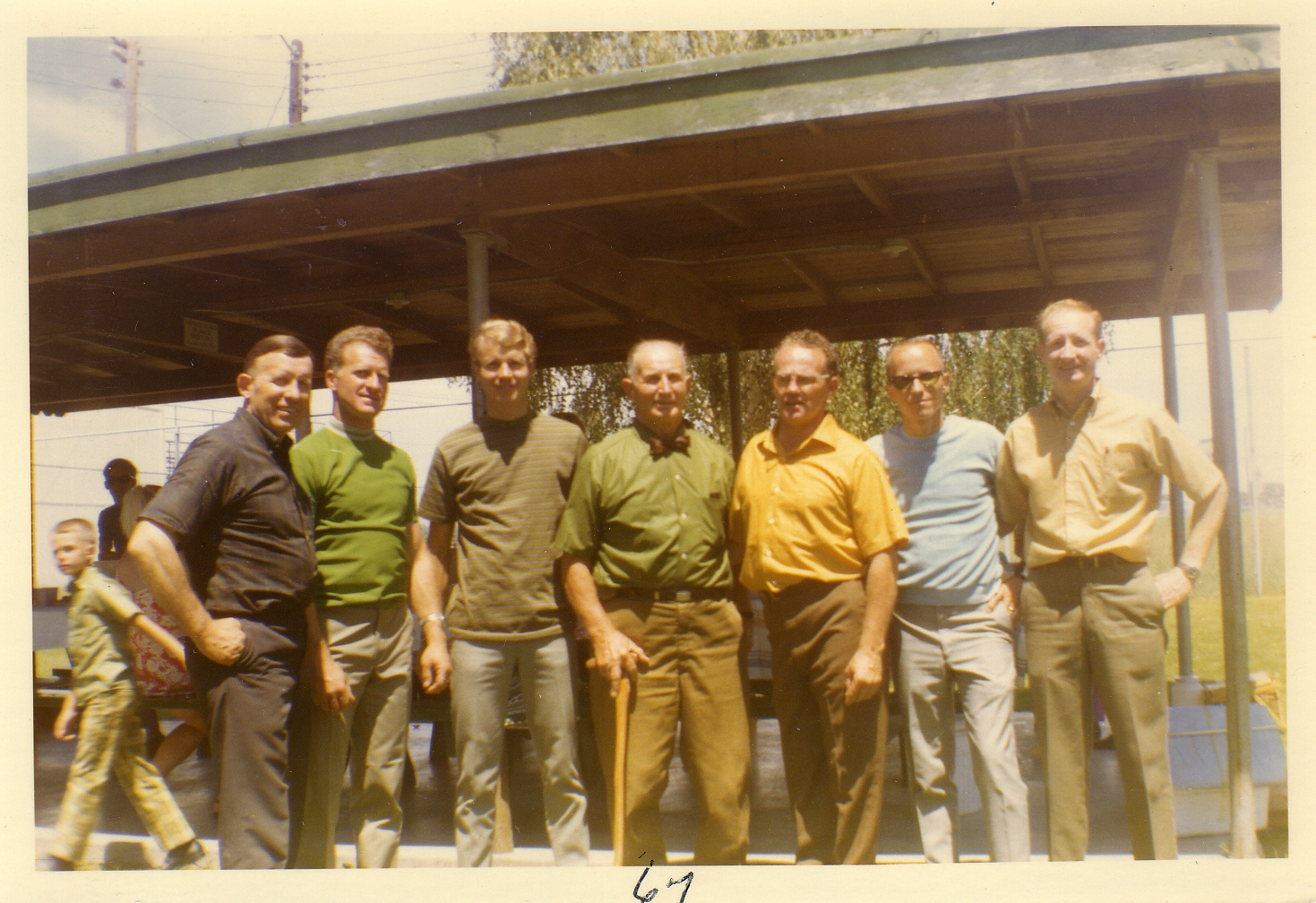
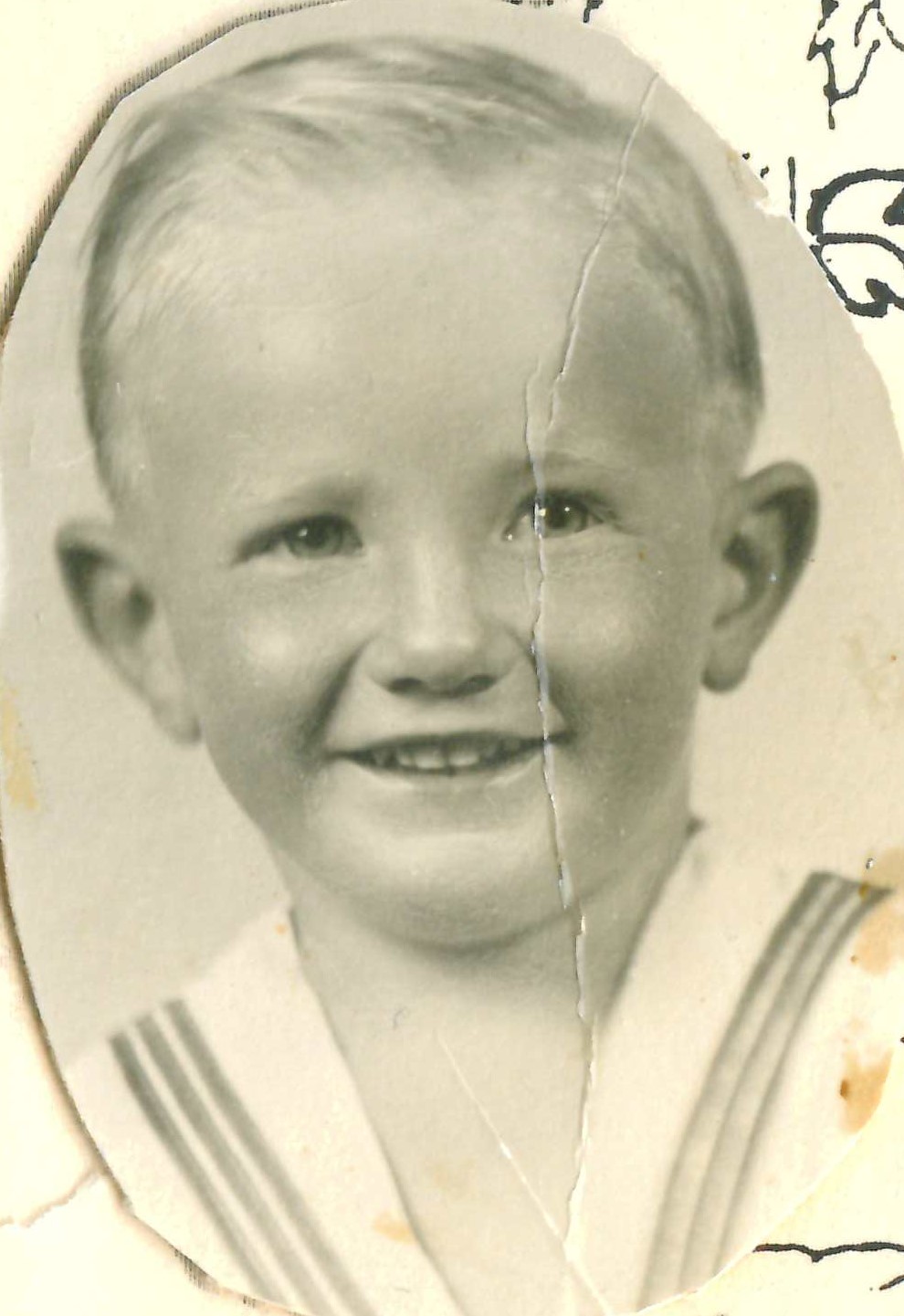
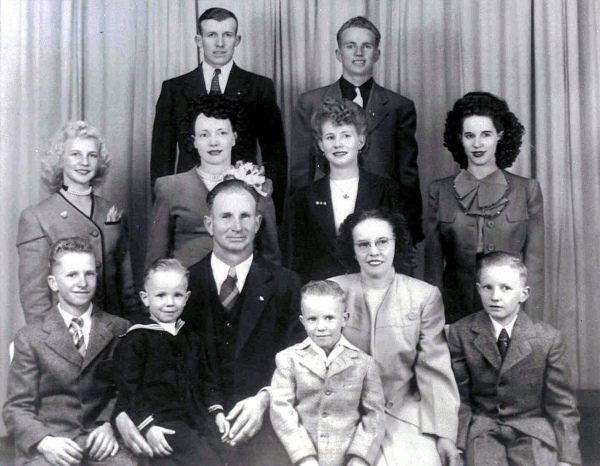
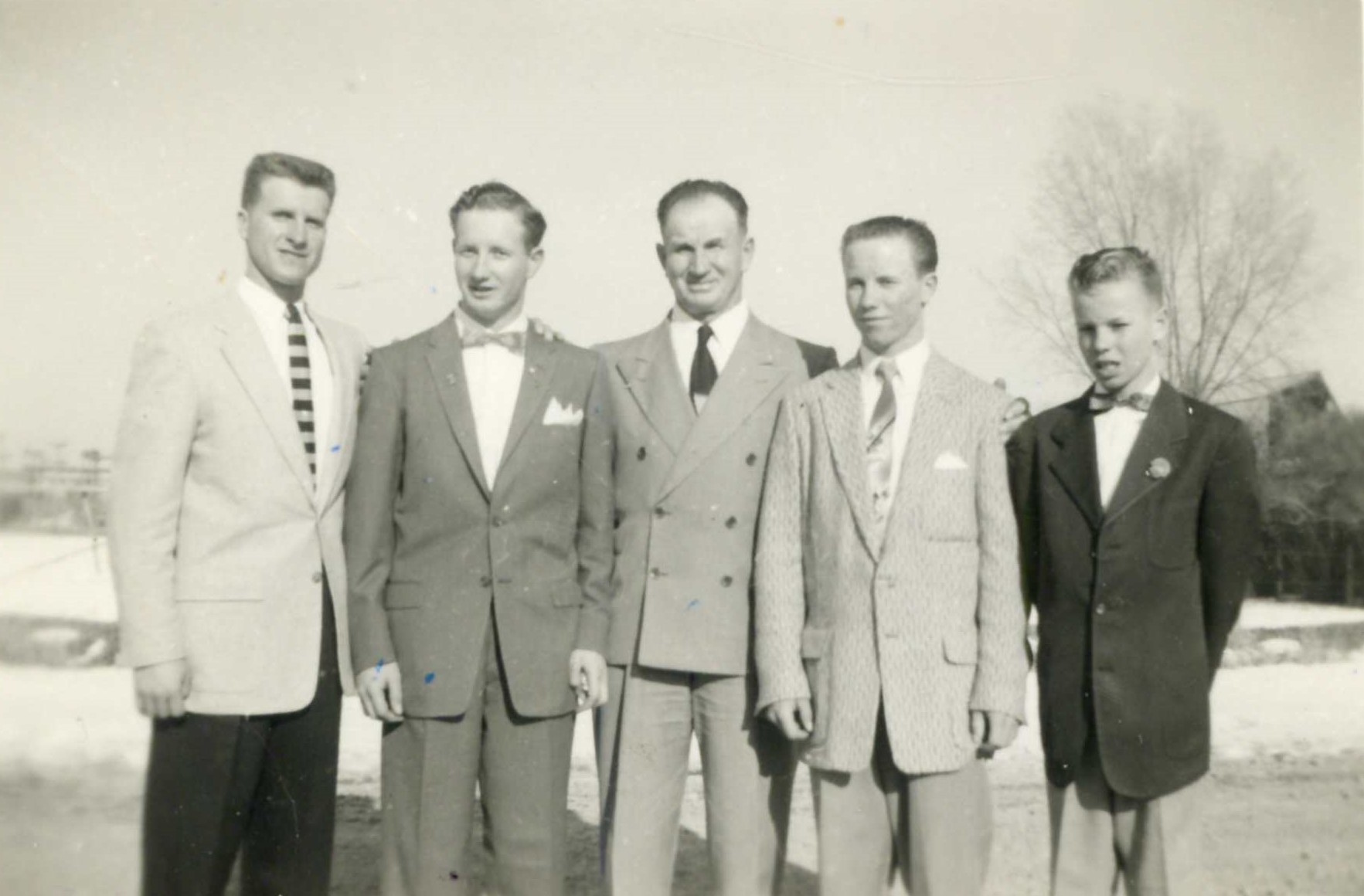
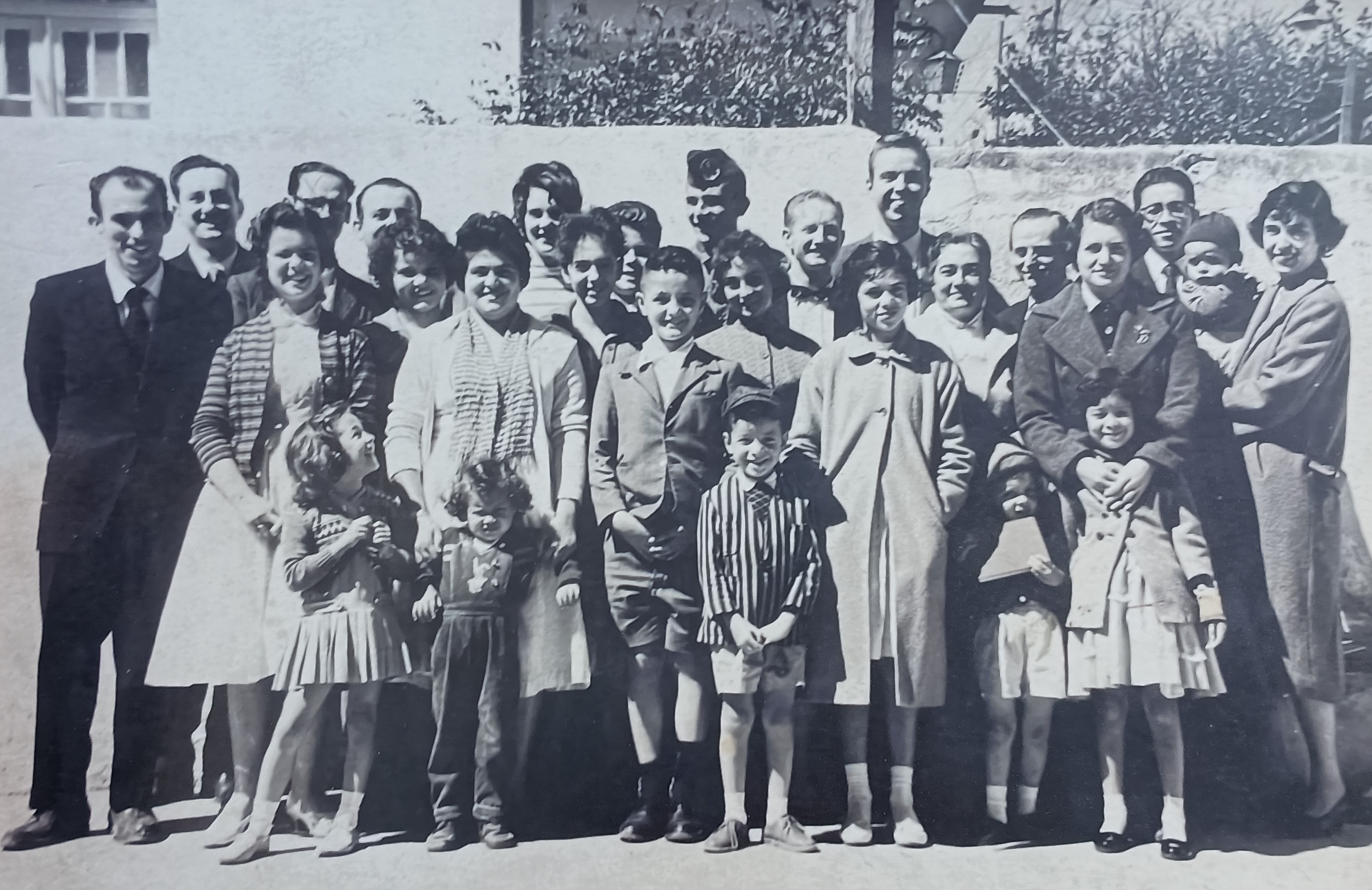
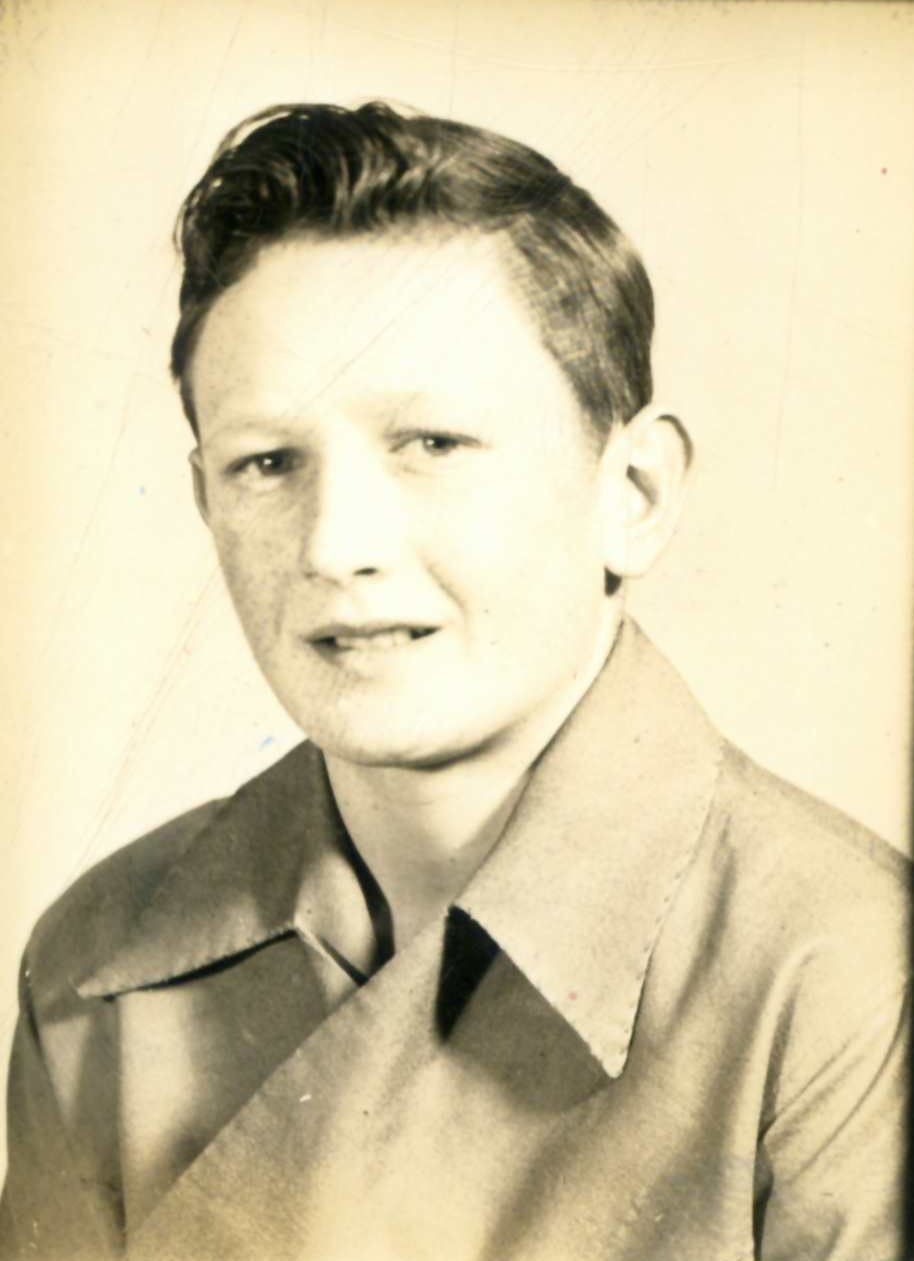
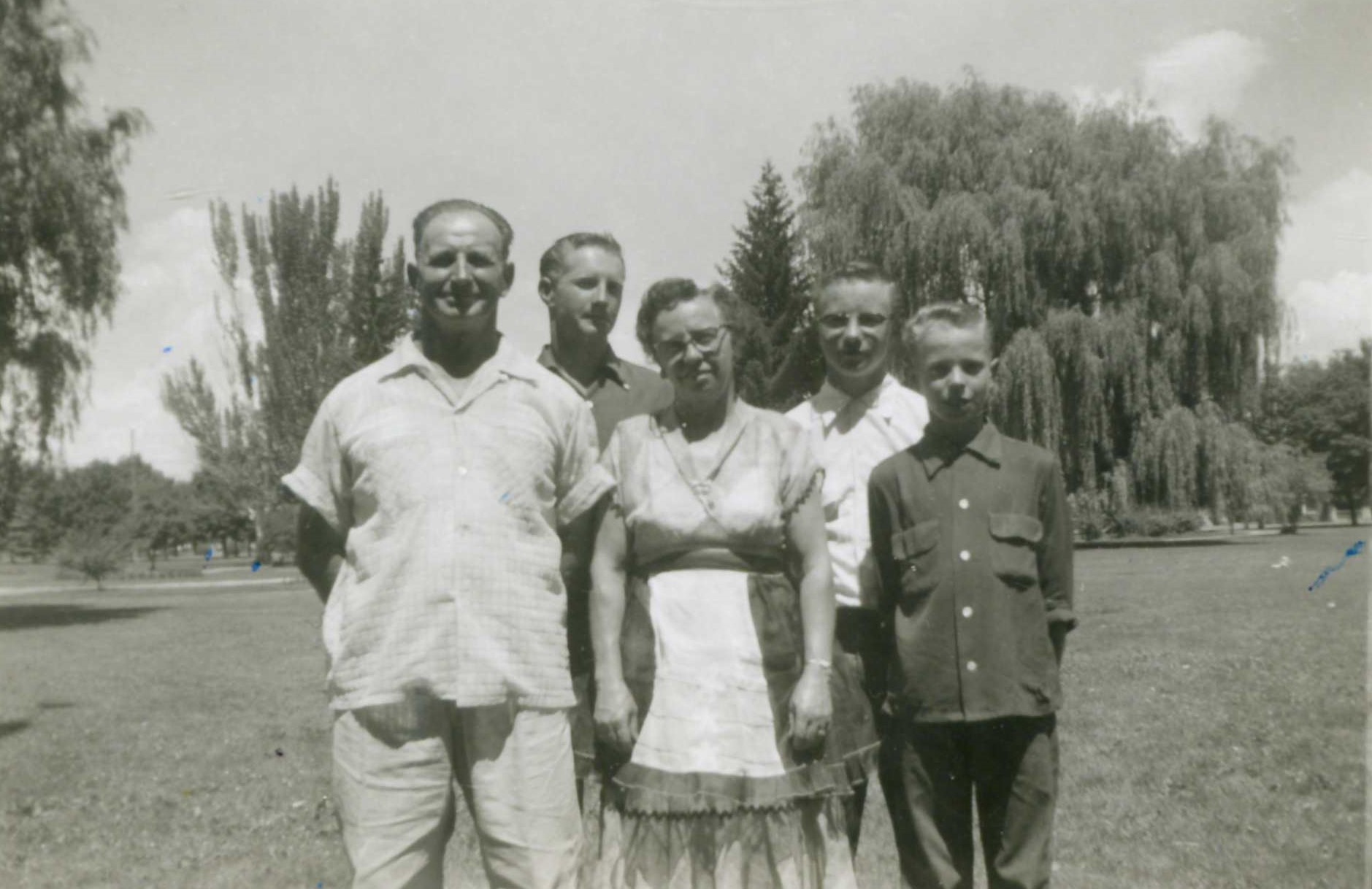
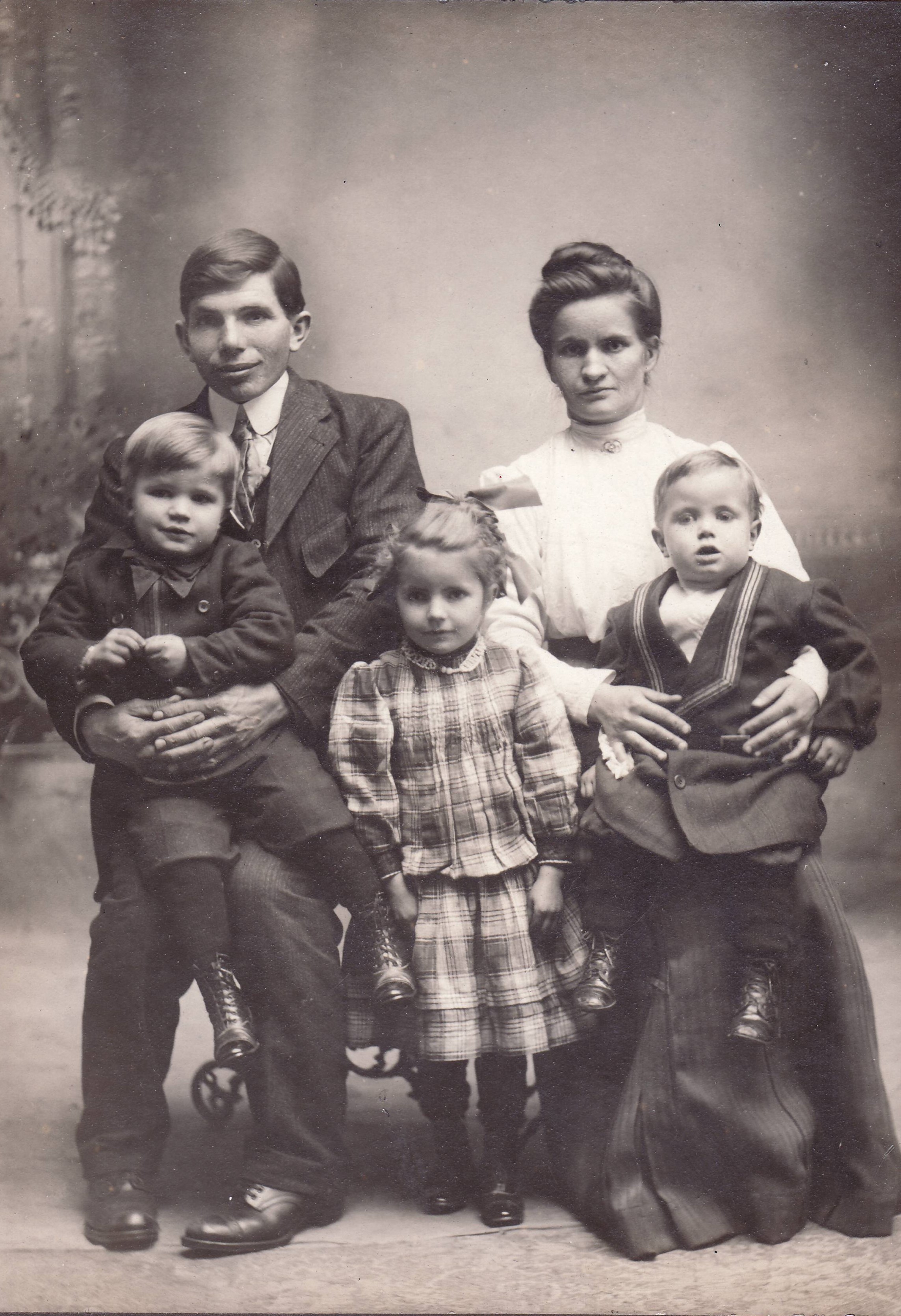
Andra Boys: William, Donald, Larry, Bill, Golden, Dale, Ross
A copy of this autobiography of my Great Grandfather was given to me years ago. I wanted to make it more widely available. I will insert clarification or other information in brackets []. I have attached the handwritten copy so you can see his handwriting.
The Life Story of William Fredrick Andra Sr I was born on February 11, 1898 in Meissen, Saxony, Germany to Wilhimina [Wilhelmina Christiana Knauke] and Theodor F. [Fredrick] Andra. My father died when I was about four years old [23 November 1902].
I was baptized in the Elbe River in [16] April 1909; came to the United States in the following month of May. I left at the age of eleven, one year ahead of the rest of the family.
The following year they were ready to come to the U.S. on the same boat but were, for some reason, delayed a month. The boat that they had intended on traveling on sank in the mid ocean. “The Lord moves in mysterious ways, his wonders to perform!”
Upon arriving here, I went to Fairview, Utah to work out my board and room from John R. Anderson, who was a former missionary in Germany.
After being in Fairview one year, I went back to Salt Lake to meet the rest of the family when they arrived.
We had quit a struggle at first, but we made out when the rest had learned the language.
I used to deliver papers, work at the slaughter house to obtain different kinds of meats to help support the family, and did all other types of odd jobs.
At the age of fourteen, my Mother took me to Preston, Idaho to the home of a former missionary [George Wanner] that helped convert my mother in Germany.
I thinned, hoed and topped beets; worked in the potatoes; and did many other things around the farm. There were about 24 head of cows to be milked. For my work, I got $18.00 a month. The next summer I got $25.00 and then $30.00 per month.
In the winter I went back to Salt Lake City because there wasn’t any work left on the farm.
I worked in the Apex Mine in Bingham at the same time that Jack Dempsey was a diamond drill sharpener.
The next winter I worked in the coal mine at Wattis in Carbon County during the flu epidemic in 1918. My future father-in-law [George Wanner] took the flu and was in the hospital in Salt Lake City. Shortly after his boy, Golden, also caught the flu and died. I took the body home to Whitney, Idaho on the train.
I did the chores for the family because they all had the flu. After working for George Wanner, 7 year on and off, I married at the age of 22 to his daughter, Mary Louise Wanner, in the Salt Lake Temple on March 10, 1920.
At a time when things were tough, I worked on the farm for James R. Bodily and in the winter I did janitor work at the Whitney School and meeting house for $30.00 a month. Then our son, William Junior was born. During this time I helped build the sugar factory in Whitney.
In 1922 we moved to Salt Lake City and I worked for the Royal Bakery for one year, then we moved back to Preston and went into the café business with my brother, Walter. We stayed in the café business until the end of 1925, then we bought the Wanner farm in Preston during the depression times.
I used to dig basements, haul gravel and sand, haul sugar beets from the beet piles to the sugar factory for $4.00 a ton. It was hard making this $1000.00 principle and $500.00 interest but with the Lord’s help and a good wife and children, we paid for the farm. In 1937 we bought 9 more acres on the east side of our farm, making 44 acres.
In 1937, I was made a High Priest. I have been a ward teacher for 36 years, ward teaching supervisor for 7 years, and a group leader for the High Priests Quorum for 12 years.
I am, at present, a director of the Mink Creek-Riverdale Canal Company.
Our main crops on this farm have been sugar beets and potatoes. We have raised peas and corn for many years.
Our present family consists of 12 children, 8 boys and 4 girls (of which 2 of the boys have passed on).
In 1947, I had a back fusion operation. It was very successful.
Seven of our children are married from which we have received 28 grand children and 2 great grand children. One of our boys is in the Western States Mission now. We have had 2 on missions previously.
I would like to pass this biography on to my son.
Prepared and arranged November 28, 1961 by William F. Andra, Sr. (Age 63) — AUTOBIOGRAPHY —
The principle factors that determined the success of William F. Andra and his wife, Mary Louise Wanner Andra, were ambition and religion. Always fight for the good!
Ross Leslie Andra, my great-uncle, died on 20 June 2024 in Salt Lake City, Utah. He was 87 years old. He was one of the younger brothers of my Grandma, Colleen Mary Andra. Some family figures cast long shadows, Ross was one of those characters.
On 29 June 2024, the Cannon Ninth Ward meetinghouse on West 1400 South in Salt Lake City filled with people who had been touched by him. Some had worked alongside. Some had received a knock at the door late in the evening. Some simply remembered the jokes. Before Bishop Ted Maxwell called the meeting to order, it was clear that a certain kind of man had died — the kind the eulogists kept calling, with unfeigned sincerity, bigger than life.
I have shared many posts regarding the Andra family. Many of those that reference Ross are listed below, but many more deal with the broader Andra family. This post attempts to bring some of that documentation together as a tribute.
The Family
William and Golden in back, Sergene, Millie, Colleen, June standing, Donald, Larry, Bill, Dale, Mary, and Ross sitting.
The world Ross was born into had been built across two continents and three generations. His grandfather Friedrich Theodor Andra had been born in Rosswein, Saxony in 1867 and died in Meissen in 1902, when Ross’s father Bill was just four years old. Bill’s mother, Christiana Wilhelmina Knauke, brought the family to America. Bill arrived alone in May 1909 — at eleven years old you paid reduced passage; at twelve, full price — and went first to Fairview, Utah, then to Preston, Idaho, where a former missionary named George Wanner had helped convert the family in Germany. Bill worked the Wanner farm for seven years, at $18 a month rising to $30, milking twenty-four cows, doing any work he could get. He married George’s daughter, Mary Louise Wanner, in the Salt Lake Temple on 10 March 1920. Christiana Knauke Andra — Ross’s grandmother — lived until Christmas Day 1957 in Salt Lake City. She was still alive when Ross stepped onto the plane for missionary service in Brazil.
Mary Louise was equally remarkable. She had nursed flu victims during the 1918 epidemic, nearly became a professional jockey at the Logan County Fair, outran all the girls and most of the boys at school in Preston. She and Bill built their life in Depression-era conditions — $1,000 principal and $500 interest on the farm, with Bill digging basements and hauling gravel and taking sugar beets to the factory at $4 a ton to make the payments. Mary’s autobiography, written in November 1961, records it without complaint: “With the Lord’s help and a good wife and children, we paid for the farm.” Her garden in Preston was massive — flowers surrounding it, vegetables in rows — and beautiful enough that even a nine-year-old boy visiting with his grandmother noticed and remembered. Ross spent the rest of his life planting tomatoes wherever he could find a plot of dirt. He was his mother’s son.
Twelve children were born to Bill and Mary between 1920 and 1943. Two died young — Robert Lee on his first day in 1934, Dennis Willard in January 1945, four days after his third birthday, of an earache in the night. The ten who survived grew up in close quarters on the Preston farm, with the pranks you would expect from six boys and four sisters sharing a household. Ross and his brothers once tied a cow to their math teacher’s front door.
Don, Ross, Bill, Dale, and Larry Andra, Preston, Idaho – 1950s
23 January 1957
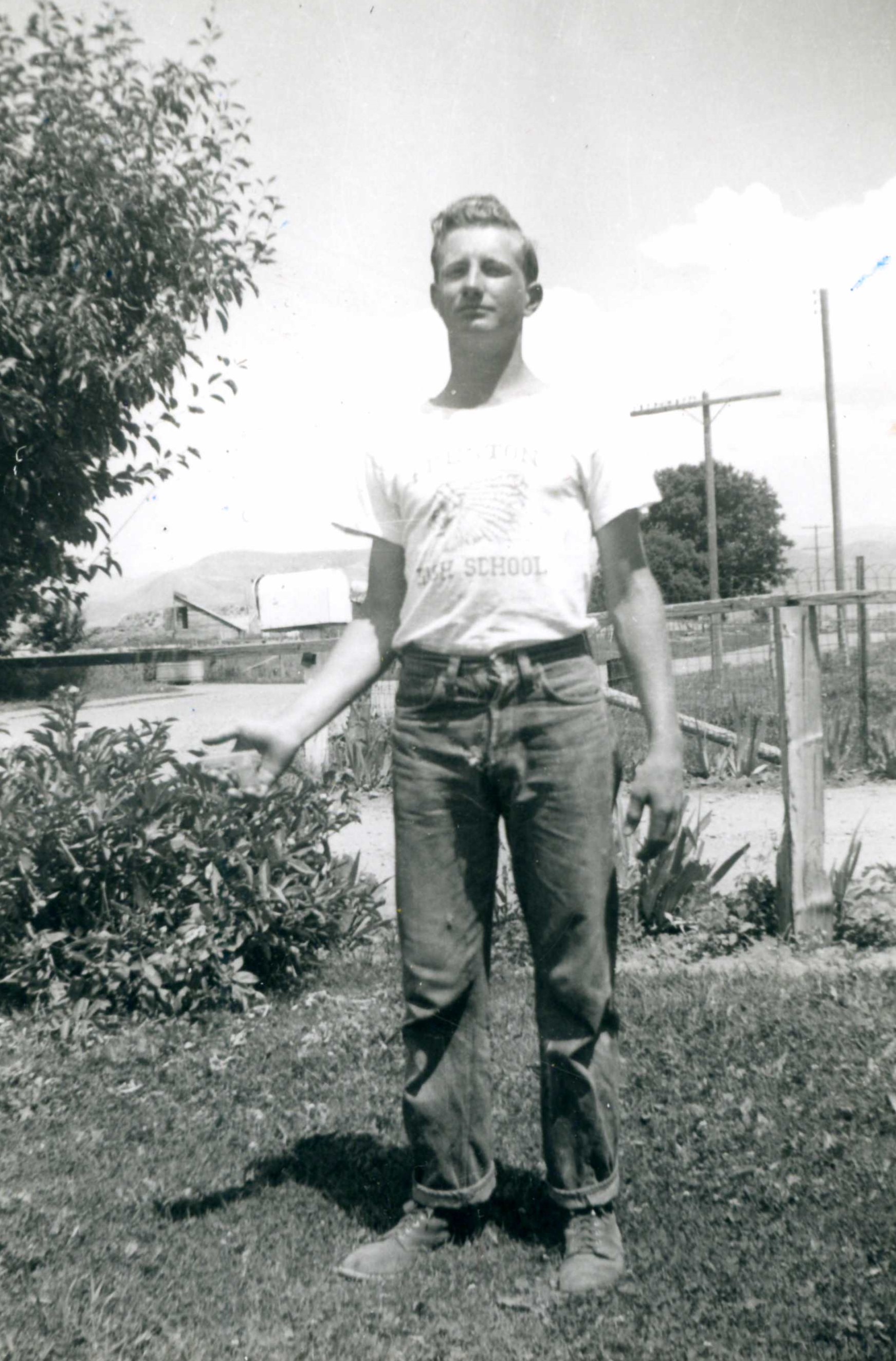
Ross Andra, Preston High T-shirt, backyard
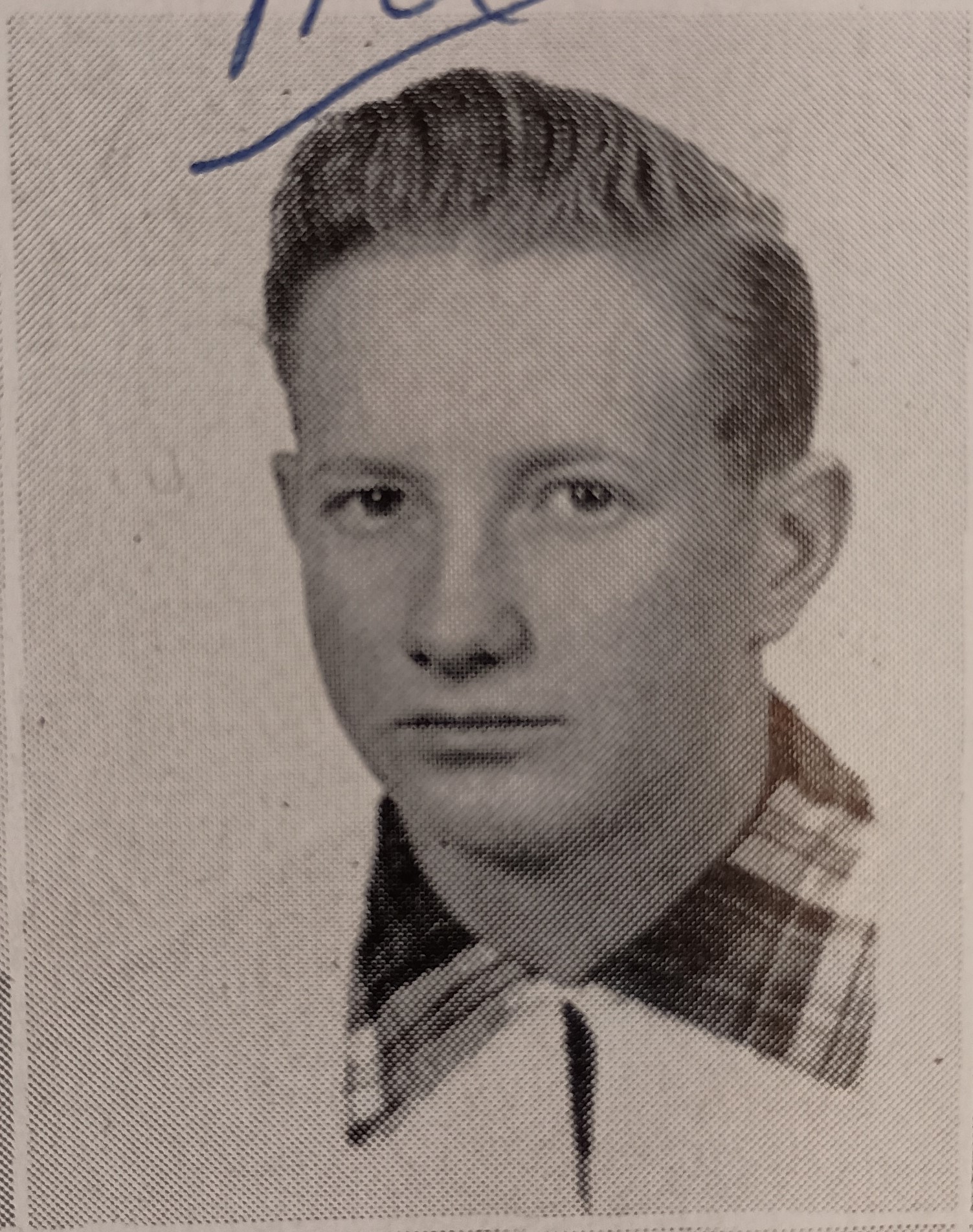
Ross graduated from Preston High School in 1955. He spent two years at Utah State Agriculture College, then headed east with his brothers Donald and Golden to work construction on the St. Lawrence Seaway project in Massena, New York. Golden was a general foreman on the Eisenhower Lock — photographed in the project’s official records, named in the local newspaper. Donald met and married a woman in Hogansburg, New York. Ross told me stories about New York, though I cannot remember enough of them to share now. What I know is that the three brothers were there together, Idaho farm boys pouring concrete on one of the great infrastructure projects of the Eisenhower era, on the St. Lawrence River in the far north of New York State.
Then Ross came home and left again — this time for Brazil.
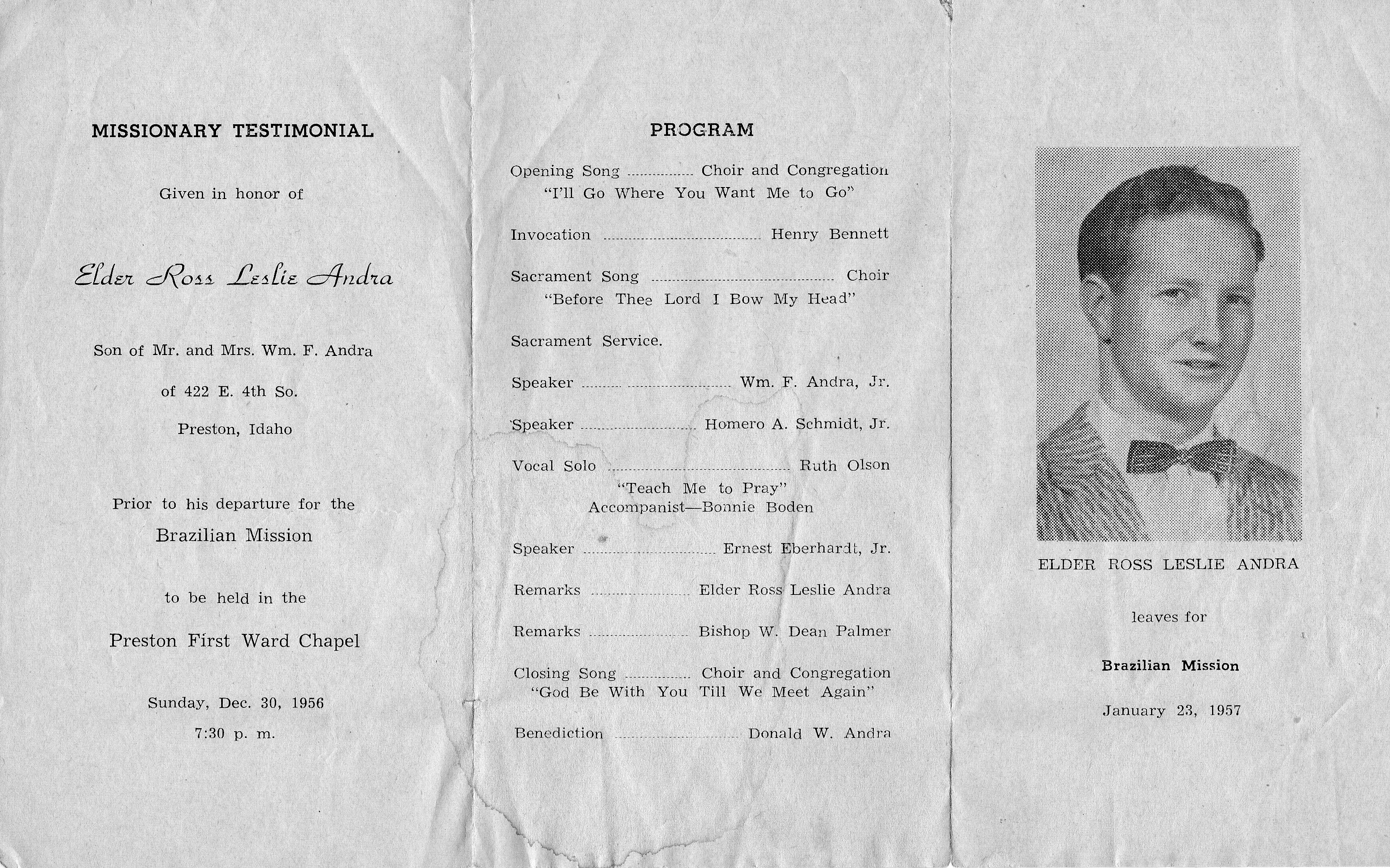
Ross Andra Missionary Farewell Program – 30 December 1956.
The missionary farewell program for Elder Ross Leslie Andra is dated Sunday, 30 December 1956, Preston First Ward Chapel, 7:30 p.m. The opening hymn was “I’ll Go Where You Want Me to Go.” His brother William Jr. — who had himself served in Mexico from 1941 to 1943, the first of the Andra brothers to go — spoke at the service. His brother Donald gave the benediction. Ross made his own remarks. Bishop W. Dean Palmer closed. The program reads: Elder Ross Leslie Andra leaves for Brazilian Mission, January 23, 1957.
I remember Ross telling a story. He had just returned home from his mission in Brazil and was sitting on the stand at Stake Conference with other returned missionaries. Apostle Joseph Fielding Smith was speaking at the pulpit. Elder Smith was speaking about being strictly honest with your fellow man. Elder Smith related a story that told of a guy who admitted to Elder Smith that he was not as honest as he should be. The irony of a man honestly confessing his inability to be honest struck a nerve with Ross. He got the giggles. Apparently he looked at someone else who also found the irony humorous and the laughter broke out and spread. Apparently Elder Smith turned around to look at them with a very unfavorable look. It only added to the giggles. Ross admitted it might have been his Brazilian sense of humor. He laughed even as he told me about the story.
Four years later — on 9 October 1960 — Ross stood at that same Preston First Ward pulpit as his farewell and spoke at the farewell for his younger brother Dale, who was leaving for the Western States Mission. The brothers sent each other off, one by one, into the world.
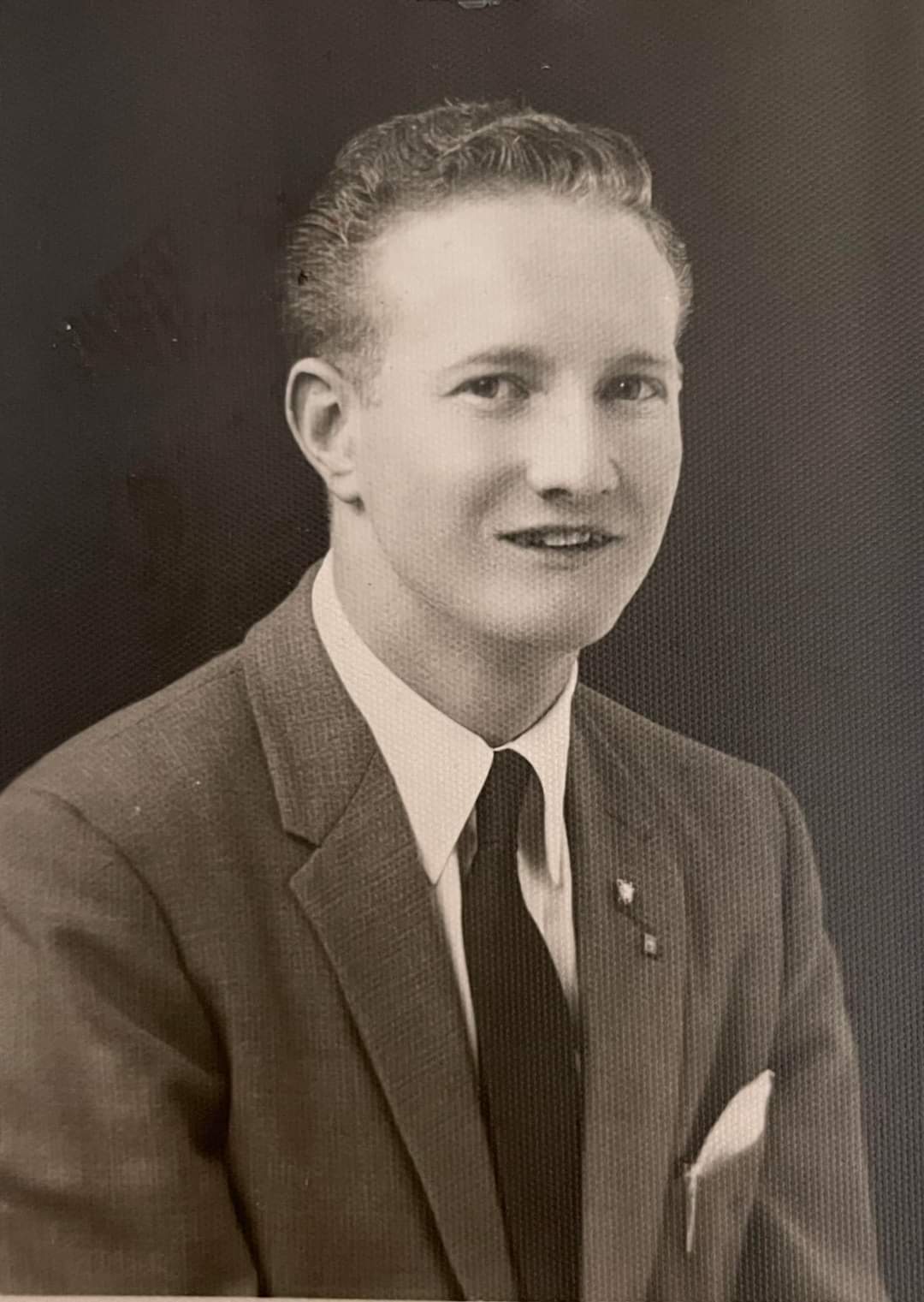
Ross served in Brazil from 1957 to 1959. He came home, enrolled at Brigham Young University, studied political science, speech education, and Portuguese, graduated with a Bachelor of Arts in 1964. But the most important thing that happened in Brazil was Adelaide.
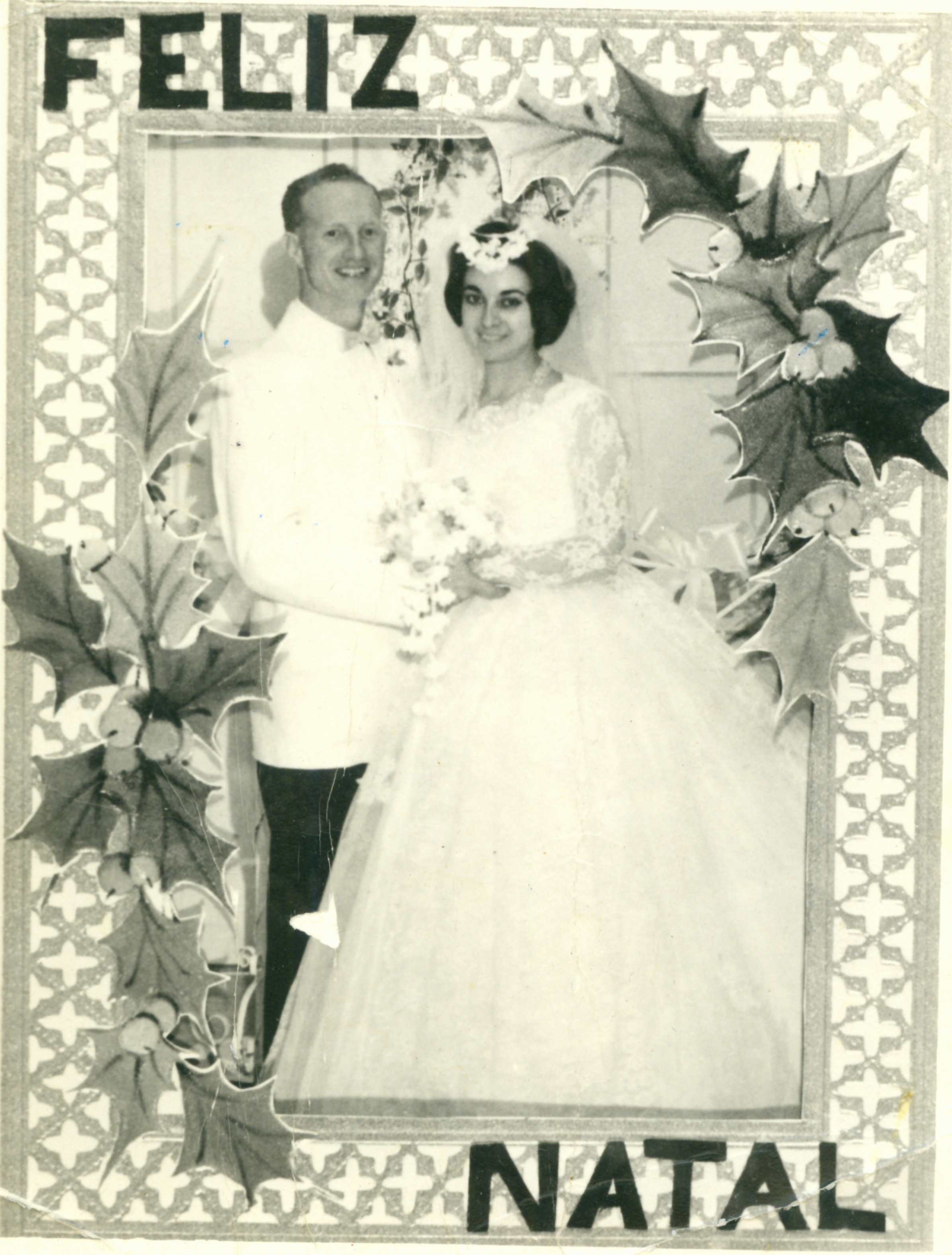
Feliz Natal
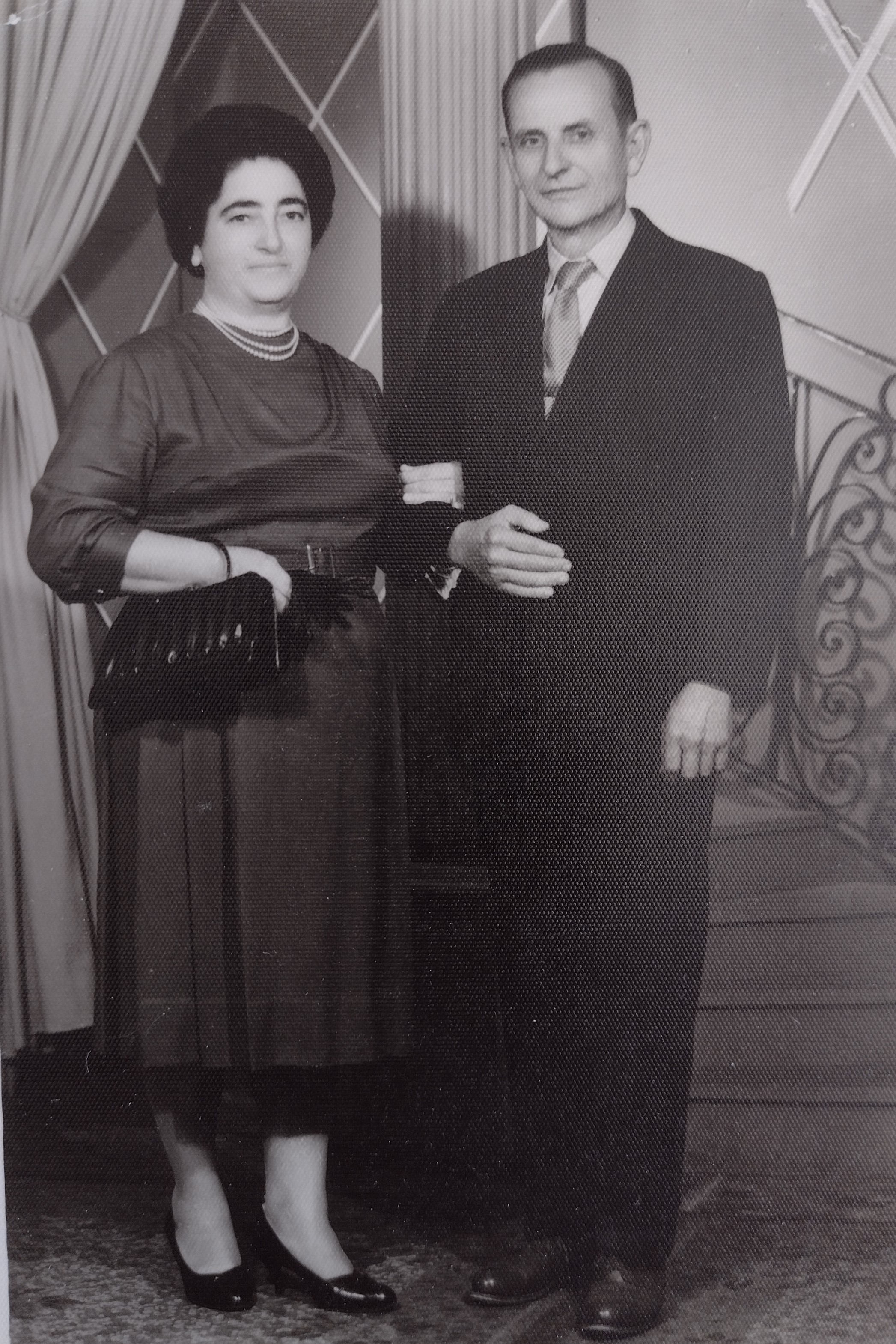
Angela and Blas Gonzalez, Adelaide’s parents
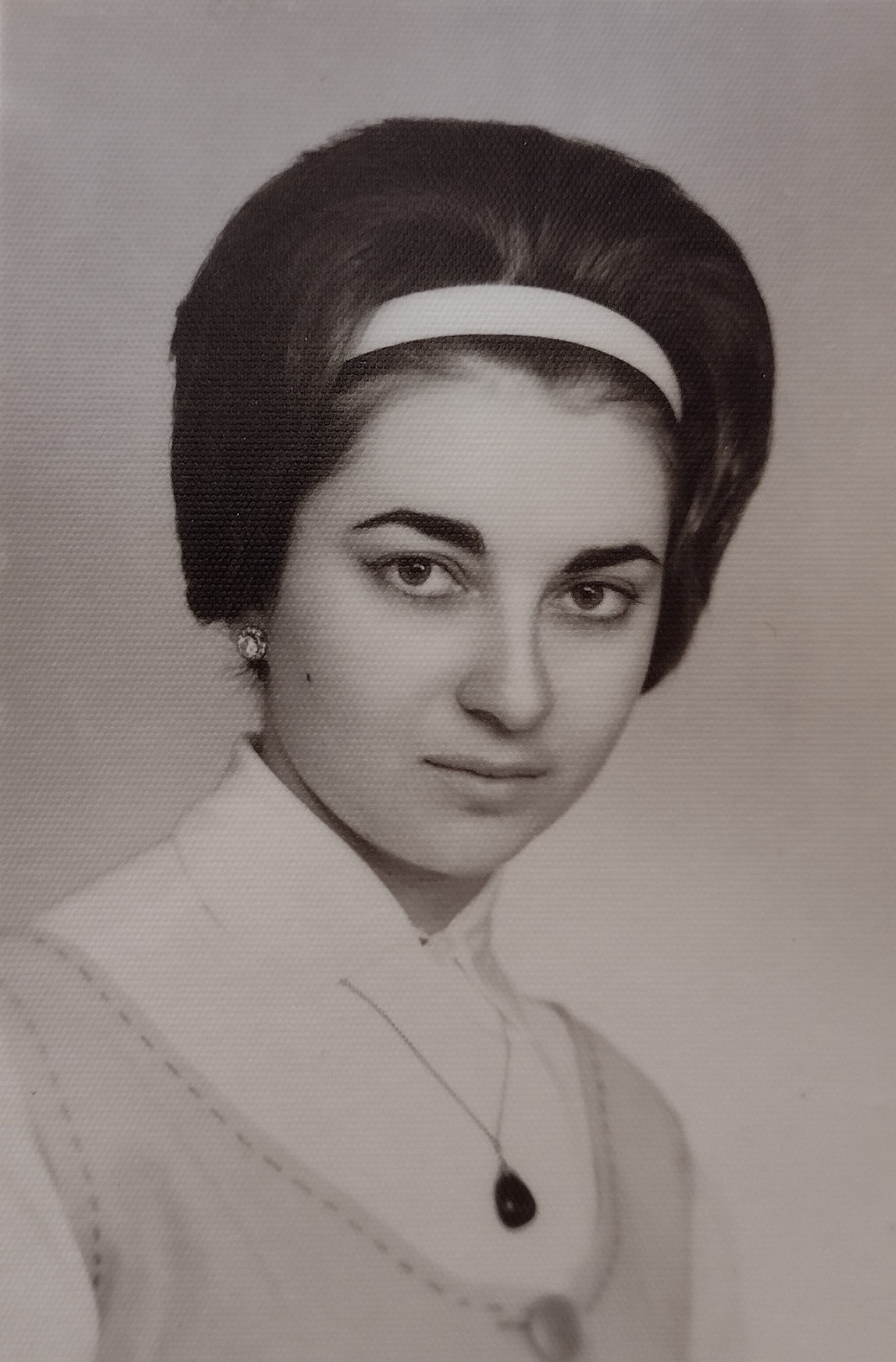
Adelaide Gonzalez Carrenho, Brazil
Adelaide Gonzalez Carrenho — the daughter of Angela and Blas Gonzalez of Brazil — was a young woman of dark eyes and composed beauty when Ross encountered her. I seem to recall that he said they met on a trip back to Brazil after his mission. After he returned to BYU; they kept in contact across the distance. On 14 June 1963, in the Logan Utah Temple they were joined in the holy bonds of matrimony for time and for all eternity. The witnesses on the marriage certificate are William F. Andra Sr. and Dale Andra — Bill and Dale, father and brother, standing at the altar the day Ross married his Brazilian bride. A missionary friend named Phyllis Merrill, who had served in Brazil and become one of Adelaide’s closest friends, spent the wedding day interpreting for Adelaide as she went through the Logan Temple for the first time. (The wedding photograph, with full identification of those present, is available here. The marriage certificate is here.)
Ross & Adelaide Andra 1965 Christmas Card
That Christmas, Ross and Adelaide sent their wedding photograph to friends in Brazil as a holiday card.
His daughter Brenda captured it simply at the funeral: Ross had “a deep love for Brazil, its people and culture, and especially for his little Brazilian bride.” That love never left him. In his later years, when health prevented the overseas return mission he and Adelaide had always wanted, they served as local service missionaries to the Portuguese- and Spanish-speaking wards of the Salt Lake Valley, driving all around visiting families, making sure they had what they needed.
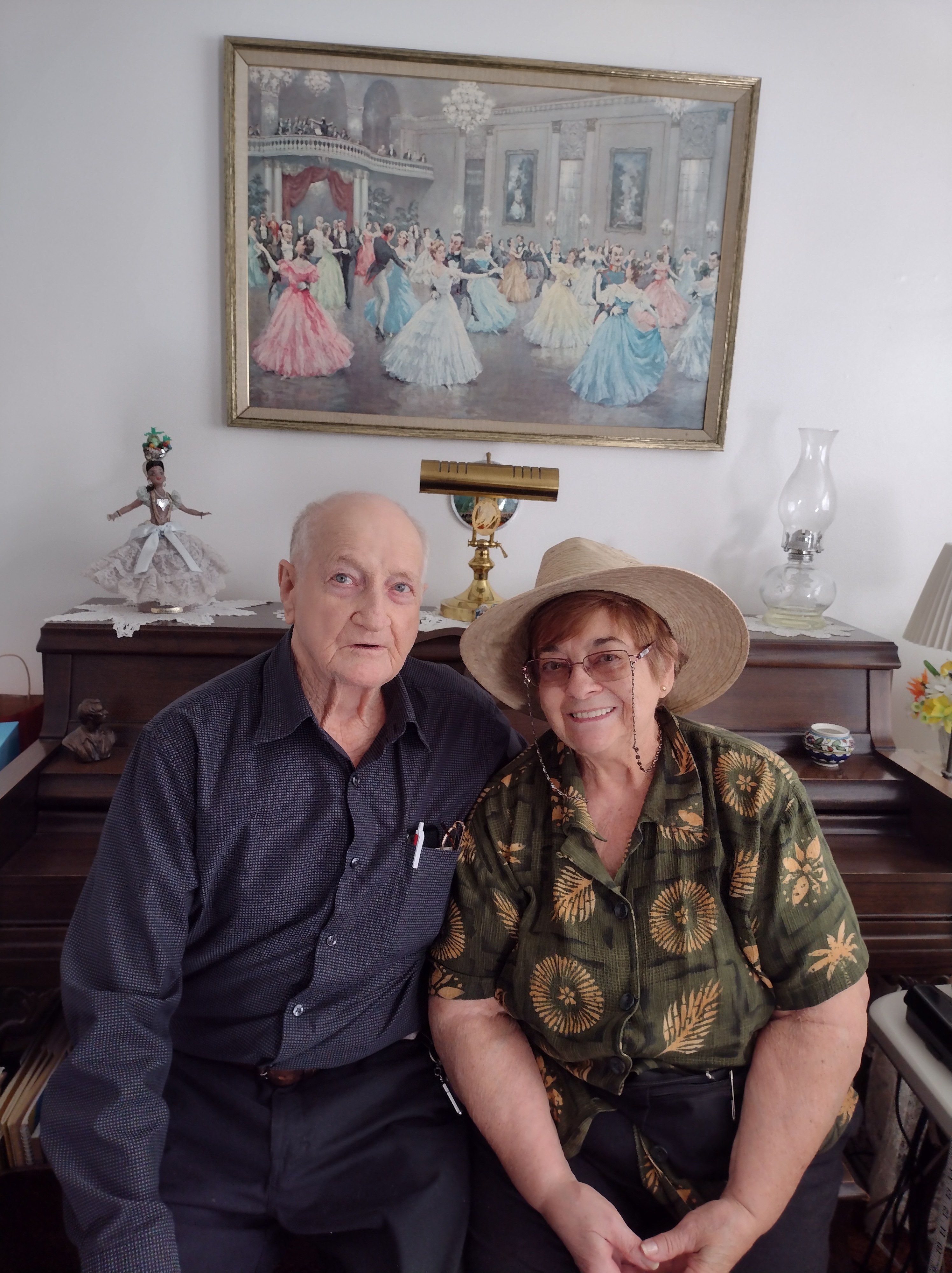
Ross and Adelaide Andra, SLC home, October 2022
The Working Life
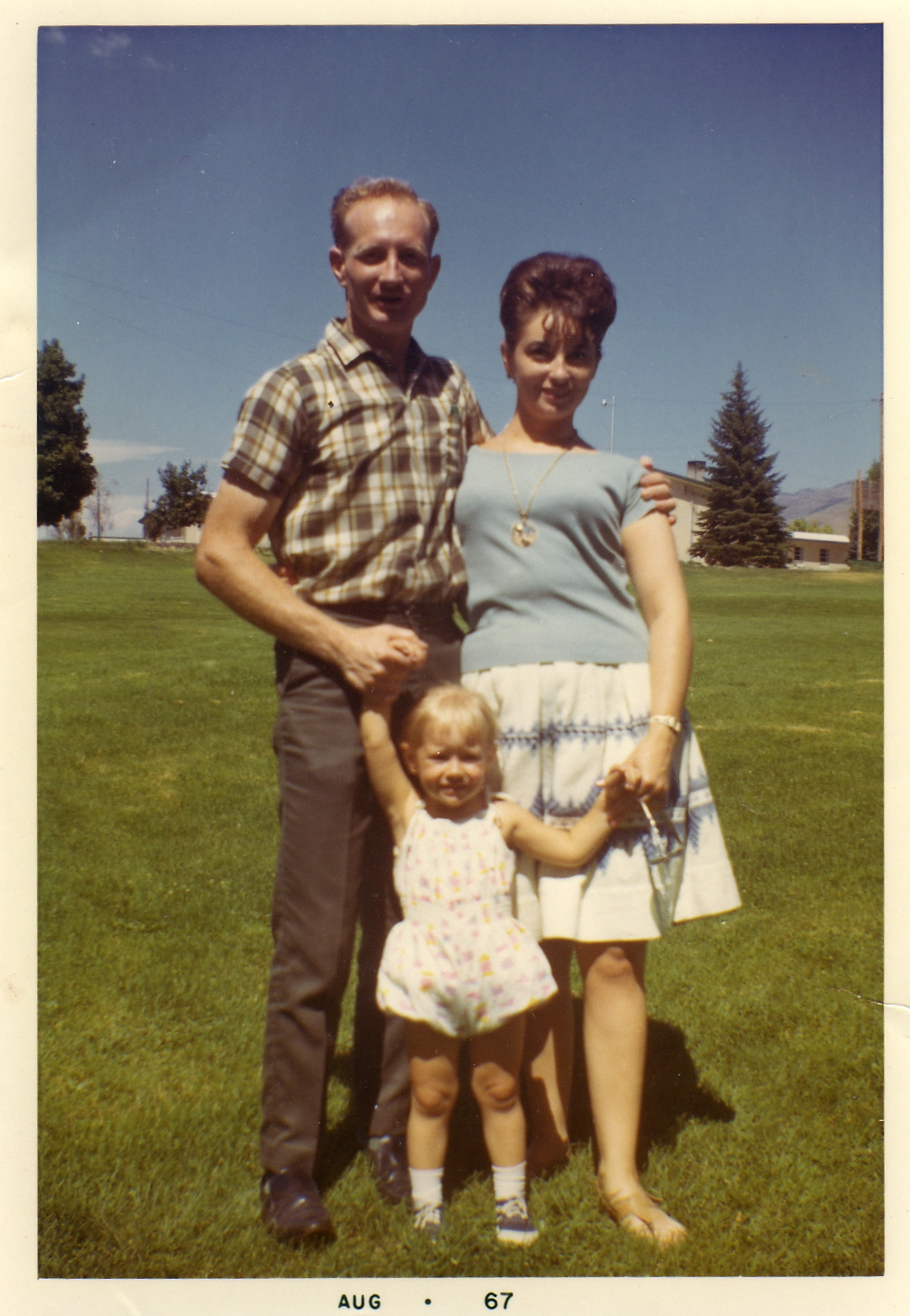
Ross, Adelaide, Brenda Andra – August 1967
The career of Ross Andra resists a single title. High school teacher. Coach. Candyman. Small business owner. Appliance installer. Furniture mover. UPS driver. Medical courier. He was, as his friend Frederick Johnson insisted at the funeral, an entrepreneur — a man who believed in the American dream and in hard work and gumption as its instruments.
As the Candyman, he kept the vending machines stocked in his eldest daughter’s school teachers’ lounge, and he would sometimes appear at recess to distribute candy on the playground, which made Brenda quite popular with her classmates. As a business owner, he often took his son Carlos along to deliver and install appliances and move furniture, with the result that Carlos learned to load a truck with the systematic precision of a Tetris puzzle. He gave his youngest daughter Denise a tutorial in personal finance when she was struggling with debt; she paid everything off.
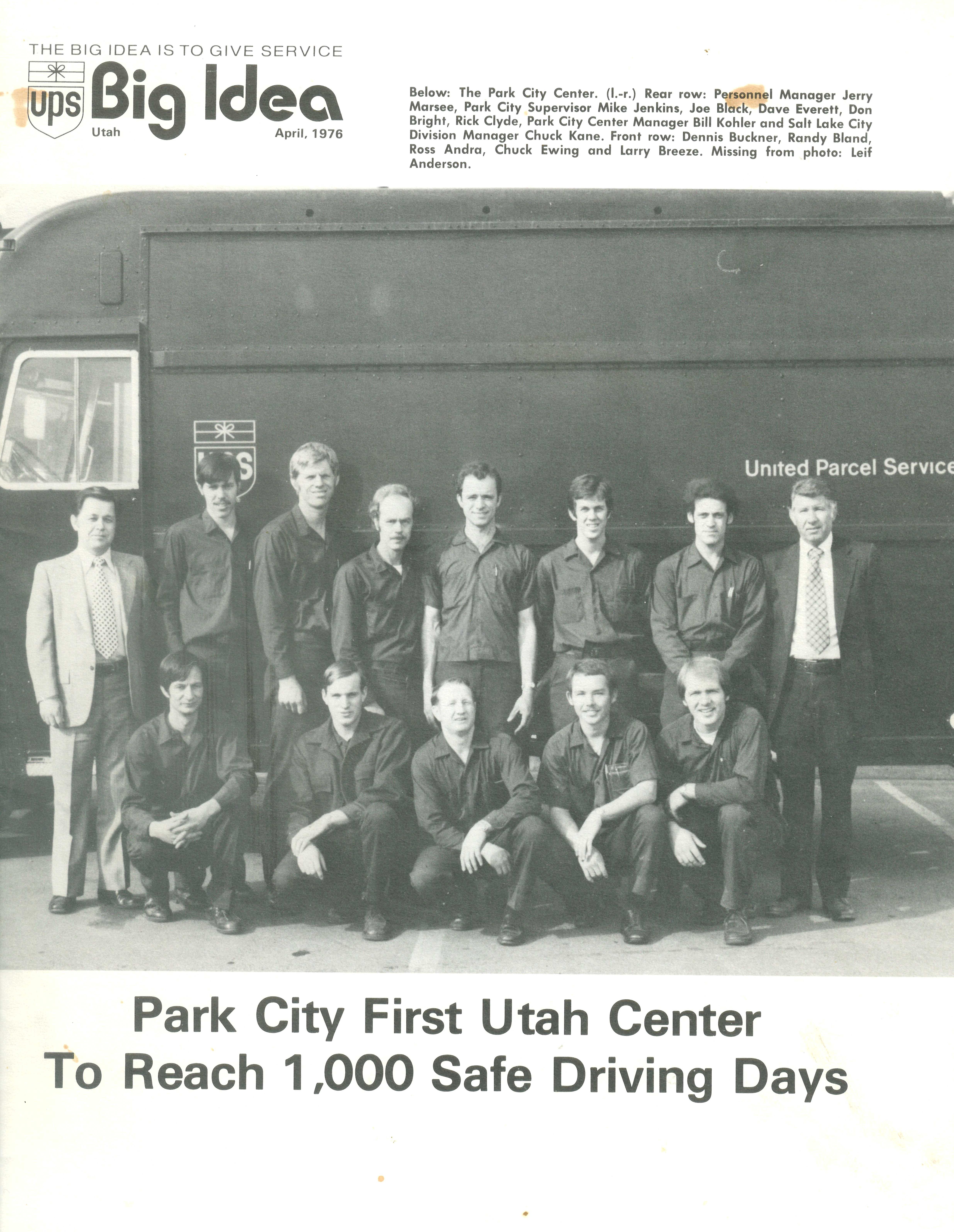
UPS company newsletter Big Idea, April 1976, Ross Andra is named as one of the drivers who helped get to 1,000 safe driving days
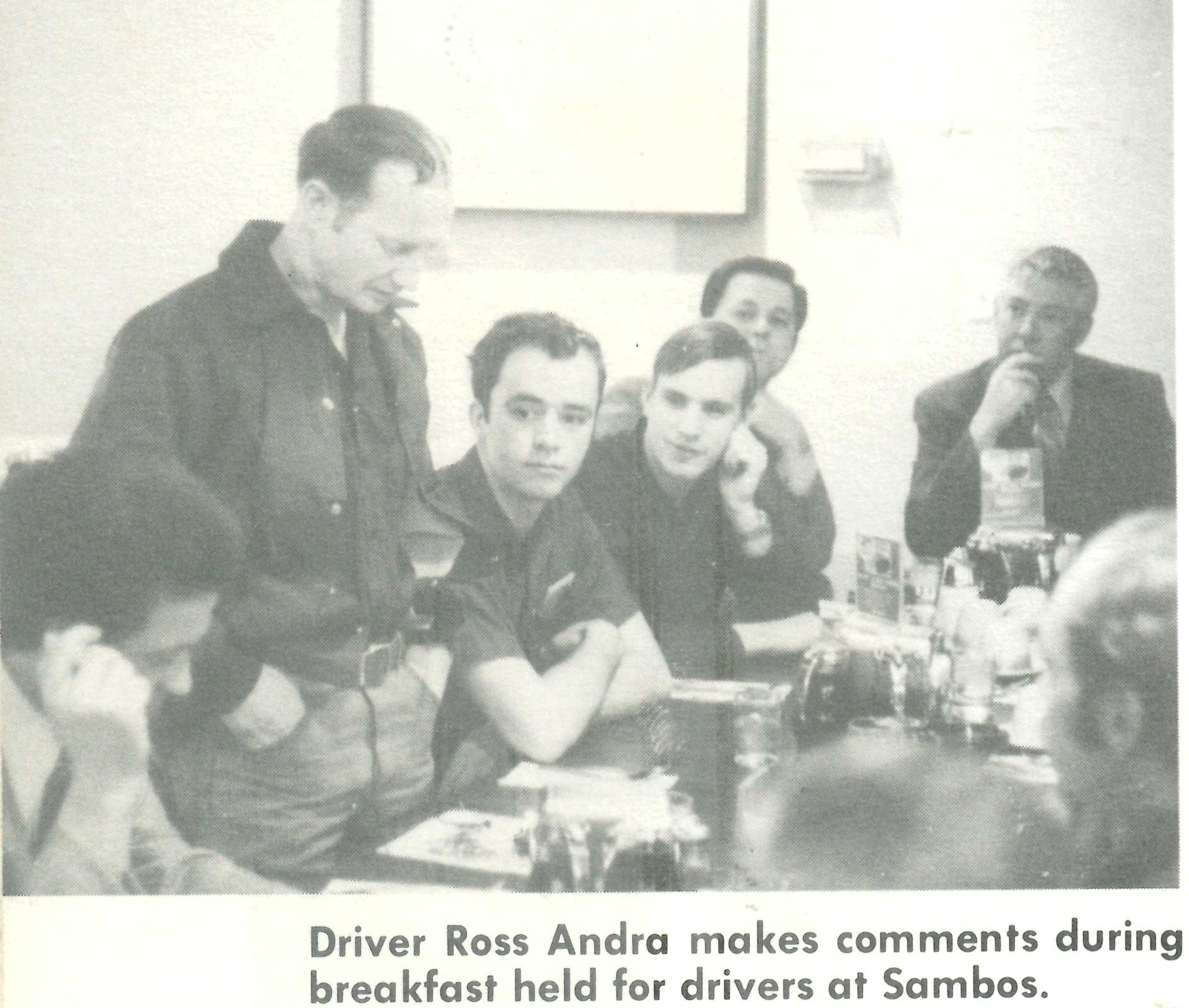
Ross Andra makes comments during breakfast held for drivers at Sambos
The April 1976 edition of the UPS company newsletter Big Idea photographed the Park City, Utah center — first in Utah to reach 1,000 safe driving days — and named Ross Andra in the front row. A separate photograph from the same period shows him standing at a drivers’ breakfast, mid-comment, captioned: “Driver Ross Andra makes comments during breakfast held for drivers at Sambos.” He drove a fully loaded truck the way most people drive a compact car, weaving through traffic with an ease that still astonished Frederick Johnson decades later. Before GPS, he had the entire I-15 corridor memorized. He was the GPS. In his later years, until age 84, he delivered blood and vital organs to medical facilities across Utah, Idaho, and Wyoming. He made people laugh the whole way.
Ross and Adelaide Andra
Ross the Boss
Judy, Dale, Mary, Bill, and Ross Andra, September 1962
Frederick Johnson — known as Freddy, or Frederico — spoke at the funeral. His father Ranley had worked weekends with Ross for years delivering and installing appliances, and when Frederico turned sixteen the interview for joining the operation was brief. “Frederico, you’re sixteen, right?” “Yeah, I’ll be sixteen at the end of —” “Frederico, you’re sixteen.” “Yes.” That was the interview.
Working with Ross, Johnson said, was better than television, even when it was miserable hard labor. His father would come home Saturdays with tears rolling down his face from laughing. The phone would ring — Ross, calling to debrief, mostly to replay the jokes that were played during the day.
Ross was a virtuoso practical joker. He favored ice dropped down the back of your shirt on hot summer deliveries. He perfected the screwdriver dropped at precisely the moment a man was bent double lifting something heavy. For years he carried a novelty ID with Elvis Presley’s photograph and produced it whenever anyone asked for identification — cashier, security guard, TSA agent. “That’s what drugs will do to you.” He once deployed it at a Salt Lake airport checkpoint around September 11th while escorting Johnson to his gate. Johnson nearly missed his plane.
But the parrot story is the finest. Ross’s family had long laughed about his famous account of being called back to the farmhouse by his mother — or so he thought — only to find a chicken calling his name. That story about a chicken that was loud enough and gave a distinct “Rawwwsss” more than once was confused for his mother calling for him. One afternoon, Johnson’s father came home from a delivery unable to speak from laughter. They had delivered a washer and dryer to an elderly woman’s home. Ross was in the basement doing the hookup. There was a parrot. Ross called up the stairs: “Is there a drain down here? We need to drain a little water.” The parrot said: What? Ross tried again. What? Is there a hole where the water goes? What? Ranley, upstairs, was quietly disintegrating and trying to hold in the laughter. Ross, red-faced and fully irritated, eventually came upstairs. When he saw Ranley’s face, he understood he had been duped by a parrot. Ranley laughed about it the whole rest of the day. The story became one of lore.
“It was rare,” Johnson said, “to get one on Ross. He always had the drop on you.” The parrot did it magnificently.
For all his irreverence — and Johnson named it plainly — there was something untouched by it. Ross never swore. He had code words and nicknames. But when it came to his faith and his testimony, Ross was always reverent. Bishop Maxwell put it simply at the close: Ross loved the scriptures. He loved the word of God. He loved Jesus Christ. And he brought that light into everything he did.
The Mission Couple
Ross and Adelaide Andra
Clay Celestino, who served as bishop of the Mountain Shadows Ward, offered a different angle. The Brazilian immigrant wards of Salt Lake City in the early 2010s were large and underserved — hundreds of families struggling with injury, poverty, paperwork, language. The Andras came as service missionaries between 2009 and 2015, and Celestino said plainly they were indispensable.
He remembered a specific night: 22 January 2013, 12:19 a.m. He sent an email. Eight minutes later, Ross replied: “Hi, Bishop. That’s no abuse at all to ask for the things you’re asking. That is the reason why we are serving a mission. We want to help our brothers and sisters the best way we can. Tomorrow I will make a few phone calls and I will provide you with the information you need.”
The list of those they helped, Celestino said, went on and on. And then, at nine in the evening, talking to Ross, you would find out he still had deliveries to make for his other job.
When the Andras were transferred unexpectedly in September 2013, Celestino read at the funeral the farewell letter he had written them at the time. He had copied the entire ward leadership. He thanked Ross for allowing him, as bishop, to concentrate on other responsibilities. “For that I will be eternally grateful to you and to Heavenly Father.” He asked them not to forget the ward. “We will not forget you.”
The Brothers
Bill, Ross, Mary, Dale, Larry Andra – late 1950s
Larry Andra — the last of the twelve, the youngest surviving child of Bill and Mary — gave the family prayer before the service and spoke as one of the main eulogists. He described the family with the dry affection of a man who has lived long enough to be the last one telling the stories.
William Jr. went first among the siblings, in 1992. Then June and Colleen in 1999, Golden in 2004, Sergene in 2013, Donald in 2016, Dale in 2021. At Dale’s funeral in August 2021 — three years before Ross’ — Ross was listed among the honorary pallbearers. By the time Ross died in June 2024, of the twelve children of Bill and Mary Andra, only Larry remained.
Dale’s funeral was held during the week of the annual Andra reunion. Larry noted that was Ross’s last reunion here on Earth. The reunions had been going since the children were young — Preston Fairgrounds, Logan Park, Lava Hot Springs, Wolcott Park by the Minidoka Dam, Richmond City Park, Riverdale, then wherever families could gather. I remember Bill Andra at those reunions. I remember the sly look that sometimes crossed Bill Andra’s face when he was about to tease someone. Ross had inherited that look too. You knew when a tease, joke, or prank was coming by the look on his face.
2010 Reunion: Ross, Donald, Larry, Sergene, Neil Anderson – 2010 Andra Reunion
The Close
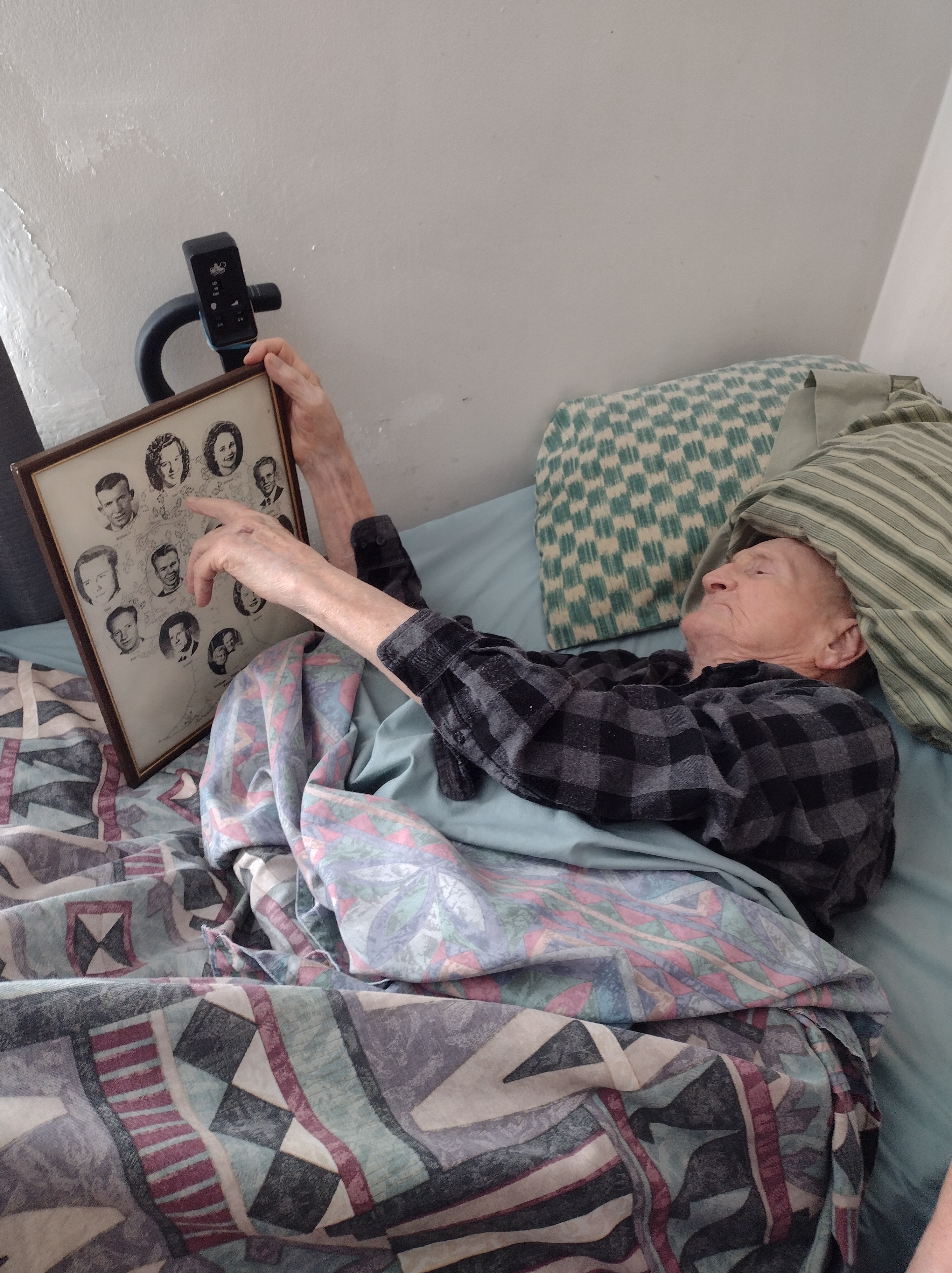
I snapped this picture of Ross the last time I visited him, 23 December 2023 at his home.
Bishop Ted Maxwell had only known Ross since the COVID years. What he had seen was enough. In the final months, when Ross could no longer come to church, he called the bishop after every sacrament meeting to report on how it had gone and offer observations. The calls grew shorter, then stopped. Maxwell told himself at first that Ross must be doing better. He knew eventually that wasn’t it.
What Maxwell said at the close was simple and accurate: everyone in that congregation had either been served by Ross or served with him, because that was what his life was. Service. Whether bringing joy or bringing the gospel — it was the same motion, from the same source.
In December 2023, six months before he died, I visited Ross at home. He was lying in bed, largely unable to rise. At one point he reached up and lifted a framed composite portrait — all twelve Andra children, the photograph that had defined the family across seven decades of reunions — and held it up toward the light, pointing at the faces one by one. He knew every one of them.
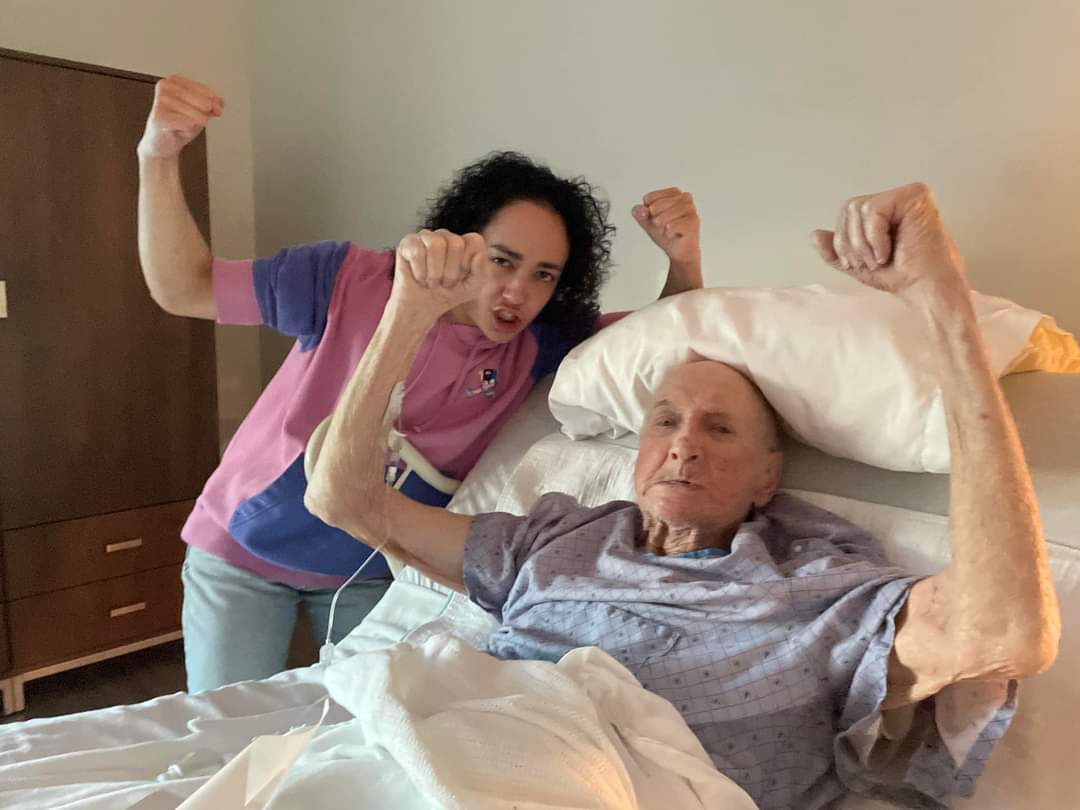
April 2024, rehabilitation with granddaughter Onyx, after fighting infection – still Ross!
In April 2024, in a rehabilitation facility after fighting an infection, Ross raised both arms in a victory pose for Onyx beside him doing the same. Frederick Johnson had sworn he had only seen Ross lying down twice — that April and on his deathbed. Ross never stopped moving. He never stopped working. He never stopped bringing the light out.
On 20 June 2024, Ross Leslie Andra died peacefully in his Salt Lake City home with his wife Adelaide, his daughter Brenda, and his son Carlos at his side.
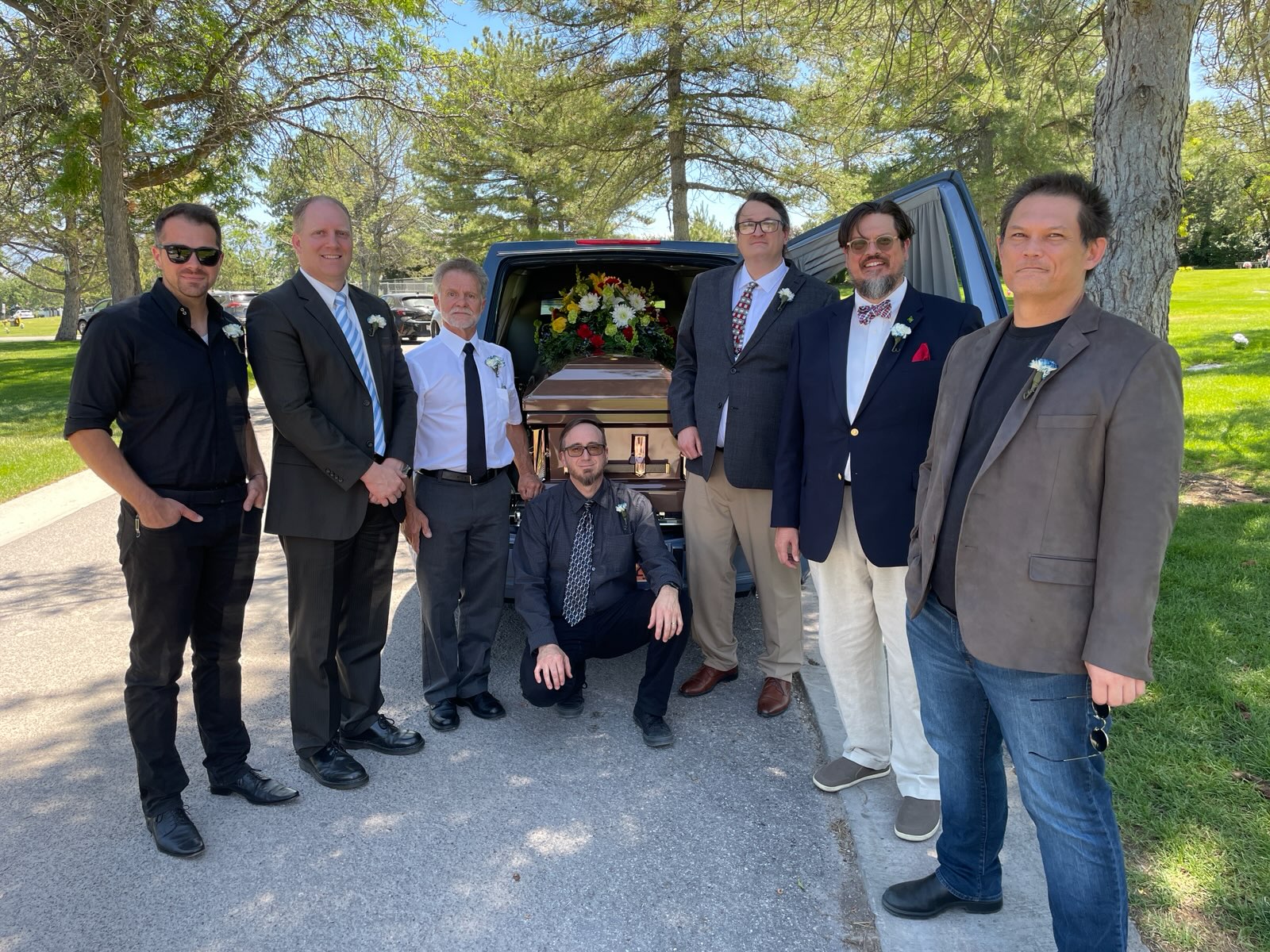
The funeral closed with “How Great Thou Art,” sung by Sister Annie Löwenthal. Then the pallbearers — Carlos Andra, Paul Ross, Larry Andra, Frederick Johnson, Tim Andra, Felipe Johnson, and Aron Hsiao — came to the front. The congregation rose. Ross Leslie Andra was carried out into the June light toward Valley View Memorial Park in West Valley City, Utah.
Frederick Johnson, who had lost his own father just two months before, had a last message. “Ross the Boss,” he said, “your life mattered a great deal to us and to me. You will not be forgotten. We’ll keep telling the jokes and passing them on.” Then, more quietly: “Say hi to Dad for me, Ross. Tell him we miss him too.”
Pallbearers at Valley View Memorial Park, West Valley City, Utah 29 June 2024. Brandon Porter, Paul Ross, Tim Andra, Carlos Andra, Felipe Johnson, Fredrick Johnson, Aron Hsiao
Ross is survived by his wife, Adelaide; his daughter Brenda (Layton) Wagner; his son Carlos (Melanie) Andra; his daughter Denise Andra; his grandson Brandon (Danika) Porter; his granddaughter Onyx Andra; his great-grandchildren Tilia, Zeke, and Sevi Porter; and his brother Larry (Barbara) Andra.
The full funeral service for Ross Leslie Andra, held 29 June 2024 at the Cannon Ninth Ward in Salt Lake City, was livestreamed and remains available to view at https://www.youtube.com/watch?v=y1qDOIbls5Q.
Note: This transcript was generated from auto-captions and has been edited for readability. Musical interludes, unintelligible passages, and pre-service ambient audio have been omitted or noted. Speaker attributions are based on self-introduction within the service.
Opening of Service
Conducting — Bishop Ted Maxwell
You may be seated. Welcome, everyone, this morning to the funeral for Ross Andra. My name is Ted Maxwell; I’m the bishop of the Cannon Ninth Ward, where the Andras have been living. I’ll be conducting today. On the stand we have President Ingersol from our stake, who is presiding. We’re so grateful to have you all here on this fine, wonderful morning to celebrate the life of Ross Leslie Andra.
We will begin by singing ‘I Believe in Christ,’ Hymn Number 134. Our pianist will be Arlene Lenthal, and the chorister will be Anda, an in-law. After which we will have an invocation by Carlos Andra, Ross’s son.
[Congregation sings “I Believe in Christ,” Hymn No. 134]
Invocation
Carlos Andra (son of Ross Andra)
Let’s bow our heads.
Our Father in Heaven, this morning we open the service with your words: “And the Lord God formed man from the dust of the ground and breathed into his nostrils the breath of life; man became a living being.”
You formed a man, and his name was Ross Leslie Andra. We thank you, Father, that we can all be here gathered together. We invite your Holy Spirit into this place in which we reflect and honor the life of my earthly father, Ross.
I ask you, Holy Spirit, to stir in the hearts of each person taking time out of the breath of their lives to come reflect and remember the impact that was made by you through this husband, father, brother, uncle, cousin, and friend.
Yea, though we walk through the valley of the shadow of death, we will fear no evil, for you are with us; your rod and your staff, they comfort us. You are Holy God; you are so loving. We love you and we thank you for your presence. We dedicate this time to let your Holy Spirit direct our time together to honor your servant, Ross Leslie Andra. In Jesus’ name, amen.
Amen.
Order of Service — Announced by Bishop Maxwell
We will begin the service with a musical number titled “My Testimony,” which will be performed by Sister Bastos and Arlene Lenthal. After which we will hear from — oh, I skipped something. I’m sorry, let’s back up. We’ll start by hearing the obituary read by Brenda Wagner, who is Ross’s daughter. After which we’ll hear from Larry Andra, who was Ross’s brother. Then we will have a musical number, “My Testimony,” performed by Sister Bastos and Arlene Lenthal, and after that we’ll hear from Frederick Johnson, who is a family friend. Closing for us will be President Clay Celestino from the Mountain Shadows Stake.
Obituary
Read by Brenda Wagner (daughter of Ross Andra)
Oh gosh — thank you so much for being here for my father and my family, my mom, everyone.
So — Ross. Now, if my eyes start watering it’s because it’s sweaty and hot outside, so that’s why.
Ross Leslie Andra, my father. At age 87, he returned to his Father in Heaven, which was on 20 June 2024. He passed with dignity and peacefully in his Salt Lake City home, with his wife Adeli, daughter Brenda, and son Carlos at his side.
Ross was born on 2 December 1936 in Preston, Idaho, to German immigrant William Frederick Andra and Mary Louise Wer— [you never know how to say that]. He grew up on a large family farm with four sisters and seven brothers.
Ross graduated from Preston High School in 1955 and then went on to attend Utah State Agriculture College — now Utah State University — for two years. Ross worked in construction with a couple of his brothers on the St. Lawrence Seaway project in Messina, New York, between February and December 1957.
He served a mission to Brazil for the Church of Jesus Christ of Latter-day Saints between 1957 and 1959, where he met his sweetheart, Adeli Gonzalez Cararu. They married in the Logan Temple on 14 June 1963. Ross had a deep love for Brazil, its people and culture, and especially for his little Brazilian bride.
After his mission to Brazil, Ross attended Brigham Young University in Provo, Utah, where he studied political science, speech education, and Portuguese. He graduated with a Bachelor of Arts from BYU in 1964 and remained one of their biggest fans right up to the end, watching games and sporting a BYU ball cap everywhere he went.
Ross instilled a strong work ethic into his children. As a servant leader, Ross served his family by example and by teaching his kids how to help Mom with household tasks. He modeled Ephesians 5:25 very well: “Husbands, love your wives, just as Christ also loved the church and gave himself for her.” Ross always made sure everyone was comfortable and that they had what they needed.
Ross loved to make people laugh, and he had a keen gift for engaging strangers with quick-witted quips. He spread many smiles and laughter across this planet.
Ross was a hard worker, and his career life spanned over various areas: from high school teacher, coach, Candyman, small business owner, appliance installer, and furniture mover to a medical career. He held unique skills and talents and applied them well throughout his life and service to others. He maintained a missionary mindset throughout his whole career.
As Candyman, Ross would fill the vending machines in the teachers’ lounge at his eldest daughter’s elementary school — me — and often he would show up during recess and pass out candy on the playground, which made his daughter Brenda — me — quite popular with her friends.
As a business owner, Ross would often take his son Carlos to work with him to deliver and install appliances and move furniture. As a result, Carlos learned to efficiently pack a moving truck like a Tetris puzzle.
Ross loved tomatoes. He would plant them anywhere he could find a plot of dirt — it could be this big, that big. His youngest daughter Denise worked hard to clear space in the backyard for a family garden so Ross could have his tomatoes.
At another point in life, when Denise found herself facing some debt, Ross sat down with her and taught her some financial principles, which she applied and was able to persevere in paying off all her debts in no time at all.
Ross was a faithful servant. With Adeli as his companion, Ross served locally as a service missionary with the Portuguese- and Spanish-speaking wards between 2009 and 2015. Together they drove all around the Salt Lake Valley visiting with families and making sure they had the resources that they needed.
Ross and Adeli had a deep desire to return to an overseas mission in Brazil, but due to health concerns they could not go. Instead they fulfilled that desire by serving the Brazilian people locally.
In his latter years, until age 84, Ross delivered blood and vital organs to various medical locations spanning Utah, Idaho, and Wyoming — and as always, he made people laugh along the way.
We kids heard many stories from Dad about growing up on the family farm — like the time he was called back to the house by his mom only to discover that it was a chicken calling out “Ross,” or the time when Ross and his brothers tied a cow to their math teacher’s front door. With multiple brothers, you can imagine the pranks that were played on and with each other.
Dad, we miss your John Wayne toughness, your Popeye strength, and your cheesy dad jokes. You were a missionary for Christ until the end. “Well done, thou good and faithful servant; thou hast been faithful over a few things, I will make thee ruler over many things; enter thou into the joy of the Lord” (Matthew 25:21). Ross has now entered the joy of his Lord.
We love you, Daddy.
Remarks
Larry Andra (brother of Ross Andra)
My name is Larry Andra. I’m the last of twelve. Ross would say, “I’m the last of the Mohicans.”
Ross was always saying to each person he had a nickname — like “teddy bear.” His kids called him Tom the Piper’s Son. And one nephew — it probably best they called him ‘Funkle’ — the funny uncle.
He lacked no jokes. He was likeable and really witty. Others said he loved to joke around with people. I always called him the numbers jokester. And I really didn’t understand when he talked to me — he knew Brazil too much; he forgot that I couldn’t understand the jokes.
Ross never did anything outside the church standards. My parents never had to worry about Ross. He had a little brother to do that.
Our father came from Germany, as mentioned before. Within a couple of months after being baptized, he came alone because he was eleven years old — at twelve you pay full price; at eleven you pay a high price. He got lost, so they came looking for him, and that’s where the twelve came in. He ended up with the missionary that baptized him going to his farm and marrying his daughter, and they had twelve children.
This week is the Andra reunion, which we’ve had — I think this is Ross’s last one here on Earth.
Death is just as important in the welfare of man as is birth. There is no greater blessing that can come than the blessing of birth. One-third of the host of heaven, because of rebellion, were denied that privilege and hence had no bodies of flesh and bone — which is the gift of God. But who would like to live forever in this world filled with pain, decay, sorrow, and tribulation — grow old and infirm and yet remain? I think all of us, if the proposition were placed before them, would not want life of that nature. We would reject it.
But death is just as important in the Plan of Salvation as birth is. We have to die. It is essential. Death comes into the world and fulfills the merciful plan of our great Creator.
Let’s talk a minute about what happens when one passes on. However painful the moment of death is physically, it is spiritually one of the most exciting and joyful moments of eternity. It’s like opening the door of a dark room — one who dies emerges into the light of the spirit world, where there will be friends and family waiting to greet him. There is no special period known to man in which they experience so much joy as when they pass through the portals of death and enter into a glorious change in the spirit world.
Death is not extinguishing the light; it is putting out the lamp — and then dawn comes.
When someone dies, it is like a beautiful lagoon. On a clear day a fine sailing ship spreads its mast and its canvas in a fresh morning breeze on the deep blue, and gradually we see her grow smaller and smaller as she nears the horizon and someone says, “There she goes — gone.” But you can be sure that on the other shore someone says, “There she comes!”
While we’re mourning the loss of Ross, others are rejoicing to meet him behind the veil. Ross has joined Mother, Dad, June, William, Colleen, Millie, Golden, Serene, Donald, Dale, Robert, Dennis, and others.
Steve Jobs was a billionaire worth $7 billion at age 56. Lying on his deathbed sick with pancreatic cancer, he said: “All my life I have recognized wealth, but all that I had was meaningless in the face of human death. You can find someone to drive a car for you, but you cannot hire someone to carry the disease for you.”
As we get older we grow smarter and slowly realize: a watch worth $30 and a watch worth $300 both show the same time. Whether we drive a car worth $150,000 or $2,000, the road and the distance are the same; we reach the same destination. If we drink a bottle of wine worth $300 or wine worth $10, we’re still drunk.
There are five undeniable facets: Do not educate your children to be rich; educate them to be happy, so when they grow up they will know the value of things, not the price. Eat your food as medicine; otherwise you eat your medicine as food. Whoever loves you and never leaves you, even if he or she has a hundred reasons to give up, will always find one reason to hold on. There is a big difference in being human. If you want to go fast, go alone — but if you want to go far, go together.
I really believe that Ross embodied what Steve Jobs was saying here — they went together.
Albert Einstein said: “Do you realize how important you truly are? Look around — who are you influencing, motivating, teaching, or inspiring? Some of the greatest souls who have ever lived will never appear in the chronicles of history. They are the great ones who spend every day of their lives serving and doing good.” Albert Einstein also said: “Try not to become a person of success, but a person of value.”
Thank you for the service you are willing to give to your families, your friends, neighbors, and community. Every great dream begins with a dreamer; always remember you have within you the strength, the patience, and the passion to reach for the stars and change the world. You are the difference — make it happen.
[Larry then shared a story about a woman whose car was stuck in the snow in a foreign country. A man came with a mule and attempted to pull her out. Before having the mule try again, the man yelled, “Let’s go, Bob! Tom! John! Lance!” — and the mule pulled the car out. When the woman asked why he called the mule different names, the man said, “Madam, my mule is blind. I wanted him to think he wasn’t pulling the car out alone.”]
People in this congregation — Adelaide needs you next to her, pulling and pushing for her. Adelaide’s happiness will return, her former capabilities will be restored, light will replace darkness, despair will give way to hope and life and will regain its meaning — but only through service. Neighbors, friends, relatives, family, and those who are in attendance here: Bishop and Friends, Adelaide does not need to be preached to, but she needs a void filled. Bless her and be of service to her, as the Savior asks of us, and I promise you that you will be blessed. I say this in the name of Jesus Christ. Amen.
Amen.
[Musical number: “My Testimony,” performed by Sister Bastos and Arlene Lenthal]
Remarks
Frederick Johnson (family friend)
My name is Frederick Johnson — Todd Elijah. I’m known as Freddy; the full version is Frederico.
Like many, the summer I turned 16 I got my first job, and it was delivering household appliances with “the Boss.” The interview went something like this: “Frederico, you’re 16, right?” And I said, “Oh yeah, I’ll be 16 at the end of —” “Frederico, you’re 16.” “Yes.” And that was my interview. But admittedly it was essentially nepotism.
As long as I could remember, my dad — Ranley Johnson — had been moonlighting on weekends with Ross. As far as I’m concerned, they were the first and only two men in a truck there ever were.
Ross, like my father, had served a mission in Brazil and married a Brazilian. In the ‘80s, all these mixed families — nowadays the church and the Brazilian community in the Salt Lake Valley has become tremendous. But when I was a little child, and when Carlos and Brenda and their little sister Denise were young, we all kind of knew each other more or less. At conference time we went to reunions together. The connection goes back even further than that — about a decade before my mother first came to the United States. My mother, Louisa Coa Johnson, came to the US in the 1970s. Adeli had served in the tiny branch of Beloni, Brazil, where my mother, my aunt, and grandmother were new converts to the church. So as I say, it was basically nepotism.
I swear, Ross the Boss Andra was the strongest man I ever knew. Thirty years my senior, he had more stamina and strength in his late fifties than I could muster at his side as a six-foot-one man in my prime. He was compact and he looked powerful to me. He not only looked and sounded like Popeye — he even talked like Popeye. Except instead of eating spinach, I think where he got his strength was from eating tomatoes.
Ross’s strength was legendary. In fact, Ross wasn’t only strong — he was an irresistible force. My dad told stories of seeing Ross pick up a Ford Pinto by its bumper to make room for the truck to pass. And I don’t doubt it.
Now, Ross, when I knew him, could sometimes come across as a little unsophisticated. But anyone who knew Ross at all knew that to dismiss Ross the Boss as a blue-collar East Idaho farm-boy country bumpkin was making a grave mistake. Ross was intelligent, well-traveled, and educated, and he did not suffer fools or foolishness.
When I was still a teenager, we were working, delivering appliances. There was another man who worked with Ross who was actually a bit more unsophisticated — I wonder if Carlos remembers Joe Yanger. The way I remember the guy: he was big and coarse, had bad Marine Corps tattoos on his arms, and talked kind of low. I couldn’t understand a word he said except swear words. He was strong as an ox and probably about as sophisticated as one, if you take my meaning.
Anyway, one day Ross tells me: “Joe Yanger got hurt.” “What happened, Ross?” “I dropped a piano on his head.” They were moving a piano, and Joe was at one end coming down the ramp. Ross said, “Joe, are you ready?” Well, Ross didn’t know if he was ready or not — so he let go of the piano. Joe Yanger ended up with some stitches in the back of his head. I don’t think it made any difference to how Joe Yanger spoke or how well Ross could understand him.
Also, I want to emphasize — and if you get a chance, read again the beautiful obituary that Ross’s family put together — Ross was not a blue-collar guy with a truck, and he certainly did not see himself that way. Ross Andra was an entrepreneur. He firmly believed in the American dream, in hard work and gumption as the way to get ahead, and that’s what he did — whether it was filling candy machines, moving vending machines, delivering appliances, or contracting his truck out as a mover. Ross believed he was an entrepreneur, and he was.
In a world where hard work and gumption were enough, Ross would have been a financially wealthy man many times over, because I also don’t know anyone who worked as hard as Ross. That’s why most of my memories are from working with him — or working with my dad and Ross the Boss — because he was always working. In fact, I swear I’ve only seen Ross lying down twice: the first time was in April, when he was in rehab after fighting an infection, and the second time was on his deathbed. Ross never stopped moving and never stopped working, and he had lots of gumption.
Now, the work that we did with Ross was, as you can imagine, physical — hard work. But Dad would come home laughing. There was always this interesting other thing about working with Ross the Boss: there would be some kind of debriefing. He’d wait long enough for you to get home, the phone would ring, and he would call — mostly I think to go over the jokes he had played on you and laugh about them again.
My memory of even Dad working with Ross is Dad coming home, the phone ringing, and then Dad laughing. Or Dad coming home — I even remember him opening the door with tears rolling down his eyes, just couldn’t stop laughing. When I worked with both of them, it was better than television, because my dad was a wise guy in his own way and the two of them together could be very entertaining.
My mom even thought: “This isn’t fair — I’m home with the kids every Saturday and you’re off having fun with Ross.” But it was hard work, and with anyone else it would have been miserable. We enjoyed working with Ross, and we all worked with Ross. My brother Felipe worked with Ross; my friend Giorgino Brown, another one of these families that’s half American, half Brazilian here in Utah; my cousin visiting one summer from New York worked with Ross one day — and Ross made an impression on everybody. It was fun, even though it was miserable hard work.
A lot of this is because Ross was a virtuoso practical joker. One of his favorite things — if we were working in the summertime — was to drop ice down your shirt. Even worse than that: when we did deliveries we had shirts that said “DPEC” on them — short for Delivery Specialist, which made it sound kind of exciting and sexy. They always seemed like they were a size too small or too short, so Ross had a knack — one of his favorite things was to take advantage of you when you were bending down picking up something really heavy and that shirt rode up. Without saying a word, Ross would just drop a screwdriver down there right when you were really going. He would just chuckle. And of course at the end of the day he’d call and say, “Hey, do you remember when I dropped that? That was good.”
For years he had a novelty ID with Elvis Presley’s picture on it, and anytime someone asked him for his ID he’d show that — it didn’t matter who they were. They’d look at it and go, “Huh?” And he’d say, “That’s what drugs will do to you.”
One time, around September 11th — I was living in New York, but every time I’d come back to town Ross would say, “Frederico, do you want to go to work?” I’d work with them even for just one day. This time he offered to take me to the airport, because Ross was always on the road — always driving a truck, delivering furniture, delivering appliances, or delivering medical equipment. So he was happy to go. We go up, and I was the one who needed to show my ID. Ross comes up, already ready, and this TSA agent — some people go, “Huh? What? You already — what drugs will do to you.” And here I am thinking, ‘Oh no. I’m not going to make my flight. They’re going to take me to the back and interrogate me.’ That was one time where the person didn’t even blink. Ross would say something like, “I’m better looking now, aren’t I?”
It was rare to get one up on Ross — he always had the drop on you. But here’s one of the most famous stories: the parrot story.
[Freddy describes the chicken story from the obituary — the time on the farm when Ross thought his mom was calling him, only to find a chicken mimicking her voice. One day, while delivering a washer and dryer to a customer’s home, Ross was working in the basement and noticed a parrot. Ross called up the stairs, “Is there a drain down here? We need to drain a little water.” The parrot replied, “What?” Ross, thinking it was the elderly owner upstairs, kept asking. Each time — “Is there a hole in the ground where the water drains?” — the parrot answered, “What?” Freddy’s father, upstairs, realized what was happening and nearly collapsed laughing. When Ross finally came up and figured it out, Freddy’s dad laughed about it the whole rest of the day. Freddy’s father had been waiting for years to get something on Ross, and the parrot delivered it.]
Ross could move a fully loaded truck like it was a subcompact car — weaving in and out of traffic. Before GPS existed, he knew the entire I-15 corridor in Utah. He was the GPS.
Ross could sometimes seem a bit irreverent — he had code words, let’s say. Ross never swore, but he might include swear words in code names and nicknames he gave to things. But when it came to his faith, his belief, and his testimony of the church, Ross was always reverent. He wasn’t serious all the time — he was still joking — but Ross was reverent, and I always knew that.
I can say honestly that Ross was a big part of my entire life. Even when I’ve lived out of state for most of the last thirty years, he would call me every once in a while to check on me. I began to worry about a year ago when the phone calls started getting shorter — because normally I’d set aside 45 minutes or an hour, because we’d have to retell all the stories about every time he dropped a screwdriver down — anyway. He’d say, “Remember when I did that, and then your dad did this.”
I just want to finish by saying — and if I do get a little emotional, it’s not because it’s hot; it’s because I’m kind of that way — Ross, to me, always was and will be bigger than life. Ross the Boss, I want to say to you that your life mattered a great deal to us and to me. I love you and your family, and how close our families have been. Your life mattered, and you will not be forgotten. You will be with us and within us, and we’ll keep telling the jokes and passing them on. We love you and we bid you farewell — but only until we meet again.
My own dad preceded Ross to the great beyond just a couple of months ago. So I personally have to say: say hi to Dad for me, Ross. Tell him we miss him too, and that we love him. Thank you.
Remarks
President Clay Celestino (former Bishop, Mountain Shadows Ward)
Brothers and sisters, my name is Clay Celestino. I served as a bishop in the Mountain Shadows Ward at the time the Andras — that’s how we pronounce their name in Portuguese, and that’s how I’m going to refer to them — were serving in our ward. On behalf of all the Brazilians — mostly Brazilians — who were part of the Winter Ward branch and the Mountain Shadows Ward, I wanted to express our deepest gratitude to this couple.
The first thing anyone would see when they met them was that big smile, and sometimes a joke. It was not hard to love them. Truly, their lives represented the love of our Savior Jesus Christ to us. With hundreds of immigrants from Brazil, the Andras represented arms of salvation, of service — hearts that were willing to bring consolation in times of distress. They were deeply engaged in serving their neighbors because of their love for our Heavenly Father and their genuine love towards anyone around them.
As bishops, we had hundreds of active members coming to our meetings every Sunday, and there was a great need for members who could assist us in lightening the burdens of those Brazilian immigrants. At any time that I needed help, the Andras were there.
I remember one day — I even have the date here — it was 22 January 2013. I sent a quick email to the Andras at 12:19 a.m., past midnight. Eight minutes later, I got a response. I didn’t want to abuse their goodwill and their desire to help others, but this is the response I got:
“Hi, Bishop. That’s no abuse at all to ask for the things you’re asking. That is the reason why we are serving a mission. We want to help our brothers and sisters the best way we can. Tomorrow I will make a few phone calls and I will provide you with the information you need.”
There were people who were unable to work because they were injured and needed help to find a doctor. There were young men who needed their dental and medical paperwork taken care of so they could submit their papers to go on a mission. There were people who needed resources from the community because they were unable to provide for themselves — people transitioning from another culture and trying to get established in this country — and they were assisted by the Andras. The list goes on and on.
And then at 9:00 p.m., talking to Ross, you would find out that he would still have to run some errands, make some deliveries, because of his other side job.
We don’t have much time, but I just wanted to express our deepest gratitude to Brother Andra. When we got the news that they were going to be transferred from our ward — initially we thought they were concluding their mission in November of 2013 — and then in September, two months prior to that date, we were surprised with the news that they were being transferred to the Winter Ward, where they actually stayed. They didn’t finish their mission there; they actually stayed for quite some time.
When I found out, I wrote this email to them, and I think it’s very fitting that I can share it now to conclude these brief words:
“Dear Sister Andra and Brother Andra — in this email I copied the entire leadership of the ward: I am saddened by the news of your sudden departure, as we are today, mainly in our community when we found out that Ross had passed on. I believe our ward leaders and members will feel as surprised and astonished as I do. While your transfer will truly bless and benefit our brothers and sisters in the Winter 17th Branch, I know our ward will deeply miss you. On behalf of all ward members and leaders, I would like to thank you for your dedication, love, and service. I have been a witness of how you have touched the lives of our members in many different ways and how your service has helped me, and allowed me in particular to concentrate on other areas of my responsibilities as a bishop — and for that I will be eternally grateful to you and to Heavenly Father. Thank you for your love for Heavenly Father, for responding to the call to serve, and for showing your love to and for our members. Hopefully as your mission ends, you will return to visit us. Please do not forget us — we will not forget you. We will announce your transfer in sacrament meeting tomorrow. Sincerely, Bishop Clay.”
Brothers and sisters, there are many tragedies around us as we hear about tragedies happening worldwide. Many of us, if not all of us, have somehow faced tragedies in our own lives. In fact, in this congregation right now there may be some who are needing a helping hand — some who may be struggling with illness, financial problems, family issues, health, and all sorts of challenges, mental illness. Sister Andra will need some support — I know that — and I’m very grateful for the support you have already extended to her during this time.
But may we honor the life of our dear Brother Andra by trying to emulate the works of Christ: being a little bit kinder, helping one another, finding time to serve, and extending that love that comes from our Heavenly Father which he has for each one of us. We are his arms; we are his hands. Ross Andra represented that very well.
I know that we will meet again, and that is the beauty of this gospel — death is not the end. We will meet again. May the love of our Heavenly Father be with each one of you as you strive to follow in the footsteps of his Son, our dear Savior Jesus Christ. In the name of Jesus Christ. Amen.
Amen.
Closing Remarks
Bishop Ted Maxwell
You know, right before I close I just want to say a word or two. In the last few months Ross had not been able to come to church because he’s been stuck at home. But initially I know he really wanted to be there, because he called me after church every Sunday and let me know how church went and gave me advice for the future. It was always really great to hear from him. As his calls dropped off I knew things were — at first I thought we were just doing better, but then I realized maybe that wasn’t the truth.
I think that’s the one thing I loved about Ross: everyone in this audience has either been served by him or served with him, because that’s what his life was — it was service. Whether it was just bringing joy or bringing the gospel, that has always been one of my great joys, getting to know him these last few years, although I’ve only known him since COVID, so I missed out on some of the really fun stuff, it sounds like.
I know the one thing Ross loved was the scriptures. He loved the word of God, and he loved Jesus Christ, and he brought that light out in everything he did.
When I think about the joy that Jesus shared with his apostles right before he died on the cross, he said: “Let not your hearts be troubled; believe in God, believe also in me. In my Father’s house are many rooms, and I go to prepare a place for you. I will come again and will take you to myself, so that where I am, ye may be also — and you know the way to where I’m going.”
It is my testimony that Ross knew the way to where Christ is — that we will see him again — and it will be in the mansions of our Heavenly Father, in that place that Christ prepared for us through his sacrifice. It is my testimony that we will see each other again, and that through the grace of Jesus Christ we may all be relieved of all those burdens that we suffer from daily — and that in those burdens we might have joy, the way that we saw our brother Andra in his life. I say that in the name of Jesus Christ. Amen.
Amen.
Closing Announcements — Bishop Maxwell
Let’s close our meeting now. We will — no, we won’t sing — we will listen to a musical number by Sister Annie Lenthal, “How Great Thou Art,” after which Paul Ross, who is Ross’s nephew, will give us the benediction. After that we’d ask the pallbearers to come up, and we’ll escort the body to the graveside, where we will reconvene.
[Musical number: “How Great Thou Art,” performed by Sister Annie Lenthal]
Benediction
Paul Ross (nephew of Ross Andra)
Our Father in Heaven, we thank thee. We thank thee for thy Son, Jesus Christ. We thank thee for this world and that we have the privilege of coming here and gaining our bodies, of learning faith and love, and of thy Savior, thy Son, and all that he has given for us, and thy love.
We thank thee for Ross Andra — his example, his good parents, and his family. We thank thee for his wit, his grit, his stature, his faithfulness, and his example. He had thy Son’s countenance with him in work and in sadness and in joy. We are grateful for him. We’re grateful for Adeli and their sweet family.
We ask thee this day that thy Spirit will continue with us. Help us to continue to feel the joy and the balm of thy Spirit, even in our sadness. We thank thee for the Atonement of Jesus Christ and the knowledge of the eternal realms that come for all of us, and what still lies in store for us. But until then, that we can have peace and serve in thy name.
And that of thy Son, dismiss us this day with safety to the cemetery and love and adoration for one another and for thee. We pray in the name of Jesus Christ. Amen.
Amen.
[Pallbearers assemble; congregation rises; body is escorted to Valley View Memorial Park, West Valley City, Utah for interment]
I received this history a few years ago. I will provide it as it is written (only minor edits). I have written before regarding Fred’s parents Johann George (John George) Wanner and Anna Maria Schmid.
“(This History is written by Jacob’s daughter – Eva June Wanner Lewis – with the information sent in by Brother Fred, and Sister Mary Ann, and her own sweet memories as well as information from Histories of Brothers and Sisters.)
“Jacob Friedrich Wanner was born January 14, 1881, in Gruenkraut, Germany, the 7th child of Johann Georg Wanner and Anna Maria Schmid. They had a large family consisting of five boys and five girls. They were quite poor so Grandfather went to work as a road overseer. This left the farm work to Grandmother and the children. They used the milk cows to do the farm work and then would milk them morning and night. They also got wood from the forest for fuel.
“It rained a lot in Germany so the out buildings were connected to the house. One time Grandma went downstairs to get some fruit. She reached over and touched something hairy – she thought it was the devil! It was a cow that had wandered down from the barn.
“Dad didn’t talk much about his life as a child but he did say he got a drum for Christmas and then it would disappear about New Year’s Day and he would get it for Christmas again the next year. He may have been joking.
“The family belonged to the Lutheran Church and was very religious.
“In the summer of 1890 the Lord sent a man along the street in Gruenkraut where Grandpa worked. He was a missionary from the Church of Jesus Christ of Latter-Day Saints. He talked to Grandpa a long time and showed him the Book of Mormon. He spoke in German. When it came dinner time Grandpa took the missionary home and said, “We’ll see Mother.” From that day the missionaries stayed in their home and the family was soon converted. They joined the church in 1891.
“Uncle George was baptized in July 1891 and went to America with one of the missionaries, Brother Terrell from Providence, Utah. Brother Terrell helped him find a job to provide for himself. He got a job with Fred Nuffer in Glendale. Grandfather and Grandmother and the three oldest girls were baptized in October 1891. Louise and Pauline were baptized in June 1894, Gottlob in June 1895 and Wilhelmina in August 1896. Dad was baptized in Preston or Franklin, Idaho, on June 7, 1894, by Lars C. Larsen and confirmed a member of the church by Austin I. Merrill on June 7, 1894. He was ordained an Elder by George C. Parkinson on September 27, 1903, and was married by Thos Morgan on September 30, 1903, at the Logan Temple.
“The family left Germany to come to America so they could worship the way the pleased. It was a long, uncomfortable trip. They took the train to the Rhine River and then boarded a boat and traveled up the Rhine, a journey of about 3 or 4 days. Then another train took them to the North Sea where a ship sailed them to Amsterdam, Holland, and then on to England. At Liverpool they boarded a ship and were on the ocean for 13 days. Dad was 12 years old when they crossed the ocean and told us of the rough sea. He had to hang on to his bunk with both hands to keep from being thrown to the floor. He said he sure got sick of eggs.
“They arrived in New York and stayed there for 2 days. Then they went to Chicago for a day and a night. They then rode a train straight through to Franklin, Idaho, which took six days. They arrived the 18th day of June, 1893.
“Uncle George and Fred Nuffer (the man he worked for) met them with a buggy and wagon and took them to Fred Nuffer’s place in Cub River. They stayed for a while with the Nuffers and purchased a farm from John Nuffer in Glendale.
“When Grandpa and Grandma moved to Whitney they sold the farm to Dad. I don’t know if Dad or Grandpa build the sandstone house. It had a kitchen, two bedrooms and a pantry. It had a hand pump that pumped water from a spring. Mary Ann and some of the children were born there.
“Dad met and married a lovely young girl, Mary Elizabeth Carter on September 30, 1903, in the Logan Temple. They lived in Whitney, Idaho, until they bought the farm. They worked hard to improve their farm and many times she helped him in the fields. They built a three bedroom brick house that stood for many years until fire destroyed it years later. Dad had a Delco generator in the garage so we had our own electricity.
“They had a lovely family, five girls and three boys: Laverna C., Fredrick D., Lorin C., Florence E., Joseph J., Erma C., Mary Ann and Grace C.
“IN 1923 – Elizabeth died leaving seven children. The youngest was almost 2 years old. Laverna got married so that left Erma and MaryAnn to take care of the baby. Erma would go to school one day and MaryAnn the next. It was hard. They tried to leave her with Aunt Ethel Barrington in Riverdale, but she got so lonely and cried all day so they went and got her. Then Dad hired Eva Christensen to come and work as a housekeeper. As time went on Dad and Eva (my mother) fell in love and was married June 26, 1925, in the Logan Temple. They had five children: Carma C., L. Bertus, Eva June, Lyman G., and Stanley C. We had a happy family life and dad always saw to it that we went to church and did what we were suppose to do. He went when he could. He always paid his tithing and other offerings. He was honest in all his dealings.
Fred and Mary with (l-r) Laverna, Fred, Lorin.
“Dad was the first one in Glendale to buy a car. We children were used to horses so we would say, “Gid up, Gid up” when we got in the car. About this time Dad was struck by lightening but was not harmed.
“Dad owned or had a share in the thrashing machine. They would go around to all the farmers in Glendale and thrash the grain. Then we would fix a big meal for all the men. It was a real fun time for the children but a lot of work for the adults. Dad worked as an oiler or on the thresher and had part of his finger taken off. When we were little he told us a fox bit it off!
“Dad was a good farmer. He took pride in all his work. He raised hay, barley and wheat. He always had 10 or 12 dairy cows. He also had horses, pigs and chickens. For many years we separated the cream from the milk in the old separator. Then Dad took the cream to Preston to sell it along with the eggs. In later years we had the milk truck come and pick up the milk so we didn’t use the separator anymore. He also bought a grain chopper and prepared his own feed for the animals. We had a big raspberry patch and used to sell raspberries for 8 quarts for a dollar. Dad always had a big garden and a big potato patch. He had a root cellar to keep potatoes, carrots, squash and apples over the winter.
“In the early 1930’s Dad bought silver foxes. He built a high fence so they couldn’t get out. He took great pride in his fox furs. They were always excellent quality! I remember watching him cure the furs and he took great care to make sure they were done right. Dad always kept his barnyard as well as the rest of the farm in good repair and very neat. His fences were always mended.
“Dad always took time out of his farm work to go to Franklin to celebrate Idaho Day on the 15th of June. We would take a big picnic lunch and spend the day. We rode the carnival rides and had a good time. He always took us kids to Downata to go swimming when we finished first crop of hay.
“Dad liked a good joke… I remember how he would laugh. He loved the radio and his favorite programs were Gang Busters, The Old Ranger and of course the news! We all had to be quiet when the news came on.
“Dad was very active and was always working except on Sunday – there was never any work done on Sunday except chores. He loved the Sunday paper. He always bought the Denver Post. It was a real shock to us when he had his heart attack because he was so active. It happened one day when he was working in the barn. We were all frightened and I called the neighbors to help us get him to the house.
“After that he had to be very careful so he sold the farm and moved to Preston. They lived just down the street from MaryAnn. He seemed to miss the farm and would putter around the yard.
“He died at the age of 74 on August 25, 1955. He was buried in the Preston Cemetery.
This is the life history of Charles August Nuffer. He wrote this autobiography on 28 January 1949. I have maintained the language and spellings of the original document. I also wrote a quick overview of his life previously.
This is a brief history of the life of Charles August Nuffer, son of Johann Christopher Nuffer and Eva Katherina Greiner Nuffer. I was born June 18th 1871 in Neuffen, Wurtemberg, Germany. When about eight years old I remember going with my father and mother to a neighbor’s home where the Mormon Elders were holding a meeting, one was Elder John Theurer of Providence, Utah. Some week later, one morning on getting up the floor was all wet, I asked my mother why, all that she said was that they were baptized members of the Mormon Church last night in the Mill Race back of our house.
It was not long after when they began to make arrangements to emigrate to America. After they had sold their home and land to get money for the voyage except what they could take with them, and that was not very much, they still had to borrow a few hundred dollars before they could go. They borrowed this money from the Schweitzer family that had also joined the Church, and came on the same ship with us, also the Lalatin family that had become members of the Church. So in the month of May 1880 they all bid farewell to friends and the land of their birth for the Gospel’s sake, and set sail on the steamer Wisconsin, for New York, U. S. A. (Early in the morning before daylight we left home in a covered wagon for the City of Stuttgart. I was carried in some bedding as I was sick with the measles and was not well enough to walk. From Stuttgart we went to Manheim and from there by boat on the Rhine to Holland and over the North Sea to London, where everybody was sick the next morning but myself, I think I was just getting over the measles.)
Young Charles August Nuffer
The first place we came to was called Castle Garden where all our belongings were examined. They also gave all the emigrants a little book, the New Testament to take along free. In those days most of the streets of New York were paved with cobble rock. After a few days rest we went by train to Collinston. Arriving in Logan we were taken by a family of Saints that gave us food and lodging for about three weeks by the name of Shaggo in North Logan. After three weeks we found a little old log house with one room and a dirt roof and plenty of bed bugs to keep us company. It was on a vacant lot on the street going to the College just east of the canal. We lived there about a month, as father bought a house and lot of Jacob Engle, full of cobble rock where we intended to make a living but we found it hard going. The house was built of small cobble stone and in the winter at night the walls would get all white with frost. Father would go out where ever he could get some work, he worked on the threshing machines and I went with him to help and he got a bushel of wheat a day. Grandma Spring, Regine and I went out in the north field to glean wheat, we would cut the heads off and put them in a sack. Father threshed them out with the flail and it made about sixteen bushels, so about all father could do is to earn for us so that we could have something to eat while John and Fred were earning money to pay for the place.
Fred went to Idaho working on the Railroad and John worked for Mr. Summers a contractor who later recommended to the Stake Presidency to take charge of building the Stake Academy after we had moved to Idaho. It seems to me the Lord had already begun to open up the way for our life’s mission in this part of the land.
When we arrived in Providence the potatoes were in full bloom on the lot which looked good, at least we would have potatoes to eat. We had to get the wood from the hills near by. They had bought a team and an old wagon so we went to get some wood. Father told me to drive, as I drove out the gate and over a little ditch the tongue dropped down and the reach came up and the team ran away and I fell under the horses feet. I received a broken shoulder and the horses ran around the block and back in the gate, my first time driving a team, at ten years old.
While living in Providence I went to school a few months during the winters of 1881 and 1882 and learned to speak English. My teacher was Mrs. Mary Neaf Maughn, the mother of Mrs. A. E. Hull and Maughn the brush man, and Peter Maughn was the other teacher.
I was baptized when I was 9 years old by Mr. Campbell the grandfather of Mrs. C. M Crabtree of this ward. My sister Mary was born here October 11, 1881. She died in Mapleton, Idaho, October 5, 1900. I look back to my young days while living in Providence, and I still have many friends there, but my parents had to look forward to some other place for our future and to find the place for our life’s mission. It seems the Lord prepared the way. One of our neighbors, a German family had a daughter married to John Miles who was living at Wormcreek and she wanted him to move to Providence where her mother lived so we traded places. We lived in Providence from June 1880 until October 1883. So from here we go to Idaho the place the Lord had chosen for us to build our future home.
We loaded what we could on our wagon and Mr. Miles the rest on his as he helped us move and all together it was not very much, but it was all the poor teams could pull over the kind of roads there were at that time. On arriving at Wormcreek we found a place with a house on it, a log house about 14 by 16 feet, all one room, with dirt floor, no fence around it and no plowed land, and when it rained the mud would run down the walls and we had to set pans on the bed to catch the rain. Father, Mother, Regine, Adolph, Mary and I lived there then. Fred was out in Oregon but he came later that fall with two big horses and John was working in Logan, I think with Mr. Summers. During the winter John rode the biggest horse to Providence as he was going with Louise Zollinger whom he later married. The horse got warmed up too much and got a sore leg and they finally had to shoot him. John and Fred were in Providence most of that winter as their grandmother lived there and Fred was going with Anna Rinderknecht.
As we did not have much hay we bought two stacks of straw from Jap Hoarn and Tom Miles, the first lived in Richmond and the other in Smithfield as they were only on their farms in the summer. The snow as so deep Regine and I filled some big sacks we had brought from the Old Country with straw and tied on the hand sled and pulled it over the rested snow for home. The Miles were the only family that were living on the Creek besides us on what is now known as the Webster Ranch, and we lived on what is now known as the Fred Wanner Place. The Miles Family ran out of feed for their cattle so in March they shoveled a path over to the south side of the hills where the wind and sun had taken the snow off the grass and it had started to grow. When they drove the cattle through the path you could not see them because the snow was so deep. So with the help of the Lord we pulled through the Winter of 1884. In the Spring John and Fred came back and began to fence and plow the land and plant crops. Later John went over to Oxford to the Land Office to file on the land for himself as he had helped most to pay for the home in Providence. As father wanted a homestead of his own, one Spring day it was on the first of May he sent over the divide between Worm creek and Cub River to find a place where he could make a home for the rest of the family. When he returned he said that no one had gone over there before him that spring, as the snow had not melted yet. That was in the spring of 1885, so during that summer John and Fred were raising the crops and helped father build a log house and we put in some crops so we have something to eat for the winter. As we did not have much of a team they had Joe Nilsen come up from Preston to plow some along the Creek, he had a big team and a sulky plow. But that was not all, we had to fight squirrels and grasshoppers. What we raised that summer had to see us through the Winter, and it was not any too much.
Fred went up Wormcreek and got some logs and had them sawed at the Moorhead and Thomas Sawmill on the Cub River. But we found that there was only enough for the roof and none for the floor and ceiling. They had lumber at the sawmill but they would sell us any for wheat and the store in Franklin did not pay cash for it. Father had already laid some logs down to put the floor on so we just had to step over them all winter but maybe it was a good thing as we got the warmth from the earth as we only had a lumber roof over us 14 feet to the top and just a four hole cook stove to warm the house and wood to burn, and it was not all dry. Still we were happy and thanked the Lord for what we had. Mother would read a chapter from the Bible, we would have prayer and we would go to bed early. (Clayborn Moorhead told me some years later that Joseph Thomas intended to take up my Father’s Homestead but he was not old enough then so my father was first. He said those Germans can’t make a living there, they will starve to death and I will get the land anyway. But, I think he did not know as much as he thought, he didn’t know we had put our trust in God.)
On Christmas Day 1884 Father sent me over to John’s (Grandma Spring was keeping house for him that winter), after twenty-five pounds of flour. The snow as up to my knees. After that flour was gone we had to grind the wheat in the coffee mill as no one went to the store anymore that winter until Father and I each carried a basket of eggs to the store in Franklin on the 2nd of March, over two feet of :frozen snow to buy some groceries. We could not busy much as we had no money. Mother raised some sugar beets in the garden, as we had no sugar she but some beets in the oven and baked them and put them in a cloth to get some syrup to make her yeast. She cut some up in little squares and browned them in the oven and ground them up to make coffee. Mother would also put the wheat in the oven to dry and brown it just a little so it would grind better and we used it for bread and mush. Finally the cow went dry so we had no milk for some time and no sugar, but we got through the winter without any sickness. We thanked our Heavenly Father for what we had and lived by faith in our Heavenly Father as we had no Church organization of any kind at that time there.
It seems the Lord wanted a tried people to build the Valleys of the Mountains for when we began to raise crops that we might have food for the next winter, we had to fight the squirrels and the grasshoppers. We worked with faith that did not falter and as I remember we never got discouraged for we felt the Lord was on our side.
April 1949
When I was going on 21 years of age I was looking for a homestead to file on. East of my father’s place, about 40 rods from our house in a hollow there was a nice little spring by a service berry bush coming out of a sandstone formation, where I decided to make my home. Not being of age to take up land, I moved a little log building with a dirt roof on it, that my father had used for a granary, onto the land. I had a bed in it and would sleep there some nights. I prayed to the Lord that he would protect it for me, that no one would file on it as I was not yet twenty-one, and not old enough to take up land. There was a man by the name of George Kent, down on the river. His wife told me there was a relative of theirs in Lewiston, Clyde Kent, who was going to jump that land, as they called it those days. I told them that I did not believe he would be that mean. I wanted to start life for myself as soon as I was 21. So on June 17, 1893, I was on my way to Blackfoot, Idaho by train in company of John McDonald, whose fare I paid to Blackfoot, and return as a witness for me as to my age. There was no bridge across Bear River to Dayton at that time. We stopped at Pocatello over night; it was not much of a town at that time, mostly railroad shops and saloons. We arrived at Blackfoot on June 18th, on my 21st birthday to file on that homestead. When I told them at the land office of the land I wanted to take up, they told me there was a man there some months before, the man I spoke of. Not giving up hope altogether we looked over the plat, and I found there was 40 acres all to itself, not filed on. After looking things over for awhile I said to Mr. McDonald that is the land my cabin and the spring of water is on; so I filed on it and returned home. Arriving on Sunday afternoon my mother said there was a man and his wife looking at your place, as they thought that I had lost out. My family with me felt to thank the Lord that I had a place to build my home on.
As Fred and I started to quarry sandstone on my father’s place that fall, I hauled some sandstone in the Spring to build me a house, but during that winter 1893, my mother came down with pneumonia and died within a week on the 26th of February 1893. She was buried in the Preston Cemetery. She was about the 2nd or 3rd person buried there, as the new cemetery had been started that year.
The following Spring the Wanner family came to Mapleton, from Germany, on my birthday June 18th, which was a Sunday. This was the first time that I had seen my life’s companion, as they came to my brother Fred’s place, where they lived until they found a home to live in. Christine was their oldest daughter and I fell in love with her at first sight. My sister Regine was home again from Montana, her husband had left her, she had a little girl Katy. Christine stayed with her until she went to Millville to work for the Pittgins family for about three months for seventy-five cents a week and her board and some old clothes. When she left they gave her $6.00 and she gave it to her father as he told her she had to earn some money yet before she got married.
That fall as I started to haul stone to build a house, besides taking care of my father’s farm—Adolph helping me, as my father was away most of that summer to Bear Lake and other places, because he didn’t feel like staying home after Mother died. When he came back he brought with him Sister Weirman, and married her in the Logan Temple. Well, during this time I had started to build my house. We dug a hole in the ground and poured water in and mixed it. That was what we used to lay up the walls, and the house is still standing. By New Years the house was finished and cleaned, but we had no furniture or anything else to put in it, but still we made our arrangements to get married. We were baptized by Heber Taylor on 26 June 1894 in Cub River and confirmed by Edward Perkins at Mapleton on the 27 Jun 1894. We were married 1st February 1894 in the Logan Temple by Marriner W. Merrill, president of the temple. (Read Christina’s biography here.) We made the trip by team and wagon, as there was no snow on the ground in the valley. We put our team in the Tithing Barn, as the Lalladine family were the caretakers. After returning from the temple, for supper we were invited by Charles O. Card at their home on depot street, as Mary Wagstaff’s mother’s sister was working at their home, and we spent our first night with them. He is the Card after which the city of Cardston, in Canada was named, as he later moved to Canada.
As I have said before, after we got the house finished we had nothing to put in it and had no money to get married with, so I asked Grandpa Wanner if he would loan me $10.00 and I would pay him back when I raised a crop. He let me have the money with which we bought our marriage license, and a few dishes for the house. We borrowed a table and an old set of knives and forks from my sister Regina, as she did not need them at that time. We returned them again when she got married to George Wanner a year or so later. We paid Grandpa in seed grain the next fall with many thanks to him for his kindness. For our wedding present Grandpa and Grandma gave us a bedstead to sleep on, as we had no furniture. I nailed some boards together for a cupboard for dishes. Stepmother Weirman Nuffer made some of our temple clothes and the garments were made out of factory. She was helpful to us in many ways, so that was the beginning of our family life in a humble way and we were happy together.
As Adolph was still at home, he and I ran my father’s farm, and I fenced my 40 acres, and started to plant some of it as fast as I could break it up. I helped Fred in the sandstone quarry to get a little money to buy a few things till we raised a crop. The Wanner family bought John’s place on Worm Creek for $2000 and became very successful farmers.
Will pass over a year or so till the first child Clara was born 10 August 1895, Louise 19 Nov 1896, Anna the 8 January 1899, Bertha 9 Jun ‘900, Fred 21 October 1901, Joseph 18 May 1904, Ida 15 Jun 1906. These children were all born in Mapleton.
From here on my main occupation was farming and quarrying sandstone. I cut grain with a binder for people in Mapleton at one dollar an acre. In the winter I worked with Fred on the Mink Creek Canal, blasting the rock with black and giant powder, making the canal from seven to ten feet wide. I worked out four hundred dollars in ditch stock and finally sold it for forty cents on the dollar. I received $1.50 a day in cash so that is all I got for my work, and we had to sleep in a tent in the wintertime and cook our meals but it build the canals so the people would get water for their land and could raise crops.
When Fred moved to Preston I took over the stone quarry. I was also ditch rider for the Preston Cub River Canal for a number of years, making a trip a day while the canal was full, at a dollar a trip. While runnig the quarry I delivered stone for some of the Preston business buildings and for the Lewiston Meetinghouse. During this time we were also taking care of John and Fred’s grandmother for a number of years. As the family was getting larger I built another room on the house as mother was busy taking care of Grandma Spring, and John was going on a mission to Germany. They decided to send Grandma Spring to Blackfoot where she died a year of so later. I think it was in the year of 1897, when Mother and I drove to Blackfoot with the team and buggy to take the rest of our homestead, that we had lost by that Mr. Kent beating me to it before I was of age. While at Blackfoot we called at the hospital to see Grandma Spring. They told us she had died before Christmas the year previous, and they had sent no word of her death to anyone. A few words more while at the land office it seems the Lord had always prepared the way for us. As we entered the land office the first person we met was President George Parkinson, who knew us well. Without his help our trip might have been in vain, as it was difficult to take up land when another party had filed on it. At the time we made this journey this was the frontier of the west. Where Downey is now there was not one hours and from Pocatello to Blackfoot was all desert, not a house, only the Indian Reservation. I carried my shotgun with us for safety. We could say much more, but it would take too long to tell it.
From here on it made a lot of work; to fence the land and break it up and get it ready to farm and to make a living for the family. From here on I will begin tow rite of some of my work in the Church for which we have left our native land. On April the 19th, 1896 the Stake Presidency, George Parkinson, Brother Cowley, Solomon Hale came to Glendale to form a German Organization, so we could hold meeting every two weeks, as there were many families Swiss and German that could not speak English. Addison Wagstaff was Ward Clerk and took the minutes. Brother Jacob I. Naef was chosen as President. It was not until 5 Jul 1896 that his counselors were chosen, Brother Jacob Schneider, first, Charles A. Nuffer second counselor. We held our meetings in the homes of the people on their farms and wherever they lived. They traveled with farm wagons a distance of20 miles one way to Mink Creek, Weston, Riverdale, Whitney, Treasureton, Mapleton, Preston and Glendale, there places were we held meetings. Some years later when Joseph Moser became President, I became one of his counselors, also brother Kern. After some years John asked to be released and I became President ofthe Branch on the 21st of March 1915, with Brother Kern and Alma Moser as my counselors. During this time we held the meeting in the old tithing office, later in the new one at Preston, until the 13th of August 1916, we held our last meeting. During the later part of the war some of the people of Preston made it very hot for the German speaking people yet most of them were Swiss, but that did not make any difference. So President Geddes came to me and asked me not to hold anymore meetings. After the war many of the German people had moved away so we never started to hold the meetings anymore, and I never was released to this day. That closes up this chapter of the German Saints of this part here, so I will go on to some of my other duties in the Church. Making in all twenty years that we held German Meetings with the people of Franklin Stake.
Now going back to the year 1899, when I ws called as second counselor to Bishop Edward Perkins in the Mapleton Ward. When Orron J. Merrill moved to Preston I took his place and his son Preston my place in the Bishopric. I was chairman of the School Board for six years, and Brother Merrill was the Clerk, and when he moved away his son was appointed in his place. While on the school board I had a schoolhouse built in the upper end of the District, with Harrison R. Merrill as the first teacher. That way the children of the upper end would not have to go so far to school. The children in the lower part of the Ward met in the old meeting house. While I was in the Bishopric Brother 0. J. Merrill was the Ward Clerk and clerk of the school board. After his father moved to Preston, 0. P. Merrill, his son, was the Ward Clerk and clerk of the School Board. Speaking of schools the first school that was held in Mapleton was in the winter of 1886, when Bishop Perkins went to Lewiston to school. He let the people of the Ward have a school room so they all got together and employed Hirum Johnson as their teacher. All children from seven years up to thirty, married men and young ladies went to school there all in one room. Some came from Franklin and Nashsville. I was feeding cattle for Harrison Thomas that winter and lived with Olive Sweet, she had to board me as she was living in their house, and they paid $150 for my schooling and $.45 for a book. I had to chop all the wood for the family. I was fifteen years old. This school house which was built by the efforts of the people of the upper part of the District, was the first schoolhouse built in Mapleton Ward with H. R. Merrill as its first teacher.
In 1899 in June I was ordained a High Priest by George Parkinson, President of the Oneida Stake, and we labored unitedly together in the Ward. Bishop Perkins was very kind to prepare me for this work, and in his home he read the Book of Mormon and the Doctrine and Covenants to me. So, that I may more fully understand the Gospel, and that I might be an example to the people of the Ward, and he taught me the Law of Tithing, and that we may be worthy to receive all the blessings that the Gospel had in store for His faithful children. So on the 21st of February 1900, we were recommended to the Logan temple to receive our second washing and anointing by President Morgan, a blessing that not so many have received, which is the greatest blessing anyone can receive in the House of the Lord, for which I have tried to be thankful all the days of my life.
In the Spring of the same year, as there was a severe drought in Southern Utah, President Lorenzo Snow went to St. George, and met with the people there and told them if they would pay an honest tithing the Lord would bless them and send rain to save their crops. As the church was in a very bad financial condition at that time. So on returning to Salt Lake City President Snow called a special meeting of all the General Authorities of the Church to meet in the temple on the Law of Tithing, on June the 2nd at 9:00 A. M. And as Bishop Perkins had taken so much interest in me he asked me to go with him, only the Bishops were called. All the General Authorities spoke in the Meeting, after which they all shouted “Hosanna to the Lord”. We were in the Temple from 9:00 A.M. until5:00 P.M. The meeting was in the room known as the Celestial Room. At the close of the meeting President Snow said, “If you will go home and pay an honest tithing, the Church will be freed from debt, and the Lord will forgive you of your past neglect, and I promise you your homes will never burn.” From that time forth I always paid a full tithing as long as I lived on this earth. This blessed land of America, which God has blessed above all other lands. So these are some of the blessings that your mother and I received through Bishop Perkins being so kind to me. In appreciation for the blessing the Lord has given us, I desired to do my full duty in my calling with the people of this ward, and we had many opportunities to be called out day and night in time of sickness and death, among the people. We labored together eight years and had much joy in our labors.
I have given you some of the ways I made a living for the family. To make a living during this time and to care for the family, I farmed, raised hogs and horses, milked cows, separating the milk and selling the cream, and making butter getting $.10 a pound at the store. The most I received while selling cream from six to seven cows was $35 a month. I also sold cream separators to the people of Franklin and Preston to make a little extra money. I cut grain with the binder for the people in Mapleton. I quarried stand stone for the Lewiston Meetinghouse, and some buildings in Preston. The Riter Brothers Drug Store and other buildings. For the hogs we received $4.00 per hundred.
I had now lived on Worm Creek, Mapleton twenty-four years and I have related only some parts of my life. During this time in my life it was necessary for us to look toward the future, and seven children had been born to us in our first home. As the family got larger I built room onto the house. During this time my sister Mary was working for a family in Logan and as she was not feeling so well she came home and we needed someone to help mother as Bertha was a baby at that time. But in September Mary came down with pneumonia and died the 5th October 1900. She had been born in Providence, Utah the 11th of October 1881. At that time most of our children were sick with scarlet fever, but they got well with our care and the help of the Lord as it was hard to get a doctor.
Before leaving Mapleton, speaking of building I feel to give some information pertaining to my father after his third wife died, Mrs. Weirman. He married Mrs. Shaub of Logan and bought the house of her son Gene. He lived in Logan a few years but he wanted to come back to Mapleton again and wanted me to build him a house in my orchard. I bought some sawed square log from Kall Wheeler, and build him the house. He paid for the materials and I did the work free, and I moved them up from wagon by team, but it was only a few years until he wanted to move again. He had already lived in Preston twice before. The first time where Ernest Porter lived, and before that out where Jim Smart’s place is. I then began to haul tone to Preston and John laid up the walls in 1907. In all the houses he lived in were one in Providence, two in Logan, one in Worm Creek, three in Mapleton and three in Preston and he died the 121h Aprill908. When I started to build my home after his death I moved his wife back to Logan with team and wagon.
I will pass over some years as things went on as usual. We began to look to the schooling of the children, as there was not much opportunity in Mapleton. I bought five acres of land in Preston and during the winter of 1905 and 1906, I began to haul sandstone from the quarry for the building of our home. I also planted trees in the spring of 1906, as there was nothing on the land whatever, only a fence around it. So this was the plan for us to move to Preston, not to improve ourselves better financially, but to make it better for Mother and all of us.
The Bishop was called to go on a mission, and I was in line for Bishop as things looked at that time. Mother was already alone so much with the family and I had so many meetings to go to at night. I was still in the German Organization, and I was so far away. I had from two and a half to three miles to ride on horseback to meeting to the home of Brother Merrill or the Bishop. In all the eight years I labored in the ward only one ward was held in our home. I leave the rest for you to answer whey we made this move which needed much consideration and prayer, and the guiding care of our Heavenly Father in making this move.
So in the Spring of 1907, after renting the farm to Hart Wheeler of Mapleton, I built a frame house sixteen feet by twenty feet to have a place to live in. Also, we had a tent for some of the children to sleep in, so I would have the family with me while I was there building our home. I built the barn a place for the cows and chickens. I hauled logs for the bam and most of the lumber for the house from the sawmill on Cub River during the summer. In October of 1907, when the frame house and the bam were built we all moved to Preston. We were all glad especially the children, when they could see the train and hear it when it came to turn on the Y. So this was a great change for all. This was the first time I lived in town, since we left Providence. So in the Spring of 1908, as soon as the snow was gone I began to dig the foundation for the house and laying up the walls; doing the work myself. Our second home in which all the children were brought to men and womanhood. This was the most happy period of our life. In order to get the large stones on the wall we had to roll them up some logs, as they were too heavy to lift. I hired Adolph to help with the work for a while, but before I got the walls finished I took down with Typhoid Fever. Adolph and Mr. Peterson finished the walls. This was in the latter part of September, and I did not know any more of the building of the house till it was finished so the family could move in. Preston was a baby then and I remember that he cried so much it must have been hard for Mother. I can’t give much detail concerning my sickness, only that Mr. States was my doctor and a lady Mary Bodily was my nurse. Brother Arnold Shuldhess, the editor of the German paper “Beobachter”, was up from Salt Lake City and came and administered to me when I first took sick. When Miss Bodily had to go some other place they got Maude Stocks for my nurse. They gave me very little food; mostly brandy and whiskey, as food is most dangerous in Typhoid, at least that was the way they used to do for Typhoid Fever at that time. I never used liquor at other times in my life.
Before I forget, my sister Regina, about the year 1886 also came home from Logan where she had been working and came down with Typhoid and there were no doctors here as there was no town of Preston here then. If there had been we would not have had any money to pay them; so her mother treated her the best she knew with tea from different herbs. Our prayers and faith were in God and she lived and got well, so we did the best we could under different ways and conditions. I will again go on with my own case. The latter part of October as I remember, I began to improve in health and they began to give me some food, as I was getting very hungry and I thought I would not get enough to eat anymore. Mother was very much afraid she might give me too much to eat, as that is the most dangerous time of the disease. The first time I went out doors again was the beginning of November. The trees were all yellow and I went up town to vote on November 6th 1908. I am sorry to say that this was not the end of our grief and sickness, so we had to start all over again and as I write these few lines it fills my eyes with tears when I think of that dear Mother that never gave up, that watched over you all night and day with faith in God for a better day. The Lord heard our prayers and she had the privilege to bring you up to manhood and womanhood, but that was not the end of our trials as stated before.
When Clara and Anna came down with the fever we had to get Doctor Emery, as Doctor States lived in Franklin. As they had to come most every day and we had a nurse that did not belong to the Church. She stayed at Preston Rooming house and we had trouble with her as I will tell you later when I get to that. By this time we were living in the new house. I think it was sometime in December. But, under the care of the new doctor and the new nurse the girls did not show any improvement. It was not long till they came down with pneumonia and week after week they did not get any etter. The nurse had a lady friend that visited some time in the evening. One day I found some empty whiskey bottles in a pile of stone that was beside the house. I at once told the Doctor we did not want his nurse any longer. He said he had a Nuffer barn place in Weston for her. He said that we would be responsible if something went wrong with the girls. I told him I was willing to take the responsibility. The nurse left and shortly she came down with the fever at the rooming house. It was only a week or ten days till the girls were up on their feet again. It was now the latter part of February and what a relief it was especially for that dear Mother, when all could rest again.
Now during my sickness some of the people of Mapleton had been told by Doctor States that there was not much hope for me to get over my sickness and mother heard of it. She prayed to the Lord saying that if he would spare my life she promised Him she would let me go on a mission, under almost any conditions whenever called. So during the summer of 1909, I worked at whatever I could find to earn something to take care of the family, and to keep out of debt, and fmd planted what we could on the lot for the next winter. Sometime if February of 1910, I received a letter from Box B, as it was called in those days, when anyone was called on a mission. I did not know anything as to a call for a mission when I received the letter stating if I could accept this call, if I could be in Salt Lake City on April the 18th. I do not know if Bishop H. Geddes had told the authorities of the Church anything of my financial condition or not, as I remember he did not to me; which was very limited at this time nor did he tell me anything about being called on a mission. We did not hesitate for a moment, but told them that I would be there at the above date. As we had no porch on the south side of the house I went to work on it before leaving. I also built a shed for the white top buggy so it would be under shelter while I was away. On the 15th ofFeb 1910, Laura was born at home with Mrs. Nancy Beckstead in attendance, which made it still harder for me to leave you all alone. I also planted some garden before leaving. So in the morning of April the 18th, I was on my way, Clara going with me to Salt Lake as mother did not want me to leave alone. That way she could hear from me just a little longer, Clara was then nearing 15 years of age and Laura was going on two months.
As I remember I was set apart for my mission by Jonathan C. Campbell to the Eastern States Mission to labor under Ben E. Rich. After a few days in Salt Lake I left with other Elders for New York City, stopping at Des Moines, Omaha, Chicago, Buffalo and on to New York. After a few days there I was appointed by Ben E. Rich to labor in West Pennsylvania, with Elder Hyrum Nelson from Cleveland, Idaho. I was then sent by way of Philadelphia to Pittsburgh with Heber D. Clark as our president. We were then sent out in the country two hundred miles tracting on the way, where there was a Branch of the Church in Buck Valley. It would be too much to give my missionary account, it is written in my missionary journals, those red books in this home. As we met in Conference in Pittsburgh, with Ben E. Rich and all the Elders in February of 1912 I was released to return home. It was most difficult for mother to carry on any longer with the large family as she had to borrow most of the money while I was away, as it was a dry season, and Mr. Wheeler, the one that bought the farm did not make any payments and the Bank charged 12% interest.
When I arrived home Laura, it was on her birthday, was two years old. One great blessing while on this mission was that I did not have one day of sickness and Mother and the children all had good health, for which we thanked the Lord with all our hearts. It was February the 15th 1912 when I arrived at home in time to make arrangements for a new life in caring for the family again, and to pay off the money we had borrowed. But, before I could do that I had to borrow some more to buy a team with which to go to work. I borrowed $700 off of Grandpa Wanner; the team cost $300. On the 15th July 1912, I purchases thirty two acres from Mr. Charles Nelson west of town on time payment, at one hundred dollars per acre. I then planted it in hay and grain, and the same year a hail storm came and destroyed the crop of wheat. I then went hauling sand and gravel for a living, and helped Uncle John with the haying.
On returning home I was asked by President Joseph Geddes to visit the wards of the Stake with the High Council for two years. It was before the Stake was divided. I also was asked to take my place again in the German Organization Meetings, one or two times a month. During this time I was serving as a Ward Teacher, a Sunday School Teacher, and quite a number of years as the class leader of the High Priests group in the ward, at Priesthood meeting, so I had plenty to keep me busy. I was also the ward Chairman ofthe Anti-Tobacco and Liquor campaign. During the First World War, I was called as a Counselor to Peter Hanson, who was Stake Superintendent of the Religion Class until the Stake was divided. In all six years, once or twice a month on Sunday or week days we would go out in the Ward to find someone to teach Religion Class in the schools, or to visit the schools that had teachers as we found it necessary. I was called as Chairman of the Genealogical Organization of the Ward. When the Ward was divided, and your mother and I worked in the Genealogical Organization. We were released when Orion Jensen was Bishop. During the years of 1923,24,25, and 26, I was called to baptize the children of the Franklin Stake. Charles F. Hawkes had done that work before. Also, at times I was called on to baptize children of the 2nd Ward at the Stake House. While in the old Church House I was a teacher in the Sunday School in the different departments at different times.
On October 30, 1916 I bought the farm in Dayton of June Jensen, Sam Morgan and H. A. Peterson of Logan, at the price of $5,500 so we would have work for the boys, so they would not have to go away from home to find work. For a number of years we had to dry farm, before we could get water. We finally got thirty shares at $130 an acres. As the land was all under bond it cost me $800 to buy the rest of the land out and we had to pay $7 per acres to get a ditch thru the Eccles Farm. I traded the land in Preston to Sam Morgon at $125 an acre that helped some. I had to clear off some thirty-five acres of sage with axes all by hand. That was all we had to do that kind of work for number of years. I had the cabin on the west hill of Peterson’s and had to carry the water from a spring below the hill in Petersons’ for cooking and vitrolling the wheat. I had to get a right-of-way from Brother McCarry at a spring to water the horses. We also had a stable on the hill for the horses. Usually we would fill our grub box on Monday morning and stay till Saturday and Mother and the girls would take care of things at home during the week. When we got water on the farm we moved up on the flat to the west of the farm. We went down the creek for water to use. We then built another room and Fred moved over with his family for the summer to help with the work as we rented the Miles farm and a year or so later Miles bought a house that we moved on his farm, for Fred and his family to live in. Later on we built another room onto it.
Preston helped us with the work after school closed and Joseph moved in up stairs when he got married, working with Roy at the car bam at the U. I. C. Railroad. In 1929 we built a house on the farm for Joseph to move in, as we had more work all the time. The cost of the house was $1250. Then came the crash of 1929, when wheat dropped to 30 cents a bushel and hogs to $4 per hundred and beets $4 a ton. To pay our debts and pay for the house all of us got together with a lot of hard work and the help of the Lord we pulled through. We also sold some hay for $5 per ton. In the Spring while the boys were thinning the beets, I was doing the summer fallowing, with the gang plow, with six horses; for a number of years. We started out with only three horses on the farm for a number of years. We could not raise hay without water. We had to haul the hay for the horses from town. Also, for the headers Mother would come over and cook for them. At the first harvest we did not have very much, and I was away trying to earn some money to pay for the heading. Louise and Preston drove over and brought them their dinner. I also went up to Glendale one summer and helped Fred Wanner and Hyrum Jensen get up their hay. They gave me a ton of hay for three days work with wagon and team and I would haul it over to the farm. That was during the early part of our farming that I am writing on this page some of our hardships.
In order to make some money to pay for the farm and to live, as we only raised grain, as we had no water on the farm, I would work on the header and do stacking. Also, I would go out with Fred Nuffer and Fred Steuri doing cement work for school houses, and other buildings. I worked for Joseph Moser as a carpenter on the Gymnasium, also did cement work, while Fred was hauling gravel. I hauled the first load of gravel for that building, also hauled gravel for the Jefferson School Building. I worked for Struve on the 4’h Ward Meeting house doing cement work on many houses in town. I had my team hauling gravel when they built the first sidewalks in Preston, until they were finished, then to the City Water Reservoir. When the Utah-Idaho Central Railroad was built I worked on the cut south of town ten hours a day for $2. Again I helped Joseph Moser when he built the beet dump, the high line by Tom Clayton’s place. I then got a job on the dump with the Sugar Co., loading beets on the cars. The next two years I was tare man for the company, and got lots of scoldings from the farmers, but the company treated me well. They used to pile any beets on the ground in large piles in different places, and haul them on the cars later. So, the boys Fred, Joseph and I would haul beets the rest of the fall. We would leave right after daylight and work until dark, so when Sunday came we were glad to get a short rest and go to Church, or I would be called to visit some Ward in the Stake in the interest of religion class to get in into the school, and on Monday back to work.
Going back to the farm work, in the fall of 1931 and 1932 I bought a herd of sheep to fatten, then took them to Denver to market to help get out of debt. While Fred was living on the Miles place and Joseph on the farm there was some difficulty, I do not know what it was, and Joseph moved back to town. Fred moved into the house on the farm and young Fred Wanner moved in where Fred had lived, as he had him working for him in 1936. I bought a tractor to do the farming, and did the summer fallowing with it that Spring. As Charles Nelson was janitor of the Ward House he asked me if l did not want to take the janitor job. So I had another job, which the girls helped me with at $11 a month, but it all helped. That was during the First World War.
Thinking it was time to retire from farming at the age of sixty-six I sold the farm in 193 7 to my son Fred. In Jun 1937 I bought the Dodge car and the Gamble home. The next year the McCarry farm. The summer of 1937 we went on a trip, Mother and I, Louise, the twins, and Joe and Gretta to Los Angeles, visiting Jim Cummings and Fred Nuffer. From there to San Francisco, then on Highway 1001 , the Redwood Road to Portland, Oregon up the Columbia River to Boise, Idaho and back. I had to come home after over two weeks absence. Mother and I had been to Los Angeles by train to visit Jim and Anna, when they lived at Beverly Glen, and again when she died the 25 January 1928. As given before the third time to California and again to San Francisco to the fair. Mother and I, Louise, Joe and Gretta, when Gretta took sick. After Mothers death, myself and Louise, Ida and Gilbert, went to Los Angeles the fourth time. Later when Jimmy Cummings was married I went on the bus to his wedding. Some years after Mother’s death, I and Louise and the twins went on a trip by car to Zions National Park, Cedar Breaks, and Bryce’s Canyon and to Yellowstone. The first time we went to Yellowstone National Park with Mother, Louise, Roy and Clara. The last time we went Louise, the twins, Donald and Joe and Getta and I went. We also went a few time to Nephi to the Roundup.
These years while Ward Chairman of the Genealogical Committee, we assisted the Stake in getting up large excursions to the temple on the U. I. C. Railroad, every month. All during our married life we would go to the temple every years as often as we were able to go. We carried on research work through the Genealogical Office in Salt Lake City, and we received sheets of names on the Nuffer and Wanner line, and my mothers Griener line, all at our own expense. I have the sheets in my trunk with the work all completed as you will find them there.
For twenty years after buying the Chevrolet car and the Dodge, we went to the Temple, whenever we could once or twice a month with a full car of people from the 2nd and 1st ward, until I took sick in December 1948. Since then I have been to the Temple three times. I am writing this May 11, 1950.While going to the Temple one February morning early it was snowing and the road was slick. I had with me in the car Mother, Louise, Brother and Sister Rindlisbacher and Mrs. Clarence Corbridge. As I was getting near the Utah line I felt there was trouble ahead. I was going about twenty-five miles an house, when George Wanner passed me. When half a mile over the Utah line the car struck a bump in the road and turned over in the barrow pit then over on its side. At that time a car came and took all but Mother and I and Louise to the Temple. Then came Orion Jensen and took Mother and Louise to the Preston Clinic to be examined by the doctor. I stayed with the car until Petterborg came. The damage on the car was over a hundred dollars.
Some months later Mother began to have pains in her back and kept getting worse as time went on. During July she got so bad I took her to the Preston Hospital for an xray. She was there for a week, and Doctor Cutler said we had better take her to the L. D. S. Hospital in Salt Lake as they could not do anymore for her there. We went to Salt Lake July 24th we were told that she had tumor of the spine. She was there for a week, when we were told that they could not do more for her so we bought her home. She died the 10th August 1940.
1 February 1949
Dear Children of Mine,
If your Mother was alive as I am writing, we would be celebrating our 55th Wedding Anniversary, but as it has fallen my lot I’m all alone in this home where you all have been brought up under her loving influence and with my deepest love for you all. I shall ever thank God, my Heavenly Father for the gospel and its blessings.
For the Andra Reunion this year, we have been asked to write our memories of my Great Grandpa and Grandma Andra (William Fredrick Andra and Mary Louise Wanner). These are my maternal grandmother’s parents, but we just referred to them as Grandpa and Grandma Andra. For sake of reading, I will call them by their more formal title.
My Grandma (Colleen, their daughter) lived in Paul, Minidoka, Idaho from before I was born. She had grown up in Preston, Franklin, Idaho and her parents still lived there. Therefore, the only time I saw them is when we visited them in Preston or they visited us in Paul. At some point, I will write a more comprehensive history of Bill and Mary Andra, but for now I will only write my personal recollections.
Great Grandpa Andra was born in 1898 and Great Grandma Andra was born in 1901. By the time I was 4 or 5, they were already in their 80’s. Some of my first memories of my Great Grandparents were the Andra Reunions held at Wolcott Park, beside the Minidoka Dam, near Acequia, Minidoka, Idaho. Here is a picture from the reunion in 1984. Great Grandpa and Grandma Andra had 12 children, so our reunions could be quite the crowd of immediate family.
Andra Reunion, July 28, 1984. Bill (Jr), Millie, Bill, Mary, Golden, Larry, Don, and June in back. Colleen and Ross in front.
Great Grandpa Andra was pretty ill. Some believed it was Parkinson’s Disease, others just thought it was old age. I do not personally know what it was. I believe the reunion was held at Wolcott Park because Grandpa was staying in the old folks home in Acequia. I remember going there multiple times with Grandma and playing while she attempted to play cribbage with Grandpa. He was pretty shaky, and could not speak in any way that I could understand him. As you can see in the photo, he needed assistance walking by this point and standing.
I remember him at Grandma’s house in Paul one time and we were having dinner. Grandma had to feed him. I do not know exactly what happened, but apparently Grandma became very upset with Grandpa Andra and slapped him over something. I was not present when it happened. I remember Grandma crying and I entered the room hearing her sob and tell Grandpa Andra how very sorry she was for what she had just done. For years afterward, she mentioned how you can spank your children, but you can never slap your Daddy.
Another time we were driving somewhere in Grandma’s 1974 yellow Mercury Cougar. Grandpa Andra was in the car with us and a song came on the radio. The song was “O My Papa” and Grandma sang along with it, apparently to Great Grandpa. Both of them cried. Grandma always sang along with the song, probably in memory of her father. Even today, I hear the song and I think of Grandma singing to her father. Very, very sweet.
Great Grandpa moved back to Preston after probably only a year or two in Acequia. The only times I really saw them then was at the Andra Reunions, now held at Riverdale, Franklin, Idaho. Here is a picture of Great Grandpa in the shade at the Riverdale water park where the reunions were held. I remember he was not very coherent by this point, and family kept herding us away from him so he could have some peace in the shade. I believe this is the last Andra Reunion he attended in 1989.
He passed away during the spring of 1990 and because school was still in, I was not allowed to go down with Grandma to the funeral. I remember wanting to go and sad I could not.
Somewhere before this time, for some unknown reason, we went to visit Great Grandma Andra in Preston. Grandpa was still in the old folks home there because we went to visit him. We actually stayed the night at Great Grandma’s for the only time I ever remember doing so. Grandma left us with Great Grandma for part of the day and she pulled out a big board with holes in it. We played “Aggravation” and it is the only time I think I ever remember playing it. You move marbles around on a board and somehow your marbles were sent back home. I remember enjoying it and Great Grandma getting quite a kick out of Andra’s reaction (I know, confusing, but it is my Sister’s first name…I wonder where my Mom got the name?). She laughed and laughed at one point where Andra was not laughing at all, which only added to Great Grandma’s enjoyment of the situation.
We helped Great Grandma in her massive garden for a good while. I remember the smells of the garden more than anything. She had flowers surrounding the garden and even my young 9-10 year old mind knew it was beautiful. Here is a picture of Great Grandma in 1990 after Great Grandpa Andra passed away.
My last memory of Great Grandma Andra was the day she passed away. She did pretty well getting around and taking care of herself until a stroke hit her a few weeks before she passed away. She went downhill very quickly and I remember there being concerns she would not even live until the Andra Reunion in 1991. The reunion was held and she was in the old folks home in Preston. Everybody knew it was pretty much good-bye at this point. We lingered that Saturday with family and then made our way over to the home to say good-bye to Great Grandma. We all hugged her and gave her kisses. Grandma climbed on the bed and gave Great Grandma a hug. She pretty much was laying on her and sobbing and telling her how much she loved her. Grandma was there too long and we could see that Great Grandma was starting to struggle to breath. Aunt Jackie pulled Grandma off Great Grandma and I still remember the fluffy white hair in the light as we left the room. It was a sweet feeling as we left.
We drove from Preston to Paul. As we walked into the house from the garage, the phone rang. Grandma answered the phone and the person on the other end informed Grandma that Great Grandma had died while we were driving back home. Grandma started crying and went somewhere to be alone. I remember feeling just as sad knowing how much Grandma loved her parents.
I have a very soft spot in my heart for my Great Grandparents because of the love I know my Grandma had for them. I did not get to know them very well. Their memory is still fresh in my mind though. I can still remember both of their smiles, Great Grandma’s laughter, and a sly look Great Grandpa Andra would get in his eye when he would tease me. I can remember looking at his little tattoo that looked like a eggbutt snaffle bit, that was the only thing in my life that I thought it resembled, just above the thumb knuckle. Kinda like an 8 on its side with a line between the loops near the thumb of the hand. I cannot remember if this was the hand he lost his thumb? (I seem to remember being told someone had the thumb in a jar!) I did not get to attend Great Grandma’s funeral either.
Anyhow, in closing, here is a picture of after May Melycher was born. They all drove down to get a 4 generation shot. I assume sometime in 1989.
Mary Andra, Jackie Melycher, Colleen Jonas, holding May Melycher