
Georg Friedrich Nuffer in early 1950s
Another entry from “We of Johann Christoph Nuffer, also known as: Neuffer, Nufer, Neufer,” The book was published in April 1990 by Dabco Printing and Binding Co in Roy, Utah. I will quote from the book itself.
“Being in my 80th year and inclined to reflection I have a desire to put in writing some of the events of my life. My memory is very clear, even back to the earliest years, and consequently few happenings are left out. For this reason I am able to go into detail beyond which might be expected.
“I was born January 20, 1864, in the little city of [Neuffen], County of Nurtingen, State of Wuerttemberg, Germany. My mother died when I was about 2. I have one brother, John, a year older than myself, still living (1943). Father married against so we were raised by a stepmother. She was a very sincere and Christian woman and a good mother. In 1870, when I was 6, I started in school and graduated from 8th grade in 1878. When I was 14, my father bound me over to learn the trade of glazier and carpenter to a man by the name of Christian Selter in Stuttgart, the capital of Wuerttemberg. I didn’t learn much the first two years as I had to do all of the errands throughout the city until a younger boy took my place so I could stay in the shop.
“In 1880, my parents were converted by the Mormon missionaries and wanted to emigrate to Utah. Stuttgart was about 20 miles from Neuffen. I received a letter from Father asking if I wanted to go with them. I did, but my master would not release me. The folks had to come through Stuttgart on their way, so I started to smuggle my things away and intended to join them. My master found my trunk empty and suspected my intentions so he offered to let me go for 200 Marks. I told Father and and he sent the money. I doubt if my master could have held me by force as I was under age. Three other families emigrated at the same time from the same town.
“From Stuttgart we went to Mannheim, down the Rhine River, to Rotterdam, then cross the North Sea to Grimsley, England. From there we went to New York and then to Logan, Utah. Father bought a house and lot in Providence, a suburb of Logan.

Young Fred Nuffer
“The first summer I went to work for a man named Oslob painting houses for 25¢ a day and board. All he did was take the jobs and mix the paint. In the fall, he sent me home and the next spring he offered me 40¢ if I would come back. I told him I had something better.
“There was a man by the name of Thomas Ricks in Logan who had a contract to lay the rails from Dillon, Montana, to Butte City on the Utah and Northern narrow gauge line. I asked for a job, although I was only a kid. But he took me with him and gave me a job dropping spikes along the rails. I got 75¢ per day and board. I learned the English language very fast that summer as I got away from the German people.
“Dillon, at that time, was the terminus of the U & N. It was a very small village. By fall we got to Silver Bow, 7 miles from Butte. I grew very fast that summer and was promoted to bolting the rails together on one side, and my wages raised to $1.05 per day. It was late fall and winter had started, but we had to get to Butte with the track. The last 4 miles laid we had to shovel a foot of snow off the grade. We got the Butte on Christmas Day, and it was the first railroad to that city.
“Mr. Ricks also had a grading job on a railroad along the Jefferson River. He sent a crew of 6 men over there with a team. I asked him to let me go along but he said I was too young. It was about 75 miles south of Butte over a range of mountains. When the wagons were loaded and they were ready to start, I crawled under the tarp and went with them. When we got out about 8 miles, I showed myself but they couldn’t do anything about it. We had a large horse tied to the hind end of the wagon. He broke loose and ran back toward the camp at Butte. I, being a boy, was sent back to catch him. They thought that would be a good way to get me back to camp.
“In fact, I was the cause of the horse breaking loose. I chased the horse all the way back to camp, caught him, put a bridle on him without anyone noticing me, and started after the wagon again. I had never ridden a horse. He was quite frisky and I fell off several times and had to find a high place to get back on. I didn’t catch the wagon, but got off on the wrong road and landed in a wood camp. They told me the road was about 10 miles east. I started out over rough ground and got on the right road. At that point the road started through a canyon. There was much snow and ice on the road as it was between Christmas and New Year’s. It was getting late and was very cold. I had to keep going to keep from freezing to death.
“About 12 miles further, that night, I came to the halfway house and found the wagon and men. They had just gotten there ahead of me and were in the house talking. They also had had a hard time pushing the wagon up the hills through the snow. I gave them a good cussing for not waiting for me. I guess it sounded funny in my broken English. They said they thought the boss would keep me at Butte. They couldn’t understand how I ever got through, it being so cold.
“The next day we came to our camp on the Jefferson River. My job was to drive two single dump carts out of a deep cut. I took one out and dumped it while 4 men loaded another with shovels. The men were kind to me and corrected my speech whenever I didn’t pronounce words right. We worked there until spring when the projected suddenly was stopped from headquarters. The road was completed some years later. We went back to Dillon by team from there. With the advent of the railroad, Dillon had grown fast and had become a division. I took the train back to Providence, Utah.
“As soon as I got home, I went to work for the Jessop brothers, Tom and Tet. They were railroad grading contractors. Their campe was located where Lava Hot Springs is built now, in Idaho. I became a night herder. My job was to take the horses and mules out on the range in the evening and come back with them at 6 a.m. in time for the teams to start the day’s work. I got $1.75 per day and rode my own horse. The next two years I spent most of my time in the saddle.
“I began to master the English language. I seldom heard German spoken during this time. This was the spring of 1882. In this campe, I had a pal of my age by the name of Mark Golightly. He was a nephew of Joe Golightly of Preston and a near relative of Mr. Jessop, my boss. He was a privileged character in camp and didn’t have to do anything if he didn’t want to. He claimed to be a fast foot racer and kept bantering me for a race. I finally told him I’d run if he accepted my distance. He said he would run any distance. I named the distance between our two camps, about 2 miles apart. I put up my saddle and $15. He put up a new $40 shotgun. There was a great commotion in camp when the men heard of it. They wanted to go right after dinner so they could all see us start. Some called me a darn fool and said Mark was a professional foot racer. But after we got started they all bet something on one or the other. A man went along on horseback. I had my mind made up to win. I made it in 14 minutes, Mark in 25 minutes. Mr. Jessop said I shouldn’t take the gun from the boy. I said all right, I didn’t want it, but Mark made me take it saying that I had won it fair.
“Our next move was to McCammon on the U & N coming up from the south. The road we were working was the Oregon Short Line, starting from Granger, Wyoming, and running west through Idaho to Oregon. McCammon was the western-most point in the construction. We pitched our camp where the depot now stands. I got acquainted with the late H.O. Harkness who owned all the land around McCammon and a hotel and saloon. He had the land fenced for about 3 miles square. He had put a gate on the further side and wanted me to drive the herd outside every night, but by the time the herd got feeding close to the fence it was time to lead them back to camp since I had to be back so early. The land was all sagebrush and greasewood and he did no farming at all. Harkness tried to raise the devil with my boss, insisting on me going outside, but I never did. Thirty years after this happened, I met Harkness at McCammon. He was sitting on the porch of his hotel in a rocking chair. He had aged and was fat. He didn’t know me but when I told him I was Jessop’s night herder he shook hands and was very friendly. I asked him if he remembered when I refused to take the herd outside of his land. He said, “Well, I ‘ll tell you, the land wasn’t mine.” He called his man, told him to hitch up the cart and took me all over his land, showed me his crops. It was a different place from 30 years earlier. He treated me like a lost friend. Invited me to dinner. Then a year after that he died.
“I might say the way Harkness got his start was by marrying the widow of a man that owned the toll bridge across the Portneuf River at McCammon. Before U & N was built there was much freighting by team from Corrine, Utah, the closest railroad point to Butte. They all had to cross the toll bridge. It was at McCammon where the Oregon Short Line met the U & N. The railroads intended to make McCammon a division and build their shops there, as plenty of water and suitable land was about. But Harkness owned all the desirable land. He got too greedy and wanted to hold up the price. The railroads refused and went through the canyon on the same grade with U & N to where Pocatello now stands and made their division point and built their shops (in 1887 – after a year in Eagle Rock). This land was on the reservation and they got it cheap from the Indians. McCammon is still a very small settlement and Pocatello is the second city in Idaho, thanks to Mr. Harkness.
“Our next move was to the desert between American Falls and Shoshone, about 75 miles without water. It took many 4-horse teams to haul water for the camps. There were dozens of camps in that lawless country. Many horse thieves and all kinds of bad men. Whenever one was caught in the act they would raise the wagon tongue, prop it up with a doubletree and hang them on it, dig a hole under their feet and bury them and nothing was said about it. There were many occasions of that kind, for a man without a horse rarely lived long and for one man to steal another’s was just the same as taking his life and the penalty was also life. The nearest authority was Boise City and they didn’t care anything about it. The most general conversation in the camps was about horses and mules, pulling matches, foot races, riding wild horses, penny ante, and stud poker.
“When late fall came my job was ended. About December 1st, I rode my horse home. While riding over the desert, I had to buy water for my horse and dog at 25¢ per bucket. Some distance from American Falls I met some tracklayers who were constantly following the grade builders. I met several spike drivers whom I dropped spikes for the previous year in Montana. At Pocatello I went to the section house and got a square meal. It was the only building in the vicinity. Not being able to get any feed for my horse, I went over to the river and turned him out and then slept out as usual. The horse would not leave me and the dog to go very far.
“I stayed in Providence until about March 1. This was the first time I took any notice of the dear girl who became my wife. I was beginning to get of shaving age.
“About that time Jessop brought some more grading outfits from George Maler of Providence who was also a railroad contractor. We loaded the outfit on flatcars at Logan and shipped them to Shoshone. We rode in covered wagons on the flatcars. At Battle Creek, near Preston, we stopped several hours, it being a terminal and a very tough place. Several of the boys got drunk, especially one by the name of George Hovey. He was continually climbing from one car to another until we missed him. When we got to McCammon we got a message that the section hands had picked up the remains of a man on the tracks. It turned out to be George Hovey. Jessop went back and sent what was left of George to his mother who was a widow. George had been working with us the previous year and was a very good boy.
“We could go to Shoshone on the train. The tracks had been laid during the winter. During the time that American Falls was the terminus there was a tent city across the Snake River with the usual quantity of bad men. Several men who were known to have money disappeared. The gamblers were under suspicion of having done the job. They were ordered out of town and told that it would be too bad if they came back. While they were gone the lawful citizens organized a vigilante committee. After a few weeks, the gamblers, Tex and Johnson, came back and were seen going into a bakery. They were surrounded in a gun battle. Tex got his arm shot off. Johnson wasn’t hurt. A rope was placed around their necks and they were led out on the railroad directly over the falls. They tied the ropes to the bridge and told them to jump. Tex jumped and Johnson had to be pushed off.
“In connection with this incident, I happened to be placer mining in 1919 on the Snake River about 5 miles below American Falls. One day I was walking to town and when I got close to the bridge I saw a bunch of men close by. I went up to them and asked what the excitement was. They had been digging post holes for an electric line to a brick yard. They said they had dug up two men with their boots on. I told them they were Tex and Johnson. They had been buried there in 1883. They asked me how I knew. I told them I was there at the time. They said, “You must be right because old Doc Brown, an old settler, told us the same thing.” They had taken the bodies to town and were told to bring them back and bury them in the same place. They were in the act of covering them up when I came upon them. The old grave was on the edge of the rim rock with good drainage and they were in recognizable condition.
“The tent city of American Falls was now moved to Shoshone on flatcars. While Shoshone was the terminus I believe it was the toughest and most lawless city that ever existed in the west. There was no authority of any kind. men gathered there from all the camps, at times about 2,000. There were stores, gambling houses and dance halls. Men got killed nearly every day.
“We were camped about half a mile from town on the banks of the Little Wood River. I had a large, black, curly-haired dog, my constant companion and a coyote killer. I rode into town one day when a large dog jumped onto mine. My dog was getting the best of the other when a man ran out of a shack with an axe to kill my dog. Just as the axe was being lifted I pulled my .44 and just in time. I told the man to drop the axe or I would fill him full of holes. He dropped it and ran. I came within a few seconds of killing a man at that time and I believe I surely would if he had touched my dog. And there would not have been anything done about it. I carried a .44 Colt night and day by request of my boss as there were many horses being stolen nearby, but against me and my dog they had no chance.
“By the end of May, we got as far as Glenns Ferry, Idaho. The first part of June we moved to Burnt Canyon above Huntington, Oregon. During that trip I had a difficult time as I had to keep the herd out at night and then sleep in the wagon traveling over rough roads during the day. The herd fed wherever night overtook us. Sometimes there was very little feed. One night we were camped where the Weiser grist mill now stands. I took the herd out on what is now the Weiser Flats. It was all sagebrush. Now it is one of the best farm locations in the west. There were a few log cabins where the Weiser Court House now stands and nothing more.
“Huntington had one store and one saloon. It was tame to what we had seen. We got too far ahead of the track gang which caused some delay. At our camp in Burnt Canyon we had a China cook and a sort of person to cause trouble, it soon became evident. Jessop’s wife and his grown daughter were the cook’s helpers. The cook had a sore hand and wanted to lay off. He said he had a friend in Boise that would be glad to come and take his place. The boss told him to send for him. In due time he arrived, about 7 o’clock one day. The woman was in her tent at that time. This new Chinaman went into the tent to talk to her. She was just leaving to go to the cook tent. She supposed he was following her out, but he didn’t. Shortly after she went back to the tent to see where he was and caught him in the act of attempting to rape her 7-year-old girl. She ran toward the dining tent and met me coming out. She said, “Catch that Chinaman – he ought to be hung.” I asked what he had done. She wouldn’t tell me. Just at that time her husband, Jessop, came riding in from the works. She ran to him, told him something, then they both hurried over to me and said we got to hang that Chinaman. He told me what he had done. The Chinaman’s blankets that had been by the cook shack were gone and so was the Chinaman. By that time the men had all come in from work for dinner. No hell was popping. The boss sent me up the road and he went down.
“There was a China camp up the road one half mile. These men were working on a rock cut. All the Chinaman were just coming out of the dining tent. I ran up to the boss, an Irishman, and asked if he had seen a stray Chinaman. He said no. I decided he had not come this way as there were no tracks in the road either. I arrived back at camp just as the boss did. He said no one had been down the road so the Chinaman must be in the brush around camp. All the men were called to hunt. There were many acres of brush all around the camp, mostly hawthorn. It was almost impossible to get through them. Before long we found his blankets in the brush, it being too thick to get them any farther. Then the hunt was on. The only way to get him out was to burn him out and that is what was done. There was much dry brush and it was in the dry season. I got out on high ground on my horse where I could look over the brush and could see them waving as the Chinaman crawled through. I directed the men to the spot by yelling the direction to go. The Chinaman soon came out of the brush and jumped in the creek. A bunch of men were there waiting for him and took him in charge. From that point I took no active part.
“They abused him terribly. One man took his queue over his back and dragged him. The boss came running on his horse and said they had found a place to hang him. Previously I had cut a trail through the brush to drive the herd night and morning to the other side of the creek into the hills. There was a large hawthorn bowed over the trail and the boss had seen that so that is where they hung him. They dug a hole under his feet and buried him in the center of the trail. I drove the heard over his grave night and morning.
“There was a Chinaman who was the head of all the China camps in the vicinity. He happened to be in the camp that I searched. The fire could be seen for miles and caused some excitement. This head Chinaman came to our camp to see what was going on. He saw the Chinaman hanging on the hawthorn. He had three of what he called our ring leaders arrested. They were taken to Baker City, Oregon, for trial. They all denied having a hand in the affair, claiming they were working on the grade at the time. The timebooks showed full time for all, although no one had worked that afternoon. So the case was dismissed. During the hanging, an Irishman in our camp had pulled for the Chinaman saying that we had punished him enough without hanging him, too. If the Irishman had not got out of their way they would have hung him, too. That shows how crazy a mob can be. It is not healthy to interfere.
“The country at that time was waving with bunch grass two feet high, with plenty of elk and deer and other wild animals. Night herding was an easy job but there were rattlesnakes everywhere. I could sleep in the grass from 10 p.m. to 4 a.m., then round up the herd and get to camp by 5:30; that is if I didn’t mind to sleep with the rattlers. But I actually did. I found it was too hot to sleep in the tent in the daytime, so I cleaned a place in the brush and made my bed on the ground and for a week every time the dinner bell rang, I stirred, a big rattler crawled from under the blankets and got away in the brush. When I think of it I must have been a foolhardy kid as I didn’t pay any attention to the snake. When I told the boys about this they called me a damn fool. One day a friend stood by my bed when the dinner bell rang and, with a forked stick, he caught the snake. He took it to the chopping block and cut off its head. It still kept rattling. I cut off about two foot more and it still rattled. I put it in m pocket with the rattles sticking out, then walked into the kitchen. The woman folks though I had a real one and all scattered.
“One night I was sleeping in the grass when my dog by my side growled. As I raised up, the dog grabbed a rattler from the front of my face. He caught it too far back from the head which permitted the snake to bite the dog several times on the side of the mouth. It was moonlight and I could see it very plain. He dropped the snake and walked around shaking his head which had already started to swell. I took him to camp and tied him to a wagon wheel and went back to the herd. In the morning, his head looked like a calf’s head. He laid in the creek all day but went out with me every night. I chopped up some meat and stuffed it down his through to keep him from starving. The boys wanted me to kill him. They said he might get mad, and if I did not kill him they would. I told them the first one that hurt the dog would be a dead man. They took my word for it and left him alone. On the 12th day I heard the first faint bark. The dog was getting well.
“Sometime in November, I bought two fine large horses and told my boss I was going to ride them home. He said I’d never get there as it was over 400 miles of unsettled country. I told him I would get there if I started, and start I did. I went straight south of Snowville, just over the Idaho line into Utah. I then back-tracked some and went east to Malad. From there I went across the mountains to Franklin, Idaho, then south to Providence, Utah, the trip taking 12 days.
“Many things happened on this trip. I camped wherever night overtook me and bought something to eat whenever I could. Sometimes I had nothing but jackrabbit fried on the sagebrush. It was harder on the dog than on me or the horse. It was warm and dusty for that time of year. Near Glenns Ferry, Idaho, I came to a house there. He let me put my horse in the stable and I slept in the stake yard. During the night the dog growled and as I peeped out from the blankets I saw the man pulling hay out of the stack. I went to sleep thinking nothing of it. Next morning my saddle was missing. I accused the man of stealing it. He denied it. He said he hadn’t been out of the house all night. I knew he was guilty and said so. I marched him all through the house ahead of my gun, but found nothing. I told him I’d kill him if I didn’t get the saddle. It had cost me $50 and I had a long ways to go. I stayed there a few hours and then he sent his boy off on a horse. I supposed he went to get help as there were several cowboy camps throughout the country. I figured that I had better be going so I made some rope stirrups for my pack-saddle, which was an old riding saddle, and put the bedding on the other horse without any saddle. I started off. I crossed at Glenns Ferry at about 4 o’clock that evening and went on into the desert. Next day was a warm one and the dog gave out. He traveled with his head close to the ground in the dust. I couldn’t do anything about it. The horses were getting dry and dying for water. It wasn’t long until the road went downhill and I came to Snake River again. I had to lead the horses to water three times before I dared to let them have all they wanted. After awhile I saw the dog crawling down the hill. He made it to the river.
“There was a stage station there and I got a square meal. This place is now called Thousand Springs, and the country is well settled.
“I went through Franklin because I had a letter from my brother, John, telling me that the folks had moved from Providence to northeast of Franklin. I went up Cub River a ways as that was northeast but found nobody that ever heard of the folks, so I turned south to Providence. I had my reason to go to Providence. My charming girl was there.
“John found out I was in Providence and came to get me. They were located on Worm Creek on a homestead. I stayed with the folks until spring, 1884, when I went to work on a gravel train and sometimes on a section between Montpelier and Granger. That fall I took a herd of sheep for George Horn to the winter range on the promontory north of Salt Lake. The spring of 1885 I met my old chum, Abe Kneiting, in Logan, and we decided to go to Butte. We worked in a sawmill for awhile, about 8 miles west of Butte. From there we went to Anaconda to drive a team in a wood camp for W. A. McCune. I worked a few months in the Anaconda smelter but didn’t like it there. I got to know Marcus Daly who was head of the smelter. The wages at the smelter were from $3 to $6 per shift, according to the job. That fall Daly cut the wages to 50¢ to $1 for the same work. The way he did it was to shut the smelter down entirely for repairs, as he claimed, and started up one furnace at a time. In a month, the smelter was in full force again with the wages cut and Daly got a $50,000 Christmas present. The company wanted him to do the same thing in the mines at Butte. He said it could not be done. The union was too strong and he valued his life.
“The mines and the smelter were owned by the same company. They also had a railroad that ran between the two places. Mr. W. O. Clark was the head man for the mines. The general talk by the men around Butte and Anaconda was about Marcus Daly, W. O. Clark and John L. Sullivan. There was a mill and concentrator west of Butte called the Bluebird Mill, owned by the company. This New York firm sent a man out to cut the wages in the mill. The mill and smelter men had no union at that time. Once, when the New Yorker was strutting along this street at the corner of Main and Clark, a bunch of men were standing there and they were whispering. All at once they closed in on the New Yorker from all sides. A few policemen came running. The mob took hold of the police and told them to walk on down the street and that it was not healthy for them to stop or look back. They went. They dropped a rope over the New Yorker and threw the other end over a telegraph pole. He begged so hard for his life that they told him if he would go back to New York and promise never to come back to Montana they’d let him go. He promised. About 100 men escorted him to the depot and put him on the first train. They say he has never been seen in Montana since. I worked for A. W. McCune until the spring of 1887 in the mines at Lion City. The camp was called Hecly and the mine called Cleopatrie. It was about 15 miles from Melrose, in the mountains.
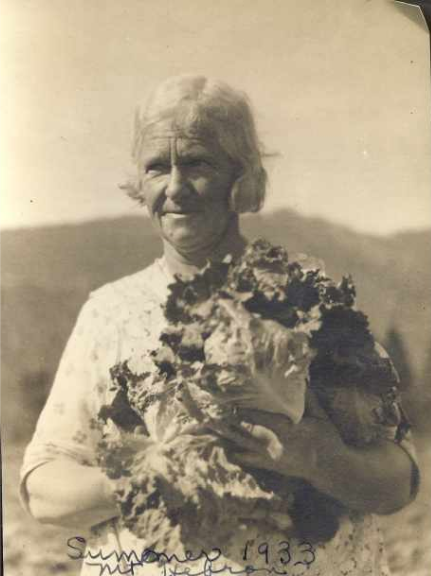
Anna Rinderknecht Nuffer, 1933 in Mt Hebron
“In the spring of 1888, I took a layoff for two weeks. My boss said if I was back in two weeks my job would be ready. I went to Providence and met my charming sweetheart, Anna Rinderknecht. I had courted her for the last 4 years. I told her I came to get married. She said all right. We called the local Justice of the Peace, Alma Mathius, to the house. He married us with her mother and two neighbors for witnesses. Licenses weren’t necessary at that time. She was raised in the Mormon Church. I was baptized into the church when I was 16. We were married under the condition that she would go with me to the mining camp where my job was waiting. She said she would go anywhere I wanted her to go and be glad of it. We were married on April 4, 1888. We lived happily together for 55 years and 6 days. She passed away April 10, 1943, at 15716 Saticoy Street, Van Nuys, California.
“Now I am due to tell the story of my married life which was altogether different conditions from my single life.
“We stayed in the mining camp until November, 1888, and went back to Providence. That winter I went to Idaho and homesteaded 160 acres adjoining my father’s place. It was between Cub River and Worm Creek. I got out logs and built a one-room house. I got a team and farming implements, moved into the log house and started farming in the spring of 1889. We had a hard going for awhile. The Cub River-Preston Canal circled our place. I got a job ditch riding the canal which was great help.
“There was a large cliff of grey sandstone on my father’s place. I started a rock quarry and got out stone in dimension sizes. It was used for trimming on the better buildings going up throughout the neighboring towns. It was much in demand. The Academy at Preston was started about that time, with my brother, John, as supervisor of construction. I got a contract to supply stone for this building which called for 2,000 cubic feet at 25¢ per foot at the quarry. The stone was used for corners, sills and watertable. The next year I furnished stone for nearly every town in Cache Valley. That was before the cement age.
“In 1891-92, the Agricultural College at Logan was expanding. I made contract with Mr. Venables of Ogden to deliver about 3,000 cubic feet of cut stone. He had tried to get some stone somewhere south of the valley but found it unsuitable. As I had furnished stone for several buildings in Logan he came to me. I lived near the quarry at that time. he inspected and approved the stone. The quarry was about 10 miles up Cub River Canyon from Franklin, on the left side slope going up the river, on a small tributary of Cub River called Sheep Creek.
“All work was done by hand. The main ledge was about 20 feet above the ground about 20 feet wide and 400 to 500 feet long. We used 12 foot church drills and blasted large rocks loose from the main ledge. We had to be careful how much powder we used so as not to shatter or cause seams in the stone. We usually had to put second charge in the opening made by the first charge to dislodge the block from the main ledge. The block so dislodged was from 6 to 7 feet thick and about 20 feet long. From then on all tools used were hammers, axes, wedges, and squares. Grooves were cut with axes wherever we desired to split the block, then wedges were set in the grooves about ten inches apart and driven in with hammers. Then we dressed them down to the right measurements, allowing one half inch for the stonecutters to take out the tool marks we made. Venables furnished bills for stone in dimension sizes as needed in the building.
“My brother, Charles August Nuffer, worked on the job the whole time it lasted. I also had a man by the name of Ed Hollingsworth of Preston, also Mr. A Merrill and Mr. Abel Smart of Cub River, and Mr. Robert Weber of Providence.
“It took part of two years for the job. The hauling was all done with wagons and horses; 30 to 35 cubic feet was a good load for two horses. These men did the hauling, John McDonald of Smithfield, Jean Weber of Providence, and Jake Rinderknecht of Providence who hauled more than any other. He used to leave home at 3 a.m., load up the same day and get back to Logan by 3 p.m. the next day. It was very hard on the horses. I also hauled a good many loads with my own team. All loading was done by hand on skids. It seems the miles were not so long when we traveled with horses as it does now when we travel in cars.
“I got 40¢ per cubic foot, of which 20¢ was paid for hauling. We had a hard time handling the name stone to go on the front of the building. When it was ordered it had 30 cubic feet in it and only one foot thick. When the stonecutters got through with it they found it too big to be hoisted in place so they made it smaller until there wasn’t much left.
“The most difficulty I had was in not getting my pay from the Superintendent. We overlooked a large 4-horse load at the final settlement. A few minutes after I had signed a receipt for the final payment in full I discovered my mistake. He refused to pay for it, although I produced the bill of lading signed by him. He didn’t dispute the debt, but said he had a receipt paid in full. He didn’t have anything and the government property couldn’t be attached, so I was the loser of about $15, which seemed a lot of money to me at that time. (Mr. Nuffer wrote this part in 1938 – excerpted here – at the request of college officials; it was part of a historical cornerstone insertion to be opened at the centennial in 1988.)
“About 1895 the Mink Creek – Preston canal was being dug. I got the job to do all the rock work for a stretch of about 10 miles. Later on, the Utah Power and Light Company built a large canal on the opposite side of the river from the Preston canal. I had several large jobs on that work. I was watermaster for one term on both the Preston canals. From 1896 to 1898 I was occupied mostly with farming, horse raising, and cow milking. In 1898, I traded my homestead for a farm nearer Preston on the brow of the hill near Battle Creek. I bought a house and lot in Preston and moved the family there. I had a few hundred head of sheep and leased 2,000 more from Joe Jensen of Brigham City. I had them two years when wool and lambs went so low I had to give them up at a loss. One of my mistakes.
“About this time the cement industry came into being. I went into the cement business and built the first cement sidewalks in Preston. I also built culverts, bridges and all kinds of cement work for the city and county. When cold weather came all cement work was stopped. Being an old timer, and always on good terms with the village Board, they gave me the job of special police in the winter. As I had a big family to support it was a great help. The city of Preston at that time had about 3,000 population and at times an unruly element visited the city and its three saloons. It kept the policeman very busy, especially at night. I was on duty mostly at night.
“In 1905, I built the first two-story hollow cement block house in that part of the country which I used for myself. We lived in the cement house for 4 years. About that time I heard from my friend who was living in Mexico, near Tampico. He was raising sugar cane and told me how we could all get rich quick raising it at $400 an acre. I and a friend went down to look it over. Mr. Tomlinson, the real estate man at the colony, offered me 87 acres of choice jungle land very cheap if I would move my family down. There was a large American colony at San Diegeto. I sold our home in Preston for $5,000 and moved the family down there. Another mistake.
“I intended to stay 5 years and get the place all planted in cane and then lease it out and come back a rich man. I bought a lot and built a house in San Diegeto. The town was 10 miles from the plantation, which was on lower ground along the river. A bunch of us Americans went down tot he plantation every Sunday evening by train to look after our Mexican workers. We would come back Saturday evening. I had from 5 to 15 Mexicans working the clear the ground and do some plowing. We had to plant tomatoes or corn first to get the ground in good condition for cane. The second year I had 5 acres in cane and 30 acres ready to plant the next year. I would have made it in 5 years if it hadn’t been for the Mexican revolution. We came to San Diegeto in April, 1909. That same year Mexico had a presidential election. Diaz was elected again which started the revolution to run him out, and trouble began all over the country. By 1911 it got so bad we had to leave as it was not safe there any more.
“I gave an old American, name of Tigner, a contract for 5 years. He was to have the place all planted in cane and return all the implements and animals in good condition. He thought he could stay on. He made very good progress for two years when Villa moved in with his band, arrested all the Americans and gave them their choice to stay in jail or leave the country. Tigner went to Tampico and left on a refuge ship. I got a letter from him from New Orleans asking me to release him from the contract. We were in our home town, Preston, when I got the letter. I couldn’t do anything but release him, so I lost all my investments and was a broke man with a large family. By that time I was in the cement business again and made a living at it.
“About 1924, a few hundred of us Americans from San Diegeto put in a damage claim in Washington against the Mexican government. My claim was for $30,000. The Mexican government agreed to pay $10 million at the rate of $500,000 per year over a period of 10 years. I was allowed $1,500 and that was cut 50 percent because there wasn’t enough to go around. Our lawyer in Washington gets 20 percent and our secretary, Mr. Tomlinson, gets 5 percent, so there isn’t much left. (*The script may have meant 20 years.)
“In 1920, we left Preston and went to Weiser, Idaho, on a farm. We stayed there 4 years when I got interested in an irrigation project in Butte Valley, Siskiyou County, California. We did quite well there for a few years until we got in several lawsuits over the water and lost some at every suit. So we always ran out of water about June 1st each year.
“There was a large cattle ranch in the south end of the valley called the Bois ranch. This had exclusive right to all the water in the creek called Butte Creek. The irrigation district bought the ranch for $50,000 in order to get the full rights to all the water. The district started to take some of the water further down the valley. The cattlemen and settlers above the valley said if the district can take the water away from the ranch they could do the same. So they started to put dams in the creek. As I was the only one that could use dynamite they always sent me to blow out the dams, which I did.
“A rich cattleman defied the district and put in a dam that a few sticks of dynamite could not blow out, as it was built with logs and large rocks and was about 25 feet across. Our president asked me how many sticks it would take to blow it out and I told him about 100. He said he would get it, as the dame must come out. I told him I would not take the responsibility as the man had too much money and could cause me trouble. He said he would send an officer with me to take the responsibility. To this I consented. They sent the local constable with me. I tired 100 sticks of dynamite in a bundle, put it under the dame on the upper side near the bottom. It did a good job. There was no more dam nor a place to build another one near.
“The owner of the ranch wanted $1,000 damage. About that time we had another lawsuit over the water with the other fellows and this man wanted to bring his case in at the same time. We all attended court at the county seat at Yreka. Everybody knew who had blown up the dam. Between the trials the lawyer asked the constable if he blew up the dam. He said no, Mr. Nuffer did that. The lawyer turned to me and said, “Did you blow up the dam?” I said I did. He asked who ordered it done and I said our district president, Mr. Snider. The lawyer turned to Mr. Snider and asked, “Did you order Mr. Nuffer to blow out the dam?” Snider said he did.
“That was the last we heard of the case. But the cattleman put in another dam. In the end, we had so many lawsuits and lost so much water every time that we could not farm successfully. I went to milking cows and raising chickens, turnkeys and pigs, and did fairly well.
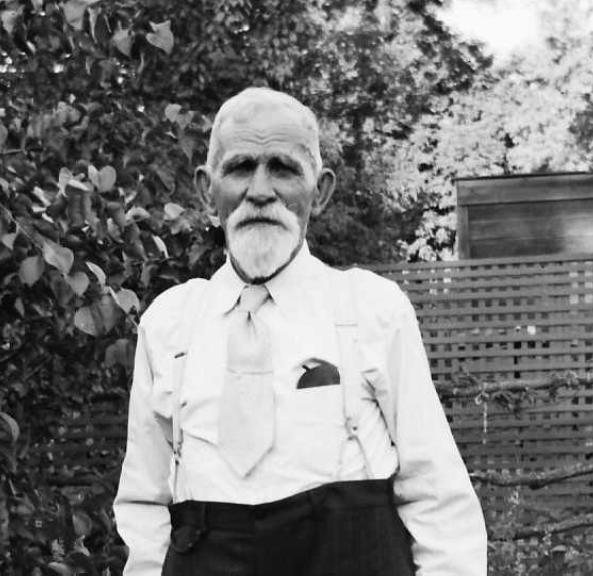
“In 1936, my son, Leon, living in Los Angeles, bought two and half acres in Van Nuys with a house and some chicken equipment. He came to Mt. Hebron where I was located and asked me to sell out and take charge of his place. I hesitated but my wife wanted to get away from Mt. Hebron. I sold at a loss and moved to Van Nuys. The place had been neglected but I worked hard and made it one of the best places in the valley. It is now December 30, 1943, and my dear wife has passed away. We had one daughter and many sons.
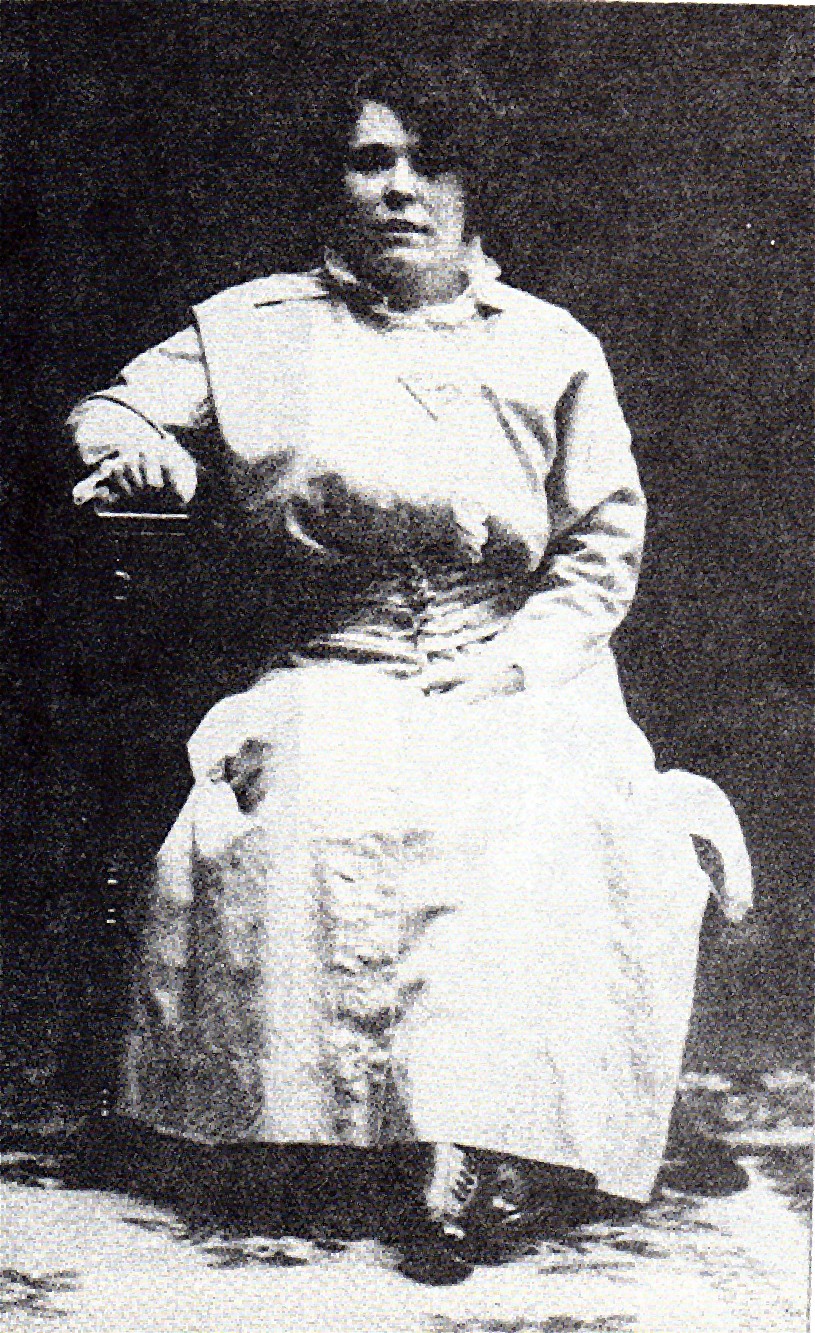
Emma Nuffer Nelson
“A short time before our first child was born we went to the Logan Temple where the ceremony was performed, our previous marriage being on a civil rite. This was on January 3, 1890. On May 4 our first child, Emma was born. She married George Nelson and died in January 28, 1919, when the flue was raging. She left two girls, Lucille, 3, and Virginia, 18 months. We raised them until they were 4 and 5 when their father married again (Anna Rinderknecht, Emma’s cousin). Our boys were Fred Jr., Leon, Bryant, Raymond, Lloyd, Glenn, Harold and George (who died in 1914 at the age of two).


 Sagacity