History of Plain City Pt 9

I have two copies of the History of Plain City, Utah. The front indicates it is from March 17th 1859 to present. As far as I can tell, the book was written in 1977. At least that is the latest date I can find in the book.

One copy belonged to my Grandparents Milo and Gladys Ross. My Grandpa has written various notes inside the history which I intend to include in parenthesis whenever they appear. They add to the history and come from his own experience and hearing. 

I will only do a number of pages at a time. I will also try to include scanned copies of the photos in the books. These are just scanned copies of these books, I have not tried to seek out originals or better copies.

History of Plain City March 17th 1859 to present, pages 141 through 149.

BONA VISTA IMPROVEMENT DISTRICT

SUBMITTED BY FLOYD PALMER

              This most important new culinary water system has made life a little more pleasant in this community and surrounding areas. It was turned into the lines just a century after sturdy pioneer families first put together temporary shelters and tapped several sweet water springs which they found in the area.

              It replaces old flowing wells, bringing precious waster from the depths of the earth. In early days many deep and surface wells dug, covered over, and fenced off to keep children from falling in. They were first fitted with “pitcher” pumps, a short-handled affair which were the “pumper” out in a short time. Even the farm animals had to depend on well water pumped to the surface by hand.

              Later, the easier to work, long-handled pumps were installed. These were followed by power pumps connected to a small storage tank. This was the ultimate in a private water supply.

              In 1955, a Weber County man, Linn C. Baker, was a member of the State legislature. He is the one who sponsored the bill to create special improvement districts. The reason he was the sponsor of this bill was due to his work in the Health Department for the State of Utah. As he studied samples of water sent to him from the outlying towns, he became aware of the amount of contamination there was in the drinking water in certain areas, Plain City was among the highest on the list. This was traceable to shallow surface wells being used, also septic tanks with poor drainage.

              Soon after the Weber Basin Conservancy District was organized, Plain City wanted to purchase one-thousand-acre feet of water. Their request was held in abeyance until a line could be built from Ogden Canyon. This, however, was never done.

              Elmer Carver was on the executive committee of Weber Basin Project. Through the encouragement of Commissioner Carver, Mr. Ezra Fjeldsted, manager of Weber basin Project, and Linn Baker, all met with the Plain City Town Board to get something started. Floyd A. Palmer, a member of the Town Board, was asked to represent Plain City on a committee of surrounding towns in Weber and Davis counties. Mr. Ezra Fjeldsted acted as chairman of this group and several meetings were held in both counties which Mr. Palmer attended.

              Following this, a public meeting was held in Plain city. Farr West, and Harrisville were asked to join in. This was for the purpose of starting a culinary water system. The results of this meeting, from all groups attending, were to go ahead, also to contact other nearby towns and get their feelings about joining in.

              A series of meetings were held in Farr West, Harrisville, Slaterville, Marriott, Wilson Lane, and Plain City. Other towns were invited to attend. Ezra Fjeldsted represented Weber Basin, Floyd A. Palmer represented Plain City, Dick Groberg represented Farr West, Kenneth Brown represented Harrisville, Clifford Blair represented Marriott and Slaterville, and Arthur W. Sorensen represented Wilson Lane. The meetings were all met with a great deal of enthusiasm and interest.

              Plain City Town Board consisted of Lee Olsen, President, Floyd A. Palmer, Elvin H. Maw, Merrill Jenkins, Blair Simpson, as members. A culinary water system was a prime item of the agenda in 1956. The town board along with several local residents were well organized to promote the need for a water supply to replace the surface wells and pumps.

              On July 19, 1956, Elmer Carver, Chairman of the Board of County Commissioners of Weber County, State of Utah, signed a certified documents that there be and is hereby created within Weber County, Utah, a Water Improvement District to be known and designated as the BONA VISTA WATER IMPROVEMENT DISTRICT, the same to embrace and include all real property lying within the following boundaries, to-wit: (SETS FORTH DETAILED LEGAL DESCRIPTION OF DISTRICT BOUNDARIES WHICH BOUNDARIES EMBRACE LANDS HEREIN ABSTRACTED – Abstracter)

              That the following-named persons are appointed as the Board of Trustees of said Bon Vista Water Improvement District:

                               Floyd A. Palmer, Plain City

                               Richard Groberg, Farr West

                               Kenneth Brown, Harrisville

                               Clifford Blair, Marriott-Slaterville

                               Arthur Sorensen, Wilson Lane

              This resolution shall take effect immediately and shall be recorded in the office of the Weber County Clerk. Recorded August 22, 1956.

Following this appointment from the Weber County Commission, the board held a short meeting. It was necessary to elect a chairman, after a discussion of each of the board members. Kenneth Brown was appointed as chairman.

              The first order of business was to secure professional and legal help. Mr. Jack Richards was appointed attorney. Jack Reeves, of the firm of Nelson, Reeves and Maxwell, was appointed engineer. They were appointed to do the field work and present the plans and drawings back to the board.

              When the plans were completed, the board spent much time deciding the most feasible and economical areas to run the lines in. Also, to give each town a fair share of the project. Following this, it was necessary to project estimated costs. The board spent many months getting costs and deciding on types and kinds of pipes and materials to use on the project. The overall plans had to look attractive and feasible in order to get a bonding company to handle the bonds.

              The first step made to secure the bond issue was to get signed pledge cards with an agreement to pay $250.00 for a waster connection. This was a requirement. Committees were organized with Floyd A. Palmer, Richard Groberg, Kenneth Brown, Clifford Blair, and Arthur Sorensen acting as chairman in each of their respective towns. The result was very successful, all those serving on these committee are deserving of much credit for their untiring effort and accomplishments.

              On August 20, 1957, a bond election was held to see if the residents would approve a $900,000.00 bond issue. The vote was 490 yes and 82 no. Edward L. Burton Company was retained as Fiscal Agent, and $698,000.00 was sold in General Obligation Bonds, and the system was under way.

              On April 14, 1958, a contract was awarded to Smith-Scott Pipe Company to furnish cement mortar-lined steel pipe for the main lines.

              Also, on April 14, 1958, a contract was awarded to Knudson Construction Company to install water mains in the Harrisville-Randall area which was Phase I of the project.

              Also, on April 14, 1958, a contract was awarded to Chicago Bridge & Iron Company to furnish and erect a 250,000.00 gallon elevated storage tank in Plain City.

              On April 28, 1958, Theron Palmer was hired as General Superintendent to oversee construction and to get it ready to serve and operated as a system.

              On May 27, 1958, an office was rented from the E. B. Stone Estate on the corner of 9th and Washington. The district still maintains its offices here. The building was purchased by the district in 1969 and has been remodeled.

              On May 27, 1958, negotiations were begun with the State Department of Welfare of obtain ownership of a spring located in Garner’s Canyon in North Ogden. The spring was used at the time by the welfare department at the Industrial School property for culinary use and irrigation use.

              On May 27, 1958, Weber Basin let a contract to Statewide Construction Company to build the 16-inch transmission line from 4000 South on U-84, down into the district where Bona Vista could connect to it.

              Also, on May 27, 1958, a piece of property located at 4100 West on 2200 North in Plain city, was purchased from Vern Palmer to construct the elevated tank.

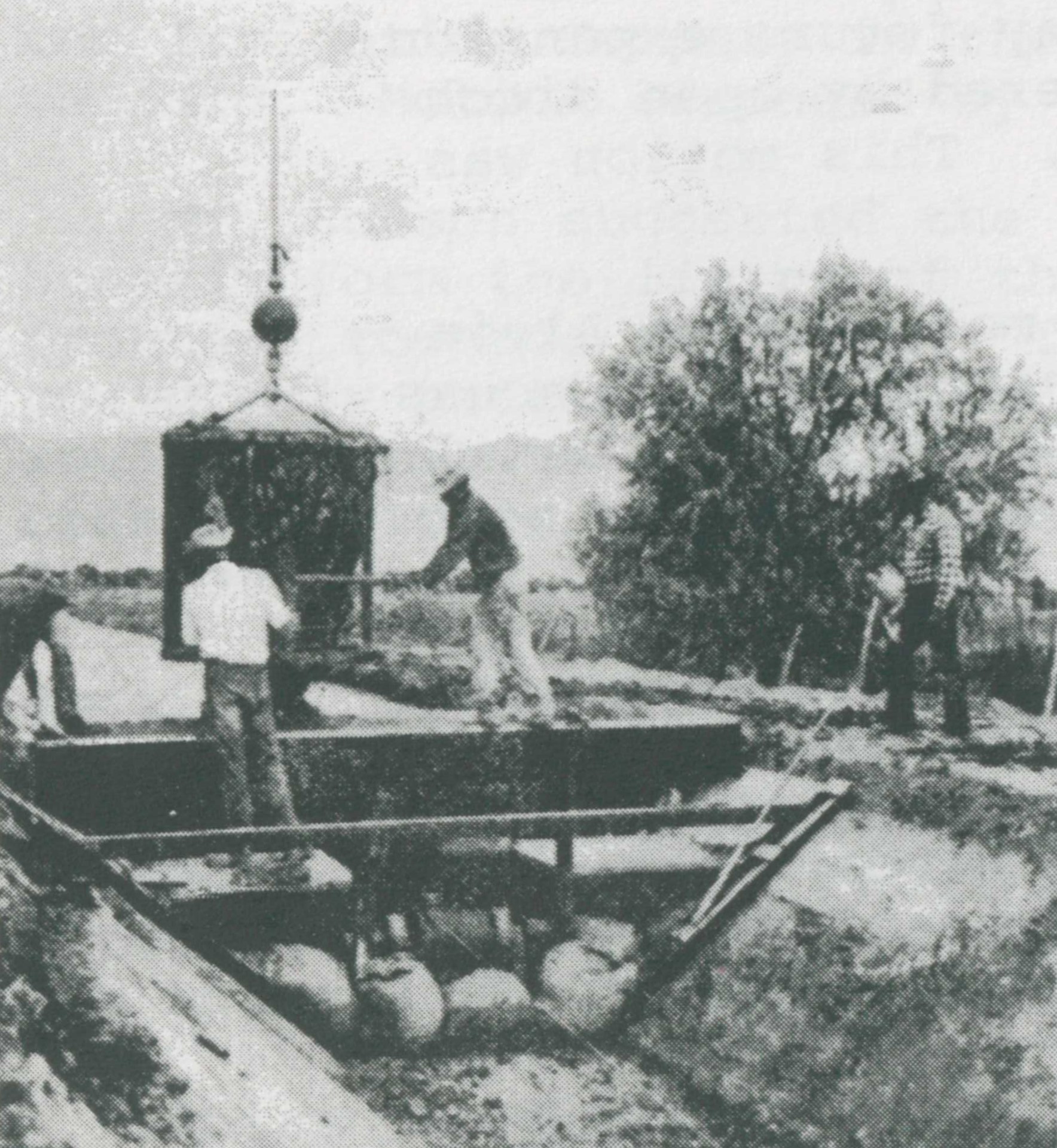
Bona Vista Water Storage Tank

              Raymond Concrete Title Company moved in and drove concrete pilings 80 feet into the ground to support the tank.

              Gerald Larkin was then awarded a contract to construct a foundation so Chicago Bridge and iron could begin erection.

              On July 3, 1958, a contract was awarded to Bert Robinson Construction Company to build lines in the Farr West and Plain City.

              Also, on July 3, 1958, Standard Plumbing Supply Company was awarded a contract to furnish materials for service lines.

              On July 17, 1958, the Weber County Commission agreed to purchase 60 fire hydrants to go on the system to be located by the Weber County Fire Chief.

              On July 17, 1958, Smedley construction Company was awarded a bid to construct lines in the Slaterville, Marriott, and Wilson area for $44,975.00. The same day Mac Construction Company of Salt Lake City was awarded the bid to construct our North Ogden Reservoir for $16,911.00. This is a concrete underground reservoir.

              On August 11, 1958, an agreement was reached with the Welfare Department to obtain full use of the spring in North Ogden. Weber-Box Elder water was purchased to replace the Welfare Department’s share of the spring.

              On February 11, 1959, work began on the plans and site for a reservoir in the Roy area.

              On March 23, 1959, it was decided to run a line on the North Plain City Road.

              On August 27, 1959, it was decided to either buy or condemn the Hansen property for a reservoir.

              A bid to build a tank in Roy was awarded to Wehyer Construction Company for #31,403.80 on September 23, 1959.

              Negotiations began to buy an eight-foot well from the Farr West Stake for $31,403.80 on September 23, 1959.

              Linn C. Baker resigned as Secretary on January 1, 1961. He had been with the district since it began.

              On December 6, 1961, it was decided to construct extensions to existing mains in the amount of $90,000.00 General Obligation Bonds were sold to finance these extensions. Waterfall Construction Company did the job.

              All though the summer of 1961, the Farr West well was tested to see if it would hold up.

              On February 28, 1962, President Wimmer signed the Warranty Deed on the Farr West well and property. On January 16, 1963, it was decided to put heat lights on our Roy tank. This was the first such installation in this area and it drew a lot of attention.

              The Utah State Health Department studied the plans for use of the plans for use of the existing well in Farr West and decided against allowing it to be used because of its depth. A change application was then filled with the State Engineer to drill the well to a deeper depth.

              On May 10, 1963, a contract with Wesley Stoddard was made to drill a well in Farr West for $21,632.00 plus $4,700.00 for the test hole to see how deep the well would have to go.

              A meeting was held at the Farr West Pump House building on January 20, 1964. This building was contracted by the Bona Vista Water employees. The piping was also done by employees of Bona Vista.

              R. W. Coleman Company was awarded a contract for $18,877.50 to change some lines under the interstate highway on November 22, 1965.

              Negotiations began on March 28, 1966, with Weber Basin on the North Ogden Well, which was later drilled and is used in the system now.

              Water meters were deemed necessary and were bought by bid from Waterworks Equipment Company and E. C. Olsen Company on October 28, 1968.

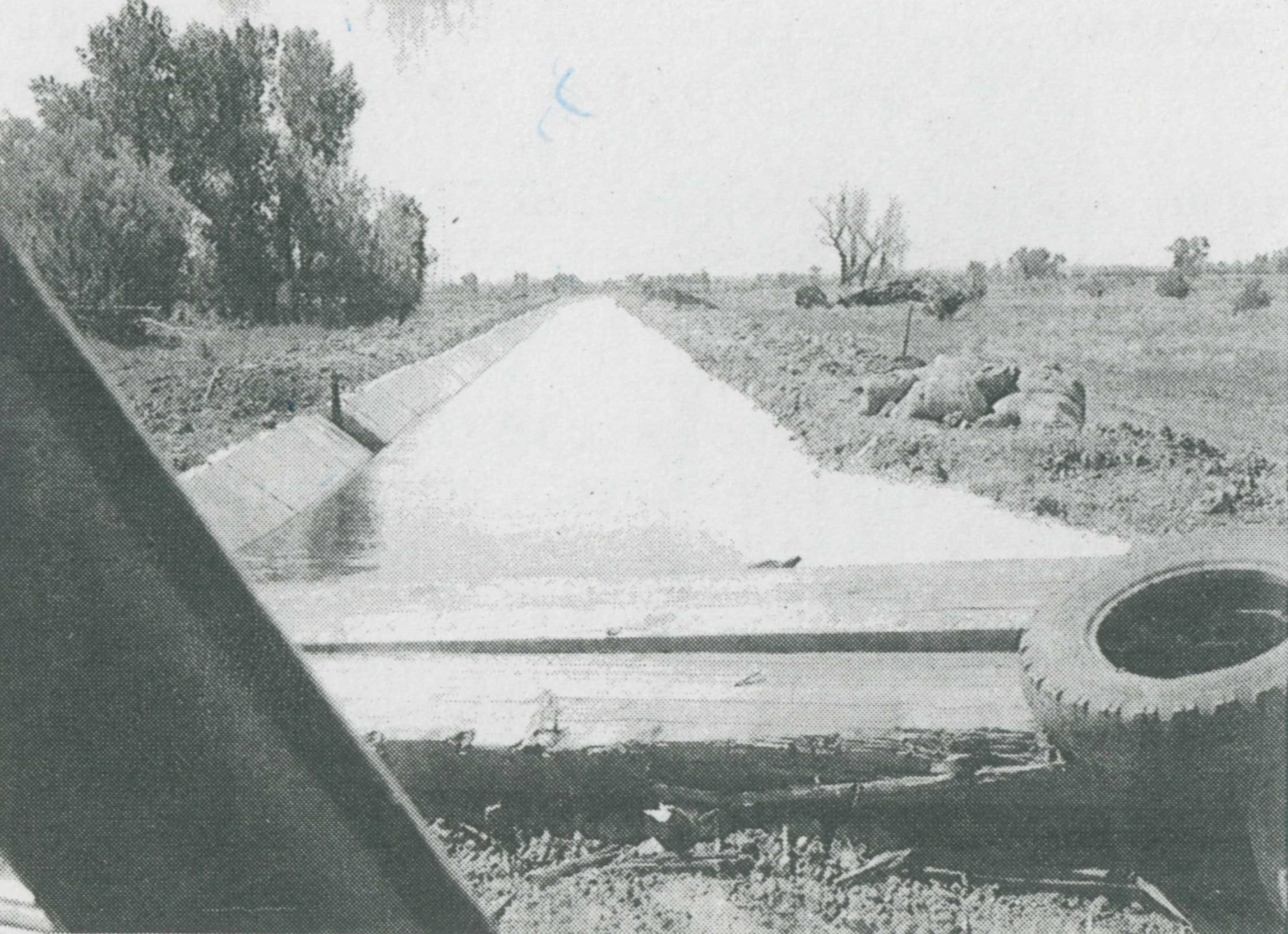
New Plain City Canal

BEGINNING OF PLAIN CITY IRRIGATION WATER

              1859 Before the summer was over some water had been brought in their new ditch from Four Mile Creek to Plain City. In 1860, the Canal was completed to Mill Creek, the following year to Broom’s Creek and in 1862 to the Ogden River. The Right of Way in Weber River was purchased in 1873 at a cost of $2000.

              In 1899 Samuel Wayment drilled an Artesian Well 249 feet deep producing additional water for the settlers. He also was in charge of the iron work and the building of the Chief Canning Factory in Plain City.

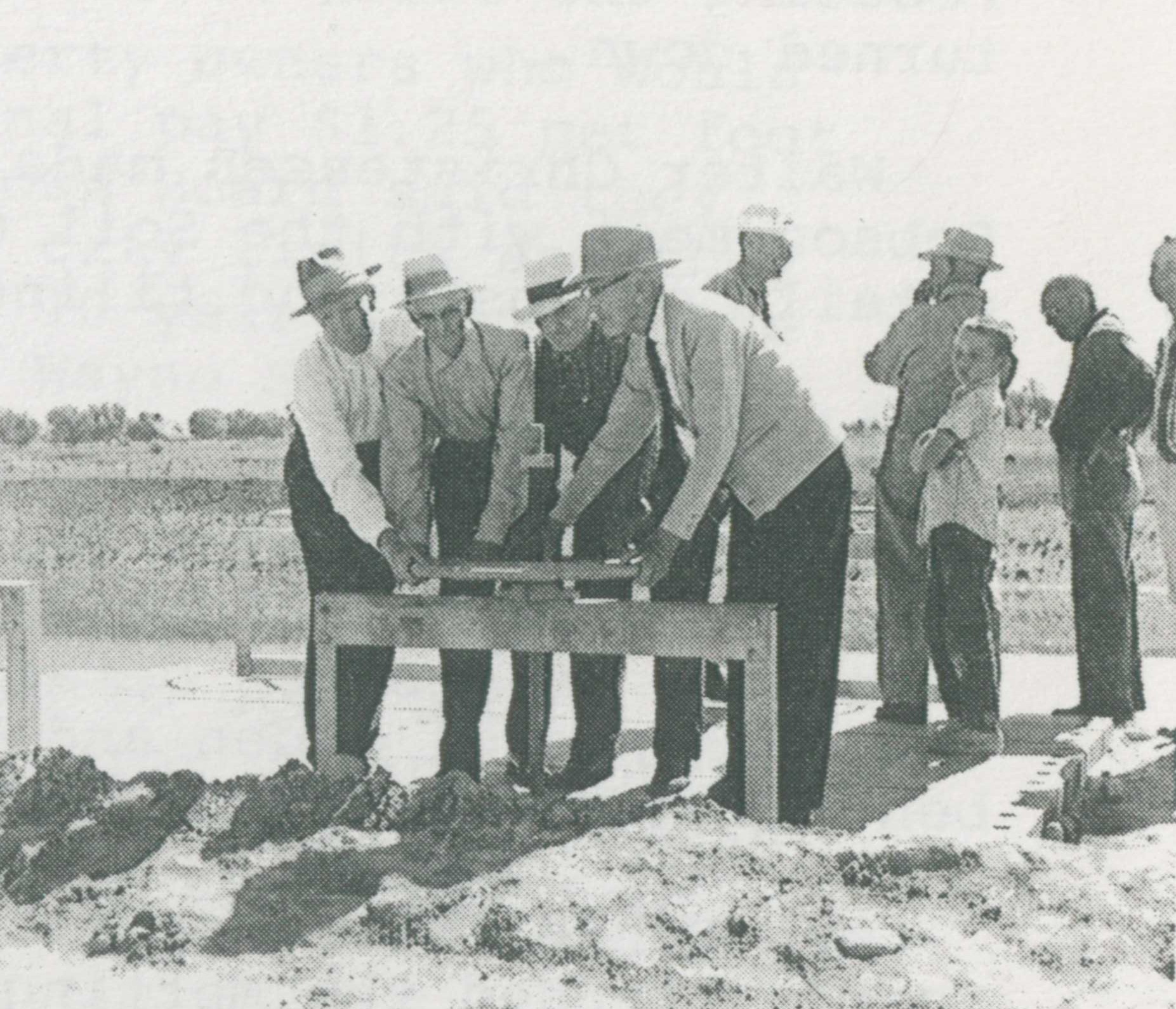
PLAIN CITY IRRIGATION-CEMENTING OF THE MAIN CANAL

SUBMITTED BY Wayne Skeen

              For many years the Plain City Irrigation Company received it’s water from the Weber River. The diversion point into the canal was just north of the old American Packing Plant that was later called the Swift Meat Packaging Plant. The Irrigation Company had a large Plank Head Gate in the Weber River that forced the water into the Plain City Irrigation Company Canal because of high waters in the spring this gate would wash out and it was necessary to make a gravel and dirt dam each year using horses, scrapers, and even large bulldozers. In recent years this became a major problem.

              The government began planning the Willard Project in 1960. This project would interfere to a certain extent with the existing canal used by the Irrigation Company because big Willard Bay Canal would be built in part of our existing canal and would also cross it in part of our existing canal and would also cross it in other areas. The leaders of this project wanted to provide a turn out from the big canal into the Plain City Irrigation Canal. The corporation of our company was necessary to give them the right to use the area affected by the construction of the Willard Bay Canal. The logical point of diversion would be west of the Farr West Church House. This meant that some new construction would be necessary to get the water into the old canal. It was in need of some repairs and it was at this time that the idea of a new cement lined canal was entertained.

              Directors who served during this period of construction were as followed:

              President                               Abram Maw                1959-60

              President                               Alvin J. Robson           1961-65

              Vice President                       Walt Christensen        1959-64

              Vice President                       Carl Taylor                  1965

                                                            Bert Hunt

                                                            Charles Heslop

                                                            Keith Blanch

                                                            Mike Panunzio

              Secretary                               Wayne Skeen              1959-65

              High lights of the minutes of the meetings during the construction period are as follow:

August 11, 1959

              Ogden City had extra water for sale this year which was allocated out to various canal companies. A motion was made by Alvin Robson that this water be purchased to see them through the current season. It would be paid by those stock holders who subscribed for the extra water.

April 4, 1960

              The meeting was called to discuss the new canal. Charles Heslop was assigned to work on interested free money from the Utah Water & Power board for the construction. Alvin Robson was assigned to work with the Soil Conservation on the completion of the surveying of the canal, and additional monies.

July 12, 1960

              A meeting was held to discuss a possible shortage of water for the remainder of the year. Time was changed from 20 shares per hour to 25 shares per hour.

January 9, 1961

              A priority was established with the Utah Water an Power board for interest free money and application made for $100,000.00

              A survey showed that there was a 10% loss of water between the River turn out and the Point of use.

March 8, 1961

              The Irrigation Company received a $10,000.00 cash settlement for their rights in the old canal from the O.U.R.D. Railroad Company that passes through their yards.

              Alvin Robson, Carl Taylor, and Walt Christensen was to secure information regarding tiling of the canal from Victor Lund’s corner up to the Jesse Singleton property where the canal leaves the road and runs back into the fields.

April 20, 1961

              A report was given by Alvin Robson regarding the tiling of the lower part of the canal. There were mixed emotions about tiling this section of the canal because of the fall and the amount of water to be delivered. “Alvin Robson commented as the discussion went on concerning the piping verses the cement lining. The stockholders are residents of this town and should have some concern towards the improvements and beautification of the community and that an open cement lined canals to greet the people entering the town is not very inviting and once it was constructed it would never be changed in our life time.”

              Keith Blanch speaking as a town board member expressed his opinion regarding the beautification and eliminating hazards in the community and felt that it was worth while and the tax payers should help with the construction of the Irrigation Company in piping this section of the canal.

              Glen Charlton and Lee Olsen from the town board were present. An opinion was asked from the town board members. Mr. Charlton felt it was a worth while project as long as it was right. Mr. Olsen commented that it was a good thing as long as it was sufficient to meet the needs of the water users.

              The town board members agreed to cover the pipe that was laid with dirt. It was agreed that 2880 feet of 36 inch tile would be laid this spring from the old beet dump corner to Victor Lund’s corner.

April 27, 1961

              The Town board members present: Dee Cook, Glen Charlton, Kent Jenkins, and Lee Olsen. Mr. Covey from Utah State University was also present.

              Further discussion concerning cost of construction of the concrete pipe continued. Keith Blanch made a motion that the town board and property owners should join with the Irrigation Company in the cost of the 36 inch tile to be laid. Motion seconded by Carl Taylor

              Mr. Robson suggested the property owners who would benefit from the lining of the canal pay $1.25 per foot frontage towards the pipe. The Town Board said they could only participate within the city limits and they would contribute $4,000.00 over a 10 year period. The bids were to be sent to Secretary Wayne Skeen by March 30, 1961.

April 30, 1961

              The purpose of this meeting was to open bids. Utah Concrete Pipe Company received bids for 36 inch concrete pipe at $8.75 per foot. Waterfall Construction Company was awarded the laying of the pipe at $1.55 per foot.

              Abram Maw made the motion that the project not be stopped at the beet dump corner but continue up to the up to the weir east of the water tower (where the pipe portion of the canal now starts) if the property owners will contribute $1.25 per foot. Motion seconded by Keith Blanch.

              Charles Heslop ad Elvin Maw were asked to approach these property owners and get their approval to pay the $1.25 and also contact all stock holders and get their signature for government participation thru the Soil Conservation.

              Charles and Elvin were successful in getting all the names except Jesse Singleton who would not accept any government monies and would not pay the $1.25 per foot to tile in front of his property.

              Alvin Robson contracted Howard Singleton, Jesse’s boy and he agreed to pay the $1.25 but only up to the old house that sat in the field and that is where the concrete pipe starts today. Alvin Robson tried to convince the Director’s that they should at the company’s cost tile the remainder of the ditch along the road because any future expansion of the community would by hampered by open ditch reducing the width of the road. This motion turned down.

              Walter Christensen made the motion that Alvin Robson meet with the Soil Conservation to discuss details of cost and tiling and lining the canal.

April 31, 1961

              Alvin East, Maurice Skeen, and Owen Wayment from the Warren Irrigation Company met with the directors to discuss details and sign a contract for the exchange of Ogden and Weber River which would benefit both companies. The contract was signed.

              Mr. Daniel Lawrence from the Utah Water & Power Board attended the meeting. Keith Blanch made the motion that Alvin Robson and Wayne Skeen be given the power to enter into a contract with the Utah Water & Power Board for the total cost of $1,300.000.00 and formulate all details.

May 3, 1961

              Junior Taylor was appointed as Water Master of the year.

May 15, 1961

              The purpose of this meeting was to discuss the Weber Basin Project with E.J. Feldstead and commissioner Wilmer Carver. They needed additional votes to finish construction of the Willard Bay. A proposed addition would cost seventeen million dollars.

June 5, 1961

              The purpose of the meeting was to see what should be done because it appeared that there would be a water shortage before the end of the year. It was proposed that we only run off water until the stream reached a point that we could not water properly and then start to use our shortage water and put turns on 1/3 basis.

September 27, 1961

              The new project was discussed and it was recommended that the company hire an engineer and begin construction on the upper end of the new canal.

              There were many problems that came out of the construction of this canal. It would be necessary to get some dirt to construct the pad for the canal. The company purchased some ground at the upper end of the canal from Max Stander. Then got the dirt that was necessary to build the upper end of the canal and then leveled the ground and gave it back to Mr. Stander. They also purchased additional dirt from Robert Penman. This dirt was trucked from his property just south of the Weber River and west of the main road. The dirt was hauled by farmers using their beet trucks, etc.. The new pad was made in the old canal banks where possible, but there was some trading of land etc. to straighten out the canal. There was also a problem in getting someone to dig out the canal to the size and shape required to allow 50 seconds feet of water at one time. The company asked for bids, but they only received one because the equipment needed to shape the canal was not available. In order to get the project moving Alvin Robson caught a bus on Ogden and went to the Fuller Forms Company in Arizona to see if they had some type of equipment that could be used. He purchased a right to one of their slip forms that could be used in forming and pouring the concrete. He returned to Ogden and worked with the Ogden Iron Works on 23rd Street and Grant Avenue where the construction of the slip forms took place. The next problem was to begin the construction of the project. Dean Hadley of Taylor was hired to do most of the big equipment work. Local farmers also helped with their equipment. The Soil Conservation furnished the engineering on the project. Herbert Issackson of Pleasant View was the surveyor. One of the major problems that existed and is still a yearly discussion is the amount of water delivered from the existing head gates. The government required that curtained head gates must be varied in size for them to participate financially.

Oct 1962

              There was much contention and personal feelings during the construction of how it should be done. Some people left the jobs and never came back, but the project was finally finished. The construction created problems for some but most of the inconveniences were ratified by the Irrigation Company. New bridges were built, land was leveled, damages to property was crops were paid for during the construction. The Company paid for fencing materials with the property owners installing the fences. Cattle that used to walk across the stream would fall into the new lined canal and couldn’t get out. The Company paid for some of the cattle that were lost before the agreement to install fencing was made.

              The total cost of the project was $199,754.08. The amount of $122,918.61 was borrowed from Utah Water & Power Board. This money was interest free if a yearly payment was made by November 30th each year. The last payment of $8.257.06 will be paid on November 30, 1977. Other cost not being paid by the stockholders come from the Soil Conservation and the sale of pieces of the old canal, and the town board. Vice President Bill Hatch of the First Security bank was also an asset in the financing of the canal.

              We borrowed monies from the First Security Bank as construction went on to pay for cost on a daily basis. On December 31, 1974, the company owed the First Security bank $60,000.00 Alvin Robson and Wayne Skeen met with Mr. Hatch in May regarding this bill. Mr. Hatch said that the bank needed some type of security for this loan. There was nothing to give him because out rights to the canal had been given to the Utah Water and Power Board. Alvin Robson and Wayne Skeen then approached Mr. Lawrence of the Utah Water and Power Board asking them for more money for the project explaining the situation with the bank. Alvin Robson explained that they might just as well take over the ownership of the canal because the bill had to be paid. There was nothing to offer as security because the Utah Water and Power board had everything that the company owned. Later, Mr. Lawrence of the Utah Water and Power Board gave the Irrigation Company an additional $30,000 which helped to delete that note at the First Security Bank.

*********

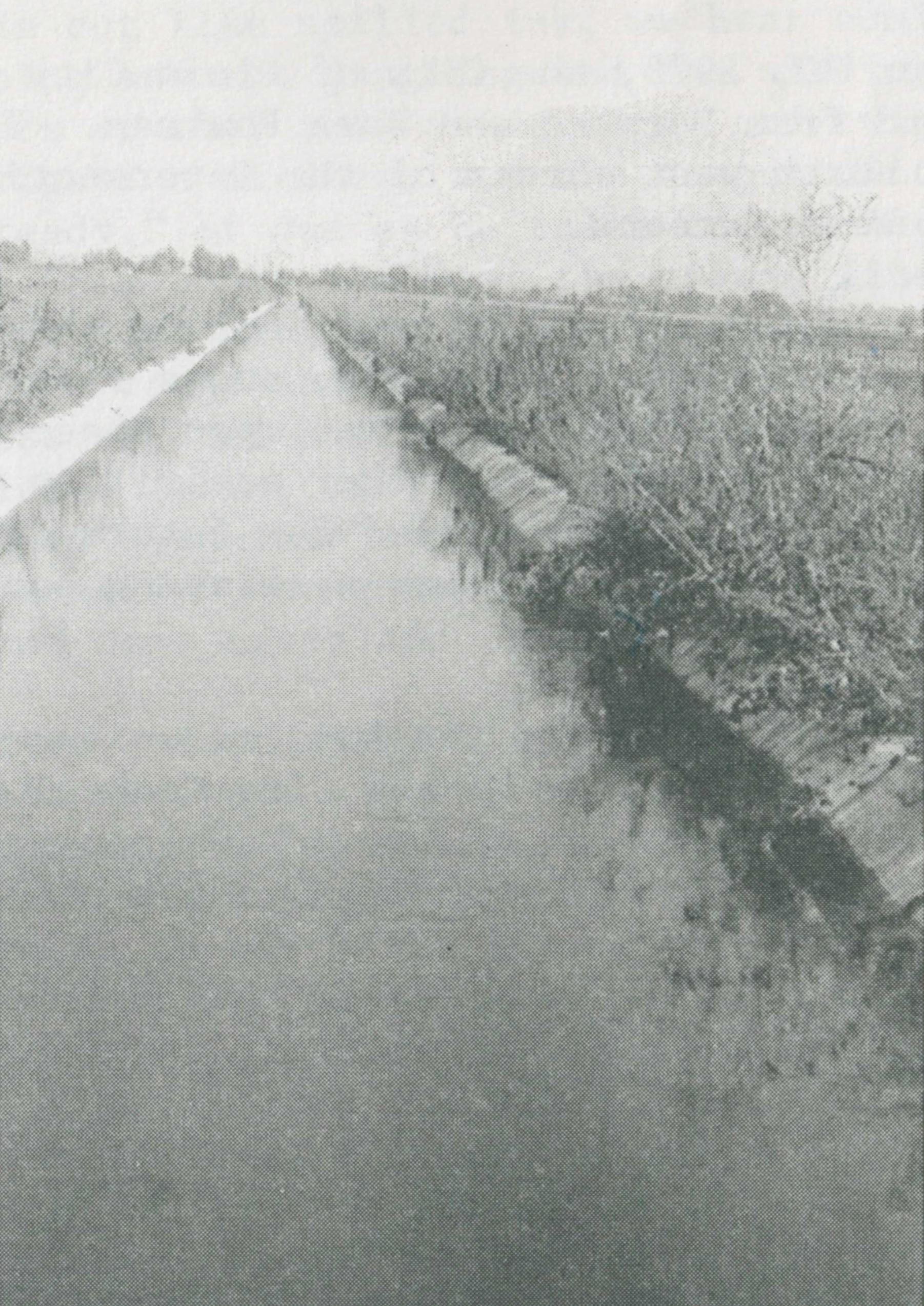
Canal after completion

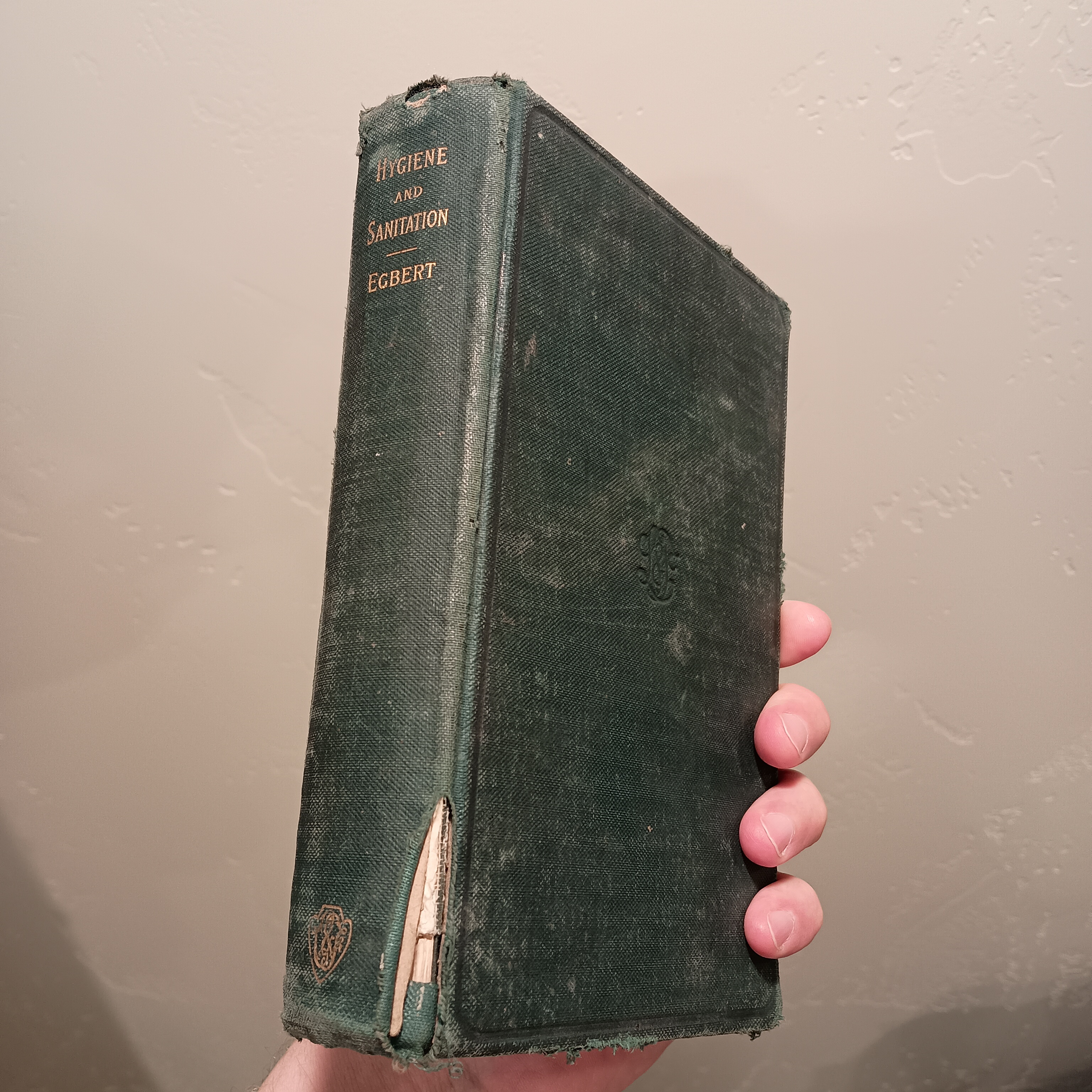
Hygiene and Sanitation by Egbert

Hygiene and Sanitation Textbook used at Brigham Young College

On the 15th I wrote about my Grandfather’s 100th Birthday (Norwood Jonas) and noting it with a newspaper article found in a textbook that belonged to his parents. This is that book. This was a textbook for my Great Grandfather at Brigham Young College in Logan, Utah.

Joseph Nelson Jonas graduated from Brigham Young College on 3 June 1915. That is 109 years ago tomorrow. Here is a copy of his Diploma. I have written about his history previously. I have also written about his time at BYC previously too.

Joseph Jonas graduation diploma from Brigham Young College in Logan, Utah

The textbook is also interesting. It appears Hygiene and Sanitation written by Seneca Egbert has some serious staying power. I found this history of Mr. Egbert.

Dr. Seneca Egbert (1863-1939) and Nancy Egbert

“Dr. Egbert was a physician. He graduated from Princeton University in 1884 and received his medical degree from the University of Pennsylvania in 1888. Before graduating, Dr. Egbert had been a demonstrator of hygiene in the Medical Department of the University of Pennsylvania. While in this position, he worked with Professor Samuel G. Dixon to establish the first Laboratory of Hygiene in the University, and was made lecturer on hygiene for 1890-1891. In 1892 the Drexel Institute of Philadelphia hired Dr. Egbert for a similar position. In 1893 he was elected Professor of Hygiene and Sanitation in the Medico-Chirurgical College of Philadelphia, appointed Vice-Dean of the same college in 1897, and elected Dean in 1898. Once the Medico-Chirurgical College merged with the University of Pennsylvania, Dr. Seneca became a professor of hygiene. He was president of the Radnor Township Board of Health and he was esteemed as a public health authority.

“In 1897 Seneca Egbert and his wife, Nancy Bredin Egbert, bought part of the old Towne family farm. The home, now owned by Fred French, is located on Blueberry Lane.

“Dr. Egbert was widely published. His book, Manual of Hygiene and Sanitation (seven editions), appeared first in 1898, as did his Home Sanitation, a Manual for Housekeepers. In 1919 Personal Hygiene for Nurses was published. He also wrote numerous articles for medical journals, maintained an impressive lecture schedule, and was a history buff who strongly advocated for the creation and maintenance of historic sites. He was not hesitant about venturing his opinion openly, and on at least two occasions made suggestions to Philadelphia politicians which received limited consideration. Dr. Egbert “was an advocate for ‘pure air, pure milk, and pure water.’ He felt that if people in the United States had these ingredients the average span of life would be increased by seven and one-half years.” He pursued this philosophy in an article, “Pure Water for Philadelphia,” which proposed damming the Mullica River and its feeder streams at the head of the tide to form a reservoir all the way to Atsion, NJ, and then pump to a reservoir on the western side to flow towards the Cooper River and another reservoir, thence to be pumped under the Delaware in order to relieve the poor water quality in Philadelphia . It would have pumped a relatively small quantity, 450,000,000 gallons of water per year, to start. The potential value of his plan was not recognized, either then or, to judge from a 2011 Web comment, now.

“On another issue, the City of Philadelphia proposed clearing all buildings from three city blocks. In response to a request for ideas on how to use this space, Dr. Egbert suggested allocating some of the land to the federal government, some to the state and some to the city of Philadelphia. On a strip of land extending down the center of the whole space, Dr. Egbert suggested constructing thirteen buildings representing the thirteen original colonies, and calling the area In­dependence Square. Each building would house the contributions made by that state towards the forming of our Union. “The idea was considered ludicrous in design and in scope. Dr. Egbert was a physician, not an architect.”

“Despite his critics, Seneca Egbert was doggedly de­termined to maintain the quality of life for Americans. For example, he embraced the newest form of transportation, bicycling, and “saw cycling as a remedy for dyspepsia, torpid liver, incipient consumption, nervous exhaustion , rheumatism, and melancholia.”

“A portrait of Dr. Egbert was painted for the University of Pennsylvania by Nancy Egbert’s brother, Rae Sloan Bredin (1870-1937). Mr. Bredin was a member of the New Hope group of American impressionists and several of his paintings are owned by New York’s Metropolitan Museum of Art. Mr. Bredin was co-founder of the Philadelphia School of Design for Women and the New York School of Fine Arts. His portrait of Dr. Egbert hangs now in the home of Dr. David Egbert Sparks, Dr. and Mrs. Egbert’s grandson, who is a genealogist and retired head of libraries at Notre Dame.

“Like Dr. Thomas Montgomery Lightfoot, Dr. Egbert was a lecturer in the winter lecture series held during the years 1887-1895 sponsored by the Academy of Natural Sciences. Dr. Egbert’s lecture was titled, “The Prevention of Disease and the Preservation of Health.”

“Nelson’s own Parke Struthers wrote in A History of Nelson that like Dr. Egbert’s good friend Dr. Thomas Montgomery Lightfoot, Seneca Egbert “met his fellow Nelsonians on an equal footing, a trait in human relations reserved for only the Great.” Mr. Struthers also states that the Egberts were “gracious, active in town affairs, and interested in the people of Nelson.” With their friends Dr. Lightfoot and his wife, Dr. and Mrs. Egbert served on the committee to make arrangements for the celebration of the one hundred and fiftieth anniversary of the first settlement of Nelson 1767-1917.

Inside cover of Hygiene and Sanitation

Here is the writing inside the book:

Joseph N. Jonas 1915

394 So. 1st East

Logan, UT

Jonas Joseph

Richmond, Utah

1915

First written page inside Hygiene and Sanitation

Here is the writing on the second page of the book:

Joseph N. Jonas

B.Y.C.

Logan, Ut.

394 So. 1 E.

Herrington, or Park

Stearn, Hot air, or Water

1 degree expands 1/491 of its val

relationship of insects to disease, Herrington

Hygiene of the school. h medical inspection.

282-387

Wilburn Norwood Jonas 100th Birthday!

Norwood Jonas in the 1960s

I thought it would be appropriate to commemorate the 100th birthday of my Grandpa, Wilburn Norwood Jonas. He went by Norwood his whole life, or Nor to those closest.

Grandpa was born 15 May 1924 in Lewiston, Cache, Utah to Lillian Coley and Joseph Nelson Jonas.  The fourth child of eight to his parents.  He married Colleen Mary Andra 27 September 1946 in Elko, Elko, Nevada.  Three children were born to him and Colleen; Douglas in 1952, Sandra in 1954, and Jackie in 1960.  He died 14 March 1975 in Burley, Cassia, Idaho and was buried 19 March 1975 in Richmond, Cache, Utah.

I was trying to think of a way to commemorate Grandpa. As linked above, I have written of him before. This week, I went through an old book I have that belong to Norwood’s dad, Joseph. Inside were some newspaper clippings and notes. One linked to Grandpa. I share it to show that research is ongoing and can be found anywhere! Just takes a little luck, heaven’s guidance, and you will stumble on them. I will wrote more on the book and other clippings inside later.

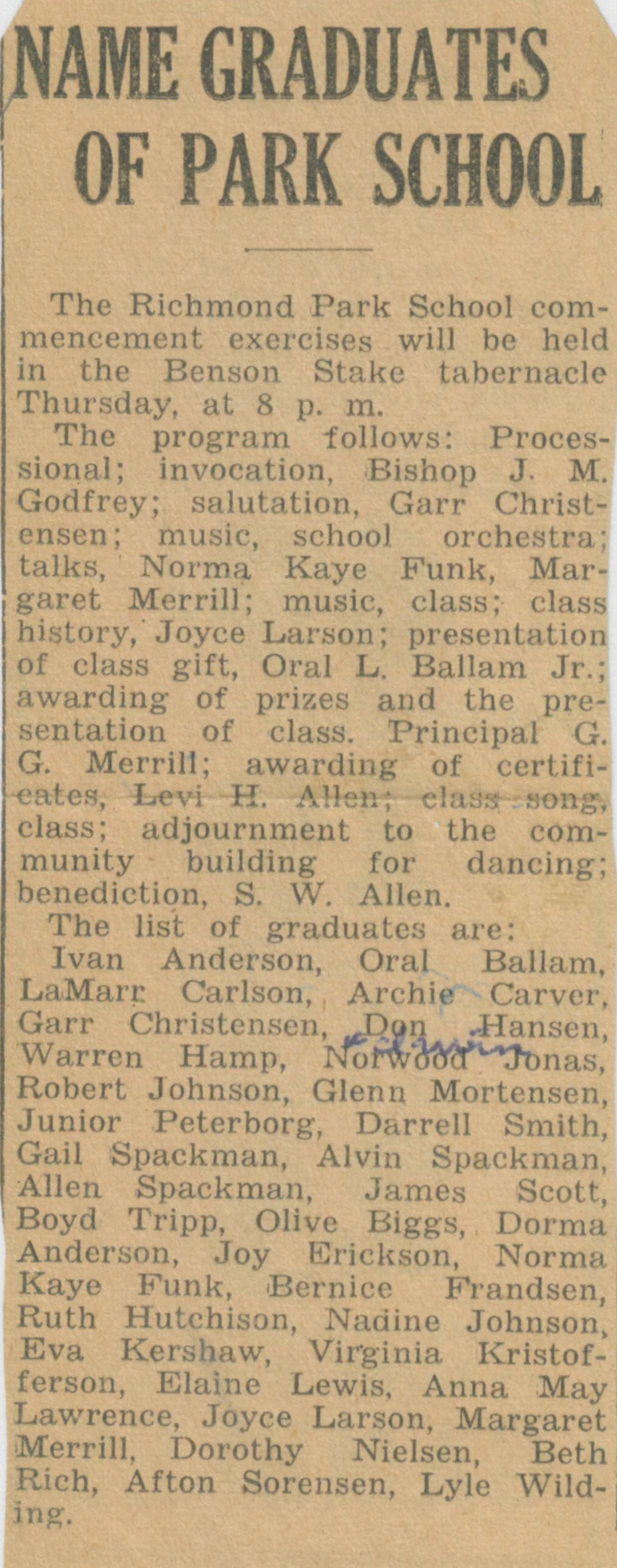
Park School was in Richmond. It was only razed in the past few years. Grandpa went to North Cache High School, although he did not graduate. This clipping also has Irwin written in to it. Which tells me he was missed or it is the wrong Jonas boy that was listed. Although, I do have a class picture of Irwin and Norwood together, so I am not clear if that tips it one way or the other.

“Name Graduates of Park School

“The Richmond Park School commencement exercises will be held in the Benson Stake tabernacle Thursday, at 8 p. m.

“The program follows: Processional; Invocation, Bishop J. M. Godfrey; salutation, Garr Christensen; music, school orchestra; talks, Norma Kaye Funk, Margaret Merrill; music, class; class history, Joyce Larson; presentation of class gift, Oral L. Ballam Jr.; awarding of prizes and the presentation of the class. Principal G. G. Merrill; awarding of certificates, Levi H. Allen; class song, class; adjournment to the community building for dancing; benediction, S. W. Allen.

“The list of graduates are: Ivan Anderson, Oral Ballam, LaMarr Carlson, Archie Carver, Garr Christensen, Don Hansen, Warren Hamp, [Irwin written in, referring to Irwin Jonas], Norwood Jonas, Robert Johnson, Glenn Mortensen, Junior Peterborg, Darrell Smith, Gail Spackman, Alvin Spackman, Allen Spackman, James Scott, Boyd Tripp, Olive Biggs, Dorma Anderson, Joy Erickson, Norma Kaye Funk, Bernice Frandsen, Ruth Hutchison, Nadine Johnson, Eva Kershaw, Virginia Kirstofferson, Elaine Lewis, Anna May Lawrence, Joyce Larson, Margaret Merrill, Dorothy Nielsen, Beth Rich, Afton Sorensen, Lyle Wilding.

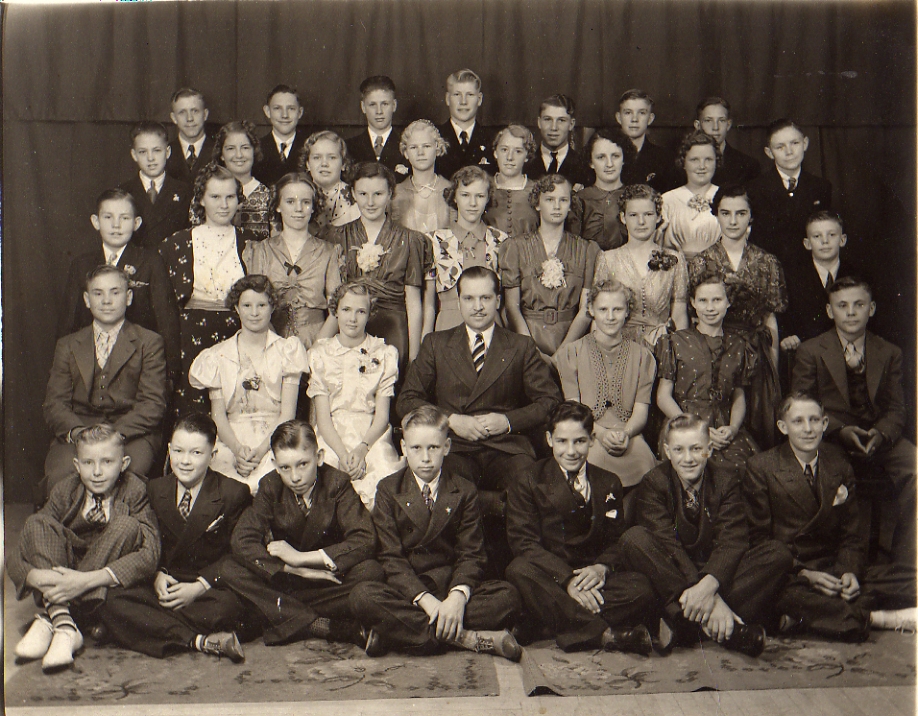
Here is the class picture with many of these same names. It also includes Irwin and Norwood. I have written about it previously.

History of Nils Bengtsson and Johanna Johansdotter’s Family

I received a copy of a history from Julie Jonas Kowallis. It is attached to Johanna’s profile in FamilySearch. Whoever compiled or rewrote the previous version seems to have mixed in references and stories related to Johanna’s son and grandson as if they were Johanna’s husband or son. Both emigrated to Utah at different times and had different trips. Further, this author edited out parts of the other history that seem to be passed down, although not verified. Some of the other history is missing, I will share it if I can find the missing second page. 

I have previously written about Johanna. I make only minor corrections within brackets. Nils and Johanna’s daughter, Agneta, is my Great Great Grandmother through her daughter Annetta “Annie” Josephine Nelson, who married Joseph Jonas.

~

The country of Sweden is about the same size as the state of California. Southern Sweden is made up of flat, fertile plains. The lan (which means country) borders have changed very little since they were established. Each lan is subdivided into smaller units that are known as parishes. 

Little is known about Swedish history before 800 AD. About this time two different tribes of Vikings entered Sweden. The Svear, who lived in the eastern parts, and the Gotar, who lived in the western parts. THey were almost continuously at war with one another. It was only after the introduction of Christianity in the 9th century that they united and formed a nation. The name Sweden comes from the phrase Svea rike, which means “Kingdom of the Svear.”

For many generations the farming class comprised most of Sweden’s population. The farmer who owned his land was usually quite stable. However, trades-men could travel great distances to obtain employment in their professions, often seeking a good position in the city. There are many lakes and streams in Sweden, so it is logical to think fishermen and seamen would have resided along the coasts or lakes. 

The people of Sweden are known to be energetic, hardworking people who value order and tidiness.

Our ancestors Nils Bengtsson and Johanna Johansdotter’s families were among the parish district of Halland in Sweden. Nils came from a long line of tall strong men of the north. Legend has it that one of his relatives was so large and strong that he was considered a giant. He could pick up two ordinary sized men, one in each fist, and bump them together. Nils was a big man, handsome and strong. He possessed unusual physical strength. An attribute many of his [descendants] would inherit. 

We have no details as to where or how Nils and Johanna met but we know that when Nils was 28 years old and Johanna 17 they were married on July 4, 1830. Johanna affectionately called Nils “her big handsome man.” They were blessed with eight children, raising seven of them to adulthood. 

The Nils Bengtsson family lived in the usual country home in Sweden. There was a long building on the south with the family residence in the east end and the west end was used for pete or turf and wood. They had a building on the north side where the cattle and the hay and grain were stored. Thatch roofs were the rule for the ordinary farm house. On the ease side of the house was a path running south past a meadow and then over a hill covered with trees. On the west there was a road leading down through the green and across a stream through a field to the north. It is difficult in our day to imagine what it would be like to live in a small one room home with a family of seven children. 

Although freedom of worship is guaranteed by the law in Sweden over 90 percent of the population belong to the Lutheran church, which is the state church. During the 1800’s missionaries from [The] Church of Jesus Christ of Latter-day Saints, or the [Mormons], began to proselyte in Sweden.

Sometime in the [1850s] missionaries called at the home of Nils and Johanna. At the time Nils was very ill. Their one room home was divided by a curtain to separate the area where Nil’s bed was. Even though he was very ill at the time he listened intently to what those missionaries said. Later he called his son Nils to his bedside and said, “What those men are telling us I feel it is right. I will not live long enough to join their church, but I want you to listen to them and if you feel that it is right you must embrace it.” Shortly after this on March 12, 1859 Nils died.

Two years passed between Nils death and the [family’s] acceptance of Mormonism. But when the Bentsson family were baptized they embraced the gospel with sincerity of heart and a love for its doctrines and principles. [Johanna was baptized a member on 11 May 1861. Agnetta was baptized 10 November 1863, Lars 5 May 1860, Ingjard 5 May 1861, Christina 4 February 1866, and Nils Jr 5 May 1860. Johann joined 7 September 1893 after immigration to Utah. The other two were after their deaths. Bengta and Borta did not join or immigrate to Utah.] Nils and Johanna’s son Nils [anglicized to Nels in United States] said that the songs of Zion filled their hearts and minds. The saints throughout the world were encouraged to emigrate to Utah to be with the main body of the church. Nils said, “I had a birds eye view of Zion in my soul and I yearned to go there.” So with a call from a Prophet and songs of Zion ringing in their hearts, the Bengtsson family began to prepare for the long journey to join with the Saints in Utah. Prior to their departure little Johan Peter, who was 6 years old, gave all of his toys away. I can’t even imagine the faith and courage that Johanna must have had. She was 49 years old at the time and she was leaving her family, her friends and her beloved homeland. The family loaded all their earthly belongings that they could carry and began their trek to America. They left Sweden because of their testimonies of the restored gospel of Jesus Christ and their convictions in its teachings. 

Nils wrote of this experience, “the family hustled along the rock paved sidewalks of Halmstad to the coast. The noise of the horses feet and the rumble of the vehicles on the rock paved road drowned all of the voices of the little ones who complained of the unceremonious haste of departure. All were safely on board, the gang planks withdrawn, before we realized that we were moving. We could see that men on the shore were being left behind… As we glided out on the calm blue waters. As we Denmark we say the harbor at Copenhagen covered with sails and booming of cannons. The dense smoke made it difficult to see the city. Germany and Denmark were at war. We sailed and entered the city from the back just before sundown. We had a long way to walk but it was worthwhile. We saw the prettiest homes, lawns, shrubbery, and statues; such as a man on a horse with beautiful decorations representing warriors and noblemen. That even I first heard the Danish language, though odd at first I soon got accustomed to it and learned to understand it.” They sailed from Denmark to Norway on their way to Hamburg, Germany passing between Holland and Belgium. 

On Friday, April 18, 1862 Johanna and her children boarded the ship “Electric” and sailed from Hamburg with 336 Saints all bound for Utah. Elder Soren Christofferson was in charge of the Saints and H.J. Johansen was the Captain of the ship. The emigrants were from Holland and other conferences in Denmark and from the Norrkooping Conference in Sweden. The “Electric” sailed down the Elbe to Bluckstadt Roads, arriving there about noon. Here anchor was cast near the ship “Athenia,” which had another company of emigrating Saints on board. At this time there were 335 emigrants on board the “Electric and 486 on the ‘Athenia.'” The “Electric” lifted anchor April 22nd and sailed to a point off the coast of Hanover, where anchor was again dropped and the ship waited for the wind to change. Favored at last with good wind the “Electric” made the final start for America April 25th, sailing out into the North Sea. Once again Nils tells of their experience, “I remember traveling through a city, the streets were lined with wagons all loaded with all kinds of meat, beef in particular. We set sail that evening with beef cattle in the hold, sheep on the deck, and the passengers on the middle floor. When daylight came we were all easing ourselves by [emptying] our poor stomachs down into the hole.” After crossing England and setting foot at several ports they finally boarded the ship that took them to America. Before sailing, President John Van Cott came on board and assisted organizing the emigrating Saints, who were divided into nine districts, in each from 25 to 40 persons. Nils wrote of this experience, “We got on board the great ship that carried us across to America. When we boarded it it stood so high out of the water that it was quite a climb to get on. We had to wait some time while the sailors and others loaded rails and other heavy freight into the hold. I have tried to forget this part of the journey. Our rations were raw beef, lard, and hard soda crackers and water, mustard and salt. The passengers would take their turn at cooking their rations of meat and sometimes they never got to cook their meat. The winds and the waves were so high sometimes that the ship rolled from one side to the other, the flag on the main mast would touch the waves and this could be seen by looking straight up through the hole. Trunks and boxes had to be tied fast to the beds on the sides of the ship. Some times passengers as well as sailors and some women helped to pump water out of the vessel.”

It was stated that unity and harmony existed among the emigrants during the entire journey. A number of meetings were held on board the ship during the voyage and at least one marriage took place and one child was born. But many also lost their lives because of diphtheria and measles. After 49 days on the ocean the ship arrived safely in the New York Harbor and the emigrants landed at Castle Gardens on Friday, June 6, 1862. Upon arriving in New York there were merchants who were selling their goods along the dock. Nils approached one who was selling what he thought was the most beautiful red fruit that he had [ever] seen, he later learned that they were tomatoes. All the money he had was 5 cents, but he gladly spent it for one of those delicious looking fruits. Much to his surprise he found it to be the nastiest thing he had ever tasted. He told the merchant this and asked for his 5 cents back. After a good laugh the merchant [returned] his 5 cents. 

Here the company met the Saints who had crossed on the “Athenia.” Both companies left New York Jun [9th], 1862 and arrived at Florence, Nebraska, Jun 19th. Lars Bengtsson, the oldest son, who was probably 27 at the time, purchased an oxen team and wagon that would take their family the rest of the way to Zion. They left Florence on the 29th of July 1862. Their captain was Joseph Horne. There was a total of 570 Saints, 52 oxen teams and wagons. 

The first few days of the journey some difficult was experienced, as the oxen, who were not used to Scandinavian orders and management, would often follow their own inclination to leave the road and run away with the wagons, but after some practice on the part of their inexperienced teamsters things became much better. 

Their oxen team gave out many times and the Elders administered to them and they would revive and trudge on. Upon crossing a river one oxen gave out and Lars quickly let the animal loose and put the yoke on his own shoulders and pulled along with the other oxen through the muddy [current] to the dry bank. It was said that Lars was a mighty man. Nearly all able bodied men and women had to walk most of the way. Some of the women rode in the wagons across the larger rivers, while they would wade across the smaller streams like the men. Sometimes the women and children were carried across the streams by the men when it was feared that the oxen could not pull the wagons with their heavy loads. 

Nils tells us in his life history that crossing the plains was a very thrilling and adventuresome as they came in contact with the wild frontier and Indians. While crossing the plains Nils along with a group of teenage boys decided one day to go a considerable [distance] from the wagon train and explore the area. One of the teenagers, pointing to an island in the middle of the river, said, “Lets all swim out to it.” They were all excited about this suggestion, so off came all of their clothes which were folded and left in neat piles along the river bank. In they jumped and swam out to the island. They landed and laid down on it. It had no animal life on it and seemed like a paradise to them. However, as they did so they found it was just a floating mass of sod and trees that had broken off from the bank upstream. They immediately turned back and tried to swim to shore, but to their dismay, they found they were too far down stream and the river banks were now rocky cliffs. They were growing very tired as they searched for a place to crawl out of the river. They prayed they could find a spot, and they did find one, their spirits lifting until they found it was infested with huge snakes. They floated on their backs until they reached a place on the river where they could get out. Thank goodness it was now getting dark because they were naked. They followed the road back to camp and whenever a wagon would come by they would have to run and hide behind bushes. It was very late when they got back to their camp. 

In the meantime a search party was sent to search for the boys and when they found their clothes on the river bank they were all presumed dead. 

As Nils neared his mother’s camp site, he could see his sister Christina outside by the camp fire baking bread. He hid himself behind some bushes and called out to Christina to bring him some clothes. She dropped what she was doing and called out, “Oh Nils ghost.” Nils called again, “don’t be foolish, bring me some clothes.” There was much rejoicing in the champ when it was discovered the boys were not dead. 

There were other exciting experiences as they crossed the plains. One day while they were crossing the North [Platte] River one of the brethren began to go down in a whirlpool. Although Nils was young he was an excellent swimmer, he quickly dove in and swam to the man. The man grabbed on to Nils and Nils pulled him to shore. 

The Saints often gathered berries for food. One day while Nils was gathering berries he because occupied with trying to find the berries and had not noticed that the wagon train had moved on. He picked up his pail and started running after them. All of a sudden a big Indian on horse-back swooped down upon him, trying to grab him as he leaned over the side of his horse. But, Nils was quick and dodged and ducked his attempts until the Indian spied some scouts from the company and fled. (Indians often succeeded in capturing young white boys and then would raise them as Indian Braves.)

L-R: Johanna Benson, Johanna Icabinda Benson, John Irven Benson, Nels Ernst Benson, Mary Ann Angel Works holding Merrill Lamont Benson.

Upon arriving in Salt Lake Johanna and her family first settled in the Sandy-Crescent area. Here they homesteaded 40 acres on land and built a small sod and log home. They farmed and raised cattle. Later Nils went to work for a man named John Nielson from Sanpete Valley and Nils moved to Spring City. At some point in time Johanna went to live with Nils and his family. She died and is buried in Spring City. Other members of the family settled in different pioneer communities that were being settled at that time. Johan Peter our ancestor who was the youngest of the eight children grew up in the Sandy-Crescent area. When he was 27 years of age he married Amanda Josephine Peterson and they became the parents of 7 children. 

Burley Idaho Temple Groundbreaking

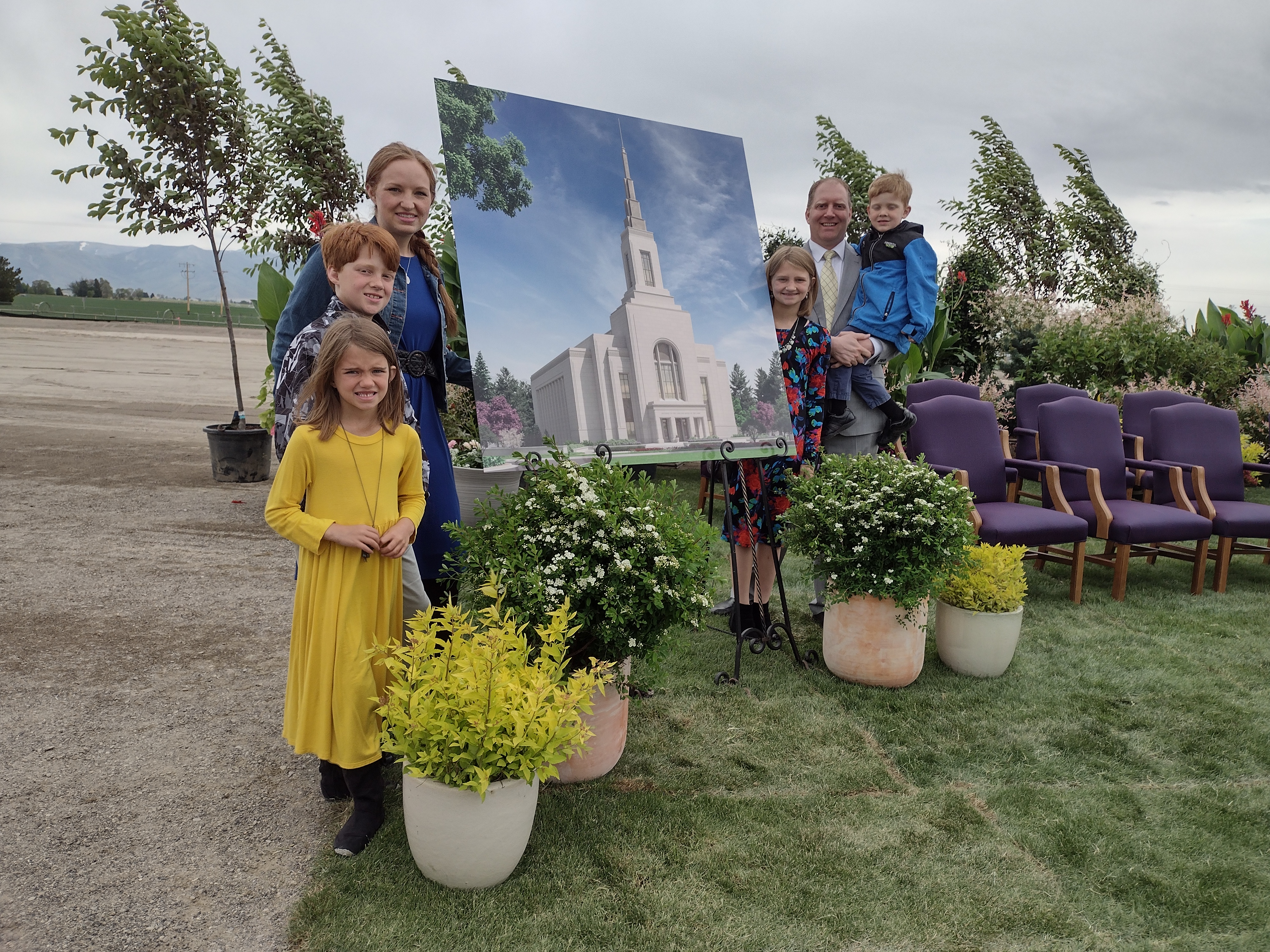
Amanda, James, Aliza, Lillian, Paul, and Hiram Ross at the Burley Idaho Temple groundbreaking

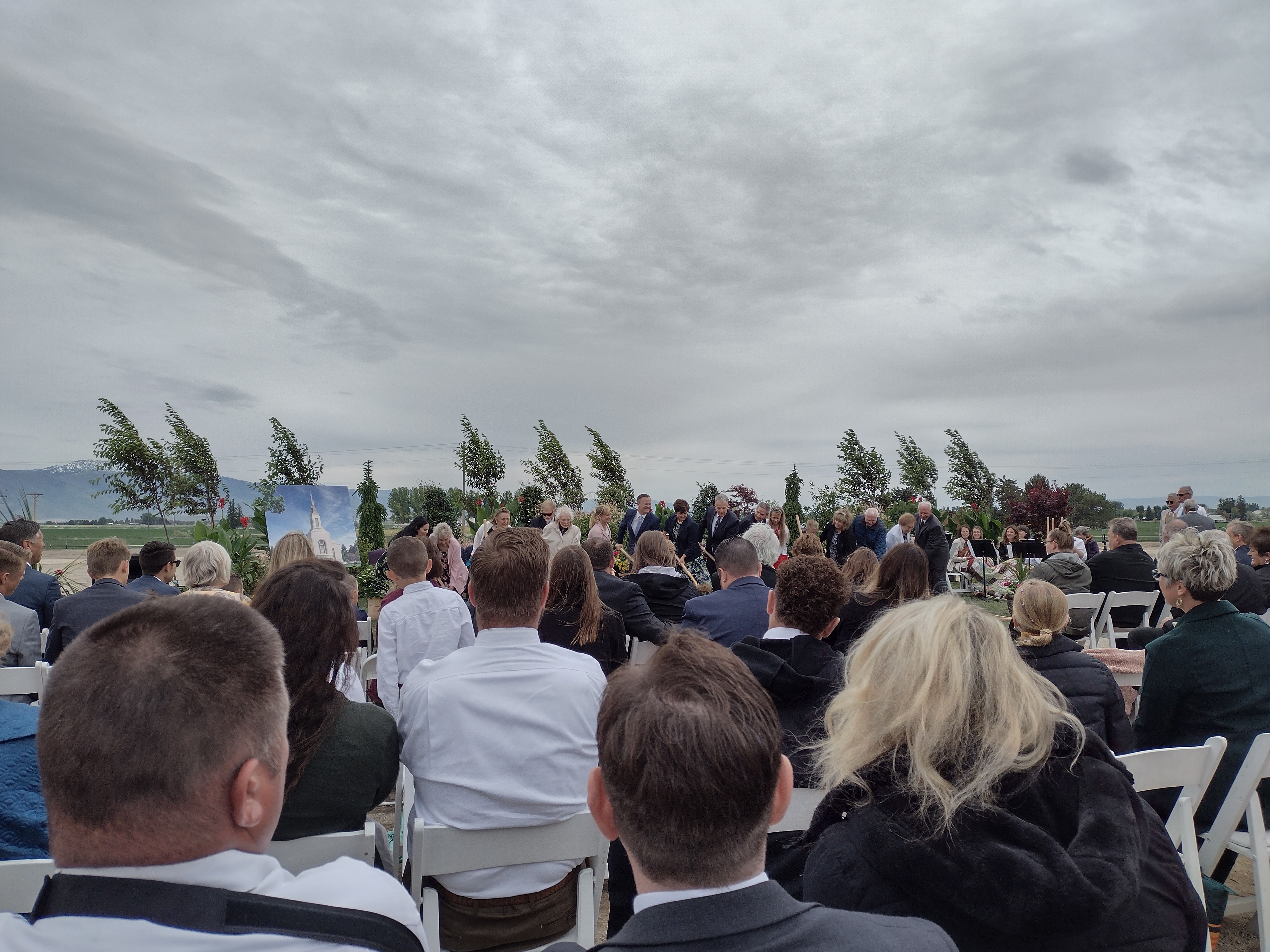
I do not know who thought that Burley, Idaho, might actually get a temple. But when it was announced on 4 April 2021 by President Russell M. Nelson, we have been watching closely since! I was fortunate enough to be invited to attend the groundbreaking as a representative for the City of Heyburn. It was a brisk, cool, windy day, but our excitement was evident. Burley native Brent H. Nielson attended and was presided at the groundbreaking.

Watching the Burley Idaho Temple groundbreaking, Doug Manning, Joelle and Kelly Anthon, Brent Nielson, and others

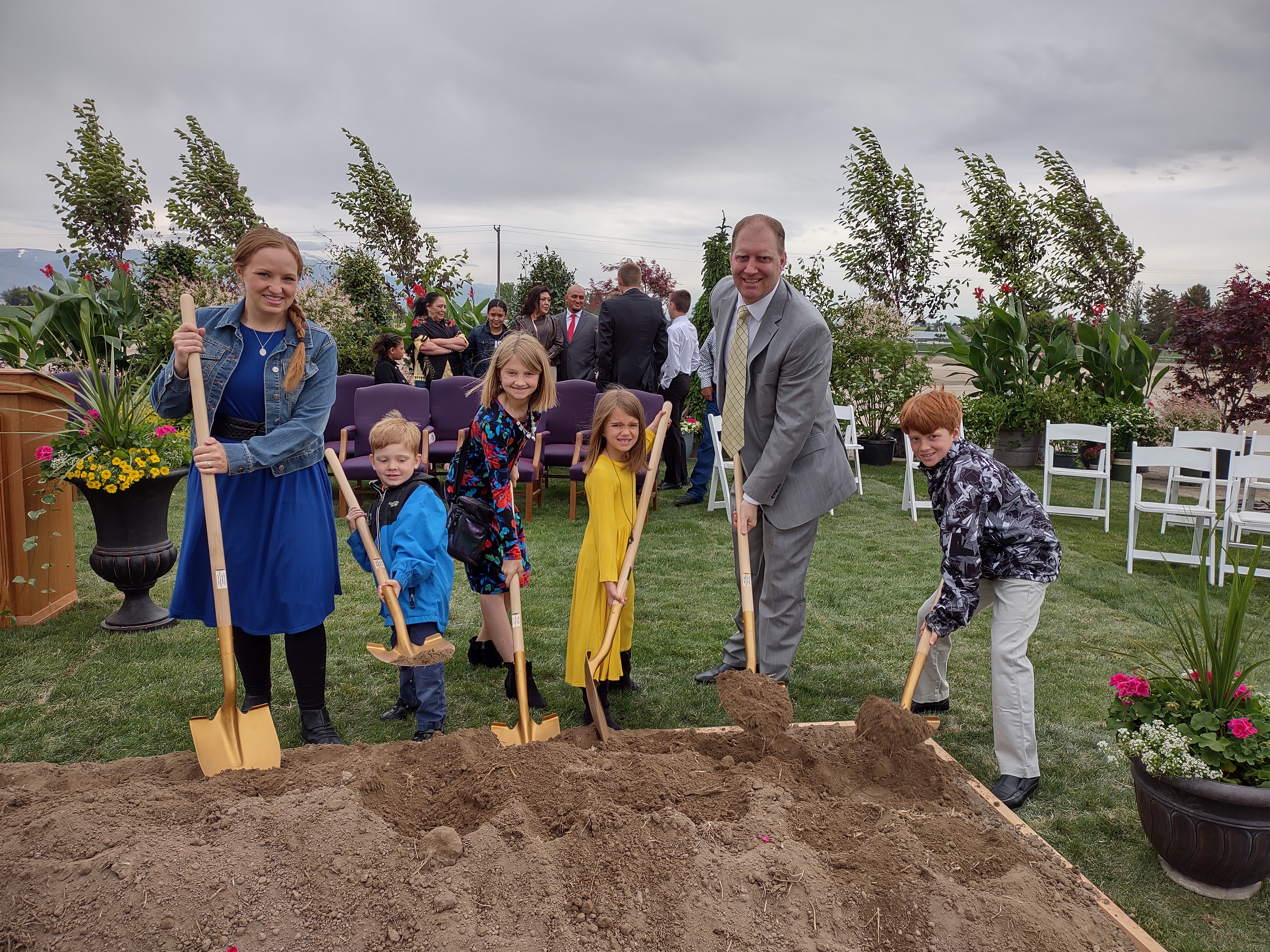
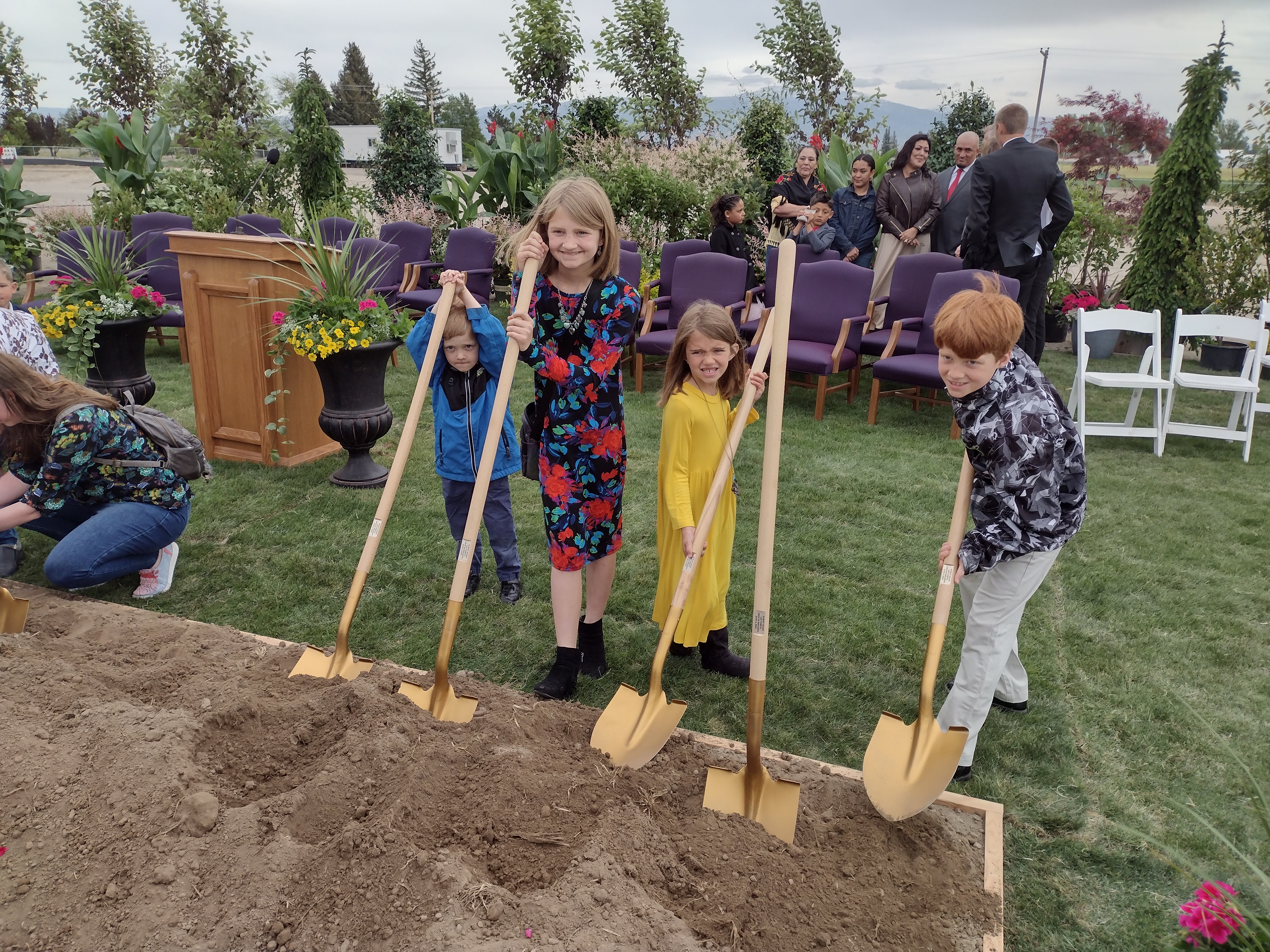
After the groundbreaking was formally over, I ran home and grabbed my family to bring them back over to do their own shovel turning.

Lillian, Hiram, Amanda, Aliza, Paul, and James Ross at Burley Idaho Temple groundbreaking

I really wanted this to be something they were a part of from the beginning.

James, Aliza, Lillian, and Hiram Ross breaking ground

They even had it available so you could take a little bag of the soil home!

Amanda, Hiram, James, Aliza, Lillian, and Paul Ross

It was a memorable occasion. We also participated by writing our names on rocks to be placed in the foundation of the temple. Over 7,000 rocks were placed in the foundation pours of the temple. Workers made sure to turn each of the rocks so the names faced upward. Our names are literally part of the temple!

Hiram at General Conference

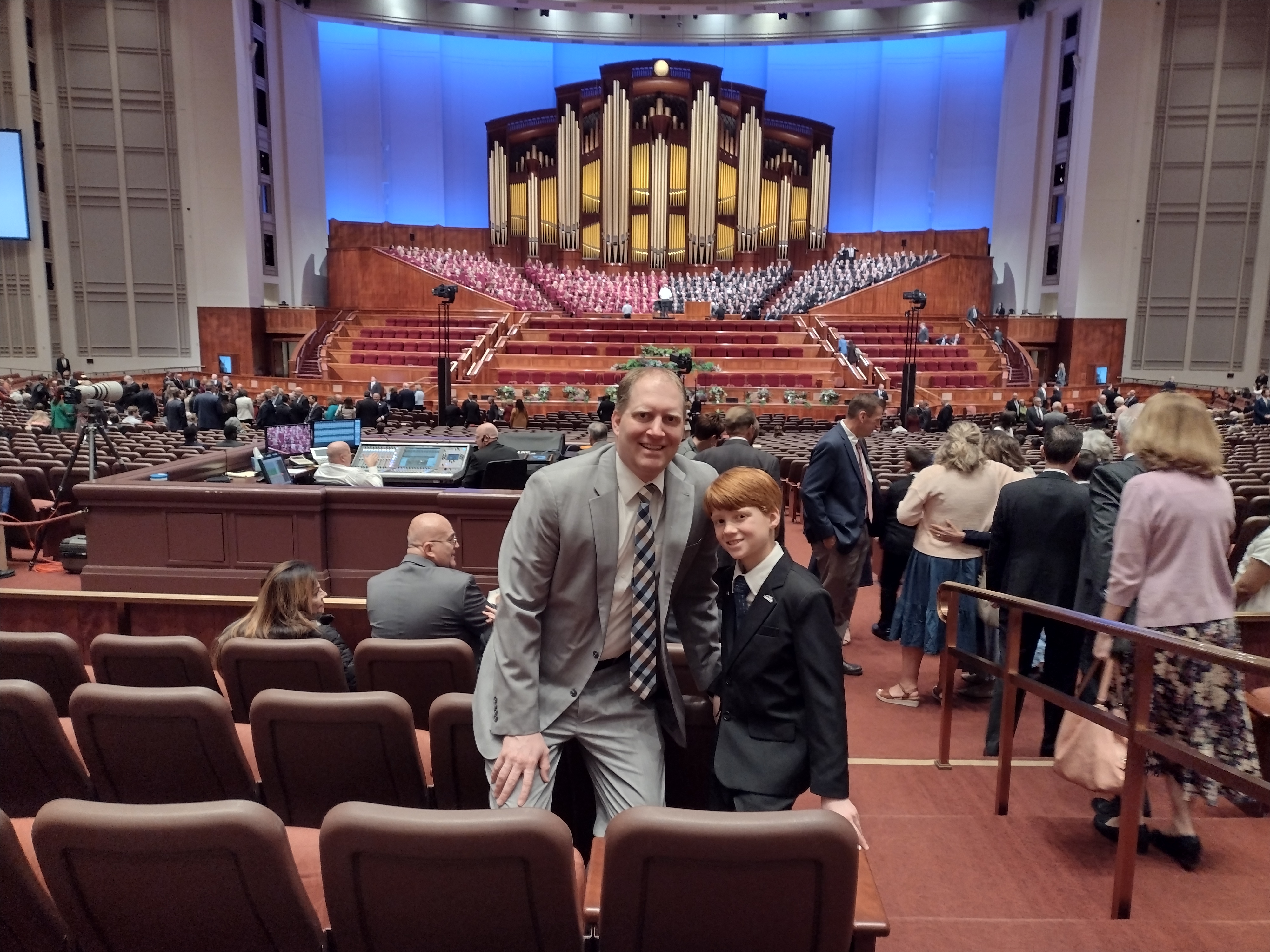
Paul and Hiram Ross at General Conference Sat 2 April 2022

We have tried to take our kids to General Conference when they turn 8. Generally, children under 8 are not invited to General Conference. Hiram turned 8 in 2020, but due to Covid-19 General Conference was not open to the public in 2020 and 2021. Hiram had to wait until he was almost 10 to attend!

Traffic in Salt Lake City was not too bad. As you can see, we are about half-way back on the main floor, do we did pretty well for seats.

President Nelson and President Ballard both spoke about missionary work. At one point Hiram turned to me and said these talks were for him. He felt the spirit and need for missionary work. Glad the Spirit touched him on this important point. Now to prepare…

Elder Bednar’s talk about heeding them not touched me. Let Us All Press On is one of my favorite hymns and has a history for me.

Time ran out. We had to head back to Kaysville so Amanda, Aliza, and Jill could go to the afternoon and evening session.

Hiram on our way out of the Conference Center

Wilford Woodruff and Founding Fathers

Wilford Woodruff’s vision of the Founding Fathers requesting Temple Ordinances

We are moving soon, but the Burley 11th Ward gave me another chance to address them. Since I received a number of requests for a copy of the talk, which is really just a collage of various items I could find online, the Journal of Discourses, the Saints second and third volumes, and other various histories. Here is the text of the talk I wrote, that does not mean it is the talk I gave…

I first addressed the freedoms we have as contrasted in the Saints third volume related to Germany. I said the word Jew and Israel from the stand and did not fear reprisal. I listen to free radio anytime I want and even seek out British radio from time to time and there is nothing illegal. Lastly, we could congregate without the worry of those in our midst about what was said or in the actual act of meeting.

Then to the following:

Declaration of Independence – We hold these truths to be self-evident, that all men are created equal, that they are endowed by their Creator with certain unalienable Rights, that among these are Life, Liberty and the pursuit of Happiness.

George Washington: “The success, which has hitherto attended our united efforts, we owe to the gracious interposition of Heaven, and to that interposition let us gratefully ascribe the praise of victory, and the blessings of peace.”

Alexander Hamilton: “The Sacred Rights of mankind are not to be rummaged from among old parchments or musty records. They are written . . . by the Hand of Divinity itself.” “For my own part, I sincerely esteem it a system, which without the finger of God, never could have been suggested and agreed upon by such a diversity of interests.”

Thomas Jefferson: “The God who gave us life gave us liberty at the same time.”

John Adams: “As I understand the Christian religion, it was, and is, a revelation.”

Benjamin Franklin: “The longer I live the more convincing Proofs I see of this Truth. That God Governs in the Affairs of Men!—And if a Sparrow cannot fall to the Ground without his Notice, is it probable that an Empire can rise without his Aid?—We have been assured, . . . in the Sacred Writings, that ‘except the Lord build the House, they labour in vain that build it.’ I firmly believe this;—and I also believe that without his concurring Aid we shall succeed in this political building no better than Builders of Babel.”

James Madison: “It is impossible for the man of pious reflection not to perceive in it a finger of that Almighty hand which has been so frequently and signally extended to our relief in the critical stages of the revolution.”

Samuel Adams: “Revelation assures us that ‘Righteousness exalteth a Nation’—Communities are dealt with in this World by the wise and just Ruler of the Universe. He rewards or punishes them according to their general Character.”

Charles Pinckney: “When the great work was done and published, I was . . . struck with amazement. Nothing less than that superintending hand of Providence, that so miraculously carried us through the war, . . . could have brought it about so complete, upon the whole.”

On May 4, 1842, he called to his side nine of the most faithful of his brethren—Hyrum Smith, Brigham Young, Heber C. Kimball, Willard Richards, Newell K. Whitney, and others—and later their wives came with them to the upper floor of the Red Brick Store in Nauvoo. 

Joseph was seeking to fulfill the promise from D&C 124, given in 1841, which the Lord would reveal to Joseph “all things pertaining to this house, and the priesthood thereof, and the place whereon it shall be built.” 

He had started, “If it should be the will of God that I might live.” Then he corrected and said, “It is not the will of the Lord that I should live, and I must give you, here in this upper room, all those glorious plans and principles whereby men are entitled to the fulness of the priesthood.” He proceeded in an improvised and makeshift way to do so.

We have from Brigham Young that after they had received these blessings the Prophet said: “Brother Brigham, this is not arranged right. But we have done the best we could under the circumstances in which we are placed, and I wish you to take this matter in hand and organize and systematize all these ceremonies.”

Brigham Young later said, “I did so. And each time I got something more, so that when we went through the temple at Nauvoo I understood and knew how to place them there. We had our ceremonies pretty correct.”

While the Nauvoo Temple was started in 1841, the first endowments were performed in the winter of 1845 and into 1846.  Baptisms had started in the Mississippi River prior to the temple and moved into the temple baptistery soon after it was completed and dedicated, well before the rest of the temple was done.  Brigham, leading the church, was personally overseeing the organization and perfection of the endowment and other ordinances that started in Nauvoo. 

After arriving in Salt Lake City, the church used the top floor of the Council House, starting in 1852 until the Endowment House was completed in 1855.  It was in this building that endowments, prayer circles, some missionary training, and some setting aparts were conducted.  The use of the Endowment House ended in 1877 with the completion of the St George Temple.  That building stood until Wilford Woodruff heard that unauthorized sealings were occurring there and ordered it razed in 1889. 

The St George Temple was the only one completed during Brigham Young’s 30 year tenure as President.  It was dedicated on 1 January 1877 in three dedicatory prayers under the direction of Brigham.  The baptistery by Wilford Woodruff, the main floor by Erastus Snow, and the sealing room by Brigham Young Jr.  Wilford Woodruff served as St George Temple President from 1877 to 1884.  Brigham had to be carried up the stairs, but he stood and spoke in the Assembly Room. 

“When I think upon this subject, I want the tongues of seven thunders to wake up the people,” he declared. “Can the fathers be saved without us? No. Can we be saved without them? No. And if we do not wake up and cease to long after the things of this earth, we will find that we as individuals will go down to hell.”

Brigham lamented that many Saints were pursuing worldly things. “Supposing we were awake to this thing, namely the salvation of the human family,” he said, “this house would be crowded, as we hope it will be, from Monday morning until Saturday night.”

On 9 January 1877, the first baptisms for the dead were performed in the St George Temple.  The first endowment for the dead was performed on 11 January 1877.  Brigham and Wilford personally oversaw the ordinances being performed.  Wilford began wearing a white suit, starting the trend that continues to this day. 

All endowments to this point had been done and passed by word of mouth.  It was in St George, far from Salt Lake City, that the ordinances were first written down.  Brigham also wanted to make sure the record was preserved and that they were standardized.  They were read to Brigham time and time again who would then approve or continue to revise the ordinances.  Brigham went home to Salt Lake City in April 1877.  He stopped and dedicated the spot for the Manti Temple on the way home.

Wilford Woodruff then wrote in his journal on Sunday 19 August 1877, “I spent the evening in preparing a list of the noted men of the 17 century and 18th, including the signers of the Declaration of Independence and presidents of the United States, for baptism on Tuesday the 21 Aug 1877.”

His journal entry for August 21 reads, “I, Wilford Woodruff, went to the temple of the Lord this morning and was baptized for 100 persons who were dead, including the signers of the Declaration of Independence. … I was baptized for the following names.” He then listed the names of one hundred men.

Elder Woodruff continued his journal entry: “When [John Daniel Thompson] McAllister had baptized me for the 100 names, I baptized him for 21, including Gen. Washington and his forefathers and all the presidents of the United States that were not on my list except Buchanan, Van Buren, and Grant.” (The work for these presidents has since been done.)

“It was a very interesting day,” Elder Woodruff continued. “I felt thankful that we had the privilege and the power to administer for the worthy dead, especially for the signers of the Declaration of Independence, that inasmuch as they had laid the foundation of our Government, that we could do as much for them as they had done for us.

“Sister Lucy Bigelow Young went forth into the font and was baptized for Martha Washington and her family, and seventy of the eminent women of the world. I called upon the brethren and sisters who were present to assist in getting endowments for those that we had been baptized for today.” (Wilford Woodruff’s journal, typescript, vol. 7, Church History Library; spelling and punctuation modernized.)

The first public mention of these events was made nearly a month after the baptisms were performed. In an address in the Tabernacle on Temple Square on 16 September 1877, Elder Woodruff first told publicly of the visitation of the signers of the Declaration of Independence.

“You have had the use of the Endowment House for a number of years, and yet nothing has ever been done for us. We laid the foundation of the government you now enjoy, and we never apostatized from it, but we remained true to it and were faithful to God. (Conference Report, April 10, 1898; Discourses of Wilford Woodruff, pp. 160-61)

During the 68th Annual General Conference of the Church which was held in April 1898, President Woodruff recounted the sacred experience:

I am going to bear my testimony to this assembly, if I never do it again in my life, that those men who laid the foundation of this American government and signed the Declaration of Independence were the best spirits the God of heaven could find on the face of the earth. They were choice spirits, not wicked men. General Washington and all the men that labored for the purpose were inspired of the Lord.

Another thing I am going to say here, because I have a right to say it.  Every one of those men that signed the Declaration of Independence, with General Washington, called upon me, as an Apostle of the Lord Jesus Christ, in the Temple at St. George, two consecutive nights, and demanded at my hands that I should go forth and attend to the ordinances of the House of God for them.  Men are here, I believe, that know of this, Brother John D. T. McAllister, David H. Cannon and James S. Bleak.  Brother McAllister baptized me for all those men, and then I told these brethren that it was their duty to go into the Temple and labor until they had got endowments for all of them.  They did it.  Would those spirits have called up on me, as an Elder in Israel to perform that work if they had not been noble spirits before God?  They would not. (Wilford Woodruff, Conference Report, April 1989, pp. 89-90.)

“They waited on me for two days and two nights,” he said,

“I thought it very singular, that notwithstanding so much work had been done, and yet nothing had been done for them.” (Journal of Discourses, 19:229.)

I was also present in the St. George Temple and witnessed the appearance of the Spirits of the Signers….the spirits of the Presidents….and also others, such as Martin Luther and John Wesley….Who came to Wilford Woodruff and demanded that their baptism and endowments be done. Wilford Woodruff was baptized for all of them. While I and Brothers J.D.T. McAllister and David H Cannon (who were witnesses to the request) were endowed for them. These men… laid the foundation of this American Gov., and signed the Declaration of Independence and were the best spirits the God of Heaven could find on the face of the earth to perform this work. Martin Luther and John Wesley helped to release the people from religious bondage that held them during the dark ages. They also prepared the people’s hearts so they would be ready to receive the restored gospel when the Lord sent it again to men on the earth.” (Personal journal of James Godson Bleak – Chief Recorder of the St. George Temple.)

In 1986, some of the staff of the Family History Library’s LDS Reference Unit were assigned to compile and computerize all the existing genealogical data on the founding fathers, to identify their families, and to document completed temple ordinances for each. For purposes of the project, a founding father was identified as one who had signed one or more of the following documents: the Articles of Association (1774), the Declaration of Independence (1776), the Articles of Confederation (1778), or the Constitution (1787).

The library study of 1986 revealed that there were no sealings of children to parents performed at the time the baptisms and endowments were performed. As a note, the ongoing revelation related to sealings to parents was not revealed until 1894.  It was then that the Law of Adoption, or sealing to prominent church leaders, was discontinued and we were encouraged to do genealogical work to compile the pedigree of the entire human family.  It was then that the Utah Genealogical Society was founded that has snowballed into the fantastic work of FamilySearch and all its appendages. 

He also recorded that George Washington, John Wesley, Benjamin Franklin, and Christopher Columbus were ordained High Priests at the time.

Temple work was performed on behalf of the following well-known and respected men and women in the St. George Utah Temple in August 1877.

Founding Fathers: William Hooper (NC), Joseph Hewes (NC), John Penn (NC), Button Gwinnett (GA), Lyman Hall (GA), George Walton (GA), Edward Rutledge (SC), Thomas Heyward Jr. (SC), Thomas Lynch (SC), Arthur Middleton (SC), Samuel Chase (MD), William Paca (MD), Thomas Stone (MD), Charles Carroll (MD), George Wythe (VA), Richard Henty Lee (VA), Thomas Jefferson (VA), Benjamin Harrison (VA), Thomas Nelson Jr. (VA), Francis Lightfoot Lee (VA), Carter Braxton (VA), Robert Morris (PA), Benjamin Rush (PA), Benjamin Franklin (PA), John Morton (PA), George Clymer (PA), James Smith (PA), George Taylor (PA), James Wilson (PA), George Ross (PA), Caeser Rodney (DE), George Read (DE), Thomas McKean (DE), Philip Livingston (NY), Francis Lewis (NY), Lewis Morris (NY), Richard Stockton (NJ), John Witherspoon (NJ), Francis Hopkinson (NJ), John Hart (NJ), Abraham Clark (NJ), Josiah Bartlett (NH), William Whipple (NH), Matthew Thornton (NH), Samuel Adams (MA), John Adams (MA), Robert Treat Paine (MA), Elbridge Gerry (MA), Stephen Hopkins (RI), William Ellery (RI), Roger Sherman (CN), Samuel Huntington (CN), William Williams (CN), and Oliver Wolcott (CN).

Note: Temple work was not done for John Hancock or William Floyd as it had already been completed previously.

Presidents of the United States: George Washington, John Adams, Thomas Jefferson, James Madison, James Monroe, John Quincy Adams, Andrew Jackson, William Henry Harrison, John Tyler, James Knox Polk, Zachary Taylor, Millard Fillmore, Franklin Pierce, Abraham Lincoln, and Andrew Johnson.  Temple work was not done for James Buchanan, Martin Van Buren, or Ulysses S. Grant.

Other eminent men baptized by Wilford Woodruff in the St. George Utah Temple in August 1877 include: Sir Edward Gibbon, Johann Wolfgang von Goethe, Oliver Goldsmith, Henry Grattan, Humboldt, Alexander von Irving, Washington Jackson, Thomas Jonathan “Stonewall” Johnson, Samuel Juarez, Benito Pablo Kemble, John Philip Liebig, Baron Justus von Livingstone, David Macaulay, Thomas Babington Nelson, Lord Horatio O’Connell, Daniel Peabody, George Powers, Hiram Reynolds, Sir Joshua Schiller, Johann Christoph Friedrich von Scott, Sir Walter Seward, William Henry Stephenson, George Thackeray, William Makepeace, Vespucci, Amerigo Webster, Daniel Wesley, John Wordsworth, William Parepa, Count Dimitrius, Martha Washington and her family, John Washington (Great Grandfather of George Washington), Sir Henry Washington, Lawrence Washington (Brother of George Washington), Augustine Washington (Father of George Washington), Lawrence Washington (Father of Augustine), Lawrence Washington, Daniel Park Custis, John Park Custis (Son of Daniel and Martha Parke Custis), and Martin Luther.

Eminent Women baptized include: Jean Armour (1767—1834) of Scotland, Jean Armour Burns (Wife of Robert Burns) (1759—1796), Jane Austen (1775—1817) of England, novelist, Mary Ball (1708—1789) of America, Mary Ball Washington (Mother of George Washington) (1732—1799), Sarah Bernard (1800—1879) of England, Sarah Barnard Faraday (wife of Michael Faraday (1791—1867), Charlotte Bronte (1816—1855) of England, novelist, Felicia Dorothea Browne (1793—1835) of England, Elizabeth Barrett Browning (1806—1861) of England, poet, (wife of Robert Browning) (1812—18?), Martha Caldwell Calhoun (d. 1802) of America (mother of John Caldwell Calhoun) (1782—1850), Martha Parke Custis (1755—1773) of America (Daughter of Martha Washington) (1732—1802), Martha Dandridge Washington (1732—1802) of America (wife of George Washington) (1732—1799),  Rachel Donelson Jackson (1767—1828) of America (wife of Andrew Jackson (1767—1845), and Abigail Eastman Webster (1737—1816) of America (mother of Daniel Webster (1782—1852), to name but a few. Temple work was performed for a total of 70 eminent women.

During most of our national history Columbus and the Founders were considered heroes with determination and foresight.  Cities, rivers, and many other places were named after them.  More recently there has been a wide spread effort, designed especially to indoctrinate young people, which slanders Columbus, the Founders and their accomplishments.  Columbus is held personally responsible for centuries of mistreatment of Native Americans.  The Founders are portrayed as being greedy and motivated by selfish interests. All of this is as astonishing as it is misleading.  

From the Lord’s perspective among the most important events of the history of the world was the discovery and founding of America.  1 Ne 11-14.  Nephi was referring to Columbus when he wrote:  “I looked and beheld a man among the Gentiles, who was separated from the seed of my brethren by the many waters; and I beheld the Spirit of God, that it came down and wrought upon the man; and he went forth upon the many waters, even unto the seed of my brethren, who were in the promised land” 1 Ne 13:12.  By the Founders “the Lord God will raise up a mighty nation…even on the face of this land.” 1 Ne 22:7.

Go on to life and history of George Ross of Pennsylvania, signer of Declaration of Independence.  

Jonas History: William Nelson Jonas

William Nelson Jonas

This is another chapter of the Jonas history book compiled by Carvel Jonas. “The Joseph Jonas clan of Utah (including – early Jonas family history; early Nelson family history)” This one is on William Nelson Jonas.

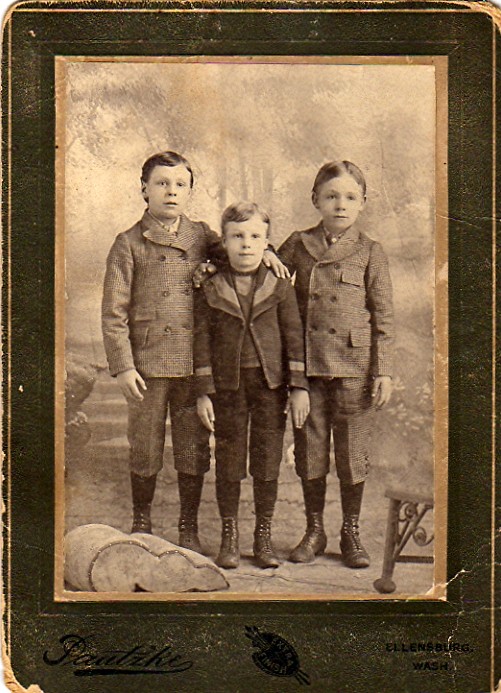
John, Joseph, and William Jonas

“William had the same name as his great grandfather, William Jonas, although he never knew it in his life.  Most likely he was named after his Uncle William Jonas.  William Nelson Jonas, the second son and fifth child of Joseph Jonas and Annette Josephine Nelson, was born 2 December 1889, He was called “Bill” by his friends at church and “Willie” by his family at his home.  His parents had, two years before his birth in 1887, sold their property 3 miles south of Ellensburg, Kittitas County, Washington State.  But the family must have stayed in the area because William went to the public school in Ellensburg his 1st, 2nd, and 3rd elementary grades.  The family then moved to a little town named Bristol, which is northwest of Ellensburg.  When he was in his 4th grade the family was living in another town named Thorpe and he attended the school at Thorpe.  Thorpe is another town northwest of Bristol.  Sometime during this time William and his two brothers went to a neighbor’s place and swiped some apples.  The kids also helped themselves to their cousin’s watermelon patch.  in 1895, he went with his family to pick hops in Yakima.  The 1900 census tells us that William and his family lived in another town which also is northwest of all the other towns mentioned.  It is called Cle Elum.  The family was renting a house in this western city.  As far as we know the family always rented. 

“William arrived in Crescent, Utah with his entire family 3 July 1901.  He attended the public school in Jordan School District for the 5th, 6th, 7th, and 8th grades.  He graduated 8 grade in Sandy.  He was baptized a member of The Church of Jesus Christ of Latter-day Saints 10 January 1902, the same day his two brothers were baptized.  When he was baptized he had just turned 12 years old by a little over a month.  Up to that time he had been raised a Catholic.  He was baptized in the Jordan River in South Jordan by his Uncle, Nels August Nelson.  He was confirmed a member the same day by William Fairfard.  There were no records found for William at the St. Andrew church in Ellensburg, so it is likely that his baptism was performed elsewhere.  Shortly after he was baptized he was ordained a deacon in the Aaronic Priesthood.  He remained a deacon until 6 January 1908 when he was ordained an Elder in the Melchizedek Priesthood by Bishop James P. Jensen.  He was never ordained a Teacher or a Priest, which are the two offices traditionally held by young people in the Mormon Church before they are ordained an Elder.  While he was a deacon he was called to be the secretary of the quorum.  He was also the President of the deacons quorum for a few years.  Perhaps after being raised in another church it was good training for William to remain a Deacon a little longer than usual.  He belonged to the 7th Quorum of Elders in the Crescent Ward in Salt Lake County.   

“During his stay in Crescent from 1901 to 1908 when he moved to Richmond, Utah, William helped his Uncle August on the family farm.  According to August’s life story William and his brothers worked hard.  It was understood that William and his brothers were to be given some land for the work they did on the Nelson farm.  But the farm wasn’t given to anyone else because much of it was sold.     

“William knew many of his cousins on his father’s side of the family until he was 12 years old.  After July of 1901 he became familiar with all of his cousins on his mother’s side of the family by living with the Nelson family.  William’s mother and this Uncle were the only two siblings in the Nelson family who had children of their own.  One of his cousins from his mother’s side, Virgil Homer Nelson, wrote in his autobiography, “They (Rosa, John, William, and Joseph) gave me plenty of companionship.  Our chief amusements were swimming, playing baseball, and skating.”   

“William had a lot of farm land to discover.  Virgil, August’s son, wrote that their farm, “…extended a mile along the east side of State Street and far to the east…a thousand acres of land in East Crescent and into the hill there.”  On one occasion when William was in the area he found a dead man laying in a ditch.   

“In the school year 1907 William went to the L.D.S. College, his first year in High School before moving to Richmond, Utah.  William and his two brothers left Crescent and went to live with their only living sister, Rosa Jonas Andersen.  When William had just turned 19 years he made this trip.  One cold, snowing day in 1908 the three boys finally arrived at their sister’s home in Richmond, Utah.  William worked four years for an August Larson in the summer and went to Brigham Young College at Logan for five years.  Each year he received a sports letter in baseball.   

Loretta Merrill, William Nelson Jonas

“On 19 September 1909 he was ordained a Seventy by Charles H. Hart, the same day his brother, John, was also ordained a Seventy.  He remained a Seventy for over 40 years.  On 1 May 1908 he received a Normal Diploma at Logan, Utah, Brigham Young College.  2 June 1911 he graduated from the BYU College and received a General High School Diploma.  Two years later he received a college diploma.  On 4 September 1913 he received a Grammar Grade County Teacher’s Certificate for Public Schools of Utah.  His graduation diploma states that he “passed an examination satisfactory in writing, arithmetic, pedagogy, physiology, reading, drawing, orthography, English, grammar, U.S. History, geography, nature study, psychology, and history of Education.”   

William Jonas “To Father”

“The following post cards have survived since 1912.  This is the year prior to his graduation from the college and gives a few insights into his personal feelings and activities.  All the cards are written to Karen Marie Thompson whom he later married.   

“Logan, 4 October 1912  “Dear friend, The first dance will be given Friday night.  It was announced in chapel this morning.  I do wish you could be here.  I’ll be up Sat. noon and we’ll go, if not say so.  I have a fine place to stay, with aunt Felelia and my cousins.  With best wishes Wm. N. Jonas.”   

“Logan 240 E. 3rd North.  Oct 11. 1912 “Dear friend: School is fine and full of life.  How is work, school and everything in particular?  There will be an oration given this morning, you ought to hear it.  I’ll not be up Sat. would certainly like to, but–  Wishing you an enjoyable time.  Your Friend William”   

“Logan240 E. 3rd N Oct 18, 1912 “Dear Friend: I would like to come up Sat. but as I have work and a class entertainment Sat.  It is impossible.  Then too I’ll be up a week from tonight.  I wish you could be down here tonight, a lecture and a dance.  Work Sat. and have a dance.  Have a good time, Don’t be angry.  With best regards and wishes as ever, your friend, Wm”   

“Logan, Oct 30, 1912  “Dear friend, Hoping you a most happy birthday and many good wishes.  There is a dance tonight, a lecture Thur. night and another dance Fri.  Always something doing in Logan.  Tell everybody hello.  as ever your friend Wm. N.”   

“Logan, Nov 7, 1912  “Dear friend, Congratulation on Nilson and the De.  We had a good conference here Sun.  Joseph F. and his son Hyrum will speak.  How are all the folks?  We are all fine.  How is the candy mouse?  Well, how is school life and activities…as good as ever here.  With best wishes from Wm. N”   

“Nov 19, 1912  “Dear Friend, your card was only rec’d.  Hope the best of health for your Pa.  I won a quarter on the game between 1st and 2nd yrs R.H.S. Sat or Fri.  We have a couple of excellent Musical recitals the last week at the Logan Tab and Nibley Hall.  Wm N.  How do you like the house work for a change or are you a hallo kid?”   

William Nelson Jonas, sitting middle, President of Wisconsin or Minnesota Conference, 1915 or 1916.

“William graduated from college soon after the above post cards were written, when he was 23 years old.  4 September 1913 when he received a Grammar Grade County Teacher’s Certificate for Public Schools.  During 1913 he taught school at Lewiston and was principal of Wheeler School District.  During this first year of teaching he received his endowments 22 May 1914, in the Logan Temple.  After teaching for one year he was called on a mission for The Church of Jesus Christ of Latter-day Saints.  He served for 27 months in the Northern States Mission.  His only grandson who served a full time mission was called to the same mission about 60 years later.  The mission was called the Minnesota-Wisconsin Mission in 1973.  William was first given a minister’s certificate which was dated 2 June 1914 and was signed by the First Presidency of the Church.  Several months earlier 16 April 1914, he had been called to the Switzerland and Germany Mission.  He was to prepare to leave by 1 July 1914 and had a meeting with the Prophet at 9:00 A.M. that first day.  However, he never went to Europe on his mission because of the First World War.  He was then reassigned to the Northern States Mission, which had it’s mission headquarters in Chicago, Illinois.  While he was on his mission he was called to preside over the Wisconsin Conference, 23 September 1915.  He was next called to preside over the Minnesota Conference.  10 January 1916.  While serving on his mission he lived at 2707 Clarke St. Milwaukee, Wisconsin; 31 South 5th Street  La Crosse, Wisconsin; 247 North Gretto Street, St. Paul, Minnesota, and no doubt visited the mission home at 2555 North Sawyer Ave, Chicago, Illinois.  He was released from his missionary service 20 August 1916. 

William Jonas, seated with girl in white standing in front of him.

“After his mission he went to Cowley, Wyoming and served as a school principal.  There were 18 graduates from the school that year.  During the summer of 1917 he went to Provo, Utah, for 12 weeks of summer school.  About this same time William went to Richmond, Utah for his father’s funeral.  William was the person who gave the information for Joseph Jonas’ death certificate.  He then went back to Wyoming and on the 28 February 1917 he registered in Big Horn County to teach school.  Soon after that in the beginning of the school year of 1917 he accepted an offer to become coach of baseball and basketball teams at Dixie Normal College in St. George, Washington County, Utah.  We have several pictures from the Dixie College School yearbook which was called “The Dixie”.  Also, the following tributes from the same book.  “Drafted (Class 1 A) It was under Coach Jonas that Cedar met their match in the Dixie basketball team.  Favors the “Windsor Tie”.”  And this one which was entitled “First Years”.  “In September 1917, the D.N.C. found on hundred and five First Year’s invading it’s halls, with bewildered excitement.  We did not remain in this state of unrest, however, for Father Jonas and Mother Watson soon had us under their protecting care.  With their willing aid and the help of every Freshie, we came off the field on Founder’s Day, flying one blue ribbon and two red ones.  The loyalty of our First Year Class was made evident by our purchase of a $100.00 Liberty Loan Bond and $75.00 in Thrift Stamps.  We are justly proud of a Freshie lad who is a member of the D.N.C. debating team.  Our class part early in December was very successful.  If you do not believe us, As Jonas, Jr., and his partners.”   

William Nelson Jonas WWI uniform

“The following 20 May 1918 William was inducted by the draft into the Army.  On 25 May 1918 he was in a training camp.  He went to camp Louise and then to Camp Kearney in California.  On August 16, 1918 he left for France.  Before he left he expressed to members of his family that he wouldn’t mind serving in the service if he didn’t have to kill people.  To his relief he was a member of the medical detachment 145 artillery.  He stayed five months in France.  His army serial number was 3,127,617.  He was a resident of St. George, but was inducted in Cache County.  He was in Btry A 145 Fa by July 15, 1918.  He went overseas from August 16, 1918 to January 4, 1919.  He was honorable discharged January 24, 1919.  He remained a private during his short stay.  His Military records tell us that he was 28 8/12 years of age when he was inducted.  He had brown eyes, brown hair and medium complexion.  He was 5 feet 8 1/2 inches tall.  He received paratyphoid shots 10 June 1918 for typhoid and was not wounded while he was gone.  He is character was considered excellent.  He was paid 24 dollars and 40 cents 24 January 1919 and was given travel pay back to Logan.  During the voyage home William was so sick that he thought he might die.  So he promised the Lord he would do whatever He wanted if his life would be spared.  And he was faithful to that promise all his life.   

“While William was in France he sent letters and post cards.  One that still survives was sent to his cousin, Hubert Jonas, who lived in Washington State.  The following is quoted from that card.  “Camp DeSavage, France November 24, 1918.  “Dear Cousin and Family, A Joyous Christmas from France.  notice our gun ‘4 point 7’.  1898 date.  The Regiment was organized 1916 on the Mexican border.  1918 France from the Beehive State Utah.  had six weeks work in the hospital, am well near Bordeaux.  Expect to move soon may be ‘over there’ too.  Sure tickled.  Best wishes and Love W. N. Jonas Sanitary Det. 145 FA Am. Ex. France.”   

“While William was gone to war his older brother, John Jonas, died.  John died 19  December 1918 and William arrived in New York 4 Feb 1915.  He missed seeing his older brother for the last time by a little less than two months.   

William Nelson Jonas and Karen Marie Thompson

“Two years after he got back from the Army he married Karen Marie Thompsen, 6 January 1921.  They were married in the Logan Temple.  Karen Marie was born 31 October 1892.  She went to school in Richmond for eight years.  She started when she was 8 years old and graduated at 15 years old.  She had passed the sixth, seventh, and eight grades in two years.  She worked in the Utah Condensory called Sego Mile, which canned milk.  She worked for 13 years.  Part of the time in the factory and part in the office.  The company had an office in Logan in which she worked most of her 13 years.  While she was working at Logan she also went to New Jersey Sewing Academy for nine weeks at night.  On 9 March 1920 she received a patriarchal blessing.  While she lived in the Murray area she was the quilt chairman in Relief Society for many years and went visiting teaching for many years.  She loved flowers and had a flower garden most of the time.   

“Mary, as she was called, was blessed by William G. Plonallsen 5 Jan 1893.  She was baptized by Clarence L. Funk 1 September 1901.  She was confirmed by Wallace K. Burnham 1 September 1901.   

“Mary’s mother was named Jensine Caroline Christensen.  She was born 11 April 1864 in Aarhus, Denmark.  She joined The Church of Jesus Christ of Latter-day Saints in 1890 and came to America 6 July 1891.  While she was sailing she met her husband, James Thomassen, who later changed his last name to Thompsen.  They were married 24 December 1891.  James Thompsen was never a member of the Church.  He was immigrating to Richmond, Utah, to be with his older brother, John, and his younger sister, Johane Caroline.  His brother, John Thomassen had joined The Church of Jesus Christ of Latter-day Saints 10 February 1869.  He later immigrated to Utah to join the Saints.  He was endowed 12 October 1875.  John must have immigrated to America about that same year.  It took his brother, James, about 16 years to follow his older brother to Utah.  Caroline was converted to the Church by August S. Schow who was from Richmond Utah.  That is one very important reason she moved to Richmond.  Their children were the following: Karen Marie born 31 October 1892 ; Ebba born 31 April 1894; James born 6 September 1896; Alta born 12 August 1902; Leland and Stella were both still born April 1898; Michael born 13 July 1906.  Caroline was a milliner in Denmark.  She sold her hat shop and paid her ticket across the Atlantic to America.  James was a carpenter and died at the age of 59.  He was bitten by a pig and was poisoned.  He suffered a great deal for four years before his death.  James was born 19 August 1854 in Vildmose, Denmark and died 8 January 1913 in Richmond, Utah.  Caroline died 17 July 1951 at 4:30 A.M. at daybreak on a Tuesday in Salt Lake City.   

Vaughn, Gaylen, Karen, Maynard, William, and Delwyn Jonas with Alta, James, and Caroline Thompson

“William and Mary lived in Richmond, Utah, when they were first married.  They went to the Benson Stake of the L.D.S. Church.  In August of the same year (1921) they moved to Franklin, Idaho, so William could teach school.  Mary worked checking ledgers for the Milk Condensory in Franklin, Logan, Richmond, and Hyrum during her life.  By September of 1921 they moved to Thatcher, Idaho.  They went to the Thatcher 2nd Ward in the Bannock Stake of the L.D.S. Church.  William, his brother Joseph and his sister, Rosa with their families tried farming.  William tried farming from Sept 1921 to Jun 1923 when they moved back to Logan.  Apparently discouraged with farming William went to Park Valley, Utah, so he could teach school for one year.  After school was over they moved back to Logan for a short while and then to Avon, Utah, for another teaching assignment.  September 1924 William took an examination at West High School for the Post Office.  He rated 3rd in his class with 93% – he got 5% for being a veteran.  In August 1925 he started work for the post office.  He worked there for 33 years and accumulated many days for not being sick.  He worked the afternoon shift and would take the trolley car to town.  He retired in 1958.  His work consisted of being a supervisor and worked with the public weighing packages.  His hours were from 3:00 P.M. to 11:00 P.M.   

“L.D.S. Church records show that they moved into their home at 120 West Burton Ave in Salt Lake City the same month he was hired at the post office, August 1925.  Mary’s mother also lived on Burton Ave.  They were in the Burton Ward, Grant Stake.  After they had lived on Burton Ave. where their son, Vaughn, was born they moved to 1854 East Clayborne in Salt Lake City in 1928.  About 1931 they moved to 906 East 39th South in the Murray area.  Then the family moved to 2964 South 9th East (where Carvel was born) in 1933.  They lived there from 1933 to about 1942-43.  Then they moved into the new home next door at 3974 South 9th East.  When William first bought land in the Murray area he purchased 6 1/4 acres.  William and his brother-in-law, Christian Andersen, built the home at 3974.  Then they moved again to 3954 South 9th East in 1951.  All three of the homes on 9th East were next door to each other.  The home at 3954 was originally an Army barracks which was moved from Kearns and later remodeled by their son, Maynard.  On 29 April 1962 they then moved to 1005 East 4025 South which was still in the Murray area.  There they lived until each passed from this life to the next.    

“William and Mary were the parents of 6 sons.  The last son, William Thompson Jonas, was born what has been called a “blue baby”, and lived only 31 1/2 hours.  He weighed 6 1/2 pounds and is buried in the Elysian Burial Grounds in Murray, Utah.  He was blessed by his father the 22 October 1937.  Their 3rd son, Gaylon Thompson Jonas, was killed 19 September 1944 on Peleliu Island in the Pacific Ocean.  He had enlisted 19 August 1942 with the 2nd Mormon Battalion.  He was awarded the Bronze Star, Purple Heart, Navy Citation Award, Pres. Citation, Navy Unit Cit., American Theater, Pac. with 3 stars.  He was killed by a Japanese sniper’s bullet while removing a wounded man.  He was killed while he was helping the fourth man that he helped that day.  He had volunteered for the assignment.   

“William blessed all six of his sons.  He also confirmed 5 of them after they were baptized.  Delwyn was blessed 2 April 1922 and confirmed 1 February 1931.  Maynard was blessed 14 March 1925 and confirmed 3 December 1933.  Vaughn was blessed 7 November 1926 and confirmed 4 November 1934.  Carvel was blessed 17 September 1934 and confirmed 2 May 1943.  William also ordained several of his sons to different offices in the Priesthood.  Gaylen was ordained a Teacher 29 January 1940.  Carvel a Deacon the 22 September 1944 and a Teacher 30 October 1949.   

“William was actively involved in work for his Church all his life.  He was Superintendent of the Sunday School of the Mill Creek Ward for 2 1/2 years.  He served as Stake Supervisor of the gospel doctrine classes.  During his gospel doctrine classes he would compare Catholic point of view with the L.D.S. view quite often according to his neighbor who attended his class.  He also served as one of the Seven Presidents of the Seventy in his stake.  He was a leader of the cottage meetings.  And taught the genealogy class for many years and became one of the senior teachers of these genealogy classes.  He was baptized for some of his dead ancestors and his wife’s dead ancestors.  He served as a ward teacher for many years.  He did all of the above including serving a full time mission for the Church before he was 50 years old (1940).  After that on 20 Mary 1943 he received a missionary call from the Mill Creek Ward, Cottonwood Stake for a stake mission.  He was set apart 26 March 1943 in the stake office at about 8:00 P.M.  Afterwards he received another stake mission calling (this was his third mission).  He and his wife Mary, were both called.  William was set apart 12 May 194?.  One of grandpa’s neighbors said that grandpa was considered a scriptorian by those who knew him in their ward, and that he had a hard time understanding why people didn’t recognize the truth in the scriptures.  He was set apart Wednesday May 18, 1944 in the stake office at 176 Vine Street for this third mission.  While William was on this stake mission his son, Gaylen, who was killed in World War II appeared to him twice requesting that his temple work be completed.  His wife, Mary, was set apart 31 August 1949 so they could serve on a mission together.  They received honorable releases from their stake missions 3 June 1951.   

“When William was called on his second mission he wrote a letter which was printed in the Millcreek Courier, which was the ward paper.  The following is quoted from that letter written March 1943, the same month he was called on his second mission.  “Faith Unshaken  Greetings to the boys in the service from Mill Creek; Recent events have not shaken my faith in the ultimate triumph of freedom and justice, for I was reared in a church where faith in God and belief that right will triumph eventually is too deeply ingrained in me to doubt its final victory.  As long as we have faith at all in God, we must know that his is All-Powerful.  That his will for the world is Justice and Right, and that eventually His purposes will be established here on earth.  Good emerges slowly, but we must not doubt its victory.”   

“”As to our country, my faith is our America, in its people, and in the American Way of Life, is unwavering.  The United States is the greatest country on the earth, not because it is our country, but by comparison.  It’s founding I believe to have been divinely ordained and that God had a mighty mission for the United States among the nations of the world.”   

“”America was founded by our forefathers in prayer, in faith, and in the heroic spirit of sacrifice.  Lives of comparative ease in their old country might have been theirs had they been willing to surrender their  convictions.  They chose the Hard Right rather than the Easy Wrong, and were ready to lay down their lives for freedom to worship God according to the dictates of their conscience.  No matter what lies ahead, we must carry on to the best of our ability, doing our utmost from day to day, each in his own niche.”   

“”After the Hard War No. I was over and the happy Peach had come, I experienced the most wonderful day of my life.  February 4, 1919 we first saw the light reflections in the distance, then the lights, buildings, the land.  Oh the shouts, “America”, “God’s country”, “Zion”, “Home Sweet Home”, ect.  Believe me the statue of Liberty certainly faced the right way–in fact everything we saw was just O.K.”   

“”I am now praying for a second great day to come soon, when this Hard War No. II is over and happy Peace is declared and my sons, Delwyn of the Army, Maynard of the Navy, and Gaylon of the Marines come marching home.  Parents, fill in the names of your sons, and my God grant the day soon.  Sincerely, William N. Jonas.”   

“On 17 December 1950 William was ordained an High Priest making  little over 40 years that he was a Seventy.  He was ordained by Verl F. McMillian of the Mill Creek 2nd Ward in the Cottonwood Stake.  After he was ordained an High Priest he was asked to teach the High Priest class for many years.  He also became interested in doing the Jonas genealogical line.  Around 1960-65 he wrote to places where his grandparents, Hubert and Mary Jonas lived after arriving in America.  On 26 October 1960 he received a returned letter from the research department of the L.D.S. Church.  He had paid people to help in the research.  From this letter we were able to learn about the 1880 census of Nebraska where the family had lived.  Another letter was received 13 April 1961 from the Register of Deeds, Monroe County, Michigan, written by the Genealogical Society research department.  In behalf of William many land records for Hubert and Mary were then found.  William wrote to the Texas State Department and Historical Society of Wisconsin hoping to find more information about our family.  Also, he had driven to his place of birth, Ellensburg, Washington for some research and visited his cousin-in-law, Regina Jonas who was living in Vancouver at the time.  The following is a quote from a letter he had written which shows the sincerity of his desires.  “…this seems to be asking a lot.  However, I will be glad to pay for services.  Have you someone who is available for such work?  I shall try to come to Ellensburg this summer if necessary.  I thank you.  William N. Jonas.”  Many attempts were made to find out where the Jonas family had lived in Germany.  Unfortunately, William never was able to discover that genealogy.  But because of his efforts there were many clues for the author to use in what eventually lead to the discovery of the Jonas genealogy pedigree, and also this history book.   

“The following are some observations about William that his children and friends have told me.  William liked to garden.  During hard economic times, and especially during the Great Depression, they always had a large vegetable garden.  Although we don’t have the exact figures it was close to an half acre.  They were able to provide for their family and also provided for a neighbor and his family who were experiencing financial difficulty.  He enjoyed excellent, physical health all his life.  He was in a car accident when he was older, about 1953-54.  During the car accident the gear shifting know of a late model Cadillac punched his side.  The knob was shaped like a tear drop.  He was a passenger and had slid across the seat with his left side hitting the knob.   

“After some of his children got back from their military service they thought they were in better physical shape than their father, who was in his 50’s.  They oldest thought he could out arm wrestle his dad now.  But William won the match.   

“While he worked for the post office he played for the baseball team on the Industrial League.  He was a good baseball player and had large knuckles on his left hand from catching baseballs.   

“William was instrumental in helping his oldest son to get a job at the post office.  He also helped his younger brother, Joseph, financially so he could go to college.  William paid for the first month rent for his son, Carvel, when he was first married.  Also, William and his wife, Mary, both visited Mr. and Mrs. Virgil Clayton and took pictures on several occasions of their grandson, Carvel Lee Jonas.   

“William, when he lived on 9th East raised chickens, pigs, had a cow and an horse.  Their children had pigeons and also dogs.  They had an orchard of mostly apples, and grew hay and grain; potatoes and lots of vegetables.  They had a chicken coop that was heated with a kerosene heater.  On one occasion the chicken coop burned down and they lost all the chickens (perhaps as many as an hundred).  While the chicken coop was burning William and his son, Maynard, tried to removed the heater and William was burned.   

“One time William had bought a new pitch fork.  He was able to carry so much hay at one time that the weight of the hay broke the handle of the new pitch fork.   

“When William would read or study a book he would read with a pen or pencil and underline and make notes in the margins.   

“A neighbor of William’s for over 25 years, Otto Hansen, said the William was very helpful in getting him a job for the post office.  William had told him about the civil service test, and encouraged him to try and pass.  This neighbor and his wife said that William and Mary were good neighbors and would do anything they could to give a helping hand to someone in need.  They considered them to be very honest people.  A story that they remember was when William was teaching the gospel doctrine class.  Apparently, for a practical joke Mary would remove William’s notes that he had prepared to teach class with from his book.  They said that they remember Bill saying, “Mary’s done it again.”  Then he was left to use the scriptures and rely on memory and past study to make up a lesson on the spot.   

“William died 14 April 1972.  He suffered from senility for a few years before he died.  Grandma had a neighbor put locks on the doors to keep grandpa Jonas from leaving without knowing where he was going.  Even when he wasn’t at his best at the end of his life his thoughts were to go to the Church welfare farm and work.  William had received an award for doing over 100 hours of volunteer work for the Church welfare farm in one year (1962), which made him 72-73 years of age.     

“Even with the differences in personality of his sons, the one thing that they all agree on is that they had a very good father.  Gaylen before he was killed in the war told his friend, “Blondy, I want you to (meet) my folks when we get a furlough, they are the best parents a guy could want.”  His sons don’t agree on many things, but they all agree about how lucky they were to have such a wonderful father.  That in itself is one of the finest tributes that a man could have.   

“Merlin Andersen told me that he always had admired William’s language.  William spoke as an educated man who had a firm grasp of the English language.  William loved kids.   

“Once William and Merlin were walking and they came to a creek.  Merlin was wondering how he was going to cross because he didn’t feel like he could jump across and make the other side.  Merlin was a young boy, but he remembers that William grabbed him and threw him easily to the other side of the creek.