History of Mary Magdalina Wanner Wagstaff

“Our Mother”

by Edna Leona Wagstaff Owen

Our mother, Mary Magdalena Wanner was born September 12, 1873 at Atzenweiler, Neckarkreis, Wuerttemberg. Wuerttemberg is one of the States in the divided German nation.

Mother is a daughter of Johann Georg Wanner and Anna Maria Schmid, and was given the name of Maria Magdalina. After the family came to the United States, mother adopted the American spelling of Mary Magdalina which she used the remainder of her life.
Our mother and her brothers and sisters were very fortunate to have parents who were honorable, upright hard working people who loved their children and worked very hard to see that they got the very best they could. Both parents believed in God and had a strong faith that their prayers would be answered in providing them with the blessings they needed. They belonged to the Luteran Church, and tried to teach their children correct principles.

Mother was the 3rd child in a family of 10 children – 5 boys and 5 girls; two of her brothers died at an early age in Germany.

Between the ages of 7 and 8, mother took care of her younger brothers and sisters while her mother and father were working in the fields. She was told to get the children to sleep; and when they woke up she would bring them to the fields to their parents. She was anxious for the children to settle down and get to sleep, so she would hold her finger tips over their eye lids thinking this would make them go to sleep but when she took her fingers off they would be wide awake.

Mother started school at the age of 8 years and graduated when she was 14. She did not go to school after that.

From the age of 10 until 13 she herded cows on a big hillside. The family lived on a farm and everyone had to help. Their father was gone a great deal of the time as a road overseer, or working in the Black Forest to make a little extra money to help increase the family income. Mother had to do a lot of hard work such as getting wood from the canyon to use for fuel to heat the house and to cook with.

Another of her jobs was to lead the cows that pulled the plow. She also piled hay and gathered grain in the fields. Most of the work was done by hand and much of the time the hay was piled on the fence so it would dry.

A 9 years of age she learned to knit and she became very proficient in this art. She knitted all her life supplying her own family with socks, etc. She knitted scarfs, caps, socks and sweaters for the soldiers during both World War 1 and 2. Among the things she knitted was a beautiful white shawl for my first baby. She also knitted two choice sweaters for my husband, one of which he has been wearing on many occasions for over 40 years and it is still in good condition. He still uses it and it has been very useful to him throughout these 40 years.

When she was 11 years of age, she could not walk for a time because of a problem with her leg. At this time, it was necessary that she be put in a baby buggy and pushed 5 or 6 miles to see the doctor.

She went to the city of Ravensburg to work when she was 15 years of age. She took care of children, did washings, ironing, helped with the cooking as well as other household tasks. While working at this job, mother developed a sore on her hand which required that she be hospitalized for two or three weeks.

During the year 1891, mother’s father brought some missionaries to their home. These missionaries were representing the Church of Jesus Christ of Latter-day Saints. These missionaries were Jacob Zollinger from Providence, Utah, John Hassenfritz of the Bear Lake area, and John Federley of Salt Lake City, Utah. Incidentally, I got to meet Jacob Zollinger, a very fine man. After my marriage, whenever I sent to the Temple, Brother Zollinger was there.

After the missionaries had been teaching them the gospel for some time, the family became very much interested and decided they would like to join the church. Some of the family that were old enough were baptized in October, 1891, and became members of the only True Church. This brought peace to their minds and joy to their hearts. It didn’t take long for this family to decide that they wanted to leave their native land and come to the United States where they could have religious freedom and better opportunities for their family to provide for their wants and needs. Not so long after this, the oldest son came to this country with some returning missionaries. This was Uncle George.

In the spring of 1893 her mother and father made preparations to take their family to America. When all was ready, they said good-bye to their relatives, friends, their home and native land.

They rode the train for one day after which they took a boat up the Rhine River. After being on the boat for 3 or 4 days, they took the train for another day which took them to the North Sea. At the north sea they got on a large boat to go to Liverpool, England. The Sea was very rough and stormy. It took them another day to reach Liverpool where they boarded a big ship and sailed for America. They were on the ocean about two weeks before they reached New York where they stayed for two or three days. Then they took the train and started across the continent for Salt Lake City, Utah. They stopped at Chicago, Illinois for one day and one night; then continued on their way. After they got to Salt Lake City, they continued on their journey to Franklin, Idaho, arriving there the 18th June 1893. After their long hard tedious journey, they were all happy and anxious to get settled in their newly adopted homeland.

They were met by their brother George and Fred Nuffer with a team of horses and a wagon. They also brought a buggy with horses. They went to Fred Nuffer’s place in Cub River where her brother George had been working. They stayed at Nuffer’s place about one week. Her father soon started to look for a place to buy and settle down. He decided to take a trip over to the Bear Lake side to see what he could find. Grandpa took mother with him on this trip. They walked across mountains and had to cross the Cub River which was very swift and difficult for them to wade across. They spent one miserable night in the mountains listening to the bears growling. They saved some of their bread to give the bears in case they bothered them.

The next Sunday after arriving in Franklin, they all went to church in Glendale and had their membership records moved to that ward. The Ward Clerk in Glendale was William Addison Wagstaff who later became mother’s husband. Grandpa Wanner soon bought the home and farm of John Nuffer in Glendale. Grandpa and Grandma lived there a number of years and then sold it to their son Fred. Later he sold it to his son Bertus.

In a short time Mrs. Fred Nuffer got mother a job in Logan, Utah, doing house work for a lady by the name of Robin. Mother could not speak the English language at this time but with the help of this good family she was able to understand and speak a little.

Mother worked for the Robin’s until 1894, at which time she went to work for a family by the name of Card. She worked at Card’s about six months. She then returned to her home in Glendale for awhile. After a short rest, she went to work at the Section House in Preston, Idaho, helping a lady cook.

In April 1895, she went to General Conference of The Church in Salt Lake City, Utah. While she was there, she found a job doing housework for a banker by the name of Shutler (we are not sure of the spelling). Mother stayed at this place until November and then went home again for a while. Some time later mother worked for some people in Preston, Idaho, by the name of Hale. In 1896 mother returned to Logan and worked for a family by the name of Bishop.

In the spring of 1896 her mother wrote her and told her that her sister Louise was going to be the “Queen of May Day” celebration to be held in Glendale and she would like her to come home and be there on this occasion. Mother decided it would be fun and decided to be there.

On the day of the celebration mother accepted the invitation of William Addison Wagstaff to have lunch with him which seems to have been a big turning point in mother’s life. After they had their lunch they went for a stroll together. It appears that it was at this time that he proposed marriage to mother.

In a few days mother returned to her job in Logan, Utah. On 11 June 1896 W. A. took Mary’s sister Louise to Logan to take over her job so she could come back to Glendale to make preparations to be married. The next day they went to Preston to pick out material for her wedding dress and selected a cream cashmere trimmed in white silk. Her Tiara had orange blossoms on it. Looking at her picture now I think it must have been just beautiful.

On 16 June W. A. and Mary went to Logan with a wagon load of grain to sell for her father. After they got to Logan they purchased a plain yellow gold wedding band. She stayed with her sister Louise that night and on Wednesday 17 June 1896, W. A. and Mary were married for time and eternity in the Logan Temple by Marriner W. Merrill, The President of the Logan Temple. They spent their wedding night in Logan and returned to Glendale the next day, June 18th. That night Mary’s father and mother gave them a wedding supper at their home.
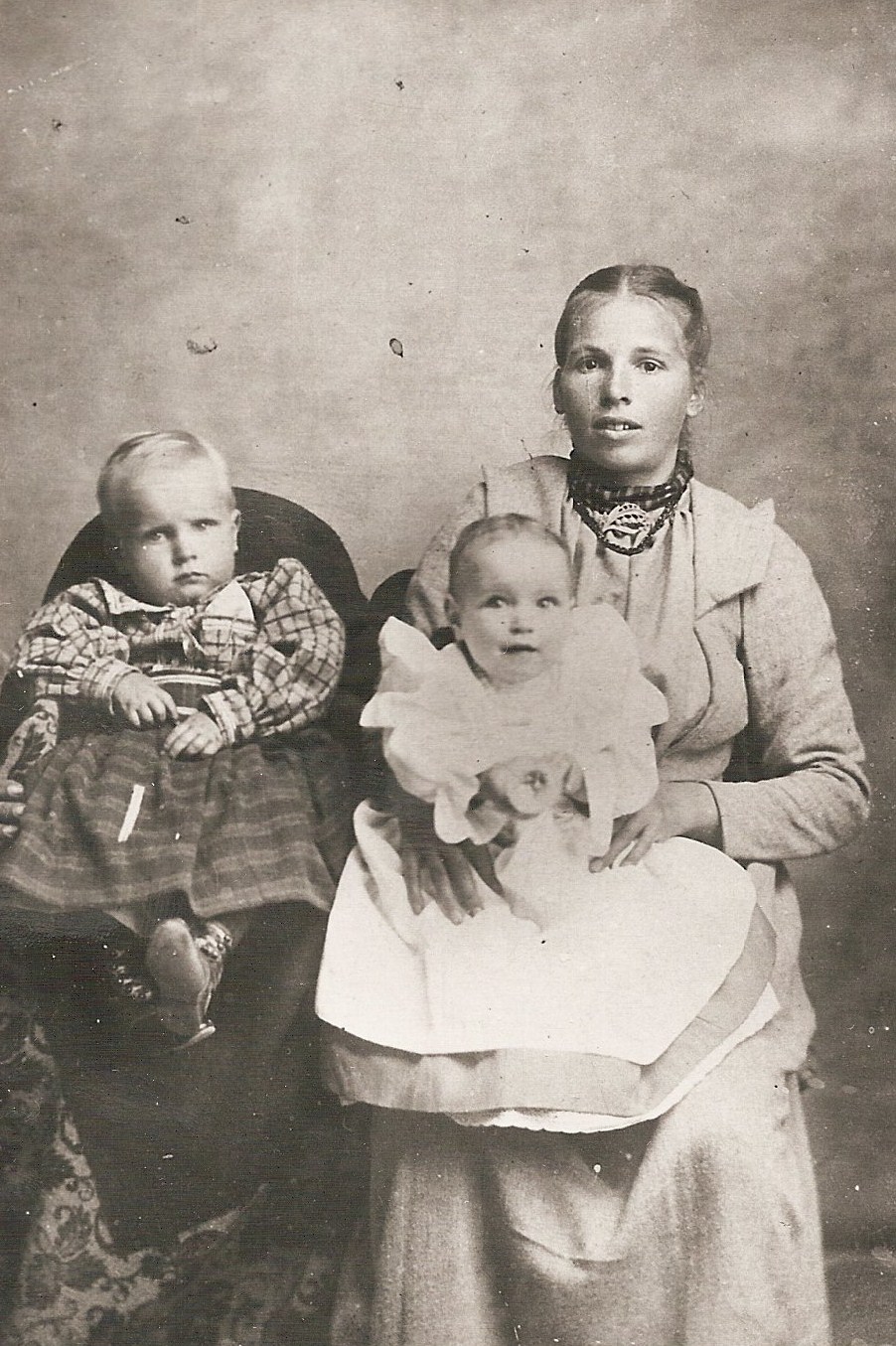
James, Annie, and Mary Wanner Wagstaff

Then mother went to live in the home where her husband and his mother resided. It was a log house with a dirt roof. This home was located about 5 miles North East of Preston, Idaho, in an area that is commonly called Glendale Flat. Mother took charge of the house and cared for her mother-in-law who had very serious leg trouble.

Right from the start mother worked side by side with her husband getting in the hay and grain. All the water for washing, bathing, drinking, etc. had to be hauled as they had no water on their place. Their cattle were driven to Worm Creek to drink. This Creek was about a mile from their home.

26 January 1897 mother’s first child was born, a tiny premature son. He was named George William. Our Dad held this tiny infant on his lap and fed it with a medicine dropper. He did everything he could to save his life but he passed away after 9 days.

Their second son named James Addison was born 24 June 1898; and 28 December 1899 her first baby girl, Annie Eliza was born. Our Dad and Mom and Dad’s mother were so very happy to have a son and a daughter to bless their home.
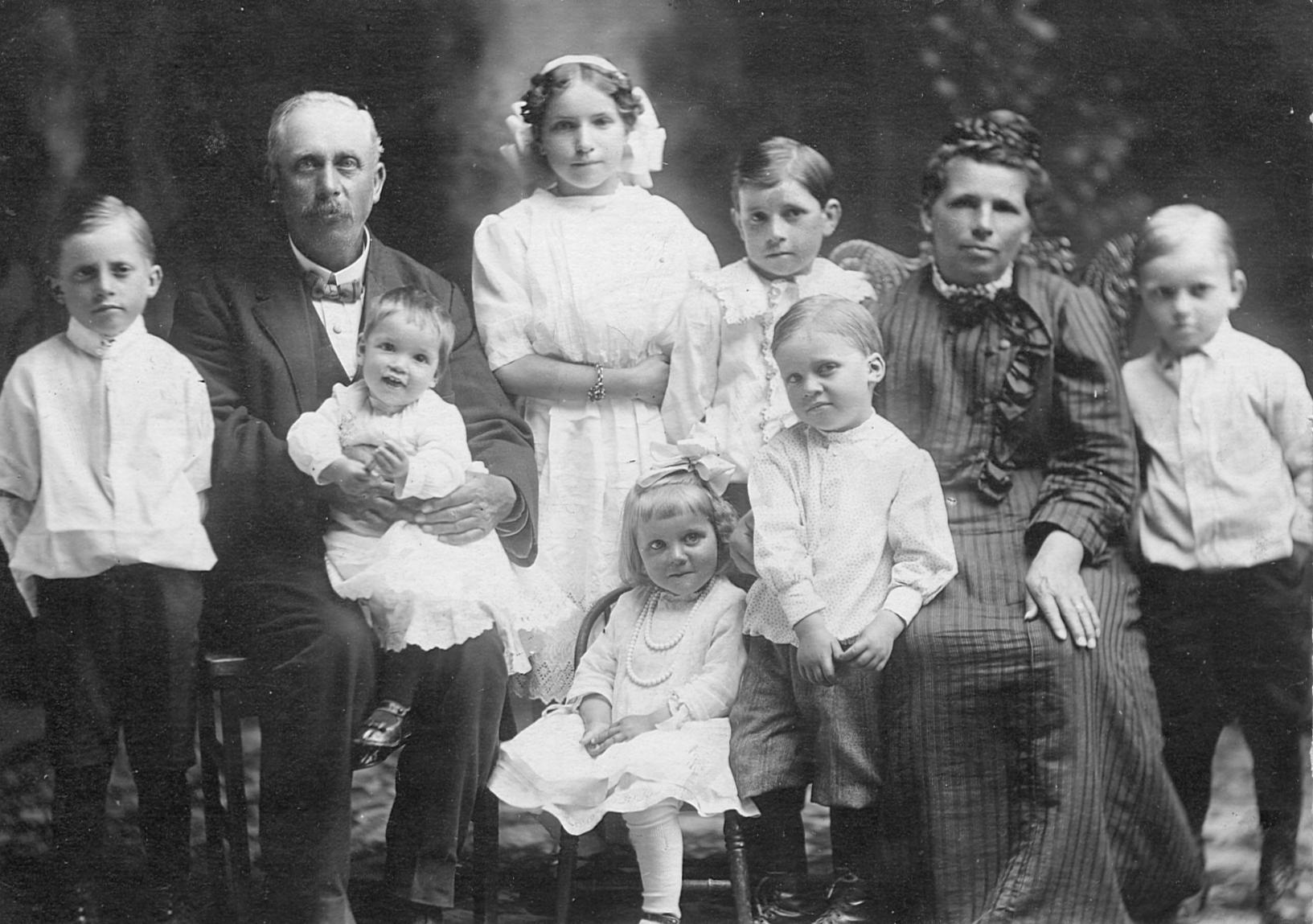
Back row: Willard, William, Annie, Parley, Maria, Jesse. Front row: Elsie, Edna, Herbert.

During the early part of mother’s married life, she worked in the Relief Society. Mother loved working in the Relief Society and did her part to make it a success.

In 1900 they moved to a two-room log house with a dirt roof. This house was located one mile from their first home. This move was made so they could be where there was water. This was a big help as they now had water from a well for culinary use as well as other things. Here they were able to have a nice garden with currants, both black and red, as well as gooseberries and raspberries. They could also have shade trees and fruit trees. I am sure this was a great blessing to them.

August 28, 1901, a son Wilford John was born. This made four children for them including the one who died. Dad and Mother were happy to have a family and Dad’s mother was thrilled to think she was now getting some grandchildren. Our Dad’s mother had a very sad time raising her family; our Dad being the only one of 4 children who lived to maturity.

Our Mother and Dad gave Dad’s mother kind and loving care for many years. She continued to have poor health. She was especially afflicted with varicose veins. Those finally turned into ulcers on her legs which had to be bandaged. One of their old neighbors has told us that she had her legs bandaged each day for over 35 years. She finally passed away in the early morning hours of December 2, 1902, and was buried in the cemetery at Glendale, Oneida County, Idaho.

The 9th of April 1903 Parley Leroy was born; and on 23 June 1903, our 22 months old brother Wilford John was drowned in a ditch just north of the house. Many people came from all around to help them at this sorrowful time in their life.

Children continued to come to bless this humble home and 3 March 1905 Willard Lesley was born. On 9 January 1907 Jesse Oleen was born. The 11th of November 1908 Herbert Spencer was born. Mother had now given birth to 7 sons and 1 daughter. She was very busy caring for them, her husband and home, as well as participating in church activities.

During the summer of 1909, they built a new house which had two rooms down and two rooms upstairs. It had a singled roof and later on was pebble-dashed.

It was in this home on a beautiful Sunday morning, 10 July 1910, the next child, a girl with hazel eyes and blond hair Edna Leona was born. The family as well as the Glendale Ward were delighted to see this baby girl come to the home where there were 7 sons and only 1 girl. 7th of August 1912 another daughter, Elsie Magdalina came to bless this home.

On the 19th of March 1913, sorry struck this home when their son James who had been ill a lot of his life passed away and was buried in the Glendale Cemetery.

On the 25 of March 1913 Mother had a patriarchal blessing by Patriarch Wm. Daines. This was a big comfort and a joy to Mother in later years.

The 8th of July 1915 Mother had her last child, a son she named Albert Wanner. Mother had a very difficult time at this birth and she was ill a long time after.

After Mother’s parents moved to Logan in 1910, she frequently went to visit them and did Temple work.

Very often Dad and Mom would drive their team and wagon and later a buggy to Preston; leave them there in the tie-yard and catch the U.I.C. to Logan to do two sessions at the Temple; then back to Preston to get their team; drive home about 4 miles. After Mother was married, she took every opportunity that came her way to go to the Temple. She loved to do this and it brought her great joy to be engaged in the Lord’s work.

Mother loved the outdoors and kept a beautiful garden and flowers; tended chickens and worked with her husband and children in the fields.

September 1918 Dad and Mom took their 3 daughters and youngest son Albert to Brigham City, Utah on the U.I.C. for Peach Day. They all had a delightful time, and enjoyed the trip very much.

During the summer of 1919 Dad and Mom and their 3 daughters and Albert again went on a visit. This tie to see Mother’s sister Pauline, who lived in Gentile Valley. They went in the white top buggy, and followed the road through the Bear Rivers narrows. This was a very narrow road and there was only a few places where people with teams could pass. Our Mother was very nervous going through the narrows. Dangerous things always made Mother worried and nervous. Mother was frightened when thunder and lightning storms were close to us, where she could see and hear it.

September 1919 Dad and Mother again took their 3 daughters and baby son on a trip. This time they took the train and went to see and learn more about where our Dad and lived and worked. They first went to Evanston, Wyoming, then Almy, Croydon and Ogden. They visited with many relatives and friends in Evanston, Almy and Croydon. Dad lived at both Almy and Croydon before coming to Idaho in 1884. For many years Dad wanted to take Mother on this trip to show her where he had lived and to meet some of his relatives and friends he had made before going to Idaho. This trip was the happy fulfillment of that wish.

Ogden, Utah was our last stop and while there Dad and Mother purchased the farm and home of his cousin and her husband Albert Phipps. This farm is located in West Weber, about five miles west of Ogden. It is an 80-acre irrigated farm. Less than half of which turned out to be good farm land.

Soon after they returned home, the news spread around that the Wagstaff family would soon be moving. Many friends and neighbors came to help in preparation for the move.

Before leaving Glendale, Mother’s good friend and neighbor Elizabeth Owen gave our family a nice going away party. Also the Glendale Ward did likewise and gave the folks a rocking chair as a token of their love and appreciation. After my brother Herbert got married, Mother gave the chair to him.

Mother had now lived in Glendale for over 25 years. She had many friends and neighbors that she loved and appreciated so much. In some ways she did not like to leave all they had worked so hard and sacrificed so much to get. Mother loved her home which had 3 new rooms added. They were now quite comfortable.

I’m sure Dad and Mother had given great thought to this venture before making the final decision to go away and start over in a strange kind of farming and among people they did not know. On the other hand they had become convinced that the move would provide better opportunities for their children. They did have 8 living children they loved with all their heart and soul. They also had great love and respect for each other. These things together with their strong testimony that Heavenly Father would bless them if they did what was right. They put their trust in God and bravely faced the future in their new environment. Little did they realize just what trials they would have to go through — even before they completely settled in their new home.

So it was in October 1919, Dad, Parley and Willard headed from Glendale to Ogden, Utah, with teams, wagons, and white top buggy loaded with family possessions. Jesse and Herbert stayed home and did the milking and tended animals. Parley and Willard stayed in Ogden, and Dad came back to Preston on U.I.C. With the help of faithful neighbors, the rest of the family possessions, cattle, chickens and furniture were put on the freight train and Dad went with them on to Ogden. Mom, us girls, Jesse, Herbert and Albert went on U.I.C. Little did he realize that when he arrived in Ogden, the officials would not let him take his animals home but quarantined them. It was a great shock to Dad when he had to pay over $1,000.00 for feed and care before he could get his animals. It is laughable now, but it wasn’t then when somehow the chickens got loose and were running all over the railroad yard with people trying to catch them. It must have been quite a sight to watch people scrambling around chasing chickens.

Our Dad left a paper in his own hand writing describing a few of the experiences our family had after we got to Ogden. The paper stats that in November 1919, the next month after we got there, Annie and Elsie came down with the Small Pox. Shortly after all the other children also came down. Dad and Mother had all 8 of us in one room and gave us patient loving care. I am sure it taxed their strength and was a great cause for worry and anxiety for them.

We had scarcely got over the Small Pox when all the children, Mother and Dad got the Influenza. We were a very sick group and our Mother was especially bad as she had Asthma along with the flu. Dad also got it but stayed up on his feet, caring for the rest of us and doing the chores. Our sister Annie and Anna Gregersen were working at a cafe in Ogden and roomed together and both of them had the flu. Our Dad went over to Ogden in the buggy every other day to take care of Annie and Anna and take them food. It became evident to our Dad that Anna was getting worse so he sent word for her parents to come. Annie and Anna were great friends and it was a great loss to Annie when her dear friend passed away 14 February 1920. I sometimes wonder how our Dad held up to the terrible work load and responsibility that was placed upon him at this time. Mother was worried about our Dad through all this.

When we first got to Ogden, we joined the Wilson Ward and Mother was put in as Relief Society Teacher. In August 1921 we joined the West Weber Ward. Before we joined the West Weber Ward, the Wilson Ward gave Mother a party and a beautiful bouquet of flowers. Mother was soon put in as a Relief Society Teacher. She continued to be a teacher until she moved to Ogden in 1935.

In June 1921 Mother and her three daughters went on a trip to Logan, Preston, Glendale and McCammon. In McCammon we visited with mother’s brother Gottlob and family. In Glendale we visited with old friends and neighbors and in Logan with Mother’s sisters and her parents.

In December 1921 Mother’s sister Pauline passed away and left her little family without a mother.

In September 1922 Uncle Wills family all got Typhoid Fever. Our Mother believed in being her brothers keeper so she took this family into one room of her home and nursed them back to health, except Annie who was in the hospital. After they got over this terrible disease, Mother continued to take care of the baby boy for some time.

In the ensuing years Mother continued her activities in taking care of her family and supported her husband in his work, church, etc. Mother loved to have chickens and she usually had a flock — this enterprise besides furnishing eggs and meat for her family helped out in providing extra income. She was active in Relief Society and regular in her attendance at Church and in paying her dues.

In January 1931 her daughters Edna and Annie went to Logan to attend the Utah State Agricultural College. This meant that Dad and Mom were alone except for Elsie, Albert, Herbert and Jesse who had come home again. That winter they did considerable visiting of friends and neighbors and Dad helped them with their genealogy. It was during the winter and spring that three old friends passed away and mother and dad attended their funerals — John Dobbs in Logan, Henry D Auger in Lewiston, and Mother’s dear friend and neighbor in Glendale, Elizabeth Owen.
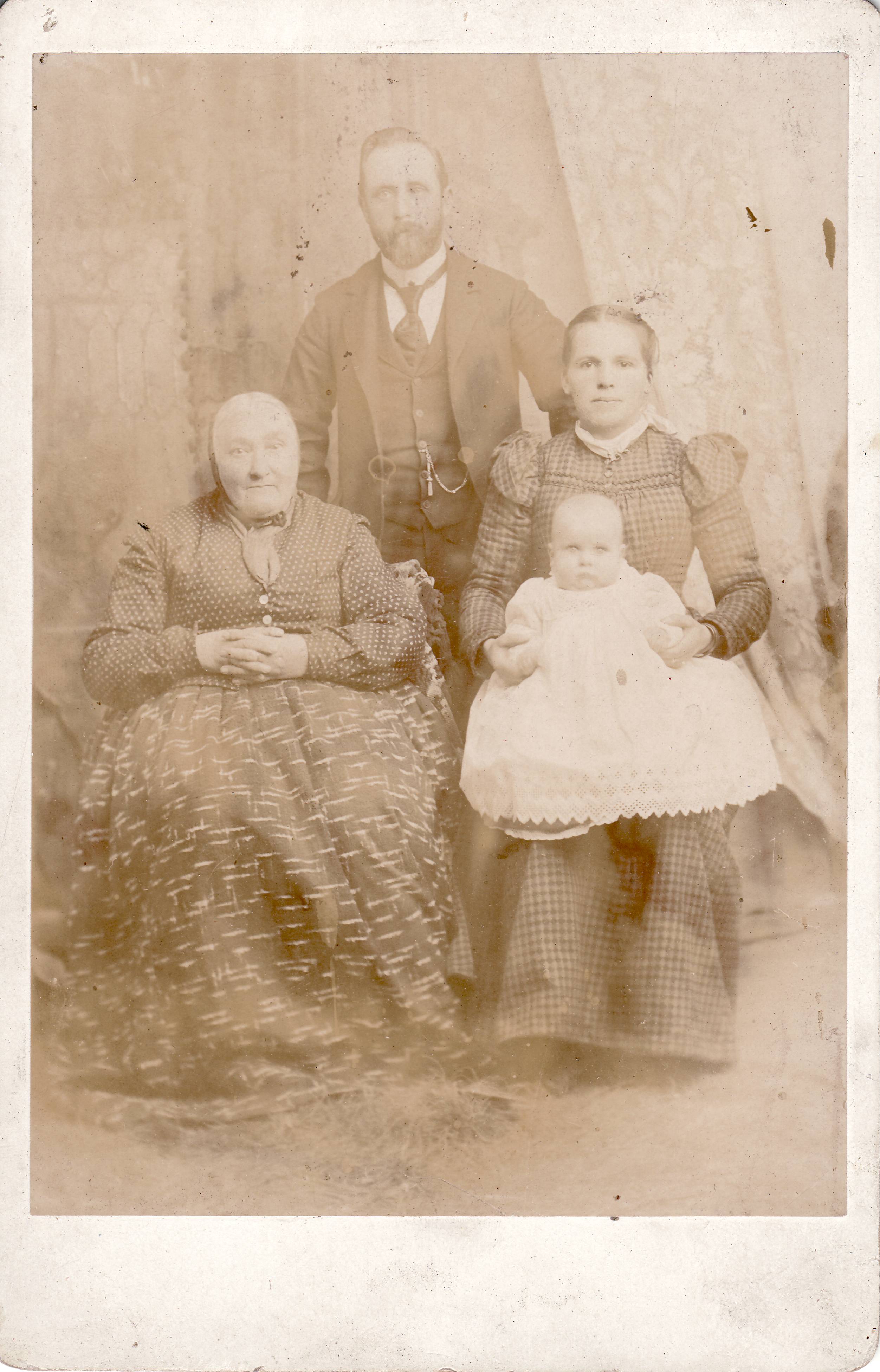
Mary Allsop Wagstaff (1826-1902) with William and Mary.

Little did Mother realize at the time that it would be less than a month when she would lose her devouted companion. Her husband had an operation for stomach ulcers in the Dee Hospital in Ogden the 29 May 1931 and passed away from Post Operative Pneumonia on 31 May. This was a terrible shock to Mother and she grieved very much. There was nothing for her to do except to go on alone without her companion. Life was hard for Mother at this time but she had all the loyal support her sons and daughters could give her. They all loved their Mother and did what they could do lighten the burden. Mother grieved long and hard over the loss of her dear husband but in time found her way to continue life and plan for the future.

Mother stayed on the farm and with the help of her children operated the farm the best they could. THe depression was on in full force and money was hard to come by. Through sheer frugality and wise management, they started to come out on top.

In January 1935, Mother, Annie and Elsie said good-bye to the farm and moved into Ogden. At first they moved into a rented house. They lived in two different rented houses.

In May 1939 Mother purchased a home at 2069 Jackson Ave in Ogden and this was her last home. Mother was comfortable in this home and she enjoyed having a little leisure time in which she could enjoy her flowers and listen to her favorite programs on the radio — Myrt and Marge was one of her specials — it all seemed so real to Mother.

20 December 1940 Mother’s oldest daughter Annie Eliza passed away. I am sure Mother missed Annie as Annie had been confined to the home with heart trouble for several years, during which time they had a lot of opportunity to enjoy each other.

In September 1941 Mother was honored on her birthday when her family gave her a dinner party at which time many of her children and grandchildren were present and Mother enjoyed it very much.

September 1943 an open house was held for her 70th birthday when many of her friends and relatives came.

April 1942 Mother had a serious operation from which she seemed to make a good recovery. FOr quite a few years after this Mother appeared to be in reasonably good health.

Time moved on for Mother as it does for us all. She had seen two world wars in which the people of her home land were heavily involved. I am sure Mother realized that many of her relatives were in action. She said little but seemed to think a lot about it. She had witnesses great changes in the lives of people including transportation, cars and trucks; telephones were beginning to gain in popularity and the radio was in almost every home. It was a thrill to Mother when she got her refrigerator. Tractors were in common use in farming and much of the back-breaking work was now done with machinery.

July 31, 1952 Mother had a mild stroke but was never confined to her bed completely. It did make a change in her life and I think she realized it. 23 of October 1952 after 3 months illness, Mother passed away at her home.

She had always been a hard working, devoted wife and Mother. She served as a Relief Society teacher for over 50 years. She paid her tithing, fast offerings and other donations. She kept her love for her family and her faith in God to the very end.

Her funeral was held 27 October at the Lindquist & Sons Mortuary in Ogden, Utah. It was a lovely funeral with lots of flowers and many friends and relatives attended. She was buried beside her dear husband in the cemetery at West Weber, Weber County, Utah.

THis little history of Mother was put together many years ago by her 3 daughters with her help in relating facts to us. Elsie brought it up to the time of Mother’s death.

I feel there is much more that could and should be said but I am sure each of her children have their own personal remembrances, as well as some of the grandchildren, but I would just like to add a little more that I don’t think has been mentioned.

I don’t remember a time when Mother did not have a lot of beautiful flowers. Geraniums that blossomed all winter long. She had morning glories, pansies, sweat peas, portulacas, pinks and others to mention a few.

Mother always made her laundry soap which was so good to use in cleaning the farm work clothes and so beautiful and white. She made many batches of soap for each of her married children as well as some of her neighbors.

When Dad and Mother killed a pig for home use, Mother worked so hard helping Dad cut it up, cure it and make delicious link sausages; and the head cheese she made was the best. There was always a piece of pork given to the neighbors.

She always churned her butter while on the farm and it was very good butter.

After we went to Ogden, Mother had a hot bed where she raised tomato and cabbage plants for themselves and others to plan in their fields.

Mother was a good cook and made the best bread, pies, rice pudding and soups. Oh! they were so good. When we had the threshers they always liked to be at our place for meals as they enjoyed the delicious meals Mother put on.

She loved to have her neighbors, friends and married children drop in for a good meal — and no one ever dropped in unexpected but that they were treated to a real meal or a snack.

After we moved to Ogden, it was the joy of her life to return to Preston to visit her dear friends, relatives and neighbors, and Dad somehow always found the necessary money so she could do that.

Mother was always clean and neat when she left home to go any place. She had beautiful long black hair that stayed dark until her death. She had a unique way of putting up her hair — hair styles changed but Mother’s never did. Many people commented on her lovely hair and the unique way she fixed it. Mother also had beautiful hats which she loved very much.

I would like to relate a little incident that happened in the summer of 1918. It was when we had a total eclipse of the sun. We did not have a radio or television and the paper hadn’t come. I guess Mother did not know the eclipse was coming. Dad had gone to town. I don’t know where the others were but Elsie, Albert, Jess and I were home with Mother. It started to get dark, then darker and darker. She became very excited and thought the end of the world was coming. She dashed out to gather the precious eggs — it was totally dark in the cop and the chickens had gone to roost. Mother was so relieved when it all passed over and the sun came out and best of all Dad came home.

One day during World War I, Dad was sitting at the breakfast table reading the paper. We knew, of course, about the German submarines sinking many of our food ships. Dad said rather nonchalantly, “Well, some more sugar has been sunk.” Mother became very excited and said, “Where?” Dad said, “In my postum,” and let out a roar.

Mother suffered with asthma most of her adult life and we all did everything we could to help out when she had a bad attack. Many mornings I remember Dad calling to us, “Come on and get up. Mother is sick.” We all rallied around and kept things going while she was down. If someone lit a match and let it burn, it would always bring on an attack of asthma. Many times when Mother was fighting for her breath we would all be frightened and I remember one time I ran to Bishop Ed. Bingham’s place to get him to come and administer to her.

Dad was always so kind, considerate and helpful to her especially when she was will; and her children were also.

Mother had a unique laugh and when something struck her as funny, she could really laugh. In a crowd you could always pick out Mother’s laugh. Several years at the July 24th celebration in West Weber she took the prize for laughing the longest and hardest. One year the prize was a leg of lamb; another time a beautiful Jordinere.

I remember that Mother had a pet lamb she loved and took very good care of it. She went to Logan for a few days to visit her mother. She wrote a letter home to use in English, but as a joke also wrote a note in Germany. We could not read the note so took it to a neighbor lady who could read German. The note said “Be sure and take good care of my lamb.” We all got quite a thrill out of this.

It was important to our Mother and Dad to see to it that each of their children were baptized in the Logan Temple. All their children were baptized except the last two. 30 March 1915 Dad and Mother took Jesse to Logan with the horse and buggy so he could be baptized. Then they stayed at grandpa’s and grandma’s home one night. When they couldn’t go they sent the children with Annie on the U.I.C. electric train.

At a George Washington party in the Glendale Ward, Vern Nelson tells this story. Mother was sitting on the front bench and Vern had to recite a poem. It was

Of all the girls in this world,

I’d marry none for riches,

I’d marry one six inches tall,

So she couldn’t wear my britches.

Vern changed the poem to read necktie instead of britches. Everyone expected him to say britches. He said Mother started to laugh and he had never seen anyone laugh so hard in his life.

A few years ago Meda Nelson Robinson told me as long as she lives she will never forget the blue and white granite kettle Mother used to make sandwiches in for us kids to eat between Sunday School and Sacrament Meeting when there was a little recess. They were usually just break and butter or sometimes a little sugar sprinkled on them, and always a cub cake with little currants in. She said that when Mother got the kettle out, that she and some of the ward kids would sally up to Mother hoping for at least a cup cake. She said sure enough Mother always had plenty and she would always get one, and how good they were.

Mother was kind and compassionate and believed that true happiness in life comes from serving others. Her friends and neighbors were often beneficiaries of her goodness, and if there was a new baby or sickness or sorrow in a home, she always found time to put on a clean apron and take a loaf of fresh baked bread, a pie, or fresh berries or something from her garden to cheer them.

She never lost sight of the purpose of life and the reasons for coming to America.

She abhorred cruelty to animals or humans.

She always had little sayings to put over a point such as “If a string is in a knot, patience will untie it. Patience can do many things; have you ever tried it.”; or “If there is a will, there is a way”; or “If at first you don’t succeed, try, try, again.”

When Mother passed away, she did not leave many possessions and no riches; but she did leave a legacy far superior to earthly things, and I’m sure we as a family appreciated that.

Mother had her dub of joy but she also knew sorrow. As I have raised my family, we had our share of sickness, accidents and near deaths and it has made me think about Mother. She must have been in great anxiety and pain over the loss of three of her children before they reached maturity.

Dad and Mother really loved each other and were always happy with each other. Dad got so much joy out of buying her special little things when she was ill such as oranges, or a can of oysters, or a bottle of soda water. They worked together as a team in whatever they did. Whether it was in the garden, cutting and curing meat or whatever, they enjoyed being together. They both enjoyed going in a cafe and having a snack like a hot beef sandwich or root beer and a sweet roll.

Mother really suffered and grieved deeply over the loss of her husband. Dad was just 70 and Mother 57 at the time. Many times we have found Mother out back of the house crying as if her heart would break — many times she was heard to say “If only papa was here.”

Mother is long since gone, but those of us who remember have a MEMORY that is SWEET and LASTING.

The Personal Story of Louise S. Bodrero

Another history in the records of Golden Rulon Andra.

“(Elsie Wagstaff Coleman read this history of Aunt Louise at our Reunion 21 June 1980)

“(Louise Sophie Wanner was born March 30, 1879.) I was born in Gruenkraut Germany. I can remember as little kids we stayed home. When we were I guess seven years old, we had to go to the Catholic school. There were no other schools around in those days. My Mother and Father didn’t always live in Gruenkraut. My father, John George Wanner was born in Hildritzhausen, Wuerttemburg, Germany, on October 18, 1845. His father was Johann Friederich Wanner, and his mother was Anna Maria Marquardt. My mother Anna Maria Schmid was born January 21, 1849 in Holzgerlingen, Wuerttemburg, Germany. Her father was Jacob Friederich Schmid and her mother was Salome Notter. In 1870 my father went to Russia to fight in the war. My parents were married the 6th. of June 1870. My Father died February 16, 1922 in Logan, Utah. My mother died December 9, 1929 in Logan Utah. The last days of their lives they lived in the 4th. Ward, and they are buried in the Logan Cemetery. My brother John George and sister Christena were born in Holzgerlingen, and my brothers, Johannes, Johannes Friederich, Frederich, Gottlob, and sisters Mary Magdalina, Pauline and Wilhelmina were all born in Gruenkraut, Germany.

Wanner Family about 1895, back (l-r): Mary, Christine, George, and Pauline; front: Anna, Fred, Louisa, Wilhelmina, Gottlob, and John Wanner.

“To continue with my story- – we did so many things in life. First of all we were poor and had not much to live on. The folks had to move from Holzgerlingen to the new place in Gruenkraut. I remember we didn’t have much land. Father got a job working on the street. The grass grew high on the side of the road and we had to help gather the grass for the cows. We had to do this everyday before father went to work.

“We were poor in those days. We had to be up at 5 o’clock in the morning when we were big enough to work for other people. We worked every day in our lives to make a dollar. I would go out and work for other people whenever there was work. Some people had lots of land and we got plenty work there. They would come and get us to work when I was seven years old. I remember we never wasted any time. I remember when we had to go to a place to get vaccinated. I know I sure suffered a long time because my arm was so sore. They do this so that it will last a lifetime in the old country against disease.

“I remember how we got warm for the winter. Father would buy a yard of wood in the forest and we had to cut it down ourselves and haul that wood home with the cows and wagon. Some were long trees too and we would haul all the limbs and everything home. I am telling you, we had the yard so full of wood that we had no room for anything else till we had it shaped down and sawed up and put in its place. You know that was a job and we had to do all this before winter set in. We had a little wagon and we went to the woods in the summertime too, to get some dry wood. We did this many times and would always take home a wagonfull.

“In the old country they had fences in the lucerne fields. We had to put them up so we could hing the hay on them to dry after it got wet from the rain, so it would not mold. When it was dry we hauled it home. I remember we did all the farming with cows, they had them work all day and then milk them at night. Father worked on the street job for many years and mother and us children did most of the farming and in the fall we went picking hops. We never failed to make a little money in them. They have fields of hops in the old country. We always earned our winter’s money there. They have acres of hops there. We never wasted our time in the field.

“Another thing we did was go to the forest and pick fruit and go and sell it in the city. The people would sure buy it because the city was a long ways from the country where we lived. We had to walk all the way to the city. We raised hemp and mother would spin half the night making it into balls. She would take it to the factory and they made clothes out of it. We used to have many yards and would stretch it out on the grass in the summertime. It would go white and thats the way mother made our sheets and everything. We have in the old country the shoemaker, and he come to the house and make shoes for us. We also had the dressmaker come to the house. Sometimes they would stay at the house a week or more.

“When the grain was but, we had to out and clean the heads of the wheat. We cleaned sacks full each day for flour and one time right in the middle of the summer, the soldiers came in with their horses on some maneuvers or something. The horses mashed the grain and trampled all our crops up. I knew there was a big field of grand and they went right through it. They stayed around about a month or more. It sure was terrible.

“After a few years father bought a new farm and house about two miles away from the old one. It was a bigger house and more land and that’s where we lived until we came to America. Our house was a long house. We had four rooms and an upstairs. In the farmhouses of the old country we had everything under one roof– the pig pen and the hay loft. There was a big place in the floor where we threshed the wheat and other grain and we pulled all the hay up in the loft towards the roof. For a long time we threshed the wheat on this hard floor below with a stick and using a big klap, four or five of us would thresh the wheat and then would sieve the wheat from the chafe. But later, I can remember that we hired a thashmachine and the cows pulled it after that.

“I remember one time a wagon run over me. I believe it went over my arm. I don’t know how bad I got hurt, but it was plenty bad enough.

“Well, later on in that place not far away they built a Lutheran church and a school, too; and there we learned to knit our own stockings and do all kinds of sewing and crocheting. Yes, they built a nice church and school. They were very strict in those schools. If you were late a few minutes you would have to hold out your hand and the teacher would hit you so hard that your hand could feel it for a long time. It was one of those hard wood sticks. It wasn’t always our fault because we had to take the milk to the creamery in the morning in the snow and ice, and we could not go very fast, but there was no excuse at all. We had a lot to do before school, and if we didn’t have the lesson ready we were scared to go to school, ’cause if we were late we would sure get hit, and when you held out your hand they would do just what they wanted to do and it didn’t hurt them any.

“In the old country they sure celebrated Christmas. We had two Christmas trees every year and nice ones at that. We had applies tied from the bottom to the top and the step and the tree sure looked pretty every year. We only had white bread for Christmas and Holidays. I can remember how good that white bread was. We never saw it very often. it was only the rich who could buy that. There was only one bakery in Gruenkraut that had good bread and cakes, but we could never buy any. This is how we made our bread: We had a box of wood. Of course, it was clean. Father worked the dough and made enough for two or three weeks. It was mostly rye bread. It was hard and dark but we had to eat it. When Valentine’s Day came around, Mother made up cakes and they sure tasted good.

“We all the time raised our own meat. We raised pigs and salted and smoked the meat. We had our own grease. Mother made her own noodles all the time. She used lots of eggs–they were sure good. We had our cellar so full of potatoes, apples of all kinds and barrels of cider and barrels of sauerkraut. I can remember our cellar was full of all kinds of good things to eat.

“Well, about our garden. We had the prettiest garden you ever saw in the old country. The garden was laid out in a square and we had a path around all over with the vegetables in the background and flowers in front and we could walk all over the paths with flowers on each side. We didn’t need any ditches, but had to pack water when it didn’t rain. We always had a beautiful garden with flowers of all kinds.

“On Saturday we always had to clean the shoes for the whole family — shine them up for Sunday. We always went to church on Sunday. We never worked on Sunday. We were not allowed to work on Sunday, because in those days they would fine you if you did. You could not even get your hay in on Sunday, even when you could see rain coming.

“Well, I guess about in the year 1890, in the summertime, the Lord sent a man along that street in Gruenkraut where my father worked, who was a missionary from the Church of Jesus Christ of Latter Day Saints. He talked to my father a long time and he told father of the new and true Gospel and about Joseph Smith and showed him the Book of Mormon. This man talked to my father in German as he was a missionary to German. Well, it was dinnertime and father took this missionary to our home and father told him–“We’ll see mother”–and from that very day on this missionary stayed at our place. His name was Zollinger from Providence, Utah. When his time came to go home, the missionary took my brother George to America with him. After that we had three more missionaries–one from Bear Lake, one from Providence, and another one from Salt Lake City, who couldn’t speak the language, so we helped him learn the language. He would tell us English words and we would tell him German words. There wasn’t anybody who would listen to the missionaries for miles around–just one other family from Ravensburg–and they were the only ones that believed the message like us. We had room for them everytime they came. There was no place else for them to go and we were glad to have them.

“The missionary from Salt Lake–his name was Hubbard–decided to go tracting one day. It was his first time tracting. He didn’t come home for so late that we thought maybe he fell into one of the wells with water that were here and there. It was late in the evening and dark, so mother decided to put a candle in the window. He soon came back and told us that he had been lost for a long time until he saw the light in the window. There weren’t many houses when I lived there, but in seventy years since, I guess it is built up all over.

“(About this same time Grandma was writing her history, Mrs. Herbert Wagstaff and son came to visit her from California. Herbert Wagstaff was the son of sister Mary Magdaline. The son had recently returned from a mission to Germany, where he had taken colored slides of the big house in Gruenkraut as it stands today. Of this evening of reminising Grandma said:) “It was sure nice to see my old home again and see it still stand in Gruenkraut. It was nice to see it again after seventy years.”)

“Well, I lived in that community for 14 years. That’s when I graduated. We started to this country when I was fifteen, in May of 1893, and got here the 15th of June, 1893. We came by ship and docked first in Amsterdam, Holland, and then in London, England. And then from London, to New York City, where we went to a big high hotel. WE were 12 days on the ocean. We had a good time on the ship where we danced. One day there was a terrible storm which throwed water up on the dock and nobody could dance after that. From New York we boarded the train for Idaho. We were 6 days on the train. On the train we sang all across the United States. We couldn’t speak any English then nor for a long time. We got off the train on the 15th of June, 1893, in Franklin, Idaho, and my brother George was there to meet us. He had a wagon with three spring seats. Well, we never were so worried on our whole trip as we were in that wagon. That day the road was so bad–open ditches with water in, and the horses danced around before they would cross. I never say such a rough road in my life–hills and hollows, and then we saw a bunch of Indians. They were hanging dead squirrels on a line to dry. That was something new to us. Well, we got to the place where we were to stay. But father was as worried that he got off the wagon and walked all the way back to Franklin. Mother and the rest of us were so worried, because he didn’t come back for a few days. We stayed with some folks for about two months, then father built a place in Glendale, Idaho, and there we lived the rest of the summer.

“Towards fall there was a man who wanted to sell his place in Glendale and father bought that place. My father farmed in Glendale. Glendale had only a little meetinghouse and also a school. I went to school there that winter to learn the English language. From then on I worked wherever I could get a job. I worked washing, cleaning house and tending children. In a place where I worked their children got mumps and I got mumps too, and I suffered so much that I could never get better for a long time. When I got better I went to work again. One time in the winter I rode a horse to Preston, and I got the toothache so bad that I had to have it pulled out right there. I soon learned to ride a horse a lot–something I’d never done in the old country.

“I worked for Matthias Cowley in Preston one winter. I guess it was the year 1895. He used to take trips and travel in a buggy–he helped organize the Northwestern States Mission. Then I worked in Whitney, Idaho. They had plenty of sickness in homes there. In 1897 we moved down to Logan and to the 5th Ward. Then I worked in Millville and went to school there at the same time learning the language. After that I went to work in Logan. It was in the 3rd Ward one night in church I met Jeffrey Bodrero. We were married in the Logan Temple, March 16, 1898. My sister Wilhelmina married Jeffrey’s brother, Moses Bodrero, December 18, 1907. Jeffrey’s father was Domenico Marsiano Bodrero, and his mother was Maria Caterina Margherita Frank Bodrero. After we were married I went to work for Dominic Bodrero that summer, who lived by the courthouse, where I walked everyday from the 9th Ward and did washing by hand on a board up until the time of my first child. Later that year I tended to beets, but they didn’t grow very well because of too many wild oats. Jeffrey went to the canyon about every day to get lumber and to make a dollar. These are the years when I lived: Gruenkraut, German: 14 years; Glendale, Idaho: 5 years; Logan 9th Ward: 30 years; Logan 4th Ward–where I became a relief society teacher. I also did a lot of temple work.

“In the old country we had known a family names Speth for a long time. We used to go back and forth to each others homes all the time. There was a big dark forest between our two places, and we were sometimes afraid to go through it because it was dark, even in the day time. Father would send us kids over in the evenings too. Sometimes we went twice a week to see them. We always had to walk of course. We had no car. I can see it now and I will never forget it. They were really friends to us. The old people never joined the church, but the boys came over to America and settled in Providence and then joined the church. My granddaughter married a Speth grandson.

“My children’s names are: [Rosalie] Marie, John George, David Wanner, Eva Margaret, William Jeffrey, Parley Lorenzo, Louise Mary, Edward Theodore, Llewellyn Grant and Evelyn Jane.

Bodrero Family (l-r): Louisa, Louise, John, Parley, Rosalie, Jeffery, Jeffery, David, Eva

“My folks went to conference everytime there was one. We never had the chance to go because children had to stay home and do the work. I remember it was in the winter once and it was so cold my parents couldn’t go to the conference. They sure liked this Mormon Gospel from the first day my father met the missionary.

Wanner Reunion, Anna Schmid Wanner sitting, standing (l-r) Mary Carter Wanner, Wilhelmina Wanner Bodrero, Mary Wanner Wagstaff, Regina Nuffer Wanner, Louisa Wanner Bodrero, Christine Wanner Nuffer, and Rebecca Hicks Wanner

“(Louise Sophie Wanner Bodrero died February 1, 1967 in Logan, Utah)

Open primaries bill introduced in Congress

History of Plain City Pt 8

I have two copies of the History of Plain City, Utah. The front indicates it is from March 17th 1859 to present. As far as I can tell, the book was written in 1977. At least that is the latest date I can find in the book.

One copy belonged to my Grandparents Milo and Gladys Ross. My Grandpa has written various notes inside the history which I intend to include in parenthesis whenever they appear. They add to the history and come from his own experience and hearing. 

I will only do a number of pages at a time. I will also try to include scanned copies of the photos in the books. These are just scanned copies of these books, I have not tried to seek out originals or better copies.

History of Plain City March 17th 1859 to present, pages 123 through 140.

SPORTS IN PLAIN CITY

 By Lyman H. Cook

            Plain City’s most prominent claim to fame has been through the sports program and the great players and teams that the town has produced. I know of no other town to community in this state, to possibly out of state, that can equal the accomplishments in the total sports program as the town of Plain City. I don’t know how many hundred championships or trophies this town has won in baseball, basketball, softball, volleyball, and Jr. Posses, over the last 75 years or more. We include the young teams and people in the town, and also the girls. These trophies and championships came from local, county, multi-county, state, stake division, region, multi-region, and All Church basketball, softball, and volleyball, which is the largest leagues in the world.

            On February 14, 1977, at 3:30 PM, there were 226 trophies in the trophy cases at the Plain City Church. I couldn’t begin to estimate the number of trophies in the homes here in Plain City. Can you comprehend the number of teams involved and especially the number of people involved on the teams in accomplishing this great record.

            There seems to be a special spirit, or force, ambition, or drive, that compels players to excel and teams to win. The will to win in Plain City is the strongest I have ever known. We have been accused of playing dirty, or being poor sports, but in answer to these charges, I would submit the phrase: We just play hard, and the spirit of competition just brings out the best in us. In Plain City you don’t hope you can win, you are expected to win. Some communities dislike us for our sports program because it is so strong, and in reality, they judge their success of their season by the fact of whether they can beat Plain City or not. I realize these are rather potent and strong statements, but never the less, they are all true.

            We dedicate this section of sports to all the people who have ever played on a team in Plain City. We realize that some names will be missed and it is not our intent to forget anyone, but we can’t remember all, and this is all of the sports material that has been turned in for the history. If your name is left off, write it in, and if you were star of the team, write that in also.

            We have asked for and received personal write-ups on a few people who have signed professional contracts or have distinguished themselves in certain sports. We recognize them for their talents in that they in turn have brought special recognition to Plain City. I am sure these talented athletes would be the first to recognize their fellow members, for they realize that no one man is bigger or better than the whole team, and in this light, we recognize the teams they played on.

            From 1944 until the present, there were three basketball teams that went to All Church and won two second places. Commencing in 1951 through 1954, we played in four fast-pitch All Church Tournaments. We won a second-place finish and eight-place finish.

            In 1953, we played on a volleyball team that went to the All Church Tournament and won the Sportsmanship Trophy, which was a great honor. The team that played were: Dee Cook, Lyman Cook, Wayne Cottle, Wayne Skeen, Blair Simpson, Kenneth Lund, Harold Hadley, and others we couldn’t remember.

            There were teams that went to the All Church Slow Pitch Tournaments from Pain City for three years. They won two All Church Championships, and a third-place finish. There have been some excellent younger teams in baseball, basketball, and softball, and a Junior team last year (1976) won a second-place in a

The All Church program.

            This was one of the early teams of Plain City, and this picture was taken around 1910. They played together for many years, and they won several championships.

Top Row: L to R:          Joe Hunt, Tooley Louis Poulsen, Preston Thomas, Parley Taylor, Jack Hodson.

Middle Row: L to R:     Mr. Anderson, Coach, Jim Thomas, Melvin Draney

Bottom row: L to R:    Oscar Richardson, Joe Singleton

Louis Poulsen

            Tooley Poulsen played on many championship teams, and played several positions, mainly second base and catcher.

            This was one of the first Mutual basketball teams in Plain City. They played their games in the upstairs of the old hall. Lyle Thomas reports that you didn’t have to be polished to play on this team, just big and rough, for there was very little whistle blowing in those days. This picture was taken in about 1925, and they won several championships.

Back Row: L to R:        Rulon Jenkins, Lyle Palmer, Marion Sneed, Milton Garner

Front Row L to R:        Theo Thompson, Ralph Robson, Coach Ellis Giles

            This was the 1930 Plain City Baseball team. They played for State Champion ship.

Top Row: L to R:          Horace Knight, Albert Sharp, Walter Christensen

Middle Row: L to R:    Floyd Palmer, Angus Richardson, Arnold Taylor, Walter Moyes, Abram Maw, William Freestone

Bottom Row: L to R:    Clair Folkman, Gilbert Taylor, Dick Skeen, Fred Singleton, Frank Skeen, Elmer Carver

BASEBALL AND EARLY SPORTS

By Elwood (Dick) Skeen

            Baseball was Plain City’s most favorite sport. Baseball in Plain City in the early 1920’s and 1930’s was composed of the Plain City Bull Dogs with the following players taking part:

                                                      Louis Poulsen

                                                      Joe Singleton

                                                      Walter Draney

                                                      Elmo Rhead

                                                      Parley Taylor

                                                      Joe Hunt

                                                      Elvin Maw

                                                      Oscar Richardson

                                                      John  Hodson

            They represented Plain City in the Weber County Farm Bureau League, composed of North Ogden, Hooper, Roy, and Clinton. There were many good ball players in those days that played on the teams. The town park at that time was covered with salt grass. There were no base lines, no pitcher mounds. But, on a Saturday afternoon the park was filled with people that came from all over the county to watch the games. Horses and wagons lined the park.

            Foot racing was also a great sport at that time, and Plain City had one of the best in Walter Draney, who was not only fast, but also a great athlete.

            As time passed and the older players began to drop out, the chance came for us younger players to take over. In 1925 I caught my first Farm Bureau game at Liberty with Ezra Taylor doing the pitching. Then, the other players that made up our team for the next few years started to play. We had our share of victories. In fact, we had more than our share of wins.

            Finances at that time were hard to come by. We did what we could to raise money to continue supporting the team. In 1928, the ball team put on the first Black and White Day with Mervin Thompson and Joseph Skeen showing their cattle. An old-time refreshment stand, soda water, ice cream, candy bars, and popcorn, which sold for 5¢. Also, some drinks that were not sold at the stand.

            Our uniforms were furnished by Plain City individuals and business firms from Ogden. Suits would have the name of the giver on the back. Decoration day and the Fourth of July were our most celebrated days with all kinds of sports for those who wished to perform. A baseball game and a dance in the evening would top the day.

            We would get the best team from Ogden to play on these days so that we could show what was leading up to the best team we had. In 1930, we won the Weber County Farm Bureau League, and the town bought us new uniforms to go to Lagoon to play Sandy, Utah, for thy State Championship. We lost by a close score. Our players were:

                                                      Gilbert Taylor

                                                      Walter Moyes

                                                      Arnold Taylor

                                                      Frank Skeen

                                                      Horace Knight

                                                      Albert Sharp

                                                      Fred Singleton

                                                      Abram Maw

                                                      Walter Christensen

                                                      Clair Folkman

                                                      Dick Skeen

            Bill Freestone was the manager. Angus Richardson was the coach. Elmer Carver took care of finances, and Floyd Palmer and Byron Carver were scorekeepers. We played in tournaments at Brigham City and Ogden, and some out-of-state games were played.

            We continued playing, but soon the gang started drifting different ways and our days were coming to an end. The league started to dwindle and later, folded up with the workload increase. Baseball was soon lost to the towns in Weber County.

Left to Right: Nalon Taylor, Bert Cook, Howard Gibson, Bud Dallinga, Wayne Cottle, Thayne Robson, Bill Stokes, Rulon Jenkins, Coach

The Desert News Sport                       Best Two MIA Teams

Page 10 – Salt Lake City, Utah-Saturday, March 11, 1944

Bottom Row: L to R:     Carl Taylor, Carl Hodson, Fred Singleton, Coach, Blair Simpson, Glen Charlton

Top Row: L to R:             Frank Hadley, John Nash, Lyman Cook, Ray Cottle

            Ray Cottle, Center:                  First Team All Church

            Frank Hadley, Forward:           Second Team All Church

            Lyman Cook, Guard:               Second Team All Church

            Blair Simpson, Guard:             Honorable Mention

            This team played for All Church Championship in 19441. They played Grantsville, Utah, and lost to them for the title. The games were played in the old Desert Gym, by the Hotel Utah. The teams stayed four nights in the Hotel Utah. They ate, slept, and played basketball.

                                                                        Top Row L to R:

                                                                        Alf Charlton, Athletic Director

                                                                        Lyman Cook, Ronald Skeen, Kenneth Lund, Grant

                                                                        Lund, Wayne Skeen, Clair Folkman, Coach

                                                                        Bottom Row L to R:

                                                                        Harold Hadley, Elmer Hipwell, Bill Stokes, Dee

                                                                        Cook, Blair Simpson

            This was the Plain City M-Men Team that played after World War II, in 1946, for several years and won several state championships and played in the division tournaments.

______________________________________________________________________________

                                                            SUNDAY MORNING, AUGUST 19, 1951

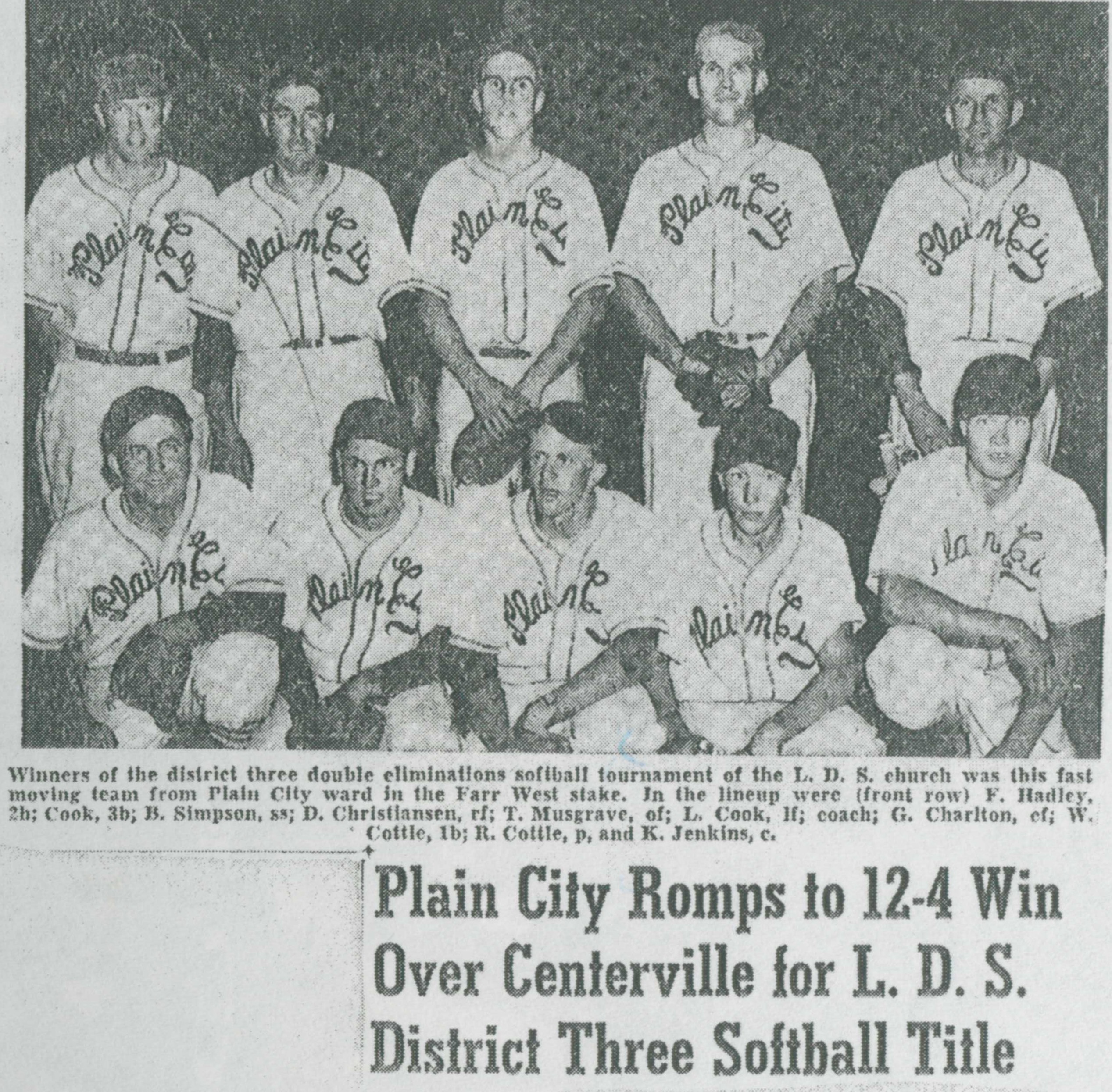
                                                                        District Three Winners

Winner of the district three double elimination softball tournament of the L.D.S. church was this fast moving team from Plain City in the Farr West Stake. In the lineup (front row) F. Hadley, 2b; Cook 3b; B. Simpson, 5b; D. Christensen, rf; T. Musgrave. Of; L. Cook, lf; coach; G. Charlton, of; W. Cottle. 1b; R. Cottle, p, and K. Jenkins, c.

                                                      Plain City Romps To 12-4 Win

                                                      Over Centerville for L. D. S.

                                                      District Three Softball Title

PLAIN CITY SOFTBALL TEAM OF 1951

                                                                        By Lyman Cook

            Plain City has always been a very strong baseball town, and the feeling was that softball was a game for girls, or you played softball at family reunions. In 1951 the Farr West Stake started a softball program and wanted teams to participate. I was Ward Athletic Director at that time and asked these players to play. This was the first softball team organized in Plain City. We won the Stake and District III. We then went on to the All Church Tournament in Salt Lake City. We won some and lost some, not too eventful. I coached the team the first year we played. This was a fast-pitch team.

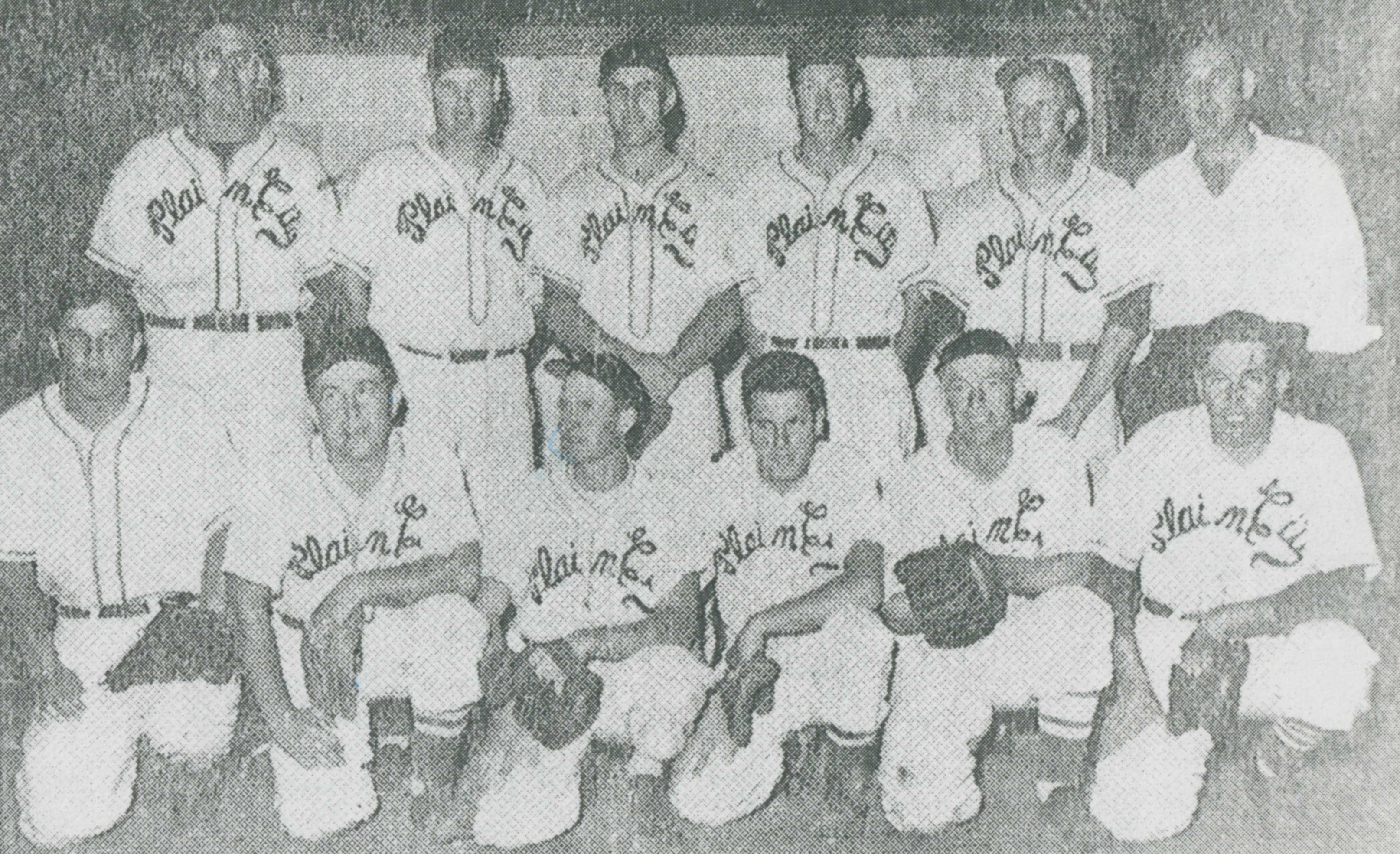
                                                            L. D. S. Division III Champs

Repeating their last year’s victory in the L.D.S. division III softball tournament, the Plain City team came through again last night at Ogden softball park to beat Hoytsville 9 to 6. Front row Left to right: M. Heslop, E. Hadley, C. Taylor, D. Cook, A. Maw and G. Charlton: back row, lerft to right: R. Cottle, W. Skeen, W. Cottle, L. Cook, B. Simpson, and D. Skeen, coach. Absent from photo: Jenkins, V. Stokes and R. Skeen.

            PLAIN CITY WARD SOFTBALL TEAM OF 1952

                                                                                    By Lyman Cook

            In 1952 we repeated as stake champions and also won the Division III Championship again. We went to the All Church Tournament again and played very well. We played for the All Church Championship, but lost to Pocatello 10th Ward in a good game. Blair Simpson was voted Most Valuable Player of the tournament. Wayne Cottle made the All Church Team. There may be others. This was also a fast-pitch team. Dick Skeen was the coach.

                                              This team played Farm Bureau Baseball and won the

                                                            Championship around 1950:

                                                            Top Row: L to R:

                                                            Junior Taylor, Wayne Skeen, Don Singleton,  Bert Cook,

                                                            Glen Charlton, Kent Jenkins, Clair Folkman, Coach

                                                            Bottom Row: L to R:

                                                            “Buss” Lyman Skeen, Frank Hadley, Wayne Cottle, Ray

                                                            Charlton, John Maw, Dee Cook

                                              This team played Pleasant Grove for All Church Champion-

                                                            Ship in 1956. They took second place.

                                                            Bottom Row: L to R:

                                                            Quinten Jenkins, Archie Skeen, LaGrand Hadley, Brent

                                                            Taylor, Ronald Sharp

                                                            Back Row: L to R:

                                                            Dee Cook, Manager, Darrell Christensen, Robert Folkman,

                                                            Bert Cook, Kenneth Lund, Wayne Cottle, Kent Jenkins, Coach

            Many county and Northern Utah Championships were obtained by this team that was sponsored by the Town Board in the late 1950’s to middle 1960’s.

COACHES:                                     Clair Folkman – Blair Simpson

TEAM MEMBERS:                         POSITIONS:

Blair Simpson                                P- IF

Wayne Cottle                                     IF

Cy Freston                                          IF

LaGrand Hadley                            OF – P

Archie Skeen                                        C

Gaylen Hansen                              C – P – IF

Bobby Taylor                                 P – OF

George Cook                                        IF

Reid Nielson                                  IF   P

Ted Favero                                    IF –

Dennis Anderson                           P

Garry Skeen                                   OF

Lynn Folkman                                OF

Bud Parker                                    IF – OP

Tom Seager                                   OF

Harold Hadley                               IF

Harold Marriott                            IF

******

PLAIN CITY WARD FASTPITCH TEAM

1960, 1961, 1962

              This team won the Stake, Region, and Division Championships, and represented the ward in All-Church competition with a successful number of victories.

COACH:                                         Elmer Carver

TEAM MEMBERS:

Tom Seager, P                                     Blair Simpson, SS

Gaylen Hansen, C                                LaGrand Hadley, LF

Wayne Cottle, 1st                                Robert Folkman, CF

George Cook, 2nd                                Dee Cook, RF

Cy Freston, 3rd                                     Don Singleton, IF

Blaine Eckman, QF                              Gar Hunter, 1st – OF

THE PLAIN CITY BULLDOGS

              This is one of the very first Weber County Recreation Teams in Plain City. Many of these players went on playing baseball for many years.

Front Row: L to R:

Dick Skeen, Coach, Fred Palmer, Darrel Thompson, Kenneth Hogge, George Cook, Ronald Sharp.

Back Row: L to R:

Archie Skeen, Brent Taylor, Wayne Poulson, Jay Freestone, Robert Folkman, LaGrand Hadley

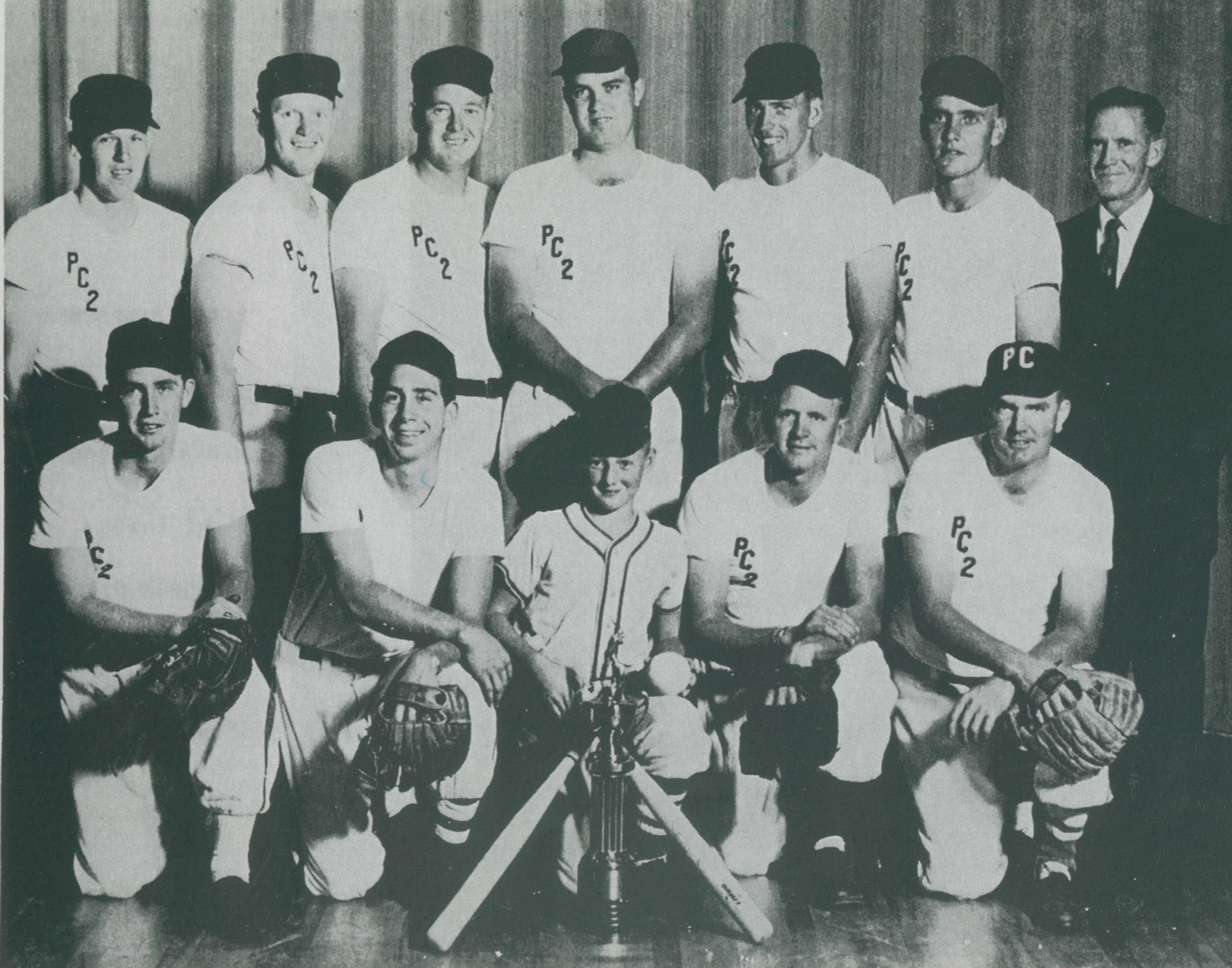
PLAIN CITY SECOND WARD

ALL – CHURCH CHAMPIONSHIP TEAM

1963 – 1ST Place

1964 – 1st Place

1965 – 3rd Place

              This team represented the Plain City 2nd Ward and Plain City Town by winning 64 and losing only two games over a three-year span. Many players received All – Church recognition. In the championship game the first year the team hit 11 home runs and pulled off a triple play for the victory.

Back Row: L to R:                                            Not in Photo

Garry Skeen                                                     Archie Skeen

Gaylen Hansen                                                Ken Searcy

George Cook                                                    Jay Freestone

Gar Hunter                                                      Val Taylor

Jerry Bradford                                                 Mel Cottle

Lynn Folkman                                                  Gordon Singleton

Bishop Rulon Chugg                                        Jim Beasley

                                                                        Don Singleton

Front Row: L to R:                                           Gary Hill

                                                                        Bishop Orlo Maw

Jerry Moyes

Doug Palmer

Dale Searcy

Blair Simpson

LaGrand Hadley

All – Church Honors:

Gar Hunter

Jerry Bradford

Ken Searcy

Gaylen Hansen

Archie Skeen

Blair Simpson, Most Valuable Player

BLAIR SIMPSON

and

ELMER SINGLETON

of the

PITTSBURGH PIRATES

1948

“Two cousins met”

ELMER SINGLETON

              Elmer Singleton started pitching for the Farm Bureau League in Plain City. He pitched for several championship teams. He signed a professional contract with Cincinnati, and played at Wenatchee, Washington in 1939, his first year. He played for Idaho Falls, Portland, and Oklahoma City. He moved on up to the big league and played with the following teams:

Cincinnati

Yankees

Chicago

Kansas City

Boston

Pittsburgh

Washington in 1950

Toronto

San Francisco

Seattle

              He was in professional baseball for 27 or 28 years, the last eight years as a player coach.

              He pitch two no hitters, one at San Francisco, and the other at Seattle. Elmer won the Player of the Year Award at Seattle in 1956. There is a baseball card with Elmer’s picture on it with the Chicago Cubs. It reads:

              “This will be Elmer’s 17th year in professional baseball.

                 He started back in 1940 and after 11 uneventful seasons,

                  got red hot to become one of the top hurlers on the

                  Pacific Coast. In 1952 at San Francisco, he won 17, followed

                  with 15 triumphs in 1953 and moved to Seattle in 1956.

                  He had the best Pacific Coast Earned Run Average.”

              Elmer told us that before he left to play professional baseball, the people of Plain City honored him at a banquet. They gave him a ball glove, and he still has it. He is listed in the Sports Record along with his accomplishments. Elmer was a great baseball pitcher. The only picture we have of Elmer is with Blair Simpson. Elmer and Blair are cousins,

              BLAIR SIMPSON

                                                      BY Blair Simpson

              I attended school at Plain City before going to Weber High School. At Weber High School I participated on the track team, played some basketball and pitched for the Weber High baseball team.

              After graduating from Weber High School in 1944, I was drafted into the army for two years.

              In 1948, I signed a professional baseball contract with the Pittsburgh Pirates organization. While playing with the Pirates, I played with the following cities:

                                                            Santa Rosa, California

                                                            Pittsburg, California

                                                            Modesto, California

                                                            Hutchinson, Kansas

                                                            Waco, Texas

                                                            Charleston, South Carolina

              I was a pitcher and had to quit because of an injury to my knee.

              After retiring from professional baseball, I played a considerable amount of baseball with Plain City and other teams in the Ogden area, such as:

                                                            Ogden Ford Sales

                                                            Heitz Heating

                                                            Wasatch Time

              I was selected on the All Star Baseball Team composed of 16 players from the State of Utah.

              I also played on many softball teams in the Ogden area such as Fisher Hess, Utah General Depot, Fred M. Nyes, Savon, and others.

              In 1952, I was named the Most Outstanding Player in the “All Church Fastpitch Softball Tournament” in Salt Lake City and was also named to the All Church All Star Team in 1953.

              In 1963, o received the Most Outstanding Player Award in the All Church Softball Slow Pitch Tournament. In 1964, I again received the most Outstanding Player Award in the slow pitch division of the All Church Tournament held in Salt Lake City. The year 1964 was one of my most memorable occasions in All Church Softball as I hit four consecutive home runs in one game.

              I would like to give a lot of credit to whatever successes I have enjoyed in athletics to the talented town of Plain City.

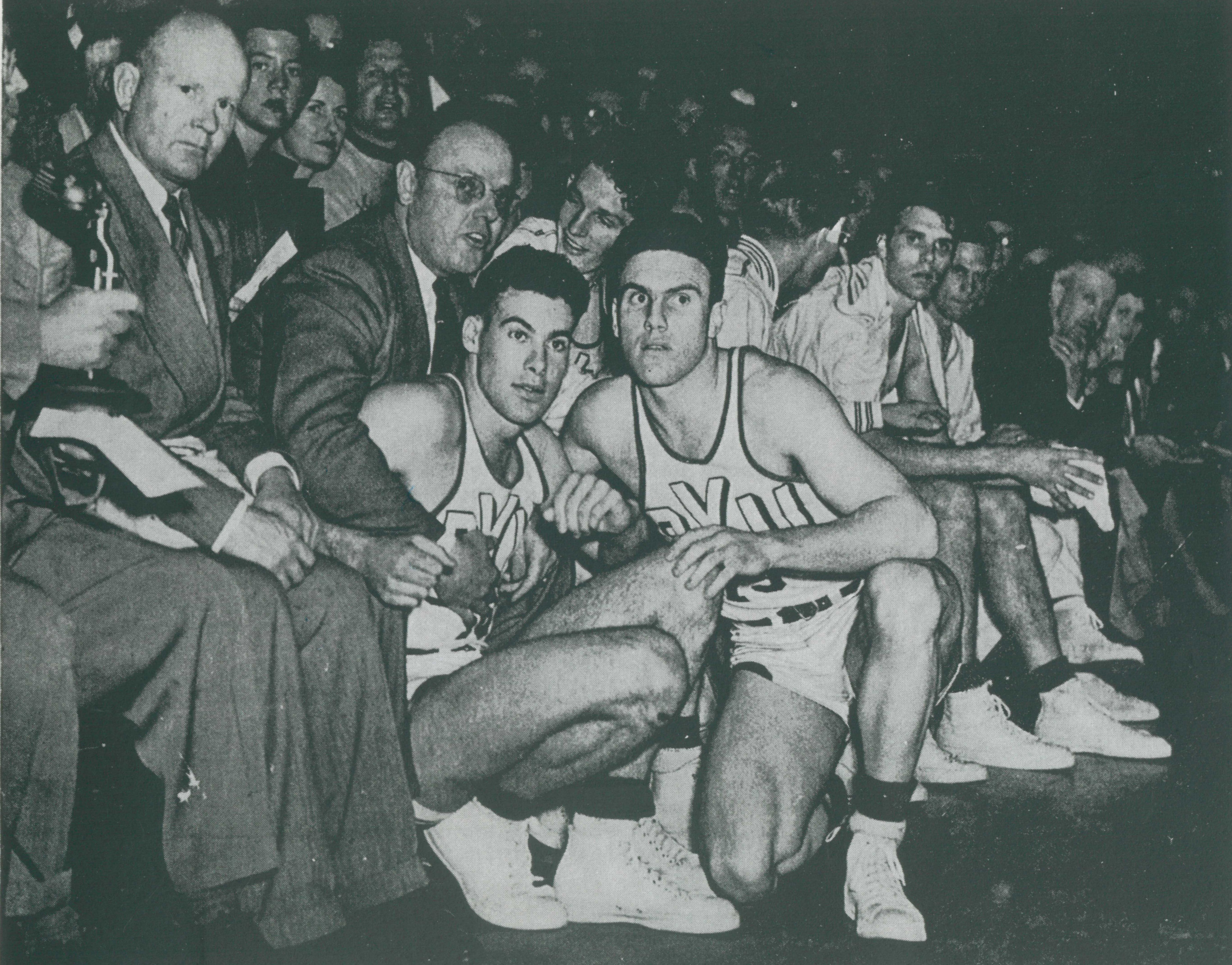
WAYNE COTTLE

                                                      By Wayne Cottle

              I was born November 30, 1928, in Ogden, Utah. I lived in Plain City all my life. I attended Plain City Elementary and Junior High. I played basketball in the 9th and in the 10th grades for Plain City. L. Rulon Jenkins was our coach and our principal. We played against Hooper, North Ogden, Huntsville, and Weber High School.

              In the Fall of 1945, I started Weber High School, playing football, basketball, baseball, and track for both years. In 1947, I played to a tie for the Region I Championship with Box Elder. We played off the tie breaker at Ogden High School, beating Box Elder for the first Region I Championship for many years. I won the Region I scoring title. We entered the State Tournament in Salt Lake City and we lost to Granite, who became the State Championships, in the semi-finals. I was the recipient of the Standard Examiner KLO Watch Award for being the outstanding athlete of the year.

              I entered Weber Junior College in the Fall of 1947. After about a month of practice I became one of the starting forwards. We played in several tournaments winning 3rd place in the Compton California Invitational.  We played an independent schedule that year. In 1948-49 Weber became a member of the ICAC Conference. We won the conference and played Snow Junior College Tournament. We won the game and I was voted the tournament’s Outstanding Player Ward. We went to the national finals in Hutchinson, Kansas. We won our first game, then we met two defeats.

In the Fall of 1949, I entered Brigham Young University. I was on the team that won the Skyline Conference Championship for the first in many years. We went to the NCAA at Kansas City, Missouri. We lost to Baylor University, then beat UCLA for 3rd place. The next year we accepted a bid to enter the National Invitational Championship and two of our players were voted All American.

              I graduated from BYU in 1951, came back to Plain City and started to play basketball with the Ward team. From the 1951- 1952 season until the creation of the Plain City 2nd Ward in 1960, we never lost a league game in the Farr West Stake. The year of the creation of the Plain City 2nd Ward, they beat us once and we beat them once. We played off the Stake Championship at Wahlquist Jr. High, and we won the team and the championship. After that season, the Church specified an age limit and I was area championships and went to the All Church several times.

WAYNE COTTLE

Brigham Young University

BERT COOK

              He attended Plain City School where he was active in athletics. He graduated and attended Weber High School in 1947 and 1948., where he participated in football, basketball, baseball, and track. In 1948, he was selected on the Class A State All Star Team, in which Weber High School won the championship. He also won the All American in boys Award in baseball at John Affleck Park in 1948. From this he won a trip to Chicago.

              He played for the Plain City baseball team for the Farm Bureau and Ogden City League.

              From 1948 until 1952 he attended Utah State university at Logan, Utah, where he started on the first five as a freshman, and later in the year played in the AAU Tournament and was selected on the All Tournament Team.

              In 1951 – 1952, he lead the conference in scoring and was voted All Conference both years. In 1952 he was voted All American in basketball where his Number 6 jersey was retired at Utah State University being the first one in the history of the school. That same year he was selected on the All Conference Team, and traveled with the Harlem Globe Trotters and the College All Star for several games. Later that year, he signed a contract with the New York Knickerbockers and was drafted into the service where he played for Fort Lee, Virginia Military team in which he lead the scoring and was later voted to the Second Army All Star Team.

              He served his country in the Far East Command in 1954, being released in 1955, when he rejoined the Knicks until 1956. After a serious knee injury he returned to Plain City and played for the Plain City Ward and the Ogden City League.

              He played on the 1956 team that won second place and he made First Team All Church.

              At Weber High School I participated in basketball, baseball, and football and was productive and beneficial. After graduation in 1954, I attended Utah State University for two years on a football scholarship. Next, I received a University of Utah Scholarship in baseball. That year 1958, was a successful year with a batting of .350. The next year was even more eventful. My batting average jumped to .490. The .490 batting average was good enough to lead the Skyline Conference, plus I was fortunate to lead the NCAA in homeruns and RBI’s. These statistics and the efforts of the University of Utah Sports Publicity Department lead to my selection as the “First Team Catcher on the College All -American baseball Team”. As a result of this honor, I was selected the “Most Valuable Player in NCAA, District 7.” The year was 1959.

              Opportunities were available to sign a professional baseball contract with the New York Yankees, Chicago Cubs, Boston Red Sox, and the Phillies. In 1959 I signed a bonus contract with the Boston Red Sox.

              During the next three years I played in the following leagues: Sophomore League in Alpine, Texas: North Carolina League in Raleigh, North Carolina; Midwest League in Waterloo, Iowa; and the Eastern League in Johnstown, Pa. Winter ball was played in Bradenton, Florida.

              In 1962, spring training was held in Deland, Florida. Because of a successful spring training I was invited to join the Triple A League in Seattle, Washington, “The Seattle Rainiers.” All Star Catcher honors were received in 1960, 1961, and 1962. In 1963 I was invited to spring training with the parent ball club, The Boston Red Sox. At the completion of spring training I was again assigned to the Seattle Rainiers.

              Some of the great stars helping the young players were: Ted Williams, Bobby Doerr, Rudy York, Johnny Pesky, and Mel Parnell. As of this year, 1977, the only teammate of mine still with the Boston Red Sox is Carl Yastrzemski.

                                                                        Bert Cook

                                                            New York Knickerbockers

                                                                        Archie Skeen

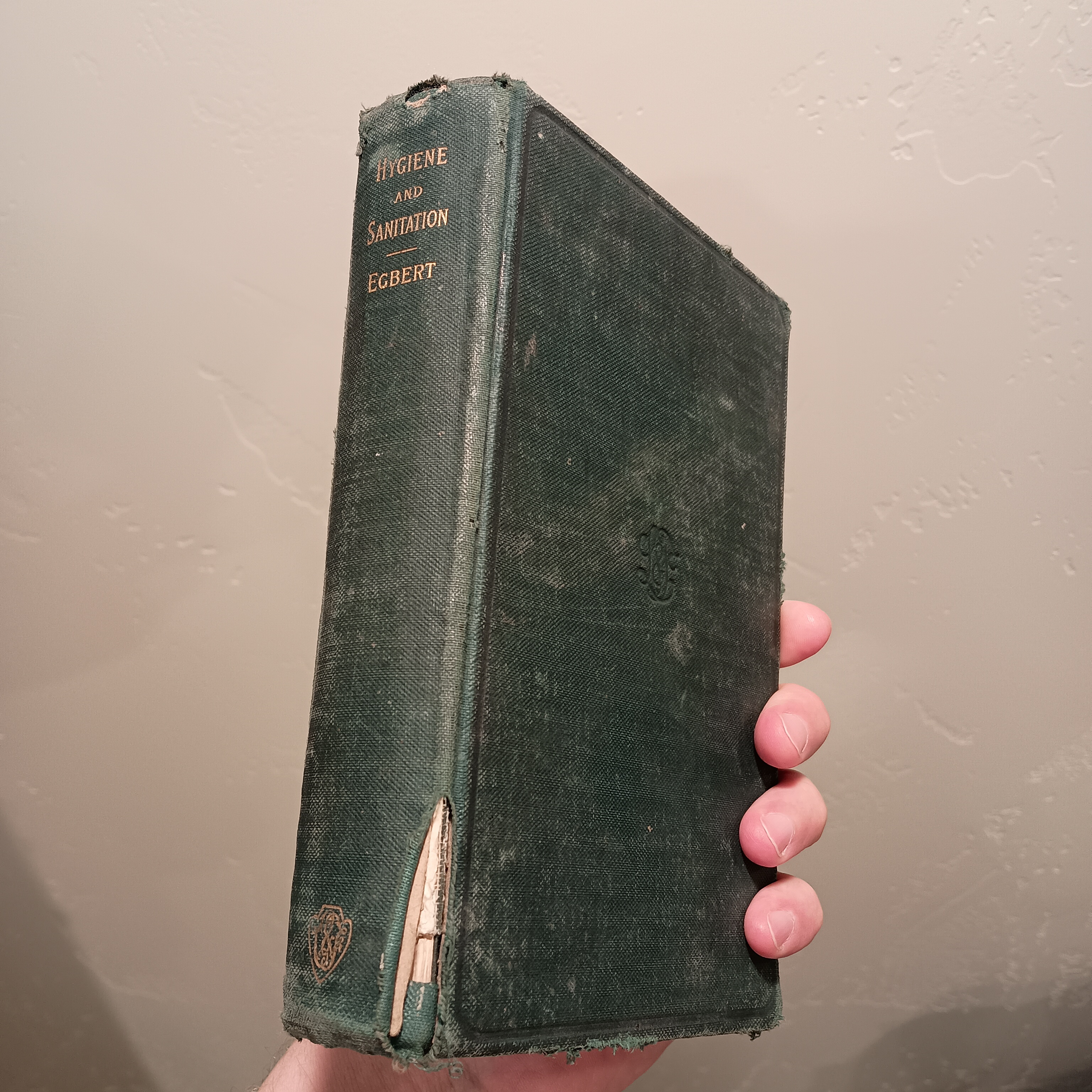
Hygiene and Sanitation by Egbert

Hygiene and Sanitation Textbook used at Brigham Young College

On the 15th I wrote about my Grandfather’s 100th Birthday (Norwood Jonas) and noting it with a newspaper article found in a textbook that belonged to his parents. This is that book. This was a textbook for my Great Grandfather at Brigham Young College in Logan, Utah.

Joseph Nelson Jonas graduated from Brigham Young College on 3 June 1915. That is 109 years ago tomorrow. Here is a copy of his Diploma. I have written about his history previously. I have also written about his time at BYC previously too.

Joseph Jonas graduation diploma from Brigham Young College in Logan, Utah

The textbook is also interesting. It appears Hygiene and Sanitation written by Seneca Egbert has some serious staying power. I found this history of Mr. Egbert.

Dr. Seneca Egbert (1863-1939) and Nancy Egbert

“Dr. Egbert was a physician. He graduated from Princeton University in 1884 and received his medical degree from the University of Pennsylvania in 1888. Before graduating, Dr. Egbert had been a demonstrator of hygiene in the Medical Department of the University of Pennsylvania. While in this position, he worked with Professor Samuel G. Dixon to establish the first Laboratory of Hygiene in the University, and was made lecturer on hygiene for 1890-1891. In 1892 the Drexel Institute of Philadelphia hired Dr. Egbert for a similar position. In 1893 he was elected Professor of Hygiene and Sanitation in the Medico-Chirurgical College of Philadelphia, appointed Vice-Dean of the same college in 1897, and elected Dean in 1898. Once the Medico-Chirurgical College merged with the University of Pennsylvania, Dr. Seneca became a professor of hygiene. He was president of the Radnor Township Board of Health and he was esteemed as a public health authority.

“In 1897 Seneca Egbert and his wife, Nancy Bredin Egbert, bought part of the old Towne family farm. The home, now owned by Fred French, is located on Blueberry Lane.

“Dr. Egbert was widely published. His book, Manual of Hygiene and Sanitation (seven editions), appeared first in 1898, as did his Home Sanitation, a Manual for Housekeepers. In 1919 Personal Hygiene for Nurses was published. He also wrote numerous articles for medical journals, maintained an impressive lecture schedule, and was a history buff who strongly advocated for the creation and maintenance of historic sites. He was not hesitant about venturing his opinion openly, and on at least two occasions made suggestions to Philadelphia politicians which received limited consideration. Dr. Egbert “was an advocate for ‘pure air, pure milk, and pure water.’ He felt that if people in the United States had these ingredients the average span of life would be increased by seven and one-half years.” He pursued this philosophy in an article, “Pure Water for Philadelphia,” which proposed damming the Mullica River and its feeder streams at the head of the tide to form a reservoir all the way to Atsion, NJ, and then pump to a reservoir on the western side to flow towards the Cooper River and another reservoir, thence to be pumped under the Delaware in order to relieve the poor water quality in Philadelphia . It would have pumped a relatively small quantity, 450,000,000 gallons of water per year, to start. The potential value of his plan was not recognized, either then or, to judge from a 2011 Web comment, now.

“On another issue, the City of Philadelphia proposed clearing all buildings from three city blocks. In response to a request for ideas on how to use this space, Dr. Egbert suggested allocating some of the land to the federal government, some to the state and some to the city of Philadelphia. On a strip of land extending down the center of the whole space, Dr. Egbert suggested constructing thirteen buildings representing the thirteen original colonies, and calling the area In­dependence Square. Each building would house the contributions made by that state towards the forming of our Union. “The idea was considered ludicrous in design and in scope. Dr. Egbert was a physician, not an architect.”

“Despite his critics, Seneca Egbert was doggedly de­termined to maintain the quality of life for Americans. For example, he embraced the newest form of transportation, bicycling, and “saw cycling as a remedy for dyspepsia, torpid liver, incipient consumption, nervous exhaustion , rheumatism, and melancholia.”

“A portrait of Dr. Egbert was painted for the University of Pennsylvania by Nancy Egbert’s brother, Rae Sloan Bredin (1870-1937). Mr. Bredin was a member of the New Hope group of American impressionists and several of his paintings are owned by New York’s Metropolitan Museum of Art. Mr. Bredin was co-founder of the Philadelphia School of Design for Women and the New York School of Fine Arts. His portrait of Dr. Egbert hangs now in the home of Dr. David Egbert Sparks, Dr. and Mrs. Egbert’s grandson, who is a genealogist and retired head of libraries at Notre Dame.

“Like Dr. Thomas Montgomery Lightfoot, Dr. Egbert was a lecturer in the winter lecture series held during the years 1887-1895 sponsored by the Academy of Natural Sciences. Dr. Egbert’s lecture was titled, “The Prevention of Disease and the Preservation of Health.”

“Nelson’s own Parke Struthers wrote in A History of Nelson that like Dr. Egbert’s good friend Dr. Thomas Montgomery Lightfoot, Seneca Egbert “met his fellow Nelsonians on an equal footing, a trait in human relations reserved for only the Great.” Mr. Struthers also states that the Egberts were “gracious, active in town affairs, and interested in the people of Nelson.” With their friends Dr. Lightfoot and his wife, Dr. and Mrs. Egbert served on the committee to make arrangements for the celebration of the one hundred and fiftieth anniversary of the first settlement of Nelson 1767-1917.

Inside cover of Hygiene and Sanitation

Here is the writing inside the book:

Joseph N. Jonas 1915

394 So. 1st East

Logan, UT

Jonas Joseph

Richmond, Utah

1915

First written page inside Hygiene and Sanitation

Here is the writing on the second page of the book:

Joseph N. Jonas

B.Y.C.

Logan, Ut.

394 So. 1 E.

Herrington, or Park

Stearn, Hot air, or Water

1 degree expands 1/491 of its val

relationship of insects to disease, Herrington

Hygiene of the school. h medical inspection.

282-387

History of Nils Bengtsson and Johanna Johansdotter’s Family

I received a copy of a history from Julie Jonas Kowallis. It is attached to Johanna’s profile in FamilySearch. Whoever compiled or rewrote the previous version seems to have mixed in references and stories related to Johanna’s son and grandson as if they were Johanna’s husband or son. Both emigrated to Utah at different times and had different trips. Further, this author edited out parts of the other history that seem to be passed down, although not verified. Some of the other history is missing, I will share it if I can find the missing second page. 

I have previously written about Johanna. I make only minor corrections within brackets. Nils and Johanna’s daughter, Agneta, is my Great Great Grandmother through her daughter Annetta “Annie” Josephine Nelson, who married Joseph Jonas.

~

The country of Sweden is about the same size as the state of California. Southern Sweden is made up of flat, fertile plains. The lan (which means country) borders have changed very little since they were established. Each lan is subdivided into smaller units that are known as parishes. 

Little is known about Swedish history before 800 AD. About this time two different tribes of Vikings entered Sweden. The Svear, who lived in the eastern parts, and the Gotar, who lived in the western parts. THey were almost continuously at war with one another. It was only after the introduction of Christianity in the 9th century that they united and formed a nation. The name Sweden comes from the phrase Svea rike, which means “Kingdom of the Svear.”

For many generations the farming class comprised most of Sweden’s population. The farmer who owned his land was usually quite stable. However, trades-men could travel great distances to obtain employment in their professions, often seeking a good position in the city. There are many lakes and streams in Sweden, so it is logical to think fishermen and seamen would have resided along the coasts or lakes. 

The people of Sweden are known to be energetic, hardworking people who value order and tidiness.

Our ancestors Nils Bengtsson and Johanna Johansdotter’s families were among the parish district of Halland in Sweden. Nils came from a long line of tall strong men of the north. Legend has it that one of his relatives was so large and strong that he was considered a giant. He could pick up two ordinary sized men, one in each fist, and bump them together. Nils was a big man, handsome and strong. He possessed unusual physical strength. An attribute many of his [descendants] would inherit. 

We have no details as to where or how Nils and Johanna met but we know that when Nils was 28 years old and Johanna 17 they were married on July 4, 1830. Johanna affectionately called Nils “her big handsome man.” They were blessed with eight children, raising seven of them to adulthood. 

The Nils Bengtsson family lived in the usual country home in Sweden. There was a long building on the south with the family residence in the east end and the west end was used for pete or turf and wood. They had a building on the north side where the cattle and the hay and grain were stored. Thatch roofs were the rule for the ordinary farm house. On the ease side of the house was a path running south past a meadow and then over a hill covered with trees. On the west there was a road leading down through the green and across a stream through a field to the north. It is difficult in our day to imagine what it would be like to live in a small one room home with a family of seven children. 

Although freedom of worship is guaranteed by the law in Sweden over 90 percent of the population belong to the Lutheran church, which is the state church. During the 1800’s missionaries from [The] Church of Jesus Christ of Latter-day Saints, or the [Mormons], began to proselyte in Sweden.

Sometime in the [1850s] missionaries called at the home of Nils and Johanna. At the time Nils was very ill. Their one room home was divided by a curtain to separate the area where Nil’s bed was. Even though he was very ill at the time he listened intently to what those missionaries said. Later he called his son Nils to his bedside and said, “What those men are telling us I feel it is right. I will not live long enough to join their church, but I want you to listen to them and if you feel that it is right you must embrace it.” Shortly after this on March 12, 1859 Nils died.

Two years passed between Nils death and the [family’s] acceptance of Mormonism. But when the Bentsson family were baptized they embraced the gospel with sincerity of heart and a love for its doctrines and principles. [Johanna was baptized a member on 11 May 1861. Agnetta was baptized 10 November 1863, Lars 5 May 1860, Ingjard 5 May 1861, Christina 4 February 1866, and Nils Jr 5 May 1860. Johann joined 7 September 1893 after immigration to Utah. The other two were after their deaths. Bengta and Borta did not join or immigrate to Utah.] Nils and Johanna’s son Nils [anglicized to Nels in United States] said that the songs of Zion filled their hearts and minds. The saints throughout the world were encouraged to emigrate to Utah to be with the main body of the church. Nils said, “I had a birds eye view of Zion in my soul and I yearned to go there.” So with a call from a Prophet and songs of Zion ringing in their hearts, the Bengtsson family began to prepare for the long journey to join with the Saints in Utah. Prior to their departure little Johan Peter, who was 6 years old, gave all of his toys away. I can’t even imagine the faith and courage that Johanna must have had. She was 49 years old at the time and she was leaving her family, her friends and her beloved homeland. The family loaded all their earthly belongings that they could carry and began their trek to America. They left Sweden because of their testimonies of the restored gospel of Jesus Christ and their convictions in its teachings. 

Nils wrote of this experience, “the family hustled along the rock paved sidewalks of Halmstad to the coast. The noise of the horses feet and the rumble of the vehicles on the rock paved road drowned all of the voices of the little ones who complained of the unceremonious haste of departure. All were safely on board, the gang planks withdrawn, before we realized that we were moving. We could see that men on the shore were being left behind… As we glided out on the calm blue waters. As we Denmark we say the harbor at Copenhagen covered with sails and booming of cannons. The dense smoke made it difficult to see the city. Germany and Denmark were at war. We sailed and entered the city from the back just before sundown. We had a long way to walk but it was worthwhile. We saw the prettiest homes, lawns, shrubbery, and statues; such as a man on a horse with beautiful decorations representing warriors and noblemen. That even I first heard the Danish language, though odd at first I soon got accustomed to it and learned to understand it.” They sailed from Denmark to Norway on their way to Hamburg, Germany passing between Holland and Belgium. 

On Friday, April 18, 1862 Johanna and her children boarded the ship “Electric” and sailed from Hamburg with 336 Saints all bound for Utah. Elder Soren Christofferson was in charge of the Saints and H.J. Johansen was the Captain of the ship. The emigrants were from Holland and other conferences in Denmark and from the Norrkooping Conference in Sweden. The “Electric” sailed down the Elbe to Bluckstadt Roads, arriving there about noon. Here anchor was cast near the ship “Athenia,” which had another company of emigrating Saints on board. At this time there were 335 emigrants on board the “Electric and 486 on the ‘Athenia.'” The “Electric” lifted anchor April 22nd and sailed to a point off the coast of Hanover, where anchor was again dropped and the ship waited for the wind to change. Favored at last with good wind the “Electric” made the final start for America April 25th, sailing out into the North Sea. Once again Nils tells of their experience, “I remember traveling through a city, the streets were lined with wagons all loaded with all kinds of meat, beef in particular. We set sail that evening with beef cattle in the hold, sheep on the deck, and the passengers on the middle floor. When daylight came we were all easing ourselves by [emptying] our poor stomachs down into the hole.” After crossing England and setting foot at several ports they finally boarded the ship that took them to America. Before sailing, President John Van Cott came on board and assisted organizing the emigrating Saints, who were divided into nine districts, in each from 25 to 40 persons. Nils wrote of this experience, “We got on board the great ship that carried us across to America. When we boarded it it stood so high out of the water that it was quite a climb to get on. We had to wait some time while the sailors and others loaded rails and other heavy freight into the hold. I have tried to forget this part of the journey. Our rations were raw beef, lard, and hard soda crackers and water, mustard and salt. The passengers would take their turn at cooking their rations of meat and sometimes they never got to cook their meat. The winds and the waves were so high sometimes that the ship rolled from one side to the other, the flag on the main mast would touch the waves and this could be seen by looking straight up through the hole. Trunks and boxes had to be tied fast to the beds on the sides of the ship. Some times passengers as well as sailors and some women helped to pump water out of the vessel.”

It was stated that unity and harmony existed among the emigrants during the entire journey. A number of meetings were held on board the ship during the voyage and at least one marriage took place and one child was born. But many also lost their lives because of diphtheria and measles. After 49 days on the ocean the ship arrived safely in the New York Harbor and the emigrants landed at Castle Gardens on Friday, June 6, 1862. Upon arriving in New York there were merchants who were selling their goods along the dock. Nils approached one who was selling what he thought was the most beautiful red fruit that he had [ever] seen, he later learned that they were tomatoes. All the money he had was 5 cents, but he gladly spent it for one of those delicious looking fruits. Much to his surprise he found it to be the nastiest thing he had ever tasted. He told the merchant this and asked for his 5 cents back. After a good laugh the merchant [returned] his 5 cents. 

Here the company met the Saints who had crossed on the “Athenia.” Both companies left New York Jun [9th], 1862 and arrived at Florence, Nebraska, Jun 19th. Lars Bengtsson, the oldest son, who was probably 27 at the time, purchased an oxen team and wagon that would take their family the rest of the way to Zion. They left Florence on the 29th of July 1862. Their captain was Joseph Horne. There was a total of 570 Saints, 52 oxen teams and wagons. 

The first few days of the journey some difficult was experienced, as the oxen, who were not used to Scandinavian orders and management, would often follow their own inclination to leave the road and run away with the wagons, but after some practice on the part of their inexperienced teamsters things became much better. 

Their oxen team gave out many times and the Elders administered to them and they would revive and trudge on. Upon crossing a river one oxen gave out and Lars quickly let the animal loose and put the yoke on his own shoulders and pulled along with the other oxen through the muddy [current] to the dry bank. It was said that Lars was a mighty man. Nearly all able bodied men and women had to walk most of the way. Some of the women rode in the wagons across the larger rivers, while they would wade across the smaller streams like the men. Sometimes the women and children were carried across the streams by the men when it was feared that the oxen could not pull the wagons with their heavy loads. 

Nils tells us in his life history that crossing the plains was a very thrilling and adventuresome as they came in contact with the wild frontier and Indians. While crossing the plains Nils along with a group of teenage boys decided one day to go a considerable [distance] from the wagon train and explore the area. One of the teenagers, pointing to an island in the middle of the river, said, “Lets all swim out to it.” They were all excited about this suggestion, so off came all of their clothes which were folded and left in neat piles along the river bank. In they jumped and swam out to the island. They landed and laid down on it. It had no animal life on it and seemed like a paradise to them. However, as they did so they found it was just a floating mass of sod and trees that had broken off from the bank upstream. They immediately turned back and tried to swim to shore, but to their dismay, they found they were too far down stream and the river banks were now rocky cliffs. They were growing very tired as they searched for a place to crawl out of the river. They prayed they could find a spot, and they did find one, their spirits lifting until they found it was infested with huge snakes. They floated on their backs until they reached a place on the river where they could get out. Thank goodness it was now getting dark because they were naked. They followed the road back to camp and whenever a wagon would come by they would have to run and hide behind bushes. It was very late when they got back to their camp. 

In the meantime a search party was sent to search for the boys and when they found their clothes on the river bank they were all presumed dead. 

As Nils neared his mother’s camp site, he could see his sister Christina outside by the camp fire baking bread. He hid himself behind some bushes and called out to Christina to bring him some clothes. She dropped what she was doing and called out, “Oh Nils ghost.” Nils called again, “don’t be foolish, bring me some clothes.” There was much rejoicing in the champ when it was discovered the boys were not dead. 

There were other exciting experiences as they crossed the plains. One day while they were crossing the North [Platte] River one of the brethren began to go down in a whirlpool. Although Nils was young he was an excellent swimmer, he quickly dove in and swam to the man. The man grabbed on to Nils and Nils pulled him to shore. 

The Saints often gathered berries for food. One day while Nils was gathering berries he because occupied with trying to find the berries and had not noticed that the wagon train had moved on. He picked up his pail and started running after them. All of a sudden a big Indian on horse-back swooped down upon him, trying to grab him as he leaned over the side of his horse. But, Nils was quick and dodged and ducked his attempts until the Indian spied some scouts from the company and fled. (Indians often succeeded in capturing young white boys and then would raise them as Indian Braves.)

L-R: Johanna Benson, Johanna Icabinda Benson, John Irven Benson, Nels Ernst Benson, Mary Ann Angel Works holding Merrill Lamont Benson.

Upon arriving in Salt Lake Johanna and her family first settled in the Sandy-Crescent area. Here they homesteaded 40 acres on land and built a small sod and log home. They farmed and raised cattle. Later Nils went to work for a man named John Nielson from Sanpete Valley and Nils moved to Spring City. At some point in time Johanna went to live with Nils and his family. She died and is buried in Spring City. Other members of the family settled in different pioneer communities that were being settled at that time. Johan Peter our ancestor who was the youngest of the eight children grew up in the Sandy-Crescent area. When he was 27 years of age he married Amanda Josephine Peterson and they became the parents of 7 children. 

Michael & Suzanna Melycher Family

John & May, Mary, Michael, William, Stephen, Michael Jr, Suzanna, Anthony, Anna, Myrtle & Joseph Melycher

This photo was taken 25 May 1936 presumably in Fairfield County, Connecticut of the Melycher family.

Michael Melycher was born 20 October 1869 in Modrová, Nové Mesto nad Váhom, Trenčiansky, Slovakia. Suzanna Gajdosik was born 22 June 1878 in the same location. Michael and Suzanna were married 3 February 1896. I am not clear when they immigrated to the United States, some records show as early as 1897, others as late as 1909.

Michael and Suzanna had 10 children.

Stephanus Melycher born September 1898 and died before 1903 in Slovakia.

Michael Carl Melycher born 7 April 1900 in Mondrova and died 30 April 1987 in Newport, Campbell, Kentucky.

John R Melycher born 29 April 1902 in Austria and died 16 February 1985 in Fort Lauderdale, Broward, Florida. His wife, May B Linderman, is also in the photo above. She was born 28 May 1911 in Kentucky and passed in 1995 in Fort Lauderdale.

Father Stephen Daniel Melycher was born 4 February 1905 in Austria and died 20 January 1997 in Brooklyn, Anne Arundel, Maryland.

Joseph Romano Melycher born 16 August 1910 in Croton Falls, Putnam, New York and died 19 August 1993 in Danbury, Fairfield, Connecticut. His wife, Myrtle Beardsley, is also in the photo above. She was born 7 April 1915 in Newtown, Fairfield, Connecticut and passed 30 May 1992 in Danbury.

Anna Mary Melycher born 10 March 1912 in Croton Falls and died 14 August 1990 in Bridgeport, Fairfield, Connecticut.

Mary Melycher born 27 February 1914 in Croton Falls and died 16 September 2013.

Anthony Francis Melycher born 15 November 1915 in Bridgeport and died 8 September 1984 in Danbury.

William Francis Melycher born 21 September 1918 in Newtown and died 14 July 1997 in Newtown. My Uncle Willie, or William Francis Melycher Jr is the son of William Sr.

Rudolph Melycher born 17 March 1920 in Newtown and died 20 September 1920 in Newtown.

Michael Sr died 22 August 1947 in Bridgeport. Suzanna died 7 January 1959, also in Bridgeport.

Here is another picture of the same occasion.

William, Joseph, Michael, Stephen, John, and Anthony Melycher

Bowen in Tucson, Arizona

Bowen home in the Tucson hills

I recently attended the National Association of Consumer Bankruptcy Attorneys (NACBA) annual conference in Tucson, Arizona at Starr Pass. The resort is secluded and away from downtown. From the resort there were a number of trails and my law school buddy, Andrew Curtis, and I took a few of them out to see the desert. We were also joined by Michael Wilder on our last evening in Tucson.

That last evening we hiked over to the Bowen House. There is an interpretive sign in the desert, a few articles online. Sherry and Ruby Bowen moved to Tucson in the 1920s from Rockford, Illinois. The change of climate was to help with her heart complications. He was a typesetter who eventually became the editor of the Arizona Daily Star. They moved to this location in 1931 and started this home while living in a cabin.

Michael Wilder and Andrew Curtis visiting in front of the Bowen House

The Bowens left Tucson in 1944 and moved to New York City where Sherry Bowen worked for the Associated Press.

Of course the genealogist in me was curious about the man and woman more than the house. I found this article from Alex Jay on the Stripper’s Guide.

View of Tucson from Starr Pass Marriott

“Sherry B. Bowen was born Sherry Bowen Krauskopf in Maywood, Illinois, on March 13, 1900, according to the Cook County, Illinois, Birth Certificates Index at Ancestry.com. His parents were Charles C. and Mary Hort. Bowen served in the Army during World War I and on his Report of Interment card, his birth surname was crossed out and “Bowen” was written above it. A note said he had legally changed his name but the date of the change was not recorded.

Starr Pass Marriott Resort

“The 1900 U.S. Federal Census said Bowen was the only child and his father was a school teacher. In the 1910 census, the family still resided in Maywood and their address was 900 8th Avenue. Bowen had a younger brother, Karl, and their father was a principal and teacher.

According to the Interment card, Bowen’s Army service started May 28, 1918. He was a private in Company B, 336th Battalion, Tank Corps. He was discharged July 18, 1919.

In 1920 Bowen was a university student and still lived with his parents at the same address. The Rochester Democrat and Chronicle (New York), August 5, 1956, said Bowen studied at the University of Illinois and then joined the Bloomington, Illinois, Pantagraph. Bowen’s move was reported in the Daily Illini, February 1, 1922.

Krauskopf Resigns Illini Position for Job on Pantagraph

Sherry B. Krauskopf ’23 has resigned as one of the news editors of The Daily Illini to accept a position on the editorial staff of the Bloomington Pantagraph. He will leave to assume his new duties Saturday.

Krauskopf will start as a reporter but will be given a taste of the mechanical side of newspaper work and will De training on the city editor’s desk as he intends to follow the editorial phases of newspaper work.

Beginning as a reporter in his freshman year Krauskopf has rounded out five semesters of work on the staff of The Daily Illini, two years as a reporter and thus far this year he has been one of the six news editors.

The Illini, January 20, 1923, reported Bowen’s marriage to Ruby Butts.

Ruby Butts Take Vows Of Marriage To S . B. Krauskopf Another romance of The Daily Illini culminated in a wedding last night when Ruby D. Butts ’23 became the bride of Sherry Krauskopf ’23 at 7 o’clock in the home of the Rev. James C. Baker, 1209 West Green street, Urbana. Mr. Baker read the service before members of the immediate families.The date for the wedding had originally been set for June, but owing to the serious illness of the groom, the ceremony was performed last night. The bride wore a gown of black satin and Spanish lace and a corsage of American roses. Geraldine Hegit ’23, who was bridesmaid, wore blue taffeta and carried a shower bouquet of La France roses. Karl H. Krauskopf ’26, brother of the groom, acted as best man. Mrs. Krauskopf has been a member of the staff of The Daily Illini for the past three years and was society editor this year until forced to resign because of ill health. The groom was a reporter on The Daily Illini in his freshman and sophomore years and was a news editor last year.

According to the Democrat and Chronicle, Bowen moved on to the Springfield, Illinois, Register. In Tucson Arizona, Bowen was at the Independent and then worked 16 years at the Arizona Daily Star.

The 1930 census recorded Bowen, a newspaper reporter, and his wife, in Tucson on North 1st Avenue. The 1933 and 1934 Tucson city directories listed his address as Route 1, Box 399A. In 1935 he resided in the Tucson Mountains. Bowen’s address was Anklam Road in the 1936 directory.

Bowen’s home and surroundings were described at the Pima County website.

Bowen brought his wife, Ruby, to Tucson from Rockford, Ill., in the late 1920s in hopes that the climate would improve her health. Bowen was a typesetter and later city editor at the Arizona Daily Star. The Bowens homesteaded in the Tucson Mountains and began living in a cabin there in 1931 while Bowen built the house of native stone. They expanded their claim to 2,000 acres. Ruby Bowen wrote for Desert Magazine of the Southwest. Her diary of her first year in the Tucson Mountains refers to the wildlife she saw, including javelina, deer and wild mountain sheep that came to the base of the cliffs nearly every evening to graze. She wrote that a mountain lion would pace about when she was cooking meat and once attempted to get in the window.

In 1944, Bowen moved to New York City to work for the Associated Press. Some of his reporting can be read in the Spokane Daily Chronicle, the Southeast Missourian and Toledo Blade.

American Newspaper Comics (2012) said Bowen wrote The Story of Santa Claus which was drawn by Ed H. Gunder and ran from December 17 to 22, 1951. The strip was syndicated by the Associated Press.

Bowen passed away August 4, 1956, in the Bronx, New York. He was buried at the Long Island National Cemetery. Bowen’s wife, Ruby, passed away November 30, 1961. Bowen and his wife are survived by a daughter, Gloria, who lives in Nevada. Ten-year-old Gloria was profiled in the Tucson Daily Citizen, March 27, 1954. 

Moving back to the Conference, it was a great chance to get reacquainted with my law school friend, Andrew Curtis. These conferences are good as I get continuing education credits for both Idaho and Utah. Nothing too earth-shattering learned, confirming much of what I knew or had forgotten. But a great opportunity to stay in a very nice resort and visit a new area.

Paul Ross and Andrew Curtis flying to Tucson from Salt Lake City