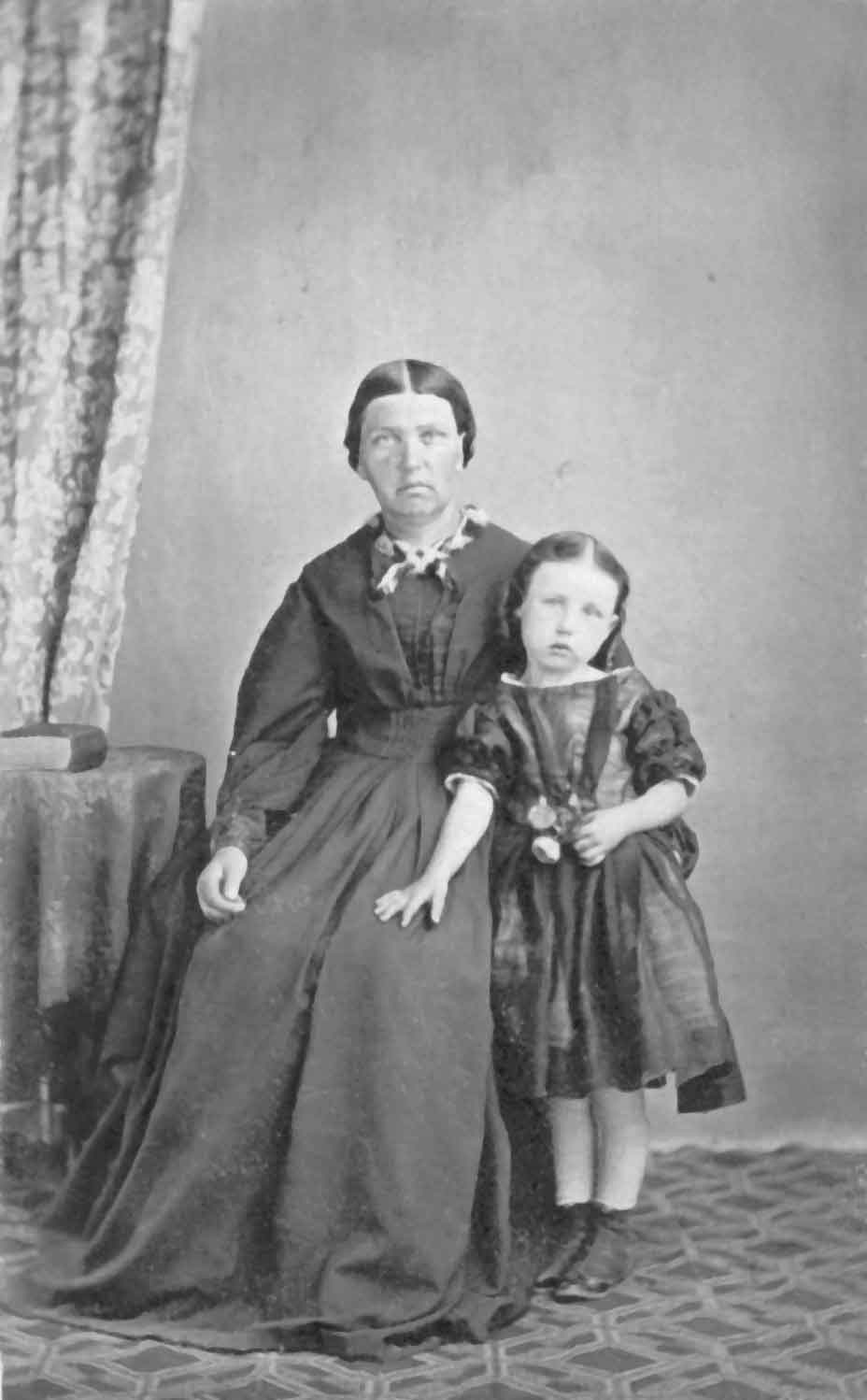
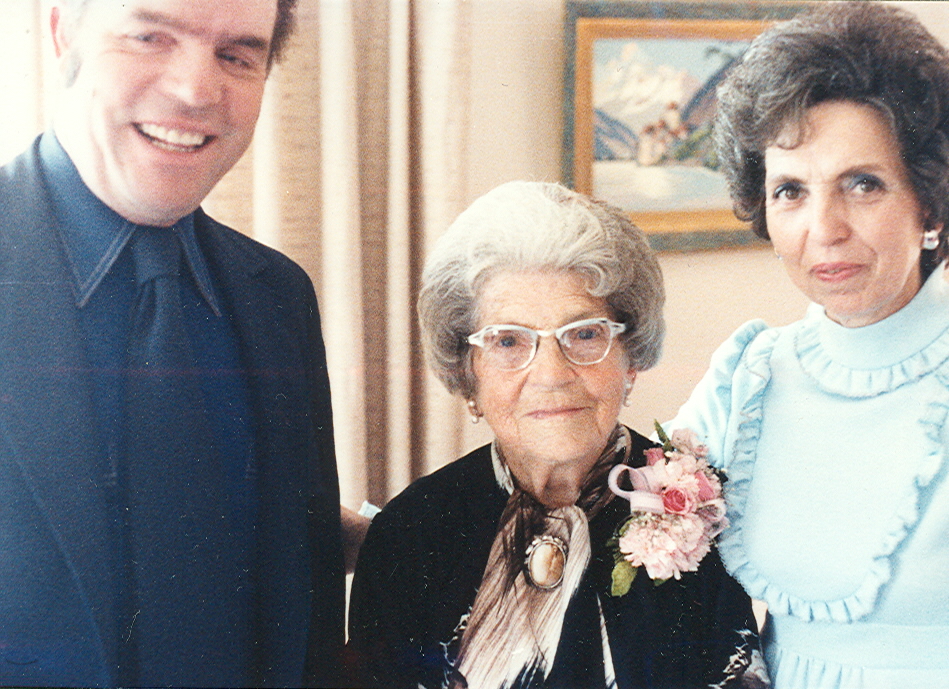
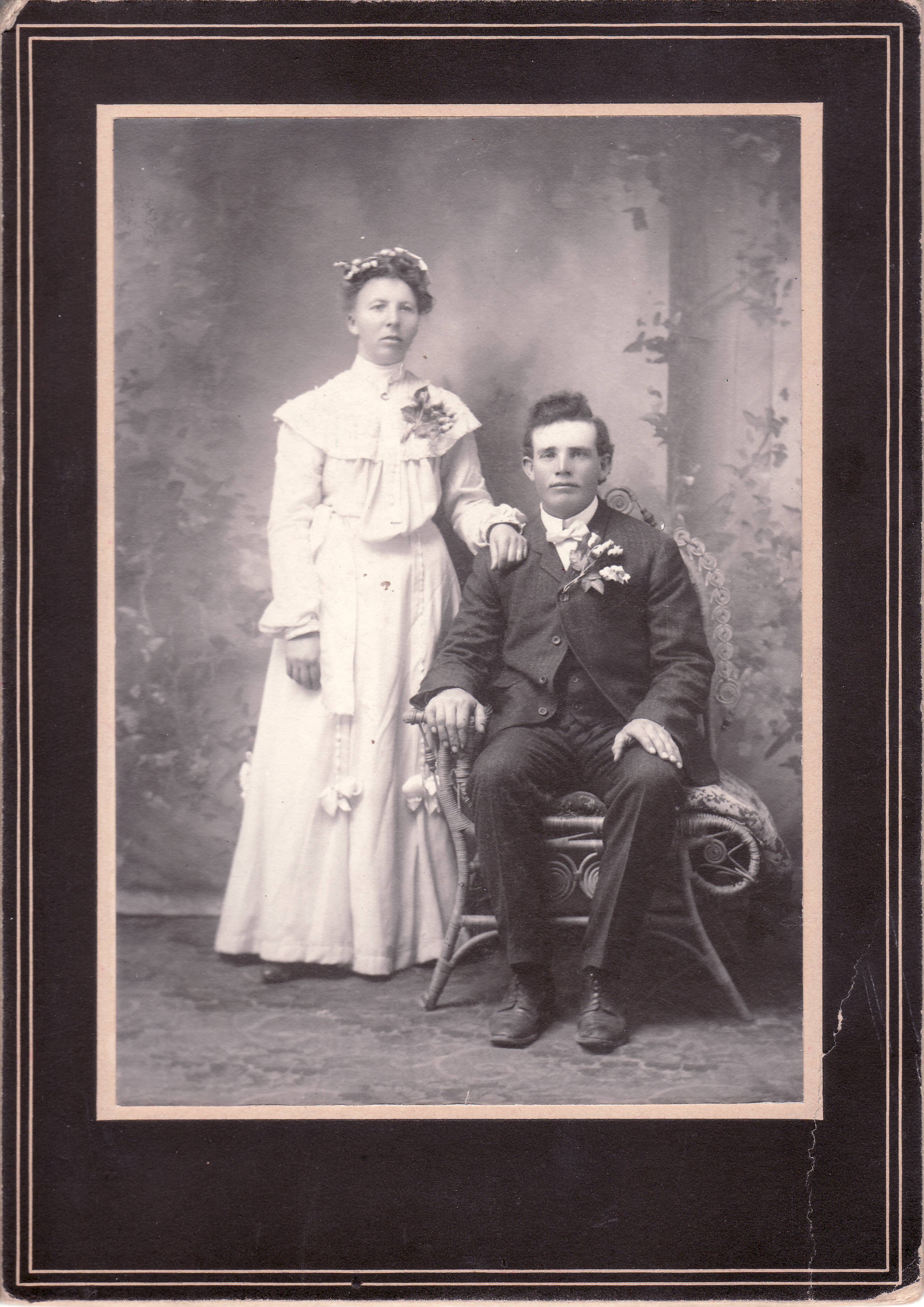
Ole and Constance Christiansen are pleased to announce the marriage of their daughter Martha to Herbert Coley, son of Stephen and Hannah Coley. They were married in 1874 in Norway. While I normally like to start these historical posts as a wedding announcement, I trip up there. We do not have any histories that give us an actual marriage date and location. Knowing the period, it is not imagined they were not actually married. Their first child was born in 1875. Curiously, after their immigration to the United States due to their conversion to The Church of Jesus Christ of Latter-day Saints, they not only went to the Logan Utah Temple to be sealed, but also applied to be married. As such, they were married and sealed in the Logan Utah Temple on 26 April 1893.
Martha was born the second of eleven children to Constance Josephine Eliza Jorgensen and Ole Christiansen on 16 April 1879 in Fredrickstad, Ostfold, Norway. I have not written their history yet, but as linked above, I wrote some limited information on Constance when we visited her grave first in 2018 and again in 2020. Ole was born in Trogstad, Norway and Constance in Drammen, Norway. Both Ole and Constance were baptized and confirmed into The Church of Jesus Christ of Latter-day Saints on 26 January 1876 in Norway.
What happens for the next few years is unclear on the reasons. Martha’s older sister, Walborg, was born 24 December 1875 in Fredrickstad, then Martha in 1879. We really have no records during this period and so I am unclear if there was another child, or two, in that period of time. Eivelda was born 20 October 1881 in Melbourne, Victoria, Australia. I have no clue why or what took the family to Australia. Their next child, Constance, was born 9 November 1883 also in Collingwood, then a suburb of Melbourne. Apparently Walborg and Martha were left in Norway while their parents went to Australia. Alice, Martha’s granddaughter recalls Martha telling of her sitting on the mountainside overlooking the fjord waiting for her parents to return and her missing them terribly. Martha’s first brother, Henry Owen, was then born 27 March 1887 back in Fredrickstag, Norway. Ole and Constance were back in Fredrickstag by March 1887.
I have been unable to find the immigration records for the Christiansen family between Norway to Australia and back. But the family was in Australia for at least 3 years, maybe as long as 6 years. They were not back in Norway very long as Rhoda was born in Richmond, Cache, Utah on 18 September 1890. Martha moved with her family to Richmond in the late 1880s. One record has it in 1887, another 1889, Martha was listed in the 1900 Census as immigrated in 1888. Either way, we now are in the vicinity of where she would have met Herbert Coley. Of Martha’s remaining 6 siblings, 5 were born in Richmond and 1 in Hyde Park.
Herbert was born the 5th of 9 known children to Hannah Maria Rogers and Stephen Coley on 12 February 1864 in Lutley, Worcestershire, England. It was while living in Lutley that the LDS missionaries first made a visit. We do not know the conversion story but Herbert and his siblings joined the church. Martha joined 23 August 1867, Herbert 1 June 1881, George 22 August 1881, and Frank 2 June 1882. The 1871 English Census has the family still living in Lutley and Herbert listed as a scholar. The call to gather in Utah was strong enough that these four children made the venture. We don’t know if Stephen and Hannah came begrudgingly or not, but they joined some of their children in Utah. Unfortunately, the other children left in England we do not know where they went or what happened to them.
Herbert shows on the 1881 English Census in Dudley, Worcestershire, England as farm labor for the Doorbar family. Herbert appears to have boarded the Nevada in Liverpool arriving 3 July 1882 in New York City, New York. I cannot see that any siblings went with him on the trip. Stephen, Hannah, and Martha all traveled in 1890 (with Letitia Lea Willetts and her daughter Clara, and two known Frank and Mary Coleys). Stephen Coley was baptized 5 January 1892 and Hanna 26 October 1892 (same day she was endowed in the temple, so either that date is wrong or the prior record could not be found and the ordinance was duplicated. Hannah died 22 October 1894 in Franklin, then Oneida County, Idaho and was buried in Lewiston.
I don’t know any of the details of how they met, but the stars seem to have aligned in Richmond. However it happened, Herbert and Martha were married and sealed 1 December 1896 in Logan at the Temple. Herbert was a diligent laborer who would acquire full ownership in their home by 1910. Martha was a strict and involved homemaker and mother.
Herbert and Martha maintained their home, large garden, and raised 10 children. Lillian was born 26 August 1898 in Lewiston (listed in the Coveville Precinct, which is now the area of Cove). The 1900 Census on 9 June 1900 lists Herbert as a farm laborer with his immigration in 1881 and Martha’s in 1888. By 1910, the Census finds the family in Wheeler (about six miles west of Lewiston) where the home was owned outright. We don’t know exactly where the family lived. Edna was born 23 November 1900, Wilford Herbert 1 Mar 1903, Carrie 20 April 1906, and Hannah Marie 3 June 1909. Ole Christiansen passed away 27 February 1900 in Richmond and was buried there. Carrie is listed as born in Richmond, but we do not know the circumstances how she was born there instead of Wheeler/Lewiston. Hannah’s birth certificate lists Herbert as a farmer and Martha as housewife. The 1910 Census on 26 May 1910 shows Herbert as a Laborer and that he “Works Out.” Whatever that meant in 1910.
All the remaining children were born in Richmond. As such, it is likely at this time the family moved to the cabin south and east of Richmond estimated about 2016 E and 9000 N. I have tried to pinpoint where the cabin remains are still located. Here is a photo of the cabin from the 1980s. The 1920 Census on 16 January 1920 lists Herbert as a Farmer and Teamster with the additional insight of “Hauls Milk & Farms.” This same Census also lists Wilford as having his own Farm, but still living with his parents.
Coley Cabin near Richmond, Utah
It was in this house that the remaining children were born. Ivan Stephan on 26 June 1912, Roland Charles on 20 July 1915, Oley Lloyd on 11 February 1918, Arthur Christiansen on 15 July 1921, and William Golden on 22 January 1924. In 2012 the home had collapsed to a pile of rubble. It was after Ellis Jonas’ funeral we visited as family (Ellis is Lillian’s son). Ellis had taken me there about 2002. Stephen Coley died 22 October 1913 in Lewiston and was buried by his wife.
The 1930 Census taker showed up 15 April 1930 and shows the family in Richmond with Roland, Lloyd, Art, and Golden still in the home. The 1940 Census on 8 April 1940 has the family still in Richmond with Art and Golden the only two remaining.
Herbert and Martha Coley in the garden
Over the years, the family kept busy with marriages. Lillian married Joseph Nelson Jonas on 6 September 1917 in the Logan Temple. Edna married Gerald Andrus 17 April 1921 in Richmond and after a short marriage, divorced, and remarried to Olof Alma Neilson 23 July 1923 in Logan, sealed 30 July 1924 at the Logan Temple. Wilford married Edith Dagmar Cammack 15 May 1924 in Logan, sealed 3 June 1946 in Logan Temple. Carrie married Joseph Lorus McMurdie 21 July 1924 in Logan, sealed 21 October 1926 in Logan Temple. Hannah married William Surgeoner Thomson 2 July 1927 in Logan, sealed 14 June 1972 in Salt Lake Temple. Ivan married Clara McMurdie 22 October 1930 in Buhl, Twin Falls, Idaho, sealed 10 February 1932 in Logan Temple. Joseph Jonas passed away 6 September 1932 in Ogden, Weber, Utah. Constance Christiansen passed away 10 December 1932 in Portland, Multnomah, Oregon and was buried there. Roland married Veda Anderson 5 May 1937 in Logan Temple. Lloyd married Verda Anderson (twin sister to Veda) 23 November 1938 in Logan Temple. Arthur married Gladys Bernice McMurdie (his niece!) 10 September 1940 in Preston, Franklin, Idaho, that marriage lasted a short time for hopefully obvious reasons. Arthur remarried to Mary Elizabeth Popwitz (his nephew’s WWII widow) 3 May 1946 in Evanston, Uinta, Wyoming. Golden married Shirley Mae Hall 15 March 1946 in Elko, Elko, Nevada, sealed 11 May 1965 in Logan. Many grandchildren were born in these years as well for Herbert and Martha.
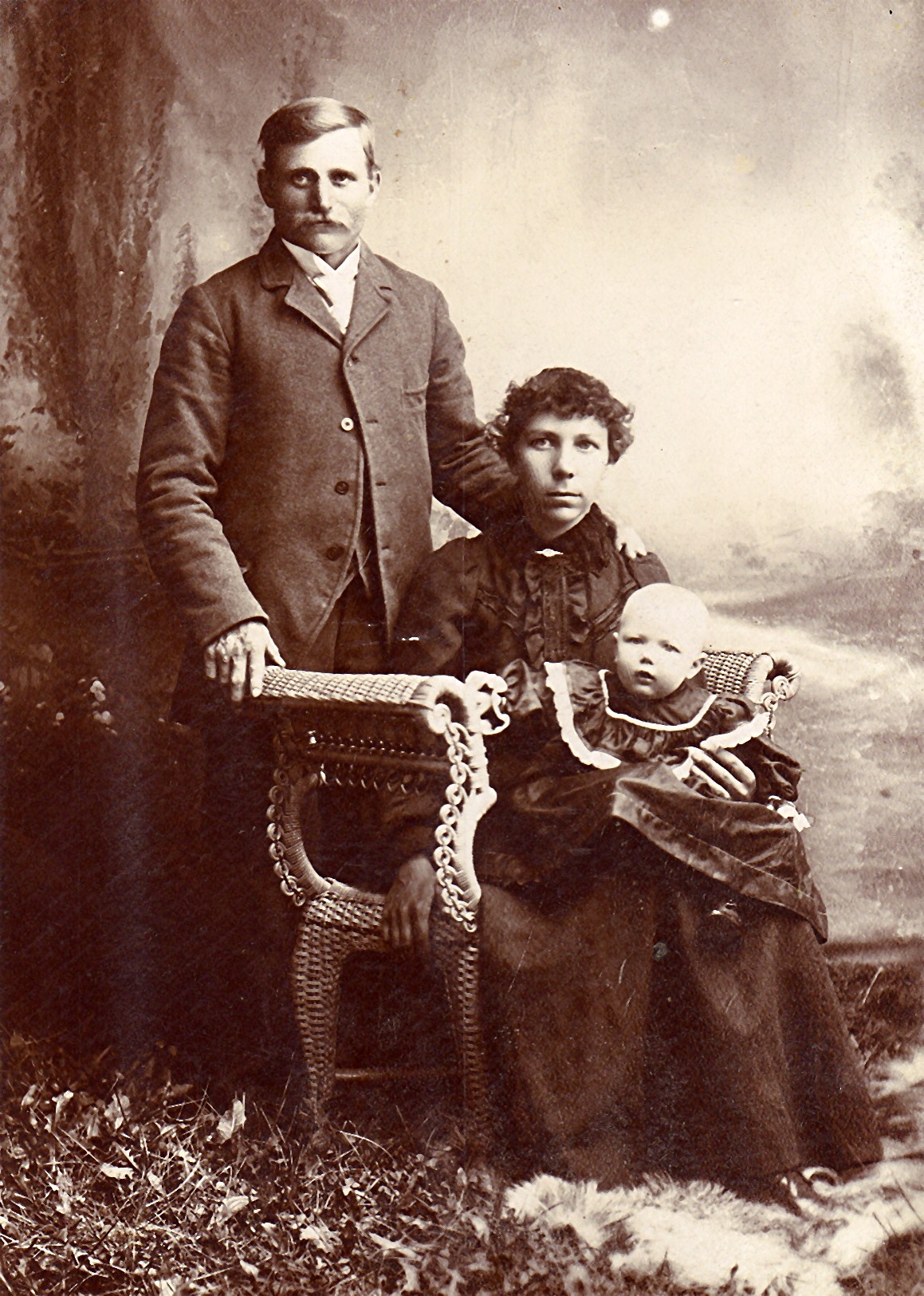
Herbert and Martha Coley (I have the original of Martha, but not of Herbert, so I know it is still out there)
Recorded family stories are fairly scant. Nobody wrote much down and that generation was gone before many were asking questions. Ivan Coley told his daughter Colleen that Herbert was a short, very English man. Apparently Herbert met Wild Bill Hickok at one point and shared that fact regularly.
In 1942, Herbert went to visit Ivan and Clara in Buhl. I will have to find out if Martha was there as well. While out in the yard, I have been told by a well, or a trough, he slipped and broke his hip. There was not really much to do for someone in that condition then. He was in terrible pain. He was taken back to Richmond and passed away later of pneumonia. He died 7 September 1942 at age 78 (obituaries all have 75) and was buried in Richmond Cemetery 9 September 1942.
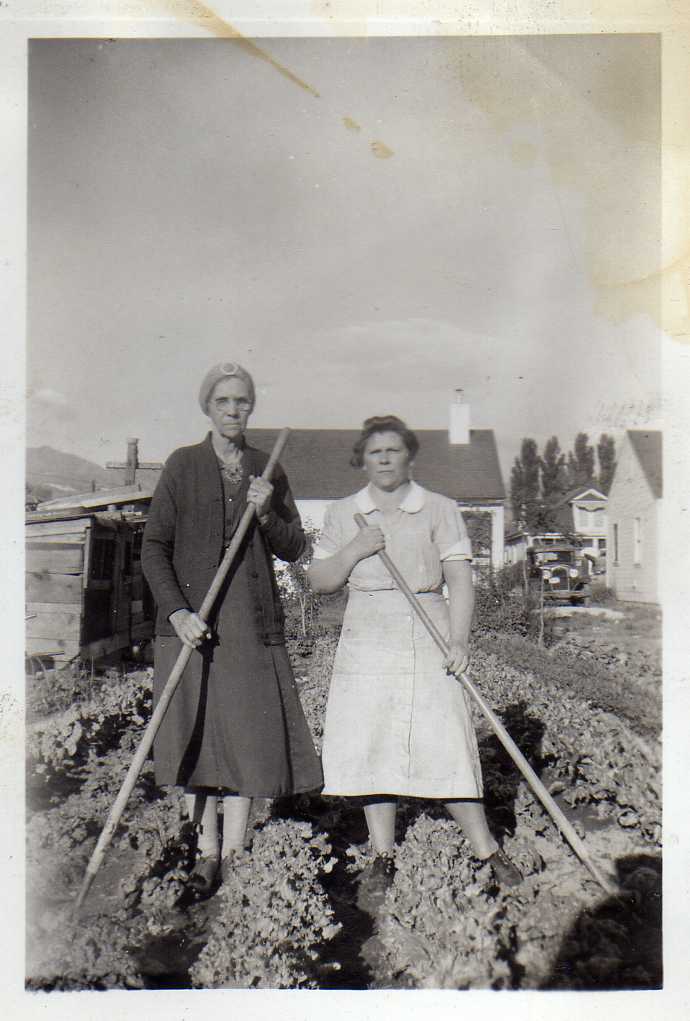
Martha Coley and Hannah Thomson in a garden, dresses and even a brooch
Martha moved into town shortly afterward. Various family members lived in the cabin when they started out their marriages. Martha’s new home was somewhere near 400 South and 200 East. With the new homes I cannot tell as well, but I have tried to pinpoint the spot. She lived in this home until she needed assistance and went to live with Lloyd and Veda in Salt Lake City. When they could not care for her any more, she then lived in a care facility in Logan the last months of her life.
5 generations about 1959, Lillian Coley Bowcutt, Martha Christiansen Coley, Joseph Hebert Jonas, Robert Lee Jonas, Joseph Leland Jonas.
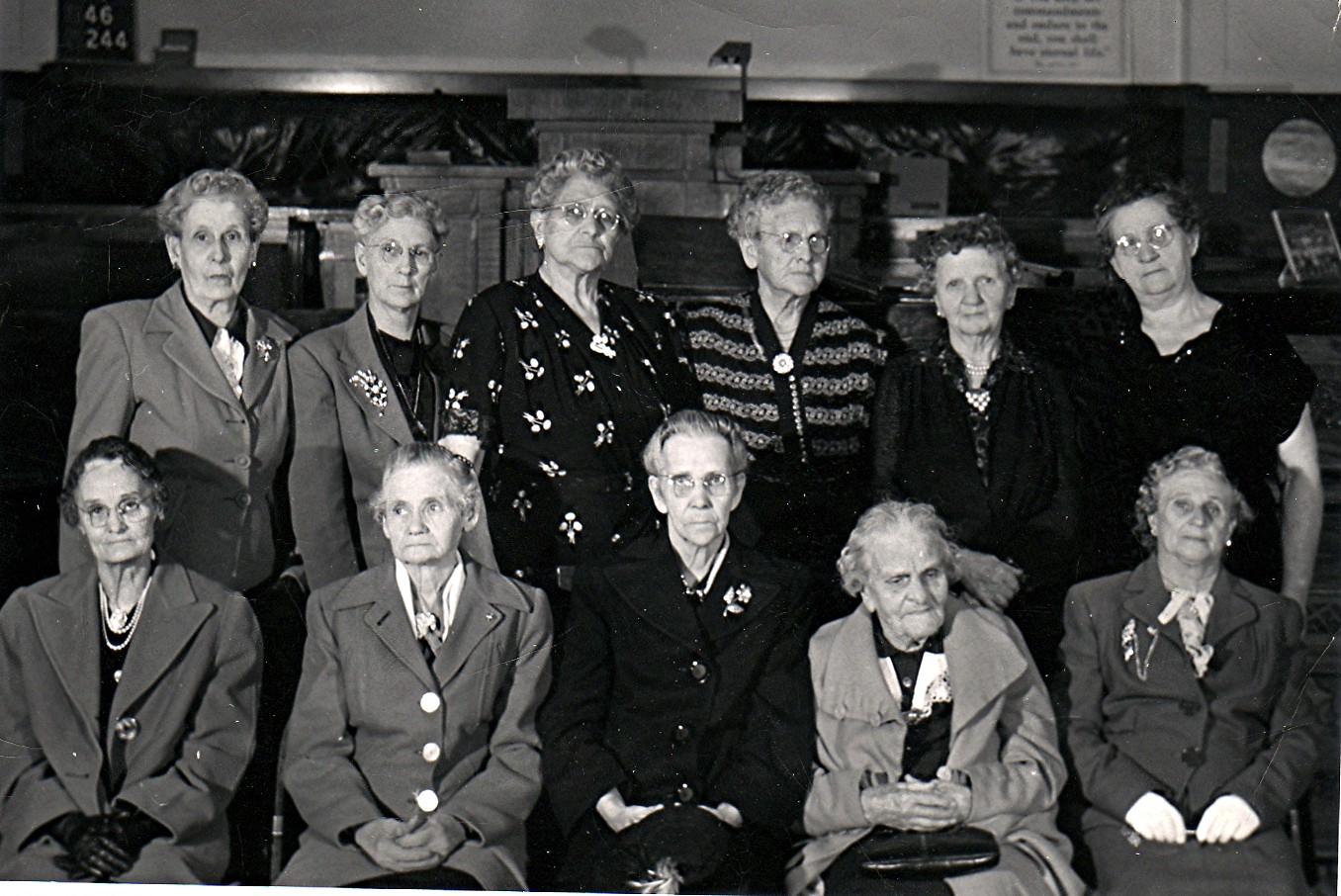
In 1948, Martha was honored for successfully Relief Society Teaching for more than 40 years. Here is a photo from that occasion. You can find more detail here.
Back (l-r): Lydia Leavitt, Estella Blair, Sarah Preece, Susanna Allen, Livinia Wilcox, Clara Wheeler. Front: Lavina Poulsen, Christensia Hansen, Martha Coley, Martha Lewis, Sarah Snelgrove.
Unfortunately I do not have a many more stories. But I do have a few more photos. We have these two photos of a gathering about 1950.
Back(l-r): Doreen Neilson, Martha Coley, Golden Coley, Edna Neilson, Unknown, Gloria Neilson holding unknown child, Olof Neilson. Middle: Shirley Coley, Joy Coley (baby), Mary Coley,
Mary (holding Joy), Shirley, Doreen, Unknown, Martha, Edna, Gloria
This wonderful family reunion picture from 1955. I have linked the other post sharing the other photo. That link also names everyone in the photo. Martha is sitting surrounded by her grandchildren and children.
1955 Coley Reunion, Richmond, Utah
Herbert’s obituary in the Salt Lake Telegram on 8 September 1942 reads:
“Richmond, Cache County – Funeral Services for Herbert Coley, 75, who died at his home in Richmond Monday at 7:45 a.m. following a brief illness will be conducted Wednesday at 1:30 p.m. in the Richmond South L.D.S. ward chapel by E. M. Hicken, Bishop.
“Mr. Coley was born in England on February 12, 1867, a son of Stephen and Hannah Rogers Coley. In 1885, at the age of 16, he immigrated to the United States.
“On December 1, 1896, he married Martha Christiansen in the Logan L.D.S. temple. He was a prominent farmer in the Richmond district.
“Surviving are his widow of Richmond, 10 sons and daughters, Mrs. Lillian Jonas, Ms. Edna Nielsen and William Golden Coley of Richmond, Wilford Herbert Coley of Logan, Ms. Hannah Thomson and Lloyd Coley of Salt Lake City, Ms. Carrie McMurdie, Ivan, Roland and Arthur Coley, all of Buhl, Idaho, 37 grandchildren, three great grandchildren, and a sister, Mrs. Martha France of Richmond.
Lillian, Edna, Martha (sitting) Coley in the 1940’s
“Friends Pay Tribute to Richmond Man
“Funeral Services for Herbert Coley, 75, prominent Richmond farmer who died at his home in Richmond, Monday at 7:45 a.m. following a brief illness, were conducted Wednesday at 1:30 p.m. in the Richmond South ward chapel by Bishop E. M. Hicken.
The rest of the article follows nearly verbatim what the Salt Lake obituary listed, then this line.
“Burial was in the Richmond cemetery under direction of the W. Loyal Hall mortuary.
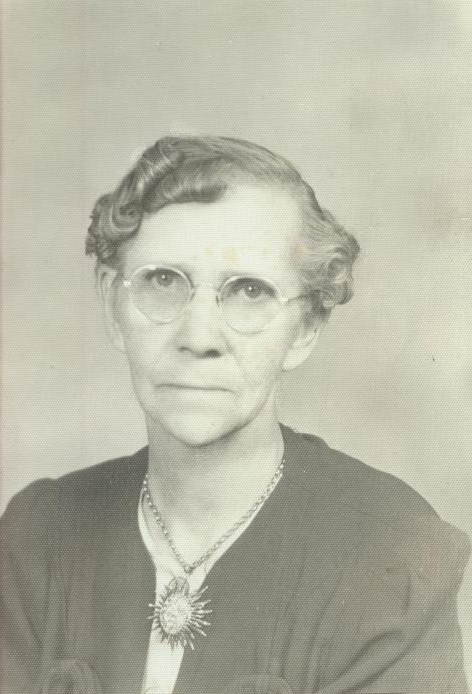
Martha Christiansen Coley very small picture enlarged
Martha Coley and Scotty
Martha Coley serious
Martha Coley smile
Martha passed away in Logan at age 82 on 14 August 1961. Here is the language from her obituary and an article of the funeral. She was buried in Richmond 17 August 1961.
“Richmond – Martha Christensen Coley, 82, died at a rest home in Logan Monday of causes incident to age. “She was born April 16, 1879 in Norway to Ole and Constance Josephine Eliza Jorgensen Christensen. When she was eight years old she came with her parents to America. “On December 1, 1896 in Logan she married Herbert Coley. The marriage was solemnized in the Logan LDS Temple in 1900. They made their home in Lewiston and Richmond. She was always active in the LDS church, especially as a Relief Society block teacher. Mr. Coley died September 7, 1942. “Surviving are Mrs. Lorenzo (Lillian) Bowcutt and Mrs. Edna Neilsen, Richmond; Wilford H. Coley, Logan; Mrs. William (Hannah) Thompson and Lloyd O. Coley, Salt Lake City; Mrs. Lars (Carrie) McMurdie and Ivan S. Coley, Buhl, Idaho; Roland Coley, Mesa, Arizona; Arthur C. Coley, Ogden; William G. Coley, Hyrum; a number of grandchildren and great grandchildren. “Funeral services will be held Thursday at 1 p.m. in the Richmond South Ward with Bishop Oral Ballam in charge. “Friends may call at Hall Mortuary in Logan Wednesday from 7 to 9 p.m. and at the South Ward chapel Thursday from 11:30 a.m. until time of services. Burial will be in the Richmond Cemetery.
“Funeral services were held in the Richmond South Ward chapel Thursday for Mrs. Martha C. Coley with Counselor Quentin Peart conducting. Lloyd Coley gave the family prayer. “Prelude and postlude music was played by Reese Murray. The ward chorus directed by Mrs. Florence Lewis with Mrs. Billie Lou Bagley as accompanist sang “The Lord’s Prayer.” Ila Rae Richman and company sang “That Wonderful Mother of Mine.” Mrs. Florence Lewis and Mrs. Rebecca Lewis sang “In the Garden,” and Ronnie Lewis sang “Beyond the Sunset.” “Prayers were by William Thomson and Larus McMurdie. Speakers were Mrs. Leona McCarrey who read the obituary, Noel Stoddard and Counselor Peart. Pallbearers were her six sons, Wilford, Ivan, Roland, Lloyd, Arthur and Golden Coley. The grave in Richmond Cemetery was dedicated by Joseph Jonas. Flowers were cared for by the Relief Society.
~
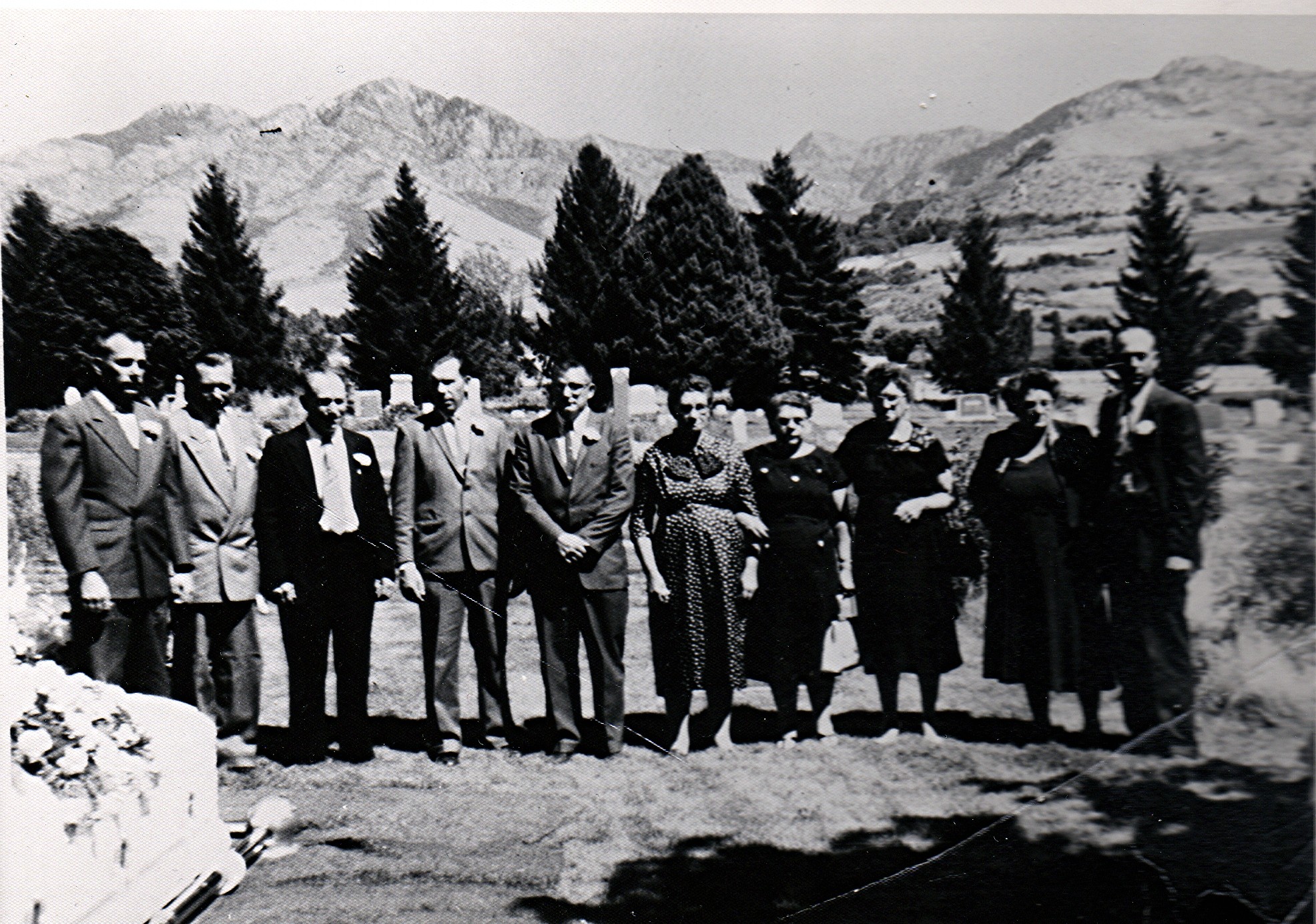
I have written previously about the video that came from the funeral and graveside service of Martha. In that post I walk through the video and the identified individuals. It also scans the 10 children standing in the cemetery. This photo below is of the same instant.
Art, Golden, Wilfred, Roland, Lloyd, Edna, Hannah, Carrie, Lillian, Ivan at their mother’s grave in Richmond, Utah
I hope some day I obtain more photos to share of Herbert and Martha.
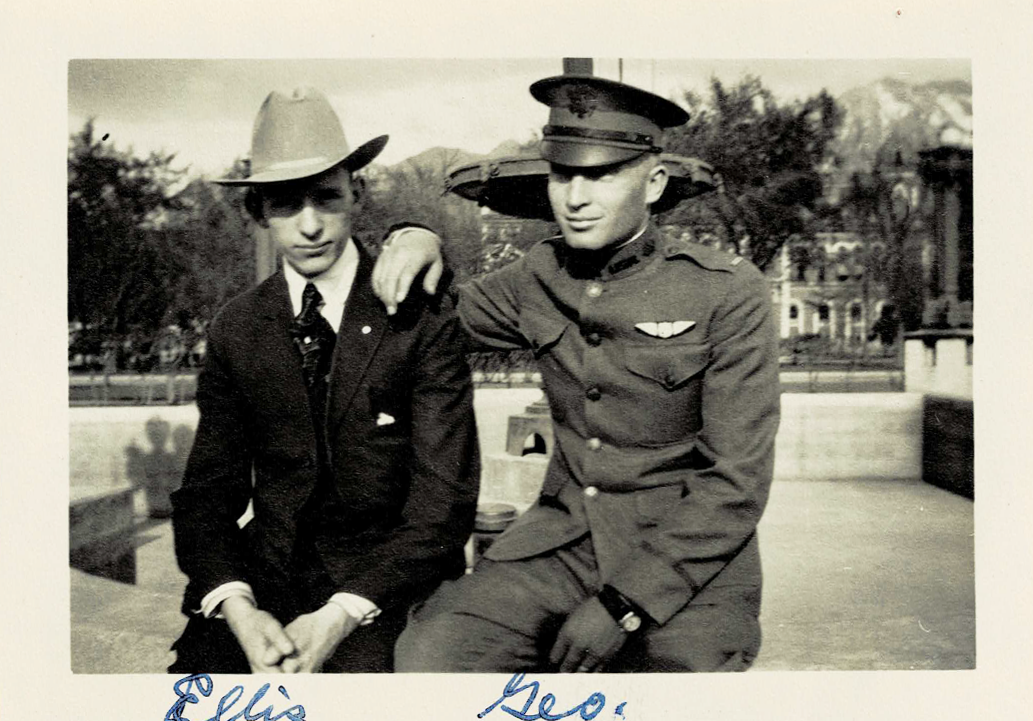
Ellis Donaldson, Gertrude Shaefer, and George Beck
Another one of those stories that are snippets of time but teases the sentiments from the heart’s strings. A story from a century ago of a life taken too early.
Joseph Ellis Donaldson went by Ellis his whole life. Not sure why, but his parents called all their sons by their middle name. Ellis was born 28 August 1896 in Park City, Summit, Utah. He is the brother to my David Delos Donaldson. I have written of their family and their relationship with the railroad and finding their way to Ogden, Weber, Utah.
In their time in Ogden, the Beck family had also moved there from Cheyenne, Laramie, Wyoming with the railroad. One of those boys was George Carl Beck. George was born 8 April 1896 in Cheyenne. Ellis and George became friends. The photo above includes Gertrude Shaefer who was one of their friends as well.
Ellis Donaldson and George Beck
George registered for the draft on 5 June 1917 in Ogden. Blue eyes, light hair, medium build, and medium height. He was then a private in the Utah National Guard and had been for 1 month. He was an electrician working for Dr. Fredrick Vining Fisher.
George Carl Beck
While in the military, he learned how to fly an airplane. He was in the Army 361 Aero Sqadron Air Service based out of Salt Lake City. Commissioned 22 April 1918. George went to Camp Mills in Mineola New York where he learned to fly at Roosevelt Field. He also acquired a Bachelor of Arts. For a time he worked for Ogden Picture Corp doing “moving picture.” George even took Ellis for a flight on at least one occasion.
Ellis Donaldson and George Beck
I am not clear on what happened or whose plane he was in. Ellis simply wrote for the above photo, “Ellis Donaldson and my boyhood buddy Lt. George C. Beck. Killed in plane tragedy summer 1919–Salt Lake.” George died 21 June 1919 in Salt Lake City. George’s death certificate states the cause of death, “Fracture at base of skull (Accidental– Airplane fell to earth)” The death certificate states he was an “Aviator” working for J. Gilmer, apparently he was no longer in the military. Aged 23 years, 2 months, 3 days. His father was the informant for the information on the death certificate.
The tragedy of a life cut short strikes me. Ellis’ short comment highlighted buddy and plane tragedy. John Greenleaf Whittier comes to mind, “For all the sad words of tongue and pen, the saddest are these, ‘It might have been.'”
This is another chapter of the Jonas history book compiled by Carvel Jonas. “The Joseph Jonas clan of Utah (including – early Jonas family history; early Nelson family history)” This one is on William Nelson Jonas.
John, Joseph, and William Jonas
“William had the same name as his great grandfather, William Jonas, although he never knew it in his life. Most likely he was named after his Uncle William Jonas. William Nelson Jonas, the second son and fifth child of Joseph Jonas and Annette Josephine Nelson, was born 2 December 1889, He was called “Bill” by his friends at church and “Willie” by his family at his home. His parents had, two years before his birth in 1887, sold their property 3 miles south of Ellensburg, Kittitas County, Washington State. But the family must have stayed in the area because William went to the public school in Ellensburg his 1st, 2nd, and 3rd elementary grades. The family then moved to a little town named Bristol, which is northwest of Ellensburg. When he was in his 4th grade the family was living in another town named Thorpe and he attended the school at Thorpe. Thorpe is another town northwest of Bristol. Sometime during this time William and his two brothers went to a neighbor’s place and swiped some apples. The kids also helped themselves to their cousin’s watermelon patch. in 1895, he went with his family to pick hops in Yakima. The 1900 census tells us that William and his family lived in another town which also is northwest of all the other towns mentioned. It is called Cle Elum. The family was renting a house in this western city. As far as we know the family always rented.
“William arrived in Crescent, Utah with his entire family 3 July 1901. He attended the public school in Jordan School District for the 5th, 6th, 7th, and 8th grades. He graduated 8 grade in Sandy. He was baptized a member of The Church of Jesus Christ of Latter-day Saints 10 January 1902, the same day his two brothers were baptized. When he was baptized he had just turned 12 years old by a little over a month. Up to that time he had been raised a Catholic. He was baptized in the Jordan River in South Jordan by his Uncle, Nels August Nelson. He was confirmed a member the same day by William Fairfard. There were no records found for William at the St. Andrew church in Ellensburg, so it is likely that his baptism was performed elsewhere. Shortly after he was baptized he was ordained a deacon in the Aaronic Priesthood. He remained a deacon until 6 January 1908 when he was ordained an Elder in the Melchizedek Priesthood by Bishop James P. Jensen. He was never ordained a Teacher or a Priest, which are the two offices traditionally held by young people in the Mormon Church before they are ordained an Elder. While he was a deacon he was called to be the secretary of the quorum. He was also the President of the deacons quorum for a few years. Perhaps after being raised in another church it was good training for William to remain a Deacon a little longer than usual. He belonged to the 7th Quorum of Elders in the Crescent Ward in Salt Lake County.
“During his stay in Crescent from 1901 to 1908 when he moved to Richmond, Utah, William helped his Uncle August on the family farm. According to August’s life story William and his brothers worked hard. It was understood that William and his brothers were to be given some land for the work they did on the Nelson farm. But the farm wasn’t given to anyone else because much of it was sold.
“William knew many of his cousins on his father’s side of the family until he was 12 years old. After July of 1901 he became familiar with all of his cousins on his mother’s side of the family by living with the Nelson family. William’s mother and this Uncle were the only two siblings in the Nelson family who had children of their own. One of his cousins from his mother’s side, Virgil Homer Nelson, wrote in his autobiography, “They (Rosa, John, William, and Joseph) gave me plenty of companionship. Our chief amusements were swimming, playing baseball, and skating.”
“William had a lot of farm land to discover. Virgil, August’s son, wrote that their farm, “…extended a mile along the east side of State Street and far to the east…a thousand acres of land in East Crescent and into the hill there.” On one occasion when William was in the area he found a dead man laying in a ditch.
“In the school year 1907 William went to the L.D.S. College, his first year in High School before moving to Richmond, Utah. William and his two brothers left Crescent and went to live with their only living sister, Rosa Jonas Andersen. When William had just turned 19 years he made this trip. One cold, snowing day in 1908 the three boys finally arrived at their sister’s home in Richmond, Utah. William worked four years for an August Larson in the summer and went to Brigham Young College at Logan for five years. Each year he received a sports letter in baseball.
Loretta Merrill, William Nelson Jonas
“On 19 September 1909 he was ordained a Seventy by Charles H. Hart, the same day his brother, John, was also ordained a Seventy. He remained a Seventy for over 40 years. On 1 May 1908 he received a Normal Diploma at Logan, Utah, Brigham Young College. 2 June 1911 he graduated from the BYU College and received a General High School Diploma. Two years later he received a college diploma. On 4 September 1913 he received a Grammar Grade County Teacher’s Certificate for Public Schools of Utah. His graduation diploma states that he “passed an examination satisfactory in writing, arithmetic, pedagogy, physiology, reading, drawing, orthography, English, grammar, U.S. History, geography, nature study, psychology, and history of Education.”
William Jonas “To Father”
“The following post cards have survived since 1912. This is the year prior to his graduation from the college and gives a few insights into his personal feelings and activities. All the cards are written to Karen Marie Thompson whom he later married.
“Logan, 4 October 1912 “Dear friend, The first dance will be given Friday night. It was announced in chapel this morning. I do wish you could be here. I’ll be up Sat. noon and we’ll go, if not say so. I have a fine place to stay, with aunt Felelia and my cousins. With best wishes Wm. N. Jonas.”
“Logan 240 E. 3rd North. Oct 11. 1912 “Dear friend: School is fine and full of life. How is work, school and everything in particular? There will be an oration given this morning, you ought to hear it. I’ll not be up Sat. would certainly like to, but– Wishing you an enjoyable time. Your Friend William”
“Logan240 E. 3rd N Oct 18, 1912 “Dear Friend: I would like to come up Sat. but as I have work and a class entertainment Sat. It is impossible. Then too I’ll be up a week from tonight. I wish you could be down here tonight, a lecture and a dance. Work Sat. and have a dance. Have a good time, Don’t be angry. With best regards and wishes as ever, your friend, Wm”
“Logan, Oct 30, 1912 “Dear friend, Hoping you a most happy birthday and many good wishes. There is a dance tonight, a lecture Thur. night and another dance Fri. Always something doing in Logan. Tell everybody hello. as ever your friend Wm. N.”
“Logan, Nov 7, 1912 “Dear friend, Congratulation on Nilson and the De. We had a good conference here Sun. Joseph F. and his son Hyrum will speak. How are all the folks? We are all fine. How is the candy mouse? Well, how is school life and activities…as good as ever here. With best wishes from Wm. N”
“Nov 19, 1912 “Dear Friend, your card was only rec’d. Hope the best of health for your Pa. I won a quarter on the game between 1st and 2nd yrs R.H.S. Sat or Fri. We have a couple of excellent Musical recitals the last week at the Logan Tab and Nibley Hall. Wm N. How do you like the house work for a change or are you a hallo kid?”
William Nelson Jonas, sitting middle, President of Wisconsin or Minnesota Conference, 1915 or 1916.
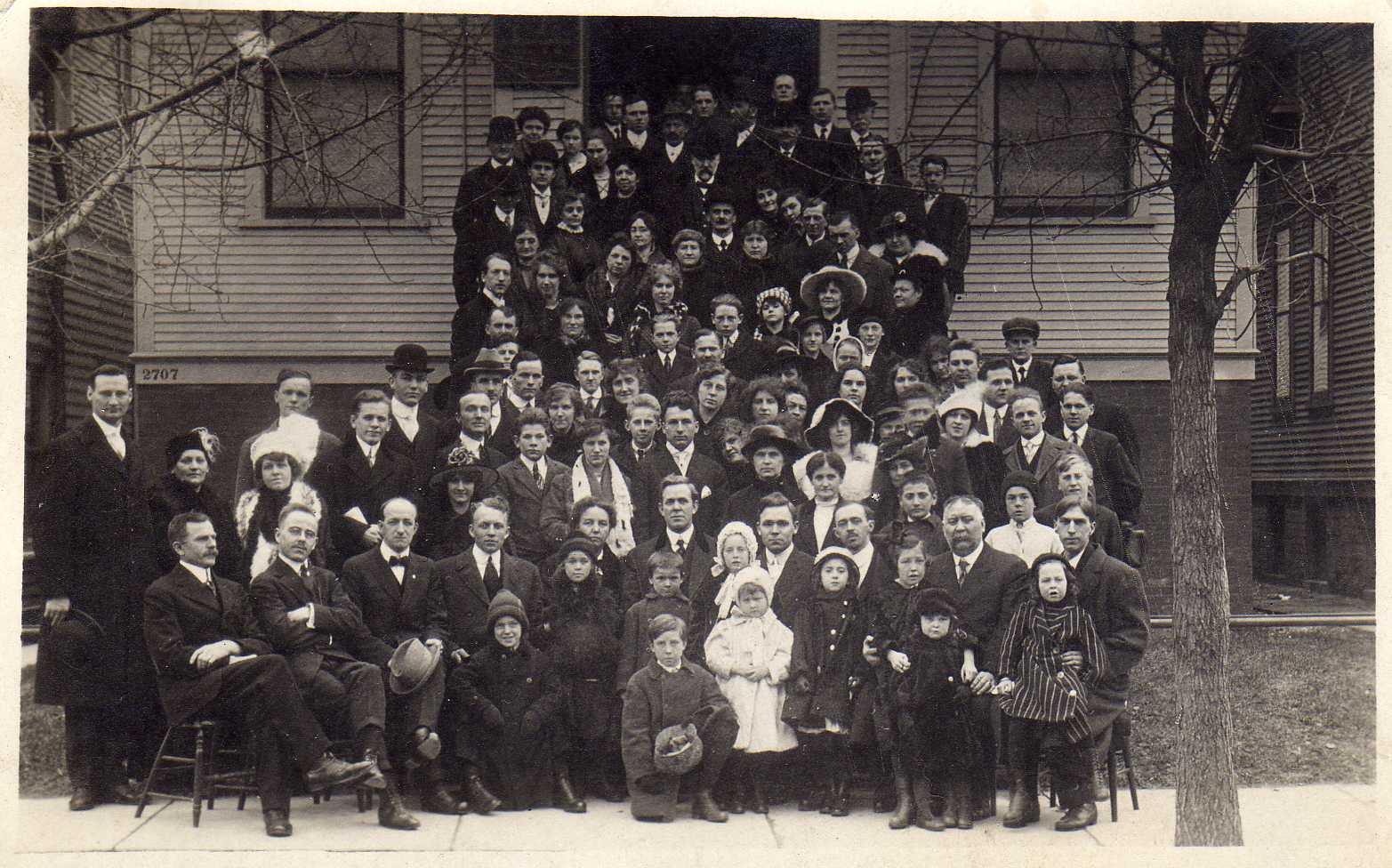
“William graduated from college soon after the above post cards were written, when he was 23 years old. 4 September 1913 when he received a Grammar Grade County Teacher’s Certificate for Public Schools. During 1913 he taught school at Lewiston and was principal of Wheeler School District. During this first year of teaching he received his endowments 22 May 1914, in the Logan Temple. After teaching for one year he was called on a mission for The Church of Jesus Christ of Latter-day Saints. He served for 27 months in the Northern States Mission. His only grandson who served a full time mission was called to the same mission about 60 years later. The mission was called the Minnesota-Wisconsin Mission in 1973. William was first given a minister’s certificate which was dated 2 June 1914 and was signed by the First Presidency of the Church. Several months earlier 16 April 1914, he had been called to the Switzerland and Germany Mission. He was to prepare to leave by 1 July 1914 and had a meeting with the Prophet at 9:00 A.M. that first day. However, he never went to Europe on his mission because of the First World War. He was then reassigned to the Northern States Mission, which had it’s mission headquarters in Chicago, Illinois. While he was on his mission he was called to preside over the Wisconsin Conference, 23 September 1915. He was next called to preside over the Minnesota Conference. 10 January 1916. While serving on his mission he lived at 2707 Clarke St. Milwaukee, Wisconsin; 31 South 5th Street La Crosse, Wisconsin; 247 North Gretto Street, St. Paul, Minnesota, and no doubt visited the mission home at 2555 North Sawyer Ave, Chicago, Illinois. He was released from his missionary service 20 August 1916.
William Jonas, seated with girl in white standing in front of him.
“After his mission he went to Cowley, Wyoming and served as a school principal. There were 18 graduates from the school that year. During the summer of 1917 he went to Provo, Utah, for 12 weeks of summer school. About this same time William went to Richmond, Utah for his father’s funeral. William was the person who gave the information for Joseph Jonas’ death certificate. He then went back to Wyoming and on the 28 February 1917 he registered in Big Horn County to teach school. Soon after that in the beginning of the school year of 1917 he accepted an offer to become coach of baseball and basketball teams at Dixie Normal College in St. George, Washington County, Utah. We have several pictures from the Dixie College School yearbook which was called “The Dixie”. Also, the following tributes from the same book. “Drafted (Class 1 A) It was under Coach Jonas that Cedar met their match in the Dixie basketball team. Favors the “Windsor Tie”.” And this one which was entitled “First Years”. “In September 1917, the D.N.C. found on hundred and five First Year’s invading it’s halls, with bewildered excitement. We did not remain in this state of unrest, however, for Father Jonas and Mother Watson soon had us under their protecting care. With their willing aid and the help of every Freshie, we came off the field on Founder’s Day, flying one blue ribbon and two red ones. The loyalty of our First Year Class was made evident by our purchase of a $100.00 Liberty Loan Bond and $75.00 in Thrift Stamps. We are justly proud of a Freshie lad who is a member of the D.N.C. debating team. Our class part early in December was very successful. If you do not believe us, As Jonas, Jr., and his partners.”
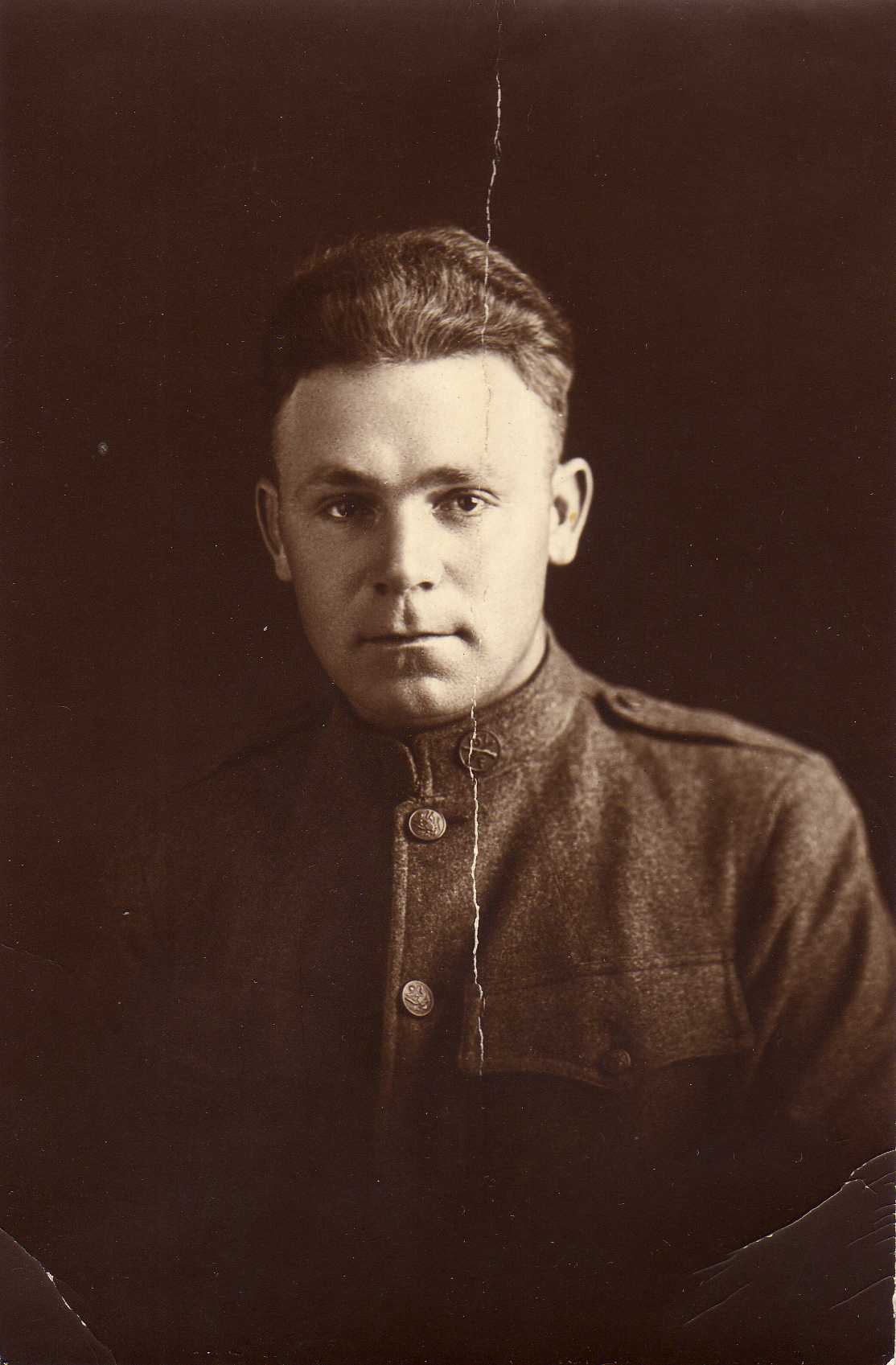
William Nelson Jonas WWI uniform
“The following 20 May 1918 William was inducted by the draft into the Army. On 25 May 1918 he was in a training camp. He went to camp Louise and then to Camp Kearney in California. On August 16, 1918 he left for France. Before he left he expressed to members of his family that he wouldn’t mind serving in the service if he didn’t have to kill people. To his relief he was a member of the medical detachment 145 artillery. He stayed five months in France. His army serial number was 3,127,617. He was a resident of St. George, but was inducted in Cache County. He was in Btry A 145 Fa by July 15, 1918. He went overseas from August 16, 1918 to January 4, 1919. He was honorable discharged January 24, 1919. He remained a private during his short stay. His Military records tell us that he was 28 8/12 years of age when he was inducted. He had brown eyes, brown hair and medium complexion. He was 5 feet 8 1/2 inches tall. He received paratyphoid shots 10 June 1918 for typhoid and was not wounded while he was gone. He is character was considered excellent. He was paid 24 dollars and 40 cents 24 January 1919 and was given travel pay back to Logan. During the voyage home William was so sick that he thought he might die. So he promised the Lord he would do whatever He wanted if his life would be spared. And he was faithful to that promise all his life.
“While William was in France he sent letters and post cards. One that still survives was sent to his cousin, Hubert Jonas, who lived in Washington State. The following is quoted from that card. “Camp DeSavage, France November 24, 1918. “Dear Cousin and Family, A Joyous Christmas from France. notice our gun ‘4 point 7’. 1898 date. The Regiment was organized 1916 on the Mexican border. 1918 France from the Beehive State Utah. had six weeks work in the hospital, am well near Bordeaux. Expect to move soon may be ‘over there’ too. Sure tickled. Best wishes and Love W. N. Jonas Sanitary Det. 145 FA Am. Ex. France.”
“While William was gone to war his older brother, John Jonas, died. John died 19 December 1918 and William arrived in New York 4 Feb 1915. He missed seeing his older brother for the last time by a little less than two months.
William Nelson Jonas and Karen Marie Thompson
“Two years after he got back from the Army he married Karen Marie Thompsen, 6 January 1921. They were married in the Logan Temple. Karen Marie was born 31 October 1892. She went to school in Richmond for eight years. She started when she was 8 years old and graduated at 15 years old. She had passed the sixth, seventh, and eight grades in two years. She worked in the Utah Condensory called Sego Mile, which canned milk. She worked for 13 years. Part of the time in the factory and part in the office. The company had an office in Logan in which she worked most of her 13 years. While she was working at Logan she also went to New Jersey Sewing Academy for nine weeks at night. On 9 March 1920 she received a patriarchal blessing. While she lived in the Murray area she was the quilt chairman in Relief Society for many years and went visiting teaching for many years. She loved flowers and had a flower garden most of the time.
“Mary, as she was called, was blessed by William G. Plonallsen 5 Jan 1893. She was baptized by Clarence L. Funk 1 September 1901. She was confirmed by Wallace K. Burnham 1 September 1901.
“Mary’s mother was named Jensine Caroline Christensen. She was born 11 April 1864 in Aarhus, Denmark. She joined The Church of Jesus Christ of Latter-day Saints in 1890 and came to America 6 July 1891. While she was sailing she met her husband, James Thomassen, who later changed his last name to Thompsen. They were married 24 December 1891. James Thompsen was never a member of the Church. He was immigrating to Richmond, Utah, to be with his older brother, John, and his younger sister, Johane Caroline. His brother, John Thomassen had joined The Church of Jesus Christ of Latter-day Saints 10 February 1869. He later immigrated to Utah to join the Saints. He was endowed 12 October 1875. John must have immigrated to America about that same year. It took his brother, James, about 16 years to follow his older brother to Utah. Caroline was converted to the Church by August S. Schow who was from Richmond Utah. That is one very important reason she moved to Richmond. Their children were the following: Karen Marie born 31 October 1892 ; Ebba born 31 April 1894; James born 6 September 1896; Alta born 12 August 1902; Leland and Stella were both still born April 1898; Michael born 13 July 1906. Caroline was a milliner in Denmark. She sold her hat shop and paid her ticket across the Atlantic to America. James was a carpenter and died at the age of 59. He was bitten by a pig and was poisoned. He suffered a great deal for four years before his death. James was born 19 August 1854 in Vildmose, Denmark and died 8 January 1913 in Richmond, Utah. Caroline died 17 July 1951 at 4:30 A.M. at daybreak on a Tuesday in Salt Lake City.
Vaughn, Gaylen, Karen, Maynard, William, and Delwyn Jonas with Alta, James, and Caroline Thompson
“William and Mary lived in Richmond, Utah, when they were first married. They went to the Benson Stake of the L.D.S. Church. In August of the same year (1921) they moved to Franklin, Idaho, so William could teach school. Mary worked checking ledgers for the Milk Condensory in Franklin, Logan, Richmond, and Hyrum during her life. By September of 1921 they moved to Thatcher, Idaho. They went to the Thatcher 2nd Ward in the Bannock Stake of the L.D.S. Church. William, his brother Joseph and his sister, Rosa with their families tried farming. William tried farming from Sept 1921 to Jun 1923 when they moved back to Logan. Apparently discouraged with farming William went to Park Valley, Utah, so he could teach school for one year. After school was over they moved back to Logan for a short while and then to Avon, Utah, for another teaching assignment. September 1924 William took an examination at West High School for the Post Office. He rated 3rd in his class with 93% – he got 5% for being a veteran. In August 1925 he started work for the post office. He worked there for 33 years and accumulated many days for not being sick. He worked the afternoon shift and would take the trolley car to town. He retired in 1958. His work consisted of being a supervisor and worked with the public weighing packages. His hours were from 3:00 P.M. to 11:00 P.M.
“L.D.S. Church records show that they moved into their home at 120 West Burton Ave in Salt Lake City the same month he was hired at the post office, August 1925. Mary’s mother also lived on Burton Ave. They were in the Burton Ward, Grant Stake. After they had lived on Burton Ave. where their son, Vaughn, was born they moved to 1854 East Clayborne in Salt Lake City in 1928. About 1931 they moved to 906 East 39th South in the Murray area. Then the family moved to 2964 South 9th East (where Carvel was born) in 1933. They lived there from 1933 to about 1942-43. Then they moved into the new home next door at 3974 South 9th East. When William first bought land in the Murray area he purchased 6 1/4 acres. William and his brother-in-law, Christian Andersen, built the home at 3974. Then they moved again to 3954 South 9th East in 1951. All three of the homes on 9th East were next door to each other. The home at 3954 was originally an Army barracks which was moved from Kearns and later remodeled by their son, Maynard. On 29 April 1962 they then moved to 1005 East 4025 South which was still in the Murray area. There they lived until each passed from this life to the next.
“William and Mary were the parents of 6 sons. The last son, William Thompson Jonas, was born what has been called a “blue baby”, and lived only 31 1/2 hours. He weighed 6 1/2 pounds and is buried in the Elysian Burial Grounds in Murray, Utah. He was blessed by his father the 22 October 1937. Their 3rd son, Gaylon Thompson Jonas, was killed 19 September 1944 on Peleliu Island in the Pacific Ocean. He had enlisted 19 August 1942 with the 2nd Mormon Battalion. He was awarded the Bronze Star, Purple Heart, Navy Citation Award, Pres. Citation, Navy Unit Cit., American Theater, Pac. with 3 stars. He was killed by a Japanese sniper’s bullet while removing a wounded man. He was killed while he was helping the fourth man that he helped that day. He had volunteered for the assignment.
“William blessed all six of his sons. He also confirmed 5 of them after they were baptized. Delwyn was blessed 2 April 1922 and confirmed 1 February 1931. Maynard was blessed 14 March 1925 and confirmed 3 December 1933. Vaughn was blessed 7 November 1926 and confirmed 4 November 1934. Carvel was blessed 17 September 1934 and confirmed 2 May 1943. William also ordained several of his sons to different offices in the Priesthood. Gaylen was ordained a Teacher 29 January 1940. Carvel a Deacon the 22 September 1944 and a Teacher 30 October 1949.
“William was actively involved in work for his Church all his life. He was Superintendent of the Sunday School of the Mill Creek Ward for 2 1/2 years. He served as Stake Supervisor of the gospel doctrine classes. During his gospel doctrine classes he would compare Catholic point of view with the L.D.S. view quite often according to his neighbor who attended his class. He also served as one of the Seven Presidents of the Seventy in his stake. He was a leader of the cottage meetings. And taught the genealogy class for many years and became one of the senior teachers of these genealogy classes. He was baptized for some of his dead ancestors and his wife’s dead ancestors. He served as a ward teacher for many years. He did all of the above including serving a full time mission for the Church before he was 50 years old (1940). After that on 20 Mary 1943 he received a missionary call from the Mill Creek Ward, Cottonwood Stake for a stake mission. He was set apart 26 March 1943 in the stake office at about 8:00 P.M. Afterwards he received another stake mission calling (this was his third mission). He and his wife Mary, were both called. William was set apart 12 May 194?. One of grandpa’s neighbors said that grandpa was considered a scriptorian by those who knew him in their ward, and that he had a hard time understanding why people didn’t recognize the truth in the scriptures. He was set apart Wednesday May 18, 1944 in the stake office at 176 Vine Street for this third mission. While William was on this stake mission his son, Gaylen, who was killed in World War II appeared to him twice requesting that his temple work be completed. His wife, Mary, was set apart 31 August 1949 so they could serve on a mission together. They received honorable releases from their stake missions 3 June 1951.
“When William was called on his second mission he wrote a letter which was printed in the Millcreek Courier, which was the ward paper. The following is quoted from that letter written March 1943, the same month he was called on his second mission. “Faith Unshaken Greetings to the boys in the service from Mill Creek; Recent events have not shaken my faith in the ultimate triumph of freedom and justice, for I was reared in a church where faith in God and belief that right will triumph eventually is too deeply ingrained in me to doubt its final victory. As long as we have faith at all in God, we must know that his is All-Powerful. That his will for the world is Justice and Right, and that eventually His purposes will be established here on earth. Good emerges slowly, but we must not doubt its victory.”
“”As to our country, my faith is our America, in its people, and in the American Way of Life, is unwavering. The United States is the greatest country on the earth, not because it is our country, but by comparison. It’s founding I believe to have been divinely ordained and that God had a mighty mission for the United States among the nations of the world.”
“”America was founded by our forefathers in prayer, in faith, and in the heroic spirit of sacrifice. Lives of comparative ease in their old country might have been theirs had they been willing to surrender their convictions. They chose the Hard Right rather than the Easy Wrong, and were ready to lay down their lives for freedom to worship God according to the dictates of their conscience. No matter what lies ahead, we must carry on to the best of our ability, doing our utmost from day to day, each in his own niche.”
“”After the Hard War No. I was over and the happy Peach had come, I experienced the most wonderful day of my life. February 4, 1919 we first saw the light reflections in the distance, then the lights, buildings, the land. Oh the shouts, “America”, “God’s country”, “Zion”, “Home Sweet Home”, ect. Believe me the statue of Liberty certainly faced the right way–in fact everything we saw was just O.K.”
“”I am now praying for a second great day to come soon, when this Hard War No. II is over and happy Peace is declared and my sons, Delwyn of the Army, Maynard of the Navy, and Gaylon of the Marines come marching home. Parents, fill in the names of your sons, and my God grant the day soon. Sincerely, William N. Jonas.”
“On 17 December 1950 William was ordained an High Priest making little over 40 years that he was a Seventy. He was ordained by Verl F. McMillian of the Mill Creek 2nd Ward in the Cottonwood Stake. After he was ordained an High Priest he was asked to teach the High Priest class for many years. He also became interested in doing the Jonas genealogical line. Around 1960-65 he wrote to places where his grandparents, Hubert and Mary Jonas lived after arriving in America. On 26 October 1960 he received a returned letter from the research department of the L.D.S. Church. He had paid people to help in the research. From this letter we were able to learn about the 1880 census of Nebraska where the family had lived. Another letter was received 13 April 1961 from the Register of Deeds, Monroe County, Michigan, written by the Genealogical Society research department. In behalf of William many land records for Hubert and Mary were then found. William wrote to the Texas State Department and Historical Society of Wisconsin hoping to find more information about our family. Also, he had driven to his place of birth, Ellensburg, Washington for some research and visited his cousin-in-law, Regina Jonas who was living in Vancouver at the time. The following is a quote from a letter he had written which shows the sincerity of his desires. “…this seems to be asking a lot. However, I will be glad to pay for services. Have you someone who is available for such work? I shall try to come to Ellensburg this summer if necessary. I thank you. William N. Jonas.” Many attempts were made to find out where the Jonas family had lived in Germany. Unfortunately, William never was able to discover that genealogy. But because of his efforts there were many clues for the author to use in what eventually lead to the discovery of the Jonas genealogy pedigree, and also this history book.
“The following are some observations about William that his children and friends have told me. William liked to garden. During hard economic times, and especially during the Great Depression, they always had a large vegetable garden. Although we don’t have the exact figures it was close to an half acre. They were able to provide for their family and also provided for a neighbor and his family who were experiencing financial difficulty. He enjoyed excellent, physical health all his life. He was in a car accident when he was older, about 1953-54. During the car accident the gear shifting know of a late model Cadillac punched his side. The knob was shaped like a tear drop. He was a passenger and had slid across the seat with his left side hitting the knob.
“After some of his children got back from their military service they thought they were in better physical shape than their father, who was in his 50’s. They oldest thought he could out arm wrestle his dad now. But William won the match.
“While he worked for the post office he played for the baseball team on the Industrial League. He was a good baseball player and had large knuckles on his left hand from catching baseballs.
“William was instrumental in helping his oldest son to get a job at the post office. He also helped his younger brother, Joseph, financially so he could go to college. William paid for the first month rent for his son, Carvel, when he was first married. Also, William and his wife, Mary, both visited Mr. and Mrs. Virgil Clayton and took pictures on several occasions of their grandson, Carvel Lee Jonas.
“William, when he lived on 9th East raised chickens, pigs, had a cow and an horse. Their children had pigeons and also dogs. They had an orchard of mostly apples, and grew hay and grain; potatoes and lots of vegetables. They had a chicken coop that was heated with a kerosene heater. On one occasion the chicken coop burned down and they lost all the chickens (perhaps as many as an hundred). While the chicken coop was burning William and his son, Maynard, tried to removed the heater and William was burned.
“One time William had bought a new pitch fork. He was able to carry so much hay at one time that the weight of the hay broke the handle of the new pitch fork.
“When William would read or study a book he would read with a pen or pencil and underline and make notes in the margins.
“A neighbor of William’s for over 25 years, Otto Hansen, said the William was very helpful in getting him a job for the post office. William had told him about the civil service test, and encouraged him to try and pass. This neighbor and his wife said that William and Mary were good neighbors and would do anything they could to give a helping hand to someone in need. They considered them to be very honest people. A story that they remember was when William was teaching the gospel doctrine class. Apparently, for a practical joke Mary would remove William’s notes that he had prepared to teach class with from his book. They said that they remember Bill saying, “Mary’s done it again.” Then he was left to use the scriptures and rely on memory and past study to make up a lesson on the spot.
“William died 14 April 1972. He suffered from senility for a few years before he died. Grandma had a neighbor put locks on the doors to keep grandpa Jonas from leaving without knowing where he was going. Even when he wasn’t at his best at the end of his life his thoughts were to go to the Church welfare farm and work. William had received an award for doing over 100 hours of volunteer work for the Church welfare farm in one year (1962), which made him 72-73 years of age.
“Even with the differences in personality of his sons, the one thing that they all agree on is that they had a very good father. Gaylen before he was killed in the war told his friend, “Blondy, I want you to (meet) my folks when we get a furlough, they are the best parents a guy could want.” His sons don’t agree on many things, but they all agree about how lucky they were to have such a wonderful father. That in itself is one of the finest tributes that a man could have.
“Merlin Andersen told me that he always had admired William’s language. William spoke as an educated man who had a firm grasp of the English language. William loved kids.
“Once William and Merlin were walking and they came to a creek. Merlin was wondering how he was going to cross because he didn’t feel like he could jump across and make the other side. Merlin was a young boy, but he remembers that William grabbed him and threw him easily to the other side of the creek.
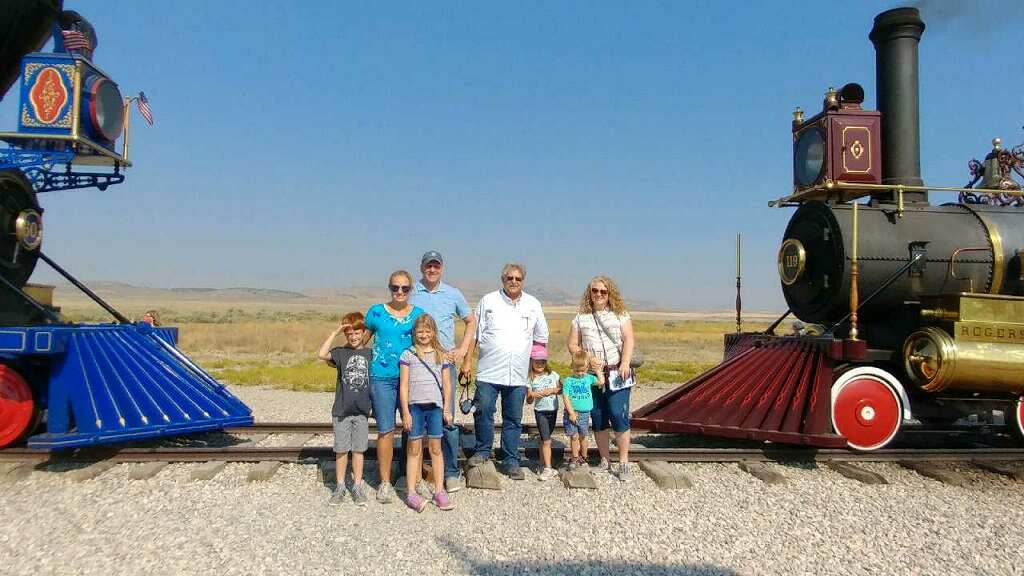
Jupiter at Golden Spike National Historic Park Sep 2020
We took a trip to Golden Spike in September 2020 for the kids to experience some Utah history. It was well worth the drive out to Promontory, Utah.
The Golden Spike has some significance on Amanda’s line. Her ancestor, Joseph Wayment, is standing in the photo taken 10 May 1869 on that momentous occasion. Below is a copy of the photo. You can see him with the hat and long beard. Look at the train on the left and the man standing right below the train light with his jacket open and white shirt; the man whose head is in front of that man’s right thigh (behind the guy with the partially raised hat). That is Joseph Wayment. Joseph Wayment was born 7 February 1844 in Whaddon, Cambridgeshire, England and passed 20 December 1931 in Ogden, Weber, Utah. He is buried in Warren. I wrote of his parents William and Martha Wayment previously.
Another interesting bit of history is that Joseph Wayment came to the United States on the ship “Amazon.” This is the same ship that my Stoker ancestors came to the United States. Not only is it the same ship, it is the same trip of the ship. Here is part of the history I wrote for William and Emma Stoker.
Joseph Wayment departed from London on a ship called “Amazon” 4 June 1863 (His parents and some siblings traveled later on “Nevada” in 1878). George Q Cannon dedicated the ship which was entirely of Saints (880+) headed for Zion. It was this same ship that Charles Dickens wrote that the Mormons were not taking misfits and scoundrels, but the “pick and flower” of England. Even George Sutherland, future U.S. Supreme Court Justice was on this ship. Here is a link to the story by Charles Dickens: The Uncommercial Traveller. The LDS church also tells of the story that day at this link: Amazon Departure. The ship sailed to Liverpool before finally heading out for America.
The “Amazon” landed at Castle Gardens, New York, New York on 18 July 1863. The Saints took rail to Albany, Albany, New York and then to Florence, Douglas, Nebraska through Detroit, Wayne, Michigan. From there they hoofed it on to Salt Lake City, Salt Lake, Utah Territory arriving 3 and 4 October 1863 (depending on which of the two companies), just in time for General Conference. Several of the company wrote of Brigham Young coming out to greet them and giving them advice. Brigham sent Joseph to Salt Creek (now Warren) to settle. He later was the first road supervisor and the father of the first born white child of Warren, Sarah Wayment in 1875.
I will have to spend some time telling more of Joseph and Ann Reed Wayment’s story another time.
My own limited tie to Promontory is just the fact the Sharps, taking my Grandpa Milo Ross, used to drive past the site out to harvest salt.
Hiram, James, Paul, and Aliza Ross on 7 September 2020
Hiram, Amanda, Aliza, and Paul Ross, Bryan Hemsley, Lillian and James Ross, and Jill Hemsley
I previously wrote of an interesting incident I had with Aliza in the Plain City, Utah Cemetery. I have thought about that several more times as we have been back to visit. It seems fitting I finally follow up and provide some additional information on William and Martha Wayment.
Aliza with William and Martha Wayment tombstone in 2016
James, Amanda, Lillian, Aliza, and Hiram Ross with tombstones for Martha and William Wayment in 2020. My William Edward Stoker’s tombstone is in the background.
As you can see, there is a little biography poster for Memorial Day. The history there is pretty brief. I found a couple of histories on William and Martha. I am posting these two for the history to be available for my children, who are descendants of William and Martha Wayment. First is the history for William, then Martha.
“William Wayment (Whayment) was born to Joseph Wayment (Whaymond) and Mary Rook Wayment. He was born 14 May 1822, in Whaddon Parish, Cambridgeshire, England. He was a small and fragile baby, but survived through his parents loving care. William was christened on 2 June 1822, in Whaddon Parish, Cambridgeshire, England. Two years later, there is a christening record dated 6 June 1824, another brother, Robert, frail from birth, who sustained life for seven months, buried 23 January 1825. William was their only surviving child.
“There are several different accounts of Joseph and Mary Rook Wayment and their descendants. Another account is this; the couple also married 15 March 1813, and lived in Barrington, Cambridgeshire, where they had become the parents of six children, three of whom, Ann, John, and Joseph, had died prior to their moving to Whaddon about 1819. This would make William the seventh, instead of the first born. The only surviving child of this union that I can find recordson is William Wayment, our ancestor.
“Whaddon is a small town in the district of Roysten and County of Cambridge with a population at that time of about 319 people living in about 60 houses. The manor belonged to Lord Hardwicke. A famous old stone Parish has stood over the town for many years.
“Very little is known about William’s early years. It is known that he received some education and learned how to read and write. Most likely he went to work at an early age, as was custom for children of that time. It is most probable, his frail beginning coupled with his early work years and sometimes meager meals stunted his growth. He often referred to himself as ‘a runt.’ All of his sons were taller than he. Our best information indicates he was small of stature, about five feet and eight or nine inches in height. He was known as a laborer and sometimes a miner, likely working wherever he could be employed.
“His father, Joseph Wayment, died and was buried 12 July 1840, in Whaddon, Cambridgeshire, England. William was about eighteen or nineteen years of age
“Sometime after the death of his father, William began courting Martha Brown, a young, fair woman of the Bassingbourne Parish. The courtship bloomed and they were married Christmas day, 25 December 1841, in the Parish of Whaddon, Cambridgeshire, England. A clerk at Somerset House, England, pointed this out to Hollis R. Johnson when he requested and received a certified copy of their marriage certificate: William signed his last name as Whayment, giving his age as twenty and listed himself as a laborer. Martha gave her age as nineteen and listed herself as a spinster, a title used under English law for any woman who had never married. William and his bride made their home with his widowed mother, Mary Rook Wayment.
“The Wayment family lived in the same house in Whaddon, Cambridgeshire, England for more than 300 years, but like most others in England, they did not own the property. They only rented. When the Wayment family moved to America, the ancestral home was claimed by the government as a Post Office. The house was one of those quaint old, two story cottages, constructed of white stone masonry and had a thatched roof. Vines grew up the walls and flowers grew on either side of the cobblestone path leading to the entrance. The fireplace was large enough to walk in with seats built on either side of the fire. A kettle hung down, stopping just above the fire. Martha did all of the cooking and baking in this huge fireplace. Years later this house was put on the market and a member of the Wayment family, by the name of Waymond (Wayment), purchased this property. Wayment descendants still reside in this home today, 2006.
“William and Martha Brown Wayment began their married life under very limited circumstances. Although an extremely hard worker, William never accumulated much wealth. Coming from a wealthy family, their modest home and insufficient circumstances were a source of embarrassment at times for Martha. It has been said that Williams earnings were often around eight shillings a week (about two dollars U.S. money). With this money, there were food, clothing, coal and rent to pay for. By careful management they were able to take care of their children as they came into their family.
“Although not a proficient provider, William proved to be a very loving, a kind and caring husband. They had eight children together, six boys and two girls. Two children died early, one at one day the other at one year and three months. It is also said that he was an exemplary father.
“All William and Martha’s children were born in Whaddon, Cambridgeshire, England. 1) Male, Aaron Wayment born 14 Nov 1842 died 15 Nov 1842 2) Male, Joseph Wayment born 7 Feb 1844 died 20 Dec 1931 3) Male, Samuel Wayment 28 May 1846 died 1 Jul 1912 4) Male, William Wayment Born 1 Mar 1849 died 19 Jun 1850 5) Female, Emily Wayment born 15 Apr 1851 died 15 Mar 1925 6) Male, John Brown Wayment born13 Apr 1854 died 30 Sept 1923 7) Male, William Thomas Wayment born 29 Apr 1859 died 15 Feb 1943 8) Female, Martha Wayment born 25 Mar 1863 died 19363
“All their children were taught to be responsible and dependable workers. But as one granddaughter, Thora Wayment Shaw stated, “it seemed necessary for them to come to America to develop their full potential.”
“As their children became old enough, they hired out to work for farmers in the area. Their work included keeping birds out of the cherry trees, pulling poppies out of grain fields and other needed farm work. Among other things, they learned to stand the bundles of grain up in small groups, called “shocks” to dry. When dry, the grain was then piled into high pointed stacks to help shed the rain while awaiting to be threshed. Some of the farmers were very hard on these young workers. Often the children would leave home at five o’clock in the morning and work until they were called for breakfast between eight and nine o’clock. Sometimes the meal was very meager. They would break around noon for lunch then continue to work until seven at night. Joseph and William T. describe one of their employers as “the meanest man on earth.”
“At that time in history, they wore a peculiar type of “smock” clothing. William T. said that it resembled a long sack with sleeves coming out of the corners and a hole in the end between the sleeves to put your head through. This ‘smock’ came down below the knees, which prevented a person from taking a long step. To jump a ditch or run, the “smock” had to be pulled up. Often the jumper landed in the water of the ditch, much to his embarrassment and to the amusement of others. If the “smock” became wet, it seemed to shrink and stick tight to the body it was covering. Usually one had to have help to get out of a wet “smock.”
“William and Martha Brown Wayment were contacted by the first Mormon missionaries in their area. William Wayment listened to their message becoming convinced of the truthfulness of the gospel. He was baptized into the Church of Jesus Christ of Latter-day Saints on 28 May 1850. He and his wife Martha opened up their home to the missionaries. This was a very courageous act on their part, because many people in their community stirred up hate to prevent the spread of the gospel. This malevolence made it necessary for the Saints to hold their meetings in different houses and to hold baptisms at night to avoid the mobs that were continually a threat to them. William was ordained an elder in the church 5 March 1876. Between 1850 and 1878, the traveling LDS missionaries always found a bed to sleep in and meals with the Wayment family. William and Martha’s home was also used as a place for the Saints and friends to meet and hear the gospel. William Wayment and George East, both our great-grandfathers, were great friends, tracted together and loved to do missionary work together before they came to America.
“Martha was one of the first to accept the message of the gospel brought by the Elders, however, due to the objections and threats of disinheritance she prolonged her baptism. Martha was baptized on 1 May, 1857, about seven years after her husband embraced the gospel. When word, of her accepting the gospel and being baptized into the Church of Jesus Christ of Latter-day Saints, reached her father, Samuel Brown, he disinherited her, cutting her off with only a few shillings. However, this did not change her mind. Setting an example with her husband, they taught their children the principles of the gospel. All of their children were baptized into the church. Joseph, Samuel, and Emily were baptized by John Jacklin on 7 May 1860.
“The first test of faith and understanding of the gospel for William Wayment came with the illness and death of his mother, Mary Rook Wayment. She died 19 March 1853, and was buried four days later in Whaddon, Cambridgeshire, England, beside her husband. William had fulfilled his final obligation to his mother.
“In the spring of 1863, William and Martha were experiencing some challenging and sobering thoughts. A new baby girl had been born to them 25 Mar 1863. Their oldest son, Joseph, was planning to leave their home to journey with a group of Saints to the Utah Territory in the United States. After careful consideration, the Wayment family set up a mutual plan to migrate to America and the land of Zion. They would all work together to save money, then send one at a time until they were all settled in the Utah Territory. At that time, Joseph worked with his father in the fossil diggings or fossil mines earning money for his transportation.
“On 4 June 1863, William and Martha’s oldest living son, Joseph, listed as Joseph Whaymond, age 19, was the first to leave, sailing from London, England, emigrating to the United States of America aboard the Amazon. This was a large 1600 ton ship, but Joseph was seasick almost all the way across the Atlantic. Arriving in New York 20 July 1863, he took the train to a point on the Missouri River, then by boat up the river to Florence, Nebraska. From there he walked and drove an ox team in Captain McCarthy’ the Dixie Company all the way to Salt Lake City, Utah Territory. It took four months to make the trip from his father’s home.
“Joseph was sent to Salt Creek, Utah, by Brigham Young, to help settle this area. Joseph planted the first fruit trees in Warren. He was the first road supervisor and the father of the first born white child of Warren, Sarah Wayment Hansen. In England, William and Martha continued to guide their children in the gospel. John was baptized and confirmed by John Jacklin on 15 April 1866.
“The passenger’s manifest of 1868, show Samuel and Casting Chapman Wayment emigrated to New York that year aboard the Constitution. Arriving in New York 6 August 1868, they continued across the continent by train to Fort Bento, then by covered wagon in the John Gillespie Company to Salt Lake City. Five years later in 1873, John followed Joseph and Samuel to America on the ship Nevada,and onto the Salt Creek District of Utah, which later was named Warren.
“Samuel Wayment first worked and lived in Deweyville and Cove Fort before settling in the Salt Creek District. They built their home at 1239 North 5900 West where Chester Wayment lived and now Matthew Wayment lives. On that very spot, the first house that Samuel and Castina built burnt to the ground along with the barn. The animals were cooked, so the people who had come to help put out the fire went home, retrieved knives, pots and pans and returned to cut up the meat.
“After Samuel and Castina left for America, William and Martha remained in England with only three children at home. On 4 March 1872, John Brown (Whayment) was ordained a priest by George Wilkins. On 31 May 1873, William Thomas (Whayment) was baptized by John Jacklin. The spirit of gathering to Zion continued to work with the Wayment family.
“The sixth child, John Brown, completed preparations, and at age 19, booked passage on the ship Nevada and sailed from Liverpool, England, 9 July 1873. Arriving in New York, he headed to Utah Territory to join his brothers. John lived with his brother Joseph in what they called “Bachelor Headquarters” in Salt Creek.
“The saving of money was slow and hard to come by so when William T. became about ten years of age, he began working in the fossil fields to help earn passage to America. Part of the time he pushed a wheelbarrow around the mine, which was very difficult for a lad of his age. He worked in the Fossil Fields until the goal was reached. (This was work in the peat bogs. Peat is compact, dark-brown organic material with high carbon content, built up by the partial decay and carbonization of vegetation in the acid water of bogs. Dried peat was and is compressed into briquettes, used in European Countries as fuel, although it is not as efficient as coal because of its large content of water and ash. Peat can also be used for mulching and soil improvement.)
“According to early church records of Norwich Conference, Martha (Whayment) was baptized 13 September 1874, by John Jacklin. On 5 March 1876, William (Whayment) was ordained an Elder by Shadrack Empey. On 4 April 1876, William (Whayment) baptized Sarah East, daughter of George East, Sr. and Rhoda Stanford East into The Church of Jesus Christ of Latter-day Saints. (Sarah was sister to Javes East, who is father of Hazel Caroline East Wayment, our grandmother, who married Theodore Wayment, grandson of William Wayment.) The following week, Sarah East, her parents and six brothers and a sister left England for Utah Territory. They sailed from Liverpool, England, on the ship Wyoming,13 September 1876. Sarah East became a daughter-in-law to William and Martha when she married their son John Brown Wayment. This took place on 7 October 1877, in Weber County, Utah.
“After John Brown left home, the family continued to unite their efforts. Final preparations to emigrate to Utah Territory were made in the spring of 1878. With their savings and help from their sons in Utah, they booked passage on the sea going vessel, the Nevada. The Nevada was Mastered by H. Gadd who hailed his home as Glasgow, Scotland. After leaving their port of departure, Liverpool, England, the ship docked in Queenstown, Ireland, where they picked up more passengers. William and family were numbered among the 443 passengers who made their crossing in steerage, as he was unable to supply the coin for being listed among those 54 passengers in the ship’s cabins. His trade was listed as a farmer. They then made sail for New York where they arrived there on 5 June 1878. There were no deaths at sea recorded on this voyage, however, the people in steerage welcomed a male infant on 30 May 1878, with the surname of Larsen.
“Martha Wayment East, later in life, told granddaughter, Rhea Marriott, “The weather was good all the way over and the ocean was calm to what it usually was, but I was seasick practically all the way. After traveling on water for ten days, we reached Castle Gardens, New York. While we were there, I bought a tomato for two pennies, the first I had ever tasted. From Castle Gardens we boarded Pullman cars to Philadelphia. We changed here to immigrant cars which were very uncomfortable. It was beautiful in the east, but gradual signs of habitation vanished and scenes about us were dry and barren. It was all so strange here, away out west, and very different from what we had expected it to be.”
“Arriving in Ogden, Utah Territory, 13 June 1878, the family was met by Joseph and Samuel. After fifteen years, this was a joyful reunion. They were then taken to Samuel’s home. After living there a few months, William followed the instructions of church leaders and settled in the Salt Creek area, to help build up the Salt Creek District.
“William and family continued to live with Samuel and Castina, while they built a log house. Their log home was located about a quarter-of-a-mile south of the present corner of 5900 West and 700 North and about 200 yards west of the present county road. There were some trees at that spot, but it was dry and hot. Stumps of these trees marked the spot for many years. William built a bowery next to the house to give a little more shade from the sun. Russian Olive trees grew on this spot for years to give shade to sheep and cattle. Living on the land was a basis to apply later for Homestead rights. William applied for homestead rights to this quarter section of land. The logs for their home were hauled from the Wasatch Mountain Range along with firewood. These trips took several days and they would camp out along the way, where they had several encounters with bears.
“In this new and strange land they had to acclimatize to the semiarid climate. This was indeed a marked change from the verdant area of their home in England. They planted cottonwood trees, yellow roses, tea vines and any other plants that would grow fast. They helped establish the community and met the hardships endured by other families pioneering new homes. Martha Wayment East said, “It was hard work, but we had a good time in our work of making a town.
“William was a farmer and a rancher. He also owned a prize set of horses that he entered in shows and contests.
“Daughter Martha would become the first school teacher in Salt Creek. William T. would become the first residing bishop of Warren and would sustain that calling for 17 years.
“On 5 January 1882, William and Martha traveled to Salt Lake City, Utah, to the endowment house, where they both received their own endowments and were sealed in marriage for time and all eternity.
“Their daughter, Emily Wayment Negus, with her husband, William, and three of their children, sailed from Liverpool, England, 2 September 1882, on the ship Wyoming. Two of this couple’s children had died and were buried in England. With the arrival of Emily and her family, William and Martha once again had all their living children and grandchildren around then to enjoy, but this was short lived.
“A year and three months later after their sealing, in the spring, William contracted Typhoid fever and inflammation. He succumbed to the illness nine days later on 17 May 1883. He was buried in the Plain City Cemetery, Plain City, Weber, Territory of Utah. His death left his beloved wife, Martha, four sons and two daughters, Joseph, Samuel, John and William T., Emily W. Negus and Martha Wayment without their patriarch. William was also survived by eighteen living grandchildren, all living in the Salt Creek area.
“His obituary said he was an honest, industrious and truthful man, a kind husband and an exemplary father. His house was always open to the servants of God, as a haven of rest and hospitality. His faith was unshaken in the principles of Eternal Life, and he had died as he had lived, a faithful Latter-day Saint. He was interred in the Plain City Cemetery, being conveyed thither by a large concourse of sorrowing relatives and friends.
“Compiled by Joan Wayment Creamer
Sources; West Warren History 1975, Warren History 1995, Ogden Junction Database, New York passenger lists 1851-1891, Daughters of the Utah Pioneers, Alma W.& Martha M. Hansen, June Wayment Orton, Mildred Wayment Bird.
Back (l-r): Sarah, Martha, Leonard, Mary; Middle: Hannah, Joseph, Ann, Martha; Sitting: Walter Wayment
Here is the history for Martha Brown Wayment.
“On 26 May 1823, Martha Brown became the fourth child born to Samuel and Mary Wade Brown in Bassingbourne, Cambridgeshire, England. She was their only girl who survived infancy.
“Cambridgeshire, a flat coastal plain is located in the southeast part of England. The climate is moderate with much rainfall which produces abundant vegetation. This area produced peat bogs where many men worked.
“Martha’s grandfather, William Brown of Whaddon, has been described as a very wealthy farmer. His son, Samuel, Martha’s father, was disinherited after he fell in love and married a servant girl, Mary Wade who worked for his parents.
“After being disinherited, young Samuel and his wife, Martha’s parents, moved to Bassingbourne where he became a butcher by trade. He also acquired and owned some land and sheep. Later he expanded his business and is said to have become a very well-to-do merchant. Samuel and Mary Wade Brown were good, moral people and highly respected in the community of Bassingbourne.
“The Bassingbourne Parish register records this couple of having nine children, seven boys and two girls. All were born in Bassingbourne. 1) William Brown, christened 24 July 1814, and died 13 January 1894, age 80 2) Martha Brown, christened 15 September 1816, and died 27 June 1817, 9 months 3) Samuel Brown, Jr, born Sept.1818, christened 11 Oct.1818, died January 1890, age72 4) Martha Brown, born 26 May 1823, christened, 20 Jul.1823, and died 12 Apr.1905, age 82 5) Thomas Brown, christened 28 July 1827, and died 21 July 1901, age 74 6) John Brown christened 30 May 1829, and died 18 March 1906, age 77 7) Joseph Brown, christened 25 September 1831, and died in August 1903, age 72 8) Richard Brown, born 15 February 1835, and died 3 April 1835, 2 months 9) Simeon Brown, born September 1840, and died 14 December 1872, age 32.
“It is said that the Browns were a family of large men, with each son being more than six feet in height. They also claim to have had a longevity of life, however only one of them lived to be more than eighty, and that was Martha Brown Wayment. The others, except the two infants and Simeon, lived full lives into their seventies.
“Martha Brown Wayment’s Brothers; William, Thomas and John, joined the English army between the ages of twenty and twenty-five. Because of their height, ‘well over six feet,’ these men were chosen to serve in the King’s Guard and marched in the changing of the Guard at Buckingham Palace. Thomas and John deserted the Army and came to America. Thomas’s arrival in America was by quite by accident. The ship he booked passage on wrecked and he was the only survivor. After floating in the Atlantic Ocean for three days, he was rescued by an American vessel, which brought him on to America. Later he married a woman named Lavina and called Clyde County, Kansas their home. They had no children. Thomas wrote to the English government requesting his pension which was given to all English soldiers. The English government replied, telling him they’d give him all that he was entitled to if he returned to England and give up his citizenship in America. Thomas declined and elected to stay in America.
“After coming to America, John Brown changed his name to John Clark. He took a wife and settled in Minnesota. They had a large family. Several years before William T. Wayment died, one of John’s daughters came to Utah and visited with him. She also stayed at the home of Martha Wayment East. That was the last recorded communication with the Clark families from Minnesota.
“William served fourteen years in the English Army, then returned to his home in Bassingbourne. He fought in the Crimean War, Battle of Enlseman and the Russian War of 1848. After the Russian War he returned to England and received a service pension for the remainder of his days.
“When Samuel Brown, Martha’s father, was too old to work any longer, Samuel Jr. took over his father’s business. Joseph also remained home, making his living as a common laborer. When Samuel Sr. died, he bequeathed all his cash earnings to his youngest son, Simeon. Simeon died of alcoholism at the age of thirty-two.
“Martha Brown Wayment; Samuel and Mary Wade Brown provided their children with the best education available. Martha worked in her father’s butcher shop. From her mother, she learned to be frugal, clean and how to keep a neat, tidy house. It has been said about Martha that she was sometimes upset by the unclean habits of some of the older members of the family around her in England.
“In a Relief Society Lesson Publication, Pamphlet #32, dated December 1910, contains short biographies and testimonies of outstanding pioneer women of the North Weber Stake. Martha Brown Wayment told: “When about twelve years of age, there was a strange preacher came there, called a ‘Mormon.’ They were very desirous of hearing what he had to say and went to a meeting. When dinner time came, she seeing them without dinner, no place to go and no money to buy it with, she told her mother that she would go without dinner if she would let the preacher have it, but her mother was not so inclined.” (Martha Brown would have been fourteen years of age when she saw the first missionaries. The first missionaries arrived in Liverpool, England, 20 July 1837.)
“Sometime after the summer of 1840, Martha Brown met William Wayment. Their courtship culminated into a Christmas day wedding the following year. They were married, 25 December 1841, in the Parish of Whaddon Cambridgeshire, England. A copy of their marriage certificate shows William signed his last name as Whayment, listed his age as twenty and his occupation as a laborer.
“Martha gave her age as nineteen, listed herself as a spinster, a title used under English law for any woman who had never married. Martha and her new husband moved in with William’s widowed mother, Mary Rook Whayment.
“The Whayment home was a white vine-covered masonry, two-story cottage, with a thatched roof. The main floor contained two rooms. The largest room had a walk-in fireplace on one end with built in seats on opposite interior walls. The cooking was done in kettles hanging in this fireplace.
“Martha and William began their lives together under very limited circumstances. Though William was a hard worker, they never accumulated much wealth. It is said that William earnings sometimes amounted to eight shillings a week which is equivalent to about two U. S. dollars. Their modest home and limited circumstances was a source of embarrassment at times for Martha. But by careful management they were able to take care of their growing family.
“As a young bride and living in her mother-in-law’s home, Martha found that circumstances and conditions were not always pleasant. One day at the most distressing of times, Martha threatened to leave the Whayment home and her husband. She went into a small room or clothes closet to get some of her things. Her mother-in-law quickly closed the door, locked her in and kept her there until Martha promised not to leave. Satisfactory adjustments were made and Martha kept her promise to stay.
“All William and Martha’s children were born in Whaddon, Cambridgeshire,England. 1) Male, Aaron Wayment born 14 Nov 1842 died 15 Nov 1842, age 1 day 2) Male, Joseph Wayment born 7 Feb 1844 died 20 Dec 1931, age 78 3) Male, Samuel Wayment 28 May 1846 died 1 Jul 1912, age 66 4) Male, William Wayment Born 1 Mar 1849 died 19 Jun 1850, age 1 year 5) Female, Emily Wayment born 15 Apr 1851 died 15 Mar 1925, age 74 6) Male, John Brown Wayment born 13 Apr 1854 died 30 Sept 1923, age 69 7) William Thomas Wayment born 29 Apr 1859 died 15 Feb 1943, age 84 8) Martha Wayment born 25 Mar 1863 died 1936, age 73.
Martha and Martha Wayment
“All their children were taught to be responsible and dependable workers. But as one granddaughter, Thora Wayment Shaw stated, “it seemed necessary for them to come to America to develop their full potential.”
“Cambridge was predominantly agricultural, producing wheat and other grains, sugar beets, fruits and vegetables. At an early age, the children hired out to work, working for these farmers in the area.
“Around the age of fourteen, Martha had heard the message of the LDS missionaries and recognized the truth of the gospel. At that point her parents would not allow her to be baptized into the Church of Jesus Christ of Latter-day Saints. Especially after some incidents occurred that seemed to involve the missionaries and turned many people living in Cambridgeshire against the Mormons. Although they were convinced of the truth, William and Martha delayed joining the church due to her family’s bitterness and influence in their community.
“Martha and William listened to the messages, the Elders of The Church of Jesus Christ of Latter-days Saints brought to the area, of the restoration of the true gospel of Jesus Christ. William became convinced of the truthfulness of the gospel they were preaching and was baptized 28 May 1850. This was not a safe thing to do in those days as many were violently against the preaching of the restored gospel. Martha also opened her home up for place to meet, to share the gospel with other Saints and friends. Between the years of 1853 and 1878, the traveling Elders always found a home with Mrs. Wayment. During that time, their house was used for a meeting house for the Saints. The Elders who traveled in that section of the country always found the family ready to share their meals and beds with them as many can testify.
“Seven years after her husband had embraced the gospel, Martha was baptized on 1 May 1857. Some have criticized Martha for waiting so long to be baptized into the Church, however, she was living in extenuating circumstances. Due to the religious persecutions heaped on the early Saints, they had to meet in secrecy. Martha was one of the first ones to become interested in the restoration of the gospel. When word of her accepting the gospel reached her father in Bassingbourne, he disinherited her, cutting her off with only a few shillings. Her father then used his influence in the Parish to oppose all new members and the spread of the Gospel of Jesus Christ. However, this did not change her mind. Martha’s testimony of its divinity sustained her. She helped set the example and taught their children the principles of the gospel. With her husband, she encouraged her children to join the Church, and all of them were baptized into the Church of Jesus Christ of Latter-day Saints.
“In the spring of 1863, Joseph, the oldest son, determined to go to America, to gather with the Saints in Zion. At this time, both him and his father, William, were working in the fossil diggings. (This was work in the peat bogs. Peat is a compact, dark-brown organic material with high carbon content, built up by the partial decay and carbonization of vegetation in the acid water of bogs. Dried peat was and is compressed into briquettes, used in European Countries as fuel, although it is not as efficient as coal because of its large content of water and ash. Peat can also be used for mulching and soil improvement.)
“The family set up a plan and fund for their relocation to the Utah Territory in America. Joseph, the oldest, was first to go. He left 4 June 1863. He was followed by Samuel and his new bride Castina Frances Ann Chapman. They sailed 24 June 1868. Two years after Samuel left, Emily married William Negus. They made their home in Whaddon for the next 12 years. Their sixth child, John Brown completed his preparations, and at age nineteen he left for America on 9 July 1873, aboard the Amazon.
“In 1871, their daughter, Emily and her husband William welcomed their first child, a son they named John. Their joy was short-lived, for when John turned eight-and-a-half months, Emily contracted typhoid fever and developed severe complications. Martha Brown Wayment, took her grandson, John and raised him until he was three years old. At that time, he was returned home to his mother who had finally recovered from her ordeal. Emily was very grateful for the loving help she received from her mother and her sister Martha. Due to the closeness John had developed with his Grandmother Wayment, Emily would often strap pack-baskets on the back of their donkey, where John would ride when they went to visit his grandparents.
“Their son Joseph had sent back to England, a marriage proposal for a local girl. It is likely that Martha gave encouragement to Ann Reed to accept her son’s Joseph’s proposal and join him in the Utah Territory. Ann completed the necessary preparations leaving Liverpool on 24 June 1874.
“It took almost another five years, continued efforts, working in the fossil fields for William and his son William T. to earn enough money for them, along with Martha and young Martha, to emigrate to America. By the spring of 1878, they were making the final preparations to emigrate to Zion. With their savings and some help from their sons in Utah, they booked passage on the ship Nevada, and sailed from Liverpool, England, 25 May 1878. This was fifteen years after theirfirst son, Joseph had emigrated to Utah Territory. After arriving in New York, they boarded a Pullman train which took them to Philadelphia. There they changed to immigrant cars, which were very uncomfortable.
“By rail they arrived in Ogden, Utah Territory, 13 June 1873, and were met by their son’s Joseph and Samuel. William and Martha followed the instructions of the church leaders and settled in the Salt Creek area. They lived with Samuel and Castina while William and William T. built a log house located about a quarter-of-a-mile south of the present corner of 5900 West and 700 North and about 200 yards west of the present county road. There were some trees at that spot, but it was dry and hot. Stumps of these trees marked the spot for many years. William built a bowery next to the house to give a little more shade from the sun. Russian Olive trees grew on this spot for years to give shade to sheep and cattle. Living on the land was a basis to apply later for Homestead rights
“In this new and strange land they had to acclimatize to the semiarid climate. This was indeed a marked change from the verdant area of their home in England. They planted cottonwood trees, yellow roses, tea vines and any other plant that would grow fast. They helped establish the community and met the hardships endured by other families pioneering new homes. Martha Wayment East said, “It was hard work, but we had a good time in our work of making a town.”
“Their daughter Emily, her husband William Negus and their three living children arrived in the fall of 1882. Martha once again rejoiced at having all of her children and grandchildren around her again.
“Martha and William Wayment continued being active in the Church they had learned to love. On 5 January 1883, they traveled to Salt Lake City, where they received their endowments and were sealed in marriage in the Endowment House.
“That spring, William contracted Typhoid fever and succumbed to this decease on 17 May 1883, at age 61 years and 3 days. He left Martha, his beloved wife, four sons and two daughters; Joseph, Samuel, John and William T., Emily W. Negus and Martha Wayment. Also, eighteen grandchildren.
“Martha Brown soon found herself completely alone. Her daughter, Martha, married Edward Marriott. Then her youngest son, William Thomas Wayment, married Maud Mary Bullock 4 July 1883. Daughter Martha was soon divorced from Edward Marriott and moved back home with her Mother. After her daughter returned to teaching school, Martha helped take care of her grandson, Arthur. Her daughter Martha then married David East on 25 December 1885, Arthur spent most of his time living with his grandmother Wayment.
“Martha was able to do her own work and lived near her daughter, Martha for more than twenty years. She continued to enjoy her church meetings, her children and her grandchildren. But she was never without problems.
“Emily’s husband, William Negus, met his death trying to uncouple the double tree to loose the team when the horses floundered in crossing a swollen stream on the North edge of Warren. William Negus drowned along with his horses on 31 March 1890.
“Martha was not idle. On 16 November 1885, she received her citizenship paper. Her husband had applied for his but died before they were granted. In 1886 Martha Brown Wayment received an important document for a land grant. It was, “the original grant of Homestead given to Martha Wayment, widow of William Wayment (deceased). The south east quarter of section two in the township six north range three west of Salt Lake Meridian in Utah Territory, containing 160 acres.” Signed by Grover Cleveland, President of the United States, and dated 18 October 1886. This tract of land is located on the west side of the present road 5900 West and extending from about 300 North then extending west to the Little Weber River. Martha gave four acres of this tract of land to her daughter Martha Wayment East for a home site. The rest of the tract was given to her son, William Thomas Wayment, and used to pasture his horses and cattle. Martha Brown Wayment’s log house was moved north to be nearer her daughter Martha’s home.
“Martha said that in her lifetime, she had read the Bible about one hundred times. She could quote scriptures freely and read the scriptures regularly to some of her grandchildren. She was always faithful and devoted to the Church and taught her children to live the same way. Martha was a very religious person. She read widely of any Church literature available. Her son, William T. said she read all the books he brought back from his mission.
“It was also said of Martha that she had the ability to handle any problems that arose in her family. She could discern and counsel sensitive situations with solutions in a way that helped hold her family together. Her daughter Emily said, “I learned how to keep a clean home and how to cook good meals from my mother.”
“Martha Brown Wayment was an outspoken person. She was described by her grandson, Chester T. Wayment for being set in her ways, but he loved to go to her home, because she always was kind to him. ” She would buy groceries from a traveling ‘grocery man’ and among her purchases was always a bag of gumdrops. Martha would enjoy the sugar off the outside of the gumdrops, then dry the off and feed them to her grandchildren. Chester said, “I ate many of those gumdrops and if I tried not to she would get very angry. She did this to all her grandkids.”
“In her later years, Martha had become very heavy, but she continued to care for most of her needs and enjoyed good health up to the time of her death. On that day, she had been visiting her daughter Emily. While returning home, she saw the traveling grocery wagon heading to her home. She hastened to arrive before him. Arriving about the same time, she told him she would need time to gather her eggs first. Martha used eggs as payment for her groceries. She asks him to come back, so he didn’t have to wait on her while she gathered and cleaned the eggs. When the grocery man returned, he could not find Martha any where, nor did she answer when he called out for her. Later her lifeless body was found in her outhouse (outside toilet). It was determined that she had died of a massive stroke or heart attack. Bishop William L. Stewart had met Martha by the old school house at noon, and reported, “she was walking quite smart,” on the day she died.
“From the Standard, Ogden, Utah, Saturday evening 18 April 1905, Column 2, pg. 7, Vol. 35. MRS. WAYMENT BURIED, The funeral services, over the remains of the late Mrs. Martha Brown Wayment, who died at her home in Warren on Wednesday last, (12 April 1905), were held at the Warren Meeting House at two o’clock yesterday afternoon. (Friday 14 April 1905.)
“”The services were presided over by Bishop William L. Stewart and the ward furnished the music. The speakers were, DR. H.C. Wadman, Frank Barrows, Joseph V. East, Thomas H. Bullock, John F. Burton, George W. Larkin and Bishop Stewart.
“”The speakers eulogized the life of the deceased, referring especially to her religious convictions, her kindly disposition, her affection for her family, and of her true friendship. The meeting house was entirely too small to accommodate the large number of relatives and friends. A large funeral cortege followed the remains to the Plain City Cemetery, where they placed in her last resting place. The grave was dedicated by Joseph H. Folkman.”
“Her death was 12 April 1905. She was laid to rest next to her husband William Wayment in the Plain City Cemetery. She was survived by four sons and two daughters, Joseph, Samuel, John and William T. Wayment, Emily W. Negus Mullen and Martha Wayment. Also, surviving was 46 grandchildren and 25 great grandchildren. The posterity of William and Martha Brown Wayment now numbers well over two thousand.
“Two recipes brought over from England by our Wayment Grandmother; Martha Brown Wayment.
YORKSHIRE PUDDING, 1 pt. of sifted flour salt, 1 pt. of milk, 4 eggs, Beat well. About 3/4 hour before the roast is done, pour off dripping from the pan-leaving enough to keep pudding from sticking. Bake 3/4 hour.
“OLD ENGLISH MINCE MEAT, 3 lbs. Beef chopped fine, 1 lb. Suet, 10 lbs. Apples (green) chopped, 3 lbs. Raisins, 1 lb. Currents, ½ lb. Lemon peel, ½ lb. Orange peel, ½ lb. Citron, ½ gal. hard cider, 1 tsp. Allspice, 1 tsp. Nutmeg, 1 tsp. Cinnamon, tsp. Cloves, 3 cups Brown sugar, Salt to taste, Boil slowly until fully cooked, then seal in bell jars. Makes about 10 quarts. May let set for a few days to improve flavor.
“Sources; West Warren History 1975, Warren History 1965, Warren History 1995, Database New York passenger lists 1851-1891, Daughters of the Utah Pioneers, Alma W.& Martha M. Hansen, June Wayment Orton, Mildred Wayment Bird, Bishop William L. Stewart Journal.
There have been many things on my mind lately. Watching the ongoing bickering in the District of Columbia for the past 20 years I often think of 1984, Brave New World, and Fahrenheit 451. The Trump world often made me thing of 1984 with the inability to rely on truth and the often shifting positions from day to day. The Democrats declare the need for truth, for which I agree. The Republicans declare the need for unity, again, I agree. Both are doing it for limited self-serving purposes though. While I am not that old, I long for the America I recall learning about in school and wonder if she will ever reappear. I weary of our rewriting history, not of addition or giving more context, but contriving it into something it is not. I love Thomas Jefferson and find great frustration in our undermining his phenomenal influence that continues to today. We are now seeing it also in the religious side with Brigham Young. Based upon those musings, I read this Imprimis talk and found it reiterating my thoughts of the past years in words. I could not help but share.
The following is adapted from a speech delivered by Larry Arnn at a Hillsdale College reception in Rogers, Arkansas, on November 17, 2020.
“On September 17, Constitution Day, I chaired a panel organized by the White House. It was an extraordinary thing. The panel’s purpose was to identify what has gone wrong in the teaching of American history and to lay forth a plan for recovering the truth. It took place in the National Archives—we were sitting in front of the originals of the Declaration of Independence and the Constitution—a very beautiful place. When we were done, President Trump came and gave a speech about the beauty of the American Founding and the importance of teaching American history to the preservation of freedom.
“This remarkable event reminded me of an essay by a teacher of mine, Harry Jaffa, called “On the Necessity of a Scholarship of the Politics of Freedom.” Its point was that a certain kind of scholarship is needed to support the principles of a nation such as ours. America is the most deliberate nation in history—it was built for reasons that are stated in the legal documents that form its founding. The reasons are given in abstract and universal terms, and without good scholarship they can be turned astray. I was reminded of that essay because this event was the greatest exhibition in my experience of the combination of the scholarship and the politics of freedom.
“The panel was part of an initiative of President Trump, mostly ignored by the media, to counter the New York Times’ 1619 Project. The 1619 Project promotes the teaching that slavery, not freedom, is the defining fact of American history. President Trump’s 1776 Commission aims to restore truth and honesty to the teaching of American history. It is an initiative we must work tirelessly to carry on, regardless of whether we have a president in the White House who is on our side in the fight.
“We must carry on the fight because our country is at stake. Indeed, in a larger sense, civilization itself is at stake, because the forces arrayed against the scholarship and the politics of freedom today have more radical aims than just destroying America.
***
“I taught a course this fall semester on totalitarian novels. We read four of them: George Orwell’s 1984, Arthur Koestler’s Darkness at Noon, Aldous Huxley’s Brave New World, and C.S. Lewis’s That Hideous Strength.
“The totalitarian novel is a relatively new genre. In fact, the word “totalitarian” did not exist before the 20th century. The older word for the worst possible form of government is “tyranny”—a word Aristotle defined as the rule of one person, or of a small group of people, in their own interests and according to their will. Totalitarianism was unknown to Aristotle, because it is a form of government that only became possible after the emergence of modern science and technology.
“The old word “science” comes from a Latin word meaning “to know.” The new word “technology” comes from a Greek word meaning “to make.” The transition from traditional to modern science means that we are not so much seeking to know when we study nature as seeking to make things—and ultimately, to remake nature itself. That spirit of remaking nature—including human nature—greatly emboldens both human beings and governments. Imbued with that spirit, and employing the tools of modern science, totalitarianism is a form of government that reaches farther than tyranny and attempts to control the totality of things.
“In the beginning of his history of the Persian War, Herodotus recounts that in Persia it was considered illegal even to think about something that was illegal to do—in other words, the law sought to control people’s thoughts. Herodotus makes plain that the Persians were not able to do this. We today are able to get closer through the use of modern technology. In Orwell’s 1984, there are telescreens everywhere, as well as hidden cameras and microphones. Nearly everything you do is watched and heard. It even emerges that the watchers have become expert at reading people’s faces. The organization that oversees all this is called the Thought Police.
“If it sounds far-fetched, look at China today: there are cameras everywhere watching the people, and everything they do on the Internet is monitored. Algorithms are run and experiments are underway to assign each individual a social score. If you don’t act or think in the politically correct way, things happen to you—you lose the ability to travel, for instance, or you lose your job. It’s a very comprehensive system. And by the way, you can also look at how big tech companies here in the U.S. are tracking people’s movements and activities to the extent that they are often able to know in advance what people will be doing. Even more alarming, these companies are increasingly able and willing to use the information they compile to manipulate people’s thoughts and decisions.
“The protagonist of 1984 is a man named Winston Smith. He works for the state, and his job is to rewrite history. He sits at a table with a telescreen in front of him that watches everything he does. To one side is something called a memory hole—when Winston puts things in it, he assumes they are burned and lost forever. Tasks are delivered to him in cylinders through a pneumatic tube. The task might involve something big, like a change in what country the state is at war with: when the enemy changes, all references to the previous war with a different enemy need to be expunged. Or the task might be something small: if an individual falls out of favor with the state, photographs of him being honored need to be altered or erased altogether from the records. Winston’s job is to fix every book, periodical, newspaper, etc. that reveals or refers to what used to be the truth, in order that it conform to the new truth.
“One man, of course, can’t do this alone. There’s a film based on 1984 starring John Hurt as Winston Smith. In the film they depict the room where he works, and there are people in cubicles like his as far as the eye can see. There would have to be millions of workers involved in constantly re-writing the past. One of the chief questions raised by the book is, what makes this worth the effort? Why does the regime do it?
“Winston’s awareness of this endless, mighty effort to alter reality makes him cynical and disaffected. He comes to see that he knows nothing of the past, of real history: “Every record has been destroyed or falsified,” he says at one point, “every book has been rewritten, every picture has been repainted, every statue and street and building has been renamed, every date has been altered. And that process is continuing day by day and minute by minute. . . . Nothing exists except an endless present in which the Party is always right.” Does any of this sound familiar?
“In his disaffection, Winston commits two unlawful acts: he begins writing in a diary and he begins meeting a woman in secret, outside the sanction of the state. The family is important to the state, because the state needs babies. But the women are raised by the state in a way that they are not to enjoy relations with their husbands. And the children—as in China today, and as it was in the Soviet Union—are indoctrinated and taught to spy and inform on their parents. Parents love their children but live in terror of them all the time. Think of the control that comes from that—and the misery.
“There are three stratums in the society of 1984. There is the Inner Party, whose members hold all the power. There is the Outer Party, to which Winston belongs, whose members work for—and are watched and controlled by—the Inner Party. And there are the proles, who live and do the blue collar work in a relatively unregulated area. Winston ventures out into that area from time to time. He finds a little shop there where he buys things. And it is in a room upstairs from this shop where he and Julia, the woman he falls in love with, set up a kind of household as if they are married. They create something like a private world in that room, although it is a world with limitations—they can’t even think about having children, for instance, because if they did, they would be discovered and killed.
“In the end, it turns out that the shopkeeper, who had seemed to be a kindly old man, is in fact a member of the Thought Police. Winston and Julia’s room contained a hidden telescreen all along, so everything they have said and done has been observed. In fact, it emerges that the Thought Police have known that Winston has been having deviant thoughts for twelve years and have been watching him carefully. When the couple are arrested, they have made pledges that they will never betray each other. They know the authorities will be able to make them say whatever they want them to say—but in their hearts, they pledge, they will be true to their love. It is a promise that neither is finally able to keep.
“After months of torture, Winston thinks that what awaits him is a bullet in the back of the head, the preferred method of execution of both the Nazis and the Soviet Communists. In Koestler’s Darkness at Noon, the protagonist walks down a basement hallway after confessing to crimes that he didn’t commit, and without any ceremony he is shot in the back of the head—eradicated as if he were vermin. Winston doesn’t get off so easy. He will instead undergo an education, or more accurately a re-education. His final stages of torture are depicted as a kind of totalitarian seminar. The seminar is conducted by a man named O’Brien, who is portrayed marvelously in the film by Richard Burton. As he alternately raises and lowers the level of Winston’s pain, O’Brien leads him to knowledge regarding the full meaning of the totalitarian regime.
“As the first essential step of his education, Winston has to learn doublethink—a way of thinking that defies the law of contradiction. In Aristotle, the law of contradiction is the basis of all reasoning, the means of making sense of the world. It is the law that says that X and Y cannot be true at the same time if they’re mutually exclusive. For instance, if A is taller than B and B is taller than C, C cannot be taller than A. The law of contradiction means things like that.
“In our time, the law of contradiction would mean that a governor, say, could not simultaneously hold that the COVID pandemic renders church services too dangerous to allow, and also that massive protest marches are fine. It would preclude a man from declaring himself a woman, or a woman declaring herself a man, as if one’s sex is simply a matter of what one wills it to be—and it would preclude others from viewing such claims as anything other than preposterous.
“The law of contradiction also means that we can’t change the past. What we can know of the truth all resides in the past, because the present is fleeting and confusing and tomorrow has yet to come. The past, on the other hand, is complete. Aristotle and Thomas Aquinas go so far as to say that changing the past—making what has been not to have been—is denied even to God. Because if something both happened and didn’t happen, no human understanding is possible. And God created us with the capacity for understanding.
“That’s the law of contradiction, which the art of doublethink denies and violates. Doublethink is manifest in the fact that the state ministry in which Winston is tortured is called the Ministry of Love. It is manifest in the three slogans displayed on the state’s Ministry of Truth: “War is peace. Freedom is slavery. Ignorance is strength.” And as we have seen, the regime in 1984 exists precisely to repeal the past. If the past can be changed, anything can be changed—man can surpass even the power of God. But still, to what end?
“”Why do you think you are being tortured? O’Brien asks Winston. The Party is not trying to improve you, he says—the Party cares nothing about you. Winston is brought to see that he is where he is simply as the subject of the state’s power. Understanding having been rendered meaningless, the only competence that has meaning is power.
““Already we are breaking down the habits of thought which have survived from before the Revolution,” O’Brien says.
“”We have cut the links between child and parent, and between man and man, and between man and woman. No one dares trust a wife or a child or a friend any longer. But in the future there will be no wives and no friends. Children will be taken from their mothers at birth, as one takes eggs from a hen. The sex instinct will be eradicated. Procreation will be an annual formality like the renewal of a ration card. . . . There will be no loyalty, except loyalty toward the Party. There will be no love, except the love of Big Brother. There will be no laughter, except the laugh of triumph over a defeated enemy. . . . All competing pleasures will be destroyed. But always—do not forget this Winston—always there will be the intoxication of power, constantly increasing and constantly growing subtler. Always, at every moment, there will be the thrill of victory, the sensation of trampling on an enemy who is helpless. If you want a picture of the future, imagine a boot stamping on a human face—forever.
“Nature is ultimately unchangeable, of course, and humans are not God. Totalitarianism will never win in the end—but it can win long enough to destroy a civilization. That is what is ultimately at stake in the fight we are in. We can see today the totalitarian impulse among powerful forces in our politics and culture. We can see it in the rise and imposition of doublethink, and we can see it in the increasing attempt to rewrite our history.
***
““An informed patriotism is what we want,” Ronald Reagan said toward the end of his Farewell Address as president in January 1989. “Are we doing a good enough job teaching our children what America is and what she represents in the long history of the world?”
“Then he issued a warning.
“Those of us who are over 35 or so years of age grew up in a different America. We were taught, very directly, what it means to be an American. And we absorbed, almost in the air, a love of country and an appreciation of its institutions. If you didn’t get these things from your family you got them from the neighborhood, from the father down the street who fought in Korea or the family who lost someone at Anzio. Or you could get a sense of patriotism from school. And if all else failed you could get a sense of patriotism from the popular culture. The movies celebrated democratic values and implicitly reinforced the idea that America was special. TV was like that, too, through the mid-sixties.
“But now, we’re about to enter the [1990s], and some things have changed. Younger parents aren’t sure that an unambivalent appreciation of America is the right thing to teach modern children. And as for those who create the popular culture, well-grounded patriotism is no longer the style. . . . We’ve got to do a better job of getting across that America is freedom—freedom of speech, freedom of religion, freedom of enterprise. And freedom is special and rare. It’s fragile; it needs protection.
“So, we’ve got to teach history based not on what’s in fashion but what’s important—why the Pilgrims came here, who Jimmy Doolittle was, and what those 30 seconds over Tokyo meant. You know, four years ago on the 40th anniversary of D-Day, I read a letter from a young woman writing to her late father, who’d fought on Omaha Beach. . . . [S]he said, “we will always remember, we will never forget what the boys of Normandy did.” Well, let’s help her keep her word. If we forget what we did, we won’t know who we are. I’m warning of an eradication of the American memory that could result, ultimately, in an erosion of the American spirit.
“American schoolchildren today learn two things about Thomas Jefferson: that he wrote the Declaration of Independence and that he was a slaveholder. This is a stunted and dishonest teaching about Jefferson.
“What do our schoolchildren not learn? They don’t learn what Jefferson wrote in Notes on the State of Virginia: “I tremble for my country when I reflect that God is just,” he wrote in that book regarding the contest between the master and the slave. “The Almighty has no attribute which can take side with us in such a contest.” If schoolchildren learned that, they would see that Jefferson was a complicated man, like most of us.
“They don’t learn that when our nation first expanded, it was into the Northwest Territory, and that slavery was forbidden in that territory. They don’t learn that the land in that territory was ceded to the federal government from Virginia, or that it was on the motion of Thomas Jefferson that the condition of the gift was that slavery in that land be eternally forbidden. If schoolchildren learned that, they would come to see Jefferson as a human being who inherited things and did things himself that were terrible, but who regretted those things and fought against them. And they would learn, by the way, that on the scale of human achievement, Jefferson ranks very high. There’s just no question about that, if for no other reason than that he was a prime agent in founding the first republic dedicated to the proposition that all men are created equal.
“The astounding thing, after all, is not that some of our Founders were slaveholders. There was a lot of slavery back then, as there had been for all of recorded time. The astounding thing—the miracle, even, one might say—is that these slaveholders founded a republic based on principles designed to abnegate slavery.
“To present young people with a full and honest account of our nation’s history is to invest them with the spirit of freedom. It is to teach them something more than why our country deserves their love, although that is a good in itself. It is to teach them that the people in the past, even the great ones, were human and had to struggle. And by teaching them that, we prepare them to struggle with the problems and evils in and around them. Teaching them instead that the past was simply wicked and that now they are able to see so perfectly the right, we do them a disservice and fit them to be slavish, incapable of developing sympathy for others or undergoing trials on their own.
“Depriving the young of the spirit of freedom will deprive us all of our country. It could deprive us, finally, of our humanity itself. This cannot be allowed to continue. It must be stopped.
Another history given to me from the collection of Golden Rulon Andra. “History of Wilhelmina Wanner Bodrero” with the subheading “Our Mother” by Laura Bodrero Nungesser.
LaMont Call, Wilhelmina Wanner Bodrero, Barbara Bodrero Call
“Our mother, Wilhelmina Wanner Bodrero, was born in the last summer of 1887 on September 12th in Atzenweiler Neckarkreis Wuerttemberg, Germany.
“Wilhelmina is a daughter of Johann George Wanner and Anna Maria Schmid. Mother was the tenth child of the ten children born to the family of five boys and five girls.
Wanner Family about 1895, Wilhelmina is the youngest.
“A small baby, mother was told that during her first year of life she was continually sick. A neighbor lady also had a little girl about the same age as mother. Her baby was always healthy. Each day the neighbor lady would come to see how mother was doing and each visit she would tell mother Wanner that her baby would never live. But sadly, the neighbor’s child died when she was about a year old, while at this time mother is still well and healthy at the young age of ninety-five.
“It is difficult for mother to remember her life in Germany because she was very young, but she remembers what her mother has told her. Mother’s father was a road supervisor and owned a little land. He also acquired a few chickens and some cattle in which the whole family had to tend to. Their life in Germany was very hard, and they were also poor.
“Mother was nearly four years of age when the missionaries came to their small home in Germany one day. it was not too long after being taught by the missionaries that the family, grasping the truthfulness of the gospel, became converted. Her brother, George, was the first to be baptized and soon after came to America with two missionaries. Nearly two years later the rest of the family was able to come to America. Mother was baptized in America August 1896.
“Mother remembers the journey to America. The first experience was riding for some time on an open train, then boarding a small boat. This small boat transported their family and whatever few possessions they held with them to a large ship, accommodating a very large deck. During the long watery voyage, mother and a young brother, Gottlob, would play on the huge deck and one day they found big, heavy barrels filled with juicy cherries. These were the first cherries she remembers eating.
“Mother was told that the journey on the ship lasted two weeks before the shores of New York finally brimmed the horizon. They stayed in New York City two days and nights before boarding a train for Chicago. When they arrived in Chicago, they lodged for a day and night, then journeyed by train westward until they reached the small f arming community of Franklin, Idaho. It was at this place, the final end of their migration, where mother’s brother George, along with horse and buggy, met them at the train stop. Accompanied by George’s employer, Fred Nuffer, they loaded into the wagon and drove off toward the Idaho community known as Glendale. Since George knew a lot of people such as the Nuffer family in Glendale, they too decided to establish their residency there.
“Within a short time they were able to purchase a little land with a small rock home. The rock home had one large room. Adjoining the house was a root cellar with a floor on top of it. This is where the children slept under the roof made of dirt. The large room in the rock home served as living quarters for the family and also as a bedroom for mother and father Wanner. Mother’s brother George worked in the rock quarry and as time went on, he helped his father add two more rooms to the rock house. This was a welcomed addition indeed!
“As the youngest child in the family, mother had a lot of time to play for the first two or three years in Glendale. Gradually, though, she had to start helping more around the house and farm. Father Wanner would cut and rack the hay and afterwards mother would follow the wagon and gather up the hay that the rack hadn’t caught.
“Mother attended school in a one room school house in Glendale. As with many schools in the early 1900’s, children of many ages met together and were taught by one teacher. Very little individual help was given. Every day mother would walk to and from school. At times in the winter, her father would take her to school by horse and buggy. Mother and her family also attended school in Glendale.
“For a couple of years, mother helped her father trap squirrels. In the mornings, her father would set ten to twelve traps in the brush bordering the fields. The government, upon seeing the ears for proof, would pay so much per pelt. One year they made $14.00.
“Life was hard on the farm. They had no refridgerator so a small addition to the rock home was built for the purpose of keeping things as cool as possible. Water was packed from the spring nearby in every season. The milk was also carried into the house and poured into large pans. While other chores were attended to the milk would set and later the cream skimmed off and churned into butter. The butter and the eggs gathered from the hens, were taken tot he market store in Preston and exchanged for other food. Later, mother Wanner bought a separator to separate the milk and cream. The separator had to be turned by hand everytime the milking was done. It was mother’s job to help turn the separator and churn the cream into butter. Mother also picked red raspberries from their raspberry patch. These juicy, plump berries were also taken to market and sold for a dime a quart.
“When mother was eleven years old, her sister Christine gave birth to another baby. mother walked two miles every day to help care for Christine and the tiny newborn. She would bathe the baby as well as feed and tend the other children. Each day she recalls running fear past badger holes along side the road, for everyone she knew had said badgers were very mean. To her relief, the badgers remained in their deep, dark caves each time she quickly passed. For two weeks she cared for her sister Christine and her new baby. For this sweet service she was given a tiny china cup.
“Father Wanner bought a farm in Whitney, Idaho when mother was in her early teens. She rode a horse to Whitney from Glendale, a seven mile trip, to help in the sugar beets and to lead the horse on the hay derrick. Then she would return to Glendale to do her given chores. Once, while herding the cows, she was riding a bridled horse without a saddle. The horse jumped a big ditch and mother fell off, hitting the ground hard. She law there a long time before she could regain her strength. The horse, sensing her helplessness, did not move but stood by her side until she could manage to get up onto his back and ride him home. This terrible fall hurt her hip severely and has given her a lot of trouble and pain for many years.
“When mother was around seventeen her father sold the Glendale farm to her brother Fred and the Whitney farm to her older brother George. She and her family moved to Preston where her father had a new home built and waiting for them.
“While living in Preston, mother attended the Oneida Academy for one year and took a sewing class. Every Sunday, her family and other German families met in each other’s homes to hold their church meetings. During the week, mother did house work for several neighbors. She did her best and worked hard. Before too long, mother was asked by a certain man from Logan, who had helped plaster their new home in Preston, to come and care for his wife when their baby was born. She did; and also worked for Mrs. Beech, who had a grocery store on Center and 4th West (by the canal) in Logan. It was later known as the Canal Grocery.
“One day the circus was coming to Logan and father Wanner decided he would like to see it very much. So mother and her parents boarded the train and traveled to Logan to see the circus. It was during this holiday that she formally met Moses Bodrero, whom she had seen a couple of times, as her sister Louise was married to his brother Jeffery. Not until this time, however, had they been properly introduced. Moses went to the circus with mother and her family, and after this first meeting they began to date. Mother continued to live and work in Logan for two or three months until she was called home to Preston when mother Wanner became very ill and needed her. mother and Moses corresponded with each other. Moses even rode the Bamberger to Preston several times to see mother. Their courtship lasted almost a year, and then on a cold winter day, December 18, 1907, they were married for time and eternity in the Logan Temple.
“They established their home with father’s parents on 3rd North and 5th West in Logan. This home was very small. It did not have any electricity or indoor plumbing. It was hard work caring for father’s parents as well as her other household demands. A very special occasion was near that would also keep mother busier than ever. A year after their marriage, they were blessed with a newborn son. They named him Earl. Their next baby was a healthy girl and they decided to call her Mae. As years followed, they were again blessed with two more sons, Floyd and Kenneth. During this time, father and mother continued living in their father’s parents and taking care of them, but when Earl was a year old, Father’s dad passed away. This was a sorrowful event and mother Bodrero remained in the home with them for she needed special love and care.
“After living in the little old home for twelve years, father decided to tear the home down and build a larger one. Before the new home was finished, mother was expecting her fifth baby. Since the new home was not completed in time for her delivery, she gave birth to their little daughter int he shanty (a small shed). Father and mother named this new baby daughter, Hazel.
“This long-awaited new home was larger and modernized with electricity and indoor plumbing. Life was easier and better for mother and her growing family. Sometimes mother would have a neighbor, by the name of Millie Shaw, come and help her take care of the babies. Following her little girl, Hazel, two more daughters were born, Clara and Laura. And later still, another sweet daughter and son joined their family. They named this new baby girl Barbara and their son was blessed and given the name Ivan. This made a total of nine children they happily received into their loving care.
“In the year 1910, mother and father Wanner moved from their home in Preston, to a home in Logan. Mother was now able to see her parents more often and they, in turn, became better acquainted with their grandchildren. Sadly though, int he year 1922, during the cold month of February, father Wanner passed away.
“When our sister, Clara, was six years old, she came down with Diphtheria and was not expected to live. However, with the good, faithful love and care from mother and father, she overcame the disease. Meanwhile, the older children stayed with their grandmother Wanner so they could continue going to school.
“Mother and father were one of the first in Logan to purchase a table radio and it was enjoyed a lot by the family. Together they would sit at night listening to the programs and music.
“After working seventeen years at the sugar factory, father had acquired by this time some land. So he left the sugar factory and became dedicated to the farm with the help of mother and the children.
“Mother recalls having a couple of sleeping babies in the baby buggy and helping father in the farm when a loud whistle suddenly blew, announcing to everyone the end of World War I. It was a happy day for all!
“Mother worked very hard in those early years, helping on the farm, caring for the children, cooking meals and caring for the house and mother Bodrero. Mother Bodrero had lived with them for twelve years following the death of her husband but then decided to move in with father’s sister. She was cared for by father’s sister a few months and then quietly passed away.
“When the new home was built, chicken coops were also constructed and each spring mother and father would order hundreds of baby chicks. Often mother would be found late into the night and early morning caring for these little chicks. Mother also loved to work in the vegetable and flower garden. She would gain joy and satisfaction through bottling a lot of fruits and making jams and jellies. For many summers, she and father and the smaller children would pile into the Essex (the family car) and go to Honeyville or Deweyville to pick or purchase ripe melons and other fruits.
“Among the other activities mother loved doing were sewing strips of rags together and making throw rugs. She was constantly quilting in her spare moments. The quits were framed and set in the dining room ready for her eager handiwork throughout each day.
“Mother also had made many friends around the neighborhood and she would visit them often. One family in particular, by the name of Mr. and Ms. Fred Speth, had come from Germany and had settled in College Ward. Mother and father became close friends with them and would visit them frequently.
“Mother was a dedicated visiting teacher in the ward and she, father and the children would attend all meetings on Sunday. She and father also attended the temple periodically, doing the work for the dead.
“Mother remembers in those days there was not a variety of events to attend, but they did go to some silent movies and German socials. They would visit heir relatives as often as possible. Mother’s sister, Mary lived in Ogden, Louise resided in Logan, Fred in Glendale, George and Christine in Preston and her youngest brother, Gottlob, lived in Inkom, Idaho.
“These good years swiftly flew by and when Earl turned twenty-one, he was called on a mission to the mid-western states. He served three years in the mission field. Missionaries served two and a half years at the time he was called, but he was given the duties of District President, therefore he continued to serve an extra six months. When he was released, he wrote to mother and father asking them to arrange things so he could meet him in Denver, Colorado. From there they would take a little tour through the Black Hills of Dakota, and on through Yellowstone Park and then home. They were able to do this, taking their youngest child Ivan with them.
“Father was able to buy a piece of land two blocks north of their home on Fifth North and Fifth West. He began making plans to build a new home on part of this land. In the spring of 1942 this dream was accomplished and mother and father moved into their second new home. At the time of this move, most of the children were married and had moved into homes of their own.
“Mother had more time to do other things so she became interested in embroidery. She would spend many hours embroidering pillowcases, scarfs, and quit blocks and soon became very good at this hobby. The handiwork is beautiful, and much of the work has been given as gifts to her children and grandchildren.
“Inspite of the fact that mother was very sickly as a child, she has enjoyed a very healthy life. There was a time in her early sixties, however, that an operation was needed, and during this trying illness her life was nearly taken. Our comforting Lord was with her as well as the faith and prayers of her loved ones and her life was spared.
“A few years later, when most people mother and father’s age would be retiring, they instead decided to be adventurous and investigate the possibilities of buying some land in the state of Washington that the government was issuing. This territory is situated near a small rural community called George; also not far from the little town named Quincy.
“Taking along their son, Ivan, they took a trip to Washington and purchased enough land for a productive farm. During the next few years they would spend the summers in Washington and winters in Logan. This was a very happy time for mother and father. Suddenly though, during the winter of 1962, father became very ill and passed away on December 19, 1962, one day following their fifty-fifth anniversary.
Bodrero Family in 1957, Front (l-r): Moses, Wilhelmina, Clara; Back: Laura, Mae, Floyd, Kenneth Ivan, Earl, Hazel, Barbara
“Mother became very fond of the farm and land in Washington, and decided to continue the work there with the help of Ivan and Clara. A circumstance in the fall of 1967, however, took the life of Clara, another sorrowful event in mother’s life. To keep herself busy, she decided to stay on the farm in Washington and help Ivan around the home and care for a small garden. For the next few years she would occasionally visit her sons and daughters and their families in Utah. These visits were always a great pleasure for her and them as well.
“Fourteen years following the death of her dear mate and nine years after the passing away of Clara, she again bereaved the loss of her eldest son Earl, who was taken from this life on December 10, 1976. Because of her strong testimony in the Lord, Jesus Christ, and in the hereafter, she remained very faithful and upheld her strength during these difficult experiences, and therefore has continued with her life. Mother has had a very strong testimony of the Gospel and faith in the Lord, Jesus Christ, and in there hereafter all of her life.
“At this time, mother is fairly well. her interest in life never diminishing, she spends most of her time embroidering quilt blocks and has also joined a lapidary (rock collecting and polishing) club. The club has monthly meetings and annual festivals that she attends. She still gardens and cares for a thriving strawberry patch. These are a few of the activities she enjoys most.
“Mother still owns the home in Logan on 5th North and 5th West, but she spends more of her time in George, Washington. mother’s brothers and sisters have passed away many years ago, but she remembers them through her many nieces and nephews. Along with her 7 surviving children, she is a grandmother to 43 grandchildren, 110 great grandchildren, and 4 great great grandchildren.
“In loving tribute, Mother exemplifies in her pioneer spirit an indominable character who loves to be doing something all of the time. True to her faith, she honors the Lord and His commandments. Alert, busy, and enjoying the work she does; this is how we will always remember our Mother.
Mary Andra, Unknown Couple, Verna Wanner, Bill Andra, Willard Wanner, Norma and Kenneth Bodrero, Wilhelmina Bodrero
This history came into my hands from Golden Andra’s collection. A received a large stack of family history from his family. I am reviewing and making them available in this format. I typed this one about Pauline as typed, misspellings and errors too.
Pauline Wanner and Wiliam Henry Crossley
“This history was compiled August 3, 1993, by J. Allyne Kemp Crossley from two seperate histories, a story written by her son, Richard and information obtained from various family members, at a special request for he 1993 Wanner Reunion, which celebrates the 123rd year of the Wanner family.
“Pauline Wanner Crossley, daughter of Johann George and Ann Maria Schmid Wanner, was born in Atzenweiler, Neckarkreis, Wuertthemberg, Germany on April 1, 1884. Wuertthemberg, being one of the states of the divided nation of Germany. At the time of her birth, she joined a family of seven brothers and sisters, she being the eigth child. Following her birth two more children came to the family making a total of ten children: five boys and five girls, two of which died at an early age, while the family was still in Germany.
“Pauline and her brothers and sisters were very fortunate to have had parents who were honorable, upright, and hard-working people, who loved their children and worked very hard to see that they got the very best that they could provide. Both parents believed in God and had a strong faith that their prayers would be answered in providing them with the blessings they needed. They belonged to the Lutheran Church, and tried to teach their children correct principles.
“Sometime during the year of 1891, Johann, Pauline’s father, brought some missionaries to their home. These missionaries were representing the Church of Jesus Christ of Latter-day Saints, they were Jacob Zollinger [1845-1942] from Providence, Utah; John Hassenfritz, from the Bear Lake area, and John Federly of Salt Lake City, Utah.
“After the missionaries had been teaching them the Gospel for some time, the family became very interested and decided they would join the Church. Some of the family were old enough to be baptized and they became members of the Church of Jesus Christ of Latter-day Saints, in October 1891. Pauline waited until after the family arrived in America to be baptized on January 7th 1897, just three months before her 13th birthday. Joining the Church brought peace to their minds and joy to their hearts. It did not take long for the family to decide that they wanted to leave their native land, and come to the United States, where they could have religious freedom and better opportunities for their families, and to provide for their wants and needs.
“Not long after their baptism, some of the missionaries were preparing to return to their homes in the U.S. and Johann and Maria decided to send their older son, George to America with them, he’d be the first member of the family, to come to this country.
“In the Spring of 1893, Pauline’s parents began making the preparations to take the rest of their family to America, saying “Good-bye” to all their relatives, friends, and their native land.
“They had to ride the train for one day, afterwhich they took a boat up the Rhine River which took three of four days, then they took another train for another day, which took them to the North Sea. Here they got on another boat which was larger than the first, which would take them to Liverpool, England. The sea was very rough and the weather stormy, so it took another day before they reached Liverpool, where they boarded a big ship to sail to America.
“They were on the ocean for about 2 weeks, before they finally reached New York, where they stayed for two or three days. From New York, they took the train once again, and started their journey across the American Continent, for Salt Lake City, Utah, having to stop in Chicago, Illinois for one day and night. After arriving in Salt Lake City, they then continued their long and tedious journey to Franklin, Idaho where they arrived on the 18th of June 1893, all being very happy, and anxious, to get settled in their newly adopted homeland.
“They were met by their brother, and son, George and Mr. Fred Nuffer. Mr. Nuffer invited George, and all of his family to stay at his home, until they could find a place of their own, which was about one week.
“The Sunday following their arrival in Franklin, they all went to church, traveling to Glendale, where they had their membership records moved to, from the Branch in Germany.
“Grandpa Wanner soon bought the home and farm of John Nuffer’s in Glendale and the family lived there for a number of years before buying a home in Logan, Utah.
“Pauline worked hard on the farms that her father had bought – he bought several for his family to run. The members of Pauline’s family were all good workers and they all strived very hard to make a go of it, in this new land. Each of them was also very diligent in working for their beliefs, for their church, and for their Savior, Jesus Christ – including Pauline – she was a member of the Relief Society Presidency, while her children were still young she would take the “Black-top” and make many trips down to Thatcher.
“Not too much is known about Pauline’s romances, as a young lady, but her daughter, Annie, remembers hearing Pauline talk about a young man that she was engaged to, prior to Pauline’s engagement to her Dad, who was killed in an avalanche – Pauline only talked about it a few times.
“Pauline Wanner and William Henry Crossley, were married in the Logan Temple on December 14th 1904; Pauline was 20 and Will was 26 at the time, they both had dark brown hair but Will’s was curly.
“Will’s parents were John and Eliza Clements Crossley, he was born the 16th of October 1878 at Weston, Idaho and was baptized May 7th 1887. He had only one older brother, named Emanuel; one half brother, Levi, also lived with them while they were at home.
“To Pauline & Will were born four girls and five boys. Their first child, a beautiful baby girl, whom they named Florence, was born about 1905, she lived for about one year, then died in a very tragic fire. About one year later, another little girl was born whom they named Violet, she lived only two weeks; a third little baby girl, named Fern, was born on May 25th 1908 and she lived for only a few hours. Pauline was out helping to put up hay when a load tipped over on top of her, bringing the baby too soon. A 4th little baby girl, Annie Laurie, who’d be their only living daughter, was then born on April 30th 1909. *(According to Annie’s birth certif., she was born in March).
“Following the birth of Annie Laurie, the family grew with the addition of the boys, each arriving about two years apart from one another. Joseph Henry, arrived on April 14th 1911; Richard Wanner on January 27th 1913; Albert John was born June 28th 1915; Clarence William, who everyone knew as “Virgil” was born March 18th 1917; he died September 6th 1984, and is buried in McCammon; and then Cyril Chester was born on October 28th 1919. These children brought lots of joy to their mother, and I’m sure that had she have lost Annie, her only living girl, she would have just laid down and died right then —
“The Pioneer immigrants had to make many sacrifices and endure many tragidies in order that they could live their faith and belief in the Gospel of Jesus Christ – many having to leave their homeland and their families, worldly goods, even suffering sicknesses and surviving near starvation and freezing temperatures – But I can’t imagine the pain and heartache of having to watch a home that I’d help build with my own hands, be destroyed in a fire, along with a very precious baby daughter – Florence, when she was only about a year old.
“Pauline and Will had both dropped-off to sleep, forgetting to turn off their coal-oil lamp, and since the wick was bad, it filled the room with smoke as it burned – which woke Will up. He was so sick from the smoke, he couldn’t stand up to talk, he had to crawl about one block, or more to the neighbors, who ran back and were able to get Pauline out of the house – but because of all the excitement and all the turmoil, they forgot about Baby Florence. When Pauline came to all she said was, “The Baby! The Baby!” But it was too late!
“The folks said that another fire happened on the homestead, in Thatcher, at the middle place, because the children decided to build a bon-fire behind the stove in the kitchen – they said it was because the fire had ruined everything so bad, that that was their reason for building their last home, on the homestead, and also a reservoir.
“Will’s older brother, Emanuel, had moved to Thatcher on a homestead, about two years before he and Pauline decided to move – He was finally persuaded and he moved his family to Thatcher, where they homesteaded the place which adjoined his brother’s.
“All of Pauline’s children had a hard “row to hoe” while they were growing up – some made sure that they got a small education and others didn’t but all-in-all nothing was easy for them –
“The children would go barefooted a lot when they were little. One day their Dad noticed that the cows were down in the “stubble” so he instructed the children to go and get them, (they were barefooted, as usual). Annie’s little feet were so tender that with each step she took, the stubble scratched them, and caused them to bleed and each added step brought more scratches, and more bleeding, so she tried to take her time, being as careful as she could so that the rough stubble wouldn’t hurt her feet anymore than they were already hurting. Her Dad got really upset that she took so long to go and help get the cows (he didn’t realize her suffering).
“Then, there were the times when the children would get lost, even on their own place – One day the children were up in the pasture, watching their Dad put in fence posts for a fence, so he could fence-off the pasture. (The children were probably helping as well). One of the boys got tired, so he wandered away from the rest and laid down in the BIG, TALL brush and went to sleep. The whole family hunted and called – but he wasn’t found until sometime after dark.
“Earlier, when the family lived by the “WHEEL GATE”, Joe and Annie went wandering in the TALL Sage Brushes, east of their place. Most of the neighbors must have hunted all over, until the “wee” hours of the morning before they finally found them – the Sage Brushes were so HUGE, that they were just right for the children to make their own little “houses” in them.
“Pauline and Will were strict parents, and living on a farm wasn’t an easy life, to be sure, and everyone needed to work to help: the children even had their responsibilities on the farm —
“Joe and Annie, for example, had to go after the cows, on the hilly pasture land, (there were lots of trees and vegetation). One day, they had just got the cows going along the “cow-trail” through the hills and a bobcat began to follow them and they were scared to death!! After running the cows for awhile, Joe was right behind the cows, Annie next, and then their dog – the dog finally tangled with the bobcat and he took off through the trees – were they ever glad to get back home!
“Another time, Annie went out to take her brother, Richard, a sandwich, when a big buck decided to turn on her and Joe – the only one that could control him was Richard – the buck wouldn’t hurt him.
“Besides his farming – Will also had a “Threshing machine” and he’d go out and do threshing for other farmers, which gave his family a little added means for flour and cereal – He’d always take a load of wheat, by wagon, down to Preston, to have ground into flour and cereal.
That was the end of page 4. It seemed to be an abrupt end, but I cannot tell if there were more pages to the history or not.