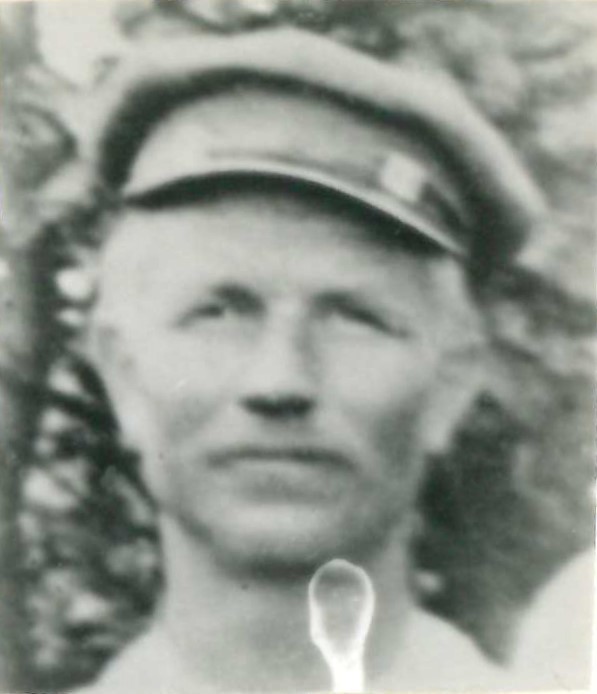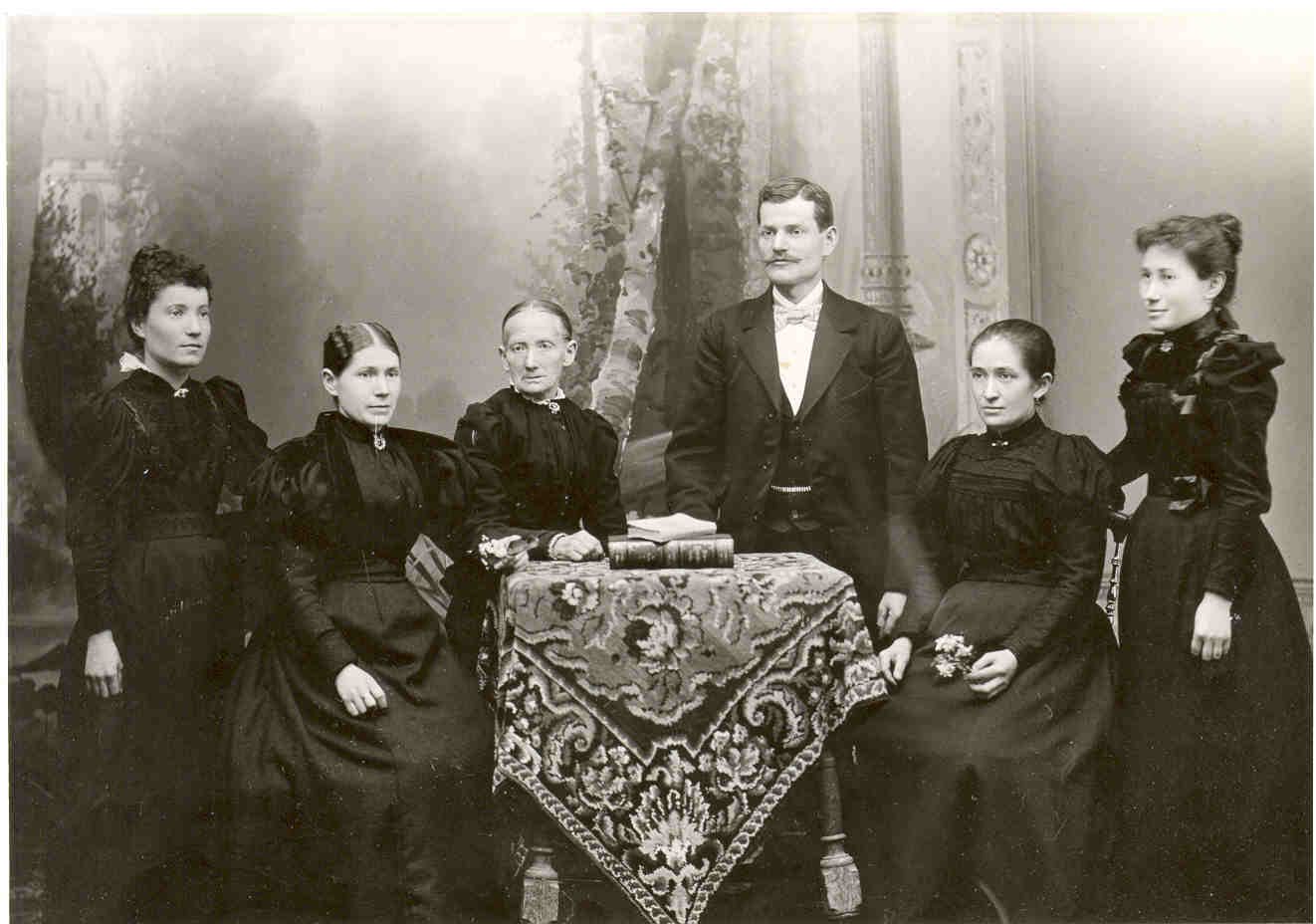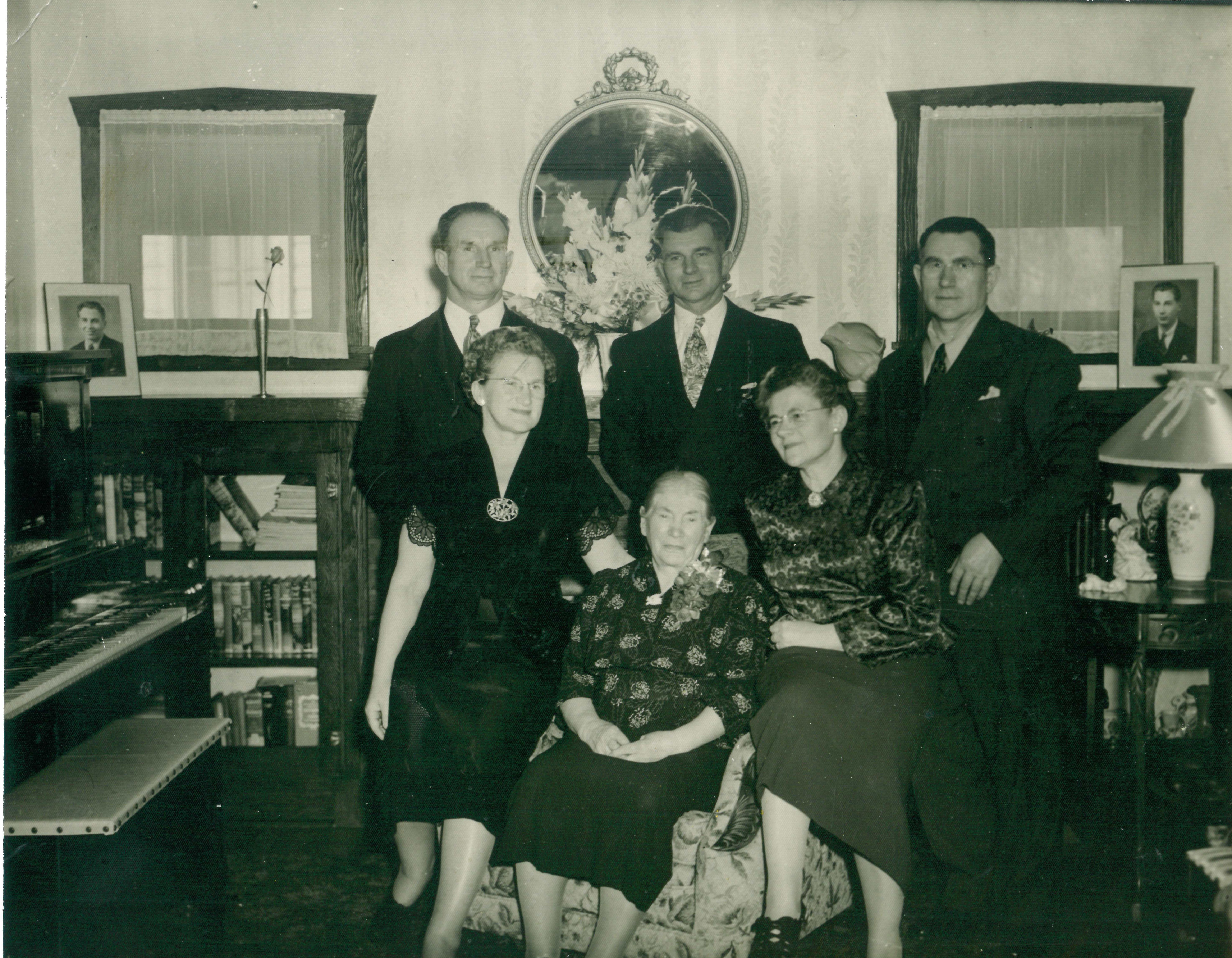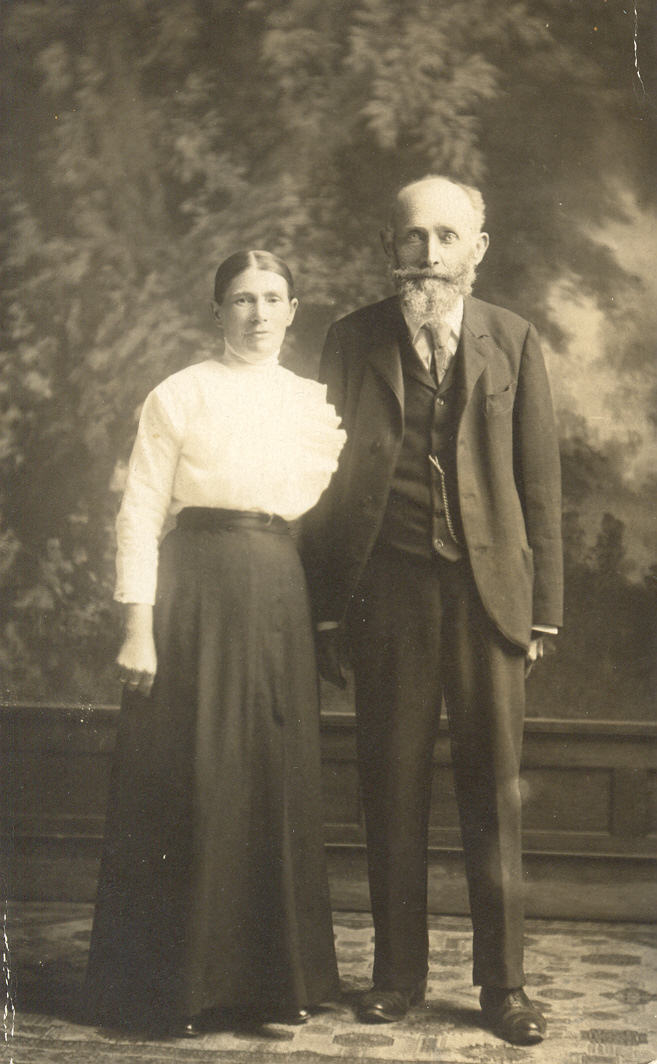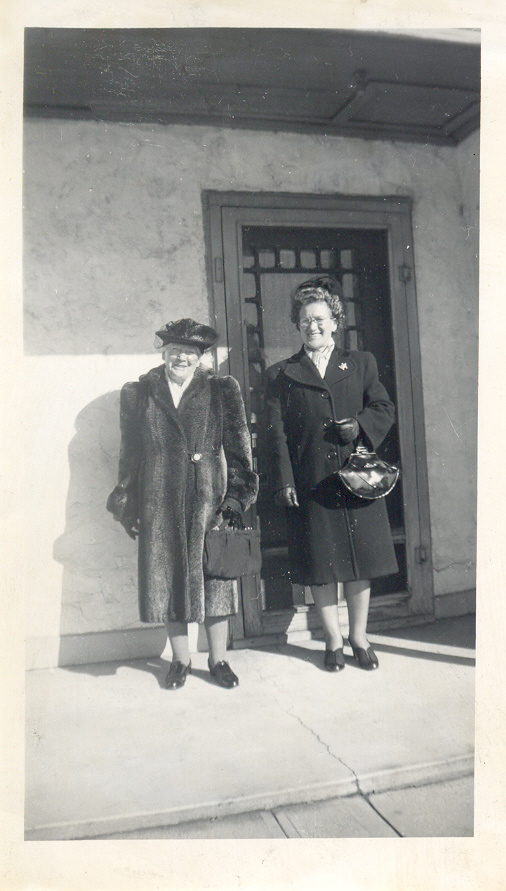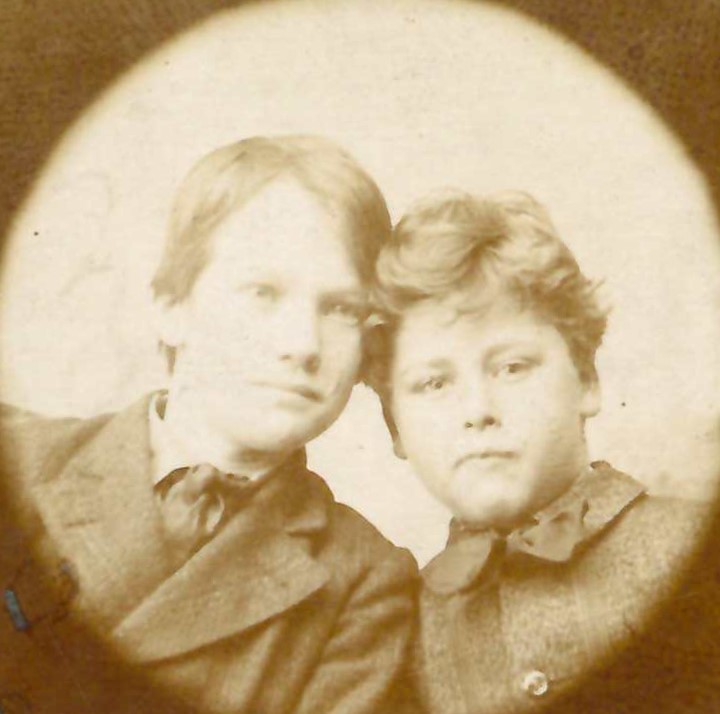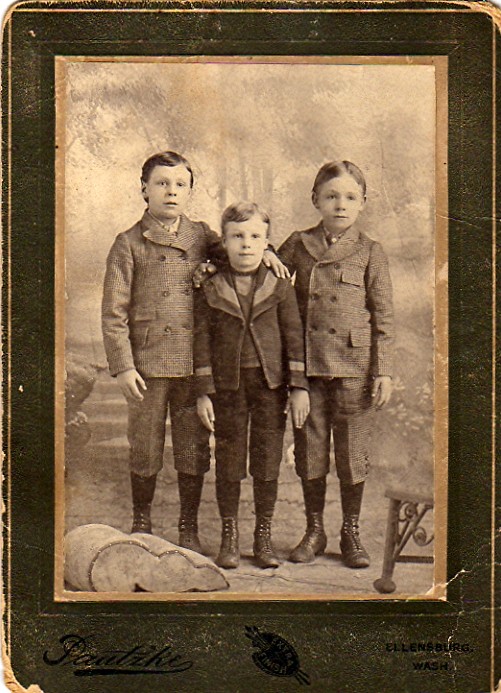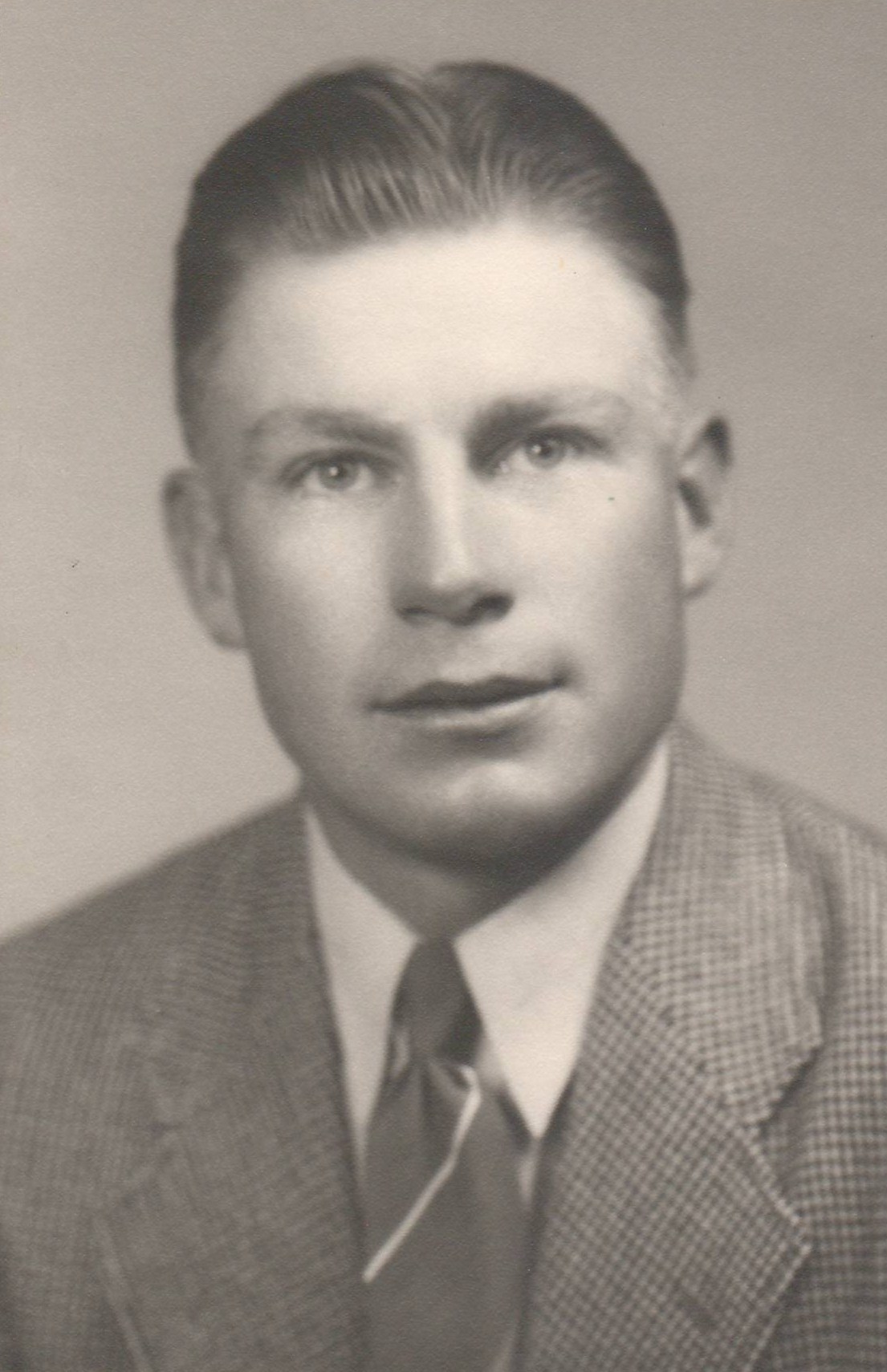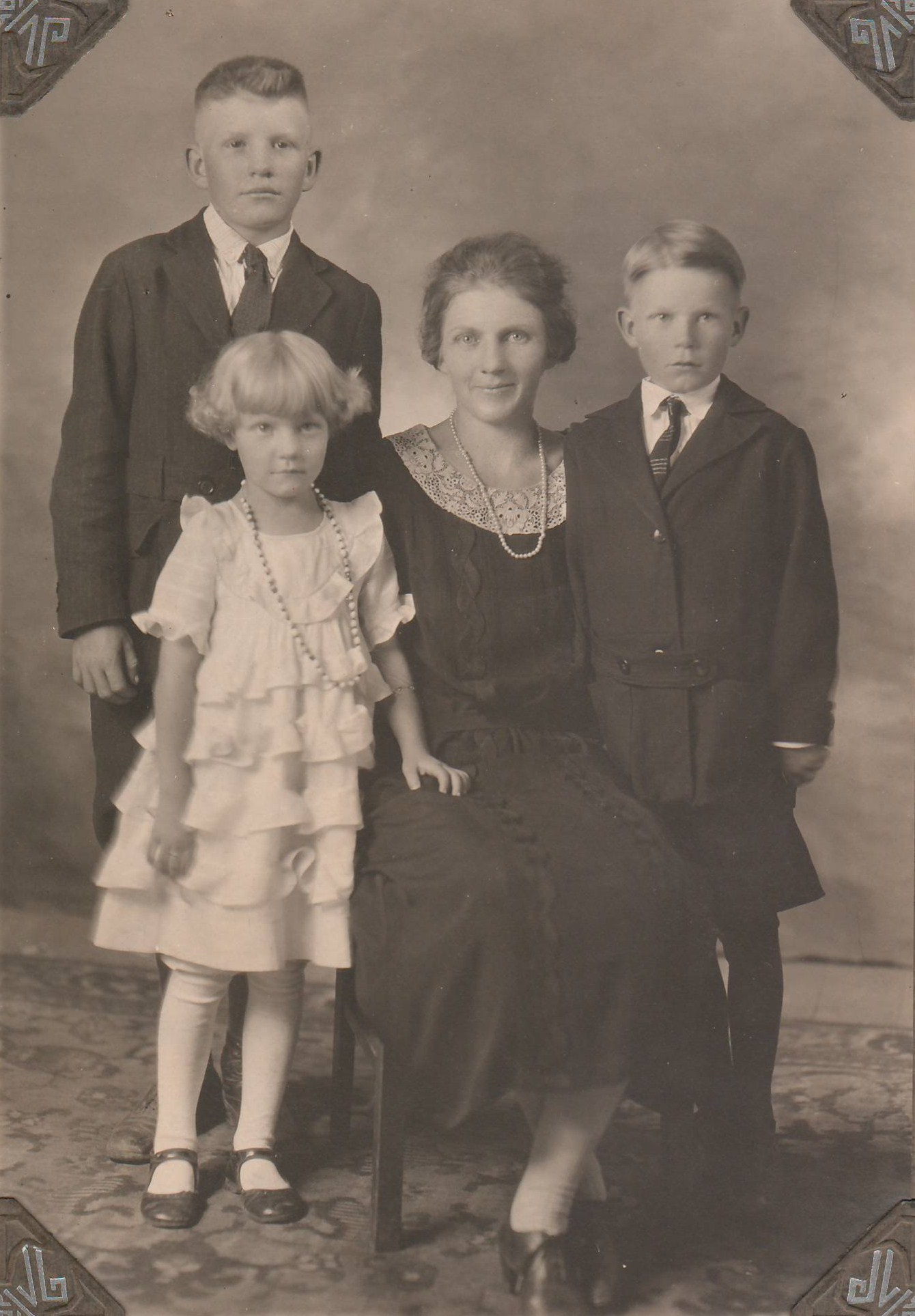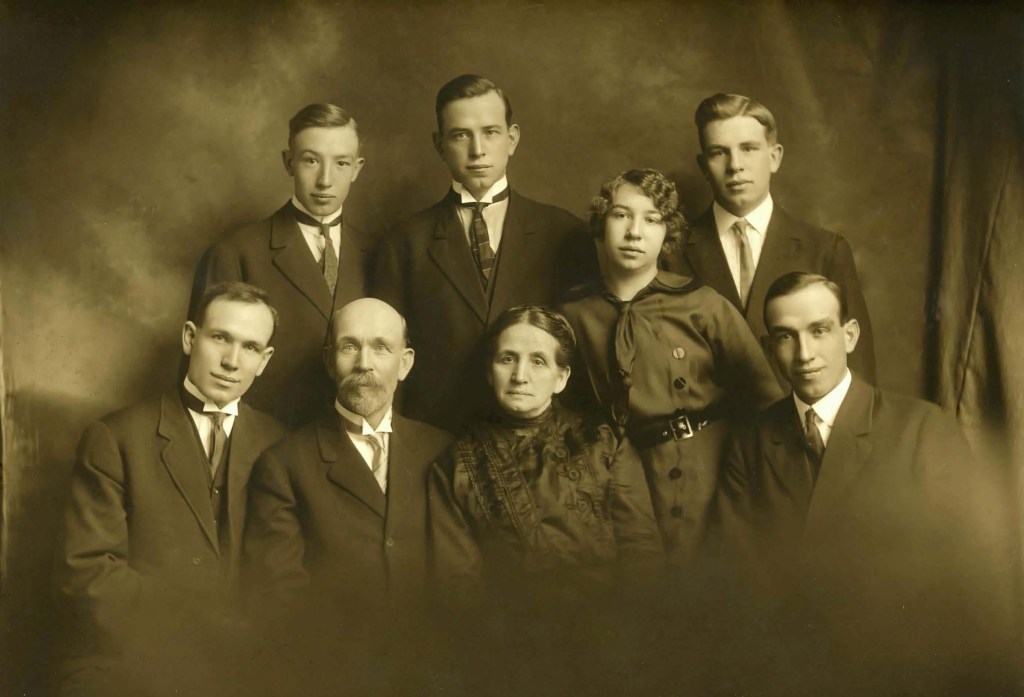
Back (l-r): Virgil, Lawrence, Fidelia, Moses. Front: Paul, Nels, Fidelia, August.
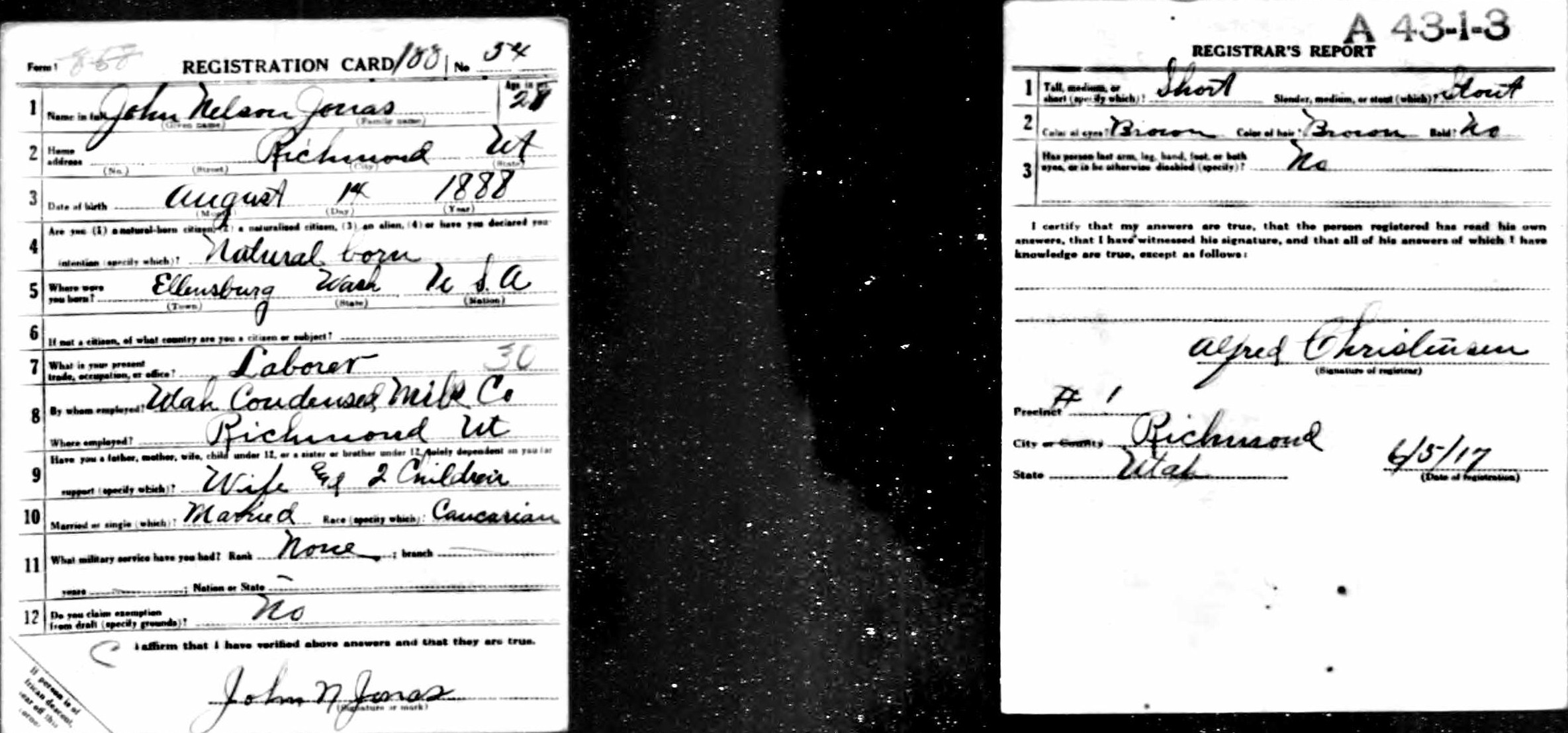
This is the autobiography of Nels August Nelson. He completed this autobiography in about 1930. For the most part, it is as it was typed. I corrected some obvious errors. I hope you enjoy because this took me over 4 months to get completely typed. It is 57 pages long and I would usually type a page or two at a time. Nels is the brother to my Annetta Josephine Nelson (Annie) who married Joseph Jonas.
~
Nels August Nelson, third child of John and Agnetta Benson Nelson, was born in Oringe, Hallands, Sweden, on May 18, 1857. My memory of the beautiful country around our home is still vivid even though I was not quite seven when we left. In 1861 we moved to Tulap, near Marebeck, a Swedish mile from Halmstadt. We had two wagons loaded with household goods. Mother and the four children were on the second wagon which father drove. I can still see the hayrack. It had four poles, two in the standard of the wagon, with holes bored and sticks driven in them to keep them apart the width of the wagon. Then there were holes in each pole on the upper side slanting outward so as to extend over the wheels gradually to about four or five feet high. Finally, a pole crossed the top of both sides and ends to keep it from spreading. This is the picture of it as I remember the morning we moved.
Our new home consisted of two long buildings, I should judge considerably neglected because father was continually repairing them between the hours on the farm. There was a peat bed some distance to the south of the house, a steep slope to the west, a small stream to the east, and cultivated land on the other side. Father planted trees from the northeast corner of the dwelling due East some distance, thence north and West to the northwest corner of the barn, forming a beautiful square. My recollection is that the trees were birch.
A road ran due east to the nearest neighbors. On the west a path ran to Marebeck. A public highway went through our place and led to Halmstadt. The village nearby had beautiful homes and churches. A large bell rang out at twelve and six, possibly other times. It seemed to say, “Vin Vellin, sure sell, some balhung, slink in” translated, “Water gruel, sour fish, come gulpdog, tumble in.”
At the north end of the farm the stream turned east where the bridge was. Just south of the bridge the slope was steep and below on the river bottom was pure meadow land. Along this river we children herded the cattle and sheep. In the three years we lived there father broke up all the land except the meadow. This was all done by man power. A man would have a “shere chick” which he pushed with his body. It cut a sod about two inches thick and eight or ten inches wide. When the sods dried they were piled up and burned. The woman did most of the piling and burning. We had such a heavy crop of potatoes on this new land that the land burst open along the rows and the potatoes could be seen on top of the ground from the road.
Now a few incidents of child life in Sweden. The school teacher boarded round at the different homes of the pupils. I marvel now at the progress they made. My sister, only ten, knew most of the New Testament, and my brother attended only one winger when he learned to read and write.
One of our cows swam the river while we were herding one spring. When we drove her back she missed the ford and got her horns caught in the roots of the trees and drowned.
Baking day was a big affair because mother baked enough bread to last a month. It seemed to improve with age. It took a lot of wood to heat the oven. On these days sister and brother had to tend baby and I had to herd the cows alone. One day I rebelled but it did no good. I was about five years old. James helped to drive the cows down to the pasture and about all I had to do was to watch the path to prevent their return. I had not been there long when I conceived the idea of driving one of the cows across to river to see her swim. I chased a black one till about noon before I succeeded in getting her across. Then I went home and told mother that I couldn’t herd the cows.
They questioned me but I made good my story and Matilda and James went around by the bridge and brought the cow home that way. After that they herded the cows and I tended the baby. Now that I think of it, this was a stupendous evil conception for a little apparently innocent child. After I got to Utah I had a similar experience. One fall, a fox bit one of the lambs. Father must have seen him catch it because he picked it up and brought it home before it died. Oh, how bad we felt! All the animals on the farm were pets.
One winter there was no snow on the ground but there was ice on the river. Three of us went down to slide on the ice. We were forbidden to slide with our shoes on because it wore them out. At first we slid with our stockings on, then we took them off and slid barefoot. The ice was so clear and smooth that we had a good time. Then Uncle Lars Benson came and helped us put on our shoes and stockings. I was the smallest so he carried me all the way home.
In the spring of 1862 mother went to the old home to bid her mother, Johanna Bengtsson, her sister Ingar, and brother Nels and John, good-bye before they started to America and Utah to live with the Mormons. She brought us all of Uncle John’s toys. One I remember especially, was a little cuckoo.
It must not have been long after when the first Mormon Elders came to see us. Andrew Peterson of Lehi was one. Later Uncle Lars came and visited us. It is beyond human pen or tongue to describe the feeling of love and peace that entered our home. We children would run up the road to look for the Elders. I was five years old, (if mother got baptized the same winter that we left in the spring, then I was six). When the Elders instructed father to get his father around the table and have family prayers, I got up from that prayer with the light of the Gospel in my soul. Everything had changed! A new light and a new hope had entered my being. Everything seemed joyous and more beautiful and even the birds sang sweeter.
After we joined the Church there were numbers of people, young and old, who came to visit us. I remember Andrew Peterson and the mother of the Lindquists who were undertakers in Ogden and Logan. When we were getting ready to come to America the sisters would come to help mother sew and get ready. The songs of Zion that they sang will ring in my ears and soul to the last moments of my life if I continue faithful to the end. “Heavenly Canaan, Oh Wondrous Canaan, Our Canaan that is Joseph’s Land. Come go with us to Canaan.” are some of the words one of the sisters sang. “Ye Elders of Israel,” and “Oh Ye Mountains High,” were some of my favorites. The Swedish language seems to give these songs more feeling than the English. I had a bird’s eye view of Zion and longed to go there.
I well remember the morning mother had promised to go to Halmstadt to be baptized. We all arose early and mother was undecided until father told her to go. In the evening as father was walking back and forth carrying the baby, he stopped and said, “Now mother is being baptized.” We looked at the clock and when mother returned she said father was right. The baptisms had to be done at night and a hole cut in the ice but mother felt no ill effects of the cold.
We had a public auction and sold everything in the line of furniture and clothing that we could not take with us. I remember two large oak chests and a couple of broadcloth suits and over coats. One they brought with them and it made over for me.
Father was a steady and prosperous young man, he worked seven years in a distillery and seven as a miller. We had a small keg of whiskey every Christmas and the children could have what they wanted of it. We often sopped our bread in it as a substitute for milk. I never saw father drunk.
Now came the time to sell the home and farm. The ground was all in crops and a rain made everything look good. Father said it was God who made it look so prosperous and we got a good price for it.
James, Matilda, and I with a big part of the baggage were left with friends in Halmstadt while father went back for mother and the younger children. The morning we were to sail was a busy one. We all did what we seldom did before, we messed the bed. Mother said, “The Devil cannot stop us,” and we were on deck in time.
It was a beautiful Friday morning, 10 April 1864, when the Johannes Nelson family hustled along the rock-paved streets of Halmstadt to the docks. The noise of the horses feet and the rumble of the vehicles drowned all the voices of the little ones who complained of the unceremonious departure. Then all were safely on board, the gang planks drawn, and before we knew it we were out at sea and the men on the shore became mere specks. (Sailed 10 April 1864 at 5:00 PM on L. J. Bager to Copenhagen. Then the Nelson’s traveled by ship directly to Liverpool (some of the others traveled by rail and steamer through Germany and England.)
Later, we were all startled by the sound of a shot ringing out and we were ordered below deck. When we could return to the deck we were told that a pirate crew had shot a hole in our ship just above the water line. In return, our ship shot off their main mast.
As we neared Denmark, we saw all the ships in the harbour and could hear cannonading as Denmark and Germany were at war. We walked around in Copenhagen and saw the fine homes, lawns, and statues, in the beautiful city. This was the first time I had heard the Danish language. We stopped at so many places that I cannot remember all of them. Cattle and sheep were loaded on at one place. We were seasick too, with so many people crowded together.
Before we left Liverpool we enjoyed watching the ships being loaded, fishing snacks came in and unloaded their cargo, and big English shire horses acted as switch engines. There was a large ship about finished in the dry dock. It must be stupendous job to build a huge ship. There seemed to be some leak at the gates because we saw a man with a diving outfit on go down and men were pumping air to him. He was down for some time. The beautiful green foliage and sward through England has always remained with me. It passes into the sublime of my soul.
The ship which we boarded to come to America was a huge one. Before it was loaded it stood so high above the water, and we had to wait some time while the sailors loaded heavy freight into the hold. (The family rode on the Monarch of the Seas. The ship departed from Liverpool, England on 28 April 1864 and arrived in New York City on 3 June 1864.)

Monarch of the Sea, 1020 LDS passengers on this voyage.
I have always tried to forget the journey across the Atlantic. Our rations were raw beef, large hard soda biscuits, water, mustard, and salt. Sometimes we would have to wait most of the day for our turn to cook our meat. Brother James knew no sickness on the whole journey, and was a favorite with the sailors. On one occasion he was riding the loose timbers that slid back and forth with the motion of the ship. At another time he went so dangerously near the railing that they sent him below. The winds and waves were so high sometimes that the flat on the main mast touched the waves as it rolled. Trunks and boxes had to be tied down. The vessel had three decks and there were bunks all around on the two lower decks. I had seen several bodies go down the gangway into the deep.
Then came the day that baby Amanda’s little body with a rock tied to her feet was lowered into the water. A little later it seemed as if it were my turn, I could not eat crackers. Mother tried everything, but I got worse. Then she fed me the raw beef and I began to improve.
Many sailors say there is no such thing as mermaids. I distinctly remember father pointing one out to me. We did see many varieties of fish. Sometimes the passengers, men and women, helped bail out water when it seemed the ship might sink.

Nilsson family on the Monarch of the Sea passenger list
Finally we reached New York, and the main body of the saints took a steamer for Albany, New York. We crossed New Jersey by train to the Delaware River. We had to wait a number of hours for the ferry, and when we got aboard it was so suffocating that sister Matilda (Bothilda formally) succumbed. Mother laid her out under some tree on a beautiful lawn. The setting sun, and approaching dusk cast a hallowed gloom over the scene. We sat silently watching by the side of mother, while father was off looking for a place to bury her. It was a beautiful, and sad sight to see father and another man carrying Matilda’s body away from her loved ones to be laid in an unknown grave. The setting of the clear blue sky, and the twinkling of the stars overhead, shining down through the trees made a variegated carpet where we sat. It would be impossible to describe mother’s feelings as her oldest was laid among strangers in a strange land. But she was the guiding star of the family, and she knew we would meet Matilda again beyond the grave.
We went by train from here, and the first incident of note was the crossing of a very high, and long bridge, large vessels with high masts could pass under it. The train stopped on the bridge while another train passed us. A few days later we were informed that the bridge had collapsed. We saw much of the country that had been desolated by the Civil War. Then we were joined by the group that went by way of Albany. They were riding on boards in cattle cars.
The car we rode in had no cushions on the seats. Sister Josephine’s cheek began swelling, we thought from the jolting of the car. Some people recommended a certain poultice which ate the flesh off her cheek.
Next we went aboard a steamer on a river. It was restful for a few days. All of us made our beds on the floor, starting in the center by the main mast or flag pole. Then another circle started at the feet of the first. Brother James and I slept on a board which formed a shelf on the side of the shelf. The space between each shelf was large enough for a full grown colored gentlemen so there was plenty of room for us boys who were small for our ages. There seemed to be two streams in the river, one quite clear, the other very muddy. By this time we were getting tired with never any rest or change and the vermin were getting unbearable.
Josephine steadily got worse and mother realized that it was only a matter of time until she would go to join her sisters. When we reached Omaha Josephine was a corpse. With the dead child and the luggage to carry, father and mother could not help me. I remember that I crawled and walked alternately with my parents waiting and encouraging me. We finally got to the top of a hill where mother laid me on the grass among some shrubs while she and father went for more luggage. When I became able to walk I went down by the river and watched the people do their washing, and trying to get rid of the cooties before we started the trip over the plains. Several graves were dug in this place.
In due time boys and wagons from Utah arrived and everything was loaded for the trip. There was a stove and tent in each wagon. Then the luggage and two families were piled in and we were off for Zion.
At first there was an abundance of grass. I liked to watch the donkeys in the train. Day after day we traveled and the only living thing of any size was an occasional stage coach and the stations built along the way. One day I got out of the wagon and ran ahead until noon. After that I had to walk most of the way. One day two young women sat down to rest. All at once they screamed and jumped up. Then a man killed a large rattler where they had been. I have seen families take a corpse out of a wagon, dig a shallow grave and then hurriedly catch up to the train which did not stop. Then we got a glimpse of the mountains in the distance. We also saw large herds of buffalo. While camping one noon a herd was coming directly towards us. Some men rode out and turned them. To avoid a stampede of our oxen, we started out and the teamsters were able to keep them under control.
The first Indians I saw was at the stage station. There must have been several hundred of them and we could see their wigwams in the distance. We were now getting into great sagebrush flats and everybody was warned against starting fires. One day at noon we yoked up in a hurry because someone had let their fire get the best of them.
Now we began to meet companies of soldiers. They generally led horses with empty saddles. Next we saw where a fire had burned some wagons in the company which grandmother crossed in 1862. The whole country round was black and the grass had not started. When we crossed rivers, if they were not too deep, the men and women waded. Two government wagons were caught in the quick sand near where we forded. As we got into the hills there was a lot of elk, deer, and antelopes. One man on a gray horse did the hunting for the group.
Several times the oxen tried to stampede. On parts of the trail men had to hold the wagons up to keep them from tipping over. The most interesting of all to me was at Echo Canyon where we were told how the Mormon scouts had marched round the cliff and made Johnston’s army believe there were a whole lot of them when in fact there were very few. We found choke cherries along the road but they were too green. The last hill seemed the longest and steepest and we did not reach the top until late in the evening. The next morning everyone was happy. Cherries were riper and so good to eat they failed to choke. Happy beyond express, we hastened to get a view of Canaan and Joseph’s land, where the Elders of Israel reside, and Prophets and Apostles to guide the Latter-day Saints.
Having seen some of the big cities of the world you may imagine our disappointment when we looked down from Emigration Canyon upon Salt Lake City by the Great Salt Lake. We saw Fort Douglas where some of the soldiers were stationed. One aged man exclaimed, “Why the children cry here as they did at home!”
We entered the dear old tithing square and rested for noon. Now it was for us to decide where we wanted to settle. We decided to go to Logan and it happened that John, our teamster was going there too. While in the yard Sister Lindquist who had visited us in Sweden brought us a large watermelon the first I had seen in my life. She was a beautiful young woman and I thought was very nice.
We soon headed north with John driving the wagon and mother, father, James, and I walking behind the wagon. As we were nearing the outskirts of the city a good lady sent a little girl out to us with two delicious applies. How good people were to us! It would certainly be a pleasure to know these fine people. It was about sundown when we passed the Hot Springs and we kept going until quite late. When we got to the canyon above Brigham City we over took a number of wagons of Scandinavian saints.
When we reached what was called Little Denmark, now Mantua, we were feted by these good saints, and given a new send-off. It seemed such a long trip through the canyons, but interesting as the teamsters had a number of bear stories to tell. Later we learned that some people had been attacked by a bear at this place. We camped just below Wellsville near the bridge above Cub creek. The people here gave us some potatoes. They were boiled and their jackets all cracked open. This was a treat I shall never forget.
We arrived at the Logan public square about noon. There was a liberty pole in the center. On one corner was a lumber shack where all our worldly goods were put and the teams drove away. Father located a short, robust Swede who hauled our wealth into his cow yard and we made ourselves comfortable. We cooked over the fireplace in the log cabin. For a few days father did not have work so all four of us went out gleaning wheat. When threshing began with the flail, father was in his glory and never lacked a job.
The most important thing ahead was to prepare a shelter for the winter which was fast approaching. Logan was planning to take care of the emigrants and her future by digging a canal north along the East Bench. All newcomers were given a city lot to be paid for by work on this canal. At the same time the number of acres of farm land was apportioned with the number of cubic yards of dirt to be removed to pay for the land.
The first homes were mostly dugouts in the side of the hill. That first winter, father carried willows from the Logan River bottom which was our fuel. He cut some small green sticks short and buried a few of these in the ashes each night to start the fire in the morning.
We were just moved into our home when Annetta Josephine was born on 18 November 1864. She was the first child born in Logan Fifth Ward. (The boundaries of the Logan Fifth Ward were Boulevard on the South, 300 East on the West, to the mountains, north to Hyde Park.) Mother was alone except for James and me. James was sent to fetch father who was threshing wheat for John Anderson. When he arrived with a sister, mother had already taken care of herself and the baby.
All went well until January when it began to thaw. Soon our dugout was filling with water. It was knee-deep when father made a path so we could get over to the neighbor’s cabin. We carried water out all day, and the rest of the water soon soaked up so that by laying a few boards on the floor we were able to go back in the evening.
It was a most severe winter. The snow was deep and it drifted so high that only the tops of houses could be seen. Thatcher’s mill, the only one in town, was frozen up, and we had to get along on bran bread. Father moved the cow to the side of the house that afforded the most protection from the wind.
As soon as spring started, all hands set to work on the canal. The men and boys had to pass our place on the way to work. The boys seemed to delight in calling us “Danish men”. James and I carried the water from the old Fourth Ward canal down on the river bottom. We always took a slide down the hill. This was all right as long as the snow was on the ground, but as soon as it began to thaw, we got soaking wet, and we usually ended up sick with bad colds. Poor mother had no time to be sick.
The first Sunday School we attended was in the cabin of John Archibald. Soon there were so many that we could not all get in. The Superintendent was Sandy Isaac, a find young man.
The summer was a happy one. Father bought two ewes, and they each had a lamb. This, with the cow, made a herd for me to care for. Most of the town drove their sheep past our place upon the college hill to feed. While we herded we also picked service berries. The boys showed us where the best berries were over on Providence flat. One day mother and two other women went with us. We crossed the river on the flume at the head of the canyon. Down among the bushes we sighted a beautiful black and white striped cat. With glee we pounded on him and threw him into the apron of one of the women. She yelled, “A skunk! Throw it away”. None of the boys got tainted, but the woman was in a bad plight.
This fall we were much better prepared for winter than we were a year ago. We had two cows, four sheep, and a yoke of steers. There was a barn for the animals, and we had a log house. We raised 120 bushels of wheat on the six acres, and mother had done considerable gleaning.
When mother went gleaning, I had to stay with the baby. One day I left her on the bed while I went out to play. She rolled off the bed and got a big lump on her head. She was still crying when mother came home. Some days she took both of us with her. When baby slept then I could help glean. Mother would carry a two-bushel sack, full of heads, on her shoulder and set the baby on top. It surely looked like a load to carry. James was with father. He would rake the hay while father cut it with the scythe and snare. Father did not like to have to go gleaning, but the money she got from the wheat was her own, and she liked good clothes and to be dressed well.
In the fall the ward was organized with a Swede and ex-solider as bishop. His name was Woolvensteen (Bengt P. Woolfenstein). The log meeting house had a fire place in the east end, and the door in the west. We held school in the same building. The teacher was a Scotchman named McGill (Adam McGill). He played the violin for the dances, and could keep on playing when he was apparently asleep. The dances generally kept up until morning. They are never-to-be-forgotten events in my life. They began around seven o’clock in the evening. About nine there would be some singing.
These songs filled my soul to over flowing, and I memorized them. Even now, there is an echo of them in my soul after fifty-nine years. The Crookston boys, and the Isaacs were such fine singers. After singing, we had games of strength, wrestling, and boxing. In the wee small hours we were ready to go home. These dances were opened and closed with prayer. We were a little rude, but the love and equality of spirit made up a real pioneer life.
December, January, and February were months I attended school. My first three months in 1865-1866 left me able to read in the second reading, which had the words grasshopper and perpendicular in it. I could also write a little.
I almost forgot one incident that happened in 1866. Father turned his steers on the range in the spring. One of these was to be given to the Indians to keep them friendly. The other one, Bill, could not be found. Father located the first one in the Indian’s herd. We went down and told them that this steer was his. “How can you prove it is your steer?” Father went up to him, took hold of his horn and led him to the Indians. They laughed and told him to take it. He led the steer home, a mile away, by holding to the horn. James hunted every where for Bill. He searched in almost every herd in the valley. In the anguish of his soul he knelt down and prayed. As he arose a feeling of satisfaction entered his bosom. He was soon rewarded by fining the long-lost steer. He succeeded in driving him home, and all were joyful and recognized the hand of Providence in answering James’ prayer.
More and more people moved into the ward. A great many of them were Scotch. There was a sixteen year old girl who used to visit with mother. One day she told mother she thought Mr. Nelson was a lovable man, and that she would like to be his second wife. Mother was delighted and did everything to get father to accept her, but in vain. From this time father’s carelessness became more evident. The girl married a non-Mormon and was lost to the Church. We all felt bad, and I suppose that had father expressed himself, there was a feeling of regret in his heart.
The year 1866-1867 surpassed the other because I found so many friends. There were the three, adorable Henderson girls, the Adams boys, Milley Mitchell, Bob Roberts, John and James Burt, and George and Bill Hibbert and his sisters and the Clarkston sisters. There were three families of McCullough’s, Archie McNeal. Of these I loved George Hibbert beyond tongue to express. One day the boys took me and laid me across a bench. I cried some and was discredited as a poor sport. That evening I still suffered, and did not sleep all night. A swelling developed just opposite my heart, and I did not go to school any more that winter.
Father made a fish trap out of willows like the one mother’s family had in Sweden. We had fish all of the time.
Every other week we herded cattle down in the fork of the Logan and Bear Rivers. It was seven miles from Logan. The banks of the river were covered with willows, where lived bears, wolves, snakes, skunks, and other pests. James herded alone most of the time. The Indians called him a hero. I stayed with him one week. The dog went home and I was ready to leave. The wolves looked defiantly at us and at night the snakes crawled over our faces. I was glad to stay home and herd the small herd near home. I had my prayers answered in finding the sheep when they were lost. I have never forgotten this incident which has pointed the way in my life.
The boys at school were telling us how we could see our future sweetheart. We all tried it with no results. One evening after supper, I tried it again. I walked backward out of the room, then backward into my bedroom at the back of the house. The room had no windows, so it was totally dark. I repeated the magic words, “Tonight, tonight is Friday night, and here I lie in all a fright, and my desire is to see , who my true love is to be, as she appears every day. To my amazement, the room lit up as light as day, and there on the board at the foot of my bed, sat a little girl. She was neat and clean, sweet as an angel. She remained there until I got a little fearful and I was left in darkness, the whole thing was the result of my unfailing faith. Later, I tried to pick her out among the Logan girls, but none answered the description.
After the sheep were gone, besides hoeing in the lot, I watched the fish trap. My broken rib right over my heart had become a running sore, and the rough times we boys had would not let it heal. A friend of mine and I got to fighting down by the fish trip. He was larger than I, but I got him down. I told him I would have to quit because of my rib. When we looked at it the hole went through in to my breast. Mother doctored it to the best of her knowledge and what the neighbors told her. It started to heal from this time and by fall was healed over. Today there is a large scar where this sore was.
One day while I was whittling away time at Thatcher’s mill, I noticed that a man had gone off and forgotten his pocket knife. It was a beautiful knife such as I had always dreamed of owning. When the miller went into another room, I took it and ran as if running for my life. By the time I got home I did not want it, so I gave it to mother. I told her I had found it on the Public Square. She seemed to doubt my word and questioned me severely. She put it up on the window sill and one day an Indian or someone else took it. Mother remarked, “Easy got, easy gone. Thank God for it”. Quite a rebuke for a guilty soul.
Another instance which mars my conscience happened as I drove the cows past a widow’s home. She had two sweet little girls just about my size. They called out to me to say “Good morning,” to them. I made a flippant retort which was unbecoming any respectful person. I told mother about it when I got home and she made me feel I had done wrong. I made a vow early in life that I would treat all women with respect, and never quarrel with any. I have lived with several including my mother-in-law and two step-mothers, and have kept the faith except with my wife. I could have done better with her.
I am grateful to the Sunday School Superintendent, his brother and sisters for creating in me a taste for reading. They had books of adventure which they loaned to me and were so kind and thoughtful. The Crookston boy’s signing has always echoed in my soul. The celebrations on the 4th and 24th of July were always gala occasions. The brass and marching bands were especially thrilling to me. To watch them drill, charge, advance, and retreat, and fight sham battles, was as good as a circus. On these occasions all five wards in Logan turned out in mass. The athletic events were highlights in my young life, especially when brother James was chosen Valley Champion of his age group.
On June 14, 1867, mother had a baby boy whom she named Joseph Hyrum. That fall we moved into the Fourth Ward. I soon learned to love the Bishop, Thomas X Smith. The people seemed to be a little more sober, and during the nine years I lived there, I do not remember a report of a sex crime being committed. There were Swiss, Hollanders, Germans, Yankees, and Scandinavians living in the ward. Daniel Johnson, a mason, was our neighbor. He had four sons, Joseph, Jacob, Daniel, and Erastus. He had a farm, herds of cattle, and an orchard which produced some of the best fruit I have ever tasted. He surely enjoyed sports and athletics. His home and yard was the gathering place for all the young people and he would sit and watch us play. He said he had never had a more enjoyable time than when chasing Uncle Sam’s soldiers in 1858. He had a small, snappy Danish wife.
On Christmas and New Year’s even, we stayed up on Temple Hill all night so we would be ready to serenade early in the morning.
I was in school in the winter of 1867-1868., with William Reak, the teacher. At noon we had to drive the cattle five blocks to water. The school was five blocks from home so we really had to hustle if we at any dinner. I think father was working at Echo Canyon. Our grain was completely taken by grasshoppers in 1867. The sun was darkened by them they were so thick. We had to sell our oxen, but we got $175 for them when the usual price was only $125. We had bought them four years before, and father always kept them butter fat. We bought a pair of two-year old steers for seventy five dollars, and grain with the other seventy five. Then father worked on the railroad, and James and I gleaned corn. James traded a good pocket knife for corn. Again we traded corn for shoes. There wasn’t money enough for us to go to school that year, but father bought a large Bible, and the two of us read through to Chronicles the second time. Here I gained the fundamental principles of the gospel which helped me throughout my life, and I always knew where to go for information, God and the Bible.
Before I left Sweden I began to have night dreams of visions, because they came to me before I went to sleep, just as soon as I closed my eyes. To illustrate: An aunt (by the way the only one of grandmother’s family that did not join the Church) made a very harsh remark to my oldest sister, Matilda. The spirit and vision informed me that she cut Matilda into firewood. I saw the wood and knew it was Matilda. When I was suffering with the broken rib and hole in my side, I saw so many things of this nature. I saw the devil in the form of a large dog, mouth open and came lolling out, ready to grab me, so much of the time I did not sleep until exhausted. From about age eight until I was almost twelve years old I did not thrive physically. Then these night visions stopped and I was able to sleep peacefully.
I loved animals and especially sheep. The stories of the Bible shepherds, David and his flute were dear to me. While herding, I would divide my dinner with the lambs. They became quite attached to me, and would come running when I opened my dinner pail, then I would lie down and they would run and jump over me. I managed to get them running in a circle, up my feet, and jump over my head, which I raised as high as I could.
Father traded his oxen for a team of young mules, very poor, but gentle. The first time we tried to drive them was to a funeral. On the way home a dog rushed out at us and the mules were off. They ran hope and stopped at the corral. We learned they had run away they first time they had been driven. As long as we owned them we were in danger of our lives because they could not be handled. Mother did a better job than any of us in driving them.
The year that grasshoppers took our grain I furnished fish which I caught in the Logan River. There some chubs and some trout. The time when the hoppers were so thick I will never forget. I was fishing down in the river and an electric storm was over near Clarkston. There seemed to be an air current because the hoppers all rose from the ground and left in that direction and in a little while I could scarcely find any bait.
I think it was in 1869 that we had a glorious 4th of July celebration. A whole band of boys dressed as Indians and tried to pick a fight. Some of us really thought they were Indians. Then we saw President Brigham Young with mounted men riding alongside his carriage. Quickly we all formed in line along the main street and as he came along he would bow to us barefoot children. We really loved these men and rarely missed a chance to go to the Tabernacle to hear them talk. One time he asked the grown-ups to leave while the boys and girls gathered around the stand to hear Martin Harris bear his testimony about seeing the plates from which the Book of Mormon was taken. We were told never to forget these things and to always tell the boys and girls during our lives this story. I have sometimes forgotten to do this. Martin Harris was a school teacher when a young man, and came to the assistance of the Prophet by giving the money necessary to get the Book of Mormon printed. A short time before he died in Clarkston, he related the whole story of the part he played in the coming forth of the Book of Mormon. This incident belongs to 1868.
This year we planted two acres of sugar cane on some new land up by college hill. We hoed and petted that cane until it surpassed anything around. We barely took time out to each our lunch. Men working near said we were foolish to spend so much time on it. James was a very good working and a good leader for me. In the fall he worked at the molasses mill downtown receiving a half gallon of molasses for twelve hours work. Father hired a boy to help me hoe the cane at the same price. He never came to work on time so I sent him home and did the work myself. From one acre we got 175 gallons, and the other 225 gallons, a small fortune.
The last spring that I herded, father had about 75 sheep and 50 cows. There was no snow late int he fall and water was scarce. When I started home at night the cows would almost run to get to Springs where Greenville now is. Then before I could get to them they were in somebody’s field. I usually had a lamb or two to carry and had to run till I was exhausted. At last a small Swiss boy with only one cow to herd helped me out. He soon got tired of mixing with me but I did not let him quit. I have herded in the spring when it snowed so hard I could hardly see the animals. All others had gone home, but I had to stay because we did not have feed at home. My clothes would be soaking wet, and when a sharp wind blow, I got mighty cold. One time one of the ewes got lost. They had been shorn late so could not stand the cold and I found their carcasses later.
Mother sheared the sheep, washed, carded, spun, and wove the cloth to make our clothes. It was about 1870 when mother had the twins, Jacob and Jacobina. They were very tiny and lived only four hours.
Father was a hard worker. He cut hay with a scythe and snaith. One time a neighbor was vexed because his five acres had not been cut. Father when down on Sunday and did not come home until he had cut all of it on Monday. The man could hardly believe that it could be done.
About the time I got hold of a couple of song boos there were over a hundred songs in each book, mostly songs about the Civil War. I memorized all in one book and part of the other, put tunes to them and sung as I herded. It made me a very ardent American, and of course all loyal Americans were Republicans. My soul always craved new information.
Mother led the social set in this part of the ward. I would listen intently as she related different incidents that were told to her at these parties. One pertained to our friend, Daniel Johnson. He had married a young woman after his first wife had no children. But after consenting to the new wife, she gave birth to a son and then very soon after two sweet girls. Almost the same thing happened to a fine young Danishman who moved into the community. He wore a stove pipe hat and was nicknamed Stovepipe. I cannot recall his real name. His wife’s name was Karen. When she consented to give him a second wife she had a son herself.
In the fall of 1871 father bought ten acres of land planted to hay and right along side the other five. I was sent out to drive a team making the road bed for the Utah Northern Railroad. I was fourteen, weighed 75 pounds, and had never driven horses. I was given a broken handled chain scraper and a balky team. With these handicaps, and jeers from some of the men it was a hard month or two for me. We had good food, so I gained in weight, strength, and experience. With the money earned father was able to bind the bargain on the land, though the fellow was sorry he had agreed to sell.
About this time we had a new baby sister come to our home. She was named Charlotte Abigail. I thought it should have been Abigail Charlotte, because Abigail was the name of the woman King David took while fleeing from King Saul. To my mind the baby was a jewel.
I gave the money I earned herding cows to mother who bought all of her clothing and always had a dollar or two on hand when it was needed most. She always looked nice in her clothes, being very tall and slender, with beautiful golden hair. At one time she weighed only 90 pounds. She loved her children dearly, but required obedience, that we be neat and clean, and attend our church duties. One morning before Sunday School she asked me to do some chore before I left. I said “No,” though I really wanted to do it. Mother grabbed a strap lying on the floor and hit me with a smart rap across the shoulders. A buckle on the strap cut my back and I yelled with pain and so did mother. She washed my back quickly and put a plaster on it so it would not be seen through the thin shirt., which was all I had on my back. Many times later in my life I have thanked God for that blow. It was just what I needed to get over being coaxed to do anything. I also learned to love mother more if that were possible.
Mother furnished the house and bought father his tobacco with the butter and egg money. Father was surely miserable at the end of the week when his weekly supply was gone. When I was allowed to go to the store to buy tobacco, I would put it in my hands and hold it over my nose so I could get a good smell of it. Father had quit the habit on the way to Utah, but some foolish men persuaded him to take a bite and he never could quit again. He tried one time and was so sick he had to go to bed and get a doctor to bleed him.
Brother James was quick to learn and was especially good at entertaining on the stage. A Mr. Crowther from the Salt Lake Theater gave him a part of a colored boy, and with only two rehearsals and no book., he made good and people were wondering who the darky was. Mother was proud of her boy. It was a lesson to me that there was room at the top for the seeming incompetent, who never had a chance, better saw who never knw what they could do.
All the boys in town received military training down on the Tabernacle square. L. R. Martineau always seemed to do things just right and I tried to do it the same and just as fast and good, which made it all fun.
About this time we had our last episode with the mules. They tried to run from the state. WE boys got out of the wagon to fix the chin strap on one of them. They leaped in the air and as they came down they broke a line and away they ran. One by one parts of the wagon were left behind. Father was thrown out with the bed. When we finally caught up with them, the tongue, one wheel, and a hub of the front axle was all there was attached to them. We were grateful that no one was hurt. We traded them off for a team of horses. The man who bought them drove along the railroad through sloughs and no roads and beat the train.
Mother made dances for us boys and served refreshments to all who were present. We had attended to terms at a dancing school the year we had so much molasses, and mother went with us the one term. This made us the best dancers in Logan. I had my first girl at this time. I had to leave town for a while so as we were playing in the street after dark I told her she had to kiss me goodbye. Girls usually say, “Don’t quit” and I kept trying until I got my kiss. When I returned she was my girl.
On my sixteenth birthday I weighed 105 pounds. That summer I left for Uncle Nels Jorgenson’s. He lived south of Hampton’s bridge, later named Collinston. We attended a dance in Deweyville and then went to work on a canal west of Bear River City which was being taken out of the Malad River. I enjoyed this job, was quite competent and efficient in whatever they set me to do. I could scrape and handle a yoke of cattle all alone, which others of the camp did not attempt. I also drove a team of young horses which grew steady under my care, but fractious when others drove them.
There seemed to be a thousand head of wild Texas cattle on the range. Most of the people along the canal did not dare to go among them on foot and were fearful even on horseback. They would stare and run around you in a circle. One day I was surrounded by a herd and it was with difficulty that I got back to camp. Uncle Nels would not let me go out on foot after that.
A number of people were very kind to me. Among them was Peter Rasmussen and the Mortenson family. Sister Mortenson was the essence of Danish kindness. She made the fires and did the cooking. Her daughter waited on us warming our hands and shoes before we went out to feed the oxen.
I crossed the ferry at Bear River City one beautiful morning bound for home when I arrived before sundown. I visited with Aunt Christine who used to care for us in Sweden.
I found James working on a gravel train and began working with him. Two would load a car, each one his half. George Watson, the boss, told me I could not shovel the gravel fast enough. I told him I could do anything my brother did. I almost failed the first few days. We would load as fast as we could, then jump on the car and ride to Mendon, unload and back again. When the job was completed James got work on the section at Hampton, and father and I on a railroad spur between Dry Lake, near Brigham City to Corinne. When we reached Corinne we were treated to all the beer we wanted. On the way back to Brigham City, the crew and the workers were feeling the effects of the beer. Father said, “You act as though you were drunk.” I retorted, “I have never been drunk in my life.” A man thirty five years old said, “That isn’t saying much for a boy. If you can say that as a man of thirty five you will be saying something.” Right then I made a resolution that I never would get drunk. Now at sixty nine I can say that I have kept this resolution.
This was a very prosperous year for our family. We bought a fine team of horses to do our farm work and we had work in the railroad. In October, mother gave birth to a little boy, Moses Nelson. She was very sick and we had a nurse to care for her. I always felt inferior to James, but one day mother called me to her and said, “August, if I die I want you to care for the children.” That had always been my job around the house. Later one evening, mother kissed me and said, “You have been a good boy, God bless you.” With a smile she turned her head and breathed her last. God along knows what little children lose when mother is gone. While sick I had heard her say, “I do not want to leave my little children.” Little did I know or realize what home would be without her. She was more than ordinarily ardent and spiritually minded, with high ideals, had a comprehensive knowledge of the gospel.
After mother was laid away, I was sent up to Richmond to work on the railroad. The weeks passed in a whirl. Soon baby Moses died, and father came up to work with me. James was with the children and took care of things at home. We soon returned and James started to school. I did all the house work except the starching and ironing. I was 16, Annette 9, Joseph 5, and Charlotte 2. The washing was a stupendous job. The water was hard. I tried putting the clothes in a sack when I boiled them to keep the hard water from forming on them. If only some friend had called and told me how to break the water and to put a little soda in the bread when it soured, it would have been a God send. It would have meant better bread and cleaner clothes for the next three years. I also had to shear the sheep. This had been mother’s job. I managed four the first day, and in time finished in some fashion.
I studied the old third part arithmetic that winter, also read the many striking lessons in the Natural Fourth Reader. Sometime in January Uncles Lars and Nels Bengston came and took James with them to Spring City in Sanpete County. I always loved that brother, the only one left who had come with me from Sweden. We sometimes quarreled but we were always together. Now we had no word from him for over a year.
I attended Sunday School regularly, and taught a class at age fourteen. I also liked to go to Sacrament meetings and Priesthood classes. I had been a deacon and was now advanced to a teacher.
This winter I attended school in the fourth ward. Orson Smith was the teacher and there were 120 children of all grades in the room. Daniel Johnson Jr was in the class ahead of me and I in a class by myself. We helped the teacher teach the younger children. In three months I passed through the third part arithmetic and to page 100 in the analytical grammar. The review was at the back of the book. I could ask most of the questions and tell the answers without looking in the book. English was a sealed science until it came to me as a vision. I had a problem on the velocity of sound. I worked on it from early afternoon until midnight, got up at 4 AM and worked till 10 AM and got it. After that I had confidence that I could solve any of them.
The baby, little Abigail, generally asked for milk during the night, but she would not accept it from me. One night I told father to lie still and I would give it to her. She refused to take it from me. I went outside and cut a switch from a current bush. When she called for milk again I held it out to her. She refused. I said to father, “Cover up,” and I struck the covers over him with considerable force. I sat down and began reading. Pretty soon she called for milk. I said, “Here it is Lottie.” She drank it and never said “No” to me again in my life. She grew to be tall and slender, had light golden hair, and had a sensitive disposition with high ideals. I have seen her sing on our gate most of a Sunday all alone because she felt her clothes were not good enough to mingle with other children. Before I left home in 1876, I could pick her up from the floor and dance with her. She had perfect rhythm and enjoyed going to the dances to watch. And oh how her little soul leaped with joy when she could get on the floor and dance.
My soul cried out for a mother’s love and care. I am very fearful that when mother sees me, she will say, “You have done tolerably well, but you failed to care for the children.” In my weak way I am still trying to care for children, everybody’s children, God’s children.
I remember when father married again. The woman had several children of her own. It was a sad day for mother’s three little ones when step-mother and her children moved into our home.
I cannot describe the feelings of regret I had when I left school that spring as I had to go to work in March. Seemed that most thought of school only to learn how to read and write. I always enjoyed Sunday School and coined the remark, “That if there was nothing more to learn or see than the pretty girls, it was worth while for me because their association threw a ray of sunshine along my paths the whole week long.”
I was in that age when young people were looking for something to do out of the ordinary. Most of the boys did a lot of mischief, but Daniel Johnson and I did not care to do that. At a bazaar we did buy some books such as Robber Tales of England, Dick Turpin, Cap Hanks, Duval, and a half dozen others. Also, the newest sensation which told about Coney Island and the New York Masquerades and Night Clubs. There were a few places other boys did not dare to go. My reading prepared me for greater ventures, or more correctly, more strategic assault. We made a few successful campaigns. Father saw us eating things he took for granted we had not come by honesty. He said, “Boys you cannot afford to do those things, you had better stop now.”
On the first of December, 1875, I started to attend school at the B.Y.C. (Brigham Young College) held in Lindquist Hall at the corner of 2nd North and 1st East. Miss Ida Cook assisted by another young lady were the teachers. Over a hundred young people were attending. I took some of the second grade class, that is, next to the highest. I soon discovered I could do the work in the highest in most everything. I had a method of explaining mathematical problems that seemed more comprehensive than the teacher which was a source of trouble to her, as it seemed on many occasions that my answers must be wrong, but I always demonstrated them to be right. On examination days she did not pay attention to a book being on my table as she knew I would not use it to copy the answers.
The Church was building a woolen factory south of the A.C. (Agricultural College, now Utah State University). I took Commercial Law and told father that some day I would be secretary of the institution. The building was never finished but I have always been glad I took the course. Miss Cook gave us a course in manners. We were taught to raise our hats to Apostles, Bishops, and officers of the various organizations and always to women. Those who adopted her instructions are among the leaders in the communities where they reside. As a rule I did we all the BY and was able to live nearer my ideal. I recognized my aged countrymen, both sexes, and could converse with them in their own tongue. On the whole, I was well thought of by all.
Just at the close of school I receive my first letter from James. I read it with pleasure, so much so that I did not notice the signature. My friend, Joseph Johnson, read it and then pointed to the signature. It was signed, James Benson. My feelings were indescribable. The brother I so adored had sent this insult. The reading I had done in the National Reader gave me good language to express myself and the letter I wrote must have made him feel ashamed. The influence of my novel reading was shown in the close of my letter. I told him as he had disgraced and disowned his brothers and sisters I would meet him half way and there fight it out and demonstrate who was superior. Had we met we would have done as did a year later, embrace each other. The incident really made me sick. I was in bed for three days and missed my examination.
I well remember Hans Munk who came across the plains in the same company we did. At that time he had one wife and was engaged to a young woman. As a lad of seven I would walk beside his wagon because of the sweet influence there. My soul was lighter in his company than any where else. Now he just lived a block from us in a big adobe house. His first wife had died, but he had two others, and the marshals were after him. He left home for a year, and when he returned his faith had cooled off and he did things unbecoming a good man. I felt sorry for him because I really loved him. He was part owner in a threshing machine. One day he slipped into the feeding part and one leg was chewed off up to his body. The first fast meeting he attended after he was unable to get around, he recognized God’s hand to save him from Hell. The Lord prospered him financially so he was able to raise three fine families and lived to be over eighty years old.
One time a group of young people went on a trip up Logan canyon. We had a bottle of homemade wine with us. I learned the danger of such rides, but was glad that the patters sent by Joseph and David were deep in my soul.
I had always been timid in water until Daniel Johnson came to the deep spring on our place and taught me to swim across it, around it, and how to float and rest. To this day swimming is a pleasure to me. I had just finished cutting 2 1/2 acres of wheat when brother Eliason, our nearest neighbor asked that we tie it. It was done in record time and went 20 bushel to the acre. Another time we started late in the day and cut, bound, and shocked five acres. I have chased a machine with five and six men all day to do as much. I built one of the largest and most artistic wheat stacks I have ever seen. Hyrum Bunce had just bought a new thresher and said it took a very strong person to feed it. I laughed at him and said that I would feed it or pitch with any man in town. I was 19 and weighed 140 pounds. The first demonstration came with two loads and a small stack. The crew did not have to stop for me.
I could not see in mind’s eye how any person could throw me down and keep me there. That represents my spirit and it was my gospel spirit too. When we played at school none could catch me. They formed a line by holding hands. I must not break the line so I ran up the side of the wall and over their heads. Such was my will power and spirit.
I believe it was the summer of 1876 that I made a large swing. Some of the Scotch boys were rather rough. They tried to take the swing away from me. Try as they would they could not loosen my grip on the rope. Later I was passing through the west end of the Fourth Ward where it was the custom to ding-bump any visitor. One grabbed my arms and two more my legs and one got on my stomach, but they did not succeed. One spring I had rheumatism in one of my legs and could scarcely get around. I had been helping father on his land three miles north of Logan. I limped most of the day but when some of the boys started to play ball, I defied the pain and really played ball. In a few days the rheumatism had left.
I worked for Brother Nathaniel Haws up in Logan Canyon, hauling lime rock to the kiln. The first week I could not lift some of the rock to begin with but by the end of the week it was easy.
I had my first Quinsy this summer due to wading in the mountain water while irrigating. My mouth closed so tightly I could scarcely get a table knife between my teeth and I was weak, but kept up with my work. At last I went to Dr. Ormsby who lanced it. While hauling the lime rock I got poison ivy all over my body. Daniel Johnson’s mother told me to make a strong solution of blue vitriol and put it on the sores. First I rubbed off all the scabs then quickly doused myself in the liquid. I never wanted to suffer again as I did then. The sores gradually went away, but I have poison in my blood to this day.
I had my try at tobacco too. An ex-bartender from Salt Lake City was smoking a pipe and I asked him to let me try it and I began puffing away. Father called me to one side and said in an undertone with so much soul that it penetrated my very being, “Don’t be a slave, be a free man. You have seen me try to quit the habit, even suffer because I couldn’t.” His advice, I felt, was too good to discard and I never took up the habit.
The 4th of July, 1876, was a big celebration, when all five wards combined and held it in Bishop Preston’s pasture. I was a member of the Central Committee. A bowery was built which had a stage and the decorations added to the festive occasion. A large swing was put up and I was given the job of swinging the girls in the afternoon. This was just to my liking, but by evening I had lost some of my enthusiasm. By doing this I became acquainted with most of the girls in all five wards of Logan, some of them the sweetest flowers that bloomed. A home cannot be made without one, a nation is not a home without them in it. A yearning lingers in one’s soul for a loving welcome and a tender touch of the hand whose heart beats all for you. The eye that beams on you alone, whose heart throbs strike true for you in every beat whether husband or son, I would not exchange it for all the world. They who prove true to God are most likely to make a go of their marriage.
It was 16 Oct 1876 when I and three other fellows started for the smelters in Sandy. The next morning the ground was covered with snow. We slept that night in a barn owned by a brother-in-law of two of the Johanson boys who were in our company. We were treated with plenty of beer. When we arrived in Sandy, we found the Flagstaff Smelter running a little, and the Mingo cold. The West Jordan was on strike. As we passed the Cooper Hotel, a mob ran out and told us what they would do if we tried to go to work. We slept on the floor in a back room of a place owned by Poulson.
One evening a number of women came and started to sing. Mrs. Rosengreen was one of them. When they finished singing, I started to clap. The women started screeching as one of them had been attacked by a man a short time before. We got out of there in a hurry.
I discovered that I longed to try some of the tricks of Charley Duval and other masked men of the time. I believed I could do them so easy and get away with it. I took a glass of beer twice a day with the others.
We decided to try to get work out at Vernon where I had two aunts and James was there too. It was about 75 miles southwest of Salt Lake City. I had no coat, only a dollar cash, and 19 dollars of Utah Northern mileage tickets, and a few buns, when I set out. I crossed the Jordan river and headed for the point near Black Rock. A boy picked me up and took me as far as Erda, where a family made me welcome to stay for the night. They gave me supper, and I spent the evening joking and whiling away time with a couple of young ladies in the home.
I left early next morning and soon came to Tooele. I had eaten the buns, and was pretty tired and weak when the stage came along. I asked for a ride but it kept going. The water along the way was so poor, nothing like the good Logan water. Feeling this way, I was in the mood to use a gun on the stage if I had had one. I drank water from the first rut I came to. This cooled me off a bit. I had been carrying my overalls in my arms but now put them on and walked with some comfort and determination. I decided that it is not the miles that we travel, but the pace we go, that kills.
I ate supper at Ajacks that night and slept with father Bennion. He took me on to Vernon and let me off at Aunt Ingra’s. I introduced myself to my aunt and began to make acquaintances with five little cousins. Auntie said that the baby, Etta, would not go to strangers, and sometimes not even to her father. I determined I would get her to come to me before evening. It was only a short time before she was sitting on my lap. I missed my own little sister and this was a near substitute.
I did not find James as he and John Benson were out near Point Lookout, about 20 miles away. When I got there James did not know me. We had not seen each other for three years. Aunt Christine told me how James had mourned for me and told of the happy times we had together. It was a dear reunion but the Benson folly was in him. Although tired from my trip, I had to demonstrate my physical strength which surpassed both of them, though they were twenty one and I but nineteen.
They took me in as a partner with them and I began cutting pinion pine trees. James had cut his foot so used crutches. He gave me a thick, heavy axe, too heavy for that work. I had never fallen trees so I did not know such axes were the kind they used. James came over to show me how. He had a new axe. He cut on one side of the tree and I on the other. I felt his spirit at once. I threw that thick, heavy axe into the heart of the tree and it fell without my breathing heavy. We cut trees until about the first of December. Charley Dahl hauled us in to Sandy where we bought new suits, hats, and boots. We looked quite genteel. Folks seemed to think I had an air of city life and dear brother James was proud of his brother.
John Benson took his team and wagon and took James and me to Sanpete County. We went to Ephraim to see Grandma Johanson who left Sweden several years before we did. She was delighted with her grandsons. She had told her neighbors what nice people were hers in Sweden. Of course they thought she was boasting but now they could see that it was the truth. How nice it would be if we always lived to be a credit to our ancestors.
One evening the boys took me down to a place where they often told fortunes. They started to tell me something but I resented it so we began playing cards. An older man suggested a new game. I said it would be OK if everyone was fair. After the cards were dealt, I noticed that the cards had been stuffed. I got up hastily and said “Anyone who could not play an honest game of cards would steal black sheep and damn him, I could lick him!” I got my hat and went home to grandmothers.
Sunday evening on the way to church some boys threw snowballs at me. I walked back and told them I was a stranger in town and would not stand for it. Some of my sternness came from trying to be a gentleman and possibly influenced some highwaymen stories. I aimed to give due respect and expected the same in return.
Uncle Nels had two little girls, one could not walk as a result of the fever. I began to take part in the talk and general pleasure and stood well with all. Uncle Nels lectured evening evening on doctrinal subjects. John and James would go to bed but I remained up to listen. I really learned very much. We went to dances and James and I were more than ordinary dancers. I also sang songs and had a good time generally.
A Patriarch came to the home and everyone had a blessing. Uncle Nels, his wife Philinda, and her sister Fidelia, had their blessings. I listened to Fidelia’s blessing through the key hole when she was told she would have a good, kind husband and a family. John was promised a family, James a stupendous power over the elements, but no family. That was his downfall as he loved children but never married. My blessing has come true as far as I have lived for it. The Patriarch asked James and John if they held the Priesthood, but did not ask me if I had been trying to do my duty, he knew without asking.
Miss Fidelia was surprised that we did not mind if she listened to our blessings and somehow it seemed that hers and mine were somewhat similar. She had said that August don’t talk much, but when he does, it counts. What I had read in stories on the subject, I was now putting into practice. I also remembered some of the Bible sayings, A wise head keepeth a still tongue.” I took Miss Fidelia to several dances that winter.
While at Uncle Nel’s place I had a severe attack of the quinsy. I tried many things and the men of the house tried lancing it, but nothing seemed to do any good. Miss Fidelia told me that he mother had said< If August were my son, I would soon cure him.” I answered, Tell your mother I will be her son (I answered under my breath, in-law).”
Sister Fannie Kofford came up that evening and really fixed me up. After the herbs were steeped, the rocks hot, and plenty of hot water was ready, I was asked to undress my feet. I put them in a tub of very warm water, put a basin of hot water in my lap with herbs in it, and was covered over from head to floor with a quilt. The temperature of the water was kept constant by putting more hot stones in it. This continued until my whole body was wet with perspiration. A large, hot, linseed poultice was put on my neck and I was rolled into a warm bed and forbidden to move.
That sweet mother’s efforts and care would forbid anyone, with a spark of gratitude to a daughter of God, which I had, from disregarding her instructions. It was difficult to lie so still and continue sweating, but I did and by morning the swelling had all shriveled up. And I kept my word too, I became her son. In all our associations we never had a jarring word.
In Feb 1877, we started for Sandy, loaded with grain. Sanpete had no snow all winter but when we got to Utah County the snow was hub deep. Salt Lake Valley had none but was foggy and muddy. We camped in the foothills west of Lehi where the ground was frozen at night and pretty choppy and rough. We had hired an Indian, David Monson, to help us, so there were four of us. The wagon bed being too narrow, we made our bed under the wagon. That night will long be remembered as we had a difficult time keeping warm. Our shoes were frozen stiff and it was hard to get them on in the morning. We were at Camp Floyd that night and back in Vernon the following day.
James had an outlaw mare on the range whose mother even the Indians could not break her mother, and this colt seemed to be like her. We hitched her up with Dagon, a small brown horse, and drove up Vernon Creek where we made camp. I drove back to Vernon alone a few days later and made it safely. I never had a bit of trouble with her after that. I took a large load of coal to Stockton with a yoke of oxen. To save money I bought hay at Ajack’s and drove out on the prairie to camp. This was sometime in March. A thin blanket and quilted bedspread was all the bedding I had and a cold wind blew all night. I rolled up in the quilts and lay behind the ox yoke and waited for morning which seemed eternities away.
I hauled coal with my wild mare and she never gave me a moment’s trouble. Some thought I used some unknown art with her. Possibly it was because I whistled or hummed a tune when she seemed nervous. One load I got out in halves and the wagon would mire to hubs. I was always fearful the horses would not be able to pull out. I shouted for joy whenever I got out of a bad place. While I neglected praying as a rule, I thanked God for all my successes and recognized his hand in all things.
That year I had dug and hauled hundreds of cords of coal from the hills with the help of Dagon and the little mare. I turned her loose to graze and could catch her anywhere. She liked my petting and had never received a cross word or look from me nor a single lash of the whip. We both loved with seeming human reciprocity. My life had been made a success by her loyalty to me. One day James told me to make her stand still while I curried her. The hair was thin and her flesh tender so the comb hurt if I was not careful. He took the comb and went after her. At the first stroke she knocked him down with her body and the next time she jerked up the bush to which she was tied and ran down the canyon jumping and kicking at the brush between her legs. James jumped on Dagon and started after her. She must have ten miles before he caught her. When he got back both horses did not look like my two pets. They were so scratched and footsore.
David Munson, the Indian, and I were chopping trees. He was a good worker and I suggested that both of us chop on the same tree at the same time. We started on one about two feet thick and when it fell my side was past the heart. There was a faith in myself that approached my faith in the restored gospel. I for it, and it for me.
On the evening of May 17, it snowed and blew so cold that James and I could scarcely unharness the horses. When we awoke there was a foot of snow on the ground. The thousands of lambs on the hills were bleating for their mothers but few of them perished. As house room was scarce I took my bath in the creek, snow or no snow, and never felt any bad effects.
While we were visited at Uncle Jorgensen’s, Uncle Nels Benson came with a load of flour and suggested that we take it down to Milford and Frisco as the price would be high down there. I thought it was a stupendous waste of labor and loss of several hundred cords of wood I could get while away. Of course I was only twenty and new in the business world. I had given Braughton & Co my word of honor to pay for everything they had let me have on the time payment. This consisted of a new harness, chains, a good tent, provisions, and grain for the horses. I had paid some of the bill but still owed most of it. Like the prodigal son I left a good thing to find a better. We followed Nels Benson to Spring City. He had been very kind to us during the winter and helped us now.
I loved my team and the new harness, I never laid it down, or hung it on the brake, but what I covered it with a blanket. I cared for my horses first, last, and all the time. Folks were surprised at the way I took care of my things. When we got to the Sevier bridge near Gunnison, James traded me a five-year-old bay, nice to look at, for faithful Dagon. This horse seemed to to have spirit, but it turned out to be a nervousness which ended up with balkiness.
Next morning all the horses were gone. I struck out for Fillmore, ten miles away, then over the hills and back to Fillmore. I saw the other boys but they had not found the horses. I went north ten miles to Holden. The men here were rounding up all stray animals not on the range. Mine were not among them. I headed east through the cedars and then south back to Fillmore where I arrived at sundown.
I had been going all day without food and was determined to have food if I had to take it. The lady at the first door refused but the second was very kind. After eating I lay down in a lot and napped for a while, and then dog-trotted back to camp. I had traveled over sixty miles that day. The boys had tracked the horses and found them. The next day we reached Milford and Uncle Nels sold out and started back home. We went on to Frisco, or tried to. Many times I wished we were back at Vernon Creek. The bay would not pull, neither would the mule, and a large yellow horses was so lame she could not travel. How I wished I had my faithful Dagon! On top of this Uncle John lost his horses. Later in the summer I found them and I took them back to Spring City with me.
While working in the Frisco hills that summer, James told me that an infidel could beat any Christian in a debate. With all the earnestness and defiance in my soul I said, “He can’t beat me!” I immediately left him and went out to the cedars where I pulled off my hat and asked the Lord to help in my efforts. I told Him I would dedicate my life to the defense of Christianity and Mormonism in particular. My whole soul went out in the declaration. From that time on I began to lead out.
One day James took the name of the Lord in vain when speaking to me and I replied in the same language for the first time in my life. I left and went off among the cedars and wept. I now began to show my individuality. We agreed to a rule that he who profaned should apologize to the other. Also a system of economy was set up which prohibited cards, checkers, and other games that led to idleness and disputes.
One day James said, “August, can you lift that front wheel?” There was a large load of coal on it and the wagon was lower than the others. I tried and failed. He remarked, “I did.” The remark hit me like a dagger. Of course I could lift it! I had John get up on the tongue while he lifted. He failed. Then I told him to stand on the corner overhead and I lifted the wagon. Then he told me to stand on the tongue and I lifted it. He remarked, “If you can, I can,” and he scarcely did it. Then I said, “That was an insult, now you two apologize,” which eh did. Our backs were raw from lifting.
When I got back to Spring City, Miss Fidelia asked me to go to a Relief Society Conference with her. I heard two sisters speak in tongues and another sister interpreted. My spirit seemed to follow every sentence and when the interpreter spoke, I recognized the thought as those of the speakers. Uncle Nels always explained the gospel to us in the evenings and also while we were journeying along.
We got out and chopped cord wood for over a month and Uncle Nels hauled it and made quite a financial trip, even if we did all get “crummy” and after cleaning up we began for a heavy drive the next summer.
We had $500 which James took back with him to Vernon, where we went to make the men pay for our wood, which they had stolen. He was to be back at a certain time and I was set to set the pits afire so as to have them ready when he came back. I started the fires and discovered the two horses had gone back home. I could not follow them on account of the coal pits. When James and John returned they had a team of wild mares. The pits were very much destroyed as I was new at the job and the team was young.
We started gain to recuperate and get ready to go home for conference. I drove to Spring City to get a load of grain and to bring back one of the horses we had found on the river. On my returned I stopped below Salina and took a bath in the river.The wind was blowing and the clouds covered the sun. That night I was very sick. My throat was swollen and I could scarcely eat anything. The road up through the canyon was all up hill. I fed the mares nine quarts of oats at noon and then went on. After going some distance the horses began trembling in their shoulders so I fed the same amount of oats again and made the summit with ease.
In the afternoon I passed Cove Fort. It is a rock wall about sixteen feet high built for protection from the Indians. The wall made one wall for each house built around the square. Antelope Springs was the next place and every one got a supply of fresh water here. I reached Beaver River bottoms by night. I could scarcely make myself understood as my throat was so swollen and I was so weak. There was still fifteen miles to camp all up hill and the last five miles was sandy road. Just as I reached the sand I met Axel Toolgreen who told me to take a dose of Humbug oil. We found enough muddy water to make up a dose. I began the last lap to camp and had to rest the team every little while. I had not gone far when the quinsy broke and all of the stinking corruption and poison came pouring out. I had no water to rinse my throat until I reached camp. John and James did not recognize me I was so pale and wan.
That summer we bought French calf skin boots with high heels and our names sewed on the tops. They cost us a hundred and twenty dollars. We paid for them with cedar posts. I got father a pair of sixes though he usually wore nines, but they fit him. In September we left camp in time to go by way of Spring City and visit with Uncle Nels who went with us to Salt Lake City. Here we bought suits, overcoats, trunks, and had our pictures taken in groups and singly.
I attended a Scandinavian meeting held in the Council House where the Deseret News building now is. Here I met a young man from Logan. A girl was tickling his knees. He said he had a date with three girls at nine o’clock that night and asked me to joint them. I told them I would be there. When I got away from them, the question was up to me. “Shall I follow them down the road of sin or break my word?” I concluded the latter and have made good the rest of my life.
On the sixteenth of October, just two years to the day when I left home I was back again. James and I aimed to be gentlemen. We had the best and most up-to-date clothes and attracted attention at the dances. I enjoyed the reels in particular. We also sent to school at the BYC (Brigham Young College). I felt the effects of two years of rude life keenly and was very timid. In course of time I got so I dared express my objections to questions wherein I differed. I found I differed most in the demonstration of mathematics. One examination asked us to name four leading vegetables. I said potatoes, beets, carrots, and parsnips. The others gave hay and lumber as two of them. They tried to show me that trees were vegetation, also hay, I knew that I was right and would not yield even though they thought I was foolish. I have lived to show my friends that I was right.
At one time Daniel Johnson and I were standing on a cordner near the big Co-op and I made the remark that I could tell a bad woman as fas as I could see her walk. “You can’t,” he countered. “What about that woman crossing the street a block north? She’s as doubtful Hell.” We waited until he recognized her and she said, “She is the most doubtful woman in Logan.” Then he wanted to know how I knew. “There is a loose hip swing of the legs in their walk. Of course all walks are modified by the dress.”
One night at a party at the BYC someone asserted that a certain lady was the most beautiful one there and asked my opinion. I thought she was if the beauty were measured by the amount of paint she had one. We all had our favorites among the fair sex. Mine was Emma Smith, though I did not like her seeming weakness and instability.
I formed a partnership with Jacob Johnson and three others and took a contract to work on the Idaho Utah Northern Railroad. I had a good big team, a new harness, and wagon. I helped father get in his crops before I left. James chose to go south with Uncles John and Nels and landed in Bristol, Nevada.
I suggested that our camp be called Johnson Camp, as I was opposed to being connected with a company. I soon found myself being manager, or foreman, as Johnson was away most of the time. On the way out the others all failed in cook,ing, so I took over that job. The first job consisted of filling a ravine with rock. Johnson went back to Logan and hired two miners, William Mitchell, and David Nelson. Mitchell was just married and brought his bride and her girl friend to do the cooking. There were fifteen teams and as many men in the camp. The road bed had to be made through lava beds which was hard to handle.
I returned to Eagle Rock (which is now Idaho Falls) and saw the men put in the steel bridge alongside the toll bridge. I had to go there to get a loan of grain for the teams. I usually spent my evenings at the dance hall. Here for the first time I saw a group of girls managed by a man termed a herder, they being under contract fr a period of time. Some of the girls asked me to dance or take a drink with them. I refused. Finally a young girl reputed to be of good character insisted that I dance with her. I told her I did not dance with her kind. A young man whom I knew from Logan and who had always been a careless fellow danced with her. He did not return to camp for about a week and when he did he came on foot and weeping because he had lost his whole outfit.
Early training and realization of the effects of sin upon our whole future here and through all the eternities gave one the strength to say “No.” I can still hear Frank Crookston sing, “Have strength to say “No.” Reading the life of Joseph was sold into Egypt and of the sweet flutist who gave King Saul peace of mind so he could sleep, also of King David, who later fell and pleaded with the Lord not to leave his soul in hell. Oh, how these pictures of the mind give strength of character which social customs and civil law fail to do in standing for the right, even to the giving of your life for the fight.
I discovered that unless we increased our pace the track layers would catch up with us and that would cost us $500.00 per day for failing to complete our work on time. I did my best to rush the men and teams but was failing. The men were rebellious and especially so when I announced we would work a Sunday shift. Saturday, at noon, feeling my incompetence, I walked out beyond a hill and in the sage brush knelt and prayed to the Father for help. I said, “Father, I cannot control these men unless you come to my assistance.” I do not remember the closing words, perhaps there were non, but I went back to camp a changed man.
That evening the men brought a trick to camp. A man would lie down, have his legs tied together with a space for a man to lock his lands and then try to pull the other into the fire. I asked Charles Larson, my step-mother’s son, if it was possible to do. He said he thought I could do it. I had been kind to him by reading stories to him. I did not realize then that he was jealous because his wife thought so much of me. I had taken her out and as was the rule I had always kissed her at the gate. The trick did not work for me. Instead of head first into the earth, which is the general rule, I kept my feet, and twisted around with the rolling man and received no great harm, only strained arms.
Sunday morning I stood up on the wagon tongue and said, “If Johnson has any friends in camp, we expect to see them out on the grade today.” I spoke in an earnest undertone. They call came out except Larson and Taylor, a prize fighter. An noon Larson picked a small man to show me that he could do what I had failed to do. He broke his collar bone and we sent him home with the women cooks. Taylor was now the cook. I never again felt unequal to my responsibility as a leader of men. By the close of the season I was recognized as the most successful or competent man on the road, both in handling men and making grade. I could leave the men all day and they would do even better in my absence. The track layers came just as we were through.
I thank God for the change of voice and the personality I possessed for his care over me in winning the trick and the rebuke that came to Larson. I have learned whom to ask for help. Two older men wanted me to stay and go in with them. I was twenty-two years old. The following was just one event that happened. Two of the men were rolling rock into the grade. One large rock was in the way and they were rolling theirs around it or lifting them over. I asked them why they did not roll the big one out of the way. They said it was too big to roll. I told them to try it again. When I returned a short time later it was still in the ground. They said they could not roll it. “All right.” I said very kindly, “if you can’t I can.” I gave such a stupendous heave, I almost broke my arm, but got it out of the way as the rock rolled. A foreman will not have to do that the second time.
I surprised all the men one day when I sparred with two men at the same time as they tried to get me down. One was my size and the other was a little smaller. The larger one stood behind me and grabbed me around the waist. As I was to all appearances going to the ground the other man came in to help. I pushed the first man to the ground with my right arm and grabbed the other with my left hand, jerked him on top of the first man and swatted his bottom as I jumped clear of both. Many incidents of interest occur in camp life. William Mitchell was an able minder, also fair in handling men. I was loading holes for blasting and he gave me the philosophy of it, and much good council generally. David Nelson never ceased to love that youngster of a boss.
One day I carried a fifteen-foot steel bar weighing 75 lbs up a mountain path that was lined with trees and also very steep. When I got to the top I was not breathing much harder than the men who followed with nothing to carry.
It seems that I should have remained in the north but some influence directed me south. All four teams came to Logan via Fort Hall, Soda Springs, and Bear Lake Valley. This was beautiful grazing country but too cold to raise grain. The Bear Lake was a heavenly blue and calm as a morn in June. This was in September and there was frost every night. There were only eight nights in August that there was not frost in Beaver Canyon near the Montana line. We came down Logan Canyon past the Temple saw mill. The scenery was beautiful with groves of pine and autumn colored Aspens and the luxuriant grass plants between. From the summit we could see for about twenty miles north and south. Some forest fires were burning. It seemed good to see again the place where I had bathed and fished. The water was never very warm.
Just after arriving home as I was going down town I met my favorite girl. She had her fortune told, and it said that a man in the north would fight for her when he returned. That was, of course, myself. As we passed (no street light) we recognized each other. By the time I got to the corner she had overtaken me and I stopped and chatted, nonsense I suppose. Others gathered and I remarked, “Well Miss Emma, as we are going in different directions, I bid you good evening.” I bowed and left.
I brought a large load of logs home with me and before going in to supper, I put my shoulder under the wheel and lifted the wagon tire off the ground. While I ate my supper two young fellows tried at the same time to lift and failed.
I had three hundred dollars which I gave to father to pay on his land. I was really to blame for not having the land deeded to James and me. Instead, I sold or gave him one of my horses to refund his share. He also gave father a new harness. When Johnson and Co settled up, he paid me $20.00. However the Company owed me $400.00 more but they had nothing to pay with. I was offered a job at clerking at $40.00 per month but refused to work for wages.
I decided to go out to Bristol and burn charcoal. Emil Drysdale, one of the partners was going with me, and James went as far as Spring City. I tool the $20.00 and stopped in Salt Lake City to get my citizenship papers. Of all things I was an American and a Mormon. I happened to find two Logan boys who acted as witnesses.
We started, practically without money, to travel four hundred miles, on the 5th of November, 1879, and it was snowing when we left. It is just possible that I shirked my duty and promise to mother to care for the children. Father offered me my lot, some of the land, and would help build a house if I would take the children. But I wanted to go and make money. When I think of mother’s charge to me, and the sad life of the children, my whole soul weeps over my dereliction, but fate drew me south. We went through snow, slush, and frost on the way to Sanpete. Uncle Nels and Aunt Philinda went with us far as St. George where they worked in the temple. We hauled grain which we sold in Bristol, except enough for our horses. Before starting I had traded my old horse for a young one. On the road to Ephraim the young horse caved in although he was guaranteed. I buckled on my pistol and rode to Mt. Pleasant, a distance of about 17 miles. When I arrived and told what the horse had done and that I could not start across the desert with such a horse, they agreed to give my old horse.
Uncle Nels, perfect in all things, did the cooking, but he failed with his yeast powder bread. I told him that no one could make good yeast powder bread by getting into it with their feet, or even using their rough hands. I baked the bread, stirred it with a knife, soft and spongy, and had good bread all the time. I did not even scorch it, although the wind blew many times. The first time I tried to make bread for my prospective paretns-in-law, I burned it back. It demonstrates care and effort.
The hardest part of this trip was over fifty miles of desert in deep snow. The remarkable thing about the journey was that the old pioneers of 1853 never had a word of complaint for the whole distance.
While we were unloading in Bristol, a business man stepped up to me and said, “You from Utah?” “Yes sir.” “Mormon?” “Yes sir.” “Are you going to stay here?” “Yes sir.” “What can you do?” “I don’t know. I have done about everything but herd hogs, but I believe I can do that too.” “You will do, you will do.” I was nicknamed the “Honest Mormon”.
Our camp was about 25 miles from Bristol. When I drove in for supplies I passed the evening in a saloon, as was the rule. One night many seemed to gather and I learned they were to serenade Nick Davis, one of the leading citizens. They were all signing and dancing jigs. I volunteered a job. Then they wanted me to drink, but I informed them I did not drink. I did sing a song. An Irishman, well raised, approached me thus: “I had just a good mother as you. She used to sing to me and I learned to pray at her knees. I am no ruffian. I want you to drink with me.” I took just a little sip, but had to keep sipping till after twelve. I could never go back to that saloon to while away the evenings when in town.
I slept in the wagon box that winter of 1880, which was so very cold. Thousands of animals died that winter. A man said, as he passed by one morning as I was getting up, “G– my boy, you have had a cold berth.” It was many degrees below zero.
I regret to relate it, but it is true. A neighboring camp in Frisco had two dishonest boys, one much older than we. They killed a cutter cow on the range and told us to come and get a quarter. There were six or eight of us and I thought it would be a good thing. While in the Bristol hills I saw a poor cow with a small calf. I reasoned that if we took the calf I would save the cow from death. That might be true but how frightened I was. I never received any satisfaction from the two acts.
I burned charcoal that winter and slept in a little hole with my feet right out in the weather. I had to get up many times each night to chop wood and put boughs over the top to keep the pits burning. Early in the spring Emil Drysdale began driving the team but he soon got the team too poor, so I took over again. This was hauling ore. It took a day to drive to the mine and a day back. The team was so weak that I got stuck many times. I would walk to lighten the load. One day I reached for the brake and fell into the rut of the wagon. The first wheel ran over my arm just below the elbow, the second struck my right knee. I straightened out in time so the second wagon grazed my head and body. I just cried for mother a little and drove down to the smelter and the foreman sneered at me and my seeming incompetence.
In time I went back to camp and the horses were in much better condition. We had coal of our own. Emil hauled and I chopped. I was able to stand on my feet until noon, then I knelt and chopped, and made a record cordage each day. We began to forge ahead, hired men, and were doing a good business. I hired a large, athletic fell, who bragged of his will power. He claimed that he could stop a stage and make all the people get off with his will power. He did have hypnotic influence with men but could not do anything with me. He acknowledged that I had some superior power. I knew it was the Priesthood. In speaking of President Young, he would say Brigham Young and then apologize, and said President Young.
After Emil had been hauling coal for some time, I went to buy a four horse outfit. There was a new road part of the way, full of rocks. I walked behind the wagons and picked up and threw out all of the rocks for ten miles. Emil admitted that it eliminated half of the seeming distance and more than half of the wear and tear on the team and wagons. I collected six hundred dollars the company owed James and my Uncles and also bought a double team and wagon with the amount they owed me. We used Drysdale’s team to drag in the wood and three span on two wagons hauling coal. We had ten men in camp where I did the cooking. The company sent out whiskey and two men to electioneer and prepare for the coming election. The superintendent, Howe, was running for the legislature on the Republican ticket. I had become a Democrat by studying the policies of both parties.
I was preparing to close down the camp so the men could go and vote the Democratic ticket. I had them all coming my way. My teamster, Joseph, was a fine, large German and had brought Democratic literature to camp. A friend of mind who had been working for me a long time was working with a rebel, Willie Peace, whom I had known in Frisco. Peace made a statement which I branded as a lie. I also used other strong words.
A few mornings after that while I was gathering the dishes he started talking as I approached him in my duties. I said, “That’s right, Willie. Stick up for yourself.” With that he struck me. My hands struck the bench and then I fell on him. His cousin pulled my head into Willie’s lap and held me there while Willie hammered my head with a rock. My teamster came in and threw the cousin off and we both stepped out reeling from the hammering with the rock. My head and face were all bloody. His lips and both eyes were swollen. Joseph said, “Come out here in the clear and finish.” I went and said, “Come, Willie, and I will give you what you want.” At that he threw the rock which struck me on the cheek, cutting a big gash. I picked up the rock and showed it to the men. I made and lunge at him and he cried out that he was through and I let him off. You will perceive that I struck only with my hands and that he gave no chance to defend myself. This was my only fight as I always tried to avoid such stuff.
I worked night and day. All the boys helped me to load every other night. After supper all hands helped to fill the sacks, sew them, and load them in the wagons.
Howe lost the election. Everything seemed to go wrong. On election day, Howe told me that if my men would vote for him he would win. I told him I understood that he had said that he could buy the Mormon vote for $3.00. I want you to know that you can’t buy my vote for the $2,000.00 which he owed me, nor for $3 million dollars, the price of Bristol. At that moment I put the price on my vote and character which has been a strength through my whole life. I could have traded my credit for a ranch with a large barn, sheep corral, the wall was eight feet high and cost over $800.00. There was a good two-story dwelling, hotbeds, and a stream of water with sole rights. My inexperience could see me living there by myself and losing my faith and I would not lose that for the world. I could have rented it. I was also offered cattle to stock it on time. A fine village could have been built there. Now it seems child foolishness to reject such an offer.
I moved to Bullionville and Panaca, a Mormon village. We reached Pioche by noon through snow over one foot deep. It took about two hours to dig through the drifts in one place. The Godby Hampton Co was doing business at Bullion. I had delivered coal to them at Frisco. We made our camp about fifteen miles south of town in the timber. It was done so quickly they named me, Nelson the Rustler.
I brought most of my men with me from Bristol. James joined us with an extra team. We had paid $50.00 per ton for hay and $70.00 for grain in Bristol, we now paid $30.00 for hay and $50.00 for grain. Even so, five teams and a large number of men ran up the store bill. The teams were idle as the smelter was not ready to receive coal. For a week I could not sleep because of the responsibility. The store began to try limiting my credit. I went down myself and talked to George T Odell, one of the clerks. I informed him that we would not stand by any trimming of our orders. I paid in stock in our Company $1,000.00 for an interest in the Benson mine, of which James was the boss, so he became an equal partner with me. Emil Drysdale became a hired hand when we left Bristol. When we began hauling in the Spring we were $2,200.00 in debt. I was only 23 and that amount seemed enormous.
Th first load we pulled out from under the trees had four span of horses and all the men came out to see us get started. My left leader, a faithful animal, looked back at his old mate on the right wheel and gave him some of his talk and the wheel horse answered by his action. We had unmatched them. I asked the boss to put Sailor with Billie on lead. When he was being led up Billie kept talking and rubbed his nose on his old mate. When I straightened up the lines, I gave them a little swing pull and the leaders stayed in their collars. The others felt the wagon move and away they went. I dared not stop for fear of miring until we got out on the road. The boys were surprised at the way I dodged the trees with the four span and heavy wagon. I always drove when the driver said it could not be done.
We moved to the East hills and in June all debts had been paid. I attempted to show how much wood I could chop and put in the pit in one day. James and I were doing the night shift. There was only enough timber here for a small pit. I did not take time to eat dinner but ran in and swallowed a few cold potatoes. I finished the pit but the potatoes went through without digesting and my stomach was never the same again.
I drove one team to Bristol to put through what I left in November. I hired a Catholic sailor, well read, to haul for me. I put up a 1,000 bushel pit in two days. The record by the Italians was three days. This pit held thirty cords of wood dug in with the limbs on, but chopped to fit smoothly in the pit and lapped with short pieces no longer than stove wood all over the outside. This Catholic sailor, aged 70, told me how mean and low Mormons were. He lived in Utah before I did. When he returned for another load I admitted what had said about them, but I told him they were as good as other people today. He agreed. If they were below and now are equal, what has made them advance faster than the rest of the world. I claimed it was the superior principles they had and lived by. He learned to love me and when we parted he said, “You are an influential young man, when you go back home start a library, and put in it these books,” and he named a number among which was Ancient Roman history.
The German hotel keeper at Bristol agreed to take the Company when I ran the bill with him. I left a Mr. Scot to send me the money for the coal to Bullion, after paying the orders which I had issued. I asked his opinion of our difference. He answered, “You are both good men. I cannot say that there is a difference.” When pay day came, I put Scot’s letter in the German’s envelope, and he took his pay.
When I left Bristol we concluded it would take a certain number of teams and men to keep the hauling up. James was left in charge. When I returned I could see by the work done and hear by the talk that there were three groups each endeavoring to run the camp. By noon I had cleared up considerable. After dinner a man about 35, who had come to the camp a wounded man made some remark about the Mormons and the whole camp roared. I sat to the right of him and retorted in no mistaken tone, “Any man who tells that to be true is a G– D—– liar.” You could have heard a pin drop and he apologized to me. He did not want to hurt my feelings. Another example was necessary.
It was understood that all were to help load the coal that evening. James had promised them melons. A six footer from Mt Pleasant stood up laughing and said, “Yes, we will go, yes we will go, and so will Mormonism.” At the proper time I caught him by the shoulder, looked him in the face and said, “Charles, business is business and must be tended to. We pay for what we want done. If you are going to do it, do so; if not, sit down.” They all went to work and when the teams came back the melons were there.
Again we aimed to be at Conference so quit early in September. The Company gave us extra for our coal. James and I were both expert at burning. We left with $1,500.00 cash and three teams. We put $1,100.00 in the Fourth Ward Store in Logan and kept $400 for expenses. We left our teams and wagons at Milford and took the train to Logan. We had decided to build a store east of Hans Munk’s during the coming winter.
We went back on the train to get our teams. James drove his and I had two Drydales. The first day at noon I fed all the horses without unhitching them. I took the bridles out of their mouths and left them hanging on their ears. Three of the horses were run-aways and one a colt. As I put the bridle on the gentlest, he snorted a little and I held my breath until I got the bridles on the leaders, then the colt. After that I began to breathe more freely. It haunted me all afternoon and I never did it again. By the time I got to Sandy the snow was almost knee deep. At Ogden it was slushy, but when I entered Cache Valley the ground was dry but rain was falling.
I put up at Daniel Johnson’s. His son was to run the store. I bought a lot on which to build, got in my winter’s hay from the Church Farm, and started to school at the B.Y.C. Miss Ida Cook was still there with J. Z. Stewart helping. Daniel Johnson Jr had been and still was a student. He had Darwin, Tom Paine, and Ingersoll among his books. He could outwit anyone in town for or against Mormonism. He ridiculed me for my positive stand. I read his books and listened to his philosophy which were generally illustrations. In school I picked up facts on theology to defend myself. By this time the Lord had given me an almost perfect comprehension of English. My faith had increased and when Sister Johnson was upset when the Edmund Tucker law was passed, she exclaimed almost weeping, “Polygamy never was true or the Lord would never have let them pass that law.” I knew [polygamy] was true. She had testified and I knew that what she had said was true, that after she had ceased to be as women are, she gave her husband a second wife, and the Lord blessed her with a son and two daughters. Another neighbor whose wife never had children, when she consented to her husband taking another wife, gave birth to a son.
I held my Doctrine and Covenants in both hands as if to open it and breathed a prayer, “Father, is there nothing in this book to ocnvince this good woman of the truth of this principle?” I opened the book and read to her, “When the Government passes any law which prohibits my people from living up to all the principles of the Gospel, then the sin rest on the Government, and we are not judged.” She was convinced. I knew from that time that the principle would be prohibited and told the people so.
God had prepared me to talk to Daniel Jr. One evening I cornered him so badly that his mother wept and his father was angry with him. I gave him the choice between infidelity and Mormonism. There was no room for him to evade the question. From that time on I felt confident that I could defend Mormonism. In his discussions he used such ideas as a man could not work with the same interest in a company as for himself. He was also accustomed to cheat in card games so I decided not to build the store. This brilliant man committed suicide a few months later.
When I first started to school I was so sensitive to criticism that I would turn black in the face and almost choke. One day Miss Cook stood by me and said kindly, “Now, Mr. Nelson, you can do better than that, try again.” In a few days I was all right. I did remarkably well that winter and was at the head of the class. I asked many questions that others failed to observe. Miss Cook had made my time longer than I had paid for and asked me to remain. I suppose if I had done so I would have had a call to Sweden on a mission. That has been my impression. I did not realize the privilege then. Some in the class had been there continually since 1876.
Some of the young men had broken the rules of the school. J. Z. Stewart spoke to them about it. The kind manner and the impression he made carried to the close of school and with me to the close of life. Miss Cook, Professor Stewart, and Orson Smith, as my teachers will never be forgotten.
When I left Johnson’s, the mother and three children hated to see me go. I had been the most cheerful and kind associate they had ever had. They asked me to forgive them for any thoughtless words or acts. Logan had been a dear home to me and little did I realize then that leaving it as a home forever. I long to go up there and stay for a month or so and visit with all my old friends. I am sure I left not a single enemy and I am sure the same is true of Crescent.
It was the first of March when I left Logan. I took Joseph Hyrum, then 14, with me. We had a difficult time through the canyon and the drifts. At Sandy we always stopped to rest up at Uncle Lars Benson’s. I attended a dance at Sharp’s, west of the State Road. A very smart young lady asked me, “What do you think when you think of nothing?” I replied, “I suppose I think of girls.” I had a real good time. I attended a M.I.A. in Sandy. Brother Lewis was President. He sang “Thou Wilt Come No More, Gentle Annie”. Brother Hewlett, an aged shoemaker, and some elder Doctor gave some intelligent and comprehensive talks on the ancient prophets with respect to the present day. We also called on Uncle Nels in Spring City and listened to a very good talk by a school teacher from Mt. Pleasant.
James came from Bullion and informed us we could have the tailing contract hauling. James handed over $700 in cash to Bynum Lane for a mine. He knew as soon as it was done that he had given his hard earnings for a hole in the ground which he never even went to see.
The morning we were to leave Milford our horses were lost. We had sent to Logan for $400 and bought two new wagons from B. F. Grant. Then we traded one of the wagons for a horse which proved to be not worth his feed. Arriving at Bullion I took a little outlaw horse I brought from Milford and with worthless Sam drove to Bristol where I traded Sam for another outlaw horse and $20 to boot. It was dangerous to hitch the two outlaw horses together.
I scrapped with them and soon had them gentle. I traded them for a team of mares, both died within a year. We sent for the last $700 and bought a scrap outfit, double team wagons. We traded my two outlaws, the best team on the job, and gave $100 to boot, and the new team was balky. James and my teams averaged $8.50 per day, and the other teams made some gain. When we quit that fall we had poorer teams and only $400 and yet we started out with $1,100. Once I worked for 36 hours without stopping. We were under contract to keep the smelter going. Then I got leaded so we decided to quit. It was then that I located Dry Creek in the fall of 1882.
On the way home through Spring City I proposed to Fidelia Ellen Kofford and was accepted. I was now aiming for a home. Uncle Lars had advised me to file on some land in Sandy in 1876. I told him I would not have the whole country as a gift. Six years later I was pleased to buy seven acres from William G Taylor, nephew of President Taylor. In closing the deal he treated us in Samuel Kemp’s saloon. We made another deal and he invited me in again. I told him I did not drink and that I had taken the first with him because I did not intend to be rude. He responded saying, “A young man just home from camp life and don’t drink!” and looked at me with astonishment.
We lived in a little house above the canal belonging to Fred Olsen. We associated much and confided in each other and I told him what an unworthy father and husband drink made of him.
I studied Gospel principles putting down the quotations; read about George Q Cannon in Congress, read Judge Black and Ingersoll’s arguments, and a book, “Elocution, Expression, English, and Manners.” I also studied the dictionary so I understood words, their derivatives, roots, and synonyms. I could bow myself out of a home with all the grace of a Frenchman. I am not saying anything about my love affair. We kept most of our love letters and they can speak for themselves.
I scrubbed my coat collar and put it on wet, then drove to Sandy and I came down with the quinzy which lasted a long time. I thought my palate would strange me at times. The anxious letters from my sweetheart were an inspiration to try and live for her sake. She sent me a Christmas present and a very nice letter.
Amelia Rollins, a young cousin, was our cook. James and Joseph were off to Sandy or elsewhere most of the time and she went with them some of the time.
Spring came and we worked on the railroad west of Ogden. I made it a point not to take part in all the light talk. One called out, “You don’t talk. What are you thinking about?” I answered, “I am thinking that if a tax were levied on all common sense, you fellows would be tax free.” An able intellectual fellow asked me why I did not talk. “I have but limited common sense and I do not wish to waste it on nonsense,” I replied. This blue-eyed six foot, 200 pound, English Mormon, left the Church as I knew he would. Just before he died, he call in Bishop Bills of South Jordan and plead with him to do what he could for him. He knew the Gospel was true and that he had strayed until he was practically lost. He passed away with regrets and a penitent soul.
I usually walked several miles to Ogden after supper for my mail. One dark night I met several girls merrily chatting as they tapped along the road. I always like to hear that kind because I knew they had good character.
My team needed rest so I worked single handed for a time. I first leveled the grade and then I filled scrapers to complete a sixteen foot high station as a guide to the rest. Some teams would go with a jerk, others slow, but I never stuck a team all day. I could take a tongue scraper with one hand and sling up one the side of the bank in filling. The other fellows stopped the team, used both hands, and a teamster one hand. All the bosses were fearful to attempt a complete station so they asked me to do it. I completed it and they marveled at the correctness of it.
When I returned to Dry Creek, Brother Taylor came to me saying, “I am a free man, I am a free man, I haven’t drunk for two months.” I was hauling mining timber for Bishop Holman. As we drove through Sandy, James Kemp came to his wagon and asked Billie to have a drink. “No sir, I have quit,” said Billie. “I wish I could say that,” James replied.
We took a contract to haul bridge material for the East Jordan canal. We went up Bell Canyon on a road that had been abandoned for years and seemed impassable. I drove from the white house on the hill; left the cart at the mouth of the canyon; took the front cart close to the roll-off; took horses and chains up to where James had cut and gathered them and snaked them down to the front cart, drug them down to the hind cart, loaded them up and hauled them to Draper past Henry Pearson’s. He was kind, gave me apples and cider, and chatted as an old friend. Sometimes I would go to Sandy and back for supplies. James decided my job was too difficult and he would cut and snake to the roll-off. While I had breakdowns and accidents we never failed to get a load a day, Sundays included, for over six weeks. We earned fifty two shares of water stock in the East Jordan Canal Co. We had bought almost forty acres of land.
I concluded to ride down to see the sweetheart up on the Sanpete where evergreens and pine grew on the level. I spent several days there. We had a love trysting place where I could stake my horse in the tall grass and Fidelia’s pet fawn would gambol at our feet. She would sit on my knee and read interesting stories to me. It was a most attractive scene, the horse in the open glen, the fawn, beautiful birds flitting from bush to bramble, and mourning doves echoing in their plaintive call.
All in all it called forth the sweetest and sublimest ecstasies of two souls whose hearts beat for each other. Blissful thoughts of the past are one’s life, what the ever returning spring time with its balmy air, fragrant flowers, variegated colors, undulating movements, as though beckoning one to come and enjoy, as they are to this beautiful earth of ours. When we have passed to the realms above, may the sweet memories of this scene, hallowed and sanctified by our pure love and devotion for each other and for God, linger in the hearts of our posterity as the most worthy heritage bequeathed to them. With all the ardor of my soul for God and His prophets, has been the yearning of my heart for righteous living. Yet the worst wretch who goes shivering by has my pity and regret. Condemnations belong to all merciful Father.
As I started home, leading my faithful horse with my left hand and my future companion for life and all eternity in my right arm, we walked slowly and talked of the future when there would be no parting. Suddenly we stopped, an ardent kiss and caress, and I was off, leaving her to meander back alone.
James and I took a contract to haul cordwood to the Eclipse Mind in the tops of the Big Cottonwood Mountains. We were to get $2.00 per cord but only one $1.00 per cord if it was not up in time. There were about five hundred cords. We started to haul but discovered that we needed help someone to haul hay and grain. I prayed the Father to send us help every morning as I got the horses, and promised Him of all we had made I would give one tenth to Him. He, God, sent a large company from Provo but Brother James objected. I knew that we were left now. The snow fell from every cloud that passed. James was down looking for teams, hay, and grain. I read Pinkerton detective stories, and boxed with a bag of salt to rest from reading. I disliked leaving our contract unfinished but that is what we did. We hauled poles to Timothy Marriot for hay, corn, and potatoes. We had a hog and feed for him and felt prepared for winter.
The reading I had done gave me the first view of the weakness of American Education. Isaac M Stewart Jr was a geologist and an educated man but did not agree with Mormonism on all points. At first we were chums. The Superintendence of the Sunday School in Draper was opposed to getting into hot water in the discussions. I remarked, “I never found water too deep to swim in, and errors, like straws, float on the surface, but he who would seek for pearls must dive beneath the surface.” We continued the discussions for about two months when the class all saw and agreed with my views. D. O. Rideout said he had learned more in six weeks than in the previous six years. In the summer Stewart debated with Supt Peter Garff on the subject, “Who is Most Loyal?” The subject was brought about through the celebrating of the 4th and 24th of July. I rose to my feet and was recognized by the chair. I said, “Every naturalized citizen must be as loyal as a natural born citizen, or indeed be a hypocrite.”
Later there was a school meeting held with William M Stewart as chairman. Dr Park was also there. He taught in Draper schools. Thy boasted of their education, I objected to their position, and held that their very fields showed the lack of education. Dr Stewart, later of the University of Utah, was so impressed by my remarks that he took the question to the Utah Educational Association and in the third year it was adopted as school policy. Forty years after that time, Thomas Spencer told me I was given the credit.
We had agreed to get married this winter and I would not be put off. With what I had and credit at Holman’s store I determined to start. I bought Fidelia a very nice coat, at least she looked well in it. When I got to Spring City I found she was in debt and a payment was expected. Charley Kofford, bless him, let me have the money. I was wearing James’ overcoat as someone took mine just before I left. I stood up in Priesthood meeting and raise my right hand and covenanted that I would attend my quorum meetings, keep the Word of Wisdom, and do my duty generally, and I meant it. I was ordained an Elder in the home of Pres James Jensen, with Nephi Hayward as mouth.
While in Spring City I felt very much humiliated because of the lack of money. A farewell party was held at the Kofford home, all of the speakers praised her, but scarce had a hope that I was OK. Father Kofford was asked to speak. He said in part, “I believe Fidelia got the man she loves, I know she did. I know she will be taken care of.” He then gave me some complimentary remarks.
We left alone in a wagon and were over two days on the road. On the 24th of January 1884 we were married in the Endowment House by Daniel H Wells. Uncle Lars Benson asked us to sup with them after which we drove to our home. Fidelia made pictures and ornaments and we were quite comfortable.
I went up South Dry Creek Canyon for timber to take out. There was a snow slide in the creek bed. I climbed so high up yet could not get over the ridge. I feared to go back. With caution I regained my footing and began the upward climb. All footholds had to be made with the axe and I knew that one slip and all would be over for me. I finally made it home before dark. The occasion gave us both quite a fright.
In the spring James and I were plowing for people in Sandy. A friction seemed to arise and Fidelia did not want to live there any longer so we moved to Draper. I had two lots and fixed up the house and we had a fair garden.
I took the contract getting out logs for James Jansen and Joseph Smith for $9.00 per 1,000 feet. I should have had at least $16.00 per 1,000 feet. I was new at saw timber. Miller Andrus worked with me a while, chopping and we slept at the mill. I told him we were not making a dollar a day. He left to cut his hay and I was alone. Brother Smith was working on a road below me and called to see if I was all right before he left. He had been gone only a short time when the handspike, which I was using to roll a large log, broke. I was thrown over the log on my back. The next thing I realized I was standing behind a tree as the log rolled by me. I was quivering like a leaf. The top of one of my boots was torn off. How I got out from under that log I shall never know. It did not roll me at all. Had it done so I would have been crushed to death. Providence has been very kind to me many times. The horses and myself were in constant danger most of the time I was getting out 50,000 feet of lumber from that canyon. No one before or since has worked there.
Fidelia and I attended Sunday School where she became a teacher of the young ladies department. We took part in all organizations for advancement. One such was a literary class under Prof William Stewart.
Mary Neff, daughter of Benjamin Neff, was living with us and attending school. I had promised to keep the Word of Wisdom, but in visiting the different homes, I was offered tea and coffee. When I refused they assumed I thought myself better than they. In a discussion with my wife and Miss Neff, they rather got the better of me. Smiling I walked to the door while they were firing at me and I said, “I will take the question to the Elder’s quorum meeting.” As I closed the door, I heard a voice in my mind ask and answer these questions, “Did you ever drink tea or coffee?” “Only sometimes.” “Did you ever commit adultery?” “Only sometimes.” The influence of the spirit, its penetration and joy is indescribable, though the words are simply indeed. Yet the illustration is unmistakably clear, I returned to the woman at once, and raising my hand toward heaven, I declared I had drunk my last cup of tea of coffee.
About this time I also discovered that at some future day we were to become parents. The two revelations made life quite happy, notwithstanding the task we both had. While she, Fidelia, was in constant fear as to my safety, she gathered fruit and prepared it for winter. From the time of the first berries at the foothills till the last thimble berries up among the pines, she was there to pick and put them up. Fidelia would take me up to the mill with a team. I would take the horse Johnny to carry my luggage to the camp, then turn him lose expecting that he would go back to her. I was amazed to see him coming to eat breakfast with me the next morning. I hurried home to see how Fidelia had reached home. At dusk she had started home with Jim’s horse and was all right. She took me back to the mill and I started up the mountain while she turned around and drove home. One night my camp fire did not appear until nearly 10 PM and Fidelia was running to get someone to look for me. At last the beacon light appeared indicating I was still alive though I might be injured.
We at length decided to move back to Dry Creek. Father Ennis gave me four early New York potatoes, so I now had a half bushel for seed. I had all of my logs turned over the roll-off and could work at them any spare time I had. It was father to go but we were more favorably located. My first load of lumber I took in for tithing. I walked the team the whole distance though the near horse, Johnny, jogged a bit. I made the trip in two and a half hours. People stared at the team and the load of 1,000 feet of green lumber. I worked at the logs all winter and a few days of the spring.
Brother Taylor and I attended our quorum meetings in Draper, also ward teacher’s meetings, though it was a very cold winter, and the roads were often unbroken. I planted about thirty acres of grain and plowed that much sage brush land. No one knew when I started in the morning for I was out pulling and piling sage brush and the fires were burning when the rest went to bed.
My mother-in-law, Fannie Kofford, came from Spring City, Sanpete County, to help us with our prospective new baby. She had not seen the city since 1853-54, so I borrowed my brother’s cart and took her through the City and up to Camp Douglas. We had a grand outing.
On April 27th, 1885, A L or August Levi came to our home after many hours of severe pain. Brother W G Taylor and I administered to her and Sister Harrison, the mid-wife from Sandy, was full of faith. When the baby cried out tears of joy rolled down my cheeks. I had always looked forward to the time when I would be a papa, as one of the happy events of my life, for it would be the beginning of a home of my own. A dwelling without children is not a home. Mother and child did well and Grandma went home. We had him blessed June 4th by Absolom Smith.
I began working at the head of the canal in 1884 and there met William Fairborne of Dry Creek. WE cooked, ate, prayed, and slept together and built a life-long friendship without a jar. I attended a stock holder’s meeting at South Cottonwood. It appears that I had views of my own and made some remarks. The company lost $50,000 by the drop at Union, which, at least a few years back, the City had carried on in the natural grade. While the water was short or scarce, we were blessed with a good crop. I felt that a permanent home had been started.
I applied to Bishop Isaac M Stewart for a Sunday School and he was pleased to make a date with us. We met in John N Eddins new brick house and the people turned out en mass. Brother William H Smith acted as janitor. There were the Eddins, Smiths, Fairbornes, Taylors, Bullocks, Cunliffes, Morrisons, and Browns. I was made Superintendent with W G Taylor as my first assistant and Hanna M Fairborne as my second assistant. Morris directed the music. I was always on time. Many times I stood in the doorway and offered up a silent prayer that the people would come out so we could accomplish the good we desired. If Morris and his sons, Arthur and William, did not come we could always depend on Vina Taylor, or Ada Cunliffe, girls not yet in their teens.
How I learned the love the members! Brother Taylor was often away and Sister Fairborne was not strong and had to walk two miles. It was a struggle but God blessed me with will power and Fidelia instructed me at home how to conduct the school. She was one of the first secretaries. Rosa Lunen, a good sister about twenty years of age was present at the organization. In 1886 we took the school out under Eddin’s Trees and sometimes in his kitchen. Brother Burgon and his children came regularly.
With Brother Burgon’s help we had a great 4th and 24th of July celebrations. He taught me the bass to the song, “Listen to the mournful wailing, as it floats through yonder cottage door, Oh! Give me back my happy childhood, take me to my home once more.”
In the winter of 1884-85, Fidelia taught the first school in Dry Creek. Bro George Burgon, a life-long teacher, expressed great satisfaction over her success with his children. We also had many parties for the children. It was an enjoyable time, especially the Christmas dance. There was candy and prizes for the best school attendance. The first dance was held in Sister Eddin’s kitchen. I led the boys across the floor and showed them how to bow and properly ask the girls for a dance, but soon discovered they were not ready for the ceremony. The dance for 1886-87 was held in James P Nelson’s house where the school was being held, now the home of O E Vombaur.
As ward teachers we were all instructed to report any activities of the US Marshall in our vicinity. I lived near the State Road and could hear them pass from our bedroom window. I rushed over to Draper a number of times on horseback and reported fast driving on the road. One night my wife called, “August, August, a buggy just went by at a tremendous pace.” I rode over nd called Bishop Stewart, then went to Bro Stewart’s home and waited for the buggy to arrive. We were surprised that it was Nancy Day and her sweetheart Bro Ballard. I felt a little sold but Bishop Stewart said it was better to make a mistake that way than to slip up the other way.
Once when a number of non-Mormons were talking with my brother, James, a load of Marshalls passed swiftly past us. I asked James to let me take his cart and a trotting stallion and away I went after them. I did not overtake them and lost the sound of their outfit. I drove to Draper and back and learned that they had gone to Riverton where they found a number of brethren who had not been warned.
We were planning on a building that would do for both school and church. We needed a place for the choir to hold practice. The site for it was the big question. Some wanted it on the south end near Joseph Bullock’s place. I insisted we must build it on the State Road. Feeling that my proposition would lose unless I made a further move, I suggested we go one block further south, next to Atwoods. This was almost on the south limit. The north end wanted it where the school house now is but failed to come out and vote. I told them if they had the courage to vote for this corner I would help them build it and we would have one in the north end in time. The building was to be 26 X 30 feet with a half-pitch roof and to be built by contract, the contractor to use our labor and material. Brother Erickson from Sandy got the contract and the building was ready to move into before winter. I was a member of the building committee. We canvassed Draper for some of the money. It cost $1,200 and when it was finished there was a balance due of $400.
Roswell Kofford, Fidelia’s youngest brother, worked for me this summer. He was eleven, a cripple, but a stupendous good worker. We had light snow so I was able to plow from the 8th of February on without a stop. That little boy would pull sage all day alone. I had just bought the Forshay land and we broke 15 acres of it besides plowing all the rest. He was sent up to me to train. I would reason with him all day when we worked together and neither of us tired. He came to me with a little rebel and went home a good Christian. I enjoyed that boy’s company. He took a personal interest in my welfare and his courage was superb.
Water was very scarce that summer and many helped themselves. I had a weir to myself and should have had the same amount of water as the Eddin’s weir. My weir was high and when the water lowed it had to be widened. Bishop Rawlins told me to take what belonged to me. Most of my corn, cane, and potatoes failed but the rest I kept alive by constant cultivation. Then the Company issued a black list and my name was on it. I demanded a trial or that the accusers rescind their statement. I was given a trial but they would not accept the result of their own figures. The Bishopric of Draper were aged men and did not comprehend the figures.
My friends wept with me when I was disfellowshipped. They asked me to yield, but I could not dishonor the family name, my wife and children who would have to meet the stigma through their lives. A second trial went the same way.
At home I slept by myself and my wife said I looked like a ghost. I did not sleep. The adversary showed me all the wonderful homes and fields and argued with me to come with him and be free. All of the arguments of Ingersol, Paine, and others that I had read and reasoned with went through my mind and I saw the supposed beauties of hell, if I would leave the protection of the Gospel plan. This continued until morning when I seemed to be raised up and then fell about a foot to the bed. I fell asleep and upon awaking I was as calm and determined to stay with the Gospel the only source of true liberty.
In a month I came before the High Council in Salt Lake City with President Angus M Cannon, Joseph E Taylor, and Charles W Penrose presiding. My wife and Charles Hanson went with me. That day the Lord took all my planning and reasoning away from me and I was left helpless to defend myself, but meek and humble as a little child. The clerk read the minutes of the last trial. I told them if those minutes stood they could pass judgment without further hearing. I also said that all of Lovendahl’s testimony should be stricken.
President thought that I should have a rehearing. I told him that I was tired of it all. I was no better than — Smith. My wife whispered, “George E Smith.” I passed a slip of paper to my side of the Council signed by Albert G Brown showing how the measurements were made by his Company. When the Eddin’s weir was 2 5/8 open, the Nelson weir was less than eight inches. The Eddins had been set at four inches all summer which made the Nelson weir less than 12 inches and impossible for me to get my share of water. I told them I had not had enough. My wife said, “Due amount.” Supt. J S Rawlins said that I had forced the trial. I also told them that until my name was cleared I have to resign all of my Church duties.
The brethren for the defense seemed to shun me while the opposition showed interest. It seemed to go against me when Joseph E Taylor remarked, “I don’t like the principle of making a man an example for the others.” President Cannon said, “You can’t make an example of this man. It is not possible you are mistaken and that you did give this man authority to measure the Nelson weir?” Bishop Rawlins answered, “Yes.” Then it was moved and carried unanimously that the decision of Bishop Stewart be reversed and I was a free man.
I shook hands with all who had testified against me as ardently as the rest and tears were rolling down my cheeks. I will not attempt to describe my gratitude to Father in Heaven. He took away all my brilliancy and showed the superiority of humility before his servants.
Home friends were overjoyed while that good aged Bishop Stewart felt a little humiliated for not stating the question fairly. I was satisfied although L H Smith, first president of the Seventies, said I was not given justice and promised he would see that I did get justice. I told him that I was satisfied. D O Rideout told me the same. I felt as though I had grown in experience and judgment and many years more tolerant.
We had our new meeting house which also served as the school house. We were to have one trustee on the night I was elected unanimously. William Fairborne, James Jensen, and Samuel Stewart objected and said the motion was illegal as there was two in one, hence null and void. One the next vote I refused to vote or work for my self. Brother Fairborne won by one vote. John Fitzgerald said to me, “I do not think much of a man who will not vote for himself and friends.” He was more than an ordinary man and has always felt that I wronged him very much. Had I voted for myself I would have been one majority, Brother Fitzgerald’s candidate would have won.
Brown, Fairborne, and myself were a committee of three for renting the house for dances and managing the dances. As I was the Sunday School Superintendent, I held the balance of power. Many thought me too strict on manners and general behavior. I held strictly to two or three rounds dances for the evening. A meeting in the community was held. I invited Bishop Stewart and Supt. Peter Garff to be present. Bro Morris moved that Bro Fairborne be made assistant Supt. That was all right with me but when Fairborne asked me to be his first assistant I objected on the ground that as I was the older and the greater talker, I would be likely to lead him astray. Supt Garff said it was up to us brethren to work together.
When I was about seventeen or eighteen most of the church membership was being rebaptized but I refused to do so. I heard a number of Apostles preach that those who were not rebaptized would drink damnation to our souls when we partook of the sacrament. I did not believe this as I felt as strong as ever. But in 1883 I wanted to get married and married right and wanted nothing to be between me and my Father in Heaven. Supt Peter Garff said I didn’t need it. I told him I wanted it so he baptized me in Joseph M Smith’s pond. I felt that I was no better than the rest of the members of the church and did not ask for any special privileges.
Considerable dissatisfaction was felt as to our treatment in the school district so at the next election Dry Creek demanded by election. As soon as I was in I saw to it that we got two outhouses. The old one had a bad record and more than fifty boys and girls had to use the same one. We also started a school in John Neff’s house.
I must go back and relate some of my financial affairs. I bought my brother James out. There was two houses and over twenty acres of land for $2,000. I already owed $300 for which I gave a team. I borrowed the $2,000 from Zion’s Savings Bank with 10% interest. I had paid 18% on the $300. In the spring of 1889 I had to do something to get money for interest. I had 4 1/2 acres of alfalfa of my own planting. That year I got 19 tons off the first crop, 17 off the second, and 13 off the third crop, a total of 49 tons. I hauled one load to town and was disgusted with the method of selling. It meant that I would be on the road every day. I asked the Lord to help me find a better way.
I had my brother, Joseph Hyrum, and Frank Thomas do most of my farming. A L did the riding and tramping from four years and up. L E pulled slack all summer before he was three. Paul insisted on helping to pick tails at two years of age and a fork was provided. The boys never retired from their jobs. It was optional at first and they never complained. I have had much help and joy with my boys in their youth. They were no care, only a joy. I took them with me to Sunday school from ages 1 1/2 and up. A L and L E took care of themselves.
I had a thorough system in my work. I got a number of customers for my hay, some of it on time payments, usually at $5 or $6 per ton. Although I hauled hay for several years I was never away over night. I did most of my irrigating at night. The men would turn it during the day. One day as I was loading a high load, I had a young Danishman helping. He was a hustler and a joy to work with. I was taking hold of a thin pinion pole as Chris began binding on the load. I cautioned him to go easy and just then the pole snapped and I landed on my shoulders on the ground. L E was on the load and he prayed for me and I was able to get up on the load. My wife plead with me not to go today. I told her to pray for me becaus I was going if I died on the way. When I got as far as Murray I was a well man. I had fallen before this and had a tender spot on my breast, now all was gone and I have never felt any ill effects from these two falls.
Another time I was loading hay from a seventy ton stack when I was stricken with the lagrippe. I asked Fidelia what she could do for me. She said I would have to go to bed. I could not do that until the hay was delivered. On the way home I drove through rain and wind. I asked mother to take the team and I went in and lay down near the stove. Mamma came and covered me and made me comfortable. In the morning I was well.
Another time I was taking a load to a dairy near the Jordan in North Salt Lake. I missed the road and got into a slough. I had to pitch the load off, get the wagon loose, and load up again. Even then I was home by noon. I aimed to haul six loads a week. That year I grew about 400 tons.
A L was soon able to haul for me. When he was nine he took a load to B Street and 4th Ave. I was behind him as far as 4th east and 8th south, when I went with a man to try to locate some lost cattle. When I got to A L he was crying as the tire had come off the wagon. The man that I had helped was a blacksmith so he soon fixed the wagon and we were soon unloaded. How dear that dependable boy seemed to me and father to him as we rode home together! That boy did all of the hay cutting on the farm after he was seven.
The boys did all the stacking of grain after age seven and one year my wife pitched on to the stack. I remember a number of teams were hauling for John Neff and my two baby boys kept two pitchers busy. The two eldest were ordained deacons when they were eight and were active in priesthood work from then on. When the two eldest were eight and tend, Paul six, Virgil three, we ran two teams hauling. I pitched on and loaded, Paul tromped, Virgil rode the horse, Lawrence handled the fork and August stacked. Some of the present-age intellectuals would cry out cruelty to children but none have had happier children they were on the whole, nor more efficient in school or church.
So far this is all from memory. I did keep a diary for a time but many of my books have been lost in moving. I studied and did some systematic thinking. This was mostly from 9 PM to 12 PM. I never allowed my late hours to interfere with my rule of etting up at six in the winter and five in the summer. Of course, many nights were occupied with irrigating.
The first question for me to solve was regarding my future inheritance. I heard preached varied thoughts but they did not give logical connection. My wife and I had read the scriptures together but still I was not satisfied. One morning about three or four, a vision of the pre-existance and the future was shown to me.
It was all so clear. My parents were my brother and sister. They were simply a medium in helping God (which is Adam) in bringing his children from the spirit to the mortal stage. This necessary that we might have the opportunity of being celestial beings like the Father. If I could so conduct myself in this stage of action to be worthy of the celestial kingdom and eternal increase, then and only then, would I gain an inheritance of my own to be as Father Adam, and my wife, a mother Eve. Failing this, I would forever inherit in connection with others of my brethren and sisters, one of the three glories eternally without increase, hence no need of an individual of an individual inheritance.
Perfection and Celestial Glory of God are definite terms, the end of all human attainment. While we become fathers and grandparents a hundred times in this world, the highest possible attainment is celestial glory with eternal increase. I know the Redeemer to be in the senior of Adam, where or from whence the Prototype provides Redeemers for each planet, is not material to us in this sphere of action. All intelligence comes from the Prototype. There is no intelligence where or beyond the first (first is inconceivable) intelligence. God is not eternally progressing in the sense that we understand it. He is the same today and forever, unchangeable. He is forever increasing in heirs and worlds numerically, but one eternal circle intelligently. With this information I asked the Lord to send my way all the experiences necessary for me to attain an individual inheritance, which in itself, includes eternal increase and Godhood.
On Christmas eve of 1890 we were invited to Sister Eddins and while there baby James was playing ont he floor with a lapdog, which had a cold. The gave one cough. My wife was alarmed and picked him up until we returned home. She did everything she thought would help and seemed to be better until New Years Eve when he took worse. He passed away about 2 PM 1 Jan 1891. I seemed to be dead in my administrations to him. I have always felt that it took his passing to touch and refine my soul.
Sister Thurza Hanson called me a few months before to administer to her child which seemed to be dying. I told the mother the child would not die. As I took it in my arms I walked and prayed and when I gave the child back to the mother it was breathing normally. She is still alive.
The people were so kind and sympathetic at James’ funeral. It seemed to prepare me for future usefulness in time of sorrow.
When the Crescent Ward was organized, I was sitting in the choir. As each name was presented I felt it was the right man. James Jensen, Bishop; William Fairborne, first counselor; and Albert G Brown second counselor. From my youth I had aimed at some time in my life to be Bishop. Now I said, “Nelson, you have overdone yourself.” I heard the divine voice say, “Nelson, is there nothing left for you to do?” Oh, the sweet comforting assurance that my labors had been accepted and that there was other work for me to do. I was made Ward clerk. My first statistical report was credited with being the first correct one sent in by a new ward. Later I held the offices of Sunday School Supt and MIA President. Then I was appointed to start building the LDS U. I contributed $5 myself and collected $20.
Draper assisted us in building our first church and they held the deed. Draper demanded of us a definite amount for their church or they threatened to sell ours. I told them they could not sell it but we could. We had a heated discussion and it I was told to sit down by Heber A Smith, which I did not do. They then threatened to throw me out so I sat down. When I got outside I told the men that God would surely humiliate them some day. Later they were all asked to resign by the community. President Angus M Cannon told Soren Jensen, our presiding Elder, to call a meeting to determine how much we would contribute to the Draper building fund. I moved that we assist Draper according to the honest conviction of our conscience. It was seconded by James B Cunliffe and carried unanimously. When the report was read in Draper, Smith remarked, “Just like that damn Nelson!”
While attending conference I was very sick. It was typhoid fever. Brother Joseph had just had it. I sent for the Elders and Soren Jensen, James B Cunliffe, and George Lunnen came. I told them it would be just as they said and I was well in the morning. However, I had no desire for food. I hunted up a sow that had farrowed and walked around most of the day and it appeared that all the sickness had left me. In the evening Frank Thomas came in with the last load of hay so I went out to help him unload. It was snowing and blowing and Fidelia begged me not to go. When I came in I said, “I have it now. No need to send for the Elders again because the Father would not hear.” Fidelia cared for me alone. Dr Robertson did all he could for me but I got worse and worse.
It happened that Brother Patterson stopped at Bishop Jensen’s place on night. When asked what his business was he said, “Healing the sick.” Sister Jensen remarked that there was a mighty sick man up the road. They came up in the morning and administered to me, also gave a blessing to Virgil who was ailing and did not walk. He soon began walking. When the Dr came that morning he was surprised that I had no fever. He advised that no one talk to me as it was a relapse and would soon die. I continued to improve from then on and was around in six weeks. The truth was that the blessing of Brother Patterson did the trick.
As soon as I was able to get around a little, I drop to Draper to find Willard Ennis and Joseph M Smith, the other trustees. I found both and arranged for a meeting in the new school house. At the meeting Draper insisted on improving their three schools and I was equally insistent the next tax levy should go to Dry Creek. I threatened to petition for a separate district. The next morning I had Frank Thomas out with the petition and every one in Crescent signed. As soon as the petition was in the hands of the County Commissioners, Draper was informed, the Board acted in our favor, and asked me to name three Board members.
I named Hyrum Lancaster, James B Cunliffe, and James Mickleson. They insisted that I must be a member so I replaced Hyrum Lancaster. When the next meeting was held at Draper the whole town was out with only Mickleson from Dry Creek and myself for the opposition. They had lawyers and all their old experienced men and I was called many names except a gentleman. I was told after that I had answered all the arguments. One person was heard to remark, “I wonder what Nelson will ask for next?”
They soon found out because we demanded our share of the school property. Willard Ennis was appointed from Draper to work with meon the County tax lists from the time taxes were first levied for schools until the present time. We found we had $1,350 due us. In six months we had a building on the flat and a big one in north Crescent on the state road for which I gave the land. The Superintendent bucked us quite a bit but we won out all the way. As a result we built up a prosperous and fairly intellectual community.
In politics I was an ardent Democrat. At my first election I was a real novice. James Mickleson was road supervisor and had most of the people in his book because he could give them a job as they needed it. I talked the different offices up in Sunday School and meetings showing the people how important it was to have good men in office. I was up for Justice of the Peace. I nominated James Kemp for constable. He was so pleased with my description of his qualifications that he then and there decided to stop drinking. He made the best Constable we ever had and in time quit using tea and coffee.
Just before the election I hitched two span of horses to a wagon, drove to the north end of the district, unfurled my flag, and hurrahed for a Democratic rally to be held in the East school house. I drove faster and made a big noise with plenty of hurrahs. I went to Draper and got a band and drove around the flat. That evening I acted as Chairman of the rally. At one time we were three to one Democratic in Dry Creek. I also helped about a dozen people to get their citizenship papers. They were to vote for us the first year but did not always do it. I learned to be patient under all circumstances however aggravating. I used it in my religious work after that. At the election we ran one vote behind the Republicans.
I forgot to relate an incident of healing that happened several years ago. I was called to administer to John Eddins, age six, who the Dr had little hopes John could get well. All of the family was there. I asked them to send for George Lunnen to assist me. While they were gone the boy died. The mother was weeping and all gathered around. I asked for the oil and was ready to administer to him when the grandfather said, “August, he is dead, you damn fool can’t you see he is dead?” As I anointed him in the name of the Lord and by the authority and power of the Priesthood which I held, he came to life again. I was surprised to hear the same grandfather say, “Just the way that medicine works, though I have never seen it work that way before, and I did not expect it to work that way. Also, if the Dr had given us any hope we would not have sent for Bro Nelson.”
I know the Lord raised that boy! The whole houseful knew that he had died and only the Lord through his agents could bring him back. When I last heard from him he was doing well out in Uinta and had a large family.
James Kemp has a boy, Freddie, who the parents call my boy. He was very sick and even Dr Robertson (no second-rate Dr) gave him up. The parents thought they would try Brother Nelson, it costs nothing and can do no harm. Freddie revived from the time I administered to him and still lives.
Brother Joseph Booth had a boy with boll poison in his foot and he was in a serious condition. After his father and I administered to him the obnoxious poultice fell off and a clean white skin covered the whole sore and his son was soon was about again.
I am happy that our home was the stopping place for many people as they journeyed to and from Salt Lake. Our evenings were full of interesting stories as they told of their experiences in accepting the Gospel. Thomas Allred related that as a young man he was called to go back to Omaha to assist the emigrants to Utah. As he left, his aged Grandmother blessed him and promised that he would safely return. On the return trip they lost their animals. He and two others overtook ten Indians and a white man driving their animals off. He told the thieves he wanted the cattle and was asked how he intended to get them.
While Allred faced the eleven men, his two companions went around and drove the cattle toward their camp. The Indians roared and waved their arms but he, like a statute, dared them with his attitude to make a false move. Allred had no fear until he turned to overtake his companions. Then he realized his extreme danger. There can be no question but that Providence was with them. The psychology of the case was the directing of his companions without answering the outlaws.
I would not be fair to my lads whom I loved and had their future outlined to not relate some of their accomplishments as babes. August rode the horse all summer on the derrick and Lawrence pulled the sack. The rope was too heavy for him. One day a number of children were there playing as we unloaded. Then Lawrence cried out and I found him with the rope around his leg which was very badly broken. Dr. Robertson set it and his mother was devoted nurse and mother to him. The two boys would start off to Sunday School ahead of me. Then I would come along with Paul in my arms, pick up Lawrence, and walk the rest of the way. I never regretted any effort in this direction.
Another time we were going in the wagon and Mama was along with a new baby. Lawrence was bothered with his water and as he began wetting his pants he started jumping up and down int he wagon and fell off into the brake. As I picked him up I could see his bare skull for quite a distance. Dr Robertson sewed it up and it healed rapidly.
I remember in the summer of 1892, myself and two husky young men were bunching hay which was very heavy and on new land. Paul was four and the others five and seven. We men turned one swath on top of the other and the lads had to clean up as we went. I started off at a good pace making it as easy for the lads as possible. It soon became a race and we did not stop until the whole six-to-seven acres was piled. It had taken us a little over an hour and I know that some grown men would not have done what the boys did and it was fun.
At one time the Republicans were having a big rally in the meeting house which was filled. I was late so I took a seat in the rear. A big Scandinavian from Sanpete was relating the fun he had with Democrats in his county. When he sat down I arose and challenged the gentleman to a public debate on human liberty and the silver question. He hesitated and then said he was not a debated nor was he prepared. I returned that I was only a clodhopper but would talk extemporaneously. I then made the same challenge to any member of his party but no one saw fit to accept. I made a rule to study all the Republicans’ issues and was well informed on the tariff question. The party never succeeded very well in Dry Creek.
I tried to be diplomatic when A G Brown was running for road supervisor. I would not run against him but suggested David Lunnen and did my best to have accepted. Still I got the credit of saying one word for him and two for myself. I was elected.
I used all poll tax money to open up new roads, four west of State Street to the river, also the road south of Kings east to the foot of the mountain. When I proposed to bridge the East Jordan Canal, the Commission asked me to wait, and they said they would tell me what to do. I waited longer than they asked and then having no go ahead from them, I went ahead and built it. When I put in the bill, the board member said I should pay for it myself. I replied that if they couldn’t I could.
Under Joseph S Rawlins I did all heavy jobs by contract. I graveled the Hyde road for 35 cents per load and allowed the teams 30 cents. I received $15.50 per day myself unloading one end of the plant on each wagon besides doing all leveling. The job was completed in 1 1/2 days. I felt quite overdone in my muscles. Another day I hauled the planks up to Ed Atwood’s, dug out the hard road the two lengths of boxing, sawed and nailed together the new boxing, put in place, and covered in one day. A long day for which I received $3.00. At the present time $25 would not get it done. It is worthwhile to know that you can trust yourself. No one ever dared to offer me a price for my honesty.
I was again stricken with typhoid fever. Dr Robertson ordered me to bed. I had an appointment to see Willard Ennis, J W W Fitzgerald, and J R Allen to arbitrate damages done to my ranch by cutting the quaking asps and other trees. They finally awarded me $30 in damages. I told the doctor I would only take a short rest this time. I had a light run of fever for three weeks and I was around again. I noticed it left my memory poor. Seemed I could not carry a thought.
Now I began to acquire property. I bought 20 acres from my brother Joseph by refunding what he had paid and taking over. Another 20 acres I got by paying a Brother Noice $100 for his $300 equity and a balance of $400. Next I got 40 acres from Legrade Young. I bought 160 acres east of Bombaur place for $900. Then came 280 acres more. Some I traded for land up on the flat where I bought several pieces along with ten shares of Bell Canyon water. It is evident that I was kept busy paying for interest and principle.
It is difficult to note details by memory, but I have this to record for 1893. My sister Charlotte Abigail lived with us that summer. When she went to Logan that fall she had the fever. Later she went to Washington to visit with our sister Annie, wife of Joseph Jonas. Annie had been sick for a long time, but none of us knew the nature of her illness until Charlotte brought the whole family to Utah with her. It turned out to be mental illness. She kept running away so we finally had to put her in the institution in Provo where she died a short time after.
I owe it to the lads to mention some of the experiences they had while herding cattle on the flat. August was talking to J H Smith one evening when they heard an unearthly howl by some wild animal. Smith hustled for home leaving the boy to go to his camp in an old house having no windows and in the direction from which the howl had come.
Another time Lawrence was herding the cows when one of them was trying to have a calf. She was far from water and could not get up. In the morning he went to see how she was. She mooed so pitifully to him that he decided on a drastic action. He literally tore the calf to pieces until it was all removed, then carried water to the cow in his hat and pulled grass and leaves for her. When she was able to get up she followed him as though he were her calf.
The milking was done on the flat. One of the younger boys would haul it down and I sold it to a man, Scott for 6 cents per gallon. Several cattle were killed by wild animals. I am just touching only the high spots of a very few of the boys’ experiences.
In 1900 the Jordan Stake was organized and I became an alternate member of the high council. The Presidency consisted of Bishop Orin P Miller, B P Hyrum Goff, and Bishop James Jensen.
We had our house improved and added to so we were very comfortable. This was the time when Charlotte brought the Jonas family to us. There were five children. It was sad to see sister in her condition. I had not seen her since 1878. The last letter I had written her was from Bristol, Nev. I suggested to her that she should marry a Mormon boy. Her reply was that Mormon boys were not as genteel as Gentile boys. Her daughter told me that before she lost her mind she would hold her head in her hands and moan, “Will not my father or brother come and get me?” The Jonas family were German Catholics and worked in the field like men. Annie had never done hard work and had the five children in so short a time that her health broke and she was also forced to become a Catholic. Her husband destroyed her letters to us so we never knew what she was going through.
We had by this time increased our cattle to over a hundred head. We bought from thirty to fifty head of calves in a year and sold all steers and unlikely heifers for beef. This is how I got the money to buy all the land and at the same time to keep the boys on missions and at the L D S U in Salt Lake.
I have forgotten the year but one year I or we hunted for a dozen beefs that were lost for about a month and they turned up with the other cattle. I usually tried to have my beef ready for market early so I always got the highest market price.
Usually the youngest boy did the herding. This time it was Moses. We had a wagon to sleep in. We gave him a dog to help. One day as he was sitting by the creek the dog began to make a fuss and looked frightened so they both got up in the wagon. Then they saw an animal which must have been a mountain lion. Their mother had taught them if they said their prayers God would take care of them and He did.
Once, while Moses was herding a black cow had a calf. He reported it as a black bull calf with white face and legs. We went up and got the cow and the black heifer calf. I almost got vexed when he kept insisting that the calf was a bull. In a few days he ran onto the bull calf which was almost starved to death. The cow had given birth to twins and both had survived.
Later Virgil was turning the cattle in from the north just below Flatiron when a mountain lion trotted past him and through the herd of cattle. Still, all the boys from the oldest to the youngest loved to roam the hills among the cattle. They learned to pray and meant it for they needed His care. Adolph Mickelson relates that one time he was rushing to catch Virgil for letting the cattle come down Beck’s place. When he got close to him Virgil was almost black in the face and almost out of breath trying to head them back. Mickelson turned in and helped the boy who was doing his best. With all the storms and difficult tasks that the boys had endured on that ranch, it pains me now that it is sold. They all so dearly loved it.
While Lawrence was attending school in Salt Lake he got a job on a sightseeing bus. He very eloquently described scenes of interest and on the way to Camp Douglas he pointed out Mount Majestic. He would say to the tour group, “At the base of that mountain my father owns 1,000 acres on which roam hundreds of heads of cattle.” The joy and pride of this ranch made the young man’s eyes glow with intelligence.
I mentioned earlier that sister Annie and her family came to live with us. I had never met her husband but soon found him to be a beer-bloated man, a rude Catholic who had compelled his whole family to be Catholic. Also sister Lottie was a physical wreck at this time. It weighed heavily on me to think that my mother had put these sweet girls under my care and I had not been faithful to the trust. Before we finally got rid of Jonas he had tried to poison a man in Sandy by the name of Larsen. He ran off to Washington to keep away from the law.
I was on the committee of three with Henry Becksted and Thomas Page to file on surplus water of the Weber River so it could be turned across the Kamas flats and drop into the Provo River and eventually into Utah Lake. We camped at the mouth of the Weber, viewed the situation, and located the original stakes, and estimated approximately where the mouth of the canal would be. While Brother Becksted drove to Coalville and recorded his filings for 500-600 second-feet, we drove home down the Provo River.
We reported at a mass meeting in West Jordan, Angus M Cannon acting as chairman. The question arose, Who are we representing, the Canal Companies, or the people? I voted with the companies and found that only one man, James Hibberd, had been with me. It was understood that each Canal Company should contribute $200 for our expenses. We returned using my teams as before. We took along Engineer George Hardy, also a boy, Gwyn Page. We camped at Beck’s hotel. Gwyn and I slept in the wagon while the others slept in the hotel.
We ran two lines, one above and one below Kamas. One was too high and the other too low for our use. Being only a junior member of the group, I knew that if I found a better line it would take a lot of convincing. Every evening I asked Father in Heaven to show me the best line with evidence that it was best. Early one morning I walked to the side hill northeast of town and set a line through the center of town without a building to obstruct. After breakfast we all went and looked the new line and all were convinced it was the best line.
We drove up to the head of the Provo River, climbed upon the summit of Weber, Provo, and Duchesne. I made an estimate of a one hundred thousand dollar tunnel which would bring the headwaters of the river into the Provo into the Provo. We could see the Bear River heading north from where we were, as where we stood we were at an elevation of 14,000 feet. There were some beautiful lakes in this section fed by rivulets from all directions. I took the Committee as far as Heber where they boarded a train.
Because I had spoken in many wards and gained the good will of the people, the Company asked me to get all of the particulars of each owner of water in the Kamas stream, which I very much disliked. Had it come to court much of the information would have had the appearance of confidential facts and had I not been considered an honest man, I might have failed. I was at last called home to find that very little or would be done because the meeting had no authority. I received 80 cents a day for myself and team during the three months I spent on the project.
While I was gone, August, age 15, had taken charge and he and the other boys had hauled and stacked 800 bushels of wheat, fattened a large bunch of hogs, killed as many as sixteen in a half day, and looked after the cattle on the ranch and the cows at home. I was real proud of them. I had a very happy meeting with the children. My only daughter, not quite three, whom I generally called my little angel was a treat to meet again after about three months absence.
That year our crops were unusually small because of a shortage of water. I borrowed $100 from Zion’s Savings Bank and paid my tithing. I felt better over that than any tithing I ever paid. My tithing increased from then on.
Before leaving Kamas, I wrote to the Deseret News stating the possibilities of increasing the water I described a canal from the Provo River to Salt Lake City and another one on the west side into Tooele County. I saw in my mind’s eye a little of what President Brigham Young saw in the early days.
I had worked for many year to get the office of the East Jordan Canal Co moved to Sandy and to have W D Kuhre secretary as Henry W Brown was so far away from the water users. He also rented all stock at a minimum price and rerented it at a maximum. After a long battle we won. The officers were J W W Fitzgerald, President N A Nelson, Vice President and Superintendent. It proved to be a very difficult job with so little water in the canal. Joseph S Mousley assisted me. We got along very well as we were both good at figures.
We had a positive system of measuring the weirs after the water was in the laterals. The mouths of all the weirs had been raised the year before under President James Jensen by making the first level six inches above grade and lowering each succeeding weir in proportion to the total of 8,000 shares. (8,000 shares equals 6 inches, or 5/15 above the bottom of the canal). This system continued until J R Allen got a Board that did not comprehend large schemes and the Superintendent was given to Draper when it should be located near the north end. He also put out James Rawlins who dared to oppose him. The Company expended over $2,000 to deepen the canal. They got as far as Atwood’s and stopped for lack of time. J R Allen said he would make the canal at the original level if it took half of his life and he succeeded by building cement checks in four different places. It is only reasonable to believe that if those checks had not been there that the canal would not have broken out as it did in 1923.
I had recommended that work on the canal be done before the irrigating season begins. Nothing was done until the water was turned in and then I was asked to keep ahead of it. I asked to measure the weirs but no move was made. I took Fred Olsen and we went over it hurriedly. When we got next to President Fitzgerald’s place he came along and ordered us to stop, but we kept right on. We found his weir had seven second feet instead of the 2 plus he should have had. As we advanced north we found that this made a big difference in the stream. Joseph S Mousley was ordered to help me divide them accurately. We discovered when we got to Sandy that we had not allowed enough water for seepage or Mousley had misinformed me. At the Board meeting which followed, I was ordered to the head of the canal to cut the railroad fence and it was inferred that I had not divided the water correctly.
The day before the meeting, I had turned or closed all the upper weirs proportionately to make up for any previous deficiency. The wind also blew from the south increasing the flow from the Jordan River. It was decided at the meeting to have Ennis go with me and start measuring from the north end of the canal. Mousley could not be with us as his child had swallowed a staple. When we got to the south end of the canal near Draper they decided that everything was OK and stopped further measuring. I fixed things up the best I could and tendered my resignation. Then Ennis and Fitzgerald got to quarreling and at the next election J R Allen became President.
An interesting historical fact that occurred in the winter of 1902-1903. The Government proposed to make Utah Lake the first big project and to expend $2,000,000 in dredging the lake and the Jordan River to the Narrows where the pumps would be installed. Lawyers F S Richards and Colonel Holmes who had been meeting for months, had written a constitution to govern all the companies. We met with our board to consider the constitution and to make amendments. I suggested four amendments to our board and Joseph Mousley was appointed to make the motions. I put over three of my own motions before all five companies. We met in M and M Store in Draper.
I was planned to let the other companies kill the whole proposition and if they did not, we would. I gave notice that I was not with them. We met in Salt Lake shortly after that and the other companies voted against and our company followed. I rose to my feet and stated that I had always been in favor of Government assistance in the conversation of water of the Utah Lake and I was going to vote in favor of the Government furnishing $2,000,000 for the project. Time is truth’s greatest friend.
It is only what I remember that I am able to write. The Jonas children became ours. My sister Lottie worked in Logan until she became so sick and weak she came to our home where she died 23 Nov 1902. Father died 26 Nov 1902 and Annie was sent home (died) from Provo a few years later. From father’s estate I received about $700 and the same amount as guardian of my sister’s children. My mother’s last instructions keep running through my mind. “August, you have been a good boy, God bless you.” Oh Father in Heaven have I at least, with all my weaknesses, striven with a desire to do my duty to them and to my father?
As Sunday School Superintendent I was told by Prof Jensen of the General Board that I had the best all around Sunday School in the Church. The Elders Quorum in the Jordan Stake needed improvement in their Quorum capacity. I and Solomon E Smith were chosen to help them. I chose W R Wellington as Secretary. There was soon a visible improvement in the whole set up.
I bought half interest in the Victor Hegsted reservoir and land project in the Teton Basin. He failed to completed his deal with the Government so the $2,500 I had paid down was lost. At this time three of the boys were attending the LDSY and August received his call for a mission to the Central Stakes. The professors had so spoiled Lawrence Egbert. He was very bright. To illustrate: One evening we were having a meeting at our house and I was talking to Bishop Jensen. Lawrence stepped up and remarked, “I know as much as you two.” I asked, “How is that?” He replied, “I know what I have learned in school and you have told me all you know.” I sometimes objected to some of the teacher’s theology. They told the boys, “Never mind your parents, they are all old fogies.” With tears in my eyes I asked the Bishop to send Lawrence on a mission.
When Paul graduated from the district school he was a chump of a fellow. He had made up his mind not to go to school any more. He was driving a team for me scraping at the smelter. Elisha Brown went to my wife and told her that Paul could graduate if he would take the examination. I was going to send one of the smaller boys for him but Delia said, “He will not come unless you go.” Mother said, “You want a bicycle and I want you to graduate. Now we will both do our best and ask God to help. I will see that you get what you want and you see that I get what I want.” He did not have an easy time because his own chum said he knew one from Crescent that would fail.
I came home at noon and told mother that we must pray more and harder for the boy. Our big boy was about the only one from Crescent that succeeded in the examination. It is beyond my limited power to describe the change in the 15 year, 160 pound. He was a forward looking man forever after. When August had been out one year and L E about six months, Paul yearned to go on a mission and I told the Bishop to call him. He went to Mississippi first. L E was in Florida and A L in Texas. A L came home with the body of an Elder who died in the field but had been out for two years. L E traveled from Key West to Georgia and talked often in Jacksonville, Florida and was out some thirty months.
Paul became President of the Atlanta Conference and then of the Ohio Conference. He visited the Sacred Grove and the HIll Cumorah and Niagara Falls. He was out almost three years. While they were gone I had three of my sister’s boys and two of my own to help. We put up as high as 400 tons of hay and had at the ranch nearly two hundred head of cattle, and often over 200 head of hogs, besides the milk cows. We had 160 acres on the State Road and rented 80 acres from Men Hill for many years. There were two homes on the farm and at the time two on the ranch. Forty acres on the ranch were cultivated and irrigated and 2,000 acres were divided into different sized pastures open at the top.
The work my lads did seemed to be beyond their power. I had some hired help most of the time. The boys were generally out of school two months of the school year, but never lost a grade. Virgil started to school late in the year and parents of Crescent objected, said he was not qualified. Heber Smith suggested that he take an examination. I objected to that and said if he failed in the spring, then their cause was just, if not I am right. Of course he did not fail, even in our baseball games we did not fail. The professors say there is a psychology in life that put things over, coupled with jobs or work. There is a spirit in man the Spirit of God giveth it understanding. That positiveness of my soul of the truth of Mormonism which I received at my father’s first prayer when I was five years of age has been verified all along life’s journey. I have never regretted my step.
About 1915 I was attending Stake Conference at the Jordan High School. When I got out I was informed that I was wanted in Court to show why I should not be tried for mental instability. I had now warning of it. If your imagination can approach in part my feelings, you will need a lively one. My son Lawrence informed the time I was to be at the Court. I took the first car in and started up town to seek an attorney. I met a lawyer, Brown, and as we walked we talked.
When I entered Judge Louis Brown’s Court, my wife and son Lawrence were there with an attorney and mental experts present. I answered all questions so coolly, I learned it was one sign of my weakness. I asked my wife, “Is it not true that while you have sometimes been aggressive to me that I have not even raised my hands in self-defense?” She answered in the affirmative and added that I had always been a kind husband to her. That was the first and only time I was called in. Zion’s Savings Bnk offered to loan me the money to defend myself, but it was not necessary. I took over all the business again and my friends had no fear of me.
I had been paying large hospital and school bills in Logan so Paul and Moses contracted to buy the farm. This was when I was sick. They could not work in harmony. Paul suggested to sell the flat and divide the $18,000 evenly between A L, L E, and Fidelia, and I was to have a $6,000 home in Sandy and $12,000 in cash. Paul would get to good farms besides but both had big mortgages on them. Carlquist, real estate man would handle both OK.
This deal ended up with L E taking the Murray farm for the mortgage and what Ella had loaned Paul on it. Paul borrowed Delia’s six thousand to try to keep the Perry Place, but he lost that too. In lieu of the money she let Paul have I have promised this home to Delia when I die. We gave Virgil the sixty acres and two houses on the flat have a mortgage of $1,800. He ran that up to $3,300 which I paid off. Paul was indebted for the Warren place for $5,500 which I paid off.
Paul suggested that Delia go on a mission. We talked to Bishop A M Nelson who called her. She went to the Eastern States. We had spent several hundred dollars to repair the house and furniture. Her mission cost two hundred dollars which took all the money I had. I am thankful she went on a mission. Besides the experiences she had she also got a good worthy husband.
Now the interest we get from Paul is all our income. The $1,800 at the Sandy Bank that was Virgil’s property was drawn at different times when the family needed. The last $200 was used when Lawrence came home from the war. He returned to Chicago and needed the cash. I asked Gardner to throw me $200 which he did and added it to the previous amount. That bank has treated me as a gentleman. In short, this was true of all the banks that I have ever dealt with.
~
This about ends Grandpa’s life history. What he did after 1930 pertained mostly to doctrines of the church. He did a lot of reading and studying and wrote his thoughts on certain principles to various persons in the Stake and Church. He was very much opposed to the doctrine of eternal progression and was always trying to find of ways to disprove it. In 1933-34 he had an operation which removed his penis because it was infected with cancer. This made it impossible for him to control the passing of urine. He was dropsical and had to sit up the remaining months of his life. However, he passed away without a struggle on September 7, 1935. He would have been 79 years old the following May 18. Those 79 years were full of struggle, unbounded energy, and courage to stand along when he knew he was right.
Buxton has said, “The longer I live, the more deeply I am convinced that that which makes the only difference between one man and other – between the weak and the powerful, the great and the insignificant – is energy; invincible determination; a purpose once formed and then death or victory.”
“To be healthy and sane and well and happy, you must do real work with your hands as well s your head.” Elbert Hubbard.
These quotations are apropos of the life of Nels A Nelson. He was a man of action and when convinced of the rightness of a thing was as unshakable as the granite mountain peaks overlooking the valleys of his western homeland. His boundless energy was expressed through the use of his hands as well as with his head. To him all things were honorable if they tended toward the building up of the Kingdom of God. He was always upheld in this work by his loyal and devoted wife, Fidelia. Their descendants are blessed to bear their name and will do well to emulate the example they set.
~
Comments by Milton Grant Nelson, grandson of Nels.
I copied this history from my Aunt Eunice Ensign Nelson’s typewritten version whom, I presume, copied it from Grandpa’s original written history. I am not certain if Grandpa wrote the original in his own handwriting or if he dictated his history to someone acting as scribe. The type of expressions and grammar used suggest to me that he may have written a good portion of it himself.
The interesting thing to me is Grandpa Nelson’s detailed recall of people’s names and places as well as events that occurred during his life. This is remarkable because he indicates that he began writing his history 59 years after leaving the land of his birth, Sweden, without the benefit of any previously written journals. Since he was seven years old when he left with father’s family, that means Grandpa was in his 66th year. I don’t know many people 20 years younger that could remember anywhere near as well.
Most important to me is Grandpa’s strong testimony of the Gospel and successful effort to keep and strengthen that testimony. By typing this history I have partaken of his spirit and have felt his presence near me as I did this task. I wanted to make certain that his story would be available to his posterity so that they too could enjoy the story of his adventurous life.