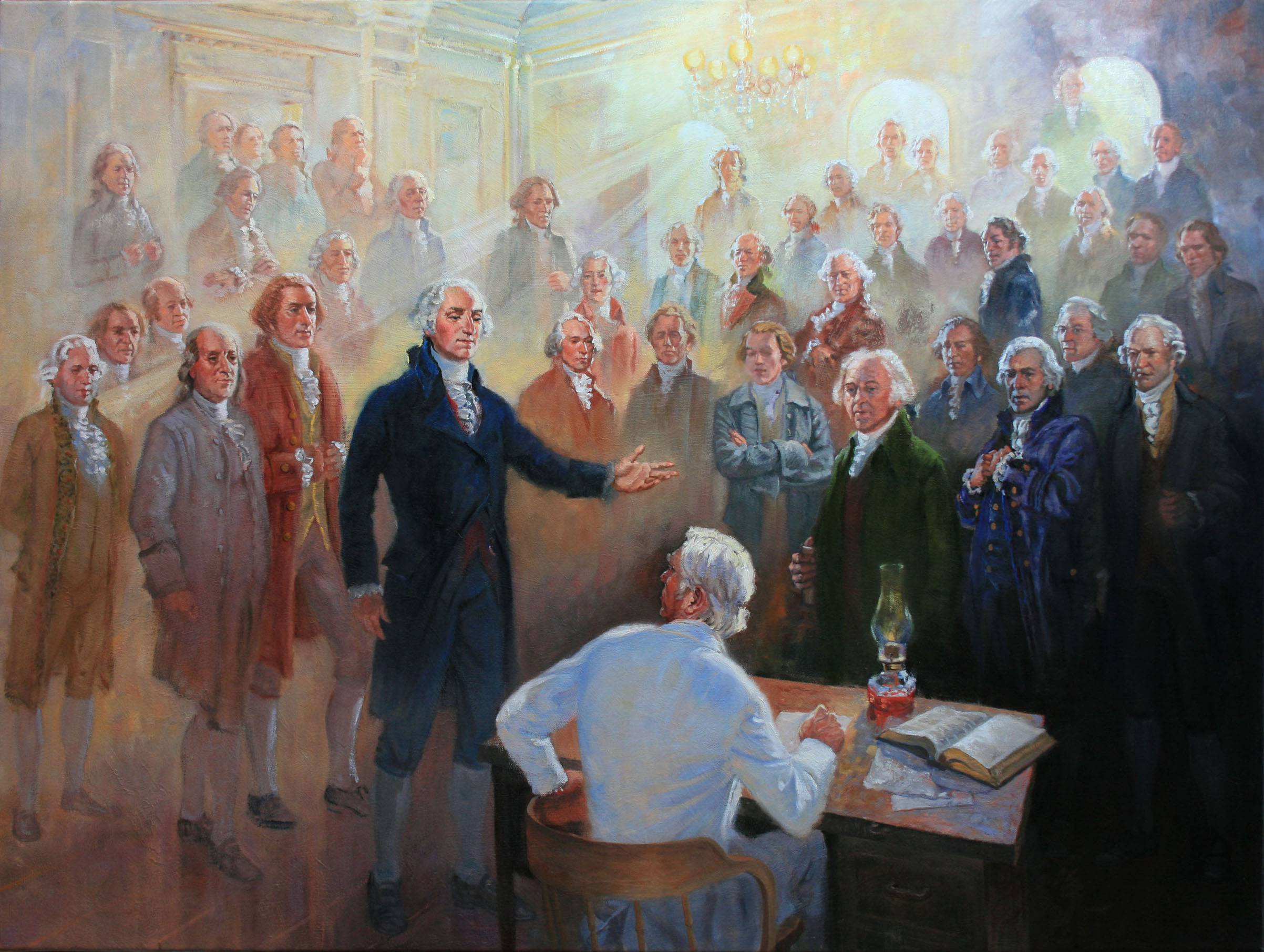
Wilford Woodruff’s vision of the Founding Fathers requesting Temple Ordinances
We are moving soon, but the Burley 11th Ward gave me another chance to address them. Since I received a number of requests for a copy of the talk, which is really just a collage of various items I could find online, the Journal of Discourses, the Saints second and third volumes, and other various histories. Here is the text of the talk I wrote, that does not mean it is the talk I gave…
I first addressed the freedoms we have as contrasted in the Saints third volume related to Germany. I said the word Jew and Israel from the stand and did not fear reprisal. I listen to free radio anytime I want and even seek out British radio from time to time and there is nothing illegal. Lastly, we could congregate without the worry of those in our midst about what was said or in the actual act of meeting.
Then to the following:
Declaration of Independence – We hold these truths to be self-evident, that all men are created equal, that they are endowed by their Creator with certain unalienable Rights, that among these are Life, Liberty and the pursuit of Happiness.
George Washington: “The success, which has hitherto attended our united efforts, we owe to the gracious interposition of Heaven, and to that interposition let us gratefully ascribe the praise of victory, and the blessings of peace.”
Alexander Hamilton: “The Sacred Rights of mankind are not to be rummaged from among old parchments or musty records. They are written . . . by the Hand of Divinity itself.” “For my own part, I sincerely esteem it a system, which without the finger of God, never could have been suggested and agreed upon by such a diversity of interests.”
Thomas Jefferson: “The God who gave us life gave us liberty at the same time.”
John Adams: “As I understand the Christian religion, it was, and is, a revelation.”
Benjamin Franklin: “The longer I live the more convincing Proofs I see of this Truth. That God Governs in the Affairs of Men!—And if a Sparrow cannot fall to the Ground without his Notice, is it probable that an Empire can rise without his Aid?—We have been assured, . . . in the Sacred Writings, that ‘except the Lord build the House, they labour in vain that build it.’ I firmly believe this;—and I also believe that without his concurring Aid we shall succeed in this political building no better than Builders of Babel.”
James Madison: “It is impossible for the man of pious reflection not to perceive in it a finger of that Almighty hand which has been so frequently and signally extended to our relief in the critical stages of the revolution.”
Samuel Adams: “Revelation assures us that ‘Righteousness exalteth a Nation’—Communities are dealt with in this World by the wise and just Ruler of the Universe. He rewards or punishes them according to their general Character.”
Charles Pinckney: “When the great work was done and published, I was . . . struck with amazement. Nothing less than that superintending hand of Providence, that so miraculously carried us through the war, . . . could have brought it about so complete, upon the whole.”
On May 4, 1842, he called to his side nine of the most faithful of his brethren—Hyrum Smith, Brigham Young, Heber C. Kimball, Willard Richards, Newell K. Whitney, and others—and later their wives came with them to the upper floor of the Red Brick Store in Nauvoo.
Joseph was seeking to fulfill the promise from D&C 124, given in 1841, which the Lord would reveal to Joseph “all things pertaining to this house, and the priesthood thereof, and the place whereon it shall be built.”
He had started, “If it should be the will of God that I might live.” Then he corrected and said, “It is not the will of the Lord that I should live, and I must give you, here in this upper room, all those glorious plans and principles whereby men are entitled to the fulness of the priesthood.” He proceeded in an improvised and makeshift way to do so.
We have from Brigham Young that after they had received these blessings the Prophet said: “Brother Brigham, this is not arranged right. But we have done the best we could under the circumstances in which we are placed, and I wish you to take this matter in hand and organize and systematize all these ceremonies.”
Brigham Young later said, “I did so. And each time I got something more, so that when we went through the temple at Nauvoo I understood and knew how to place them there. We had our ceremonies pretty correct.”
While the Nauvoo Temple was started in 1841, the first endowments were performed in the winter of 1845 and into 1846. Baptisms had started in the Mississippi River prior to the temple and moved into the temple baptistery soon after it was completed and dedicated, well before the rest of the temple was done. Brigham, leading the church, was personally overseeing the organization and perfection of the endowment and other ordinances that started in Nauvoo.
After arriving in Salt Lake City, the church used the top floor of the Council House, starting in 1852 until the Endowment House was completed in 1855. It was in this building that endowments, prayer circles, some missionary training, and some setting aparts were conducted. The use of the Endowment House ended in 1877 with the completion of the St George Temple. That building stood until Wilford Woodruff heard that unauthorized sealings were occurring there and ordered it razed in 1889.
The St George Temple was the only one completed during Brigham Young’s 30 year tenure as President. It was dedicated on 1 January 1877 in three dedicatory prayers under the direction of Brigham. The baptistery by Wilford Woodruff, the main floor by Erastus Snow, and the sealing room by Brigham Young Jr. Wilford Woodruff served as St George Temple President from 1877 to 1884. Brigham had to be carried up the stairs, but he stood and spoke in the Assembly Room.
“When I think upon this subject, I want the tongues of seven thunders to wake up the people,” he declared. “Can the fathers be saved without us? No. Can we be saved without them? No. And if we do not wake up and cease to long after the things of this earth, we will find that we as individuals will go down to hell.”
Brigham lamented that many Saints were pursuing worldly things. “Supposing we were awake to this thing, namely the salvation of the human family,” he said, “this house would be crowded, as we hope it will be, from Monday morning until Saturday night.”
On 9 January 1877, the first baptisms for the dead were performed in the St George Temple. The first endowment for the dead was performed on 11 January 1877. Brigham and Wilford personally oversaw the ordinances being performed. Wilford began wearing a white suit, starting the trend that continues to this day.
All endowments to this point had been done and passed by word of mouth. It was in St George, far from Salt Lake City, that the ordinances were first written down. Brigham also wanted to make sure the record was preserved and that they were standardized. They were read to Brigham time and time again who would then approve or continue to revise the ordinances. Brigham went home to Salt Lake City in April 1877. He stopped and dedicated the spot for the Manti Temple on the way home.
Wilford Woodruff then wrote in his journal on Sunday 19 August 1877, “I spent the evening in preparing a list of the noted men of the 17 century and 18th, including the signers of the Declaration of Independence and presidents of the United States, for baptism on Tuesday the 21 Aug 1877.”
His journal entry for August 21 reads, “I, Wilford Woodruff, went to the temple of the Lord this morning and was baptized for 100 persons who were dead, including the signers of the Declaration of Independence. … I was baptized for the following names.” He then listed the names of one hundred men.
Elder Woodruff continued his journal entry: “When [John Daniel Thompson] McAllister had baptized me for the 100 names, I baptized him for 21, including Gen. Washington and his forefathers and all the presidents of the United States that were not on my list except Buchanan, Van Buren, and Grant.” (The work for these presidents has since been done.)
“It was a very interesting day,” Elder Woodruff continued. “I felt thankful that we had the privilege and the power to administer for the worthy dead, especially for the signers of the Declaration of Independence, that inasmuch as they had laid the foundation of our Government, that we could do as much for them as they had done for us.
“Sister Lucy Bigelow Young went forth into the font and was baptized for Martha Washington and her family, and seventy of the eminent women of the world. I called upon the brethren and sisters who were present to assist in getting endowments for those that we had been baptized for today.” (Wilford Woodruff’s journal, typescript, vol. 7, Church History Library; spelling and punctuation modernized.)
The first public mention of these events was made nearly a month after the baptisms were performed. In an address in the Tabernacle on Temple Square on 16 September 1877, Elder Woodruff first told publicly of the visitation of the signers of the Declaration of Independence.
“You have had the use of the Endowment House for a number of years, and yet nothing has ever been done for us. We laid the foundation of the government you now enjoy, and we never apostatized from it, but we remained true to it and were faithful to God. (Conference Report, April 10, 1898; Discourses of Wilford Woodruff, pp. 160-61)
During the 68th Annual General Conference of the Church which was held in April 1898, President Woodruff recounted the sacred experience:
I am going to bear my testimony to this assembly, if I never do it again in my life, that those men who laid the foundation of this American government and signed the Declaration of Independence were the best spirits the God of heaven could find on the face of the earth. They were choice spirits, not wicked men. General Washington and all the men that labored for the purpose were inspired of the Lord.
Another thing I am going to say here, because I have a right to say it. Every one of those men that signed the Declaration of Independence, with General Washington, called upon me, as an Apostle of the Lord Jesus Christ, in the Temple at St. George, two consecutive nights, and demanded at my hands that I should go forth and attend to the ordinances of the House of God for them. Men are here, I believe, that know of this, Brother John D. T. McAllister, David H. Cannon and James S. Bleak. Brother McAllister baptized me for all those men, and then I told these brethren that it was their duty to go into the Temple and labor until they had got endowments for all of them. They did it. Would those spirits have called up on me, as an Elder in Israel to perform that work if they had not been noble spirits before God? They would not. (Wilford Woodruff, Conference Report, April 1989, pp. 89-90.)
“They waited on me for two days and two nights,” he said,
“I thought it very singular, that notwithstanding so much work had been done, and yet nothing had been done for them.” (Journal of Discourses, 19:229.)
I was also present in the St. George Temple and witnessed the appearance of the Spirits of the Signers….the spirits of the Presidents….and also others, such as Martin Luther and John Wesley….Who came to Wilford Woodruff and demanded that their baptism and endowments be done. Wilford Woodruff was baptized for all of them. While I and Brothers J.D.T. McAllister and David H Cannon (who were witnesses to the request) were endowed for them. These men… laid the foundation of this American Gov., and signed the Declaration of Independence and were the best spirits the God of Heaven could find on the face of the earth to perform this work. Martin Luther and John Wesley helped to release the people from religious bondage that held them during the dark ages. They also prepared the people’s hearts so they would be ready to receive the restored gospel when the Lord sent it again to men on the earth.” (Personal journal of James Godson Bleak – Chief Recorder of the St. George Temple.)
In 1986, some of the staff of the Family History Library’s LDS Reference Unit were assigned to compile and computerize all the existing genealogical data on the founding fathers, to identify their families, and to document completed temple ordinances for each. For purposes of the project, a founding father was identified as one who had signed one or more of the following documents: the Articles of Association (1774), the Declaration of Independence (1776), the Articles of Confederation (1778), or the Constitution (1787).
The library study of 1986 revealed that there were no sealings of children to parents performed at the time the baptisms and endowments were performed. As a note, the ongoing revelation related to sealings to parents was not revealed until 1894. It was then that the Law of Adoption, or sealing to prominent church leaders, was discontinued and we were encouraged to do genealogical work to compile the pedigree of the entire human family. It was then that the Utah Genealogical Society was founded that has snowballed into the fantastic work of FamilySearch and all its appendages.
He also recorded that George Washington, John Wesley, Benjamin Franklin, and Christopher Columbus were ordained High Priests at the time.
Temple work was performed on behalf of the following well-known and respected men and women in the St. George Utah Temple in August 1877.
Founding Fathers: William Hooper (NC), Joseph Hewes (NC), John Penn (NC), Button Gwinnett (GA), Lyman Hall (GA), George Walton (GA), Edward Rutledge (SC), Thomas Heyward Jr. (SC), Thomas Lynch (SC), Arthur Middleton (SC), Samuel Chase (MD), William Paca (MD), Thomas Stone (MD), Charles Carroll (MD), George Wythe (VA), Richard Henty Lee (VA), Thomas Jefferson (VA), Benjamin Harrison (VA), Thomas Nelson Jr. (VA), Francis Lightfoot Lee (VA), Carter Braxton (VA), Robert Morris (PA), Benjamin Rush (PA), Benjamin Franklin (PA), John Morton (PA), George Clymer (PA), James Smith (PA), George Taylor (PA), James Wilson (PA), George Ross (PA), Caeser Rodney (DE), George Read (DE), Thomas McKean (DE), Philip Livingston (NY), Francis Lewis (NY), Lewis Morris (NY), Richard Stockton (NJ), John Witherspoon (NJ), Francis Hopkinson (NJ), John Hart (NJ), Abraham Clark (NJ), Josiah Bartlett (NH), William Whipple (NH), Matthew Thornton (NH), Samuel Adams (MA), John Adams (MA), Robert Treat Paine (MA), Elbridge Gerry (MA), Stephen Hopkins (RI), William Ellery (RI), Roger Sherman (CN), Samuel Huntington (CN), William Williams (CN), and Oliver Wolcott (CN).
Note: Temple work was not done for John Hancock or William Floyd as it had already been completed previously.
Presidents of the United States: George Washington, John Adams, Thomas Jefferson, James Madison, James Monroe, John Quincy Adams, Andrew Jackson, William Henry Harrison, John Tyler, James Knox Polk, Zachary Taylor, Millard Fillmore, Franklin Pierce, Abraham Lincoln, and Andrew Johnson. Temple work was not done for James Buchanan, Martin Van Buren, or Ulysses S. Grant.
Other eminent men baptized by Wilford Woodruff in the St. George Utah Temple in August 1877 include: Sir Edward Gibbon, Johann Wolfgang von Goethe, Oliver Goldsmith, Henry Grattan, Humboldt, Alexander von Irving, Washington Jackson, Thomas Jonathan “Stonewall” Johnson, Samuel Juarez, Benito Pablo Kemble, John Philip Liebig, Baron Justus von Livingstone, David Macaulay, Thomas Babington Nelson, Lord Horatio O’Connell, Daniel Peabody, George Powers, Hiram Reynolds, Sir Joshua Schiller, Johann Christoph Friedrich von Scott, Sir Walter Seward, William Henry Stephenson, George Thackeray, William Makepeace, Vespucci, Amerigo Webster, Daniel Wesley, John Wordsworth, William Parepa, Count Dimitrius, Martha Washington and her family, John Washington (Great Grandfather of George Washington), Sir Henry Washington, Lawrence Washington (Brother of George Washington), Augustine Washington (Father of George Washington), Lawrence Washington (Father of Augustine), Lawrence Washington, Daniel Park Custis, John Park Custis (Son of Daniel and Martha Parke Custis), and Martin Luther.
Eminent Women baptized include: Jean Armour (1767—1834) of Scotland, Jean Armour Burns (Wife of Robert Burns) (1759—1796), Jane Austen (1775—1817) of England, novelist, Mary Ball (1708—1789) of America, Mary Ball Washington (Mother of George Washington) (1732—1799), Sarah Bernard (1800—1879) of England, Sarah Barnard Faraday (wife of Michael Faraday (1791—1867), Charlotte Bronte (1816—1855) of England, novelist, Felicia Dorothea Browne (1793—1835) of England, Elizabeth Barrett Browning (1806—1861) of England, poet, (wife of Robert Browning) (1812—18?), Martha Caldwell Calhoun (d. 1802) of America (mother of John Caldwell Calhoun) (1782—1850), Martha Parke Custis (1755—1773) of America (Daughter of Martha Washington) (1732—1802), Martha Dandridge Washington (1732—1802) of America (wife of George Washington) (1732—1799), Rachel Donelson Jackson (1767—1828) of America (wife of Andrew Jackson (1767—1845), and Abigail Eastman Webster (1737—1816) of America (mother of Daniel Webster (1782—1852), to name but a few. Temple work was performed for a total of 70 eminent women.
During most of our national history Columbus and the Founders were considered heroes with determination and foresight. Cities, rivers, and many other places were named after them. More recently there has been a wide spread effort, designed especially to indoctrinate young people, which slanders Columbus, the Founders and their accomplishments. Columbus is held personally responsible for centuries of mistreatment of Native Americans. The Founders are portrayed as being greedy and motivated by selfish interests. All of this is as astonishing as it is misleading.
From the Lord’s perspective among the most important events of the history of the world was the discovery and founding of America. 1 Ne 11-14. Nephi was referring to Columbus when he wrote: “I looked and beheld a man among the Gentiles, who was separated from the seed of my brethren by the many waters; and I beheld the Spirit of God, that it came down and wrought upon the man; and he went forth upon the many waters, even unto the seed of my brethren, who were in the promised land” 1 Ne 13:12. By the Founders “the Lord God will raise up a mighty nation…even on the face of this land.” 1 Ne 22:7.
Go on to life and history of George Ross of Pennsylvania, signer of Declaration of Independence.
Several months ago I took my Dad and Step-Mother out to the Minidoka-Acequia-Rupert Cemetery north of Rupert Idaho. I had inherited 11 graves in the cemetery from the Phibbs family. 7 are together in one location, four in another. We were there on that occasion to pick out their final resting place. A somber experience if you think about it.
We walked around both sets of graves and picked out their preferred location. They picked out two graves that they wanted and we visited for a little while. While there, we looked at some of their future neighbors.
There were three graves that caught our attention. Older graves from 1917 in which it appeared all three had died the same year. Two male names and a female, we thought it looked like a father and mother and son. That raised enough questions that I researched them. Here is what is on the grave stones:
George E Davies 1908 – 1917
Hyrum E Davies 1879 – 1917
Mercy M Davis 1881 – 1917
The investigation began. It was not that hard to find their connections on FindaGrave as husband and wife and son. They had all died the same date, 4 July 1917, over 105 years ago.
I started researching the online newspapers for Rupert, Idaho. I found the Rupert Democrat from 4 July 1917 above. Here is the text of that article:
AN APPALLING TRAGEDY OCCURED ON THE MORNING OF JULY FOURTH
MR. AND MRS. HYRUM E. DAVIES AND NINE YEAR OLD SON GEORGE, WERE DROWNED IN MAIN CANAL NEAR ACEQUIA ON MORNING OF FOURTH.
BODIES HAVEN’T BEEN RECOVERED
Victims Were Enroute to the Minidoka Dam to Spend the Day Fishing When Auto Plunged Over the Embankment.
Mr. and Mrs. Hyrum E Davies and their son George, of this city met an untimely and deplorable death on the morning of July Fourth, when the auto in which they were riding skidded and plunged into the canal at a point in the canal road seven miles east of this city and one and one-half miles east of Acequia. Mr. and Mrs. Davies in company with Mr. and Mrs. R. S. Houghton and two small children were on their way to the Dam in Mr. Davies’ big Case auto, whey they had planned to spend the day fishing when the dreadful accident occured. Mr. Davies was driving and Mr. Houghton occupied the front seat with him and was holding his four year old son, the two ladies and Mr. Houghton’s two year old boy and the nine year old son of Mr. Davies occuping the rear seat; the car was running along at about twenty miles an hour, the rear wheel coming in contact with a rut caused the car to skid and the driver evidently lost control of the machine and before it was brought to a stop had plunged down the embankment and was submerged in eight foot of water in the middle of the canal. Mr. Houghton floundered out of the car and holding onto it with one hand succeeded in placing his little four year old son safely on top of the car. He then drug his wife from the car and assisted her to safety on the auto top also, the little eighteen months old son came to surface about twenty feet down stream from the auto a few seconds later and he (Houghton) quickly rescued it, after a strenuous tussle with the swift current in his efforts to return to the car.
Houghton kept close watch expecting to render aid to the other three when they appeared on the surface, but he watched in vain, the swift under current evidently took them down stream, at any rate Mr. Houghton is positive that none of the bodies appeared on the surface after he had gotten his wife to safety.
Mr. Houghton relates that before the car was completely submerged that Mrs. Davies collapsed and was firmly holding her son, George, in her arms, that the husband was attempting to get from under the steering gear and was reaching for his wife and it is the opinion of Mr. Houghton that the three were taken down the stream clinging to one another. Mr. Davies could swim but the weight of his wife and boy was too much for him to master.
Mr. Davies was an inexperienced driver, having purchased his car about one month ago. The emergency brake was set firmly when hauled out of the canal.
The Packham brothers, who were driving a buggy closely behind the car were witnesses to the tragedy, one of the young med hurriedly secured a rope at the home of L. A. Darr and succeeded in bringing the Houghtons to shore with the assistance of his brother and guard on the canal who had been attracted to the scene by the other young man.
A rescue party was soon organized after word had reached this city by ‘phone, and hastened to the place where the accident took place and a diligent search was kept up all during the day until a late hour at night for the bodies but at this writing none of the unfortunate victims have been recovered.
Mr. and Mrs. Davies had been residents of Rupert for the past three months, moving here from Salt Lake City in the early part of April. Mr. Davies was a carpenter by occupation.
As a result of the horrible disaster four little children will never again perceive the pleasures of a doting and solicitious father and mother. The surviving children, who were to spend their Fourth in Rupert at the request of their parents, include three girls and a boy, namely Virginia, aged fifteen; Gladys, aged twelve; Nelva, aged five and Erwin aged two. They will be cared for by their aunt, Mrs. A. G. Morris of this city, Mr. Morris being a brother of Mrs. Davies. Another brother, S. N. Morris resides at Salt Lake City. Mrs. Mollie Wheeler of this city is also related to the Davies family.
While the Davies family was not very well known in this city, their tragic and sudden death cast a shadow of sadness and gloom over our city which detracted from the enjoyment of the celebration to a noticeable extent.
The Houghtons are also recent new comers to Rupert, having moved here from LaGrande, Oregon, less than a month ago. Mrs. Houghton is a daughter of Mr. and Mrs. J. L. Workman of this city. The Davies family was in no way related to the Houghtons.
Mr. Davies was thirty-six years of age and his wife thirty-five. They were married sixteen years ago in Utah. They were members of the L. D. S. church.
I also found this article.
Article from Salt Lake
HYRUM E. DAVIES, formerly of Salt Lake, who with his wife and child, was drowned near Rupert, Idaho, yesterday.
AUTOMOBILE PLUNGE DROWNS 3 PERSONS
Former Salt Lake Residents Die When Machine Falls Into Canal Dam.
Two former Salt Lakers, ,Mr. and Mrs. Hyrum E. Davies, and their 4-year-old son were drowned in the Minidoka project canal near Rupert, Idaho, yesterday afternoon when their automobile plunged over an embankment. The bodies have not been recovered.
First word of the drowning was received in this city by Mr. and Mrs. E. J. Strong, 360 Ninth East street, Mrs. Strong being a sister of Mr. Davies.
Communication by wire with Sheriff Hiram Thompson of Lincoln County, Idaho, established the fact that early in the afternoon Mr. & Ms. Davies started for the Snake river dam, which diverts the water into the Minidoka project canal. They had with them their 4-year-old son, leaving the four elder children at home.
When a short distance out of Rupert Mr. Davies, who was driving the automobile, appears to have lost control of the car as it struck a deep chuck hole in the road. The vehicle went over the embankment into the canal, which at that point is about eight feet deep and 120 feet wide.
Persons driving along the road later saw the automobile in the canal and notified the officers. A searching party was immediately formed and the work of attempting to find the three bodies was begun. Up to the last reports received late last night no success had been realized in the effort. The search was continued and a screen was stretched across the canal at a point some distance below the point of drowning to catch the bodies in case efforts made by men on a rapidly-constructed raft should fail.
Mr. Davies had lived in Salt Lake City about thirty-five years and until six weeks ago, when he moved his family to Rupert, Idaho, was employed as a motorman for the Utah Light & Traction company. The family lived at 650 Ely avenue which is between Seventh and Eighth East and Seventh and Eighth South streets.
Surviving Mr. Davies are four sisters, Mrs. E. J. Strong and Mrs. David McCleery of this city, Mrs. A. Freeman of Ogden and Mrs. E. T. Knotts of Shawnee, Okla.
Mr. and Mrs. E. J. Strong left here for Rupert on the midnight O. S. L. train last night. Upon recover of the bodies they will probably be brought to Salt Lake for burial.
I was unable at this time to find any updates to the story for when the bodies were found or obituaries. I will update if I find that information.
Hyrum Edward Davies, born 12 August 1879 in Cottonwood, Salt Lake, Utah.
Mercy Mathews Morris, born 28 January 1881 in Salt Lake City, Salt Lake, Utah.
Hyrum and Mercy were married 16 October 1901 in Mercur, Tooele, Utah.
Hyrum and Mercy had five children, Virginia, Gladys, George, Afton, Erwin.
Mercy Virginia Davies, born 19 July 1902 in Salt Lake City, Utah, died 24 Ocober 1977 in Los Angeles, Los Angeles, California.
Gladys Orlean Davies, born 19 March 1905 in Salt Lake City, Utah, died 10 December 1964 in Las Vegas, Clark, Nevada.
George Edward Davies, born 8 March 1908 in Salt Lake City, Utah, died 4 July 1917 in Minidoka County, Idaho.
Afton Elva Davies, born 13 August 1911 in Albion, Cassia, Idaho, died 26 October 2001 in Orange County, California.
Hyrum Erwin Davies, born 8 March 1915 in Salt Lake City, Utah, died 15 September 1996 in Barstow, San Bernardino, California.
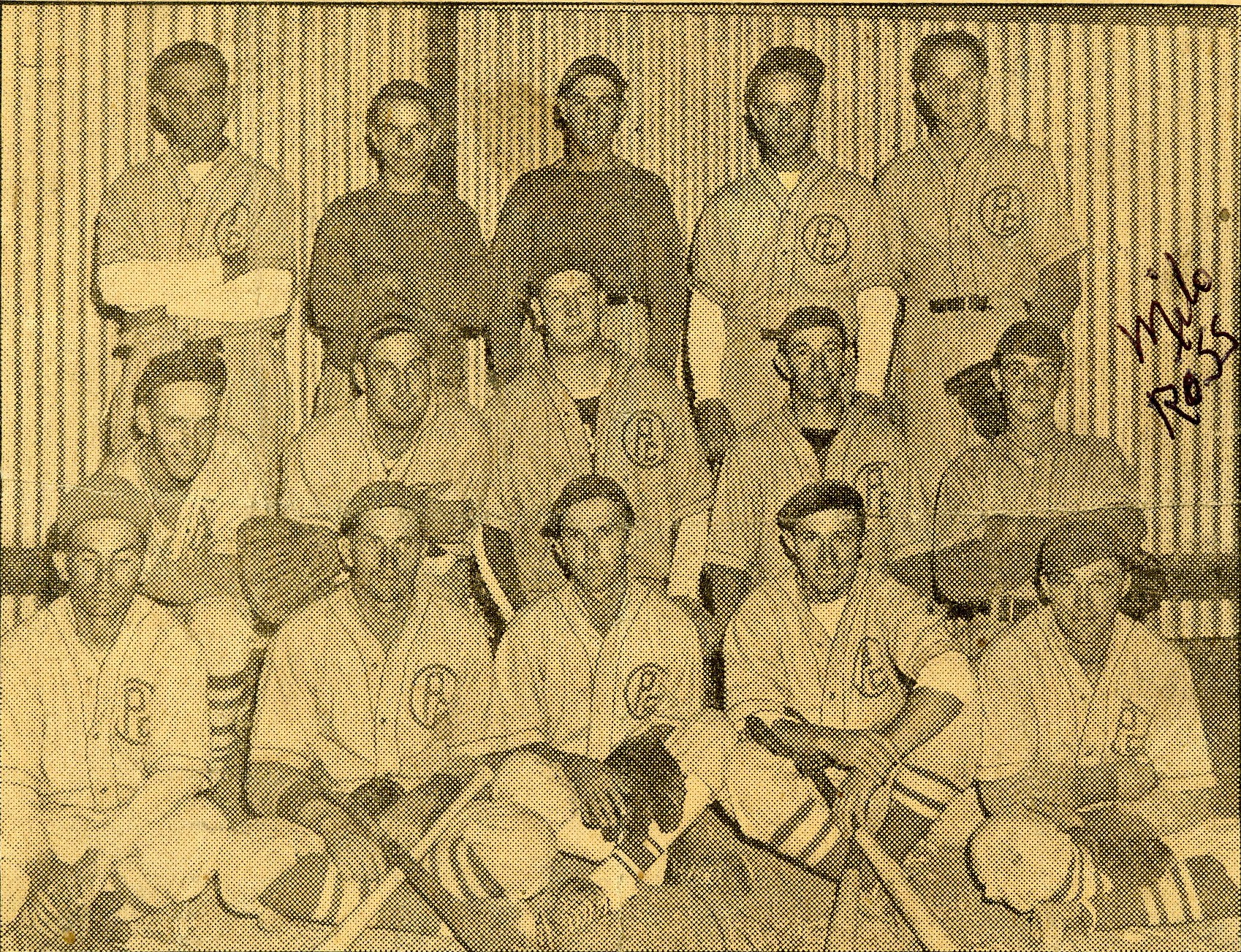
Back (l-r):William Freestone (manager), Norman Carver, Glen Charlton, Fred Singleton, and Elmer Singleton. Middle: Clair Folkman, Dick Skeen, Albert Sharp, Abe Maw, Milo Ross. Front: F. Skeen, Walt Moyes, Arnold Taylor, Lynn Stewart, Theron Rhead.
The caption to this newspaper clipping read as follows: “Favored by Many…Plain City’s hustling ball club has many of the bleacherites at the 1938 Utah farm bureau tournament picking it to walk off with the state title before the joust closes.” The caption goes on to list the names of the individuals included in the photograph which I reproduced as the caption to the photo above. I list the names just as they were listed in the caption for the photo. The title of the article was “Plain City Clubbers Show Ability.” The clipping is included in Grandpa’s clippings but we do not know exactly when it was published. The team did end up going to Lagoon and playing Sandy for the state championship, but lost.
This team obviously played and practiced in Plain City, Weber, Utah. Grandpa has told me numerous times how he used to play baseball. With Grandpa just past 90, it is a bit hard to imagine him hustling after anything, let alone after a ball. The other thing that struck me about this team is I expected them to all be much closer in age to each other.
Grandpa’s comments about this photo were, “Lost our last game. 1 to 0 in Salt Lake.”
William Sessions Freestone (1901-1998) Manager.
Norman Elmer Carver (1919-2001)
Alfred Glen Charlton (1919-1974)
Clair Marcus Folkman (1910-1975)
Abraham “Abe” Edward Maw (1906-1985)
Walter “Walt” Jeremiah Moyes (1907-1983)
William Albert Sharp (1909-1984)
Bert Elmer Singleton (1918-1996) For those baseball fans out there, Elmer went on to play 24 seasons in his career. He played for teams like Boston Braves, Chicago Clubs, Pittsburgh Pirates, and Washington Senators.
Grandpa, Milo Ross, was a builder nearly his entire adult life. Even into his 80s he was helping people remodel, reroof (and falling off those roofs and living), and more. Here is a story of Grandpa and Grandma getting involved for the construction of a new church in north Plain City. I am taking this from his own writing (I corrected spelling and edited for reading):
Milo Ross, Lee Dickamore, John Watson
“Yes – I did pray many times on my knees asking for Heavenly Father’s hand –
Milo Ross, Lee Dickamore, John Watson, Aline Lord
“April 2002 Milo Ross
“May 10 2002
“President Dickamore – Farr West also – Watson President new church by Archie Hunt
“Start family news of events that did help build church in Plain City by making phone calls and asking if Dickamore President for Farr West – Plain City Stake if they would think and accept a chance to build church in different area of Plain City
Gladys and Milo Ross, Lee Dickamore, John Watson, Aline and Gene Lord
“It was rumored around a new church was to be built in north Plain City area. So I called President Dickamore at the Stake Center in Plain City one Sunday, during church services, and asked if he would please let me show a building place for a new church. Not only as a church presence but because of the Abram Maw and wife [Monna] and Maw family always wanted to help support the church with a good high piece of ground that could be easily drain for parking, drainage and no drainage.
John Watson, Lee Dickamore, Gene and Alina Lord, Gladys and Milo Ross
John Watson, Lee Dickamore, Gene and Aline Lord, Gladys and Milo Ross
Lee Dickamore, John Watson, Gladys and Milo Ross
“I’ve done work building for the Maws and their wishes – some day maybe the Maws could donate something nice to The Church of Jesus Christ of Latter-day Saints in honor of the greatness of the glory that the family of Maws had received from being members of the church and the many great blessings the Lord had shared with the large family of Maws.
“A few days later President Dickamore asked if I would show the ground and information of the offer.
“After Abram and his wife passed away Aline [Maw] Lord and husband, Gene Lord, talked about maybe some day the church would accept the ground set apart from the Maws Estate when divided among the family of Maws and grand children and the Maws wishes to keep one piece of ground clean and keep up good so maybe some one in the church would help the spirit and desire and also want and have the people in charge of our church to some day foresee a house of our Lord build on the ground, that if Maws have prayed and dedicated to church all their lives for a dream come true.
Maw/Lord Home in Plain City, Utah
“So Milo Ross has helped the Maw family to keep up the Maws wishes and with the great help from President Dickamore and President Watson Milo’s wishes and a desire to fulfill a wish come true for the great Maw family and my great Archie Hunt and wife, their good works and keeping up the drive to encourage in some way that in our life altogether keep information going forward to keep the building spirit alive as long as we life.
Aline Lord, Milo and Gladys Ross
“So from the Lords family and the Seager Velda [Maw] family and thanks to the man of God that did his praying from our Savior Jesus Christ our wishes and prayers through a man from Farr West.
Unknown workers, Aline and Gene Lord, Gladys and Milo Ross
“And his presidency made our dreams come true. Thanks Dickamore, we can all go forward now and start our family histories and tell the wold how not a railroad but a lovely church came into our Plain City by the words of a great man from Farr West. Dickamore and his counselors. Milo Ross. Yes, prayers do help our Lord.
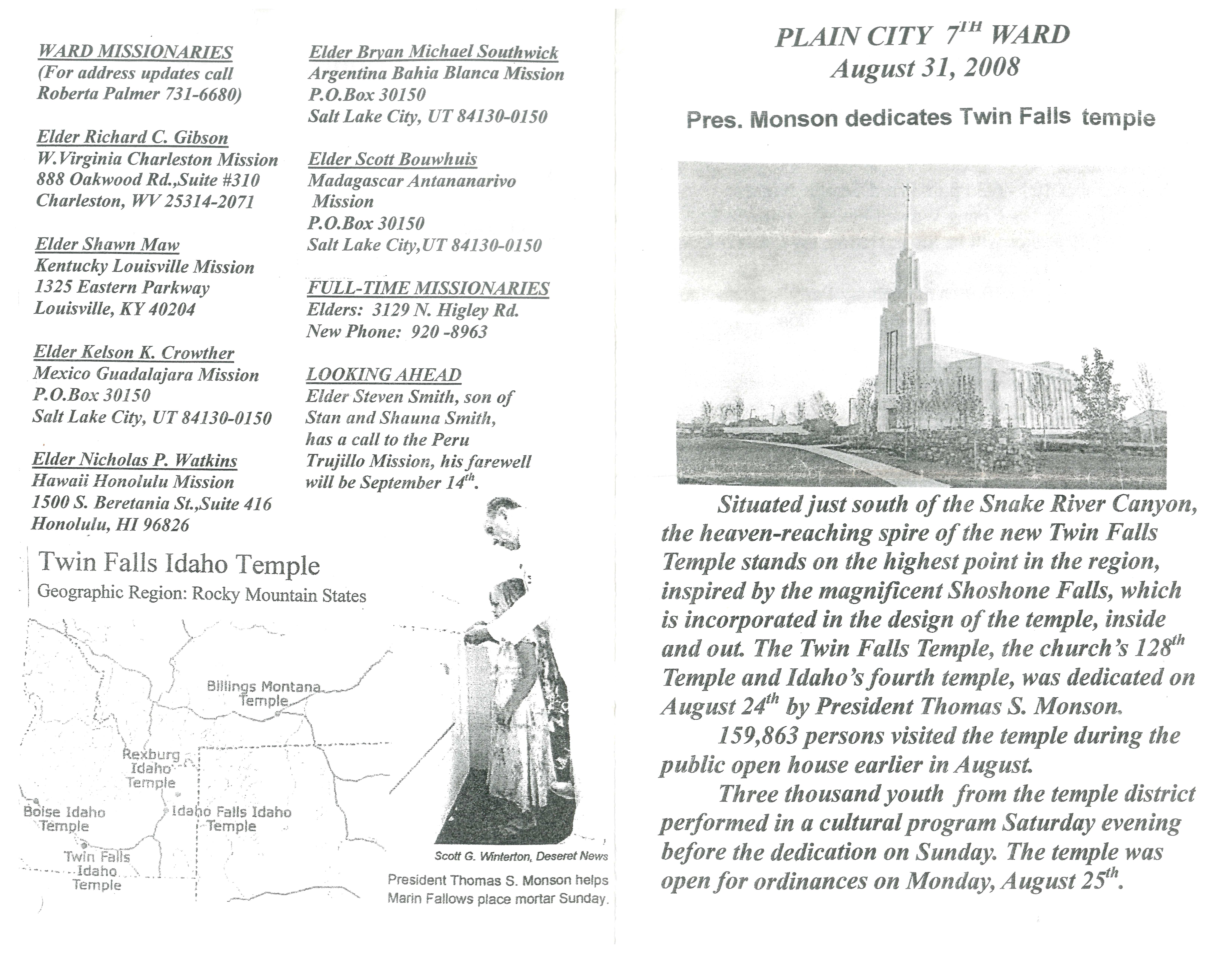
Milo Ross found it full circle that the Plain City 7th Ward bulletin included information on the Twin Falls Idaho Temple Dedication
Grandpa helped construct the replacement chapel in downtown Plain City dedicated in 1954. He felt some rejection and disappointment when that building was replaced. But his excitement over his part in the construction of this chapel was palpable, even though I doubt he lifted a hammer to help.
The above photo caught my attention for various reasons, but I reflected upon my Naef relatives in little Downey. Every time I drive past Downey I think of them. The only one I ever knew personally was Ralph Gail Naef (1926-2009). We corresponded and talked about family history, he even came to our wedding reception in Farmington, Utah (he lived in Salt Lake). I even stopped and found the graves of Alma Katherine Scheibel (1889-1969) and Charles Daniel Naef (1884-1964) in the Downey cemetery.
I previously shared the biography Kate wrote of her mother, my Great Great Grandmother, Regina Friederike Nuffer Wanner (1869-1942).
I referenced Charles’ father Jacob Ira Naef as the first President of the German Branch in Glendale, Idaho.
I republished the story of Regina’s granddaughter, Delores Anderson, Kate’s daughter.
I also gave some of Kate’s history in the biography of Regina and John George Wanner Jr (1870-1947).
Looks like it is time to provide a fuller story of Kate and Charles. Until then, here is a photo of young Kate with Regina.
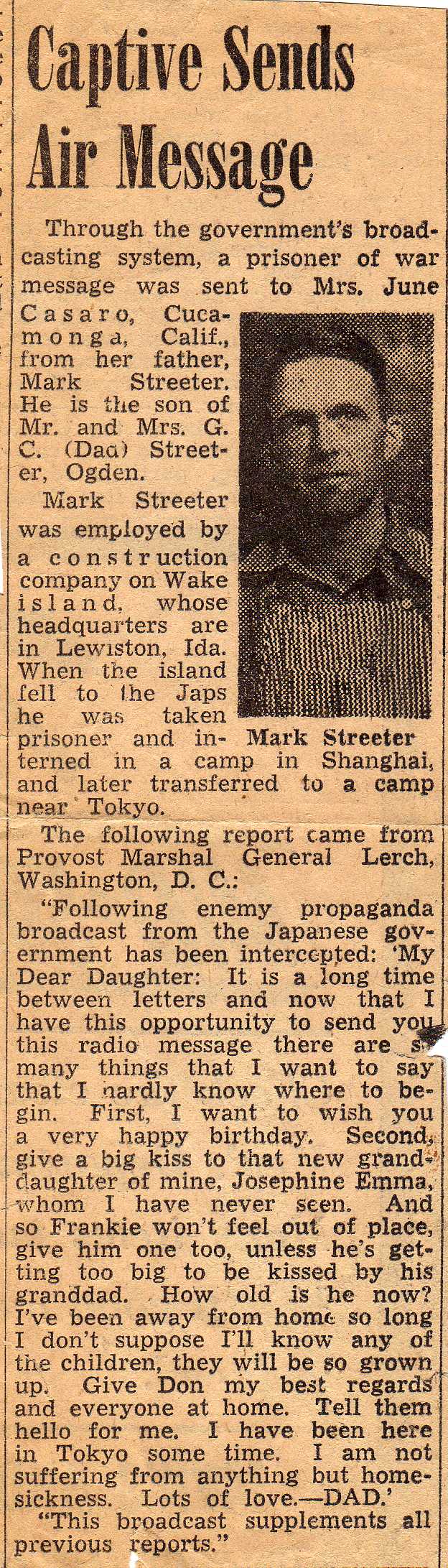
The Notorious Bunka Affair and the First Surrender of the Japanese In World War Two.
Now Told for the First Time.
A Fight for Survival
All in One Life Time
By
Mark L. Streeter
Prelude
When one looks back over the past years of life, memories are all that remain in the storage chest of the mind. Some are like golden treasures casting a brilliant light through the darkness of life’s uncertainty. Others are like badly decomposed offal whose stench tears on the nerves like the craving of an addict for opiates, and they will not die…. Like marionettes on a string we dance to the tune of the times, sometime in step, sometimes out of step.
This is an unusual journey through life where time is the essence.
The beginning, May 11, 1898.
I was born during the Spanish-American War in a little settlement called Kanesville, in an area about ten miles west and slightly south of Ogden, Utah, where a few early Mormon settlers has taken up abode, among them my grandfather, Cal Wilson, who migrated from Nauvoo, Illinois with the Latter Day Saint handcarters fleeing persecution because of their religious beliefs. I always presumed they called that settlement Kanesville because in those early days the settlers lacking sugar raised an abundance of sorghum cane. Perhaps one of the settlers was named Kane and they named it after him, I really do not know, nor did I know then what an effect war would have on my future.
My mother Jane Anna was the daughter of Grandpa Cal, the ninth child in a family of fifteen boys and girls. In those days big families of children were not uncommon. The early settlers needed all the off-spring they could get in order to help them turn the then somewhat desolate Utah into a flourishing Garden of Eden, also large families helped increase the membership of the Mormon Church. Everyone call them “Mormons” then, and it is reported that they were not too saintly when it came to protecting their land of Zion. There is a little ditty that was quite popular then about the Mormons. It went partly like this; “Oh, I can tell you’re a Mormon by the cut of your hair: I can tell you’re a Mormon by the clothes that you wear: You’re a Mormon, goddam you, go back to Utah:” There is a lot more to it, I won’t tell it here, but it showed that a lot of people still thought the Mormons were a queer lot, and they still do.
My father, George C. (Clark) was the oldest son of the reverend George Oscar Streeter, a line-riding Methodist Preacher, who stood seven foot two inches in his stocking feet, and they were big feet, took size sixteen boots, handmade. The heaviest work he ever did was carry the Bible. He was as rough as the west and would brawl and drink with the toughest characters the west produced, and firmly believed that his listeners should get religion even if he had to beat it into them. During those early days, religion, like the settlers, had a rough row to hoe.
My father was raised for the ministry and ran away from his father’s forceful endeavors to make him a man of God. He headed west and lived with the Indians for several years, adopting many of their ways. He had extremely powerful jaws from riding, and breaking horses Indian fashion, without a saddle, rope or bridle, and clamping his jaws shut on the horses mane, where if he let go he lost his horse and maybe his life. The Indians didn’t fool around much when they were breaking in a horse, they became part of the horse, never leaving the horse’s back until it was broken. Dad had quite a reputation as a horse breaker or bronco buster. He was known then as “Dude Streeter” because of his plug hat, fine clothes, pinstripe pants, patent leather shoes and spats, which outfit he acquired in the east where he went through college after his Indian escapade. Dad and his pals won a lot of bets made on “Dude Streeter”, the college dandy, who no good westerner though could get on a horse, let alone ride one. He also drove cattle over the Chisum Trail, finally ending up in Utah with Butch Cassidy and some other notorious characters including Bill Cody (Buffalo Bill). There he met my mother, marrying her and she calmed him down and he became a carpenter, building many of the homes and buildings in the Ogden, Utah area. He jokingly said that he became a carpenter because Christ was a carpenter and that was as close to him as he could get. He never joined any religious organizations but made many life-long friends among the Mormons. Mother and Dad got along very well despite their different religious thinking. Mother was a Mormon, and a wonderful mother. Sometimes when I was naughty and was caught doing something wrong, Mother would spank me with her hairbrush, and them she would cry, and to see her cry hurt me a lot more than the hairbrush.
Nothing much happened in my life until I was about six years old. At that time Dad and Mother and one of my aunts and uncles decided to go to the World’s Fair in Portland or Seattle, I have forgotten which. I will never forget that trip, made in a two seated white-top buggy for the women and children to ride in, and a Studebaker wagon to haul the food, water, tents, and other supplies necessary for such a long trip overland with horses. I do not know how long it took, but to me it was ages. The roads in many places were mere trails. At times we all had to get out and help push the buggy and wagon over steep grades, which made the horses strain until their muscles stand out and sweat worked into a leathery white foam where the harness rubbed them. Other times when I sat next to the outside in the buggy seat, it looked like miles down the cliffs next to the road, and I gripped the seat and help my breath thinking every minute we would fall off. Things look a lot different to a six-year-old boy. I remember sometimes we would sleep in beds made on the ground in the open, and at night I would watch the stars and listen to the coyotes howl, and all kinds of thought ran through my head, and my imagination would run wild and I was many things in many places, I traveled all over the world, the whole big world, and I thought, “Gee, God must be a great guy to make all this”, and today these thoughts remain with me;
Out on the western prairie
Is where I like to tarry
When the twilight is settling down,
We are the campfire sitting “roun”.
The horizon is fiery red in the west
Where the sun has gone to rest.
And far up there in the sky
The evening star winks its solitary eye.
The dusky shadows flit around
As the fire puts them to rout.
The coyotes begin to prowl
From afar you can hear them howl.
As I sit in silence there
In the balmy evening air
And smell the aroma of the sage,
I do not wonder at the adage
About his big, silent land
That stretches on every hand,
“God made the prairie for the free”,
The Twilight he made for me.
I do not remember much about the World’s Fair, except the electric lights, which were new then, almost everyone used coal-oil lamps. The electric lights were in long strings outlining the fair building, with the reflection of the lights on the water in the river. It looked like a fairyland to us kids.
After seeing the Fair, my folks and Aunt and Uncle sold all their horses, wagons and things and bought tickets on a ship to take us to San Francisco, California. I remember getting seasick, but after a day or two my brother and I had a great time on that ship. Where the river met the ocean it was very rough. Dad and Mother were not very good sailors either, and I think did not enjoy the boat trip very much.
Dad got what they called “walking typhoid” and when we arrived in San Francisco he was taken to a hospital. My Uncle Mark whom I was names after, got the rest of us located in a house, and it was there that I saw my first automobile. It looked like a solid rubber-tired buggy without shaves or a horse pulling it. It made a bangety bangety noise, and my brother and I ran along behind it holding onto the back. Dad came home from the hospital and for a while helped Uncle Mark down on the docks, but he was too weak to be of much use. Uncle Mark was a whiskey taster at the Warf. The barrels of whiskey came in ships and was unloaded on the docks. Uncle Mark’s Job was to remove the wooden bung from every barrel and insert a small cup on a wire and taste the whiskey. Although he was always a jovial nature, I don’t think he actually swallowed much of the whiskey. Buyers only wanted to know they were getting whiskey and not something else.
The Doctor finally told Dad that it would be better for him to go back to Utah. We left in a day or two by train pulled by one of those new huge coal burning steam engines, arriving in Ogden, Utah to hear that San Francisco had been destroyed by an earthquake the day after we left. The house we had lived in was completely destroyed. Uncle Mark survived the quake so did the barrels of whiskey he was tasting. The whiskey was taken over by the rescue authorities and used for medical purposes for treating the victims of the quake.
April 1906
I spent the next seven years growing up in the Ogden, Utah area. At times being a newsboy, grocery delivery boy, elevator boy, bell, hop, bakers helper, and helping Dad build houses in between jobs. I also became an expert lather and wood boxmaker, which had a tendency to spoil me, as a youngster, by making twenty or more dollars a day at these trades, when the good daily wages for then was five dollars a day. It was during this time that I saw my first aeroplane as it visited the Ogden Fairgrounds for people to see. People were skeptical then about aeroplanes and autos, saying they were rich mens playthings and would never amount to much. Old Dobbin, the horse, was a trusted member of the American family and people were not going to give the horse up easily. Life moved at a more leisurely pace then.
The wanderlust gripped me and I decided, without my folks knowledge, I would see what the rest of the world looked like. I bought a ticket for California arriving in Los Angeles almost broke and I found out that the world was not as easy pickens as I had thought and I ended up visiting my Aunt Daisy in Sawtell. She took me in tow and let a hungry boy have a home with her. While there my Dad’s Uncle Crosby, who owned about half the cattle and land in a big part of the State of Nebraska before he sold everything and moved into a mansion on “Gold Doorknob Row” in Pasadena, came to visit us. I presume at my Dad’s suggestion, and ask me to come and live with him. He said he would send me through an exclusive college in Pasadena and get me started in business when I graduated. Uncle Crosby never had any children of his own. It sounded good and after encouragement from Aunt Daisy, I accepted his offer.
The first thing Uncle Crosby, no relation to Bing, did was to buy me some fine clothes and a roadster auto, which I didn’t know how to drive. I learned to drive after crumpling a few fenders which Uncle had fixed. Everything seemed fine, but the first morning I was at their house I got up early and decided to mow the lawn. Uncle rushed out in his pajamas and stopped me, saying they had a Gardner to do such things. After a week or two of idleness I decided to get a job of some kind, so I would not have to depend on my Uncle for everything. I answered an ad in the paper and got a job taking care of an apartment complex near my Uncle Crosby’s place. It was an easy job and paid well and they were glad to have me because of my Uncle’s standing in the community. All I did was collect the rent and notify a realtor when anyone moved. When my Uncle found out I had the job he was furious and made me quit, saying he would take care of all my needs. This didn’t make me feel very good and after a couple of weeks of idleness I told him I was homesick and wanted to go home. He bought me a ticket and I left but got off the train in Las Vegas, Nevada. There I met my Uncle Milt who was a prospector and had a good mine near Gas Peak about eighteen miles north and west of Las Vegas. He gave me a job and I went to work in the mine sorting ore, with my cousin “Snooks”.
I learned a lot about mines and hard-rock miners on our trips to Las Vegas which then consisted of the Overland Hotel and a few blocks of saloons and whorehouses which soon cleaned the hard rock miners out of their pay and the bleary eyed single and double-jacks returned to the mines to earn another stake which usually ended up being spent on another wild spree in Nevada’s desert den iniquity.
The mine we worked in was in the end of a blind canyon. My cousin and I found out that the two canyon entrance claims had never been proved up on, so after working hours in the mine, we did the necessary required prove up work on the canyon entrance claims and had them recorded. We notified the mining interests who were financing the mine operations and they paid us a handsome sum for the claims, but easy come easy go, and in a short time we were a lot wiser, back in Los Angeles, and broke. I went back to good old Aunt Daisy’s and she took me in again.
A neighbor boy and I thought we would look good in military uniform, that is that the girls would think we looked good, so we lied about our ages and enlisted in the California National Guard. The very next day the National Guard was sent to Nogales, Arizona and we found ourselves with the 21st U.S. Army regulars invading Mexico, after some of Pancho Villa’s followers who were causing a lot of trouble raiding the border towns of the United States. I understood we were not supposed to cross the Mexican border but for some reason we did. In one of the skirmishes that followed something hit and exploded in the arch of my right foot.
It was very painful, bad wound and I was taken prisoner along with another fellow. We were taken by truck to a place we were told was in Chihuahua and lodged in jail. The jail was of adobe, very thick walls, with bars running from ceiling to floor where windows are supposed to be. The bars were imbedded in concrete at the base which had become rotten with age and a poor mixture of cement. We were treated fairly well, fed and given a small drink of Tequila every day. It was terribly hot in the jail. People used to come and look through the bars at us, some would give us cigarettes. After about a week or ten days we decided we could escape by getting one of the bars loose in the rotten concrete. We worked on it at night and in the early morning hours we were successful and made our escape, hiding out as soon as it got daylight. My injured foot gave me a lot of trouble. We had no food or water and had to survive on what we could steal at night from gardens and chicken coops. It was pretty rough going. After a few days, we lost track of time, by traveling over sparsely populated desert area without much food or water we were near exhaustion. We saw a lone house in the distance and decided to go there and ask for food and water. To our surprise an American answered the door. We asked where we were and he said in the United States about fifty miles from Nogales, Arizona. We were elated. After being fed and a good nights rest in bed, our American host took us in his pickup truck to Nogales. We thanked him and headed for the freight yard where we caught a freight train headed for Los Angeles. Arriving there we split up. I never did report back to the National Guard. I caught another freight train heading for Utah. I arrived back home tired, hungry, and sick. After a few months at home, I was in pretty good shape again.
World War One was going strong and we were getting more involved, and the government was asking for volunteers to go to work in munition plants in West Virginia. I signed up and left for Charleston, West Virginia. I signed up and left for Charleston, West Virginia to work as an electrician in the powder plant for Nitro. Shortly after my arrival there, the big flu epidemic, broke out and I was assigned to driving a Red Cross truck hauling dead and dying flu patients out of the hills in the back country. I was accompanied by a French doctor who would not let me wear a flu mask, but insisted that I take a small swallow of whiskey, which he got from the Red Cross canteen, every time we handled alive or dead flu victim. We handled several hundred. Sometimes the signs we saw in the back country were sickening, with dead and living sick in the same bed. I never did get the flu. After the flu epidemic abated, I returned to Utah.
The folks place in Plain City sure looked good to me. Mother had made such a success of her chicken business that Dad had quit building and helped her gather the eggs and feed the chickens. I stayed there quite a while, until a girl I had gone through school with and I decided to get married. Neither my parents or hers were in favor of the idea, saying we were too young, that it was just nature’s urging to produce babies that brought us together and not love. We got married anyway with or without our folk’s blessings and left immediately for Paul, Idaho, the center of the Minidoka land boom. Land which is now worth many thousands of dollars an acre, if you can find any for sale, could be bought for ten dollars an acre, but ten dollars was hard to get. We went into the confectionary business in the new town of Paul, but the business was a flop and failed mainly because of lack of customers. There were not enough people in the area to support it. Our marriage also went on the rocks at the same time, my wife Ethel falling in love with a soldier. I guess it was love, they lived together until she died after having several children. We had one daughter from our marriage, named June, which ended in divorce.
We were deep into World War One then. An armistice was declared on November 11, 1918, but they were still drafting men. I knew my draft number would soon be coming up, so I went to Pocatello, Idaho and enlisted at the first recruiting office I came to. Which was the U.S. Marine Corps. Even though an armistice was signed I was told that I was only enlisting for the duration of the war. Well, for me that war lasted a long time, from March 1919 to May 1925. During that time, I received injuries that resulted in the loss of a finger and the use of my right arm, which kept me in the Naval Hospital for the biggest part of two and a half years. I was finally discharged from the hospital as incurable. After a year or so I got the use of my arm back, and ended up in Elko, Nevada, where I went to work for a wholesale house. I worked up a thriving business for the wholesale house with the bootleggers and girlies for hire, prostitutes, trade supplying them with sugar and malt grains to make whiskey. Nevada never did ratify the national prohibition law. I also supplied the many foreign-born residents of Elko who liked their wine, Zenfrendel wine grapes which I shipped from California, to make what they called “Dago Red”. This was a cash on the barrelhead business and was very profitable.
While in Elko I met a very attractive red headed girl who was there visiting her aunt, and we became very fond of each other. We met under rather unusual circumstances at the Elko Hot Springs, where a friend and I had gone for a swim. We had just got out of the pool, dressed, and were leaving when we saw a boy in the deep end of the pool struggling in the water and sinking. I jumped in clothes and all and pulled him out. There was no one else in the pool and if we had not seen him and got him out, he would have drowned. The red headed girl was his aunt. I was always very much attracted to red headed women. Later I moved to Ogden, Utah where she lived. She would always meet me someplace and never let me come to her home. We finally went to Malad, Idaho at her request and got married. Later I found out that she was already married and was the daughter of a prominent Ogden City official. I was somewhat dumbfounded. The result of our marriage was her getting pregnant, and now we were in a real jam, which resulted in telling her husband everything and his getting a divorce. We then moved to California where we were again married legally with her stepfather and mother witnessing the marriage in San Diego, California. There I went into lathing and building business and accumulated quite a sizeable fortune. We also went to Hawaii where I did considerable building. While there we saw the first planes to ever fly to Hawaii. It was considered a master event for aviation. Upon our return to California we saw the first talking motion picture, Al Jolson in Sonny Boy. Television was unknown then.
The 1929 Crash.
The nations economic house of cards fell down with the biggest financial crash in American history. It happened overnight. Everyone went to bed enjoying the big boom and woke up the next morning to see the big bust and count their losses. I lost everything I owned including my home, sold everything and divided the cash up among my creditors. Some could not stand their losses and committed suicide. I started all over again and it was tough going. I took my wife, Alice and my two children, Jack and Dolores, and joined the millions looking for work, any kind of work. We headed north. We got as far as Pismo Beach, California where I luckily got a job helping building Adam’s Court, then one of the finest in the coastal area of California. After the court was built, Adams, who had previously sold his gravel pit holding for a fortune, purchased another court close by to cut competition, remodeled it and I was the manager for a year or so. Then I went to work for the Pismo Times, a weekly newspaper, owned and published by Howard Pratt formerly of the editorial staff of the Manchester Guardian in England. The Pismo Times had a national circulation. My job with the Times was news reporter, Sportswriter, the Pismo Area was well-known as a sports center, writing three weekly columns and selling advertising.
It was about this time that Piggly Wiggly, the first self-help chain store, had started a trend of chain stores that would eventually sweep over the nation. Editor Pratt could see the writing on the wall, the death knell for independent businesses, so published the Home Owned Business Advocate. Technocracy was also in its heyday then and Editor Pratt published the National Technocrat together with a few other papers, which kept me very busy. We also went through the Roosevelt Bank Holidays and use Pismo Clam shells for money. I lived the worst part of the depression out there. The question of America’s recovery from the twenty-nine depression was in doubt and remained in doubt for several years. This experience started a trend of thought in my mind, that there must be a way to stabilize our economy, and I started to read and continued to read for years everything I could get my hands on relating to our economic problems and possible answers.
Life between my wife Alice, and I by that time had reached the point of no return. She was a very good mother to out two children, Jack and Dolores, but was jealous to the point of insanity, flying into uncontrollable rages which lasted for days at a time, even if I treated her mother nice. She was insanely jealous of any other female and wanted me all to herself. The condition was becoming unbearable and was wrecking the children’s lives, so we decided, or I decided to separate, and I ended up in Florida, where I went to work on the Pensacola airport as a metal lather.
This second marriage disaster had shaken me to the very core. Some of the causes were undoubtedly mine. I wanted to get that part of my life forever out of my mind and start all over again. I changed my name to Jack O’Keefe and decided to start a new life and bury the past. Tomorrow with the raising sun a new life would begin.
Man’s Hopes Rise with the Morning Sun.
While watching the morning sun rise spreading its brilliant, golden, war, life giving rays over the earth, who has not felt that exhilaration of the inner self, culminating in the belief that all is right with the world, with God in the Heaven, and Peace in the soul? Night in one last convulsion of eerie darkness, has releases from its womb of fear, the light, and a new day is born. With a lusty cry, emerging from their prenatal sleep, the people nuzzle the bosom of mother earth in search of food, the strongest getting the fullest teat and woe be unto the hind teat child. And so, the struggle continues, from bawling babes to brawling men. How quick the day is over, and no protesting voice, nor wish, nor supplicating plea, can stay the coming night, nor erase one bit of the record which is your today and yesterday.
……………………………………………
Then it happened again, my need for companionship and love, and my liking for red headed women. I met Vera. She was a hasher working in a Greek restaurant next to the bakery in which I was temporarily employed while waiting for the airport metal lathing job to get ready. Wages in the south were very poor compared to the west. Vera was being paid three dollars and fifty cents per week, plus tips, if any, plus all the food she could take home to her two children, Dorothy, eight and Bud, six. I was not getting much more in the bakery, but the metal lathing job was coming up which paid one dollar per hour, with a forty-hour working week was exceptionally good pay there at the time.
While working in the bakery, I worked with some colored people or “niggers” as they were called. I became a very close friend of one and went to his home and to church with his family. They were very nice people. Once I was nearly thrown, and thrown is the right word, into jail for going into the “nigger” side of the bar to have a beer with my friend. The south left a bad taste in my mouth.
Vera was from Idaho. I had lived in Idaho and talking about Idaho brought us together. I liked her and her two children very much and after a short two weeks, we were married under my true name. The marriage was solemnized by a Mormon Elder at Vera’s request. She was a Latter Day Saint or Mormon.
Then a tragedy of errors began to unfold that were to affect me for many years to come. The cheap room Vera lived in was in a home of ill repute. The rest of the rooms occupied by pimps hustling trade for their female partners posing as married couples. Vera’s hair was red, “henna red”. She was hopelessly in love with a sailor who had brought her to Pensacola on a promise of marriage only to desert her for another women he had got pregnant. Vera’s marriage to me was only a marriage of convenience to support her two children. This nearly threw me for a loop, and I got rip roaring drunk. That didn’t help a bit and when I sobered up and thought things over, I decided for the children’s sake and my own, I had better make this marriage work. Then I got the real shock of shocks that took me flying to a doctor, where I discovered that for a wedding present my wife had given me the clap, gonorrhea. I was dumbfounded and didn’t know what to do. After a sleepless night I told my wife and took her to the doctor too. He cured us both and she said she would be a good wife and behave herself, for some reason I believed her. We moved from that dingy room into a nice apartment in another building. I finished the job at the airport, and we left in a second-hand Buick car I had bought for Fort Benning, Georgia and another lathing job.
Before going to Fort Benning, I read in the paper that good paying jobs were available in Jacksonville, Florida. I went there to see about it and applied at the State Office Listed. They gave me a chit for a room for the night and a chit for breakfast in the morning and told me to report the next morning at 7AM. I did and was told to go out and get on one of the Army trucks parked alongside the building. I and other men got on the truck from the rear step. As soon as it was full, an armed soldier guard jumped on the rear step as the truck sped off. At the time I did not think much about the armed soldier on the rear step. After about twenty-five miles or so, the truck entered the gates of Fort Ucon which were heavily guarded. We got out at the administration building and there we were told that this was to be our home for the next two weeks and that we could not leave. We were told that we would receive a dollar a day, and more if we wanted to work at some occupation keeping the camp in order, that school training would be available for anyone wishing to attend classes. We were bathed, deloused, and given new Army clothes. Those that needed medical attention were sent to the hospital barracks. The reaction among the men was mixed, but after a lot of bitching, cursing, and some physical reaction that had to be quelled, we all melted into camp life.
Hungry unemployed men get dangerous, and crime was on the rise, with street corner talk of revolution common. Fort Ucon and other places like it was one way for the government to get these hungry, angry unemployed off the streets, and hope that after two weeks of forced detention and good care most of them would prefer to stay out the depression there. Economic conditions had deteriorated to such an extent that the government felt it was better to feed these disillusioned men that to fight them.
It was during this era that the word “communist” replaces the words “son of a bitch” in our vocabulary. If you voiced any opposition to the economic conditions that existed or criticized the government, you were a damned communist.”
I was called radical and some other names because I said that those who were responsible for economic suppression of the common people, thus creating a fertile field to sow the seeds of communism, those same people who considered themselves to be good loyal law-abiding Americans and who did not even belong to the Communist Part, were the Communist makers and a greater threat to America than the Communists would ever be.
The two weeks that I spent at Fort Ucon I worked in the office of the camp newspaper getting out the semi-weekly issue. During this time, my wife did not know where I was, as outgoing letters were forbidden. As soon as I got out, I returned to Pensacola and we immediately left for Fort Benning, Georgia.
At Fort Benning I made the mistake of driving to the construction office in our car with Florida license plates on it, and they told me that I could not go to work because I did not live in Georgia, despite the fact I was sent there by the same company I worked for in Pensacola, to work on their job at the Fort. Federal regulations, they said I was not a resident of Georgia. On top of that my wife became very ill with an attack of Appendicitis and our funds were soon exhausted. In desperation I told the Federal Inspector at Fort Benning to either let me go to work or take care of us. The result was that they furnished us with a fairly nice apartment in Columbus free, and we were given a food allowance, and I was given a job teaching a Federally sponsored kindergarten class of mostly illiterates, young and old, who could neither read or write. My pay was two dollars and fifty cents per week. We could have lived out the depression like that, but after a short time we decided to get back to Utah or Idaho where we had folks and were known.
That trip was an amazing experience. I sold some of my clothes to get a tank full of gasoline and get a little food and we left Columbus. We literally hitch-hiked with our car, giving anyone along the highway a ride that could buy a gallon of gasoline, and asking numerous cities along the way for work or assistance, which resulted in most of them not wanting to permanently support us with their already over-taxed relief funds, filling the car with gasoline and giving us five dollars’ worth of groceries. Food was a lot cheaper then.
At last we arrived in Idaho Falls, Idaho and for the first time I met my wife’s folks, obtained a W.P.A. job which soon petered out. At that time more than half of the people in Idaho Falls, Idaho were unemployed and on relief rolls, including many now prominent citizens. The western part of the city east of the Snake River became a shanty town, with shacks built of scrap junk of every description and was known as Duttonville. It took more than forty years for the city to get rid of the Duttonville blot on the landscape.
During that time, my wife heard from a close friend in Coeur d’Alene, Idaho that if we came up there in the panhandle and took over some government repossessed tax land, we could sell enough timber to pay for it, and that there was enough wild game, elk, deer, goose, and fish to be had to keep us from starvation. It sounded good, so we took off for Coeur d’Alene. After selling everything of value we possessed including my wife’s diamond ring, along the way to buy gas and food, we got to Lewiston, Idaho.
There our luck changed. I got work as a lather and did real well doing lathing jobs in many parts of the Northwest. We purchased a five-acre fruit and berry farm in Lewiston Orchards. We lived there for a couple of years until the lure of big pay took me to Wake Island in the South Pacific.
The time we lived in Lewiston Orchards was, I believe the happiest time of our lives and among my favorite memories. There are times in all of our lives when we live in the land of memory.
When the evening shadows fall, in the soft solitude of twilight, a feeling of peace enters the soul and we think back over the memories of the past, trying to visualize our favorite recollections. When one has reached the halfway mark of life and begins to reminisce, there are so many beautiful memories that bring joy to the heart, that it is extremely difficult to select one as being the favorite.
Then it was spring in Lewiston Orchards, with mother nature giving life to everything that grows. Our little farm with the fruit trees a sea of pink and white blossoms. The pink crowns of rhubarb gently breaking through the soil. The freshly turned earth behind the plow. My daughter’s musical laughter as she fondly embraces a wobbly legged newborn calf, with the mother cow looking on with gentle eyes of brown. On the lawn of virgin green my boy bursting with energy of youth, frolicking with his dog, unmindful of his gardens unplanted seeds. My wife and I in the flower garden, which we love so well, planting tulip bulbs in neat rows, as purple violets peep at us from a canopy of leaves, scenting the air with their fragrant smell. We stop a while to watch pretty red breasted robins build their nest of mud and grass in a nearby tree, her hand in mine, our hearts filled with love and the joy of living, our eyes speak words our mouths cannot utter.
…………………………………….
Then time which we cannot stay, speeds on to another day. There is the scent of a new mown hay in the air. Chickens are merrily singing in their chicken way. Cows contentedly grazing in the clover. Trees heavily laden with golden apricots. A few luscious unpicked cherries in the trees. My boy industriously hoeing in the garden, while whistling the latest tune. A hen clucking to her chicks. My daughter picking raspberries and laughing at her pet cow begging for berries through the fence, her joyous laughter ringing through the summer air like voice of a virgin soul free of all care. My wife coming out of the flower garden with her arms full of flowers of very brilliant hue, the gleam of her auburn tresses in the sun, her sparking eyes of blue and radiant cheeks furnishing still competition for the beauty of the flowers. Leaning on my hoe, I survey my heavenly realm in sublime unconsciousness of the work waiting to be done. The poetry of my life then was sweeter that the choicest nectar drawn from honeysuckles by the rainbow hued hummingbird to feed her young. My crown the envy of kings.
……………………………………..
Now my last children, like the young robins in the overcrowded nest, have taken wing and flown away to build their own nests in other cherry trees. The autumn of life has come. The tree branches are gnarled and bare. The flowers folded in their seeds. The grass a dusty brown. But there is still beauty in the somber cast, as I sit in the twilight with my memories. Mine has been a life well spent.
……………………………………..
Then it was September 23, 1941
Dawn was just breaking as I drove into the driveway of our small farm in Lewiston Orchards. I was just returning from sixteen weeks of working on national defense housing projects at Fort Lewis, Seattle and Bremerton, Washington. I was over-joyed at being home again with my wife and family. I anticipated a good weeks rest before returning to work for another nation defense project at Hermiston, Oregon, October 1st. However, On September 24th, I received a phone call from the Lewiston Labor Temple notifying me that I was to leave the next day for Wake Island. I had previously signed an application with the Morrison-Knudson Construction Company of Boise, Idaho for work building maintenance buildings and quarters for the Pacific Naval Air Base on Wake Island.
After an all too short three-day visit at home I bid my family goodbye and my wife drove me to the bus depot. I kissed my wife goodbye and boarded a special bus that was taking workmen bound for Wake Island, to Alameda, California. As I sat there next to the window looking at my wife standing there waiting for the bus to leave, I had the strangest feeling, a premonition of foreboding trouble, if you wish to call it that. All of a sudden I did not want to leave and just as I decided to get off the bus and give up the trip, Ottos Gans, a carpenter, sat down beside me and the driver started the bus. Another minute and I would have been off the bus and the rest of this life adventure would never have been told.
As I waved farewell to my wife, little did I realize that I would not see her again for nearly five years and be deeply involved in the most destructive war in history. What a difference a few seconds can make in a person’s life.
September 30, 1941.
We arrived in Alameda, California where I signed a nine month’s labor contract and sailed the same day on the U.S.S. Worton for Honolulu, Hawaii. Arriving in Honolulu, I spent a week at the Pacific Naval Air Base Contractors Hotel and sailed on the new aircraft tender U.S.S. Curtis for Wake Island.
While enroute to Wake Island on the U.S.S. Curtis, we received several reports of the worsening Japanese situation. We also received a ship memo telling us in the event of serious trouble with Japan we would be evacuated immediately. Of course, then we did not know that the Japanese would do the evacuating. An American submarine stayed in sight of the ship all the way to Wake Island.
We were enjoying the calm voyage in the tropical sunshine and my thoughts conformed with the panorama before me, as I sat on the deck, and looked up from my reading, with its rhythmic raising and falling and gently swaying, watching the flight of a white gull as it majestically glided over the gentle swelling of the light turquoise colored waves, capped in effervescent foamy white lace, bubbling like lustrous pearls, sometimes racing each other under the tropical sunshine which glistened from their sides like a thousand diamond facets cut by the deft hand of a jeweler, and sparkling in the gentle wind-blown spray as if sown by the hand of magic. Some waves to end with a gentle slap at the ship’s side as if to rebuke it for disturbing such a beautiful aquatic scene, with the ever-widening path in its wake, which cut through the tranquility of the aquatic picture like the knife of a mad despoiler.
Then as if the cinema operator had changed the film, the picture changed as dark clouds appeared in the sky and the wind began to blow. The waves became larger and rain came down in torrents. The waves increase in size and became huge and ominous with the wind blowing the tops off into white spume. The ship wallowed in a through between swells, then plunged its bow into a huge and ominous with the wind blowing the tips off into white spume. The ship wallowed in a through between swells, then plunged its bow into a huge wave, rising into the crest of the wave where it hung for a moment with tons of water cascading off its bow decks, then plunging into another through, giving one the impression we were going to go to the bottom of the sea. That is the way it looked to us landlubbers. We had entered into the edge of a typhoon.
I got a little seasick and wondered what would happen if the sea got worse, and with imaginative mind I viewed what was below all this restless heaving bosom of the sea. I could see the hulks of many ships enshrouded in seaweed, barnacles and silt, with grotesque skeleton crews, sailing ships, wooden ships, steel ships, ships of war, whose armament even at the bottom of the sea with a death watch crew of rotting bones to man the rusty guns, took on a menacing appearance illustrating that the fallacies of mankind live on, even after man has destroyed himself with his own genius.
Then my thoughts took on a more realistic trend and I wondered what would be the outcome of this disturbing reports our radio had given concerning the war in Europe and the trouble in which Japan was involved in Asia. Would it involve us? Perhaps I had been foolish to take this trip to Wake Island? Maybe we needed the Defenses? The pay was high, and I needed that. It would help pay off the fruit and berry farm we were buying. Times had not been too good and although I hated to be away from my wife and children for nine months, well, nine months goes by pretty fast when you are busy. And it would get us out of debt, and we would have a place of our own. And then hadn’t they told us that we would be evacuated at the first sign of trouble and sent home.
We arrived at Wake Island on the tail end of a typhoon, with the sea so rough it was impossible to make a landing. There were no docks on Wake Island. Landing had to be made by small boats over the coral reed at high tide. For one week we circled the Island at a safe distance.
October 30, 1941.
The sea at last calmed down enough to make a landing. I have to hand it to our Navy, Our sailor boys knew their business, and us landlubbers did a lot of unnecessary worrying.
Arriving on the Island, we found that the mess hall, canteen, a few barracks and a sea water distilling plant were the only buildings completed. The air strip consisted of a rough unpaved strip through coral and brush, made by a bulldozer. A dredge was in the lagoon which was eventually to become a submarine base. Pan American Airways had a small hotel building and a concrete ramp on the lagoon which was a refueling stop for the Pan Am Clippers, before they took off for the Island of Guam. Ship loads of building materials and hundreds of steel barrels of aviation gasoline and oil were stacked in huge piles in the open. It looked like we had a lot of work to do. I went to work the next day as a reinforcing steel worker. Three days later I was transferred to an electrician’s job. Then three says later I was assigned as foreman of metal lathing and plastering operations. I had to recruit a crew from inexperienced men which necessitated some extremely hard work under difficulties. However, the work progresses very good, we worked long hours from nine to thirteen hours daily. The extra hours would make good pay checks. We were issued some canteen script for use on the Island. The rest of our wages were kept in trust accounts in banks at home.
There were about fifteen hundred construction workers, four hundred and eighty Navy and Marine Corps personnel and about a dozen Pan American Airlines employees on Wake Island. That included the entire population except the birds, rat, and hermit crabs. There was no soil or fresh water on the Island and no women. The highest point about sea level on the Island was twenty-one feet. Wake Island really consisted of three small islands around a lagoon and separated by narrow channels. The entire island was surrounded by a coral reef. It was about three miles and a half around the island.
December 8, 1941 (Wake Island Time)
This morning we received the news that Pearl Harbor had been bombed by the Japanese, but all construction work went on as usual. My crew was working in the general warehouse building just completing some cement plastering. We had a cement mixer running under the main canopy which made considerable noise, so that we could not hear normal noise from outside the building. About ten minutes to twelve we were startled by a series of explosions which shook the building to its very foundations. The walls swayed crazily, glass from the windows cascaded to the floor in broken fragments, the hum of plane motors and the rattle of machine guns mingled with the other noises was deafening. I ordered my workmen to flatten out on the floor and fortunately none of them were injured.
After a few minutes as the drone of planes faded, we ventured outside to see what had happened. Just outside the door in the street between buildings were huge bomb craters. Parts of buildings across the street were demolished. The suction created by exploding bombs had forced heavy steel doors right through steel door frames, bulging like they had been punched by a giant fist. A steel tank of large capacity just completed was riddled by machine gun bullets. Workmen were running in wild confusion, some trying to hide under the sparse tropical brush. I saw one man on his knees beside a small bush praying as loud as he could, his face a picture of stark fear. I jumped across a trench to try and console him and saw a dead man in the bottom of the trench. The Pan Am Hotel nearby was aflame and a large gasoline dump composed of hundreds of steel fifty gallon barrels between me and the hotel was a blazing inferno, with barrels exploding throwing flaming gasoline hundreds of feet into the air. I tried to get over to the hotel to see if I could help the injured, but the intense heat of the burning gasoline stopped me. In another direction I saw billowing clouds of black smoke from a burning dump of asphalt and stored paint.
Trucks which had just arrived to take workmen to the contractors dining hall whisked most of the workmen away. I remained on the job to shut off the plaster mixer and clean it out, so that it could be of further use if needed. I proceeded to look around and found that two bombs had made direct hits on the building we were working in. One had exploded in a room in which metal toilet partitions were stored which absorbed most of the shock. The other bomb, quite a large one, had penetrated the roof which stripped off the fins and it hit the concrete floor a glancing blow which by some freak action tore off the concussion cap. Then it bounded crashing through a partition and coming to rest unexploded in the center of the warehouse floor. Five bombs had fallen and exploded on each side of the warehouse, making a total of twelve bombs that hit the building and adjacent streets. I tried again to get over to the Pan Am Hotel compound to see if I could render some aid to the injured, but the flaming gasoline and exploding barrels made it impossible to get through the blazing barrier.
I returned to the warehouse just as a truck drove up and the driver said they needed cots and blankets at the hospital quick and asked if I could get something to break open the crates of cots and blankets. I did. More trucks and officers arrived wanting more supplies. I will never forget the Naval officer who drove his pickup into the warehouse to the unexploded bomb and placed it in the pickup and drove away. We all watched and held our breath, knowing that the bomb could go off any minute. I worked there in the warehouse until dark helping load trucks with supplies, during which time I made two trips in a pickup truck to the hospital with cots and blankets. As soon as we could set up a cot someone would place a wounded man on it. The hospital seemed full of wounded. There was blood everywhere, and men groaning in pain. The one Doctor and attendants were working like mad to take care of them. We opened up one cot and almost before we had taken our hands off it, a wounded man was placed on it. I do not know who he was and all I can remember of him is the bloody stump of an arm spurting blood near my face, which made me sick to my stomach and I threw up. On another cot a steel worker I knew with his heel blown off. I only had time to say, “Take it easy old man, everything is going to be alright”. As I left for more cots, I saw him trying to cinch up his belt around his leg to stop the bleeding. He was killed the next day when the hospital was hit and burned.
Some of the contractor’s employee’s barracks were in flames. Most of our planes were destroyed in that first bombing and most of the pilots and mechanics were killed. A large gasoline or oil storage tank across the lagoon was on fire belching flames and smoke hundreds of feet into the air. These are only a few glimpses of what I saw that day. Things happened so fast and everyone was in such a hurry it was hard to focus your eyes and mind on anything which was probably a good thing, as your mind did not register all the horror for you to remember later. I heard that casualties that day among the civilian workmen was about forty killed and wounded. I do not know what the military losses were.
The warehouse was on Pele Island. That evening I walked back to Wake Island which was about a mile. I arrived there tired and hungry, having had nothing to eat since early morning. I found the camp practically deserted. The civilian workmen had been told to take care of themselves as best they could, and stay out of what was left of the camp as it would probably be bombed again. I found a grassy place near the lagoon a short distance from camp and with a few companions; George Gans, Otto Gans, Milton Glazier, and Herman Mayer, stretched out on the ground and was soon fast asleep from exhaustion.
The next morning after a hasty breakfast of fried egg and some bread and coffee, I joined a group of volunteers to help the marines by filling sand bags to place around gun emplacements. There were about forty men in the party, filling the sand bags with coral sand at a location near the bridge between Wake and Pele Islands. We had worked all morning and it was nearing noon, December 9th. I said to my partner, a reinforcing steel worker by the name of Busic say, “it’s about noon, if the Japs come over today they will sure try to bomb this bridge. Don’t you think we had better get in a safer place for awhile?” Before Busic could answer me we heard some planes followed by some explosions and saw the hospital and some buildings nearby burst into flames. Busic said, “it’s too late now, here they are” I looked up and saw planes overhead and a cluster of bombs falling directly at us. I yelled to Busic, “Dive into the coral pit”. I did likewise, rolling myself into a ball against the pit bank. The pit was about four feet deep. The next thing I knew it seemed like all hell broke loose and dropped on me. There was a terrific explosion and I and the ground upon which I lay curled up like a ball, seemed to lift into the air and then I was back on the ground with a terrible weight on me. I could hardly breathe, and my eyes were full of coral sand. I lay that way for what seemed hours but was really only a few seconds. I was too stunned to move, not knowing whether I was wounded or not. I tried to move my arms and legs. I did not hurt anywhere so started to struggle out of the coral sand on top of me. I got my head and shoulders out and couldn’t see a thing for the coral sand in my eyes binding me. Someone came over to me and said, “Are you hurt?” I said, “no”. Then I managed to work my whole body out of the sand and succeeded in getting enough coral sand out of my eyes so I could see. I had been buried about four feet. A bomb had hit not over ten feet from where Busic and I were working. I was not hurt, but what a sight greeted me. Three of the crew of workmen were dead and some fourteen wounded and a truck on fire. My friend Busic had tried to run, and a bomb fragment had almost cut him in two. He was killed instantly.
Trucks arrived and took the dead and wounded away. I decided it was about time I did something to protect myself in future raids. I took a shovel and an arm full of empty sacks and proceeded across the bridge to Wake Island. I saw a corpse under the bridge. I passed the flaming hospital and some burning barracks and noticed the canteen had been hit and the roof was all ascrew, but it was not burning. I passed quickly through the camp and chose a place near the lagoon where I thought the Japs would not be likely to bomb or machine gun, this was about a block from camp. I dug a hole in the coral sand and sand bagged the walls of the hole and covered the top with dead brush which made a passable dugout, and from the air looked like the surrounding landscape. When I had finished, I started back to camp to see if I could get something to eat and some water to drink. On the way, I met Elbert Look and Robert Lee, two American-Chinese messmen, they did not have any place to hold up in, so I told them to join me. We got a jug full of water but no food, so we returned to the dugout. It was just large enough for the three of us to curl up in. We spent the fourteen days of Jap bombings and attacks by naval guns there. We subsisted during that time mainly on canned fruit, fruit juices and raisins. Other workmen had raided the food dumps in the brush and taken everything else. Our drinking water was gasoline tainted. The hastily filled gas drums that had been scattered throughout the brush had not been cleaned before being filed with water. Every time we lit a cigarette we expected to blow up.
At night we joined working parties and built sandbag enclosures for anti-aircraft guns. We also helped build an underground hanger of sorts for the two remaining planes. Every night we changed the position of the anti-aircraft guns and carried ammunition to the new locations. Once at night we saw what we believed to be blinker signals from an American submarine. We saw no answering signals.
We were bombed every day and twice on Sunday, you could almost set your watch by their daily arrival time. Bombs lit close enough once to strip the ground clean of all vegetation for a hundred feet or more around our dugout. We were shook up quite a bit, but not hurt. Our only wounds so far were badly skinned shins from working at night without lights and bumping into chunks of coral. We had begun to lose weight on our diet of canned fruit, fruit juices and raisins, and from the growth of our beards we looked like some castaways on a lonely Pacific Island.
The night of December twenty-second, two men in a dugout not far from us invited us over to eat. They had found some cans of chili con carne and we all had a good feed. The next day a direct bomb hit and killed one of the men. The other man was killed the same day by machine-gun bullets while driving a truck. We felt very bad and knew we might be next. My eyes gave me a lot of trouble, being stuck shut every morning by infection from the coral sand I got in them when I was buried by exploding bombs on December eighth. The same Naval Officer who had carried that unexploded bomb out of the warehouse on December the eighth saw my eyes on a working party, and took me to the medical dugout and had them treat my eyes, and gave me hell for not going to the medical dugout sooner myself. I knew the medical dugout had their hands full taking care of the wounded and I did not want to bother them. My eyes slowly improved.
Several Japanese planes were shot down on the island and some were seen trailing smoke as they left Wake, so they were apparently lost also. Only one of out patched up planes was still flying with a wounded pilot at the controls.
The Japanese attacked the island twice with naval guns, but did little damage because they came in too close to the island and most of the large caliber guns overshot the island. Several of their ships were sunk by the U.S. Marine gunners by breach sighting, and then firing the four-inch naval deck guns fastened to concrete base bolts with heavy wire. The gun emplacements were not finished yet, and no one knew where the nuts were to fasten them down. Two Jap destroyers made it over the coral reef landing on the beach. U.S. Marine gunners mowed them down as fast as they came over the sides of the ships. I heard that they only took one prisoner alive from those destroyers.
December 23, 1941. Wake Island Surrenders.
The morning of December 23rd after a terrific bombing and hammering by naval guns, and the United States Marines running out of ammunition, Wake Island surrendered. Runners were sent through the brush, telling everyone they could find that the white flag was up and for everyone to get out of the brush onto the road near the bombed machine shop and wait for the Japs. That news was hard to take. No one knew what to expect. Jap planes were still flying overhead dropping a few bombs and machine-gunning some places. We could see the white flag flying over the island’s military headquarters dugout. Jap ships were circling the island.
We started through the brush for the road keeping in the open spaces as much as possible so the Japs could see us. We had not gone far when a Jap plane opened up on us with machine-guns. We dove into the bushes and machine gun bullets kicked up sand all around us. As we continued our way out, we passed a U.S. Marine anti-aircraft gun emplacement we had helped sandbag, the gun was wrecked, and the dead Marine’s legs were sticking out of the fox hole.
Taken Prisoner by the Japanese.
We finally made it to the road and there joined approximately three hundred civilian workmen, a few U.S. Marines and Naval Offices. We sat and waited. About ten or eleven o’clock, a truck with that Japanese flag flying on it and a machine-gun mounted on the hood came down the road towards us. It stopped a short distance away and some Japs came towards us on foot and ordered us all to put our hands on our heads and line up and follow them back down the road. Two or three machine-guns were trained on us. About five hundred yards down the road where it curved near the sea the Japs halted us. They then ordered us to take off all of our clothes and sit in a squatting position in the road naked, In the blistering sun. They took every wristwatch and ring in sight. We were now surrounded with Japs manning machine-guns. I think everyone there thought that they intended to march us down to the beach and machine gun us all and let the tide take our bodies. I do not know what changed their minds. After sitting there in the hot sun for about five hours we were told to put our clothes back on. No one got their own clothes, and some were lucky to get any clothes at all. We were very sunburned and very thirsty. A thousand disturbing thoughts went through our minds. Then we were marched out to their air strip and made to sit in rows so that when you laid down there was only room for your body packed in between other prisoners. We had nothing to eat that day and nothing to drink and the rough coral air strip made a rough bed that night. We spent the whole next day in the same spot, not being allowed to move around at all. When nature called, we had to do the best we could in the spot where we lay. They gave us a little to eat, very little, a little water and a couple of cigarettes.
That night it began to rain, so they ordered us all, about fifteen hundred men, into the underground hanger built for the few planes we had left after the first bombing raid. Prisoners were packed in so tight, when a prisoner fainted because of the foul hot air, they could not fall down. The night was a living nightmare. I was packed in straddling a garbage can on its side. After standing in that spread legged position for hours, I managed to squirm down and crawl into the garbage can head first, which covered most of my body. My legs did not fare so well, men stood on them all night. The next day I could hardly walk. Some prisoners did not survive that ordeal.
Christmas Day, December 25, 1941
Today we were marched back to what was left of the camp and crowded into barracks that were not destroyed. The space I was in was normally built to accommodate two men, and eleven of us were jammed into it. The Japs had built a barbwire fence around what was left of the camp and it became our first prison camp. We were all used on forced labor, building barbwire entanglements on the beaches and other heavy work, and were poorly fed, although there was plenty of American food supplies in buildings not damaged. That was a dismissal Christmas Day, no brightly decorated Christmas tree, no plum pudding, no turkey, but even under those conditions we could occasionally hear some prisoners singing Holy Night.
While I was out on one of those working parties, we passed the paint shop which was still intact. We heard quiet a commotion and stopped to see what was going on. A painter on another working party had somehow got the Jap guard to let him into the paint shop and had drank some alcohol and was quite drunk. Just then a Japanese officer came up and the painter began to curse him and all the Japs. The officer understood English very well and became very angry and pulled out his samurai sword and nearly decapitated the painter right there in front of us. It was a terrible sight, the painter died instantly.
The bombing had knocked out the electric line to the canteen and refrigeration plant and the Japs had me and a couple of other electricians repairing it. We had got on the top of the canteen building where the roof was damaged to repair the electric line. While on roof, I managed to drop down through the hole in the roof into the canteen. There I put on another pair of pants legs with food and cigarettes. I later got safely through the fence past the guards into the compound where we stayed. The food items and the cigarettes helped our morale quite a bit.
We finally got the electricity line to the refrigeration plant fixed and opened it to see if it worked, and the stench of decaying human flesh nearly overcame us. All of the dead U.S Marines and civilian workmen had been put in the cold storage compartment and when the electricity went off, the cold storage compartments became like a hot oven. Some of the other prisoners had the gruesome task of cleaning that human debris out of them, as the Japs wanted to use them.
While on another working party we were taken past the concrete ramp at the Pan Am Airline compound. I will never forget the sight. A Pan Am Air Clipper on its way to Guam with the payroll for the military there, upon hearing Pearl Harbor had been bombed came back to Wake Island, landed on the concrete ramp and kicked the mail sacks out on the ramp before leaving for Honolulu. The Japs had ripped the mail sacks open and dumped the money out on the ramp, thousands of dollars. It was scattered all over and we walked through it, good old American greenbacks, like it was so many leaves. It made you feel kind of funny. We couldn’t pick it up or do anything with it. I do not know what happened to it.
January 12,1942. Leaving Wake Island.
Early in the morning of January 12th, all of the prisoners on Wake Island except about four hundred, mostly maintenance men and equipment operators, were taken on board the Japanese ship Nita Maru, the largest passenger liner on the Pacific Ocean, and packed like sardines in the lowest holds of the ship. As I boarded the ship, I took my last look at Wake Island and wondered if I would ever see my home and loved ones again.
After I was boarding the ship I was searched three times on the way to the hold, and everything taken from me, except a small picture of my wife which I had wrapped in cellophane and put it in the watch pocket of my pants. For some reason, they did not find it. I was also slapped several times. The hold was stifling. We were not allowed to move around at all and had to sit or lay on the steel deck. We were fed once a day with a small bowl of watery rice soup and a pickled plum. For toilets, we used five gallon cans with the tops cut out, which were emptied once a day by being hoisted up out of the hold on the rope and part of the contents of the cans showered down on us as they were being drawn up to be emptied.
Many prisoners were beaten unmercifully, especially the U.S. Marines who were in the hold directly above us. We could hear someone being beaten most of the time. I spent eleven days in the hell hole. I had lost about thirty five pounds since capture and most of that loss was on that trip on the Nita Maru.
Our first port of call was Yokohama, Japan where they took four or five prisoners off the ship. The only one I knew who left the ship was Ensign George (Buckey) Henshaw, U.S.N. The rest of us were kept down in the holds except a few who were taken up to the deck to have their pictures taken for propaganda purposes. I later saw that picture in Life Magazine. After several hours the Nita Maru got under way again and a few days later was docked at WooSung, China. As we left the ship we were forced to run down the companionway in which Japanese were stationed about every twenty feet. As we passed we were given a swat across the buttocks with the flat side of a sword. Upon shore, we were lined up and officially turned over to the Japanese Army. We were given a lengthy speech by some Japanese army officer, which the translator interpreter summed up as saying, “You must obey. We will not kill all of you”. We then marched about fourteen miles to the old Chinese Barracks at WooSung. We arrived there half starved and exhausted. This was January and quite cold. We suffered from the cold very much, being scantily clad and coming from the tropics. I had on a pair of badly worn tennis shoes, a pair of shorts, a T shirt and a sun helmet/ Not very good clothes for freezing weather.
WooSung Prison Camp. January 23, 1942
The WooSung Prison Camp was composed of about a dozen wooden barracks built by the Chinese years ago. It was there that the Nationalist Chinese Army fought one of its greatest historic battles. The barracks looked like they had not been used for years and were in a very bad state of disrepair. Windows and doors hanging from one hinge or fallen off, glass broken out, boards on the sides of the buildings loose or fallen off, the corrugated iron roof leaking from many bullet holes and some blown off. The grounds were a maze of weeds and littered with trash of very description.
The Japanese had hastily thrown up a 2600 volt electric fence around the compound. Beyond the electric fence were barbwire entanglements. There were guard towers at the four corners. Each barracks would accommodate about two hundred men, thirty or forty men to the section. Wooden platforms about two feet off the floor lined both sides of each section and served as beds. In this narrow space almost all of out time was spent when we were not on working parties. In these cramped quarters, it was impossible to do anything without disturbing the prisoner next to you, which caused a lot of frayed nerves and some fist fights. All water had to be boiled before used, and the almost worn our pump never produced enough water to drink. For a long time each prisoner was allowed one cup of water a day. Prisoners could not use water to clean their teeth, wash themselves or their clothes. Food was very poor and consisted mainly of rice sweeping from godowns and contained numerous rat droppings, and some watery stew made from sweet potato, squash and tomato vines or anything that could be put into it to give it taste and look like it might contain a little nourishment. Sometimes prisoners killed rats, big fat ones, which were plentiful, and ate them despite the warnings from our own prisoner doctor that they were cholera and typhus carriers.
There I got my introduction to pellagra. Everyone was suffering from malnutrition. I also contracted malaria and was very sick, receiving no treatment at all. Medical supplies were non-existent in camp. After about three or four weeks, part of which time I was delirious, the attack of malaria finally shook itself out for the time being and I recovered slowly, and returned to the working parties.
May the first, 1942 I had my first bath in the cold water, using sand as soap, I also had a change of clothes, some old used Japanese army pants, jacket and some underwear and socks and shoes, all old used Japanese army discard. This was my first change of clothes in six months. In fact, it was the first time I had my clothes off since capture. We all wore every rag we could get a hold of both day and night to try to keep warm. The few ragged blankets the Japs gave us did not add to our comfort. It gets very cold in the area around Shanghai. We shivered day and night. Many nights those who could not stand the cold any longer would get up and walk up and down the barracks isle all night to keep their blood circulating.
Although the Red Cross or the Americans in the international settlement had sent us through the Japs, two potbellied cast iron stoves for each barracks, the Japs would not allow us to have fires in them. Once or twice prisoners were caught with fires in their stoves and the Japs made them carry the stoves for hours, up and down between the barracks with a huge sign saying, “we have disobeyed”.
We were required to dig a series of tank traps between our camp and the river. As this area had been a battleground years ago, while digging these tank traps we uncovered many remains of dead Chinese soldiers. All that was left of them was skeletons and rotten uniforms. We saw Chinese children playing some kind of a game with the exposed human skulls we had uncovered. It was hard for me to get used to the Chinese attitudes about death, perhaps to the long suffering collie class deaths was looked upon as a relief and a door to a better life. To many orientals death became a common thing like life only with more meaning.
Once when I was out on a working party, I saw Japs soldiers tie a Chinese man to a fence and throw water over him until he would became incased in ice and either suffocate or freeze to death. Other times I saw them shoot Chinese so they would fall into their own graves which the Japs had made them dig.
We were forced to salute and bow to every Jap we saw, and if we did not, we were slapped in the face and sometimes beaten. We got slapped so often that it became sort of routine to be expected. To resist or to show by facial expression that you were angry meant that you would get worse punishment, such as standing for hours with your arms outstretched, which after a while became almost unbearable. I took several beatings from the Japs which took days to recover from. I finally learned to keep my face expressionless, no matter what happened.
Conditions became so intolerable that I planned to escape, which would have been fairly easy, because I was working as camp electrician and was frequently outside the electric fence and not watched too closely and at times I had to pull the fuse plugs on the electric fence so that the old prisoners could cut the grass and weeds growing up under the fence. It would have been easy to defuse the plugs and replace them.
Once I had just replaced the fuse plugs so that the fence was electrified, and a Jap sentry nearby saw me and came over to see what I was doing. He started to pull one of the plugs and touched the hot fence and was instantly killed. All that saved my life trying to explain what had happened was that a Jap Sargent had seen it happen they did nothing to me.
After talking over the possibility of escaping from every angle with my two friends, Milton Glazier and Elbert Look, we decided against it at the time, because it would have been almost impossible for a white man to get through the fourteen hundred miles of Japanese held China. If we should be able to avoid the Japanese, some starving Chinese would turn us in for a bowl of rice, or we would die from cholera or typhus before we could get to friendly territory. Our decision was proven later to be a good one, when a few days later a few of the highest ranking POW officers managed to escape through the electric fence by shorting it out or digging under it, and after a few days being caught and brought back to camp and parade around camp for all the prisoners to see and then taken away and presumably shot. We really did not know what happened to them. We never saw them again. This discouraged any further attempts by prisoners to escape.
As the weather became warmer, with the permission of the Japanese, many of the prisoners became interested in study groups in the evening to improve their minds and pass the time away. These study groups discussed everything under the sun, religion, politics, economics and an almost endless assortment of books from the Seafarer’s Library in Shanghai which the Japanese allowed to be brought into camp. Some of these groups help religious services for those who wished to attend. These services included Catholic, Protestant and Mormon. There were a lot of Mormon Elders in the POW camp, taken prisoners on Wake Island, employees of PNAB contractors. Some of the prisoners were graduates of such universities as Yale, Oxford, Heidelberg, and U.S. Army and U.S. Naval academies which made the discussions very interesting. This had a good effect on keeping trouble among the prisoners at a minimum.
I spent much of my non-working hours in writing and which the aid of an old typewriter, and some rice paper and cardboard and the help of Joseph Astarita, an artist and some other prisoner writers, published three books, one copy each, which were circulated throughout camp and enjoyed by the prisoners. I spent much of my time studying economics, financing of governments and reasons for their failure to create national and international equilibrium, and thinking of ways to improve them. The library brought into camp provided some very good books on the subjects. In prison camp you have a lot of time to do a lot of thinking.
I began seriously thinking of the future, from all indications it looked like the war would last a long time. I gave a lot of thought to what I could do, if anything to hasten the end of the war or improve the plight of the prisoners. I finally decided that I could not do anything unless by some means I could get into the confidence of the liberal Japanese who were not in favor of the war, and work from the inside, so to speak. At that time it was just a dream wishful thinking. I had no definite plan as to what to do, or how to do it. I realized whatever I did would be a long shot in the dark, a big gamble, and if once started, I would have to go through with it regardless of the consequences, and I might lose my head if caught or suspicioned by the militarists.
I discussed the possibilities of being able to do anything with two of my best friends whom I could trust to keep their mouth shuts, Milton Glazier and Jasper Dawson. However, they were skeptical of what I could do, or how to do it. I said no more about it for a while, but it was constantly on my mind.
At that time the Japs were very cocky and were continually blasting President Roosevelt and blaming everything on him. So I decided that if I could write something about President Roosevelt and let it get into the hands of the Japanese someway, it might be an opening wedge to start. Prisoners were allowed to write a few letters, so I wrote this:
AN ODE TO PRESIDENT ROOSEVELT
To one of faith, in whom we placed the same,
Giving power and glory to your name,
Believing that you would be,
A good example for humanity,
We can not help but doubt,
That you meant what you talked about,
Of Peace, and your hate of war,
Then being planned by your diplomats near and far,
You called men copperheads and louts,
Who wished Peace and dared by their shouts,
To warn those who were being meekly lead,
To the brink of war where blood is shed,
If falsehoods, liars make,
Then for why, you spake,
To mothers of their sons,
In foreign lands would shoot no guns,
But only in their homeland,
To protect if, would they take gun in hand?
What madness of your mind,
Made you break law, that were made to bind,
All men of all nations, in happy estate,
Where men were born of love, not hate?
Do you worship the God you claim to trust,
When you affectionately fondle greed and lust?
Can wealth and glory, thus obtained,
Be worth the price, and thus retained,
When mothers hearts are full of pain,
For sons they will never see again,
Whose slaughtered bodies, upon which vultures fed,
Lie upon battlefields, their souls have fled?
When fields once growing abundant crops,
Are watered now by blood that drops,
And flows from gaping wounds to depart,
From broken bodies and stilled heart-
A harvest now of rotting bones,
Broken hearts and shattered homes?
To what future heights do you aspire,
Breaking pledges, committing deeds so dire,
To bring men, hunger, want and pain,
Their faith in you to never regain?
What crop can you expect to harvest from such seed,
Planted by the fury of wars, lust and greed?
Do you hold the President’s office, then so high,
And people such fools they think you cannot lie?
Vain and dishonorable is he,
Who would ask in such glory,
And aggrandizement thus obtained,
By dishonoring those who honor have attained.
If this by me be treasonable wit,
Then may you make the most of it,
For thank God, I am still,
An American with just will,
Holding Justice, Truth and Right,
Above all things gained by untruth and might.
I put the ode in an envelope I made myself, addressed the envelope to President Roosevelt, and gave it to the Japanese interpreter to send. I did not know whether they would send it or not, or what they would do with it. I knew they would read it as all POW mail was censored, so I waited for results. If I had known then the results that ode would have caused I might not have sent it, but the die was cast now and there was no turning back. A few days later I was called up to the Jap office interpreter as well as all the rest of the Japs in the office were all smiles, treating me with much courtesy, giving me cigarettes and saying that I had written a fine letter. After that I noticed quite a difference in attitude of the Japs in the camp when I came in contact with them. It looked like I had made a good start, so from then on I acted as friendly as possible towards them. Being all over camp, in the Jap section as well on account of the electrical work I was doing, I talked to them as often as I could, but my progress was slow and it at times seemed rather hopeless. In any event I hoped that somewhere along the line that ode took some Japanese with a good understanding of English could see the ode held a double meaning and could be applied to Togo as well.
Conditions in Woosung Prison Camp remained about the same, slave labor, abuse, hunger, wearing on the prisoners’ nerves. Two prisoners were killed on the electrical fence, and a few others were severely shocked. One prisoner, an electricians helper on Wake Island who had worked with me, called Lonnie, I have forgotten his last name, was shot and killed instantly by a careless Japanese sentry who he was talking to over the fence. The shot went through his neck severing his jugular vein and lodging in a post nearby. I was close to him when it happened, and I put my fingers over the hole in his neck to try to stop the blood, while another prisoner got the POW doctor, but it was no use, he was dead when the doctor arrived. Several prisoners died from starvation and beatings. Another friend of mine died of a ruptured spleen from a beating by the Japs. Prisoners were becoming very irritable and there was constant friction between the eleven hundred civilian prisoners and the military prisoners numbering about five hundred. The civilian prisoners were mostly construction workers from Wake Island known in construction circles as “building stiffs’, men who were hard workers and hard livers, not caring anything about military discipline. I interceded on several occasions to try to smooth out misunderstandings that arose between the civilian POWs and military POWs, only to arouse the ire of some of the officer POW’s towards me. I also tried unsuccessfully to get the Japanese to separate the Wake Island civilians construction workers, who should be internees and not prisoners of war, from the military prisoners.
We existed after that fashion in WooSung Prison Camp for about a year, and were then transferred to KiangWan Camp also in the Shanghai area. About a month or so before being transferred to KaingWan, some copies of the Nippon Time, English language issues, were distributed in the WooSung Camp which contained the Ode to President Roosevelt I had written. That caused a lot of unfavorable comment about me from the officer POW’s. The first knowledge I had of it was when Col Wm Ashurst of the North China Embassy U.S. Marines issued an order barring me from the barracks of the North China Marines. This information was brought to me by the only North China Marines I knew, Jasper Dawson. He told me that the Marines adjutant of each section of the North China Marine barracks had told the prisoners that Col. Ashurst had issued an order barring me from their barracks, that I was pro-Jap, a communist, a traitor trying to overthrow the United States Government. Dawson also stated that the North China Marines did not know me at all, and they asked, “who is that guy, Streeter”?. A few days later Major Brown, U.S.M.C North China Marines sent word that he would like to see me. I called at his room, where I found Major Brown and Ed Clancey, the commander of the civilian POW’s. Because of the very hostile and unreasonable attitude of Major Brown, I refused to discuss the matter with him. Ed Clancey remained silent. The ugly false rumors concerning me continued to persist with many added embellishments. Shortly after this affair the first contingent of prisoners in WooSung camp were sent to Japan, a few hundred, and the POW officers made sure my friend Dawson was among them. The rest of the prisoners were moved to KiangWan Prison Camp.
KiangWan Prison Camp – 1943
This camp was in the KiangWan district about eight miles from Shanghai, China. It consisted of a group of old Chinese barracks in very bad shape, surrounded by a newly constructed six foot high brick wall topped with a 2600 volt electric fence. Another 2500 volt electric fence was inside this wall about fifty feet. Guard towers were in all four corners of the camp manned by armed soldiers with machine guns to keep the prisoners from trying to escape. Partly surrounding the prison compound was the barracks of the Japanese guards, administration building and Kempi officer. The prison buildings inside the electric fence and grounds were in if not worse conditions than those in WooSun Camp. It took a lot of hard work by the prisoners to get the camp in somewhat of a livable condition.
Conditions in WooSun Prison Camp were very similar to conditions in all Japanese prison camps, filth, abuse starvation and slave labor.
A few miles from camp the Japs had a “MT. Fuji” project to give the prisoners exercise so they said. It consisted of building a large mountain of earth and a series of smaller mountains. It was extremely hard labor and took over a year for a thousand or more prisoners to build. I later heard that it was to be used for a gunnery range. Several prisoners were badly injured on this Mt. Fuji project and some lost their lives.
As camp electrician, I was assigned the job of building fourteen miles of power lines which afforded me several opportunities to witness some repulsive atrocities committed by the Japs against the Chinese in the area through which we constructed the line.
The lines was sort of a temporary affair and the only recognizable materials I saw in the supply trucks were rolls of number eight copper wire and some glass insulators. The poles and crossarms, if you could call them such, were about twenty feet long and about four or five inches thick. The crossarms were lashed to the poles with strips of bamboo applied wet. When dried they made quite firm fastenings. The poles with crossarms attached and one wire fastened to each insulator where laid on the ground in a row with the butt of the bamboo poles within a few inches of the holes. Then a Chinese crew would rise each bamboo pole with crossarm and wires attached and put the poles in the hole, placing about ten at a time firmly in the ground, them move ahead with another ten. We were expected to do a mile a day. I was surprised to see the line stay up. The wires sagged considerably not too far above the ground where anyone could reach them. But electricity would flow through it ok.
After we progressed for a few miles, we would have to go back and do long stretches over again. The Chinese would cut the line at night and steal hundreds of feet of wire. On one occasion I had to go about a mile from the line to a Japanese office they had set up in a Chinese house to ask that some more materials be sent to replace some stolen wire. I was told by the Japanese interpreter to sit on a bench outside and wait, that they had one of the wire thieves inside and were trying to find out the others involved, I heard a lot of loud yelling inside the house and the thuds, like blows being struck. After a while the door opened and four soldiers and two officers came out with the Chinese, a chain around his neck, and face all bloody. He could still walk. When they got him outside and four soldiers threw him to the ground spread-eagled with a soldier holding each leg and arm. One of the Jap officers pulled the Chinese’s pants down exposing his genitals, then each officer used a piece of brick and took turns pounding the Chinese’s testicles. The Chinese screamed and screamed and then passed out cold. The Jap officers threw water on him to revive him and asked him some more questions, the Chinese remained silent, then the Jap officer would repeat the process of beating his testicles with bricks. I witnessed the whole performance. They finally left the poor Chinese chained to an iron pipe in the yard. I repeated my request for more wire and left for the line with a sickening feeling in my stomach and a burning hate for these Jap monsters.
Several times I was invited into Chinese homes to eat. Probably the first time they had ever seen an American. It is surprising how well two different races of people can get along, neither race understanding the others language, and only using hand signals and smiles. They were very friendly to me. I Had learned a few words in the Cantonese dialect from some of the American-Chinese messmen POW’s, but it didn’t help me as these Chinese spoke a different dialect. The few Japanese guards stationed along the power line didn’t pay too much attention to me as long as I didn’t get too far away from the line. The Jap guards were about two blocks apart and about a block away from the line.
One day I saw a Chinese woman pushing a cart about five hundred feet from the line. A Jap guard called her over to him and I heard a lot of loud talking, and then the woman screaming in Chinese. The guard had ripped most of her clothes off and was raping her. Another guard heard the commotion and joined the rapist and they took turns attacking the poor woman. From what I could see, she was a young woman. After they had satisfied their lust, the guards left and I heard what sounded like a shot. The Chinese girl remained laying on the ground, I presumed dead. About that time I had to return to camp.
Another time we came across a pregnant Chinese woman, dead, tied to a post, with her belly split and part of her intestines pulled out. I heard later that this is a way to torture information out of a person. Slit the stomach and slowly pull the intestines out inch by inch. I was also told that Orientals were masters of the fine art of human torture, to get information or confessions of guilt.
It was about this time that the Japanese circulated a questionaire in the KiangWan Prison Camp. The questionnaire was printed in English and was quite lengthy. It ask what your special abilities were, your educational background and what you had done for the past twenty years. The circulation of the questionaire caused much consternation among the prisoners and the pros and cons of whether the questionaire should be filled out truthfully were rife. The final consensus of opinion among the prisoners was that the questionaire should be filled out truthfully, as the Japanese at some future date may ask questions again and if the prisoner could not remember what they had written in the questionaire they would be punished severely. The majority of the prisoners therefore made them out truthfully. These same questionaires were circulated in other prison camps at the same time, however we did not know it then. Nothing more was heard from the questionaires until November, 1943, when Cpl. Bud Richard, USMC, Larry Quillie, Stephen Shattles, Jack Taylor and I, PNAB Workers from Wake Island, were called to the Japanese interpreters office and told that we were going to be sent to a better camp in Tokyo. Quillie, Richard, Taylor and myself were former newspaper men. Shattles was an actor. No reason was given for our transfer, except when I ask the interpreter Isamu Ishihara if he could tell us what we might be going to Tokyo for, he said, “ you probably will work for the Nippon Times”. We were told to get our belongings together and be, ready to leave the next day. We wondered why only five of us were going.
That night there was much speculation in camp as to why only five prisoners were being transfered, and hundreds of questions were fired at us from every angle by other prisoners. We could only tell them what the interpreter had told us. That we were going to Tokyo to a better camp and perhaps work for the Nippon Times. The reaction of some of the prisoners to this was that we were holding out on them and not telling all that we knew. Previously some large groups of prisoners had been transfered from camp to unknown destinations, but this was the first time such a small number were leaving and told where they were going. Rumors flew thick and fast, as they always did in prison camp, with personal opinions attached to the rumors and some of the personal opinions were quite rank. Little did we know then how those rumors were to effect us at a later date.
That night I went to bed with a troubled mind thinking of my wife and wondering if I would ever see her again:
A RENDERVOUS WITH MY WIFE IN KIANGWAN
In the nights, dreaming, I woke at the touch of
your body while in slumber moving,
You smiled, still sleeping, I kissed the jewel like
tears from your cheeks,
And my heart was near bursting,
My soul tormented with love and anguish.
Our tears mingled, and smiling, you slept.
I told you, you were the light of my life, whispering
sweet love calls in your ears,
Asking, do you love me my dear?
In the silence you smiled, and I felt the answer
Beneath your breast in the throb of your heart.
Clasped in each others arms, a breath of ecstasy,
Our bodies and souls merged as one,
Your heart answered, I love you.
You still slept, your face a radiant glow.
I quit dreaming and slept the sound sleep of contentment,
Amid the tears on my pillow.
It was about this time that Kazumaru (Buddy) Uno had been in camp making recordings of the prisoners messages to their loved ones at home, which the Japanese wished to use for propaganda purposes. Quite a number of messages were recorded including the now famous messages of Major James P.S. Devereux, USMC, to his family.
The next morning, five of us, Quille, Shattles, Taylor, Richard and I reported to the interpreters office, our meager belongings were searched thoroughly and we were told to get on a waiting truck. Four Japanese guards, a Japanese officer and a Kemei got on the truck with us and we were our constant companions throughout the entire trip to Tokyo. We were first taken to the Shanghai Bund. Some of the sights along the way were appalling. Street people living like animals, their only earthly possessions, a grass mat with a hole cut for the head to go through and the balance tied around the waste with a grass rope. These people had no homes, slept in doorways or gutters, living on what they could beg or steal, sometimes working from early morning to late at night for a bowl of rice. Some who died were left where they died, and the dogs ate them. We saw two such carcasses and dogs eating on them. Before the Japanese captured Shanghai, the Chinese for many miles around flocked the Shanghai for protection by the Nationalist Chinese Army. The population increased so fast that food was a serious problem, and disease another problem, they were dieing off like flies. The Japanese made no effort to curb disease or clean up the human corpses from the city. At the Bund we were taken aboard a passenger ship and our first port of call was Moji, Japan. It was rather a pleasant trip. Our Jap guards and officers wanted to travel first class, we did the same. Upon our arrival at Moji, we were met by a group of school children who sang songs and waived Japanese flags. After spending the whole day in Moji, we were taken aboard an express train trip and saw a great deal of Japan. An amusing incident happened aboard the train, I had to go to the toilet, benjo they called, one of the guards took me and waited outside the little benjo only big enough for one. When I came out, he said, “,me Benjo”, and handed me his rifle to hold until he came out of the toilet. While waiting for the train in Moji’s depot we had to go to the toilet and asked a guard where the toilet was, he pointed to a door and we went in and were relieving ourselves in a urine gutter when some women came in and squatted down right in front of us over the urine trench and we left in a hurry, not knowing that both sexes used the same toilets. It seems we lost our Kempei at Moji, but were not long without one. Upon our arrival at the Tokyo train depot we were met by a new Kempei, one of those strutting cocky Nazi types. We must have created a strange sight as we disembarked from the train. Stephen Shattles was a firey red head with a firey red beard and stood well over six feet and wore a Japanese soldiers uniform made for a man of about four feet five inches, which left a large surplus of bare arms and legs protruding from the short sleeves and trouser legs. Jack Taylor and Quilles who were small were less conspicuous, as was Cpl. Bud Rickard in the U.S. Marines uniforms. I, on the other hand, had a full bristling beard well streaked with grey, wore a white, that is, it was once white, USN Petty Officers coat and all insignias had been removed from it, a tattered pair of brown corduroy pants, a ragged wool Marines Corps muffler and a Chinese grey wool cap that resembled the caps worn by Russians Cossacks. The Kempei said, “ what nationality are you”? I answered “no speak de English”. With which he left me alone. Under the escort of the new Kempei and our old guards were taken on a surface tram for some distance, and then walked several blocks, finally crossing a narrow sort of foot bridge to a sort of island compound in the day. Here we were taken over by the Japanese authorities. This was Omori Prison Camp.
Omori Prison Camp, November 23,1943.
This camp was a small man-made island of slit dredged up from Tokyo Bay, an area the size of two of our city blocks. It was connected with the mainland by a narrow foot bridge. The buildings were of typical wooden Japanese Army barracks construction, with double deck wooden sleeping platforms lining both sides of the center isle. The entire prison compound was surrounded by a high wooden fence. The Japanese guards quarters and administration officer were also inside the compound. The prison population was about five hundred, principally American and British. This camp was used as a sort of prisoner transfer point, no prisoners remaining there for any length of time.
It was dark when we arrived. Our belongings were again searched after which the Japanese interpreter told us we were “special prisoners”, that we would be assigned to a barracks of other special prisoners and that we would only be required to stand morning and evening tenko, “roll call” and keep our barracks clean and that we would not be required to join the daily work parties that left camp, We were assigned to a barracks that contained about one hundred other special prisoners brought there from various other prison camps. This group of special prisoners consisted of British Army band with musical instruments, artist, actors, newspaper men, writers, radio men and few other special ability men. Some of them had been there as long as three months. No one knew why they were there, only that they were special prisoners. Of course upon our arrival, prison rumors began to run wild again, and there were as many versions of why we were there as there were special prisoners.
The next morning we were given some fairly good British uniforms and shirts, Japanese underware and socks, and mail. Omori was the prisoner of war mail distribution center, and this morning I received seven letters, which was the first mail I had received since capture. I read and re-read those letters until I had nearly worn them out. The food was on a much better quality and more plentiful and greatly improved over our starvation diet at WooSung and KiangWan prison camps.
Joseph Astarita was an American Italian boy of fine physique from Brooklyn, New York, a self- trained artist with a technique of his own. He was a very likable chap. He said that conditions at Osaka Prison Camp were deplorable, that prisoners were dieing off like flies, some even cripping themselves by braking their legs or smashing their own feet to escape the unbearable slave labor in the Japanese shipyards. Astarita introduced me to another prisoner, Sgt. Frank Fujita, U.S. Army from Texas, the son of a white mother and a Japanese father, and one of the finest artists I ever met. He was captured in Java, NEI and was a 100% American, although of pronounced Japanese Characteristics. He was beaten un-mercifully by the Japanese on several occasions because he would not say he was Japanese. I also met Sgt. John David Provoo of San Francisco. California who was captured in the Philippines with the fall of Corregidor, and who impressed me as a young man of superior intelligence with a charming princely appearance, despite the prison rumor that was circulating the influence these two prisoners, Sgt. Fujita and Sgt. Provoo would have on my future.
After about four days of this leisurely new prison life at Omori, the Japanese authorities began calling special prisoners up to the office for interviews. My turn came on November 30, 1943. I was told to report to the administration office. I was very courteously ushered into a room in which four Japanese in civilian clothes were seated at a large table opposite me as I entered. They all arose and bowed and I was asked to be seated in a chair opposite them. A package of cigaretes was pushed across the table in front of me, and the apparent Japanese of highest authority said in perfect English, “have a cigarette Mr. Streeter:, at the same time holding a lighted match for my cigarette and saying, “ we hope you have been more comfortable at Omori than you were at your previous home in KiangWan?” To which I replied that I had been more comfortable at Omori but the life of a prisoner of war was never comfortable. The Japanese continued, “we would like to ask you some questions. Your cooperation would be most helpful”. The rest of the conversation was carried on between a second Japanese and was as follow:
Question: “Mr. Streeter, what is your politics?”
Answer: “I belong to no political party.”
Question: “Who do you think will win the war?”
Answer: “No one ever wins a war, everyone loses.
But the so-called fighting part of a war
Is always won by the side that can keep
The most men and equipment in the field
For the longest period of time”.
Question: “What do you think of President Roosevelt?”
Answer” “ I think Roosevelt is the most clever politician we have ever had in the
White house. However, I do not always agree with the politics.”
Question: “What do you think of the Japanese People?”
Answer: “People are very much alike the world over, regardless of race.”
This ended the interview and I returned to the barracks. From what I could gather from the other prisoners who were interviewed, the line of questioning followed the same pattern. Jack Taylor was asked what he would like to do best as a prisoner, and being a stockman he said raise bulls, which seemed to rather displease his interviewers.
Prison rumors were again flying thick and fast and everyone was wondering what they were going to do with us. We were not long in finding out. That evening thirteen of us who had been interviewed were told to pack our belongings and be ready to leave camp the next morning. This group included Joseph Astarita, Larry Quilles, Stephen Shattles, and I, all PNAB employees from Wake Island; LT. Edwin Kalbfleish, U.S. Army, George Williams, Bombadier Donald Bruce and Bombadier Harry Pearson, British Air Force, Bombadier Kenneth (Mickey) Parkyns, Australian Air force, And WO Nickles Schenks, Jr. of the Dutch Army.
The next morning we were all lined up in front of the Japanese Prison administration office, our belongings searched and then as was the custom when an officer was going to talk to departing prisoners, a table was brought out and placed well in front of us and a Japanese General came out and got up from the table and gave a long speech in Japanese, which the interpreter summed up in these words. “You are going to another home and you must obey. I can no longer be responsible for your safety”. This had an ominous sound and did not make us feel very good. We were hustled aboard an waiting truck, guarded by the Jap soldiers. As Stephen Shattles was getting on the truck, the way he placed his belongings on the truck evidently displeased Japanese Lt. Hamamoto, who rudely kicked Steve’s things off the truck and struck Steve with his sumari sword case, at the same time shouting in Japanese. This incident gave us another feeling of foreboding evil. We were very sober, cowed, group of prisoners as the truck left Omori.
After a ride of perhaps eight miles the truck stopped in front of the three story concrete building that looked like it might be some kind of office building. We got off the truck and were ushered through an archway in the center of the building. On the left side of the building was a sign which said “Bunkagekun”. “The Cultural College” in English, and on the right side was a sign in Japanese characters and a large sign with the letters Y.F.B. and a lot of Japanese characters. The archway opened onto a paved area approximately 50 x 100 feet with small buildings at the sides and a large two story structure at the rear. The entire area between the front and rear buildings was surrounded with a five foot thick brick wall.
This was Bunka Headquarters Prison Camp, December 1; 1943.
This camp was formerly an American endowed religious school for girls, located in the Bunka educational district of Surigadiain a triangular are about the size of three city blocks flanked on one side by a four line electric tram dugway, one side by a mote full of water, the other side sloping down for about four blocks, a gradual drop of two hundred feet, which gave us a fair view of a large part of Tokyo. At the rear of Bunka was a large hospital, with another fairly large maternity hospital, adjoining on one side and a large residence on the other side.
We were the first prisoners to arrive at Bunka. We were hastily lined up in the paved yard and the customary table was brought out and put well in front of us upon which a scar-faced high ranking Kempei Tia officer proceeded to give us another lengthy speech in Japanese. Looking from the side lines were Count Norizane Ikeda the civilian director of Bunka, Major Shigetsugu Tsuneishi head of the Japanese Broadcasting Company, Lt. Hamamoto and our interpreter and prison supervisor, Kazumar (Buddy) Uno. Uno interpreted this long speech as saying “ you have been brought here to work with the Japanese in their great peace offensive, You must obey. Your lives are no longer guaranteed”. We were then dismissed and Count Ikeda and Buddy Uno took us it the building at the rear and we were assigned our quarters on the second floor. The civilian prisoners and military rank and file enlisted personnel prisoners placed in one classroom at one end of the building in which they typical Japanese wooden platforms for sleeping had been built along each wall. The officer military prisoners were assigned an like classroom at the other end of the building. Both of these rooms were connected by a glassed-in hall along the front of the building. Between these two rooms was another classroom that we were to use as recreational and study room.
The first floor of the building was much the same as the second floor, the large classroom was a dining room, and the classroom directly under the officers room was also used as a dining room, and the classroom directly under the officers room was also used as a work room under the watchful eye of Buddy Uno. The basement of the building contained a lavatory, storage room kitchen, and quarters for the Japanese caretaker and his wife. One of the small buildings at the side of the compound was used for food storage, and other small buildings on the other side of the compound was used as quarters for the minor Japanese staff. The large concrete building in front of the compound was used entirely by the Japanese administration staff and guards.
A few minutes after receiving our welcoming speech, Sgt. John Provoo, Ensign Buckey Henshaw, Lt. McNaughten and Bombadier Harry Pearson were immediately taken to the Hoso Koki radio station JOAK Tokyo and handed a prepared script. This they were forced to broadcast under the program title “ Hinomuri Hour:. Hinomuri meaning rising sun. After the prisoners returned from the radio station, Buddy Uno had us all assemble in the work room and gave us a long lecture, saying that we were to write a broadcast, a half hour program every day, and immediately assigned each of us a subject to write on, and instructions on how to treat the subject.
That evening after Uno left and we were alone, we were a very unhappy group of prisoners, everyone there would have given almost anything it be back in his old camp doing slave labor. Very little sleep was had that night. The situation was discussed from every angle and how we might get out of it. However, all discussions finally ended with the words from our welcoming speech by the Jap Kempei officer, “your lives are no longer guaranteed”. All of us with the exceptions of George Williams, the British official from the Gilbert Islands, thought we were hopelessly lost and to refuse meant certain death. Williams with the dogged typical English stubbornness said that he was going to refuse regardless of the consequences. We all feared for his life, but no amount of entreating would induce William to change his mind.
The next morning at tenko (roll call) the Japanese apparently could tell by the faces of the prisoners that their pet scheme of using prisoners to broadcast propaganda had not been accepted with any show of enthusiasm.
Shortly after breakfast we were all assembled again in the courtyard and given another lengthy speech by Japanese Major Tsuneishi, which, summed up by Uno’s interpreting as, “ you are to cooperate with the Japanese in their great peace offensive, you must obey. Your lives are no longer guaranteed. If anyone here does not wish to cooperate with the Japanese, step out of rank, one pace forward”. We would have liked to step forward in a body but feared the consequences. The only prisoner to step forward was George Williams. Major Tsuneishi look furious and grasped his samuri sword pulled it about half out of the case, and for a moment looked like he was going to decapitate Williams on the spot. He evidently changed his mind, gave the sword a savage thrust back into the case and screamed something in Japanese. While we were thus assembled the caretakers wife shuffled past and gave us a friendly smile. We did not know then what an important part she would play in our future. We were briskly ordered by Uno to get back in the building to our quarters and pull all the blinds down on the front of the building. With the exception of Williams we all did this without delay. I think everyone thought they would execute Williams right there in the courtyard. But they did not, Williams was whisked out of camp by guards, without his belongings. Later Uno called us to assemble in the work room and told us that was the last of Williams and if we did not obey and cooperate with the Japanese we would receive the same fate as Williams. The only prisoner who dared to speak up at this was Sgt. Provoo who spoke Japanese and understood the Japanese. He told Uno in no uncertain words what he thought of the Japanese and their method of using prisoners of war to broadcast their propaganda. Uno who was raised in Salt Lake City, Utah, got furious and struck Sgt. Provoo with his first and said that would be enough of that, that this time he would not report it to the front office but for John to watch his step and control his tongue, Provoo very angrily said something in Japanese and that ended that incident.
British Lt. Jack McNaughton was a appointed commander of the prisoners and was to be responsible for the prisoners policing their quarters and answering morning and evening tenko, roll call. Ensign Buckey Henshaw was given the portion of the program called, “The Three Missing Men”, Sgt. Provoo was given Uno’s pet part of the program called, “War on War”, and made MC of the program. Dutch Warrant officer Nic Schenk, Jr. was given the duties of cook for the prisoners, with Bonbadier Mickey Parkyns as assistant. I was assigned writing political commentaries especially condemning President Roosevelt. Stephen Shattles, Larry Quilles, as well as some of the other prisoners were not writers, so for a while double duty fell upon those who could write. It is remarkable what men can do the threat of death always hanging over them, men who had never written before became profuse writers, men who had never acted before acted like old show troupers. I had never written a play in my life, yet under Uno’s assignment I wrote in addition to my other writings, one radio play a week for sixteen weeks, all of which were broadcast and considered by other prisoners as quite good plays, before the propaganda was injected into them by the Japs. The method of turning an otherwise good piece of writing into propaganda is quite a simple task, by changing a word here and there and injecting of a word or phrase here and there, and the entire meaning of the writer is changed. Buddy Uno was very clever at this. Everything written by the Bunka prisoners was first turned over to Buddy who blue penciled some, made his insertions here and there and they were sent to the front office where they went through another stage of blue penciling and inserting of additional words, and the final results was what we had to broadcast.
The broadcasting at first did not bother us too much, as it was such rank propaganda that we all felt the people who heard it would only laugh at the Japanese crude attempts at propaganda. But later on the Japanese sensing that some of the Bunka Prisoners were very clever men, tried through connivery, innuendo, threats, and constant physical and mental pressure to use prisoner intelligence in place of their own. Thus began one of the greatest battles of wits during the war, with the Japanese civilians Bunka authorities trying every trick at their command to win the confidence, friendship, and cooperation of the Bunka POW’s, while the Japanese military personnel of Bunka by creating incidents kept the element of fear always uppermost in the prisoners minds, fear of sudden death, torture, or slow systematic starvation. The Bunka prisoners on the other hand trying to show Japanese the futility of their propaganda and war efforts, toning down their writing assignments as much as possible without rising the ire of the Japanese, at the same time using every trick possible to kill the propaganda effect of broadcasting by voice variations and make broadcasting by voice variations and make broadcast contain information of value to the allies. Using every art of diplomacy and subterfuge to outwit their captors. Then on top of all this was the task of trying to keep prisoners from breaking down because of the constant nerve wracking mental pressure and literally blowing their tops and endangering the lives of all Bunka POW’s. Every waking hour was a constant vigilant nerve wracking fight, where failure meant death or worse.
We felt that radio monitors in the United States would surely be clever enough to see we were trying to do, and be able to piece together the cleverly hidden Tokyo weather reports, air-raid damage and the general feeling of the Japanese people, all of which and more was contained in our broadcast. Although the United States government has been very reticent on the subject since the war, other short wave radio hams who were monitoring broadcast from Japan, especially prisoners of war messages, have been very profuse in their commendation of our getting such information through to the United States. To my knowledge the only Japanese who was aware of what was being done through our broadcasts was Buddy Uno, who for some yet unexplained reason did not report it, and only occasional blue penciled some items. He was born and raised in Salt Lake City, Utah. He once worked for my father-in-law on the Ogden Standard – Examiner in Ogden, Utah. Before the capture of Shanghai, China by the Japanese, Uno was a foreign correspondent for a San Francisco, California newspaper. After capture of Shanghai, he apparently went all out to the Japanese and was for some time on their main propaganda figures in the area, controlling all newspaper and news sources.
He was the alleged publisher of the “Freedom Magazine” and author of another notorious book the “Isle of Delusion” concerning the Philippines Islands. During Uno’s tenure of office at Bunka he was a constant puzzle to the POW’s, at times going out of his way to be nice and friendly and at other times being brutal. To call the Japanese Japs would turn him into a fanatic bordering on insanity. Once he took Nic Schenk and I to his home for dinner to meet his wife and children and then to a park where we took a boat ride. On another accession he told me before the entire Bunka group of prisoners that the way I was writing things in which were offensive to the Japanese I was writing my own death warrant. That I should be kicked out of Bunka Camp.
To try to tell all that happened at Bunka would take several books. I am only trying to tell here the important highlights in one of the outstanding struggles of the war with Japan, in which the Bunka prisoners of war were the principal figures.
A few days after our arrival at Bunka, Australian Warrant Officer John Dooley, Sgt. Walter Odlin, U.S. Sgt. (Pappy) Light, U.S. Army, Sgt. Frank Fujita, U.S. Army, Cpl. Bud Rickard, USMC, Fred Hoblet, USMC, and Bos’n Fredrick Fugerson Smith, U.S. Navy, were brought to Bunka to Omori. The prisoner population was now, with the loss of Williams, twenty. Things followed much the same pattern as before.
About a week later major Charles Cousins, Australian Army, captured in Singapore, who was a former popular radio commentator, and Captain Wallace E. Ince, U.S. Army radio officer captured in the Philippines were brought into Bunka. Upon their arrival, Uno told us we were not to talk to either of them about what they were doing. They would leave camp every morning and return every evening. This went on for some time. However, Uno’s warning about not talking to them about what they were doing had little effect on any of us. As information has a way of getting around in prison camp, as is true of all prisons, the tighter the restrictions, the more clever the prisoners become in circumventing them.
Major Cousins and Captain Ince had been brought to Tokyo months before any of us, and up to their arrival at Bunka had been housed in Tokyo’s swank Dia Itchi Hotel, and given comparative freedom in the main business district of Tokyo. However, Freedom in Tokyo meant constant surveillance by the Kempei Tia. (Japanese thought police). Their work was writing work and broadcasting on the Zero Hour at radio station JOAK. Captain Ince was also known then as Ted Wallace and Tokyo Tony. The misfortunes of war perhaps never threw two more opposite characters together than Major Cousins and Captain Ince. Major Cousins was of the highest order of Australian officer-gentlemen whose bearing and voice commanded the respect of even the Japanese. He was a slightly greying man in his early forties, while Captain Ince was a firey red head in his middle thirties, self conceited and arrogant, with a superior than thou attitude that made most prisoners shun his company, and the Japanese very hostile toward him.
During his stay at Bunka Major Cousins was respected by all, even the Japanese, and no statesman was ever more diplomatic. Through his diplomatic handling of delicate situations that arose in Bunka the prisoners escaped severe punishment by the Japanese on several occasions. Very shortly after his arrival at Bunka, Major Cousins was appointed POW officer commander of the Bunka POW’s replacing Lt. Jack McNaughten, British Army. Some of the Bunka Japanese Staff took a violent dislike of Captain Ince, especially Buddy Uno, Lt. Hamamoto, and Count Kabayama. Captain Ince was bashed about quite a bit. One occasion after a Captain Ince incident, I was called into Count Kabayama’s presence for a version of what happened. The Count was very angry and said, “I have taken all of Captain Ince I can stand and I am getting rid of him and his gang”’ at the same time picking up the phone to call the guards. I said, “ Count Kabayama please reconsider what you are doing, maybe you don’t like Captain Ince and his gang, but don’t turn them over to the Kempeis, I am sure that you would later regret it, sending them to their death”. With that the Count put down the phone and Captain Ince and his gang were again safe for the time being. To this day they do not know that I interceded in their behalf.
Count Kabayama’s connection with Bunka was in an advisory capacity to other Japanese authorities. He spoke perfect english, having been educated in England at Oxford and having spent a great deal of time in the United States. The Kabayama family was one the most influential in Japan.
There was little organized resistance by Bunka POW’s, but every Bunka POW took it upon himself to do everything in his power to defeat the Japanese purpose of broadcasting and sabotage the program at every opportunity. The lack of organized resistance was due mainly to two causes, one the lack of efficient POW leadership, and two, because all POW’s had been prisoners for a long time and had learned from bitter experience the danger of scuttle-butt and that they could trust no one but themselves. Prison Camp life does strange things to men, and Bunka was no exception. Even with such a small group cliques were formed, and some staying away from other prisoners as much as possible. The POW officers had their clique with a superior than thou attitude towards the rest of the prisoners, which was painfully apparent throughout the Bunka experience, by all POW officers except WO Nick Schenk, Dutch Army and WO John Dooley, Australian Army, who remained gentlemen in spite of their military rank. The civilian POW’s for the most part stayed by themselves. The enlisted military POW’s stuck quite closer together. Captain Ince formed a clique of his own, which consisted of Sgt. Pappy Light, U.S. Army, Sgt. Frank Fujita, U.S. Army, Bos’n Fredrick Smith, U.S. Navy and Darwin Dodds PNAB employee from Wake Island. Captain Ince exerted a strong influence over these men and they were the cause of much dissension in camp and were often referred to as the Ince gang.
Some people are apt to wonder why such a small group of men under such circumstances should not be a congenial solidly knit unit fighting for the interests of all, with all racial and social casts reduced to a common level, but with human nature as it is, prison camp life has a tendency to make the raw edges of human society much more apparent, under such conditions survival is the strongest urge and fear the greatest warper of human character. The Japanese were well aware of this and took advantage of it at every opportunity, by systematic verge of starvation diets and regularly planned incidents to keep fresh in the minds of the prisoners the fear of sudden death or worse.
During our first few months of broadcasting, armed guards were kept in evidence in the hall and the rooms adjoining the broadcasting rooms whenever POWs were taken to the radio station. We were usually taken to the radio station by auto and on occasions by electric tram. When going by auto we passed the Imperial Palace grounds, both going and coming back. Whenever we passed the Imperial Palace we were told to take off our hats and bowing in the direction of the Palace. The Japanese accompanying us did the same thing which they said was showing respect for their Emperor. Once when going by electric tram, four of us and a Japanese in civilian clothing during the rush of people to get on the tram our Japanese companion was left on the station boarding platform or ramp and the train with us aboard sped on its way. We didn’t know exactly what to do, but decided to get off at the next station stop and wait for the Japanese that was taking us to the radio station, to catch up with us, which he did and we continued on our way. These trams were very crowded and most of the time we had to stand up all the way. On several occasions while standing packed in the tram, because I had a beard well streaked with grey, and Japanese showed great respect for old age, a Japanese who had a seat beside me would pull on my clothes and squirm out of the seat so I could sit down.
Our food at the beginning at the Bunka although not plentiful was of a good grade of white rice and some watery stew made from dikon and another vegetable somewhat resembling lettuce, later the white rice was taken from the Bunka food storage room and substituted with a poor grade of what they called barley rice, and later on replaced by millet. Our ration per prisoner consisted of about a teacup full of boiled rice or millet without any seasoning three times a day, and a little watery soup.
Upon our arrival at Bunka most prisoners were already suffering from pellagra or beri-beri because of starvation diets in their prison camps, and conditions at Bunka was not conductive of getting rid of our malnutrition conditions, Dutch Warrant officer Nick Schenk was in the worse condition with his feet and ankles swollen to twice their normal size from beri-beri, yet he very courageously stood on his feet for hours every day on wet concrete floors in the galley cooking what food we had. Many times Schenk was beaten for putting a few more ounces in the rations allowed by the Japanese. But even with the beatings Nick always somehow managed to filch a little more supplies than we were allowed. Whenever we ask the Japanese for more food they politely told us that we were already getting the regular army ration for Japanese soldiers.
To try to gain the confidence of the POW’s some of the Japanese of the Bunka personnel would once in a while bring a little fish or meat and give it to us on the sly, to make the POW’s think they were good Joe’s, but most always after the gracious gifts our rations were cut for a few days. From what we could learn the civilian population of Japs was having difficulty getting sufficient food, but not the Jap military. We were certain that some of the food sent to Bunka to feed prisoners was taken by the Bunka Japanese for themselves. The fear of starvation makes strange bedfellows.
Shortly before Christmas Major Willesdon Cox, U.S. Airforce and Lt. Jack Wisner, U.S. Air Force, shot down in New Guinea, were brought into Bunka both in a terrible state physically and mentally from long periods of solitary confinement and starvation diets, and constant hours of questioning by the Kempei Tai. Major Cox being the senior ranking POW American officer in camp was appointed POW commander in the place Cousins, however, due to major Cox’s poor condition Major Cousins carried on his duties for some months. The population of Bunka Prison Camp now was twenty-two.
A day before Christmas we were informed by Buddy Uno and the civilian Japanese director of Bunka that we were to receive some American Red Cross boxes of food for Christmas. The boxes would be given to us at the radio station. We were all highly elated at the prospect of some good old American food. Uno had the POW’s prepare a special Christmas broadcast in which these Red Cross food boxes would be given to us on the radio program. Christmas day we all went to the radio station, but as we went on air, no Red Cross boxes were in sight. Uno told us that they had been unavoidably delayed so we would have to go through with the program anyway. A short wooden platform had been placed under the mike for sound effect when the Red Cross food boxes were set on it, as Uno’s voice said “Wishing you all a very merry Christmas, and a Red Cross box for each and every on of you”, the prisoners spirits reached a new low, which was very much apparent in the rest of the broadcast. Apparently the Japanese somehow felt they had lost face, so Lt. Hamamoto rushed in with a few small sacks containing a few cookies and hastily placed them on the boxes under the mike. There were not enough for one sack per prisoner. Lt. Hamamoto sensing that he had lost face further by not getting enough sacks of cookies, after the broadcast was over took us all up to the cafeteria on the next floor of the radio building and bought us all a plate lunch. For the rest of the war, the phrase, “A Red Cross box for each and everyone of you”, became a special symbol of hate for the Japanese at Bunka.
When we were first to the radio station to broadcast we were told not to talk to anyone whom we might see or come in contact with at the radio station. At first we adhered quite strictly to those instructions, but as we became more familiar with the radio station and the Japanese in charge, we managed to carry on conversation with many of the broadcasters including Iva Toguri otherwise known as Tokyo Rose; Mother Topping an American missionary who had spent many years in Japan; Lilly Abeg, Swiss; Reggie Hollingsworth, German, but who looked and talked like an Englishman; Buckey Harris, English- Japanese; Norman Reyes, Philippines and others. Some of these people gave us a lot of information on the progress of the war and were always very generous in giving us cigarettes, which were very hard for POWs to get, despite our supposed to be cigarette ratio which more than often failed to materialize.
When I first met Iva Toguri the first thing she said was “Keep your fingers crossed, we will lick these damn Japs yet”. Throughout the rest of the war Iva Toguri proved herself to be a very loyal American and friend of the Bunka POW’s.
Way hysterical, super patriots and overzealous news reporters have in many cases done more irreparable damage to otherwise victims of circumstances beyond their control, than bombs and other ravages of war. Many cases of character assassination which have ruined lives have been committed by such vicious propaganda. These irrefutable facts are in the records for anyone interested enough to find out for themselves.
It is impossible to separate the Iva Toguri d Aquino case from Bunka, as to separate the Siamese twins, for what reason a few paragraphs will of necessity have to be devoted to Mrs. d Aquino.
Iva Toguri was born and educated in Los Angeles, California and was a typical American girl, raised in the typical American way, a graduate of the University of Southern California and as truly American as children of other foreign emigrants to the United States who spent the principal years of their life in their adopted home.
A short time before the war Iva went to Japan to visit relatives and like a lot of other nesi-Japanese was caught in Japan at the outbreak of the war. The plight of these nest Japanese was in many cases worse than the lot of the prisoners of war. Being American of Japanese ancestry the Japanese considered them Japanese and forced them to undergo and do the same things required of Japanese citizens, and on top of that they were under constant suspicious and under the watchful eye of the Japanese neighborhood and the Kempei Tia.
Iva was for a while employed at the Danish Embassy. Later she obtained employment at radio station JOAK, where she was employed when the Jap military authorities took over the operation of the department where she worked, and she was required to act as a translator of English and American radio scripts. It was while working in that capacity that she met Major Cousins and Captain Ince who were broadcasting on the Zero Hour Program. Major Cousins and Captain Ince asked her to join their radio program, to which she protested. Cousins and Ince over her protests went to the Japanese authorities under Major Tsuneishi and asked that she be placed on their program, which the Japanese did, with Cousins and Ince writing all the scripts and giving her voice culture for radio work. This was first told by Iva and later by major Cousins and John Holland, Civilian Australian from Shanghai who worked with Cousins and Ince on the Zero Hour, until he was sentenced to eighteen months solitary confinement in Saparo prison for non-cooperation with the Japanese.
Iva obtained on the black market and from some of her friends in Tokyo, food and cigarettes and sent them to Bunka with major Cousins and Captain Ince, for the Bunka POW’s for which the prisoners were very grateful. After Cousins and Ince were taken off the Zero Hour food and cigarettes obtained by Iva still found their way into Bunka. If it had not been for this additional food and conditions of the POWS in the Bunka would have been much more serious. Whenever any of us met Iva at the radio station she always had some words to cheer us up. During the war Iva met and married Felipe d Aquino a Portuguese national of Portuguese- Japanese parentage. Following the Japanese surrendered, Iva was taken into custody by the U.S. Army on orders of General Douglas McArthur and after months of confinement in Yokahama and Sugamo prisons she was released without any charges being placed against her. She wanted to return to the United States but her American passport was not honored, the U.S. Government claiming she was now a Portuguese citizen and could only return to the United States on a Portuguese citizen visa under the Portuguese emigration quota. After months of harassment by U. S. government agents she was declared an American citizen, arrest and taken to the United States to stand trial for treason. During all of this time I kept in constant contact with her and my wife and I sent her food and clothing for survival in occupied Japan. The following is a letter we received from Iva during those long months of harassment.
396 Ikerjiri Machi Setagaya-Ku
Tokyo – Japan
Dear Mark;
This is to let you know that I just got your letter of the 7th of January and words fail to do justice to express my feelings…. Thank you so much for your thoughtfulness. If the baby were here I’m sure he’d want to thank you himself. Yes, I did give birth to a baby boy on the 5th of January, but difficulties during labor exhausted his little heart and he was taken from us after only 7 hours on this earth. My condition was not to good towards the end of my pregnancy…….please thank your wife also for her kind wishes and please convey to her my sincerest appreciation for her thoughtfulness during the times my baby was coming along. It was a hard blow losing my first child but time will help erase the heartaches and memories connected with the event……..It was very sweet of you Mark to think of another box of food for both baby and myself. I can’t thank you enough for all you have done for me in the past. I’m no good at writing and worse when it comes to expressing what I feel in my heart. In simple language thank you, thank you, from the bottom of my heart……..
Iva.
On July 5, 1949 after my return to the United States I was served with a federal subpoena to appear for the defense in the Tokyo Rose trial in San Francisco, California. That trail was a fiasco all the way through. No trial in American court jurisprudence was ever conducted with a greater miscarriage of justice. It was a “policy” conviction. The government had Iva convicted before she was ever brought to trail. The character assassins had done their job well…. No evidence was ever produced in court to prove she ever committed a treasonable act against the United States Government, yet she was convicted and sentenced to ten years in prison and fined ten thousands dollars, and after serving her time the U.S. Attorney General wanted to deport her as an enemy alien.
Several Bunka POW’s appeared in the defense, including Major Cousin’s and Kenneth Parkyns of Australia, Captain Wallace E Ince, Milton Glazier, John Tunnicliffe and myself.
Jap Major Tseneishi former Bunka Prison Camp director was a government witness against Tokyo Rose. When I saw him there, I asked United States Commissioner Francis ST J. Fox to issue a warrant for his arrest as a war criminal for mistreatment of allied war prisoners. The government went over Commissioner Fox’s head and refused to have the Jap ex-major put them under arrest, saying that he was under the protective custody of the United States as a witness, that it was up to General Douglas McArthur to take action upon the Jap’s return to Japan. General McArthur did nothing. The cocky Jap ex-major returned to Japan quite well off financially because of the witness and travel pay he received from the United States government. During the trial U.S. Prosecuting attorney Tom DeWolf referred to Bunka Prison Camp as a “Rest Camp Delux”.
Now back to Bunka Prison Camp. The question of the food was always uppermost in the prisoners minds, and after the ranking questions of Red Cross food boxes was brought up by the POW’s so often, the Japanese finally informed us that they would bring us some Red Cross Boxes. They said that there were a lot of Red Cross supplies at distribution centers, but the trouble was getting transportation to bring them to Bunka. At this time it was announced that Major Tsuneishi would give one of his to become famous Bunka banquets for the Bunka POW’s. The date for the feast was set. The Red Cross food boxes were brought in. That was the first disappointment. Only enough boxes were brought in for each prisoner to have a half box. Some of the hungry Japs probably ate the missing boxes. So we decided to make the best of it, and with the thought that if we each donated a portion of our meager Red Cross food to be used by Schenk for the banquet it might make the Japanese feel that they were losing face and get then to increase our food ration, so we gave up a portion of our cherished treasure, and Nick Schenk did himself proud with the dishes he prepared from it. The Japanese increased the rice ration for what day, and furnished some squid, a few cookies and a small amount of Saki and a package of cigarettes per prisoner.
The dining room was arranged so that we all sat at one big table. Over the table hanging from the ceiling were the flags of the principal nations in the war including the American flag. Major Tsuneishi sat at the head of the table, and a half dozen other Japanese were there including Buddy Uno and Takabuma Hishikari who had replaced silly giggling Count Ikeda as camp director. Major Tsuneishi had Uno pour each a small drink of Skai, and then Major proposed we all drink a toast to peace between our countries. He also made a request through Uno that he would like to have from each prisoner a written article on how to bring peace. During the course of the banquet it was requested that the prisoners choose a new name for the Hinumori Hour. Several names were suggested and the one chosen was Humanity Calls.
The banquet was finally over and our stomachs were full for once, although the meals had not made us any more enthusiastic about the Japanese, it was good to go to bed that night without being hungry. The next day our food rations were cut to a new low. Several times banquets were held during our stay at Bunka. They were cleverly planned schemes by Major Tsuneishi to keep the prisoners on as close to starvation diet as possible and when anything began to lag on the broadcasting program and it needed to be pepped up, to give a banquet and while the prisoners were anticipating more food they would react better to Japanese suggestions. This same procedure was followed on a smaller scale by other Bunka Japanese who would occasionally bring some meat or fish and give it to the prisoners as if on the sly. Almost always following these gifts, the prisoners were requested it write something special.
There were only three prisoners who responded to major Tsineishi’s request for articles on how to bring about peace, Major Cousins, and Lt. Kalbfleish wrote, but here are some excerpts from my article on peace to Makor Tsuneishi;
~~
In connection with your request for suggestions concerning the best methods to pursue to bring about an immediate peace, I find myself somewhat in a position comparable to the Hinomaru Hour radio program, having an urgent desire to reach responsible ears, but unfortunately by being in a so called enemy country, there remains the uncertainty of being able to convince the listener of the sincerity of purpose in what is said.
In the following, although by its brevity it does not produce complete comprehensiveness, I have not written in the early flush of idealism and not because of the desire for self eulogy or individual benefit.
To the subject of peace, harmonious international relations and racials amity, I have given long profound sober deliberation. No purpose is ever served by “wishful thinking’ or volleys of meaningless, purposeless ‘intellectual bable’,-only by action directed at the contributory source of humanity’s ills, can they be remedied.
As to what would ‘ bring an immediate peace, I am frankly at a loss to know, unless I might use the trite phrase, ‘Nations quit fighting.’ If I may be so bold, I do not believe that any peace that would be desirable to the war weary people of the world, will ever be successfully consummated by the present national statesmen of the world, all of who to some degree are the propagators of war. However, I believe there are several methods which to my knowledge have never been used, which would hasten peace, with beneficent results to all parties concerned……..In viewing the pages of history of nations, it remains quite obvious that world equilibrium and peace cannot be, or ever hoped to be attained by the force of arms…… Another means of further cementing post-war Japanese-American friendly relations, would be the treatment of war prisoners to be such that after the war, most of the returned prisoners would be goodwill ambassadors from the nation that held them captive.
A perusal of my writing and actions during the time I have spent as a civilian prisoner of war, will clearly define my views. I add the following person declaration to further clarify my views;
I am a citizen of the world.
I will respect and obey the laws of all nations which do not interfere with or jeopardize the security, welfare and peace of my fellowman.
I will never deny my fellowman any of the privileges that I seek for myself.
I will always endeavor to create a spirit of goodfellowship and understanding among and with the people of all races that I come in contact with.
I will always endeavor to do my part, today, to make the world a better place in which to, live
I pledge allegiance only to those ideas and principals of my fellowman which will propagate inter-racials harmony and beneficience.
If this prospectus contains any seeds of interested, I would be very glad to go into a more lengthy discussion at your convenience.
~~
Lt. Kalbfleishi, Jr. made a very grave error, intentionally or otherwise, on the radio which threw the Japanese into a panic, and we all received a lecture and threats if it ever happened again. The next day we were all assembled in the work room and the subject of the peace articles was brought up, and it seemed that Lt. Kalbfleishi’s article had been a very blunt condemnation of the Japanese treatment of POWs. We were no longer required and that he was to be removed from Bunka. In a few minutes he was taken out of the Bunka by the Kempei without his belongings, and we were told by Uno that that was the end of Lt. Kalbfleishi and if any of the rest of us had any funny ideas we had better watch our steps or we would leave Bunka feet first. This was the second time the omnious threats of death had been brought so close, first George Williams, now Lt. Kalbfleishi. Who would be next?
The Hinomuri Hour had been dropped, as well as Uno’s War on War. The Humanity Calls program instituted in its place. Sgt. John David Provoo was retained as master of ceremonies. Later another program was started called, Postman Calls, in charge of Captain Ince. The prisoners having been successful in toning down the broadcasts and making them less innocuous, taking most of the time up with music and messages from the prisoners to their relatives at home. Even though the Japanese motive for broadcasting prisoner of war messages was for the purpose of trying to arouse the feeling of people at home, relatives and friends of POWs, so they would clamor for the end of the war so the POWs could come home, we thought that the intentions of the Japanese would be futile, and that we were rendering the folks back home a great service by sending messages from their love ones in the hell holes of Japanese prison camps, just to let them know that their POWs were all alive and carrying on. We tried to establish two way radio contact with the United States but were unsuccessful, the United States government perhaps for security reasons did not answer. However, we did establish two way communication with the Australian government. Major Cousins and Captain Ince were removed from the Zero Hour program and all their work confined to the Bunka programs.
During the course of the year Pfc. Romano Martines, US Army and Pfc… Jimmy Martinez, US Army, no relations to each other, and Darwin Dodds, a construction worker from Wake Island were brought into Bunka. The Bunka prisoner population now with the loss of Williams and Kalbfleish was twenty-five. Conditions remained about the same for months. The physical condition of the prisoners became worse, every prisoner was suffering from pellagra and beri-beri, nerves were on the tattered edge almost to the breaking point, tempers were flaring, and minds cracking. Japanese incidents were becoming more frequent, food worse, just millet.
Uno’s actions had become unbearable. Requests were made to the main office Japanese authorities for his removal from Bunka. These requests were finally granted after Major Cousins had a diplomatic conference with Major Tsuneishi and I had virtually blown my top to Count Kabayama and told him in no uncertain words that I was fed up with Uno and it was no longer possible for me to work under him or on anything in connection with him, that I refused to do anything more, that the Japs could stand me up against the wall and shoot me or anything else they wished, that I was through with the whole Bunka set up. A short time later Uno was removed from Bunka and a Japanese civilian named Domoto took his place. Domoto spoke good American-English, and I was told that before the war he was in the United States in the import and export business. After Domoto took over I still refused to take an active part in the programs. Friction between the prisoners became more intense, and finally in disgust I gathered up my belongings and moved out of the POW quarters into a small room over the room where food supplies were stored, only leaving there for tenko and meals, such as they were. I had moved there without Japanese permission, but nothing happened or resulted from the move except for frequent visits and long talks with Count Kabayama, Hishikari, Domoto and later with Major Kyhei Hifumi who had joined the Bunka staff. Most of these talks were carried on with Count Kabayama and Domoto who both spoke good English. For some time I had been studying the Japanese and although I had a pretty fair knowledge of what Japanese were talking about, I never tried to talk to them in Japanese except to say good morning, good evening, and thank you.
Count Kabayama suggested that I help him prepare some propaganda leaflets to be dropped on our troops by Japanese planes. I laughed at the idea, and said, “See what effect those leaflets American planes dropped on Tokyo.” I didn’t agree with some of his other ideas for broadcasting and told him that knowing him to be a graduate of Oxford that I presumed him to be an intelligent man, and the things he was suggesting were not very intelligent. If he desired peace between the United States and Japs as he had so often stated, that he and the other Japanese who had expressed the same desire would have to do a big about face and start to prove by their actions that they desired peace and let the world know of their peaceful actions. We discussed many other matters including conditions at Bunka. Count Kabayama said “The Prisoners at Bunka have not been very cooperative with the Japanese, we are having a difficult time with them.” I relied, “Just for example, reverse the process and put yourself in the place of these prisoners, only in an American prison camp in the United States, would you be very cooperative?” Mr. Kabayama, the reactions of all human beings to like circumstances and environments are the same, which point you are well aware of. Quit being so stupid. If we wish to get anywhere by these talks, we have got to talk cold turkey. I haven’t anything against the Japanese people personally. I had nothing to do with starting this war. I am a non-combatant civilian. Yet I am held as a prisoner of war by your people… Yes, maybe you are sorry, – so am I, and whenever you or any other Japanese people can convince me that your intentions are honorable and that you really want peace and are willing to do something to bring about peace, I will work with you day and night to accomplish that end. Until I am so convinced any further talks are useless.
During the course of these talks we got into many heated arguments, but Count Kabayama showed deep respect for my views. Some of these heated arguments between Count Kabayama and myself became so loud that other prisoners in the exercise yard could hear and evidently became quite concerned, as I had several POW callers, first Sgt. Provoo, then Ensign Buckey Henshaw, Nick Schenk and John Dooley.. To all I was non-commital, except to say that I was having it out with the Japanese at Bunka and I hoped to accomplish some good. Ensign Henshaw said that he had been sent by the other prisoners to ask me to move back to the regular POW quarters. However, I refused. I had a long talk at night with Major Cousins in the exercise yard where we could not be heard, by any bugs planted to jeopardize the prisoners and that I hoped to accomplish some good, including better treatment of POWS. That I was playing a dangerous game which only concerned me.
A short time later Domoto came to see me and said that the Japanese authorities at Bunka had had a big talk concerning me and that they had agreed to let me work out any plan that I wished and that they had chosen Domoto to work with me. A short time later I was called to the front office for an interview with Major Hifumi, a civilian Japanese named Hanama Tasaki acting as interpreter. Major Hifumi said that he was very interested in what he had heard about me, asking a few questions about my age, my family, where I was taken prisoner, and where I had been held prisoner before coming to Bunka.
A few days later I was surprised to have callers to my room, Major Hifumi, Tsaki, and Japanese General who I did not know. From the decorations on his uniform and shoulder sash, I presumed he was a member of the general staff. Major Hifumi did all of the talking, interpreter by Tasaki, he said that I was to work with him and Tasaki would be my liason man in place of Domoto, and that he Major Hifumi would take full responsibility for anything that I did and would be responsible for my safety. After this short session they left and I felt that something big was about to happen.
That evening Tasaki came to see me and said that he had a lot of getting acquainted to do and that he would spend the next few days talking to me or as long as was necessary for me to be convinced that the Japanese I had been talking to meant what they said, and for me to find out if he, Tasaki, was a man I could work with and trust. Tasaki and I spent about a week together getting acquainted. I was very much surprised to find out that Tasaki was a very active member of the Japanese underground, a strong group of liberals, working for the overthrow of the military who were in control of the Japanese government and the people, and that Major Hifumi was also high in the movement of the liberals, Major Hifumi had came to Bunka from an assignment on the Russian border in Manchuria, where he had a great deal of contact with occidentals and had a much broader outlook on life than most orientals. Tasaki was not content with just talking to me, but took me to see quite a few members of the Japanese who were in the liberal movement. We visited and talked to agents in Naval Headquarters, Army Headquarters, the Japanese Broadcasting Company, the Information Bureau, the Foreign Office, the Tokyo Police Department, the Neighborhood Association, and the Diet. From all indications the liberal Japanese who were not in favor of the war in the first place, hoped to take advantage of the worsening military situation and take over the government. The Japanese people were hungry and the military had suffered some great losses. The liberals thought that while the military was busy trying to save their far flung battered forces that it would be a good time to take over the government and work out some kind of an agreement for peace and save something for Japan besides face. The Emperor’s brother Prince Fumimaro Konoye, which sounds like Kuni, was in favor of their actions, however belonging to the Imperial family could not appear to be an active participant. A former member of the Japanese Diet was working in the Bunka offices, as was Maso Takabatake of the Foreign Office and others including some Japanese translators. Bunka was fast becoming one of the principal working centers of the liberal underground movement. Tasaki also told me that anything could happen and if any of us were caught or suspected by the military it would mean certain death, and for that reason we had to be doubly careful working right under the noses of some of the military clique in Bunka. Tasaki also told me that arrangements had been made for a half hour program on radio JOAK for me to use as I fit. He also ask me if there were other prisoners in Bunka whom I would like to work with me. Then Tasaki said if there were any other prisoners in any other camp that I knew would like to work with me that they would be brought to Tokyo. I gave him the names of a few POWs I knew I could trust and felt would like to work with me. Later I was told that only three of them could be brought, as the war had taken a turn for the worse for the Japanese and it would be impossible to spare planes to fly POWs from Shanghai. Milton (Whitney) Glazier and John Tunnicliffe, PNAB employees from Wake Island, and Pfc. Dale Andrews USMC from Wake Island were in Osaka and would be brought to Tokyo soon. The only other prisoner I had requested who was in any area where he could be brought to Tokyo was Cpl. Jasper Dawson, USMC from the North China Embassy Gaurd who was in a hospital in Hokido with a nervous breakdown.
Prisoners in Bunka were beginning to crack up, Major Cousins spent several months in a Japanese hospital with a nervous breakdown. Sgt. Provoo broke down and Stephen Shattles became a great problem, he was slipping both physically and mentally, and some of the other prisoners were on the verge of collapse. The food situation had gotten so bad that cats were caught and eaten, as were snails, shells and all, old bones, leaves, bark, anything that looked like it might contain a little nourishment. The food ration consisted of only millet. The situation got so bad that the Japanese sensing that they were apt to lose their entire POW group from starvation, as a final resort gave the worst prisoners vitamin shots. These shots were given by Edward H. Hayeski who laughingly said he was only a horse doctor. For some time American B29s had been making their daily calls on Tokyo and this did not improve the disposition of the Japanese in charge of Bunka.
I remember one night I was reading. Yes prisoners of war sometimes read. I remember the last words on the page before the lights went out;…and cold hopes like worms within the living clay.” The blackout came without warning blotting out the pages of the book. – The drone of planes, – I sat expectant. – The building shook, – The air-raid sirens screeched, – They beat the Japs that time. – The stillness that followed was broken by the crackling of flames. – I raced out of the building. – The sky was red from nearby fire. – My foot caught on am metal manhole cover. – I went sprawling. – I look up at the billowing smoke and heard the angry humming, like bees being smudged. – and the ripping sound of water, – falling bombs. – Aware of only one thought, – I must live, – I crawled into the sewer manhole, – pulled the metal cover over my head. – It was dark. – pitch dark, – and it stank. The concussion of the exploding bombs sucked air out of the manholes around the metal lid, like the rattle of death in the throat of a dying man. – the ground shook, – something moved near my leg. – I was not alone. Rats. – I laughed, – it sounded hollow like the echo of death. – The rats vanished. – I stopped laughing, – Dig deep holes of the ground : ‘was that my voice? – Yes – Deep holes in the ground like the rats, – cower in the sewers of civilization, – human garbage. – No wonder the earth shakes and quivers like a dying thing, gasping its last breath out from around a sewer manhole cover:” – More bombs, – dirt sifted down my neck. – “ Dig deeper, you must survive “- My hands plunge into the sewer garbage, ”what is this? – It feels like a rotten potato. – yes that’s what it is:“ The rats get fat they eat rotten potatos. – How does one begin eating again when the very essence of one’s life has been slowly dissolved by hunger? – For three and a half years, summer and winter, endless scavenging for food to sustain life, – that life being consumed so mercilessly by slow starvation, – Even in my subconscious mind during sleep it dwelt upon food. – Ah, those lucious Idaho Russet potatoes dribbling with hot butter, that my wife used to prepare. When you bite into one the melted butter runs down your chin. – I wipe the slime from my mouth on my shirt sleeve, – God, that putrid odor. – There’s the rats again. – “I only ate one of your rotten potatoes:“ – My voice was cracked and dry, – my stomach felt queer again. – I found a match and a cigarette butt in my pocket. – A haze of smoke spiraled towards the voices blended with the crunch of heavily booted feet on the frozen grounded near the manhole. – Japs, – I thought, they are looking for me. – I crushed out my cigarette butt, – I wanted to shout, “It’s alright, here I am down here with some more rats, – Something inside me turned sickening, – The footsteps passed on. – “God, how much longer can it last: – Six month more? Maybe a year? Listen to that furious pounding, like hands crashing down on a piano keys, – the music of Hell.” A stranger feeling crept over me, – Sometime, somehow, it will be real again, all that was before, and we can crawl out of the sewers of civilization, – and exhausted I went to sleep in the sewer with the rats and it became part of my dream.
Another Christmas passed and the cold winter heatless days and nights started to give way to spring. Prisoners huddles against the sunny side of buildings to soak up some of the spring sunshine into their aching bones. The B29s came more often. The fires from the bombings were bigger. March came. March 1945 and the first big air-raid on Tokyo. Over the years after Pearl Harbor. Tokyo was then the third largest city in the world, still a quaint picturesque teeming city of millions, showing few scars of the war. There had been a few raids on Tokyo. There had been a few raids by small numbers of high flying B29s, too high for the Japanese Zeros and antiaircrafts guns, but the damage was negligible. There had been a few small areas damaged by the fire and bombs, but the effects on the people of Tokyo seemed one of curiosity instead of fear and they went their business as usual. The only persons seemingly to be very interested at all in the fire bombs of the B29s was the Japanese high commands. They sent armies of workmen and military tanks over most of the congested areas of the city tearing down buildings, making fire breaks about a city block wide, similar to the fire through the American forests. These fire breaks crisscrossed the city and were miles long. The breaks were made by hooking steel cables around the buildings and army tanks pulling them down, the workmen removing any valuable metal and burning the remainder. I had been a prisoner of war in Tokyo since December 1, 1943 and the work I was assigned to took me almost daily over portions of Tokyo giving me ample opportunity to see most of the city.
As most planes raiding Tokyo came from the direction of Mount Fujiama, we assumed that they followed a radio beam directed at Mount Fujiama, and then took from there to various parts of the city. Hence we usually had about a half hour warning by air-raid sirens before the planes actually appeared, streaking through the sky like huge silver birds, leaving long trails of condensed air in their wake, reminding one of skywriters, writing the fate of Japan.
In March there is quite a bit of snow on the ground in Tokyo. This night early in March we had completed our days works and everyone had gone to bed on our wooden platforms in an effort to keep warm, as we were not permitted to have any sort of heat in our quarters. Most of us had fallen into fitful slumber disturbed by shivering and dreams of food, when it seemed like the world had explored under our very beds. The buildings shook, some glass fell from the windows…. Some plaster fell upon my bed from the ceiling, and I bounded out, to be greeted with the wild crescendo of air-raid sirens, the drone of planes, anti-aircrafts guns, exploding shells and bombs and the shouting of Japanese guards. A Faint glow of red appeared on the horizon. All lights were blacked out. The glow grew brighter and by the time I had reached the outside of the building the sky was a brilliant red with billowing clouds of smoke pouring skywards. More red glows became leaping tongues of flame. The crackle of burning wood could be plainly heard. In a few minutes the night was turned to almost day by the light from the many fired almost completely surrounding our compound. Ashes were failing on the snow, showers of sparks and occasionally a large piece of flaming wood fell near, drawn up into the air by the updraft of the raging fires and dropped, starting more fires in the flimsy buildings. Pieces of antiaircraft shells were falling like hail, with a queer swish and thud.
We were hastily assembled, all twenty-five of us, called to attention by sullen excited guards, and counted. The Japanese seemed rather uncertain as to what to do with us, and we remained standing in the court yard for what seemed hours. Then the Japanese in charge told us to get a few belongings together and also a wet blanket for every prisoner that could be thrown over our faces and bodies in case we had to evacuate the camp, through the burning areas surrounding us.. Then we were told to take shelter in the building and be ready to evacuate at a moments notice. Some of the prisoners took what they had to the basement of the building for what protection it offered, I with some others took advantageous points where we could see the fireworks, and no fourth of July celebration back home ever put on a better or greater display of fireworks.
The huge B29s were now flying low and they seemed to be everywhere, dropping more fire bombs and a few blockbusters. Sometimes they could be seen plainly as they entered an area of the sky lighted by the fires. Searchlights would pick up and keep others in the beams of light, with exploding antiaircraft shells making firey puffs and lights in the sky, with the B29s fire bombs exploding in the air showering down what appeared to be myrids of sparks, which floated down to burst instantaneously into more fires as they came in contact with anything combustible on the ground. Occasionally one of the big silvery B29s would be hit and either explode in midair, or come crashing down to earth with its crew. Others that were hit would streak off through the sky to try to find a safer landing with their engines belching fire leaving a trail or spark in the planes wake. I saw one B29 emerge from a smoke bank into the searchlight beam and then explode and seem to disintegrate into nothingness, apparently an anticraft shell hit the bomb load. Another was hit by a Jap suicide plane which broke the B29 into, one end falling each way. I saw two Japs Zero planes streak for a B29, one from the bottom and one from the top, only to miss the B29 and crash head on and fall to earth in a tangled mass of flaming wreckage… I saw another B29 emerge through a dense smoke screen into a searchlight beam, then waver and come fluttering down like a crippled bird. Only one parachute left the B29, as it floated earthward a Jap Zero plane drove at it several times. I presumed the pilot or crew member in the parachute was dead when it landed, his life blasted out while swinging earthward in the parachute, by the Jap Zero. There was so much going on that it was hard to focus your eyes on it all through the eerie pattern of flames, smoke, tracer bullets, searchlight beams, and exploding bombs and shells. It was quite a show and you knew the Americans would win, and it made you forget the hunger pains in your stomach for a while.
Tokyo for blocks and blocks surrounding out camp had now became a raging inferno, with flames fanned by the wind leaping whole city blocks with buildings disappearing in the twinkling of a eye. The fire breaks made by the Japanese were useless.
The scene was abruptly interrupted by an ack-ack gun emplacement near by being hit by a bomb and the ack-ack shells ricocheting through our camp compound to explode in an ejected lot. We were again hastily assembled and it appeared that the Japanese were going to evacuate the camp. But after some time of excited Japanese chatter, we were again dismissed. Apparently, the Japanese thought it futile to try to get through the ring of fire surrounding us. The rest of the night we were forced to form bucket brigades to put out the flaming embers that fell on the buildings in camp. About five o’clock in the morning the all clear sounded and a grimy, tired group of prisoners tried to get a little rest as best they could. The morning was still raging throughout the city. Probably what saved our lives in that raid, the American raiding planes probably knew we were in that area of hospitals and schools, and that the place was quite well protected from fire, by a water moat on one side and a four lane electric tram dugway on the other side and the wind was in the right direction to blow the flames away from the area. Our camp and a few hospitals adjoining it was the only area for miles that was not destroyed. I think God was watching over us that night.
The water and gas mains had been bombed out of commission, and we had to carry water several blocks from the broken water main. Our food supply, what little we had soon disappeared, and we subsisted entirely on millet. We continued to work as before.
About noon the following day my assignment took me to the heart of the Tokyo business district and what a sight greeted the eye. Miles and miles of devastation, smoldering ruins, ashes, twisted metal frames of some of the better constructed buildings, blackened burned bodies protruding from the debris and laying in the streets and throngs of smoke begrimed people wandering aimlessly through the devastation. The Imperial Palace was hit. The large Imperial Palace grounds which were beautiful parks were filled with teeming masses of survivors of the fire who had sought refuge in the Palace grounds near their Emperor, as if he could give them protection. Many of the people we passed were terribly burned, with most of their hair burned off and their clothes not fairing much better. It seemed a miracle how some of them were still alive. According to the Japanese reported losses in the press, approximately three million people were either killed or wounded in that fire. I do not think the exact number will ever be known, nor the horror of that fire ever forgotten by the Japanese people. From then until the capitulation of Japan the air-raids became more frequent. From my personal contact with the Japanese in all walks of life I firmly believe that the fire bombing did more to hasten the end of the war than the atomic bombs. The liberal Japanese were getting more bold and desperately looking for a way out of the war. Peace feelers were put out in many directions.
Andrews, Tunnicliffe, and Glazier arrived from Osaka prison camp. It was late in April. Prior to their arrival I had been discussing the Japanese treatment of Prisoners of war with Count Kabayama. Among other things I said, “Count Kabayama, considering the fact that the Japanese during World War One were credited with the best treatment of prisoners of war, it is hard for me to understand the Japanese policy towards the treatment of prisoners of war today. The treatment of prisoners of war by the Japanese in this war is shocking the entire world, and putting a dark blot on the Japanese people that will take a lot to remove.” To this Count Kabayama replied, “ Mr. Streeter, I think you have been in some very unfortunate circumstances since capture by the Japanese. I do not think the general treatment of prisoners of war by the Japanese is as bad as you state.” I answered with, “Soon Andrews, Tunnicliffe, and Glazier will be here from Osaka and you can see for yourself.” When these prisoners arrived from Osaka they were in such deplorable condition that they were kept in a small movie theater room in the front office building for three days, fed, washed, deloused and given clean clothes before I was permitted to see them. Even the entire Bunka Japanese staff was shocked by their condition. They were filthy, their clothes in tatters. All were in severe stages of pellagra and beri-beri. Glazier looked like a human skeleton with skin stretched tight over it, and had lost part of his foot, self inflicted, to escape the deadly slave labor in the ship yards that was killing the prisoners like flies. Andrews was bloated all over from beri-beri. Tunnicliffe was in the last stages of beri-beri, almost dead on his feet, and had to be helped to walk by the Andrews and Glazier.
Count Kabayama was ashamed to face me. Tasaki took me into the room where the prisoners were, and even after they had been fed, stuffed with food, for three days, washed, deloused and in clean clothes, the sight of their condition made my blood boil. After questioning them, I stormed out with Rasaki at my heels entreating me not to do anything rash, into the front office in which Count Kabayama, Count Ikeda, Hisikari, T. Kojima and a couple of other Japanese were seated at their desk. I am afraid I went a little berserk. I confronted Count Kabayama at his desk. I scream at him, “I told you so: Come look at these prisoners: – I hammered on his desk, “Their condition is a disgrace to the Japanese race: – You have got to do something for them or they will die: – The air was tense. The Japanese in the office sat with blank faces. Tasaki saved the situation by saying to Count Kabayama “These men are in bad shape. Some vitamin shots may help them.” – That started a flow of Japanese chatter, with the result that a Doctor Tasaki from a nearby hospital was brought over and administered vitamin shots. Tunnicliffe’s condition was so bad that after receiving the vitamin shot he passed out cold. After the Doctor revived him we carried him to one of the rooms on the ground floor of the front Japanese office building, which the Japanese had cleaned out for us to occupy. I got my belongings from the room over the food storage shed and moved over with Andrews, Glazier, and Tunnicliffe. Dr. Tasaki continued to give regular vitamin shots and treat Tunnicliffe, who improved very slowly. Andrews and Glazier both told me that if Tunnicliffe had stayed in Osaka he would have died in a short time, and I am sure that Andrews and Glazier would not have lived much longer at Osaka. They said that prisoners were dying there like flies, and many were maiming themselves to get a few days rest from the slave drudgery in the ship yard. Even in their condition Andrews, Glazier, and Tunnicliffe were very anxious to plunge into the work I was attempting to do. We worked long hours and many times all night long on ways to get the Japanese interested in doing something constructive to bring the was to a close.
The war had taken a bad turn for the Japanese and they could now see that the end was not to far off. Any efforts by the military now could only be a delaying action. The propaganda of the military clique was intensified calling upon the people to fight to the last man, woman and child, even with sharpened bamboo sticks to repel an invasion by the allies. Some of the Japanese not connected with the liberal movement were becoming very much concerned by the changing events of the war and were looking for a way out, without losing too much face.
Taking advantage of these conditions I pressed the point home that the better treatment of war prisoners would be a face saving gesture even at this late date. Several discussions were held discussing this point, during which I made several suggestions concerning POWs, that the Japanese authorities allow American Red Cross representatives to enter Japan with full complement of trucks and supplies to take charge of feeding and caring for America POWs held in Japan. The Japanese to give the American Red Cross safe conduct into Japan, and protection while in Japan. That the Red Cross authorities so entering Japan would have remain for the duration of the war. The extreme shortage of edible foods in Japan made it almost impossible for Japan to feed the POWs properly, and this act would be a humanitarian gesture on their part. They also talked about the possibility of sending me to the United States as a peace envoy. I also suggested that the Japanese allow all Mormon Elders held prisoners by the Japan to return to their homes in the United States. The Japanese to take them to some border point in Russia and turn them over to American councilor authorities. This not to be an exchange of prisoners, but the outright freedom of Mormon Elders. There were quite a number of Mormon Elders taken prisoner on Wake Island, employees of PNAB Contractors. Being a Mormon Elder myself I told them that I would not return to the United States with the Mormon Elders released, in the event they decided to send them home, so that the Japanese would not think that I was planning this just to get home to my loved ones. We discussed many other things, even an audience with the Emperor. It appeared the Japanese could see that the end of the war was not far off, and they were desperately seeking any way that might make the final accounting less painful for them. Some of the die hard Japanese in high places were resentful of the things I had been permitted to say and do, which caused the liberals much concern for my safety.
I made a full report to Tasaki and he immediately went to work on the matters. We didn’t know what to expect, conditions were sort of hectic, but felt that something good would come out of it. Shortly after this Red cross food boxes were brought into Bunka. This time a full box for every prisoner, and a few bundles of clothes and blankets. Things were looking better, and it looked like we might make it through the war, alive, yet.
During this time as Tasaki and I were just leaving the JOAK broadcasting building, we had just emerged from the door when a Japanese whom I did not know came rushing up to the steps to Tasaki and angrily demanded to know who had given me authority to say the things I had been saying on the air, evidently not recognizing me. He and Tasaki exchanged some heated remarks, and Tasaki and I hastily left the area. We returned to camp and Tasaki told us to get our belongings together at once as we had to move soon to a residence just a block from Bunka which had been prepared for us, Andrews, Glazier and Tunnicliffe. Tasaki said that we would be accorded embassy status and have complete freedom in the area. We moved over to the new place and it was quite a nice oriental type house on a large landscape lot with a six foot brick wall completely surrounding it and a large entrance gate. It was well furnished with occidental furnishings of excellent quality in our living quarters. A full size bed and a mosquito netting canopy for myself and good single beds for Andrews, Glazier and Tunnicliffe. There was a nice tiled Japanese bath and kitchen. One large living room was fixed up as an office with desks and typewriters and a telephone. It was really a very nice place. Our food was to come from Bunka, and be picked up three times a day by Glazier and bought to our new quarters. We were issued a good supply of Japanese cigarettes. Tasaki told me that the Japanese authorities had given my suggestions considerable thought and had decided in favor of my plan for the Mormon Elders and were thinking strongly about the Red Cross suggestions, and to be prepared with broadcasts ready to go on the air the first of May. Then Tasaki gave me a Book of Mormon, a gift from the Japanese authorities. We plugged enthusiastically into our work, working into the wee hours of the morning every day. We were left entirely to ourselves.
After a few days the first note of discord entered our new quarters in the form of diminutive giggling Count Ikeda with some of his silly propaganda ideas which he politely insisted that I prepare for broadcast on our new radio programs. I told him that his suggestions for broadcast did not meet with the policy set forth for the programs, and therefore I would not use them. This started a chain of events which almost wrecked our whole plan and delayed starting it June first. Tasaki came in very excited and said that I had not been very diplomatic in handling Count Ikeda. That Count Ikeda belonged to a very influential Japanese family, although he was acting very strangely, and that he sensed something was going on that his clique did not know about, and had ask the higher authorities for an explanation. This brought the Kempei Tia down to Bunka, and for a few days things were quite tense in the Japanese front office, with everyone going into excited conferences.
After a few days things began to quite down. Tasaki said that the Japanese who had approved the new radio program had asked him to suggest to me that we prepare one broadcast in line with Count Ikeda’s ideas and that they would have the military down to listen to the broadcast. The military would then think that everything was alright and leave us alone. To this I replied that if we were not permitted to carry on the program as planned, we would not broadcast at all. These arguments lasted long into the night, with Tasaki carrying the results back and forth. This bickering went on for two or three weeks, under embassy status protocol accorded us. The final result was that we agreed to put on a substitute program for the military to listen to, but we would not use Count Ikeda’s ideas. On June the first we made our first broadcast for the military to listen to, and as Tasaki had said, after that they left us entirely alone. Count Ikeda left us alone too. We never saw him again.
We made our broadcast concerning the Mormon Elders, asking the United States to confirm receiving them via short wave from the Civilianaires, as we called new program. Preparations were made by the Japanese to concentrate all Mormon Elders, held prisoners in Japan, in Tokyo, so that when we received confirmation from the United States receiving our broadcast, the Mormon Elders would be placed in my charge and flown by the Japanese to the Russian boarder near Valadavostock, when I was to escort them to the border and turn them over to United States representative there. A week or more passed and no reply from the United States government or the Mormon Church, so the broadcasts were repeated. We never received any reply so the plan had to be abandoned. The recording of those broadcasts are in the files of the United States government and also in the files of The Church of Jesus Christ of Latter Day Saints, or Mormon Church, Salt Lake City, Utah. Those broadcasts were also heard by many short wave hams throughout the nation..
In our new quarters we were left almost entirely to ourselves. Tasaki, Takabataki and Tadeo Ito slept their nights in one of the rooms. There were no Japanese guards. We had very little contact with the other prisoners at Bunka. Our food ration was put in a pail by Schenk and taken to the guard room in Bunka where it was picked up there three times a day by Glazier. We were now subsisting entirely on millet. Once a Japanese lady came and gave us a few potatoes. We had helped her when her house was burned down in one of the air-raids. Glazier concocked some soup from Magnolia blossoms, bark and grasses, and we managed to steal a couple of carp from a sacred pond near. Tasaki brought us some sea-weed and a few small fish once in a while although he had no more to eat than we did, and was losing weight very fast. I think he was tubercular.
The allied air raids were being intensified, and Tokyo was fast becoming a city of ashes, rubble and dead. It is only a miracle that we survived the bombings. Almost every direction we looked from our quarters there was nothing to see but fire ravaged buildings as far as the eye could see. During one of the big air-raids that followed we were nearly killed by an American P51. We were just coming out of the building where we lived, coming down the front steps and it looked like the P51 was going to fly right into the building. We scrambled and flattened out on the ground and the plane opened up with machine guns… Bullets sprayed all around us and a couple went through my coat but missed my body. Then a bomber dropped a large bomb which hit in our yard and bounced high into the air without exploding and stopped in a cloud of dust. The Japanese later removed it. That I think was the biggest air-raid of the wave. I wondered how so many could be in the air without colliding. They seemed to be flying in every direction, and some in droves like migrating birds. We went to the radio station that day on the subway and got quite a scare, the light went out, and the came to a halt in total blackness with the vibration of the bombing being felt. After a long delay we finally got under way and arrived at the station somewhat relieved. At the radio station that day while broadcasting we could not hear the bombs, but the vibration of their explosions made the mic we were talking in bounce up and down. Leaving the radio station I saw the remains of an American pilot who had bailed out and his parachute did not open and he hit the pavement and I think broke every bone in his body. It was a nasty sight. I saw a bank near the radio station that was hit dead center by a bomb and money, paper, was scattered all over. I picked up a handful, which I still have. The Tokyo railway station, a large impressive stone and steel building was gutted by fire, and unburied human corpses were scattered about, many badly burned. I was told that the fire bomb falling particles created fifteen hundred degree heat, burning right through steel beams, and blown through windows into flames, leaving only the outer shell of the buildings. Fire bombs gutted most of the so called fireproof buildings. Many people were burnt to cinders. The stench of decaying unburied dead was nauseating. Tasaki furnished us daily with large sheafs of monitored radio broadcasts from the United States, so that we could keep good track of how the war was progressing. One of the freaks of radio, KSL in Salt Lake City, Utah we could hear very plain at times where we were in Tokyo. What caused this I do not know, or whether it lasted permanently.
Friction was becoming more apparent between the Japanese. The military die hard were exorting the people to a last ditch fight, while other elements were seeking means to surrender without losing too much face. The underground liberals were getting bolder, and letting their voices be heard. The situation in Japan had reached a stage were anything could happen. Late in July Tasaki informed me that Prince Konoye was coming to see me for a conference. The morning the Prince was to arrive at our quarters, I told Andrews, Tunnicliffe and Glazier to carry on their work as usual, not to rise and bow, but to remain seated all the time. About ten o’clock that morning, I heard someone coming in the front door. I looked up and saw Tasaki with Prince Konoye and several other Japanese, some in civilian clothes and some in military uniform. I remained seated until they came near. I arose. Tasaki introduced Prince Konoye and I bowed, ask the Prince to be seated and resumed my seat. Everyone else in the room, except Andrews, Tunniclife, and Glazier remained standing. Some of the military present did not look too pleased with what was going on. Prince Konoye, which sounds like kuni, said, that he had been told often, that I was a man of peace and that he was open for any suggestions I might have to bring the war to a close, honorably. He also asked what the Japanese could expect if they surrendered. I told him that my government had never been too hard in their treatment of people whom they had conquered in war, that on the contrary they had been most generous in the rehabilitation of those countries, and that I did not think that my government would change that policy with regards to Japan. I told him that I knew that face saving meant a great deal to the Japanese people. I suggested that this could be accomplished, if any surrender or capitulation gesture made by the Japanese was made by their Emperor. That no one would question such a decision by the Emperor, and that I believe both the Japanese and the American people would welcome such a move for peace. The entire conversation was carried on between Prince Konoye and myself, no one else present said one word. After the talk Prince Konoye was very profuse in his thanks, and the entire group left.
You can well imagine the feelings of Andrews, Tunnicliffe, Glazier and myself after this talk. If the Japanese by any chance followed the suggestions I had made, it would mean that they had virtually surrendered to four prisoners of war. The boys kept asking me, “Do you think they will do it? You put it pretty blunt, maybe too blunt. Maybe they won’t like it after they get thinking it over?” I told the boys I and only stated the truth, and I hoped for the best. What they would do at this stage of the war anyones guess.
From then on we saw very little of Tasaki. He would come a little before time for us to go to the radio station. Take us there. Bring us back, and then we would not see him until next morning. One day he came in and said that he had some bad news to tell us. Some atomic bombs had been dropped on Hiroshima and Nagasaki. The damage was terrible. The entire cities were destroyed with thousands of people. It was some new kind of bomb. Tokyo might be next. He said that if we had any white in the line of clothes to wear then or other light colors, and get under the concrete portion of the building immediately at every air-raid warning.
On August 9, 1945 Tasaki told us it looks like it is over. The big news is scheduled four days after tomorrow. August the 10th our radio broadcast contained the following message, “ Listen to the Civilian Aires program tomorrow at this same time and you will hear what people of the world have been waiting and longing to hear.”
Tasaki told me he did not know what was going to happen, the Diet was in extraordinary session, and he could not find out anything else. Nothing more happened until August 14th. The first word we had was from Glazier who said that and he was going over to Bunka for our food ration people were standing in the street listening to someone talking on the radio in Japanese. Everyone was standing as if in awe. Glazier could not understand what it was all about. Next we heard Tasaki rushing in and saying, “I’ve only got a minute. They’ve done it. The Emperor announced the surrender over the radio just a little while ago. Be ready to go to the radio station and make your last broadcast. I’ll be back in a few minutes.”
As we neared the radio station that day a cordon of Japanese soldiers were stationed around the four blocks surrounding the radio station. They were standing almost elbow to elbow. No one was allowed through the ring of guards to enter the radio station except on special permit. Tasaki showed our special permit and we went in the radio station. Everyone in sight was armed. No one seemed to pay any attention to us. I will never forget that broadcast. We did not follow any script. We were alone in front the mic. A lone radio technician in the control room who could not speak or understand a word of English. We were pretty excited. The first thing that was said was. “What shall we do now?” Glazier said,” Let’s sit here and grin at each other.” The rest of the program I don’t remember much about. We slapped each other on the back, and danced all over station. The lone Japs in the control room must have thought we had gone batty.
We returned to our quarters. Tasaki left and in a few minutes he was back with two armed guards. He explained that the underground had come out in the open, and it was found out by the military clique that I had been actively working against them. The soldier guards were to protect me from the military clique. One guard was placed at the entrance gate and the other was to remain with me at all times, even stand at the foot of my bed when I slept.
That night things in Tokyo were hectic. In one large building not too far where we were, people could be heard singing far into the night. Bursts of machine gun fire could be heard occasionally, along with spasmatic rifle fire. The next day Japanese planes flew overhead dropping leaflets telling the people to stand by the air force and fight to the last man, and ignore the Emperor’s rescript announcement. Japanese were firing on Japanese planes. High ranking Japanese officers and officials were committing hari-karu. Over Tokyo hung a ball of smoke from burning records. They were burning everything they did not want to fall into the hands of the Americans. The rebellious airforce was hard to quell. Prince Konoye after repeated personal appeals at the various air bases finally quieted them down. After a few days we did nothing but relax and anticipate our return home to our loved ones. Tasaki told us we were to be sent back with the rest of the Bunka POWs to Omori to await the arrival of the American liberating forces, who would probably fly us all back to the United States.
On some pretext Tasaki ask me to go with him for a while. We were gone a couple of hours doing nothing in particular except ride the tram to Tokyo, stop at the Dia Itchi Hotel for a few minutes and return.
When we returned to our quarters, to my utter amazement I saw a large table had been arranged in the main room and Andrews, Tunnicliffe, and Glazier and about a dozen Japanese including Major Hifumi were seated at the table which contained quite a variety of good food. As Tasaki and I entered everyone arose and I was ushered by Tasaki to the seat at the head table. Major Hifumi then gave a short speech which was interrupted by Tasaki as, “We now have peace, for which you have worked very hard. This dinner is given in your honor, in appreciation of your untiring efforts to bring peace between our two nations,” Then every Japanese present stood up and bowed to me, then to Andrews, Tunnicliffe and Glazier. It was a memorable occasion. After the dinner we were in another part of the building and a high ranking Japanese officer motioned to us and we entered a small room he was in and he bowed took his samuri sword off and presented it to me, a gesture of surrender. It was a beautiful sword, but I handed it back to him and thanked him in Japanese. He seemed rather pleased. They take great pride in their samuri swords. Some of them are works of art and are handed down from generation to generation. The Japanese owner of the house we were quartered in was there and he treated us to some Japanese beer and gave us some pictures of the house. Most of the Japanese we met during that time seemed very anxious to be friendly and glad that the war was over.
About August 22, 1945 we were told to get our belongings together and be prepared to return to Omori. Orders were issued by the Japanese that no prisoner would be allowed to take any pictures, written or printed material with him. During the entire time in Japanese custody I had kept a complete record of everything I had written, including copies of all correspondence with the Japanese. I also had pictures and other data in my possession which I believed would be of interest to the occupation forces. During the bombing, I had carefully hidden them under a pile of rocks away from the buildings to protect them in case of fire. I did not leave without them. The two bundles weighed approximately forty pounds, and were contained in a Dutch haversack and a case I had fashioned out of a rubber raincoat. Tasaki took it up with major Hifumi and he stamped them with his personal chop and gave me a letter to the Omori authorities stating that I was permitted to keep them. He also gave me the following letters; (Translation)
CERTIFICATE OF PROOF
American Non-combatant Mark L Streeter
Because the above mentioned person, who previously had been forced to participate in the local special broadcast program, may need some proof for his defense in this connection upon returning to his country, the following two articles have been specially granted him to take back.
A black case containing original copies and other matter.
A paper bag which contains original copies of written matter
August 23,1945.
Branch Officer, Surugadai,
Public Relations,
Kyuhei Hifimi, Major, Japanese Army.
We joined the other prisoners at Bunka and all returned to Omori together. As the truck taking us to Omori pulled slowly out of Bunka the lone figure of Mama San stood in the yard waving goodbye. I must tell more about her.
I first saw her I Tokyo December 1, 1943 as the first group of prisoners, I among them, were brought into Bunka Headquarters Prisoner of war Camp. We were lined up in the courtyard and being told by a scarfaced Jap Major through an interpreter, that we must obey, that our lives were no longer guaranteed. I saw her shuffle past towards the rear building. She glanced at us and smiled. It was a friendly smile. After two years of prisoner of war life we were sadly in need of friendly smiles.
As I learned later her name was, Mrs. Mitsu Nishina. She was fifty-two years old and had four sons in the Japanese army. She had not seen or heard from them in years and assumed they were all dead. She was now a general chore woman for the Japanese offices at Bunka Headquarters Prison Camp at Kanda-ku, Surugadai 2-chone 5, Tokyo, Japan. Bunka was formerly an American endowed religious school. Mrs. Nishina and her husband were caretakers for the school and lived in small quarters in the basement of the rear building. When the Japanese Army took over the school for their propaganda headquarters, they took over the Nishinas too.
Most of the prisoners in Bunka were in their early twenties and thirties. I was the oldest prisoner among them.
During the next two years of our stay in Bunka we got to know Mrs. Nishina very well and her friendly smile brightened many a dark and dismal day. We called her Mama San. We learned that mother love knows no racial barriers. We were boys in trouble. Now we were her boys. She could not do enough for us and most of what she did had to be done on the sly so that the Japanese officers in the front office would not know. She stood in que lines for hours, often in the rain, to get us a few cigarettes and what food she could buy with the meager salary to supplement our near starvation diet. She was threatened and slapped on several occasions by Japanese officers for helping us. When one of her boys was beoki (sick) she would sneak up to our quarters and rub chests and do what she could to ease the illness of her boys with her own meager supply of medicine.
Every morning rain or shine the first thing to greet us as we came down into the courtyard for morning tenko (roll call) was neat smiling Mama San with a graceful bow and a happy Ohio gasai masu (Good morning) and every evening Mama San’s polite bow and friendly smile saying yasumi nasia (good night). Mama San could not speak a word of English, however we taught her a few words before we left Bunka. But friendship and mother love surmounts all language barriers and her joyous laughter was like a clarion call from on high. She would sit for hours on bench in the courtyard in the evening talking to her boys. It was surprising how much Mama San and her boys could understand even though they spoke different tongues.
I saw one of the youngest prisoners, a mere boy, break down and cry like a baby from the pressure of prisoners of war life and yearning for his loved ones at home. I saw Mama San take him in her arms and talk to him with words only a mother can say to her son and stroke his head until his sobs subsided. I saw the look in the boys eyes the next day when Mama San brought him a small white dog named Shiro.
The only time I ever saw Mama San display anger was when one of her boys was unjustly punished by the Japanese. Although I could not understand all the angry words, she said about the Japanese officers I could understand the tone of her words and the expression in her eyes.
There was no heat in the buildings we occupied. In the winter when we were all suffering from the cold, Mama San somehow got a small supply of charcoal and taught us how to make little charcoal heaters out of small tin cans. We could put them between our feet sitting on a chair and drape a blanket around us to retain the heat. She played baseball with her boys. She helped them wash and mend their clothes.
During heavy air-raids when bombs were falling everywhere and half of Tokyo was in flames Mama San reminded me of a little Bantum hen running here and there clucking to her chicks to see that they were all under the best protective part of the building. We all learned to love and respect her.
At Christmas time the boys cut some limbs of pine in the courtyard and made a crude Christmas tree complete with decorations made from tinfoil from cigarettes packages and colored paper. We taught Mama San about Christ and Christmas. She joined in singing Christmas carols. One of the boys who was an artist made a beautiful Christmas card for Mama San which we all signed. I am sure that Mama San’s Budda and our Christ looked down on the screen with approval.
When we were all in the truck leaving Bunka for Omori. I will never forget the lone figure of Mama San standing in the courtyard smiling and saying over and over Sayonara. (Goodbye).
I am sure every prisoner had tears in his eyes and a lump in his throat. No one spoke for blocks.
We all filed glowing reports with the U.S. occupation forces of Mama San’s wonderful treatment of Bunka prisoners of war. I later heard that as long as the U.S Army was in Japan Mama San would not want for anything.
I hope that Mama San’s Bunka boys somehow eased the heartaches for her four lost sons, and I know that all Bunka prisoners of war are better men for having known Mama San.
Major Hifumi and Tasaki accompanied us to Omori and after I was assigned to a barracks and still in possession of my records they bid me goodbye. So we were back in Omori with nothing to do but wait for the Americans to arrive and take us home.
We had not been at Omori long before American planes flew over and dropped large steel drums of food and clothing by parachute. Everyone went a little wild at the sight of our planes. The starving POWs were so anxious to get the food that was dropped that some of them rushed out too soon and some of them were killed and wounded, being hit by the falling steel drums of food and clothing, even though they had been warned not to rush out until all the drops were made. The sight of good American food falling from the planes was too much for some starving POWs to resist waiting for. After the drops were completed I rushed out to where one of the steel drums had hit and the ground was littered with broken cans of peaches and packages of chocolate. I grabbed hands full of peaches from the ground and stuffed them into my mouth along with hands full of chocolate and a lot stayed in my beard, it was a mess, but I was hungry.
August 29,1945.
The American prisoners of war liberating forces under Captain Harold E. Stassen, USN landed at Omori.
This should be the end of the story about Bunka, with the war over and the Bunka prisoners of war on their way home, with the experience with a bad memory. But it is not the end of the Bunka affair. There is much more to tell and some of it not very pleasant.
When Captain Harold E Stassen, USN, former governor of Minnesota landed at Omori, I saw Captain Wallace E Ince in earnest conversation with him, at the time I placed no significance in it.
Shortly before sundown Captain Ince came to the barracks where I was billeted and ask me if I would come with him for a few minutes. I replied in the affirmative, and proceeded to climb down from the upper deck to go with him. He proceeded me out of the barracks, I a short distance behind him. He walked in the direction of the main camp office. I paid little attention to where we were going, thinking that Captain Ince wanted me to help perform some task that needed doing. I noticed that there were a lot of American Officers and men in uniform gathered on the front raised platform as we were opposite it. It was then that Captain Ince halted facing the gathered officers. I also stopped a few passes behind him. He saluted Captain Stassen and said,” I would like to place Mark L. Streeter, civilian from Wake Island, and Sgt. John David Provoo, US Army under arrest, Captain Ince then ordered me to turn around and go back to the barracks. When I turned around I saw Sgt. John Davis Provoo, under the custody of POW Sgt. Frank Fujita, US Army, a few feet behind where I had been standing. This was the first time I had any knowledge that they were anywhere in the vicinity. We four went back to the barracks, where Captain Ince told me that I was his prisoner, and that I was to speak to no one. Neither Captain Ince or Sgt. Fujita carried any sidearms. I asked Captain Ince what this was all about. He replied, “You are now in the custody of the United States Army,” and refused to say more. Andrews, Tunnicliffe and Glazier saw what was going on and wanted to take care of Captain Ince and Sgt. Fujita, but I told them that Captain Stassen had authorized it, so I would follow through and find out what it was all about. I had just been released from being a prisoner of war by the Japanese and now I was a prisoner of war by the Americans. It looked like, as the old saying goes, that I jumped out of the frying pan right into the fire.
When The first landing craft was ready to take POWs off Omori, the POWs were all lined up waiting to board. Captain Ince and Sgt. Fujita took Sgt. Provoo and I to the head of the line and we went aboard first.
Andrews plunged and elbowed his way through the line and got aboard right behind us. I could see that he was going to stick close to me, if he had to fight to do it, if no other reason than to be a witness to what went on.
The landing craft held about fifty POWs pulled up alongside the Hospital Ship Benevolence and we climbed aboard. We were given baths, deloused and given clean clothes. Sgt. Provoo and I were assigned to the lock ward, which was full of shellshock or as they call them in this war, GIs suffering from battle fatigue.
I had carried all of my papers with me. The corpsman in charge wanted to put these through the steampressure delouser, and was very insistent. I demanded to see the ship purser, and finally after much arguing I turned my two bags of papers over to him and ask that they be locked in the ships safe, until I could turn them over to Naval Intelligence. He then wrote a letter to captain Laws, skipper of the Benevolence and requested that I be permitted to see Naval Intelligence, to turn the papers over to them. Captain Laws ignored my letters.
Sgt Provoo and I remained in that lock ward, without anyone coming to see us for two weeks, without being given any medical attention. We were still in the dark as to why we were there. At the end of two weeks we were transferred to the U.S. Army Hospital Ship Marigold, and again confined to a lock ward cell which was about three by six feet in size. No medical attention was given us despite the fact that we were both suffering from the effects of extreme malnutrition pellagra and beri-beri. I was permitted to bring my papers to the Marigold and there given a receipt from them. Shortly after our arrival we were locked in our cell a Chaplin stopped by and said,” What are you in here for?” I said , “For shoveling shit against the tide,” He shook his head and passed on. After about three days two U.S. Army CIC officers came to see me. I told them where my papers were and they got them.
Sgt. Provoo and I remained aboard the U.S. Army Hospital Ship Marigold one week. We did not see Captain Ince or Sgt. Fujita again. Then we were taken by MPs in a jeep to Yokahama and put in the city jail them under control of the U.S. Army. There I was interviewed by the press, two newsmen were let into the cell. The interview was most interesting. They introduced themselves (I have forgotten their names) and said, “You are a hard man to see, but at last we have permission to interview you.” I replied, “The mystery deepens. Perhaps you gentlemen can tell me what this is all about.” One of them handed me a copy of a recent worldwide radio news broadcast which stated that, Mark L. Streeter, a civilian from Wake Island, who had been held prisoner by the Japanese since the capture of Wake Island had been taken into custody by the U.S. Eight Army Counter Intelligence Corps and that Streeter is the only American on general Douglas McArthur’s top list of war criminals.” To say that I was dumbfounded, would be putting it mildly. I told them what had happened since my capture and said, “I am sorry gentlemen, if you are looking for anything sensational, I am afraid I will have to disappoint you. I have told you all that I know The U.S. Army has failed to tell me anything so far.” One of the newsmen said,”who arrested you, and what have you been charged with?” I replied, ”I have already told you of the Captain Ince incident at Omori and as for charges I know nothing except what you have shown in that news broadcast.” That ended the interview. A few minutes later, it was now about nine o’clock at night, Sgt. Provoo and I were whisked out of Yokahama city jail and taken by jeep to Yokahama Prison now also under the control of the U.S. Eight Army. We were the first prisoners to arrive. A few minutes after we entered the prison, and were waiting to see what happened next, another group of prisoners were brought in, including Col. Misinger (German) called the butcher of warsaw; George Vargas and his two very young sons. Vargas was secretary to Predident Omenda of the Philippines, other Philippines in the group were Jose P. Laurel, former Chief Justice of the Philippines Supreme Court, and his son Jose P. Laurel Jr; Camilo Osais and B. Aquino both former representatives of the Philippines in the United States Senate. We were all booked under the watchful eyes of American GI guards armed with automatic rifles and assigned calls.
The next day Sgt. Provoo and I were taken out of Yokahama Prison by the U.S. Eight Army Provost Marshall and taken to the Provost Marshall’s office in Yokahama. He told us,” I don’t know what this is all about, but you do not have to worry now, make yourselves at home here for a while, until I get time, and I will take you to the pier and put you aboard an LS boat headed for the States.” About an hour later the Provost Marshall tool us aboard the LS5 and told us we were to have the freedom to the ship, but not to leave it while it was in port without his permission. We were assigned bunks in the crews quarters. After a good bath we joined the crew at mess and enjoyed a good meal. About nine o’clock that night we were in the recreation room listening to the radio and talking to crew members, when the Captain of the ship came in and touched me on the shoulder at the same time saying in a low voise, “Mr. Streeter, some changes must be made in your quarters, will you and Sgt. Provoo accompany me, please? We were told to get our belongings from the bunks and were escorted to the ships brig down in the bilge and there locked up, again without any explanation. We were at a loss to understand what was going on. The next morning two CIC men took us off the ship. We were photographed and placed in a jeep and taken back to Yokahama Prison, and again placed in dingy cells.
In the course of the next few days more prisoners were brought in, including John Holland (Australian) who had just been released from the Japanese prison at Saparo, where he was confined for eighteen months in solitary confinement in a cell in which he could not stand up in. He was in very bad shape; Raja Mehandra Pratap (Indian national) founder of the World Federation of Religion, and who had been granted political asylum by Japan years ago, after his break with the British over Indian independence; the German Embassy staff, Ambassador Stammer, Franz Joseph Span, Count Derkeim, Walter Pekrun, Dr. Kinderman spy and counter spy who had been doing spying work for the United States, Russia and Germany, quite a character who could speak several languages fluently; Helmet Pop, Henrick Loy and others; the Chinese Embassy Staff including Admiral Wu, Professor Feng Tung Tsu, Joseph Cherng and others; Dr. Maung finance minister of Burma, Ba Ma President of Burma and other Burmese; Dr. Van Deist, Dutch Buddist Pries; Iva Toguri de Aguino known as Tokyo Rose; Lilly Abeg (Swiss) radio broadcast; General Homa and other high ranking Japanese including the Prime Minister Togo.
The only difference in this prison and the other prison camps I had been in was the different uniforms the GI guards wore, and we were fed good food. We worked, eat, and bathed and slept under the menancing muzzles of Tommy guns. We were forced to do the most belittling tasks. We were given no medical attention, even though Dr. Maung was suffering from a form of creeping paralysis, John Holland, Sgt. Provoo and I suffering from acute pellagra and beri-beri. My right hand and forearm was swollen to almost twice normal size from phlebitis and my ankles very badly swollen from beri-beri, yet I was told by a prison officer that I would have to make daily rounds of the prison yard under guard and pick up all cigarette butts and other filth around the prison. The officer told me I would have to do it “or else” and the “or else” didn’t sound very good. While making the rounds around the prison, I had the opportunity to talk to Iva Toguri de Aquino through her cell barred window. Outside of our working period and a brief exercise period, the rest of the time was spent in dank prison cells.
After we were in Yokahama Prison for a few days, General Eichelberger, U.S. Eight Army made the rounds of the prison talking briefly with each new prisoner. The main question asked was the same, “ Are you getting enough to eat?” on this day my cell door was thrown open and General Eichelberger said,” Are you getting enough to eat?” I answered, “Yes,” Then the General said, “Do you know Tokyo Rose?” I answered,”Yes, I know the girl referred to as Tokyo Rose.” General Eichelberger then said, “She done us a lot of good when we needed it, a lot more than the rest of you God Dam Japs.” This conversation was heard by both John Holland and Sgt. Provoo who had cells adjoining mine.
A few days after this incident I was called to the prison office and introduced to a National Broadcasting Company representative. He was permitted to interview me in a room by ourselves. I related the events of my POW experience up to the present time. The NBC interviewer said, “I think you have gotten a raw deal, and I am going to give you a break in my broadcast.” Since hearing what his broadcast said, if he was sincere in his statement to me, U.S. Eight Army censorship deleted the major portion of it, and as often the case half truths are more dangerous than outright lies.
A few days later I had a call from the American Red Cross and was asked if there was anything that I wanted. I told them that the only thing that I wanted was the opportunity to send a cable to my wife telling her that I was alright. I wrote a short cable to my wife simply stating,” I am O.K. Please do not worry.” The Red Cross representative said that it would be sent at once.. Three months later the same cable was given to me and I was asked by the prison authorities if I wished it sent as a letter, that letter writing under censorship was now permitted. To this time we were held incommunicado.
While in Yokahama Prison I was interviewed on numerous occasions by the CIC, CID, CIA, and FBI. I gave them information on tunnels the Japanese had dug in which to hide things they did not want to fall into the hands of the Americans. I had seen some of these tunnels being dug in Tokyo and in forest on the outskirts of Tokyo. I had also seen Japanese hauling a truck load of records from the building across the street from the radio station. At the same time records were being burned all over Tokyo, so the logical conclusion on seeing piles of records burning in the rear of the building from which the truck load was being hauled away, was that they intended to hide them. The occupation forces later found many of these tunnels and recovered many valuable records and much bullion and precious gems from them. I also gave them the name of Dr. Tasaki who told me that he had saved a supply of radium from a bombed out laboratory.
During my stay in Yokahama Prison I borrowed a typewriter from John Holland and make out a reparations claim against Japan, filing one copy with General McArthur and sending one copy to the United States Attorney General for appropriate action.
In November 1945 we were all transferred by truck to Sugamao Prison in Tokyo. Sugamo is the largest prison in Japan. It was now divided into three sections, the Red Section for Japanese prisoners, the white section for GI prisoners, and the Blue Section for political prisoners. Except for the Japanese who were already confined in at Sugamo prison, we were all placed in the Blue Section. I was still not legally charged with any offense, nor given any reason for my confinement. The Prison was under the command of Col. Hardy, U.S. Army, whose home was in Yakima, Washington. Sugamo was a little improvement over Yokahama. The guards inside the prison now did not carry guns, and much of the belittling work was omitted. The orders to get the prisoners in the Blue Section were modified to “requests” for volunteer the results would not be too pleasant. Being a construction foreman I was ‘requested’ to build some brick walks in the exercise yard and paint the interior of the Blue Section. In addition to this work I was ‘requested’ to build a pulpit in one end of the dining room in order for meals, church services and motion pictures. I performed these services throughout my stay in Sugamo Prison. I was given the Germany Embassy staff as a work crew to do the work. The Blue Section did not look too bad after it was cleaned up. But it was still prison.
We were still not furnished any medical attention. Dr, Maung’s paralysis condition became very bad. We prisoners did what we could to try and make him comfortable. He died on a British ship enroute to Burma after his released from Sugamo, at least that is what we were told. Sgt. Provoo had began to crack up the terrific strains of this extended prison life, and became quite a problem. I was the only one who could do anything with him. He depended entirely on me. I had several very hot arguments with the CIC and prison officials concerning his treatment. His mother died while he was in Sugamo and the shock nearly finished him.
The Protestant Chaplin and the Catholic Chaplin of the prison took a great interest in Sgt. Provoo and I, and tried to get something done in our behalf, however they were squelched by the high brass, and told to keep hands off both of us. The Protestant Chaplin ignored the orders and persisted to work in our behalf, and was subsequently transferred out to Sugamo. The Catholic Chaplin told me he had been given the same orders and feared if he did more he would be ousted too. He said for the spiritual; well-being of the inmates he would comply, thinking it best that Sugamo have at least one Chaplin to comfort the prisoners as much as possible.
The long months of confinement were becoming unbearable to men and women who were locked up and forgotten, and given no reason for such confinement. Americans don’t do such things, or so the world was told. Most of the prisoners in the Blue Section wrote letters to SCAP, allied Headquarters, asking for an explanation of why they were there and what they could expect. The only letter SCAP considered important enough to answer was a letter written by Franz Joseph Span, a rabid Nazi, and head of the German Nazi Party in Japan during the war. I retained a copy of that letter.
Having despaired of receiving any answer to my letters to SCAP, I prepared a writ of Habeas Corpus, had it attested to by Lt. Bernard, U.S. Army, and sent it to the U.S. State Department’s highest civilian representative in Japan, George Atchison. I received no answer. Nearly eight months of this extended unexplained prison life had passed and the prisoners in the Blue Section of Sugamo Prison were becoming very blue indeed. Prisoners were fast losing faith in their visions of what freedom and American Democracy meant.
Let me tell you about a vision, a vision I had in Sugamo Prison in Tokyo, Japan, after seeing war in all its beastliness and men in all of their depravity and hypocricy, and seeing life and death and the intervening time between life and death sometimes too repulsive to discuss. A vision reflected in the eyes of others, a vision many of you may have seen. A vision in Blue, reflected in the eyes of my life whom I had not seen for nearly five years—–Yes, My Dear, five years is a longtime———
In the night I looked into your eyes, a vision of blue loveliness, clear as crystal, blue crystal, like water with unprobed depths, and I saw therein lying thoughts too deep for tears, reflecting the tragedy of mortal immortals of a receding world mirrored in the blue without beginning or end
And I saw miracles created by men, men, women and children changed in the twinkling of a eye into blood spots on broken bricks and concrete, and I saw history, glorious history, written on the glazed cols eyes of the dead, and I saw bleaching bones tell the story much better than words, I saw merciful death stop the scrams of the tortured, and the red blood, as drop by drop it soaked into the dust the dust of other dead, I saw others pray, and others prayers stilled on the cold grey dead lips.
I saw words spoken, and words unspoken. Men forbidden to speak, and men charged with having spoken, hanging with necks broken, because other men had spoken. And I saw freedom of speech gurgling sounds on the air waves more unintelligible than static, and with less meaning, and I saw ears listen and not know what they had spoken, and I saw words smeared in printers ink, dark words like black ink, and clean words like the white paper on which they were printed, only to be discarded like old newspaper and become trash.
And I saw eyes full of fear, and eyes full of hate, and eyes full of pity, and eyes that were tired and could not see what they saw, and nor malice, thinking of their stomachs, and feeling their necks just to make sure, and others were counting medals, and others were without medals, and I saw the disciples of Christ in military uniform walking among the soldiers, and I saw others with bloated stomachs from hunger, and others with bloated stomachs from lust of the flesh, and I saw babies cry and suckle at breasts from which came no milk, and I saw other young men with guns on their shoulders, and they were tired, and I saw old men with stars on their shoulder, and other old men with no stars on their shoulders, and they talked and talked, and said many things, and the people listened and wondered.
And I saw people look out through prison bars and other people look in through prison bars, and I saw women cry, and I saw men cry, and some talked using big words, and some could not talk because words no longer held any meaning, and I saw men going home.
I saw great important work to be done, and idle men shouting for work, then I closed my eyes, I did not want to see more, but I still heard strange sounds, and I thought I heard you crying.
And I looked and I saw the people, the multitudes of people, and some were black, and some were not black, and some were not so black, and some were white and some were not white, and I heard their voices, some were gentle and some were harsh, and some were not gentle not gentle and some were not so harsh, and they spoke of many things in many tongues, and they made a big noise, and the noise covered everything, and I listened, and the noise went on and on, and the others listened, and the voices spoke of honor, and of mothers, and od fathers, and little children, and of men, and God and love, and countries and laws, and they were all in honor, and they were all mixed, and the voices said honor was in all of them and they were all in honor, to be honored and honoring, and I wanted to learn about honor, and I sought it amongst the multitudes, and I saw many people and I was one of the people.
And I saw the lawmakers make laws, and some of the laws were good, and some of the laws were bad, and some of the lawmakers were good and some of the lawmakers were bad, and some of the people liked the laws, and some of the did not like the laws, and some of the people liked the lawmakers, and some of the people did not like the lawmakers, and some of the people made laws more to their own liking, and some of the people obeyed the laws, and some of the people did not obey the laws, and some of the people said there were no laws, and many people suffered, and people said God’s laws were good and just, and God was wise, wiser than men, and the people prayed to thank God for the good laws, and promised to obey the ten commandments, and they rejoiced that it was not good to covet their neighbors goods, and not to be adulterers, and love their neighbors, and not to kill them, And then I saw the legions of dead soldiers, and the soldiers, and the ashes, and the broken bricks, and the broken bricks.- and the defeated soldiers, and the ashes,- and the broken bricks, and the broken homes, and the broken lives, and I heard the people voices and I learned about honor from them. And I saw death and it became a common things like life, only with more value. And I saw men imprisoned, and men hanged, because they believed what they were taught to believe, and I saw others teaching their beliefs and chiding those who did not believe. Then I looked out of my prison window, and I saw the blue sky above and the green trees below, and I thought about God, and marveled at the beauty of the sky and trees. And the disciples of God came into the prison to teach their beliefs, and God did not come with them. And the children of God sang hymns and offered prayers of supplication and adulation, and God listened and wondered, and the blue sky and green trees remained as God made them.
Then the shadows deepened and took on lively shapes of people and things and I heard the muffled sobs in another cell, and closing my eyes, weary at gazing at the prison walls of my shrunken world, and the darkness became a cross, and I dreamed of things that used to be and are no more, and the present became doubtful, and the future more doubtful, and only the past real and I lived again through the life that was unreal and yet so real, and the memory will not die.
The confusion became more intense, and some said they were right and some said they were wrong, and some people shot other people because they did the same thing they did, war became a magnificent thing in one noble breath and an abominable crime in another pious breath, and truth became a Chameleon of many changing colors, and you could not call it one thing in all places, because it became many different things in many places, each a truth and right in itself blending into each new back ground, – and the Judges tried to define it and could not, because it did not remain the same color when it changed places, and the truth of one area became the untruth of another area, and like Chameleons flicked their tongues at flies, and the people wondered about the flies.
The peace was unpeaceful and the man-made worlds within the world defied each other and tried to destroy the God made world, and the blood of the dead became the tears of the living, and prisons became the only refuge and haven of safety from the madness, and memories were the only precious things, like the touch of your lips and the lingering nectar of a kiss.
I awoke at the touch of a hand, and felt the message that only the touch of a hand we love can tell. You have such exquisite hands, My Dear, such lovely hands within which to hold my heart. Then I remembered that you were far away, and it was dark and it must have been the heavy hand of destiny that was pressing on my brow. And then I thought I heard you crying. And the vision remains like bitter gall on my tongue.
April 1946.
World finally came through that Sgt. Provoo was going home. He was given a new uniform with all his proper decorations and big me goodbye with tears in his eyes.
Sgt. Provoo’s departure left me in a desperate mood. I thought I had better figure out some way to get out of Sugamo alive. I was charge of incoming food stores, so I made friends with a GI guard by giving him some food to trade to some hungry Japanese girl for sexual intercourse. This was frowned upon by the military, but was a common practice with a lot of occupation GIs. I now had this particular GI on the spot. So I asked him to mail some letters for me, that I had written to my Congressional friends in Washington D.C. I told him to put them in the U.S. Army, YMCA postoffice box in Tokyo. He did not like the idea but I convinced him it would be best for him to do so. The GI mail from the YMCA postoffice was not censored. I put a fake soldiers name and number and outfit on the return address of the envelope. If these letters got through, I might make it home.
On the way to one of the interviewing rooms to be interviewed by a U.S. General French, U. S Army Bureau of Psychological Warfare, concerning the effect of American psychological warfare on the Japanese. I saw Premier Togo and Isamu Ishihara the former slave driver at KiangWan Prison Camp Ishihara was tried and convicted of committing atrocities to America and Allied prisoners of war and was sentenced to life imprisonment AT HARD LABOR… Premier Togo after a vain attempt to take his own life, was hanged, as was some other Japanese officers.
Although I had not received any answers to my letters to George Atchison, Jr, the highest American civilian authority in Japan, I thought it would not hurt to try again so I sent the following letter:
George Atchison, Jr. Hq and Hq Det. Sugamo Prison
Chairman of Far Eastern Council. Apo 181 Tokyo, Japan.
Far Eastern Council Headquarters. May 31, 1946
Tokyo, Japan.
Dear Sir,
I had hope that it would not be necessary to communicate with you again concerning my Democratic imprisonment. However, as the case, as they call it, seems to remain in the status quo, with all of my inquiries to other branches of occupation authority remaining unanswered and unacted upon, the silence has become quite oppressive.
I have received the rather hazy information from unquotable sources, that the case is now in the hands of the ‘higher ups’, whoever that indicates I do not know, but assuming that it could be the Far Eastern Council, even though I cannot understand how my case could be of any conceivable interest to them, I am appealing again to you as Chairman representing the United States government, to take cognizance of the following matters and take appropriate action to bring them to a speedy just conclusion.
I am an American citizen
I was an emergency defense civilian worker on Wake Island at the outbreak of the war.
I was captured by the Japanese on December 23, 1941, with the capitulation of Wake Island.
I was held illegally by the Japanese as a military prisoner of war for 44 months, and subjected to all indignities, humiliations, and sufferings of prisoner of war life, in prison camp on Wake Island, China, And Japan, until August 29, 1945.
On August 29, 1945, I was placed in unexplained custody and confinement by the American Occupation military forces.
This is the beginning of the 10th month of such unexplained imprisonment.
I have not been notified of any charges against me, or of any indictment, nor have I been tried or convicted of any crime.
I have been held virtually in commicado by letters writing restriction and censorship.
I have been allowed no legal representation.
I have never been allowed to give a complete accurate comprehensive account of my activities while a prisoner of the Japanese.
I have never been given the proper rehabilitation necessary to recover physically or mentally from the abuses of prisoner of war life under the Japanese.
Of the 30 Allied prisoners of war confined in Bunka Headquarters Prison Camp in Tokyo, Japan, who were forced under threat of death to write and broadcast for the Japanese Army, to my knowledge I am the only one in prison, and only one other was in prison and was released two months ago.
All inquiries, letters, and requests that I have made to remedy this condition have remained ignored and unanswered, including a petition of Habeas Corpus.
I am no longer concerned with any charges that may or may not be in the process or being filed against me, if such is considered possible after more than nine months of what should have been a just and fair investigation of what was quite obvious already to any intelligent person. I am only concerned with Democratic justice. If such justice still exists for Americans. In quoting your own words appearing in the news, “The Potsdam Declaration calls for Democracy in Japan and no matter how you spell “Democracy” you can not make the word “totalitarianism’ out of its nine letters.” I wonder if this applies toto only the Japanese. The points from 5 to 13 inclusive on the preceeding pages could easily be interpreted as an indication of the application of totalitarian tendencies, comparable to the Kempei Tia and the Jap thought police However, I order to believe otherwise, as there may be an explanation. to offer for this unhappy state of affairs. But whatever explanation is made can hardly be considered as justifiable in the light of Democratic justice.
There is also rumored that I am being held for protective custody, which puts the questions, protected from who? I have also been told that I am imagining things, after all with the ‘silent treatment’ I have received for the past 9 months there is room for imagination. However, the 13 points I have enumerated are not imagination, they are cold facts that resemble a nightmare of iniquity.
I have not received yet, any answer to my previous letters to you of last month, which I realize must be due to the urgency of the important affairs of your position, However, may I remind you that to an American who has spent more than 53 months in continued confinement as a prisoner of war, the matters I have written about become very urgent and very important, and to be justly treated more important.
I trust that you will give this subject prompt consideration, days are much longer in prison waiting for someone to do something, that they are in Tokyo.
Your respectfully, Mark L. Streeter.
One day I received a pleasant surprise when going to the interviewing room to find the occupant none other than my nephew Frank Streeter, to had called to pay me a visit. He was in the Navy and had had a hard time getting permission to see me. However, after two days of persistent effort seeing almost everyone but General McArthur, he finally made it. We had a nice fifteen minute visit. It was good to see someone from home.
After that I got so desperate that I refused to see anyone or make any statements to anyone until I was back I the United States under the protection of the Federal Courts. The U.S Army had still not charged me with anything and had now held me nearly ten months.
During that final period of incarceration in Sugamo Prison I think I ran the whole gamit of human emotions. I beat on the steel walls of my cell until the palms of my hands felt like they were on fire and prickled by a thousand needles; I screamed and cursed until I thought my lungs would burst and exhausted I slid down the wall onto my knees, and I prayed. Oh God how I prayed, until my voice failed and I could not utter a sound, and my knees were raw, I fell over the steel floor and I cried, and cried, and cried until there were no more tears and dry eyed the soundwracking sobs subsided and I drifted into the utter exhausted state of semi-consciousness. When I awoke hours later and realized that the events of the past few years had not reduced me to a gibbering idiot and that a great calmness had entered my body and I would somehow survive, and perhaps after all Gods had heard my frantic prayers.
Then I sat on the cot and counted the red splotches of mashed bedbugs on the wall. The splotches were in several rows. There were three hundred and ten all together. Each splotch represented a day, twenty-four hours. Three hundred and ten times twenty-four, that seven thousand four hundred and forty hours, ten months in this stinking hole. Counting bedbugs had become a ritual with me, a mashed bedbug every night. It was a good way to keep track of the time, the days, when I did not have a calendar. There had been other prison cells and other prison camps. Fifty-two months and twenty days. One thousand five hundred and eighty days. Seventeen thousand and three hundred and twenty hours. Three prisons, two prison ships, five prison camps. That took a lot of mashed bedbugs, but there were plenty of them. The little red splotches some turned brown, that was my blood, each drop draining away my life. That time was lost, gone forever. Seventeen thousand three hundred and twenty-four hours of living squashed out on something else. You have seen what little things bedbugs have done to other prisoners minds.
A key grated in the steel door of the cell. I looked toward the door glad to get rid of thinking of bedbugs. Lt. Turner, U.S. Army entered. He said, “Hello Streeter. I’ve got news for you. You are leaving here tomorrow. I don’t know where you are going. All I know is that you are going out of here. Thought I would tell you so you could be prepared. Better get tit bed and some rest.” With that Lt. Turner left and I went to bed, back to bedbugs. There had been so many moves, and always another prison. This was nothing to get excited about. A move always was a break in the monotony, and you could start another calendar all over again. I turned out the light, and went to sleep, and the bedbugs came out of their hiding places and crawled over me.
The next morning I was escorted to the prison office and introduced by Col Hardy to two American Officers. They politely carried my belongings out of the prison and we got into a jeep and drove away. Arriving in Yokahama they drove past Yokahama Prison and on down to the waterfront where I was taken aboard the USS Cape Clear, assigned to a stateroom, handed a large brown envelope containing travel orders, and wished good luck, by the departing officers. It appeared that my letters to my Congressman friends in Washington had reached their destination. Maybe my last letter to George Atchison helped also, anyway I was on my way home and I may get there yet.
I am fully convinced that if I had not smuggled those letters out of Sugamo Prison that I would never have reached the United States, that the U.S. Eight Army would have seen to it that some accident befell me, such as falling overboard from a ship and reported lost at sea, or being killed in a jeep wreck, on the way Yokahama to board a ship for home.
On my trip home I occupied an officers stateroom with a Dutch Catholic Priest and a French civilian. A U.S. Army officer who had been very friendly to me in Sugamo was in the stateroom next to us. He was returning home and knowing that I was without funds, he gave me twenty-five dollars so that I would not arrive in the United States broke.
When the ship docked at Seattle, Washington, two FBI men came aboard and whisked me off the ship before anyone else, even skipping customs, evidently to get me out of the hands of the U.S Army. The travel orders given me when I left Japan stated that upon my arrival at Seattle, Washington, I was to report immediately to an U.S. Army base nearby. If the FBI men had not removed me so suddenly from the ship, I am sure that every type of delaying action would have been used to keep me from going home. After a short discussion with the FBI and a very good meal which they bought me, I phoned my wife in Ogden, Utah, and she wired me a ticket and I left by Greyhound Bus for home. This was June 20, 1946.
At last I was going home. It took the biggest part of two days to get to Ogden, Utah, and I am sure that I was kept under surveillance by the FBI while making the trip. During that time on the bus going home a thousand thoughts ran through my mind. I wished the bus would go faster. The last few miles were the longest. I was tensed in anticipation of taking my wife in my arms and showering her with kisses. It had been so long and I had many times imagined this joyous reunion during my POW life would she think I had changed? I did not look to bad, my POW friends in Sugamo had given me some of their clothes, a suit an overcoat, suede shoes, shirt and tie, and a hat, so I would look more presentable. I was quite thin, and not used to being free, kinda like a bird just out of its cage and I was still a little jumpy at sudden noises like cars backfiring and planes engines, but I will watch it and keep myself under control and I guess they won’t notice and there will be so much to talk about. The bus is pulling into the station. I don’t see anyone through the bus window. The Bus stops. I gather up my duffle bag and with heart pounding get off the bus. There is no one here to meet me. Maybe the bus got in early. I enter the depot. No one is there. I walk out the front door and look around. There’s Mother, Dad, and Sis just starting across the street. I ran out to meet them and right there in the middle of the street we have a joyous reunion unmindful of the cars honking their horns. We get back on the sidewalk, everyone so excited and all talking at once. A car pulls up to the curb near and stops. Yes, it is Vera and our daughter Dorothy, and her husband Kenneth Porter whom I have never met, Dorothy was married while I was away. The folks say for us all to come over to their house. I get in the car with Vera, and Dorothy and Ken. Vera does not even kiss me, we drive away. We had not gone but a few blocks when Vera said, “I am going to get a divorce, I was dumbfounded and speechless, instead of driving to my folks place, they drove to Ken and Dorothy’s place. We went into the house. They were very cool and Vera said again that she was going to get a divorce, and to get out of the house, that I couldn’t stay there. I was stunned. In a daze I picked up my duffel bag and left the house and walked blindly my mind in a turmoil, somehow I got to my folks place, and told them what had happened. My Mother, Dad, and Sis were very sad and hurt, and said they expected something like this, but not the way it happened. I learned that my wife had been running with some fast company, frequenting bars on the undesirable portion of twenty-fifth street, and that she had been unfaithful to me. That she had been keeping company with a much younger man than herself, and it was common knowledge that they had sexual relations over a long period of time. He died a short time before I came home. Vera worked for the telephone company and when they heard the way she treated me, she was fired. My Sis had a lot to do with that. Vera had bought a house in Sunset, Utah, which she sold and went to San Francisco, California, and went to work for the telephone company under another name. She was only there a short time, and for some reason left and went to Idaho Falls, Idaho and stayed with her mother there.
I went to the Marine Hospital in San Francisco for a thorough physical and mental checkup and overhauling after my POW life. Before going to San Francisco, during my short stay in Utah an attempt was made on my life and I was cut up quite badly. It was done by some man in soldiers uniform. I reported it to the authorities. It looked like the U.S. Army had not forgotten me. While I was in San Francisco, I met Sgt. John David Provoo again. He had been discharged by the U.S. Army and had re-enlisted and was on his way to Camp Dix, Virginia. I saw him off on the train. He seemed to be an entirely changed man. He had gained weight and put the disagreeable experience of the war behind him. It was good to see that part of a very disagreeable situation ending well. But it wasn’t the end for Sgt.Provoo, and what happened later was a shocking example of military character assassination and governmental premedicated collusions to obstruct justice as was practice in the hysteria of the time in many cases. Sgt. Provoo was tired and convinced in the public press, arrested by the government, tried, and convicted of treason, and then the case thrown out of court, and Sgt. Provoo freed. All of this covered a period of about three years of harassment by the military and government agencies.
While in California I suffered a complete nervous breakdown. My POW American-Chinese friend A1 Look took me in tow and took care of me both physically and financially, as the government had refused to pay me the money due me according to law for the Wake Island deal. After spending some time in California with look, my daughter June, and my daughter Dolores, I returned to my folks place in Ogden, Utah.
It had been in the press that my attorneys were trying to get a settlement out of Federal Court for the thousands of dollars the government was illegally refusing to pay me.
Whether is publicity had anything to do with it or not, out of a clear blue sky, as the saying goes, I got a long distance phone call from my wife from Idaho Falls, Idaho. She said that she had been thinking things over and was very sorry for what she had done and would arrive that evening on the train and for me to meet her at the train depot and we could talk things over again if I wanted to. I had been hurt badly. I did not know what to do. I told her I would meet her, and when I saw her the old love was still there. We decided to forget the past and start over. We told our daughter Dorothy and my folks and left for Idaho Falls, Idaho. We bought a lot next to her mothers place and started to build us a home. Then I got another surprise that bowled me over, my wife had given me the clap again. I took her to a local doctor, and we were both cured again. She said that she would behave herself and be a good wife, for some reason I believed her.
A short time later another ex-POW and I went to Arizona and began to build homes. While in Arizona, U.S. Senate Carl E. Hayden demanded that the government either charge me with something or give me a clear slate and pay me the money due. In December 1947 the U.S. Department of Justice told Senator Hayden, that no charges, informations, indictments or warrants had been issued against me. But still the government evaded the issue of a settlement. Other Congressmen who were doing everything they could in my behalf were, Senators, Herman Welker, and Senator Glen Taylor of Idaho, and Congressman Walter K. Granger of Utah. Congressman Richard M. Nixon of California was asked to intercede in the Bunka affair, in behalf of Iva Toguri, Sgt Provoo and other Bunka POWs from California, but failed to take any actions. Also a battery of attorneys in Utah, Idaho and Arizona were using every legal means available to get the government to comply with the law regarding me. I made two trips to Washington D. C. to see if I could expedite matters, and got the ‘Washington run around’ and ‘brush off’, all saying, “We are doing everything we can, the government is holding up everything” When asked which department of government was responsible, they all hemmed and hawed, and said, “Not us.”, and that is all they would say.
J. Edgar Hoover, FBI Chief, wrote my attorneys, “The Department of Justice has instructed us to make a world wide investigation of Streeter.” Walter Winchell, a close friend of Hoover, and Dean of the rabble rousing hate mongers, was in his heyday accusing me of everything except starting the war. Kate Smith and some other commentators got in their ‘two bits worth’.
While in Washington, D.C. I had a long talk with Drew Pearson in the Mayflower Hotel. He was very understanding and treated me fairly in his column.
Assistant Attorney General Theron L. Caudel, in charge of criminal prosecution in the Justice Department, who was later sent to prison himself, kept repeating, “Our investigation have not produced anything of any incrimination nature that would warrant charges against Mr. Streeter”.
This evasive action by the government went on for over five years.
Another attempt was made on my life while in Arizona. An insignia torn from the attackers uniform was sent to the FBI, and identification as an insignia worn by officers of West Point. The Army wasn’t giving up easily. However, that was the last attempt to silence me.
I took my fight against corrupt government practices and unethical political candidates to the air, broadcasting over stations in Arizona and sending requested broadcast records to other stations in the South and West. I campaigned vigorously against Harold E. Stassen and Douglas A. Mc Arthurs who both had their eyes on the White House. Both had shown gross negligance of duty and unfair treatment of Bunka POWs.
July 5, 1949 I was subpoenaed to appear at the trial of Iva Toguri (Tokyo Rose) in the Federal Court in San Francisco, another case of government character assassination and being ‘railroaded’ through the press before going to trial. (In 1976 sworn statements by government witnesses and jurors, have stated that intimidation, coercion, threats and bribery were used by government agents, to influence the verdict of the court.) Perhaps nowhere in the jurisprudence of the Federal Courts has there been a grosser miscarriage of justice. Under a recent United States Supreme Court decision the Iva Toguri trial should be called a mistrial and her citizenship restored.
There were too many people now involved in my defense, and a showdown was fast approaching, then all of a sudden the government clammed up and paid me off. They had stalled for over five years.
I was now back in Idaho and very active in the building business and at the urging of my many friends I ran unsuccessfully for the United States Senate in 1956, on a non-tax ticket. Frank Church was the lucky winner. It was said that my plan for better financing of government without the use of taxation, was ahead of their times and the country was not ready for it.
The next few years of my life were rather uneventful, I had now moved back to the Latter Day Saints land of Zion, Utah and was employed as Superintendent of Animal Control for Roy City, for nearly fourteen years, which was very interesting job, probably not as interesting as being a United States Senator, but it had its political implications. You learn a lot about people through their dogs. The things some people will do to become ‘top dogs’ is often unbelievable.
Since running for the United States Senate on the Streeter No-tax plan I spent twenty years more studying economics and social conditions in the nation and ways to improve them, centering my studies on the causes of our economic and social ills and means to remove the causes within the framework of the Constitution of the United States, and without socializing or communizing the government or business, and came up with Serviceocracy and a Bill to Create National Equilibrium, a revised improvement of the no-tax plan, based on known facts, and not theoretical assumptions, which if adopted by Congress and the American public, will do what seems to be the impossible. Create a monetary unit (Dollar) that can not be lost or stolen. Stop dead in its tracks ninety percent of all crimes.
Channel directly into every home in the nation thousands of dollars worth of cost free benefits annually. Cut inflation more than fifty percent below its present level. Increase production and consumer demands that will produce 100% employment of American labor and absorb thousands of laborers from our two friendly national neighbors, Mexico and Canada.
Create a national defense posture that can be equaled by any nation.
Keep all American’ businesses in permanent high gear and profitable. Produce Social Security for all Americans that is really Secured against poverty and want.
I hope that this time I am not ahead of the times and the people will be receptive before it is too late.
Wosung Prison Camp and the missing Peking Man bones are in the limelight again, as China makes latest demands for their return to China. They were in the possession of Col. Ashurst (now Deceased) and Dr. Wm T. Foley, Capt. USN both of the North China Embassy U.S. Marines. (Whereabouts now unknown) I witnessed their arrival at WoSung Prison Camp and for nearly two years had them under close observation, and know that some thing was buried under the barracks floor supposedly secretly. I learned of this through my close friend Cpl. Jasper Dawson of the North China Marines.
I am convince that the answer to the Peking Man missing bones will be found in WoSung or KiangWan Prison Camps in China.
I heard that my good friend Hanama Tasaki who played such an important part in the surrender of Japan, and who spoke flawless American-English which he learned in a Catholic School in Japan, had passed away from tuberculosis. He never lived to see the America he wanted to see.
An interesting item Tasaki told me was the Japanese meteorological balloon bombs that were released on the pacific air currents flowing towards the United States and Canada. He said that the reports had stated that some of the balloon bombs had reached the United States and started forest fires and caused a few deaths. However, they did not prove to be successful in creating fear and destruction they were intended to produce, so were discontinued. Publications of news on the air current balloon bombs landing was kept almost entirely from the American public by the United States government.
I have often wondered if some unknown power plans or course of life and sets the time and place where we will meet another person who will be a guiding influence in taking us safely through the tragedies that befall us, with love and understanding indescribable in words, perhaps love born of another life of which we know not.
This happened to me. Why it happened, I do not know. During a severe attack of malaria in 1942 when I lay unconscious for days in a Japanese POW Camp, I dreamed or at least thought I had dreamed when I regained consciousness, that a beautiful brown skinned girl who said she was my daughter, kissed me and said, “Don’t worry Dad, I am here with you and everything is going to be alright”. It was on my mind for some time and then forgotten, until twenty-one years later when I met Agalelei Falo of Western Samoa at a friends house in Roy, Utah, the minute our eyes met something clicked in my mind and I remembered that dream I had in 1942 and I knew that she was the girl of my dreams and that I would love her always and do everything to make her life a happy life. She had been brought to a strange country on deceptive promises and abused. Her large brown eyes reminded me of a crippled fawn’s eyes, pleading, trusting. And looking into your very soul.
My wife and I took her and she became our foster daughter and we both loved her very much, and gave her a good education and started her safely on a life of her own.
Ten years later my wife and I dissolved forty years of marriage and almost everything I owned was taken from me by a designing wife and her greedy relatives, and I was at my wits end, even planning to destroy those who had ruled my declining years of life, when it was my foster daughter Agalelei who rescued me and helped me get free from the hate deforming my soul, kissed me and kept saying, “Don’t worry Dad, I am with you and everything is going to be alright”.
I still think that dream I had in 1942 was somehow real.
Many of the characters both great and small in this journey through life have passed away, including those of every nationality who, regardless of their reasons, participated in the greatest orgy of mass murder and destruction ever experienced by the human. As I watch the obituaries, the great equalizer, I wonder
What of their moulded clay,
Turned to dust and the dust then blown away?
What of their fragile shells,
Gone to Heaven, or gone to separate firey Hells?
Future historians will refer to this time era as the Hysterical Age, with the political world divided into two camps with ideologies as different as day and night, with the super salesman of Democracy and the super salesmen of communism in fierce competition, scouring the world for new converts, with every means of conveying the spoken word turned into a screaming banshee by propagandists turning the world’s populace into pitiful neurotics.
The ‘New Deal’ and the “Four year plan” left the people crisis minded. Crisis’s became the opiate of the hysterical.
The biggest wave of mass human slaughter and destruction the world had ever witnessed ended on the Might Mo. Peace fell on an unsuspecting populace. They were not ready for Peace. It would take time to get accustomed to Peace. War profits were high. Where were the profits to come from now? A new crisis had arising, manufacturers of war supplies became frantic and began scouring the world for new markets for their wares. Labor liked the big wartime wages, Business liked the big profitable wartime business. The false security of war economy had left its mark
Korea eased the peacetime tension somewhat. Chinese and Russian war supplies flowed into North Korea. American manufactured war supplies flowed into South Korea. The war industries were in high gear again, labor was back to work.
American elected the most famous General of World War Two to the Presidency. Bernard Beruch moved again in the White House. The Russians also got a new dictator.
The Korean issue wore out and the crisis minded turned their eyes hopefully towards Indo China. The tempo of propaganda was stepped up. Communism vs Americanism. Vietnam burst onto the world like a plague, a big hundred of billions dollars plague. The Nixon fiasco followed. Again we had Peace of a fashion and another crisis, unheard of inflation trends. And the war materials salesman were again hopefully scouring the world over again for markets, and getting them.
The United Nations Assembly was searching for means to an end. Atomic stock piles were getting too large. Someway must be found to use them without anniliating the controllers. For once the war supplies manufacturers had not did themselves, created a weapon they were afraid to use as it was intended. It became apparent that to realize anything out of the investment it would have to be in peacetime efforts.
Perhaps this will result in the only same thing to come out of the Hysterical delamma..
May tomorrow bring a brighter day for mankind.
…………………
THE MAN WITH THE BAYONET
Immersed in the fire of hate, still not hating,
We met upon the battlefield, as if debating,
The sense of this, his life of mine to give,
Both with the urgent desire to live.
Viglant guardians of the proffered substitutes for God,
What may man believe. —the belief remain untros.
With throbbing pulse, and brain a living flame,
Lifting a cry of defiance for the game, —
Only a moment from death removed, –why must I life define,
Left in the terrible void of the stoppage of time?
The flash of steel, as the bayonets plunge, –
The sudden feel of cutting steel, as I made a lunge, –
Deep within my opponets flesh, – the Spurting blood.
What furtile thoughts, in my brain, aflood.
The outstreached hands, the hurlting figure, the stopping jerk around
The legs that sag, – abody slumping to the ground.
Shook with remorse, and compassionate alarms,
I drew the fallen, dieing soldier into my arms,
Watched his life, fast fade away,
Forgive me brother, I began to say-,
When these fancied words I thought he said,
“Forgive brother for I am dead.”
As I held the lifeless carcass there,
A thousand whys, my thoughts despair,
What caused the flashing blade, – in vain,
To sever all reason from the brain,
To produce this soulless shell ?
Heedless if the battle danger, I madly yell,
Oh Vain glorious Leaders of men to strife,
Look upon God’s handiwork, – minus life;
No patriotic glory of winning battle fame,
Can restore lifes warm vigor to this fast cooling frame;
No pios treaty produced by diplomatic wit,
Can restore the spark of life to it;
The joy of Peace, – Freedom triamphants call,
Upon these dead ears will fall;
Yours the glory and the gold,
His the earths continued cold.
The last stop in the crooked course of life,
Taking no account of consequences, in the strife,
Reasoning through our bellies, – completely lacking thought,
The germs of desperation producing naught,
What an end for all philosophy, – to behold,
A brothel where angels prostitute their souls, for a piece of gold,
Mutilate the human spirit, to decay,
In the migration from sty, – to the sty belay,
A lunatic asylum, with truth subtracted from the breath,
This photo appeared of David D Williams recently. I had a very small copy of the same photo attached to a family pedigree sheet. Here is a copy of that pedigree that belonged to my Grandmother, Gladys Maxine Donaldson Ross. The other photos on the pedigree I have also match. I was pretty excited when this one showed up in better and higher resolution than the one on the family group sheet.
Pedigree of David Delos Donaldson
My Grandma would not have known David as he passed away in 1911. I have previously written on David D Williams and Gwenllian Jordan. For a quick updated, David D Williams was born 12 November 1832 in Pembrey, Carmarthenshire, Wales. He joined The Church of Jesus Christ of Latter-day Saints in August 1848. He saved and emigrated to Utah in 1864. He married his wife on board the the ship, General McClellan, docked at Bramley-Moore Dock in Liverpool, Lancashire, England. He and Gwenllian Jordan settled in Ogden, Weber, Utah. They had 10 children of which Mary Elizabeth Williams (1869 – 1951) is my Great Great Grandmother. David passed away 27 November 1911 in Ogden. He was buried 2 December 1911 in the Ogden City Cemetery. He and Gwenllian do not yet have a tombstone, something I hope to correct.
Amanda and Paul Ross at our property in Beryl, Utah
There are various benefits from family history. I have various stories that come from fortuitous interactions with the living and the dead. Here is another one of those physical manifestations that come from doing family history.
My grandfather, Milo James Ross, had a half sister June Ethelyn Streeter. June lived her final years with her daughter, Ina Corsaro, in Adelanto, California. I made contact with and visited through the years with Ina and her husband, Merk French.
At one point I had visited with Grandpa about June’s father, Mark Streeter. Grandpa said he would shoot that traitor himself. Grandpa was sometimes pretty forthright, but that was one instance where it shocked me with the abruptness of his language.
In 2019, we took Aliza and Hiram to Disneyland. One of the conditions of the California trip was a stop to try and visit with Ina in Adelanto. While we were there, we connected with a family member I had never met. She was kind enough to let me take a couple of photo albums and other family history on the condition I return them. Of course I did so. Ina and I spent several months naming and getting those photos and documents uploaded to FamilySearch and properly identified.
Fast forward a year or two and I got a random phone call from Ina. She and Merk had purchased a parcel of land in Beryl, Iron, Utah in the 1970s. She had no use for it, she said it wasn’t worth much, and it was in Utah. She asked if I would be interested in it and she would give it as a gift in gratitude for all the help with family history work. I said sure.
We jumped through the hoops with a Utah title company and got the transfer done.
A beautiful day in Beryl, Utah
We took a trip through southern Utah with the kids in March of 2021. We spent a few days in St. George and we ventured out of our way to stop by our nearly gifted property in Beryl, Utah. The photo above is the kids taking our picture on the land we believe we own. There are not clear coordinates and this is as close as we could approximate our parcels. We think we got pretty close.
Our property taxes are about $10 a year. There are no weed or other duties for the parcel. We don’t know how often we will get to visit it. But we own dirt in Utah now, which only came about because of family and family history. So far it is a blessing, hopefully it will always be that way. What does the future hold for this parcel? Will it be in our life?