I stumbled on this article in the Deseret News and have kept it as it struck me on multiple levels. The United States Supreme Court is the pinnacle, of sorts, of my profession – law. I also practice as a public defender for those charged with crimes. The article also shows the humanity we have to remember in whatever we do.
The article named “A lesson to learn from a Supreme Court justice and the mother of a defendant” was published 18 September 2021 in the Church News, published by the Deseret News, written by Sarah Jane Weaver. Here is a link to the interview mentioned in the article, the discussion begins at 47 minutes.
~
Judge Sonia Sotomayor (L), the first Hispanic justice on the us Supreme Court, is sworn in with the Judicial Oath in the East Conference room of the Supreme Court on August 8, 2009, as the 111th Justice of the US Supreme Court by Chief Justice John Roberts (not pictured) as her mother Celina (R) holds the Bible and her brother Juan Luis (C) looks on. Sotomayor is President Barack Obama’s first high court nominee. AFP PHOTO/Paul J. Richards (Photo credit should read PAUL J. RICHARDS/AFP/Getty Images)
I recently listed to a November 2018 conversation between United States Supreme Court Justice Sonia Sotomayor and David M. Rubenstein. It was sent to me by a friend.
During the annual David M. Rubenstein Lecture, sponsored by the American Academy of Arts and Sciences, Rubenstein asked Justice Sotomayor – who was confirmed to the Supreme Court on Aug. 6, 2009 – about the Bible she used for her swearing-in ceremony.
Sotomayor spoke of a courtroom interaction that had taken place years earlier, when she was a trial judge.
She recalled sentencing a young member of The Church of Jesus Christ of Latter-day Saints, a process that allowed her to learn a little about the faith. During the sentencing, she mentioned d”how impressed she was with many of the tenets and values” of the religion.
In retrospect, Sotomayor said she sentenced the defendant “more harshly” that she might have a few years later. ”It was a difficult case for me,” she explained to Rubinstein.
After the sentence was handed down and she had moved to her next cases, she received a package in the mail from the defendant’s mother.
Because the package was unsolicited, it was examined and X-rayed. When the box was finally opened, it contained what Sotomayor referred to as “a Mormon Bible.”
The defendant’s mother had sent it with a note “explaining that I had spoken about their religion and that she thought I should learn more about it. So she had sent me a Bible.”
Bound by a code of conduct, Sotomayor cannot accept gifts, “certainly not from a defendant’s mother.” She thought “about what she could do because sending it back seemed like the wrong thing to do.”
Ultimately, she learned the value of the Bible from the U.S. Library of Congress, and sent the gift-giver a money order. She thanked the mother for the Bible and explained, “I couldn’t accept the book as a gift, but that I could pay for the book.”
Then she told Rubenstein: “That is the book I used for my swearing in.”
This exchange between the judge and the mother certainly is an example of Sotomayor’s quest for understanding, her laudable commitment to the ethics that govern her profession and her goodness.
It also communicates much about the defendant’s mother, who reached out to a judge after a difficult case. Her sincere gesture rippled through the years, climaxing as Sotomayor took her place as the 111th Supreme Court justice in U.S. history – and the third woman and the first Hispanic to serve on the court.
Sotomayor goes on in the interview to talk about the importance of listening and understanding.
The mother modeled both. She didn’t send a scathing letter to the judge, criticizing her opinion, approach or application of the law. She showed no anger, contempt or rage. Instead she sought common ground.
And in a most profound gesture, the mother, whose son was just sentenced, perhaps “harshly,” offered a treasured truth.
As racial tensions spread like wildfire across the United States in June 2020, President Russell M. Nelson said Church leaders “abhor the reality that some would deny others respect.”
President Nelson wrote that during the Savior’s early mission, “He constantly ministered to those who were excluded, marginalized, judged, over-looked, abused and discounted. As His followers, can we do anything less? The answer is no! We believe in freedom, kindness and fairness for all of God’s children!
“Let us be clear. WE are brothers and sisters, each of us the child of a loving Father in Heaven. His Son, the Lord Jesus Christ, invites all to come unto Him.”
President Nelson asked everyone to foster fundamental respect for the human dignity of every human soul.
“We need to work tirelessly to build bridges of understanding rather than creating walls of segregation. I plead with us to work together for peace, for mutual respect and for an outpouring of love for all of God’s children.”
We see the smallest example of this as the paths of a judge and a mother shared political ideologies. I suspect they did not.
I do not know how the mother felt about her son’s sentence. I have to wonder if she felt the judge had found the long-sought balance between justice and mercy.
And I do not know if the paths of these women ever crossed again.
But what I do know is beautiful – and contains a sweet lesson in a world needing more bridges than walls. A judge sought understanding and a mother responded with grace. Years after their brief interaction, the judge laid her hand on the mother’s Bible and sore an oath to God as she took her place on the United States’ highest court.
I have two copies of the History of Plain City, Utah. The front indicates it is from March 17th 1859 to present. As far as I can tell, the book was written in 1977. At least that is the latest date I can find in the book.
One copy belonged to my Grandparents Milo and Gladys Ross. My Grandpa has written various notes inside the history which I intend to include in parenthesis whenever they appear. They add to the history and come from his own experience and hearing.
I will only do a number of pages at a time. I will also try to include scanned copies of the photos in the books. These are just scanned copies of these books, I have not tried to seek out originals or better copies.
History of Plain City March 17th 1859 to present, pages 44 through 57.
THE LIFE STORY OF MARY ANN CARVER GEDDES
SUBMITTED BY HER GRANDDAUGHTER
SELMA GEDDES SUMMERS
“SAND IN HER SHOES”
This is a task I have always wanted to do yet now I sit down to write the facts of my Grandmother’s life, I feel quite inadequate to do justice to her story.
There are some things about her life that even she has forgotten. There are other things I am sure she would ask me not to write just now. There are many things that should be written but that are difficult to put into this account. I will do then the best I can from my memory of her stories and from accounts written by others who have seen fit to write of her life.
“It’s a good world, but it takes a lot of grit to get along in it. Sometimes you just have to put a little sand in your shoes.”
Have you ever had Aunt Min tell you this? Then you are one of the lucky ones, for that means you are one of the lucky ones whose paths has crossed the path of a woman whose influenced must have made you a little better.
Perhaps you were fortunate enough to spend some time in her friendly old kitchen. Were you tired when you came, or blue, or a little discouraged? Even the sight of the old adobe house with its trim neat lawns and bright flowers must have mad you feel a little better and when her white head appeared (it’s been white so long) and both hands were stretched out to greet you, whatever burden you were bearing must have felt a little lighter. And while you were rested or unburdened yourself, Aunt Min bustled about and soon you found yourself sitting at a table loaded down with large pink slices of the most delicious ham you ever tested, tiny new potatoes cooked in milk with sprinkles of parsley and crusty slices of bread fresh from the oven and juicy thick wedges of black currant pie. One’s troubles are never as bad when the stomach is full she often said. And then she listened if you wanted to talk or she told you of experiences that were similar to yours that would help solve your own problems, then she told you of God and you left with a loaf of warm bread under the other, knowing that truly you been helped by a good woman.
And when you had gone, more than likely, she out her old blue sun bonnet on her white head, tied a bucket round her waist and went out into the hot sun to pick more currants and strawberries or apples, so that the next time you came she would be ready for you.
This remarkable woman was born on October 2, 1857, in Kaysville, Davis County, a daughter of John and Mary Ann Eames Carver. Her parents were deeply religious who left England and came to America because of love of the Church of Jesus Christ of Latter-day Saints.
Her only recollection of her Kaysville home was her nightly prayer when she asked God to bless “the Weavers, the Carvers, and stubby legged Jones.”
When she was two years old, the family moved to Plain City. Here they lived in a dirt cellar furnished with furniture made by the father’s own hands—table, beds and even a little chair for little Minnie. The cupboards were a ledge dug in the dirt wall. At the side of a four-poster bed made of posts set upright and rawhide strips crosswise to support the tick was Minnies bed. Two poles placed horizontally one end resting on edge of Mother’s bed, one end driven in the dirt wall and rawhide strips on which the straw tick was placed. The blue and white calico valance was quite stylish as it hung in folds from the high posts and hid the boys’ trundle bed which was pulled out at night and hidden in the daytime.
She loves to tell the stories of her childhood, especially those she remembers of a beloved mother who passed away far too young. She tells of how her mother reared in England by parents who were considered in those days to be financially fairly well off, had the grit and determination to make a good life for her husband and children out in the wilderness. She likes to tell how her mother sold her beautiful dresses that she had brought from England to obtain food for her children and how her mother crawled to the cabin door to milk a cow to obtain milk for her children when she had a new baby, when the father had been delayed. Yet one of the strongest recollections in her life was the suffering of her mother during frequent child birth and it was one of the things which influenced her entire life.
Her early girlhood was spent much as all pioneer children. She helped make soap, starch, candles, she learned to spin cord and knit besides there was milking, churning, sewing, shoe making and cooking to be done. Most of the water was carried from the spring below the hill, but sometimes she would carry water from the well driven by Thomas Singleton because it made better tea than the spring water.
With the other children she helped gather greasewood for soap because ashes from this bush had more lye content that sagebrush.
From Aunt Rachel, her father’s second wife, she learned much of knitting and crocheting. Years later her children and many of her grandchildren’s clothes were made prettier and fancier by her spinner – it was always lumpy, but she knit her own stockings when she was ten years old. Her first crochet hook was made from the hard inner core of sagebrush, scraped with a piece of glass. Lucky too are her children and grandchildren who own one of the beautiful hand made quilts she has made.
Along with the other children she went to school under Mr. McQuire and took turns with what few books and smooth boards to write on that were available. In the winter there were shoes to wear made from leather from hides her father took to worn, but in the summer she and her brothers ad sisters went barefoot to save the shoes.
Her first pair of button shoes were purchased at a store owned by Jappa Folkman. It was in an adobe house that has since been destroyed. It was there too she tasted her first piece of peppermint candy which Mr. Folkman broke up and passed around for all to taste.
Some of her earliest recollections are of the days when the railroad first came in 1869. The school children saw the smoke rising from the engine stationed at the Utah Hot Springs. They mad one bound out of school, ran across to the Hansen’s and stood upon a shed to get a better view. On the way back, Mr. McQuire waited at the door and as the children filed past each received a crack on the hand. Next day, however, school was dismissed so that all could go to the Springs and see this new wonder.
Another exciting event was the day the smoke could be seen at Promontory where the railroads met and the golden spike driven.
She also likes to tell how the grasshoppers came and she says, “sharpened their teeth on the fence at night to be ready in the morning”. The grasshoppers plague lasted for about seven years. She says, “We drove grasshoppers when they were little, we drove them when they were big—from morning until evening with the exception of a few hours during the middle of the day at which time hoppers would rise, circle about in the air with a humming sound much like the noise of the airplanes you now hear overhead. They were in such numbers they shadowed the sun making a shady spot on the ground below. At night the group would light on fences covering boards until it looked black with their bodies. The settlers tried to plant fruit trees and bushes, currants, gooseberries and such to replace the natural shade the hoppers destroyed but it seemed almost a losing battle. She remembers covering a lone strawberry plant almost ready to bear in the morning the grasshoppers had crawled under the pan and eaten the entire plant. Broken-hearted she went to her mother who told her not to worry, God would take care of things and sure enough He did, she says.
When she was 12 years of age her mother died, leaving John, George, Minnie, Willard, Joseph, Parley and Nancy. Nancy passed away when she was 11 years old with inflammation of the bowels or appendicitis. Although Aunt Rachel was very good to the children it seemed that her brothers turned more and more to sister Minnie and continued to do so all the days of her life and she has lived to see them all pass to their reward.
At 15 years of age, she began her public career as a teacher in the Sunday School. John Spires was the First Superintendent, Mr. Boothe Assistant. The Bible, Testament, 1st and 2nd Reader were the text books used. She remembers her Father going to Salt Lake to buy books. He took with him a big barrel of molasses, corn and wheat which had been donated by townspeople to be exchanged for books. She taught Sunday School from 1872 until 1879, teach Book of Mormon and Arithmetic.
In 1875 the M.I.A. was organized in Plain City and she was among its first members. By this time she was a lovely young lady of 18 years and she had a great dramatic talent. The best entertainment of the day was the dramas enacted by the young people and in these she always had a leading part. Her eyes still sparkle when she gives small excerpts from these old plays. Another popular form of entertainment was the band concerts and the young neighbor of the Carvers, William Geddes took a leading part in these, William was a steady quiet boy who paid court to her in great seriousness. But there were other young men who took sought her hand and it wasn’t until she was almost 20 years old she decided that William was the man to whom she wanted to entrust her life. She married him in August of 1877 and went to live in Salt Lake where her husband was working as a stone cutter on the L.D.S. temple. This was a special mission and the men who received their call from President Brigham Young were required to stay there and only return home on special occasions. Her husband became an expert stone cutter. It was particular work done with a chopping knife and dust blown away until the desired shape was obtained. Some of the balls on the outside of the temple were made by William Geddes.
It was in Salt Lake that her first baby Elizabeth was born and in a few short months died. This too was another experience that was to have a direct influence on the activities of her entire life. Because of her mother’s difficulties in child bearing and her own difficult time at Elizabeth’s birth, she was always and forever trying to find ways and means of helping at the time of birth. It became a common thing in Plain City to “run for Aunt Min when a new baby was coming to town.” How many times she helped at the coming of a new life would be impossible to estimate. It has been said that she helped at the birth of children in practically every family in Plain City.
She was familiar to all the early doctors of Ogden and they came to rely on her to such an extent that many times before a doctor would make the long trip to Plain City from Ogden with horse and buggy, they would instruct patients to have Aunt Min come and see if the services of a doctor was necessary and then if she said it was essential, the doctor came.
After a short time in Salt Lake, she returned to Plain City to the two room adobe house her husband had built for her and here she has spent nearly three quarters of a century. Her home was built on the spot which had once been the camping ground of an Indian tribe, but the Indians gave them very little trouble now.
In 1879 she became Secretary of the Y.L.M.I.A. She was editor of the paper known as the “Enterprise” which was read at Conjoint meetings. After this position she became First Counselor in the same organization. In 1906 she became Superintendent of the Religion Class for one year and then became President of the Plain City Relief Society from September 5, 1907 until December 2, 1911.
At this time the Relief Society was an organization which was primarily interested in taking care of the sick and those unable to do for themselves. Aunt Min was one of the first women to see in this organization an opportunity for women to, as she said “improve their minds and further their education that they could become better wives and mothers”, and she was one of those who were instrumental in planning and beginning classwork in Relief Society.
In 1911, she was released from the Presidency of the Relief Society that she might spend more time with her ailing father.
In February 1912, she became an aid in the Stake Board of the North Weber Stake which position she held for 12 years.
In 1882 her husband was called to fulfill a mission for the church in Scotland. She was happy that he had this opportunity to serve the church and she took care of their home and little family while he was gone in cheerfulness and love. He returned in 1884.
If there were hardship in her married life or moments of discouragement, never have you heard her speak of them. Nothing but words of deep devotion, love and respect for every member of the entire family have ever passed her lips.
Fiercely loyal she has been to every one who bears the Geddes name, yet her own family would be the first to tell you that if they needed correction or chastisement they need look no further than home to receive it, for she has been one to council and advice, instruct and scold if need be, every member of her family even down to the third generation. Wise has been her council and direction. Never has she discussed the problems or imperfections of any member of her family with any other member.
She has had an almost Christ-life virtue of seeing some good in the worst of us. Intensely religious herself, she was always tolerant when she sought to understand the other fellows point of view.
After the death of her husband in 1891 leaving her five children and another little soul on the way, her need for the grit and determination she was born with was greater than ever, for it was not easy for a woman to make a living for a family in those early days.
She did much hard work and early trained her children that it was by the sweat of the brow that there was bread to be eaten. More and more she turned to the kind of work for which she was a natural and it became a common sight on the dusty roads of Plain City to see Aunt Min—in summer a blue sun bonnet on her head, in winter a knitted shawl around her shoulders—tramping from one end of town to the other, tending the sick, the dying, and the new born. Usually under one arm was a loaf of fresh bread, in her hand a pot of warm gruel, in her apron —– from a hot water bottle to a bottle of Castro Oil. Down the middle of the dusty road she trotted to bring comfort and aid to those who needed her. Morning, noon, or the dead of night, cold or heat, snow or rain made no difference to her and Aunt min became and “Angel of Mercy” to a whole community.
She labored long and hard to get the money necessary for her children’s living yet money for moneys’ sake has never meant a thing to her. She was as proud of the home her husband built her as had it been Buckingham Palace. The new things her children brought her in her later life meant more to her for the thoughtfulness in their hearts than the convenience it meant to her. She gave of her means as freely as she gave of her times and talents.
She has always been an admirer of others life herself who could take adversity and make of it a triumph, and she has always had an open heart and in any moral or spiritual sickness as well as physical illness.
Her natural sunny disposition has been lightened by a ready wit and a quick tongue. As a girl she was vivacious and her quick wit is best described by a story she tells of a conversation between she and her husband. He once said to her, “Minnie—You’ll have to admit I’ve been a good husband to you, I’ve never said a cross word to you in my entire life”. And then she answered, “Well, I’ve been a better wife than you have a husband then, for I’ve had to say lots of cross words to you”.
Nearly a century of living has dimmed her eyes and slowed her feet, but for you who would still find the time from the hectic living of this day and age to sit at her feet for but a few moments, you would find that you came away from her more akin with the Lamb for didn’t He say Himself, “Even as ye have done it unto the least of Mine, Ye have done it unto Me.”
So pause for a moment and lend an ear for there is much you can learn from she who has lived with—
Sand in her shoes,
Healing in her hands,
Wisdom in her head and
The love of God in her heart.
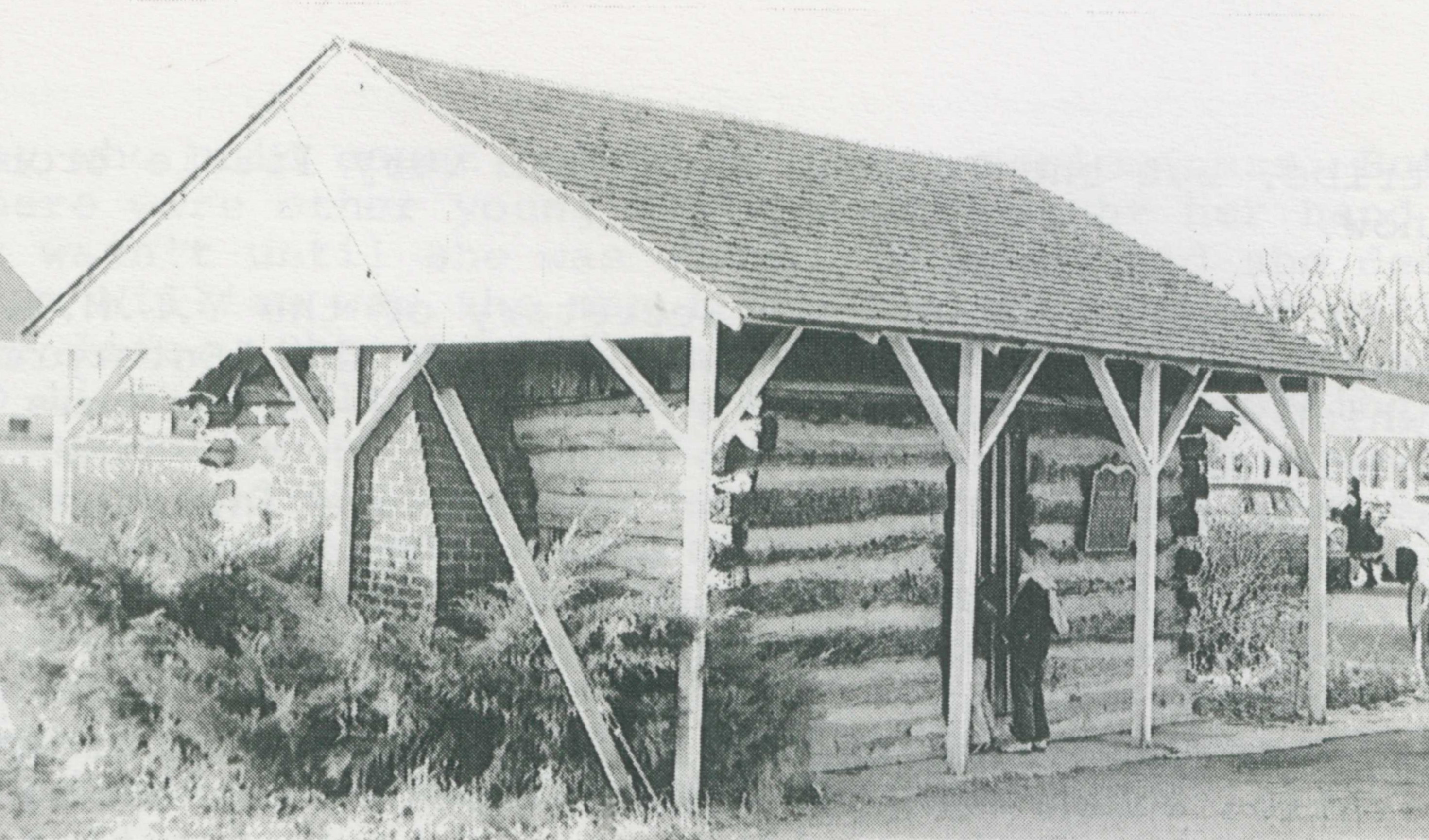
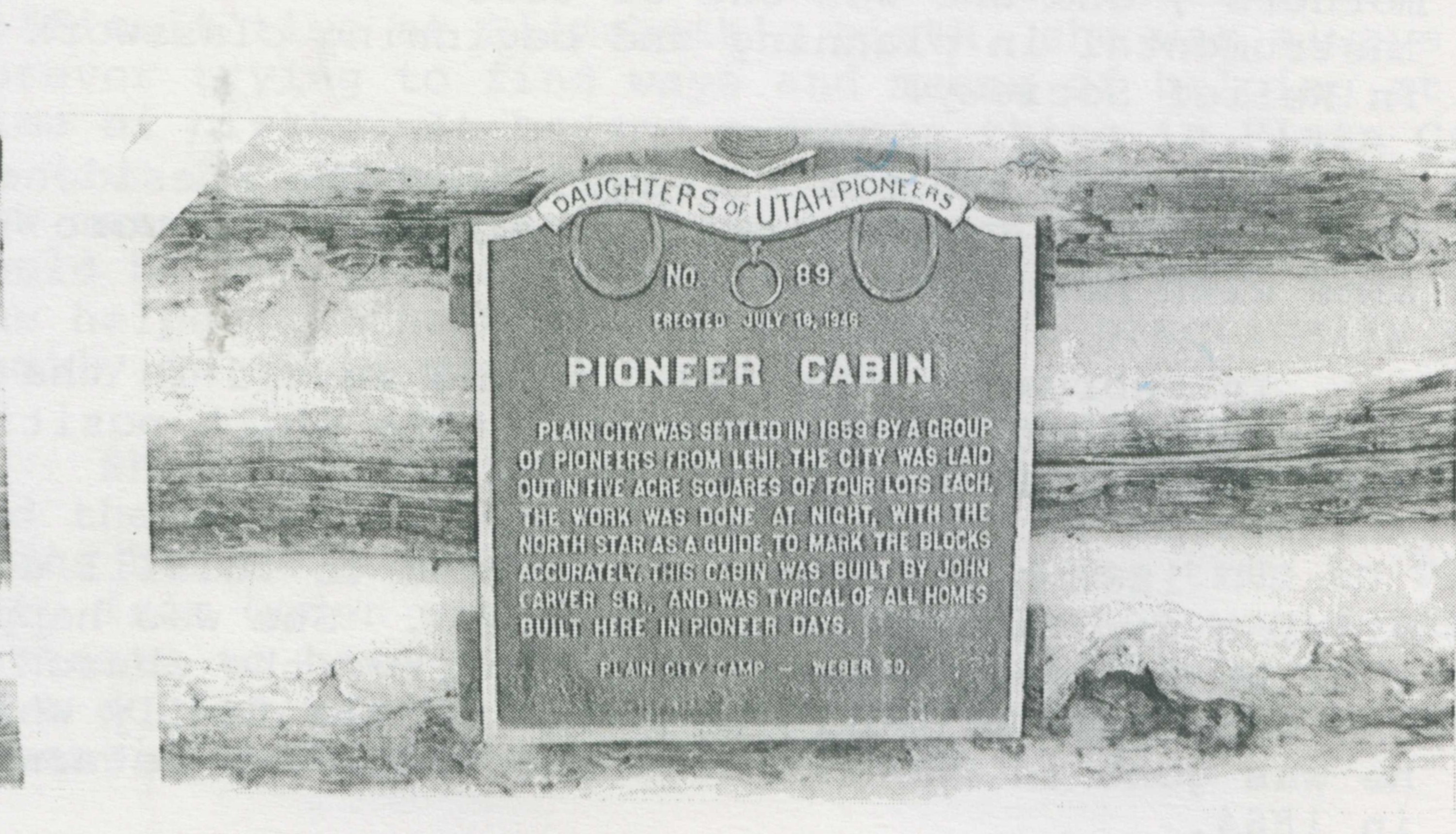
Second log cabin built in Plain City. Built by John Carver Sr. Restored [have to search for Carver Cabin in 1997 history] by Daughters of Utah Pioneers, Plain City Camp.
Andrew Peter Poulsen one of the early settlers of Plain City, Utah was born June 12, 1842 at Ronne, Bornholm, Denmark. In his late twenties, he was converted to the Church of Jesus Christ of Latter Day Saints and with his brother Hans left their beautiful land of Denmark and came to Utah in 1869.
They worked on the railroad from the mouth of Weber Canyon to Ogden and then on west of Hot Springs and north to Promontory Point.
Late in the fall of 1869, Andrew married Sena Henson and their first home was a sod hut at the northwest part of Plain City. They lived there until they bought land east of the center of town and built an adobe house. This was a project that relatives and friends helped with as all the adobe bricks were made by hand.
This house still stands today having been remodeled and extra rooms built after World War I by his son Hans Peter Poulsen. Today a grandson Bernard H. Poulsen lives in the home.
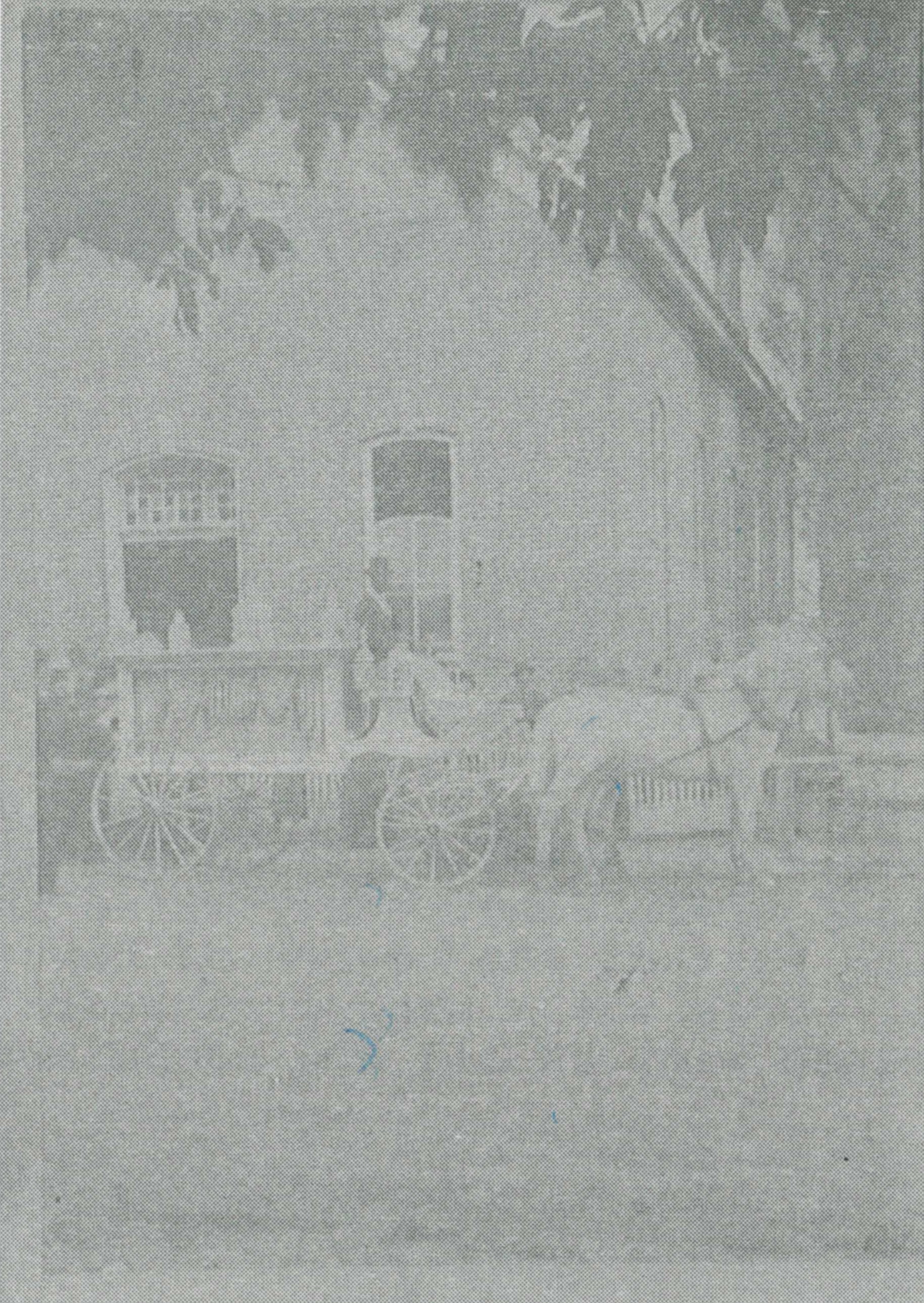
Andrew Peter Poulsen loved horses and took great pride in keeping them well groomed. He had two fine teams of horses, one a white team and the other one a dark pair. For years, he was active in church and community work and used his “long back” surrey and fine white team of horses to carry the deceased to the church and cemetery. He gave freely of his time and money for the building up of the church and the community. He died September 20, 1922 at his home of stomach cancer.
Andrew’s parents, Pedra Poulsen and his wife Karen Kirstine Rettrup also came to Utah from their native Denmark and settled in Plain City in the late fall of 1869. They brought their daughter Andrea Marie Poulsen with them. She later married Christine Olsen in 1872.
Andrew Peter Poulsen’s team of white horses pulling the “long-back” surrey.
Hans Peter Poulsen was born April 19, 1875, in Plain City, Utah a son of Andrew Peter Poulsen and Sena Benson. He was the second oldest and only son in a family of four children, three of whom lived to adulthood. He was educated in the Weber County schools and also attended Brigham Young Academy where he was on the first football team at that school. He fulfilled an L.D.S. mission to Denmark from June 26, 1901 to October 3, 1903. He left his wife and young son at home with her mother in Ogden, Utah.
Hans Peter or H. Poulsen, as he went by to distinguish himself from his Uncle Hans was a farmer and dairyman. He was one of the charter members and a director of the Weber Central Dairy Association. For years, he was a director in the Farm Bureau Association. Most of is life he was active in church and community work. He was a loving and devoted father and husband. For over 50 years, he was married to Ellen K. Maw and they were the parents of seven children.
Hans Peter Poulsen was the first constable of Plain City, from 1916 to 1920, and was also a Deputy Sheriff of Weber County. While he was constable one of his first jobs was to round up several young men for stealing cattle from the towns people and selling them to the slaughter house in West Ogden.
Traveling in those days by horse and buggy was much slower than the fast cars of today but within a short time, the young men were taken into custody and placed in the Weber County Jail which was located in Ogden between Washington Blvd. and Adams Avenue on 24th Street.
White team of horses owned by Hans’ father, Andrew Peters Poulsen
HISTORY OF THE DUMMY
Submitted by Ivy Skeen Carver
Between 1897 and 1910 one could buy a round-trip ticket from Ogden to hot Springs for 30 cents on a train called “The Dummy”. It left Washington Blvd. and 19th Street to Hot Springs via North Ogden.
This “Dummy” train line was extended to Plain City via Harrisville, in 1909. There was quite a celebration; Royal Carver remembered his uncle, Jim Carver, standing on the platform around the engine, pulling the whistle and ringing the bell. One of the engineers was William Clark, the conductor was “Moonie” Holmes, and other engineers were Charles Tracy of William Lane, Charles Lunt and others.
The “Dummy” would start grass fires along the line, with its twice a day trips. One fire was started in the grass on Charles Taylor’s home on the 4th of July, 1915, which burned his barn sheds, pig-pens the old sow and her brood. This disrupted the celebration in Plain City center as the ball team and other men went to Poplar Lane to fight the fire and save the house. The railroad was held negligent and they paid Charles Taylor $1500. After the fire in 1915, and before 1918, they electrified the “dummy” as a precaution to prevent other fires. One amusing tale of the Taylor fire was the Milkman, George Moyes, coming from the dairy with some of his cans full of sour milk and his using this milk along with water from the slough to pour on the fire.
Along the Railroad line from Harrisville to Plain City there were several wooden platforms for loading and unloading freight. There were two newspapers, Morning and Evening, which the “dummy” brought out to be delivered by boys on horses such as Royal Craver, Vern Palmer, Edward Kerr and Charles (Chuck) Skeen and others. The train was so slow that kids would out-run the train on their farm horses and even on foot, running until they gave out.
The “Dummy” worked as a freight engine. The road-bed was laid and rails set by residents along the line. They were paid by Script, which was good for a ride on the train.
More History of the “Dummy”
Submitted by Irene Skeen
In 1909 John Maw, Lyman Skeen and Mr. Skeen and Mr. Eccles, then head of Utah-Idaho Railroad company, negotiated for a railroad to Plain City. On Nov. 15, 1909, the first railroad was built into Plain City.
A big celebration was held in the adobe school, on the north east corner of the town square.
The tracks came along the side of the road through Harrisville and down Plain City to the cemetery, then north to the square. This railroad was used for produced, beet-hauling, lumber, coal and transportation. It was known as the “Dummy” by everybody in Plain City. It was one car pulled with the engine. The inside had a coal stove and kerosene lamps. The car was divided by a partition; one end for the men and the other for ladies. However, it was not restricted as such.
A foggy morning, in 1915, as they were on their way to Ogden and traveling on the old Harrisville road, the “Dummy” ran head-on into an engine pulling railroad cars full of coal. Naturally, everyone was thrown from their seats and some were injured, however, not seriously.
There were two houses nearly where the people went to keep warm. The ladies at the homes bandaged the cuts, where needed, and the people were returned to their homes on bob-sleighs.
Most of the passengers were students going to Weber Academy or to Ogden high School. The “Dummy” stopped at the depot located about one-half block west of the Post Office on 24th Street and the passengers walked to their destination or to Washington Blvd and caught a city street-car.
England’s Store
***
ENGLAND STORE
Merlin England’s grandfather, his mothers father, had a store in Logan. Mrs. Ellen England persuaded her husband to go into the business in Plain City. The store was located west of the England home. Mr. England left for L.D.S. Mission early in 1896, and left the store, coal-yard and farm for Mrs. England to supervise. Merlin England was 3 months at that time.
AGENDA OF THE 50TH CELEBRATION OF THE SETTLEMENT OF PLAIN CITY
MARCH 17, 1909
The citizens of Plain City met in the L.D.S. Church on March 17, 1909, at 10:00 am to celebrate the 50th anniversary of the settlement of Plain City.
Masters of ceremony: Bishop Henry J. Garner, Josiah B. Carver, James L. Robson
Singing by Choir: “Let the Mountains Shout for Joy”
Fred Kenley directing, Bertha Robson organist.
Prayer: Alonzo Knight
Ladies Quartet: Ruby Ipson, Pearl Taylor, Jessie Kenley, Sylvia Richardson
Speech: Lewis W. Shurtliff, First Bishop of Plain City
Song: Willard Lund
Reading of Poem: Peter M. Folkman, composed by David Booth
Speech: George W. Bramwell, Past Bishop
Josiah B. Carver announced that today work was begun on the railroad for Plain City.
Humor Speech: Charles H. Greenwell of Ogden
Singing by Choir:
Prayer: Charles Weatherston
All of the people went it the Adobe Hall to the banquet, the first day for the old people, and the second day for the children. About 1000 people were fed.
NEWSPAPER ARTICLE THAT APPEARED IN THE OGDEN STANDARD EXAMINER IN 1930 ENTITLED:
“HOMECOMING OF PLAIN CITY IS WELL ATTENDED”
ONLY SURVIVORS OF ORIGINAL SETTLERS IS GUEST OF HONOR
Twelve annual homecoming of Plain City, celebrating the seventy- first anniversary of the settlement of the town held Tuesday, proved to be a very enjoyable affair and was attended by a large gathering of residents and former residents from other Utah towns and Idaho and Oregon.
Lyman Skeen, 79, only survivor of the original settlers, was guest of honor and gave a brief talk. Mr. Skeen is a son of Joseph Skeen who built the first log cabin in Plain city. Other early residents of Plain City, now residents of Smithfield, who attended the celebration, were Mrs. Tillie Collette Merrill, 81, and her sister, Mrs. Julia Collette Cantrell, 79.
Plain City was founded on March 17, 1859, by a group of people from Lehi. A history of the founding of the town and many interesting incidents connected therewith were given by P.M Folkman.
A tribute to the pioneers of the town and to the pioneers of Utah was given by Miss May Taylor. A talk on community loyalty was given by Lawrence Jenkins. Wilmer Maw presided at the morning session. Invocation was given by Gilbert Thatcher.
March 17, the date on which Plain City was founded, was also the date on which the Relief Society of the L.D.S Church was organized in Nauvoo by the Prophet Joseph Smith and this subject was discussed by Mrs. Sarah Larkin of the North Weber Stake Relief Society Presidency.
Mayor Ora Bundy, City Commissioners Fred E. Williams and W. J. Rackham, and County Commissioners F. W. Stratford, Harvey P. Randell and I. A. Norris were among the distinguished guests.
Luncheon was served at noon. Dancing was enjoyed at night. Music and readings and other features were on the program which continued throughout the day.
Lyman Skeen
Lyman Skeen came to Plain City with his father Joseph Skeen with the original settlers on March 17, 1959 at the age of nine on his pony. He was the last living original pioneer of Plain City. He died in 1933.
ANNE CATHERINE HEDEVIG RASMUSSEN HANSEN
SUBMITTED BY HER GRANDDAUGHTER
LAVINA TELFORD THOMPSON
Anne Catherine Hedevig Rasmussen Hansen was the first wife of Hans Christian Hansen and was born October 1, 1823, in Millinge, Cavanninge, Svendborg, Denmark.
On October 7, 1849, she married Hans Christian Hansen in the Parrish of Horne.
Hedevig and her husband were among the first people in their community, Helsinger, to give willing ears to the gospel of Jesus Christ. They were baptized October 25, 1851. She supported her husband in preparation for leaving their homeland and families and their immigration to America. They left Demark, December 20, 1852, and sailed for Utah on January 16, 1853 on the “Forest Monarch”.
Pioneering in Utah was not easy, particularly to one who has experienced the upper middle class level of circumstances since her marriage. After living a pioneer life in Utah for a little over a year, Hedevig was thrilled with the birth of her child and first daughter, Josephine.
During the next three years, they moved several times, first in Ogden, then to Bingham’s Fort and finally to Harrisville. It was there that her third son, Nephi, was born.
August 28, 1857 became a special day in their lives. They were sealed together in the Endowment House. The first born in the covenant and her second daughter, Anne Margarethe, arrived April 6, 1859, in Harrisville.
Early in 1869, a great challenge came into the home, when Hedevig’s husband was called to fill a mission in his native Denmark. Hedevig made a shirt for her husband from material of one of her petticoats. She dyed it in juice from bark and roots, and Hans wore it as he left for his mission.
The following was taken from Josephine’s writing:
It was known that mother could wait upon women in confinement cases. It was a natural gift with her. They came for her to go to Plain City to care for a lady there. This was four miles away. She did her work so well that the woman paid her $2.00 in silver. Her career was established and they kept coming for her to go around nursing. Two bushel of wheat was the price usually charged. Then the Bishop came to our place from Plain City and wanted mother to move down there so she would be nearer to wait on women in their confinement cases. They tore our log house down, moved it to Plain City, and put it up again. They also built us a dugout, and now we lived in a settlement and could go to school. Two or more children blessed Hedevig’s home in Plain City. Hans Christian was born August 14, 1863, and Chauney Ephrian was born May 8, 1866.
Hedevig lived a full life and was taken in death March 31, 1899, being buried in Plain City.
HISTORY OF PLAIN CITY FROM THE LIFE OF
CHARLES NEAL
I, Charles Neal, son of Job Neal and Harriet Smith Neal, was born September 7, 1834, in Stratford-on-Avon, Warwickshire, England. I was baptized August 10, 1849, at Stratford-on-Avon by George Smith, and confirmed by Elder John Freeman. About 1853, I was ordained a Teacher by Elder Weeks.
I, with other immigrants left England on the 22nd day of March 1857 on the ship George Washington with Captain Cummings in command. We arrived in Boston about April 12, then proceeded on our journey to Iowa City, which was the Western terminus of the railroad. There we had to wait about three weeks for the handcarts to be finished before we could start our journey across the plains. There were about 125 handcarts and 275 men, women, and children in the company. Israel Evans was Captain, and Benjamin Ashley, Assistant Captain. I was teamster most of the way. After a long and tedious journey on the plains, our food supply became exhausted so that we had to live four days on buffalo meat without salt. We arrived in Salt Lake City on September 11, 1857, from which I further continued my journey to Lehi.
On the 24th of September I returned to Salt Lake City and found Miss Annie England who came across the sea and plains with me. We were married the same day by Elder Israel Evans., Captain of our company and then returned to Lehi and went to work for him.
On March 10, 1859, a small company left Lehi in search of a new home. We were in that company which settled in the place now known as Plain City.
Upon arriving on March 17, we took up the arduous labors of fencing in the Big Field and making Plain City Irrigation Canal, besides fencing in our own lots and planting them. Being of an ambitious character, I carried stakes from the Weber River and fenced in the first lot.
The first year we lost our crop. I then went in search of work and got a job from President Brigham Young on the wall around the Eagle Gate in Salt Lake City. Two weeks later, my wife, Annie England Neal, followed me on foot to Salt Lake, and learning I was working for President Young, she obtained work in the Lion House in Brigham Young’s family where she remained for eighteen months.
When we were about to return to Plain City, Sister Eliza R. Snow, recommended that we have our endowments. Accordingly, before leaving, we were endowed and sealed by President Brigham Young on October 24, 1860. On the same day I was ordained an Elder by Elders J. V. Long and George D. Watt.
We then returned to Plain City where I was appointed with a company of three to oversee the water ditches, in which capacity I served about three years. I was then appointed watermaster in Plain City. I served one year with credit and satisfaction.
I was one of the first appointed Sunday School teachers in Plain City, and at the Sunday School Jubilee held in Salt Lake City in 1899, I received my badge for having been a Sunday School worker for thirty-five years.
From 1864 to 1899, I served as organist in the Sunday School and Ward.
In 1860, I helped to build the first school house, which was adobe. I also helped to build the second school house which was fifty by twenty-five feet. I was Chairman of the committee to construct the present meeting house. I was one of the school trustees for eight years and road supervisor for about nine years.
In 1866, I was called to go to the Missouri River with four yolk of oxen to bring some immigrants, which made my third trip across the plains. While at the Missouri River I met the two orphan children of my sister, Ellen Eggerson, who died and was buried at sea on July 4. Her infant baby died on the 21st of July in Nebraska and was buried there. I returned and brought with me my sister’s little son, two and one-half year old. When about four days out from the Missouri River, I was taken very sick and was not expected to live; in fact Captain Harden was about to leave me there with provisions that should I recover, I would be brought in on the stage. But I begged the Captain to bring me along with them, telling him if he would, I should recover. So they brought me along and after traveling for about three hundred miles, with good care, I was able to drive my own team and get back all right.
When home again, I assisted in starting the first martial and brass band in Plain City. We purchased a second-hand set of brass band instruments from the old Camp Floyd Band in Salt Lake.
I was Postmaster in Plain City for many years. The following was published by the President of Ogden in 1903.
“Charles Neal, the retiring Postmaster of Plain City, has a most enviable record of service. The post office at Plain City was discontinued today and that town will be furnished with rural delivery. Charles Neal, who has been Postmaster in Plain City for the past twenty-five years, retires from service with an enviable record. He has served continuously under five Presidential administrations and that is sufficient evidence of his ability. He has a record in the Government of which he may feel proud”
My first wife, Annie England Neal, died November 5, 1900. She was a faithful and devoted wife, and endured many hardships and privations in our pioneer days in this, our mountain home. She was a true and faithful Latter Day Saint. Having no children of her own, she raised my sister’s child, Emily Neal Eggerson, from two and a half years old until about nineteen. We raised my brother, Willard, from eight years old until he married at the age of twenty, and Sophia England, her niece, from three months old to about fifteen years old; also Ella Jerimah Neal, my niece, from nine until she was about nineteen. We also raised William Neal, my nephew, from two and a half years to about twelve when he went away with his sister, Ella, who married Thomas H. Cottle.
In 1901, I married Miss Myra Swingwood. About 1907, my wife’s sister, Annie Swingwood Brown, died, leaving two children-a boy and an infant baby girl. We adopted Myra, the baby girl, who is now six years old.
At present, I am the oldest handcart pioneer in Weber County.
(Dictated shortly before his death)
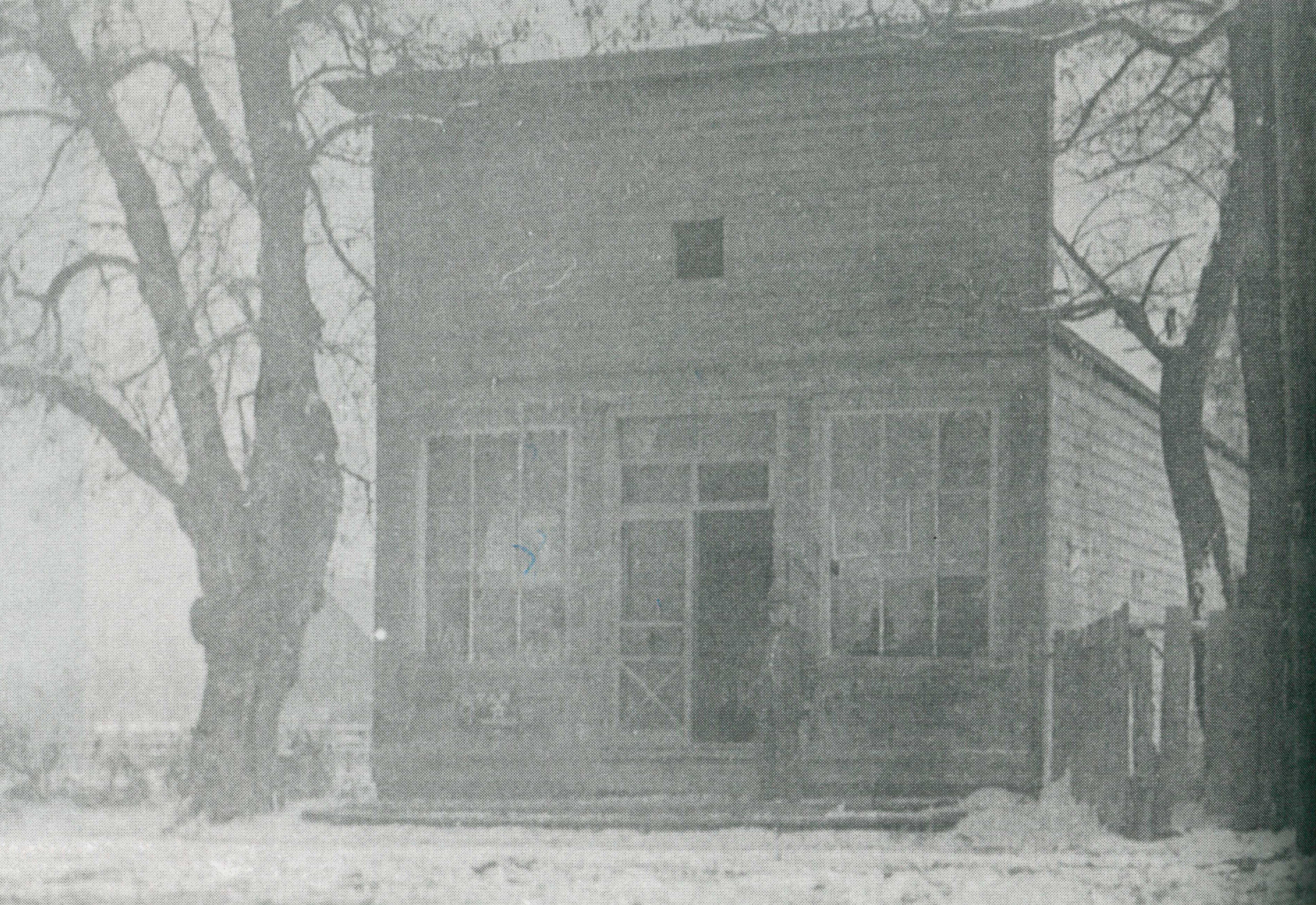
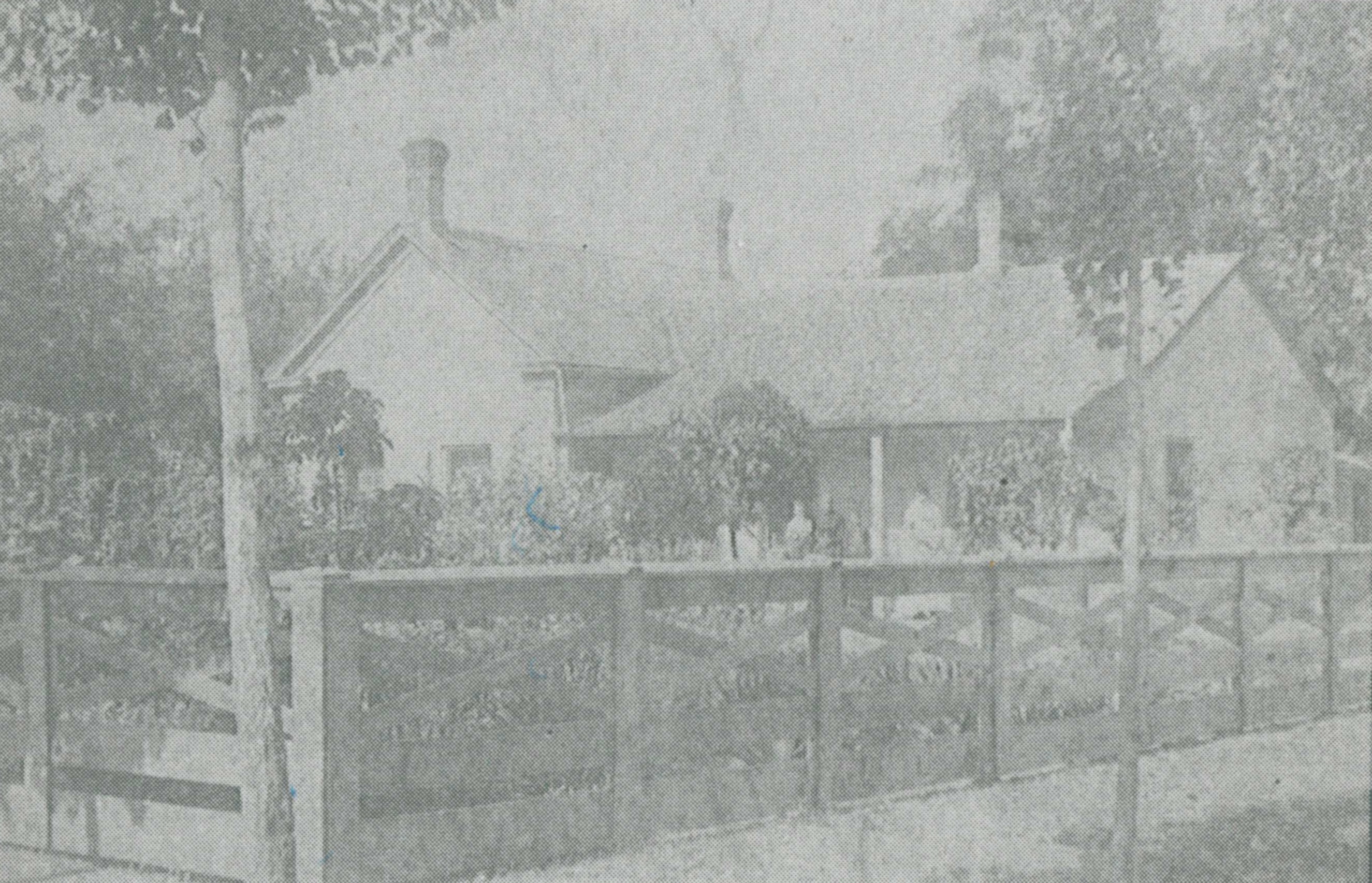
Thomas Singleton’s home now owned by Elmer Singleton
Back in the early days of my blog, this photo was one that I uploaded. However, in the transition to wordpress all the previous photos were lost in albums.
I mentioned this stop at Calico, San Bernardino, California when I wrote the day after. Here is a clip from that post:
“We have thoroughly enjoyed our honeymoon to California. We have had a wonderfully beautiful condo for our stay. I very much appreciate James and Catherine Cazier for all their Sunday meals, but now for this condo as well. They were so gracious to offer it.
“We have enjoyed movies, time to relax, Christmas, and little excursions all over. Yesterday we went to Calico, the old Ghost town north of Barstow. It was definitely a tourist trap, but I very much enjoyed the visit. Amanda and I even took one of those old west photos which I will have to be sure to get up on the site as well. We have grown closer and closer. Something I would not have thought possible. We commented often after the marriage that nothing had really changed. However, with the benefits of marriage, we have found our love and relationship at a newer, deeper level. Something we could not have imagined only a week ago. Only heaven knows where it could be in another month, year, or lifetime. Hopefully it only progresses. Like the old hymn, there is no end…
Here I write 18 years later.
Senator Gordon H Smith told me as I got closer to marry Amanda that love ebbs and flows, take the good with the bad. That is truly what has happened. Love has ebbed and flowed over the past 18 years. But I cannot imagine my life without my dear, sweet wife. She puts up with more than I ever will.
18 year anniversary of being on our honeymoon. The beginning of yet another year together.
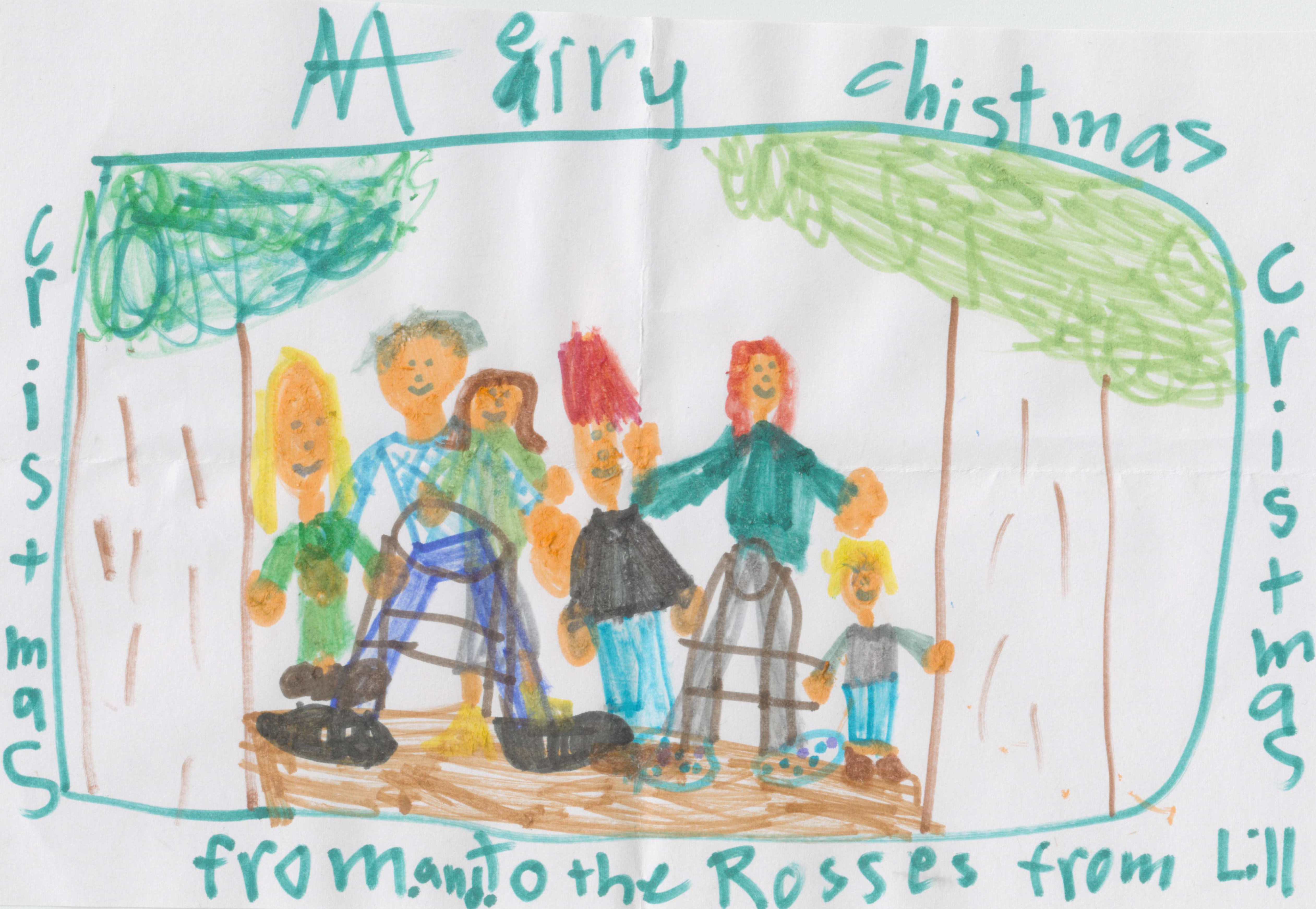
These were simply too cute not to share. Every year, we send out a couple hundred Christmas cards to friends, acquaintances, and professional contacts. A few weeks before Christmas, Lillie wanted to get in on the action and said she was going to make a Christmas Card for us to send out.
Lillian Ross Christmas Card “Merry Chistmas Cristmas Cristmas from and to the Rosses from Lill”
She made the Christmas Card you see above. She came to work with me at the office on a Friday a week or two before Christmas. The fun part was she even made a little envelope for it, also from copy paper here in the office. It was addressed from the Ross Family with a happy little attempt at our address. I wish we had saved it as it was a piece of art in and of itself.
James is more blond as Amanda and Hiram are more red haired. I have more hair, although not sure if I am wearing a hat or what is going on there. I love Amanda’s polka dot shoes. We are all happy, except maybe James looks mean or mad. I also like we have a nice nature shot between two trees!
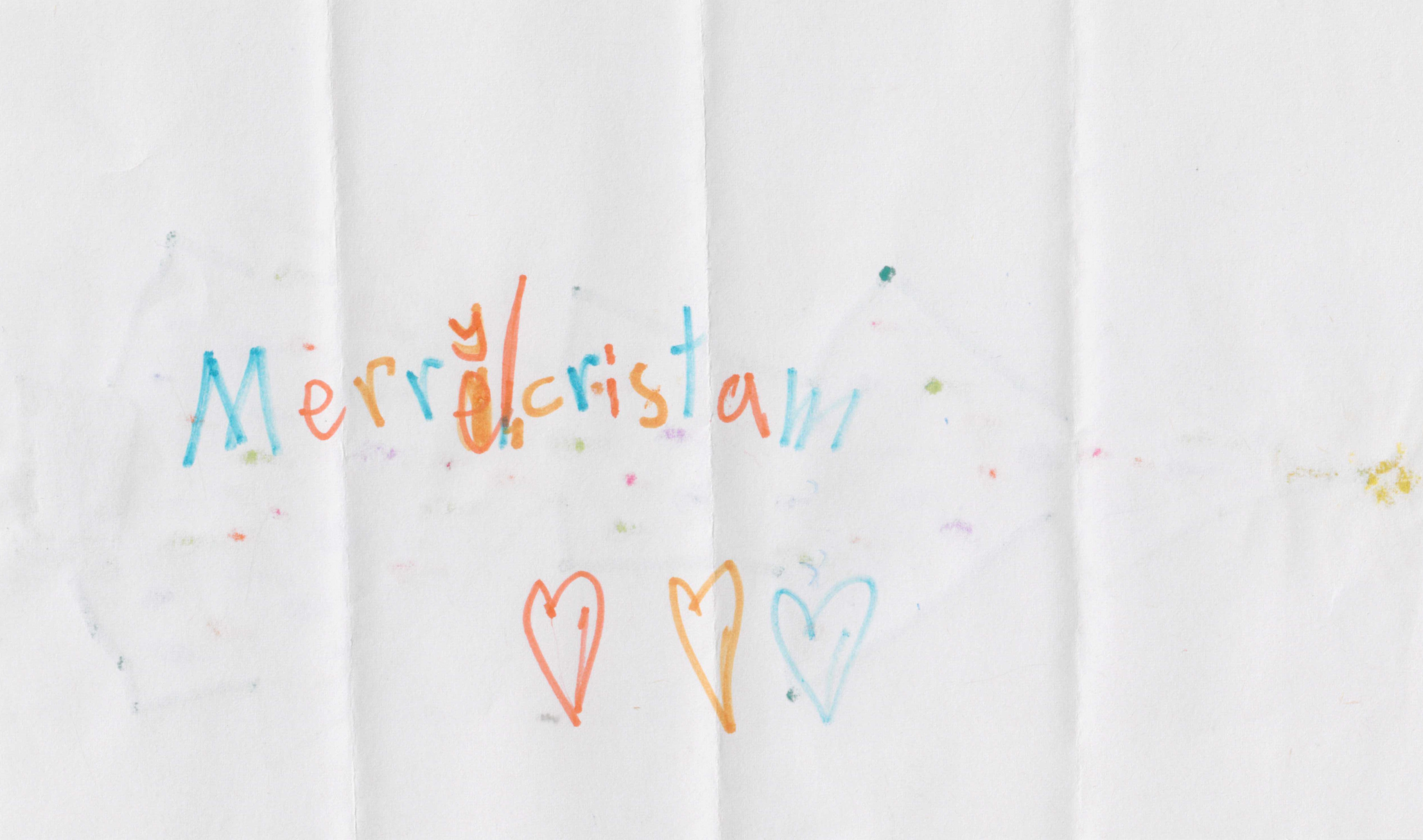
Merry Christmas note from Lillian
Christmas tree insert from Lillian
James also sent home a Christmas Card from school I thought I would share.
James Ross – Merry Christmas Mom and Dad
Here is the inside of the card.
James Ross’ coloring prowess comes to light on the inside of the card
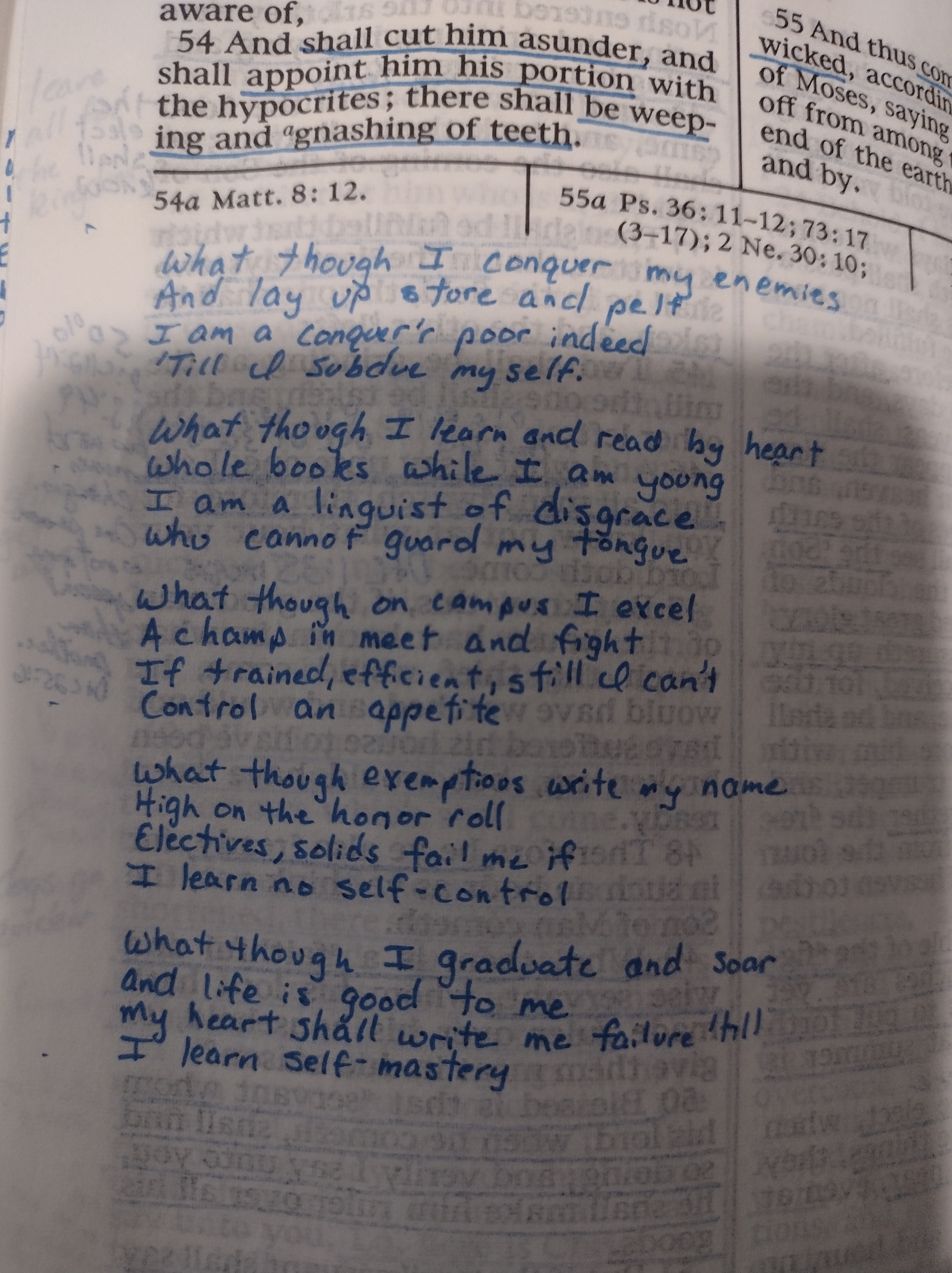
I was writing a talk a few weeks ago and while working through my scriptures I stumbled upon this poem I remember writing in there while on my mission in early 2000. I want to say it was while I was in Runcorn, England, but I cannot say for sure. It struck me as relevant now as it was then. Just to be clear, I did not write or compose this poem. I tried to locate a copy online and found the first paragraph, but none of the rest. It says it is author unknown (for at least the first paragraph). I did find that David O. McKay cited the first paragraph in a talk in 1967.
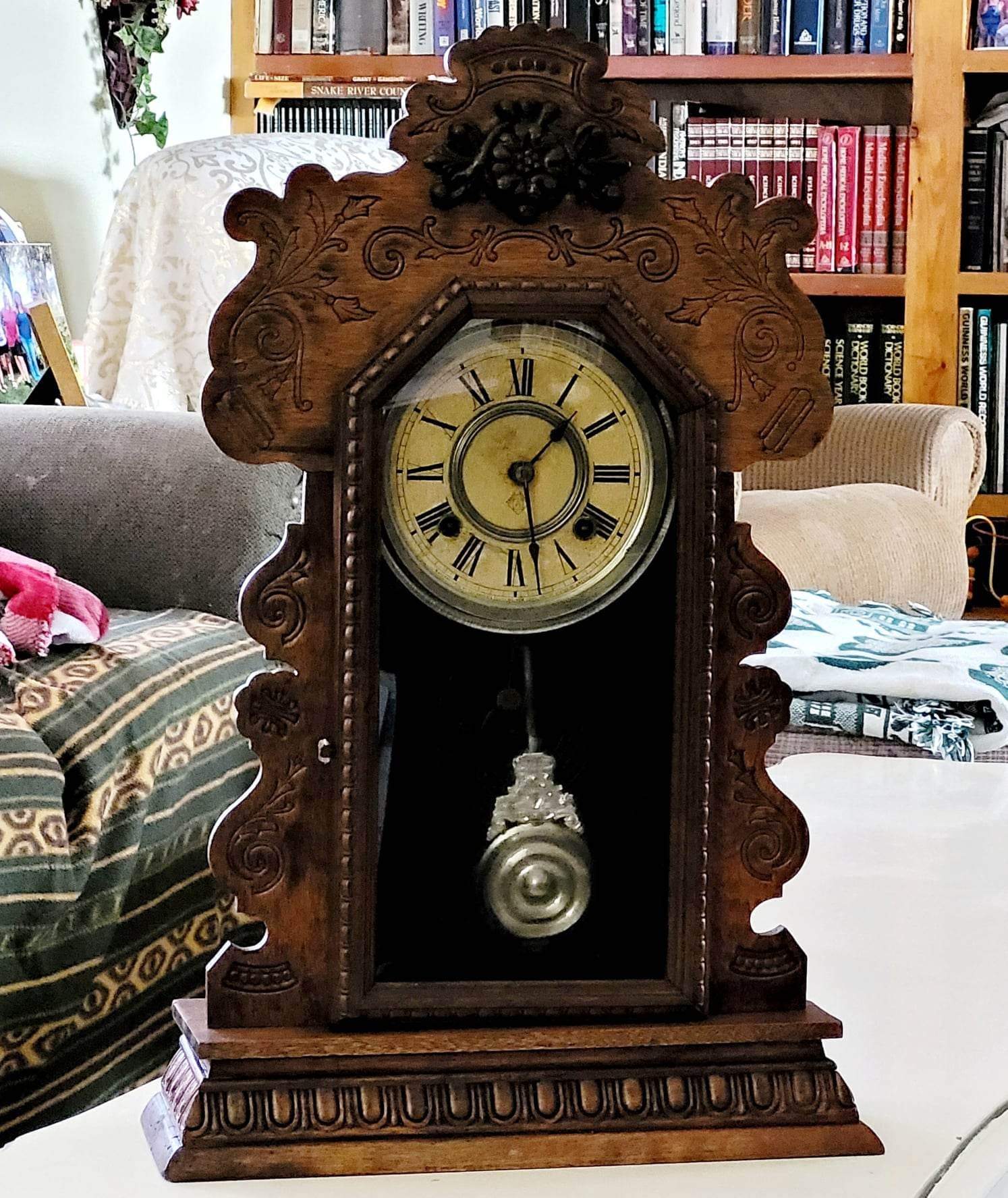
A few years ago I snapped this photo of my Great Grandmother’s clock sitting on my Dad’s work bench in his shop.
My parents picked up this clock in Richmond, Utah after my Great Grandma Lillian Coley Jonas Bowcutt passed away in 1987. The story I recall was that it was in the root cellar. The belief being that at some point it quit working and was placed in the cellar.
At some point I remember Dad determining that the main spring had broke. The photo above 2021 shows that the silver of the clock, if it was original, was nearly all gone. I don’t think it was original, probably painted at some point over the years. Sitting in a root cellar for unknown decades had not helped the wood and clock mechanism either.
I don’t know if my Great Grandparents purchased it new or not. I will have to do some research on it, but the belief is this clock likely predates my Great Grandparent’s marriage in 1918. Did it belong to the the Coley family before that, the Jonas, or did someone else give/sell it to them? We will not know in this life. It likely even predated Lillian’s birth in 1898.
Either way, Dad took it upon himself to work on restoring it. He took the clock to Twin Falls and had the mechanism fixed. He restored the wood and glass while the clock was fixed. Here is what it looked like at Christmas 2022. Pretty amazing.
It now works and even chimes the hour and quarter hour. A beautiful relic restored to life.
I have two copies of the History of Plain City, Utah. The front indicates it is from March 17th 1859 to present. As far as I can tell, the book was written in 1977. At least that is the latest date I can find in the book.
One copy belonged to my Grandparents Milo and Gladys Ross. My Grandpa has written various notes inside the history which I intend to include in parenthesis whenever they appear. They add to the history and come from his own experience and hearing.
I will only do a number of pages at a time. I will also try to include scanned copies of the photos in the books. These are just scanned copies of these books, I have not tried to seek out originals or better copies.
History of Plain City March 17th 1859 to present, pages 39 through 43.
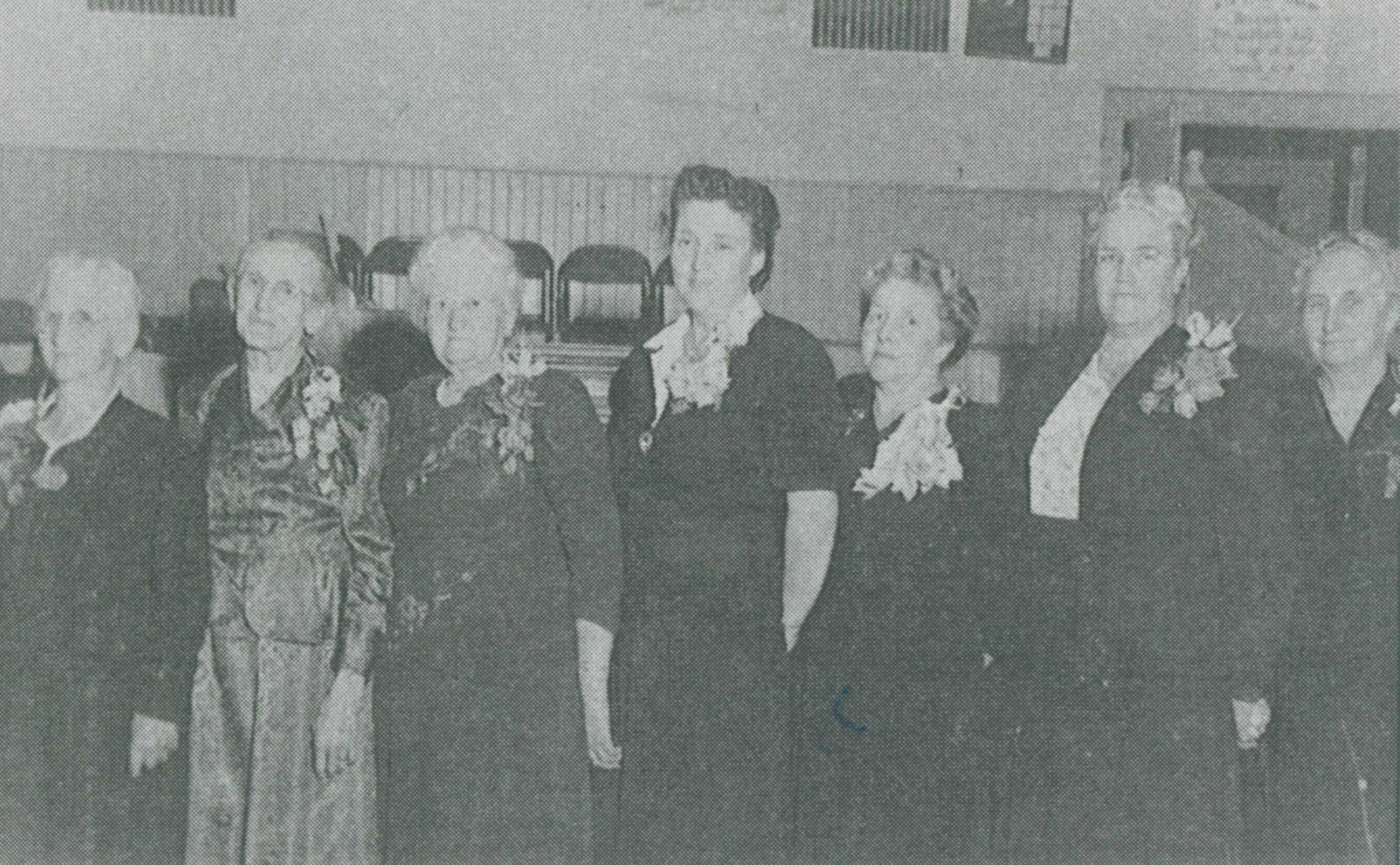
Former Relief Society Presidents Prior to 1948
Mary Ann Geddes, Laura Moench Jenkins, Ismilda England, Nellie Ward Neal, Lavina Telford, Cerilla Palmer, Sarah Y Knight
Relief Society Prior to 1946.
Relief Society Singing Mothers Early 1960’s
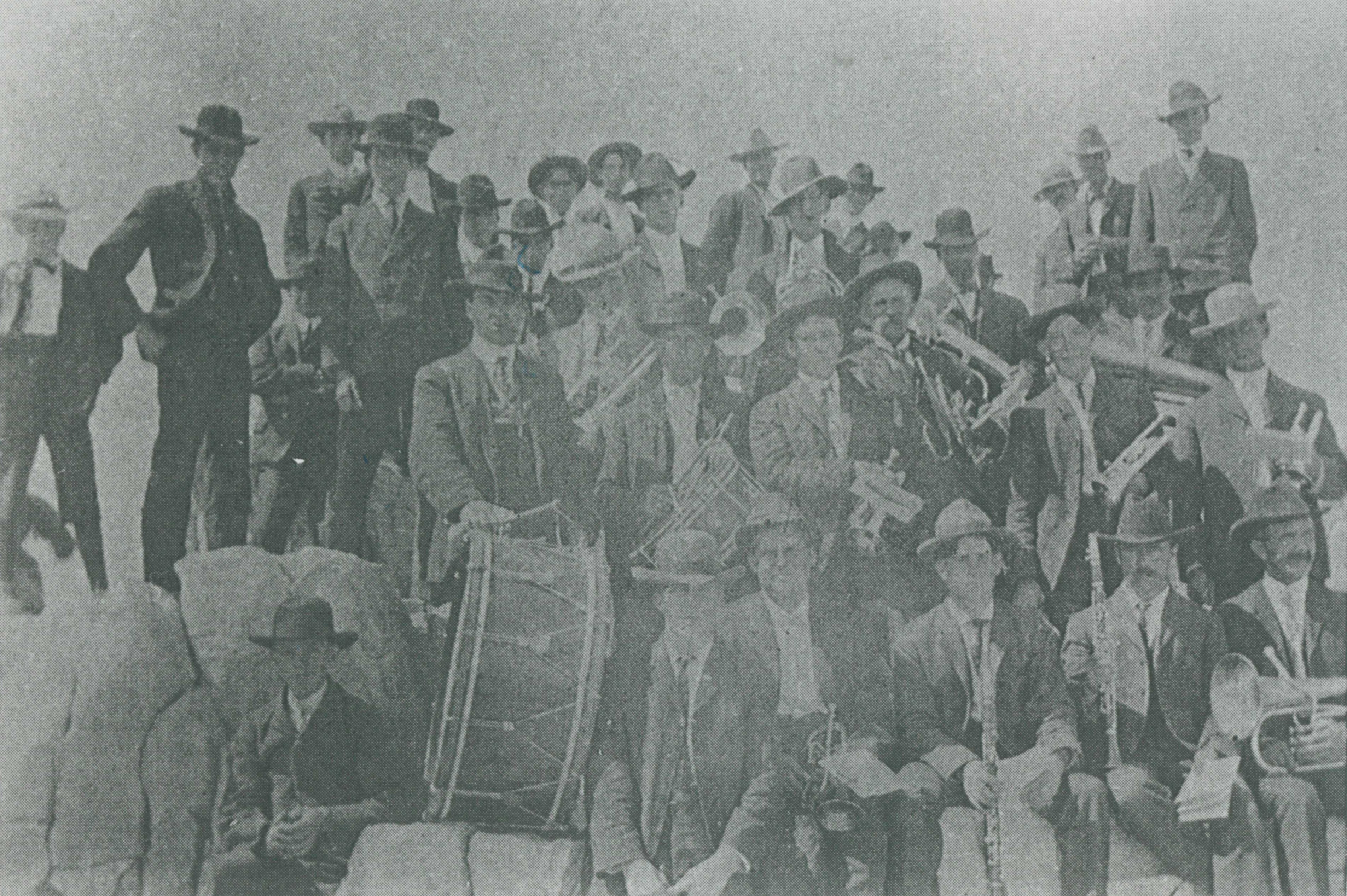
First brass band organized in Plain City.
Pioneer Trio (l-r): Alminda Johnson (Harmonica), Ina Poulsen (Harmonica), Florence Singleton (Accompanist)
This group performed for many years at Ward and town recreation activities. Elizabeth Lund joined the group after as a Whistler.
HISTORY OF PLAIN CITY RECREATION HALL
Pioneer settlers of the early communities loved to dance. Plain City residents began dancing on bare dirt floors four months after arriving here. Later, they danced in homes and school houses.
One school house was an adobe building on the south side of the side of the square. Local talent was used for the music and entertainment.
An amusement hall, where dances were held, was located between the Leah Penman home and the George Weatherston home, where Lynn Folsman’s home now stands. It faced west, with a raised stage in the west end. This property was deeded to the L.D.S. Church in December, 1906.
An Act of Congress, dated April 24, 1820, entitled “An act making further provisions for the sale of public lands, etc.,” Utah Territory, U.S.A., signed by President Ulysses S. Grant, gave a tract of land 640 acres for the townsite of Plain City.
Some of this property was deeded to Charles Weatherston December 9, 1898. Mr. Weatherston deeded a lot to the Church when George W. Bramwell was Bishop.
The recreation hall was destroyed by fire before 1912. Since then, the property has been deeded back to Weatherstons.
An open air dance hall was built just west of the present L.D.S. Chapel in 1925. It was a community landmark and had an extra special dance floor. Later, it was closed in so it could be enjoyed in the winter months.
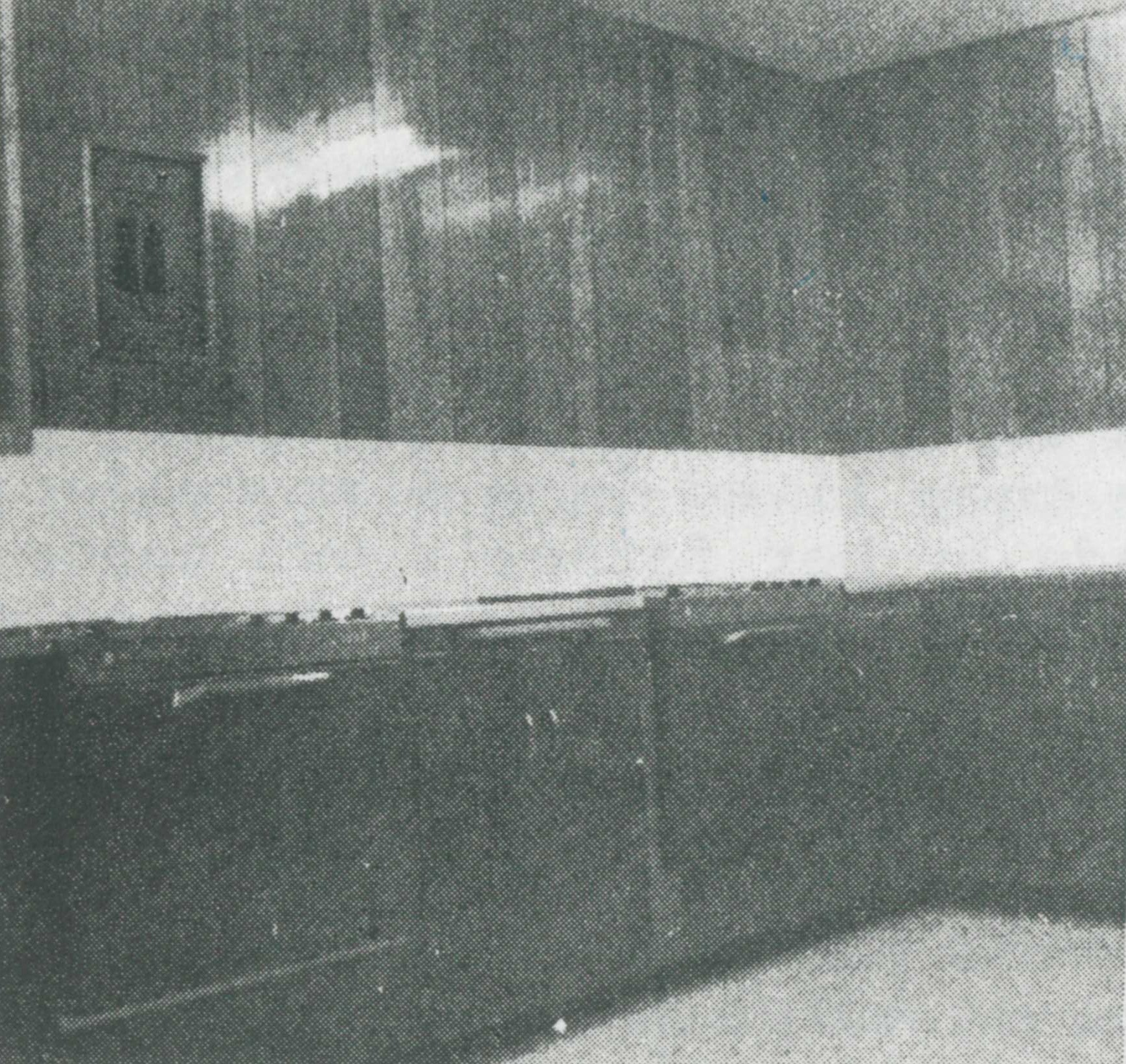
The Church Center had just been completely remodeled on the inside, including a basketball court, a beautiful modern kitchen, and other features, when it was destroyed by fire April 22, 1967.
Plain City Chapel dedicated 1889 looking from Northwest.
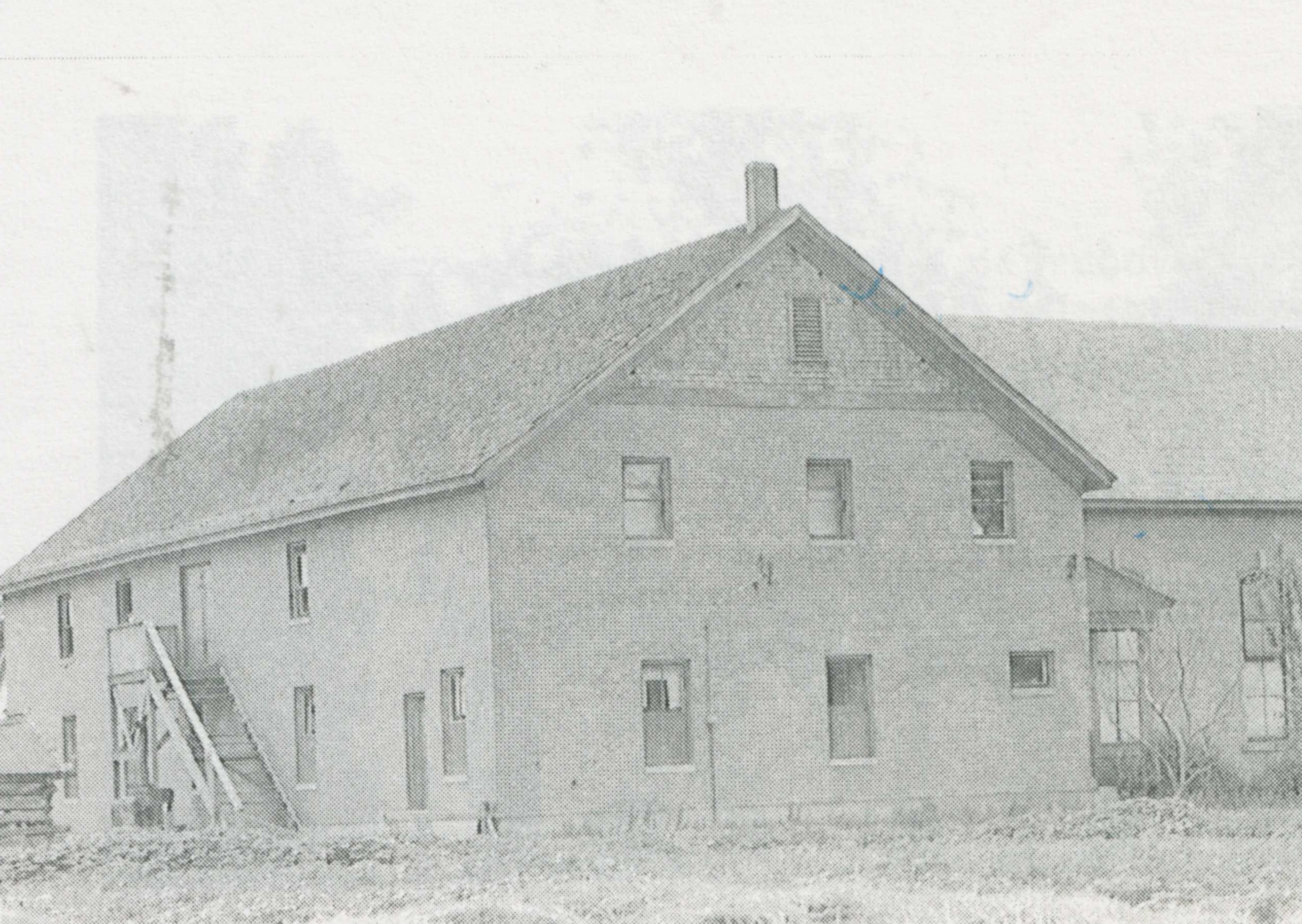
Rear of Chapel. This addition was built in 1914 which added a kitchen, several class rooms and a recreation hall upstairs.
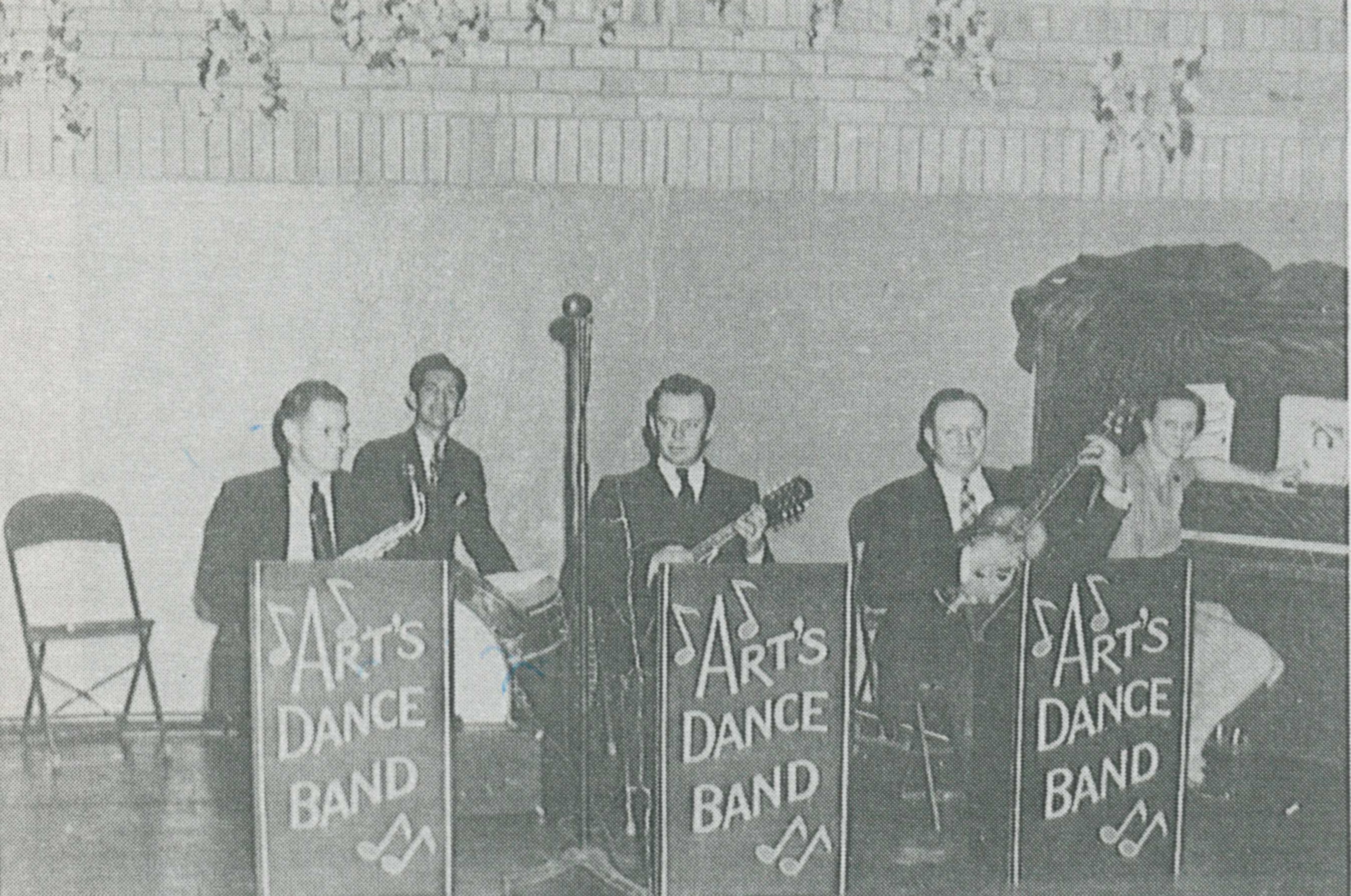
Arts (Art Simpson) Dance Band played for most of the dances held in the recreation hall that burned down in 1967. They also played throughout the county.
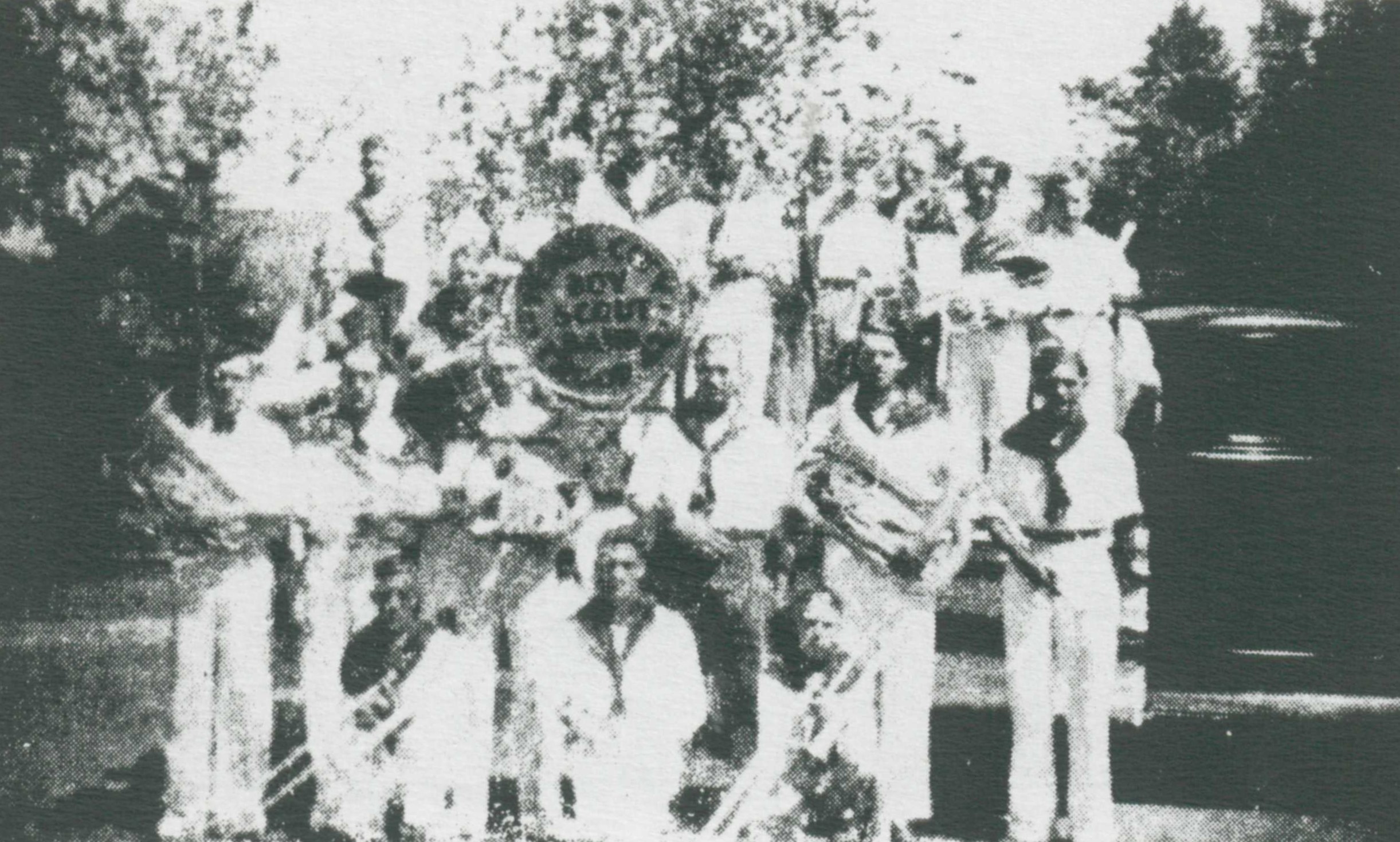
Boy Scout Band organized by L Rulon Jenkins in 1934. They rode around the town on a truckbed on the Fourth of July at daybreak playing lively music to awaken the residents and summon them to the celebration on the Town Square. They also performed on other occasions.
Kitchen Band played for most of the dances held in the recreation hall that burned down in 1967. They also played throughout the county.
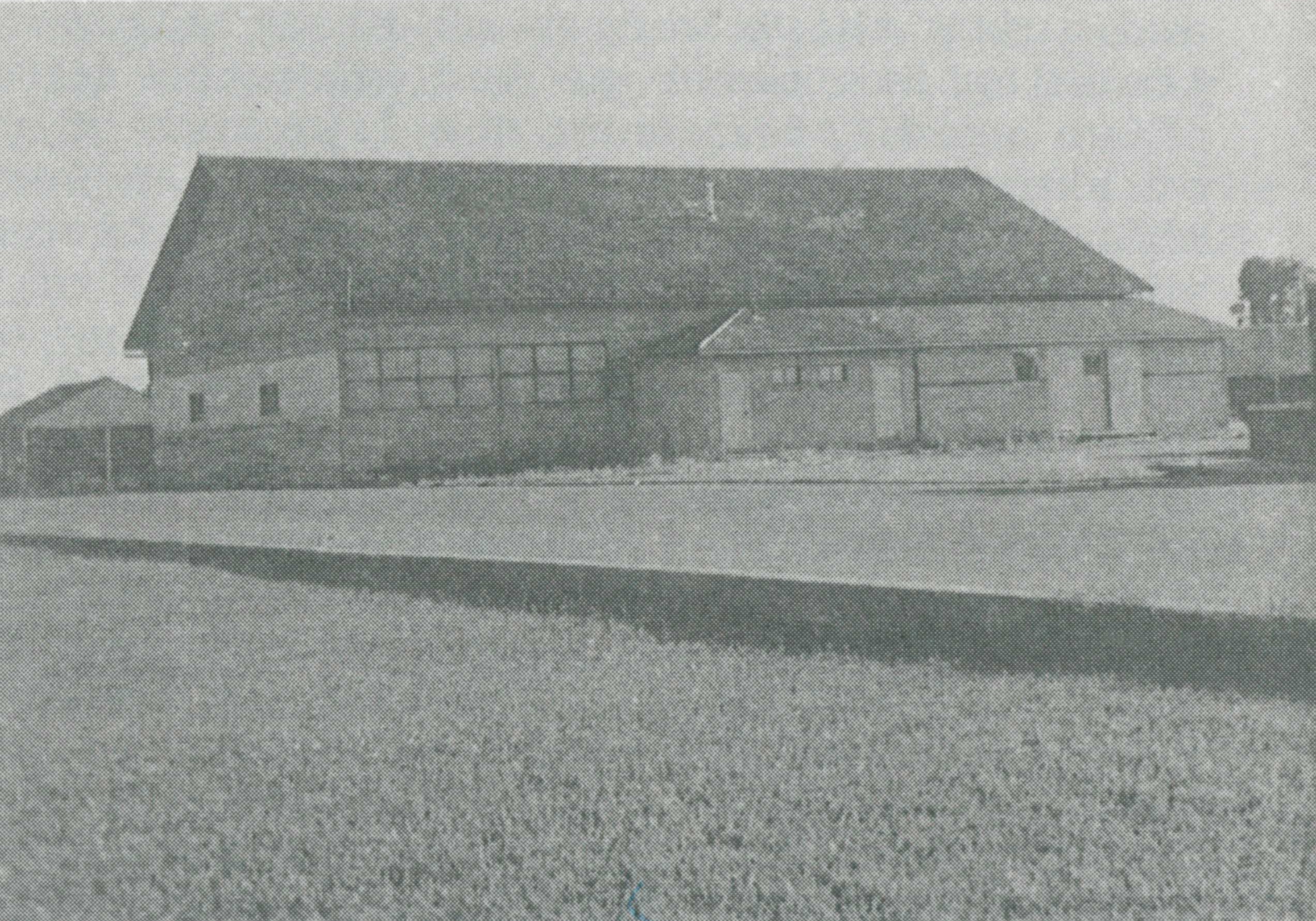
The Recreation Hall was built in 1924. The first dance was held July 20, 1924. Additions were added in 1966 when the building was renovated. A kitchen was added, also facilities for basketball.
Kitchen of renovated addition.
This building was destroyed by fire in April 1967.
This building was first built as an open air dance hall and was later enclosed so it could be used in the winter months.
This is the Dedicatory Program that was in my Grandpa Milo Ross’ possessions. Dad provided me a copy and I scanned it. The writing on the program and throughout is his writing, Milo James Ross.
Plain City Ward – Farr West Stake – Church of Jesus Christ of Latter-Day Saints – Sunday, November 7, 1954 – 2:00 P.M.
Grandpa was always pleased to have been a part of the construction of this building. He was upset when this building had a new one built beside it and then tore down this one. He also had great satisfaction in helping to arrange the construction of the Plain City 2nd, 7th, and 8th Ward Building.
Charles L. Heslop, Elvin H. Maw, George E. Knight, Merrill Jenkins
Our Bishops who have served during planning and construction of this New Chapel.
Bishop Charles L. Heslop, Bishop Elvin H. Maw, Bishop George E. Knight, Bishop Merrill Jenkins.
History of Construction
Bishop Heslop, who served as bishop of our ward from 1936 to 1944 along with his counselors Gordon Thompson and Abram Maw secured the ground for the location of this new chapel from Stephen Knight a resident of Plain City ward with thought in mind that some day this would be the site of our new building. It was during their administration that Bishop LeGrande Richards came to our ward and spoke to people instructing them to start a building program, and forget much remodeling of our old Chapel. In 1944 Bishop Heslop was released and Elvin H. Maw was sustained as Bishop with L. Rulon Jenkins and Fred Singleton as counselors. Later Lewellyn Hipwell served as a counselor. During this time the approval to build was given and enough money was raised to start construction, but due to the outbreak of war, we were unable to begin. In 1949 Bishop Elvin H. Maw was released and George E. Knight was sustained as Bishop with Leslie T. Maw and Howard Hadley counselors. In the fall of 1951 Brother Howard McKean came and visited our old chapel at which time he instructed us to make plans to build a new building. In the spring of 1952 the ground breaking ceremonies took place and the building commenced. Committees composed of ward members were chosen to help secure donated labor and funds and many other things pertaining to this undertaking. The entire ward response was wonderful and the construction proceeded very well. In the fall of 1953 the Stake was reorganized with Bishop George E. Knight being called as first counselor to President Raymond Pace. The ward was reorganized with Merrill Jenkins sustained as Bishop with Elmer Ericson and William J. Searcy as counselors. It has been under their direction that this chapel was completed.
To single out individuals for special thanks would be amiss since there are so many who have contributed their utmost and someone would surely be left out.
The building has been entirely constructed under the capable supervision of Leland Carver a Seventy in our ward. We are very proud of the work done under his direction.
Written by Grandpa, Milo James Ross was paid to help Mr. Carver as a carpenter.
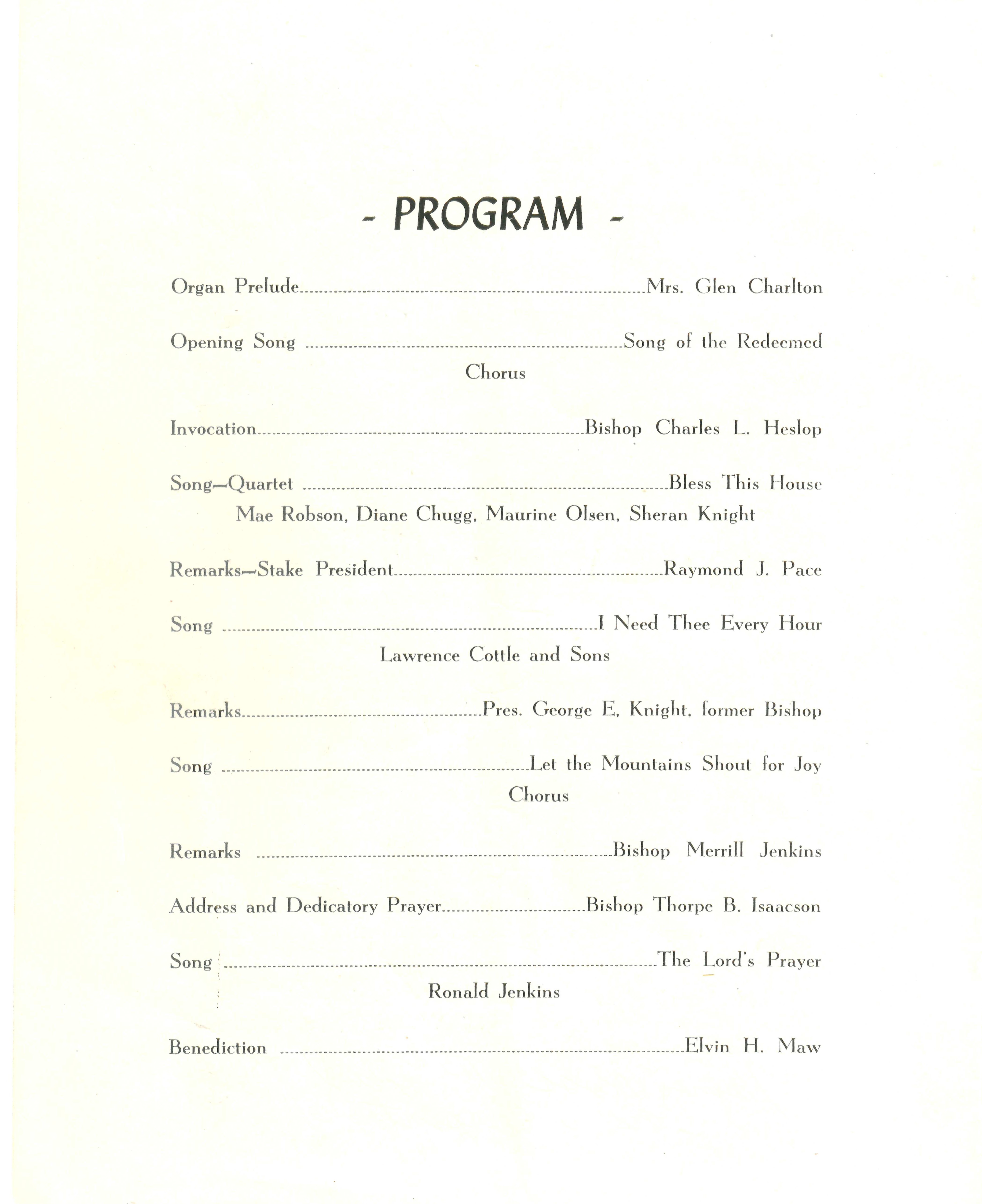
Program
Organ Prelude – Ms. Glen Charlton
Opening Song – Song of the Redeemed – Chorus
Invocation – Bishop Charles L. Heslop
Song – Quartet – Bless This House – Mae Robson, Diane Chugg, Maurine Olsen, Sheran Knight
Remarks – Stake President Raymond J. Pace
Song – I Need Thee Every Hour – Lawrence Cottle and Sons
Remarks – Pres. George E. Knight, former Bishop
Song – Let the Mountains Shout for Joy – Chorus
Remarks – Bishop Merrill Jenkins
Address and Dedicatory Prayer – Bishop Thorpe B. Isaacson
Song – The Lord’s Prayer – Ronald Jenkins
Benediction – Elvin H. Maw
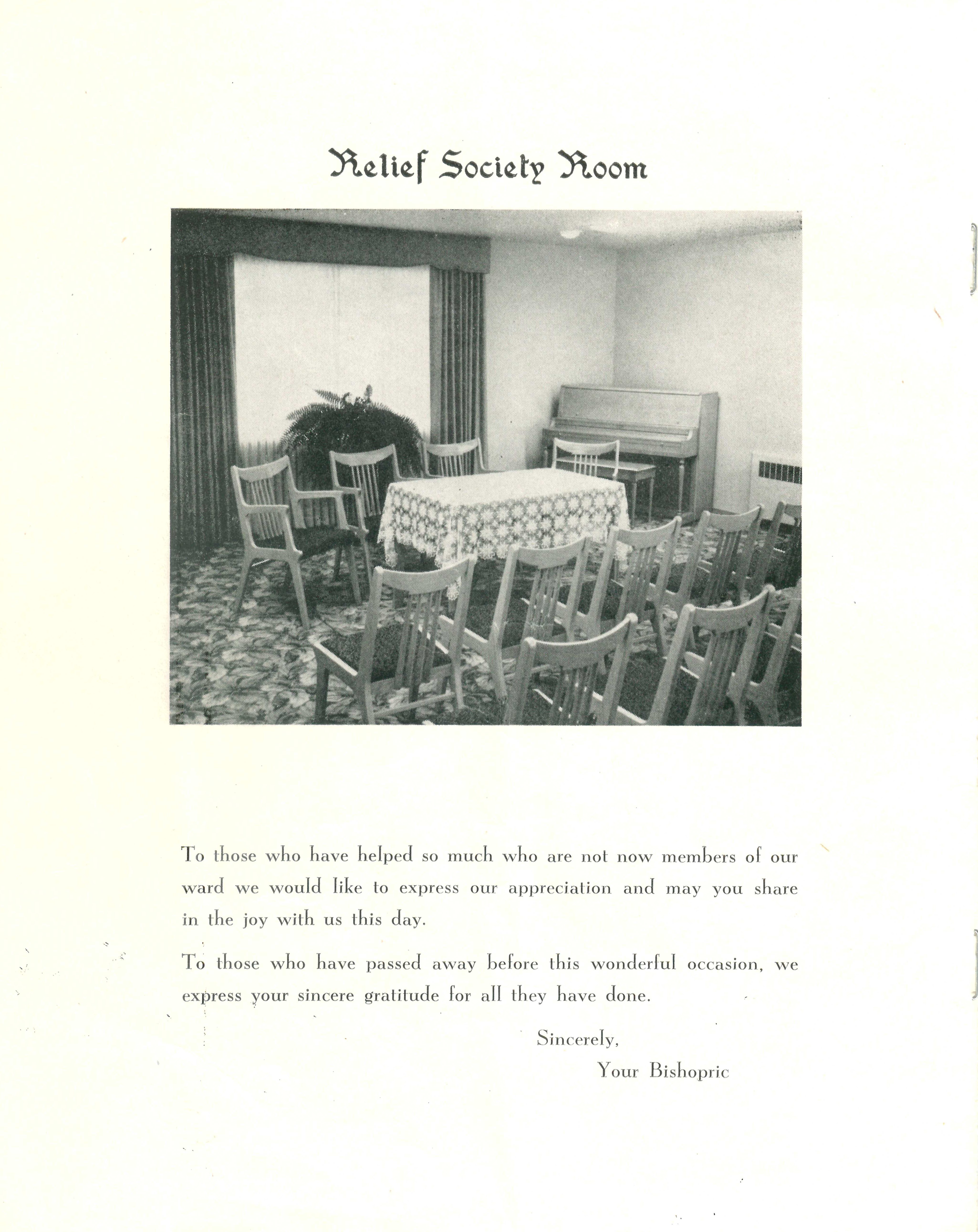
To those who have helped so much who are not now members of our ward we would like to express our appreciation and may you share in the joy with us this day.
To those who have passed away before this wonderful occasion, we express your sincere gratitude for all they have done.
Sincerely, Your Bishopric
Acknowlegement
Let us here give thanks to those who have given so generously of their time and means to make this building possible. May we all work to the end that it shall serve the purpose for which it was intended.



















 Sagacity