Bailey – Goodlad Wedding

James Bailey, blacksmith of Sheffield, and Sarah Goodlad, also of Sheffield, were married after banns on 11 December 1826 at the Parish Church of St Peter and St Paul in Sheffield, Yorkshire (now Sheffield Cathedral). James was the son of James Bailey and Mary, of Askham, Nottinghamshire. Sarah was the daughter of John Goodlad and Elizabeth Hammond, of Sheffield.
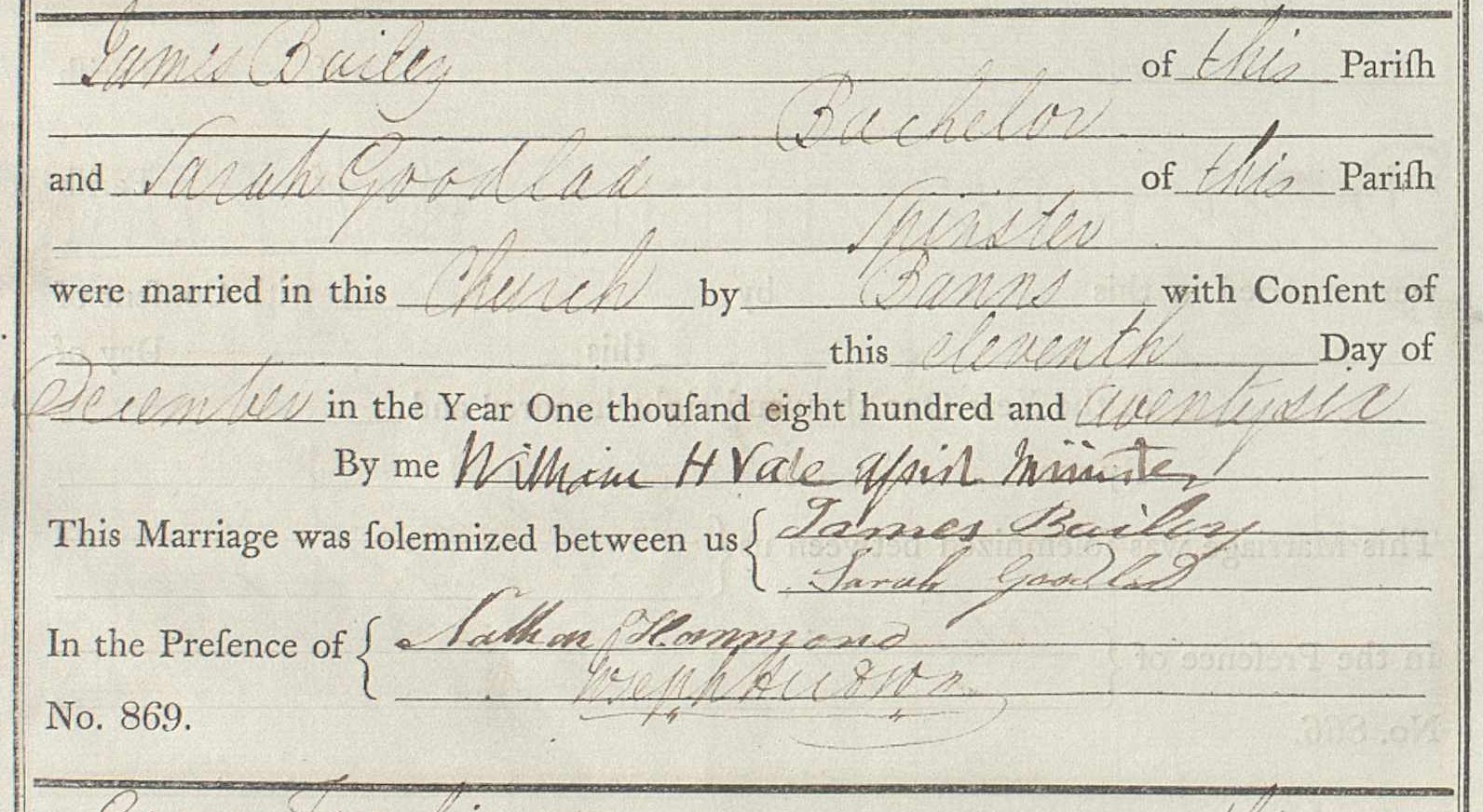
Bailey – Goodlad marriage record

The couple will make their home in Mattersey, Nottinghamshire.

That is the substance of what the register records. Entry No. 869, page 290, Sheffield Archives & Local Studies, reference PR-138-3-22. The officiating minister was William H Vale, Assistant Minister. Both parties signed their own names, neither made a mark. The witnesses were Nathan Hampson and a second name only partially legible. Both James and Sarah were listed as of “this Parish,” meaning both had established Sheffield residence by the time they married. James was twenty-nine. Sarah was twenty-six.

James Bailey was born in Askham, Nottinghamshire, and baptized there at the parish church on 5 February 1797, the second child of James Bailey and Mary. Some list her last name as White, but no sources verify this information. His father’s trade was blacksmith, and James followed him into it. By the time he appears in Sheffield he is an established tradesman, already old enough to have made his own way in the world. His origins in Askham, a small Nottinghamshire village, and his presence in Sheffield’s industrial economy by his late twenties suggest a young man who went where the work was.

Sarah Goodlad’s story begins further back. She was born on 6 September 1800 in Rotherham, Yorkshire, the second child of John Goodlad and Elizabeth Hammond. She was baptized at the Parish Church of St Mary, Rotherham, on 30 November 1800.

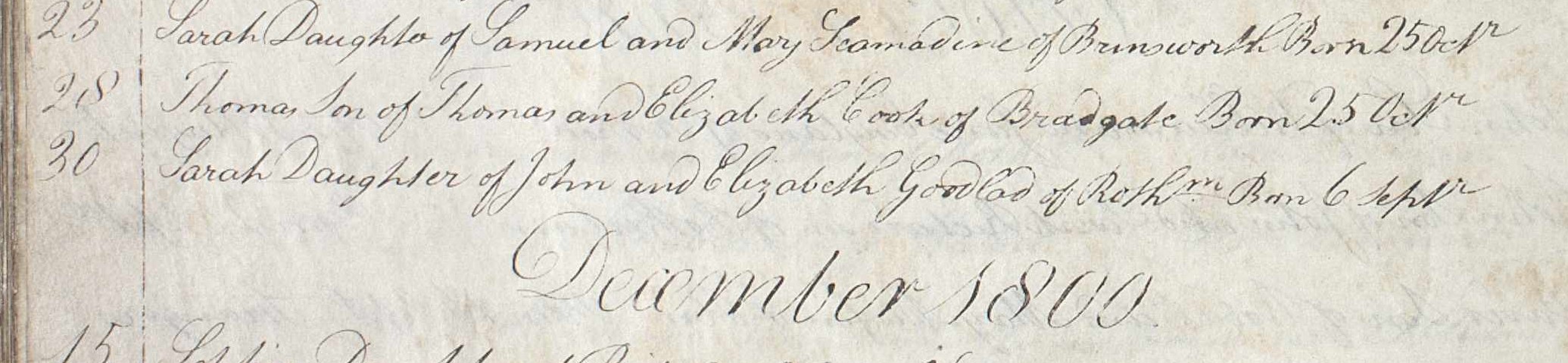
Sarah Goodlad birth record
Another record of Sarah Goodlad’s birth
Third record for Sarah Goodlad’s birth

John Goodlad had been baptized on 28 February 1775 at the Parish Church of St Peter, Conisbrough, the son of William Goodlad and his wife Elizabeth. He was a cabinet maker by trade, and he and Elizabeth Hammond were married on 29 July 1798 at the Parish Church of St Mary, Rotherham. Their witnesses were Thomas Hammond and Sarah Hammond, almost certainly Elizabeth’s family. Elizabeth Hammond was a Yorkshire woman, born about 1776, whose origins beyond her marriage we have not been able to trace.

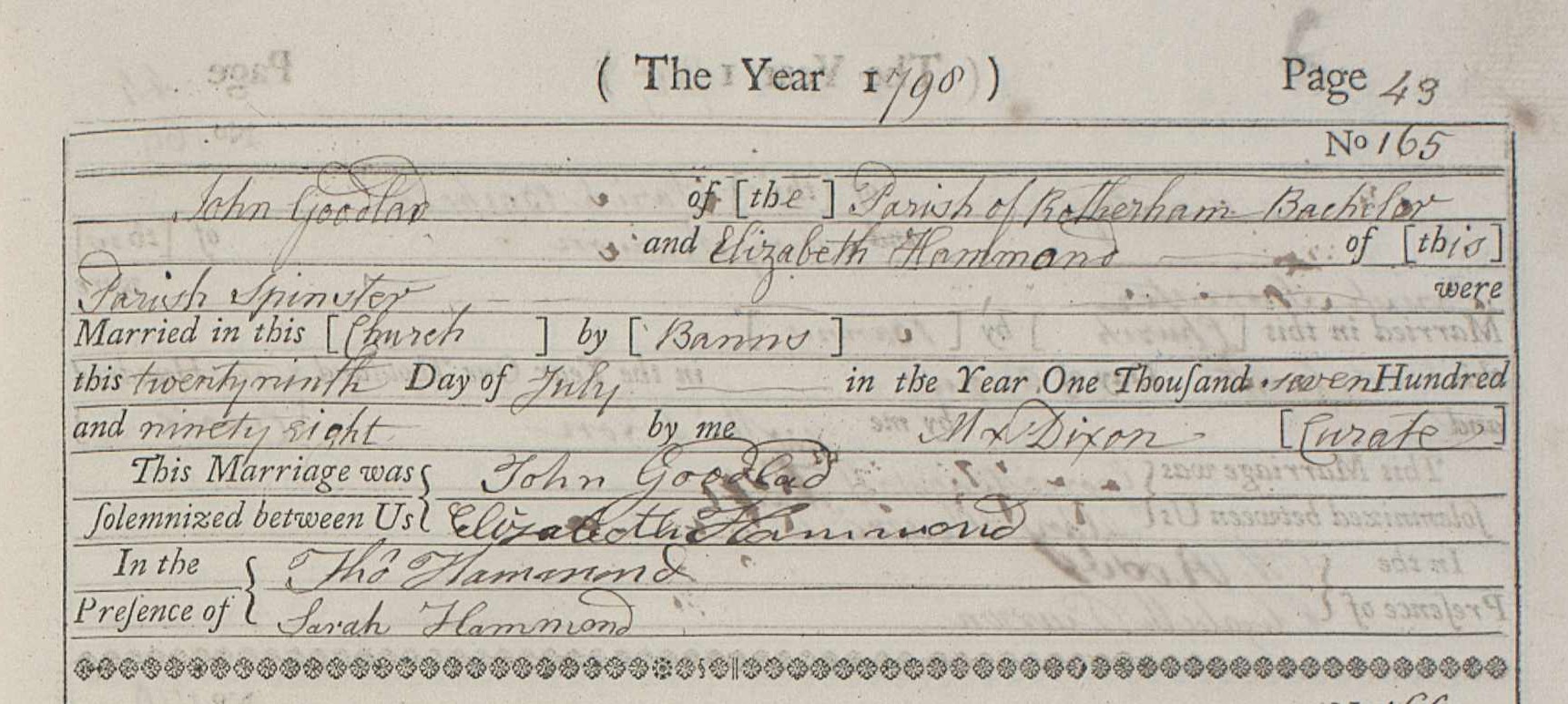
John Goodlad and Elizabeth Hammond marriage record
John Goodlad and Elizabeth Hammond marriage record – note, they could both sign their names

The Goodlads had five children. Ann, their eldest, was born in 1798. Sarah followed in 1800, baptized at the Parish Church of St Mary, Rotherham. By 1803, the family had moved to Sheffield, and Mary Ann was baptized there on 22 July 1803 at the Parish Church of St Peter and St Paul, Sheffield (now Sheffield Cathedral). Elizabeth was baptized at the same church on 21 November 1806, and John — the youngest — on 2 July 1809, also there.

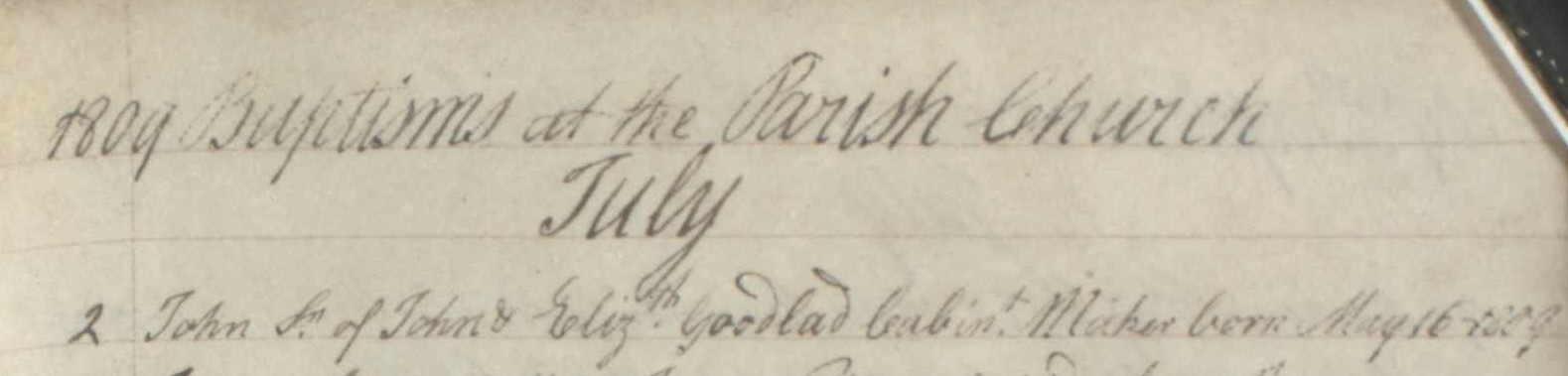
Elizabeth Goodlad birth record in 1806
John Goodlad birth record in 1809

John Goodlad was a cabinet maker working in Sheffield by at least 1803, when both Mary Ann’s and Elizabeth’s baptism records note his occupation.

Tragedy struck in 1809. John Goodlad was buried on 26 September 1809 at St Peter’s Church, Conisbrough, the parish of his birth, where his parents William and Elizabeth still lived. He was thirty-five years old. The Conisbrough register describes him as “John Goodlad of Sheffield, Son of William & Elizabeth Goodlad of this parish, aged 35 years.” He left five children under the age of eleven, the youngest barely four months old.
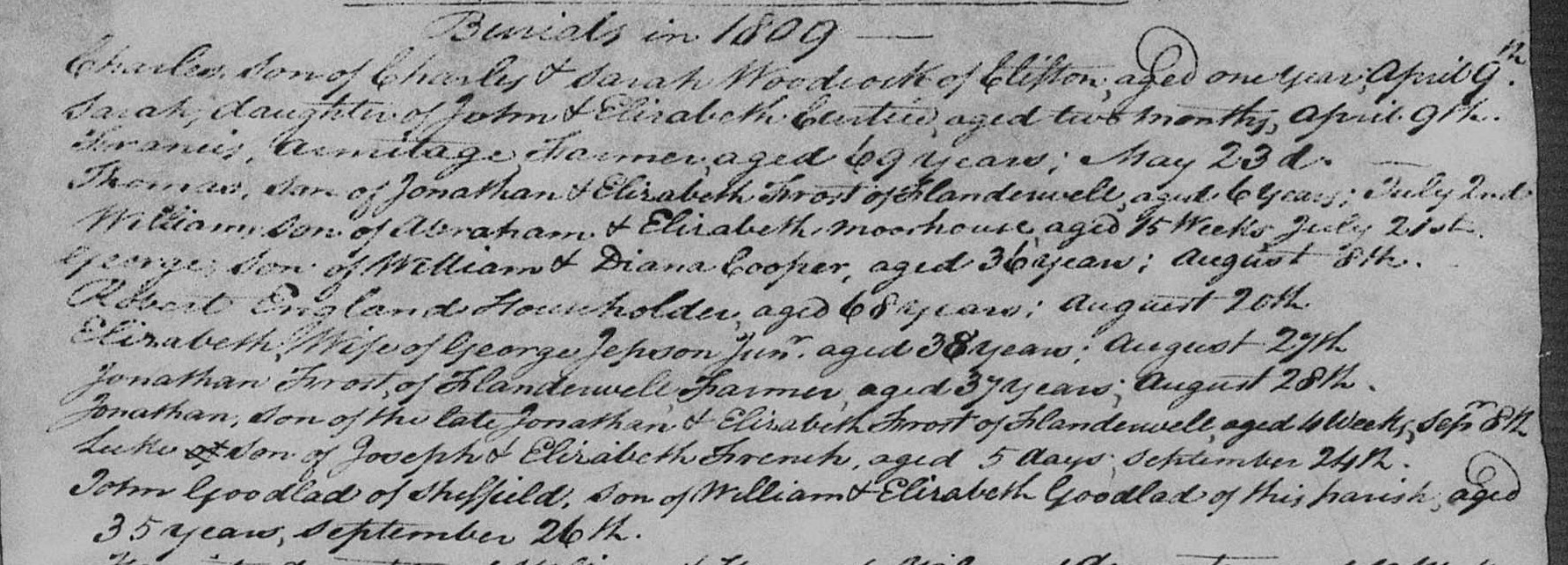
John Goodlad burial record

His daughter Elizabeth, three years old, was buried at St Peter’s Church, Conisbrough on 31 December 1809. His infant son John, described in the register as son of “the late John,” was buried at St Peter’s Church, Conisbrough on 28 January 1810, aged four months. Three deaths in four months: a husband, a daughter, an infant son.

Elizabeth Hammond was widowed at approximately thirty-three with three surviving children, Ann, Sarah, and Mary Ann. She remarried on 1 April 1811 at the parish church in Tankersley, Yorkshire, to Enoch Lumb, a Sheffield blacksmith baptized on 28 February 1774 at the Parish Church of St Peter, Woodkirk (now West Ardsley). Together they had three children: William Hammond Lumb, born 1 May 1812, his middle name preserving his mother’s maiden name; Grace, baptized 12 January 1817 at the Parish Church of St Peter, Woodkirk; and Noah, born 1822. William died in Sheffield in 1818 at age six. Noah died there in 1826 at age four. Grace survived, married Robert Frisby at the Parish Church of St Peter and St Paul, Sheffield (now Sheffield Cathedral) on 20 December 1836, and raised seven children in Sheffield through at least 1881. The Frisby descendants share a half-blood line with Mary Ann Bailey Sharp’s descendants through their common mother Elizabeth Hammond, and any researcher who finds their way to the Frisby or Lumb families in Sheffield will find this the connecting thread. Enoch Lumb was buried in Sheffield on 1 January 1835. Elizabeth Hammond survived him as well, living in Sheffield until she was buried at St George’s Church, Sheffield, on 5 September 1849, aged 73. She had outlived two husbands and three of her five Goodlad children. She did not live to see her granddaughter Mary Ann Bailey leave England for America two years later.
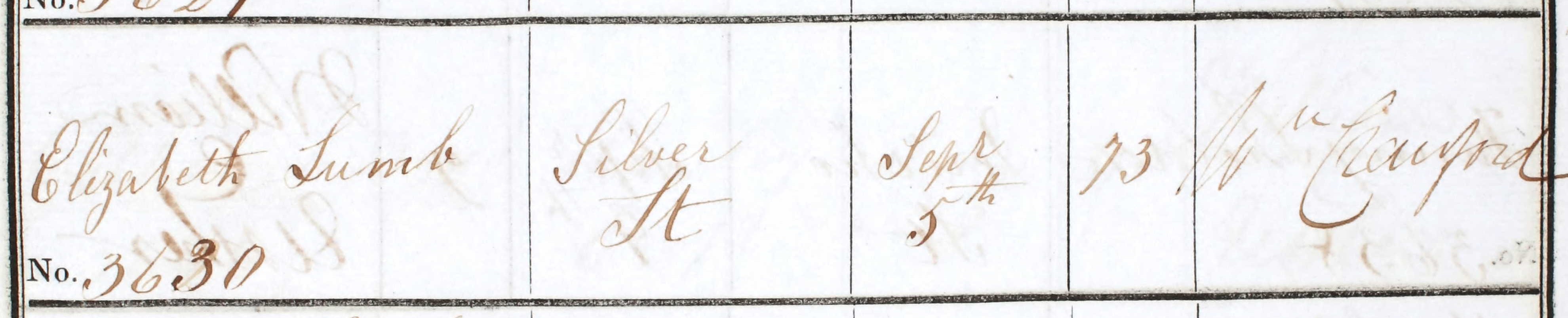
Elizabeth Hammond Goodlad Lumb death record

Sarah Goodlad grew up in the household of a widowed and then remarried mother in Sheffield. When she and James Bailey married in 1826 at the Parish Church of St Peter and St Paul, Sheffield, both were described as parishioners of that church, the same building where her younger siblings had been baptized, where her half-sister Grace would marry a decade later. It was the church of the Goodlad family’s Sheffield years, and Sarah married there in the presence of whatever witnesses attended that December day.

After the marriage the Baileys settled in Mattersey, a small village in the Bassetlaw district of Nottinghamshire, roughly thirty miles from Sheffield. James worked as a blacksmith. Their children were baptized at the parish church in Mattersey, their names recorded in the bishop’s transcripts now held at Nottinghamshire Archives:

Mary Ann, born 28 November 1828, baptized 8 December 1828 at Mattersey parish church. She is the thread that connects this family to Sagacity. You can read more about her at the Sharp-Bailey Wedding post.

George, baptized 20 February 1831 at Mattersey parish church, buried 21 October 1834, aged three.

John, baptized 10 February 1833 at Mattersey parish church. He disappears from the record after the christening, absent from the 1841 census, no death recorded, his fate unknown.

George James, baptized 10 December 1834 at Mattersey parish church, seven weeks after his brother George died, buried 14 January 1835, aged five weeks.

Sarah Elizabeth, baptized 11 December 1835 at Mattersey parish church, born less than a year after George James was buried. She appears in the 1841 census at Mattersey, aged five, and then vanishes from the record like her brother John.

Jane, born 19 April 1839, baptized at Mattersey parish church. She also appears in the 1841 census, aged two, and was buried 1 November 1841.
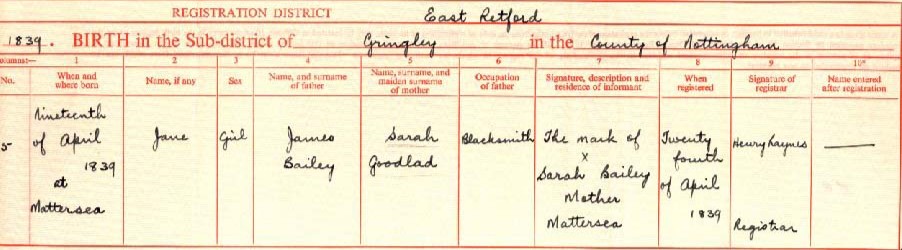
Jane Bailey birth record

Emma Jane, baptized 27 January 1843 at Mattersey parish church.

The 1841 census found the Bailey household at Mattersey: James, age 40; Sarah, age 40; Mary Ann, age 12; Sarah Elizabeth, age 5; Jane, age 2. Two teenage boys, Joseph Baker and George Swinden, both 15, rounded out the household, almost certainly apprentices to James’s smithy. Three children had died by then. Two more, John and Sarah Elizabeth, slipped from the record without explanation.

Sarah Goodlad Bailey died on 7 September 1843 at Mattersey, aged 43. The death was registered in the sub-district of Gringley, East Retford, entry No. 413. The cause given on the certificate was “Visitation of God,” the Victorian designation for sudden or unexplained death. The informant was P R Falkner, Coroner for the County of Nottingham, not James Bailey, which suggests Sarah’s death was sudden enough, or sufficiently uncertain in its cause, to require a coroner’s involvement. Emma Jane had been baptized on 27 January 1843; Sarah died seven and a half months later. The record does not say whether the two events were connected.
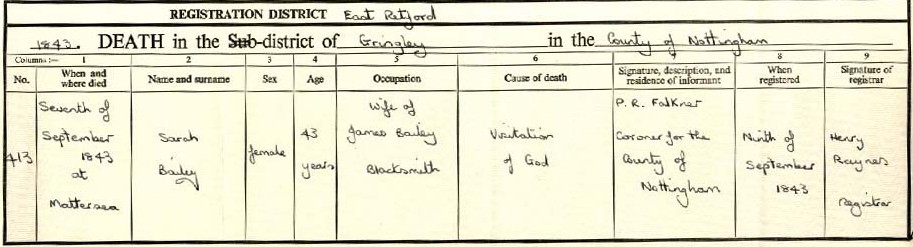
Sarah Goodlad Bailey death record

James remarried, to a woman named Harriet, born about 1804 in Green, Yorkshire, whose surname does not appear in any document found so far. By the 1851 census the household at Mattersey consisted of James, age 53, Blacksmith, born Askham, Nottinghamshire; Harriet, age 47, wife, born Yorkshire Green; Emma Jane, age 8, scholar, born Mattersey; and Thomas Parkinson, age 16, apprentice blacksmith, born Clayworth, Nottinghamshire. James had kept a young male apprentice in the house across every census, Joseph Baker and George Swinden in 1841, Thomas Parkinson in 1851, Charles Watkin in 1861. The smithy continued.
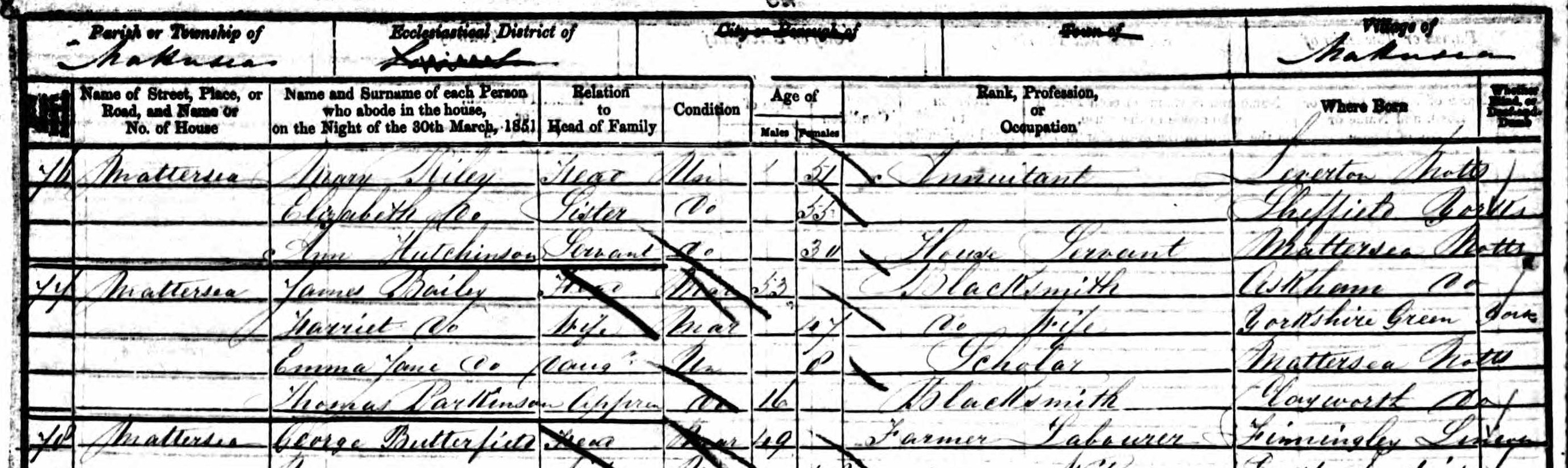
1851 British Census

Harriet died between 1851 and 1861. The 1861 census found James, now 63 and widowed, still at Mattersey, still listed as a blacksmith. Emma Jane, 18, kept house for him. Charles Watkin, 18, served as apprentice. It was the same household pattern, grown smaller.
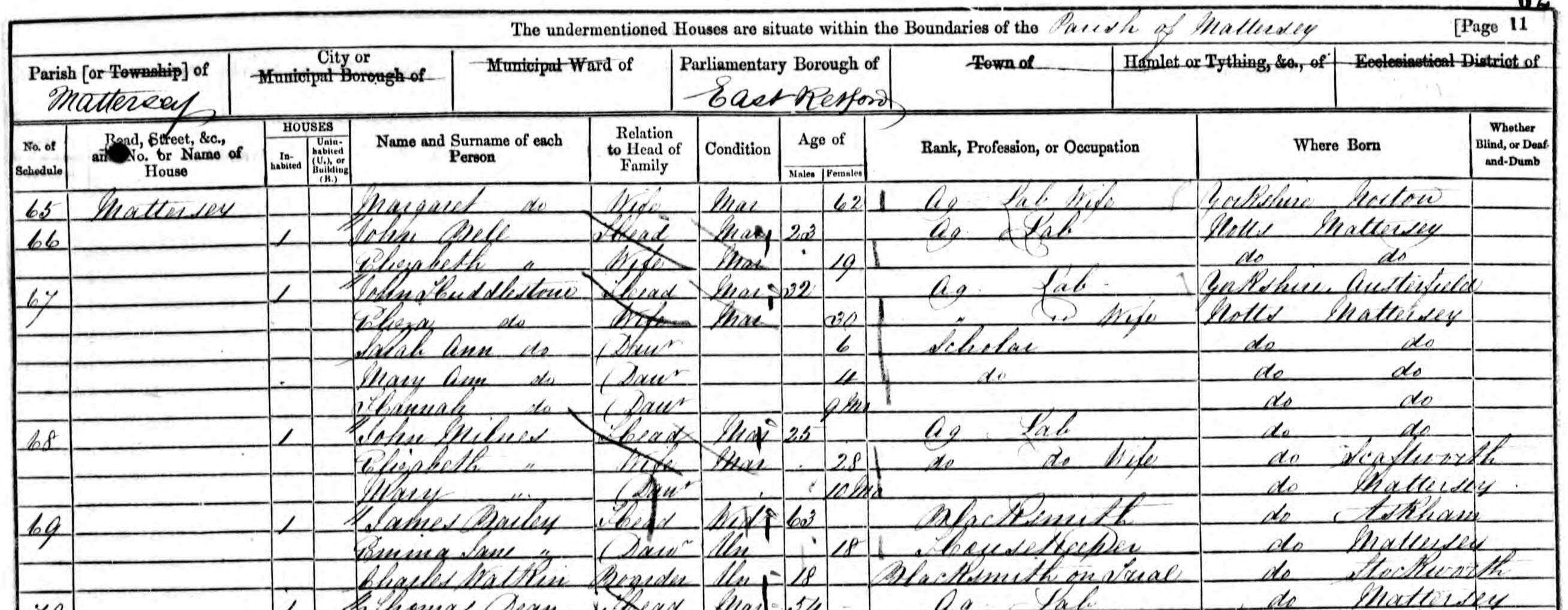
1861 British Census

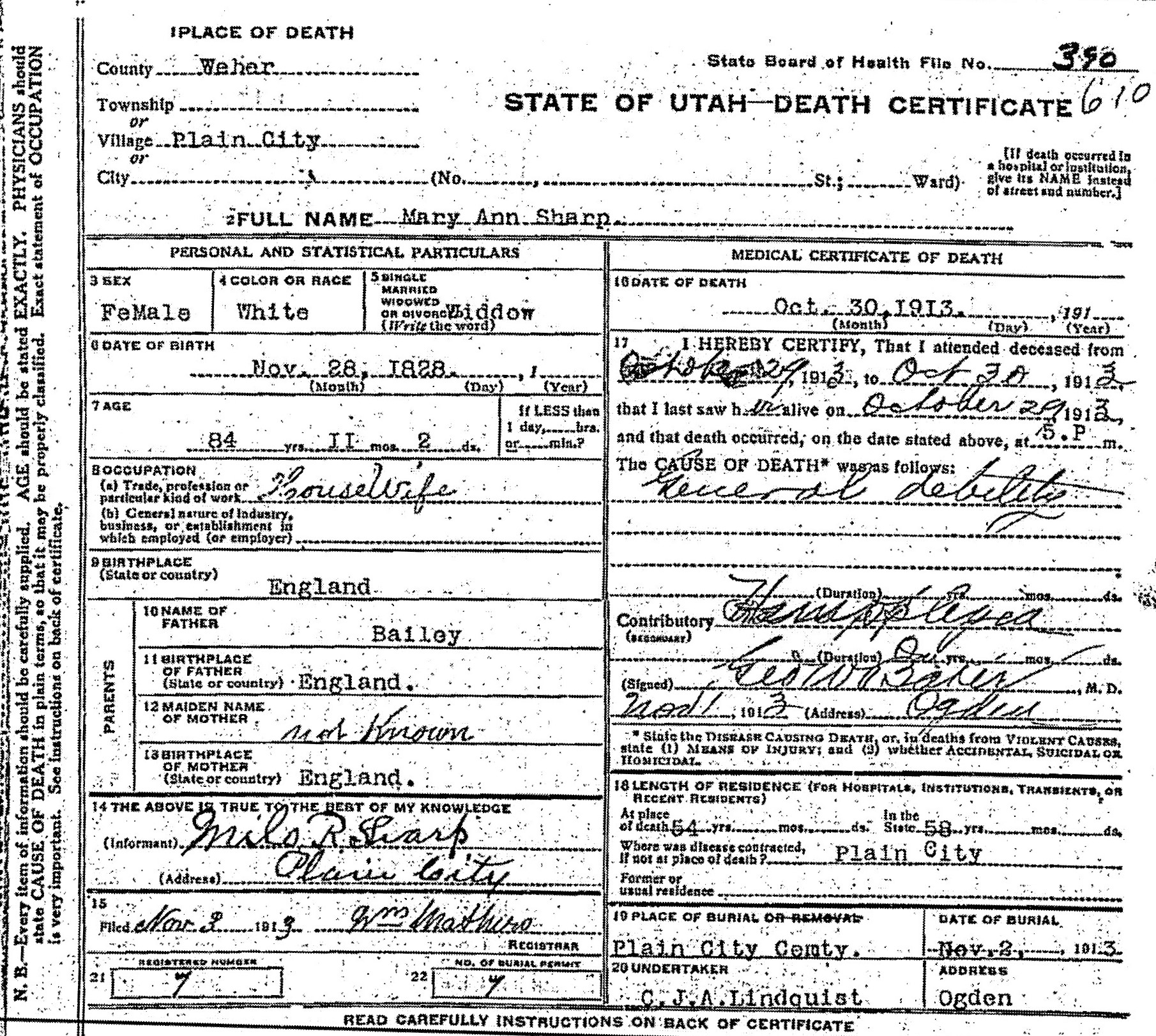
After 1861 James Bailey disappears from the record. No death certificate has been found. Mary Ann’s Utah death certificate, completed in Plain City in 1913, identifies her father only as “Bailey.” Her children in Plain City knew their grandfather’s trade and his surname but apparently not his given name.

Mary Ann Bailey left Mattersey as a young woman and eventually left England altogether. Her story after Mattersey is told on this site at the Sharp-Bailey Wedding, the Sharp Family History Outreach, and the Sharp-Stoker Wedding.


Sources

England, Nottinghamshire, Church Records, 1578–1937 (Bishop’s Transcripts, Nottinghamshire Archives) — baptisms of James Bailey (5 February 1797, Askham), George Bailey (20 February 1831, Mattersey), John Bailey (10 February 1833, Mattersey), George James Bailey (10 December 1834, Mattersey), Sarah Elizabeth Bailey (11 December 1835, Mattersey), Emma Jane Bailey (27 January 1843, Mattersey)

England, Yorkshire, Parish Registers, 1538–2016 (Sheffield Archives & Local Studies) — marriage of James Bailey and Sarah Goodlad, 11 December 1826, Parish Church of St Peter and St Paul Sheffield, PR-138-3-22, page 290; baptisms of Mary Ann Goodlad (22 July 1803), Elizabeth Goodlad (21 November 1806), John Goodlad (2 July 1809), all at Parish Church of St Peter and St Paul, Sheffield; marriage of John Goodlad and Elizabeth Hammond, 29 July 1798, Parish Church of St Mary, Rotherham

England, Yorkshire, Bishop’s Transcripts, 1547–1957 (Borthwick Institute for Archives) — baptism of Sarah Goodlad, 30 November 1800, Parish Church of St Mary, Rotherham; baptism of John Goodlad, 28 February 1775, Parish Church of St Peter, Conisbrough; burial of John Goodlad, 26 September 1809, St Peter’s Church, Conisbrough, aged 35; burial of Elizabeth Goodlad, 31 December 1809, St Peter’s Church, Conisbrough; burial of John Goodlad junior, 28 January 1810, St Peter’s Church, Conisbrough

England, Yorkshire, Parish Registers, 1538–2016 (Doncaster Archives) — baptism of John Goodlad, 28 February 1775, Parish Church of St Peter, Conisbrough, page 8, reference P7

General Register Office, London — death certificate of Sarah Bailey, 7 September 1843, Gringley sub-district, East Retford, No. 413, DA 651580; birth certificate of Jane Bailey, 19 April 1839, Gringley sub-district, East Retford, No. 5, BC 917598

England and Wales, Census, 1841 (HO107/851/6) — James Bailey household, Mattersey

England and Wales, Census, 1851 (HO107/2121/86) — James Bailey household, Mattersey; Elizabeth Lumb household, Arundel Street, Sheffield

England and Wales, Census, 1861 (RG09/2412/62) — James Bailey household, Mattersey; Grace Frisby household, Sheffield

England and Wales, Death Registration Index 1837–2007 (FamilySearch) — death of Elizabeth Lumb, 1849, Sheffield, volume 22, page 686

Burials at St George’s Church, Sheffield, September 1849 (Sheffield Archives) — burial of Elizabeth Lumb, 5 September 1849, No. 3630, aged 73

Utah Death Certificate — Mary Ann Sharp, 30 October 1913, Plain City, Weber County, Utah, No. 390
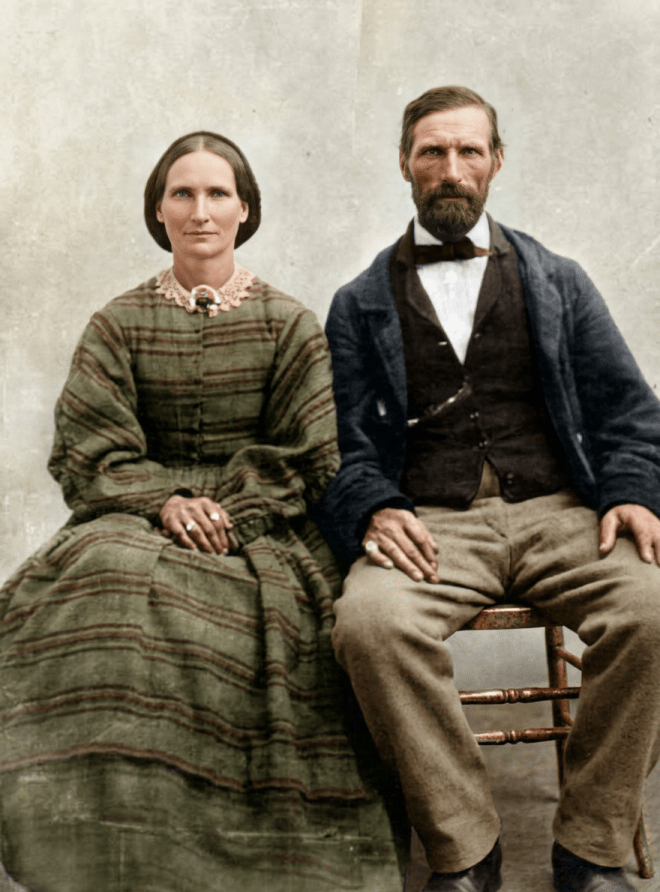
Sharp – Bailey Wedding

Mary Ann and William Sharp

James and Sarah Goodlad Bailey are pleased to announce the marriage of their daughter Mary Ann Bailey to William Sharp, son of Thomas and Elizabeth Cartwright Sharp. William and Mary Ann were married at Loup Fork, Howard, Nebraska on 10 July 1853. (Loup Fork appears to have been a crossing of the Loup River, somewhere between Fullerton and Palmer Nebraska, in order to go turn south to rejoin trail along the Platte River.)

William is mason and farmer. They will make their home wherever they are called to settle once they arrive in the Utah Territory.

Due to the circumstances of this family, it is pretty unlikely an announcement would have ever been written. Everything about these families was in motion. Family members on both sides were strewn all over two continents and their lives were still recovering from a number of personal blows. While this was probably a high point, they knew there was a long road still ahead of them. All four of their parents had passed before their marriage.

William was born the third of eight children born to Thomas and Elizabeth Cartwright Sharp 10 December 1826 in Misson, Nottinghamshire, England. His baptism is recorded on 7 January 1827 at Misson Anglican church, confirmed by the Bishop’s Transcripts at Nottinghamshire Archives. He spent his life as a mason but kept a farm. We do not know where or how he learned how to be a mason. His father, Thomas, is listed as “Ag Lab”, which is probably an agricultural laborer on the 1841 English Census. Thomas died in 1841 after the census was taken.

In 1848, the LDS missionaries came to visit in Misson. William was the first in his family, that we know, to join the church on 20 June 1848. His mother followed 11 August 1849 and his sister Isabella 16 September 1849. The records available do not show that William’s siblings, Elizabeth and James joined the church, but they came with the family to the United States on their way to Zion. The family story tells the family was friendly and open towards the missionaries. One of the missionaries was a George Emery (the only potential George Emery I could find appears to have lived 1792 – 1867).

Elizabeth Sharp was determined to emigrate with her family to Utah. Her family attempted to discourage her by warning her about the dangers of the American Indians. Nevertheless, she departed with William, Isabella, Elizabeth, and James. The other four children had died as infants before leaving England. The family purchased tickets at 25 pounds sterling in Liverpool. The family set sail on the “James Pennell” on 2 October 1850 commanded by Captain James Fullerton. The LDS leaders on board were Christopher Layton (1821–1898) and William Lathrop Cutler (1821–1851) leading the company all the way to Zion. Right before hitting the waters of the Mississippi the ship encountered a storm where the masts were broken and the ship drifted for a couple of days. Luckily, a pilot boat found them and another ship (that left two weeks later from Liverpool) tugged them to New Orleans, Louisiana. The ship arrived at dock on 22 November 1850. The family struggled with sea sickness and chills and fevers that beset them in New Orleans and St. Louis. From there the entire group boarded the “Pontiac” and continued to St. Louis, Missouri where they found work and spent the winter. Despite having crossed the Atlantic, Elizabeth, the mother of the family, died 17 February 1851 in St. Louis and was buried in Bellefontaine Cemetery.

Among the fellow passengers on the James Pennell were the Singleton family of Misson. The Singletons were neighbors in Nottinghamshire. William Singleton (1793–1850) sailed with his children, including Thomas Singleton (1825–1885) and Charles Singleton (1838–1907). Tragically, William Singleton died in St. Louis on 16 December 1850, just three weeks after the ship docked. His son Thomas pressed on, becoming one of Plain City’s 1859 founding pioneers, where he worked as a carpenter and band leader alongside William Sharp. Thomas Singleton is listed among those excommunicated alongside William Sharp on 31 January 1879. Generations later, Thomas’s grandson Bert Elmer Singleton (1918–1995), born and raised in Plain City, became one of Utah’s most celebrated baseball players, pitching in the major leagues over 28 seasons. The Sharps and Singletons, neighbors in Misson, remained neighbors in Plain City across the generations.

Elizabeth’s death left the four siblings to fend for themselves. William and Isabella both still desired to move on with the Saints to Utah. William became fast friends with Mary Ann Bailey Padley, a widow who had lost her husband before leaving England. They were such good friends that Anne Elizabeth Padley (she went by Sharp her whole life though) was born 31 October 1852. Isabella married Joseph Carlisle, who had arrived two years earlier, 18 May 1853, in St. Louis. That same day the Moses Clawson Company, “St. Louis Company,” departed from St. Louis. Joseph and Isabella Carlisle, along with William Sharp and Mary Padley (with her son Lorenzo Padley and new infant Anne), left with the company. Joseph and William were well respected because they were apparently very good athletes and challenged anyone to a wrestling match.

The Sharps and Carlisles drove a wagon for William Jennings, a Salt Lake City merchant and freighter. The outfitting was done in Keokuk, Iowa. The company for traveling over the plains was formally organized in Kanesville, Iowa. On the trail, William and Mary Ann Padley were married 10 July 1853 in Loup Fork, Nebraska. The company arrived in Salt Lake City between the 15th and 20th of September the same year.

Mary Ann was born the first of seven children born to James and Sarah Goodlad Bailey on 28 November 1828 in Mattersey, Nottinghamshire, England. Her baptism is recorded on 8 December 1828 at Mattersey Anglican church, confirmed by the Bishop’s Transcripts at Nottinghamshire Archives. James was a blacksmith. The Bailey family were practicing members of the Church of England, described by a later family history as “very sincere and devout in their religion.” Mary Ann attended school and obtained training in millinery and sewing. Sarah died in 1843 and James remarried to a lady named Harriet. We don’t have a death date for James at this time.

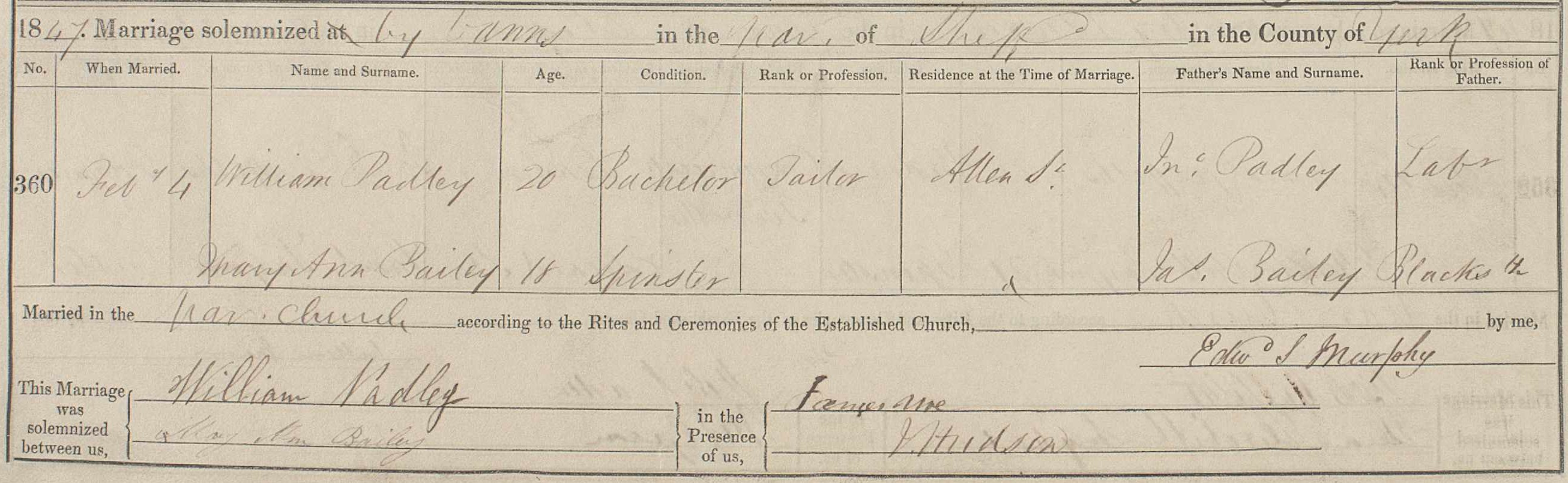
Shortly before her 18th birthday, Mary Ann met missionaries of The Church of Jesus Christ of Latter-day Saints and converted. She was baptized 20 October 1846. Her father and Harriet dismissed her from the home for becoming a Mormon. She soon met William Padley, another LDS member and a tailor who lived on Allen Street in Sheffield, and married him on 4 February 1847 at the Church of St Peter and St Paul (now a cathedral) in Sheffield.

Padley – Bailey marriage record

William Padley was born 22 September 1826 in Morton, Lincolnshire, just across the River Trent from Mattersey, and they may well have known each other from their home area before both moved to Sheffield. They had a son, Lorenzo Joseph Padley, born in December 1847. William became ill when Lorenzo was born and died 22 February 1850 in Morton, Lincolnshire. Left alone with a new son, Mary Ann went back to her parents, who would have nothing to do with her unless she gave up her religion. She would not, and instead decided to join the Saints in Utah.

Mary Ann and Lorenzo sailed from Liverpool on 8 January 1851 on the “Ellen” with James Willard Cummings (1819–1883) as the leader of the company. The ship had a difficult passage with measles and what others thought was whooping cough. She arrived in New Orleans 14 March 1851. On the 19th they left for St. Louis on the “Alleck Scott” and arrived on the 26th. Mary Ann and Lorenzo stayed in St. Louis while the company moved on, and it was there that she met William Sharp and his family.

William and Mary Ann grew close during their time in St. Louis. A daughter, Anne Elizabeth, was born to them on 31 October 1852. Both were still determined to join the Saints in Utah. They arranged to drive a freight wagon west for William Jennings, a Salt Lake City merchant and freighter, as the means of joining the Moses Clawson Company. On the trail, William and Mary Ann were married on 10 July 1853 at the crossing of Loup Fork in present-day Howard County, Nebraska. The company arrived in Salt Lake City between the 15th and 20th of September that year.

They settled in Lehi, Utah, Utah for a couple of years but had a number of issues with range for the cattle and some other minor squabbles. Water was also not found to be very dependable in the Lehi area. During this time, William and Mary Ann gave birth to two children, William and Isabella in 1854 and 1856, but both died as infants. Milo Riley was born in Lehi 23 July 1857. I have written of Milo and his family previously at this link: Sharp-Stoker Wedding.

William learned of land north near Ogden, Weber, Utah that was going to be opened up from some of the Saints passing through Lehi (abandoning Salt Lake City before the arrival of Johnson’s Army). These Lehi Saints were told of ample land and good water that was available west of Ogden. A scouting expedition went to search out the area in the fall of 1858 and visited with Lorin Farr (1820–1909) who told them of the available plain to the west.

The Sharp family left with other Lehi Saints on 10 March 1859 to travel to this new area. The group of about 100 arrived 17 March 1859 at what is present day Plain City, Weber, Utah. The company arrived at about 5 PM during the middle of a snowstorm. The company lined up the wagons to protect them from the wind and dug a hole in the ground for the campfire. Reports indicate that snow was deep and conditions uncomfortable. Plain City apparently lived up to its name with sagebrush that rose over 4 feet tall from the high water table beneath the soil.

William Sharp put his carpentry and masonry skills to work making adobe brick and helping build the first homes in Plain City. William and Mary Ann lived in one of these homes. William served in the Plain City band, on the Plain City Z.C.M.I. board, acting as a builder, and also serving as a city leader. William and Mary Ann’s daughter, Evelyn, was the first girl born in Plain City, on 12 October 1859. Victorine Mary was born 8 April 1862 and was their last child. Mary Ann kept busy sewing and making suits, coats, and other jobs. Each of her daughters learned to become dressmakers.

William and Mary Ann each received their initiatory and endowment on 17 August 1861 at the Endowment House. On the same day, Mary Ann was sealed by proxy to her deceased first husband William Padley, with William Sharp himself standing proxy for the man Mary Ann had first married. As a woman already sealed to another man, she could not be sealed to William Sharp during their marriage, as the church did not permit women to be sealed to more than one husband at that time. The Sharp children’s sealing situation caused considerable family angst as all children born to Mary Ann after the 1861 sealing were born in the covenant to William Padley rather than William Sharp.

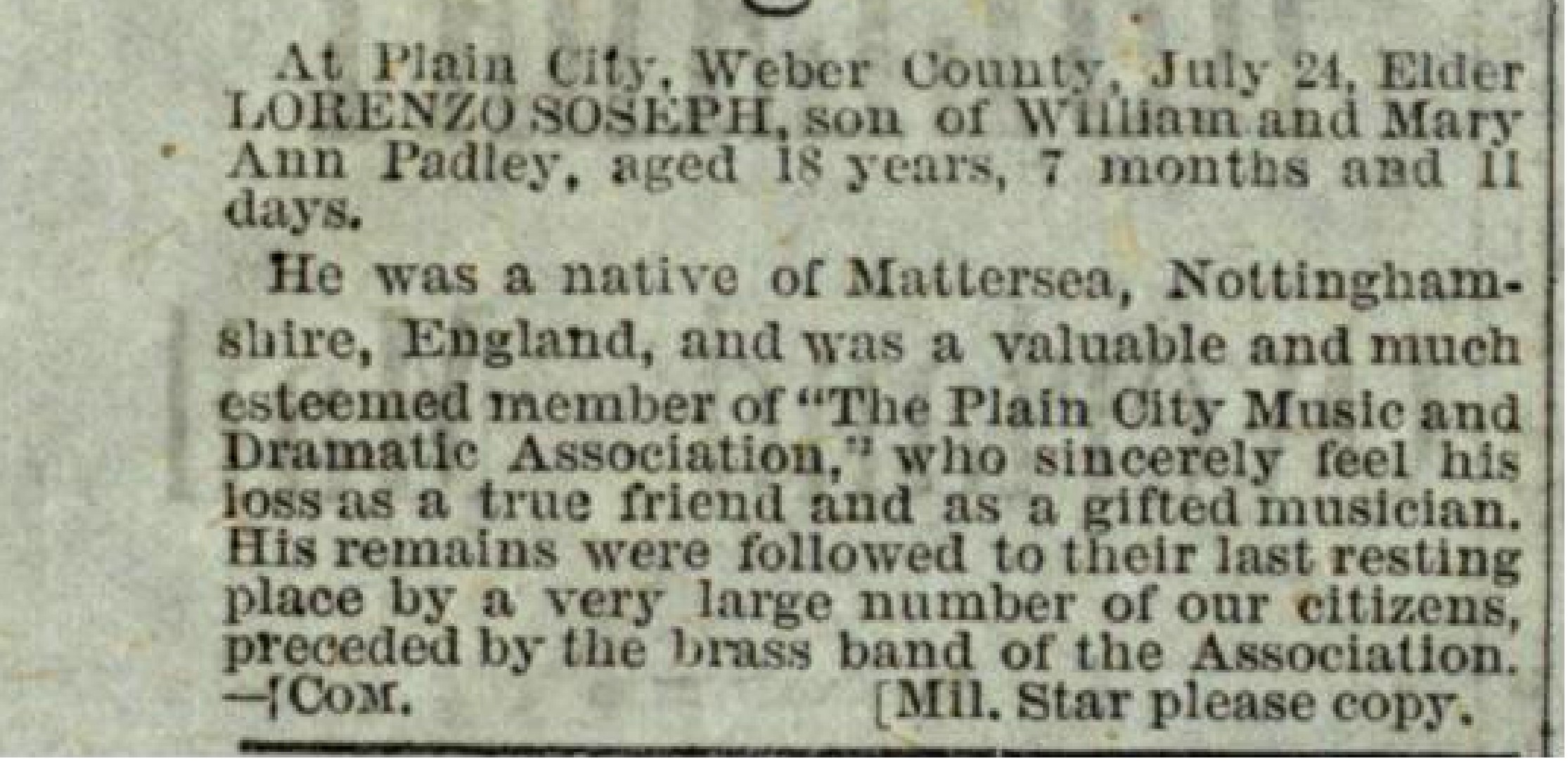
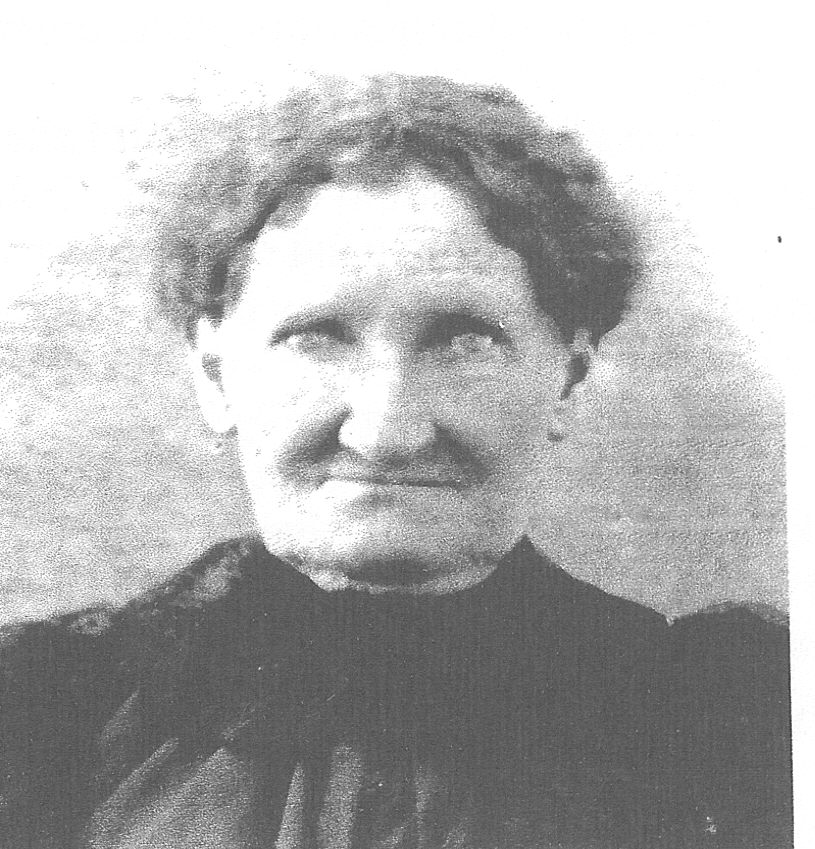
Lorenzo Joseph Padley died 24 July 1866 at Plain City, aged 18 years, 7 months and 11 days, putting his birth approximately 13 December 1847 in Mattersey, Nottinghamshire, England. He had grown up to become a valued member of the Plain City Music and Dramatic Association, which mourned him as a true friend and gifted musician. His remains were followed to their last resting place by a very large number of citizens, preceded by the brass band of the Association. The notice requested the Millennial Star in England to copy — a reminder that Mary Ann’s roots, and Lorenzo’s birthplace, lay in Nottinghamshire. The photo we have of him is pretty scratched, but here is a cleaned up photo, but it is not perfect. It is hard to tell what is his nose and what was deformities in the photo.

Anne Elizabeth married Daniel Claiborne Thomas Jr. on 29 January 1872 in Salt Lake City at the Endowment House, where they also received their initiatory, endowment, and sealing the same day. Daniel had been born 14 July 1850 on the Platte River in Nebraska on the trail to Utah. His father, Daniel Claiborne Thomas Sr., had been converted to the church by his brother Preston while on a mission to the Southern States, and the family had come to Utah in 1850, settling in Sulphur Springs (later named Lehi) among the earliest settlers there, before joining the Plain City founding group in March 1859. They settled in Plain City and had six children: Claiborne William (1872), Francis Milo (1875), LeRoy Bertrand (1878), Estella Inez (1884), Delbert (1888), and Elizabeth La Vieve (1889). Anne Elizabeth died 29 July 1891 in Plain City at thirty-eight, leaving six children ranging in age from two to nineteen. Daniel outlived her by thirty-eight years, dying in Ogden on 2 September 1929, and was buried beside her in Plain City Cemetery.

After several instances of desertion, Mary Ann moved out of their home on Christmas Eve 1875 and utterly refused to go back to William. William sued for divorce and Franklin Dewey Richards (1821–1899) granted the divorce (in probate court) on 19 May 1876.

At this time, it is possible that Bishop Lewis Warren Shurtleff (1835–1922), branch president 1870–1877, bishop 1877–1883, extended himself beyond what the members felt was right — going so far as to dictate how much everyone should pay in tithing — and some families were very vocal in expressing their discontent. William Sharp began construction on St. Paul’s Episcopal Church in 1877, and many disaffected members found a religious haven in this new faith. The building still stands today, owned by the Lions Club in Plain City. A significant group of members were excommunicated on 31 January 1879, including William Sharp, Mary Ann Sharp (listed separately because of the divorce), William Skeen, Edwin Dix, George Musgrave (father of their future daughter-in-law), Thomas Musgrave, Thomas Singleton, Thomas Davis, George W Harris, Jonathan Moyes, John Moyes, Winfield Spiers, James Wadman, Robert Davis, John Davis, and Thomas Robson. These lists also have “and wife” as well as “and family” which seems to indicate that spouses and families were included. Many of these families returned to the church after time away, some individuals never did. Milo Ross’s 1997 oral history interview offers one family perspective on the causes of the split.

This same year, William remarried to the widow of Charles McGary, Charlotte Elizabeth Earl, about 1879. We do not know exactly when or where.

Milo Riley married Mary Ann Stoker (aka Lillian or Lilly Musgrave) 11 May 1879 in Plain City in the little church William built. He died in 1916 in Plain City. Read about them here.

Evelyn Carlisle married James Henry Taylor 16 January 1881 in Plain City. She died in 1941 in Oregon.

Victorine Mary married Robert Edward Maw on 8 April 1883 in Plain City, her twenty-first birthday. Robert had been born in Plain City on 15 October 1859, the son of Robert Maw, one of Plain City’s founding pioneers who had consecrated his Lehi property in January 1857 and arrived in Plain City on 17 March 1859, the same day as the Sharp family. William Sharp had built the elder Robert Maw’s adobe house in those early Plain City years and had played cornet alongside Abraham Maw in Plain City’s first band. The marriage of Victorine Sharp and Robert Edward Maw united two of Plain City’s founding families. They had seven children: Ruby Ada (1884), Alice (1885), Jessie (1886), Florence Eveline (1888), Grace (1890), Edith Louise (1893), and Edward Clyde (1896). On the morning of 23 April 1897, a snow slide struck the Consolidated Mining and Smelting Company’s Garfield Mine in Gibbs Canyon, four miles north of Brigham City. Robert was killed. The Brigham City Bugler reported the disaster that week, noting that he was a married man who left a widow and seven children. Victorine was thirty-four years old. Her youngest child, Edward Clyde, was barely a year old. She did not remarry, living in Plain City and later Ogden until her death on 18 March 1945. She is buried in Plain City Cemetery.

Mary Ann Bailey Sharp

Mary Ann continued to work as a dressmaker until she could not do so any more due to age. She lived with her Granddaughter Elizabeth Taylor from before 1900 and even moved with her to Baker City, Baker, Oregon. Mary Ann moved back to Plain City not long after Beth married.

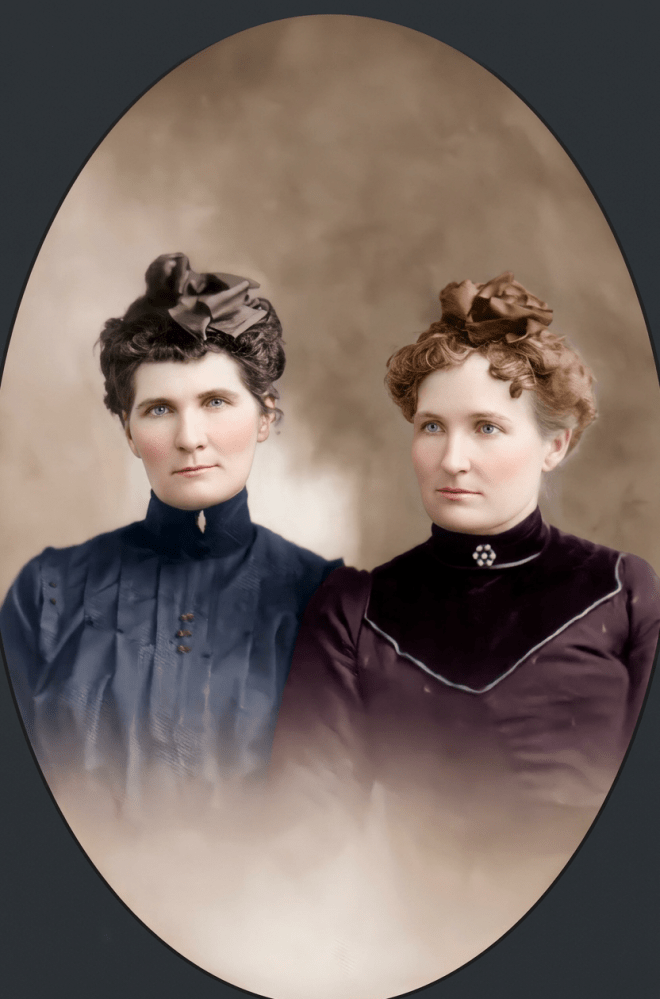
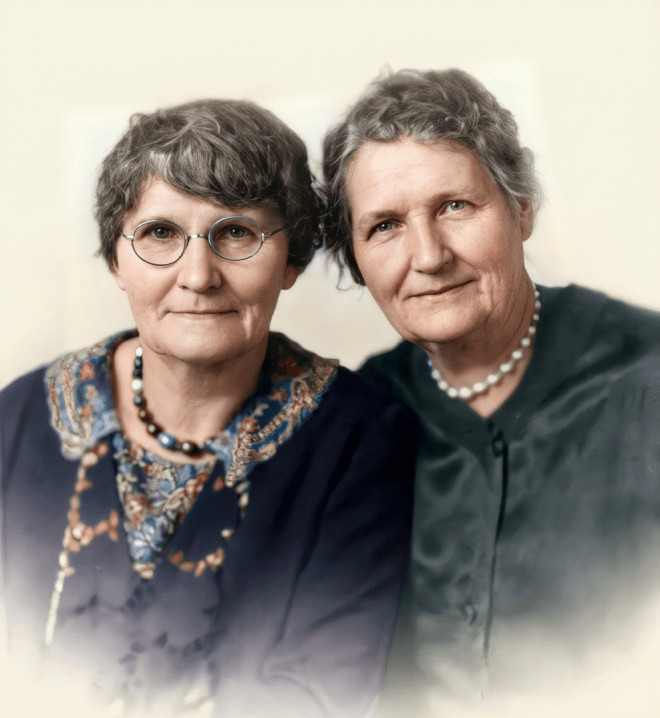
Evelyn & Victorine Sharp

~

Evelyn and Victorine Sharp

William died at 950 Washington Ave in Ogden on 22 December 1900 at 74 years and was buried two days later in the Ogden cemetery. Mary Ann died 30 October 1913 in Plain City at 84 years and was buried there three days later.

Mary Ann Bailey Sharp death certificate

William and Mary Ann both died outside the church.

In December 1933, fifty-four years after the excommunication, three of Isabella Sharp Carlisle’s sons — Joseph Carlisle, James Carlisle, and Harvey Carlisle — wrote to LDS Church President Heber J. Grant requesting proxy reinstatement for their Uncle William and his former wife Mary Ann. Their letter described William as “honest, virtuous and kind” and was addressed care of Mrs. James S. Thompson — Annie Thompson, who would later write the 1957 history of Elizabeth Cartwright Sharp, and who was the daughter of James Carlisle. The letter explicitly identified William as “born 10 Dec. 1826, Misson, Notts., England, and later settled in Plain City, Utah.”

President Grant responded on 16 December 1933, consenting to proxy baptism for both William and Mary Ann. He noted that since they had previously received their endowments on 17 August 1861, those ordinances would need to be restored by proxy as well, and authorized Elder George F. Richards, President of the Salt Lake Temple, to officiate. On 3 February 1934, proxy baptism and confirmation were performed for both William and Mary Ann at the Salt Lake Temple, with William’s sealing to parents following on 2 July 1934. The restoration of William Sharp and his wife to the church, by the hands of his sister Isabella’s sons, closed that chapter.