As I worked through the photos of Dave and Betty Donaldson, I stumbled on some pictures sent from Dad. Dad, Milo Paul Ross, attended the 1957 Boy Scout Jamboree in Valley Forge, Pennsylvania. I thought I would share those photos along with some other items I have scanned related to that trip. Since there were a couple of photos from the 1958 High Adventure Trip, I thought I would include those too.
First, be aware that the Great Salt Lake and Lake Bonneville Councils published a book about their trip. “Onward for God and My Country” was the motto. I have scanned the entire book – it is provided below.
The book says the trip occurred in July 1957. The book provides plenty of photos of the highlights. These few photos show what Dad thought was interesting enough to take pictures.
The trip took them east through a variety of states. Included was Chicago, Detroit, and Palmyra. Stops included the Sacred Grove and Smith Farm. Albany, Springfield, Boston, and New York City.
Dad does not recall the names or even knowing anyone in the photos at Jamboree.
I remember Dad talking about the Statue of Liberty. They climbed the stairs to the crown. He also indicated that at that time they let some of them climb to the torch. It was a very memorable experience. He also mentioned the Empire State Building and Independence Hall in Philadelphia. Vice President Nixon addressed the Scouts.
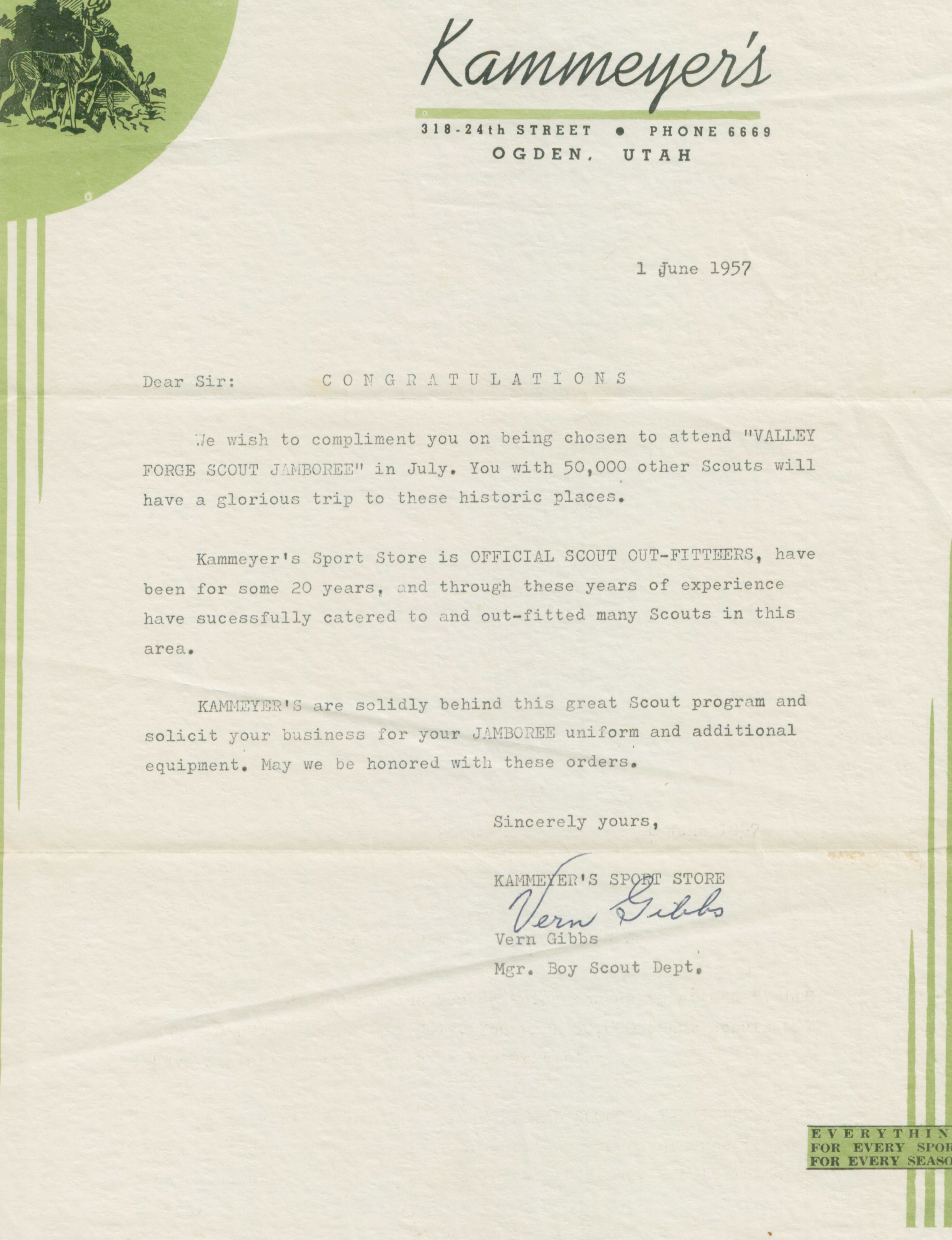
Kammeyer’s supported the Jamboree.
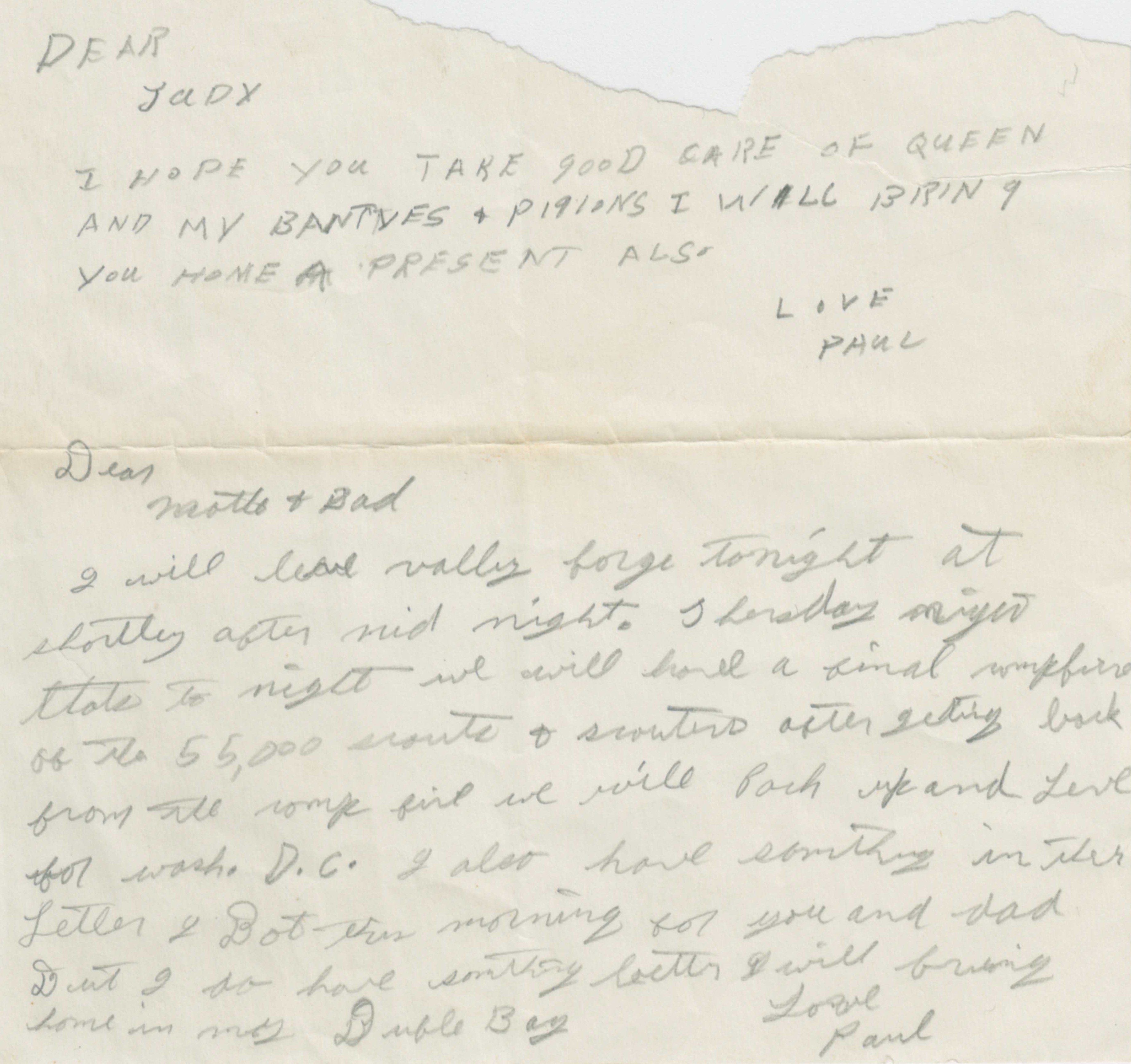
For those LDS Scouts, Harold B Lee and Delbert L Stapley spoke to the boys on Sunday. Here is a letter Dad wrote home while there.
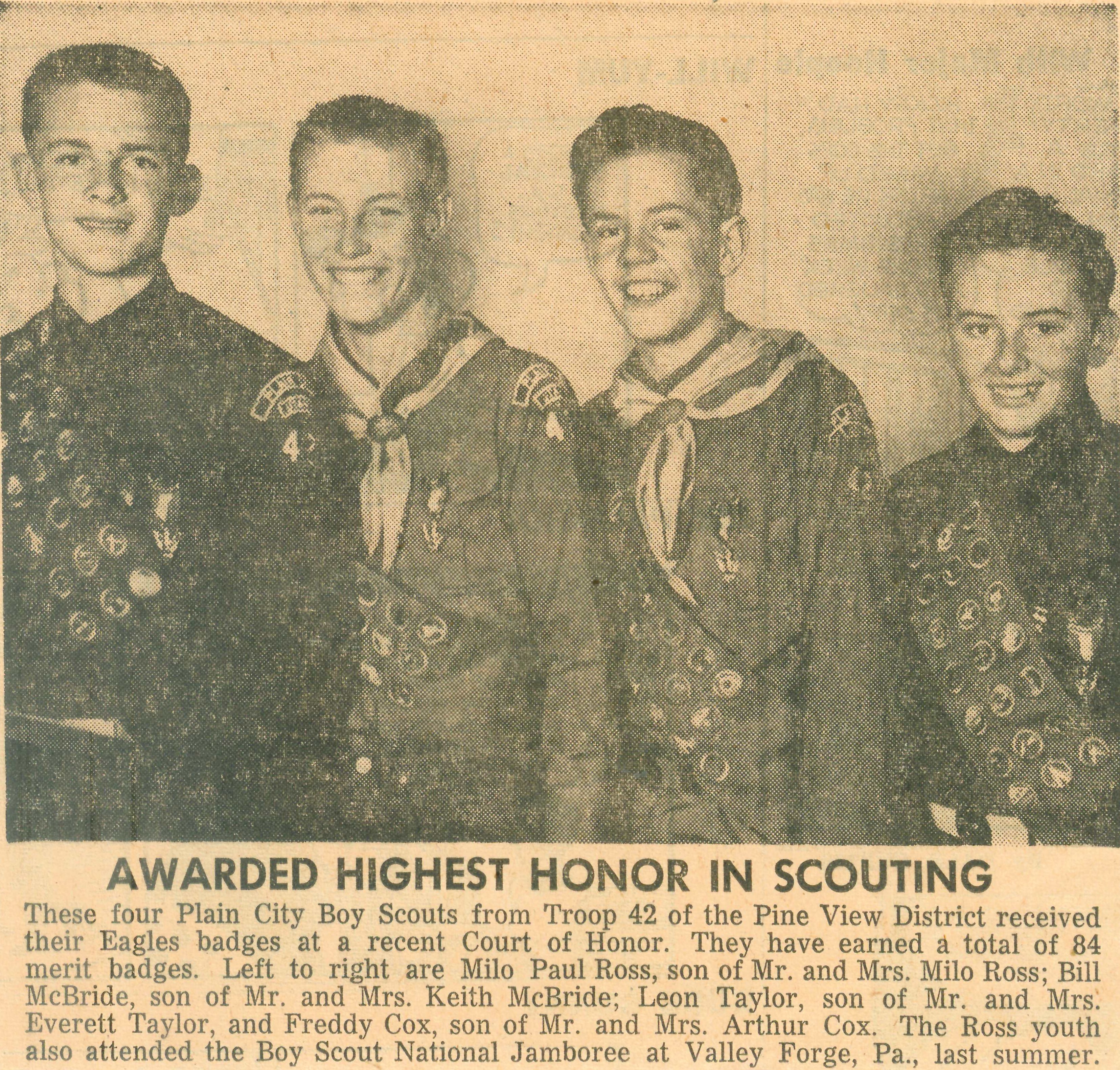
I previously wrote about Dad and scouting. Here is his Eagle Scout picture.
Milo Paul Ross achieved Eagle Scout
Here is a note Grandpa made about this picture.
Milo Ross, Bill McBride, Leon Taylor, Freddy Cox Eagle Announcement
Milo James Ross commented about Milo Paul Ross receiving his Duty to God award on 27 April 1959
Duty to God Award
Letter from Church Headquarters
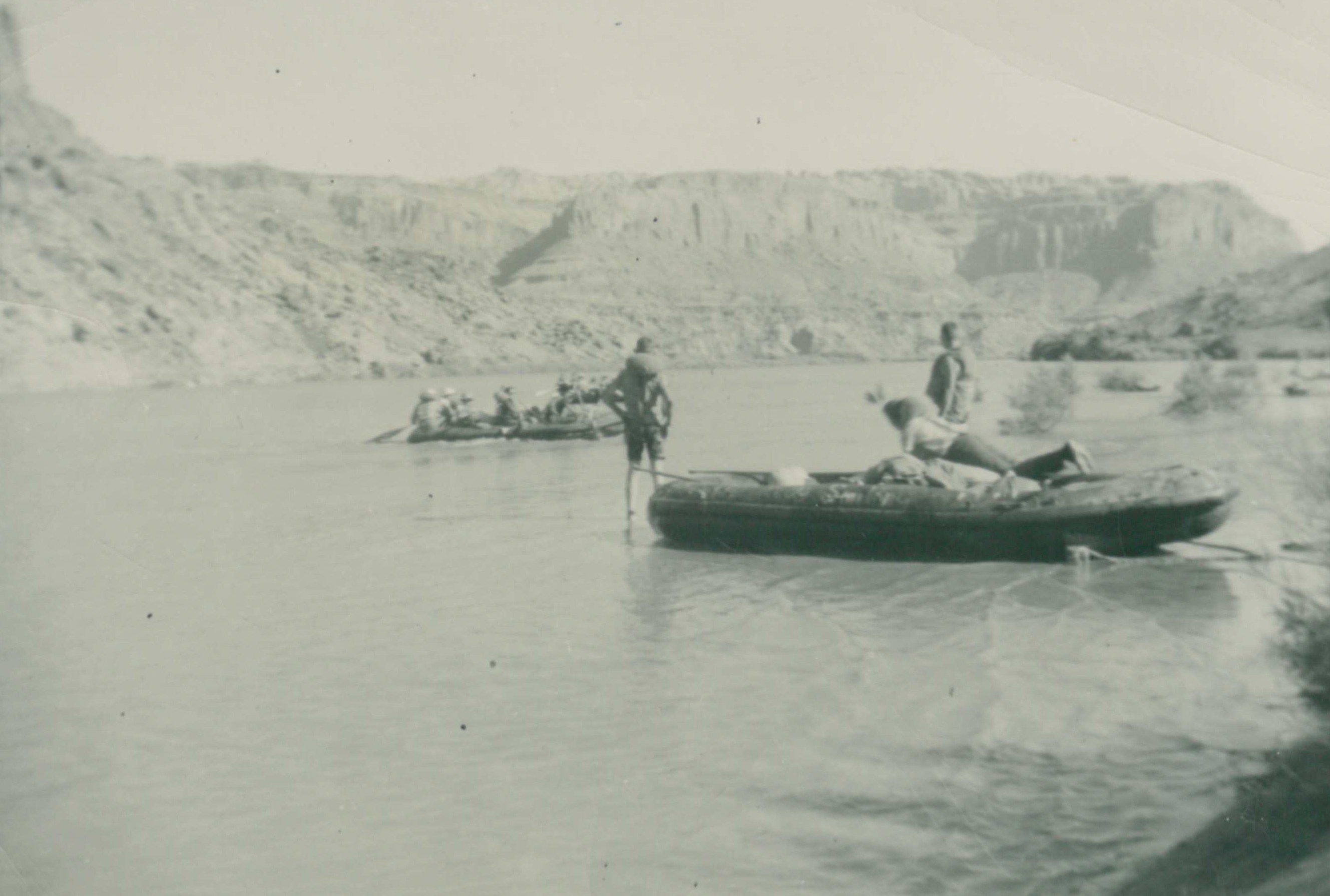
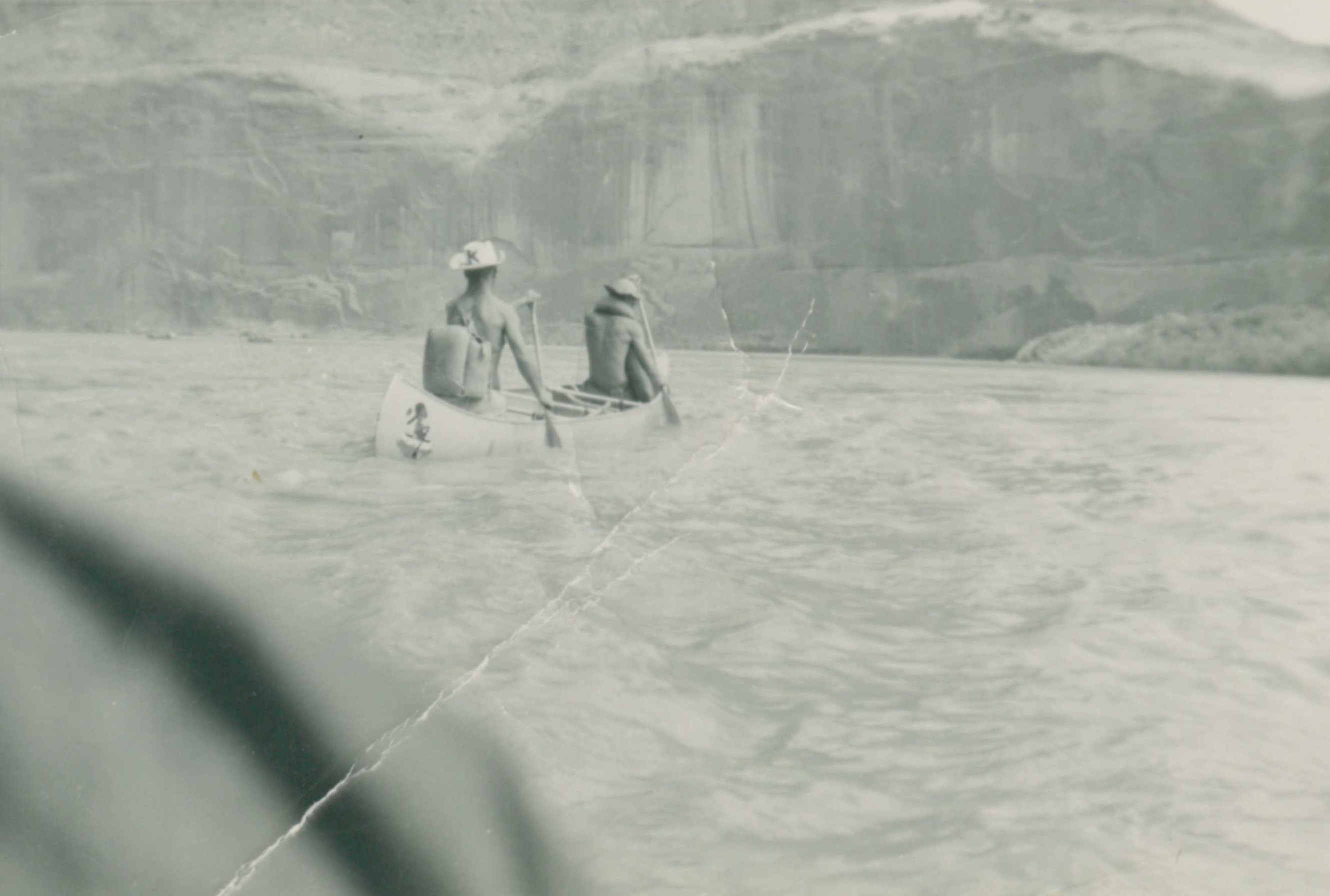
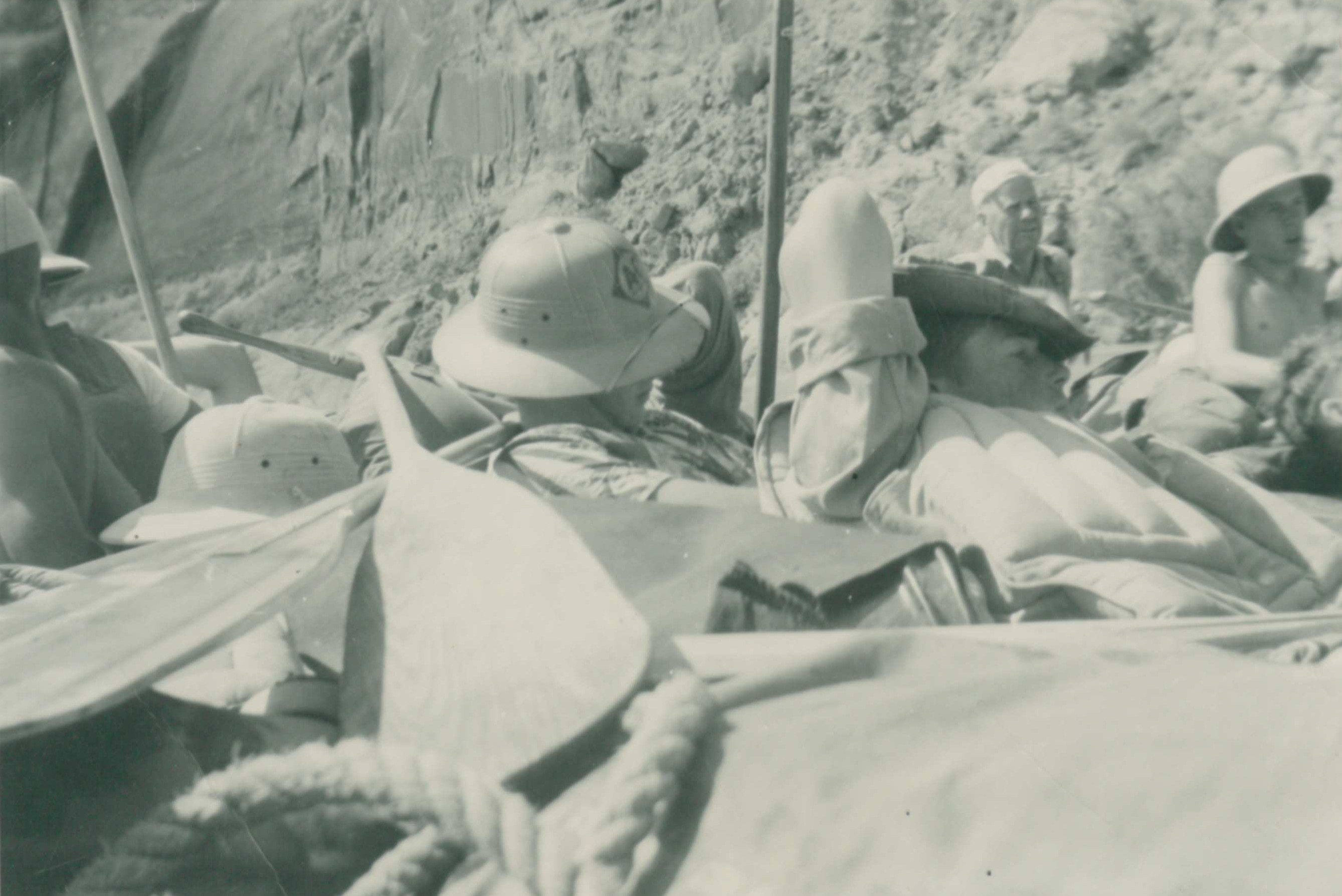
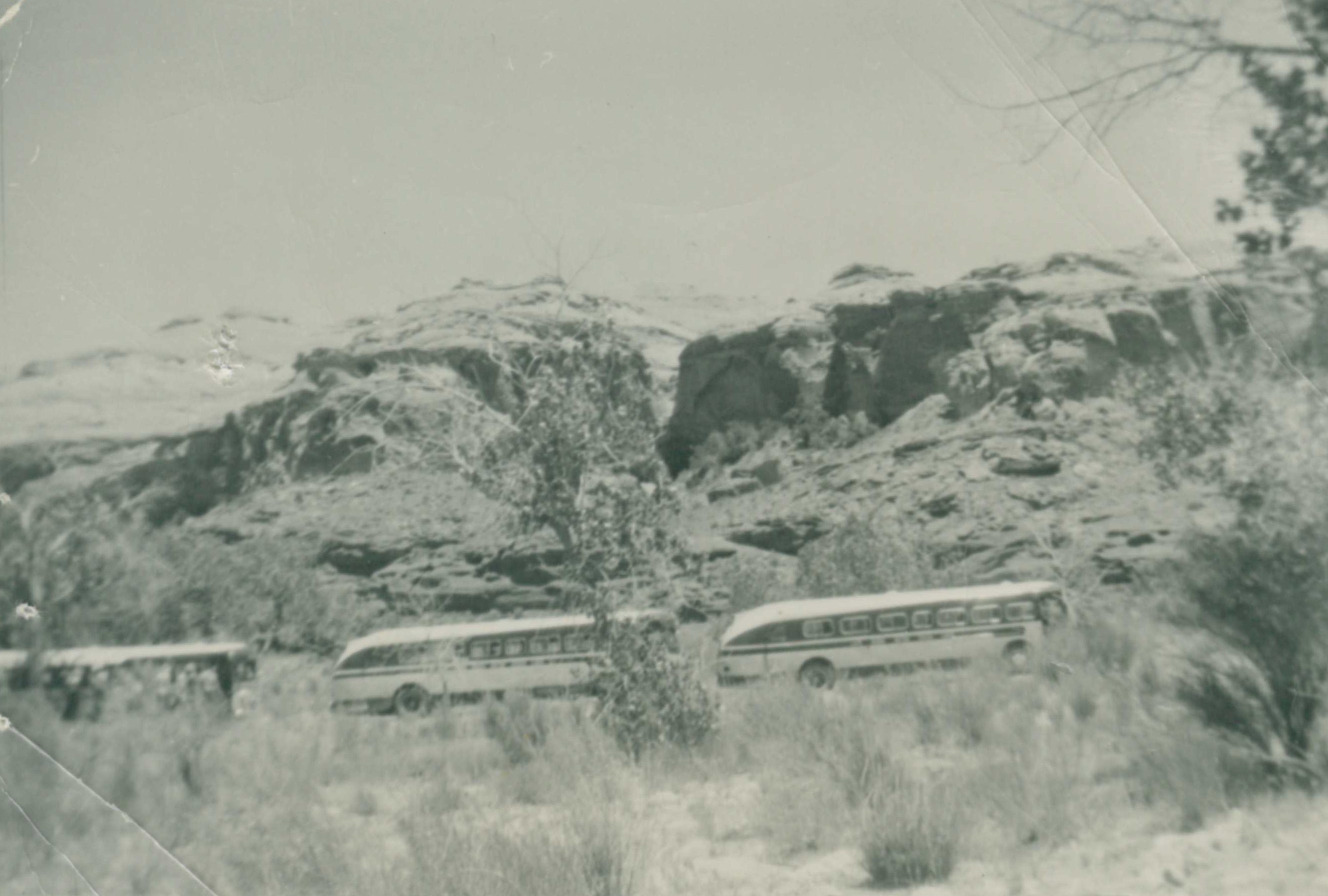
Here are a couple of the photos from the Colorado River rafting trip. Dad thinks there are more photos. He does not remember or recognize any of the individuals in the photos.
Dad remembered they had to pull out of the river to go around the Glen Canyon Dam construction.
~
~
~
~
Both of these were trips of a lifetime. Neither have been forgotten.
We took the opportunity to attend the Casper Wyoming Temple Open House on 31 August 2024. We planned the weekend to do some sightseeing and visit some church and family history sites. I am reposting as this has updates on 3 additional ancestors that also came through the Overland Trail.
We left on the Friday morning with the hope of making it all the way to Casper before nightfall. We took old US Highway 30 through Soda Springs and Montpelier. We made a stop to visit the grave of my Grandmother in Dingle.
Aliza, Lillian, Paul, James, and Hiram Ross at the graves of Bud and Colleen Lloyd
We drove through Cokeville and reminded the kids of the story of the Cokeville miracle. As we drove along the old highway, I pointed out the old railroad Y that used to go to the Stauffer mine that was located in Leefe, Wyoming. I spent the first summer or two of my life at Leefe while my dad was tasked with tearing down and removing the mine with Circle A Construction. We stopped in Kemmerer to refuel and also drive past the first J. C. Penney store. We made a quick stop at the Parting of the Ways along the California, Mormon, and Oregon trails.
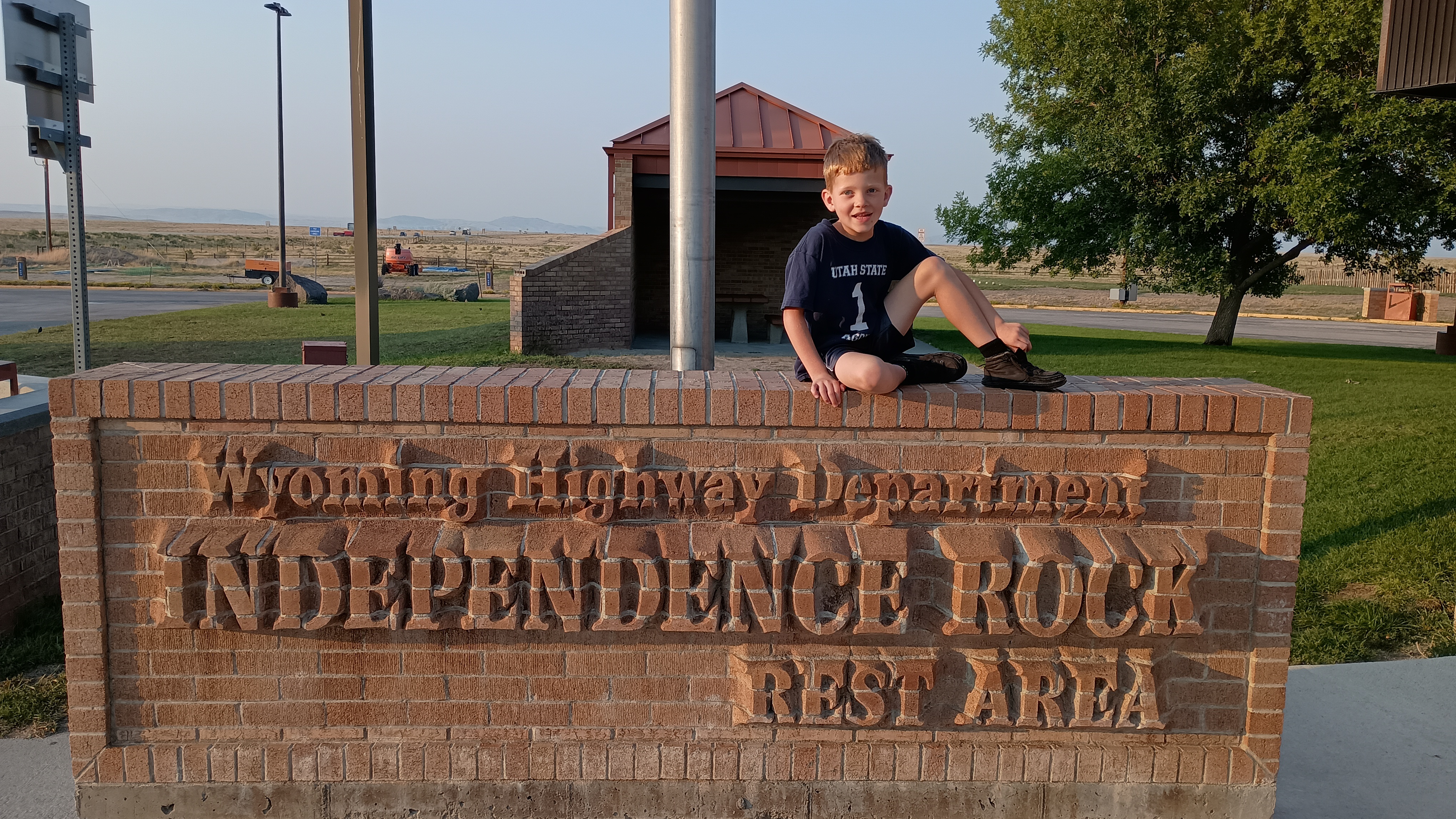
James Ross at Independence Rock
With four kids, we often stop at rest areas. As you can see above, we stopped at the one at Independence Rock. The rock is nearby and doubles as the parking location to visit the rock.
We finally made it to Casper about sunset. We ate an amazing Italian meal at Racca’s Pizzeria Napoletana and checked into our hotel.
Casper Wyoming Temple
We got up early, dressed appropriately, and headed out to visit the Casper Wyoming Temple. It was beautiful. Much smaller than I had anticipated. It is definitely one of the smallest temples, but that is because of the population and distance to other temples. It will supposedly have five stakes in its temple district, some of which will still come from a long distance to attend. Don’t let size fool you, it still has all the distinct parts of a temple and related quality. I think I may very much prefer the intimacy of the smaller temples. It actually reminded me of the Helena Montana Temple on size and flow.
Ross family at the Casper Wyoming Temple Open House
The temple does not have an adjoining chapel, but it does have a distribution/visitor center. We watched the video, enjoyed waiting in the line, and got to see the whole temple. If I were asked, there are a couple of design changes I would make for flow, but this temple will not regularly see these types of crowds or have those issues.
Ross family with the Casper Wyoming Temple
We hurried back to our hotel, changed, loaded up the car, checked out, and headed off to our next stop: The National Historic Trails Interpretive Center in Casper. I did not take any pictures there, but it was very well done. I enjoyed the visit, helped the kids with their junior ranger activities, and learned a few things. Part of the museum had its own little room and video dedicated to the Martin and Willie Handcart Companies.
We stopped at Independence Rock again on our way headed west. We walked around the massive rock and looked at a number of the signatures carved into stone from over 160 years ago. It was hot and we needed to get our little doggies along to Devil’s Gate.
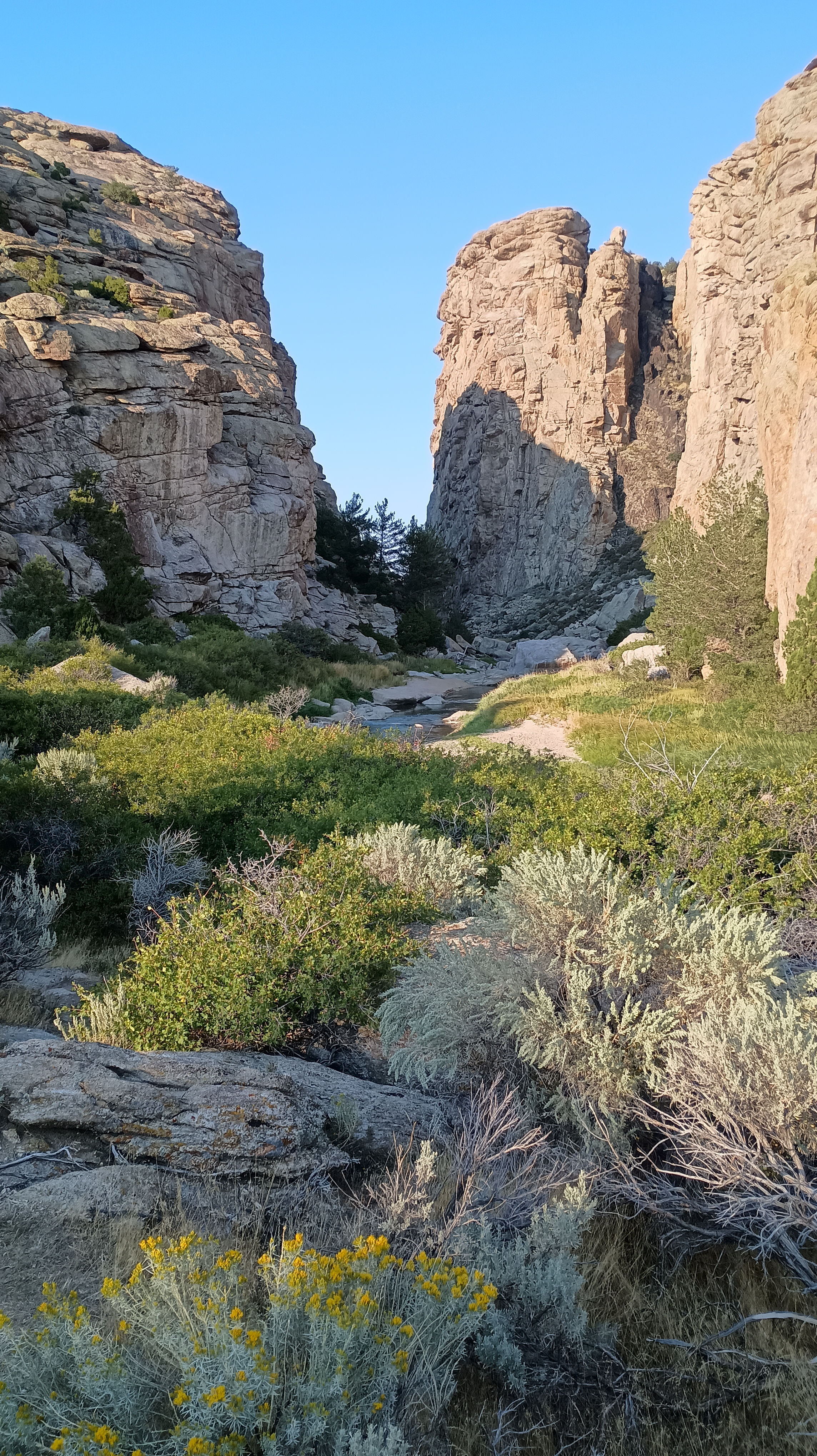
I will write about this more in a bit, but Devil’s Gate was a major landmark on the trail going west for all pioneers on the trails. But Devil’s Gate became more than a landmark and became a historical site in the tragic fall of 1856. Fort Seminoe was based there on the west side of Devil’s Gate, but it had been abandoned earlier that same year. It was that fall that the Martin Handcart Company found itself stranded in the snow. Days later the stranded handcart company moved into a nearby cove to get away from the wind, snow, and cold. That cove is now known as Martin’s Cove.
The Sun Ranch from Devil’s Gate, now The Martin’s Cove: Mormon Trail Site
We found the visitor’s center much more hospitable than some of our ancestors. As I worked through my family history, I had some of my own ancestors who passed through this very Devil’s Gate and area. Here are my ancestral lines that came across on the Mormon Trail. I had counted only 3 while in Casper, but hadn’t realized the Williams clan came over in two separate trips.
William and Mary Ann Sharp in 1853. Wagon train. Moses Clawson Company. William and Mary Ann met in the wagon train and married in Nebraska in 1853. William and Mary are my 3rd Great Grandparents.
John Williams in 1860. Wagon train. John Smith Company. John came over with his two sons John Haines (1829) and Richard (1838). I don’t know why his son David went separately in 1864. I am a descendant of John through David. John is my 4th Great Grandfather.
Johanna Benson in 1862. Wagon train. Joseph Horne Company. Johanna came over with some of her children and their families, her daughter Agneta, came over in 1864 with her family. Johanna is my 4th Great Grandmother.
William Edward Stoker in 1863. Wagon train. Unknown Company. William was traveling with his family, including the baby Mary Ann. William is my 3rd Great Grandfather, Mary Ann is my 2nd Great Grandmother.
John and Agneta Nelson in 1864. Wagon train. William Preston Company. Agneta is the daughter of Johanna Benson who came over in 1862. John and Agneta are my 3rd Great Grandparents.
David D and Gwenllian Williams in 1864. David is the son of John mentioned above. Wagon train. William S Warren Company. Gwenllian came with her sister Mary. Both married on the ship in Liverpool before setting sail for Utah. Gwenllian and Mary’s parents, David and Margaret Jordan, came over in 1872 crossing the plains by rail. David and Gwenllian are my 3rd Great Grandparents.
That gives me 10 ancestors that crossed the plains by wagon, none by handcart that I can tell. The unknown companies were all wagon trains as there were not handcarts those years.
Devil’s Gate – 2024
Every single one of these seven ancestors of mine who came west on the trail would have passed through Devil’s Gate. Here I stood on this sacred ground and snapped this photo of my daughter, my descendant and their descendant, at Devil’s Gate.
Aliza Ross at Devil’s Gate
It took me a bit more work, as I am not as familiar, to find those family lines of Amanda’s that also would have passed along the Mormon Trail to the west before the railroad made it much, much faster and safer. It took me several occasions over a couple of weeks to spend the time to research all these lines.
Henry and Ann Jackson in 1852. Wagon train. James C Snow Company. This is Amanda’s 4th Great Grandparents.
Regina Hansen in 1853. Wagon train. John E Forsgren Company. Her son, Hans Hansen, also accompanied her on the trip. Regina’s husband stayed behind. Regina is Amanda’s 4th Great Grandmother, Hans is Amanda’s 3rd Great Grandfather.
Grave of Hans Hansen in Plain City, Utah. Edith Sharp Ross’ stone is the stone at 10 o’clock from the top of this stone, my Great Grandmother.
David Buttars in 1843. Wagon train. William Empey Company. He appears to have traveled alone. Amanda’s 3rd Great Grandfather.
Birthe Jacobson in 1854. Unknown if wagon train or handcart company. Birthe’s daughter, Maria Jacobson, also accompanied her on the trip. Her husband Jorgen died in Missouri as part of the trip. Birthe is Amanda’s 5th Great Grandmother, Maria is Amanda’s 4th Great Grandmother.
Harriet Housley in 1856. Handcart company. Edward Martin Company. Harret’s son, George Housley, also accompanied her on the trip. Two other children came later. Harriet is Amanda’s 5th Great Grandmother, George is Amanda’s 4th Great Grandfather.
Richard and Christine Hemsley (1836 – 1915) in 1857. Handcart company. Israel Evans Company. This is Amanda’s 4th Great Grandparents.
Ole and Anne Jensen in 1861. Likely wagon train. Unknown company. Amanda’s 5th Great Grandparents.
John Crompton in 1862. Wagon train. Joseph Horne Company. John also had his daughter, Hannah Crompton, with him. John is Amanda’s 4th Great Grandfather, Hannah is Amanda’s 3rd Great Grandmother.
Anna Nielsen in 1862. Wagon train. Christian Madsen Company. She traveled alone. Amanda’s 3rd Great Grandmother.
Joseph and Penelope Thompson in 1862. Wagon train. John Riggs Murdock Company. Their son, Joseph Thompson, also accompanied the family. Amanda’s 4th Great Grandparents, Joseph is Amanda’s 3rd Great Grandfather.
Joseph Wayment in 1863. Wagon train. Unknown Company. Appears to have come alone. Although his parents and most of his siblings would come later by rail. Amanda’s 3rd Great Grandfather.
Axel Boyer in 1866. Wagon train. Abner Lowry Company. Amanda’s 4th Great Grandfather. Also traveled with the Keeps, other ancestors of Amanda.
James and Ann Keep in 1866. Wagon train. Abner Lowry Company. Their daughter, Sarah Keep, also accompanied the family. James and Ann are Amanda’s 4th Great Grandparents, Sarah is Amanda’s third great Grandmother. Also traveled with Axel Boyer, other ancestor of Amanda.
Richard Hemsley (1801 – 1866) and his later wife Sarah in 1866. Wagon train. William Henry Chipman Company. Amanda’s 5th Great Grandfather.
Peter Peterson in 1866. Wagon train. Joseph Sharp Rawlins Company. Peter is Amanda’s 4th Great Grandfather.
That is the Hemsley line alone, Amanda’s Dad. I count 26 ancestors of Amanda’s Dad that came through Devil’s Gate.
James, Lillian, Hiram, and Aliza Ross at Devil’s Gate Mormon Handcart Visitor Center
Amanda’s Mom’s line, the Holden family, has the following:
Edwin and Ruia Holden in 1852. Wagon train. Uriah Curtis Company. Their son, Henry Holden, also accompanied the family. Edwin and Ruia are Amanda’s 4th Great Grandparents, Henry is Amanda’s 3rd Great Grandfather.
Jesse and Temperance McCauslin in 1851. Wagon train. Unknown Company. Temperance passed away in Council Bluffs, Iowa. She did not make the trail in Wyoming or Devil’s Gate. Their daughter, Louisa McCauslin, also accompanied the family. Jesse is Amanda’s 4th Great Grandfather, Louisa is Amanda’s 3rd Great Grandmother.
John and Adelaide Roberts in 1863. Wagon train. Thomas Ricks Company. Their son, Hyrum Roberts, also accompanied the family. John and Adelaide are Amanda’s 3rd Great Grandparents, Hyrum is Amanda’s 2nd Great Grandfather.
Thomas and Mary Ashton in 1851. Wagon train. Morris Phelps Company. Mary also passed away in Iowa. She did not make the trail in Wyoming or Devil’s Gate. Their son, Joseph Ashton, also accompanied the family. Thomas is Amanda’s 4th Great Grandfather, Joseph is Amanda’s 3rd Great Grandfather.
Sarah Jarvis in 1854. Wagon train. Job Smith Company. She came with some of her family, but not with her son, Amanda’s ancestor, George Jarvis. Sarah is Amanda’s 4th Great Grandmother.
George and Ann Jarvis in 1853. Wagon train. Unknown Company. George and Ann are Amanda’s 3rd Great Grandparents. George is the son of Sarah Jarvis mentioned above.
William and Rebecca Finch in 1854. Wagon train. Daniel Garn Company. William and Rebecca are Amanda’s 3rd Great Grandparents.
Joseph Finch in 1853. Wagon train. Joseph Young Company. Joseph is the son of William and Rebecca Finch mentioned above.
John and Hannah Davis in 1851. Wagon train. Eaton Kelsey Company. Their daughter, Mary Jane, also accompanied the family. The family also has Davies listed for their last name sometimes. John and Hannah are Amanda’s 4th great grandparents, Mary Jane is Amanda’s 3rd Great Grandmother.
John Evans in 1866. Wagon train. William Henry Chipman Company (same company as Amanda’s Richard Hemsley above). His wife, Sarah, died on the trip from the United Kingdom in New York. His son, John Evans, also accompanied his father and brother. John is Amanda’s 3rd Great Grandfather, John is Amanda’s 2nd Great Grandfather.
James and Elizabeth Boyack in 1855. Wagon train. Milo Andrus Company. James and Elizabeth are Amanda’s 4th Great Grandparents.
James Boyack in 1853. Wagon train. Appleton Harmon Company. James is Amanda’s 3rd Great Grandfather. James is the son of James and Elizabeth Boyack above that came in 1855 across the plains.
Margary Waterhouse in 1855. Wagon train. Milo Andrus Company. Margary is Amanda’s 3rd Great Grandmother. She came across with the same train as James Boyack’s parents, presumably that is how she met her future husband. The Company arrived 24 October 1855 in Utah, James and Margary married 23 November 1855 in Springville, Utah.
That is the Holden line alone, Amanda’s Mom. I count 26 of ancestors of Amanda’s Mom that came through Devil’s Gate. As an aside, I also looked at her biological line (as she is adopted), and not a single one of her biological ancestors passed through Devil’s Gate.
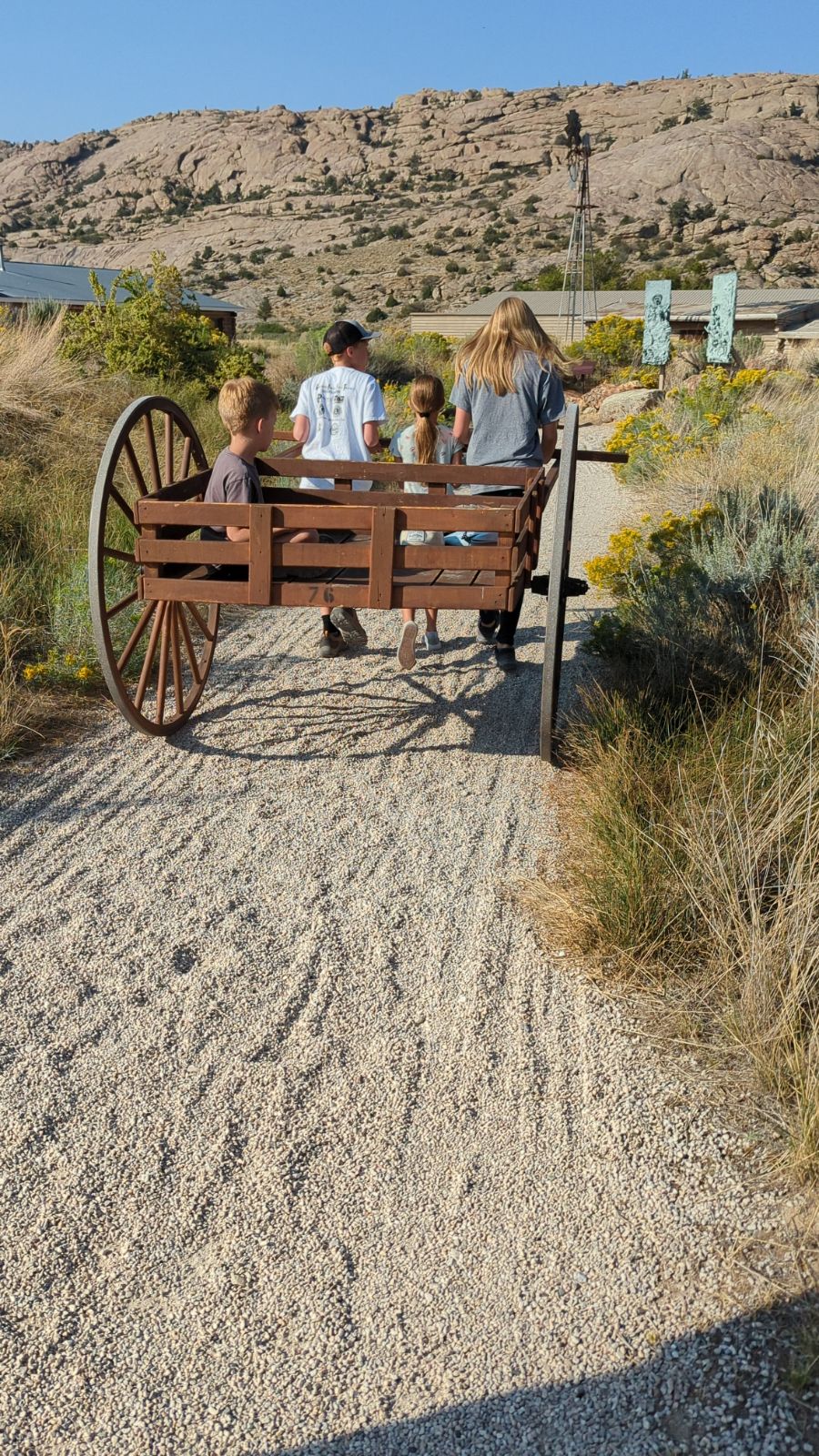
James riding while Hiram, Lillian, and Aliza Ross pull a handcart at Devil’s Gate Mormon Handcart Visitors Center
We also stopped and visited with the sixth crossing of the Sweetwater River. This was the location where, like the Martin Handcart Company, the Willie Handcart Company also got stuck in wind, snow, and cold in 1856. Their rescue occurred here.
The next day, on our way to Grand Teton National Park, we made a stop at Fort Washakie, Wyoming. This is one of the alleged graves of Sacagawea. We stopped and remembered her, whether her final resting place or not.
All in all, I was surprised by my own connection to the Mormon Trail. I had never considered that I have 7 ancestors who had literally come this way. Or that my children have 59 ancestors that literally come this way. They passed by Independence Rock, through Devil’s gate, and two of those 59 suffered with the Martin Handcart Company. I will write more on the Housley’s later as there have been other interesting interactions with that clan since our marriage.
Transcript for Housley, George Frederick, [Reminiscences], in Life histories of George Frederick Housley and Maria Christina Jacobsen Housley
“The Bishop of the Ward wanted George to talk in Church and tell of his coming across the plains, but George said he just could not speak in public so his wife’s brother-in-law, George Wood, who was a lawyer, came to his home and took his story down in short hand as George told the story to him. Then they had it read in a reunion. It was as follows:
“In the year of [1856], I with mother left our native land England, with about 600 others for our America “The Zion of Our God,” on the good ship “Horizon,” spending five weeks in our voyage to Boston. Where we took passage on a steamboat to Iowa. Awaiting there for three weeks for our hand-carts to be made that were to carry our “all” across the vast stretch of the plains to Utah. Each family supplying themselves with the necessary food for their journey if they were well. At Iowa City, where we were camped, a gentleman told me that we would starve to death if we went there at this season. One of our people and his family decided to stay over. I became tempted to do likewise and upon telling my mother that we better stay she became much depressed in spirit and told me to wait a little while. During the time she prayed to Our Heavenly Father for guidance. One fellow traveler, after deciding to stay, sent out one day in the woods to hunt for game, and while away was seized with fever and ague. He hurried home and upon entering the tent where mother I were awaiting him, he laid upon the cot and commenced singing in poetry and rhyme, telling mother to take me with her to the valley and that we should get through alright. Mother told me she had made it a matter of prayer and by this means her prayers were answered. I told her then that we would go to the valley at all hazards because I was satisfied all would be well.
“Upon the company starting we were in line with our cart and ready. All went well as we joyously sang, “For some must push and some must pull as we go marching up the hill. As merrily on the way we go, until we reach the valley, Oh!” As days wore on, our spirits lagged as we became weary. Some of our people became sick and were compelled to ride, thus compelling others to be more heavily loaded. Provisions commencing to get scarce as the days wore on, necessitating our captain to put us on shorter rations. Many dying by the wayside where they were buried each night where we camped and their graves were left unmarked except by our tears. At this season and at this part of the plains it commenced getting cold, and were again placed on shorter rations of 4 ounces of flour to each person per day. We traveled to the Sweet Waters River where we camped, being so weak and exhausted that it was almost impossible to move. Many of our people while there died of starvations while others froze to death by the wayside.
“A man from London by the name of Stone, while trying to get to an Indian camp was devoured by wolves; when found by some of our camp, nothing was left of him but his legs inside his boots.
“Receivers were sent out from the Valley to assist us in and could not find us, thinking we were lost on the plains the rescue party concluded to return to the Valley. But one of their number stated that he would go to the States but what he would find us. About noon a horseman was seen coming into our camp, and he looked like an angel to us poor starving emigrants who had eaten nothing but flour for three days. With words of encouragement he entreated us to make another start. But, many, while their will was good, their strength failed them and they dropped and froze to death by the way.
“The relief party returned and met us and assisted us with some provisions. But scores of our brethren and sisters died and were left in unmarked graves by the wayside. At this time I was permitted to sleep in a tent with two of my companions. Each of them dying by my side where I slept by them ’till morning when they were taken away and buried.” In a later trip across the plains to assist the emigrants at one of our camps I saw many of the bones of my companions that had been dug up by the wolves. At the time of my companions death I became despondent through weakness that I longed for death and tried to hide myself from the company that I might die, but one of the brethren returning back for something, found me sitting behind the rock where I had hoped to die. He took me along with him for a day before we caught up with the company. I was permitted to sleep in a wagon that night, where I slept with a dead man all night.
“The next day we were permitted to see and enter into the Valley (November 29, my birthday). Although I was too weak to walk, my feet being much swollen I wrapped them in my mother’s shaw until we were taken care of by kind friends who were awaiting us. But brother Slack, our kind friend, would not allow me only a limited amount of bread as he was afraid it would kill me. But after they had gone to meeting I finished up the whole pot pie which had been prepared for the family, and I am alive yet and I have been hungry to this day.”
“President Parkinson of the Hyrum Stake was present at the reunion and when he heard of the hardships, suffering and hunger George went through, he made arrangements with the Church authorities to grant this couple the privilege of receiving their second endowments. After they received theirs, Mary Ann stood proxy for George’s first wife, who received their second endowments of the 28th of July 1910. This is a privilege and blessing that only a few people have had since the Church was organized…. An addendum was added: “One time while visiting in Mapleton at his son Ben’s home, he and my Grandfather—Marshall Franklin Allen—were reminiscing over old times. Grandfather Allen told of one time when “Brother Brigham” had called him to accompany several other young men in going out to meet the Hand Cart Company, to take them some provisions and assist them into the Valley. As he knelt in prayer the evening before going, he said that he told the Lord that it was a foolish thing to do, going out in such weather and with no roads to follow. But while he was still in the act of prayer, it was made known to him that he should go. It was also made known that he would be able to save many of their lives. After search many hours the rescue party became discouraged. Thinking the Hand Cart Company had been lost on the plains, they decided to return to the Valley. Grandfather said, “I told them I would go ’til I reached the States but what I would find them” About noon they found a group of handcarts with their poor, starving people. Thinking there may be more farther back, he rode on for some distance. He saw a dark spot among some rocks. Upon investigating, he found it to be a young man. He wrapped his blankets around him and helped him onto his horse. Then Grandfather Housley spoke up and said—”The horse had one white leg, a white strip in it’s forehead and the rest of it was coal black.” Grandfather Allen said, “Yes.” Grandfather Housley said, “It was a bright plaid blanket.” Grandfather Allen asked, “How do you know?” Grandfather Housley said, “Because I was the one you found!” Then he stood up and said, “And I want to tell you, if it hadn’t been for the prayers of my mother and the faith of the Saints, I would not have lived ’till you found me and I never would have reached the Valley!”
I have two copies of the History of Plain City, Utah. The front indicates it is from March 17th 1859 to present. As far as I can tell, the book was written in 1977. At least that is the latest date I can find in the book.
One copy belonged to my Grandparents Milo and Gladys Ross. My Grandpa has written various notes inside the history which I intend to include in parenthesis whenever they appear. They add to the history and come from his own experience and hearing.
I will only do a number of pages at a time. I will also try to include scanned copies of the photos in the books. These are just scanned copies of these books, I have not tried to seek out originals or better copies.
History of Plain City March 17th 1859 to present, pages 123 through 140.
SPORTS IN PLAIN CITY
By Lyman H. Cook
Plain City’s most prominent claim to fame has been through the sports program and the great players and teams that the town has produced. I know of no other town to community in this state, to possibly out of state, that can equal the accomplishments in the total sports program as the town of Plain City. I don’t know how many hundred championships or trophies this town has won in baseball, basketball, softball, volleyball, and Jr. Posses, over the last 75 years or more. We include the young teams and people in the town, and also the girls. These trophies and championships came from local, county, multi-county, state, stake division, region, multi-region, and All Church basketball, softball, and volleyball, which is the largest leagues in the world.
On February 14, 1977, at 3:30 PM, there were 226 trophies in the trophy cases at the Plain City Church. I couldn’t begin to estimate the number of trophies in the homes here in Plain City. Can you comprehend the number of teams involved and especially the number of people involved on the teams in accomplishing this great record.
There seems to be a special spirit, or force, ambition, or drive, that compels players to excel and teams to win. The will to win in Plain City is the strongest I have ever known. We have been accused of playing dirty, or being poor sports, but in answer to these charges, I would submit the phrase: We just play hard, and the spirit of competition just brings out the best in us. In Plain City you don’t hope you can win, you are expected to win. Some communities dislike us for our sports program because it is so strong, and in reality, they judge their success of their season by the fact of whether they can beat Plain City or not. I realize these are rather potent and strong statements, but never the less, they are all true.
We dedicate this section of sports to all the people who have ever played on a team in Plain City. We realize that some names will be missed and it is not our intent to forget anyone, but we can’t remember all, and this is all of the sports material that has been turned in for the history. If your name is left off, write it in, and if you were star of the team, write that in also.
We have asked for and received personal write-ups on a few people who have signed professional contracts or have distinguished themselves in certain sports. We recognize them for their talents in that they in turn have brought special recognition to Plain City. I am sure these talented athletes would be the first to recognize their fellow members, for they realize that no one man is bigger or better than the whole team, and in this light, we recognize the teams they played on.
From 1944 until the present, there were three basketball teams that went to All Church and won two second places. Commencing in 1951 through 1954, we played in four fast-pitch All Church Tournaments. We won a second-place finish and eight-place finish.
In 1953, we played on a volleyball team that went to the All Church Tournament and won the Sportsmanship Trophy, which was a great honor. The team that played were: Dee Cook, Lyman Cook, Wayne Cottle, Wayne Skeen, Blair Simpson, Kenneth Lund, Harold Hadley, and others we couldn’t remember.
There were teams that went to the All Church Slow Pitch Tournaments from Pain City for three years. They won two All Church Championships, and a third-place finish. There have been some excellent younger teams in baseball, basketball, and softball, and a Junior team last year (1976) won a second-place in a
The All Church program.
This was one of the early teams of Plain City, and this picture was taken around 1910. They played together for many years, and they won several championships.
Top Row: L to R: Joe Hunt, Tooley Louis Poulsen, Preston Thomas, Parley Taylor, Jack Hodson.
Middle Row: L to R: Mr. Anderson, Coach, Jim Thomas, Melvin Draney
Bottom row: L to R: Oscar Richardson, Joe Singleton
Louis Poulsen
Tooley Poulsen played on many championship teams, and played several positions, mainly second base and catcher.
This was one of the first Mutual basketball teams in Plain City. They played their games in the upstairs of the old hall. Lyle Thomas reports that you didn’t have to be polished to play on this team, just big and rough, for there was very little whistle blowing in those days. This picture was taken in about 1925, and they won several championships.
Back Row: L to R: Rulon Jenkins, Lyle Palmer, Marion Sneed, Milton Garner
Front Row L to R: Theo Thompson, Ralph Robson, Coach Ellis Giles
This was the 1930 Plain City Baseball team. They played for State Champion ship.
Top Row: L to R: Horace Knight, Albert Sharp, Walter Christensen
Middle Row: L to R: Floyd Palmer, Angus Richardson, Arnold Taylor, Walter Moyes, Abram Maw, William Freestone
Bottom Row: L to R: Clair Folkman, Gilbert Taylor, Dick Skeen, Fred Singleton, Frank Skeen, Elmer Carver
BASEBALL AND EARLY SPORTS
By Elwood (Dick) Skeen
Baseball was Plain City’s most favorite sport. Baseball in Plain City in the early 1920’s and 1930’s was composed of the Plain City Bull Dogs with the following players taking part:
Louis Poulsen
Joe Singleton
Walter Draney
Elmo Rhead
Parley Taylor
Joe Hunt
Elvin Maw
Oscar Richardson
John Hodson
They represented Plain City in the Weber County Farm Bureau League, composed of North Ogden, Hooper, Roy, and Clinton. There were many good ball players in those days that played on the teams. The town park at that time was covered with salt grass. There were no base lines, no pitcher mounds. But, on a Saturday afternoon the park was filled with people that came from all over the county to watch the games. Horses and wagons lined the park.
Foot racing was also a great sport at that time, and Plain City had one of the best in Walter Draney, who was not only fast, but also a great athlete.
As time passed and the older players began to drop out, the chance came for us younger players to take over. In 1925 I caught my first Farm Bureau game at Liberty with Ezra Taylor doing the pitching. Then, the other players that made up our team for the next few years started to play. We had our share of victories. In fact, we had more than our share of wins.
Finances at that time were hard to come by. We did what we could to raise money to continue supporting the team. In 1928, the ball team put on the first Black and White Day with Mervin Thompson and Joseph Skeen showing their cattle. An old-time refreshment stand, soda water, ice cream, candy bars, and popcorn, which sold for 5¢. Also, some drinks that were not sold at the stand.
Our uniforms were furnished by Plain City individuals and business firms from Ogden. Suits would have the name of the giver on the back. Decoration day and the Fourth of July were our most celebrated days with all kinds of sports for those who wished to perform. A baseball game and a dance in the evening would top the day.
We would get the best team from Ogden to play on these days so that we could show what was leading up to the best team we had. In 1930, we won the Weber County Farm Bureau League, and the town bought us new uniforms to go to Lagoon to play Sandy, Utah, for thy State Championship. We lost by a close score. Our players were:
Gilbert Taylor
Walter Moyes
Arnold Taylor
Frank Skeen
Horace Knight
Albert Sharp
Fred Singleton
Abram Maw
Walter Christensen
Clair Folkman
Dick Skeen
Bill Freestone was the manager. Angus Richardson was the coach. Elmer Carver took care of finances, and Floyd Palmer and Byron Carver were scorekeepers. We played in tournaments at Brigham City and Ogden, and some out-of-state games were played.
We continued playing, but soon the gang started drifting different ways and our days were coming to an end. The league started to dwindle and later, folded up with the workload increase. Baseball was soon lost to the towns in Weber County.
Left to Right: Nalon Taylor, Bert Cook, Howard Gibson, Bud Dallinga, Wayne Cottle, Thayne Robson, Bill Stokes, Rulon Jenkins, Coach
The Desert News Sport Best Two MIA Teams
Page 10 – Salt Lake City, Utah-Saturday, March 11, 1944
Bottom Row: L to R: Carl Taylor, Carl Hodson, Fred Singleton, Coach, Blair Simpson, Glen Charlton
Top Row: L to R: Frank Hadley, John Nash, Lyman Cook, Ray Cottle
Ray Cottle, Center: First Team All Church
Frank Hadley, Forward: Second Team All Church
Lyman Cook, Guard: Second Team All Church
Blair Simpson, Guard: Honorable Mention
This team played for All Church Championship in 19441. They played Grantsville, Utah, and lost to them for the title. The games were played in the old Desert Gym, by the Hotel Utah. The teams stayed four nights in the Hotel Utah. They ate, slept, and played basketball.
Top Row L to R:
Alf Charlton, Athletic Director
Lyman Cook, Ronald Skeen, Kenneth Lund, Grant
Lund, Wayne Skeen, Clair Folkman, Coach
Bottom Row L to R:
Harold Hadley, Elmer Hipwell, Bill Stokes, Dee
Cook, Blair Simpson
This was the Plain City M-Men Team that played after World War II, in 1946, for several years and won several state championships and played in the division tournaments.
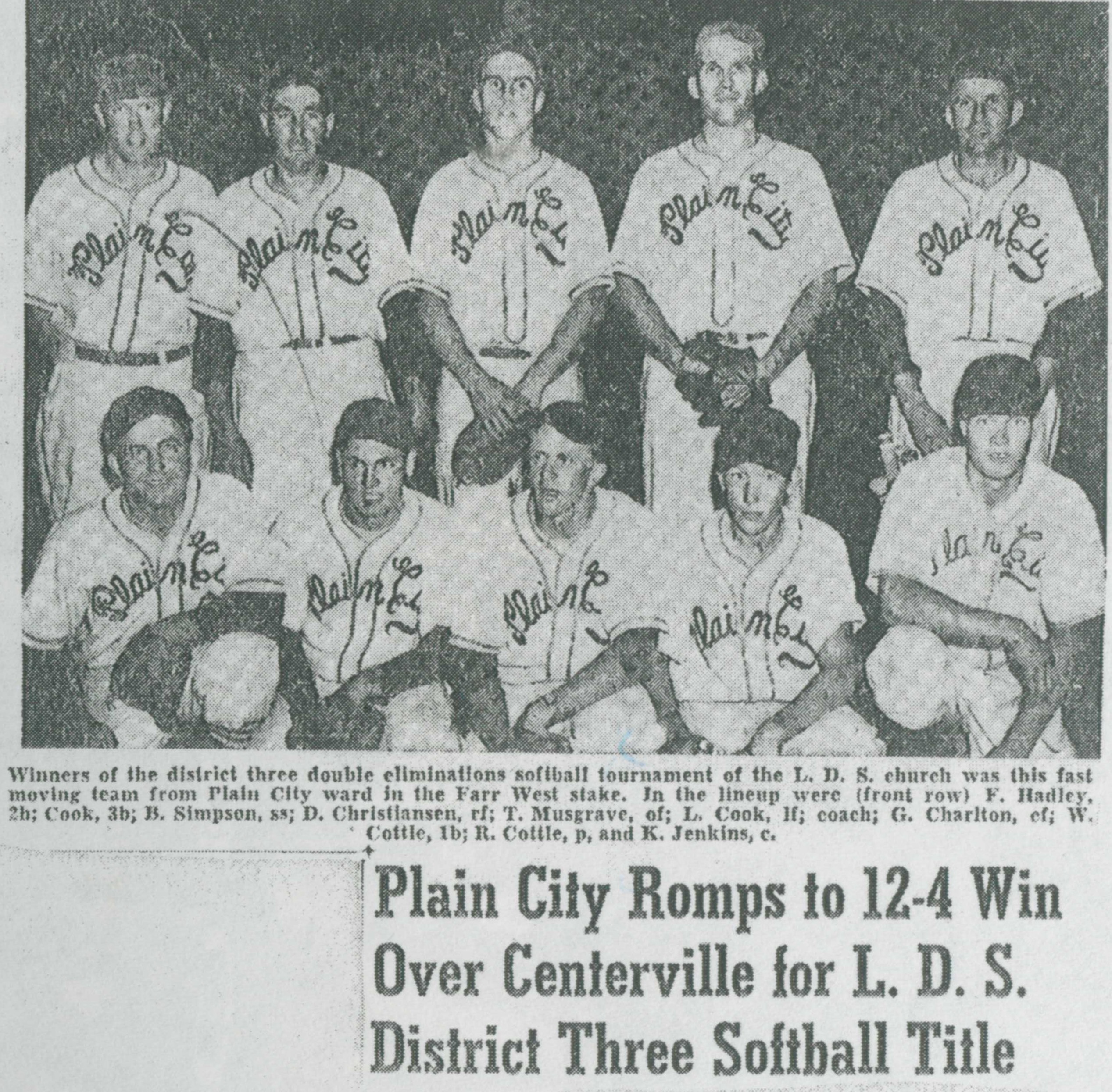
Winner of the district three double elimination softball tournament of the L.D.S. church was this fast moving team from Plain City in the Farr West Stake. In the lineup (front row) F. Hadley, 2b; Cook 3b; B. Simpson, 5b; D. Christensen, rf; T. Musgrave. Of; L. Cook, lf; coach; G. Charlton, of; W. Cottle. 1b; R. Cottle, p, and K. Jenkins, c.
Plain City Romps To 12-4 Win
Over Centerville for L. D. S.
District Three Softball Title
PLAIN CITY SOFTBALL TEAM OF 1951
By Lyman Cook
Plain City has always been a very strong baseball town, and the feeling was that softball was a game for girls, or you played softball at family reunions. In 1951 the Farr West Stake started a softball program and wanted teams to participate. I was Ward Athletic Director at that time and asked these players to play. This was the first softball team organized in Plain City. We won the Stake and District III. We then went on to the All Church Tournament in Salt Lake City. We won some and lost some, not too eventful. I coached the team the first year we played. This was a fast-pitch team.
L. D. S. Division III Champs
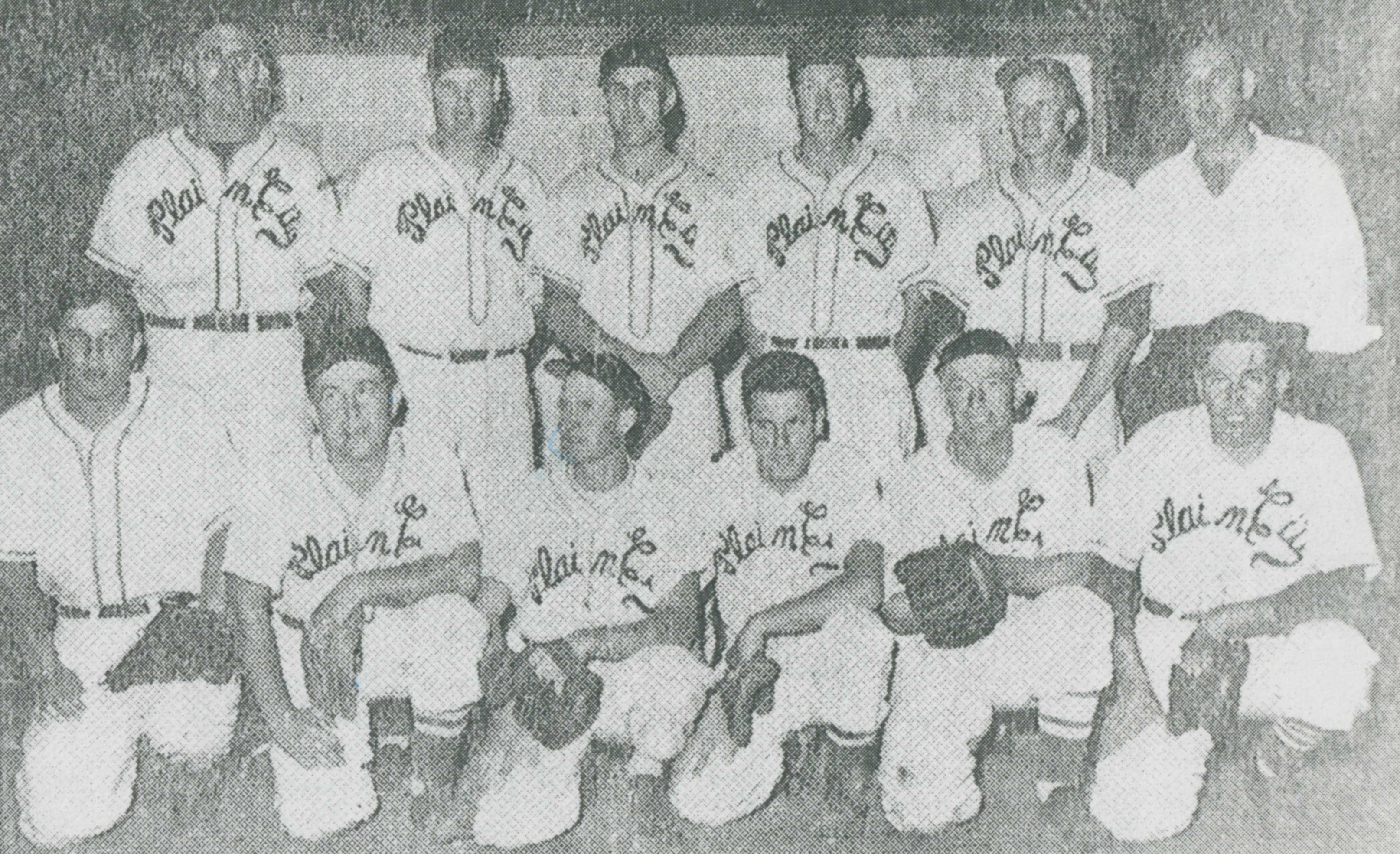
Repeating their last year’s victory in the L.D.S. division III softball tournament, the Plain City team came through again last night at Ogden softball park to beat Hoytsville 9 to 6. Front row Left to right: M. Heslop, E. Hadley, C. Taylor, D. Cook, A. Maw and G. Charlton: back row, lerft to right: R. Cottle, W. Skeen, W. Cottle, L. Cook, B. Simpson, and D. Skeen, coach. Absent from photo: Jenkins, V. Stokes and R. Skeen.
PLAIN CITY WARD SOFTBALL TEAM OF 1952
By Lyman Cook
In 1952 we repeated as stake champions and also won the Division III Championship again. We went to the All Church Tournament again and played very well. We played for the All Church Championship, but lost to Pocatello 10th Ward in a good game. Blair Simpson was voted Most Valuable Player of the tournament. Wayne Cottle made the All Church Team. There may be others. This was also a fast-pitch team. Dick Skeen was the coach.
This team played Farm Bureau Baseball and won the
Championship around 1950:
Top Row: L to R:
Junior Taylor, Wayne Skeen, Don Singleton, Bert Cook,
Glen Charlton, Kent Jenkins, Clair Folkman, Coach
Bottom Row: L to R:
“Buss” Lyman Skeen, Frank Hadley, Wayne Cottle, Ray
Charlton, John Maw, Dee Cook
This team played Pleasant Grove for All Church Champion-
Dee Cook, Manager, Darrell Christensen, Robert Folkman,
Bert Cook, Kenneth Lund, Wayne Cottle, Kent Jenkins, Coach
Many county and Northern Utah Championships were obtained by this team that was sponsored by the Town Board in the late 1950’s to middle 1960’s.
COACHES: Clair Folkman – Blair Simpson
TEAM MEMBERS: POSITIONS:
Blair Simpson P- IF
Wayne Cottle IF
Cy Freston IF
LaGrand Hadley OF – P
Archie Skeen C
Gaylen Hansen C – P – IF
Bobby Taylor P – OF
George Cook IF
Reid Nielson IF P
Ted Favero IF –
Dennis Anderson P
Garry Skeen OF
Lynn Folkman OF
Bud Parker IF – OP
Tom Seager OF
Harold Hadley IF
Harold Marriott IF
******
PLAIN CITY WARD FASTPITCH TEAM
1960, 1961, 1962
This team won the Stake, Region, and Division Championships, and represented the ward in All-Church competition with a successful number of victories.
COACH: Elmer Carver
TEAM MEMBERS:
Tom Seager, P Blair Simpson, SS
Gaylen Hansen, C LaGrand Hadley, LF
Wayne Cottle, 1st Robert Folkman, CF
George Cook, 2nd Dee Cook, RF
Cy Freston, 3rd Don Singleton, IF
Blaine Eckman, QF Gar Hunter, 1st – OF
THE PLAIN CITY BULLDOGS
This is one of the very first Weber County Recreation Teams in Plain City. Many of these players went on playing baseball for many years.
Front Row: L to R:
Dick Skeen, Coach, Fred Palmer, Darrel Thompson, Kenneth Hogge, George Cook, Ronald Sharp.
Back Row: L to R:
Archie Skeen, Brent Taylor, Wayne Poulson, Jay Freestone, Robert Folkman, LaGrand Hadley
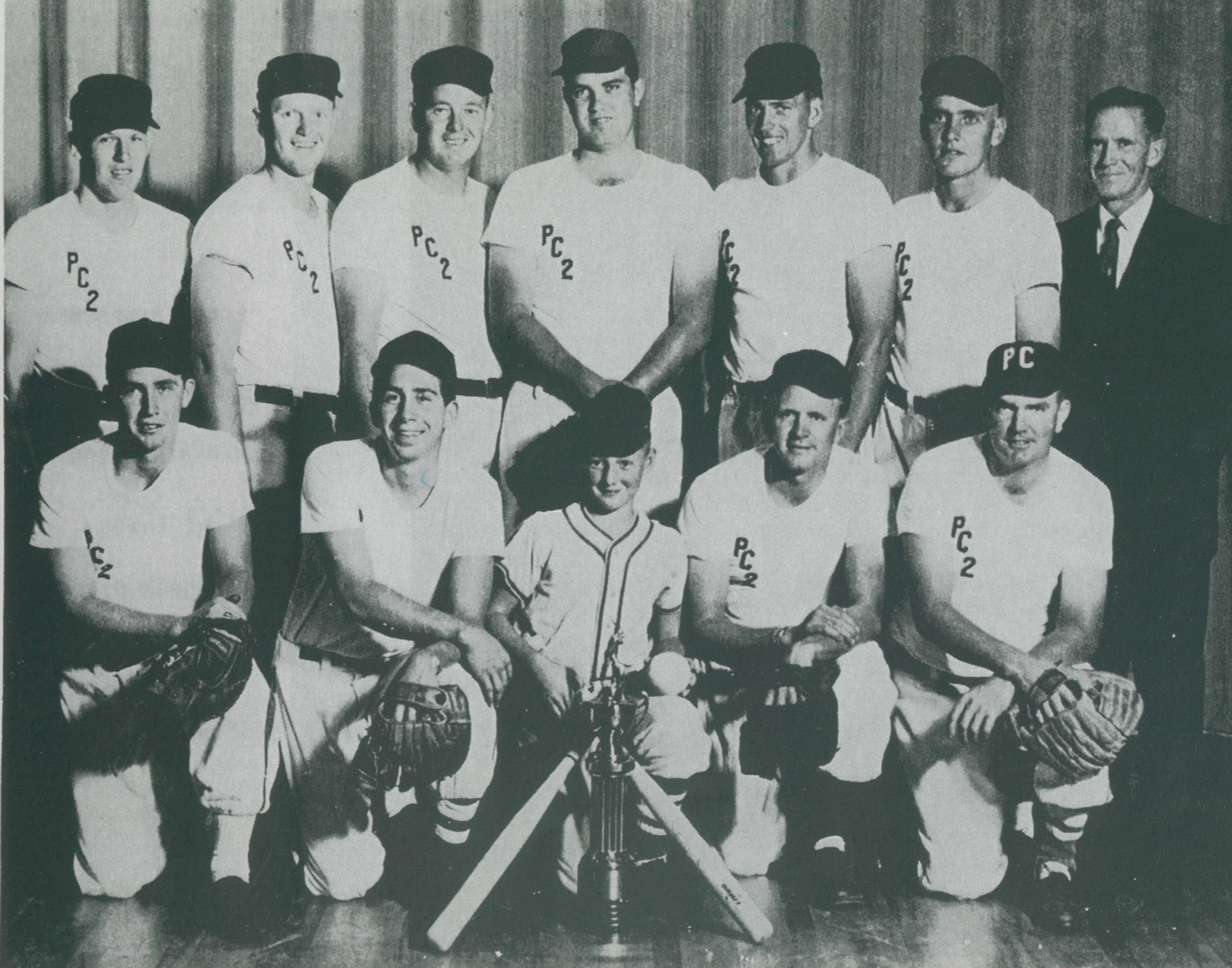
PLAIN CITY SECOND WARD
ALL – CHURCH CHAMPIONSHIP TEAM
1963 – 1ST Place
1964 – 1st Place
1965 – 3rd Place
This team represented the Plain City 2nd Ward and Plain City Town by winning 64 and losing only two games over a three-year span. Many players received All – Church recognition. In the championship game the first year the team hit 11 home runs and pulled off a triple play for the victory.
Back Row: L to R: Not in Photo
Garry Skeen Archie Skeen
Gaylen Hansen Ken Searcy
George Cook Jay Freestone
Gar Hunter Val Taylor
Jerry Bradford Mel Cottle
Lynn Folkman Gordon Singleton
Bishop Rulon Chugg Jim Beasley
Don Singleton
Front Row: L to R: Gary Hill
Bishop Orlo Maw
Jerry Moyes
Doug Palmer
Dale Searcy
Blair Simpson
LaGrand Hadley
All – Church Honors:
Gar Hunter
Jerry Bradford
Ken Searcy
Gaylen Hansen
Archie Skeen
Blair Simpson, Most Valuable Player
BLAIR SIMPSON
and
ELMER SINGLETON
of the
PITTSBURGH PIRATES
1948
“Two cousins met”
ELMER SINGLETON
Elmer Singleton started pitching for the Farm Bureau League in Plain City. He pitched for several championship teams. He signed a professional contract with Cincinnati, and played at Wenatchee, Washington in 1939, his first year. He played for Idaho Falls, Portland, and Oklahoma City. He moved on up to the big league and played with the following teams:
Cincinnati
Yankees
Chicago
Kansas City
Boston
Pittsburgh
Washington in 1950
Toronto
San Francisco
Seattle
He was in professional baseball for 27 or 28 years, the last eight years as a player coach.
He pitch two no hitters, one at San Francisco, and the other at Seattle. Elmer won the Player of the Year Award at Seattle in 1956. There is a baseball card with Elmer’s picture on it with the Chicago Cubs. It reads:
“This will be Elmer’s 17th year in professional baseball.
He started back in 1940 and after 11 uneventful seasons,
got red hot to become one of the top hurlers on the
Pacific Coast. In 1952 at San Francisco, he won 17, followed
with 15 triumphs in 1953 and moved to Seattle in 1956.
He had the best Pacific Coast Earned Run Average.”
Elmer told us that before he left to play professional baseball, the people of Plain City honored him at a banquet. They gave him a ball glove, and he still has it. He is listed in the Sports Record along with his accomplishments. Elmer was a great baseball pitcher. The only picture we have of Elmer is with Blair Simpson. Elmer and Blair are cousins,
BLAIR SIMPSON
BY Blair Simpson
I attended school at Plain City before going to Weber High School. At Weber High School I participated on the track team, played some basketball and pitched for the Weber High baseball team.
After graduating from Weber High School in 1944, I was drafted into the army for two years.
In 1948, I signed a professional baseball contract with the Pittsburgh Pirates organization. While playing with the Pirates, I played with the following cities:
Santa Rosa, California
Pittsburg, California
Modesto, California
Hutchinson, Kansas
Waco, Texas
Charleston, South Carolina
I was a pitcher and had to quit because of an injury to my knee.
After retiring from professional baseball, I played a considerable amount of baseball with Plain City and other teams in the Ogden area, such as:
Ogden Ford Sales
Heitz Heating
Wasatch Time
I was selected on the All Star Baseball Team composed of 16 players from the State of Utah.
I also played on many softball teams in the Ogden area such as Fisher Hess, Utah General Depot, Fred M. Nyes, Savon, and others.
In 1952, I was named the Most Outstanding Player in the “All Church Fastpitch Softball Tournament” in Salt Lake City and was also named to the All Church All Star Team in 1953.
In 1963, o received the Most Outstanding Player Award in the All Church Softball Slow Pitch Tournament. In 1964, I again received the most Outstanding Player Award in the slow pitch division of the All Church Tournament held in Salt Lake City. The year 1964 was one of my most memorable occasions in All Church Softball as I hit four consecutive home runs in one game.
I would like to give a lot of credit to whatever successes I have enjoyed in athletics to the talented town of Plain City.
WAYNE COTTLE
By Wayne Cottle
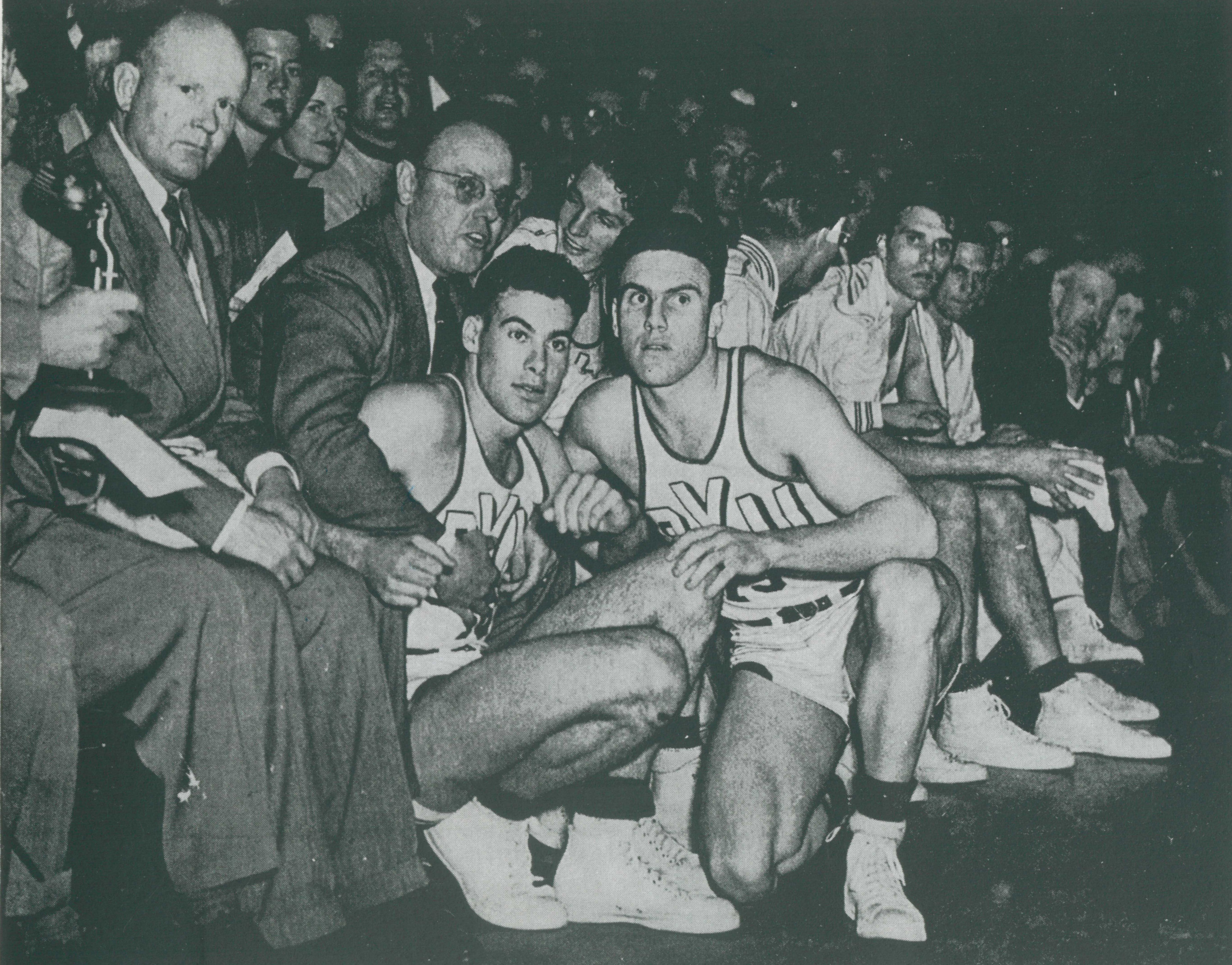
I was born November 30, 1928, in Ogden, Utah. I lived in Plain City all my life. I attended Plain City Elementary and Junior High. I played basketball in the 9th and in the 10th grades for Plain City. L. Rulon Jenkins was our coach and our principal. We played against Hooper, North Ogden, Huntsville, and Weber High School.
In the Fall of 1945, I started Weber High School, playing football, basketball, baseball, and track for both years. In 1947, I played to a tie for the Region I Championship with Box Elder. We played off the tie breaker at Ogden High School, beating Box Elder for the first Region I Championship for many years. I won the Region I scoring title. We entered the State Tournament in Salt Lake City and we lost to Granite, who became the State Championships, in the semi-finals. I was the recipient of the Standard Examiner KLO Watch Award for being the outstanding athlete of the year.
I entered Weber Junior College in the Fall of 1947. After about a month of practice I became one of the starting forwards. We played in several tournaments winning 3rd place in the Compton California Invitational. We played an independent schedule that year. In 1948-49 Weber became a member of the ICAC Conference. We won the conference and played Snow Junior College Tournament. We won the game and I was voted the tournament’s Outstanding Player Ward. We went to the national finals in Hutchinson, Kansas. We won our first game, then we met two defeats.
In the Fall of 1949, I entered Brigham Young University. I was on the team that won the Skyline Conference Championship for the first in many years. We went to the NCAA at Kansas City, Missouri. We lost to Baylor University, then beat UCLA for 3rd place. The next year we accepted a bid to enter the National Invitational Championship and two of our players were voted All American.
I graduated from BYU in 1951, came back to Plain City and started to play basketball with the Ward team. From the 1951- 1952 season until the creation of the Plain City 2nd Ward in 1960, we never lost a league game in the Farr West Stake. The year of the creation of the Plain City 2nd Ward, they beat us once and we beat them once. We played off the Stake Championship at Wahlquist Jr. High, and we won the team and the championship. After that season, the Church specified an age limit and I was area championships and went to the All Church several times.
WAYNE COTTLE
Brigham Young University
BERT COOK
He attended Plain City School where he was active in athletics. He graduated and attended Weber High School in 1947 and 1948., where he participated in football, basketball, baseball, and track. In 1948, he was selected on the Class A State All Star Team, in which Weber High School won the championship. He also won the All American in boys Award in baseball at John Affleck Park in 1948. From this he won a trip to Chicago.
He played for the Plain City baseball team for the Farm Bureau and Ogden City League.
From 1948 until 1952 he attended Utah State university at Logan, Utah, where he started on the first five as a freshman, and later in the year played in the AAU Tournament and was selected on the All Tournament Team.
In 1951 – 1952, he lead the conference in scoring and was voted All Conference both years. In 1952 he was voted All American in basketball where his Number 6 jersey was retired at Utah State University being the first one in the history of the school. That same year he was selected on the All Conference Team, and traveled with the Harlem Globe Trotters and the College All Star for several games. Later that year, he signed a contract with the New York Knickerbockers and was drafted into the service where he played for Fort Lee, Virginia Military team in which he lead the scoring and was later voted to the Second Army All Star Team.
He served his country in the Far East Command in 1954, being released in 1955, when he rejoined the Knicks until 1956. After a serious knee injury he returned to Plain City and played for the Plain City Ward and the Ogden City League.
He played on the 1956 team that won second place and he made First Team All Church.
At Weber High School I participated in basketball, baseball, and football and was productive and beneficial. After graduation in 1954, I attended Utah State University for two years on a football scholarship. Next, I received a University of Utah Scholarship in baseball. That year 1958, was a successful year with a batting of .350. The next year was even more eventful. My batting average jumped to .490. The .490 batting average was good enough to lead the Skyline Conference, plus I was fortunate to lead the NCAA in homeruns and RBI’s. These statistics and the efforts of the University of Utah Sports Publicity Department lead to my selection as the “First Team Catcher on the College All -American baseball Team”. As a result of this honor, I was selected the “Most Valuable Player in NCAA, District 7.” The year was 1959.
Opportunities were available to sign a professional baseball contract with the New York Yankees, Chicago Cubs, Boston Red Sox, and the Phillies. In 1959 I signed a bonus contract with the Boston Red Sox.
During the next three years I played in the following leagues: Sophomore League in Alpine, Texas: North Carolina League in Raleigh, North Carolina; Midwest League in Waterloo, Iowa; and the Eastern League in Johnstown, Pa. Winter ball was played in Bradenton, Florida.
In 1962, spring training was held in Deland, Florida. Because of a successful spring training I was invited to join the Triple A League in Seattle, Washington, “The Seattle Rainiers.” All Star Catcher honors were received in 1960, 1961, and 1962. In 1963 I was invited to spring training with the parent ball club, The Boston Red Sox. At the completion of spring training I was again assigned to the Seattle Rainiers.
Some of the great stars helping the young players were: Ted Williams, Bobby Doerr, Rudy York, Johnny Pesky, and Mel Parnell. As of this year, 1977, the only teammate of mine still with the Boston Red Sox is Carl Yastrzemski.
I really do not know anything about this photo. This was one of many photos that were in the Todd/Coley collection that I scanned in 2014. On the back of it was written “Leander Harral Twin Falls” in pencil. I really was not sure if that was enough information. This must have been a friend of Melvin Todd.
Doing a quick search today, I found an obituary for a Leander Harral. Everything seems to be a match. I uploaded the photo to his profile on FamilySearch.
Leander H. Harral
Des Moines, Iowa – Leander H. Harral, 84, died January 15, 2020. Born and reared in Twin Falls, Idaho. Graduated from Idaho State University with a B.S. in business, a minor in accounting. Worked for the State of Iowa, Department of Education for 30 years. Served in the US Army, post Korean Conflict for 6 years. He was active in Neighborhood Organizations in Des Moines. He loved to fish and travel. Most of all he loved his AKC Champion Border Terriers competing in Earthdog, Tracking, Agility, Rally and Obedience. Most rewarding to him was when he did volunteering with his therapy dog, Joy.
Survived by his wife, a 60 year marriage, Olga “Trudy” (Nerge) Harral; good neighbor and friend, Terry Davis; sister-in-law, Betty Lou (Paul) Schwake; sister, June (Wayne Tardiff) Harral; brother, Quintin (Avon) Harral; many nieces and nephews, great- and great-great-.
Leander was preceded in death by his parents, Quintin and Louise (Engelbrecht) Harral; father and mother-in-law, Clarence and Doris Nerge; sister and brother-in-law, Jacqueline and Raymond Davis; and brother-in-law, Harold Haverkamp.
Services will be held at Garden of Memories Cemetery in Waterloo, Iowa at a later date for the immediate family. Arrangements handled by Hamilton’s Funeral Home.
Here is another photo of the bunch. It shows Quinton Harral on it.
Quinton Harral
I found this obituary for Quinton Harral, he passed away just last year.
Quintin Henry Harral, age 86, passed away peacefully early Sunday morning on July 16, 2023, at Eastern Idaho Regional Medical Center in Idaho Falls, Idaho, from post surgical complications.
Quintin was born in Twin Falls, Idaho, on July 23, 1936, to Quintin Leander Harral and Louise Lulu Engelbrecht Harral. Quintin was the second of three children, Leander, an older brother by 16 months and a younger sister, June, 2 years later.
Quintin grew up in Twin Falls and was a member of the first graduating class of Twin Falls High School in 1954. He then attended Idaho State College which is now called Idaho State University in Pocatello, Idaho, and graduated in the Votec Auto Body and Fender Program. He also was a member of the ISU Marching Band. Quintin was a premier trumpeter and was often requested to play “Taps” at funerals and events.
He met Leona Rosa Henrie on October 31, 1957, in Idaho Falls, Idaho, while he was drag racing down Main Street. They eloped to Las Vegas, Nevada, on December 17, 1957. They were later sealed in the Idaho Falls LDS Temple. Quintin’s and Leona’s children are: Cindy Lu, Pamela Joy (deceased), Bruce Quin, and Anthony Vail. They raised their four children while living in Idaho Falls, Twin Falls, Boise, and Pocatello, Idaho. Leona passed away on June 21, 1993, in Pocatello, Idaho. On January 17, 1998, Quintin married in the Idaho Falls LDS Temple Patricia Jane Hancock Anderson. Patricia passed away on November 24, 2001, in Pocatello, Idaho. On November 29, 2003, Quintin married, and is survived by Avon Woolstenhulme Hillman in Eagle, Idaho.
Quintin worked as a Body and Fender man at C Ed Flandro’s in Pocatello and Theisen Motor Company in Twin Falls after he and Leona married. In 1967, he changed careers and went to work for Farmers Insurance Company in Boise, Idaho, as an Auto Claims Adjuster. In 1971, he was promoted to the Pocatello Regional Office of Farmers Insurance as the Regional Auto Physical Damage Claims Manager overseeing Idaho, Montana, and Utah. Quintin retired from Farmers Insurance in 1998.
Quintin loved cars and racing. Drag racing was his obsession. Prior to retiring and Leona’s death, his two sons formed the “Harral Racing Team.” His daughter, Pam, was even involved in the racing world.
Quintin was a member of The Church of Jesus Christ of Latter-day Saints. He joined the church in 1963, in Twin Falls, Idaho, and remained a faithful member. He had a strong testimony and never doubted it. He was always participating in many acts of service. He and Avon lived in St. George then returned to Ammon, Idaho, where they served a Humanitarian Mission and worked in the Idaho Falls Temple. Quintin held many church callings, including Elders Quorum President twice, Sunday School President, Ward Membership Clerk, Ward Clerk, and Financial Clerk for four different Bishops. He served a service mission in the East Pocatello Stake while he and Patricia were married.
Quintin is survived by his wife, Avon Hillman; daughter, Cindy Lu Latimore (Mark) of Chubbuck, Idaho; son, Bruce Quin Harral (Cathy) of Eagle, Idaho; and son, Anthony Vail Harral (Bobbie) of Pocatello, Idaho; sister, June Harral of Ft. Walton Beach, Florida; and sister-in-law, Trudy Harral of Des Moines, Iowa; as well as his 14 grandchildren and 34 great-grandchildren.
Preceding Quintin in death is Leona Henrie, wife; Patricia Anderson, wife; daughter, Pamela Harral; brother, Leander Harral; and his parents, Quintin Leander Harral and Lousie Lulu Engelbrecht Harral.
Services will be held at 11:00 a.m. on Thursday, July 20, 2023, at the Cortland Ridge Ward, 3934 E. 49th S., in Ammon. The family will visit with friends from 10:00 a.m. to 10:45 a.m. prior to services at the church. Burial will be at 2:30 p.m. in the Mountain View Cemetery in Pocatello, Idaho.
Lastly, there was this photo of Quinton, Leander, and June. Quinton’s obituary indicate she lives in Florida and is still alive.
Jonas negative taken in early 1960s on Temple Square, Salt Lake City, Utah
This article is from Pioneer magazine, 2019 Vol. 66, No. 4. This is actually a reprint from the October 1937 Pioneer magazine. This article was entitled Lost on the Handcart Trail and was written by D. J. G.
“Sarah Goode Marshall displayed courage and mother love typical of the early pioneer women of our state. She was the mother of six small children whose father died during the preparation of the family to immigrate from Great Britain to America. Saddened, but not discouraged at the loss of her husband, she left her native England with a company of Mormon Immigrants, arriving in the State of Iowa in the spring of 1845, just as the first handcart companies were being organized.
“Mrs. Marshall prayerfully raised her tear filled eyes to Heaven and asked God to be her guide and protector to her little ones, and comfort them through their long journey to an unknown land, among a company of strangers. All she owned was placed in a small hand cart. She then began the long trek over the plains with her six children.
“Their journey through the State of Iowa was very difficult, but they must become accustomed to hardship and exhaustion which comes through overwork and little nourishment. Alone, she, most of all, must become accustomed to being the one who must sacrifice, the one who must endure patiently, the one who must have explicit confidence in their captain. She must learn to submit to his will and obey company regulations without questions.
“One day after their journey had been resumed, following a short rest and lunch, Mrs. Marshall missed one of her little girls. She became frantic and sick with fear for her child. A search among the children of the company was hurriedly made. Inquiries were made regarding the child and her disappearance, but no information could be gained. It seemed no one had missed the child. Mrs. Marshall then appealed to the captain of her company and asked for permission to go back over the trail in search of her baby. The captain was stern and exacting. He pondered and stared at her and then said, ”You must not leave the company, too much time has already been lost and all must be on their way.” Her heart was filled with anguish, her sorrow and anxiety was almost more than she could endured. Sympathetic mothers in the company wept and tried to comfort her. They uttered silent prayers for her and her babe. She obeyed the captain and slowly she pushed her little cart along the weary trail. Every step separating her farther and farther from her child.
“At last “Halt” was called and their day’s journey ended. Her great mental anguish and suffering made her ill, but after a scant supper had been eaten she carefully tucked her five remaining children in their camp beds and then she waited patiently for darkness to fall. She knew all would then sleep soundly in camp. When all was quiet and she was alone she slipped away, back over the trail which she had just traveled. Hoping, praying, listening, weeping, she often called aloud to her child only to be mocked by the echo of her own voice and dead silence of the prairie. She plodded wearily on, but her fear was consuming her hope and the faith that she would find her little girl became weaker. Her strength was failing, and she was almost exhausted. It seemed that she would fail, she was lost, alone, weary and sick, she staggered on, and then out of the shadows of the night she came upon her babe lying on the trail. Then came the realization that she was rewarded. Her little one lay exhausted at her feet. Mrs. Marshall knelt beside her sobbing, sleeping little child, and on that lonely prairie trail thanked God. She knew that the prayers she had uttered during that day and night had been heard and answered.
“She hugged her babe to her. She could hear the howls of the wolf and the hoot of the owl. After a very short rest she nestled her sleeping baby’s head to her breast and began once more plodding back over the trail to the hand cart company. Just as the company was about to start on the day’s journey Mrs. Marshall appeared in camp, baby safe and a heroic mother feeling that she had rescued her babe from the perils of the wilderness.
This article is from Pioneer magazine, 2019 Vol. 66, No. 4. This is actually a reprint from the Winter 1997 Pioneer magazine. This article was entitled Payback Time and was written by Paul W. Hodson. I made a couple of corrections as referenced in brackets.
“The Mormon Battalion boys had marched, walked and limped for 2,000 miles—from Council Bluffs, Iowa, to Ft. Leavenworth, over the plains of Kansas, across the deserts of the Southwest to the Pacific Ocean. Six months on the way, they were lean and exhausted and numbered only 350 of the 500 who had left Iowa in June of 1846, just a few months after being driven from Nauvoo. Upon arriving in San Diego, they were declined to Pueblo de los Angeles for an expected skirmish with troops of the Mexican General Jose Flores, last seen at San Pasqual.
“Once trooper, Williard G Smith, was an 18-year-old drummer and survivor of the Ha[w]n’s Mill massacre. He had been only 11 years when frenzied Missouri mobbers stormed into the Ha[w]n’s Mill settlement, killing his father and 9-year-old brother. He had carried his badly wounded 6-year-old brother, [Alma], from the blacksmith’s shop, which had been besieged by the mob and where his dead brother[, Sardius,] had been shot.
“Near the front of the battalion was Capt. Levi W Hancock, who had served in the First Quorum of the Seventy in Kirtland with Willard’s uncle, Sylvester Smith. As they came into what was then the little Mexican town of Pueblo de los Angeles, Hancock was confronted by a scruffy looking vagabond—a pitiful, decrepit fellow.
““What can I do for you?” the captain asked.
““If there be any Mormon soldier here who was at Ha[w]n’s Mill in 1838, let me talk to him,” the man said, his twisted, agonized face grimacing even more. He began to tremble and weep. “I shot a little boy’s brains out and saw them gushing out all over his dead body!” he wailed. “I can’t forget that horrible scene in the black-smith shop! Killing is too good for me! Destroy me!
“Capt. Hancock knew well the tragic story of Ha[w]n’s Mill, and he was aware of Willard’s losses there. He hesitated for a moment as the man continued to sob at his feet. “Come, “he said at last . I’ll take you to that little boy’s brother.”
“When they reached Willard the tramp blurted out: “Did you know small boy who was killed at Ha[w]n’s Mill? I am the man who killed him.”
“Willard looked at the man, dumbfounded. Confusion emotion swelled within him as he recalled the unforgotten scene he had experienced as a youngster. His jaw tightened; his teeth clenched. For years he had promised himself that one day he would find and kill the men who had murdered his brother and his father. After a long pause, Willard responded to the man’s questions: “He was my little brother. I found him in the blacksmith’s shop, bleeding, with his brains scattered on the floor.”
“The broken-down tramp fell into his knees in front of Willard, bared his chest and pled with the young man to execute him. It was a moment for which Willard had hoped for years, and yet he hesitated to extract his revenge. He found himself wishing he could talk to his mother, Amanda Barnes Smith who had been widowed, lost one son and left with another son with his hip shot out as a result of the events at Ha[w]n’s Mill. How would she feel about this? Would she be bitter and filled with rage? Would she encourage Willard to aim his rifle and pull the trigger at the man who had brought so much destruction and sadness to their family? He didn’t think so.
“The odd-looking man with tattered clothes, unshaven face and gaunt eyes threw himself prostrate on the ground at Willard’s feet. “I did that terrible deed!” he cried. “Kill me! I beg you! Kill me!”
“As Willard looked down upon the suffering wretch, years of accumulated anger melted away, replaced by pity. “I have no wish to kill,” he said. “Go your way.”
““No!” the man screamed in tortured anguish. “I can’t live any longer with that memory! Take your gun and kill me! Take me out of my misery!”
“”There is a just God in Heaven who will revenge that crime,” Willard said. I will not stain my hands with your blood.” The man continued to wail as Willard returned to his campsite. For the first time in many years, the young battalion soldier felt at peace. As the tramp, he loitered around the camp for days, begging to be killed until the officers had him driven away. He was last seen stumbling down the road, a ghostly spectacle of unremitted torment crying out for judgment.
“From Never Forsake Legacy of the Ha[w]n’s Mill Massacre by Paul W. Hodson, a great-grandson of Amanda Barnes Smith and a grandson of [Alma] Smith, the wounded little boy Willard saved from the blacksmith’s shop.


















 Sagacity