David & Sarah Buttar

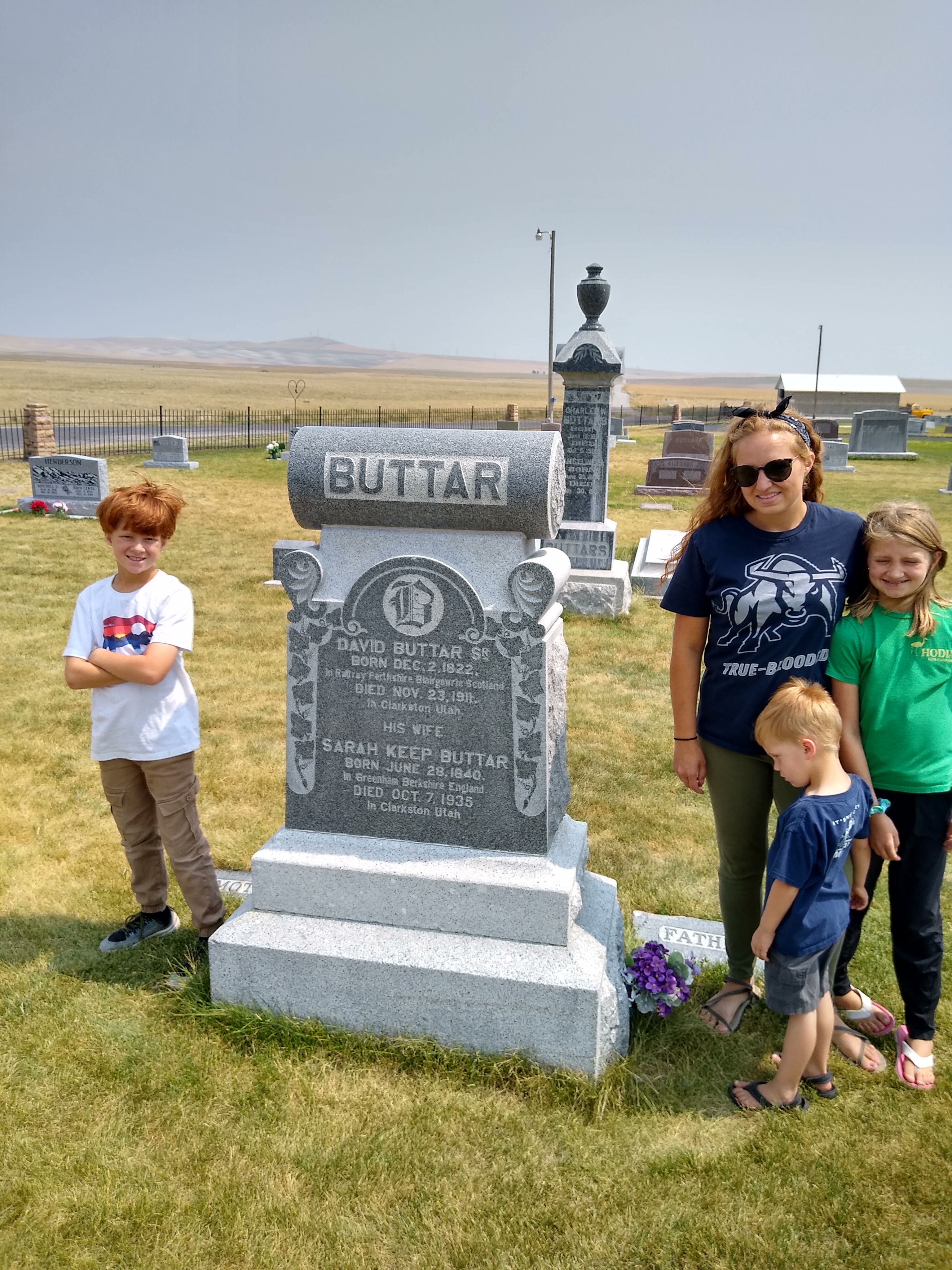
Hiram, Amanda, James, and Aliza Ross at the grave of David and Sarah Buttar in Clarkston, Utah – August 2021

I moved this this history moved up in my list because I know two other descendants of David and Sarah Buttar who live near us. My wife and children are descendants of David and Sarah Buttar’s daughter, Emma Jane, who married David Crompton Thompson.
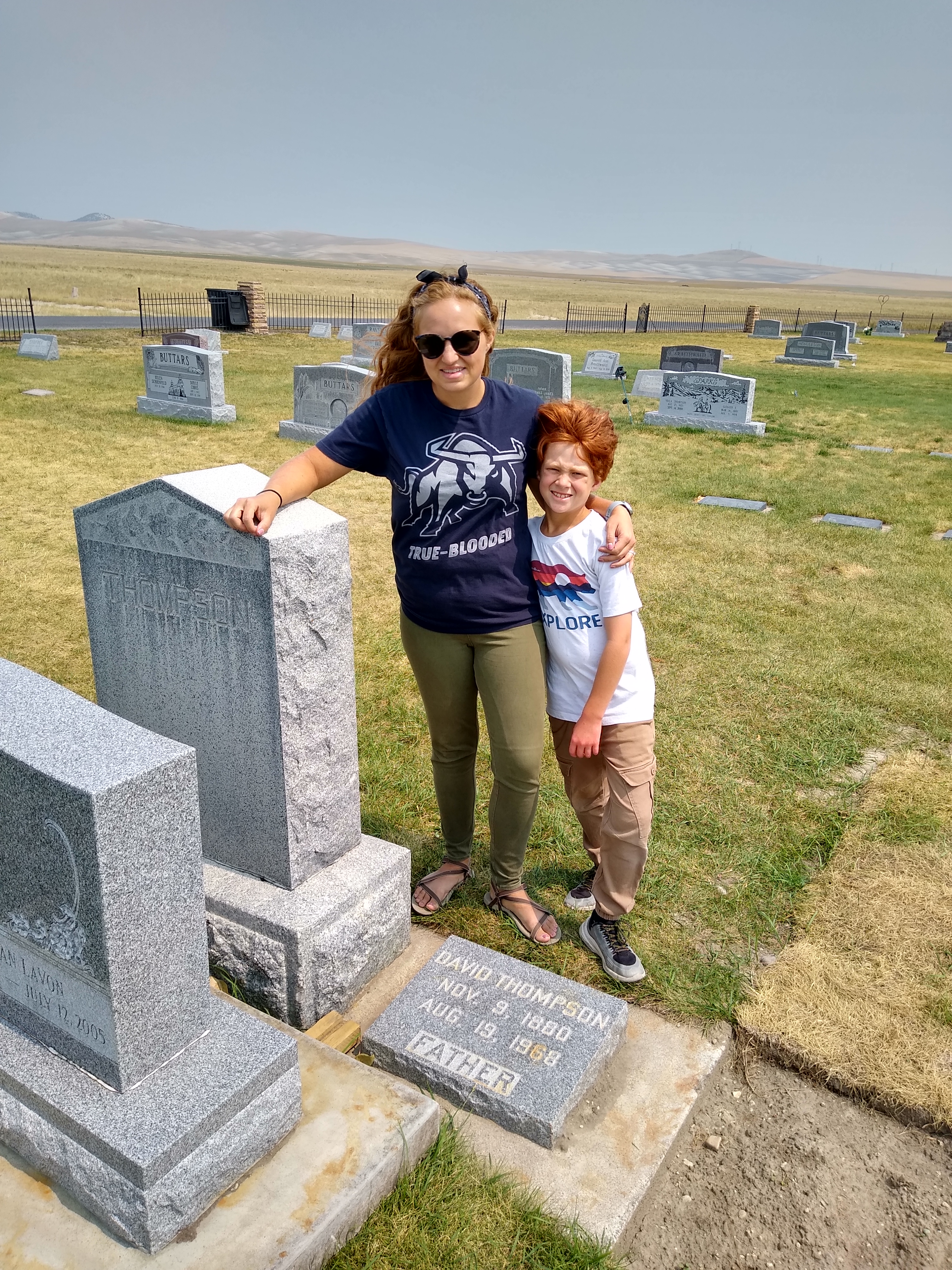
Amanda and Hiram Ross at the graves of David and Emma Thompson in Clarkston, Utah – August 2021

There are a couple of histories out there for David and Sarah Buttar. They seem to descend from a common history. There are a couple of differences and disputes, which I will point out.

David Buttar was born 2 December 1822 in Perthshire, Scotland to Donald Buttar and Elspeth Rattray. Some family records give Elspeth another first name of Betheah, but no contemporary record provides such a name. Although through the years, she was referred to as Betty. Some of the Buttar family records show the name. Her parents did not provide it on official records and she did not use it in her life for official purposes.

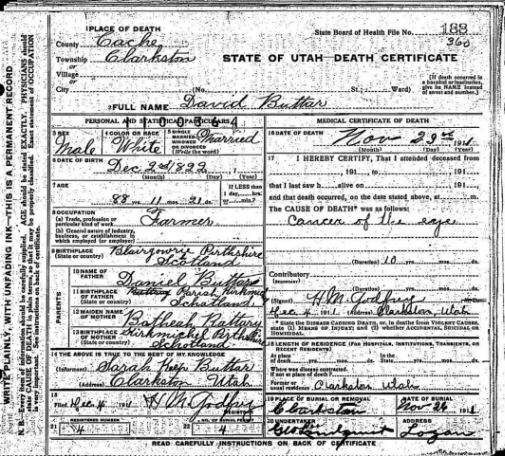
No contemporary record gives David’s birth location. He was christened 12 December 1822 in Rattray, Perthshire, Scotland. Family records show him as born in Blairgowrie, Perthshire, Scotland. His death certificate, the information coming from his surviving spouse, Sarah Keep Buttar, gives this location too.

Donald, David’s father, was a tailor by trade. Both Donald and David apprenticed to become shoe makers. David followed the shoe maker trade in both Scotland and in the United States. David was brought up in a religious home. He was also musical playing the bellows on the local Presbyterian Church’s pipe organ and the flute for the choir. His father, Donald, died at the age of 83 when David was 12 years old.

On December 14, 1848, at the age of 26, David married Margaret Spalding in Blairgowrie, Perthshire, Scotland. On 19 January 1851, David was baptized a member of the Church of Jesus Christ of Latter-day Saints. Margaret was baptized a few months later on 27 June 1851. David was ordained a priest in 1854. In February of that same year, David left Scotland for America with his wife and their four small children: Marjory, Meek, Bethea, and David. While at sea the youngest child David, who was an infant of seven months old, died and was buried at sea. The journey by sea to America from Scotland took seven weeks and two days.

David and his family traveled across the plains by ox cart with the Taylor Company. Sarah’s history is shared below that includes stories of crossing the plaints. While on the plains, cholera erupted amongst the company and David became very ill and nearly died. It took him some time to get over the effects of cholera. David and his family had to walk most of the way to Utah. One day while gathering firewood, David did not notice that among the wood he had also picked up a rattle snake and carried it back to camp. It was only when he put the wood down on the ground that he realized he had carried the snake without being bit. At another time David experienced another sobering moment after sleeping the night in a bed he had made under the wagon. The next morning after dressing himself and rolling up his bedroll, he discovered that a rattle snake had curled up inside his bedding during the night and he had slept in!

The family arrived in Salt Lake City in the fall of 1854. They lived in Salt Lake City for five months where David worked as a shoemaker for a Brother Samuel Mellener. David then moved his family to Lehi, Utah. After moving to Lehi, David continued working for Brother Mellener. David did not have a method of transportation and had to walk from Lehi to Salt Lake to pick up leather for his shoes and return the finished shoes to Brother Mellener. There were times when he was able to secure a ride to Salt Lake. After a few years, David was able to raise some calves that, once grown, were able to supply a team of oxen for transportation. In Lehi the family lived in a mud house with a dirt floor. David also began to farm in Lehi. In the year 1856, all the crops in Lehi were eaten by grasshoppers and the family had no flower. Because of the flour shortage, bran bread was made.

In August 1863, Margaret died while in childbirth leaving David with six small children. The oldest girl was only fourteen years old and the baby, Margaret, was five days old. Baby Margaret died two weeks after her mother and was buried in the Lehi cemetery. David experienced sad, hard times and, having no family nearby to assist him with the children. Four years later on 16 December 1866 he married Sarah Keep Francis. Sarah had previously been married in England, but had left her husband behind before coming to the United States. Sarah had a daughter of her own, Lucy Ann Francis, who David always regarded as his own daughter. On April 16, 1868, a daughter, Sarah Isabell, was born. Sadly, Sarah Isabell died on June 16th. Sarah Isabell was buried in the Lehi cemetery.

In October of 1868, the family moved to Clarkston in Cache Valley of Utah. David was ordained an Elder that same fall. Upon arriving in Clarkston, David built a two room log house in the Clarkston Fort. In 1870, David moved from the fort and built another two-room log home on the north side of Clarkston near his farm. He raised cows, horses, sheep, pigs, and chickens on their farm.
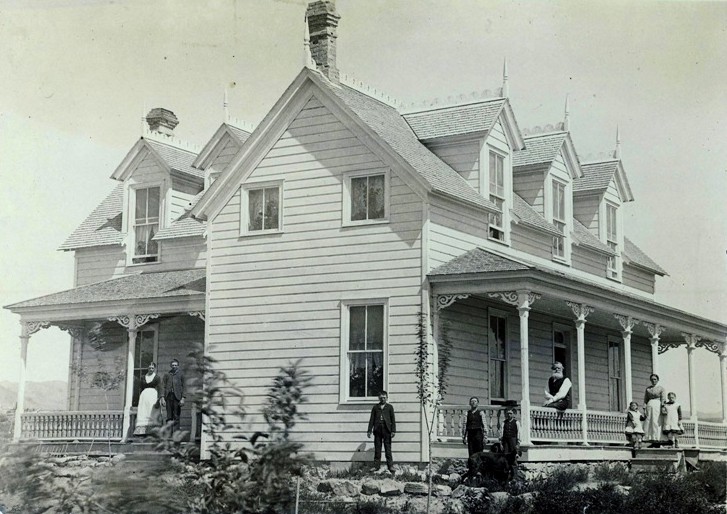
Buttar home north of Clarkston, Thomas James in front of the house, David Alexander next to the right, then James Joseph, then David, then Emma Jane, Sarah, and Mary

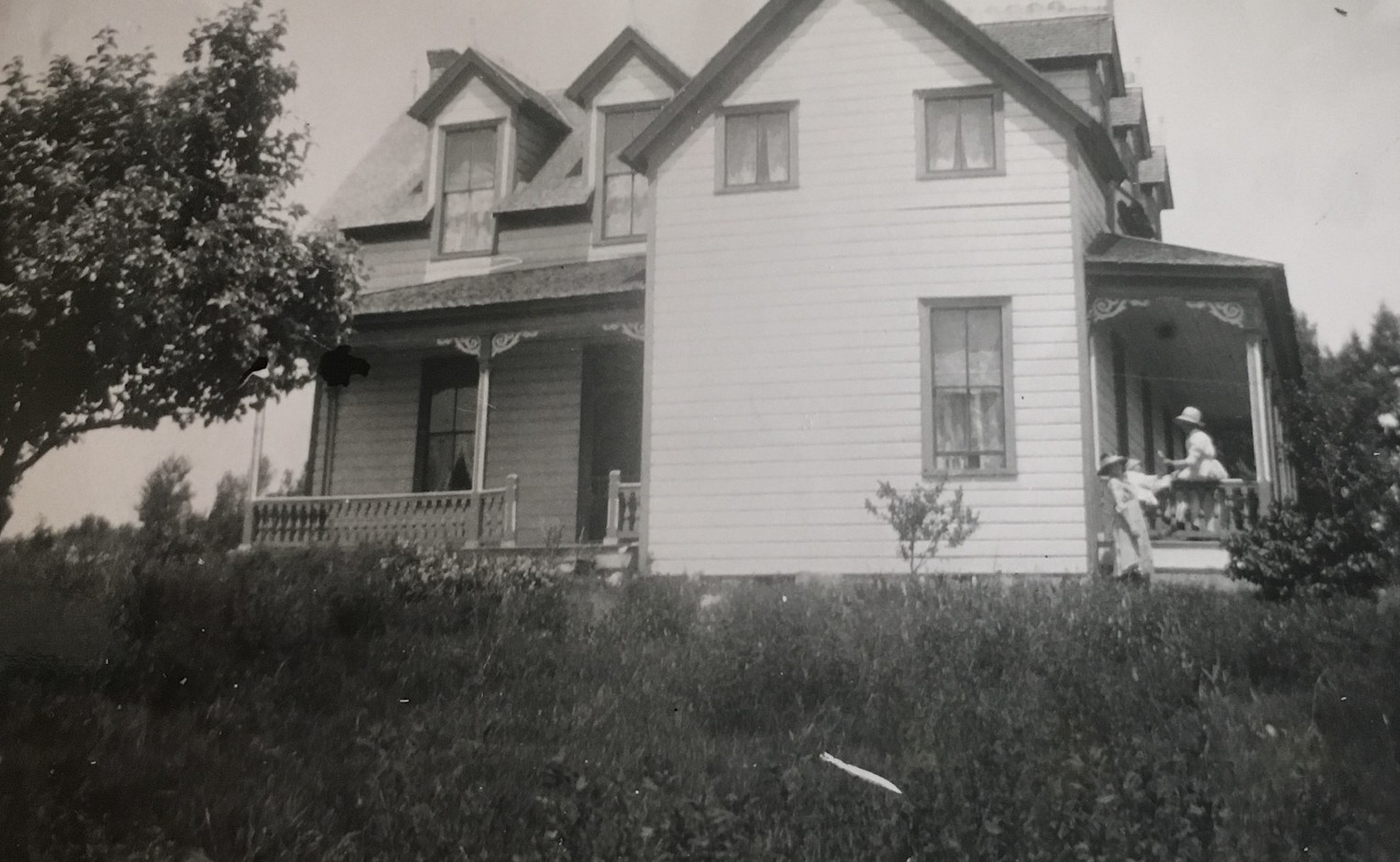
In 1870, David and Sarah built a large, white framed house for the family. The two-story home had a porch on the front, three dormer windows on the second floor facing east, and two dormer windows facing south with a veranda below. It was a large home for the standards at that time. It was a beautiful home that overlooked the farm and had a commanding view of the valley. The first prayer circle in Clarkston was held in a upstairs room of that home. Unfortunately, this beautiful home burned on 31 May 1931.

David became a high priest. He believed in paying a honest tithing, knowing that the Lord keeps his promises by opening the windows of heaven to pour out blessing on all that keep his laws and commandments. This was proved to David in the spring of 1871 when the grasshoppers were so thick that when in flight they darkened the sun. Three times that summer the grasshoppers ate all of David’s grain. When they came the fourth time, with the help of his children, the grasshoppers were driven into ditches where the chickens would devour them. The grasshoppers were so large that the chickens could only eat three or four at a time. David told his family that because he had paid his tithing that the Lord would provide for them. It was then that the seagulls came and began eating the grasshoppers until they could eat no more. When the seagulls had eaten their fill, they would go to the ditch and throw up the grasshoppers and then continue to eat more. Once the grasshoppers were completely devoured, the seagulls flew away. This time the grain grew to maturity and David produced 1,300 bushels of grain – the largest crop he had ever harvested up to that time.
When David first began to farm in Clarkston, he cut his grain with a “cradle”, after a few years he purchased a “dropper” to cut the grain. He hired six men to flay and bind the grain. David would cure his wheat for planting with slack-lime, and he would sow his seeds by hand casting them.

David continued to make shoes for the first few years in Clarkston, but the last shoes he made were for his step-daughter, Lucy Anne, and he purposely made one that was wrong-side-out and stated that “he wouldn’t make any more shoes”, and he never did.

David would mend his harnesses with wooden, maple pegs that were actually intended as tacks to hang shoes on. He planted five to ten acres of potatoes each year. Although for the first few years hay had to be bound by hand, David purchased the first self-binder in Clarkston that bound the hay with wire. Later, he assisted Andrew Heggie and Peter S Barson in buying the first header in Clarkston.

One year the sunflowers had grown so profusely in the wheat that when the threshers came, they refused to thresh it. He made a flail and flailed all the wheat by hand on a wagon cover. After the grain was harvested, David had to haul it some 60 miles (each way) to Corinne or Ogden by team and wagon just to sell it.

During the construction of the Logan Temple, David donated $100 each year until the temple was completed. He did temple work for many of his ancestors in the Logan Temple. He also gave financial assistance to build the old rock meeting house in Clarkston as well as the new chapel that is still standing in Clarkston today (although it has undergone several additions and renovations since then).
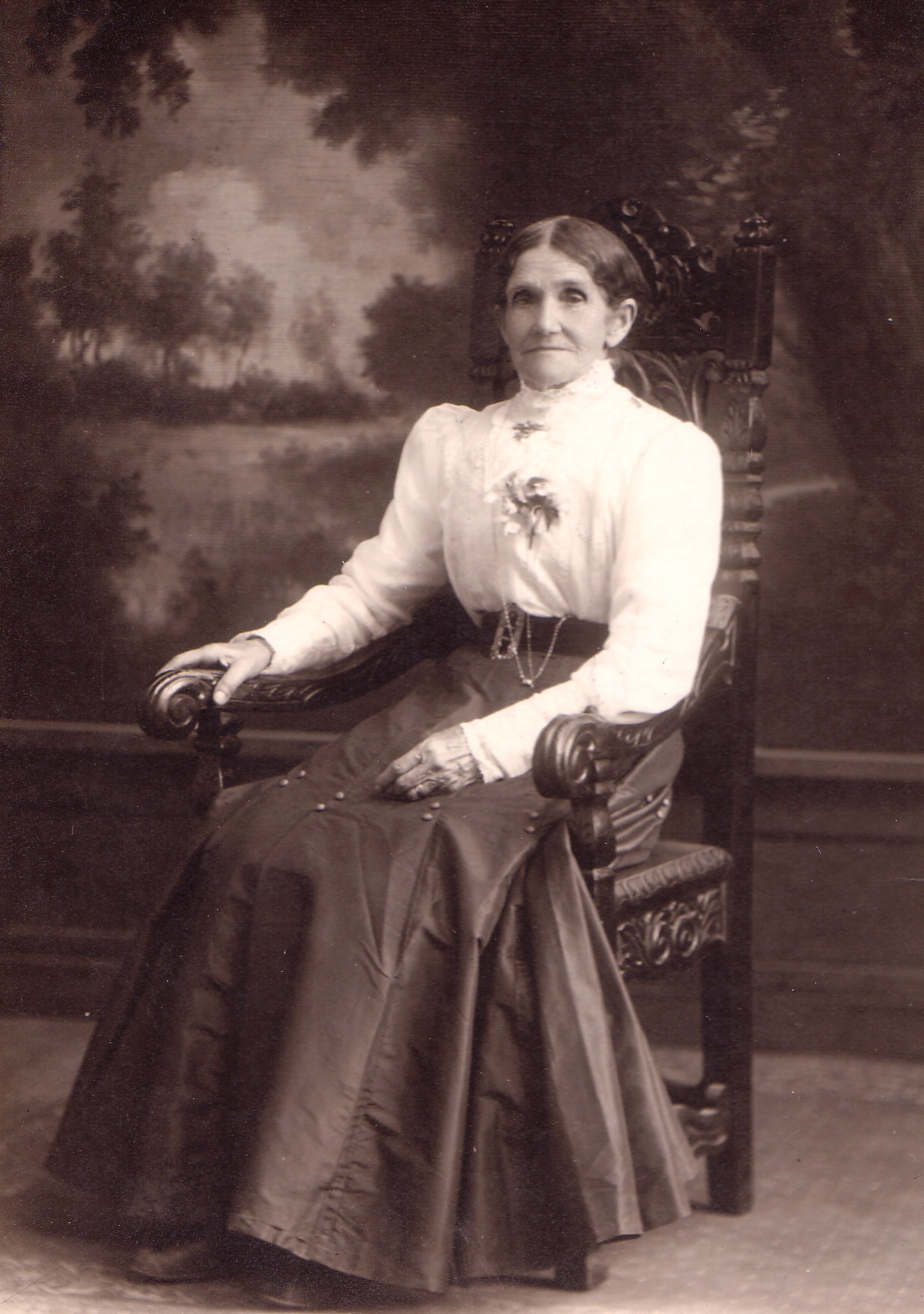
Sarah Keep Buttar

In 1884, David married Sophia Jensen Hansen in plural marriage. He lived in polygamy for 20 years. In 1889, polygamists were advised by the authorities of the Church to give themselves up instead of being hunted down by the law. On the first of June 1889, David gave himself up. Because of his age (67), he was not required to serve the usual six months jail sentence. He paid, instead, a $100 fine and returned home a happy man.
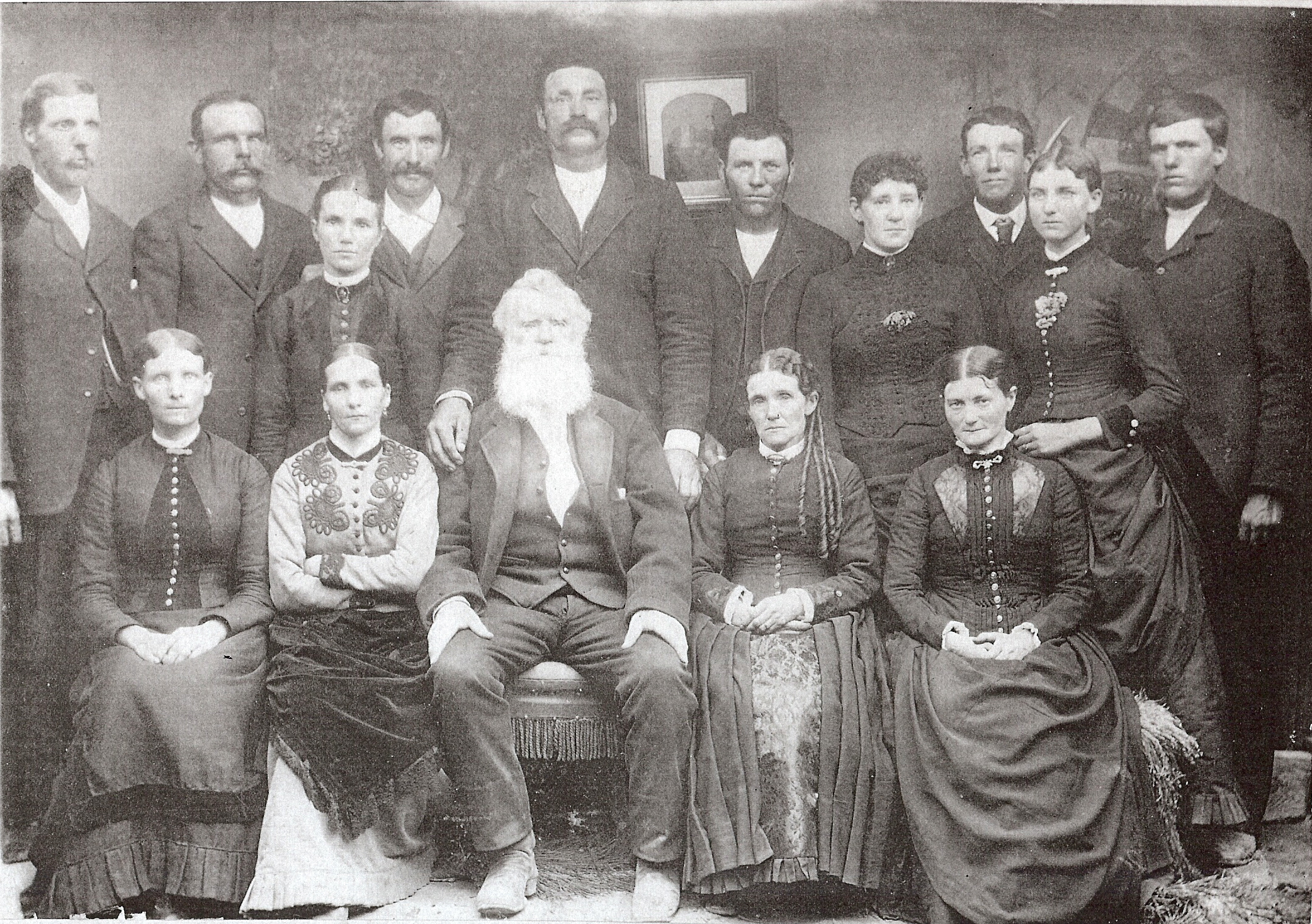
Back (l-r): William Sparks, Hans Jensen, Lucy Ann Francis, Robert Buttar, John Buttar, Daniel Buttar, Elizabeth Buttar, Charles Buttar, Margaret Cutler, Will Sparks; Sitting: Emma Gover, Sarah Buttar, David Buttar, Sarah Keep Buttar, Karen Buttar

On 10 May 1899, David, his wife Sarah, their son Charles and a niece Mary Jenkins, had all attended the Logan Temple. While driving across the Bear River Bridge on their return trip home to Clarkston, the bridge broke and the entire group fell into the river. Fortunately, two gentlemen by the name of William Bingham and William Thain were nearby and were able to pull everyone from the river. Apparently though, Sarah was rendered unconscious because of some timbers that had fallen on her and was taken home to Clarkston unconscious. William Bingham, who had so bravely rescued her and the others, thought that surely she had died and came to Clarkston a few days later to attend her funeral. It would be an understatement to say that he was quite surprised to find no funeral transpiring, as Sarah was alive and well. Sarah did report afterward of having an out-of-body experience during the near-drowning incident and spoke of the beautiful things she witnessed on the other side of the veil.

In 1909, David contributed $200 to President Budge of the Logan Temple. President Budge gratefully said that the donation was an answer to prayers, as money was needed to purchase a new rug (carpet) to replace carpet that had been burned in a recent temple fire. President Budge gave David a priesthood blessing which pleased David greatly. David also stated that he thought that would be his last donation to the temple – and it was. On November 23, 1911, David passed away from eye cancer at the age of 89. He was laid to rest in the Clarkston Cemetery. A beautiful, majestic monument has been erected to his memory at his burial site.
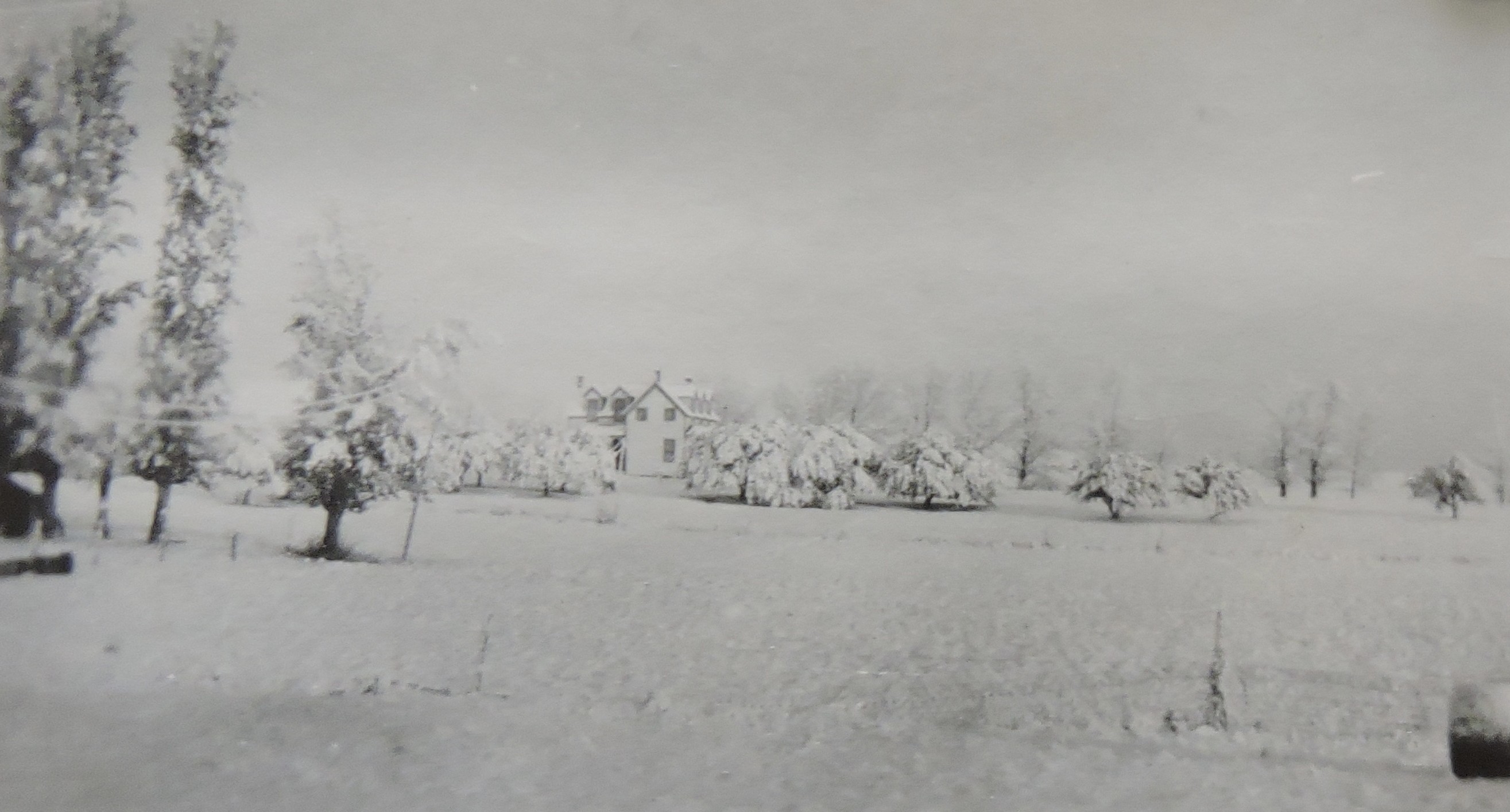
Buttar home on 6 October 1920

Was David a Buttar or Buttars? His christening record prepared by the church has Butter, likely from the mouth of his father. It does not show as plural. When David was married to his first wife, Margaret Spalding, the church recorded his name as David Buttar. Another record, likely created from his own dictation to the individual creating the record. The 1860 Census, probably from someone else’s mouth, has Buttar. But yet, 1870, probably from someone else’s mouth, has Buttars. It goes back and forth. 1910 Census – Buttars. Death certificate for Charles William Buttar – father is David Buttar – Sarah Keep Buttar completed this death certificate information (but Charles’ grave marker has Buttars). The death certificate for his wife, Sarah Keep Buttar – has his name as David Buttars. Alternatively, when he died, Sarah Keep Buttar provided the death certificate information and provided his name as David Buttar. But, when she applied for the Daughters of the Pioneers, she wrote Buttars. Ultimately, some of his siblings and own children used both variations. There are likely other records, but it appears at this time the records created by him in his own life show Buttar. Lastly, when he died, the family listed Buttar on the tombstone (as seen above). But since his christenening record (provided by his parents), marriage certificate (provided by him), and his death certificate (provided by his wife) all list Buttar, along with his tombstone, I will go with Buttar for this history.
David has an entry in Pioneers and Prominent Men in Utah.

“Buttar, David (son of Daniel Buttar and Batheah Rattray, born 1788, both of Blairgowrie, Perthshire, Scotland. Born Dec. 2, 1822 at Blairgowrie. Came to Utah November, 1854, Capt. Taylor Company.

“Married Margaret Spalding Dec. 14, 1848, in Scotland (daughter of John Spalding and Marjory Meek Johnson), who was born April 1, 1822, and came to Utah with husband. Their children; Marjory Meek Johnson b. Sep. 16, 1849, m. Henry Mullet December, 1866; m. Joseph J. Harrison 1869; Batheah b. July 15, 1851, m. William Sparks Dec. 15, 1868; David b. November, 1863, d. February, 1854; John Spalding b. May 22, 1856, m. Sarah L. Tanner Jan. 1, 1880; Daniel b. Sept. 22, 1858, m. Emma Cover January, 1883; Robert Sutter b. April 6, 1861, m. Mary Godfrey 1891; Margaret b. Aug. 6, 1863, d. infant. Family home Lehi, Utah.

“Married Sarah Keep Dec. 16, 1866, at Lehi (daughter of James Joseph Keep (high priest) and Ann Miller; married July 22, 1836; pioneers Oct. 22, 1866, Abner Lowry company. She was the widow of Thomas Francis, married May 15, 1865, and mother of Lucy Ann Francis, born March 26, 1866, who married Hans Jensen July, 1884). She was born June 28, 1840, Greenham, Berkshire, Eng. Their children: Sarah Isabell Buttar, b. April 16, 1868, d. June 15, 1868; Elizabeth Keep b. June 9, 1869, m. John Loosle Dec. 3, 1891; Charles William b. June 15, 1871, m. Angeline Stuart May 18, 1892; Thomas James b. Oct. 13, 1873, m. Annie Loosle; David Alexander b. Dec. 14, 1876, m. Rose Loosle; James Joseph Keep b. Feb. 26, 1878, m. Agnes Jordan; Mary Janet b. June 30, 1880, m. Louis Thompson; Emma Jane b. Oct. 8, 1882, m. David Thompson. Family home Clarkston, Utah.

“Settled at Clarkston 1868. High priest. Shoemaker; farmer. Died Nov. 23. 1911.
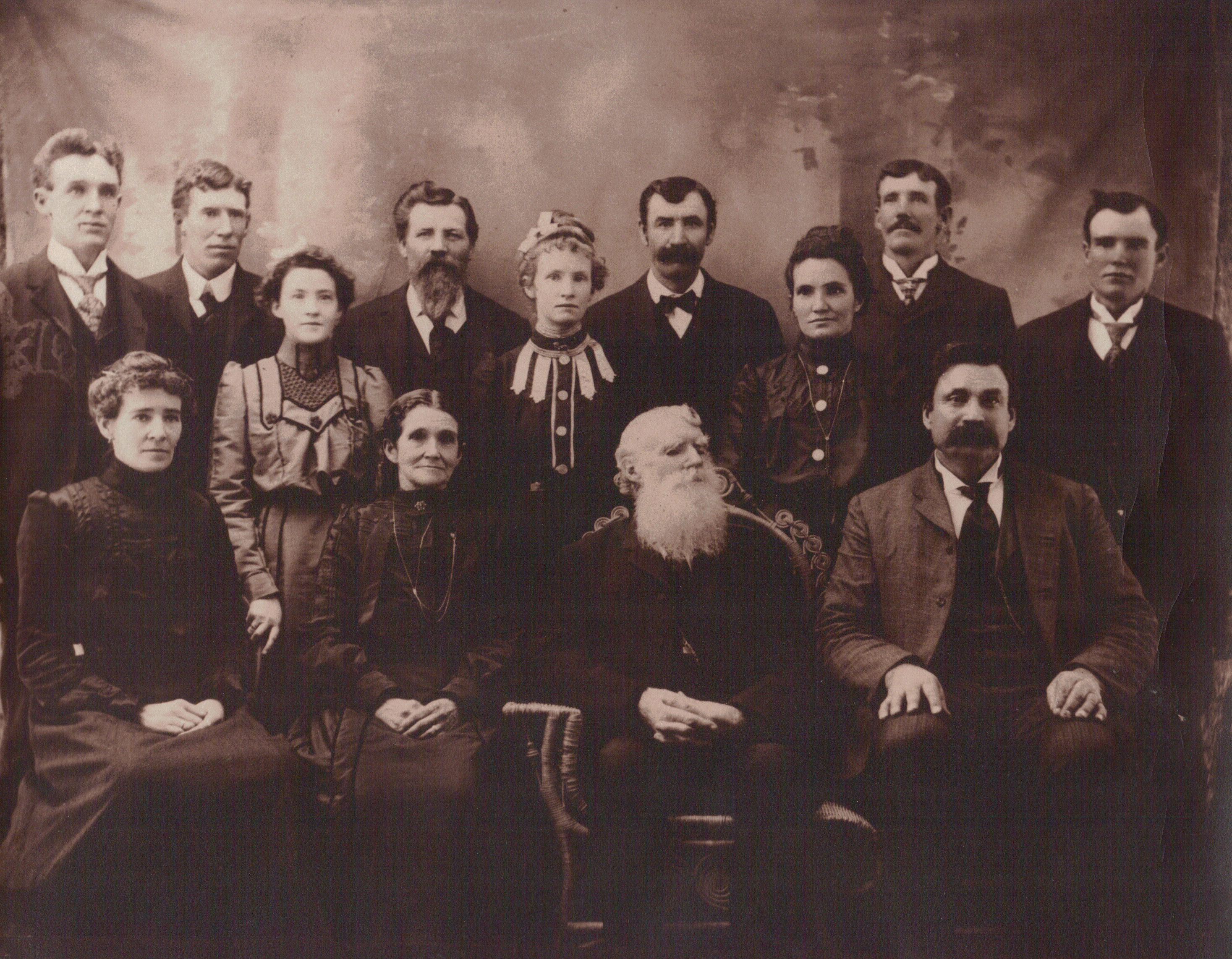
Back (l-r): James Joseph, David Alexander, Emma Jane, Daniel, Mary Janet, Robert Sutter, Lucy Ann, Charles William, Thomas James; Front: Elizabeth, Sarah, David, and John Spalding

The Pioneers and Prominent Men of Utah biography gives a good overview of David’s family.

This editorial obituary also provided some insights into David.
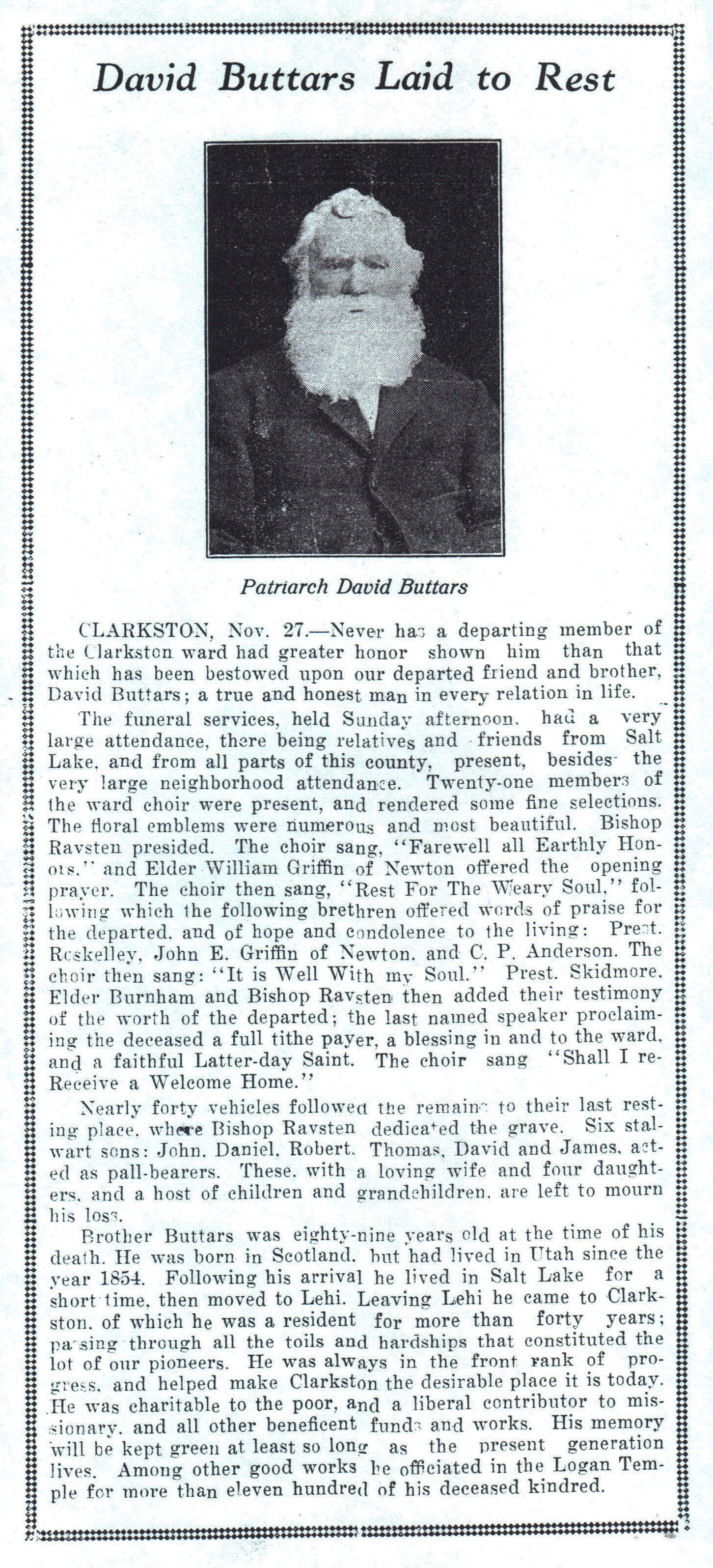
“CLARKSTON, Nov. 27 – Never has a departing member of the Clarkston ward had greater honor shown him than that which has been bestowed upon our departed friend and brother, David Buttars; a true and honest man in every relation in life.

“The funeral services, held Sunday afternoon, had a very large attendance, there being relatives and friends from Salt Lake, and from all parts of this county, present, besides the very large neighborhood attendance. Twenty-one members of the ward choir were present, and rendered some fine selections. The floran emblems were numerous and most beautifulf. Bishop Ravsten presided. The choir sang, “Farewell all Early Honors” and Elder William Griffin of Newton offered the opening prayer. The choir then sang, “Rest For the Weary Soul,” following which the following brethren offered words of praise for the departed, and of hope and condolence to the living: Prest. Roskelley, John E. Griffin of Newton, and C. P. Anderson. The choir then sang: “It is Well With my Soul.” Prest. Skidmore, Elder Burnham and Bishop Ravsten then added their testimony of the worth of the departed; the last named speaker proclaiming the deceased a full tithe payer, a blessing in and to the ward, and a faithful Latter-day Saint. The choir sang “Shall I Receive a Welcome Home.”

“Nearly forty vehicles followed the remains to their last resting place, where Bishop Ravsten dedicated the grave. Six stalwart sons: John, Daniel, Robert, Thomas, David and James, acted as pall-bearers. These, with a loving wife and four daughters, and a host of children and grandchildren are left to mourn his loss.

“Brother Buttars was eight-nine years old at the time of his death. He was born in Scotland, but had lived in Utah since the year 1854. Following his arrival he lived in Salt Lake for a short time, then moved to Lehi. Leaving Lehi he came to Clarkston of which he was a resident for more than forty years; passing through all the toils and harships that constituted the lot of our pioneers. He was always in the front rank of progress and helped make Clarkston the desirable place it is today. He was charitable to the poor, and a liberal contributor to missionary, and all other beneficent funds and works. His memory will be kept green as least so long as the present generation lives. Among other good works he officiated in the Logan Temple for more than eleven hundred of his deceased kindred.
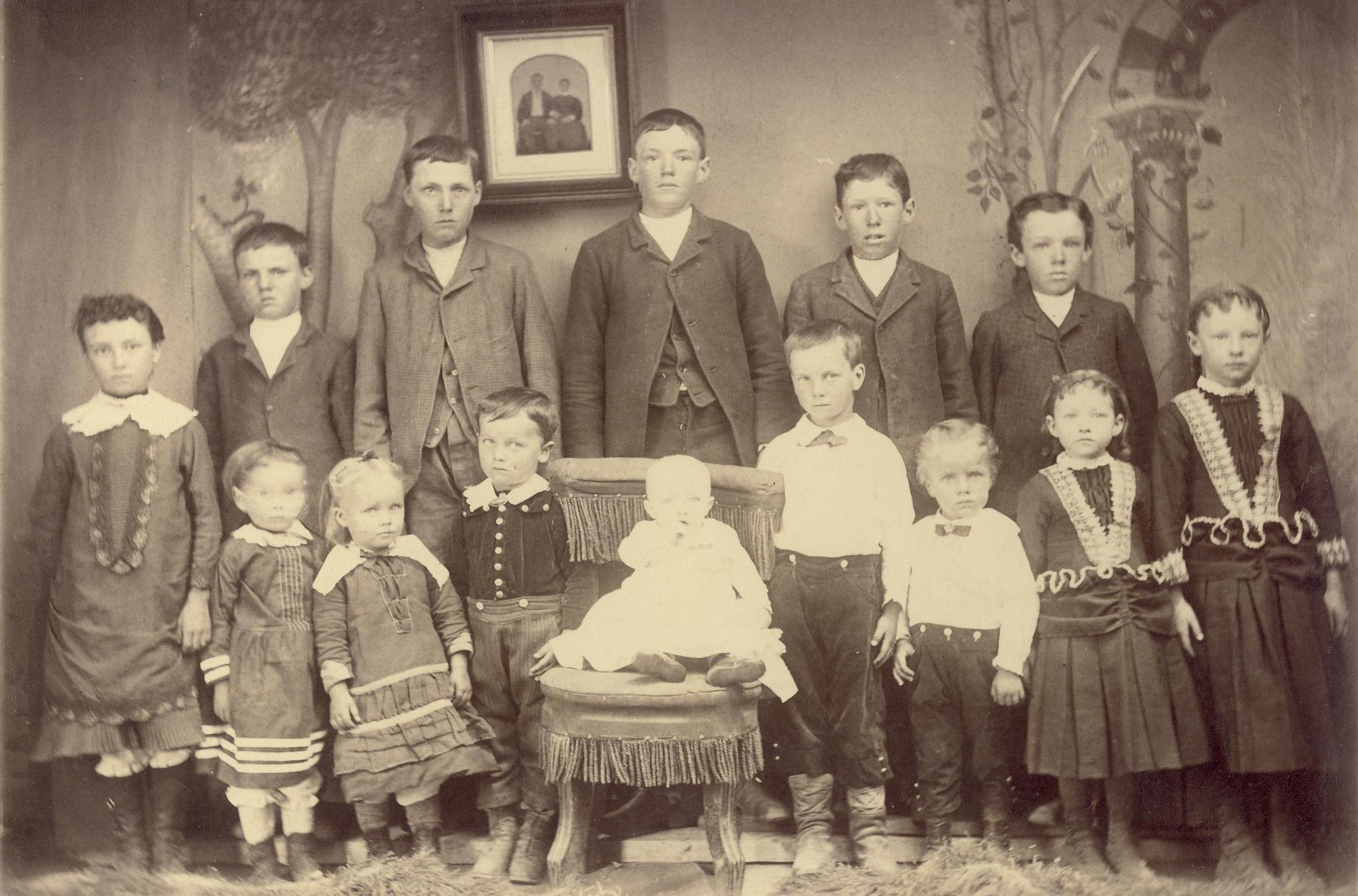
Back (l-r): Margaret Priscilla Buttars, George Alfred Sparks, David Sparks, (photo of James & Ann Keep), Thomas James Buttars, David Alexander Buttars, James Joseph Buttars, Mary Janet Buttars; Front: Rachel Betheah Buttars, Margaret Sarah Buttars, Daniel David Buttars, Melvin Henry Buttars, David William Buttars, Thomas Hans Jensen, and Emma Jane Buttars

David and Sarah Keep were married 16 December 1866 in Lehi, Utah, Utah. David and Sarah received their endowments in the Salt Lake City Endowment House on 14 December 1868. David and Margaret, and David and Sarah were also sealed the same day in the Endowment House. I am not clear if Margaret was initially endowed on 14 December 1868 and the record was lost, but the work is officially shown as completed for Margaret on 5 June 1884 in the Logan Temple. David married Karen Sophia Jensen 11 June 1884 in Logan, Cache, Utah at the Temple.
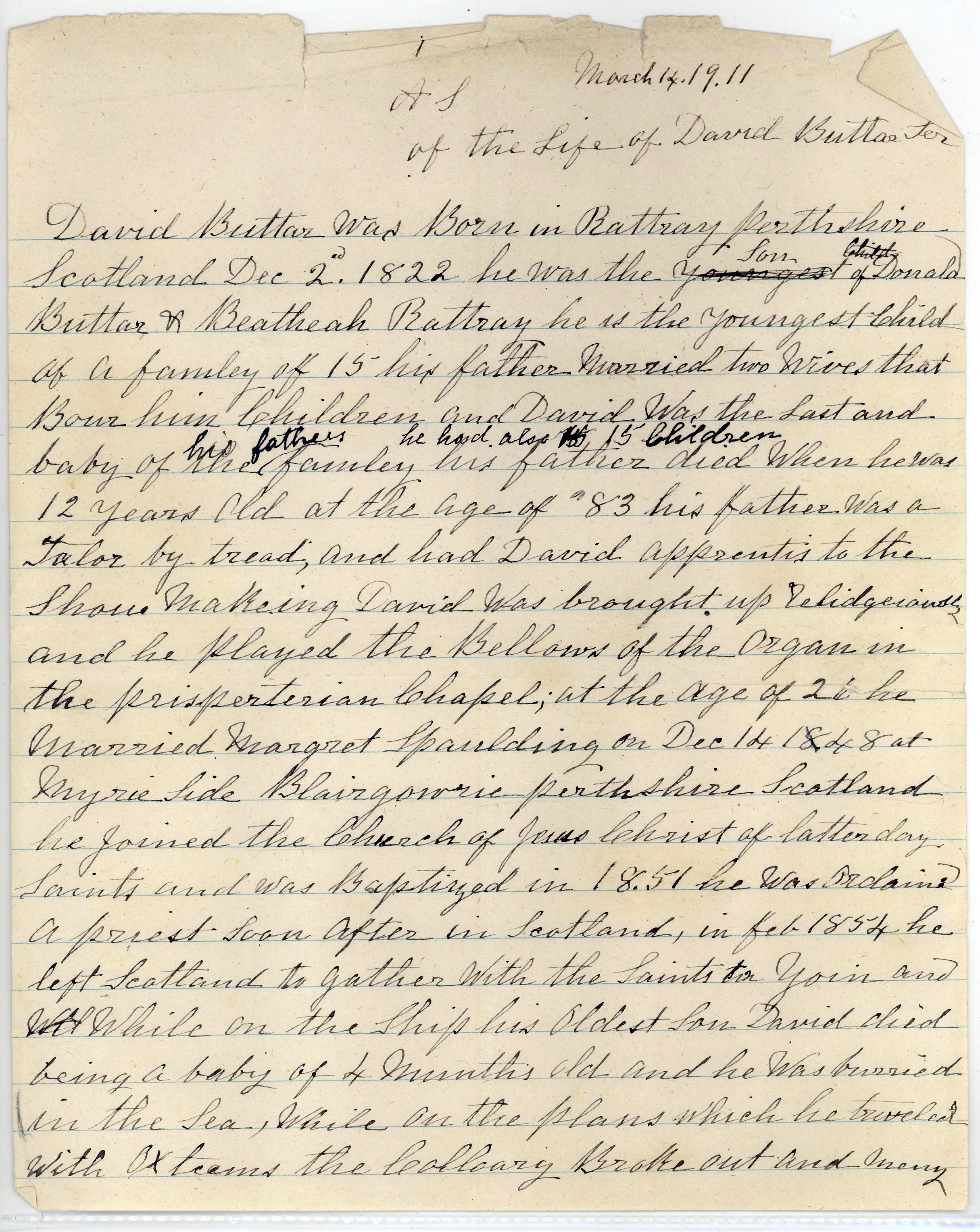
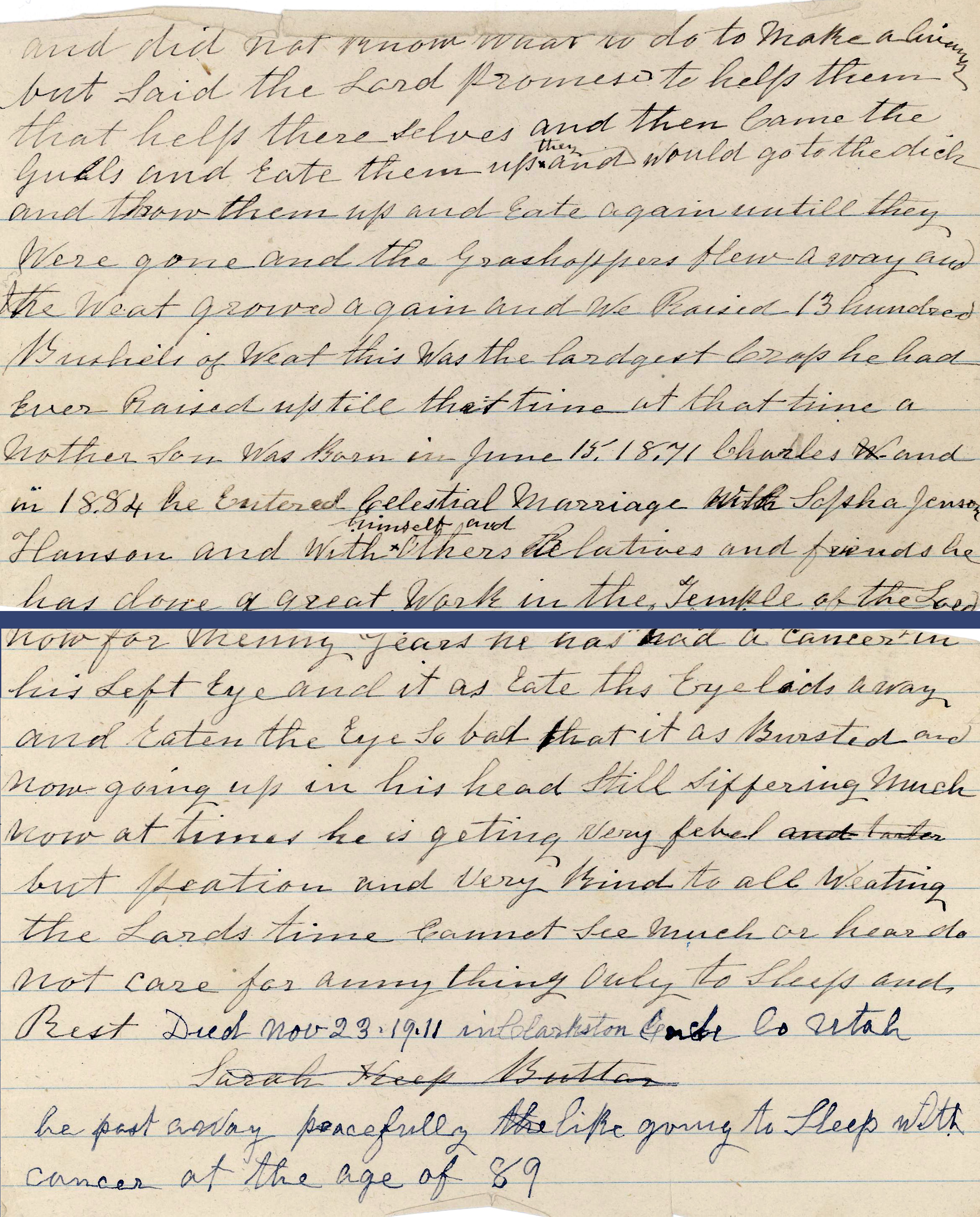
Handwritten biography of David Buttar by Sarah Buttar after his passing

This biography added some other interesting insights, particularly of his death. Sounds like a painful process, even if the final passing was like going to sleep.
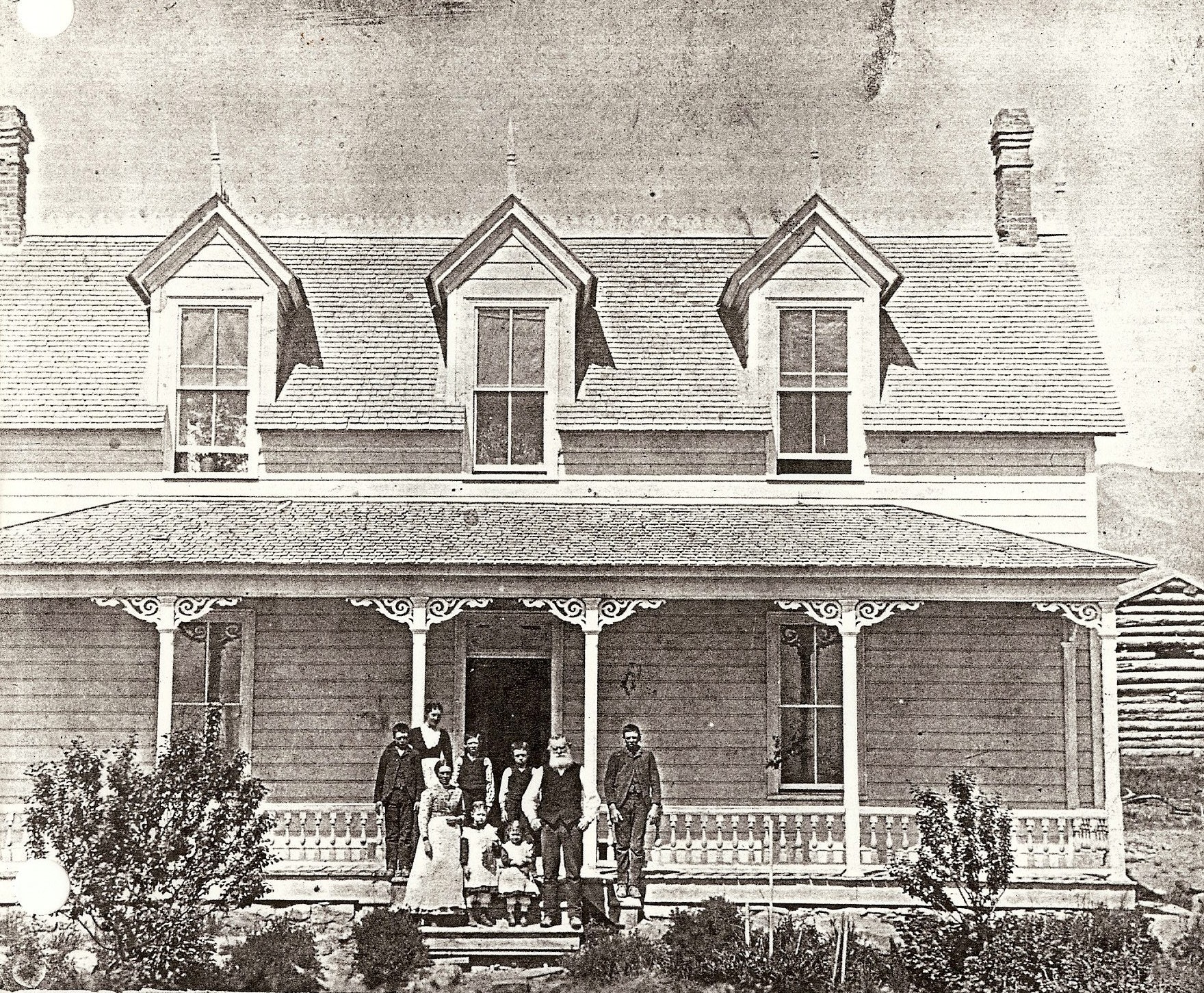
Buttar home, Thomas, Elizabeth, Sarah, David Alexander, Mary, James Joseph, Emma Jane, David, and unknown

“A sketch of Sarah Keep Buttars life up to the age of 82 which I Sarah write myself, I was born the 28th of June 1840 at Stroudgreen, Greenham, Berkshire, England. Daughter of James Joseph Keep and Ann Miller Keep.

“I was christened in the Church of England, and learned all the Collicks, Hymns, Prayers and Chants, I can yet repeat some of them. I was naturally religious and when eight years of age the Elders of the Church of Jesus Christ of Latter Day Saints came and stood outside my Fathers gate and preached. My Mother was brought up a staunch Baptist and my Father belonged to the Church of England. Mother didn’t understand the teachings of the Elders as soon as my Father did. One Sunday Morning the Elders came to preach in front of our house and Father took a bench out for all to sit on. Father believed in their teachings and one Sunday morning, 23 July 1848, he crept out of bed and was baptized without any of us knowing it. When he came back mother knew he had been baptized, and came upstairs and told us children to call out “You have been by the Latter Day Saints haven’t you?” Father told Mother if she would go to the Latter Day Saints Church with him he would go to the Baptist Chapel with her sometimes.

“One day they were too late for the Baptist meeting and Father ask Mother to go the Latter Day Saint meeting, and she went with him and soon after she joined the church. After joining the Church they lost everything, their home, and five other houses they owned. Then they had to pay rent, after this the Elders came to our house and held their meetings. Then I was baptize the date being February 1849 the ice was broken for me. I had to walk home on and one half miles under Mother’s cloak in my wet clothes, because the mob was calling my Father, “Curley Keep”, the Latter Day Devil to let a little girl like me be dipped.

“In 1850 we all had the smallpox, my eldest brother James Joseph Keep died from smallpox 25 February 1850, my Mother was also very sick with the smallpox.

“We were very poor and when my baby sister Harriet was born the 8th of March 1850, my Mother had a cancer in her breast and Father wanted to get a Doctor, but Mother wanted the Elders, so my sister and I went for the Elders, they administered to her and anointed her breast and the cancer went away, and she was never bothered with it again, this strengthened my faith in the gospel and I became more religious and what I learned I did not forget. I was taught to learn and repeat verses of the Bible when in Sunday School and at home. As I grew older I traveled much with my Father and his companion. When they went out preaching in the open air I was always anxious to go, and they said I could go if I could sing for them which I did. People gathered to listen to their teachings and many joined the church. My Father and his companion and I suffered many persecutions but the Lord preserved us from our enemies.

“At the age of thirteen I went to London with my father and his companion I sang in the streets of London, we were often told by the police to move on.

“At the age of eighteen I was self willed, and thought about marriage, my Father told us older girls not to get married until we came to the New Valley. Although I had great desire to get to the valley, thinking it would be “Heaven on Earth” yet I thought I would please myself. At this time I had a dream and was shown the route to the valley. The American Elders said when I related it to them that it was truly the route to the valley, in the dream I saw high mountains and the plains, and as I passed on walking I came to a beautiful green meadow, and I heard Heavenly Music and Singing. I saw on the top of the high mountain a very elderly looking man and he was dressed in a long robe, his beard and hair was long and white, he was winding some silver piping on top of the mountain, the sun shown on him so bright that it dazzled my eyes and just at that time a woman passed by me, then I saw a gate leading into the meadow, and there was a gatekeeper, the woman went up to the gate he told her she would have to have her blessing before she could go through, he beckoned to the man on the top of the mountain and he came down and gave her a wonderful blessing he beckoned to the man again and he came and laid his hands on my head and told me to honor my father and my Mother that my days may be long up on the land which the Lord they giveth thee, he said go thy ways and obey they parents in all things. I didn’t think I had as good of a blessing as the woman that passed through before me and when the gate keeper said you can now go into the meadow I said, “I do not want to, for he did not give me as good of a blessing as that woman had, and I did not want to go in.”

“He said, “You had what you deserved,” then I went back and I saw a house where there was dancing and I could hear music, I thought I heard my sister’s voice, and I went up to the door, there were two door keepers, and they gave me a push and said, “You can’t come in here,” I fell down the steps, when I got up I turned to the meadow again and I sat down and cried bitterly, when I awoke my pillow was very wet, I saw that I was going to do something wrong and afterward I knew what it was.

“At the age of twenty five I married against my Father’s and Mother’s wishes and they didn’t know it for six weeks, then to my sorrow I found that my husband had just joined to church to get me, for my Father said I should not marry anyone out of the church, this was his council and I disobeyed him. When I was married my husband told me that it was once my day but now it was his day, he let me know it at a later time.

“In 1866 my Father and Mother were going to the Valley, and I could not go, my husband said if I went to see my Father off he would push me overboard, but the Lord helped me. My Mother and Father told me if I would go with them and leave my husband they would pay me for it, I could see I would never get there the way my husband was acting so I gave my word to go. I left him although it was very hard to part. I kept my word and obeyed my parents, and like in my dream I shed many tears, I did not tell my husband that I was going and he seemed kinder that day then ever before, which made it more hard for me to endure, but I prepared everything as though I was going back home that night, he ask if he should come for me and carry the baby, I said no it might be late when my Aunt leaves, and I may stay at Mother’s all night.

“The next morning finding I did not go home he went to Mother’s and not finding me there he sent a man dressed in pilots clothes to the ship to find me, he questioned me as to where I was going with such a young baby and at that I hardly told him, when he said are going alone, my Mother said “NO” for I was going with my Father and my Brother-in-law, meaning my sister’s husband, he said “OH” and up the companion ladder, I told Mother I was afraid my Husband would come, I passed my baby over to the other side of the ship, I got into the berth of a young couple that had a feather bed in one corner and I crept down behind it. Three policeman came and looked in every berth and did not see me, they were after two apprentices, and four more sisters, and one brother that were leaving husband and wives, they never got any of us, but the two apprentices went back.

“We set sail 23 May 1866 on the American Congress. When at sea we were tossed about and nearly all become seasick. I was blessed by having only three days of seasickness, Father and Mother and my two younger sisters were very sick and my baby caught the whooping cough, having caught cold by being passed about when the policemen were after me. The Lord spared her life and she got well.

“The cook’s cabin took fire, and a little time after the sea was so rough our main mast broke, and the sail went into the sea, next day they fixed the mast, we had a calm and the ship did not move back or forward, but rocked about. We had a Concert on the top deck and enjoyed ourselves. We had heavy fog very often so bad the Captain could not see where we were going, Brother Rider, the President’s counsel was talking to the Captain on the quarter deck and saw the fog lift up he said “What is that?” It was the breakers he saw, but the Captain did not answered, he sprang to the wheel and called, “About ship all hands to the Riggins,” soon the danger was over and the Captain said that in a short time all would have had a watery grave if the fog had not lifted, we were saved by providence.

“When we were on the river the boat took fire, and they carried large fiery sticks past the foot of my bed and threw them in the water.

“We landed in New York the 4th of July 1866, we anchored and saw many beautiful fire works, a ship was set on fire on the sea and with flames coming out of its many windows it was a great sight. Next day we went on the pier and then came another task, we had to pass a man that read our names off when we came to my name, as I was called Sarah Keep, and child, he said “Stop!” Where is your husband, and how do you know he is not here? “Stand Back!” he shouted, I stood back and all the young men passed, my old friend, Will Penny, came and ask me what was the matter, I told him and he told me to come with him and they would not know who he was, I went with him and all was well. We stayed in New York three weeks. My sister Lucy’s baby was born there, then came another task, my Father did not have enough money to take me on to the valley, I sold my wedding ring to buy my baby a pair of shows, and a hat, and also to pay for an advertisement. I advertised to be a wet nurse, my Mother was to take my baby on to Zion, and I would follow. I went to the office and engaged at twenty dollars a month, when I was returned home I met my Father, he said he had been to the office of Brother Bullock and Thomas Taylor who was looking after the emigrant companies and they told him not to leave me there in a strange land if I had left my husband for the gospel, and as my Father didn’t have the money they said the church would take me and I could pay it back when I got to Zion and I had the money to do so. Father decided I could go on with him if I wanted to, but I thought I could save enough to pay my own way, I was very glad when it was time for the boat to leave. When we were on the train the wheels caught fire and we were pushed into another car as if we were sheet, for we were just emigrants.

“While crossing the plaints with oxen teams the Cholera broke out, and about seventy one died, many were buried in a quite or sheets, the wolves would howl around at night, and perhaps dig up the dead that were buried.

“One night about twenty five or thirty Indians came to camp, they were on the war path, it frightened us very much, for we were afraid we would surely be killed, they had scalps of women’s long hair hanging from their tomahawks, and their belts were filled with arrows and bows in their hands, they had a letter which they gave to the Captain to read, he called, is there anyone in camp who can read the Indian language, a young sister by the name of Emma who had left her husband and two little girls said ” I can read the Indian Language.” She had learned to read it when her husband was a soldier, and he had taught her to read it, she read the letter, and was pleased the Indians, the Captain pitched a tent inside the ring of wagons, and fed them they sang all night, and followed us all the next day calling “We Want White Women,” at last they left us.

“When traveling the Captain would take my baby on his horse, and tell me to talk on, and the teamsters would pick me up, and take me in their wagon and they would ride on the tongue of the wagon, they would tell me to sing to them and they would walk rather than see me walk as I had sore feet.”I used to wash my baby’s clothes in the streams when we camped, and the teamsters would tell me to dry my clothes by the fire, they let me bake my bread in the skillet after their baking was done. Sometimes I had only bread or small piece of bacon to nurse my baby on.

“I am thankful I am here, and I have learned what I came here for, I can say I do know that the Lord has been with me and give me more than I deserve, but he has promised “He that leaves Father and Mother, Husband or Wife for the gospel, shall receive a Hundred Fold.” I can now see there was work for me to do for the dead and the Lord has blessed and preserved my life many times to do this work. I am very thankful to him for it.

“I traveled first with Father and Mother, and two Sisters in Pratt’s Company, then Captain Inkley came to bring the sick in, and I came with his company I left my parents, and arrived in Salt Lake City at conference, the fifth or sixth of October 1866. In two weeks I hired out to a sister’s home to nurse her as she was sick. I got a cold in my eyes, and it was so terrible that I went to my sister Mary’s in Lehi until they were better. Brother David Buttars came there on business and told me he knew what would cure my eyes if I would do it. He told me Brother Brigham Young’s remedy. Was to dig down a little over a foot deep in the soil mold the soil and lay it on my eyes at night in a fine cloth, I did it and it healed my eyes in a week.

“Mr. Buttars came again and asked my sister and I to his daughter Marjory’s Wedding Supper. I went and when I was going home he wanted to go with me and carry the baby, he did so, and that night he ask me to become his wife, that was the pay he wanted for telling me what would cure my eyes, in less than three weeks we were married in my sister’s house by the Bishop’s counselor in Lehi, I was twenty six years old and had one child, and David was forty four and had five children. Sisteen months later I had my first baby girl, Sarah Isabelle two months later 15 Jun 1868 she died and was buried in the garden until David came home, then she had been dead eight days, David and I buried her ourselves in the graveyard at Lehi Utah.

“My husband had been to Clarkston to buy us a home, this was in June 1868, and in October 1868, we moved to Clarkston, Utah.

“That fall the grasshoppers were so bad that we but up cow skin and made a rope which three of us dragged up and down the garden in order to make the grasshopper fly away, and keep them from cutting the grain. There were so many grasshoppers that when they were flying they would darken the sun.

“When we were on our way to Clarkston, we were just crossing the mountain top, and the tongue of the wagon broke, the horses and the cattle went off and were lost for five days travel time, during this time the mail coach with President John Taylor passed us and nearly tipped over, because we could not get out of the way, we started again for Clarkston and arrived at the end of October 1868, and I have lived here since.

“I was the first milliner in Clarkston, I made Straw hats, and straw braid, and straw trimmings for the hats. In 1869 my third daughter was born. Two more years we fought the grasshopper and crickets. In 1871 there were seven crowds of crickets and three crowds of grasshoppers that came and ate everything up. On the 15th of June 1871 my first boy, Charles, was born, and eight days after on the 23 of June 1871 the seagulls came and ate all the grasshoppers and crickets.
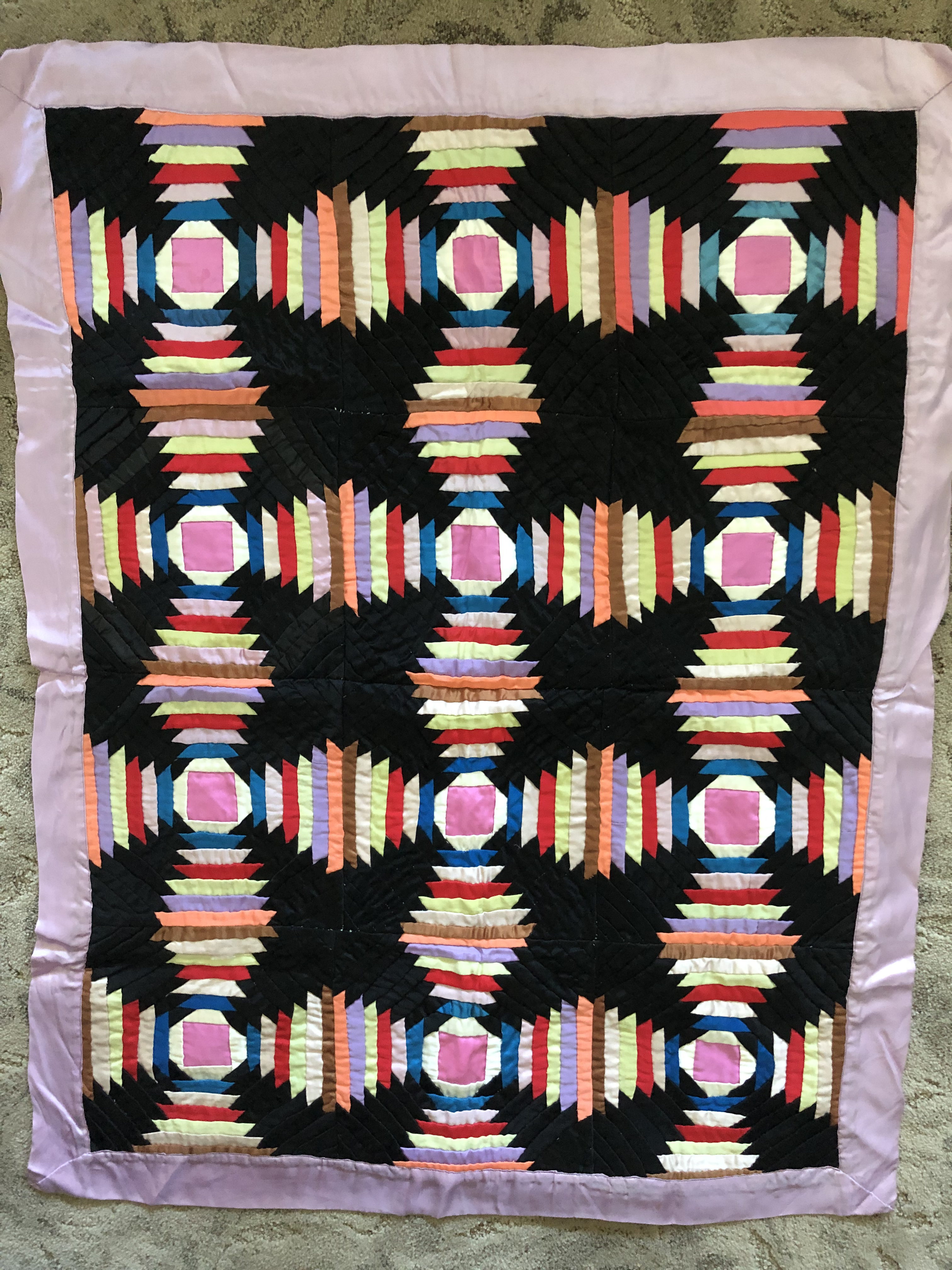
Baby quilt made by Sarah Buttar

“I joined the Female society in 1869 at Clarkston, and was a teacher for many years. I was the President of the Primary for six years, and a teacher for about eighteen years. The first Prayer circle in Clarkston was in my home, I was very much delighted and it was kept there for three years and four months. Then it was moved to the New Tithing house. I was married to my husband David Buttars 16th December 1866 and was sealed to him in the Endowment House in Salt Lake City, Utah 14 December 1868.
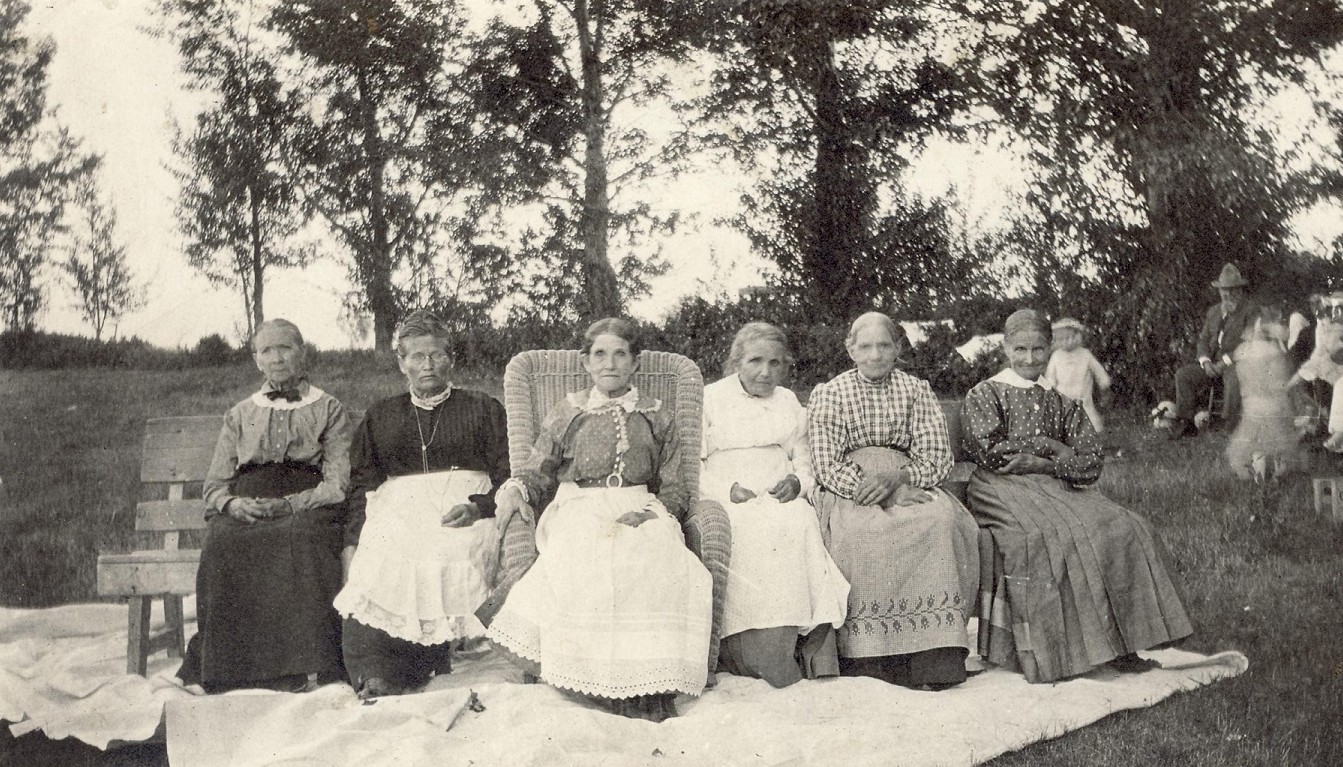
Clarkston Ward Sisters: Annie Heggie, Marie Anderson, Sarah Buttar, Jane Godfrey, Hannah Thompson, Elizabeth Loosle

“In 1884 my husband took another wife. We lives in that Celestial order for twenty three years. I have worked in the Salt Lake Temple, and the Logan Temple for the dead. I have worked and paid for about two thousand names. I have had my second Endowments many years ago. I have seen and talked to Martin Harris, one of the three witnesses, who is buried in the Clarkston Cemetery, I am a member of the Camp of Daughter’s of pioneers named in his honor, I have planted flowers on his grave.

“I have been near drowning two or three times. Once on the ship and twice in America, once when I was crossing the Bear River Bridge with my husband and relatives, we were returning from doing temple work, the bridge broke and we all went into the river, I was laid upon the river bank for dead, being crushed with the broken timber, I regained my consciousness, that was on the 30th of May 1899.

” I have had nine children five girls and four boys, three are dead at the present time, Eight of them are married and have families of their own. I am now Eighty two years old. I am writing this in March 1923.

“Sarah Keep Buttars died 7 October 1935 at the age of ninety five. SHe was active until a few days before her death. She attended the Cache County Fair in September 1935 and won a prize for her Fancy Hand Work and the honor of being the oldest pioneer in Cache Valley attending the fair.
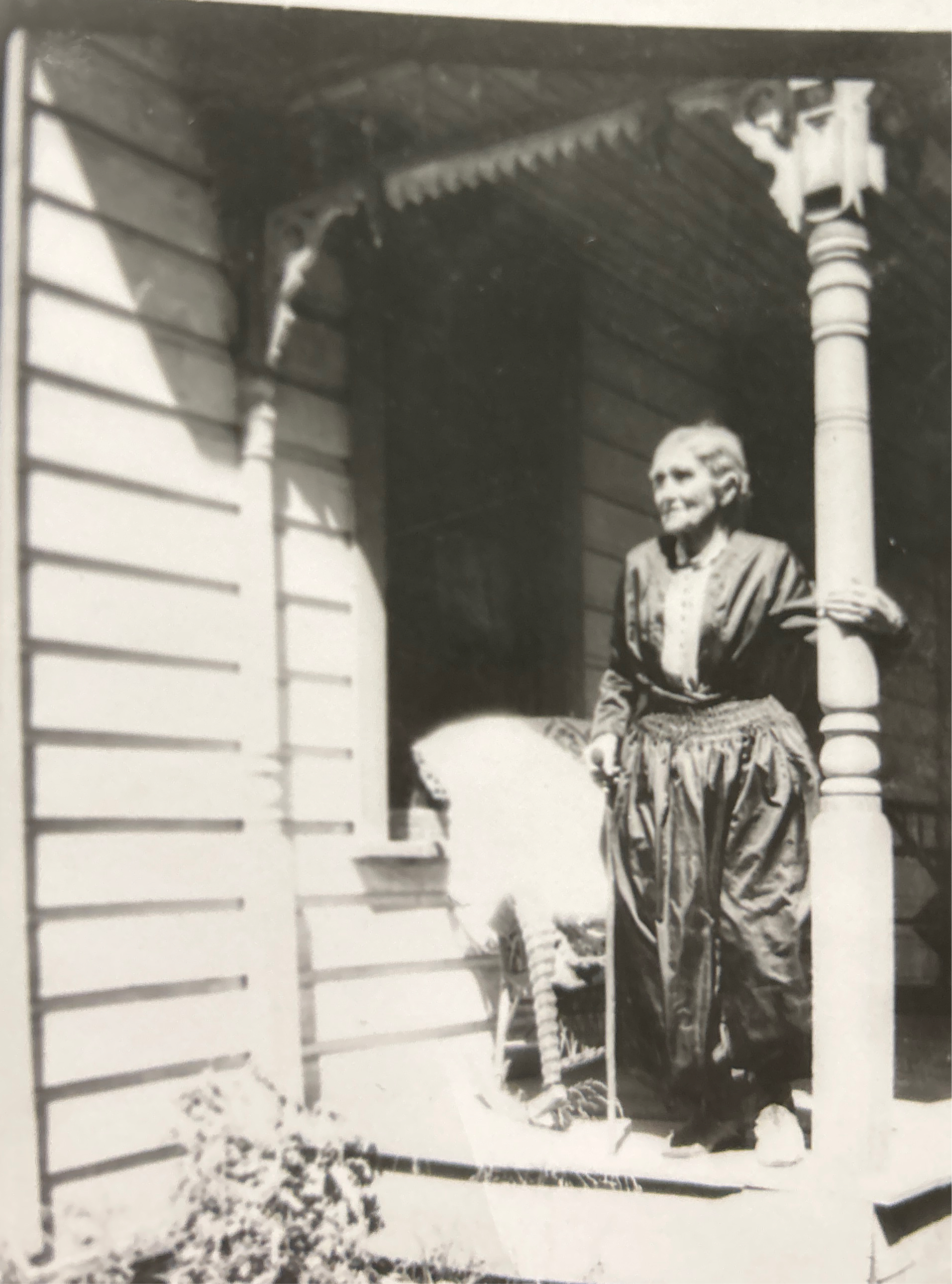
Sarah Keep Buttar

History of Plain City Pt 11

I have two copies of the History of Plain City, Utah. The front indicates it is from March 17th 1859 to present. As far as I can tell, the book was written in 1977. At least that is the latest date I can find in the book.

One copy belonged to my Grandparents Milo and Gladys Ross. My Grandpa has written various notes inside the history which I intend to include in parenthesis whenever they appear. They add to the history and come from his own experience and hearing. 

I will only do a number of pages at a time. I will also try to include scanned copies of the photos in the books. These are just scanned copies of these books, I have not tried to seek out originals or better copies.

History of Plain City March 17th 1859 to present, pages 166 through 184. That is the end of the Plain City History!

Can you Remember or Did you know?

By Lyman N Cook

            The following articles are a collection of stories and events that have been a part of Plain City. These are in no way a complete list of the stories that could be told. We have older people who can remember the colorful events and stories, the eras of history, and they should be told and recorded. I hope these people will do so while they are here to tell them. I have touched upon a few. Whether the stories are good or bad, it has been my purpose or intent to have all the questions and answers, but merely to help your mind reflect upon the beautiful memories of Plain City.

            Please, as readers, do not take any personal offense or injury to any of the stories. They were not written with any unkindness in mind, but hopefully you will enjoy them.

            The stories are, in reality, a tribute and a compliment to the early settlers of Plain City. I cannot comprehend the magnitude of courage and strength, and the hardships those early pioneer men and women endured. How unselfishly they worked and planned for the betterment of Plain City to make it a better place for you and I to live today.

            I have a deep personal feeling that we owe them everything.

            The most interest and pleasure that the book has brought to me has been the fact that I have had an opportunity to visit in the homes of so many wonderful and interesting people. Compiling, reading, and writing the history has so fascinated and compelled me that I have stayed up all night, only to find in the morning that I am just as refreshed as if I had slept all night.

            The following people have been so kind and helpful to me in writing the stories. They have told me stories, and refreshed my memory. I feel a deep appreciation for them, and I feel that they should be recognized. They are: Mrs. Lavina Thomas (on tape), Lyle Thomas, Byron Carver, Lee Carver, Laura Musgrave, George Knight, Clyde Hadley, Amy Robson, Harvey and Jennie Cook, Dick and Luella Skeen, Bill and Nonie Freestone, Irene Skeen, Ivy Skeen Marsden, and many others: Kris Ewert, for her printing. A special thanks to all. And also Ina Poulsen.

“TRUE STORIES AND COLORFUL EVENTS OF PLAIN CITY “

SLEIGH BELLS

            One of the pleasant memories of a cold, crisp, clear pioneer winter night, was the jingling of sleigh bells as families made their way to church or to visit with friends or neighbors. The rich sound of their ringing through the hollow night air could be heard all over town. First starting out faintly and then increasing in volume as they approached their destination. It would seem that the still, peaceful night was just made for the ringing of the sleigh bells.

            Almost all the families had a string of sleigh bells that were a prized possession, and a family treasure. Some of the larger strands would go across the back of the horses and around underneath the stomach, also a strand would fit on the hames. The quality of the workmanship that produced the full, rich tones will continue to enrich our memories of the past. Maybe if we lost our minds be calm and drift back through the years, we can still hear the tinkling of the sleigh bells.

PIONEER HOMES, WASH DAYS, FEATHER TICKS, COLD BEDROOMS, OLD COAL, OR WOOD STOVES

            The pioneer home was usually built with two rooms, and as the family income and new family members came along, they would add an addition of bedrooms, and a dining room, parlor, or living room. There was usually a large cook stove for the parlor and dining room. The kitchen was the center of activity in the home, and only on special occasions, or when company came, would they build a fire in the other rooms. They would usually bank the stoves with wood or coal to last as long as possible. But by morning, the fire was always out. They would have two or three coal buckets, and a kindling box, and some member of the family had the chore to see what they were always full. It took a strong constitution to roll out of bed on a cold winter morning and make the fire, and wait for it to get warm.

            Monday morning in the home was washday. It would start very early and last all day. They would heat the water in a copper-bottom boiler and would usually boil the clothes to help get them clean. They used a homemade lye soap. The women scrubbed the clothes on a scrub board usually placed in a metal washtub, and after scrubbing, would rinse the clothes two and three times. They would then be hung on the clothesline to dry. There was a special pride taken in the wash and to tell a woman that she hung out a pretty wash was to pay her a special tribute.

            The pioneer families would usually wait until cold weather to kill meat. They would cure it, salt brine it, or dry it. For fresh meat, they would put it in a flour sack and hang it high on the north side of the house. When they wanted fresh meat they would go outside, climb the ladder, or use a pulley to bring the flour sack in. They would cut off what meat they wanted and return the flour sack out on the north side. It was not uncommon to see flour sacks hanging from the north side of most homes.

            The bedrooms were usually located on the north side on the north side of the house, and were the furtherest from the stoves. It was like going into another world, or the north pole to go to bed. If you slept with a brother or sister, you would try to get them to go to bed first so they could warm the bed. The frost and ice crystals would collect on the window glass usually forming in the fall and never leaving until spring. It would usually be about a half-inch thick on the glass. The frost crystals would form in beautiful designs and patterns on the windows.

            The straw tick or mattress was made with a cover and filled with straw. Each year they would empty the straw, wash the cover, and refill it with new straw when they thrashed in the fall. They would place a feather tick on top of the straw tick, and it was filled with feathers from geese and ducks. It was really warm and soft. The sheets, blankets, and quilts were piled on the bed until they were so heavy that it was hard to turn over. It was especially nice when the dog would sleep on your side of the bed, as he made an excellent footwarmer. What a breed of people to survive the cold, hard time of pioneer life.

INDIANS

            There seems to be no evidence of any Indian violence or hostilities in Plain City. However, they would visit the homes of the early settlers and ask for food. As a sign of friendship to the Indians, they would always give them food. It was a very frightening experience for the pioneer women to have the Indians call when the men were in the field working and they were home alone. The children were especially scared, and were taught to be very careful when they were around.

            There were people alive today in Plain City that can remember when Indians would come into town and camp. Some favorite campgrounds were across from Paul Costley’s garage, and across the street north of George Cook’s home. The white kids always played close to home when Indians were in town, and they never went anywhere at night.

            The Indians squaws would go to every home and ask or beg for food. The homes that were generous would be visited several times. The Indians would stay for several days, and they would then load their treasures and leave and go north. The Indians must have liked the people of Plain City because they returned each year for many, many years.

PERRY BOAT

            The ferry boat and landing was located near where the river bridge crosses the Weber River on the Plain City, West Weber road on 4700 West. It provided a river crossing for people, cattle, sheep, horses, and wagons. The ferry was made of logs tied together, and a large molasses boiler and pole was used to push the ferry across the river.

            In the spring when the flood waters covered all of the low lands, the ferry would run from the hill on the north side near the Warren canal to the hill on the south as you enter West Weber. When the water receeded, the ferry returned to the channel. It has been said that in the spring the Indians would come to the hill and if the ferry was on the West Weber side, they would call across the river until the ferry came to get them. Sarah Richardson Hodson could imitate the Indian’s call for the ferry. She seemed to know more abut the ferry than anyone we knew of.

            It might be important to include information about the times before all of the times before all of the reservoirs were built to hold back and store the early run-off water. Almost every spring the river would leave its channel and flood the low lands of Slaterville, Plain City, West Weber, Warren and West Warren. During some years the water would be so deep the road was closed. As a boy I can remember traveling 4700 West when the water would be up to the running boards of the Model A. The last year of excessive water was in 1952.

            Not too much is known about the ferry, but it lends itself to another colorful era of interesting Plain City history.

POST OFFICE

            The Plain City Post Office was located where Neta Charlton’s home is located, or one block North of the school on the northeast corner. It was run by Charlie Neal and his wife, Pussy Neal. He ran the Post office for 25 years from 1877 or 1878 until 1902 or 1903 when the government closed the Post Office, and the mail was brought into Plain city by Fred Kenley and delivered by horse and buggy.

            Merl England has in his possession a letter that was postmarked Plain City, Utah, August 8, 1891.

            Pussy Neal had, and kept a start of live yeast and would sell it to the women of the town to use in mixing bread. Annie Skelton would send her daughter, Nonie Skeen Freestone, down to the Neal’s for yeast. It didn’t take many trips before Nonie developed a real taste for live yeast. She would buy a three-pound lard bucket full, but by the time she walked five blocks home, she would have half of the bucket drank. She claims that it was quiet a tasty drink.

EARLY BAPTISMS

            A very important date in the lives of young eight-year-old people was their baptism. Nowadays this ordinance is performed in a stake center with a very beautiful font. Before this time, this ordinance was performed in canals, rivers, lakes, and ponds. One of the most popular places to be baptized was the First Rock Crossing, or seck, as it was called. This was located on Center Street next to George West’s home, long before the canal was cemented. There was a row of poplar trees along the street, and the children would dress behind the trees. Some people would take their children up the street in the buggy and dress them, and then return for the baptism.

            There were usually just two baptisms a year, one in the late spring and the other in the early fall. As a result, there were usually several children to be baptized at a time. The children would sit on a log and wait for their turn.

            Some of the young people went down to the river and were baptized. The location on the river was near where the present bridge is located. They used willow trees to dress behind. Laura Musgrave and Royal Carver were tow that were baptized in the river.

            George knight told me that he was baptized in the Warren Canal about where the present pump is located. This was a colorful era of the past and should help to rekindle some pleasant memories for those who participated.

THE PRIVY, CRANNY, ROOSEVELT, OR ALIAS, THE ONE-HOLER, OR THE TWO-HOLER

                        There was a great deal of social status involved and a real pride taken in building, caring for, and beautifying the outdoor privy. Some of the seats were made of select lumber and sanded and smoothed to the point where they were quite comfortable. And on the other extreme, some seats were rough and slivery. Some families were careful to make the privy weather proof, while others you could look out the cracks in every direction.

            You could usually tell the size of the family in the house, whether it be large or small, by the size of the property. Is it a one or a two holer?

            Some of the families, to prove to the world that their cranny was something special, and a respected place, would cut beautiful designs in the top of the door. I never quite figured out whether the hole in the door was for ventilation, or simply to study the wonders of the sky at night. Some of the designs were a half moon shape, a diamond shape, star, or just a round circle.

            The Skeen girls, Ivy Skeen Marsden, Lenora Skeen Freestone, and Jennie Skeen Cook, still maintain to this day that their little brother, Dick Skeen, learned to throw the baseball so very well by practice throwing at the privy. He would wait until the girls would get inside and lock the door, then he would open up the rocks, clods, green pears, or anything to keep them pinned down. Dick’s favorite was the dirt clod. He would aim for the hole in the door and throw the clod through. The clod would hit the wall, break up and shower the girls with dust and dirt. He would then really laugh when the girls would cry, scream, and holler for their mother to come and rescue them from their brother.

            Halloween was a risky time for outdoor privies. One of the favorite Halloween pranks for the kids was to spend the night tipping over crannies. The only thing that I would like to say on the subject now is that I am ashamed and sorry, and I must report that I am one of the parents who feel like the kids of today are going to the dogs.

            During the depression and late thirties, and prior to World War II, the government had a P.W.A. and W. P. A. program. Workmen would come to your home and build outside crannies. They had a cement floor and a lid on the seat. They were weatherproof, and most people who owned one felt like that was the next best thing to running water. They were called “Roosevelts.”

            Usually an old Sears catalog would act as a years supply of toilet tissue.

            Some of the more discreet families would keep a pot, or thunderjug in the house for emergencies during the cold stormy winter nights. This fact was considered the family’s dark, deep secret, and was usually emptied before dawn.

            With the exception of two years in the Navy, I used the outdoor privy for 26 years, and first four years after I was married. We sometimes hear it would be nice to go back to the good old days, but certainly not to the days of the outdoor privy.

SCHOOLS

  1. The first school was in George Musgrave’s dugout. He later held school in a one-room adobe.
  2. The first public school was built on the south of the square. It was built out of adobe. It was one room.
  3. There was a school located on the northeast corner of the square. The town and ward used this building for some social functions. It was built of adobe in 1873 or 1874.
  4. The North school was located where Walter Christensen now lives.
  5. The South school is still standing and was remodeled by Harvey Cook into a home. It is located where Gordon Sorensen now lives, and across from Eldon Weston’s home. This home was built of brick.
  6. The Poplar School was located across from Augusta Nash’s home.

I have been led to believe that there was school classes being held in all these four schools at the same time. This world be shortly before and after 1900.

EARLY STORIES

            There have been at least ten stores and meat markets in Plain City up the present time. Some of the stores have stayed in the same place, but have had several different owners. I’ll just mention where the old stores were located. There were two Coy Stores. They were owned by Sarah Coy and Eliza Coy. One was across the street about where Mildred Sparks now lives. This is about 2200 North and 4650 West. The old ZCMI store was where B & C foods is now located. Garner’s store was where the pool hall is now. England’s store was where Merlin England’s now lives. McElroy’s store was where Jack’s Garage is now located. Stoker’s was located one block behind the school where Gordon McFarland lives. Maw’s was located just west of the bowery.

            John Vause built and operated a meat market just north of Adela Carver’s home. Some of Steve Knight’s family operated a meat market about where White’s Café is today. Peter M. Folkman had a meat market across from the school on the east side.

            Most of these early stores would trade merchandize for eggs and butter. This was especially nice for the kids of the town because they could take one egg or more and trade for candy. There wasn’t hen’s nest that was safe in Plain City. Laura Musgrave tells of how she would get Nonie Freestone and they would raid Nonie’s father’s chicken coop for eggs to go to the store for candy. There was real safety for Laura, as she always has been real sharp in having Nonie in her own father’s coop with her.

BLACKSMITH SHOPS

  1. Christopher Folkman was the first one in Plain City. He learned his trade in Denmark. It was located near Leslie Maw’s home and Elmer Carver’s home.
  2. Janus Lund’s Blacksmith shop was located near Dennis Lund’s home. He died in 1908.
  3. Rall J. Taylor started his shop in 1908 and the building still stands just north of Kirt Knight’s garage.
  4. Lew Ericson’s shop was located on the property of Neta Charlton.
  5. George Davis’ shop was near Phil Alsup’s old home and across the street from Thomas.
  6. Lee Gould’s shop was located near where Florence and Carl Hodson now live.
  7. Farley’s shop was located near where Sterling Thompson now lives.
  8. Lyman Skeen’s shop was located just south of his old home. The property is now owned by George Skeen Cook.

THE EARLY DENTIST

            Lyman Skeen acted as the early dentist, and his only speciality was pulling teeth. He had a special pair of forceps which are still in the possession of the family.

            People came from all of Plain City to have their teeth pulled. In those days they didn’t have any dental check-ups, or fill any decayed teeth. If a person got a cavity, they endured it until the tooth would ache and then Lyman Skeen would pull the tooth.

            He was a large man and once he hooked onto the tooth, he had very little trouble getting it out.

            Some of his children report that when anyone came to have their teeth pulled, they would run into the house and hide under the bed and hold their ears so they couldn’t hear the person holler or scream.

            Lee Carver tells the story about as a boy going down to Lyman Skeen’s and having a tooth pulled. He was told if he would sit still and not holler to scream, and act like a man, that Lyman would pay him .25 cents. It certainly must be one of the rare cases of a dentist paying his patient.

            George Knight told me he made a trip to Lyman Skeen’s home to have his tooth pulled. He was told that if he would take it like a man and not holler or yell, that he could drive the mules and wagons. After the tooth was out they went out and harnessed the mules and hooked them to the wagon and George drove the mules to his home. George said that there was nothing that Lyman could have done to make him feel more important and give him a bigger thrill than to sit on the seat with Lyman and drive those large mules home. He was so excited that he forgot what he had gone down there for.

            Ina Poulsen tells the story of her toothache when she was a girl. It was a large double tooth, and it had ached for days. She finally decided that having it pulled couldn’t hurt any more than the ache, so she went to see Lyman Skeen. She walked down to his place in the evening and they were eating supper. She said he got right up from the table and didn’t even finish his meal to pull her tooth. Annie got the forceps and sat her in his large grandfather chair. Again, the Skeen kids scattered and hid from the noise. Ina did mention that she did holler and scream, but it was all over in a minute. She said he was really good at pulling teeth. It also gives some insight into the quality, character, and gentleness of Lyman Skeen.

ICE HOUSE

            An Interesting part of the history of Plain City was the old ice house. It was located across from the school on the property where Clara Folkman now lives and sat behind the old home. In the winter when the Four Mile reservoir, river and other water would freeze hard enough, they would cut it with ice saws. They would then haul it by team and bobsleigh to the ice house for storage.

            Peter M. Folkman owned and operated the ice house, and in the winter he would have as many as twenty men working for him. They would work through the winter and would fill a rather large building with ice. They would cover it with wild hay and sawdust so it wouldn’t melt so fast in the heat and it would last all summer.

            They would sell it to the people of Plain City for their use in the old wooden ice chest, for making ice cream, mainly for parties, and for whatever else their need was.

MARTIN SMITH AND THE MEAT WAGON

            One of the colorful characters that would come into Plain City was Martin Smith. He owned a team of skinny horses and a closed-in meat wagon, and peddled fresh meat from door to door. He would come into town two or three times a week. He always carried a green willow switch, and would open the meat box, and use the switch to chase the flies out.

            The lady of the house would come out to the wagon and look over the variety of cuts, or I would imagine he would cut whatever they wanted. A favorite pass time of the kids of the days was to try and sneak weeneys when he was busy with their mother. He was a sharp enough businessman that he made sure he always got enough money to pay for the weiners.

            It sounds rather primitive in todays worlds, but it filled a need and is another colorful chapter out of the past.

GEORGE MOYES AND HIS MILK TRUCK

            George Moyes had the first milk truck in Plain City. He delivered the milk to some of the homes in Plain City. It was George that was coming home from the dairy and discovered the fire in the dummy had started and burned Charlie Taylor’s barn. He used his load of milk to help put out the fire. I don’t know of anyone today who wouldn’t like to own that little truck.

THE EARLY THRASHERS

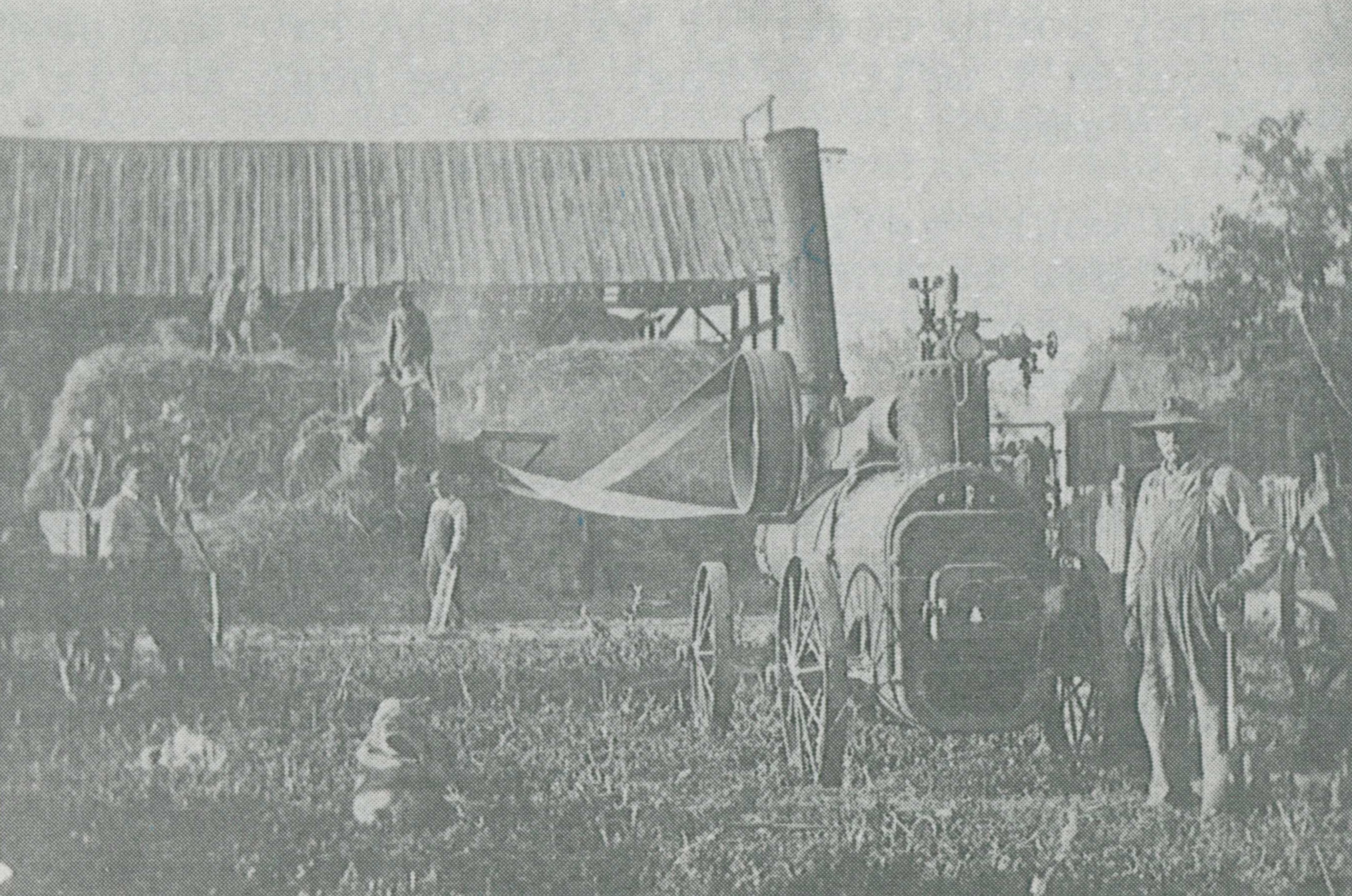
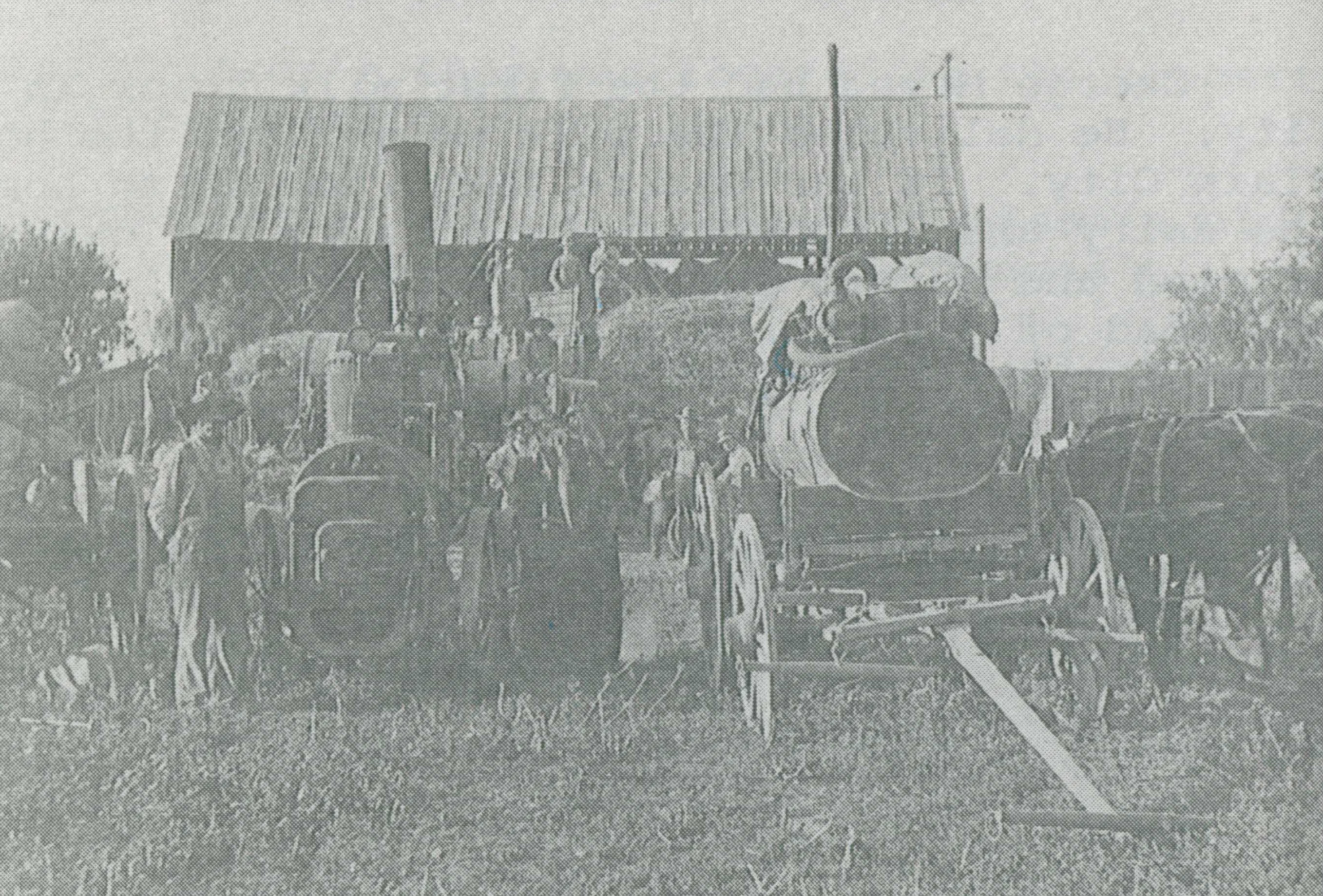
            A colorful time on the farm was thrashing time. The first machines were horse powered, and were a great improvement over the hand method. These colorful pictures are some of the early steam-powered thrashers. There were men who owned their own machines and would do custom work for their neighbors. When the thrashers would move onto a farm, it would usually take several days to complete the farmer’s field.

            While the thrashers were at the farm, it was the responsibility if the farmer to feed the men three meals a day. This consisted of many of the neighbors who helped each other. They worked hard and they required large meals. The women worked all day long to prepare the meals. The phrase, “I have cooked enough food for the thrashers,” was probably coined during this era. The farmer had to take care of the horses also.

            The men usually carried their own bedrolls and slept on the new fresh straw.

            Arthur Skeen and Frances Thomas owned and operated thrashing machines that I remember.

THE GYPSY HORSE TRADERS

            The horse trader would come into Plain City once or twice a year. They would arrive in large white-top wagons leading a large number of horses. Some of the camping areas where they would stay were; out by the beet dump, by the water tower, on the square, and in the lot across from the Lyman Skeen home where George Cook now lives. They would stay about a week and would camp or live in their wagons.

            The kids were frightened at the sight of the traders and the week they were in town they placed close to home and never ventured far from home at night. The traders were famous for taking things that didn’t belong to them.

            As a boy I can remember the trader camps and walking through them with my father. Because of the shady characters and the stories I had been told, I can remember of never letting go of my father’s hand. To see the people involved and the many horses there were, made a lasting impression upon my young mind.

            If any of the townspeople needed a horse or team, or wanted to sell any horses, they would bring their horses, or come to the traders camp. They would barter, trade, or sell. In order to make a sharp deal they would dicker all day. There were many stories told of how sharp a deal they made or how badly they got stung by the horse traders.

LYMAN DUMP

            There were two beet dumps in Plain City. One was located across from the water tower, the other was the Lyman Dump located one-half mile west of the canning factory where the railroad tracks crossed 5100 West. It was named after Lyman Skeen because of his work on the railroad to that plant, and on into Warren. John Vause was the weigh master and was more or less in charge of the dump. They would haul the beets with teams and wagons to the dump, where they would be loaded on to the rail cars and taken to Wilson Lane for processing. At times the cars were not available ad they would pile the beets by hand. The pile had to be six feet high and stacked just right. When cars were available, the factory would pay the farmers thirty cents a ton to load the beets by hand and then into the cars.

            A story is told of a certain farmer that would bring beets to the dump. The drivers were supposed to stay on the wagon to weigh their beets over with the wagons loaded, and then back their wagons across empty. This farmer would get off the empty wagon, stay on the scales, but would reach up and take hold of a board on the scale house, and pull most of his weigh off the scales. John Vause used to say, “ Look at that fat old ____. He thinks he is fooling me, but I always take 200 pounds off whether he is on the scale or not,”

            Mervin Thompson was there ad tells a story about Lyman Skeen hauling a large beet rack full of beets to the dump with a four-horse hitch. The lead team was fine large horses and the back team was large mules. The dump was elevated with a steep incline up to a platform where the wagon would stop and be unloaded. It was high enough to clear a rail car and the beets ran down into the car. The decline from the platform was steep. He made his approach with the team struggling to pull the heavy wagon up the incline. As the teams lunged forward down over the decline. Lyman sprang to his feet and held the mules back so the wagon rode up against the rumps of the mules, and he moved the lead horses out fast enough to keep out of the way. He never lost a sugar beet. It was truly a great display of fine horsemanship. It was truly his ability with the horses that saved him and his team from death or injury.

            He calmly made a circle around to the approach incline and took the teams up the incline. This time he was ready for them and the mules and horses stopped where they were supposed to. As the teams came down off the decline, they knew they had been taught a valuable lesson by a skillful master.

THE SWIMMING HOLES

            If anything in this world can turn a man into a boy again, it is the pleasant memories of the old swimming hole. The warm summer days with friends and the happy, carefree times are the most memorable in a life time. There seems to be a special magnetic force that pulls and draws boys to water. It is especially difficult to try and explain to parents that special force, and why it was so necessary to go swimming so much. We lived in the water and the longest part of the day was the one hour we had to wait for our dinner to digest before we could go in swimming again.

            Every irrigation canal, pond, river, or creek had their favorite swimming hole. The favorite holes in Plain City were not by the First and Second Rock Crossing, the canal, but Four Mile, Draney headgates, and the Anderson hole in the river. The Anderson hole was located just below the Warren pump by the bend in the river and northeast of the bridges. One could tell by the number of ponies, wagons, and buggies, that there was always a large crowd, and from the laughter and the noise, you could tell they were having a great time. The Anderson hole was secluded enough, and no girls around. For the men and boys it was pure skinny dipping. If any boy had shown up with a swimming suit in those days, they would have laughed him out of town.

            The Anderson hole was the place all of the men and boys took their Saturday night bath. George Knight tells the story that he counted 65 men and boys swimming at one time in the river. Sant Madsen was the oldest at 65, and there was a young boy of about 6 years of age.

            Wilford, or “Wiff” Skeen was considered the most gifted and powerful swimmers around this country. During World War I he swam on a Navy swim team. Gordon Thompson and George Knight said that Wiff was the most beautiful swimmer they had ever seen. Fred Kenley, I think, was I the Navy and traveled throughout the world. He said in all his travels that Wiff was the best Swimmer he had ever seen. He would put his little brother, Dick Skeen, on his back and swim out into the middle of the river. Dick must have been real little then, but he would dump him off and make him swim to shore while he carefully watched. Someone lost a shovel in Anderson hole and Wiff dove down to the bottom and brought it up, supposedly the only man to ever touch bottom.

            Ogden City, Swifts, and the By-Products, began to dump raw sewage into the river and ruined probably the greatest memory maker in all of Plain City. It just seems so strange that man has a habit of always destroying his own best things in life.

DRIVING THE COWS TO THE PASTURE

            The people who milked cows for their own use or who later on milked cows to sell the milk to the creamery, would usually drive their own cows to pasture during the summer months. The pasture was located one, two, or three miles from home. It would require taking the cows out in the morning and returning them in the evening. This responsibility usually fell to the younger members of the family and required a cow pony. In those days everyone’s home, yard, and  farm area were fenced so the cows traveling to and from the pastures did not create a problem. During the hot, dry summer weather, the roads and trails of the cows were very dusty. It was very difficult to follow the cows very closely as the dust was so heavy.

            One of these pastures was called the West Pasture. It was located north and west from Ivan Moyes’ home. This pasture was owned by several different people. The number of cattle they would put in the pasture was based on the amount of the pasture that they owned. In the evening the first person to the gate would open it and let the cows out. The cows, from force of habit, would follow the same trail to the town park where they would feed. It was not uncommon to see twenty-five or thirty milk cows feeding on the square in the early evening. The farmers would go to the square, collect their cows, and take them home.

            For those who played baseball, football, or just played on the square, there were some real hazards involved after the cows had been there.

            Modern feeding and milking techniques have eliminated the need for the daily move to the pasture and also the need for the fenced-in yards.

CANNING FACTORIES

            Another very important industry in Plain City was the growing and canning of tomatoes. The first factory built in Plain city was across the street from Loyd Olsen’s at 1900 North 4700 West. Laura Grieves Musgrave tells of working in this factory filling the cans with tomatoes. She was just a girl at the time, and expressed how happy she was to be able to earn money in those days. At that time there was no child labor laws.

            Part of this factory was later moved near the square and used by the maw family for their store and other buildings.

            The second canning factory still stands at 1975 North 4650 West, and was used for many years. The sandy loam soil of Plain City seemed to be ideal for the tomatoes to grow and helped to give them the flavor, quality, and yield that rarely can be equaled. Times were very tough to earn money in those days, and many men and women would work at the factory in the fall of the year to help supplement their income. This factory was built in 1925.

            The empty cans would be shipped in by railroad and the processed tomatoes would be shipped out to the railroad.

            The events that impressed my memories most about the factory, were the lines of loaded wagons and trucks waiting to be unloaded. While the farmers waited for boxes, or to be unloaded, or for their tomatoes to be graded, they would visit by the hour. The stories and the tall tales that would be told during that time will long be remembered. It used to fascinate me to watch the women peel the tomatoes. The full pans would be scalded and go around on a belt. The women would take a full pan, core and peel the tomatoes, and when the pan was full, they would put their number in the pan and return it to the belt. They were paid by the pan, and it amounted to five cents to ten cents a pan. In later years it raised from eight cents to ten cents a pan. The fastest peelers could peel about 60 pans a day.

            Some of the fastest peelers were Dorothy Christensen, Thelma Hodson Wayment, Doris Hodson Chugg, and Ruth Arave Taylor, deceased. Whether peeling tomatoes, cutting potatoes, thinning beets, wall papering, or whatever, Ruth Taylor, as I remember her, had to be the hardest working woman I ever know. I always marveled at her ability.

            Can your minds eye visualize the smoke coming from the tall stack, and the pleasant tomato odor that drifted along the air currents through the town of Plain City.

PEA VINERS – PEA WAGONS

            One of the early industries, or cash crops of Plain City was from the raising of peas. It t must be remembered that in the very early times, the settlers were only interested and concerned about food to keep them through the winter. As they worked and improved their homes, the roads, and the irrigation system, their ability to products more and vary their crops increased. It was then that they branched out into the pea industry.

            The main pea viner was located on 2200 north, about a half mile west of 4650 West, on the north side of the street. It provided work for some of the men of the community, to stack the pea vines. In the winter the farmers fed the vines to their cattle.

            The farmers would plant the peas in the early spring, and the harvest would begin about the 4th of July. The pea vines would be out with a horse-drawn mower. They would pitch them on a wagon and haul them to the vines by a team of horses.

            As young boys we would look forward to the horse-drawn pea wagons on their way to the viner. We would run out into the street and catch the wagon, pull off a big armful of peas, carry them into the shade, and eat peas all day long. I don’t believe that peas gave you as severe a belly ache as green apples, but it ran a close second. More important, we were ready to go after the first wagon the next day. As a young man, I pitched the peas on the wagon in the fields, and off at the viner.

            Later, another viner was built out east. It was located about one-half mile east of the water tower.

            In 1949, I was building my house and my friend and neighbor, Louis R. Jenkins, would come frequently and visit. He said, “You have a nice location, but when the wind is right you may be able to smell the pea viner, but you know, that’s a good smell.” I never forgot his statement though the pea industry lasted only a very few years after that date. But, who could ever forget the potent odor that came after the vines and the juices fermented. No wonder the people who hauled pea vines had very little, if any, sinus problems.

Epilogue:         Included should be the smell and the people who would haul the feed fresh beet pulp.

TRAPPERS

            The Plain City area is situated where there was many creeks, drains, sloughs, ponds, and water areas for the muskrats to live. It seemed to me at one time to another, about every young man was involved in trapping. This could have been an inborn spirit in each young boy to be a trapper or a mountain man. The season would usually start in the fall until the water froze, and then again in the spring when the ice left. It came at a time when jobs were hard to find for young men and provided spending money for them. Trapping provided a good source of money for me when I was going to high school. The hide buyers would usually pay from thirty-five cents to a dollar and a quarter, depending on the size of the hide.

            A good trapper could usually catch around 100 rats a day. I know one trapper that brought and paid for a new car during one trapping season. Some of the better trappers in Plain City that I can remember were, Elwin Taylor, Everett Taylor, Lyman Thomas, and Joe Wheeler.

NICK NAMES

            Practically no one grew up in Plain City without having a nick name tacked on to him or her, because of something they did, said, or the way they acted, or some mannerism. It was not all uncommon for a group of Plain City boys, just to impress a girl friend, to talk and call the individual by their nick name, and the girls never knew who they were talking about. On the other hand, someone may come into the town and ask for Don Singleton, Darrell Christensen, Boyce England, Elwin Taylor, Horace Knight, LaGrand Hadley, George Cook, Clair Folkman, Lynn Folkman, Eldon Weston, or Jay Freestone, only to be told that they didn’t know anyone living here by that name. But had they asked for “Seebo, ““Breezy,” “Buzz,” “Bunny,” “Skinner,” “Gandy Goose or Pety Hadley,” “Joe,” “Ober,” “Homer,” or “Grass,” the townspeople could tell them right away where they lived.

            Some of these people whose names will be mentioned have passed away, and it is my purpose to pay tribute, and add to their good names, rather than take anything away from them. Some have also moved away, but they got their name in Plain City.

            There are so many names that I simply can’t remember them all, but here are a few: “Buss” Lyman Skeen, “Rip” Ronald Skeen, “Geg” Garry Skeen, “Brig” Orson Knight, “Snide” Elmer Carver, “Suitcase” Blair Simpson, “Huss” Harold Hadley, “Tubby” Frank Hadley, “Duke” “ Frog” Kenneth Christensen, “Fooz” Grant Lund, “Hazel” Kenneth Lund, “Bud” Richard Dallinga, “Cirk” Keith Lund, “Sodie” Elmer Hipwell, “Diff” Jack Etherington, “Tiff” Clyde Skeen, “Taa” Jack Freestone, “Sunny” Lyman Freestone, “Bub” Howard Freestone, “Cork” Carl Hodson, “Tumbleweed” Don Van Sickle, “Red” Lyman Cook, “Chic” Dee Cook, “Heater” Bert Cook, “Beef” Wheat Taylor, “Big Chub” Charles Fulmer, “Little Chub” Robert Fulmer, “Buddles” Rulon Jenkins, “Curley” Quenten Jenkins, “Bun” Ray Hadley, “Weiny” Dwaine Hadley, “Mustard” Bill Hadley, “Napkin” Dennis Hadley.

            “Punken” Elmer Ericson, “Eif” Kent Jenkins, “Perk” Ray Coy, “Bear” Ronald Hogge, “Stinne” Wayne Skeen, “Hinke” Verl Rawson, “Toad” Loyd Knight, “Tarzan” Thayne Knight, “Dob” Blaine Knight, “Ikee” Ivan Hodson, “Grit” Dean Moyes, “Bud” Knight, “Lym” Skeen, “Beaver” Gordon Hadley, “Trapper” Durland Hadley, “Deddy” Darrell Thompson, “Pubby” Vernal Moyes, “Sam” Lyle Thomas, “Gonnie” Kenneth Woods, “Jim” Theron Rhead, “Mag” Noel England, “Jim” Elwin Skeen, ‘Bones” Bob Folkman, “Swede” Brent Taylor, “Curly” Davis, “Mayor” Dean Baker. “Wimpy” Loren Facer, “Tooley” Louis Poulsen, “Dick” Elwood Skeen, “Mud” Claude Rhead, “Weeser” Gene Lund, “Fiddler” Elmo Rhead, “Hook” Harold Hobson, “Roan” Harold Ross, “Mike” Milo Ross, “Wheeler” Keith Blanch, “Luke” John Nash, “Tom” Vandel Maw, “Joe” John Maw, “Judge” Thayne Robson, “Bushy” Wayne Cottle, “Pickus” Paul Coy, “George” Cliff Folkman, “Willie” Warren Williams, “Wally” Wallace Knight, “Cruzz” Kent Robson, “Evert” Bill England, “Tom” Merrill Jenkins, “Aus” Bob Wade, “Cougar” Norman Carver, “English” Wayne Carver.

             Something more interesting than the names is how each one got their nickname. You should ask some of them sometimes. We should announce from Plain city to the world that we have had for the last 55 years, the original ”Jaws” Paul Knight. It is very distressing and disturbing to read where some outsider has taken the name “Jaws” and capitalized on it, made a film, and grossed more than 25 million dollars, when the original “Jaws” had been in Plain City all along.

            When we analize the personality, the good times, and especially the stories, I doubt that anyone in Plain City would take 25 million from our original “Jaws.”

THE PEST HOUSE OR PRIMITIVE HOSPITAL

            The constant underlying fears that pioneers and early settlers lived with daily was the threat of disease, illness, or sickness. There just weren’t any doctors or medicine available, and if anyone got sick, they either got well on their own, or they didn’t make it.

            If a dreaded disease, or plague, as it was called struck the early settlers, many of them felt like it was God’s way of punishing them for things they had done or for the things they had not done. There were so many mysteries and superstitions concerning that, that people acted and responded in what now might be considered strange ways. The people felt the best thing to do was to isolate the sick people, and as a result of this type of thinking, the pioneers built the Pest House. To make sure it was really isolated, the people went about a mile west of town on the bank of First Creek and built Pest house. The Pest House was located on the bank of the creek. There were some tall poplar trees surrounding the building, but have since been removed. Clyde tells me that information was handed down and told to him about the spot where the Pest House was located. Years ago there was some evidence of a building there.

            When a person got sick, they would take him to the Pest house to get better. They were usually left alone to care for themselves. Someone from the town would take food and water, and provide some care, but for the most part, it was just a kill or cure method. In most cases the patients, if they died, expired from exposure or lack of care rather than from the disease because the building was poorly constructed.

            During the Smallpox epidemic of 1871, or about then, there weren’t any public meetings held in Plain City from September until the next March. The people lived in total fear of the disease.

            The William Skeen family was hit very hard with Smallpox and they lost four children. It has been told that while his family was very sick, he called for the church and they were fearful, they refused to go help. His friends also turned away. This good man was left to bury his four children all alone, and some of them at night. He was so disappointed in the Elders of the church and his friends, that he left the church and he named one of his sons that was born later “Frenz Denial.”

IMPORTANT FACTS

  1. Ivan Skeen Marsden and Lona Ipson Watson were the first lady missionaries to leave from Plain City in 1914. They served in the Eastern States Mission.
  2. The first car reported to be in Plain City was Dr. Rich, who drove out to treat a patient.
  3. It mentions that Richie owned the first car. Some of the other early car owners were Tom England, John Maw, Lyman Skeen, and others. Later, Lyman Skeen owned an eight-passenger Chandler.
  4. Sammy Sampson was one of the early barbers.
  5. There are seven children of original settlers living today in1977 that we know about. There may be others. Four of them live in Plain City. They are:

                                          Ada Skeen William Allred

                                          Victoria Sharp Hunt

                                          Mary Sharp Richardson

                                          Ivy Skeen Marsden

                                          Lenora Skeen Freestone

                                          Jennie Skeen Cook

                                          Elwood “Dick” Skeen

      It is remarkable when you think after 118 years that there are still children of the first settlers still living.

  • Richard Lund was the early fiddle player in the town.

LYMAN SKEEN, OWNER OF GREAT HORSES

            Lyman Skeen owned and loved great horses. He had two large barns full of fine Stallions, besides many work teams that he used in his construction business. He worked in Utah, Wyoming, and Idaho, on construction building canals, road beds, and whatever. He knew horses flesh and people would bring their horses from all over the country to have him doctor their horses.

            Lyman made three trips to Europe to buy horses. On one occasion, he bought six head of Shire horses in England and brought them by ship to the United States, and by rail to Ogden. He also brought a little Englishman named Tommy ____ to take care of the horses and train them.

            When they arrived in Ogden Lyman took Blaine Skeen, Elmer Skeen, Orson Knight, and others to help bring the horses home. Orson Knight tells before they brought them to Plain City, they paraded them down Washington Boulevard. He mentioned that no boy could have been prouder to lead those large horses down Washington. He said the little Englishman walked beside the horses with a whip, and he would crack the whip and the horses would rare up and prance and put on quite a display for the large horses.

            Sline was probably the greatest Shire horse to ever come into the State of Utah, or the West. The little Englishman is holding Sline in the picture.

            The Skeen kids can remember frequently someone yelling “Sline’s out.” and he would always prance up through the lot. Lyman would send his boys out to catch Sline, but they never could catch him. Lyman would sit back and watch his proud horse run and exercise, and when Lyman felt like he had enough, he would walk out and up to Sline and lead him to the barn. Whenever Sline had been he left hoof prints about a foot square through the garden.

SLINE” – Importe I Three-year-old Shire Colt

L. SKEEN

LYMAN SKEEN WITH HIS SHIRE HORSE.

One of these big Shire horses died at the age of three days. It was raised on a bottle by Annie Skeen, wife of Lyman Skeen.

SAMMY SAMPSON THE BARBER

            Sammy Sampson barbered in his home which was located across the street from Dell Sharp’s home. He was one of the early barbers. Byron Carver tells of getting his hair cut there when he was a boy. He said, “You could ask for any type of a cut you wanted, but you only got one cut, mostly bad,” I can see Byron chuckle ass a twinkle from the past came into his eyes. “Oh it was bad,” he said, “and as long as you had any hair left, Sammy would keep cutting.”

            On one occasion he went to get his hair cut when it was hot and Sammy was cooking something that didn’t smell too good. Some of the men who had gathered were smoking El-rope-o cigars, and Byron was getting light headed as he sat in the chair. As Sammy worked him over he became more ill. Sammy soaped his neck and shaved it with a large thick, straight razor, that scraped more than it cut. Sammy kept a pan of hot water on the stove with a wash cloth on it that he used to wash the soap off. As he laid that hot cloth on Byron’s neck, Byron rolled off the chair and fainted dead away. When he came to, big Lafe Skeen was holding him on his lap. That was one hair cut Byron will always remember, and as long as he is alive the memory of Sammy Sampson the barber will live on.

            Sammy charged 5 to 10 cents a haircut in those days, and trim and shave on the older men was 15 cents.

THE RACE TRACK, PLAIN CITY’S FIRST

            William Skeen owned some very fine racehorses and he built a racetrack to train his horses. The neighbors would meet on occasion and race their horses to test the speed against their neighbors horses. Stories have been told that there were some very exciting races held at the track. It was located near four mile reservoir.

            They tell the story of a man from Ogden, who was quite a footracer and he was supposed to have challenged and bragged that he could beat a horse in a certain distance. It was well talked up and word spread around, and the race was held. There was a little money that changed hands quite a crowd. But you know, no one can remember who won the race. It was another colorful time in early Plain City.

THE WEDNESDAY NIGHT SHOW

            Growing up as a kid during the late twenties, thirties and into the early forties here in Plain City was quite an eventful time. It seemed that the world moved at a slower more relaxed pace and there was time to enjoy visiting and to crate your own entertainment and fun. Depression times were very hard for most families, with very little one and barely the necessities of life. There was very little money available for entertainment and if you had any entertainment, you created your own. They were carefree happy times. As a kid you were lucky if you got into Ogden once a month or even once during the summer. By comparison with today, all the entertainment seems to be provided for the young people and all they have to do is show up with money and everything is provided for them.

            In the summer kids games and ball games were a very big thing and something was going on every day and night. Hide and seek, run sheepy run, kick the can, and whatever else anyone could think up were always popular. Skating and sleigh riding were the fall and winter games. You would skate all day and build fires at night so you could skate even longer.

            Sometimes in the thirties the movies began to be very popular. Someone from Ogden would bring a movie out to Plain City every Wednesday night. It was held in the upstairs of the old church house and there would be two to three hundred people or more watching the show. The admission was ten cents and hardly anyone ever missed the Wednesday night movie. There was usually a serial episode before the regular movie and it would last for about weeks. It would lead you up to an exciting climax and then announce, “To be continued next week.” I can remember they would be the longest weeks ever, waiting to get back to the show to see what happened. Tail Spit Tommy always a big feature with the serials.

            There were some very spooky shows and I can recall small kids screaming and crying, and they would have to leave the show. The shows were scary, but the spooky part was walking home at night after the show. You were always extra light on your feet, and with any strange sound out of the blackness of the night, you would be at a full gallop and double your stride. Ah, but they were good times.

            The automobile and the war, and the latest movie hits in Ogden all led to the down fall of the Wednesday night show in Plain City. It was a colorful era in Plain City and one that everyone seemed to enjoy.

A TRIBUTE TO BETTY

            Somehow the roads of Plain City look and seem a little different now days without the familiar figure of Betty. Her shopping bag in hand, her figure that time and age had bent a little, and limp that the years had brought on, headed up the road to Ogden. Time had also slowed her steps, but not her to walk to town.

            Probably Betty was born fifty years too late to fit in well with a changing society. He life was the simple life, and her wants and needs were few. She was very string willed, proud, and stubborn in some regards. She was very determined not to be pressured into joining the modern world.

            Some people say she was eccentric, old, strange, but she was a rugged individualist who refused to conform to anyones standards but her own. As a result of her ways the young people would sometimes tease and torment Betty. But in her own way she ignored them and went her way. Is it not strange that we from our own little worlds are so willing to unfairly judge other people by out own knowledge and standards. Especially if their standards and personality traits do not measure up or lower down to our own.

            I wouldn’t begin to know how many thousands of times Betty walked to Ogden, and back with groceries, even after she was around seventy five years of age. I suppose before we could fairly evaluate Betty we should ask the women of Plain City how many times they have walked to Ogden, and back home. Their were many people who were good to Betty and wanted to help her, but she seemed determined and happy to do things her own way.

            Betty was a hard worker and she worked for many people in Plain City. Later she worked in Ogden doing housework. I carried mail in Ogden for thirty years and would see Betty working at some of the finest homes in Ogden. Her family paid me a tribute when they asked me to speak at her funeral.

            Betty will be remembered as one of Plain City’s remarkable characters. If we let our memories wander a little, and though our minds eye we might still catch a glimpse of a shadow of Betty walking to town.

Hygiene and Sanitation by Egbert

Hygiene and Sanitation Textbook used at Brigham Young College

On the 15th I wrote about my Grandfather’s 100th Birthday (Norwood Jonas) and noting it with a newspaper article found in a textbook that belonged to his parents. This is that book. This was a textbook for my Great Grandfather at Brigham Young College in Logan, Utah.

Joseph Nelson Jonas graduated from Brigham Young College on 3 June 1915. That is 109 years ago tomorrow. Here is a copy of his Diploma. I have written about his history previously. I have also written about his time at BYC previously too.

Joseph Jonas graduation diploma from Brigham Young College in Logan, Utah

The textbook is also interesting. It appears Hygiene and Sanitation written by Seneca Egbert has some serious staying power. I found this history of Mr. Egbert.

Dr. Seneca Egbert (1863-1939) and Nancy Egbert

“Dr. Egbert was a physician. He graduated from Princeton University in 1884 and received his medical degree from the University of Pennsylvania in 1888. Before graduating, Dr. Egbert had been a demonstrator of hygiene in the Medical Department of the University of Pennsylvania. While in this position, he worked with Professor Samuel G. Dixon to establish the first Laboratory of Hygiene in the University, and was made lecturer on hygiene for 1890-1891. In 1892 the Drexel Institute of Philadelphia hired Dr. Egbert for a similar position. In 1893 he was elected Professor of Hygiene and Sanitation in the Medico-Chirurgical College of Philadelphia, appointed Vice-Dean of the same college in 1897, and elected Dean in 1898. Once the Medico-Chirurgical College merged with the University of Pennsylvania, Dr. Seneca became a professor of hygiene. He was president of the Radnor Township Board of Health and he was esteemed as a public health authority.

“In 1897 Seneca Egbert and his wife, Nancy Bredin Egbert, bought part of the old Towne family farm. The home, now owned by Fred French, is located on Blueberry Lane.

“Dr. Egbert was widely published. His book, Manual of Hygiene and Sanitation (seven editions), appeared first in 1898, as did his Home Sanitation, a Manual for Housekeepers. In 1919 Personal Hygiene for Nurses was published. He also wrote numerous articles for medical journals, maintained an impressive lecture schedule, and was a history buff who strongly advocated for the creation and maintenance of historic sites. He was not hesitant about venturing his opinion openly, and on at least two occasions made suggestions to Philadelphia politicians which received limited consideration. Dr. Egbert “was an advocate for ‘pure air, pure milk, and pure water.’ He felt that if people in the United States had these ingredients the average span of life would be increased by seven and one-half years.” He pursued this philosophy in an article, “Pure Water for Philadelphia,” which proposed damming the Mullica River and its feeder streams at the head of the tide to form a reservoir all the way to Atsion, NJ, and then pump to a reservoir on the western side to flow towards the Cooper River and another reservoir, thence to be pumped under the Delaware in order to relieve the poor water quality in Philadelphia . It would have pumped a relatively small quantity, 450,000,000 gallons of water per year, to start. The potential value of his plan was not recognized, either then or, to judge from a 2011 Web comment, now.

“On another issue, the City of Philadelphia proposed clearing all buildings from three city blocks. In response to a request for ideas on how to use this space, Dr. Egbert suggested allocating some of the land to the federal government, some to the state and some to the city of Philadelphia. On a strip of land extending down the center of the whole space, Dr. Egbert suggested constructing thirteen buildings representing the thirteen original colonies, and calling the area In­dependence Square. Each building would house the contributions made by that state towards the forming of our Union. “The idea was considered ludicrous in design and in scope. Dr. Egbert was a physician, not an architect.”

“Despite his critics, Seneca Egbert was doggedly de­termined to maintain the quality of life for Americans. For example, he embraced the newest form of transportation, bicycling, and “saw cycling as a remedy for dyspepsia, torpid liver, incipient consumption, nervous exhaustion , rheumatism, and melancholia.”

“A portrait of Dr. Egbert was painted for the University of Pennsylvania by Nancy Egbert’s brother, Rae Sloan Bredin (1870-1937). Mr. Bredin was a member of the New Hope group of American impressionists and several of his paintings are owned by New York’s Metropolitan Museum of Art. Mr. Bredin was co-founder of the Philadelphia School of Design for Women and the New York School of Fine Arts. His portrait of Dr. Egbert hangs now in the home of Dr. David Egbert Sparks, Dr. and Mrs. Egbert’s grandson, who is a genealogist and retired head of libraries at Notre Dame.

“Like Dr. Thomas Montgomery Lightfoot, Dr. Egbert was a lecturer in the winter lecture series held during the years 1887-1895 sponsored by the Academy of Natural Sciences. Dr. Egbert’s lecture was titled, “The Prevention of Disease and the Preservation of Health.”

“Nelson’s own Parke Struthers wrote in A History of Nelson that like Dr. Egbert’s good friend Dr. Thomas Montgomery Lightfoot, Seneca Egbert “met his fellow Nelsonians on an equal footing, a trait in human relations reserved for only the Great.” Mr. Struthers also states that the Egberts were “gracious, active in town affairs, and interested in the people of Nelson.” With their friends Dr. Lightfoot and his wife, Dr. and Mrs. Egbert served on the committee to make arrangements for the celebration of the one hundred and fiftieth anniversary of the first settlement of Nelson 1767-1917.

Inside cover of Hygiene and Sanitation

Here is the writing inside the book:

Joseph N. Jonas 1915

394 So. 1st East

Logan, UT

Jonas Joseph

Richmond, Utah

1915

First written page inside Hygiene and Sanitation

Here is the writing on the second page of the book:

Joseph N. Jonas

B.Y.C.

Logan, Ut.

394 So. 1 E.

Herrington, or Park

Stearn, Hot air, or Water

1 degree expands 1/491 of its val

relationship of insects to disease, Herrington

Hygiene of the school. h medical inspection.

282-387

Betty Donaldson Obituary

Betty May Oram Donaldson, 83, passed away peacefully surrounded by many dear friends on November 13, 2014. She was born November 5, 1931 to Gloyd Hyrum Oram and Rosabelle Grant Oram in Ogden, Utah.

Betty Oram Toddler

Betty Oram as a toddler

She attended schools in Honeyville and Ogden. She met and married David William Donaldson on April 12, 1953 (in Las Vegas) and their marriage was later solemnized in the Ogden LDS Temple (2008). They enjoyed traveling, camping and fishing. After 54 years together, David died in 2007.

Gloyd and Betty Oram

Gloyd and Betty Oram

Betty loved her dogs, cooking, crocheting, listening to books on tape and visiting with friends and family. She worked as a medical record and lab technician. She was a member of the LDS Church Plain City 7th Ward.

Betty Oram

Betty Oram

She is survived by her sister, Marilyn Keyes of Williamsburg, Virginia, many cousins, nieces and nephews and lots of friends. She will be missed very much.

LaPriel Gailey and Betty Oram

LaPriel Gailey and Betty Oram

She was preceded in death by her parents and brother Donald Oram.

Betty with cup

A viewing for family and friends will be held on Friday, November 21, 2014 from 6 to 8 p.m. at Myers Ogden Mortuary, 845 Washington Blvd and Saturday from 9 to 10 a.m. at the mortuary. Graveside services will be held at 11 a.m. on Saturday, November 22, 2014 at the Honeyville Cemetery, 6900 North 2500 West.

Betty and David (Dave) Donaldson

Betty and David (Dave) Donaldson

We would like to thank the Lotus Park Assisted Living personnel and Intermountain Homecare (especially Vickie, Launi and Misty) for their excellent care of Betty. We are very grateful for the assistance of Betty’s ward family during her last few weeks.

~

That is her obituary as found in the newspaper with two additions by me (in parenthesis).  I thought I would add a couple more side notes.

I have mentioned Betty and Dave in the history for Dave’s parents found at this link.

I am not sure the reasons, but it sounds like Betty was pretty much raised by her grandparents, Jedediah Mill Grant and Annie Kaziah Bowcutt.  Interestingly, Annie’s brother, Lorenzo, married my great grandmother Lillian Coley Jonas years after my great grandfather had passed away.  Betty had some interesting stories about Ren as he was known.  You can see pictures of Ren and his obituary at the link for Lillian.  She adored her Grandmother Annie Bowcutt Grant.  As I mentioned, I did not think to ask why, but she never told me much about her parents.  But she told me loads about her grandparents.  She even gave me a number of photos to scan of them, which I will likely post next week.

I liked to go and visit Aunt Betty.  Since she lived next to Grandpa and Grandma it was easy and convenient to go.  Sometimes though after spending a few hours with Grandpa and Grandma I wanted to get on the road but Grandpa would send me to Betty’s with something to give her and Dave (when he was still alive).  Grandma would even walk over with me sometimes.

doc20150207162904_001

Betty May Oram Donaldson Funeral Program