A short history lesson for Moon, Labrador on ranked-choice voting

I was trying to find some photos and stumbled upon my Mom’s graduation pamphlet I had scanned a few years ago. Thought maybe it was time to share it, especially where I have seen some of her classmates have passed away recently.

1972 Baccalaureate and Commencement – Burley High School – Burley Idaho
These programs courtesy of the following Public Spirited Business Concerns
Amalgamated Sugar Co.
Burley Processing Co.
Burley Reminder
Cassia National Bank
First Federal Savings & Loan Assn., Burley Branch
First Security Bank
Guys ‘N Dolls
Idaho Bank & Trust Co.
Idaho First National Bank Burley Office
McCaslins
Ponderosa Inn
J. R. Simplot Food Processing Division
South Idaho Press

Class Officers
President Garth Beck
Vice President Bud Hoffbuhr
Secretary Jill Hinz
Executives Peggy Wood, Peggy Larson, Kaye Dawn Larson, Jeananne Gruwell, Jean Graham
Class Adviser Mr. David Peck
Baccalaureate Sunday, May 21, 1972 2:30 P.M.
Mr. Tom Gruwell , Principal, Presiding
Processional High School Band Mike Chesley, Conducting
Welcome Garth Beck Class President
Invocation Bud Hoffbuhr
Special Number Bel Canto Choir Elden Wood, Conducting “Battle Hymn of the Republic”
Address Dr. Walter R. Peterson
Cherubim Song Senior Octet
Benediction Calvin Pearson
Recessional High School Band
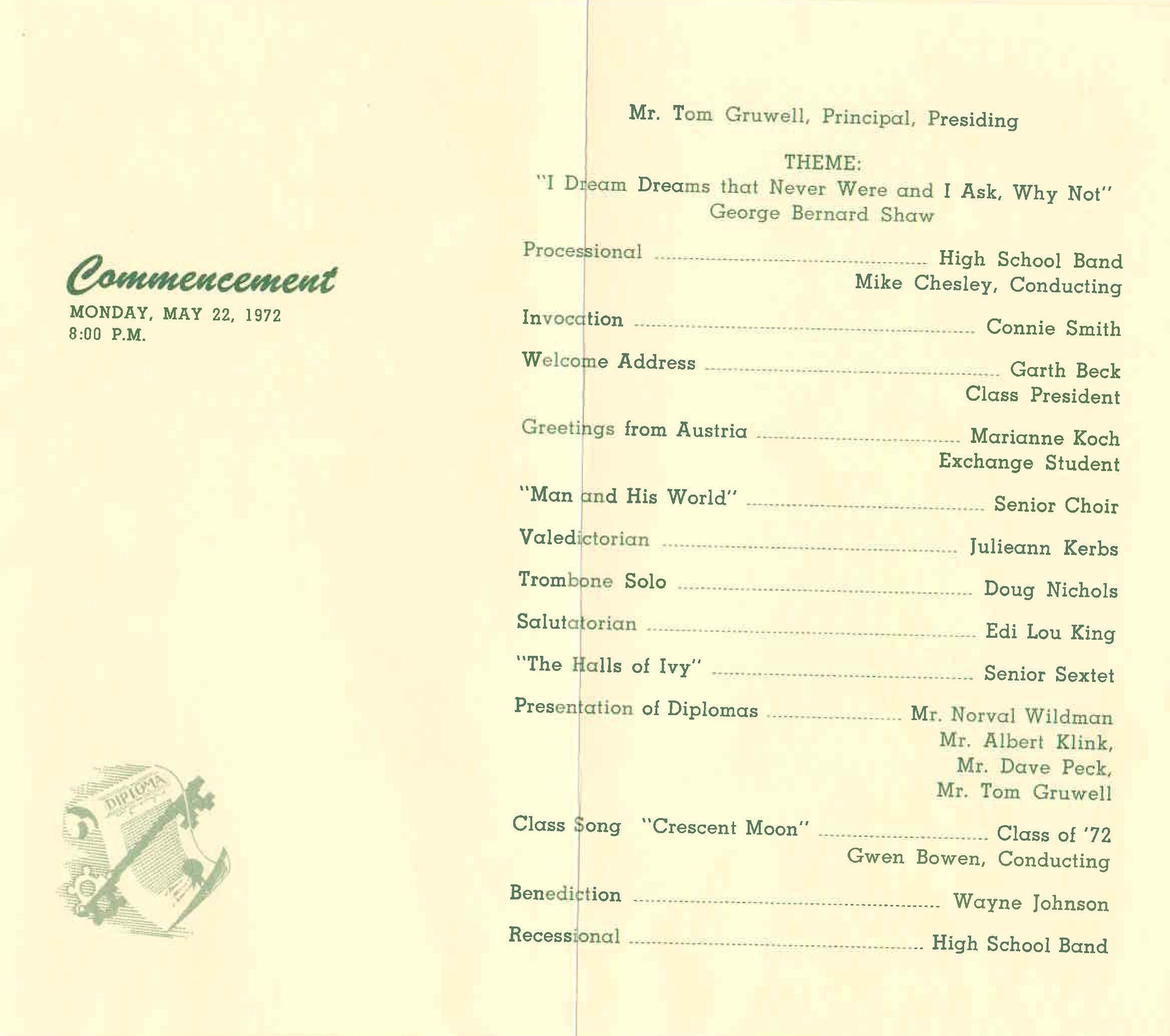
Commencement Monday, May 22, 1972 8:00 P.M.
Mr. Tom Gruwell, Principal, Presiding
THEME: “I Dream Dreams that Never Were and I Ask, Why Not” – George Bernard Shaw
Processional – High School Band – Mike Chesley, Conducting
Invocation – Connie Smith
Welcome Address – Garth Beck, Class President
Greetings from Austria – Marianne Koch – Exchange Student
“Man and His World” – Senior Choir
Valedictorian – Julieann Kerbs
Trombone Solo – Doug Nichols
Salutatorian – Edi Lou King
“The Halls of Ivy” – Senior Sextet
Presentation of Diplomas – Mr. Norval Wildman, Mr. Albert Klink, Mr. Dave Peck, Mr. Tom Gruwell
Class Song “Crescent Moon” – Class of ’72 – Gwen Bowen, Conducting
Benediction – Wayne Johnson
Recessional – High School Band
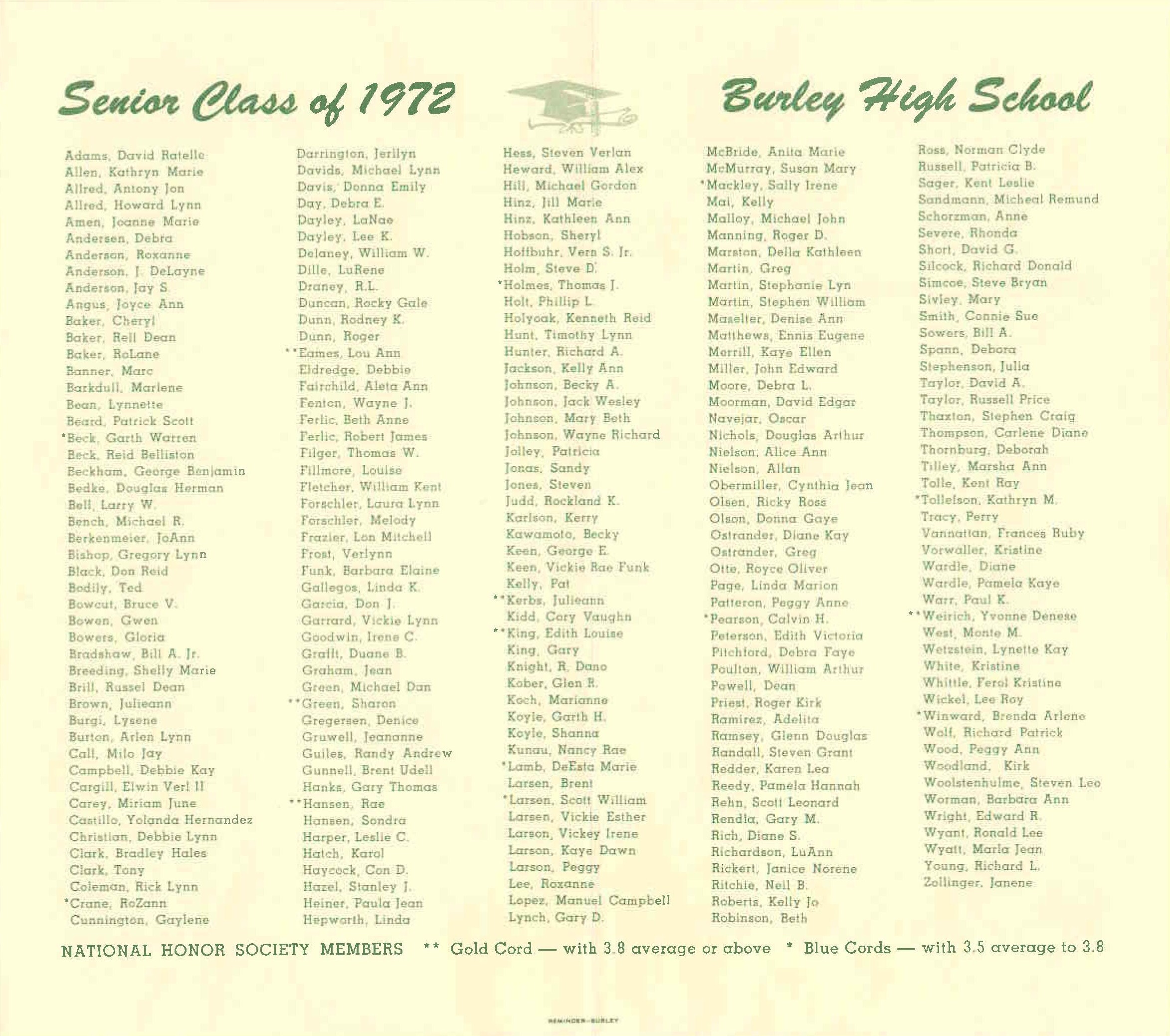
Adams, David Ratelle
Allen, Kathryn Marie
Allred, Anthony Jon
Allred, Howard Lynn
Amen, Joanne Marie
Andersen, Debra
Anderson, Roxanne
Anderson, Jerald DeLayne (1954 – 2017)
Anderson, Jay S
Anderson, Todd Michael (1953 – 1972)
Angus, Joyce Ann
Baker, Cheryl
Baker, Rell Dean
Banner, Marc
Barkdull, Marlene
Bewan, Lynnette
Beard, Patrick Scott
* Beck, Garth Warren (1953 – 2002)
Beck, Reid Belliston
Beckham, George Benjamin
Bedke, Douglas Herman
Bell, Larry W
Bench, Michael R
Berkenmeier, JoAnn
Bishop, Gregory Lynn
Black, Don Reid
Bodily, Ted O (1954 – 2019)
Bowcut, Bruce V
Bowen, Gwen
Bowers, Gloria
Bradshaw, Bill A Jr
Breeding, SHelly Marie
Briggs, Larry
Brill, Russel Dean
Brown, Julieann
Burgi, Lysene (1953 – 2016)
Burton, Arlen Lynn (1954 – 2014)
Call, Milo Jay
Campbell, Debra “Debbie” Kay (1954 – 2019) Johnson
Cargill, Elwin Verl II
Carey, Mirian June
Castillo, Yolanda Hernandez
Christian, Debbie Lynn
Clark, Bradley Hales
Clark, Antone “Tony” Lee (1954 -2015)
Coleman, Rick Lynn
* Crane, RoZann
Cunnington, Gaylene
Darrington, Jerilyn
Davids, Michael Lynn (1953 – 2020)
Davis, Donna Emily
Day, Debra E
Dayley, LaNae
Dayley, Lee K
Delaney, William W
Dille, LuRene
Draney, Rex Leonard (1953 – 2007)
Duncan, Rocky Gale (1954 – 2020)
Dunn, Rodney K
Dunn, Roger
** Eames, Lou Ann
Eldredge, Debbie
Farwell, Albert Michael (1952 – 2023)
Fairchild, Aleta Ann
Fenton, Wayne J
Ferlic, Beth Anne
Ferlic, Robert James
Filger, Thomas W
Fillmore, Louise
Fletcher, William Kent
Forschler, Laura Lynn
Forschler, Melody
Frazier, Lon Mitchell
Frost, Verlynn
Funk, Barbara Elaine
Gallegos, Linda K
Garcia, Don J
Garrard, Vickie Lynn
Goodwin, Irene Cecilia
Goold, Gary
Graf, Becky Ann (1954 – 2011) Moats, Kloer
Grafft, Duane Brian (1953 – 2006)
Graham, Jean
Green, Michael Dan
** Green, Sharon
Gregersen, Denice
Gruwell, Jeananne
Guiles, Randy Andrew (1953 – 2015)
Gunnell, Brent Udell
Hanks, Gary Thomas
** Hansen, Rae
Hansen, Sondra
Harper, Leslie C
Hatch, Karol (1953 – 2004) Kerr
Haycock, Con D
Hazel, Stanley Jarvis (1953 – 2008)
Heiner, Paula Jean
Hepworth, Linda
Hess, Steven Lerlan
Heward, William Alex
Hill, Michael Gordon
Hinz, Jill Marie
Hinz, Kathleen Ann
Hobson, Sheryl
Hoffbuhr, Vernard “Bud” Standley Jr (1954 – 1997)
Holm, Steve D
* Holmes, Thomas J
Holt, Phillip L
Holyoak, Kenneth Reid
Hunt, Timothy Lynn
Hunter, Richard A
Jackson, Kelly Ann
Johnson, Becky A
Johnson, Jack Wesley
Johnson, Mary Beth
Johnson, Wayne Richard (1953 – 2008)
Jolley, Patricia
Jonas, Sandy (1954 – alive)
Jones, Steven
Judd, Rockland K (1953 – 2012)
Karlson, Kerry
Kawamoto, Becky
Keen, George E
Keen, Vickie Rae Funk
Kelly, Pat
** Kerbs, Julieann
Kidd, Cory Vaughn
** King, Edith Louise
King, Gary
Knight, Robin Daniel (1953 – 2014)
Kober, Glen R
Koch, Marianne
Koyle, Garth H
Koyle, Shanna
Kunau, Nancy Rae
* Lamb, DeEsta Marie
Larsen, Brent
* Larsen, Scott William
Larsen, Vickie Esther
Larson, Vickey Irene
Larson, Kaye Dawn (1954 – 2019) Silcock
Larson, Peggy (1954 – 2016) Stirland
Lee, Roxanne
Lopez, Manuel Campbell
Loveland, Cynthia (1954 – 1981)
Loveland, Kevin R (1954 – 2008)
Lynch, Gary D
McBride, Anita Marie
McMurray, Susan Mary
* Mackley, Sally Irene
Mai, Kelly
Malloy, Michael John
Manning, Roger D
Marston, Della Kathleen
Martin, Gregory Max (1954 – 1975)
Martin, Stephanie Lyn
Martin, Stephen William
Maselter, Denise Ann (1954 – 2022) Rollins
Matthews, Ennis Eugene
Merrill, Kaye Ellen
Miller, John Edward
Moore, Debra Lynn (1954 – 2002)
Moorman, David Edgar (1953 – 1997)
Navejar, Oscar
Newcomb, Kathy Lorene (1954 – 2020) Bailey
Nichols, Doulgas Arthur
Nielson, Alice Ann
Nielson, Allan (1954 – 2020)
Obermiller, Cynthia Jean
Olsen, Ricky Ross
Olson, Donna Gaye
Ostrander, Diane Kay
Ostrander, Greg
Osterhout, Rex Dale (1954 – 2017)
Otte, Royce Oliver
Page, Linda Marion
Patteron, Peggy Ann
* Pearson, Calvin H
Peterson, Edith Victoria
Pitchford, Debra Faye
Poulton, William Arthur
Powell, Leslie Dean (1953 – 2005)
Priest, Roger Kirk
Ramirez, Adelita
Ramsey, Glenn Douglas
Randall, Steven Grant
Redder, Karen Lea
Reedy, Pamela Hannah
Rehn, Scott Leonard (1954 – 1994)
Rendla, Gary M
Rich, Diane S
Richardson, LuAnn
Rickert, Janice Norene
Ritchie, Neil B
Roberts, Kelly Jo
Robinson, Beth
Ross, Norman Clyde
Russell, Patricia B
Sager, Kent Leslie
Sandmann, Michael Remund
Schorzman, Anne
Severe, Rhonda
Short, David G
Silcock, Richard Donald
Simcoe, Steve Bryan
Sivley, Mary
Smith, Connie Sue
Sowers, Bill A
Spann, Debora
Stephenson, Julia
Taylor, David A (1953 – 2009)
Taylor, Russell Price (? – alive)
Thaxton, Stephen Craig
Thompson, Carlene Diane
Thornburg, Deborah
Telley, Marsha Ann
Tolle, Kent Ray
* Tollefson, Kathryn M
Tracy, Perry Alan (1953 – 2005)
Vannatian, Frances Ruby
Vorwaller, Kristine
Wardle, Diane
Wardle, Pamela Kaye
Warr, Dee Ann (1954 – 2013)
Warr, Paul K
** Weirich, Yvonne Denese
West, Monte M
Wetzstein, Lynette Kay
White, Kristine
Whittle, Ferol Kristine
Wickel, Lee Roy
* Winward, Brenda Arlene
Wolf, Richard Patrick
Wood, Peggy Ann
Woodland, Kirk
Woolstenhulme, Steven Leo
Worman, Barbara Ann
Wright, Edward R
Wyant, Ronald Lee
Wyatt, Marla Jean
Young, Richard LeRoy (1953 – 2022)
Zollinger Janene
National Honor Society Members
** Gold Cord – with 3.8 average or above
* Blue Cords – with 3.5 average to 3.8
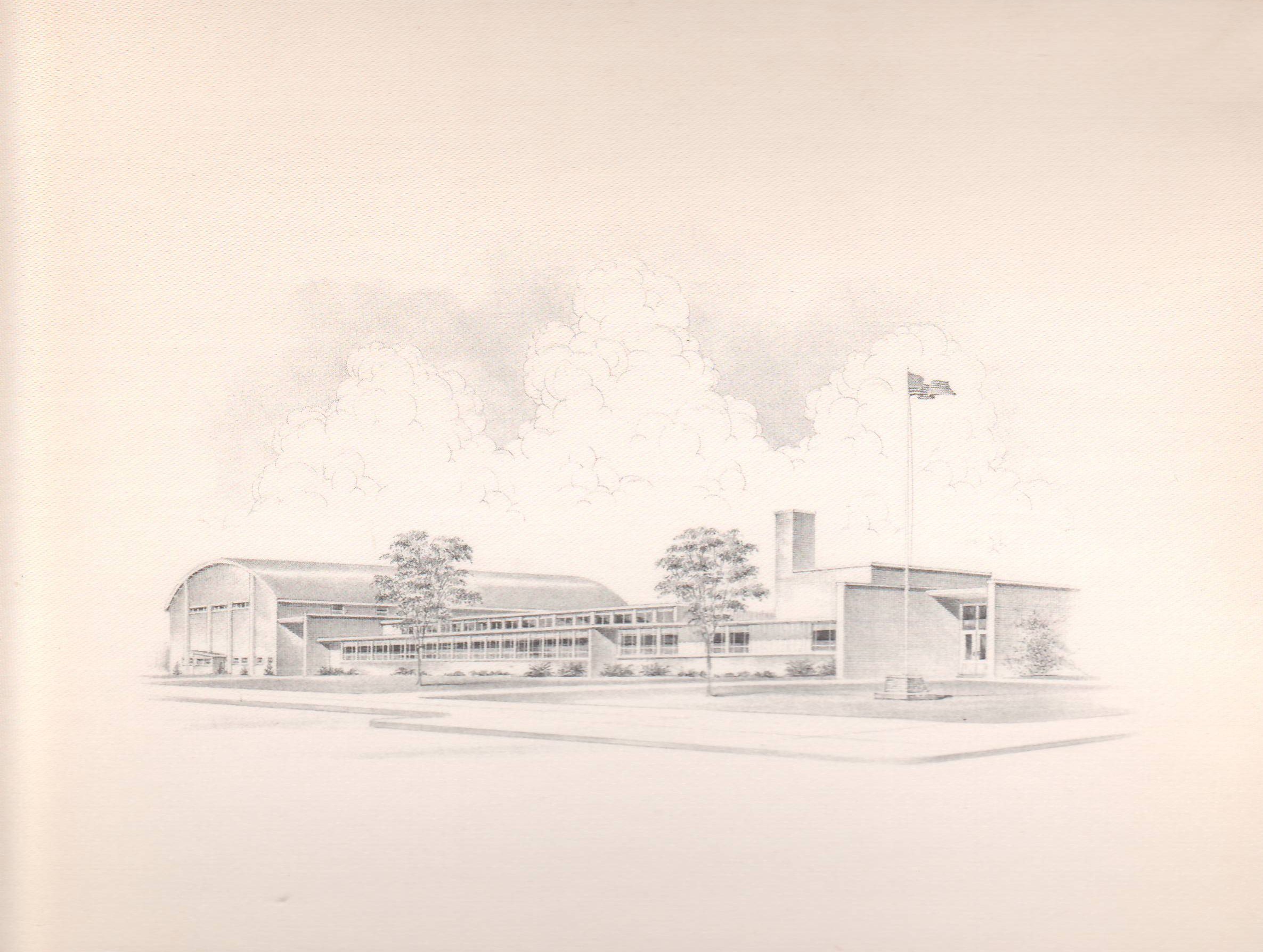
The sketch of the Burley High School on the front of the Diploma case.

Mom’s actual Diploma.
Burley High School – Burley, Idaho
This Certifies That Sandy Jonas has satisfactorily completed a Course of Study prescribed for Graduation from this School and is therefore awarded this Diploma.
Given in the month of May, nineteen hundred and seventy-two
Tom Gruwell – Principal
Harold W Blauer – Superintendent
W B Whiteley – Chairman Board of Education

Here is a copy of Mom’s Senior picture – 1972


I read this article in the Utah Bar Journal. It struck me as accurate. Enough so that I wanted to share it with others! I thought the metric system in the United Kingdom was not intuitive, especially where most things had metric and imperial side by side.
In 1975, the United States enacted the Metric Conversion Act, amended by the Omnibus Trade Act of 1988, attempting to compel American citizenry to adopt the modern metric system as their official system of measurement (i.e., the International System of Units). The United States later directed all U.S. agencies to “take all appropriate measures within their authority” to convert to the metric system. Exec. Order No. 12770, 56 FR 35801, at 393 (July 29, 1991). Less than fifty years earlier, the consensus view of the U.S. Congress had been that “the metric system is inferior to the English.” Congressional Hearing Relative to the Compulsory Introduction of the Metric System, on H.R. 10, Cong. 237 (1926) (statement of Samuel S. Dale to the Committee on Coinage, Weights and Measures).
Questions about whether weights and measures should be expressed in the imperial system or the metric system in evidence, statutes, and case law have never been fully resolved. In many states, legislation arbitrarily reverts from the imperial system to metric system within subsections of the same statute. See, e.g., Utah Code Ann. § 58-37c-19 (outlawing distribution and possession of methamphetamines in ounces); id. § 58-37c-20.5 (outlawing purchase of pseudoephedrine in grams); see also, e.g., 18 V.S.A. § 4231(a)(3), (outlawing possession of cocaine measured in ounces); 18 V.S.A. § 4231(a)(2) (outlawing possession of cocaine measured in grams). The Supreme Court also appears to have vacillated about how best to express weights and measures. See, e.g., Whole Woman’s Health v. Hellerstedt, 579 U.S. 582 (2016) (expressing distance in miles using the imperial system); Massachusetts v. EPA, 549 U.S. 497 (2007) (converting evidence presented in the imperial system to metric system units). And although the U.S. Patent and Trademark Office (USPTO) technically requires applicants to use the metric system, it does not enforce this requirement.
Academics have long advocated for adoption of the metric system as a way of resolving this conflict, while blue-collar American works have resisted the same. Emerging evidence further discussed below appears supportive of the blue-collar workers’ reluctance.
Historical Controversy
Pressure from continental Europe to adopt the metric system began when the metric system was invented in 1791 during the French Revolution by Pierre-Simon Laplace. Thomas Jefferson rejected European pressure to convert, predicting the metric system would fail. U.S. Dep. Of Comm., A History of the Metric System Controversy in the United States, Nat’l Bur. Stand. Spec. Publ. 345–10. John Quincy Adams was forced to write a 117-page report in 1821 on weights and measures, concluding that the metric system was unnaturally contrived. He said, “[o]f all the nations of European origin, ours is that which least requires any change in the system of their weights and measures.” John Quincy Adams, Report Upon Weights and Measures, p. 93: U.S. Senate (1821). Even Napoleon himself ridiculed the metric system and prohibited its use in the First French Empire, which had created it. “Napoleon didn’t personally admire the metric system that Laplace invented, saying, ‘I can understand the twelfth part of an inch, but not the thousandth part of a metre.’” Andrew Roberts, Napoleon: A Life (Viking 2014). Following enactment of the Metric Conversion Act in the United States in 1975, the USPTO issued a directive requiring that weights and measures submitted in U.S. Patent applications be presented in the metric system and codified this directive in the Manual of Patent Examining Procedure § 608.01. As a result of these laws and regulations intended to “metricate” the American people, nothing changed. Patent attorneys simply ignored § 608.01 and courts in our system of jurisprudence have largely done the same.
Laymen across the country have resisted pressure to adopt the metric system whenever it is applied. The National Cowboy Hall of Fame director sued the National Bureau of Standards in 1981 for spending $2.5 million per year to promote the metric system but had certiorari denied by the U.S. Supreme Court when he lost the case on standing. The Supreme Court Today Rejected an Effort by Two Champions, U. Press Int’l (Nov. 30, 1981), available at https://www.upi.com/Archives/1981/11/30/The-Supreme-Courttoday-rejected-an-effort-by-two/8345375944400/ (commenting on case No. 81-780). The Ford Motor Company refused to switch to the metric system and authorized articles critical of the metric system. Henry Ford, Moving Forward (1931). Francis Dugan, representing the U.S construction industry on the U.S. Metric Board, promised that U.S. construction would “be the very last sector [in the U.S.] to implement conversion to metric measurement – if at all.” U.S. Metric Board, Summary Report (Jul. 1982). To counter the popular resistance to the metrification of the United States, the National Institute for Standards and Technology established the U.S. Metric Program and the U.S. Metric Board for metricating America in the 1970s. The U.S. Metric Board was disbanded by Ronald Reagan in 1982 while the U.S. Metric Program employed one person from 1982 until 2013. In 2013, when the sole employee of the U.S. Metric Program retired and was asked why nothing had been accomplished in thirty years, he blamed the failure of the U.S. to convert to the metric system on incorrigible semi-truck drivers whom he alleged were incapable of understanding overpass heights and prone to ramming their trailers into overpasses across the country. Carrie Swiggum, Meet the Sole Employee of the U.S. Metric Program, Mental Floss
(Mar. 20, 2013), https://www.mentalfloss.com/article/50160/years-ken-butcher-was-sole-employee-us-metric-program.
While singling out truck drivers for ridicule, actual confusion was taking its toll among America’s more educated demographics. NASA’s Mars Climate Orbiter was lost in 1999 because NASA scientists misconverted feet to meters. An Air Canada plane crashed in 1983 after its pilots misconverted pounds to kilograms, and a patient died in 1999 when given 0.5 grams of Phenobarbital instead of 0.5 grains.
Modern Chaos
Progressive thinkers continue to demand that the U.S. convert. Hollywood’s Cate Blanchet asked on Jimmy Kimmel live in 2018, “Explain to me how the country that can send a man to the moon is still in gallons and inches?” Jimmy Kimmel Live, Cate Blanchett Thinks Americans Should Use the Metric System, YouTube (Sept. 14, 2018), https://www.youtube.com/watch?v=f1FBYgk3svU.
In spite of the Metric Conversion Act and a directive in 1984 from the Department of Transportation that the Federal Aviation Administration (FAA) switch to the metric system, the FAA largely failed to transition, insisting pilots could estimate runway lengths and approach speeds better in customary imperial units. The National Transportation Safety Board switched to the metric system in the 1980s, then abruptly switched back – actually printing interstate speed limit signs in the metric system for several months. The FAA’s refusal to switch Federal Aviation Regulations, airworthiness directives, and traffic control practices to the metric system forced the rest of the world to switch their avionics and traffic control systems back to the imperial system and continue calculating altitude in feet, speed in knots, and distance in miles and knots, rather than in kilometers. To the chagrin of its detractors, the imperial system
is adopted by every country in the world for aviation-related functions as a result of U.S. dominance. Additionally, U.S. dominance in aviation resulted in the worldwide adaption of English as the exclusive language of communication between pilots and air traffic control towers.
Is the Imperial System Illogical?
What are we to make of this chaos? Is the United States acting illogically in resisting metrification that reformists insist is inevitable? The imperial system bases its units of measurement on organically evolved common artefacts thought to be common to human observation and intuitively understood, whereas the derived units of metric system are defined as arbitrary fractions of scientific constants. For instance, a foot in the imperial system is about the length of a human foot. The meter, on the other hand, is defined as being 1/299,792,458 of the distance light travels in a second. In the imperial system, a cup is about a cup. The volume of a barrel of oil is, it turns out, about a barrel. An acre is about the amount of land a farmer can till in a day using an ox. A mile is 2,000 paces (i.e., 1,000 left and right steps). An inch is the width of a human thumb. The same intuitive observations underlie the units of teaspoons, tablespoons, bushels, grains, lightyears, and candlepower. Even the Fahrenheit temperature scale of the imperial system was created roughly to define zero degrees as the freezing point of seawater and 100 degrees as body temperature (while Kelvin defines zero as the temperature at which molecular motion ceases for any adiabatic process). We must ask ourselves whether it is easier to understand the power of your car in horsepower or in kilogram force in meters per second.
Scientists say that the metric system has more “coherence” than the imperial system because the derived units of the metric system are directly related to the base units without the need for intermediate conversion factors. In layman’s terms, scientists say the metric units makes more sense because you simply multiply everything by ten. They do not think anyone can remember there are sixteen ounces in a pound or twelve inches in a foot. But if you times nonsense by ten, don’t you simply end up with ten times as much nonsense? Do we not use the imperial system of weights and measures for the same reason we speak an organically derived language? Despite its irregular verb conjugations and spelling, most of the world would consider English to be preferable to contrived languages such as Esperanto. Why are some units of measurement, common to both the imperial system and the metric system, indivisibly correlated to human observation – for instance measuring time using twelve months to a year and thirty days to a month, corresponding to the phases of the moon and seasons?
Evidence Supportive of American Claims
Preliminary results of studies being done for the first time only in 2022 seem to confirm that because the base units in the imperial system are intuitively derived, those who use the imperial system are better able to estimate distance, temperature, speed, volume, and weight than those who use the metric system. This finding holds true for layman and scientists alike. According to one study, even among those with degrees in hard sciences, baccalaurei educated using the imperial system were better able to estimate distance in feet than their counterparts educated using the metric system could in meters – by nearly an entire standard deviation. See Steven Rinehart, Cross-Sectional Study on the Ability of Those Educated Using the Imperial System of Measurement to Estimate Weights and Measures Relative to those Educations Using the Metric System, Auctores (Aug. 10, 2022), https://www.auctoresonline.org/article/cross-sectionalstudy-of-the-ability-of-those-educated-using-the-imperial-systemof-measurement-to-estimate-weights-and-measures-relative-to-those-educated-using-the-metric-system. Study participants were also better able to estimate temperature and speed in the imperial system. With the exception of physicians’ ability to estimate small units of volume, every demographic estimated weights and measures more accurately in the imperial system than the metric system. See id. This is of consequence in the law where juries are tasked with interpreting and understanding evidentiary data presented to them. It is also important where witnesses, such as law enforcement officers, are regularly tasked with estimating distance, speed, and other measurements in the courts of the land.
Metrification Justification
The two justifications perpetually advanced for 250 years for converting to the metric system have always been: (1) that because Europe, as the center of scientific and economic power in the Western world, uses it, the U.S. must also use it or fall behind economically and scientifically; and, (2) that the metric system is easier to understand for the unlearned masses because it defines every unit as consisting of exactly ten of the units smaller than it.
A review of editorial opinions published by major news outlines and scientific journals from 1996 to 2015 shows that of 1,110 cited publications during this period about metrification of the United States, essentially all advocated American transition to the metric system by relying on these two arguments. Published Articles about the Metric System, Metrication, and Related Standards, U.S. Metric Assoc. (Aug. 10, 2022), https://usma.org/publishedarticles-about-the-metric-system-metrication-and-related-standards.
Since the arguments upon which proponents of the metric system rely were originally formulated, however, America has grown to overshadow Europe in economic and scientific power; and emerging studies seem to support the claim that the imperial system may be the more intuitive and readily understood of the two systems. Consequently, rather than being moot, both arguments exclusively advanced over two centuries for converting to the metric system would appear now to prescribe the opposite course of action than that for which they were proposed (and Cate Blanchett has her answer). Is it possible that Jefferson, Adams, Reagan, and Napolean were right all along? Do the proponents of the metric system bely ulterior motives in their insistence the U.S. convert? Is there an element of academic snobbery in the hype about the metric system? Is it even possible that the metric system itself comes to us as some kind of political artifice born in protest of British imperialism? Has the time come to repeal the Metric Conversion Act?
Conclusions
There may be reason for judges and attorneys crafting local rules – or even the rules of civil procedure – to require that weights and measures in evidence be converted into customary units when supplied to juries. Could verdicts rendered by juries presented evidence in the metric system be collaterally attacked on the basis the metrics were not converted? In fact, it appears they have been. See Commonwealth v. Rivera, 918 N.E.2d 871, 874 (Mass. App. Ct. 2009) (finding non-harmless error where jury required to apply metric system without testimony about metric unit conversions). Despite all the advocacy over the years in favor of the metric system and denouncement of the imperial system as anachronistic, the belief in the superiority of the metric system might still be argued to be a large-scale example of groupthink. Perhaps there is still wisdom in the old Latin maxim, via antiqua via est tuta (the old way is the safe way).
STEVEN RINEHART is a patent attorney employed by the firm Vested Law LLP.
He regularly deals with questions of weights and measures in preparing patent applications.
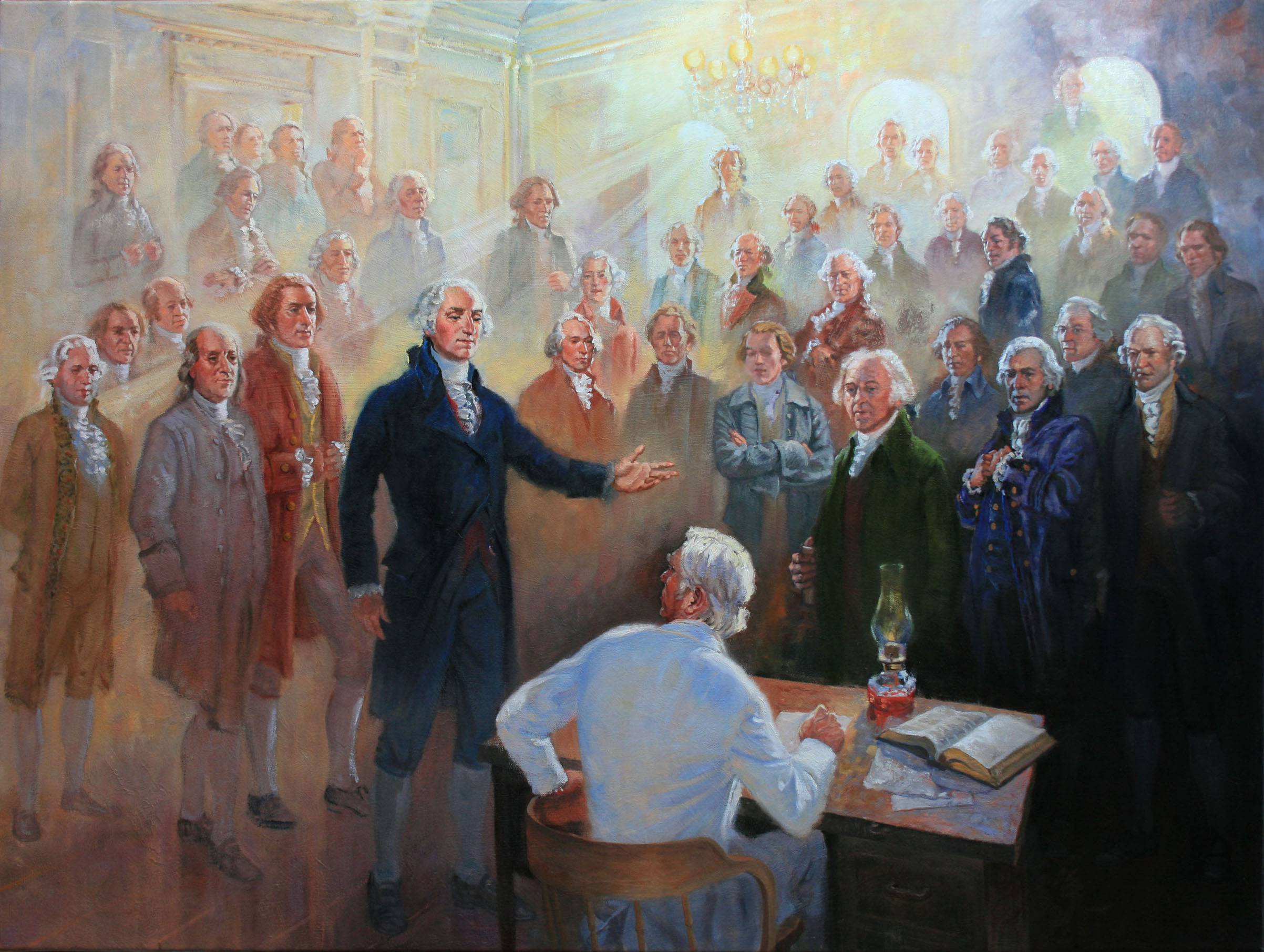
We are moving soon, but the Burley 11th Ward gave me another chance to address them. Since I received a number of requests for a copy of the talk, which is really just a collage of various items I could find online, the Journal of Discourses, the Saints second and third volumes, and other various histories. Here is the text of the talk I wrote, that does not mean it is the talk I gave…
I first addressed the freedoms we have as contrasted in the Saints third volume related to Germany. I said the word Jew and Israel from the stand and did not fear reprisal. I listen to free radio anytime I want and even seek out British radio from time to time and there is nothing illegal. Lastly, we could congregate without the worry of those in our midst about what was said or in the actual act of meeting.
Then to the following:
Declaration of Independence – We hold these truths to be self-evident, that all men are created equal, that they are endowed by their Creator with certain unalienable Rights, that among these are Life, Liberty and the pursuit of Happiness.
George Washington: “The success, which has hitherto attended our united efforts, we owe to the gracious interposition of Heaven, and to that interposition let us gratefully ascribe the praise of victory, and the blessings of peace.”
Alexander Hamilton: “The Sacred Rights of mankind are not to be rummaged from among old parchments or musty records. They are written . . . by the Hand of Divinity itself.” “For my own part, I sincerely esteem it a system, which without the finger of God, never could have been suggested and agreed upon by such a diversity of interests.”
Thomas Jefferson: “The God who gave us life gave us liberty at the same time.”
John Adams: “As I understand the Christian religion, it was, and is, a revelation.”
Benjamin Franklin: “The longer I live the more convincing Proofs I see of this Truth. That God Governs in the Affairs of Men!—And if a Sparrow cannot fall to the Ground without his Notice, is it probable that an Empire can rise without his Aid?—We have been assured, . . . in the Sacred Writings, that ‘except the Lord build the House, they labour in vain that build it.’ I firmly believe this;—and I also believe that without his concurring Aid we shall succeed in this political building no better than Builders of Babel.”
James Madison: “It is impossible for the man of pious reflection not to perceive in it a finger of that Almighty hand which has been so frequently and signally extended to our relief in the critical stages of the revolution.”
Samuel Adams: “Revelation assures us that ‘Righteousness exalteth a Nation’—Communities are dealt with in this World by the wise and just Ruler of the Universe. He rewards or punishes them according to their general Character.”
Charles Pinckney: “When the great work was done and published, I was . . . struck with amazement. Nothing less than that superintending hand of Providence, that so miraculously carried us through the war, . . . could have brought it about so complete, upon the whole.”
On May 4, 1842, he called to his side nine of the most faithful of his brethren—Hyrum Smith, Brigham Young, Heber C. Kimball, Willard Richards, Newell K. Whitney, and others—and later their wives came with them to the upper floor of the Red Brick Store in Nauvoo.
Joseph was seeking to fulfill the promise from D&C 124, given in 1841, which the Lord would reveal to Joseph “all things pertaining to this house, and the priesthood thereof, and the place whereon it shall be built.”
He had started, “If it should be the will of God that I might live.” Then he corrected and said, “It is not the will of the Lord that I should live, and I must give you, here in this upper room, all those glorious plans and principles whereby men are entitled to the fulness of the priesthood.” He proceeded in an improvised and makeshift way to do so.
We have from Brigham Young that after they had received these blessings the Prophet said: “Brother Brigham, this is not arranged right. But we have done the best we could under the circumstances in which we are placed, and I wish you to take this matter in hand and organize and systematize all these ceremonies.”
Brigham Young later said, “I did so. And each time I got something more, so that when we went through the temple at Nauvoo I understood and knew how to place them there. We had our ceremonies pretty correct.”
While the Nauvoo Temple was started in 1841, the first endowments were performed in the winter of 1845 and into 1846. Baptisms had started in the Mississippi River prior to the temple and moved into the temple baptistery soon after it was completed and dedicated, well before the rest of the temple was done. Brigham, leading the church, was personally overseeing the organization and perfection of the endowment and other ordinances that started in Nauvoo.
After arriving in Salt Lake City, the church used the top floor of the Council House, starting in 1852 until the Endowment House was completed in 1855. It was in this building that endowments, prayer circles, some missionary training, and some setting aparts were conducted. The use of the Endowment House ended in 1877 with the completion of the St George Temple. That building stood until Wilford Woodruff heard that unauthorized sealings were occurring there and ordered it razed in 1889.
The St George Temple was the only one completed during Brigham Young’s 30 year tenure as President. It was dedicated on 1 January 1877 in three dedicatory prayers under the direction of Brigham. The baptistery by Wilford Woodruff, the main floor by Erastus Snow, and the sealing room by Brigham Young Jr. Wilford Woodruff served as St George Temple President from 1877 to 1884. Brigham had to be carried up the stairs, but he stood and spoke in the Assembly Room.
“When I think upon this subject, I want the tongues of seven thunders to wake up the people,” he declared. “Can the fathers be saved without us? No. Can we be saved without them? No. And if we do not wake up and cease to long after the things of this earth, we will find that we as individuals will go down to hell.”
Brigham lamented that many Saints were pursuing worldly things. “Supposing we were awake to this thing, namely the salvation of the human family,” he said, “this house would be crowded, as we hope it will be, from Monday morning until Saturday night.”
On 9 January 1877, the first baptisms for the dead were performed in the St George Temple. The first endowment for the dead was performed on 11 January 1877. Brigham and Wilford personally oversaw the ordinances being performed. Wilford began wearing a white suit, starting the trend that continues to this day.
All endowments to this point had been done and passed by word of mouth. It was in St George, far from Salt Lake City, that the ordinances were first written down. Brigham also wanted to make sure the record was preserved and that they were standardized. They were read to Brigham time and time again who would then approve or continue to revise the ordinances. Brigham went home to Salt Lake City in April 1877. He stopped and dedicated the spot for the Manti Temple on the way home.
Wilford Woodruff then wrote in his journal on Sunday 19 August 1877, “I spent the evening in preparing a list of the noted men of the 17 century and 18th, including the signers of the Declaration of Independence and presidents of the United States, for baptism on Tuesday the 21 Aug 1877.”
His journal entry for August 21 reads, “I, Wilford Woodruff, went to the temple of the Lord this morning and was baptized for 100 persons who were dead, including the signers of the Declaration of Independence. … I was baptized for the following names.” He then listed the names of one hundred men.
Elder Woodruff continued his journal entry: “When [John Daniel Thompson] McAllister had baptized me for the 100 names, I baptized him for 21, including Gen. Washington and his forefathers and all the presidents of the United States that were not on my list except Buchanan, Van Buren, and Grant.” (The work for these presidents has since been done.)
“It was a very interesting day,” Elder Woodruff continued. “I felt thankful that we had the privilege and the power to administer for the worthy dead, especially for the signers of the Declaration of Independence, that inasmuch as they had laid the foundation of our Government, that we could do as much for them as they had done for us.
“Sister Lucy Bigelow Young went forth into the font and was baptized for Martha Washington and her family, and seventy of the eminent women of the world. I called upon the brethren and sisters who were present to assist in getting endowments for those that we had been baptized for today.” (Wilford Woodruff’s journal, typescript, vol. 7, Church History Library; spelling and punctuation modernized.)
The first public mention of these events was made nearly a month after the baptisms were performed. In an address in the Tabernacle on Temple Square on 16 September 1877, Elder Woodruff first told publicly of the visitation of the signers of the Declaration of Independence.
“You have had the use of the Endowment House for a number of years, and yet nothing has ever been done for us. We laid the foundation of the government you now enjoy, and we never apostatized from it, but we remained true to it and were faithful to God. (Conference Report, April 10, 1898; Discourses of Wilford Woodruff, pp. 160-61)
During the 68th Annual General Conference of the Church which was held in April 1898, President Woodruff recounted the sacred experience:
I am going to bear my testimony to this assembly, if I never do it again in my life, that those men who laid the foundation of this American government and signed the Declaration of Independence were the best spirits the God of heaven could find on the face of the earth. They were choice spirits, not wicked men. General Washington and all the men that labored for the purpose were inspired of the Lord.
Another thing I am going to say here, because I have a right to say it. Every one of those men that signed the Declaration of Independence, with General Washington, called upon me, as an Apostle of the Lord Jesus Christ, in the Temple at St. George, two consecutive nights, and demanded at my hands that I should go forth and attend to the ordinances of the House of God for them. Men are here, I believe, that know of this, Brother John D. T. McAllister, David H. Cannon and James S. Bleak. Brother McAllister baptized me for all those men, and then I told these brethren that it was their duty to go into the Temple and labor until they had got endowments for all of them. They did it. Would those spirits have called up on me, as an Elder in Israel to perform that work if they had not been noble spirits before God? They would not. (Wilford Woodruff, Conference Report, April 1989, pp. 89-90.)
“They waited on me for two days and two nights,” he said,
“I thought it very singular, that notwithstanding so much work had been done, and yet nothing had been done for them.” (Journal of Discourses, 19:229.)
I was also present in the St. George Temple and witnessed the appearance of the Spirits of the Signers….the spirits of the Presidents….and also others, such as Martin Luther and John Wesley….Who came to Wilford Woodruff and demanded that their baptism and endowments be done. Wilford Woodruff was baptized for all of them. While I and Brothers J.D.T. McAllister and David H Cannon (who were witnesses to the request) were endowed for them. These men… laid the foundation of this American Gov., and signed the Declaration of Independence and were the best spirits the God of Heaven could find on the face of the earth to perform this work. Martin Luther and John Wesley helped to release the people from religious bondage that held them during the dark ages. They also prepared the people’s hearts so they would be ready to receive the restored gospel when the Lord sent it again to men on the earth.” (Personal journal of James Godson Bleak – Chief Recorder of the St. George Temple.)
In 1986, some of the staff of the Family History Library’s LDS Reference Unit were assigned to compile and computerize all the existing genealogical data on the founding fathers, to identify their families, and to document completed temple ordinances for each. For purposes of the project, a founding father was identified as one who had signed one or more of the following documents: the Articles of Association (1774), the Declaration of Independence (1776), the Articles of Confederation (1778), or the Constitution (1787).
The library study of 1986 revealed that there were no sealings of children to parents performed at the time the baptisms and endowments were performed. As a note, the ongoing revelation related to sealings to parents was not revealed until 1894. It was then that the Law of Adoption, or sealing to prominent church leaders, was discontinued and we were encouraged to do genealogical work to compile the pedigree of the entire human family. It was then that the Utah Genealogical Society was founded that has snowballed into the fantastic work of FamilySearch and all its appendages.
He also recorded that George Washington, John Wesley, Benjamin Franklin, and Christopher Columbus were ordained High Priests at the time.
Temple work was performed on behalf of the following well-known and respected men and women in the St. George Utah Temple in August 1877.
Founding Fathers: William Hooper (NC), Joseph Hewes (NC), John Penn (NC), Button Gwinnett (GA), Lyman Hall (GA), George Walton (GA), Edward Rutledge (SC), Thomas Heyward Jr. (SC), Thomas Lynch (SC), Arthur Middleton (SC), Samuel Chase (MD), William Paca (MD), Thomas Stone (MD), Charles Carroll (MD), George Wythe (VA), Richard Henty Lee (VA), Thomas Jefferson (VA), Benjamin Harrison (VA), Thomas Nelson Jr. (VA), Francis Lightfoot Lee (VA), Carter Braxton (VA), Robert Morris (PA), Benjamin Rush (PA), Benjamin Franklin (PA), John Morton (PA), George Clymer (PA), James Smith (PA), George Taylor (PA), James Wilson (PA), George Ross (PA), Caeser Rodney (DE), George Read (DE), Thomas McKean (DE), Philip Livingston (NY), Francis Lewis (NY), Lewis Morris (NY), Richard Stockton (NJ), John Witherspoon (NJ), Francis Hopkinson (NJ), John Hart (NJ), Abraham Clark (NJ), Josiah Bartlett (NH), William Whipple (NH), Matthew Thornton (NH), Samuel Adams (MA), John Adams (MA), Robert Treat Paine (MA), Elbridge Gerry (MA), Stephen Hopkins (RI), William Ellery (RI), Roger Sherman (CN), Samuel Huntington (CN), William Williams (CN), and Oliver Wolcott (CN).
Note: Temple work was not done for John Hancock or William Floyd as it had already been completed previously.
Presidents of the United States: George Washington, John Adams, Thomas Jefferson, James Madison, James Monroe, John Quincy Adams, Andrew Jackson, William Henry Harrison, John Tyler, James Knox Polk, Zachary Taylor, Millard Fillmore, Franklin Pierce, Abraham Lincoln, and Andrew Johnson. Temple work was not done for James Buchanan, Martin Van Buren, or Ulysses S. Grant.
Other eminent men baptized by Wilford Woodruff in the St. George Utah Temple in August 1877 include: Sir Edward Gibbon, Johann Wolfgang von Goethe, Oliver Goldsmith, Henry Grattan, Humboldt, Alexander von Irving, Washington Jackson, Thomas Jonathan “Stonewall” Johnson, Samuel Juarez, Benito Pablo Kemble, John Philip Liebig, Baron Justus von Livingstone, David Macaulay, Thomas Babington Nelson, Lord Horatio O’Connell, Daniel Peabody, George Powers, Hiram Reynolds, Sir Joshua Schiller, Johann Christoph Friedrich von Scott, Sir Walter Seward, William Henry Stephenson, George Thackeray, William Makepeace, Vespucci, Amerigo Webster, Daniel Wesley, John Wordsworth, William Parepa, Count Dimitrius, Martha Washington and her family, John Washington (Great Grandfather of George Washington), Sir Henry Washington, Lawrence Washington (Brother of George Washington), Augustine Washington (Father of George Washington), Lawrence Washington (Father of Augustine), Lawrence Washington, Daniel Park Custis, John Park Custis (Son of Daniel and Martha Parke Custis), and Martin Luther.
Eminent Women baptized include: Jean Armour (1767—1834) of Scotland, Jean Armour Burns (Wife of Robert Burns) (1759—1796), Jane Austen (1775—1817) of England, novelist, Mary Ball (1708—1789) of America, Mary Ball Washington (Mother of George Washington) (1732—1799), Sarah Bernard (1800—1879) of England, Sarah Barnard Faraday (wife of Michael Faraday (1791—1867), Charlotte Bronte (1816—1855) of England, novelist, Felicia Dorothea Browne (1793—1835) of England, Elizabeth Barrett Browning (1806—1861) of England, poet, (wife of Robert Browning) (1812—18?), Martha Caldwell Calhoun (d. 1802) of America (mother of John Caldwell Calhoun) (1782—1850), Martha Parke Custis (1755—1773) of America (Daughter of Martha Washington) (1732—1802), Martha Dandridge Washington (1732—1802) of America (wife of George Washington) (1732—1799), Rachel Donelson Jackson (1767—1828) of America (wife of Andrew Jackson (1767—1845), and Abigail Eastman Webster (1737—1816) of America (mother of Daniel Webster (1782—1852), to name but a few. Temple work was performed for a total of 70 eminent women.
During most of our national history Columbus and the Founders were considered heroes with determination and foresight. Cities, rivers, and many other places were named after them. More recently there has been a wide spread effort, designed especially to indoctrinate young people, which slanders Columbus, the Founders and their accomplishments. Columbus is held personally responsible for centuries of mistreatment of Native Americans. The Founders are portrayed as being greedy and motivated by selfish interests. All of this is as astonishing as it is misleading.
From the Lord’s perspective among the most important events of the history of the world was the discovery and founding of America. 1 Ne 11-14. Nephi was referring to Columbus when he wrote: “I looked and beheld a man among the Gentiles, who was separated from the seed of my brethren by the many waters; and I beheld the Spirit of God, that it came down and wrought upon the man; and he went forth upon the many waters, even unto the seed of my brethren, who were in the promised land” 1 Ne 13:12. By the Founders “the Lord God will raise up a mighty nation…even on the face of this land.” 1 Ne 22:7.
Go on to life and history of George Ross of Pennsylvania, signer of Declaration of Independence.

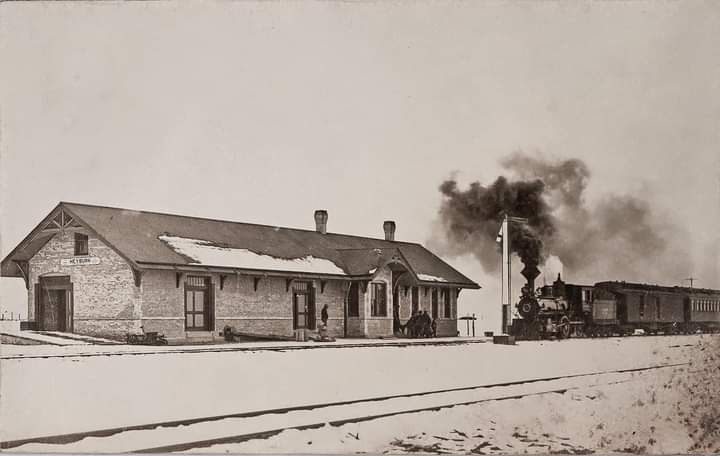
This photo popped up a while ago on an Idaho History Page. I downloaded the photograph and wanted to share it. The photo is of the Heyburn Train Depot in the very early days of the City.
Growing up in the area, I never thought much of Heyburn. It was just in the middle as we were going somewhere. Now that I am the City Attorney, I have learned much more of Heyburn, its past and its future.
Heyburn’s name was changed from Riverton as apparently the Post Office thought there were too many. Senator Weldon Brinton Heyburn represented Idaho in the United States Congress at the time. He was a big man and had served Idaho since 1903. He collapsed on the Senate floor in 1912 and died some time later.
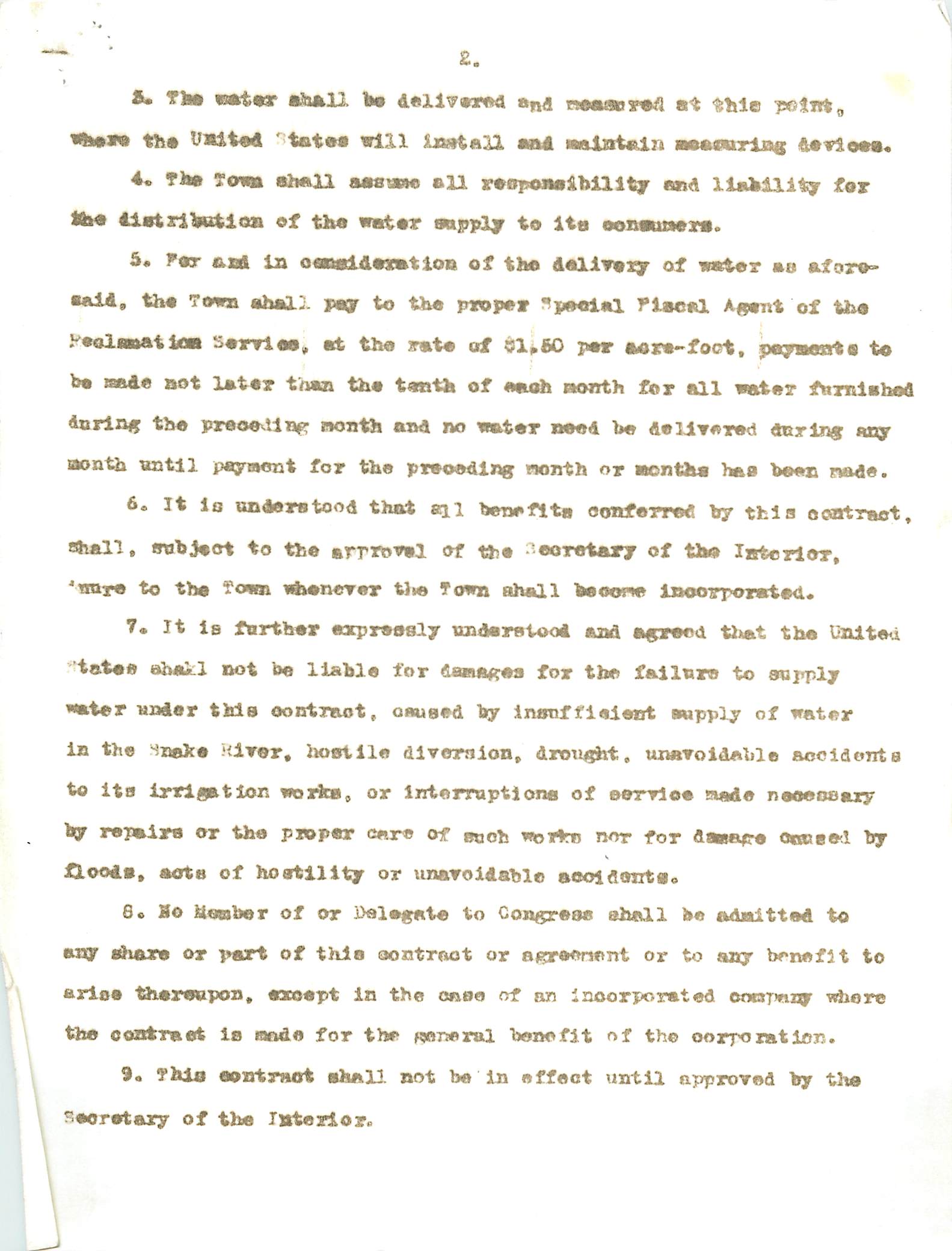
As an interesting bit of history, I thought I would share this Bureau of Reclamation contract with Heyburn from 1910.
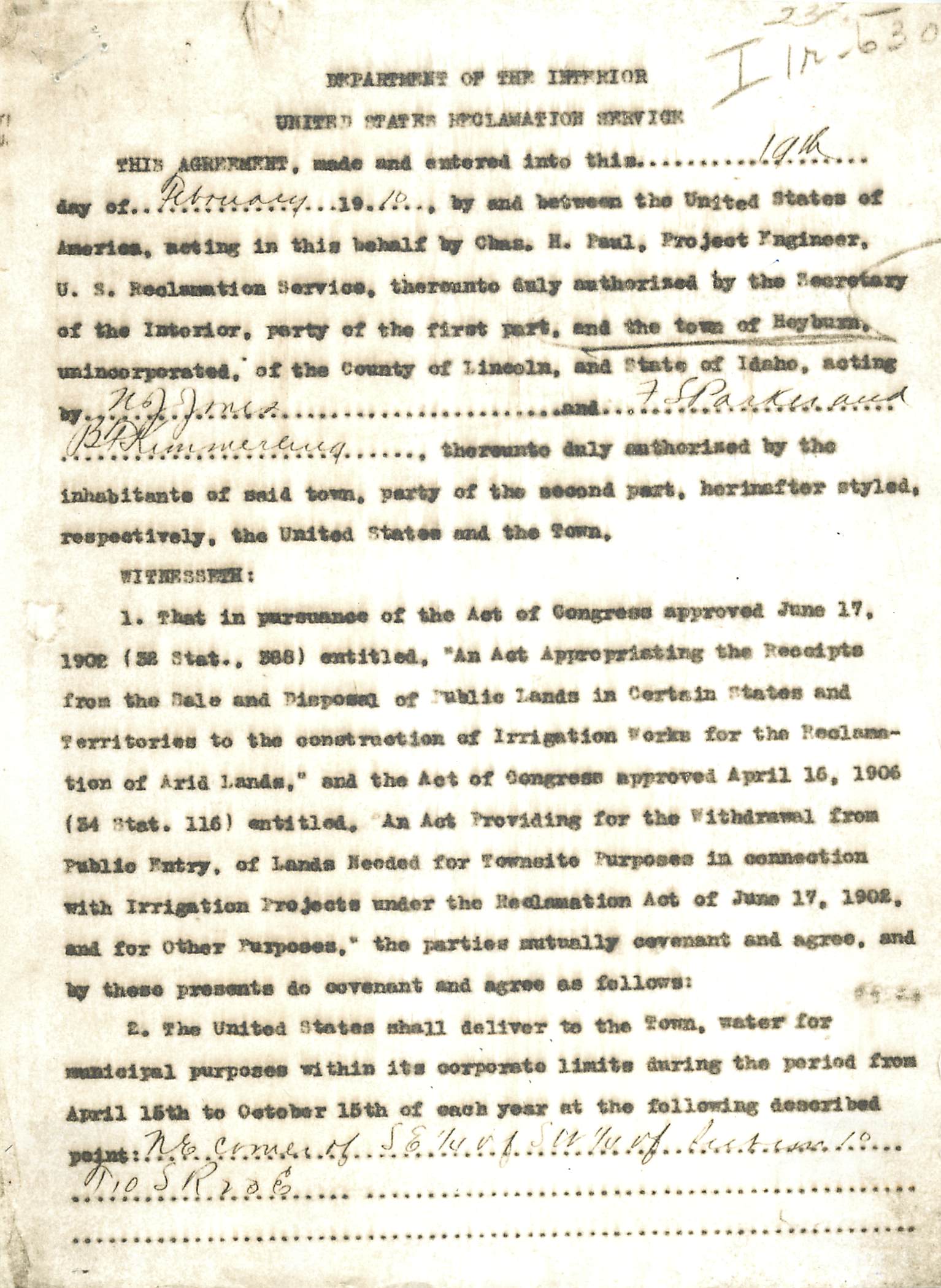
As you can see, the contract is between the unincorporated Town of Heyburn and the United States Reclamation Service. I am not entirely clear how an unincorporated town signs a contract. Minidoka County had not been created yet, that is 3 years later, so this is in Lincoln County. Acting for the now Bureau of Reclamation was Charles H Paul, the project engineer for the construction of the Minidoka Dam and delivery system. As you can see, the contract is dated 19 February 1910. The City of Paul is named after Charles Howard Paul (1875-1941).
This was the agreement for the Bureau to delivery water for irrigation to the City each year. This contract is still in place.


Heyburn was incorporated in Lincoln County, Idaho on 18 January 1911.
Lincoln County Board of Commissioners Minutes, Book #2, pages 285-286:
“In the matter of the incorporation of the Village of Heyburn. This matter came on regularly to be heard and it appearing to the Board that a petition signed by a majority of the taxable inhabitants of the proposed Village of Heyburn, Lincoln County, Idaho, has been presented and duly filed, praying that they may be incorporated as a Village, designating “Heyburn” as the name they wish to assume and describing the metes and bounds of the proposed Village, and the Board being satisfied that a majority of the taxable inhabitants of the proposed Village have signed such petition, and that such proposed Village has not heretofore been incorporated under any law of this State, it is therefore ordered and declared that the said Village proposed in said petition be and the same is hereby incorporated under the name of the “Village of Heyburn” with metes and bounds as follows:
5 miles to the northeast corner of Section 1, thence south 10 miles to the southeast corner of Section 24 Township 8 South Range 15 East, thence west 6 miles to the southwest corner of Section 19, thence north 2 miles, thence west 1 mile, thence north 1 mile, thence west ½ mile, thence north 1 mile to the quarter corner on the north of Section 2 Township 8 South Range 14 East, thence west ½ mile to the place of beginning.
Lincoln County Board of Commissioners Minutes, Book #2, pages 287:
“In the matter of the appointment of five persons as Trustees of the Village of Heyburn duly incorporated and this being the time of the incorporation of said Village and for the appointment of Trustees for the same pursuant to law; therefore it is ordered by the Board that the following named persons possessing the qualifications provided by statute be and they are hereby appointed Trustees of the said incorporated Village of Heyburn to hold their office and perform all the duties required of them as such Trustees by law until the election and qualification of their successors: T. J. Smith, F. H. Adams, B. F. Kimerling, Lee St Clair, and George E. Schroeder.
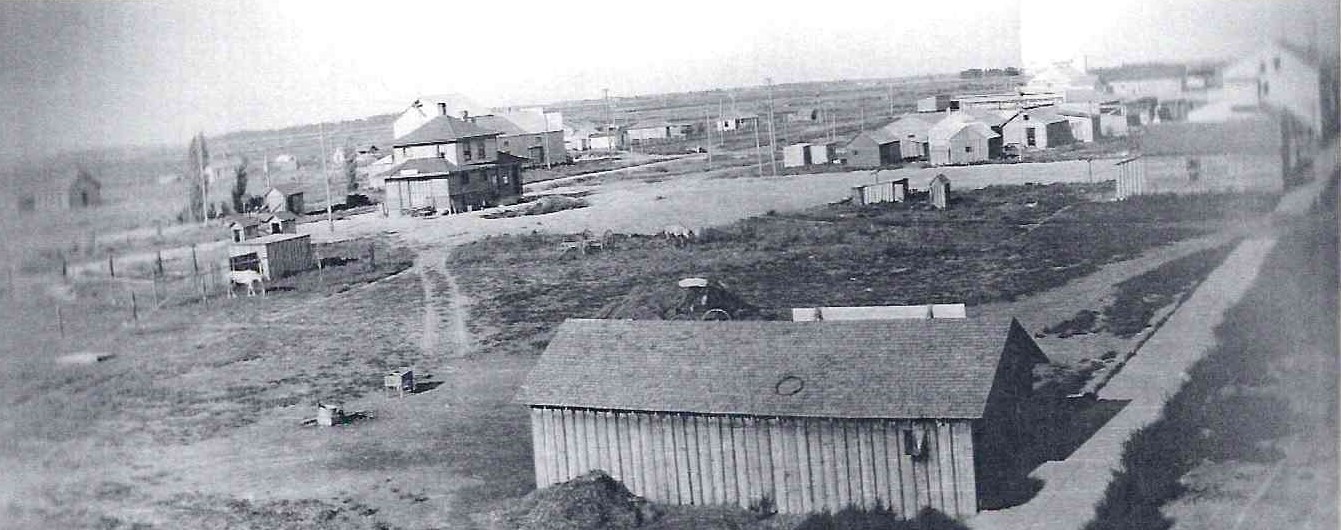
Paul Idaho Train Depot
Another old photo of Paul, Idaho. To the left, center of the photo is the Paul Train Depot. The depot was located about half way between Main Street and 1st West Street on the north side of West Railroad Street and south of the tracks. This photo was very early on, probably before 1917 as the Amalgamated drainage ditch does not appear in to be running through the photo. Also, the buggy in the front and no parked cars elsewhere provide some hint.
Immediately behind from this view and across the tracks is the Watson Farm Supply Building.

Watson Farm Supply
Looking east down Idaho Street you can see the back side of Merrill’s Food Market. On the following photo, you can see the north side of that building on the right side of Main Street before the bricked Adams Building.

Main Street near the tracks looking South in Paul, Idaho
If you look out to the very far left of the photo with the depot, you can see the first school in Paul. That school was located on James Ellis land. I don’t know when that school was built or when it was replaced with a school virtually in the block behind where this photo was taken.

Paul Idaho Train Depot
For Father’s Day this year, I thought I would reach back to 2011. My grandfather, Milo James Ross, turned 90 on 4 February 2011. For that grand event, the Ross/Donaldson families, and Plain City community came together to celebrate. I have loaded most of the photos from that day on to FamilySearch, I only share a few of the family pictures from that day.
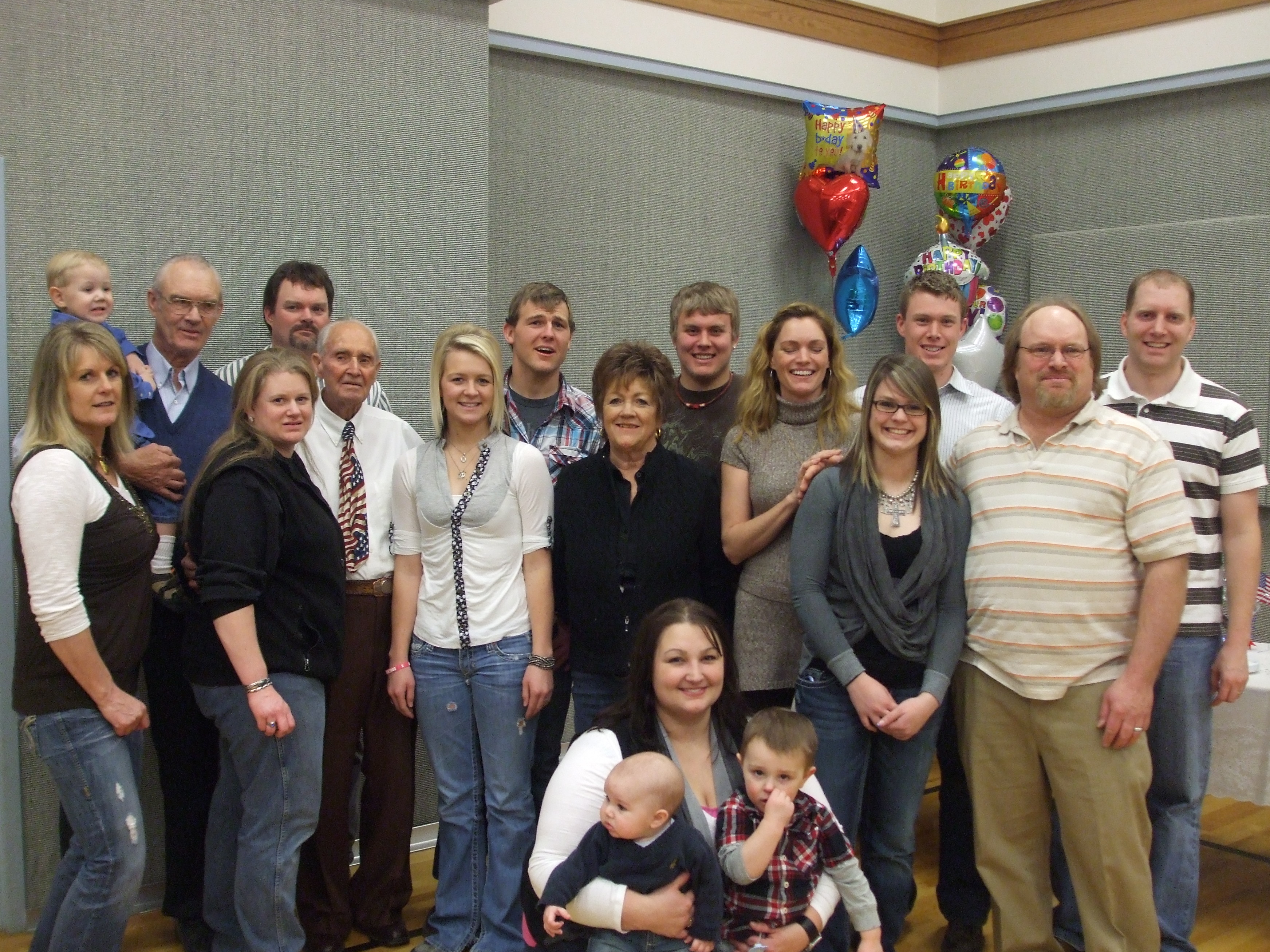
Whole Ross Clan: (l-r) Cindy Adams, Milo Ross (holding Daniel Constable), Andra Ross, Jeffrey Ross, Milo Ross, Tanisha Adams, Cody Adams, Caroline Gallegos, Jerrett Ross, Becky Patterson, Mercedes Ross, Matthew Ross, Scott Ross, Paul Ross; Front Stefanie Hadley holding Gavyn and Kayden Hadley.
This photo holds a good portion of the Ross descendants. A couple of four generations in this photo.
The celebration was held in a building that Grandpa helped orchestrate construction from the original donation of the land (stretching back over 70 years) to its actual erection. He was a ardent supporter of the United States flag and the Boy Scouts rewarded him accordingly.
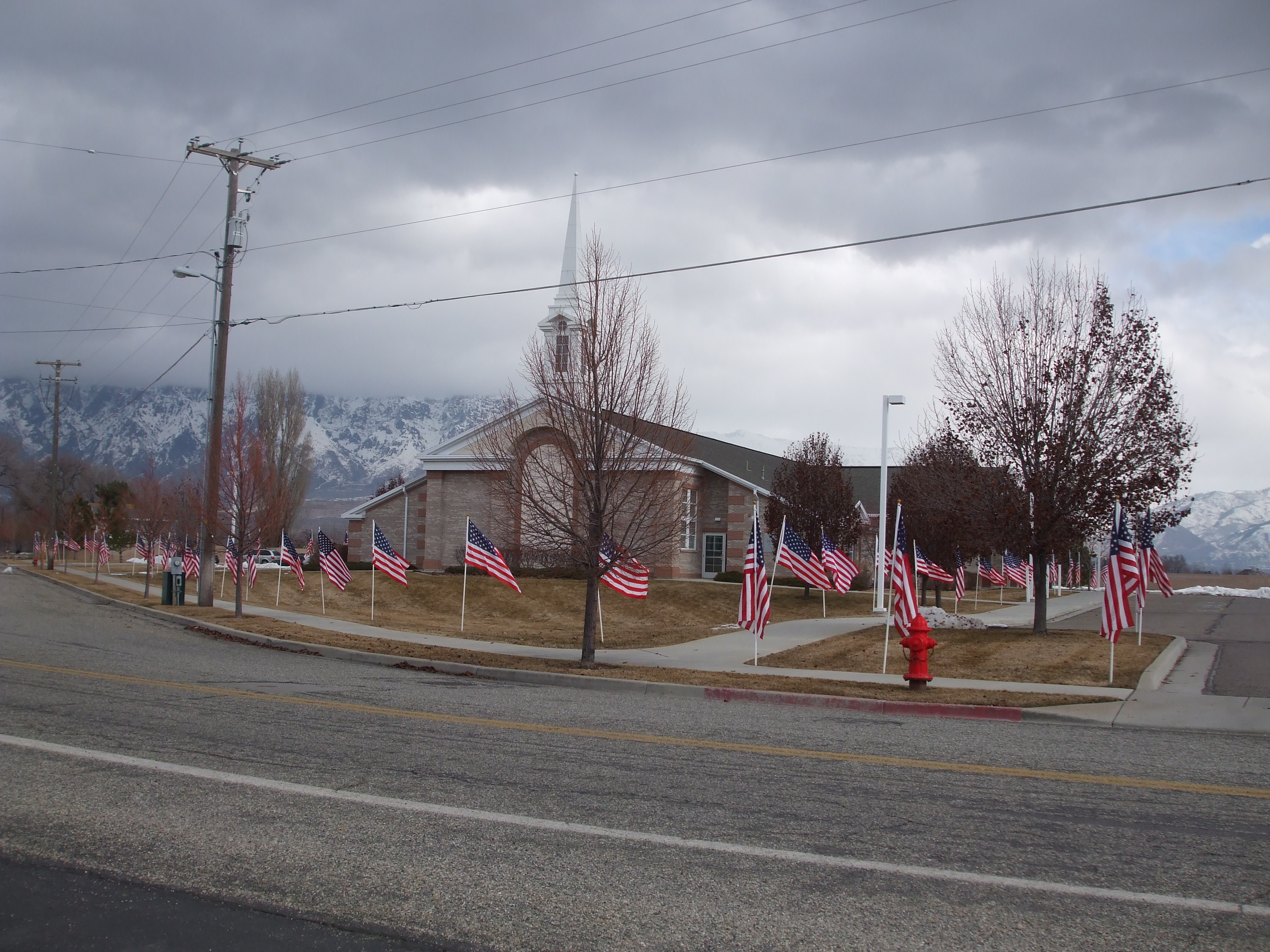
Plain City 2/7/8 Ward Building at 2952 North 4200 West decorated for Grandpa’s 90th Birthday Party
Family and friends came from Oregon and Washington, I came from Oklahoma, others from Colorado. Most came from nearby in Idaho and Utah.

Ross Boys: Paul Ross, Matt Ross, Milo Ross, Daniel Constable, Jeff Ross, Milo Ross, Jerrett Ross, Scott Ross (holding Gavyn Hadley) and Kayden Hadley
Here is a picture of Dad, Grandpa, and Caroline.

Milo Paul, Milo James, Caroline

Kristy Neilson, Tanisha Adams, Cody Adams, Jeneal Adams, Bret Adams, Cindy Adams
And to wrap up, the one that seems to be the best. Grandpa’s big smile.

Million Dollar Smile
An interesting side note, Grandpa had shrapnel in his face. As time continued its march, some of his teeth started to die and break off. He had a bridge and various other problems. But this smile has a piece of shrapnel behind his upper lip that bothered him his entire life.

Milo Ross, Jeneal Adams
Main Street near the tracks looking South in Paul, Idaho
This is another photo that caught my eye. I can almost imagine myself in the image because this is my home town.
This picture is taken from atop the Watson Farm Supply Store. Here is a picture of that building.
Watson Farm Supply
The two story building on the right is the Merrill’s Food Market.
The brick two-story building behind is the Adams Building. Here is photo of it from the east looking west.

Adams Block, Paul, Idaho
Across the street from Merrill’s is Feeders Grain. Here is a picture of it.

Feeders Grain
 Sagacity