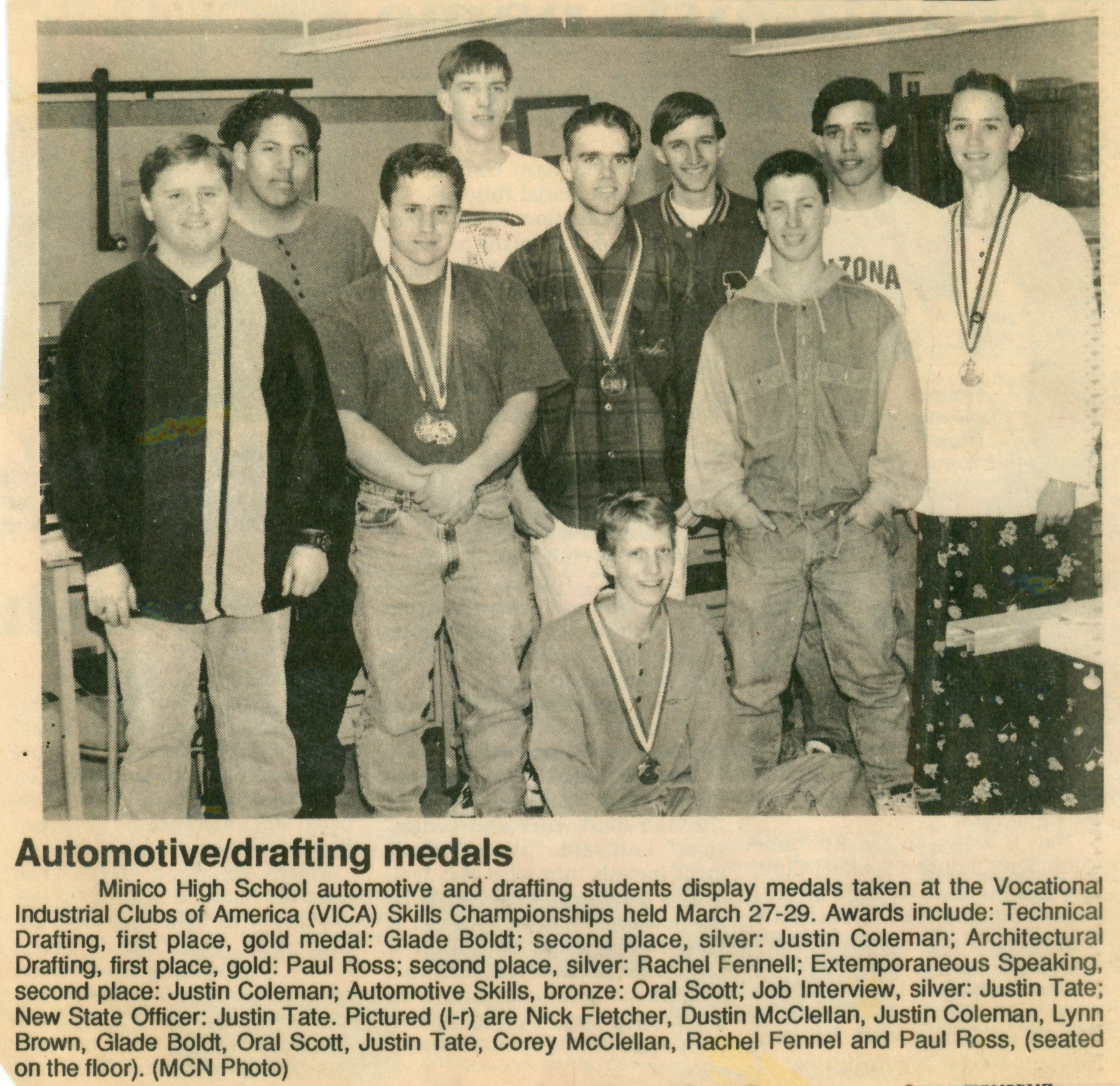
Minico High School automotive and drafting students display medals taken at the Vocational Industrial Clubs of America (VICA) Skills Championships held March 27-29. Awards include: Technical Drafting, first place, gold medal: Glade Boldt; second place, silver: Justin Coleman; Architectural Drafting, first place, gold: Paul Ross; second place, silver: Rachel Fennell; Extemporaneous Speaking, second place: Justin Coleman; Automotive Skills, bronze: Oral Scott; Job Interview, silver: Justin Tate; New State Officer: Justin Tate. Pictured (;-r) are Nick Fletcher, Dustin McClellan, Justin Coleman, Lynn Brown, Glade Boldt, Oral Scott, Justin Tate, Corey McClellan, Rachel Fennell and Paul Ross, (seated on the floor).
I remember a few things about this trip to Lewis-Clark State College in Lewiston, Idaho. It was a really long drive, or so it seemed to me. I got motion sick on the winding road to Lewiston from Boise. Multiple times we had to stop so I could throw up. I had let my hair grow longer than I ever had and it was a new sensation and some made fun of me because I kept messing with it. I remember just thinking Lewiston was a run-down town. Which must be saying something for the boy coming from Paul, Idaho!
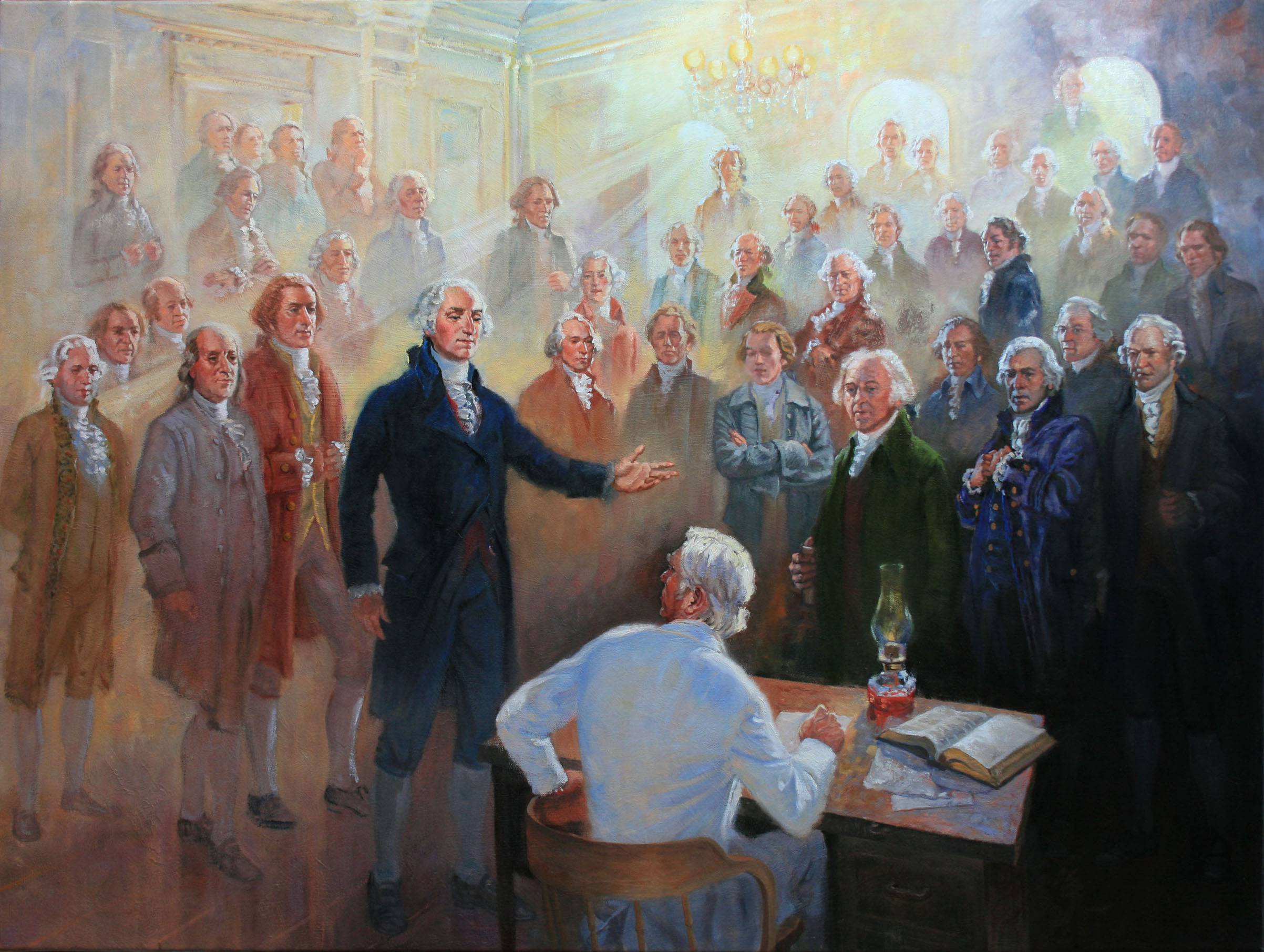
Wilford Woodruff’s vision of the Founding Fathers requesting Temple Ordinances
We are moving soon, but the Burley 11th Ward gave me another chance to address them. Since I received a number of requests for a copy of the talk, which is really just a collage of various items I could find online, the Journal of Discourses, the Saints second and third volumes, and other various histories. Here is the text of the talk I wrote, that does not mean it is the talk I gave…
I first addressed the freedoms we have as contrasted in the Saints third volume related to Germany. I said the word Jew and Israel from the stand and did not fear reprisal. I listen to free radio anytime I want and even seek out British radio from time to time and there is nothing illegal. Lastly, we could congregate without the worry of those in our midst about what was said or in the actual act of meeting.
Then to the following:
Declaration of Independence – We hold these truths to be self-evident, that all men are created equal, that they are endowed by their Creator with certain unalienable Rights, that among these are Life, Liberty and the pursuit of Happiness.
George Washington: “The success, which has hitherto attended our united efforts, we owe to the gracious interposition of Heaven, and to that interposition let us gratefully ascribe the praise of victory, and the blessings of peace.”
Alexander Hamilton: “The Sacred Rights of mankind are not to be rummaged from among old parchments or musty records. They are written . . . by the Hand of Divinity itself.” “For my own part, I sincerely esteem it a system, which without the finger of God, never could have been suggested and agreed upon by such a diversity of interests.”
Thomas Jefferson: “The God who gave us life gave us liberty at the same time.”
John Adams: “As I understand the Christian religion, it was, and is, a revelation.”
Benjamin Franklin: “The longer I live the more convincing Proofs I see of this Truth. That God Governs in the Affairs of Men!—And if a Sparrow cannot fall to the Ground without his Notice, is it probable that an Empire can rise without his Aid?—We have been assured, . . . in the Sacred Writings, that ‘except the Lord build the House, they labour in vain that build it.’ I firmly believe this;—and I also believe that without his concurring Aid we shall succeed in this political building no better than Builders of Babel.”
James Madison: “It is impossible for the man of pious reflection not to perceive in it a finger of that Almighty hand which has been so frequently and signally extended to our relief in the critical stages of the revolution.”
Samuel Adams: “Revelation assures us that ‘Righteousness exalteth a Nation’—Communities are dealt with in this World by the wise and just Ruler of the Universe. He rewards or punishes them according to their general Character.”
Charles Pinckney: “When the great work was done and published, I was . . . struck with amazement. Nothing less than that superintending hand of Providence, that so miraculously carried us through the war, . . . could have brought it about so complete, upon the whole.”
On May 4, 1842, he called to his side nine of the most faithful of his brethren—Hyrum Smith, Brigham Young, Heber C. Kimball, Willard Richards, Newell K. Whitney, and others—and later their wives came with them to the upper floor of the Red Brick Store in Nauvoo.
Joseph was seeking to fulfill the promise from D&C 124, given in 1841, which the Lord would reveal to Joseph “all things pertaining to this house, and the priesthood thereof, and the place whereon it shall be built.”
He had started, “If it should be the will of God that I might live.” Then he corrected and said, “It is not the will of the Lord that I should live, and I must give you, here in this upper room, all those glorious plans and principles whereby men are entitled to the fulness of the priesthood.” He proceeded in an improvised and makeshift way to do so.
We have from Brigham Young that after they had received these blessings the Prophet said: “Brother Brigham, this is not arranged right. But we have done the best we could under the circumstances in which we are placed, and I wish you to take this matter in hand and organize and systematize all these ceremonies.”
Brigham Young later said, “I did so. And each time I got something more, so that when we went through the temple at Nauvoo I understood and knew how to place them there. We had our ceremonies pretty correct.”
While the Nauvoo Temple was started in 1841, the first endowments were performed in the winter of 1845 and into 1846. Baptisms had started in the Mississippi River prior to the temple and moved into the temple baptistery soon after it was completed and dedicated, well before the rest of the temple was done. Brigham, leading the church, was personally overseeing the organization and perfection of the endowment and other ordinances that started in Nauvoo.
After arriving in Salt Lake City, the church used the top floor of the Council House, starting in 1852 until the Endowment House was completed in 1855. It was in this building that endowments, prayer circles, some missionary training, and some setting aparts were conducted. The use of the Endowment House ended in 1877 with the completion of the St George Temple. That building stood until Wilford Woodruff heard that unauthorized sealings were occurring there and ordered it razed in 1889.
The St George Temple was the only one completed during Brigham Young’s 30 year tenure as President. It was dedicated on 1 January 1877 in three dedicatory prayers under the direction of Brigham. The baptistery by Wilford Woodruff, the main floor by Erastus Snow, and the sealing room by Brigham Young Jr. Wilford Woodruff served as St George Temple President from 1877 to 1884. Brigham had to be carried up the stairs, but he stood and spoke in the Assembly Room.
“When I think upon this subject, I want the tongues of seven thunders to wake up the people,” he declared. “Can the fathers be saved without us? No. Can we be saved without them? No. And if we do not wake up and cease to long after the things of this earth, we will find that we as individuals will go down to hell.”
Brigham lamented that many Saints were pursuing worldly things. “Supposing we were awake to this thing, namely the salvation of the human family,” he said, “this house would be crowded, as we hope it will be, from Monday morning until Saturday night.”
On 9 January 1877, the first baptisms for the dead were performed in the St George Temple. The first endowment for the dead was performed on 11 January 1877. Brigham and Wilford personally oversaw the ordinances being performed. Wilford began wearing a white suit, starting the trend that continues to this day.
All endowments to this point had been done and passed by word of mouth. It was in St George, far from Salt Lake City, that the ordinances were first written down. Brigham also wanted to make sure the record was preserved and that they were standardized. They were read to Brigham time and time again who would then approve or continue to revise the ordinances. Brigham went home to Salt Lake City in April 1877. He stopped and dedicated the spot for the Manti Temple on the way home.
Wilford Woodruff then wrote in his journal on Sunday 19 August 1877, “I spent the evening in preparing a list of the noted men of the 17 century and 18th, including the signers of the Declaration of Independence and presidents of the United States, for baptism on Tuesday the 21 Aug 1877.”
His journal entry for August 21 reads, “I, Wilford Woodruff, went to the temple of the Lord this morning and was baptized for 100 persons who were dead, including the signers of the Declaration of Independence. … I was baptized for the following names.” He then listed the names of one hundred men.
Elder Woodruff continued his journal entry: “When [John Daniel Thompson] McAllister had baptized me for the 100 names, I baptized him for 21, including Gen. Washington and his forefathers and all the presidents of the United States that were not on my list except Buchanan, Van Buren, and Grant.” (The work for these presidents has since been done.)
“It was a very interesting day,” Elder Woodruff continued. “I felt thankful that we had the privilege and the power to administer for the worthy dead, especially for the signers of the Declaration of Independence, that inasmuch as they had laid the foundation of our Government, that we could do as much for them as they had done for us.
“Sister Lucy Bigelow Young went forth into the font and was baptized for Martha Washington and her family, and seventy of the eminent women of the world. I called upon the brethren and sisters who were present to assist in getting endowments for those that we had been baptized for today.” (Wilford Woodruff’s journal, typescript, vol. 7, Church History Library; spelling and punctuation modernized.)
The first public mention of these events was made nearly a month after the baptisms were performed. In an address in the Tabernacle on Temple Square on 16 September 1877, Elder Woodruff first told publicly of the visitation of the signers of the Declaration of Independence.
“You have had the use of the Endowment House for a number of years, and yet nothing has ever been done for us. We laid the foundation of the government you now enjoy, and we never apostatized from it, but we remained true to it and were faithful to God. (Conference Report, April 10, 1898; Discourses of Wilford Woodruff, pp. 160-61)
During the 68th Annual General Conference of the Church which was held in April 1898, President Woodruff recounted the sacred experience:
I am going to bear my testimony to this assembly, if I never do it again in my life, that those men who laid the foundation of this American government and signed the Declaration of Independence were the best spirits the God of heaven could find on the face of the earth. They were choice spirits, not wicked men. General Washington and all the men that labored for the purpose were inspired of the Lord.
Another thing I am going to say here, because I have a right to say it. Every one of those men that signed the Declaration of Independence, with General Washington, called upon me, as an Apostle of the Lord Jesus Christ, in the Temple at St. George, two consecutive nights, and demanded at my hands that I should go forth and attend to the ordinances of the House of God for them. Men are here, I believe, that know of this, Brother John D. T. McAllister, David H. Cannon and James S. Bleak. Brother McAllister baptized me for all those men, and then I told these brethren that it was their duty to go into the Temple and labor until they had got endowments for all of them. They did it. Would those spirits have called up on me, as an Elder in Israel to perform that work if they had not been noble spirits before God? They would not. (Wilford Woodruff, Conference Report, April 1989, pp. 89-90.)
“They waited on me for two days and two nights,” he said,
“I thought it very singular, that notwithstanding so much work had been done, and yet nothing had been done for them.” (Journal of Discourses, 19:229.)
I was also present in the St. George Temple and witnessed the appearance of the Spirits of the Signers….the spirits of the Presidents….and also others, such as Martin Luther and John Wesley….Who came to Wilford Woodruff and demanded that their baptism and endowments be done. Wilford Woodruff was baptized for all of them. While I and Brothers J.D.T. McAllister and David H Cannon (who were witnesses to the request) were endowed for them. These men… laid the foundation of this American Gov., and signed the Declaration of Independence and were the best spirits the God of Heaven could find on the face of the earth to perform this work. Martin Luther and John Wesley helped to release the people from religious bondage that held them during the dark ages. They also prepared the people’s hearts so they would be ready to receive the restored gospel when the Lord sent it again to men on the earth.” (Personal journal of James Godson Bleak – Chief Recorder of the St. George Temple.)
In 1986, some of the staff of the Family History Library’s LDS Reference Unit were assigned to compile and computerize all the existing genealogical data on the founding fathers, to identify their families, and to document completed temple ordinances for each. For purposes of the project, a founding father was identified as one who had signed one or more of the following documents: the Articles of Association (1774), the Declaration of Independence (1776), the Articles of Confederation (1778), or the Constitution (1787).
The library study of 1986 revealed that there were no sealings of children to parents performed at the time the baptisms and endowments were performed. As a note, the ongoing revelation related to sealings to parents was not revealed until 1894. It was then that the Law of Adoption, or sealing to prominent church leaders, was discontinued and we were encouraged to do genealogical work to compile the pedigree of the entire human family. It was then that the Utah Genealogical Society was founded that has snowballed into the fantastic work of FamilySearch and all its appendages.
He also recorded that George Washington, John Wesley, Benjamin Franklin, and Christopher Columbus were ordained High Priests at the time.
Temple work was performed on behalf of the following well-known and respected men and women in the St. George Utah Temple in August 1877.
Founding Fathers: William Hooper (NC), Joseph Hewes (NC), John Penn (NC), Button Gwinnett (GA), Lyman Hall (GA), George Walton (GA), Edward Rutledge (SC), Thomas Heyward Jr. (SC), Thomas Lynch (SC), Arthur Middleton (SC), Samuel Chase (MD), William Paca (MD), Thomas Stone (MD), Charles Carroll (MD), George Wythe (VA), Richard Henty Lee (VA), Thomas Jefferson (VA), Benjamin Harrison (VA), Thomas Nelson Jr. (VA), Francis Lightfoot Lee (VA), Carter Braxton (VA), Robert Morris (PA), Benjamin Rush (PA), Benjamin Franklin (PA), John Morton (PA), George Clymer (PA), James Smith (PA), George Taylor (PA), James Wilson (PA), George Ross (PA), Caeser Rodney (DE), George Read (DE), Thomas McKean (DE), Philip Livingston (NY), Francis Lewis (NY), Lewis Morris (NY), Richard Stockton (NJ), John Witherspoon (NJ), Francis Hopkinson (NJ), John Hart (NJ), Abraham Clark (NJ), Josiah Bartlett (NH), William Whipple (NH), Matthew Thornton (NH), Samuel Adams (MA), John Adams (MA), Robert Treat Paine (MA), Elbridge Gerry (MA), Stephen Hopkins (RI), William Ellery (RI), Roger Sherman (CN), Samuel Huntington (CN), William Williams (CN), and Oliver Wolcott (CN).
Note: Temple work was not done for John Hancock or William Floyd as it had already been completed previously.
Presidents of the United States: George Washington, John Adams, Thomas Jefferson, James Madison, James Monroe, John Quincy Adams, Andrew Jackson, William Henry Harrison, John Tyler, James Knox Polk, Zachary Taylor, Millard Fillmore, Franklin Pierce, Abraham Lincoln, and Andrew Johnson. Temple work was not done for James Buchanan, Martin Van Buren, or Ulysses S. Grant.
Other eminent men baptized by Wilford Woodruff in the St. George Utah Temple in August 1877 include: Sir Edward Gibbon, Johann Wolfgang von Goethe, Oliver Goldsmith, Henry Grattan, Humboldt, Alexander von Irving, Washington Jackson, Thomas Jonathan “Stonewall” Johnson, Samuel Juarez, Benito Pablo Kemble, John Philip Liebig, Baron Justus von Livingstone, David Macaulay, Thomas Babington Nelson, Lord Horatio O’Connell, Daniel Peabody, George Powers, Hiram Reynolds, Sir Joshua Schiller, Johann Christoph Friedrich von Scott, Sir Walter Seward, William Henry Stephenson, George Thackeray, William Makepeace, Vespucci, Amerigo Webster, Daniel Wesley, John Wordsworth, William Parepa, Count Dimitrius, Martha Washington and her family, John Washington (Great Grandfather of George Washington), Sir Henry Washington, Lawrence Washington (Brother of George Washington), Augustine Washington (Father of George Washington), Lawrence Washington (Father of Augustine), Lawrence Washington, Daniel Park Custis, John Park Custis (Son of Daniel and Martha Parke Custis), and Martin Luther.
Eminent Women baptized include: Jean Armour (1767—1834) of Scotland, Jean Armour Burns (Wife of Robert Burns) (1759—1796), Jane Austen (1775—1817) of England, novelist, Mary Ball (1708—1789) of America, Mary Ball Washington (Mother of George Washington) (1732—1799), Sarah Bernard (1800—1879) of England, Sarah Barnard Faraday (wife of Michael Faraday (1791—1867), Charlotte Bronte (1816—1855) of England, novelist, Felicia Dorothea Browne (1793—1835) of England, Elizabeth Barrett Browning (1806—1861) of England, poet, (wife of Robert Browning) (1812—18?), Martha Caldwell Calhoun (d. 1802) of America (mother of John Caldwell Calhoun) (1782—1850), Martha Parke Custis (1755—1773) of America (Daughter of Martha Washington) (1732—1802), Martha Dandridge Washington (1732—1802) of America (wife of George Washington) (1732—1799), Rachel Donelson Jackson (1767—1828) of America (wife of Andrew Jackson (1767—1845), and Abigail Eastman Webster (1737—1816) of America (mother of Daniel Webster (1782—1852), to name but a few. Temple work was performed for a total of 70 eminent women.
During most of our national history Columbus and the Founders were considered heroes with determination and foresight. Cities, rivers, and many other places were named after them. More recently there has been a wide spread effort, designed especially to indoctrinate young people, which slanders Columbus, the Founders and their accomplishments. Columbus is held personally responsible for centuries of mistreatment of Native Americans. The Founders are portrayed as being greedy and motivated by selfish interests. All of this is as astonishing as it is misleading.
From the Lord’s perspective among the most important events of the history of the world was the discovery and founding of America. 1 Ne 11-14. Nephi was referring to Columbus when he wrote: “I looked and beheld a man among the Gentiles, who was separated from the seed of my brethren by the many waters; and I beheld the Spirit of God, that it came down and wrought upon the man; and he went forth upon the many waters, even unto the seed of my brethren, who were in the promised land” 1 Ne 13:12. By the Founders “the Lord God will raise up a mighty nation…even on the face of this land.” 1 Ne 22:7.
Go on to life and history of George Ross of Pennsylvania, signer of Declaration of Independence.
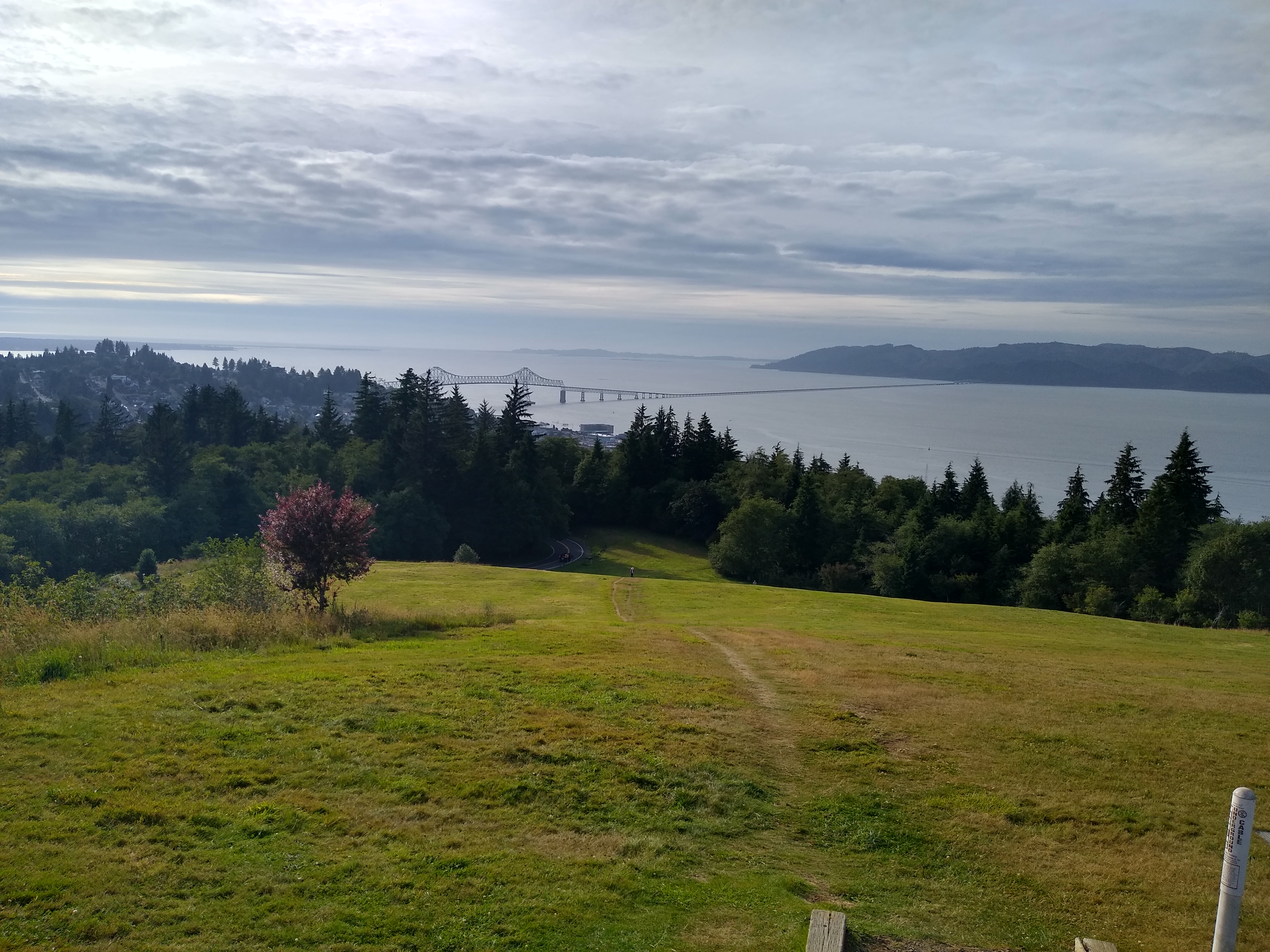
On 7 August 2020, the Ross Clan arrived at Astoria, Oregon. We had driven from Forks, Washington, and was headed to Seaside, Oregon. We wanted to make a stop at the Astoria Column and we had children who needed a bathroom break.
Astoria-Megler Bridge and the Columbia River
As you can see from this photo, we were too late on the potty break.
James waiting for a diaper change. Yes, the puddle under him is his too. Notice how wet his pants are?
James after his diaper change and the still damp bench from where he was seated earlier.
Can you see the look in his eye? “Dad, are you really going to take a picture of me and my remnant wet spot on the bench?”
Here is a shot of the Astoria Column, which was closed by the time we arrived. We have been here twice now and failed to get here while it was open.
Astoria Column with our Nissan Quest.
Last, a photo I took looking to the north. Imagine the awe of Lewis and Clark?
I previously wrote of an interesting incident I had with Aliza in the Plain City, Utah Cemetery. I have thought about that several more times as we have been back to visit. It seems fitting I finally follow up and provide some additional information on William and Martha Wayment.
Aliza with William and Martha Wayment tombstone in 2016
James, Amanda, Lillian, Aliza, and Hiram Ross with tombstones for Martha and William Wayment in 2020. My William Edward Stoker’s tombstone is in the background.
As you can see, there is a little biography poster for Memorial Day. The history there is pretty brief. I found a couple of histories on William and Martha. I am posting these two for the history to be available for my children, who are descendants of William and Martha Wayment. First is the history for William, then Martha.
“William Wayment (Whayment) was born to Joseph Wayment (Whaymond) and Mary Rook Wayment. He was born 14 May 1822, in Whaddon Parish, Cambridgeshire, England. He was a small and fragile baby, but survived through his parents loving care. William was christened on 2 June 1822, in Whaddon Parish, Cambridgeshire, England. Two years later, there is a christening record dated 6 June 1824, another brother, Robert, frail from birth, who sustained life for seven months, buried 23 January 1825. William was their only surviving child.
“There are several different accounts of Joseph and Mary Rook Wayment and their descendants. Another account is this; the couple also married 15 March 1813, and lived in Barrington, Cambridgeshire, where they had become the parents of six children, three of whom, Ann, John, and Joseph, had died prior to their moving to Whaddon about 1819. This would make William the seventh, instead of the first born. The only surviving child of this union that I can find recordson is William Wayment, our ancestor.
“Whaddon is a small town in the district of Roysten and County of Cambridge with a population at that time of about 319 people living in about 60 houses. The manor belonged to Lord Hardwicke. A famous old stone Parish has stood over the town for many years.
“Very little is known about William’s early years. It is known that he received some education and learned how to read and write. Most likely he went to work at an early age, as was custom for children of that time. It is most probable, his frail beginning coupled with his early work years and sometimes meager meals stunted his growth. He often referred to himself as ‘a runt.’ All of his sons were taller than he. Our best information indicates he was small of stature, about five feet and eight or nine inches in height. He was known as a laborer and sometimes a miner, likely working wherever he could be employed.
“His father, Joseph Wayment, died and was buried 12 July 1840, in Whaddon, Cambridgeshire, England. William was about eighteen or nineteen years of age
“Sometime after the death of his father, William began courting Martha Brown, a young, fair woman of the Bassingbourne Parish. The courtship bloomed and they were married Christmas day, 25 December 1841, in the Parish of Whaddon, Cambridgeshire, England. A clerk at Somerset House, England, pointed this out to Hollis R. Johnson when he requested and received a certified copy of their marriage certificate: William signed his last name as Whayment, giving his age as twenty and listed himself as a laborer. Martha gave her age as nineteen and listed herself as a spinster, a title used under English law for any woman who had never married. William and his bride made their home with his widowed mother, Mary Rook Wayment.
“The Wayment family lived in the same house in Whaddon, Cambridgeshire, England for more than 300 years, but like most others in England, they did not own the property. They only rented. When the Wayment family moved to America, the ancestral home was claimed by the government as a Post Office. The house was one of those quaint old, two story cottages, constructed of white stone masonry and had a thatched roof. Vines grew up the walls and flowers grew on either side of the cobblestone path leading to the entrance. The fireplace was large enough to walk in with seats built on either side of the fire. A kettle hung down, stopping just above the fire. Martha did all of the cooking and baking in this huge fireplace. Years later this house was put on the market and a member of the Wayment family, by the name of Waymond (Wayment), purchased this property. Wayment descendants still reside in this home today, 2006.
“William and Martha Brown Wayment began their married life under very limited circumstances. Although an extremely hard worker, William never accumulated much wealth. Coming from a wealthy family, their modest home and insufficient circumstances were a source of embarrassment at times for Martha. It has been said that Williams earnings were often around eight shillings a week (about two dollars U.S. money). With this money, there were food, clothing, coal and rent to pay for. By careful management they were able to take care of their children as they came into their family.
“Although not a proficient provider, William proved to be a very loving, a kind and caring husband. They had eight children together, six boys and two girls. Two children died early, one at one day the other at one year and three months. It is also said that he was an exemplary father.
“All William and Martha’s children were born in Whaddon, Cambridgeshire, England. 1) Male, Aaron Wayment born 14 Nov 1842 died 15 Nov 1842 2) Male, Joseph Wayment born 7 Feb 1844 died 20 Dec 1931 3) Male, Samuel Wayment 28 May 1846 died 1 Jul 1912 4) Male, William Wayment Born 1 Mar 1849 died 19 Jun 1850 5) Female, Emily Wayment born 15 Apr 1851 died 15 Mar 1925 6) Male, John Brown Wayment born13 Apr 1854 died 30 Sept 1923 7) Male, William Thomas Wayment born 29 Apr 1859 died 15 Feb 1943 8) Female, Martha Wayment born 25 Mar 1863 died 19363
“All their children were taught to be responsible and dependable workers. But as one granddaughter, Thora Wayment Shaw stated, “it seemed necessary for them to come to America to develop their full potential.”
“As their children became old enough, they hired out to work for farmers in the area. Their work included keeping birds out of the cherry trees, pulling poppies out of grain fields and other needed farm work. Among other things, they learned to stand the bundles of grain up in small groups, called “shocks” to dry. When dry, the grain was then piled into high pointed stacks to help shed the rain while awaiting to be threshed. Some of the farmers were very hard on these young workers. Often the children would leave home at five o’clock in the morning and work until they were called for breakfast between eight and nine o’clock. Sometimes the meal was very meager. They would break around noon for lunch then continue to work until seven at night. Joseph and William T. describe one of their employers as “the meanest man on earth.”
“At that time in history, they wore a peculiar type of “smock” clothing. William T. said that it resembled a long sack with sleeves coming out of the corners and a hole in the end between the sleeves to put your head through. This ‘smock’ came down below the knees, which prevented a person from taking a long step. To jump a ditch or run, the “smock” had to be pulled up. Often the jumper landed in the water of the ditch, much to his embarrassment and to the amusement of others. If the “smock” became wet, it seemed to shrink and stick tight to the body it was covering. Usually one had to have help to get out of a wet “smock.”
“William and Martha Brown Wayment were contacted by the first Mormon missionaries in their area. William Wayment listened to their message becoming convinced of the truthfulness of the gospel. He was baptized into the Church of Jesus Christ of Latter-day Saints on 28 May 1850. He and his wife Martha opened up their home to the missionaries. This was a very courageous act on their part, because many people in their community stirred up hate to prevent the spread of the gospel. This malevolence made it necessary for the Saints to hold their meetings in different houses and to hold baptisms at night to avoid the mobs that were continually a threat to them. William was ordained an elder in the church 5 March 1876. Between 1850 and 1878, the traveling LDS missionaries always found a bed to sleep in and meals with the Wayment family. William and Martha’s home was also used as a place for the Saints and friends to meet and hear the gospel. William Wayment and George East, both our great-grandfathers, were great friends, tracted together and loved to do missionary work together before they came to America.
“Martha was one of the first to accept the message of the gospel brought by the Elders, however, due to the objections and threats of disinheritance she prolonged her baptism. Martha was baptized on 1 May, 1857, about seven years after her husband embraced the gospel. When word, of her accepting the gospel and being baptized into the Church of Jesus Christ of Latter-day Saints, reached her father, Samuel Brown, he disinherited her, cutting her off with only a few shillings. However, this did not change her mind. Setting an example with her husband, they taught their children the principles of the gospel. All of their children were baptized into the church. Joseph, Samuel, and Emily were baptized by John Jacklin on 7 May 1860.
“The first test of faith and understanding of the gospel for William Wayment came with the illness and death of his mother, Mary Rook Wayment. She died 19 March 1853, and was buried four days later in Whaddon, Cambridgeshire, England, beside her husband. William had fulfilled his final obligation to his mother.
“In the spring of 1863, William and Martha were experiencing some challenging and sobering thoughts. A new baby girl had been born to them 25 Mar 1863. Their oldest son, Joseph, was planning to leave their home to journey with a group of Saints to the Utah Territory in the United States. After careful consideration, the Wayment family set up a mutual plan to migrate to America and the land of Zion. They would all work together to save money, then send one at a time until they were all settled in the Utah Territory. At that time, Joseph worked with his father in the fossil diggings or fossil mines earning money for his transportation.
“On 4 June 1863, William and Martha’s oldest living son, Joseph, listed as Joseph Whaymond, age 19, was the first to leave, sailing from London, England, emigrating to the United States of America aboard the Amazon. This was a large 1600 ton ship, but Joseph was seasick almost all the way across the Atlantic. Arriving in New York 20 July 1863, he took the train to a point on the Missouri River, then by boat up the river to Florence, Nebraska. From there he walked and drove an ox team in Captain McCarthy’ the Dixie Company all the way to Salt Lake City, Utah Territory. It took four months to make the trip from his father’s home.
“Joseph was sent to Salt Creek, Utah, by Brigham Young, to help settle this area. Joseph planted the first fruit trees in Warren. He was the first road supervisor and the father of the first born white child of Warren, Sarah Wayment Hansen. In England, William and Martha continued to guide their children in the gospel. John was baptized and confirmed by John Jacklin on 15 April 1866.
“The passenger’s manifest of 1868, show Samuel and Casting Chapman Wayment emigrated to New York that year aboard the Constitution. Arriving in New York 6 August 1868, they continued across the continent by train to Fort Bento, then by covered wagon in the John Gillespie Company to Salt Lake City. Five years later in 1873, John followed Joseph and Samuel to America on the ship Nevada,and onto the Salt Creek District of Utah, which later was named Warren.
“Samuel Wayment first worked and lived in Deweyville and Cove Fort before settling in the Salt Creek District. They built their home at 1239 North 5900 West where Chester Wayment lived and now Matthew Wayment lives. On that very spot, the first house that Samuel and Castina built burnt to the ground along with the barn. The animals were cooked, so the people who had come to help put out the fire went home, retrieved knives, pots and pans and returned to cut up the meat.
“After Samuel and Castina left for America, William and Martha remained in England with only three children at home. On 4 March 1872, John Brown (Whayment) was ordained a priest by George Wilkins. On 31 May 1873, William Thomas (Whayment) was baptized by John Jacklin. The spirit of gathering to Zion continued to work with the Wayment family.
“The sixth child, John Brown, completed preparations, and at age 19, booked passage on the ship Nevada and sailed from Liverpool, England, 9 July 1873. Arriving in New York, he headed to Utah Territory to join his brothers. John lived with his brother Joseph in what they called “Bachelor Headquarters” in Salt Creek.
“The saving of money was slow and hard to come by so when William T. became about ten years of age, he began working in the fossil fields to help earn passage to America. Part of the time he pushed a wheelbarrow around the mine, which was very difficult for a lad of his age. He worked in the Fossil Fields until the goal was reached. (This was work in the peat bogs. Peat is compact, dark-brown organic material with high carbon content, built up by the partial decay and carbonization of vegetation in the acid water of bogs. Dried peat was and is compressed into briquettes, used in European Countries as fuel, although it is not as efficient as coal because of its large content of water and ash. Peat can also be used for mulching and soil improvement.)
“According to early church records of Norwich Conference, Martha (Whayment) was baptized 13 September 1874, by John Jacklin. On 5 March 1876, William (Whayment) was ordained an Elder by Shadrack Empey. On 4 April 1876, William (Whayment) baptized Sarah East, daughter of George East, Sr. and Rhoda Stanford East into The Church of Jesus Christ of Latter-day Saints. (Sarah was sister to Javes East, who is father of Hazel Caroline East Wayment, our grandmother, who married Theodore Wayment, grandson of William Wayment.) The following week, Sarah East, her parents and six brothers and a sister left England for Utah Territory. They sailed from Liverpool, England, on the ship Wyoming,13 September 1876. Sarah East became a daughter-in-law to William and Martha when she married their son John Brown Wayment. This took place on 7 October 1877, in Weber County, Utah.
“After John Brown left home, the family continued to unite their efforts. Final preparations to emigrate to Utah Territory were made in the spring of 1878. With their savings and help from their sons in Utah, they booked passage on the sea going vessel, the Nevada. The Nevada was Mastered by H. Gadd who hailed his home as Glasgow, Scotland. After leaving their port of departure, Liverpool, England, the ship docked in Queenstown, Ireland, where they picked up more passengers. William and family were numbered among the 443 passengers who made their crossing in steerage, as he was unable to supply the coin for being listed among those 54 passengers in the ship’s cabins. His trade was listed as a farmer. They then made sail for New York where they arrived there on 5 June 1878. There were no deaths at sea recorded on this voyage, however, the people in steerage welcomed a male infant on 30 May 1878, with the surname of Larsen.
“Martha Wayment East, later in life, told granddaughter, Rhea Marriott, “The weather was good all the way over and the ocean was calm to what it usually was, but I was seasick practically all the way. After traveling on water for ten days, we reached Castle Gardens, New York. While we were there, I bought a tomato for two pennies, the first I had ever tasted. From Castle Gardens we boarded Pullman cars to Philadelphia. We changed here to immigrant cars which were very uncomfortable. It was beautiful in the east, but gradual signs of habitation vanished and scenes about us were dry and barren. It was all so strange here, away out west, and very different from what we had expected it to be.”
“Arriving in Ogden, Utah Territory, 13 June 1878, the family was met by Joseph and Samuel. After fifteen years, this was a joyful reunion. They were then taken to Samuel’s home. After living there a few months, William followed the instructions of church leaders and settled in the Salt Creek area, to help build up the Salt Creek District.
“William and family continued to live with Samuel and Castina, while they built a log house. Their log home was located about a quarter-of-a-mile south of the present corner of 5900 West and 700 North and about 200 yards west of the present county road. There were some trees at that spot, but it was dry and hot. Stumps of these trees marked the spot for many years. William built a bowery next to the house to give a little more shade from the sun. Russian Olive trees grew on this spot for years to give shade to sheep and cattle. Living on the land was a basis to apply later for Homestead rights. William applied for homestead rights to this quarter section of land. The logs for their home were hauled from the Wasatch Mountain Range along with firewood. These trips took several days and they would camp out along the way, where they had several encounters with bears.
“In this new and strange land they had to acclimatize to the semiarid climate. This was indeed a marked change from the verdant area of their home in England. They planted cottonwood trees, yellow roses, tea vines and any other plants that would grow fast. They helped establish the community and met the hardships endured by other families pioneering new homes. Martha Wayment East said, “It was hard work, but we had a good time in our work of making a town.
“William was a farmer and a rancher. He also owned a prize set of horses that he entered in shows and contests.
“Daughter Martha would become the first school teacher in Salt Creek. William T. would become the first residing bishop of Warren and would sustain that calling for 17 years.
“On 5 January 1882, William and Martha traveled to Salt Lake City, Utah, to the endowment house, where they both received their own endowments and were sealed in marriage for time and all eternity.
“Their daughter, Emily Wayment Negus, with her husband, William, and three of their children, sailed from Liverpool, England, 2 September 1882, on the ship Wyoming. Two of this couple’s children had died and were buried in England. With the arrival of Emily and her family, William and Martha once again had all their living children and grandchildren around then to enjoy, but this was short lived.
“A year and three months later after their sealing, in the spring, William contracted Typhoid fever and inflammation. He succumbed to the illness nine days later on 17 May 1883. He was buried in the Plain City Cemetery, Plain City, Weber, Territory of Utah. His death left his beloved wife, Martha, four sons and two daughters, Joseph, Samuel, John and William T., Emily W. Negus and Martha Wayment without their patriarch. William was also survived by eighteen living grandchildren, all living in the Salt Creek area.
“His obituary said he was an honest, industrious and truthful man, a kind husband and an exemplary father. His house was always open to the servants of God, as a haven of rest and hospitality. His faith was unshaken in the principles of Eternal Life, and he had died as he had lived, a faithful Latter-day Saint. He was interred in the Plain City Cemetery, being conveyed thither by a large concourse of sorrowing relatives and friends.
“Compiled by Joan Wayment Creamer
Sources; West Warren History 1975, Warren History 1995, Ogden Junction Database, New York passenger lists 1851-1891, Daughters of the Utah Pioneers, Alma W.& Martha M. Hansen, June Wayment Orton, Mildred Wayment Bird.
Back (l-r): Sarah, Martha, Leonard, Mary; Middle: Hannah, Joseph, Ann, Martha; Sitting: Walter Wayment
Here is the history for Martha Brown Wayment.
“On 26 May 1823, Martha Brown became the fourth child born to Samuel and Mary Wade Brown in Bassingbourne, Cambridgeshire, England. She was their only girl who survived infancy.
“Cambridgeshire, a flat coastal plain is located in the southeast part of England. The climate is moderate with much rainfall which produces abundant vegetation. This area produced peat bogs where many men worked.
“Martha’s grandfather, William Brown of Whaddon, has been described as a very wealthy farmer. His son, Samuel, Martha’s father, was disinherited after he fell in love and married a servant girl, Mary Wade who worked for his parents.
“After being disinherited, young Samuel and his wife, Martha’s parents, moved to Bassingbourne where he became a butcher by trade. He also acquired and owned some land and sheep. Later he expanded his business and is said to have become a very well-to-do merchant. Samuel and Mary Wade Brown were good, moral people and highly respected in the community of Bassingbourne.
“The Bassingbourne Parish register records this couple of having nine children, seven boys and two girls. All were born in Bassingbourne. 1) William Brown, christened 24 July 1814, and died 13 January 1894, age 80 2) Martha Brown, christened 15 September 1816, and died 27 June 1817, 9 months 3) Samuel Brown, Jr, born Sept.1818, christened 11 Oct.1818, died January 1890, age72 4) Martha Brown, born 26 May 1823, christened, 20 Jul.1823, and died 12 Apr.1905, age 82 5) Thomas Brown, christened 28 July 1827, and died 21 July 1901, age 74 6) John Brown christened 30 May 1829, and died 18 March 1906, age 77 7) Joseph Brown, christened 25 September 1831, and died in August 1903, age 72 8) Richard Brown, born 15 February 1835, and died 3 April 1835, 2 months 9) Simeon Brown, born September 1840, and died 14 December 1872, age 32.
“It is said that the Browns were a family of large men, with each son being more than six feet in height. They also claim to have had a longevity of life, however only one of them lived to be more than eighty, and that was Martha Brown Wayment. The others, except the two infants and Simeon, lived full lives into their seventies.
“Martha Brown Wayment’s Brothers; William, Thomas and John, joined the English army between the ages of twenty and twenty-five. Because of their height, ‘well over six feet,’ these men were chosen to serve in the King’s Guard and marched in the changing of the Guard at Buckingham Palace. Thomas and John deserted the Army and came to America. Thomas’s arrival in America was by quite by accident. The ship he booked passage on wrecked and he was the only survivor. After floating in the Atlantic Ocean for three days, he was rescued by an American vessel, which brought him on to America. Later he married a woman named Lavina and called Clyde County, Kansas their home. They had no children. Thomas wrote to the English government requesting his pension which was given to all English soldiers. The English government replied, telling him they’d give him all that he was entitled to if he returned to England and give up his citizenship in America. Thomas declined and elected to stay in America.
“After coming to America, John Brown changed his name to John Clark. He took a wife and settled in Minnesota. They had a large family. Several years before William T. Wayment died, one of John’s daughters came to Utah and visited with him. She also stayed at the home of Martha Wayment East. That was the last recorded communication with the Clark families from Minnesota.
“William served fourteen years in the English Army, then returned to his home in Bassingbourne. He fought in the Crimean War, Battle of Enlseman and the Russian War of 1848. After the Russian War he returned to England and received a service pension for the remainder of his days.
“When Samuel Brown, Martha’s father, was too old to work any longer, Samuel Jr. took over his father’s business. Joseph also remained home, making his living as a common laborer. When Samuel Sr. died, he bequeathed all his cash earnings to his youngest son, Simeon. Simeon died of alcoholism at the age of thirty-two.
“Martha Brown Wayment; Samuel and Mary Wade Brown provided their children with the best education available. Martha worked in her father’s butcher shop. From her mother, she learned to be frugal, clean and how to keep a neat, tidy house. It has been said about Martha that she was sometimes upset by the unclean habits of some of the older members of the family around her in England.
“In a Relief Society Lesson Publication, Pamphlet #32, dated December 1910, contains short biographies and testimonies of outstanding pioneer women of the North Weber Stake. Martha Brown Wayment told: “When about twelve years of age, there was a strange preacher came there, called a ‘Mormon.’ They were very desirous of hearing what he had to say and went to a meeting. When dinner time came, she seeing them without dinner, no place to go and no money to buy it with, she told her mother that she would go without dinner if she would let the preacher have it, but her mother was not so inclined.” (Martha Brown would have been fourteen years of age when she saw the first missionaries. The first missionaries arrived in Liverpool, England, 20 July 1837.)
“Sometime after the summer of 1840, Martha Brown met William Wayment. Their courtship culminated into a Christmas day wedding the following year. They were married, 25 December 1841, in the Parish of Whaddon Cambridgeshire, England. A copy of their marriage certificate shows William signed his last name as Whayment, listed his age as twenty and his occupation as a laborer.
“Martha gave her age as nineteen, listed herself as a spinster, a title used under English law for any woman who had never married. Martha and her new husband moved in with William’s widowed mother, Mary Rook Whayment.
“The Whayment home was a white vine-covered masonry, two-story cottage, with a thatched roof. The main floor contained two rooms. The largest room had a walk-in fireplace on one end with built in seats on opposite interior walls. The cooking was done in kettles hanging in this fireplace.
“Martha and William began their lives together under very limited circumstances. Though William was a hard worker, they never accumulated much wealth. It is said that William earnings sometimes amounted to eight shillings a week which is equivalent to about two U. S. dollars. Their modest home and limited circumstances was a source of embarrassment at times for Martha. But by careful management they were able to take care of their growing family.
“As a young bride and living in her mother-in-law’s home, Martha found that circumstances and conditions were not always pleasant. One day at the most distressing of times, Martha threatened to leave the Whayment home and her husband. She went into a small room or clothes closet to get some of her things. Her mother-in-law quickly closed the door, locked her in and kept her there until Martha promised not to leave. Satisfactory adjustments were made and Martha kept her promise to stay.
“All William and Martha’s children were born in Whaddon, Cambridgeshire,England. 1) Male, Aaron Wayment born 14 Nov 1842 died 15 Nov 1842, age 1 day 2) Male, Joseph Wayment born 7 Feb 1844 died 20 Dec 1931, age 78 3) Male, Samuel Wayment 28 May 1846 died 1 Jul 1912, age 66 4) Male, William Wayment Born 1 Mar 1849 died 19 Jun 1850, age 1 year 5) Female, Emily Wayment born 15 Apr 1851 died 15 Mar 1925, age 74 6) Male, John Brown Wayment born 13 Apr 1854 died 30 Sept 1923, age 69 7) William Thomas Wayment born 29 Apr 1859 died 15 Feb 1943, age 84 8) Martha Wayment born 25 Mar 1863 died 1936, age 73.
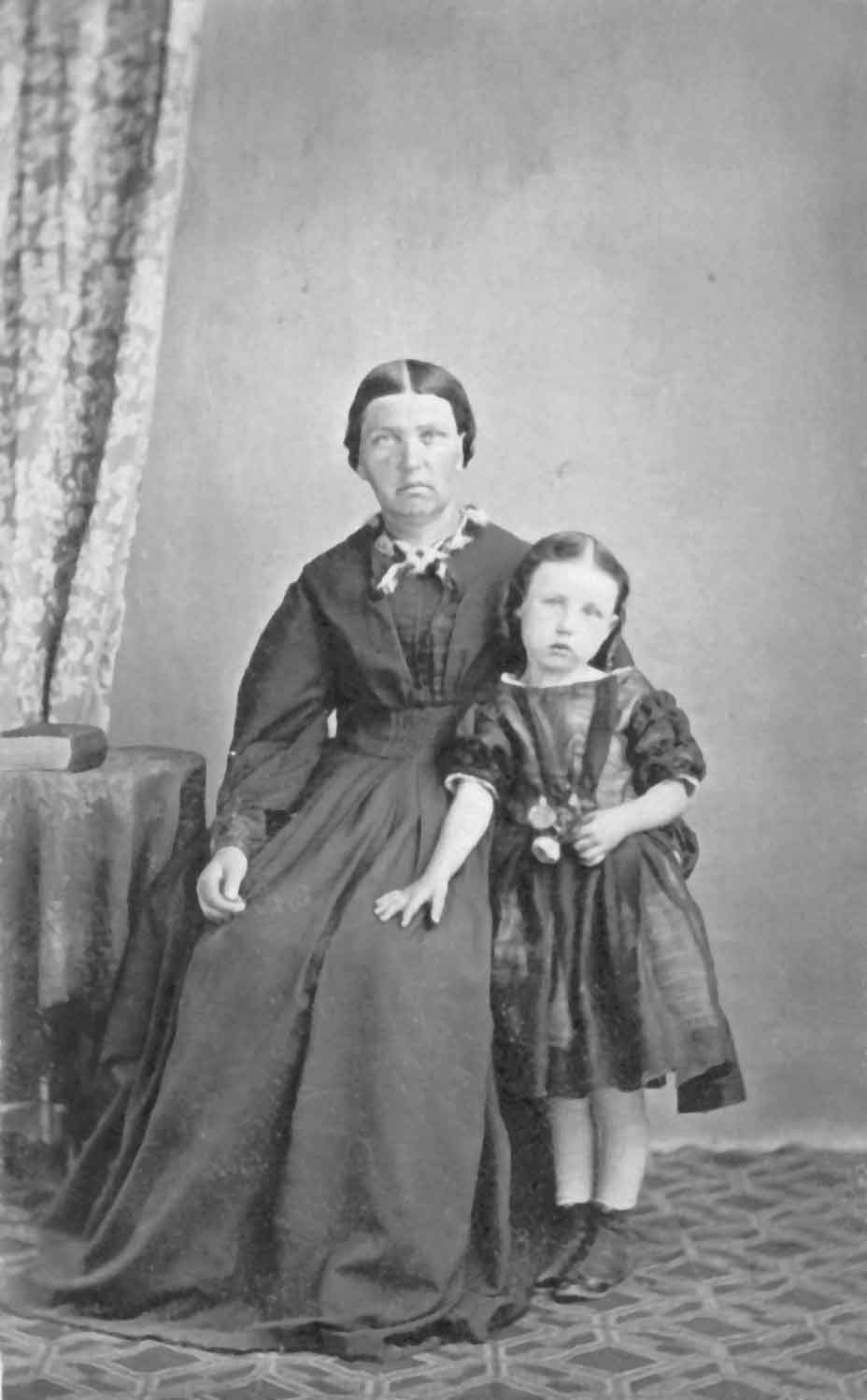
Martha and Martha Wayment
“All their children were taught to be responsible and dependable workers. But as one granddaughter, Thora Wayment Shaw stated, “it seemed necessary for them to come to America to develop their full potential.”
“Cambridge was predominantly agricultural, producing wheat and other grains, sugar beets, fruits and vegetables. At an early age, the children hired out to work, working for these farmers in the area.
“Around the age of fourteen, Martha had heard the message of the LDS missionaries and recognized the truth of the gospel. At that point her parents would not allow her to be baptized into the Church of Jesus Christ of Latter-day Saints. Especially after some incidents occurred that seemed to involve the missionaries and turned many people living in Cambridgeshire against the Mormons. Although they were convinced of the truth, William and Martha delayed joining the church due to her family’s bitterness and influence in their community.
“Martha and William listened to the messages, the Elders of The Church of Jesus Christ of Latter-days Saints brought to the area, of the restoration of the true gospel of Jesus Christ. William became convinced of the truthfulness of the gospel they were preaching and was baptized 28 May 1850. This was not a safe thing to do in those days as many were violently against the preaching of the restored gospel. Martha also opened her home up for place to meet, to share the gospel with other Saints and friends. Between the years of 1853 and 1878, the traveling Elders always found a home with Mrs. Wayment. During that time, their house was used for a meeting house for the Saints. The Elders who traveled in that section of the country always found the family ready to share their meals and beds with them as many can testify.
“Seven years after her husband had embraced the gospel, Martha was baptized on 1 May 1857. Some have criticized Martha for waiting so long to be baptized into the Church, however, she was living in extenuating circumstances. Due to the religious persecutions heaped on the early Saints, they had to meet in secrecy. Martha was one of the first ones to become interested in the restoration of the gospel. When word of her accepting the gospel reached her father in Bassingbourne, he disinherited her, cutting her off with only a few shillings. Her father then used his influence in the Parish to oppose all new members and the spread of the Gospel of Jesus Christ. However, this did not change her mind. Martha’s testimony of its divinity sustained her. She helped set the example and taught their children the principles of the gospel. With her husband, she encouraged her children to join the Church, and all of them were baptized into the Church of Jesus Christ of Latter-day Saints.
“In the spring of 1863, Joseph, the oldest son, determined to go to America, to gather with the Saints in Zion. At this time, both him and his father, William, were working in the fossil diggings. (This was work in the peat bogs. Peat is a compact, dark-brown organic material with high carbon content, built up by the partial decay and carbonization of vegetation in the acid water of bogs. Dried peat was and is compressed into briquettes, used in European Countries as fuel, although it is not as efficient as coal because of its large content of water and ash. Peat can also be used for mulching and soil improvement.)
“The family set up a plan and fund for their relocation to the Utah Territory in America. Joseph, the oldest, was first to go. He left 4 June 1863. He was followed by Samuel and his new bride Castina Frances Ann Chapman. They sailed 24 June 1868. Two years after Samuel left, Emily married William Negus. They made their home in Whaddon for the next 12 years. Their sixth child, John Brown completed his preparations, and at age nineteen he left for America on 9 July 1873, aboard the Amazon.
“In 1871, their daughter, Emily and her husband William welcomed their first child, a son they named John. Their joy was short-lived, for when John turned eight-and-a-half months, Emily contracted typhoid fever and developed severe complications. Martha Brown Wayment, took her grandson, John and raised him until he was three years old. At that time, he was returned home to his mother who had finally recovered from her ordeal. Emily was very grateful for the loving help she received from her mother and her sister Martha. Due to the closeness John had developed with his Grandmother Wayment, Emily would often strap pack-baskets on the back of their donkey, where John would ride when they went to visit his grandparents.
“Their son Joseph had sent back to England, a marriage proposal for a local girl. It is likely that Martha gave encouragement to Ann Reed to accept her son’s Joseph’s proposal and join him in the Utah Territory. Ann completed the necessary preparations leaving Liverpool on 24 June 1874.
“It took almost another five years, continued efforts, working in the fossil fields for William and his son William T. to earn enough money for them, along with Martha and young Martha, to emigrate to America. By the spring of 1878, they were making the final preparations to emigrate to Zion. With their savings and some help from their sons in Utah, they booked passage on the ship Nevada, and sailed from Liverpool, England, 25 May 1878. This was fifteen years after theirfirst son, Joseph had emigrated to Utah Territory. After arriving in New York, they boarded a Pullman train which took them to Philadelphia. There they changed to immigrant cars, which were very uncomfortable.
“By rail they arrived in Ogden, Utah Territory, 13 June 1873, and were met by their son’s Joseph and Samuel. William and Martha followed the instructions of the church leaders and settled in the Salt Creek area. They lived with Samuel and Castina while William and William T. built a log house located about a quarter-of-a-mile south of the present corner of 5900 West and 700 North and about 200 yards west of the present county road. There were some trees at that spot, but it was dry and hot. Stumps of these trees marked the spot for many years. William built a bowery next to the house to give a little more shade from the sun. Russian Olive trees grew on this spot for years to give shade to sheep and cattle. Living on the land was a basis to apply later for Homestead rights
“In this new and strange land they had to acclimatize to the semiarid climate. This was indeed a marked change from the verdant area of their home in England. They planted cottonwood trees, yellow roses, tea vines and any other plant that would grow fast. They helped establish the community and met the hardships endured by other families pioneering new homes. Martha Wayment East said, “It was hard work, but we had a good time in our work of making a town.”
“Their daughter Emily, her husband William Negus and their three living children arrived in the fall of 1882. Martha once again rejoiced at having all of her children and grandchildren around her again.
“Martha and William Wayment continued being active in the Church they had learned to love. On 5 January 1883, they traveled to Salt Lake City, where they received their endowments and were sealed in marriage in the Endowment House.
“That spring, William contracted Typhoid fever and succumbed to this decease on 17 May 1883, at age 61 years and 3 days. He left Martha, his beloved wife, four sons and two daughters; Joseph, Samuel, John and William T., Emily W. Negus and Martha Wayment. Also, eighteen grandchildren.
“Martha Brown soon found herself completely alone. Her daughter, Martha, married Edward Marriott. Then her youngest son, William Thomas Wayment, married Maud Mary Bullock 4 July 1883. Daughter Martha was soon divorced from Edward Marriott and moved back home with her Mother. After her daughter returned to teaching school, Martha helped take care of her grandson, Arthur. Her daughter Martha then married David East on 25 December 1885, Arthur spent most of his time living with his grandmother Wayment.
“Martha was able to do her own work and lived near her daughter, Martha for more than twenty years. She continued to enjoy her church meetings, her children and her grandchildren. But she was never without problems.
“Emily’s husband, William Negus, met his death trying to uncouple the double tree to loose the team when the horses floundered in crossing a swollen stream on the North edge of Warren. William Negus drowned along with his horses on 31 March 1890.
“Martha was not idle. On 16 November 1885, she received her citizenship paper. Her husband had applied for his but died before they were granted. In 1886 Martha Brown Wayment received an important document for a land grant. It was, “the original grant of Homestead given to Martha Wayment, widow of William Wayment (deceased). The south east quarter of section two in the township six north range three west of Salt Lake Meridian in Utah Territory, containing 160 acres.” Signed by Grover Cleveland, President of the United States, and dated 18 October 1886. This tract of land is located on the west side of the present road 5900 West and extending from about 300 North then extending west to the Little Weber River. Martha gave four acres of this tract of land to her daughter Martha Wayment East for a home site. The rest of the tract was given to her son, William Thomas Wayment, and used to pasture his horses and cattle. Martha Brown Wayment’s log house was moved north to be nearer her daughter Martha’s home.
“Martha said that in her lifetime, she had read the Bible about one hundred times. She could quote scriptures freely and read the scriptures regularly to some of her grandchildren. She was always faithful and devoted to the Church and taught her children to live the same way. Martha was a very religious person. She read widely of any Church literature available. Her son, William T. said she read all the books he brought back from his mission.
“It was also said of Martha that she had the ability to handle any problems that arose in her family. She could discern and counsel sensitive situations with solutions in a way that helped hold her family together. Her daughter Emily said, “I learned how to keep a clean home and how to cook good meals from my mother.”
“Martha Brown Wayment was an outspoken person. She was described by her grandson, Chester T. Wayment for being set in her ways, but he loved to go to her home, because she always was kind to him. ” She would buy groceries from a traveling ‘grocery man’ and among her purchases was always a bag of gumdrops. Martha would enjoy the sugar off the outside of the gumdrops, then dry the off and feed them to her grandchildren. Chester said, “I ate many of those gumdrops and if I tried not to she would get very angry. She did this to all her grandkids.”
“In her later years, Martha had become very heavy, but she continued to care for most of her needs and enjoyed good health up to the time of her death. On that day, she had been visiting her daughter Emily. While returning home, she saw the traveling grocery wagon heading to her home. She hastened to arrive before him. Arriving about the same time, she told him she would need time to gather her eggs first. Martha used eggs as payment for her groceries. She asks him to come back, so he didn’t have to wait on her while she gathered and cleaned the eggs. When the grocery man returned, he could not find Martha any where, nor did she answer when he called out for her. Later her lifeless body was found in her outhouse (outside toilet). It was determined that she had died of a massive stroke or heart attack. Bishop William L. Stewart had met Martha by the old school house at noon, and reported, “she was walking quite smart,” on the day she died.
“From the Standard, Ogden, Utah, Saturday evening 18 April 1905, Column 2, pg. 7, Vol. 35. MRS. WAYMENT BURIED, The funeral services, over the remains of the late Mrs. Martha Brown Wayment, who died at her home in Warren on Wednesday last, (12 April 1905), were held at the Warren Meeting House at two o’clock yesterday afternoon. (Friday 14 April 1905.)
“”The services were presided over by Bishop William L. Stewart and the ward furnished the music. The speakers were, DR. H.C. Wadman, Frank Barrows, Joseph V. East, Thomas H. Bullock, John F. Burton, George W. Larkin and Bishop Stewart.
“”The speakers eulogized the life of the deceased, referring especially to her religious convictions, her kindly disposition, her affection for her family, and of her true friendship. The meeting house was entirely too small to accommodate the large number of relatives and friends. A large funeral cortege followed the remains to the Plain City Cemetery, where they placed in her last resting place. The grave was dedicated by Joseph H. Folkman.”
“Her death was 12 April 1905. She was laid to rest next to her husband William Wayment in the Plain City Cemetery. She was survived by four sons and two daughters, Joseph, Samuel, John and William T. Wayment, Emily W. Negus Mullen and Martha Wayment. Also, surviving was 46 grandchildren and 25 great grandchildren. The posterity of William and Martha Brown Wayment now numbers well over two thousand.
“Two recipes brought over from England by our Wayment Grandmother; Martha Brown Wayment.
YORKSHIRE PUDDING, 1 pt. of sifted flour salt, 1 pt. of milk, 4 eggs, Beat well. About 3/4 hour before the roast is done, pour off dripping from the pan-leaving enough to keep pudding from sticking. Bake 3/4 hour.
“OLD ENGLISH MINCE MEAT, 3 lbs. Beef chopped fine, 1 lb. Suet, 10 lbs. Apples (green) chopped, 3 lbs. Raisins, 1 lb. Currents, ½ lb. Lemon peel, ½ lb. Orange peel, ½ lb. Citron, ½ gal. hard cider, 1 tsp. Allspice, 1 tsp. Nutmeg, 1 tsp. Cinnamon, tsp. Cloves, 3 cups Brown sugar, Salt to taste, Boil slowly until fully cooked, then seal in bell jars. Makes about 10 quarts. May let set for a few days to improve flavor.
“Sources; West Warren History 1975, Warren History 1965, Warren History 1995, Database New York passenger lists 1851-1891, Daughters of the Utah Pioneers, Alma W.& Martha M. Hansen, June Wayment Orton, Mildred Wayment Bird, Bishop William L. Stewart Journal.
Today I wanted to dedicate some time to James Otis Ellis. President Roosevelt signed the Reclamation Act on 12 June 1902. The Minidoka Project was established by the Secretary of the Interior on 23 April 1904. The Minidoka Dam and its related canals and laterals started shortly after. Delivery of water began in 1907.
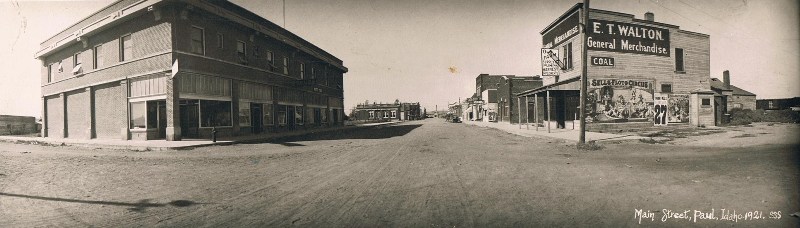
With the announcement of the Minidoka Project settlers flocked to the region. One of the four men who selected sites near what is now Paul, Idaho, was James “Jim” Ellis. These men struggled and barely survived the three years before the water finally starting flowing to Paul. In 1907, these men then incorporated the City of Paul. Jim Ellis hired an engineer and surveyed the town site and named it Paul after Charles H. Paul, the engineer in charge of the Minidoka Project. In 1910, the railroad was built across part of the land owned by Jim Ellis. He donated the land for the depot.
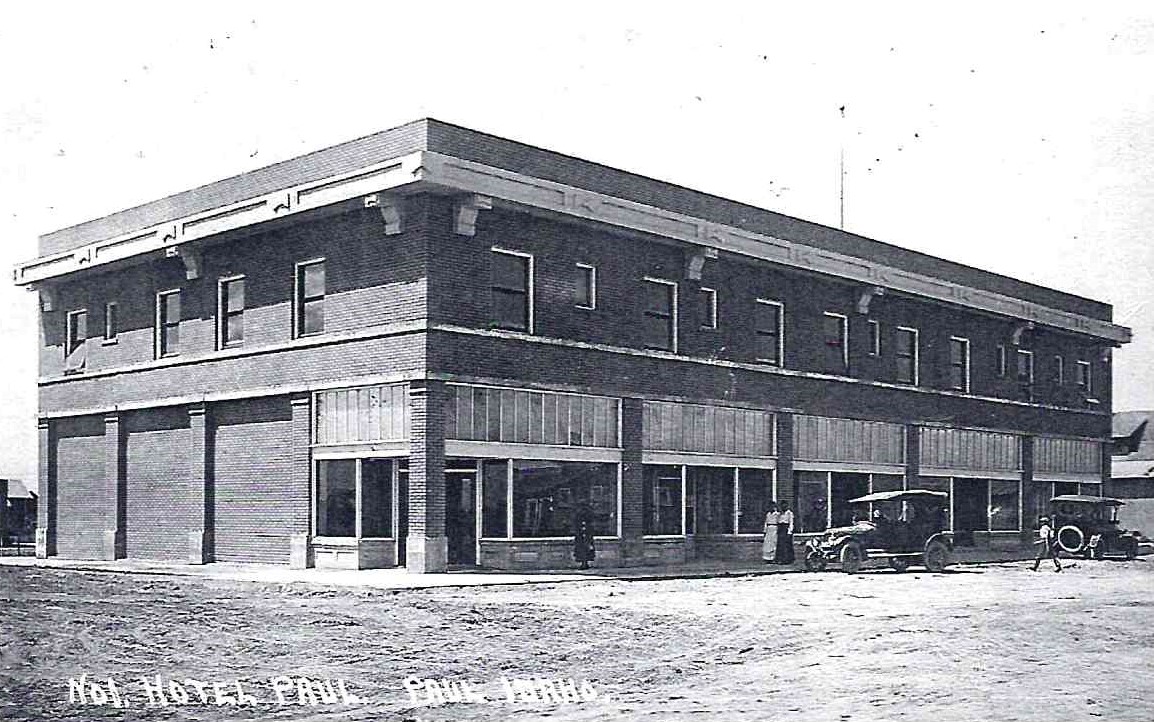
Jim donated part of his homestead to create much of the City of Paul. He was instrumental in bringing the railroad to town. He also donated lots for various entities to build and support the town including the Lutheran Church, the LDS Church, the Methodist Church, and Modern Woodmen of America. Jim helped found the first hotel in Paul and also helped establish some of the other first businesses.
Paul Hotel, Paul, Idaho
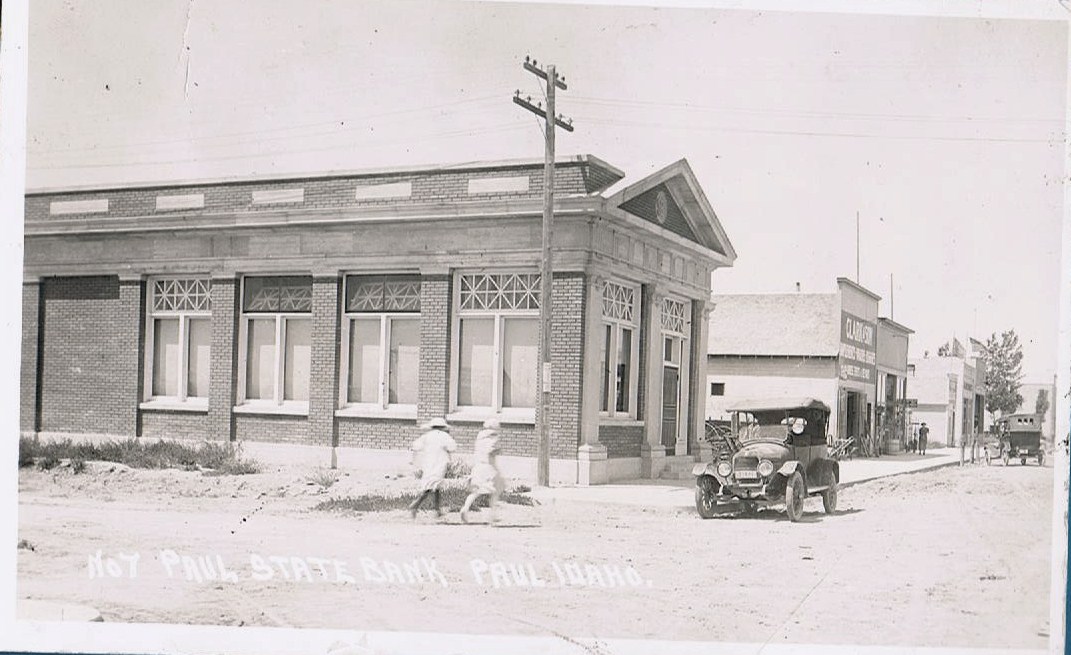
Jim also helped found the first bank in Paul, the Paul State Bank. This building still stands at its location a block west of the hotel.
Paul State Bank, Paul, Idaho
Much of Paul, Idaho, existed because of Jim Ellis. Hopefully at some point I can spend some time on the other three men, Tom Clark being the other to mention now.
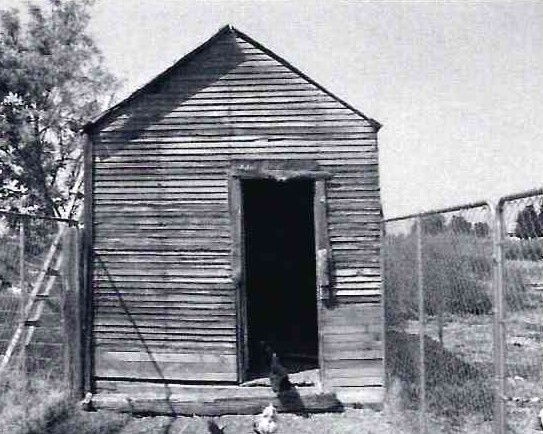
The last remaining original building on the Ellis homestead. This building is a one room shack with a window and smokestack. There is believe this was Jim’s home in the early days on Paul.
Ellis home at early homestead of Paul, Idaho.
Jim Ellis was born 10 February 1872 in Portia, Vernon, Missouri. All of his family stayed in Missouri so I don’t know how he ended up in Idaho. The opportunity to homestead with the knowledge of the Reclamation Act and Minidoka Project could very likely been the draw. In the 1900 Census he was still in Vernon County. But 4 years later he was in the flat desert sagebrush land of southern Idaho staking out claims.
Many of the homesteaders struggled and failed before the water finally arrived. Jim was able to hold out and make it work. He slaved away for years. He returned to Missouri to convince his childhood sweetheart to join him in Idaho. Elizabeth Emma Rexroad and her sister, Artie, made the trip out to southern Idaho. The Rexroads were still in Missouri for the 1920 Census, but Jim and Lizzie married 23 June 1921 in Pocatello, Bannock, Idaho. The two did not have children.
Whatever work he might have done in Missouri might not have gained much notoriety. But today the main route of Highway 25 through Paul, Idaho, bears, in his honor, the name of Ellis Street.
Bird’s Eye View of Paul, Idaho, about 1921. Looking up Idaho Street, the road parallel on the left is Clark Street.
Here is an article written about Lizzie Ellis after an interview about 1983. Elizabeth Rexroad was born 16 February 1889 in Adrian, Bates, Missouri.
“James Otis Ellis homesteaded where the City of Paul, Idaho now stands. He donated land for the first school in the city and also built the first hotel there, The Woodman. The farm owned by Elizabeth Ellis and her late husband Jim Ellis stood on both sides of the main drain at Paul and included the land on which the railroad was built in 1910. As appreciation to these hardy pioneer couple and in recognition for their contribution to the community a street later to become Highway 25, was named Ellis Street. Jim Ellis was one of four men who made their way from the railroad mainline at Minidoka to the present site of Paul in 1904, three years before water was delivered to the land. He cleared his land with a grubbing hoe. Having moved from Missouri, Jim later went back and persuaded his sweetheart to join him. It was in 1920 that Elizabeth left her millinery business in Adrian, Missouri and moved to Idaho where she and Jim were later married following a ride on the railroad to Pocatello. ‘I loved hats,’ muses Elizabeth, who had worked as an apprentice and operator of the millinery shop for five years. Though a city girl by trade, Elizabeth was raised on a farm at Liberty, near Kansas City, where she had learned what farm life was all about. Thus it was no problem for her to join her husband in the fields as he planted, irrigated and harvested his fields of wheat, oats and alfalfa. All the work was done with horses and by hand in those days and she learned to harness her animals, hitch them to the implements and do the field work right along with her husband. She could run the mower and pitch the hay right along with the men. She remembers the first tractor they bought, but apparently neither she nor Jim was too thrilled with its performance as it soon found its way in a neighbor’s farm where it remained for an extended period of time while they continued to do the work with their horses. Jim and Elizabeth had no children and she says she is ‘the last survivor’ of her large Missouri family of two boys and eight girls. One nephew shares the family home with her on the original homestead in Paul. At 94, and with eyesight failing, she spends her time just waiting for another day to come around. She takes care of her own household chores but has little use for the television set in her living room.”
Jim passed 15 October 1961. Lizzie passed 21 September 1988. Both are buried in the Paul Cemetery.
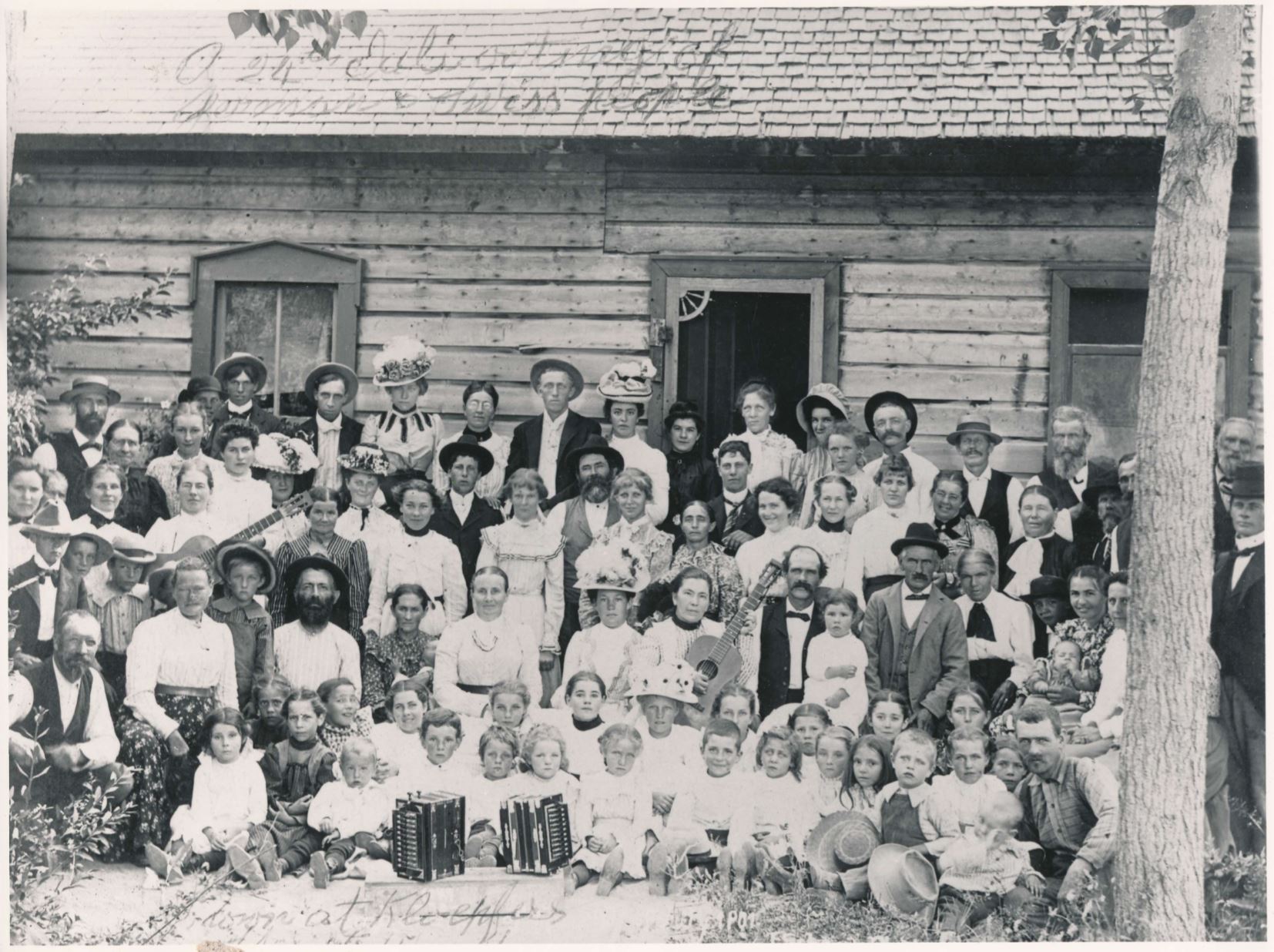
This is a fascinating photo from Kelvin Wursten shared on FamilySearch. It contains the only photograph I know of my Great Great Great Grandfather Johann Christoph Nuffer. He is to the right of the tree, furthest back. If you zoom in, it is a fairly good photo of him. I wish I had the photo that all the paintings are of, but I guess this will have to do until it turns up somewhere.
This photo was taken a Swiss/German Celebration in Logan, Utah in what was known as the 7th Ward. This party took place at the Kloepfer home on what is called The Island. It was also referred to Polly Wog Town due to all the frogs. This photo was taken by Eugene Schaub, who a few years later in 1902 would have Johann Christoph Nuffer for a step-father. The meetings of this Swiss/German group apparently helped in creating that relationship.
I have previously shared the biography of Johann Christoph Nuffer as told by his granddaughter, Alma Katherine Scheibel Naef. There are a couple of others who are known in the photo. You will have to go to FamilySearch to get the identification on lining the right face to the exact person. But I recount the names and dates for your information below.
Maria Anna Alker (1847-1926), who married Conrad Schaub and later married Johann Christoph Nuffer.
Anna Brunner (1854-1938)
John Alfred Burgi (1852-1937)
Palmyra Anna Burgi (1882-1946)
Louise Rosalinda Clark (1963-1938)
Elizabeth Fluhmann (1841-1915)
Bertha Gilgen (1891-1979)
Friedrich Gilgen (1854-1954)
Lena Gilgen (1893-1990)
Margaritha Gilgen (1881-1965)
Mary Ann Gilgen (1882-1933)
Olena Hoth (1874-1962)
Julia Keller (1882-1973)
Philipp Kloepfer (1863-1940)
Marianna Krahenbuhl (1855-1940)
Louisa Amanda Lehman (1859-1947)
Magdalena Mosimann (1841-1914)
Anna von Niederhaeusern (1890-1975)
Rosina von Niederhaeusern (1883-1979)
Johann Christoph Nuffer (1835-1908)
Marie Emma Schaerer (1885-1972)
Lydia Seeholzer (1883-1954)
Theodore Martin Seeholzer (1877-1950)
Johannes Weber (1840-1923)
Anna Weyermann (1895-1977)
Gottfried Weyermann (1875-1935), whose mother had been married to Johann Christoph Nuffer but died prior to this photo.
John Weyermann (1899-1944), another step-son of Johann Christoph Nuffer.
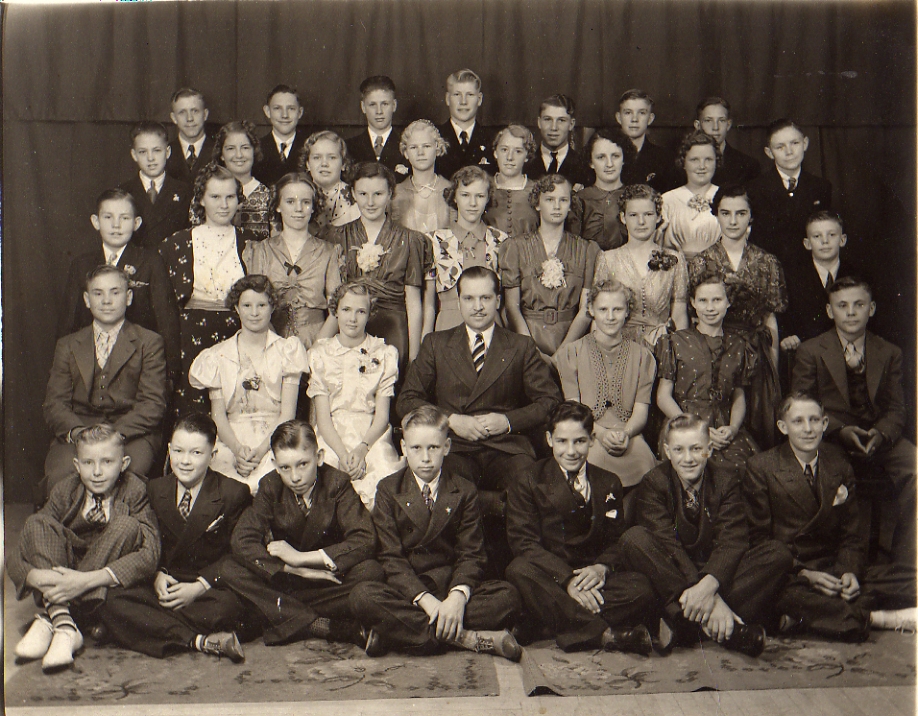
Back(l-r): Ira Hillyard, Unknown, Bob Johnson, Junior Petterborg, Irwin Jonas, Unknown, Unknown. 2nd from Back: Unknown, Ruth Rich, Kaye Funk, Anna Lawrence, Joyce Larsen, Ruth Hutchinson, Nadine Johnson, Darrel Smith. Middle Row: Unknown, Unknown, Eva Kershaw, Lyle Wilding, Unknown, Afton Sorensen, Dorothy Nielson, Unknown, Norwood Jonas. 2nd from Front: Alvin Spackman, Bernice Frandsen, Unknown, Glacus Merrill, Joy Erickson, Unknown, Allen Spackman. Front: Garr Christensen, Oral Ballam Jr, LaMar Carlson, Unknown, Gail Spackman, Ivan Anderson, Warren Hamp.
This is Glacus Merrill’s class from what I believe is 1936. He taught class at Park School in Richmond, Cache, Utah. Several individuals have assisted me to name the individuals I have so far. There are too many unknowns that I hope to clarify in the future. If anyone can help, I would certainly appreciate it. My Grandfather, Norwood, and his brother, Irwin, are both in the photo. Irwin died in World War II, and I assume some of the rest did as well.
I have listed all the individuals below with some limited information I could find on them. At the very bottom is Glacus’ obituary.
Here is a copy of the obituary I found for Glacus. Wow, I wish my school teachers had been this amazing.
LOGAN – Glacus G. Merrill, 96, died of causes incident to age in Logan, Utah on Saturday, February 9, 2002. He was born May 27, 1905 in Richmond, Utah to Hyrum Willard and Bessie Cluff Merrill. He is a grandson of Marriner W. Merrill, a pioneer prominent in the settling of Cache Valley, an Apostle of the Lord Jesus Christ, and the first president of the Logan LDS Temple. He married Constance B. Bernhisel in 1925, and they were later divorced. He married Marie B. Bailey, March 24, 1945 in Washington D.C. Their marriage was later solemnized in the Logan LDS Temple.
While attending school, he participated in track and football at North Cache and Brigham Young College, where he graduated in 1925. Glacus graduated from Utah State University in 1935 and also attended the University of Utah and Chico State College in California. He is a graduate of the REI Radio Engineering School in Sarasota, Florida. He was the principal of the Richmond Park School for 11 years and served in the U.S. Navy for four years during World War II. He served an LDS mission to California from 1954-1955. While living in the East, he served as President of the West Virginia Farm Bureau and the State Black Angus Association. He is an honorary Kentucky Colonel. He also served as President and District Governor of Lions Clubs in Utah and West Virginia, and was a member of the Lions Club for 42 years. Glacus was Vice President of the West Virginia Broadcasters Association, and is a member of the USU Old Main Society. He established a Scholarship Fund in the Communications Department at USU. The Montpelier, Idaho Jaycees presented him with their outstanding Citizen’s Award. He was also a member of the Montpelier Rotary Club, Utah Farm Bureau, VFW and American Legion. He is a member of the “Around the World Club” having traveled around the world with his son, Gregory. He and his wife, Marie traveled extensively. Merrill was a popular Rodeo announcer in his early days. He authored the book “Up From the Hills” which was finished in 1988 and is available in area libraries.
Honored by the Utah Broadcasters as a pioneer in Radio Broadcasting, Merrill started his broadcasting career in 1938 as part owner and Program Director at KVNU Radio in Logan. After serving four years in the Navy, he built his first radio station Clarksburg, West Virginia. He owned and operated 11 other stations in West Virginia, Ohio, Maryland, Idaho and Utah, including stations in Montpelier, Idaho and Logan, Utah. He was well known for his frank and outspoken editorials, news and comments on KBLW in Logan. He has given over 7,000 newscasts and editorials always ending them with the saying, “Have Good Day Neighbor.” In 56 years of radio broadcasting, he trained several young broadcasters who are now making good.
As a hobby, wherever he lived, he operated a cattle ranch and farm. He served in many civic and church activities including counselor in the LDS Stake MIA, counselor in the East Central Stake Mission Presidency, 5 years as a Branch President and 11 years as District President in West Virginia. He also served as Deputy Scout Commissioner in Idaho and for 12 years taught the High Priest Class in the Logan 3rd Ward and served for several years as the High Priest Group Leader. He was an avid supporter of many missionaries in the area.
His wife, Marie preceded him in death on April 22, 1993, as well as six brothers and one sister. He is survived by his two daughters, Darla D. (Mrs. Dennis Clark) of Logan; Madge (Mrs. Melvin Meyer) of Smithfield; one son, G. Gregory (Joan) Merrill of Logan; nine grandchildren, 22 great-grandchildren and 10 great-great-grandchildren. Funeral services will be held at 12 Noon on Thursday, February 14, 2002, at the Logan 3rd Ward Chapel, 250 North 400 West, with Bishop Grant Carling conducting. Friends and family may call Wednesday evening, February 13th, at the Nelson Funeral Home, 162 East 400 Norther, Logan from 6 to 8 p.m. and on Thursday at the church from 10:30 to 11:30 a.m. Interment will be in the Richmond City Cemetery.
Cleo Gallegos, Mayor of Heyburn, had this photograph in her office one day earlier this year. She snagged it for a day or two for me to see it. I snapped a couple of photographs of it. I have tried researching it or determining some of the individuals and I fear they may be too far in the past for me to try and get it independently. Unless someone has a list of individuals in the photo, it is just good for conversation. I don’t have a clue of a single individual included here. But this organization was a new piece to southern Idaho history I was unaware.
The 79’ers first meeting was held 28 September 1921 in Burley, Idaho. 73 pioneers from Cassia, Twin Falls, Jerome, Minidoka, Gooding, and Lincoln Counties signed the roster as qualifying members. In order to qualify, you had to arrive in Southern Idaho before 1880.
Between 1921 and 1924, meetings were held in Burley or Twin Falls. After 1924, the annual meetings were held in Albion. Hence the photo above dated 1 September 1926, this would have been the annual meeting.
In 1941 a special reunion was held where over 200 people attended. Judge Alfred Budge and Idaho Governor Chase Clark were made honorary members.
Not much history after that is available online.
Cassia County was created in 1879 and originally I thought that was what the group was referring to. However, membership was permitted from Minidoka, Jerome, and Lincoln Counties which territories were never part of Cassia County. I am still unclear why 1879 or 1880 was a year to commemorate in southern Idaho.
I also found Hyrum Smith Lewis (1868 – 1955) served for 26 years as President of the 79’ers. He is buried in Declo.












 Sagacity