Transcript for Housley, George Frederick, [Reminiscences], in Life histories of George Frederick Housley and Maria Christina Jacobsen Housley
“The Bishop of the Ward wanted George to talk in Church and tell of his coming across the plains, but George said he just could not speak in public so his wife’s brother-in-law, George Wood, who was a lawyer, came to his home and took his story down in short hand as George told the story to him. Then they had it read in a reunion. It was as follows:
“In the year of [1856], I with mother left our native land England, with about 600 others for our America “The Zion of Our God,” on the good ship “Horizon,” spending five weeks in our voyage to Boston. Where we took passage on a steamboat to Iowa. Awaiting there for three weeks for our hand-carts to be made that were to carry our “all” across the vast stretch of the plains to Utah. Each family supplying themselves with the necessary food for their journey if they were well. At Iowa City, where we were camped, a gentleman told me that we would starve to death if we went there at this season. One of our people and his family decided to stay over. I became tempted to do likewise and upon telling my mother that we better stay she became much depressed in spirit and told me to wait a little while. During the time she prayed to Our Heavenly Father for guidance. One fellow traveler, after deciding to stay, sent out one day in the woods to hunt for game, and while away was seized with fever and ague. He hurried home and upon entering the tent where mother I were awaiting him, he laid upon the cot and commenced singing in poetry and rhyme, telling mother to take me with her to the valley and that we should get through alright. Mother told me she had made it a matter of prayer and by this means her prayers were answered. I told her then that we would go to the valley at all hazards because I was satisfied all would be well.
“Upon the company starting we were in line with our cart and ready. All went well as we joyously sang, “For some must push and some must pull as we go marching up the hill. As merrily on the way we go, until we reach the valley, Oh!” As days wore on, our spirits lagged as we became weary. Some of our people became sick and were compelled to ride, thus compelling others to be more heavily loaded. Provisions commencing to get scarce as the days wore on, necessitating our captain to put us on shorter rations. Many dying by the wayside where they were buried each night where we camped and their graves were left unmarked except by our tears. At this season and at this part of the plains it commenced getting cold, and were again placed on shorter rations of 4 ounces of flour to each person per day. We traveled to the Sweet Waters River where we camped, being so weak and exhausted that it was almost impossible to move. Many of our people while there died of starvations while others froze to death by the wayside.
“A man from London by the name of Stone, while trying to get to an Indian camp was devoured by wolves; when found by some of our camp, nothing was left of him but his legs inside his boots.
“Receivers were sent out from the Valley to assist us in and could not find us, thinking we were lost on the plains the rescue party concluded to return to the Valley. But one of their number stated that he would go to the States but what he would find us. About noon a horseman was seen coming into our camp, and he looked like an angel to us poor starving emigrants who had eaten nothing but flour for three days. With words of encouragement he entreated us to make another start. But, many, while their will was good, their strength failed them and they dropped and froze to death by the way.
“The relief party returned and met us and assisted us with some provisions. But scores of our brethren and sisters died and were left in unmarked graves by the wayside. At this time I was permitted to sleep in a tent with two of my companions. Each of them dying by my side where I slept by them ’till morning when they were taken away and buried.” In a later trip across the plains to assist the emigrants at one of our camps I saw many of the bones of my companions that had been dug up by the wolves. At the time of my companions death I became despondent through weakness that I longed for death and tried to hide myself from the company that I might die, but one of the brethren returning back for something, found me sitting behind the rock where I had hoped to die. He took me along with him for a day before we caught up with the company. I was permitted to sleep in a wagon that night, where I slept with a dead man all night.
“The next day we were permitted to see and enter into the Valley (November 29, my birthday). Although I was too weak to walk, my feet being much swollen I wrapped them in my mother’s shaw until we were taken care of by kind friends who were awaiting us. But brother Slack, our kind friend, would not allow me only a limited amount of bread as he was afraid it would kill me. But after they had gone to meeting I finished up the whole pot pie which had been prepared for the family, and I am alive yet and I have been hungry to this day.”
“President Parkinson of the Hyrum Stake was present at the reunion and when he heard of the hardships, suffering and hunger George went through, he made arrangements with the Church authorities to grant this couple the privilege of receiving their second endowments. After they received theirs, Mary Ann stood proxy for George’s first wife, who received their second endowments of the 28th of July 1910. This is a privilege and blessing that only a few people have had since the Church was organized…. An addendum was added: “One time while visiting in Mapleton at his son Ben’s home, he and my Grandfather—Marshall Franklin Allen—were reminiscing over old times. Grandfather Allen told of one time when “Brother Brigham” had called him to accompany several other young men in going out to meet the Hand Cart Company, to take them some provisions and assist them into the Valley. As he knelt in prayer the evening before going, he said that he told the Lord that it was a foolish thing to do, going out in such weather and with no roads to follow. But while he was still in the act of prayer, it was made known to him that he should go. It was also made known that he would be able to save many of their lives. After search many hours the rescue party became discouraged. Thinking the Hand Cart Company had been lost on the plains, they decided to return to the Valley. Grandfather said, “I told them I would go ’til I reached the States but what I would find them” About noon they found a group of handcarts with their poor, starving people. Thinking there may be more farther back, he rode on for some distance. He saw a dark spot among some rocks. Upon investigating, he found it to be a young man. He wrapped his blankets around him and helped him onto his horse. Then Grandfather Housley spoke up and said—”The horse had one white leg, a white strip in it’s forehead and the rest of it was coal black.” Grandfather Allen said, “Yes.” Grandfather Housley said, “It was a bright plaid blanket.” Grandfather Allen asked, “How do you know?” Grandfather Housley said, “Because I was the one you found!” Then he stood up and said, “And I want to tell you, if it hadn’t been for the prayers of my mother and the faith of the Saints, I would not have lived ’till you found me and I never would have reached the Valley!”
Jupiter at Golden Spike National Historic Park Sep 2020
We took a trip to Golden Spike in September 2020 for the kids to experience some Utah history. It was well worth the drive out to Promontory, Utah.
The Golden Spike has some significance on Amanda’s line. Her ancestor, Joseph Wayment, is standing in the photo taken 10 May 1869 on that momentous occasion. Below is a copy of the photo. You can see him with the hat and long beard. Look at the train on the left and the man standing right below the train light with his jacket open and white shirt; the man whose head is in front of that man’s right thigh (behind the guy with the partially raised hat). That is Joseph Wayment. Joseph Wayment was born 7 February 1844 in Whaddon, Cambridgeshire, England and passed 20 December 1931 in Ogden, Weber, Utah. He is buried in Warren. I wrote of his parents William and Martha Wayment previously.
Another interesting bit of history is that Joseph Wayment came to the United States on the ship “Amazon.” This is the same ship that my Stoker ancestors came to the United States. Not only is it the same ship, it is the same trip of the ship. Here is part of the history I wrote for William and Emma Stoker.
Joseph Wayment departed from London on a ship called “Amazon” 4 June 1863 (His parents and some siblings traveled later on “Nevada” in 1878). George Q Cannon dedicated the ship which was entirely of Saints (880+) headed for Zion. It was this same ship that Charles Dickens wrote that the Mormons were not taking misfits and scoundrels, but the “pick and flower” of England. Even George Sutherland, future U.S. Supreme Court Justice was on this ship. Here is a link to the story by Charles Dickens: The Uncommercial Traveller. The LDS church also tells of the story that day at this link: Amazon Departure. The ship sailed to Liverpool before finally heading out for America.
The “Amazon” landed at Castle Gardens, New York, New York on 18 July 1863. The Saints took rail to Albany, Albany, New York and then to Florence, Douglas, Nebraska through Detroit, Wayne, Michigan. From there they hoofed it on to Salt Lake City, Salt Lake, Utah Territory arriving 3 and 4 October 1863 (depending on which of the two companies), just in time for General Conference. Several of the company wrote of Brigham Young coming out to greet them and giving them advice. Brigham sent Joseph to Salt Creek (now Warren) to settle. He later was the first road supervisor and the father of the first born white child of Warren, Sarah Wayment in 1875.
I will have to spend some time telling more of Joseph and Ann Reed Wayment’s story another time.
My own limited tie to Promontory is just the fact the Sharps, taking my Grandpa Milo Ross, used to drive past the site out to harvest salt.
Hiram, James, Paul, and Aliza Ross on 7 September 2020
Hiram, Amanda, Aliza, and Paul Ross, Bryan Hemsley, Lillian and James Ross, and Jill Hemsley
We stopped to pay a visit at the Clarkston, Utah, Cemetery recently. We were in Cache Valley for the Jonas Reunion and I knew Amanda had some ancestors buried in Clarkston. Amanda did not recall ever seen their graves (and I also had not searched them out). We have also been talking about Martin Harris in our study of the Doctrine & Covenants. I surprised the family with a surprise stop on our way home from the Jonas Reunion in Hyrum.
Amanda, Aliza, Hiram, and James Ross at graves of James & Ann Keep on 8 August 2021, a hot, windy, and smokey day
James & Ann Keep are Amanda’s 4th Great Grandparents. Amanda wasn’t very familiar with them so we had to do some homework.
James Joseph Keep was born 25 September 1804 in Chiswick, Middlesex, England to James Joseph and Ann Evens Keep. He was christened 11 November 1804 in St. Nicholas Parish in Chiswick. His father died when he was 5 and was raised by his grandparents.
James married Elizabeth Parr in 1825 and she passed away in or before 1836. He remarried to Ann Miller on 25 July 1836 in St. Mary’s, Reading, Berkshire, England. They joined the Methodists, then the Baptists, and then were Independents.
Two young Mormon men came near the house preaching the true gospel and Ann told James to go out and hear them. They were preaching about baptism. He went into the house and searched his Bible to ascertain the truth of what they said. Here he found that baptism was to be born of the water and the spirit. When they came again to preach, James took a long bench for the people to sit on. That evening he went to the meeting house. There he heard the saints speak in tongues.
Apparently he and his family were baptized in 1848 into The Church of Jesus Christ of Latter-day Saints. He joined 23 July 1848 and Ann on 20 September 1848.
Ann Miller was born 10 August 1816 in Newbury, Berkshire, England to James and Ann Elkins Miller. She was christened 2 October 1816 at North Croft Lane Baptist Church in Newbury.
The 1841 and 1851 census both have the Keep family in Thatcham, Berkshire, England. He was a mason and bricklayer.
James, Ann, and family left London on 23 May 1866 on the ship American Congress arriving at Castle Gardens, New York, on 5 July 1866. They were in Wyoming, Otoe, Nebraska on 13 August 1866 traveling with the Abner Lowry Wagon Company arrving in Salt Lake City, Utah on 22 October 1866.
James and Ann Keep attended the Endowment House 6 Jun 1868.
The 1870 Census places the James & Ann Keep in Newton, Cache, Utah with Maria. Shortly afterward they moved to Clarkston and James built a masonry home for them. 1880 Census has them located in Clarkston. James was known for his masonry work and often built chimneys for individuals.
Ann helped in the fields with James to raise crops. They had oxen with which they did their farming. Sometimes she would be very tired when she got home. The oxen’s names were Jack and Jue. Ann called them by name and they would reply by their actions.
James & Ann Keep
Ann enjoyed her home and loved to make it look nice. She had flowers in the windows and all around the house and a fine orchard of apples, English currants, and gooseberries. All kinds of vegetables were grown in the garden. Her husband helped to care for it too. There was a small porch on the front of her house with a hop vine all around it which grew and ran all over the porch making a nice shade in the summertime. In the fall she would gather the hops and dry them and make yeast with them three times per week. The sisters in the town would send a cup of flour to trade for a cup of yeast to make their bread. In this way she kept herself in flour.
Ann and James Keep at their home in Clarkston, Utah
She was called as first counselor to Mary Griffin in the Clarkston Relief Society on 12 February 1875. She was released in 1885 as she and her husband were getting old and could not do their work so well. Ann was a very busy woman. When too old to do heavy work, she would sew quilt blocks for the Relief Society and for her grandchildren or anyone who would let her do it for them.
James and Ann decided to sell their house and property and live on the principle and interest. In 1890, they sold out and moved to Lehi, Utah for two years. Then they returned to Clarkston to live for several years. Ann had a very bad sick spell and it took her a long time to recover. After she got well, they moved to Newton to live with a daughter, Ruth Griffin.
Just before her death Ann bore a strong testimony to the truth of the gospel, telling her daughters and families to hold fast to the end for this was the true Church of Jesus Christ and to do all they could for their dead. She told her nurse, Caroline Thompson, to hold her pocket book for her, then she took out a dollar and passed it to her daughter, Sarah Buttars and said, “Get my brother Joseph’s temple work done for he was a good man.” She passed away 25 October 1896 in Newton.
James passed away while staying with his daughter Mary Turner in Lehi on 14 March 1899. His body was returned and buried in Clarkston.
Here is the story of her hearing from the Branch President in Newbury.
~
Kennett Place, Newbury, Berks, Sept. 30, 1850
Dear President Pratt,
We have recently been favored with a manifestation of the miraculous power of God; in this branch of the Church a sister, named Ann Keep, the wife of Joseph Keep, who is a deacon in the Church, had a cancer in her breast for some time; and it became so bad of late that she intended to have it cut out, and the time was appointed for it to be done. Three medical men were to be present at the operation. A brother named David Davis, an elder in the Church, called to see her, and she told him she was going to have the cancer taken out; and he said to her “have you got any faith in the power of God?” and she answered “yes:” and he said “so have I.” Accordingly he anointed her breast with oil, and laid hands upon her, and the pain left her there and then, and she never felt it any more; and from that time the cancer got less, until it disappeared; and the breast that had the cancer is as well as the other. This is known by many out of the Church.
Yours, &c.
Thomas Squires
President of the Newbury Branch
~
James Keep finds himself in history due to being present in the home of Martin Harris at the visit of Ole Jensen in July 1875. John Godfrey and James Keep both signed as witnesses to the statement of Ole Jensen, Clarkston Ward Clerk. This is from Jensen’s statement:
It was in Clarkston, Utah, July 1875. Early in the morning a thought came to my mind that I would go and see how Brother Martin Harris was feeling. It was only three blocks from my home. I heard he was not feeling well. People came from other towns to see Brother Harris and hear him bear his testimony on the Book of Mormon. When I arrived there were two men present. Brother Harris lay on his bed leaning on his elbow. I said, How are you? Brother Harris answered slowly, Pretty well.We came to hear your testimony on the Book of Mormon.
Yes, he said in a loud voice as he sat up in bed, I wish that I could speak loud enough that the whole world could hear my testimony. Brother stand over so I can see you. Then he stretched out his hand and said, Brother I believe there is an Angel to hear what I shall tell you, and you shall never forget what I shall say. The Prophet, Oliver Cowdery, David Whitmer and myself went into a little grove to pray to obtain a promise that we should behold it with our own eyes.
That we could testify of it to the world. We prayed two or three times and at length the angel stood before Oliver and David and showed them the plates. But behold I had gone by myself to pray and in my desperation I asked the Prophet to kneel down with me and pray for me that I may also see the plates. And we did so and immediately the Angel stood before me and said, Look and when I glanced at him I fell but I stood on my feet and saw the Angel turn the golden leaves over and I said, It is enough my Lord and my God.Then I heard the voice of God say the book is true and translate correctly!“
Martin Harris then turned himself as though he had no more to say and we made ready to go but he spoke again and said, I will tell you a wonderful thing that happened after Joseph had found the plates. Three of us took some tools to go to the hill and hunt for some more boxes of gold or something and indeed we found a stone box. We got quite excited about it and dug quite carefully around it and we were ready to take it up, but behold by some unseen power the box slipped back into the hill. We stood there and looked at it and one of us took a crowbar and tried to drive it through the lid and hold it but the bar glanced off and broke off one corner of the box.“
“Sometime that box will be found and you will see the corner broken off and then you will know I have told the truth again. Brother as sure as you are standing here and see me, just so sure did I see the golden plates in His hand and He showed them to me. I have promised that I will bear witness of this truth both here and hereafter.”
His lips trembled and tears came into his eyes. I should liked to have asked one more question but I failed to do so. But I refreshed myself and shook hands and thanked him and left. When I think of the day I stood before Martin Harris and saw him stretch forth his hand and raise his voice and hear his testimony, the feeling that thrilled my whole being, I can never forget. Nor can I express the joy that filled my soul. This is a true statement.
~
We also visited the grave of Martin Harris in the same cemetery at Clarkston.
Paul, Aliza, and Hiram Ross at the grave of Martin Harris on 8 August 2021
I previously wrote of an interesting incident I had with Aliza in the Plain City, Utah Cemetery. I have thought about that several more times as we have been back to visit. It seems fitting I finally follow up and provide some additional information on William and Martha Wayment.
Aliza with William and Martha Wayment tombstone in 2016
James, Amanda, Lillian, Aliza, and Hiram Ross with tombstones for Martha and William Wayment in 2020. My William Edward Stoker’s tombstone is in the background.
As you can see, there is a little biography poster for Memorial Day. The history there is pretty brief. I found a couple of histories on William and Martha. I am posting these two for the history to be available for my children, who are descendants of William and Martha Wayment. First is the history for William, then Martha.
“William Wayment (Whayment) was born to Joseph Wayment (Whaymond) and Mary Rook Wayment. He was born 14 May 1822, in Whaddon Parish, Cambridgeshire, England. He was a small and fragile baby, but survived through his parents loving care. William was christened on 2 June 1822, in Whaddon Parish, Cambridgeshire, England. Two years later, there is a christening record dated 6 June 1824, another brother, Robert, frail from birth, who sustained life for seven months, buried 23 January 1825. William was their only surviving child.
“There are several different accounts of Joseph and Mary Rook Wayment and their descendants. Another account is this; the couple also married 15 March 1813, and lived in Barrington, Cambridgeshire, where they had become the parents of six children, three of whom, Ann, John, and Joseph, had died prior to their moving to Whaddon about 1819. This would make William the seventh, instead of the first born. The only surviving child of this union that I can find recordson is William Wayment, our ancestor.
“Whaddon is a small town in the district of Roysten and County of Cambridge with a population at that time of about 319 people living in about 60 houses. The manor belonged to Lord Hardwicke. A famous old stone Parish has stood over the town for many years.
“Very little is known about William’s early years. It is known that he received some education and learned how to read and write. Most likely he went to work at an early age, as was custom for children of that time. It is most probable, his frail beginning coupled with his early work years and sometimes meager meals stunted his growth. He often referred to himself as ‘a runt.’ All of his sons were taller than he. Our best information indicates he was small of stature, about five feet and eight or nine inches in height. He was known as a laborer and sometimes a miner, likely working wherever he could be employed.
“His father, Joseph Wayment, died and was buried 12 July 1840, in Whaddon, Cambridgeshire, England. William was about eighteen or nineteen years of age
“Sometime after the death of his father, William began courting Martha Brown, a young, fair woman of the Bassingbourne Parish. The courtship bloomed and they were married Christmas day, 25 December 1841, in the Parish of Whaddon, Cambridgeshire, England. A clerk at Somerset House, England, pointed this out to Hollis R. Johnson when he requested and received a certified copy of their marriage certificate: William signed his last name as Whayment, giving his age as twenty and listed himself as a laborer. Martha gave her age as nineteen and listed herself as a spinster, a title used under English law for any woman who had never married. William and his bride made their home with his widowed mother, Mary Rook Wayment.
“The Wayment family lived in the same house in Whaddon, Cambridgeshire, England for more than 300 years, but like most others in England, they did not own the property. They only rented. When the Wayment family moved to America, the ancestral home was claimed by the government as a Post Office. The house was one of those quaint old, two story cottages, constructed of white stone masonry and had a thatched roof. Vines grew up the walls and flowers grew on either side of the cobblestone path leading to the entrance. The fireplace was large enough to walk in with seats built on either side of the fire. A kettle hung down, stopping just above the fire. Martha did all of the cooking and baking in this huge fireplace. Years later this house was put on the market and a member of the Wayment family, by the name of Waymond (Wayment), purchased this property. Wayment descendants still reside in this home today, 2006.
“William and Martha Brown Wayment began their married life under very limited circumstances. Although an extremely hard worker, William never accumulated much wealth. Coming from a wealthy family, their modest home and insufficient circumstances were a source of embarrassment at times for Martha. It has been said that Williams earnings were often around eight shillings a week (about two dollars U.S. money). With this money, there were food, clothing, coal and rent to pay for. By careful management they were able to take care of their children as they came into their family.
“Although not a proficient provider, William proved to be a very loving, a kind and caring husband. They had eight children together, six boys and two girls. Two children died early, one at one day the other at one year and three months. It is also said that he was an exemplary father.
“All William and Martha’s children were born in Whaddon, Cambridgeshire, England. 1) Male, Aaron Wayment born 14 Nov 1842 died 15 Nov 1842 2) Male, Joseph Wayment born 7 Feb 1844 died 20 Dec 1931 3) Male, Samuel Wayment 28 May 1846 died 1 Jul 1912 4) Male, William Wayment Born 1 Mar 1849 died 19 Jun 1850 5) Female, Emily Wayment born 15 Apr 1851 died 15 Mar 1925 6) Male, John Brown Wayment born13 Apr 1854 died 30 Sept 1923 7) Male, William Thomas Wayment born 29 Apr 1859 died 15 Feb 1943 8) Female, Martha Wayment born 25 Mar 1863 died 19363
“All their children were taught to be responsible and dependable workers. But as one granddaughter, Thora Wayment Shaw stated, “it seemed necessary for them to come to America to develop their full potential.”
“As their children became old enough, they hired out to work for farmers in the area. Their work included keeping birds out of the cherry trees, pulling poppies out of grain fields and other needed farm work. Among other things, they learned to stand the bundles of grain up in small groups, called “shocks” to dry. When dry, the grain was then piled into high pointed stacks to help shed the rain while awaiting to be threshed. Some of the farmers were very hard on these young workers. Often the children would leave home at five o’clock in the morning and work until they were called for breakfast between eight and nine o’clock. Sometimes the meal was very meager. They would break around noon for lunch then continue to work until seven at night. Joseph and William T. describe one of their employers as “the meanest man on earth.”
“At that time in history, they wore a peculiar type of “smock” clothing. William T. said that it resembled a long sack with sleeves coming out of the corners and a hole in the end between the sleeves to put your head through. This ‘smock’ came down below the knees, which prevented a person from taking a long step. To jump a ditch or run, the “smock” had to be pulled up. Often the jumper landed in the water of the ditch, much to his embarrassment and to the amusement of others. If the “smock” became wet, it seemed to shrink and stick tight to the body it was covering. Usually one had to have help to get out of a wet “smock.”
“William and Martha Brown Wayment were contacted by the first Mormon missionaries in their area. William Wayment listened to their message becoming convinced of the truthfulness of the gospel. He was baptized into the Church of Jesus Christ of Latter-day Saints on 28 May 1850. He and his wife Martha opened up their home to the missionaries. This was a very courageous act on their part, because many people in their community stirred up hate to prevent the spread of the gospel. This malevolence made it necessary for the Saints to hold their meetings in different houses and to hold baptisms at night to avoid the mobs that were continually a threat to them. William was ordained an elder in the church 5 March 1876. Between 1850 and 1878, the traveling LDS missionaries always found a bed to sleep in and meals with the Wayment family. William and Martha’s home was also used as a place for the Saints and friends to meet and hear the gospel. William Wayment and George East, both our great-grandfathers, were great friends, tracted together and loved to do missionary work together before they came to America.
“Martha was one of the first to accept the message of the gospel brought by the Elders, however, due to the objections and threats of disinheritance she prolonged her baptism. Martha was baptized on 1 May, 1857, about seven years after her husband embraced the gospel. When word, of her accepting the gospel and being baptized into the Church of Jesus Christ of Latter-day Saints, reached her father, Samuel Brown, he disinherited her, cutting her off with only a few shillings. However, this did not change her mind. Setting an example with her husband, they taught their children the principles of the gospel. All of their children were baptized into the church. Joseph, Samuel, and Emily were baptized by John Jacklin on 7 May 1860.
“The first test of faith and understanding of the gospel for William Wayment came with the illness and death of his mother, Mary Rook Wayment. She died 19 March 1853, and was buried four days later in Whaddon, Cambridgeshire, England, beside her husband. William had fulfilled his final obligation to his mother.
“In the spring of 1863, William and Martha were experiencing some challenging and sobering thoughts. A new baby girl had been born to them 25 Mar 1863. Their oldest son, Joseph, was planning to leave their home to journey with a group of Saints to the Utah Territory in the United States. After careful consideration, the Wayment family set up a mutual plan to migrate to America and the land of Zion. They would all work together to save money, then send one at a time until they were all settled in the Utah Territory. At that time, Joseph worked with his father in the fossil diggings or fossil mines earning money for his transportation.
“On 4 June 1863, William and Martha’s oldest living son, Joseph, listed as Joseph Whaymond, age 19, was the first to leave, sailing from London, England, emigrating to the United States of America aboard the Amazon. This was a large 1600 ton ship, but Joseph was seasick almost all the way across the Atlantic. Arriving in New York 20 July 1863, he took the train to a point on the Missouri River, then by boat up the river to Florence, Nebraska. From there he walked and drove an ox team in Captain McCarthy’ the Dixie Company all the way to Salt Lake City, Utah Territory. It took four months to make the trip from his father’s home.
“Joseph was sent to Salt Creek, Utah, by Brigham Young, to help settle this area. Joseph planted the first fruit trees in Warren. He was the first road supervisor and the father of the first born white child of Warren, Sarah Wayment Hansen. In England, William and Martha continued to guide their children in the gospel. John was baptized and confirmed by John Jacklin on 15 April 1866.
“The passenger’s manifest of 1868, show Samuel and Casting Chapman Wayment emigrated to New York that year aboard the Constitution. Arriving in New York 6 August 1868, they continued across the continent by train to Fort Bento, then by covered wagon in the John Gillespie Company to Salt Lake City. Five years later in 1873, John followed Joseph and Samuel to America on the ship Nevada,and onto the Salt Creek District of Utah, which later was named Warren.
“Samuel Wayment first worked and lived in Deweyville and Cove Fort before settling in the Salt Creek District. They built their home at 1239 North 5900 West where Chester Wayment lived and now Matthew Wayment lives. On that very spot, the first house that Samuel and Castina built burnt to the ground along with the barn. The animals were cooked, so the people who had come to help put out the fire went home, retrieved knives, pots and pans and returned to cut up the meat.
“After Samuel and Castina left for America, William and Martha remained in England with only three children at home. On 4 March 1872, John Brown (Whayment) was ordained a priest by George Wilkins. On 31 May 1873, William Thomas (Whayment) was baptized by John Jacklin. The spirit of gathering to Zion continued to work with the Wayment family.
“The sixth child, John Brown, completed preparations, and at age 19, booked passage on the ship Nevada and sailed from Liverpool, England, 9 July 1873. Arriving in New York, he headed to Utah Territory to join his brothers. John lived with his brother Joseph in what they called “Bachelor Headquarters” in Salt Creek.
“The saving of money was slow and hard to come by so when William T. became about ten years of age, he began working in the fossil fields to help earn passage to America. Part of the time he pushed a wheelbarrow around the mine, which was very difficult for a lad of his age. He worked in the Fossil Fields until the goal was reached. (This was work in the peat bogs. Peat is compact, dark-brown organic material with high carbon content, built up by the partial decay and carbonization of vegetation in the acid water of bogs. Dried peat was and is compressed into briquettes, used in European Countries as fuel, although it is not as efficient as coal because of its large content of water and ash. Peat can also be used for mulching and soil improvement.)
“According to early church records of Norwich Conference, Martha (Whayment) was baptized 13 September 1874, by John Jacklin. On 5 March 1876, William (Whayment) was ordained an Elder by Shadrack Empey. On 4 April 1876, William (Whayment) baptized Sarah East, daughter of George East, Sr. and Rhoda Stanford East into The Church of Jesus Christ of Latter-day Saints. (Sarah was sister to Javes East, who is father of Hazel Caroline East Wayment, our grandmother, who married Theodore Wayment, grandson of William Wayment.) The following week, Sarah East, her parents and six brothers and a sister left England for Utah Territory. They sailed from Liverpool, England, on the ship Wyoming,13 September 1876. Sarah East became a daughter-in-law to William and Martha when she married their son John Brown Wayment. This took place on 7 October 1877, in Weber County, Utah.
“After John Brown left home, the family continued to unite their efforts. Final preparations to emigrate to Utah Territory were made in the spring of 1878. With their savings and help from their sons in Utah, they booked passage on the sea going vessel, the Nevada. The Nevada was Mastered by H. Gadd who hailed his home as Glasgow, Scotland. After leaving their port of departure, Liverpool, England, the ship docked in Queenstown, Ireland, where they picked up more passengers. William and family were numbered among the 443 passengers who made their crossing in steerage, as he was unable to supply the coin for being listed among those 54 passengers in the ship’s cabins. His trade was listed as a farmer. They then made sail for New York where they arrived there on 5 June 1878. There were no deaths at sea recorded on this voyage, however, the people in steerage welcomed a male infant on 30 May 1878, with the surname of Larsen.
“Martha Wayment East, later in life, told granddaughter, Rhea Marriott, “The weather was good all the way over and the ocean was calm to what it usually was, but I was seasick practically all the way. After traveling on water for ten days, we reached Castle Gardens, New York. While we were there, I bought a tomato for two pennies, the first I had ever tasted. From Castle Gardens we boarded Pullman cars to Philadelphia. We changed here to immigrant cars which were very uncomfortable. It was beautiful in the east, but gradual signs of habitation vanished and scenes about us were dry and barren. It was all so strange here, away out west, and very different from what we had expected it to be.”
“Arriving in Ogden, Utah Territory, 13 June 1878, the family was met by Joseph and Samuel. After fifteen years, this was a joyful reunion. They were then taken to Samuel’s home. After living there a few months, William followed the instructions of church leaders and settled in the Salt Creek area, to help build up the Salt Creek District.
“William and family continued to live with Samuel and Castina, while they built a log house. Their log home was located about a quarter-of-a-mile south of the present corner of 5900 West and 700 North and about 200 yards west of the present county road. There were some trees at that spot, but it was dry and hot. Stumps of these trees marked the spot for many years. William built a bowery next to the house to give a little more shade from the sun. Russian Olive trees grew on this spot for years to give shade to sheep and cattle. Living on the land was a basis to apply later for Homestead rights. William applied for homestead rights to this quarter section of land. The logs for their home were hauled from the Wasatch Mountain Range along with firewood. These trips took several days and they would camp out along the way, where they had several encounters with bears.
“In this new and strange land they had to acclimatize to the semiarid climate. This was indeed a marked change from the verdant area of their home in England. They planted cottonwood trees, yellow roses, tea vines and any other plants that would grow fast. They helped establish the community and met the hardships endured by other families pioneering new homes. Martha Wayment East said, “It was hard work, but we had a good time in our work of making a town.
“William was a farmer and a rancher. He also owned a prize set of horses that he entered in shows and contests.
“Daughter Martha would become the first school teacher in Salt Creek. William T. would become the first residing bishop of Warren and would sustain that calling for 17 years.
“On 5 January 1882, William and Martha traveled to Salt Lake City, Utah, to the endowment house, where they both received their own endowments and were sealed in marriage for time and all eternity.
“Their daughter, Emily Wayment Negus, with her husband, William, and three of their children, sailed from Liverpool, England, 2 September 1882, on the ship Wyoming. Two of this couple’s children had died and were buried in England. With the arrival of Emily and her family, William and Martha once again had all their living children and grandchildren around then to enjoy, but this was short lived.
“A year and three months later after their sealing, in the spring, William contracted Typhoid fever and inflammation. He succumbed to the illness nine days later on 17 May 1883. He was buried in the Plain City Cemetery, Plain City, Weber, Territory of Utah. His death left his beloved wife, Martha, four sons and two daughters, Joseph, Samuel, John and William T., Emily W. Negus and Martha Wayment without their patriarch. William was also survived by eighteen living grandchildren, all living in the Salt Creek area.
“His obituary said he was an honest, industrious and truthful man, a kind husband and an exemplary father. His house was always open to the servants of God, as a haven of rest and hospitality. His faith was unshaken in the principles of Eternal Life, and he had died as he had lived, a faithful Latter-day Saint. He was interred in the Plain City Cemetery, being conveyed thither by a large concourse of sorrowing relatives and friends.
“Compiled by Joan Wayment Creamer
Sources; West Warren History 1975, Warren History 1995, Ogden Junction Database, New York passenger lists 1851-1891, Daughters of the Utah Pioneers, Alma W.& Martha M. Hansen, June Wayment Orton, Mildred Wayment Bird.
Back (l-r): Sarah, Martha, Leonard, Mary; Middle: Hannah, Joseph, Ann, Martha; Sitting: Walter Wayment
Here is the history for Martha Brown Wayment.
“On 26 May 1823, Martha Brown became the fourth child born to Samuel and Mary Wade Brown in Bassingbourne, Cambridgeshire, England. She was their only girl who survived infancy.
“Cambridgeshire, a flat coastal plain is located in the southeast part of England. The climate is moderate with much rainfall which produces abundant vegetation. This area produced peat bogs where many men worked.
“Martha’s grandfather, William Brown of Whaddon, has been described as a very wealthy farmer. His son, Samuel, Martha’s father, was disinherited after he fell in love and married a servant girl, Mary Wade who worked for his parents.
“After being disinherited, young Samuel and his wife, Martha’s parents, moved to Bassingbourne where he became a butcher by trade. He also acquired and owned some land and sheep. Later he expanded his business and is said to have become a very well-to-do merchant. Samuel and Mary Wade Brown were good, moral people and highly respected in the community of Bassingbourne.
“The Bassingbourne Parish register records this couple of having nine children, seven boys and two girls. All were born in Bassingbourne. 1) William Brown, christened 24 July 1814, and died 13 January 1894, age 80 2) Martha Brown, christened 15 September 1816, and died 27 June 1817, 9 months 3) Samuel Brown, Jr, born Sept.1818, christened 11 Oct.1818, died January 1890, age72 4) Martha Brown, born 26 May 1823, christened, 20 Jul.1823, and died 12 Apr.1905, age 82 5) Thomas Brown, christened 28 July 1827, and died 21 July 1901, age 74 6) John Brown christened 30 May 1829, and died 18 March 1906, age 77 7) Joseph Brown, christened 25 September 1831, and died in August 1903, age 72 8) Richard Brown, born 15 February 1835, and died 3 April 1835, 2 months 9) Simeon Brown, born September 1840, and died 14 December 1872, age 32.
“It is said that the Browns were a family of large men, with each son being more than six feet in height. They also claim to have had a longevity of life, however only one of them lived to be more than eighty, and that was Martha Brown Wayment. The others, except the two infants and Simeon, lived full lives into their seventies.
“Martha Brown Wayment’s Brothers; William, Thomas and John, joined the English army between the ages of twenty and twenty-five. Because of their height, ‘well over six feet,’ these men were chosen to serve in the King’s Guard and marched in the changing of the Guard at Buckingham Palace. Thomas and John deserted the Army and came to America. Thomas’s arrival in America was by quite by accident. The ship he booked passage on wrecked and he was the only survivor. After floating in the Atlantic Ocean for three days, he was rescued by an American vessel, which brought him on to America. Later he married a woman named Lavina and called Clyde County, Kansas their home. They had no children. Thomas wrote to the English government requesting his pension which was given to all English soldiers. The English government replied, telling him they’d give him all that he was entitled to if he returned to England and give up his citizenship in America. Thomas declined and elected to stay in America.
“After coming to America, John Brown changed his name to John Clark. He took a wife and settled in Minnesota. They had a large family. Several years before William T. Wayment died, one of John’s daughters came to Utah and visited with him. She also stayed at the home of Martha Wayment East. That was the last recorded communication with the Clark families from Minnesota.
“William served fourteen years in the English Army, then returned to his home in Bassingbourne. He fought in the Crimean War, Battle of Enlseman and the Russian War of 1848. After the Russian War he returned to England and received a service pension for the remainder of his days.
“When Samuel Brown, Martha’s father, was too old to work any longer, Samuel Jr. took over his father’s business. Joseph also remained home, making his living as a common laborer. When Samuel Sr. died, he bequeathed all his cash earnings to his youngest son, Simeon. Simeon died of alcoholism at the age of thirty-two.
“Martha Brown Wayment; Samuel and Mary Wade Brown provided their children with the best education available. Martha worked in her father’s butcher shop. From her mother, she learned to be frugal, clean and how to keep a neat, tidy house. It has been said about Martha that she was sometimes upset by the unclean habits of some of the older members of the family around her in England.
“In a Relief Society Lesson Publication, Pamphlet #32, dated December 1910, contains short biographies and testimonies of outstanding pioneer women of the North Weber Stake. Martha Brown Wayment told: “When about twelve years of age, there was a strange preacher came there, called a ‘Mormon.’ They were very desirous of hearing what he had to say and went to a meeting. When dinner time came, she seeing them without dinner, no place to go and no money to buy it with, she told her mother that she would go without dinner if she would let the preacher have it, but her mother was not so inclined.” (Martha Brown would have been fourteen years of age when she saw the first missionaries. The first missionaries arrived in Liverpool, England, 20 July 1837.)
“Sometime after the summer of 1840, Martha Brown met William Wayment. Their courtship culminated into a Christmas day wedding the following year. They were married, 25 December 1841, in the Parish of Whaddon Cambridgeshire, England. A copy of their marriage certificate shows William signed his last name as Whayment, listed his age as twenty and his occupation as a laborer.
“Martha gave her age as nineteen, listed herself as a spinster, a title used under English law for any woman who had never married. Martha and her new husband moved in with William’s widowed mother, Mary Rook Whayment.
“The Whayment home was a white vine-covered masonry, two-story cottage, with a thatched roof. The main floor contained two rooms. The largest room had a walk-in fireplace on one end with built in seats on opposite interior walls. The cooking was done in kettles hanging in this fireplace.
“Martha and William began their lives together under very limited circumstances. Though William was a hard worker, they never accumulated much wealth. It is said that William earnings sometimes amounted to eight shillings a week which is equivalent to about two U. S. dollars. Their modest home and limited circumstances was a source of embarrassment at times for Martha. But by careful management they were able to take care of their growing family.
“As a young bride and living in her mother-in-law’s home, Martha found that circumstances and conditions were not always pleasant. One day at the most distressing of times, Martha threatened to leave the Whayment home and her husband. She went into a small room or clothes closet to get some of her things. Her mother-in-law quickly closed the door, locked her in and kept her there until Martha promised not to leave. Satisfactory adjustments were made and Martha kept her promise to stay.
“All William and Martha’s children were born in Whaddon, Cambridgeshire,England. 1) Male, Aaron Wayment born 14 Nov 1842 died 15 Nov 1842, age 1 day 2) Male, Joseph Wayment born 7 Feb 1844 died 20 Dec 1931, age 78 3) Male, Samuel Wayment 28 May 1846 died 1 Jul 1912, age 66 4) Male, William Wayment Born 1 Mar 1849 died 19 Jun 1850, age 1 year 5) Female, Emily Wayment born 15 Apr 1851 died 15 Mar 1925, age 74 6) Male, John Brown Wayment born 13 Apr 1854 died 30 Sept 1923, age 69 7) William Thomas Wayment born 29 Apr 1859 died 15 Feb 1943, age 84 8) Martha Wayment born 25 Mar 1863 died 1936, age 73.
Martha and Martha Wayment
“All their children were taught to be responsible and dependable workers. But as one granddaughter, Thora Wayment Shaw stated, “it seemed necessary for them to come to America to develop their full potential.”
“Cambridge was predominantly agricultural, producing wheat and other grains, sugar beets, fruits and vegetables. At an early age, the children hired out to work, working for these farmers in the area.
“Around the age of fourteen, Martha had heard the message of the LDS missionaries and recognized the truth of the gospel. At that point her parents would not allow her to be baptized into the Church of Jesus Christ of Latter-day Saints. Especially after some incidents occurred that seemed to involve the missionaries and turned many people living in Cambridgeshire against the Mormons. Although they were convinced of the truth, William and Martha delayed joining the church due to her family’s bitterness and influence in their community.
“Martha and William listened to the messages, the Elders of The Church of Jesus Christ of Latter-days Saints brought to the area, of the restoration of the true gospel of Jesus Christ. William became convinced of the truthfulness of the gospel they were preaching and was baptized 28 May 1850. This was not a safe thing to do in those days as many were violently against the preaching of the restored gospel. Martha also opened her home up for place to meet, to share the gospel with other Saints and friends. Between the years of 1853 and 1878, the traveling Elders always found a home with Mrs. Wayment. During that time, their house was used for a meeting house for the Saints. The Elders who traveled in that section of the country always found the family ready to share their meals and beds with them as many can testify.
“Seven years after her husband had embraced the gospel, Martha was baptized on 1 May 1857. Some have criticized Martha for waiting so long to be baptized into the Church, however, she was living in extenuating circumstances. Due to the religious persecutions heaped on the early Saints, they had to meet in secrecy. Martha was one of the first ones to become interested in the restoration of the gospel. When word of her accepting the gospel reached her father in Bassingbourne, he disinherited her, cutting her off with only a few shillings. Her father then used his influence in the Parish to oppose all new members and the spread of the Gospel of Jesus Christ. However, this did not change her mind. Martha’s testimony of its divinity sustained her. She helped set the example and taught their children the principles of the gospel. With her husband, she encouraged her children to join the Church, and all of them were baptized into the Church of Jesus Christ of Latter-day Saints.
“In the spring of 1863, Joseph, the oldest son, determined to go to America, to gather with the Saints in Zion. At this time, both him and his father, William, were working in the fossil diggings. (This was work in the peat bogs. Peat is a compact, dark-brown organic material with high carbon content, built up by the partial decay and carbonization of vegetation in the acid water of bogs. Dried peat was and is compressed into briquettes, used in European Countries as fuel, although it is not as efficient as coal because of its large content of water and ash. Peat can also be used for mulching and soil improvement.)
“The family set up a plan and fund for their relocation to the Utah Territory in America. Joseph, the oldest, was first to go. He left 4 June 1863. He was followed by Samuel and his new bride Castina Frances Ann Chapman. They sailed 24 June 1868. Two years after Samuel left, Emily married William Negus. They made their home in Whaddon for the next 12 years. Their sixth child, John Brown completed his preparations, and at age nineteen he left for America on 9 July 1873, aboard the Amazon.
“In 1871, their daughter, Emily and her husband William welcomed their first child, a son they named John. Their joy was short-lived, for when John turned eight-and-a-half months, Emily contracted typhoid fever and developed severe complications. Martha Brown Wayment, took her grandson, John and raised him until he was three years old. At that time, he was returned home to his mother who had finally recovered from her ordeal. Emily was very grateful for the loving help she received from her mother and her sister Martha. Due to the closeness John had developed with his Grandmother Wayment, Emily would often strap pack-baskets on the back of their donkey, where John would ride when they went to visit his grandparents.
“Their son Joseph had sent back to England, a marriage proposal for a local girl. It is likely that Martha gave encouragement to Ann Reed to accept her son’s Joseph’s proposal and join him in the Utah Territory. Ann completed the necessary preparations leaving Liverpool on 24 June 1874.
“It took almost another five years, continued efforts, working in the fossil fields for William and his son William T. to earn enough money for them, along with Martha and young Martha, to emigrate to America. By the spring of 1878, they were making the final preparations to emigrate to Zion. With their savings and some help from their sons in Utah, they booked passage on the ship Nevada, and sailed from Liverpool, England, 25 May 1878. This was fifteen years after theirfirst son, Joseph had emigrated to Utah Territory. After arriving in New York, they boarded a Pullman train which took them to Philadelphia. There they changed to immigrant cars, which were very uncomfortable.
“By rail they arrived in Ogden, Utah Territory, 13 June 1873, and were met by their son’s Joseph and Samuel. William and Martha followed the instructions of the church leaders and settled in the Salt Creek area. They lived with Samuel and Castina while William and William T. built a log house located about a quarter-of-a-mile south of the present corner of 5900 West and 700 North and about 200 yards west of the present county road. There were some trees at that spot, but it was dry and hot. Stumps of these trees marked the spot for many years. William built a bowery next to the house to give a little more shade from the sun. Russian Olive trees grew on this spot for years to give shade to sheep and cattle. Living on the land was a basis to apply later for Homestead rights
“In this new and strange land they had to acclimatize to the semiarid climate. This was indeed a marked change from the verdant area of their home in England. They planted cottonwood trees, yellow roses, tea vines and any other plant that would grow fast. They helped establish the community and met the hardships endured by other families pioneering new homes. Martha Wayment East said, “It was hard work, but we had a good time in our work of making a town.”
“Their daughter Emily, her husband William Negus and their three living children arrived in the fall of 1882. Martha once again rejoiced at having all of her children and grandchildren around her again.
“Martha and William Wayment continued being active in the Church they had learned to love. On 5 January 1883, they traveled to Salt Lake City, where they received their endowments and were sealed in marriage in the Endowment House.
“That spring, William contracted Typhoid fever and succumbed to this decease on 17 May 1883, at age 61 years and 3 days. He left Martha, his beloved wife, four sons and two daughters; Joseph, Samuel, John and William T., Emily W. Negus and Martha Wayment. Also, eighteen grandchildren.
“Martha Brown soon found herself completely alone. Her daughter, Martha, married Edward Marriott. Then her youngest son, William Thomas Wayment, married Maud Mary Bullock 4 July 1883. Daughter Martha was soon divorced from Edward Marriott and moved back home with her Mother. After her daughter returned to teaching school, Martha helped take care of her grandson, Arthur. Her daughter Martha then married David East on 25 December 1885, Arthur spent most of his time living with his grandmother Wayment.
“Martha was able to do her own work and lived near her daughter, Martha for more than twenty years. She continued to enjoy her church meetings, her children and her grandchildren. But she was never without problems.
“Emily’s husband, William Negus, met his death trying to uncouple the double tree to loose the team when the horses floundered in crossing a swollen stream on the North edge of Warren. William Negus drowned along with his horses on 31 March 1890.
“Martha was not idle. On 16 November 1885, she received her citizenship paper. Her husband had applied for his but died before they were granted. In 1886 Martha Brown Wayment received an important document for a land grant. It was, “the original grant of Homestead given to Martha Wayment, widow of William Wayment (deceased). The south east quarter of section two in the township six north range three west of Salt Lake Meridian in Utah Territory, containing 160 acres.” Signed by Grover Cleveland, President of the United States, and dated 18 October 1886. This tract of land is located on the west side of the present road 5900 West and extending from about 300 North then extending west to the Little Weber River. Martha gave four acres of this tract of land to her daughter Martha Wayment East for a home site. The rest of the tract was given to her son, William Thomas Wayment, and used to pasture his horses and cattle. Martha Brown Wayment’s log house was moved north to be nearer her daughter Martha’s home.
“Martha said that in her lifetime, she had read the Bible about one hundred times. She could quote scriptures freely and read the scriptures regularly to some of her grandchildren. She was always faithful and devoted to the Church and taught her children to live the same way. Martha was a very religious person. She read widely of any Church literature available. Her son, William T. said she read all the books he brought back from his mission.
“It was also said of Martha that she had the ability to handle any problems that arose in her family. She could discern and counsel sensitive situations with solutions in a way that helped hold her family together. Her daughter Emily said, “I learned how to keep a clean home and how to cook good meals from my mother.”
“Martha Brown Wayment was an outspoken person. She was described by her grandson, Chester T. Wayment for being set in her ways, but he loved to go to her home, because she always was kind to him. ” She would buy groceries from a traveling ‘grocery man’ and among her purchases was always a bag of gumdrops. Martha would enjoy the sugar off the outside of the gumdrops, then dry the off and feed them to her grandchildren. Chester said, “I ate many of those gumdrops and if I tried not to she would get very angry. She did this to all her grandkids.”
“In her later years, Martha had become very heavy, but she continued to care for most of her needs and enjoyed good health up to the time of her death. On that day, she had been visiting her daughter Emily. While returning home, she saw the traveling grocery wagon heading to her home. She hastened to arrive before him. Arriving about the same time, she told him she would need time to gather her eggs first. Martha used eggs as payment for her groceries. She asks him to come back, so he didn’t have to wait on her while she gathered and cleaned the eggs. When the grocery man returned, he could not find Martha any where, nor did she answer when he called out for her. Later her lifeless body was found in her outhouse (outside toilet). It was determined that she had died of a massive stroke or heart attack. Bishop William L. Stewart had met Martha by the old school house at noon, and reported, “she was walking quite smart,” on the day she died.
“From the Standard, Ogden, Utah, Saturday evening 18 April 1905, Column 2, pg. 7, Vol. 35. MRS. WAYMENT BURIED, The funeral services, over the remains of the late Mrs. Martha Brown Wayment, who died at her home in Warren on Wednesday last, (12 April 1905), were held at the Warren Meeting House at two o’clock yesterday afternoon. (Friday 14 April 1905.)
“”The services were presided over by Bishop William L. Stewart and the ward furnished the music. The speakers were, DR. H.C. Wadman, Frank Barrows, Joseph V. East, Thomas H. Bullock, John F. Burton, George W. Larkin and Bishop Stewart.
“”The speakers eulogized the life of the deceased, referring especially to her religious convictions, her kindly disposition, her affection for her family, and of her true friendship. The meeting house was entirely too small to accommodate the large number of relatives and friends. A large funeral cortege followed the remains to the Plain City Cemetery, where they placed in her last resting place. The grave was dedicated by Joseph H. Folkman.”
“Her death was 12 April 1905. She was laid to rest next to her husband William Wayment in the Plain City Cemetery. She was survived by four sons and two daughters, Joseph, Samuel, John and William T. Wayment, Emily W. Negus Mullen and Martha Wayment. Also, surviving was 46 grandchildren and 25 great grandchildren. The posterity of William and Martha Brown Wayment now numbers well over two thousand.
“Two recipes brought over from England by our Wayment Grandmother; Martha Brown Wayment.
YORKSHIRE PUDDING, 1 pt. of sifted flour salt, 1 pt. of milk, 4 eggs, Beat well. About 3/4 hour before the roast is done, pour off dripping from the pan-leaving enough to keep pudding from sticking. Bake 3/4 hour.
“OLD ENGLISH MINCE MEAT, 3 lbs. Beef chopped fine, 1 lb. Suet, 10 lbs. Apples (green) chopped, 3 lbs. Raisins, 1 lb. Currents, ½ lb. Lemon peel, ½ lb. Orange peel, ½ lb. Citron, ½ gal. hard cider, 1 tsp. Allspice, 1 tsp. Nutmeg, 1 tsp. Cinnamon, tsp. Cloves, 3 cups Brown sugar, Salt to taste, Boil slowly until fully cooked, then seal in bell jars. Makes about 10 quarts. May let set for a few days to improve flavor.
“Sources; West Warren History 1975, Warren History 1965, Warren History 1995, Database New York passenger lists 1851-1891, Daughters of the Utah Pioneers, Alma W.& Martha M. Hansen, June Wayment Orton, Mildred Wayment Bird, Bishop William L. Stewart Journal.
Another entry from “We of Johann Christoph Nuffer, also known as: Neuffer, Nufer, Neufer,” The book was published in April 1990 by Dabco Printing and Binding Co in Roy, Utah. I will quote from the book itself.
“Written October 17, 1933.
“I will begin with my grandmother on my mother’s side, what I remember my mother telling us as children. My grandmother was a lover of music and she became acquainted with a young man who was very good looking a good singer with curly hair. He was a poor boy and my grandmother’s parents were well to do. It seems that they opposed their marriage for that reason. But they were married anyway. I do not remember his given name (Ulrich Ramp) but my grandmother’s name was Ann Elizabeth Bauman Ramp. They lived very happy although they were poor, and for disobeying her parents she was disinherited which made it very hard for them. In due time, they had a baby boy, and then a baby girl, who was my mother. I do not remember what became of the boy but they made a great deal of the baby girl. The father did work whenever he could. It seems like there always has been hard times for some from the very beginning.
“Everything was going as well as might be expected until father died very suddenly, which caused the mother to go to work in some kind of a mill. She was unable to take care of the children and, as is the custom in some countries, she let some well to do people take the little girl and raise her. They sent her to school where she had a good education. Her name was Anna Barbara Ramp. She lived with those people for many years. Her mother would come to see her whenever she could. She was a great lover of all children and when Easter time came she would get eggs and color them as nice as she could just for the pleasure of giving them to children that she knew. She was yet a young woman when she died.
“Then my mother, when she was a grown woman, worked in a tred mill which belonged to the people she lived with. They also had children, some her own age. They thought a great deal of each other.
“In due time, she met some Mormon missionaries and became very interested in their talks, after which she became a member of the church. During this time she became acquainted with Jacob Rinderknecht, who later became my father, but she didn’t come to America for a number of years after that.
“Jacob Rinderknecht had a family when my mother first met him which he brought to America in the early sixties. They lived in New York for a while, then came to Utah. The family consisted of Father, Mother, a daughter and a son (some children having died in Switzerland where they all came from). They settled in Providence on the very spot where my brother Jake Rinderknecht now lives.
“All this time my mother was working in her country trying to save enough money to come to America. Finally the time came when she landed in New York. Then she came across the plaints with ox teams and walked much of the way. When she arrived in Salt Lake City, the missionary that she was so good to over in Switzerland was to meet her and take her to Southern Utah. This he never did.
“Jacob Rinderknecht happened to be there at the time, having had a chance to go to Salt Lake City with someone that drove an ox team there from Providence. So he got her to go home with him. Later they made a trip to Salt Lake and were married in the Endowment House. She was then 36 years old and one of Utah’s Pioneers. She was the second wife. I have heard her tell what a terrible, hard life she lived. At that time she lived in a dugout in a bank, or hollow, that used to run through the lot which is now filled in. I think that was where I was born. The first family had a log house and after the first wife died, my mother moved in.
“When I was 4 years old my father gave me away. Not long after that he died. I don’t remember him very well. He was 62 and very poor. He may have done this and meant it for my good, but my poor mother fought hard for me. I was older than my brother, Jake, and then a pair of twins; one, my sister, still lives.
“My father gave me to some English people of Providence who adopted me. They were well to do for those times. They had buried all their children while babies, and they seemed to take a liking to me. They said I was so pretty, and I guess they were right as I can remember that I had long ringlets, my hair being curly and how hard it was to comb. Once, when I played with the neighbor’s children, I got lice in my hair. My hair had to but cut off close to my head and I was glad because then it was easy to comb.
“At first I rather liked my new home but when I wanted to go back to my mother they said no. As I got older I would run away and go home, then they would take me back and I would cry for days. I wanted to go home and my mother did everything she could to get me back, bu no, they watched me so close that I didn’t get a chance very often. I always had the feeling that I would get back sometime. They would lock me in a room and if my mother came to see me they would say I had gone somewhere. Many a time they would see her coming, then they would take me out the back door and hide me somewhere.
“As I grew older, they gave me all kinds of hard jobs to do such as going after the cows that had strayed through town and if I didn’t find them or came home without them they would send me to bed without supper in a dark room, or would lock me in a dark cellar for an hour or so. They had so many ways of punishing me that I couldn’t them all. One time, I was trying to jump a ditch of water and fell in backward. I was scared to go home so I sat around in my wet clothes. One of the neighbors told on me, then they took my clothes off, got a gunny sack, cut a whole for my head and some for my arms, then put that on and locked me in a small closet that I couldn’t stand up in, and without any dinner. They left me there all afternoon while they went away.
“I had about 4 years of this life which was anything but a happy one. It was the rule those days that the ones that could afford it should go to conference either in April or October. At one of those times, the only man that I can remember calling father, the one who had adopted me, went to Salt Lake. His wife and myself stayed home and did all the work about the place. In due time, he came back and I suppose he was very happy although his wife did a lot of crying and was very unhappy. At the time I didn’t quite grasp the thing or what it was all about but at last it came out. He had married another woman while he was in the city and she was soon to come and live with us. Can you imagine what a trick to play on his first wife? So one fine day she came. She had not been in this country very long. She had come from London and rather a nice lady, a dressmaker, I think and as soon as she found out about me she wanted them to let me go to my mother, but I did not for a long time.
“So they finally got things settled and the house was divided and each woman had her half. Then I had more chores to do. And in due time there came a baby son which was the king of the house. When he got old enough I would take him out in his carriage as they called it. One day one of the wheels came off. Then I was scared and ran back to the house to get help. I really was expecting a whipping, but not that time and soon everything was all right again.
“One Sunday all the children in the neighborhood were in the street playing. I was inside my fence looking on. I wanted to go out with them so bad that I got up enough courage to go to the house and ask if I could go and play. Then the second wife said, yes, you can go home to your mother if you want to. It surprised me so I couldn’t believe they meant it, so I went out and when I got int he street, which was a straight line and in the third block was my mother’s place, I just ran every bit of the way.
“I was, at this time, about nine years old and had started to school. My mother was so glad and yet she was afraid to believe it. I had quite a time trying to make her understand as I couldn’t talk German anymore, but I soon learned. I stayed but I was always on the watch. If any of them had come after me I couldn’t have been found. I was very happy at home again. But one evening here came my adopted mother with an interpreter to talk to mother and try to get me back. She cried and begged me to come. I wouldn’t go near her for fear she wouldn’t let me loose. She promised me things but it did no good. I wanted to stay with my mother, brother and sister.
“I was so poor and thin that my mother would cry when she saw my thin little body, but I soon grew big and strong and was large for my age. In due time, I used to go back and see my adopted parents. As I got older I went back and worked for them. They were candy makers and sold candy to the stores in Logan.
The book then seems to transfer from the autobiography to the biography of Anna Rinderknecht Nuffer by an unknown person.
“In Hedingen, Zurich, Switzerland lived a girl Elizabeth Bauman. She was a jolly happy girl with a good home and many friends. She kept company with Ulrich Ramp, a young man with pretty curly hair. He was a fine singer. These two people were very much in love with each other but Elizabeth’s parents who were well to do disapproved of their marriage and threatened to disinherit her if she married Ulrich, but this made no difference. They were married and lived happily together in spite of being very poor.
“A baby girl was born, which they named Barbara. When she was two years old, her father died suddenly. This was a terrible blow to this young mother. Her parents were bitter and did not help her, so she had someone take care of her baby and went out to work. When Barbara became of school age her mother had her put into a home of well to do people who put her through school. Her mother died shortly after and these people cared for her until she was grown. They treated her kindly and she loved them very much, (and later had Temple work done for them). These people owned a threat factory and Barbara worked there along time. She had many friends. She heard of the Mormon Elders and went to their meetings which seemed to impress her greatly. She would walk many miles to go to their meetings and would give the Elders all the money she could spare to get food. She was insulted by her friends when she joined the Mormon Church, but she saved her money to go to Zion. One missionary from Southern Utah fell in love with her and promised to meet her when she arrived in Salt Lake City.
“She crossed the ocean in an old Sailing Vessel. There were many bad storms which kept them back. After eight weeks they landed and crossed the plains with ox-teams in the year 1866. Grandmother walked most of the way, she being young and strong. I remember her telling of her breaking her garnet beads, which she prized very highly, on the yoke of the oxen.
“After the long walk across the plains with all the hardships of those Pioneer days, scarcity of food, sickness and death, their faith still unfaltering, they finally reach Salt Lake Valley. But in her sorrow the good Mormon Elder sweetheart was not there to meet her as promised. Imagine a young girl here along without relatives. She did get disappointed badly but not discouraged. She worked for other Pioneers for her food.
“Jacob Rinderknecht, a pioneer living in the little town of Providence, along with other men, went to Salt Lake City looking for a young wife. He saw Barbara a fine rosy cheeked strong young lady and decided she would be just what he wanted so he persuaded her to go back with him, offering her a home, so she married him in the Endowment House in 1868 and walked back to Providence with him. Here she was introduced to his first wife and family.
“Jacob Rinderknecht was in his sixties and Barbara 36. She lived in a dug-out and his first wife was in a log cabin on the old Rinderknecht lot at Providence, Utah. There were four children, one died when very young. When Emma was quite young, her father died, his first wife died several years before. This left the mother to care for the children. She had a garden which supplied her with vegetables, a few hens, and a cow which kept the family. She had a churn which the whole settlement borrowed, and she was noted for her good yeast. She wanted her girls dressed as fine as she could so she hired Sister Campbell to crochet lace for their petticoats and pants, as father (Jacob Rinderknecht Jr.) told me for he would take the eggs to pay for the lace.
“She was a real tithe payer, always went to church, although she understood very little English. She taught her children high ideals, love of music, honesty, industry and faith in God. She was fond of her Grandchildren and went to see them at least once a year.
“She endured many hardships but she never lost her faith. She said many times she thought God was her only friend. When her children were sick she went for the Elders.
“After her husband’s death, Jacob, a small boy, took the responsibility of caring for the family. The girls worked hard. Annie worked for Frank Madison. Emma worked hard, she went to wash for people in Logan so Jacob could buy horses to run a small piece of land. He went up Logan Canyon when 14 years of age all alone and got enough lumber to build the frame house for his mother.
I came across some pictures of Paul, Minidoka County, Idaho recently. Thank you to the City of Paul for making them available.
I remember this building as a kid. Somehow the alley immediately behind this building I seemed to get puncture weeds that would flatten my tire and then I had to walk over to the tire store to get it fixed. I felt an attachment to the building even though I never entered that I recollect. I was saddened when they tore the building down in the late 1980’s or early 1990’s.
The photo says it was the Paul Store Co. on Idaho Street and Main Street in Paul. Just behind the building away further to the right is Paul Elementary. I don’t know anything about Paul Store Co. but this photo has K & C Auction written on the front of the building.
I think the Adams Block at the top of the façade is more interesting.
J. E. Earley and Frank Adams were the founders of the Southern Idaho Review, a newspaper that was established in Heyburn, not far from Paul.
Francis “Frank” Henry Adams was born 18 September 1880 in London, Middlesex, Ontario, Canada. I am not sure exactly why he came to the Minidoka Project, but he was involved with the Heyburn newspaper very early on. The Heyburn website indicates the newspaper started publishing in 1905.
Frank then went on to marry Clara Louise Schodde, son of the well-known rancher Henry & Minnie Schodde whose homestead is located about 3.5 miles west of Heyburn, about 2.5 west of Paul and about 3 miles to the south. Clara, born 1 August 1884, is claimed the first baby born in the area north of the Snake in what is now Minidoka County. Frank and Clara married 10 June 1908 in Heyburn by Rev. Merkins.
I don’t know what the Adams Building was originally built for. All I know is that it was a stately building that eventually lost usefulness and was demolished for storage units. When I was looking for somewhere to locate my law office when I came to Idaho, I did reminisce about the Adams Building wishing it was still there as I was trying to locate the owner of the old Paul State Bank. The owner was not interested in selling and the Adams Building was only a memory.
I remember walking along Main Street when the building was being demolished. I saw the old Adams Block blocks sitting in the rubble and wanting to climb the fence to grab them and take them home. Funny what memories we recall.
I was reading a newspaper article this week and it referenced St Pancras Station in London. It made me think about the last time I was there in 2008. Here is an impromptu picture Amanda took on that occasion. Here you can see a shot of the famed Barlow trainshed.
St Pancras Station’s Barlow Trainshed.
I believe I had just enjoyed a steak and potato pasty and we were were on our way to find one of the draws of St Pancras besides just catching a train. Amanda just had to find this location before we boarded our next train.
Amanda pushing her cart onto platform 9 3/4 from Harry Potter fame
This was just an extra. We were really there to hop on the Eurostar to go to the Continent. We caught the train and I slept all the way to Lille, France due to a little jet lag.
This picture we snapped on the walk between Gare de Lille-Europe to Gare de Lille-Flandres on Av. le Corbusier. I looked it up on Google Maps and boy, the route has changed since this photo was taken. As you can tell, it was a dismal day we were there with plenty of green. Not so much anymore, much more urban now!
Av. le Corbusier looking at Gare de Lille-Flandres.
We did not take any pictures in Gare de Lille-Flandres, I remember it being quite impressive. Look it up online. Or, I guess we will have to go back.
We did take one more picture at Gare de Lille-Flandres. You can see it here and our funny take of it at the time.
This is the life history of Charles August Nuffer. He wrote this autobiography on 28 January 1949. I have maintained the language and spellings of the original document. I also wrote a quick overview of his life previously.
This is a brief history of the life of Charles August Nuffer, son of Johann Christopher Nuffer and Eva Katherina Greiner Nuffer. I was born June 18th 1871 in Neuffen, Wurtemberg, Germany. When about eight years old I remember going with my father and mother to a neighbor’s home where the Mormon Elders were holding a meeting, one was Elder John Theurer of Providence, Utah. Some week later, one morning on getting up the floor was all wet, I asked my mother why, all that she said was that they were baptized members of the Mormon Church last night in the Mill Race back of our house.
It was not long after when they began to make arrangements to emigrate to America. After they had sold their home and land to get money for the voyage except what they could take with them, and that was not very much, they still had to borrow a few hundred dollars before they could go. They borrowed this money from the Schweitzer family that had also joined the Church, and came on the same ship with us, also the Lalatin family that had become members of the Church. So in the month of May 1880 they all bid farewell to friends and the land of their birth for the Gospel’s sake, and set sail on the steamer Wisconsin, for New York, U. S. A. (Early in the morning before daylight we left home in a covered wagon for the City of Stuttgart. I was carried in some bedding as I was sick with the measles and was not well enough to walk. From Stuttgart we went to Manheim and from there by boat on the Rhine to Holland and over the North Sea to London, where everybody was sick the next morning but myself, I think I was just getting over the measles.)
Young Charles August Nuffer
The first place we came to was called Castle Garden where all our belongings were examined. They also gave all the emigrants a little book, the New Testament to take along free. In those days most of the streets of New York were paved with cobble rock. After a few days rest we went by train to Collinston. Arriving in Logan we were taken by a family of Saints that gave us food and lodging for about three weeks by the name of Shaggo in North Logan. After three weeks we found a little old log house with one room and a dirt roof and plenty of bed bugs to keep us company. It was on a vacant lot on the street going to the College just east of the canal. We lived there about a month, as father bought a house and lot of Jacob Engle, full of cobble rock where we intended to make a living but we found it hard going. The house was built of small cobble stone and in the winter at night the walls would get all white with frost. Father would go out where ever he could get some work, he worked on the threshing machines and I went with him to help and he got a bushel of wheat a day. Grandma Spring, Regine and I went out in the north field to glean wheat, we would cut the heads off and put them in a sack. Father threshed them out with the flail and it made about sixteen bushels, so about all father could do is to earn for us so that we could have something to eat while John and Fred were earning money to pay for the place.
Fred went to Idaho working on the Railroad and John worked for Mr. Summers a contractor who later recommended to the Stake Presidency to take charge of building the Stake Academy after we had moved to Idaho. It seems to me the Lord had already begun to open up the way for our life’s mission in this part of the land.
When we arrived in Providence the potatoes were in full bloom on the lot which looked good, at least we would have potatoes to eat. We had to get the wood from the hills near by. They had bought a team and an old wagon so we went to get some wood. Father told me to drive, as I drove out the gate and over a little ditch the tongue dropped down and the reach came up and the team ran away and I fell under the horses feet. I received a broken shoulder and the horses ran around the block and back in the gate, my first time driving a team, at ten years old.
While living in Providence I went to school a few months during the winters of 1881 and 1882 and learned to speak English. My teacher was Mrs. Mary Neaf Maughn, the mother of Mrs. A. E. Hull and Maughn the brush man, and Peter Maughn was the other teacher.
I was baptized when I was 9 years old by Mr. Campbell the grandfather of Mrs. C. M Crabtree of this ward. My sister Mary was born here October 11, 1881. She died in Mapleton, Idaho, October 5, 1900. I look back to my young days while living in Providence, and I still have many friends there, but my parents had to look forward to some other place for our future and to find the place for our life’s mission. It seems the Lord prepared the way. One of our neighbors, a German family had a daughter married to John Miles who was living at Wormcreek and she wanted him to move to Providence where her mother lived so we traded places. We lived in Providence from June 1880 until October 1883. So from here we go to Idaho the place the Lord had chosen for us to build our future home.
We loaded what we could on our wagon and Mr. Miles the rest on his as he helped us move and all together it was not very much, but it was all the poor teams could pull over the kind of roads there were at that time. On arriving at Wormcreek we found a place with a house on it, a log house about 14 by 16 feet, all one room, with dirt floor, no fence around it and no plowed land, and when it rained the mud would run down the walls and we had to set pans on the bed to catch the rain. Father, Mother, Regine, Adolph, Mary and I lived there then. Fred was out in Oregon but he came later that fall with two big horses and John was working in Logan, I think with Mr. Summers. During the winter John rode the biggest horse to Providence as he was going with Louise Zollinger whom he later married. The horse got warmed up too much and got a sore leg and they finally had to shoot him. John and Fred were in Providence most of that winter as their grandmother lived there and Fred was going with Anna Rinderknecht.
As we did not have much hay we bought two stacks of straw from Jap Hoarn and Tom Miles, the first lived in Richmond and the other in Smithfield as they were only on their farms in the summer. The snow as so deep Regine and I filled some big sacks we had brought from the Old Country with straw and tied on the hand sled and pulled it over the rested snow for home. The Miles were the only family that were living on the Creek besides us on what is now known as the Webster Ranch, and we lived on what is now known as the Fred Wanner Place. The Miles Family ran out of feed for their cattle so in March they shoveled a path over to the south side of the hills where the wind and sun had taken the snow off the grass and it had started to grow. When they drove the cattle through the path you could not see them because the snow was so deep. So with the help of the Lord we pulled through the Winter of 1884. In the Spring John and Fred came back and began to fence and plow the land and plant crops. Later John went over to Oxford to the Land Office to file on the land for himself as he had helped most to pay for the home in Providence. As father wanted a homestead of his own, one Spring day it was on the first of May he sent over the divide between Worm creek and Cub River to find a place where he could make a home for the rest of the family. When he returned he said that no one had gone over there before him that spring, as the snow had not melted yet. That was in the spring of 1885, so during that summer John and Fred were raising the crops and helped father build a log house and we put in some crops so we have something to eat for the winter. As we did not have much of a team they had Joe Nilsen come up from Preston to plow some along the Creek, he had a big team and a sulky plow. But that was not all, we had to fight squirrels and grasshoppers. What we raised that summer had to see us through the Winter, and it was not any too much.
Fred went up Wormcreek and got some logs and had them sawed at the Moorhead and Thomas Sawmill on the Cub River. But we found that there was only enough for the roof and none for the floor and ceiling. They had lumber at the sawmill but they would sell us any for wheat and the store in Franklin did not pay cash for it. Father had already laid some logs down to put the floor on so we just had to step over them all winter but maybe it was a good thing as we got the warmth from the earth as we only had a lumber roof over us 14 feet to the top and just a four hole cook stove to warm the house and wood to burn, and it was not all dry. Still we were happy and thanked the Lord for what we had. Mother would read a chapter from the Bible, we would have prayer and we would go to bed early. (Clayborn Moorhead told me some years later that Joseph Thomas intended to take up my Father’s Homestead but he was not old enough then so my father was first. He said those Germans can’t make a living there, they will starve to death and I will get the land anyway. But, I think he did not know as much as he thought, he didn’t know we had put our trust in God.)
On Christmas Day 1884 Father sent me over to John’s (Grandma Spring was keeping house for him that winter), after twenty-five pounds of flour. The snow as up to my knees. After that flour was gone we had to grind the wheat in the coffee mill as no one went to the store anymore that winter until Father and I each carried a basket of eggs to the store in Franklin on the 2nd of March, over two feet of :frozen snow to buy some groceries. We could not busy much as we had no money. Mother raised some sugar beets in the garden, as we had no sugar she but some beets in the oven and baked them and put them in a cloth to get some syrup to make her yeast. She cut some up in little squares and browned them in the oven and ground them up to make coffee. Mother would also put the wheat in the oven to dry and brown it just a little so it would grind better and we used it for bread and mush. Finally the cow went dry so we had no milk for some time and no sugar, but we got through the winter without any sickness. We thanked our Heavenly Father for what we had and lived by faith in our Heavenly Father as we had no Church organization of any kind at that time there.
It seems the Lord wanted a tried people to build the Valleys of the Mountains for when we began to raise crops that we might have food for the next winter, we had to fight the squirrels and the grasshoppers. We worked with faith that did not falter and as I remember we never got discouraged for we felt the Lord was on our side.
April 1949
When I was going on 21 years of age I was looking for a homestead to file on. East of my father’s place, about 40 rods from our house in a hollow there was a nice little spring by a service berry bush coming out of a sandstone formation, where I decided to make my home. Not being of age to take up land, I moved a little log building with a dirt roof on it, that my father had used for a granary, onto the land. I had a bed in it and would sleep there some nights. I prayed to the Lord that he would protect it for me, that no one would file on it as I was not yet twenty-one, and not old enough to take up land. There was a man by the name of George Kent, down on the river. His wife told me there was a relative of theirs in Lewiston, Clyde Kent, who was going to jump that land, as they called it those days. I told them that I did not believe he would be that mean. I wanted to start life for myself as soon as I was 21. So on June 17, 1893, I was on my way to Blackfoot, Idaho by train in company of John McDonald, whose fare I paid to Blackfoot, and return as a witness for me as to my age. There was no bridge across Bear River to Dayton at that time. We stopped at Pocatello over night; it was not much of a town at that time, mostly railroad shops and saloons. We arrived at Blackfoot on June 18th, on my 21st birthday to file on that homestead. When I told them at the land office of the land I wanted to take up, they told me there was a man there some months before, the man I spoke of. Not giving up hope altogether we looked over the plat, and I found there was 40 acres all to itself, not filed on. After looking things over for awhile I said to Mr. McDonald that is the land my cabin and the spring of water is on; so I filed on it and returned home. Arriving on Sunday afternoon my mother said there was a man and his wife looking at your place, as they thought that I had lost out. My family with me felt to thank the Lord that I had a place to build my home on.
As Fred and I started to quarry sandstone on my father’s place that fall, I hauled some sandstone in the Spring to build me a house, but during that winter 1893, my mother came down with pneumonia and died within a week on the 26th of February 1893. She was buried in the Preston Cemetery. She was about the 2nd or 3rd person buried there, as the new cemetery had been started that year.
The following Spring the Wanner family came to Mapleton, from Germany, on my birthday June 18th, which was a Sunday. This was the first time that I had seen my life’s companion, as they came to my brother Fred’s place, where they lived until they found a home to live in. Christine was their oldest daughter and I fell in love with her at first sight. My sister Regine was home again from Montana, her husband had left her, she had a little girl Katy. Christine stayed with her until she went to Millville to work for the Pittgins family for about three months for seventy-five cents a week and her board and some old clothes. When she left they gave her $6.00 and she gave it to her father as he told her she had to earn some money yet before she got married.
That fall as I started to haul stone to build a house, besides taking care of my father’s farm—Adolph helping me, as my father was away most of that summer to Bear Lake and other places, because he didn’t feel like staying home after Mother died. When he came back he brought with him Sister Weirman, and married her in the Logan Temple. Well, during this time I had started to build my house. We dug a hole in the ground and poured water in and mixed it. That was what we used to lay up the walls, and the house is still standing. By New Years the house was finished and cleaned, but we had no furniture or anything else to put in it, but still we made our arrangements to get married. We were baptized by Heber Taylor on 26 June 1894 in Cub River and confirmed by Edward Perkins at Mapleton on the 27 Jun 1894. We were married 1st February 1894 in the Logan Temple by Marriner W. Merrill, president of the temple. (Read Christina’s biography here.) We made the trip by team and wagon, as there was no snow on the ground in the valley. We put our team in the Tithing Barn, as the Lalladine family were the caretakers. After returning from the temple, for supper we were invited by Charles O. Card at their home on depot street, as Mary Wagstaff’s mother’s sister was working at their home, and we spent our first night with them. He is the Card after which the city of Cardston, in Canada was named, as he later moved to Canada.
As I have said before, after we got the house finished we had nothing to put in it and had no money to get married with, so I asked Grandpa Wanner if he would loan me $10.00 and I would pay him back when I raised a crop. He let me have the money with which we bought our marriage license, and a few dishes for the house. We borrowed a table and an old set of knives and forks from my sister Regina, as she did not need them at that time. We returned them again when she got married to George Wanner a year or so later. We paid Grandpa in seed grain the next fall with many thanks to him for his kindness. For our wedding present Grandpa and Grandma gave us a bedstead to sleep on, as we had no furniture. I nailed some boards together for a cupboard for dishes. Stepmother Weirman Nuffer made some of our temple clothes and the garments were made out of factory. She was helpful to us in many ways, so that was the beginning of our family life in a humble way and we were happy together.
As Adolph was still at home, he and I ran my father’s farm, and I fenced my 40 acres, and started to plant some of it as fast as I could break it up. I helped Fred in the sandstone quarry to get a little money to buy a few things till we raised a crop. The Wanner family bought John’s place on Worm Creek for $2000 and became very successful farmers.
Will pass over a year or so till the first child Clara was born 10 August 1895, Louise 19 Nov 1896, Anna the 8 January 1899, Bertha 9 Jun ‘900, Fred 21 October 1901, Joseph 18 May 1904, Ida 15 Jun 1906. These children were all born in Mapleton.
From here on my main occupation was farming and quarrying sandstone. I cut grain with a binder for people in Mapleton at one dollar an acre. In the winter I worked with Fred on the Mink Creek Canal, blasting the rock with black and giant powder, making the canal from seven to ten feet wide. I worked out four hundred dollars in ditch stock and finally sold it for forty cents on the dollar. I received $1.50 a day in cash so that is all I got for my work, and we had to sleep in a tent in the wintertime and cook our meals but it build the canals so the people would get water for their land and could raise crops.
When Fred moved to Preston I took over the stone quarry. I was also ditch rider for the Preston Cub River Canal for a number of years, making a trip a day while the canal was full, at a dollar a trip. While runnig the quarry I delivered stone for some of the Preston business buildings and for the Lewiston Meetinghouse. During this time we were also taking care of John and Fred’s grandmother for a number of years. As the family was getting larger I built another room on the house as mother was busy taking care of Grandma Spring, and John was going on a mission to Germany. They decided to send Grandma Spring to Blackfoot where she died a year of so later. I think it was in the year of 1897, when Mother and I drove to Blackfoot with the team and buggy to take the rest of our homestead, that we had lost by that Mr. Kent beating me to it before I was of age. While at Blackfoot we called at the hospital to see Grandma Spring. They told us she had died before Christmas the year previous, and they had sent no word of her death to anyone. A few words more while at the land office it seems the Lord had always prepared the way for us. As we entered the land office the first person we met was President George Parkinson, who knew us well. Without his help our trip might have been in vain, as it was difficult to take up land when another party had filed on it. At the time we made this journey this was the frontier of the west. Where Downey is now there was not one hours and from Pocatello to Blackfoot was all desert, not a house, only the Indian Reservation. I carried my shotgun with us for safety. We could say much more, but it would take too long to tell it.
From here on it made a lot of work; to fence the land and break it up and get it ready to farm and to make a living for the family. From here on I will begin tow rite of some of my work in the Church for which we have left our native land. On April the 19th, 1896 the Stake Presidency, George Parkinson, Brother Cowley, Solomon Hale came to Glendale to form a German Organization, so we could hold meeting every two weeks, as there were many families Swiss and German that could not speak English. Addison Wagstaff was Ward Clerk and took the minutes. Brother Jacob I. Naef was chosen as President. It was not until 5 Jul 1896 that his counselors were chosen, Brother Jacob Schneider, first, Charles A. Nuffer second counselor. We held our meetings in the homes of the people on their farms and wherever they lived. They traveled with farm wagons a distance of20 miles one way to Mink Creek, Weston, Riverdale, Whitney, Treasureton, Mapleton, Preston and Glendale, there places were we held meetings. Some years later when Joseph Moser became President, I became one of his counselors, also brother Kern. After some years John asked to be released and I became President ofthe Branch on the 21st of March 1915, with Brother Kern and Alma Moser as my counselors. During this time we held the meeting in the old tithing office, later in the new one at Preston, until the 13th of August 1916, we held our last meeting. During the later part of the war some of the people of Preston made it very hot for the German speaking people yet most of them were Swiss, but that did not make any difference. So President Geddes came to me and asked me not to hold anymore meetings. After the war many of the German people had moved away so we never started to hold the meetings anymore, and I never was released to this day. That closes up this chapter of the German Saints of this part here, so I will go on to some of my other duties in the Church. Making in all twenty years that we held German Meetings with the people of Franklin Stake.
Now going back to the year 1899, when I ws called as second counselor to Bishop Edward Perkins in the Mapleton Ward. When Orron J. Merrill moved to Preston I took his place and his son Preston my place in the Bishopric. I was chairman of the School Board for six years, and Brother Merrill was the Clerk, and when he moved away his son was appointed in his place. While on the school board I had a schoolhouse built in the upper end of the District, with Harrison R. Merrill as the first teacher. That way the children of the upper end would not have to go so far to school. The children in the lower part of the Ward met in the old meeting house. While I was in the Bishopric Brother 0. J. Merrill was the Ward Clerk and clerk of the school board. After his father moved to Preston, 0. P. Merrill, his son, was the Ward Clerk and clerk of the School Board. Speaking of schools the first school that was held in Mapleton was in the winter of 1886, when Bishop Perkins went to Lewiston to school. He let the people of the Ward have a school room so they all got together and employed Hirum Johnson as their teacher. All children from seven years up to thirty, married men and young ladies went to school there all in one room. Some came from Franklin and Nashsville. I was feeding cattle for Harrison Thomas that winter and lived with Olive Sweet, she had to board me as she was living in their house, and they paid $150 for my schooling and $.45 for a book. I had to chop all the wood for the family. I was fifteen years old. This school house which was built by the efforts of the people of the upper part of the District, was the first schoolhouse built in Mapleton Ward with H. R. Merrill as its first teacher.
In 1899 in June I was ordained a High Priest by George Parkinson, President of the Oneida Stake, and we labored unitedly together in the Ward. Bishop Perkins was very kind to prepare me for this work, and in his home he read the Book of Mormon and the Doctrine and Covenants to me. So, that I may more fully understand the Gospel, and that I might be an example to the people of the Ward, and he taught me the Law of Tithing, and that we may be worthy to receive all the blessings that the Gospel had in store for His faithful children. So on the 21st of February 1900, we were recommended to the Logan temple to receive our second washing and anointing by President Morgan, a blessing that not so many have received, which is the greatest blessing anyone can receive in the House of the Lord, for which I have tried to be thankful all the days of my life.
In the Spring of the same year, as there was a severe drought in Southern Utah, President Lorenzo Snow went to St. George, and met with the people there and told them if they would pay an honest tithing the Lord would bless them and send rain to save their crops. As the church was in a very bad financial condition at that time. So on returning to Salt Lake City President Snow called a special meeting of all the General Authorities of the Church to meet in the temple on the Law of Tithing, on June the 2nd at 9:00 A. M. And as Bishop Perkins had taken so much interest in me he asked me to go with him, only the Bishops were called. All the General Authorities spoke in the Meeting, after which they all shouted “Hosanna to the Lord”. We were in the Temple from 9:00 A.M. until5:00 P.M. The meeting was in the room known as the Celestial Room. At the close of the meeting President Snow said, “If you will go home and pay an honest tithing, the Church will be freed from debt, and the Lord will forgive you of your past neglect, and I promise you your homes will never burn.” From that time forth I always paid a full tithing as long as I lived on this earth. This blessed land of America, which God has blessed above all other lands. So these are some of the blessings that your mother and I received through Bishop Perkins being so kind to me. In appreciation for the blessing the Lord has given us, I desired to do my full duty in my calling with the people of this ward, and we had many opportunities to be called out day and night in time of sickness and death, among the people. We labored together eight years and had much joy in our labors.
I have given you some of the ways I made a living for the family. To make a living during this time and to care for the family, I farmed, raised hogs and horses, milked cows, separating the milk and selling the cream, and making butter getting $.10 a pound at the store. The most I received while selling cream from six to seven cows was $35 a month. I also sold cream separators to the people of Franklin and Preston to make a little extra money. I cut grain with the binder for the people in Mapleton. I quarried stand stone for the Lewiston Meetinghouse, and some buildings in Preston. The Riter Brothers Drug Store and other buildings. For the hogs we received $4.00 per hundred.
I had now lived on Worm Creek, Mapleton twenty-four years and I have related only some parts of my life. During this time in my life it was necessary for us to look toward the future, and seven children had been born to us in our first home. As the family got larger I built room onto the house. During this time my sister Mary was working for a family in Logan and as she was not feeling so well she came home and we needed someone to help mother as Bertha was a baby at that time. But in September Mary came down with pneumonia and died the 5th October 1900. She had been born in Providence, Utah the 11th of October 1881. At that time most of our children were sick with scarlet fever, but they got well with our care and the help of the Lord as it was hard to get a doctor.
Before leaving Mapleton, speaking of building I feel to give some information pertaining to my father after his third wife died, Mrs. Weirman. He married Mrs. Shaub of Logan and bought the house of her son Gene. He lived in Logan a few years but he wanted to come back to Mapleton again and wanted me to build him a house in my orchard. I bought some sawed square log from Kall Wheeler, and build him the house. He paid for the materials and I did the work free, and I moved them up from wagon by team, but it was only a few years until he wanted to move again. He had already lived in Preston twice before. The first time where Ernest Porter lived, and before that out where Jim Smart’s place is. I then began to haul tone to Preston and John laid up the walls in 1907. In all the houses he lived in were one in Providence, two in Logan, one in Worm Creek, three in Mapleton and three in Preston and he died the 121h Aprill908. When I started to build my home after his death I moved his wife back to Logan with team and wagon.
I will pass over some years as things went on as usual. We began to look to the schooling of the children, as there was not much opportunity in Mapleton. I bought five acres of land in Preston and during the winter of 1905 and 1906, I began to haul sandstone from the quarry for the building of our home. I also planted trees in the spring of 1906, as there was nothing on the land whatever, only a fence around it. So this was the plan for us to move to Preston, not to improve ourselves better financially, but to make it better for Mother and all of us.
The Bishop was called to go on a mission, and I was in line for Bishop as things looked at that time. Mother was already alone so much with the family and I had so many meetings to go to at night. I was still in the German Organization, and I was so far away. I had from two and a half to three miles to ride on horseback to meeting to the home of Brother Merrill or the Bishop. In all the eight years I labored in the ward only one ward was held in our home. I leave the rest for you to answer whey we made this move which needed much consideration and prayer, and the guiding care of our Heavenly Father in making this move.
So in the Spring of 1907, after renting the farm to Hart Wheeler of Mapleton, I built a frame house sixteen feet by twenty feet to have a place to live in. Also, we had a tent for some of the children to sleep in, so I would have the family with me while I was there building our home. I built the barn a place for the cows and chickens. I hauled logs for the bam and most of the lumber for the house from the sawmill on Cub River during the summer. In October of 1907, when the frame house and the bam were built we all moved to Preston. We were all glad especially the children, when they could see the train and hear it when it came to turn on the Y. So this was a great change for all. This was the first time I lived in town, since we left Providence. So in the Spring of 1908, as soon as the snow was gone I began to dig the foundation for the house and laying up the walls; doing the work myself. Our second home in which all the children were brought to men and womanhood. This was the most happy period of our life. In order to get the large stones on the wall we had to roll them up some logs, as they were too heavy to lift. I hired Adolph to help with the work for a while, but before I got the walls finished I took down with Typhoid Fever. Adolph and Mr. Peterson finished the walls. This was in the latter part of September, and I did not know any more of the building of the house till it was finished so the family could move in. Preston was a baby then and I remember that he cried so much it must have been hard for Mother. I can’t give much detail concerning my sickness, only that Mr. States was my doctor and a lady Mary Bodily was my nurse. Brother Arnold Shuldhess, the editor of the German paper “Beobachter”, was up from Salt Lake City and came and administered to me when I first took sick. When Miss Bodily had to go some other place they got Maude Stocks for my nurse. They gave me very little food; mostly brandy and whiskey, as food is most dangerous in Typhoid, at least that was the way they used to do for Typhoid Fever at that time. I never used liquor at other times in my life.
Before I forget, my sister Regina, about the year 1886 also came home from Logan where she had been working and came down with Typhoid and there were no doctors here as there was no town of Preston here then. If there had been we would not have had any money to pay them; so her mother treated her the best she knew with tea from different herbs. Our prayers and faith were in God and she lived and got well, so we did the best we could under different ways and conditions. I will again go on with my own case. The latter part of October as I remember, I began to improve in health and they began to give me some food, as I was getting very hungry and I thought I would not get enough to eat anymore. Mother was very much afraid she might give me too much to eat, as that is the most dangerous time of the disease. The first time I went out doors again was the beginning of November. The trees were all yellow and I went up town to vote on November 6th 1908. I am sorry to say that this was not the end of our grief and sickness, so we had to start all over again and as I write these few lines it fills my eyes with tears when I think of that dear Mother that never gave up, that watched over you all night and day with faith in God for a better day. The Lord heard our prayers and she had the privilege to bring you up to manhood and womanhood, but that was not the end of our trials as stated before.
When Clara and Anna came down with the fever we had to get Doctor Emery, as Doctor States lived in Franklin. As they had to come most every day and we had a nurse that did not belong to the Church. She stayed at Preston Rooming house and we had trouble with her as I will tell you later when I get to that. By this time we were living in the new house. I think it was sometime in December. But, under the care of the new doctor and the new nurse the girls did not show any improvement. It was not long till they came down with pneumonia and week after week they did not get any etter. The nurse had a lady friend that visited some time in the evening. One day I found some empty whiskey bottles in a pile of stone that was beside the house. I at once told the Doctor we did not want his nurse any longer. He said he had a Nuffer barn place in Weston for her. He said that we would be responsible if something went wrong with the girls. I told him I was willing to take the responsibility. The nurse left and shortly she came down with the fever at the rooming house. It was only a week or ten days till the girls were up on their feet again. It was now the latter part of February and what a relief it was especially for that dear Mother, when all could rest again.
Now during my sickness some of the people of Mapleton had been told by Doctor States that there was not much hope for me to get over my sickness and mother heard of it. She prayed to the Lord saying that if he would spare my life she promised Him she would let me go on a mission, under almost any conditions whenever called. So during the summer of 1909, I worked at whatever I could find to earn something to take care of the family, and to keep out of debt, and fmd planted what we could on the lot for the next winter. Sometime if February of 1910, I received a letter from Box B, as it was called in those days, when anyone was called on a mission. I did not know anything as to a call for a mission when I received the letter stating if I could accept this call, if I could be in Salt Lake City on April the 18th. I do not know if Bishop H. Geddes had told the authorities of the Church anything of my financial condition or not, as I remember he did not to me; which was very limited at this time nor did he tell me anything about being called on a mission. We did not hesitate for a moment, but told them that I would be there at the above date. As we had no porch on the south side of the house I went to work on it before leaving. I also built a shed for the white top buggy so it would be under shelter while I was away. On the 15th ofFeb 1910, Laura was born at home with Mrs. Nancy Beckstead in attendance, which made it still harder for me to leave you all alone. I also planted some garden before leaving. So in the morning of April the 18th, I was on my way, Clara going with me to Salt Lake as mother did not want me to leave alone. That way she could hear from me just a little longer, Clara was then nearing 15 years of age and Laura was going on two months.
As I remember I was set apart for my mission by Jonathan C. Campbell to the Eastern States Mission to labor under Ben E. Rich. After a few days in Salt Lake I left with other Elders for New York City, stopping at Des Moines, Omaha, Chicago, Buffalo and on to New York. After a few days there I was appointed by Ben E. Rich to labor in West Pennsylvania, with Elder Hyrum Nelson from Cleveland, Idaho. I was then sent by way of Philadelphia to Pittsburgh with Heber D. Clark as our president. We were then sent out in the country two hundred miles tracting on the way, where there was a Branch of the Church in Buck Valley. It would be too much to give my missionary account, it is written in my missionary journals, those red books in this home. As we met in Conference in Pittsburgh, with Ben E. Rich and all the Elders in February of 1912 I was released to return home. It was most difficult for mother to carry on any longer with the large family as she had to borrow most of the money while I was away, as it was a dry season, and Mr. Wheeler, the one that bought the farm did not make any payments and the Bank charged 12% interest.
When I arrived home Laura, it was on her birthday, was two years old. One great blessing while on this mission was that I did not have one day of sickness and Mother and the children all had good health, for which we thanked the Lord with all our hearts. It was February the 15th 1912 when I arrived at home in time to make arrangements for a new life in caring for the family again, and to pay off the money we had borrowed. But, before I could do that I had to borrow some more to buy a team with which to go to work. I borrowed $700 off of Grandpa Wanner; the team cost $300. On the 15th July 1912, I purchases thirty two acres from Mr. Charles Nelson west of town on time payment, at one hundred dollars per acre. I then planted it in hay and grain, and the same year a hail storm came and destroyed the crop of wheat. I then went hauling sand and gravel for a living, and helped Uncle John with the haying.
On returning home I was asked by President Joseph Geddes to visit the wards of the Stake with the High Council for two years. It was before the Stake was divided. I also was asked to take my place again in the German Organization Meetings, one or two times a month. During this time I was serving as a Ward Teacher, a Sunday School Teacher, and quite a number of years as the class leader of the High Priests group in the ward, at Priesthood meeting, so I had plenty to keep me busy. I was also the ward Chairman ofthe Anti-Tobacco and Liquor campaign. During the First World War, I was called as a Counselor to Peter Hanson, who was Stake Superintendent of the Religion Class until the Stake was divided. In all six years, once or twice a month on Sunday or week days we would go out in the Ward to find someone to teach Religion Class in the schools, or to visit the schools that had teachers as we found it necessary. I was called as Chairman of the Genealogical Organization of the Ward. When the Ward was divided, and your mother and I worked in the Genealogical Organization. We were released when Orion Jensen was Bishop. During the years of 1923,24,25, and 26, I was called to baptize the children of the Franklin Stake. Charles F. Hawkes had done that work before. Also, at times I was called on to baptize children of the 2nd Ward at the Stake House. While in the old Church House I was a teacher in the Sunday School in the different departments at different times.
On October 30, 1916 I bought the farm in Dayton of June Jensen, Sam Morgan and H. A. Peterson of Logan, at the price of $5,500 so we would have work for the boys, so they would not have to go away from home to find work. For a number of years we had to dry farm, before we could get water. We finally got thirty shares at $130 an acres. As the land was all under bond it cost me $800 to buy the rest of the land out and we had to pay $7 per acres to get a ditch thru the Eccles Farm. I traded the land in Preston to Sam Morgon at $125 an acre that helped some. I had to clear off some thirty-five acres of sage with axes all by hand. That was all we had to do that kind of work for number of years. I had the cabin on the west hill of Peterson’s and had to carry the water from a spring below the hill in Petersons’ for cooking and vitrolling the wheat. I had to get a right-of-way from Brother McCarry at a spring to water the horses. We also had a stable on the hill for the horses. Usually we would fill our grub box on Monday morning and stay till Saturday and Mother and the girls would take care of things at home during the week. When we got water on the farm we moved up on the flat to the west of the farm. We went down the creek for water to use. We then built another room and Fred moved over with his family for the summer to help with the work as we rented the Miles farm and a year or so later Miles bought a house that we moved on his farm, for Fred and his family to live in. Later on we built another room onto it.
Preston helped us with the work after school closed and Joseph moved in up stairs when he got married, working with Roy at the car bam at the U. I. C. Railroad. In 1929 we built a house on the farm for Joseph to move in, as we had more work all the time. The cost of the house was $1250. Then came the crash of 1929, when wheat dropped to 30 cents a bushel and hogs to $4 per hundred and beets $4 a ton. To pay our debts and pay for the house all of us got together with a lot of hard work and the help of the Lord we pulled through. We also sold some hay for $5 per ton. In the Spring while the boys were thinning the beets, I was doing the summer fallowing, with the gang plow, with six horses; for a number of years. We started out with only three horses on the farm for a number of years. We could not raise hay without water. We had to haul the hay for the horses from town. Also, for the headers Mother would come over and cook for them. At the first harvest we did not have very much, and I was away trying to earn some money to pay for the heading. Louise and Preston drove over and brought them their dinner. I also went up to Glendale one summer and helped Fred Wanner and Hyrum Jensen get up their hay. They gave me a ton of hay for three days work with wagon and team and I would haul it over to the farm. That was during the early part of our farming that I am writing on this page some of our hardships.
In order to make some money to pay for the farm and to live, as we only raised grain, as we had no water on the farm, I would work on the header and do stacking. Also, I would go out with Fred Nuffer and Fred Steuri doing cement work for school houses, and other buildings. I worked for Joseph Moser as a carpenter on the Gymnasium, also did cement work, while Fred was hauling gravel. I hauled the first load of gravel for that building, also hauled gravel for the Jefferson School Building. I worked for Struve on the 4’h Ward Meeting house doing cement work on many houses in town. I had my team hauling gravel when they built the first sidewalks in Preston, until they were finished, then to the City Water Reservoir. When the Utah-Idaho Central Railroad was built I worked on the cut south of town ten hours a day for $2. Again I helped Joseph Moser when he built the beet dump, the high line by Tom Clayton’s place. I then got a job on the dump with the Sugar Co., loading beets on the cars. The next two years I was tare man for the company, and got lots of scoldings from the farmers, but the company treated me well. They used to pile any beets on the ground in large piles in different places, and haul them on the cars later. So, the boys Fred, Joseph and I would haul beets the rest of the fall. We would leave right after daylight and work until dark, so when Sunday came we were glad to get a short rest and go to Church, or I would be called to visit some Ward in the Stake in the interest of religion class to get in into the school, and on Monday back to work.
Going back to the farm work, in the fall of 1931 and 1932 I bought a herd of sheep to fatten, then took them to Denver to market to help get out of debt. While Fred was living on the Miles place and Joseph on the farm there was some difficulty, I do not know what it was, and Joseph moved back to town. Fred moved into the house on the farm and young Fred Wanner moved in where Fred had lived, as he had him working for him in 1936. I bought a tractor to do the farming, and did the summer fallowing with it that Spring. As Charles Nelson was janitor of the Ward House he asked me if l did not want to take the janitor job. So I had another job, which the girls helped me with at $11 a month, but it all helped. That was during the First World War.
Thinking it was time to retire from farming at the age of sixty-six I sold the farm in 193 7 to my son Fred. In Jun 1937 I bought the Dodge car and the Gamble home. The next year the McCarry farm. The summer of 1937 we went on a trip, Mother and I, Louise, the twins, and Joe and Gretta to Los Angeles, visiting Jim Cummings and Fred Nuffer. From there to San Francisco, then on Highway 1001 , the Redwood Road to Portland, Oregon up the Columbia River to Boise, Idaho and back. I had to come home after over two weeks absence. Mother and I had been to Los Angeles by train to visit Jim and Anna, when they lived at Beverly Glen, and again when she died the 25 January 1928. As given before the third time to California and again to San Francisco to the fair. Mother and I, Louise, Joe and Gretta, when Gretta took sick. After Mothers death, myself and Louise, Ida and Gilbert, went to Los Angeles the fourth time. Later when Jimmy Cummings was married I went on the bus to his wedding. Some years after Mother’s death, I and Louise and the twins went on a trip by car to Zions National Park, Cedar Breaks, and Bryce’s Canyon and to Yellowstone. The first time we went to Yellowstone National Park with Mother, Louise, Roy and Clara. The last time we went Louise, the twins, Donald and Joe and Getta and I went. We also went a few time to Nephi to the Roundup.
These years while Ward Chairman of the Genealogical Committee, we assisted the Stake in getting up large excursions to the temple on the U. I. C. Railroad, every month. All during our married life we would go to the temple every years as often as we were able to go. We carried on research work through the Genealogical Office in Salt Lake City, and we received sheets of names on the Nuffer and Wanner line, and my mothers Griener line, all at our own expense. I have the sheets in my trunk with the work all completed as you will find them there.
For twenty years after buying the Chevrolet car and the Dodge, we went to the Temple, whenever we could once or twice a month with a full car of people from the 2nd and 1st ward, until I took sick in December 1948. Since then I have been to the Temple three times. I am writing this May 11, 1950.While going to the Temple one February morning early it was snowing and the road was slick. I had with me in the car Mother, Louise, Brother and Sister Rindlisbacher and Mrs. Clarence Corbridge. As I was getting near the Utah line I felt there was trouble ahead. I was going about twenty-five miles an house, when George Wanner passed me. When half a mile over the Utah line the car struck a bump in the road and turned over in the barrow pit then over on its side. At that time a car came and took all but Mother and I and Louise to the Temple. Then came Orion Jensen and took Mother and Louise to the Preston Clinic to be examined by the doctor. I stayed with the car until Petterborg came. The damage on the car was over a hundred dollars.
Some months later Mother began to have pains in her back and kept getting worse as time went on. During July she got so bad I took her to the Preston Hospital for an xray. She was there for a week, and Doctor Cutler said we had better take her to the L. D. S. Hospital in Salt Lake as they could not do anymore for her there. We went to Salt Lake July 24th we were told that she had tumor of the spine. She was there for a week, when we were told that they could not do more for her so we bought her home. She died the 10th August 1940.
1 February 1949
Dear Children of Mine,
If your Mother was alive as I am writing, we would be celebrating our 55th Wedding Anniversary, but as it has fallen my lot I’m all alone in this home where you all have been brought up under her loving influence and with my deepest love for you all. I shall ever thank God, my Heavenly Father for the gospel and its blessings.


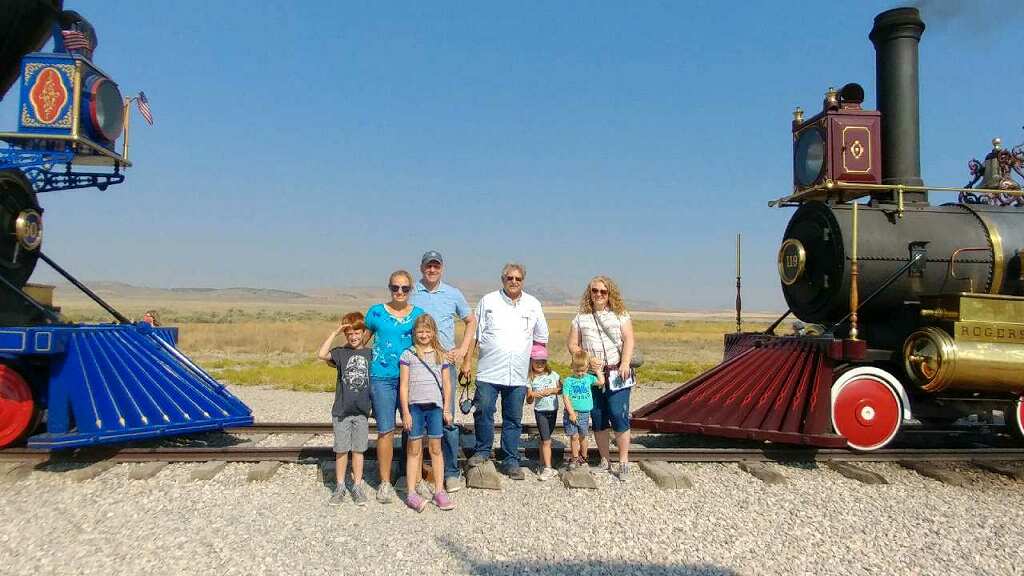


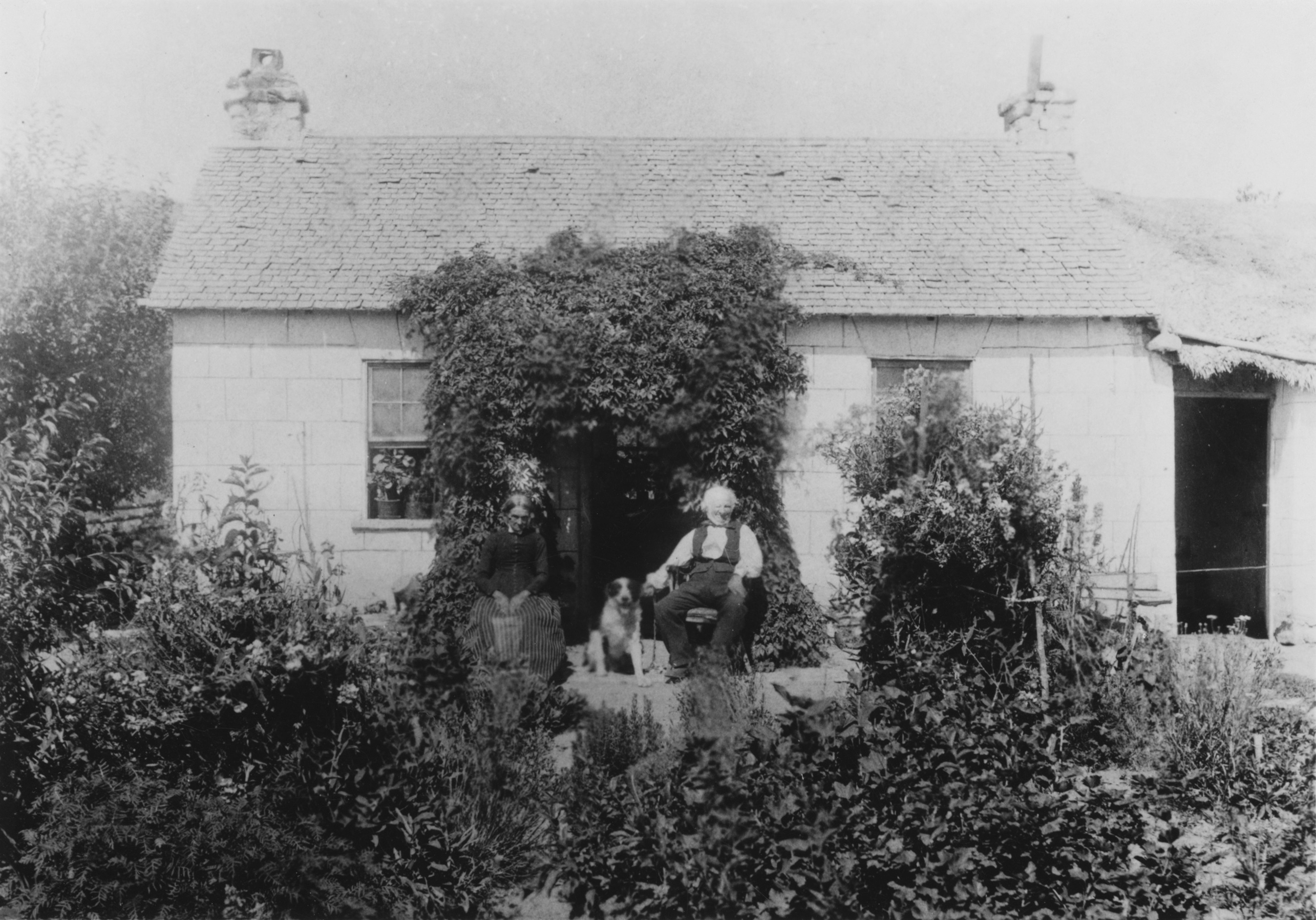
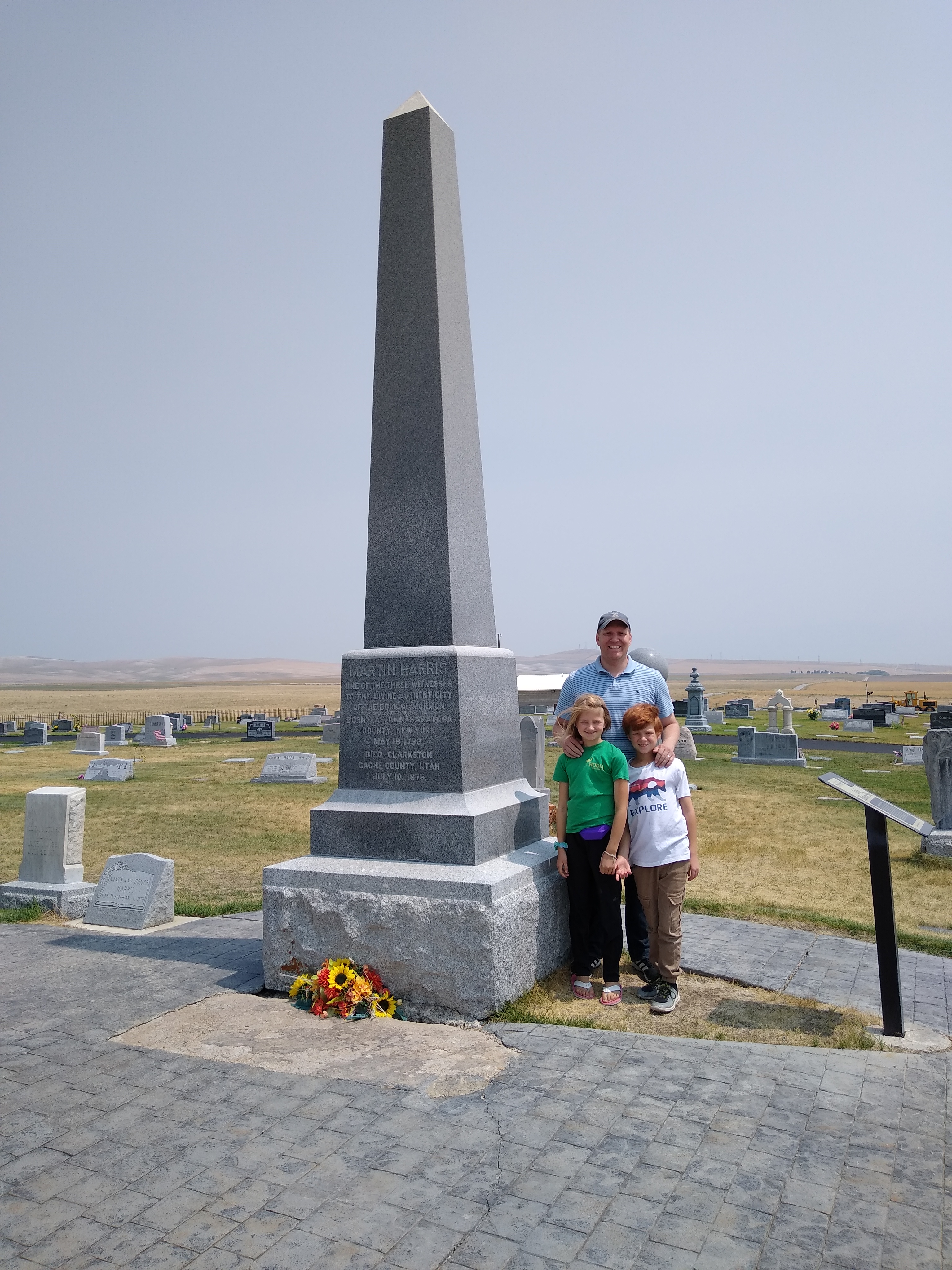


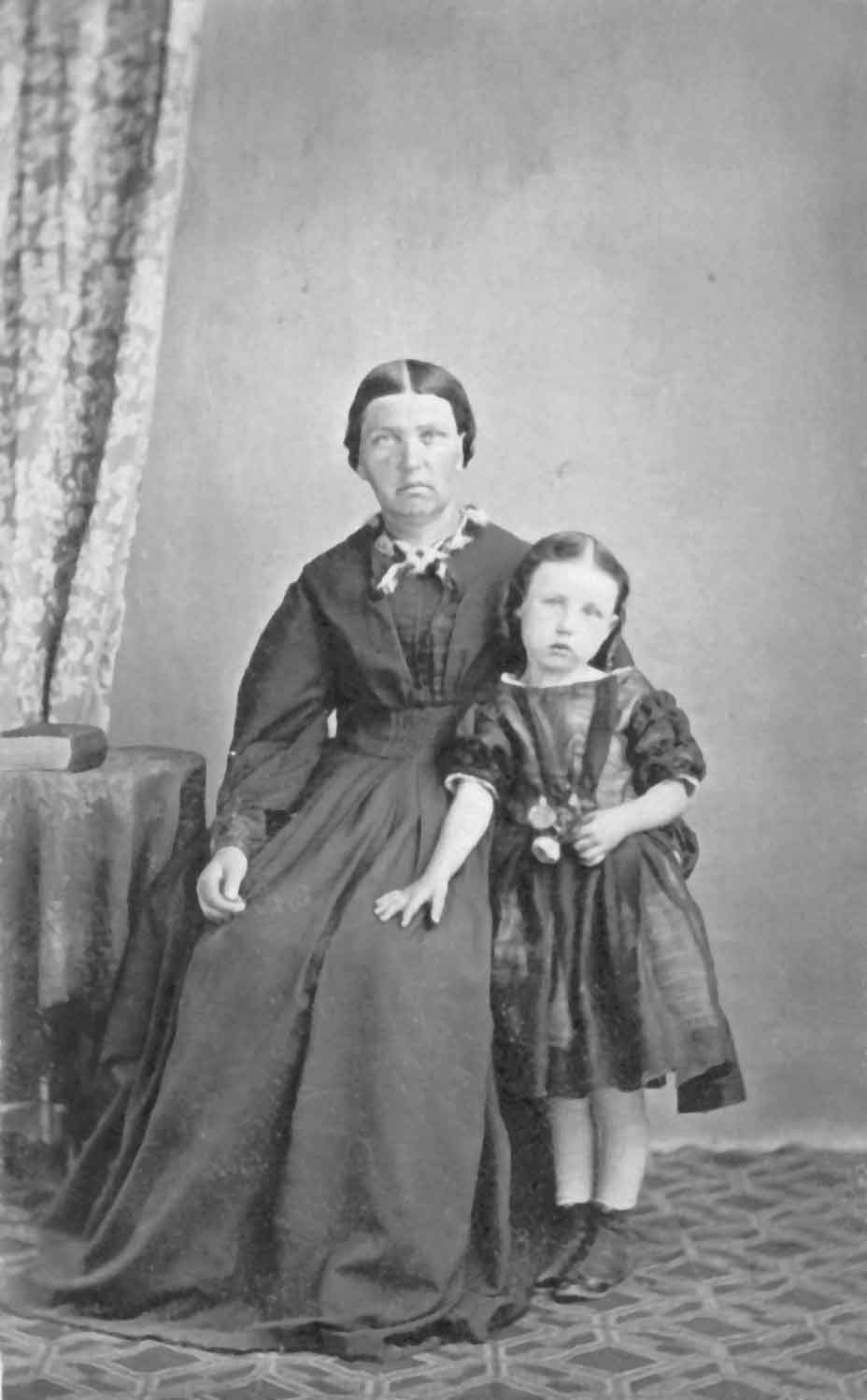


 Sagacity