The Burley Idaho Temple Open House ran 3 November 2025 to 22 November 2025. It was an amazing opportunity to invite the local and broader community to walk through a pinnacle of our worship. I attended 5 of the much more individual and personal tours on the 3rd through 5th with public leaders and distinguished guests. I wish everyone could attend these tours, which would often take 45 minutes to 60 minutes for the full tour. Some of these were guided by General Authorities, including Elders Steven R. Bangerter, Karl D. Hirst, and K. Brett Nattress.
On Thursday, the general public was welcome to attend open tours. Our first tour tried to do a small introduction in each room, but about half-way through that was abandoned to keep the lines moving. Every tour I attended afterward did not have any attempted presentations, other than to remind individuals to not take photos and to speak softly.
Amanda sneaked over and caught a personal tour on the 6th.
6 November 2025 – Amanda Ross attended individually
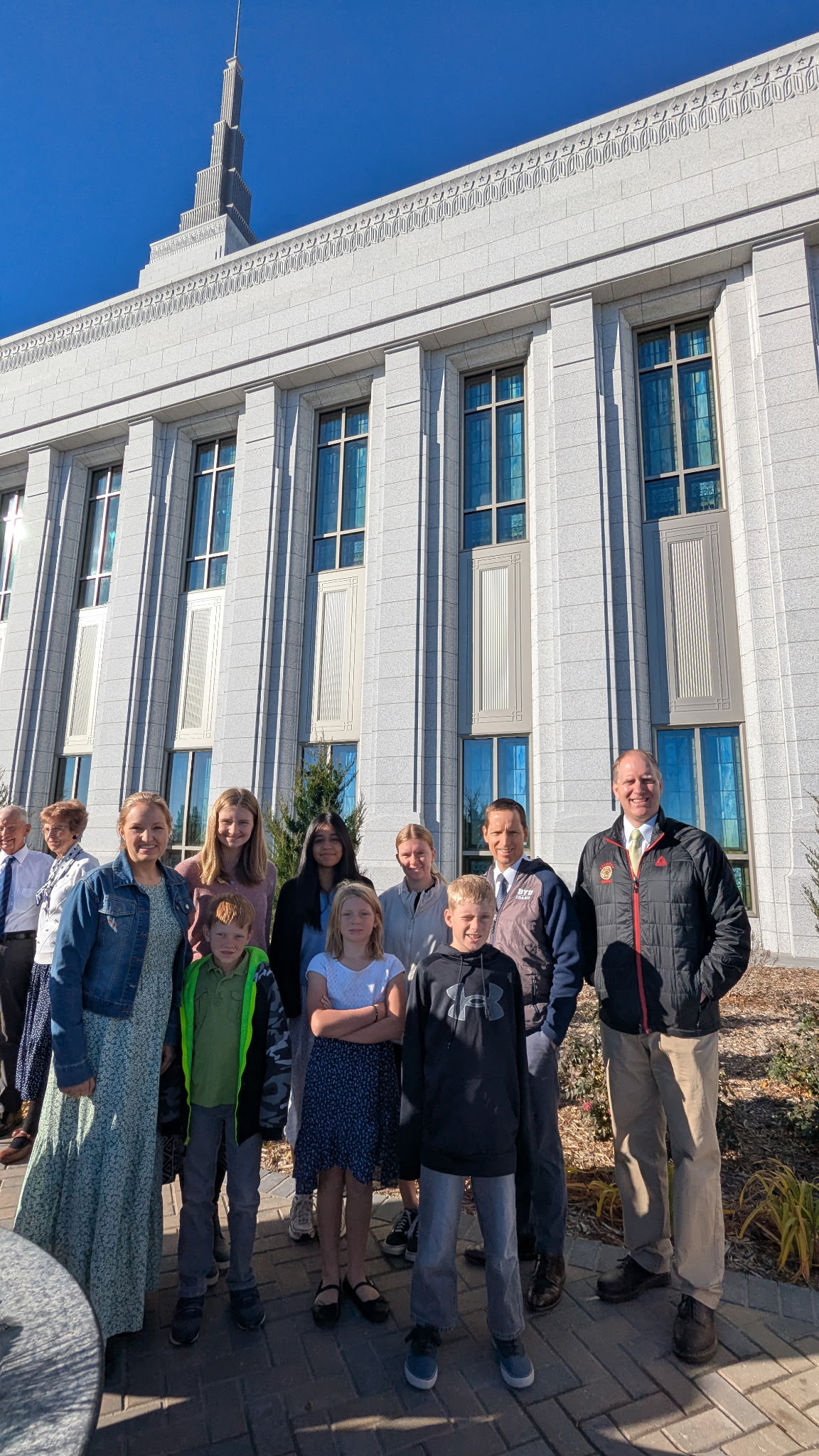
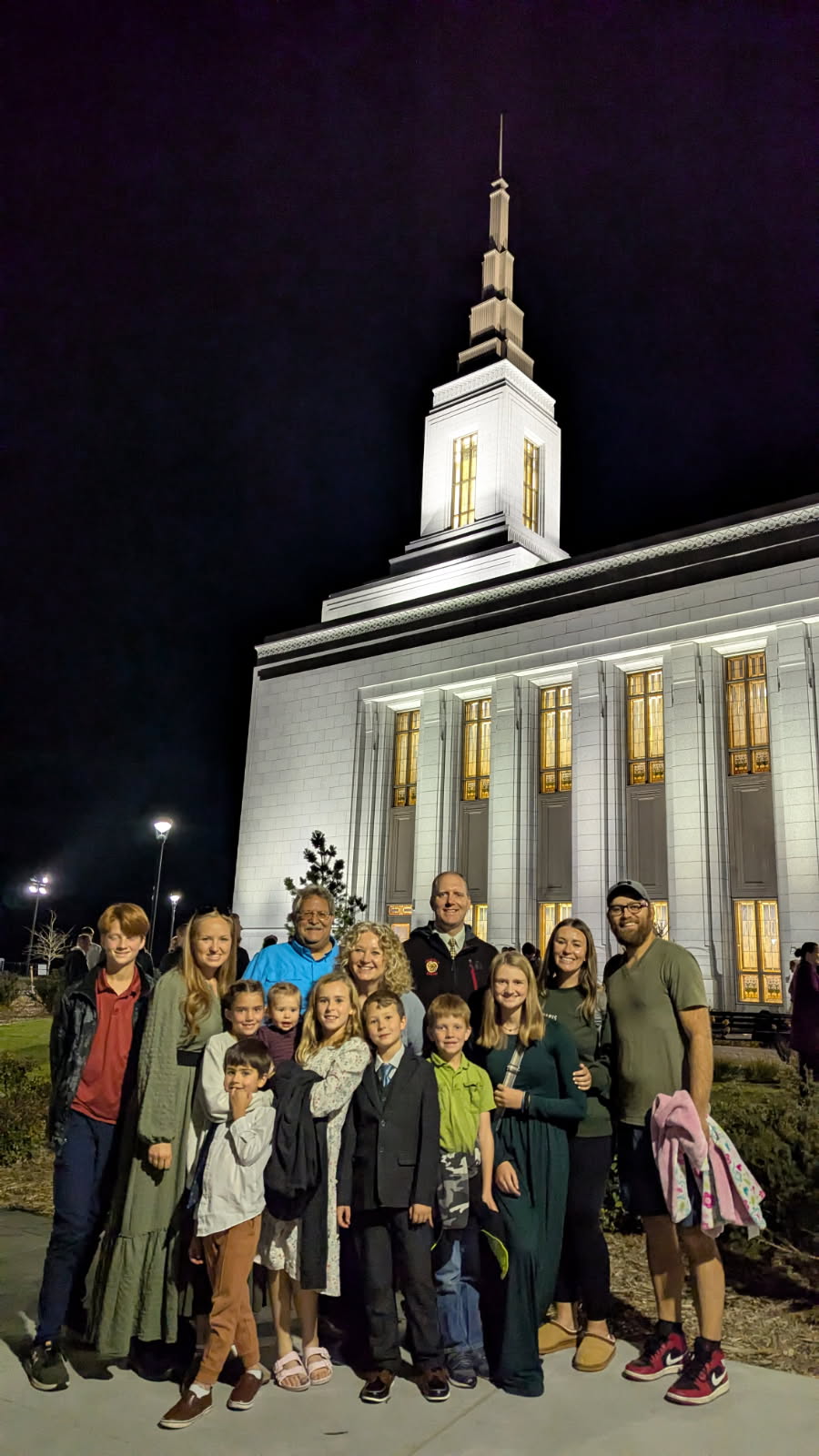
Amanda and I took our family on Friday 7 November 2025.
Saturday morning we attended with some friends. This was my 7th tour that first week!
8 November 2025 – Bud and Karen Marie Whiting, Amanda Ross, James Ross, Aliza Hales, Lea Pierucci Izama, Audra Hales, Aleah Hales, Anson Hales, Brad Hales, Paul Ross
The next weekend, Amanda had a bunch of family come to town and also attend. This Friday night was my 4th tour of the second week.
14 November 2025 – Hiram Ross, Amanda Ross, Lillian Ross, Rowan Hemsley, Margo Hemsley, Bryan Hemsley, Olivia Hemsley, Jill Hemsley, Jack Hemsley, James Ross, Paul Ross, Aliza Ross, Jordan Hemsley, Derek Hemsley
I also got to attend some more times the third week. But my 4th tour in the third week was with my sister and brother-in-law.
22 November 2025 – Paul Ross, Andra and Wes Herbst
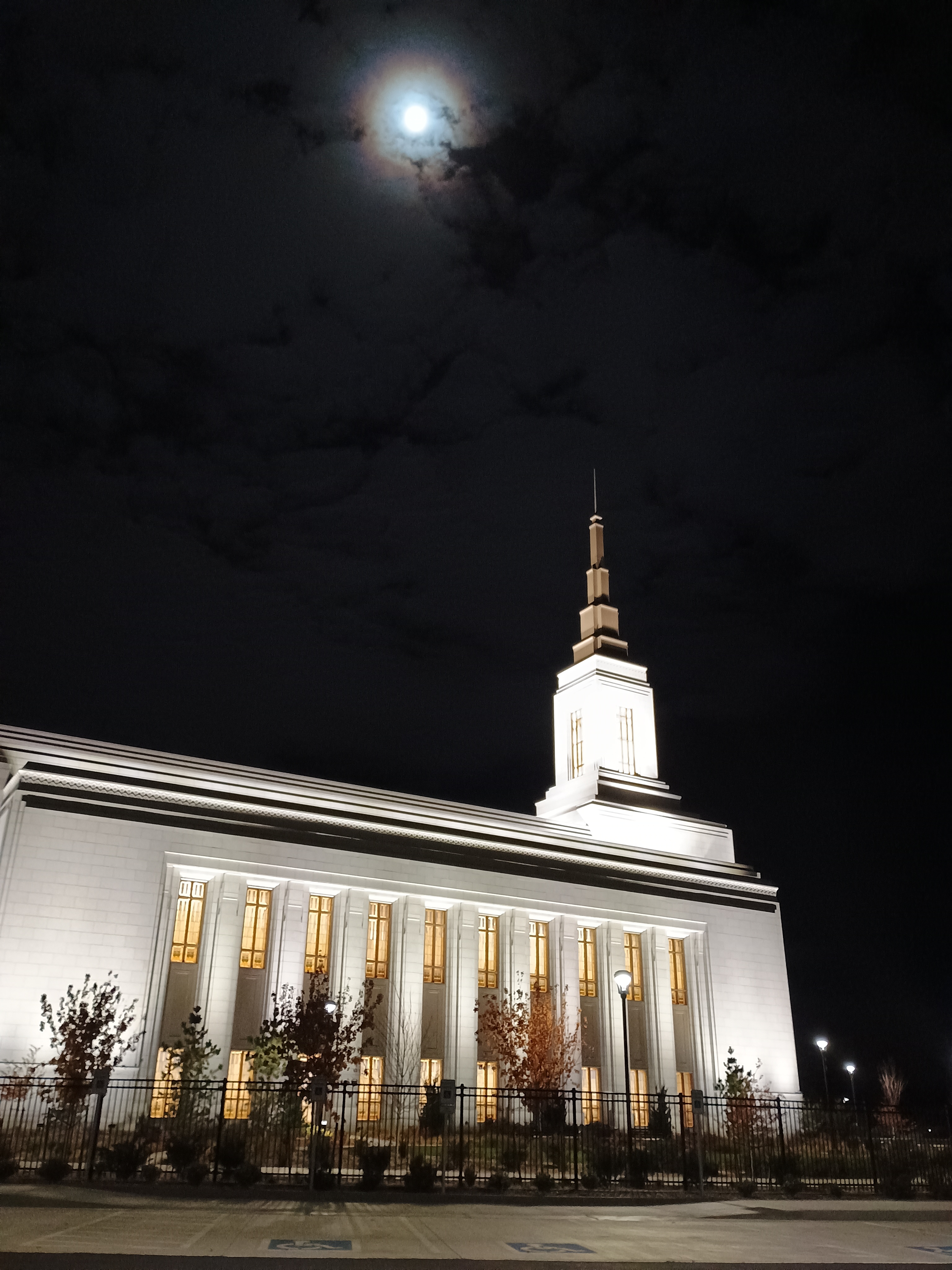
That makes 15 trips through the temple for the open house. I was also privileged to do temple security on 5 different occasions, all for the 9:00 PM to 1:00 AM shift. Here are some photos from that opportunity.
4 November 2025
4 November 2025
5 November 2025 – Paul Ross and Kevin Mower for the graveyard shift
10 November 2025 – Paul Ross and Tyson Smith for the graveyard shift
Amanda also got to do a security shift, parking shift, and foot covering (booty) shift.
12 November 2025 – Amanda Ross Parking Shift
12 November 2025 – Amanda Ross Security Shift
Some of the late night security shifts were great opportunities to reflect on the blessings we are now achieving with the ease and access of a temple so close.
When I received my first temple recommend for my own endowment, Paul Idaho Stake President, M. Gene Hansen, invited me to make a commitment to attend the temple every month at a minimum. I took that commitment. I agreed.
In Hazelton, Idaho, it took me roughly 2 1/4 hours to get to the Boise Idaho Temple (speed limits have increased since then); Idaho Falls Idaho Temple was just under 2 hours; Logan Utah Temple was about 2 1/2 hours, and Ogden Utah Temple was 2 1/2 hours. I was endowed in Logan in September 1998 with my Dad. I attended Logan and Boise before going on the mission. But it was at least half a day planning to attend the temple before the mission.
Within the Manchester England Mission is found the Preston England Temple. Attending the temple in the mission required coordination with members as the temple isn’t near public transportation and we relied on members to take us. We could only go on Preparation Day, which was Tuesday. That took some work, but I was able to attend every month of the mission (except for some months where some missionaries had abused the privilege and all missionaries lost temple attendance options for three months). Getting to the temple was within 1 hour for every area in which I served.
I lived in Branson Missouri for a couple of years. Our closest temple for Branson was the St. Louis Missouri Temple. That drive was at least 4 hours one way, often 4 1/2 hours. That required an entire day to be set aside and planned to drive, attend, and return home. Never missed a month in Branson. I sealed my Jonas grandparents together in St. Louis Missouri Temple. The Bentonville Arkansas Temple has been constructed much closer at about 2 hours. The Springfield Missouri Temple will be less than an hour away from Branson.
Amanda and I lived in Richmond Virginia for a couple of years. Our closest temple for Richmond was the Washington D.C. Temple. That drive was between 4 and 5 hours away, depending on beltway traffic. We would often go up and spend Friday night with family, attend the temple that night or in the morning, and then make our way back home. Washington D.C. Temple was closed for a bit, so to make the monthly trip, we had to go to the Raleigh North Carolina Temple. That was almost a 4 hour drive one direction. The new Richmond Virginia Temple is just outside the first neighborhood we lived in and within 10 minutes of the second neighborhood we lived.
When we moved back to Idaho, the Twin Falls Idaho Temple had been dedicated. That dropped the 2 to 2 1/2 hour drive time for all those temples to less than an hour, usually between 50-60 minutes. But it still takes time and planning to ensure I get there every month. This is double now that we also have a commitment to see that Aliza and Hiram are able to attend at least monthly.
Now, with the dedication of the Burley Idaho Temple in January, the temple will be between 5 to 6 minutes away.
Now I have to reevaluate. It seems the once a month commitment is not enough. I think that will remain the absolute minimum going forward for the rest of my life. It also seems I have no reason to not attend to at least one ordinance in the temple at least every week.
To show my gratitude to our Father and our Savior, I intend to attend the Burley Idaho Temple at least daily for the first 30 days it is open after dedication. Which isn’t as much as it seems if you consider it is not open on Sunday, Monday, or Thursday. Still working out what happens after the first 30 days.
For the last three weeks I have found myself regularly humming The Spirit of God and also muttering the Hosanna Shout under my breath. I am looking forward to the dedication of the Burley Idaho Temple on 11 January 2026!
I have two copies of the History of Plain City, Utah. The front indicates it is from March 17th 1859 to present. As far as I can tell, the book was written in 1977. At least that is the latest date I can find in the book.
One copy belonged to my Grandparents Milo and Gladys Ross. My Grandpa has written various notes inside the history which I intend to include in parenthesis whenever they appear. They add to the history and come from his own experience and hearing.
I will only do a number of pages at a time. I will also try to include scanned copies of the photos in the books. These are just scanned copies of these books, I have not tried to seek out originals or better copies.
History of Plain City March 17th 1859 to present, pages 123 through 140.
SPORTS IN PLAIN CITY
By Lyman H. Cook
Plain City’s most prominent claim to fame has been through the sports program and the great players and teams that the town has produced. I know of no other town to community in this state, to possibly out of state, that can equal the accomplishments in the total sports program as the town of Plain City. I don’t know how many hundred championships or trophies this town has won in baseball, basketball, softball, volleyball, and Jr. Posses, over the last 75 years or more. We include the young teams and people in the town, and also the girls. These trophies and championships came from local, county, multi-county, state, stake division, region, multi-region, and All Church basketball, softball, and volleyball, which is the largest leagues in the world.
On February 14, 1977, at 3:30 PM, there were 226 trophies in the trophy cases at the Plain City Church. I couldn’t begin to estimate the number of trophies in the homes here in Plain City. Can you comprehend the number of teams involved and especially the number of people involved on the teams in accomplishing this great record.
There seems to be a special spirit, or force, ambition, or drive, that compels players to excel and teams to win. The will to win in Plain City is the strongest I have ever known. We have been accused of playing dirty, or being poor sports, but in answer to these charges, I would submit the phrase: We just play hard, and the spirit of competition just brings out the best in us. In Plain City you don’t hope you can win, you are expected to win. Some communities dislike us for our sports program because it is so strong, and in reality, they judge their success of their season by the fact of whether they can beat Plain City or not. I realize these are rather potent and strong statements, but never the less, they are all true.
We dedicate this section of sports to all the people who have ever played on a team in Plain City. We realize that some names will be missed and it is not our intent to forget anyone, but we can’t remember all, and this is all of the sports material that has been turned in for the history. If your name is left off, write it in, and if you were star of the team, write that in also.
We have asked for and received personal write-ups on a few people who have signed professional contracts or have distinguished themselves in certain sports. We recognize them for their talents in that they in turn have brought special recognition to Plain City. I am sure these talented athletes would be the first to recognize their fellow members, for they realize that no one man is bigger or better than the whole team, and in this light, we recognize the teams they played on.
From 1944 until the present, there were three basketball teams that went to All Church and won two second places. Commencing in 1951 through 1954, we played in four fast-pitch All Church Tournaments. We won a second-place finish and eight-place finish.
In 1953, we played on a volleyball team that went to the All Church Tournament and won the Sportsmanship Trophy, which was a great honor. The team that played were: Dee Cook, Lyman Cook, Wayne Cottle, Wayne Skeen, Blair Simpson, Kenneth Lund, Harold Hadley, and others we couldn’t remember.
There were teams that went to the All Church Slow Pitch Tournaments from Pain City for three years. They won two All Church Championships, and a third-place finish. There have been some excellent younger teams in baseball, basketball, and softball, and a Junior team last year (1976) won a second-place in a
The All Church program.
This was one of the early teams of Plain City, and this picture was taken around 1910. They played together for many years, and they won several championships.
Top Row: L to R: Joe Hunt, Tooley Louis Poulsen, Preston Thomas, Parley Taylor, Jack Hodson.
Middle Row: L to R: Mr. Anderson, Coach, Jim Thomas, Melvin Draney
Bottom row: L to R: Oscar Richardson, Joe Singleton
Louis Poulsen
Tooley Poulsen played on many championship teams, and played several positions, mainly second base and catcher.
This was one of the first Mutual basketball teams in Plain City. They played their games in the upstairs of the old hall. Lyle Thomas reports that you didn’t have to be polished to play on this team, just big and rough, for there was very little whistle blowing in those days. This picture was taken in about 1925, and they won several championships.
Back Row: L to R: Rulon Jenkins, Lyle Palmer, Marion Sneed, Milton Garner
Front Row L to R: Theo Thompson, Ralph Robson, Coach Ellis Giles
This was the 1930 Plain City Baseball team. They played for State Champion ship.
Top Row: L to R: Horace Knight, Albert Sharp, Walter Christensen
Middle Row: L to R: Floyd Palmer, Angus Richardson, Arnold Taylor, Walter Moyes, Abram Maw, William Freestone
Bottom Row: L to R: Clair Folkman, Gilbert Taylor, Dick Skeen, Fred Singleton, Frank Skeen, Elmer Carver
BASEBALL AND EARLY SPORTS
By Elwood (Dick) Skeen
Baseball was Plain City’s most favorite sport. Baseball in Plain City in the early 1920’s and 1930’s was composed of the Plain City Bull Dogs with the following players taking part:
Louis Poulsen
Joe Singleton
Walter Draney
Elmo Rhead
Parley Taylor
Joe Hunt
Elvin Maw
Oscar Richardson
John Hodson
They represented Plain City in the Weber County Farm Bureau League, composed of North Ogden, Hooper, Roy, and Clinton. There were many good ball players in those days that played on the teams. The town park at that time was covered with salt grass. There were no base lines, no pitcher mounds. But, on a Saturday afternoon the park was filled with people that came from all over the county to watch the games. Horses and wagons lined the park.
Foot racing was also a great sport at that time, and Plain City had one of the best in Walter Draney, who was not only fast, but also a great athlete.
As time passed and the older players began to drop out, the chance came for us younger players to take over. In 1925 I caught my first Farm Bureau game at Liberty with Ezra Taylor doing the pitching. Then, the other players that made up our team for the next few years started to play. We had our share of victories. In fact, we had more than our share of wins.
Finances at that time were hard to come by. We did what we could to raise money to continue supporting the team. In 1928, the ball team put on the first Black and White Day with Mervin Thompson and Joseph Skeen showing their cattle. An old-time refreshment stand, soda water, ice cream, candy bars, and popcorn, which sold for 5¢. Also, some drinks that were not sold at the stand.
Our uniforms were furnished by Plain City individuals and business firms from Ogden. Suits would have the name of the giver on the back. Decoration day and the Fourth of July were our most celebrated days with all kinds of sports for those who wished to perform. A baseball game and a dance in the evening would top the day.
We would get the best team from Ogden to play on these days so that we could show what was leading up to the best team we had. In 1930, we won the Weber County Farm Bureau League, and the town bought us new uniforms to go to Lagoon to play Sandy, Utah, for thy State Championship. We lost by a close score. Our players were:
Gilbert Taylor
Walter Moyes
Arnold Taylor
Frank Skeen
Horace Knight
Albert Sharp
Fred Singleton
Abram Maw
Walter Christensen
Clair Folkman
Dick Skeen
Bill Freestone was the manager. Angus Richardson was the coach. Elmer Carver took care of finances, and Floyd Palmer and Byron Carver were scorekeepers. We played in tournaments at Brigham City and Ogden, and some out-of-state games were played.
We continued playing, but soon the gang started drifting different ways and our days were coming to an end. The league started to dwindle and later, folded up with the workload increase. Baseball was soon lost to the towns in Weber County.
Left to Right: Nalon Taylor, Bert Cook, Howard Gibson, Bud Dallinga, Wayne Cottle, Thayne Robson, Bill Stokes, Rulon Jenkins, Coach
The Desert News Sport Best Two MIA Teams
Page 10 – Salt Lake City, Utah-Saturday, March 11, 1944
Bottom Row: L to R: Carl Taylor, Carl Hodson, Fred Singleton, Coach, Blair Simpson, Glen Charlton
Top Row: L to R: Frank Hadley, John Nash, Lyman Cook, Ray Cottle
Ray Cottle, Center: First Team All Church
Frank Hadley, Forward: Second Team All Church
Lyman Cook, Guard: Second Team All Church
Blair Simpson, Guard: Honorable Mention
This team played for All Church Championship in 19441. They played Grantsville, Utah, and lost to them for the title. The games were played in the old Desert Gym, by the Hotel Utah. The teams stayed four nights in the Hotel Utah. They ate, slept, and played basketball.
Top Row L to R:
Alf Charlton, Athletic Director
Lyman Cook, Ronald Skeen, Kenneth Lund, Grant
Lund, Wayne Skeen, Clair Folkman, Coach
Bottom Row L to R:
Harold Hadley, Elmer Hipwell, Bill Stokes, Dee
Cook, Blair Simpson
This was the Plain City M-Men Team that played after World War II, in 1946, for several years and won several state championships and played in the division tournaments.
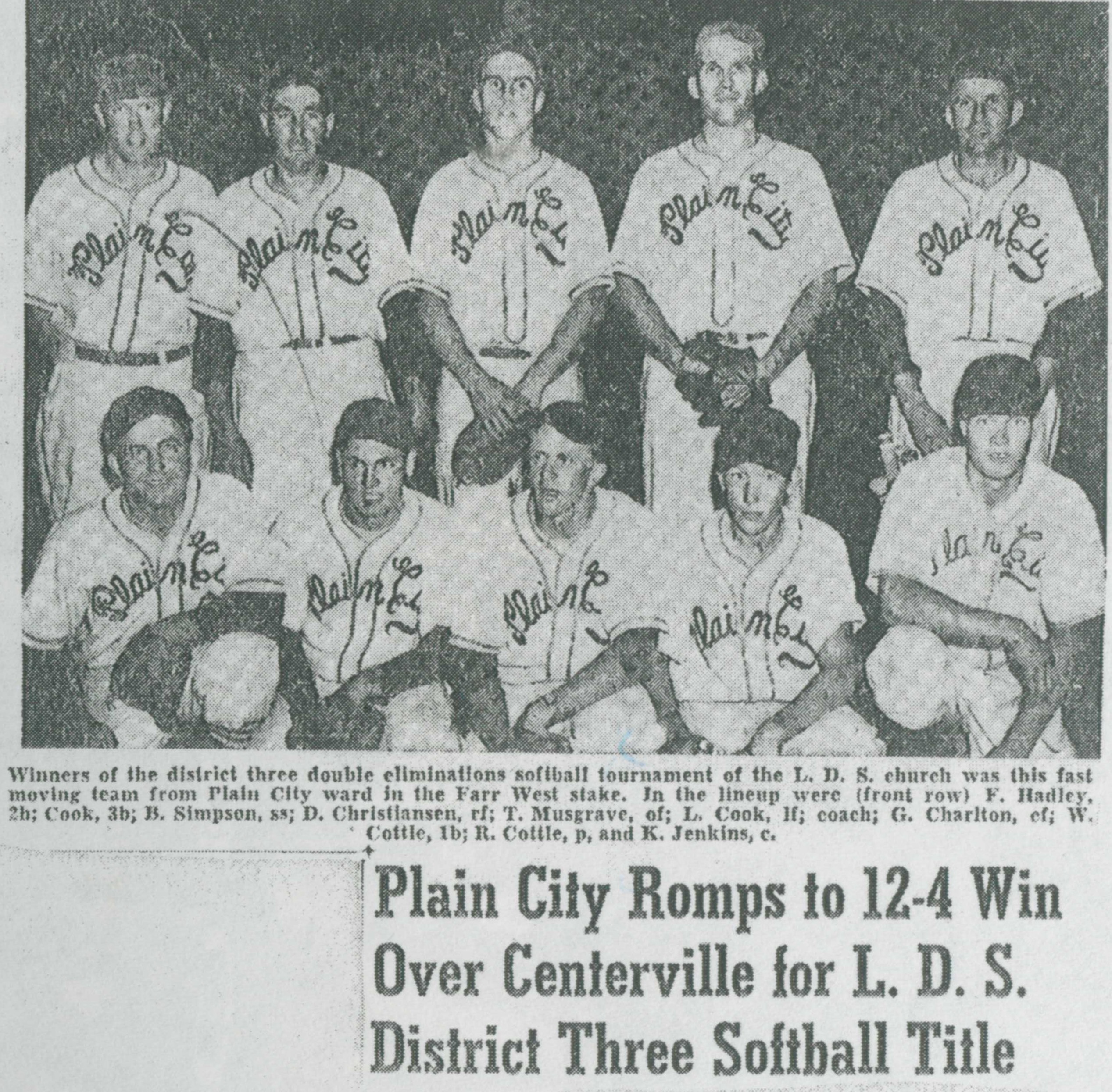
Winner of the district three double elimination softball tournament of the L.D.S. church was this fast moving team from Plain City in the Farr West Stake. In the lineup (front row) F. Hadley, 2b; Cook 3b; B. Simpson, 5b; D. Christensen, rf; T. Musgrave. Of; L. Cook, lf; coach; G. Charlton, of; W. Cottle. 1b; R. Cottle, p, and K. Jenkins, c.
Plain City Romps To 12-4 Win
Over Centerville for L. D. S.
District Three Softball Title
PLAIN CITY SOFTBALL TEAM OF 1951
By Lyman Cook
Plain City has always been a very strong baseball town, and the feeling was that softball was a game for girls, or you played softball at family reunions. In 1951 the Farr West Stake started a softball program and wanted teams to participate. I was Ward Athletic Director at that time and asked these players to play. This was the first softball team organized in Plain City. We won the Stake and District III. We then went on to the All Church Tournament in Salt Lake City. We won some and lost some, not too eventful. I coached the team the first year we played. This was a fast-pitch team.
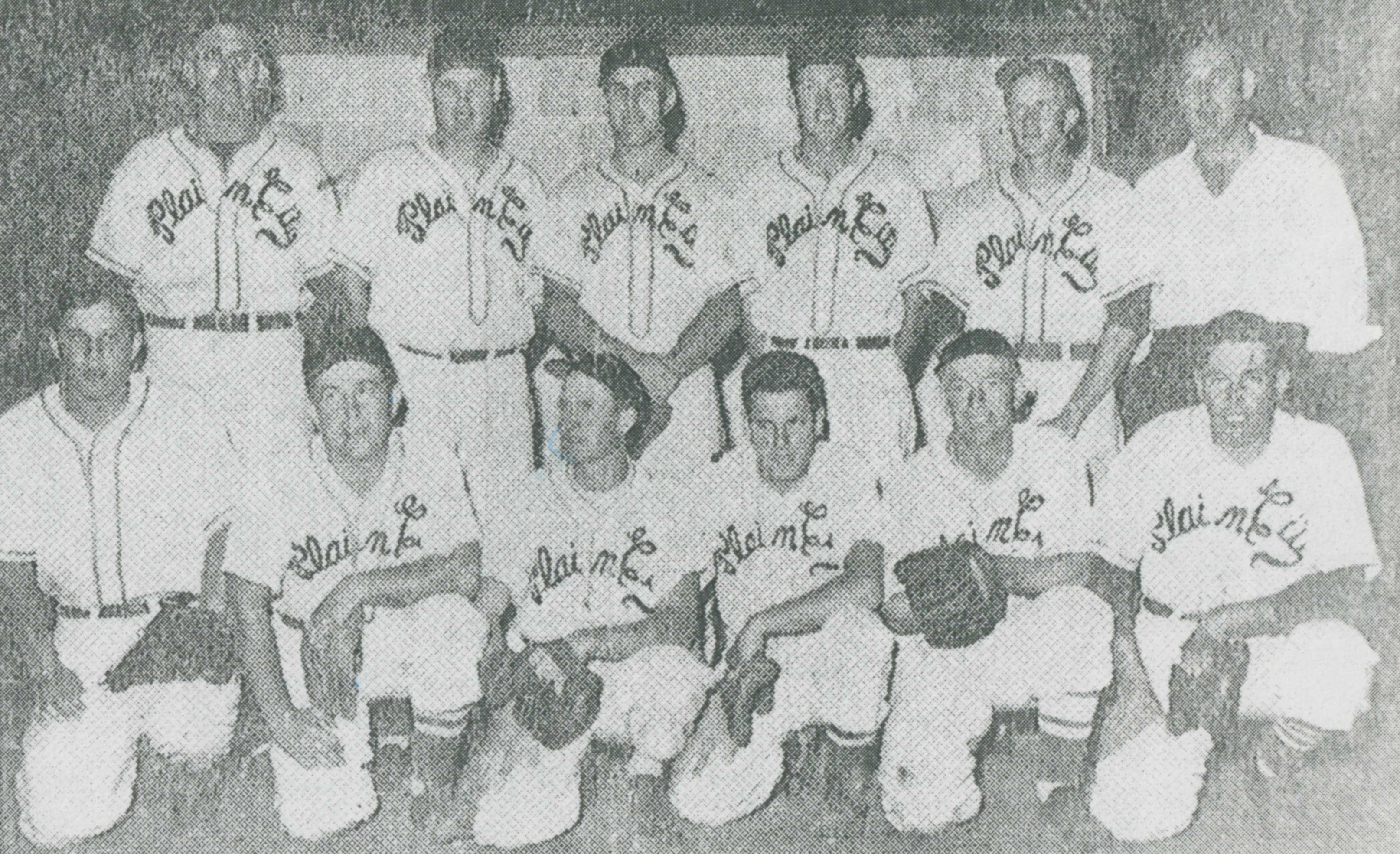
L. D. S. Division III Champs
Repeating their last year’s victory in the L.D.S. division III softball tournament, the Plain City team came through again last night at Ogden softball park to beat Hoytsville 9 to 6. Front row Left to right: M. Heslop, E. Hadley, C. Taylor, D. Cook, A. Maw and G. Charlton: back row, lerft to right: R. Cottle, W. Skeen, W. Cottle, L. Cook, B. Simpson, and D. Skeen, coach. Absent from photo: Jenkins, V. Stokes and R. Skeen.
PLAIN CITY WARD SOFTBALL TEAM OF 1952
By Lyman Cook
In 1952 we repeated as stake champions and also won the Division III Championship again. We went to the All Church Tournament again and played very well. We played for the All Church Championship, but lost to Pocatello 10th Ward in a good game. Blair Simpson was voted Most Valuable Player of the tournament. Wayne Cottle made the All Church Team. There may be others. This was also a fast-pitch team. Dick Skeen was the coach.
This team played Farm Bureau Baseball and won the
Championship around 1950:
Top Row: L to R:
Junior Taylor, Wayne Skeen, Don Singleton, Bert Cook,
Glen Charlton, Kent Jenkins, Clair Folkman, Coach
Bottom Row: L to R:
“Buss” Lyman Skeen, Frank Hadley, Wayne Cottle, Ray
Charlton, John Maw, Dee Cook
This team played Pleasant Grove for All Church Champion-
Dee Cook, Manager, Darrell Christensen, Robert Folkman,
Bert Cook, Kenneth Lund, Wayne Cottle, Kent Jenkins, Coach
Many county and Northern Utah Championships were obtained by this team that was sponsored by the Town Board in the late 1950’s to middle 1960’s.
COACHES: Clair Folkman – Blair Simpson
TEAM MEMBERS: POSITIONS:
Blair Simpson P- IF
Wayne Cottle IF
Cy Freston IF
LaGrand Hadley OF – P
Archie Skeen C
Gaylen Hansen C – P – IF
Bobby Taylor P – OF
George Cook IF
Reid Nielson IF P
Ted Favero IF –
Dennis Anderson P
Garry Skeen OF
Lynn Folkman OF
Bud Parker IF – OP
Tom Seager OF
Harold Hadley IF
Harold Marriott IF
******
PLAIN CITY WARD FASTPITCH TEAM
1960, 1961, 1962
This team won the Stake, Region, and Division Championships, and represented the ward in All-Church competition with a successful number of victories.
COACH: Elmer Carver
TEAM MEMBERS:
Tom Seager, P Blair Simpson, SS
Gaylen Hansen, C LaGrand Hadley, LF
Wayne Cottle, 1st Robert Folkman, CF
George Cook, 2nd Dee Cook, RF
Cy Freston, 3rd Don Singleton, IF
Blaine Eckman, QF Gar Hunter, 1st – OF
THE PLAIN CITY BULLDOGS
This is one of the very first Weber County Recreation Teams in Plain City. Many of these players went on playing baseball for many years.
Front Row: L to R:
Dick Skeen, Coach, Fred Palmer, Darrel Thompson, Kenneth Hogge, George Cook, Ronald Sharp.
Back Row: L to R:
Archie Skeen, Brent Taylor, Wayne Poulson, Jay Freestone, Robert Folkman, LaGrand Hadley
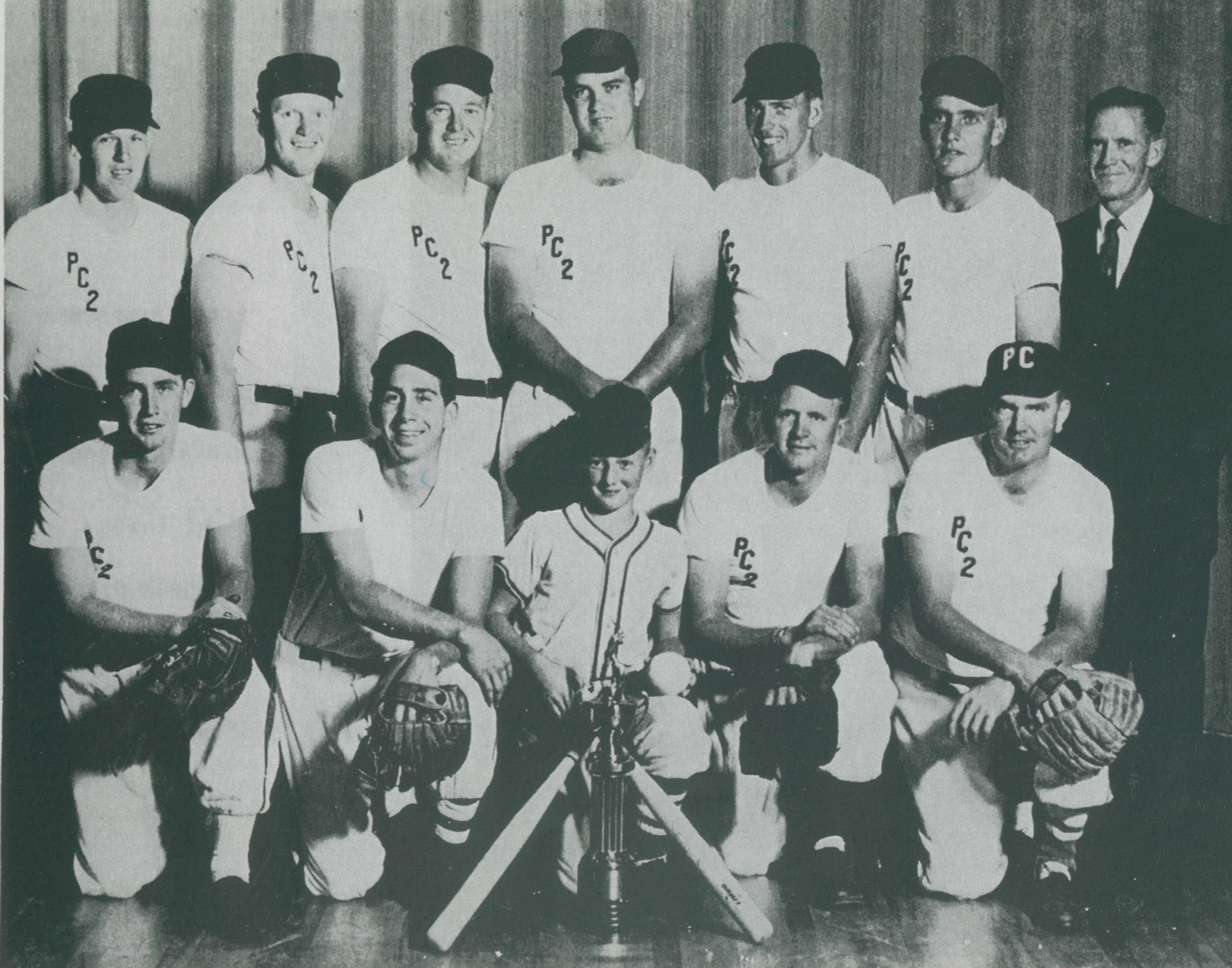
PLAIN CITY SECOND WARD
ALL – CHURCH CHAMPIONSHIP TEAM
1963 – 1ST Place
1964 – 1st Place
1965 – 3rd Place
This team represented the Plain City 2nd Ward and Plain City Town by winning 64 and losing only two games over a three-year span. Many players received All – Church recognition. In the championship game the first year the team hit 11 home runs and pulled off a triple play for the victory.
Back Row: L to R: Not in Photo
Garry Skeen Archie Skeen
Gaylen Hansen Ken Searcy
George Cook Jay Freestone
Gar Hunter Val Taylor
Jerry Bradford Mel Cottle
Lynn Folkman Gordon Singleton
Bishop Rulon Chugg Jim Beasley
Don Singleton
Front Row: L to R: Gary Hill
Bishop Orlo Maw
Jerry Moyes
Doug Palmer
Dale Searcy
Blair Simpson
LaGrand Hadley
All – Church Honors:
Gar Hunter
Jerry Bradford
Ken Searcy
Gaylen Hansen
Archie Skeen
Blair Simpson, Most Valuable Player
BLAIR SIMPSON
and
ELMER SINGLETON
of the
PITTSBURGH PIRATES
1948
“Two cousins met”
ELMER SINGLETON
Elmer Singleton started pitching for the Farm Bureau League in Plain City. He pitched for several championship teams. He signed a professional contract with Cincinnati, and played at Wenatchee, Washington in 1939, his first year. He played for Idaho Falls, Portland, and Oklahoma City. He moved on up to the big league and played with the following teams:
Cincinnati
Yankees
Chicago
Kansas City
Boston
Pittsburgh
Washington in 1950
Toronto
San Francisco
Seattle
He was in professional baseball for 27 or 28 years, the last eight years as a player coach.
He pitch two no hitters, one at San Francisco, and the other at Seattle. Elmer won the Player of the Year Award at Seattle in 1956. There is a baseball card with Elmer’s picture on it with the Chicago Cubs. It reads:
“This will be Elmer’s 17th year in professional baseball.
He started back in 1940 and after 11 uneventful seasons,
got red hot to become one of the top hurlers on the
Pacific Coast. In 1952 at San Francisco, he won 17, followed
with 15 triumphs in 1953 and moved to Seattle in 1956.
He had the best Pacific Coast Earned Run Average.”
Elmer told us that before he left to play professional baseball, the people of Plain City honored him at a banquet. They gave him a ball glove, and he still has it. He is listed in the Sports Record along with his accomplishments. Elmer was a great baseball pitcher. The only picture we have of Elmer is with Blair Simpson. Elmer and Blair are cousins,
BLAIR SIMPSON
BY Blair Simpson
I attended school at Plain City before going to Weber High School. At Weber High School I participated on the track team, played some basketball and pitched for the Weber High baseball team.
After graduating from Weber High School in 1944, I was drafted into the army for two years.
In 1948, I signed a professional baseball contract with the Pittsburgh Pirates organization. While playing with the Pirates, I played with the following cities:
Santa Rosa, California
Pittsburg, California
Modesto, California
Hutchinson, Kansas
Waco, Texas
Charleston, South Carolina
I was a pitcher and had to quit because of an injury to my knee.
After retiring from professional baseball, I played a considerable amount of baseball with Plain City and other teams in the Ogden area, such as:
Ogden Ford Sales
Heitz Heating
Wasatch Time
I was selected on the All Star Baseball Team composed of 16 players from the State of Utah.
I also played on many softball teams in the Ogden area such as Fisher Hess, Utah General Depot, Fred M. Nyes, Savon, and others.
In 1952, I was named the Most Outstanding Player in the “All Church Fastpitch Softball Tournament” in Salt Lake City and was also named to the All Church All Star Team in 1953.
In 1963, o received the Most Outstanding Player Award in the All Church Softball Slow Pitch Tournament. In 1964, I again received the most Outstanding Player Award in the slow pitch division of the All Church Tournament held in Salt Lake City. The year 1964 was one of my most memorable occasions in All Church Softball as I hit four consecutive home runs in one game.
I would like to give a lot of credit to whatever successes I have enjoyed in athletics to the talented town of Plain City.
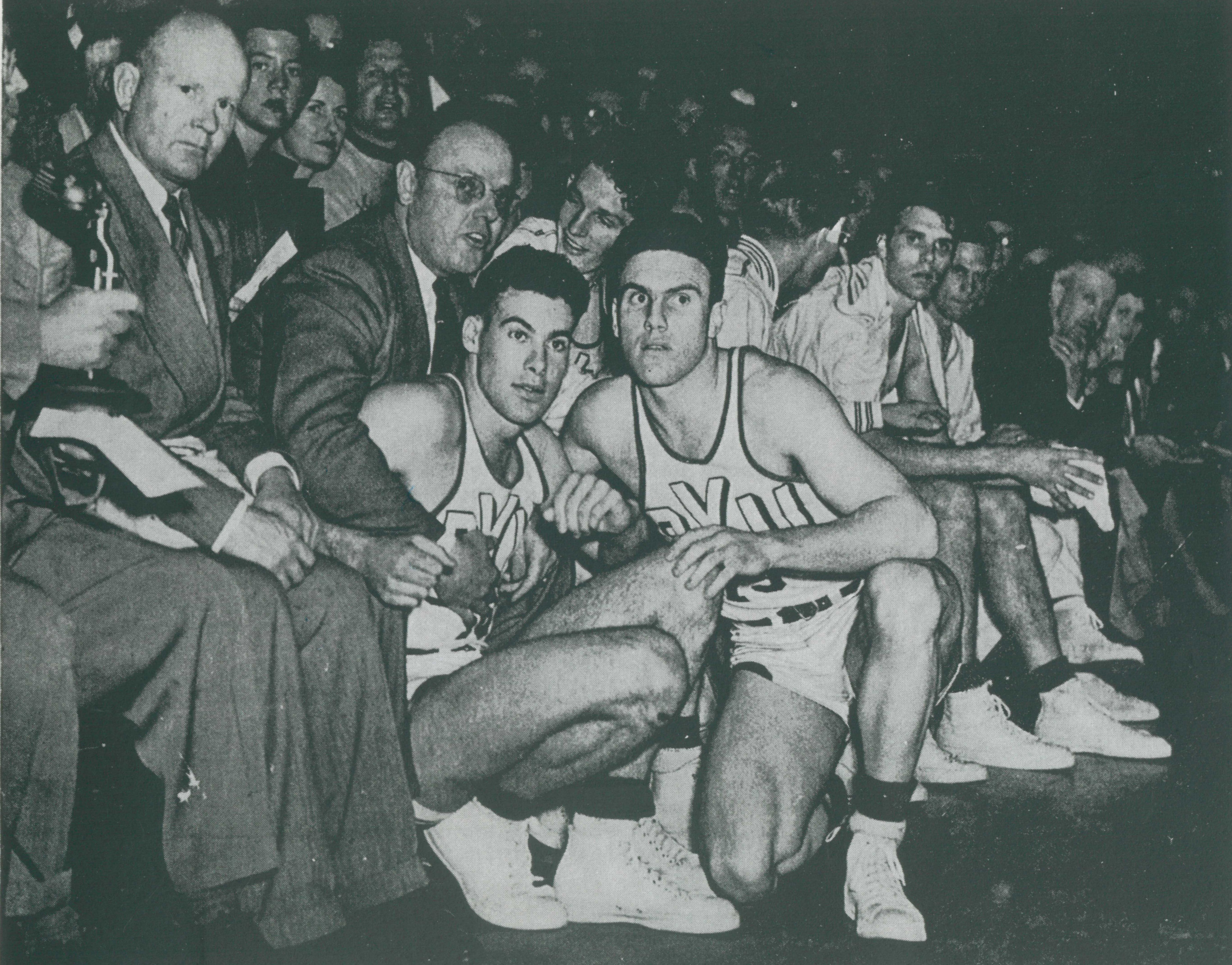
WAYNE COTTLE
By Wayne Cottle
I was born November 30, 1928, in Ogden, Utah. I lived in Plain City all my life. I attended Plain City Elementary and Junior High. I played basketball in the 9th and in the 10th grades for Plain City. L. Rulon Jenkins was our coach and our principal. We played against Hooper, North Ogden, Huntsville, and Weber High School.
In the Fall of 1945, I started Weber High School, playing football, basketball, baseball, and track for both years. In 1947, I played to a tie for the Region I Championship with Box Elder. We played off the tie breaker at Ogden High School, beating Box Elder for the first Region I Championship for many years. I won the Region I scoring title. We entered the State Tournament in Salt Lake City and we lost to Granite, who became the State Championships, in the semi-finals. I was the recipient of the Standard Examiner KLO Watch Award for being the outstanding athlete of the year.
I entered Weber Junior College in the Fall of 1947. After about a month of practice I became one of the starting forwards. We played in several tournaments winning 3rd place in the Compton California Invitational. We played an independent schedule that year. In 1948-49 Weber became a member of the ICAC Conference. We won the conference and played Snow Junior College Tournament. We won the game and I was voted the tournament’s Outstanding Player Ward. We went to the national finals in Hutchinson, Kansas. We won our first game, then we met two defeats.
In the Fall of 1949, I entered Brigham Young University. I was on the team that won the Skyline Conference Championship for the first in many years. We went to the NCAA at Kansas City, Missouri. We lost to Baylor University, then beat UCLA for 3rd place. The next year we accepted a bid to enter the National Invitational Championship and two of our players were voted All American.
I graduated from BYU in 1951, came back to Plain City and started to play basketball with the Ward team. From the 1951- 1952 season until the creation of the Plain City 2nd Ward in 1960, we never lost a league game in the Farr West Stake. The year of the creation of the Plain City 2nd Ward, they beat us once and we beat them once. We played off the Stake Championship at Wahlquist Jr. High, and we won the team and the championship. After that season, the Church specified an age limit and I was area championships and went to the All Church several times.
WAYNE COTTLE
Brigham Young University
BERT COOK
He attended Plain City School where he was active in athletics. He graduated and attended Weber High School in 1947 and 1948., where he participated in football, basketball, baseball, and track. In 1948, he was selected on the Class A State All Star Team, in which Weber High School won the championship. He also won the All American in boys Award in baseball at John Affleck Park in 1948. From this he won a trip to Chicago.
He played for the Plain City baseball team for the Farm Bureau and Ogden City League.
From 1948 until 1952 he attended Utah State university at Logan, Utah, where he started on the first five as a freshman, and later in the year played in the AAU Tournament and was selected on the All Tournament Team.
In 1951 – 1952, he lead the conference in scoring and was voted All Conference both years. In 1952 he was voted All American in basketball where his Number 6 jersey was retired at Utah State University being the first one in the history of the school. That same year he was selected on the All Conference Team, and traveled with the Harlem Globe Trotters and the College All Star for several games. Later that year, he signed a contract with the New York Knickerbockers and was drafted into the service where he played for Fort Lee, Virginia Military team in which he lead the scoring and was later voted to the Second Army All Star Team.
He served his country in the Far East Command in 1954, being released in 1955, when he rejoined the Knicks until 1956. After a serious knee injury he returned to Plain City and played for the Plain City Ward and the Ogden City League.
He played on the 1956 team that won second place and he made First Team All Church.
At Weber High School I participated in basketball, baseball, and football and was productive and beneficial. After graduation in 1954, I attended Utah State University for two years on a football scholarship. Next, I received a University of Utah Scholarship in baseball. That year 1958, was a successful year with a batting of .350. The next year was even more eventful. My batting average jumped to .490. The .490 batting average was good enough to lead the Skyline Conference, plus I was fortunate to lead the NCAA in homeruns and RBI’s. These statistics and the efforts of the University of Utah Sports Publicity Department lead to my selection as the “First Team Catcher on the College All -American baseball Team”. As a result of this honor, I was selected the “Most Valuable Player in NCAA, District 7.” The year was 1959.
Opportunities were available to sign a professional baseball contract with the New York Yankees, Chicago Cubs, Boston Red Sox, and the Phillies. In 1959 I signed a bonus contract with the Boston Red Sox.
During the next three years I played in the following leagues: Sophomore League in Alpine, Texas: North Carolina League in Raleigh, North Carolina; Midwest League in Waterloo, Iowa; and the Eastern League in Johnstown, Pa. Winter ball was played in Bradenton, Florida.
In 1962, spring training was held in Deland, Florida. Because of a successful spring training I was invited to join the Triple A League in Seattle, Washington, “The Seattle Rainiers.” All Star Catcher honors were received in 1960, 1961, and 1962. In 1963 I was invited to spring training with the parent ball club, The Boston Red Sox. At the completion of spring training I was again assigned to the Seattle Rainiers.
Some of the great stars helping the young players were: Ted Williams, Bobby Doerr, Rudy York, Johnny Pesky, and Mel Parnell. As of this year, 1977, the only teammate of mine still with the Boston Red Sox is Carl Yastrzemski.
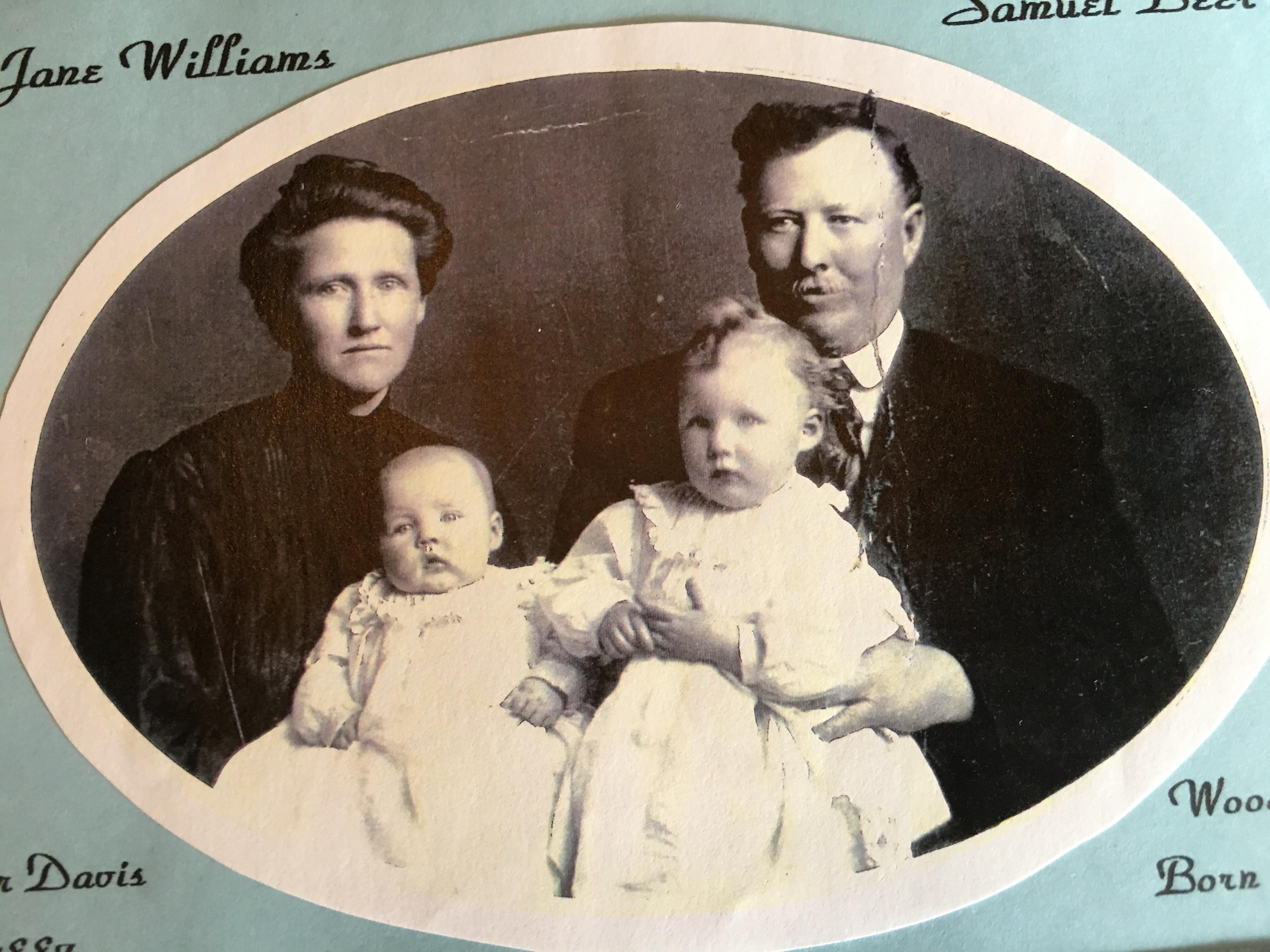
Another family history story. This one is interesting in that his Idaho case went before the United States Supreme Court in Davis v. Beason. This is the biography of Samuel Deer Davis (1859-1923) written by Dean G Grow, his great-grandson. Samuel Deer Davis married Mary Jane Williams, daughter of Sarah Jane Davis and John Haines Williams. Mary is the sister to David Davis Williams who I also previously shared his biography.
~
“This is the history of my great-grandfather, who was instrumental in the legal attempts that The Church of Jesus Christ of Latter-day Saints undertook to counter the continuing political and legal assault against the Church due to the practice of polygamy in the late 1880’s not only in Utah but in Idaho where he lived.
“Samuel D. Davis was born in Salt Lake City on 22 July 1859 to David Woodwell Davies and Mary Deer. Samuel’s father had been a missionary in his native Wales for seven years before coming to America. Aboard ship, David met his bride-to-be, Mary Deer, also a native of Wales. When they arrived in Kansas City, Missouri, it was too late in the year, creating a delay in getting to the Salt Lake Valley. So they decided to marry. This occurred on 25 November 1852, in Kansas City. They most likely traveled across the plains with a group of Welsh immigrants in the summer of 1853.
Samuel Deer Davis
“After arriving in Salt Lake Valley, David being a painter and a glazier, set up his home and they began their life there. David and Mary’s first son, David Thomas was born on 4 March 1854 in Salt Lake City. Their second son, Woodwell was born in 1856 in Salt Lake City. David was sealed to Mary on 2 March 1856 in the Presidents office in Salt Lake City. At the same time and place, he was sealed to Elizabeth Berry, thus becoming a polygamist. Elizabeth being a native of Bath, Summerset, England. Their third son, Samuel Deer as indicated earlier was born in 1859. They were all shown on the 1860 U. S. Census, living in the 8th Ward in Salt Lake City. It was soon after that, Woodwell died, date unknown. Their fourth and fifth sons, twins, Hyrum Eynon and Joseph were born on 15 August 1862. Joseph died as an infant, but Hyrum lived to adulthood. Their last son, Septimus was born and died soon after in 1864, probably about the time that his father David Woodwell, died of consumption (Tuberculosis) on 20 March 1864. Thus Mary was left with three boys ages 10, 5, and 2. I was unable to determine what happened to Elizabeth Berry.
Davis cabin in Samaria
“In November of 1864, Mary married a man named George R. McLaughlin of whom we can find no record of birth, death or census information. They had a son George R. Jr. who was born 27 August 1865. Their second child, Mary Ellen was born about 1866 and died soon after. Mary’s second husband, George treated her harshly and abandoned her many times. One time for almost a year. The last time, she heard he was living in Cheyenne, Wyoming and had no plans to return. She divorced him on the 20th of January 1868. Thus Mary was continuously left with four boys to feed and care for. It was soon after this that she became seriously ill and the doctor told her she would soon die. Her last son, George was a toddler at the time. A neighbor, Charles and Jemima Walker offered to adopt George and Mary regretfully consented as she didn’t want to leave such a young child. Not long after, Mary recovered and went back to the Walkers pleading with them to return her son, but they refused. They were still neighbors in the 1870 Census with the Walkers showing George as their son at age 5. George died 29 January 1889 at the age of 24 in a train accident returning to Sugar House, Utah from an outing with friends to Red Bluff Quarry.
“Toward the end of the year, Mary met John Evan Price, another Welshman and became a polygamous wife of his on 26 December 1870. Mary was 39 years of age and 14 years his junior. He was in good financial circumstances at this time according to their granddaughter. He had settled in Samaria, Oneida, Idaho on April 16, 1868 with one other family, being one of the first. He is also credited with giving Samaria it’s name. Several others settled there the next month. A branch of the Church was organized there in November of 1868. Elder Lorenzo Snow, then of the Twelve Apostles, visited in July of 1869 and approved of the city plot, encouraging the settlers to continue to build and plant there.
“John brought Mary and her children to Samaria after their marriage. Two additional children were born to this union, Margaret Ann Price on 10 January 1872 and Elizabeth Jane Price on 17 March 1875, both in Samaria. Unfortunately, John died within a few years on 22 June 1878 in Samaria leaving Mary a widow again. But this time she was left in good circumstances where she was able to sell off property to new immigrants to Samaria. She reverted back to her Davis name after 1880. Her sons were now getting older. Her oldest, David Thomas was married in Samaria to Amy Ann Sawyer on 7 January 1879 just 6 months after John Evan Price died. Mary was the postmistress of Samaria for many years and the Relief Society President for 17 years in Samaria. Eliza R. Snow stayed in her home during a conference in Samaria.
“Her second son, the subject of this manuscript, Samuel D., had no formal education but only that which was from his mother, Mary. He married Mary Jane Williams on 11 Oct 1882 in the Endowment House in Salt lake City. Their first child, Sarah Jane, was born in August of 1883 and died the same month. Their second child, Woodwell Williams was born 17 November 1884. It was during this time that his wife encouraged him to get some formal education. He started by attending the district school in Samaria. Afterward he attended the James Chandler school in Washakie, Utah. It was a great sacrifice and struggle as he continued to farm and support his family during that time. He had so much success as a scholar in Washakie, that in 1886 he attended the Brigham Young College in Logan, Utah. He also studied law during his evenings. His third child, Edgar Williams was born on 1 March 1887. He soon became a partner in a law firm in Malad, Idaho of Evans, Gibbs and Davis.
Mary Jane Williams and Samuel Deer Davis with Edgar and Woodwill Davis
“At this time there was much pressure on the local LDS communities by the Idaho politicians who were strongly anti-Mormon, about the Church practice of polygamy. 75% of the population lived in the eastern half of the state and about 20% of those were L. D. S. which meant that they represented a large voting block.
“These following steps were in relation to the 1884-1885 law, not the 1889 one which was taken to the Supreme Court.
“From E. Leo Lyman’s “Political Background of the Woodruff Manifesto”: “William Budge, the leading spokesman for the Church in Idaho, tried to bring as much pressure as he could on the outcome of the case. Budge used Utah Congressional delegate John T. Caine to generate pressures on the Judge Berry through political friends back home. He also traveled to the Blackfoot judicial headquarters to confer with Berry before he rendered his decision. The judge, who recorded the conversation as accurately as he could recall, claimed the Church leader first quoted U.S. Solicitor General Jenks as saying that if the test oath law was taken before the United States Supreme Court, “it would not stand for a moment.” Budge also stressed the crucial nature of the pending decision on the continued allegiance of the Idaho Mormons to the Democratic party (Berry 1888).
“Berry’s reply demonstrated considerable admiration for Mormon industry and economic accomplishments but firmly stated his intent to “administer the laws as they were.” He made it clear he could not allow political considerations to affect his decision and expressed regret that the Mormons could not bring their marriage relations into “regulation step” with the rest of American society (Berry 1888). The published decision {Idaho Daily Statesman, 17, 20 Oct. 1888; Wood River Times, 16, 17, 24 Oct. 1888) not only upheld the test oath but ruled the Mormon arguments that they no longer taught or practiced plural marriage were merely a temporary posture of no importance so long as the general Church had made no changes on the question. The kind of concession necessary to relieve the disfranchisement onslaught, Judge Berry stressed, was a formal renunciation of the doctrine at a Church general conference, not unlike what actually occurred several years later.”
“From the Encyclopedia Britannica: “They enacted a law in 1884-1885 that all county and precinct officers were required to take a test oath abjuring bigamy, polygamy, or celestial marriage; and under this law in 1888 three members of the territorial legislature were deprived of their seats as ineligible. An act of 1889, forbade in the case of any who had since the 1st of January 1888 practiced, taught, aided or encouraged polygamy or bigamy, their registration or voting until two years after they had taken a test oath renouncing such practices, and until they had satisfied the District Court that in the two years after they had been guilty of no such practices.”
“The earlier law had been tested by the Church in the territorial federal courts, but was unsuccessful. This 1889 law, regarding voting, was commonly called “The Idaho Test Oath” which meant essentially that if you were a member of the Church, whether practicing polygamy or not, you could not vote and was retroactive to January 1 the year before. It appears that the Church decided to test this law all the way to the United States Supreme Court.
“In Samaria on Oct 27, 1888, 26 men including Samuel D. Davis asked to have their names removed from the records of the Church with apparent approval of the Church leaders so that they could vote in the November 1888 election but primarily to provide a test case. There were about 30 in Malad City who did the same thing. The new law having been enacted after the men had voted, they were indicted almost a year later for conspiracy to break a law that wasn’t created until the following year. The case became known as “Davis vs. Beason” and can still be found today by searching the internet.
“From the Deseret News on September 21, 1889: “The perjury case against Mr. Evans of Malad having been disposed of in the District Court of that place, the next matters of importance tackled were the conspiracy cases. Indeed there was practically but one case, fifty six persons having been included in one indictment.
“The matter came up for trial before Judge Berry on Tuesday, Sept. 10th [1889]. There was much disappointment among the virulent anti-“Mormon” element over the result of the case of perjury against Mr. Evans and the officers said that in the conspiracy matter they would get a jury together that would convict this time. For this purpose they scoured the country and imagined they had got what they wanted when the panel was completed.
“The charge preferred in the indictment against the fifty-six defendants was substantially that they had conspired together to break the laws of Idaho Territory, notably the Idaho test oath law, by agreeing to vote at an election when they knew that they had no right to do so.
“The case was tried and at 6 p.m. on Wednesday was given to the jury. On Thursday the 12th at 2 p.m. the jury came into the court with a verdict, in which they found fifty-five of the defendants not guilty and one guilty. The latter was Samuel D. Davis of Samaria.
“A new trial was asked for Mr. Davis by counsel for the defense and denied, and the court sentenced him to pay a fine of $500. The fine was not paid and Mr. Davis placed in jail for a maximum of 250 days [$2 a day]. Judge Berry was applied to for a writ of habeas corpus which was also denied, and an appeal from his action was taken to the Supreme Court of the United States.
“The matter is in the best possible shape it could possibly assume for final adjudication. None of the acquitted fifty-five defendants can be again placed in jeopardy on the same subject, either under the title of conspiracy or any other. The appeal to the Supreme Court involves the validity of the infamous test oath law, which will therefore be decided one way or the other.
“The defense was conducted with marked ability, the attorneys being Mr. J. S. Rawlins of Salt Lake, and Mr. J. N. Kimball of Ogden. Mr. Standrod and “Kentucky Smith” appeared on the part of the prosecution.”
“From the above article it is clear that it was “arranged” in advance that one person would be the focal point for the test case. That person, having probably volunteered due to his legal schooling, was none other than Samuel D. Davis. He obviously knew that he would spend some time behind bars, but was willing to do that for the Church.
“To give a better idea of the named individuals in this case, they are as follows: Charles H. Berry, a former attorney general of Minnesota, later on, an associate justice of the Idaho Supreme Court who would have jurisdiction as the Judge in this case in Malad City. Joseph S. Rawlins was a city attorney in Salt Lake City and worked with Brigham Young and following Church leaders on matters of law. He later served in the Congress of the U. S. and assisted in gaining statehood for Utah. He was also known as the “Red-headed Reactor of the Rockies” because he made such a fight about the confiscation of the Church property. It was through his efforts that the property was eventually restored. J. N. Kimball also served as a defense attorney for the Church in Ogden. Drew W. Standrod came to Malad City, Idaho from Kentucky with his parents and took up the practice of law there. He was elected as the prosecuting attorney there twice and later became a judge moving to Pocatello. “Kentucky” Smith is actually H. W. Smith who was an anti-Mormon lawyer of prominence in Ogden, Utah and the author of the “Idaho Test Oath” law. He also later became a judge in Idaho. Sheriff Harvey G. Beason was an appointed sheriff who was just 29 years old at this time. His was the other name in the test case. He soon after moved to Montana and then to Gillette, Wyoming where he lived until his death in 1939.
“From another article in the Deseret News written in Samaria on September 30, 1889.
“”A very strange scene was witnessed here on the 25th inst. (Sept 1889) It will be remembered that Mr. Samuel D. Davis of this place was found guilty not long since at the District Court held at Malad City, of voting at the election held here last fall contrary to the provision of the anti-Mormon Test Oath law, and that he was sentenced to pay a fine of $500 and costs, pending payment of which he was sent to the county jail. He applied for a writ of habeas corpus which was denied by Judge Berry. Application was then made direct to Washington for a similar writ. Here it was thought the matter would rest for the present. But not so; on Sept. 13, Sheriff Beason came to Samaria and levied an attachment on Mr. Davis’ property having an order from the court to sell at public auction enough to cover fine and costs. On the 25th inst. said order was carried into effect. Sheriff Beason, Attorney Standrod, Treasurer D. Tovey, Commissioner P. Fredrickson and a few others came over. The sale began at 2 o’clock. Mr. Davis’ only horse was sold to Meyer Kohn of Malad, for $21.00. (Mr. Kohn has since offered to return the animal for the same price), which was about one-fifth his real value. Mr. Davis interest in the firm of Evans, Gibbs, & Davis was knocked off to Standrod for $190.00.
“It was the Intention to sell the little home where Mrs. Davis and her two little children reside, but the title being defective it was abandoned. This was all that could be found to sell and the sale came to a close.
“The sheriff seemed very dry after his labors for he and his companions indulged quite freely. They had apparently come over well prepared.”
“This article indicates that Samuel’s family also suffered because of the case. The article was incorrect in that there were “two little children” in the home. My grandfather, John Vincent “Vin” Davis was born on 6 July 1889 and was just a few months old when this took place, which means that there were two little children and one infant. It also indicates that his fine was reduced almost 40% by the $211.00 amount recovered in the sale. Therefore his sentence would be reduced by about 100 days, leaving 150 days remaining to be served. From the Deseret News on 11 January 1890, it indicates that the hearing was held in the U. S. Supreme Court, probably a day or two earlier. The hearing is several pages of arguments both for and against which I will not be discussing here. It can also be found on the internet by searching “Davis vs. Beason”. The ruling was handed down on 2 February 1890, upholding the Idaho law. At this time Samuel had been in jail for 113 days. I was unable to determine whether he remained the last 30 some days in jail or whether the Church paid the balance of the fine to release him or whether he was reimbursed for his personal losses. During this era many members sacrificed much for their belief.
“President Wilford Woodruff issued the “Manifesto” a few months later on 24 September 1890, ending plural marriage in the Church. The Idaho law was changed in 1893, the disqualification was made no longer retroactive, the two-year clause was omitted, and the test oath covered only present renunciation of polygamy, thus allowing members to vote once again. It took until the 1980’s to get similar wording in the Idaho State Constitution removed.
“Samuel D. Davis continued in his practice of law and in 1899 he was appointed Probate Judge of Oneida County, Idaho. He was twice elected to this office. In 1901, after the formation of the Idaho State Bar, he took the examination for the bar and was admitted to practice in all the courts of the state.
“His wife of 21 years, Mary Jane Williams Davis died on 19 March 1903 in Samaria. Later that year he moved his family of boys to Malad City to continue his practice and opened a new law office there. His brother-in-law, Isaac B. Evans, who had been on a mission in the south, introduced him to a woman in Salt lake City, whom he had known while on his mission. She was Alice Godwin, daughter of Handy Haywood Godwin and Elizabeth Ann Naylor Godwin. They were natives of Clinton, Sampson, North Carolina. She was a true daughter of the old south. Samuel was very interested and she was interested also, but I’m sure was concerned by the thought of finishing the raising of 7 boys. But apparently she was up to the task as they were married in the Salt Lake Temple on 13 November 1905. She bore him 3 more children. First, Mary Naylor Davis, 13 September 1906, second, Alice Deer Davis, 18 January 1908 and Samuel Godwin Davis on 6 March 1911, all in Malad City, Idaho.
“He continued in Malad City until moving to Salt Lake City about 1918. He was there in the January 1920 U. S. Census. He probably moved to Twin Falls, Idaho in the summer of 1920 to accept employment as the City Attorney. Two of his boys followed him there. One, Eugene, who was still living with him and the other, John Vincent and his family, who was still living in Samaria. In June of 1923, he was made the Twin Falls Police magistrate, but unfortunately, he died within 6 months on 13 December 1923. After the funeral, his body was shipped back to Samaria to be buried. His second wife, Alice moved to Salt Lake City, where she died 13 January 1945. Her body was also returned to Samaria to be buried.
“From the Twin Falls Times News: “Judge Davis was early admitted to the bar in Idaho, and served as county attorney and probate judge in Oneida county. He attracted wide attention in the early days by his success as an irrigation and criminal lawyer. It was his boast that some of Idaho’s best known attorneys had begun their legal training in his office. He was an active and prominent member of the L. D. S. Church serving as member of the High Council in Malad and Twin Falls.”
“Thus ended a long legal career in the State of Idaho and the life of a man who was willing to stand for his principles, even risking all his possessions at one time. He died at the age of 64, which would be considered still young by today’s standards. His part in the legal battle was apparently unknown to his children, grandchildren and their descendants. My mother did mention many years ago that she had heard about the voting issue. Those of his children as indicated earlier were very young and would not have known about the landmark legal case, unless he had related it to them. He was a good man and his story needed to be told, so that all would be aware of his sacrifice during another time of great difficulty in the history of the Church.“
In the Spirit of the Fast, with it being Fast and Testimony day, I thought I would do the same online with regards to my latest manifestation.
Here are two quotes with relation to family history work. Particularly, after you have done your homework and gone to the limit of your capacity, the door will be opened and a little more revealed. Sometimes, the floods even fall into your lap.
“It is your duty now to rise up, all of you, and trace your genealogies, and begin to exercise the powers which belong to saviors of men, and when you do this in earnest, you will begin to comprehend how widespread, how numerous your ancestors are for whom Temple work has to be performed, in order that they may be brought into the fold; and when you get stopped, the Lord will reveal further information to you;” (George Q Cannon, JD 22:130)
“That same God who has ordained baptism for the dead, and who has commanded the believers in this generation to be baptized for them, will in due time, when we have done all we can in searching out our genealogies, reveal to us the chain so that we shall find our fathers, no matter how many generations…(Orson Pratt, JD 16:300)
While in Virginia, I spent a considerable amount of time in the Family History Library. I taught my classes there, helped people do research, and spent many, many days pouring through books for familiar names and information. Often I would borrow a book from the library for the week and through the week go through the entire book pulling out information on possible relatives. In doing so, I really opened up a number of families for which I found nothing on the internet or anywhere else.
However, in doing so, I ended up with a whole host of what I call floaters. Those individuals who I was pretty sure linked into the families I already had in the file, but I had no real information to tie them in. For example, going through a marriage registry book gives only the names of the couple, and typically the father of the bride who gave bond. I had a whole host of couple’s floating. In about a dozen couples, the bride’s father’s name was Joseph Martin. I had more than 30 Joseph Martin’s in my file and to try and link them to one was nearly impossible without more help.
Since I knew my time was limited in Virginia and the resources of the library, I would often take any individual with a relative’s name. For example, every Graham, Martin, Meredith, and other families I ran across their information went into my file. While this was highly successful with the Meredith line in tying the families together, it was much less so with the Martin’s due to their sheer number. Martinsville, Virginia, obviously founded by Martin’s has at least 3 major Martin families who in all branch throughout Virginia and North Carolina.
Just this past month I was wondering how in the world I was going to connect these floaters in my file. It just happened to be that I received a couple of e-mails that led to my receiving a packet in the mail. The history report for an 8th grader on Revolutionary Soldier and founder of Martinsville, Joseph Martin. Who would have ever known an 8th grader would write such a concise and researched document. I tied my 30+ Joseph Martin’s together in such a way that I am down to 10! All of those floaters whose father’s name was Joseph Martin are gone. In my mind, it is a miracle.
The mere fact that information which so perfectly fit my scenario is in my hands is the work of the Lord. As I connected link after link, that is what was running through my mind. “This is the hand of the Lord which has brought this to pass.”
Surely, the hand of the Lord is over this work. This I surely know, and only witnessed to again through this manifestation. There are an endless host of such experiences. If it were not for the Spirit witnessing this fact to me, just the mere coincidence of so many genealogical research puzzle pieces coming together in my life is near impossible.
I know the work is alive and vibrant. It all depends on how much we wish to be engaged in it. The more engaged, the greater the blessings for us and those who we also serve. It is an endless circle.
It seems to be one of those weeks where there isn’t necessarily a whole lot to tell. So to make an entry, and anything with a little length, I will offer a smattering of thoughts from all over the spectrum.
A big Happy Birthday to Chris Horsley and Amanda Smith on the 14th. I sent them both e-mails and wished them the best. It is my Aunt Jackie’s birthday on the 25th, so Happy Birthday ahead of time.
Tuesday night Amanda and I went to pay a visit to Doris Coley. She lives over in Laurel Fork area. Amanda has worked with her for some time at Macy’s. She lured Amanda over there in pursuit of a free TV and DVD player. I really don’t care if we own either and would actually prefer not to. That is just a little more weight I will have to worry about moving in a year and another distraction to take away some of what little time we mortals have been given. Somehow I had come to believe it was a venture where we would go over and pick up the newly acquired property and head back home. We made an evening of it. We chatted about the nice lovely pleasantries of the life at Macy’s. Conversation turned to life in general and school. Of course I did a full analysis to see if her Coley line could in any way be related to mine (Hers is several hundreds of years in North Carolina making at least that long of a connection seeing how mine came directly from England).
She had a nice little piano in her living room that also became conversation. She invited me to play it and before long I was in my own land while the women pondered paths I didn’t care to walk. Before the night had ended we sang some hymns and even ended in a discussion about religion. I ended the evening with giving her a copy of the Book of Mormon and basically a first discussion. Sometimes I feel I am not as bold as I once was. Honestly, it seems that one relies upon their companion so much to bear testimony and Amanda had no clue of the missionary ways that I think that is the only reason it felt pretty weak. Sadly, I think both of us relied on trying to convince too much rather than just bearing testimony and letting the Spirit drive it to the heart. Amanda left thinking we had been too bold and I left thinking we had not been bold enough. She called us a few days later and made sure we were still planning on coming back. Either way, we don’t seem to have offended. I look forward to a return visit and whether or not she read any of the newly introduced sacred scripture.
Tonight I paid a visit to the Family History Library outside my normal working hours. We had a pretty severe thunderstorm this evening and the two ladies working inside decided to go watch the storm for a minute. Sadly, they left their keys in the library. I rushed down thinking I would find two drowned older ladies. Luckily enough they had only locked themselves out of the library, and not the building. So I spent some time visiting with them about the Merrick’s of Maine/Massachusetts. They decided to leave early so I played the piano and practiced some singing until a member of the Stake Presidency appeared to practice basketball.
Tuesday night at the library also proved to be interesting. For the second week in a row a young man who is a recent convert came into the library to do some research. He appeared with his laptop last week with PAF newly downloaded. He started putting in his family. He is preparing to go to the temple and wanted to do some of his own names for baptisms in about two weeks. He never even knew who his Dad was last week. This week he came back with dates and places and interestingly, was able to link him into the Cosby line. Once we did that we were able to take him back to Jamestowne and even followed the line back 1,000 years. He comes from a noble line in England. He was amazed to find ancestors on both of his lines whose temple work had been done. Some as early as 1932 in the Mesa, Arizona Temple. I look forward to seeing him this coming Tuesday when we run these names through TempleReady.
Last Sunday we had our Stake Priesthood Meeting. We were introduced to the new Mission President, President Millburn. I prefer him much more than the last one. He seems much more humble and able to connect with an audience. In addition, he gave a great talk on fishing. He is an expert at it, that is for sure. Who else uses a stomach pump on a fish? President Mullins (who interrupted my singing and playing tonight) gave a talk about various topics. One was that individuals in the stake are not carrying their weight in fast offerings. I thought that was interesting. None of the other talks I remember. However, the power in the singing was easily felt.
Today I was branded again at work due to a broker’s dishonesty. A man gave me a complete sob story about why an appraisal was sufficient. He manipulated my inexperience in working someone else’s loan, added with the other person not recording what they had done, and my not being thorough enough to catch the little red flags has now cost the bank a loan which is considered a risk and investors will not buy it. Due to my approving of an updated appraisal, that wasn’t really updated, and the bank always standing by their word somebody got away with money that probably would not have been approved. Like speeding tickets with points, I have now gained my first and hope they will wear off over time… It is a good thing I no longer have access to that broker’s information for I would surely give him a phone call and let him know how sorely disappointed I am in him. At any rate, “Let God choose between me and thee and reward thee according to thy deeds.”
Terry McComb’s funeral is going to be this coming Saturday. I so wish I could be there. Alas, we can’t do everything we want in life. His obituary appeared today in the Times News. I looked at it this morning at work. I am looking forward to having my own clipping from the newspaper for my records. I guess I will just have to pay a visit to the cemetery next time I get back to Idaho. I so planned on spending a day or two in Branson on the way home for a lesson or two. I guess I won’t now, at least stay for lessons.
We are headed up to Washington, DC again this weekend to attend the temple. I am very much looking forward to it. I have very much felt my faith increase this week and my soul feeling greatly nourished after some experiences in the scriptures. 2 Peter 2 and Ether 12 were powerful this week.
We received the Church News today and I read the parts about the new Brazil Temple. I was thinking how excited President Faust must be to have the temple dedication coming up and realized he had passed away. I guess he will be there at any rate, but not with a mortal body. I wonder who will be called next. I surely hope it is someone independent from the Quorum of the Twelve Apostles. I certainly think tradition and order are a good thing but it is always nice to shake things up from time to time. Too often people get so rigid about the way things should be done we forget the role of inspiration being mixed in the bag. I would really like to see a President of the Church not be the most senior Apostle. How would that be for shaking things up? We need more John Winder’s, Reuben Clark’s, Jedediah Grant’s, Hyrum Smith’s, and Charles Nibley’s in the world.
Lastly, I will end on a political note. I haven’t had a political candidate really catch much of the sympathies of my heart. They seem so canned and stale I can’t stand it. However, Obama gave a comment this week about opening up government. Boy, if reading an article ever stopped my heart, that was one of them. A candidate willing to give full disclosure to the public? If that becomes his whole purpose in life, I will most certainly vote for that man. Well, that is only after he drops universal health care. After my experiences in England, will never support government ran health care. But open disclosure? How refreshing. That requires more effort. That requires doing things you know the whole country can be privy to. Where would Bill Clinton be if he had known that? How would things be different with Bush? Either of them? Watergate? Iran-Contra? New Deal? War? How would the world be different?
It is time I gave an update in relation to the past weekend. It was a nice little three day weekend where we could enjoy ourselves. But more interestingly, we made a trip to North Carolina.
We planned the trip late last year in an effort to go and visit my cousin, Terry Jonas. We ended up bailing for some reason that escapes me. I think I was in the middle of a job transition and did not want to worry about the costs of the trip at that very moment. Perhaps it was just that money was a little tight.
At any rate, we made the trip this weekend. I left work a little early on Friday, we went home and packed, and we drove south to the Tar Heel State. It wasn’t much of an exciting drive as most of it was in the dark. We searched in vain for a good music station so most of the trip was to General Conference. (I know, it should be first…) The trip was marked with the peculiarity that we were driving in the middle of January and had on the air conditioning most of the time.
Terry Jonas is the son of Spencer Jonas. Spencer is the brother to my Grandfather, Norwood Jonas. That makes Terry my first cousin, once removed.
We arrived and had the introductions. While he remembers me when I was a kid, I have no memory of Terry Jonas anywhere in my memory. I also have no memory of his father. I have vague memories of his mother at the reunions. I do remember my mother going to Spencer’s funeral in 1988. Terry and Marylynne’s daughter, Brook was there along with her husband, Scott Plummer, and their daughter Bryleigh. We sat around and chatted for the rest of the evening.
He provided some interesting insights into the personality of my Grandfather. He told me about going hunting, fishing, and hiking with Grandpa. He commented that once snowshoeing, Grandpa slipped down through some snow and hit his knee pretty hard. Grandpa made the joke later, if Terry hadn’t been there, he would have cried.
Spencer thought so highly of Grandpa that he went and did Grandpa’s endowment right at the year mark. He was so on the ball that Uncle Joseph was irritated that he did not get to do it. Terry said Joe did not wait around when it came time to do Earl’s endowment.
He said Grandpa was very soft spoken. He was always well thought out in everything he did. He made the comment that Uncle Norwood was his favorite of the family.
Terry is writing a history of his own family. He said he is mostly done with it. He wants to start writing on the extended Jonas family, of which I look forward to receiving some. He did show me some of the family history he has on the Cole family, which is his mother’s family name. It was interesting to see their history extending back through Nauvoo. I don’t have one ancestor who crossed the plains or is associated with early church history so it is interesting to read and see of others who do.
The next morning we went out to a hole in the wall named Mickey’s in Walkerville, NC. It was a busy little place and the food was good. Interesting crowd. We drove back to Kernersville, watched Ensign to the Nations, and then headed out for the Raleigh Temple. Terry and Marylynne were driving to Raleigh, so they led the trail for us. We arrived at the temple and participated in an endowment session. It was Spanish Speaking and my little receiver quit working halfway through, so I got a refresher course in Spanish.
The drive home turned out to be a bit crazy. Their signs in North Carolina are not very helpful. They have no long distance signs to let one know of junctions with other freeways or anything of that sort. We made our way back up to I-40 only to be lost in the change between I-40 and I-440. What a joke. We wound our way around until we found I-40 again, and then we thought we would drive east until we hit I-85 or I-95. Well, if it doesn’t fit the norm, we headed east on I-40 and found ourselves going south. Finally we had to call Amanda’s parents to look things up on a computer to find out where in the world we were headed. We had wound our way south and were headed towards South Carolina. We made course corrections and finally found our way to I-95. From there we found our way home.
It was a great weekend to get away. We enjoyed it and I really have no desire to visit North Carolina again. I would not mind heading to the South Carolina Temple sometime, but it is a bit of a ways away. Who knows.
Yesterday was dedicated mostly to helping an older gentleman in our ward do family history. He is as blind as a bat and trying to teach a blind man how to use a mouse and enter information is just useless. After an hour with him I volunteered to put all the information in the computer for him and to take care of temple ready and printing of files. I enjoyed the research but found myself researching in North Carolina!
Well, things are well. Church is great. Really enjoyed the President Kimball lesson on Sunday. The teacher skipped some of the best paragraphs in the lesson, but oh well.













 Sagacity