In re Champ

Decision: In re Richard M. Champ and Helen B. Champ, Case No. 08-40272-JDP (Bankr. D. Idaho, 19 Aug. 2013)
Judge: Honorable Jim D. Pappas, United States Bankruptcy Judge
Counsel for Debtors: Paul Ross, Idaho Bankruptcy Law, Paul, Idaho
Chapter 13 Trustee: Kathleen A. McCallister, Meridian, Idaho


Background

Richard and Helen Champ filed a Chapter 13 petition on 8 April 2008, represented by attorney Emil F. Pike, Jr. Their plan was confirmed in October 2008, requiring monthly payments of $910 over sixty months toward $53,019.09 in unsecured debt. The confirmation order included a specific provision reflecting that Mrs. Champ had a pending Social Security disability claim: if she were awarded benefits, the Debtors were required to file an amended Schedule I to disclose that income.

The Debtors faithfully made plan payments for nearly five years — even through a period in which Mr. Champ suffered a heart attack and the Trustee extended the payment period to allow them to catch up. By the time this dispute arose, only approximately $1,130 remained unpaid under the Plan.


The Trustee’s Motion

In March 2013 — nearly two years after learning of the Social Security award from the Debtors’ 2011 tax return — McCallister filed a motion to dismiss, alleging that the Debtors had failed to comply with the confirmation order by not amending their schedules to disclose Mrs. Champ’s Social Security lump sum award of $37,914.40 and her ongoing monthly benefit of $1,038.90. The Trustee argued the award remained property of the estate and demanded either dismissal or a turnover of approximately $25,600 to pay creditors in full.


The Objection

The Debtors engaged new counsel — Paul Ross with Idaho Bankruptcy Law — and filed a substantive objection raising several important points.

First, the Debtors’ original attorney, Emil Pike, had passed away in April 2010, leaving them without legal guidance at the precise moment they needed it most. When Mrs. Champ received the Social Security award in mid-2011, the Debtors did what they understood to be appropriate — they called the Trustee’s office. A factual dispute arose over what was communicated: the Trustee believed the Debtors were asking about a payoff and were told to contact an attorney; the Debtors believed they were simply told to keep making plan payments. Either way, their outreach demonstrated good faith, not an intent to conceal.

Second, new counsel promptly filed amended Schedules B, C, and I to address all disclosure deficiencies, including the Social Security lump sum, the ongoing monthly benefit, and a previously undisclosed $92 monthly Lamb Weston pension payment to Mrs. Champ.

Third, and critically as a legal matter, Social Security benefits are excluded from the calculation of a debtor’s current monthly income under 11 U.S.C. § 101(10A)(B) following BAPCPA. As such, the Social Security award would not have increased the Debtors’ required plan payments regardless of when it was disclosed. The Trustee’s demand for a $25,600 turnover had no statutory basis.

The objection also raised alternative relief: modification of the plan under § 1329 to reduce any remaining payment obligation to zero given the Debtors’ reduced income and medical hardships, or alternatively, a hardship discharge under § 1328(b) given that the plan shortfall was attributable to circumstances beyond the Debtors’ control — specifically, the death of their attorney and Mr. Champ’s serious medical issues.


The Court’s Ruling

Judge Pappas denied the Trustee’s motion to dismiss in its entirety. While acknowledging that the Debtors technically failed to comply with the confirmation order, the Court exercised its discretion under 11 U.S.C. § 1307(c) — which uses the permissive “may” rather than the mandatory “shall” — and weighed the totality of the circumstances carefully.

The Court’s analysis turned on several key findings:

  • The death of the Debtors’ attorney left them without guidance at a pivotal moment, and their confusion about compliance was understandable given that circumstance
  • The Debtors’ phone call to the Trustee’s office and their voluntary provision of their 2011 tax return — which disclosed the Social Security income — demonstrated that they were not attempting to conceal anything
  • The Debtors had substantially completed five years of plan payments; denying them a discharge at that stage would be a disproportionately harsh sanction
  • Under post-BAPCPA law, Social Security income is excluded from current monthly income under § 101(10A)(B), meaning the award would not have changed the Debtors’ payment obligations in any event — a point recently confirmed by the Ninth Circuit in Drummond v. Welsh (In re Welsh), 711 F.3d 1120 (9th Cir. 2013)
  • The undisclosed Lamb Weston pension of $92 per month, while a concern, was too minor an omission to override five years of consistent plan compliance

The Court declined to consider the alternative requests for plan modification or hardship discharge raised in the objection, noting those would need to be raised by proper motion with appropriate notice — but the dismissal motion itself was denied, clearing the path for the Debtors to receive their discharge.


Why This Matters

1. Disclosure obligations are ongoing and binding. Confirmed plans create court orders, and debtors must comply with them throughout the life of the case — not just at the point of confirmation. A change in financial circumstances mid-case requires prompt attention.

2. Attorney death mid-case creates real risk for clients. When counsel passes away during a long Chapter 13 plan, clients are left without guidance precisely when they may need it most. Practitioners and courts alike should be attentive to these situations, and successor counsel should audit compliance with the confirmation order from the outset.

3. Social Security income is excluded from disposable income calculations post-BAPCPA. While SS income must be disclosed on Schedule I, it does not factor into a debtor’s projected disposable income under § 1325(b), and — as confirmed in In re Welsh — it cannot be considered in a good faith analysis under § 1325(a). The Trustee’s demand for a $25,600 turnover in this case was legally untenable.

4. Dismissal under § 1307(c) is discretionary. Courts are not required to dismiss even upon a finding of material default. Where debtors have acted in good faith, made substantial plan payments, and the equities weigh against dismissal, courts retain and will exercise broad discretion to deny the motion.

5. Good faith communication matters. The Debtors’ efforts — calling the Trustee’s office, providing tax returns, engaging new counsel promptly — were central to the Court’s finding that no intent to evade existed. Documented communication with the Trustee’s office, even if informal, can be meaningful evidence in contested dismissal proceedings.


Full Decision: Case No. 08-40272-JDP, Doc. 72 (Bankr. D. Idaho 19 Aug. 2013)

1957 Jamboree and 1958 Colorado River

As I worked through the photos of Dave and Betty Donaldson, I stumbled on some pictures sent from Dad. Dad, Milo Paul Ross, attended the 1957 Boy Scout Jamboree in Valley Forge, Pennsylvania. I thought I would share those photos along with some other items I have scanned related to that trip. Since there were a couple of photos from the 1958 High Adventure Trip, I thought I would include those too.

First, be aware that the Great Salt Lake and Lake Bonneville Councils published a book about their trip. “Onward for God and My Country” was the motto. I have scanned the entire book – it is provided below.

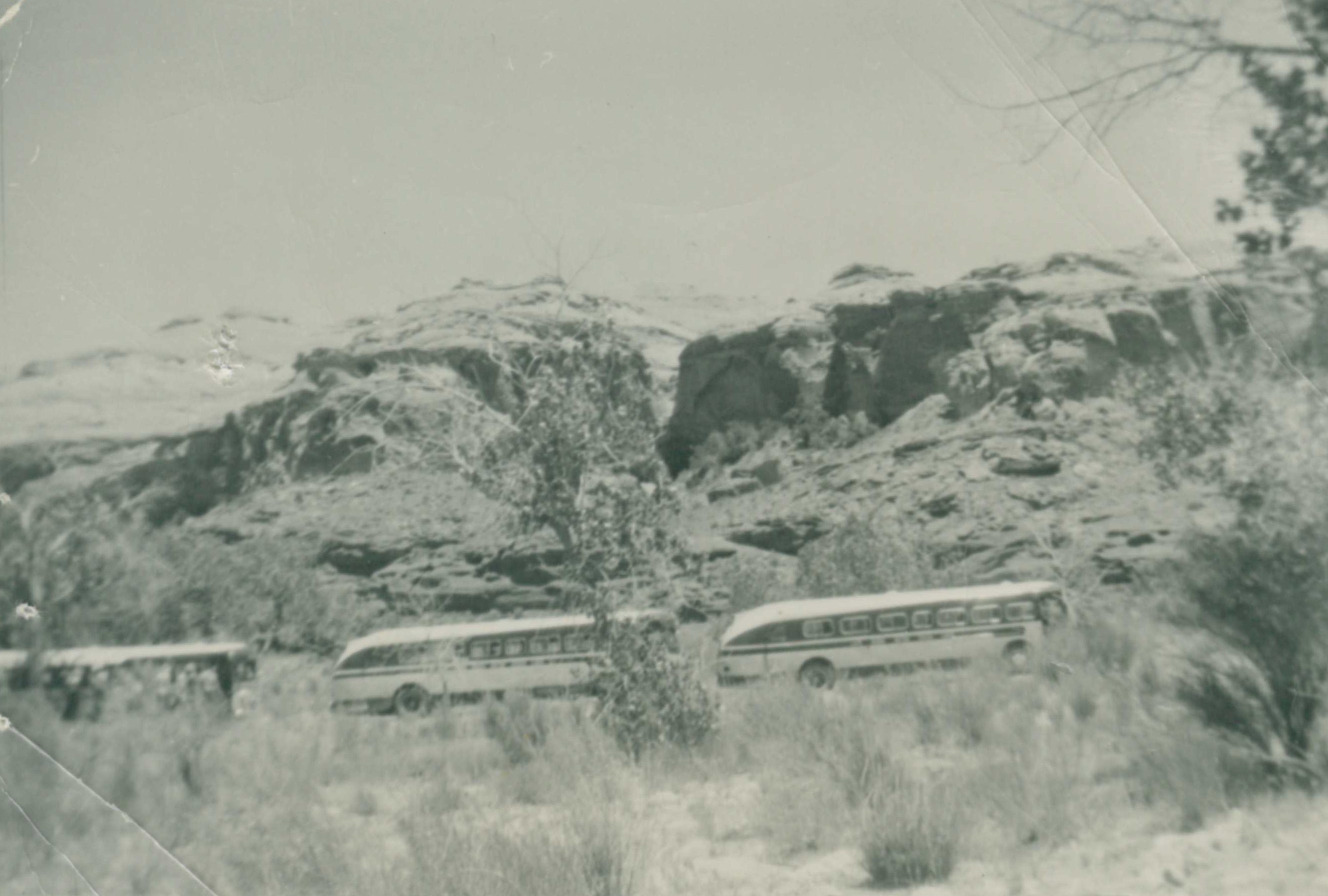
The book says the trip occurred in July 1957. The book provides plenty of photos of the highlights. These few photos show what Dad thought was interesting enough to take pictures.

The trip took them east through a variety of states. Included was Chicago, Detroit, and Palmyra. Stops included the Sacred Grove and Smith Farm. Albany, Springfield, Boston, and New York City.

Dad does not recall the names or even knowing anyone in the photos at Jamboree.

I remember Dad talking about the Statue of Liberty. They climbed the stairs to the crown. He also indicated that at that time they let some of them climb to the torch. It was a very memorable experience. He also mentioned the Empire State Building and Independence Hall in Philadelphia. Vice President Nixon addressed the Scouts.

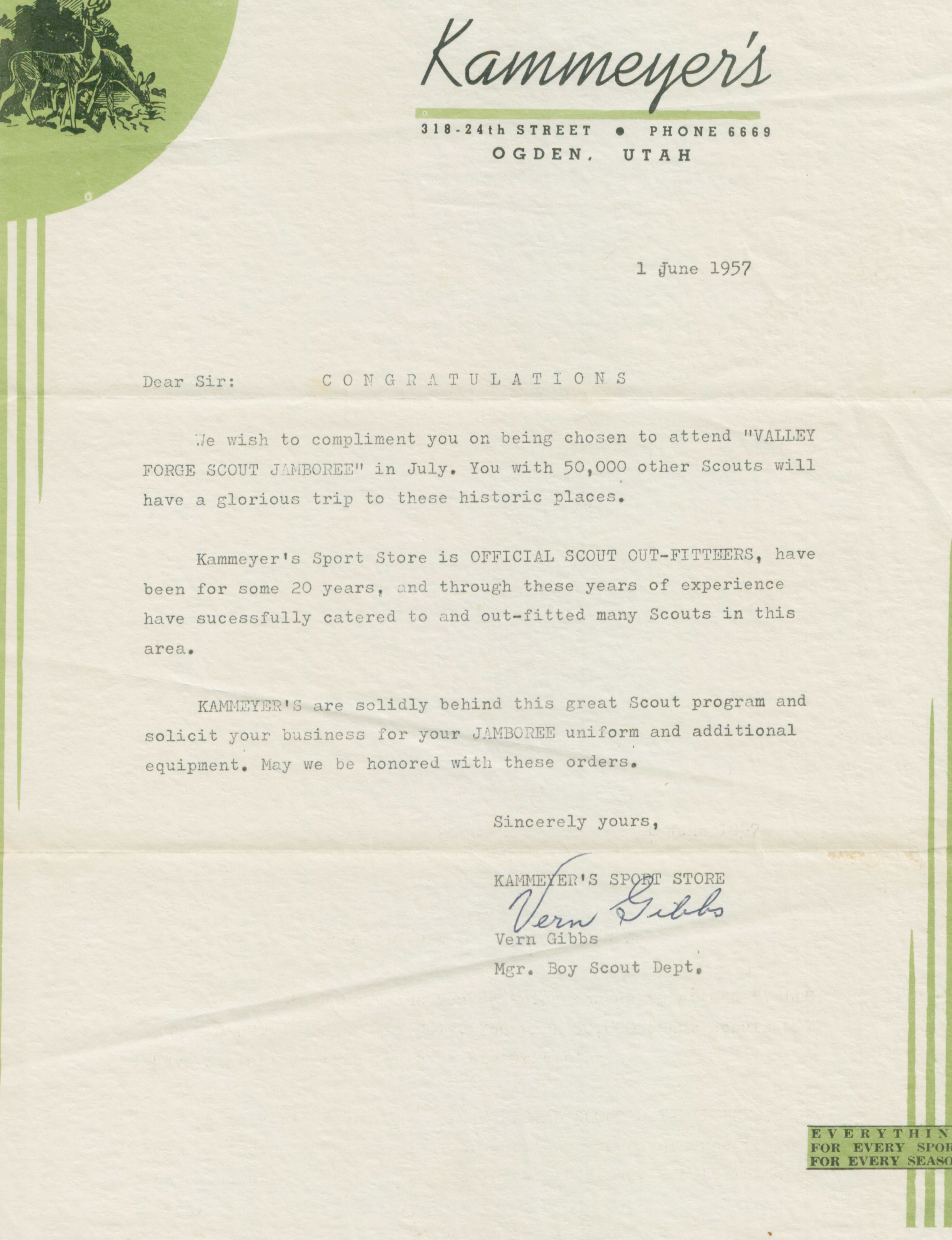
Kammeyer’s supported the Jamboree.

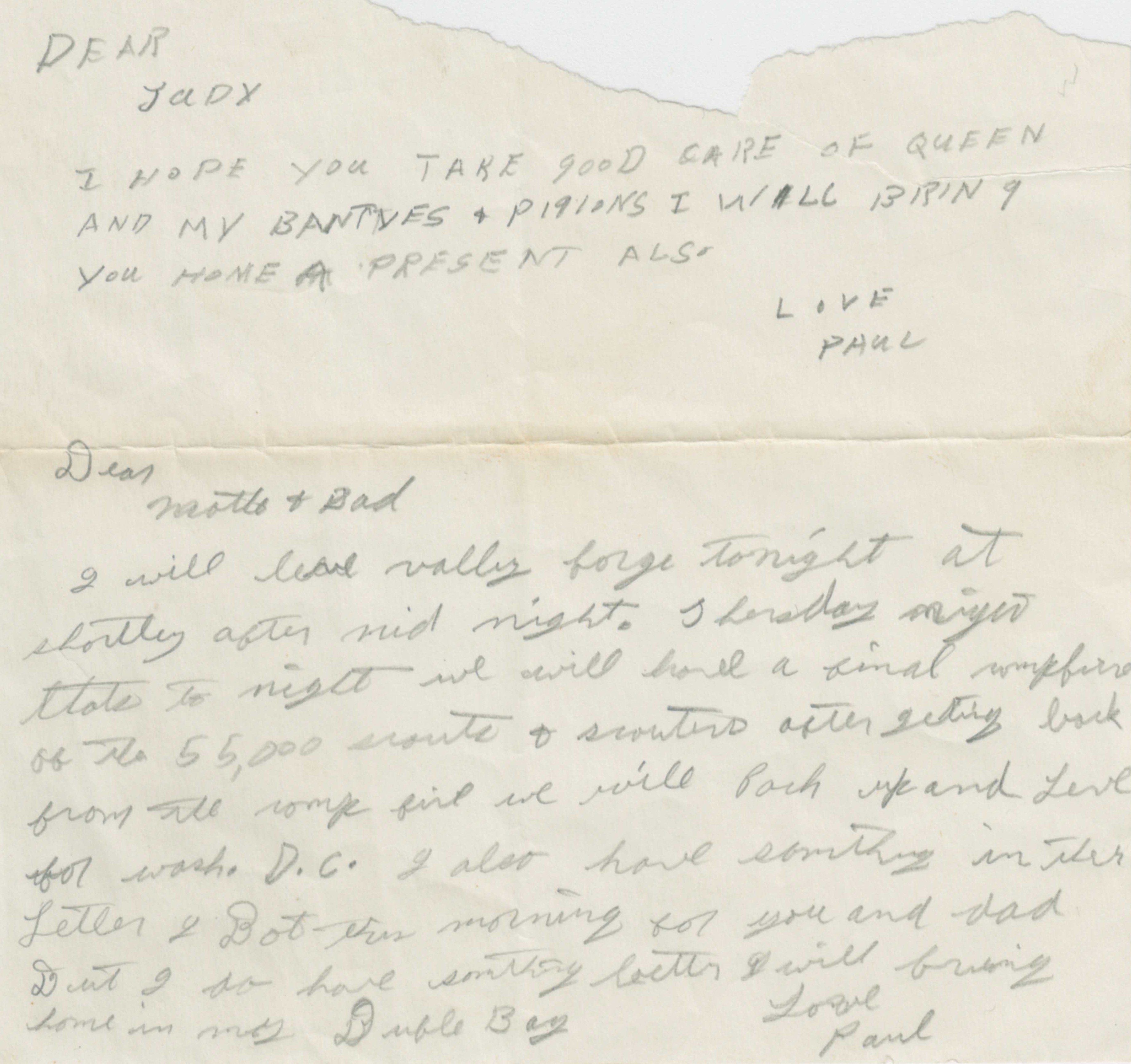
For those LDS Scouts, Harold B Lee and Delbert L Stapley spoke to the boys on Sunday. Here is a letter Dad wrote home while there.

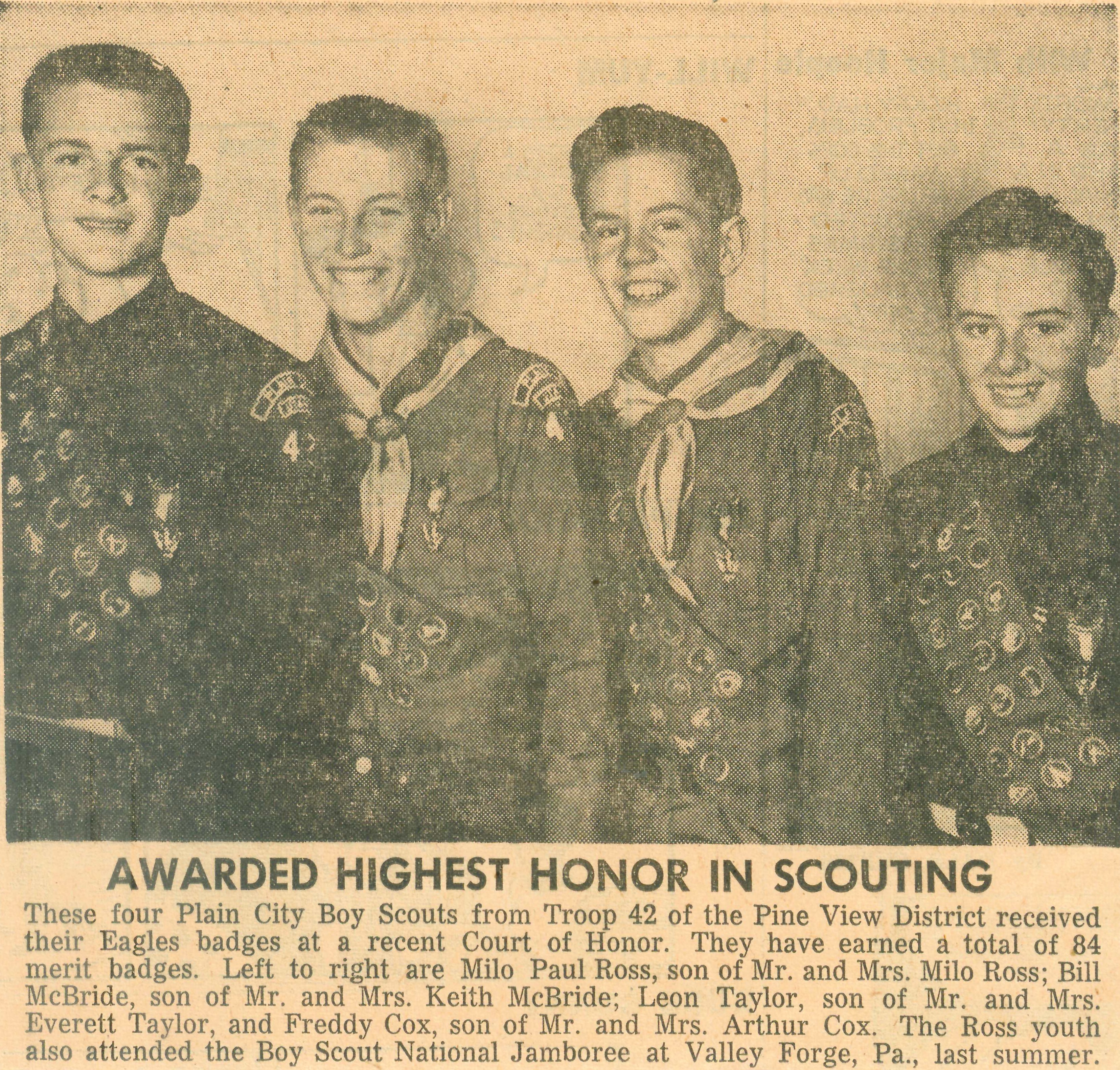
I previously wrote about Dad and scouting. Here is his Eagle Scout picture.

Milo Paul Ross achieved Eagle Scout

Here is a note Grandpa made about this picture.

Milo Ross, Bill McBride, Leon Taylor, Freddy Cox Eagle Announcement
Milo James Ross commented about Milo Paul Ross receiving his Duty to God award on 27 April 1959
Duty to God Award
Letter from Church Headquarters

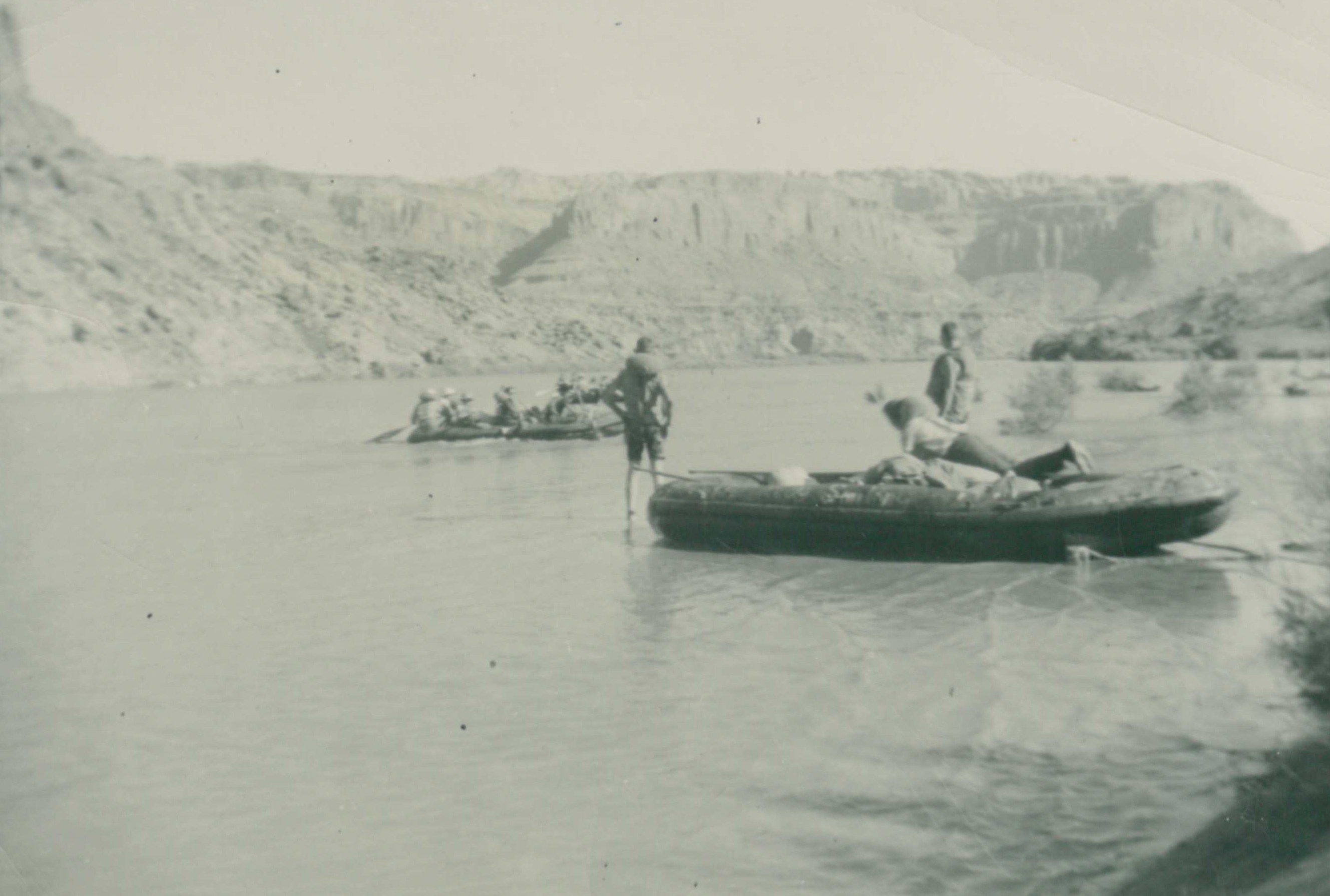
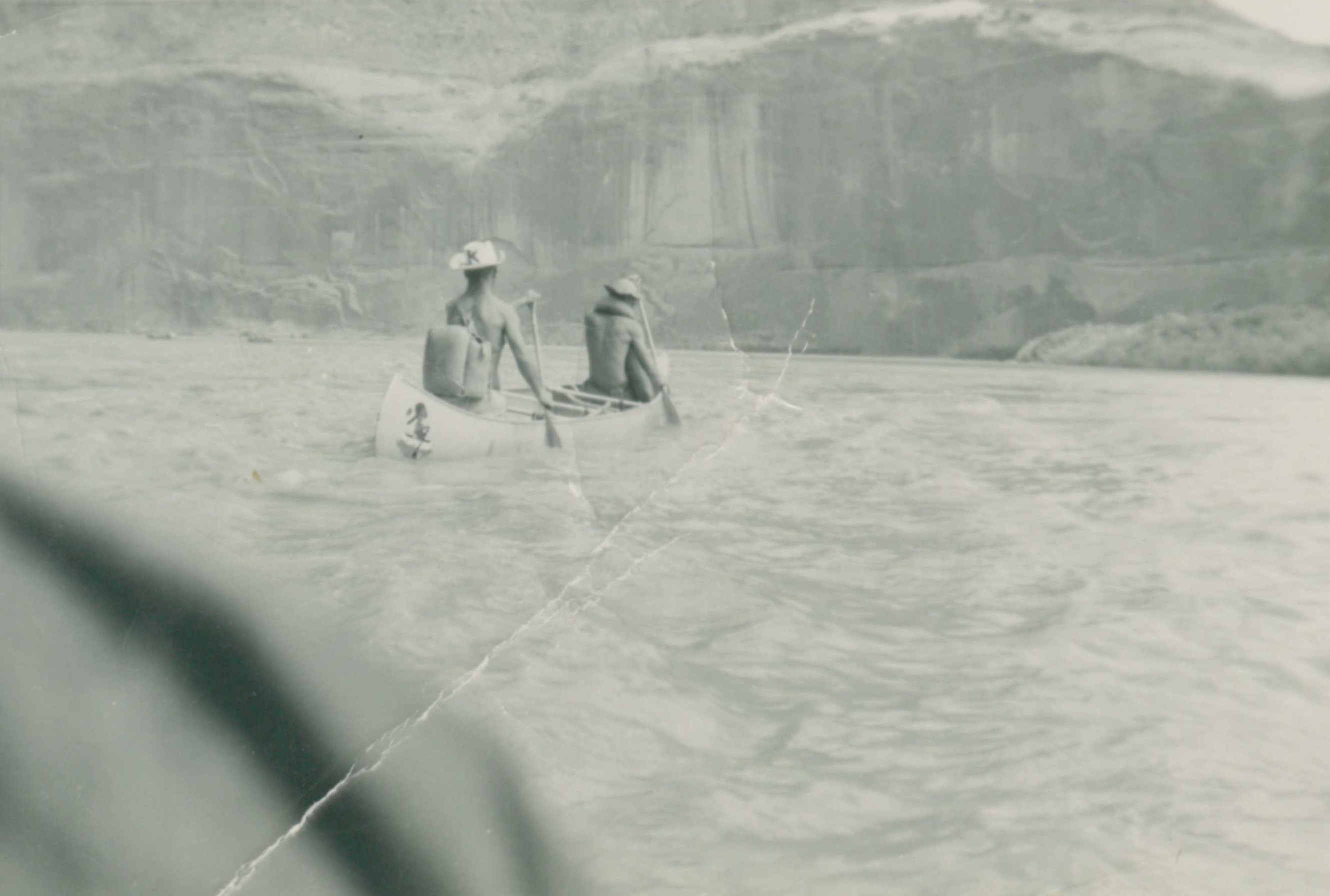
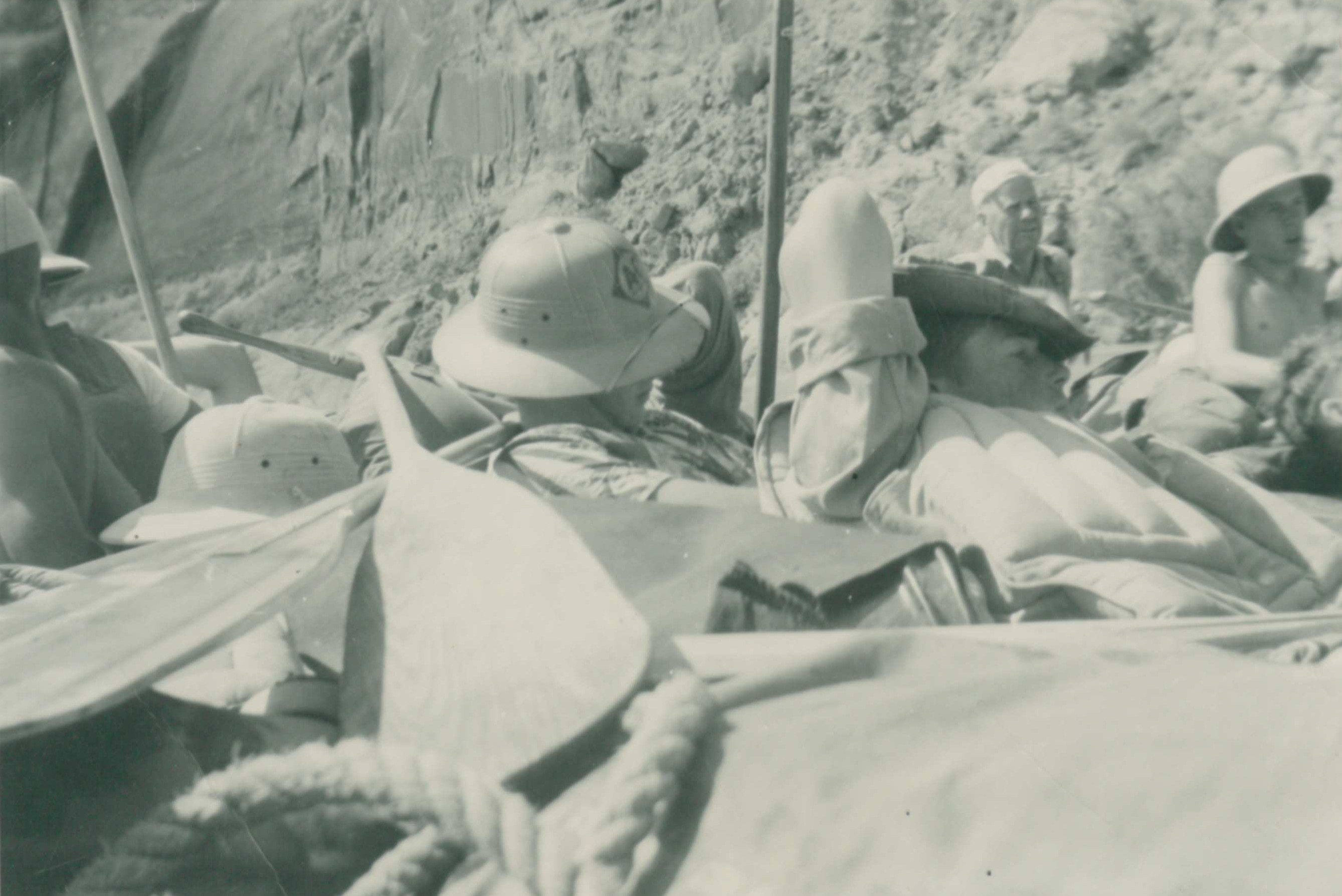
Here are a couple of the photos from the Colorado River rafting trip. Dad thinks there are more photos. He does not remember or recognize any of the individuals in the photos.

Dad remembered they had to pull out of the river to go around the Glen Canyon Dam construction.

~

~

~

~

Both of these were trips of a lifetime. Neither have been forgotten.

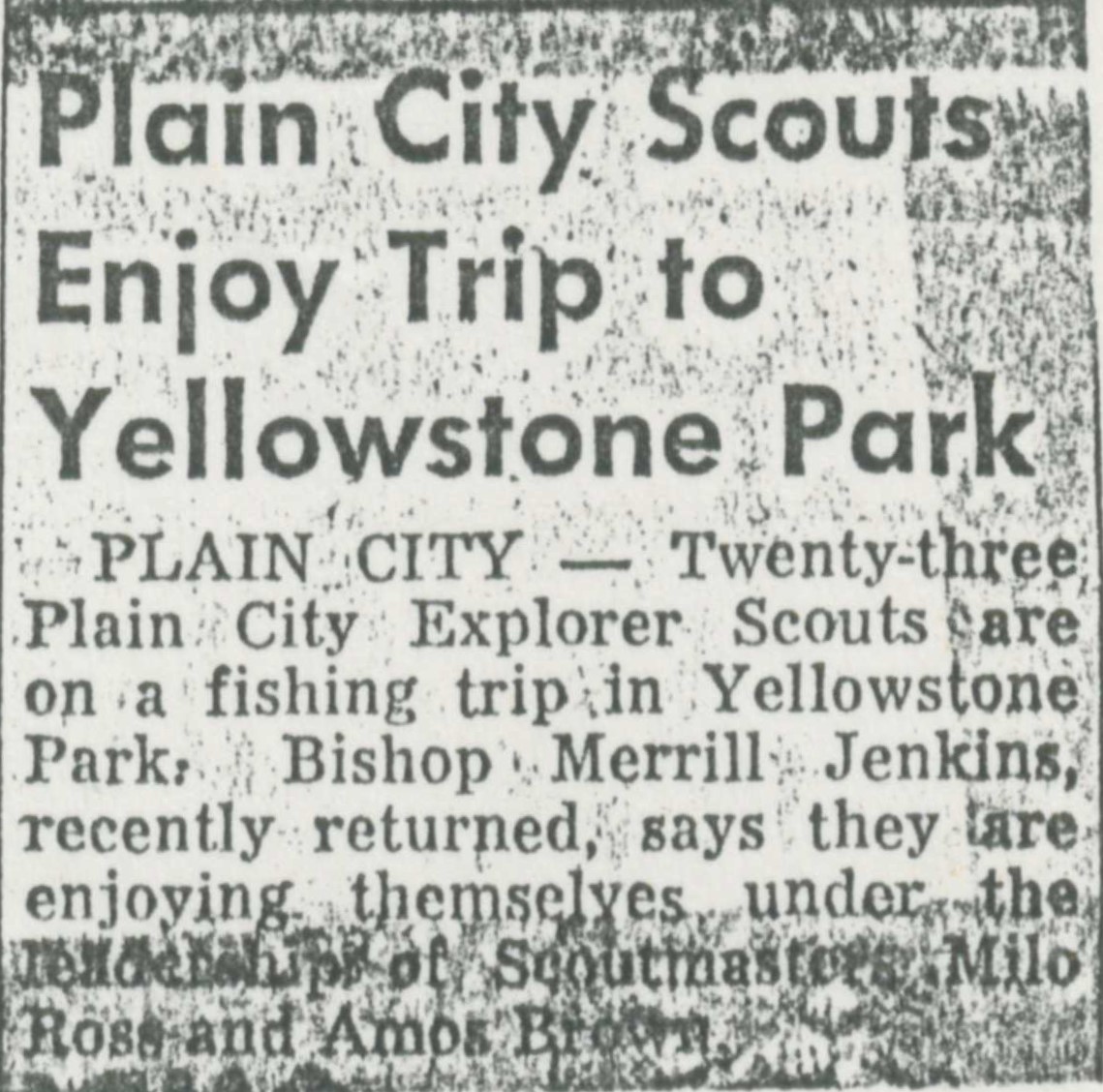
Another clip, I don’t know the year or time.

Casper Wyoming Temple Open House

We took the opportunity to attend the Casper Wyoming Temple Open House on 31 August 2024. We planned the weekend to do some sightseeing and visit some church and family history sites. I am reposting as this has updates on 3 additional ancestors that also came through the Overland Trail.

We left on the Friday morning with the hope of making it all the way to Casper before nightfall. We took old US Highway 30 through Soda Springs and Montpelier. We made a stop to visit the grave of my Grandmother in Dingle.

Aliza, Lillian, Paul, James, and Hiram Ross at the graves of Bud and Colleen Lloyd

We drove through Cokeville and reminded the kids of the story of the Cokeville miracle. As we drove along the old highway, I pointed out the old railroad Y that used to go to the Stauffer mine that was located in Leefe, Wyoming. I spent the first summer or two of my life at Leefe while my dad was tasked with tearing down and removing the mine with Circle A Construction. We stopped in Kemmerer to refuel and also drive past the first J. C. Penney store. We made a quick stop at the Parting of the Ways along the California, Mormon, and Oregon trails.

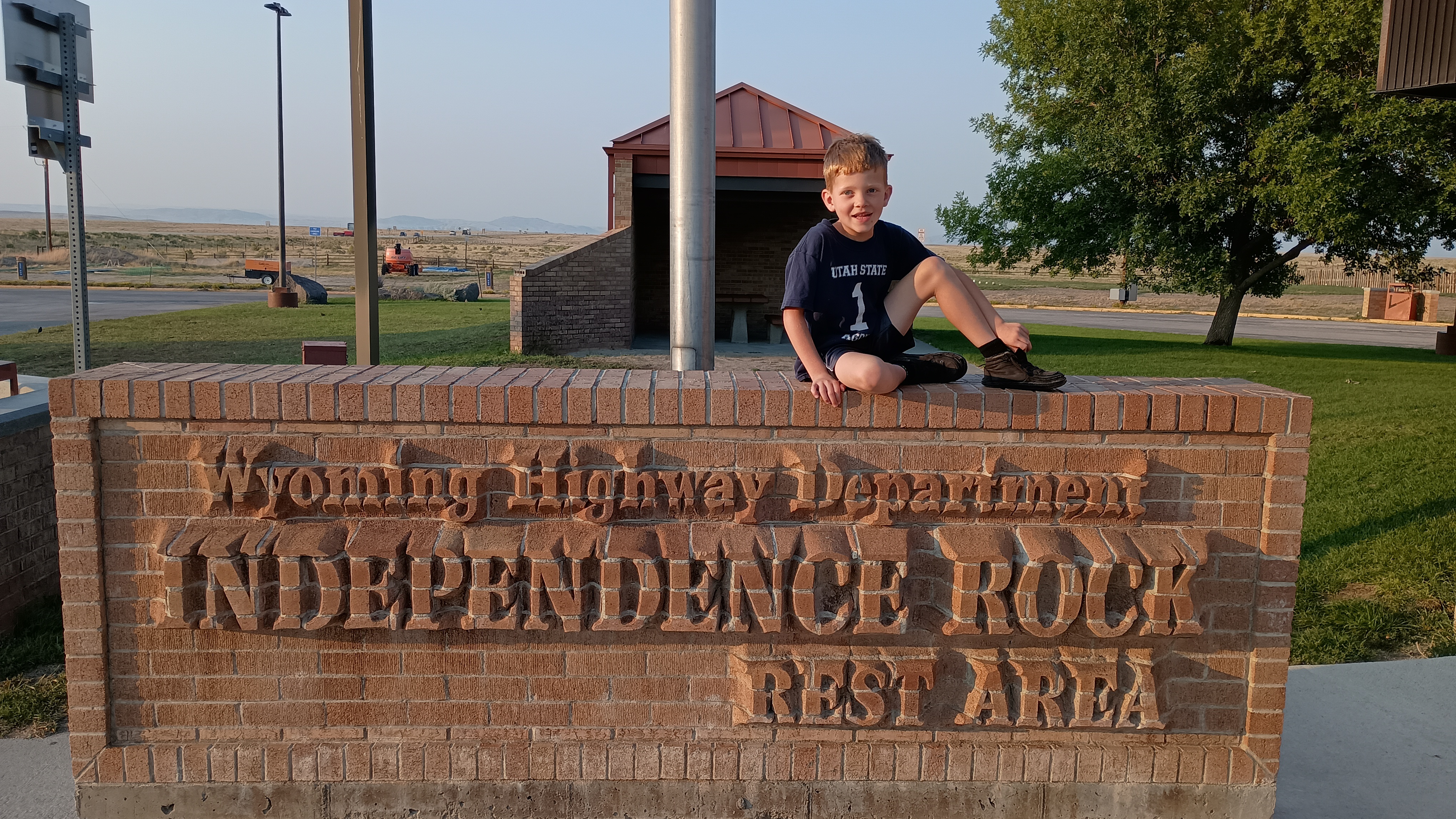
James Ross at Independence Rock

With four kids, we often stop at rest areas. As you can see above, we stopped at the one at Independence Rock. The rock is nearby and doubles as the parking location to visit the rock.

We finally made it to Casper about sunset. We ate an amazing Italian meal at Racca’s Pizzeria Napoletana and checked into our hotel.

Casper Wyoming Temple

We got up early, dressed appropriately, and headed out to visit the Casper Wyoming Temple. It was beautiful. Much smaller than I had anticipated. It is definitely one of the smallest temples, but that is because of the population and distance to other temples. It will supposedly have five stakes in its temple district, some of which will still come from a long distance to attend. Don’t let size fool you, it still has all the distinct parts of a temple and related quality. I think I may very much prefer the intimacy of the smaller temples. It actually reminded me of the Helena Montana Temple on size and flow.

Ross family at the Casper Wyoming Temple Open House

The temple does not have an adjoining chapel, but it does have a distribution/visitor center. We watched the video, enjoyed waiting in the line, and got to see the whole temple. If I were asked, there are a couple of design changes I would make for flow, but this temple will not regularly see these types of crowds or have those issues.

Ross family with the Casper Wyoming Temple

We hurried back to our hotel, changed, loaded up the car, checked out, and headed off to our next stop: The National Historic Trails Interpretive Center in Casper. I did not take any pictures there, but it was very well done. I enjoyed the visit, helped the kids with their junior ranger activities, and learned a few things. Part of the museum had its own little room and video dedicated to the Martin and Willie Handcart Companies.

We stopped at Independence Rock again on our way headed west. We walked around the massive rock and looked at a number of the signatures carved into stone from over 160 years ago. It was hot and we needed to get our little doggies along to Devil’s Gate.

I will write about this more in a bit, but Devil’s Gate was a major landmark on the trail going west for all pioneers on the trails. But Devil’s Gate became more than a landmark and became a historical site in the tragic fall of 1856. Fort Seminoe was based there on the west side of Devil’s Gate, but it had been abandoned earlier that same year. It was that fall that the Martin Handcart Company found itself stranded in the snow. Days later the stranded handcart company moved into a nearby cove to get away from the wind, snow, and cold. That cove is now known as Martin’s Cove.

The Sun Ranch from Devil’s Gate, now The Martin’s Cove: Mormon Trail Site

We found the visitor’s center much more hospitable than some of our ancestors. As I worked through my family history, I had some of my own ancestors who passed through this very Devil’s Gate and area. Here are my ancestral lines that came across on the Mormon Trail. I had counted only 3 while in Casper, but hadn’t realized the Williams clan came over in two separate trips.

William and Mary Ann Sharp in 1853. Wagon train. Moses Clawson Company. William and Mary Ann met in the wagon train and married in Nebraska in 1853. William and Mary are my 3rd Great Grandparents.

John Williams in 1860. Wagon train. John Smith Company. John came over with his two sons John Haines (1829) and Richard (1838). I don’t know why his son David went separately in 1864. I am a descendant of John through David. John is my 4th Great Grandfather.

Johanna Benson in 1862. Wagon train. Joseph Horne Company. Johanna came over with some of her children and their families, her daughter Agneta, came over in 1864 with her family. Johanna is my 4th Great Grandmother.

William Edward Stoker in 1863. Wagon train. Unknown Company. William was traveling with his family, including the baby Mary Ann. William is my 3rd Great Grandfather, Mary Ann is my 2nd Great Grandmother.

John and Agneta Nelson in 1864. Wagon train. William Preston Company. Agneta is the daughter of Johanna Benson who came over in 1862. John and Agneta are my 3rd Great Grandparents.

David D and Gwenllian Williams in 1864. David is the son of John mentioned above. Wagon train. William S Warren Company. Gwenllian came with her sister Mary. Both married on the ship in Liverpool before setting sail for Utah. Gwenllian and Mary’s parents, David and Margaret Jordan, came over in 1872 crossing the plains by rail. David and Gwenllian are my 3rd Great Grandparents.

That gives me 10 ancestors that crossed the plains by wagon, none by handcart that I can tell. The unknown companies were all wagon trains as there were not handcarts those years.

Devil’s Gate – 2024

Every single one of these seven ancestors of mine who came west on the trail would have passed through Devil’s Gate. Here I stood on this sacred ground and snapped this photo of my daughter, my descendant and their descendant, at Devil’s Gate.

Aliza Ross at Devil’s Gate

It took me a bit more work, as I am not as familiar, to find those family lines of Amanda’s that also would have passed along the Mormon Trail to the west before the railroad made it much, much faster and safer. It took me several occasions over a couple of weeks to spend the time to research all these lines.

Henry and Ann Jackson in 1852. Wagon train. James C Snow Company. This is Amanda’s 4th Great Grandparents.

Regina Hansen in 1853. Wagon train. John E Forsgren Company. Her son, Hans Hansen, also accompanied her on the trip. Regina’s husband stayed behind. Regina is Amanda’s 4th Great Grandmother, Hans is Amanda’s 3rd Great Grandfather.

Grave of Hans Hansen in Plain City, Utah. Edith Sharp Ross’ stone is the stone at 10 o’clock from the top of this stone, my Great Grandmother.

David Buttars in 1843. Wagon train. William Empey Company. He appears to have traveled alone. Amanda’s 3rd Great Grandfather.

Birthe Jacobson in 1854. Unknown if wagon train or handcart company. Birthe’s daughter, Maria Jacobson, also accompanied her on the trip. Her husband Jorgen died in Missouri as part of the trip. Birthe is Amanda’s 5th Great Grandmother, Maria is Amanda’s 4th Great Grandmother.

Harriet Housley in 1856. Handcart company. Edward Martin Company. Harret’s son, George Housley, also accompanied her on the trip. Two other children came later. Harriet is Amanda’s 5th Great Grandmother, George is Amanda’s 4th Great Grandfather.

Richard and Christine Hemsley (1836 – 1915) in 1857. Handcart company. Israel Evans Company. This is Amanda’s 4th Great Grandparents.

Ole and Anne Jensen in 1861. Likely wagon train. Unknown company. Amanda’s 5th Great Grandparents.

John Crompton in 1862. Wagon train. Joseph Horne Company. John also had his daughter, Hannah Crompton, with him. John is Amanda’s 4th Great Grandfather, Hannah is Amanda’s 3rd Great Grandmother.

Anna Nielsen in 1862. Wagon train. Christian Madsen Company. She traveled alone. Amanda’s 3rd Great Grandmother.

Joseph and Penelope Thompson in 1862. Wagon train. John Riggs Murdock Company. Their son, Joseph Thompson, also accompanied the family. Amanda’s 4th Great Grandparents, Joseph is Amanda’s 3rd Great Grandfather.

Joseph Wayment in 1863. Wagon train. Unknown Company. Appears to have come alone. Although his parents and most of his siblings would come later by rail. Amanda’s 3rd Great Grandfather.

Axel Boyer in 1866. Wagon train. Abner Lowry Company. Amanda’s 4th Great Grandfather. Also traveled with the Keeps, other ancestors of Amanda.

James and Ann Keep in 1866. Wagon train. Abner Lowry Company. Their daughter, Sarah Keep, also accompanied the family. James and Ann are Amanda’s 4th Great Grandparents, Sarah is Amanda’s third great Grandmother. Also traveled with Axel Boyer, other ancestor of Amanda.

Richard Hemsley (1801 – 1866) and his later wife Sarah in 1866. Wagon train. William Henry Chipman Company. Amanda’s 5th Great Grandfather.

Peter Peterson in 1866. Wagon train. Joseph Sharp Rawlins Company. Peter is Amanda’s 4th Great Grandfather.

That is the Hemsley line alone, Amanda’s Dad. I count 26 ancestors of Amanda’s Dad that came through Devil’s Gate.

James, Lillian, Hiram, and Aliza Ross at Devil’s Gate Mormon Handcart Visitor Center

Amanda’s Mom’s line, the Holden family, has the following:

Edwin and Ruia Holden in 1852. Wagon train. Uriah Curtis Company. Their son, Henry Holden, also accompanied the family. Edwin and Ruia are Amanda’s 4th Great Grandparents, Henry is Amanda’s 3rd Great Grandfather.

Jesse and Temperance McCauslin in 1851. Wagon train. Unknown Company. Temperance passed away in Council Bluffs, Iowa. She did not make the trail in Wyoming or Devil’s Gate. Their daughter, Louisa McCauslin, also accompanied the family. Jesse is Amanda’s 4th Great Grandfather, Louisa is Amanda’s 3rd Great Grandmother.

John and Adelaide Roberts in 1863. Wagon train. Thomas Ricks Company. Their son, Hyrum Roberts, also accompanied the family. John and Adelaide are Amanda’s 3rd Great Grandparents, Hyrum is Amanda’s 2nd Great Grandfather.

Thomas and Mary Ashton in 1851. Wagon train. Morris Phelps Company. Mary also passed away in Iowa. She did not make the trail in Wyoming or Devil’s Gate. Their son, Joseph Ashton, also accompanied the family. Thomas is Amanda’s 4th Great Grandfather, Joseph is Amanda’s 3rd Great Grandfather.

Sarah Jarvis in 1854. Wagon train. Job Smith Company. She came with some of her family, but not with her son, Amanda’s ancestor, George Jarvis. Sarah is Amanda’s 4th Great Grandmother.

George and Ann Jarvis in 1853. Wagon train. Unknown Company. George and Ann are Amanda’s 3rd Great Grandparents. George is the son of Sarah Jarvis mentioned above.

William and Rebecca Finch in 1854. Wagon train. Daniel Garn Company. William and Rebecca are Amanda’s 3rd Great Grandparents.

Joseph Finch in 1853. Wagon train. Joseph Young Company. Joseph is the son of William and Rebecca Finch mentioned above.

John and Hannah Davis in 1851. Wagon train. Eaton Kelsey Company. Their daughter, Mary Jane, also accompanied the family. The family also has Davies listed for their last name sometimes. John and Hannah are Amanda’s 4th great grandparents, Mary Jane is Amanda’s 3rd Great Grandmother.

John Evans in 1866. Wagon train. William Henry Chipman Company (same company as Amanda’s Richard Hemsley above). His wife, Sarah, died on the trip from the United Kingdom in New York. His son, John Evans, also accompanied his father and brother. John is Amanda’s 3rd Great Grandfather, John is Amanda’s 2nd Great Grandfather.

James and Elizabeth Boyack in 1855. Wagon train. Milo Andrus Company. James and Elizabeth are Amanda’s 4th Great Grandparents.

James Boyack in 1853. Wagon train. Appleton Harmon Company. James is Amanda’s 3rd Great Grandfather. James is the son of James and Elizabeth Boyack above that came in 1855 across the plains.

Margary Waterhouse in 1855. Wagon train. Milo Andrus Company. Margary is Amanda’s 3rd Great Grandmother. She came across with the same train as James Boyack’s parents, presumably that is how she met her future husband. The Company arrived 24 October 1855 in Utah, James and Margary married 23 November 1855 in Springville, Utah.

That is the Holden line alone, Amanda’s Mom. I count 26 of ancestors of Amanda’s Mom that came through Devil’s Gate. As an aside, I also looked at her biological line (as she is adopted), and not a single one of her biological ancestors passed through Devil’s Gate.

James riding while Hiram, Lillian, and Aliza Ross pull a handcart at Devil’s Gate Mormon Handcart Visitors Center

We also stopped and visited with the sixth crossing of the Sweetwater River. This was the location where, like the Martin Handcart Company, the Willie Handcart Company also got stuck in wind, snow, and cold in 1856. Their rescue occurred here.

The next day, on our way to Grand Teton National Park, we made a stop at Fort Washakie, Wyoming. This is one of the alleged graves of Sacagawea. We stopped and remembered her, whether her final resting place or not.

All in all, I was surprised by my own connection to the Mormon Trail. I had never considered that I have 7 ancestors who had literally come this way. Or that my children have 59 ancestors that literally come this way. They passed by Independence Rock, through Devil’s gate, and two of those 59 suffered with the Martin Handcart Company. I will write more on the Housley’s later as there have been other interesting interactions with that clan since our marriage.

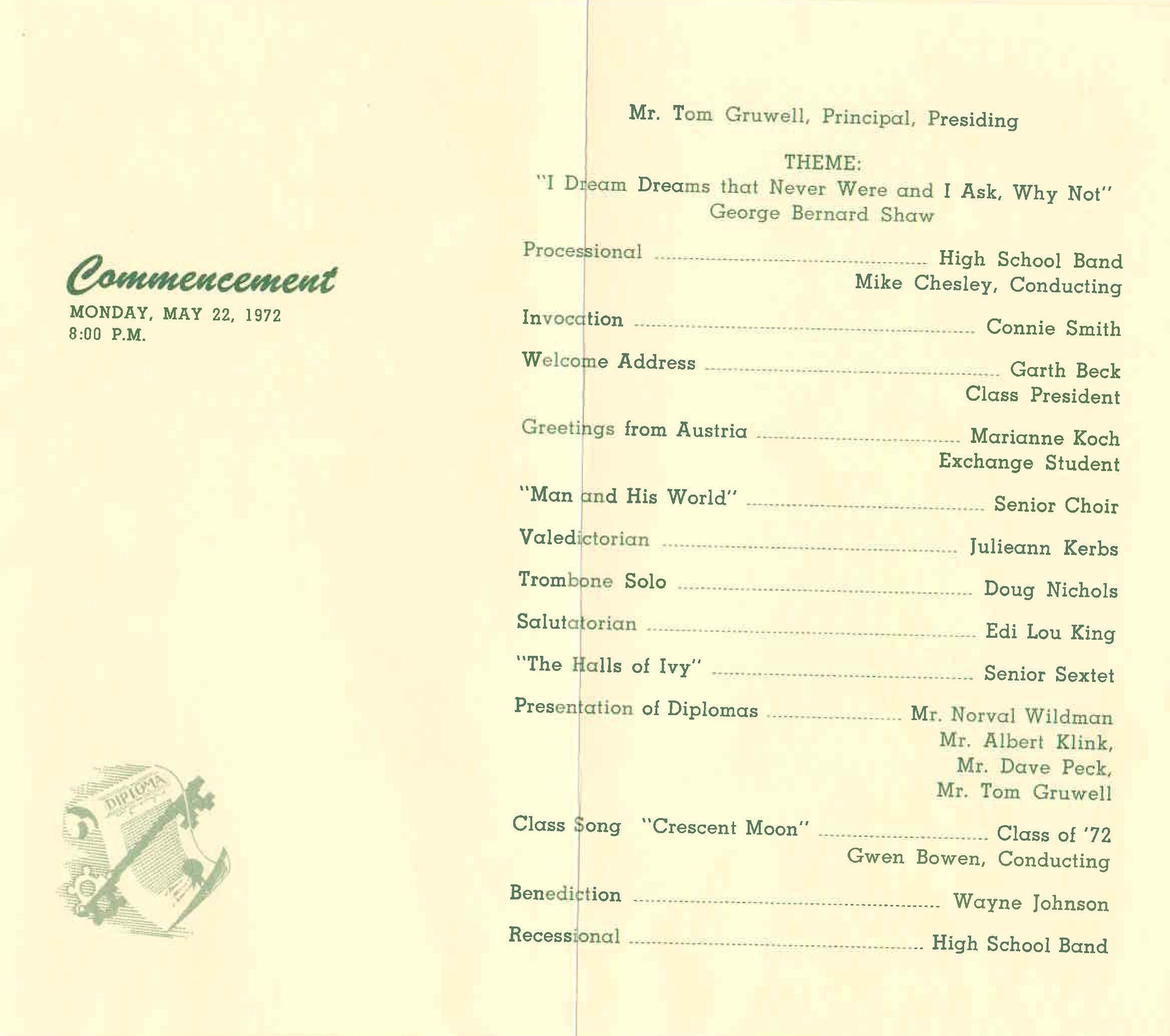
1972 Burley High School Commencement

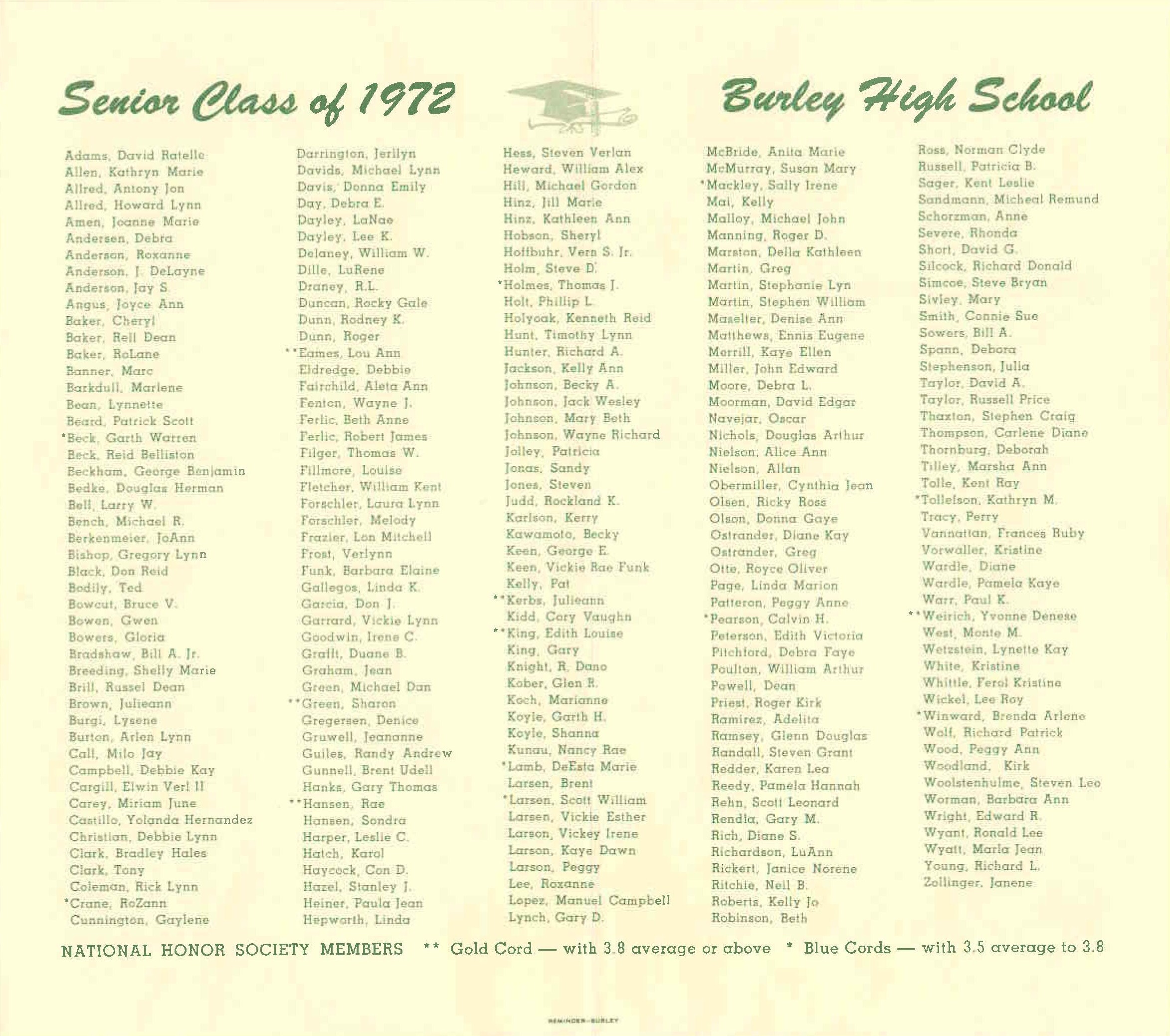
I was trying to find some photos and stumbled upon my Mom’s graduation pamphlet I had scanned a few years ago. Thought maybe it was time to share it, especially where I have seen some of her classmates have passed away recently.

1972 Baccalaureate and Commencement – Burley High School – Burley Idaho

These programs courtesy of the following Public Spirited Business Concerns

Amalgamated Sugar Co.

Burley Processing Co.

Burley Reminder

Cassia National Bank

First Federal Savings & Loan Assn., Burley Branch

First Security Bank

Guys ‘N Dolls

Idaho Bank & Trust Co.

Idaho First National Bank Burley Office

McCaslins

Ponderosa Inn

J. R. Simplot Food Processing Division

South Idaho Press

Class Officers

President Garth Beck

Vice President Bud Hoffbuhr

Secretary Jill Hinz

Executives Peggy Wood, Peggy Larson, Kaye Dawn Larson, Jeananne Gruwell, Jean Graham

Class Adviser Mr. David Peck

Baccalaureate Sunday, May 21, 1972 2:30 P.M.

Mr. Tom Gruwell , Principal, Presiding

Processional High School Band Mike Chesley, Conducting

Welcome Garth Beck Class President

Invocation Bud Hoffbuhr

Special Number Bel Canto Choir Elden Wood, Conducting “Battle Hymn of the Republic”

Address Dr. Walter R. Peterson

Cherubim Song Senior Octet

Benediction Calvin Pearson

Recessional High School Band

Commencement Monday, May 22, 1972 8:00 P.M.

Mr. Tom Gruwell, Principal, Presiding

THEME: “I Dream Dreams that Never Were and I Ask, Why Not” – George Bernard Shaw

Processional – High School Band – Mike Chesley, Conducting

Invocation – Connie Smith

Welcome Address – Garth Beck, Class President

Greetings from Austria – Marianne Koch – Exchange Student

“Man and His World” – Senior Choir

Valedictorian – Julieann Kerbs

Trombone Solo – Doug Nichols

Salutatorian – Edi Lou King

“The Halls of Ivy” – Senior Sextet

Presentation of Diplomas – Mr. Norval Wildman, Mr. Albert Klink, Mr. Dave Peck, Mr. Tom Gruwell

Class Song “Crescent Moon” – Class of ’72 – Gwen Bowen, Conducting

Benediction – Wayne Johnson

Recessional – High School Band

Adams, David Ratelle

Allen, Kathryn Marie

Allred, Anthony Jon

Allred, Howard Lynn

Amen, Joanne Marie

Andersen, Debra

Anderson, Roxanne

Anderson, Jerald DeLayne (1954 – 2017)

Anderson, Jay S

Anderson, Todd Michael (1953 – 1972)

Angus, Joyce Ann

Baker, Cheryl

Baker, Rell Dean

Banner, Marc

Barkdull, Marlene

Bewan, Lynnette

Beard, Patrick Scott

* Beck, Garth Warren (1953 – 2002)

Beck, Reid Belliston

Beckham, George Benjamin

Bedke, Douglas Herman

Bell, Larry W

Bench, Michael R

Berkenmeier, JoAnn

Bishop, Gregory Lynn

Black, Don Reid

Bodily, Ted O (1954 – 2019)

Bowcut, Bruce V

Bowen, Gwen

Bowers, Gloria

Bradshaw, Bill A Jr

Breeding, SHelly Marie

Briggs, Larry

Brill, Russel Dean

Brown, Julieann

Burgi, Lysene (1953 – 2016)

Burton, Arlen Lynn (1954 – 2014)

Call, Milo Jay

Campbell, Debra “Debbie” Kay (1954 – 2019) Johnson

Cargill, Elwin Verl II

Carey, Mirian June

Castillo, Yolanda Hernandez

Christian, Debbie Lynn

Clark, Bradley Hales

Clark, Antone “Tony” Lee (1954 -2015)

Coleman, Rick Lynn

* Crane, RoZann

Cunnington, Gaylene

Darrington, Jerilyn

Davids, Michael Lynn (1953 – 2020)

Davis, Donna Emily

Day, Debra E

Dayley, LaNae

Dayley, Lee K

Delaney, William W

Dille, LuRene

Draney, Rex Leonard (1953 – 2007)

Duncan, Rocky Gale (1954 – 2020)

Dunn, Rodney K

Dunn, Roger

** Eames, Lou Ann

Eldredge, Debbie

Farwell, Albert Michael (1952 – 2023)

Fairchild, Aleta Ann

Fenton, Wayne J

Ferlic, Beth Anne

Ferlic, Robert James

Filger, Thomas W

Fillmore, Louise

Fletcher, William Kent

Forschler, Laura Lynn

Forschler, Melody

Frazier, Lon Mitchell

Frost, Verlynn

Funk, Barbara Elaine

Gallegos, Linda K

Garcia, Don J

Garrard, Vickie Lynn

Goodwin, Irene Cecilia

Goold, Gary

Graf, Becky Ann (1954 – 2011) Moats, Kloer

Grafft, Duane Brian (1953 – 2006)

Graham, Jean

Green, Michael Dan

** Green, Sharon

Gregersen, Denice

Gruwell, Jeananne

Guiles, Randy Andrew (1953 – 2015)

Gunnell, Brent Udell

Hanks, Gary Thomas

** Hansen, Rae

Hansen, Sondra

Harper, Leslie C

Hatch, Karol (1953 – 2004) Kerr

Haycock, Con D

Hazel, Stanley Jarvis (1953 – 2008)

Heiner, Paula Jean

Hepworth, Linda

Hess, Steven Lerlan

Heward, William Alex

Hill, Michael Gordon

Hinz, Jill Marie

Hinz, Kathleen Ann

Hobson, Sheryl

Hoffbuhr, Vernard “Bud” Standley Jr (1954 – 1997)

Holm, Steve D

* Holmes, Thomas J

Holt, Phillip L

Holyoak, Kenneth Reid

Hunt, Timothy Lynn

Hunter, Richard A

Jackson, Kelly Ann

Johnson, Becky A

Johnson, Jack Wesley

Johnson, Mary Beth

Johnson, Wayne Richard (1953 – 2008)

Jolley, Patricia

Jonas, Sandy (1954 – alive)

Jones, Steven

Judd, Rockland K (1953 – 2012)

Karlson, Kerry

Kawamoto, Becky

Keen, George E

Keen, Vickie Rae Funk

Kelly, Pat

** Kerbs, Julieann

Kidd, Cory Vaughn

** King, Edith Louise

King, Gary

Knight, Robin Daniel (1953 – 2014)

Kober, Glen R

Koch, Marianne

Koyle, Garth H

Koyle, Shanna

Kunau, Nancy Rae

* Lamb, DeEsta Marie

Larsen, Brent

* Larsen, Scott William

Larsen, Vickie Esther

Larson, Vickey Irene

Larson, Kaye Dawn (1954 – 2019) Silcock

Larson, Peggy (1954 – 2016) Stirland

Lee, Roxanne

Lopez, Manuel Campbell

Loveland, Cynthia (1954 – 1981)

Loveland, Kevin R (1954 – 2008)

Lynch, Gary D

McBride, Anita Marie

McMurray, Susan Mary

* Mackley, Sally Irene

Mai, Kelly

Malloy, Michael John

Manning, Roger D

Marston, Della Kathleen

Martin, Gregory Max (1954 – 1975)

Martin, Stephanie Lyn

Martin, Stephen William

Maselter, Denise Ann (1954 – 2022) Rollins

Matthews, Ennis Eugene

Merrill, Kaye Ellen

Miller, John Edward

Moore, Debra Lynn (1954 – 2002)

Moorman, David Edgar (1953 – 1997)

Navejar, Oscar

Newcomb, Kathy Lorene (1954 – 2020) Bailey

Nichols, Doulgas Arthur

Nielson, Alice Ann

Nielson, Allan (1954 – 2020)

Obermiller, Cynthia Jean

Olsen, Ricky Ross

Olson, Donna Gaye

Ostrander, Diane Kay

Ostrander, Greg

Osterhout, Rex Dale (1954 – 2017)

Otte, Royce Oliver

Page, Linda Marion

Patteron, Peggy Ann

* Pearson, Calvin H

Peterson, Edith Victoria

Pitchford, Debra Faye

Poulton, William Arthur

Powell, Leslie Dean (1953 – 2005)

Priest, Roger Kirk

Ramirez, Adelita

Ramsey, Glenn Douglas

Randall, Steven Grant

Redder, Karen Lea

Reedy, Pamela Hannah

Rehn, Scott Leonard (1954 – 1994)

Rendla, Gary M

Rich, Diane S

Richardson, LuAnn

Rickert, Janice Norene

Ritchie, Neil B

Roberts, Kelly Jo

Robinson, Beth

Ross, Norman Clyde

Russell, Patricia B

Sager, Kent Leslie

Sandmann, Michael Remund

Schorzman, Anne

Severe, Rhonda

Short, David G

Silcock, Richard Donald

Simcoe, Steve Bryan

Sivley, Mary

Smith, Connie Sue

Sowers, Bill A

Spann, Debora

Stephenson, Julia

Taylor, David A (1953 – 2009)

Taylor, Russell Price (? – alive)

Thaxton, Stephen Craig

Thompson, Carlene Diane

Thornburg, Deborah

Telley, Marsha Ann

Tolle, Kent Ray

* Tollefson, Kathryn M

Tracy, Perry Alan (1953 – 2005)

Vannatian, Frances Ruby

Vorwaller, Kristine

Wardle, Diane

Wardle, Pamela Kaye

Warr, Dee Ann (1954 – 2013)
Warr, Paul K

** Weirich, Yvonne Denese

West, Monte M

Wetzstein, Lynette Kay

White, Kristine

Whittle, Ferol Kristine

Wickel, Lee Roy

* Winward, Brenda Arlene

Wolf, Richard Patrick

Wood, Peggy Ann

Woodland, Kirk

Woolstenhulme, Steven Leo

Worman, Barbara Ann

Wright, Edward R

Wyant, Ronald Lee

Wyatt, Marla Jean

Young, Richard LeRoy (1953 – 2022)

Zollinger Janene

National Honor Society Members

** Gold Cord – with 3.8 average or above

* Blue Cords – with 3.5 average to 3.8

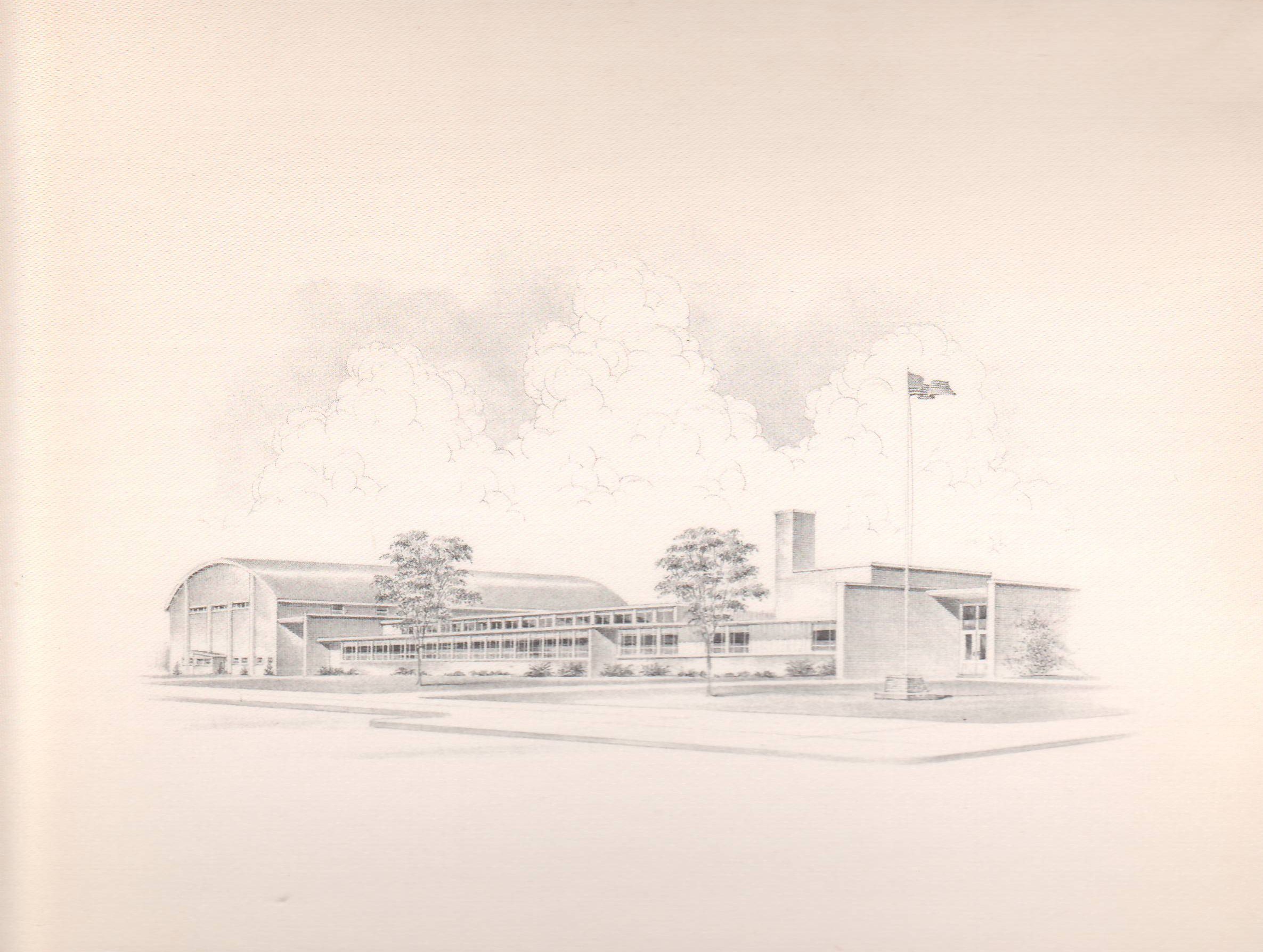
The sketch of the Burley High School on the front of the Diploma case.

Sandy Jonas Burley High School Diploma

Mom’s actual Diploma.

Burley High School – Burley, Idaho

This Certifies That Sandy Jonas has satisfactorily completed a Course of Study prescribed for Graduation from this School and is therefore awarded this Diploma.

Given in the month of May, nineteen hundred and seventy-two

Tom Gruwell – Principal

Harold W Blauer – Superintendent

W B Whiteley – Chairman Board of Education

Here is a copy of Mom’s Senior picture – 1972

Lesson from a Supreme Court Justice and a defendant’s mother

I stumbled on this article in the Deseret News and have kept it as it struck me on multiple levels. The United States Supreme Court is the pinnacle, of sorts, of my profession – law. I also practice as a public defender for those charged with crimes. The article also shows the humanity we have to remember in whatever we do.

The article named “A lesson to learn from a Supreme Court justice and the mother of a defendant” was published 18 September 2021 in the Church News, published by the Deseret News, written by Sarah Jane Weaver. Here is a link to the interview mentioned in the article, the discussion begins at 47 minutes. 

~

Judge Sonia Sotomayor (L), the first Hispanic justice on the us Supreme Court, is sworn in with the Judicial Oath in the East Conference room of the Supreme Court on August 8, 2009, as the 111th Justice of the US Supreme Court by Chief Justice John Roberts (not pictured) as her mother Celina (R) holds the Bible and her brother Juan Luis (C) looks on. Sotomayor is President Barack Obama’s first high court nominee. AFP PHOTO/Paul J. Richards (Photo credit should read PAUL J. RICHARDS/AFP/Getty Images)

I recently listed to a November 2018 conversation between United States Supreme Court Justice Sonia Sotomayor and David M. Rubenstein. It was sent to me by a friend. 

During the annual David M. Rubenstein Lecture, sponsored by the American Academy of Arts and Sciences, Rubenstein asked Justice Sotomayor – who was confirmed to the Supreme Court on Aug. 6, 2009 – about the Bible she used for her swearing-in ceremony. 

Sotomayor spoke of a courtroom interaction that had taken place years earlier, when she was a trial judge. 

She recalled sentencing a young member of The Church of Jesus Christ of Latter-day Saints, a process that allowed her to learn a little about the faith. During the sentencing, she mentioned d”how impressed she was with many of the tenets and values” of the religion.

In retrospect, Sotomayor said she sentenced the defendant “more harshly” that she might have a few years later. ”It was a difficult case for me,” she explained to Rubinstein.

After the sentence was handed down and she had moved to her next cases, she received a package in the mail from the defendant’s mother. 

Because the package was unsolicited, it was examined and X-rayed. When the box was finally opened, it contained what Sotomayor referred to as “a Mormon Bible.” 

The defendant’s mother had sent it with a note “explaining that I had spoken about their religion and that she thought I should learn more about it. So she had sent me a Bible.” 

Bound by a code of conduct, Sotomayor cannot accept gifts, “certainly not from a defendant’s mother.” She thought “about what she could do because sending it back seemed like the wrong thing to do.”

Ultimately, she learned the value of the Bible from the U.S. Library of Congress, and sent the gift-giver a money order. She thanked the mother for the Bible and explained, “I couldn’t accept the book as a gift, but that I could pay for the book.” 

Then she told Rubenstein: “That is the book I used for my swearing in.” 

This exchange between the judge and the mother certainly is an example of Sotomayor’s quest for understanding, her laudable commitment to the ethics that govern her profession and her goodness.

It also communicates much about the defendant’s mother, who reached out to a judge after a difficult case. Her sincere gesture rippled through the years, climaxing as Sotomayor took her place as the 111th Supreme Court justice in U.S. history – and the third woman and the first Hispanic to serve on the court. 

Sotomayor goes on in the interview to talk about the importance of listening and understanding.

The mother modeled both. She didn’t send a scathing letter to the judge, criticizing her opinion, approach or application of the law. She showed no anger, contempt or rage. Instead she sought common ground.

And in a most profound gesture, the mother, whose son was just sentenced, perhaps “harshly,” offered a treasured truth. 

As racial tensions spread like wildfire across the United States in June 2020, President Russell M. Nelson said Church leaders “abhor the reality that some would deny others respect.” 

President Nelson wrote that during the Savior’s early mission, “He constantly ministered to those who were excluded, marginalized, judged, over-looked, abused and discounted. As His followers, can we do anything less? The answer is no! We believe in freedom, kindness and fairness for all of God’s children!

“Let us be clear. WE are brothers and sisters, each of us the child of a loving Father in Heaven. His Son, the Lord Jesus Christ, invites all to come unto Him.”

President Nelson asked everyone to foster fundamental respect for the human dignity of every human soul. 

“We need to work tirelessly to build bridges of understanding rather than creating walls of segregation. I plead with us to work together for peace, for mutual respect and for an outpouring of love for all of God’s children.” 

We see the smallest example of this as the paths of a judge and a mother shared political ideologies. I suspect they did not.

I do not know how the mother felt about her son’s sentence. I have to wonder if she felt the judge had found the long-sought balance between justice and mercy. 

And I do not know if the paths of these women ever crossed again.

But what I do know is beautiful – and contains a sweet lesson in a world needing more bridges than walls. A judge sought understanding and a mother responded with grace. Years after their brief interaction, the judge laid her hand on the mother’s Bible and sore an oath to God as she took her place on the United States’ highest court.

Holden Grave Payson Utah

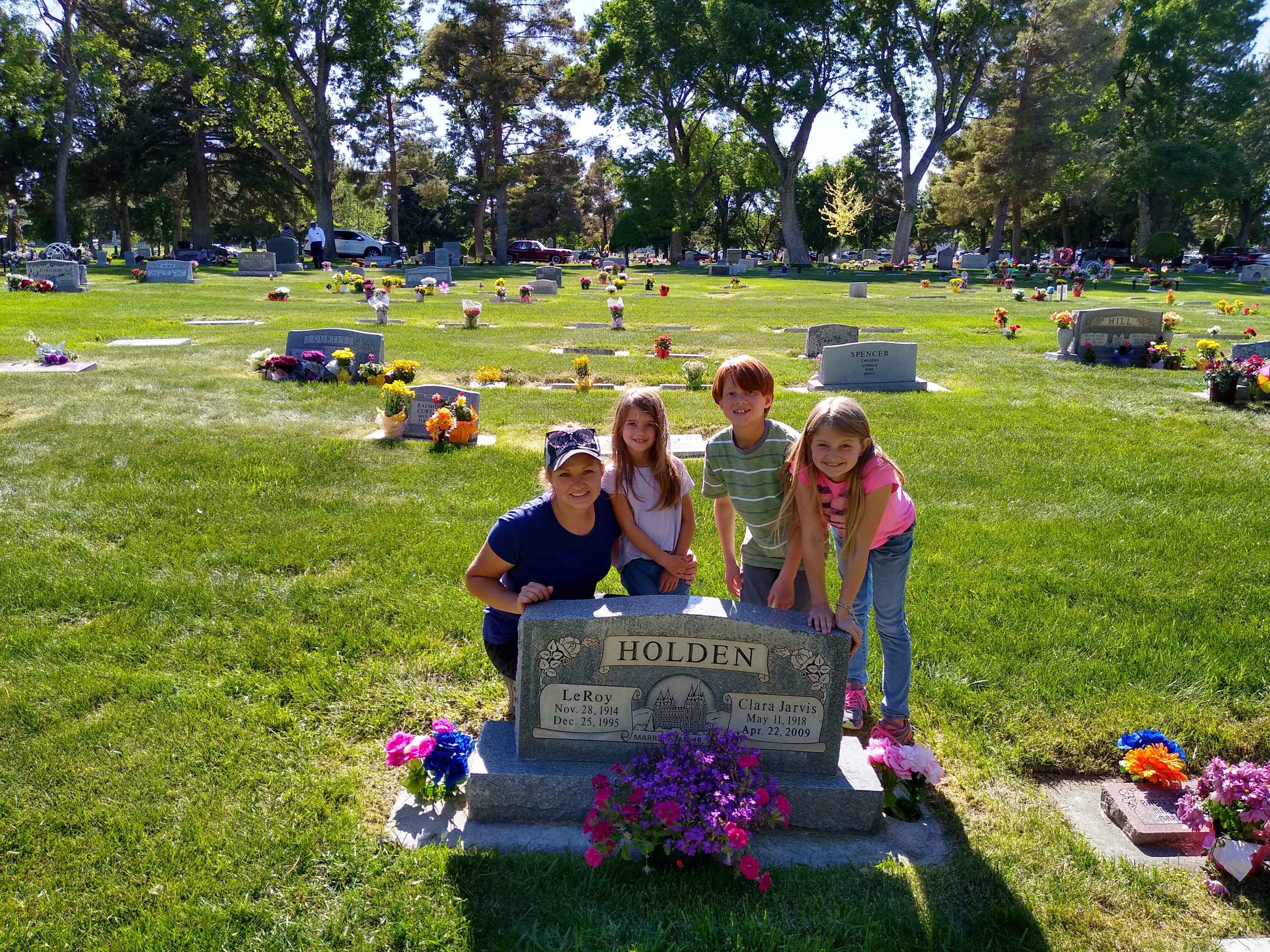
Amanda, Lillian, Hiram, and Aliza Ross at the grave of LeRoy and Clara Holden in Payson, Utah

We tend to not get down to Payson, Utah, Utah too often. On this occasion we were on our way back from Ely, White Pine, Nevada from a trip to Great Basin National Park. We were also coming home on Memorial Day weekend, so we had to make some visits to family graves.

LeRoy and Clara Elizabeth Jarvis Holden are Amanda’s maternal grandparents.

Back (l-r): Roy Holden, D Hemsley, Bryan, Jill, and Amanda Hemsley, Mel and Shanna Thompson. Front: Clara Hemsley, Belle Hemsley, June and Walter Hansen.

LeRoy Holden was born 28 November 1914 in Provo, Utah, Utah. He was the son of Alvin Peter Holden and Emma Jane Roberts. I tried to convince Amanda we should name a son Alvin citing to her family history, but it was to no avail.

He met Clara Elizabeth Jarvis was born 11 May 1918 in Palmyra, Utah, Utah. She was the daughter of Joseph Finch Jarvis and Sarah Jane Evans.

Clara Elizabeth Jarvis

LeRoy and Clara met and were married in the Salt Lake City Utah Temple on 19 January 1939. Together they had 5 children and adopted Amanda’s mother, Jill in 1963.

Clara and Roy Holden

LeRoy developed cancer and passed away 25 December 1995 in Provo. He was buried 29 Decembber 1995 in Payson City Cemetery.

Clara met and married Jay LeGrande Barlow on 20 December 1996 in Provo. He was born 7 July 1918 in Enterprise, Washington, Utah.

Clara passed away 22 April 2009 in Salt Lake City, Salt Lake, Utah. She was buried 25 April 2009 in Payson City Cemetery.

Jay passed away a short time later on 23 September 2009 in Draper, Salt Lake, Utah. He was buried 28 September 2009 in Payson City Cemetery next to his wife Dorothy Emett (1920-1993).

Bryan & Jill Hemsley, Roy and Clara Holden, Amanda Hemsley in stroller

A Defense of the Imperial System of Measurement in Law

I read this article in the Utah Bar Journal. It struck me as accurate. Enough so that I wanted to share it with others! I thought the metric system in the United Kingdom was not intuitive, especially where most things had metric and imperial side by side.

In 1975, the United States enacted the Metric Conversion Act, amended by the Omnibus Trade Act of 1988, attempting to compel American citizenry to adopt the modern metric system as their official system of measurement (i.e., the International System of Units). The United States later directed all U.S. agencies to “take all appropriate measures within their authority” to convert to the metric system. Exec. Order No. 12770, 56 FR 35801, at 393 (July 29, 1991). Less than fifty years earlier, the consensus view of the U.S. Congress had been that “the metric system is inferior to the English.” Congressional Hearing Relative to the Compulsory Introduction of the Metric System, on H.R. 10, Cong. 237 (1926) (statement of Samuel S. Dale to the Committee on Coinage, Weights and Measures).

Questions about whether weights and measures should be expressed in the imperial system or the metric system in evidence, statutes, and case law have never been fully resolved. In many states, legislation arbitrarily reverts from the imperial system to metric system within subsections of the same statute. See, e.g., Utah Code Ann. § 58-37c-19 (outlawing distribution and possession of methamphetamines in ounces); id. § 58-37c-20.5 (outlawing purchase of pseudoephedrine in grams); see also, e.g., 18 V.S.A. § 4231(a)(3), (outlawing possession of cocaine measured in ounces); 18 V.S.A. § 4231(a)(2) (outlawing possession of cocaine measured in grams). The Supreme Court also appears to have vacillated about how best to express weights and measures. See, e.g., Whole Woman’s Health v. Hellerstedt, 579 U.S. 582 (2016) (expressing distance in miles using the imperial system); Massachusetts v. EPA, 549 U.S. 497 (2007) (converting evidence presented in the imperial system to metric system units). And although the U.S. Patent and Trademark Office (USPTO) technically requires applicants to use the metric system, it does not enforce this requirement.

Academics have long advocated for adoption of the metric system as a way of resolving this conflict, while blue-collar American works have resisted the same. Emerging evidence further discussed below appears supportive of the blue-collar workers’ reluctance.

Historical Controversy

Pressure from continental Europe to adopt the metric system began when the metric system was invented in 1791 during the French Revolution by Pierre-Simon Laplace. Thomas Jefferson rejected European pressure to convert, predicting the metric system would fail. U.S. Dep. Of Comm., A History of the Metric System Controversy in the United States, Nat’l Bur. Stand. Spec. Publ. 345–10. John Quincy Adams was forced to write a 117-page report in 1821 on weights and measures, concluding that the metric system was unnaturally contrived. He said, “[o]f all the nations of European origin, ours is that which least requires any change in the system of their weights and measures.” John Quincy Adams, Report Upon Weights and Measures, p. 93: U.S. Senate (1821). Even Napoleon himself ridiculed the metric system and prohibited its use in the First French Empire, which had created it. “Napoleon didn’t personally admire the metric system that Laplace invented, saying, ‘I can understand the twelfth part of an inch, but not the thousandth part of a metre.’” Andrew Roberts, Napoleon: A Life (Viking 2014). Following enactment of the Metric Conversion Act in the United States in 1975, the USPTO issued a directive requiring that weights and measures submitted in U.S. Patent applications be presented in the metric system and codified this directive in the Manual of Patent Examining Procedure § 608.01. As a result of these laws and regulations intended to “metricate” the American people, nothing changed. Patent attorneys simply ignored § 608.01 and courts in our system of jurisprudence have largely done the same.

Laymen across the country have resisted pressure to adopt the metric system whenever it is applied. The National Cowboy Hall of Fame director sued the National Bureau of Standards in 1981 for spending $2.5 million per year to promote the metric system but had certiorari denied by the U.S. Supreme Court when he lost the case on standing. The Supreme Court Today Rejected an Effort by Two Champions, U. Press Int’l (Nov. 30, 1981), available at https://www.upi.com/Archives/1981/11/30/The-Supreme-Courttoday-rejected-an-effort-by-two/8345375944400/ (commenting on case No. 81-780). The Ford Motor Company refused to switch to the metric system and authorized articles critical of the metric system. Henry Ford, Moving Forward (1931). Francis Dugan, representing the U.S construction industry on the U.S. Metric Board, promised that U.S. construction would “be the very last sector [in the U.S.] to implement conversion to metric measurement – if at all.” U.S. Metric Board, Summary Report (Jul. 1982). To counter the popular resistance to the metrification of the United States, the National Institute for Standards and Technology established the U.S. Metric Program and the U.S. Metric Board for metricating America in the 1970s. The U.S. Metric Board was disbanded by Ronald Reagan in 1982 while the U.S. Metric Program employed one person from 1982 until 2013. In 2013, when the sole employee of the U.S. Metric Program retired and was asked why nothing had been accomplished in thirty years, he blamed the failure of the U.S. to convert to the metric system on incorrigible semi-truck drivers whom he alleged were incapable of understanding overpass heights and prone to ramming their trailers into overpasses across the country. Carrie Swiggum, Meet the Sole Employee of the U.S. Metric Program, Mental Floss

(Mar. 20, 2013), https://www.mentalfloss.com/article/50160/years-ken-butcher-was-sole-employee-us-metric-program.

While singling out truck drivers for ridicule, actual confusion was taking its toll among America’s more educated demographics. NASA’s Mars Climate Orbiter was lost in 1999 because NASA scientists misconverted feet to meters. An Air Canada plane crashed in 1983 after its pilots misconverted pounds to kilograms, and a patient died in 1999 when given 0.5 grams of Phenobarbital instead of 0.5 grains.

Modern Chaos

Progressive thinkers continue to demand that the U.S. convert. Hollywood’s Cate Blanchet asked on Jimmy Kimmel live in 2018, “Explain to me how the country that can send a man to the moon is still in gallons and inches?” Jimmy Kimmel Live, Cate Blanchett Thinks Americans Should Use the Metric System, YouTube (Sept. 14, 2018), https://www.youtube.com/watch?v=f1FBYgk3svU.

In spite of the Metric Conversion Act and a directive in 1984 from the Department of Transportation that the Federal Aviation Administration (FAA) switch to the metric system, the FAA largely failed to transition, insisting pilots could estimate runway lengths and approach speeds better in customary imperial units. The National Transportation Safety Board switched to the metric system in the 1980s, then abruptly switched back – actually printing interstate speed limit signs in the metric system for several months. The FAA’s refusal to switch Federal Aviation Regulations, airworthiness directives, and traffic control practices to the metric system forced the rest of the world to switch their avionics and traffic control systems back to the imperial system and continue calculating altitude in feet, speed in knots, and distance in miles and knots, rather than in kilometers. To the chagrin of its detractors, the imperial system

is adopted by every country in the world for aviation-related functions as a result of U.S. dominance. Additionally, U.S. dominance in aviation resulted in the worldwide adaption of English as the exclusive language of communication between pilots and air traffic control towers.

Is the Imperial System Illogical?

What are we to make of this chaos? Is the United States acting illogically in resisting metrification that reformists insist is inevitable? The imperial system bases its units of measurement on organically evolved common artefacts thought to be common to human observation and intuitively understood, whereas the derived units of metric system are defined as arbitrary fractions of scientific constants. For instance, a foot in the imperial system is about the length of a human foot. The meter, on the other hand, is defined as being 1/299,792,458 of the distance light travels in a second. In the imperial system, a cup is about a cup. The volume of a barrel of oil is, it turns out, about a barrel. An acre is about the amount of land a farmer can till in a day using an ox. A mile is 2,000 paces (i.e., 1,000 left and right steps). An inch is the width of a human thumb. The same intuitive observations underlie the units of teaspoons, tablespoons, bushels, grains, lightyears, and candlepower. Even the Fahrenheit temperature scale of the imperial system was created roughly to define zero degrees as the freezing point of seawater and 100 degrees as body temperature (while Kelvin defines zero as the temperature at which molecular motion ceases for any adiabatic process). We must ask ourselves whether it is easier to understand the power of your car in horsepower or in kilogram force in meters per second.

Scientists say that the metric system has more “coherence” than the imperial system because the derived units of the metric system are directly related to the base units without the need for intermediate conversion factors. In layman’s terms, scientists say the metric units makes more sense because you simply multiply everything by ten. They do not think anyone can remember there are sixteen ounces in a pound or twelve inches in a foot. But if you times nonsense by ten, don’t you simply end up with ten times as much nonsense? Do we not use the imperial system of weights and measures for the same reason we speak an organically derived language? Despite its irregular verb conjugations and spelling, most of the world would consider English to be preferable to contrived languages such as Esperanto. Why are some units of measurement, common to both the imperial system and the metric system, indivisibly correlated to human observation – for instance measuring time using twelve months to a year and thirty days to a month, corresponding to the phases of the moon and seasons?

Evidence Supportive of American Claims

Preliminary results of studies being done for the first time only in 2022 seem to confirm that because the base units in the imperial system are intuitively derived, those who use the imperial system are better able to estimate distance, temperature, speed, volume, and weight than those who use the metric system. This finding holds true for layman and scientists alike. According to one study, even among those with degrees in hard sciences, baccalaurei educated using the imperial system were better able to estimate distance in feet than their counterparts educated using the metric system could in meters – by nearly an entire standard deviation. See Steven Rinehart, Cross-Sectional Study on the Ability of Those Educated Using the Imperial System of Measurement to Estimate Weights and Measures Relative to those Educations Using the Metric System, Auctores (Aug. 10, 2022), https://www.auctoresonline.org/article/cross-sectionalstudy-of-the-ability-of-those-educated-using-the-imperial-systemof-measurement-to-estimate-weights-and-measures-relative-to-those-educated-using-the-metric-system. Study participants were also better able to estimate temperature and speed in the imperial system. With the exception of physicians’ ability to estimate small units of volume, every demographic estimated weights and measures more accurately in the imperial system than the metric system. See id. This is of consequence in the law where juries are tasked with interpreting and understanding evidentiary data presented to them. It is also important where witnesses, such as law enforcement officers, are regularly tasked with estimating distance, speed, and other measurements in the courts of the land.

Metrification Justification

The two justifications perpetually advanced for 250 years for converting to the metric system have always been: (1) that because Europe, as the center of scientific and economic power in the Western world, uses it, the U.S. must also use it or fall behind economically and scientifically; and, (2) that the metric system is easier to understand for the unlearned masses because it defines every unit as consisting of exactly ten of the units smaller than it.

A review of editorial opinions published by major news outlines and scientific journals from 1996 to 2015 shows that of 1,110 cited publications during this period about metrification of the United States, essentially all advocated American transition to the metric system by relying on these two arguments. Published Articles about the Metric System, Metrication, and Related Standards, U.S. Metric Assoc. (Aug. 10, 2022), https://usma.org/publishedarticles-about-the-metric-system-metrication-and-related-standards.

Since the arguments upon which proponents of the metric system rely were originally formulated, however, America has grown to overshadow Europe in economic and scientific power; and emerging studies seem to support the claim that the imperial system may be the more intuitive and readily understood of the two systems. Consequently, rather than being moot, both arguments exclusively advanced over two centuries for converting to the metric system would appear now to prescribe the opposite course of action than that for which they were proposed (and Cate Blanchett has her answer). Is it possible that Jefferson, Adams, Reagan, and Napolean were right all along? Do the proponents of the metric system bely ulterior motives in their insistence the U.S. convert? Is there an element of academic snobbery in the hype about the metric system? Is it even possible that the metric system itself comes to us as some kind of political artifice born in protest of British imperialism? Has the time come to repeal the Metric Conversion Act?

Conclusions

There may be reason for judges and attorneys crafting local rules – or even the rules of civil procedure – to require that weights and measures in evidence be converted into customary units when supplied to juries. Could verdicts rendered by juries presented evidence in the metric system be collaterally attacked on the basis the metrics were not converted? In fact, it appears they have been. See Commonwealth v. Rivera, 918 N.E.2d 871, 874 (Mass. App. Ct. 2009) (finding non-harmless error where jury required to apply metric system without testimony about metric unit conversions). Despite all the advocacy over the years in favor of the metric system and denouncement of the imperial system as anachronistic, the belief in the superiority of the metric system might still be argued to be a large-scale example of groupthink. Perhaps there is still wisdom in the old Latin maxim, via antiqua via est tuta (the old way is the safe way).

STEVEN RINEHART is a patent attorney employed by the firm Vested Law LLP.

He regularly deals with questions of weights and measures in preparing patent applications.

John Nuffer

John and Louisa Nuffer Family

Back l-r: Austin, Willard, Luther, Louis, Herman; Middle l-r: Myron, John, Florance, Edwin, Louisa, Agnes; Front l-r: Karl, Athene Nuffer

Here is a copy of the autobiography of John Nuffer, brother to siblings Regina Wanner (my great great Grandmother) and Charles August Nuffer.

“I was born December 4, 1862 at Neuffen, Wuerttemberg, Germany, the eldest son of [John] Christopher and Agnes Barbara Spring Nuffer. After attending the common grade schools for eight years I was confirmed in the Lutheran Church, at age of thirteen years.

“I was apprenticed to an architect builder in the building trade in the city of Stuttgart where I labored with the stone cutters and masons six months in the summer time, and attended the Architectural college the six remaining months alternately for three years, when I received my diploma as a journeyman in the building trade. The following spring I emigrated with my father’s family to America the first week in May 1880.

“My mother died when I was four years old. There was another boy, Fred, of the same mother, a year and a half old when she died. Father married another woman, Eva Katrina Greiner. Through her influence the family joined the Church.

“This is how the Nuffer family joined the Mormon Church:

“In the year 1879 the missionary, Henry Flam, a distant relative of the Nuffer family came to the city of Neuffen, the State of Wuerttemberg, Germany, preaching his religion to the family of John Christopher Nuffer in a cottage meeting. The following families attended the meeting: Jacob Schweitzer, Anton Lalatin, Abraham Kneiting. They all joined the Church and in 1880, immigrated to Utah, with the exception of the Kneiting family who emigrated in 1881. Now Eva Katrina Nuffer, wife of John Christopher Nuffer, being a very religious woman accepted the doctrine first, being somewhat out of harmony in her belief with the States’ Kirche, (State Church), the Lutheran Church, especially on the doctrine of child baptism, vicarious atonement and the punishment for Adam’s transgression. It was she who kept the doctrines before the others, so when Elder John Theurer followed Elder Henry Flam, the following year to visit them, the four families Nuffer, Schweitzer, Lalatin and Kneiting were ready to be baptized by Elder Theurer, which took place at the house of Christopher Nuffer. There was a running millrace at the rear of the house which they dammed off with planks. The baptism took place at night to keep them from disturbance, for there was much hostility in the town. The town parson especially made a tirade against it in his Sunday sermon. To avoid persecution, they decided to emigrate as soon as possible.

“They sold their holdings at once at auction sale, at a great loss to the real value. In the first days of May 1880 the three families Nuffer, Schweitzer and Lalatin left Neuffen by team to the capitol of the state, Stuttgart, from where they took the train to Mannheim (Home of Men) on the Rhine River. Here they joined a party of about thirty from Switzerland under the leadership of Elder John Theurer. From Mannheim they took two boats down the River Rhine to the North Sea. Here they took the steamer to Hull, England and then crossed England on the railroad to Liverpool. Here more Saints joined them. They left Liverpool in the company of about two hundred. After three weeks on the Atlantic Ocean they arrived in New York. From here the leaders chartered a special train which in about a weeks time went directly to Ogden, Utah, where they were royally received by some of the Saints.

“The Nuffer family then went to Logan (1880). I was baptized on the first Tuesday in August in the Blacksmith Fork River by Nicholas Summers, confirmed by John Lederman. I got a job working on the Logan Temple the first winter as a stonecutter. Father’s family bought a home in Providence and settled there. The second year I worked in Salt Lake on the Deseret University building for contractor Elias Morris as a stonecutter and mason.

“In 1882 I went with Tom Ricks to Montana to do some mason work on the Great Northern Railroad. I stayed there about six months. I came back to Logan and worked on the Logan Temple helping to finish the baptismal font and helped to point (to point is to fill and finish carefully the joints with mortar) the Temple until it was finished on the outside. In the fall of 1883 I persuaded father’s family to sell their home and we moved into Idaho and took up a homestead in Worm Creek, Oneida County, then called Preston, now called Glendale.

“On September 18, 1884, I married Louisa Zollinger and was sealed in the Logan Temple in 1891. She was the daughter of Ferdinand and Louisa Meier Zollinger. We lived at Glendale until the fall of 1890 when we moved to Preston, having been called by the Church to take charge and superintend the building of the Oneida Stake Academy.

“In the spring of 1895, I was called on a mission to Germany. I worked in the city of Stuttgart eleven months, presiding over that branch and baptized five persons. From there I went to Nuremberg where I labored six months. From there I was called to Mission headquarters in Bern, Switzerland, to edit the “Stern”, the German edition of the Millennial Star. While there I translated B.H. Roberts’ “The Gospel”, and Wilford Woodruff’s “Experiences”, and “The Key to Theology” into the German language, which were published as serials in the “Stern”.

“In the summer of 1897 I received my release and taking charge of a company of Saints, I arrived in Salt Lake the third of July and arrived at my home in Preston on the 4th of July 1897.

“After coming home I was contracting building in partnership with Joseph S. Geddes, building several residences, the Weston Tabernacle, The First Ward chapel, and several school houses and other buildings. After that I opened an architect office and planned most of the older business blocks, the Opera House, State Bank building, the Oneida Stake Science building and several other school buildings outside of Preston at McCammon and Grace.

“When Preston was organized into a village I served four years as a village trustee, and two years as village clerk until Preston was organized into a city.

“Eleven children were born to us: Luther Jacob, John Willard, Louis Ferdinand, Herman Christopher, Austin Ekert, Karl Aaron, Agnes Louise, Myron David, Florence Myrtle, Edwin Joseph and Athene Barbara.

“The foregoing was told to Jennie Smart Nuffer

September 1938

John Nuffer raised apples for many years. His orchard was located at the family home East on Fourth South Street. When he retired from public office, he continued to look after his fruit raising as well as dairy cattle. He was very proud of the fine fruit he raised and never over-charged for his produce. His health failed very fast following the death of his wife on October 1945 and he followed her in death on June 4, 1946. He was buried in the Preston Cemetery. He was a High Priest.