
Another history in the records of Golden Rulon Andra.
“(Elsie Wagstaff Coleman read this history of Aunt Louise at our Reunion 21 June 1980)
“(Louise Sophie Wanner was born March 30, 1879.) I was born in Gruenkraut Germany. I can remember as little kids we stayed home. When we were I guess seven years old, we had to go to the Catholic school. There were no other schools around in those days. My Mother and Father didn’t always live in Gruenkraut. My father, John George Wanner was born in Hildritzhausen, Wuerttemburg, Germany, on October 18, 1845. His father was Johann Friederich Wanner, and his mother was Anna Maria Marquardt. My mother Anna Maria Schmid was born January 21, 1849 in Holzgerlingen, Wuerttemburg, Germany. Her father was Jacob Friederich Schmid and her mother was Salome Notter. In 1870 my father went to Russia to fight in the war. My parents were married the 6th. of June 1870. My Father died February 16, 1922 in Logan, Utah. My mother died December 9, 1929 in Logan Utah. The last days of their lives they lived in the 4th. Ward, and they are buried in the Logan Cemetery. My brother John George and sister Christena were born in Holzgerlingen, and my brothers, Johannes, Johannes Friederich, Frederich, Gottlob, and sisters Mary Magdalina, Pauline and Wilhelmina were all born in Gruenkraut, Germany.
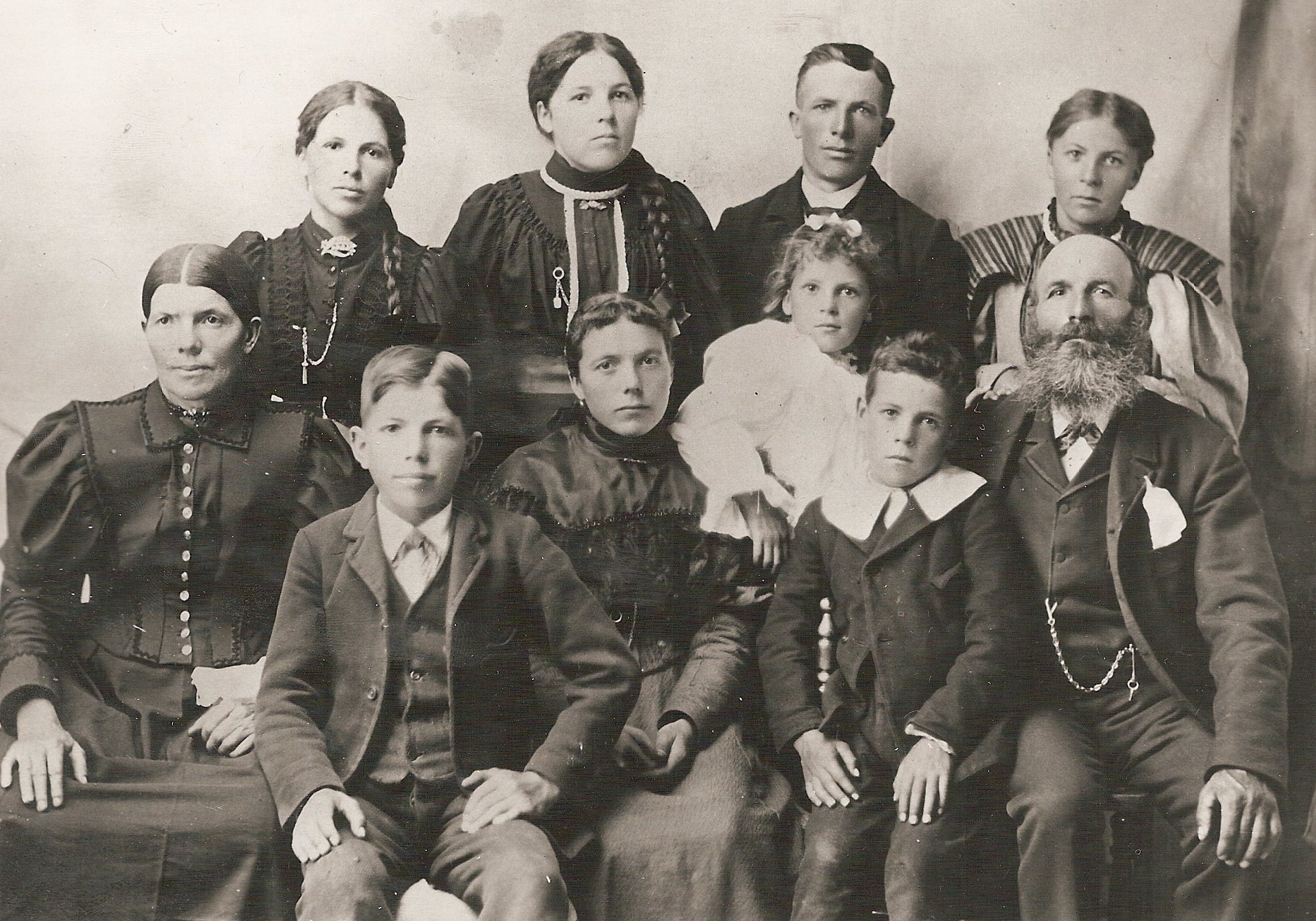
“To continue with my story- – we did so many things in life. First of all we were poor and had not much to live on. The folks had to move from Holzgerlingen to the new place in Gruenkraut. I remember we didn’t have much land. Father got a job working on the street. The grass grew high on the side of the road and we had to help gather the grass for the cows. We had to do this everyday before father went to work.
“We were poor in those days. We had to be up at 5 o’clock in the morning when we were big enough to work for other people. We worked every day in our lives to make a dollar. I would go out and work for other people whenever there was work. Some people had lots of land and we got plenty work there. They would come and get us to work when I was seven years old. I remember we never wasted any time. I remember when we had to go to a place to get vaccinated. I know I sure suffered a long time because my arm was so sore. They do this so that it will last a lifetime in the old country against disease.
“I remember how we got warm for the winter. Father would buy a yard of wood in the forest and we had to cut it down ourselves and haul that wood home with the cows and wagon. Some were long trees too and we would haul all the limbs and everything home. I am telling you, we had the yard so full of wood that we had no room for anything else till we had it shaped down and sawed up and put in its place. You know that was a job and we had to do all this before winter set in. We had a little wagon and we went to the woods in the summertime too, to get some dry wood. We did this many times and would always take home a wagonfull.
“In the old country they had fences in the lucerne fields. We had to put them up so we could hing the hay on them to dry after it got wet from the rain, so it would not mold. When it was dry we hauled it home. I remember we did all the farming with cows, they had them work all day and then milk them at night. Father worked on the street job for many years and mother and us children did most of the farming and in the fall we went picking hops. We never failed to make a little money in them. They have fields of hops in the old country. We always earned our winter’s money there. They have acres of hops there. We never wasted our time in the field.
“Another thing we did was go to the forest and pick fruit and go and sell it in the city. The people would sure buy it because the city was a long ways from the country where we lived. We had to walk all the way to the city. We raised hemp and mother would spin half the night making it into balls. She would take it to the factory and they made clothes out of it. We used to have many yards and would stretch it out on the grass in the summertime. It would go white and thats the way mother made our sheets and everything. We have in the old country the shoemaker, and he come to the house and make shoes for us. We also had the dressmaker come to the house. Sometimes they would stay at the house a week or more.
“When the grain was but, we had to out and clean the heads of the wheat. We cleaned sacks full each day for flour and one time right in the middle of the summer, the soldiers came in with their horses on some maneuvers or something. The horses mashed the grain and trampled all our crops up. I knew there was a big field of grand and they went right through it. They stayed around about a month or more. It sure was terrible.
“After a few years father bought a new farm and house about two miles away from the old one. It was a bigger house and more land and that’s where we lived until we came to America. Our house was a long house. We had four rooms and an upstairs. In the farmhouses of the old country we had everything under one roof– the pig pen and the hay loft. There was a big place in the floor where we threshed the wheat and other grain and we pulled all the hay up in the loft towards the roof. For a long time we threshed the wheat on this hard floor below with a stick and using a big klap, four or five of us would thresh the wheat and then would sieve the wheat from the chafe. But later, I can remember that we hired a thashmachine and the cows pulled it after that.
“I remember one time a wagon run over me. I believe it went over my arm. I don’t know how bad I got hurt, but it was plenty bad enough.
“Well, later on in that place not far away they built a Lutheran church and a school, too; and there we learned to knit our own stockings and do all kinds of sewing and crocheting. Yes, they built a nice church and school. They were very strict in those schools. If you were late a few minutes you would have to hold out your hand and the teacher would hit you so hard that your hand could feel it for a long time. It was one of those hard wood sticks. It wasn’t always our fault because we had to take the milk to the creamery in the morning in the snow and ice, and we could not go very fast, but there was no excuse at all. We had a lot to do before school, and if we didn’t have the lesson ready we were scared to go to school, ’cause if we were late we would sure get hit, and when you held out your hand they would do just what they wanted to do and it didn’t hurt them any.
“In the old country they sure celebrated Christmas. We had two Christmas trees every year and nice ones at that. We had applies tied from the bottom to the top and the step and the tree sure looked pretty every year. We only had white bread for Christmas and Holidays. I can remember how good that white bread was. We never saw it very often. it was only the rich who could buy that. There was only one bakery in Gruenkraut that had good bread and cakes, but we could never buy any. This is how we made our bread: We had a box of wood. Of course, it was clean. Father worked the dough and made enough for two or three weeks. It was mostly rye bread. It was hard and dark but we had to eat it. When Valentine’s Day came around, Mother made up cakes and they sure tasted good.
“We all the time raised our own meat. We raised pigs and salted and smoked the meat. We had our own grease. Mother made her own noodles all the time. She used lots of eggs–they were sure good. We had our cellar so full of potatoes, apples of all kinds and barrels of cider and barrels of sauerkraut. I can remember our cellar was full of all kinds of good things to eat.
“Well, about our garden. We had the prettiest garden you ever saw in the old country. The garden was laid out in a square and we had a path around all over with the vegetables in the background and flowers in front and we could walk all over the paths with flowers on each side. We didn’t need any ditches, but had to pack water when it didn’t rain. We always had a beautiful garden with flowers of all kinds.
“On Saturday we always had to clean the shoes for the whole family — shine them up for Sunday. We always went to church on Sunday. We never worked on Sunday. We were not allowed to work on Sunday, because in those days they would fine you if you did. You could not even get your hay in on Sunday, even when you could see rain coming.
“Well, I guess about in the year 1890, in the summertime, the Lord sent a man along that street in Gruenkraut where my father worked, who was a missionary from the Church of Jesus Christ of Latter Day Saints. He talked to my father a long time and he told father of the new and true Gospel and about Joseph Smith and showed him the Book of Mormon. This man talked to my father in German as he was a missionary to German. Well, it was dinnertime and father took this missionary to our home and father told him–“We’ll see mother”–and from that very day on this missionary stayed at our place. His name was Zollinger from Providence, Utah. When his time came to go home, the missionary took my brother George to America with him. After that we had three more missionaries–one from Bear Lake, one from Providence, and another one from Salt Lake City, who couldn’t speak the language, so we helped him learn the language. He would tell us English words and we would tell him German words. There wasn’t anybody who would listen to the missionaries for miles around–just one other family from Ravensburg–and they were the only ones that believed the message like us. We had room for them everytime they came. There was no place else for them to go and we were glad to have them.
“The missionary from Salt Lake–his name was Hubbard–decided to go tracting one day. It was his first time tracting. He didn’t come home for so late that we thought maybe he fell into one of the wells with water that were here and there. It was late in the evening and dark, so mother decided to put a candle in the window. He soon came back and told us that he had been lost for a long time until he saw the light in the window. There weren’t many houses when I lived there, but in seventy years since, I guess it is built up all over.
“(About this same time Grandma was writing her history, Mrs. Herbert Wagstaff and son came to visit her from California. Herbert Wagstaff was the son of sister Mary Magdaline. The son had recently returned from a mission to Germany, where he had taken colored slides of the big house in Gruenkraut as it stands today. Of this evening of reminising Grandma said:) “It was sure nice to see my old home again and see it still stand in Gruenkraut. It was nice to see it again after seventy years.”)
“Well, I lived in that community for 14 years. That’s when I graduated. We started to this country when I was fifteen, in May of 1893, and got here the 15th of June, 1893. We came by ship and docked first in Amsterdam, Holland, and then in London, England. And then from London, to New York City, where we went to a big high hotel. WE were 12 days on the ocean. We had a good time on the ship where we danced. One day there was a terrible storm which throwed water up on the dock and nobody could dance after that. From New York we boarded the train for Idaho. We were 6 days on the train. On the train we sang all across the United States. We couldn’t speak any English then nor for a long time. We got off the train on the 15th of June, 1893, in Franklin, Idaho, and my brother George was there to meet us. He had a wagon with three spring seats. Well, we never were so worried on our whole trip as we were in that wagon. That day the road was so bad–open ditches with water in, and the horses danced around before they would cross. I never say such a rough road in my life–hills and hollows, and then we saw a bunch of Indians. They were hanging dead squirrels on a line to dry. That was something new to us. Well, we got to the place where we were to stay. But father was as worried that he got off the wagon and walked all the way back to Franklin. Mother and the rest of us were so worried, because he didn’t come back for a few days. We stayed with some folks for about two months, then father built a place in Glendale, Idaho, and there we lived the rest of the summer.
“Towards fall there was a man who wanted to sell his place in Glendale and father bought that place. My father farmed in Glendale. Glendale had only a little meetinghouse and also a school. I went to school there that winter to learn the English language. From then on I worked wherever I could get a job. I worked washing, cleaning house and tending children. In a place where I worked their children got mumps and I got mumps too, and I suffered so much that I could never get better for a long time. When I got better I went to work again. One time in the winter I rode a horse to Preston, and I got the toothache so bad that I had to have it pulled out right there. I soon learned to ride a horse a lot–something I’d never done in the old country.
“I worked for Matthias Cowley in Preston one winter. I guess it was the year 1895. He used to take trips and travel in a buggy–he helped organize the Northwestern States Mission. Then I worked in Whitney, Idaho. They had plenty of sickness in homes there. In 1897 we moved down to Logan and to the 5th Ward. Then I worked in Millville and went to school there at the same time learning the language. After that I went to work in Logan. It was in the 3rd Ward one night in church I met Jeffrey Bodrero. We were married in the Logan Temple, March 16, 1898. My sister Wilhelmina married Jeffrey’s brother, Moses Bodrero, December 18, 1907. Jeffrey’s father was Domenico Marsiano Bodrero, and his mother was Maria Caterina Margherita Frank Bodrero. After we were married I went to work for Dominic Bodrero that summer, who lived by the courthouse, where I walked everyday from the 9th Ward and did washing by hand on a board up until the time of my first child. Later that year I tended to beets, but they didn’t grow very well because of too many wild oats. Jeffrey went to the canyon about every day to get lumber and to make a dollar. These are the years when I lived: Gruenkraut, German: 14 years; Glendale, Idaho: 5 years; Logan 9th Ward: 30 years; Logan 4th Ward–where I became a relief society teacher. I also did a lot of temple work.
“In the old country we had known a family names Speth for a long time. We used to go back and forth to each others homes all the time. There was a big dark forest between our two places, and we were sometimes afraid to go through it because it was dark, even in the day time. Father would send us kids over in the evenings too. Sometimes we went twice a week to see them. We always had to walk of course. We had no car. I can see it now and I will never forget it. They were really friends to us. The old people never joined the church, but the boys came over to America and settled in Providence and then joined the church. My granddaughter married a Speth grandson.
“My children’s names are: [Rosalie] Marie, John George, David Wanner, Eva Margaret, William Jeffrey, Parley Lorenzo, Louise Mary, Edward Theodore, Llewellyn Grant and Evelyn Jane.

“My folks went to conference everytime there was one. We never had the chance to go because children had to stay home and do the work. I remember it was in the winter once and it was so cold my parents couldn’t go to the conference. They sure liked this Mormon Gospel from the first day my father met the missionary.

“(Louise Sophie Wanner Bodrero died February 1, 1967 in Logan, Utah)








 Sagacity