History of Plain City Pt 2

I have two copies of the History of Plain City, Utah. The front indicates it is from March 17th 1859 to present. As far as I can tell, the book was written in 1977. At least that is the latest date I can find in the book.

One copy belonged to my Grandparents Milo and Gladys Ross. My Grandpa has written various notes inside the history which I intend to include in parenthesis whenever they appear. They add to the history and come from his own experience and hearing.

I will only do a number of pages at a time. I will also try to include scanned copies of the photos in the books. These are just scanned copies of these books, I have not tried to seek out originals or better copies.

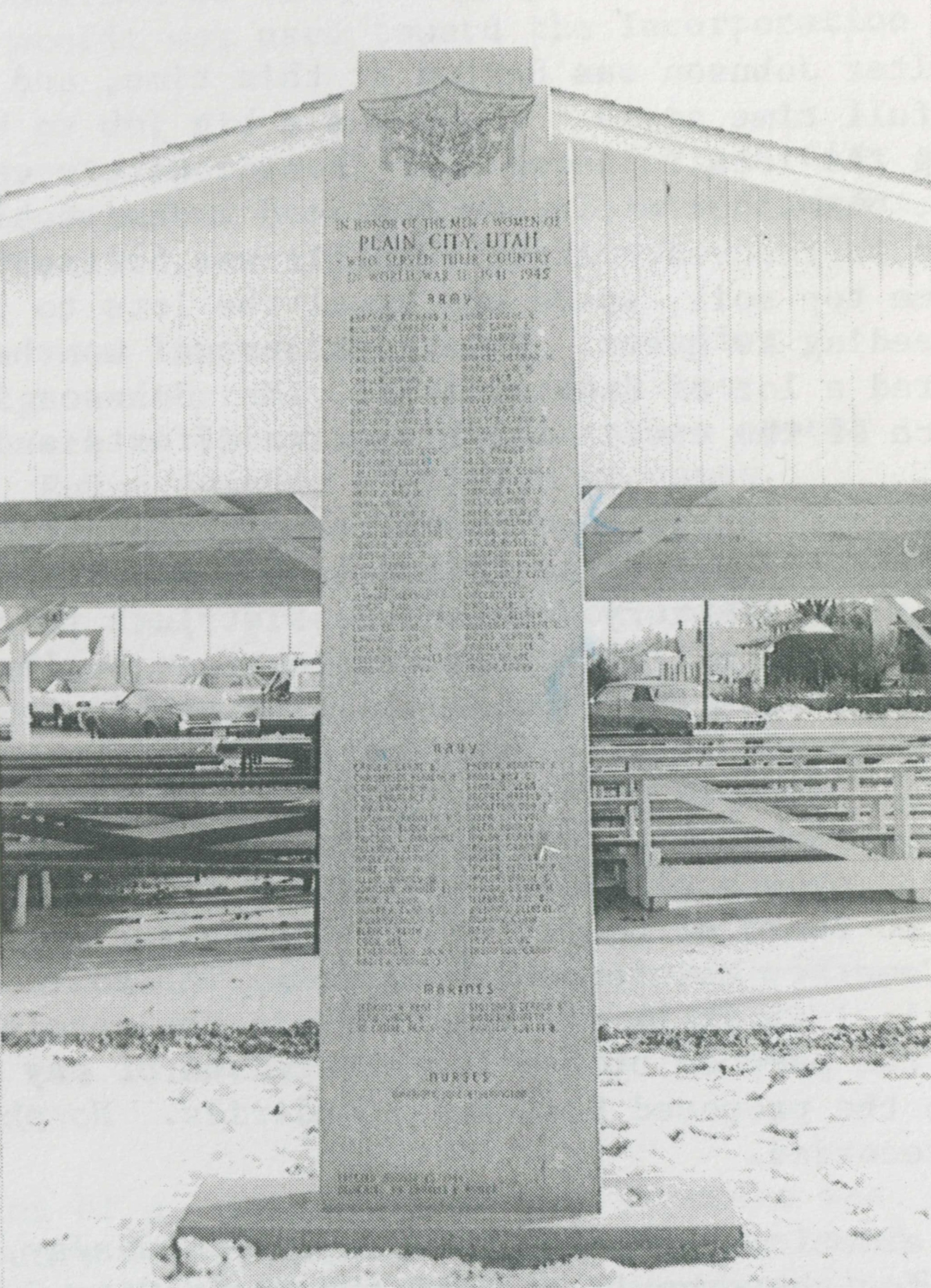
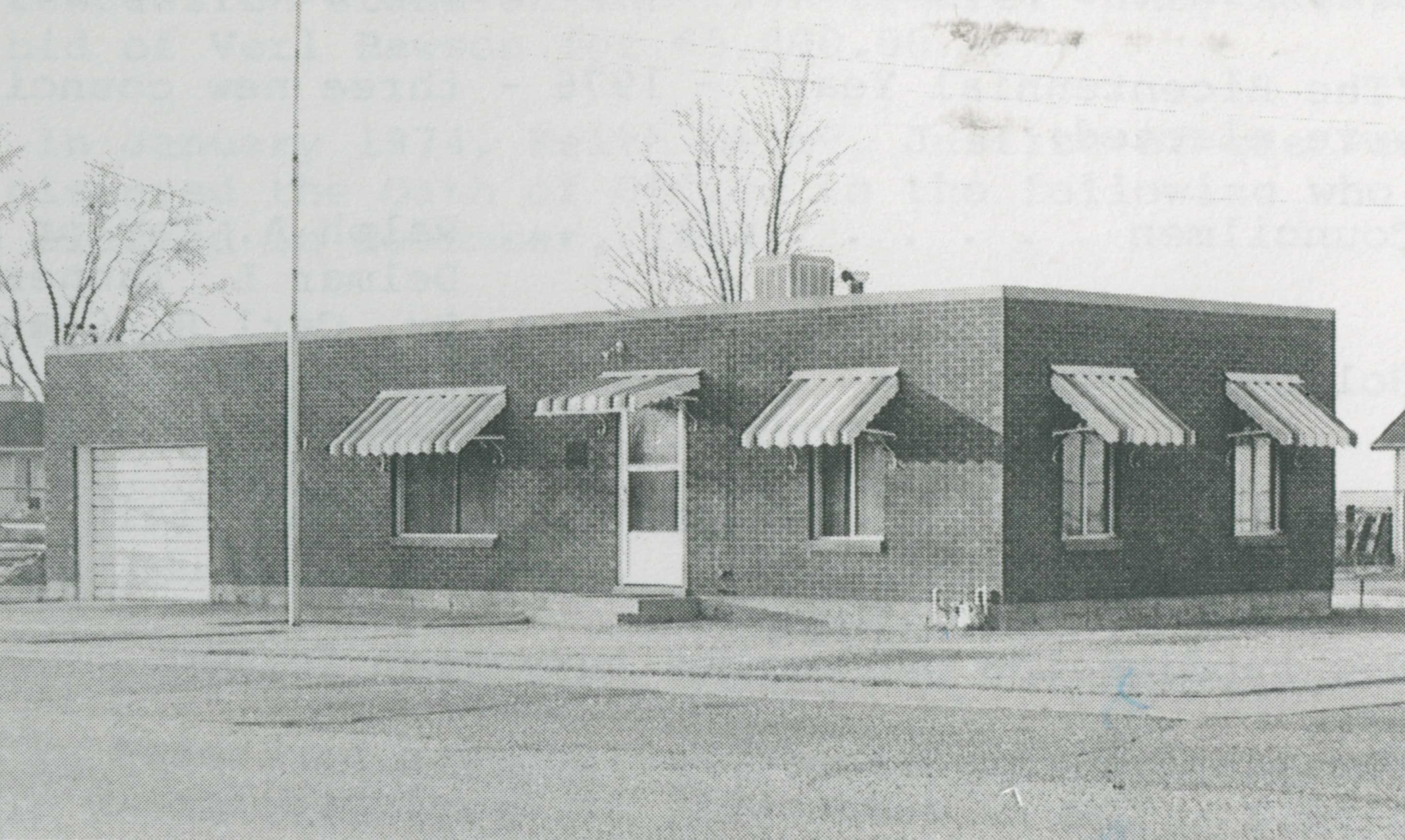
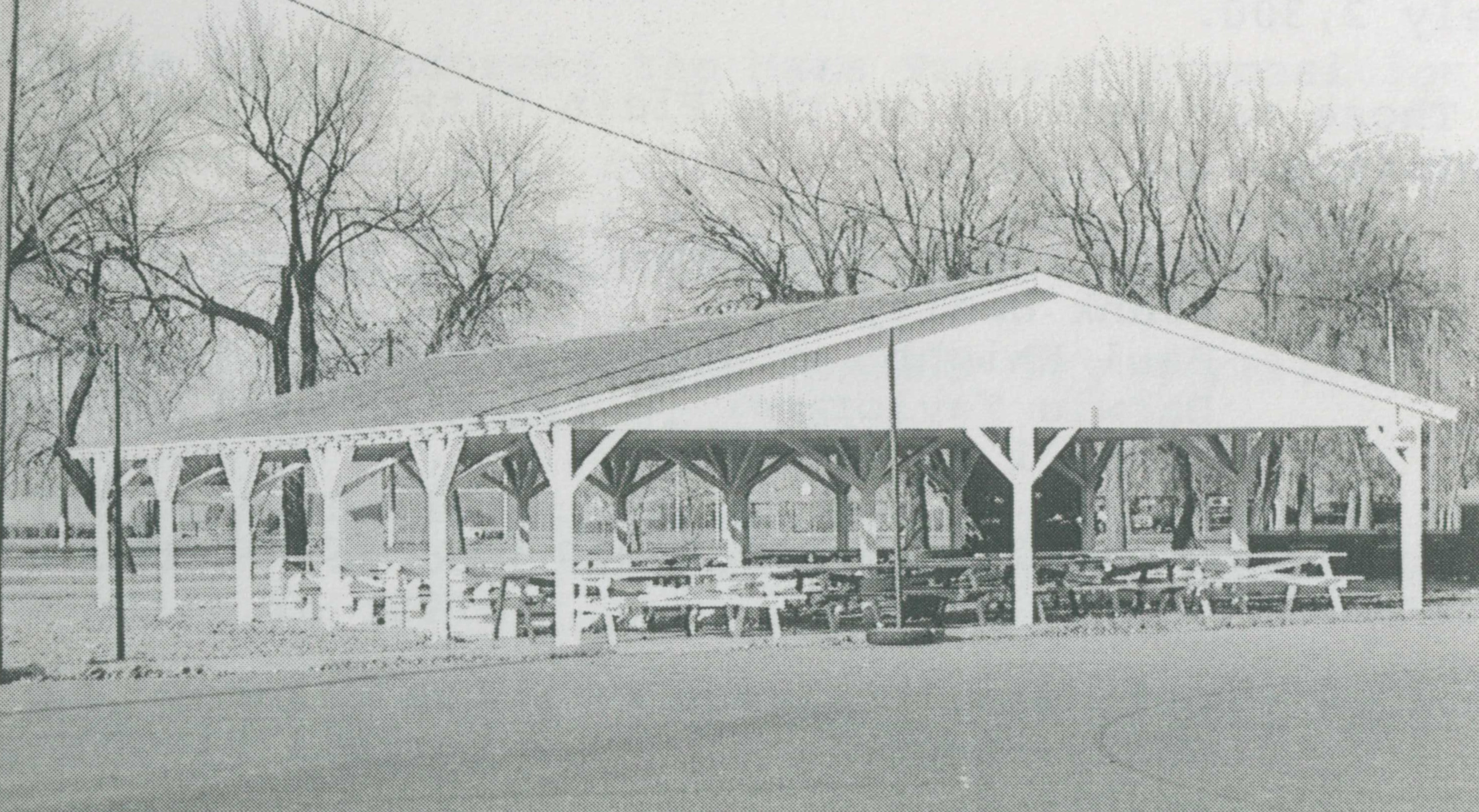
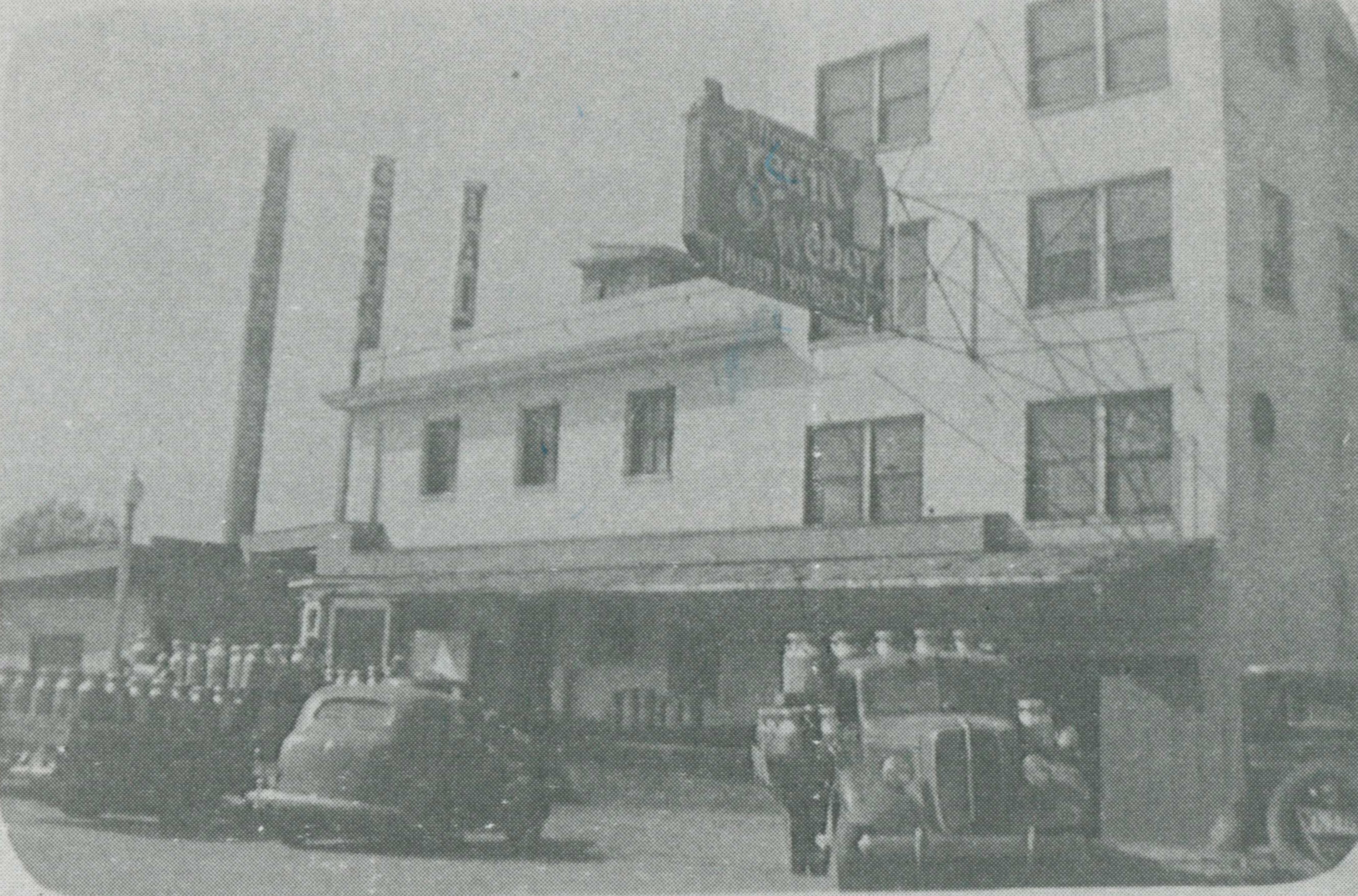
History of Plain City March 17th 1859 to present, pages 33 through 38.

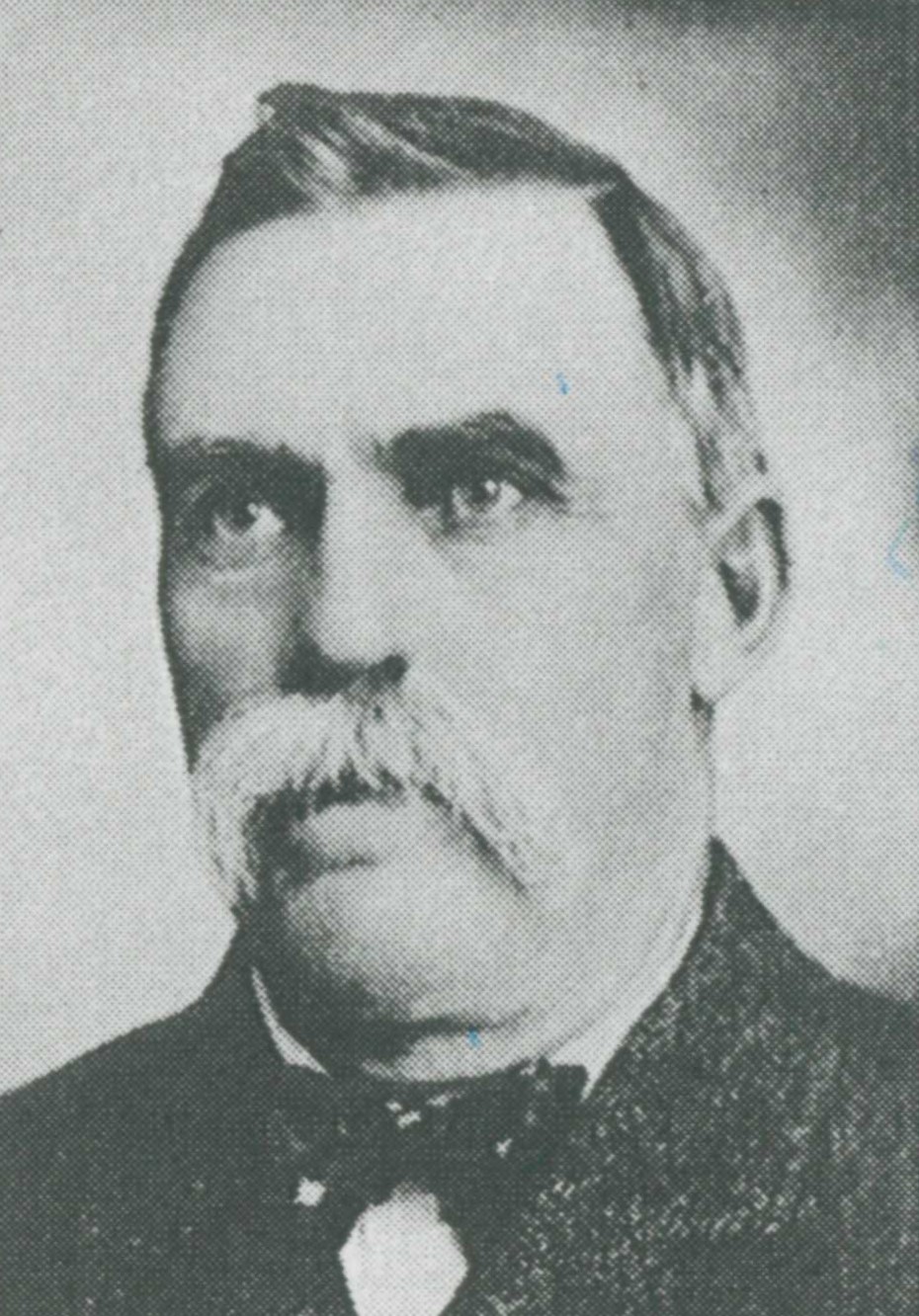
Past Bishops of Plain City

Henry J Gardner 1906 – 1910
Back (l-r): Wilmer J Maw, George E Knight, Elvin H Maw, Charles L Heslop; Front: George A Palmer, Gilbert Thatcher, Henry T Maw

Wilmer J. Maw      1920–1926

George E. Knight  1949–1953

Elvin H. Maw        1944–1949

Charles L. Heslop  1936–1944 (Married Milo Ross & Gladys Donaldson April 1942)

George A. Palmer 1926–1936

Gilbert Thatcher  1913–1920

Henry T. Maw     1910–1913

(l-r): Charles L Heslop, Elvin H Maw, George E Knight, Merrill Jenkins, Lyman H Cook, Rulon Chugg, Wayne W Cottle, Orlo S Maw

Charles L Heslop, 1936-1944

Elvin H Maw, 1944-1949

George E Knight, 1949-1953

Merrill Jenkins, 1953-1959

Lyman H Cook, 1959-1964

Rulon Chugg, 1960-1965, 2nd Ward

Plain City Ward – Wayne W Cottle, 1964 –

Plain City Ward – Orlo S Maw, 1965

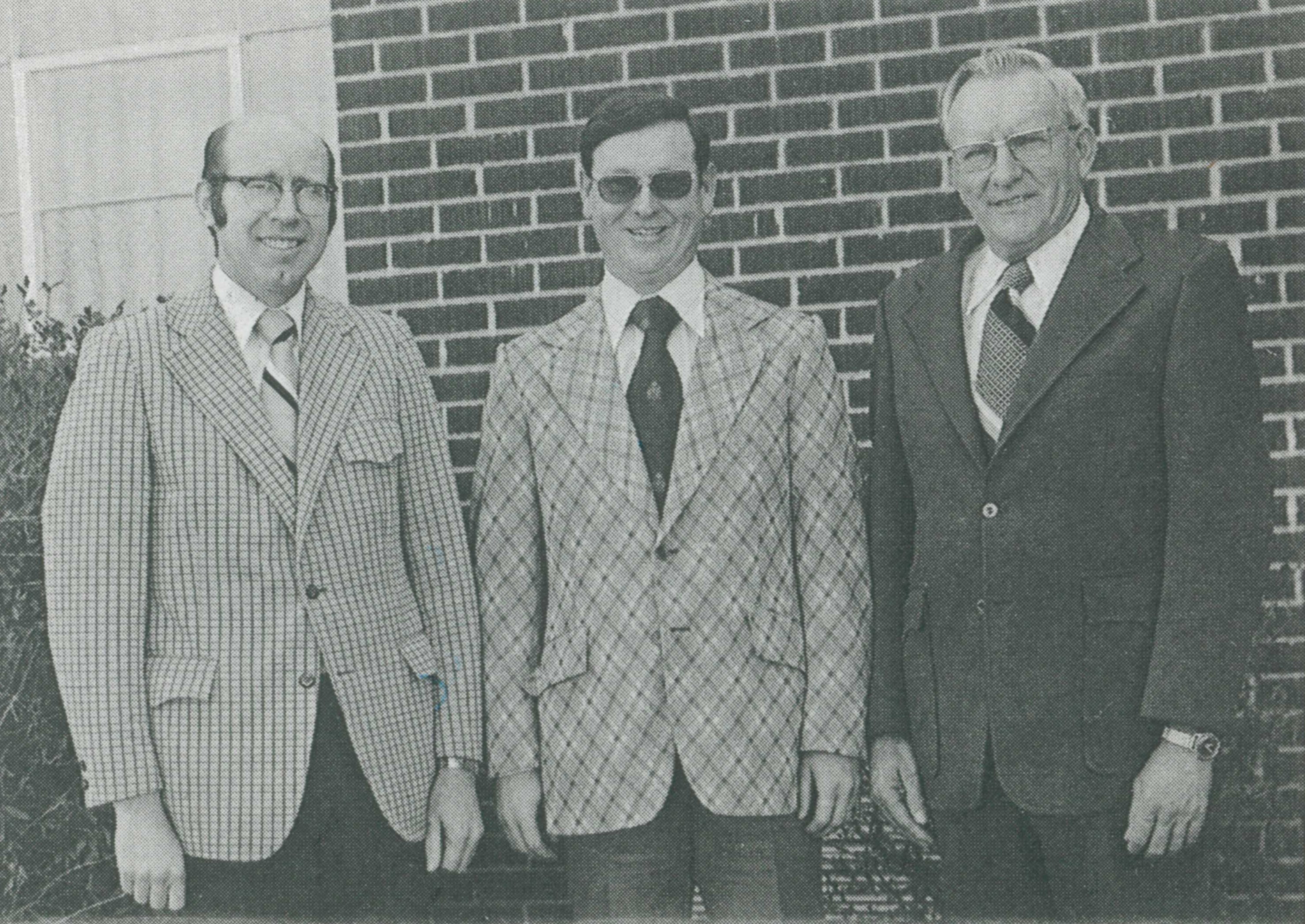
(l-r) Kent Calvert, Robert Sharp, Kent Jenkins

Kent Calvert, 2nd Ward 1971-1974, 3rd Ward 1974-

Robert Sharp, 2nd Ward 1974-

Kent Jenkins, 1st Ward 1971-

PLAIN CITY BRANCH OFFICER

1859 – 1977

Submitted by Roxy Heslop                  Gilbert Thatcher                      1913 – 1920

PRESIDING ELDERS                                                     Wilmer J Maw                        1920 – 1926

William W Raymond              1859 – 1863                George A Palmer                   1926 – 1936

John Carver                             1863 – 1866                Charles L Heslop                     1936 – 1944

William W Raymond              1866 – 1870                Elvin H. Maw                           1944 – 1949

Lewis W Shurtliff                    1870 – 1877                George F Knight                     1949 – 1953

FIRST COUNSELORS                                                    Merrill Jenkins                        1953 – 1959

Daniel Collet                           1859 – 1866                Lyman Cook                             1959 – 1964

John Carver                             1872 – 1877                Wayne W Cottle                     1964 – 1971

SECOND COUNSELORS                                               Kent Jenkins                            1971 –

Jeppe G Folkman                    1859 – 1872               

~

PLAIN CITY FIRST WARD

John Spiers                              1872 – 1877                FIRST COUNSELORS

CLERKS                                                                         John Spiers                              1877 – 1895

John Spiers                              1859 – 1872                Abraham Maw                        1895 – 1901

William W McGuire               1872 – 1877                Peter C Green                        1901 – 1903

PLAIN City Ward Officers        1877 – 1977                Henry J Garner                       1903 – 1906

BISHOP                                                                        Peter M Folkman                   1906 – 1910

Lewis W Shurtleff                   1877 – 1883                James L Robson                      1910 – 1920

George W Bramwell              1883 – 1906                George A Palmer                   1920 – 1926

Henry T Maw                         1910 – 1913                Elvin H Maw                           1926 – 1936

Gordon F Thompson  1936 – 1944                Abraham E Maw                    1936 – 1944

L Rulon Jenkins           1944 – 1949                Fred L Singleton                     1944 – 1946

Leslie T Maw              1949 – 1953                Llewellyn Hipwell                    1946 – 1949

Elmer Ericson              1953 – 1956                Howard Hadley                       1949- 1953

Rulon Chugg                1956 – 1956                William Searcy                        1953 – 1955

Thad Carlson               1959 – 1960                Rulon Chugg                            1955 – 1956

Carl Lund                     1960 – 1964                LeRoy P Folkman                    1956 – 1959

A Lew Jenkins              1964 – 1966                Kent Jenkins                            1959 – 1964

Darwin J Taylor           1966 – 1971                Delmar L Tanner                    1964 – 1969

G Earl Thompson        1971 – 1972                Blaine R Jensen                      1969 – 1971

Gary Jackson               1974 –                          Steven Miller                          1971 – 1974

SECOND COUNSELORS                                    Gary Jackson                           1972 – 1974

Peter C Green            1877 – 1901                Jerry Bradford                         1974 –

Samuel P Draney        1901 – 1903                WARD CLERK

Peter M Folkman       1903 – 1906                William McGuire                    1877 – 1887

Peter P Green            1906 – 1907                George Carver                        1877 – 1890

William G Rhead        1907 – 1910                Peter C Green                        1890 – 1903

William C Carver        1910 – 1913                William Kenley                        1903 – 1907

Marion Knight             1913 – 1914                William A Kerr                        1907 – 1914

William England, Jr    1914 – 1920                William H Heslop                   1914 – 1936

Elvin H Maw               1920 – 1926                LeRoy P Folkman                    1936 – 1942

Thomas Jenkins           1926 – 1936                Fred L Singleton                     1942 – 1944

Walter Moyes             1944 – 1947                A Glen Charlton                     1963 – 1965

A.Lew Jenkins              1947 – 1951                Gaylen Hansen                        1965 – 1966

Herbert E Barnes       1951 – 1953                Kent Calvert                            1966 – 1971

Blair Simpson              1953 – 1959                Robert Sharp                           1971 – 1974

Glen A Charlton         1953 – 1959                Rodney Roper                         1974 –

Kent Jenkins                1957 – 1959                SECOND COUNSELORS

Willard Wayment        1953 – 1959                A Glen Charlton                     1960 – 1963

Harold Hadley             1959 –                          LeRoy Folkman                        1963 – 1965

Wayne Skeen              1959 – 1965                Denton Hall                             1965 – 1971

Vernon Smith              1965 – 1965                Donald Skeen                          1971 – 1974

Robert Wade               1965 –                          John Stevens                           1974 –

Clair Truscott              1965 – 1971                CLERKS  

                                                                        Walter Moyes                         1960 – 1965

~

PLAIN CITY SECOND WARD                             Lewis Moyes                           1965 – 1974

            Created June 12, 1960                        R John Maw                           1974 – 1976

BISHOPS                                                          Duane Bullock                         1976 –

Rulon Chugg                1960 – 1965               

~

PLAIN CITY THIRD WARD

Orlo S Maw                1965 – 1971                            Created June 23, 1974

Kent Calvert                1971 – 1974                BISHOPS

Robert Sharp               1974 –                          Kent Calvert                            1974 –

FIRST COUNSELORS                                                    FIRST COUNSELORS

Jay Taggart                 1960 – 1963                            David Petersen                        1974 – 1976

Layne Thompson         1976 –

SECOND COUNSELOR

Robert Lewis               1974 – 1976

F. LeRoy Williams       1976 –

CLERKS

Keith Hamp                 1974 –

~

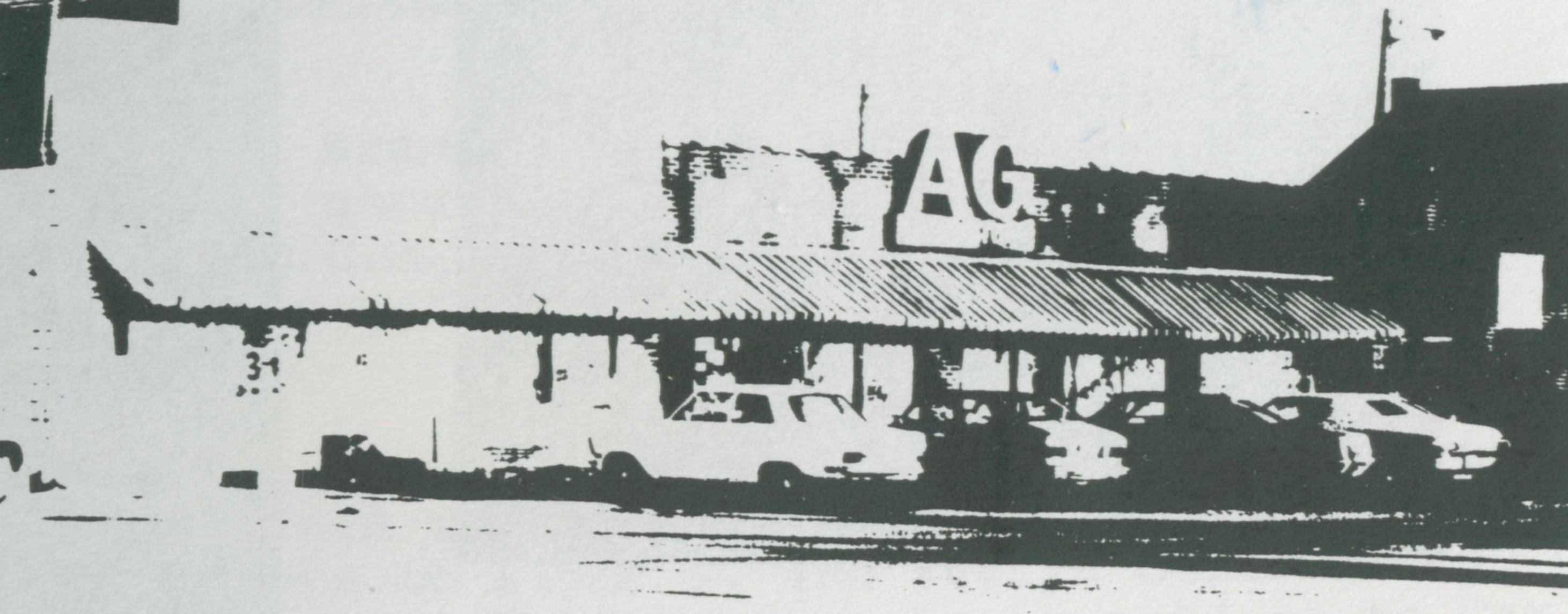
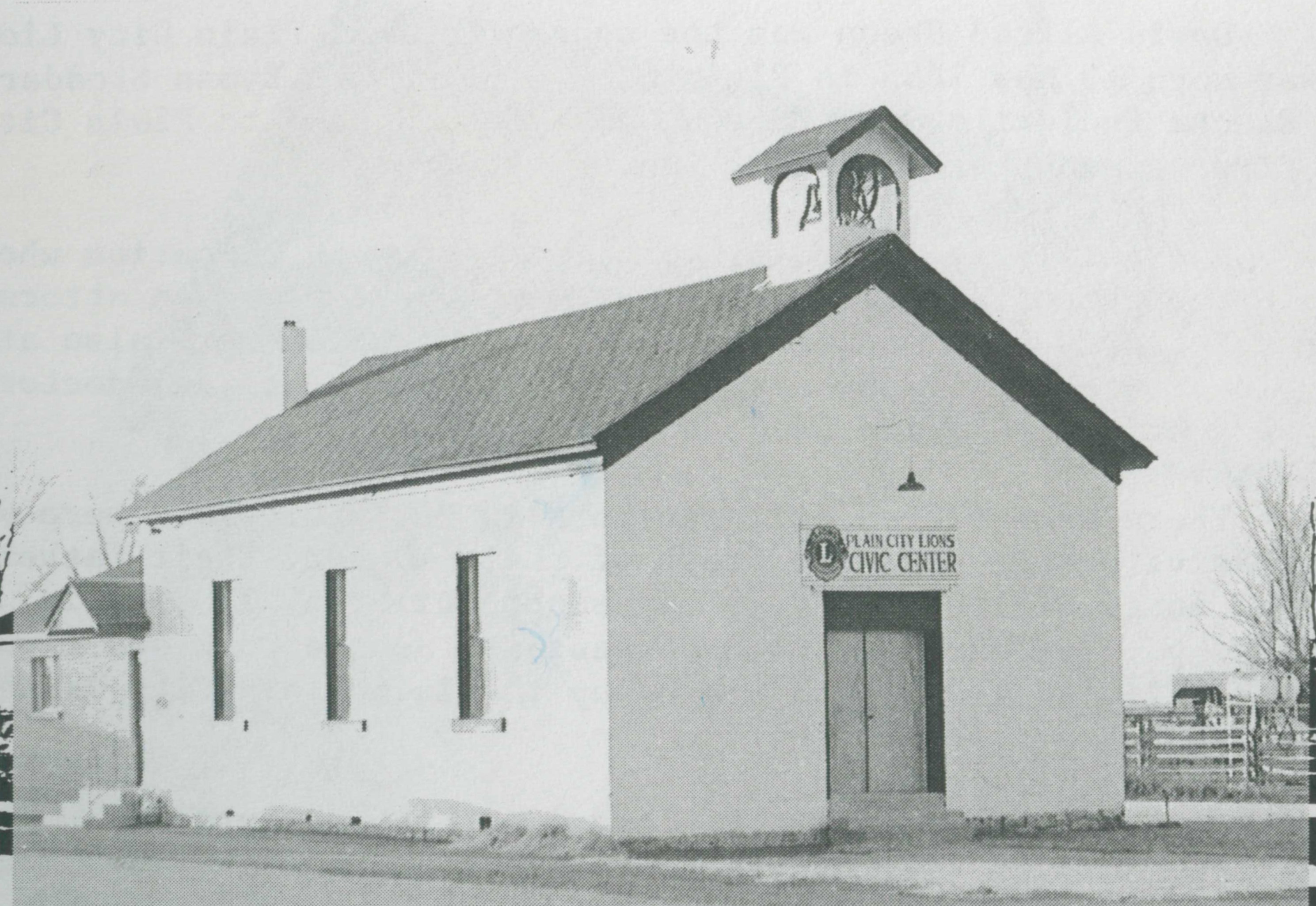
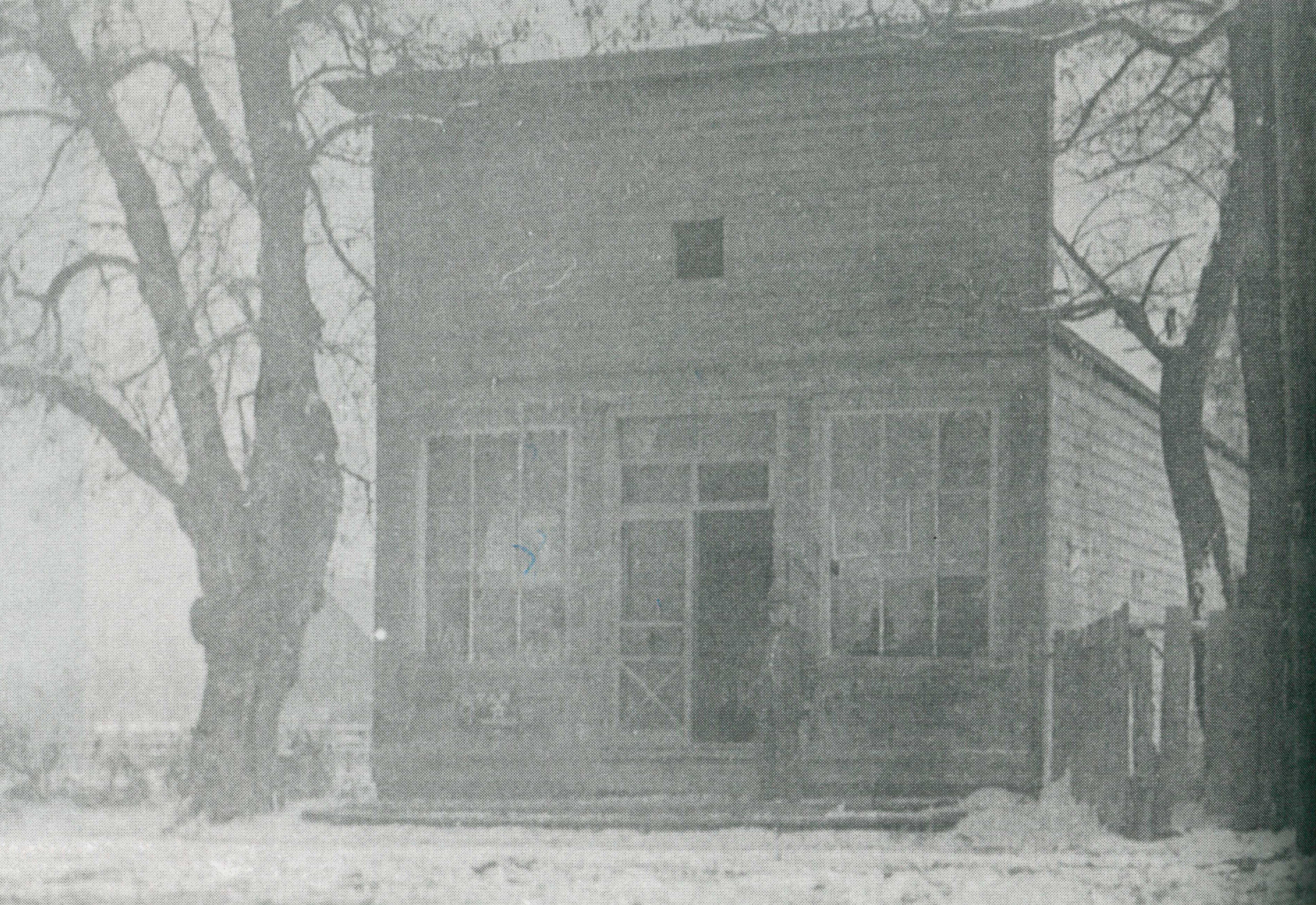
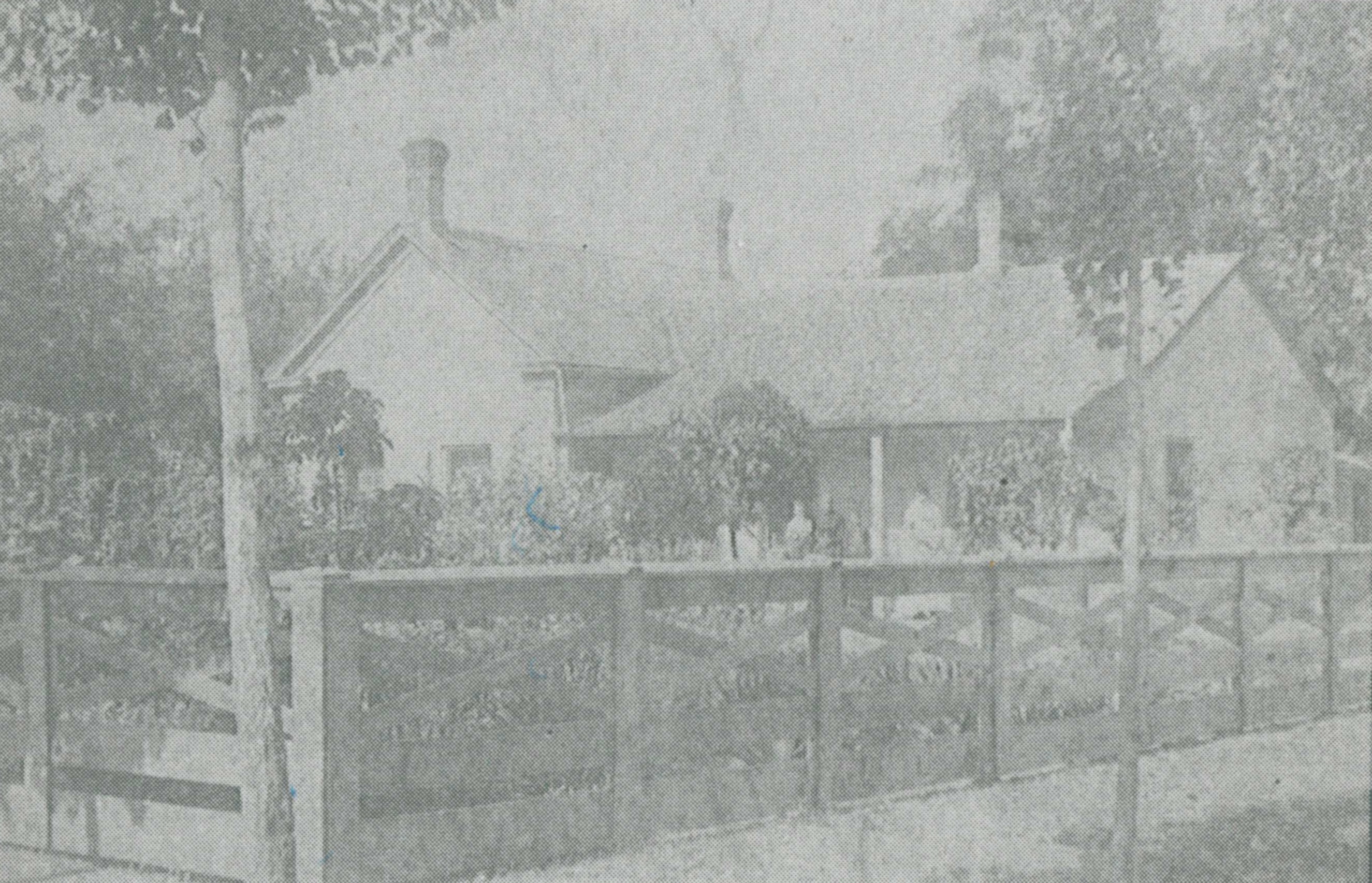
Plain City Chapel. Dedicated 1889. Tore down in 1953. Was built just North of the present chapel.
Another view of the Plain City Chapel of 1889.
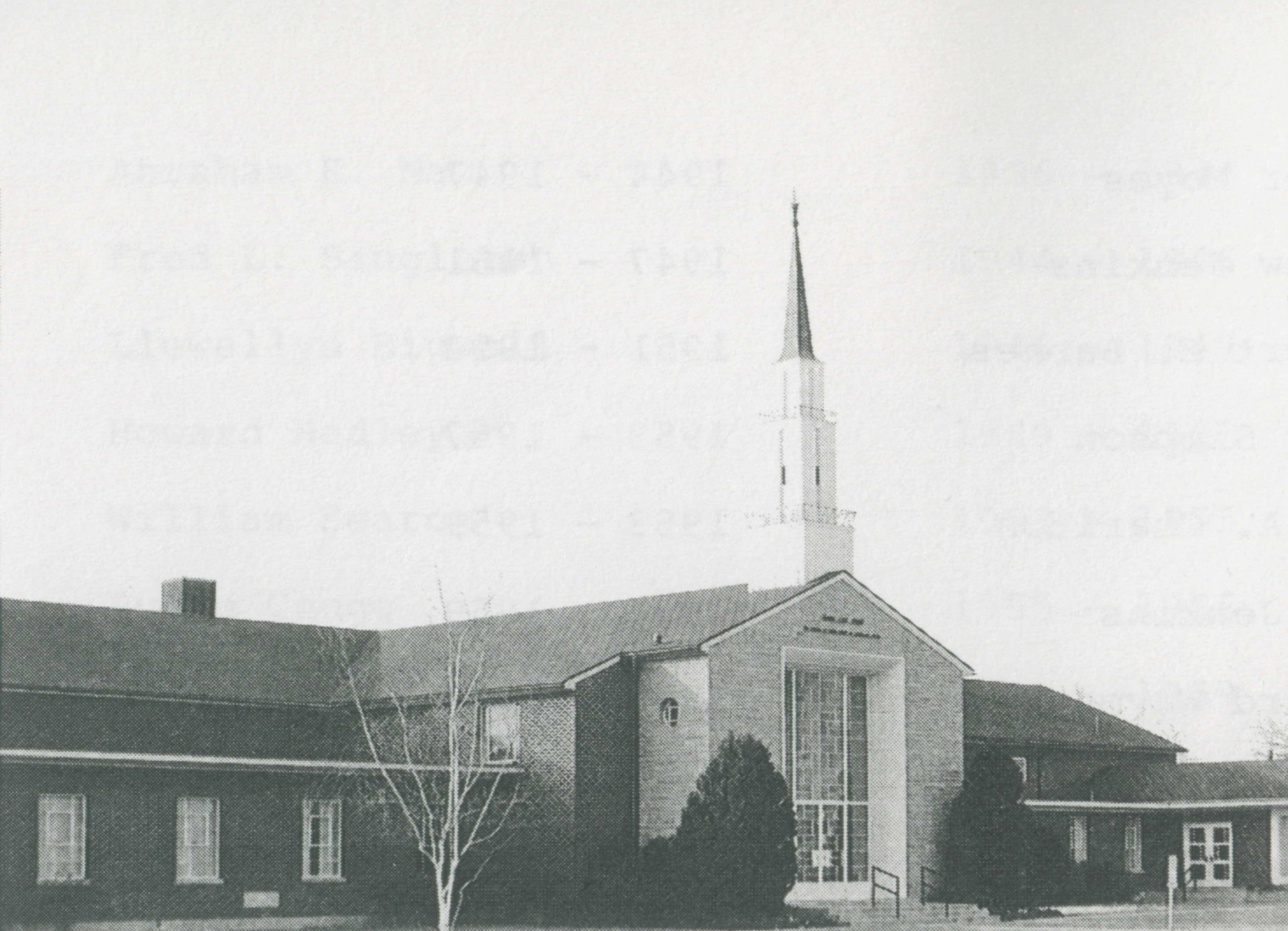
Present City Chapel. Dedicated 1954.

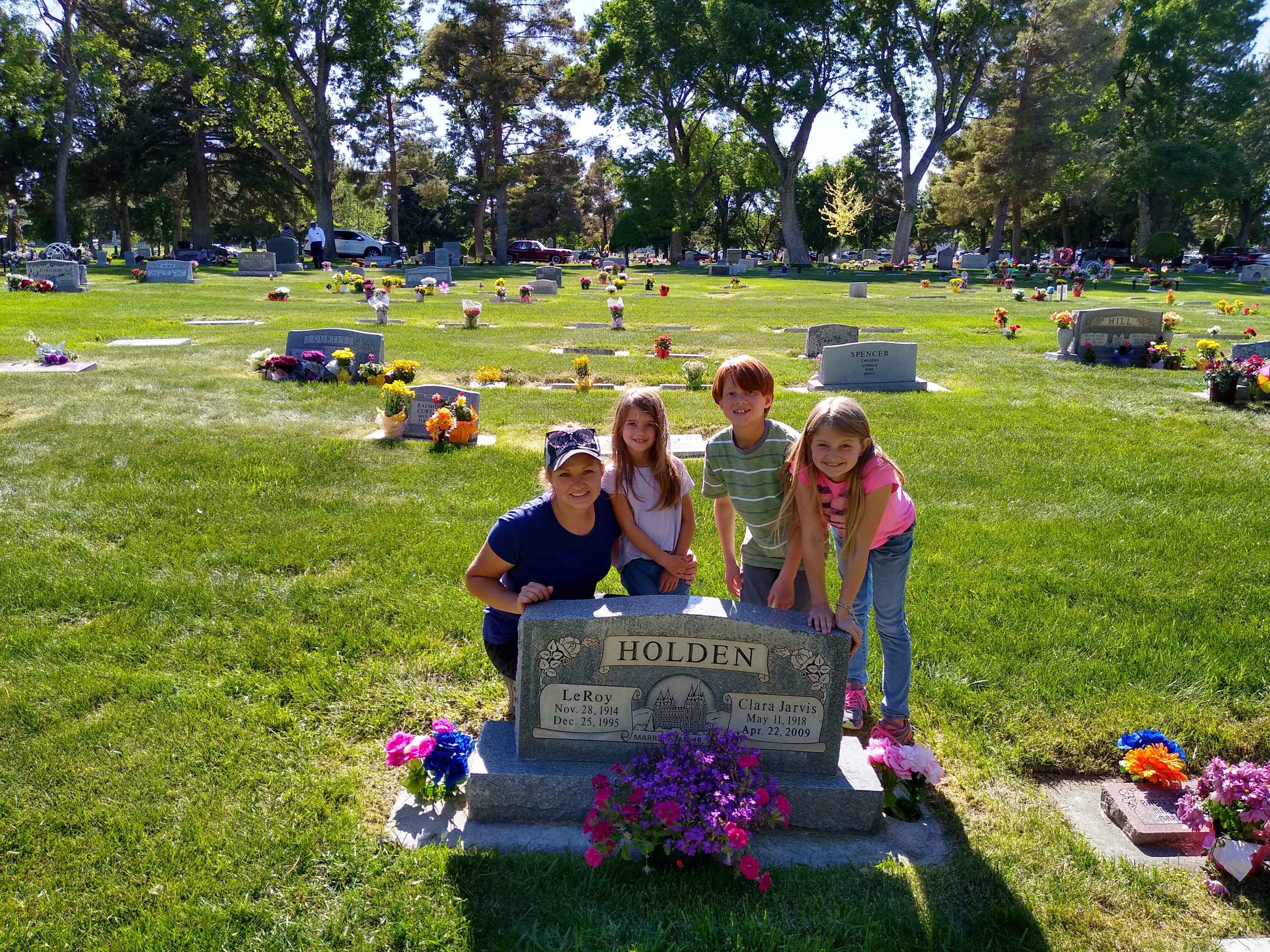
Holden Grave Payson Utah

Amanda, Lillian, Hiram, and Aliza Ross at the grave of LeRoy and Clara Holden in Payson, Utah

We tend to not get down to Payson, Utah, Utah too often. On this occasion we were on our way back from Ely, White Pine, Nevada from a trip to Great Basin National Park. We were also coming home on Memorial Day weekend, so we had to make some visits to family graves.

LeRoy and Clara Elizabeth Jarvis Holden are Amanda’s maternal grandparents.

Back (l-r): Roy Holden, D Hemsley, Bryan, Jill, and Amanda Hemsley, Mel and Shanna Thompson. Front: Clara Hemsley, Belle Hemsley, June and Walter Hansen.

LeRoy Holden was born 28 November 1914 in Provo, Utah, Utah. He was the son of Alvin Peter Holden and Emma Jane Roberts. I tried to convince Amanda we should name a son Alvin citing to her family history, but it was to no avail.

He met Clara Elizabeth Jarvis was born 11 May 1918 in Palmyra, Utah, Utah. She was the daughter of Joseph Finch Jarvis and Sarah Jane Evans.

Clara Elizabeth Jarvis

LeRoy and Clara met and were married in the Salt Lake City Utah Temple on 19 January 1939. Together they had 5 children and adopted Amanda’s mother, Jill in 1963.

Clara and Roy Holden

LeRoy developed cancer and passed away 25 December 1995 in Provo. He was buried 29 Decembber 1995 in Payson City Cemetery.

Clara met and married Jay LeGrande Barlow on 20 December 1996 in Provo. He was born 7 July 1918 in Enterprise, Washington, Utah.

Clara passed away 22 April 2009 in Salt Lake City, Salt Lake, Utah. She was buried 25 April 2009 in Payson City Cemetery.

Jay passed away a short time later on 23 September 2009 in Draper, Salt Lake, Utah. He was buried 28 September 2009 in Payson City Cemetery next to his wife Dorothy Emett (1920-1993).

Bryan & Jill Hemsley, Roy and Clara Holden, Amanda Hemsley in stroller

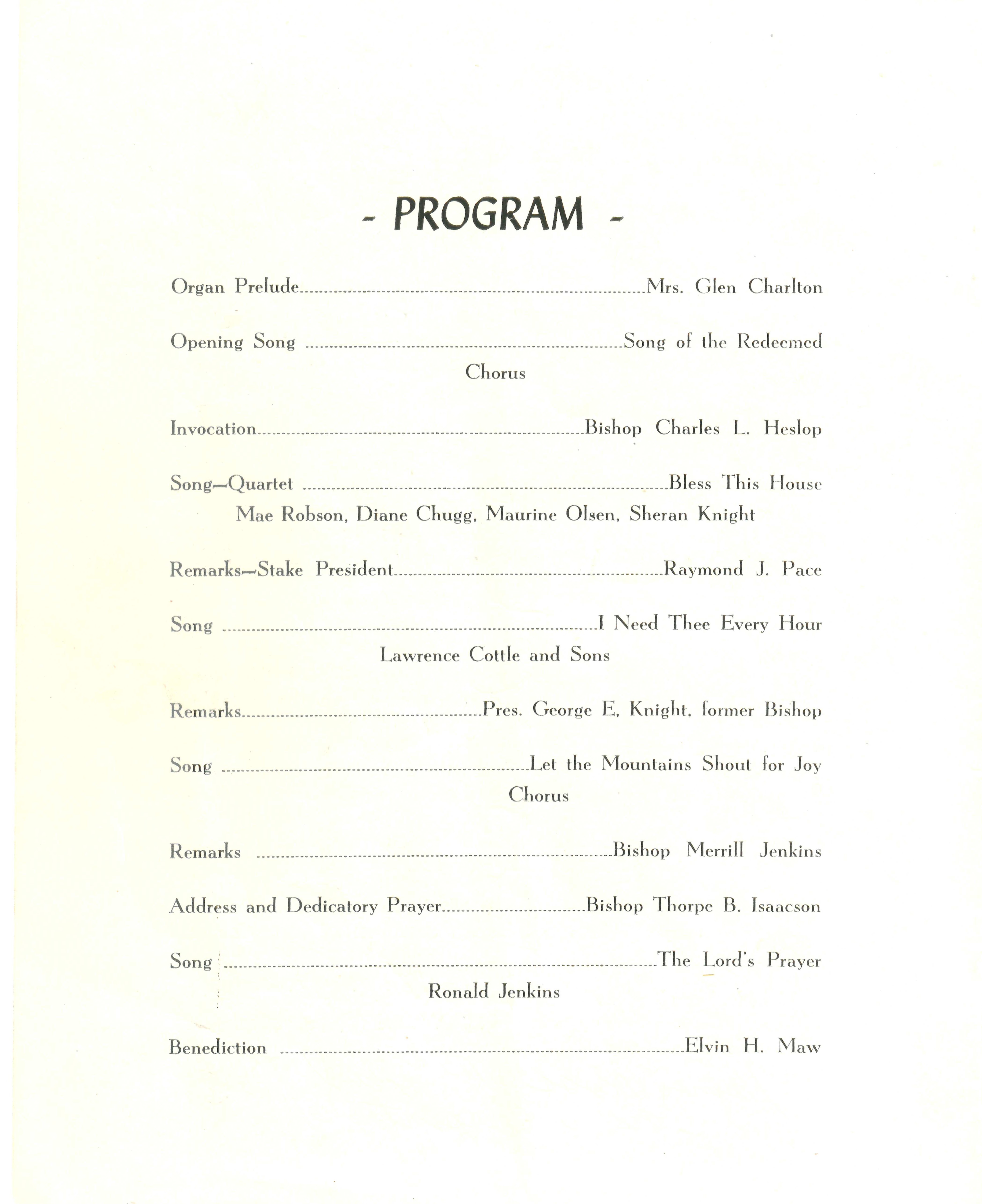
Plain City Stake Center Dedicatory Service

In Grandpa and Grandma’s possessions were two pamphlets from the 1979 and 1954 dedications of the church buildings in Plain City, Utah. Here is the 1979. Grandpa helped work on this building. He also helped extensively on the 1954 building. As I previously wrote, Grandpa also had a hand in obtaining the land for the construction of the 2, 7, and 8 Ward building. I will share the 1954 pamphlet at a later date.

Dedicatory Program for Plain City Stake Center 20 September 1979

Dedicatory Service

Plain City Utah Stake Center and Plain City Third & Fourth Wards

The Church of Jesus Christ of Latter-day Saints

2120 North 4575 West

September 30, 1979

2:00 PM

Dedicated under the direction of Bernard P. Brockbank

Member – First Quorum of Seventy

Stake Presidencies

Plain City Utah Stake

Samuel S Lower – 1st Counselor

President Kent W Calvert

R. Alton Griffin – 2nd Counselor

Ogden Utah Farr West Stake

Robert E Jennings – 1st Counselor

President H Orvil Holley

Shirl K Fadel – 2nd Counselor

Bishoprics in Plain City Utah Stake

Plain City Third Ward

Robert Ewer – 2nd Counselor

Bishop Layne S Thompson

Dennis Carlson – 1st Counselor

Plain City Fourth Ward

Ronald L Larsen – 2nd Counselor

Bishop Harold O Hadley

Theodore G Balderree – 1st Counselor

Farr West First Ward

E Robert Rauzi – 1st Counselor

Bishop Dale John Chugg

Sheldon W Taylor – 2nd Counselor

Farr West Second Ward

Val Stratford – 1st Counselor

Bishop Harvey W Higley

Paul W Bryner – 2nd Counselor

Plain City First Ward

Alvin G Foremaster – 1st Counselor

Bishop Darwin J Taylor

Gary L Thompson – 2nd Counselor

Plain City Second Ward

Ronald H Olsen – 1st Counselor

Bishop Robert L Sharp

William A Van Hulten – 2nd Counselor

Program

Organ Prelude – Marjorie Westergard

Prayer Hymn “Abide With Me” Dedicatory Choir Donna Vause Conducting, Marjore Westergard, Organist

Welcome and Acknowledgements – President Kent W Calvert

Hymn “The Spirit of God Like a Fire is Burning” Choir and Congregation

Invocation – President J Raymond Johnson

Hymn “Oh How Lovely Was the Morning” (Jesus Lover of My Soul)

Multi-Media Presentation – Ward Conference Committee, Carl R Saunders, Rober Ewer, Harold Westergard, Photographer and Sound Technician Larry Hansen

Remarks – President H Orvil Holley

Remarks – President Kent W Calvert

Hymn “Song of Dedication”

Address and Dedicator Prayer – Bernard P Brockbank

Closing Hymn “Come Come Ye Saints” arr. by J Spencer Cornwall

Benediction – President Wayne Cottle

Organ Postlude – Marjorie Westergard

FLowers – McEntire’s Bachelor Bouquets

Historical Contributions – Plain City, Lyman Cook, Farr West, Helena Watson

Ushers – High Council & Assistants

Carl R Saunders, Boyd B Call, Ronald W Jenkins, F Leroy Williams, Owen C Garlick, R Kent Jenkins, Gary L Jackson, Steven F Smith, Dennis W Moss, Alan Yorganson, Rodney A Roper, Alan S Hadley, E Lionel Brady, Don H Wade, Robert A Ewer, Carl C White, Harold A Westergard, Ross C Moore, Duane Bullock, Scott K Jenkins, Sterling Mayhew, Lloyd Beutler

Stake Patriarch – Charles A Groberg

Dedicatory Program for Plain City Stake Center 20 September 1979

History of the Church in Plain City

A history of the Church in Plain City is and was directly related to the restoration of the Gospel in this dispensation and the organization of the Church in 1830. The conversion to Mormonism of many of the eventual settlers of Plain City and their testimonies of the truthfulness of this knowledge enabled the early saints to endure the physical hardships and the migration of modern Israel into the Salt Lake Valley.

A group of early saints, numbering about one hundred people, of neighbors, friends, and converts from Lehi, Utah, who found the water there had already been claimed, came north to Plain City on March 17, 1859 to make their new home, Their first homes were dugouts in the hill with a grass and dirt roof, and a dirt floor. Many of these dug-outs were used for meetings. Meetings were held outdoors and in a large tent.

One July 24, 1859, a dance was held on the barrens, near the dump to celebrate the saints arrival into the Salt Lake Valley. The music was furnished by a comb band, and many danced barefoot.

The first church and school was built in 1859 of adobe which was eighteen by twenty-four feet, and located on the south side of the square. In 1863 a twelve by eighteen foot split log addition was added. It was shingled at this time. A bowery of willows was constructed near the meeting house to be used in the summer. In 1874 a new building was built of adobe on the northeast corner of the square. In 1889 a brick chapel was dedicated which was across the street from the south side of the square. A kitchen, recreation all, upstairs, and classrooms were added in 1914. This building was born down in 1953. 1953-54 the present three-ward chapel was built and dedicated. This same building was remodeled and additions added. The dedication of the new remodeled building was February 14, 1971. 1978-79 the new Plain City Stake Center on 2125 North was built and dedicated September 30, 1979.

1859-1877 Plaint City was a branch with four different Presiding Elders. 1877-1960 Plain City was one ward with 12 different Bishops. 1960 the Plain City II Ward was created. 1974 the Plain City III Ward was created. 1977 the Plain City Stake was created. July 1979 the Plain City IV and V Wards were created.

History of Farr West Wards

On November 30, 1890, Harrisville and West Harrisville were divided and the west section was named Farr West. This name was selected to honor Lorin Farr, the first mayor of Ogden and former president of the Weber Stake, and Chauncy W West who prior to 1870 was presiding bishop of Weber County.

William Andrew Taylor Sr was chosen as the first bishop of the Farr West Ward (1890-1892), followed by William F McEntire (1892-1897), James Martin Sr (1898-1909), Moroni Chugg (1909-1928), Lorenzo Taylor (1928-1938), Almon D Brown (1959-1964), Brian L Taylor (1964-1971), Owen C Garlick (1971-1977). In 1972 the Farr West Ward was divided into Farr West First and Farr West Second Wards. Owen C Garlick remained bishop of Farr West First Ward and Jay A Davis became first bishop of the Farr West Second Ward (1972-1975), followed by Harold A Westergard (1975-1978), and Harvey W Higley (1978-present). Dale J Chugg followed Bishop Garlick as bishop of Farr West First (1977-present).

In 1873 the first building for church and school was built across from the present chapel. It was used until 1880 when the Ward Hall was built at the cost of $1,500. In 1926 the present chapel was dedicated by President Heber J Grant. This building cost $19,700. In 1958 an additional was built costing $142,000 and was dedicated by Richard L Evans.

In 1945 the Farr West Ward purchased 10 1/4 acres of land. This became the first welfare farm in the Farr West Stake.

The ward population listed for 1900 was 231; in 1931, 325; 1960, 577; in 1979, about 471 for Farr West First and about 670 for Farr West Second.

The Far West Wards have been in four different stakes; namely, Weber, North Weber, Farr West, and now Plain City.

Dedicatory Program for Plain City Stake Center 20 September 1979

“And that thou mayest more fully keep thyself unspotted from the world, thou shalt go to the house of prayer and offer up thy sacraments upon my holy day” D&C 59:9

Sterling R Lyon – Architect

John L Wadman – General Contractor

Dedicatory Program for Plain City Stake Center 20 September 1979

Myler Girls

Sarah Myler, Mary Mylder, Ruby Myler, and Leila Myler

I came upon a stack of Van Leeuwen and Bremer photos from my cousin Jennie Bremer Britzman’s estate.

I worked through all the photos, sorted and scanned them. The ones I recognized I uploaded to FamilySearch. The ones I did not, I shared with other Van Leeuwen family online. Nearly all of the photos were named. This one above was one that nobody seemed to recognize.

The back of it only said the following in four rows:

“top Sarah

“Mary

“bottom Ruby right

“Leila left

I presumably had 4 sisters, or closely related girls, with the names of Sarah, Mary, Ruby, and Leila.

Since these were of some relationship or linkage to the Bremer/Van Leeuwen families, I posted on an Ogden website. Almost immediately I had an obituary that was shared with me.

I started researching Mary Myler Standing and everything seemed to fall into place. Reviewed their profiles on FamilySearch confirmed it. They looked like these girls and were the right age. One of them even had a similar photo of the same age, probably the same dress and same day. Not only had I found the family, these four sisters are relatives of Amanda and my kids through the Buttar/Keep line.

I am still not clear on how or why the photo might have been in with the stack of photos. My only hunch is that these girls grew up in Clarkston, Utah and somehow knew the Bremer family of Richmond, Utah.

Here is the obituary:

WASHINGTON TERRACE – Our precious, courageous mother, Mary Myler Standing died at home, Thursday morning, October 31, 2002 of cancer, with her testimony of her Savior, Jesus Christ, and her membership in The Church of Jesus Christ of Latter-day Saints still strong. She was generous to those in need, the Church Missionary Program, Humanitarian Aid and Perpetual Education Fund. Mary Standing was born January 7, 1912, in Clarkston, UT to George Joseph Myler and Rachel Buttars Myler, the third of six children. She grew up in Clarkston, UT and graduated from North Cache High School. She worked on the family farm with her dad. She was a good horse rider and loved to race her horse with anyone willing. She always loved music. In her youth she would play the organ to accompany her dad playing the violin. She married Joseph Rulon Standing of Fielding, UT on January 21, 1933 and sealed in the Logan Temple December 16, 1937. They were blessed with six daughters. Mary always sewed for her daughters through the years, even though many of those years she had to use a treadle sewing machine late into the night. She provided an atmosphere of music in her home for her daughters. This required her working outside of the home part-time so that she could afford to have a piano and have them take music lessons. Later, when living in Denver, she gave free piano lessons to young people in her ward who could not afford lessons. She was famous for her wonderful home-made fudge and Boston Crème candy. Kids came from all over the Terrace on Halloween and asked, “Is this the place where you get the home-made candy?” (She also made “melt-in-your-mouth” pie crusts.) Mary always welcomed everyone, expected or not, into her home for meals or for just a place to spend the night. Everyone always felt welcome. During World War II, Mary and Rulon moved from Fielding, UT to Ogden so he could work at the Ogden Arsenal. Mary worked at the Washington Terrace Drug Store, Ballard & Carter Electronics, and eventually became a professional seamstress, both in the Ogden area and Denver, CO, for 11 years. Mary retired as a professional seamstress in Denver in 1974. When her husband retired from Chevron in 1975, they returned to Washington Terrace to live. Mary and her husband celebrated their Golden Wedding Anniversary in Ogden in 1983; they were one month short of their 66th anniversary at his death on December 15, 1998. Mary has served in numerous teaching and executive positions in The Church of Jesus Christ of Latter-day Saints. She and her husband served as ordinance workers in the Ogden Temple for a number of years. Mary always made the Savior and His Church her number one priority in her life. Her teachings and example of honesty, integrity, and testimony have been unwavering throughout her life. Her grandchildren and great-grandchildren loved her and visited her often. They felt the love and interest she had for each of them. She is survived by a sister, Vendalyn Apgood of Clarkston, UT and brother, George Blaine Myler of Mesa, AZ. She is also survived by five daughters: Lois Howell (Don), Centerville, UT; Doris Hancock (Harlen), St. George, UT; Linda Anderson Lucas (Gary), North Ogden, UT; Susan Rideout (Mack) and Retta James (Rick), both of Salt Lake City, UT, and 20 grandchildren and 46 great-grandchildren, numerous step-grandchildren and step great-grandchildren whom she loved with great devotion. She was preceded in death by her husband; daughter, Kathleen Standing; parents; and three sisters, Leila Thompson, Sarah Godfrey, Ruby Godfrey. The family wishes to thank Dr. Frank Haglund, McKay Dee Hospital Staff, and CNS Hospice staff, especially Michelle Miller, Doris Valentine, and Queenie Aydelott. Viewings will be held Sunday evening, Nov. 3rd, from 6 p.m. to 8 p.m. at Leavitt’s Mortuary, 836 36th St., in Ogden, UT, and Monday morning, from 10:45 a.m. to 11:45 a.m. at Washington Terrace Third Ward, 4900 S. 300 W. The services follow in the chapel at 12 noon. Burial will be at the Fielding, UT Cemetery.

An Appalling Tragedy Occurred on the Morning of July Fourth

The Rupert Democrat 4 July 1917

Several months ago I took my Dad and Step-Mother out to the Minidoka-Acequia-Rupert Cemetery north of Rupert Idaho. I had inherited 11 graves in the cemetery from the Phibbs family. 7 are together in one location, four in another. We were there on that occasion to pick out their final resting place. A somber experience if you think about it.

We walked around both sets of graves and picked out their preferred location. They picked out two graves that they wanted and we visited for a little while. While there, we looked at some of their future neighbors.

There were three graves that caught our attention. Older graves from 1917 in which it appeared all three had died the same year. Two male names and a female, we thought it looked like a father and mother and son. That raised enough questions that I researched them. Here is what is on the grave stones:

George E Davies 1908 – 1917

Hyrum E Davies 1879 – 1917

Mercy M Davis 1881 – 1917

The investigation began. It was not that hard to find their connections on FindaGrave as husband and wife and son. They had all died the same date, 4 July 1917, over 105 years ago.

I started researching the online newspapers for Rupert, Idaho. I found the Rupert Democrat from 4 July 1917 above. Here is the text of that article:

AN APPALLING TRAGEDY OCCURED ON THE MORNING OF JULY FOURTH

MR. AND MRS. HYRUM E. DAVIES AND NINE YEAR OLD SON GEORGE, WERE DROWNED IN MAIN CANAL NEAR ACEQUIA ON MORNING OF FOURTH.

BODIES HAVEN’T BEEN RECOVERED

Victims Were Enroute to the Minidoka Dam to Spend the Day Fishing When Auto Plunged Over the Embankment.

Mr. and Mrs. Hyrum E Davies and their son George, of this city met an untimely and deplorable death on the morning of July Fourth, when the auto in which they were riding skidded and plunged into the canal at a point in the canal road seven miles east of this city and one and one-half miles east of Acequia. Mr. and Mrs. Davies in company with Mr. and Mrs. R. S. Houghton and two small children were on their way to the Dam in Mr. Davies’ big Case auto, whey they had planned to spend the day fishing when the dreadful accident occured. Mr. Davies was driving and Mr. Houghton occupied the front seat with him and was holding his four year old son, the two ladies and Mr. Houghton’s two year old boy and the nine year old son of Mr. Davies occuping the rear seat; the car was running along at about twenty miles an hour, the rear wheel coming in contact with a rut caused the car to skid and the driver evidently lost control of the machine and before it was brought to a stop had plunged down the embankment and was submerged in eight foot of water in the middle of the canal. Mr. Houghton floundered out of the car and holding onto it with one hand succeeded in placing his little four year old son safely on top of the car. He then drug his wife from the car and assisted her to safety on the auto top also, the little eighteen months old son came to surface about twenty feet down stream from the auto a few seconds later and he (Houghton) quickly rescued it, after a strenuous tussle with the swift current in his efforts to return to the car.

Houghton kept close watch expecting to render aid to the other three when they appeared on the surface, but he watched in vain, the swift under current evidently took them down stream, at any rate Mr. Houghton is positive that none of the bodies appeared on the surface after he had gotten his wife to safety.

Mr. Houghton relates that before the car was completely submerged that Mrs. Davies collapsed and was firmly holding her son, George, in her arms, that the husband was attempting to get from under the steering gear and was reaching for his wife and it is the opinion of Mr. Houghton that the three were taken down the stream clinging to one another. Mr. Davies could swim but the weight of his wife and boy was too much for him to master.

Mr. Davies was an inexperienced driver, having purchased his car about one month ago. The emergency brake was set firmly when hauled out of the canal.

The Packham brothers, who were driving a buggy closely behind the car were witnesses to the tragedy, one of the young med hurriedly secured a rope at the home of L. A. Darr and succeeded in bringing the Houghtons to shore with the assistance of his brother and guard on the canal who had been attracted to the scene by the other young man.

A rescue party was soon organized after word had reached this city by ‘phone, and hastened to the place where the accident took place and a diligent search was kept up all during the day until a late hour at night for the bodies but at this writing none of the unfortunate victims have been recovered.

Mr. and Mrs. Davies had been residents of Rupert for the past three months, moving here from Salt Lake City in the early part of April. Mr. Davies was a carpenter by occupation.

As a result of the horrible disaster four little children will never again perceive the pleasures of a doting and solicitious father and mother. The surviving children, who were to spend their Fourth in Rupert at the request of their parents, include three girls and a boy, namely Virginia, aged fifteen; Gladys, aged twelve; Nelva, aged five and Erwin aged two. They will be cared for by their aunt, Mrs. A. G. Morris of this city, Mr. Morris being a brother of Mrs. Davies. Another brother, S. N. Morris resides at Salt Lake City. Mrs. Mollie Wheeler of this city is also related to the Davies family.

While the Davies family was not very well known in this city, their tragic and sudden death cast a shadow of sadness and gloom over our city which detracted from the enjoyment of the celebration to a noticeable extent.

The Houghtons are also recent new comers to Rupert, having moved here from LaGrande, Oregon, less than a month ago. Mrs. Houghton is a daughter of Mr. and Mrs. J. L. Workman of this city. The Davies family was in no way related to the Houghtons.

Mr. Davies was thirty-six years of age and his wife thirty-five. They were married sixteen years ago in Utah. They were members of the L. D. S. church.

I also found this article.

Article from Salt Lake

HYRUM E. DAVIES, formerly of Salt Lake, who with his wife and child, was drowned near Rupert, Idaho, yesterday.

AUTOMOBILE PLUNGE DROWNS 3 PERSONS

Former Salt Lake Residents Die When Machine Falls Into Canal Dam.

Two former Salt Lakers, ,Mr. and Mrs. Hyrum E. Davies, and their 4-year-old son were drowned in the Minidoka project canal near Rupert, Idaho, yesterday afternoon when their automobile plunged over an embankment. The bodies have not been recovered.

First word of the drowning was received in this city by Mr. and Mrs. E. J. Strong, 360 Ninth East street, Mrs. Strong being a sister of Mr. Davies.

Communication by wire with Sheriff Hiram Thompson of Lincoln County, Idaho, established the fact that early in the afternoon Mr. & Ms. Davies started for the Snake river dam, which diverts the water into the Minidoka project canal. They had with them their 4-year-old son, leaving the four elder children at home.

When a short distance out of Rupert Mr. Davies, who was driving the automobile, appears to have lost control of the car as it struck a deep chuck hole in the road. The vehicle went over the embankment into the canal, which at that point is about eight feet deep and 120 feet wide.

Persons driving along the road later saw the automobile in the canal and notified the officers. A searching party was immediately formed and the work of attempting to find the three bodies was begun. Up to the last reports received late last night no success had been realized in the effort. The search was continued and a screen was stretched across the canal at a point some distance below the point of drowning to catch the bodies in case efforts made by men on a rapidly-constructed raft should fail.

Mr. Davies had lived in Salt Lake City about thirty-five years and until six weeks ago, when he moved his family to Rupert, Idaho, was employed as a motorman for the Utah Light & Traction company. The family lived at 650 Ely avenue which is between Seventh and Eighth East and Seventh and Eighth South streets.

Surviving Mr. Davies are four sisters, Mrs. E. J. Strong and Mrs. David McCleery of this city, Mrs. A. Freeman of Ogden and Mrs. E. T. Knotts of Shawnee, Okla.

Mr. and Mrs. E. J. Strong left here for Rupert on the midnight O. S. L. train last night. Upon recover of the bodies they will probably be brought to Salt Lake for burial.

I was unable at this time to find any updates to the story for when the bodies were found or obituaries. I will update if I find that information.

Hyrum Edward Davies, born 12 August 1879 in Cottonwood, Salt Lake, Utah.

Mercy Mathews Morris, born 28 January 1881 in Salt Lake City, Salt Lake, Utah.

Hyrum and Mercy were married 16 October 1901 in Mercur, Tooele, Utah.

Hyrum and Mercy had five children, Virginia, Gladys, George, Afton, Erwin.

Mercy Virginia Davies, born 19 July 1902 in Salt Lake City, Utah, died 24 Ocober 1977 in Los Angeles, Los Angeles, California.

Gladys Orlean Davies, born 19 March 1905 in Salt Lake City, Utah, died 10 December 1964 in Las Vegas, Clark, Nevada.

George Edward Davies, born 8 March 1908 in Salt Lake City, Utah, died 4 July 1917 in Minidoka County, Idaho.

Afton Elva Davies, born 13 August 1911 in Albion, Cassia, Idaho, died 26 October 2001 in Orange County, California.

Hyrum Erwin Davies, born 8 March 1915 in Salt Lake City, Utah, died 15 September 1996 in Barstow, San Bernardino, California.

Jonas History: William Nelson Jonas

William Nelson Jonas

This is another chapter of the Jonas history book compiled by Carvel Jonas. “The Joseph Jonas clan of Utah (including – early Jonas family history; early Nelson family history)” This one is on William Nelson Jonas.

John, Joseph, and William Jonas

“William had the same name as his great grandfather, William Jonas, although he never knew it in his life.  Most likely he was named after his Uncle William Jonas.  William Nelson Jonas, the second son and fifth child of Joseph Jonas and Annette Josephine Nelson, was born 2 December 1889, He was called “Bill” by his friends at church and “Willie” by his family at his home.  His parents had, two years before his birth in 1887, sold their property 3 miles south of Ellensburg, Kittitas County, Washington State.  But the family must have stayed in the area because William went to the public school in Ellensburg his 1st, 2nd, and 3rd elementary grades.  The family then moved to a little town named Bristol, which is northwest of Ellensburg.  When he was in his 4th grade the family was living in another town named Thorpe and he attended the school at Thorpe.  Thorpe is another town northwest of Bristol.  Sometime during this time William and his two brothers went to a neighbor’s place and swiped some apples.  The kids also helped themselves to their cousin’s watermelon patch.  in 1895, he went with his family to pick hops in Yakima.  The 1900 census tells us that William and his family lived in another town which also is northwest of all the other towns mentioned.  It is called Cle Elum.  The family was renting a house in this western city.  As far as we know the family always rented. 

“William arrived in Crescent, Utah with his entire family 3 July 1901.  He attended the public school in Jordan School District for the 5th, 6th, 7th, and 8th grades.  He graduated 8 grade in Sandy.  He was baptized a member of The Church of Jesus Christ of Latter-day Saints 10 January 1902, the same day his two brothers were baptized.  When he was baptized he had just turned 12 years old by a little over a month.  Up to that time he had been raised a Catholic.  He was baptized in the Jordan River in South Jordan by his Uncle, Nels August Nelson.  He was confirmed a member the same day by William Fairfard.  There were no records found for William at the St. Andrew church in Ellensburg, so it is likely that his baptism was performed elsewhere.  Shortly after he was baptized he was ordained a deacon in the Aaronic Priesthood.  He remained a deacon until 6 January 1908 when he was ordained an Elder in the Melchizedek Priesthood by Bishop James P. Jensen.  He was never ordained a Teacher or a Priest, which are the two offices traditionally held by young people in the Mormon Church before they are ordained an Elder.  While he was a deacon he was called to be the secretary of the quorum.  He was also the President of the deacons quorum for a few years.  Perhaps after being raised in another church it was good training for William to remain a Deacon a little longer than usual.  He belonged to the 7th Quorum of Elders in the Crescent Ward in Salt Lake County.   

“During his stay in Crescent from 1901 to 1908 when he moved to Richmond, Utah, William helped his Uncle August on the family farm.  According to August’s life story William and his brothers worked hard.  It was understood that William and his brothers were to be given some land for the work they did on the Nelson farm.  But the farm wasn’t given to anyone else because much of it was sold.     

“William knew many of his cousins on his father’s side of the family until he was 12 years old.  After July of 1901 he became familiar with all of his cousins on his mother’s side of the family by living with the Nelson family.  William’s mother and this Uncle were the only two siblings in the Nelson family who had children of their own.  One of his cousins from his mother’s side, Virgil Homer Nelson, wrote in his autobiography, “They (Rosa, John, William, and Joseph) gave me plenty of companionship.  Our chief amusements were swimming, playing baseball, and skating.”   

“William had a lot of farm land to discover.  Virgil, August’s son, wrote that their farm, “…extended a mile along the east side of State Street and far to the east…a thousand acres of land in East Crescent and into the hill there.”  On one occasion when William was in the area he found a dead man laying in a ditch.   

“In the school year 1907 William went to the L.D.S. College, his first year in High School before moving to Richmond, Utah.  William and his two brothers left Crescent and went to live with their only living sister, Rosa Jonas Andersen.  When William had just turned 19 years he made this trip.  One cold, snowing day in 1908 the three boys finally arrived at their sister’s home in Richmond, Utah.  William worked four years for an August Larson in the summer and went to Brigham Young College at Logan for five years.  Each year he received a sports letter in baseball.   

Loretta Merrill, William Nelson Jonas

“On 19 September 1909 he was ordained a Seventy by Charles H. Hart, the same day his brother, John, was also ordained a Seventy.  He remained a Seventy for over 40 years.  On 1 May 1908 he received a Normal Diploma at Logan, Utah, Brigham Young College.  2 June 1911 he graduated from the BYU College and received a General High School Diploma.  Two years later he received a college diploma.  On 4 September 1913 he received a Grammar Grade County Teacher’s Certificate for Public Schools of Utah.  His graduation diploma states that he “passed an examination satisfactory in writing, arithmetic, pedagogy, physiology, reading, drawing, orthography, English, grammar, U.S. History, geography, nature study, psychology, and history of Education.”   

William Jonas “To Father”

“The following post cards have survived since 1912.  This is the year prior to his graduation from the college and gives a few insights into his personal feelings and activities.  All the cards are written to Karen Marie Thompson whom he later married.   

“Logan, 4 October 1912  “Dear friend, The first dance will be given Friday night.  It was announced in chapel this morning.  I do wish you could be here.  I’ll be up Sat. noon and we’ll go, if not say so.  I have a fine place to stay, with aunt Felelia and my cousins.  With best wishes Wm. N. Jonas.”   

“Logan 240 E. 3rd North.  Oct 11. 1912 “Dear friend: School is fine and full of life.  How is work, school and everything in particular?  There will be an oration given this morning, you ought to hear it.  I’ll not be up Sat. would certainly like to, but–  Wishing you an enjoyable time.  Your Friend William”   

“Logan240 E. 3rd N Oct 18, 1912 “Dear Friend: I would like to come up Sat. but as I have work and a class entertainment Sat.  It is impossible.  Then too I’ll be up a week from tonight.  I wish you could be down here tonight, a lecture and a dance.  Work Sat. and have a dance.  Have a good time, Don’t be angry.  With best regards and wishes as ever, your friend, Wm”   

“Logan, Oct 30, 1912  “Dear friend, Hoping you a most happy birthday and many good wishes.  There is a dance tonight, a lecture Thur. night and another dance Fri.  Always something doing in Logan.  Tell everybody hello.  as ever your friend Wm. N.”   

“Logan, Nov 7, 1912  “Dear friend, Congratulation on Nilson and the De.  We had a good conference here Sun.  Joseph F. and his son Hyrum will speak.  How are all the folks?  We are all fine.  How is the candy mouse?  Well, how is school life and activities…as good as ever here.  With best wishes from Wm. N”   

“Nov 19, 1912  “Dear Friend, your card was only rec’d.  Hope the best of health for your Pa.  I won a quarter on the game between 1st and 2nd yrs R.H.S. Sat or Fri.  We have a couple of excellent Musical recitals the last week at the Logan Tab and Nibley Hall.  Wm N.  How do you like the house work for a change or are you a hallo kid?”   

William Nelson Jonas, sitting middle, President of Wisconsin or Minnesota Conference, 1915 or 1916.

“William graduated from college soon after the above post cards were written, when he was 23 years old.  4 September 1913 when he received a Grammar Grade County Teacher’s Certificate for Public Schools.  During 1913 he taught school at Lewiston and was principal of Wheeler School District.  During this first year of teaching he received his endowments 22 May 1914, in the Logan Temple.  After teaching for one year he was called on a mission for The Church of Jesus Christ of Latter-day Saints.  He served for 27 months in the Northern States Mission.  His only grandson who served a full time mission was called to the same mission about 60 years later.  The mission was called the Minnesota-Wisconsin Mission in 1973.  William was first given a minister’s certificate which was dated 2 June 1914 and was signed by the First Presidency of the Church.  Several months earlier 16 April 1914, he had been called to the Switzerland and Germany Mission.  He was to prepare to leave by 1 July 1914 and had a meeting with the Prophet at 9:00 A.M. that first day.  However, he never went to Europe on his mission because of the First World War.  He was then reassigned to the Northern States Mission, which had it’s mission headquarters in Chicago, Illinois.  While he was on his mission he was called to preside over the Wisconsin Conference, 23 September 1915.  He was next called to preside over the Minnesota Conference.  10 January 1916.  While serving on his mission he lived at 2707 Clarke St. Milwaukee, Wisconsin; 31 South 5th Street  La Crosse, Wisconsin; 247 North Gretto Street, St. Paul, Minnesota, and no doubt visited the mission home at 2555 North Sawyer Ave, Chicago, Illinois.  He was released from his missionary service 20 August 1916. 

William Jonas, seated with girl in white standing in front of him.

“After his mission he went to Cowley, Wyoming and served as a school principal.  There were 18 graduates from the school that year.  During the summer of 1917 he went to Provo, Utah, for 12 weeks of summer school.  About this same time William went to Richmond, Utah for his father’s funeral.  William was the person who gave the information for Joseph Jonas’ death certificate.  He then went back to Wyoming and on the 28 February 1917 he registered in Big Horn County to teach school.  Soon after that in the beginning of the school year of 1917 he accepted an offer to become coach of baseball and basketball teams at Dixie Normal College in St. George, Washington County, Utah.  We have several pictures from the Dixie College School yearbook which was called “The Dixie”.  Also, the following tributes from the same book.  “Drafted (Class 1 A) It was under Coach Jonas that Cedar met their match in the Dixie basketball team.  Favors the “Windsor Tie”.”  And this one which was entitled “First Years”.  “In September 1917, the D.N.C. found on hundred and five First Year’s invading it’s halls, with bewildered excitement.  We did not remain in this state of unrest, however, for Father Jonas and Mother Watson soon had us under their protecting care.  With their willing aid and the help of every Freshie, we came off the field on Founder’s Day, flying one blue ribbon and two red ones.  The loyalty of our First Year Class was made evident by our purchase of a $100.00 Liberty Loan Bond and $75.00 in Thrift Stamps.  We are justly proud of a Freshie lad who is a member of the D.N.C. debating team.  Our class part early in December was very successful.  If you do not believe us, As Jonas, Jr., and his partners.”   

William Nelson Jonas WWI uniform

“The following 20 May 1918 William was inducted by the draft into the Army.  On 25 May 1918 he was in a training camp.  He went to camp Louise and then to Camp Kearney in California.  On August 16, 1918 he left for France.  Before he left he expressed to members of his family that he wouldn’t mind serving in the service if he didn’t have to kill people.  To his relief he was a member of the medical detachment 145 artillery.  He stayed five months in France.  His army serial number was 3,127,617.  He was a resident of St. George, but was inducted in Cache County.  He was in Btry A 145 Fa by July 15, 1918.  He went overseas from August 16, 1918 to January 4, 1919.  He was honorable discharged January 24, 1919.  He remained a private during his short stay.  His Military records tell us that he was 28 8/12 years of age when he was inducted.  He had brown eyes, brown hair and medium complexion.  He was 5 feet 8 1/2 inches tall.  He received paratyphoid shots 10 June 1918 for typhoid and was not wounded while he was gone.  He is character was considered excellent.  He was paid 24 dollars and 40 cents 24 January 1919 and was given travel pay back to Logan.  During the voyage home William was so sick that he thought he might die.  So he promised the Lord he would do whatever He wanted if his life would be spared.  And he was faithful to that promise all his life.   

“While William was in France he sent letters and post cards.  One that still survives was sent to his cousin, Hubert Jonas, who lived in Washington State.  The following is quoted from that card.  “Camp DeSavage, France November 24, 1918.  “Dear Cousin and Family, A Joyous Christmas from France.  notice our gun ‘4 point 7’.  1898 date.  The Regiment was organized 1916 on the Mexican border.  1918 France from the Beehive State Utah.  had six weeks work in the hospital, am well near Bordeaux.  Expect to move soon may be ‘over there’ too.  Sure tickled.  Best wishes and Love W. N. Jonas Sanitary Det. 145 FA Am. Ex. France.”   

“While William was gone to war his older brother, John Jonas, died.  John died 19  December 1918 and William arrived in New York 4 Feb 1915.  He missed seeing his older brother for the last time by a little less than two months.   

William Nelson Jonas and Karen Marie Thompson

“Two years after he got back from the Army he married Karen Marie Thompsen, 6 January 1921.  They were married in the Logan Temple.  Karen Marie was born 31 October 1892.  She went to school in Richmond for eight years.  She started when she was 8 years old and graduated at 15 years old.  She had passed the sixth, seventh, and eight grades in two years.  She worked in the Utah Condensory called Sego Mile, which canned milk.  She worked for 13 years.  Part of the time in the factory and part in the office.  The company had an office in Logan in which she worked most of her 13 years.  While she was working at Logan she also went to New Jersey Sewing Academy for nine weeks at night.  On 9 March 1920 she received a patriarchal blessing.  While she lived in the Murray area she was the quilt chairman in Relief Society for many years and went visiting teaching for many years.  She loved flowers and had a flower garden most of the time.   

“Mary, as she was called, was blessed by William G. Plonallsen 5 Jan 1893.  She was baptized by Clarence L. Funk 1 September 1901.  She was confirmed by Wallace K. Burnham 1 September 1901.   

“Mary’s mother was named Jensine Caroline Christensen.  She was born 11 April 1864 in Aarhus, Denmark.  She joined The Church of Jesus Christ of Latter-day Saints in 1890 and came to America 6 July 1891.  While she was sailing she met her husband, James Thomassen, who later changed his last name to Thompsen.  They were married 24 December 1891.  James Thompsen was never a member of the Church.  He was immigrating to Richmond, Utah, to be with his older brother, John, and his younger sister, Johane Caroline.  His brother, John Thomassen had joined The Church of Jesus Christ of Latter-day Saints 10 February 1869.  He later immigrated to Utah to join the Saints.  He was endowed 12 October 1875.  John must have immigrated to America about that same year.  It took his brother, James, about 16 years to follow his older brother to Utah.  Caroline was converted to the Church by August S. Schow who was from Richmond Utah.  That is one very important reason she moved to Richmond.  Their children were the following: Karen Marie born 31 October 1892 ; Ebba born 31 April 1894; James born 6 September 1896; Alta born 12 August 1902; Leland and Stella were both still born April 1898; Michael born 13 July 1906.  Caroline was a milliner in Denmark.  She sold her hat shop and paid her ticket across the Atlantic to America.  James was a carpenter and died at the age of 59.  He was bitten by a pig and was poisoned.  He suffered a great deal for four years before his death.  James was born 19 August 1854 in Vildmose, Denmark and died 8 January 1913 in Richmond, Utah.  Caroline died 17 July 1951 at 4:30 A.M. at daybreak on a Tuesday in Salt Lake City.   

Vaughn, Gaylen, Karen, Maynard, William, and Delwyn Jonas with Alta, James, and Caroline Thompson

“William and Mary lived in Richmond, Utah, when they were first married.  They went to the Benson Stake of the L.D.S. Church.  In August of the same year (1921) they moved to Franklin, Idaho, so William could teach school.  Mary worked checking ledgers for the Milk Condensory in Franklin, Logan, Richmond, and Hyrum during her life.  By September of 1921 they moved to Thatcher, Idaho.  They went to the Thatcher 2nd Ward in the Bannock Stake of the L.D.S. Church.  William, his brother Joseph and his sister, Rosa with their families tried farming.  William tried farming from Sept 1921 to Jun 1923 when they moved back to Logan.  Apparently discouraged with farming William went to Park Valley, Utah, so he could teach school for one year.  After school was over they moved back to Logan for a short while and then to Avon, Utah, for another teaching assignment.  September 1924 William took an examination at West High School for the Post Office.  He rated 3rd in his class with 93% – he got 5% for being a veteran.  In August 1925 he started work for the post office.  He worked there for 33 years and accumulated many days for not being sick.  He worked the afternoon shift and would take the trolley car to town.  He retired in 1958.  His work consisted of being a supervisor and worked with the public weighing packages.  His hours were from 3:00 P.M. to 11:00 P.M.   

“L.D.S. Church records show that they moved into their home at 120 West Burton Ave in Salt Lake City the same month he was hired at the post office, August 1925.  Mary’s mother also lived on Burton Ave.  They were in the Burton Ward, Grant Stake.  After they had lived on Burton Ave. where their son, Vaughn, was born they moved to 1854 East Clayborne in Salt Lake City in 1928.  About 1931 they moved to 906 East 39th South in the Murray area.  Then the family moved to 2964 South 9th East (where Carvel was born) in 1933.  They lived there from 1933 to about 1942-43.  Then they moved into the new home next door at 3974 South 9th East.  When William first bought land in the Murray area he purchased 6 1/4 acres.  William and his brother-in-law, Christian Andersen, built the home at 3974.  Then they moved again to 3954 South 9th East in 1951.  All three of the homes on 9th East were next door to each other.  The home at 3954 was originally an Army barracks which was moved from Kearns and later remodeled by their son, Maynard.  On 29 April 1962 they then moved to 1005 East 4025 South which was still in the Murray area.  There they lived until each passed from this life to the next.    

“William and Mary were the parents of 6 sons.  The last son, William Thompson Jonas, was born what has been called a “blue baby”, and lived only 31 1/2 hours.  He weighed 6 1/2 pounds and is buried in the Elysian Burial Grounds in Murray, Utah.  He was blessed by his father the 22 October 1937.  Their 3rd son, Gaylon Thompson Jonas, was killed 19 September 1944 on Peleliu Island in the Pacific Ocean.  He had enlisted 19 August 1942 with the 2nd Mormon Battalion.  He was awarded the Bronze Star, Purple Heart, Navy Citation Award, Pres. Citation, Navy Unit Cit., American Theater, Pac. with 3 stars.  He was killed by a Japanese sniper’s bullet while removing a wounded man.  He was killed while he was helping the fourth man that he helped that day.  He had volunteered for the assignment.   

“William blessed all six of his sons.  He also confirmed 5 of them after they were baptized.  Delwyn was blessed 2 April 1922 and confirmed 1 February 1931.  Maynard was blessed 14 March 1925 and confirmed 3 December 1933.  Vaughn was blessed 7 November 1926 and confirmed 4 November 1934.  Carvel was blessed 17 September 1934 and confirmed 2 May 1943.  William also ordained several of his sons to different offices in the Priesthood.  Gaylen was ordained a Teacher 29 January 1940.  Carvel a Deacon the 22 September 1944 and a Teacher 30 October 1949.   

“William was actively involved in work for his Church all his life.  He was Superintendent of the Sunday School of the Mill Creek Ward for 2 1/2 years.  He served as Stake Supervisor of the gospel doctrine classes.  During his gospel doctrine classes he would compare Catholic point of view with the L.D.S. view quite often according to his neighbor who attended his class.  He also served as one of the Seven Presidents of the Seventy in his stake.  He was a leader of the cottage meetings.  And taught the genealogy class for many years and became one of the senior teachers of these genealogy classes.  He was baptized for some of his dead ancestors and his wife’s dead ancestors.  He served as a ward teacher for many years.  He did all of the above including serving a full time mission for the Church before he was 50 years old (1940).  After that on 20 Mary 1943 he received a missionary call from the Mill Creek Ward, Cottonwood Stake for a stake mission.  He was set apart 26 March 1943 in the stake office at about 8:00 P.M.  Afterwards he received another stake mission calling (this was his third mission).  He and his wife Mary, were both called.  William was set apart 12 May 194?.  One of grandpa’s neighbors said that grandpa was considered a scriptorian by those who knew him in their ward, and that he had a hard time understanding why people didn’t recognize the truth in the scriptures.  He was set apart Wednesday May 18, 1944 in the stake office at 176 Vine Street for this third mission.  While William was on this stake mission his son, Gaylen, who was killed in World War II appeared to him twice requesting that his temple work be completed.  His wife, Mary, was set apart 31 August 1949 so they could serve on a mission together.  They received honorable releases from their stake missions 3 June 1951.   

“When William was called on his second mission he wrote a letter which was printed in the Millcreek Courier, which was the ward paper.  The following is quoted from that letter written March 1943, the same month he was called on his second mission.  “Faith Unshaken  Greetings to the boys in the service from Mill Creek; Recent events have not shaken my faith in the ultimate triumph of freedom and justice, for I was reared in a church where faith in God and belief that right will triumph eventually is too deeply ingrained in me to doubt its final victory.  As long as we have faith at all in God, we must know that his is All-Powerful.  That his will for the world is Justice and Right, and that eventually His purposes will be established here on earth.  Good emerges slowly, but we must not doubt its victory.”   

“”As to our country, my faith is our America, in its people, and in the American Way of Life, is unwavering.  The United States is the greatest country on the earth, not because it is our country, but by comparison.  It’s founding I believe to have been divinely ordained and that God had a mighty mission for the United States among the nations of the world.”   

“”America was founded by our forefathers in prayer, in faith, and in the heroic spirit of sacrifice.  Lives of comparative ease in their old country might have been theirs had they been willing to surrender their  convictions.  They chose the Hard Right rather than the Easy Wrong, and were ready to lay down their lives for freedom to worship God according to the dictates of their conscience.  No matter what lies ahead, we must carry on to the best of our ability, doing our utmost from day to day, each in his own niche.”   

“”After the Hard War No. I was over and the happy Peach had come, I experienced the most wonderful day of my life.  February 4, 1919 we first saw the light reflections in the distance, then the lights, buildings, the land.  Oh the shouts, “America”, “God’s country”, “Zion”, “Home Sweet Home”, ect.  Believe me the statue of Liberty certainly faced the right way–in fact everything we saw was just O.K.”   

“”I am now praying for a second great day to come soon, when this Hard War No. II is over and happy Peace is declared and my sons, Delwyn of the Army, Maynard of the Navy, and Gaylon of the Marines come marching home.  Parents, fill in the names of your sons, and my God grant the day soon.  Sincerely, William N. Jonas.”   

“On 17 December 1950 William was ordained an High Priest making  little over 40 years that he was a Seventy.  He was ordained by Verl F. McMillian of the Mill Creek 2nd Ward in the Cottonwood Stake.  After he was ordained an High Priest he was asked to teach the High Priest class for many years.  He also became interested in doing the Jonas genealogical line.  Around 1960-65 he wrote to places where his grandparents, Hubert and Mary Jonas lived after arriving in America.  On 26 October 1960 he received a returned letter from the research department of the L.D.S. Church.  He had paid people to help in the research.  From this letter we were able to learn about the 1880 census of Nebraska where the family had lived.  Another letter was received 13 April 1961 from the Register of Deeds, Monroe County, Michigan, written by the Genealogical Society research department.  In behalf of William many land records for Hubert and Mary were then found.  William wrote to the Texas State Department and Historical Society of Wisconsin hoping to find more information about our family.  Also, he had driven to his place of birth, Ellensburg, Washington for some research and visited his cousin-in-law, Regina Jonas who was living in Vancouver at the time.  The following is a quote from a letter he had written which shows the sincerity of his desires.  “…this seems to be asking a lot.  However, I will be glad to pay for services.  Have you someone who is available for such work?  I shall try to come to Ellensburg this summer if necessary.  I thank you.  William N. Jonas.”  Many attempts were made to find out where the Jonas family had lived in Germany.  Unfortunately, William never was able to discover that genealogy.  But because of his efforts there were many clues for the author to use in what eventually lead to the discovery of the Jonas genealogy pedigree, and also this history book.   

“The following are some observations about William that his children and friends have told me.  William liked to garden.  During hard economic times, and especially during the Great Depression, they always had a large vegetable garden.  Although we don’t have the exact figures it was close to an half acre.  They were able to provide for their family and also provided for a neighbor and his family who were experiencing financial difficulty.  He enjoyed excellent, physical health all his life.  He was in a car accident when he was older, about 1953-54.  During the car accident the gear shifting know of a late model Cadillac punched his side.  The knob was shaped like a tear drop.  He was a passenger and had slid across the seat with his left side hitting the knob.   

“After some of his children got back from their military service they thought they were in better physical shape than their father, who was in his 50’s.  They oldest thought he could out arm wrestle his dad now.  But William won the match.   

“While he worked for the post office he played for the baseball team on the Industrial League.  He was a good baseball player and had large knuckles on his left hand from catching baseballs.   

“William was instrumental in helping his oldest son to get a job at the post office.  He also helped his younger brother, Joseph, financially so he could go to college.  William paid for the first month rent for his son, Carvel, when he was first married.  Also, William and his wife, Mary, both visited Mr. and Mrs. Virgil Clayton and took pictures on several occasions of their grandson, Carvel Lee Jonas.   

“William, when he lived on 9th East raised chickens, pigs, had a cow and an horse.  Their children had pigeons and also dogs.  They had an orchard of mostly apples, and grew hay and grain; potatoes and lots of vegetables.  They had a chicken coop that was heated with a kerosene heater.  On one occasion the chicken coop burned down and they lost all the chickens (perhaps as many as an hundred).  While the chicken coop was burning William and his son, Maynard, tried to removed the heater and William was burned.   

“One time William had bought a new pitch fork.  He was able to carry so much hay at one time that the weight of the hay broke the handle of the new pitch fork.   

“When William would read or study a book he would read with a pen or pencil and underline and make notes in the margins.   

“A neighbor of William’s for over 25 years, Otto Hansen, said the William was very helpful in getting him a job for the post office.  William had told him about the civil service test, and encouraged him to try and pass.  This neighbor and his wife said that William and Mary were good neighbors and would do anything they could to give a helping hand to someone in need.  They considered them to be very honest people.  A story that they remember was when William was teaching the gospel doctrine class.  Apparently, for a practical joke Mary would remove William’s notes that he had prepared to teach class with from his book.  They said that they remember Bill saying, “Mary’s done it again.”  Then he was left to use the scriptures and rely on memory and past study to make up a lesson on the spot.   

“William died 14 April 1972.  He suffered from senility for a few years before he died.  Grandma had a neighbor put locks on the doors to keep grandpa Jonas from leaving without knowing where he was going.  Even when he wasn’t at his best at the end of his life his thoughts were to go to the Church welfare farm and work.  William had received an award for doing over 100 hours of volunteer work for the Church welfare farm in one year (1962), which made him 72-73 years of age.     

“Even with the differences in personality of his sons, the one thing that they all agree on is that they had a very good father.  Gaylen before he was killed in the war told his friend, “Blondy, I want you to (meet) my folks when we get a furlough, they are the best parents a guy could want.”  His sons don’t agree on many things, but they all agree about how lucky they were to have such a wonderful father.  That in itself is one of the finest tributes that a man could have.   

“Merlin Andersen told me that he always had admired William’s language.  William spoke as an educated man who had a firm grasp of the English language.  William loved kids.   

“Once William and Merlin were walking and they came to a creek.  Merlin was wondering how he was going to cross because he didn’t feel like he could jump across and make the other side.  Merlin was a young boy, but he remembers that William grabbed him and threw him easily to the other side of the creek.

2020: The Year of the Dead

This wasn’t intentional.  Not sure why or how it happened, but it did.

Anyone who knows me knows that I stop and visited deceased people and ancestors anytime I am in the neighborhood.  Kinda like stopping in to visit any other cousin or friend when you are driving through, are in town, and have some time.  Ancestors are very accommodating whenever you want to stop in and visit.  Maybe COVID-19 just gave us more time.

I have the following ancestors who are buried somewhat nearby, western United States.  I will link each ancestor I have written about previously if you want additional information.  Here are my ancestors and where they are buried.

As of this writing, I see there are two ancestors that I haven’t stopped and visited in the last few years and got pictures with the kids and the tombstone, Christiana Andra in Salt Lake City and William Sharp in Ogden (I now have the goal to get it done before the end of the year).  I also have a couple of known ancestors without tombstones, David and Gwenllian Jordan in Ogden, Utah, Hubert Jonas in Ellensburg, Washington (but we got pictures at the grave), and Damey Ross in Olivehurst, California (who we visited after hours and couldn’t even locate the grave).  We should remedy that but we may just have to stop and get pictures with their grave locations.

I also cheat and use the 2016, 2018, and 2019 photos with three ancestors, Johanna Benson in Spring City, Utah in 2018, John William Ross in San Bruno, California in 2016, and James Thomas Ross/Meredith in Fresno, California in 2019.  I could do a 2020 photo for Johanna, but I am not going to California just to redo a tombstone photo with the two Ross ancestors.

Grandparents

Milo & Gladys Ross – Plain City, Utah

Lillian, Paul, Aliza, and Hiram Ross with tombstone of Gladys Maxine Donaldson (1921-2004) and Milo James Ross (1921-2014) on 23 May 2020.

Norwood Jonas – Richmond, Utah

Hiram and Aliza Ross with tombstone of Wilburn Norwood Jonas (1924-1975) on 26 July 2020.

Colleen Lloyd – Dingle, Idaho

Lillian, Hiram, James, and Aliza Ross with tombstone of Colleen Mary Andra (1928-1999) and Ivan W Lloyd (1919-2011) on 25 July 2020.

Great Grandparents

John Ross – Golden Gate National, San Bruno, California

Paul Ross with tombstone of John William (Jack) Ross (1890-1948) on 24 May 2016.

Ethel Ross – Plain City, Utah

Hiram, Aliza, and Lillian Ross with tombstone for Ethel Sharp Ross (1898-1925) on 23 May 2020.

Delos & Dena Donaldson – Ogden, Utah

Aliza Ross with tombstone for Berendena Van Leeuwen (1898-1959) and David Delos Donaldson (1894-1953) on 28 June 2020.

Joseph & Lillian Jonas – Richmond, Utah

Hiram and Aliza Ross with tombstone of Lillian Coley (1898-1987) and Joseph Nelson Jonas (1893-1932) on 26 July 2020.

Bill & Mary Andra – Whitney, Idaho

Lillian (in background by Wanner tombstone), James, Aliza, and Hiram Ross with tombstone of Mary Louise Wanner (1901-1991) and William Fredrick Andra (1898-1990) on 26 July 2020.

Great Great Grandparents

James Ross/Meredith – Belmont Memorial, Fresno, California

Paul, Aliza, and Hiram Ross with tombstone of James Thomas Ross (aka James R Meredith)(1869-1951) on 10 May 2019.

Damey Graham Ross – Sierra View, Olivehurst, California

Damey Catherine Graham Ross doesn’t have a tombstone, but we visited her grave in 2016 in the evening.  No photo.

Milo & Lillie Sharp – Plain City, Utah

Aliza, Paul, Lillian, and Hiram Ross with tombstone of Mary Ann Bailey (1828-1913), Mary Ann (Lillian “Lillie” Musgrave) Stoker (1861-1935) and Milo Riley Sharp (1857-1916) on 23 May 2020. Mary Ann Bailey is the mother of Milo Riley Sharp, don’t confuse mother Mary Ann with spouse Mary Ann. We shorten our Lillian’s name to Lillie’s spelling in her honor.

William & Mary Donaldson – Ogden, Utah

Aliza Ross with tombstones of Mary Elizabeth Williams (1869-1951) and William Scott Donaldson (1865-1913) on 28 June 2020.

George & Minnie Van Leeuwen – Ogden, Utah

Aliza Ross with tombstones for Hermina Jansen (1860-1921) and George Henry (Gerhardus Hendrick) Van Leeuwen (1856-1932) on 28 June 2020.

Joseph Jonas – Richmond, Utah

Tombstone of Joseph Jonas (1859-1917) on 26 July 2020.  The S is a mistake put there by someone.  Some have put his mother’s maiden name “Schumacher” there, but we have yet to find any evidence of that middle initial or name.

Annie Jonas – Crescent, Sandy, Utah

Lillian and Hiram Ross with tombstone of Annetta Josephine Nelson Jonas (1864-1907) on 11 July 2020.

Herbert & Martha Coley – Richmond, Utah

Lillian Ross with tombstone of Martha Christiansen (1879-1961) and Herbert Coley (1864-1942) on 26 July 2020.

Christiana Andra – Wasatch Memorial, Latona Section, Salt Lake City, Utah

Aliza Ross, Jill Hemsley, Lillian Ross with tombstone of Christiana Wilhelmina Knauke (1869-1957), widow of Friedrich Theodor Andra, on 6 September 2020.  She went by Wilhelmina in the United States and married Johann Wendel, as I have written previously.  The other grave is her daughter-in-law and grandson, Rebecca Emelia Christensen (1904-1931) and Otto Carl Andra (1929-1929).

George & Regina Wanner – Whitney, Idaho

Hiram and Aliza Ross with tombstone of Regina Frederike Nuffer (1869-1942) and John George Wanner (1870-1947) on 26 July 2020.

Great Great Great Grandparents

William Sharp – Ogden, Utah

Lillie, Paul, Aliza, and Hiram Ross with tombstone of William Sharp on 27 November 2020.  This was the first time I had ever been to William’s grave.

Mary Sharp – Plain City, Utah

Aliza, Paul, Lillian, and Hiram Ross with tombstone of Mary Ann Bailey (1828-1913), Mary Ann (Lillie Musgrave) Stoker (1861-1935) and Milo Riley Sharp (1857-1916) on 23 May 2020. Mary Ann Bailey is the mother of Milo Riley Sharp, don’t confuse mother Mary Ann with spouse Mary Ann. We shorten our Lillian’s name to Lillie’s spelling in her honor.

William Stoker – Plain City, Utah

Hiram, Paul, Lillian, and Aliza Ross with tombstone of William Edward Stoker (1827-1899) on 23 May 2020.

David & Gwenllian Williams – Ogden, Utah

Aliza, Lillie, Paul, James, and Hiram Ross at the graves of Gwenllian Jordan (1842-1900) and David D Williams (1832-1911) on 27 November 2020.  Neither have a tombstone. 

Hubert Jonas – Holy Cross, Ellensburg, Washington

Lillian Ross with tombstone of Emma Schriber Jonas (1855-1898), wife of William Jonas on 5 August 2020. William and his father Hubert both do not have tombstones and are buried next to Emma.

John & Annie Nelson – Logan, Utah

Hiram, James, Lillian, and Aliza Ross with tombstone for Agnetta Benson (Bengtsson)(1832-1873) and John Nelson (Johann Nilsson)(1827-1902) on 25 July 2020.

Stephen & Hannah Coley – Lewiston, Utah

Aliza Ross with tombstone of Hannah Maria Rogers (1832-1894) and Stephen Coley (1830-1913) on 26 July 2020.

Olle Christiansen – Richmond, Utah

Lillian Ross with the tombstone of Olle Christiansen (1853-1900) on 26 July 2020.  This tombstone notes his wife’s burial in Portland, Oregon.

Constance Christiansen – Multnomah Park, Portland, Oregon

Paul, Aliza, and Lillian Ross with tombstone of Constance Josephine Eliza Jorgensen Christiansen (1857-1932) on 8 August 2020.  Portland apparently isn’t watering their cemeteries this year.

John & Anna Wanner – Logan, Utah

James, Aliza, Hiram, and Lillian Ross with tombstone of Anna Maria Schmid (1849-1929) and John George Wanner (1845-1922) on 25 July 2020.

John & Eva Nuffer – Preston, Idaho

Aliza, Hiram, and Lillian Ross with tombstones of Eva Katharina Greiner (1835-1893) and Johann Christoph Nuffer (1835-1908) on 26 July 2020.

Great Great Great Great Grandparents

John Williams – Ogden, Utah

James, Lillie, Aliza, Paul, and Hiram Ross at the tombstone of John Williams (1797-1876) on 27 November 2020.

David & Margret Jordan – Brigham City, Utah

Paul, Aliza, Lillian, and Hiram Ross with tombstones for Margret Watkins (1816-1902), David Jordan (1820-1893) and Thomas Jordan (1857-1880) on 23 May 2020. Thomas is the son of David and Margret.

Johanna Benson – Spring City, Utah

Paul, Aliza, Hiram, and Lillian Ross with tombstone of Johanna Johannsson Benson (Bengtsson)(1813-1897) on 7 September 2018.  I know I am cheating, it wasn’t 2020.  But it was recent.

Olavus & Hanna Jorgensen – Richmond, Utah

Aliza Ross with tombstones of Hanna Mathea Christensen (1831-1900) and Olavus Jorgensen (1830-1904) on 26 July 2020.

Others visited this year.

Garrett Lee Smith – Weston, Oregon

Paul Ross with tombstone of Garrett Lee Smith (1981-2003) on 9 August 2020.  Garrett was my last missionary companion.

Eli Benjamin Stoker – Mullan, Idaho

Tombstone of Eli Benjamin Stoker (1870-1952) on 3 August 2020.  Eli is the half-brother to my Mary Ann Stoker Sharp.

Mary Nelson Jonas – Holy Cross – Ellensburg, Washington

Aliza Ross with tombstone of Mary Nelson Jonas (1885-1899) on 5 August 2020.  Mary is the sister to my Joseph Nelson Jonas.

Ezra & Flora Benson – Whitney, Idaho

Aliza and James Ross with tombstone of Flora Smith Amussen (1901-1992) and Ezra Taft Benson (1899-1994) on 26 July 2020.  Many know Ezra as the 13th President of The Church of Jesus Christ of Latter-day Saints and Secretary of Agriculture under President Eisenhower.

Spackman Plot Marker – Lewiston, Utah

Aliza Ross with the Spackman Plot Marker. She recognized and wanted a picture with the Pacman tombstone on 26 July 2020.

Walter Theodor Andra – Logan, Utah

Aliza, Hiram, and Lillian Ross with tombstone of Walter Theodor Andra (1896-1967) on 25 July 2020.  Walter is brother to my Bill Andra.

Charles Wilson Nibley – Logan, Utah

Aliza, Hiram, James, and Lillian Ross with tombstone of Charles Wilson Nibley (1849-1931) on 25 July 2020.  Charles is known for various positions and business interests, but most will know him as a member of the First Presidency (non-apostle) to President Heber J Grant of The Church of Jesus Christ of Latter-day Saints.

Moses Thatcher – Logan, Utah

Lillian, Hiram, and Aliza Ross with tombstone of Moses Thatcher (1842-1909) on 25 July 2020.  Moses is known for various positions and business interests, but most will know him as a an Apostle of The Church of Jesus Christ of Latter-day Saints.

Allison Ann Parker – Logan, Utah

Tombstone of Allison Ann Parker (1976-1997) on 25 July 2020.  Allison is a friend and brother of my high school friends Ryan and Russell Parker.  She passed away after a tragic accident driving back to Utah after our Senior Prom date night in 1997.

Peter Maughan – Logan, Utah

James, Aliza, Lillian, and Hiram Ross with tombstone of Peter Maughan on 25 July 2020.  Peter is known for various positions and business interests, as one of the founders of Cache Valley, Utah.

Ezra Benson – Logan, Utah

Aliza, James, Hiram, and Lillian Ross with tombstone of Ezra Taft Benson (1811-1869) on 25 July 2020.  Ezra is known for various positions and business interests, but most will know him as a an Apostle of The Church of Jesus Christ of Latter-day Saints.

Nels Nelson – Crescent, Sandy, Utah

Hiram and Lillian Jonas with tombstone of Nels August Nelson (Nilsson)(1857-1935) on 11 July 2020. He is the brother to my Annetta “Annie” Jonas.

Stanley Spatig – West Warren, Utah

Tombstone of Stanley Hazen Spatig (1940-2013). Son of Eva Virtue Wanner Spatig, sister to my Mary Louise Wanner Andra.

Joseph & Ann Wayment – West Warren, Utah

Bryan Hemsley, Amanda, Aliza, and Hiram Ross with tombstones of Ann Reed (1852-1931) and Joseph Wayment (1844-1931). Amanda’s Great Great Great Grandparents on 24 May 2020.

Louis & Martha Hansen – West Warren, Utah

Bryan Hemsley, Aliza, Amanda, and Hiram Ross with tombstone of Sarah Eveline Judkins (1886-1943), Louis Alma Hansen (1876-1951), and Martha Ann Wayment (1877-1908) on 24 May 2020. Louis and Martha are Amanda’s Great Great Grandparents.

Walter & Myrtle Hansen – West Warren, Utah

Bryan & Jill Hemsley with Aliza, Lillian, Amanda, and Hiram Ross with tombstone of Myrtle Thompson (1902-1959) and Walter Wayment Hansen (1904-1995) on 24 May 2020. Walter and Myrtle are Amanda’s Great Grandparents.

Evan & Lona Jonas – Lindquist Memorial Gardens of the Wasatch, Ogden, Utah

Aliza and James Ross with tombstone for Lona Rae Jensen (1930-2012) and Evan Reed Jonas (1928-1999) on 23 May 2020. Evan is the brother to my Norwood Jonas.

Spencer & Jimmie Jonas – Lindquist Memorial Gardens of the Wasatch, Ogden, Utah

Aliza Ross with tombstone of Viola Amelia (Jimmie) Cole (1920-1996) and Spencer Gilbert Jonas (1919-1988) on 23 May 2020. Spencer is the brother to my Norwood Jonas.

Melvin Thompson – Lindquist Memorial Gardens of the Wasatch, Ogden, Utah

Amanda, James, Aliza, Lillian, Hiram Ross, Bryan and Jill Hemsley, and Alyssa Smart with tombstone of Melvin J Thompson (1925-2018) on 23 May 2020. Mel is Amanda step-Grandpa.

Merle & Belle Hemsley – Lindquist Memorial Gardens of the Wasatch, Ogden, Utah

Bryan & Jill Hemsley, Hiram, Lillian, Aliza, and Amanda Ross with tombstone for Belle Sarah Peterson (1917-2003) and Richard Merle Hemsley (1912-1962) on 23 May 2020. Merle and Belle are Amanda’s Great Grandparents.

Ellen Weller – Hooper, Utah

Tombstone of Ellen Watton Weller (1828-1894) on 23 May 2020. I stumbled upon this tombstone in Hooper. I was walking around, felt inspired to walk over, and looked at this one knowing there was a link. Name looked vaguely familiar. Half-sister to my Hannah Maria Rogers Coley. Didn’t know she was buried in Hooper, FamilySearch didn’t have it either. Her and Joseph Weller are now documented and updated.

Dee Hemsley – Hooper, Utah

Alyssa Smart, Bryan and Jill Hemsley, Aliza, Lillian, Amanda, and Hiram Ross with tombstone of Richard DeLece Hemsley (1936-2013) on 23 May 2020.  Dee is Amanda’s grandfather.

William & Martha Wayment – Plain City, Utah

James, Amanda, Lillian, Aliza, and Hiram Ross with tombstones for Martha Brown (1823-1905) and William Wayment (1822-1883) on 23 May 2020. William and Martha are Amanda’s Great Great Great Great Grandparents.  The tombstone above Aliza’s head is William Edward Stoker mentioned above, my Great Great Great Grandfather.

Lorenzo Snow – Brigham City, Utah

Hiram, Lillian, and Aliza Ross with tombstone for Lorenzo Snow (1814-1901) on 23 May 2020. Lorenzo Snow is known as the 5th President of The Church of Jesus Christ of Latter-day Saints.

David & Ruby Haight – Wasatch Memorial, Salt Lake City, Utah

Aliza & Lillian Ross, Jill Hemsley, with tombstone of Ruby Olson (1910-2004) and David Bruce Haight (1906-2004) on 6 September 2020.  David Haight is known as an Apostle of The Church of Jesus Christ of Latter-day Saints and I previously interacted with him regarding marriage.

Charlotte Sharp – Ogden, Utah

James and Paul Ross at the tombstone of Charlotte Elizabeth Earl (1816-1907) on 27 November 2020.  Charlotte married my William Sharp (1826-1900) after she was widowed of her first husband Charles James McGary (1808-1875). 

Lorin Farr – Ogden, Utah

Paul Ross with tombstone of Lorin Farr (1808-1907) on 27 November 2020.  Lorin Farr was the first Stake President of the Weber Stake which covered all the territory of all my ancestors in Ogden and Plain City.  He was also the first Mayor of Ogden.

Thomas Marsh – Ogden, Utah

Paul Ross with tombstone of Thomas Baldwin Marsh (1800-1866) on 27 November 2020.  Thomas Marsh is known as the first Apostle of The Church of Jesus Christ of Latter-day Saints, who had he remained faithful, would have been President before Brigham Young.

Sergene Sorenson – Pleasant View, Burley, Idaho

Lillie, Hiram, Aliza, and James Ross with tombstone of Sergene Sorenson (1932-2013) on 2 January 2021. Sergene is the sister to my Grandma Colleen.

Scott Sorenson – Pleasant View, Burley, Idaho

James, Lillie, Hiram, and Aliza Ross with tombstone of Scott Sorenson (1951-2001) on 2 January 2021.
Lillie, Hiram, Aliza, and James Ross with tombstone of Bert Sorenson (1924-1991) on 2 January 2021.

Milo Ross 1997 Interview

Interview of Milo Ross

By

Wayne Carver

08-13-1997

Tape I – A

University of Utah Veterans Commemoration in 2009

Wayne: Okay. I’m at Milo Ross’ home in Plain City, which is just through the lots from where I grew up at and the date is what, August the 13th?

Milo:    Probably the 13th today.

Wayne: Wednesday August 13th. This is tape one, side one of a conversation I’m having with Milo.

(tape stopped)

Milo:    Should have put on there Plain City.

Wayne: Oh, well, I’ll remember that.  But I have trouble if I don’t do that little preliminary stuff, is I get the tapes mixed up.  You have a quiet voice, so I think I could find a book or something to – oh—

Milo:    Here’s one right here.

Wayne: Just to prop this –

Milo:    How about this?  What do you need?

Wayne: Just something like this.

Milo Ross in uniform at Fort Lewis, Washington

Milo: Oh

Wayne: Since I want –

Milo: Here’s some more book.  You know, you said you was talking to Aunt Vic Hunt.  I’ll tell you a story about her.  She’s over to the rest home, see.  Yardley, he came in and he says – he and an attorney came in and he says, Mrs. Hunt, he says, you sure got a rhythm out of heart.  He says, you gotta start moving around taking it a little more easy, don’t hurt yourself.  She says, “listen you young punk.” she says, “Why don’t you tell me something I don’t know anything about. I’ve lived with that all my life,” she says.

Wayne: Well Paul – or Milo, can I just ask you a few obvious questions for the — and then – can you tell me your full legal name?

Milo: Do you wanna start now?

Wayne: yeah.

Milo: My name’s Milo James Ross.

Wayne: And what date were you born?

Milo: February the 4th, 1921.

Wayne: So, you’re two years older than I.

Milo: Born in ’21.

Wayne: Right, I was born in ’23?

Milo: ’23.

Wayne: Yeah. Where were you born?

Milo: Plain City.

Wayne: And who were your parents?

Milo: My mother was Ethel Sharp Ross.  That’d be Vic Hunt’s sister.  Ed Sharp’s sister, Dale Sharp’s sister.  My dad was Jack Ross.  And he came from Virginia.  They came out west and settled over in Rupert and Paul, Idaho.  When they found out they was gonna have a sugar factory in that area.  So, they run the railroad track a ride out.  What they really done, they bummed their way out on the railroad, flat cars at that time.  They was bringing coal and stuff out from Virginia out into that country.  And Dad and Grandad and all the relatives that could decided to come out.  And that was the only way they could afford to come out because nobody had any money.  So they settled around Paul and Rupert, Idaho area.  And that’s where my dad met my mother, Ethel Ross, because she had that store I was telling you about in Paul.

Wayne: Yes, go back and tell me again for the tape how your mom got up in Paul running a store.

Milo: Well, the – when they were going to work and back and forth from Plain City in to Ogden, they used to ride the Old Bamberger track out here.  And when they – when the first came out, they had a – it was an electrical trolley car, you probably remember it had an arm on top that had –

Wayne: Right, yeah.

Milo: — Track.  I remember riding the car once and I was down to Wilmer Maw’s helping them unload coal and stuff like that out of the boxcars down there.  But that old dummy car used to bring them cars down there.  They had a spur at Wilmer Maw’s store and also at Roll’s garage.  Stopped right there.

Wayne: That’s right, yeah, I remember that.

Milo: Then they used to ship vegetables and stuff out from the railroad track from there out.  But mother was going to Ogden on this – I don’t know how – how you call it a Bamberger Track Car, Trolley Car, or whatever you call it.  But when they got making a turn and transferring, probably around 17th street in there where they used to be the headquarters, they got bumped and some of them got knocked down and hurt.  I never did find out how bad my mother was, but the railroad company settled out of court and give them all so much money apiece, the ones that got hurt.

Well, my mother, she knew of a place in Paul Idaho that had some property.  She decided to go there and buy that little store front and live in Paul, Idaho, because she married this Mark Streeter at that time.  Maybe you remember him.

Wayne: oh, yes, yeah.

Milo: Mark Streeter.  They went into Paul, Idaho and –

Wayne: Was she married to Mark?

Milo: She got married to him –

Wayne: When the accident occurred:

Milo: No. not – not – just after.

Wayne: uh-hu.

Milo: But she got the settlement and he found out that she had the money and everything and she had gone to Idaho, so I figured he – he probably figured she was a rich old dog, he went to Idaho to marry her.

Wayne: I see yeah.

Milo: So he went to the – up the store, Paul, Idaho, up there and they got married.  And then they had a child, June Streeter, that lived with Dale Sharp, if you remember, for a long time.

Wayne: Yeah, vaguely.

Milo:  But – and then she stayed with the Streeters in Ogden most of her life, June did.  And then the war broke out, World War I.  Mark Streeter, her husband, joined the army and left my mother, Ethel Ross, Sharp Ross Streeter, abandoned in Idaho without a husband with this daughter, and he never did return.  So after so many years, my dad met my mother in Paul, Idaho at the store because the Ross had come there to work at the sugar factory from Virginia, the grandparents and the whole family, Phibbs and the whole – lot moving out, have a moved out down to there to try to get work.  So that’s how my dad met my mother was in Paul, Idaho, because they had Streeters confectionery.  And that’s (unintelligible).

Wayne:  Did your mother have no contacts up at Paul?  Were there Plain City people or-

Milo:  That’s something I never did know because Uncle Ed Sharp never told me.

Wayne:  Uh-huh.

Milo:  See, I was – mother came back here after she married dad, Jack Ross, we lived down by Abe Maw’s in an old log cabin house.

Wayne: With your father and mother?

Milo:  Yes, Jack and my mother, Ethel.  And then mother got sick with childbirth.  There was – here mother had Milo – well, she had June to start out with Streeter.

Wayne:  With Streeter, yeah.

Milo Ross in Canada 1986

Milo:  And then she had Milo, my name, Milo James Ross, with Jack Ross, dad.  And then there was Paul Ross.

Wayne:  Little Paul?

Milo:  Paul Ross, the blond, he fell out of Ed Sharp’s barn, broke his arm, fell on his head and concussion and he died when he was about 11 or 12 years old.

Wayne:  I remember that, yeah.

Milo:  And that was up at Ed Sharp’s barn.  Then there was Harold Ross, and then baby John Ross.  But John Ross died at childbirth with female trouble.  And that was down in Abe Maw’s property where the old log cabin house was.

And then when Mother died, my Dad, he had no way of feeding us down here because he’d come from Idaho down here with her to come back to live in Utah around her folks.  They decided to – he didn’t’ know what to do.  He couldn’t feed us.  So he went to each one of the Sharps families and Os Richardson ad everybody else and they said they wouldn’t help him.

Wayne:  Os had married Mary—

Milo: Mary –

Wayne:  –yeah.

Milo: — Sister to Ethel.

Wayne:  Mary Sharp.

Milo:  So – and Ray Sharp, he didn’t want us.  Over in Clinton.

Wayne:  Oh, I didn’t know him.

Milo:  Well, he was Ed Sharp’s brother.  There was Ed Sharp, lived out here, and Dale Sharp.

Wayne:  Right.

Milo:  But it was hard times for everybody.  They didn’t have no money to feed nobody extra.

Wayne:  This would be in the twenties?

Milo:  That would be back in nineteen twenty – I was born in ’21 and I was five when I come back here, when they brought – the Sharps brought us back here from going back to Idaho.  But when I was five, my dad took us to the hot springs and carried us kids – took us to the hot springs, and put us on an old – I don’t know whether the church built a railroad track into Idaho or not.  But they got on a dummy or a car and they went into Paul, Idaho, from the hot springs at that time.

Wayne:  And you went up on that?

Milo:  Yes.

Wayne:  And –

Milo:  My dad?

Wayne:  — Harold.

Milo:  — Harold.

Wayne: And Paul.

Milo: And Paul.

Wayne:  And you went back up to Paul?

Milo:  Paul, Idaho.  I was – I was in the neighborhood about four years old at that time when he took us back.

Wayne:  Now, he went with you?

Milo:  He took us back there because dad – Grandpa and Grandma lived in Paul or Rupert, right in that area.

Wayne:  Grandpa and Grandma –

Milo:  Ross.

Wayne:  –Ross?

Milo: Ross.

Wayne:  Okay, yeah.

Milo:  And they was from – Where’d I tell you?

Wayne: Virginia:

Milo:  Virginia.

Wayne:  Uh-huh.  And how long did you live up there?

Milo:  About a year.  But you see, there was no money to feed kids.  They couldn’t buy groceries and stuff.  They came out here poor people.

Wayne:  Yeah.

Milo:  And they was working at the railroad – sugar factory trying to make a dollar.  And Mother, she figured maybe send the kids – when she got sick, send them back up to Grandpa and Grandma.  And see, Grandpa and Grandma was old and they couldn’t take care of us, so she – she just couldn’t make a go of it with the store and because she was sick, you know, with childbirth.  And then they – I don’t know what they done with the store and everything back up there, but it really wasn’t a lot, but still it was a place they was making a little money.

Wayne:  But had your mom passed away by –

Milo:  Yes.

Wayne:  – – When you went back?

Milo: Yes.

Wayne:  Did she die down here?

Milo:  She died in the log cabin house.

Wayne:  So she’s buried in the Plain City Cemetery?

Milo:  Right on Ed Sharp’s lots next to Ed Sharp and his wife. (Telephone rings.) Let me catch that.

Wayne:  Can I borrow – –

(Pause in Tape.)

Milo:  … Ross and gas station there at five points.  And this is his boy, Nick Kuntz, married this Rhees girl and the lived right across the street.

Wayne:  I probably know her aunts and uncles up in Pleasant View.

Milo:  Yeah.

Wayne:  Beth and – –

Milo:  Yeah.

Wayne:  – -Dorothy and – –

Milo:  See, her dad helped build these homes here for Jones when they built this housing unit when they bought that ground from Blanch Estate there.

Wayne:  Oh, the Wheeler – –

Milo:  Wheeler Estate.

Wayne:  Yeah.

Milo:  But I was telling you about my mother.

Wayne:  Yeah

Milo:  Go ahead and tell me what you want.

Wayne:  No, that’s fine because I don’t know this story.  Harold told me some of it years ago, but – –

Milo:  But – – are you still on tape?

Wayne:  Uh-huh.

Milo:  I’ll tell you a little bit more about dad and mother.  My dad, he always walked to work.  They had no cars then.  They had horses and buggies and that’s about all.  And he walked from Plain City over to Wilson Lane to work at the sugar factory.

Wayne:  Oh, yeah.

Milo:  And let Folkman – –

Wayne:  Uh-huh.

Milo:  – – Mark Folkman, them guys used to walk through the fields to Wilson Lane every day.

Wayne: Yeah.

Milo: Or ride a horse.

Wayne: Yeah, that’s four miles or so.

Milo: Four or five, yeah.

Wayne:  Four or five, yeah.

Milo:  Used to go over there to work at the sugar factory.

Wayne:  Yeah

Milo:  And whenever they come home or anything like that, they’d bring groceries and stuff home and carry it, you know, they – – nobody had transportation at that time.  But it was tough for everybody.  You don’t – – you talk about money, there was no money.  They used – – they used scrip money, you remember, for a long time they give them kind of a paper money.  If you took a veal or something to town, they’d give you scrip money for it, and then you could trade it back for groceries.

Wayne:  Can you remember the scrip money?

Milo:  Yes.

Wayne:  I don’t think I can.

Milo:  I’ve got – – I’ve got some papers and stuff like the stamps they used to save, sugar stamps and stuff – –

Wayne:  During the war.

Milo:  During the war – –

Wayne:  Yeah.

Milo:  – – You had to have a stamp and stuff like that.

Wayne:  Remember those tax tokens:

Milo:  I saved – –

Wayne:  Plastic – –

Milo:  I tacked some of them with a hole in them, you know.

Wayne:  Yeah

Milo:  They called them Governor Blood money or something, your dad did – –

Wayne:   Yeah

Milo:  – – Mr. Carver.  But there was no money for nobody around the country.  And my Dad tried to feed us kids when we went back to Idaho wit Grandpa and Grandma.  And they was – – they was probably like some of us today, didn’t have shoes – –

Wayne:  Yeah.

Milo:  – – You know what I mean?

Wayne: Yeah.

Milo:  Hard going.

Wayne: Did your Dad go back with you to Paul

Milo: He rode back to Paul and stayed back there.  He worked at the sugar factory for a long time with Grandpa.

Wayne:  Uh – huh

Milo:  And the Phibbs, there used to be a Judge Phibbs that married into the Ross Family.  And they stayed in that area there for a long time.  But I’ve – – my son now, Paul Ross, Milo Paul Ross, he’s – – he lives in Paul, Idaho.

Wayne:  Oh, does he?

Milo:  And it’s quite a coincidence, you know, and – –

Wayne:  Yeah.

Milo:  – – I went back and I was gonna try to buy the building, one thing another, but it’s so hard to get the records and everything.  But I do have the records and plot plan and some papers of my mother’s.

Wayne:  Is the old store building – –

Milo:  The old – –

Wayne: – – Still there?

Milo:  The old store is there.  I wanted to try to buy it, but Paul, Idaho, wants to restore the – – that street.  Kind of run down, dilapidated, you know.  They don’t wanna do anything right now until they get the money to go ahead and do things like that with it.  But my dad called and said for the Sharps to come and get the boys because they couldn’t feed us.  So that’s why Ed Sharp, Dale Sharp, and Fred Hunt, Aunt Vic Hunt, they took each one of us a kid.  Ed Sharp took me Milo.

Wayne:  Uh – huh.

Milo:  Dale Sharp took Harold.

Wayne:  Right.

Milo:  And Fred Hunt, that would be Aunt Vic, my mother’s sister, Vic Hunt, they took Paul.  And then June, she stayed with the Streeters all the time.

Wayne:  Now, they’re in Ogden.

Milo:  In Ogden.

Wayne:  Uh – huh

Milo:  So that’s how – – that’s why June didn’t stay here with us all the time.

Wayne:  Now, this Streeter business, did – – Mark you say disappeared.

Milo:  Right.

Wayne:  Did he never come back?

Milo:  He came back later on in years.  He went as prisoner – – He went A.W.O.L.

Wayne:  Uh – huh.

Milo: Do you understand me?

Wayne: Yeah

Milo:  They called him a traitor of the country.  They figured he spied against the United States.

Wayne:  Was he overseas?

Milo:  I don’t know.

Wayne:  Good heavens, I – –

Milo:  But, you know, you hear these stories.

Wayne:  Yeah.

Milo:  And then in World War II, he done the same thing.  He collaborated with the Japanese out of San Francisco, see.

Wayne: Good Lord.

Milo:  Yeah, Mark Streeter.  But he says he didn’t, but he did.  You understand me?

Wayne:  Yeah.

Milo:  He – – He seemed like he always had his nose with the enemy.  You understand what I mean?

Wayne:  Yeah

Milo:  Trying to make money that way.

Wayne:  What did he do to make a living when he came back?

Milo:  He’s just a dog catcher, something, picked up side jobs, Mark Streeter.

Wayne:  Of course mother had divorced him then – –

Milo: right.

Wayne:  – – on grounds of desertion.

Milo:  desertion.

Wayne: Okay

Milo:  That’s why she married my Dad.

Wayne:  Right.

Milo:  But, see, Dad called the Sharps and asked them to come and get the kids.  So that would be in the wintertime they come and got us, and Ed Sharp took me, Fred Hunt took Paul, Dale Sharp took Harold.

Wayne:  And June?

Milo:  Stayed with the Streeters.

Wayne:  In Ogden.

Milo:  Grandma Streeter.

Wayne:  And she was – – she was a Streeter.  Her father had been Mark Streeter.

Milo:  My sister is a Streeter.  I’m a Ross.

Wayne:  Right.

Milo:  We’re half.

Wayne:  Yeah. Is – – is June still alive?

Milo:  June’s still alive.  She lives down in California.

Wayne:  I don’t think I ever knew her, but I’m sure she was in Plain City a lot.

Milo:  She stayed around with Fern Sharp all the time.

Wayne:  Oh.

Milo:  They used to come out and stay there.  And – –

Wayne:  When she went – – when she came down from Paul and you guys went to the Sharps, she went – – did she stay with Mark Streeter then her father.

Milo:  Mark Streeter’s mother.

Wayne:  Oh, not with Mark?

Milo:  Well, Mark Streeter lived with his mother.

Wayne:  Oh.

Milo:  Do you understand it?

Wayne:  Yeah.

Milo:  And, oh, you remember Christensen, lives down by the store.

Wayne: Pub?

Milo: Yeah

Wayne:  And Cap – –

Milo:  He – – he lived down below Jack’s garage.  But he had a brother that lived up by – –  Ralph Taylor lives there now.

Wayne:  Well, Cap Christensen – –

Milo: Cap Christensen.

Wayne: A – – (Unintelligible)

Milo:  That was Cap, wasn’t it?

Wayne:  Yeah, that was Cap.

Milo:  Yeah.  But you see, they had a daughter, would be Harold Christensen and – –

Wayne:  And Max.

Milo: Max and all them – –

Wayne:  Artell.

Milo: Artell.

Wayne: (Unintelligible)

Milo:  Artell used to run around with my sister, June, and Fern Sharp – –

Wayne: Oh.

Milo: – – The three of them.  You probably remember them together.

Wayne:  I just spent an afternoon with Fern.

Milo:  Did you?

Wayne:  Yeah.

Milo:  Fern Sharp?

Wayne:  Yeah. Shields.

Milo:  Yeah

Wayne:  Well, I’ve got that straight at last then.  But do you know how long Mark Streeter was away before he came back?

Milo:  Mark Streeter must have been away about four, five years, a deserter of the country.

Wayne:  I wonder what he did in those – –

Milo:   They – – they figured he was a traitor to the United States.

Wayne:  Yeah.

Milo:  But he said he was sick in the hospital.  They – – I really never did know.

Wayne:  Yeah.  I wonder if anyone does.

Milo:  The only way you could ever find out would be to go through court records.

Wayne:  Yeah.

Milo:  Weber County.

Wayne:  Yeah. Okay.  So that you’re with Ed, Paul’s with – –

Milo:  Fred and Vic.

Wayne:  – – Fred and Vic, and Harold’s with Dale and – –

Milo:  Violet.  She was – –

Wayne: Violet.

Milo:  Her name was Violet Grieves before she married Sharp.

Wayne:  Oh.

Milo:  She’d be related to Pete Grieve and them.

Wayne:  Uh – huh

Milo:  And they would be related to the Easts in Warren.  And Ed Sharp’s wife was East from Warren.

Wayne:  She was.

Milo:  So see, there’s kind of a – –

Wayne:  Yeah.

Milo:  – – Intermarriage through the – – each family down through that line down – – but when Dad told the Sharps to come and get us out of Idaho, they came up to get us.  And I was about five years old when they come.  And before – – before we was ready to come home to Utah again, us kids was playing in bed and I got a – – a fishhook caught in the bottom part of my eyelid here.

Wayne:  Good Lord.

Milo:  And I was only maybe five years old and – –

Wayne: yeah.

Milo:  – – I remembered it.  And I can remember my Grandpa telling me, do not pull, leave it alone, leave it alone, and he said, I’ll have to get you some help.  So, they went and got some help and these guys come back and I heard one of them say, you take his feet and I’ll take his arms.  You know.  And somebody else hold his head.  So, what they done, they – – they – – I think they must have cut the hook or something and then reversed and took it out.  I don’t know what they done.  But it was caught in the bottom of my eyelid.  But they – – I was sore of that when I come to Utah.  And then when – – I don’t know whether Dale Sharp was with Os Richardson when they come up to get us or not.  But they come up in a big car to Paul, Idaho, and they brought us home across the Snake River at Paul, between Paul and Rupert there someplace to bring us back home.  And every so often, I’d look back and I – – I thought I could always see Grandpa and Grandma and my Dad waving goodbye to me.

Wayne: Yeah.

Milo:  And farther down the road we got, it seemed like we were always stopping, the car had trouble or something, tires or something.  Putting water in it and that this – –

Wayne: This is Os and Mary’s car.

Milo: Yes.

Wayne: Did Mary come up?

Milo: I don’t remember whether Aunt Mary was with us or not.  I don’t remember who was in the car, but I do remember Os Richardson because he was kind of a heavyset man and he was quite blunt.

Wayne: Yeah, I remember him.

Milo: Yeah.

Wayne:  He was our neighbor down at Warren.

Milo: Yeah

Wayne:  Yeah

Milo:  He was quite blunt.  And he’s – – I figured him a mean man.

Wayne: Oh.

Milo:  And when I’d wave, he’d also say, put your arm down, you know, don’t distract me, and this and that, you know.

Wayne: Yeah

Milo:  But we rode in the back seat, but I’d look back and didn’t matter which hill.  I could see my Grandpa and Grandma.

Wayne:  Yeah.   Yeah.

Milo:  But it was quite an experience.  We came home and they.

Wayne:    How old you were then, Milo?

Milo:  Five years old.

Wayne:  Five.

Milo:  But they – – they brought me back and give me to Ed Sharp.  And they took Paul down and left him with Fred and Vic.  And then they took Paul – – Harold down and give him with Dale Sharp.  But I think Dale Sharp went us with us – – them to bring us back.  And we were only within what, two or three blocks of each other, and yet I couldn’t go see him.  They was afraid I’d run away.

Wayne: Oh

Milo:  So I was kind of quarantined, you know, and you’ll get to see him on the weekend.  You know, they was trying to separate us.

Wayne:  Could be, yeah.

Milo:  And when Paul come here, he had a hernia down right this side of his groin.  And when he’d cough or sneeze, it’d pop open like a ball inside.

Wayne:  He’s just a little boy.

Milo: Little boy.  And it would pop open and they had kind of a – – like a leather strap or something around there and a pad around it to kind of hold it in – –

Wayne:  A truss.

Milo: – – Truss or something.

Wayne:  A trust, yeah.

Milo:  But it was tough for us kids.

Wayne:  I’ll bet it was tough.

Milo:  It was tough.

Wayne:  You – – you were the oldest.

Milo:  I was the oldest, five.

Wayne:  Five and – –

Milo:  Four and three.

Wayne:  Harold was four – –

Milo:  Yeah.

Wayne:  No, Harold was – –

Milo:  Paul.

Wayne: Paul.

Milo:  And Harold.  Five, four, three.

Wayne:  Five, four, three.  Yeah and June was maybe six?

Milo:  She was probably two years older than us.

Wayne:  Uh-huh.

Milo:  Three, I don’t remember just what.

Wayne:  Did you ever see your dad – –

Milo:  Yes, sir.

Wayne:  – – Again:

Milo:  After the war, I went into the service, World War II, and I received a letter from Livermore, California, and it stated that my Dad was a veteran, World War I, and he was in Livermore, California not expected to live over maybe a week, three, four days.  And he would like to see one of his boys if they’d like to come and see him before he died.  And the Sharps and everybody told me leave him alone because he was a no good man.  He never cared about us.

Well, I’d married my wife, Gladys, and we had this son, Milo Paul, but her dad Donaldson says, “Heck, Milo, if you wanna go down see your dad,” he says, “I’ll give you the greyhound bus fair down.  $55, $80, whatever it is.”

Wayne:  Yeah.

Milo:  He said you’ll have to thumb your way back.  I said, well, if I get down there I’ll get to see him, that’d be fine.  I asked my wife, if it would be all right to go, and she said yes.

Wayne:  Were you living in Plain City?

Milo:  Living in Plain City.  And we were renting at that time just a house, you know.  And I says to Dale Sharp and them, I says, I thought maybe I’d go down and see my Dad.  And they says, forget about him.  Him he’s no good son of a bugger, you know, they called him by a name – –

Wayne:  Yeah.

Milo:  – – So I decided to go and I went to Livermore, California, and I jumped a ride out with an army truck and to Livermore, California, Hospital.  I got there late – –

Wayne:  Was this an army hospital?

Milo:  Yeah. Veterans’ Hospital, Livermore.  And I got there late in the evening.  And nothing was going around and nobody was doing anything, it was on the weekend.  So I go into the hospital and nobody’s around so I just kind of walked through the – – it was late and maybe 1:00, 1:30 in the evening, night.  And I walked down through the halls and went up on the second floor and walked down the aisle a little bit, and I thought, well, maybe what I better do is just sit here in the corner, and maybe have a catnap for a while.  Then I heard somebody cough, and heard them say, “what time is it?”  And somebody said, “it’s about 1:30, 2:00 o’clock,” see?  So I heard this talking and I walked down the hall a ways and I seen the one light on one of the beds and I says – – stepped towards the door, and I says, “Does anybody happen to know a Jack Ross or anybody in here, is anybody here can hear me?”  And a voice come back and it says, yes.  “Come on in, Milo or Harold.  I’m your Dad.”

Wayne:  Oh, boy.

Milo:  And I walked right to that man’s door.

Wayne: Yeah.

Milo:  And It’s – – And about that time, two guys grab me by the arm and escorted me out of the room.  And they gonna have me put in jail because he had no visitors.  You understand me?  He was on oxygen and this and that.   So I says, “Oh, what difference does it make?”  I said, “I’m his son.  I don’t remember my dad.”  I says “At least you could do is let me tell him goodbye.  If he’s gonna die, what difference does it make?”  So these two orderlies says, “you stay outside for a while.”  So I stood there by the door and they hurried and they put some needles and stuff in his legs.  Was probably giving him morphine or something.  I don’t know what they were doing, trying to do keep him alive longer, something, I don’t know what they were doing.  But I says to the one gentleman, he run past me fast, and I says, “Couldn’t I just say goodbye to my dad anyway?” And he said, “Well, just wait a while.”  So pretty soon there was about three of them over my dad working with him, and finally the one young man says to the rest, he says, “Oh, let the kid come in and say goodbye to his dad.” So I walked in, talked to dad.  He says, “I’m sure glad you come.”  And I said, “Well, I’m Milo.”  And I said, “I don’t remember you, Dad,” but I says, “I decided after reading the Red Cross letter I would come and see and you tell you hello.  Tell you thanks for letting me have a Dad, anyway.”

Wayne:  Yeah.

Milo:  So he says, “Well, Milo,” he said, “I’m gonna tell you a secret.” He says, “When I took you kids to Idaho, I was a son of a bitch.”  Then he says, “When I got into Idaho, he says, I was a son of a bitch.”  And he says, “It didn’t matter what I done, I was a son of a bitch.”  He said, “Then they told me if I ever come back to see my kids after I sent you down to Utah, they would kill me.”

Wayne:  The Sharps told him?

Milo:  The Sharps.  I says, “Which one of the Sharps?”  And he says, “It’s best not to say, Milo.”  But he says, “I’ll tell you secret, if you don’t think I ever come to see you, ask Betty Boothe.”  He says, “You remember Betty Boothe?”  And I said, “She’s been in my home, many, many, many times.”  And he says, “I come out in a taxi cab three times, and I got Betty Boothe to go with me to see you kids.”  And he said, “I rode out to Ed Sharp’s Farm and I didn’t dare get out of the taxi.  Because I – – I was threatened I’d be killed.”  So he says, “I did wave out of the taxicab and sit there and watch you out in the field,” us kids.  And says, “If you don’t think I did,” he says, “ask Betty Boothe.”  And then I got a different feeling towards my Dad – –

Wayne:  Yeah.

Milo:  – – when he said that.

Wayne:  Yeah, I can imagine.

Milo:  Because I could see – – now I have letters that was sent to the Sharps and the Hunts and they hid the letters from us kids.  They would not tell us that Dad and Grandpa sent us letters or anything.  And I have these letters.  And in these letters it’s Grandpa and Grandma asking please, tell us how the little kids are.  And then my Dad, he wrote a letter and he says – –

Wayne:  Now, were there – – they up in Paul all this time.

Milo:  Paul, Idaho, all that time.

Wayne:  Uh-huh.

Milo:  But the Sharps and them, they’d never read us the letters and everything because they – – they wanted us to be with them.  The Sharps and Hunt.  Do you understand?

Wayne:  Yeah, I understand.

Milo:  Kind of hard – – but I have those letters.

Wayne:  Yeah.

Milo:  And when – –

Wayne:  He was thinking about you a lot more than you thought he was.

Milo:  Well, this is the bad part about life.  Now, Aunt Vic Hunt, when Fred Hunt died, Howard Hunt got killed in the war, her son – –

Wayne:  Yeah.

Milo: – – Fred Hunt got – – died.  Bert Hunt, their son, got electrocuted and Bob, the grandson, got electrocuted.

Wayne:  I remember that.

Milo:  The night before they got electrocuted, I helped Bert Hunt carry the milk from the barn to the milk parlor where Bert and his boy got electrocuted.    And I helped carry that milk cans the same as they did the night before.

But Aunt Vic Hunt says, “Oh, Milo, she says, I just feel like I – – I’m being punished for something.”  She says, “I’ve got a box here that came from you folks.”  And she says, “I’ve got all these letters and everything.”  She says, “I’ve read them.  And I’ve never told you about them.”  But she says, “I’m not gonna give them all to you now, but I will give you some of them.”  So she give me some of the letters.  And she had kind of an old cigar box.  Remember the old cigars boxes with a lid on it?  And she says, “I’ll give you this, too.”  She says, “I think maybe I’ve been punished long enough now.”  She says, “I’ve lost too many in my family.  Maybe I’m being punished because I haven’t been fair to you kids.”  She says, “Here’s the box, the gifts and everything they’ve sent to you.”  I says, “Aunt Vic, if that means that much to you,” I says, “You keep the box.  And then when you’re dead and gone, you tell your family to give it to me.”   But I says, “I will take these letters.  And I sure love you for it.  And thanks for being good to us kids.”  And I says, “Gladys and I will go now.”  My wife was with me.  She was really brokenhearted.  I told her she was forgiven and everything.  I says, “Live you life out.”  I done  a lot a work for aunt Vic after that.  Helped her wire the house and anything went wrong, I’d go help her, help her, help her, help her, help her.

Wayne:  Yeah.

Milo:  But when she – – she died, the family never did give me the cigar box of stuff back.  They kept it.  And I think today Archie Hunt probably has it.

Wayne:  Now who would – – who is he?

Milo:  That would be Vic Hunt’s boy, grandson.  Bret Hunt – –

Wayne:  Oh.

Milo:  – – That got electrocuted.  This is my wife and daughter, if you’d shut that off a second I’ll help them.

(pause in the tape.)

Milo:  The letters and stuff that my wife and I got from my aunt Vic Hunt.  And when I read them, I – –  I felt a lot better towards my dad and my family because it’s – – they wanted to separate from us that Ross family altogether.  But I have an old, old bible on the Ross side that’s a great big hardback bible from Virginia.  And I have a half-brother back there.  And my dad had married a day lady back there.  When my mother died, he went back to Virginia to see if he could make ends meet to bring the family maybe to Virginia.  But he couldn’t make a go of it with the day.  And this son of his, Hobart Day, he told him about having a family here, Milo, Paul, and Harold, and John that died.  Well, all these years, Hobart, the half-brother back there, instead of keeping the Ross family, he kept the Day family.  So he kept the old bibles and everything back Virginia at the home back there.  So I got Hobart, after I made contact with him after doing genealogy work after the war, then he – – I bought his way out here, him and his wife out here twice to visit with us.  And he brought this old, old bible out here and it’s one of the King James, I’d say it’s about five, six inches deep, hardback.  You’ve probably seen them.

Wayne:  Yeah.

Milo:  Yeah.

Wayne:  Yeah.

Milo:  But I that have of the Ross Family there, but it’s quite a deal, you know.

Wayne:  Did you ever see your Ross grandparents?

Milo:  Not after.  See, they were old and feeble.

Wayne:  Uh-huh.

Milo:  I never even got to go to their funeral.  That’s what makes it bad.  But my brother, Harold Ross, his wife, Colleen Hancock, she done a lot of genealogy work and she’s the one that got us together on genealogy to get the Ross family back to Virginia.

Wayne:  Yeah.

Milo:  And Hobart Day, the half-brother.

Wayne:  Yeah.

Milo:  But it’s – – and then I have – – I have my grandparents’ old china cabinet.  And I have the old wooden washing machine.  And I have the old cream separator they used to turn the handle on.

Wayne:  Now, Which grandparents?

Milo:  The Ross and the Sharps.

Wayne:  After the – – your Ross grandparents passed away?

Milo:  Yeah.

Wayne:  And Paul.

Milo:  Yeah, I’ve got part of their – –

Wayne:  How did you get those – – That?

Milo:  Through the – – through the people in Idaho.

Wayne:  Uh-huh.

Milo:  See, they – – they set them aside.

Wayne:  In the ward – – well, they weren’t church members, were they?

Milo:  No.  They were Presbyterians.  They were not LDS.  But I have this old wooden wash machine.  I’ve recent – – redone it and put it together.  Made new stays for it so every part works on it and all the metal.

Wayne:  Did you go up and bring them back?

Milo:  No, they were given to me from Paul or Rupert, Idaho.  On the Phibbs side family or something like that.

Wayne:  Yeah.

Milo:  So I do have – – And then on the Grandma Sharp side, I have parts of her old stuff, too, books and stuff.  I have my mother’s records of Paul, Idaho store where they – – where they sold eggs, a dozen eggs like for two and a half, three cents.

Wayne:  A dozen.

Milo:  A dozen.

Wayne:  Yeah.

Milo:  Yeah.  They – – It’s amazing.  I have – – I have a lot of old antiques and stuff.  Before you leave, I’ll show you lot of my old antiques and let you see the washer and stuff like that.

Wayne:  I’d like to see that.

Milo:  Then maybe someday you’d like to come by and take a picture or of them or something.  Or you can talk to them – – while we’re looking at them, talk to us.

Wayne:  While we’re on family, your mother was a Sharp.

Milo:  Ethel Sharp.  Her dad was – – they lived where Ernie Sharp lived.  Milo Sharp.

Wayne:  Oh, yes.  Now, was it Milo – – Milo Sharp was one of them group that separated from the church, was he not?  And they became Episcopalians.

Milo:  Right.

Wayne:  Do you know anything about the cause of that split?

Milo:  One Bishop.

Wayne:  Really:  I’ve not been able to pinpoint it.

Milo:  The way I understand it, they – – they asked them to pay a tenth of the tithing of everything.  And he – – he told them if they killed a beef, he wanted a certain part of that beef.

Wayne:  The Bishop told them?

Milo:  The Bishop.

Wayne:  Do you know who the Bishop was?

Milo:  I think Thatcher.  Does that sound right?

Wayne:  That sounds too late.  Gil Thatcher was Bishop,  we’re back in 1869 and ’70 when this Schism, this Split, so it wasn’t Gil Thatcher.

Milo:  Well, I don’t know for sure.

Wayne:  Shurtliff, maybe.

Milo:  I was back in that area.  But the Bishop at that time, the Hunts excommunicated from the church also.  Fred Hunt, Vic Hunt, all them, they went to Episcopal Church.

Wayne:  Yeah.

Milo:  They build the Episcopal church down by Dean Baker’s there.  They use that for the Lions Club now.

Wayne:  Yeah.

Milo:  My mother used to be the organist for it for many years, they said.

Wayne:  Your mother Ross?

Milo:  Uh-huh.  But she was a Sharp, Ethel Sharp.

Wayne:  Of course, Sharp.

Milo:  She was a Sharp.  She played the organ for them when she was younger.  And she played the organ and kind of led the music and everything like that.

Wayne:  You know, Vic didn’t know for sure what had caused – – it was her father, Milo.

Milo:  Right, Milo.

Wayne:  And he – – she said, oh, Wayne, they liked their – – to play cards and they did a lot of things that church didn’t like and they just finally got tired of it.  But I think there was some – – something somewhere.

Milo:  It was over – – it was over the meat.  Dale Sharp – –

Wayne:  Uh – huh.

Milo:  – – Took care of Harold and Ed Sharp took care of me.  And Ed Sharp gave the church an awful lot.  He used give them the asparagus, he used to give them potatoes.  When they harvest or anything like that, he’d say, Bishop Heslop, Bishop Maw, whoever the Bishop was, come up and get sacks of stuff for some of the people.  But Ed Sharp and them, they always give to the Mormon church.

Now, when they built the Plain City church down here, they used to sell cakes and stuff, raffles.

Wayne:  The new one?

Milo:  The new one.

Wayne:  That’s gonna be torn down.

Milo:  Yeah, but I – – see, I helped build that.  I was a carpenter on it and Lee Carver was the supervisor on it.  And I was – – George Knight was the Bishop on it.  But when they auctioned these cakes and that off, Fred Hunt was probably one of the ones that bought the cakes probably more than anybody.  He probably paid four, five hundred dollars for a cake.

Wayne:  Yeah, yeah.

Milo:  So you see, it wasn’t religion against religion because they did  – –

Wayne:  Not by that time.

Milo:  – – They were together.

Wayne:  Uh-huh.

Milo:  But the earlier Sharps and some of them, And I think some of the Taylors pulled away from the church, too – –

Wayne:  Yeah.

Milo: – – And they went farther east.

Wayne:  The Thomases.

Milo: Thomases, they pushed out, too, on account.

Wayne:  But then they slowly worked back.

Milo:  Come back in.

Wayne:  Yeah.  As a little guy then living in a family that was not LDS – –

Milo:  Right.

Wayne:  – – What was your religious upbringing, Milo?

Milo:  Never had much.  We did go to church.

Wayne:  To the LDS?

Milo:  No.

Wayne:  Or to the Episcopalian?

Milo:  Episcopalian – –

Wayne:  Really.

Milo:  When we went to Idaho, see, they didn’t have a Mormon church there.  See, the Presbyterian, whatever it is.  But I’ve got some of my mother’s song books and stuff, some of the old songs books.

Wayne:  Yeah.

Milo:  They sing the same songs there as we do today in our church.

Wayne:  Yeah.

Milo:  It’s kind of nice.

Wayne:  I can remember as a kid, we would hear the bell ring, the bells – –

Milo:  Yes.

Wayne:  – – Ring, and we’d run down to the end of the lane – –

Milo:  To look at it.

Wayne:  – – And look at the people going to church.

Milo:  Uh-huh.

Wayne:  But that – – those were – – those were only maybe once a month or whenever the minister could come out – –

Milo:  Yes.

Wayne:  – – From Ogden.  And that someone told me, I think, oh, Leslie’s wife, Ruth – –

Milo:  Yeah.

Wayne:  – – Poulson, that there was a lady lived out in Plain City, lived in that house where Leslie and Ruth lived, who was kind of she – – the representative of the Episcopalian Church, and she taught school.

Milo:  Uh-hu.

Wayne:  Did you go to that school?

Milo:  I didn’t.

Wayne:  Might not have been around when you – –

Milo:  If you reach down there to your right side down there’s a little tiny book right there.

Wayne:  This one?

Milo:  I got a lot of little books like that.  That book right there came from Huntsville.  That came from the Joseph Peterson’s library in Huntsville probably, huh?

Wayne:  Yeah, yeah.

Milo:  But I’ve got – – I pick up all these books and stuff like this when I’m out around traveling, and I buy them and get them.

Wayne:  Yeah

Milo:  Now, I’ve got a lot of books like this and I’ve got a lot of mother’s books and stuff where she’s wrote poetry and stuff.  My mother wrote a lot of poetry.  And Albert Sharp got almost all the poetry and everything of my mother’s.  So if you got on the Sharp – –

Wayne:  I did talk to Albert, but I didn’t see any of your mother’s poetry.

Milo:  She wrote a lot of poetry.

Wayne:  Uh-huh.  Well, that was probably true of Harold growing up with Dale Sharp – –

Milo:  Non Mormons.

Wayne:  But Harold went to Mutual with us.

Milo:  We went to Mutual.

Wayne:  You went to Mutual.

Milo:  I went to Mutual.

Wayne:  Uh-huh.  And Harold became a member of the LDS Church.

Milo:  Right.  So did I later.

Wayne:  Do you know – –

(End of Tape I-A.)

Wayne:  …Of a conversation with Milo Ross in Plain City.

Milo:  See, when we were – – When we went to school, we – – they’d always ask us to go to Sunday School or Mutual or whatever they had.

Wayne:  Primary.

Milo:  Primary.

Wayne:  Did you go across the square – –

Milo:  Yes.

Wayne:  – – to – –

Milo:  Yeah, we always – – he went anyway.

Wayne:  Sure.

Milo:  You know, because everybody kind of went together.  Then we went to Weber High.  I took Seminary.

Wayne:  You did?

Milo:  So – – well, Ruth took Seminary too.  Your sister, Ruth.

Wayne:  Oh sure.  So did I.

Milo:  So we took – – we took Seminary – –

Wayne:  Floyd Eyre.

Milo:  – – Together.  We took seminary from Mr.  Eyre, he was the principal, he was the teacher of it.  But, you know, I enjoyed – – I enjoyed listening to the stories.  Then I enjoyed taking the assignments, reading certain scriptures and things that they give us.

At that time, they did not press the Book of Mormon like they do now.

Wayne:  No, I think that’s true.

Milo:  See, And – – But I enjoyed it.

Wayne:  And Ernie didn’t object to this?

Milo:  Nobody ever – – nobody ever objected to anything.

Wayne:  Yeah.

Milo:  It’s like the Martinis and the Ropalatos in West Weber, I’ve done a lot of building for them.  The old grandpa and grandma and them guys, you’re not gonna convert them, but you see the young girls and the young boys are joining the Mormon church.

Wayne:  Uh-huh, yeah.

Milo:  See, the Martini girls marries the Dickemores that’s Mormons.  So see they – – but the old – –

Turn that off just a minute.

(Tape pauses.)

Milo:  …Truck – – truck and trailer all loaded.  And I seen aunt Vic get hit.  She came up to the stop sign from the west side and she stopped.  And then she went to go across the road, and when she went to go across the road, there was a car came from the north, I’d say hundred miles an hour, some young girl.  And the young girl was gonna pass her on the front as aunt Vic went ahead.  She throwed on her brakes a little tiny bit and she got caught Aunt Vic back, just back of the door, back of her car.  And that throwed Aunt Vic’s car around in a spin and the young girl come right on down to where I was at watching it.

Wayne:  Where were you?

Milo:  I come from the south.  And see I – – I seen it all.

Wayne:  Yeah.

Milo:  Well, I knew it was Aunt Vic’s car, and this young girl, she come down to road, and she was unconscious laying over the steering wheel.  And she come down the road, so I pulled off the side the road so that she wouldn’t hit me, then she made kind of a slump over on the wheel and she pulled to the right side and got off the side the road and that’s where her car stopped.  So I opened the door there and a kid come up on a motorcycle and I said, run back down to the store on your bike, motorbike, and get some ice and let’s put on her and see if we can revive her.  So the kid, he went back and got ice and the called the cops and that.  I told them to call the cops.  And he come back with this bag of ice and I was putting ice and that on when policeman came, and she came to by that time.

Wayne:  Now, is this the young girl or Vic?

Milo:  The young girl.

Wayne:  Oh.  Where’s Vic all this time?

Milo:  She was up at the intersection about 50 – – oh, a hundred, hundred feet farther up the road.

Wayne:  In her car.

Milo:  In her car.  But she had spun around and she had went on the east side of the road facing south.

Wayne:  Yeah.

Milo:  It spun her completely around.

Wayne:  Didn’t tip over.

Milo:  Didn’t tip over.  But I seen it.

Wayne:  Yeah.  Her sister Mary was with her – –

Milo:  Yes.

Wayne:  – – That day, I talked – – and I did – – I asked Vic what was it like growing up in Plain City as a not only a non Mormon, but as the daughter of one of the ringleaders in the separation.  And she said, oh, made no difference.  She said, I never had any prejudice.  And Mary wouldn’t agree with her.  Mary said they looked down on us.

Did you ever have any sense of being looked down on because you were not a member of the church?

Milo:  I don’t think anybody ever looked on any of us.

Wayne:  Did you hear Vic or Dale or any – – or Ed – –

Milo:  Nobody ever – – nobody ever looked down on the church.

Wayne:  Did the church look down on them?

Milo:  I don’t think so.

Wayne:  Dad was a great friend of Ed’s.

Milo:  Every – – they were the closest buddies in the world.

Wayne:  Yeah.

Milo:  And Joe Singleton.

Wayne:  Uh-huh.

Milo:  You dad and Ed Sharp and Joe Singleton was probably the first appraisers and supervisors of the home loan administration or something like that, weren’t they?

Wayne:  Dad as a – – worked for the assessor’s office.

Milo:  Okay.

Wayne:  In Weber County.

Milo:  That’s why they got Ed Sharp and Joe Singleton to work with him then.

Wayne:  Oh, I guess, yeah.

Milo:  But they went around and appraised property and one thin another, when these guys was trying to get home loans for farms and stuff.

Wayne:  Yeah.

Milo:  Now, when they got the loans and stuff like that, they got them on a loan, real low interest rate.  And then when they settled my grandmother Sharp’s estate and one thing another, my estate money from my mother’s side, us kids being young, they decided instead of giving us kids the money, the one that was taking care of us would get the money and they could put – – apply it on their home loan – –

Wayne:  Oh.

Milo:  – – To keep their farms because a lot of people was losing their farms because a lot of people was losing their farms at that time.

Wayne:  Yeah.

Milo:  Mr. England and some of them had lost their farms, you know, and the Maws and some of them, they’d – – that’s when the banks went broke.

Wayne:  Right.

Milo:  And so when they settled the estate and one thing anther, my share went to Ed Sharp.  And Harold’s share of his when the split it up amongst us kids went to Dal Sharp.  And Fred Hunt took Paul’s share, see?

Wayne:  Right.

Milo:  And they applied that to their home loans.  To keep them from losing their farms.  Then after Ed Sharp, these guys die, Vic settled the Sharp Estate on their side, Ed Sharp’s Estate, and Ed Sharp’s girls and boys, they didn’t wanna pay me back the loan that they had taken from me as a youngster.  They said I wasn’t entitled to it because I hadn’t applied for it.  You know, they go back to the legal deal.

Wayne:  Yeah, yeah.

Milo:  So I says, well. I’m not gonna fight nobody.  But I said,tell you what I’d like you to do.  Why don’t you just pay me four or five percent interest on it all those years.

Wayne:  Just give you the interest.

Milo:  Yeah, but it was kind of a sore thumb.

Wayne:  Yeah.

Milo:  I told them I don’t care.

Wayne:  It was a loan that you had made without knowing it.

Milo:  I – – I didn’t know anything about it.

Wayne:  Right.  That’s an odd way of handling that, you know, anyway – –

Milo:  Well – –

Wayne:  – – If it should have been put in a trust of some sort and the – – so you would be sure to get it.

Milo:  I didn’t really want it because I helped my uncle Ed save his farm that raised me, you understand?

Wayne:  Uh-huh.

Milo:  So I – – I said, oh, he was good enough to give me a home, I don’t care.

Wayne:  Just to – p for the tape and to jog my memory, who were Ed’s kids?  I remember liking – – there was Ruby.

Milo:  Louise, start with Louise.

Wayne:  Okay.  She the oldest.

Milo:  Louise.

Wayne:  Louise.

Milo:  She married Ralph Blanch.

Wayne:  Oh, okay.

Milo:  Florence, married Nielson.

Wayne:  From Taylor?

Milo:  West Weber, Taylor.

Wayne:  Yeah.

Milo:  Leonard Nielson.

Wayne:  Did he used to pitch.

Milo:  Yeah.

Wayne:  Yeah, stiff-armed and – –

Milo:  Yeah.  And then there was Marjorie, she married Ferrel Clontz, big tall guy, went to Idaho.

Wayne:  Yeah.

Milo:  Then there was Ethel Sharp.

Wayne:  I remember Ethel.

Milo:  She married Garth Hunter.  Then there was Ruby Sharp.  She married Norton Salberg.  There was Milo Sharp.  You remember Milo Sharp.

Wayne:  Mutt?

Milo:  Mutt Sharp.

Wayne:  Okay.

Milo:  That’s Milo.

Wayne:  Yeah.

Milo:  And then there was Dean Sharp – – no, there was Josephine.

Wayne:  Josephine.

Milo:  Josephine Sharp, she married Darwin Costley, Paul Costley’s brother.

Wayne:  uh-huh.

Milo:  Then Dean Sharp, the baby.

Wayne:  Dean.

Milo:  Dean Sharp.  And Louise took care of Dean when Ed’s wife passed away.

Wayne:  Oh, who was Ed’s wife.

Milo:  She was Lilly East.

Wayne: Right, okay.  From Warren.

Milo: From Warren.

Wayne:  Yeah?

Milo: Yeah

Wayne: So there were two Milos in your house.

Milo:  Both Milo, Milo Ross and Milo Sharp.

Wayne: Right.

Milo: I was older.  Now, they had another son, Elmer Sharp, that died young with scarlet fever or something, around 12 or 13 years old, but I don’t remember him.  When we were kids at that – – living with Ed Sharp’s at that time, they had diphtheria, they had different things that they used to have this doctor that used to come out, Dr. Brown or somebody, and they’d always give us a shot and medicines and stuff, you know.

Wayne: Yeah.  So how – – you were – – you were five when you went to live with Ed?

Milo:  I was five when they brought me back down here to live with Ed Sharp, five.

Wayne: So those kids were your brothers and sisters in effect.

Milo: Not that close.

Wayne:  Weren’t you?

Milo: Un-unh.  They always – – I don’t know, they – – they felt like Ed Sharp showed me a little more prejudice or something.  When he got his truck, I got to jump in the truck and go with him once in a while to feed the cattle and stuff, do you understand that?

Wayne: Uh-huh.

Milo: Then had he his truck and he’d – – he’d get the neighbors they’d all get in the truck and go for rides and camp overnight up in the canyons.  And they used to go down to Warren, pick up the Easts and Caulders.  And they used to get in this truck and they’d go up to Pineview Dam, up to the wells – –

Wayne: Uh-huh.

Milo:  And they’d stay overnight.

Wayne: The old artesian wells.

Milo: Uh-huh.

Wayne: Yeah, before the dam.

Milo: And Jack Singleton, do you remember him?

Wayne:  Yeah.

Milo: Now, Ed Sharp, he had a salt mine out at Promontory. And he used to – – he used to run that through the winter and harvest salt.  And I was with Ed Sharp – – you got a couple minutes:  I was with Ed Sharp once when we was coming back with a load of salt from Promontory up on the hill, and there was a place there we always stop and get a drink.  And there was a note there.  And Uncle Ed read it and this Charlie Carter, and old hermit out there, that used to prospect, mine, and one thing another, decided to end his life so he jumped down in the well and killed himself.  So Ed Sharp and I went down the railroad to Promontory, and Uncle Ed had them – – done something on teletype or wherever you call it, code, and they sent a message back to Brigham City to Sheriff Hyde, and he came out and told us to stay there until he came back out.  But they – – they took ropes and everything and lowered lanterns down in this here well.  When they’d get down so far where uncle Ed was down there trying to tie the rope around Charlie Carter, these lamps would go out. No oxygen, I guess – –

Wayne: yeah.

Milo: So – –

Wayne: But body was there, huh?

Milo: It was down in there.

Wayne: Yeah.

Milo: But Uncle Ed Sharp, after he went down in there and tried it a few times, the lights would keep going out, they said, well, we – – there’s no use putting down anymore because they’re gonna go out all the time.  But Charlie Carter, he came out there, the Sheriff, and he had somebody with him. But Ed Sharp, he went down – –

Wayne: Not Charlie Carter, he’s the body.  Hyde.

Milo: Hyde.

Wayne:  Right.

Milo: But he went down, Ed Sharp went down in the bottom to get Charlie out, Tie a rope on him, get him our if he could.  And we let the ropes down and then when Ed Sharp pulled on the rope or this or that, they could holler down and talk to him.  It was a deep well.  And they tied these ropes together three or four times, lowered him down in there and – – and finally they signaled, and they said, help us pull.  So, I was a little tot, maybe 14, 15. I really don’t remember, but I remember helping pull on this here rope, and they worked a long time to get him up out of the well.  Then when we get him right just up here to the top of the well to get him up of there, we couldn’t get him out over the well.  And somebody jumped up on that wooden platform there and took a hold of him and helped pull him out and over.  And Ed Sharp was underneath him, helped pushed him up out, dead Carter.  They pushed him out on the ground and he just kind of flopped out there on the ground where we were at.  And these – – Hyde and his friend took a hold of Ed Sharp and helped him out of the well, they untied the ropes from around his body because they – – If anything went wrong, we could pull him back up.  And soon as he got out on the ground, he went into a cold shock because he’d been down in that cold water.  And when he – – he started to shake and tremble and just – – he couldn’t control the nerves in his body.  And they made Ed Sharp lay down on the ground and they took his clothes off and they took blankets and gunny sacks and stuff and rubbed him and rubbed him and rubbed him and tried to circulate his blood or something.  I don’t know I’d – – hardly what was the matter.  I remember I was crying.  But remember I was so scared and – – And when he got out, they laid him down like that, I got down and I give him a big love, you know, and I told him, I said, I’m sure glad you’re out of there, you know, I – I was scared and I – –

Wayne: Yeah.

Milo:  – – I’m sure glad – –

Wayne: How old were you?

Milo:  I don’t know.  I must have been about 12, 14, I don’t remember.

Wayne:  Yeah.

Milo:  But I was just thinking about it, and Mr. Hyde and that guy, they rubbed him and rubbed him and rubbed him.  And they got him so he wasn’t trembling so much.  And then they – – they changed clothes around from one to another so he could have some dry clothes on.  But little things like that in life, you never forget it.

Wayne:  No. Lord.

Milo:  But see, nobody knows about Ed Sharp going down in the well and sav – –

Wayne:  No.

Milo:  – – Saving a dead man’s life and give him a burial.

Wayne:  Right.

Milo:  Now he wasn’t a Mormon.

Wayne: Well, he was dead.

Milo:  He was dead.

Wayne:  Didn’t safe his life.  Saved the body.

Milo:  Saved the body, but he give him – – he give him life, he give him burial.

Wayne: Yeah.

Milo:  But you see now, he wasn’t Mormon.

Wayne:  No.

Milo:  But see, he went down in there – –

Wayne:  What did Ed – – what did they do with the body.

Milo:  Sheriff Hyde, they – – Sheriff Hyde had that – – looked kind of like a square – – like an old square Hudson or something, Graham or something, I don’t remember.  An old square car.  And we had to help them put him on – – put his Charlie Carter on the back seat.  And they rolled him up in canvases, put him on the back seat and took him to Brigham.

Not long ago there was a piece in the paper about Mr. Hyde, they – – somebody wanted to get a little history about Sheriff Hyde, and I was just thinking, well, maybe I should let them people know that – –

Wayne:  Right.

Milo:  – – I was – –

Wayne:  He was Sheriff up there for a long time.

Milo:  And then his boy took over after that, they tell me.

Wayne:  Oh, did he?

Milo:  They tell me.

Wayne:  Maybe that’s why – –  wasn’t it Warren Hyde or – –

Milo:  Warren, something like that.

Wayne:  Yeah. I didn’t know about Ed’s salt operation.

Milo:  That was one of the biggest in the state.

Wayne:  Really?

Milo:  Yeah. Then they opened that one up down towards Wendover.  And see, they – –

Wayne:  Ed did?

Milo:  No. Morton Salt or somebody – –

Wayne:  Oh, yeah, yeah.

Milo:  – – opened up a big one down there.  But we – – in the winter, they used to load boxcars, salt out – – out at promontory.

Wayne:  Now, did Ed own this operation.

Milo:  Ed Sharp and Ray Sharp.  They took – –

Wayne:  Who’s Ray.

Milo:  A brother.  Ed Sharp’s brother, Ray Sharp.

Wayne:  He never lived in Plain City?

Milo:  They lived in Clinton, Sunset.  But they run that salt pond and they – – but they had this salt pond out there and they – – they’d harvest the salt.  They took the horses out there to use the horses to plow the salt loose so they could harvest it.  It used to come in layers after water would evaporate.  They take the horses out there, but the horses hoofs would get coated up with salt so bad the horses got so sore they had to bring the horses back out.

Wayne:  Yeah.

Milo:  So they rigged up the trucks and tractors and made little tractors and ski-doos to maybe haul maybe a half a ton out at a time – –

Wayne:  uh – huh.

Milo:  – – without using horses.

Wayne:  Did they – – they just sold it in gross weight or did they bag it?

Milo:  We bagged a lot of it.

Wayne:  Did you?

Milo:  100-pound bags.

Wayne:  And you worked out there.

Milo:  Oh, I had to work out there.

Wayne:  Uh-huh.

Milo:  They had a pond – –

Wayne:  Did all the other kids?

Milo:  The girls never did.  Let’s see, Eddie Sharp, Milo’s brother, Eddie Sharp, walked from Promontory across the cutoff to West Weber out here to back to Plain City.  He got homesick.  He wouldn’t stay out there.

Wayne:  He went over on the Lucin cutoff?

Milo:  Yeah.

Wayne:  How far is that”

Milo:  That would be about 75 miles – –

Wayne:  Yeah.

Milo: – – Going down to Brigham, down around there.  But he cut across the railroad track this way.  What is it, about 12 miles?  Maybe four – – oh, it’d be 12 miles to Little Mountain – –

Wayne:  Yeah.

Milo:  – – Then the cutoff’s be about ten miles.

Wayne:  Little Eddie, huh?

Milo:  After that – – that’s be Ed Sharp’s young boy.

Wayne:  Right.

Milo:  But he got homesick and we were working in the salt and Ed Sharp and them guys, see, they was trucking salt over to Brigham and over to Corrine, they was stockpiling it.

Wayne:  Oh.

Milo:  See, they’d truck pile it in, then they’d go get rations and stuff and come back.

Wayne:  Did you stay out – –

Milo:  We stated out there.

Wayne:  – – overnight:

Milo:  They had a big cave back in there.  Charlie Carter and them guys had dug their caves.  And the Indians had had caves back in that area, Indian caves and stuff back in there, and lived back in these caves for a long time at Promontory.  Then they had big tents and stuff that they had out in there.  They had the kitchens and stuff out there for the laborers.

Wayne:  Right.

Milo:  In the wintertime, they had probably ten, 15 guys – –

Wayne:  Yeah.

Milo:  That’s come out with their trucks.  They all – – they all bought small trucks and – – they weren’t big trucks, you know, they – – young kids get these trucks and they’d come out there and try to make a dollar.

Wayne:  And he loaded them all with this scoop shovel.

Milo:  Scooped, everything was scooped.

Wayne:  uh-huh.

Milo:  No tractor.

Wayne:  No.

Milo:  It was all shovel.  We done a lot of work at nighttime.  Nighttime, lot of wok at nighttime.

Wayne:  Why?  Why nighttime?

Milo:  Cool.

Wayne:  Oh, yeah.  Did that go on the year-round?

Milo:  Just in the winter.

Wayne:  Just in the winter.

Milo:  Uh-huh.  Through the winter months.

Wayne:  Uh-huh.

Milo:  The summertime, see, the – – you could fill your ponds up and then keep – keep your ponds full through the summer.

Wayne:  That’s when they make the salt?

Milo:  That’s when the evaporation (unintelligible) to salt there.

Wayne:  So the winter’s the harvest.

Milo:  The harvest.

Wayne:  Yeah.

Milo:  But in Promontory, when they put that track across to Promontory, they went across and left a part of the lake with salt and everything in it, deep salt, and Ed Sharp and them harvested a lot of that slat right in there.

Wayne:  Uh-huh.

Milo:  And one time we was there and it was – – they had this pond of salt and they piled it up to dry, make it white.  And the pelicans used to come around.  They used to feed them.  And they put the dynamite in to blast this salt, and uncle Ed Sharp says, oh, he says, there’s the pelicans.  Shoo them away, shoo them away.  And they all flew away but one.  And he says oh, John, he says, I gotta get you out of there.  He ways, gonna blow you up.  So Ed Sharp he run back to where the dynamite was and he grabbed this pelican.  And he grabbed the pelican and he run, I don’t know how far, not very far when this blast went off, the salt blowing it up.  But the – – he fell, fell down on the salt and the bird went away.  The birds couldn’t fly because they had salt on their wings.  So they’d take these pelicans up and they’d wash them so the pelicans could fly again.  But he saved that pelican’s life. But he could have got killed himself.

Wayne:  Yeah, I’ll say.

Milo:  But I – I’ve often thought about Ed Sharp doing things like that.  But he raised me to be a good – –

Wayne:  Yeah.

Milo:  – – Boy.

Wayne:  Dad used to love to talk to Ed.  We’d sometimes leave here, Grandpa’s place, headed for Warren.  But we’d sometimes end up at a – –

Milo:  Yeah.

Wayne:  – – Ed’s and I would set there on the hay rack waiting for those two people to stop talking.

Milo:  Yeah.

Wayne:  They really, genuinely liked each other, I think.

Milo:  But see, Ed Sharp, he – – he rented ground off of Bill Freestone down in Warren.

Wayne:  Oh.

Milo:  Where Milton Brown lives, there used to be a house out in the back.

Wayne:  Oh, okay.

Milo:  And Bill Freestone lived out in the back of there and Ed – –

Wayne:  I remember that.

Milo: – – Ed Sharp – – see, I was a kid, we used to go down there and he planted – –

Wayne:  Just across the creek from uncle Earl – –

Milo:  – – Potatoes and stuff.

Wayne:  – – Hadley’s.

Milo:  Yeah, down by uncle – – now, where your uncle Earl Hadley and his wife lives, me and Howard Hunt seen that twister that come through the country and tore down the creamery.  The old pea vinery.

Wayne:  Down on the salt flat or on the – – in the pasture.

Milo:  Yeah. Me and Howard Hunt seen that cyclone pick that building up.  We was in Howard’s dad’s car.  We seen that twister come through the country.  And we was kind of watching it, riding through the dirt roads, and we rode over here by the dump road going down to Hadley’s, and that picked that building right up and it twisted it around tight up in the are and twisted it around and then it just set it down and then it crumbled.

Wayne:  I remember that.

Milo:  And it went right – –

Wayne:  Yeah.

Milo:  And it went right down, this twister went down across the road and then it come back towards your uncle Earl Hadley’s and it come – – missed his house.  But it went – – his barn was kind of front and north of the house, and it went right through there and it picked up part of that barn on the west side, it picked that sloping part up.  Mr. Hadley and his wife had just come in to have dinner, and they put the horses in there with the harness, hames and that all on – –

Wayne:  Yeah.

Milo:  – – And that picked that shed up and set it back down on them horses.  And me and Howard run in there to help Mr. Hadley, we pried that up.  Mr. Hadley reached in and talking to them horses and his wife, Liz, I think is her name – –

Wayne:  Right.

Milo:  – – But each one of them talked to them horses so they didn’t jump around.  And me and Howard helped pry that roof up, and he took them horses right our of there.  And them horses – – I often thought about that.  If nobody was around, see, the horses would have probably died.

Wayne:  Yeah.  And you were down there working on Ed – –

Milo:  No – –

Wayne:  (Unintelligible)

Milo:  Me and Howard was in the car.  He’d borrowed his dad’s car.  We was – – we had the water our there by uncle Ed Sharp’s, and Howard said, come and ride down to the store with me.  So we go down to buy the ham – – the baloney to make a sandwich.

Wayne:  Just down to Olsen’s or Maw’s?

Milo:  Maw’s Store.

Wayne: uh-hu.

Milo: And we seen that twister coming.

Wayne:  Oh, you – – oh.

Milo:  You could hear it.

Wayne:  Yeah.

Milo:  You could hear it.  And we was startled.  We was dumb.  We wanted to drive in it.

Wayne:  Yeah, you bet.

Milo:  If we’d a drove in it, see, it’d a probably picked us up.

Wayne:  Yeah.  That’s how you got such a good view of it though.  You were chasing – – out there chasing it.

Milo:  Well, we was watching it.

Wayne:  Yeah.

Milo:  But we got to see the creamery – – the vinery go down.

Wayne:  Yeah.

Milo:  And we got to see the barn pick up, the lean-to on the west side and then we seen it set – –

Wayne:  That’s right.

Milo:  We could see the horses.

Wayne:  Yeah.

Milo:  And then it set that right back down.  And them horses, I guess the rafters and that probably wedged just so that it didn’t kill them, you know.

Wayne:  Yeah.

Milo:  Then you see, right after – – right after that, see, we had to go into the war.

Wayne:  Right.

Milo:  World War Two.

Wayne:  I wanna cut back.  Taking much more time – – of your time that I meant to.  But can you tell me briefly what you know about how Howard got killed in the war?

Milo:  Howard – – Howard Hunt, they tell me, got killed by our own ammunition.

Wayne:  They were in Italy?

Milo:  In Italy.

Wayne:  And he was with the Gibson kid and Arnold Rose?

Milo:  Also Folkman.  I think Folkman was in the – –

Wayne:  Oh, I thought he was in Navy.

Milo:  I don’t know.

Wayne:  Leon?

Milo:  They were all close together at that time.

Wayne:  Uh-huh.

Milo:  Whether they was on the move or what, I don’t know.  But Archie Hunt could tell you.

Wayne:  Probably – – Archie’s Vic’s son.

Milo:  Yeah, grandson.

Wayne:  Grandson.

Milo:  But he could tell you.

Wayne:  Gee, I maybe oughta go see him.  Who did he marry?

Milo:  He’s remarried Ez Hadley’s wife.  Now, you know Harold Hunt?

Wayne:  Yeah.

Milo:  Harold Hunt might be able to tell you about Howard.

Wayne:  Yeah, I’m not gonna be able to see Howard.  I’m going home tomorrow.

Milo:  Are you?  I can run you down to Archie Hunt’s.  But see I went into the war.  Howard went into the war.

Wayne:  Right.

Milo:  Out of all of us guys from Plain City that went in on the first draft, they sent us down to Fort Douglas, Utah.

Wayne:  When did you go in?

Milo and Gladys Ross, 30 May 1942

Milo: In what was it, ’41?  Took us all in town the first draft.

Wayne:  Howard went with you?

Milo:  No.  No, they come in later.

Wayne:  Oh.

Milo:  But the first draft, they sent us all out, we went out of the Bamberger tracks.

Wayne:  Who was with you, remember?

Milo:  Ellis Lund.

Wayne:  Yeah.

(l-r): Kenneth Barrow, Ellis or Keith Lund, Milo Ross, Jim Jardine, Unknown, Victor Wayment, Earl Collins 16 Oct 1942

Milo:  Yeah, Ellis Lund and – – now I’ve lost it.  But we all went down to Fort Douglas.  We got down to Fort Douglas.  They examined us, shoot us, and everything else like that.  Put us in barracks.  And they called my name our after they examined and tested us on everything, they called my name out to come up the office.  I go up to the office.  I was supposed to go get my duffel bag, be ready to move out so – – so many minutes.  I run back to the barracks, got my bags and everything, and come back up where I was at.  They put me in a jeep with four, five other guys.  They took us right down to the railroad station in Salt Lake.  They shipped us out to Fort Lewis, Washington, the same day, night we got down to Fort Douglas, they shipped us to Fort Lewis, Washington.  And I was the only one out of the whole group that was sent out.  And the rest of them guys all stayed here a week or two down here to Fort Douglas, Utah and they sent me up to Fort Lewis.

Wayne:  You were just at Douglas long enough to get a – –

Milo:  Examination.

Wayne:  – – Uniform and – –

Milo:  Yeah, they hurried me right through.

Wayne:  Why?

Milo:  I don’t know whether they had a call they wanted so many to go on this troop, Illinois outfit, National Guard outfit coming through, I don’t know.

Wayne:   What, so you did basic training at Fort Lewis?

Milo:  Yeah.

Wayne:  That’s where Norm and Paul – –

Milo:  They came there, yeah.

Wayne:  uh-huh.  For the 41st division.

Milo:  Yeah.  But they come up a little later.

Wayne:  If we’re on your war career, we might as well stay with it, then we can cut back.  What else did you do in the war besides go in early and – –

Milo:  Well – –

Wayne:  – – Get hijacked in Salt Lake?

Milo:  Well, here’s the deal.  What I was gonna tell you about.  They asked us these questions about putting these pins together.  If you open a window, how many panes would you have if you opened – – as a window over there, if you open that there window over there halfway, how many panes would you have?  You understand it?  Like a sliding window?

Wayne:  Yeah.

Milo:  If you opened that there window, how many panes would you have if you opened it halfway?  How would the four – – would you have it if you opened it halfway?  You understand it?

Wayne:  Has that army general intelligence (unintelligible)

Milo:  Intelligence stuff.

Wayne:  Yeah.

Milo:  And I didn’t care.  I was mad.  You understand it?  I – – I really didn’t care anything about that.  And they – – they says, do you like to shoot a gun?  And I says I’m – – I’m an expert rifleman.  And maybe that there’s why they throwed me out, you know?  They didn’t like me down there.

Wayne:  This is at Fort Douglas?

Milo:  Fort Douglas.  And they put me on a train and I went from here right on the – – tight up to Fort Douglas, Utah, and done all my basic training there.

Wayne:  Fort Lewis, Washington.

Milo:  Fort Lewis, Washington.

Wayne:  Uh-huh.

Milo:  And I spent my time there, and then after we done our time at Fort Lewis, we went down to Needles, California, Barstow, and opened up a big army training camp down there.  We dug great big latrines and trenches and they brought wooden boxes in for toilets and stuff like that.

Wayne:  What kind of outfit were you in?

Milo:  That was with the 33rd division.

Wayne:  In an infantry – –

Milo:  National Guard.  Illinois National Guard.

Wayne:  Oh, okay.

Milo:  33rd, Golden Cross.

Wayne:  Okay.  Is that you?

Milo:  Yeah.  I’m a highly-decorated soldier.

Wayne:  Yeah, you are.

Milo:  Yeah.

Wayne:  Well, tell – – let’s stay with that.

Milo:  But.

Wayne:  tell me about your war.

Milo:  We was – –

Gladys:  Before he leaves, I’d like you to show him the plaques that you made (unintelligible).

Milo:  Okay.

Gladys:  (Unintelligible)

Milo:  Okay.  He can hear you.  At Fort Douglas, Utah, they had an air base there also.  They had the B-51’s and P-38’s and they were training the pilots and everybody.  And we were training there.  And they put me in the infantry.  And I done a lot of – – lot of latrine duty.  We was in barracks.

Wayne:  Yeah.

Milo:  Fort Douglas – – Fort Lewis.

Wayne:  Yeah.

Milo:  And didn’t matter what I done, the company commander, whoever it was, he liked me.  If we go out on maneuvers, rifle shooting, anything like that, they liked me because I could hit the targets.  They could pull a target up and I could shoot it.

Wayne:  Like Plain City kids, you’d grown up – –

Milo:  I done it.

Wayne:  Sure.

Milo:  If we run infiltration course or anything, get down on your guts and crawl.

Wayne:  Uh-huh.

Milo:  Go under the barbed wire and this and that – –

Wayne:  Right.

Milo:  – – I done it.  And they liked me.   And they – – they come along with the 60- millimeter mortar.  Told me all about that, an one thing another.  And they said, do you know how far that is down to that tree down there?  And I says, yeah, I say, it’s probably about 150 yards.  And didn’t matter what they done, they’d fire this mortar, 150 yards, they’d be on their target.  You know, I wasn’t doing it.  But they was asking me these things.

Wayne:  Yeah.

Milo: And they’d say, how far away is that tree over there.  I’d say, well, it’s close to a thousand yards.  But I was good on – –

Wayne:  Right.

Milo:  – – Distance.

Wayne:  Uh-huh.

Milo:  And it didn’t matter what I done.  And as soon I was there, I was the soldier of the month the first month.

Wayne:  Wow.

Milo:  I got a pass out of it, you know, and then they made me a private first class and then a corporal and then a buck sergeant, you know.

Wayne:  Yeah.

Milo:  Then when I got down to Barstow, they made me a Tech Sergeant.  Give me a weapons platoon.  And that was your 30 machine guns and your 60-millimeter mortars, see?  But they give me a platoon down there.  And then when they give me the platoon, they put us on guard duty one night.  And they took me way out in the desert and left me.  Now, you’re gonna stay here until certain hours and then you’ll be relieved.  Well, I was gone through the night.  The next morning at about noon, here they come to get me.  And they said, well, why didn’t you walk in?  I said, walk in?  Why walk in?  I was told to stay here.  Was you scared?  I had an order.  I done it.  I get back to camp, they give me a five-day pass for being a soldier of the month down there.  You see?

Wayne:  Yeah.

Milo:  So they give me a platoon sergeant.  They made me a two-striper.  One stripe under at that time.

Wayne:  Oh, a staff – –

Milo:  Yeah, a staff sergeant.

Wayne:  Uh-huh.

Milo: Then.  And then they made us a two star later on.  Two stripe after.

Wayne:  And that’s the tech.

Milo:  Tech, yeah. After that.  But they was changing at that time.  But they give me a five-day pass.  And I come back to Utah.

Wayne:  Yeah.

Milo: They give me a five-day pass, but I could only have three because we were shipping out.  So I hurried home see my wife, Gladys.  She’d come back from Washington so she could be with me just that – – say hello.

Wayne:  Uh-huh.

Milo: And I come home to see my wife and I had to go right back the next morning so I’d be able to ship out.

Wayne:  You went back to Barstow?

Milo:  Barstow.

Wayne:  Your outfit was – –

Milo:  Barstow.

Wayne:  – – Still there.

Milo:  We was ready to ship out.  But I’d received this five-day pass that had – – soldier of the month award.

Wayne:  Yeah.

Milo:  So that’s why I got to come home and to go back.  So then they – –

Wayne:  When had you got married?

Milo: Well, we got married in ’41.  See, then – –

Wayne:  Just before you went in?

Milo:  Just before we went in.  And see, I never seen my boy, Milo, he was born while I was overseas.  I didn’t see Milo until he was three years old.

Wayne:  Uh-huh.  Who did you marry?

Milo:  Gladys Donaldson.

Wayne:  From Ogden?

Milo:  Ogden, yeah.  Dave Donaldson’s daughter.  Dave Donaldson.  They lived on – well, Norm, he used to go up there.  They used to pick Gladys up.  And Frank Hadley, they used to go pick Gladys and their sisters all up.  They used to go up there.  But they – – they shipped us out of Barstow and they was gonna send us – – they was gonna send us in to Alaska.  They give us all this here heavy equipment and everything, go to Alaska. Then when we get on the ships, the first thing the do is give us new clothing and everything, and we’re going to the southwest pacific.  So we went into the Hawaiian Islands.  So that’s where – – where we started out at, Hawaiian Islands.

Wayne: Right.

Milo:  Then we went from Hawaiian Islands down through – – down Past Kanton Island, Christmas Island, Fiji Islands.  We was gonna go into Australia, then they decided instead of going into Australia, they had kept the Japs from going into Australia, so they sent us back up into the Coral Sea, back up into New Guinea.

Wayne: Yeah.

Milo: And so we went up into Finch and Lae and Hollandia.  And while we were in there, we unloaded ships and stuff for the ship guys and everything like that.  And then while we were in there, I got the soldier of the month award because I got the guys to help dig trenches to get water down out of the – – the fields so that it wasn’t swampy all the way through.  And we dug these trenches and they gave me soldiers of the month down there.

We went down to the ocean front in these trucks and we brought coral rock and gravel stuff and made us sidewalks and stuff in our camps.  And then the next thing you know, the whole outfits’s done it.  And then we put poles and that up and so we didn’t have to have tents, we put a canvas over the top, more like a roof, so everybody done that.

Wayne:  And this was in New Guinea.

Milo:  In New Guinea.  But you see, we went down to Finch Haven, down to Lae, then over to Hollandia, see, and helped unload ships.  Then over – – when we was unloading ships, we – – I was in charge of unloading the ships.  We unloaded at nighttime so the Navy could sleep and then get their rest, we worked through the nights for them.  And we was unloading different things, and one of the guys down below, one of the buck sergeants, I heard him say, hey, this casket here, I put old Sergeant Ross’s name on it, he says make sure this son of a bitch gets it.  You see, you could hear them talking.

Wayne:  Yeah.

Milo:  And I knew who it was.  So when we got through off the ship, we have about 50 guys I was in charge of, and another shift come on to relieve us, we go on for four hours, so when we go to load up, I says, say, Sergeant so and so, you gotta come over here a minute, I got a detail for you.  Yes, Sergeant Ross.  I said, bring three buddies with you.  So he brought three buddies over with him.  And I says, I got a detail for you.  I says, you ride back down to camp with us.  I says, it’s only a mile and a half.  But I says, I heard you guys talking down – – down in the ship down there, and I says, I got this casket with my name on it and I wanna be sure and keep it.  I want you to carry this back to my tent.  Maybe I’ll sleep in it a night or two.  And he says, oh, Sergeant Ross, I didn’t mean that.  You know, but he was mad, you know, he’s irritated to think that the Sergeant would have to go down there and work.

Wayne:  Yeah.

Milo:  But little things like this happens.

Wayne:  Yeah.

Milo:  But we unloaded tires, 50-gallon drums of oil, gas, out in trucks and they took it out into the bamboos, you know, out in the – – out in the mud swamps.

Wayne:  What port were you at?

Milo:  Finch Haven.

Wayne:  Finschhafen.  Now Port Moresby’s on the other side.

Milo:  That’s on the upper – – back down farther.

Wayne:  Yeah.

Milo:  But when you go up into Coral Sea, you go up kind of towards Borneo, the Big Island.  Now, Borneo from where we were at, Finschhafen, you could see Borneo Volcano eruption 24 hours a day.

Wayne:  Oh.

Milo:  Borneo.  And then after we – – after we stayed in there, they said there was no Japs in there.  But me and Palke, my friend, army buddy, we was down to the ocean and this native guy come and asked us if we’d shoot two Japs.  That these two Japs had taken these native girls prisoners.  And we thought he was just kidding we says, yeah we will.  So we go with this native.  They call them fuzzy tops, New Guinea.  We go back, back over here where he’s at and he’s pointing to us.  He says, right here, right here.  See, this native.  And I says, well, thems Japanese.  They’re not supposed to be any Japs here.  And he says, two of them.  I says, Palke, you take the left one, I’ll take the right one.  So we shot them.  You understand me?

Wayne: Yeah.

Milo: And then we got – – we got a Japanese flag apiece.  My buddy Palke and my – – myself – –

Wayne:  Yeah.

Milo:  And Then – –

Wayne:  They had captured two native girls?

Milo:  Yeah.  They were shacking up with the native girls, these Japs.

Wayne:  Yeah.

Milo:  And this here native fuzzy top, he didn’t want these Japanese there.

Wayne:  Yeah.

Milo:  So he asked us to shoot them.

Wayne:  You just sneaked up on them in their – –

Milo:  Well, we – – we thought he was kidding us.

Wayne:  Yeah.

Milo:  So I says to Palke, I says, you take the left one, I’ll take the right one.  And we never did tell nobody.  You understand me?  We didn’t dare.  We was scared.  We was chicken.  We was afraid we’d get in prison.  You understand it?

Wayne:  uh-huh.

Milo:  But see – –

Wayne:  You probably broke an article of war.

Milo:  We broke an article of war – –

Wayne:  Yeah.

Milo:  – – Because we didn’t talk to the commander in the first place.

Wayne:  Right.  And it was not a combat situation.

Milo:  We were in combat.

Wayne: Were you?

Milo:  We were loaded with ammunition at all times ready to fire you see, the Japs come across with their airplanes and strafe us and bomb us and they said – – they said the planes and that wasn’t in there, but – –

Wayne:  It’s a combat zone.

Milo:  It’s a combat zone.

Wayne:  Uh-huh.

Milo: But we – –  wherever we went, we had to have a gun and two of us had to be together.

Wayne:  Yeah.

Milo:  You understand?  At all times.

Wayne:  Yeah.

Milo:  If we went down to the ships to unload everything like that, we ha a patrol, guard duty.  You had five men, guard duty besides you’re unloading guys stuff like that.  But see, after we left Finschhafen, Lae, we went to Dutch East Indies, Morotai, and that used to be a Leper Colony, British Colony.  Used it be a Leper Colony.  And we went to Morotai, Dutch East Indies, and we had big airstrip there we had to guard.

Wayne:  All this time you were in the 33rd – –

Milo:  33rd Division.

Wayne:  – – Division National Guard from Illinois.

Milo:  Illinois.  130th Infantry. But everything that I’ve done, I got the solder of the month award.  I even got a soldier of the month award for fixing up the drain ditches and fixing the gravel sidewalks and stuff like that.

Wayne:  Yeah.

Milo:  And then the Latrines and stuff, we fixed them back farther away.  Then I took the drums and we took – – cut the drums in half and put them by our tents to save the water that came off the tents.

Wayne:  Oh, the oil drums.

Milo: Yeah.

Wayne:  Yeah.

Milo: We saved all these drums and stuff.

Wayne:  Yeah.

Milo:  And we got our own water to wash our clothes and stuff with.  And I got a soldier of the month award for that, and I had a chance to go to Australia for five-day pass, but what can you do?  You don’t have no money.  You – – no way to go.  I could have went down with the Australian boy to fly down and back – –

Wayne:  Yeah.

Milo:  But, you know, I didn’t go.

Wayne:  You weren’t getting paid?

Milo:  Army?

Wayne: Uh-huh.

Milo:  Oh, yeah, they paid.

Wayne:  Fifty-two – – well, you were – – you were a staff sergeant.

Milo:  But we send money home.  We was taking out insurance and sending most of it home.  We was maybe getting $20 a month, you know, not much.

Wayne:  Uh-huh.

Milo:  But we went from – – from New Guinea we went up into Dutch East Indies, Morotai, and we guarded the airstrip.  And the Australian boys, when the would take off the with their airplanes, they would always do a barrel roll.  They’d roll their plane over and – – plane over and – – and we had this guard duty to guard this airstrip.  And then when the Japs started to giving the airstrip a bad time, we had to make a drive back up through the airstrip and up through the country in towards – – I don’t remember the town now.  Morotai.  But we made a drive back up through there to locate the Japanese and get them our of there.  And they killed quite a few of the Japanese did, the leading forces.  We always brought up the rear, the weapons platoon.  But we always had to be on the guard duty.

And then when we got back in farther, they had more Japanese farther back up into Morotai in Village, so they put us in ducks and took is out in the water in the lake, in the ocean, and put us in P.T. Boats.  And there was I think about 12 of us.  We had a lieutenant Early that went with us.  And I volunteered to go as a weapon platoon tech Sergeant.  They put us in there p.t. boats and they too us up to this city – –

Wayne:  There were 12 of you in the – –

Milo:  About 12 of us.  About 12 of us, if I remember right that volunteered to go up.

Wayne:  In one p.t. boat?

Milo:  No.  They had the two p.t. boats.

Wayne:  Two.

Milo: They brought the two p.t. boat in.

(Tape I-B ends.  Tape II-A Begins.)

Wayne:  . . . two side one of a conversation with Milo Ross at his home in Plain City.

Milo: Number three.

Wayne:  What?

Milo:  One, two, three.

Wayne:  One, two – – third side.

Milo: third side.

Wayne: Tape two.

Milo: Yeah.  But they took us up in these p.t. boats out of the ducks, then we get out, starting out towards to where we was supposed to go, up to the city, this kid, he pushes a handle down on that p.t. boat and that thing just sat back on its tail, you know, and we – – we though it was gonna tip over backwards.  You know I mean?

Wayne: Yeah.

Milo:  Because we’d never been in a p.t. boat.  And he rammed us right up in on the beach.  And we got up in there and we – – we make a beach landing, war-type landing for the Japs, we go in there Bayonets and rifle ready to go, and nobody was there.  We run through the – – around the buildings.  Run down through the streets like we was trained to do.  Run our – – right on down along the side the beach, clear down where the boats and everything was at.  And when we got down where the – – they’d tied their boats and all that all up, there was a great big open well, and it was lined with rock and everything, beautiful, beautiful picture.  If you ever seen anything in the – – a picture of a open well water, and that’s where they got their drinking water out of, out of buckets and ropes.  And then no Japs, no people around at all.  So one the follow – –

Wayne:  This is – – this is a native village then.

Milo:  Native village on Morotai.

Wayne:  Yeah.

Milo: Dutch East Indies.

Wayne:  Yeah.

Milo: They have Gilden money, Gilden and different type.  But one of the fellows hollered and says, come quick.  O the five or six of us that was looking at this water and well and stuff broke and run to where he was at with our rifles, we figured he had some Japs pinned down.  But he got to the bank.  So we go over to the bank and they had a great big standing vault.  And he says, look it here, all the money in the world.  So without thinking, we took our ammunition, we put armor-piercing ammunition in our clips.  And we cut a hole in this vault to take the money out.  You understand me?

Wayne:  Yeah.  Was it Japanese money?

Milo:  It was New Guinea – – not New Guinea, but – –

Wayne:  Dutch?

Milo: Dutch East Indies.

Wayne:  Paper money.

Milo:  Paper money.

Wayne:  Yeah.

Milo:  So we – – we loaded this all up in our coats and, you know, your fatigues and stuff like that, we loaded ourselves all up.  And the lieutenant Early, he says, well, I gotta have some, too.  See, he’s – – he’s in charge.  And I’m the platoon sergeant.  We even put it in our pants down to our leggings, we had these leggings on.  So we – – we robbed the bank.  But we did accomplish our mission, no Japs, nobody around.  We go back and get into the p.t. boats, go back down, he kicks us off into these ducks.  And then the ducks take us back and puts us on the beach down there on Morotai.  And as soon as we get down there, we’re under arrest.  They strip us off completely.  Nude.  We’re ready to be court martialed.

Wayne:  Yeah.

Milo:  And here’s Lieutenant Early stripped off just like we are.  Somebody had went down the ground from the bank, down to where we come back in at.  It probably wasn’t very far.  They came back down and told them that we’d robbed the bank.  So when Lieutenant told them what it was, we give them the money and everything like that, they was all satisfied and contented.  Lieutenant Early kind of shut it up some way.  I don’t know how they done it.  But we was – – were under army arrest.  Then they tell us, go ahead and get dressed back up in uniform.  No charges will be pressed.  You’ve returned the money.  So they release us.

And about that time, another ship, barge, came in, and it was artillery guys coming in to observe for artillery.  Sergeant Ross, go with them.  Set up.  Yes, sir.  I tell the guys, must have been about six of them, I said, just head straight out through here, and I said we’ll go out about 40, 50 yards and stop.  Then I says, we’ll call in one shell and find out how close you are with us.  So they called in the one shell.

Wayne: What are they gonna fire on if there were no Japanese?

Milo: Well, we have to have artillery wherever we go.  For our own protection.  They know there’s Japs in Morotai.

Wayne: But you didn’t find any.

Milo: We didn’t find them, but we wanted artillery.

Wayne: You wanted (unintelligible).

Milo: Around us.

Wayne: Okay.

Milo: And they have a shell that they throw in there that’s a smoked shell.

Wayne: Right, you’re just spotting target.

Milo: Just spot – – spot target.

Wayne: Yeah, okay.

Milo: And they – – the one – – the observation man says, I’m gonna run over here to the side and he says, I’ll – – I’ll be right back.  I gotta go to the bathroom a minute.  So he left us and he just started to walking maybe 20, 25 feet, and boom.  We thought the artillery shell had come in and got us.  But where – – we looked back to see where it was at, and there was booby trap that this observer had booby trapped, and it had jumped up out of the ground and it had exploded just about his waist height.  And it looked like it blew him all to hell.  We ran over there to see if we could help him, and his hands and his legs – – the one leg was almost completely off, you know, and his hands was just strung out, you know, you could see the bones and all that in there.  And he – – he was conscious, and he says, oh, what did I do wrong?  And then he passed out.  And then we hollered for the medics and the medics come up, and they decided they’d have to finish amputating his leg because the – – these cords and everything was bothering, hindering, and everything, so they bandaged him all up and tourniqueted him up and fixed him all up.  And while we were there, I says, listen, you better get that shell in here on us pretty soon now because, I says, the Japs will know we’re here.  So the observation guy from the artillery guy, he called in for this shell and they brought one in and it was close enough to us to where we are at, we knew where it was at, and I says, don’t bring it in any closer, that’s fine.

But all the time we’re talking on the radio back to the company commander, our company commander Kelly, and told him what had happened.  With probably booby traps all the way around, watch your area back there, too, because there is booby traps.  So the artillery guys, they back out, we go back down to where the company’s dug in, and they call in for two or three shells, artillery shells.  They fired way back from the distance off another island back to you, and you can hear them old guns go boom, boom.  Then pretty soon you can hear them coming in, shoo, shoo, shoo.  And then they boom, you know.  And I flag them off and say, that’s enough, that’s – – that’s right where we need it so we know we got some protection and the Japs’ll know we got some protection.  And I told the company commander on the radio, I says, we’re zeroed in, sir, right about where we need to be.  Good go, sergeant Ross, he says, have the men dig in for the night.

So we stay in this here area for two or three days, then we go back down to Morotai, the airport.  And we’re still down there until after Christmas.  Christmans eve, they used to have a wash machine Charlie bomber come across, Jap bomber, he’d drop bombs on Morotai.  And then after he got so far across and about so high up, they’d turn these search lights on him.  They had these great big search lights.  They’d turn about six, six to 12 of them if they had all fired up ready to light, and they’d turn these lights up on there and then when the lights would get on the Jap plane, then our planes would be able to spot the bomber and then the P.51’s and 38’s, P.38’s would shoot them down.  But that was in the best side in the world if I ever seen in my life was to see a Jap bomber shot down in Morotai.  To see – – to see the light on him, to see him explode, and then see a flash, the black – – black explosion then a flash, then hear the motors revving up and going down into the ocean.  Then you see your airplanes do their tip of their wings and everybody turns their lights off, follows this airline right on down to the ocean, you know.  But it was quite a thrill, something different for us to be able to see how the air corps and everybody worked as a unit.

Wayne: Yeah.

Milo:  And we stayed – –

Wayne:  What Christmas would this be?

Milo:  Oh – –

Wayne:  ’42, ’43?

Milo: Let’s see, ’43, ’44.

Wayne:  ’44.

Milo:  ’44.

Wayne: Yeah.

Milo: Then we went from – – they told us – – they told us we’d be loading out – – we stayed there and guarded the airstrip (Pause in tape.  Unintelligible) we killed all them Japs up the side there.  Those Japanese let us go through them in that cocoon grass.

Wayne: Yeah.

Milo: They let that first group go right on past them, about the first squad.  And after we got about the first squad past, we always have a signal, we stop.  We talk to them on the radio.  You have your walkie-talkie and you have everybody stop.  And when you stop, one faces one way and one faces the opposite way.  Back to back.  Combat.  And one of the fellows radioed on and he says, I just seen movement in the grass.  Japanese to our left front.

The orders were hang by, on signal, everybody fire to our left, mover forward.  So when the signal come, every – – everybody starts to shooting and they stand up and they go, walk through the cocoon grass.  But they took the Japanese by surprise right on the ground.  We never lost a man at Morotai.  Them riflemen, them riflemen really protected us, I’ll tell that you.  They – – they just done a good job.  But the Japanese let them go right through.  But if us guys in the back hadn’t seen it, them guys would have been cut off.

Wayne:  Yeah.

Milo:  From Morotai we went – – they was gonna take us up into different islands and they kept us on the ships for quite a while.  We’d go from one island to another to make landings, and they’d hold us out.  And then after so many days, they told us they told us we would be going up to – – into Luzon.

Wayne:  Yeah.

Milo:  So then they went up into Luzon, and Harold’s Bunch, 32nd, and probably Norm’s bunch from the 41st and that bunch that Norm and Paul Knight’s and them, they went down into Manila.

Wayne:  I’m not sure – –

Milo:  Down by Clark Air Base, Subic Bay, they probably come in down there.  But we went up above and come back in Lingayen Gulf where MacArthur came back in.

Wayne:  Yeah.

Milo:  And they sent us back up in Lingayen Gulf as guard duty, so when MacArthur comes back in on his, I shall return – –

Wayne: Yeah.

Milo:  – – That, that is the 33rd division where he comes back in there, if you know the history of it.  That is your golden cross assignment, the return of MacArthur, right in there.  That’s where MacArthur comes back in the 33rd division.

Wayne: Did you have to fight your way in there?

Milo: Never. Not there.  We could hear the Japs’ artillery fire coming back out of the hills out of Baguio City down into the valleys.  But see, Harold and them guys, they come through clear down into Subic Bay, down in Manila, and they worked their way back up through the island.  And Milo Sharp and them guys, they went back to Kibachiwan, the prison camp.  Milo Sharp, his bunch went over to Kibachiwan and relieved all the prisoners of war over in that area.

Wayne: Oh.  You know what outfit Mutt was in?

Milo: I don’t remember.  But Harold was with the 32nd division.  And Harold and them went over to Galiano Valley, wasn’t it?

Wayne: I don’t know.

Milo: Galiano Vallley.  They went – – they went past Kibachiwan, the concentration camp, and they went back into Kibachiwan and we went over into Baguio City.  So we were all close together.  And I – – that’s – – that’s when I – – I met Harold down in Luzon.

Wayne:  Oh, did you?

Milo:  Up in – – but up in Lingayen Gulf.  He come up through there.  And I was in charge of distributing the trucks and stuff as they come off the ships, and I was in charge of having them relay the companies, to companies into certain areas and – – but I seen Harold and these guys come through, his buddy.

Wayne: Was that just by chance?

Milo:  By chance.

Wayne:  No kidding?

Milo: But he knew we was coming in.

Wayne: Oh.

Milo:  See, he had a radio.  And on the radio you communicate with each other.

Wayne:  Uh-huh

Milo: And he picked up our code and he was so many miles away and they came through the field.

Wayne:  Yeah.

Milo:  Instead of going around the road, they come through the field to us.  And I throwed my glasses up and I says to Lieutenant Early, I says, there’s a couple soldiers coming down through there and they’re not Japs, you know.  And I was bringing these trucks in, keeping them going where they was supposed to go, and hollering the different guys where to put them.  And pretty soon, these two soldiers got up close enough and I throw my glasses on there and I thought, hell, hell, oh mighty. And then I say to Lieutenant Early, I says, what’s going on here?  He says, aw, don’t pay no attention to them, they’re all right.  So pretty soon, Harold and them guys, they got, oh, probably here to the road, and I heard Harold say, God, big brother, don’t you even know me?  See, he had his glasses.

Wayne:  Yeah.

Milo:  And he’d come down to a dentist probably.

Wayne: Yeah.

Milo: And see, I was just coming in off the ships, but – –

Wayne:  So he had an idea you were in the area.

Milo:  Well, we have radios.

Wayne:  Yeah.

Milo:  See, they knew, they knew we were coming in there.

Wayne: Did you ever run into any other guys from Plain City.

Milo: I didn’t know – – Raymond Bitton from West Weber.  He married Beth Skeen.

Wayne: Oh.

Milo: Now, he was in the 33rd division also.

Wayne: Oh.

Milo:  He got a bronze star, yeah.  And see, we went – – we – – after we left Luzon, they sent us up into Aringay.  We stayed at Aringay and prepared to drop to – –

Wayne: Milo, I gotta use your – –

(Pause in tape)

Milo:  They sent us from Luzon after – – after MacArthur and them came in, they relieved us out of there as guard duty and they sent us over into Aringay.  They sent us over into Aringay to go through the homes and villages through there, house by house, and searching for the Japanese.

Wayne:  Uh-huh.

Milo: Outside of Aringay.  And outside of Aringay, we trained to go from one house to another, and we had to take – – go in in twos.  One of you walk into a house.  These are only one – or two-room building shacks.  One would go one way and one go the other way, and you had your rifle and bayonet and go right on in, ready to pull trigger any time.  And that was the hardest thing in the world for me is to go in a house ready to shoot in case you see a Japanese or somebody in there.  And it was pretty hard, but we – – we searched these villages, we searched the houses, we searched the outside and everything around Aringay.

And then around Aringay, we dug in.  And after we’d dug in for one day, the Japanese threw artillery shells in on us, and one of the shells exploded down by the – – a trail, being and it left something burning.  And the fellows went down to see what it was, and it was money.  The had hit a cache of money that the Japanese had buried, and the paper money and that had caught on fire and the silver coins and that was scattered all over.  And I’ve got clippings on that where they found over half a million dollars in coin the Japanese had buried.

But in this artillery barrage that they throwed around us, they throwed the 90’s artillery and whatever it was in on us.  And that was on February the 14th in the morning about 8:00 or 9:00 o’clock, February the 14th.  That’s when the one shell knocked me down and about four other guys got – –

Wayne:  This is 1945?

Milo:  ’45.

Wayne:  yeah.

Milo:  knocked us down, and – – February the 14th.  And then I realized I was down on the ground and wanted to get up to help, and then my one leg, I couldn’t get it up.  I was paralyzed in the one leg.  I’d been wounded.  So I go get up, and I go crawl over to help my buddy because he was bleeding on the side quite a bit on his neck.  And I put this compress on there as tight as I could, and told him to hold it.  And I says, I’ll have to help Fred, my buddy Palke over here – – not Palke, but one of the other fellows, said to come and help him.  I crawled over to help him and I thought, well, I’m stand up.  And when I went to stand up again, then another shell come in and hit us again.  So I got hit once, and then I got hit again, see.  So I got hit from the front and I got hit from the back (unintelligible) over that side.

Wayne:  Where was the second hit?

Milo:  From the back side on the artillery, see, caught me in the back.

Wayne:  In the back.

Milo:  It was shrapnel, but they – – I think they knocked about 11 of us down.  And Palke, he come running over, that’s my buddy here, and I says, Palke, I says, get my pictures of my wife and Gladys and my wallet out of my pack over there, will you?  I’d just come back off of guard duty through the night.  I went out on a suicide post, and I’d just come back.  And I hadn’t had any sleep, and I got wounded as I come, and I was just having a sip of drink with the guys, and I says, you guys, I says, we better split this up.  I says, we’re gonna get artillery up here, too.  And I no sooner said it than these two shells come in about the same time and got us.

But they shipped me down to 144 station hospital, and I was down there for about a month.  And I said, I gotta get out of here.  So I volunteered to go back to the company.  And then when we got back in the company, they sent us out – – out to San Fernando Valley where the Japanese were out over in that concentration there.  We was supposed to make a road block in that area to keep them there.  And we waded the Aringay river through the night.  And that’s after we’d been wounded.  I come back to camp that day, I come back to camp about 3:00 o’clock, and they was preparing to go out.  And I was just coming out of the hospital.  And they says, what are you gonna do, Sergeant Ross?  And I says, well, I’ll go with you.  Oh, why don’t you stay with the company?  And I said, no, I’ll go with you.  So I went and got my ammunition and everything, full pack and everything, and went with them.  We waded the Aringay river about 3:00 o’clock in the morning just below the bridge because they knew it was dynamited.  Japs was gonna blow it up.  We waded the Aringay river and went over into San Fernando Valley and waited until daybreak there to go back up into – – up towards Baguio City where we done most of our fighting.  But we done a lot of – –

Milo J Ross

Wayne:  So a day after you come out of the hospital, you’re engaged in a fire fight with – –

Milo:  Well, the day I come back out, I was loading up my pack that night to go with my company back into combat.

Wayne:  Yeah.

Milo:  And I was kind of chicken when I waded that river.  I had a little fear in me.

Wayne:  Yeah.  The wounds were – – didn’t – –

Milo:  Just shrapnel wounds.

Wayne: didn’t break any bone; they were flesh?

Milo: Flesh wounds.

Wayne: Didn’t shatter any bones or – –

Milo:  Just – – just poke holes through you – –

Wayne:  uh-huh.

Milo: – – you know, just – –

Wayne:  yeah.

Milo:  – – poke, poke holes through your body, you know.  And my legs was the same way.  But I – – they wasn’t gonna release me out of the 144 station hospital, and I said, I’ve gotta get out of here, I’m gonna go nuts.  But I went back in and the next, that – – the same night I got out, we waded the Aringay River.  We went right over to San Fernando Valley and then we worked our way back up on the ridges, back up through there, and starred to crawling down, down ridges, trying to wipe the Japanese out.

Then we got – – We got – – we had to take Hill X.  And Bilbil Mountain.  My Company got the Presidential Unit Citation.  But I got – – I got the Purple Heart, the Silver Star, and the Good Conduct Medal, and the Presidential Unit Citation.

Wayne:  You know, I had no idea you’d got a Silver Star.

Milo: Yeah.

Wayne:  That’s – – that’s impressive, Milo.

Milo: I got the Presidential Unit Citation with the company.

Wayne:  Yeah.

Milo:  We had about a 40 – – they tried to take Hill X.  About seven or eight times before, and then they called upon Company C to take it.  We tried to take that, we got fired on and pinned down.  And we had to dig in for the night.  We lost quite a few men. And then we stayed and worked our way up the ridge, but we got up on top and on Hill X, we made our mission.  We dug in, we built pill boxes and stayed in.  We stayed there for seven, seven or eight days.  And they dropped ammunition and stuff from the airplanes, the C-47, they dropped ammunition and stuff our to us.  And then they had Filipino people bring rations and stuff up on their heads.

Wayne:  The Japanese are above you on the hill?

Milo:  They was on the – –

Wayne:  Dug in?

Milo:  – – Hill X.  And also on Bilbil Mountain.  And that’s where we was getting most of our fire from is Bilbil Mountain.  And Hill X, we had to work our way up that.  And when we got to our point up here, we dug in, then we built pill boxes with a roof over them.  We’d put logs and stuff over them.

Wayne:  Oh.

Milo:  And then the night when they was gonna release us, they told us that high officials would be up.  Make room in the foxholes for them after dark.  So all the colonels and majors and everybody come up to see what they’re gonna do, so they get in our foxholes with and bunkers with us, and they stay through the night with us, and then the next morning they see what they gotta do, and decide they’re gonna relieve, take us off of this hill, Hill X.  So they relieve us off of Hill X. And they bring another company up to take our position.  And we go on back, back out of here, back down to rest area.  And when we get down to rest area, they feed us and let us drink and have clean up.  And about dark, they told us that we’d be combat ready again, with no sleep, after supper we would go back up on Bilbil Mountain where the other company was pinned down.

Wayne:  Yeah.

Milo: After we ate, loaded up, went back toward Bilbil Mountain, we had to walk back up where they let us off.  Through the night, we walked up on top towards Bilbil Mountain, made contact with the company that was pinned down.  On radio, you’re always on radio, you understand me?

Wayne:  Uh-huh.

Milo: And they have their patrol back and forth.  We make patrol with them right on back up to where their company’s at, pinned down.  And they tell us that in morning we would – – all bayonets would be fixed bayonets. Ready to fire and move forward.  If anybody goes down, you move on past them, you do not stop, you move right through the company that’s pinned down, our own troops.   And the rifleman at daybreak – – you could see movement of the Japanese.   And you could see our troops down in the foxholes where we had to go down through.   And as soon as they give the signal, our troops went right on down through the first platoon, second platoon, third platoon, and I was the last platoon, fourth platoon.   We seen what was going on.  Our first squad of men that went down,  that – – all that firing was from the hip.  They – – they went through there.  You know, they caught the Japanese by surprise.   They took them right in their foxholes, right through the other company.  The other company was told stay in their foxholes.

Wayne: (Unintelligible )

Milo:  They had to stay down, let us through them.  And C Company went right through them.  And when we come through,  there was not a soldier of our company that got wounded.   We went right through the company that was pinned down and right off of Bilbil Mountain,  right on across the ridge, went right down to hill X,that we had been on the day before.

Wayne:  Good grief.

Milo:  And went right on down.

Wayne :  Yeah.

Milo:  Back down to camp.  I never did know what the company got for that.  I’ve – – you know, I – – I come back out of the service right after that because we was up in Luzon fighting on them hills and stuff like that.

Wayne: Yeah.

Milo:  But I – – I did have a chance to stand and – – with Captain Kelly when we received his – –

Wayne:  He was your company commander?

Milo:  Company commander.  He got his Silver Star.   I got one.

Wayne:  And you got one.

Milo:  And I got to stand down with him on the platform they fixed for us.  P.W. Clarkson, sixth corps commander, pinned that Silver Star on me star.  He says, sergeant Ross, come and go to – – with us in Japan, and he says, I’ll give you a platoon – – a company of your own.  I’ll make you a lieutenant.  I says, sir, let me go home.  I got enough points.  65 points.

Wayne:  Is the war over by now?

Milo:  It’s just about over.   I says, the Japs are whipped, they’re coming in.  I says they’re coming in.  I says, I took a prisoner of war, and I says, 25, 30 others, I had them come up the next morning and I says, they’re coming in, they’re coming in.

And he says, Sergeant Ross, we need more just like you.  I says, please let me go home.

But I had the chance to stand on a platform with Captain Kelly and have a division pass by in review.

Wayne:  Wow.

Milo:  You know, that’s quite an honor.

Wayne:  Right

Milo:  Each company come by, and you hear then holler, Company C, eyes right.

Wayne:  Yeah.

Milo:  Right on down through,  you know  – –

Wayne:  Not many tech sergeants get that privilege.

Milo:  That’s really a privilege.

Wayne :  Yeah.

Milo:  I was honored.   I felt proud.   I am a huge-decorated soldier.

Wayne:  Can I look at those pictures?

Milo:  You bet.

(Pause in tape)

Milo:  Sorry I took so much of your time.

(Pause in tape)

Milo:  Some people’s got them, but I’ve never got them.

Wayne:  I’m gonna ask Milo to run over these decorations again on the tape.  I had it off.  So we’re standing in front of a framed kind of collage of photographs and medals from his war – – there’s  the – – you have the Good Conduct Medal.

Milo:  Good Conduct Medal.

Wayne:  The Silver Star.

Milo:  Silver Star for gallantry in action.

Wayne:  Right.  And now that’s just the step below the – –

Milo:  Medal of Honor.

Wayne:  The Medal of Honor.

Milo:  Uh-huh.

Wayne:  Right. And the Purple Heart.

Milo:  Purple Heart.

Wayne:  And the good – –

Milo:  World War II.

Wayne:  World War II.   Okay.  And then there’s a ribbon for a Presidential Unit Citation.   And the – –

Milo:  Combat Infantry.

Wayne:  Combat Infantry badge.

Milo:  The picture of P.W. Clarkson, sixth corps commander.

Wayne:  And up there’s his hash marks for – –

Milo:  Service points.

Wayne:  Right.  Is that – – I’ve forgotten  – –

Milo:  I don’t remember.

Wayne:  Six months.

Milo:  Yes.  That’s the old golden cross, 3rd division,  and that’s our  – – that’s our battle stars.

Wayne:  Two battle stars.

Milo:  See the one over here in the southwest pacific.

Wayne :  Uh-huh.

Milo:  Down into New Guinea.   Morotai.   And then the Philippine Islands over here.

Wayne:  The two battle stars are for the Philippines.

Milo:  Yeah.

Wayne:  And the one to the left of the cross is the New Guinea.

Milo:  New Guinea.

Wayne:  Right.  What is this?

Milo: That’s the expert.

Wayne:  Oh.

Milo:  I’m an expert in everything that I used.

Wayne:  Yeah.

Milo:  I have citations, written citations, I have M-1 rifles, carbine, hand grenades.

Wayne:  Yeah.

Milo:  I have certificates of everything.  I have a plaque made up that I’ll show you in my bedroom.  I’ll bring out and show you.  But it’s P.W. Clarkson pinning the silver star on me.  That’s captain Kelly standing by me.  And after he pinned these on me, we had the division, 33rd division pass by in review.

Wayne:  Yeah J.

Milo:  Honored me and Captain Kelly.

Wayne:  And that was essentially the end of your army career?

Milo:  I wanted to get out at that time.

Wayne:  Yeah.  While you were still whole.

Milo:  I’ll show you the plaque.

(Pause in tape)

Milo:  His name’s Milo Paul Ross.  And he’s an Eagle Scout.  And he has a son here named Paul after his – –

Wayne:   Oh.

Milo: – – After his dad.

Wayne:  Yeah.  Is that his Eagle Scout?

Milo:  He’s an Eagle Scout.

Wayne:  Right.

Milo:  And he’s  – – he’s a high-decorated Eagle Scout also Milo’s and Eagle Scout and his son’s an Eagle Scout.

Wayne:  Where does Milo live?

Milo:  Paul, Idaho.

Wayne:  Oh.

Milo:  Paul, Idaho.  He – – this here bit here received a – – an award out of Minico.  This school in Rupert give almost a million dollars scholarship out in high school graduation,  and my grandson, Paul Ross – –

Wayne:  Paul Ross.

Milo:  – – right here received from there clear on down to there.

Wayne:  Well.

Milo:  About $52,000 scholarships,  that the young buck, Paul Ross, received.

Wayne:  To USU

Milo:  Yeah, up to Logan.

Wayne:  Right. What did he do?

Milo: He’s in drafting, engineering,  and computers.  But you can – – can you read them here?  That’s a presidential.

Wayne:  Presidential.

Milo:  $24,000.

Wayne:  For $24,828.

Milo:  Uh-huh.

Wayne:  USU Drafting and Music.

Milo:  Uh-huh.

Wayne:  $1,500.

Milo:  Uh-huh.

Wayne:  USU Academic honors, $250.

Milo:  Uh-huh.

Wayne:  James Dixon Honorary,  $1,000.   Harry S. Truman Library Institute,  $2,000.  Colorado School of Mines Achievement,  $6,000.  Freshman, $2,000.  Performing arts,  $800.  John and Doris Jensen, $750.  Conoco, $1,000.  Delano F. Scott, $1,500.

Milo: Yeah.

Wayne:  That’s quite a list.

Milo:  Well – –

Wayne:  Now, is this when he graduated from high school?

Milo:  From high school.

Wayne:  Then he gets these for the college or – –

Milo:  yeah he’s going up to Logan.  He has a scholarship here now to go to Logan, tuition paid.   But he has to pay $3,000 for his board and room I think up there.

Wayne:  Uh-huh.

Milo:  But other than that  – –

Wayne:  Is he up there now?

Milo:  He’s going this fall.

Wayne:  He’ll be a freshman?

Milo:  (unintelligible )

Wayne:  Oh, this has just happened then?

Milo:  Just happened.

Wayne:  Oh, yeah, this is June 4th.

Milo:  Yeah.

Wayne:  1997.

Milo:  He’s a brilliant boy.

Wayne:  Minidoka  County.

Milo:  Yeah, he’s been – –

Wayne:  Rupert, Idaho.

Milo:  He’s been back to Kansas City twice.  He went back later year on a scholarship fund.  This year he went back to Kansas City with his dad.  They spent ten days going back, come back again, and he placed 16th last year and he placed 16th this year national.

Wayne:  Yeah.

Milo:  Scholarships.  He got to go back to Harry S. Truman scholarship school back there that they have for scholarships.  And he placed 16th each time.  And that’s Milo’s boy.  Now, he wants – – what he wants to do now,  when he’s going to Logan, if Logan will let him go this fall when he’s a in school to California on a scholarship for Stanford,  I think it is – –

Wayne:  Oh.

Milo:  – – If they’ll let him go to Stanford on a scholarship, oh, like a scholarship deal, he wants to go down there if Logan will let him go long enough out of college to go down there to – – on that time limit for that scholarship down there.  He’s gonna try to get it.  I don’t know whether he’ll been able to get it or not.

Wayne:  Huh.

Milo:  But he picked up about $52,000 scholarships.

Wayne:  Yeah.  Where did your son, Milo, go to school.

Milo:  He went to Plain City.  See, he had his schooling here.

Wayne:  But he – – did he go to college?

Milo:  He didn’t go to college.

Wayne:  He went to Weber High?

Milo:  See, I bought him that ’59 Chevrolet Impala convertible, that red one.  Do you remember him driving that around?   I bought him that – –

Wayne :  No, I haven’t been around.

Milo:  I bought him a ’59 Impala convertible to keep him in school.   And then I tried to get him to go on a mission.  He wouldn’t go on a mission.  And I says, son, here’s $5,000, I’ll give it to you now, or I’ll put it in the bank in your checking account if you’ll go to – – go on a mission.   He says, dad, I’m old enough to know where I wanna go.  So he just went to work for Circle A Trucking outfit,  and he’s been with them ever since.  He’s  the – – he’s their supervisor up at Paul, Idaho, for the big trucking outfit up there.  That’s one of the biggest outfits there is in the states is Circle A Trucking.

I’ve got a plaque here that I’ve just kind of put a little junk together.

Wayne:  Oh, boy.

Milo:  And it really isn’t put together very nice.   But come over here.

Wayne:  Now Milo’s showing me a mock-up he’s  got of some material on a kind if a – –

Milo:  Clipping.

Wayne:  – – two-part clipboard here.  There’s his Chevron.

Milo:  I even got a – – I got a clipping of Plain City School play night, see.

Wayne:  Oh, my heavens.

Milo:  Here’s – – here’s your sister, Ruth, in here.

Wayne: Yeah.

Milo: She was my leading girl.

Wayne: Right, I remember that play.

Milo: She was – – she was my girlfriend.   And you know what?  I tease her.  I always say, when I was supposed to kiss you, you always used to put a handkerchief up so our lips never touched.  She gets a kick out of that.  But that was in the school.

Wayne: Yeah

Milo:  Can you read what day that was?  I don’t remember.

Wayne:  Plain City Junior High School  – –

Milo:  ‘36

Wayne:  – – Will present “The Girl who Forgot” in the ward recreation hall tonight.  That is something the 3rd, 1936.

Milo:  1936, Yeah.  But I kept that.

Wayne:  Rex McEntire.

Milo:  Uh-huh.

Wayne:  Keith Hodson.

Milo:  Uh-huh.

Wayne:  Ray Charlton.

Milo:  Yeah.  Van Elliott Heninger, he’s in there.

Wayne:  Ray Richard  – – Ray – – Ray Richardson.

Milo:  Charlton.

Wayne:  Oh, Ray Charlton.

Milo:  Ray Charlton.

Wayne:  Middle row Dorothy Richardson.

Milo:  Dorothy Richardson.

Wayne:  Right.  June Wayment.

Milo:  June Wayment.

Wayne:  Larne Thompson.

Milo:  Uh-huh.

Wayne:  Margarite Maw.

Milo:  Uh-huh.

Wayne:  Ruth Carver.  Back row, principal  J.M. Rhees.  Eugene Maw.  Director,  Van Elliott Heninger.   He was our baseball coach.

Milo:  Right.

Wayne:  Right.

Milo:  Yeah.

Wayne:  Milo Ross

Milo:  Yeah.

Wayne:  And teacher, Ernst Rauzi.

Milo:  Yeah.

Wayne:  Who taught us shop, didn’t he?

Milo:  Yeah.

Wayne:  Oh, that’s something.

Milo:  Isn’t that?

Wayne:  Yeah.

Milo:  I – – I had some of these pictures made up and give the kids all some.

Wayne: Yeah.

Milo:  Then this here one picture here that – –

Wayne:  Plain City Clubbers Show ability.

Milo:  That’s baseball.

Wayne:  Yeah.

Milo:  I don’t remember what year that was either.   That probably won’t even tell you.

Wayne:  No.  Are you in there?

Milo:  Yes, sir. Yeah.

Wayne:  Yeah, there’s Elmer.

Milo:  Yeah.

Wayne:  That Freddy?

Milo:  Yeah, that’s old Fred.

Wayne:  Glen.

Milo:  Glen.

Wayne:  Norm.

Milo: Yeah.

Wayne:  My brother.

Milo:  Frankie Skeen.

Wayne:  Oh, is it?  Yeah.  Claire Folkman.

Milo:  Claire Folkman.  Dick – –

Wayne:  Dick Skeen, Albert Sharp – –

Milo:  Albert Sharp.

Wayne:  Abe Maw.

Milo:  Yeah.   Milo Ross.

Wayne:  Is that you?

Milo:  Yeah, that’s Milo.

Wayne:  Yeah.

Milo:  Hang onto that there.

(Telephone rings.)

Wayne:  And on the front row there is Frankie Skeen, Walt Moyes, Arnold Taylor, Lynn Stewart,  (unintelligible).

Yeah, the rest of this caption reads, Plain City’s Hustling Ball Club has many of the bleacherites at the 1938 Utah Farm Bureau Baseball Championship picking it to walk off with the slate – – the state title.  Before the joust closes.  Yeah,  we recognize the Al Warden prose there.

Milo:  Yeah.

Wayne:  Yeah.   I don’t think they won it.  I don’t think we ever won that.  Played those games up at Brigham City, didn’t we?

Milo:  We got placed second.

Wayne: Yeah.

Milo:  Denver and Rio Grand got first.

Wayne:  Really?

Milo:  Yeah.   And thus is a picture here of – –

Wayne:  Oh, of Luzon.

Wayne:  Uh-huh.

Milo:  Now, here’s one of New Guinea.   Picture of New Guinea.  Here’s a picture  – –

Wayne:  Now, I can’t pick you out there.  Where are you?

Milo:  Well, I won’t be in that picture.

Wayne: Oh you’re taking the picture.

Milo:  I’m taking the picture.   Here’s my brother,  Harold Ross, and Milo Ross.  We got a little write-up against  – –

Wayne:  For heaven’s sake.  You was all so lean.  Yeah.  You did.

Milo:  Then I got a picture here of me in the hospital, 44 station hospital.   And that’s McFarland, Delmar White, and Milo Ross and Lyman Skeen.

Wayne:  This was all in the Pacific – – or in the Philippines?

Milo:  Yeah.  That’s the Philippine Islands right there. 144 Station Hospital.

Wayne:  Were they all – – were they in the hospital?

Milo:  They came to see me.

Wayne:  Oh,  they came to see you.

Milo:  They – – they –  on these radios, you have communication back and forth.

Wayne:  Yeah.

Milo:  In the war.   And here’s our Japanese flag we took.

Wayne: Yeah.

Milo:  I that have there.  Here’s  – – I have a Silver Star, a citation.   Here’s Captain Kelly and Milo Ross here.

Wayne:  Yeah.

2004

Milo:  Here’s Presidential Unit Citation.   I – –

Wayne:  Company  C., 18th infantry regiment – –

Milo:  one hundred thirty  – –

Wayne:  – – of the 33rd – –

Milo: Division.

Wayne:  – – Division.

Milo:  Uh-huh.

Wayne:  Right.

Milo: Yeah.

Wayne: Okay.

Milo:  This here’s  the 33rd division.   Here’s the copy of it, that over there.  Now, I have a – – oh, here’s a picture where we were at in New Guinea and different places like this.  But everything that I  – – the ships and that I was on, I kept a record of everything that I rode on.

Wayne:  Well, yeah.

Milo:  Can you see it?

Wayne:  Uh-huh.

Milo:  I even have the dates and everything that I kept them on.  I kept – – I kept it in my helmet so it wouldn’t get destroyed.   Isn’t that amazing?

Wayne:  Yeah.

Milo:  But I got more time on the shop than a lot of Navy boys have got.  And then I got the battles that you was in here, see?  Different places here.   Here’s the 33rd division strikes gold, see, recovers a half million dollars plot – –

Wayne:  Oh.

Milo:  – – Uncovered.

Wayne:  This is a – –

Milo:  That’s what – –

Wayne:  – – Newspaper, your division newspaper.

Milo:  Yeah.  See I was telling you about this one here.  But see, I have the certificates, the mortars, and machine guns, and everything.

Wayne:  Yeah.

Milo:  These are all nice.  But I – – I kind of kept a record of all of it.  These here are little clippings like these here.  Sergeant Ross leads an attack and all that, you know, and – –

Wayne: Yeah.

Milo:  I have them all together.

Wayne:  Is it – – what paper is this from?

Milo:  That’s standard.

Wayne:  Oh, Uh-huh.

Milo:  But I got a – – I got lot of copies of it.  I’m trying to put a bunch of them together.

Wayne:  Yeah.

Milo:  I was wondering if I could find that one down to – – here’s Morotai right here.   That was September the 16th, ’42.  I told you ’44.

Wayne:  Was when you were in Morotai?

Milo:  Uh-huh.  Let’s see, let’s see what I wrote on here.

Wayne:  Yeah.

Milo:  This is ’44, in December 1944 in Morotai, that – – I was right when I told you before.

Wayne: Oh,  this is from the time  – –

Milo:  Yeah.

Wayne:  – – this was when you went in the service.

Milo:  Right.

Wayne:  September 16, 1942.

Milo:  Yeah.

Wayne:  And you were discharged September 30th, 1945.

Discharge Certificate

Milo: Right.

Wayne: Almost three full years.

Milo:  Three years.  And then December ’44, see, we was in a battle down in Dutch East Indies,  Morotai, our first combat,  see, out here.  That’s Christmas Eve,  see, right here?   Under combat fire, February the 14th.  First enemy fire in Rosario, Luzon.   The last of February,  202.  See, we was on a lot of hills.

Wayne:  Hill 18 – –

Milo:  – – Yeah.

Wayne:  – – 02.

Milo:  1802, near Rosario.  Near Arringay, Luzon.  And then middle of March, Ballang City.  Last of March through April, May, Hill X, with seven unsuccessful attempts,  they had tried taking that hill before us – –

Wayne:  Uh-huh.

Milo:  – – the army, our army, they asked company C., our company , to take it, after what did I say, seven?

Wayne:  Yeah.

Milo:  So they tried to take that hill seven times.  We went up and we took it ourselves with the company.   We had a high casualty rate, about 44 percent if I remember, it’s on one of these here clippings here that says it.  This Presidential Unit Citation probably tells me.  And we was on Hill X.  And then we went back up on top.

Wayne:  But you took Hill X.  By going up – –

Milo:  Walking right up after them.

Wayne:  Well, I thought  – – weren’t you brought down from Hill X.  Then you regrouped and came up where the artillery – –

Milo:  We go up to Hill X first.  We take Hill X and hold it and dug in.  And then after we dug in, they took us out, back to camp area, they take us back up over here and come up on Bilbil Mountain.

Wayne:  Okay.   I had.

Milo:  Right next to it.

Wayne: Okay.   You – – so you took Hill X.  Before Bilbil Island.

Milo:  Yeah.

Wayne:  Okay.

Milo:  I’ll give you some clippings, if you’ll give me your name and address, I’ll send you copies of them.

Wayne:  I will. I’ll be glad to have them.

Milo:  Look, here’s the Presidential Unit Citation.  They’re just clipped on kind of easy.  These are cute.  This is my wife here.  Here’s one right here.  His platoon received the mission to protect from the left flank along this – – also to push forward and capture a section of the hill.

(Tape II-A.  Ends.  Tape II-B begins.)

Wayne:  His platoon received the mission of protecting the left Flank of the company’s assaults, and was also to push forward and capture a section of the hill.  The Japs’ positions were peppered with heavy barrages of artillery and mortar fire before the attack.  The unit started the attack with Sergeant Ross leading his platoon.  After reaching half of the – – just half the distance, the infantrymen were stopped by Japan fire consisting of knee mortars, rifles, and machine guns.  During rest of the day, the two groups slugged back and forth at each other with their arms.  During the night, the Japs launched an attack against the 130th perimeter, but were driven off.  Sergeant Ross’s machine guns and mortars played an important role in stopping the enemies attack.  The following date the Doughboys slowly started – –

Milo:  To gain.

Wayne:  Oh,  to gain yards until by late afternoon they had pushed to the top and captured the positions, killing a large number of Japs.  Sergeant Ross’s platoon captured it’s objective before any other of the other units were able to secure theirs.  Sergeant Ross has been in the services for nearly three years – –

Milo:  Two.

Wayne:  – – Two of which have been spent in the Pacific area.  Prior to participating in the Philippines liberation campaign, he battled the Japs in Netherland East Indies in the second battle of – –

Milo: Morotai.

Wayne:  – – Morotai.   Who wrote this?

Milo:  These come from – #

Wayne:  You don’t know what that’s from?

Milo:  I don’t know, but I’ll give you a copy.

Wayne:  That apparently is a news account.

Milo:  Yeah.  Here’s a Presidential Unit Citation.  Can you read this one right here?  Do you wanna read that?

Wayne:  I would like it on the tape, yeah.

Milo:  Okay.

Wayne:  Is that the same as this?

Milo:  Same as that.  Turn it over by your light there.

Wayne:  Huh?

Milo:  Turn it over by your light.  Maybe you see it better, can you?

Wayne:  Unit Citation,  5 July, 1945, Headquarters 33rd Infantry Division,  A.P.O. 33, General Orders Number 159.  Under the provisions of Section 4, Circular Number 333, War Department, 22 December, 1943, the following unit is cited by the Commanding General of the 33rd infantry division: Company C., 130th Infantry Regiment, is cited for outstanding performance of duty in armed conflict with the enemy.  Bilbil Mountain of Province Luzon – –

Milo:  Come in.

Wayne:  – – Philippine Islands  – –

Milo:  Come in.

Wayne:  – – An extremely rugged forest covered – -, key defensive positions was occupied by a company of Japs reinforced with heavy machine guns, section – – 90-millimeter mortar section and two sections, two guns of 75-millimeter howitzers.  This commanding ground afforded excellent observation and enable the enemy to maneuver it’s forces and supporting- – weapons to advantageous positions,  to successfully – – to success – -I can’t read – –

Milo:  To seize.

Wayne:  To success – –

Milo:  Oh – –

Wayne:  To success – –

Milo:  Important – -oh, two previous unsuccessful – –

Wayne:  To successfully repel seven previous attempts – –

Milo:  They’d been tried taking it seven times before.

Wayne:  All right.   To seize Hill X.

Milo:  But we took it in the first time up.

Wayne:  The strategically important know on the southeastern slope of Bilbil Mountain.   Hill X.  Was honeycombed with prepared positions from which the enemy observed and harassed our movements along the Galiano-Baguio road.  That’s B-a-g-u-i-o.

Milo:  Baguio.

Wayne:  Baguio,  the Galiano – Baguio – –

Milo:  Galiano.

Wayne:  Galiano-Baguio road.

Milo:  Baguio road.

Wayne:  On Ap- – on 12 April 1945, company C. Under the sweltering sun laboriously climbed steep mountain trail which followed the crest of an extremely narrow hogback ridge, which except for shot – –

Milo:  Cogon Grass.

Wayne: – -Cogon Grass and sparse bamboo growth was devoid of cover, and pushed to within 400 yards of the crest of Hill X.  When they were met by heavy barrage of 90-mortimer – -millimeter mortar fire which enveloped the entire ridge.  From the simultaneously intense enemy machine gun and rifle fire emanating from the many camouflaged spiders holes and caves astride the trail,  evac- – inflicted many casualties forcing the company to dig in.  A reconnaissance revealed no other route to the objective, so the company evacuated it’s casualties and aggressively pressed against this seemingly impenetrable fortress throughout the day making the enemy – –

Milo:  Disclose.

Wayne:  – – Disclose its strong points.   On 13 April 1945, despite the fact that the constant watchfulness against the night infiltration  – –

Milo:  You lost a line – –

Wayne:  No, I skipped a line, didn’t I?

Milo:  On April first – –

Wayne:  It’s my glasses.  On 13 April 1945, despite the fact that the men weary from the strenuous climb, the fierce fighting and constant watchfulness against night infiltration, the company launched a dawn attack.  Undaunted by the intense fire which inflicted five casualties to the leading elements, the gallant fighting men of company C. Imbued with an indomitable fighting spirit swiftly worked their way up, up – – way up the knife – like ridge,  and in the fiercest kind of close-in fighting wiped out six Jap machine gun nests in succession, killing the defending Japs in their hole.  The enemy fanatically contested with intense fire every foot of the way to the summit, but undismayed,  company C. Seized Hill X. And dug in tenaciously holding on despite continuous harassing fire delivered from the dominating positions on the Bilbil Mountain.

That night the Japs counter-attacked another company sent to assist in the attack on Bilbil Mountain, on 14 April 1945, succeeded in reaching the summit only to be driven off by the fierce Jap counter-attack.  The full fury and power of the Japs was again turned on company C.  Which alone held its, position, successfully repulsion gallery the severe and determined counter-attacks.  The tired fighting men of company C.  Exhibiting unwavering fighting spirit despite nearly 50 percent casualties, tenaciously held Hill X.  For five days until reinforcements were available to continue the attack and annihilate the enemy.

Milo:  That’s right,  but I’ll give you a copy of these.

Wayne: Yeah, that would be great.

Milo:  I’ll fix you up something.

Wayne:  Yeah, they’re kind of hard to take off the tape and – –

Milo:  Yeah.

Wayne:  – – Get accurate.

Milo:  But I’ll  – – I’ll give you a copy of it.

Wayne:  Hi.

A Voice:  Hello, how are you?

Milo:  This is Dick Skeen’s boy.

A Voice:  (unintelligible)

Wayne:  How did you do?

A Voice:  Cody (Unintelligible)

Wayne: Cody – –

A Voice: (unintelligible)

Wayne:  Across the street?

A Voice:  Uh-huh.

Wayne: Oh.

Milo:  Yeah.

Wayne:  Trying to do an audio on visual stuff.  We should have a video.

Milo:  They told about the Philippine Islands people would give you a ribbon, liberation ribbon.

Wayne:  Uh-huh.

Milo:  So I wrote to the Philippine people, that I really appreciated them, one thing and another, see.

Wayne: Yeah.

Milo:  Then I thought, well, I’ll just tell something about the people.  So I told about the people carrying the water and the stuff up on their heads and that.

Wayne:  Yeah.

Milo:  And I said, I don’t know whether the Army’s ever told you this or not, but I wanna thank you personally.  I never had guts enough to get out of my foxhole, do you understand it?

Wayne:  Yeah.

Milo:  To help you carry that stuff up the hill.  But the women and the men and the girls that carried the ammunition and water up to us, I’d like at this time to thank you people from the Philippine Islands for helping us while we were in the war to save your country.

Wayne:  That was mighty – – mighty thoughtful of you Milo.

Milo:  Well, I wrote a letter and I sent it to the Philippine people and I kept this copy.

Wayne:  Right, did you get any response?

Milo:  Not yet.  You don’t get much back.

Wayne:  Probably not.  I’m sure it was delivered.

Milo: Yeah.

Wayne: Yeah.

Milo: Now, is there anything else?  But I will, while you’re still on your tape, I will give you a copy of my Presidential Unit Citation.  I’ll give you a picture of myself.

Wayne: Right.  And if you’re gonna make, you know, I could go into Kinko’s and get copies made in a hurry.

Milo:  Well – –

Wayne:  If you wanted to trust me with any of this stuff.

Milo:  I’d  – –

Wayne:  But you – –

Milo:  Let me get them all together for you.

Wayne:  – – Maybe rather have them – – I’d like a copy of that, if you wouldn’t mind my having one.

Milo:  Well, it’s not too good a writing.

Wayne:  Well, wasn’t gonna grade it.

Milo:  Well, professor  – –

Wayne: It’s not a theme.  But there’s nor many soldiers that wrote letters like that – –

Milo:  See I – –

Wayne:  – – 40 years after the fact.

Milo:  But the idea of it is, the idea of it is, see, I did write to the people.

Wayne:  Right.

Milo:  And thank them for it.

Wayne: Yeah.

Milo:  And I – – I – –  where  is Gladys?  But I did  write to the Filipino people, look, I wrote this here April 7, 1994.  Can you see it?

Wayne:  Yeah.

Milo:  Dear Philippine people and the government,  do you understand it?

Wayne:  Yeah.

Milo: Thanks for not forgetting and out the war, do you understand that?

Wayne:  Right.

Milo:  Then I put down Milo Ross and my number and everything like that.  Filipino.  But it’s your country, not my country.

Wayne:  Yeah.  Have you ever been back?

Milo:  No.

Wayne:  Yeah, that’s a very, very thoughtful letter, indeed.

Milo:  Well, I wanted to write to the people.

Wayne:  That’s – –

Milo:  That’s my little Milo.  This is Mr with the horses.   You remember that?

Wayne:  This is the guy I knew.

Milo:  That’s many years ago, Wayne.

Wayne:  You haven’t got one of you in your baseball uniform?

Milo:  Yes, sir, that’s the only one down here.

Wayne: I was probably the score keeper for that team.

Milo:  You was the scorekeeper – –

Wayne: Yeah.

Milo: – – Wayne, you was the scorekeeper.  They called you the bat boy.

Wayne:  Right.  In English.

Milo:  English.

Wayne:  I called Ted Christensen and I said I – – it’s a long time ago, and he said, I remember you, English.

Milo:  But I – –

Wayne: – – I’ll never live it down.

Milo:  If you will get – – give me your name and address and that and I – – I will get you – – I’ll put you a bunch of stuff together.

Wayne:  Good, I’d like that.  Yeah.  Are you gonna have to stop for dinner?

Milo:  Beg pardon?

Wayne:  Are you gonna have to stop for dinner?

Milo:  No.  You just tell me what you wanna do and I’ll – –

Wayne: Okay,.  Well, I’d like to cut back from Army.  You came home in – – from the Army in – –

Milo:  ’45.

Wayne:  In ’45. In what, July – – what did it say?

Milo:  I came home in September.

Wayne: September of ’45?

Milo:  Yeah, August.

Wayne:  Right.  Let’s go back a little bit to – – we’ll have to be a little  – –

Milo:  He’s on time because he’s gotta fly out.

(Conversation in background.)

Milo:  Here, you go here.  Do you want that (unintelligible)

Wayne:  Well, it might be a little better.

Milo:  Why don’t you sit over here?

A Voice:  Nice to meet you.

Wayne:  Nice to meet you

A Voice:  See you later. (Unintelligible)

Milo: Wayne and them used to live where the homes and that’s in here.

A Voice:  Over here?

Milo:  Carver.

Wayne: We lived in the house where Lorin – –

A Voice:  Oh,  okay .

Wayne:  – –  And Carolyn lived.  That’s the old – –

Milo:  He’s a professor back in Minnesota.

Wayne:  Minnesota.

Milo:  He’s taking, putting a little stuff together.

Wayne:  I’m interviewing all the old people.

A Voice:  All the old people, huh?  Well, this guy sure is interesting, so I’m sure – –

Wayne:  Yeah, he is.

A Voice:  – – (unintelligible) lot of information.

Wayne:  Fascinating, yeah.

A Voice:  Well, I’ll let you go.

Milo:  Gladys, it’s 6:00 o’clock.  Are you gonna feed Judy?

Gladys:  She’s been fed (unintelligible).

Milo:  Okay.  We got a little bit more.

Gladys:  Did you get my dishes done?

Milo:  Did you get them dishes done, she says?  Did you want (unintelligible)

Wayne:  Yeah.

Milo: I’m gonna tell you – – can you hear me now?

Wayne:  I can hear you.  I’ll stop in a minute to see if we’re – –

Milo:  See if you pick it up.

Wayne:  Yeah.

Milo:  Then I’ll wanna tell you you two things more.

Wayne:  Okay.

Milo:  Tell me when you’re ready.

Wayne:  Go ahead.

Milo:  I wrote to the Philippine people in ’94 and thanked them for the help that they give us on Hill X.  The time we were there, we could not leave.  You understand me?

Wayne:  Right.

Milo:  We were pinned down.  And when you’re pinned down, the only place you go is crawling.  And these natives would bring that water, ammunition up to us, get to a certain place, they’d drop it off and run back.  I never seen an Army man jump up to help any of them bring it up, you understand me?

Wayne:  Uh-huh.

Milo:  I didn’t either.  But maybe we all should have went and helped them, I don’t know.

Wayne:  You’d have got shot.

Milo:  You understand what I’m trying to say?

Wayne:  Sure.

Milo:   But I thought, wonder if anybody ever thanked those people for doing it for us.  Because we couldn’t have stood there.  We wouldn’t have – – we wouldn’t have stayed there.  So I wrote that letter to them and thanked those people, to let the people know that their help to carry that ammunition up.

Wayne:  Yeah.

Milo:  Sunday we was up to church services up to the Dee Hospital.  I’ve been going up there for six years.  I go up there and I help them pass the Sacrament, bless people, or anything like that in the hospital that wants to be blessed or have Sacrament or anything like that for six years.  This two Sundays ago a Japanese girl came from Tokyo.  Sister Sparrow introduced her to me.  And while I was sitting there, I got thinking, I wonder if that young girl would be a relative of – – to the soldier, Japanese, that I took prisoner of war outside of Baguio.  So it all run through my mind and finally I think, oh, gee, I’ll write a little letter to her.  I made an appointment to meet them next Sunday at the hospital,  so they came back next Sunday to the hospital, and I wrote this here little letter there and I told her, I says, you don’t know me, I don’t know you, but I said, during the war, outside of Baguio City, I give a Japanese a soldier to live his life.  I took him a prisoner of war.  I did not get his name, didn’t get his address, didn’t do anything like that.  But I said, I took him prisoner of war late in the afternoon, dark, and I says, I told him to tell his buddies to come up the next morning out of the cave.  There’s 25 or 30 more of them in there.  Come up with a white flag in the morning, up the trail with their white flag and surrender, because you’re done.  You’re gonna be blowed up if you don’t come out.  So he took back with me up the hill, and I never bothered me a bit taking him back as a prison of war.  I was down there alone.

I get back up to our foxholes and I told, I was on radio, I had my radio, I told them what we was doing, they was, watching me.  I get back up on the hill where we were at, dug in, one thing and another, and they have somebody there to take this man prisoner of war.  So before they take him prisoners of war, I shared a candy bar with him.  I give him a candy bar and shook his hand.  And says, good luck, I’m glad you came up the way you did.  And I says, your friends will probably meet you tomorrow someplace else.

I never thought anything more about it until I was to church after all these years.

Wayne:  Yeah.

Milo:  Fifty-two,  three years.  You understand it?

Wayne:  Yeah.

Milo:  And I see this Japanese girl, and I think, wonder if she could have a grandpa that I saved his life.  Wouldn’t that be something if that young girl goes, back to Tokyo and maybe it’s her grandpa or somebody in her family that I took a prisoner of war.  And I give her my name and address and I told her about what had happened.  I says, when you go back home, you see in your family or relatives, and around if they know some man that was taken prisoner of war outside of Baguio City, and if he did, I’m Milo Ross.  And I’d sure like to write to him.  And if he’s still alive, I’d even pay his way over here.  You know what I mean?

Wayne:  Yeah.

Milo:  I would.

Wayne:  Yeah.

Milo:  I – – But you get attached to this.

Wayne:  Yeah.

Milo:  And it’s in your heart.  Now, lot of guys say, how – – how can you do things like this and do that?  You don’t do it.  You’re a trained.  Day in day out, day in and day out.  The guys that trained and stayed trained is the guys that come back home.  The guys that was lazy, they didn’t make it too good.  It was hard for them.  But the guys that stayed alert physical  – – there was five tech sergeants, first sergeant,  second, third, fourth sergeant,  and the master sergeant,  the company.   Five of us.  Trained together.   Five of us sergeants came home on the same bus ticket – – boat together.

Wayne:  Yeah.

Milo:  Isn’t that amazing?

Wayne:  Yeah,  it is.

Milo:  Five of us.  And it just shows you, you can do ‘er.  And see then, I didn’t get to see my son until he was three years old.

Wayne:  Yeah.

Milo:   I was gone for three years old.  But I have a wonderful wife that sent me letters, encouraged me.

Wayne:  It’s amazing, you know, how much the war has stayed with you, though.

Milo:  Nobody knows, though.  If you told somebody you used your helmet to mess in, do you think they’d believe you?

Wayne:  Well, I would.

Milo:  See, you have to.

Wayne:  Yeah, because I did.

Milo:  You had to.

Wayne:  Yeah.

Milo:  You had to.

Wayne:  Yeah.

Milo: And people don’t realize.

Wayne:  But there are a lot of guys from world war two, you know, I think they – – were able to cut it right off.

Milo:  Forget it.

Wayne:  And forget it.  You haven’t.  Or you wouldn’t feel that way about that Japanese girl.

Milo:  It touched my heart.

Wayne:  Yeah,  yeah.

Milo:  I thought, here’s a young girl.  Maybe I saved her daddy to give her a life.

Wayne:  Yeah.

Milo:  Huh?

Wayne:  Yeah,  indeed.

Milo:  See, I’m – –

Wayne:  Yeah.

Milo:  – – I’m kind of a Mormon, you know.

Wayne:  When did you become a Mormon?

Milo:  Oh, what was it, back in ’36, ’37, when I was going into seminary, you know.

Hi Judy.

But, you know, little things like this in life, if I hadn’t of had a wonderful wife, I would have never come back home.

Wayne:  Really?

Milo:  Never.  I’d have never come back home.  I’d have went into Japan  – –

Wayne:  You mean you’d have – –

Milo:  I’d have stayed.

Wayne:  You’d have pulled away somewhere.

Milo:  I would have stayed in the war.  Because I – – I’d have been – – I’d have been up, you know.  They – – they wanted me to take over platoons, they wanted me to do this, do that.

Wayne:  Yeah.

Milo:  They even sent me over to headquarters, you know.  And helped me over there.  You know, and helped me,  helped me, helped me.

Wayne:  Yeah.

Milo:  They liked me.

Wayne:  Yeah.

Milo:  But if it hadn’t have been for – –

Wayne:  That’s interesting.  It didn’t surprise me when Harold became a career soldier.  Always thought Harold would like that.  But I didn’t  – – I wouldn’t have suspected that of you, you know.

Milo:  See, Harold got a Bronze Star.

Wayne:  Yeah.

Milo:  Did he – – you talked to him?

Wayne:  Yes.

Milo:  He got a Bronze Star.

Wayne:  Yeah, over at Dad’s place right after Dad died.  Paul Knight got a Bronze Star.

Wayne:  Did he?

Milo:  He did.

Wayne:  Uh-huh, in the Philippines.

Milo:  Dale Moyes – – Dale East was there, too.

Wayne:  Really.

Milo:  Yeah,  Dale East was there.

Wayne:  Yeah

Milo:  Blair Simpson was there.

Wayne:  In the Philippines?

Milo:  Yeah.

Wayne:  Did you run into all the guys.

Milo:  Never met a one of them.  Harold, my brother Harold – –

Wayne:  Uh-huh.

Milo:  I went to Kibachiwan to see Milo Sharp, and the night I got to Kibachiwan, about 2:00 o’clock in the morning,  those guys were in trucks going out.  And how are you gonna find him?

Wayne:  Yeah.

Milo:  See, they’d relieved all the prisoners of war out of Kibachiwan.  Them guys, are the ones that caught the devil right there.  They – – they had a dirty setup taking prisoners of war there.

Wayne:  I didn’t see a soul from Plain City in the three years I was in the service.

Milo:  Yeah.

Wayne:  Until I got back home.  I was in Europe course.

Milo:  Yeah.

Wayne:  And I think the Philippines, they cluster together more.  We were spread all over, you know.  Or I the – –

Can we cut back for a little bit to your life in Plain City – –

Milo:  (unintelligible)

Wayne:  – – you went to Plain City school, you went to Weber High school.   Any big adventures there?

Milo:  In school?

Wayne:  Uh-huh.

Milo:  Oh, Mr. Bates, do you remember him?

Wayne:  Parley – – Parley Bates?

Milo:  Year, I remember Parley Bates.

Wayne:  Yeah.   Was he a big adventure?   I must have missed that part of him.

Milo:  He was – – oh, he was kind of like a prophet.

Wayne:  Really?

Milo:  Yeah understand me?  You can do it.

Wayne:  Well, we tried to teach me mathematics.  And he thought he could.  He was no prophet there.

Milo:  Well, what I mean is, he – – he tried.

Wayne:  Oh, yeah, he tried.

Milo:  He tried, tried, tried, tried.  Do you understand?  Now, in algebra and geometry, I was easy.

Wayne:  Really?

Milo:  Spelling?  I couldn’t even spell mother.

Wayne:  Yeah.

Milo:  They asked me to – – in school once to draw a Robin.  So I tried to draw a Robin, you know, Charcoal, whatever we had.  And when I got through drawing this little robin, the lady, sister Stewart, Norma Stewart, she says, Milo, what is this?  Is this an elephant. And I said, no, that’s a Robin.

But you know, spelling and  English,  things like that, I couldn’t go for it, you know. .

Wayne:  Yeah.

Milo:  But when it come to building homes and stuff like that, I could take a set of blueprints and I could tell you every board that went into it.?

Wayne:  Right.  Now, did you – – did you just learn that on your own?

Milo:  It’s  – –

Wayne:  All your building skills and – –

Milo:  It’s probably like in your brain, you know, you take school and you take math and one thing another, and you – – you pick it up here and you pick it up there.  And Harold Hunt taught me a lot.

Wayne:  Yeah.

Milo:  Harold Hunt, Del Sharp.

Wayne:  Right.

Milo: Harold Hunt’s probably one of smartest men there is in the world on a square

Wayne:  Oh.

Milo:  Big framing square.

Wayne:  One of the quietest men in the world.

Milo:  Quietest men in the world.

Wayne:  Yeah.

Milo: Wonderful.  They’ve done a lot of good for Plain City.  If you want to ask me questions, go right ahead.   I’m just talking.

Wayne:  No, that’s fine.  I – – I’ve wanted to go talk to Harold, you know, but I’ve been scared a little bit.

Milo:  I’ll go with you.

Wayne:  Well,  I’m not sure we will because I’m out here tomorrow.

Milo:  Oh, But he’d be tickled to death for you to come over.

Wayne:  Really?

Milo : Yes, sir.

Wayne:  Yeah, I always feel like I’m butting in on people.

Gladys:  You ought to go see him a minute before you leave.

Milo:  He’d  be glad to talk to you.  And you could ask him about Howard.

Wayne:  Yeah that’s true.

Gladys:  Jump in the car and go over and see him before you go home.

Milo:  You got a minute?

Wayne:  Oh, boy, I gotta go see Frank Hadley pretty quick.  Maybe I could catch a minute tomorrow.

Milo:  Okay.

Wayne:  I can call you?  Or I’ll just go over and – – will he mind if I call him?

Milo:  He’d be glad to see you.

Wayne: His wife’s Ina.

Milo:  Ina.

Wayne:  Who was she.

Milo:  She was an Etherington from West Weber.

Wayne:  Adele’s  – – Ladell’s brother – –

Milo:  Right.

Wayne:  – – Right.  Tell me, you made your life after the war as a builder,  right?

Milo:  I worked for the American Pack for many years.

Wayne:  Oh, did you?

Milo:  I was assistant foreman on the killing floor for many years.

Wayne: Oh, that became Swift.

Milo:  Used to be the American Pack, then Swift took over.  Then when Swift come over, they came in with the union.  And I could see what was happening.   They put them on piecework.   And when they put them on piecework,  I could see what was happening and I decided to get out of there.  So I got out of there and I went into – – to the carpenter business and I went to work – – second day I quit, I went to work on the 24th street Viaduct as a carpenter.

Wayne:  Oh.

Milo:  So, I helped on the 24th street viaduct I built some scaffolding horses for them on them a-frames, on them I-beams and stuff like that,  to put the plank and that on – –

Wayne:  Is that the – – Are you talking about the new – –

Milo: 24th street viaduct.

Wayne:  When they pulled the old – –

Milo: West side down.

Wayne:  Yeah.

Milo: They took that all down right after the war.  But I went to work over there for Wheelright’s Toughy Wheelright.

Wayne: Oh.

Milo:  And they sent me from – – they sent me up on Kaysville up there with another guy and we went up there and we laid out a great big water tank hole.  He was a surveyor,  and he took me up there and he taught me how to survey, how to use an instrument, you know, and how to lay it out.

Wayne:  Yeah.

Milo:  And everybody seemed to like they kind of liked me when I got on a job with something like that, and it just seemed like everything fell together.  And then I went to work for Westingskow and Clay.  And I was a purchaser for them.

Wayne:  I’m sorry, who?

Milo:  Westingskow and Clay.

Wayne:  Westing- –

Milo:  Westingskow.

Wayne:  Skow.

Milo:  Yeah.   And Ben Clay.  They were builders.

Wayne:  Oh.

Milo:  We built down in Roy, Clearfield, and right in that area there.  They- – one of the biggest builders right after the war.

Wayne:  Work on all those homes that have filled up – –

Milo:  Yeah.

Wayne :  – – The country?

Milo:  Yeah. And then I – – I went – – I built 1q units,  four-plexes for C.R. England in Roy.

Wayne:  Really?

Milo:  You remember that?

Wayne:  Well, I remember Chester.

Milo:  Chester England,  he had the lumber yard.

Wayne:  I wasn’t around when he was in the lumber business no.

Milo: But I- – I went down into Roy right above the old folks’ home there and built 11 four-plexes for him. That’s the first – – first million dollars he made.

Wayne:  Really?

Milo:  Yeah.  He was offered a million dollars for them after we got completed.

Wayne:  Well, he just built them on speculation?

Milo:  Well, he had me build them and he furnished all the material and everything out of his lumber yard.  And he had me as a foreman and I overseen them.  And I helped them survey their sewer in for Roy sewer and we run the water and everything.  It was kind of new to all of them at that time- –

Wayne:  Uh-huh.

Milo:  – – to have that many units.   And they were kind of glad to have somebody help them, you know, to get their right measurements from the road and everything.   And it kind of work out nice.  But I worked for Chester England for all those years.  And then I work with Chester England in Plain City.  See, we built about 15 homes in Plain City for C.R. England.  But he financed each one of the homes we built for those people.

Wayne :  We’re these just individual lots?

Milo:  Individual lots.

Wayne:  They’re not side-by-side.

Milo:  No, just individuals.

Wayne: Uh-huh.

Milo: Down by the cemetery.

Wayne:  Uh-huh.

Milo:  See, he built them down through there.  And then after we got through with C.R. England, see, I went into business on myself and I had five guys working for me.  And we started to remodeling like Milton Brown’s house and built Dale Moyes’ house and Ike Moyes’ house.  We went right on through, Claire Folkman’s house, you know.

Wayne:  Where – – did Milton Brown live in Plain City.

Milo:  He lived in Warren,  down by the creek.

Wayne:  That’s what I thought.  By third creek.

Milo:  By Earl’s.

Wayne:  Yeah, that’s right,  yeah.

Milo:  See we remodeled his house.  And but I- – I  built Plain City Church with Lee Carver.  I built 38, 39th ward chapel on – – in South Ogden with Lee Carver.  He was the supervisor there.

Wayne:  He kind of worked for the church, didn’t he?

Milo:  He did work for the church.

Wayne:  Right.

Milo:  Worked for the church  (unintelligible).  I wrote Lee Carver a letter too.

Wayne:  I understand he’s in a rest home now.

Milo:  He’s in a rest home on 9th Street with his boy, Brent.

Wayne:  Yeah.  I’m glad the two of them can be together.

Milo:  Yeah.

Wayne:  I tried to call his daughter, Karen, but I can’t get them. I think they’re out – –

Milo:  If you wanna get a hold Lee Carver, I’ll go with you.  On 9th Street.  Take you right to his room.

Gladys:  Lee would be thrilled – –

Milo: He’d be glad  – –

Gladys:  – – to see you.

Milo:  You’d be- – you’d  do you good to get some tapes of that.

Wayne:  I’ve got – – I’ve got about ten tapes from Lee about ten years ago when he was still working out in his shop.

Milo:  They never give Lee Carver credit for building the Plain City church.  They didn’t even mention his name, dedication, you know that?

Wayne:  No.

Milo:  They didn’t even mention Milo Ross name a builder on it when they dedicated our church.

Wayne:  Yeah.

Milo:  It’s sad.  The guy that does the work and everything, he don’t get – – when we built Plain City Bowery up there, Junior Taylor and I done all the cement work.  They didn’t even mention that.  They mentioned the other guys that was in Lions’ club and this and that.

Wayne:  Oh.

Milo:  Do you understand?

Wayne: Yeah.

Milo:  But us guys, Junior Taylor and Milo Ross, they never give us credit for nothing.

Wayne:  Was Junior a builder?

Milo:  He helped cement, yeah, he helped us.  You see Clark Taylor run a housing building outfit up 2nd Street.  They called it Vitt’s Constitution.

Wayne:  Oh.

Milo:  Clark Taylor was the strawman of it.

Wayne:  Oh.

Milo:  He was the driver.

Wayne:  Yeah.

Milo:  That was up 2nd Street.  And Junior Taylor and Hugh Taylor and all then guys and Wilmette Taylor and all them come in, and he give us all work.  And that’s – – it helped each one of us progress.  But it’s really special.

Wayne: Yeah.  Well, I’m gonna have to go and I’ve kept you long enough.  Can you make a – – you’ve lived here all your life except for those four years you were in service.

Milo:  Three years.

Wayne :  Three years.   What do you make of it all?

Milo:  I’ve seen – – I’ve even got a picture of Milo, myself, in a buggy,  four, five of us in a buggy, one-horse-drawn buggy.

Wayne:  Yeah.

Milo :  I’m back that far.  And I remember we only had one light in a house, ceiling.

Wayne:  hanging from the – –

Milo: Hanging down.  You had to turn that on.

Wayne: Yeah.

Milo:  I remember Merle England gathering up milk after a while, he started gathering up the milk.  They used to have to take their milk to the creamery there they separated it, cream and milk.

Wayne: Right.

Milo:  I’ve got a cream separator out here I’ll show you before you go.

Wayne:  Have you?

Milo:  And I remember Ed Sharp getting one – – probably one – – not the first truck in here, but one of the first trucks.  Winer Maw, remember that great big truck they brought in here that had hard wheel rubber tires.

Wayne:  Oh.

Milo:  And – –

Wayne: A motorized truck?

Milo:  Yes, sir.

Wayne:  Not on pneumatic tires?

Milo:  It didn’t have on the – – it didn’t have on the air tires.  It had on – –

Wayne:  Good heavens.

Milo:  It had hard pressed rubber, like hard rubber on it.

Wayne:  Yeah.

Milo: And the young boy, George Maw, was probably the one that drove it from Ogden out to here.  I’m not sure.

Wayne: Yeah.

Milo:  Because we used to be able to go down to Maw’s and work a little bit to get a – – some lunch meat, baloney, and black Nigger Babies, and stuff like that, you know.

Wayne:  Right.

Milo:  Used to go help them unload coal and stuff like that to pick up a dollar.  We didn’t have money.  That’s what makes it bad.  But I – – remember the one light and milking the cows by hand.  Everybody had cows.

Wayne:  Yeah.

Milo:  Everybody had chickens.  They had animals.  Ducks and geese.  They traded eggs.  They traded wheat and grain.  I can remember when they used to grind their grain through that grinder.

Wayne: Oh.

Milo:  Grind it, you know, and make their own bread.  And they’d – – you didn’t have butter and stuff like that.  You couldn’t buy it.  You make your own butter.

Wayne:  Do you remember the old creamery out there.

Milo:  Yes, sir.  Right across  – –

Wayne: That was ruins when we were kids.

Milo:  Yeah.   That was right where Timmy Folkman lives there now on the north side by Fred Hunt’s house.

Wayne:  That’s just about across from Fred.

Milo:  Barn.

Wayne:  Down by the barn. Whose creamery was that?

Milo: I don’t know.

Wayne:  Do you know who started it or – –

Milo: I don’t know.  Lee Carver tore that down for the materials.

Wayne:  Did he?

Milo:  Uh-huh.

Wayne:  I remember that.

Milo:  Yeah.  Lee Carver –

Wayne:  Used to go down there and play in the ruins.

Milo:  Yeah.   He used to go there.  And on Saturdays and Sundays, they used to come there, and we used to box.  Harold Hunt had boxing gloves and he’d get us to use the gloves and box each other, you know.

Wayne: Yeah, Ted was telling me about that.  I hadn’t realized that.

Milo: Yeah, but we was having fun.

Wayne: Yeah.

Milo:  And then Harold Hunt and Bert Hunt and Lloyd Robbins and a bunch of them guys had their horses they used to ride. And they’d also play Wyatt Earp and all that and go underneath the horses belly and all this and that.

Wayne: Yeah.

Milo:  And Lloyd Robbins – – Lynn Robbins, he went underneath the horse up by uncle Ed Sharp’s, and when he went underneath the horse and came back up, the horse was running, and there’s a guy – wire that comes from the poles down into the ground?  And he caught that guy-wire on the side of his face and tore his face open that’s why he had a scar there.

Wayne:  I remember that.

Milo: Yeah.

Wayne:  He was a tall skinny kid.

Milo:  Tall skinny boy.

Wayne:  Was he Dob and Blaine’s  – –

Milo:  Yeah,  brother.

Wayne:  Or, no, who was Dob?

Milo:  Blaine.

Wayne:  Blaine.  And it was Blaine and Lloyd.

Milo: Yeah.

Wayne:  Right.

Milo:  And Lynn.

Wayne:  And Lynn.

Milo:  And Lois.

Wayne:  We’re they Ire’s – –

Milo:  Ire’s kids.

Wayne:  Kids.

Milo:  But everybody had cows.  Everybody drove their cows from Plain City out to pastures.

Wayne:  Right.

Milo:  Carvers done the same thing.

Wayne:  Yeah.

Milo:  And – –

Wayne:  Some came east, some went west.

Milo:  Did I tell you about the log cabin, the Carvers – –

Wayne:  Yeah.

Milo: Okay.  I’ll tell you about the log cabin in Plain City.  The kids got into the old log cabin they had a roof over it to protect it.  And the kids got in there after the war and they – – they play up on the roof of the old cabin house, between that and the roof that they put over it to protect it.  And they got to using it for a latrine.  Instead of getting down, they’d urinate.   And in summer, you go down there to help fix up the old log cabin house, it smelled so bad, you couldn’t hardly stand the odor.   So the daughters of pioneers – – who had it at that time, Gladys?  Aunt Vic  Hunt?

Gladys:  Aunt Vic Hunt was one of the leaders.

Milo:  Who was the other one?

Wayne:  Mindi?

Milo:  Yeah.

Wayne:  In Moyes?

Milo:  Oh, the Carver girl.  Bud Carver’s daughter.

Wayne:  Beth?

Gladys:  Beth.

Milo:  Beth.

Wayne:  Oh,  okay.

Milo:  She had me come down and see what to do with the log cabin house, the Carver log cabin house.  They wanted to kind of restore it and keep it because it was going down to nothing.

Wayne :  Yeah.

Milo:  The plaster and everything was falling out of the walls.

Wayne:  That’s when it was down here by Walt’s

Milo:  Yeah.

Wayne:  Yeah.

Milo: But the plaster and everything was falling out of the walls and the roof and the ceiling and all the thing was going down .  The windows were broke out and everything like that.  So I went down and I told them, I says, I’ll fix it up, but I’m not gonna leave that roof on top because that’s where the kids are doing your damage.  I’m gonna take it all down, and make the log cabin, the Carver log cabin, so everybody can admire it.  So I – – over years, I’ve kept the log cabin up.  And Rosella Maw, Arlo Maw’s wife has a key to it now.  Where I used to have a key, now they won’t let me have a key to it anymore.  Since Rosella Maw took over, I don’t have a key.

Gladys: (unintelligible)

Milo:  Huh?

Gladys:  Rosella wants it.

Milo:  Rosella Maw.

Wayne:  We were in it just Saturday because there was a Carver reunion and Joanne went over to Rosella and got the key.

Milo:  You have to get the key.

Wayne:  We went in.

Milo:  I used to have a key.

Wayne:  That’s a shame

Milo:  I took care of it all my life, you understand?

Wayne :  Yeah.

Milo: Since the war and- –

Wayne:  Yeah.

Milo:  And I fixed it all up and I put them big heavy shakes shingles on it and everything and I’ve put the mud back in the walls and fixed it up.  And I’ve put the steel gate and that on there.  And the windows.  I’ve fixed it all up.  And I’ve put great big long spikes through some of the logs, drove them spikes in through there so they cannot pull them out.

Wayne:  Uh-huh.

Milo:  See, I’ve cut the heads off the spikes and drove them – –

Wayne:  Yeah.

Milo:  – -right in so kids – – and the kids use to tear them apart.  They’d take a log out and go through.  And that’s why them spikes are in there, put all them in there.  But over the years, Harold Carver- – Harold Carver donated money to president Calvert to shingle it and fix it up, some money one time.

Wayne:  Uh-huh.

Milo:  So president Calvert said he had this, money and that for it.  And I says, well, let me tear the roof and that all off and, let me fix it so it’s nice.  So that’s why theses thick but shingles are on there, them big slate shingles, and that.

Wayne:  Uh-huh.

Milo:  But otherwise,  you wouldn’t have a Carver building.

Wayne:  I hadn’t known that, you know, Milo.

Milo: Yeah.

Wayne:  I’m really proud that that’s the Carver thing up there.

Milo:  I am too.

Wayne:  Yeah.

Milo:  Because the Carvers meant a lot to me.

Wayne: Yeah.

Milo: Yeah.  Your dad, your mother was – – they were gold to us.  They shared their garden with us.  She’d pick beans and stuff and say, Gladys, would you like a mess of beans?  Gladys says, yes, I’ll be over to pick them.  She’d go over to pick them, they were already picked.

Wayne:  Yeah.

Gladys:  I had to take care of my handicapped daughter and that before I could go pick.

Milo:  But you see – –

Gladys:  Already had them picked.

Milo:  The Carvers- – the Carvers had really been a dad and mother to a lot of us.

Wayne:  I remember – – I’ve got a letter, you wrote dad a letter – –

Milo:  In the war.

Wayne:  – – in the war.  A very tender letter, yeah.

Milo:  But it come from my heart.

Wayne: Yeah.

Milo:  Do you know why I wrote him a letter?   Sent me a card.  Joe Hunt sent me a card.  Do you understand it?

Wayne:  Yeah.

Milo:  You never forget that.

Wayne:  No. Yeah.

Milo:  But I – – I am a high-decorated soldier.  I was turned in for Congressional Medal of Honor and one of the lieutenants wouldn’t sign it.

Wayne:  Oh.

Milo:   You have to have two signatures.  But I did get a Silver Star.

Wayne:  Right.

Milo:  Do you understand me?

Wayne:  Yeah.   Did you ever meet George Whalen that got the Congressional medal?

Milo:  No.

Wayne:  The Slater Villegas kid?

Milo:  He was – –

Wayne:  He was in the navy- –

Milo:  – – Paramedics.

Wayne:  Yeah,  he was in – – oh, well, ever sorry you came back to Plain City?

Milo:  Well, I’ve lived in Plain City all my life.

Wayne:  I know.

Milo:  Plain City’s been our home all of our lives.  Its, like I was telling you about my dad, everybody told me not to go see him, I went and seen him.  And I’m glad I went and seen him.

Wayne:  Yeah.

Milo :  You understand me?  And this Japanese girl I was telling you about, if she is a daughter or relative to that guy that I took prisoner of war, my heart will be full of joy to think that I saved another generation of families.

Wayne:  Right,  but – – that will be one of the great miracles of all time- –

Milo:  It can happen.

Wayne:  – – If – -if she finds someone out of that – –

Milo:  It’s could be.

Wayne:  Oh,  it could be.   I don’t doubt that it could be.

Milo:  It could be.

Wayne:  But it’s called a miracle.

Milo:  Miracle.

Wayne:  Yeah.

Milo:  But it does happen every day.

Wayne:  Yeah?  So I know Harold lives over in West Weber.

Milo:  West Weber.

Wayne:  Paul was killed, you say?

Milo:  My brother Paul?  He died in a barn at Ed Sharp’s.

Wayne:  Your brother.

Milo:  My brother.   See, they were playing in the barn up at Ed Sharp’s and he fell out of the barn and broke his arm and concussion of the head, broke his head open.

Wayne:  How old was he then?

Milo:  Paul would have to be about nine or 11, somewhere in there.

Wayne:  So that happened not long after you came back to Plain City.

Milo:  We came back home down here.

Wayne:  And your sister – –

Milo:  June.

Wayne:  – – June.

Milo:  She’s still alive and living in California.   In Anaheim, I think she lived down around Anaheim, (unintelligible) district area. But tell him – – tell him about the letters aunt Vic Hunt was gonna give me, then she didn’t give me the cigar box.

Gladys:  I’ve got some letters.  And they’re Milo’s, they were sent to Milo’s, and I’ve kept them all these years and I wanna give them to him.  Se me and Milo went over this night.  And she says, well, they’re upstairs.   I’ll have to go upstairs and get them.  So she opened that door to go upstairs, then she come back and says, no, Milo, I don’t think I’m gonna give you these letters yet.  So Milo never got those letters.

Milo:  She’s handed me the cigar box.

Gladys:  She handed them to him, then took them back.

Milo:  I says, Aunt Vic, if that means that much to you, you take this box back.   I never got the box.

Wayne:  And you said you think you know who has that?

Milo:  I think Archie Hunt’s family got it.

Wayne:  Archie.

Milo:  But I’m not never gonna say anything to Archie Hunt.

Wayne:  Now, who – – yeah.

Milo:  It’s Bert.  That would be Fred Hunt’s- –

Wayne:  Did Archie marry Carol?

Milo:  Yeah.  Ralph Taylor.

Wayne:  Ralph and Elma’s, yeah.

Milo:  What’s in that box, little bit of money and that was in that box, do you understand?   Were the gifts that they’d sent me.

Wayne:  Yeah.

Milo:  Gold pieces and stuff like that.  I really don’t care.  Silver certificate notes, gold notes.  You know, they had silver and gold certificates then, you know.

Wayne:  I’ve heard of them.  I don’t remember seeing them.

Milo:  Well,  I got some.

Wayne:  Yeah.

Milo:  But I got – -but I will – – I’ll – – I’ll fix you up a copy of my citations.

Wayne:  I’d appreciate that a lot.  And I’m not gonna have time to see – –

Milo:  Now, Frank – – Frank Hadley has got a lot of history about the baseball playing.  And he’s got a lot about Milo Ross pitching the ball game, 13 strikeouts, 12 strikeouts, 11 strikeouts, you know what I mean?  No hitters.

Wayne:  Yeah.

Milo: And Frank Hadley has all of that.  But I’ve never been able to get him- –

Wayne:  has he got the score books?

Milo:  Yes.

Wayne:  Has he?

Milo:  Yeah.

Wayne:  I’ve gotta go over and talk to him.

Milo:  Yeah.

Gladys:  He’d love to see you.

Wayne:  What?

Milo:  You know where he lives.

Wayne:  Yeah.

Milo:  Down there.

Wayne: Yeah.  I see him in the winter at st. George.

Milo:  Do you go down there?

Wayne:  We’ve been renting a place, so we go whenever we can find a place to live.

Milo:  Archie Hunt has a home in – – ground in St. George,  Archie Hunt. And they rent that out.

Wayne:  Oh.

Milo:  So maybe you ought to get a hold Archie Hunt and put a trailer on there once in a while.

Wayne:  Yeah.

Milo:  Are you still teaching?

Wayne:  No.  I retired.

Milo:  You’ve retired

Wayne:  Yeah.   I taught until was 70 and decided that was enough.

Milo:  Dr. Burst has a son that he’s – – Nicholas.  Just put him in Stanford, California for $31,000 for one year, schooling.  Thirty, thirty-one thousand.

Wayne:  Yeah,  I can believe it.  My school is about 28.

Milo: Yeah.

Wayne: Yeah.  And there are families that have got two or three kids – –

Milo:  Right.

Wayne: – – that – – I couldn’t afford Weber College.

Milo:  Well, that’s the way – –

Wayne: Which was 56 a year.

Milo:  But I have that grandson there that picks up close to $52,000 on paper – –

Wayne: Yeah.

Milo:  – – Besides what other he gets.   When they went back to these here scholarship meetings and stuff like this,  they give them tapes, they give them the recordings, they gave them pamphlets for the computers.

Wayne:  Yeah.

Milo:  They pick up like- – what did he tell us – – $7,000 in these pamphlets and stuff for the computers, disk and stuff like that.

Wayne:  Yeah.

Milo: They’re gifts to these kids.   If you had to buy them, it’s amazing.

Gladys :  He’s just a very smart boy and he isn’t a smart alec

He’s just as nice as can be.

Milo:  He’s nice like his father and his grandfather.

Wayne:  Yeah.

Milo: But you take – – you take the Carver family, probably respected more than any family in Plain City that I’ve ever known, the Carver family.

Wayne:  Yeah, well, I’m real pleased to hear that.  I’m, you know, it’s been so long since I’ve lived here, I – -and it almost breaks my heart when I see the that the old town has disappeared,  you know, bears no relationship.

Milo:  You see, I remodeled your dad’s place.

Wayne:  Oh, I thought that’s all you did. I didn’t know you worked for contractors.

Milo:  Well, I worked for contract- –

Wayne: You built mom’s kitchen that she was so proud of.

Milo:  I got underneath the floor, put the floor back together.  There wasn’t even any floor under it.

Wayne: I don’t know what’s in there now.

Milo:  Your family’s in there.

Wayne: Well, it breaks Joan heart the way Lorin and Carolyn have just let it – –

Milo:  They let it go.

Wayne:  Yeah.  Well- –

(Tape Ends.)