It is Sabbath in Wigan. Therefore, not a whole lot in the way of mention of traveling or exotic places. However, we did go to church and visit a few people. A quick couple of thoughts.
Church was great. Funny how even though I lived here for a couple of years, I still really struggle with some of the accents. In Sacrament alone, I could not understand the second speaker. Might as well have been Greek.
The pure Wigan accent I am simply unable to replicate. I cannot even try.
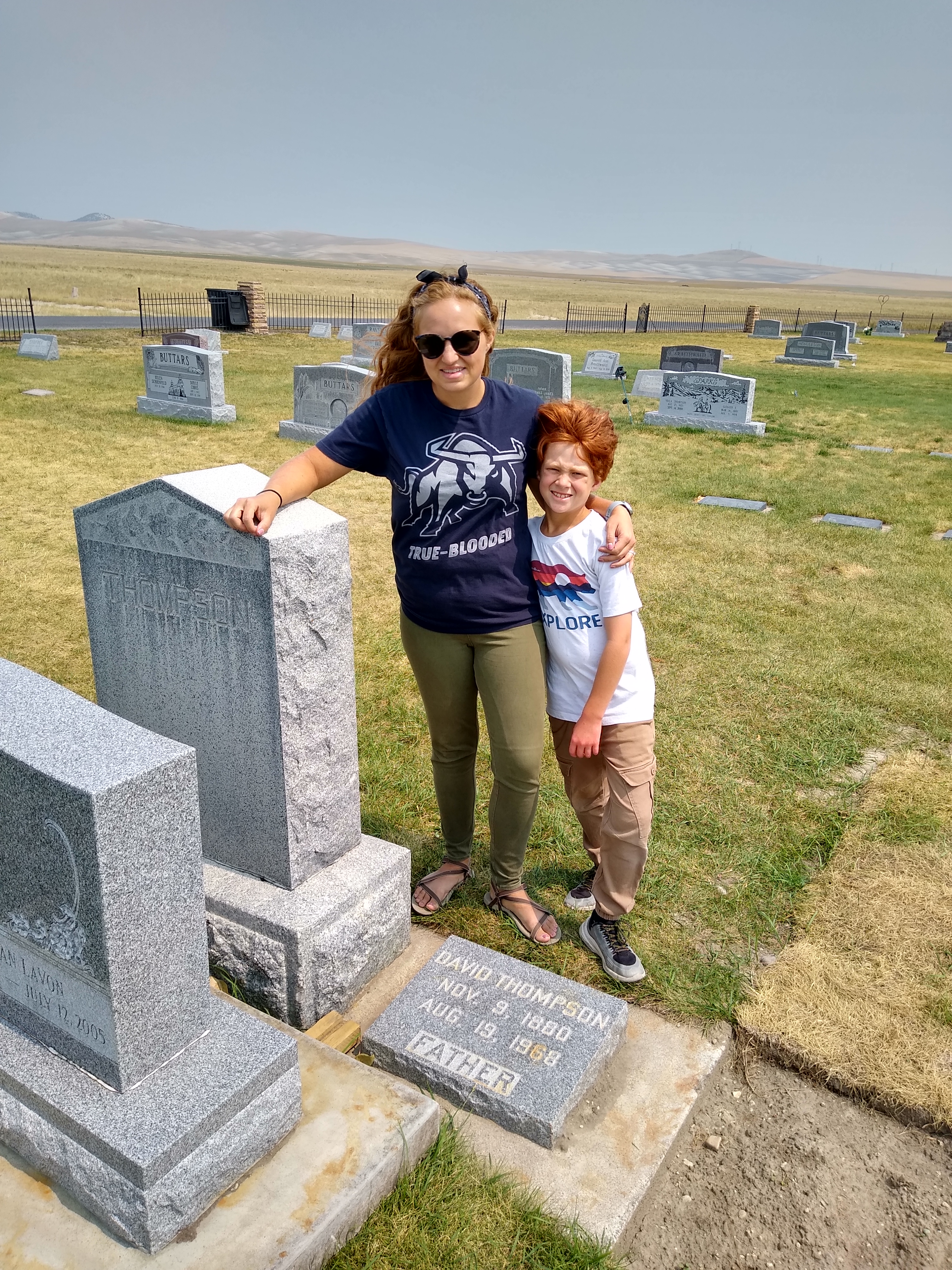
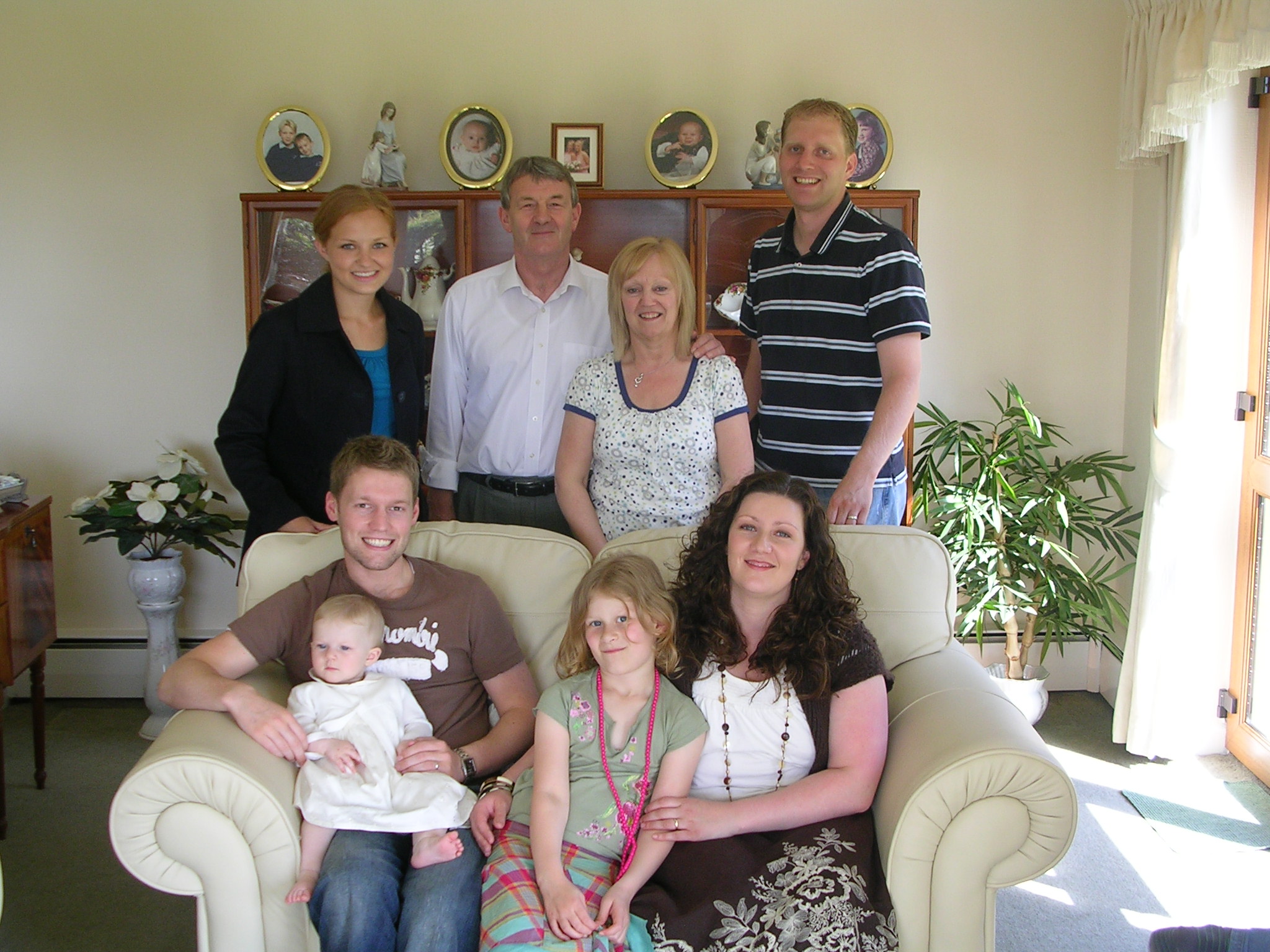
Jim and Julie Monks family at their home
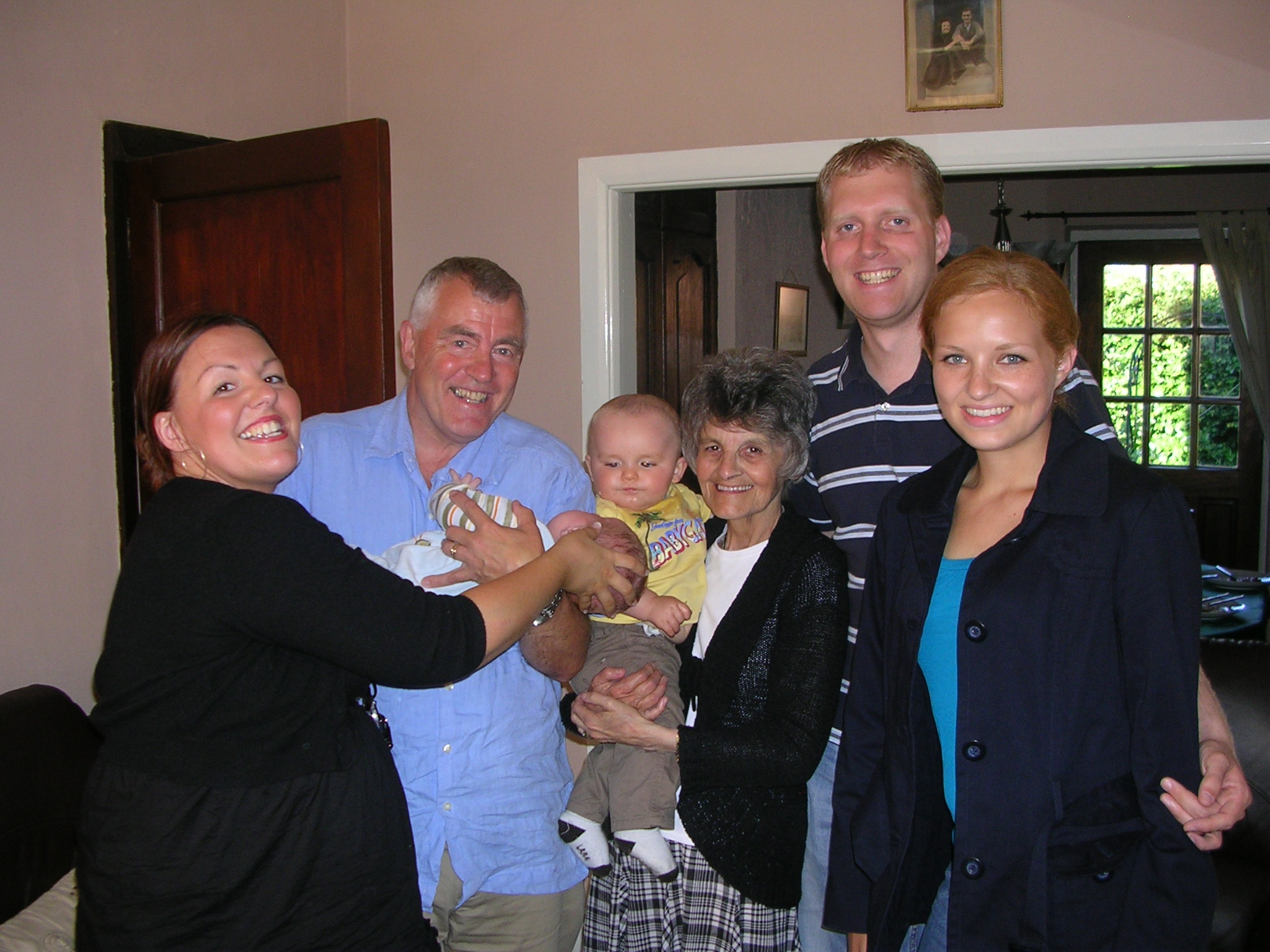
We went to visit a couple of people. Jim and Julie Monks, Dawn Rhodes, Ceri and Lorraine Jenkins, Charlotte Ainscough, Alan and Rose Aspey, Brian and Sylvia Burtonwood, and Rene Simpkin. We had a very good visit with the Monks, Jenkins, and Aspeys.
Ceri and Lorraine Jenkins family with her daughter Charlotte Ainscough in Wigan
Dawn Rhodes doesn’t live in the address we were given. We were either given the wrong address or she has moved. She was the only convert in the mission I felt like I really oversaw the entire thing from initial contact to baptism and even some of the new investigator discussions. Alas, she is not active and it seems nobody really knows where she is. Except for Brother Monks and she either moved or he gave me the wrong address in Aspull. I was very disappointed.
Alan and Rose Aspey family in Wigan
Sadly, I found out Rene’ Simpkin passed away around Christmas of 2003. That would explain the stopping of letters. I am disappointed nobody notified me or responded to the letters. I will have to find her birth and death information so I have it for my records. I really came to love the lady and she the church, but she just couldn’t give up her wine. The Burtonwoods remembered her. She was a fine lady.
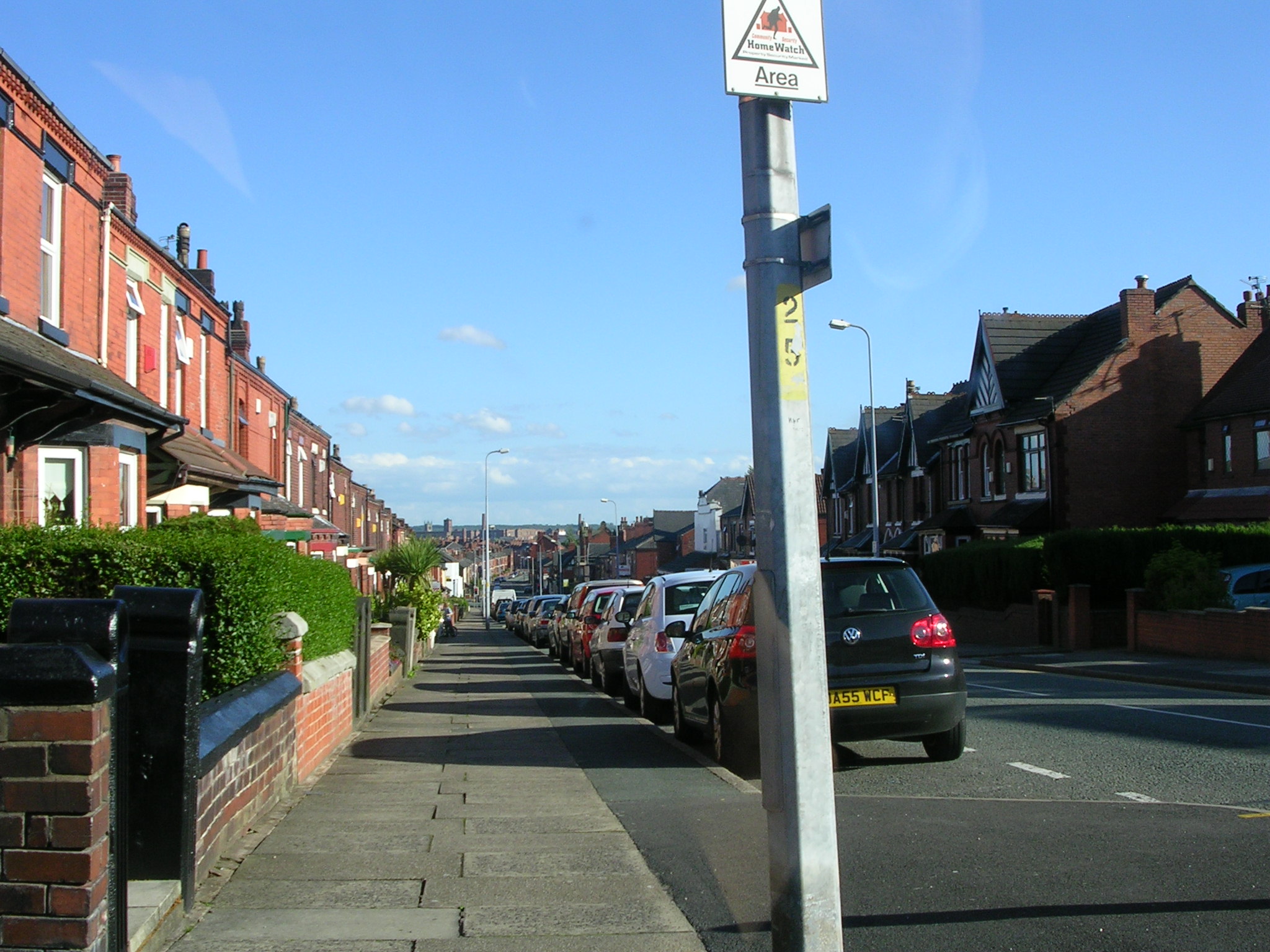
Street near Aspey home looking toward Wigan
In visiting with Alan Aspey, he let me know an Aspey from Wigan is definitely related to him. I will have to let my Aunt Lolane Andra know that her Margaret Aspey who came from Wigan is very likely related to him. Interestingly, Alan also commented about his Aspeys living in Upholland and Ormskirk. We told him about Amanda’s Ashton relations in Upholland and he knew the name as having some in his own line. However, he knows of no relations who joined the Mormon church and moved to America. This would be a first for him if we could show a link.
I found out from President Monks that Gheorghe Simion, my second to last companion from Romania, now lives in Liverpool. We will have to try and find some contact information for him so we can meet up while we are near Liverpool.
Charlotte Ainscough still has the little stuffed animal I gave her when we baptized her. I found out she named him Ross. How sweet is that? The Jenkins and Charlotte were very excited to see us. They gave us their passes for the British Trust sites in England. We will have to mail them back when we leave the country, but it includes a parking pass. Meaning we can save well over 200 pounds with the passes for much of our travel throughout the UK in our remaining time.
It was a sweet day in Wigan. It made me feel good so many people remembered me. If not my name, at least my face. They all adored Amanda and commented on how beautiful she was. Some even recognized her from our wedding announcements.
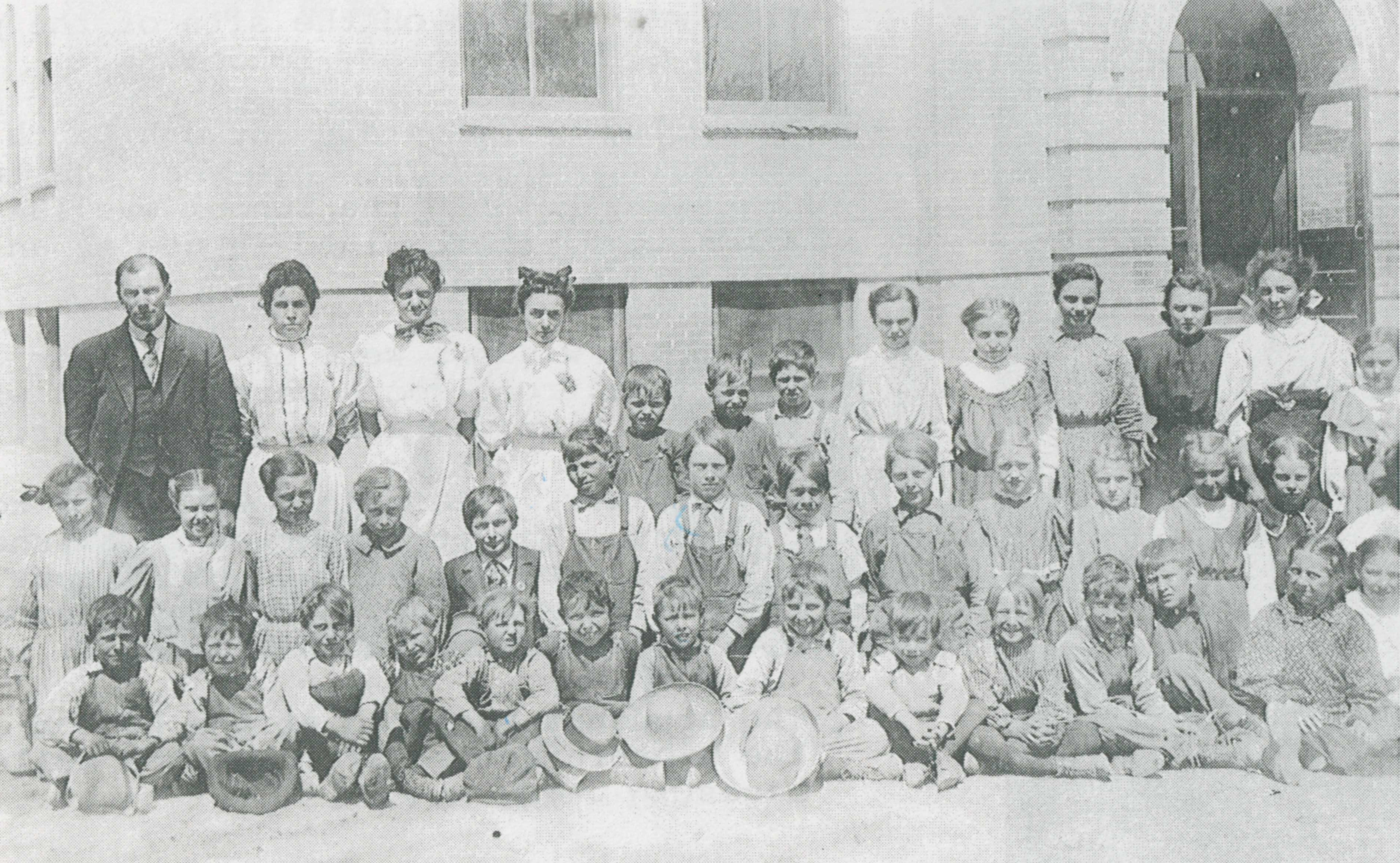
Back (l-r): Nellie Ward Neal, Carl Hodson, Kenneth Taylor, Paul Ross, Howard Singleton, June Etherington, Una Cottle, Hugh Taylor, Rex McEntire, Lyman Skeen, ?. Middle: Marguerite Maw, Lucille Maw, Ruth Hipwell, Frank Hadley, Kent Jenkins, ?, Golda Illum, Ruby Sharp, Lloyd Olsen. Front: Atholeen England, Alice Maw, Lucille Hadley, Myrine McFarland, Verla Lund, Ruth Carver, ?, Rae Knight.
Here is a class photo from what is believed to be a 2nd Grade Class taken outside the old Plain City School in Plain City, Weber, Utah. I have at least two family members in the photo, Paul Ross and Ruby Sharp. I have added family history to the individuals below, question marks either denote an unknown person or dates.
I have two copies of the History of Plain City, Utah. The front indicates it is from March 17th 1859 to present. As far as I can tell, the book was written in 1977. At least that is the latest date I can find in the book.
One copy belonged to my Grandparents Milo and Gladys Ross. My Grandpa has written various notes inside the history which I intend to include in parenthesis whenever they appear. They add to the history and come from his own experience and hearing.
I will only do a number of pages at a time. I will also try to include scanned copies of the photos in the books. These are just scanned copies of these books, I have not tried to seek out originals or better copies.
History of Plain City March 17th 1859 to present, pages 166 through 184. That is the end of the Plain City History!
Can you Remember or Did you know?
By Lyman N Cook
The following articles are a collection of stories and events that have been a part of Plain City. These are in no way a complete list of the stories that could be told. We have older people who can remember the colorful events and stories, the eras of history, and they should be told and recorded. I hope these people will do so while they are here to tell them. I have touched upon a few. Whether the stories are good or bad, it has been my purpose or intent to have all the questions and answers, but merely to help your mind reflect upon the beautiful memories of Plain City.
Please, as readers, do not take any personal offense or injury to any of the stories. They were not written with any unkindness in mind, but hopefully you will enjoy them.
The stories are, in reality, a tribute and a compliment to the early settlers of Plain City. I cannot comprehend the magnitude of courage and strength, and the hardships those early pioneer men and women endured. How unselfishly they worked and planned for the betterment of Plain City to make it a better place for you and I to live today.
I have a deep personal feeling that we owe them everything.
The most interest and pleasure that the book has brought to me has been the fact that I have had an opportunity to visit in the homes of so many wonderful and interesting people. Compiling, reading, and writing the history has so fascinated and compelled me that I have stayed up all night, only to find in the morning that I am just as refreshed as if I had slept all night.
The following people have been so kind and helpful to me in writing the stories. They have told me stories, and refreshed my memory. I feel a deep appreciation for them, and I feel that they should be recognized. They are: Mrs. Lavina Thomas (on tape), Lyle Thomas, Byron Carver, Lee Carver, Laura Musgrave, George Knight, Clyde Hadley, Amy Robson, Harvey and Jennie Cook, Dick and Luella Skeen, Bill and Nonie Freestone, Irene Skeen, Ivy Skeen Marsden, and many others: Kris Ewert, for her printing. A special thanks to all. And also Ina Poulsen.
“TRUE STORIES AND COLORFUL EVENTS OF PLAIN CITY “
SLEIGH BELLS
One of the pleasant memories of a cold, crisp, clear pioneer winter night, was the jingling of sleigh bells as families made their way to church or to visit with friends or neighbors. The rich sound of their ringing through the hollow night air could be heard all over town. First starting out faintly and then increasing in volume as they approached their destination. It would seem that the still, peaceful night was just made for the ringing of the sleigh bells.
Almost all the families had a string of sleigh bells that were a prized possession, and a family treasure. Some of the larger strands would go across the back of the horses and around underneath the stomach, also a strand would fit on the hames. The quality of the workmanship that produced the full, rich tones will continue to enrich our memories of the past. Maybe if we lost our minds be calm and drift back through the years, we can still hear the tinkling of the sleigh bells.
PIONEER HOMES, WASH DAYS, FEATHER TICKS, COLD BEDROOMS, OLD COAL, OR WOOD STOVES
The pioneer home was usually built with two rooms, and as the family income and new family members came along, they would add an addition of bedrooms, and a dining room, parlor, or living room. There was usually a large cook stove for the parlor and dining room. The kitchen was the center of activity in the home, and only on special occasions, or when company came, would they build a fire in the other rooms. They would usually bank the stoves with wood or coal to last as long as possible. But by morning, the fire was always out. They would have two or three coal buckets, and a kindling box, and some member of the family had the chore to see what they were always full. It took a strong constitution to roll out of bed on a cold winter morning and make the fire, and wait for it to get warm.
Monday morning in the home was washday. It would start very early and last all day. They would heat the water in a copper-bottom boiler and would usually boil the clothes to help get them clean. They used a homemade lye soap. The women scrubbed the clothes on a scrub board usually placed in a metal washtub, and after scrubbing, would rinse the clothes two and three times. They would then be hung on the clothesline to dry. There was a special pride taken in the wash and to tell a woman that she hung out a pretty wash was to pay her a special tribute.
The pioneer families would usually wait until cold weather to kill meat. They would cure it, salt brine it, or dry it. For fresh meat, they would put it in a flour sack and hang it high on the north side of the house. When they wanted fresh meat they would go outside, climb the ladder, or use a pulley to bring the flour sack in. They would cut off what meat they wanted and return the flour sack out on the north side. It was not uncommon to see flour sacks hanging from the north side of most homes.
The bedrooms were usually located on the north side on the north side of the house, and were the furtherest from the stoves. It was like going into another world, or the north pole to go to bed. If you slept with a brother or sister, you would try to get them to go to bed first so they could warm the bed. The frost and ice crystals would collect on the window glass usually forming in the fall and never leaving until spring. It would usually be about a half-inch thick on the glass. The frost crystals would form in beautiful designs and patterns on the windows.
The straw tick or mattress was made with a cover and filled with straw. Each year they would empty the straw, wash the cover, and refill it with new straw when they thrashed in the fall. They would place a feather tick on top of the straw tick, and it was filled with feathers from geese and ducks. It was really warm and soft. The sheets, blankets, and quilts were piled on the bed until they were so heavy that it was hard to turn over. It was especially nice when the dog would sleep on your side of the bed, as he made an excellent footwarmer. What a breed of people to survive the cold, hard time of pioneer life.
INDIANS
There seems to be no evidence of any Indian violence or hostilities in Plain City. However, they would visit the homes of the early settlers and ask for food. As a sign of friendship to the Indians, they would always give them food. It was a very frightening experience for the pioneer women to have the Indians call when the men were in the field working and they were home alone. The children were especially scared, and were taught to be very careful when they were around.
There were people alive today in Plain City that can remember when Indians would come into town and camp. Some favorite campgrounds were across from Paul Costley’s garage, and across the street north of George Cook’s home. The white kids always played close to home when Indians were in town, and they never went anywhere at night.
The Indians squaws would go to every home and ask or beg for food. The homes that were generous would be visited several times. The Indians would stay for several days, and they would then load their treasures and leave and go north. The Indians must have liked the people of Plain City because they returned each year for many, many years.
PERRY BOAT
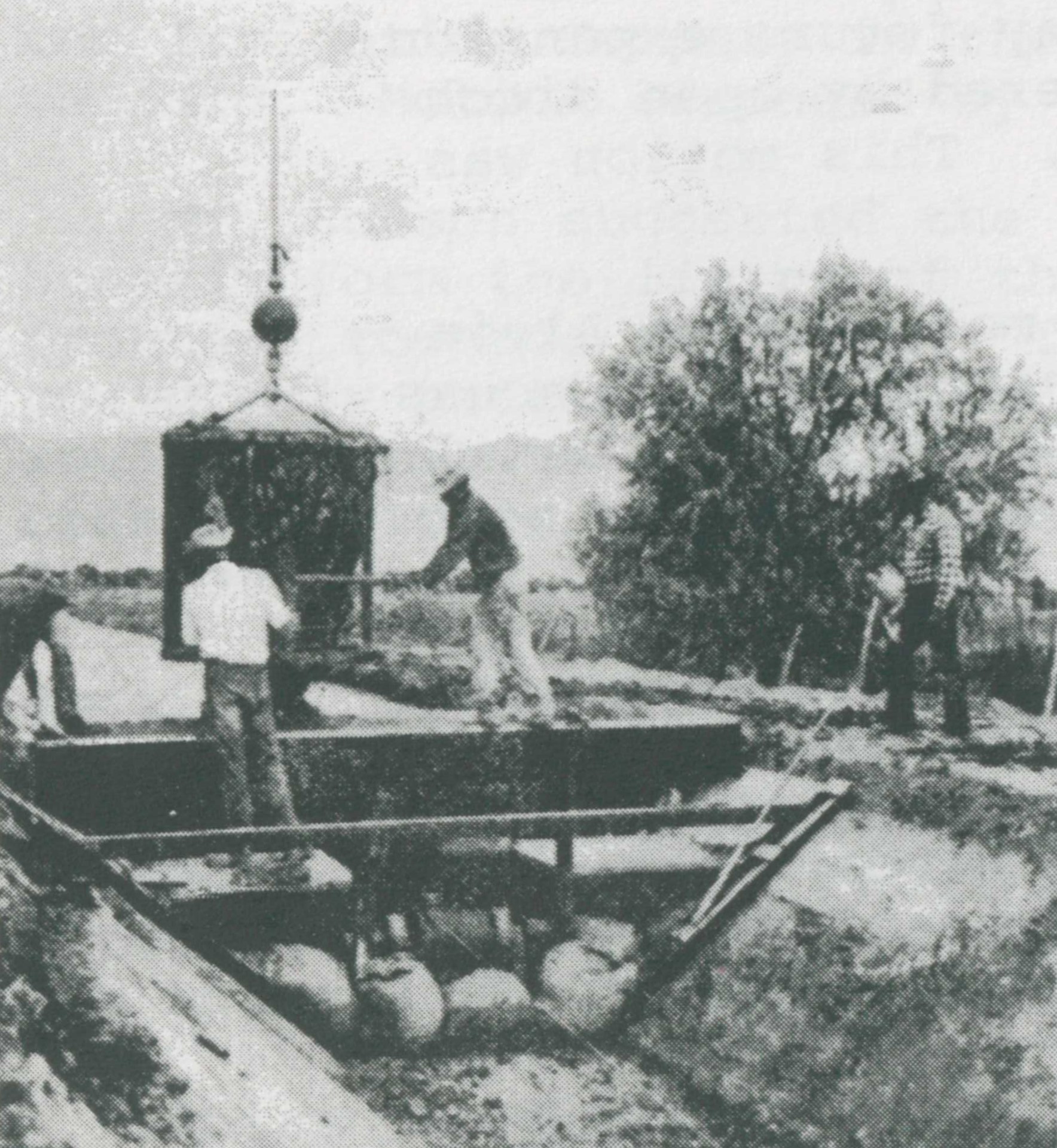
The ferry boat and landing was located near where the river bridge crosses the Weber River on the Plain City, West Weber road on 4700 West. It provided a river crossing for people, cattle, sheep, horses, and wagons. The ferry was made of logs tied together, and a large molasses boiler and pole was used to push the ferry across the river.
In the spring when the flood waters covered all of the low lands, the ferry would run from the hill on the north side near the Warren canal to the hill on the south as you enter West Weber. When the water receeded, the ferry returned to the channel. It has been said that in the spring the Indians would come to the hill and if the ferry was on the West Weber side, they would call across the river until the ferry came to get them. Sarah Richardson Hodson could imitate the Indian’s call for the ferry. She seemed to know more abut the ferry than anyone we knew of.
It might be important to include information about the times before all of the times before all of the reservoirs were built to hold back and store the early run-off water. Almost every spring the river would leave its channel and flood the low lands of Slaterville, Plain City, West Weber, Warren and West Warren. During some years the water would be so deep the road was closed. As a boy I can remember traveling 4700 West when the water would be up to the running boards of the Model A. The last year of excessive water was in 1952.
Not too much is known about the ferry, but it lends itself to another colorful era of interesting Plain City history.
POST OFFICE
The Plain City Post Office was located where Neta Charlton’s home is located, or one block North of the school on the northeast corner. It was run by Charlie Neal and his wife, Pussy Neal. He ran the Post office for 25 years from 1877 or 1878 until 1902 or 1903 when the government closed the Post Office, and the mail was brought into Plain city by Fred Kenley and delivered by horse and buggy.
Merl England has in his possession a letter that was postmarked Plain City, Utah, August 8, 1891.
Pussy Neal had, and kept a start of live yeast and would sell it to the women of the town to use in mixing bread. Annie Skelton would send her daughter, Nonie Skeen Freestone, down to the Neal’s for yeast. It didn’t take many trips before Nonie developed a real taste for live yeast. She would buy a three-pound lard bucket full, but by the time she walked five blocks home, she would have half of the bucket drank. She claims that it was quiet a tasty drink.
EARLY BAPTISMS
A very important date in the lives of young eight-year-old people was their baptism. Nowadays this ordinance is performed in a stake center with a very beautiful font. Before this time, this ordinance was performed in canals, rivers, lakes, and ponds. One of the most popular places to be baptized was the First Rock Crossing, or seck, as it was called. This was located on Center Street next to George West’s home, long before the canal was cemented. There was a row of poplar trees along the street, and the children would dress behind the trees. Some people would take their children up the street in the buggy and dress them, and then return for the baptism.
There were usually just two baptisms a year, one in the late spring and the other in the early fall. As a result, there were usually several children to be baptized at a time. The children would sit on a log and wait for their turn.
Some of the young people went down to the river and were baptized. The location on the river was near where the present bridge is located. They used willow trees to dress behind. Laura Musgrave and Royal Carver were tow that were baptized in the river.
George knight told me that he was baptized in the Warren Canal about where the present pump is located. This was a colorful era of the past and should help to rekindle some pleasant memories for those who participated.
THE PRIVY, CRANNY, ROOSEVELT, OR ALIAS, THE ONE-HOLER, OR THE TWO-HOLER
There was a great deal of social status involved and a real pride taken in building, caring for, and beautifying the outdoor privy. Some of the seats were made of select lumber and sanded and smoothed to the point where they were quite comfortable. And on the other extreme, some seats were rough and slivery. Some families were careful to make the privy weather proof, while others you could look out the cracks in every direction.
You could usually tell the size of the family in the house, whether it be large or small, by the size of the property. Is it a one or a two holer?
Some of the families, to prove to the world that their cranny was something special, and a respected place, would cut beautiful designs in the top of the door. I never quite figured out whether the hole in the door was for ventilation, or simply to study the wonders of the sky at night. Some of the designs were a half moon shape, a diamond shape, star, or just a round circle.
The Skeen girls, Ivy Skeen Marsden, Lenora Skeen Freestone, and Jennie Skeen Cook, still maintain to this day that their little brother, Dick Skeen, learned to throw the baseball so very well by practice throwing at the privy. He would wait until the girls would get inside and lock the door, then he would open up the rocks, clods, green pears, or anything to keep them pinned down. Dick’s favorite was the dirt clod. He would aim for the hole in the door and throw the clod through. The clod would hit the wall, break up and shower the girls with dust and dirt. He would then really laugh when the girls would cry, scream, and holler for their mother to come and rescue them from their brother.
Halloween was a risky time for outdoor privies. One of the favorite Halloween pranks for the kids was to spend the night tipping over crannies. The only thing that I would like to say on the subject now is that I am ashamed and sorry, and I must report that I am one of the parents who feel like the kids of today are going to the dogs.
During the depression and late thirties, and prior to World War II, the government had a P.W.A. and W. P. A. program. Workmen would come to your home and build outside crannies. They had a cement floor and a lid on the seat. They were weatherproof, and most people who owned one felt like that was the next best thing to running water. They were called “Roosevelts.”
Usually an old Sears catalog would act as a years supply of toilet tissue.
Some of the more discreet families would keep a pot, or thunderjug in the house for emergencies during the cold stormy winter nights. This fact was considered the family’s dark, deep secret, and was usually emptied before dawn.
With the exception of two years in the Navy, I used the outdoor privy for 26 years, and first four years after I was married. We sometimes hear it would be nice to go back to the good old days, but certainly not to the days of the outdoor privy.
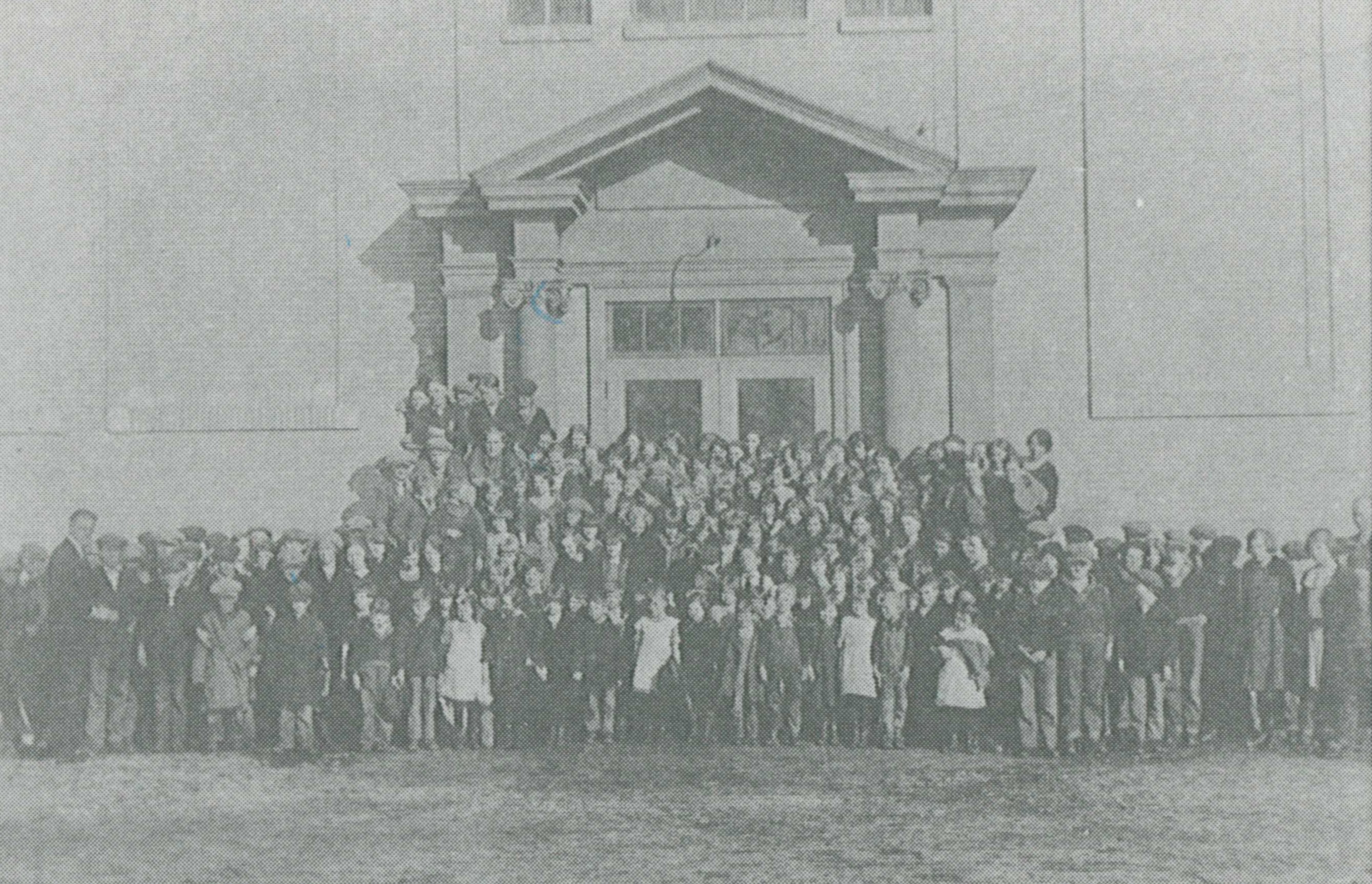
SCHOOLS
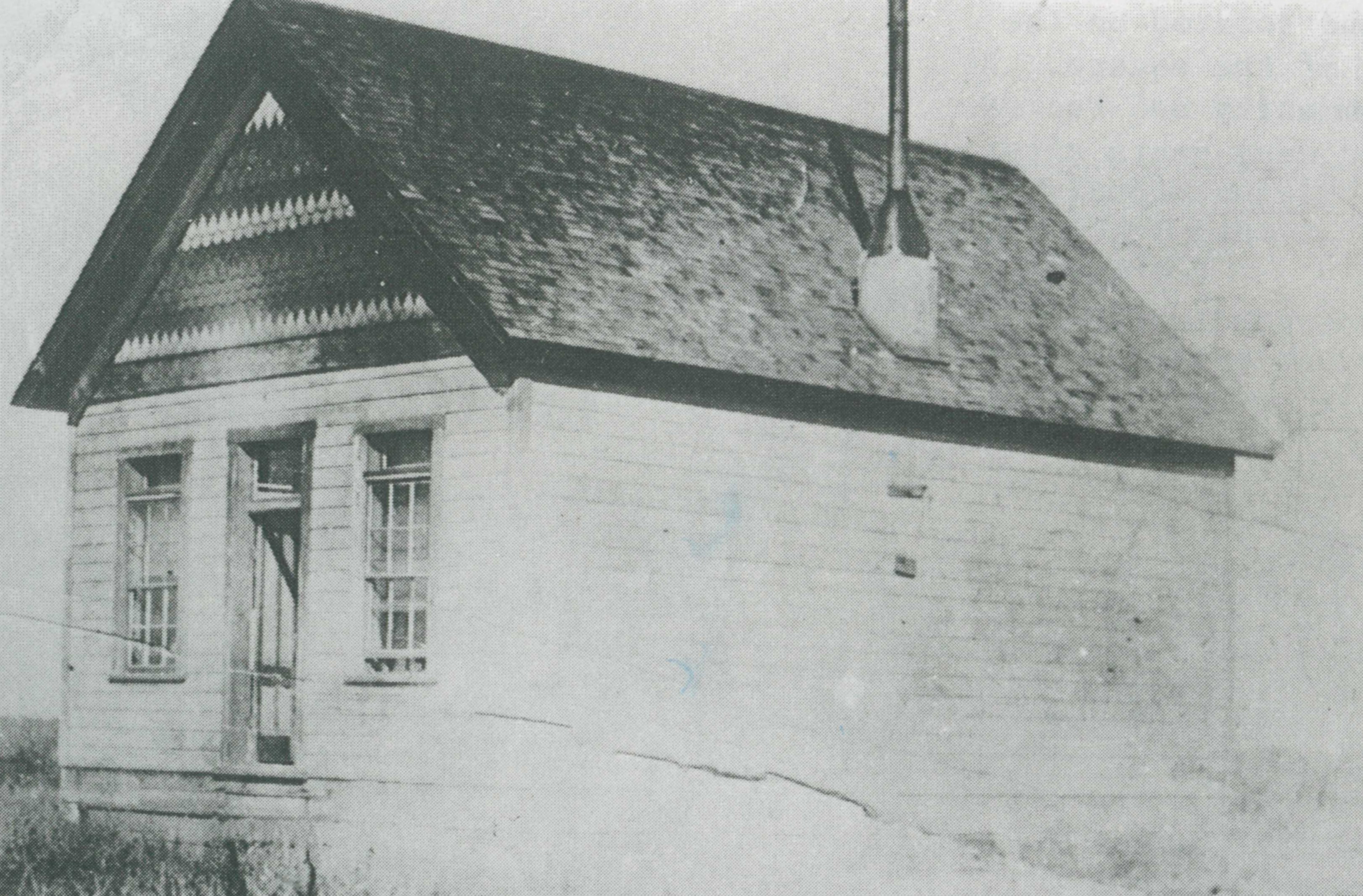
The first school was in George Musgrave’s dugout. He later held school in a one-room adobe.
The first public school was built on the south of the square. It was built out of adobe. It was one room.
There was a school located on the northeast corner of the square. The town and ward used this building for some social functions. It was built of adobe in 1873 or 1874.
The North school was located where Walter Christensen now lives.
The South school is still standing and was remodeled by Harvey Cook into a home. It is located where Gordon Sorensen now lives, and across from Eldon Weston’s home. This home was built of brick.
The Poplar School was located across from Augusta Nash’s home.
I have been led to believe that there was school classes being held in all these four schools at the same time. This world be shortly before and after 1900.
EARLY STORIES
There have been at least ten stores and meat markets in Plain City up the present time. Some of the stores have stayed in the same place, but have had several different owners. I’ll just mention where the old stores were located. There were two Coy Stores. They were owned by Sarah Coy and Eliza Coy. One was across the street about where Mildred Sparks now lives. This is about 2200 North and 4650 West. The old ZCMI store was where B & C foods is now located. Garner’s store was where the pool hall is now. England’s store was where Merlin England’s now lives. McElroy’s store was where Jack’s Garage is now located. Stoker’s was located one block behind the school where Gordon McFarland lives. Maw’s was located just west of the bowery.
John Vause built and operated a meat market just north of Adela Carver’s home. Some of Steve Knight’s family operated a meat market about where White’s Café is today. Peter M. Folkman had a meat market across from the school on the east side.
Most of these early stores would trade merchandize for eggs and butter. This was especially nice for the kids of the town because they could take one egg or more and trade for candy. There wasn’t hen’s nest that was safe in Plain City. Laura Musgrave tells of how she would get Nonie Freestone and they would raid Nonie’s father’s chicken coop for eggs to go to the store for candy. There was real safety for Laura, as she always has been real sharp in having Nonie in her own father’s coop with her.
BLACKSMITH SHOPS
Christopher Folkman was the first one in Plain City. He learned his trade in Denmark. It was located near Leslie Maw’s home and Elmer Carver’s home.
Janus Lund’s Blacksmith shop was located near Dennis Lund’s home. He died in 1908.
Rall J. Taylor started his shop in 1908 and the building still stands just north of Kirt Knight’s garage.
Lew Ericson’s shop was located on the property of Neta Charlton.
George Davis’ shop was near Phil Alsup’s old home and across the street from Thomas.
Lee Gould’s shop was located near where Florence and Carl Hodson now live.
Farley’s shop was located near where Sterling Thompson now lives.
Lyman Skeen’s shop was located just south of his old home. The property is now owned by George Skeen Cook.
THE EARLY DENTIST
Lyman Skeen acted as the early dentist, and his only speciality was pulling teeth. He had a special pair of forceps which are still in the possession of the family.
People came from all of Plain City to have their teeth pulled. In those days they didn’t have any dental check-ups, or fill any decayed teeth. If a person got a cavity, they endured it until the tooth would ache and then Lyman Skeen would pull the tooth.
He was a large man and once he hooked onto the tooth, he had very little trouble getting it out.
Some of his children report that when anyone came to have their teeth pulled, they would run into the house and hide under the bed and hold their ears so they couldn’t hear the person holler or scream.
Lee Carver tells the story about as a boy going down to Lyman Skeen’s and having a tooth pulled. He was told if he would sit still and not holler to scream, and act like a man, that Lyman would pay him .25 cents. It certainly must be one of the rare cases of a dentist paying his patient.
George Knight told me he made a trip to Lyman Skeen’s home to have his tooth pulled. He was told that if he would take it like a man and not holler or yell, that he could drive the mules and wagons. After the tooth was out they went out and harnessed the mules and hooked them to the wagon and George drove the mules to his home. George said that there was nothing that Lyman could have done to make him feel more important and give him a bigger thrill than to sit on the seat with Lyman and drive those large mules home. He was so excited that he forgot what he had gone down there for.
Ina Poulsen tells the story of her toothache when she was a girl. It was a large double tooth, and it had ached for days. She finally decided that having it pulled couldn’t hurt any more than the ache, so she went to see Lyman Skeen. She walked down to his place in the evening and they were eating supper. She said he got right up from the table and didn’t even finish his meal to pull her tooth. Annie got the forceps and sat her in his large grandfather chair. Again, the Skeen kids scattered and hid from the noise. Ina did mention that she did holler and scream, but it was all over in a minute. She said he was really good at pulling teeth. It also gives some insight into the quality, character, and gentleness of Lyman Skeen.
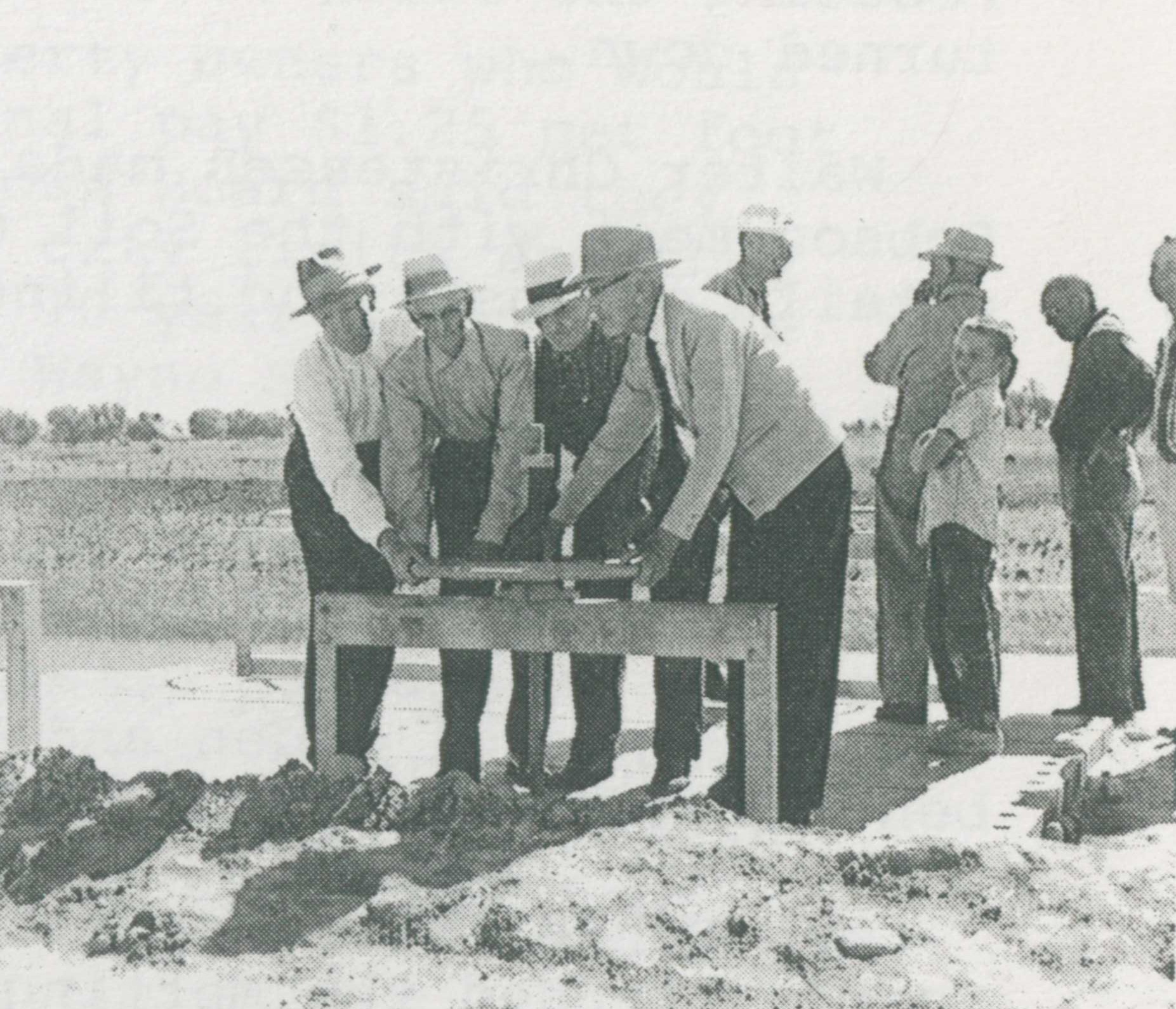
ICE HOUSE
An Interesting part of the history of Plain City was the old ice house. It was located across from the school on the property where Clara Folkman now lives and sat behind the old home. In the winter when the Four Mile reservoir, river and other water would freeze hard enough, they would cut it with ice saws. They would then haul it by team and bobsleigh to the ice house for storage.
Peter M. Folkman owned and operated the ice house, and in the winter he would have as many as twenty men working for him. They would work through the winter and would fill a rather large building with ice. They would cover it with wild hay and sawdust so it wouldn’t melt so fast in the heat and it would last all summer.
They would sell it to the people of Plain City for their use in the old wooden ice chest, for making ice cream, mainly for parties, and for whatever else their need was.
MARTIN SMITH AND THE MEAT WAGON
One of the colorful characters that would come into Plain City was Martin Smith. He owned a team of skinny horses and a closed-in meat wagon, and peddled fresh meat from door to door. He would come into town two or three times a week. He always carried a green willow switch, and would open the meat box, and use the switch to chase the flies out.
The lady of the house would come out to the wagon and look over the variety of cuts, or I would imagine he would cut whatever they wanted. A favorite pass time of the kids of the days was to try and sneak weeneys when he was busy with their mother. He was a sharp enough businessman that he made sure he always got enough money to pay for the weiners.
It sounds rather primitive in todays worlds, but it filled a need and is another colorful chapter out of the past.
GEORGE MOYES AND HIS MILK TRUCK
George Moyes had the first milk truck in Plain City. He delivered the milk to some of the homes in Plain City. It was George that was coming home from the dairy and discovered the fire in the dummy had started and burned Charlie Taylor’s barn. He used his load of milk to help put out the fire. I don’t know of anyone today who wouldn’t like to own that little truck.
THE EARLY THRASHERS
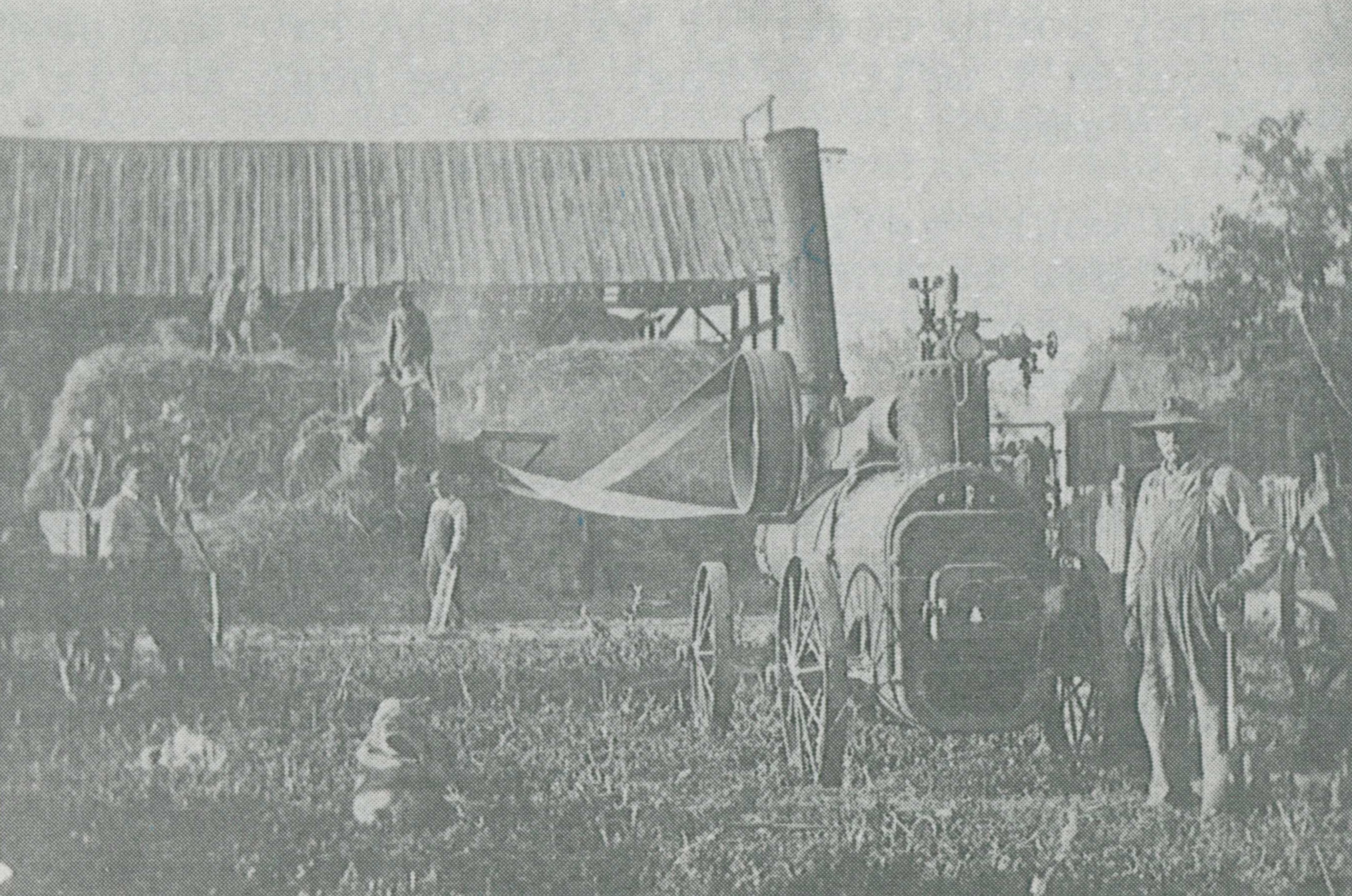
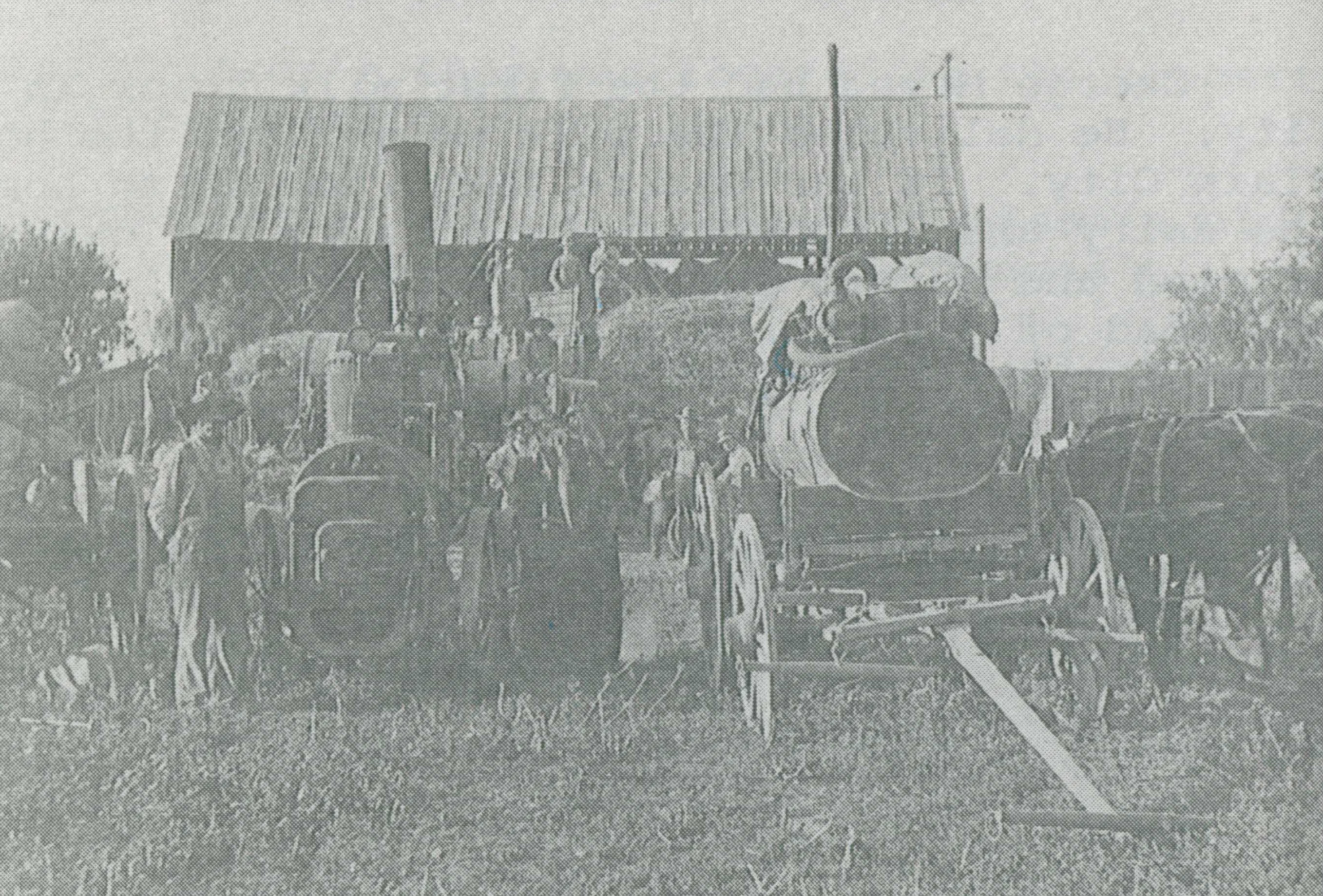
A colorful time on the farm was thrashing time. The first machines were horse powered, and were a great improvement over the hand method. These colorful pictures are some of the early steam-powered thrashers. There were men who owned their own machines and would do custom work for their neighbors. When the thrashers would move onto a farm, it would usually take several days to complete the farmer’s field.
While the thrashers were at the farm, it was the responsibility if the farmer to feed the men three meals a day. This consisted of many of the neighbors who helped each other. They worked hard and they required large meals. The women worked all day long to prepare the meals. The phrase, “I have cooked enough food for the thrashers,” was probably coined during this era. The farmer had to take care of the horses also.
The men usually carried their own bedrolls and slept on the new fresh straw.
Arthur Skeen and Frances Thomas owned and operated thrashing machines that I remember.
THE GYPSY HORSE TRADERS
The horse trader would come into Plain City once or twice a year. They would arrive in large white-top wagons leading a large number of horses. Some of the camping areas where they would stay were; out by the beet dump, by the water tower, on the square, and in the lot across from the Lyman Skeen home where George Cook now lives. They would stay about a week and would camp or live in their wagons.
The kids were frightened at the sight of the traders and the week they were in town they placed close to home and never ventured far from home at night. The traders were famous for taking things that didn’t belong to them.
As a boy I can remember the trader camps and walking through them with my father. Because of the shady characters and the stories I had been told, I can remember of never letting go of my father’s hand. To see the people involved and the many horses there were, made a lasting impression upon my young mind.
If any of the townspeople needed a horse or team, or wanted to sell any horses, they would bring their horses, or come to the traders camp. They would barter, trade, or sell. In order to make a sharp deal they would dicker all day. There were many stories told of how sharp a deal they made or how badly they got stung by the horse traders.
LYMAN DUMP
There were two beet dumps in Plain City. One was located across from the water tower, the other was the Lyman Dump located one-half mile west of the canning factory where the railroad tracks crossed 5100 West. It was named after Lyman Skeen because of his work on the railroad to that plant, and on into Warren. John Vause was the weigh master and was more or less in charge of the dump. They would haul the beets with teams and wagons to the dump, where they would be loaded on to the rail cars and taken to Wilson Lane for processing. At times the cars were not available ad they would pile the beets by hand. The pile had to be six feet high and stacked just right. When cars were available, the factory would pay the farmers thirty cents a ton to load the beets by hand and then into the cars.
A story is told of a certain farmer that would bring beets to the dump. The drivers were supposed to stay on the wagon to weigh their beets over with the wagons loaded, and then back their wagons across empty. This farmer would get off the empty wagon, stay on the scales, but would reach up and take hold of a board on the scale house, and pull most of his weigh off the scales. John Vause used to say, “ Look at that fat old ____. He thinks he is fooling me, but I always take 200 pounds off whether he is on the scale or not,”
Mervin Thompson was there ad tells a story about Lyman Skeen hauling a large beet rack full of beets to the dump with a four-horse hitch. The lead team was fine large horses and the back team was large mules. The dump was elevated with a steep incline up to a platform where the wagon would stop and be unloaded. It was high enough to clear a rail car and the beets ran down into the car. The decline from the platform was steep. He made his approach with the team struggling to pull the heavy wagon up the incline. As the teams lunged forward down over the decline. Lyman sprang to his feet and held the mules back so the wagon rode up against the rumps of the mules, and he moved the lead horses out fast enough to keep out of the way. He never lost a sugar beet. It was truly a great display of fine horsemanship. It was truly his ability with the horses that saved him and his team from death or injury.
He calmly made a circle around to the approach incline and took the teams up the incline. This time he was ready for them and the mules and horses stopped where they were supposed to. As the teams came down off the decline, they knew they had been taught a valuable lesson by a skillful master.
THE SWIMMING HOLES
If anything in this world can turn a man into a boy again, it is the pleasant memories of the old swimming hole. The warm summer days with friends and the happy, carefree times are the most memorable in a life time. There seems to be a special magnetic force that pulls and draws boys to water. It is especially difficult to try and explain to parents that special force, and why it was so necessary to go swimming so much. We lived in the water and the longest part of the day was the one hour we had to wait for our dinner to digest before we could go in swimming again.
Every irrigation canal, pond, river, or creek had their favorite swimming hole. The favorite holes in Plain City were not by the First and Second Rock Crossing, the canal, but Four Mile, Draney headgates, and the Anderson hole in the river. The Anderson hole was located just below the Warren pump by the bend in the river and northeast of the bridges. One could tell by the number of ponies, wagons, and buggies, that there was always a large crowd, and from the laughter and the noise, you could tell they were having a great time. The Anderson hole was secluded enough, and no girls around. For the men and boys it was pure skinny dipping. If any boy had shown up with a swimming suit in those days, they would have laughed him out of town.
The Anderson hole was the place all of the men and boys took their Saturday night bath. George Knight tells the story that he counted 65 men and boys swimming at one time in the river. Sant Madsen was the oldest at 65, and there was a young boy of about 6 years of age.
Wilford, or “Wiff” Skeen was considered the most gifted and powerful swimmers around this country. During World War I he swam on a Navy swim team. Gordon Thompson and George Knight said that Wiff was the most beautiful swimmer they had ever seen. Fred Kenley, I think, was I the Navy and traveled throughout the world. He said in all his travels that Wiff was the best Swimmer he had ever seen. He would put his little brother, Dick Skeen, on his back and swim out into the middle of the river. Dick must have been real little then, but he would dump him off and make him swim to shore while he carefully watched. Someone lost a shovel in Anderson hole and Wiff dove down to the bottom and brought it up, supposedly the only man to ever touch bottom.
Ogden City, Swifts, and the By-Products, began to dump raw sewage into the river and ruined probably the greatest memory maker in all of Plain City. It just seems so strange that man has a habit of always destroying his own best things in life.
DRIVING THE COWS TO THE PASTURE
The people who milked cows for their own use or who later on milked cows to sell the milk to the creamery, would usually drive their own cows to pasture during the summer months. The pasture was located one, two, or three miles from home. It would require taking the cows out in the morning and returning them in the evening. This responsibility usually fell to the younger members of the family and required a cow pony. In those days everyone’s home, yard, and farm area were fenced so the cows traveling to and from the pastures did not create a problem. During the hot, dry summer weather, the roads and trails of the cows were very dusty. It was very difficult to follow the cows very closely as the dust was so heavy.
One of these pastures was called the West Pasture. It was located north and west from Ivan Moyes’ home. This pasture was owned by several different people. The number of cattle they would put in the pasture was based on the amount of the pasture that they owned. In the evening the first person to the gate would open it and let the cows out. The cows, from force of habit, would follow the same trail to the town park where they would feed. It was not uncommon to see twenty-five or thirty milk cows feeding on the square in the early evening. The farmers would go to the square, collect their cows, and take them home.
For those who played baseball, football, or just played on the square, there were some real hazards involved after the cows had been there.
Modern feeding and milking techniques have eliminated the need for the daily move to the pasture and also the need for the fenced-in yards.
CANNING FACTORIES
Another very important industry in Plain City was the growing and canning of tomatoes. The first factory built in Plain city was across the street from Loyd Olsen’s at 1900 North 4700 West. Laura Grieves Musgrave tells of working in this factory filling the cans with tomatoes. She was just a girl at the time, and expressed how happy she was to be able to earn money in those days. At that time there was no child labor laws.
Part of this factory was later moved near the square and used by the maw family for their store and other buildings.
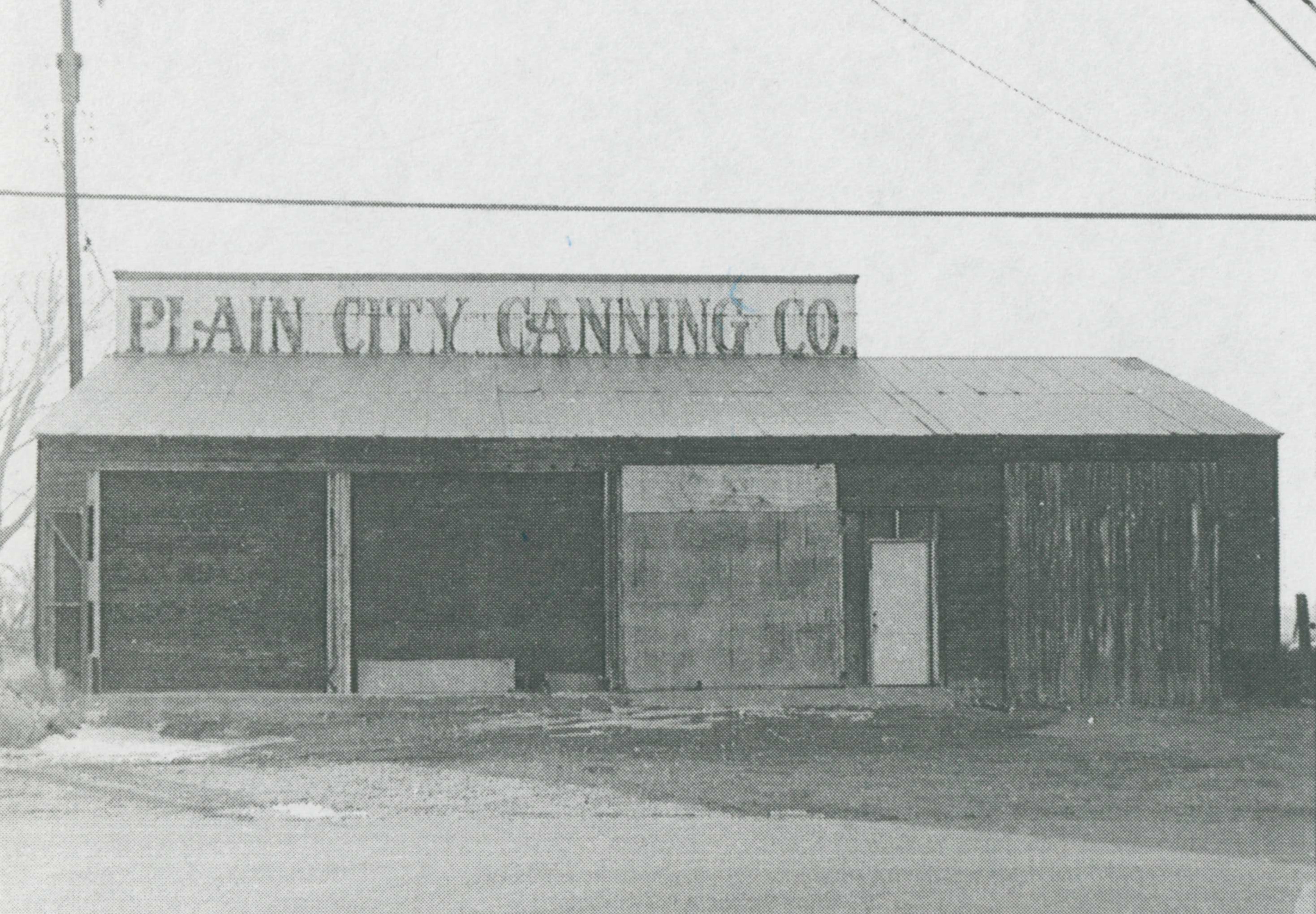
The second canning factory still stands at 1975 North 4650 West, and was used for many years. The sandy loam soil of Plain City seemed to be ideal for the tomatoes to grow and helped to give them the flavor, quality, and yield that rarely can be equaled. Times were very tough to earn money in those days, and many men and women would work at the factory in the fall of the year to help supplement their income. This factory was built in 1925.
The empty cans would be shipped in by railroad and the processed tomatoes would be shipped out to the railroad.
The events that impressed my memories most about the factory, were the lines of loaded wagons and trucks waiting to be unloaded. While the farmers waited for boxes, or to be unloaded, or for their tomatoes to be graded, they would visit by the hour. The stories and the tall tales that would be told during that time will long be remembered. It used to fascinate me to watch the women peel the tomatoes. The full pans would be scalded and go around on a belt. The women would take a full pan, core and peel the tomatoes, and when the pan was full, they would put their number in the pan and return it to the belt. They were paid by the pan, and it amounted to five cents to ten cents a pan. In later years it raised from eight cents to ten cents a pan. The fastest peelers could peel about 60 pans a day.
Some of the fastest peelers were Dorothy Christensen, Thelma Hodson Wayment, Doris Hodson Chugg, and Ruth Arave Taylor, deceased. Whether peeling tomatoes, cutting potatoes, thinning beets, wall papering, or whatever, Ruth Taylor, as I remember her, had to be the hardest working woman I ever know. I always marveled at her ability.
Can your minds eye visualize the smoke coming from the tall stack, and the pleasant tomato odor that drifted along the air currents through the town of Plain City.
PEA VINERS – PEA WAGONS
One of the early industries, or cash crops of Plain City was from the raising of peas. It t must be remembered that in the very early times, the settlers were only interested and concerned about food to keep them through the winter. As they worked and improved their homes, the roads, and the irrigation system, their ability to products more and vary their crops increased. It was then that they branched out into the pea industry.
The main pea viner was located on 2200 north, about a half mile west of 4650 West, on the north side of the street. It provided work for some of the men of the community, to stack the pea vines. In the winter the farmers fed the vines to their cattle.
The farmers would plant the peas in the early spring, and the harvest would begin about the 4th of July. The pea vines would be out with a horse-drawn mower. They would pitch them on a wagon and haul them to the vines by a team of horses.
As young boys we would look forward to the horse-drawn pea wagons on their way to the viner. We would run out into the street and catch the wagon, pull off a big armful of peas, carry them into the shade, and eat peas all day long. I don’t believe that peas gave you as severe a belly ache as green apples, but it ran a close second. More important, we were ready to go after the first wagon the next day. As a young man, I pitched the peas on the wagon in the fields, and off at the viner.
Later, another viner was built out east. It was located about one-half mile east of the water tower.
In 1949, I was building my house and my friend and neighbor, Louis R. Jenkins, would come frequently and visit. He said, “You have a nice location, but when the wind is right you may be able to smell the pea viner, but you know, that’s a good smell.” I never forgot his statement though the pea industry lasted only a very few years after that date. But, who could ever forget the potent odor that came after the vines and the juices fermented. No wonder the people who hauled pea vines had very little, if any, sinus problems.
Epilogue: Included should be the smell and the people who would haul the feed fresh beet pulp.
TRAPPERS
The Plain City area is situated where there was many creeks, drains, sloughs, ponds, and water areas for the muskrats to live. It seemed to me at one time to another, about every young man was involved in trapping. This could have been an inborn spirit in each young boy to be a trapper or a mountain man. The season would usually start in the fall until the water froze, and then again in the spring when the ice left. It came at a time when jobs were hard to find for young men and provided spending money for them. Trapping provided a good source of money for me when I was going to high school. The hide buyers would usually pay from thirty-five cents to a dollar and a quarter, depending on the size of the hide.
A good trapper could usually catch around 100 rats a day. I know one trapper that brought and paid for a new car during one trapping season. Some of the better trappers in Plain City that I can remember were, Elwin Taylor, Everett Taylor, Lyman Thomas, and Joe Wheeler.
NICK NAMES
Practically no one grew up in Plain City without having a nick name tacked on to him or her, because of something they did, said, or the way they acted, or some mannerism. It was not all uncommon for a group of Plain City boys, just to impress a girl friend, to talk and call the individual by their nick name, and the girls never knew who they were talking about. On the other hand, someone may come into the town and ask for Don Singleton, Darrell Christensen, Boyce England, Elwin Taylor, Horace Knight, LaGrand Hadley, George Cook, Clair Folkman, Lynn Folkman, Eldon Weston, or Jay Freestone, only to be told that they didn’t know anyone living here by that name. But had they asked for “Seebo, ““Breezy,” “Buzz,” “Bunny,” “Skinner,” “Gandy Goose or Pety Hadley,” “Joe,” “Ober,” “Homer,” or “Grass,” the townspeople could tell them right away where they lived.
Some of these people whose names will be mentioned have passed away, and it is my purpose to pay tribute, and add to their good names, rather than take anything away from them. Some have also moved away, but they got their name in Plain City.
There are so many names that I simply can’t remember them all, but here are a few: “Buss” Lyman Skeen, “Rip” Ronald Skeen, “Geg” Garry Skeen, “Brig” Orson Knight, “Snide” Elmer Carver, “Suitcase” Blair Simpson, “Huss” Harold Hadley, “Tubby” Frank Hadley, “Duke” “ Frog” Kenneth Christensen, “Fooz” Grant Lund, “Hazel” Kenneth Lund, “Bud” Richard Dallinga, “Cirk” Keith Lund, “Sodie” Elmer Hipwell, “Diff” Jack Etherington, “Tiff” Clyde Skeen, “Taa” Jack Freestone, “Sunny” Lyman Freestone, “Bub” Howard Freestone, “Cork” Carl Hodson, “Tumbleweed” Don Van Sickle, “Red” Lyman Cook, “Chic” Dee Cook, “Heater” Bert Cook, “Beef” Wheat Taylor, “Big Chub” Charles Fulmer, “Little Chub” Robert Fulmer, “Buddles” Rulon Jenkins, “Curley” Quenten Jenkins, “Bun” Ray Hadley, “Weiny” Dwaine Hadley, “Mustard” Bill Hadley, “Napkin” Dennis Hadley.
“Punken” Elmer Ericson, “Eif” Kent Jenkins, “Perk” Ray Coy, “Bear” Ronald Hogge, “Stinne” Wayne Skeen, “Hinke” Verl Rawson, “Toad” Loyd Knight, “Tarzan” Thayne Knight, “Dob” Blaine Knight, “Ikee” Ivan Hodson, “Grit” Dean Moyes, “Bud” Knight, “Lym” Skeen, “Beaver” Gordon Hadley, “Trapper” Durland Hadley, “Deddy” Darrell Thompson, “Pubby” Vernal Moyes, “Sam” Lyle Thomas, “Gonnie” Kenneth Woods, “Jim” Theron Rhead, “Mag” Noel England, “Jim” Elwin Skeen, ‘Bones” Bob Folkman, “Swede” Brent Taylor, “Curly” Davis, “Mayor” Dean Baker. “Wimpy” Loren Facer, “Tooley” Louis Poulsen, “Dick” Elwood Skeen, “Mud” Claude Rhead, “Weeser” Gene Lund, “Fiddler” Elmo Rhead, “Hook” Harold Hobson, “Roan” Harold Ross, “Mike” Milo Ross, “Wheeler” Keith Blanch, “Luke” John Nash, “Tom” Vandel Maw, “Joe” John Maw, “Judge” Thayne Robson, “Bushy” Wayne Cottle, “Pickus” Paul Coy, “George” Cliff Folkman, “Willie” Warren Williams, “Wally” Wallace Knight, “Cruzz” Kent Robson, “Evert” Bill England, “Tom” Merrill Jenkins, “Aus” Bob Wade, “Cougar” Norman Carver, “English” Wayne Carver.
Something more interesting than the names is how each one got their nickname. You should ask some of them sometimes. We should announce from Plain city to the world that we have had for the last 55 years, the original ”Jaws” Paul Knight. It is very distressing and disturbing to read where some outsider has taken the name “Jaws” and capitalized on it, made a film, and grossed more than 25 million dollars, when the original “Jaws” had been in Plain City all along.
When we analize the personality, the good times, and especially the stories, I doubt that anyone in Plain City would take 25 million from our original “Jaws.”
THE PEST HOUSE OR PRIMITIVE HOSPITAL
The constant underlying fears that pioneers and early settlers lived with daily was the threat of disease, illness, or sickness. There just weren’t any doctors or medicine available, and if anyone got sick, they either got well on their own, or they didn’t make it.
If a dreaded disease, or plague, as it was called struck the early settlers, many of them felt like it was God’s way of punishing them for things they had done or for the things they had not done. There were so many mysteries and superstitions concerning that, that people acted and responded in what now might be considered strange ways. The people felt the best thing to do was to isolate the sick people, and as a result of this type of thinking, the pioneers built the Pest House. To make sure it was really isolated, the people went about a mile west of town on the bank of First Creek and built Pest house. The Pest House was located on the bank of the creek. There were some tall poplar trees surrounding the building, but have since been removed. Clyde tells me that information was handed down and told to him about the spot where the Pest House was located. Years ago there was some evidence of a building there.
When a person got sick, they would take him to the Pest house to get better. They were usually left alone to care for themselves. Someone from the town would take food and water, and provide some care, but for the most part, it was just a kill or cure method. In most cases the patients, if they died, expired from exposure or lack of care rather than from the disease because the building was poorly constructed.
During the Smallpox epidemic of 1871, or about then, there weren’t any public meetings held in Plain City from September until the next March. The people lived in total fear of the disease.
The William Skeen family was hit very hard with Smallpox and they lost four children. It has been told that while his family was very sick, he called for the church and they were fearful, they refused to go help. His friends also turned away. This good man was left to bury his four children all alone, and some of them at night. He was so disappointed in the Elders of the church and his friends, that he left the church and he named one of his sons that was born later “Frenz Denial.”
IMPORTANT FACTS
Ivan Skeen Marsden and Lona Ipson Watson were the first lady missionaries to leave from Plain City in 1914. They served in the Eastern States Mission.
The first car reported to be in Plain City was Dr. Rich, who drove out to treat a patient.
It mentions that Richie owned the first car. Some of the other early car owners were Tom England, John Maw, Lyman Skeen, and others. Later, Lyman Skeen owned an eight-passenger Chandler.
Sammy Sampson was one of the early barbers.
There are seven children of original settlers living today in1977 that we know about. There may be others. Four of them live in Plain City. They are:
Ada Skeen William Allred
Victoria Sharp Hunt
Mary Sharp Richardson
Ivy Skeen Marsden
Lenora Skeen Freestone
Jennie Skeen Cook
Elwood “Dick” Skeen
It is remarkable when you think after 118 years that there are still children of the first settlers still living.
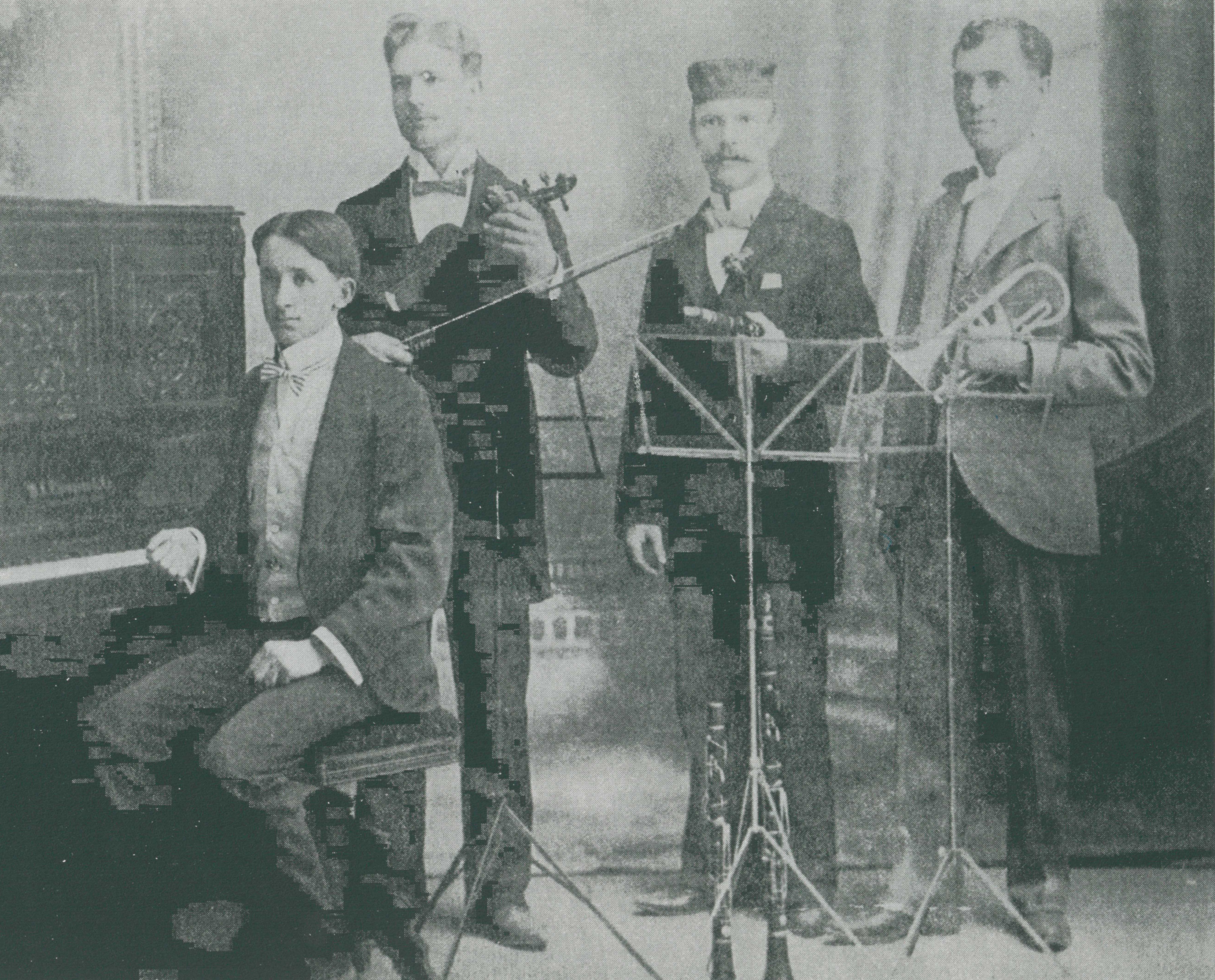
Richard Lund was the early fiddle player in the town.
LYMAN SKEEN, OWNER OF GREAT HORSES
Lyman Skeen owned and loved great horses. He had two large barns full of fine Stallions, besides many work teams that he used in his construction business. He worked in Utah, Wyoming, and Idaho, on construction building canals, road beds, and whatever. He knew horses flesh and people would bring their horses from all over the country to have him doctor their horses.
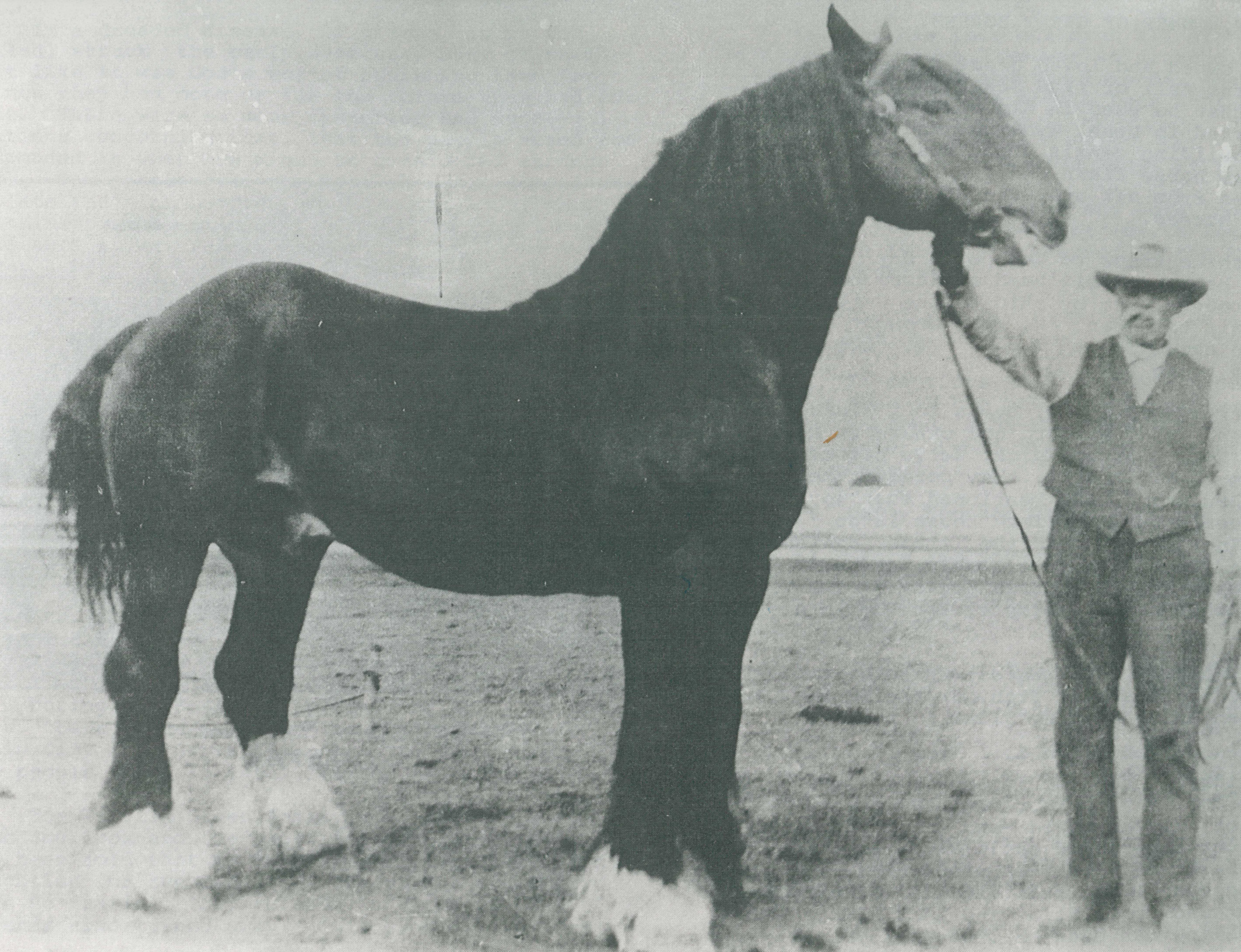
Lyman made three trips to Europe to buy horses. On one occasion, he bought six head of Shire horses in England and brought them by ship to the United States, and by rail to Ogden. He also brought a little Englishman named Tommy ____ to take care of the horses and train them.
When they arrived in Ogden Lyman took Blaine Skeen, Elmer Skeen, Orson Knight, and others to help bring the horses home. Orson Knight tells before they brought them to Plain City, they paraded them down Washington Boulevard. He mentioned that no boy could have been prouder to lead those large horses down Washington. He said the little Englishman walked beside the horses with a whip, and he would crack the whip and the horses would rare up and prance and put on quite a display for the large horses.
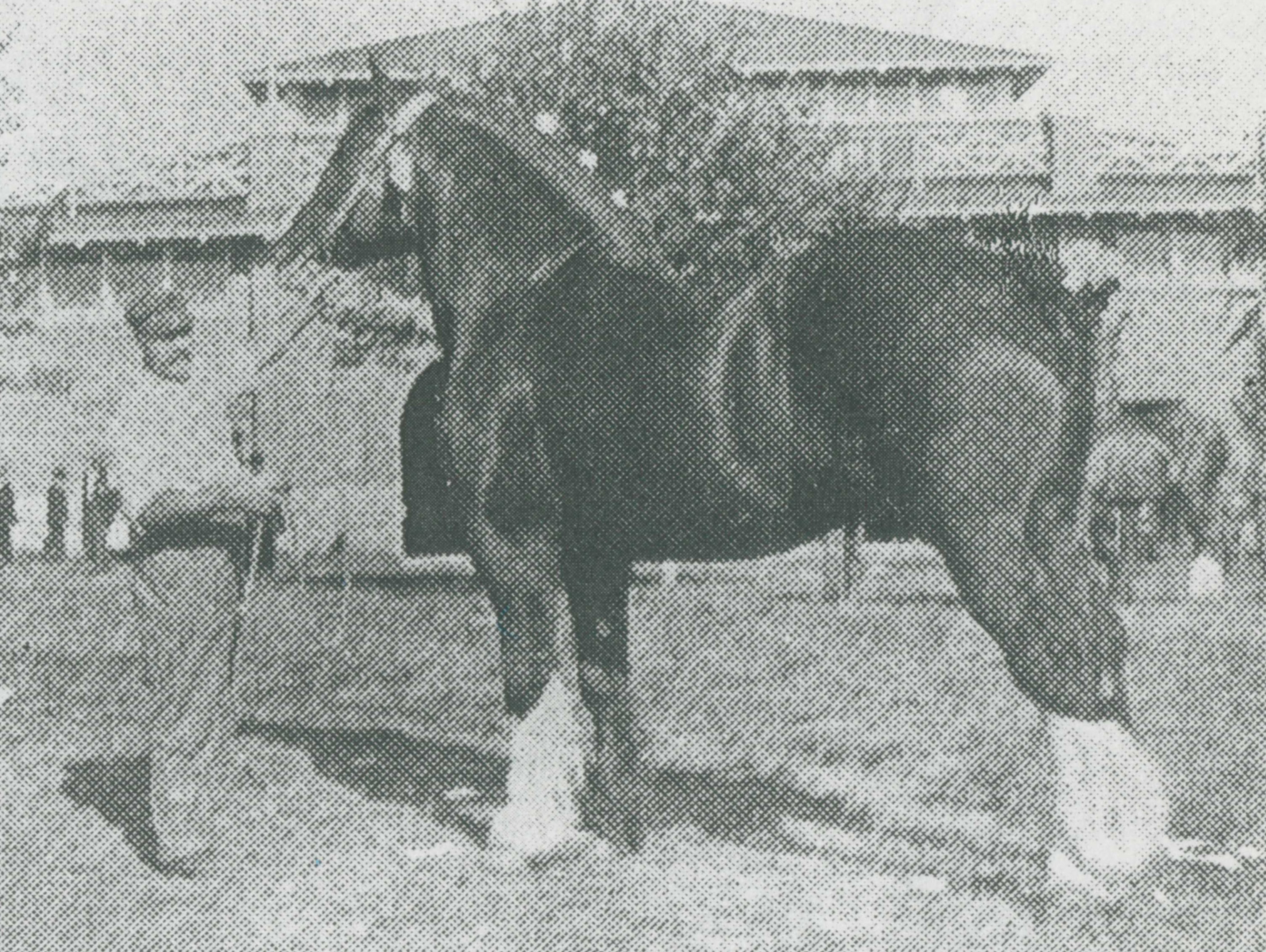
Sline was probably the greatest Shire horse to ever come into the State of Utah, or the West. The little Englishman is holding Sline in the picture.
The Skeen kids can remember frequently someone yelling “Sline’s out.” and he would always prance up through the lot. Lyman would send his boys out to catch Sline, but they never could catch him. Lyman would sit back and watch his proud horse run and exercise, and when Lyman felt like he had enough, he would walk out and up to Sline and lead him to the barn. Whenever Sline had been he left hoof prints about a foot square through the garden.
“SLINE” – Importe I Three-year-old Shire Colt
L. SKEEN
LYMAN SKEEN WITH HIS SHIRE HORSE.
One of these big Shire horses died at the age of three days. It was raised on a bottle by Annie Skeen, wife of Lyman Skeen.
SAMMY SAMPSON THE BARBER
Sammy Sampson barbered in his home which was located across the street from Dell Sharp’s home. He was one of the early barbers. Byron Carver tells of getting his hair cut there when he was a boy. He said, “You could ask for any type of a cut you wanted, but you only got one cut, mostly bad,” I can see Byron chuckle ass a twinkle from the past came into his eyes. “Oh it was bad,” he said, “and as long as you had any hair left, Sammy would keep cutting.”
On one occasion he went to get his hair cut when it was hot and Sammy was cooking something that didn’t smell too good. Some of the men who had gathered were smoking El-rope-o cigars, and Byron was getting light headed as he sat in the chair. As Sammy worked him over he became more ill. Sammy soaped his neck and shaved it with a large thick, straight razor, that scraped more than it cut. Sammy kept a pan of hot water on the stove with a wash cloth on it that he used to wash the soap off. As he laid that hot cloth on Byron’s neck, Byron rolled off the chair and fainted dead away. When he came to, big Lafe Skeen was holding him on his lap. That was one hair cut Byron will always remember, and as long as he is alive the memory of Sammy Sampson the barber will live on.
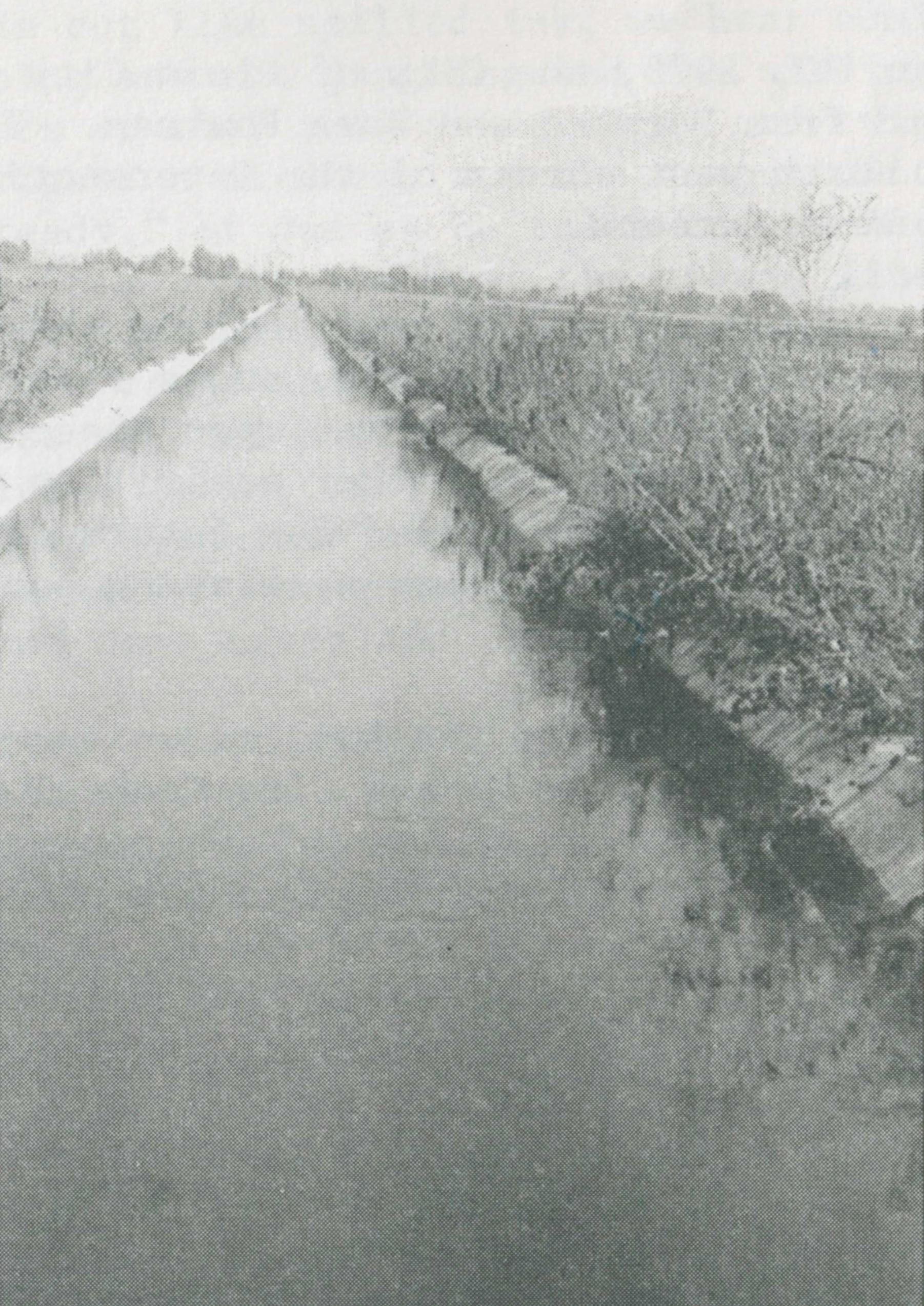
Sammy charged 5 to 10 cents a haircut in those days, and trim and shave on the older men was 15 cents.
THE RACE TRACK, PLAIN CITY’S FIRST
William Skeen owned some very fine racehorses and he built a racetrack to train his horses. The neighbors would meet on occasion and race their horses to test the speed against their neighbors horses. Stories have been told that there were some very exciting races held at the track. It was located near four mile reservoir.
They tell the story of a man from Ogden, who was quite a footracer and he was supposed to have challenged and bragged that he could beat a horse in a certain distance. It was well talked up and word spread around, and the race was held. There was a little money that changed hands quite a crowd. But you know, no one can remember who won the race. It was another colorful time in early Plain City.
THE WEDNESDAY NIGHT SHOW
Growing up as a kid during the late twenties, thirties and into the early forties here in Plain City was quite an eventful time. It seemed that the world moved at a slower more relaxed pace and there was time to enjoy visiting and to crate your own entertainment and fun. Depression times were very hard for most families, with very little one and barely the necessities of life. There was very little money available for entertainment and if you had any entertainment, you created your own. They were carefree happy times. As a kid you were lucky if you got into Ogden once a month or even once during the summer. By comparison with today, all the entertainment seems to be provided for the young people and all they have to do is show up with money and everything is provided for them.
In the summer kids games and ball games were a very big thing and something was going on every day and night. Hide and seek, run sheepy run, kick the can, and whatever else anyone could think up were always popular. Skating and sleigh riding were the fall and winter games. You would skate all day and build fires at night so you could skate even longer.
Sometimes in the thirties the movies began to be very popular. Someone from Ogden would bring a movie out to Plain City every Wednesday night. It was held in the upstairs of the old church house and there would be two to three hundred people or more watching the show. The admission was ten cents and hardly anyone ever missed the Wednesday night movie. There was usually a serial episode before the regular movie and it would last for about weeks. It would lead you up to an exciting climax and then announce, “To be continued next week.” I can remember they would be the longest weeks ever, waiting to get back to the show to see what happened. Tail Spit Tommy always a big feature with the serials.
There were some very spooky shows and I can recall small kids screaming and crying, and they would have to leave the show. The shows were scary, but the spooky part was walking home at night after the show. You were always extra light on your feet, and with any strange sound out of the blackness of the night, you would be at a full gallop and double your stride. Ah, but they were good times.
The automobile and the war, and the latest movie hits in Ogden all led to the down fall of the Wednesday night show in Plain City. It was a colorful era in Plain City and one that everyone seemed to enjoy.
A TRIBUTE TO BETTY
Somehow the roads of Plain City look and seem a little different now days without the familiar figure of Betty. Her shopping bag in hand, her figure that time and age had bent a little, and limp that the years had brought on, headed up the road to Ogden. Time had also slowed her steps, but not her to walk to town.
Probably Betty was born fifty years too late to fit in well with a changing society. He life was the simple life, and her wants and needs were few. She was very string willed, proud, and stubborn in some regards. She was very determined not to be pressured into joining the modern world.
Some people say she was eccentric, old, strange, but she was a rugged individualist who refused to conform to anyones standards but her own. As a result of her ways the young people would sometimes tease and torment Betty. But in her own way she ignored them and went her way. Is it not strange that we from our own little worlds are so willing to unfairly judge other people by out own knowledge and standards. Especially if their standards and personality traits do not measure up or lower down to our own.
I wouldn’t begin to know how many thousands of times Betty walked to Ogden, and back with groceries, even after she was around seventy five years of age. I suppose before we could fairly evaluate Betty we should ask the women of Plain City how many times they have walked to Ogden, and back home. Their were many people who were good to Betty and wanted to help her, but she seemed determined and happy to do things her own way.
Betty was a hard worker and she worked for many people in Plain City. Later she worked in Ogden doing housework. I carried mail in Ogden for thirty years and would see Betty working at some of the finest homes in Ogden. Her family paid me a tribute when they asked me to speak at her funeral.
Betty will be remembered as one of Plain City’s remarkable characters. If we let our memories wander a little, and though our minds eye we might still catch a glimpse of a shadow of Betty walking to town.
I have two copies of the History of Plain City, Utah. The front indicates it is from March 17th 1859 to present. As far as I can tell, the book was written in 1977. At least that is the latest date I can find in the book.
One copy belonged to my Grandparents Milo and Gladys Ross. My Grandpa has written various notes inside the history which I intend to include in parenthesis whenever they appear. They add to the history and come from his own experience and hearing.
I will only do a number of pages at a time. I will also try to include scanned copies of the photos in the books. These are just scanned copies of these books, I have not tried to seek out originals or better copies.
History of Plain City March 17th 1859 to present, pages 150 through 165.
SITE FOR NEW TOWN PARK
SUBMITTED BY FLORENE PARKE
In December, 1975, Mayor Lee Olsen and the Plain City Town Council consisting of William VanHoulten, Wayne Cottle, Darwin Taylor and David Thomas, passed a resolution to purchase 20 acres of land. This land was to be used as a recreational complex and also house the town hall and other municipal buildings.
On December 30, 1975, the City of Plain City purchased 20 acres of land from Bernard and Nora Poulsen. The land is located at the north-west corner of the intersection of 2200 North and 4100 West Streets.
The long-term plans for the park included three regulation ball diamonds, (two softball diamonds, and a little league ball diamond); an equestrian arena and open space exercise area to be used for football and other activities requiring large open spaces. A site identified for future development of municipal structures may include a swimming pool, restrooms and parking areas.
Purchasing and developing the land is an expensive process. It is the intention of the City Council to program the work in six one-year phases. Development of the equestrian arena was part of the first year’s phase.
The area housed an arena known as Paul Knight’s Arena. It has been used in the past for several Junior Possee competitions, calf roping meets, and various horses related events. The arena needed fencing and landfill and water installations.
In December, 1976, the Plain City Lions Club, in cooperation with the parents of Junior Possee members, had the area surveyed and hauled 103 loads of sand necessary for a proper working arena. Approximately 30 volunteers donated their time and equipment for two days to complete this part of the work.
Heavy gauge chain-link fencing has been purchased with money from the town and from money raised by Junior Possee members through various fund raising projects. The fence will be installed as soon as the weather conditions permit.
Plain City’s Junior Possees, Four-H groups, and the many other residents interested in equestrian sports will have a safe place for their activities, and the town will have an arena to be proud of.
Paul’s Arena as it is known today, which will be rebuilt into the Town’s new Park. Used for many years for horse and Jr. Posse events.
*A CHILD’S CHRISTMAS IN UTAH
BY WAYNE CARVER (SON OF ELMER AND JANE CARVER)
ASSOCIATE PROFESSOR OF ENGLISH
CARLETON COLLEGE
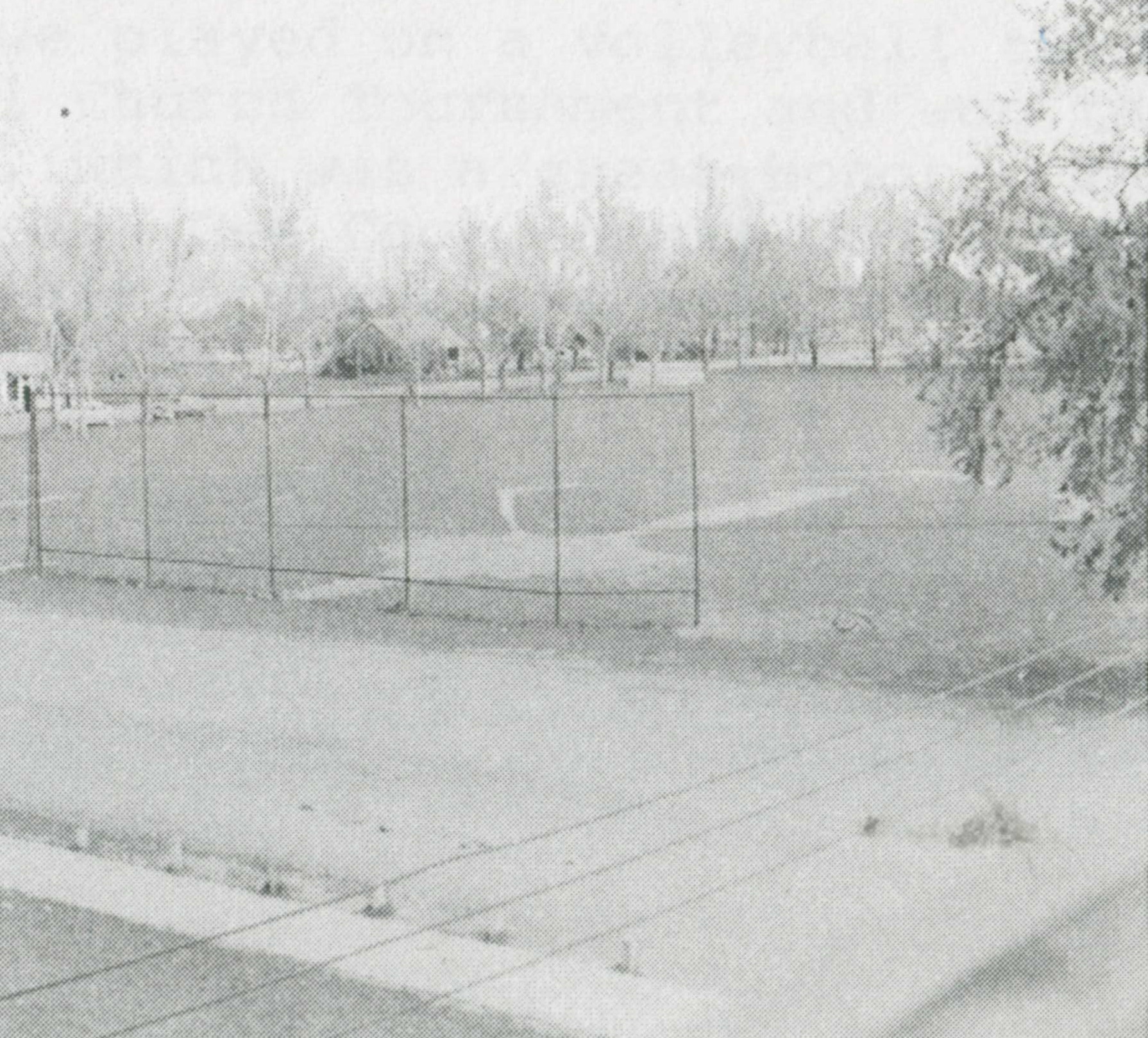
It isn’t that way now. The quiet fields are broken into building lots and the farmers build jet engines in the city and garden with a tractor after work. The old canal is lined with concrete and in the center of the town the Saturday and sun-drenched baseball diamond has shrunk to softball under lights, and the county has built a tennis court just off third bade for a game the kids are beginning to learn to play in white shoes.
The frame store with the pot-bellied stove smelling of sizzled tobacco spit and with the mash sacks and rummy dive in back is a supermarket now where wives in stretch-pants by barefoot and frozen chopped broccoli by the ton and aerosol bombs that go “SwwOOOOOOsh” and keep off the bugs or put on your pie a water glob of something threatening to be white and that keeps your arteries open.
It isn’t the way it used to be in that un-fluent time of plowing, planting, watering, hoeing, furrowing, harvesting, and throwing the harvest in the river to be pickled in the Great Salt Lake. It is the affluent society now, of missile sites and loan companies, and the ice cream comes come frozen in glazed wrapping and taste like the strips of brown paper we used to put our upper lip to stop the nosebleed. And I have not been back for Christmas for many and many a year – to the long everyday stocking with a fifty cent piece squashing the toe, the large orange pressing the half dollar down – a thick, loose-skinned orange that peeled clean and dry – to the heaped snow that fell on every Christmas eve – I have not been back, and it isn’t that way now – and all I can do is gather a crystal or two from a vein of quartz- or is it foolsgold? – in Time.
****
In the bed-covering warmth of the high ceiling room in the weather-bent old house between the mountains and the salt lake, nothing was alive at first except the dry flopping of the harness straps against the horse’s matted cost and the cold jangle of the chains against the horse’s matted coat and the cold jungle of the chains against the single-tree of the go-devil that Dad used to clear the paths between the house and the barn, the barn and the chicken coop, the chicken coop and the house, and to gouge a trial down the drifted lane to the country road where the snowplows from the shops in Ogden would come later in the day. Lying in the dark that is beginning to be thin out like spilled ink, we hear coming through the window the flopping and the jangling and the sliding rumble of the triangular runners as they push aside rocks and twigs and skid down the sides of irrigation ditches, and the tongue clicking and “steady, boy, steady,” of Dad as he talks to the horse. Hearing this, and seeing from under the door the orange line of kitchen light and, without listening for it, hearing the first snapping of the kindling in the range and smelling, without sniffing for it, the sulphurousness of coal smoke, we know- all three of us – that we have been trickled ourselves and somehow, we can’t say how, had fallen asleep – sometime, somewhere, – back in that black night and that Christmas had come again and caught us sleeping.
Then the tinny, descending jingle of loose bedsprings, the cold shock beneath the warm flannel pajamas legs, the cold fluttering linoleum slap against the feet; and the orange line beneath the door flashes upward and out: We are across the kitchen, through the heavy coal smoke to where the living room door id barred, sealed against us, as mother, at the side door, calls outside, and Dad comes in.
Daylight comes with the smell of oranges, pine, needles, pine needles, and chocolate, and coal smoke from the heater, and the brittle crack of hazel nuts and the tearing raveling crunch of peanut shells, the shimmering glissando of tissue paper crushing, the sweet sticky slurp of cherry chocolates, and the crack and shatter of peanut brittle. Amidst the smell, above the sounds, comes the “oh, just what I wanted,” of Mother and the “Very nice, very fine,” of Dad and the “One -two-three-four! I got four presents that’s simply more than anybody,” of Mary and the “This Wheel’s just fine cause it’s got a burr on the axle, not a cotter key,” of Nephi, and the “Billy’s got this book, he’ll not swap. I’ll swap with Rex,” of another.
By mid-morning the board valley glisten under the cold sun, and you have gone alone through the fields I the over-the-boots snow and along the row of willows besides the canal and watched the muskrats swimming in the alley of dark water between the frozen banks, have seen the runic tracing of the quail and pheasant trails and shaken the loose snow away from your collar that a magpie knocked down on you as you passed beneath the cottonwood trees to Rex’s place where you ate rock candy, swapped the extra Bomba you had read for the Army Boys in France that you had not. By noon you have been to Bill’s through the glare of the sun and snow and shown him your hi-tops with the long grey woolen socks ad the fold-over edge of red at the top and eaten peanut brittle, been to Grant’s and seen the new skates, shown-off the cream and green cover of your Plunk and Luck and eaten candy, been along the roads, the ditches, the trails until the snow packed into ice inside your boots has sent you home to dry and then, drying, behind the big heater in the living room to sail on the stack of books to all the great green world that never was and will last, therefore, forever.
The crunch and ravel and shimmering tinkle is gone from the room now. The quiet is there like a field rippled with snow until the others return from their rounds, and in from the kitchen come only the first rasps ad scrapes and clicks and hacks of dinner’s getting underway. There is pine tree and warmth and the smell of chocolate syrup. Behind the stove Bomba the Jungle Boy crouches in the grass besides the trail as the enemy patrol with poisoned darts in their quivers and blow guns in their hand file slowly by the disappear into the tangled heat of the jungle. In the gassy, coal smelling clearing Bomba is wiping into glittering brightness the still smouldering and dripping blade when, bursting through the streaming wall of branches and vines, comes Aunt Em’s bellow of tribal greeting, followed by a safari of cousins and a diminutive uncle, each one bearing weapons and supplies clutched in their careful and love-filled hands.
“Good Lord, Louisa, there you are just as I figgered, sweating out in the kitchen while everybody else has a fine faretheewell. We’re late but I been after Ephriam since daybreak to get them cows milked so’s we could get on our way. By Judas Priest, you would thought the man had never milked a cow before. Biggest kid in house for Christmas. I get more work out of the cat than I do him. Lordy! You ought to see that house. You can’t see out the windows for trash, and I’m so flustered I think I sliced an egg on the jello and a banana on the hot potato salad. I’m afraid to look, I tell you. And Moroni? – he was out chasing the girls until je ought to have been home milking, too; and, Lord, Sara and nell, you’d of thought they never been given anything before. And all the time, Eph draggin’ along, them cows moanin’ out in the barn, their bags so full they’d like t’have died, nothing to eat – it’s a good thing for that, I suppose. Why, he didn’t get out of the house until ten O’clock, the milk man had come and gone by two hours and all the time me trying’ to bake a cake in a crooked oven with the coal Wilbur man sold us at a special and, Louisa, I’m tellin ’you it ain’t coal at all. It’s just dirt. It’s better dirt than half that hard scrabble your man’s farming down there in Salt Creek, and if Wilbur can sell that sandy loam he sold me for coal, I’s say Josiah’s got a fortune in fuel under that field of onions he tries to grow ever summer. Glow! I’s by there t’other day lookin’ for the horses before the shruf stray-penned “ em and I say to Eph, “Josiah’s got a nice five acres of picklin’ onions out a that salt flat he’s tryin’ to farm. Ought to get a special price, seein’s how they pickled all summer. Grow! I’s by ther t’other day lookin’ for the horses before the shurf stray -penned “em and I say to Eph, “ Josiah’s got a nice five acres of picklin’ onions out a that salt flat he’s tryin’ to bake this cake, and roast a shoulder of pork and fix the salad and I’m up to my chin in candy and nuts and wrappin’ paper until I finally just booted everybody out the back door and said, “Lordy, go over t’the neighbors and dirty up some fresh territory while I get something done.” So they did. Except Eph. He’s still settin’ there in his new robe and slippers, dozin’ mind you, his head bobbin’ back and forth like a derrick fork. And them poor cows hollerin’ to be milked, and finally I told him, “Lord almighty man, go out there and take out enough milk to relieve their pain anyways, even if you don’t care about no milk check next week.’ So he did. Well, here we are. Where d’you want me to put the roast to keep it warm, Here! Give me that knife, I’ll peel the taters. Don’t you get no help? Where’re your kids? You get started on the rolls, woman. This house is goin’ to be crawlin’ with starving prople before we get turned around and us without a thing to put in their mouths.I thought I told you Big J flour’s better’n this other stuff. Lord! I don’t know what’s goin’ to happen to us. Ten o’clock milkin’; I tell you, I thought I’d never live to the day.”
And then the green jungle explodes into white brightness and come alive with cousins and uncles and aunts as the tribal dance around the tree begins and the hecatombs are offered to the angry powers of hunger and love: roast chicken, roast turkey, hams, and pork shoulders, brown gravies, chicken gravies, sage and giblet stuffing, candied yams and sweet potatoes, mashed potatoes, cranberry sauce, creamed corn, wax beans, lima beans, and string beans, carrots – tossed salads, potato salads, gelatin salads, cream pies, fruit pies, mince pies, pumpkin pies, chocolate cake, and white cakes, jello ad whipped crème and sliced bananas, candy in dishes and boxes, apples, oranges, and bananas – and one cup of coffee brewed just for Uncle Heber, the free-thinker of the tribe who risked the taboo, and for him, too, the cracked saucer for the ashes of his cigar.
And above the crack of celery, the clack of china, the clink oof silverware, the chattering drone and occasional giggle or scream, and through the acrid halo of smoke around Uncle Heber’s head comes Aunt Em’s piercing voice: “It’s a foul habit and an abomination in the sight of God, Heber, and I’d rather see my brother take to drink than terbakker the way you do. And coffee defiles the temple of the spirit in a worse way, and Louisa’s curtain’ll smell of Christmas and sin until the Fourth of July because of you.”
And though the drone and chatter, Uncle Heber’s: Sis, you finish your meal in your way; I’ll finish mine in mine. The Prophet used to smoke, so did Brother Brigham – and chew. They chewed and spit like any man. I sin in good company. Fact, is sis, if the truth was known, smokin’ and good coffee got to be a sin because Joseph had an allergy to caffeine and nicotine. Used to break out in hive after every cup of joe and every satisfying drag, so he made both a sin. Say, get me a stove match will you, sis, while yer up – in the kitchen there. See? A good cigar goes out if it ain’t appreciated.”
And then through the long dying of the day, the world beyond the oppressive clearing behind the stove goes on. Bomba frees the friendly white girl, eats a tapir, while through the nebulous jungle wall from far beyond come the shouts and squeals of cousins and brother and sister play, the falsetto chirping of Aunt talk, and the grumbling bass of Uncle talk. And as the Army boys march aboard the transport in New York to go to France with “Lafayette, we are here,” on their lips, there hovers in the air of the stifling, coal-gas smelling hold of the transport:
“Franklin D. Roosevelt was sent by God to lead his children out of bondage.”
“I like that man’s smile. Then he sticks them cig-roots in his mouth and I tell you I jist don’t know!”
“We should have won that game on the Fourth; Freddie just got a leetle tired. . . .”
“Walkin’ on to my farm and tellin’ me what I can grow and what I can’r. I sicked the dog on that little pipsqueak. . . .”
“Doak, that big elephant, fannin’ twice with men on. . . . Never could hit a round-house out.”
“. . . on relief until his first paycheck . . . blew it all one weekend at Elko. . . “
“Next time Brig Roberts umpire, I say protest the game. . . “ “Two of them Clinton players smoke. I seen ‘em. . . “
“Good for them . . . “
“Heber!”
“Paid in paper script. . . not worth the paper it’s . . . “
“. . . kept track the last three games . . . fanned four times with one on . . . “
“Farmers the last one to get anything from a government . . . “
“We got 3.2 beer what we have to risk damnation to drink. But the price of tater’s about the same as when Hoover. . . “
“ Eat the taters then the shut up. “ S bettern defilin’ Em! We’d live forever, that a-way – the two of us.”
“Ha!”
“Only hit all year as I remember rolled down the gopher hole back of first base in West Warren for a ground rule double. . . some clean up hitter be is. . . “
“don’t care how the man smokes. I’d vote for FDR for God tomorrow if I had the chance..”
“But President Hoover says. . . “
“To Hell with President Hoover!”
“Heber! Heber! Heber!”
And now Bart, the oldest, most handsome, most dependable of all the Army Boys in France, escaped from the hospital in the rear, slogs through the nuts, shells, and package wrapping of rural France, wet, cold, delirious, dropping into shell holes as the rat-a-tat-tat of a match-shooting gun rattles out of the living room from behind the sofa. In the lull that follows, as the darkness comes on, a command rips across the subdue murmur of No-Man’s Land: Ephriam! It’s milkin’ time. Lord! Let’s go on home and see how many cow’s got mastitis from this mornin’. Judas Priest! One thing for sure. Never milk a cow, never have to. They’ll have their bags caked-up like a lick of salt. Come on, Eph!.
And Uncle Heber, rising from the waves of cigar smoke, “Emmie sit down. For the Lord of all the Lamanites. I only see you about once a year, it seems like.”
She, settling back into the sofa, “That’s for sure.” There is a long quiet. Then, “But Heber, when’re you going to come to your senses and make your peace with me and the Church.”
I’m ready, Emmie, always have been. For you or the Church. But I figger the Church’ll be a dang sight easier to settle up with that you.”
From inside the pill-box in the living room comes another burst of fire, and Bart, with his dependent buddies, crawls along a little stream in the gassy gloom of twilight, trying to get a bearing on the mortar that is lobbing rounds into the Company. And Bart whispers, “I’m going over there to see what it looks like, anyways.”
“No, no, bart,” from his friends. But he, “Remember the Luistania.” Ashamed, they say no more. “It may not be what I’m after but just beyond that hill is where I need a pig for winter dressing up, and if Parley P. Brown – Goodie-Two-Shoes Brown, we called him in school – has got what I want –“
‘Heber! That’s talk I won’t hear. He’s a God-fearing man and –“
“And a man practically lacking in the power of speech, Em, that’s what he is. Why, Em whenever I think you’re right, that I’m a sinner temporarily damned to a lower degree of glory, I remember the day I went over there to buy that pig. We’re out in the pen, see – a sloppy pen if you ever saw one – and all these weaner pigs are grunting around in there. I’ve got this gunny sack and a three foot piece of two-by-four, but Parl Brown don’t so things that way. No Sir! ‘You stay here, ‘ he says and he crawls in that stuff. I’ll return presently with a shoat.” Return! Presently! Shoat! The man can’t talk. Well – anyhow – he slops into the pen. He corners one of the wet-snouted little balderdroppers, lunges at it and, by Christmas, kisses by half a foot – skids into the plank wall. Judas Priest, I though he’d killed himself. Picks himself up. Scrapes himself off. Looks over at me. You could hardly see his face. ‘Little rascals,’ he says, and grins; he corners another. Dives again, skids, misses, splatters, hits, stands up,wipes, away at himself a bit. Elusive little tykes,’ he says, turns, gets ready to do it again. I’ve had enough. ‘Parl!’ I beller at him. He looks around. I crawls over the fence. By jaspers, I’m near tears, ‘Parl, for Juniper’s sweet loving sake, man, don’t talk to pigs like that. Now you go on, get out of here!’ He goes, me pushin him. Then I turns to the litter and look them square in the eye. They’re all backed into one side and a corner, still and quiet. They’d sense the change right off. Then I hold my two- by out in front where they can see it. I drops my sack open, the mouth of it facing them. I drops on my haunches and teeters a bit. Then I says, real tight and lowlike: ‘Now – you little thin-snouted, bleary-eyed runty-backed, spiral-trailed sons of this litter, one of you hop into this sack.’ Why, almost immediately, you might say, the one nearest the sack trots over, sniffs a hit, squeals a little, and walks in the sack and curls up. I snap the sack to with a piece of binder twine, hoists it over my shoulder, climbs ion the pick-up and brings it along home. Paid Parl a day later by check. Well, Emmie, you see the point? Sin has its place. A man like Parley P. Brown might not defile the curtains in the parlor, might make it all the way to the Celestial degree of glory, but he’s not worth a good God- damn in a pig pen.”
Then the war draws to its close in the snow of winter and the troops march home from No-Man’s Land, over there, over there – across the rubbles of papers and candy and peanuts and broken toys and needles from the trees, and , suddenly, the lights all over the world come on to Mother’s: You’ll ruin your eyes, son, reading in the dark behind that heater.”
And only the others are there now – the other two and Dad and Mother – and we eat a sandwich of cold chicken and have some milk out of the big pan in the pantry and we have family prayer around a chair in the kitchen. Kneeling there, the linoleum burning its cold into our knees, everything is love and one and whole. The day is blest, and all the days to come.
In the bedroom we shiver against the cold sheets and giggle and fight for warmth against each other.
In enveloping blackness we hear the squeak of the snow under Dad’s boots as he walks for the check-up to the barn and hear the sounds of cleaning up from the kitchen.
Overhead the attic creaks as the old house sways a little in the winter chill that comes down on a black wind from the black mountains to the east an moves through the valley and across the salt lake and into all the years to come – but that cannot touch the bed-covering warmth of a Christmas that is past.
*Reprinted by permission of ‘The Carleton Miscellany”
Copyright, 1965, by Carleton College
Northfield, Minnesota 55057
FIRST PLAIN CITY CANNING FACTORY
This was the first canning factory in Plain City. It was located across the street from Loyd Olsen’s home at about 1900 North 4700 West. The factory was built around or before 1900. The picture was taken in 1906 or 1907. The factory was torn down in 1916 or 1917 and part of it was moved to become part of the john Maw store. Laura Musgrave remembers working there as a girl.
We do not have the names of those in the picture, but were told that the older man on far right is Abraham Maw who run the factory. He is the father of Henry T. Maw and grandfather of Abraham Maw.
PICTURE TAKEN ABOUT 1900
Front row left to right:
Trina Folkman, Wilford Danvers, Lonna Richardson Miller, Thomas Jenkins.
Second row left to right:
Elea England Watson, Dave Geddes, Luci Rawson, Sophie England, Jed Skeen, Melissa Carver.
Third row left to right:
Rose Stoker, Cerilla Richardson, Lorenzo Lund, Sussen Geddes, John Moyes, Riley Skeen, Lyman Skeen, Emily White, Richard Lund.
Peter Green was on the original photo with only part of him showing. You could see his hat and right arm and leg.
EARLY ORCHESTRA
The man with the cap is Robert Hunt. He is Clara Hunt Singleton’s brother. Clara was the mother of Florence Singleton Simpson.
OLD PHOTOS
Above two: Plain City’s 110 year Anniversary.
Picture taken in front of the old dance hall. In 1959 on the Sunday nearest the 17th of March no cars were allowed at the church, just teams and horses and buggies. The people came to church in pioneer dress as a climax to a weeks long celebration.
Above: Rear view of the old Church house. The upstairs was a recreation hall with a stage.
PLAIN CITY CANNING COMPANY
The Plain City Canning Company was built in 1925. They operated the factory for over 30 years. During World War II they used prisoner’s of war for laborers during the canning season. It is owned by George Cook.
EVERETT’S PLUMBING
This building was built by Everett Taylor for his plumbing business.
BUSINESSES OF TODAY
BUILDERS BARGAIN CENTER
Builders Bargain Center, formerly England’s Builders. This business was started and run by Chester England for many years.
The Confectionery, but known to everyone in City has the Pool Hall, or the Grog Hall.
BUSINESSES OF TODAY
BARNES FURNITURE CO.
Barnes Furniture Co. was started by Hebert and Elida Barnes in the winter of 1948-1949. Elida had acquired upholstery skills through Utah State Extension Services with offices in Odgen. Herbert learned wood work, restyling and remodeling from Utah Defense Depot. An elderly German refinishing craftsman taught Hebert the refinishing craft. Later on both had upholstery training through Weber College.
The first shop was one-half of a small railroad box car situated east and south of the present shop at 1600 N. 4700 W.
This makeshift shop was soon out grown. The present shop erected in 1953.
FIRST SHOP
Now owned by George Cook and used as a bath house.
PRESENT SHOP OF BARNES FURNITURE
BUSINESSES OF TODAY
PAUL COSTLEY GARAGE
This garage opened in the fall of 1947, and is located north of the city of Plain City.
C. & B. REPAIR SHOP
The C. & B. Auto Repair Shop owned by Curt Knight and Bruce Hall. The old building at the left is Rall Taylor’s old blacksmith shop.
BUSINESSES OF TODAY
CLIFF FOLKMAN SERVICES
Cliff Folkman operated a gas station in this location for over 30 years. He moved into the new building in the fall of 1964, located in the center of town, on the east side of the Square.
WHITIE’S CAFE AND ICE CREAM PARLOR
Dennis White opened his cafe in the summer of 1976. It is located on the east side of the Square.
BUSINESSES OF TODAY
UTAH TRANSIT AUTHORITY BY RUTH FOWERS
On Tuesday, July 6, 1976, the Utah Transit Authority started regular bus transportation services to Plain City area. The bus arrived in Plain city at 6:55 A.M. and returned to Ogden through Slaterville by way of Pioneer Road. The schedule continued every 40 minutes, the late bus leaving Plain city at 6:55 P.M., Monday through Saturday, with o service Sunday or holidays. It is called Route #20 Plain City.
This service had been in the planning for some three years prior. The U.T.A. is supported by quarter of a cent sales tax. The fare being 15 cents for adults and 10 cents for children and senior citizens, with senior citizens allowed the courtesy ot ride free between the hours of 10 – 3 and after 6 P.M.
Many citizens are enjoying this method of transportation to and from Ogden, some extend its service to Salt Lake City and return.
BANK OF UTAH
Nov. 27, 1972, marked the grand opening date for the Plain City Branch of the Bank of Utah.
The bank has had a steady increase in its patronage since the beginning. Services are available to all the citizens in the surrounding towns. Some clientele come from as far as south Brigham City.
The bank started with three employees and now as four.
I have two copies of the History of Plain City, Utah. The front indicates it is from March 17th 1859 to present. As far as I can tell, the book was written in 1977. At least that is the latest date I can find in the book.
One copy belonged to my Grandparents Milo and Gladys Ross. My Grandpa has written various notes inside the history which I intend to include in parenthesis whenever they appear. They add to the history and come from his own experience and hearing.
I will only do a number of pages at a time. I will also try to include scanned copies of the photos in the books. These are just scanned copies of these books, I have not tried to seek out originals or better copies.
History of Plain City March 17th 1859 to present, pages 141 through 149.
BONA VISTA IMPROVEMENT DISTRICT
SUBMITTED BY FLOYD PALMER
This most important new culinary water system has made life a little more pleasant in this community and surrounding areas. It was turned into the lines just a century after sturdy pioneer families first put together temporary shelters and tapped several sweet water springs which they found in the area.
It replaces old flowing wells, bringing precious waster from the depths of the earth. In early days many deep and surface wells dug, covered over, and fenced off to keep children from falling in. They were first fitted with “pitcher” pumps, a short-handled affair which were the “pumper” out in a short time. Even the farm animals had to depend on well water pumped to the surface by hand.
Later, the easier to work, long-handled pumps were installed. These were followed by power pumps connected to a small storage tank. This was the ultimate in a private water supply.
In 1955, a Weber County man, Linn C. Baker, was a member of the State legislature. He is the one who sponsored the bill to create special improvement districts. The reason he was the sponsor of this bill was due to his work in the Health Department for the State of Utah. As he studied samples of water sent to him from the outlying towns, he became aware of the amount of contamination there was in the drinking water in certain areas, Plain City was among the highest on the list. This was traceable to shallow surface wells being used, also septic tanks with poor drainage.
Soon after the Weber Basin Conservancy District was organized, Plain City wanted to purchase one-thousand-acre feet of water. Their request was held in abeyance until a line could be built from Ogden Canyon. This, however, was never done.
Elmer Carver was on the executive committee of Weber Basin Project. Through the encouragement of Commissioner Carver, Mr. Ezra Fjeldsted, manager of Weber basin Project, and Linn Baker, all met with the Plain City Town Board to get something started. Floyd A. Palmer, a member of the Town Board, was asked to represent Plain City on a committee of surrounding towns in Weber and Davis counties. Mr. Ezra Fjeldsted acted as chairman of this group and several meetings were held in both counties which Mr. Palmer attended.
Following this, a public meeting was held in Plain city. Farr West, and Harrisville were asked to join in. This was for the purpose of starting a culinary water system. The results of this meeting, from all groups attending, were to go ahead, also to contact other nearby towns and get their feelings about joining in.
A series of meetings were held in Farr West, Harrisville, Slaterville, Marriott, Wilson Lane, and Plain City. Other towns were invited to attend. Ezra Fjeldsted represented Weber Basin, Floyd A. Palmer represented Plain City, Dick Groberg represented Farr West, Kenneth Brown represented Harrisville, Clifford Blair represented Marriott and Slaterville, and Arthur W. Sorensen represented Wilson Lane. The meetings were all met with a great deal of enthusiasm and interest.
Plain City Town Board consisted of Lee Olsen, President, Floyd A. Palmer, Elvin H. Maw, Merrill Jenkins, Blair Simpson, as members. A culinary water system was a prime item of the agenda in 1956. The town board along with several local residents were well organized to promote the need for a water supply to replace the surface wells and pumps.
On July 19, 1956, Elmer Carver, Chairman of the Board of County Commissioners of Weber County, State of Utah, signed a certified documents that there be and is hereby created within Weber County, Utah, a Water Improvement District to be known and designated as the BONA VISTA WATER IMPROVEMENT DISTRICT, the same to embrace and include all real property lying within the following boundaries, to-wit: (SETS FORTH DETAILED LEGAL DESCRIPTION OF DISTRICT BOUNDARIES WHICH BOUNDARIES EMBRACE LANDS HEREIN ABSTRACTED – Abstracter)
That the following-named persons are appointed as the Board of Trustees of said Bon Vista Water Improvement District:
Floyd A. Palmer, Plain City
Richard Groberg, Farr West
Kenneth Brown, Harrisville
Clifford Blair, Marriott-Slaterville
Arthur Sorensen, Wilson Lane
This resolution shall take effect immediately and shall be recorded in the office of the Weber County Clerk. Recorded August 22, 1956.
Following this appointment from the Weber County Commission, the board held a short meeting. It was necessary to elect a chairman, after a discussion of each of the board members. Kenneth Brown was appointed as chairman.
The first order of business was to secure professional and legal help. Mr. Jack Richards was appointed attorney. Jack Reeves, of the firm of Nelson, Reeves and Maxwell, was appointed engineer. They were appointed to do the field work and present the plans and drawings back to the board.
When the plans were completed, the board spent much time deciding the most feasible and economical areas to run the lines in. Also, to give each town a fair share of the project. Following this, it was necessary to project estimated costs. The board spent many months getting costs and deciding on types and kinds of pipes and materials to use on the project. The overall plans had to look attractive and feasible in order to get a bonding company to handle the bonds.
The first step made to secure the bond issue was to get signed pledge cards with an agreement to pay $250.00 for a waster connection. This was a requirement. Committees were organized with Floyd A. Palmer, Richard Groberg, Kenneth Brown, Clifford Blair, and Arthur Sorensen acting as chairman in each of their respective towns. The result was very successful, all those serving on these committee are deserving of much credit for their untiring effort and accomplishments.
On August 20, 1957, a bond election was held to see if the residents would approve a $900,000.00 bond issue. The vote was 490 yes and 82 no. Edward L. Burton Company was retained as Fiscal Agent, and $698,000.00 was sold in General Obligation Bonds, and the system was under way.
On April 14, 1958, a contract was awarded to Smith-Scott Pipe Company to furnish cement mortar-lined steel pipe for the main lines.
Also, on April 14, 1958, a contract was awarded to Knudson Construction Company to install water mains in the Harrisville-Randall area which was Phase I of the project.
Also, on April 14, 1958, a contract was awarded to Chicago Bridge & Iron Company to furnish and erect a 250,000.00 gallon elevated storage tank in Plain City.
On April 28, 1958, Theron Palmer was hired as General Superintendent to oversee construction and to get it ready to serve and operated as a system.
On May 27, 1958, an office was rented from the E. B. Stone Estate on the corner of 9th and Washington. The district still maintains its offices here. The building was purchased by the district in 1969 and has been remodeled.
On May 27, 1958, negotiations were begun with the State Department of Welfare of obtain ownership of a spring located in Garner’s Canyon in North Ogden. The spring was used at the time by the welfare department at the Industrial School property for culinary use and irrigation use.
On May 27, 1958, Weber Basin let a contract to Statewide Construction Company to build the 16-inch transmission line from 4000 South on U-84, down into the district where Bona Vista could connect to it.
Also, on May 27, 1958, a piece of property located at 4100 West on 2200 North in Plain city, was purchased from Vern Palmer to construct the elevated tank.
Bona Vista Water Storage Tank
Raymond Concrete Title Company moved in and drove concrete pilings 80 feet into the ground to support the tank.
Gerald Larkin was then awarded a contract to construct a foundation so Chicago Bridge and iron could begin erection.
On July 3, 1958, a contract was awarded to Bert Robinson Construction Company to build lines in the Farr West and Plain City.
Also, on July 3, 1958, Standard Plumbing Supply Company was awarded a contract to furnish materials for service lines.
On July 17, 1958, the Weber County Commission agreed to purchase 60 fire hydrants to go on the system to be located by the Weber County Fire Chief.
On July 17, 1958, Smedley construction Company was awarded a bid to construct lines in the Slaterville, Marriott, and Wilson area for $44,975.00. The same day Mac Construction Company of Salt Lake City was awarded the bid to construct our North Ogden Reservoir for $16,911.00. This is a concrete underground reservoir.
On August 11, 1958, an agreement was reached with the Welfare Department to obtain full use of the spring in North Ogden. Weber-Box Elder water was purchased to replace the Welfare Department’s share of the spring.
On February 11, 1959, work began on the plans and site for a reservoir in the Roy area.
On March 23, 1959, it was decided to run a line on the North Plain City Road.
On August 27, 1959, it was decided to either buy or condemn the Hansen property for a reservoir.
A bid to build a tank in Roy was awarded to Wehyer Construction Company for #31,403.80 on September 23, 1959.
Negotiations began to buy an eight-foot well from the Farr West Stake for $31,403.80 on September 23, 1959.
Linn C. Baker resigned as Secretary on January 1, 1961. He had been with the district since it began.
On December 6, 1961, it was decided to construct extensions to existing mains in the amount of $90,000.00 General Obligation Bonds were sold to finance these extensions. Waterfall Construction Company did the job.
All though the summer of 1961, the Farr West well was tested to see if it would hold up.
On February 28, 1962, President Wimmer signed the Warranty Deed on the Farr West well and property. On January 16, 1963, it was decided to put heat lights on our Roy tank. This was the first such installation in this area and it drew a lot of attention.
The Utah State Health Department studied the plans for use of the plans for use of the existing well in Farr West and decided against allowing it to be used because of its depth. A change application was then filled with the State Engineer to drill the well to a deeper depth.
On May 10, 1963, a contract with Wesley Stoddard was made to drill a well in Farr West for $21,632.00 plus $4,700.00 for the test hole to see how deep the well would have to go.
A meeting was held at the Farr West Pump House building on January 20, 1964. This building was contracted by the Bona Vista Water employees. The piping was also done by employees of Bona Vista.
R. W. Coleman Company was awarded a contract for $18,877.50 to change some lines under the interstate highway on November 22, 1965.
Negotiations began on March 28, 1966, with Weber Basin on the North Ogden Well, which was later drilled and is used in the system now.
Water meters were deemed necessary and were bought by bid from Waterworks Equipment Company and E. C. Olsen Company on October 28, 1968.
New Plain City Canal
BEGINNING OF PLAIN CITY IRRIGATION WATER
1859 Before the summer was over some water had been brought in their new ditch from Four Mile Creek to Plain City. In 1860, the Canal was completed to Mill Creek, the following year to Broom’s Creek and in 1862 to the Ogden River. The Right of Way in Weber River was purchased in 1873 at a cost of $2000.
In 1899 Samuel Wayment drilled an Artesian Well 249 feet deep producing additional water for the settlers. He also was in charge of the iron work and the building of the Chief Canning Factory in Plain City.
PLAIN CITY IRRIGATION-CEMENTING OF THE MAIN CANAL
SUBMITTED BY Wayne Skeen
For many years the Plain City Irrigation Company received it’s water from the Weber River. The diversion point into the canal was just north of the old American Packing Plant that was later called the Swift Meat Packaging Plant. The Irrigation Company had a large Plank Head Gate in the Weber River that forced the water into the Plain City Irrigation Company Canal because of high waters in the spring this gate would wash out and it was necessary to make a gravel and dirt dam each year using horses, scrapers, and even large bulldozers. In recent years this became a major problem.
The government began planning the Willard Project in 1960. This project would interfere to a certain extent with the existing canal used by the Irrigation Company because big Willard Bay Canal would be built in part of our existing canal and would also cross it in part of our existing canal and would also cross it in other areas. The leaders of this project wanted to provide a turn out from the big canal into the Plain City Irrigation Canal. The corporation of our company was necessary to give them the right to use the area affected by the construction of the Willard Bay Canal. The logical point of diversion would be west of the Farr West Church House. This meant that some new construction would be necessary to get the water into the old canal. It was in need of some repairs and it was at this time that the idea of a new cement lined canal was entertained.
Directors who served during this period of construction were as followed:
President Abram Maw 1959-60
President Alvin J. Robson 1961-65
Vice President Walt Christensen 1959-64
Vice President Carl Taylor 1965
Bert Hunt
Charles Heslop
Keith Blanch
Mike Panunzio
Secretary Wayne Skeen 1959-65
High lights of the minutes of the meetings during the construction period are as follow:
August 11, 1959
Ogden City had extra water for sale this year which was allocated out to various canal companies. A motion was made by Alvin Robson that this water be purchased to see them through the current season. It would be paid by those stock holders who subscribed for the extra water.
April 4, 1960
The meeting was called to discuss the new canal. Charles Heslop was assigned to work on interested free money from the Utah Water & Power board for the construction. Alvin Robson was assigned to work with the Soil Conservation on the completion of the surveying of the canal, and additional monies.
July 12, 1960
A meeting was held to discuss a possible shortage of water for the remainder of the year. Time was changed from 20 shares per hour to 25 shares per hour.
January 9, 1961
A priority was established with the Utah Water an Power board for interest free money and application made for $100,000.00
A survey showed that there was a 10% loss of water between the River turn out and the Point of use.
March 8, 1961
The Irrigation Company received a $10,000.00 cash settlement for their rights in the old canal from the O.U.R.D. Railroad Company that passes through their yards.
Alvin Robson, Carl Taylor, and Walt Christensen was to secure information regarding tiling of the canal from Victor Lund’s corner up to the Jesse Singleton property where the canal leaves the road and runs back into the fields.
April 20, 1961
A report was given by Alvin Robson regarding the tiling of the lower part of the canal. There were mixed emotions about tiling this section of the canal because of the fall and the amount of water to be delivered. “Alvin Robson commented as the discussion went on concerning the piping verses the cement lining. The stockholders are residents of this town and should have some concern towards the improvements and beautification of the community and that an open cement lined canals to greet the people entering the town is not very inviting and once it was constructed it would never be changed in our life time.”
Keith Blanch speaking as a town board member expressed his opinion regarding the beautification and eliminating hazards in the community and felt that it was worth while and the tax payers should help with the construction of the Irrigation Company in piping this section of the canal.
Glen Charlton and Lee Olsen from the town board were present. An opinion was asked from the town board members. Mr. Charlton felt it was a worth while project as long as it was right. Mr. Olsen commented that it was a good thing as long as it was sufficient to meet the needs of the water users.
The town board members agreed to cover the pipe that was laid with dirt. It was agreed that 2880 feet of 36 inch tile would be laid this spring from the old beet dump corner to Victor Lund’s corner.
April 27, 1961
The Town board members present: Dee Cook, Glen Charlton, Kent Jenkins, and Lee Olsen. Mr. Covey from Utah State University was also present.
Further discussion concerning cost of construction of the concrete pipe continued. Keith Blanch made a motion that the town board and property owners should join with the Irrigation Company in the cost of the 36 inch tile to be laid. Motion seconded by Carl Taylor
Mr. Robson suggested the property owners who would benefit from the lining of the canal pay $1.25 per foot frontage towards the pipe. The Town Board said they could only participate within the city limits and they would contribute $4,000.00 over a 10 year period. The bids were to be sent to Secretary Wayne Skeen by March 30, 1961.
April 30, 1961
The purpose of this meeting was to open bids. Utah Concrete Pipe Company received bids for 36 inch concrete pipe at $8.75 per foot. Waterfall Construction Company was awarded the laying of the pipe at $1.55 per foot.
Abram Maw made the motion that the project not be stopped at the beet dump corner but continue up to the up to the weir east of the water tower (where the pipe portion of the canal now starts) if the property owners will contribute $1.25 per foot. Motion seconded by Keith Blanch.
Charles Heslop ad Elvin Maw were asked to approach these property owners and get their approval to pay the $1.25 and also contact all stock holders and get their signature for government participation thru the Soil Conservation.
Charles and Elvin were successful in getting all the names except Jesse Singleton who would not accept any government monies and would not pay the $1.25 per foot to tile in front of his property.
Alvin Robson contracted Howard Singleton, Jesse’s boy and he agreed to pay the $1.25 but only up to the old house that sat in the field and that is where the concrete pipe starts today. Alvin Robson tried to convince the Director’s that they should at the company’s cost tile the remainder of the ditch along the road because any future expansion of the community would by hampered by open ditch reducing the width of the road. This motion turned down.
Walter Christensen made the motion that Alvin Robson meet with the Soil Conservation to discuss details of cost and tiling and lining the canal.
April 31, 1961
Alvin East, Maurice Skeen, and Owen Wayment from the Warren Irrigation Company met with the directors to discuss details and sign a contract for the exchange of Ogden and Weber River which would benefit both companies. The contract was signed.
Mr. Daniel Lawrence from the Utah Water & Power Board attended the meeting. Keith Blanch made the motion that Alvin Robson and Wayne Skeen be given the power to enter into a contract with the Utah Water & Power Board for the total cost of $1,300.000.00 and formulate all details.
May 3, 1961
Junior Taylor was appointed as Water Master of the year.
May 15, 1961
The purpose of this meeting was to discuss the Weber Basin Project with E.J. Feldstead and commissioner Wilmer Carver. They needed additional votes to finish construction of the Willard Bay. A proposed addition would cost seventeen million dollars.
June 5, 1961
The purpose of the meeting was to see what should be done because it appeared that there would be a water shortage before the end of the year. It was proposed that we only run off water until the stream reached a point that we could not water properly and then start to use our shortage water and put turns on 1/3 basis.
September 27, 1961
The new project was discussed and it was recommended that the company hire an engineer and begin construction on the upper end of the new canal.
There were many problems that came out of the construction of this canal. It would be necessary to get some dirt to construct the pad for the canal. The company purchased some ground at the upper end of the canal from Max Stander. Then got the dirt that was necessary to build the upper end of the canal and then leveled the ground and gave it back to Mr. Stander. They also purchased additional dirt from Robert Penman. This dirt was trucked from his property just south of the Weber River and west of the main road. The dirt was hauled by farmers using their beet trucks, etc.. The new pad was made in the old canal banks where possible, but there was some trading of land etc. to straighten out the canal. There was also a problem in getting someone to dig out the canal to the size and shape required to allow 50 seconds feet of water at one time. The company asked for bids, but they only received one because the equipment needed to shape the canal was not available. In order to get the project moving Alvin Robson caught a bus on Ogden and went to the Fuller Forms Company in Arizona to see if they had some type of equipment that could be used. He purchased a right to one of their slip forms that could be used in forming and pouring the concrete. He returned to Ogden and worked with the Ogden Iron Works on 23rd Street and Grant Avenue where the construction of the slip forms took place. The next problem was to begin the construction of the project. Dean Hadley of Taylor was hired to do most of the big equipment work. Local farmers also helped with their equipment. The Soil Conservation furnished the engineering on the project. Herbert Issackson of Pleasant View was the surveyor. One of the major problems that existed and is still a yearly discussion is the amount of water delivered from the existing head gates. The government required that curtained head gates must be varied in size for them to participate financially.
Oct 1962
There was much contention and personal feelings during the construction of how it should be done. Some people left the jobs and never came back, but the project was finally finished. The construction created problems for some but most of the inconveniences were ratified by the Irrigation Company. New bridges were built, land was leveled, damages to property was crops were paid for during the construction. The Company paid for fencing materials with the property owners installing the fences. Cattle that used to walk across the stream would fall into the new lined canal and couldn’t get out. The Company paid for some of the cattle that were lost before the agreement to install fencing was made.
The total cost of the project was $199,754.08. The amount of $122,918.61 was borrowed from Utah Water & Power Board. This money was interest free if a yearly payment was made by November 30th each year. The last payment of $8.257.06 will be paid on November 30, 1977. Other cost not being paid by the stockholders come from the Soil Conservation and the sale of pieces of the old canal, and the town board. Vice President Bill Hatch of the First Security bank was also an asset in the financing of the canal.
We borrowed monies from the First Security Bank as construction went on to pay for cost on a daily basis. On December 31, 1974, the company owed the First Security bank $60,000.00 Alvin Robson and Wayne Skeen met with Mr. Hatch in May regarding this bill. Mr. Hatch said that the bank needed some type of security for this loan. There was nothing to give him because out rights to the canal had been given to the Utah Water and Power Board. Alvin Robson and Wayne Skeen then approached Mr. Lawrence of the Utah Water and Power Board asking them for more money for the project explaining the situation with the bank. Alvin Robson explained that they might just as well take over the ownership of the canal because the bill had to be paid. There was nothing to offer as security because the Utah Water and Power board had everything that the company owned. Later, Mr. Lawrence of the Utah Water and Power Board gave the Irrigation Company an additional $30,000 which helped to delete that note at the First Security Bank.
I have two copies of the History of Plain City, Utah. The front indicates it is from March 17th 1859 to present. As far as I can tell, the book was written in 1977. At least that is the latest date I can find in the book.
One copy belonged to my Grandparents Milo and Gladys Ross. My Grandpa has written various notes inside the history which I intend to include in parenthesis whenever they appear. They add to the history and come from his own experience and hearing.
I will only do a number of pages at a time. I will also try to include scanned copies of the photos in the books. These are just scanned copies of these books, I have not tried to seek out originals or better copies.
History of Plain City March 17th 1859 to present, pages 123 through 140.
SPORTS IN PLAIN CITY
By Lyman H. Cook
Plain City’s most prominent claim to fame has been through the sports program and the great players and teams that the town has produced. I know of no other town to community in this state, to possibly out of state, that can equal the accomplishments in the total sports program as the town of Plain City. I don’t know how many hundred championships or trophies this town has won in baseball, basketball, softball, volleyball, and Jr. Posses, over the last 75 years or more. We include the young teams and people in the town, and also the girls. These trophies and championships came from local, county, multi-county, state, stake division, region, multi-region, and All Church basketball, softball, and volleyball, which is the largest leagues in the world.
On February 14, 1977, at 3:30 PM, there were 226 trophies in the trophy cases at the Plain City Church. I couldn’t begin to estimate the number of trophies in the homes here in Plain City. Can you comprehend the number of teams involved and especially the number of people involved on the teams in accomplishing this great record.
There seems to be a special spirit, or force, ambition, or drive, that compels players to excel and teams to win. The will to win in Plain City is the strongest I have ever known. We have been accused of playing dirty, or being poor sports, but in answer to these charges, I would submit the phrase: We just play hard, and the spirit of competition just brings out the best in us. In Plain City you don’t hope you can win, you are expected to win. Some communities dislike us for our sports program because it is so strong, and in reality, they judge their success of their season by the fact of whether they can beat Plain City or not. I realize these are rather potent and strong statements, but never the less, they are all true.
We dedicate this section of sports to all the people who have ever played on a team in Plain City. We realize that some names will be missed and it is not our intent to forget anyone, but we can’t remember all, and this is all of the sports material that has been turned in for the history. If your name is left off, write it in, and if you were star of the team, write that in also.
We have asked for and received personal write-ups on a few people who have signed professional contracts or have distinguished themselves in certain sports. We recognize them for their talents in that they in turn have brought special recognition to Plain City. I am sure these talented athletes would be the first to recognize their fellow members, for they realize that no one man is bigger or better than the whole team, and in this light, we recognize the teams they played on.
From 1944 until the present, there were three basketball teams that went to All Church and won two second places. Commencing in 1951 through 1954, we played in four fast-pitch All Church Tournaments. We won a second-place finish and eight-place finish.
In 1953, we played on a volleyball team that went to the All Church Tournament and won the Sportsmanship Trophy, which was a great honor. The team that played were: Dee Cook, Lyman Cook, Wayne Cottle, Wayne Skeen, Blair Simpson, Kenneth Lund, Harold Hadley, and others we couldn’t remember.
There were teams that went to the All Church Slow Pitch Tournaments from Pain City for three years. They won two All Church Championships, and a third-place finish. There have been some excellent younger teams in baseball, basketball, and softball, and a Junior team last year (1976) won a second-place in a
The All Church program.
This was one of the early teams of Plain City, and this picture was taken around 1910. They played together for many years, and they won several championships.
Top Row: L to R: Joe Hunt, Tooley Louis Poulsen, Preston Thomas, Parley Taylor, Jack Hodson.
Middle Row: L to R: Mr. Anderson, Coach, Jim Thomas, Melvin Draney
Bottom row: L to R: Oscar Richardson, Joe Singleton
Louis Poulsen
Tooley Poulsen played on many championship teams, and played several positions, mainly second base and catcher.
This was one of the first Mutual basketball teams in Plain City. They played their games in the upstairs of the old hall. Lyle Thomas reports that you didn’t have to be polished to play on this team, just big and rough, for there was very little whistle blowing in those days. This picture was taken in about 1925, and they won several championships.
Back Row: L to R: Rulon Jenkins, Lyle Palmer, Marion Sneed, Milton Garner
Front Row L to R: Theo Thompson, Ralph Robson, Coach Ellis Giles
This was the 1930 Plain City Baseball team. They played for State Champion ship.
Top Row: L to R: Horace Knight, Albert Sharp, Walter Christensen
Middle Row: L to R: Floyd Palmer, Angus Richardson, Arnold Taylor, Walter Moyes, Abram Maw, William Freestone
Bottom Row: L to R: Clair Folkman, Gilbert Taylor, Dick Skeen, Fred Singleton, Frank Skeen, Elmer Carver
BASEBALL AND EARLY SPORTS
By Elwood (Dick) Skeen
Baseball was Plain City’s most favorite sport. Baseball in Plain City in the early 1920’s and 1930’s was composed of the Plain City Bull Dogs with the following players taking part:
Louis Poulsen
Joe Singleton
Walter Draney
Elmo Rhead
Parley Taylor
Joe Hunt
Elvin Maw
Oscar Richardson
John Hodson
They represented Plain City in the Weber County Farm Bureau League, composed of North Ogden, Hooper, Roy, and Clinton. There were many good ball players in those days that played on the teams. The town park at that time was covered with salt grass. There were no base lines, no pitcher mounds. But, on a Saturday afternoon the park was filled with people that came from all over the county to watch the games. Horses and wagons lined the park.
Foot racing was also a great sport at that time, and Plain City had one of the best in Walter Draney, who was not only fast, but also a great athlete.
As time passed and the older players began to drop out, the chance came for us younger players to take over. In 1925 I caught my first Farm Bureau game at Liberty with Ezra Taylor doing the pitching. Then, the other players that made up our team for the next few years started to play. We had our share of victories. In fact, we had more than our share of wins.
Finances at that time were hard to come by. We did what we could to raise money to continue supporting the team. In 1928, the ball team put on the first Black and White Day with Mervin Thompson and Joseph Skeen showing their cattle. An old-time refreshment stand, soda water, ice cream, candy bars, and popcorn, which sold for 5¢. Also, some drinks that were not sold at the stand.
Our uniforms were furnished by Plain City individuals and business firms from Ogden. Suits would have the name of the giver on the back. Decoration day and the Fourth of July were our most celebrated days with all kinds of sports for those who wished to perform. A baseball game and a dance in the evening would top the day.
We would get the best team from Ogden to play on these days so that we could show what was leading up to the best team we had. In 1930, we won the Weber County Farm Bureau League, and the town bought us new uniforms to go to Lagoon to play Sandy, Utah, for thy State Championship. We lost by a close score. Our players were:
Gilbert Taylor
Walter Moyes
Arnold Taylor
Frank Skeen
Horace Knight
Albert Sharp
Fred Singleton
Abram Maw
Walter Christensen
Clair Folkman
Dick Skeen
Bill Freestone was the manager. Angus Richardson was the coach. Elmer Carver took care of finances, and Floyd Palmer and Byron Carver were scorekeepers. We played in tournaments at Brigham City and Ogden, and some out-of-state games were played.
We continued playing, but soon the gang started drifting different ways and our days were coming to an end. The league started to dwindle and later, folded up with the workload increase. Baseball was soon lost to the towns in Weber County.
Left to Right: Nalon Taylor, Bert Cook, Howard Gibson, Bud Dallinga, Wayne Cottle, Thayne Robson, Bill Stokes, Rulon Jenkins, Coach
The Desert News Sport Best Two MIA Teams
Page 10 – Salt Lake City, Utah-Saturday, March 11, 1944
Bottom Row: L to R: Carl Taylor, Carl Hodson, Fred Singleton, Coach, Blair Simpson, Glen Charlton
Top Row: L to R: Frank Hadley, John Nash, Lyman Cook, Ray Cottle
Ray Cottle, Center: First Team All Church
Frank Hadley, Forward: Second Team All Church
Lyman Cook, Guard: Second Team All Church
Blair Simpson, Guard: Honorable Mention
This team played for All Church Championship in 19441. They played Grantsville, Utah, and lost to them for the title. The games were played in the old Desert Gym, by the Hotel Utah. The teams stayed four nights in the Hotel Utah. They ate, slept, and played basketball.
Top Row L to R:
Alf Charlton, Athletic Director
Lyman Cook, Ronald Skeen, Kenneth Lund, Grant
Lund, Wayne Skeen, Clair Folkman, Coach
Bottom Row L to R:
Harold Hadley, Elmer Hipwell, Bill Stokes, Dee
Cook, Blair Simpson
This was the Plain City M-Men Team that played after World War II, in 1946, for several years and won several state championships and played in the division tournaments.
Winner of the district three double elimination softball tournament of the L.D.S. church was this fast moving team from Plain City in the Farr West Stake. In the lineup (front row) F. Hadley, 2b; Cook 3b; B. Simpson, 5b; D. Christensen, rf; T. Musgrave. Of; L. Cook, lf; coach; G. Charlton, of; W. Cottle. 1b; R. Cottle, p, and K. Jenkins, c.
Plain City Romps To 12-4 Win
Over Centerville for L. D. S.
District Three Softball Title
PLAIN CITY SOFTBALL TEAM OF 1951
By Lyman Cook
Plain City has always been a very strong baseball town, and the feeling was that softball was a game for girls, or you played softball at family reunions. In 1951 the Farr West Stake started a softball program and wanted teams to participate. I was Ward Athletic Director at that time and asked these players to play. This was the first softball team organized in Plain City. We won the Stake and District III. We then went on to the All Church Tournament in Salt Lake City. We won some and lost some, not too eventful. I coached the team the first year we played. This was a fast-pitch team.
L. D. S. Division III Champs
Repeating their last year’s victory in the L.D.S. division III softball tournament, the Plain City team came through again last night at Ogden softball park to beat Hoytsville 9 to 6. Front row Left to right: M. Heslop, E. Hadley, C. Taylor, D. Cook, A. Maw and G. Charlton: back row, lerft to right: R. Cottle, W. Skeen, W. Cottle, L. Cook, B. Simpson, and D. Skeen, coach. Absent from photo: Jenkins, V. Stokes and R. Skeen.
PLAIN CITY WARD SOFTBALL TEAM OF 1952
By Lyman Cook
In 1952 we repeated as stake champions and also won the Division III Championship again. We went to the All Church Tournament again and played very well. We played for the All Church Championship, but lost to Pocatello 10th Ward in a good game. Blair Simpson was voted Most Valuable Player of the tournament. Wayne Cottle made the All Church Team. There may be others. This was also a fast-pitch team. Dick Skeen was the coach.
This team played Farm Bureau Baseball and won the
Championship around 1950:
Top Row: L to R:
Junior Taylor, Wayne Skeen, Don Singleton, Bert Cook,
Glen Charlton, Kent Jenkins, Clair Folkman, Coach
Bottom Row: L to R:
“Buss” Lyman Skeen, Frank Hadley, Wayne Cottle, Ray
Charlton, John Maw, Dee Cook
This team played Pleasant Grove for All Church Champion-
Dee Cook, Manager, Darrell Christensen, Robert Folkman,
Bert Cook, Kenneth Lund, Wayne Cottle, Kent Jenkins, Coach
Many county and Northern Utah Championships were obtained by this team that was sponsored by the Town Board in the late 1950’s to middle 1960’s.
COACHES: Clair Folkman – Blair Simpson
TEAM MEMBERS: POSITIONS:
Blair Simpson P- IF
Wayne Cottle IF
Cy Freston IF
LaGrand Hadley OF – P
Archie Skeen C
Gaylen Hansen C – P – IF
Bobby Taylor P – OF
George Cook IF
Reid Nielson IF P
Ted Favero IF –
Dennis Anderson P
Garry Skeen OF
Lynn Folkman OF
Bud Parker IF – OP
Tom Seager OF
Harold Hadley IF
Harold Marriott IF
******
PLAIN CITY WARD FASTPITCH TEAM
1960, 1961, 1962
This team won the Stake, Region, and Division Championships, and represented the ward in All-Church competition with a successful number of victories.
COACH: Elmer Carver
TEAM MEMBERS:
Tom Seager, P Blair Simpson, SS
Gaylen Hansen, C LaGrand Hadley, LF
Wayne Cottle, 1st Robert Folkman, CF
George Cook, 2nd Dee Cook, RF
Cy Freston, 3rd Don Singleton, IF
Blaine Eckman, QF Gar Hunter, 1st – OF
THE PLAIN CITY BULLDOGS
This is one of the very first Weber County Recreation Teams in Plain City. Many of these players went on playing baseball for many years.
Front Row: L to R:
Dick Skeen, Coach, Fred Palmer, Darrel Thompson, Kenneth Hogge, George Cook, Ronald Sharp.
Back Row: L to R:
Archie Skeen, Brent Taylor, Wayne Poulson, Jay Freestone, Robert Folkman, LaGrand Hadley
PLAIN CITY SECOND WARD
ALL – CHURCH CHAMPIONSHIP TEAM
1963 – 1ST Place
1964 – 1st Place
1965 – 3rd Place
This team represented the Plain City 2nd Ward and Plain City Town by winning 64 and losing only two games over a three-year span. Many players received All – Church recognition. In the championship game the first year the team hit 11 home runs and pulled off a triple play for the victory.
Back Row: L to R: Not in Photo
Garry Skeen Archie Skeen
Gaylen Hansen Ken Searcy
George Cook Jay Freestone
Gar Hunter Val Taylor
Jerry Bradford Mel Cottle
Lynn Folkman Gordon Singleton
Bishop Rulon Chugg Jim Beasley
Don Singleton
Front Row: L to R: Gary Hill
Bishop Orlo Maw
Jerry Moyes
Doug Palmer
Dale Searcy
Blair Simpson
LaGrand Hadley
All – Church Honors:
Gar Hunter
Jerry Bradford
Ken Searcy
Gaylen Hansen
Archie Skeen
Blair Simpson, Most Valuable Player
BLAIR SIMPSON
and
ELMER SINGLETON
of the
PITTSBURGH PIRATES
1948
“Two cousins met”
ELMER SINGLETON
Elmer Singleton started pitching for the Farm Bureau League in Plain City. He pitched for several championship teams. He signed a professional contract with Cincinnati, and played at Wenatchee, Washington in 1939, his first year. He played for Idaho Falls, Portland, and Oklahoma City. He moved on up to the big league and played with the following teams:
Cincinnati
Yankees
Chicago
Kansas City
Boston
Pittsburgh
Washington in 1950
Toronto
San Francisco
Seattle
He was in professional baseball for 27 or 28 years, the last eight years as a player coach.
He pitch two no hitters, one at San Francisco, and the other at Seattle. Elmer won the Player of the Year Award at Seattle in 1956. There is a baseball card with Elmer’s picture on it with the Chicago Cubs. It reads:
“This will be Elmer’s 17th year in professional baseball.
He started back in 1940 and after 11 uneventful seasons,
got red hot to become one of the top hurlers on the
Pacific Coast. In 1952 at San Francisco, he won 17, followed
with 15 triumphs in 1953 and moved to Seattle in 1956.
He had the best Pacific Coast Earned Run Average.”
Elmer told us that before he left to play professional baseball, the people of Plain City honored him at a banquet. They gave him a ball glove, and he still has it. He is listed in the Sports Record along with his accomplishments. Elmer was a great baseball pitcher. The only picture we have of Elmer is with Blair Simpson. Elmer and Blair are cousins,
BLAIR SIMPSON
BY Blair Simpson
I attended school at Plain City before going to Weber High School. At Weber High School I participated on the track team, played some basketball and pitched for the Weber High baseball team.
After graduating from Weber High School in 1944, I was drafted into the army for two years.
In 1948, I signed a professional baseball contract with the Pittsburgh Pirates organization. While playing with the Pirates, I played with the following cities:
Santa Rosa, California
Pittsburg, California
Modesto, California
Hutchinson, Kansas
Waco, Texas
Charleston, South Carolina
I was a pitcher and had to quit because of an injury to my knee.
After retiring from professional baseball, I played a considerable amount of baseball with Plain City and other teams in the Ogden area, such as:
Ogden Ford Sales
Heitz Heating
Wasatch Time
I was selected on the All Star Baseball Team composed of 16 players from the State of Utah.
I also played on many softball teams in the Ogden area such as Fisher Hess, Utah General Depot, Fred M. Nyes, Savon, and others.
In 1952, I was named the Most Outstanding Player in the “All Church Fastpitch Softball Tournament” in Salt Lake City and was also named to the All Church All Star Team in 1953.
In 1963, o received the Most Outstanding Player Award in the All Church Softball Slow Pitch Tournament. In 1964, I again received the most Outstanding Player Award in the slow pitch division of the All Church Tournament held in Salt Lake City. The year 1964 was one of my most memorable occasions in All Church Softball as I hit four consecutive home runs in one game.
I would like to give a lot of credit to whatever successes I have enjoyed in athletics to the talented town of Plain City.
WAYNE COTTLE
By Wayne Cottle
I was born November 30, 1928, in Ogden, Utah. I lived in Plain City all my life. I attended Plain City Elementary and Junior High. I played basketball in the 9th and in the 10th grades for Plain City. L. Rulon Jenkins was our coach and our principal. We played against Hooper, North Ogden, Huntsville, and Weber High School.
In the Fall of 1945, I started Weber High School, playing football, basketball, baseball, and track for both years. In 1947, I played to a tie for the Region I Championship with Box Elder. We played off the tie breaker at Ogden High School, beating Box Elder for the first Region I Championship for many years. I won the Region I scoring title. We entered the State Tournament in Salt Lake City and we lost to Granite, who became the State Championships, in the semi-finals. I was the recipient of the Standard Examiner KLO Watch Award for being the outstanding athlete of the year.
I entered Weber Junior College in the Fall of 1947. After about a month of practice I became one of the starting forwards. We played in several tournaments winning 3rd place in the Compton California Invitational. We played an independent schedule that year. In 1948-49 Weber became a member of the ICAC Conference. We won the conference and played Snow Junior College Tournament. We won the game and I was voted the tournament’s Outstanding Player Ward. We went to the national finals in Hutchinson, Kansas. We won our first game, then we met two defeats.
In the Fall of 1949, I entered Brigham Young University. I was on the team that won the Skyline Conference Championship for the first in many years. We went to the NCAA at Kansas City, Missouri. We lost to Baylor University, then beat UCLA for 3rd place. The next year we accepted a bid to enter the National Invitational Championship and two of our players were voted All American.
I graduated from BYU in 1951, came back to Plain City and started to play basketball with the Ward team. From the 1951- 1952 season until the creation of the Plain City 2nd Ward in 1960, we never lost a league game in the Farr West Stake. The year of the creation of the Plain City 2nd Ward, they beat us once and we beat them once. We played off the Stake Championship at Wahlquist Jr. High, and we won the team and the championship. After that season, the Church specified an age limit and I was area championships and went to the All Church several times.
WAYNE COTTLE
Brigham Young University
BERT COOK
He attended Plain City School where he was active in athletics. He graduated and attended Weber High School in 1947 and 1948., where he participated in football, basketball, baseball, and track. In 1948, he was selected on the Class A State All Star Team, in which Weber High School won the championship. He also won the All American in boys Award in baseball at John Affleck Park in 1948. From this he won a trip to Chicago.
He played for the Plain City baseball team for the Farm Bureau and Ogden City League.
From 1948 until 1952 he attended Utah State university at Logan, Utah, where he started on the first five as a freshman, and later in the year played in the AAU Tournament and was selected on the All Tournament Team.
In 1951 – 1952, he lead the conference in scoring and was voted All Conference both years. In 1952 he was voted All American in basketball where his Number 6 jersey was retired at Utah State University being the first one in the history of the school. That same year he was selected on the All Conference Team, and traveled with the Harlem Globe Trotters and the College All Star for several games. Later that year, he signed a contract with the New York Knickerbockers and was drafted into the service where he played for Fort Lee, Virginia Military team in which he lead the scoring and was later voted to the Second Army All Star Team.
He served his country in the Far East Command in 1954, being released in 1955, when he rejoined the Knicks until 1956. After a serious knee injury he returned to Plain City and played for the Plain City Ward and the Ogden City League.
He played on the 1956 team that won second place and he made First Team All Church.
At Weber High School I participated in basketball, baseball, and football and was productive and beneficial. After graduation in 1954, I attended Utah State University for two years on a football scholarship. Next, I received a University of Utah Scholarship in baseball. That year 1958, was a successful year with a batting of .350. The next year was even more eventful. My batting average jumped to .490. The .490 batting average was good enough to lead the Skyline Conference, plus I was fortunate to lead the NCAA in homeruns and RBI’s. These statistics and the efforts of the University of Utah Sports Publicity Department lead to my selection as the “First Team Catcher on the College All -American baseball Team”. As a result of this honor, I was selected the “Most Valuable Player in NCAA, District 7.” The year was 1959.
Opportunities were available to sign a professional baseball contract with the New York Yankees, Chicago Cubs, Boston Red Sox, and the Phillies. In 1959 I signed a bonus contract with the Boston Red Sox.
During the next three years I played in the following leagues: Sophomore League in Alpine, Texas: North Carolina League in Raleigh, North Carolina; Midwest League in Waterloo, Iowa; and the Eastern League in Johnstown, Pa. Winter ball was played in Bradenton, Florida.
In 1962, spring training was held in Deland, Florida. Because of a successful spring training I was invited to join the Triple A League in Seattle, Washington, “The Seattle Rainiers.” All Star Catcher honors were received in 1960, 1961, and 1962. In 1963 I was invited to spring training with the parent ball club, The Boston Red Sox. At the completion of spring training I was again assigned to the Seattle Rainiers.
Some of the great stars helping the young players were: Ted Williams, Bobby Doerr, Rudy York, Johnny Pesky, and Mel Parnell. As of this year, 1977, the only teammate of mine still with the Boston Red Sox is Carl Yastrzemski.
I have two copies of the History of Plain City, Utah. The front indicates it is from March 17th 1859 to present. As far as I can tell, the book was written in 1977. At least that is the latest date I can find in the book.
One copy belonged to my Grandparents Milo and Gladys Ross. My Grandpa has written various notes inside the history which I intend to include in parenthesis whenever they appear. They add to the history and come from his own experience and hearing.
I will only do a number of pages at a time. I will also try to include scanned copies of the photos in the books. These are just scanned copies of these books, I have not tried to seek out originals or better copies.
History of Plain City March 17th 1859 to present, pages 107 through 122.
SCHOOLS
Early Plain City School
Poplar School
Submitted by Roxey R. Heslop
Poplar was a branch of the Plain City Ward and it received its name from the long rows of Poplar trees on both sides of the street.
The school district was organized in 1891. First school was held in the home of Peter McCue located about 3475 West 1975 North. James L. Robson was the first teacher followed by Mrs. W. Winslow and Myra Gray.
A room school house was built about 1894 at 3320 West 1975 North. This picture is not the Poplar school which had no windows in the front but on the west side and three was a wood shed at the back but it is very similar in many ways.
The teachers were Bessie Zinn, Blanch Bagley, Freed W. Dalton, Naomi Tracy, Emma Anderson, Sarah Stevenson, Etta Brow, Lottie Henigar, Minnie Rudiger, Melvina Wayment, Esther Steward, Welthy Lake, and Pearl Tracy.
The Poplar School House was the center of church and social activities. Sunday School was organized 3 Sept. 1894. Primary and Religion were held there.
Dances were wonderful. Everyone danced and the young folks were taught to waltz, two-step, quadrills, polkas, schottisches and others that were popular at that times. Richard Lund with his violin accompanied by his daughters, Annie or Alminda on the organ. Often lunch was served. Children’s dances were held.
The Poplar Lane people were like a united family. Everyone went to church and attended all social events. All the children played together.
Nearly all of the folks have gone but those who are left enjoy wonderful memories of the days of activity, associations and inspirations that was bought from the one-room school.
First consolidated public school. Built to replace the North, South, and Poplar Schools. It was built of adobe and located on the northeast corner of the square. It was used as a community and recreational center for many years after the second consolidated school was built.
Second public school after front door was sealed; new entrance was built on the east side when the gymnasium was added. Lunch room facilities were added to the west later.
Second public school after remodeling when front windows were bricked over but before later additions were made.
Interior of the second school, showing old wood and metal desks that were attached to long wooden planks.
CLASS PICTURE TAKEN IN THE POPLAR SCHOOL
Poplar school was a one room building. This picture was taken during the school term of 1901-1902 with Etta Brown as teacher. Later she married LeRoy E. Cowles who became the president of the University of Utah.
Top row: Emma Cottle, Elmer Robson, Ada Skeen, Williams Allred, Walter Cottle, Anzley Miller Luckart, Parley Taylor, Luella Cottle Stanger, Edmund Furnis, Alma Furnis, Laurence Cottle, Leslie Taylor, John Taylor.
Bertha Urry, Kate Urry East, Pearl Taylor Lund, Bertha Robson England, Alice Urry Wayment, Josephine Cottle Monroe, John Jackson, Elmer Taylor.
Roxey Robson Heslop, Manila Taylor Hancock, Emma Taylor Homer, Kate Kensley Nalder, Parley Stoker, Blanch Kenley, Drysdale, Unknown, Jessie Kenley Wayment, Evelyn Taylor Cottle, unknown, Martena Taylor Surrage, Merl Jackson, Zina Urry, Nellie Kenley Draney.
Some were too young to go to school and were brought for the picture.
Submitted by Roxey R. Heslop
This is the graduating class of 1907, Class of 1906-1907
Iris Poulsen, LaVerna Davis, Principal John C. Neal, Florence Singleton, Ruth Poulsen
Front Row:
Clifton Kerr, Marion Sneed, Arvilla Taylor, Ellis Giles, Margaret Hunt, Gilbert Taylor, Harold Carver
PUBLIC SCHOOL BUILT IN 1906
This is located on the site of the present Plain City Elementary School.
It included elementary through tenth grade in later years. The last year the tenth grade was held in the school was 1947. After that, it remained in use as an elementary school.
The front windows were bricked over and later the front doors were bricked when the gymnasium was added to the east.
Still later, a cafeteria was added to the west. The building was demolished in 1955, leaving the later additions and adding a new addition of classrooms to the east that same year.
The students pictured at the bottom of the picture are enlarged on the3 following pages.
Weber County School District was organized in 1906-07. Plain City was dedicated in September of 1906.
The teachers are: John Quincy Blaylock, Laura Lamon, Rosabell O’dell and Elda Cooley.
1909, 8TH Grade Graduation Class.
Back row L to R: John Taylor, Roxey Robson (Heslop), Easter Lund (Stevenson), Elvin Maw, Mildred England (Hart) (Robins).
Front row L to R: Lona Ipsen ( – ), Teacher John Q. Blaylock, Bertha Hodson (Bullock).
Enlargement of the students in the 1907-07 school picture on the preceeding pages, showing the center one-third of the students.
Early school buses were privately owned and used for summer vacations and school trips.
Enlargement of the students in the 1906-07 school picture on the preceeding page, showing the left one-third of the students.
L. Rulon Jenkins, teacher and Principal of the 1906 school during later years in the 30’s and 40’s.
Early classes held in the 1906 school during succeeding years. Dates and identities not known.
Early Plain City Class Picture Date and teacher unknown. We hope you can identify a parent or grandparent to make it more meaningful to you.
View of the 1906 school after the gymnasium had been added and more modern bus transportation used.
CLARA SKEEN THOMAS
SUBMITTED BY BEVERLY B EDDY
The Plain City School Hot Lunch Program was organized by Clara Skeen Thomas, wife of George Sidney Thomas. Clara Thomas was the first to start the Hot Lunch Program at the Plain City School 1923-1924.
She received $1.00 per day. She served vegetable and tomato soups, chip beef gravy on mashed potatoes and chili. These were purchased at the cost of three cents a bowl. With this money she received from the food, she would but the materials needed to prepare the next meal.
For years, she cooked and prepared the food at her home. She would have to take it up to the school each day. This would consist of three blocks each way. Later the school purchased a coal oil stove, which made it possible to prepare the food at the school. Each year the Hot Lunch program started in November and ended in March. Clara Skeen Thomas cooked and prepared the hot lunch at the Plain City School for eleven years and never missed a day.
SCHOOL LUNCH PROGRAM
L to R: Ivy Carver, Elizabeth Lund, Vacona Singleton, Tillie Moyes, Bell Woods.
SCHOOL BUS TRANSPORTATION
SUBMITTED BY ELMER ROSE
Oh what progress in education when in 1926, Weber High School opened its doors for County students. This high school is located on Washington Blvd. and presently occupied by the Adult Education Center.
Elmer Rose, of Warren, drove a bus to accommodate the northwest area of Weber County. Mr. Rose’s route covered several miles each day. He picked up all the high school students from Warren and both elementary and high school students from the south end of Plain City. He dropped the elementary students off at the Plain City elementary school. The student’s near the street car tracks were left to ride it to the high school.
Mr. Rose then continued his route through the North Plain City Road, back along highway 84 to within a reasonable distance from the car line. Then after passing the Harrisville along the route to Ogden limits.
On the route going to the high school, Mr. Rose picked up the Farr West Elementary students and delivered them to the Farr West School. He returned down the North Plain City Road picking up the elementary students for Plain City School.
The bus contracts to maintain and operate these units of transportation were awarded by bids. The lowest bidder getting the job if his outfit met the approval of the school board.
The inside of the bus had a bench on each side facing the center. The girls usually occupied these seats. In the center was a bench called a straddle seat. The boys were crowded together astraddle this bench.
The first bus was small and about 30 students were crowded into it. The students gave this bus the nickname of “Cracker Box”.
He often chartered his privately owned bus to take scouts, F.H.A. and other groups on excursions and other activities.
Mr. Rose removed the bus from its chassis during the summer so that he might use the truck for farm trucking.
This picture is of the second privately owned bus maintained and operated by Elmer Rose. This bus had a large capacity, accommodating about 50 students.
BUSSES LOADED IN FRONT OF WEBER HIGH SCHOOL IN 1926
The first buses to transport students to Weber High School in 1926 were operated and maintained by the individual owners. The contracts were let to the person whose bid was accepted by the Board of Education. Since these first buses were individually owned, the owners often used them for 4-H, temple, and various other excursions and activities.
Owners often used them for hunting trips. Family and friends slept in them overnight lodging away from home. The straddle bench was removed to make room for the bed.
Some owners removed the bus body from the chassis and placed another bed on the truck, so as to utilize it for farm trucking during the summer.
School transportation has evolved from the horse-drawn school wagon to the giant sized yellow school bus.
Today students ride to school fairly comfortable. The buses are warm, the seats padded, the radio plays popular music. These luxuries were undreamed of by the students who rode in the white top covered wagon, or the horse drawn sleigh in the midst of winter.
SUBMITTED BY RUTH FOWERS
SCHOOL LUNCH PROGRAM WORKERS
L to R: Hazel Kennedy, Mabel Moyes, Thelma H. Palmer, VaCona P. Singleton- Head Cook.
L to R: Principal Earl Cragun, Fern Hogge, Mabel Moyes, Norma Jensen, Hazel Kennedy.
Demolition in 1955 of the school building of 1906. This building had been in use continuously since that date. Many changes and additions had been added around it.
View of the new addition added in 1954-55 as seen through the rubble of the 1906 building and the construction equipment of the new building.
View of the Plain City Town Square from the roof of the school gymnasium.
Three view of the Plain City Elementary School as it stands today in 1977 with its many additions.
I have two copies of the History of Plain City, Utah. The front indicates it is from March 17th 1859 to present. As far as I can tell, the book was written in 1977. At least that is the latest date I can find in the book.
One copy belonged to my Grandparents Milo and Gladys Ross. My Grandpa has written various notes inside the history which I intend to include in parenthesis whenever they appear. They add to the history and come from his own experience and hearing.
I will only do a number of pages at a time. I will also try to include scanned copies of the photos in the books. These are just scanned copies of these books, I have not tried to seek out originals or better copies.
History of Plain City March 17th 1859 to present, pages 76 through 106.
HISTORY OF THE OLSEN GROCERY STORE
Two of the earliest merchants in Plain City were A. M. Schoemaker and William Van Dyke. Mr. Shoemaker had a little store just east of the old adobe meeting house. Van Dyke’s store was just across the street from the southwest corner of the public square on the sight of the John Maw store where the Plain City bowery now stands.
The Cooperative Mercantile Institution was organized in 1869 with John Spiers as President, J. P. Green, C .O. Folkman, George Folkman and Andrew Ipson as directors, and George H. Carver and J. S. Carver as the managers.
In the early days of Utah, the L .D. S. Church organized cooperative stores in different places called “Zions Cooperative Mercantile Institutions.” One of these was organized in Plain City in Jens Peter Folkman’s home at 2480 N. 4350 W. in March of 1869. He was appointed manager by the directors.
The capitol stock was $500.00. Mr. Folkman continued as manager for several years. At a reorganization some time later, John Spiers was retained as president and John Carver was elected vice president of the board of directors, which was composed of Jeppe G. Folkman, William Sharp and Alexander Marian Shoemaker, with George Bramwell as secretary and William G. McGuire as secretary-treasurer.
Finally a corner was bought by the company from Mr. Hansen in 1889, where Carl Olsen’s store is now situated. (1959) A frame building was erected and here Jens Peter Folkman continued as manger until the store was closed by Z.C.M.I. on account of bankruptcy cause through too many bad debts.
It was reopened by the parent store in Ogden and was managed by George and James Carver but was closed again for the same reason as before.
George W. Bramwell and his brother, Henry, bought the stock of goods and ran the store as a private business. Z.C.M.I. took over once more and hired George W. Bramwell to run it as a branch of their store.
It was next sold to Henry J. Garner and Robert W. Maw. They sold it to Thomas England. Thomas England sold his store to Peter J. and Evelyn Christensen, who rented it out for a time, then later sold it to Carl Olsen in 1925.
In the early days of the Olsen stores Parvin Produce Company of Ogden established the business of shipping potatoes from Plain City. They were located at the Olsen store and when they discontinued business, Carl Olsen and Wilmer J. Maw started shipping potatoes. Mr. Olsen loaded his cars at the end of the railroad spur in front of Roll’s Garage, now Jack Etherington’s Garage at 2415 N. 4425 W. and Mr. Maw loaded his cars by the “John Maw & Sons” store where they bowery now stands.
Carl Olsen
Don Olsen
Lee Olsen
The above was taken from a Historical Study of Plain City, Weber County, Utah, by Fern Olsen Taylor. A thesis was submitted for her Master of Science Degree in 1959.
The Utah Oregon Lumber Company business was purchased by Carl Olsen from Wilmer L. Maw, and at this time Annie Knight Geddes came to work for Mr. Olsen. Coal was also sold. Many loads of potatoes, coal, etc., were weighed on the scales located just south of the store.
Oscar Richardson worked with Carl in the produce shipping and George Elvie Weatherston worked with him in the store for a short time.
Carl opened the store with the help of his family, Lucille, Lee, Fern, Don, and Loyd.
A beautiful ice cream fountain was purchased and installed in the northwest part of the store. There were marble counter tops, malt machines, syrup dispensers and necessary equipment to make malts, splits, sundaes and many, many hand-dipped ice cream cones. A half dozen stools lined the counter. The choice of flavors then were chocolate, vanilla, or strawberry. A popular item was the candy punch-board that was a temptation some had a hard time resisting.
In 1939 Carl remodeled the back of the store. The partition at the east end and the swinging doors were moved, making room for a meat counter and meat cooler. More shelves and more groceries were added. Heat was provided by a coal heaterola. A shed was built by the store about 1889 and was used until 1949 for various purposes, a lumber storage shop, a barber shop and also later for a meat market. It faced the road and was located just south of the store.
In March, 1941, cold storage lockers were installed. The store was enlarged and a full-time butcher, Ralph Vause, came to work to serve the locker patrons. Many deer at hunting time were cleaned and dressed, filling the meat coolers to overflowing.
Carl Olsen sold his store to two of his sons, Lee and Don in April 1947. The store became “I.G.A.” and then later “A.G.“ Lee and Don enlarged the store, adding the brick building extending the south wall to the confectionery. The frame shed was moved to the back of the store and connected to a metal storage shed connecting the back of the store.
On July 9, 1949, the grand opening was held. Children came to the store from near and far to buy penny candy, a special treat.
Mr. Carl Olsen passed away February 25, 1955.
The Olsen family owned and operated the store for half a century and enjoyed a wonderful association with Plain City and the neighboring communities.
On April 18, 1973, Don and marge Olsen, and Lee and Clara Olsen sold the store to Perry and Sonia Merrill of Pleasant View. They Operated the store for three years and sold it to Elliot and Gayle Casperson. It is now the “B and C Market.” May 24, 1976.
COPY OF DOCUMENT PLACED AT THE BASE OF MONUMENT HONORING SERVICEMEN
August 26, 1944
To whom so ever of the dim and distant future, may come in possession of these documents, let it be known that:
We, the people of Plain City, Utah through our Committee for the men in Service with the aid of the people in the community do erect and dedicated this memorial, of everlasting granite, to honor the memory of those who, from our community, were enlisted and served in the Armed Forces of these United States of America and fought for its principles of Freedom, Justice and Democracy in the Second Great World War, which we have faith will culminate as all our country’s war have, in victory.
Today, August 26, 1944, when hostilities have been raging for 32 months, as we solemnly and proudly honor all Servicemen and Women, especially those who left from our community, and whose names are cut and will be cut in this monument, this war, cruel and savage beyond description is being waged across the seas, gravely threatening to destroy our freedom.
May God and justice destroy the forces and the barbarious leaders of those aggressor nations before they make it necessary for this nation of ours to again, by force of its arms, defend itself and the principles on which it was founded.
We, as a people are deeply grateful for the services and sacrifices made, not only the men who served in the war, but all those who fought and for those who died to defend this great nation since the first clash of arms in the battles of Lexington and Concord, we honor and revere the memory of them all. So in the erection of an everlasting memorial those, who left this country beginning 32 months ago to serve in the Armed Forces of these United States, to keep alive the flame of liberty and pass on to our posterity the stories of their brave and noble deeds, even beyond the time that this granite shall have crumbles to dust obliterating the names carved here on.
May we never again be called to erect other similar memorials because our country was again at war.
But rather, would we as a people whole heartedly join together to sponsor a shaft to commemorate the beginning of an era of eternal lasting peace without the horrors of war.
A BRIEF HISTORY OF PLAIN CITY
A group of men from Lehi came in the fall of 1858 and looked over the town, they also made a preliminary survey for a canal site, using a sixteen foot two by four grooved out and set on a three-legged tripod, with water in the groove to act as a level. This preliminary survey was made to the big levee that fall of 1858, some work was done on the big levee that fall, until it was necessary for the men to return to their homes in Lehi.
On March 17, 1859, a company of about 100 people arrived in Plain City about 5 o’clock in the afternoon. They camped in a hollow in the south part which later became Samuel Draney’s lots. The wagons were lined up east and west for protection against the north winds. Although snow was deep, they soon dug a big hole and built a fire making it as comfortable as possible.
One of the first things to do after arrivals was to survey the townsite and assign lots to the settlers, so they could get some kind of shelter for their families. Joseph Grue states that John Spiers and others who surveyed Plain City had in mind their home, the city of Nauvoo, and followed the pattern as nearly as possible. They surveyed the town at night using the north star and three tall poles just below it, as a working guide. The measuring chain was a piece of rope which they dragged along over the deep snow through which they waded. The original plat was six blocks long and three blocks wide, running north and south. Each block contained five acres and is divided into four lots. Each settler was allowed some choice in the selection of his lot, and each shelter was allowed twenty acres of farm land on the out shirts.
The Plain City canal was commenced in May of 1859 shortly after part of the crops were planted and completed to four mile creel that first year and later to Mill Creek and then to Ogden River, which relieved the situation somewhat during seasons when water was plentiful, but was of little benefit in dry seasons, the Plain City irrigation company under the supervision from the beginning.
Mr. Rollett, a Frenchman, introduced the culture of asparagus to Plain City, the seed came from France in 1859. This became one of the leading industries of Plain City, as the soil and climate are especially adapted to its culture. Plain City asparagus had become known far and near, and at the present time the asparagus in handled by the Plain City Asparagus. They ship asparagus to all parts of the United States.
Early homes were dugouts, then log cabins and later adobe. The first stone house was built by William Skeen in 1862 or 1863, by hauling rock from Hot Springs, northeast of Plain City.
The first school and meeting house was built in 1859. It was of log and adobe and was located on the south side of the public square. This adobe building was used as a meeting house, school house, amusement and dance hall for a number of years.
George Musgrave was the first Plain City school teacher. His first school was held in his dugout on his lot.
The First Relief Society was organized January 3, 1868, with Almira Raymond President. The first Primary was organized in 1881 with Susannah Robinson President. The first Mutual Improvement Association was organized in 1876 with William England as President.
An Episcopalian Church was built in 1877, and was used as a school and church. At that time, it had about 75 members. The building is still standing and still in use (Lions Club House).
Evelyn Sharp was the first white baby girl to be born in Plain City, and Thomas Singleton was the first white boy. They were born in 1859.
People of Plain City have always fostered amusement and entertainment of various kinds. In the early days they always had a brass band, a choir, dramatic association, and a baseball team. Regardless of all the hardships endured by the early settlers, recreation was always enjoyed. Dances were held in the old adobe school house on the south side of the square in winter and in the bowery near it in summer. They danced on the hard dirt floor at first, many of them in their bare feet. Most of the dances were square dances, at various times music was furnished by comb bands.
The first real meeting house that was built expressly for ward purposes is the present brick structure commenced in 1884 and finished in 1889.
The following men have been Bishops of Plain City Ward since it was first organized in the order listed: W. W. Raymond, L. W. Shurtliff, George W. Bramwell, Henry J. Garner, Henry T. Maw, Gilbert Thatcher, Wilmer J. Maw, George A. Palmer, Charles Heslop and the present Bishop Elvin H. Maw.
Plain City is principally a farming and dairy community, with sugar beets, onion, tomatoes, potatoes, peas, grain, alfalfa and asparagus being grown as the principal crops.
A branch of the North Ogden Canning Factory is located in Plain City and tomatoes are grown and processed each year. The canning factory was completed in 1925.
Many of the men of the community have profitable dairy herds, and each year a “Dairy Day” is held on the town square, prize stock being shown. Stock is shown from all parts of the state.
A Junior High School is located in the center of town, where approximately 225 children attend. L. Rulon Jenkins is now the principal of the school.
At the present time, Plain City has a population of approximately 800 inhabitants.
Each year on March 17 a “homecoming” celebration is held to commemorate the settling of the town.
Plain City was incorporated this year of 1944 with the town board as follows: Dean Baker, Chairman, W. Albert Sharp, Fred L. Singleton, Floyd A. Palmer, L. Rulon Jenkins and Don E. Carver as Secretary.
**************
The committee for the servicemen was selected about one year ago, and appointed by the Ward Bishopric, for the purpose of paying tribute and honor to the fellows and girls who enter the service.
The first funds were collected through a scrap iron drive, which was initiated by Dean Baker. The support of all the people of Plain City was gained by soliciting, and many tons of irons was donated by members of the town.
The task of securing the names to be placed on the monument and helping to plan its erection was done by the Committee for the Men and Women in the Service with William Freestone as Chairman, Elbert J. Moyes, Elmer P. Carver, John A. Hodson, Dean Baker, Mrs. Frank V. Skeen, Mrs. W. Albert Sharp, and Mrs. Vern L. Palmer.
As the original plans for the erection of his memorial called for only those who had been honored at Plain City, we deeply regret that names of some of the fellows who are in the Service, who have been residents at some time previous to their entering the service, will not appear on this monument.
We, the Committee for Servicemen, representing the people of Plain City extend our thanks and heartfelt appreciation to all individuals whose combined efforts have made the erection of this monument possible. The primary objective of this committee is to uphold and defend the Constitution of the United States of America and be to service to the community, state and nation and to transmit to our posterity the principles of justice, freedom, and democracy.
This everlasting and beautiful monument is sturdy and tough and is truly symbolic of the sterling qualities and character of the men whose names it will bear until it shall have been worn away to dust by the elements of time and returned to mother nature from when it came.
As duly requested, this document was written and prepared by Mrs. Frank V. Skeen, Mrs. W. Albert Sharp, and Mrs. Vern L. Palmer, together with the aid of the other members of the committee, and whose sincerest hope and aim was that the full honor and credit due, is bestowed on the citizens of Plain City who form a part of the great until by which this nation was founded and is governed. May the heritage of these rights of quality and self government never be taken away from those to whom it rightfully belongs – the people.
Mothers or Fathers and Wives of Service Men whose names appear on the Monument. Picture taken August 26, 1944, at the dedication of the monument. [Gladys Donaldson Ross on the back row, fifth from the left.]
BEET GROWING IN PLAIN CITY
SUBMITTED BY RUTH K. FOWERS
The sugar beet industry was one of the early farming activities in Plain City.
The ground was prepared late in the fall and early spring for planting the seed much the same as it is today except horse drawn machinery was used instead of tractor operated ones.
After the seed sprouted and the young plants grew a few inches in height, the rows were cultivated, and a thinning of the plants was required since the seeds were drilled close together. Segregated seeds had not been developed at that time. This thinning process was that of spacing the beet plants several inches apart to allow the young plant to grow. This was usually done with a short handled hoe and hand labor. A good beet thinner might be able to cover an acre a day.
The best crop required another hoeing or two and cultivating to eliminate the weed growth. Regular irrigation was necessary to give moisture to the growing plants.
In October the beets were matured and ready for harvesting. Again this process required much manual labor and the use of horse powered machinery.
The beets were dug using a beet digger. The beet leaf was cut from the beet itself by hand using a long beet knife. Then the beets were thrown into rows or piles to be gathered up with a large beet fork to be placed on a specially built box on which they could be hauled to the beet dump.
Sometimes young members of the family, who were too young to lift the beet fork full of beets, could assist with the beet loading by grasping the tail of the beet and giving it just enough of a throw to allow to them to load in the beet box.
With a team and wagon they were then transported to the beet dump and emptied into either a railroad beet car or placed in the beet pile.
Double hitch teams and wagons load of beets ready to leave the field.
Unloading the wagon by means of a hand turned pulley which lifts one side of the wagon and dumps them into the hopper.
From the hopper the beets are elevated to be dropped into the railroad cars.
When the beets were brought in faster than the railroad cars could be loaded they were piled for later loading.
The beets were transported to the Amalgamated Sugar Factory where another process was utilized to manufacture refined sugar to be used in homes, industries, eating establishments or wherever possible.
In 1958, in Weber County, the average yield was 16.3 tons per acre. According to an article which appeared in the Ogden Standard Examiner on October 19, 1959, Mike Pannanzio averaged 28.8 tons per acre on a 13-acre piece. On a four acre piece, the yield was better than 30 tons per acre. This farm situated near the site of the Plain City beet dump which was located just north of 4100 West 1975 North.
The beet dump has since been removed and a modern housing development now occupied the site.
RALL TAYLOR’S OLD BLACKSMITH SHOP
He started his business in 1908, ad was still in business in the Forties. We understand this building was a part of the first canning factory in Plain City, and was moved to this location.
DAIRY DAYS
BY WILLIAM FREESTONE
The first Dairy Days held in Plain City was in May of 1926. The purpose was to finance the Plain City baseball team.
William Freestone was the manager for the team with Elmer Carver, finance, Angus Richardson was coach, Floyd Palmer and Byron Carver were score keepers, and Rufus Maw, umpire.
The general committee consisted of William Freestone, Chairman for the day, with Elmer Carver, Floyd Palmer, Merwin Thompson, Angus Richardson, Byron Carver, and Rufus Maw assisting. The entire team also worked hard to make a successful day.
The day was well organized. There was a big exhibit of cattle from all around the area, especially the Holstein Breeders Association. The local dairy men have full support to the day.
The afternoon programs consisted of a game between Plain City and Clinton. Horse racing and horse pulling contest were also on the program. The successful day ended in the evening with a big dance held in the town hall.
Dairy Days have continued to this day under various managements.
This information was obtained from William Freestone, Elwood Skeen, and Walter Christensen.
This picture is the baseball team that the first Dairy Days was organized to sponsor and finance.
Top Row L to R: Angus Richardson, Coach; Bill Freestone, Manager; Alf Charlton, Transportation; Horace Knight, Dick Skeen, Walt Moyes, Abe Maw, Tooley Poulsen, Clark Taylor
Bottom Row L to R: Rufus Maw, Umpire; Fred Singleton, Louie Giles, Clair Folkman, Frankie Skeen, Arnold Taylor, Wally Knight, bat boy
DAIRY DAYS
BY HAROLD THOMPSON
Merwin Thompson came to Plain City in 1907. He had lived briefly in Ogden during which time he worked on a big cattle and sheep outfit in Eden, Utah. Before that, he lived in Scipio, Millard County.
He ran the farm which was later owned by himself and his brother, Gordon. This farm was not very level when he and his brothers took it over, and they levelled it with horses and fresno Scrapers. They then established a fine irrigation system.
During the 1920’s Merwin acquire four fine registered Holstein heifers from Joseph Skeen of Warren. From his beginning, he developed a high producing registered milking herd.
In the late 1920’s he helped organized the Plain City Black and White Days and served for over forty years as a director of that exhibition. In the beginning, the show was for Holsteins-Friesias Cattle only. Later, it was expanded to include all dairy cattle.
At the time of his death, his dairy farm, dairy buildings and dairy was one of the best farms in Weber County.
The Ralph Robson family have participated in Dairy Days for many years. Shown are two animals they have shown.
DAIRY DAYS
BY FLOYD PALMER
This was first known as Plain City Black and White Days. It was sponsored by the Plain City Farm Bureau, as a fund-raising project for the baseball team. Later, it was sponsored by Holstein Breeders and the Plain City Farm Bureau. The financial help came from local people and business firms in the area.
Members of the Ogden Chamber of Commerce, along with the “Ogden Livestock Show” committee and the Weber County Commissioners, all became interested in lending their support tot eh growing need for an expanded show. These people were influential in getting the three-county shows (Jersey Show, Coliseum-Guernsey Show, Huntsville-Holstein Show, lain City) to combine their shows, and this is how it became known as the “Plain City Dairy Day.”
This move with the support of local people reaching out for help, was the means of getting the Weber County Commissioners and the State Legislature to give financial help for the show. It is also supported by many individuals and firms in a financial way. The officers now consist of the following:
Plain City has become the home of one of the largest Dairy Shows in the State of Utah. It is held annually around the middle of May and is open to all breeds of dairy cattle. The opening day is devoted to the Junior divisions. This is limited to bonafide 4-H Club members and F. F A. Future Farmers Only. The second day is designated for the Open division. It is also held under strict rules, such as, Registration Certificates, State Health Standards are required, including Health Certificates and blood tests.
The management is well planned and organized. It consists of General Management, Directors, Clerks, and special committees, Finance, Premiums and Entries, Junior Department, Junior Judging Classes, Publicity, Cattle Supervisor, Grounds and Dinner, Special Awards Committee, and Tractor Driving Contest.
Many of the very finest dairy herds in the United State of Utah are on exhibition here.
The judging is by top quality judges, usually out of state judges are used foe the open division. The junior department is also very selective to get the best judges possible. Rules adopted by the Purebred Cattle Association of Utah are strictly enforced for the Open Division. The Junior Division is placed according to the Danish System of judging.
The Junior Division exhibits 150 to 175 animals. The open Division exhibits 250 to 200 animals. The breeds are mostly Holstein, Jersey, Guernsey, and Brown Swiss. Cash rewards run from $1600 to $2000. Ribbons are also awarded in both Open and Junior Divisions. Special awards are given to the juniors in Fitting and Showmanship, Outstanding Exhibitor, Best Club Group of Animals, (five animals owned by at least three exhibitors.)
One of the outstanding special awards is the Frank M. Browning Memorial Award. A Swiss Cow Bell is given to the outstanding 4-H exhibitor. Other
Other special awards are: Lynn Richardson Award to the outstanding F.F.A Exhibitor; Smoot Dairy Award which is a special prize to the 2nd and 3rd place 4-H boy in fitting and showmanship; Five Points Drug Company which is a special prize to the 2nd and 3rd place F.F.A member in fitting the showmanship; Utah Holstein-Friesian Association Award, which is a trophy for the three best females bred and owned by exhibitor: Weber Chapter F.F.A. which is a belt to the F.F.A. exhibitor taking best care of his exhibits: Read Bros. Halter to the 4-H member under 13 years of age placing highest in fitting and showmanship: John Chugg Halter to the 4-H member placing highest in showmanship only: C. W. Cross Gift Certificate to the F.F.A. boy placing highest in fitting and showmanship: Curtis Breeding Service Halter to the 4-H club member over 13 years of age placing highest in fitting and showmanship: Federal Land bank Award to Grand Champion Cow: Commercial Security Bank: Production Class, 14 cash awards and ribbons.
Mr. Robert P. Stewart, Principal of the Plain City Elementary School takes very active part in the success of Dairy Days. For several years Mr. Stewart has organized a dairy class at the school. Paul Knight has furnished the facilities. The calves have been furnished by Paul Knight and Archie Hunt. The school instructors have been Ray Hull and Steven Gertsch. Both boys and girls have entered the Dairy Class activity. In addition to oral instructions, they feed, groom, care and prepare the calves to be shown in the ring to be judge. As many ass 25 very enthusiastic youth have taken part. The award money has been divided among the participants.
The Plain City School, under the direction of Principal Stewart, has served an annual Dairy Day Dinner. This has been an outstanding attraction to many state and local officials, business, and dairy people. The food is always delicious, and the service is excellent. French-grown Plain City asparagus is always included in the meal.
The faculty and P.T.A. operate the concession stand on the park for the two-day dairy show. This serves a worthwhile purpose for the school and those attending the day’s events. The school children have been good to help clean the grounds after.
Since this Dairy Days started, small dairy herds have almost become extinct. They have been forced to grow larger and develop better grades of producing animals. We now have dairy herds entering this show from Utah dairy farms that are recognized as top dairy herds of the nation. They also exhibit their cattle at national shows.
This Plain City Town Board takes an active part in helping to promote the success of Dairy Days. The last few years they have provided help to put up the tie racks, take them down, and clean up the grounds.
Over the years, the Dairy Days Committees have replaced the old pole fences with a new set of painted tie racks that can be moved after the show is over. They also have a moveable loading chute for the cattle.
The 1977 Plain City Dairy Days will be listed on the program as the Forty-Eight Annual Show. This takes it back to 1929 for the beginning of Plain City Black and White Days. It would seem appropriate to list and give credit to some of the management people that have served fifteen years or more. They include:
Ralph Robson Merwin Thompson
Clair Folkman Floyd A. Palmer
Lee Olsen John Chugg
J . W. Hatch Fay Boyer
Robert (Bob) Penman Edgar Smoot
Verl Poll Clifford Smout
Mary Papageorge Kogianes Burns Wangsgard
Lynn Richardson Byron Thompson
A L Christensen
Plain City has the largest all-breed dairy show in the State of Utah.
Plain City School Students take great pride in learning how to train and groom their loaned animals for the Dairy Days Show. For them it means a full day away from the books while they get the real learning of being part of a real livestock show.
PLAIN CITY CEMETERY
SUBMITTED BY Floyd Palmer
The old of the Plain City Cemetery grounds came about only once a year. This was when the tulips came into blossom for about two weeks. After this it was solid mass of tea vines and weeds.
A newspaper article that appeared in the Ogden standard Examiner in the spring of 1938 was submitted by Roxy Heslop.
Bloom Wave Will Appear No More
Spring of 1938 Roxey Heslop
BLANKET OF FLOWERS…. The field of varicolored tulips being admired by 14-year-old Idona Maw of Plain City will be dug up and replaced with grass and shrubbery as a part of the improvement program underway at the Plain City Cemetery. The tulips will be taken out as soon as they cease blooming, Wilmer J. maw announced. An elaborate sprinkling system fed by a 700-foot artesian well will be laid throughout the cemetery. The well recently completed, flows 40 gallons per minute. The blanket of blooms will be removed because of the short of tulip lives. Bulbs will be given free to persons interested in obtaining them for replanting. (Standard-Examiner photo)
The new beautification program started in the year 1937. It came about through Floyd A. Palmer and his affection for his mother, Emma Jane Carver Palmer, who had suffered a long illness. She had said to him many times that she hoped someone would keep the weeds and tea vines from growing on her grave in the Plain City Cemetery.
Following her death on May 26, 1937, Floyd went to Bishop Charles L. Heslop and asked of something could be done to improve the Cemetery grounds. Bishop Heslop was quick to say, “…yes, and I would like to make you the Chairman of a committee to start the project.” Following their conversation Walter J. Moyes and Art M. Simpson was called in by the Bishop to assist on the committee. The preliminary took several months of work and study to formulate a workable plan for the project.
It was decided to drive a flowing well for the water. Raising the necessary money was the next step. Local lot owners were contacted and letters were sent to those living in and out of the state. We asked for $5.00 per lot and stated we would drive a well large enough to handle all that participated. The response was good and very few questioned the feasibility of the project. A 2 ½ pipe was washed 730 feet deep for the well. It required continuous drilling and was necessary to haul water in to drill with. Wesley and Virgil Stoddard from West Point did the drilling. The well was flowing a beautiful stream of water in May, 1938. The people were happy to have water available for flowers on Memorial Day.
Pipe lines were laid to service each lot from stand pipes with a hose connection. Our Cemetery Sexton, Walter J. Moyes, agreed to care for the lots for $6.00 a season. The owners were to help prepare the lots for seeding. Much credit is due to Walter for the first lawn planted and their care. Some lots were seeded in the Fall, of 1938. Others, in the spring of 1939. As each lot was improved, it made a new appearance.
L-R: Floyd A. Palmer, Art M. Simpson, and Walter J. Moyes
This caretaker system continued to grow each year through 1934. Then the flow of water became inadequate to serve all desiring lawns. This, along with public interest, led to developing a way to extend caretaker service to all lots. Through the counsel and help of many interested town residents, it was decided that the best method would be to levied to finance the project on a sound basis. Rulon Jenkins gave much help and assistance to get things started for the Town Incorporation. It was necessary to raise money to finance the preliminary work of surveying, engineering fees, Attorney fees, etc. Our first annual Potato Day Celebration, July 4, 1943, was a financial success. Dean Baker was the Chairman of this and many others worked hard on the committee. The profit was used toward the Incorporation of the town.
Petitions were circulated through the town of Plain City and were presented to the Board of County Commissioners of Weber County on November 27, 1943, certified as follow:
“That they have read the said petition, including the names of signors thereof, and what they are acquainted with each of the signors whose names appear as following: L. Rulon Jenkins certifies to names appearing opposites the number 1 to 50, inc.; Dean Baker certifies to names appearing opposite the numbers 101 to 150, inc,; W.A. Sharp certifies to names opposites numbers 201 to 253, inc,; and they believe each of said respective signatures to be true and genuine.”
The board of Weber County Commissioner approved a RESOLUTION to take effect and be in force from and after 5 O’Clock P.M. on the 13th day of January, A. D 1944, creating the TOWN OF PLAIN CITY.
A Board consisting of a President and four Trustee was appointed by the County Commissioners. The following named persons were appointed, to-wit: Dean Baker, President, L. Rulon Jenkins, Fred L. Singleton, Albert Sharp, and Floyd A. Palmer Trustee, to hold office until the next municipal election. Bond was fixed at $500.00 each.
The Board then moved ahead with plans to complete the Cemetery improvement. Potato Day, July 4th, again brought some revenue and a one mill levy on property tax in November, 1944, was enough to purchase pipe and get it installed with mostly donated labor, in Fall, 1944. In the spring of 1945, the caretaker building was relocated on the west side of the cemetery for a pump house. A new pressure pump was purchased and placed in the building with a connection to the irrigation ditch. This furnished plenty of water to sprinkle the entire cemetery.
Walter Johnson was Sexton at this time and was employed on a full time scale. There was a big job to be done preparing the lots to be seeded. Many concrete coping, large trees, obnoxious weeds, fences, and undesirable shrubs had to be removed. After this, it was necessary to haul in some top soil, spade and level the lots to prepare them for seeding to grass. This took several months and required a lot of donated labor. Mr. Johnson is deserving of much of the credit for his extra efforts and hard work.
The next change came about through the action of our State Legislature. The 1945 Session made it possible to organized Cemetery Maintenance Districts throughout the State. A one mill Property tax levy can be levied. After a thorough investigation and holding public meetings, the Town Board and public favored creating a Cemetery District.
In pursuance to Chapter 17, Session Laws of Utah, 1945, property owners of Plain City, Utah, filed a petition with the Board of County Commissioners for organization of a Cemetery Maintenance District. The Board set Monday, June 11, 1945, at 11 O’Clock A.M. in the session room for the purpose of hearing objections of any taxpayer within the proposed District boundaries. No objections were recorded.
An election was held in Plain City, Tuesday, July 17, 1945, for the organization of the Plain City Cemetery District. There were 407 legal registered voters, less non-property owners, leaving a total of 310 legal registered voting taxpayers. The official canvas of votes cast were as follows:
Total Vores Cast 233
Yes 222
No 10
Spoiled 1
The Board if County Commissioners of Weber County, State of Utah, met pursuant to Chapter 17, Session Laws of Utah, 1945 at 10:30 A.M. on Thursday, July 19, 1945, in the session room and organized the Plain City Cemetery District, and that the following be recommended to the Governor of the State of the Utah, as the first Commissioners of said subdistricts:
Albert Sharp, District Number One
Floyd A. Palmer, District Number Two
Charles Helsop, District number Three
There being no further business the meeting adjourned.
(Signed) L . M. Hess, Chairman
At the next election LeRoy Folkman replaced Charles Heslop as a Commissioner. They are as follows:
Floyd A. Palmer, Chairman
Albert Sharp
LeRoy Folkman, Secretary
During 1952, a new brick building was constructed for the pump house and caretaker. A 60’ Flag Pole was installed. Memorial Day Services were held at the Cemetery on May 30th.
In the spring of 1953, Charles Telford was employed as a full time Sexton and Caretaker. Mr. Johnson had requested to be released because of health. Mr. Telford had great pride in his work and did an excellent job as caretaker. He always went the extra mile to help keep the grounds in beautiful shape. New chain link fencing and gates were installed at different times around the boundaries of the Cemetery.
It has been necessary to open new lots on the north side of the Cemetery. These have been seeded and made a part of the new area. There had been good planning for future growth when this extra land was purchased.
Charles Telford was stricken with a stroke while he was working at the Cemetery on June 9, 1963. He was found by a neighbor living by the Cemetery, after Lulu, had phoned her to tell Charles his dinner was ready. Mr. Telford never recovered from this. After going to the hospital he was taken to the Roy hospital where he passed away on September 25, 1967. The town of Plain City is very grateful to Charles and Lavina Telford for their faithful work.
The Sexton and Caretaker job was then taken over by Jerry Bradford and LeRoy Folkman. They have continued with very fine devoted service to the town.
In 1967, Floyd A. Palmer moved to Ogden and when the election came that fall, Abraham Maw was voted in to take his place on the Board. By then, Floyd had been helping with the Cemetery growth and improvement for 30 years. He is grateful for the opportunity to be a part of this excellent town and Church programs that has gone on. Also to work with so many fine people who will continue their service and may this responsibility be passed on to those who will have a desire to continue.
SERVICEMEN’S MONUMENT
This monument was built to honor the Servicemen who serve in World War II. Photo shows it as it stands today in front of the Town Bowery and Church parking lot.
THE FOLLOWING WAS TAKEN FROM DEEDS IN POSSESSION OF MRS. GEORGE WEATHERSTON:
The townsite of Plain City was established. An act of Congress April 24, 1820, entitled, “An Act Making Further Provision For The Sale Of The Public Lands, Etc.”
Six hundred forty acres of land were provided for people of this townsite.
“Now know ye that the United States of America, by these present, do give and grant unto the said Franklin D. Richards, Judge of Weber County, in trust as aforesaid, and this successor in said trust above described, the tract as described.”
Signed: Ulysses S. Grant, USA
Utah became a territory in 1872.
INCORPORATION AND GOVERNMENT OF PLAIN CITY
In Utah the community affairs were first conducted by the President Elder, and later by the Bishopric of the L.D.S. Ward.
As all community members wanted a voice in the governing of the town, it became necessary to formulate a system whereby elections could be held and others could be voted into office.
A group public-interested men spent many hours promoting the incorporation of Plain City. Petitions had to be formulated and circulated to gain interest and cooperation of the townspeople.
A Committee had been chosen to help beautify the Plain City Cemetery. They found that the only way service could be maintained was to incorporate and thereby secure money through a tax levy.
On January 13, 1944, the Articles of Incorporation for the town of Plain City were filed in the Weber County Clerk’s office in Ogden, Utah.
Adoption of a resolution designating Plain City as an incorporated town was made and action was taken by Weber County Commissioners, George F. Simmons, Lyman M. Hess and Joseph Peterson. Appointment of a “President of the Town Board” and four “Trustees” was made to serve as a governing body until the next municipal election two years later.
A nomination was made by L. Rulon Jenkins that Dean Baker serve as President. The following were appointed to serve:
The cemetery district was officially created on July 19, 1945.
Town board meeting were held in the Plain City School.
Formerly, the county had jurisdiction over road improvement. Now, the town board had to assume the responsibility or road upkeep and new construction. The state tax funds, based on the population of the town, could now be secured for improvement of roads and culverts. Later, it would be used law enforcement, public works, recreation, etc.
In November, 1945, the first municipal election was held in the plain City. In 1946, the following elected men took office:
In 1948, the town board directed a beautification project on the Town Square. The five-acre park was leveled and sodded in the spring of 1949. Dairy Days had to be held on the school grounds and on neighboring property.
A granite monument was erected on the Church ground honoring those who had served in World War II.
In November, 1948, President Elmer Carver was elected to the position of Weber County Commissioner. On April 12, 1949, the duties of President of the Town Board were taken over by Floyd A. Palmer, who was appointed to succeed Mr. Carver to the post. Meetings were held with three Trustees until a fourth could be appointed. They met in the home of President Palmer.
On January 1, 1950, the following men took the oath of office:
President of the Town Board . . . . . . . . Clair M. Folkman
Elvin H. Maw was appointed Town Clerk. Meetings were held at Clair Folkman’s home.
Plain City’s assessed valuation for 1950 was $390,220.00
An annual celebration was held each year on July 4th. It was called “Potato Day.” A queen and her attendants were chosen to reign over the day. The affair was sponsored by the Town Board and the Cemetery Committee to raise funds for the upkeep of the cemetery and other purposes.
Walter Johnson was employed as caretaker of the cemetery.
On October 2, 1950, Frank Anderson became the Town Marshall. He served until August of 1951.
In 1951, Plain city joined the Municipal League. It was made up of cities and towns in the State of Utah. Years later, the name was changed to “Utah League of Cities and Towns.”
The population of Plain “City in 1951 was 829. The elected men of Plain City would now hold office four years instead of two years.
In January, 1952, the Trustees elected to the Board were:
Trustees . . . . . . . . . . . . . Lee Olsen
Earl Hadley
Holdover Trustees. . . . . .Elvin H. Maw, Town Clerk
Lewis Vincenti
On April 7, 1952, Frank Hadley was appointed to fill the unexpired term of Earl Hadley, who passed away April 4, 1952.
On April 6, 1953, Rulon Chugg was appointed to fill the unexpired term of Lewis Vincenti, who passed away December 1, 1952.
In May 1953, a flagpole was installed at the Plain City Cemetery.
The Town Board discussed the possibility of bringing the following elected officers:
President of the Town Board . . . . . . . . Lee Olsen
Town Board meetings were now held at President Lee Olsen’s home and at the L.D.S Church.
Gordon Thompson was serving on the Mosquito Abatement District.
Plain City voted to have supervised control of the town dump. Victor Lund, Ezra Richardson, Elwin Taylor, Verl Stokes, and later Carston Illum have been employed as supervisors.
Plain City signed an application for culinary water.
Lights were installed on the town square for night games and recreation. A dedication ceremony was held and President Lee Olsen threw the switch for the first time on July 2, 1954.
On November 7, 1954, the new L.D.S Church was dedicated.
In 1955, public restroom were constructed on the north side of the recreation hall.
On October 25, 1955, the new addition to the Plain City School was dedicated.
A motion was made that the Town Board assist the Lion’s Club in building a water tower.
On January 2, 1956, Elvin H. Maw, Town Clerk, administered the Oath of Office to the following-elected trustees:
Trustees . . . . . . . . . . . . Floyd A. Palmer
Elvin Maw
Holdover Trustees. . . . Merrill Jenkins
Blair Simpson
The Town Board sponsors and assists the Plain City “Dairy Days” show each year.
Floyd A. Palmer was assigned to serve on the Board of Trustee in the Bona Vista Water District. Theron Palmer was Superintendent of Bona Vista.
The Town Board assisted the Lions Club and the Plain City Ward in building a bowery and fireplace south of the Town Square in 1957. This was completed in 1958.
Property was purchased from Llewellyn Hipwell, located west if the Lions Clubhouse for the purpose of building a Town Hall.
In January, 1958, Town Clerk, Elvin H. Maw, administrated the Oath of Office to the following elected officials:
President of the Town Board . . . . . . . . . Kent Jenkins
The Board signed an ordinance with Bona Vista Water District and construction of a culinary water system was begun. Surface wells and pitcher pumps would soon be a memory. The above information was taken from:
A book “ A Historical Study of Plain City “ by Fern Olsen Taylor.
Ogden Standard Examiner news clipping
Research by Clara Olsen
In 1958, Lee Carver contracted the building of the 20’ x 44’ Town Hall. In May, the new municipal building was completed to serve the Town of Plain City, under the direction of President Lee Olsen, Trustees: Floyd A. Palmer, Glen Charlton, Kent Jenkins, Elvin H. Maw, Town Clerk.
Zoning ordinances were passed.
Work on the Willard Bay was underway.
On March 17, 1959, Plain City celebrated its Centennial year. It was observed with a week of outstanding events. We wore pioneer clothing, walked to church and enjoyed many programs as we honored pioneer ancestors. One special feature was the presentation of a pageant written by a Plain City native, Mrs. Gwendolyn Jenkins Griffin, called “Sand In The Shoes.” A large cast of characters, choir, and band members participated. Wheatly and Fen Taylor were program chairmen.
A large water tower storage tank is now an important new part of the scenery in the Plain City area.
In May, 1959, letters were sent to all residents of Plain City, informing them that they were required to obtained building permits. Walter Moyes was assigned to be the building inspector.
On January 2, 1959, Theron Palmer reported that the water was turned into Plain City water lines.
In 1960, two newly-elected Trustee took Office:
Trustees . . . . . . . . . . . . . Keith Blanch
Dee Cook
Holdover Trustees . . . . .Kent Jenkins
Glen Charlton, Town Clerk
The Plain City Ward was divided June 12.
The Plain City Town Board is now working with Mountain Fuel Supply Company to have natural gas piped into the town. The project is to be completed in 1961.
Plain City board members are organized a “Zoning Board.”
Plain City Improvement Council for community development was organized with executive committee members as follow:
Mayor, Lee Olsen Merrill Jenkins
Rulon Chugg Carl Taylor
Lyman Cook Clair Folkman
Mrs. Rosella Maw
In 1961, it was decided that the 40-year-old Recreation Hall would be renovated. Many hours were spent by dedicated men and women on this project.
The Plain City Town Board considered purchasing property from Bernard Poulsen for a park. It was voted down.
The population of Plain City now is near 1,5000. (Standard Examiner)
The 1962 elected officials for this term were:
President of the Town Board . . . . . . . Kent Jenkins
Rulon Chugg was appointed to fill the unexpired term of Keith Blanch.
The Town Board is supporting the Summer Recreation Program, and junior Posse activities.
George Weatherston was the first Justice of the Peace in Plain City. He resigned in 1966, and Keith Daley was appointed to that office.
On June 3, 1967, Plain City received a proclamation signed by Governor Rampton:
“Where Govern Rampton did declare Plain City a City of the Third Class.”
The former title of “President of the Town Board” will now be changed to “Mayor”. Keith Blanch was the first to be officially called “Mayor of Plain City.”
The title of “Trustees” will be changed to “Councilmen”. There will now be five councilmen instead of four.
In April 1967, the recently renovated recreation hall was destroyed by fire.
In 1968, three new councilmen were elected and installed. The Oath of Office was administered by Keith Daley:
In November, 1968, Plain City approved the “Sewer Bond Issue” by a 228 to 69 vote. Plans for the project are underway with work to be completed in 1969.
Mayor Keith Blanch became the manager of the Plain City-Farr West Sewer System.
“Mans First Trip To The Moon” – July, 1969.
In January, 1970, the following officials took the Oath of Office:
Mayor . . . . . . . . . . . . . . Keith Blanch
Councilmen . . . . . . . . . .Kent Jenkins
Melvin Cottle
Vernal Moyes
Holdover Councilmen. . Lynn Folkman
Rulon Chugg
Cherrill Knight resigned her position as City Recorder and Lucille White took her place.
Plain City annexed 57 acres of land bordering on the South of the town to become “Pioneer Village.”
A Railroad line was constructed along the north side of Plain City extending to little Mountain where the Great Salt Lake Minerals and Chemical Corporation is located.
On November 27, 1971, the new Bank of Utah was dedicated in Plain City.
Two newcomers and one incumbent won elections in 1972. Keith Daley administered the Oath of Office to :
Councilmen . . . . . . . . . . . . .Darwin Taylor
Wayne Cottle
Lynn Folkman
Holdover Councilmen. . . . . .Vernal Moyes
Kent Jenkins
On October 23, 1973, the council asked for bids and plans for new restrooms to be constructed west of the concession stand on the Town Square. They accepted the bid of Verl Rawson for $5,000.00
In January 1974, Keith Daley, justice of the Peace, administered the Oath of Office to the following who were elected in November, 1973:
Councilmen. . . . . . . . . . . . . . . . David Thomas
William VanHulten
Holdover Councilmen. . . . . . . . Wayne Cottle
Darwin Taylor
Lynn P. Folkman
In 1974 Kelly Hipwell was hired as full-time “Public Works Director” for Plain City. Walter Johnson and Elbert Moyes have served as Public Works’ employees. Carson Illum is presently “Plain City Public Works” employee.
Lucille White resigned and Diane Taylor became the City Recorder.
Plain City endorsed the Mass Transit Proposition.
The new Weber High School was dedicated March 28, 1974, in Pleasant View. Plain City students attend Weber High School and Wahlquist junior High School.
England Builder’s Lumber Company was heavily damaged by fire on April 6, 1975.
The Lions building was restored by the Plain City Lion’s Club. The building was formerly the Episcopal Church built in 1877.
Residents of Plain City were asked to post “House Numbers”.
Ground breaking was held for the new “Pioneer Park” racetrack in the northeast part of Plain City, in 1975.
“The Bicentennial Year” – 1976 – three new councilmen were elected:
Councilmen . . . . . . . . . . . . . . . . . . . . . Ralph A. Taylor
In July, 1976, the assessed valuation of Plain City was $2,862.521.000.
New subdivision ordinances have been formed.
The property of Bernard Poulsen was purchased for a park. The 20 acres will be developed for posse drills and future recreation.
The Utah Transit Bus Service was initiated in Plain City in 1977.
The population in March of 1976, was approximately 2,300.
Those now serving on the Plain City Planning Commission are:
Boyd Parke, Chairman
Frank Hadley
Paul Knight
Darwin Taylor
Farrell Bingham
Those now serving on the Plain City Board of Adjustments:
Orlo Maw, Chairman Lee Painter
Garry Skeen Farrell Bingham
Archie Hunt
The above information beginning in 1959, was taken from the Ogden Standard Examiner newspaper articles and the Plain City Council minutes.
Clara Olsen
Dean Baker
Elmer Carver
Clair Folkman
Floyd Palmer
Mayors
Keith Blanch
Lee Olsen
Ball Park with Concession Stand built by the Town in the background
Town Hall erected in 1958
Bowery built by the Town and the Lions Club [Milo James Ross finished off cement on Bowery]
Dean A. Baker
Submitted By Beverly B. Eddy
The town of Plain City was incorporated, approved and effective January 13, 1944. Dean A. Baker worked many long hours helping to organize the Town Board when Plain City was incorporated and served as Plain City’s first mayor, January 13, 1944.
During World War II (with the help of scouts) Dean gathered scrap iron from all over the surrounding area, hauled it to Plain City and piled it in the town square, to help in the was effort. According to a letter he has from the Governor of Utah, Plain City collected more iron than any other community in the state of Utah. When the iron was sold, the money was used to help finance the incorporation of the town and to build a monument (located in the center of town) honoring all the Plain City men and women who served in the armed services.
Dean Baker helped organized the first Plain City cemetery District in the State of Utah, July 19, 1945.
The Plain City Lion’s Club was chartered May 11, 1948 with 65 charter members. Dean Baker was chosen for their charter president. The history of the Plain City Lion’s Club is an inspiring one of unselfish service to the community.
Some years ago, Dean was asked (in an interview concerning the Lion’s International) how he felt about his Lion’s Club activities? His answer was “I’ve enjoyed everything I have ever done in the Lion’s Club and was always well paid in the satisfaction that comes from doing something for others. But the Lion’s have done more for me that I ever did for them. When I was seriously ill and recovering at home after some major surgery, the Plain City Lion’s came down to my place and harvested over 20 acres of corn for me. They showed up here with over 20 trucks, tractors and corn Choppers, harvested my crop, hauled it to the pits and put it away. Then they all went home and harvested their own crops. But nine was the first crop harvested. You ask me what I think of the Lion’s Club? Mister, I love ‘em.” –and great big tears rolled unashamedly—the guy really meant it. The Lion’s Club has done this for many other people. The Lion’s Club is the largest service club in the world.
Some years ago Dean Baker acquired the old Episcopalian Church building (built in 1878) in Plain City. He offered this building to the Lion’s Club for a club house. In order for the club to finance the purchase (which would return only his investment in the property) he deeded the property to the club and allowed them to sell two-thirds of it. This raised part of the funds and the club put on queen contest and other promotions to raise the balance. Dean organized and helped with these promotions until the money was raised.
The Lion’s have completely remodeled the building several times. They now have a beautiful clubhouse, which they have turned over to the Town Board for use as a Civic Center available to all.
Dean Baker was an Air Raid Warden in Plain City and went to meetings every week. Just about the whole time of the war. Meetings were held at the City and County building in Ogden.
Dean was chairman of the first Potato Day Queen Contest Celebration, which was held for many years thereafter. At this celebration there were well over one hundred horses. They held horse shows, children’s races and parades. The celebration committee gave away horses and saddles and other prizes and still made $1,000 or more for the town. This was one of the biggest events of the year and everyone participated. There were wrestling matches. Flag raising ceremonies to start the day off. Later in the day, Dean held a Rodeo in his pasture just west of the town square by his barn. Many of the young boys and girls riding calves. Horse races were also held. Everyone had a great day.
The old Singleton Home, and is presently owned by a daughter, Art and Florence Singleton Simpson
Picture of Merlin England Milk Truck in front of the Cream O’ Weber Diary located between 25th and 26th Street on Ogden Avenue. He hauled milk for many, many years. Many people would ride into town and home with Merl England in those days.
It was nearly one hundred years ago that a small band of families broke away from the Mormon Church in Plain City, Utah, to once again embrace the Episcopal faith. That summer of 1876, representatives of these 13 families met with the Rev. James Gillogly to ask his help in forming a new congregation.
Rev. Gillogly encouraged the brethren by traveling to Plain City from Ogden, where the tiny congregation would hold church services in the public school house. The ten mile trip was made regularly, regardless of weather conditions.
Finally, an appeal was made through the “Spirit of Missions” asking church members in the east for money to build a church. A corner lot of one acre was purchased for $150, and another $100 was all it took for the people of Plain City to build their long-awaited church.
The resulting dusty red, adobe brick building is a monument to the perseverance of those early settlers. Erected in 1877, the building still stands today—and is in better shape than ever because of the recent Bicentennial efforts of the Plain City Lions Club. [Built by William Sharp]
The Lions actually took an active interest in the old church on 1952. Members needed a place to meet, but with no other space available, decided that the church was the most likely spot.
They intended to buy the building, but were hampered by the lack of funds in the club’s coffers. Turning down the offer of a loan from two businessmen in town, the club raised their funds through a Memorial Day celebration and the sale of two lots from the church’s one acre of ground.
The building was finally theirs. Members fixed it up, and even added a modern new kitchen, restrooms and a furnace room. By 1974, however, the old structure had nearly succumbed to weather, time and vandalism.
The Bicentennial restoration of the original church was voted to be a most appropriate way to celebrate America’s heritage. A new roof was put on. Double doors decorated the front entrance. Aluminum windows and screens were attached to keep the harsh weather out. Cement windows sills were built to replace the rotting wood. Inside, a new hardwood floor and draperies finished the church’s now-modern décor.
Wheatley Taylor, club president, took a personal interest in the church’s “memorial bell,” carted to the little western town in 1878 to sit atop the building’s belfry. “We believe it is the first church bell to ring in Plain City,” he said, adding, “When we took the bell down, the wood just came apart in our hands.”
Taylor scoured the state in search of a craftsman who could repair the cracks in the metal bell. While cleaning the bell, he found an inscription which explains the bell’s name. Engraved on the huge 500 pound bell is the inscription, “in Memorial Rev. James Lee Gillogly Obit XIV Feb. MDCCCLXXXI.”
The bell now sits atop the church, nestled in a new belfry.
Once again, the Lions Club coffers were exhausted. The club made application to the Bicentennial Committee for funds and also asked that the building be named a historical site. Cooperation was received on both counts, Lions report.
The building has turned into a true civic center for the 2,000 residents of Plain City. The Lions Club entertains townspeople by scheduling special programs in the completely-renovated building.
Other civic groups also use the center for their special purpose. When town meetings draw an overflow crowd, they are naturally moved next door to the larger quarters of the Lions Civic Center.
Clean, light and airy, with sparkling new metal chairs, the interior belies the building’s historic façade.
Although most of the work was done recently as part of the club’s Bicentennial efforts, members’ original restoration work back in the 1950’s has not been forgotten. In 1962, the Plain City Lions Club was presented with the state’s D. A . Skeen Award, in honor of the past International President who spent his childhood years in Plain City.
Through much hard work and effort by the Lions, not only is the building now restored, but so are the integrity and strength that forged it in the beginning a hundred years ago.
DAVID ALFRED SKEEN
Submitted by Roxy Heslop
David Alfred Skeen was the sponsor of the Plain City Lions Club. He was born 13 May 1885 in Plain City, the son of Lyman Stoddard Skeen and Electra Phelomila Dixon Skeen. His father came to Plain City with the first group that arrived 17 March 1959.
The family seemed to be very interested in education when few people thought of attending college. D. A. Skeen was an attorney in Salt Lake. His brothers, Jedidiah D. and W. Riley were also attorneys. His oldest brother Lyman, 14 years older, was a medical doctor who was very brilliant but passed away at the age of 35.
There were eleven children born in Plain City and were very progressive people. At thew death of their mother, their father married Annie Skelton and they had eight children all born in Plain City. Ivy Marsden, Leona Freestone, Jennie Cook and Elwood Skeen are living (1977) and are happy to claim Plain City is a choice place.
D. A. Skeen, founder of Lionism in Utah, charter member and first president in 1921 of the Salt Lake City Lion’s Club is a native Utah son. He was born at Plain City. Lion D. A. Skeen served as District Governor of District 28 in 1922. At that time District 28 included all of Utah and part of Idaho. He continued to be very active in Lionism and was elevated to the position of International President in 1944.
During the United Nations Conference held in San Francisco in 1945 he served with Melvin Jones, founder of Lionism, as a Consultant and Special Delegation. He was a Consultant and Special Delegate to the Paris Peace Conference in 1946. He was an ardent supporter if the United Nations and was a member of the Board of Directors of the American Association for the United Nations.
Past President Skeen has served with distinction and has witnessed the growth and development of Lionism throughout the World.