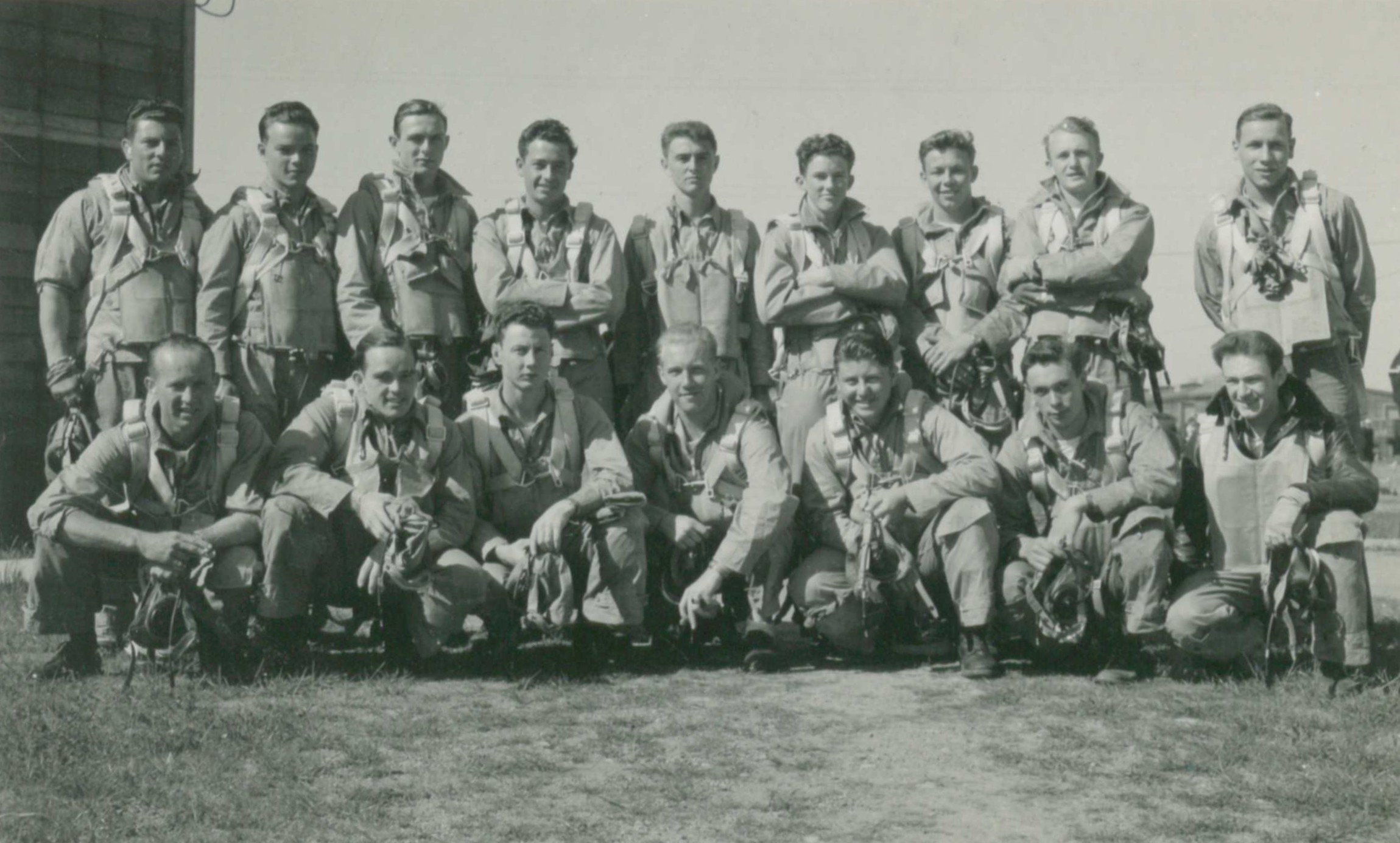
Navy Air Show – 1945

Back (l-r): Bob Reading, Smo Smolinsky, Dick West, Jack Seabolt, Norm Reid, Bill Plunkett, Skull Nelson, Wes Harper, Junior Locher; Front: Jack Simmerman, Bob Johnson, Mike Michaelson, Al Thorngren, Norm Schram, Hoot Nejdl, Ted Wallover.

I continue to scan photos that belonged to my Great Uncle and Aunt, Dave and Betty Donaldson. This one had names typed on the back. Chauncey “Mike” Michaelson married my Grandma’s sister, Dena Donaldson on 7 December 1943 in Los Angeles, Los Angeles, California.

This photo says “Navy Air Show” at “NAS Santa Rosa, Calif.” on 31 March 1945. Dena and Mike had a son born 29 October 1944 in Brigham City, Utah.

The back of the card has the names written on it. I assume it is accurate as it was likely from the time, but the handwriting gives further definition. I can also tell there are a number of nicknames, so I wasn’t able to find most of the people listed in the photo. Either the name was too common or the name given is not sufficient.

Wes Harper – could be Wesley Raymon Harper (1922 – 1982) of Larned, Kansas.

Bob Johnson – could not find anyone that seemed to fit.

Junior Locher – could be Junior Lewis Locher (1919 – 2003) of Glasgow, Virginia.

Chauncey De Orr “Mike” Michaelson (1922 – 2006) of Montpelier, Idaho.

Hoot Nejdl – could not find anyone that seemed to fit.

Skull Nelson – could not find anyone that seemed to fit.

Bill Plunkett – could not find anyone that seemed to fit.

Bob Reading – could not find anyone that seemed to fit.

Norm Reid – could not find anyone that seemed to fit.

Norm Schram – could be Norman Hayner Schram (1922 – 2011) of Pontiac, Michigan.

Jack Seabolt – could not find anyone that seemed to fit.

Jack Simmerman – could not find anyone that seemed to fit.

Smo Smolinsky – could not find anyone that seemed to fit.

Al Thorngren – could not find anyone that seemed to fit.

Ted Wallover – could not find anyone that seemed to fit.

Dick West – could not find anyone that seemed to fit.

~

Casper Wyoming Temple Open House

We took the opportunity to attend the Casper Wyoming Temple Open House on 31 August 2024. We planned the weekend to do some sightseeing and visit some church and family history sites. I am reposting as this has updates on 3 additional ancestors that also came through the Overland Trail.

We left on the Friday morning with the hope of making it all the way to Casper before nightfall. We took old US Highway 30 through Soda Springs and Montpelier. We made a stop to visit the grave of my Grandmother in Dingle.

Aliza, Lillian, Paul, James, and Hiram Ross at the graves of Bud and Colleen Lloyd

We drove through Cokeville and reminded the kids of the story of the Cokeville miracle. As we drove along the old highway, I pointed out the old railroad Y that used to go to the Stauffer mine that was located in Leefe, Wyoming. I spent the first summer or two of my life at Leefe while my dad was tasked with tearing down and removing the mine with Circle A Construction. We stopped in Kemmerer to refuel and also drive past the first J. C. Penney store. We made a quick stop at the Parting of the Ways along the California, Mormon, and Oregon trails.

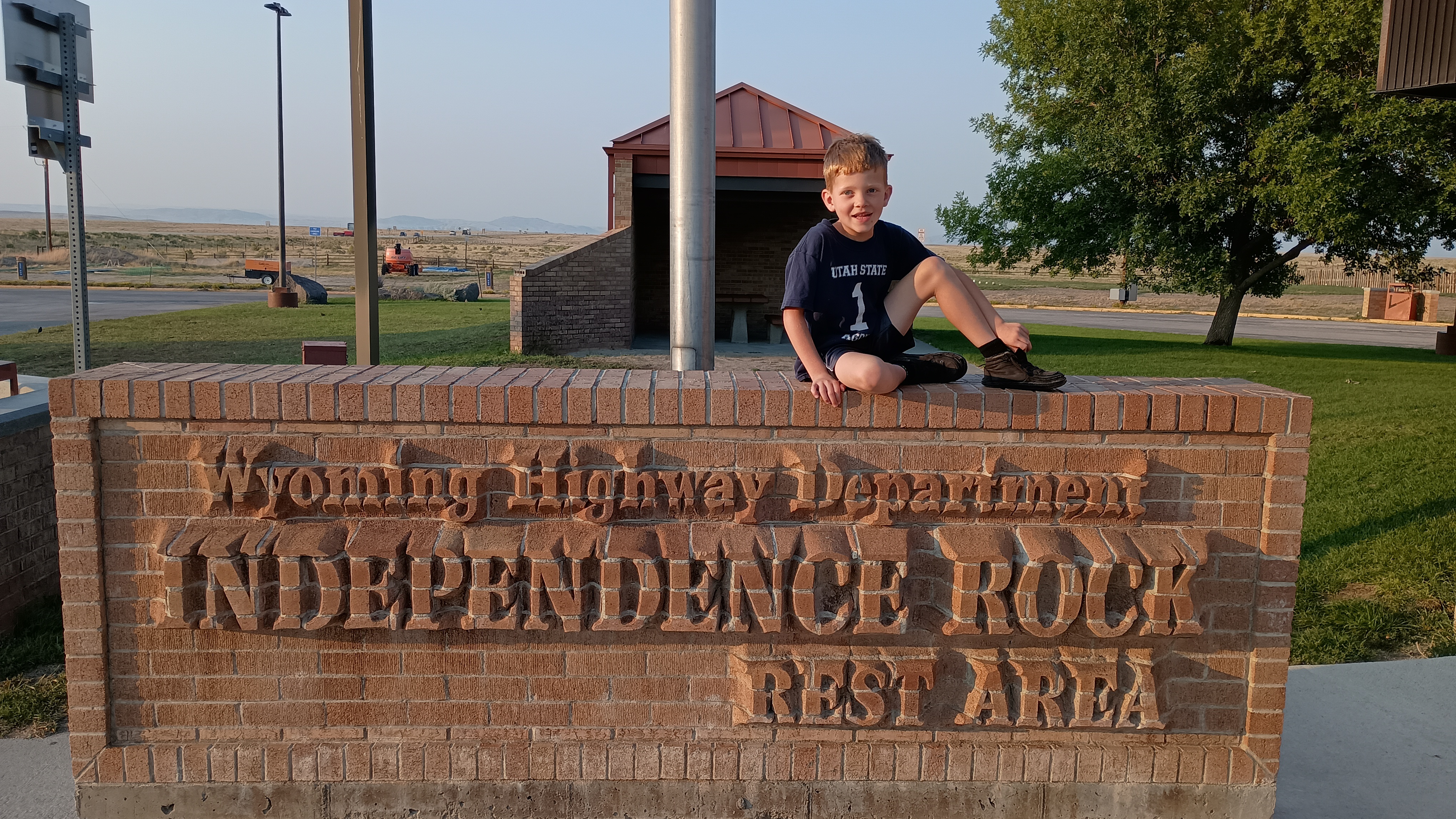
James Ross at Independence Rock

With four kids, we often stop at rest areas. As you can see above, we stopped at the one at Independence Rock. The rock is nearby and doubles as the parking location to visit the rock.

We finally made it to Casper about sunset. We ate an amazing Italian meal at Racca’s Pizzeria Napoletana and checked into our hotel.

Casper Wyoming Temple

We got up early, dressed appropriately, and headed out to visit the Casper Wyoming Temple. It was beautiful. Much smaller than I had anticipated. It is definitely one of the smallest temples, but that is because of the population and distance to other temples. It will supposedly have five stakes in its temple district, some of which will still come from a long distance to attend. Don’t let size fool you, it still has all the distinct parts of a temple and related quality. I think I may very much prefer the intimacy of the smaller temples. It actually reminded me of the Helena Montana Temple on size and flow.

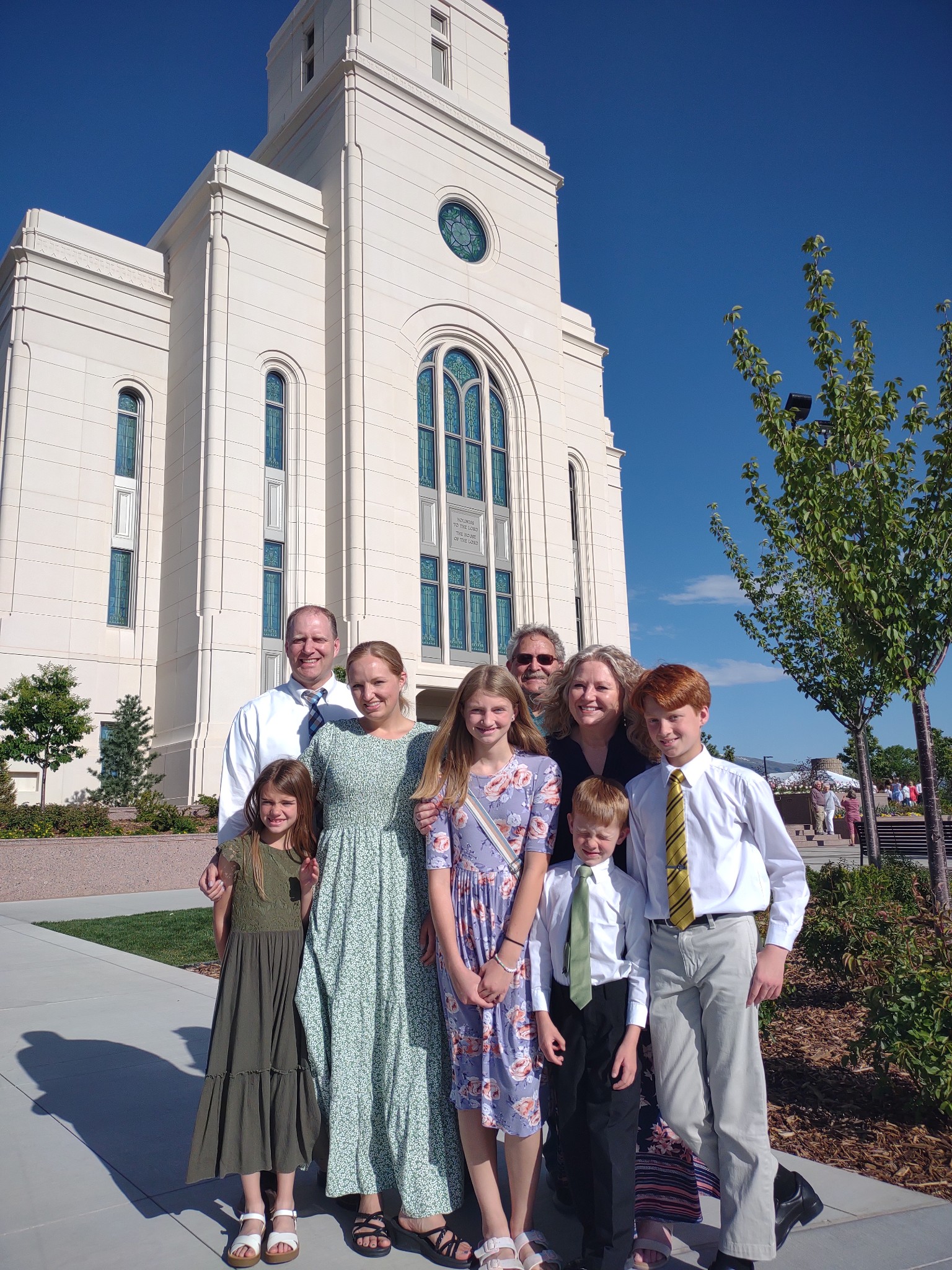
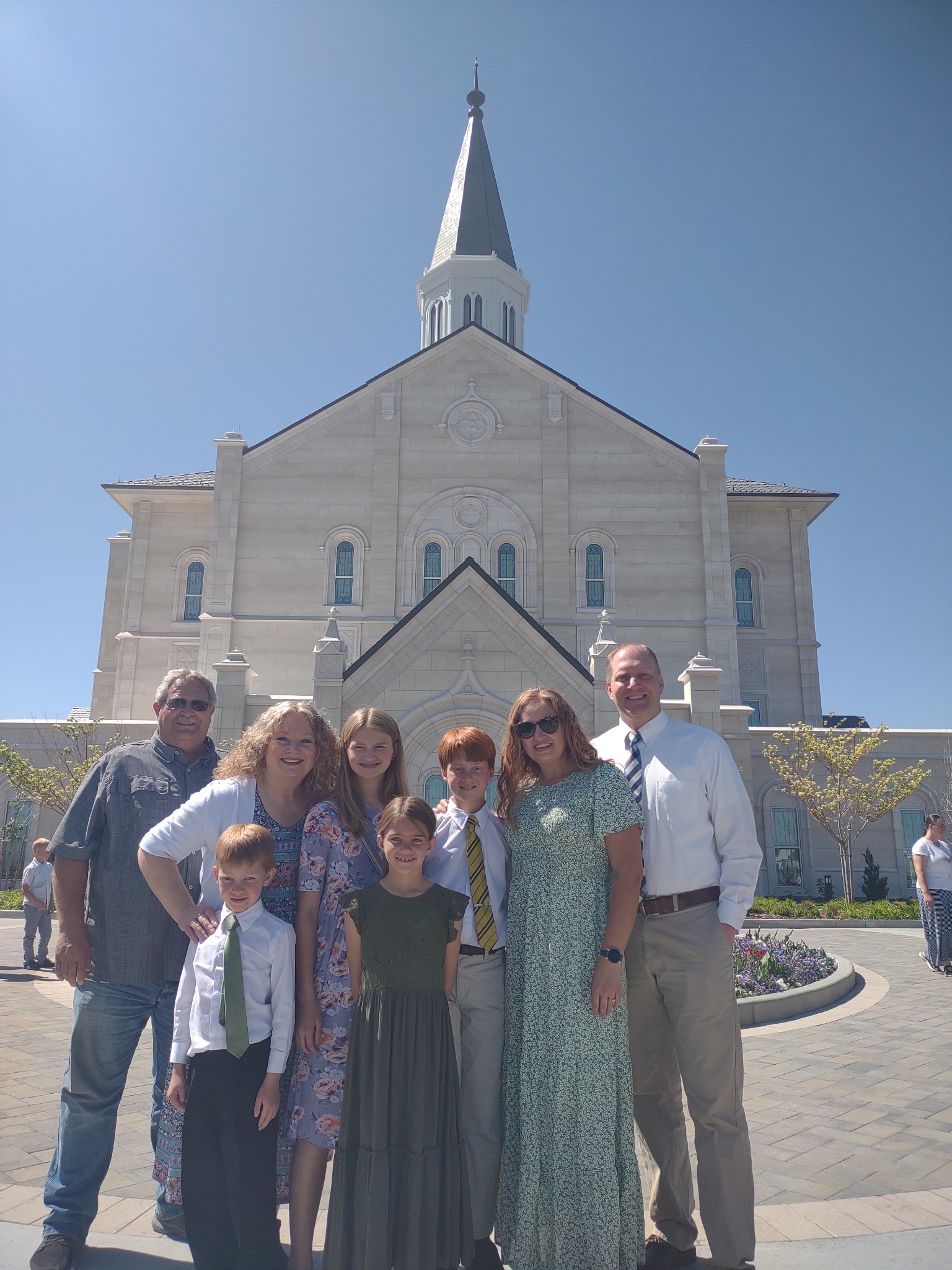
Ross family at the Casper Wyoming Temple Open House

The temple does not have an adjoining chapel, but it does have a distribution/visitor center. We watched the video, enjoyed waiting in the line, and got to see the whole temple. If I were asked, there are a couple of design changes I would make for flow, but this temple will not regularly see these types of crowds or have those issues.

Ross family with the Casper Wyoming Temple

We hurried back to our hotel, changed, loaded up the car, checked out, and headed off to our next stop: The National Historic Trails Interpretive Center in Casper. I did not take any pictures there, but it was very well done. I enjoyed the visit, helped the kids with their junior ranger activities, and learned a few things. Part of the museum had its own little room and video dedicated to the Martin and Willie Handcart Companies.

We stopped at Independence Rock again on our way headed west. We walked around the massive rock and looked at a number of the signatures carved into stone from over 160 years ago. It was hot and we needed to get our little doggies along to Devil’s Gate.

I will write about this more in a bit, but Devil’s Gate was a major landmark on the trail going west for all pioneers on the trails. But Devil’s Gate became more than a landmark and became a historical site in the tragic fall of 1856. Fort Seminoe was based there on the west side of Devil’s Gate, but it had been abandoned earlier that same year. It was that fall that the Martin Handcart Company found itself stranded in the snow. Days later the stranded handcart company moved into a nearby cove to get away from the wind, snow, and cold. That cove is now known as Martin’s Cove.

The Sun Ranch from Devil’s Gate, now The Martin’s Cove: Mormon Trail Site

We found the visitor’s center much more hospitable than some of our ancestors. As I worked through my family history, I had some of my own ancestors who passed through this very Devil’s Gate and area. Here are my ancestral lines that came across on the Mormon Trail. I had counted only 3 while in Casper, but hadn’t realized the Williams clan came over in two separate trips.

William and Mary Ann Sharp in 1853. Wagon train. Moses Clawson Company. William and Mary Ann met in the wagon train and married in Nebraska in 1853. William and Mary are my 3rd Great Grandparents.

John Williams in 1860. Wagon train. John Smith Company. John came over with his two sons John Haines (1829) and Richard (1838). I don’t know why his son David went separately in 1864. I am a descendant of John through David. John is my 4th Great Grandfather.

Johanna Benson in 1862. Wagon train. Joseph Horne Company. Johanna came over with some of her children and their families, her daughter Agneta, came over in 1864 with her family. Johanna is my 4th Great Grandmother.

William Edward Stoker in 1863. Wagon train. Unknown Company. William was traveling with his family, including the baby Mary Ann. William is my 3rd Great Grandfather, Mary Ann is my 2nd Great Grandmother.

John and Agneta Nelson in 1864. Wagon train. William Preston Company. Agneta is the daughter of Johanna Benson who came over in 1862. John and Agneta are my 3rd Great Grandparents.

David D and Gwenllian Williams in 1864. David is the son of John mentioned above. Wagon train. William S Warren Company. Gwenllian came with her sister Mary. Both married on the ship in Liverpool before setting sail for Utah. Gwenllian and Mary’s parents, David and Margaret Jordan, came over in 1872 crossing the plains by rail. David and Gwenllian are my 3rd Great Grandparents.

That gives me 10 ancestors that crossed the plains by wagon, none by handcart that I can tell. The unknown companies were all wagon trains as there were not handcarts those years.

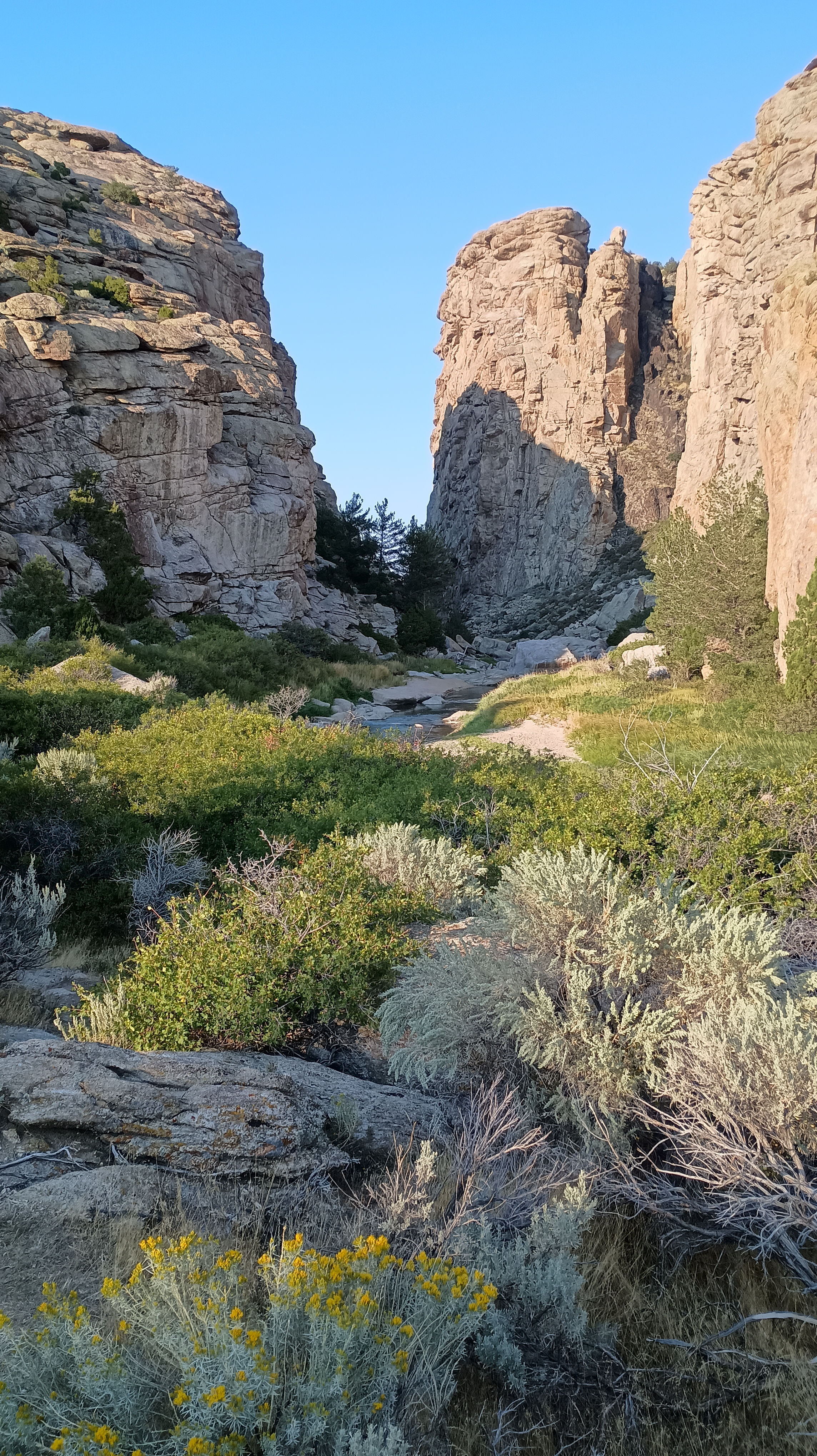
Devil’s Gate – 2024

Every single one of these seven ancestors of mine who came west on the trail would have passed through Devil’s Gate. Here I stood on this sacred ground and snapped this photo of my daughter, my descendant and their descendant, at Devil’s Gate.

Aliza Ross at Devil’s Gate

It took me a bit more work, as I am not as familiar, to find those family lines of Amanda’s that also would have passed along the Mormon Trail to the west before the railroad made it much, much faster and safer. It took me several occasions over a couple of weeks to spend the time to research all these lines.

Henry and Ann Jackson in 1852. Wagon train. James C Snow Company. This is Amanda’s 4th Great Grandparents.

Regina Hansen in 1853. Wagon train. John E Forsgren Company. Her son, Hans Hansen, also accompanied her on the trip. Regina’s husband stayed behind. Regina is Amanda’s 4th Great Grandmother, Hans is Amanda’s 3rd Great Grandfather.

Grave of Hans Hansen in Plain City, Utah. Edith Sharp Ross’ stone is the stone at 10 o’clock from the top of this stone, my Great Grandmother.

David Buttars in 1843. Wagon train. William Empey Company. He appears to have traveled alone. Amanda’s 3rd Great Grandfather.

Birthe Jacobson in 1854. Unknown if wagon train or handcart company. Birthe’s daughter, Maria Jacobson, also accompanied her on the trip. Her husband Jorgen died in Missouri as part of the trip. Birthe is Amanda’s 5th Great Grandmother, Maria is Amanda’s 4th Great Grandmother.

Harriet Housley in 1856. Handcart company. Edward Martin Company. Harret’s son, George Housley, also accompanied her on the trip. Two other children came later. Harriet is Amanda’s 5th Great Grandmother, George is Amanda’s 4th Great Grandfather.

Richard and Christine Hemsley (1836 – 1915) in 1857. Handcart company. Israel Evans Company. This is Amanda’s 4th Great Grandparents.

Ole and Anne Jensen in 1861. Likely wagon train. Unknown company. Amanda’s 5th Great Grandparents.

John Crompton in 1862. Wagon train. Joseph Horne Company. John also had his daughter, Hannah Crompton, with him. John is Amanda’s 4th Great Grandfather, Hannah is Amanda’s 3rd Great Grandmother.

Anna Nielsen in 1862. Wagon train. Christian Madsen Company. She traveled alone. Amanda’s 3rd Great Grandmother.

Joseph and Penelope Thompson in 1862. Wagon train. John Riggs Murdock Company. Their son, Joseph Thompson, also accompanied the family. Amanda’s 4th Great Grandparents, Joseph is Amanda’s 3rd Great Grandfather.

Joseph Wayment in 1863. Wagon train. Unknown Company. Appears to have come alone. Although his parents and most of his siblings would come later by rail. Amanda’s 3rd Great Grandfather.

Axel Boyer in 1866. Wagon train. Abner Lowry Company. Amanda’s 4th Great Grandfather. Also traveled with the Keeps, other ancestors of Amanda.

James and Ann Keep in 1866. Wagon train. Abner Lowry Company. Their daughter, Sarah Keep, also accompanied the family. James and Ann are Amanda’s 4th Great Grandparents, Sarah is Amanda’s third great Grandmother. Also traveled with Axel Boyer, other ancestor of Amanda.

Richard Hemsley (1801 – 1866) and his later wife Sarah in 1866. Wagon train. William Henry Chipman Company. Amanda’s 5th Great Grandfather.

Peter Peterson in 1866. Wagon train. Joseph Sharp Rawlins Company. Peter is Amanda’s 4th Great Grandfather.

That is the Hemsley line alone, Amanda’s Dad. I count 26 ancestors of Amanda’s Dad that came through Devil’s Gate.

James, Lillian, Hiram, and Aliza Ross at Devil’s Gate Mormon Handcart Visitor Center

Amanda’s Mom’s line, the Holden family, has the following:

Edwin and Ruia Holden in 1852. Wagon train. Uriah Curtis Company. Their son, Henry Holden, also accompanied the family. Edwin and Ruia are Amanda’s 4th Great Grandparents, Henry is Amanda’s 3rd Great Grandfather.

Jesse and Temperance McCauslin in 1851. Wagon train. Unknown Company. Temperance passed away in Council Bluffs, Iowa. She did not make the trail in Wyoming or Devil’s Gate. Their daughter, Louisa McCauslin, also accompanied the family. Jesse is Amanda’s 4th Great Grandfather, Louisa is Amanda’s 3rd Great Grandmother.

John and Adelaide Roberts in 1863. Wagon train. Thomas Ricks Company. Their son, Hyrum Roberts, also accompanied the family. John and Adelaide are Amanda’s 3rd Great Grandparents, Hyrum is Amanda’s 2nd Great Grandfather.

Thomas and Mary Ashton in 1851. Wagon train. Morris Phelps Company. Mary also passed away in Iowa. She did not make the trail in Wyoming or Devil’s Gate. Their son, Joseph Ashton, also accompanied the family. Thomas is Amanda’s 4th Great Grandfather, Joseph is Amanda’s 3rd Great Grandfather.

Sarah Jarvis in 1854. Wagon train. Job Smith Company. She came with some of her family, but not with her son, Amanda’s ancestor, George Jarvis. Sarah is Amanda’s 4th Great Grandmother.

George and Ann Jarvis in 1853. Wagon train. Unknown Company. George and Ann are Amanda’s 3rd Great Grandparents. George is the son of Sarah Jarvis mentioned above.

William and Rebecca Finch in 1854. Wagon train. Daniel Garn Company. William and Rebecca are Amanda’s 3rd Great Grandparents.

Joseph Finch in 1853. Wagon train. Joseph Young Company. Joseph is the son of William and Rebecca Finch mentioned above.

John and Hannah Davis in 1851. Wagon train. Eaton Kelsey Company. Their daughter, Mary Jane, also accompanied the family. The family also has Davies listed for their last name sometimes. John and Hannah are Amanda’s 4th great grandparents, Mary Jane is Amanda’s 3rd Great Grandmother.

John Evans in 1866. Wagon train. William Henry Chipman Company (same company as Amanda’s Richard Hemsley above). His wife, Sarah, died on the trip from the United Kingdom in New York. His son, John Evans, also accompanied his father and brother. John is Amanda’s 3rd Great Grandfather, John is Amanda’s 2nd Great Grandfather.

James and Elizabeth Boyack in 1855. Wagon train. Milo Andrus Company. James and Elizabeth are Amanda’s 4th Great Grandparents.

James Boyack in 1853. Wagon train. Appleton Harmon Company. James is Amanda’s 3rd Great Grandfather. James is the son of James and Elizabeth Boyack above that came in 1855 across the plains.

Margary Waterhouse in 1855. Wagon train. Milo Andrus Company. Margary is Amanda’s 3rd Great Grandmother. She came across with the same train as James Boyack’s parents, presumably that is how she met her future husband. The Company arrived 24 October 1855 in Utah, James and Margary married 23 November 1855 in Springville, Utah.

That is the Holden line alone, Amanda’s Mom. I count 26 of ancestors of Amanda’s Mom that came through Devil’s Gate. As an aside, I also looked at her biological line (as she is adopted), and not a single one of her biological ancestors passed through Devil’s Gate.

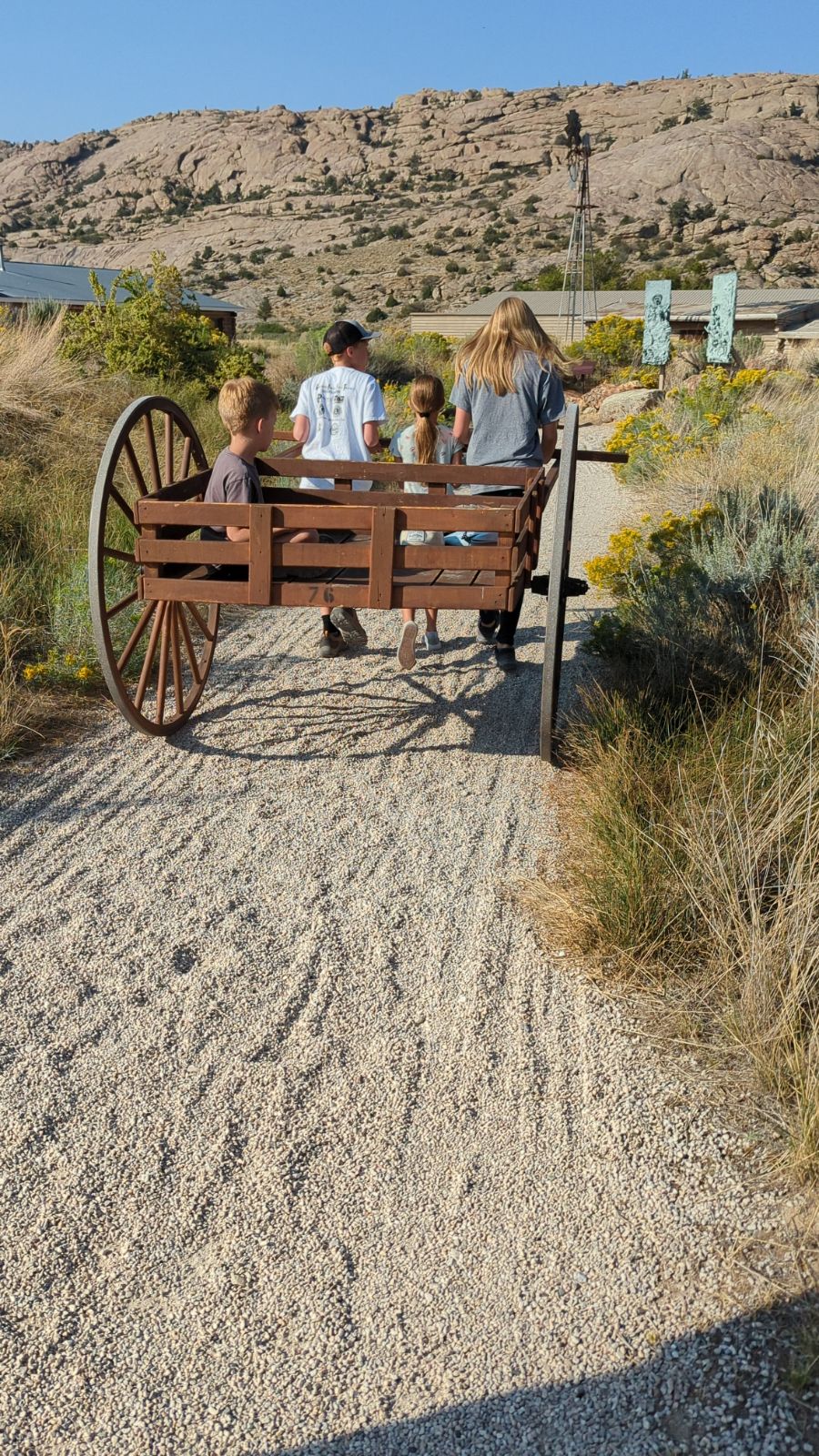
James riding while Hiram, Lillian, and Aliza Ross pull a handcart at Devil’s Gate Mormon Handcart Visitors Center

We also stopped and visited with the sixth crossing of the Sweetwater River. This was the location where, like the Martin Handcart Company, the Willie Handcart Company also got stuck in wind, snow, and cold in 1856. Their rescue occurred here.

The next day, on our way to Grand Teton National Park, we made a stop at Fort Washakie, Wyoming. This is one of the alleged graves of Sacagawea. We stopped and remembered her, whether her final resting place or not.

All in all, I was surprised by my own connection to the Mormon Trail. I had never considered that I have 7 ancestors who had literally come this way. Or that my children have 59 ancestors that literally come this way. They passed by Independence Rock, through Devil’s gate, and two of those 59 suffered with the Martin Handcart Company. I will write more on the Housley’s later as there have been other interesting interactions with that clan since our marriage.

Layton & Taylorsville Temple Open Houses

Paul, Hiram, and Aliza Ross at Vernal Utah Temple

Before I talk about the Layton and Taylorsville Temples, I thought I better throw in another temple visit we made since I last updated. While on Spring Break this year, we made a stop in Vernal, Utah. While there, we scheduled and attended the Vernal Utah Temple with the kids. Glad we stopped to make another memory at another House of the Lord.

Hiram and Aliza at Vernal Utah Temple on 27 March 2024

Since the kids have a goal to attend the temple every month this year, we did also make it in April to the Twin Falls Temple. In May, while going to Utah for the open houses, we made sure to stop off and fulfill the monthly goal. May took us to Ogden Utah Temple.

Hiram and Aliza Ross at Ogden Utah Temple 17 May 2024

Later that evening, we attended the open house of the Layton Utah Temple with Amanda’s parents. Beautiful.

Paul, Lillian, Amanda, Aliza, James, and Hiram Ross with Bryan and Jill Hemsley 17 May 2024

We look forward to attending the temple after it is dedicated.

The next day we attended the open house for the Taylorsville Utah Temple, again with Amanda’s parents. We were also excited to run into the Brad and Rachel Hales family as well as Sarah Sanderson!

Bryan and Jill Hemsley with James, Aliza, Lillian, Hiram, Amanda, and Paul Ross 18 May 2024

It has been a crazy year for temple attendance and temple open houses. We have attended quite a few and quite a few are coming up for open houses. Wow, should be fun. It is exciting that the Kingdom and Church of God on the earth is in such a position to build so many beautiful houses to the Lord. We are blessed to attend the open houses and hopefully return some day to participate in holy ordinances there.

When I was interviewed for my first temple recommend in 1998, President Gene Hansen indicated he had a goal since he was first endowed to attend the temple every single month. He challenged me to do the same. As long as I have held a recommend, or I had permission to attend, I have attended the temple every single month since 1998. That meant a full day off of work in Missouri as it was a 4 hour drive one way from Branson, Missouri, to St. Louis, Missouri. Or from Richmond, Virginia, to Washington, D.C., that was a 4-5 hour drive and we often would go up and spend the night and return home on Saturday or Sunday depending on the circumstances.

Many open houses are upcoming, including Deseret Peak Utah; Casper Wyoming; Grand Junction Colorado; Elko Nevada; Syracuse Utah; Burley Idaho; Lindon Utah; Ephraim Utah; Smithfield Utah; Montpelier Idaho; Heber Valley Utah; Teton River Idaho; Salt Lake City Utah; Provo Rock Canyon Utah; Cody Wyoming; Lethbridge Alberta; Lehi Utah; and West Jordan Utah. Hopefully we can make some of the more exotic ones, particularly Birmingham England; Edinburgh Scotland; Honolulu Hawaii; and Vancouver British Columbia. We will see what our future holds.

Aslett Passing

Milo Ross and Larry Aslett

My Dad called me last week to let me know Larry Aslett passed away. We often called him Uncle Larry growing up. Dad and Larry were friends and co-workers, business partners, as associates for more than 50 years. They first worked together in the 1960s and have kept in contact ever since. Dad, Larry, Steve, and Marvin all worked together at Circle A Construction. Dad worked there from like 1971 until 2004 or so when he retired. I will share a few photos I could find. I thought I had some more of Marvin, Steve, and Larry, but cannot find them right now.

Larry Dean Aslett passed peacefully in his sleep at the age of seventy-eight with his loving wife by his side on October 30, 2022. He was born to Marvin Aslett and Larie Stanger-Aslett on June 14, 1944 in Wendell, Idaho.

He started working for Circle A Construction at the tender age of 14, where he continued to work his entire life (except for the 3 years, 9 months and 28 days that he served our country in the United States Navy.)

Before entering the Navy, Larry also worked in Jackson Hole, Wyoming as a service station attendant. In the Navy, Larry was at sea on the guided missile destroyer USS Lynde McCormick DDG-8. He started out in the boiler room and then was a cook and went on to be a baker. He was known for his cinnamon rolls that were a favorite of the Commander of the fleet. Larry was an owner of Circle A Construction, Aslett Electric, Aslett Ranches and Mikey’s Graphics. He spent his life as Operations Manager with Circle A Construction, running all of the jobs through the years.

On March 28, 1965, Larry married the love of his life, Louise. They first lived in Randolph, Utah. They moved to Ogden, Utah in 1971 and then in 1977, they moved back to Jerome. They had two daughters, Lori and Lisa. He was an extremely proud dad and grandpa and would talk about his kids and grandkids to anyone and everyone.

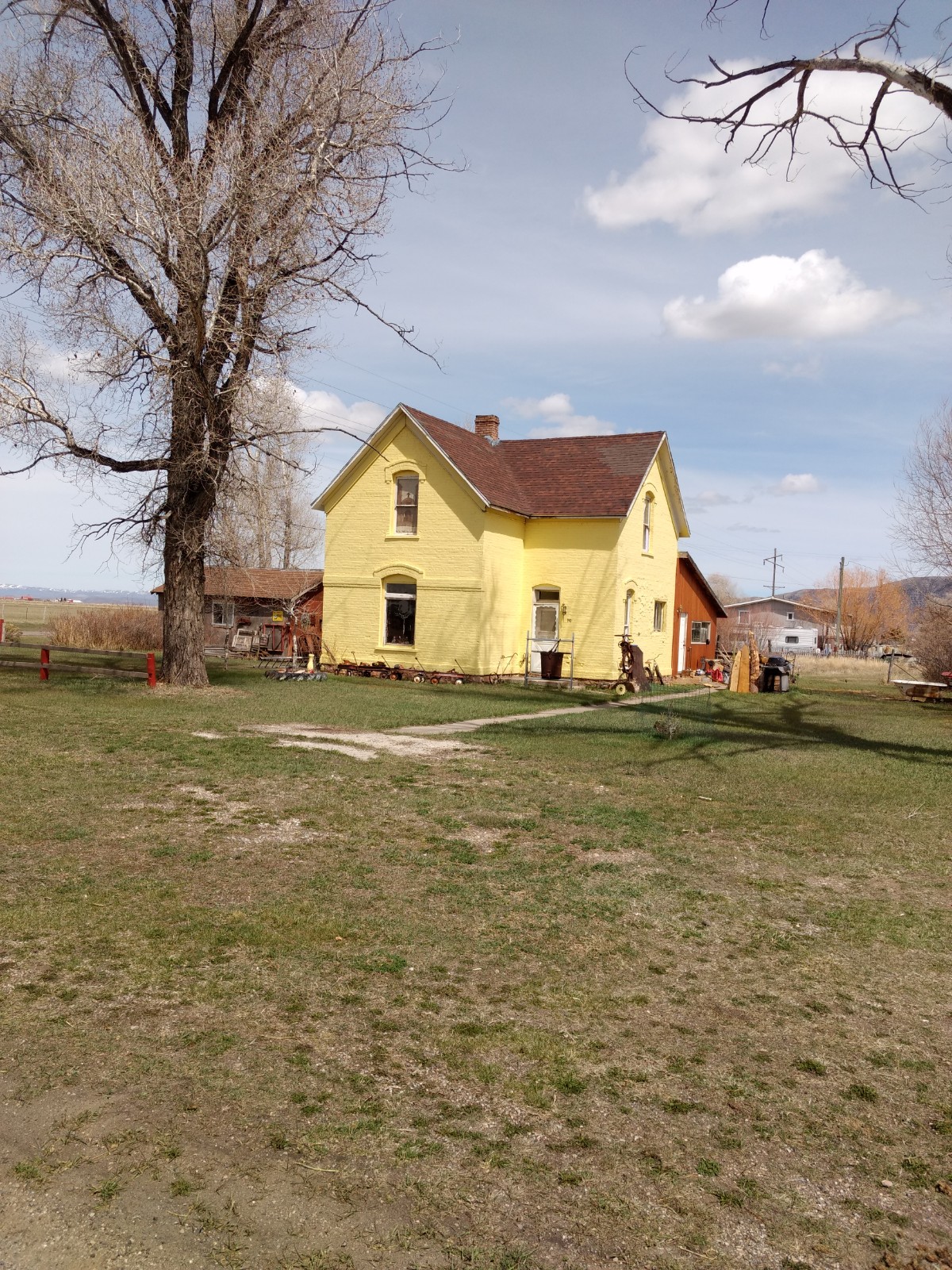
House in Randolph, Utah that Larry and Louise Aslett lived in.

Next to his family, his other love was animals. Larry loved animals of all kinds and was often bringing them home for Louise to raise. His collection of exotic animals included everything from buffalo to fallow deer, and even a zebra.

He and Louise introduced the Asletts to horse racing with their horse, Solar Bar, in 1976. Horses were a huge part of his life. He loved riding into the back country on his horse, Sparky, while leading his mules, Jackie and Mable. Pack trips with Sage were some of his fondest memories.

Larry loved spending time with family and friends. During his life, he started the Magic Valley Draft Horse Association with Harold Horting and the Jeep Preservation Club of the Magic Valley with Wes Stapleton and Les Abbott. He had a love for the old jeeps and had lots of laughter and fun on jeep trips throughout the years. His collection of old military vehicles led to his love of collecting later in life.

Larry’s life was filled with laughter. He taught his children and grandchildren to laugh at the absurdities in life, the frustrations in life, and the silly things in life. To laugh at life itself and not let it get you down.

Larry was preceded in death by his grandparents, Bop and Baw; parents, Marvin and Larie; and his brother, Steve. He is survived by his wife of 57 years, Louise; daughters, Lori (Frank) Norcutt and Lisa (Tom) Jaramillo; nephew, (son of his heart) Steve, Jr. “Sage” Aslett; beloved aunt Lorraine Kerruish; brother, Dave (Sharon) Aslett; sister-in-law, Barbara Aslett; step-sister, BZ Waite; and his beloved grandchildren, Dylan, Kayla, Kylie and Nikita.

Larry is embarking on a great adventure and we are at the window waving goodbye. It is not hard to imagine the joy of those awaiting him in Heaven. Those of us left behind find great comfort in knowing how much love he received the moment he was enveloped into their arms. We love you. Rest in Peace Grandpa. 8-11 Deano.

A viewing will be held from 6:00 pm until 8:00 pm, Monday, November 14, 2022 at Farnsworth Mortuary, 1343 S Lincoln Ave., Jerome. A military graveside service will be held at 1:00 pm, Tuesday, November 15, 2022 at the Idaho State Veterans Cemetery, 10100 N. Horseshoe Bend Rd., Boise, Idaho 83714.

Circle A Construction Truck in Paul Idaho Parade, in front of the Felton Apartments, about 1985.

I don’t think I remember a time when I did not know Larry and Steve Aslett. Even growing up we went to the roundups in Mackay, Idaho every year. For several days we rode horses above Mackay, above White Knob. I loved those times and was sad when they sold that ranch and purchased the Three Creek Ranch near Rogerson, Idaho.

Steve Aslett passed away late last year.

Steven L. Aslett passed away surrounded by his loving family on Dec, 21st at the age of 74. He was Born on October, 14th 1947 to Marvin Aslett and Larie Stanger in Wendell Idaho.

He had two brothers Keith (Pat) and Larry (Louise) and two half brothers Lenard and David. He married the love of his life Barb Stuhlberg on April 1st (not a joke), 1967. He attended elementary school at Pleasant Plains north of Jerome, Graduated from high school in Jackson hole Wyoming in 1965. Graduated from Weber State University in Engineering with a minor in business in 1970.

Steve was an owner of Aslett Electric and Circle A construction. He loved spending time at House Creek Ranch, Fairfield, and Magic Reservoir. He had a passion for hunting, snowmobiling, golfing and boating. Above all, He loved spending time with his Family.

He is survived by his wife of 54 years Barb, Father Marvin, son Steve (Sage)(Connie), Daughter LeAnne (Reid), Grandchildren, Colton(Christina), Michael(Ashleigh), Shelbie(Sage), Brydon, Roper, Great Grandchildren, Rowan, Roper, Stetson, Brixton, and Wyatt and numerous nieces and nephews. He is preceded by his mother and grandparents.

His strength throughout life has been an inspiration to all of us. He was the cornerstone of our family. Always ready to tell you how things are and what should be done. There was never a moment when a good band wasn’t around the corner for a chance to dance, and one eye open to see a new friend. There was always a plan on the horizon with Jim Keyes and Glen Somerset, whether it was a guided hunt by Sage, an outing on the golf course with team Circle A and buddies, the trail to find powder, or the four wheeler adventures. He loved getting on the phone with LeAnne for her daily lecture, enjoying her long hugs, and taking a drive with her hands off the dash and feet off the seat.

There will be a viewing at Parke’s Magic Valley Funeral Home in Twin Falls on Tuesday December 28th from 5pm to 7pm, and a memorial on December 29th at the turf club starting at 6pm.

We will miss you Mr. happy feet! Family requests any memorials be given in Steve’s name to the charity of your choice.

Marvin Aslett, their father, passed away just earlier this year.

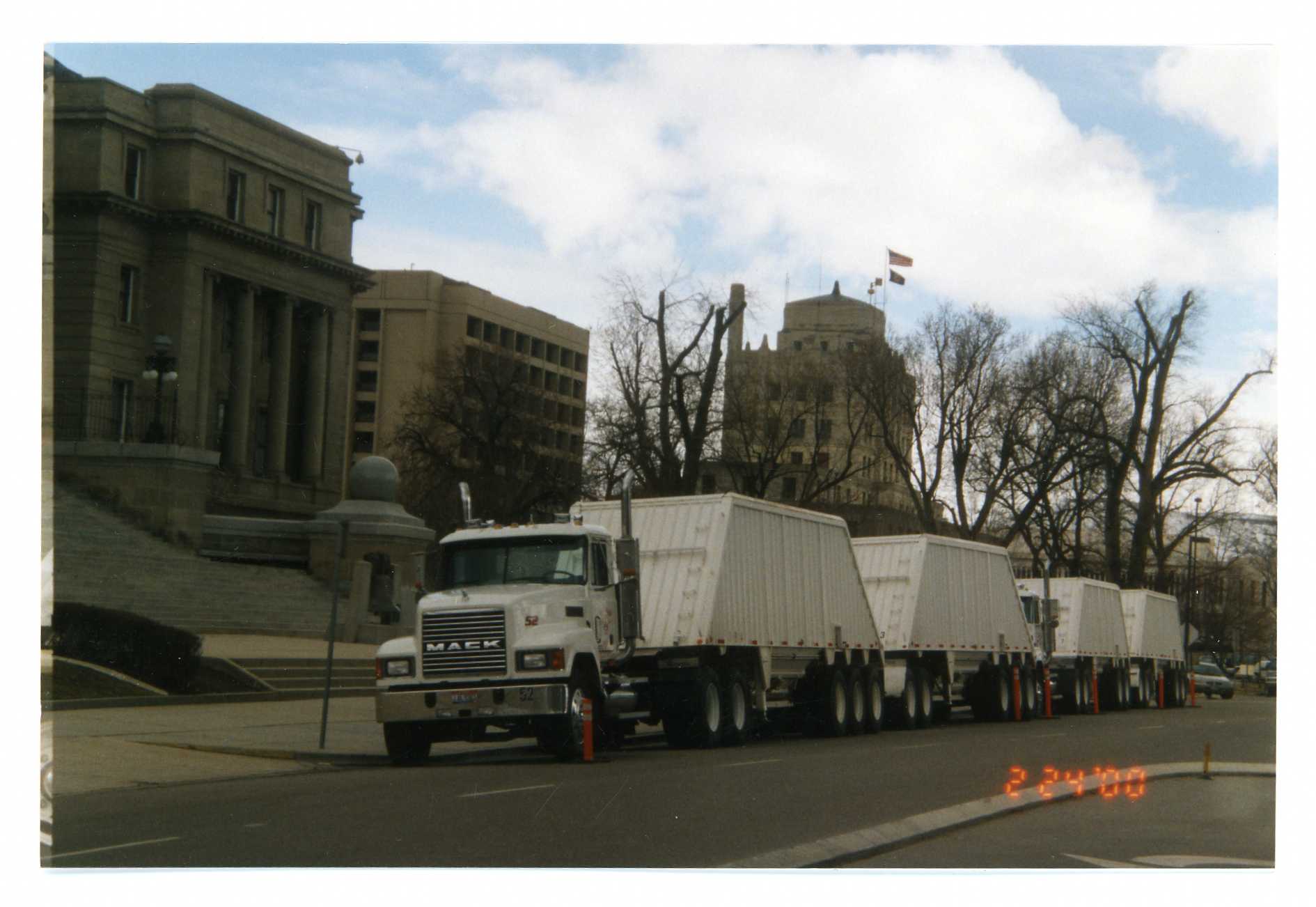
Circle A Construction trucks in front of the Idaho Capitol in 2000

Marvin Aslett passed peacefully in his home on August 7, 2022, surrounded by family. Marvin was born April 4, 1926 in Montpelier, Idaho, to parents Leon and Leona Aslett, and they lived in Lava Hot Springs. As a young boy, Marvin attended school in Cokeville, Wyoming. It was a tiny schoolhouse with two boys and two girls! In 1936, they moved to a farm in Jerome, Idaho, where he attended school out at Pleasant Plains. Marvin went to school till halfway into his sophomore year. He then moved to Sun Valley and worked as a bus boy in the Sun Valley Lodge.

In 1943, Marvin married Larie Stanger and their son, Keith, was born. Marvin joined the U.S. Marine Corp on May 25, 1944. His son, Larry, was born one month after Marvin went into the Marine Corp. During his time with the Marines, Marvin served in World War II / South Pacific Theater. He was on invasions into the Philippines, fighting Japanese. He served until February 8, 1946 when he received an honorable discharge at the rank of corporal. His third son, Steve, came along in 1947.

In 1952, Marvin, along with his Mother and Father, started Circle A Construction. In 1965, his son, Larry, rejoined the company after being in the Navy. Then in 1979, his son, Steve, also joined the company.

Marvin married his second wife, Afton, in 1957, and their son, Leonard, was born. They divorced, and Marvin married Norma in 1962 and had son, David. Then, in 1977, Marvin married Joy Hollibaugh, He and Joy were married for 40 years.

Marvin and Joy loved golfing! Marvin had 4 holes-in-one. One at Jerome, one at Clear Springs and 2 in Hawaii. At 96, Marvin still enjoyed golfing with his friends and family.

In 1980, Aslett Ranches began racing quarter horses throughout the Western United States. Their horse won the “Poor Boy Futurity” and in 1981, they captured the Intermountain Quarter Horse Derby. Their stallion “Circle A Special” received a Racing Register of Merit in Emmett, Idaho, where he set a track record in the 250-yard dash. He set another track record in Pocatello, Idaho in the 400-yard dash. On January 4, 1988, Governor Cecil Andrus appointed Marvin to the Racing Commission, where he served for 13 years as Chairman of the Board. In 2007, Marvin was inducted into the Idaho Quarter Horse Racing Division’s Hall of Fame.

Marvin was also active in his community. In the early 1980’s, he served on the Boise State University Board of Trustees. He was also on the College of Southern Idaho’s foundation Board and continued the Leon Aslett Scholarship Fund that his father had set up. Also, in 1983, Marvin served as President of the Association of General Contractors.

In addition to the racehorses, Aslett Ranches is a 500 + cow/calf operation. Operating for the last 20 years in House Creek, previously located in Mackay.

Marvin is survived by his sister, Lorraine Kerruish; sons, Keith (Pat) Aslett, Larry (Louise) Aslett, Leonard (Carolyn) Aslett and David (Sharon) Aslett, and his stepdaughters, Deb Steinaker and Bz Waite; daughter-in-law, Barbara Aslett; 15 grandchildren, 25 great-grandchildren and seven great-great grandchildren. Marvin was preceded in death by his parents, Leon and Leona; his wife, Joy; his son, Steve; stepson, David; and stepdaughter, Marilyn.

Circle A Construction grain trains at the end of a field for harvest

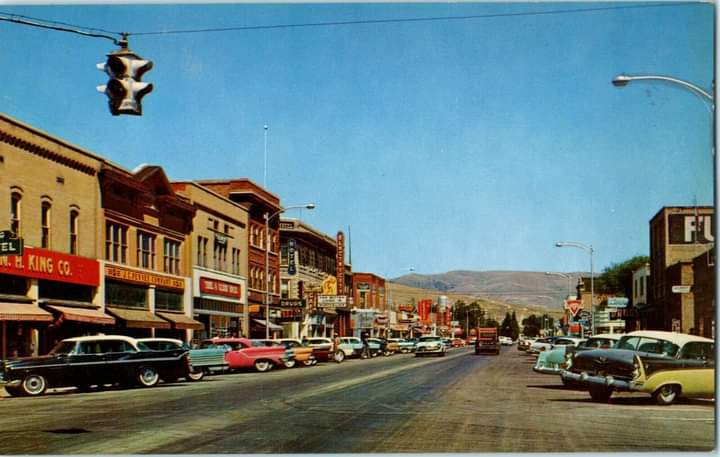
Late 1950s Montpelier, Idaho

Washington Street, Montpelier, Idaho late 1950s

The first time I saw this picture I grabbed it for a number of reasons.

First, that looks like my car on the front right of the photo. That is clearly a 1956 Dodge car on the right in the same yellow, charcoal, and white as my car. Although when my car was repainted about 1984, the top and inside the fins around the taillights was also painted charcoal so that there is not any white on it at present. Mine is a Coronet. Looking closer at the photo, that car is likely a higher model as the chrome stripe goes up before the bumper, where the lower models went down. So it must be a Custom Lancer or Custom Royal. Here is a link to the different models and nuances of the 1956 Dodge lineup.

Aliza and 1956 Dodge Coronet

Second, I have been to Montpelier dozens of times in my life. Beginning in the 1980s with my Grandmother, Colleen Jonas, selling insurance. I came to love the town. Soda Springs and Montpelier both had the viaducts which stuck out in my mind. I immediately recognized the town.

Growing up in and near Burley, Idaho, I am familiar with the history of the King’s Variety Store chain. On the left is the M. H. King Co. Who in southern Idaho is not familiar with Milton Herman King and his variety or discount stores? I went looking and can see on Google that the King building in the photo is no longer present in Montpelier. However, the rest of the buildings on the north are still there, but some with some pretty drastic facade alterations. Even though King’s has now closed, Google still has one across the street on this picture. Apparently with the buildings the Dodge is parked in front of all gone.

Third, the red car in the picture appears to be the only 1958 model, I think. The rest all look like 1956 or earlier, so that red one might only be a 1957. This picture is likely in 1957 or 1958.

Fourth, my Dad, Milo Ross, spent quite a few summers in Montpelier growing up as my Great Uncle Chauncey De Orr Michaelson was born in Montpelier in 1922. He was married to my Grandma Gladys Ross’ sister, Dena Dorothy Donaldson. Richard Michaelson and Dad ran around Montpelier probably during the same time period as this photo. When we lived in Leefe, Wyoming, once and a while the family would have to come in or through Montpelier as well.

Fifth, my Grandma Jonas married Bud Lloyd who haled from the Montpelier area. Grandma and Bud met in the early 1990s while she was working in the Montpelier area. They dated and were married in 1998. Unfortunately she passed away in 1999. They are both buried in Dingle, just south of Montpelier.

Deer Cliff Inn 1998

Lastly, Montpelier has an announcement for a temple. This modern view will have a temple spire in it down the road, probably above that truck that looks like a garbage truck. Montpelier on the right side has a beautiful school that has been kept. I hope it continues to be kept and maintained. Bringing a temple to downtown Montpelier will do much to help rejuvenate the downtown area that seems to have struggled.

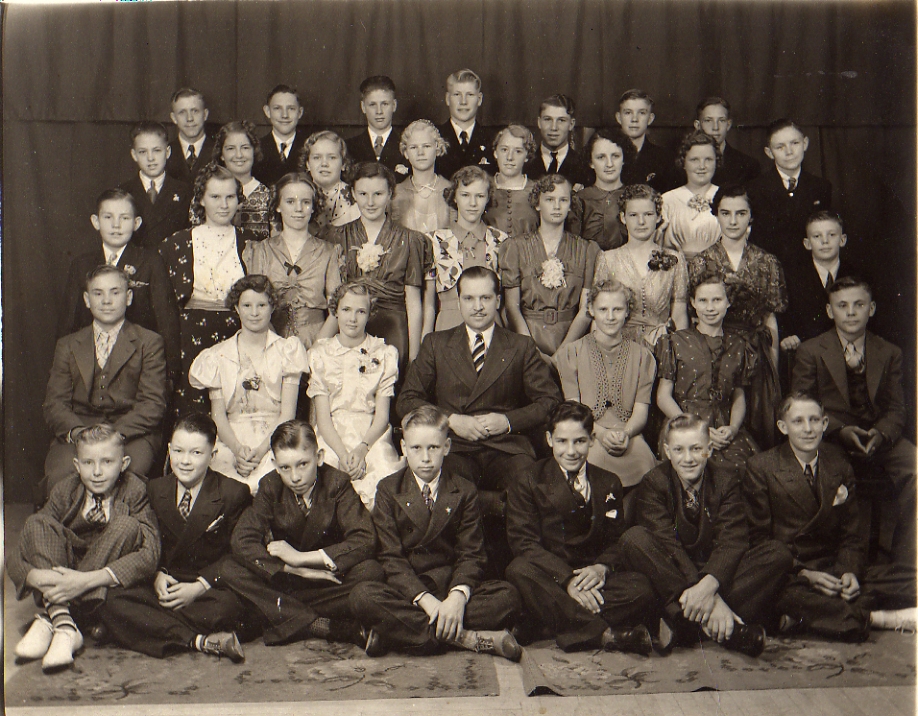
Glacus Merrill’s Class

Back(l-r): Ira Hillyard, Unknown, Bob Johnson, Junior Petterborg, Irwin Jonas, Unknown, Unknown.  2nd from Back: Unknown, Ruth Rich, Kaye Funk, Anna Lawrence, Joyce Larsen, Ruth Hutchinson, Nadine Johnson, Darrel Smith.  Middle Row: Unknown, Unknown, Eva Kershaw, Lyle Wilding, Unknown, Afton Sorensen, Dorothy Nielson, Unknown, Norwood Jonas.  2nd from Front: Alvin Spackman, Bernice Frandsen, Unknown, Glacus Merrill, Joy Erickson, Unknown, Allen Spackman.  Front: Garr Christensen, Oral Ballam Jr, LaMar Carlson, Unknown, Gail Spackman, Ivan Anderson, Warren Hamp.

This is Glacus Merrill’s class from what I believe is 1936.  He taught class at Park School in Richmond, Cache, Utah.  Several individuals have assisted me to name the individuals I have so far.  There are too many unknowns that I hope to clarify in the future.  If anyone can help, I would certainly appreciate it.  My Grandfather, Norwood, and his brother, Irwin, are both in the photo.  Irwin died in World War II, and I assume some of the rest did as well.

I have listed all the individuals below with some limited information I could find on them.  At the very bottom is Glacus’ obituary.

Ira William Hillyard (1924-2009)

Unknown

Robert “Bob” Jay Johnson (1924-2009)

Junior “Pete” Lee Petterborg (1923-1990)

Irwin John Jonas (1921-1944)

Unknown

Unknown

Unknown

Ruth Rich

Norma Kaye Funk (1924-2002)

Anna May Lawrence (1924-1988)

Joyce Larsen (1924-1968)

Ruth Hutchinson (1924-2002)

Nadine Johnson (1924-2005)

Darrel Wilmot Smith (1924-2008)

Unknown

Unknown

Eva Kershaw

Lyle Wilding (1924-2002)

Unknown

Mary Afton Sorensen (1923-2008)

Dorothy Nielson (1924-2019)

Unknown

Wilburn Norwood Jonas (1924-1975)

Alvin Chester Spackman (1923-1994)

Bernice Frandsen (1924-2002)

Unknown

Glacus Godfrey Merrill (1905-2002)

Joy Erickson (1924-2010)

Unknown

Allen Elijah Spackman (1923-1997)

Garr Dee Christensen (1923-2002)

Oral Lamb Ballam (1925-2016)

Victor LaMar Carlson (1923-2008)

Unknown

Harold Gail Spackman (1924-1991)

Ivan Carl Anderson (1923-2017)

Warren Thomas Hamp (1924-2009)

Here is a copy of the obituary I found for Glacus.  Wow, I wish my school teachers had been this amazing.

LOGAN – Glacus G. Merrill, 96, died of causes incident to age in Logan, Utah on Saturday, February 9, 2002.  He was born May 27, 1905 in Richmond, Utah to Hyrum Willard and Bessie Cluff Merrill.  He is a grandson of Marriner W. Merrill, a pioneer prominent in the settling of Cache Valley, an Apostle of the Lord Jesus Christ, and the first president of the Logan LDS Temple.  He married Constance B. Bernhisel in 1925, and they were later divorced.  He married Marie B. Bailey, March 24, 1945 in Washington D.C.  Their marriage was later solemnized in the Logan LDS Temple.

While attending school, he participated in track and football at North Cache and Brigham Young College, where he graduated in 1925.  Glacus graduated from Utah State University in 1935 and also attended the University of Utah and Chico State College in California.  He is a graduate of the REI Radio Engineering School in Sarasota, Florida.  He was the principal of the Richmond Park School for 11 years and served in the U.S. Navy for four years during World War II.  He served an LDS mission to California from 1954-1955.  While living in the East, he served as President of the West Virginia Farm Bureau and the State Black Angus Association.  He is an honorary Kentucky Colonel.  He also served as President and District Governor of Lions Clubs in Utah and West Virginia, and was a member of the Lions Club for 42 years.  Glacus was Vice President of the West Virginia Broadcasters Association, and is a member of the USU Old Main Society.  He established a Scholarship Fund in the Communications Department at USU.  The Montpelier, Idaho Jaycees presented him with their outstanding Citizen’s Award.  He was also a member of the Montpelier Rotary Club, Utah Farm Bureau, VFW and American Legion.  He is a member of the “Around the World Club” having traveled around the world with his son, Gregory.  He and his wife, Marie traveled extensively.  Merrill was a popular Rodeo announcer in his early days.  He authored the book “Up From the Hills” which was finished in 1988 and is available in area libraries.

Honored by the Utah Broadcasters as a pioneer in Radio Broadcasting, Merrill started his broadcasting career in 1938 as part owner and Program Director at KVNU Radio in Logan.  After serving four years in the Navy, he built his first radio station Clarksburg, West Virginia.  He owned and operated 11 other stations in West Virginia, Ohio, Maryland, Idaho and Utah, including stations in Montpelier, Idaho and Logan, Utah.  He was well known for his frank and outspoken editorials, news and comments on KBLW in Logan.  He has given over 7,000 newscasts and editorials always ending them with the saying, “Have Good Day Neighbor.”  In 56 years of radio broadcasting, he trained several young broadcasters who are now making good.

As a hobby, wherever he lived, he operated a cattle ranch and farm.  He served in many civic and church activities including counselor in the LDS Stake MIA, counselor in the East Central Stake Mission Presidency, 5 years as a Branch President and 11 years as District President in West Virginia.  He also served as Deputy Scout Commissioner in Idaho and for 12 years taught the High Priest Class in the Logan 3rd Ward and served for several years as the High Priest Group Leader.  He was an avid supporter of many missionaries in the area.

His wife, Marie preceded him in death on April 22, 1993, as well as six brothers and one sister.  He is survived by his two daughters, Darla D. (Mrs. Dennis Clark) of Logan; Madge (Mrs. Melvin Meyer) of Smithfield; one son, G. Gregory (Joan) Merrill of Logan; nine grandchildren, 22 great-grandchildren and 10 great-great-grandchildren.  Funeral services will be held at 12 Noon on Thursday, February 14, 2002, at the Logan 3rd Ward Chapel, 250 North 400 West, with Bishop Grant Carling conducting.  Friends and family may call Wednesday evening, February 13th, at the Nelson Funeral Home, 162 East 400 Norther, Logan from 6 to 8 p.m. and on Thursday at the church from 10:30 to 11:30 a.m.  Interment will be in the Richmond City Cemetery.

The Story of Anna Elizabeth Reber

I stumbled upon this history written about Anna Elizabeth Reber.  Anna was the third spouse to my John Christoph Nuffer.  He married her 28 September 1893 in the Logan Utah Temple after my 3rd Great Grandmother Eva Katharina Greiner died 26 February 1893 in Mapleton, Franklin, Idaho.  I thought it was interesting to review the life of a later spouse for John Christoph Nuffer.  If you would like to review the pdf with pictures and more, it is attached here:  Reber

The Story of Anna Elizabeth Reber

We would like to acknowledge dedicated genealogists who have preserved for decades the oral histories, journals, and handwritten records used in this story.

Faith and Courage

The Story of Anna Elizabeth Reber

By: Christine A. Quinn and Sterling D. Quinn

Graphic design by: Michelle Quinn, Au.D.

2017

Anna Elizabeth Reber

Early Years in Switzerland

1855-1875


Frau Reber felt only gratitude that her new baby was alive and had not died as had her last child.  This little girl, born May 17, 1855, would complete their family of three sons and three daughters. They named the child Anna Elizabeth to distinguish her from her older sisters, Anna and Barbara.  Later in life this child would come to be known simply as “Annie.”

The family was settled on the Reber’s ancestral farm in Schangnau, Bern, Switzerland where they spoke a unique Bern dialect of Swiss German, or Schwyzertutsch (Luck 1985).  It was a small country village dotted with chalets, settled in the forested and fertile Emmental valley along the Emme and Aare rivers. It has been said, “An who have wandered through such magnificent forests as those of …Emmental, will never forget the berries, the mushrooms, the neatly arranged stacks of firewood, the beautifully colored autumn foliage, and the grey low-hanging mists and frost-decorated conifers of early winter”  (Luck, 1985 p. 470). For hundreds of years in this valley the same industrious group of families had raised cattle for milk and cheese, while nurturing vineyards, orchards and crops.

This was a Switzerland just emerging from the hated status of a vassal state to the French Emperor Napoleon, an indignity thrown off seven years prior.  Hope arose as the impoverished and beleaguered people named the central city of Bern to be the capital of the new Swiss Confederation (Luck) 1985).

The child Annie grew nurtured in the love of her family.  Little girls in Switzerland wew taught the virtues of being clean, neat, punctual, thrifty, independent, and hard working.  There were cows to be milked as well as household chores to be done. Annie would have been taught to knit and sew the linen, silk, and cotton fabrics for which the Swiss were famous.  Education was also encouraged.

Tragedy visited the family when Annie’s 21 year old brother, Jacob, died in the fall of 1861.  This loss left an indelible impression on the six year old girl, enough that many years later she ensured saving ordinances were performed on his behalf in a temple of The Church of Jesus Christ of Latter-day Saints (LDS).


Marriage and Family

1875-1890


How Annie and her future husband, Gottfried Weiermann, met is a mystery,  but Bern did enjoy the reputation of being “more lively and sociable than any other town in Switzerland”.  Men and women came together to amuse themselves with English country dances as well as waltzes (Luck, 1985 p. 255)

The Weiermann family worked the land and raised cattle for many generations in the village of Wynigen, a little over 20 miles northeast of the city of Bern.  Rather than compete with five brothers for farmland, Gottfried decided to try his hand at the ancient profession of stone masonry. At age 23 when he met Annie, he had perhaps finished his apprenticeship and therefore gained some freedom to marry.

The couple were likely wed in the Protestant church in Wynigen on 21 August 1875.  At the time, Annie was only months away from giving birth. The couple affectionately named this child after his father, Gottfried, but he was known as “Fred”.  Although he was a sickly child, Fred would survive to bring his mother much joy and comfort until the end of her life.

Less than two years later the family moved again to Ferenberg where Anne gave birth to twins, Andre and Peter.  They survived only a day, which tragically was not uncommon at that time as one out of every five births in Switzerland ended in death (Luck, 1985).

A year later Gottfried moved his family closer to the city of Bern to Ostermundigen, the largest regional quarry center in Switzerland.  A special train with a cog in the center had been invented six years earlier to haul the thick, soft, and colorful sandstone up from the mines.  Previously this job relied on horse or mule tams. The train made it possible to quarry enough stone for export, while also enabling urban expansion of Bern, which demanded massive amounts of stone for new buildings.  Up to 500 men were working as either quarry men, Steinbrecher, who extracted the stone, or stone masons, Steinhau, who skillfully dressed, shaped, and cut the stone. Of the two, stone masons enjoyed a higher social status.  The stone masons of Bern had an established fraternity in the city since 1321 (Storemyr, 2012). Gottfried, along with other craftsmen, flocked to this bountiful source of work.

Next to the noisy and dusty train yard, families of stone masons resided in multistory slums (Storemyr, 2012).  Laundry hanging between tenements flapped in the wind while the narrow dirty streets teemed with children of all ages.  Families crowded into tiny, tightly packed rooms, sharing limited sanitation facilities. “The wages were exceedingly low and people extremely poor” (Stucki 1888, Nov. 20).  Stomachs were never full. In 1876, Swiss families were spending 60 % of their income on food. “A typical diet for the older children and adults consisted of coffee, black tea, or cocoa water with a little milk, some cheese and bread.  ….The midday meal typically consisted of boiled potatoes, pasta, cheese, and coffee or tea, and wine. The evening meal was usually of cheese and a vegetable soup – the latter being made by boiling together leeks, cabbage, beetroot, potatoes, and pasta” (Luck, 1985, p.p. 249,441).

In the spring of 1878 with the aid of a midwife, 23 year old Annie gave birth to a son, Christian, and in September of the next year to a daughter, Ida.  Like all their neighbors, the family fought for financial survival. Not quite 4 years old, Fred would have been responsible for helping keep his little sister safe and happy as their mother cared for her new infant.  Imagine her efforts in washing cloth diapers and keeping a clean house under those circumstances! Years later Annie’s daughter, Ida, reflected her mother’s standards when she said, “Just because you are poor, you don’t need to be dirty” (Arave, 2017).

The Weiermanns had lived in Ostermundigen at least five years when on 2 August 1883 they welcomed a blonde curly-haired baby boy into their home.  He was named Jacob after his maternal grandfather and deceased uncle.

Two years later Annie was expecting a child for her final time.  Due to unknown circumstances (perhaps poverty or a medical crisis), she traveled an hour to the hospital in Bern on a cold December day in 1885 where she gave birth to a small girl who didn’t survive (Weyerman, G).  They named her Anna.

At this point, the family consisted of Gottfried age 33, Annie age 30, Fred age 10, Christian 7, Ida 6, and Jacob age 2.  Gottfried may have occasionally taken his oldest son to the stone yard to teach him aspects of his craft, because in later years Fred was known as a skilled stone mason (Weyerman G).

Gottfried’s pursued recreation of heavy drinking with the stone mason’s fraternity began to affect the Weiermann family.  Workers bonded over alcohol, and Ostermundigen quarry men became legendary for schnapps consumption (Storemyr, 2012). Unfortunately, Gottfried’s drinking created a fissure in his marriage.  Circumstances only worsened with the death of 10-year-old Christian on 4 June 1887. The cause is unknown; it may have been an accident, or one of the many infectious diseases rampant at that time such as influenza, smallpox, diphtheria, tuberculosis, Typhus fever, or measles (Luck, 1985).

Annie and Gottfried’s marriage soon reached a breaking point and ended in divorce (Weiermann, I. 1955).  Years later in a heart-wrenching remembrance, Fred wrote, “My parents lived financially poor. Conditions brought it about that the family got badly broken up and scattered.  Three of my brothers and one sister was called on the other side. In the year 1887, the rest of my family met the sad experience of the separation of Father and Mother on account of drunkenness” (Weyerman, G).

Desperate to provide for her children, Annie hired out as a seamstress, one of the few professions available to women that would allow her to care for little ones at home (Wheeler, I.).  Wages were notoriously low; a decade later, women making shirts in their homes were earning less than a penny an hour, and often worked more than 12 hours a day (Cadbury, 2011). Bending over and straining to see tiny stitches by the dim light of an oil lamp was exhausting.  “As one of the infamous sweated trades, seamstressing represented the trails of arduous work, miserable working conditions, impossibly long hours, and equally impossibly low wages” (Harris, chap. 2.). The older children most likely helped their mother by doing the chores and mining their siblings; but life soon changed for 11 year old Fred in a way that must have torn at his mother’s heart.

Because of the family’s poverty and her status as a divorced mother, Annie was legally compelled to register with one of the councils in Ostermundigen responsible to care for the poor and orphans.  If it was believed the children could not be provided for this council had the power to break up the poorest families. Despite Annie’s courageous efforts to support her children, the council forced Fred to enter into foster care, there he became known as a “Verdingkinder”, or literally “discarded child” (Foulkes, 2012).

In this sad circumstance, the amiable and music-loving Fred was taken from his mother and given into the custody of a gentleman who lived in Habstetten, about an hour’s walk from his family.  There, Fred attended school and helped with the chores. He longed for his family, and visited his mother whenever he could obtain permission (Weyerman,G).


“Oh! But for one short hour!

A respite however brief!

No Blessed leisure for love or hope,

But in their briny bed

My tears must stop, for every drop

Hiders needle and thread!”


With fingers weary and worn,

With eyelids heavy and red,

A woman sat in unwomanly rags,

Plying her needle and thread —

-Thomas Hood

“Song of the Shirt”


Within a year after these turbulent events, Annie received an invitation from her neighbor to meet with missionaries, or Elders, from LDS church.  Members of this faith were commonly known as Mormons. After meeting several times, Annie began to take her children along to Sunday School and other meetings (Wheeker, I).  Annie almost immediately recognized the simplicity and truthfulness of the long awaited and newly restored church of Jesus Christ. Her countrymen had been searching for this truth through the Protestant Reformation for over 300 years (Luck, 1985).  One can imagine the gospel of Jesus Christ calming her soul and assuaging her fears at a time of life when it was most needed.

Annie, Ida, and Jacob began a formal study of Mormonism with young Elder Alfred Budge, who taught them the first principles of the gospel (Weyerman, G). Annie may have read the tract, Die Froke Botschaft, (Glad Tidings of Great Joy), or Glaubenskekenntniss, (The Articles of Faith) (Reiser).  In time, she received a witness from the Holy Ghost that Christ’s church had been restored to the earth through the young American prophet, Joseph Smith Jr.  Despite some local persecution, she and Ida were soon converted and baptized by Elder Budge in late October 1888. At this time, Jacob had not yet reached the age of 8 years old required for baptism (Wheeler, I).

Arriving at church on Sundays took an hour of walking into downtown Bern, where Annie and her children wound through cobblestone streets lined with ancient stone houses standing side by side like soldiers at attention.  They knew they were getting close to their destination when they heard the Sabbath bells pealing from the gothic tower of the Bern cathedral. Soon they arrived at the mission office where church services were held. The many families who attended the Bern Branch may have eaten a modest lunch as the fellowshipped between morning and evening meetings.  Every week the congregation took the sacrament and listened to preaching by either Mission President Stucki, the local Branch President, or one of the Elders. A volunteer choir provided uplifting music (Stucki, 1837-1918).

Around this time Fred went to live with another foster family in the closer town of Ittigen, which shortened the walk to see his loved ones.  During Fred’s visits, his mother earnestly shared with him the principles of the new religion she was learning. It was her heart’s desire that he would be baptized and join the church.


Swiss/German

Missionaries

1880-1890


The Mormon missionaries in the region of Bern were led by John Ulrich Stucki.  A native of Switzerland, Stucki had been living in the territory of Utah at the time of his assignment to serve as the Swiss/German Mission President.  This would be the second time he accepted this weighty responsibility.

Not only would Stucki be responsible for the 13 traveling Elders in the mission; he would also publish the monthly LDS newsletter, “Der Stern”, and he would administer from his office in Bern all the branches of the church in Germany and Switzerland.  Added to these weighty responsibilities was overseeing the twice yearly emigration to Utah made by Swiss and German Mormons. These members wishing to join others of their faith in the building up of “Zion” would leave their homes and travel to the Rocky Mountains of the United States of America (Stucki, 1837-1918).

Accompanying Presiden Stucki to the mission field was 19 year old Alfred Budge, the son of Stucki’s good friend, William Budge.  What thoughts and anticipations might have filled the young elder’s mind as he contemplated his father’s earlier mission to Switzerland in 1854, “when opposition to the church was so violent that within three months he was on thirteen occasions placed under arrest and imprisoned for short periods, and finally was obligated to return to England!” (Budge, W).

When President Stucki and Elder Budge arrived in Switzerland on 15 May 1888 Elder Budge did not speak German (Stucki, 1837-1918).  Five months later he was teaching the Weiermann family in Ostermundigan using their native tongue (Wheeler, I).

Working with Elder Budge was the pleasant-mannered Elder Albert Schneider Reiser from Salt Lake City.  His Swiss parents spoke German at home, so he had the advantage of being familiar with the language.

Seventeen old Albert had been forced to grow up fast after his father, along with many faithful LDS men, was incarcerated by the United States government for the common practice of polygamy.  To support his family, Albert took charge of their clock repair business in downtown Salt Lake. He delivered customers’ clocks to the prison, where his father repaired them. Interestingly, Elder Budge’s father was converted to the LDS faith in Scotland, and Elder Reiser’s in Switzerland; yet they both emigrated to America on the same ship and crossed the plains to Utah in the same wagon train 28 years earlier in 1860 (Reiser).


Switzerland to United States

Emigration

1890


Elder Reiser arrived in Switzerland just a few days after Annie’s baptism, and began helping to teach the Weiermann family (Stucki 1837-1918).  The missionaries had with them some pictures of Utah. For decades, Mormon converts in Europe had been encouraged by church leaders to gather to “Zion” in the American West.  Surely ideas of emigration were planted by visiting Elders and church officials, but when accused of being an emigration agent, Elder Reiser remarked: “It was not my business to persuade people to emigrate, but to bring them the Gospel….there was only one true church….[I] told them how important it was for mankind to investigate Joseph Smith’s message….”(Reiser).

One late summer morning Fred joined his family on their brisk walk to church.  His mother made an astonishing announcement that she had arranged for them to emigrate to Zion!  Because the children had received an inheritance from the death of their father’s Aunt Isali, they could afford to emigrate.  The family would be reunited and travel together to start a new life with the Saints in Utah. (Weyerman, G.)

After the day’s church services, Annie shared with the mission president some of her worries about Fred’s situation.  President Stucki lovingly took hold of her hands and prophesied, “Fear not, for your son Gottfried. He will be the means of bringing many souls into the church” (Weyerman, G).  Within 10 days, Annie and her three children, led by President Stucki and joined by Elder Budge, began their odyssey to Zion.

The miracle of emigration did not take place without Annie’s heroic effort and faith.  President Stucki promised that if the saints paid their tithing, a way would be opened up for them to join the saints in Zion (Stucki, July 31, 1888).  The children’s inheritance from their great aunt had been put into an untouchable trust. With nerve and steely determination, the slight-built Annie faced authorities and requested they give her the funds to use for emigration to America.  When they refused, she threatened to leave without the children and then the state could raise them! After this ultimatum, they relented and granted her the inheritance of 500 Swiss francs (Weiermann, I., 1955).

Annie delivered the money to President Stucki, who hired agents from the Guion shipping line to purchase train and steamer tickets.  These agents arranged transportation, loding, and food, and also oversaw the moving of luggage from Switzerland to England and then on to America.  President Stucki also took care of details such as procuring bedding, tinware, etc. to be forwarded to the steamer for the transatlantic crossing (Stucki, 1937-1918).

In preparation for the voyage, Annie made some traditional hard dry Swiss bread, then fried it in butter to be their principal diet.  The missionaries taught them how to say “hot water” in English, so they could request some to pour over their bread, thus making it edible (Wheeler, F 1948).  Then the family of four packed all their worldly goods into five pieces of luggage (Mormon Migration). They were now ready to travel over 5,000 miles to join the Saints in Utah.


May God Bless Them All and Bring

Them Safely into the Bosom of the

Church and Kingdom of God”


This was the fourth and final emigration that President Stucki oversaw during this mission.  He and Elder Budge wew being released from their callings to return home to America with the emigrating saints.  Feelings were tender in the Bern branches the day before departure when President Stucki preached his farewell sermon in Sacrament Meeting.  Since his arrival two years earlier, he served the saints daily while surviving fever and smallpox. At the close of the meeting it is likely they sang the Swiss hymn, “May God Bless Them All and Bring Them Safely in the Bosom of the Church and Kingdom of God” (Stucki, 1837-1918).

The next morning, Monday, 1 September 1890, Annie (35), Fred (14), Ida (10), and Jacob (7) began their pilgrimage by boarding the train in Bern.  Who can know the conflicted feelings that must have been in their hearts? These may have involved jow, excitement, and hope of a new life in America among the Saints of God; mixed with the regret of leaving loved ones and the magnificent country of their birth.  Years later when Fred saw a newsreel about the Alps in Switzerland he sat and wept from homesickness for his native land. He commented, “The beauty of that land could not be found anywhere else”. (Weyerman, G).

At 10:30 a.m. the saints were on their way north to the border city of Basel entertaining themselves with singing.  Arriving after noon, the train pulled into Basel to pick up the missionaries as well as 13 members of the faithful Gygi family.  To everyone’s horror Rudolph Gygi, the father, had been stabbed the night before in the face by a mob of hoodlums who thought he was taking his six daughters to be enslaved in polygamy (Gygi).

Through the night and into Tuesday, the travelers continued north by train into Belgium.  It was 2 September, Ida’s 11th birthday. Perhaps she made friends with Anna and Elisa Gygi and helped them watch their younger brothers and sisters.  At the late hour of 11:00 p.m. the weary saints arrived in the port city of Antwerp. The Swiss emigrants were met at the train station by their agent who provided a wagon to transport their luggage and at least seven children under age 10 to a boarding house.  Before retiring, all received refreshment, which could have been soup, meat, vegetables, coffee, and bread (Stucki, J. 1837-1918).

After a night’s rest, the Swiss saints united with about 51 emigrating converts from Germany who spoke German so differently that neither group could understand the other.  Together this made 72 travelers. Once again they loaded their belongings onto a wagon to transport them down to the dock where the shop was moored (Stucki 1937-1918.) There the family had their first glimpse of the vast sea and all the ships and business of the bustling Antwerp harbor.  Searching for words, Ida wrote as an old woman, :The trip across the ocean was quite – I don’t know what you would call it – an experience to us” (Weiermann,I. 1955).

All boarded the steamer, which launched into the North Sea shortly after noon.  Their destination was the port of Hull on England’s eastern shore (Woods & Evans 2002).  For many, this was the first time on the open sea. Spirits were high and the saints passed time with singing hymns of praise, or conversion pleasantly.  President Stucki recorded, “the vessel went steady, sea sickness was therefore very light and confined to but few” (Stucki 1837-1918).

They traveled all night to reach Hull on Thursday at 3:00 in the morning.  The ship could not dock at low tide, so the passengers had to transfer in the dark to a tugboat that took them to shore.  Ida remembered the confusion, “While crossing the North Sea, something went wrong with the ship and we had to change ships.  Somehow we lost a roll of bedding, which we needed very much” (Stucki 1837-1918) (Weiermann, I., 1955). Despite the hassle of getting ashore, the emigrants were met by a kindly agent who examined their luggage to verify it was duty-free.  He also saw that the hungry Saints received something to eat before boarding a train late in the day.

Lulled to sleep by the clicking -clacking rhythm of the steam train’s wheels, the adventures slept most of the six-hour 140 mile journey across England to Liverpool.  They arrived before dawn on Friday morning (Stucki, 1837-1918).


September 1890

MON 01    Train: Bern – Basel

TUES 02    Train: Antwerp

WED 03    Boat: Antwerp – Hull

Thurs 04    Train: Hull – Liverpool

FRI 05        Liverpool – Immigration House

SAT 06    Loading of the ship, off at 3pm

SUN 07    Atlantic Crossing Day 1 – Queenstown

MON 08    Atlantic Crossing Day 2 – 294 miles

TUES 09    Atlantic Crossing Day 3 – 300 miles

WED 10    Atlantic Crossing Day 4 – 320 miles

THURS 11    Atlantic Crossing Day 5 – 298 miles

FRI 12     Atlantic Crossing Day 6 – Newfoundland

SAT 13     Atlantic Crossing Day 7 – 314 miles

SUN 14    Atlantic Crossing Day 8 – 320 miles

MON 15    Atlantic Crossing Day 9 – 298 – miles

TUE 16     Atlantic Crossing Day 10 – 308 miles

        Arrival in New York, USA

WED 17    Luggage and Customs

    TRAIN CROSSING TO UTAH & IDAHO

SUN 28    Train: Montpelier, ID

Wagon and Buggy to Paris, ID

Once again, shipping hires by President Stucki greeted the Mormon converts upon their arrival to Liverpool.  This city situated on the western coast of England was considered in the nineteenth century the most active international port of emigration in the world.  It was also home to the British Mission, and served as the administrative headquarters for the LDS church in Europe (Woods & Evans, p.91).

Passengers were not allowed to board their ships until either the day before or the day of departure (Liverpool); thus, the saints were taken to an immigration house to wait, eat, and rest for a day (Stucki, 1837-1918).

Meanwhile, it was LDS church procedure that every emigration company have a Presidency.  They would watch over the saints, conduct Sunday services, and see that everyone reached their destination.  John U. Stucki acted as President, and selected Alfred Budge and C. Meyer as his counselors. The day before departure, they were called and set apart by the British mission president, George Teasdale (Stucki, 1857-1918) (Mormon Migration Database, 1890, Sept. 6).

The sleek 366.2 ft steamer S/S Wisconsin, piloted by Captain Worral, waited patiently at port to receive her passengers (Mormon migration database, 1890, Sept. 6).  She was one of a fleet of 16 ships run by the Liverpool and Great Western Steamship Company,  known commonly as the “Guion Line.”  For 20 years the company’s ships had been launching twice a week to transport passengers and mail from Liverpool to New York.  A typical trip across the Atlantic took a week. At a time when there was no air travel, they were known as “ocean greyhounds” (Guion) (Miller).

All day Saturday September 6 a steady stream of humanity carting trunks, baskets, bags, and bed rolls trudged up the ramp of the stately steamship with its tall dark smokestack.  Seventy-six first staterooms as well as spacious dining rooms. Thy were joined by 100 intermediate passengers.

Then the Weiermann family joined a mass of 800 impoverished voyagers crowded into the notorious “steerage” section below deck (miller).  Annie, Ida, and Jacob were together in the Port Aft Steerage, while Fred was assigned Fore Steerage, perhaps because he was an older single male (Mormon migration Database, 1890, Sep.6).

It was a cacophony of humanity: men women and children from many countries speaking a babble of languages.  Each passenger was assigned a number on a canvas berth. When not in use the berths could be neatly stowed away making space for tables and  seats during the day. The journey would be no luxury cruise for these steerage passengers. Conditions were cramped, food was poor, and the atmosphere often bad; especially during rough weather when access to the upper deck was restricted. (Solem).

By 3:00 PM the ship’s crew drew up anchor.  All passengers went on deck, waving white handkerchiefs and throwing hats as they watched England slowly shrink into the horizon.  With this fanfare, Annie and her family bid farewell to their old life, and looked with hope to a brighter future in America, the land of opportunity.

As the ship glided into the night, the Swiss converts completed the irs six days of their traveling adventure.  When the sun came up it was a beautiful morning and the sea was as smooth as glass. President Stucki would have liked to conduct Sunday services, but the ship was too crowded and there was nowhere they could meet without disturbing someone.

By Late morning they reached the southern seaport of Ireland’s Queenstown harbor, where they remained for an hour or so to pick up more passengers.  Soon after moving out, they were engulfed in a dense blanket of fog. Everyone listened with suspense to a shrill whistle blow in rapid succession waning other floating vessels of their presence.  Soon all was well as they glided out of the fog into weather as fine as before. Although the steamer was quite steady, some began to get sea sick (Stucki, 1837-1918).

By Monday, several of the women and a baby were pretty sick, which kept President Stucki and his counselors busy.  Ida and her brothers were focused on the adventure and didn’t seem to mind the discomforts of travel. She said, “We used to go up on deck all the time.  The sailors would take us skating across it. We really had a good time – us kids did when we wasn’t sick” (Weiermann, I., 1955).

If the passengers weren’t sick on Monday, many became queasy on the next day when a wind made the sea rough and caused the ship to pitch and roll.

An English convert traveling a few years earlier on the same ship described a similar chaotic event:

“….Towards night the wind began to raise rather rough and the captain shouted out from the upper deck, “Look out for a storm.” The sailors began to run from one end of the ship to the other with large chains and ropes….We was then all ordered down below.  Pots, pans, buckets, and everything that was not fast was rolling about. Old people falling down, young ones laughing at the fun but did not last long. A large rope had been placed all along the water closets for protection. During the time we was standing by this rope waiting to get in the closets, our ship gave another sudden roll and we fell over this rope, old and young, head and tail together, vomiting on each other.  Girls screaming, boys laughing, old men and women grumbling, children crying” (Horsley, S., 1877, September 19-29).

The Ship continued to roll heavy with water pouring over the deck clear into Wednesday.  Soon even President Stucki and Elder Budge were sick too (Stucki, 1837-1918.) Years later Ida recalled, “When we were sick we would have to go on deck every day no matter how sick you were.  But we got across” (Weiermann, I. 1955).

On Thursday quite a number of suffering women remained in their berths.  Crowded conditions below deck caused the air to become fetid with disagreeable body odors, strange foods, vomit, waste, and ship oil.  Mercifully, the temperatures were quite cool (Stucki, 1837-1918).

By the sixth day at sea the weather improved, the ship steadied, and everyone felt much more cheerful.  Despite the rather chilly stiff breeze most passengers enjoyed a refreshing interlude basking in the sun on deck.  Some excitedly observed an iceberg silhouetted against the horizon about ten miles to the left (Stucki, 1837-1918).

At last after being a sea for a week, the ship entered cal waters off the coast of Newfoundland.  Some of the sick were beginning to feel better; everyone felt happier and more hopeful. In the afternoon, steerage passengers had to pass a routine health inspection, and if necessary receive vaccinations.  This was in the interest of the shipping company to avoid paying a hefty fee for any unhealthy passengers.

Sunday, President Stucki conducted church services in he saloon, or the first class public area of the ship.  The next few days passed without incident. There was some rain, but much to the passengers. President Stucki notes in his journal, “If it had been as warm all the way as the first two days, there would no doubt have been a good deal of sickness; the Lord is overruling all things for good.” (Stucki, 1837-1918).

On Tuesday afternoon, to everyone’s great joy  and anticipation,their destination was sighted!  All the immigrants strained to see the fabled America.  With gratitude and relief for a safe journey, the travelers watched the New York skyline slowly grow into view.  Their hearts certainly swelled at the first glimpse of the magnificent and newly erected Statue of Liberty. Majestically she  lifted her lamp to greet the “huddled masses yearning to breathe free”. (Lazarus, 1883). They passed Staten or “Quarantine” Island at 5:00 that evening, pulling up to the pier at 7:15 p.m. It was 16 September 1890; the first day of their life in America!

Heavy rain caused some delay the next day, but the baggage was unloaded by Wednesday noon, and an examination made by custom house officers.  Since the Immigration Station on Ellis Island was under construction, new arrivals were taken to the temporary Barge Office located in Castle Clinton at Battery Park on the southern tip of Manhattan Island (Ellis Island Immigration Museum.)  There all steerage passengers had to pass inspection or be sent back. Ida years later remembered the tense time in this way, “When we arrived at Ellis Island (sic), [mother] did not have the necessary amount of money the government required of those coming into this country, so she showed them a letter of proposal of marriage she had received from a convert who was already in the United States, and let them believe she was coming to marry him” (Weiermann, I. 1955) (Wheeler, F., 1948).

When all was cleared and the immigration process finished President Stucki concluded in a letter, “We are very thankful to our Heavenly Father for the many blessings received thus far, and feel to trust in him for our safe arrival in the land of his choice” (Mormon Migration database 6 Sept. 1890-Sept. 1890.).

It isn’t known for sure which railroad route the Weiermann family and their fellow saints took west.  Nevertheless as they crossed the continent, vast flat prairie lands would seem endless to someone from a tiny country encircled by tall mountains.  It was an adventure with pleasures for wide-eyed travelers. Ida thrilled to see wild horses running with the train (Wheeler, I., 1955). Fred with gratitude recorded, “We had good health and lots of pleasure on our journey both on train and ship”. (Weyerman, G).

Most of the European immigrants were destined for the Utah towns of Salt Lake City, Provo, Payson, Logan, and Nephi.  About 21 of the weary saints stayed on the train to travel northwest into the new state of Idaho. They arrived in the frontier town of Montpelier on 28 September 1890.  Continuing on by wagon and buggy, the Weiermann family, returning missionaries, and others rolled 10 miles south to the tiny town of Paris, Idaho. Fred remembered, “Elders Stucki and Budge were also glad to get home and and had all things arranged for hospitality.”  (Weyerman, G) (Stocker, J).

In Paris, the red sandstone of the newly dedicated tabernacle looked down on the little town.  This recently settled country of small farms was very different from the noisy crowded city the Weiermann’s were used to.  However, for Annie it may have triggered happy memories of her youth growing up in rural Switzerland.


Life in America

1890-1893


One of the great motivations for Mormon emigration was to be able to reach a temple, considered the “Lord’s house,” where they could receive ordinances necessary for their own salvation and perform them by proxy on behalf of their deceased ancestors.  This was a priority which Annie acted on immediately. It is recorded that her 10 year old son, Christian Weiermnn, three years deceased, was baptized by proxy in the Logan, Utah temple on 25 September 1890, suggesting someone took his name to the temple before the family finished their journey to their new home in Idaho. (Proxy baptisms were not required for her twin sons and daughter, since they died as innocent infants).

Many people who came to the United States chose to change or “americanize” the spelling or their names.  Fred’s Posterity most often spell their name Weyerman, while the family of Ida has most often spelled their name Weiermann.  In various family records the name can be seen in old records; Gottfried was known as “Fred”, his brother Jacob sometimes as “Jake”, and their mother, Anna Elizabeth, came to be known as “Annie” (1900 census).

Soon Annie and her young son Jacob moved into a rented log cabin owned by a Mrs. Herzog.  Annie began earning money taking in sewing. Ida had the opportunity to live with and work for the beloved Stucki family, who were also boarding the local school teacher.  Ida reminisces, “My teacher lived at the Stucky (sic) home and was very good to help me with my lessons” (wheeler,I., 1955). Once again, Fred boarded away from his family when he went to work on a farm.

Paris, Idaho had been colonized by the Latter-day Saints 17 years earlier and had two LDS wards.  What a change after attending the small branch in Bern! It was wonderful to dwell without persecution among people who believed and lived as they did; however, life was not without challenges.  Everyone had to work hard on the frontier for the survival of their family. It wasn’t easy learning a new language and adjusting to the ways of America. For example the young Swiss girl, Elisa Gygi, whom Ida certainly made friends with on the journey to Utah, recalls how at school she was told her name was to be the more familiar Alice instead of Elisa.  The children made fun of her because her shoes and clothes were different. Subsequently, Elisa took turns with her sister wearing to school a nice dress and some shoes someone gave them. In their poverty the Gygi family happily received groceries, clothes, and candy for Christmas from the Bishop of their ward (Gygi). It isn’t hard to imagine the Weiermann family relying on friends in a similar way until they were able to earn money to support themselves.

On 29 December 1890, several months after their arrival in Idaho, Fred received the ordinance of baptism into The Church of Jesus Christ of Latter-Day Saints.  Several days later, on New Year’s Day, his younger brother, Jacob, was also baptized. Then, according to the custom at that time for member immigrants arriving in Zion, Annie and her daughter, Idam, were rebaptized.  It was a new year and a new life for the Weiermann family.

Fred traveled 20 miles north to Nounan, Idaho, to work.  There he was also able to procure a log cabin for his mother and brother.  Ida earned money by living in several homes where she helped with chores. Then she said, “Mother got work so I stayed at home the next year.  Then we went back to Paris [Idaho} where mother met Mr Nuffer at a German Conference….” (Wheeler, I. 1955).


Family and Marriage

1893-1901


A medieval castle overlooks the southern city of [Neuffen], Germany, where 27-year-old Johann Christoph Nuffer married Agnes Barbara Spring early in the year of 1862. Four years later tragedy struck when within 7 months their baby girl and her 26-year -old mother died.  Christoph was now left a widower to raise two sons, John, age 4, and Fred, age 3. (Nuffer, C).

A month later on July 25, 1867, he married Eva Katharina Greiner, who began to raise his sons as her own.  Christoph and Eva were surrounded by their extended family, and were supported by Christopher’s work as a dress goods weaver and a salesman of produce from his vineyard and farm.  Over a span of ten years, they added Regina, Charles, and Adolf to their family. (Nuffer, C).

After listening to the Mormon missionaries, the Nuffer family decided to join The Church of Jesus Christ of Latter-day Saints.  They secretly damned a millrace at the rear of the house so the family could be baptized at night, undisturbed by hostile villagers.  To avoid the persecution that immediately followed, they decided to emigrate to Utah as soon as possible. Christoph sold their home and land, and borrowed money from another immigrating family to gather the needed funds.  Notwithstanding all the children catching measles, the family survived the transatlantic crossing in May 1880 on the steamship Wisconsin. (Ironically, the very same ship that in ten years would bring the Weiermann Family to America) (Naef, 1990).

The Nuffers followed many German and Swiss saints who pioneered Providence, Utah, situated just south of Logan.  Like countless others, they started our poor and worked hard to better their circumstances. Thankfully, the older sons Fred and John helped a great deal with the heavy labor.  A year after arriving in Zion, their last child, Mary was born (Naef, 1990).

In the fall of 1883 the oldest son, John, persuaded his father to sell their home and move into southeastern Idaho to homestead.  Two years later they set up another claim. It was a rough life, but his son Charles recalled, “(We) were happy and thanked the Lord for what we had.  Mother would read a chapter from the Bible, we would have prayer an we would go to bed early….We thanked our Heavenly Father for what we had and lived by faith…a I remember we never got discouraged for we felt the Lord was on our side” (Nuffer, C., 1949).

The Nuffer ranch was located northwest of Mapleton, Idaho.  Their farm was cut in half be the main road. On the east side was the land where their homes, stables, and fruit orchards were located.  On the west side of the road was meadow blanketed in lush grass with a creek running through it. This farm from one end to the other was a beautiful place (Naef, 1990).

In the winter of 1893, Eva, Christoph’s wife of 2 years, developed pneumonia and suddenly died within a week.  Her grieving family buried her in the first grave in the new Preston, Idaho cemetery. Christoph could not bear to be alone in the home where he had so happily lived with his wife, so his sons Charles an Adolf ran the farm, “while there father was away most of the summer at Bear Lake and other places” (Nuffer, C).

While away, Christoph, now known as Christopher, met 38 year old Annie Weierman at a German Conference (Wheeler, I., 1955).  These conferences were an opportunity for German speaking LDS converts to socialize using their native language. Through uplifting sermons, singing and dancing the Conferences offered support for immigrants adjusting to their new lives.

By the end of the summer, Christopher and Annie knew they wanted to get married.  They were sealed for Time and Eternity in the Logan temple a few months later on 26 September 1893 (Reber).

The one photograph we have of Annie was likely taken in Logan, “The Temple City”, at this time.  She serenely gazes out of the image, an attractive women with light-colored deep set eyes, high cheekbones, fair smooth skin, and unusually sculpted lips.  Her brown hair is modestly pulled back to the nape of her neck and wrapped into a bun. She is slightly built, probably no taller than her daughter who grew to about 5 feet 2 inches.  Her newly learned English would have been graced with a lilting Swiss accent. She wears a dark tailored dress, which she may have sewn, that has a high collar and mutton sleeves, the height of fashion in 1893.  It could be imagined the jeweled heart brooch pinned to her collar could have been a wedding gift from her husband.

At age 59, Brother Nuffer was considered “ an old widower” by Annie’s children.  (Weyerman, G). Besides love and companionship, he offered their mother a social status and financial security that she had likely never experienced.  Their stone house surrounded by pastures, orchards, and a garden may have reminded her of her rural youth in Switzerland. Because her new husband had lived in the area for many years, she benefited from the reputation he had in the community as a successful farmer.  The Nuffer name was well known in the surrounding towns as Christopher’s oldest son, John, was a trained architect and stone mason. He helped build the Logan temple, and also designed many of the public buildings in Preston, Idaho; including the opera house, bank, and churches. (Nuffer, J).

Annie and Christopher had many things in common, such as firm testimonies that Joseph Smith had indeed been an instrument in the restoration of Christ’s church, and that they were building up Zion in the American west.  They had both followed the same path of conversion, they both spoke German and understood the ways of the “old country”, and they both followed a strikingly similar emigration path. But like many second marriages, there was the potential for tension and competition for loyalty between their children.  As can be imagined, the children and their mother were very close after weathering so many adversities together. Annie’s marriage to Mr. Nuffer may not have been favored by the children. Fred’s feelings were, “Ida and Jacob remained no longer with mother then, but had to look out for themselves, neither I had any place that I could call my home” (Weyerman, G).

During the next year, Fred Weyerman became engaged to a girl named Sally, but this arrangement ended abruptly when Sally eloped with another man.  This seemingly devastating event turned out to be a blessing when Fred met 20 year old Olena Hoth while they were at a party of a mutual friend. Fred and Olena were married by their bishop two weeks later.  “Lena” was raised in a faithful Latter-day Saint family. She was a loving, loyal, and hardworking woman who would have a special role in the life of her mother-in-law. She and Fred loved each other and eventually had a family of 15 children.  (Weyerman, L).

Two months later the newly married Fred and Lena traveled a distance to the Logan temple to be sealed on 26 September 1894 for Time and Eternity.  In preparation for his temple ordinances, Fred Weyerman was ordained an Elder by their beloved Swiss mission president, John U. Stucki. It was a joyful occasion as Lena and Fred received their endowments and were sealed together. (eyerman, G)  Later that same day, Annie must have glowed with happiness as all her children were sealed to her and Christopher Nuffer (Reber, A).

About this same time Annie’s step son, Charles, recorded she made him temple clothes in preparation for his marriage.  He reminisced that, “His new step mother was helpful to us in many ways as we began our married life” (Nuffer, C., 1949).

In 1895 Fred and Lena welcomed a baby and named her Anna Weyerman.  Fred bargained with his stepfather for forty acres of his farmland in Mapleton, so Annie looked forward to seeing her new granddaughter often.  (Weyerman, G).

Near this time, Christopher’s oldest son, John, left to serve in the German/Swiss mission.  Imagine Annie’s feelings of curiosity and nostalgia as she read letters posted from the mission headquarters in Bern, Switzerland.

That winter Ida married David Wheeler.  His father, Calvin Wheeler, was a notable pioneer who settled in the Mapleton area seven years earlier.  David reminisces in his autobiography, “I finally met a girl, Ida Weiermann Nuffer, that I thought just suited me, and finally ask her to marry me.  She wanted me to wait for a while but as I had got a call to go on a mission she finally consented. We married in the Logan Temple on December 4, 1895.  Ida was just a few months past sixteen years of age.” David let six weeks later to serve a mission in the southern states of the USA. Ida supported herself by living with and working for families until he returned two and a half years later (Wheeler, D).

After a year of improving his land, Fred went to make a payment and fix the deeds; however, the sons of “Mr. Christoffer Nuffer would not agree, so [we] had to pull out with empty hands” (Weyerman, G).  It could have been that the sons didn’t know about their father’s deal or agree with it. There was a lot of competition in the area over staking out claims on various parcels of land. Christopher’s sons had also been working the land for years with the hope of ownership.  The emotions raised at that time may have prompted Ida to comment that “We, [Fred, IDa and Jacob], were not welcomed there” (Wheeler, I. 1955).

In the year 1896, Fred and Lena lost a baby named after Fred’s brother, Christian.  In 1898 they also lost a month-old baby girl named Marie Weyerman. That same year Ida’s husband, David, returned from his mission.  Also, Annie’s first husband and father of her children Gottfried Weiermann, died at age 46 in his home town of Wynigen, Switzerland (Wheeler, D.) (Reber,A).

David and Ida moved to the mountains of Western Idaho where David took a contract to cut railroad ties.  On 28 December 1899 Ida gave birth to her first child, Florence, alone in a crude timberland shelter while waiting for a doctor to arrive.  Ida’s only assistance was a blessing from the local missionaries, who afterward sent out into the yard to pray for her (Wheeler, I).

The last years of Annie’s life were marked by marriages, births, harvests, missions, and some deaths.  Mostly it was the day-to-day rhythm of life that generously filled the calendar. After they sold their ranch to the Hull Brothers of Whitney, Christopher and Annie moved to Preston into a two-room frame house near his oldest son, john (Naef, 1990).  The 1900 US Census records the family living in Preston, Idaho, and lists Christopher Nuffer as a farmer, Annie E. as his wife, and Jacob, his single stepson, as a farm laborer. It also notes that Annie can read and write English. Sometime between the 1900 Census and March 1901, Christopher and Annie Nuffer moved to Logan, Utah, which was to be their last home together (Naef, 1990).

By the time, Annie was very ill with “dropsy”, an old term for edema, or fluid retention usually in the feet, ankles and legs (Weyerman, L).  She may have suffered from it for years as it could have been caused by congestive heart failure, diseases of the heart muscle, or some other heart ailment.  As these diseases progress breathing becomes difficult; making walking arduous (Quinn, 2017).

Possibly because Annie needed someone stronger than her aging husband to nurse her, she moved in with her son, Fred.  His wife, Lena, was two months from giving birth. This was a charitable and generous act on Lena’s part, as she was now caring for Annie, a baby and three other children under the age of 5.  (Weyerman, L).

As soon as Annie’s daughter, Ida, recovered enough from the birth of her second child in August 1901, she came to Logan to relieve Lena as her mother’s sole nurse (Wheeler, I. 1955.)    Many Christian virtues were exercised as Lena and Ida worked together to take care of their 6 small children as well as nurse their mother through her last living days. (Weyerman, L).

When November came around, Fred was preparing to leave his seriously ill mother and family of small children to fulfill a call t the German/Swiss mission,  Under what he called “very hard circumstances”, he departed for Switzerland 25 November 1901. This young father knew he would not see his cherished family for over two years.  (Weyerman, G). It was also likely he would never see his beloved mother again. Indeed, she died 1 December 1901, less than a week after his departure for Switzerland. The grieving family buried 4-year-old Annie E. Nuffer in the Logan City Cemetery (Utah Cemetery Inventory).

For an unknown reason, Annie made made the unusual request before she died to have their family’s temple sealing to her second husband, John Christoph Nuffer, cancelled.  She wanted Fred to go to the LDS authorities and arrange for her to be sealed to her first husband, Gottfried Weiermann, and then to have their seven children sealed to them.  This wish was eventually fulfilled in the Logan LDS temple on 8 March 1905, about a year after Fred returned from his mission. (Ida Christensen Arave witnessed the Church temple records at the family history center in SLC) (Wheeler, I., 1955).

Anna Elizabeth Reber’s family was one of 90,000 known Latter-day Saint immigrants who crossed the oceans to America between 1840-1891.  “They had a most unusual success rate; making about 550 voyages, and losing no vessels crossing the Atlantic….These Mormon immigrants were responding to a call to gather with the righteous in a promised land, which they called Zion” (Woods, 2000 p. 74).  Because of courage to act on her faith, a tenacious 3 year old divorced mother of three changed her family’s course into the future. Annie’s decision to join The Church of Jesus Christ of Latter-day Saints and emigrate to the American west where she could help build the Lord’s kingdom on earth has directly influenced hundreds of her progeny.  Her determination not only lifted her family out of poverty, but more importantly pioneered the way toward salvation for untold numbers of future and past generations. For this act of faith, valor, and love we praise and remember her.


EPILOGUE


John Christoph Nuffer married for the fourth time four months after Annie’s death.  He lived to age 73, dying 12 April 1908 (Naef, 1990).

Fred Weyerman was suddenly killed 9 March 1935 at age 59 when the bike he was riding slipped on ice and hit a bus.  He left nine surviving children and his widow, who would never remarry. His sister Ida and her family kept in touch with “Aunt Lena” and their cousins for many years after his passing.  (Weyerman, G).

Ida Weierman Wheeler bore 10 children and lived to be 80.  She remained a faithful member of the LDS church through a multitude of trials as her she and her husband, David, worked to eke out a living on the frontier of southeastern Idaho.  Her obituary quoted her friends as saying, “She was a bulwark of strength, patience, and loving kindness to all who knew her” (Wheeler, D) (Olsen, L).

Jacob Weiermann didn’t marry until 1908, when he was 25.  His wife died in the 1918 Spanish flu epidemic.  Their two children, Donald and Martha, went to live with their Aunt Ida and Uncle Dave for a time (Arave, I., 2017). Jacob didn’t marry again.  He worked as a miner in Nevada, and died in Utah of tuberculosis 25 January 1945 at age 61 (Weierman, J., 1945).


The Church of Jesus Christ of [Latter-day] Saints in Europe


President Joseph F. Smith visited

Zurich, Switzerland in 1906, and predicted:

“The time would come when temples to the Most High would be built in various countries of the world.”

The Bern Switzerland Temple was the first temple built where English was not the main local language.  It was dedicated on 11 September 1955 (Petersen, S., 2013).


The Story of My Life by Fred Nuffer

Georg Friedrich Nuffer in early 1950s

Another entry from “We of Johann Christoph Nuffer, also known as: Neuffer, Nufer, Neufer,” The book was published in April 1990 by Dabco Printing and Binding Co in Roy, Utah. I will quote from the book itself.

“Being in my 80th year and inclined to reflection I have a desire to put in writing some of the events of my life.  My memory is very clear, even back to the earliest years, and consequently few happenings are left out.  For this reason I am able to go into detail beyond which might be expected.

“I was born January 20, 1864, in the little city of [Neuffen], County of Nurtingen, State of Wuerttemberg, Germany.  My mother died when I was about 2.  I have one brother, John, a year older than myself, still living (1943).  Father married against so we were raised by a stepmother.  She was a very sincere and Christian woman and a good mother.  In 1870, when I was 6, I started in school and graduated from 8th grade in 1878.  When I was 14, my father bound me over to learn the trade of glazier and carpenter to a man by the name of Christian Selter in Stuttgart, the capital of Wuerttemberg.  I didn’t learn much the first two years as I had to do all of the errands throughout the city until a younger boy took my place so I could stay in the shop.

“In 1880, my parents were converted by the Mormon missionaries and wanted to emigrate to Utah.  Stuttgart was about 20 miles from Neuffen.  I received a letter from Father asking if I wanted to go with them.  I did, but my master would not release me.  The folks had to come through Stuttgart on their way, so I started to smuggle my things away and intended to join them.  My master found my trunk empty and suspected my intentions so he offered to let me go for 200 Marks.  I told Father and and he sent the money.  I doubt if my master could have held me by force as I was under age.  Three other families emigrated at the same time from the same town.

“From Stuttgart we went to Mannheim, down the Rhine River, to Rotterdam, then cross the North Sea to Grimsley, England.  From there we went to New York and then to Logan, Utah.  Father bought a house and lot in Providence, a suburb of Logan.

Young Fred Nuffer

“The first summer I went to work for a man named Oslob painting houses for 25¢ a day and board.  All he did was take the jobs and mix the paint.  In the fall, he sent me home and the next spring he offered me 40¢ if I would come back.  I told him I had something better.

“There was a man by the name of Thomas Ricks in Logan who had a contract to lay the rails from Dillon, Montana, to Butte City on the Utah and Northern narrow gauge line.  I asked for a job, although I was only a kid.  But he took me with him and gave me a job dropping spikes along the rails.  I got 75¢ per day and board.  I learned the English language very fast that summer as I got away from the German people.

“Dillon, at that time, was the terminus of the U & N.  It was a very small village.  By fall we got to Silver Bow, 7 miles from Butte.  I grew very fast that summer and was promoted to bolting the rails together on one side, and my wages raised  to $1.05 per day.  It was late fall and winter had started, but we had to get to Butte with the track.  The last 4 miles laid we had to shovel a foot of snow off the grade.  We got the Butte on Christmas Day, and it was the first railroad to that city.

“Mr. Ricks also had a grading job on a railroad along the Jefferson River.  He sent a crew of 6 men over there with a team.  I asked him to let me go along but he said I was too young.  It was about 75 miles south of Butte over a range of mountains.  When the wagons were loaded and they were ready to start, I crawled under the tarp and went with them.  When we got out about 8 miles, I showed myself but they couldn’t do anything about it.  We had a large horse tied to the hind end of the wagon.  He broke loose and ran back toward the camp at Butte.  I, being a boy, was sent back to catch him.  They thought that would be a good way to get me back to camp.

“In fact, I was the cause of the horse breaking loose.  I chased the horse all the way back to camp, caught him, put a bridle on him without anyone noticing me, and started after the wagon again.  I had never ridden a horse.  He was quite frisky and I fell off several times and had to find a high place to get back on.  I didn’t catch the wagon, but got off on the wrong road and landed in a wood camp.  They told me the road was about 10 miles east.  I started out over rough ground and got on the right road.  At that point the road started through a canyon.  There was much snow and ice on the road as it was between Christmas and New Year’s.  It was getting late and was very cold.  I had to keep going to keep from freezing to death.

“About 12 miles further, that night, I came to the halfway house and found the wagon and men.  They had just gotten there ahead of me and were in the house talking.  They also had had a hard time pushing the wagon up the hills through the snow.  I gave them a good cussing for not waiting for me.  I guess it sounded funny in my broken English.  They said they thought the boss would keep me at Butte.  They couldn’t understand how I ever got through, it being so cold.

“The next day we came to our camp on the Jefferson River.  My job was to drive two single dump carts out of a deep cut.  I took one out and dumped it while 4 men loaded another with shovels.  The men were kind to me and corrected my speech whenever I didn’t pronounce words right.  We worked there until spring when the projected suddenly was stopped from headquarters.  The road was completed some years later.  We went back to Dillon by team from there.  With the advent of the railroad, Dillon had grown fast and had become a division.  I took the train back to Providence, Utah.

“As soon as I got home, I went to work for the Jessop brothers, Tom and Tet.  They were railroad grading contractors.  Their campe was located where Lava Hot Springs is built now, in Idaho.  I became a night herder.  My job was to take the horses and mules out on the range in the evening and come back with them at 6 a.m. in time for the teams to start the day’s work.  I got $1.75 per day and rode my own horse.  The next two years I spent most of my time in the saddle.

“I began to master the English language.  I seldom heard German spoken during this time.  This was the spring of 1882.  In this campe, I had a pal of my age by the name of Mark Golightly.  He was a nephew of Joe Golightly of Preston and a near relative of Mr. Jessop, my boss.  He was a privileged character in camp and didn’t have to do anything if he didn’t want to.  He claimed to be a fast foot racer and kept bantering me for a race.  I finally told him I’d run if he accepted my distance.  He said he would run any distance.  I named the distance between our two camps, about 2 miles apart.  I put up my saddle and $15.  He put up a new $40 shotgun.  There was a great commotion in camp when the men heard of it.  They wanted to go right after dinner so they could all see us start.  Some called me a darn fool and said Mark was a professional foot racer.  But after we got started they all bet something on one or the other.  A man went along on horseback.  I had my mind made up to win.  I made it in 14 minutes, Mark in 25 minutes.  Mr. Jessop said I shouldn’t take the gun from the boy.  I said all right, I didn’t want it, but Mark made me take it saying that I had won it fair.

“Our next move was to McCammon on the U & N coming up from the south.  The road we were working was the Oregon Short Line, starting from Granger, Wyoming, and running west through Idaho to Oregon.  McCammon was the western-most point in the construction.  We pitched our camp where the depot now stands.  I got acquainted with the late H.O. Harkness who owned all the land around McCammon and a hotel and saloon.  He had the land fenced for about 3 miles square.  He had put a gate on the further side and wanted me to drive the herd outside every night, but by the time the herd got feeding close to the fence it was time to lead them back to camp since I had to be back so early.  The land was all sagebrush and greasewood and he did no farming at all.  Harkness tried to raise the devil with my boss, insisting on me going outside, but I never did.  Thirty years after this happened, I met Harkness at McCammon.  He was sitting on the porch of his hotel in a rocking chair.  He had aged and was fat.  He didn’t know me but when I told him I was Jessop’s night herder he shook hands and was very friendly.  I asked him if he remembered when I refused to take the herd outside of his land.  He said, “Well, I ‘ll tell you, the land wasn’t mine.”  He called his man, told him to hitch up the cart and took me all over his land, showed me his crops.  It was a different place from 30 years earlier.  He treated me like a lost friend.  Invited me to dinner.  Then a year after that he died.

“I might say the way Harkness got his start was by marrying the widow of a man that owned the toll bridge across the Portneuf River at McCammon.  Before U & N was built there was much freighting by team from Corrine, Utah, the closest railroad point to Butte.  They all had to cross the toll bridge.  It was at McCammon where the Oregon Short Line met the U & N.  The railroads intended to make McCammon a division and build their shops there, as plenty of water and suitable land was about.  But Harkness owned all the desirable land.  He got too greedy and wanted to hold up the price.  The railroads refused and went through the canyon on the same grade with U & N to where Pocatello now stands and made their division point and built their shops (in 1887 – after a year in Eagle Rock).  This land was on the reservation and they got it cheap from the Indians.  McCammon is still a very small settlement and Pocatello is the second city in Idaho, thanks to Mr. Harkness.

“Our next move was to the desert between American Falls and Shoshone, about 75 miles without water.  It took many 4-horse teams to haul water for the camps.  There were dozens of camps in that lawless country.  Many horse thieves and all kinds of bad men.  Whenever one was caught in the act they would raise the wagon tongue, prop it up with a doubletree and hang them on it, dig a hole under their feet and bury them and nothing was said about it.  There were many occasions of that kind, for a man without a horse rarely lived long and for one man to steal another’s was just the same as taking his life and the penalty was also life.  The nearest authority was Boise City and they didn’t care anything about it.  The most general conversation in the camps was about horses and mules, pulling matches, foot races, riding wild horses, penny ante, and stud poker.

“When late fall came my job was ended.  About December 1st, I rode my horse home.  While riding over the desert, I had to buy water for my horse and dog at 25¢ per bucket.  Some distance from American Falls I met some tracklayers who were constantly following the grade builders.  I met several spike drivers whom I dropped spikes for the previous year in Montana.  At Pocatello I went to the section house and got a square meal.  It was the only building in the vicinity.  Not being able to get any feed for my horse, I went over to the river and turned him out and then slept out as usual.  The horse would not leave me and the dog to go very far.

“I stayed in Providence until about March 1.  This was the first time I took any notice of the dear girl who became my wife.  I was beginning to get of shaving age.

“About that time Jessop brought some more grading outfits from George Maler of Providence who was also a railroad contractor.  We loaded the outfit on flatcars at Logan and shipped them to Shoshone.  We rode in covered wagons on the flatcars.  At Battle Creek, near Preston, we stopped several hours, it being a terminal and a very tough place.  Several of the boys got drunk, especially one by the name of George Hovey.  He was continually climbing from one car to another until we missed him.  When we got to McCammon we got a message that the section hands had picked up the remains of a man on the tracks.  It turned out to be George Hovey.  Jessop went back and sent what was left of George to his mother who was a widow.  George had been working with us the previous year and was a very good boy.

“We could go to Shoshone on the train.  The tracks had been laid during the winter.  During the time that American Falls was the terminus there was a tent city across the Snake River with the usual quantity of bad men.  Several men who were known to have money disappeared.  The gamblers were under suspicion of having done the job.  They were ordered out of town and told that it would be too bad if they came back.  While they were gone the lawful citizens organized a vigilante committee.  After a few weeks, the gamblers, Tex and Johnson, came back and were seen going into a bakery.  They were surrounded in a gun battle.  Tex got his arm shot off.  Johnson wasn’t hurt.  A rope was placed around their necks and they were led out on the railroad directly over the falls.  They tied the ropes to the bridge and told them to jump.  Tex jumped and Johnson had to be pushed off.

“In connection with this incident, I happened to be placer mining in 1919 on the Snake River about 5 miles below American Falls.  One day I was walking to town and when I got close to the bridge I saw a bunch of men close by.  I went up to them and asked what the excitement was.  They had been digging post holes for an electric line to a brick yard.  They said they had dug up two men with their boots on.  I told them they were Tex and Johnson.  They had been buried there in 1883.  They asked me how I knew.  I told them I was there at the time.  They said, “You must be right because old Doc Brown, an old settler, told us the same thing.”  They had taken the bodies to town and were told to bring them back and bury them in the same place.  They were in the act of covering them up when I came upon them.  The old grave was on the edge of the rim rock with good drainage and they were in recognizable condition.

“The tent city of American Falls was now moved to Shoshone on flatcars.  While Shoshone was the terminus I believe it was the toughest and most lawless city that ever existed in the west.  There was no authority of any kind.  men gathered there from all the camps, at times about 2,000.  There were stores, gambling houses and dance halls.  Men got killed nearly every day.

“We were camped about half a mile from town on the banks of the Little Wood River.  I had a large, black, curly-haired dog, my constant companion and a coyote killer.  I rode into town one day when a large dog jumped onto mine.  My dog was getting the best of the other when a man ran out of a shack with an axe to kill my dog.  Just as the axe was being lifted I pulled my .44 and just in time.  I told the man to drop the axe or I would fill him full of holes.  He dropped it and ran.  I came within a few seconds of killing a man at that time and I believe I surely would if he had touched my dog.  And there would not have been anything done about it.  I carried a .44 Colt night and day by request of my boss as there were many horses being stolen nearby, but against me and my dog they had no chance.

“By the end of May, we got as far as Glenns Ferry, Idaho.  The first part of June we moved to Burnt Canyon above Huntington, Oregon.  During that trip I had a difficult time as I had to keep the herd out at night and then sleep in the wagon traveling over rough roads during the day.  The herd fed wherever night overtook us.  Sometimes there was very little feed.  One night we were camped where the Weiser grist mill now stands.  I took the herd out on what is now the Weiser Flats.  It was all sagebrush.  Now it is one of the best farm locations in the west.  There were a few log cabins where the Weiser Court House now stands and nothing more.

“Huntington had one store and one saloon.  It was tame to what we had seen.  We got too far ahead of the track gang which caused some delay.  At our camp in Burnt Canyon we had a China cook and a sort of person to cause trouble, it soon became evident.  Jessop’s wife and his grown daughter were the cook’s helpers.  The cook had a sore hand and wanted to lay off.  He said he had a friend in Boise that would be glad to come and take his place.  The boss told him to send for him.  In due time he arrived, about 7 o’clock one day.  The woman was in her tent at that time.  This new Chinaman went into the tent to talk to her.  She was just leaving to go to the cook tent.  She supposed he was following her out, but he didn’t.  Shortly after she went back to the tent to see where he was and caught him in the act of attempting to rape her 7-year-old girl.  She ran toward the dining tent and met me coming out.  She said, “Catch that Chinaman – he ought to be hung.”  I asked what he had done.  She wouldn’t tell me.  Just at that time her husband, Jessop, came riding in from the works.  She ran to him, told him something, then they both hurried over to me and said we got to hang that Chinaman.  He told me what he had done.  The Chinaman’s blankets that had been by the cook shack were gone and so was the Chinaman.  By that time the men had all come in from work for dinner.  No hell was popping.  The boss sent me up the road and he went down.

“There was a China camp up the road one half mile.  These men were working on a rock cut.  All the Chinaman were just coming out of the dining tent.  I ran up to the boss, an Irishman, and asked if he had seen a stray Chinaman.  He said no.  I decided he had not come this way as there were no tracks in the road either.  I arrived back at camp just as the boss did.  He said no one had been down the road so the Chinaman must be in the brush around camp.  All the men were called to hunt.  There were many acres of brush all around the camp, mostly hawthorn.  It was almost impossible to get through them.  Before long we found his blankets in the brush, it being too thick to get them any farther.  Then the hunt was on.  The only way to get him out was to burn him out and that is what was done.  There was much dry brush and it was in the dry season.  I got out on high ground on my horse where I could look over the brush and could see them waving as the Chinaman crawled through.  I directed the men to the spot by yelling the direction to go.  The Chinaman soon came out of the brush and jumped in the creek.  A bunch of men were there waiting for him and took him in charge.  From that point I took no active part.

“They abused him terribly.  One man took his queue over his back and dragged him.  The boss came running on his horse and said they had found a place to hang him.  Previously I had cut a trail through the brush to drive the herd night and morning to the other side of the creek into the hills.  There was a large hawthorn bowed over the trail and the boss had seen that so that is where they hung him.  They dug a hole under his feet and buried him in the center of the trail.  I drove the heard over his grave night and morning.

“There was a Chinaman who was the head of all the China camps in the vicinity.  He happened to be in the camp that I searched.  The fire could be seen for miles and caused some excitement.  This head Chinaman came to our camp to see what was going on.  He saw the Chinaman hanging on the hawthorn.  He had three of what he called our ring leaders arrested.  They were taken to Baker City, Oregon, for trial.  They all denied having a hand in the affair, claiming they were working on the grade at the time.  The timebooks showed full time for all, although no one had worked that afternoon.  So the case was dismissed.  During the hanging, an Irishman in our camp had pulled for the Chinaman saying that we had punished him enough without hanging him, too.  If the Irishman had not got out of their way they would have hung him, too.  That shows how crazy a mob can be.  It is not healthy to interfere.

“The country at that time was waving with bunch grass two feet high, with plenty of elk and deer and other wild animals.  Night herding was an easy job but there were rattlesnakes everywhere.  I could sleep in the grass from 10 p.m. to 4 a.m., then round up the herd and get to camp by 5:30; that is if I didn’t mind to sleep with the rattlers.  But I actually did.  I found it was too hot to sleep in the tent in the daytime, so I cleaned a place in the brush and made my bed on the ground and for a week every time the dinner bell rang, I stirred, a big rattler crawled from under the blankets and got away in the brush.  When I think of it I must have been a foolhardy kid as I didn’t pay any attention to the snake.  When I told the boys about this they called me a damn fool.  One day a friend stood by my bed when the dinner bell rang and, with a forked stick, he caught the snake.  He took it to the chopping block and cut off its head.  It still kept rattling.  I cut off about two foot more and it still rattled.  I put it in m pocket with the rattles sticking out, then walked into the kitchen.  The woman folks though I had a real one and all scattered.

“One night I was sleeping in the grass when my dog by my side growled.  As I raised up, the dog grabbed a rattler from the front of my face.  He caught it too far back from the head which permitted the snake to bite the dog several times on the side of the mouth.  It was moonlight and I could see it very plain.  He dropped the snake and walked around shaking his head which had already started to swell.  I took him to camp and tied him to a wagon wheel and went back to the herd.  In the morning, his head looked like a calf’s head.  He laid in the creek all day but went out with me every night.  I chopped up some meat and stuffed it down his through to keep him from starving.  The boys wanted me to kill him.  They said he might get mad, and if I did not kill him they would.  I told them the first one that hurt the dog would be a dead man.  They took my word for it and left him alone.  On the 12th day I heard the first faint bark.  The dog was getting well.

“Sometime in November, I bought two fine large horses and told my boss I was going to ride them home.  He said I’d never get there as it was over 400 miles of unsettled country.  I told him I would get there if I started, and start I did.  I went straight south of Snowville, just over the Idaho line into Utah.  I then back-tracked some and went east to Malad.  From there I went across the mountains to Franklin, Idaho, then south to Providence, Utah, the trip taking 12 days.

“Many things happened on this trip.  I camped wherever night overtook me and bought something to eat whenever I could.  Sometimes I had nothing but jackrabbit fried on the sagebrush.  It was harder on the dog than on me or the horse.  It was warm and dusty for that time of year.  Near Glenns Ferry, Idaho, I came to a house there.  He let me put my horse in the stable and I slept in the stake yard.  During the night the dog growled and as I peeped out from the blankets I saw the man pulling hay out of the stack.  I went to sleep thinking nothing of it.  Next morning my saddle was missing.  I accused the man of stealing it.  He denied it.  He said he hadn’t been out of the house all night.  I knew he was guilty and said so.  I marched him all through the house ahead of my gun, but found nothing.  I told him I’d kill him if I didn’t get the saddle.  It had cost me $50 and I had a long ways to go.  I stayed there a few hours and then he sent his boy off on a horse.  I supposed he went to get help as there were several cowboy camps throughout the country.  I figured that I had better be going so I made some rope stirrups for my pack-saddle, which was an old riding saddle, and put the bedding on the other horse without any saddle.  I started off.  I crossed at Glenns Ferry at about 4 o’clock that evening and went on into the desert.  Next day was a warm one and the dog gave out.  He traveled with his head close to the ground in the dust.  I couldn’t do anything about it.  The horses were getting dry and dying for water.  It wasn’t long until the road went downhill and I came to Snake River again.  I had to lead the horses to water three times before I dared to let them have all they wanted.  After awhile I saw the dog crawling down the hill.  He made it to the river.

“There was a stage station there and I got a square meal.  This place is now called Thousand Springs, and the country is well settled.

“I went through Franklin because I had a letter from my brother, John, telling me that the folks had moved from Providence to northeast of Franklin.  I went up Cub River a ways as that was northeast but found nobody that ever heard of the folks, so I turned south to Providence.  I had my reason to go to Providence.  My charming girl was there.

“John found out I was in Providence and came to get me.  They were located on Worm Creek on a homestead.  I stayed with the folks until spring, 1884, when I went to work on a gravel train and sometimes on a section between Montpelier and Granger.  That fall I took a herd of sheep for George Horn to the winter range on the promontory north of Salt Lake.  The spring of 1885 I met my old chum, Abe Kneiting, in Logan, and we decided to go to Butte.  We worked in a sawmill for awhile, about 8 miles west of Butte.  From there we went to Anaconda to drive a team in a wood camp for W. A. McCune.  I worked a few months in the Anaconda smelter but didn’t like it there.  I got to know Marcus Daly who was head of the smelter.  The wages at the smelter were from $3 to $6 per shift, according to the job.  That fall Daly cut the wages to 50¢ to $1 for the same work.  The way he did it was to shut the smelter down entirely for repairs, as he claimed, and started up one furnace at a time.  In a month, the smelter was in full force again with the wages cut and Daly got a $50,000 Christmas present.  The company wanted him to do the same thing in the mines at Butte.  He said it could not be done.  The union was too strong and he valued his life.

“The mines and the smelter were owned by the same company.  They also had a railroad that ran between the two places.  Mr. W. O. Clark was the head man for the mines.  The general talk by the men around Butte and Anaconda was about Marcus Daly, W. O. Clark and John L. Sullivan.  There was a mill and concentrator west of Butte called the Bluebird Mill, owned by the company.  This New York firm sent a man out to cut the wages in the mill.  The mill and smelter men had no union at that time.  Once, when the New Yorker was strutting along this street at the corner of Main and Clark, a bunch of men were standing there and they were whispering.  All at once they closed in on the New Yorker from all sides.  A few policemen came running.  The mob took hold of the police and told them to walk on down the street and that it was not healthy for them to stop or look back.  They went.  They dropped a rope over the New Yorker and threw the other end over a telegraph pole.  He begged so hard for his life that they told him if he would go back to New York and promise never to come back to Montana they’d let him go.  He promised.  About 100 men escorted him to the depot and put him on the first train.  They say he has never been seen in Montana since.  I worked for A. W. McCune until the spring of 1887 in the mines at Lion City.  The camp was called Hecly and the mine called Cleopatrie.  It was about 15 miles from Melrose, in the mountains.

Anna Rinderknecht Nuffer, 1933 in Mt Hebron

“In the spring of 1888, I took a layoff for two weeks.  My boss said if I was back in two weeks my job would be ready.  I went to Providence and met my charming sweetheart, Anna Rinderknecht.  I had courted her for the last 4 years.  I told her I came to get married.  She said all right.  We called the local Justice of the Peace, Alma Mathius, to the house.  He married us with her mother and two neighbors for witnesses.  Licenses weren’t necessary at that time.  She was raised in the Mormon Church.  I was baptized into the church when I was 16.  We were married under the condition that she would go with me to the mining camp where my job was waiting.  She said she would go anywhere I wanted her to go and be glad of it.  We were married on April 4, 1888.  We lived happily together for 55 years and 6 days.  She passed away April 10, 1943, at 15716 Saticoy Street, Van Nuys, California.

“Now I am due to tell the story of my married life which was altogether different conditions from my single life.

“We stayed in the mining camp until November, 1888, and went back to Providence.  That winter I went to Idaho and homesteaded 160 acres adjoining my father’s place.  It was between Cub River and Worm Creek.  I got out logs and built a one-room house.  I got a team and farming implements, moved into the log house and started farming in the spring of 1889.  We had a hard going for awhile.  The Cub River-Preston Canal circled our place.  I got a job ditch riding the canal which was great help.

“There was a large cliff of grey sandstone on my father’s place.  I started a rock quarry and got out stone in dimension sizes.  It was used for trimming on the better buildings going up throughout the neighboring towns.  It was much in demand.  The Academy at Preston was started about that time, with my brother, John, as supervisor of construction.  I got a contract to supply stone for this building which called for 2,000 cubic feet at 25¢ per foot at the quarry.  The stone was used for corners, sills and watertable.  The next year I furnished stone for nearly every town in Cache Valley.  That was before the cement age.

“In 1891-92, the Agricultural College at Logan was expanding.  I made contract with Mr. Venables of Ogden to deliver about 3,000 cubic feet of cut stone.  He had tried to get some stone somewhere south of the valley but found it unsuitable.  As I had furnished stone for several buildings in Logan he came to me.  I lived near the quarry at that time.  he inspected and approved the stone.  The quarry was about 10 miles up Cub River Canyon from Franklin, on the left side slope going up the river, on a small tributary of Cub River called Sheep Creek.

“All work was done by hand.  The main ledge was about 20 feet above the ground about 20 feet wide and 400 to 500 feet long.  We used 12 foot church drills and blasted large rocks loose from the main ledge.  We had to be careful how much powder we used so as not to shatter or cause seams in the stone.  We usually had to put  second charge in the opening made by the first charge to dislodge the block from the main ledge.  The block so dislodged was from 6 to 7 feet thick and about 20 feet long.  From then on all tools used were hammers, axes, wedges, and squares.  Grooves were cut with axes wherever we desired to split the block, then wedges were set in the grooves about ten inches apart and driven in with hammers.  Then we dressed them down to the right measurements, allowing one half inch for the stonecutters to take out the tool marks we made.  Venables furnished bills for stone in dimension sizes as needed in the building.

“My brother, Charles August Nuffer, worked on the job the whole time it lasted.  I also had a man by the name of Ed Hollingsworth of Preston, also Mr. A Merrill and Mr. Abel Smart of Cub River, and Mr. Robert Weber of Providence.

“It took part of two years for the job.  The hauling was all done with wagons and horses; 30 to 35 cubic feet was a good load for two horses.  These men did the hauling, John McDonald of Smithfield, Jean Weber of Providence, and Jake Rinderknecht of Providence who hauled more than any other.  He used to leave home at 3 a.m., load up the same day and get back to Logan by 3 p.m. the next day.  It was very hard on the horses.  I also hauled a good many loads with my own team.  All loading was done by hand on skids.  It seems the miles were not so long when we traveled with horses as it does now when we travel in cars.

“I got 40¢ per cubic foot, of which 20¢ was paid for hauling.  We had a hard time handling the name stone to go on the front of the building.  When it was ordered it had 30 cubic feet in it and only one foot thick.  When the stonecutters got through with it they found it too big to be hoisted in place so they made it smaller until there wasn’t much left.

“The most difficulty I had was in not getting my pay from the Superintendent.  We overlooked a large 4-horse load at the final settlement.  A few minutes after I had signed a receipt for the final payment in full I discovered my mistake.  He refused to pay for it, although I produced the bill of lading signed by him.  He didn’t dispute the debt, but said he had a receipt paid in full.  He didn’t have anything and the government property couldn’t be attached, so I was the loser of about $15, which seemed a lot of money to me at that time.  (Mr. Nuffer wrote this part in 1938 – excerpted here – at the request of college officials; it was part of a historical cornerstone insertion to be opened at the centennial in 1988.)

“About 1895 the Mink Creek – Preston canal was being dug.  I got the job to do all the rock work for a stretch of about 10 miles.  Later on, the Utah Power and Light Company built a large canal on the opposite side of the river from the Preston canal.  I had several large jobs on that work.  I was watermaster for one term on both the Preston canals.  From 1896 to 1898 I was occupied mostly with farming, horse raising, and cow milking.  In 1898, I traded my homestead for a farm nearer Preston on the brow of the hill near Battle Creek.  I bought a house and lot in Preston and moved the family there.  I had a few hundred head of sheep and leased 2,000 more from Joe Jensen of Brigham City.  I had them two years when wool and lambs went so low I had to give them up at a loss.  One of my mistakes.

“About this time the cement industry came into being.  I went into the cement business and built the first cement sidewalks in Preston.  I also built culverts, bridges and all kinds of cement work for the city and county.  When cold weather came all cement work was stopped.  Being an old timer, and always on good terms with the village Board, they gave me the job of special police in the winter.  As I had a big family to support it was a great help.  The city of Preston at that time had about 3,000 population and at times an unruly element visited the city and its three saloons.  It kept the policeman very busy, especially at night.  I was on duty mostly at night.

“In 1905, I built the first two-story hollow cement block house in that part of the country which I used for myself.  We lived in the cement house for 4 years.  About that time I heard from my friend who was living in Mexico, near Tampico.  He was raising sugar cane and told me how we could all get rich quick raising it at $400 an acre.  I and a friend went down to look it over.  Mr. Tomlinson, the real estate man at the colony, offered me 87 acres of choice jungle land very cheap if I would move my family down.  There was a large American colony at San Diegeto.  I sold our home in Preston for $5,000 and moved the family down there.  Another mistake.

“I intended to stay 5 years and get the place all planted in cane and then lease it out and come back a rich man.  I bought a lot and built a house in San Diegeto.  The town was 10 miles from the plantation, which was on lower ground along the river.  A bunch of us Americans went down tot he plantation every Sunday evening by train to look after our Mexican workers.  We would come back Saturday evening.  I had from 5 to 15 Mexicans working the clear the ground and do some plowing.  We had to plant tomatoes or corn first to get the ground in good condition for cane.  The second year I had 5 acres in cane and 30 acres ready to plant the next year.  I would have made it in 5 years if it hadn’t been for the Mexican revolution.  We came to San Diegeto in April, 1909.  That same year Mexico had a presidential election.  Diaz was elected again which started the revolution to run him out, and trouble began all over the country.  By 1911 it got so bad we had to leave as it was not safe there any more.

“I gave an old American, name of Tigner, a contract for 5 years.  He was to have the place all planted in cane and return all the implements and animals in good condition.  He thought he could stay on.  He made very good progress for two years when Villa moved in with his band, arrested all the Americans and gave them their choice to stay in jail or leave the country.  Tigner went to Tampico and left on a refuge ship.  I got a letter from him from New Orleans asking me to release him from the contract.  We were in our home town, Preston, when I got the letter.  I couldn’t do anything but release him, so I lost all my investments and was a broke man with a large family.  By that time I was in the cement business again and made a living at it.

“About 1924, a few hundred of us Americans from San Diegeto put in a damage claim in Washington against the Mexican government.  My claim was for $30,000.  The Mexican government agreed to pay $10 million at the rate of $500,000 per year over a period of 10 years.  I was allowed $1,500 and that was cut 50 percent because there wasn’t enough to go around.  Our lawyer in Washington gets 20 percent and our secretary, Mr. Tomlinson, gets 5 percent, so there isn’t much left.  (*The script may have meant 20 years.)

“In 1920, we left Preston and went to Weiser, Idaho, on a farm.  We stayed there 4 years when I got interested in an irrigation project in Butte Valley, Siskiyou County, California.  We did quite well there for a few years until we got in several lawsuits over the water and lost some at every suit.  So we always ran out of water about June 1st each year.

“There was a large cattle ranch in the south end of the valley called the Bois ranch.  This had exclusive right to all the water in the creek called Butte Creek.  The irrigation district bought the ranch for $50,000 in order to get the full rights to all the water.  The district started to take some of the water further down the valley.  The cattlemen and settlers above the valley said if the district can take the water away from the ranch they could do the same.  So they started to put dams in the creek.  As I was the only one that could use dynamite they always sent me to blow out the dams, which I did.

“A rich cattleman defied the district and put in a dam that a few sticks of dynamite could not blow out, as it was built with logs and large rocks and was about 25 feet across.  Our president asked me how many sticks it would take to blow it out and I told him about 100.  He said he would get it, as the dame must come out.  I told him I would not take the responsibility as the man had too much money and could cause me trouble.  He said he would send an officer with me to take the responsibility.  To this I consented.  They sent the local constable with me.  I tired 100 sticks of dynamite in a bundle, put it under the dame on the upper side near the bottom.  It did a good job.  There was no more dam nor a place to build another one near.

“The owner of the ranch wanted $1,000 damage.  About that time we had another lawsuit over the water with the other fellows and this man wanted to bring his case in at the same time.  We all attended court at the county seat at Yreka.  Everybody knew who had blown up the dam.  Between the trials the lawyer asked the constable if he blew up the dam.  He said no, Mr. Nuffer did that.  The lawyer turned to me and said, “Did you blow up the dam?”  I said I did.  He asked who ordered it done and I said our district president, Mr. Snider.  The lawyer turned to Mr. Snider and asked, “Did you order Mr. Nuffer to blow out the dam?”  Snider said he did.

“That was the last we heard of the case.  But the cattleman put in another dam.  In the end, we had so many lawsuits and lost so much water every time that we could not farm successfully.  I went to milking cows and raising chickens, turnkeys and pigs, and did fairly well.

“In 1936, my son, Leon, living in Los Angeles, bought two and half acres in Van Nuys with a house and some chicken equipment.  He came to Mt. Hebron where I was located and asked me to sell out and take charge of his place.  I hesitated but my wife wanted to get away from Mt. Hebron.  I sold at a loss and moved to Van Nuys.  The place had been neglected but I worked hard and made it one of the best places in the valley.  It is now December 30, 1943, and my dear wife has passed away.  We had one daughter and many sons.

Emma Nuffer Nelson

“A short time before our first child was born we went to the Logan Temple where the ceremony was performed, our previous marriage being on a civil rite.  This was on January 3, 1890.  On May 4 our first child, Emma was born.  She married George Nelson and died in January 28, 1919, when the flue was raging.  She left two girls, Lucille, 3, and Virginia, 18 months.  We raised them until they were 4 and 5 when their father married again (Anna Rinderknecht, Emma’s cousin).  Our boys were Fred Jr., Leon, Bryant, Raymond, Lloyd, Glenn, Harold and George (who died in 1914 at the age of two).