A Personal Note
This document found its way into my family history files for good reason. Settler no. 68 — William Sharp (1826–1900) — is my ancestor. William was born 10 December 1826 in Misson, Nottinghamshire, England. He married Mary Ann Padley and the couple crossed the plains in the Moses Clawson Company, arriving in Salt Lake City on 15 September 1853. They went first to Lehi, but as the Plain City History records, “the land was not too good and there was no good grazing for their cattle.” They consecrated their Lehi property to the Church on 8 January 1857 — the same day as William Clark himself — before joining the group that would found Plain City.
The Daughters of Utah Pioneers history of Plain City describes William Sharp simply as “the first stone mason in Plain City.” That understates it considerably. He built the Episcopal Church in 1877, the old Singleton home, and Robert Maw’s adobe house — that last detail connecting two Lehi consecrators (nos. 68 and 47) in the work of building their new community. He played the cornet in Plain City’s first band alongside Abraham Maw. He made adobe bricks with Joseph Skeen, Joseph Robinson, and Jeppe G. Folkman — all men who appear on Clark’s consecration list. He worked with Thomas Singleton constructing many of Plain City’s early houses. His daughter Victorine Mary Sharp married Robert Edward Maw, connecting the two founding families by marriage as well as by community. His son Milo Riley Sharp played first base on Plain City’s founding baseball team, and Milo’s wife Lillie Stoker Sharp performed in Plain City’s second dramatic association. Milo served as school trustee beginning in 1897. Across generations, W. Albert Sharp served as a founding trustee of both the town board and the cemetery district when Plain City incorporated in 1944.
The Sharps were not alone in making that journey north from Lehi. The consecration list reads almost like a founding roster for Plain City — and the primary sources confirm it. Robert Maw (no. 47) left his own first-person account: “I Robert Maw, say that I was one of the first pioneers who came to Plain City on March 17, 1859. We left Lehi on the 10th of March.” The fall 1858 scouting party that selected the Plain City site included Daniel Collett (no. 14), Joseph Skeen (no. 69), William Wallace Raymond (no. 64), Joseph Robinson (no. 67), Joseph Folkman and Jeppe Folkman (no. 28), and Thomas Ashton — men who had consecrated their Lehi properties just months before. When Plain City Branch was organized in May 1859, William Wallace Raymond was appointed the first Presiding Elder, with Daniel Collett and Jeppe G. Folkman as counselors. Joseph Skeen — who built Plain City’s first log cabin and is credited with introducing adobe making to Utah — was appointed the first water master. His wife Alice Booth Robinson was recorded as the first white woman to set foot on Plain City soil.
Jeppe Jorgen Folkman (no. 28) managed Plain City’s cooperative ZCMI store from its founding in 1869 and operated one of the settlement’s first stores from his home. The Folkman family remained central to Plain City’s commercial and civic life for generations. Robert Maw (no. 47) founded the Maw family line in Plain City — his descendants produced three generations of ward bishops, a commercial dynasty in the Maw store and canning operations, and civic leaders serving on the town board and irrigation company board well into the twentieth century. William Van Dyke (no. 78) operated one of Plain City’s earliest merchant stores, confirmed as a living pioneer at the 1909 50th anniversary celebration. The Raymond family (nos. 63–64) provided the first Presiding Elder, first Relief Society president, and LDS Sunday School assistant superintendent.
The Lehi fort of the 1850s was, in a very real sense, the nursery of Plain City. Clark’s consecration list and the Plain City founding history are two windows into the same group of people, two years apart.
The following is a transcription of Clark’s paper, with the three original images and footnotes collected at the end.
Wayne E. Clark, a Lehi native and retired Auburn University professor of entomology, spent years examining the consecration deeds signed by early Lehi settlers, comparing them against Utah County property records, the 1860 Federal Census, Sanborn Fire Insurance Maps, and family history sources. His 2017 paper, part of the Wayne E. Clark Collection at the Lehi Historical Society and Archives (lehihistory.com), has been cited by the University of Utah’s Century of Black Mormons project and published in the Lehi Free Press. The underlying deeds are held in the Utah County Office of Land Records and at the BYU L. Tom Perry Special Collections.
Early Mormon Settlers in Lehi, Utah Territory, Consecrated Their Properties to Their Church
Wayne E. Clark
Lehi, Utah, 2017
The Lehi Pioneer Monument was erected in 1908 on the Northeast corner of First North and First West Streets in Lehi, Utah. A photographer pointing his lens toward the Southeast captured a portion of a small adobe home in an early photograph of the monument. That home stood on First North Street on the block on which the Lehi Memorial Building would come to stand in a few years. In pioneer times the block on which it stood was the northeastern-most of sixteen city blocks that were enclosed within a twelve-foot-high mud wall erected as protection against the fear of hostile Indians. The monument was constructed on the site of the last crumbling remnants of the old wall.
Things have changed in Lehi since the little adobe home stood across the street from the monument. The wall is gone and forgotten. The old Lehi High School/Junior High School athletic field that came to occupy the site on which the monument and the adobe house in the background is gone, if not entirely forgotten. Instead of the athletic field, chairs and umbrellas surround a small wading pool on a deck that extends south of the swimming pool that’s part of the large Lehi Legacy Center complex on the ground on which the monument stood, and a large parking lot covers the ground on which the house once stood. Today, if one stands on the spot where the photographer stood in 1908, or some time not long afterward, automobiles that carry people to and from the Lehi Legacy Center occupy a prominent portion of the scene. The Memorial Building can be seen along the photographer’s line of site in the background.
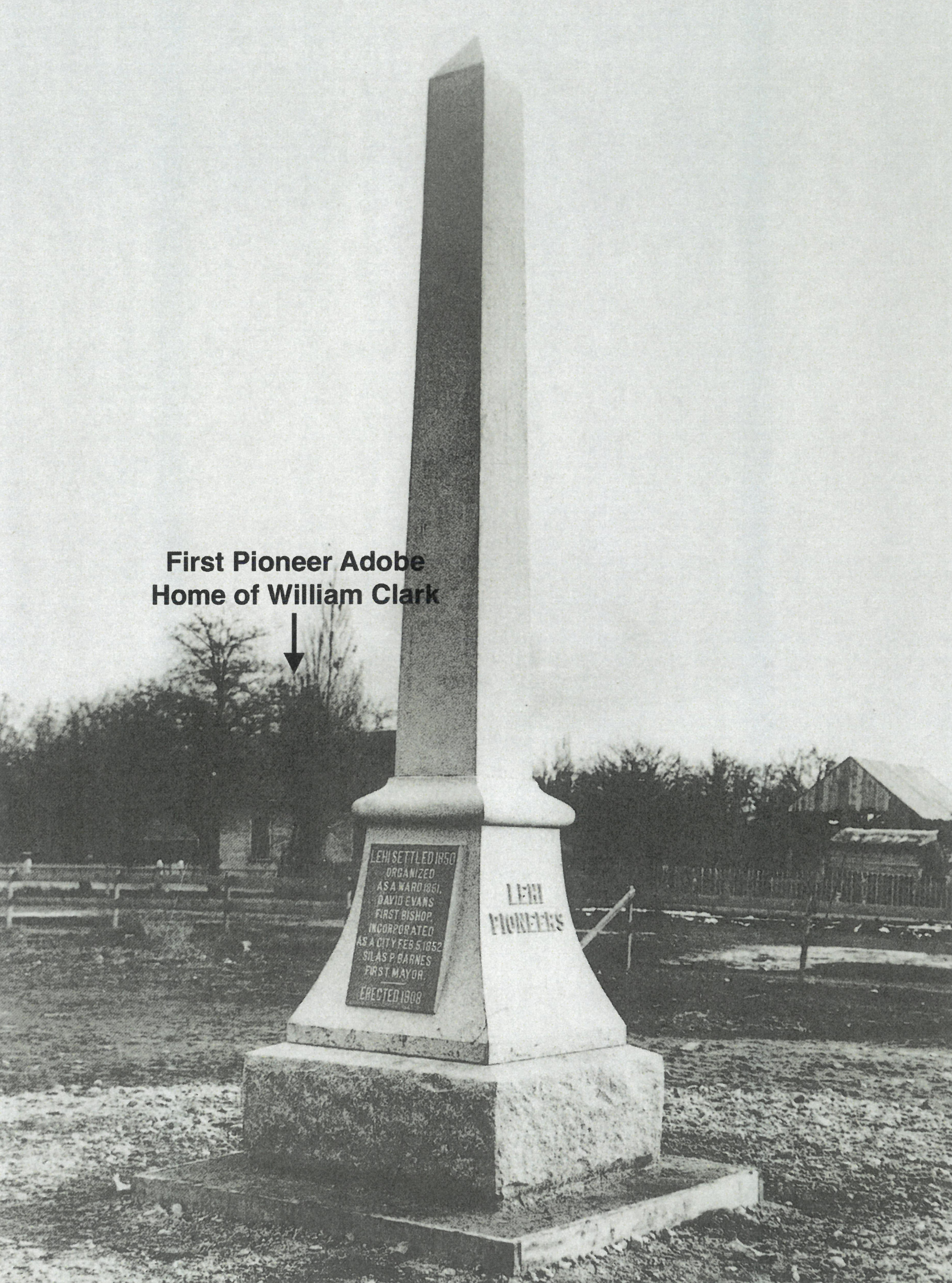
The owner of the home was my second great grandfather, English Mormon immigrant William Clark (1825–1910). He and at least 84 other heads of families in Lehi did what he did between 11 April 1856 and 30 January 1858. A little more than three years later he consecrated his little adobe house to the church.
Feramorz Young Fox provides an explanation of the “Consecration Movement” of the 1850s.2 He writes that the movement was church-wide. Hundreds of documents he calls “deeds of consecration” were generated in the Utah Territory between 1855 and 1862.3 The first public announcement of the Consecration Movement was given at general conference in April 1854, but the implementation was delayed until a proper form compliant with the laws of the Territory could be developed and printed. He writes that Brigham Young’s consecration deed4 is dated 11 April 1855, but notes the existence of an earlier deed recorded in Millard County on 1 January 1855.
Fox presents a table5 in which the numbers of deeds by county are listed, along with the population of each county between the years 1855 and 1857. The total for the fourteen counties in the table is given as 2,747. This must be the figure used by Leonard Arrington to calculate that about forty percent of the 7,000 heads of families in the Utah Territory deeded all their property to the church during the period in which the program was in effect.6 Fox gives the following numbers for Utah County: 69 (1855), 147 (1856), and 92 (1857) for a total of 922.
William Clark’s consecration deed is representative.
Be it known by these presents that I, William Clark, of Lehi City, in the county of Utah, and Territory of Utah, for and in consideration of the good will which I have for the Church of Jesus Christ of Latter Day Saints, give and convey unto Brigham Young, Trustee in Trust for said Church, his successors in office, and assigns, all my claim to and ownership of the following described property, to wit:
One lot in the City of Lehi with buildings thereon and improvements: Lot no. 6 in Block 16 containing 50/160 of an improvement.
Also Lot 9 in Block 7 of Plat B in the American Creek Survey of Farm Land containing 5 acres … $25.00
Also Lots 12 & 13 in Block 5 Containing 2 acres in the Lehi Garden Lot Survey … $20.00
Also Lot 15 in Block 10 Containing 10 acres in Plat B, American Creek Survey of Farm Land … $30.00
Also outstanding account in land … $200.00
1 yoke of oxen, 1 horse … $140.00
1 wagon, $45, 1 rifle, $10 … $55.00
2 cows @ $30.00 each, 1 two year old, $25 … $55.00
1 yearling heifer, $15, 1 hog, $17 … $32.00
Farming tools, $10. Mechanics tool, $2.50 … $12.50
Household furniture … $50.00
35 Bu. of Wheat @ $2 per Bushel … $70.00
10 Bu. of Corn @ $1.5 per Bushel … $15.00
30 Bu. of Oats @ $1 per Bushel … $30.00
30 Bu. of Potatoes @ $1 per Bushel … $30.00
Garden Vegetable $6, Hay $24 … $30.00
120 lbs of Pork at 20¢ per lb … $24.00
Total Amount of William Clark’s property … $1048.508
Together with all the rights privileges and appurtenances thereunto belonging or pertaining. I also covenant and agree that I am the lawful claimant and owner of said property and will warrant and forever defend the same unto the said Trustee in Trust, his successors in office and assigns, against the claims of our heirs and assigns, against the claims of any heirs, assigns, or any person whosoever.
[signed] William Clark his x mark
Witnesses:
Thomas Taylor
George A. Leslie
Thomas Ashton
Territory of Utah, County of Utah. I Lucius N. Scovill, Recorder of the aforesaid County, certify that the signer of the above transfer, personal known to me, appeared this 8th day of January AD 1857, and acknowledged that he of his own choice executed the foregoing transfer.
Lucius N. Scovill
Recorder of Utah Co. UT.
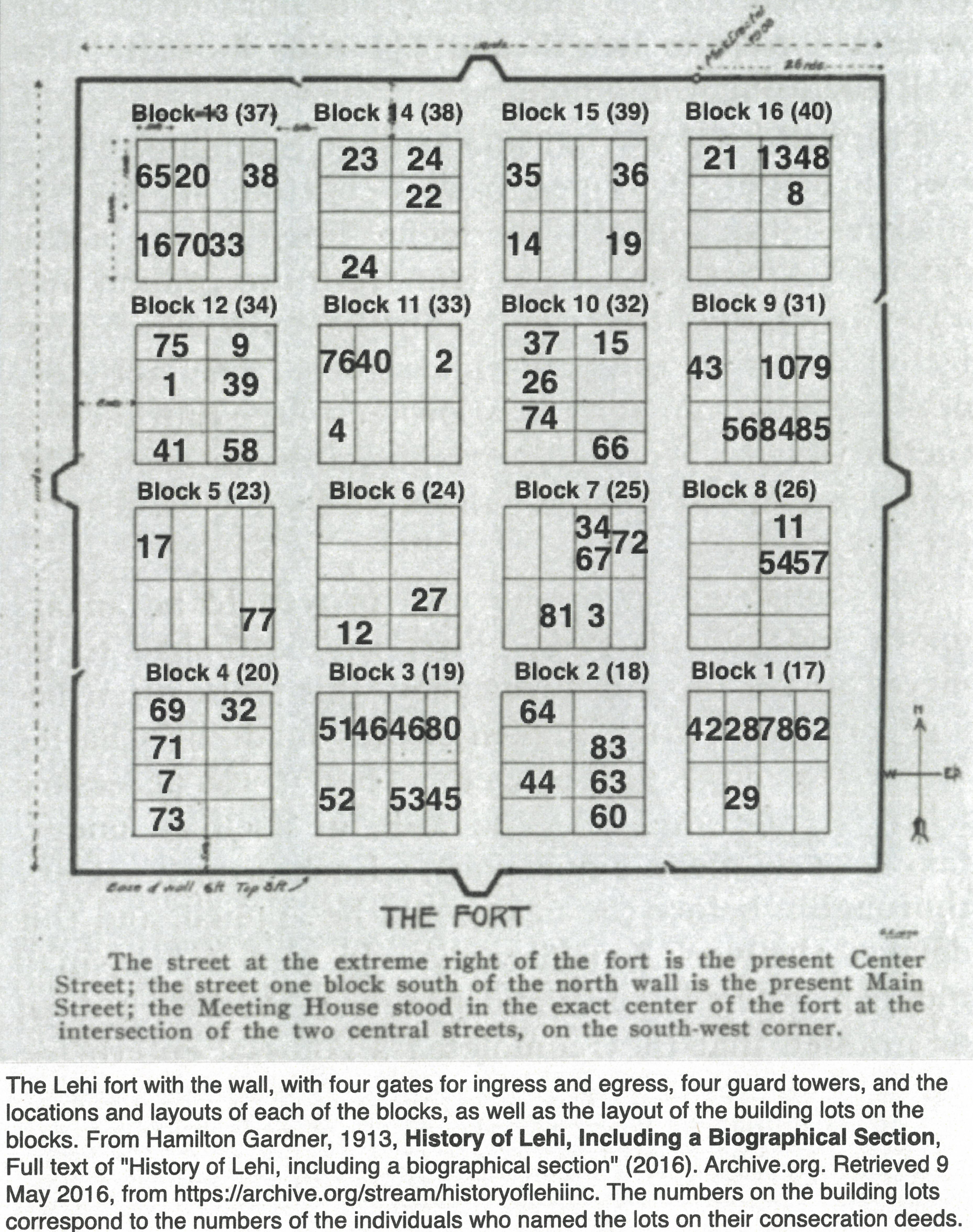
The property William Clark and his neighbors in Lehi consecrated to the church included title to land. This falls into three categories for Clark and for the others: farm land, garden plots and lots on city blocks. The farm land is defined in what the deeds refer to as the “American Creek Survey of Farm Land.” This survey has not been located.9 Likewise, the survey for the Garden Plots referred to on the consecration deeds has not been located.10 The third category of property in land recorded on the consecration deeds refers to a “Lehi Survey of Building Lots.” The survey was evidently done in 1853 by Bishop Evans, as described in the consecration deeds.
The sixteen blocks inside the fort were numbered beginning with the block on the Southeast corner as Block 1 and continuing east to west with Blocks 2 through 4, then switching to east on the second tier of blocks and so forth to Block 16 on the Northeast corner of the fort.
Although the blocks inside the fort had to be re-numbered, this numbering system is consistent with one in use today. The current system apparently dates from 1861. According to Gardner,13 on April 27, 1861, the council received a numerously signed petition asking that the city be enlarged. This unmistakable sign of growth occasioned much discussion. For one, Bishop Evans seriously objected to any such extension of the city, giving as his reason the lack of water in Dry Creek to supply any considerable addition to the population of Lehi. Finally, however, all objections were satisfactorily adjusted, and the City Council ordered that a tier of blocks be surveyed around the wall. These did not supply the unexpected demand for building lots, so a tier each on the North and South was subsequently surveyed and sold to home builders.
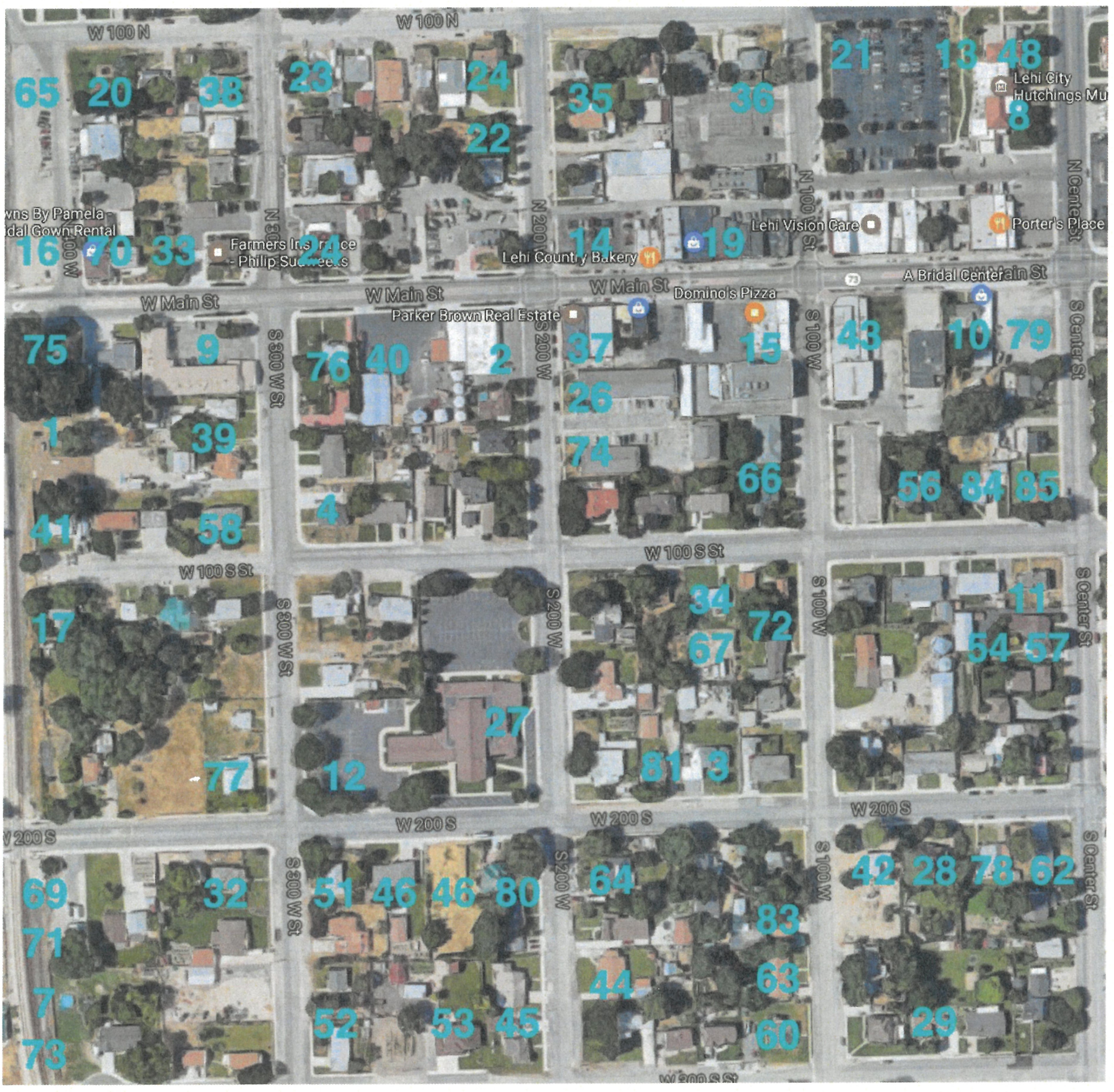
Gardner included a diagrammatic depiction of the fort, surrounded by the wall, in his history,14 with four gates for ingress and egress, four guard towers, and the locations and layouts of each of the blocks, as well as the layout of the building lots on the blocks, are depicted. The numbers of blocks 1–16 are shown, with the corresponding numbers of the same blocks in the later surveys and continuing to this date, in parentheses. The lot and block numbers are listed on 71 of the 85 1856/1858 Lehi consecration deeds.15 The building lots on the diagram as assigned to the individual settlers are identified by the following numbers. Some of the homes listed on the consecration deeds are still standing. The house nearest current addresses of these are listed. The apparent location of houses no longer standing are also given below.
The Settler Lists
Note: Seventy-two of the 85 examined consecration deeds list the block number and the lot number of property in the city. All of the blocks listed are inside the fort. A few deeds list portions of additional lots, and some list two or more complete building lots. Thirteen deeds list no city lots. Presumably those individuals did not own their own homes. Thirty-two deeds list an adobe house and one lists a “mud house.” These are valued from $150.00 to $1,100.00. Two individuals, Abram Hatch and John Riggs Murdock, specified that their adobe houses had four rooms and one cellar. Joseph Skeen listed a 6-room adobe house. Eight log houses (on 7 lots), with values ranging from $60.00 to $200.00, are listed on the deeds. Eighteen deeds list a lot number and a block number but specify only that the property was “with improvements,” without describing the type of house. Fourteen of the 85 deeds have no lot or block numbers or houses. Presumably these individuals did not own their own homes. Lehi settler’s consecrations ranged from $127.75 to $3,075.00, for a total of $93,128.70.
South, 400 West
1. Andrew Anderson (1833–1909). Lehi, Lot 4, Block 12, with adobe house, $400.00, $1,203.00 total consecration. 17 November 1856. BK C, 1855, p. 83. 37 South, 400 West
South, 200 West
2. Thomas Ashton (1813–1903). Lehi, Lot 8, Block 11, with log house, $200.00, $1,543.00 total consecration. 9 January 1857. BK F, p. 109. 36 South, 200 West
140 South, 200 West
3. Charles Barnes Jr. (1827–1911). Lehi, Lot 2, Block 7, with adobe house, $300.00, $1,008.00 total consecration. 10 January 1857. BK F, p. 129.
69 South, 300 West
4. Alfred Bell (1794–1874). Lehi, Lot 4, Block 11, with adobe house, $400.00, $1,201.00 total consecration. 10 January 1857. BK F, p. 123.
5. Jens Peter Ipsen Benson [Peter Benson] (1831–1898). Lehi, no city lot, $135.00 total consecration. 16 January 1857. BK F, p. 177.
6. Yeppa Benson [Jeppe Bendtsen] (1795–1872). Lehi, no city lot, $168.00 total consecration. 16 January 1857. BK F, p. 177.
West, 300 South
7. Samuel Briggs (1826–1898). Lehi, Lot 3, Block 4, with adobe house, $150.00, $997.00 total consecration. 10 January 1857. BK F, p. 131. 382
West Main Street
8. George Brough (1823–1914). Lehi, Lot 7, Block 16, with adobe home, $150.00, $421.00 total consecration. 16 January 1857. BK F, p. 180. 55 North Center Street
North Center Street
9. Abram Brown [Abraham Brown] (1808–1891). Lehi, Lot 9, Block 12, with adobe house, $250.00, $608.00 total consecration. 26 January 1857. BK F, p. 208. 333 West Main Street
West Main Street
10. John Brown (1820–1896). Lehi, Lot 7, Block 9, with improvements, $150.00, $3,083.00 total consecration. 8 January 1857. BK F, p. 81. 45 West Main Street
15 West, 100 South
11. Martin Bushman (1802–1870). Lehi, Lot 6, Block 8, with improvements, $300.00, $1,032.00 total consecration. 16 January 1857. BK F, p. 167.
284 West, 200 South
12. David Clark (1816–1889). Lehi, Lot 2, Block 6, with adobe house, $600.00, $1,520.00 total consecration. 5 February 1857. BK G, p. 71.
100 West, 100 North
13. William Clark (1825–1910). Lehi, Lot 6, Block 16, with adobe house, $200.00, $1,048.50 total consecration. 8 January 1857. BK F, p. 91. 45 West, 100 North
West Main Street
14. Daniel Collett (1807–1894). Lehi, Lot 4, Block 15, with improvements, $200.00, $1,313 total consecration. 10 January 1857. BK F, p. 126. 188 West Main Street
West Main Street
15. Sylvanus Collett (1835–1901). Lehi, Lot 6, Block 10, with adobe house, $150.00, $360.00 total consecration. 9 January 1857. BK F, p.
104, 115 West Main Street
16. Sarah Couzens [Sarah Jaque] (widow of Joseph Couzens [Joseph William Cousins (1809–1856)], deceased). Lehi, Lot 4, Block 13, with improvements, $150.00, $927.20 total consecration. 9 March 1857. BK H, p. 40.
206, 389 West, 100 South
17. Daniel William Cox (1801–1858). Lehi, Lot 5, Block 5, with adobe house, $450.00, $2,225.50 total consecration. 20 January 1857. BK F, p.
West Main Street
18. William Taylor Dennis (1810–1894). Lehi, no city lot, $4,115.50 total consecration. 9 January 1857. BK F, p. 111.
West Main Street
19. Joseph Dobson (1804–1872). Lehi, Lot 2, Block 15, with mud house, $200.00, $721.00 total consecration. 8 January 1857. BK F, p. 83. 130
86 North, 400 West
20. James Downs (1815–1882). Lehi, Lot 6 and W1/2 of Lot 7, Block 13, with adobe house, $250.00, $1,813.00 total consecration. 9 March 1857. BK H, p. 46.16
North, 100 West
21. Robert Dunn (1818–1885). Lehi, Lot 5, Block 16, with improvements, $250.00, $1,085 total consecration. 20 January 1857. BK F, p. 272.17 86 North, 100 West
North, 100 West
22. Shadrack Empy (1822–1892). Lehi, Lot 7, Block 14, with adobe house, $200.00, $820.00 total consecration. 10 January 1857. BK F, p. 130. 229
West, 100 North
23. Abel Evans (1812–1866). Lehi, Lot 5, Block 14, except NE Quarter of lot, with house, $150.00, $528.00 total consecration. 31 December 1856. BK F, p. 40.18 90 North, 300 West
Main Street
24. David Evans (1804–1883). Lehi, Lots 2 and 6, Block 14, $1,100.00, $3,075.00 total consecration. 10 May 1856. BK C, p. 39.19 288 West Main Street
Main Street
25. Henry Beck Evans (1830–1911). Lehi, no city lot, $180.00 total consecration. 28 January 1857. BK F, p. 284.
200 West
26. Joseph Field (1831–1911). Lehi, Lot 4, Block 10, with improvements, $200.00, $489.00 total consecration. 16 January 1857. BK F, p. 178. 49
200 West, South
27. John Folker (1814–1884). Lehi, Lot 8, Block 6, with adobe house, $200.00, $984.00 total consecration. 8 January 1857. BK F, p. 94. 166
South, 200 West
28. Jeppe George Folkmann [Jeppe Jorgen Folkman] (1824–1916).20 Lehi, Lot 6, Block 1, with improvements, $65.00, $394.00 total consecration. 28 January 1857. BK F, p. 285. 65 West, 200 South
200 West, South
29. William Fotheringham (1826–1913). Lehi, Lot 3, Block 1, with two log houses, $100.00, $1,845 total consecration. 4 November 1856. BK C, p.
73, 66 West, 300 South
30. Charles Wesley Gallup. Lehi, no city lot, $438.50 total consecration. 16 January 1857. BK F, p. 170.
31. John Henry Glines (1831–1897). Lehi, no city lot, $387.00 total consecration. 31 March 1857. BK H p. 90.
Block 6, Lot 6, 6 North
32. Abram Hatch [Abraham Chase Hatch] (1830–1911). Lehi, Lot 6, Block 4, with adobe house, $750.00, $2,891.00 total consecration. 10 January 1857. BK F, np. 132.21
100 South
33. Lorenzo Hill Hatch (1826–1910), and Sylvia S. Hatch. Lehi, Lot 2, Block 13, with buildings and improvements, $800.00, $1,608.00 total consecration. 11 April 1856. BK C 1855, p. 41.22 212 South, 300 West
125 West
34. John Joseph Hayes (1825–1899). Lehi, E1/2 Lot 7, Block 7, $100.00, $311.00 total consecration. 9 January 1857. BK F, p. 105. 125 West, 100 South
96 North, 200 West
35. William Brown Hill (1836–1883). Lehi, Lot 5, Block 15, with improvements, $150.00, $931.75 total consecration. 29 December 1856. BK F, p. 30. 96 North, 200 West
93 North, 100 West
36. William Hyde (1818–1874). Lehi, Lot 8, Block 15, $150.00, $1,040.00 total consecration. 23 December 1857. BK H, p. 106.
187 West Main Street
37. Ezekiel Hopkins (1801–1872), or his son, Ezekiel Hopkins (1839–1911). Lehi, Lot 5, Block 10, with log house, $200.00, $610.00 total consecration. 10 January 1857. BK F, p. 120.23 187 West Main Street
87 North, 300 West
38. Daniel James (1807–1880). Lehi, E1/2 Lot 7, and N1/2 Lot 8, Block 13, with adobe house, $200.00, $871.00 total consecration. 28 February 1857. BK H, p. 21. 87 North, 300 West
South, 300 West
39. Samuel James (1825–1893). Lehi, Lot 7, Block 12, with adobe house, $150.00, $490.00 total consecration. 28 January 1857. BK F, p. 278. 24
West Main Street
40. John Karren (1834–1905). Lehi, Lot 7, Block 11, with adobe house, $150.00, $441.00 total consecration. 28 January 1857. BK F, p. 181. 231
West Main Street
41. Thomas Karren (1810–1876). Lehi, Lot 2 & the E1/2 of Lot 3, in Block 12, with log house, $150.00, $1,766.00 total consecration. 8 January 1857. BK F, p. 92. 390 West, 100 South
217 South, 100 West
42. Henry Kearns (1778–1859). Lehi, Lot 5, Block 1, with improvements, $350.00, $1,049.00 total consecration. 10 January 1857. BK F, p. 128.
West Main Street
43. Suel Lamb (1833–1913). Lehi, Lot 5, Block 9, with adobe house, $150.00, $652.00 total consecration. 10 January 1857. BK F, p. 127. 95 West Main Street
261 South, 200 West
44. John Irvin Lawson [John Lawson] (1805–1884). Lehi, N1/2 Lot 3, Block 3, with improvements, $50.00, $145.00 total consecration. 10 January 1857. BK F, p. 117.
290 South, 200 West
45. Abraham Losee (1814–1887). Lehi, Lot 1, Block 3, with improvements, $150.00, $1,153.00 total consecration. 9 January 1857. BK F, p. 115.
290 South, 200 West
46. John Smiley Lott (1826–1894) and Permelia Darrow Lott (widow of Cornelius P. Lott, deceased) and Peter Lott (1805–1882). Lehi, Lot 1, Block 3, $150.00, $1,153.00 total consecration. 9 January 1857. BK F, p. 115.
[Peter] Lyman Lott (1842–1906). Lehi, Lots 6 and 7, Block 3, with improvements, $600.00, $2,226.00 total consecration. 8 January 1857. BK F, p. 100. 241 West, 200 South
47. Robert Maw (1834–1920). Lehi, no city lot, $285.00 total consecration. 19 January 1857. BK F, p. 182. PC
45 West, 100 North
48. James McGaw (1824–1872) & Elias Bassett.24 Lehi, Lot 6, Block 16, with adobe house, $400.00, $2,255.00 total consecration. 23 December 1857. BK H, p. 108.
100 North
49. Ephraim Mecham (1808–1891). Lehi, no city lot, $392.50 total consecration. 28 January 1857. BK F, p. 280.
50. John Miller (1846–1939). Lehi, no city lot, $127.75 total consecration. 28 January 1857. BK F, p. 280.
300 West
51. John Murdock (1792–1871). Lehi, Lot 5, Block 3, with house, $100.00, $295.00 total consecration. 31 December 1856. BK F, p. 38. 209 South
300 West
52. John Riggs Murdock (1826–1913). Lehi, Lot 4, Block 3, also 3/8 of Lot 3, Block 4, Lehi, with 4-room adobe house with cellar, $800.00, $5,097.00 total consecration. 9 January 1857. BK F, p. 114. 269 South, 300 West
238 West, 300 South
53. Orrice Clapp Murdock (1824–1915). Lehi, Lot 2 and 2 rods of the E side of Lot 3, Block 3, with house, $500.00, $1,665.50 total consecration. 8 January 1857. BK F, p. 95. 238 West, 300 South
South Center Street
54. Jens Nelson [Jens Nielsen] (1796–1875). Lehi, N1/2 of Lot 7, Block 8, $50.00, $306.00 total consecration. 16 January 1857. BK F, p. 171. 140
South Center Street
55. Henry Elliot Norton (1826–1913). Lehi, no city lot, $460.00 total consecration. 7 May 1856. BK C, p. 42.
74 West, 100 South
56. Peter Madsen Peel [Peder Madsen Pihl] (1820–1900). Lehi, Lot 3, Block 9, with log house, $100.00, $537.00 total consecration. 28 January 1857. BK F, p. 279. 74 West, 100 South
140 South Center Street
57. Hans Peterson [Hans Pederson] (1823–1881). Lehi, S1/2 of Lot 7, Block 8, with log house, $60.00, $537.00 total consecration. 28 January 1857. BK F, p. 286. 140 South Center Street
88 South, 300 West
58. Canute Peterson (1824–1902). Lehi, Lot 1, Block 12, with improvements, $150.00, $1,957.00 total consecration. 8 January 1857. BK F, p. 85.
59. Peter Peterson (1821–1901). Lehi, no city lot, $307.50 total consecration. 28 January 1857. BK F, p. 283.
290 South, 100 West
60. Stephen Howard Pierce (1816–Deceased). Lehi, Lot 1, Block 2, with improvements, $466.00, $761.00 total consecration. 28 January 1857. BK F, p. 275.
290 South, 100 West
61. Charles Price (1800–1873). Lehi, no city lot, $680.00 total consecration. 27 November 1856. BK C, p. 104.
South Center Street
62. Tunis Rappley (1808–1883). Lehi, Lot 8, Block 1, with adobe house, $200.00, $772.00 total consecration. 28 January 1857. BK F, p. 282. 220 South Center Street
260 South, 100 West
63. Alonzo Pearls Raymond (1821–1904). Lehi, Lot 8,25 Block 2, with adobe house, $300.00, $2,305.00 total consecration. 9 January 1857. BK F, p. 108. 260 South, 100 West
215 South, 100 West
64. William Wallace Raymond (1824–1881). Lehi, Lot 5, Block 2, with log house, $200.00, $2,020.00 total consecration. 31 March 1857. BK H, p.
88 West, 215 South
65. William Reid (1805–1858). Lehi, Lot 5, Block 13, with improvements, $23.00, $450.50 total consecration. 16 January 1857. BK F, p. 179.
86 North, 400 West
66. Alonzo Donnell Rhodes (1824–1893). Lehi, E1/2 of Lot 1, Block 10, with house, $200.00, $1,164.00 total consecration. 9 January 1857. BK F, p. 102. 90 South, 100 West
125 West, 100 South
67. Joseph Robinson (1814–1891). Lehi, W1/2 Lot 7, Block 7, with improvements, $100.00, $521.00 total consecration. 28 January 1857.26 BK F, p. 281. 125 West, 100 South
100 South
68. William Sharp ([1826]–1900). Lehi, no city lot, $235.00 total consecration. 8 January 1857. BK F, p. 86.
86 West, 125 South
69. Joseph Skeen (1816–1882). Lehi, Lot 5, Block 4, with 6-room adobe house, $1,000.00, $2,764.00 total consecration. 8 January 1857. BK F, p. 99. 377 West, 200 South
205, 390 West Main Street
70. Joseph Johnson Smith (1821–1902). Lehi, Lot 3, Block 13, with adobe house, $500.00, $1,804.00 total consecration. 20 January 1857. BK F, p.
89, 267 South, 400 West
71. Samuel Thomas Smith (1823–1890). Lehi, Lot 4, Block 4, with adobe house, $150.00, $507.50 total consecration. 8 January 1857. BK F, p.
West Main Street
72. James Taylor [James Whitehead Taylor] (1819–1891) and Ann Taylor. Lehi, Lot 8, Block 7, $700.00, $1,300.00 total consecration. no date, no month,27 1856. BK C 1855, p. 40. 110 South, 100 West
382 West, 300 South
73. Thomas Taylor (1826–1900). Lehi, Lot 2, Block 2, with adobe house, $300.00, $932.00 total consecration. 9 January 1857. BK F, p. 106–107.
65 South, 100 West
74. William Taylor [William Whitehead Taylor] (1828–1907). Lehi, Lot 3, Block 10, adobe house, $200.00, total consecration $625.00. [no date]. BK C 1855, p. 81. April 1856. 65 South, 100 West
186 South, 300 West
75. Daniel Stillwell Thomas (1803–1878). Lehi, Lot 5, Block 12, with adobe house, $300.00, $842.50 total consecration. 26 February 1857. BK G, p. 204. 405 West Main Street
West Main Street
76. Preston Thomas (1814–1877). Lehi, Lot 5, Block 11, with log houses, $200.00, $2,207.00 total consecration. 8 January 1857. BK F, p. 97. 281 West Main Street
186 South, 300 West
77. John Titcomb (1800–1858). Lehi, Lot 1, Block 5, with adobe house, $300.00, $1,150.00 total consecration. 10 January 1857. BK F, p. 122.
37 West, 200 South
78. William Van Dyke (1830–1901). Lehi, Lot 7, Block 1, with adobe house, $200.00, $523.75 total consecration. 30 January 1858. Not found in Utah County book.28
11 West, 200 South
79. Andrew Vince [Moses Andrews Vince] (1809–1859). Lehi, Lot 8, Block 8, $450.00 total consecration. 8 January 1857. BK F, p. 88. 11 West Main Street
216 South, 200 West
80. William Sidney Smith Willes (1819–1871). Lehi, Lot 8, Block 3, with improvements, $700.00, $2,020.00 total consecration. 9 January 1857. BK F, p. 112–113.
168 West, 200 South
81. Thomas Griffin Winn (1829–1904). Lehi, Lot 3, Block 7, with adobe house, $200.00, $666.50 total consecration. 7 January 1857. BK F, p.
80 West, 168 South
82. William Henry Winn (1833–1884). Lehi, no lot or block, $148.00 total consecration. 9 April 1857. BK H, p. 84.
240 South, 100 West
83. Solomon Wixom (1809–1879).29 Lehi, Lot 7 and N1/2 of Lot 8, Block 2, with adobe house, $400.00, $1,308.50 total consecration. 28 January 1857. BK H, p.
36 West, 100 South
84. Georg Gottlieb Zimmermann (1781–1866). Lehi, Lot 2, Block 9, with improvements, $125.00, $443.00 total consecration. 16 January 1857. BK F, p. 169.
88 South, Center Street
85. John Zimmerman (1820–1908). Lehi, Lot 1, Block 9, $125.00, $1,873.00 total consecration. 16 January 1857. BK F, p. 176.
Fort Cabin Occupants
The cabins were arranged end-to-end to form a hollow square in the first of two phases of the fort. Van Wagoner says nearly three hundred settlers occupied sixty cabins, but he names only fifty-three individuals31 on the list corresponding to the numbers (1–85) of the diagram.
| East Side (7) | North Side (12) | West Side (18) | South Side (16) |
|---|---|---|---|
| William Goates | 2. Thomas Ashton | John Andreason | Orrace Murdock |
| 81. George Zimmerman | 4. Alfred Bell | 17. Daniel Cox | 51. John R. Murdock Sen. |
| John Zimmerman | 22. Abel Evans | Samuel James | 50. John Murdock |
| John Spires | 23. David Evans | 38. Samuel James | 31. Abram Hatch |
| 61. Tunis Rappley | 14. William Dobson | 75. Luke Titcomb | 45. Mrs. Pamelia Lott |
| Martin Bushman | Philip Olmstead | Charles Partridge | 45. John S. Lott |
| John Brown | Prime Coleman | 7. Samuel Briggs | Ira J. Willes |
| William Coleman | William Goates | 77. W. S. S. Willes | |
| George Coleman | 70. Samuel T. Smith | 44. Abraham Losee | |
| William Burgess | 12. David Clark | Mrs. Lydia Losee | |
| Jehial McConnell | 57. Canute Peterson | 68. Joseph Skeens | |
| Joel W. White | 9. Abraham Brown | 40. Thomas Skeens | |
| Israel Evans | John Mercer | Alonzo D. Rhodes | |
| David Evans | 69. Joseph J. Smith | Thomas Karren | |
| Riley Judd | 84. Daniel S. Thomas | John Winn | |
| David Judd | Samuel Harwood | Silas P. Barnes | |
| John W. Norton | Daniel Cox | 61. Tunis Rappley | |
| Henry Norton | Oley Ellingson | ||
| J. Wiley Norton | |||
| David Norton |
Closing Notes
Some of the settlers remained in Lehi after their 1856/1857 consecrations were accepted and recorded. The locations of the homes of several of them in later years have been located in other studies.32 Some moved from Lehi. Some moved from the fort in Lehi to other property in Lehi. For example, William Clark moved from the Lot 6 property on Block 16(40) to a home on Lot 4 of the same block some time before he received title to both lots in 1871.
Some of the names absent from the cabins list are absent from the consecration deeds. This could reflect the fact that the individuals left Lehi before the consecration movement began, or that the individuals did not consecrate their property, or that their consecration deeds have not yet been located.
Sixty-eight of the 128 building lots on the sixteen blocks in the fort are represented on the consecration deeds. If 40% of the men in the Lehi settlement consecrated their property, as Arrington says was the estimated percentage of the participation of the men in the Territory, 51 lots should have been claimed on the deeds. It appears that participation in the consecration movement was higher in Lehi than in other parts of the Territory.
Notes
1 This, and similar documents by Wayne E. Clark, are posted at the Lehi Historical Society and Historical Archive Indexes, https://www.lehihistory.com. Thanks to John Knollin Haws Jr. and the other volunteers at the Lehi Historical Society and Archives for encouragement and support, and to Dan Olds for heartily pushing for the search for consecration deeds and for other important historical information. Corrections or additions welcome. wayneeldenclark@gmail.com.
2 Fox, Feramorz Y. (March 1944). The Consecration Movement of the Middle ‘Fifties,’ Improvement Era, 47 (2) February, March 1944: 80–81, 120–21, 124–25, 146–47, 185, 187–88.
3 He wrote that the recorded deeds were to have been sent to the office of the Trustee-in-Trust of the church in Great Salt Lake City. These must include the deeds now preserved in the LDS Church History Library, in Salt Lake City. Consecration Deeds, 1854–1867. One book, Consecration book, circa 1857–1858, Call Number CR 5 53, Identifier CR 5 53/b0001. No. 233, has a list of deeds from throughout the Territory. The original deeds on the printed forms of many are accessible from CR 5 53: Consecration Deeds 1854–1867. For example, the original consecration deed of John Brown is accessed from Deeds, B, #271–288. Fox mentions the existence of two deeds in possession of a man who found them in a rubbish pile.
4 Found in “Book A of Deeds” in the church historians office, and in “Pioneer Records, Salt Lake County Recorder’s Office, p. 249.”
5 p. 120
6 Leonard J. Arrington, Great Basin Kingdom: An Economic History of the Latter-day Saints, 1830–1900, p. 146–147. See also James Naylor Jones, The Utah Valley Home, https://familysearch.org/photos/artifacts/987726. Accessed 15 February, 2017, and Willing Hands: A Biography of Lorenzo Hill Hatch (1826–1910), http://www.b13family.com/html/journal-lorenzo_hatch.htm. Accessed 15 February, 2017.
7 Fox notes that this is an exact count, taken from records in office of the county recorder. He must have seen the copies of the deeds preserved in LDS Conveyance books in the Utah County Office of Land Records, 100 East Center Street, Suite 1300, Provo, Utah 84606. The contents of the books are indexed for electronic searching. Consecration deeds of early Lehi settlers are found in books labelled LDS Church Conveyances, BK C, BK F, and BK H.
8 His consecration was twenty cents below the average, $1,048.70.
9 Ownership and numbers of Lots and Blocks and acreage on various surveys throughout the county are contained in Webb Access to Utah County Land Records – Abstract Images — LDS Church Conveyance. Included are “American Creek Survey 1851,” “American Creek Survey of Farm Land,” 1853–1855, “Upper Dry Creek Survey of Farming Land,” 1853, and “Lake Farm Land.”
10 Presumably the garden plots in 1855/1856 were the same as the ones on later records. The earliest entry in the Utah County abstract book for garden plots for Lehi is for 1 December 1879.
11 Hamilton Gardner, 1913, History of Lehi, Including a Biographical Section, https://archive.org/stream/historyoflehiinc
12 Lehi: Portraits of a Utah Town, https://dcms.lds.org/delivery/DeliveryManagerServlet?dps_pid=IE1023732&from=fnd, accessed 17 November 2016.
13 Hamilton Gardner, 1913, History of Lehi, Including a Biographical Section, p. 158–159.
14 Hamilton Gardner, 1913, History of Lehi, Including a Biographical Section, https://archive.org/stream/historyoflehiinc.
15 Webb Access to Utah County Land Records – Abstract Images — LDS Church Conveyances BK C, BK F, and BK H.
16 Original in LDS Church History Library, CR 5 53, box 2, fd. 16
17 Original in CR 5 53, box 2, fd. 16
18 Original in LDS Church History Library, CR 5 53, box 3, fd. 1
19 Immediately follows the deed of David Evans, dated 10 May 1856, and of Henry C. Norton, dated 7 May [1856].
20 A brother, Jens Peter Folkman (1829–1911), has a son born in Lehi in 1858.
21 Original in LDS Church History Library CR 5 53 box 3, fd. 3
22 Original in LDS Church History Library, CR 5 53, box 3, fd. 3. See also Willing Hands: A Biography of Lorenzo Hill Hatch, 1826–1910, http://www.b13family.com/html/journal-lorenzo_hatch.htm
23 Original in LDS Church History Library, CR 5 53, box 3, fd. 3
24 James McGaw, age 34, was in Ogden, Utah, in the 1860 Census. His wife, Mary Matilda Bassett (1800–1878), age 56, was with him, as was Mary’s mother, Matilda Salter Bassett (1800–1878), age 56, (1837–1906), age 23, and Elias Bassett, age 40. Elias must have been James’s brother in law.
25 This may be listed in error for Lot 6. Lot 8 of Block 2 is also recorded as having been claimed by Solomon Wixom on 28 January 1857. Alternatively Raymond and Wixom could each have occupied 1/2 of Lot 6 in 1857.
26 Immediately follows the deed of David Evans, dated 10 May 1856, and precedes the deeds of Lorenzo Hill Hatch, dated 11 April 1856, and of Henry C. Norton, dated 7 May [1856].
27 See Mormon Pioneer Overland Travel, Joseph Robinson, https://history.lds.org/overlandtravel/pioneers/17621923085049108012/joseph-robinson. Accessed 1 March 2017.
28 See Biography of Joseph Morgan Wixom, https://familysearch.org/photos/artifacts/999379. Accessed 1 March 2017.
29 This figure includes $1000.00 listed by John Brown for his wife’s slave girl. See Consecration, Reformation, and “One African Servant Girl” in Lehi, Utah, https://drive.google.com/file/d/0B5wDxipAGQN2a0libjFK1d2VEME0/view?usp=sharing
31 Lehi: Portraits of a Utah Town, https://dcms.lds.org/delivery/DeliveryManagerServlet?dps_pid=IE1023732&from=fnd, accessed 17 November 2016, p. 4–5, citing Andrew Field, “Notes.” Courtesy Leona Noyes, Lehi Library/Archives. Tunis Rappley is listed on both the East and South sides of the fort.
32 A subsequent study of the consecration deeds combined with the 1860 Census and other sources of information resulted in a more complete picture of the Lehi City fort in the years following the issuance of the deeds. Mormon Pioneers in Lehi, Utah Territory, 1854–1871, https://drive.google.com/file/d/0B5wDxipAGQN2YzRBczAxMjlhsVFU/view?usp=sharing
33 The Old Fort Wall, a Herd of Cows, and a Near and Dear Neighbor in Lehi, Utah, https://drive.google.com/file/d/0B5wDxipAGQN2a0libjFK1d2VEME0/view?usp=sharing
~
For more on William Sharp and his descendants, and on the Plain City families whose Lehi roots are documented in Clark’s consecration list, see:
Sharp-Bailey Wedding — William and Mary Ann’s story
Sharp-Stoker Wedding — Milo Riley Sharp and his family
History of Plain City — a multi-part series on Plain City’s founding families and history
1895 Plain City Student Body — the children of Plain City’s founding generation, including Delwin Sharp and the Skeen, Maw, and Folkman families
Sharp Family History Outreach — the broader Sharp family history and connections
Wayne E. Clark, Lehi, Utah, 2017. Part of the Wayne E. Clark Collection at the Lehi Historical Society and Archives, https://www.lehihistory.com. Contact: wayneeldenclark@gmail.com. Corrections or additions welcome.