History of Plain City Pt 9

I have two copies of the History of Plain City, Utah. The front indicates it is from March 17th 1859 to present. As far as I can tell, the book was written in 1977. At least that is the latest date I can find in the book.

One copy belonged to my Grandparents Milo and Gladys Ross. My Grandpa has written various notes inside the history which I intend to include in parenthesis whenever they appear. They add to the history and come from his own experience and hearing. 

I will only do a number of pages at a time. I will also try to include scanned copies of the photos in the books. These are just scanned copies of these books, I have not tried to seek out originals or better copies.

History of Plain City March 17th 1859 to present, pages 141 through 149.

BONA VISTA IMPROVEMENT DISTRICT

SUBMITTED BY FLOYD PALMER

              This most important new culinary water system has made life a little more pleasant in this community and surrounding areas. It was turned into the lines just a century after sturdy pioneer families first put together temporary shelters and tapped several sweet water springs which they found in the area.

              It replaces old flowing wells, bringing precious waster from the depths of the earth. In early days many deep and surface wells dug, covered over, and fenced off to keep children from falling in. They were first fitted with “pitcher” pumps, a short-handled affair which were the “pumper” out in a short time. Even the farm animals had to depend on well water pumped to the surface by hand.

              Later, the easier to work, long-handled pumps were installed. These were followed by power pumps connected to a small storage tank. This was the ultimate in a private water supply.

              In 1955, a Weber County man, Linn C. Baker, was a member of the State legislature. He is the one who sponsored the bill to create special improvement districts. The reason he was the sponsor of this bill was due to his work in the Health Department for the State of Utah. As he studied samples of water sent to him from the outlying towns, he became aware of the amount of contamination there was in the drinking water in certain areas, Plain City was among the highest on the list. This was traceable to shallow surface wells being used, also septic tanks with poor drainage.

              Soon after the Weber Basin Conservancy District was organized, Plain City wanted to purchase one-thousand-acre feet of water. Their request was held in abeyance until a line could be built from Ogden Canyon. This, however, was never done.

              Elmer Carver was on the executive committee of Weber Basin Project. Through the encouragement of Commissioner Carver, Mr. Ezra Fjeldsted, manager of Weber basin Project, and Linn Baker, all met with the Plain City Town Board to get something started. Floyd A. Palmer, a member of the Town Board, was asked to represent Plain City on a committee of surrounding towns in Weber and Davis counties. Mr. Ezra Fjeldsted acted as chairman of this group and several meetings were held in both counties which Mr. Palmer attended.

              Following this, a public meeting was held in Plain city. Farr West, and Harrisville were asked to join in. This was for the purpose of starting a culinary water system. The results of this meeting, from all groups attending, were to go ahead, also to contact other nearby towns and get their feelings about joining in.

              A series of meetings were held in Farr West, Harrisville, Slaterville, Marriott, Wilson Lane, and Plain City. Other towns were invited to attend. Ezra Fjeldsted represented Weber Basin, Floyd A. Palmer represented Plain City, Dick Groberg represented Farr West, Kenneth Brown represented Harrisville, Clifford Blair represented Marriott and Slaterville, and Arthur W. Sorensen represented Wilson Lane. The meetings were all met with a great deal of enthusiasm and interest.

              Plain City Town Board consisted of Lee Olsen, President, Floyd A. Palmer, Elvin H. Maw, Merrill Jenkins, Blair Simpson, as members. A culinary water system was a prime item of the agenda in 1956. The town board along with several local residents were well organized to promote the need for a water supply to replace the surface wells and pumps.

              On July 19, 1956, Elmer Carver, Chairman of the Board of County Commissioners of Weber County, State of Utah, signed a certified documents that there be and is hereby created within Weber County, Utah, a Water Improvement District to be known and designated as the BONA VISTA WATER IMPROVEMENT DISTRICT, the same to embrace and include all real property lying within the following boundaries, to-wit: (SETS FORTH DETAILED LEGAL DESCRIPTION OF DISTRICT BOUNDARIES WHICH BOUNDARIES EMBRACE LANDS HEREIN ABSTRACTED – Abstracter)

              That the following-named persons are appointed as the Board of Trustees of said Bon Vista Water Improvement District:

                               Floyd A. Palmer, Plain City

                               Richard Groberg, Farr West

                               Kenneth Brown, Harrisville

                               Clifford Blair, Marriott-Slaterville

                               Arthur Sorensen, Wilson Lane

              This resolution shall take effect immediately and shall be recorded in the office of the Weber County Clerk. Recorded August 22, 1956.

Following this appointment from the Weber County Commission, the board held a short meeting. It was necessary to elect a chairman, after a discussion of each of the board members. Kenneth Brown was appointed as chairman.

              The first order of business was to secure professional and legal help. Mr. Jack Richards was appointed attorney. Jack Reeves, of the firm of Nelson, Reeves and Maxwell, was appointed engineer. They were appointed to do the field work and present the plans and drawings back to the board.

              When the plans were completed, the board spent much time deciding the most feasible and economical areas to run the lines in. Also, to give each town a fair share of the project. Following this, it was necessary to project estimated costs. The board spent many months getting costs and deciding on types and kinds of pipes and materials to use on the project. The overall plans had to look attractive and feasible in order to get a bonding company to handle the bonds.

              The first step made to secure the bond issue was to get signed pledge cards with an agreement to pay $250.00 for a waster connection. This was a requirement. Committees were organized with Floyd A. Palmer, Richard Groberg, Kenneth Brown, Clifford Blair, and Arthur Sorensen acting as chairman in each of their respective towns. The result was very successful, all those serving on these committee are deserving of much credit for their untiring effort and accomplishments.

              On August 20, 1957, a bond election was held to see if the residents would approve a $900,000.00 bond issue. The vote was 490 yes and 82 no. Edward L. Burton Company was retained as Fiscal Agent, and $698,000.00 was sold in General Obligation Bonds, and the system was under way.

              On April 14, 1958, a contract was awarded to Smith-Scott Pipe Company to furnish cement mortar-lined steel pipe for the main lines.

              Also, on April 14, 1958, a contract was awarded to Knudson Construction Company to install water mains in the Harrisville-Randall area which was Phase I of the project.

              Also, on April 14, 1958, a contract was awarded to Chicago Bridge & Iron Company to furnish and erect a 250,000.00 gallon elevated storage tank in Plain City.

              On April 28, 1958, Theron Palmer was hired as General Superintendent to oversee construction and to get it ready to serve and operated as a system.

              On May 27, 1958, an office was rented from the E. B. Stone Estate on the corner of 9th and Washington. The district still maintains its offices here. The building was purchased by the district in 1969 and has been remodeled.

              On May 27, 1958, negotiations were begun with the State Department of Welfare of obtain ownership of a spring located in Garner’s Canyon in North Ogden. The spring was used at the time by the welfare department at the Industrial School property for culinary use and irrigation use.

              On May 27, 1958, Weber Basin let a contract to Statewide Construction Company to build the 16-inch transmission line from 4000 South on U-84, down into the district where Bona Vista could connect to it.

              Also, on May 27, 1958, a piece of property located at 4100 West on 2200 North in Plain city, was purchased from Vern Palmer to construct the elevated tank.

Bona Vista Water Storage Tank

              Raymond Concrete Title Company moved in and drove concrete pilings 80 feet into the ground to support the tank.

              Gerald Larkin was then awarded a contract to construct a foundation so Chicago Bridge and iron could begin erection.

              On July 3, 1958, a contract was awarded to Bert Robinson Construction Company to build lines in the Farr West and Plain City.

              Also, on July 3, 1958, Standard Plumbing Supply Company was awarded a contract to furnish materials for service lines.

              On July 17, 1958, the Weber County Commission agreed to purchase 60 fire hydrants to go on the system to be located by the Weber County Fire Chief.

              On July 17, 1958, Smedley construction Company was awarded a bid to construct lines in the Slaterville, Marriott, and Wilson area for $44,975.00. The same day Mac Construction Company of Salt Lake City was awarded the bid to construct our North Ogden Reservoir for $16,911.00. This is a concrete underground reservoir.

              On August 11, 1958, an agreement was reached with the Welfare Department to obtain full use of the spring in North Ogden. Weber-Box Elder water was purchased to replace the Welfare Department’s share of the spring.

              On February 11, 1959, work began on the plans and site for a reservoir in the Roy area.

              On March 23, 1959, it was decided to run a line on the North Plain City Road.

              On August 27, 1959, it was decided to either buy or condemn the Hansen property for a reservoir.

              A bid to build a tank in Roy was awarded to Wehyer Construction Company for #31,403.80 on September 23, 1959.

              Negotiations began to buy an eight-foot well from the Farr West Stake for $31,403.80 on September 23, 1959.

              Linn C. Baker resigned as Secretary on January 1, 1961. He had been with the district since it began.

              On December 6, 1961, it was decided to construct extensions to existing mains in the amount of $90,000.00 General Obligation Bonds were sold to finance these extensions. Waterfall Construction Company did the job.

              All though the summer of 1961, the Farr West well was tested to see if it would hold up.

              On February 28, 1962, President Wimmer signed the Warranty Deed on the Farr West well and property. On January 16, 1963, it was decided to put heat lights on our Roy tank. This was the first such installation in this area and it drew a lot of attention.

              The Utah State Health Department studied the plans for use of the plans for use of the existing well in Farr West and decided against allowing it to be used because of its depth. A change application was then filled with the State Engineer to drill the well to a deeper depth.

              On May 10, 1963, a contract with Wesley Stoddard was made to drill a well in Farr West for $21,632.00 plus $4,700.00 for the test hole to see how deep the well would have to go.

              A meeting was held at the Farr West Pump House building on January 20, 1964. This building was contracted by the Bona Vista Water employees. The piping was also done by employees of Bona Vista.

              R. W. Coleman Company was awarded a contract for $18,877.50 to change some lines under the interstate highway on November 22, 1965.

              Negotiations began on March 28, 1966, with Weber Basin on the North Ogden Well, which was later drilled and is used in the system now.

              Water meters were deemed necessary and were bought by bid from Waterworks Equipment Company and E. C. Olsen Company on October 28, 1968.
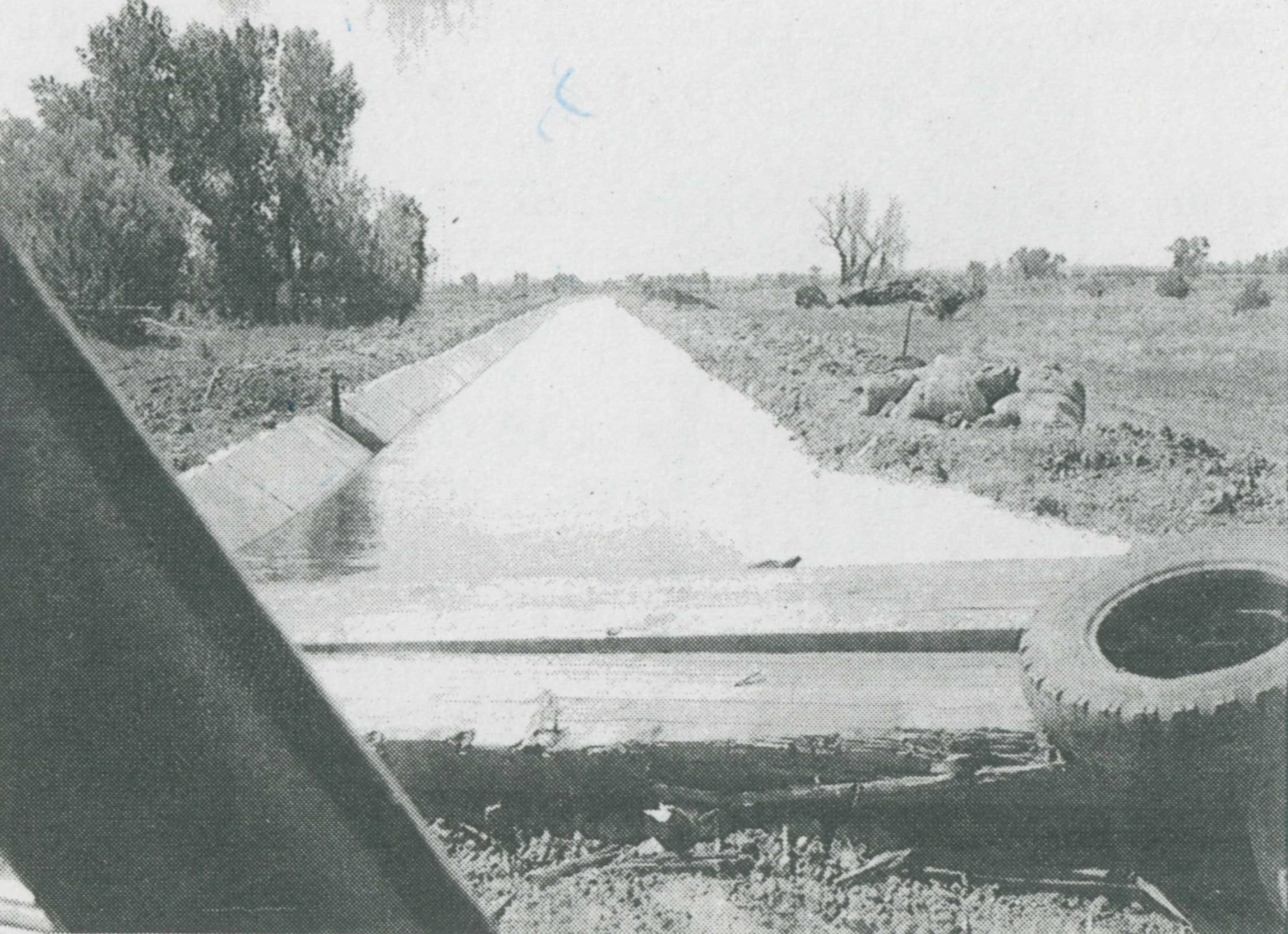
New Plain City Canal

BEGINNING OF PLAIN CITY IRRIGATION WATER

              1859 Before the summer was over some water had been brought in their new ditch from Four Mile Creek to Plain City. In 1860, the Canal was completed to Mill Creek, the following year to Broom’s Creek and in 1862 to the Ogden River. The Right of Way in Weber River was purchased in 1873 at a cost of $2000.

              In 1899 Samuel Wayment drilled an Artesian Well 249 feet deep producing additional water for the settlers. He also was in charge of the iron work and the building of the Chief Canning Factory in Plain City.

PLAIN CITY IRRIGATION-CEMENTING OF THE MAIN CANAL

SUBMITTED BY Wayne Skeen

              For many years the Plain City Irrigation Company received it’s water from the Weber River. The diversion point into the canal was just north of the old American Packing Plant that was later called the Swift Meat Packaging Plant. The Irrigation Company had a large Plank Head Gate in the Weber River that forced the water into the Plain City Irrigation Company Canal because of high waters in the spring this gate would wash out and it was necessary to make a gravel and dirt dam each year using horses, scrapers, and even large bulldozers. In recent years this became a major problem.

              The government began planning the Willard Project in 1960. This project would interfere to a certain extent with the existing canal used by the Irrigation Company because big Willard Bay Canal would be built in part of our existing canal and would also cross it in part of our existing canal and would also cross it in other areas. The leaders of this project wanted to provide a turn out from the big canal into the Plain City Irrigation Canal. The corporation of our company was necessary to give them the right to use the area affected by the construction of the Willard Bay Canal. The logical point of diversion would be west of the Farr West Church House. This meant that some new construction would be necessary to get the water into the old canal. It was in need of some repairs and it was at this time that the idea of a new cement lined canal was entertained.

              Directors who served during this period of construction were as followed:

              President                               Abram Maw                1959-60

              President                               Alvin J. Robson           1961-65

              Vice President                       Walt Christensen        1959-64

              Vice President                       Carl Taylor                  1965

                                                            Bert Hunt

                                                            Charles Heslop

                                                            Keith Blanch

                                                            Mike Panunzio

              Secretary                               Wayne Skeen              1959-65

              High lights of the minutes of the meetings during the construction period are as follow:

August 11, 1959

              Ogden City had extra water for sale this year which was allocated out to various canal companies. A motion was made by Alvin Robson that this water be purchased to see them through the current season. It would be paid by those stock holders who subscribed for the extra water.

April 4, 1960

              The meeting was called to discuss the new canal. Charles Heslop was assigned to work on interested free money from the Utah Water & Power board for the construction. Alvin Robson was assigned to work with the Soil Conservation on the completion of the surveying of the canal, and additional monies.

July 12, 1960

              A meeting was held to discuss a possible shortage of water for the remainder of the year. Time was changed from 20 shares per hour to 25 shares per hour.

January 9, 1961

              A priority was established with the Utah Water an Power board for interest free money and application made for $100,000.00

              A survey showed that there was a 10% loss of water between the River turn out and the Point of use.

March 8, 1961

              The Irrigation Company received a $10,000.00 cash settlement for their rights in the old canal from the O.U.R.D. Railroad Company that passes through their yards.

              Alvin Robson, Carl Taylor, and Walt Christensen was to secure information regarding tiling of the canal from Victor Lund’s corner up to the Jesse Singleton property where the canal leaves the road and runs back into the fields.

April 20, 1961

              A report was given by Alvin Robson regarding the tiling of the lower part of the canal. There were mixed emotions about tiling this section of the canal because of the fall and the amount of water to be delivered. “Alvin Robson commented as the discussion went on concerning the piping verses the cement lining. The stockholders are residents of this town and should have some concern towards the improvements and beautification of the community and that an open cement lined canals to greet the people entering the town is not very inviting and once it was constructed it would never be changed in our life time.”

              Keith Blanch speaking as a town board member expressed his opinion regarding the beautification and eliminating hazards in the community and felt that it was worth while and the tax payers should help with the construction of the Irrigation Company in piping this section of the canal.

              Glen Charlton and Lee Olsen from the town board were present. An opinion was asked from the town board members. Mr. Charlton felt it was a worth while project as long as it was right. Mr. Olsen commented that it was a good thing as long as it was sufficient to meet the needs of the water users.

              The town board members agreed to cover the pipe that was laid with dirt. It was agreed that 2880 feet of 36 inch tile would be laid this spring from the old beet dump corner to Victor Lund’s corner.

April 27, 1961

              The Town board members present: Dee Cook, Glen Charlton, Kent Jenkins, and Lee Olsen. Mr. Covey from Utah State University was also present.

              Further discussion concerning cost of construction of the concrete pipe continued. Keith Blanch made a motion that the town board and property owners should join with the Irrigation Company in the cost of the 36 inch tile to be laid. Motion seconded by Carl Taylor

              Mr. Robson suggested the property owners who would benefit from the lining of the canal pay $1.25 per foot frontage towards the pipe. The Town Board said they could only participate within the city limits and they would contribute $4,000.00 over a 10 year period. The bids were to be sent to Secretary Wayne Skeen by March 30, 1961.

April 30, 1961

              The purpose of this meeting was to open bids. Utah Concrete Pipe Company received bids for 36 inch concrete pipe at $8.75 per foot. Waterfall Construction Company was awarded the laying of the pipe at $1.55 per foot.

              Abram Maw made the motion that the project not be stopped at the beet dump corner but continue up to the up to the weir east of the water tower (where the pipe portion of the canal now starts) if the property owners will contribute $1.25 per foot. Motion seconded by Keith Blanch.

              Charles Heslop ad Elvin Maw were asked to approach these property owners and get their approval to pay the $1.25 and also contact all stock holders and get their signature for government participation thru the Soil Conservation.

              Charles and Elvin were successful in getting all the names except Jesse Singleton who would not accept any government monies and would not pay the $1.25 per foot to tile in front of his property.

              Alvin Robson contracted Howard Singleton, Jesse’s boy and he agreed to pay the $1.25 but only up to the old house that sat in the field and that is where the concrete pipe starts today. Alvin Robson tried to convince the Director’s that they should at the company’s cost tile the remainder of the ditch along the road because any future expansion of the community would by hampered by open ditch reducing the width of the road. This motion turned down.

              Walter Christensen made the motion that Alvin Robson meet with the Soil Conservation to discuss details of cost and tiling and lining the canal.

April 31, 1961

              Alvin East, Maurice Skeen, and Owen Wayment from the Warren Irrigation Company met with the directors to discuss details and sign a contract for the exchange of Ogden and Weber River which would benefit both companies. The contract was signed.

              Mr. Daniel Lawrence from the Utah Water & Power Board attended the meeting. Keith Blanch made the motion that Alvin Robson and Wayne Skeen be given the power to enter into a contract with the Utah Water & Power Board for the total cost of $1,300.000.00 and formulate all details.

May 3, 1961

              Junior Taylor was appointed as Water Master of the year.

May 15, 1961

              The purpose of this meeting was to discuss the Weber Basin Project with E.J. Feldstead and commissioner Wilmer Carver. They needed additional votes to finish construction of the Willard Bay. A proposed addition would cost seventeen million dollars.

June 5, 1961

              The purpose of the meeting was to see what should be done because it appeared that there would be a water shortage before the end of the year. It was proposed that we only run off water until the stream reached a point that we could not water properly and then start to use our shortage water and put turns on 1/3 basis.

September 27, 1961

              The new project was discussed and it was recommended that the company hire an engineer and begin construction on the upper end of the new canal.

              There were many problems that came out of the construction of this canal. It would be necessary to get some dirt to construct the pad for the canal. The company purchased some ground at the upper end of the canal from Max Stander. Then got the dirt that was necessary to build the upper end of the canal and then leveled the ground and gave it back to Mr. Stander. They also purchased additional dirt from Robert Penman. This dirt was trucked from his property just south of the Weber River and west of the main road. The dirt was hauled by farmers using their beet trucks, etc.. The new pad was made in the old canal banks where possible, but there was some trading of land etc. to straighten out the canal. There was also a problem in getting someone to dig out the canal to the size and shape required to allow 50 seconds feet of water at one time. The company asked for bids, but they only received one because the equipment needed to shape the canal was not available. In order to get the project moving Alvin Robson caught a bus on Ogden and went to the Fuller Forms Company in Arizona to see if they had some type of equipment that could be used. He purchased a right to one of their slip forms that could be used in forming and pouring the concrete. He returned to Ogden and worked with the Ogden Iron Works on 23rd Street and Grant Avenue where the construction of the slip forms took place. The next problem was to begin the construction of the project. Dean Hadley of Taylor was hired to do most of the big equipment work. Local farmers also helped with their equipment. The Soil Conservation furnished the engineering on the project. Herbert Issackson of Pleasant View was the surveyor. One of the major problems that existed and is still a yearly discussion is the amount of water delivered from the existing head gates. The government required that curtained head gates must be varied in size for them to participate financially.

Oct 1962

              There was much contention and personal feelings during the construction of how it should be done. Some people left the jobs and never came back, but the project was finally finished. The construction created problems for some but most of the inconveniences were ratified by the Irrigation Company. New bridges were built, land was leveled, damages to property was crops were paid for during the construction. The Company paid for fencing materials with the property owners installing the fences. Cattle that used to walk across the stream would fall into the new lined canal and couldn’t get out. The Company paid for some of the cattle that were lost before the agreement to install fencing was made.
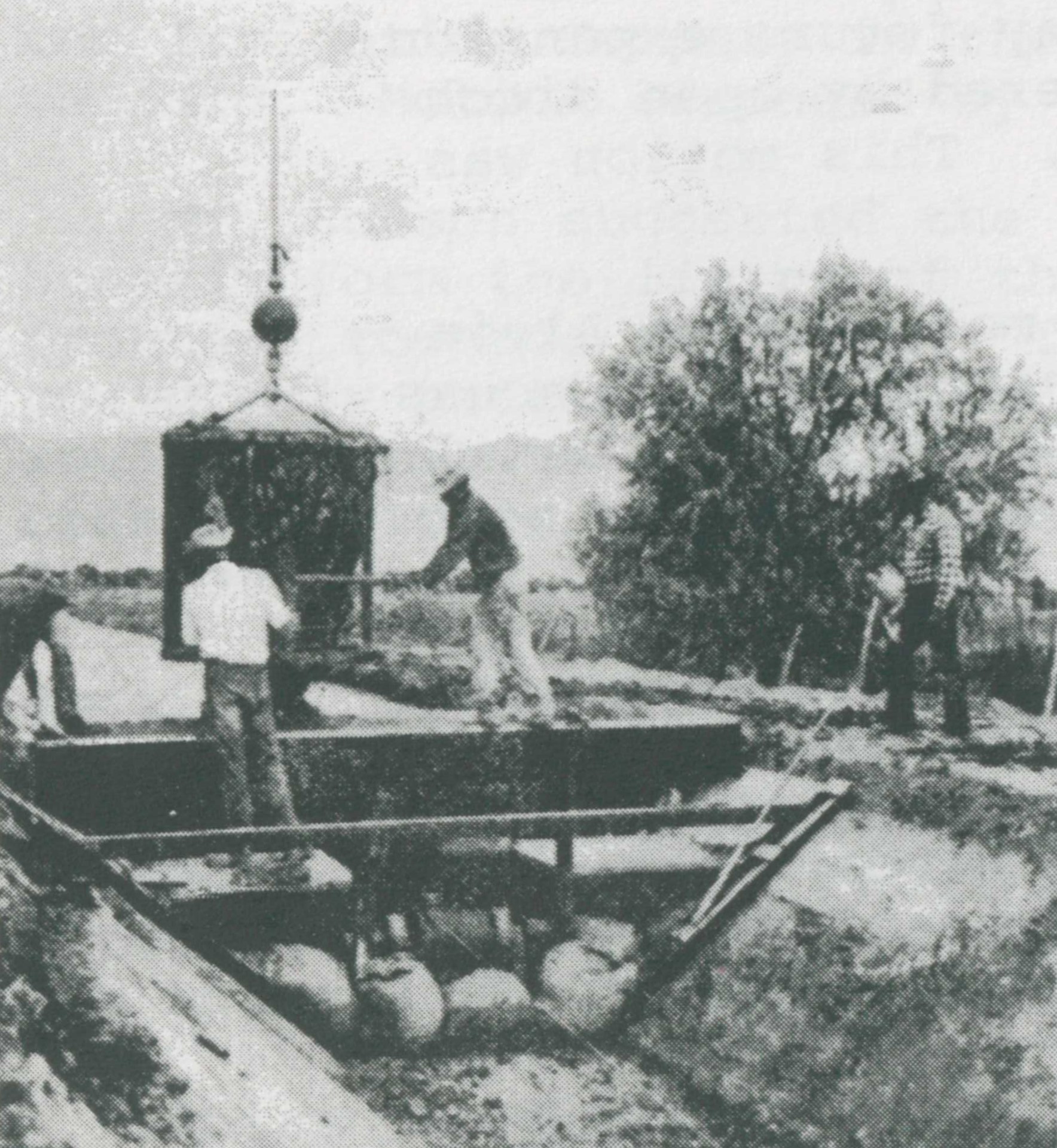
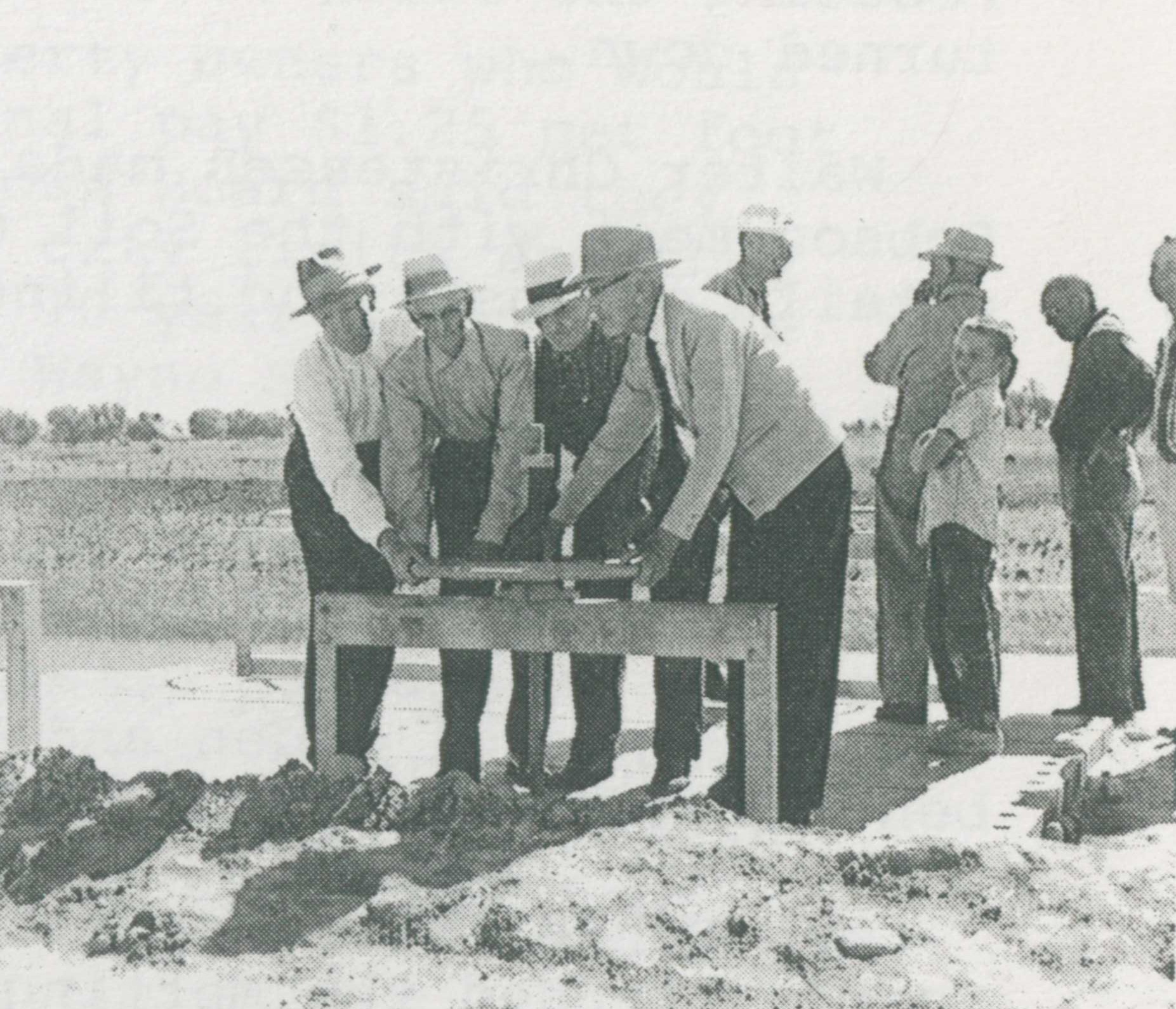
              The total cost of the project was $199,754.08. The amount of $122,918.61 was borrowed from Utah Water & Power Board. This money was interest free if a yearly payment was made by November 30th each year. The last payment of $8.257.06 will be paid on November 30, 1977. Other cost not being paid by the stockholders come from the Soil Conservation and the sale of pieces of the old canal, and the town board. Vice President Bill Hatch of the First Security bank was also an asset in the financing of the canal.

              We borrowed monies from the First Security Bank as construction went on to pay for cost on a daily basis. On December 31, 1974, the company owed the First Security bank $60,000.00 Alvin Robson and Wayne Skeen met with Mr. Hatch in May regarding this bill. Mr. Hatch said that the bank needed some type of security for this loan. There was nothing to give him because out rights to the canal had been given to the Utah Water and Power Board. Alvin Robson and Wayne Skeen then approached Mr. Lawrence of the Utah Water and Power Board asking them for more money for the project explaining the situation with the bank. Alvin Robson explained that they might just as well take over the ownership of the canal because the bill had to be paid. There was nothing to offer as security because the Utah Water and Power board had everything that the company owned. Later, Mr. Lawrence of the Utah Water and Power Board gave the Irrigation Company an additional $30,000 which helped to delete that note at the First Security Bank.

*********
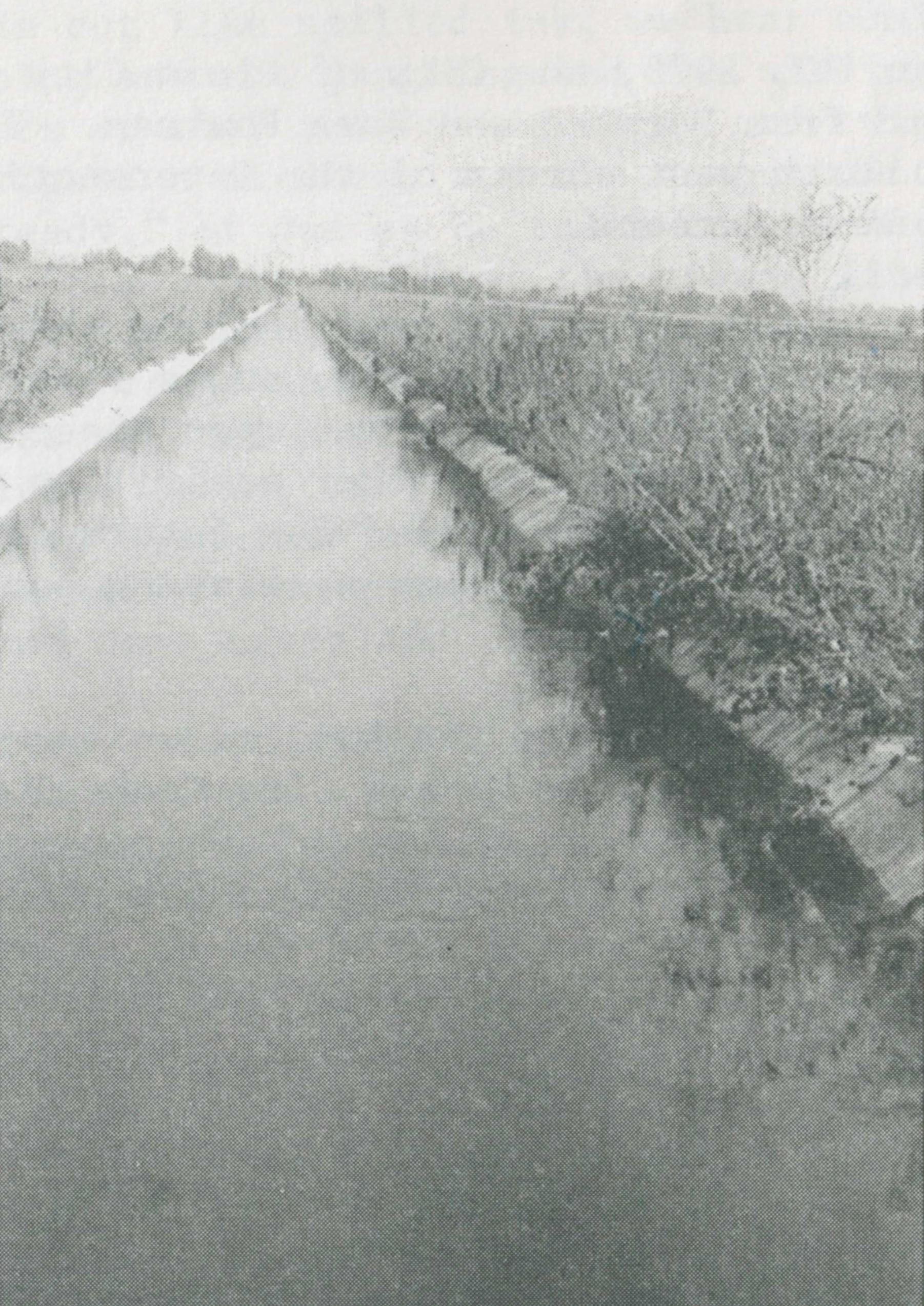
Canal after completion

History of Plain City Pt 4

I have two copies of the History of Plain City, Utah. The front indicates it is from March 17th 1859 to present. As far as I can tell, the book was written in 1977. At least that is the latest date I can find in the book.

One copy belonged to my Grandparents Milo and Gladys Ross. My Grandpa has written various notes inside the history which I intend to include in parenthesis whenever they appear. They add to the history and come from his own experience and hearing.

I will only do a number of pages at a time. I will also try to include scanned copies of the photos in the books. These are just scanned copies of these books, I have not tried to seek out originals or better copies.

History of Plain City March 17th 1859 to present, pages 44 through 57.

THE LIFE STORY OF MARY ANN CARVER GEDDES

SUBMITTED BY HER GRANDDAUGHTER

SELMA GEDDES SUMMERS

“SAND IN HER SHOES”

            This is a task I have always wanted to do yet now I sit down to write the facts of my Grandmother’s life, I feel quite inadequate to do justice to her story.

            There are some things about her life that even she has forgotten. There are other things I am sure she would ask me not to write just now. There are many things that should be written but that are difficult to put into this account. I will do then the best I can from my memory of her stories and from accounts written by others who have seen fit to write of her life.

            “It’s a good world, but it takes a lot of grit to get along in it. Sometimes you just have to put a little sand in your shoes.”

            Have you ever had Aunt Min tell you this? Then you are one of the lucky ones, for that means you are one of the lucky ones whose paths has crossed the path of a woman whose influenced must have made you a little better.

            Perhaps you were fortunate enough to spend some time in her friendly old kitchen. Were you tired when you came, or blue, or a little discouraged? Even the sight of the old adobe house with its trim neat lawns and bright flowers must have mad you feel a little better and when her white head appeared (it’s been white so long) and both hands were stretched out to greet you, whatever burden you were bearing must have felt a little lighter. And while you were rested or unburdened yourself, Aunt Min bustled about and soon you found yourself sitting at a table loaded down with large pink slices of the most delicious ham you ever tested, tiny new potatoes cooked in milk with sprinkles of parsley and crusty slices of bread fresh from the oven and juicy thick wedges of black currant pie. One’s troubles are never as bad when the stomach is full she often said. And then she listened if you wanted to talk or she told you of experiences that were similar to yours that would help solve your own problems, then she told you of God and you left with a loaf of warm bread under the other, knowing that truly you been helped by a good woman.

            And when you had gone, more than likely, she out her old blue sun bonnet on her white head, tied a bucket round her waist and went out into the hot sun to pick more currants and strawberries or apples, so that the next time you came she would be ready for you.

            This remarkable woman was born on October 2, 1857, in Kaysville, Davis County, a daughter of John and Mary Ann Eames Carver. Her parents were deeply religious who left England and came to America because of love of the Church of Jesus Christ of Latter-day Saints.

            Her only recollection of her Kaysville home was her nightly prayer when she asked God to bless “the Weavers, the Carvers, and stubby legged Jones.”

            When she was two years old, the family moved to Plain City. Here they lived in a dirt cellar furnished with furniture made by the father’s own hands—table, beds and even a little chair for little Minnie. The cupboards were a ledge dug in the dirt wall. At the side of a four-poster bed made of posts set upright and rawhide strips crosswise to support the tick was Minnies bed. Two poles placed horizontally one end resting on edge of Mother’s bed, one end driven in the dirt wall and rawhide strips on which the straw tick was placed. The blue and white calico valance was quite stylish as it hung in folds from the high posts and hid the boys’ trundle bed which was pulled out at night and hidden in the daytime.

            She loves to tell the stories of her childhood, especially those she remembers of a beloved mother who passed away far too young. She tells of how her mother reared in England by parents who were considered in those days to be financially fairly well off, had the grit and determination to make a good life for her husband and children out in the wilderness. She likes to tell how her mother sold her beautiful dresses that she had brought from England to obtain food for her children and how her mother crawled to the cabin door to milk a cow to obtain milk for her children when she had a new baby, when the father had been delayed. Yet one of the strongest recollections in her life was the suffering of her mother during frequent child birth and it was one of the things which influenced her entire life.

            Her early girlhood was spent much as all pioneer children. She helped make soap, starch, candles, she learned to spin cord and knit besides there was milking, churning, sewing, shoe making and cooking to be done. Most of the water was carried from the spring below the hill, but sometimes she would carry water from the well driven by Thomas Singleton because it made better tea than the spring water.

            With the other children she helped gather greasewood for soap because ashes from this bush had more lye content that sagebrush.

            From Aunt Rachel, her father’s second wife, she learned much of knitting and crocheting. Years later her children and many of her grandchildren’s clothes were made prettier and fancier by her spinner – it was always lumpy, but she knit her own stockings when she was ten years old. Her first crochet hook was made from the hard inner core of sagebrush, scraped with a piece of glass. Lucky too are her children and grandchildren who own one of the beautiful hand made quilts she has made.

            Along with the other children she went to school under Mr. McQuire and took turns with what few books and smooth boards to write on that were available. In the winter there were shoes to wear made from leather from hides her father took to worn, but in the summer she and her brothers ad sisters went barefoot to save the shoes.

            Her first pair of button shoes were purchased at a store owned by Jappa Folkman. It was in an adobe house that has since been destroyed. It was there too she tasted her first piece of peppermint candy which Mr. Folkman broke up and passed around for all to taste.

            Some of her earliest recollections are of the days when the railroad first came in 1869. The school children saw the smoke rising from the engine stationed at the Utah Hot Springs. They mad one bound out of school, ran across to the Hansen’s and stood upon a shed to get a better view. On the way back, Mr. McQuire waited at the door and as the children filed past each received a crack on the hand. Next day, however, school was dismissed so that all could go to the Springs and see this new wonder.

            Another exciting event was the day the smoke could be seen at Promontory where the railroads met and the golden spike driven.

            She also likes to tell how the grasshoppers came and she says, “sharpened their teeth on the fence at night to be ready in the morning”. The grasshoppers plague lasted for about seven years. She says, “We drove grasshoppers when they were little, we drove them when they were big—from morning until evening with the exception of a few hours during the middle of the day at which time hoppers would rise, circle about in the air with a humming sound much like the noise of the airplanes you now hear overhead. They were in such numbers they shadowed the sun making a shady spot on the ground below. At night the group would light on fences covering boards until it looked black with their bodies. The settlers tried to plant fruit trees and bushes, currants, gooseberries and such to replace the natural shade the hoppers destroyed but it seemed almost a losing battle. She remembers covering a lone strawberry plant almost ready to bear in the morning the grasshoppers had crawled under the pan and eaten the entire plant. Broken-hearted she went to her mother who told her not to worry, God would take care of things and sure enough He did, she says.

            When she was 12 years of age her mother died, leaving John, George, Minnie, Willard, Joseph, Parley and Nancy. Nancy passed away when she was 11 years old with inflammation of the bowels or appendicitis. Although Aunt Rachel was very good to the children it seemed that her brothers turned more and more to sister Minnie and continued to do so all the days of her life and she has lived to see them all pass to their reward.

            At 15 years of age, she began her public career as a teacher in the Sunday School. John Spires was the First Superintendent, Mr. Boothe Assistant. The Bible, Testament, 1st and 2nd Reader were the text books used. She remembers her Father going to Salt Lake to buy books. He took with him a big barrel of molasses, corn and wheat which had been donated by townspeople to be exchanged for books. She taught Sunday School from 1872 until 1879, teach Book of Mormon and Arithmetic.

            In 1875 the M.I.A. was organized in Plain City and she was among its first members. By this time she was a lovely young lady of 18 years and she had a great dramatic talent. The best entertainment of the day was the dramas enacted by the young people and in these she always had a leading part. Her eyes still sparkle when she gives small excerpts from these old plays. Another popular form of entertainment was the band concerts and the young neighbor of the Carvers, William Geddes took a leading part in these, William was a steady quiet boy who paid court to her in great seriousness. But there were other young men who took sought her hand and it wasn’t until she was almost 20 years old she decided that William was the man to whom she wanted to entrust her life. She married him in August of 1877 and went to live in Salt Lake where her husband was working as a stone cutter on the L.D.S. temple. This was a special mission and the men who received their call from President Brigham Young were required to stay there and only return home on special occasions. Her husband became an expert stone cutter. It was particular work done with a chopping knife and dust blown away until the desired shape was obtained. Some of the balls on the outside of the temple were made by William Geddes.

            It was in Salt Lake that her first baby Elizabeth was born and in a few short months died. This too was another experience that was to have a direct influence on the activities of her entire life. Because of her mother’s difficulties in child bearing and her own difficult time at Elizabeth’s birth, she was always and forever trying to find ways and means of helping at the time of birth. It became a common thing in Plain City to “run for Aunt Min when a new baby was coming to town.” How many times she helped at the coming of a new life would be impossible to estimate. It has been said that she helped at the birth of children in practically every family in Plain City.

            She was familiar to all the early doctors of Ogden and they came to rely on her to such an extent that many times before a doctor would make the long trip to Plain City from Ogden with horse and buggy, they would instruct patients to have Aunt Min come and see if the services of a doctor was necessary and then if she said it was essential, the doctor came.

            After a short time in Salt Lake, she returned to Plain City to the two room adobe house her husband had built for her and here she has spent nearly three quarters of a century. Her home was built on the spot which had once been the camping ground of an Indian tribe, but the Indians gave them very little trouble now.

            In 1879 she became Secretary of the Y.L.M.I.A. She was editor of the paper known as the “Enterprise” which was read at Conjoint meetings. After this position she became First Counselor in the same organization. In 1906 she became Superintendent of the Religion Class for one year and then became President of the Plain City Relief Society from September 5, 1907 until December 2, 1911.

            At this time the Relief Society was an organization which was primarily interested in taking care of the sick and those unable to do for themselves. Aunt Min was one of the first women to see in this organization an opportunity for women to, as she said “improve their minds and further their education that they could become better wives and mothers”, and she was one of those who were instrumental in planning and beginning classwork in Relief Society.

            In 1911, she was released from the Presidency of the Relief Society that she might spend more time with her ailing father.

            In February 1912, she became an aid in the Stake Board of the North Weber Stake which position she held for 12 years.

            In 1882 her husband was called to fulfill a mission for the church in Scotland. She was happy that he had this opportunity to serve the church and she took care of their home and little family while he was gone in cheerfulness and love. He returned in 1884.

            If there were hardship in her married life or moments of discouragement, never have you heard her speak of them. Nothing but words of deep devotion, love and respect for every member of the entire family have ever passed her lips.

            Fiercely loyal she has been to every one who bears the Geddes name, yet her own family would be the first to tell you that if they needed correction or chastisement they need look no further than home to receive it, for she has been one to council and advice, instruct and scold if need be, every member of her family even down to the third generation. Wise has been her council and direction. Never has she discussed the problems or imperfections of any member of her family with any other member.

            She has had an almost Christ-life virtue of seeing some good in the worst of us. Intensely religious herself, she was always tolerant when she sought to understand the other fellows point of view.

            After the death of her husband in 1891 leaving her five children and another little soul on the way, her need for the grit and determination she was born with was greater than ever, for it was not easy for a woman to make a living for a family in those early days.

            She did much hard work and early trained her children that it was by the sweat of the brow that there was bread to be eaten. More and more she turned to the kind of work for which she was a natural and it became a common sight on the dusty roads of Plain City to see Aunt Min—in summer a blue sun bonnet on her head, in winter a knitted shawl around her shoulders—tramping from one end of town to the other, tending the sick, the dying, and the new born. Usually under one arm was a loaf of fresh bread, in her hand a pot of warm gruel, in her apron —– from a hot water bottle to a bottle of Castro Oil. Down the middle of the dusty road she trotted to bring comfort and aid to those who needed her. Morning, noon, or the dead of night, cold or heat, snow or rain made no difference to her and Aunt min became and “Angel of Mercy” to a whole community.

            She labored long and hard to get the money necessary for her children’s living yet money for moneys’ sake has never meant a thing to her. She was as proud of the home her husband built her as had it been Buckingham Palace. The new things her children brought her in her later life meant more to her for the thoughtfulness in their hearts than the convenience it meant to her. She gave of her means as freely as she gave of her times and talents.

              She has always been an admirer of others life herself who could take adversity and make of it a triumph, and she has always had an open heart and in any moral or spiritual sickness as well as physical illness.

            Her natural sunny disposition has been lightened by a ready wit and a quick tongue. As a girl she was vivacious and her quick wit is best described by a story she tells of a conversation between she and her husband. He once said to her, “Minnie—You’ll have to admit I’ve been a good husband to you, I’ve never said a cross word to you in my entire life”. And then she answered, “Well, I’ve been a better wife than you have a husband then, for I’ve had to say lots of cross words to you”.

            Nearly a century of living has dimmed her eyes and slowed her feet, but for you who would still find the time from the hectic living of this day and age to sit at her feet for but a few moments, you would find that you came away from her more akin with the Lamb for didn’t He say Himself, “Even as ye have done it unto the least of Mine, Ye have done it unto Me.”

            So pause for a moment and lend an ear for there is much you can learn from she who has lived with—

                                    Sand in her shoes,

                                    Healing in her hands,

                                    Wisdom in her head and

                                    The love of God in her heart.

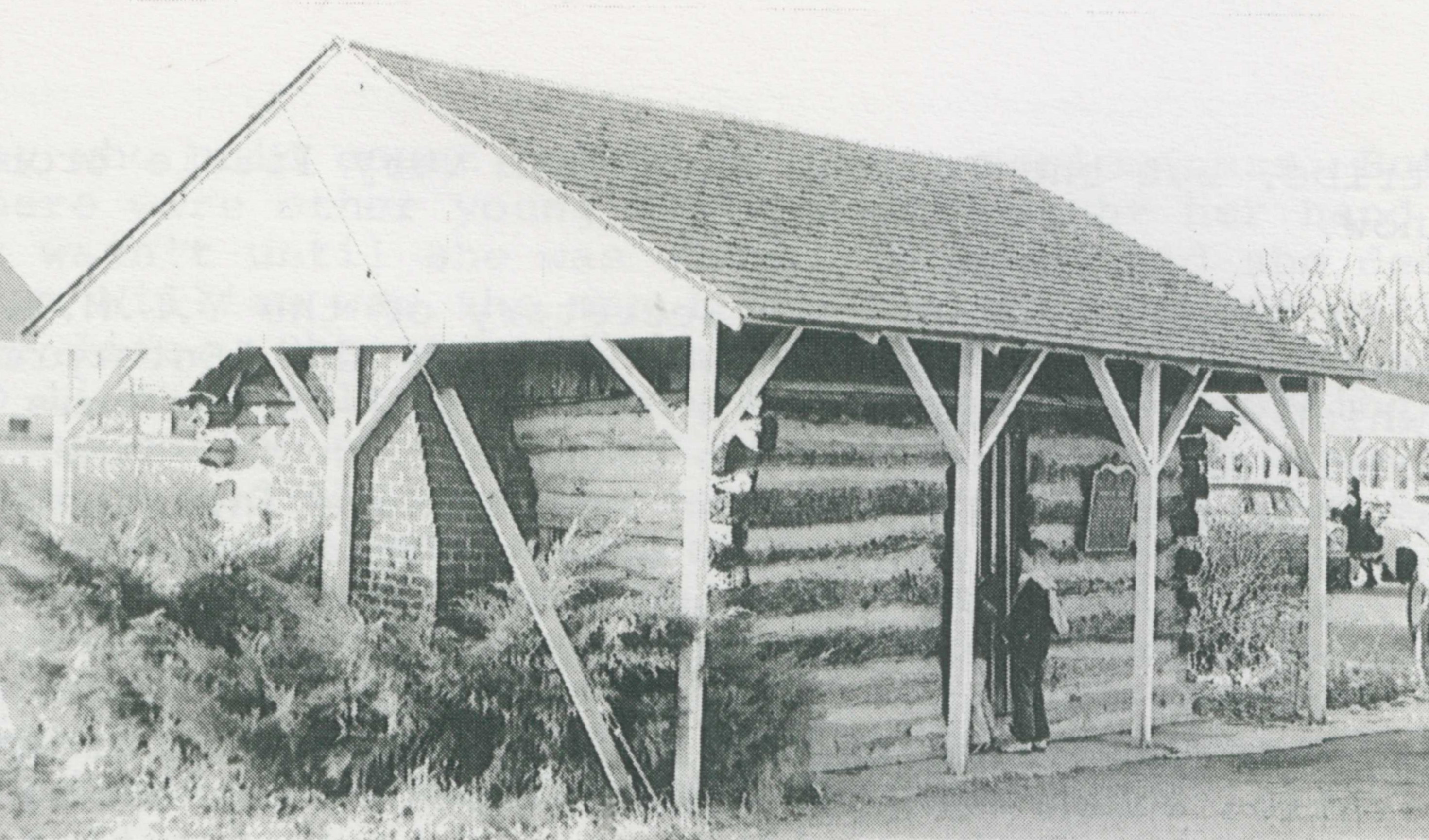
Second log cabin built in Plain City. Built by John Carver Sr. Restored [have to search for Carver Cabin in 1997 history] by Daughters of Utah Pioneers, Plain City Camp. 
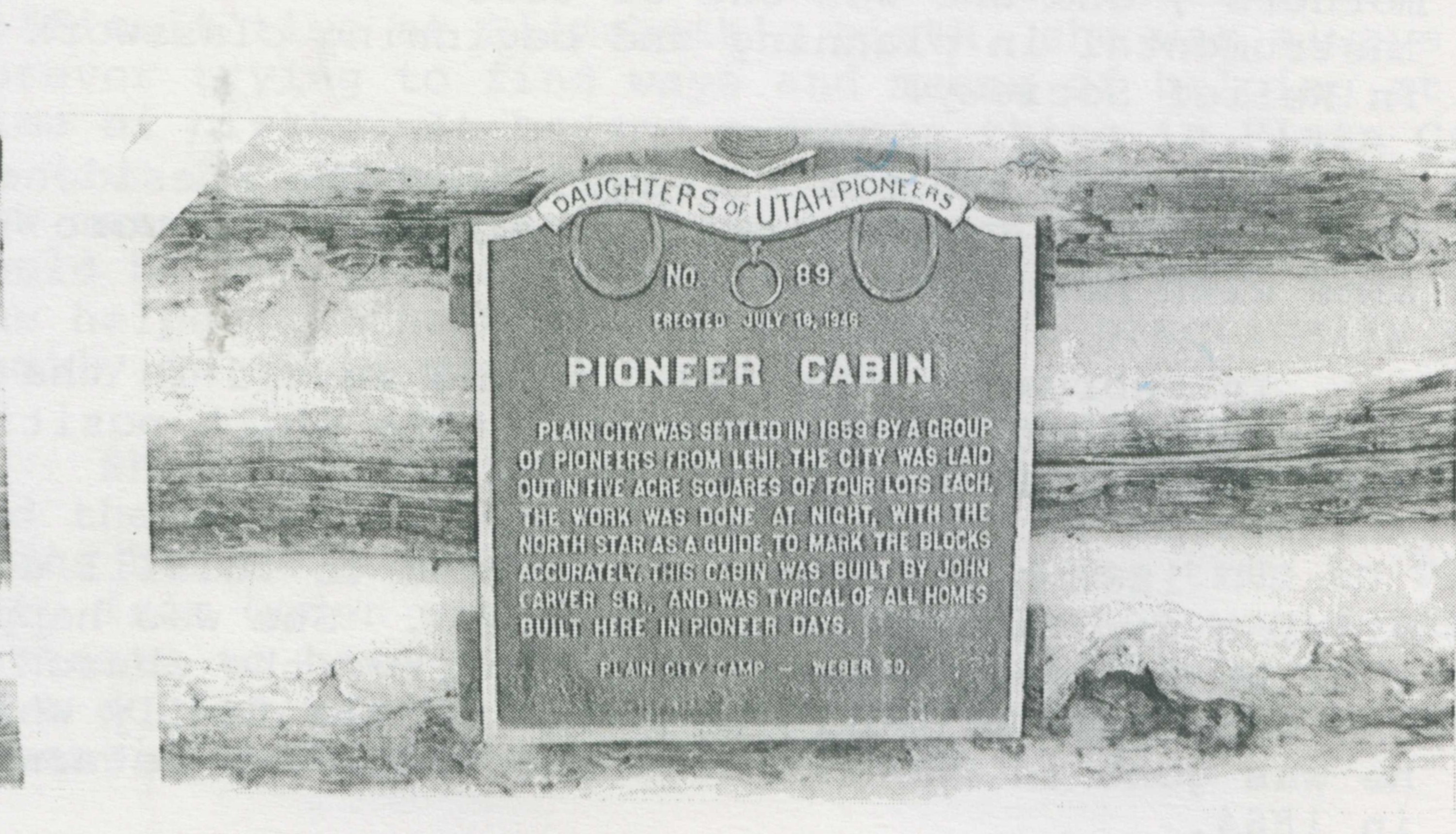
Plaque on front of John Carver‘s cabin.

EARLY SETTLERS

SUBMITTED BY NORA POULSEN

            Andrew Peter Poulsen one of the early settlers of Plain City, Utah was born June 12, 1842 at Ronne, Bornholm, Denmark. In his late twenties, he was converted to the Church of Jesus Christ of Latter Day Saints and with his brother Hans left their beautiful land of Denmark and came to Utah in 1869.

            They worked on the railroad from the mouth of Weber Canyon to Ogden and then on west of Hot Springs and north to Promontory Point.

            Late in the fall of 1869, Andrew married Sena Henson and their first home was a sod hut at the northwest part of Plain City. They lived there until they bought land east of the center of town and built an adobe house. This was a project that relatives and friends helped with as all the adobe bricks were made by hand.

            This house still stands today having been remodeled and extra rooms built after World War I by his son Hans Peter Poulsen. Today a grandson Bernard H. Poulsen lives in the home.

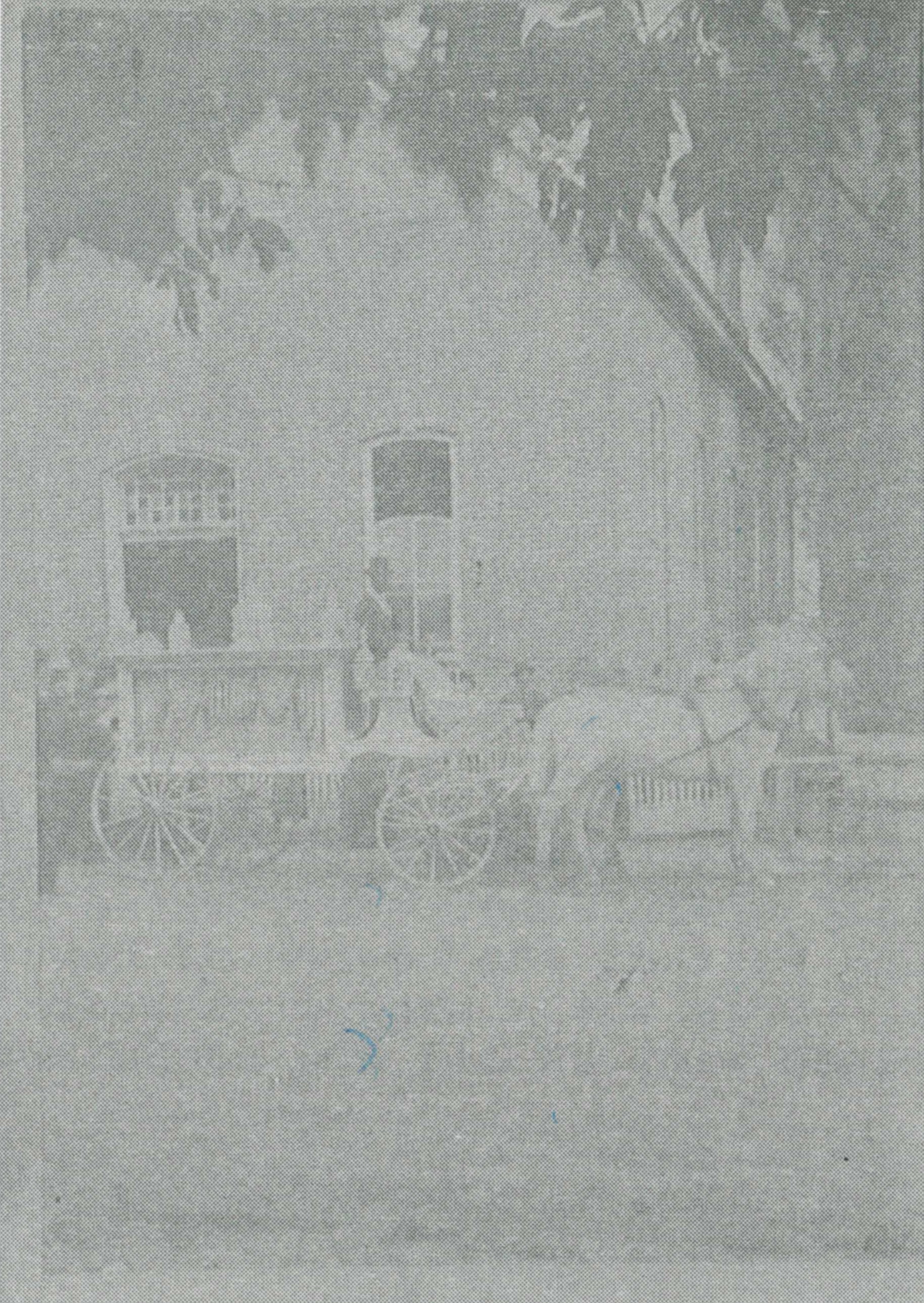
            Andrew Peter Poulsen loved horses and took great pride in keeping them well groomed. He had two fine teams of horses, one a white team and the other one a dark pair. For years, he was active in church and community work and used his “long back” surrey and fine white team of horses to carry the deceased to the church and cemetery. He gave freely of his time and money for the building up of the church and the community. He died September 20, 1922 at his home of stomach cancer.

            Andrew’s parents, Pedra Poulsen and his wife Karen Kirstine Rettrup also came to Utah from their native Denmark and settled in Plain City in the late fall of 1869. They brought their daughter Andrea Marie Poulsen with them. She later married Christine Olsen in 1872.

Andrew Peter Poulsen’s team of white horses pulling the “long-back” surrey.

               Hans Peter Poulsen was born April 19, 1875, in Plain City, Utah a son of Andrew Peter Poulsen and Sena Benson. He was the second oldest and only son in a family of four children, three of whom lived to adulthood. He was educated in the Weber County schools and also attended Brigham Young Academy where he was on the first football team at that school. He fulfilled an L.D.S. mission to Denmark from June 26, 1901 to October 3, 1903. He left his wife and young son at home with her mother in Ogden, Utah.

            Hans Peter or H. Poulsen, as he went by to distinguish himself from his Uncle Hans was a farmer and dairyman. He was one of the charter members and a director of the Weber Central Dairy Association. For years, he was a director in the Farm Bureau Association. Most of is life he was active in church and community work. He was a loving and devoted father and husband. For over 50 years, he was married to Ellen K. Maw and they were the parents of seven children.

            Hans Peter Poulsen was the first constable of Plain City, from 1916 to 1920, and was also a Deputy Sheriff of Weber County. While he was constable one of his first jobs was to round up several young men for stealing cattle from the towns people and selling them to the slaughter house in West Ogden.

            Traveling in those days by horse and buggy was much slower than the fast cars of today but within a short time, the young men were taken into custody and placed in the Weber County Jail which was located in Ogden between Washington Blvd. and Adams Avenue on 24th Street.

White team of horses owned by Hans’ father, Andrew Peters Poulsen

HISTORY OF THE DUMMY

Submitted by Ivy Skeen Carver

            Between 1897 and 1910 one could buy a round-trip ticket from Ogden to hot Springs for 30 cents on a train called “The Dummy”. It left Washington Blvd. and 19th Street to Hot Springs via North Ogden.

            This “Dummy” train line was extended to Plain City via Harrisville, in 1909. There was quite a celebration; Royal Carver remembered his uncle, Jim Carver, standing on the platform around the engine, pulling the whistle and ringing the bell. One of the engineers was William Clark, the conductor was “Moonie” Holmes, and other engineers were Charles Tracy of William Lane, Charles Lunt and others.

            The “Dummy” would start grass fires along the line, with its twice a day trips. One fire was started in the grass on Charles Taylor’s home on the 4th of July, 1915, which burned his barn sheds, pig-pens the old sow and her brood. This disrupted the celebration in Plain City center as the ball team and other men went to Poplar Lane to fight the fire and save the house. The railroad was held negligent and they paid Charles Taylor $1500. After the fire in 1915, and before 1918, they electrified the “dummy” as a precaution to prevent other fires. One amusing tale of the Taylor fire was the Milkman, George Moyes, coming from the dairy with some of his cans full of sour milk and his using this milk along with water from the slough to pour on the fire.

            Along the Railroad line from Harrisville to Plain City there were several wooden platforms for loading and unloading freight. There were two newspapers, Morning and Evening, which the “dummy” brought out to be delivered by boys on horses such as Royal Craver, Vern Palmer, Edward Kerr and Charles (Chuck) Skeen and others. The train was so slow that kids would out-run the train on their farm horses and even on foot, running until they gave out.

            The “Dummy” worked as a freight engine. The road-bed was laid and rails set by residents along the line. They were paid by Script, which was good for a ride on the train.

More History of the “Dummy”

Submitted by Irene Skeen

            In 1909 John Maw, Lyman Skeen and Mr. Skeen and Mr. Eccles, then head of Utah-Idaho Railroad company, negotiated for a railroad to Plain City. On Nov. 15, 1909, the first railroad was built into Plain City.

            A big celebration was held in the adobe school, on the north east corner of the town square.

            The tracks came along the side of the road through Harrisville and down Plain City to the cemetery, then north to the square. This railroad was used for produced, beet-hauling, lumber, coal and transportation. It was known as the “Dummy” by everybody in Plain City. It was one car pulled with the engine. The inside had a coal stove and kerosene lamps. The car was divided by a partition; one end for the men and the other for ladies. However, it was not restricted as such.

            A foggy morning, in 1915, as they were on their way to Ogden and traveling on the old Harrisville road, the “Dummy” ran head-on into an engine pulling railroad cars full of coal. Naturally, everyone was thrown from their seats and some were injured, however, not seriously.

            There were two houses nearly where the people went to keep warm. The ladies at the homes bandaged the cuts, where needed, and the people were returned to their homes on bob-sleighs.

            Most of the passengers were students going to Weber Academy or to Ogden high School. The “Dummy” stopped at the depot located about one-half block west of the Post Office on 24th Street and the passengers walked to their destination or to Washington Blvd and caught a city street-car.

England’s Store

***

ENGLAND STORE

Merlin England’s grandfather, his mothers father, had a store in Logan. Mrs. Ellen England persuaded her husband to go into the business in Plain City. The store was located west of the England home. Mr. England left for L.D.S. Mission early in 1896, and left the store, coal-yard and farm for Mrs. England to supervise. Merlin England was 3 months at that time.

AGENDA OF THE 50TH CELEBRATION OF THE SETTLEMENT OF PLAIN CITY

MARCH 17, 1909

            The citizens of Plain City met in the L.D.S. Church on March 17, 1909, at 10:00 am to celebrate the 50th anniversary of the settlement of Plain City.

Masters of ceremony: Bishop Henry J. Garner, Josiah B. Carver, James L. Robson

Singing by Choir:         “Let the Mountains Shout for Joy”

                                    Fred Kenley directing, Bertha Robson organist.

Prayer: Alonzo Knight

Ladies Quartet:           Ruby Ipson, Pearl Taylor, Jessie Kenley, Sylvia Richardson

Speech of Welcome:   Bishop Henry J. Garner

Speech:           Pioneer, John Carver

Song:               Evelyn Harding Christensen

Recitation:      Martha Hansen

Speech:           Lewis W. Shurtliff, First Bishop of Plain City

Song:   Willard Lund

 Reading of Poem:      Peter M. Folkman, composed by David Booth

Speech:           George W. Bramwell, Past Bishop

Josiah B. Carver announced that today work was begun on the railroad for Plain City.

Humor Speech:           Charles H. Greenwell of Ogden

Singing by Choir:

Prayer: Charles Weatherston

            All of the people went it the Adobe Hall to the banquet, the first day for the old people, and the second day for the children. About 1000 people were fed.

            The following is a list of living pioneers:

  • John Carver                             * George H. Carver
  • Christopher O. Folkman         * Minnie Carver Geddes
  • Jens P Folkman                       * Victoria Musgrave
  • Charles Neal                           * Alonzo Knight
  • Lyman Skeen                           * Catherine Knight
  • Caroline Skeen                        * William Knight
  • Susanna Booth                       * Isabell Draney Bramwell
  • George P. Folkman     * John K. Spiers
  • Jeppa Folkman       * Edwin Dix
  • John Davis         * Winfield Spiers
  • Robert L. Davis       * William L. Stewart
  • Robert Maw        * Mrs. Thomas Singleton
  • Joseph S. Geddes      * William Sharp
  • Aggie Peterson       * Emma (Singleton) Richardson
  • John Carver Jr        * William Van Dyke
  • Milo R. Sharp
  • Present at this celebration.

NEWSPAPER ARTICLE THAT APPEARED IN THE OGDEN STANDARD EXAMINER IN 1930 ENTITLED:

“HOMECOMING OF PLAIN CITY IS WELL ATTENDED”

ONLY SURVIVORS OF ORIGINAL SETTLERS IS GUEST OF HONOR

            Twelve annual homecoming of Plain City, celebrating the seventy- first anniversary of the settlement of the town held Tuesday, proved to be a very enjoyable affair and was attended by a large gathering of residents and former residents from other Utah towns and Idaho and Oregon.

            Lyman Skeen, 79, only survivor of the original settlers, was guest of honor and gave a brief talk. Mr. Skeen is a son of Joseph Skeen who built the first log cabin in Plain city. Other early residents of Plain City, now residents of Smithfield, who attended the celebration, were Mrs. Tillie Collette Merrill, 81, and her sister, Mrs. Julia Collette Cantrell, 79.

            Plain City was founded on March 17, 1859, by a group of people from Lehi. A history of the founding of the town and many interesting incidents connected therewith were given by P.M Folkman.

            A tribute to the pioneers of the town and to the pioneers of Utah was given by Miss May Taylor. A talk on community loyalty was given by Lawrence Jenkins. Wilmer Maw presided at the morning session. Invocation was given by Gilbert Thatcher.

            March 17, the date on which Plain City was founded, was also the date on which the Relief Society of the L.D.S Church was organized in Nauvoo by the Prophet Joseph Smith and this subject was discussed by Mrs. Sarah Larkin of the North Weber Stake Relief Society Presidency.

            Mayor Ora Bundy, City Commissioners Fred E. Williams and W. J. Rackham, and County Commissioners F. W. Stratford, Harvey P. Randell and I. A. Norris were among the distinguished guests.

            Luncheon was served at noon. Dancing was enjoyed at night. Music and readings and other features were on the program which continued throughout the day.

Lyman Skeen

Lyman Skeen came to Plain City with his father Joseph Skeen with the original settlers on March 17, 1959 at the age of nine on his pony. He was the last living original pioneer of Plain City. He died in 1933.

ANNE CATHERINE HEDEVIG RASMUSSEN HANSEN

SUBMITTED BY HER GRANDDAUGHTER

LAVINA TELFORD THOMPSON

            Anne Catherine Hedevig Rasmussen Hansen was the first wife of Hans Christian Hansen and was born October 1, 1823, in Millinge, Cavanninge, Svendborg, Denmark.

            On October 7, 1849, she married Hans Christian Hansen in the Parrish of Horne.

            Hedevig and her husband were among the first people in their community, Helsinger, to give willing ears to the gospel of Jesus Christ. They were baptized October 25, 1851. She supported her husband in preparation for leaving their homeland and families and their immigration to America. They left Demark, December 20, 1852, and sailed for Utah on January 16, 1853 on the “Forest Monarch”.

            Pioneering in Utah was not easy, particularly to one who has experienced the upper middle class level of circumstances since her marriage. After living a pioneer life in Utah for a little over a year, Hedevig was thrilled with the birth of her child and first daughter, Josephine.

            During the next three years, they moved several times, first in Ogden, then to Bingham’s Fort and finally to Harrisville. It was there that her third son, Nephi, was born.

            August 28, 1857 became a special day in their lives. They were sealed together in the Endowment House. The first born in the covenant and her second daughter, Anne Margarethe, arrived April 6, 1859, in Harrisville.

            Early in 1869, a great challenge came into the home, when Hedevig’s husband was called to fill a mission in his native Denmark. Hedevig made a shirt for her husband from material of one of her petticoats. She dyed it in juice from bark and roots, and Hans wore it as he left for his mission.

            The following was taken from Josephine’s writing:

            It was known that mother could wait upon women in confinement cases. It was a natural gift with her. They came for her to go to Plain City to care for a lady there. This was four miles away. She did her work so well that the woman paid her $2.00 in silver. Her career was established and they kept coming for her to go around nursing. Two bushel of wheat was the price usually charged. Then the Bishop came to our place from Plain City and wanted mother to move down there so she would be nearer to wait on women in their confinement cases. They tore our log house down, moved it to Plain City, and put it up again. They also built us a dugout, and now we lived in a settlement and could go to school. Two or more children blessed Hedevig’s home in Plain City. Hans Christian was born August 14, 1863, and Chauney Ephrian was born May 8, 1866.

            Hedevig lived a full life and was taken in death March 31, 1899, being buried in Plain City.

HISTORY OF PLAIN CITY FROM THE LIFE OF

CHARLES NEAL

            I, Charles Neal, son of Job Neal and Harriet Smith Neal, was born September 7, 1834, in Stratford-on-Avon, Warwickshire, England. I was baptized August 10, 1849, at Stratford-on-Avon by George Smith, and confirmed by Elder John Freeman. About 1853, I was ordained a Teacher by Elder Weeks.

            I, with other immigrants left England on the 22nd day of March 1857 on the ship George Washington with Captain Cummings in command. We arrived in Boston about April 12, then proceeded on our journey to Iowa City, which was the Western terminus of the railroad. There we had to wait about three weeks for the handcarts to be finished before we could start our journey across the plains. There were about 125 handcarts and 275 men, women, and children in the company. Israel Evans was Captain, and Benjamin Ashley, Assistant Captain. I was teamster most of the way. After a long and tedious journey on the plains, our food supply became exhausted so that we had to live four days on buffalo meat without salt. We arrived in Salt Lake City on September 11, 1857, from which I further continued my journey to Lehi.

            On the 24th of September I returned to Salt Lake City and found Miss Annie England who came across the sea and plains with me. We were married the same day by Elder Israel Evans., Captain of our company and then returned to Lehi and went to work for him.

             On March 10, 1859, a small company left Lehi in search of a new home. We were in that company which settled in the place now known as Plain City.

            Upon arriving on March 17, we took up the arduous labors of fencing in the Big Field and making Plain City Irrigation Canal, besides fencing in our own lots and planting them. Being of an ambitious character, I carried stakes from the Weber River and fenced in the first lot.

            The first year we lost our crop. I then went in search of work and got a job from President Brigham Young on the wall around the Eagle Gate in Salt Lake City. Two weeks later, my wife, Annie England Neal, followed me on foot to Salt Lake, and learning I was working for President Young, she obtained work in the Lion House in Brigham Young’s family where she remained for eighteen months.

            When we were about to return to Plain City, Sister Eliza R. Snow, recommended that we have our endowments. Accordingly, before leaving, we were endowed and sealed by President Brigham Young on October 24, 1860. On the same day I was ordained an Elder by Elders J. V. Long and George D. Watt.

            We then returned to Plain City where I was appointed with a company of three to oversee the water ditches, in which capacity I served about three years. I was then appointed watermaster in Plain City. I served one year with credit and satisfaction.

            I was one of the first appointed Sunday School teachers in Plain City, and at the Sunday School Jubilee held in Salt Lake City in 1899, I received my badge for having been a Sunday School worker for thirty-five years.

            From 1864 to 1899, I served as organist in the Sunday School and Ward.

            In 1860, I helped to build the first school house, which was adobe. I also helped to build the second school house which was fifty by twenty-five feet. I was Chairman of the committee to construct the present meeting house. I was one of the school trustees for eight years and road supervisor for about nine years.

            In 1866, I was called to go to the Missouri River with four yolk of oxen to bring some immigrants, which made my third trip across the plains. While at the Missouri River I met the two orphan children of my sister, Ellen Eggerson, who died and was buried at sea on July 4. Her infant baby died on the 21st of July in Nebraska and was buried there. I returned and brought with me my sister’s little son, two and one-half year old. When about four days out from the Missouri River, I was taken very sick and was not expected to live; in fact Captain Harden was about to leave me there with provisions that should I recover, I would be brought in on the stage. But I begged the Captain to bring me along with them, telling him if he would, I should recover. So they brought me along and after traveling for about three hundred miles, with good care, I was able to drive my own team and get back all right.

            When home again, I assisted in starting the first martial and brass band in Plain City. We purchased a second-hand set of brass band instruments from the old Camp Floyd Band in Salt Lake.

I was Postmaster in Plain City for many years. The following was published by the President of Ogden in 1903.

“Charles Neal, the retiring Postmaster of Plain City, has a most enviable record of service. The post office at Plain City was discontinued today and that town will be furnished with rural delivery. Charles Neal, who has been Postmaster in Plain City for the past twenty-five years, retires from service with an enviable record. He has served continuously under five Presidential administrations and that is sufficient evidence of his ability. He has a record in the Government of which he may feel proud”

            My first wife, Annie England Neal, died November 5, 1900. She was a faithful and devoted wife, and endured many hardships and privations in our pioneer days in this, our mountain home. She was a true and faithful Latter Day Saint. Having no children of her own, she raised my sister’s child, Emily Neal Eggerson, from two and a half years old until about nineteen. We raised my brother, Willard, from eight years old until he married at the age of twenty, and Sophia England, her niece, from three months old to about fifteen years old; also Ella Jerimah Neal, my niece, from nine until she was about nineteen. We also raised William Neal, my nephew, from two and a half years to about twelve when he went away with his sister, Ella, who married Thomas H. Cottle.

            In 1901, I married Miss Myra Swingwood. About 1907, my wife’s sister, Annie Swingwood Brown, died, leaving two children-a boy and an infant baby girl. We adopted Myra, the baby girl, who is now six years old.

            At present, I am the oldest handcart pioneer in Weber County.

            (Dictated shortly before his death)

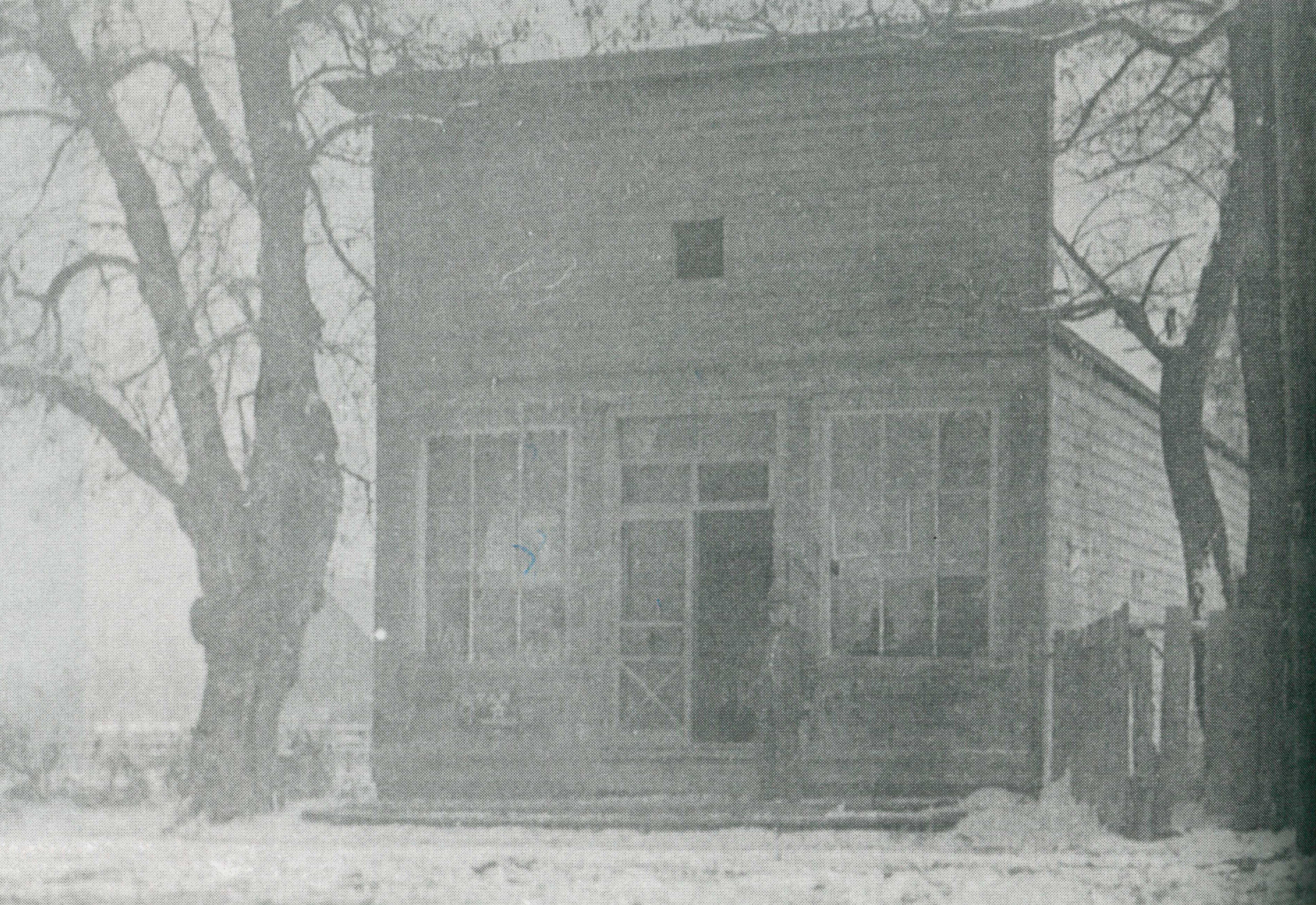
Thomas Singleton’s home now owned by Elmer Singleton

Golden Spike National Historic Park

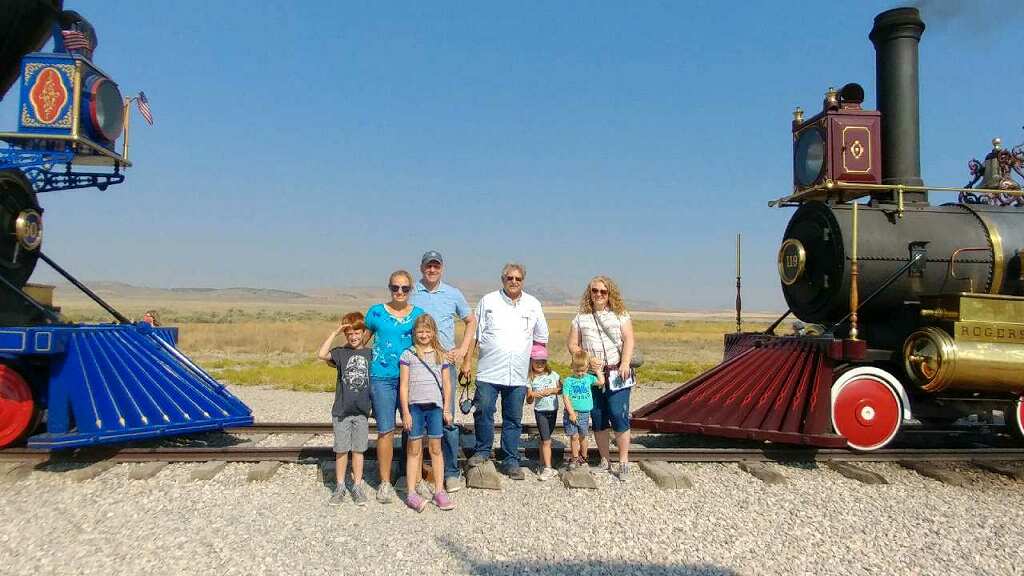
Jupiter at Golden Spike National Historic Park Sep 2020

We took a trip to Golden Spike in September 2020 for the kids to experience some Utah history. It was well worth the drive out to Promontory, Utah.

The Golden Spike has some significance on Amanda’s line. Her ancestor, Joseph Wayment, is standing in the photo taken 10 May 1869 on that momentous occasion. Below is a copy of the photo. You can see him with the hat and long beard. Look at the train on the left and the man standing right below the train light with his jacket open and white shirt; the man whose head is in front of that man’s right thigh (behind the guy with the partially raised hat). That is Joseph Wayment. Joseph Wayment was born 7 February 1844 in Whaddon, Cambridgeshire, England and passed 20 December 1931 in Ogden, Weber, Utah. He is buried in Warren. I wrote of his parents William and Martha Wayment previously.

Another interesting bit of history is that Joseph Wayment came to the United States on the ship “Amazon.” This is the same ship that my Stoker ancestors came to the United States. Not only is it the same ship, it is the same trip of the ship. Here is part of the history I wrote for William and Emma Stoker.

Joseph Wayment departed from London on a ship called “Amazon” 4 June 1863 (His parents and some siblings traveled later on “Nevada” in 1878).  George Q Cannon dedicated the ship which was entirely of Saints (880+) headed for Zion.  It was this same ship that Charles Dickens wrote that the Mormons were not taking misfits and scoundrels, but the “pick and flower” of England.  Even George Sutherland, future U.S. Supreme Court Justice was on this ship.  Here is a link to the story by Charles Dickens: The Uncommercial Traveller.  The LDS church also tells of the story that day at this link: Amazon Departure.  The ship sailed to Liverpool before finally heading out for America.

The “Amazon” landed at Castle Gardens, New York, New York on 18 July 1863.  The Saints took rail to Albany, Albany, New York and then to Florence, Douglas, Nebraska through Detroit, Wayne, Michigan.  From there they hoofed it on to Salt Lake City, Salt Lake, Utah Territory arriving 3 and 4 October 1863 (depending on which of the two companies), just in time for General Conference.  Several of the company wrote of Brigham Young coming out to greet them and giving them advice. Brigham sent Joseph to Salt Creek (now Warren) to settle. He later was the first road supervisor and the father of the first born white child of Warren, Sarah Wayment in 1875.

I will have to spend some time telling more of Joseph and Ann Reed Wayment’s story another time.

My own limited tie to Promontory is just the fact the Sharps, taking my Grandpa Milo Ross, used to drive past the site out to harvest salt.

Hiram, James, Paul, and Aliza Ross on 7 September 2020
Hiram, Amanda, Aliza, and Paul Ross, Bryan Hemsley, Lillian and James Ross, and Jill Hemsley

William and Martha Wayment

William and daughter, Martha Wayment

I previously wrote of an interesting incident I had with Aliza in the Plain City, Utah Cemetery. I have thought about that several more times as we have been back to visit. It seems fitting I finally follow up and provide some additional information on William and Martha Wayment.

Aliza with William and Martha Wayment tombstone in 2016
James, Amanda, Lillian, Aliza, and Hiram Ross with tombstones for Martha and William Wayment in 2020. My William Edward Stoker’s tombstone is in the background.

As you can see, there is a little biography poster for Memorial Day. The history there is pretty brief. I found a couple of histories on William and Martha. I am posting these two for the history to be available for my children, who are descendants of William and Martha Wayment. First is the history for William, then Martha.

“William Wayment (Whayment) was born to Joseph Wayment (Whaymond) and Mary Rook Wayment. He was born 14 May 1822, in Whaddon Parish, Cambridgeshire, England. He was a small and fragile baby, but survived through his parents loving care. William was christened on 2 June 1822, in Whaddon Parish, Cambridgeshire, England. Two years later, there is a christening record dated 6 June 1824, another brother, Robert, frail from birth, who sustained life for seven months, buried 23 January 1825. William was their only surviving child.

“There are several different accounts of Joseph and Mary Rook Wayment and their descendants. Another account is this; the couple also married 15 March 1813, and lived in Barrington, Cambridgeshire, where they had become the parents of six children, three of whom, Ann, John, and Joseph, had died prior to their moving to Whaddon about 1819. This would make William the seventh, instead of the first born. The only surviving child of this union that I can find recordson is William Wayment, our ancestor.

“Whaddon is a small town in the district of Roysten and County of Cambridge with a population at that time of about 319 people living in about 60 houses. The manor belonged to Lord Hardwicke. A famous old stone Parish has stood over the town for many years.

“Very little is known about William’s early years. It is known that he received some education and learned how to read and write. Most likely he went to work at an early age, as was custom for children of that time. It is most probable, his frail beginning coupled with his early work years and sometimes meager meals stunted his growth. He often referred to himself as ‘a runt.’ All of his sons were taller than he. Our best information indicates he was small of stature, about five feet and eight or nine inches in height. He was known as a laborer and sometimes a miner, likely working wherever he could be employed.

“His father, Joseph Wayment, died and was buried 12 July 1840, in Whaddon, Cambridgeshire, England. William was about eighteen or nineteen years of age

“Sometime after the death of his father, William began courting Martha Brown, a young, fair woman of the Bassingbourne Parish. The courtship bloomed and they were married Christmas day, 25 December 1841, in the Parish of Whaddon, Cambridgeshire, England. A clerk at Somerset House, England, pointed this out to Hollis R. Johnson when he requested and received a certified copy of their marriage certificate: William signed his last name as Whayment, giving his age as twenty and listed himself as a laborer. Martha gave her age as nineteen and listed herself as a spinster, a title used under English law for any woman who had never married. William and his bride made their home with his widowed mother, Mary Rook Wayment.

“The Wayment family lived in the same house in Whaddon, Cambridgeshire, England for more than 300 years, but like most others in England, they did not own the property. They only rented. When the Wayment family moved to America, the ancestral home was claimed by the government as a Post Office. The house was one of those quaint old, two story cottages, constructed of white stone masonry and had a thatched roof. Vines grew up the walls and flowers grew on either side of the cobblestone path leading to the entrance. The fireplace was large enough to walk in with seats built on either side of the fire. A kettle hung down, stopping just above the fire. Martha did all of the cooking and baking in this huge fireplace. Years later this house was put on the market and a member of the Wayment family, by the name of Waymond (Wayment), purchased this property. Wayment descendants still reside in this home today, 2006.

“William and Martha Brown Wayment began their married life under very limited circumstances. Although an extremely hard worker, William never accumulated much wealth. Coming from a wealthy family, their modest home and insufficient circumstances were a source of embarrassment at times for Martha. It has been said that Williams earnings were often around eight shillings a week (about two dollars U.S. money). With this money, there were food, clothing, coal and rent to pay for. By careful management they were able to take care of their children as they came into their family.

“Although not a proficient provider, William proved to be a very loving, a kind and caring husband. They had eight children together, six boys and two girls. Two children died early, one at one day the other at one year and three months. It is also said that he was an exemplary father.

“All William and Martha’s children were born in Whaddon, Cambridgeshire, England. 1) Male, Aaron Wayment born 14 Nov 1842 died 15 Nov 1842 2) Male, Joseph Wayment born 7 Feb 1844 died 20 Dec 1931 3) Male, Samuel Wayment 28 May 1846 died 1 Jul 1912 4) Male, William Wayment Born 1 Mar 1849 died 19 Jun 1850 5) Female, Emily Wayment born 15 Apr 1851 died 15 Mar 1925 6) Male, John Brown Wayment born13 Apr 1854 died 30 Sept 1923 7) Male, William Thomas Wayment born 29 Apr 1859 died 15 Feb 1943 8) Female, Martha Wayment born 25 Mar 1863 died 19363

“All their children were taught to be responsible and dependable workers. But as one granddaughter, Thora Wayment Shaw stated, “it seemed necessary for them to come to America to develop their full potential.”

“As their children became old enough, they hired out to work for farmers in the area. Their work included keeping birds out of the cherry trees, pulling poppies out of grain fields and other needed farm work. Among other things, they learned to stand the bundles of grain up in small groups, called “shocks” to dry. When dry, the grain was then piled into high pointed stacks to help shed the rain while awaiting to be threshed. Some of the farmers were very hard on these young workers. Often the children would leave home at five o’clock in the morning and work until they were called for breakfast between eight and nine o’clock. Sometimes the meal was very meager. They would break around noon for lunch then continue to work until seven at night. Joseph and William T. describe one of their employers as “the meanest man on earth.”

“At that time in history, they wore a peculiar type of “smock” clothing. William T. said that it resembled a long sack with sleeves coming out of the corners and a hole in the end between the sleeves to put your head through. This ‘smock’ came down below the knees, which prevented a person from taking a long step. To jump a ditch or run, the “smock” had to be pulled up. Often the jumper landed in the water of the ditch, much to his embarrassment and to the amusement of others. If the “smock” became wet, it seemed to shrink and stick tight to the body it was covering. Usually one had to have help to get out of a wet “smock.”

“William and Martha Brown Wayment were contacted by the first Mormon missionaries in their area. William Wayment listened to their message becoming convinced of the truthfulness of the gospel. He was baptized into the Church of Jesus Christ of Latter-day Saints on 28 May 1850. He and his wife Martha opened up their home to the missionaries. This was a very courageous act on their part, because many people in their community stirred up hate to prevent the spread of the gospel. This malevolence made it necessary for the Saints to hold their meetings in different houses and to hold baptisms at night to avoid the mobs that were continually a threat to them. William was ordained an elder in the church 5 March 1876. Between 1850 and 1878, the traveling LDS missionaries always found a bed to sleep in and meals with the Wayment family. William and Martha’s home was also used as a place for the Saints and friends to meet and hear the gospel. William Wayment and George East, both our great-grandfathers, were great friends, tracted together and loved to do missionary work together before they came to America.

“Martha was one of the first to accept the message of the gospel brought by the Elders, however, due to the objections and threats of disinheritance she prolonged her baptism. Martha was baptized on 1 May, 1857, about seven years after her husband embraced the gospel. When word, of her accepting the gospel and being baptized into the Church of Jesus Christ of Latter-day Saints, reached her father, Samuel Brown, he disinherited her, cutting her off with only a few shillings. However, this did not change her mind. Setting an example with her husband, they taught their children the principles of the gospel. All of their children were baptized into the church. Joseph, Samuel, and Emily were baptized by John Jacklin on 7 May 1860.

“The first test of faith and understanding of the gospel for William Wayment came with the illness and death of his mother, Mary Rook Wayment. She died 19 March 1853, and was buried four days later in Whaddon, Cambridgeshire, England, beside her husband. William had fulfilled his final obligation to his mother.

“In the spring of 1863, William and Martha were experiencing some challenging and sobering thoughts. A new baby girl had been born to them 25 Mar 1863. Their oldest son, Joseph, was planning to leave their home to journey with a group of Saints to the Utah Territory in the United States. After careful consideration, the Wayment family set up a mutual plan to migrate to America and the land of Zion. They would all work together to save money, then send one at a time until they were all settled in the Utah Territory. At that time, Joseph worked with his father in the fossil diggings or fossil mines earning money for his transportation.

“On 4 June 1863, William and Martha’s oldest living son, Joseph, listed as Joseph Whaymond, age 19, was the first to leave, sailing from London, England, emigrating to the United States of America aboard the Amazon. This was a large 1600 ton ship, but Joseph was seasick almost all the way across the Atlantic. Arriving in New York 20 July 1863, he took the train to a point on the Missouri River, then by boat up the river to Florence, Nebraska. From there he walked and drove an ox team in Captain McCarthy’ the Dixie Company all the way to Salt Lake City, Utah Territory. It took four months to make the trip from his father’s home.

“Joseph was sent to Salt Creek, Utah, by Brigham Young, to help settle this area. Joseph planted the first fruit trees in Warren. He was the first road supervisor and the father of the first born white child of Warren, Sarah Wayment Hansen. In England, William and Martha continued to guide their children in the gospel. John was baptized and confirmed by John Jacklin on 15 April 1866.

“The passenger’s manifest of 1868, show Samuel and Casting Chapman Wayment emigrated to New York that year aboard the Constitution. Arriving in New York 6 August 1868, they continued across the continent by train to Fort Bento, then by covered wagon in the John Gillespie Company to Salt Lake City. Five years later in 1873, John followed Joseph and Samuel to America on the ship Nevada,and onto the Salt Creek District of Utah, which later was named Warren.

“Samuel Wayment first worked and lived in Deweyville and Cove Fort before settling in the Salt Creek District. They built their home at 1239 North 5900 West where Chester Wayment lived and now Matthew Wayment lives. On that very spot, the first house that Samuel and Castina built burnt to the ground along with the barn. The animals were cooked, so the people who had come to help put out the fire went home, retrieved knives, pots and pans and returned to cut up the meat.

“After Samuel and Castina left for America, William and Martha remained in England with only three children at home. On 4 March 1872, John Brown (Whayment) was ordained a priest by George Wilkins. On 31 May 1873, William Thomas (Whayment) was baptized by John Jacklin. The spirit of gathering to Zion continued to work with the Wayment family.

“The sixth child, John Brown, completed preparations, and at age 19, booked passage on the ship Nevada and sailed from Liverpool, England, 9 July 1873. Arriving in New York, he headed to Utah Territory to join his brothers. John lived with his brother Joseph in what they called “Bachelor Headquarters” in Salt Creek.

“The saving of money was slow and hard to come by so when William T. became about ten years of age, he began working in the fossil fields to help earn passage to America. Part of the time he pushed a wheelbarrow around the mine, which was very difficult for a lad of his age. He worked in the Fossil Fields until the goal was reached. (This was work in the peat bogs. Peat is compact, dark-brown organic material with high carbon content, built up by the partial decay and carbonization of vegetation in the acid water of bogs. Dried peat was and is compressed into briquettes, used in European Countries as fuel, although it is not as efficient as coal because of its large content of water and ash. Peat can also be used for mulching and soil improvement.)

“According to early church records of Norwich Conference, Martha (Whayment) was baptized 13 September 1874, by John Jacklin. On 5 March 1876, William (Whayment) was ordained an Elder by Shadrack Empey. On 4 April 1876, William (Whayment) baptized Sarah East, daughter of George East, Sr. and Rhoda Stanford East into The Church of Jesus Christ of Latter-day Saints. (Sarah was sister to Javes East, who is father of Hazel Caroline East Wayment, our grandmother, who married Theodore Wayment, grandson of William Wayment.) The following week, Sarah East, her parents and six brothers and a sister left England for Utah Territory. They sailed from Liverpool, England, on the ship Wyoming,13 September 1876. Sarah East became a daughter-in-law to William and Martha when she married their son John Brown Wayment. This took place on 7 October 1877, in Weber County, Utah.

“After John Brown left home, the family continued to unite their efforts. Final preparations to emigrate to Utah Territory were made in the spring of 1878. With their savings and help from their sons in Utah, they booked passage on the sea going vessel, the Nevada. The Nevada was Mastered by H. Gadd who hailed his home as Glasgow, Scotland. After leaving their port of departure, Liverpool, England, the ship docked in Queenstown, Ireland, where they picked up more passengers. William and family were numbered among the 443 passengers who made their crossing in steerage, as he was unable to supply the coin for being listed among those 54 passengers in the ship’s cabins. His trade was listed as a farmer. They then made sail for New York where they arrived there on 5 June 1878. There were no deaths at sea recorded on this voyage, however, the people in steerage welcomed a male infant on 30 May 1878, with the surname of Larsen.

“Martha Wayment East, later in life, told granddaughter, Rhea Marriott, “The weather was good all the way over and the ocean was calm to what it usually was, but I was seasick practically all the way. After traveling on water for ten days, we reached Castle Gardens, New York. While we were there, I bought a tomato for two pennies, the first I had ever tasted. From Castle Gardens we boarded Pullman cars to Philadelphia. We changed here to immigrant cars which were very uncomfortable. It was beautiful in the east, but gradual signs of habitation vanished and scenes about us were dry and barren. It was all so strange here, away out west, and very different from what we had expected it to be.”

“Arriving in Ogden, Utah Territory, 13 June 1878, the family was met by Joseph and Samuel. After fifteen years, this was a joyful reunion. They were then taken to Samuel’s home. After living there a few months, William followed the instructions of church leaders and settled in the Salt Creek area, to help build up the Salt Creek District.

“William and family continued to live with Samuel and Castina, while they built a log house. Their log home was located about a quarter-of-a-mile south of the present corner of 5900 West and 700 North and about 200 yards west of the present county road. There were some trees at that spot, but it was dry and hot. Stumps of these trees marked the spot for many years. William built a bowery next to the house to give a little more shade from the sun. Russian Olive trees grew on this spot for years to give shade to sheep and cattle. Living on the land was a basis to apply later for Homestead rights. William applied for homestead rights to this quarter section of land. The logs for their home were hauled from the Wasatch Mountain Range along with firewood. These trips took several days and they would camp out along the way, where they had several encounters with bears.

“In this new and strange land they had to acclimatize to the semiarid climate. This was indeed a marked change from the verdant area of their home in England. They planted cottonwood trees, yellow roses, tea vines and any other plants that would grow fast. They helped establish the community and met the hardships endured by other families pioneering new homes. Martha Wayment East said, “It was hard work, but we had a good time in our work of making a town.

“William was a farmer and a rancher. He also owned a prize set of horses that he entered in shows and contests.

“Daughter Martha would become the first school teacher in Salt Creek. William T. would become the first residing bishop of Warren and would sustain that calling for 17 years.

“On 5 January 1882, William and Martha traveled to Salt Lake City, Utah, to the endowment house, where they both received their own endowments and were sealed in marriage for time and all eternity.

“Their daughter, Emily Wayment Negus, with her husband, William, and three of their children, sailed from Liverpool, England, 2 September 1882, on the ship Wyoming. Two of this couple’s children had died and were buried in England. With the arrival of Emily and her family, William and Martha once again had all their living children and grandchildren around then to enjoy, but this was short lived.

“A year and three months later after their sealing, in the spring, William contracted Typhoid fever and inflammation. He succumbed to the illness nine days later on 17 May 1883. He was buried in the Plain City Cemetery, Plain City, Weber, Territory of Utah. His death left his beloved wife, Martha, four sons and two daughters, Joseph, Samuel, John and William T., Emily W. Negus and Martha Wayment without their patriarch. William was also survived by eighteen living grandchildren, all living in the Salt Creek area.

“His obituary said he was an honest, industrious and truthful man, a kind husband and an exemplary father. His house was always open to the servants of God, as a haven of rest and hospitality. His faith was unshaken in the principles of Eternal Life, and he had died as he had lived, a faithful Latter-day Saint. He was interred in the Plain City Cemetery, being conveyed thither by a large concourse of sorrowing relatives and friends.

“Compiled by Joan Wayment Creamer

Sources; West Warren History 1975, Warren History 1995, Ogden Junction Database, New York passenger lists 1851-1891, Daughters of the Utah Pioneers, Alma W.& Martha M. Hansen, June Wayment Orton, Mildred Wayment Bird.

Back (l-r): Sarah, Martha, Leonard, Mary; Middle: Hannah, Joseph, Ann, Martha; Sitting: Walter Wayment

Here is the history for Martha Brown Wayment.

“On 26 May 1823, Martha Brown became the fourth child born to Samuel and Mary Wade Brown in Bassingbourne, Cambridgeshire, England. She was their only girl who survived infancy.

“Cambridgeshire, a flat coastal plain is located in the southeast part of England. The climate is moderate with much rainfall which produces abundant vegetation. This area produced peat bogs where many men worked.

“Martha’s grandfather, William Brown of Whaddon, has been described as a very wealthy farmer. His son, Samuel, Martha’s father, was disinherited after he fell in love and married a servant girl, Mary Wade who worked for his parents.

“After being disinherited, young Samuel and his wife, Martha’s parents, moved to Bassingbourne where he became a butcher by trade. He also acquired and owned some land and sheep. Later he expanded his business and is said to have become a very well-to-do merchant. Samuel and Mary Wade Brown were good, moral people and highly respected in the community of Bassingbourne.

“The Bassingbourne Parish register records this couple of having nine children, seven boys and two girls. All were born in Bassingbourne. 1) William Brown, christened 24 July 1814, and died 13 January 1894, age 80 2) Martha Brown, christened 15 September 1816, and died 27 June 1817, 9 months 3) Samuel Brown, Jr, born Sept.1818, christened 11 Oct.1818, died January 1890, age72 4) Martha Brown, born 26 May 1823, christened, 20 Jul.1823, and died 12 Apr.1905, age 82 5) Thomas Brown, christened 28 July 1827, and died 21 July 1901, age 74 6) John Brown christened 30 May 1829, and died 18 March 1906, age 77 7) Joseph Brown, christened 25 September 1831, and died in August 1903, age 72 8) Richard Brown, born 15 February 1835, and died 3 April 1835, 2 months 9) Simeon Brown, born September 1840, and died 14 December 1872, age 32.

“It is said that the Browns were a family of large men, with each son being more than six feet in height. They also claim to have had a longevity of life, however only one of them lived to be more than eighty, and that was Martha Brown Wayment. The others, except the two infants and Simeon, lived full lives into their seventies.

“Martha Brown Wayment’s Brothers; William, Thomas and John, joined the English army between the ages of twenty and twenty-five. Because of their height, ‘well over six feet,’ these men were chosen to serve in the King’s Guard and marched in the changing of the Guard at Buckingham Palace. Thomas and John deserted the Army and came to America. Thomas’s arrival in America was by quite by accident. The ship he booked passage on wrecked and he was the only survivor. After floating in the Atlantic Ocean for three days, he was rescued by an American vessel, which brought him on to America. Later he married a woman named Lavina and called Clyde County, Kansas their home. They had no children. Thomas wrote to the English government requesting his pension which was given to all English soldiers. The English government replied, telling him they’d give him all that he was entitled to if he returned to England and give up his citizenship in America. Thomas declined and elected to stay in America.

“After coming to America, John Brown changed his name to John Clark. He took a wife and settled in Minnesota. They had a large family. Several years before William T. Wayment died, one of John’s daughters came to Utah and visited with him. She also stayed at the home of Martha Wayment East. That was the last recorded communication with the Clark families from Minnesota.

“William served fourteen years in the English Army, then returned to his home in Bassingbourne. He fought in the Crimean War, Battle of Enlseman and the Russian War of 1848. After the Russian War he returned to England and received a service pension for the remainder of his days.

“When Samuel Brown, Martha’s father, was too old to work any longer, Samuel Jr. took over his father’s business. Joseph also remained home, making his living as a common laborer. When Samuel Sr. died, he bequeathed all his cash earnings to his youngest son, Simeon. Simeon died of alcoholism at the age of thirty-two.

“Martha Brown Wayment; Samuel and Mary Wade Brown provided their children with the best education available. Martha worked in her father’s butcher shop. From her mother, she learned to be frugal, clean and how to keep a neat, tidy house. It has been said about Martha that she was sometimes upset by the unclean habits of some of the older members of the family around her in England.

“In a Relief Society Lesson Publication, Pamphlet #32, dated December 1910, contains short biographies and testimonies of outstanding pioneer women of the North Weber Stake. Martha Brown Wayment told: “When about twelve years of age, there was a strange preacher came there, called a ‘Mormon.’ They were very desirous of hearing what he had to say and went to a meeting. When dinner time came, she seeing them without dinner, no place to go and no money to buy it with, she told her mother that she would go without dinner if she would let the preacher have it, but her mother was not so inclined.” (Martha Brown would have been fourteen years of age when she saw the first missionaries. The first missionaries arrived in Liverpool, England, 20 July 1837.)

“Sometime after the summer of 1840, Martha Brown met William Wayment. Their courtship culminated into a Christmas day wedding the following year. They were married, 25 December 1841, in the Parish of Whaddon Cambridgeshire, England. A copy of their marriage certificate shows William signed his last name as Whayment, listed his age as twenty and his occupation as a laborer.

“Martha gave her age as nineteen, listed herself as a spinster, a title used under English law for any woman who had never married. Martha and her new husband moved in with William’s widowed mother, Mary Rook Whayment.

“The Whayment home was a white vine-covered masonry, two-story cottage, with a thatched roof. The main floor contained two rooms. The largest room had a walk-in fireplace on one end with built in seats on opposite interior walls. The cooking was done in kettles hanging in this fireplace.

“Martha and William began their lives together under very limited circumstances. Though William was a hard worker, they never accumulated much wealth. It is said that William earnings sometimes amounted to eight shillings a week which is equivalent to about two U. S. dollars. Their modest home and limited circumstances was a source of embarrassment at times for Martha. But by careful management they were able to take care of their growing family.

“As a young bride and living in her mother-in-law’s home, Martha found that circumstances and conditions were not always pleasant. One day at the most distressing of times, Martha threatened to leave the Whayment home and her husband. She went into a small room or clothes closet to get some of her things. Her mother-in-law quickly closed the door, locked her in and kept her there until Martha promised not to leave. Satisfactory adjustments were made and Martha kept her promise to stay.

“All William and Martha’s children were born in Whaddon, Cambridgeshire,England. 1) Male, Aaron Wayment born 14 Nov 1842 died 15 Nov 1842, age 1 day 2) Male, Joseph Wayment born 7 Feb 1844 died 20 Dec 1931, age 78 3) Male, Samuel Wayment 28 May 1846 died 1 Jul 1912, age 66 4) Male, William Wayment Born 1 Mar 1849 died 19 Jun 1850, age 1 year 5) Female, Emily Wayment born 15 Apr 1851 died 15 Mar 1925, age 74 6) Male, John Brown Wayment born 13 Apr 1854 died 30 Sept 1923, age 69 7) William Thomas Wayment born 29 Apr 1859 died 15 Feb 1943, age 84 8) Martha Wayment born 25 Mar 1863 died 1936, age 73.

Martha and Martha Wayment

“All their children were taught to be responsible and dependable workers. But as one granddaughter, Thora Wayment Shaw stated, “it seemed necessary for them to come to America to develop their full potential.”

“Cambridge was predominantly agricultural, producing wheat and other grains, sugar beets, fruits and vegetables. At an early age, the children hired out to work, working for these farmers in the area.

“Around the age of fourteen, Martha had heard the message of the LDS missionaries and recognized the truth of the gospel. At that point her parents would not allow her to be baptized into the Church of Jesus Christ of Latter-day Saints. Especially after some incidents occurred that seemed to involve the missionaries and turned many people living in Cambridgeshire against the Mormons. Although they were convinced of the truth, William and Martha delayed joining the church due to her family’s bitterness and influence in their community.

“Martha and William listened to the messages, the Elders of The Church of Jesus Christ of Latter-days Saints brought to the area, of the restoration of the true gospel of Jesus Christ. William became convinced of the truthfulness of the gospel they were preaching and was baptized 28 May 1850. This was not a safe thing to do in those days as many were violently against the preaching of the restored gospel. Martha also opened her home up for place to meet, to share the gospel with other Saints and friends. Between the years of 1853 and 1878, the traveling Elders always found a home with Mrs. Wayment. During that time, their house was used for a meeting house for the Saints. The Elders who traveled in that section of the country always found the family ready to share their meals and beds with them as many can testify.

“Seven years after her husband had embraced the gospel, Martha was baptized on 1 May 1857. Some have criticized Martha for waiting so long to be baptized into the Church, however, she was living in extenuating circumstances. Due to the religious persecutions heaped on the early Saints, they had to meet in secrecy. Martha was one of the first ones to become interested in the restoration of the gospel. When word of her accepting the gospel reached her father in Bassingbourne, he disinherited her, cutting her off with only a few shillings. Her father then used his influence in the Parish to oppose all new members and the spread of the Gospel of Jesus Christ. However, this did not change her mind. Martha’s testimony of its divinity sustained her. She helped set the example and taught their children the principles of the gospel. With her husband, she encouraged her children to join the Church, and all of them were baptized into the Church of Jesus Christ of Latter-day Saints.

“In the spring of 1863, Joseph, the oldest son, determined to go to America, to gather with the Saints in Zion. At this time, both him and his father, William, were working in the fossil diggings. (This was work in the peat bogs. Peat is a compact, dark-brown organic material with high carbon content, built up by the partial decay and carbonization of vegetation in the acid water of bogs. Dried peat was and is compressed into briquettes, used in European Countries as fuel, although it is not as efficient as coal because of its large content of water and ash. Peat can also be used for mulching and soil improvement.)

“The family set up a plan and fund for their relocation to the Utah Territory in America. Joseph, the oldest, was first to go. He left 4 June 1863. He was followed by Samuel and his new bride Castina Frances Ann Chapman. They sailed 24 June 1868. Two years after Samuel left, Emily married William Negus. They made their home in Whaddon for the next 12 years. Their sixth child, John Brown completed his preparations, and at age nineteen he left for America on 9 July 1873, aboard the Amazon.

“In 1871, their daughter, Emily and her husband William welcomed their first child, a son they named John. Their joy was short-lived, for when John turned eight-and-a-half months, Emily contracted typhoid fever and developed severe complications. Martha Brown Wayment, took her grandson, John and raised him until he was three years old. At that time, he was returned home to his mother who had finally recovered from her ordeal. Emily was very grateful for the loving help she received from her mother and her sister Martha. Due to the closeness John had developed with his Grandmother Wayment, Emily would often strap pack-baskets on the back of their donkey, where John would ride when they went to visit his grandparents.

“Their son Joseph had sent back to England, a marriage proposal for a local girl. It is likely that Martha gave encouragement to Ann Reed to accept her son’s Joseph’s proposal and join him in the Utah Territory. Ann completed the necessary preparations leaving Liverpool on 24 June 1874.

“It took almost another five years, continued efforts, working in the fossil fields for William and his son William T. to earn enough money for them, along with Martha and young Martha, to emigrate to America. By the spring of 1878, they were making the final preparations to emigrate to Zion. With their savings and some help from their sons in Utah, they booked passage on the ship Nevada, and sailed from Liverpool, England, 25 May 1878. This was fifteen years after theirfirst son, Joseph had emigrated to Utah Territory. After arriving in New York, they boarded a Pullman train which took them to Philadelphia. There they changed to immigrant cars, which were very uncomfortable.

“By rail they arrived in Ogden, Utah Territory, 13 June 1873, and were met by their son’s Joseph and Samuel. William and Martha followed the instructions of the church leaders and settled in the Salt Creek area. They lived with Samuel and Castina while William and William T. built a log house located about a quarter-of-a-mile south of the present corner of 5900 West and 700 North and about 200 yards west of the present county road. There were some trees at that spot, but it was dry and hot. Stumps of these trees marked the spot for many years. William built a bowery next to the house to give a little more shade from the sun. Russian Olive trees grew on this spot for years to give shade to sheep and cattle. Living on the land was a basis to apply later for Homestead rights

“In this new and strange land they had to acclimatize to the semiarid climate. This was indeed a marked change from the verdant area of their home in England. They planted cottonwood trees, yellow roses, tea vines and any other plant that would grow fast. They helped establish the community and met the hardships endured by other families pioneering new homes. Martha Wayment East said, “It was hard work, but we had a good time in our work of making a town.”

“Their daughter Emily, her husband William Negus and their three living children arrived in the fall of 1882. Martha once again rejoiced at having all of her children and grandchildren around her again.

“Martha and William Wayment continued being active in the Church they had learned to love. On 5 January 1883, they traveled to Salt Lake City, where they received their endowments and were sealed in marriage in the Endowment House.

“That spring, William contracted Typhoid fever and succumbed to this decease on 17 May 1883, at age 61 years and 3 days. He left Martha, his beloved wife, four sons and two daughters; Joseph, Samuel, John and William T., Emily W. Negus and Martha Wayment. Also, eighteen grandchildren.

“Martha Brown soon found herself completely alone. Her daughter, Martha, married Edward Marriott. Then her youngest son, William Thomas Wayment, married Maud Mary Bullock 4 July 1883. Daughter Martha was soon divorced from Edward Marriott and moved back home with her Mother. After her daughter returned to teaching school, Martha helped take care of her grandson, Arthur. Her daughter Martha then married David East on 25 December 1885, Arthur spent most of his time living with his grandmother Wayment.

“Martha was able to do her own work and lived near her daughter, Martha for more than twenty years. She continued to enjoy her church meetings, her children and her grandchildren. But she was never without problems.

“Emily’s husband, William Negus, met his death trying to uncouple the double tree to loose the team when the horses floundered in crossing a swollen stream on the North edge of Warren. William Negus drowned along with his horses on 31 March 1890.

“Martha was not idle. On 16 November 1885, she received her citizenship paper. Her husband had applied for his but died before they were granted. In 1886 Martha Brown Wayment received an important document for a land grant. It was, “the original grant of Homestead given to Martha Wayment, widow of William Wayment (deceased). The south east quarter of section two in the township six north range three west of Salt Lake Meridian in Utah Territory, containing 160 acres.” Signed by Grover Cleveland, President of the United States, and dated 18 October 1886. This tract of land is located on the west side of the present road 5900 West and extending from about 300 North then extending west to the Little Weber River. Martha gave four acres of this tract of land to her daughter Martha Wayment East for a home site. The rest of the tract was given to her son, William Thomas Wayment, and used to pasture his horses and cattle. Martha Brown Wayment’s log house was moved north to be nearer her daughter Martha’s home.

“Martha said that in her lifetime, she had read the Bible about one hundred times. She could quote scriptures freely and read the scriptures regularly to some of her grandchildren. She was always faithful and devoted to the Church and taught her children to live the same way. Martha was a very religious person. She read widely of any Church literature available. Her son, William T. said she read all the books he brought back from his mission.

“It was also said of Martha that she had the ability to handle any problems that arose in her family. She could discern and counsel sensitive situations with solutions in a way that helped hold her family together. Her daughter Emily said, “I learned how to keep a clean home and how to cook good meals from my mother.”

“Martha Brown Wayment was an outspoken person. She was described by her grandson, Chester T. Wayment for being set in her ways, but he loved to go to her home, because she always was kind to him. ” She would buy groceries from a traveling ‘grocery man’ and among her purchases was always a bag of gumdrops. Martha would enjoy the sugar off the outside of the gumdrops, then dry the off and feed them to her grandchildren. Chester said, “I ate many of those gumdrops and if I tried not to she would get very angry. She did this to all her grandkids.”

“In her later years, Martha had become very heavy, but she continued to care for most of her needs and enjoyed good health up to the time of her death. On that day, she had been visiting her daughter Emily. While returning home, she saw the traveling grocery wagon heading to her home. She hastened to arrive before him. Arriving about the same time, she told him she would need time to gather her eggs first. Martha used eggs as payment for her groceries. She asks him to come back, so he didn’t have to wait on her while she gathered and cleaned the eggs. When the grocery man returned, he could not find Martha any where, nor did she answer when he called out for her. Later her lifeless body was found in her outhouse (outside toilet). It was determined that she had died of a massive stroke or heart attack. Bishop William L. Stewart had met Martha by the old school house at noon, and reported, “she was walking quite smart,” on the day she died.

“From the Standard, Ogden, Utah, Saturday evening 18 April 1905, Column 2, pg. 7, Vol. 35. MRS. WAYMENT BURIED, The funeral services, over the remains of the late Mrs. Martha Brown Wayment, who died at her home in Warren on Wednesday last, (12 April 1905), were held at the Warren Meeting House at two o’clock yesterday afternoon. (Friday 14 April 1905.)

“”The services were presided over by Bishop William L. Stewart and the ward furnished the music. The speakers were, DR. H.C. Wadman, Frank Barrows, Joseph V. East, Thomas H. Bullock, John F. Burton, George W. Larkin and Bishop Stewart.

“”The speakers eulogized the life of the deceased, referring especially to her religious convictions, her kindly disposition, her affection for her family, and of her true friendship. The meeting house was entirely too small to accommodate the large number of relatives and friends. A large funeral cortege followed the remains to the Plain City Cemetery, where they placed in her last resting place. The grave was dedicated by Joseph H. Folkman.”

“Her death was 12 April 1905. She was laid to rest next to her husband William Wayment in the Plain City Cemetery. She was survived by four sons and two daughters, Joseph, Samuel, John and William T. Wayment, Emily W. Negus Mullen and Martha Wayment. Also, surviving was 46 grandchildren and 25 great grandchildren. The posterity of William and Martha Brown Wayment now numbers well over two thousand.

“Two recipes brought over from England by our Wayment Grandmother; Martha Brown Wayment.

YORKSHIRE PUDDING, 1 pt. of sifted flour salt, 1 pt. of milk, 4 eggs, Beat well. About 3/4 hour before the roast is done, pour off dripping from the pan-leaving enough to keep pudding from sticking. Bake 3/4 hour.

“OLD ENGLISH MINCE MEAT, 3 lbs. Beef chopped fine, 1 lb. Suet, 10 lbs. Apples (green) chopped, 3 lbs. Raisins, 1 lb. Currents, ½ lb. Lemon peel, ½ lb. Orange peel, ½ lb. Citron, ½ gal. hard cider, 1 tsp. Allspice, 1 tsp. Nutmeg, 1 tsp. Cinnamon, tsp. Cloves, 3 cups Brown sugar, Salt to taste, Boil slowly until fully cooked, then seal in bell jars. Makes about 10 quarts. May let set for a few days to improve flavor.

“Sources; West Warren History 1975, Warren History 1965, Warren History 1995, Database New York passenger lists 1851-1891, Daughters of the Utah Pioneers, Alma W.& Martha M. Hansen, June Wayment Orton, Mildred Wayment Bird, Bishop William L. Stewart Journal.

Sharp-Stoker Wedding

Milo Sharp, Archie Richardson, Mary Ann and Ethel Sharp, Roy Richardson

William Stoker and the late Emma Eames Stoker are pleased to announce the marriage of their daughter Mary Ann to Milo Riley Sharp, son of William Sharp and Mary Ann Sharp.  They were married in at the Episcopal Church in Plain City, Weber, Utah on 11 May 1879.

Milo is currently a farmer in Plain City.

The couple will make their home in Plain City.

Just trying to write these first three paragraphs was not easy with this family.  So many twists and turns with each individual name makes it difficult to find the proper wording and fashion to form the sentences.

I struggled on whether to call Mary Ann by her other known name, Lillian Musgrave.  After marriage, she was known as Lilly M Sharp.  Mary Ann was born 24 February 1861 at in Reading, Berkshire, England.  The family was likely living at 18 Albert Street within St. Mary’s Parish.  She was the fifth and last child (some show her as the 6th of 7 children though) of William Stoker, a journeyman saddler working in Reading, and Emma Eames.  Emma contracted tuberculosis (listed as phthisis on the death certificate) and passed away 28 April 1863 at the same address after a year struggle with the disease.  Mary Ann never knew her mother.  Her father and older sister (Alice) joined the LDS church 27 May 1863.  Her older brother, William Thomas, eleven years her senior, had joined 5 December 1860.

The family wasted no time in gathering to Zion.  The Stoker family departed from London on a ship called “Amazon” 4 June 1863.  George Q Cannon dedicated the ship which was entirely of Saints (880+) headed for Zion.  It was this same ship that Charles Dickens wrote that the Mormons were not taking misfits and scoundrels, but the “pick and flower” of England.  Even George Sutherland, future U.S. Supreme Court Justice was on this ship.  Here is a link to the story by Charles Dickens: The Uncommercial Traveller.  The LDS church also tells of the story that day at this link: Amazon Departure.  The ship sailed to Liverpool before finally heading out for America.  Elijah Larkin, who would help found Larkin Mortuary, noted that on the 16th and 20th of June, Thomas Stoker was administered to due to a sickness since leaving Liverpool.

The “Amazon” landed at Castle Gardens, New York, New York on 18 July 1863.  The Saints took rail to Albany, Albany, New York and then to Florence, Douglas, Nebraska through Detroit, Wayne, Michigan.  From there they hoofed it on to Salt Lake City, Salt Lake, Utah Territory arriving 3 and 4 October 1863 (depending on which of the two companies), just in time for General Conference.  Several of the company wrote of Brigham Young coming out to greet them and giving them advice.

William moved almost immediately to Ogden, Weber, Utah and set up shop working with leather.  William wasted no time in remarrying to Eliza Sinfield in Ogden 18 May 1864.  While Mary Ann is listed as a child for William and Eliza on the 1870 Census, she was actually living with George Augustus and Victorine Jane Dix Musgrave.  She is listed with their family on the 1870 Census as well.  Additionally, the other children from this first marriage were also being raised by other families.  Family lore indicates that William and Eliza could not afford to raise these older children and farmed them out to families that could afford to take care of them.  Other evidence points that they were not all that poor, but it is not likely we will ever really know.  Here are three of the sisters later in life.

l-r: Mary Ann Stoker Sharp, Jeanette Stoker Rogers, Henrietta Stoker Weston

Mary Ann was raised by George and Victorine Musgrave.  She knew who her real father was, but had no real childhood memories of him.  George Musgrave was a school teacher and musician in Plain City.  George and Victorine were unable to have children and Mary Ann was probably a welcome addition in their home.  Victorine had also been adopted.  Although not formally adopted, George and Victorine called her Lillian Musgrave, but she grew nicknamed Lilly.  The rest of her life she went by Lilly and took the Musgrave as her middle name after she married with the obvious middle initial “M”.  Here is a picture of Victorine Jane Dix Musgrave.  Her son, Austin, even lists his mother’s name as Lillee Musgrave.

George and Victorine knew music and taught school.  Naturally, Lilly was taught the same.  She ended up participating in the second dramatic association in Plain City.  Some of their shows put on were, “Mistletoe Bough,” “Mickle Earl,” “Maniac Lover,” “Fruits of the Wind Cup,” “Streets of New York,” “The Two Galley Slaves,” “The Rough Diamond,” “Earnest Mall Travers,” and “Ten Knights in a Bar Room.”

All was not well in Zion during these years in Plain City.  Family lore has it that when a Bishop (Lewis Shurtleff, branch president 1870-1877, bishop 1877-1883) extended himself beyond what the members felt was right, these families made sure it was known.  The final straw came when Bishop Shurleff started telling the members what they would give as tithing.  These were not just on the fringe members, but good standing members of the church in the area.  William Sharp (Lilly’s future father-in-law) began construction on St. Paul’s Episcopal Church in 1877 for many of these disaffected members (Still standing today and owned by the Lions in Plain City).  For whatever reason a significant group of members were excommunicated between 1877 and 1882.  Many of Plain City’s leading members were excommunicated.  Excommunicated 31 January 1879 were William Sharp (the same who built the new church), Mary Ann Sharp (William’s ex-wife, divorced in 1876, Lilly’s future mother-in-law), William Skeen, Edwin Dix, George Musgrave (Lilly’s adopted father), Thomas Musgrave, Thomas Singleton, Thomas Davis, George W Harris, Jonathan Moyes, John Moyes, Winfield Spiers, James Wadman, Robert Davis, John Davis, and Thomas Robson.  These lists also have “and wife” as well as “and family” which seems to indicate that this list may have included spouses and families.  Mary Ann Sharp (Lilly’s future mother-in-law) is the only woman, but perhaps because the rest were representing their families, where with the recent divorce she was not represented by William.  Many of these families returned to the church after time away, some individuals never did.

While Lilly’s name is not on the list, she was probably classified with the Musgrave family.  We do not have any record of her baptism, but she was with the Musgrave family attending the newly established St. Paul’s Episcopal Church.  Although it seems Victorine Musgrave was excommunicated, she continued active with LDS Relief Society (or she was not excommunicated).  It was during this time, Lilly also come to fall in love with Milo Riley Sharp.  William Sharp, with the assistance of Milo, had also helped build the Musgrave’s new home.  In St. Paul’s Episcopal Church, J. S. Gellogly married Milo and Lilly on 11 May 1879.

Milo Riley Sharp

Milo Riley Sharp was born 23 Jul 1857 in Lehi, Utah, Utah.  He was the fourth of six children born to William and Mary Ann Bailey Sharp.  Mary Ann did have a child, Lorenzo Padley, from a previous marriage in which she was widowed.  William and Mary Ann Sharp immigrated to Utah in 1853 after joining the LDS church in 1848 and 1846 respectively.  At first they were sent to Lehi but had a number of issues with range for the cattle and some other minor squabbles.  Water was also not found to be very dependable in the Lehi area.  William learned of land north near Ogden that was going to be opened up from some of the Saints passing through Lehi (abandoning Salt Lake City before the arrival of Johnson’s Army).  These Lehi Saints were told of ample land and good water that was available west of Ogden.  A scouting expedition went to search out the area in the fall of 1858 and visited with Lorin Farr who told them of the available plain to the west.  You can read more of his parents at: Sharp-Bailey Wedding.

The Sharp family left with other Lehi Saints on 10 March 1859 to travel to this new area.  The group arrived 17 March 1859 at what is present day Plain City.  William Sharp put his carpentry and masonry skills to work making adobe brick and helping build the first homes in Plain City.  In one of these first adobe brick homes is where Milo Riley grew up.  William served in the Plain City band, the Plain City Z.C.M.I. board, a builder, and a city leader.  Milo’s little sister, Evelyn, was the first girl born in Plain City in October 1859.

Milo’s mother, Mary Ann Bailey Sharp, moved out on Christmas Eve 1875 and refused to come back to William.  William sued for divorce and Franklin D. Richards granted the divorce (in probate court) on 19 May 1876.

Milo Riley Sharp as a young man

As mentioned earlier, the Sharp’s also had a falling out with the LDS church and were excommunicated the same day as the Musgrave family.  Since there were not loads of people in Plain City, Lilly and Milo knew each other.  The conditions in the community, their respective families excommunication, probably help to forge the commonalities they had and led to their marriage.

Milo kept busy working with his father building homes and other masonry and carpentry work.  He also had time to play first base at baseball and played on Plain City’s first baseball team.  The team could beat all the other northern Utah teams except Salt Lake.

The marriage of Milo and Lilly eventually produced a quiver of 12 children.  Milo Ray on 29 February 1880.  George was born 2 August 1881 and passed the same day.  Effie was born 6 June 1882 and died 6 September 1883.  Delwin arrived 30 June 1884.  Ernest and Austin came 7 Jan 1886.  Edward William appeared 25 October 1887.  Victorine showed 23 November 1889 and later married Fredrick Lawrence Hunt.  Mary Irene materialized 26 June 1892 and married Oscar “Os” Child Richardson.  Edith dawned 4 February 1895 and married Clements Richard Martin.  Ethel was born 9 April 1898 and I have written of her at this link: Ross-Sharp Wedding.  Emily appeared 5 April 1900 and quickly extinguished 31 July 1900.  Nine of the children lived to adulthood and 8 of those married and had children.

Mary, Lillie (Mary Ann), Ethel (baby), Victorine, Edith (in front) Sharp

Milo built a new home for the family early on so the family had room to grow.  He added to it as more room was needed as you can see in this photo.  We do not know the year it was originally built, but we know the children after 1888 were born in this home.  The home’s address is 2897 N. 4200 W. in Plain City.

Milo successfully farmed all of these years.  He kept busy with civic affairs.  He was elected constable of Plain City on the Republican ticket in 1891.  In 1893, he sat on a committee to investigate the incorporating of Plain City, although it was not incorporated until 1944 with grandson William Albert Sharp serving on the town board.  Milo and Lilly were singers and continued to play in the Plain City bands.  Lilly was also well-known for her poetry.  In 1911, Milo finished building a new home, pictured below (address is 2771 N. 4200 W. in Plain City).  Milo farmed hard until he caught influenza and eventually pneumonia passing away at the early age of 59 at 9:30 a.m. 24 June 1916 at his sister’s home, Victoria Maw, who lived at 5 Warren Court (which I believe may now be Warren Row or Lane in Ogden).  His funeral was held in the little church he helped his father build, St. Paul’s Episcopal Church on 27 June 1916.

Lilly lived in this home until she passed away in 1935.  Her son, Ernest Sharp, never married and helped take care of her and then lived the rest of his life in the home (he died in 1967).  Milo James Ross, Lilly’s grandson, purchased the home at that time and later transferred it to his daughter, Caroline.

Lilly kept a clean home.  The grandsons were taught to stop by every time they passed, especially to and from school.  This permitted dishes to be washed, wood to be hauled, and wood to be split.  Lilly had a strict regimen for cleaning pots, dishes, and pans (especially bedpans).  This included the outdoor pump station, even with lye to remove odors.  The boys knew to take special care not to make a mess when carrying fire wood or in any other way on entering the home.  The gate was always to be closed, whether coming or going.  While this might seem stern, she always opened the door for those coming and going and gave them a warm smile.

Mary Ann Stoker Sharp

Mary Ann Stoker Sharp

Lilly often made bread, keeping her own live yeast, often from warm potato water.  She had her own milk separator and used it.  The boys helped make butter and she treated the boys to buttermilk and warm bread.  She would also warm apples in the oven to share or dried fruit.  She kept a full root cellar with homemade cured meats, dried fruits, and bottled vegetables.  The Sharp family had onions that could be used to flavor soups and other needs.  Many of the family still grow these onions even until today.  Many mushrooms and water crest were gathered too.

Lilly often had kind words and a warm, gracious smile.  She kept a small table in the pantry where she brushed her teeth with salt, baking soda, and a bar of soap.  The bucket was always there with a drinking cup and a ladle to draw water.  She was thin and tall.  She wore long dresses from her neck to her feet with shoes that went up about six inches.  She kept her hair rolled in the back of her head held with a comb with long teeth.  If she was not thin enough, she wore a corset to make her look even smaller.  She was very neat and proud in her appearance.

She kept a spinning wheel in the home for the times when she would spin wool into thread.  She also had the grandsons help turn her mattress from time to time.  She did not leave the house much in her later years unless she had a ride, but even then did not stay long before going home.  It was clear she enjoyed watching her grandchildren.  The last decade or so of her life, she had to use a hearing tube to hear.  Some of her grandchildren joked that it was like using the telephone, just you could see who was on the other end.

Lilly passed at 10:55 p.m. at her daughter’s home, Victorine Hunt, 6 May 1935 of hypertension with chronic major carditis and pneumonia.  She had remained faithfully active in the Episcopal Church until she could not get around very much.  Later in life she needed assistance as she could not walk very far.  Her funeral was held in the Plain City LDS chapel with Rev. John W. Hyslop officiating on 9 May 1935.  She was buried with Milo in the Plain City Cemetery.

Raymond Draper, Caroline Ross Gallegos, Milo Ross