Casper Wyoming Temple Open House

We took the opportunity to attend the Casper Wyoming Temple Open House on 31 August 2024. We planned the weekend to do some sightseeing and visit some church and family history sites. I am reposting as this has updates on 3 additional ancestors that also came through the Overland Trail.

We left on the Friday morning with the hope of making it all the way to Casper before nightfall. We took old US Highway 30 through Soda Springs and Montpelier. We made a stop to visit the grave of my Grandmother in Dingle.

Aliza, Lillian, Paul, James, and Hiram Ross at the graves of Bud and Colleen Lloyd

We drove through Cokeville and reminded the kids of the story of the Cokeville miracle. As we drove along the old highway, I pointed out the old railroad Y that used to go to the Stauffer mine that was located in Leefe, Wyoming. I spent the first summer or two of my life at Leefe while my dad was tasked with tearing down and removing the mine with Circle A Construction. We stopped in Kemmerer to refuel and also drive past the first J. C. Penney store. We made a quick stop at the Parting of the Ways along the California, Mormon, and Oregon trails.

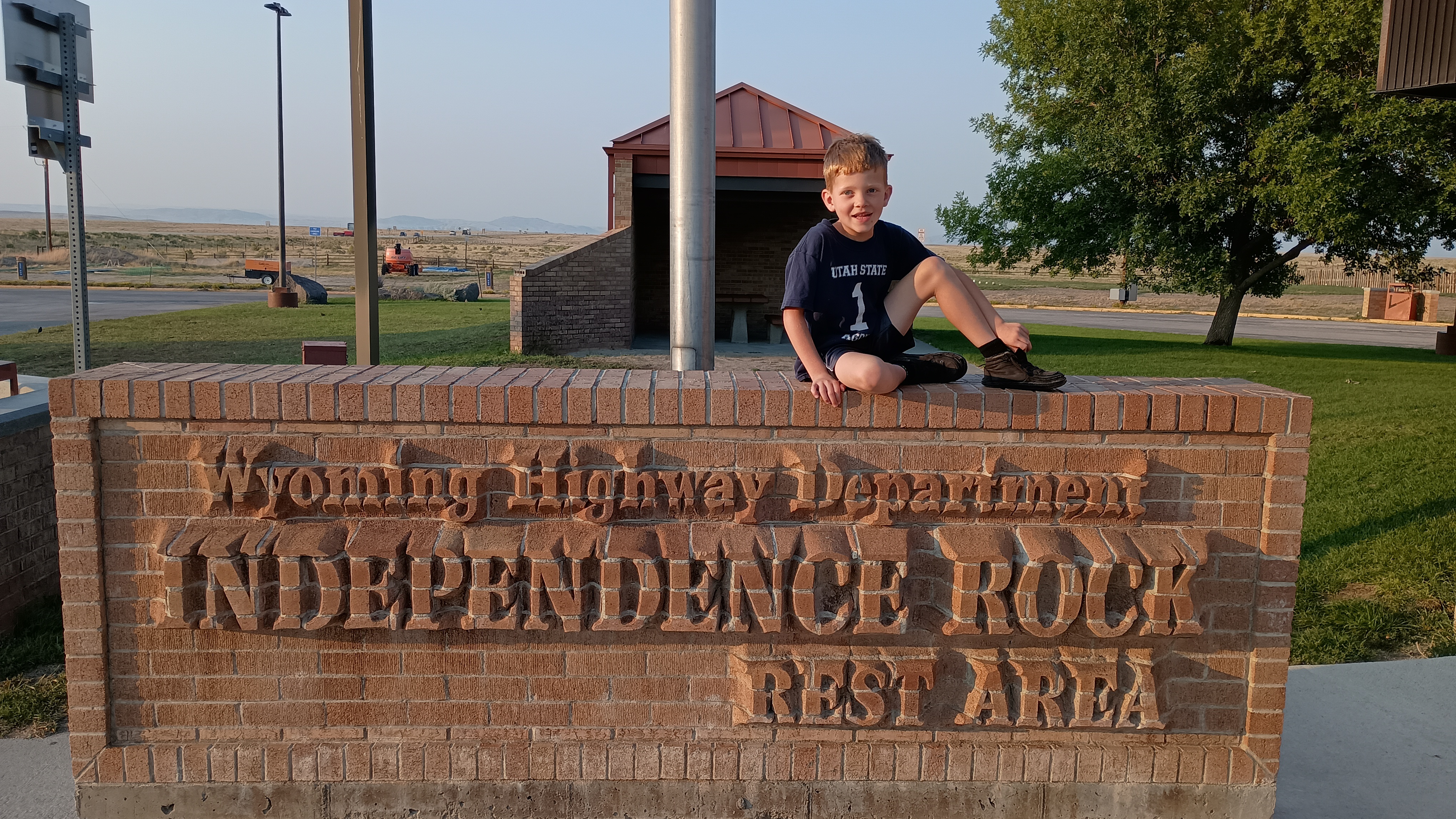
James Ross at Independence Rock

With four kids, we often stop at rest areas. As you can see above, we stopped at the one at Independence Rock. The rock is nearby and doubles as the parking location to visit the rock.

We finally made it to Casper about sunset. We ate an amazing Italian meal at Racca’s Pizzeria Napoletana and checked into our hotel.

Casper Wyoming Temple

We got up early, dressed appropriately, and headed out to visit the Casper Wyoming Temple. It was beautiful. Much smaller than I had anticipated. It is definitely one of the smallest temples, but that is because of the population and distance to other temples. It will supposedly have five stakes in its temple district, some of which will still come from a long distance to attend. Don’t let size fool you, it still has all the distinct parts of a temple and related quality. I think I may very much prefer the intimacy of the smaller temples. It actually reminded me of the Helena Montana Temple on size and flow.

Ross family at the Casper Wyoming Temple Open House

The temple does not have an adjoining chapel, but it does have a distribution/visitor center. We watched the video, enjoyed waiting in the line, and got to see the whole temple. If I were asked, there are a couple of design changes I would make for flow, but this temple will not regularly see these types of crowds or have those issues.

Ross family with the Casper Wyoming Temple

We hurried back to our hotel, changed, loaded up the car, checked out, and headed off to our next stop: The National Historic Trails Interpretive Center in Casper. I did not take any pictures there, but it was very well done. I enjoyed the visit, helped the kids with their junior ranger activities, and learned a few things. Part of the museum had its own little room and video dedicated to the Martin and Willie Handcart Companies.

We stopped at Independence Rock again on our way headed west. We walked around the massive rock and looked at a number of the signatures carved into stone from over 160 years ago. It was hot and we needed to get our little doggies along to Devil’s Gate.

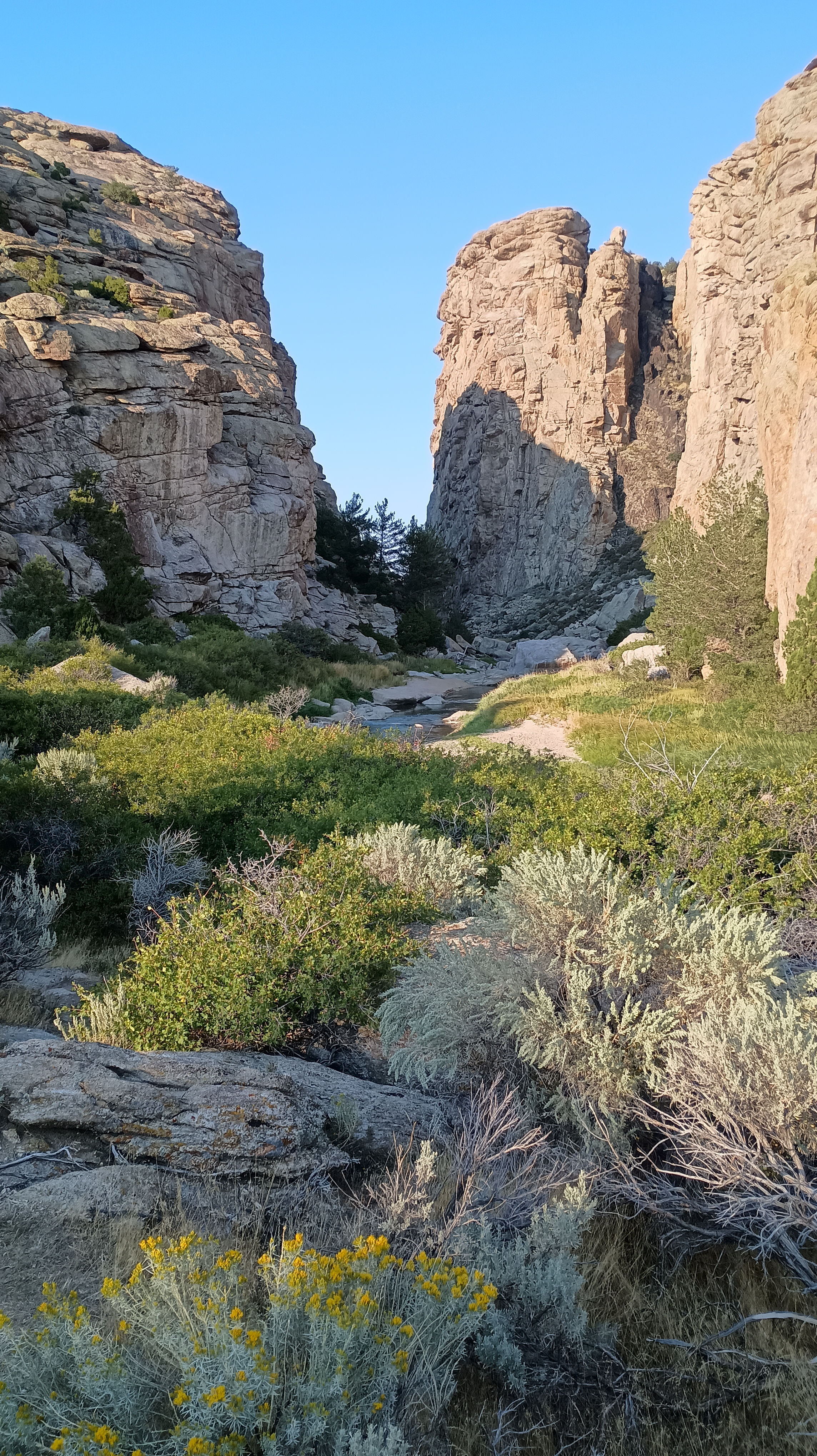
I will write about this more in a bit, but Devil’s Gate was a major landmark on the trail going west for all pioneers on the trails. But Devil’s Gate became more than a landmark and became a historical site in the tragic fall of 1856. Fort Seminoe was based there on the west side of Devil’s Gate, but it had been abandoned earlier that same year. It was that fall that the Martin Handcart Company found itself stranded in the snow. Days later the stranded handcart company moved into a nearby cove to get away from the wind, snow, and cold. That cove is now known as Martin’s Cove.

The Sun Ranch from Devil’s Gate, now The Martin’s Cove: Mormon Trail Site

We found the visitor’s center much more hospitable than some of our ancestors. As I worked through my family history, I had some of my own ancestors who passed through this very Devil’s Gate and area. Here are my ancestral lines that came across on the Mormon Trail. I had counted only 3 while in Casper, but hadn’t realized the Williams clan came over in two separate trips.

William and Mary Ann Sharp in 1853. Wagon train. Moses Clawson Company. William and Mary Ann met in the wagon train and married in Nebraska in 1853. William and Mary are my 3rd Great Grandparents.

John Williams in 1860. Wagon train. John Smith Company. John came over with his two sons John Haines (1829) and Richard (1838). I don’t know why his son David went separately in 1864. I am a descendant of John through David. John is my 4th Great Grandfather.

Johanna Benson in 1862. Wagon train. Joseph Horne Company. Johanna came over with some of her children and their families, her daughter Agneta, came over in 1864 with her family. Johanna is my 4th Great Grandmother.

William Edward Stoker in 1863. Wagon train. Unknown Company. William was traveling with his family, including the baby Mary Ann. William is my 3rd Great Grandfather, Mary Ann is my 2nd Great Grandmother.

John and Agneta Nelson in 1864. Wagon train. William Preston Company. Agneta is the daughter of Johanna Benson who came over in 1862. John and Agneta are my 3rd Great Grandparents.

David D and Gwenllian Williams in 1864. David is the son of John mentioned above. Wagon train. William S Warren Company. Gwenllian came with her sister Mary. Both married on the ship in Liverpool before setting sail for Utah. Gwenllian and Mary’s parents, David and Margaret Jordan, came over in 1872 crossing the plains by rail. David and Gwenllian are my 3rd Great Grandparents.

That gives me 10 ancestors that crossed the plains by wagon, none by handcart that I can tell. The unknown companies were all wagon trains as there were not handcarts those years.

Devil’s Gate – 2024

Every single one of these seven ancestors of mine who came west on the trail would have passed through Devil’s Gate. Here I stood on this sacred ground and snapped this photo of my daughter, my descendant and their descendant, at Devil’s Gate.

Aliza Ross at Devil’s Gate

It took me a bit more work, as I am not as familiar, to find those family lines of Amanda’s that also would have passed along the Mormon Trail to the west before the railroad made it much, much faster and safer. It took me several occasions over a couple of weeks to spend the time to research all these lines.

Henry and Ann Jackson in 1852. Wagon train. James C Snow Company. This is Amanda’s 4th Great Grandparents.

Regina Hansen in 1853. Wagon train. John E Forsgren Company. Her son, Hans Hansen, also accompanied her on the trip. Regina’s husband stayed behind. Regina is Amanda’s 4th Great Grandmother, Hans is Amanda’s 3rd Great Grandfather.

Grave of Hans Hansen in Plain City, Utah. Edith Sharp Ross’ stone is the stone at 10 o’clock from the top of this stone, my Great Grandmother.

David Buttars in 1843. Wagon train. William Empey Company. He appears to have traveled alone. Amanda’s 3rd Great Grandfather.

Birthe Jacobson in 1854. Unknown if wagon train or handcart company. Birthe’s daughter, Maria Jacobson, also accompanied her on the trip. Her husband Jorgen died in Missouri as part of the trip. Birthe is Amanda’s 5th Great Grandmother, Maria is Amanda’s 4th Great Grandmother.

Harriet Housley in 1856. Handcart company. Edward Martin Company. Harret’s son, George Housley, also accompanied her on the trip. Two other children came later. Harriet is Amanda’s 5th Great Grandmother, George is Amanda’s 4th Great Grandfather.

Richard and Christine Hemsley (1836 – 1915) in 1857. Handcart company. Israel Evans Company. This is Amanda’s 4th Great Grandparents.

Ole and Anne Jensen in 1861. Likely wagon train. Unknown company. Amanda’s 5th Great Grandparents.

John Crompton in 1862. Wagon train. Joseph Horne Company. John also had his daughter, Hannah Crompton, with him. John is Amanda’s 4th Great Grandfather, Hannah is Amanda’s 3rd Great Grandmother.

Anna Nielsen in 1862. Wagon train. Christian Madsen Company. She traveled alone. Amanda’s 3rd Great Grandmother.

Joseph and Penelope Thompson in 1862. Wagon train. John Riggs Murdock Company. Their son, Joseph Thompson, also accompanied the family. Amanda’s 4th Great Grandparents, Joseph is Amanda’s 3rd Great Grandfather.

Joseph Wayment in 1863. Wagon train. Unknown Company. Appears to have come alone. Although his parents and most of his siblings would come later by rail. Amanda’s 3rd Great Grandfather.

Axel Boyer in 1866. Wagon train. Abner Lowry Company. Amanda’s 4th Great Grandfather. Also traveled with the Keeps, other ancestors of Amanda.

James and Ann Keep in 1866. Wagon train. Abner Lowry Company. Their daughter, Sarah Keep, also accompanied the family. James and Ann are Amanda’s 4th Great Grandparents, Sarah is Amanda’s third great Grandmother. Also traveled with Axel Boyer, other ancestor of Amanda.

Richard Hemsley (1801 – 1866) and his later wife Sarah in 1866. Wagon train. William Henry Chipman Company. Amanda’s 5th Great Grandfather.

Peter Peterson in 1866. Wagon train. Joseph Sharp Rawlins Company. Peter is Amanda’s 4th Great Grandfather.

That is the Hemsley line alone, Amanda’s Dad. I count 26 ancestors of Amanda’s Dad that came through Devil’s Gate.

James, Lillian, Hiram, and Aliza Ross at Devil’s Gate Mormon Handcart Visitor Center

Amanda’s Mom’s line, the Holden family, has the following:

Edwin and Ruia Holden in 1852. Wagon train. Uriah Curtis Company. Their son, Henry Holden, also accompanied the family. Edwin and Ruia are Amanda’s 4th Great Grandparents, Henry is Amanda’s 3rd Great Grandfather.

Jesse and Temperance McCauslin in 1851. Wagon train. Unknown Company. Temperance passed away in Council Bluffs, Iowa. She did not make the trail in Wyoming or Devil’s Gate. Their daughter, Louisa McCauslin, also accompanied the family. Jesse is Amanda’s 4th Great Grandfather, Louisa is Amanda’s 3rd Great Grandmother.

John and Adelaide Roberts in 1863. Wagon train. Thomas Ricks Company. Their son, Hyrum Roberts, also accompanied the family. John and Adelaide are Amanda’s 3rd Great Grandparents, Hyrum is Amanda’s 2nd Great Grandfather.

Thomas and Mary Ashton in 1851. Wagon train. Morris Phelps Company. Mary also passed away in Iowa. She did not make the trail in Wyoming or Devil’s Gate. Their son, Joseph Ashton, also accompanied the family. Thomas is Amanda’s 4th Great Grandfather, Joseph is Amanda’s 3rd Great Grandfather.

Sarah Jarvis in 1854. Wagon train. Job Smith Company. She came with some of her family, but not with her son, Amanda’s ancestor, George Jarvis. Sarah is Amanda’s 4th Great Grandmother.

George and Ann Jarvis in 1853. Wagon train. Unknown Company. George and Ann are Amanda’s 3rd Great Grandparents. George is the son of Sarah Jarvis mentioned above.

William and Rebecca Finch in 1854. Wagon train. Daniel Garn Company. William and Rebecca are Amanda’s 3rd Great Grandparents.

Joseph Finch in 1853. Wagon train. Joseph Young Company. Joseph is the son of William and Rebecca Finch mentioned above.

John and Hannah Davis in 1851. Wagon train. Eaton Kelsey Company. Their daughter, Mary Jane, also accompanied the family. The family also has Davies listed for their last name sometimes. John and Hannah are Amanda’s 4th great grandparents, Mary Jane is Amanda’s 3rd Great Grandmother.

John Evans in 1866. Wagon train. William Henry Chipman Company (same company as Amanda’s Richard Hemsley above). His wife, Sarah, died on the trip from the United Kingdom in New York. His son, John Evans, also accompanied his father and brother. John is Amanda’s 3rd Great Grandfather, John is Amanda’s 2nd Great Grandfather.

James and Elizabeth Boyack in 1855. Wagon train. Milo Andrus Company. James and Elizabeth are Amanda’s 4th Great Grandparents.

James Boyack in 1853. Wagon train. Appleton Harmon Company. James is Amanda’s 3rd Great Grandfather. James is the son of James and Elizabeth Boyack above that came in 1855 across the plains.

Margary Waterhouse in 1855. Wagon train. Milo Andrus Company. Margary is Amanda’s 3rd Great Grandmother. She came across with the same train as James Boyack’s parents, presumably that is how she met her future husband. The Company arrived 24 October 1855 in Utah, James and Margary married 23 November 1855 in Springville, Utah.

That is the Holden line alone, Amanda’s Mom. I count 26 of ancestors of Amanda’s Mom that came through Devil’s Gate. As an aside, I also looked at her biological line (as she is adopted), and not a single one of her biological ancestors passed through Devil’s Gate.

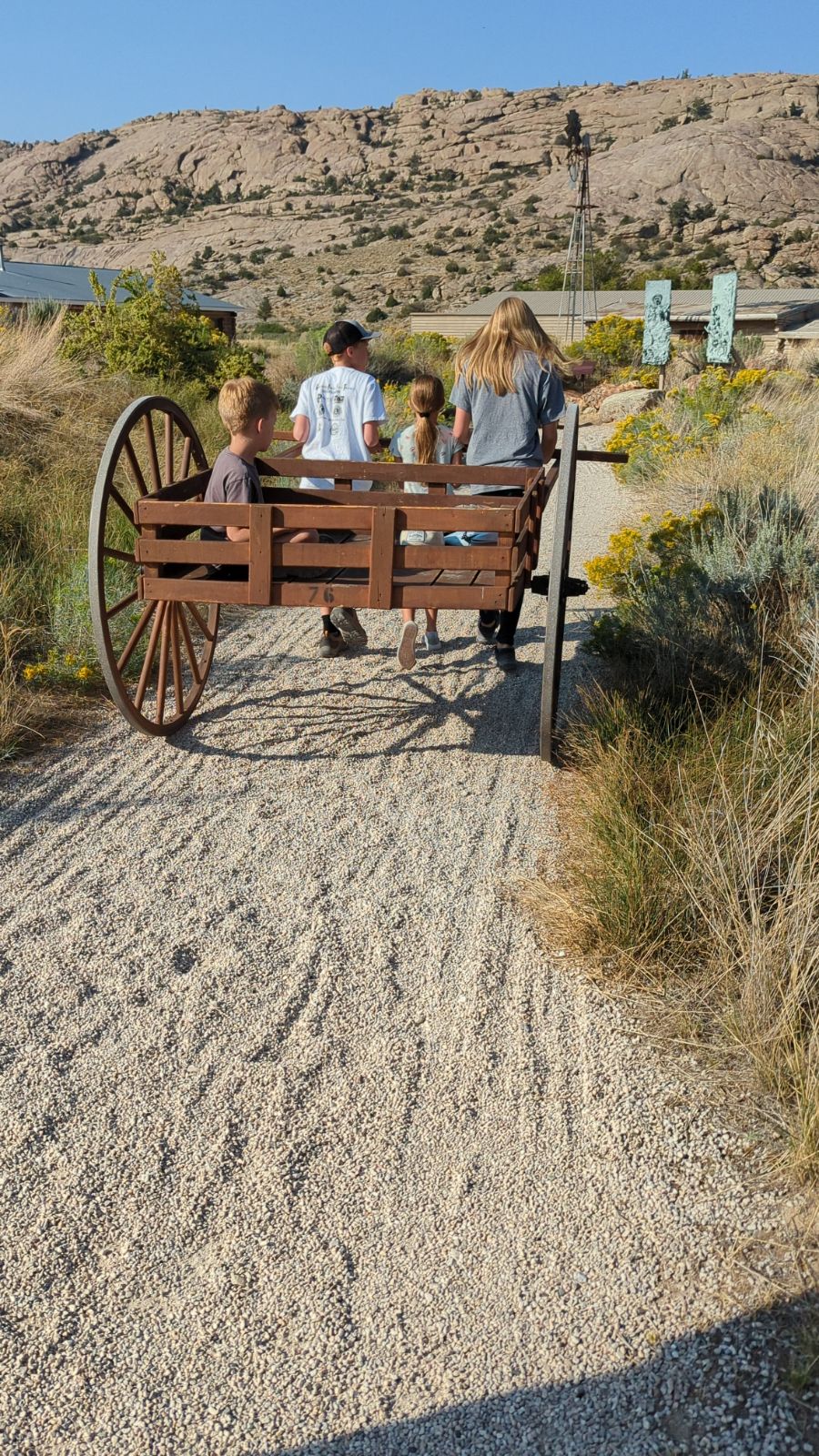
James riding while Hiram, Lillian, and Aliza Ross pull a handcart at Devil’s Gate Mormon Handcart Visitors Center

We also stopped and visited with the sixth crossing of the Sweetwater River. This was the location where, like the Martin Handcart Company, the Willie Handcart Company also got stuck in wind, snow, and cold in 1856. Their rescue occurred here.

The next day, on our way to Grand Teton National Park, we made a stop at Fort Washakie, Wyoming. This is one of the alleged graves of Sacagawea. We stopped and remembered her, whether her final resting place or not.

All in all, I was surprised by my own connection to the Mormon Trail. I had never considered that I have 7 ancestors who had literally come this way. Or that my children have 59 ancestors that literally come this way. They passed by Independence Rock, through Devil’s gate, and two of those 59 suffered with the Martin Handcart Company. I will write more on the Housley’s later as there have been other interesting interactions with that clan since our marriage.

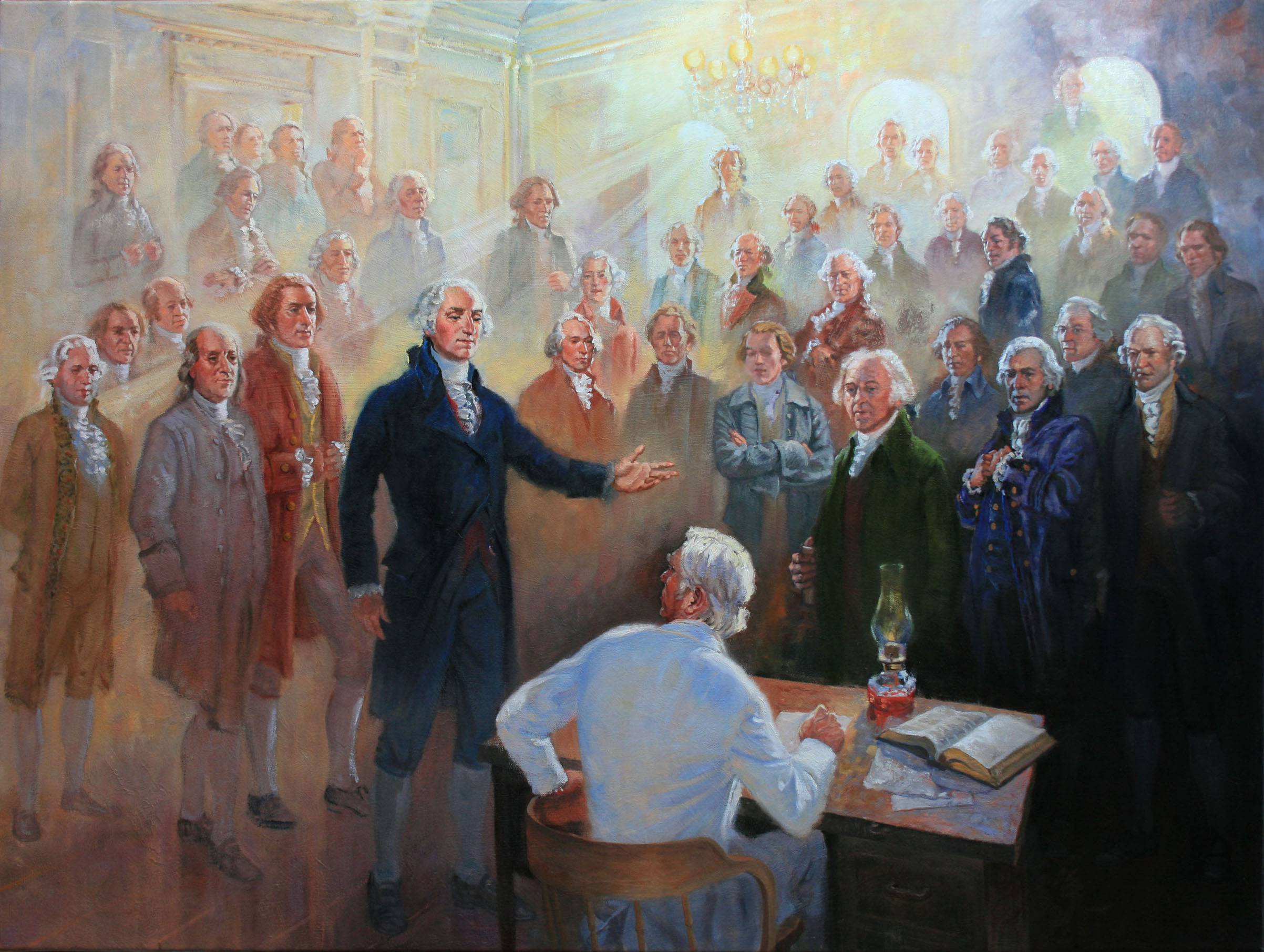
Wilford Woodruff and Founding Fathers

Wilford Woodruff’s vision of the Founding Fathers requesting Temple Ordinances

We are moving soon, but the Burley 11th Ward gave me another chance to address them. Since I received a number of requests for a copy of the talk, which is really just a collage of various items I could find online, the Journal of Discourses, the Saints second and third volumes, and other various histories. Here is the text of the talk I wrote, that does not mean it is the talk I gave…

I first addressed the freedoms we have as contrasted in the Saints third volume related to Germany. I said the word Jew and Israel from the stand and did not fear reprisal. I listen to free radio anytime I want and even seek out British radio from time to time and there is nothing illegal. Lastly, we could congregate without the worry of those in our midst about what was said or in the actual act of meeting.

Then to the following:

Declaration of Independence – We hold these truths to be self-evident, that all men are created equal, that they are endowed by their Creator with certain unalienable Rights, that among these are Life, Liberty and the pursuit of Happiness.

George Washington: “The success, which has hitherto attended our united efforts, we owe to the gracious interposition of Heaven, and to that interposition let us gratefully ascribe the praise of victory, and the blessings of peace.”

Alexander Hamilton: “The Sacred Rights of mankind are not to be rummaged from among old parchments or musty records. They are written . . . by the Hand of Divinity itself.” “For my own part, I sincerely esteem it a system, which without the finger of God, never could have been suggested and agreed upon by such a diversity of interests.”

Thomas Jefferson: “The God who gave us life gave us liberty at the same time.”

John Adams: “As I understand the Christian religion, it was, and is, a revelation.”

Benjamin Franklin: “The longer I live the more convincing Proofs I see of this Truth. That God Governs in the Affairs of Men!—And if a Sparrow cannot fall to the Ground without his Notice, is it probable that an Empire can rise without his Aid?—We have been assured, . . . in the Sacred Writings, that ‘except the Lord build the House, they labour in vain that build it.’ I firmly believe this;—and I also believe that without his concurring Aid we shall succeed in this political building no better than Builders of Babel.”

James Madison: “It is impossible for the man of pious reflection not to perceive in it a finger of that Almighty hand which has been so frequently and signally extended to our relief in the critical stages of the revolution.”

Samuel Adams: “Revelation assures us that ‘Righteousness exalteth a Nation’—Communities are dealt with in this World by the wise and just Ruler of the Universe. He rewards or punishes them according to their general Character.”

Charles Pinckney: “When the great work was done and published, I was . . . struck with amazement. Nothing less than that superintending hand of Providence, that so miraculously carried us through the war, . . . could have brought it about so complete, upon the whole.”

On May 4, 1842, he called to his side nine of the most faithful of his brethren—Hyrum Smith, Brigham Young, Heber C. Kimball, Willard Richards, Newell K. Whitney, and others—and later their wives came with them to the upper floor of the Red Brick Store in Nauvoo. 

Joseph was seeking to fulfill the promise from D&C 124, given in 1841, which the Lord would reveal to Joseph “all things pertaining to this house, and the priesthood thereof, and the place whereon it shall be built.” 

He had started, “If it should be the will of God that I might live.” Then he corrected and said, “It is not the will of the Lord that I should live, and I must give you, here in this upper room, all those glorious plans and principles whereby men are entitled to the fulness of the priesthood.” He proceeded in an improvised and makeshift way to do so.

We have from Brigham Young that after they had received these blessings the Prophet said: “Brother Brigham, this is not arranged right. But we have done the best we could under the circumstances in which we are placed, and I wish you to take this matter in hand and organize and systematize all these ceremonies.”

Brigham Young later said, “I did so. And each time I got something more, so that when we went through the temple at Nauvoo I understood and knew how to place them there. We had our ceremonies pretty correct.”

While the Nauvoo Temple was started in 1841, the first endowments were performed in the winter of 1845 and into 1846.  Baptisms had started in the Mississippi River prior to the temple and moved into the temple baptistery soon after it was completed and dedicated, well before the rest of the temple was done.  Brigham, leading the church, was personally overseeing the organization and perfection of the endowment and other ordinances that started in Nauvoo. 

After arriving in Salt Lake City, the church used the top floor of the Council House, starting in 1852 until the Endowment House was completed in 1855.  It was in this building that endowments, prayer circles, some missionary training, and some setting aparts were conducted.  The use of the Endowment House ended in 1877 with the completion of the St George Temple.  That building stood until Wilford Woodruff heard that unauthorized sealings were occurring there and ordered it razed in 1889. 

The St George Temple was the only one completed during Brigham Young’s 30 year tenure as President.  It was dedicated on 1 January 1877 in three dedicatory prayers under the direction of Brigham.  The baptistery by Wilford Woodruff, the main floor by Erastus Snow, and the sealing room by Brigham Young Jr.  Wilford Woodruff served as St George Temple President from 1877 to 1884.  Brigham had to be carried up the stairs, but he stood and spoke in the Assembly Room. 

“When I think upon this subject, I want the tongues of seven thunders to wake up the people,” he declared. “Can the fathers be saved without us? No. Can we be saved without them? No. And if we do not wake up and cease to long after the things of this earth, we will find that we as individuals will go down to hell.”

Brigham lamented that many Saints were pursuing worldly things. “Supposing we were awake to this thing, namely the salvation of the human family,” he said, “this house would be crowded, as we hope it will be, from Monday morning until Saturday night.”

On 9 January 1877, the first baptisms for the dead were performed in the St George Temple.  The first endowment for the dead was performed on 11 January 1877.  Brigham and Wilford personally oversaw the ordinances being performed.  Wilford began wearing a white suit, starting the trend that continues to this day. 

All endowments to this point had been done and passed by word of mouth.  It was in St George, far from Salt Lake City, that the ordinances were first written down.  Brigham also wanted to make sure the record was preserved and that they were standardized.  They were read to Brigham time and time again who would then approve or continue to revise the ordinances.  Brigham went home to Salt Lake City in April 1877.  He stopped and dedicated the spot for the Manti Temple on the way home.

Wilford Woodruff then wrote in his journal on Sunday 19 August 1877, “I spent the evening in preparing a list of the noted men of the 17 century and 18th, including the signers of the Declaration of Independence and presidents of the United States, for baptism on Tuesday the 21 Aug 1877.”

His journal entry for August 21 reads, “I, Wilford Woodruff, went to the temple of the Lord this morning and was baptized for 100 persons who were dead, including the signers of the Declaration of Independence. … I was baptized for the following names.” He then listed the names of one hundred men.

Elder Woodruff continued his journal entry: “When [John Daniel Thompson] McAllister had baptized me for the 100 names, I baptized him for 21, including Gen. Washington and his forefathers and all the presidents of the United States that were not on my list except Buchanan, Van Buren, and Grant.” (The work for these presidents has since been done.)

“It was a very interesting day,” Elder Woodruff continued. “I felt thankful that we had the privilege and the power to administer for the worthy dead, especially for the signers of the Declaration of Independence, that inasmuch as they had laid the foundation of our Government, that we could do as much for them as they had done for us.

“Sister Lucy Bigelow Young went forth into the font and was baptized for Martha Washington and her family, and seventy of the eminent women of the world. I called upon the brethren and sisters who were present to assist in getting endowments for those that we had been baptized for today.” (Wilford Woodruff’s journal, typescript, vol. 7, Church History Library; spelling and punctuation modernized.)

The first public mention of these events was made nearly a month after the baptisms were performed. In an address in the Tabernacle on Temple Square on 16 September 1877, Elder Woodruff first told publicly of the visitation of the signers of the Declaration of Independence.

“You have had the use of the Endowment House for a number of years, and yet nothing has ever been done for us. We laid the foundation of the government you now enjoy, and we never apostatized from it, but we remained true to it and were faithful to God. (Conference Report, April 10, 1898; Discourses of Wilford Woodruff, pp. 160-61)

During the 68th Annual General Conference of the Church which was held in April 1898, President Woodruff recounted the sacred experience:

I am going to bear my testimony to this assembly, if I never do it again in my life, that those men who laid the foundation of this American government and signed the Declaration of Independence were the best spirits the God of heaven could find on the face of the earth. They were choice spirits, not wicked men. General Washington and all the men that labored for the purpose were inspired of the Lord.

Another thing I am going to say here, because I have a right to say it.  Every one of those men that signed the Declaration of Independence, with General Washington, called upon me, as an Apostle of the Lord Jesus Christ, in the Temple at St. George, two consecutive nights, and demanded at my hands that I should go forth and attend to the ordinances of the House of God for them.  Men are here, I believe, that know of this, Brother John D. T. McAllister, David H. Cannon and James S. Bleak.  Brother McAllister baptized me for all those men, and then I told these brethren that it was their duty to go into the Temple and labor until they had got endowments for all of them.  They did it.  Would those spirits have called up on me, as an Elder in Israel to perform that work if they had not been noble spirits before God?  They would not. (Wilford Woodruff, Conference Report, April 1989, pp. 89-90.)

“They waited on me for two days and two nights,” he said,

“I thought it very singular, that notwithstanding so much work had been done, and yet nothing had been done for them.” (Journal of Discourses, 19:229.)

I was also present in the St. George Temple and witnessed the appearance of the Spirits of the Signers….the spirits of the Presidents….and also others, such as Martin Luther and John Wesley….Who came to Wilford Woodruff and demanded that their baptism and endowments be done. Wilford Woodruff was baptized for all of them. While I and Brothers J.D.T. McAllister and David H Cannon (who were witnesses to the request) were endowed for them. These men… laid the foundation of this American Gov., and signed the Declaration of Independence and were the best spirits the God of Heaven could find on the face of the earth to perform this work. Martin Luther and John Wesley helped to release the people from religious bondage that held them during the dark ages. They also prepared the people’s hearts so they would be ready to receive the restored gospel when the Lord sent it again to men on the earth.” (Personal journal of James Godson Bleak – Chief Recorder of the St. George Temple.)

In 1986, some of the staff of the Family History Library’s LDS Reference Unit were assigned to compile and computerize all the existing genealogical data on the founding fathers, to identify their families, and to document completed temple ordinances for each. For purposes of the project, a founding father was identified as one who had signed one or more of the following documents: the Articles of Association (1774), the Declaration of Independence (1776), the Articles of Confederation (1778), or the Constitution (1787).

The library study of 1986 revealed that there were no sealings of children to parents performed at the time the baptisms and endowments were performed. As a note, the ongoing revelation related to sealings to parents was not revealed until 1894.  It was then that the Law of Adoption, or sealing to prominent church leaders, was discontinued and we were encouraged to do genealogical work to compile the pedigree of the entire human family.  It was then that the Utah Genealogical Society was founded that has snowballed into the fantastic work of FamilySearch and all its appendages. 

He also recorded that George Washington, John Wesley, Benjamin Franklin, and Christopher Columbus were ordained High Priests at the time.

Temple work was performed on behalf of the following well-known and respected men and women in the St. George Utah Temple in August 1877.

Founding Fathers: William Hooper (NC), Joseph Hewes (NC), John Penn (NC), Button Gwinnett (GA), Lyman Hall (GA), George Walton (GA), Edward Rutledge (SC), Thomas Heyward Jr. (SC), Thomas Lynch (SC), Arthur Middleton (SC), Samuel Chase (MD), William Paca (MD), Thomas Stone (MD), Charles Carroll (MD), George Wythe (VA), Richard Henty Lee (VA), Thomas Jefferson (VA), Benjamin Harrison (VA), Thomas Nelson Jr. (VA), Francis Lightfoot Lee (VA), Carter Braxton (VA), Robert Morris (PA), Benjamin Rush (PA), Benjamin Franklin (PA), John Morton (PA), George Clymer (PA), James Smith (PA), George Taylor (PA), James Wilson (PA), George Ross (PA), Caeser Rodney (DE), George Read (DE), Thomas McKean (DE), Philip Livingston (NY), Francis Lewis (NY), Lewis Morris (NY), Richard Stockton (NJ), John Witherspoon (NJ), Francis Hopkinson (NJ), John Hart (NJ), Abraham Clark (NJ), Josiah Bartlett (NH), William Whipple (NH), Matthew Thornton (NH), Samuel Adams (MA), John Adams (MA), Robert Treat Paine (MA), Elbridge Gerry (MA), Stephen Hopkins (RI), William Ellery (RI), Roger Sherman (CN), Samuel Huntington (CN), William Williams (CN), and Oliver Wolcott (CN).

Note: Temple work was not done for John Hancock or William Floyd as it had already been completed previously.

Presidents of the United States: George Washington, John Adams, Thomas Jefferson, James Madison, James Monroe, John Quincy Adams, Andrew Jackson, William Henry Harrison, John Tyler, James Knox Polk, Zachary Taylor, Millard Fillmore, Franklin Pierce, Abraham Lincoln, and Andrew Johnson.  Temple work was not done for James Buchanan, Martin Van Buren, or Ulysses S. Grant.

Other eminent men baptized by Wilford Woodruff in the St. George Utah Temple in August 1877 include: Sir Edward Gibbon, Johann Wolfgang von Goethe, Oliver Goldsmith, Henry Grattan, Humboldt, Alexander von Irving, Washington Jackson, Thomas Jonathan “Stonewall” Johnson, Samuel Juarez, Benito Pablo Kemble, John Philip Liebig, Baron Justus von Livingstone, David Macaulay, Thomas Babington Nelson, Lord Horatio O’Connell, Daniel Peabody, George Powers, Hiram Reynolds, Sir Joshua Schiller, Johann Christoph Friedrich von Scott, Sir Walter Seward, William Henry Stephenson, George Thackeray, William Makepeace, Vespucci, Amerigo Webster, Daniel Wesley, John Wordsworth, William Parepa, Count Dimitrius, Martha Washington and her family, John Washington (Great Grandfather of George Washington), Sir Henry Washington, Lawrence Washington (Brother of George Washington), Augustine Washington (Father of George Washington), Lawrence Washington (Father of Augustine), Lawrence Washington, Daniel Park Custis, John Park Custis (Son of Daniel and Martha Parke Custis), and Martin Luther.

Eminent Women baptized include: Jean Armour (1767—1834) of Scotland, Jean Armour Burns (Wife of Robert Burns) (1759—1796), Jane Austen (1775—1817) of England, novelist, Mary Ball (1708—1789) of America, Mary Ball Washington (Mother of George Washington) (1732—1799), Sarah Bernard (1800—1879) of England, Sarah Barnard Faraday (wife of Michael Faraday (1791—1867), Charlotte Bronte (1816—1855) of England, novelist, Felicia Dorothea Browne (1793—1835) of England, Elizabeth Barrett Browning (1806—1861) of England, poet, (wife of Robert Browning) (1812—18?), Martha Caldwell Calhoun (d. 1802) of America (mother of John Caldwell Calhoun) (1782—1850), Martha Parke Custis (1755—1773) of America (Daughter of Martha Washington) (1732—1802), Martha Dandridge Washington (1732—1802) of America (wife of George Washington) (1732—1799),  Rachel Donelson Jackson (1767—1828) of America (wife of Andrew Jackson (1767—1845), and Abigail Eastman Webster (1737—1816) of America (mother of Daniel Webster (1782—1852), to name but a few. Temple work was performed for a total of 70 eminent women.

During most of our national history Columbus and the Founders were considered heroes with determination and foresight.  Cities, rivers, and many other places were named after them.  More recently there has been a wide spread effort, designed especially to indoctrinate young people, which slanders Columbus, the Founders and their accomplishments.  Columbus is held personally responsible for centuries of mistreatment of Native Americans.  The Founders are portrayed as being greedy and motivated by selfish interests. All of this is as astonishing as it is misleading.  

From the Lord’s perspective among the most important events of the history of the world was the discovery and founding of America.  1 Ne 11-14.  Nephi was referring to Columbus when he wrote:  “I looked and beheld a man among the Gentiles, who was separated from the seed of my brethren by the many waters; and I beheld the Spirit of God, that it came down and wrought upon the man; and he went forth upon the many waters, even unto the seed of my brethren, who were in the promised land” 1 Ne 13:12.  By the Founders “the Lord God will raise up a mighty nation…even on the face of this land.” 1 Ne 22:7.

Go on to life and history of George Ross of Pennsylvania, signer of Declaration of Independence.  

2020: The Year of the Dead

This wasn’t intentional.  Not sure why or how it happened, but it did.

Anyone who knows me knows that I stop and visited deceased people and ancestors anytime I am in the neighborhood.  Kinda like stopping in to visit any other cousin or friend when you are driving through, are in town, and have some time.  Ancestors are very accommodating whenever you want to stop in and visit.  Maybe COVID-19 just gave us more time.

I have the following ancestors who are buried somewhat nearby, western United States.  I will link each ancestor I have written about previously if you want additional information.  Here are my ancestors and where they are buried.

As of this writing, I see there are two ancestors that I haven’t stopped and visited in the last few years and got pictures with the kids and the tombstone, Christiana Andra in Salt Lake City and William Sharp in Ogden (I now have the goal to get it done before the end of the year).  I also have a couple of known ancestors without tombstones, David and Gwenllian Jordan in Ogden, Utah, Hubert Jonas in Ellensburg, Washington (but we got pictures at the grave), and Damey Ross in Olivehurst, California (who we visited after hours and couldn’t even locate the grave).  We should remedy that but we may just have to stop and get pictures with their grave locations.

I also cheat and use the 2016, 2018, and 2019 photos with three ancestors, Johanna Benson in Spring City, Utah in 2018, John William Ross in San Bruno, California in 2016, and James Thomas Ross/Meredith in Fresno, California in 2019.  I could do a 2020 photo for Johanna, but I am not going to California just to redo a tombstone photo with the two Ross ancestors.

Grandparents

Milo & Gladys Ross – Plain City, Utah

Lillian, Paul, Aliza, and Hiram Ross with tombstone of Gladys Maxine Donaldson (1921-2004) and Milo James Ross (1921-2014) on 23 May 2020.

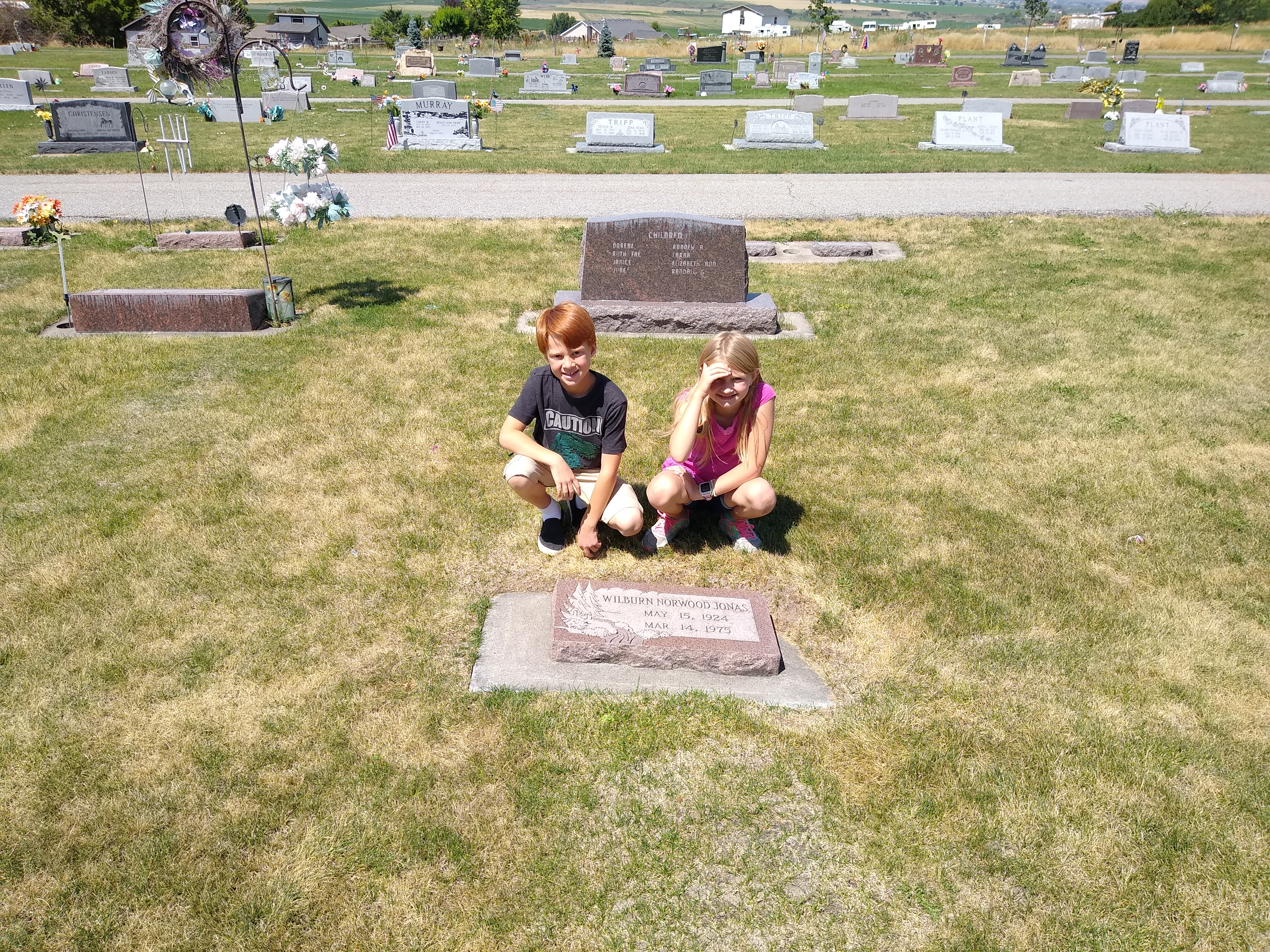
Norwood Jonas – Richmond, Utah

Hiram and Aliza Ross with tombstone of Wilburn Norwood Jonas (1924-1975) on 26 July 2020.

Colleen Lloyd – Dingle, Idaho

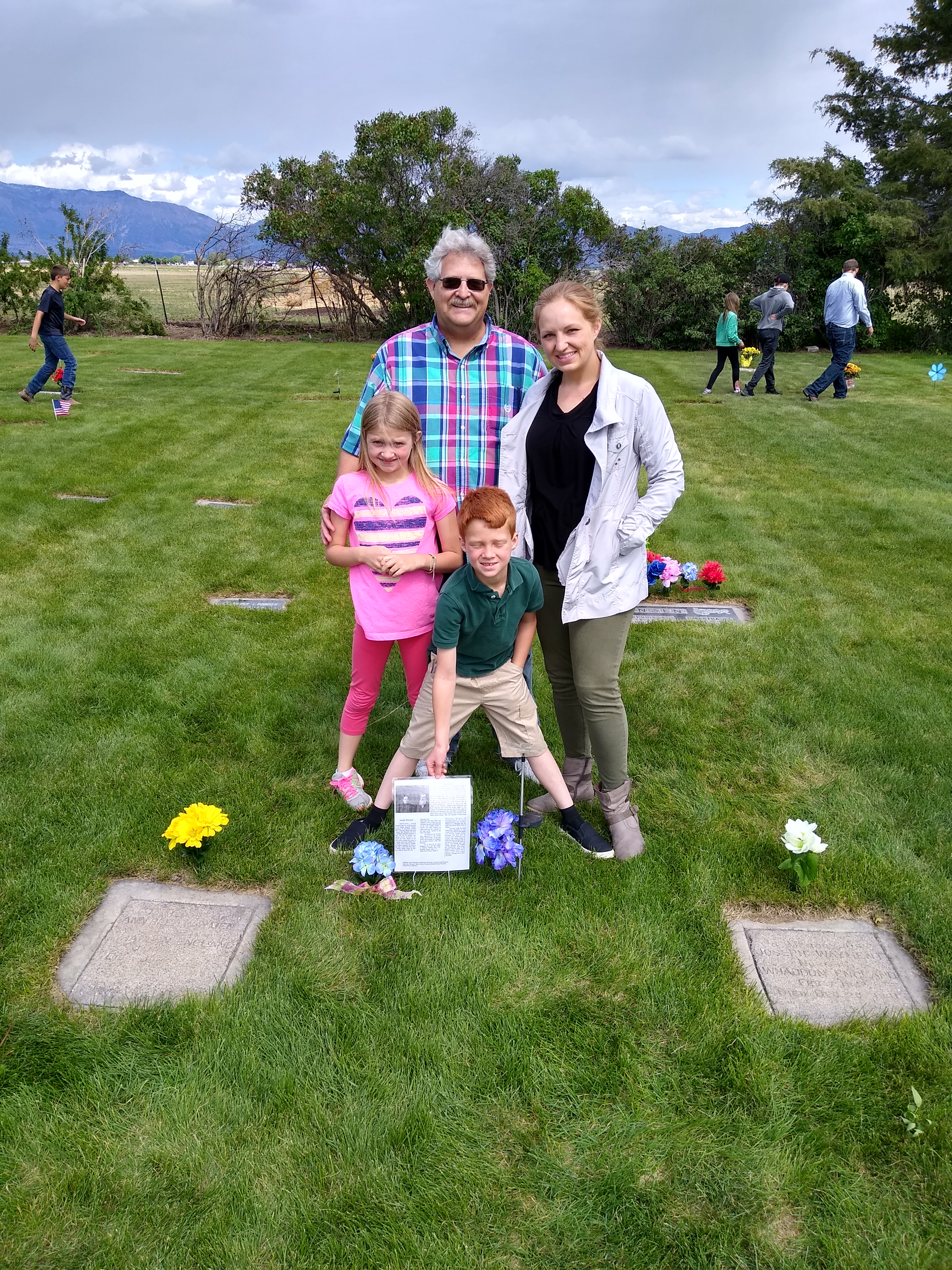
Lillian, Hiram, James, and Aliza Ross with tombstone of Colleen Mary Andra (1928-1999) and Ivan W Lloyd (1919-2011) on 25 July 2020.

Great Grandparents

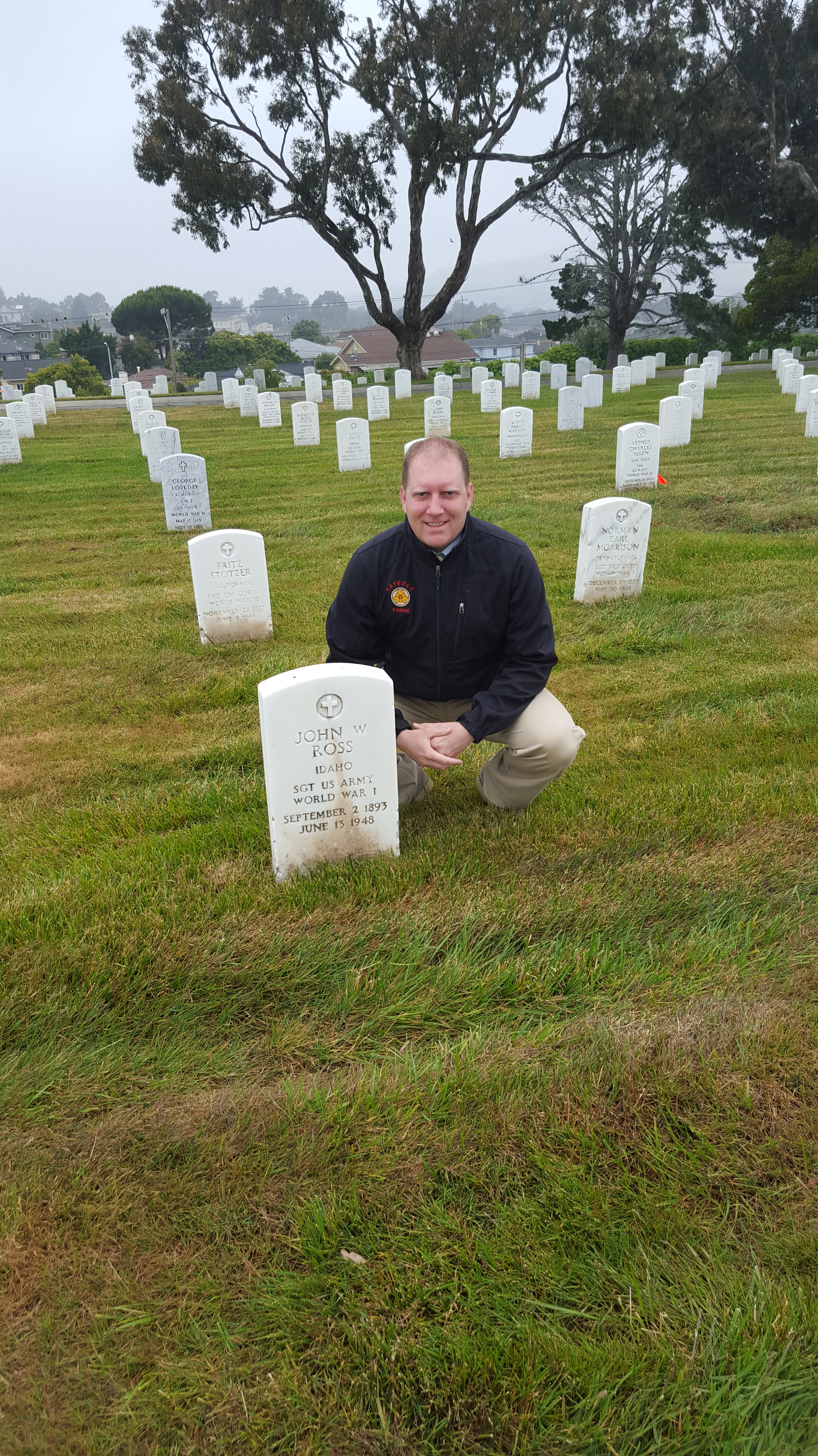
John Ross – Golden Gate National, San Bruno, California

Paul Ross with tombstone of John William (Jack) Ross (1890-1948) on 24 May 2016.

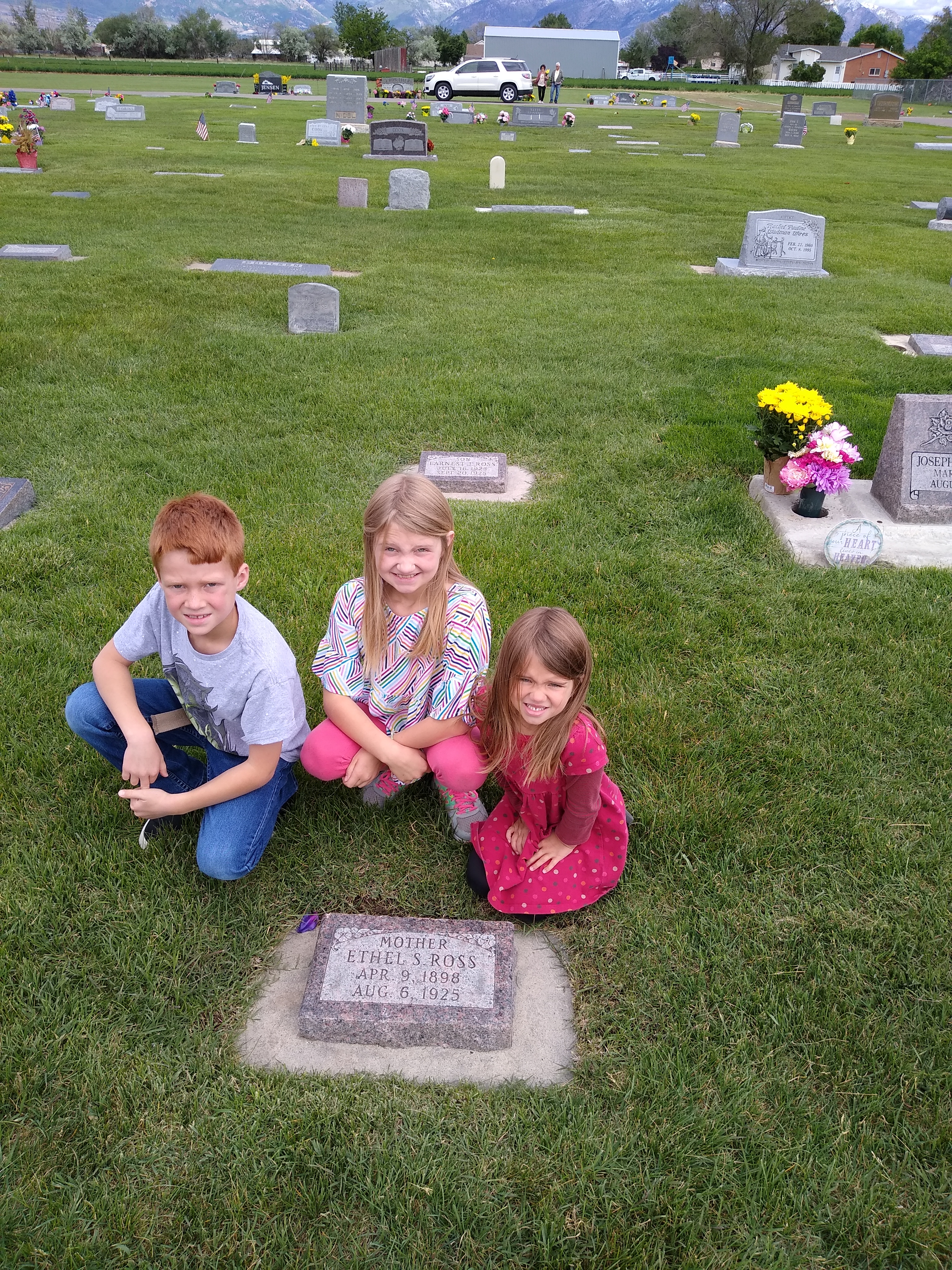
Ethel Ross – Plain City, Utah

Hiram, Aliza, and Lillian Ross with tombstone for Ethel Sharp Ross (1898-1925) on 23 May 2020.

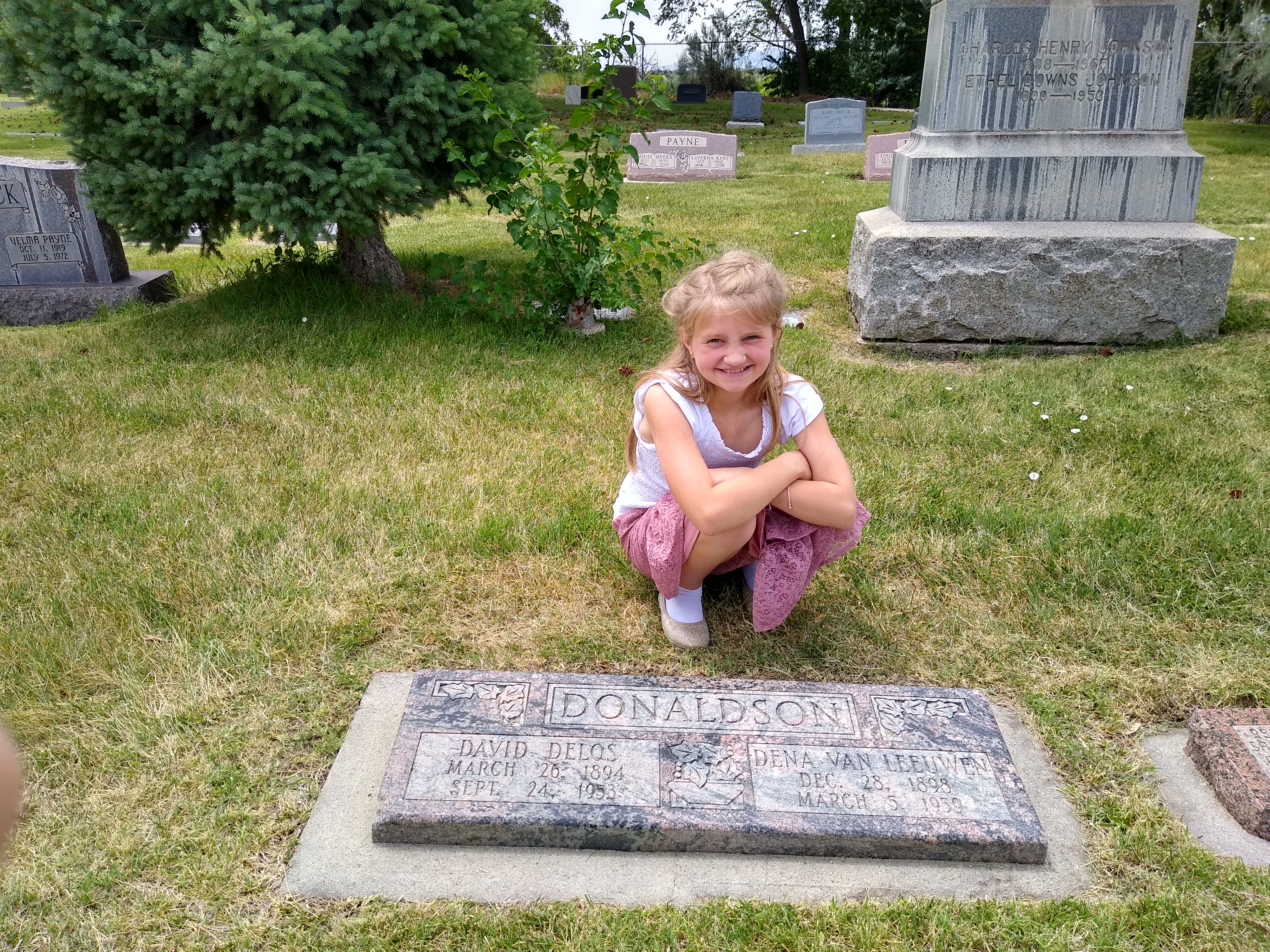
Delos & Dena Donaldson – Ogden, Utah

Aliza Ross with tombstone for Berendena Van Leeuwen (1898-1959) and David Delos Donaldson (1894-1953) on 28 June 2020.

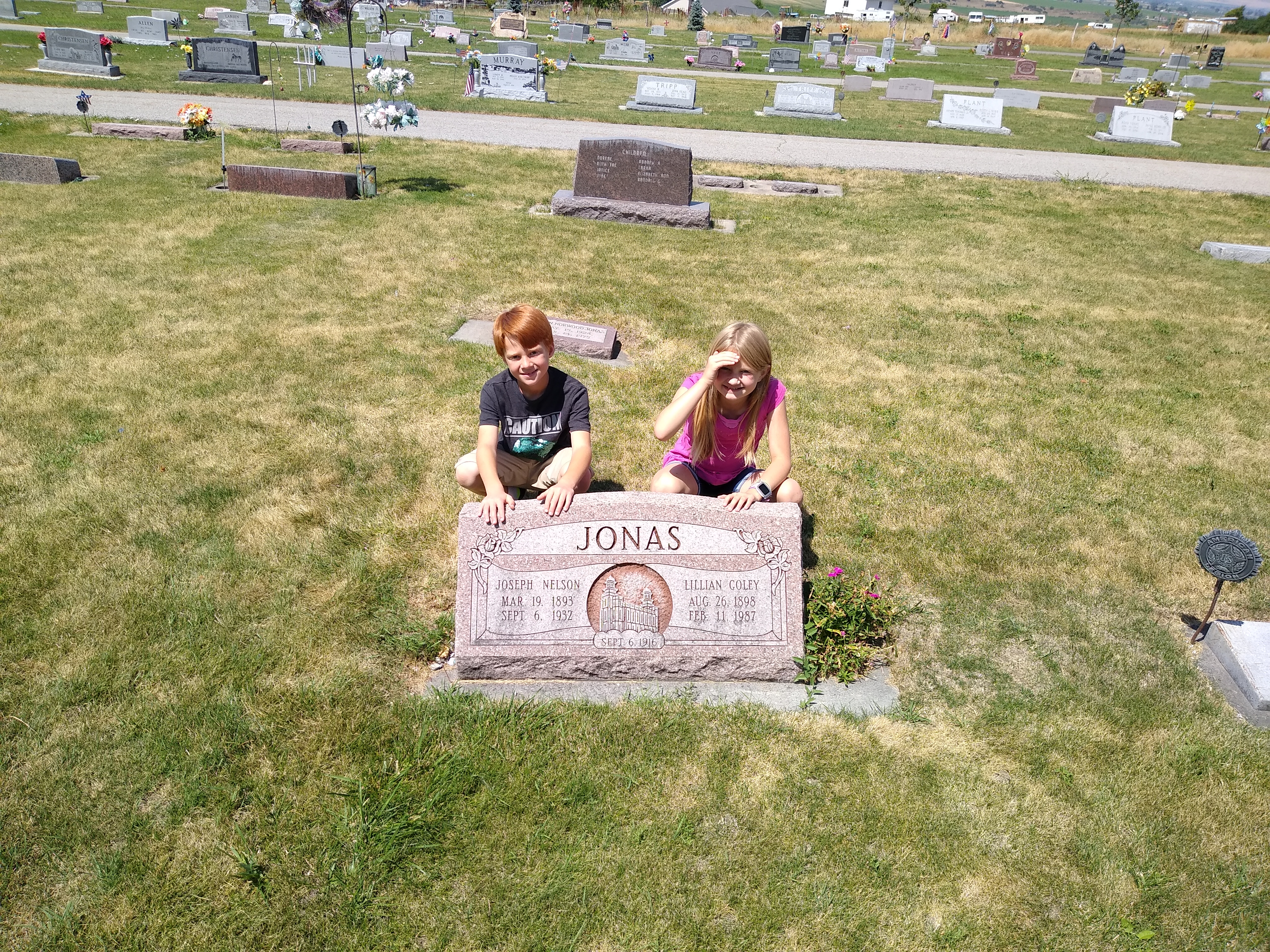
Joseph & Lillian Jonas – Richmond, Utah

Hiram and Aliza Ross with tombstone of Lillian Coley (1898-1987) and Joseph Nelson Jonas (1893-1932) on 26 July 2020.

Bill & Mary Andra – Whitney, Idaho

Lillian (in background by Wanner tombstone), James, Aliza, and Hiram Ross with tombstone of Mary Louise Wanner (1901-1991) and William Fredrick Andra (1898-1990) on 26 July 2020.

Great Great Grandparents

James Ross/Meredith – Belmont Memorial, Fresno, California

Paul, Aliza, and Hiram Ross with tombstone of James Thomas Ross (aka James R Meredith)(1869-1951) on 10 May 2019.

Damey Graham Ross – Sierra View, Olivehurst, California

Damey Catherine Graham Ross doesn’t have a tombstone, but we visited her grave in 2016 in the evening.  No photo.

Milo & Lillie Sharp – Plain City, Utah

Aliza, Paul, Lillian, and Hiram Ross with tombstone of Mary Ann Bailey (1828-1913), Mary Ann (Lillian “Lillie” Musgrave) Stoker (1861-1935) and Milo Riley Sharp (1857-1916) on 23 May 2020. Mary Ann Bailey is the mother of Milo Riley Sharp, don’t confuse mother Mary Ann with spouse Mary Ann. We shorten our Lillian’s name to Lillie’s spelling in her honor.

William & Mary Donaldson – Ogden, Utah

Aliza Ross with tombstones of Mary Elizabeth Williams (1869-1951) and William Scott Donaldson (1865-1913) on 28 June 2020.

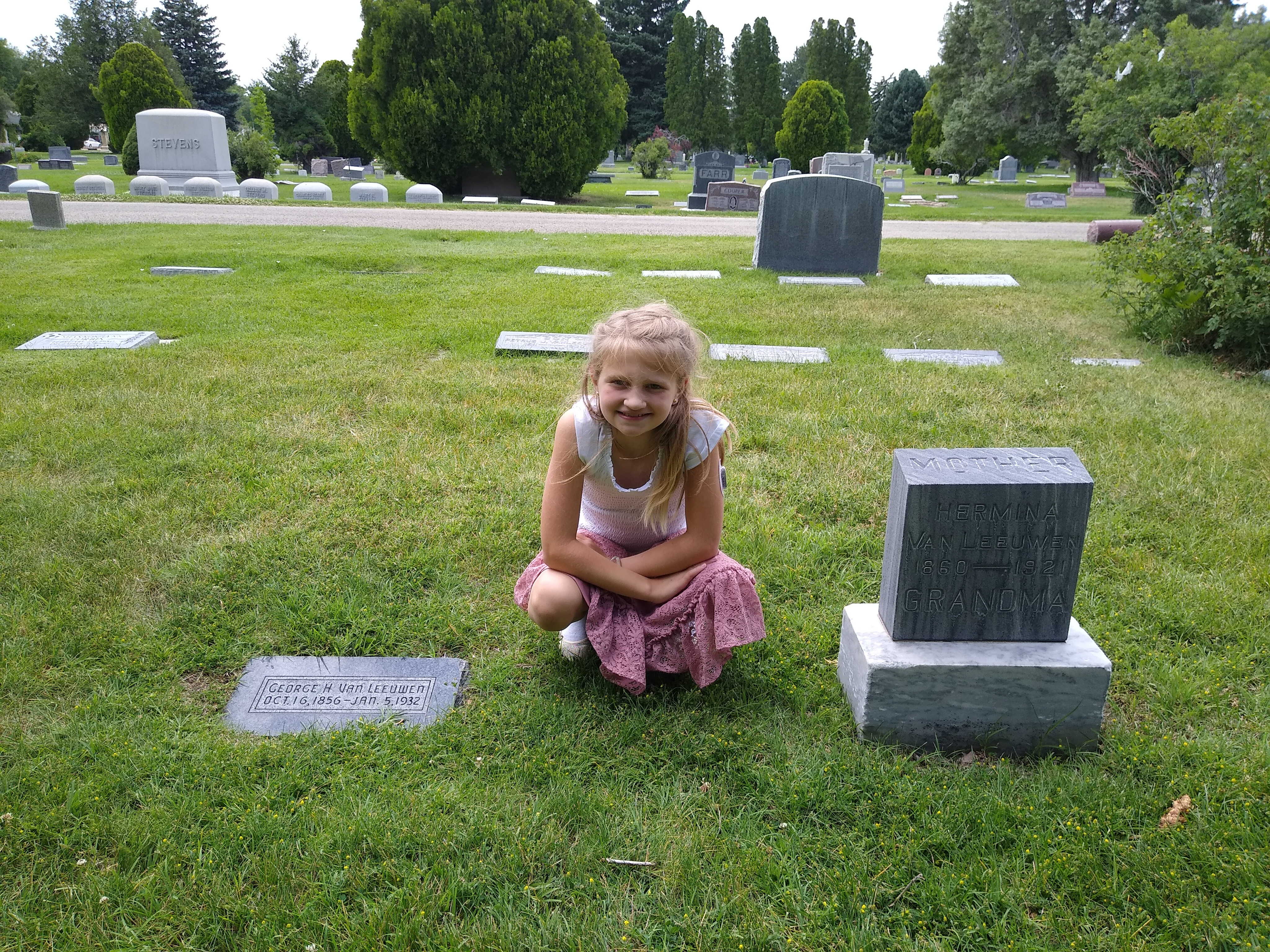
George & Minnie Van Leeuwen – Ogden, Utah

Aliza Ross with tombstones for Hermina Jansen (1860-1921) and George Henry (Gerhardus Hendrick) Van Leeuwen (1856-1932) on 28 June 2020.

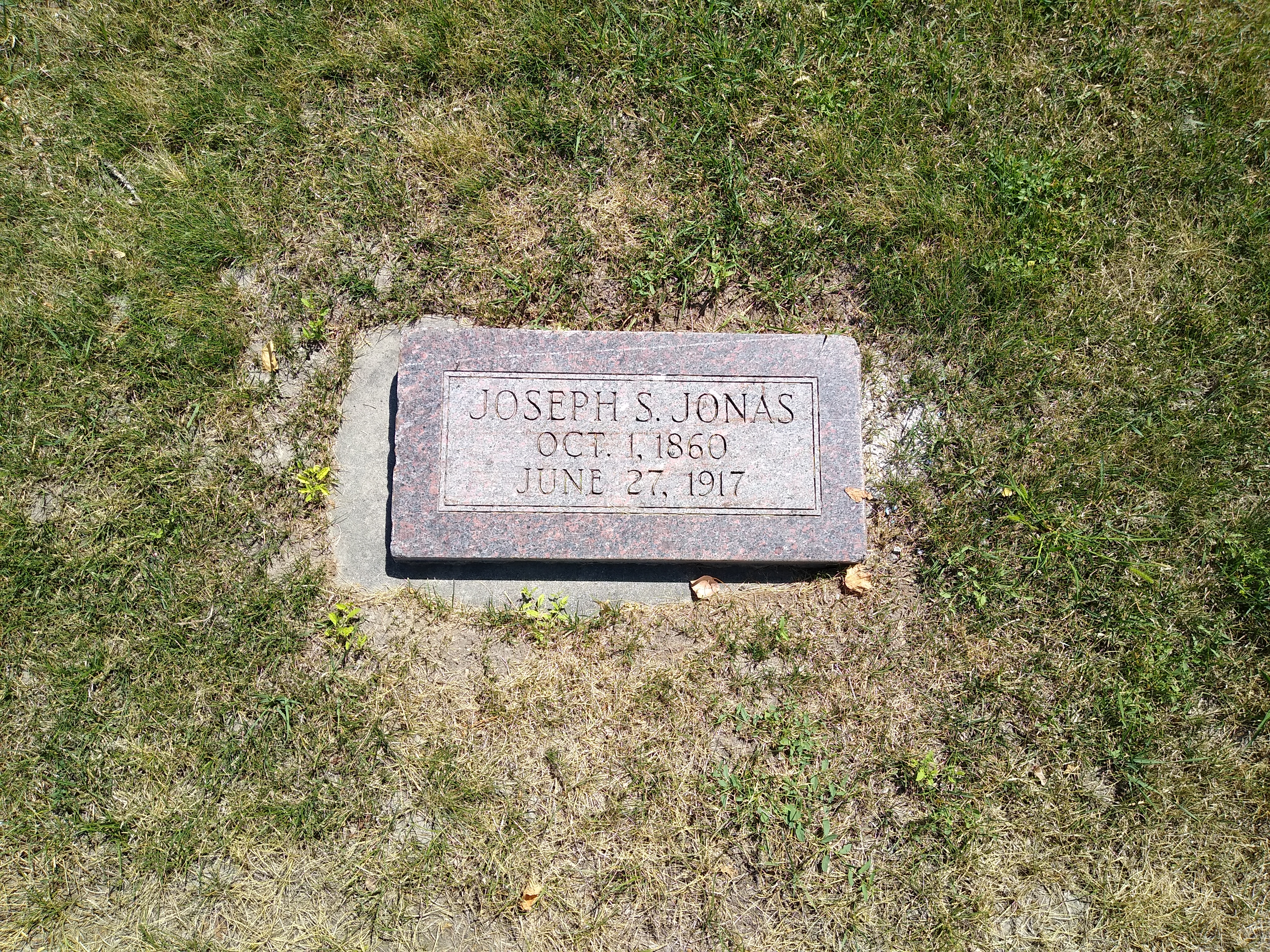
Joseph Jonas – Richmond, Utah

Tombstone of Joseph Jonas (1859-1917) on 26 July 2020.  The S is a mistake put there by someone.  Some have put his mother’s maiden name “Schumacher” there, but we have yet to find any evidence of that middle initial or name.

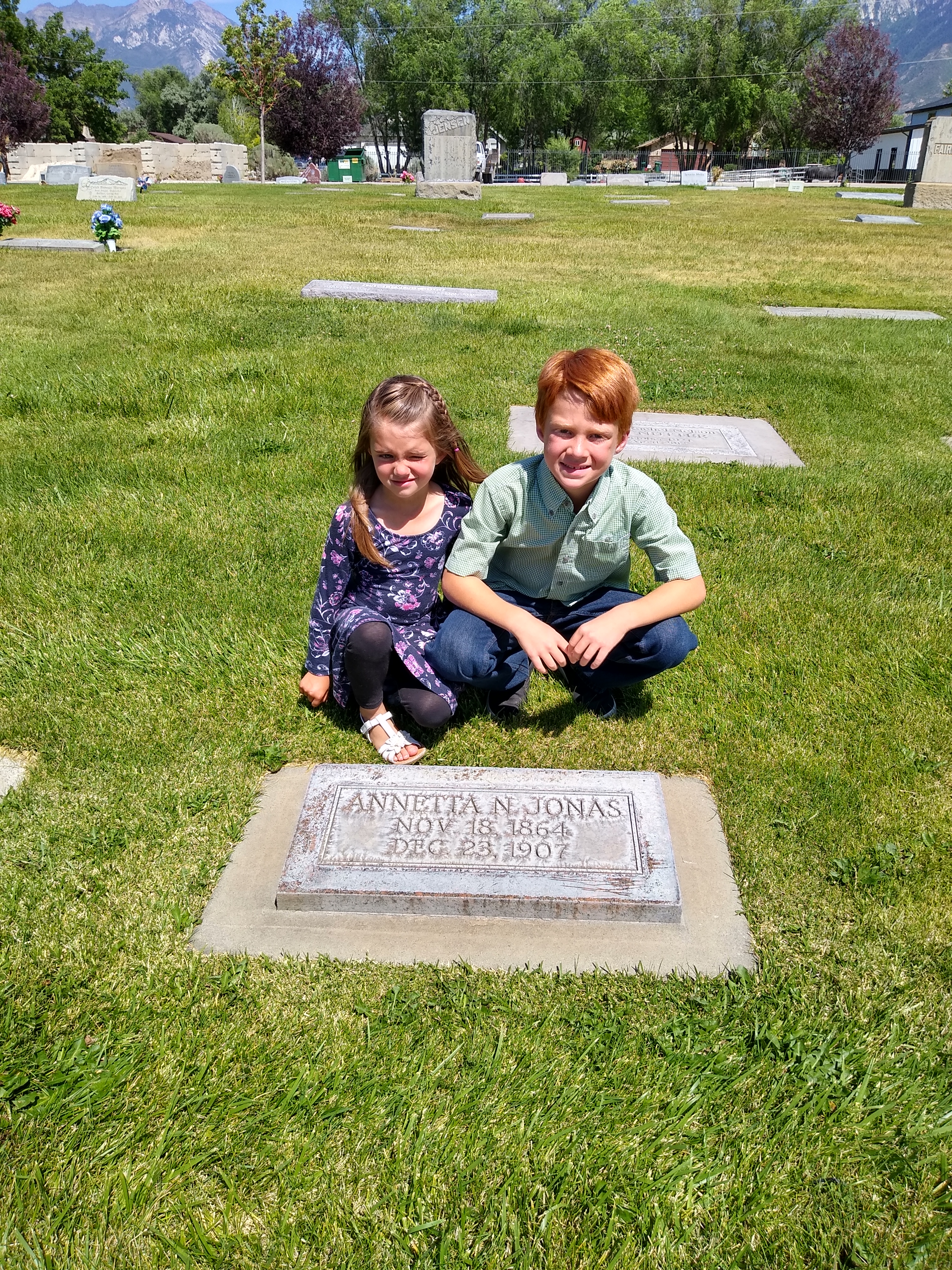
Annie Jonas – Crescent, Sandy, Utah

Lillian and Hiram Ross with tombstone of Annetta Josephine Nelson Jonas (1864-1907) on 11 July 2020.

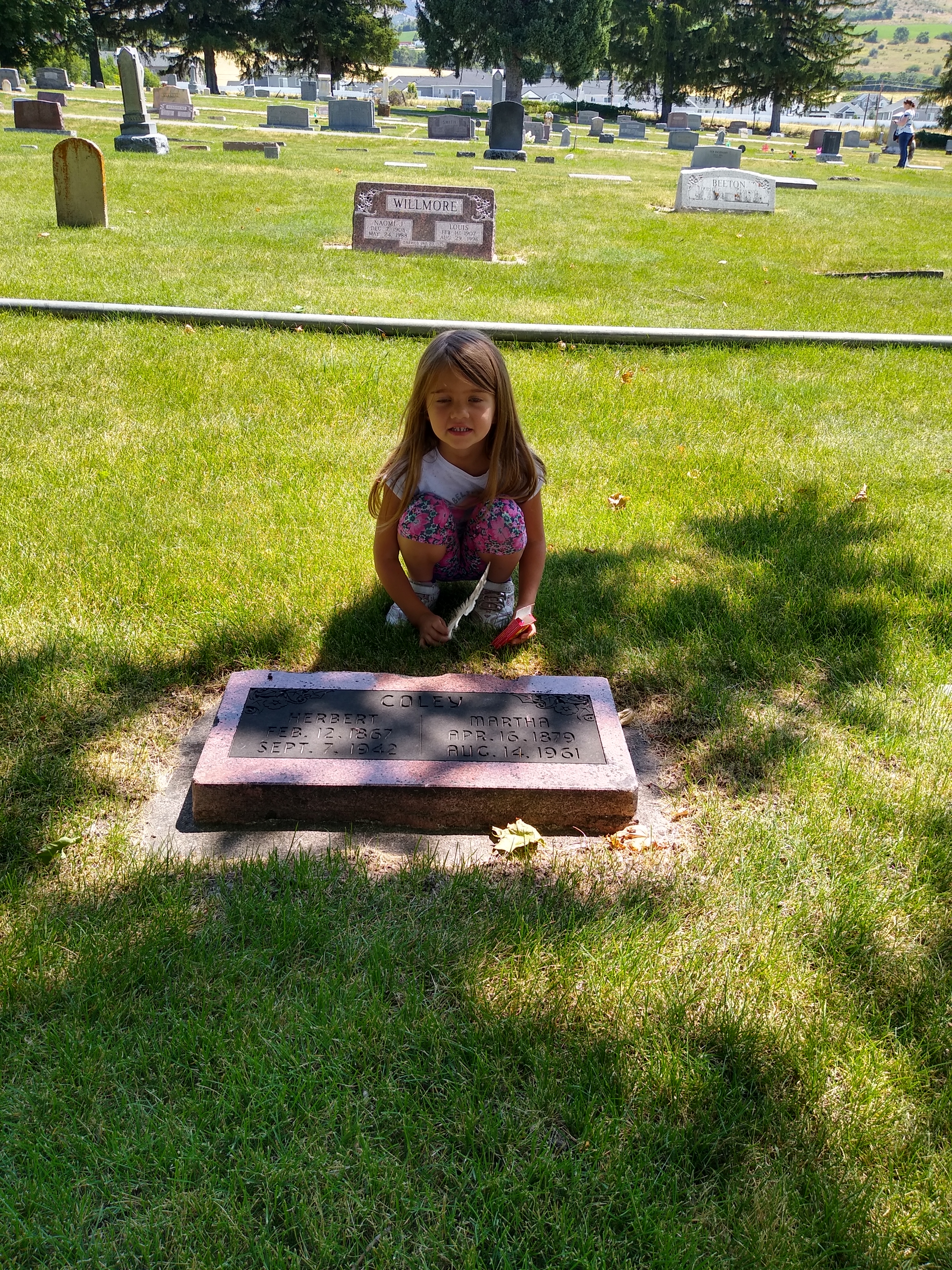
Herbert & Martha Coley – Richmond, Utah

Lillian Ross with tombstone of Martha Christiansen (1879-1961) and Herbert Coley (1864-1942) on 26 July 2020.

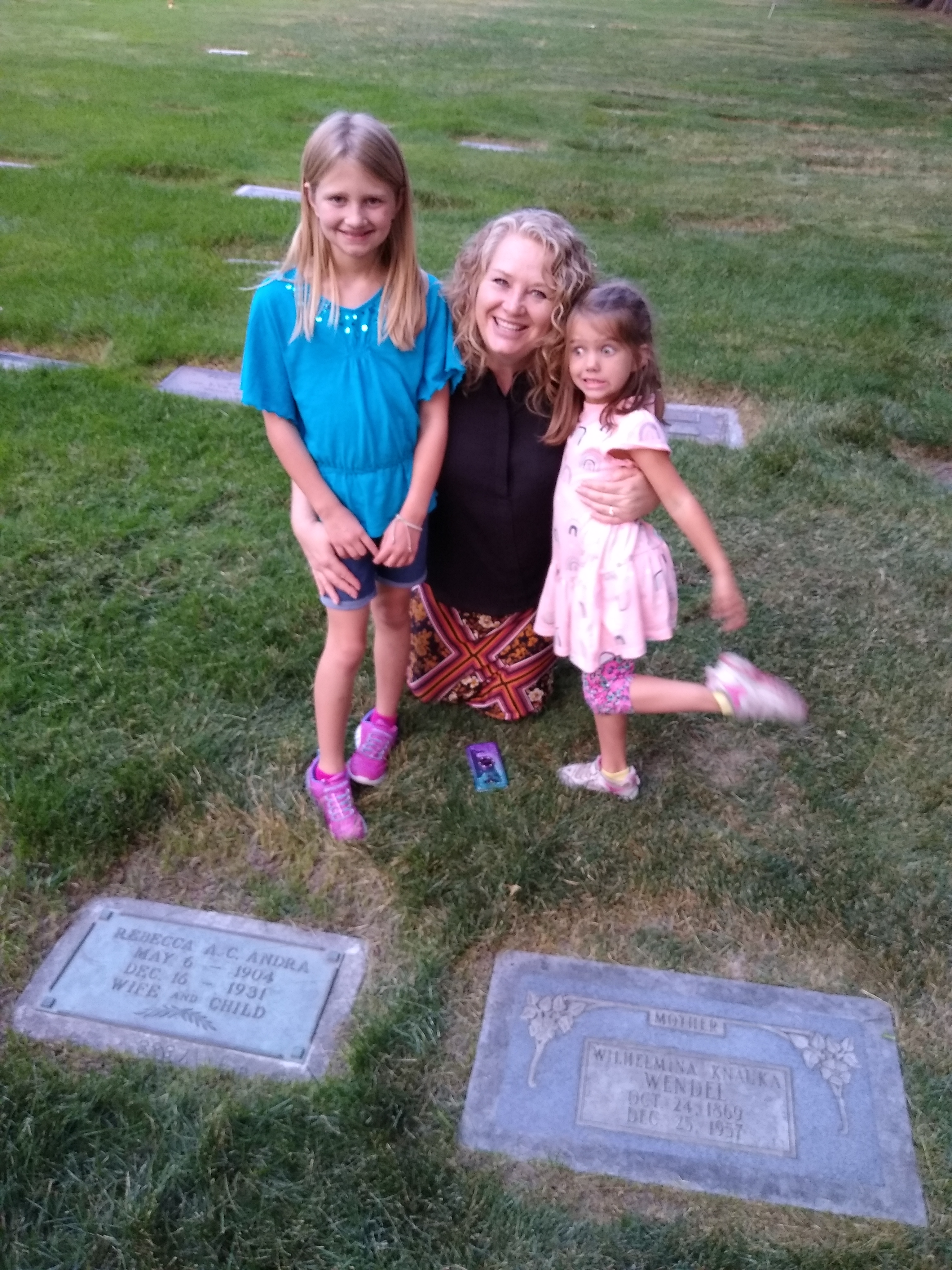
Christiana Andra – Wasatch Memorial, Latona Section, Salt Lake City, Utah

Aliza Ross, Jill Hemsley, Lillian Ross with tombstone of Christiana Wilhelmina Knauke (1869-1957), widow of Friedrich Theodor Andra, on 6 September 2020.  She went by Wilhelmina in the United States and married Johann Wendel, as I have written previously.  The other grave is her daughter-in-law and grandson, Rebecca Emelia Christensen (1904-1931) and Otto Carl Andra (1929-1929).

George & Regina Wanner – Whitney, Idaho

Hiram and Aliza Ross with tombstone of Regina Frederike Nuffer (1869-1942) and John George Wanner (1870-1947) on 26 July 2020.

Great Great Great Grandparents

William Sharp – Ogden, Utah

Lillie, Paul, Aliza, and Hiram Ross with tombstone of William Sharp on 27 November 2020.  This was the first time I had ever been to William’s grave.

Mary Sharp – Plain City, Utah

Aliza, Paul, Lillian, and Hiram Ross with tombstone of Mary Ann Bailey (1828-1913), Mary Ann (Lillie Musgrave) Stoker (1861-1935) and Milo Riley Sharp (1857-1916) on 23 May 2020. Mary Ann Bailey is the mother of Milo Riley Sharp, don’t confuse mother Mary Ann with spouse Mary Ann. We shorten our Lillian’s name to Lillie’s spelling in her honor.

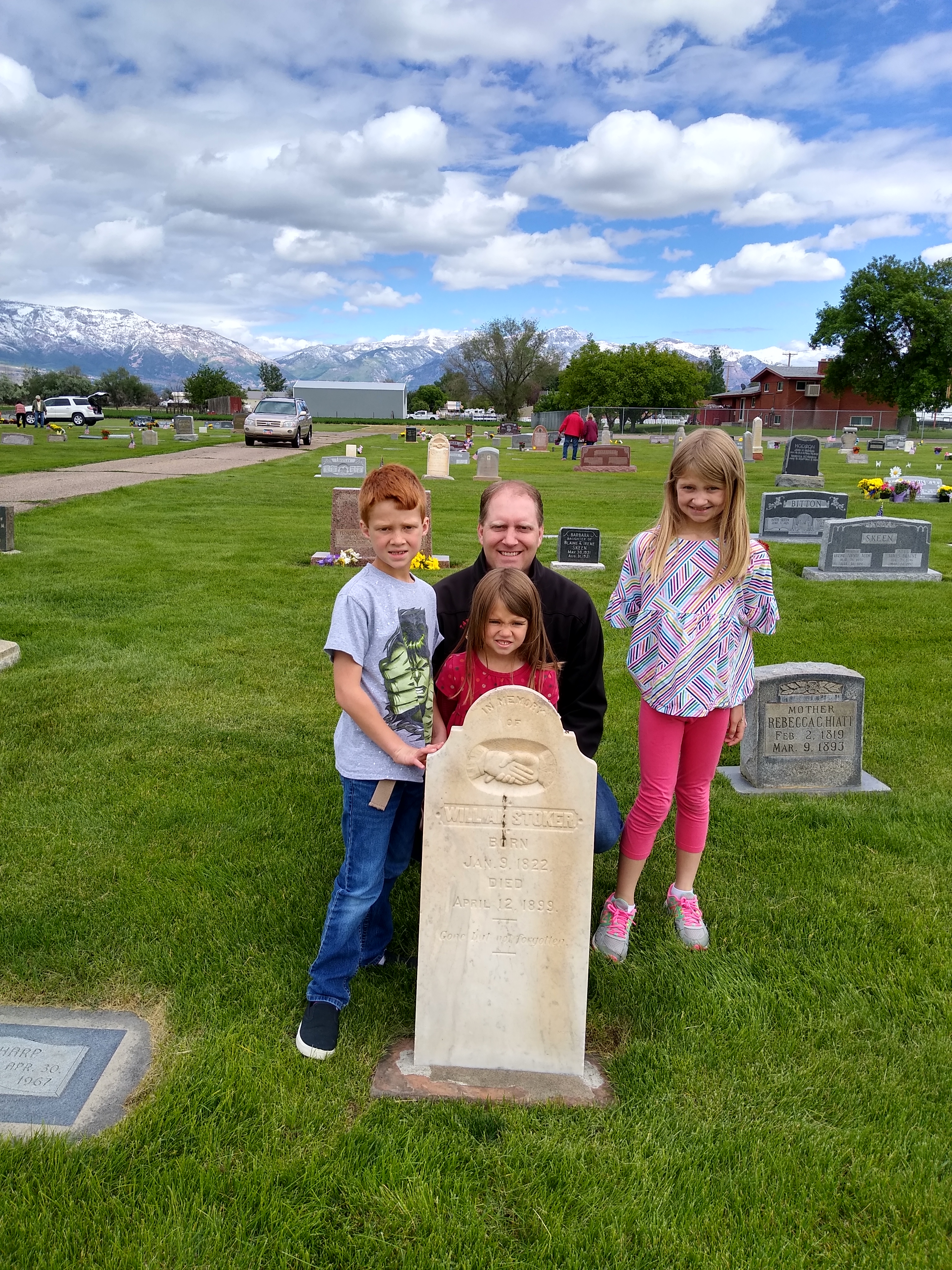
William Stoker – Plain City, Utah

Hiram, Paul, Lillian, and Aliza Ross with tombstone of William Edward Stoker (1827-1899) on 23 May 2020.

David & Gwenllian Williams – Ogden, Utah

Aliza, Lillie, Paul, James, and Hiram Ross at the graves of Gwenllian Jordan (1842-1900) and David D Williams (1832-1911) on 27 November 2020.  Neither have a tombstone. 

Hubert Jonas – Holy Cross, Ellensburg, Washington

Lillian Ross with tombstone of Emma Schriber Jonas (1855-1898), wife of William Jonas on 5 August 2020. William and his father Hubert both do not have tombstones and are buried next to Emma.

John & Annie Nelson – Logan, Utah

Hiram, James, Lillian, and Aliza Ross with tombstone for Agnetta Benson (Bengtsson)(1832-1873) and John Nelson (Johann Nilsson)(1827-1902) on 25 July 2020.

Stephen & Hannah Coley – Lewiston, Utah

Aliza Ross with tombstone of Hannah Maria Rogers (1832-1894) and Stephen Coley (1830-1913) on 26 July 2020.

Olle Christiansen – Richmond, Utah

Lillian Ross with the tombstone of Olle Christiansen (1853-1900) on 26 July 2020.  This tombstone notes his wife’s burial in Portland, Oregon.

Constance Christiansen – Multnomah Park, Portland, Oregon

Paul, Aliza, and Lillian Ross with tombstone of Constance Josephine Eliza Jorgensen Christiansen (1857-1932) on 8 August 2020.  Portland apparently isn’t watering their cemeteries this year.

John & Anna Wanner – Logan, Utah

James, Aliza, Hiram, and Lillian Ross with tombstone of Anna Maria Schmid (1849-1929) and John George Wanner (1845-1922) on 25 July 2020.

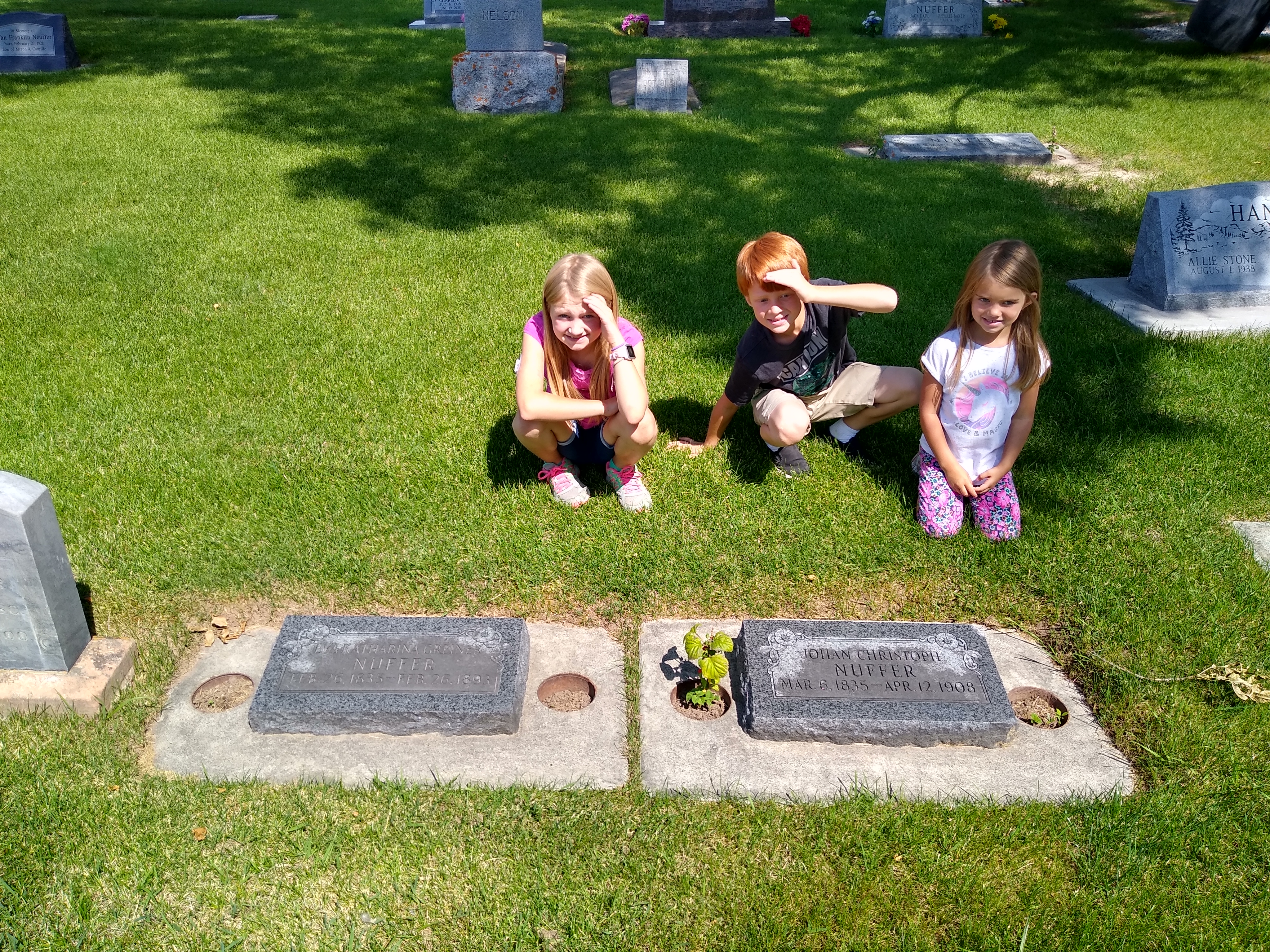
John & Eva Nuffer – Preston, Idaho

Aliza, Hiram, and Lillian Ross with tombstones of Eva Katharina Greiner (1835-1893) and Johann Christoph Nuffer (1835-1908) on 26 July 2020.

Great Great Great Great Grandparents

John Williams – Ogden, Utah

James, Lillie, Aliza, Paul, and Hiram Ross at the tombstone of John Williams (1797-1876) on 27 November 2020.

David & Margret Jordan – Brigham City, Utah

Paul, Aliza, Lillian, and Hiram Ross with tombstones for Margret Watkins (1816-1902), David Jordan (1820-1893) and Thomas Jordan (1857-1880) on 23 May 2020. Thomas is the son of David and Margret.

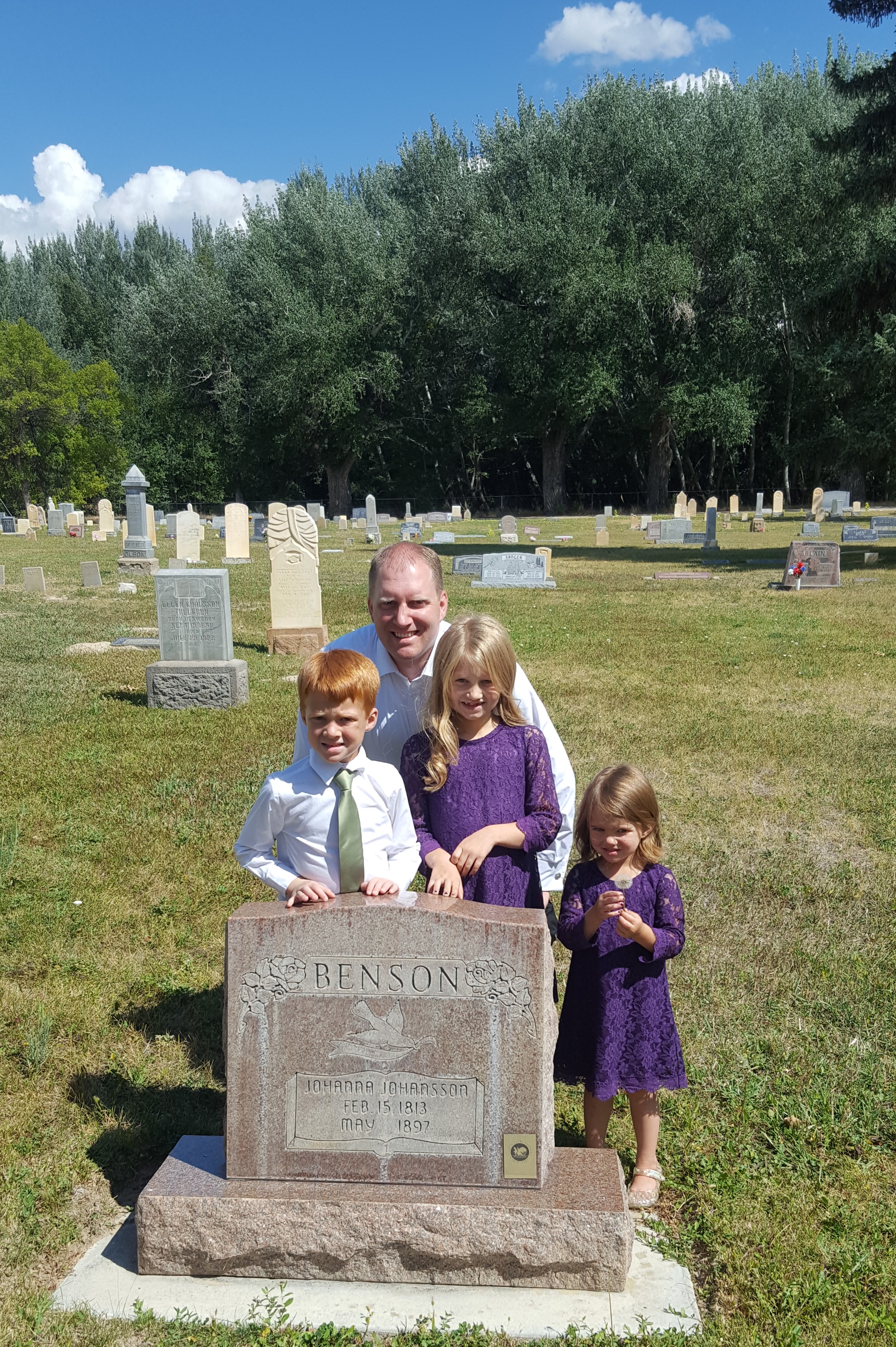
Johanna Benson – Spring City, Utah

Paul, Aliza, Hiram, and Lillian Ross with tombstone of Johanna Johannsson Benson (Bengtsson)(1813-1897) on 7 September 2018.  I know I am cheating, it wasn’t 2020.  But it was recent.

Olavus & Hanna Jorgensen – Richmond, Utah

Aliza Ross with tombstones of Hanna Mathea Christensen (1831-1900) and Olavus Jorgensen (1830-1904) on 26 July 2020.

Others visited this year.

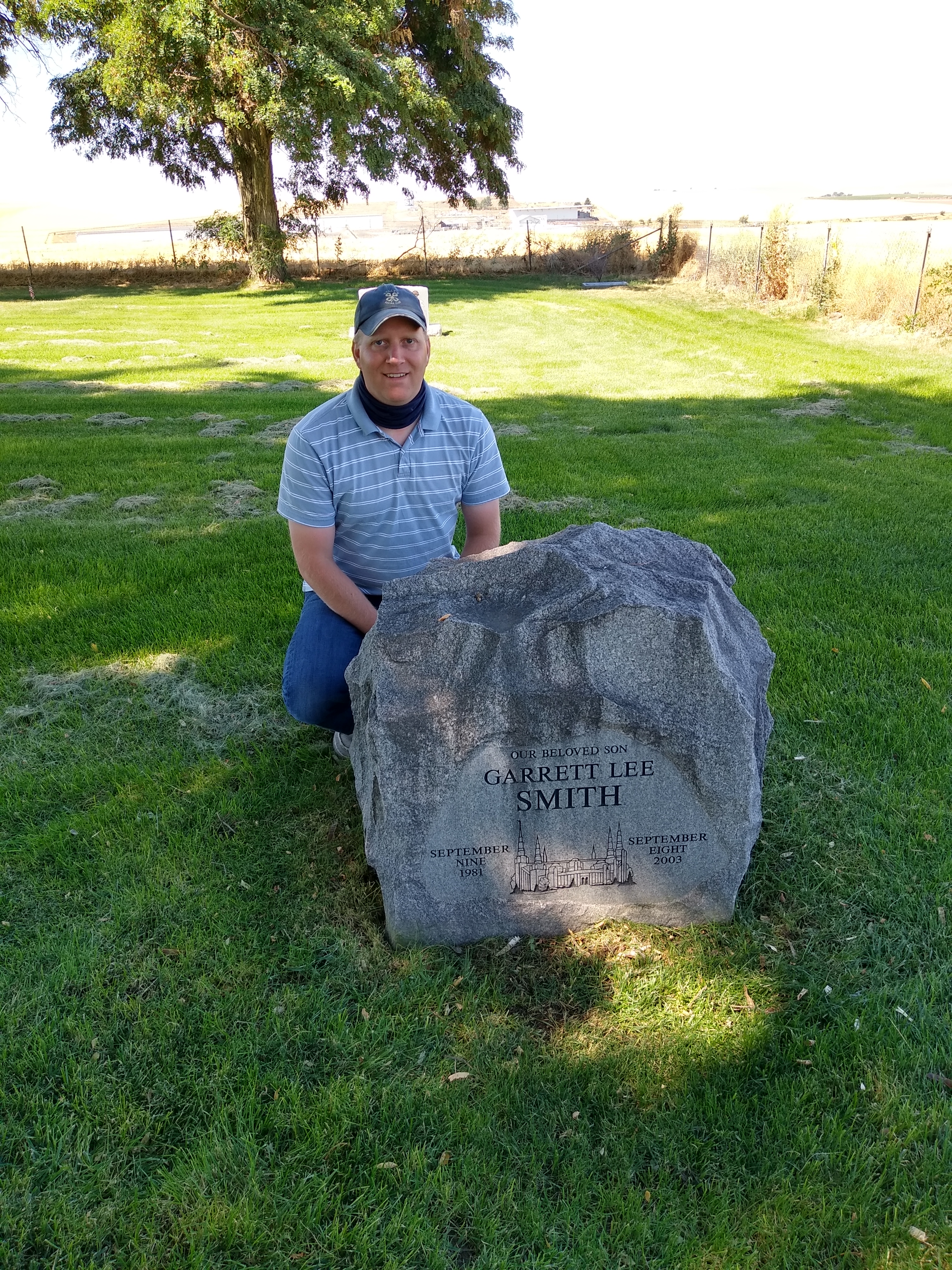
Garrett Lee Smith – Weston, Oregon

Paul Ross with tombstone of Garrett Lee Smith (1981-2003) on 9 August 2020.  Garrett was my last missionary companion.

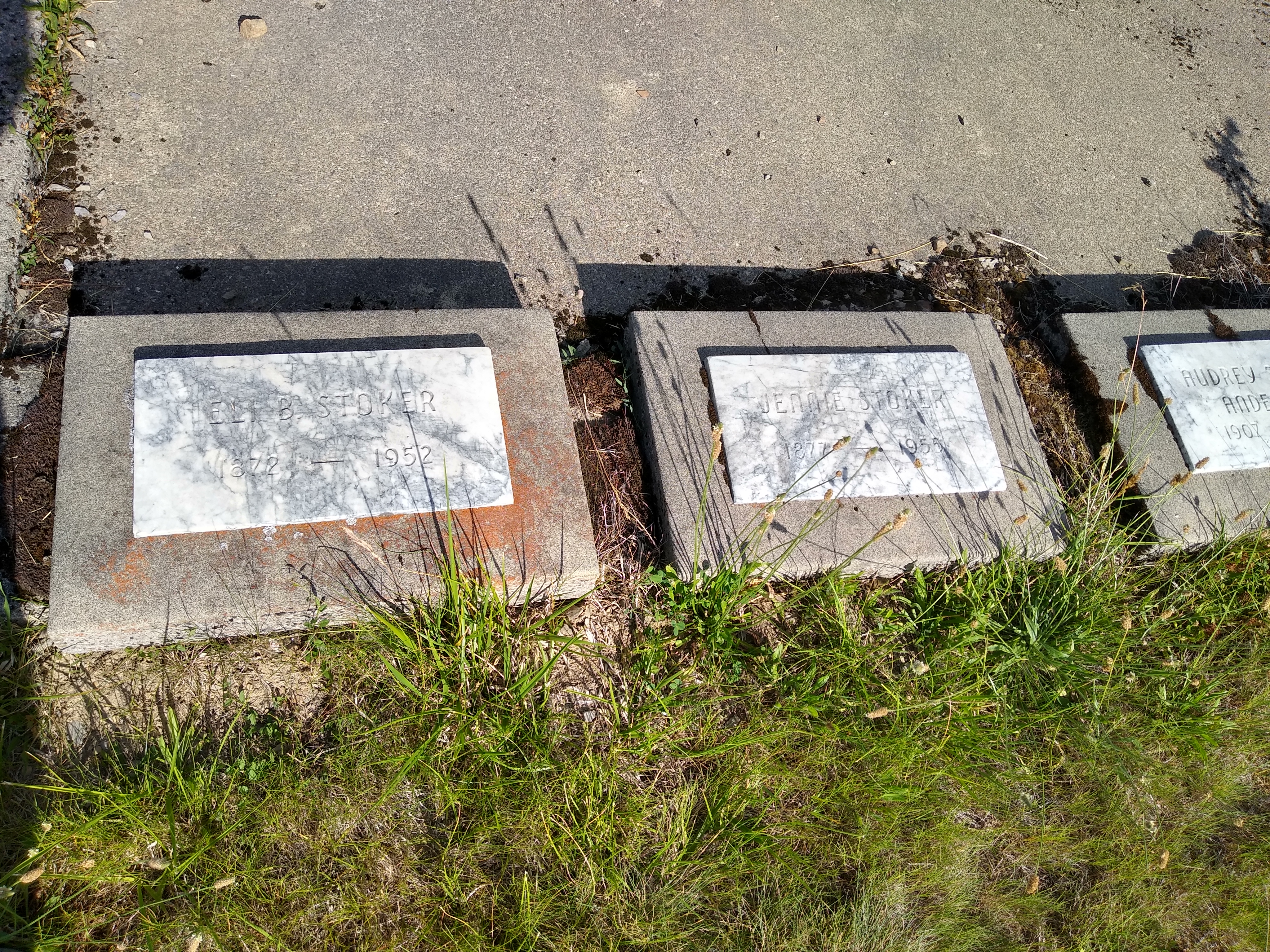
Eli Benjamin Stoker – Mullan, Idaho

Tombstone of Eli Benjamin Stoker (1870-1952) on 3 August 2020.  Eli is the half-brother to my Mary Ann Stoker Sharp.

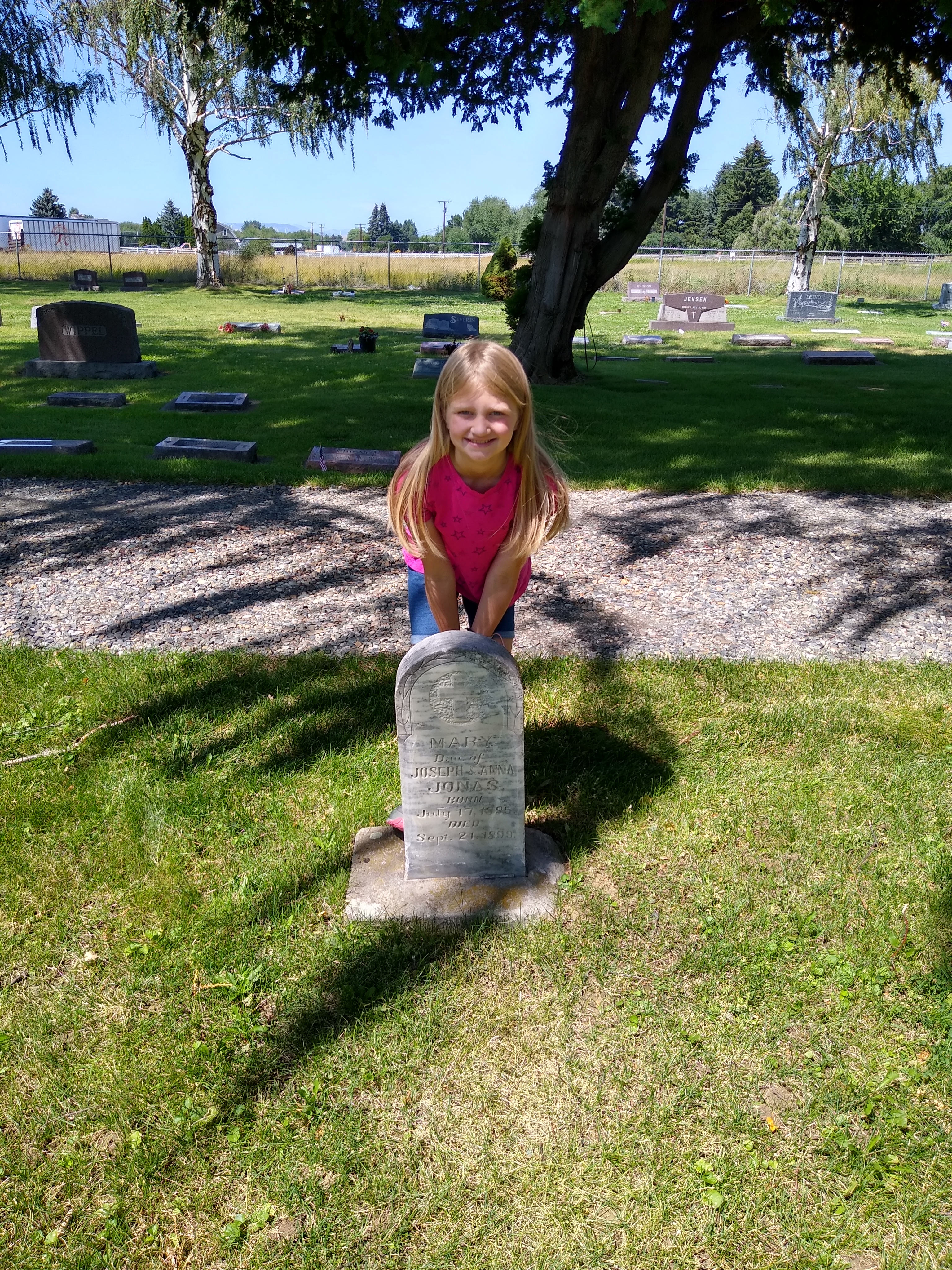
Mary Nelson Jonas – Holy Cross – Ellensburg, Washington

Aliza Ross with tombstone of Mary Nelson Jonas (1885-1899) on 5 August 2020.  Mary is the sister to my Joseph Nelson Jonas.

Ezra & Flora Benson – Whitney, Idaho

Aliza and James Ross with tombstone of Flora Smith Amussen (1901-1992) and Ezra Taft Benson (1899-1994) on 26 July 2020.  Many know Ezra as the 13th President of The Church of Jesus Christ of Latter-day Saints and Secretary of Agriculture under President Eisenhower.

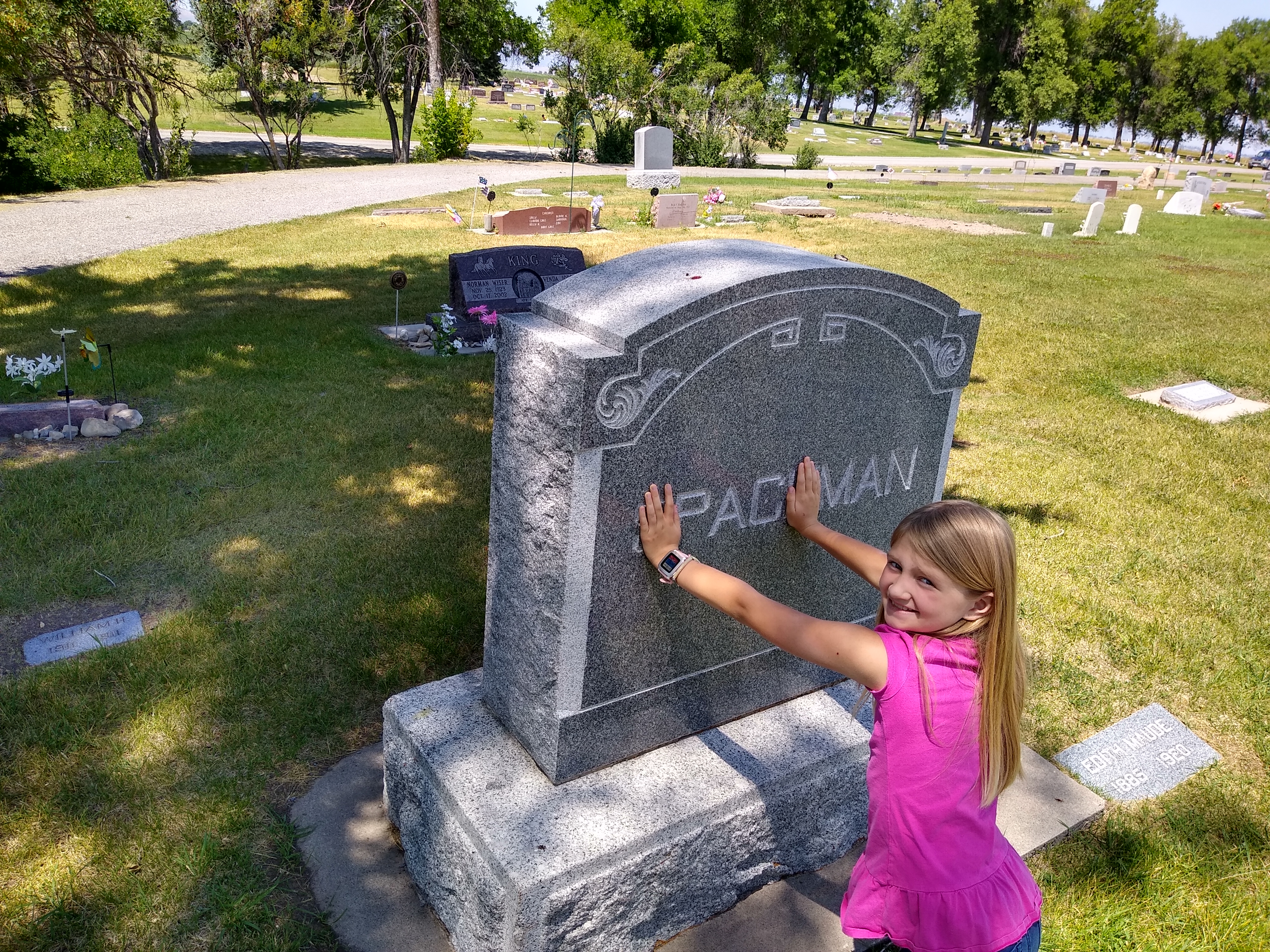
Spackman Plot Marker – Lewiston, Utah

Aliza Ross with the Spackman Plot Marker. She recognized and wanted a picture with the Pacman tombstone on 26 July 2020.

Walter Theodor Andra – Logan, Utah

Aliza, Hiram, and Lillian Ross with tombstone of Walter Theodor Andra (1896-1967) on 25 July 2020.  Walter is brother to my Bill Andra.

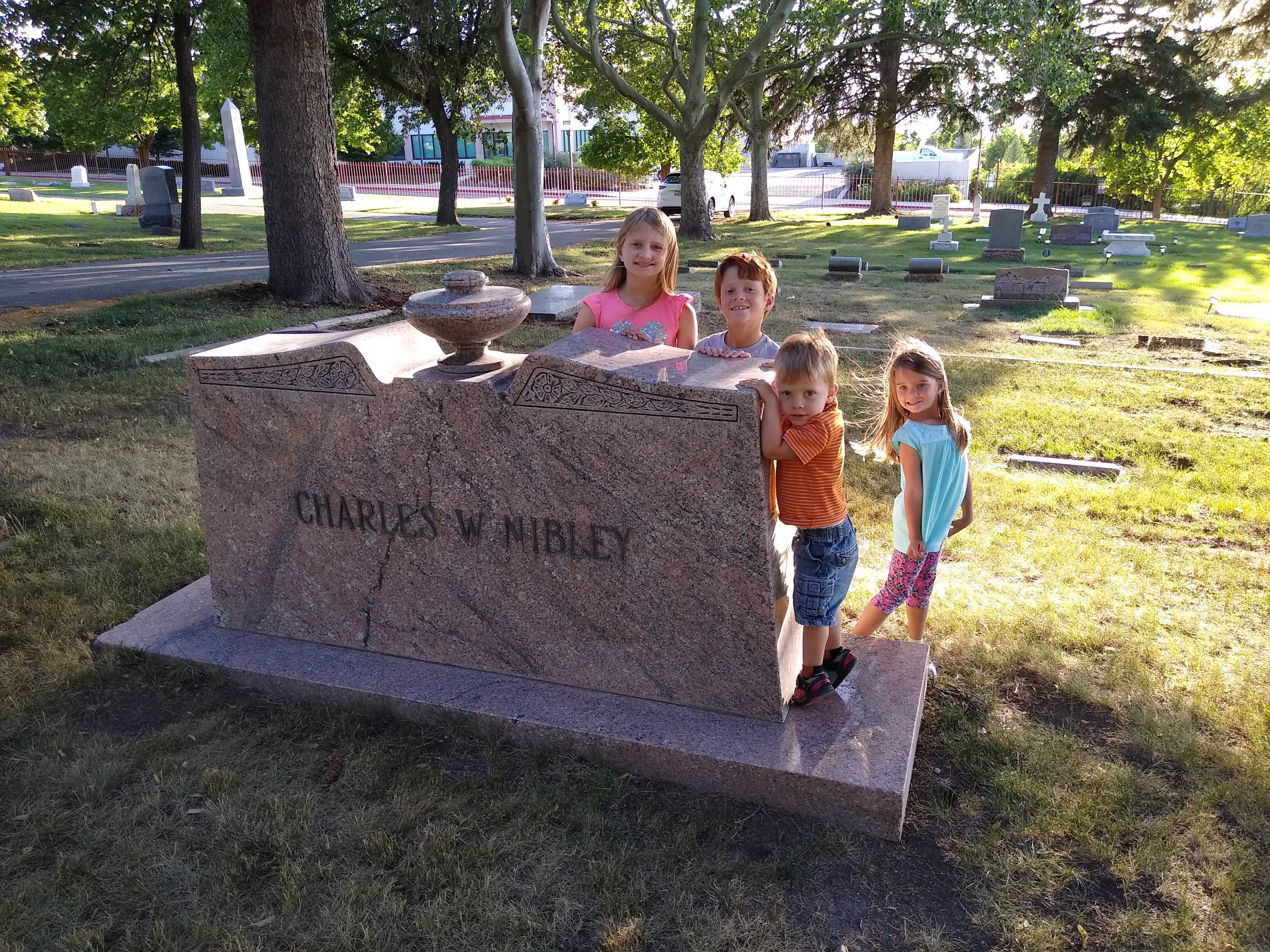
Charles Wilson Nibley – Logan, Utah

Aliza, Hiram, James, and Lillian Ross with tombstone of Charles Wilson Nibley (1849-1931) on 25 July 2020.  Charles is known for various positions and business interests, but most will know him as a member of the First Presidency (non-apostle) to President Heber J Grant of The Church of Jesus Christ of Latter-day Saints.

Moses Thatcher – Logan, Utah

Lillian, Hiram, and Aliza Ross with tombstone of Moses Thatcher (1842-1909) on 25 July 2020.  Moses is known for various positions and business interests, but most will know him as a an Apostle of The Church of Jesus Christ of Latter-day Saints.

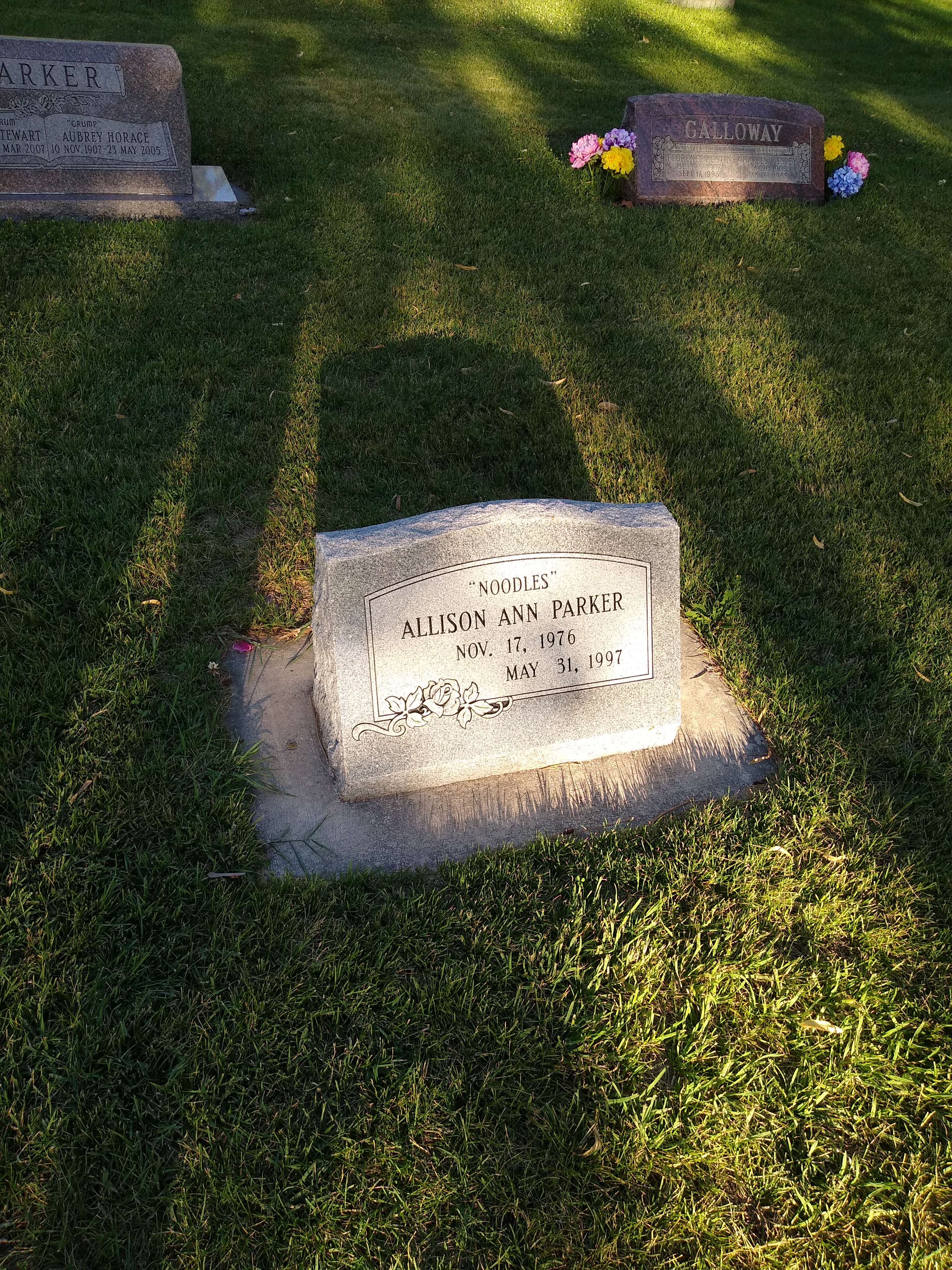
Allison Ann Parker – Logan, Utah

Tombstone of Allison Ann Parker (1976-1997) on 25 July 2020.  Allison is a friend and brother of my high school friends Ryan and Russell Parker.  She passed away after a tragic accident driving back to Utah after our Senior Prom date night in 1997.

Peter Maughan – Logan, Utah

James, Aliza, Lillian, and Hiram Ross with tombstone of Peter Maughan on 25 July 2020.  Peter is known for various positions and business interests, as one of the founders of Cache Valley, Utah.

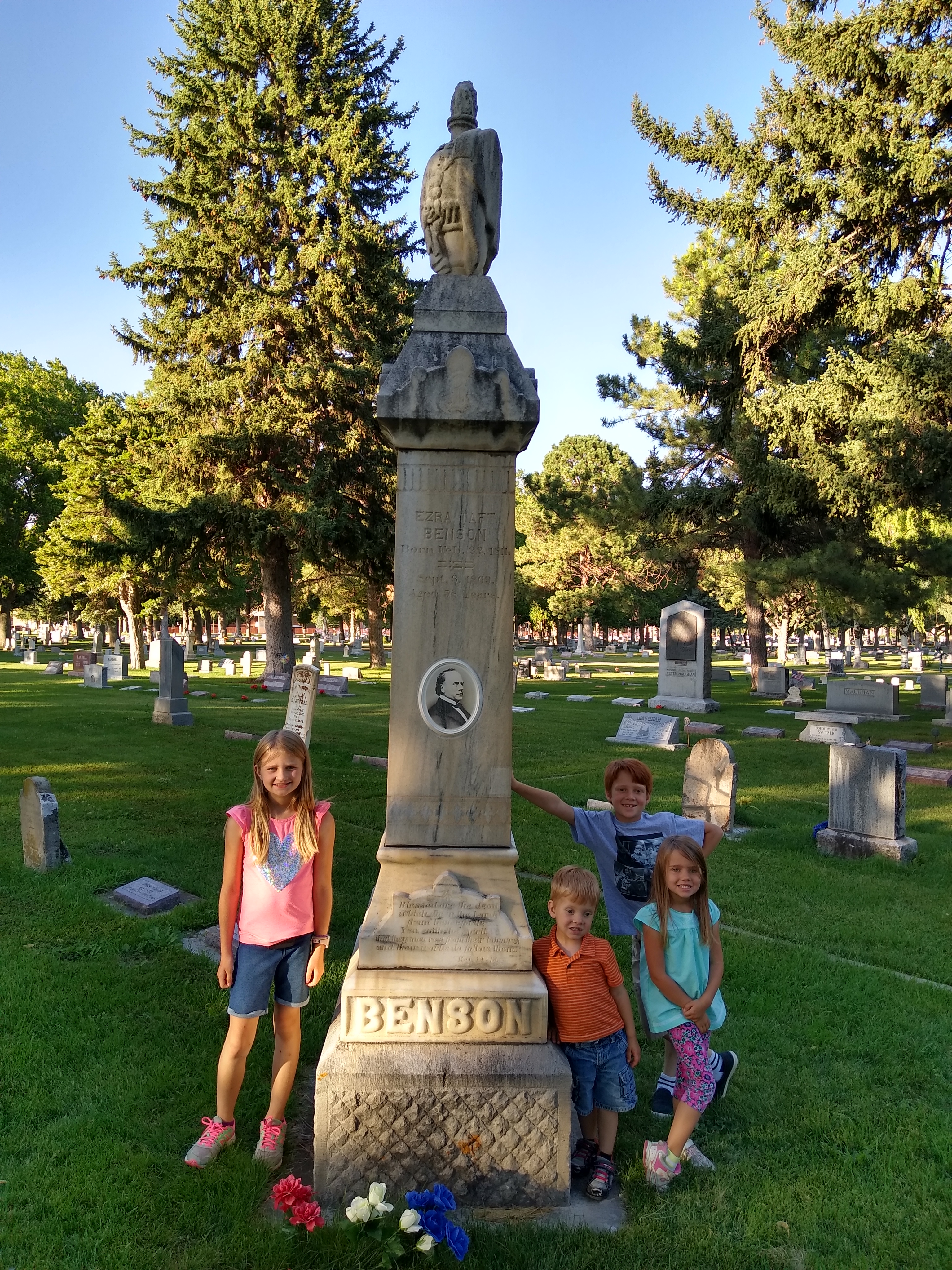
Ezra Benson – Logan, Utah

Aliza, James, Hiram, and Lillian Ross with tombstone of Ezra Taft Benson (1811-1869) on 25 July 2020.  Ezra is known for various positions and business interests, but most will know him as a an Apostle of The Church of Jesus Christ of Latter-day Saints.

Nels Nelson – Crescent, Sandy, Utah

Hiram and Lillian Jonas with tombstone of Nels August Nelson (Nilsson)(1857-1935) on 11 July 2020. He is the brother to my Annetta “Annie” Jonas.

Stanley Spatig – West Warren, Utah

Tombstone of Stanley Hazen Spatig (1940-2013). Son of Eva Virtue Wanner Spatig, sister to my Mary Louise Wanner Andra.

Joseph & Ann Wayment – West Warren, Utah

Bryan Hemsley, Amanda, Aliza, and Hiram Ross with tombstones of Ann Reed (1852-1931) and Joseph Wayment (1844-1931). Amanda’s Great Great Great Grandparents on 24 May 2020.

Louis & Martha Hansen – West Warren, Utah

Bryan Hemsley, Aliza, Amanda, and Hiram Ross with tombstone of Sarah Eveline Judkins (1886-1943), Louis Alma Hansen (1876-1951), and Martha Ann Wayment (1877-1908) on 24 May 2020. Louis and Martha are Amanda’s Great Great Grandparents.

Walter & Myrtle Hansen – West Warren, Utah

Bryan & Jill Hemsley with Aliza, Lillian, Amanda, and Hiram Ross with tombstone of Myrtle Thompson (1902-1959) and Walter Wayment Hansen (1904-1995) on 24 May 2020. Walter and Myrtle are Amanda’s Great Grandparents.

Evan & Lona Jonas – Lindquist Memorial Gardens of the Wasatch, Ogden, Utah

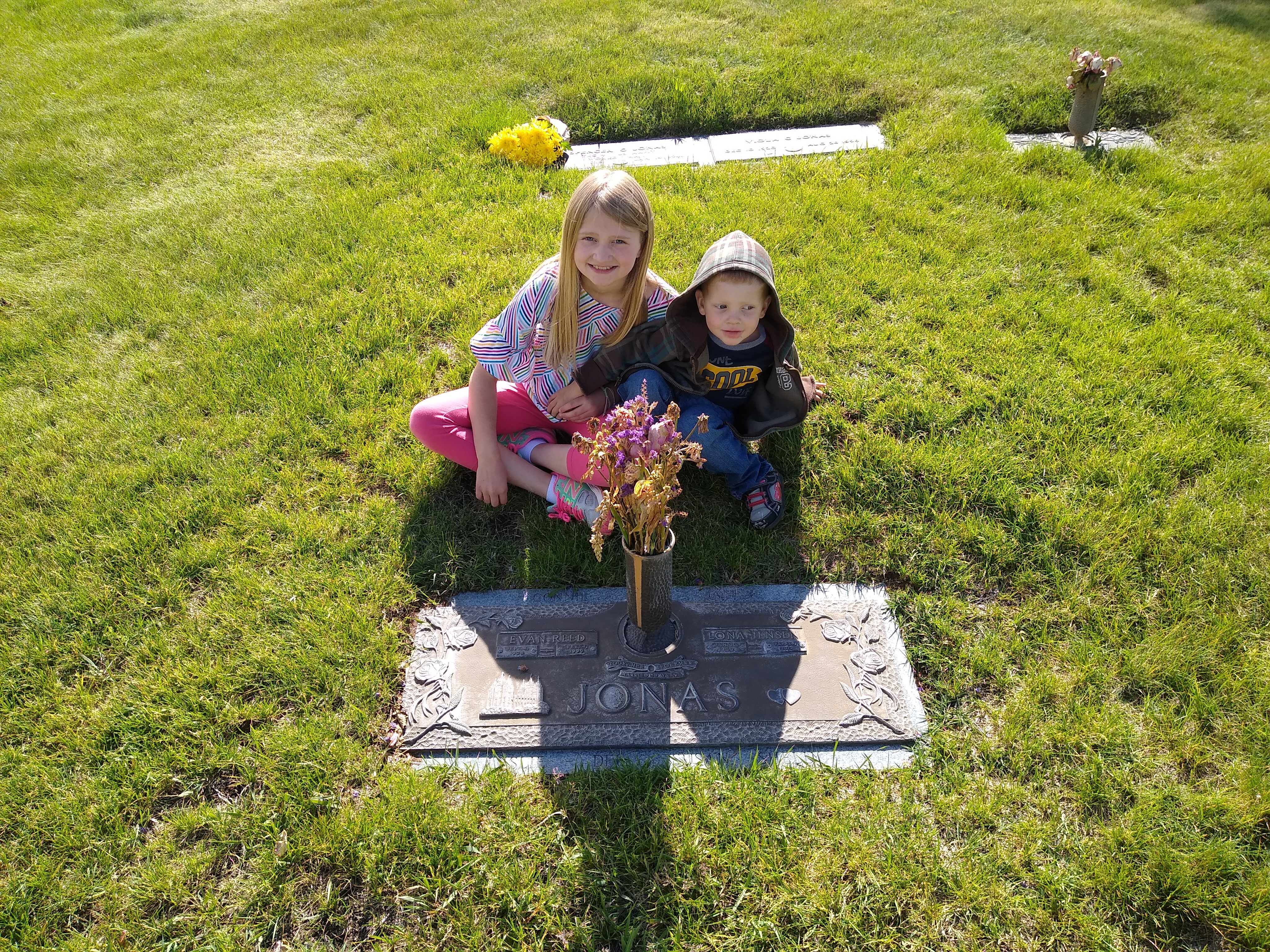
Aliza and James Ross with tombstone for Lona Rae Jensen (1930-2012) and Evan Reed Jonas (1928-1999) on 23 May 2020. Evan is the brother to my Norwood Jonas.

Spencer & Jimmie Jonas – Lindquist Memorial Gardens of the Wasatch, Ogden, Utah

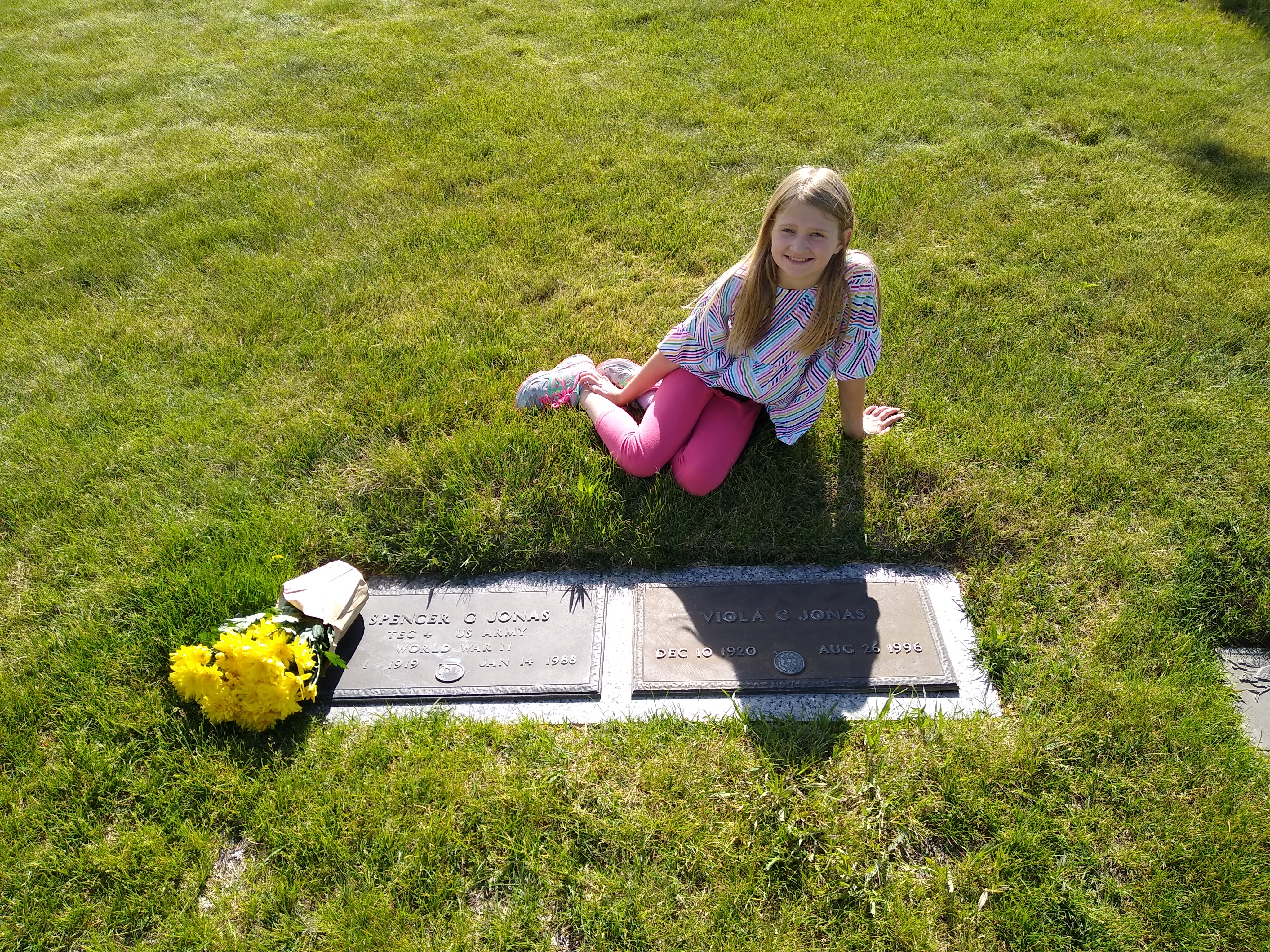
Aliza Ross with tombstone of Viola Amelia (Jimmie) Cole (1920-1996) and Spencer Gilbert Jonas (1919-1988) on 23 May 2020. Spencer is the brother to my Norwood Jonas.

Melvin Thompson – Lindquist Memorial Gardens of the Wasatch, Ogden, Utah

Amanda, James, Aliza, Lillian, Hiram Ross, Bryan and Jill Hemsley, and Alyssa Smart with tombstone of Melvin J Thompson (1925-2018) on 23 May 2020. Mel is Amanda step-Grandpa.

Merle & Belle Hemsley – Lindquist Memorial Gardens of the Wasatch, Ogden, Utah

Bryan & Jill Hemsley, Hiram, Lillian, Aliza, and Amanda Ross with tombstone for Belle Sarah Peterson (1917-2003) and Richard Merle Hemsley (1912-1962) on 23 May 2020. Merle and Belle are Amanda’s Great Grandparents.

Ellen Weller – Hooper, Utah

Tombstone of Ellen Watton Weller (1828-1894) on 23 May 2020. I stumbled upon this tombstone in Hooper. I was walking around, felt inspired to walk over, and looked at this one knowing there was a link. Name looked vaguely familiar. Half-sister to my Hannah Maria Rogers Coley. Didn’t know she was buried in Hooper, FamilySearch didn’t have it either. Her and Joseph Weller are now documented and updated.

Dee Hemsley – Hooper, Utah

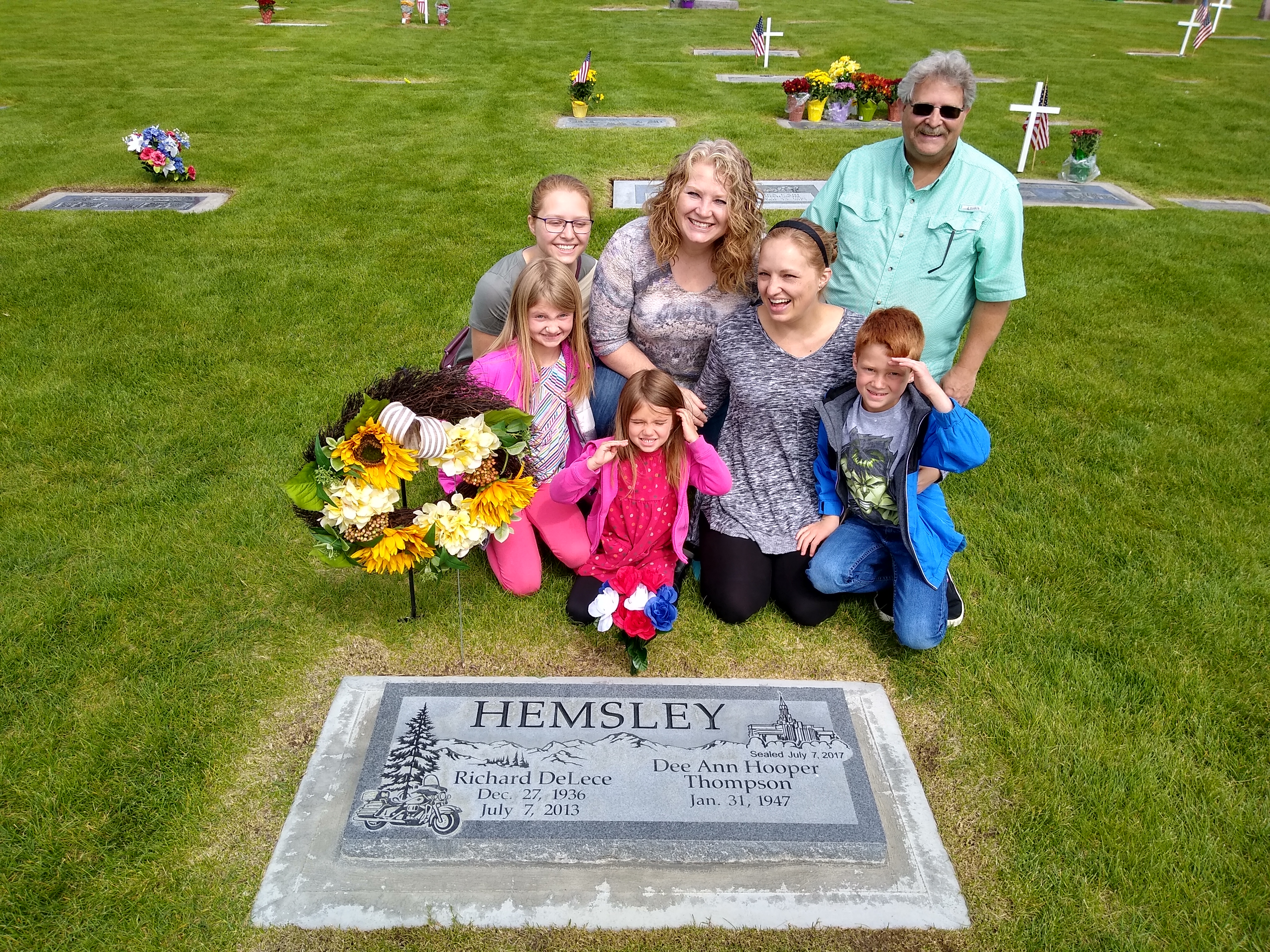
Alyssa Smart, Bryan and Jill Hemsley, Aliza, Lillian, Amanda, and Hiram Ross with tombstone of Richard DeLece Hemsley (1936-2013) on 23 May 2020.  Dee is Amanda’s grandfather.

William & Martha Wayment – Plain City, Utah

James, Amanda, Lillian, Aliza, and Hiram Ross with tombstones for Martha Brown (1823-1905) and William Wayment (1822-1883) on 23 May 2020. William and Martha are Amanda’s Great Great Great Great Grandparents.  The tombstone above Aliza’s head is William Edward Stoker mentioned above, my Great Great Great Grandfather.

Lorenzo Snow – Brigham City, Utah

Hiram, Lillian, and Aliza Ross with tombstone for Lorenzo Snow (1814-1901) on 23 May 2020. Lorenzo Snow is known as the 5th President of The Church of Jesus Christ of Latter-day Saints.

David & Ruby Haight – Wasatch Memorial, Salt Lake City, Utah

Aliza & Lillian Ross, Jill Hemsley, with tombstone of Ruby Olson (1910-2004) and David Bruce Haight (1906-2004) on 6 September 2020.  David Haight is known as an Apostle of The Church of Jesus Christ of Latter-day Saints and I previously interacted with him regarding marriage.

Charlotte Sharp – Ogden, Utah

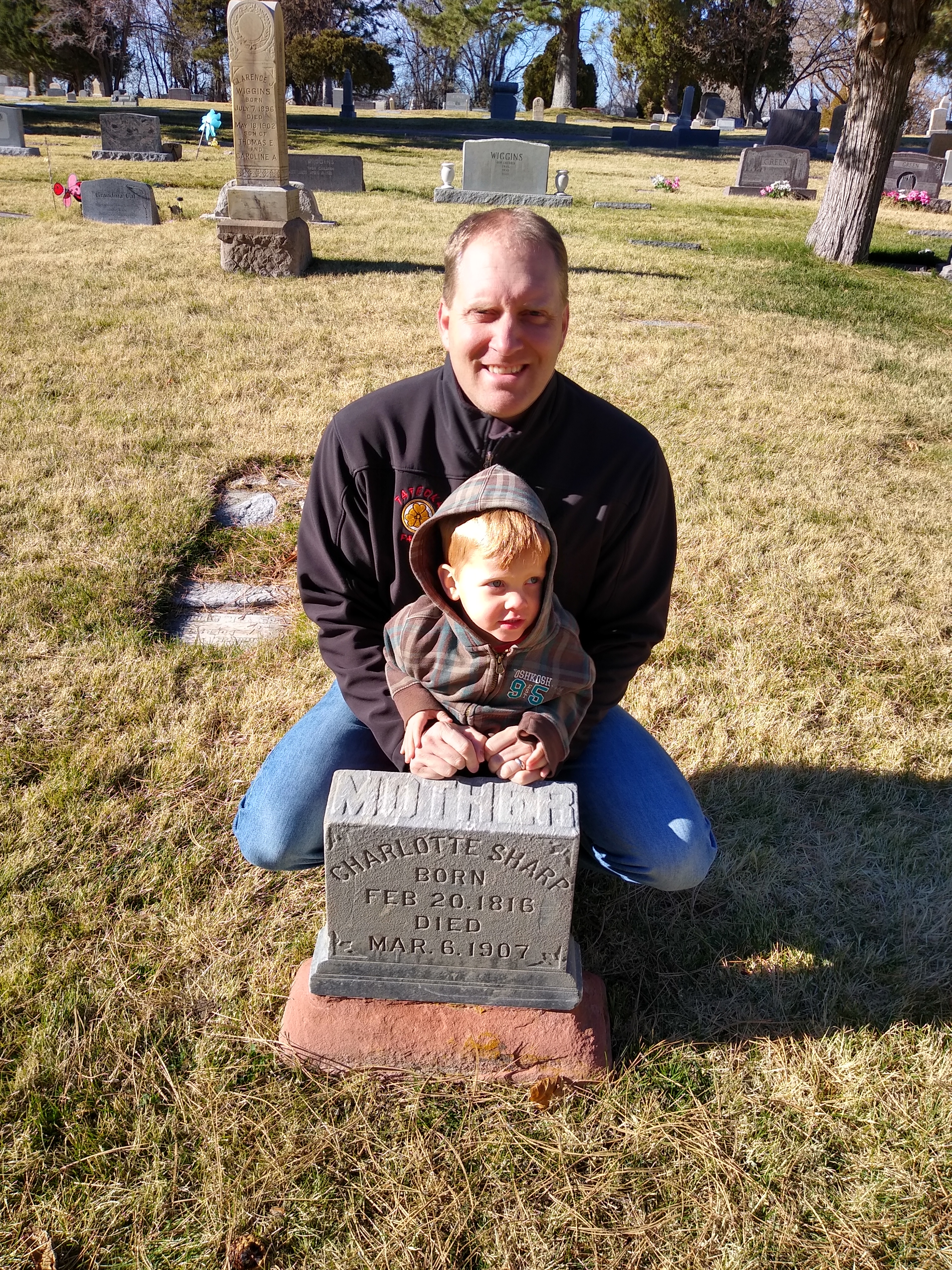
James and Paul Ross at the tombstone of Charlotte Elizabeth Earl (1816-1907) on 27 November 2020.  Charlotte married my William Sharp (1826-1900) after she was widowed of her first husband Charles James McGary (1808-1875). 

Lorin Farr – Ogden, Utah

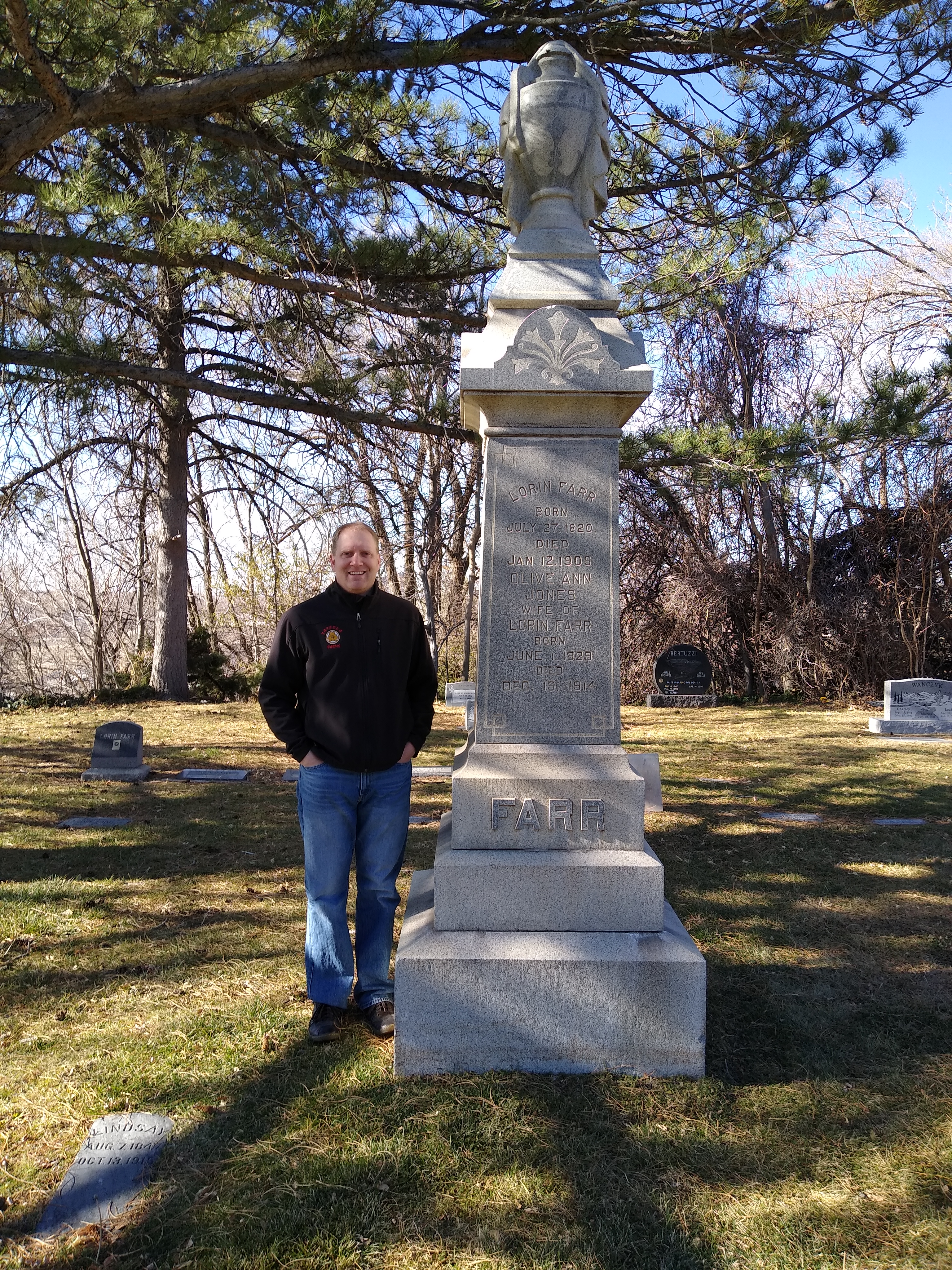
Paul Ross with tombstone of Lorin Farr (1808-1907) on 27 November 2020.  Lorin Farr was the first Stake President of the Weber Stake which covered all the territory of all my ancestors in Ogden and Plain City.  He was also the first Mayor of Ogden.

Thomas Marsh – Ogden, Utah

Paul Ross with tombstone of Thomas Baldwin Marsh (1800-1866) on 27 November 2020.  Thomas Marsh is known as the first Apostle of The Church of Jesus Christ of Latter-day Saints, who had he remained faithful, would have been President before Brigham Young.

Sergene Sorenson – Pleasant View, Burley, Idaho

Lillie, Hiram, Aliza, and James Ross with tombstone of Sergene Sorenson (1932-2013) on 2 January 2021. Sergene is the sister to my Grandma Colleen.

Scott Sorenson – Pleasant View, Burley, Idaho

James, Lillie, Hiram, and Aliza Ross with tombstone of Scott Sorenson (1951-2001) on 2 January 2021.
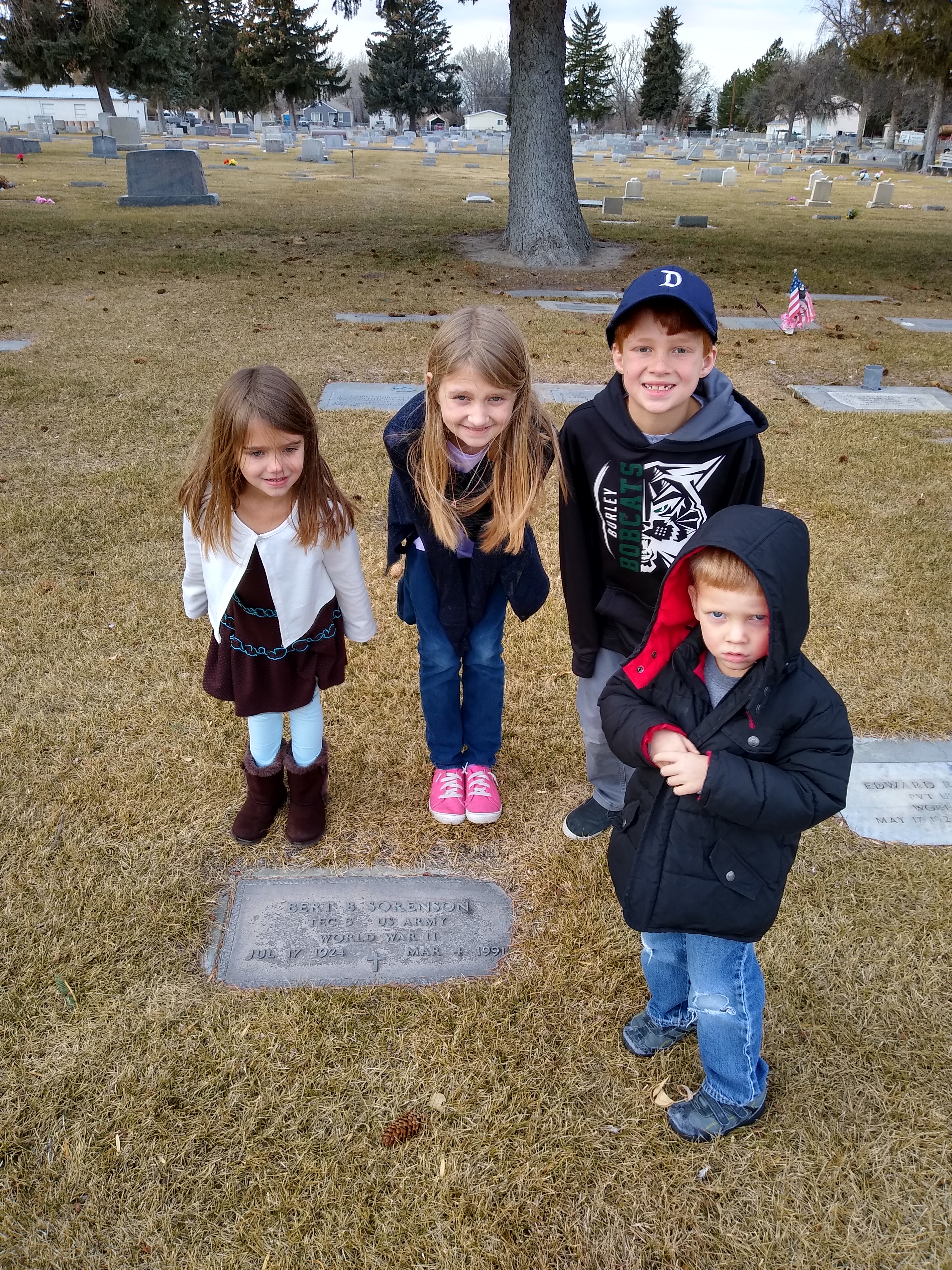
Lillie, Hiram, Aliza, and James Ross with tombstone of Bert Sorenson (1924-1991) on 2 January 2021.

Aliza’s Name

Repeatedly people ask us why we spell Aliza’s name the way we do.  Some ask why we don’t spell it the ‘Mormon’ way like Eliza Roxbury Snow or some of the others in church history.  It is very popular in Utah and is mostly confined to the intermountain west.  As we found out in Oklahoma, not many people even knew how to say the name who did not know LDS history.

Truth be told, we first stumbled upon the name at St. John the Baptist, a church in Halesowen, Worcestershire, England.  Here is a picture of the tombstone that caught our attention.

DSCN3873

Joseph Willetts (1842 – 1903) is the son of Samuel Willetts (1800 – ?), Samuel Willetts (1800 – ?) is the son of Samuel Willetts (1769 – ?) and Mary Crumpton (1773 – 1787).  Samuel Willetts (1800 – ?) is the brother to my Letitia Willetts (1795 – 1875).  Letitia is my 4th great-grandmother who married James Coley (1795 – 1875).

I have written of James and Letitia before.

At any rate, Aliza is the wife of Joseph Willetts.  I don’t even know her maiden name.  But once we saw the name, we both knew that we liked it and wanted to name our daughter after this Aliza Willetts (1844 – 1915) buried at St. John the Baptist in Halesowen, England.

Halesowen and nearby Hasbury and Lutley are strongholds of my Coley, Willetts, Parish, and Lea lines.  Hopefully I will get to visit again some day when the heavens have not opened to unleash rains upon us.  I also hope that maybe Aliza might be able to visit the grave of this namesake, maybe even with us.

Samuel Deer Davis

Another family history story.  This one is interesting in that his Idaho case went before the United States Supreme Court in Davis v. Beason.  This is the biography of Samuel Deer Davis (1859-1923) written by Dean G Grow, his great-grandson.  Samuel Deer Davis married Mary Jane Williams, daughter of Sarah Jane Davis and John Haines Williams.  Mary is the sister to David Davis Williams who I also previously shared his biography.

~

“This is the history of my great-grandfather, who was instrumental in the legal attempts that The Church of Jesus Christ of Latter-day Saints undertook to counter the continuing political and legal assault against the Church due to the practice of polygamy in the late 1880’s not only in Utah but in Idaho where he lived.

“Samuel D. Davis was born in Salt Lake City on 22 July 1859 to David Woodwell Davies and Mary Deer.  Samuel’s father had been a missionary in his native Wales for seven years before coming to America.  Aboard ship, David met his bride-to-be, Mary Deer, also a native of Wales.  When they arrived in Kansas City, Missouri, it was too late in the year, creating a delay in getting to the Salt Lake Valley.  So they decided to marry.  This occurred on 25 November 1852, in Kansas City.  They most likely traveled across the plains with a group of Welsh immigrants in the summer of 1853.

ADB12440-4C65-4CDC-A7D2-9C499AA30087

Samuel Deer Davis

“After arriving in Salt Lake Valley, David being a painter and a glazier, set up his home and they began their life there.  David and Mary’s first son, David Thomas was born on 4 March 1854 in Salt Lake City.  Their second son, Woodwell was born in 1856 in Salt Lake City.  David was sealed to Mary on 2 March 1856 in the Presidents office in Salt Lake City.  At the same time and place, he was sealed to Elizabeth Berry, thus becoming a polygamist.  Elizabeth being a native of Bath, Summerset, England.  Their third son, Samuel Deer as indicated earlier was born in 1859.  They were all shown on the 1860 U. S. Census, living in the 8th Ward in Salt Lake City.  It was soon after that, Woodwell died, date unknown.  Their fourth and fifth sons, twins, Hyrum Eynon and Joseph were born on 15 August 1862.  Joseph died as an infant, but Hyrum lived to adulthood.  Their last son, Septimus was born and died soon after in 1864, probably about the time that his father David Woodwell, died of consumption (Tuberculosis) on 20 March 1864.  Thus Mary was left with three boys ages 10, 5, and 2.  I was unable to determine what happened to Elizabeth Berry.

cabin

Davis cabin in Samaria

“In November of 1864, Mary married a man named George R. McLaughlin of whom we can find no record of birth, death or census information.  They had a son George R. Jr. who was born 27 August 1865.  Their second child, Mary Ellen was born about 1866 and died soon after.   Mary’s second husband, George treated her harshly and abandoned her many times.  One time for almost a year.  The last time, she heard he was living in Cheyenne, Wyoming and had no plans to return.  She divorced him on the 20th of January 1868.  Thus Mary was continuously left with four boys to feed and care for.  It was soon after this that she became seriously ill and the doctor told her she would soon die.  Her last son, George was a toddler at the time.  A neighbor, Charles and Jemima Walker offered to adopt George and Mary regretfully consented as she didn’t want to leave such a young child.  Not long after, Mary recovered and went back to the Walkers pleading with them to return her son, but they refused.  They were still neighbors in the 1870 Census with the Walkers showing George as their son at age 5.  George died 29 January 1889 at the age of 24 in a train accident returning to Sugar House, Utah from an outing with friends to Red Bluff Quarry.

“Toward the end of the year, Mary met John Evan Price, another Welshman and became a polygamous wife of his on 26 December 1870.  Mary was 39 years of age and 14 years his junior.  He was in good financial circumstances at this time according to their granddaughter.  He had settled in Samaria, Oneida, Idaho on April 16, 1868 with one other family, being one of the first.  He is also credited with giving Samaria it’s name.  Several others settled there the next month.  A branch of the Church was organized there in November of 1868.  Elder Lorenzo Snow, then of the Twelve Apostles, visited in July of 1869 and approved of the city plot, encouraging the settlers to continue to build and plant there.

“John brought Mary and her children to Samaria after their marriage.  Two additional children were born to this union, Margaret Ann Price on 10 January 1872 and Elizabeth Jane Price on 17 March 1875, both in Samaria.  Unfortunately, John died within a few years on 22 June 1878 in Samaria leaving Mary a widow again.  But this time she was left in good circumstances where she was able to sell off property to new immigrants to Samaria.  She reverted back to her Davis name after 1880.  Her sons were now getting older.  Her oldest, David Thomas was married in Samaria to Amy Ann Sawyer on 7 January 1879 just 6 months after John Evan Price died.  Mary was the postmistress of Samaria for many years and the Relief Society President for 17 years in Samaria.  Eliza R. Snow stayed in her home during a conference in Samaria.

“Her second son, the subject of this manuscript, Samuel D., had no formal education but only that which was from his mother, Mary.  He married Mary Jane Williams on 11 Oct 1882 in the Endowment House in Salt lake City.  Their first child, Sarah Jane, was born in August of 1883 and died the same month.  Their second child, Woodwell Williams was born 17 November 1884.  It was during this time that his wife encouraged him to get some formal education.  He started by attending the district school in Samaria.  Afterward he attended the James Chandler school in Washakie, Utah.  It was a great sacrifice and struggle as he continued to farm and support his family during that time.  He had so much success as a scholar in Washakie, that in 1886 he attended the Brigham Young College in Logan, Utah.  He also studied law during his evenings.  His third child, Edgar Williams was born on 1 March 1887.  He soon became a partner in a law firm in Malad, Idaho of Evans, Gibbs and Davis.

CE3C2ECA-B897-4F05-9255-E5423077950D

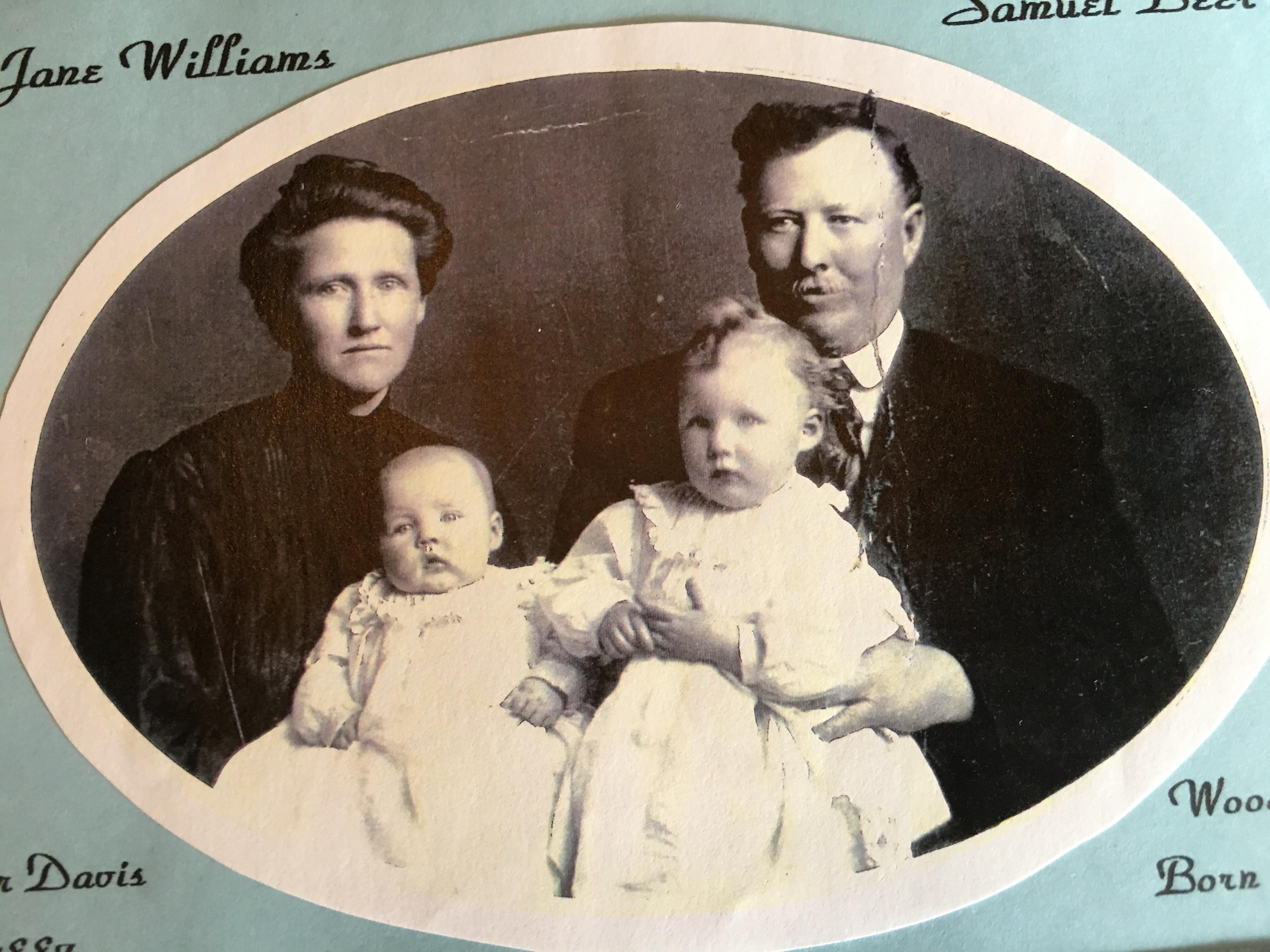
Mary Jane Williams and Samuel Deer Davis with Edgar and Woodwill Davis

“At this time there was much pressure on the local LDS communities by the Idaho politicians who were strongly anti-Mormon, about the Church practice of polygamy.  75% of the population lived in the eastern half of the state and about 20% of those were L. D. S. which meant that they represented a large voting block.

“These following steps were in relation to the 1884-1885 law, not the 1889 one which was taken to the Supreme Court.

“From E. Leo Lyman’s “Political Background of the Woodruff Manifesto”:  “William Budge, the leading spokesman for the Church in Idaho, tried to bring as much pressure as he could on the outcome of the case.  Budge used Utah Congressional delegate John T. Caine to generate pressures on the Judge Berry through political friends back home.  He also traveled to the Blackfoot judicial headquarters to confer with Berry before he rendered his decision.  The judge, who recorded the conversation as accurately as he could recall, claimed the Church leader first quoted U.S. Solicitor General Jenks as saying that if the test oath law was taken before the United States Supreme Court, “it would not stand for a moment.” Budge also stressed the crucial nature of the pending decision on the continued allegiance of the Idaho Mormons to the Democratic party (Berry 1888).

“Berry’s reply demonstrated considerable admiration for Mormon industry and economic accomplishments but firmly stated his intent to “administer the laws as they were.” He made it clear he could not allow political considerations to affect his decision and expressed regret that the Mormons could not bring their marriage relations into “regulation step” with the rest of American society (Berry 1888). The published decision {Idaho Daily Statesman, 17, 20 Oct. 1888; Wood River Times, 16, 17, 24 Oct. 1888) not only upheld the test oath but ruled the Mormon arguments that they no longer taught or practiced plural marriage were merely a temporary posture of no importance so long as the general Church had made no changes on the question. The kind of concession necessary to relieve the disfranchisement onslaught, Judge Berry stressed, was a formal renunciation of the doctrine at a Church general conference, not unlike what actually occurred several years later.”

“From the Encyclopedia Britannica: “They enacted a law in 1884-1885 that all county and precinct officers were required to take a test oath abjuring bigamy, polygamy, or celestial marriage; and under this law in 1888 three members of the territorial legislature were deprived of their seats as ineligible.  An act of 1889, forbade in the case of any who had since the 1st of January 1888 practiced, taught, aided or encouraged polygamy or bigamy, their registration or voting until two years after they had taken a test oath renouncing such practices, and until they had satisfied the District Court that in the two years after they had been guilty of no such practices.

“The earlier law had been tested by the Church in the territorial federal courts, but was unsuccessful.  This 1889 law, regarding voting, was commonly called “The Idaho Test Oath” which meant essentially that if you were a member of the Church, whether practicing polygamy or not, you could not vote and was retroactive to January 1 the year before.  It appears that the Church decided to test this law all the way to the United States Supreme Court.

“In Samaria on Oct 27, 1888, 26 men including Samuel D. Davis asked to have their names removed from the records of the Church with apparent approval of the Church leaders so that they could vote in the November 1888 election but primarily to provide a test case.  There were about 30 in Malad City who did the same thing.  The new law having been enacted after the men had voted, they were indicted almost a year later for conspiracy to break a law that wasn’t created until the following year.  The case became known as “Davis vs. Beason” and can still be found today by searching the internet.

“From the Deseret News on September 21, 1889:  “The perjury case against Mr. Evans of Malad having been disposed of in the District Court of that place, the next matters of importance tackled were the conspiracy cases. Indeed there was practically but one case, fifty six persons having been included in one indictment.

“The matter came up for trial before Judge Berry on Tuesday, Sept. 10th [1889]. There was much disappointment among the virulent anti-“Mormon” element over the result of the case of perjury against Mr. Evans and the officers said that in the conspiracy matter they would get a jury together that would convict this time.  For this purpose they scoured the country and imagined they had got what they wanted when the panel was completed.

“The charge preferred in the indictment against the fifty-six defendants was substantially that they had conspired together to break the laws of Idaho Territory, notably the Idaho test oath law, by agreeing to vote at an election when they knew that they had no right to do so.

“The case was tried and at 6 p.m. on Wednesday was given to the jury.  On Thursday the 12th at 2 p.m. the jury came into the court with a verdict, in which they found fifty-five of the defendants not guilty and one guilty.  The latter was Samuel D. Davis of Samaria.

“A new trial was asked for Mr. Davis by counsel for the defense and denied, and the  court sentenced him to pay a fine of $500.  The fine was not paid and Mr. Davis placed in jail for a maximum of 250 days [$2 a day].  Judge Berry was applied to for a writ of habeas corpus which was also denied, and an appeal from his action was taken to the Supreme Court of the United States.

“The matter is in the best possible shape it could possibly assume for final adjudication. None of the acquitted fifty-five defendants can be again placed in jeopardy on the same subject, either under the title of conspiracy or any other.  The appeal to the Supreme Court involves the validity of the infamous test oath law, which will therefore be decided one way or the other.

“The defense was conducted with marked ability, the attorneys being Mr. J. S. Rawlins of Salt Lake, and Mr. J. N. Kimball of Ogden.   Mr. Standrod and “Kentucky Smith” appeared on the part of the prosecution.”

“From the above article it is clear that it was “arranged” in advance that one person would be the focal point for the test case.  That person, having probably volunteered due to his legal schooling, was none other than Samuel D. Davis.  He obviously knew that he would spend some time behind bars, but was willing to do that for the Church.

“To give a better idea of the named individuals in this case, they are as follows:  Charles H. Berry, a former attorney general of Minnesota, later on, an associate justice of the Idaho Supreme Court who would have jurisdiction as the Judge in this case in Malad City.  Joseph S. Rawlins was a city attorney in Salt Lake City and worked with Brigham Young and following Church leaders on matters of law.  He later served in the Congress of the U. S. and assisted in gaining statehood for Utah.  He was also known as the “Red-headed Reactor of the Rockies” because he made such a fight about the confiscation of the Church property.  It was through his efforts that the property was eventually restored.  J. N. Kimball also served as a defense attorney for the Church in Ogden.  Drew W. Standrod came to Malad City, Idaho from Kentucky with his parents and took up the practice of law there.  He was elected as the prosecuting attorney there twice and later became a judge moving to Pocatello.  “Kentucky” Smith is actually H. W. Smith who was an anti-Mormon lawyer of prominence in Ogden, Utah and the author of the “Idaho Test Oath” law.  He also later became a judge in Idaho.  Sheriff Harvey G. Beason was an appointed sheriff who was just 29 years old at this time.  His was the other name in the test case.  He soon after moved to Montana and then to Gillette, Wyoming where he lived until his death in 1939.

“From another article in the Deseret News written in Samaria on September 30, 1889.

“”A very strange scene was witnessed here on the 25th inst. (Sept 1889)  It will be remembered that Mr. Samuel D. Davis of this place was found guilty not long since at the District Court held at Malad City, of voting at the election held here last fall contrary to the provision of the anti-Mormon Test Oath law, and that he was sentenced to pay a fine of $500 and costs, pending payment of which he was sent to the county jail.  He applied for a writ of habeas corpus which was denied by Judge Berry.  Application was then made direct to  Washington for a similar writ.  Here it was thought the matter would rest for the present. But not so; on Sept. 13, Sheriff Beason came to Samaria and levied an attachment on Mr. Davis’ property having an order from the court to sell at public auction enough to cover fine and costs.  On the  25th inst. said order was carried into effect.  Sheriff Beason, Attorney Standrod, Treasurer D. Tovey,  Commissioner P. Fredrickson and a few others came over.  The sale began at 2 o’clock.  Mr. Davis’ only horse was sold to Meyer Kohn of Malad, for $21.00. (Mr. Kohn has since offered to return the animal for the same price), which was about one-fifth his real value.  Mr. Davis interest in the firm of Evans, Gibbs, & Davis was knocked off to Standrod for $190.00.

“It was the Intention to sell the little home where Mrs. Davis and her two little children reside, but the title being defective it was abandoned. This was all that could be found to sell and the sale came to a close.

“The sheriff seemed very dry after his labors for he and his companions indulged quite freely.  They had apparently come over well prepared.”

“This article indicates that Samuel’s family also suffered because of the case.  The article was incorrect in that there were “two little children” in the home.  My grandfather, John Vincent “Vin” Davis was born on 6 July 1889 and was just a few months old when this took place, which means that there were two little children and one infant.  It also indicates that his fine was reduced almost 40% by the $211.00 amount recovered in the sale.  Therefore his sentence would be reduced by about 100 days, leaving 150 days remaining to be served.  From the Deseret News on 11 January 1890, it indicates that the hearing was held in the U. S. Supreme Court, probably a day or two earlier.  The hearing is several pages of arguments both for and against which I will not be discussing here.  It can also be found on the internet by searching “Davis vs. Beason”.  The ruling was handed down on 2 February 1890, upholding the Idaho law.  At this time Samuel had been in jail for 113 days.  I was unable to determine whether he remained the last 30 some days in jail or whether the Church paid the balance of the fine to release him or whether he was reimbursed for his personal losses.  During this era many members sacrificed much for their belief.

“President Wilford Woodruff issued the “Manifesto” a few months later on 24 September 1890, ending plural marriage in the Church.  The Idaho law was changed in 1893, the disqualification was made no longer retroactive, the two-year clause was omitted, and the test oath covered only present renunciation of polygamy, thus allowing members to vote once again.  It took until the 1980’s to get similar wording in the Idaho State Constitution removed.

“Samuel D. Davis continued in his practice of law and in 1899 he was appointed Probate Judge of Oneida County, Idaho.  He was twice elected to this office.  In 1901, after the formation of the Idaho State Bar, he took the examination for the bar and was admitted to practice in all the courts of the state.

“His wife of 21 years, Mary Jane Williams Davis died on 19 March 1903 in Samaria.  Later that year he moved his family of boys to Malad City to continue his practice and opened a new law office there.  His brother-in-law,  Isaac B. Evans, who had been on a mission in the south, introduced him to a woman in Salt lake City, whom he had known while on his mission.  She was Alice Godwin, daughter of Handy Haywood Godwin and Elizabeth Ann Naylor Godwin.  They were natives of Clinton, Sampson, North Carolina.  She was a true daughter of the old south.  Samuel was very interested and she was interested also, but I’m sure was concerned by the thought of finishing the raising of 7 boys.  But apparently she was up to the task as they were married in the Salt Lake Temple on 13 November 1905.  She bore him 3 more children.  First, Mary Naylor Davis, 13 September 1906, second, Alice Deer Davis, 18 January 1908 and Samuel Godwin Davis on 6 March 1911, all in Malad City, Idaho.

“He continued in Malad City until moving to Salt Lake City about 1918.  He was there in the January 1920 U. S. Census.  He probably moved to Twin Falls, Idaho in the summer of 1920 to accept employment as the City Attorney.  Two of his boys followed him there.  One, Eugene, who was still living with him and the other, John Vincent and his family, who was still living in Samaria.  In June of 1923, he was made the Twin Falls Police magistrate, but unfortunately, he died within 6 months on 13 December 1923.  After the funeral, his body was shipped back to Samaria to be buried.  His second wife, Alice moved to Salt Lake City, where she died 13 January 1945.  Her body was also returned to Samaria to be buried.

“From the Twin Falls Times News:  “Judge Davis was early admitted to the bar in Idaho, and served as county attorney and probate judge in Oneida county.  He attracted wide attention in the early days by his success as an irrigation and criminal lawyer.  It was his boast that some of Idaho’s best known attorneys had begun their legal training in his office.  He was an active and prominent member of the L. D. S. Church serving as member of the High Council in Malad and Twin Falls.”

“Thus ended a long legal career in the State of Idaho and the life of a man who was willing to stand for  his principles, even risking all his possessions at one time.  He died at the age of 64, which would be considered still young by today’s standards.  His part in the legal battle was apparently unknown to his children, grandchildren and their descendants.  My mother did mention many years ago that she had heard about the voting issue.  Those of his children as indicated earlier were very young and would not have known about the landmark legal case, unless he had related it to them.  He was a good man and his story needed to be told, so that all would be aware of his sacrifice during another time of great difficulty in the history of the Church.

Charles August Nuffer

This is the life history of Charles August Nuffer.  He wrote this autobiography on 28 January 1949.  I have maintained the language and spellings of the original document.  I also wrote a quick overview of his life previously.

This is a brief history of the life of Charles August Nuffer, son of Johann Christopher Nuffer and Eva Katherina Greiner Nuffer. I was born June 18th 1871 in Neuffen, Wurtemberg, Germany. When about eight years old I remember going with my father and mother to a neighbor’s home where the Mormon Elders were holding a meeting, one was Elder John Theurer of Providence, Utah. Some week later, one morning on getting up the floor was all wet, I asked my mother why, all that she said was that they were baptized members of the Mormon Church last night in the Mill Race back of our house.

It was not long after when they began to make arrangements to emigrate to America. After they had sold their home and land to get money for the voyage except what they could take with them, and that was not very much, they still had to borrow a few hundred dollars before they could go. They borrowed this money from the Schweitzer family that had also joined the Church, and came on the same ship with us, also the Lalatin family that had become members of the Church. So in the month of May 1880 they all bid farewell to friends and the land of their birth for the Gospel’s sake, and set sail on the steamer Wisconsin, for New York, U. S. A. (Early in the morning before daylight we left home in a covered wagon for the City of Stuttgart. I was carried in some bedding as I was sick with the measles and was not well enough to walk. From Stuttgart we went to Manheim and from there by boat on the Rhine to Holland and over the North Sea to London, where everybody was sick the next morning but myself, I think I was just getting over the measles.)

Young Charles August Nuffer

Young Charles August Nuffer

The first place we came to was called Castle Garden where all our belongings were examined. They also gave all the emigrants a little book, the New Testament to take along free. In those days most of the streets of New York were paved with cobble rock. After a few days rest we went by train to Collinston. Arriving in Logan we were taken by a family of Saints that gave us food and lodging for about three weeks by the name of Shaggo in North Logan. After three weeks we found a little old log house with one room and a dirt roof and plenty of bed bugs to keep us company. It was on a vacant lot on the street going to the College just east of the canal. We lived there about a month, as father bought a house and lot of Jacob Engle, full of cobble rock where we intended to make a living but we found it hard going. The house was built of small cobble stone and in the winter at night the walls would get all white with frost. Father would go out where ever he could get some work, he worked on the threshing machines and I went with him to help and he got a bushel of wheat a day. Grandma Spring, Regine and I went out in the north field to glean wheat, we would cut the heads off and put them in a sack. Father threshed them out with the flail and it made about sixteen bushels, so about all father could do is to earn for us so that we could have something to eat while John and Fred were earning money to pay for the place.

Fred went to Idaho working on the Railroad and John worked for Mr. Summers a contractor who later recommended to the Stake Presidency to take charge of building the Stake Academy after we had moved to Idaho. It seems to me the Lord had already begun to open up the way for our life’s mission in this part of the land.

When we arrived in Providence the potatoes were in full bloom on the lot which looked good, at least we would have potatoes to eat. We had to get the wood from the hills near by. They had bought a team and an old wagon so we went to get some wood. Father told me to drive, as I drove out the  gate and over a little ditch the tongue dropped down and the reach came up and the team ran away and I fell under the horses feet. I received a broken shoulder and the horses ran around the block and back in the gate, my first time driving a team, at ten years old.

While living in Providence I went to school a few months during the winters of 1881 and 1882 and learned to speak English. My teacher was Mrs. Mary Neaf Maughn, the mother of Mrs. A. E. Hull and Maughn the brush man, and Peter Maughn was the other teacher.

I was baptized when I was 9 years old by Mr. Campbell the grandfather of Mrs. C. M Crabtree of this ward. My sister Mary was born here October 11, 1881. She died in Mapleton, Idaho, October 5, 1900. I look back to my young days while living in Providence, and I still have many friends there, but my parents had to look forward to some other place for our future and to find the place for our life’s mission. It seems the Lord prepared the way. One of our neighbors, a German family had a daughter married to John Miles who was living at Wormcreek and she wanted him to move to Providence where her mother lived so we traded places. We lived in Providence from June 1880 until October 1883. So from here we go to Idaho the place the Lord had chosen for us to build our future home.

We loaded what we could on our wagon and Mr. Miles the rest on his as he helped us move and all together it was not very much, but it was all the poor teams could pull over the kind of roads there were at that time. On arriving at Wormcreek we found a place with a house on it, a log house about 14 by 16 feet, all one room, with dirt floor, no fence around it and no plowed land, and when it rained the mud would run down the walls and we had to set pans on the bed to catch the rain. Father, Mother, Regine, Adolph, Mary and I lived there then. Fred was out in Oregon but he came later that fall with two big horses and John was working in Logan, I think with Mr. Summers. During the winter John rode the biggest horse to Providence as he was going with Louise Zollinger whom he later married. The horse got warmed up too much and got a sore leg and they finally had to shoot him. John and Fred were in Providence most of that winter as their grandmother lived there and Fred was going with Anna Rinderknecht.

As we did not have much hay we bought two stacks of straw from Jap Hoarn and Tom Miles, the first lived in Richmond and the other in Smithfield as they were only on their farms in the summer. The snow as so deep Regine and I filled some big sacks we had brought from the Old Country with straw and tied on the hand sled and pulled it over the rested snow for home. The Miles were the only family that were living on the Creek besides us on what is now known as the Webster Ranch, and we lived on what is now known as the Fred Wanner Place. The Miles Family ran out of feed for their cattle so in March they shoveled a path over to the south side of the hills where the wind and sun had taken the snow off the grass and it had started to grow. When they drove the cattle through the path you could not see them because the snow was so deep. So with the help of the Lord we pulled through the Winter of 1884. In the Spring John and Fred came back and began to fence and plow the land and plant crops. Later John went over to Oxford to the Land Office to file on the land for himself as he had helped most to pay for the home in Providence. As father wanted a homestead of his own, one Spring day it was on the first of May he sent over the divide between Worm creek and Cub River to find a place where he could make a home for the rest of the family. When he returned he said that no one had gone over there before him that spring, as the snow had not melted yet. That was in the spring of 1885, so during that summer John and Fred were raising the crops and helped father build a log house and we put in some crops so we have something to eat for the winter. As we did not have much of a team they had Joe Nilsen come up from Preston to plow some along the Creek, he had a big team and a sulky plow. But that was not all, we had to fight squirrels and grasshoppers. What we raised that summer had to see us through the Winter, and it was not any too much.

Fred went up Wormcreek and got some logs and had them sawed at the Moorhead and Thomas Sawmill on the Cub River. But we found that there was only enough for the roof and none for the floor and ceiling. They had lumber at the sawmill but they would sell us any for wheat and the store in Franklin did not pay cash for it. Father had already laid some logs down to put the floor on so we just had to step over them all winter but maybe it was a good thing as we got the warmth from the earth as we only had a lumber roof over us 14 feet to the top and just a four hole cook stove to warm the house and wood to burn, and it was not all dry. Still we were happy and thanked the Lord for what we had. Mother would read a chapter from the Bible, we would have prayer and we would go to bed early. (Clayborn  Moorhead told me some years later that Joseph Thomas intended to take up my Father’s Homestead but he was not old enough then so my father was first. He said those Germans can’t make a living there, they will starve to death and I will get the land anyway. But, I think he did not know as much as he thought, he didn’t know we had put our trust in God.)

On Christmas Day 1884 Father sent me over to John’s (Grandma Spring was keeping house for him that winter), after twenty-five pounds of flour. The snow as up to my knees. After that flour was gone we had to grind the wheat in the coffee mill as no one went to the store anymore that winter until Father and I each carried a basket of eggs to the store in Franklin on the 2nd of March, over two feet of :frozen snow to buy some groceries. We could not busy much as we had no money. Mother raised some sugar beets in the garden, as we had no sugar she but some beets in the oven and baked them and put them in a cloth to get some syrup to make her yeast. She cut some up in little squares and browned them in the oven and ground them up to make coffee. Mother would also put the wheat in the oven to dry and brown it just a little so it would grind better and we used it for bread and mush. Finally the cow went dry so we had no milk for some time and no sugar, but we got through the winter without any sickness. We thanked our Heavenly Father for what we had and lived by faith in our Heavenly Father as we had no Church organization of any kind at that time there.

It seems the Lord wanted a tried people to build the Valleys of the Mountains for when we began to raise crops that we might have food for the next winter, we had to fight the squirrels and the grasshoppers. We worked with faith that did not falter and as I remember we never got discouraged for we felt the Lord was on our side.

April 1949

When I was going on 21 years of age I was looking for a homestead to file on. East of my father’s place, about 40 rods from our house in a hollow there was a nice little spring by a service berry bush coming out of a sandstone formation, where I decided to make my home. Not being of age to take up land, I moved a little log building with a dirt roof on it, that my father had used for a granary, onto the land. I had a bed in it and would sleep there some nights. I prayed to the Lord that he would protect it for me, that no one would file on it as I was not yet twenty-one, and not old enough to take up land. There was a man by the name of George Kent, down on the river. His wife told me there was a relative of theirs in Lewiston, Clyde Kent, who was going to jump that land, as they called it those days. I told them that I did not believe he would be that mean. I wanted to start life for myself as soon as I was 21. So on June 17, 1893, I was on my way to Blackfoot, Idaho by train in company of John McDonald, whose fare I paid to Blackfoot, and return as a witness for me as to my age. There was no bridge across Bear River to Dayton at that time. We stopped at Pocatello over night; it was not much of a town at that time, mostly railroad shops and saloons. We arrived at Blackfoot on June 18th, on my 21st birthday to file on that homestead. When I told them at the land office of the land I wanted to take up, they told me there was a man there some months before, the man I spoke of. Not giving up hope altogether we looked over the plat, and I found there was 40 acres all to itself, not filed on. After looking things  over for awhile I said to Mr. McDonald that is the land my cabin and the spring of water is on; so I filed on it and returned home. Arriving on Sunday afternoon my mother said there was a man and his wife looking at your place, as they thought that I had lost out. My family with me felt to thank the Lord that I had a place to build my home on.

As Fred and I started to quarry sandstone on my father’s place that fall, I hauled some sandstone in the Spring to build me a house, but during that winter 1893, my mother came down with pneumonia and died within a week on the 26th of February 1893. She was buried in the Preston Cemetery. She was about the 2nd or 3rd person buried there, as the new cemetery had been started that year.

The following Spring the Wanner family came to Mapleton, from Germany, on my birthday June 18th, which was a Sunday. This was the first time that I had seen my life’s companion, as they came to my brother Fred’s place, where they lived until they found a home to live in. Christine was their oldest daughter and I fell in love with her at first sight. My sister Regine was home again from Montana, her husband had left her, she had a little girl Katy. Christine stayed with her until she went to Millville to work for the Pittgins family for about three months for seventy-five cents a week and her board and some old clothes. When she left they gave her $6.00 and she gave it to her father as he told her she had to earn some money yet before she got married.

That fall as I started to haul stone to build a house, besides taking care of my father’s farm—Adolph helping me, as my father was away most of that summer to Bear Lake and other places, because he didn’t feel like staying home after Mother died. When he came back he brought with him Sister Weirman, and married her in the Logan Temple. Well, during this time I had started to build my house. We dug a hole in the ground and poured water in and mixed it. That was what we used to lay up the walls, and the house is still standing. By New Years the house was finished and cleaned, but we had no furniture or anything else to put in it, but still we made our arrangements to get married. We were baptized by Heber Taylor on 26 June 1894 in Cub River and confirmed by Edward Perkins at Mapleton on the 27 Jun 1894. We were married 1st February 1894 in the Logan Temple by Marriner W. Merrill, president of the temple. (Read Christina’s biography here.)  We made the trip by team and wagon, as there was no snow on the ground in the valley. We put our team in the Tithing Barn, as the Lalladine family were the caretakers. After returning from the temple, for supper we were invited by Charles O. Card at their home on depot street, as Mary Wagstaff’s mother’s sister was working at their home, and we spent our first night with them. He is the Card after which the city of Cardston, in Canada was named, as he later moved to Canada.

As I have said before, after we got the house finished we had nothing to put in it and had no money to get married with, so I asked Grandpa Wanner if he would loan me $10.00 and I would pay him back when I raised a crop. He let me have the money with which we bought our marriage license, and a few dishes for the house. We borrowed a table and an old set of knives and forks from my sister Regina, as she did not need them at that time. We returned them again when she got married to George Wanner a year or so later. We paid Grandpa in seed grain the next fall with many thanks to him for his kindness. For our wedding present Grandpa and Grandma gave us a bedstead to sleep on, as we had no furniture. I nailed some boards together for a cupboard for dishes. Stepmother Weirman Nuffer made some of our temple clothes and the garments were made out of factory. She was helpful to us in many ways, so that was the beginning of our family life in a humble way and we were happy together.

As Adolph was still at home, he and I ran my father’s farm, and I fenced my 40 acres, and started to plant some of it as fast as I could break it up. I helped Fred in the sandstone quarry to get a little money to buy a few things till we raised a crop. The Wanner family bought John’s place on Worm Creek for $2000 and became very successful farmers.

Will pass over a year or so till the first child Clara was born 10 August 1895, Louise 19 Nov 1896, Anna the 8 January 1899, Bertha 9 Jun ‘900, Fred 21 October 1901, Joseph 18 May 1904, Ida 15 Jun 1906. These children were all born in Mapleton.

From here on my main occupation was farming and quarrying sandstone. I cut grain with a binder for people in Mapleton at one dollar an acre. In the winter I worked with Fred on the Mink Creek Canal, blasting the rock with black and giant powder, making the canal from seven to ten feet wide. I worked out four hundred dollars in ditch stock and finally sold it for forty cents on the dollar. I received $1.50 a day in cash so that is all I got for my work, and we had to sleep in a tent in the wintertime and cook our meals but it build the canals so the people would get water for their land and could raise crops.

When Fred moved to Preston I took over the stone quarry. I was also ditch rider for the Preston Cub River Canal for a number of years, making a trip a day while the canal was full, at a dollar a trip. While runnig the quarry I delivered stone for some of the Preston business buildings and for the Lewiston Meetinghouse. During this time we were also taking care of John and Fred’s grandmother for a number of years. As the family was getting larger I built another room on the house as mother was busy taking care of Grandma Spring, and John was going on a mission to Germany. They decided to send Grandma Spring to Blackfoot where she died a year of so later. I think it was in the year of 1897, when Mother and I drove to Blackfoot with the team and buggy to take the rest of our homestead, that we had lost by that Mr. Kent beating me to it before I was of age.  While at Blackfoot we called at the hospital to see Grandma Spring.  They told us she had died before Christmas the year previous, and they had sent no word of her death to anyone.  A few words more while at the land office it seems the Lord had always prepared the way for us.  As we entered the land office the first person we met was President George Parkinson, who knew us well.  Without his help our trip might have been in vain, as it was difficult to take up land when another party had filed on it.  At the time we made this journey this was the frontier of the west.  Where Downey is now there was not one hours and from Pocatello to Blackfoot was all desert, not a house, only the Indian Reservation.  I carried my shotgun with us for safety.  We could say much more, but it would take too long to tell it.

From here on it made a lot of work; to fence the land and break it up and get it ready to farm and to make a living for the family.  From here on I will begin tow rite of some of my work in the Church for which we have left our native land.  On April the 19th, 1896 the Stake Presidency, George Parkinson, Brother Cowley, Solomon Hale came to Glendale to form a German Organization, so we could hold meeting every two weeks, as there were many families Swiss and German that could not speak English. Addison Wagstaff was Ward Clerk and took the minutes. Brother Jacob I. Naef was chosen as President. It was not until 5 Jul 1896 that his counselors were chosen, Brother Jacob Schneider, first, Charles A. Nuffer second counselor. We held our meetings in the homes of the people on their farms and wherever they lived. They traveled with farm wagons a distance of20 miles one way to Mink Creek, Weston, Riverdale, Whitney, Treasureton, Mapleton, Preston and Glendale, there places were we held meetings. Some years later when Joseph Moser became President, I became one of his counselors, also brother Kern. After some years John asked to be released and I became President ofthe Branch on the 21st of March 1915, with Brother Kern and Alma Moser as my counselors. During this time we held the meeting in the old tithing office, later in the new one at Preston, until the 13th of August 1916, we held our last meeting. During the later part of the war some of the people of Preston made it very hot for the German speaking people yet most of them were Swiss, but that did not make any difference. So President Geddes came to me and asked me not to hold anymore meetings. After the war many of the German people had moved away so we never started to hold the meetings anymore, and I never was released to this day. That closes up this chapter of the German Saints of this part here, so I will go on to some of my other duties in the Church. Making in all twenty years that we held German Meetings with the people of Franklin Stake.

Now going back to the year 1899, when I ws called as second counselor to Bishop Edward Perkins in the Mapleton Ward. When Orron J. Merrill moved to Preston I took his place and his son Preston my place in the Bishopric. I was chairman of the School Board for six years, and Brother Merrill was the Clerk, and when he moved away his son was appointed in his place. While on the school board I had a schoolhouse built in the upper end of the District, with Harrison R. Merrill as the first teacher. That way the children of the upper end would not have to go so far to school. The children in the lower part of the Ward met in the old meeting house. While I was in the Bishopric Brother 0. J. Merrill was the Ward Clerk and clerk of the school board. After his father moved to Preston, 0. P. Merrill, his son, was the Ward Clerk and clerk of the School Board. Speaking of schools the first school that was held in Mapleton was in the winter of 1886, when Bishop Perkins went to Lewiston to school. He let the people of the Ward have a school room so they all got together and employed Hirum Johnson as their teacher. All children from seven years up to thirty, married men and young ladies went to school there all in one room. Some came from Franklin and Nashsville. I was feeding cattle for Harrison Thomas that winter and lived with Olive Sweet, she had to board me as she was living in their house, and they paid $150 for my schooling and $.45 for a book. I had to chop all the wood for the family. I was fifteen years old. This school house which was built by the efforts of the people of the upper part of the District, was the first schoolhouse built in Mapleton Ward with H. R. Merrill as its first teacher.

In 1899 in June I was ordained a High Priest by George Parkinson, President of the Oneida Stake, and we labored unitedly together in the Ward. Bishop Perkins was very kind to prepare me for this work, and in his home he read the Book of Mormon and the Doctrine and Covenants to me. So, that I may more fully understand the Gospel, and that I might be an example to the people of the Ward, and he taught me the Law of Tithing, and that we may be worthy to receive all the blessings that the Gospel had in store for His faithful children. So on the 21st of February 1900, we were recommended to the Logan temple to receive our second washing and anointing by President Morgan, a blessing that not so many have received, which is the greatest blessing anyone can receive in the House of the Lord, for which I have tried to be thankful all the days of my life.

In the Spring of the same year, as there was a severe drought in Southern Utah, President Lorenzo Snow went to St. George, and met with the people there and told them if they would pay an honest tithing the Lord would bless them and send rain to save their crops. As the church was in a very bad financial condition at that time. So on returning to Salt Lake City President Snow called a special meeting of all the General Authorities of the Church to meet in the temple on the Law of Tithing, on June the 2nd at 9:00 A. M. And as Bishop Perkins had taken so much interest in me he asked me to go with him, only the Bishops were called. All the General Authorities spoke in the Meeting, after which they all shouted “Hosanna to the Lord”. We were in the Temple from 9:00 A.M. until5:00 P.M. The meeting was in the room known as the Celestial Room. At the close of the meeting President Snow said, “If you will go home and pay an honest tithing, the Church will be freed from debt, and the Lord will forgive you of your past neglect, and I promise you your homes will never burn.” From that time forth I always paid a full tithing as long as I lived on this earth. This blessed land of America, which God has blessed above all other lands. So these are some of the blessings that your mother and I received through Bishop Perkins being so kind to me. In appreciation for the blessing the Lord has given us, I desired to do my full duty in my calling with the people of this ward, and we had many opportunities to be called out day and night in time of sickness and death, among the people. We labored together eight years and had much joy in our labors.

I have given you some of the ways I made a living for the family. To make a living during this time and to care for the family, I farmed, raised hogs and horses, milked cows, separating the milk and selling the cream, and making butter getting $.10 a pound at the store. The most I received while selling cream from six to seven cows was $35 a month. I also sold cream separators to the people of Franklin and Preston to make a little extra money. I cut grain with the binder for the people in Mapleton. I quarried stand stone for the Lewiston Meetinghouse, and some buildings in Preston. The Riter Brothers Drug Store and other buildings. For the hogs we received $4.00 per hundred.

I had now lived on Worm Creek, Mapleton twenty-four years and I have related only some parts of my life. During this time in my life it was necessary for us to look toward the future, and seven children had been born to us in our first home. As the family got larger I built room onto the house. During this time my sister Mary was working for a family in Logan and as she was not feeling so well she came home and we needed someone to help mother as Bertha was a baby at that time. But in September Mary came down with pneumonia and died the 5th October 1900.  She had been born in Providence, Utah the 11th of October 1881. At that time most of our children were sick with scarlet fever, but they got well with our care and the help of the Lord as it was hard to get a doctor.

Before leaving Mapleton, speaking of building I feel to give some information pertaining to my father after his third wife died, Mrs. Weirman. He married Mrs. Shaub of Logan and bought the house of her son Gene. He lived in Logan a few years but he wanted to come back to Mapleton again and wanted me to build him a house in my orchard. I bought some sawed square log from Kall Wheeler, and build him the house. He paid for the materials and I did the work free, and I moved them up from wagon by team, but it was only a few years until he wanted to move again. He had already lived in Preston twice before. The first time where Ernest Porter lived, and before that out where Jim Smart’s place is. I then began to haul tone to Preston and John laid up the walls in 1907. In all the houses he lived in were one in Providence, two in Logan, one in Worm Creek, three in Mapleton and three in Preston and he died the 121h Aprill908. When I started to build my home after his death I moved his wife back to Logan with team and wagon.

I will pass over some years as things went on as usual. We began to look to the schooling of the children, as there was not much opportunity in Mapleton. I bought five acres of land in Preston and during the winter of 1905 and 1906, I began to haul sandstone from the quarry for the building of our home. I also planted trees in the spring of 1906, as there was nothing on the land whatever, only a fence around it. So this was the plan for us to move to Preston, not to improve ourselves better financially, but to make it better for Mother and all of us.

The Bishop was called to go on a mission, and I was in line for Bishop as things looked at that time. Mother was already alone so much with the family and I had so many meetings to go to at night. I was still in the German Organization, and I was so far away. I had from two and a half to three miles to ride on horseback to meeting to the home of Brother Merrill or the Bishop. In all the eight years I labored in the ward only one ward was held in our home. I leave the rest for you to answer whey we made this move which needed much consideration and prayer, and the guiding care of our Heavenly Father in making this move.

So in the Spring of 1907, after renting the farm to Hart Wheeler of Mapleton, I built a frame house sixteen feet by twenty feet to have a place to live in. Also, we had a tent for some of the children to sleep in, so I would have the family with me while I was there building our home. I built the barn a place for the cows and chickens. I hauled logs for the bam and most of the lumber for the house from the sawmill on Cub River during the summer. In October of 1907, when the frame house and the bam were built we all moved to Preston. We were all glad especially the children, when they could see the train and hear it when it came to turn on the Y. So this was a great change for all. This was the first time I lived in town, since we left Providence. So in the Spring of 1908, as soon as the snow was gone I began to dig the foundation for the house and laying up the walls; doing the work myself. Our second home in which all the children were brought to men and womanhood. This was the most happy period of our life. In order to get the large stones on the wall we had to roll them up some logs, as they were too heavy to lift. I hired Adolph to help with the work for a while, but before I got the walls finished I took down with Typhoid Fever. Adolph and Mr. Peterson finished the walls. This was in the latter part of September, and I did not know any more of the building of the house till it was finished so the family could move in. Preston was a baby then and I remember that he cried so much it must have been hard for Mother. I can’t give much detail concerning my sickness, only that Mr. States was my doctor and a lady Mary Bodily was my nurse. Brother Arnold Shuldhess, the editor of the German paper “Beobachter”, was up from Salt Lake City and came and administered to me when I first took sick. When Miss Bodily had to go some other place they got Maude Stocks for my nurse. They gave me very little food; mostly brandy and whiskey, as food is most dangerous in Typhoid, at least that was the way they used to do for Typhoid Fever at that time. I never used liquor at other times in my life.

Before I forget, my sister Regina, about the year 1886 also came home from Logan where she had been working and came down with Typhoid and there were no doctors here as there was no town of Preston here then. If there had been we would not have had any money to pay them; so her mother treated her the best she knew with tea from different herbs. Our prayers and faith were in God and she lived and got well, so we did the best we could under different ways and conditions. I will again go on with my own case. The latter part of October as I remember, I began to improve in health and they began to give me some food, as I was getting very hungry and I thought I would not get enough to eat anymore. Mother was very much afraid she might give me too much to eat, as that is the most dangerous time of the disease. The first time I went out doors again was the beginning of November. The trees were all yellow and I went up town to vote on November 6th 1908. I am sorry to say that this was not the end of our grief and sickness, so we had to start all over again and as I write these few lines it fills my eyes with tears when I think of that dear Mother that never gave up, that watched over you all night and day with faith in God for a better day. The Lord heard our prayers and she had the privilege to bring you up to manhood and womanhood, but that was not the end of our trials as stated before.

When Clara and Anna came down with the fever we had to get Doctor Emery, as Doctor States lived in Franklin. As they had to come most every day and we had a nurse that did not belong to the Church. She stayed at Preston Rooming house and we had trouble with her as I will tell you later when I get to that. By this time we were living in the new house. I think it was sometime in December. But, under the care of the new doctor and the new nurse the girls did not show any improvement. It was not long till they came down with pneumonia and week after week they did not get any etter. The nurse had a lady friend that visited some time in the evening. One day I found some empty whiskey bottles in a pile of stone that was beside the house. I at once told the Doctor we did not want his nurse any longer. He said he had a Nuffer barn place in Weston for her. He said that we would be responsible if something went wrong with the girls. I told him I was willing to take the responsibility. The nurse left and shortly she came down with the fever at the rooming house. It was only a week or ten days till the girls were up on their feet again. It was now the latter part of February and what a relief it was especially for that dear Mother, when all could rest again.

Now during my sickness some of the people of Mapleton had been told by Doctor States that there was not much hope for me to get over my sickness and mother heard of it. She prayed to the Lord saying that if he would spare my life she promised Him she would let me go on a mission, under almost any conditions whenever called. So during the summer of 1909, I worked at whatever I could find to earn something to take care of the family, and to keep out of debt, and fmd planted what we could on the lot for the next winter. Sometime if February of 1910, I received a letter from Box B, as it was called in those days, when anyone was called on a mission. I did not know anything as to a call for a mission when I received the letter stating if I could accept this call, if I could be in Salt Lake City on April the 18th. I do not know if Bishop H. Geddes had told the authorities of the Church anything of my financial condition or not, as I remember he did not to me; which was very limited at this time nor did he tell me anything about being called on a mission. We did not hesitate for a moment, but told them that I would be there at the above date. As we had no porch on the south side of the house I went to work on it before leaving. I also built a shed for the white top buggy so it would be under shelter while I was away. On the 15th ofFeb 1910, Laura was born at home with Mrs. Nancy Beckstead in attendance, which made it still harder for me to leave you all alone. I also planted some garden before leaving. So in the morning of April the 18th, I was on my way, Clara going with me to Salt Lake as mother did not want me to leave alone. That way she could hear from me just a little longer, Clara was then nearing 15 years of age and Laura was going on two months.

As I remember I was set apart for my mission by Jonathan C. Campbell to the Eastern States Mission to labor under Ben E. Rich. After a few days in Salt Lake I left with other Elders for New York City, stopping at Des Moines, Omaha, Chicago, Buffalo and on to New York. After a few days there I was appointed by Ben E. Rich to labor in West Pennsylvania, with Elder Hyrum Nelson from Cleveland, Idaho. I was then sent by way of Philadelphia to Pittsburgh with Heber D. Clark as our president. We were then sent out in the country two hundred miles tracting on the way, where there was a Branch of the Church in Buck Valley. It would be too much to give my missionary account, it is written in my missionary journals, those red books in this home. As we met in Conference in Pittsburgh, with Ben E. Rich and all the Elders in February of 1912 I was released to return home. It was most difficult for mother to carry on any longer with the large family as she had to borrow most of the money while I was away, as it was a dry season, and Mr. Wheeler, the one that bought the farm did not make any payments and the Bank charged 12% interest.

When I arrived home Laura, it was on her birthday, was two years old. One great blessing while on this mission was that I did not have one day of sickness and Mother and the children all had good health, for which we thanked the Lord with all our hearts. It was February the 15th 1912 when I arrived at home in time to make arrangements for a new life in caring for the family again, and to pay off the money we had borrowed. But, before I could do that I had to borrow some more to buy a team with which to go to work. I borrowed $700 off of Grandpa Wanner; the team cost $300. On the 15th July 1912, I purchases thirty two acres from Mr. Charles Nelson west of town on time payment, at one hundred dollars per acre. I then planted it in hay and grain, and the same year a hail storm came and destroyed the crop of wheat. I then went hauling sand and gravel for a living, and helped Uncle John with the haying.

On returning home I was asked by President Joseph Geddes to visit the wards of the Stake with the High Council for two years. It was before the Stake was divided. I also was asked to take my place again in the German Organization Meetings, one or two times a month. During this time I was serving as a Ward Teacher, a Sunday School Teacher, and quite a number of years as the class leader of the High Priests group in the ward, at Priesthood meeting, so I had plenty to keep me busy. I was also the ward Chairman ofthe Anti-Tobacco and Liquor campaign. During the First World War, I was called as a Counselor to Peter Hanson, who was Stake Superintendent of the Religion Class until the Stake was divided. In all six years, once or twice a month on Sunday or week days we would go out in the Ward to find someone to teach Religion Class in the schools, or to visit the schools that had teachers as we found it necessary. I was called as Chairman of the Genealogical Organization of the Ward. When the Ward was divided, and your mother and I worked in the Genealogical Organization. We were released when Orion Jensen was Bishop. During the years of 1923,24,25, and 26, I was called to baptize the children of the Franklin Stake. Charles F. Hawkes had done that work before. Also, at times I was called on to baptize children of the 2nd Ward at the Stake House. While in the old Church House I was a teacher in the Sunday School in the different departments at different times.

On October 30, 1916 I bought the farm in Dayton of June Jensen, Sam Morgan and H. A. Peterson of Logan, at the price of $5,500 so we would have work for the boys, so they would not have to go away from home to find work. For a number of years we had to dry farm, before we could get water. We finally got thirty shares at $130 an acres. As the land was all under bond it cost me $800 to buy the rest of the land out and we had to pay $7 per acres to get a ditch thru the Eccles Farm. I traded the land in Preston to Sam Morgon at $125 an acre that helped some. I had to clear off some thirty-five acres of sage with axes all by hand. That was all we had to do that kind of work for number of years. I had the cabin on the west hill of Peterson’s and had to carry the water from a spring below the hill in Petersons’ for cooking and vitrolling the wheat. I had to get a right-of-way from Brother McCarry at a spring to water the horses. We also had a stable on the hill for the horses. Usually we would fill our grub box on Monday morning and stay till Saturday and Mother and the girls would take care of things at home during the week. When we got water on the farm we moved up on the flat to the west of the farm. We went down the creek for water to use. We then built another room and Fred moved over with his family for the summer to help with the work as we rented the Miles farm and a year or so later Miles bought a house that we moved on his farm, for Fred and his family to live in. Later on we built another room onto it.

Preston helped us with the work after school closed and Joseph moved in up stairs when he got married, working with Roy at the car bam at the U. I. C. Railroad. In 1929 we built a house on the farm for Joseph to move in, as we had more work all the time. The cost of the house was $1250. Then came the crash of 1929, when wheat dropped to 30 cents a bushel and hogs to $4 per hundred and beets $4 a ton. To pay our debts and pay for the house all of us got together with a lot of hard work and the help of the Lord we pulled through. We also sold some hay for $5 per ton. In the Spring while the boys were thinning the beets, I was doing the summer fallowing, with the gang plow, with six horses; for a number of years. We started out with only three horses on the farm for a number of years. We could not raise hay without water. We had to haul the hay for the horses from town. Also, for the headers Mother would come over and cook for them. At the first harvest we did not have very much, and I was away trying to earn some money to pay for the heading. Louise and Preston drove over and brought them their dinner. I also went up to Glendale one summer and helped Fred Wanner and Hyrum Jensen get up their hay. They gave me a ton of hay for three days work with wagon and team and I would haul it over to the farm. That was during the early part of our farming that I am writing on this page some of our hardships.

In order to make some money to pay for the farm and to live, as we only raised grain, as we had no water on the farm, I would work on the header and do stacking. Also, I would go out with Fred Nuffer and Fred Steuri doing cement work for school houses, and other buildings. I worked for Joseph Moser as a carpenter on the Gymnasium, also did cement work, while Fred was hauling gravel. I hauled the first load of gravel for that building, also hauled gravel for the Jefferson School Building. I worked for Struve on the 4’h Ward Meeting house doing cement work on many houses in town. I had my team hauling gravel when they built the first sidewalks in Preston, until they were finished, then to the City Water Reservoir. When the Utah-Idaho Central Railroad was built I worked on the cut south of town ten hours a day for $2. Again I helped Joseph Moser when he built the beet dump, the high line by Tom Clayton’s place. I then got a job on the dump with the Sugar Co., loading beets on the cars. The next two years I was tare man for the company, and got lots of scoldings from the farmers, but the company treated me well. They used to pile any beets on the ground in large piles in different places, and haul them on the cars later. So, the boys Fred, Joseph and I would haul beets the rest of the fall. We would leave right after daylight and work until dark, so when Sunday came we were glad to get a short rest and go to Church, or I would be called to visit some Ward in the Stake in the interest of religion class to get in into the school, and on Monday back to work.

Going back to the farm work, in the fall of 1931 and 1932 I bought a herd of sheep to fatten, then took them to Denver to market to help get out of debt. While Fred was living on the Miles place and Joseph on the farm there was some difficulty, I do not know what it was, and Joseph moved back to town. Fred moved into the house on the farm and young Fred Wanner moved in where Fred had lived, as he had him working for him in 1936. I bought a tractor to do the farming, and did the summer fallowing with it that Spring. As Charles Nelson was janitor of the Ward House he asked me if l did not want to take the janitor job. So I had another job, which the girls helped me with at $11 a month, but it all helped. That was during the First World War.

Thinking it was time to retire from farming at the age of sixty-six I sold the farm in 193 7 to my son Fred. In Jun 1937 I bought the Dodge car and the Gamble home. The next year the McCarry farm. The summer of 1937 we went on a trip, Mother and I, Louise, the twins, and Joe and Gretta to Los Angeles, visiting Jim Cummings and Fred Nuffer. From there to San Francisco, then on Highway 1001 , the Redwood Road to Portland, Oregon up the Columbia River to Boise, Idaho and back. I had to come home after over two weeks absence. Mother and I had been to Los Angeles by train to visit Jim and Anna, when they lived at Beverly Glen, and again when she died the 25 January 1928. As given before the third time to California and again to San Francisco to the fair. Mother and I, Louise, Joe and Gretta, when Gretta took sick. After Mothers death, myself and Louise, Ida and Gilbert, went to Los Angeles the fourth time. Later when Jimmy Cummings was married I went on the bus to his wedding. Some years after Mother’s death, I and Louise and the twins went on a trip by car to Zions National Park, Cedar Breaks, and Bryce’s Canyon and to Yellowstone. The first time we went to Yellowstone National Park with Mother, Louise, Roy and Clara. The last time we went Louise, the twins, Donald and Joe and Getta and I went. We also went a few time to Nephi to the Roundup.

These years while Ward Chairman of the Genealogical Committee, we assisted the Stake in getting up large excursions to the temple on the U. I. C. Railroad, every month. All during our married life we would go to the temple every years as often as we were able to go. We carried on research work through the Genealogical Office in Salt Lake City, and we received sheets of names on the Nuffer and Wanner line, and my mothers Griener line, all at our own expense. I have the sheets in my trunk with the work all completed as you will find them there.

For twenty years after buying the Chevrolet car and the Dodge, we went to the Temple, whenever we could once or twice a month with a full car of people from the 2nd and 1st ward, until I took sick in December 1948. Since then I have been to the Temple three times. I am writing this May 11, 1950.While going to the Temple one February morning early it was snowing and the road was slick. I had with me in the car Mother, Louise, Brother and Sister Rindlisbacher and Mrs. Clarence Corbridge. As I was getting near the Utah line I felt there was trouble ahead. I was going about twenty-five miles an house, when George Wanner passed me. When half a mile over the Utah line the car struck a bump in the road and turned over in the barrow pit then over on its side. At that time a car came and took all but Mother and I and Louise to the Temple. Then came Orion Jensen and took Mother and Louise to the Preston Clinic to be examined by the doctor. I stayed with the car until Petterborg came. The damage on the car was over a hundred dollars.

Some months later Mother began to have pains in her back and kept getting worse as time went on. During July she got so bad I took her to the Preston Hospital for an xray. She was there for a week, and Doctor Cutler said we had better take her to the L. D. S. Hospital in Salt Lake as they could not do anymore for her there. We went to Salt Lake July 24th we were told that she had tumor of the spine. She was there for a week, when we were told that they could not do more for her so we bought her home. She died the 10th August 1940.

1 February 1949

Dear Children of Mine,

If your Mother was alive as I am writing, we would be celebrating our 55th Wedding Anniversary, but as it has fallen my lot I’m all alone in this home where you all have been brought up under her loving influence and with my deepest love for you all. I shall ever thank God, my Heavenly Father for the gospel and its blessings.

The Last Wagon

"To Them of the Last Wagon" by Lynn Fausett

In honor of Pioneer Day, here is a talk given in 1947 by J. Reuben Clark that has always touched me.  I think of it fairly regularly, especially when I find myself in a position of following others whose opinions or ideas just do not seem to make much sense to me.  I am reminded of my duty not to murmur and to do what I can and have the faith that the rest will just work out.  I just need to do the very best I can in the realm I life.  The caravan/wagon train moves on.

“At the near close of this one hundredth year of the entering into these valleys of your fathers and your mothers, some of yours and mine, I wish to speak a few further words of humble tribute and thanksgiving to them, and especially to the meekest and lowliest of them, those great souls, majestic in the simplicity of their faith and in their living testimony of the truth of the restored gospel, to those souls in name unknown, unremembered, unhonored in the pages of history, but lovingly revered round the hearthstones of their children and their children’s children who pass down from generation to generation the story of their faith and their mighty works, and the righteousness of their lives and living, those souls who worked and worked, and prayed and followed, and wrought so gloriously.

“I would not take away one word of praise or gratitude, honor or reverence from the great men who led these humble ones of ours. They were mighty men in brain and brawn, in courage and valor, in honesty and in love of truth, living near the Lord—Brothers Brigham and Heber and Wilford and Willard and Charles, the two Orsons and Parley, and John and George and Erastus and Lorenzo and Daniel and Joseph and Jedediah, and a host of other giants, each and all richly blessed with the Lord’s divine love and with that gift of the Holy Ghost that made them leaders truly like unto Moses of old. I yield, we yield, to no one in our gratitude for them and for their work of directing the conquest of the wilderness and of saving men’s souls. Their names shine lustrously on those pages of history which record only the doings of the makers of epochs—those choice spirits, chosen before the foundation of the world, to be the leaders and builders of dispensations of God’s dealings with men; and these leaders of ours to be the builders of that dispensation which of old was named the Dispensation of the Fulness of Time. Unnumbered eternities will remember and honor them.

“But I should like now and here to say a few words about those who trod after where those giants led, some in the same companies that the Brethren piloted, some in later companies following that year and the years after, some in the fateful handcarts with their unexcelled devotion, heroism, and faith, all trickling forward in a never-failing, tiny stream, till they filled the valley they entered and then flowed out at the sides and ends, peopling this whole wilderness-waste which they fructified, making it to fulfil the ancient prophecy that the desert should blossom as the rose.

I would like to say something about the last wagon in each of the long wagon trains that toiled slowly over the plains, up mountain defiles, down steep, narrow canyons, and out into the valley floor that was to be home—this last wagon: last, because the ox team that pulled it was the smallest and leanest and weakest, and had the tenderest feet of any in the train; it was slow starting, and slow moving; last, because worn and creaking, it took more time to fix and to grease, for young Jimmy generally had trouble in getting the wagon jack under the “ex”; last, because its wind-rent cover was old and patched and took hours to mend and tie up to keep out the storm; last, because the wife, heavy with child, must rest till the very moment of starting; last, because sickly little Bill, the last born, poorly nourished, must be washed and coaxed to eat the rough food, all they had; last, because with all his tasks—helping little Bill, cooking and cleaning up the breaksfast,—Mother was not able to help much—Father took a little longer to yoke his cattle and to gird himself for the day’s labor; last, because his morning prayers took a few more minutes than the others spent—he had so many blessings to thank the Lord for and some special blessings to ask the Lord to grant, blessings of health and strength, especially for his wife, and for little Bill, and for the rest, and then the blessings for himself that his own courage would not fail, but most of all for the blessing of faith, faith in God and in the Brethren who sometimes seemed so far away. For they were out in front where the air was clear and clean and where they had unbroken vision of the blue vault of heaven. The Brethren had really visioned the glory of the Lord, who walked near them, put his thoughts into their minds; his spirit guided and directed them, petitioned thereto by the thousands of Saints who were back in Winter Quarters, back in Iowa, back in the States, and beyond, even across the waters, for the faithful poured out their souls in fervent prayer to Almighty God that the Brethren should be inspired. The Saints buoyed up the Brethren out in front with encouragement, with praise, and sometimes even with adulation. Knowing the Brethren were prophets of God, the Saints gave them full confidence, daily, almost hourly, expressed. The Brethren lived in a world of commendation from friends and the tried and true Saints. Rarely was their word or their act questioned by the faithful Saints. This was as it should be and had to be to carry out the Lord’s purposes.

“But back in the last wagon, not always could they see the Brethren way out in front, and the blue heaven was often shut out from their sight by heavy, dense clouds of the dust of the earth. Yet day after day, they of the last wagon pressed forward, worn and tired, footsore, sometimes almost disheartened, borne up by their faith that God loved them, that the restored gospel was true, and that the Lord led and directed the Brethren out in front. Sometimes, they in the last wagon glimpsed, for an instant, when faith surged strongest, the glories of a celestial world, but it seemed so far away, and the vision so quickly vanished, because want and weariness and heartache and sometimes discouragement were always pressing so near. When the vision faded, their hearts sank. But they prayed again and pushed on, with little praise, with not too much encouragement, and never with adulation. For there was nearly always something wrong with the last wagon or with its team—the off ox was a little lame in the right front shoulder; the hub of the left front wheel was often hot; the tire of the hind wheel on the same side was loose. So corrective counsel, sometimes strong reproof, was the rule, because the wagon must not delay the whole train.

“But yet in the last wagon there was devotion and loyalty and integrity, and above and beyond everything else, faith in the Brethren and in God’s power and goodness. For had not the Lord said that “not even a sparrow falleth unnoticed by the Father, and were they not of more value than sparrows?” And then they had their testimony burning always like an eternal fire on a holy altar, that the restored gospel was true, and that Joseph was a prophet of God, and that Brigham was Joseph’s chosen successor.

“When the train moved forward in the early morning sun and the oxen with a swinging pull that almost broke the tongue got that last wagon on the move, the dust in the still morning air hung heavy over the road. Each wagon from the first stirred up its own cloud, till when the last wagon swung into line, that dust was dense and suffocating. It covered the last wagon and all that was in it; it clung to clothes; it blackened faces; it filled eyes already sore, and ears. The wife, soon to be a mother, could hardly catch her breath in the heavy, choking dust, for even in the pure air she breathed hard from her burden. Each jolt of the wagon, for those ahead had made wagon ruts almost “ex” deep, wrung from her clenched lips a half-groan she did her best to keep from the ears of the anxious, solicitous husband plodding slowly along, guiding and goading the poor dumb cattle, themselves weary from the long trek. So through the long day of jolting and discomfort and sometimes pain, sometimes panting for breath, the mother, anxious only that the unborn babe should not be injured, rode, for she could not walk; and the children walked, for the load was too heavy and big for them to ride; and the father walked sturdily alongside and prayed.

“When in the evening the last wagon creaked slowly into its place in the circle corral, and the Brethren came to inquire how the day had gone with the mother, then joy leaped in their hearts, for had not the Brethren remembered them? New hope was born, weariness fled, fresh will to do was enkindled; gratitude to God was poured out for their knowledge of the truth, for their testimony that God lived, that Jesus was the Christ, that Joseph was a prophet, that Brigham was his ordained successor, and that for the righteous a crown of glory awaited that should be theirs during the eternities of the life to come. Then they would join in the songs and dancing in the camp, making the camp’s gaiety their own, as much as Mother’s condition would permit.

“Then the morning came when from out that last wagon floated the la-la of the newborn babe, and mother love made a shrine, and Father bowed in reverence before it. But the train must move on. So out into the dust and dirt the last wagon moved again, swaying and jolting, while Mother eased as best she could each pain-giving jolt so no harm might be done her, that she might be strong to feed the little one, bone of her bone, flesh of her flesh. Who will dare to say that angels did not cluster round and guard her and ease her rude bed, for she had given another choice spirit its mortal body that it might work out its God-given destiny?

“My mother was one of those babes so born in 1848, ninety-nine years ago.

Another morning came, when courageous little Bill, who, with a hero’s heart, had trudged through long days of hot sun and through miles of soggy mud in the rain, his little body drenched, little Bill, weak and wan, must be crowded in to ride with Mother, for he was sick from a heavy cold. Months before, on that cold winter’s night when they had fled Nauvoo for their lives to escape the fiendish wrath of a wild mob, Bill became dangerously ill with pneumonia, which left him with weak lungs. This old illness now returned. He grew worse and worse. The elders came and prayed he might get well. But the Lord wanted little Bill with him. So a few mornings later a weeping mother and a grief-stricken father and that last wagon swung into place in the line, leaving beside the road, under some scrub brush a little mound, unmarked save for heaped-up rocks to keep out the wolves, a mound that covered another martyr to the cause of truth.

“So through dust and dirt, dirt and dust, during the long hours, the longer days—that grew into weeks and then into months, they crept along till, passing down through its portals, the valley welcomed them to rest and home. The cattle dropped to their sides, wearied almost to death; nor moved they without goading, for they too sensed they had come to the journey’s end.

“That evening was the last of the great trek, the mightiest trek that history records since Israel’s flight from Egypt, and as the sun sank below the mountain peaks of the west and the eastern crags were bathed in an amethyst glow that was a living light, while the western mountainsides were clothed in shadows of the rich blue of the deep sea, they of the last wagon, and of the wagon before them, and of the one before that, and so to the very front wagon of the train, these all sank to their knees in the joy of their souls, thanking God that at last they were in Zion. “Zion, Zion, lovely Zion, beautiful Zion, Zion, City of our God.” They knew there was a God, for only he could have brought them triumphant, militant, through all the scorn, the ridicule, the slander, the tarrings and featherings, the whippings, the burnings, the plunderings, the murderings, the ravishings of wives and daughters, that had been their lot, the lot of their people since Joseph visioned the Father and the Son.

“But hundreds of these stalwart souls of undoubting faith and great prowess, were not yet at their journey’s end.

“Brother Brigham again called them to the colors of the kingdom of God, and sent them to settle the valleys, near and remote, in these vast mountains of refuge. So again they yoked their oxen and hitched up their teams, and putting their all in the covered wagon, this time willingly, unwhipped by the threat of mob cruelty and outrage, they wended their slow way to new valleys, again trusting with implicit faith in the wisdom and divine guidance of their Moses. The very elements obeyed their faith, faith close kin to that which made the world.

“These tens of thousands who so moved and so built were the warp and the woof of Brother Brigham’s great commonwealth. Without them Brother Brigham had failed his mission. These were the instruments—the shovelers, the plowers, and sowers and reapers, the machinists, the architects, the masons, the wood-workers, the organ builders, the artisans, the mathematicians, the men of letters, all gathered from the four corners of the earth, furnished by the Lord to Brother Brigham and the prophet leaders who came after, that he and they might direct the working out of His purposes. These wrought as God inspired Brother Brigham and the other prophets to plan, all to the glory of God and the upbuilding of his kingdom.

“Upright men they were, and fearless, unmindful of what men thought or said of them, if they were in their line of duty. Calumny, slander, derision, scorn left them unmoved, if they were treading the straight and narrow way. Uncaring they were of men’s blame and censure, if the Lord approved them. Unswayed they were by the praise of men, to wander from the path of truth. Endowed by the spirit of discernment, they knew when kind words were mere courtesy, and when they betokened honest interest. They moved neither to the right nor to the left from the path of truth to court the good favor of men.

“So for a full hundred years, urged by the spirit of gathering and led by a burning testimony of the truth of the restored gospel, thousands upon tens of thousands of these humble souls, one from a city, two from a family, have bidden farewell to friends and homes and loved ones, and with sundered heartstrings, companioned with privation and with sacrifice even to life itself, these multitudes have made their way to Zion, to join those who were privileged to come earlier, that all might build up the kingdom of God on earth—all welded together by common hardship and suffering, neverending work and deep privation, tragic woes and heart-eating griefs, abiding faith and exalting joy, firm testimony and living spiritual knowledge—a mighty people, missioned with the salvation, not only of the living, but of the dead also, saviors not worshipers of their ancestors, their hearts aglow with the divine fire of the spirit of Elijah, who turns the hearts of the fathers to the children and of the children to the fathers.

“And thousands upon thousands of these tens of thousands, from the first till now, all the elect of God, measured to their humble calling and to their destiny as fully as Brother Brigham and the others measured to theirs, and God will so reward them. They were pioneers in word and thought and act and faith, even as were they of more exalted station. The building of this intermountain empire was not done in a corner by a select few but by this vast multitude flowing in from many nations, who came and labored and wrought, faithfully following their divinely called leaders.

“In living our lives let us never forget that the deeds of our fathers and mothers are theirs, not ours; that their works cannot be counted to our glory; that we can claim no excellence and no place, because of what they did, that we must rise by our own labor, and that labor failing we shall fail. We may claim no honor, no reward, no respect, nor special position or recognition, no credit because of what our fathers were or what they wrought. We stand upon our own feet in our own shoes. There is no aristocracy of birth in this Church; it belongs equally to the highest and the lowliest; for as Peter said to Cornelius, the Roman centurion, seeking him:

“… Of a truth I perceive that God is no respecter of persons: But in every nation he that feareth him, and worketh righteousness, is accepted with him.” (Acts 10:34-35)

“So to these humble but great souls, our fathers and mothers, the tools of the Lord, who have, for this great people, hewed the stones and laid the foundations of God’s kingdom, solid as the granite mountains from which they carved the rocks for their temple, to these humble souls, great in faith, great in work, great in righteous living, great in fashioning our priceless heritage, I humbly render my love, my respect, my reverent homage. God keep their memories ever fresh among us, their children, to help us meet our duties even as they met theirs, that God’s work may grow and prosper till the restored gospel of Jesus Christ rules all nations and all peoples, till peace, Christ’s peace, shall fill the whole earth, till “righteousness shall cover the earth even as the waters cover the mighty deep.” Let us here and now dedicate all that we have and all that we are to this divine work.

Manifesteth

Often as I survey the environment around me, I wonder about many of the charismatic gifts.  It is a fascinating world we live in.  Many churches teach that they were done away.  Others teach us that they must ever be upon us and always manifest as a true sign to the believers.  In the world of Mormonism, there is certainly a middle ground.  One I am always watching and listening for.
“But the Son of righteousness shall appear unto them…And that he manifesteth himself unto all those who believe in him, by the power of the Holy Ghost; yea, unto every nation, kindred, tongue, and people, working mighty miracles, signs, and wonders, among the children of men according to their faith.” (2 Nephi 26:9, 13).
There are those within the church who make the comment that if we have not seen the Savior, than we have obtained nor lived up to all that our religion has to offer.  However, does that really mean we have to see him physically and in person?  I certainly believe it is a possibility, but something that doesn’t seem common place.  To me it seems something much more sublime.  Dreams, Visions, and all the other gifts must be manifest by the Spirit.  Accordingly we are told, that if the Holy Ghost burns the witness into our heart, it is better than if we had physical verification of the Savior.
Rather than separating all the parts of this verse apart, like many others, why don’t we look and see that perhaps the working of mighty miracles, signs, and wonders may be methods of his appearing unto us?  After all, if we can feed the hungry and clothe the naked and it is as if we did it unto him, why could not the same being done to us be a witness of him in our entropy world?  What is even more, what if we were in tune enough the spirit witnessed to us the person was acting in the Savior’s place?
How else would we learn to see the countenance of the Savior in others?  How else would we learn to see the countenance of the Savior in us and if we are a saved being?
I certainly believe in the visions and dreams which give us greater insight into the Savior’s life.  The example of Orson F. Whitney or Melvin J Ballard are great examples of what is possible in that realm.  One of the latest testimonies of the same I have read came from David B. Haight.  It seems to me that after we have learned to recognize the voice of the Spirit manifesting the miracles and signs around us, then we may be granted a greater vision and view of the beyond.
One thing I am sure of, the boasting I sometimes hear is surely not what the individuals are relating.  I remember the tale of a sister who worked in the Washington D.C. Temple.  Apparently she helped close down the temple some evenings.  She then commented in her testimony of that the Savior lives and that he goes to his own.  She then repeated over and over about four times, “I know He lives.”  While it surely may be the case she knows and it seems she was trying to indicate, after all Lorenzo Snow’s experience was similar.  However, the Spirit was not present, and to paraphrase a Joseph Smith comment about those who do not prophesy according to the Spirit, “and there shall be many inquiries after them.”
However, if we have learned to recognize the Spirit through the signs and miracles around us, I know such blessings are available.  But would we ever really know for sure if anyone else knows?  Does it really matter?  If we haven’t learned to walk that path, and to recognize those miracles and signs among us, does it really matter whether or not another member really knows?
“The earth rolls upon her wings, and the sun giveth his light by day, and the moon giveth her light by night, and the stars also give their light, as they roll upon their wings in their glory, in the midst of the power of God.  Unto what shall I liken these kingdoms, that ye may understand?  Behold, all these are kingdoms, and any man who hath seen any or the least of these hath seen God moving in his majesty and power.” (D&C 88:44-46)  If we have viewed the creation of God by the Spirit, we have seen God.  Why do we need to see more.  This was Marion G. Romney’s testimony given to us again just last General Conference by Elder Hales.
“But behold, I will show unto you a God of miracles, even the God of Abraham, and the God of Isaac, and the God of Jacob; and it is that same God who created the heavens and the earth, and all things that in them are.” (Mormon 9:11)
Lastly, the questions I have posed are answered so clearly by Moroni himself.  He who appeared and was another witness of the spirituality of Joseph.  He surely would not have seen anything if he had not seen the miracles and signs of God all around him.  We know he wondered at the heavens in all their beauty and order.
“Wherefore, my beloved brethren, have miracles ceased because Christ hath ascended into heaven, and hath sat down on the right hand of God, to claim of the Father his rights of mercy which he hath upon the children of men?  For he hath answered the ends of the law, and he claimeth all those who have faith in him; and they who have faith in him will cleave unto every good thing; wherefore he advocateth the cause of the children of men; and he dwelleth eternally in the heavens.  And because he hath done this, my beloved brethren, have miracles ceased?  Behold I say unto you, Nay; neither have angels ceased to minister unto the children of men.” (Moroni 7:27-29).
Just because Christ doesn’t walk among us doesn’t mean miracles have ceased.  Just because he dwelleth eternally in the heavens does not mean the mercies do not still descend upon those with faith.  Interestingly, the first example of the miracles that Moroni gives is that of an angel ministering unto us.  Perhaps we are to busy looking beyond the mark and are missing the signs, miracles, and angels all about us.  Indeed, the angels we are called to receive, but also to which we are also called to minister.