I have two copies of the History of Plain City, Utah. The front indicates it is from March 17th 1859 to present. As far as I can tell, the book was written in 1977. At least that is the latest date I can find in the book.
One copy belonged to my Grandparents Milo and Gladys Ross. My Grandpa has written various notes inside the history which I intend to include in parenthesis whenever they appear. They add to the history and come from his own experience and hearing.
I will only do a number of pages at a time. I will also try to include scanned copies of the photos in the books. These are just scanned copies of these books, I have not tried to seek out originals or better copies.
History of Plain City March 17th 1859 to present, pages 150 through 165.
SITE FOR NEW TOWN PARK
SUBMITTED BY FLORENE PARKE
In December, 1975, Mayor Lee Olsen and the Plain City Town Council consisting of William VanHoulten, Wayne Cottle, Darwin Taylor and David Thomas, passed a resolution to purchase 20 acres of land. This land was to be used as a recreational complex and also house the town hall and other municipal buildings.
On December 30, 1975, the City of Plain City purchased 20 acres of land from Bernard and Nora Poulsen. The land is located at the north-west corner of the intersection of 2200 North and 4100 West Streets.
The long-term plans for the park included three regulation ball diamonds, (two softball diamonds, and a little league ball diamond); an equestrian arena and open space exercise area to be used for football and other activities requiring large open spaces. A site identified for future development of municipal structures may include a swimming pool, restrooms and parking areas.
Purchasing and developing the land is an expensive process. It is the intention of the City Council to program the work in six one-year phases. Development of the equestrian arena was part of the first year’s phase.
The area housed an arena known as Paul Knight’s Arena. It has been used in the past for several Junior Possee competitions, calf roping meets, and various horses related events. The arena needed fencing and landfill and water installations.
In December, 1976, the Plain City Lions Club, in cooperation with the parents of Junior Possee members, had the area surveyed and hauled 103 loads of sand necessary for a proper working arena. Approximately 30 volunteers donated their time and equipment for two days to complete this part of the work.
Heavy gauge chain-link fencing has been purchased with money from the town and from money raised by Junior Possee members through various fund raising projects. The fence will be installed as soon as the weather conditions permit.
Plain City’s Junior Possees, Four-H groups, and the many other residents interested in equestrian sports will have a safe place for their activities, and the town will have an arena to be proud of.
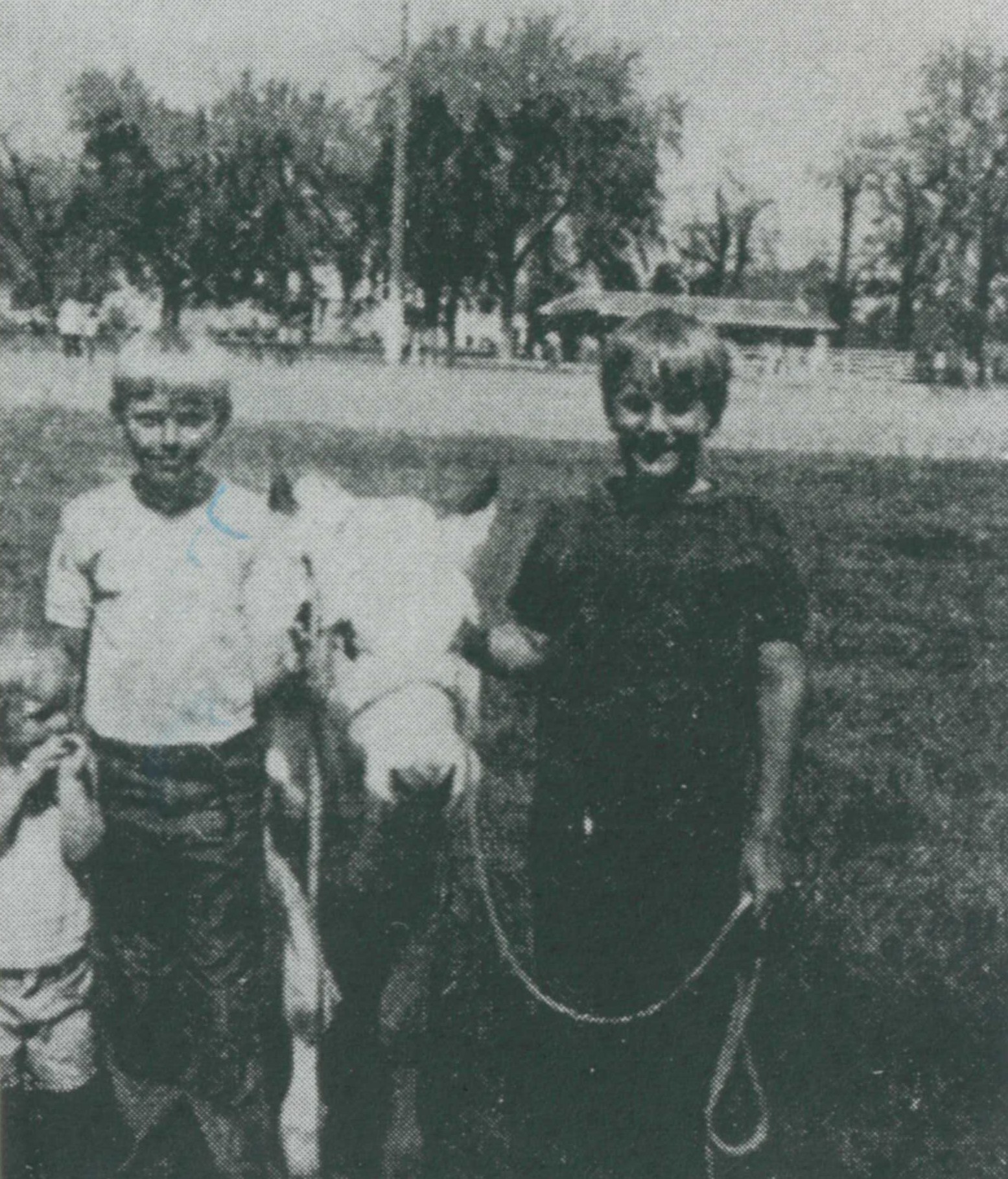
Paul’s Arena as it is known today, which will be rebuilt into the Town’s new Park. Used for many years for horse and Jr. Posse events.
*A CHILD’S CHRISTMAS IN UTAH
BY WAYNE CARVER (SON OF ELMER AND JANE CARVER)
ASSOCIATE PROFESSOR OF ENGLISH
CARLETON COLLEGE
It isn’t that way now. The quiet fields are broken into building lots and the farmers build jet engines in the city and garden with a tractor after work. The old canal is lined with concrete and in the center of the town the Saturday and sun-drenched baseball diamond has shrunk to softball under lights, and the county has built a tennis court just off third bade for a game the kids are beginning to learn to play in white shoes.
The frame store with the pot-bellied stove smelling of sizzled tobacco spit and with the mash sacks and rummy dive in back is a supermarket now where wives in stretch-pants by barefoot and frozen chopped broccoli by the ton and aerosol bombs that go “SwwOOOOOOsh” and keep off the bugs or put on your pie a water glob of something threatening to be white and that keeps your arteries open.
It isn’t the way it used to be in that un-fluent time of plowing, planting, watering, hoeing, furrowing, harvesting, and throwing the harvest in the river to be pickled in the Great Salt Lake. It is the affluent society now, of missile sites and loan companies, and the ice cream comes come frozen in glazed wrapping and taste like the strips of brown paper we used to put our upper lip to stop the nosebleed. And I have not been back for Christmas for many and many a year – to the long everyday stocking with a fifty cent piece squashing the toe, the large orange pressing the half dollar down – a thick, loose-skinned orange that peeled clean and dry – to the heaped snow that fell on every Christmas eve – I have not been back, and it isn’t that way now – and all I can do is gather a crystal or two from a vein of quartz- or is it foolsgold? – in Time.
****
In the bed-covering warmth of the high ceiling room in the weather-bent old house between the mountains and the salt lake, nothing was alive at first except the dry flopping of the harness straps against the horse’s matted cost and the cold jangle of the chains against the horse’s matted coat and the cold jungle of the chains against the single-tree of the go-devil that Dad used to clear the paths between the house and the barn, the barn and the chicken coop, the chicken coop and the house, and to gouge a trial down the drifted lane to the country road where the snowplows from the shops in Ogden would come later in the day. Lying in the dark that is beginning to be thin out like spilled ink, we hear coming through the window the flopping and the jangling and the sliding rumble of the triangular runners as they push aside rocks and twigs and skid down the sides of irrigation ditches, and the tongue clicking and “steady, boy, steady,” of Dad as he talks to the horse. Hearing this, and seeing from under the door the orange line of kitchen light and, without listening for it, hearing the first snapping of the kindling in the range and smelling, without sniffing for it, the sulphurousness of coal smoke, we know- all three of us – that we have been trickled ourselves and somehow, we can’t say how, had fallen asleep – sometime, somewhere, – back in that black night and that Christmas had come again and caught us sleeping.
Then the tinny, descending jingle of loose bedsprings, the cold shock beneath the warm flannel pajamas legs, the cold fluttering linoleum slap against the feet; and the orange line beneath the door flashes upward and out: We are across the kitchen, through the heavy coal smoke to where the living room door id barred, sealed against us, as mother, at the side door, calls outside, and Dad comes in.
Daylight comes with the smell of oranges, pine, needles, pine needles, and chocolate, and coal smoke from the heater, and the brittle crack of hazel nuts and the tearing raveling crunch of peanut shells, the shimmering glissando of tissue paper crushing, the sweet sticky slurp of cherry chocolates, and the crack and shatter of peanut brittle. Amidst the smell, above the sounds, comes the “oh, just what I wanted,” of Mother and the “Very nice, very fine,” of Dad and the “One -two-three-four! I got four presents that’s simply more than anybody,” of Mary and the “This Wheel’s just fine cause it’s got a burr on the axle, not a cotter key,” of Nephi, and the “Billy’s got this book, he’ll not swap. I’ll swap with Rex,” of another.
By mid-morning the board valley glisten under the cold sun, and you have gone alone through the fields I the over-the-boots snow and along the row of willows besides the canal and watched the muskrats swimming in the alley of dark water between the frozen banks, have seen the runic tracing of the quail and pheasant trails and shaken the loose snow away from your collar that a magpie knocked down on you as you passed beneath the cottonwood trees to Rex’s place where you ate rock candy, swapped the extra Bomba you had read for the Army Boys in France that you had not. By noon you have been to Bill’s through the glare of the sun and snow and shown him your hi-tops with the long grey woolen socks ad the fold-over edge of red at the top and eaten peanut brittle, been to Grant’s and seen the new skates, shown-off the cream and green cover of your Plunk and Luck and eaten candy, been along the roads, the ditches, the trails until the snow packed into ice inside your boots has sent you home to dry and then, drying, behind the big heater in the living room to sail on the stack of books to all the great green world that never was and will last, therefore, forever.
The crunch and ravel and shimmering tinkle is gone from the room now. The quiet is there like a field rippled with snow until the others return from their rounds, and in from the kitchen come only the first rasps ad scrapes and clicks and hacks of dinner’s getting underway. There is pine tree and warmth and the smell of chocolate syrup. Behind the stove Bomba the Jungle Boy crouches in the grass besides the trail as the enemy patrol with poisoned darts in their quivers and blow guns in their hand file slowly by the disappear into the tangled heat of the jungle. In the gassy, coal smelling clearing Bomba is wiping into glittering brightness the still smouldering and dripping blade when, bursting through the streaming wall of branches and vines, comes Aunt Em’s bellow of tribal greeting, followed by a safari of cousins and a diminutive uncle, each one bearing weapons and supplies clutched in their careful and love-filled hands.
“Good Lord, Louisa, there you are just as I figgered, sweating out in the kitchen while everybody else has a fine faretheewell. We’re late but I been after Ephriam since daybreak to get them cows milked so’s we could get on our way. By Judas Priest, you would thought the man had never milked a cow before. Biggest kid in house for Christmas. I get more work out of the cat than I do him. Lordy! You ought to see that house. You can’t see out the windows for trash, and I’m so flustered I think I sliced an egg on the jello and a banana on the hot potato salad. I’m afraid to look, I tell you. And Moroni? – he was out chasing the girls until je ought to have been home milking, too; and, Lord, Sara and nell, you’d of thought they never been given anything before. And all the time, Eph draggin’ along, them cows moanin’ out in the barn, their bags so full they’d like t’have died, nothing to eat – it’s a good thing for that, I suppose. Why, he didn’t get out of the house until ten O’clock, the milk man had come and gone by two hours and all the time me trying’ to bake a cake in a crooked oven with the coal Wilbur man sold us at a special and, Louisa, I’m tellin ’you it ain’t coal at all. It’s just dirt. It’s better dirt than half that hard scrabble your man’s farming down there in Salt Creek, and if Wilbur can sell that sandy loam he sold me for coal, I’s say Josiah’s got a fortune in fuel under that field of onions he tries to grow ever summer. Glow! I’s by there t’other day lookin’ for the horses before the shruf stray-penned “ em and I say to Eph, “Josiah’s got a nice five acres of picklin’ onions out a that salt flat he’s tryin’ to farm. Ought to get a special price, seein’s how they pickled all summer. Grow! I’s by ther t’other day lookin’ for the horses before the shurf stray -penned “em and I say to Eph, “ Josiah’s got a nice five acres of picklin’ onions out a that salt flat he’s tryin’ to bake this cake, and roast a shoulder of pork and fix the salad and I’m up to my chin in candy and nuts and wrappin’ paper until I finally just booted everybody out the back door and said, “Lordy, go over t’the neighbors and dirty up some fresh territory while I get something done.” So they did. Except Eph. He’s still settin’ there in his new robe and slippers, dozin’ mind you, his head bobbin’ back and forth like a derrick fork. And them poor cows hollerin’ to be milked, and finally I told him, “Lord almighty man, go out there and take out enough milk to relieve their pain anyways, even if you don’t care about no milk check next week.’ So he did. Well, here we are. Where d’you want me to put the roast to keep it warm, Here! Give me that knife, I’ll peel the taters. Don’t you get no help? Where’re your kids? You get started on the rolls, woman. This house is goin’ to be crawlin’ with starving prople before we get turned around and us without a thing to put in their mouths.I thought I told you Big J flour’s better’n this other stuff. Lord! I don’t know what’s goin’ to happen to us. Ten o’clock milkin’; I tell you, I thought I’d never live to the day.”
And then the green jungle explodes into white brightness and come alive with cousins and uncles and aunts as the tribal dance around the tree begins and the hecatombs are offered to the angry powers of hunger and love: roast chicken, roast turkey, hams, and pork shoulders, brown gravies, chicken gravies, sage and giblet stuffing, candied yams and sweet potatoes, mashed potatoes, cranberry sauce, creamed corn, wax beans, lima beans, and string beans, carrots – tossed salads, potato salads, gelatin salads, cream pies, fruit pies, mince pies, pumpkin pies, chocolate cake, and white cakes, jello ad whipped crème and sliced bananas, candy in dishes and boxes, apples, oranges, and bananas – and one cup of coffee brewed just for Uncle Heber, the free-thinker of the tribe who risked the taboo, and for him, too, the cracked saucer for the ashes of his cigar.
And above the crack of celery, the clack of china, the clink oof silverware, the chattering drone and occasional giggle or scream, and through the acrid halo of smoke around Uncle Heber’s head comes Aunt Em’s piercing voice: “It’s a foul habit and an abomination in the sight of God, Heber, and I’d rather see my brother take to drink than terbakker the way you do. And coffee defiles the temple of the spirit in a worse way, and Louisa’s curtain’ll smell of Christmas and sin until the Fourth of July because of you.”
And though the drone and chatter, Uncle Heber’s: Sis, you finish your meal in your way; I’ll finish mine in mine. The Prophet used to smoke, so did Brother Brigham – and chew. They chewed and spit like any man. I sin in good company. Fact, is sis, if the truth was known, smokin’ and good coffee got to be a sin because Joseph had an allergy to caffeine and nicotine. Used to break out in hive after every cup of joe and every satisfying drag, so he made both a sin. Say, get me a stove match will you, sis, while yer up – in the kitchen there. See? A good cigar goes out if it ain’t appreciated.”
And then through the long dying of the day, the world beyond the oppressive clearing behind the stove goes on. Bomba frees the friendly white girl, eats a tapir, while through the nebulous jungle wall from far beyond come the shouts and squeals of cousins and brother and sister play, the falsetto chirping of Aunt talk, and the grumbling bass of Uncle talk. And as the Army boys march aboard the transport in New York to go to France with “Lafayette, we are here,” on their lips, there hovers in the air of the stifling, coal-gas smelling hold of the transport:
“Franklin D. Roosevelt was sent by God to lead his children out of bondage.”
“I like that man’s smile. Then he sticks them cig-roots in his mouth and I tell you I jist don’t know!”
“We should have won that game on the Fourth; Freddie just got a leetle tired. . . .”
“Walkin’ on to my farm and tellin’ me what I can grow and what I can’r. I sicked the dog on that little pipsqueak. . . .”
“Doak, that big elephant, fannin’ twice with men on. . . . Never could hit a round-house out.”
“. . . on relief until his first paycheck . . . blew it all one weekend at Elko. . . “
“Next time Brig Roberts umpire, I say protest the game. . . “ “Two of them Clinton players smoke. I seen ‘em. . . “
“Good for them . . . “
“Heber!”
“Paid in paper script. . . not worth the paper it’s . . . “
“. . . kept track the last three games . . . fanned four times with one on . . . “
“Farmers the last one to get anything from a government . . . “
“We got 3.2 beer what we have to risk damnation to drink. But the price of tater’s about the same as when Hoover. . . “
“ Eat the taters then the shut up. “ S bettern defilin’ Em! We’d live forever, that a-way – the two of us.”
“Ha!”
“Only hit all year as I remember rolled down the gopher hole back of first base in West Warren for a ground rule double. . . some clean up hitter be is. . . “
“don’t care how the man smokes. I’d vote for FDR for God tomorrow if I had the chance..”
“But President Hoover says. . . “
“To Hell with President Hoover!”
“Heber! Heber! Heber!”
And now Bart, the oldest, most handsome, most dependable of all the Army Boys in France, escaped from the hospital in the rear, slogs through the nuts, shells, and package wrapping of rural France, wet, cold, delirious, dropping into shell holes as the rat-a-tat-tat of a match-shooting gun rattles out of the living room from behind the sofa. In the lull that follows, as the darkness comes on, a command rips across the subdue murmur of No-Man’s Land: Ephriam! It’s milkin’ time. Lord! Let’s go on home and see how many cow’s got mastitis from this mornin’. Judas Priest! One thing for sure. Never milk a cow, never have to. They’ll have their bags caked-up like a lick of salt. Come on, Eph!.
And Uncle Heber, rising from the waves of cigar smoke, “Emmie sit down. For the Lord of all the Lamanites. I only see you about once a year, it seems like.”
She, settling back into the sofa, “That’s for sure.” There is a long quiet. Then, “But Heber, when’re you going to come to your senses and make your peace with me and the Church.”
I’m ready, Emmie, always have been. For you or the Church. But I figger the Church’ll be a dang sight easier to settle up with that you.”
From inside the pill-box in the living room comes another burst of fire, and Bart, with his dependent buddies, crawls along a little stream in the gassy gloom of twilight, trying to get a bearing on the mortar that is lobbing rounds into the Company. And Bart whispers, “I’m going over there to see what it looks like, anyways.”
“No, no, bart,” from his friends. But he, “Remember the Luistania.” Ashamed, they say no more. “It may not be what I’m after but just beyond that hill is where I need a pig for winter dressing up, and if Parley P. Brown – Goodie-Two-Shoes Brown, we called him in school – has got what I want –“
‘Heber! That’s talk I won’t hear. He’s a God-fearing man and –“
“And a man practically lacking in the power of speech, Em, that’s what he is. Why, Em whenever I think you’re right, that I’m a sinner temporarily damned to a lower degree of glory, I remember the day I went over there to buy that pig. We’re out in the pen, see – a sloppy pen if you ever saw one – and all these weaner pigs are grunting around in there. I’ve got this gunny sack and a three foot piece of two-by-four, but Parl Brown don’t so things that way. No Sir! ‘You stay here, ‘ he says and he crawls in that stuff. I’ll return presently with a shoat.” Return! Presently! Shoat! The man can’t talk. Well – anyhow – he slops into the pen. He corners one of the wet-snouted little balderdroppers, lunges at it and, by Christmas, kisses by half a foot – skids into the plank wall. Judas Priest, I though he’d killed himself. Picks himself up. Scrapes himself off. Looks over at me. You could hardly see his face. ‘Little rascals,’ he says, and grins; he corners another. Dives again, skids, misses, splatters, hits, stands up,wipes, away at himself a bit. Elusive little tykes,’ he says, turns, gets ready to do it again. I’ve had enough. ‘Parl!’ I beller at him. He looks around. I crawls over the fence. By jaspers, I’m near tears, ‘Parl, for Juniper’s sweet loving sake, man, don’t talk to pigs like that. Now you go on, get out of here!’ He goes, me pushin him. Then I turns to the litter and look them square in the eye. They’re all backed into one side and a corner, still and quiet. They’d sense the change right off. Then I hold my two- by out in front where they can see it. I drops my sack open, the mouth of it facing them. I drops on my haunches and teeters a bit. Then I says, real tight and lowlike: ‘Now – you little thin-snouted, bleary-eyed runty-backed, spiral-trailed sons of this litter, one of you hop into this sack.’ Why, almost immediately, you might say, the one nearest the sack trots over, sniffs a hit, squeals a little, and walks in the sack and curls up. I snap the sack to with a piece of binder twine, hoists it over my shoulder, climbs ion the pick-up and brings it along home. Paid Parl a day later by check. Well, Emmie, you see the point? Sin has its place. A man like Parley P. Brown might not defile the curtains in the parlor, might make it all the way to the Celestial degree of glory, but he’s not worth a good God- damn in a pig pen.”
Then the war draws to its close in the snow of winter and the troops march home from No-Man’s Land, over there, over there – across the rubbles of papers and candy and peanuts and broken toys and needles from the trees, and , suddenly, the lights all over the world come on to Mother’s: You’ll ruin your eyes, son, reading in the dark behind that heater.”
And only the others are there now – the other two and Dad and Mother – and we eat a sandwich of cold chicken and have some milk out of the big pan in the pantry and we have family prayer around a chair in the kitchen. Kneeling there, the linoleum burning its cold into our knees, everything is love and one and whole. The day is blest, and all the days to come.
In the bedroom we shiver against the cold sheets and giggle and fight for warmth against each other.
In enveloping blackness we hear the squeak of the snow under Dad’s boots as he walks for the check-up to the barn and hear the sounds of cleaning up from the kitchen.
Overhead the attic creaks as the old house sways a little in the winter chill that comes down on a black wind from the black mountains to the east an moves through the valley and across the salt lake and into all the years to come – but that cannot touch the bed-covering warmth of a Christmas that is past.
*Reprinted by permission of ‘The Carleton Miscellany”
Copyright, 1965, by Carleton College
Northfield, Minnesota 55057
FIRST PLAIN CITY CANNING FACTORY
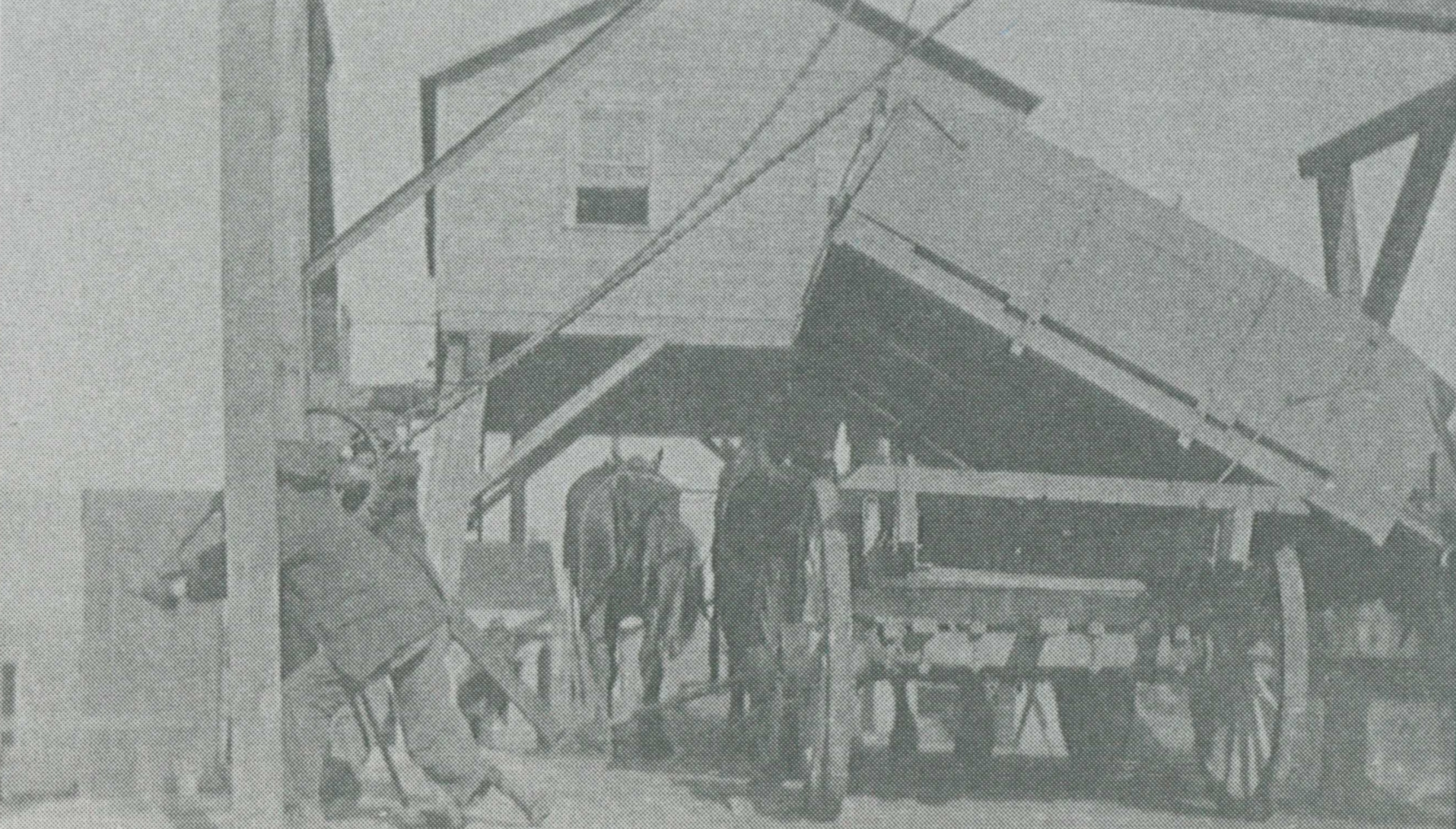
This was the first canning factory in Plain City. It was located across the street from Loyd Olsen’s home at about 1900 North 4700 West. The factory was built around or before 1900. The picture was taken in 1906 or 1907. The factory was torn down in 1916 or 1917 and part of it was moved to become part of the john Maw store. Laura Musgrave remembers working there as a girl.
We do not have the names of those in the picture, but were told that the older man on far right is Abraham Maw who run the factory. He is the father of Henry T. Maw and grandfather of Abraham Maw.
PICTURE TAKEN ABOUT 1900
Front row left to right:
Trina Folkman, Wilford Danvers, Lonna Richardson Miller, Thomas Jenkins.
Second row left to right:
Elea England Watson, Dave Geddes, Luci Rawson, Sophie England, Jed Skeen, Melissa Carver.
Third row left to right:
Rose Stoker, Cerilla Richardson, Lorenzo Lund, Sussen Geddes, John Moyes, Riley Skeen, Lyman Skeen, Emily White, Richard Lund.
Peter Green was on the original photo with only part of him showing. You could see his hat and right arm and leg.
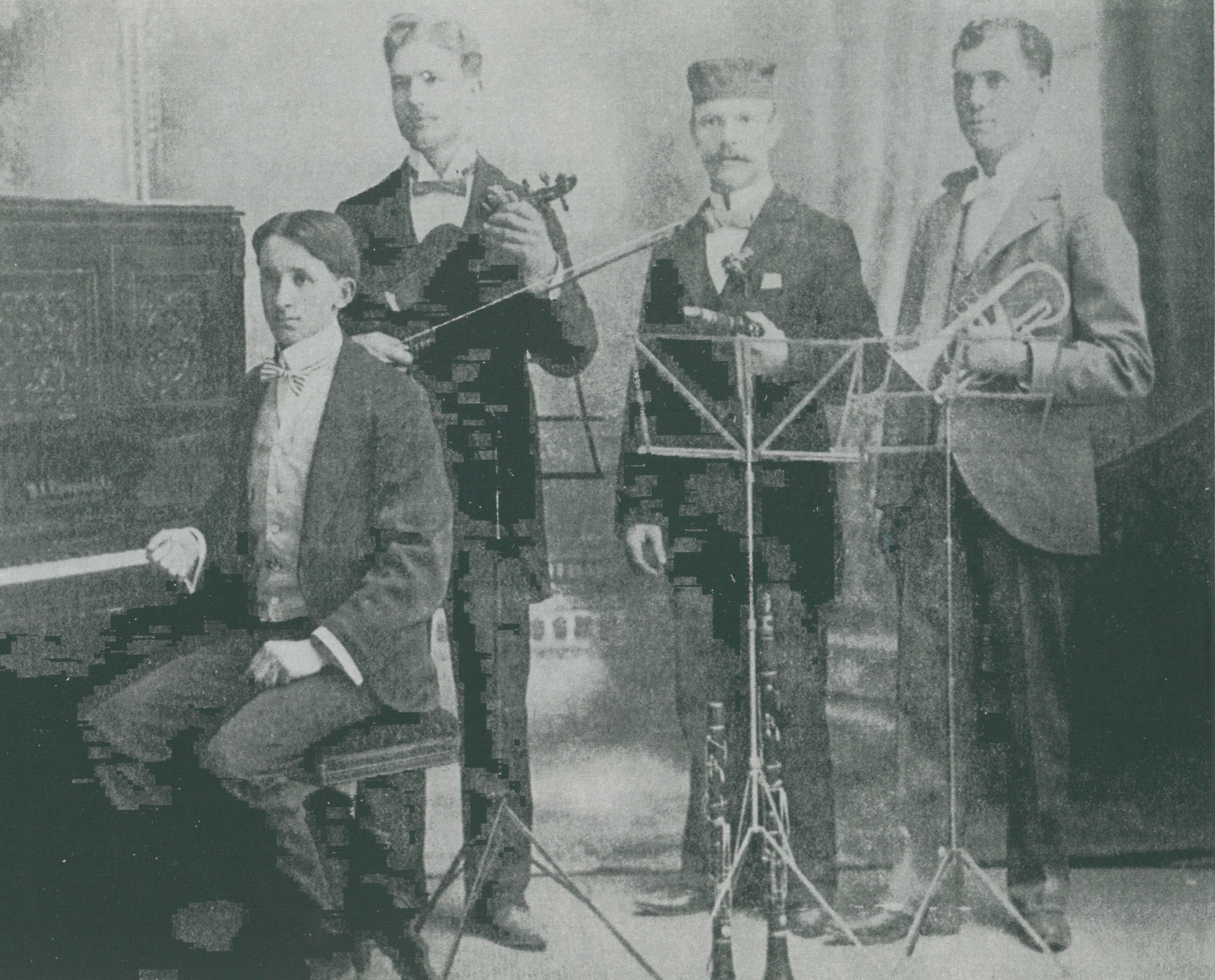
EARLY ORCHESTRA
The man with the cap is Robert Hunt. He is Clara Hunt Singleton’s brother. Clara was the mother of Florence Singleton Simpson.
OLD PHOTOS
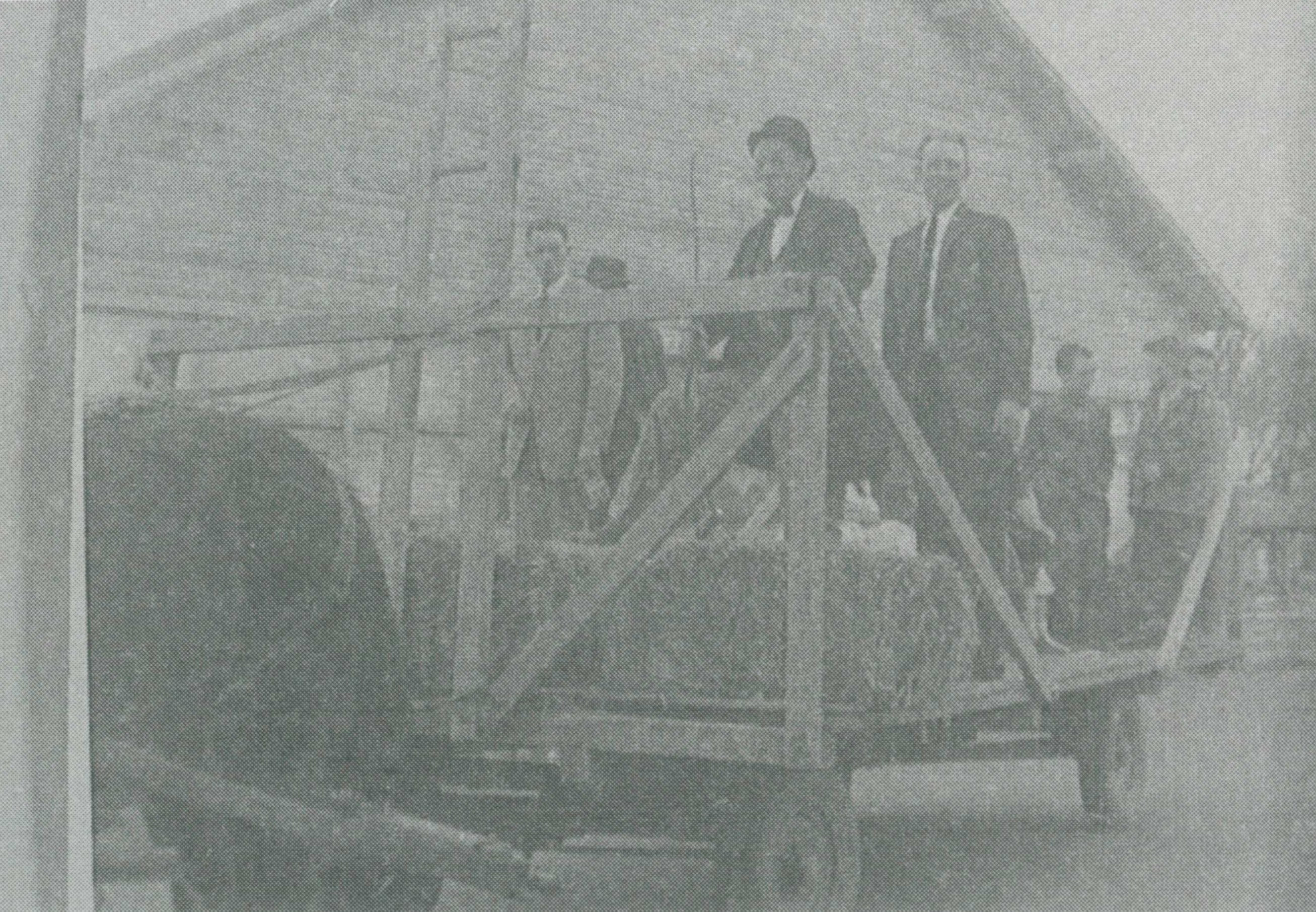
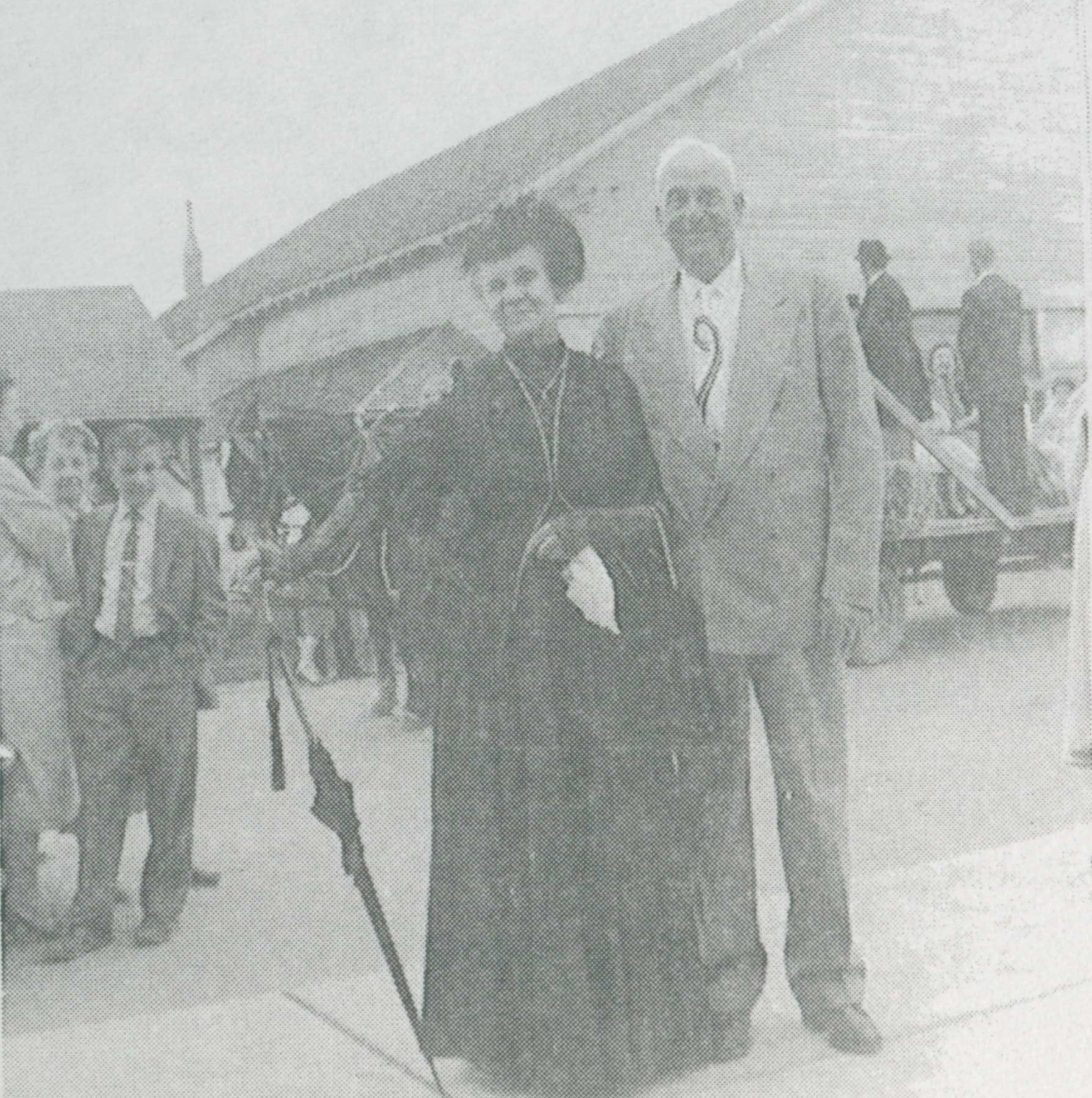
Above two: Plain City’s 110 year Anniversary.
Picture taken in front of the old dance hall. In 1959 on the Sunday nearest the 17th of March no cars were allowed at the church, just teams and horses and buggies. The people came to church in pioneer dress as a climax to a weeks long celebration.
Above: Rear view of the old Church house. The upstairs was a recreation hall with a stage.
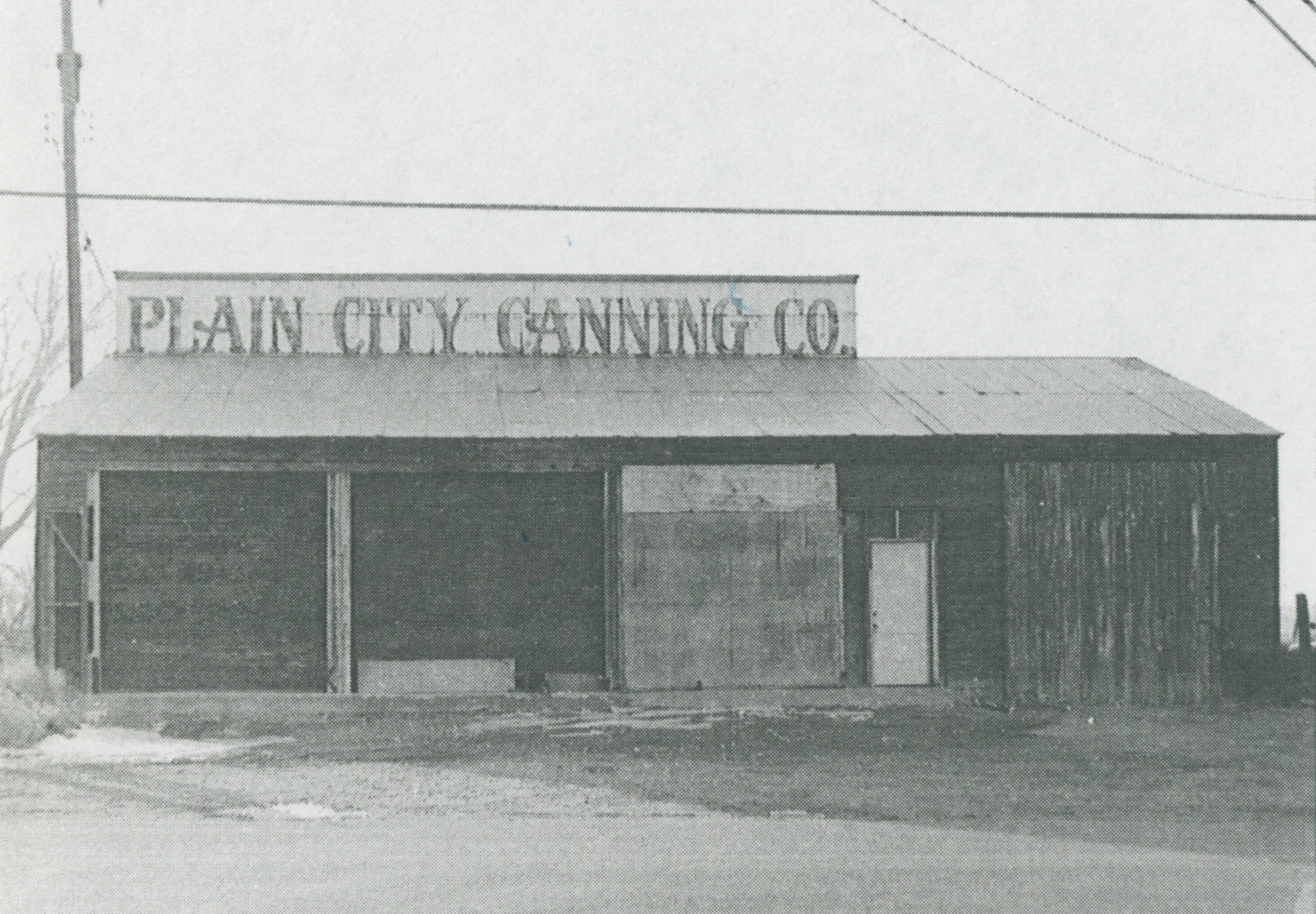
PLAIN CITY CANNING COMPANY
The Plain City Canning Company was built in 1925. They operated the factory for over 30 years. During World War II they used prisoner’s of war for laborers during the canning season. It is owned by George Cook.
EVERETT’S PLUMBING
This building was built by Everett Taylor for his plumbing business.
BUSINESSES OF TODAY
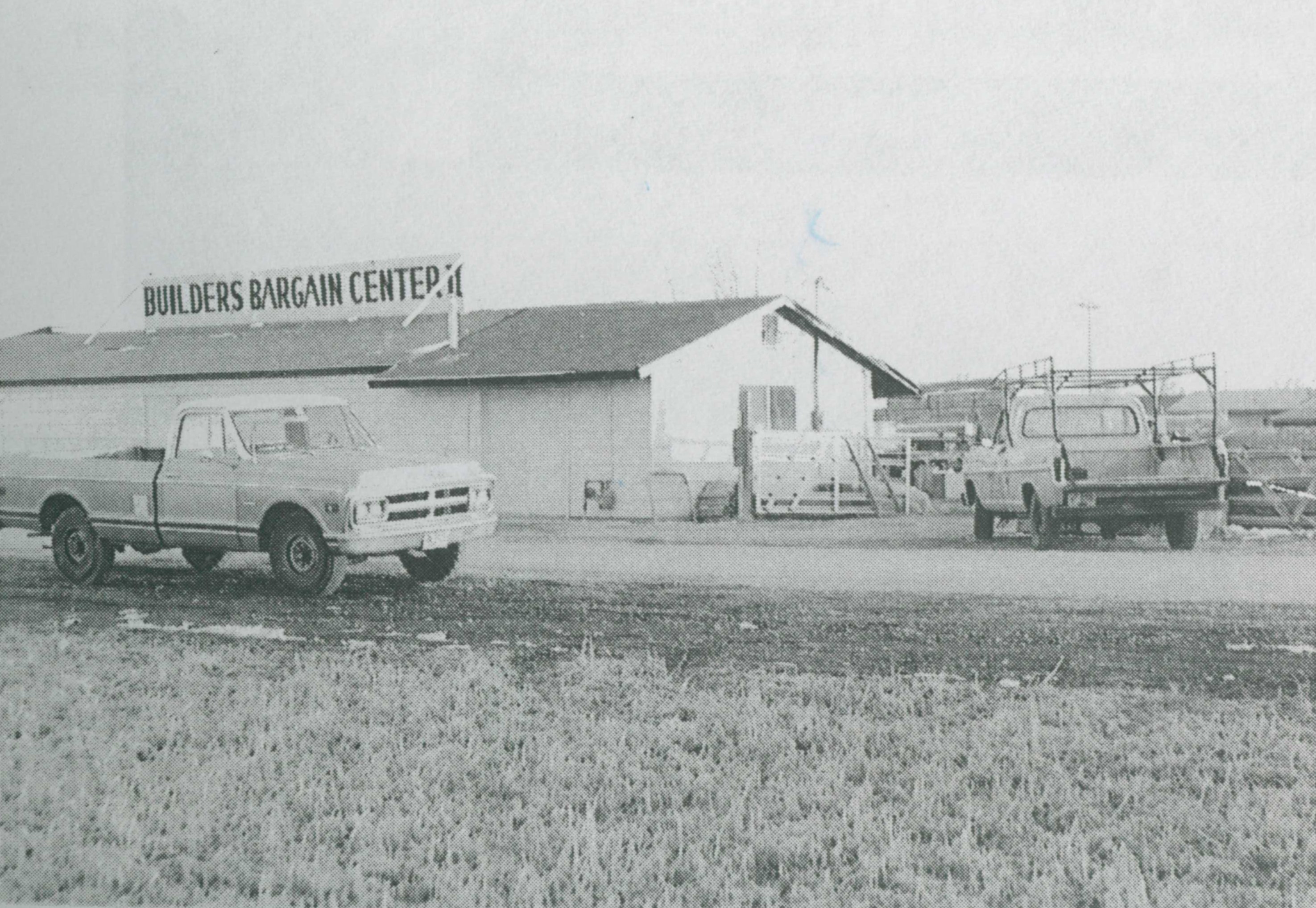
BUILDERS BARGAIN CENTER
Builders Bargain Center, formerly England’s Builders. This business was started and run by Chester England for many years.
The Confectionery, but known to everyone in City has the Pool Hall, or the Grog Hall.
BUSINESSES OF TODAY
BARNES FURNITURE CO.
Barnes Furniture Co. was started by Hebert and Elida Barnes in the winter of 1948-1949. Elida had acquired upholstery skills through Utah State Extension Services with offices in Odgen. Herbert learned wood work, restyling and remodeling from Utah Defense Depot. An elderly German refinishing craftsman taught Hebert the refinishing craft. Later on both had upholstery training through Weber College.
The first shop was one-half of a small railroad box car situated east and south of the present shop at 1600 N. 4700 W.
This makeshift shop was soon out grown. The present shop erected in 1953.
FIRST SHOP
Now owned by George Cook and used as a bath house.
PRESENT SHOP OF BARNES FURNITURE
BUSINESSES OF TODAY
PAUL COSTLEY GARAGE
This garage opened in the fall of 1947, and is located north of the city of Plain City.
C. & B. REPAIR SHOP
The C. & B. Auto Repair Shop owned by Curt Knight and Bruce Hall. The old building at the left is Rall Taylor’s old blacksmith shop.
BUSINESSES OF TODAY
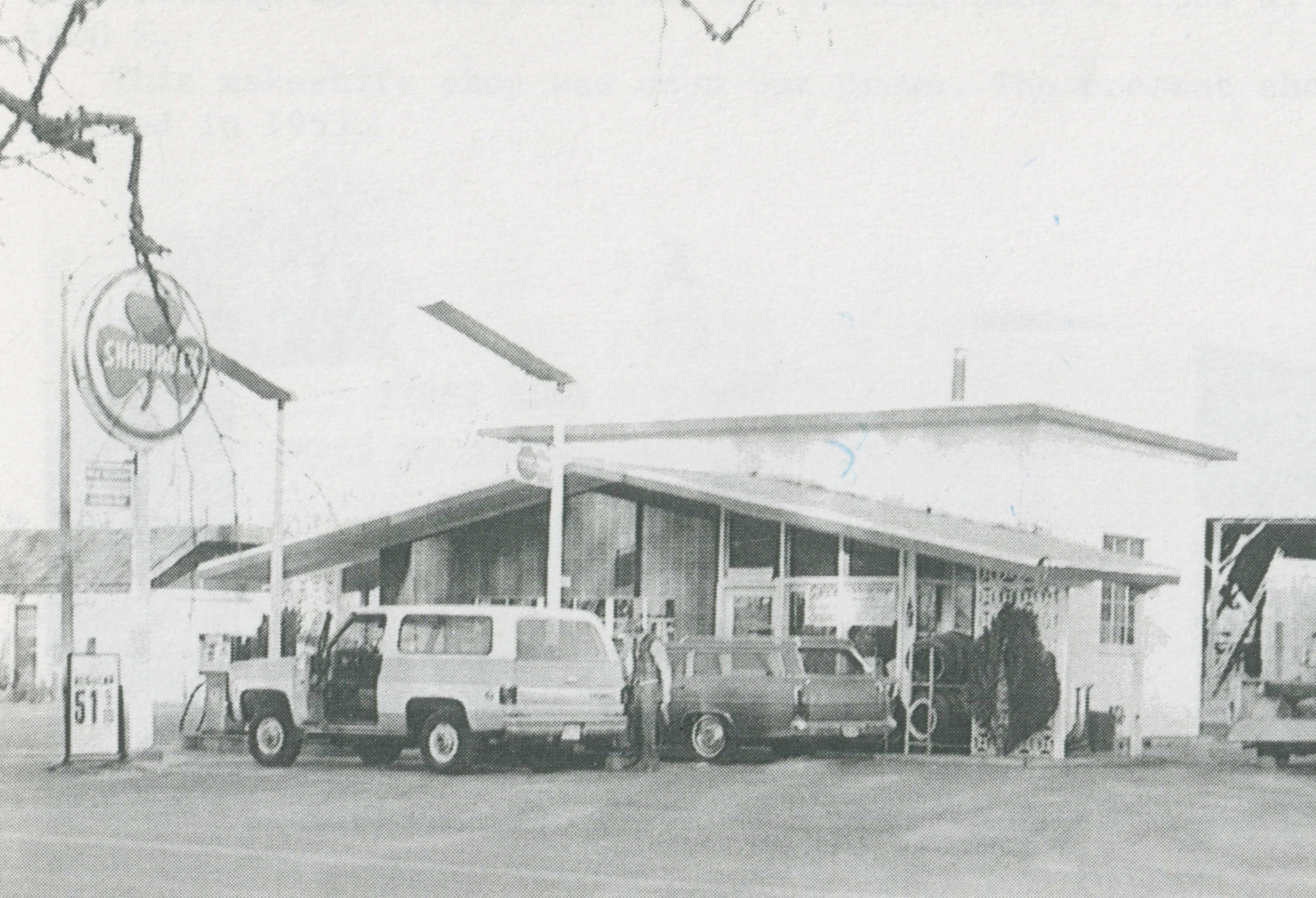
CLIFF FOLKMAN SERVICES
Cliff Folkman operated a gas station in this location for over 30 years. He moved into the new building in the fall of 1964, located in the center of town, on the east side of the Square.
WHITIE’S CAFE AND ICE CREAM PARLOR
Dennis White opened his cafe in the summer of 1976. It is located on the east side of the Square.
BUSINESSES OF TODAY
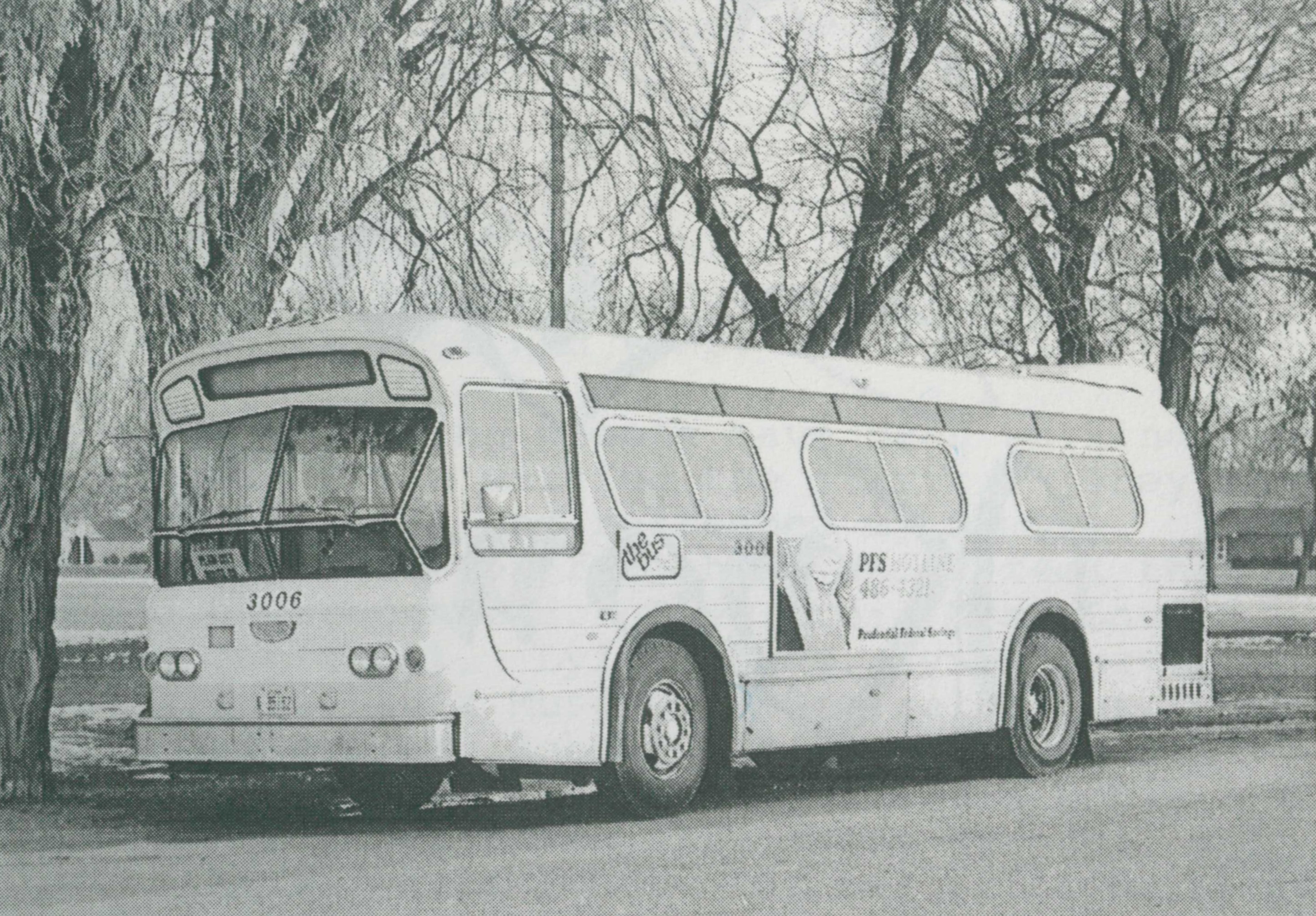
UTAH TRANSIT AUTHORITY BY RUTH FOWERS
On Tuesday, July 6, 1976, the Utah Transit Authority started regular bus transportation services to Plain City area. The bus arrived in Plain city at 6:55 A.M. and returned to Ogden through Slaterville by way of Pioneer Road. The schedule continued every 40 minutes, the late bus leaving Plain city at 6:55 P.M., Monday through Saturday, with o service Sunday or holidays. It is called Route #20 Plain City.
This service had been in the planning for some three years prior. The U.T.A. is supported by quarter of a cent sales tax. The fare being 15 cents for adults and 10 cents for children and senior citizens, with senior citizens allowed the courtesy ot ride free between the hours of 10 – 3 and after 6 P.M.
Many citizens are enjoying this method of transportation to and from Ogden, some extend its service to Salt Lake City and return.
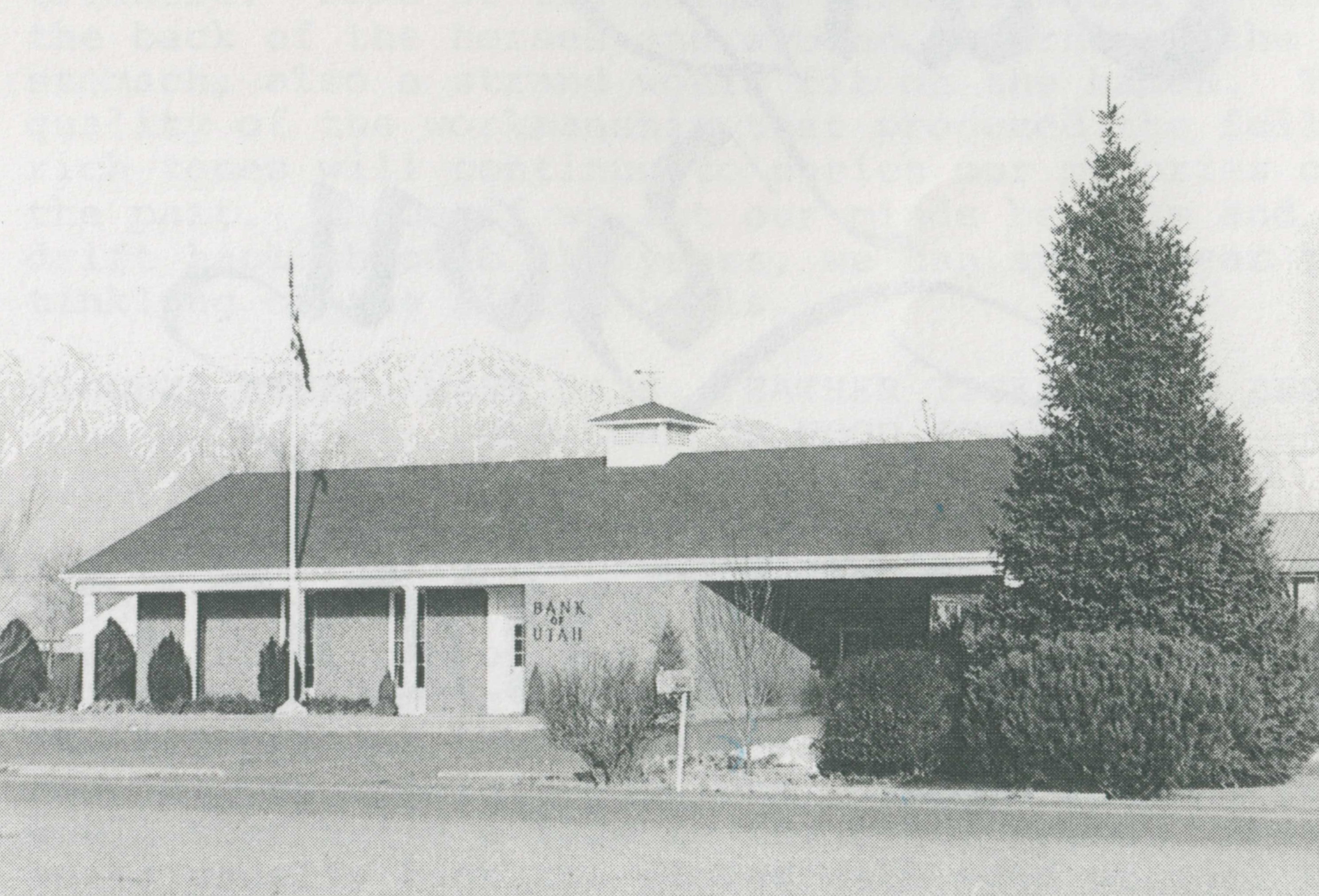
BANK OF UTAH
Nov. 27, 1972, marked the grand opening date for the Plain City Branch of the Bank of Utah.
The bank has had a steady increase in its patronage since the beginning. Services are available to all the citizens in the surrounding towns. Some clientele come from as far as south Brigham City.
The bank started with three employees and now as four.
I have two copies of the History of Plain City, Utah. The front indicates it is from March 17th 1859 to present. As far as I can tell, the book was written in 1977. At least that is the latest date I can find in the book.
One copy belonged to my Grandparents Milo and Gladys Ross. My Grandpa has written various notes inside the history which I intend to include in parenthesis whenever they appear. They add to the history and come from his own experience and hearing.
I will only do a number of pages at a time. I will also try to include scanned copies of the photos in the books. These are just scanned copies of these books, I have not tried to seek out originals or better copies.
History of Plain City March 17th 1859 to present, pages 141 through 149.
BONA VISTA IMPROVEMENT DISTRICT
SUBMITTED BY FLOYD PALMER
This most important new culinary water system has made life a little more pleasant in this community and surrounding areas. It was turned into the lines just a century after sturdy pioneer families first put together temporary shelters and tapped several sweet water springs which they found in the area.
It replaces old flowing wells, bringing precious waster from the depths of the earth. In early days many deep and surface wells dug, covered over, and fenced off to keep children from falling in. They were first fitted with “pitcher” pumps, a short-handled affair which were the “pumper” out in a short time. Even the farm animals had to depend on well water pumped to the surface by hand.
Later, the easier to work, long-handled pumps were installed. These were followed by power pumps connected to a small storage tank. This was the ultimate in a private water supply.
In 1955, a Weber County man, Linn C. Baker, was a member of the State legislature. He is the one who sponsored the bill to create special improvement districts. The reason he was the sponsor of this bill was due to his work in the Health Department for the State of Utah. As he studied samples of water sent to him from the outlying towns, he became aware of the amount of contamination there was in the drinking water in certain areas, Plain City was among the highest on the list. This was traceable to shallow surface wells being used, also septic tanks with poor drainage.
Soon after the Weber Basin Conservancy District was organized, Plain City wanted to purchase one-thousand-acre feet of water. Their request was held in abeyance until a line could be built from Ogden Canyon. This, however, was never done.
Elmer Carver was on the executive committee of Weber Basin Project. Through the encouragement of Commissioner Carver, Mr. Ezra Fjeldsted, manager of Weber basin Project, and Linn Baker, all met with the Plain City Town Board to get something started. Floyd A. Palmer, a member of the Town Board, was asked to represent Plain City on a committee of surrounding towns in Weber and Davis counties. Mr. Ezra Fjeldsted acted as chairman of this group and several meetings were held in both counties which Mr. Palmer attended.
Following this, a public meeting was held in Plain city. Farr West, and Harrisville were asked to join in. This was for the purpose of starting a culinary water system. The results of this meeting, from all groups attending, were to go ahead, also to contact other nearby towns and get their feelings about joining in.
A series of meetings were held in Farr West, Harrisville, Slaterville, Marriott, Wilson Lane, and Plain City. Other towns were invited to attend. Ezra Fjeldsted represented Weber Basin, Floyd A. Palmer represented Plain City, Dick Groberg represented Farr West, Kenneth Brown represented Harrisville, Clifford Blair represented Marriott and Slaterville, and Arthur W. Sorensen represented Wilson Lane. The meetings were all met with a great deal of enthusiasm and interest.
Plain City Town Board consisted of Lee Olsen, President, Floyd A. Palmer, Elvin H. Maw, Merrill Jenkins, Blair Simpson, as members. A culinary water system was a prime item of the agenda in 1956. The town board along with several local residents were well organized to promote the need for a water supply to replace the surface wells and pumps.
On July 19, 1956, Elmer Carver, Chairman of the Board of County Commissioners of Weber County, State of Utah, signed a certified documents that there be and is hereby created within Weber County, Utah, a Water Improvement District to be known and designated as the BONA VISTA WATER IMPROVEMENT DISTRICT, the same to embrace and include all real property lying within the following boundaries, to-wit: (SETS FORTH DETAILED LEGAL DESCRIPTION OF DISTRICT BOUNDARIES WHICH BOUNDARIES EMBRACE LANDS HEREIN ABSTRACTED – Abstracter)
That the following-named persons are appointed as the Board of Trustees of said Bon Vista Water Improvement District:
Floyd A. Palmer, Plain City
Richard Groberg, Farr West
Kenneth Brown, Harrisville
Clifford Blair, Marriott-Slaterville
Arthur Sorensen, Wilson Lane
This resolution shall take effect immediately and shall be recorded in the office of the Weber County Clerk. Recorded August 22, 1956.
Following this appointment from the Weber County Commission, the board held a short meeting. It was necessary to elect a chairman, after a discussion of each of the board members. Kenneth Brown was appointed as chairman.
The first order of business was to secure professional and legal help. Mr. Jack Richards was appointed attorney. Jack Reeves, of the firm of Nelson, Reeves and Maxwell, was appointed engineer. They were appointed to do the field work and present the plans and drawings back to the board.
When the plans were completed, the board spent much time deciding the most feasible and economical areas to run the lines in. Also, to give each town a fair share of the project. Following this, it was necessary to project estimated costs. The board spent many months getting costs and deciding on types and kinds of pipes and materials to use on the project. The overall plans had to look attractive and feasible in order to get a bonding company to handle the bonds.
The first step made to secure the bond issue was to get signed pledge cards with an agreement to pay $250.00 for a waster connection. This was a requirement. Committees were organized with Floyd A. Palmer, Richard Groberg, Kenneth Brown, Clifford Blair, and Arthur Sorensen acting as chairman in each of their respective towns. The result was very successful, all those serving on these committee are deserving of much credit for their untiring effort and accomplishments.
On August 20, 1957, a bond election was held to see if the residents would approve a $900,000.00 bond issue. The vote was 490 yes and 82 no. Edward L. Burton Company was retained as Fiscal Agent, and $698,000.00 was sold in General Obligation Bonds, and the system was under way.
On April 14, 1958, a contract was awarded to Smith-Scott Pipe Company to furnish cement mortar-lined steel pipe for the main lines.
Also, on April 14, 1958, a contract was awarded to Knudson Construction Company to install water mains in the Harrisville-Randall area which was Phase I of the project.
Also, on April 14, 1958, a contract was awarded to Chicago Bridge & Iron Company to furnish and erect a 250,000.00 gallon elevated storage tank in Plain City.
On April 28, 1958, Theron Palmer was hired as General Superintendent to oversee construction and to get it ready to serve and operated as a system.
On May 27, 1958, an office was rented from the E. B. Stone Estate on the corner of 9th and Washington. The district still maintains its offices here. The building was purchased by the district in 1969 and has been remodeled.
On May 27, 1958, negotiations were begun with the State Department of Welfare of obtain ownership of a spring located in Garner’s Canyon in North Ogden. The spring was used at the time by the welfare department at the Industrial School property for culinary use and irrigation use.
On May 27, 1958, Weber Basin let a contract to Statewide Construction Company to build the 16-inch transmission line from 4000 South on U-84, down into the district where Bona Vista could connect to it.
Also, on May 27, 1958, a piece of property located at 4100 West on 2200 North in Plain city, was purchased from Vern Palmer to construct the elevated tank.
Bona Vista Water Storage Tank
Raymond Concrete Title Company moved in and drove concrete pilings 80 feet into the ground to support the tank.
Gerald Larkin was then awarded a contract to construct a foundation so Chicago Bridge and iron could begin erection.
On July 3, 1958, a contract was awarded to Bert Robinson Construction Company to build lines in the Farr West and Plain City.
Also, on July 3, 1958, Standard Plumbing Supply Company was awarded a contract to furnish materials for service lines.
On July 17, 1958, the Weber County Commission agreed to purchase 60 fire hydrants to go on the system to be located by the Weber County Fire Chief.
On July 17, 1958, Smedley construction Company was awarded a bid to construct lines in the Slaterville, Marriott, and Wilson area for $44,975.00. The same day Mac Construction Company of Salt Lake City was awarded the bid to construct our North Ogden Reservoir for $16,911.00. This is a concrete underground reservoir.
On August 11, 1958, an agreement was reached with the Welfare Department to obtain full use of the spring in North Ogden. Weber-Box Elder water was purchased to replace the Welfare Department’s share of the spring.
On February 11, 1959, work began on the plans and site for a reservoir in the Roy area.
On March 23, 1959, it was decided to run a line on the North Plain City Road.
On August 27, 1959, it was decided to either buy or condemn the Hansen property for a reservoir.
A bid to build a tank in Roy was awarded to Wehyer Construction Company for #31,403.80 on September 23, 1959.
Negotiations began to buy an eight-foot well from the Farr West Stake for $31,403.80 on September 23, 1959.
Linn C. Baker resigned as Secretary on January 1, 1961. He had been with the district since it began.
On December 6, 1961, it was decided to construct extensions to existing mains in the amount of $90,000.00 General Obligation Bonds were sold to finance these extensions. Waterfall Construction Company did the job.
All though the summer of 1961, the Farr West well was tested to see if it would hold up.
On February 28, 1962, President Wimmer signed the Warranty Deed on the Farr West well and property. On January 16, 1963, it was decided to put heat lights on our Roy tank. This was the first such installation in this area and it drew a lot of attention.
The Utah State Health Department studied the plans for use of the plans for use of the existing well in Farr West and decided against allowing it to be used because of its depth. A change application was then filled with the State Engineer to drill the well to a deeper depth.
On May 10, 1963, a contract with Wesley Stoddard was made to drill a well in Farr West for $21,632.00 plus $4,700.00 for the test hole to see how deep the well would have to go.
A meeting was held at the Farr West Pump House building on January 20, 1964. This building was contracted by the Bona Vista Water employees. The piping was also done by employees of Bona Vista.
R. W. Coleman Company was awarded a contract for $18,877.50 to change some lines under the interstate highway on November 22, 1965.
Negotiations began on March 28, 1966, with Weber Basin on the North Ogden Well, which was later drilled and is used in the system now.
Water meters were deemed necessary and were bought by bid from Waterworks Equipment Company and E. C. Olsen Company on October 28, 1968.
New Plain City Canal
BEGINNING OF PLAIN CITY IRRIGATION WATER
1859 Before the summer was over some water had been brought in their new ditch from Four Mile Creek to Plain City. In 1860, the Canal was completed to Mill Creek, the following year to Broom’s Creek and in 1862 to the Ogden River. The Right of Way in Weber River was purchased in 1873 at a cost of $2000.
In 1899 Samuel Wayment drilled an Artesian Well 249 feet deep producing additional water for the settlers. He also was in charge of the iron work and the building of the Chief Canning Factory in Plain City.
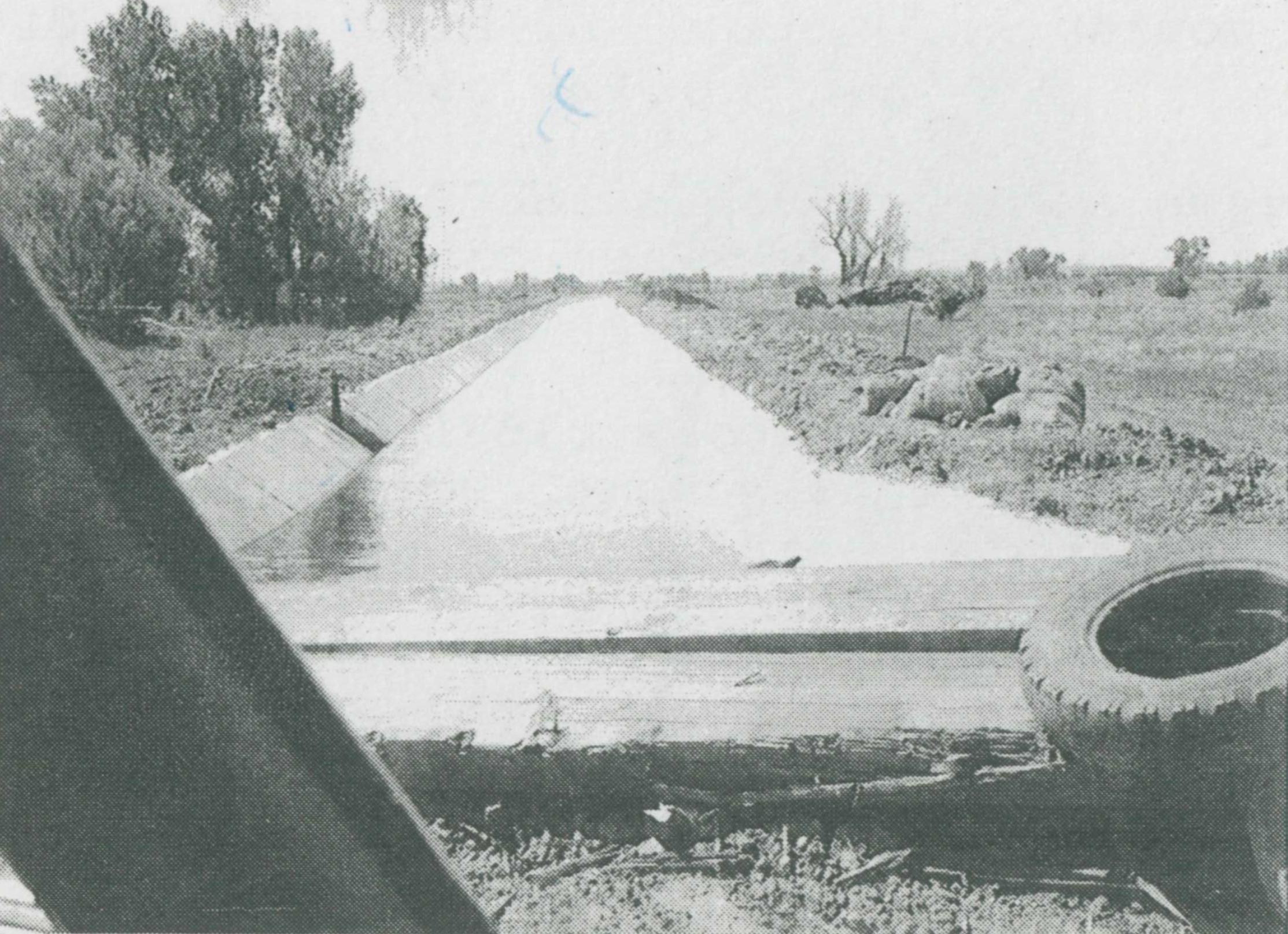
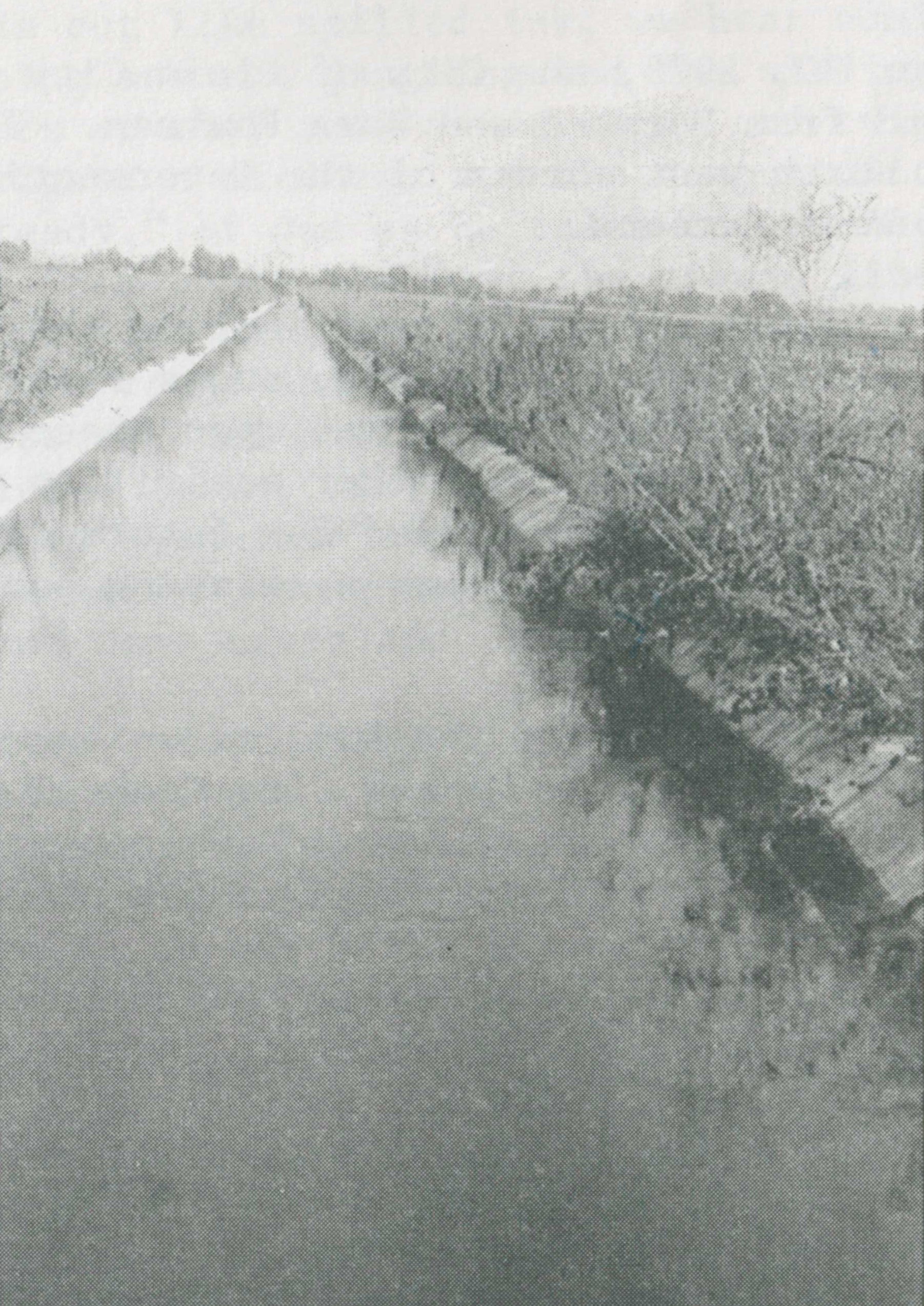
PLAIN CITY IRRIGATION-CEMENTING OF THE MAIN CANAL
SUBMITTED BY Wayne Skeen
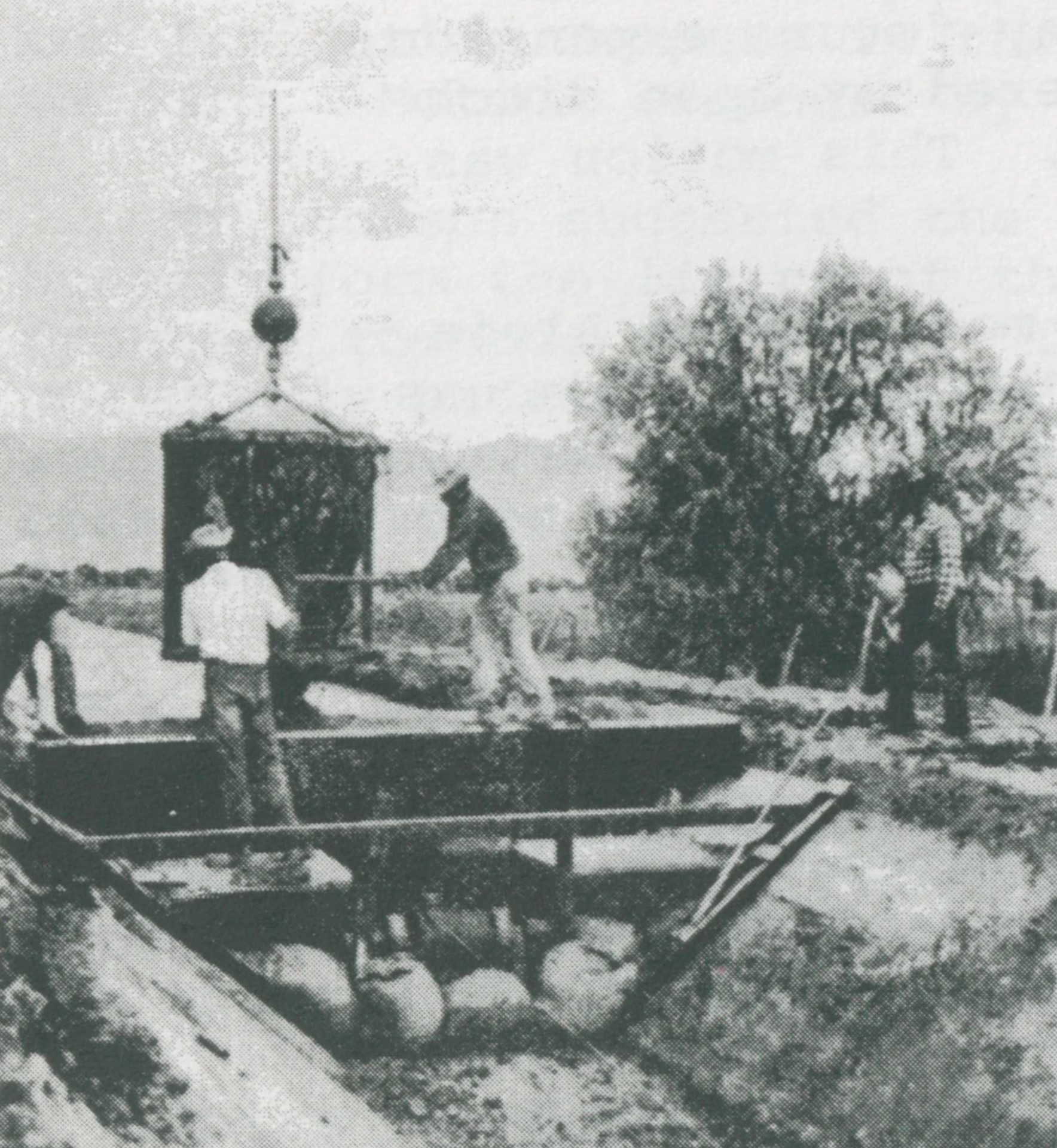
For many years the Plain City Irrigation Company received it’s water from the Weber River. The diversion point into the canal was just north of the old American Packing Plant that was later called the Swift Meat Packaging Plant. The Irrigation Company had a large Plank Head Gate in the Weber River that forced the water into the Plain City Irrigation Company Canal because of high waters in the spring this gate would wash out and it was necessary to make a gravel and dirt dam each year using horses, scrapers, and even large bulldozers. In recent years this became a major problem.
The government began planning the Willard Project in 1960. This project would interfere to a certain extent with the existing canal used by the Irrigation Company because big Willard Bay Canal would be built in part of our existing canal and would also cross it in part of our existing canal and would also cross it in other areas. The leaders of this project wanted to provide a turn out from the big canal into the Plain City Irrigation Canal. The corporation of our company was necessary to give them the right to use the area affected by the construction of the Willard Bay Canal. The logical point of diversion would be west of the Farr West Church House. This meant that some new construction would be necessary to get the water into the old canal. It was in need of some repairs and it was at this time that the idea of a new cement lined canal was entertained.
Directors who served during this period of construction were as followed:
President Abram Maw 1959-60
President Alvin J. Robson 1961-65
Vice President Walt Christensen 1959-64
Vice President Carl Taylor 1965
Bert Hunt
Charles Heslop
Keith Blanch
Mike Panunzio
Secretary Wayne Skeen 1959-65
High lights of the minutes of the meetings during the construction period are as follow:
August 11, 1959
Ogden City had extra water for sale this year which was allocated out to various canal companies. A motion was made by Alvin Robson that this water be purchased to see them through the current season. It would be paid by those stock holders who subscribed for the extra water.
April 4, 1960
The meeting was called to discuss the new canal. Charles Heslop was assigned to work on interested free money from the Utah Water & Power board for the construction. Alvin Robson was assigned to work with the Soil Conservation on the completion of the surveying of the canal, and additional monies.
July 12, 1960
A meeting was held to discuss a possible shortage of water for the remainder of the year. Time was changed from 20 shares per hour to 25 shares per hour.
January 9, 1961
A priority was established with the Utah Water an Power board for interest free money and application made for $100,000.00
A survey showed that there was a 10% loss of water between the River turn out and the Point of use.
March 8, 1961
The Irrigation Company received a $10,000.00 cash settlement for their rights in the old canal from the O.U.R.D. Railroad Company that passes through their yards.
Alvin Robson, Carl Taylor, and Walt Christensen was to secure information regarding tiling of the canal from Victor Lund’s corner up to the Jesse Singleton property where the canal leaves the road and runs back into the fields.
April 20, 1961
A report was given by Alvin Robson regarding the tiling of the lower part of the canal. There were mixed emotions about tiling this section of the canal because of the fall and the amount of water to be delivered. “Alvin Robson commented as the discussion went on concerning the piping verses the cement lining. The stockholders are residents of this town and should have some concern towards the improvements and beautification of the community and that an open cement lined canals to greet the people entering the town is not very inviting and once it was constructed it would never be changed in our life time.”
Keith Blanch speaking as a town board member expressed his opinion regarding the beautification and eliminating hazards in the community and felt that it was worth while and the tax payers should help with the construction of the Irrigation Company in piping this section of the canal.
Glen Charlton and Lee Olsen from the town board were present. An opinion was asked from the town board members. Mr. Charlton felt it was a worth while project as long as it was right. Mr. Olsen commented that it was a good thing as long as it was sufficient to meet the needs of the water users.
The town board members agreed to cover the pipe that was laid with dirt. It was agreed that 2880 feet of 36 inch tile would be laid this spring from the old beet dump corner to Victor Lund’s corner.
April 27, 1961
The Town board members present: Dee Cook, Glen Charlton, Kent Jenkins, and Lee Olsen. Mr. Covey from Utah State University was also present.
Further discussion concerning cost of construction of the concrete pipe continued. Keith Blanch made a motion that the town board and property owners should join with the Irrigation Company in the cost of the 36 inch tile to be laid. Motion seconded by Carl Taylor
Mr. Robson suggested the property owners who would benefit from the lining of the canal pay $1.25 per foot frontage towards the pipe. The Town Board said they could only participate within the city limits and they would contribute $4,000.00 over a 10 year period. The bids were to be sent to Secretary Wayne Skeen by March 30, 1961.
April 30, 1961
The purpose of this meeting was to open bids. Utah Concrete Pipe Company received bids for 36 inch concrete pipe at $8.75 per foot. Waterfall Construction Company was awarded the laying of the pipe at $1.55 per foot.
Abram Maw made the motion that the project not be stopped at the beet dump corner but continue up to the up to the weir east of the water tower (where the pipe portion of the canal now starts) if the property owners will contribute $1.25 per foot. Motion seconded by Keith Blanch.
Charles Heslop ad Elvin Maw were asked to approach these property owners and get their approval to pay the $1.25 and also contact all stock holders and get their signature for government participation thru the Soil Conservation.
Charles and Elvin were successful in getting all the names except Jesse Singleton who would not accept any government monies and would not pay the $1.25 per foot to tile in front of his property.
Alvin Robson contracted Howard Singleton, Jesse’s boy and he agreed to pay the $1.25 but only up to the old house that sat in the field and that is where the concrete pipe starts today. Alvin Robson tried to convince the Director’s that they should at the company’s cost tile the remainder of the ditch along the road because any future expansion of the community would by hampered by open ditch reducing the width of the road. This motion turned down.
Walter Christensen made the motion that Alvin Robson meet with the Soil Conservation to discuss details of cost and tiling and lining the canal.
April 31, 1961
Alvin East, Maurice Skeen, and Owen Wayment from the Warren Irrigation Company met with the directors to discuss details and sign a contract for the exchange of Ogden and Weber River which would benefit both companies. The contract was signed.
Mr. Daniel Lawrence from the Utah Water & Power Board attended the meeting. Keith Blanch made the motion that Alvin Robson and Wayne Skeen be given the power to enter into a contract with the Utah Water & Power Board for the total cost of $1,300.000.00 and formulate all details.
May 3, 1961
Junior Taylor was appointed as Water Master of the year.
May 15, 1961
The purpose of this meeting was to discuss the Weber Basin Project with E.J. Feldstead and commissioner Wilmer Carver. They needed additional votes to finish construction of the Willard Bay. A proposed addition would cost seventeen million dollars.
June 5, 1961
The purpose of the meeting was to see what should be done because it appeared that there would be a water shortage before the end of the year. It was proposed that we only run off water until the stream reached a point that we could not water properly and then start to use our shortage water and put turns on 1/3 basis.
September 27, 1961
The new project was discussed and it was recommended that the company hire an engineer and begin construction on the upper end of the new canal.
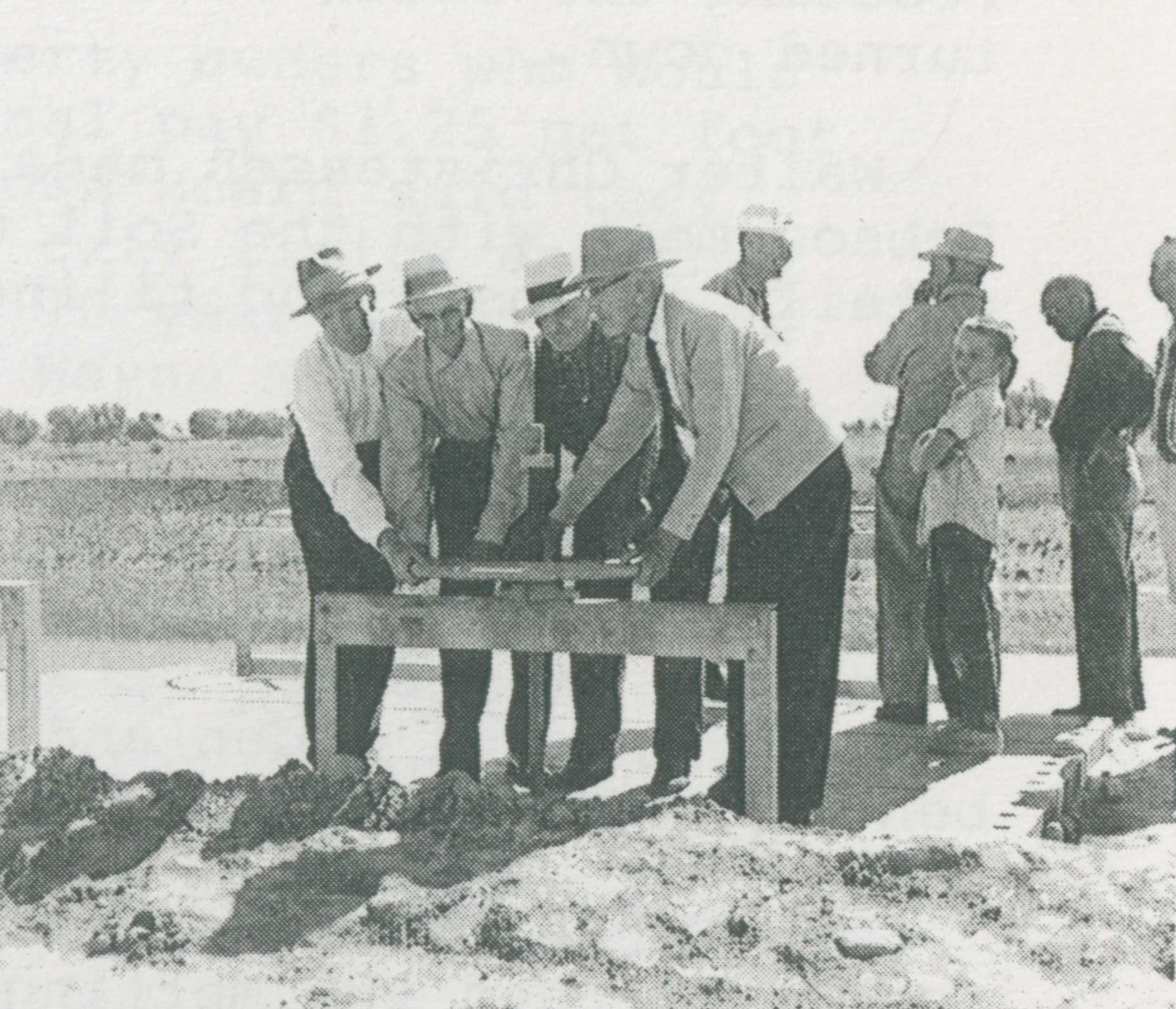
There were many problems that came out of the construction of this canal. It would be necessary to get some dirt to construct the pad for the canal. The company purchased some ground at the upper end of the canal from Max Stander. Then got the dirt that was necessary to build the upper end of the canal and then leveled the ground and gave it back to Mr. Stander. They also purchased additional dirt from Robert Penman. This dirt was trucked from his property just south of the Weber River and west of the main road. The dirt was hauled by farmers using their beet trucks, etc.. The new pad was made in the old canal banks where possible, but there was some trading of land etc. to straighten out the canal. There was also a problem in getting someone to dig out the canal to the size and shape required to allow 50 seconds feet of water at one time. The company asked for bids, but they only received one because the equipment needed to shape the canal was not available. In order to get the project moving Alvin Robson caught a bus on Ogden and went to the Fuller Forms Company in Arizona to see if they had some type of equipment that could be used. He purchased a right to one of their slip forms that could be used in forming and pouring the concrete. He returned to Ogden and worked with the Ogden Iron Works on 23rd Street and Grant Avenue where the construction of the slip forms took place. The next problem was to begin the construction of the project. Dean Hadley of Taylor was hired to do most of the big equipment work. Local farmers also helped with their equipment. The Soil Conservation furnished the engineering on the project. Herbert Issackson of Pleasant View was the surveyor. One of the major problems that existed and is still a yearly discussion is the amount of water delivered from the existing head gates. The government required that curtained head gates must be varied in size for them to participate financially.
Oct 1962
There was much contention and personal feelings during the construction of how it should be done. Some people left the jobs and never came back, but the project was finally finished. The construction created problems for some but most of the inconveniences were ratified by the Irrigation Company. New bridges were built, land was leveled, damages to property was crops were paid for during the construction. The Company paid for fencing materials with the property owners installing the fences. Cattle that used to walk across the stream would fall into the new lined canal and couldn’t get out. The Company paid for some of the cattle that were lost before the agreement to install fencing was made.
The total cost of the project was $199,754.08. The amount of $122,918.61 was borrowed from Utah Water & Power Board. This money was interest free if a yearly payment was made by November 30th each year. The last payment of $8.257.06 will be paid on November 30, 1977. Other cost not being paid by the stockholders come from the Soil Conservation and the sale of pieces of the old canal, and the town board. Vice President Bill Hatch of the First Security bank was also an asset in the financing of the canal.
We borrowed monies from the First Security Bank as construction went on to pay for cost on a daily basis. On December 31, 1974, the company owed the First Security bank $60,000.00 Alvin Robson and Wayne Skeen met with Mr. Hatch in May regarding this bill. Mr. Hatch said that the bank needed some type of security for this loan. There was nothing to give him because out rights to the canal had been given to the Utah Water and Power Board. Alvin Robson and Wayne Skeen then approached Mr. Lawrence of the Utah Water and Power Board asking them for more money for the project explaining the situation with the bank. Alvin Robson explained that they might just as well take over the ownership of the canal because the bill had to be paid. There was nothing to offer as security because the Utah Water and Power board had everything that the company owned. Later, Mr. Lawrence of the Utah Water and Power Board gave the Irrigation Company an additional $30,000 which helped to delete that note at the First Security Bank.
I have two copies of the History of Plain City, Utah. The front indicates it is from March 17th 1859 to present. As far as I can tell, the book was written in 1977. At least that is the latest date I can find in the book.
One copy belonged to my Grandparents Milo and Gladys Ross. My Grandpa has written various notes inside the history which I intend to include in parenthesis whenever they appear. They add to the history and come from his own experience and hearing.
I will only do a number of pages at a time. I will also try to include scanned copies of the photos in the books. These are just scanned copies of these books, I have not tried to seek out originals or better copies.
History of Plain City March 17th 1859 to present, pages 123 through 140.
SPORTS IN PLAIN CITY
By Lyman H. Cook
Plain City’s most prominent claim to fame has been through the sports program and the great players and teams that the town has produced. I know of no other town to community in this state, to possibly out of state, that can equal the accomplishments in the total sports program as the town of Plain City. I don’t know how many hundred championships or trophies this town has won in baseball, basketball, softball, volleyball, and Jr. Posses, over the last 75 years or more. We include the young teams and people in the town, and also the girls. These trophies and championships came from local, county, multi-county, state, stake division, region, multi-region, and All Church basketball, softball, and volleyball, which is the largest leagues in the world.
On February 14, 1977, at 3:30 PM, there were 226 trophies in the trophy cases at the Plain City Church. I couldn’t begin to estimate the number of trophies in the homes here in Plain City. Can you comprehend the number of teams involved and especially the number of people involved on the teams in accomplishing this great record.
There seems to be a special spirit, or force, ambition, or drive, that compels players to excel and teams to win. The will to win in Plain City is the strongest I have ever known. We have been accused of playing dirty, or being poor sports, but in answer to these charges, I would submit the phrase: We just play hard, and the spirit of competition just brings out the best in us. In Plain City you don’t hope you can win, you are expected to win. Some communities dislike us for our sports program because it is so strong, and in reality, they judge their success of their season by the fact of whether they can beat Plain City or not. I realize these are rather potent and strong statements, but never the less, they are all true.
We dedicate this section of sports to all the people who have ever played on a team in Plain City. We realize that some names will be missed and it is not our intent to forget anyone, but we can’t remember all, and this is all of the sports material that has been turned in for the history. If your name is left off, write it in, and if you were star of the team, write that in also.
We have asked for and received personal write-ups on a few people who have signed professional contracts or have distinguished themselves in certain sports. We recognize them for their talents in that they in turn have brought special recognition to Plain City. I am sure these talented athletes would be the first to recognize their fellow members, for they realize that no one man is bigger or better than the whole team, and in this light, we recognize the teams they played on.
From 1944 until the present, there were three basketball teams that went to All Church and won two second places. Commencing in 1951 through 1954, we played in four fast-pitch All Church Tournaments. We won a second-place finish and eight-place finish.
In 1953, we played on a volleyball team that went to the All Church Tournament and won the Sportsmanship Trophy, which was a great honor. The team that played were: Dee Cook, Lyman Cook, Wayne Cottle, Wayne Skeen, Blair Simpson, Kenneth Lund, Harold Hadley, and others we couldn’t remember.
There were teams that went to the All Church Slow Pitch Tournaments from Pain City for three years. They won two All Church Championships, and a third-place finish. There have been some excellent younger teams in baseball, basketball, and softball, and a Junior team last year (1976) won a second-place in a
The All Church program.
This was one of the early teams of Plain City, and this picture was taken around 1910. They played together for many years, and they won several championships.
Top Row: L to R: Joe Hunt, Tooley Louis Poulsen, Preston Thomas, Parley Taylor, Jack Hodson.
Middle Row: L to R: Mr. Anderson, Coach, Jim Thomas, Melvin Draney
Bottom row: L to R: Oscar Richardson, Joe Singleton
Louis Poulsen
Tooley Poulsen played on many championship teams, and played several positions, mainly second base and catcher.
This was one of the first Mutual basketball teams in Plain City. They played their games in the upstairs of the old hall. Lyle Thomas reports that you didn’t have to be polished to play on this team, just big and rough, for there was very little whistle blowing in those days. This picture was taken in about 1925, and they won several championships.
Back Row: L to R: Rulon Jenkins, Lyle Palmer, Marion Sneed, Milton Garner
Front Row L to R: Theo Thompson, Ralph Robson, Coach Ellis Giles
This was the 1930 Plain City Baseball team. They played for State Champion ship.
Top Row: L to R: Horace Knight, Albert Sharp, Walter Christensen
Middle Row: L to R: Floyd Palmer, Angus Richardson, Arnold Taylor, Walter Moyes, Abram Maw, William Freestone
Bottom Row: L to R: Clair Folkman, Gilbert Taylor, Dick Skeen, Fred Singleton, Frank Skeen, Elmer Carver
BASEBALL AND EARLY SPORTS
By Elwood (Dick) Skeen
Baseball was Plain City’s most favorite sport. Baseball in Plain City in the early 1920’s and 1930’s was composed of the Plain City Bull Dogs with the following players taking part:
Louis Poulsen
Joe Singleton
Walter Draney
Elmo Rhead
Parley Taylor
Joe Hunt
Elvin Maw
Oscar Richardson
John Hodson
They represented Plain City in the Weber County Farm Bureau League, composed of North Ogden, Hooper, Roy, and Clinton. There were many good ball players in those days that played on the teams. The town park at that time was covered with salt grass. There were no base lines, no pitcher mounds. But, on a Saturday afternoon the park was filled with people that came from all over the county to watch the games. Horses and wagons lined the park.
Foot racing was also a great sport at that time, and Plain City had one of the best in Walter Draney, who was not only fast, but also a great athlete.
As time passed and the older players began to drop out, the chance came for us younger players to take over. In 1925 I caught my first Farm Bureau game at Liberty with Ezra Taylor doing the pitching. Then, the other players that made up our team for the next few years started to play. We had our share of victories. In fact, we had more than our share of wins.
Finances at that time were hard to come by. We did what we could to raise money to continue supporting the team. In 1928, the ball team put on the first Black and White Day with Mervin Thompson and Joseph Skeen showing their cattle. An old-time refreshment stand, soda water, ice cream, candy bars, and popcorn, which sold for 5¢. Also, some drinks that were not sold at the stand.
Our uniforms were furnished by Plain City individuals and business firms from Ogden. Suits would have the name of the giver on the back. Decoration day and the Fourth of July were our most celebrated days with all kinds of sports for those who wished to perform. A baseball game and a dance in the evening would top the day.
We would get the best team from Ogden to play on these days so that we could show what was leading up to the best team we had. In 1930, we won the Weber County Farm Bureau League, and the town bought us new uniforms to go to Lagoon to play Sandy, Utah, for thy State Championship. We lost by a close score. Our players were:
Gilbert Taylor
Walter Moyes
Arnold Taylor
Frank Skeen
Horace Knight
Albert Sharp
Fred Singleton
Abram Maw
Walter Christensen
Clair Folkman
Dick Skeen
Bill Freestone was the manager. Angus Richardson was the coach. Elmer Carver took care of finances, and Floyd Palmer and Byron Carver were scorekeepers. We played in tournaments at Brigham City and Ogden, and some out-of-state games were played.
We continued playing, but soon the gang started drifting different ways and our days were coming to an end. The league started to dwindle and later, folded up with the workload increase. Baseball was soon lost to the towns in Weber County.
Left to Right: Nalon Taylor, Bert Cook, Howard Gibson, Bud Dallinga, Wayne Cottle, Thayne Robson, Bill Stokes, Rulon Jenkins, Coach
The Desert News Sport Best Two MIA Teams
Page 10 – Salt Lake City, Utah-Saturday, March 11, 1944
Bottom Row: L to R: Carl Taylor, Carl Hodson, Fred Singleton, Coach, Blair Simpson, Glen Charlton
Top Row: L to R: Frank Hadley, John Nash, Lyman Cook, Ray Cottle
Ray Cottle, Center: First Team All Church
Frank Hadley, Forward: Second Team All Church
Lyman Cook, Guard: Second Team All Church
Blair Simpson, Guard: Honorable Mention
This team played for All Church Championship in 19441. They played Grantsville, Utah, and lost to them for the title. The games were played in the old Desert Gym, by the Hotel Utah. The teams stayed four nights in the Hotel Utah. They ate, slept, and played basketball.
Top Row L to R:
Alf Charlton, Athletic Director
Lyman Cook, Ronald Skeen, Kenneth Lund, Grant
Lund, Wayne Skeen, Clair Folkman, Coach
Bottom Row L to R:
Harold Hadley, Elmer Hipwell, Bill Stokes, Dee
Cook, Blair Simpson
This was the Plain City M-Men Team that played after World War II, in 1946, for several years and won several state championships and played in the division tournaments.
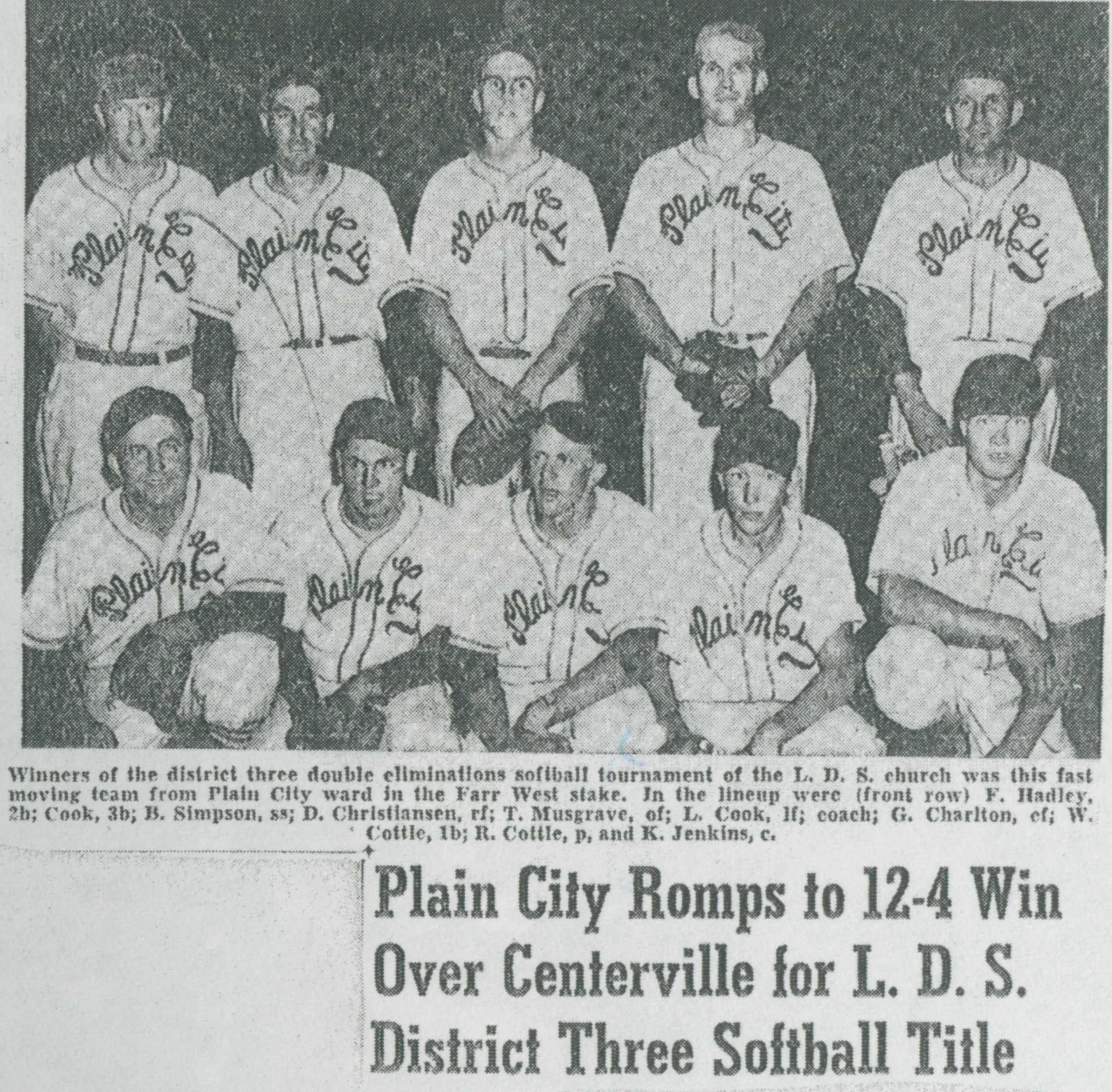
Winner of the district three double elimination softball tournament of the L.D.S. church was this fast moving team from Plain City in the Farr West Stake. In the lineup (front row) F. Hadley, 2b; Cook 3b; B. Simpson, 5b; D. Christensen, rf; T. Musgrave. Of; L. Cook, lf; coach; G. Charlton, of; W. Cottle. 1b; R. Cottle, p, and K. Jenkins, c.
Plain City Romps To 12-4 Win
Over Centerville for L. D. S.
District Three Softball Title
PLAIN CITY SOFTBALL TEAM OF 1951
By Lyman Cook
Plain City has always been a very strong baseball town, and the feeling was that softball was a game for girls, or you played softball at family reunions. In 1951 the Farr West Stake started a softball program and wanted teams to participate. I was Ward Athletic Director at that time and asked these players to play. This was the first softball team organized in Plain City. We won the Stake and District III. We then went on to the All Church Tournament in Salt Lake City. We won some and lost some, not too eventful. I coached the team the first year we played. This was a fast-pitch team.
L. D. S. Division III Champs
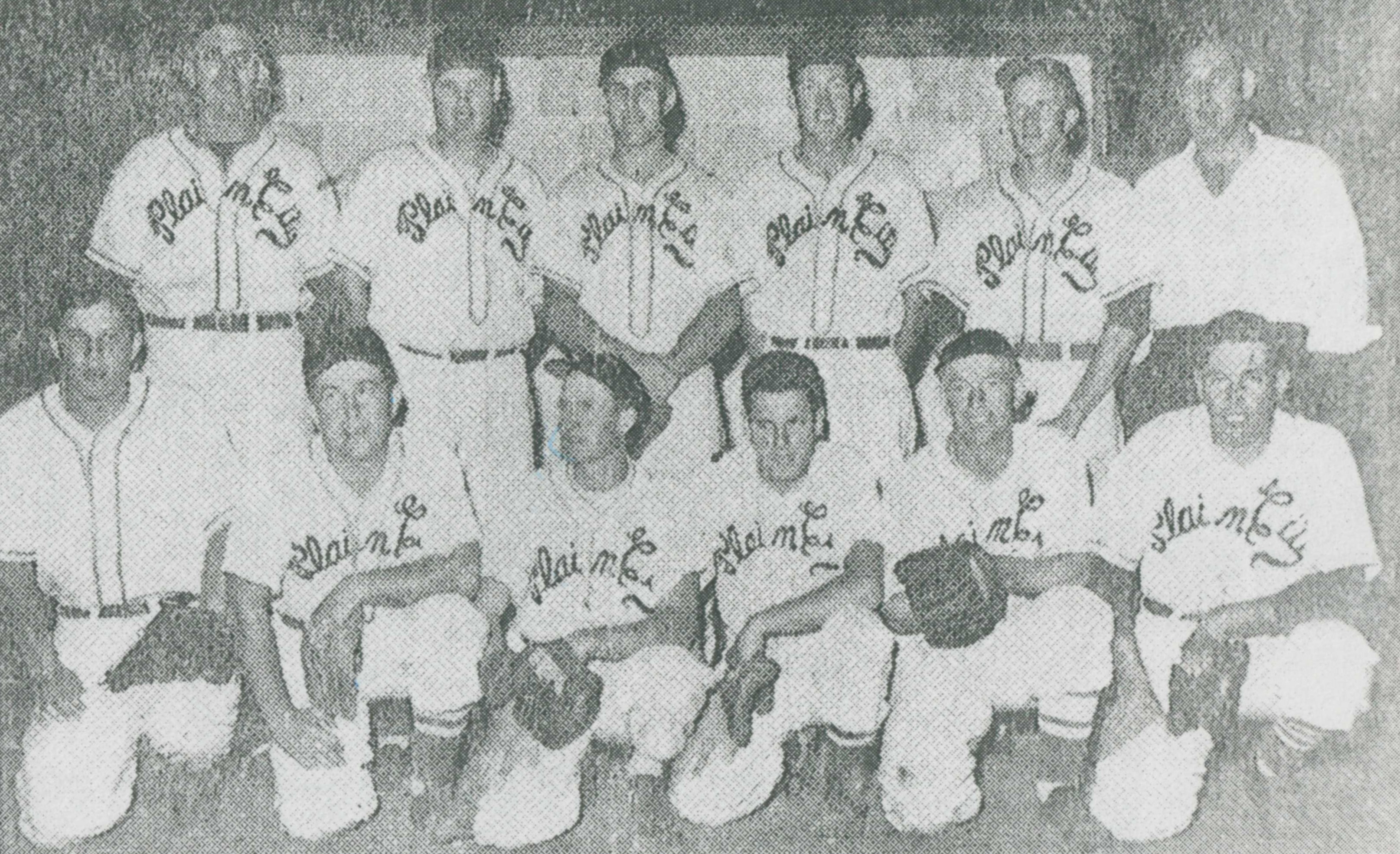
Repeating their last year’s victory in the L.D.S. division III softball tournament, the Plain City team came through again last night at Ogden softball park to beat Hoytsville 9 to 6. Front row Left to right: M. Heslop, E. Hadley, C. Taylor, D. Cook, A. Maw and G. Charlton: back row, lerft to right: R. Cottle, W. Skeen, W. Cottle, L. Cook, B. Simpson, and D. Skeen, coach. Absent from photo: Jenkins, V. Stokes and R. Skeen.
PLAIN CITY WARD SOFTBALL TEAM OF 1952
By Lyman Cook
In 1952 we repeated as stake champions and also won the Division III Championship again. We went to the All Church Tournament again and played very well. We played for the All Church Championship, but lost to Pocatello 10th Ward in a good game. Blair Simpson was voted Most Valuable Player of the tournament. Wayne Cottle made the All Church Team. There may be others. This was also a fast-pitch team. Dick Skeen was the coach.
This team played Farm Bureau Baseball and won the
Championship around 1950:
Top Row: L to R:
Junior Taylor, Wayne Skeen, Don Singleton, Bert Cook,
Glen Charlton, Kent Jenkins, Clair Folkman, Coach
Bottom Row: L to R:
“Buss” Lyman Skeen, Frank Hadley, Wayne Cottle, Ray
Charlton, John Maw, Dee Cook
This team played Pleasant Grove for All Church Champion-
Dee Cook, Manager, Darrell Christensen, Robert Folkman,
Bert Cook, Kenneth Lund, Wayne Cottle, Kent Jenkins, Coach
Many county and Northern Utah Championships were obtained by this team that was sponsored by the Town Board in the late 1950’s to middle 1960’s.
COACHES: Clair Folkman – Blair Simpson
TEAM MEMBERS: POSITIONS:
Blair Simpson P- IF
Wayne Cottle IF
Cy Freston IF
LaGrand Hadley OF – P
Archie Skeen C
Gaylen Hansen C – P – IF
Bobby Taylor P – OF
George Cook IF
Reid Nielson IF P
Ted Favero IF –
Dennis Anderson P
Garry Skeen OF
Lynn Folkman OF
Bud Parker IF – OP
Tom Seager OF
Harold Hadley IF
Harold Marriott IF
******
PLAIN CITY WARD FASTPITCH TEAM
1960, 1961, 1962
This team won the Stake, Region, and Division Championships, and represented the ward in All-Church competition with a successful number of victories.
COACH: Elmer Carver
TEAM MEMBERS:
Tom Seager, P Blair Simpson, SS
Gaylen Hansen, C LaGrand Hadley, LF
Wayne Cottle, 1st Robert Folkman, CF
George Cook, 2nd Dee Cook, RF
Cy Freston, 3rd Don Singleton, IF
Blaine Eckman, QF Gar Hunter, 1st – OF
THE PLAIN CITY BULLDOGS
This is one of the very first Weber County Recreation Teams in Plain City. Many of these players went on playing baseball for many years.
Front Row: L to R:
Dick Skeen, Coach, Fred Palmer, Darrel Thompson, Kenneth Hogge, George Cook, Ronald Sharp.
Back Row: L to R:
Archie Skeen, Brent Taylor, Wayne Poulson, Jay Freestone, Robert Folkman, LaGrand Hadley
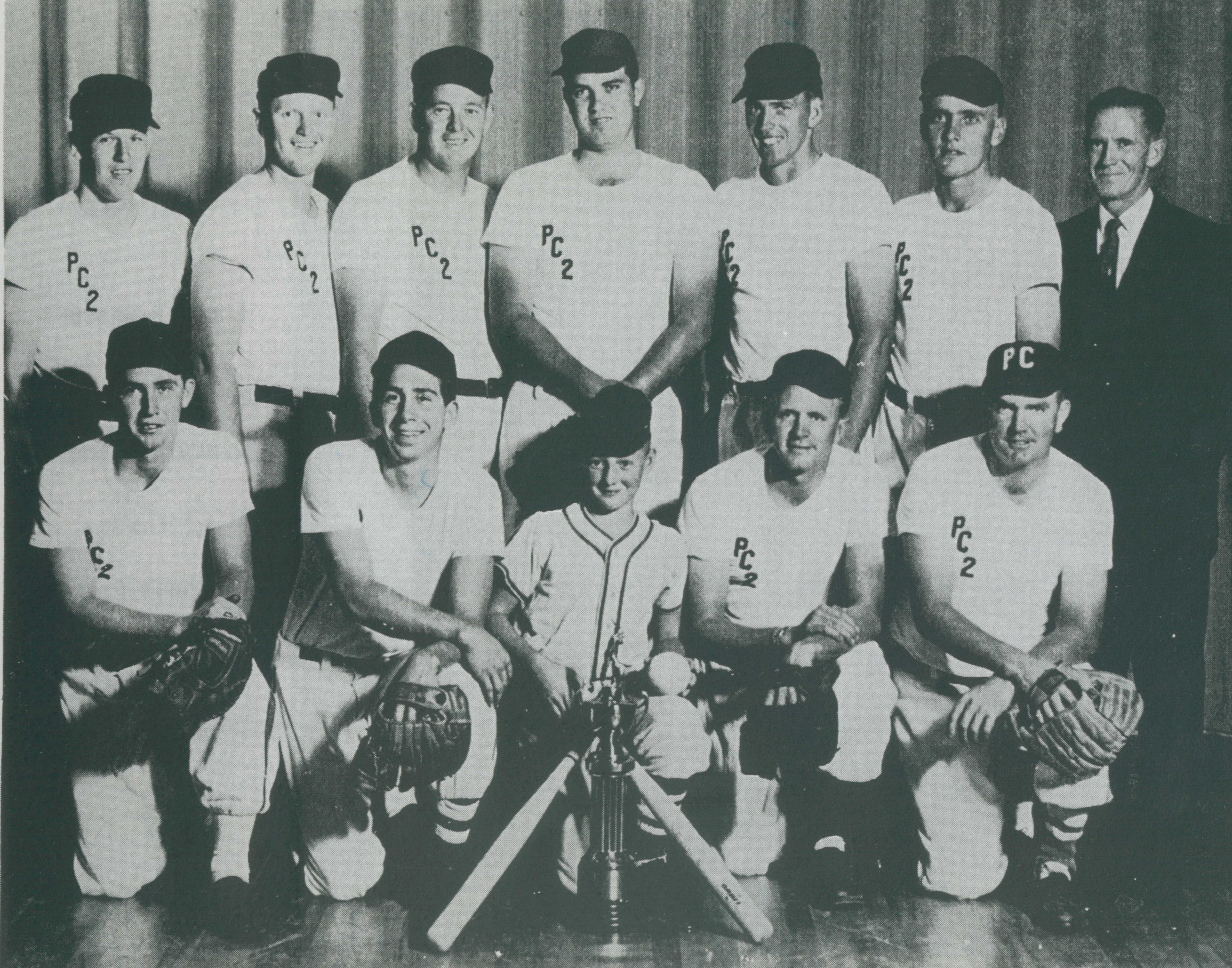
PLAIN CITY SECOND WARD
ALL – CHURCH CHAMPIONSHIP TEAM
1963 – 1ST Place
1964 – 1st Place
1965 – 3rd Place
This team represented the Plain City 2nd Ward and Plain City Town by winning 64 and losing only two games over a three-year span. Many players received All – Church recognition. In the championship game the first year the team hit 11 home runs and pulled off a triple play for the victory.
Back Row: L to R: Not in Photo
Garry Skeen Archie Skeen
Gaylen Hansen Ken Searcy
George Cook Jay Freestone
Gar Hunter Val Taylor
Jerry Bradford Mel Cottle
Lynn Folkman Gordon Singleton
Bishop Rulon Chugg Jim Beasley
Don Singleton
Front Row: L to R: Gary Hill
Bishop Orlo Maw
Jerry Moyes
Doug Palmer
Dale Searcy
Blair Simpson
LaGrand Hadley
All – Church Honors:
Gar Hunter
Jerry Bradford
Ken Searcy
Gaylen Hansen
Archie Skeen
Blair Simpson, Most Valuable Player
BLAIR SIMPSON
and
ELMER SINGLETON
of the
PITTSBURGH PIRATES
1948
“Two cousins met”
ELMER SINGLETON
Elmer Singleton started pitching for the Farm Bureau League in Plain City. He pitched for several championship teams. He signed a professional contract with Cincinnati, and played at Wenatchee, Washington in 1939, his first year. He played for Idaho Falls, Portland, and Oklahoma City. He moved on up to the big league and played with the following teams:
Cincinnati
Yankees
Chicago
Kansas City
Boston
Pittsburgh
Washington in 1950
Toronto
San Francisco
Seattle
He was in professional baseball for 27 or 28 years, the last eight years as a player coach.
He pitch two no hitters, one at San Francisco, and the other at Seattle. Elmer won the Player of the Year Award at Seattle in 1956. There is a baseball card with Elmer’s picture on it with the Chicago Cubs. It reads:
“This will be Elmer’s 17th year in professional baseball.
He started back in 1940 and after 11 uneventful seasons,
got red hot to become one of the top hurlers on the
Pacific Coast. In 1952 at San Francisco, he won 17, followed
with 15 triumphs in 1953 and moved to Seattle in 1956.
He had the best Pacific Coast Earned Run Average.”
Elmer told us that before he left to play professional baseball, the people of Plain City honored him at a banquet. They gave him a ball glove, and he still has it. He is listed in the Sports Record along with his accomplishments. Elmer was a great baseball pitcher. The only picture we have of Elmer is with Blair Simpson. Elmer and Blair are cousins,
BLAIR SIMPSON
BY Blair Simpson
I attended school at Plain City before going to Weber High School. At Weber High School I participated on the track team, played some basketball and pitched for the Weber High baseball team.
After graduating from Weber High School in 1944, I was drafted into the army for two years.
In 1948, I signed a professional baseball contract with the Pittsburgh Pirates organization. While playing with the Pirates, I played with the following cities:
Santa Rosa, California
Pittsburg, California
Modesto, California
Hutchinson, Kansas
Waco, Texas
Charleston, South Carolina
I was a pitcher and had to quit because of an injury to my knee.
After retiring from professional baseball, I played a considerable amount of baseball with Plain City and other teams in the Ogden area, such as:
Ogden Ford Sales
Heitz Heating
Wasatch Time
I was selected on the All Star Baseball Team composed of 16 players from the State of Utah.
I also played on many softball teams in the Ogden area such as Fisher Hess, Utah General Depot, Fred M. Nyes, Savon, and others.
In 1952, I was named the Most Outstanding Player in the “All Church Fastpitch Softball Tournament” in Salt Lake City and was also named to the All Church All Star Team in 1953.
In 1963, o received the Most Outstanding Player Award in the All Church Softball Slow Pitch Tournament. In 1964, I again received the most Outstanding Player Award in the slow pitch division of the All Church Tournament held in Salt Lake City. The year 1964 was one of my most memorable occasions in All Church Softball as I hit four consecutive home runs in one game.
I would like to give a lot of credit to whatever successes I have enjoyed in athletics to the talented town of Plain City.
WAYNE COTTLE
By Wayne Cottle
I was born November 30, 1928, in Ogden, Utah. I lived in Plain City all my life. I attended Plain City Elementary and Junior High. I played basketball in the 9th and in the 10th grades for Plain City. L. Rulon Jenkins was our coach and our principal. We played against Hooper, North Ogden, Huntsville, and Weber High School.
In the Fall of 1945, I started Weber High School, playing football, basketball, baseball, and track for both years. In 1947, I played to a tie for the Region I Championship with Box Elder. We played off the tie breaker at Ogden High School, beating Box Elder for the first Region I Championship for many years. I won the Region I scoring title. We entered the State Tournament in Salt Lake City and we lost to Granite, who became the State Championships, in the semi-finals. I was the recipient of the Standard Examiner KLO Watch Award for being the outstanding athlete of the year.
I entered Weber Junior College in the Fall of 1947. After about a month of practice I became one of the starting forwards. We played in several tournaments winning 3rd place in the Compton California Invitational. We played an independent schedule that year. In 1948-49 Weber became a member of the ICAC Conference. We won the conference and played Snow Junior College Tournament. We won the game and I was voted the tournament’s Outstanding Player Ward. We went to the national finals in Hutchinson, Kansas. We won our first game, then we met two defeats.
In the Fall of 1949, I entered Brigham Young University. I was on the team that won the Skyline Conference Championship for the first in many years. We went to the NCAA at Kansas City, Missouri. We lost to Baylor University, then beat UCLA for 3rd place. The next year we accepted a bid to enter the National Invitational Championship and two of our players were voted All American.
I graduated from BYU in 1951, came back to Plain City and started to play basketball with the Ward team. From the 1951- 1952 season until the creation of the Plain City 2nd Ward in 1960, we never lost a league game in the Farr West Stake. The year of the creation of the Plain City 2nd Ward, they beat us once and we beat them once. We played off the Stake Championship at Wahlquist Jr. High, and we won the team and the championship. After that season, the Church specified an age limit and I was area championships and went to the All Church several times.
WAYNE COTTLE
Brigham Young University
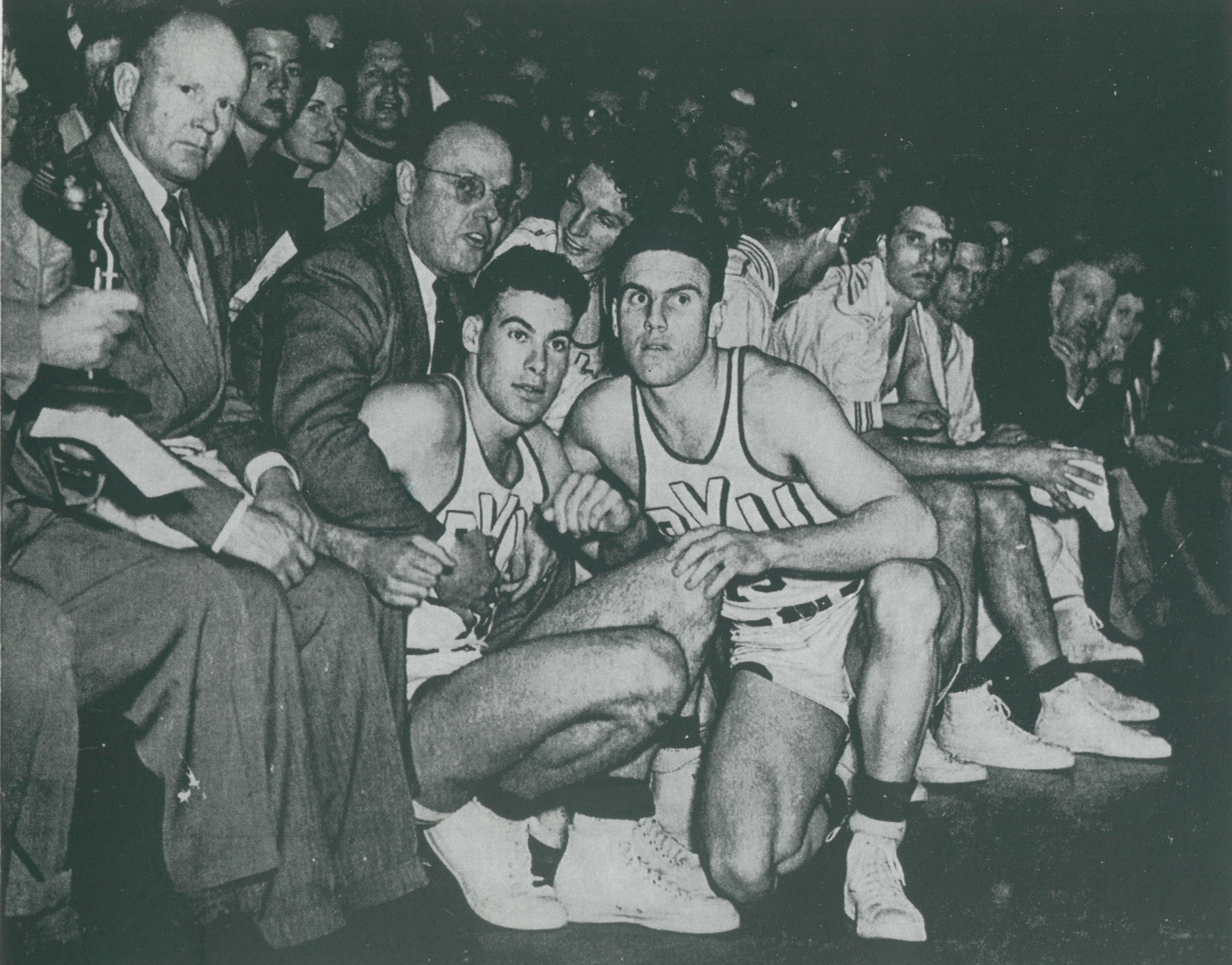
BERT COOK
He attended Plain City School where he was active in athletics. He graduated and attended Weber High School in 1947 and 1948., where he participated in football, basketball, baseball, and track. In 1948, he was selected on the Class A State All Star Team, in which Weber High School won the championship. He also won the All American in boys Award in baseball at John Affleck Park in 1948. From this he won a trip to Chicago.
He played for the Plain City baseball team for the Farm Bureau and Ogden City League.
From 1948 until 1952 he attended Utah State university at Logan, Utah, where he started on the first five as a freshman, and later in the year played in the AAU Tournament and was selected on the All Tournament Team.
In 1951 – 1952, he lead the conference in scoring and was voted All Conference both years. In 1952 he was voted All American in basketball where his Number 6 jersey was retired at Utah State University being the first one in the history of the school. That same year he was selected on the All Conference Team, and traveled with the Harlem Globe Trotters and the College All Star for several games. Later that year, he signed a contract with the New York Knickerbockers and was drafted into the service where he played for Fort Lee, Virginia Military team in which he lead the scoring and was later voted to the Second Army All Star Team.
He served his country in the Far East Command in 1954, being released in 1955, when he rejoined the Knicks until 1956. After a serious knee injury he returned to Plain City and played for the Plain City Ward and the Ogden City League.
He played on the 1956 team that won second place and he made First Team All Church.
At Weber High School I participated in basketball, baseball, and football and was productive and beneficial. After graduation in 1954, I attended Utah State University for two years on a football scholarship. Next, I received a University of Utah Scholarship in baseball. That year 1958, was a successful year with a batting of .350. The next year was even more eventful. My batting average jumped to .490. The .490 batting average was good enough to lead the Skyline Conference, plus I was fortunate to lead the NCAA in homeruns and RBI’s. These statistics and the efforts of the University of Utah Sports Publicity Department lead to my selection as the “First Team Catcher on the College All -American baseball Team”. As a result of this honor, I was selected the “Most Valuable Player in NCAA, District 7.” The year was 1959.
Opportunities were available to sign a professional baseball contract with the New York Yankees, Chicago Cubs, Boston Red Sox, and the Phillies. In 1959 I signed a bonus contract with the Boston Red Sox.
During the next three years I played in the following leagues: Sophomore League in Alpine, Texas: North Carolina League in Raleigh, North Carolina; Midwest League in Waterloo, Iowa; and the Eastern League in Johnstown, Pa. Winter ball was played in Bradenton, Florida.
In 1962, spring training was held in Deland, Florida. Because of a successful spring training I was invited to join the Triple A League in Seattle, Washington, “The Seattle Rainiers.” All Star Catcher honors were received in 1960, 1961, and 1962. In 1963 I was invited to spring training with the parent ball club, The Boston Red Sox. At the completion of spring training I was again assigned to the Seattle Rainiers.
Some of the great stars helping the young players were: Ted Williams, Bobby Doerr, Rudy York, Johnny Pesky, and Mel Parnell. As of this year, 1977, the only teammate of mine still with the Boston Red Sox is Carl Yastrzemski.
I have two copies of the History of Plain City, Utah. The front indicates it is from March 17th 1859 to present. As far as I can tell, the book was written in 1977. At least that is the latest date I can find in the book.
One copy belonged to my Grandparents Milo and Gladys Ross. My Grandpa has written various notes inside the history which I intend to include in parenthesis whenever they appear. They add to the history and come from his own experience and hearing.
I will only do a number of pages at a time. I will also try to include scanned copies of the photos in the books. These are just scanned copies of these books, I have not tried to seek out originals or better copies.
History of Plain City March 17th 1859 to present, pages 107 through 122.
SCHOOLS
Early Plain City School
Poplar School
Submitted by Roxey R. Heslop
Poplar was a branch of the Plain City Ward and it received its name from the long rows of Poplar trees on both sides of the street.
The school district was organized in 1891. First school was held in the home of Peter McCue located about 3475 West 1975 North. James L. Robson was the first teacher followed by Mrs. W. Winslow and Myra Gray.
A room school house was built about 1894 at 3320 West 1975 North. This picture is not the Poplar school which had no windows in the front but on the west side and three was a wood shed at the back but it is very similar in many ways.
The teachers were Bessie Zinn, Blanch Bagley, Freed W. Dalton, Naomi Tracy, Emma Anderson, Sarah Stevenson, Etta Brow, Lottie Henigar, Minnie Rudiger, Melvina Wayment, Esther Steward, Welthy Lake, and Pearl Tracy.
The Poplar School House was the center of church and social activities. Sunday School was organized 3 Sept. 1894. Primary and Religion were held there.
Dances were wonderful. Everyone danced and the young folks were taught to waltz, two-step, quadrills, polkas, schottisches and others that were popular at that times. Richard Lund with his violin accompanied by his daughters, Annie or Alminda on the organ. Often lunch was served. Children’s dances were held.
The Poplar Lane people were like a united family. Everyone went to church and attended all social events. All the children played together.
Nearly all of the folks have gone but those who are left enjoy wonderful memories of the days of activity, associations and inspirations that was bought from the one-room school.
First consolidated public school. Built to replace the North, South, and Poplar Schools. It was built of adobe and located on the northeast corner of the square. It was used as a community and recreational center for many years after the second consolidated school was built.
Second public school after front door was sealed; new entrance was built on the east side when the gymnasium was added. Lunch room facilities were added to the west later.
Second public school after remodeling when front windows were bricked over but before later additions were made.
Interior of the second school, showing old wood and metal desks that were attached to long wooden planks.
CLASS PICTURE TAKEN IN THE POPLAR SCHOOL
Poplar school was a one room building. This picture was taken during the school term of 1901-1902 with Etta Brown as teacher. Later she married LeRoy E. Cowles who became the president of the University of Utah.
Top row: Emma Cottle, Elmer Robson, Ada Skeen, Williams Allred, Walter Cottle, Anzley Miller Luckart, Parley Taylor, Luella Cottle Stanger, Edmund Furnis, Alma Furnis, Laurence Cottle, Leslie Taylor, John Taylor.
Bertha Urry, Kate Urry East, Pearl Taylor Lund, Bertha Robson England, Alice Urry Wayment, Josephine Cottle Monroe, John Jackson, Elmer Taylor.
Roxey Robson Heslop, Manila Taylor Hancock, Emma Taylor Homer, Kate Kensley Nalder, Parley Stoker, Blanch Kenley, Drysdale, Unknown, Jessie Kenley Wayment, Evelyn Taylor Cottle, unknown, Martena Taylor Surrage, Merl Jackson, Zina Urry, Nellie Kenley Draney.
Some were too young to go to school and were brought for the picture.
Submitted by Roxey R. Heslop
This is the graduating class of 1907, Class of 1906-1907
Iris Poulsen, LaVerna Davis, Principal John C. Neal, Florence Singleton, Ruth Poulsen
Front Row:
Clifton Kerr, Marion Sneed, Arvilla Taylor, Ellis Giles, Margaret Hunt, Gilbert Taylor, Harold Carver
PUBLIC SCHOOL BUILT IN 1906
This is located on the site of the present Plain City Elementary School.
It included elementary through tenth grade in later years. The last year the tenth grade was held in the school was 1947. After that, it remained in use as an elementary school.
The front windows were bricked over and later the front doors were bricked when the gymnasium was added to the east.
Still later, a cafeteria was added to the west. The building was demolished in 1955, leaving the later additions and adding a new addition of classrooms to the east that same year.
The students pictured at the bottom of the picture are enlarged on the3 following pages.
Weber County School District was organized in 1906-07. Plain City was dedicated in September of 1906.
The teachers are: John Quincy Blaylock, Laura Lamon, Rosabell O’dell and Elda Cooley.
1909, 8TH Grade Graduation Class.
Back row L to R: John Taylor, Roxey Robson (Heslop), Easter Lund (Stevenson), Elvin Maw, Mildred England (Hart) (Robins).
Front row L to R: Lona Ipsen ( – ), Teacher John Q. Blaylock, Bertha Hodson (Bullock).
Enlargement of the students in the 1907-07 school picture on the preceeding pages, showing the center one-third of the students.
Early school buses were privately owned and used for summer vacations and school trips.
Enlargement of the students in the 1906-07 school picture on the preceeding page, showing the left one-third of the students.
L. Rulon Jenkins, teacher and Principal of the 1906 school during later years in the 30’s and 40’s.
Early classes held in the 1906 school during succeeding years. Dates and identities not known.
Early Plain City Class Picture Date and teacher unknown. We hope you can identify a parent or grandparent to make it more meaningful to you.
View of the 1906 school after the gymnasium had been added and more modern bus transportation used.
CLARA SKEEN THOMAS
SUBMITTED BY BEVERLY B EDDY
The Plain City School Hot Lunch Program was organized by Clara Skeen Thomas, wife of George Sidney Thomas. Clara Thomas was the first to start the Hot Lunch Program at the Plain City School 1923-1924.
She received $1.00 per day. She served vegetable and tomato soups, chip beef gravy on mashed potatoes and chili. These were purchased at the cost of three cents a bowl. With this money she received from the food, she would but the materials needed to prepare the next meal.
For years, she cooked and prepared the food at her home. She would have to take it up to the school each day. This would consist of three blocks each way. Later the school purchased a coal oil stove, which made it possible to prepare the food at the school. Each year the Hot Lunch program started in November and ended in March. Clara Skeen Thomas cooked and prepared the hot lunch at the Plain City School for eleven years and never missed a day.
SCHOOL LUNCH PROGRAM
L to R: Ivy Carver, Elizabeth Lund, Vacona Singleton, Tillie Moyes, Bell Woods.
SCHOOL BUS TRANSPORTATION
SUBMITTED BY ELMER ROSE
Oh what progress in education when in 1926, Weber High School opened its doors for County students. This high school is located on Washington Blvd. and presently occupied by the Adult Education Center.
Elmer Rose, of Warren, drove a bus to accommodate the northwest area of Weber County. Mr. Rose’s route covered several miles each day. He picked up all the high school students from Warren and both elementary and high school students from the south end of Plain City. He dropped the elementary students off at the Plain City elementary school. The student’s near the street car tracks were left to ride it to the high school.
Mr. Rose then continued his route through the North Plain City Road, back along highway 84 to within a reasonable distance from the car line. Then after passing the Harrisville along the route to Ogden limits.
On the route going to the high school, Mr. Rose picked up the Farr West Elementary students and delivered them to the Farr West School. He returned down the North Plain City Road picking up the elementary students for Plain City School.
The bus contracts to maintain and operate these units of transportation were awarded by bids. The lowest bidder getting the job if his outfit met the approval of the school board.
The inside of the bus had a bench on each side facing the center. The girls usually occupied these seats. In the center was a bench called a straddle seat. The boys were crowded together astraddle this bench.
The first bus was small and about 30 students were crowded into it. The students gave this bus the nickname of “Cracker Box”.
He often chartered his privately owned bus to take scouts, F.H.A. and other groups on excursions and other activities.
Mr. Rose removed the bus from its chassis during the summer so that he might use the truck for farm trucking.
This picture is of the second privately owned bus maintained and operated by Elmer Rose. This bus had a large capacity, accommodating about 50 students.
BUSSES LOADED IN FRONT OF WEBER HIGH SCHOOL IN 1926
The first buses to transport students to Weber High School in 1926 were operated and maintained by the individual owners. The contracts were let to the person whose bid was accepted by the Board of Education. Since these first buses were individually owned, the owners often used them for 4-H, temple, and various other excursions and activities.
Owners often used them for hunting trips. Family and friends slept in them overnight lodging away from home. The straddle bench was removed to make room for the bed.
Some owners removed the bus body from the chassis and placed another bed on the truck, so as to utilize it for farm trucking during the summer.
School transportation has evolved from the horse-drawn school wagon to the giant sized yellow school bus.
Today students ride to school fairly comfortable. The buses are warm, the seats padded, the radio plays popular music. These luxuries were undreamed of by the students who rode in the white top covered wagon, or the horse drawn sleigh in the midst of winter.
SUBMITTED BY RUTH FOWERS
SCHOOL LUNCH PROGRAM WORKERS
L to R: Hazel Kennedy, Mabel Moyes, Thelma H. Palmer, VaCona P. Singleton- Head Cook.
L to R: Principal Earl Cragun, Fern Hogge, Mabel Moyes, Norma Jensen, Hazel Kennedy.
Demolition in 1955 of the school building of 1906. This building had been in use continuously since that date. Many changes and additions had been added around it.
View of the new addition added in 1954-55 as seen through the rubble of the 1906 building and the construction equipment of the new building.
View of the Plain City Town Square from the roof of the school gymnasium.
Three view of the Plain City Elementary School as it stands today in 1977 with its many additions.
I was trying to find some photos and stumbled upon my Mom’s graduation pamphlet I had scanned a few years ago. Thought maybe it was time to share it, especially where I have seen some of her classmates have passed away recently.
1972 Baccalaureate and Commencement – Burley High School – Burley Idaho
These programs courtesy of the following Public Spirited Business Concerns
Amalgamated Sugar Co.
Burley Processing Co.
Burley Reminder
Cassia National Bank
First Federal Savings & Loan Assn., Burley Branch
First Security Bank
Guys ‘N Dolls
Idaho Bank & Trust Co.
Idaho First National Bank Burley Office
McCaslins
Ponderosa Inn
J. R. Simplot Food Processing Division
South Idaho Press
Class Officers
President Garth Beck
Vice President Bud Hoffbuhr
Secretary Jill Hinz
Executives Peggy Wood, Peggy Larson, Kaye Dawn Larson, Jeananne Gruwell, Jean Graham
Class Adviser Mr. David Peck
Baccalaureate Sunday, May 21, 1972 2:30 P.M.
Mr. Tom Gruwell , Principal, Presiding
Processional High School Band Mike Chesley, Conducting
Welcome Garth Beck Class President
Invocation Bud Hoffbuhr
Special Number Bel Canto Choir Elden Wood, Conducting “Battle Hymn of the Republic”
Address Dr. Walter R. Peterson
Cherubim Song Senior Octet
Benediction Calvin Pearson
Recessional High School Band
Commencement Monday, May 22, 1972 8:00 P.M.
Mr. Tom Gruwell, Principal, Presiding
THEME: “I Dream Dreams that Never Were and I Ask, Why Not” – George Bernard Shaw
Processional – High School Band – Mike Chesley, Conducting
Invocation – Connie Smith
Welcome Address – Garth Beck, Class President
Greetings from Austria – Marianne Koch – Exchange Student
“Man and His World” – Senior Choir
Valedictorian – Julieann Kerbs
Trombone Solo – Doug Nichols
Salutatorian – Edi Lou King
“The Halls of Ivy” – Senior Sextet
Presentation of Diplomas – Mr. Norval Wildman, Mr. Albert Klink, Mr. Dave Peck, Mr. Tom Gruwell
Class Song “Crescent Moon” – Class of ’72 – Gwen Bowen, Conducting
Benediction – Wayne Johnson
Recessional – High School Band
Adams, David Ratelle
Allen, Kathryn Marie
Allred, Anthony Jon
Allred, Howard Lynn
Amen, Joanne Marie
Andersen, Debra
Anderson, Roxanne
Anderson, Jerald DeLayne (1954 – 2017)
Anderson, Jay S
Anderson, Todd Michael (1953 – 1972)
Angus, Joyce Ann
Baker, Cheryl
Baker, Rell Dean
Banner, Marc
Barkdull, Marlene
Bewan, Lynnette
Beard, Patrick Scott
* Beck, Garth Warren (1953 – 2002)
Beck, Reid Belliston
Beckham, George Benjamin
Bedke, Douglas Herman
Bell, Larry W
Bench, Michael R
Berkenmeier, JoAnn
Bishop, Gregory Lynn
Black, Don Reid
Bodily, Ted O (1954 – 2019)
Bowcut, Bruce V
Bowen, Gwen
Bowers, Gloria
Bradshaw, Bill A Jr
Breeding, SHelly Marie
Briggs, Larry
Brill, Russel Dean
Brown, Julieann
Burgi, Lysene (1953 – 2016)
Burton, Arlen Lynn (1954 – 2014)
Call, Milo Jay
Campbell, Debra “Debbie” Kay (1954 – 2019) Johnson
Cargill, Elwin Verl II
Carey, Mirian June
Castillo, Yolanda Hernandez
Christian, Debbie Lynn
Clark, Bradley Hales
Clark, Antone “Tony” Lee (1954 -2015)
Coleman, Rick Lynn
* Crane, RoZann
Cunnington, Gaylene
Darrington, Jerilyn
Davids, Michael Lynn (1953 – 2020)
Davis, Donna Emily
Day, Debra E
Dayley, LaNae
Dayley, Lee K
Delaney, William W
Dille, LuRene
Draney, Rex Leonard (1953 – 2007)
Duncan, Rocky Gale (1954 – 2020)
Dunn, Rodney K
Dunn, Roger
** Eames, Lou Ann
Eldredge, Debbie
Farwell, Albert Michael (1952 – 2023)
Fairchild, Aleta Ann
Fenton, Wayne J
Ferlic, Beth Anne
Ferlic, Robert James
Filger, Thomas W
Fillmore, Louise
Fletcher, William Kent
Forschler, Laura Lynn
Forschler, Melody
Frazier, Lon Mitchell
Frost, Verlynn
Funk, Barbara Elaine
Gallegos, Linda K
Garcia, Don J
Garrard, Vickie Lynn
Goodwin, Irene Cecilia
Goold, Gary
Graf, Becky Ann (1954 – 2011) Moats, Kloer
Grafft, Duane Brian (1953 – 2006)
Graham, Jean
Green, Michael Dan
** Green, Sharon
Gregersen, Denice
Gruwell, Jeananne
Guiles, Randy Andrew (1953 – 2015)
Gunnell, Brent Udell
Hanks, Gary Thomas
** Hansen, Rae
Hansen, Sondra
Harper, Leslie C
Hatch, Karol (1953 – 2004) Kerr
Haycock, Con D
Hazel, Stanley Jarvis (1953 – 2008)
Heiner, Paula Jean
Hepworth, Linda
Hess, Steven Lerlan
Heward, William Alex
Hill, Michael Gordon
Hinz, Jill Marie
Hinz, Kathleen Ann
Hobson, Sheryl
Hoffbuhr, Vernard “Bud” Standley Jr (1954 – 1997)
Holm, Steve D
* Holmes, Thomas J
Holt, Phillip L
Holyoak, Kenneth Reid
Hunt, Timothy Lynn
Hunter, Richard A
Jackson, Kelly Ann
Johnson, Becky A
Johnson, Jack Wesley
Johnson, Mary Beth
Johnson, Wayne Richard (1953 – 2008)
Jolley, Patricia
Jonas, Sandy (1954 – alive)
Jones, Steven
Judd, Rockland K (1953 – 2012)
Karlson, Kerry
Kawamoto, Becky
Keen, George E
Keen, Vickie Rae Funk
Kelly, Pat
** Kerbs, Julieann
Kidd, Cory Vaughn
** King, Edith Louise
King, Gary
Knight, Robin Daniel (1953 – 2014)
Kober, Glen R
Koch, Marianne
Koyle, Garth H
Koyle, Shanna
Kunau, Nancy Rae
* Lamb, DeEsta Marie
Larsen, Brent
* Larsen, Scott William
Larsen, Vickie Esther
Larson, Vickey Irene
Larson, Kaye Dawn (1954 – 2019) Silcock
Larson, Peggy (1954 – 2016) Stirland
Lee, Roxanne
Lopez, Manuel Campbell
Loveland, Cynthia (1954 – 1981)
Loveland, Kevin R (1954 – 2008)
Lynch, Gary D
McBride, Anita Marie
McMurray, Susan Mary
* Mackley, Sally Irene
Mai, Kelly
Malloy, Michael John
Manning, Roger D
Marston, Della Kathleen
Martin, Gregory Max (1954 – 1975)
Martin, Stephanie Lyn
Martin, Stephen William
Maselter, Denise Ann (1954 – 2022) Rollins
Matthews, Ennis Eugene
Merrill, Kaye Ellen
Miller, John Edward
Moore, Debra Lynn (1954 – 2002)
Moorman, David Edgar (1953 – 1997)
Navejar, Oscar
Newcomb, Kathy Lorene (1954 – 2020) Bailey
Nichols, Doulgas Arthur
Nielson, Alice Ann
Nielson, Allan (1954 – 2020)
Obermiller, Cynthia Jean
Olsen, Ricky Ross
Olson, Donna Gaye
Ostrander, Diane Kay
Ostrander, Greg
Osterhout, Rex Dale (1954 – 2017)
Otte, Royce Oliver
Page, Linda Marion
Patteron, Peggy Ann
* Pearson, Calvin H
Peterson, Edith Victoria
Pitchford, Debra Faye
Poulton, William Arthur
Powell, Leslie Dean (1953 – 2005)
Priest, Roger Kirk
Ramirez, Adelita
Ramsey, Glenn Douglas
Randall, Steven Grant
Redder, Karen Lea
Reedy, Pamela Hannah
Rehn, Scott Leonard (1954 – 1994)
Rendla, Gary M
Rich, Diane S
Richardson, LuAnn
Rickert, Janice Norene
Ritchie, Neil B
Roberts, Kelly Jo
Robinson, Beth
Ross, Norman Clyde
Russell, Patricia B
Sager, Kent Leslie
Sandmann, Michael Remund
Schorzman, Anne
Severe, Rhonda
Short, David G
Silcock, Richard Donald
Simcoe, Steve Bryan
Sivley, Mary
Smith, Connie Sue
Sowers, Bill A
Spann, Debora
Stephenson, Julia
Taylor, David A (1953 – 2009)
Taylor, Russell Price (? – alive)
Thaxton, Stephen Craig
Thompson, Carlene Diane
Thornburg, Deborah
Telley, Marsha Ann
Tolle, Kent Ray
* Tollefson, Kathryn M
Tracy, Perry Alan (1953 – 2005)
Vannatian, Frances Ruby
Vorwaller, Kristine
Wardle, Diane
Wardle, Pamela Kaye
Warr, Dee Ann (1954 – 2013)
Warr, Paul K
** Weirich, Yvonne Denese
West, Monte M
Wetzstein, Lynette Kay
White, Kristine
Whittle, Ferol Kristine
Wickel, Lee Roy
* Winward, Brenda Arlene
Wolf, Richard Patrick
Wood, Peggy Ann
Woodland, Kirk
Woolstenhulme, Steven Leo
Worman, Barbara Ann
Wright, Edward R
Wyant, Ronald Lee
Wyatt, Marla Jean
Young, Richard LeRoy (1953 – 2022)
Zollinger Janene
National Honor Society Members
** Gold Cord – with 3.8 average or above
* Blue Cords – with 3.5 average to 3.8
The sketch of the Burley High School on the front of the Diploma case.
Sandy Jonas Burley High School Diploma
Mom’s actual Diploma.
Burley High School – Burley, Idaho
This Certifies That Sandy Jonas has satisfactorily completed a Course of Study prescribed for Graduation from this School and is therefore awarded this Diploma.
Given in the month of May, nineteen hundred and seventy-two
I have two copies of the History of Plain City, Utah. The front indicates it is from March 17th 1859 to present. As far as I can tell, the book was written in 1977. At least that is the latest date I can find in the book.
One copy belonged to my Grandparents Milo and Gladys Ross. My Grandpa has written various notes inside the history which I intend to include in parenthesis whenever they appear. They add to the history and come from his own experience and hearing.
I will only do a number of pages at a time. I will also try to include scanned copies of the photos in the books. These are just scanned copies of these books, I have not tried to seek out originals or better copies.
History of Plain City March 17th 1859 to present, pages 76 through 106.
HISTORY OF THE OLSEN GROCERY STORE
Two of the earliest merchants in Plain City were A. M. Schoemaker and William Van Dyke. Mr. Shoemaker had a little store just east of the old adobe meeting house. Van Dyke’s store was just across the street from the southwest corner of the public square on the sight of the John Maw store where the Plain City bowery now stands.
The Cooperative Mercantile Institution was organized in 1869 with John Spiers as President, J. P. Green, C .O. Folkman, George Folkman and Andrew Ipson as directors, and George H. Carver and J. S. Carver as the managers.
In the early days of Utah, the L .D. S. Church organized cooperative stores in different places called “Zions Cooperative Mercantile Institutions.” One of these was organized in Plain City in Jens Peter Folkman’s home at 2480 N. 4350 W. in March of 1869. He was appointed manager by the directors.
The capitol stock was $500.00. Mr. Folkman continued as manager for several years. At a reorganization some time later, John Spiers was retained as president and John Carver was elected vice president of the board of directors, which was composed of Jeppe G. Folkman, William Sharp and Alexander Marian Shoemaker, with George Bramwell as secretary and William G. McGuire as secretary-treasurer.
Finally a corner was bought by the company from Mr. Hansen in 1889, where Carl Olsen’s store is now situated. (1959) A frame building was erected and here Jens Peter Folkman continued as manger until the store was closed by Z.C.M.I. on account of bankruptcy cause through too many bad debts.
It was reopened by the parent store in Ogden and was managed by George and James Carver but was closed again for the same reason as before.
George W. Bramwell and his brother, Henry, bought the stock of goods and ran the store as a private business. Z.C.M.I. took over once more and hired George W. Bramwell to run it as a branch of their store.
It was next sold to Henry J. Garner and Robert W. Maw. They sold it to Thomas England. Thomas England sold his store to Peter J. and Evelyn Christensen, who rented it out for a time, then later sold it to Carl Olsen in 1925.
In the early days of the Olsen stores Parvin Produce Company of Ogden established the business of shipping potatoes from Plain City. They were located at the Olsen store and when they discontinued business, Carl Olsen and Wilmer J. Maw started shipping potatoes. Mr. Olsen loaded his cars at the end of the railroad spur in front of Roll’s Garage, now Jack Etherington’s Garage at 2415 N. 4425 W. and Mr. Maw loaded his cars by the “John Maw & Sons” store where they bowery now stands.
Carl Olsen
Don Olsen
Lee Olsen
The above was taken from a Historical Study of Plain City, Weber County, Utah, by Fern Olsen Taylor. A thesis was submitted for her Master of Science Degree in 1959.
The Utah Oregon Lumber Company business was purchased by Carl Olsen from Wilmer L. Maw, and at this time Annie Knight Geddes came to work for Mr. Olsen. Coal was also sold. Many loads of potatoes, coal, etc., were weighed on the scales located just south of the store.
Oscar Richardson worked with Carl in the produce shipping and George Elvie Weatherston worked with him in the store for a short time.
Carl opened the store with the help of his family, Lucille, Lee, Fern, Don, and Loyd.
A beautiful ice cream fountain was purchased and installed in the northwest part of the store. There were marble counter tops, malt machines, syrup dispensers and necessary equipment to make malts, splits, sundaes and many, many hand-dipped ice cream cones. A half dozen stools lined the counter. The choice of flavors then were chocolate, vanilla, or strawberry. A popular item was the candy punch-board that was a temptation some had a hard time resisting.
In 1939 Carl remodeled the back of the store. The partition at the east end and the swinging doors were moved, making room for a meat counter and meat cooler. More shelves and more groceries were added. Heat was provided by a coal heaterola. A shed was built by the store about 1889 and was used until 1949 for various purposes, a lumber storage shop, a barber shop and also later for a meat market. It faced the road and was located just south of the store.
In March, 1941, cold storage lockers were installed. The store was enlarged and a full-time butcher, Ralph Vause, came to work to serve the locker patrons. Many deer at hunting time were cleaned and dressed, filling the meat coolers to overflowing.
Carl Olsen sold his store to two of his sons, Lee and Don in April 1947. The store became “I.G.A.” and then later “A.G.“ Lee and Don enlarged the store, adding the brick building extending the south wall to the confectionery. The frame shed was moved to the back of the store and connected to a metal storage shed connecting the back of the store.
On July 9, 1949, the grand opening was held. Children came to the store from near and far to buy penny candy, a special treat.
Mr. Carl Olsen passed away February 25, 1955.
The Olsen family owned and operated the store for half a century and enjoyed a wonderful association with Plain City and the neighboring communities.
On April 18, 1973, Don and marge Olsen, and Lee and Clara Olsen sold the store to Perry and Sonia Merrill of Pleasant View. They Operated the store for three years and sold it to Elliot and Gayle Casperson. It is now the “B and C Market.” May 24, 1976.
COPY OF DOCUMENT PLACED AT THE BASE OF MONUMENT HONORING SERVICEMEN
August 26, 1944
To whom so ever of the dim and distant future, may come in possession of these documents, let it be known that:
We, the people of Plain City, Utah through our Committee for the men in Service with the aid of the people in the community do erect and dedicated this memorial, of everlasting granite, to honor the memory of those who, from our community, were enlisted and served in the Armed Forces of these United States of America and fought for its principles of Freedom, Justice and Democracy in the Second Great World War, which we have faith will culminate as all our country’s war have, in victory.
Today, August 26, 1944, when hostilities have been raging for 32 months, as we solemnly and proudly honor all Servicemen and Women, especially those who left from our community, and whose names are cut and will be cut in this monument, this war, cruel and savage beyond description is being waged across the seas, gravely threatening to destroy our freedom.
May God and justice destroy the forces and the barbarious leaders of those aggressor nations before they make it necessary for this nation of ours to again, by force of its arms, defend itself and the principles on which it was founded.
We, as a people are deeply grateful for the services and sacrifices made, not only the men who served in the war, but all those who fought and for those who died to defend this great nation since the first clash of arms in the battles of Lexington and Concord, we honor and revere the memory of them all. So in the erection of an everlasting memorial those, who left this country beginning 32 months ago to serve in the Armed Forces of these United States, to keep alive the flame of liberty and pass on to our posterity the stories of their brave and noble deeds, even beyond the time that this granite shall have crumbles to dust obliterating the names carved here on.
May we never again be called to erect other similar memorials because our country was again at war.
But rather, would we as a people whole heartedly join together to sponsor a shaft to commemorate the beginning of an era of eternal lasting peace without the horrors of war.
A BRIEF HISTORY OF PLAIN CITY
A group of men from Lehi came in the fall of 1858 and looked over the town, they also made a preliminary survey for a canal site, using a sixteen foot two by four grooved out and set on a three-legged tripod, with water in the groove to act as a level. This preliminary survey was made to the big levee that fall of 1858, some work was done on the big levee that fall, until it was necessary for the men to return to their homes in Lehi.
On March 17, 1859, a company of about 100 people arrived in Plain City about 5 o’clock in the afternoon. They camped in a hollow in the south part which later became Samuel Draney’s lots. The wagons were lined up east and west for protection against the north winds. Although snow was deep, they soon dug a big hole and built a fire making it as comfortable as possible.
One of the first things to do after arrivals was to survey the townsite and assign lots to the settlers, so they could get some kind of shelter for their families. Joseph Grue states that John Spiers and others who surveyed Plain City had in mind their home, the city of Nauvoo, and followed the pattern as nearly as possible. They surveyed the town at night using the north star and three tall poles just below it, as a working guide. The measuring chain was a piece of rope which they dragged along over the deep snow through which they waded. The original plat was six blocks long and three blocks wide, running north and south. Each block contained five acres and is divided into four lots. Each settler was allowed some choice in the selection of his lot, and each shelter was allowed twenty acres of farm land on the out shirts.
The Plain City canal was commenced in May of 1859 shortly after part of the crops were planted and completed to four mile creel that first year and later to Mill Creek and then to Ogden River, which relieved the situation somewhat during seasons when water was plentiful, but was of little benefit in dry seasons, the Plain City irrigation company under the supervision from the beginning.
Mr. Rollett, a Frenchman, introduced the culture of asparagus to Plain City, the seed came from France in 1859. This became one of the leading industries of Plain City, as the soil and climate are especially adapted to its culture. Plain City asparagus had become known far and near, and at the present time the asparagus in handled by the Plain City Asparagus. They ship asparagus to all parts of the United States.
Early homes were dugouts, then log cabins and later adobe. The first stone house was built by William Skeen in 1862 or 1863, by hauling rock from Hot Springs, northeast of Plain City.
The first school and meeting house was built in 1859. It was of log and adobe and was located on the south side of the public square. This adobe building was used as a meeting house, school house, amusement and dance hall for a number of years.
George Musgrave was the first Plain City school teacher. His first school was held in his dugout on his lot.
The First Relief Society was organized January 3, 1868, with Almira Raymond President. The first Primary was organized in 1881 with Susannah Robinson President. The first Mutual Improvement Association was organized in 1876 with William England as President.
An Episcopalian Church was built in 1877, and was used as a school and church. At that time, it had about 75 members. The building is still standing and still in use (Lions Club House).
Evelyn Sharp was the first white baby girl to be born in Plain City, and Thomas Singleton was the first white boy. They were born in 1859.
People of Plain City have always fostered amusement and entertainment of various kinds. In the early days they always had a brass band, a choir, dramatic association, and a baseball team. Regardless of all the hardships endured by the early settlers, recreation was always enjoyed. Dances were held in the old adobe school house on the south side of the square in winter and in the bowery near it in summer. They danced on the hard dirt floor at first, many of them in their bare feet. Most of the dances were square dances, at various times music was furnished by comb bands.
The first real meeting house that was built expressly for ward purposes is the present brick structure commenced in 1884 and finished in 1889.
The following men have been Bishops of Plain City Ward since it was first organized in the order listed: W. W. Raymond, L. W. Shurtliff, George W. Bramwell, Henry J. Garner, Henry T. Maw, Gilbert Thatcher, Wilmer J. Maw, George A. Palmer, Charles Heslop and the present Bishop Elvin H. Maw.
Plain City is principally a farming and dairy community, with sugar beets, onion, tomatoes, potatoes, peas, grain, alfalfa and asparagus being grown as the principal crops.
A branch of the North Ogden Canning Factory is located in Plain City and tomatoes are grown and processed each year. The canning factory was completed in 1925.
Many of the men of the community have profitable dairy herds, and each year a “Dairy Day” is held on the town square, prize stock being shown. Stock is shown from all parts of the state.
A Junior High School is located in the center of town, where approximately 225 children attend. L. Rulon Jenkins is now the principal of the school.
At the present time, Plain City has a population of approximately 800 inhabitants.
Each year on March 17 a “homecoming” celebration is held to commemorate the settling of the town.
Plain City was incorporated this year of 1944 with the town board as follows: Dean Baker, Chairman, W. Albert Sharp, Fred L. Singleton, Floyd A. Palmer, L. Rulon Jenkins and Don E. Carver as Secretary.
**************
The committee for the servicemen was selected about one year ago, and appointed by the Ward Bishopric, for the purpose of paying tribute and honor to the fellows and girls who enter the service.
The first funds were collected through a scrap iron drive, which was initiated by Dean Baker. The support of all the people of Plain City was gained by soliciting, and many tons of irons was donated by members of the town.
The task of securing the names to be placed on the monument and helping to plan its erection was done by the Committee for the Men and Women in the Service with William Freestone as Chairman, Elbert J. Moyes, Elmer P. Carver, John A. Hodson, Dean Baker, Mrs. Frank V. Skeen, Mrs. W. Albert Sharp, and Mrs. Vern L. Palmer.
As the original plans for the erection of his memorial called for only those who had been honored at Plain City, we deeply regret that names of some of the fellows who are in the Service, who have been residents at some time previous to their entering the service, will not appear on this monument.
We, the Committee for Servicemen, representing the people of Plain City extend our thanks and heartfelt appreciation to all individuals whose combined efforts have made the erection of this monument possible. The primary objective of this committee is to uphold and defend the Constitution of the United States of America and be to service to the community, state and nation and to transmit to our posterity the principles of justice, freedom, and democracy.
This everlasting and beautiful monument is sturdy and tough and is truly symbolic of the sterling qualities and character of the men whose names it will bear until it shall have been worn away to dust by the elements of time and returned to mother nature from when it came.
As duly requested, this document was written and prepared by Mrs. Frank V. Skeen, Mrs. W. Albert Sharp, and Mrs. Vern L. Palmer, together with the aid of the other members of the committee, and whose sincerest hope and aim was that the full honor and credit due, is bestowed on the citizens of Plain City who form a part of the great until by which this nation was founded and is governed. May the heritage of these rights of quality and self government never be taken away from those to whom it rightfully belongs – the people.
Mothers or Fathers and Wives of Service Men whose names appear on the Monument. Picture taken August 26, 1944, at the dedication of the monument. [Gladys Donaldson Ross on the back row, fifth from the left.]
BEET GROWING IN PLAIN CITY
SUBMITTED BY RUTH K. FOWERS
The sugar beet industry was one of the early farming activities in Plain City.
The ground was prepared late in the fall and early spring for planting the seed much the same as it is today except horse drawn machinery was used instead of tractor operated ones.
After the seed sprouted and the young plants grew a few inches in height, the rows were cultivated, and a thinning of the plants was required since the seeds were drilled close together. Segregated seeds had not been developed at that time. This thinning process was that of spacing the beet plants several inches apart to allow the young plant to grow. This was usually done with a short handled hoe and hand labor. A good beet thinner might be able to cover an acre a day.
The best crop required another hoeing or two and cultivating to eliminate the weed growth. Regular irrigation was necessary to give moisture to the growing plants.
In October the beets were matured and ready for harvesting. Again this process required much manual labor and the use of horse powered machinery.
The beets were dug using a beet digger. The beet leaf was cut from the beet itself by hand using a long beet knife. Then the beets were thrown into rows or piles to be gathered up with a large beet fork to be placed on a specially built box on which they could be hauled to the beet dump.
Sometimes young members of the family, who were too young to lift the beet fork full of beets, could assist with the beet loading by grasping the tail of the beet and giving it just enough of a throw to allow to them to load in the beet box.
With a team and wagon they were then transported to the beet dump and emptied into either a railroad beet car or placed in the beet pile.
Double hitch teams and wagons load of beets ready to leave the field.
Unloading the wagon by means of a hand turned pulley which lifts one side of the wagon and dumps them into the hopper.
From the hopper the beets are elevated to be dropped into the railroad cars.
When the beets were brought in faster than the railroad cars could be loaded they were piled for later loading.
The beets were transported to the Amalgamated Sugar Factory where another process was utilized to manufacture refined sugar to be used in homes, industries, eating establishments or wherever possible.
In 1958, in Weber County, the average yield was 16.3 tons per acre. According to an article which appeared in the Ogden Standard Examiner on October 19, 1959, Mike Pannanzio averaged 28.8 tons per acre on a 13-acre piece. On a four acre piece, the yield was better than 30 tons per acre. This farm situated near the site of the Plain City beet dump which was located just north of 4100 West 1975 North.
The beet dump has since been removed and a modern housing development now occupied the site.
RALL TAYLOR’S OLD BLACKSMITH SHOP
He started his business in 1908, ad was still in business in the Forties. We understand this building was a part of the first canning factory in Plain City, and was moved to this location.
DAIRY DAYS
BY WILLIAM FREESTONE
The first Dairy Days held in Plain City was in May of 1926. The purpose was to finance the Plain City baseball team.
William Freestone was the manager for the team with Elmer Carver, finance, Angus Richardson was coach, Floyd Palmer and Byron Carver were score keepers, and Rufus Maw, umpire.
The general committee consisted of William Freestone, Chairman for the day, with Elmer Carver, Floyd Palmer, Merwin Thompson, Angus Richardson, Byron Carver, and Rufus Maw assisting. The entire team also worked hard to make a successful day.
The day was well organized. There was a big exhibit of cattle from all around the area, especially the Holstein Breeders Association. The local dairy men have full support to the day.
The afternoon programs consisted of a game between Plain City and Clinton. Horse racing and horse pulling contest were also on the program. The successful day ended in the evening with a big dance held in the town hall.
Dairy Days have continued to this day under various managements.
This information was obtained from William Freestone, Elwood Skeen, and Walter Christensen.
This picture is the baseball team that the first Dairy Days was organized to sponsor and finance.
Top Row L to R: Angus Richardson, Coach; Bill Freestone, Manager; Alf Charlton, Transportation; Horace Knight, Dick Skeen, Walt Moyes, Abe Maw, Tooley Poulsen, Clark Taylor
Bottom Row L to R: Rufus Maw, Umpire; Fred Singleton, Louie Giles, Clair Folkman, Frankie Skeen, Arnold Taylor, Wally Knight, bat boy
DAIRY DAYS
BY HAROLD THOMPSON
Merwin Thompson came to Plain City in 1907. He had lived briefly in Ogden during which time he worked on a big cattle and sheep outfit in Eden, Utah. Before that, he lived in Scipio, Millard County.
He ran the farm which was later owned by himself and his brother, Gordon. This farm was not very level when he and his brothers took it over, and they levelled it with horses and fresno Scrapers. They then established a fine irrigation system.
During the 1920’s Merwin acquire four fine registered Holstein heifers from Joseph Skeen of Warren. From his beginning, he developed a high producing registered milking herd.
In the late 1920’s he helped organized the Plain City Black and White Days and served for over forty years as a director of that exhibition. In the beginning, the show was for Holsteins-Friesias Cattle only. Later, it was expanded to include all dairy cattle.
At the time of his death, his dairy farm, dairy buildings and dairy was one of the best farms in Weber County.
The Ralph Robson family have participated in Dairy Days for many years. Shown are two animals they have shown.
DAIRY DAYS
BY FLOYD PALMER
This was first known as Plain City Black and White Days. It was sponsored by the Plain City Farm Bureau, as a fund-raising project for the baseball team. Later, it was sponsored by Holstein Breeders and the Plain City Farm Bureau. The financial help came from local people and business firms in the area.
Members of the Ogden Chamber of Commerce, along with the “Ogden Livestock Show” committee and the Weber County Commissioners, all became interested in lending their support tot eh growing need for an expanded show. These people were influential in getting the three-county shows (Jersey Show, Coliseum-Guernsey Show, Huntsville-Holstein Show, lain City) to combine their shows, and this is how it became known as the “Plain City Dairy Day.”
This move with the support of local people reaching out for help, was the means of getting the Weber County Commissioners and the State Legislature to give financial help for the show. It is also supported by many individuals and firms in a financial way. The officers now consist of the following:
Plain City has become the home of one of the largest Dairy Shows in the State of Utah. It is held annually around the middle of May and is open to all breeds of dairy cattle. The opening day is devoted to the Junior divisions. This is limited to bonafide 4-H Club members and F. F A. Future Farmers Only. The second day is designated for the Open division. It is also held under strict rules, such as, Registration Certificates, State Health Standards are required, including Health Certificates and blood tests.
The management is well planned and organized. It consists of General Management, Directors, Clerks, and special committees, Finance, Premiums and Entries, Junior Department, Junior Judging Classes, Publicity, Cattle Supervisor, Grounds and Dinner, Special Awards Committee, and Tractor Driving Contest.
Many of the very finest dairy herds in the United State of Utah are on exhibition here.
The judging is by top quality judges, usually out of state judges are used foe the open division. The junior department is also very selective to get the best judges possible. Rules adopted by the Purebred Cattle Association of Utah are strictly enforced for the Open Division. The Junior Division is placed according to the Danish System of judging.
The Junior Division exhibits 150 to 175 animals. The open Division exhibits 250 to 200 animals. The breeds are mostly Holstein, Jersey, Guernsey, and Brown Swiss. Cash rewards run from $1600 to $2000. Ribbons are also awarded in both Open and Junior Divisions. Special awards are given to the juniors in Fitting and Showmanship, Outstanding Exhibitor, Best Club Group of Animals, (five animals owned by at least three exhibitors.)
One of the outstanding special awards is the Frank M. Browning Memorial Award. A Swiss Cow Bell is given to the outstanding 4-H exhibitor. Other
Other special awards are: Lynn Richardson Award to the outstanding F.F.A Exhibitor; Smoot Dairy Award which is a special prize to the 2nd and 3rd place 4-H boy in fitting and showmanship; Five Points Drug Company which is a special prize to the 2nd and 3rd place F.F.A member in fitting the showmanship; Utah Holstein-Friesian Association Award, which is a trophy for the three best females bred and owned by exhibitor: Weber Chapter F.F.A. which is a belt to the F.F.A. exhibitor taking best care of his exhibits: Read Bros. Halter to the 4-H member under 13 years of age placing highest in fitting and showmanship: John Chugg Halter to the 4-H member placing highest in showmanship only: C. W. Cross Gift Certificate to the F.F.A. boy placing highest in fitting and showmanship: Curtis Breeding Service Halter to the 4-H club member over 13 years of age placing highest in fitting and showmanship: Federal Land bank Award to Grand Champion Cow: Commercial Security Bank: Production Class, 14 cash awards and ribbons.
Mr. Robert P. Stewart, Principal of the Plain City Elementary School takes very active part in the success of Dairy Days. For several years Mr. Stewart has organized a dairy class at the school. Paul Knight has furnished the facilities. The calves have been furnished by Paul Knight and Archie Hunt. The school instructors have been Ray Hull and Steven Gertsch. Both boys and girls have entered the Dairy Class activity. In addition to oral instructions, they feed, groom, care and prepare the calves to be shown in the ring to be judge. As many ass 25 very enthusiastic youth have taken part. The award money has been divided among the participants.
The Plain City School, under the direction of Principal Stewart, has served an annual Dairy Day Dinner. This has been an outstanding attraction to many state and local officials, business, and dairy people. The food is always delicious, and the service is excellent. French-grown Plain City asparagus is always included in the meal.
The faculty and P.T.A. operate the concession stand on the park for the two-day dairy show. This serves a worthwhile purpose for the school and those attending the day’s events. The school children have been good to help clean the grounds after.
Since this Dairy Days started, small dairy herds have almost become extinct. They have been forced to grow larger and develop better grades of producing animals. We now have dairy herds entering this show from Utah dairy farms that are recognized as top dairy herds of the nation. They also exhibit their cattle at national shows.
This Plain City Town Board takes an active part in helping to promote the success of Dairy Days. The last few years they have provided help to put up the tie racks, take them down, and clean up the grounds.
Over the years, the Dairy Days Committees have replaced the old pole fences with a new set of painted tie racks that can be moved after the show is over. They also have a moveable loading chute for the cattle.
The 1977 Plain City Dairy Days will be listed on the program as the Forty-Eight Annual Show. This takes it back to 1929 for the beginning of Plain City Black and White Days. It would seem appropriate to list and give credit to some of the management people that have served fifteen years or more. They include:
Ralph Robson Merwin Thompson
Clair Folkman Floyd A. Palmer
Lee Olsen John Chugg
J . W. Hatch Fay Boyer
Robert (Bob) Penman Edgar Smoot
Verl Poll Clifford Smout
Mary Papageorge Kogianes Burns Wangsgard
Lynn Richardson Byron Thompson
A L Christensen
Plain City has the largest all-breed dairy show in the State of Utah.
Plain City School Students take great pride in learning how to train and groom their loaned animals for the Dairy Days Show. For them it means a full day away from the books while they get the real learning of being part of a real livestock show.
PLAIN CITY CEMETERY
SUBMITTED BY Floyd Palmer
The old of the Plain City Cemetery grounds came about only once a year. This was when the tulips came into blossom for about two weeks. After this it was solid mass of tea vines and weeds.
A newspaper article that appeared in the Ogden standard Examiner in the spring of 1938 was submitted by Roxy Heslop.
Bloom Wave Will Appear No More
Spring of 1938 Roxey Heslop
BLANKET OF FLOWERS…. The field of varicolored tulips being admired by 14-year-old Idona Maw of Plain City will be dug up and replaced with grass and shrubbery as a part of the improvement program underway at the Plain City Cemetery. The tulips will be taken out as soon as they cease blooming, Wilmer J. maw announced. An elaborate sprinkling system fed by a 700-foot artesian well will be laid throughout the cemetery. The well recently completed, flows 40 gallons per minute. The blanket of blooms will be removed because of the short of tulip lives. Bulbs will be given free to persons interested in obtaining them for replanting. (Standard-Examiner photo)
The new beautification program started in the year 1937. It came about through Floyd A. Palmer and his affection for his mother, Emma Jane Carver Palmer, who had suffered a long illness. She had said to him many times that she hoped someone would keep the weeds and tea vines from growing on her grave in the Plain City Cemetery.
Following her death on May 26, 1937, Floyd went to Bishop Charles L. Heslop and asked of something could be done to improve the Cemetery grounds. Bishop Heslop was quick to say, “…yes, and I would like to make you the Chairman of a committee to start the project.” Following their conversation Walter J. Moyes and Art M. Simpson was called in by the Bishop to assist on the committee. The preliminary took several months of work and study to formulate a workable plan for the project.
It was decided to drive a flowing well for the water. Raising the necessary money was the next step. Local lot owners were contacted and letters were sent to those living in and out of the state. We asked for $5.00 per lot and stated we would drive a well large enough to handle all that participated. The response was good and very few questioned the feasibility of the project. A 2 ½ pipe was washed 730 feet deep for the well. It required continuous drilling and was necessary to haul water in to drill with. Wesley and Virgil Stoddard from West Point did the drilling. The well was flowing a beautiful stream of water in May, 1938. The people were happy to have water available for flowers on Memorial Day.
Pipe lines were laid to service each lot from stand pipes with a hose connection. Our Cemetery Sexton, Walter J. Moyes, agreed to care for the lots for $6.00 a season. The owners were to help prepare the lots for seeding. Much credit is due to Walter for the first lawn planted and their care. Some lots were seeded in the Fall, of 1938. Others, in the spring of 1939. As each lot was improved, it made a new appearance.
L-R: Floyd A. Palmer, Art M. Simpson, and Walter J. Moyes
This caretaker system continued to grow each year through 1934. Then the flow of water became inadequate to serve all desiring lawns. This, along with public interest, led to developing a way to extend caretaker service to all lots. Through the counsel and help of many interested town residents, it was decided that the best method would be to levied to finance the project on a sound basis. Rulon Jenkins gave much help and assistance to get things started for the Town Incorporation. It was necessary to raise money to finance the preliminary work of surveying, engineering fees, Attorney fees, etc. Our first annual Potato Day Celebration, July 4, 1943, was a financial success. Dean Baker was the Chairman of this and many others worked hard on the committee. The profit was used toward the Incorporation of the town.
Petitions were circulated through the town of Plain City and were presented to the Board of County Commissioners of Weber County on November 27, 1943, certified as follow:
“That they have read the said petition, including the names of signors thereof, and what they are acquainted with each of the signors whose names appear as following: L. Rulon Jenkins certifies to names appearing opposites the number 1 to 50, inc.; Dean Baker certifies to names appearing opposite the numbers 101 to 150, inc,; W.A. Sharp certifies to names opposites numbers 201 to 253, inc,; and they believe each of said respective signatures to be true and genuine.”
The board of Weber County Commissioner approved a RESOLUTION to take effect and be in force from and after 5 O’Clock P.M. on the 13th day of January, A. D 1944, creating the TOWN OF PLAIN CITY.
A Board consisting of a President and four Trustee was appointed by the County Commissioners. The following named persons were appointed, to-wit: Dean Baker, President, L. Rulon Jenkins, Fred L. Singleton, Albert Sharp, and Floyd A. Palmer Trustee, to hold office until the next municipal election. Bond was fixed at $500.00 each.
The Board then moved ahead with plans to complete the Cemetery improvement. Potato Day, July 4th, again brought some revenue and a one mill levy on property tax in November, 1944, was enough to purchase pipe and get it installed with mostly donated labor, in Fall, 1944. In the spring of 1945, the caretaker building was relocated on the west side of the cemetery for a pump house. A new pressure pump was purchased and placed in the building with a connection to the irrigation ditch. This furnished plenty of water to sprinkle the entire cemetery.
Walter Johnson was Sexton at this time and was employed on a full time scale. There was a big job to be done preparing the lots to be seeded. Many concrete coping, large trees, obnoxious weeds, fences, and undesirable shrubs had to be removed. After this, it was necessary to haul in some top soil, spade and level the lots to prepare them for seeding to grass. This took several months and required a lot of donated labor. Mr. Johnson is deserving of much of the credit for his extra efforts and hard work.
The next change came about through the action of our State Legislature. The 1945 Session made it possible to organized Cemetery Maintenance Districts throughout the State. A one mill Property tax levy can be levied. After a thorough investigation and holding public meetings, the Town Board and public favored creating a Cemetery District.
In pursuance to Chapter 17, Session Laws of Utah, 1945, property owners of Plain City, Utah, filed a petition with the Board of County Commissioners for organization of a Cemetery Maintenance District. The Board set Monday, June 11, 1945, at 11 O’Clock A.M. in the session room for the purpose of hearing objections of any taxpayer within the proposed District boundaries. No objections were recorded.
An election was held in Plain City, Tuesday, July 17, 1945, for the organization of the Plain City Cemetery District. There were 407 legal registered voters, less non-property owners, leaving a total of 310 legal registered voting taxpayers. The official canvas of votes cast were as follows:
Total Vores Cast 233
Yes 222
No 10
Spoiled 1
The Board if County Commissioners of Weber County, State of Utah, met pursuant to Chapter 17, Session Laws of Utah, 1945 at 10:30 A.M. on Thursday, July 19, 1945, in the session room and organized the Plain City Cemetery District, and that the following be recommended to the Governor of the State of the Utah, as the first Commissioners of said subdistricts:
Albert Sharp, District Number One
Floyd A. Palmer, District Number Two
Charles Helsop, District number Three
There being no further business the meeting adjourned.
(Signed) L . M. Hess, Chairman
At the next election LeRoy Folkman replaced Charles Heslop as a Commissioner. They are as follows:
Floyd A. Palmer, Chairman
Albert Sharp
LeRoy Folkman, Secretary
During 1952, a new brick building was constructed for the pump house and caretaker. A 60’ Flag Pole was installed. Memorial Day Services were held at the Cemetery on May 30th.
In the spring of 1953, Charles Telford was employed as a full time Sexton and Caretaker. Mr. Johnson had requested to be released because of health. Mr. Telford had great pride in his work and did an excellent job as caretaker. He always went the extra mile to help keep the grounds in beautiful shape. New chain link fencing and gates were installed at different times around the boundaries of the Cemetery.
It has been necessary to open new lots on the north side of the Cemetery. These have been seeded and made a part of the new area. There had been good planning for future growth when this extra land was purchased.
Charles Telford was stricken with a stroke while he was working at the Cemetery on June 9, 1963. He was found by a neighbor living by the Cemetery, after Lulu, had phoned her to tell Charles his dinner was ready. Mr. Telford never recovered from this. After going to the hospital he was taken to the Roy hospital where he passed away on September 25, 1967. The town of Plain City is very grateful to Charles and Lavina Telford for their faithful work.
The Sexton and Caretaker job was then taken over by Jerry Bradford and LeRoy Folkman. They have continued with very fine devoted service to the town.
In 1967, Floyd A. Palmer moved to Ogden and when the election came that fall, Abraham Maw was voted in to take his place on the Board. By then, Floyd had been helping with the Cemetery growth and improvement for 30 years. He is grateful for the opportunity to be a part of this excellent town and Church programs that has gone on. Also to work with so many fine people who will continue their service and may this responsibility be passed on to those who will have a desire to continue.
SERVICEMEN’S MONUMENT
This monument was built to honor the Servicemen who serve in World War II. Photo shows it as it stands today in front of the Town Bowery and Church parking lot.
THE FOLLOWING WAS TAKEN FROM DEEDS IN POSSESSION OF MRS. GEORGE WEATHERSTON:
The townsite of Plain City was established. An act of Congress April 24, 1820, entitled, “An Act Making Further Provision For The Sale Of The Public Lands, Etc.”
Six hundred forty acres of land were provided for people of this townsite.
“Now know ye that the United States of America, by these present, do give and grant unto the said Franklin D. Richards, Judge of Weber County, in trust as aforesaid, and this successor in said trust above described, the tract as described.”
Signed: Ulysses S. Grant, USA
Utah became a territory in 1872.
INCORPORATION AND GOVERNMENT OF PLAIN CITY
In Utah the community affairs were first conducted by the President Elder, and later by the Bishopric of the L.D.S. Ward.
As all community members wanted a voice in the governing of the town, it became necessary to formulate a system whereby elections could be held and others could be voted into office.
A group public-interested men spent many hours promoting the incorporation of Plain City. Petitions had to be formulated and circulated to gain interest and cooperation of the townspeople.
A Committee had been chosen to help beautify the Plain City Cemetery. They found that the only way service could be maintained was to incorporate and thereby secure money through a tax levy.
On January 13, 1944, the Articles of Incorporation for the town of Plain City were filed in the Weber County Clerk’s office in Ogden, Utah.
Adoption of a resolution designating Plain City as an incorporated town was made and action was taken by Weber County Commissioners, George F. Simmons, Lyman M. Hess and Joseph Peterson. Appointment of a “President of the Town Board” and four “Trustees” was made to serve as a governing body until the next municipal election two years later.
A nomination was made by L. Rulon Jenkins that Dean Baker serve as President. The following were appointed to serve:
The cemetery district was officially created on July 19, 1945.
Town board meeting were held in the Plain City School.
Formerly, the county had jurisdiction over road improvement. Now, the town board had to assume the responsibility or road upkeep and new construction. The state tax funds, based on the population of the town, could now be secured for improvement of roads and culverts. Later, it would be used law enforcement, public works, recreation, etc.
In November, 1945, the first municipal election was held in the plain City. In 1946, the following elected men took office:
In 1948, the town board directed a beautification project on the Town Square. The five-acre park was leveled and sodded in the spring of 1949. Dairy Days had to be held on the school grounds and on neighboring property.
A granite monument was erected on the Church ground honoring those who had served in World War II.
In November, 1948, President Elmer Carver was elected to the position of Weber County Commissioner. On April 12, 1949, the duties of President of the Town Board were taken over by Floyd A. Palmer, who was appointed to succeed Mr. Carver to the post. Meetings were held with three Trustees until a fourth could be appointed. They met in the home of President Palmer.
On January 1, 1950, the following men took the oath of office:
President of the Town Board . . . . . . . . Clair M. Folkman
Elvin H. Maw was appointed Town Clerk. Meetings were held at Clair Folkman’s home.
Plain City’s assessed valuation for 1950 was $390,220.00
An annual celebration was held each year on July 4th. It was called “Potato Day.” A queen and her attendants were chosen to reign over the day. The affair was sponsored by the Town Board and the Cemetery Committee to raise funds for the upkeep of the cemetery and other purposes.
Walter Johnson was employed as caretaker of the cemetery.
On October 2, 1950, Frank Anderson became the Town Marshall. He served until August of 1951.
In 1951, Plain city joined the Municipal League. It was made up of cities and towns in the State of Utah. Years later, the name was changed to “Utah League of Cities and Towns.”
The population of Plain “City in 1951 was 829. The elected men of Plain City would now hold office four years instead of two years.
In January, 1952, the Trustees elected to the Board were:
Trustees . . . . . . . . . . . . . Lee Olsen
Earl Hadley
Holdover Trustees. . . . . .Elvin H. Maw, Town Clerk
Lewis Vincenti
On April 7, 1952, Frank Hadley was appointed to fill the unexpired term of Earl Hadley, who passed away April 4, 1952.
On April 6, 1953, Rulon Chugg was appointed to fill the unexpired term of Lewis Vincenti, who passed away December 1, 1952.
In May 1953, a flagpole was installed at the Plain City Cemetery.
The Town Board discussed the possibility of bringing the following elected officers:
President of the Town Board . . . . . . . . Lee Olsen
Town Board meetings were now held at President Lee Olsen’s home and at the L.D.S Church.
Gordon Thompson was serving on the Mosquito Abatement District.
Plain City voted to have supervised control of the town dump. Victor Lund, Ezra Richardson, Elwin Taylor, Verl Stokes, and later Carston Illum have been employed as supervisors.
Plain City signed an application for culinary water.
Lights were installed on the town square for night games and recreation. A dedication ceremony was held and President Lee Olsen threw the switch for the first time on July 2, 1954.
On November 7, 1954, the new L.D.S Church was dedicated.
In 1955, public restroom were constructed on the north side of the recreation hall.
On October 25, 1955, the new addition to the Plain City School was dedicated.
A motion was made that the Town Board assist the Lion’s Club in building a water tower.
On January 2, 1956, Elvin H. Maw, Town Clerk, administered the Oath of Office to the following-elected trustees:
Trustees . . . . . . . . . . . . Floyd A. Palmer
Elvin Maw
Holdover Trustees. . . . Merrill Jenkins
Blair Simpson
The Town Board sponsors and assists the Plain City “Dairy Days” show each year.
Floyd A. Palmer was assigned to serve on the Board of Trustee in the Bona Vista Water District. Theron Palmer was Superintendent of Bona Vista.
The Town Board assisted the Lions Club and the Plain City Ward in building a bowery and fireplace south of the Town Square in 1957. This was completed in 1958.
Property was purchased from Llewellyn Hipwell, located west if the Lions Clubhouse for the purpose of building a Town Hall.
In January, 1958, Town Clerk, Elvin H. Maw, administrated the Oath of Office to the following elected officials:
President of the Town Board . . . . . . . . . Kent Jenkins
The Board signed an ordinance with Bona Vista Water District and construction of a culinary water system was begun. Surface wells and pitcher pumps would soon be a memory. The above information was taken from:
A book “ A Historical Study of Plain City “ by Fern Olsen Taylor.
Ogden Standard Examiner news clipping
Research by Clara Olsen
In 1958, Lee Carver contracted the building of the 20’ x 44’ Town Hall. In May, the new municipal building was completed to serve the Town of Plain City, under the direction of President Lee Olsen, Trustees: Floyd A. Palmer, Glen Charlton, Kent Jenkins, Elvin H. Maw, Town Clerk.
Zoning ordinances were passed.
Work on the Willard Bay was underway.
On March 17, 1959, Plain City celebrated its Centennial year. It was observed with a week of outstanding events. We wore pioneer clothing, walked to church and enjoyed many programs as we honored pioneer ancestors. One special feature was the presentation of a pageant written by a Plain City native, Mrs. Gwendolyn Jenkins Griffin, called “Sand In The Shoes.” A large cast of characters, choir, and band members participated. Wheatly and Fen Taylor were program chairmen.
A large water tower storage tank is now an important new part of the scenery in the Plain City area.
In May, 1959, letters were sent to all residents of Plain City, informing them that they were required to obtained building permits. Walter Moyes was assigned to be the building inspector.
On January 2, 1959, Theron Palmer reported that the water was turned into Plain City water lines.
In 1960, two newly-elected Trustee took Office:
Trustees . . . . . . . . . . . . . Keith Blanch
Dee Cook
Holdover Trustees . . . . .Kent Jenkins
Glen Charlton, Town Clerk
The Plain City Ward was divided June 12.
The Plain City Town Board is now working with Mountain Fuel Supply Company to have natural gas piped into the town. The project is to be completed in 1961.
Plain City board members are organized a “Zoning Board.”
Plain City Improvement Council for community development was organized with executive committee members as follow:
Mayor, Lee Olsen Merrill Jenkins
Rulon Chugg Carl Taylor
Lyman Cook Clair Folkman
Mrs. Rosella Maw
In 1961, it was decided that the 40-year-old Recreation Hall would be renovated. Many hours were spent by dedicated men and women on this project.
The Plain City Town Board considered purchasing property from Bernard Poulsen for a park. It was voted down.
The population of Plain City now is near 1,5000. (Standard Examiner)
The 1962 elected officials for this term were:
President of the Town Board . . . . . . . Kent Jenkins
Rulon Chugg was appointed to fill the unexpired term of Keith Blanch.
The Town Board is supporting the Summer Recreation Program, and junior Posse activities.
George Weatherston was the first Justice of the Peace in Plain City. He resigned in 1966, and Keith Daley was appointed to that office.
On June 3, 1967, Plain City received a proclamation signed by Governor Rampton:
“Where Govern Rampton did declare Plain City a City of the Third Class.”
The former title of “President of the Town Board” will now be changed to “Mayor”. Keith Blanch was the first to be officially called “Mayor of Plain City.”
The title of “Trustees” will be changed to “Councilmen”. There will now be five councilmen instead of four.
In April 1967, the recently renovated recreation hall was destroyed by fire.
In 1968, three new councilmen were elected and installed. The Oath of Office was administered by Keith Daley:
In November, 1968, Plain City approved the “Sewer Bond Issue” by a 228 to 69 vote. Plans for the project are underway with work to be completed in 1969.
Mayor Keith Blanch became the manager of the Plain City-Farr West Sewer System.
“Mans First Trip To The Moon” – July, 1969.
In January, 1970, the following officials took the Oath of Office:
Mayor . . . . . . . . . . . . . . Keith Blanch
Councilmen . . . . . . . . . .Kent Jenkins
Melvin Cottle
Vernal Moyes
Holdover Councilmen. . Lynn Folkman
Rulon Chugg
Cherrill Knight resigned her position as City Recorder and Lucille White took her place.
Plain City annexed 57 acres of land bordering on the South of the town to become “Pioneer Village.”
A Railroad line was constructed along the north side of Plain City extending to little Mountain where the Great Salt Lake Minerals and Chemical Corporation is located.
On November 27, 1971, the new Bank of Utah was dedicated in Plain City.
Two newcomers and one incumbent won elections in 1972. Keith Daley administered the Oath of Office to :
Councilmen . . . . . . . . . . . . .Darwin Taylor
Wayne Cottle
Lynn Folkman
Holdover Councilmen. . . . . .Vernal Moyes
Kent Jenkins
On October 23, 1973, the council asked for bids and plans for new restrooms to be constructed west of the concession stand on the Town Square. They accepted the bid of Verl Rawson for $5,000.00
In January 1974, Keith Daley, justice of the Peace, administered the Oath of Office to the following who were elected in November, 1973:
Councilmen. . . . . . . . . . . . . . . . David Thomas
William VanHulten
Holdover Councilmen. . . . . . . . Wayne Cottle
Darwin Taylor
Lynn P. Folkman
In 1974 Kelly Hipwell was hired as full-time “Public Works Director” for Plain City. Walter Johnson and Elbert Moyes have served as Public Works’ employees. Carson Illum is presently “Plain City Public Works” employee.
Lucille White resigned and Diane Taylor became the City Recorder.
Plain City endorsed the Mass Transit Proposition.
The new Weber High School was dedicated March 28, 1974, in Pleasant View. Plain City students attend Weber High School and Wahlquist junior High School.
England Builder’s Lumber Company was heavily damaged by fire on April 6, 1975.
The Lions building was restored by the Plain City Lion’s Club. The building was formerly the Episcopal Church built in 1877.
Residents of Plain City were asked to post “House Numbers”.
Ground breaking was held for the new “Pioneer Park” racetrack in the northeast part of Plain City, in 1975.
“The Bicentennial Year” – 1976 – three new councilmen were elected:
Councilmen . . . . . . . . . . . . . . . . . . . . . Ralph A. Taylor
In July, 1976, the assessed valuation of Plain City was $2,862.521.000.
New subdivision ordinances have been formed.
The property of Bernard Poulsen was purchased for a park. The 20 acres will be developed for posse drills and future recreation.
The Utah Transit Bus Service was initiated in Plain City in 1977.
The population in March of 1976, was approximately 2,300.
Those now serving on the Plain City Planning Commission are:
Boyd Parke, Chairman
Frank Hadley
Paul Knight
Darwin Taylor
Farrell Bingham
Those now serving on the Plain City Board of Adjustments:
Orlo Maw, Chairman Lee Painter
Garry Skeen Farrell Bingham
Archie Hunt
The above information beginning in 1959, was taken from the Ogden Standard Examiner newspaper articles and the Plain City Council minutes.
Clara Olsen
Dean Baker
Elmer Carver
Clair Folkman
Floyd Palmer
Mayors
Keith Blanch
Lee Olsen
Ball Park with Concession Stand built by the Town in the background
Town Hall erected in 1958
Bowery built by the Town and the Lions Club [Milo James Ross finished off cement on Bowery]
Dean A. Baker
Submitted By Beverly B. Eddy
The town of Plain City was incorporated, approved and effective January 13, 1944. Dean A. Baker worked many long hours helping to organize the Town Board when Plain City was incorporated and served as Plain City’s first mayor, January 13, 1944.
During World War II (with the help of scouts) Dean gathered scrap iron from all over the surrounding area, hauled it to Plain City and piled it in the town square, to help in the was effort. According to a letter he has from the Governor of Utah, Plain City collected more iron than any other community in the state of Utah. When the iron was sold, the money was used to help finance the incorporation of the town and to build a monument (located in the center of town) honoring all the Plain City men and women who served in the armed services.
Dean Baker helped organized the first Plain City cemetery District in the State of Utah, July 19, 1945.
The Plain City Lion’s Club was chartered May 11, 1948 with 65 charter members. Dean Baker was chosen for their charter president. The history of the Plain City Lion’s Club is an inspiring one of unselfish service to the community.
Some years ago, Dean was asked (in an interview concerning the Lion’s International) how he felt about his Lion’s Club activities? His answer was “I’ve enjoyed everything I have ever done in the Lion’s Club and was always well paid in the satisfaction that comes from doing something for others. But the Lion’s have done more for me that I ever did for them. When I was seriously ill and recovering at home after some major surgery, the Plain City Lion’s came down to my place and harvested over 20 acres of corn for me. They showed up here with over 20 trucks, tractors and corn Choppers, harvested my crop, hauled it to the pits and put it away. Then they all went home and harvested their own crops. But nine was the first crop harvested. You ask me what I think of the Lion’s Club? Mister, I love ‘em.” –and great big tears rolled unashamedly—the guy really meant it. The Lion’s Club has done this for many other people. The Lion’s Club is the largest service club in the world.
Some years ago Dean Baker acquired the old Episcopalian Church building (built in 1878) in Plain City. He offered this building to the Lion’s Club for a club house. In order for the club to finance the purchase (which would return only his investment in the property) he deeded the property to the club and allowed them to sell two-thirds of it. This raised part of the funds and the club put on queen contest and other promotions to raise the balance. Dean organized and helped with these promotions until the money was raised.
The Lion’s have completely remodeled the building several times. They now have a beautiful clubhouse, which they have turned over to the Town Board for use as a Civic Center available to all.
Dean Baker was an Air Raid Warden in Plain City and went to meetings every week. Just about the whole time of the war. Meetings were held at the City and County building in Ogden.
Dean was chairman of the first Potato Day Queen Contest Celebration, which was held for many years thereafter. At this celebration there were well over one hundred horses. They held horse shows, children’s races and parades. The celebration committee gave away horses and saddles and other prizes and still made $1,000 or more for the town. This was one of the biggest events of the year and everyone participated. There were wrestling matches. Flag raising ceremonies to start the day off. Later in the day, Dean held a Rodeo in his pasture just west of the town square by his barn. Many of the young boys and girls riding calves. Horse races were also held. Everyone had a great day.
The old Singleton Home, and is presently owned by a daughter, Art and Florence Singleton Simpson
Picture of Merlin England Milk Truck in front of the Cream O’ Weber Diary located between 25th and 26th Street on Ogden Avenue. He hauled milk for many, many years. Many people would ride into town and home with Merl England in those days.
It was nearly one hundred years ago that a small band of families broke away from the Mormon Church in Plain City, Utah, to once again embrace the Episcopal faith. That summer of 1876, representatives of these 13 families met with the Rev. James Gillogly to ask his help in forming a new congregation.
Rev. Gillogly encouraged the brethren by traveling to Plain City from Ogden, where the tiny congregation would hold church services in the public school house. The ten mile trip was made regularly, regardless of weather conditions.
Finally, an appeal was made through the “Spirit of Missions” asking church members in the east for money to build a church. A corner lot of one acre was purchased for $150, and another $100 was all it took for the people of Plain City to build their long-awaited church.
The resulting dusty red, adobe brick building is a monument to the perseverance of those early settlers. Erected in 1877, the building still stands today—and is in better shape than ever because of the recent Bicentennial efforts of the Plain City Lions Club. [Built by William Sharp]
The Lions actually took an active interest in the old church on 1952. Members needed a place to meet, but with no other space available, decided that the church was the most likely spot.
They intended to buy the building, but were hampered by the lack of funds in the club’s coffers. Turning down the offer of a loan from two businessmen in town, the club raised their funds through a Memorial Day celebration and the sale of two lots from the church’s one acre of ground.
The building was finally theirs. Members fixed it up, and even added a modern new kitchen, restrooms and a furnace room. By 1974, however, the old structure had nearly succumbed to weather, time and vandalism.
The Bicentennial restoration of the original church was voted to be a most appropriate way to celebrate America’s heritage. A new roof was put on. Double doors decorated the front entrance. Aluminum windows and screens were attached to keep the harsh weather out. Cement windows sills were built to replace the rotting wood. Inside, a new hardwood floor and draperies finished the church’s now-modern décor.
Wheatley Taylor, club president, took a personal interest in the church’s “memorial bell,” carted to the little western town in 1878 to sit atop the building’s belfry. “We believe it is the first church bell to ring in Plain City,” he said, adding, “When we took the bell down, the wood just came apart in our hands.”
Taylor scoured the state in search of a craftsman who could repair the cracks in the metal bell. While cleaning the bell, he found an inscription which explains the bell’s name. Engraved on the huge 500 pound bell is the inscription, “in Memorial Rev. James Lee Gillogly Obit XIV Feb. MDCCCLXXXI.”
The bell now sits atop the church, nestled in a new belfry.
Once again, the Lions Club coffers were exhausted. The club made application to the Bicentennial Committee for funds and also asked that the building be named a historical site. Cooperation was received on both counts, Lions report.
The building has turned into a true civic center for the 2,000 residents of Plain City. The Lions Club entertains townspeople by scheduling special programs in the completely-renovated building.
Other civic groups also use the center for their special purpose. When town meetings draw an overflow crowd, they are naturally moved next door to the larger quarters of the Lions Civic Center.
Clean, light and airy, with sparkling new metal chairs, the interior belies the building’s historic façade.
Although most of the work was done recently as part of the club’s Bicentennial efforts, members’ original restoration work back in the 1950’s has not been forgotten. In 1962, the Plain City Lions Club was presented with the state’s D. A . Skeen Award, in honor of the past International President who spent his childhood years in Plain City.
Through much hard work and effort by the Lions, not only is the building now restored, but so are the integrity and strength that forged it in the beginning a hundred years ago.
DAVID ALFRED SKEEN
Submitted by Roxy Heslop
David Alfred Skeen was the sponsor of the Plain City Lions Club. He was born 13 May 1885 in Plain City, the son of Lyman Stoddard Skeen and Electra Phelomila Dixon Skeen. His father came to Plain City with the first group that arrived 17 March 1959.
The family seemed to be very interested in education when few people thought of attending college. D. A. Skeen was an attorney in Salt Lake. His brothers, Jedidiah D. and W. Riley were also attorneys. His oldest brother Lyman, 14 years older, was a medical doctor who was very brilliant but passed away at the age of 35.
There were eleven children born in Plain City and were very progressive people. At thew death of their mother, their father married Annie Skelton and they had eight children all born in Plain City. Ivy Marsden, Leona Freestone, Jennie Cook and Elwood Skeen are living (1977) and are happy to claim Plain City is a choice place.
D. A. Skeen, founder of Lionism in Utah, charter member and first president in 1921 of the Salt Lake City Lion’s Club is a native Utah son. He was born at Plain City. Lion D. A. Skeen served as District Governor of District 28 in 1922. At that time District 28 included all of Utah and part of Idaho. He continued to be very active in Lionism and was elevated to the position of International President in 1944.
During the United Nations Conference held in San Francisco in 1945 he served with Melvin Jones, founder of Lionism, as a Consultant and Special Delegation. He was a Consultant and Special Delegate to the Paris Peace Conference in 1946. He was an ardent supporter if the United Nations and was a member of the Board of Directors of the American Association for the United Nations.
Past President Skeen has served with distinction and has witnessed the growth and development of Lionism throughout the World.
I have two copies of the History of Plain City, Utah. The front indicates it is from March 17th 1859 to present. As far as I can tell, the book was written in 1977. At least that is the latest date I can find in the book.
One copy belonged to my Grandparents Milo and Gladys Ross. My Grandpa has written various notes inside the history which I intend to include in parenthesis whenever they appear. They add to the history and come from his own experience and hearing. This one is fun as it includes the history of my Great Great Great Grandparents William and Mary Ann Sharp and also references my Great Great Grandfather Milo Riley Sharp.
I will only do a number of pages at a time. I will also try to include scanned copies of the photos in the books. These are just scanned copies of these books, I have not tried to seek out originals or better copies.
History of Plain City March 17th 1859 to present, pages 58 through 75.
William MATHERS
Submitted by Augusta Nash
William Mathers was born in Scotland and came here as a convert to the church. He was a sort of an eccentric man, but he had many special talents and hobbies. He had the finest gun collection for many miles around and loved to decorate the stock with designs of inlaid gold. He was very efficient in this. He also was a taxidermist and did beautiful work in this field. There were few who could match this hunting abilities and the days when few men had enough money to engage in the sport, he became the guide and leader for many well to do men from the city when they came out to hunt. He also was the quarantine official in the days when contagious diseases were quarantined, and he filled this capacity with the utmost integrity, believing absolutely in the law.
Mr. Mathers withi his bag of ducks in front of his shop where he displayed his guns and taxidermy
FRED J. KENLEY
SUBMITTED BY AUGUSTA NASH
Fred J. Kenley started working as a rural mail carrier in 1902, from the main Post Office on Twenty Fourth Street in Ogden. A branch was soon established at Five Points known as Station A. From there two rural Carriers (Routes 2 and 3) and one city carrier sorted their mail and left for their routes. Mr. Kenley’s route (2) consisted of delivery through Harrisville, Farr West, Plain City, Slaterville, and Marriott. A distance of about thirty miles. His first conveyance being a horse and cart, later a buggy and horse. In 1916 he purchased his first Model T Ford. There is much that could be written about the difficulties of delivering the mail; bad weather, bad roads, etc., but he never missed one day. I became his substitute for a long time. He was retired in 1933 by Pres. Roosevelt to help provide jobs to younger men.
Mr. Kenley served the community in other ways. He was a great lover of music and played the clarinet. He with his brother William, who played the violin, and a friend Seth Harper, who played the piano, played for dances all over Weber County. For m any years they entertained in activities all over. Then Mr. Kenley had a choir. In those years almost everyone belonged to the choir. Their weekly practices were held and nothing took place over them. They sang for church, and for entertainment all over Weber County. He took great delight in the accomplishments of this choir. It was second only to the Ogden Tabernacle choir. He was a great scholar and teacher and a Scout Master.
Fred J. Kenley-his first conveyance being a horse & cart
Fred J. Kenley-his later conveyance being a horse & buggy
HISTORY OF PLAIN CITY AS SEEN BY MERLIN ENGLAND
I was born on December 17, 1895, on the same lot that now live on, in a little adobe room. Walter Draney was born on the same day in Plain city. We went to school together and he was a very dear friend. When I was six years old the school was where Walt Christensen lives now. If memory serves me right, Elmer Carver and I are the only two left that attended that school. I can remember three of my teachers; one was Merrill Jenkins’ mother, one was Mae Stewart, who lived just across the road from where I live now. The other was Mrs. Skeen, Ivy Carver’s mother. I can remember Dad tell about the first school which was on the south side of the square. Every Monday morning each of the students took 25 cents to pay the teacher for her wages.
When I was a Deacon, our Quorum took care of the meeting house. There were two stoves, one on each side. It was the Deacon’s work to keep coal and wood for the fires in the wintertime. Richard Lund was the Quorum teacher. Our meeting was Monday night. He had a good singing voice and we had to sing or he wanted to know why. On Saturdays, we would take two horses, a hay rack and our lunch to the north range and cut sagebrush for all the windows in Plain City. The next Saturday we would go in groups and cut the sagebrush into kindling for these ladies. We had a lot of good times and as I remember, there was very little swearing or taking the Lord’s name in vain at any time.
When we went to school, a child’s birthday was celebrated by a surprise party. We had many good times together. Our parties usually broke up at no later than 9:30, I can remember when the dance hall stood where Lynn Folkman’s new home is now. Sometimes later a dance hall was built west of where the church now stands. It later burned down. Many people enjoyed good times at the old dance hall. We had a picture show on Saturday nights. Pete Poulsen and William Hunt took charge of the tickets.
In those days my Father ran a store on the lot where I now live.
It would take all day with team and wagon to bring the dry goods from Ogden. I can remember when the first telephone came to Plain City. My Father gave the telephone company permission to put the switchboard in the back of the store. They took two of my sisters to be switchboard operators. Father and Abram Maw’s grandfather owned the first two telephones. When the phone was put throughout the town, it cost $1.00 a month. Many the night my Father came and got me out of bed and I saddled my pony and delivered a telephone message of a death or of a sick friend to someone in Plain City at all hours of the night. If you needed a doctor, it would take an hour for him to get out this far because it was all horse and buggy. If he needed to stay into the night, it was up to the person who called him to see that his horse was taken proper care of.
Some of the women brought their butter to trade for groceries. Mostly it was a 20 cent a pound trade. Salmon was 10 cents and 15 cents a can. You could buy a work shirt for 65 cents, a pair of shoes for $2.00
The first job I had to earn money was driving cows. I had to drive Father’s cows, so William Hunt and James Stewart hired me to drive their cows. I received 50 cents a month from each of them.
At one time in Plain City there were many people orchards. A lot of the apples were hauled to Salt Lake by team and wagon. It would take three days to go. If you were lucky, you could sell the apples in one day at anywhere from 40 cents to 60 cents a bushel. It would taker a whole day to get home again.
I can remember the first canning factory. They had to haul the cans from Ogden by team and rig with canvas wrapped around them. After the tomatoes were canned, they had to haul to West Weber or Ogden by team to the railroad.
My father, Thomas England, John Maw, and Lyman Skeen were the three men appointed to the committee to bring the railroad from Harrisville to Plain City and Warren. That increased the sugar beets by many acres because the railroad would do the hauling out.
The first gravel roads we had in Plain City were made with rock that was crushed at the west end of Pleasant View, North Ogden, and Ogden, and was hauled to Plain City and Hooper by team and wagon. The men would do it in the winter when work was hard to find. One man would put in three days a week, and then another would work the other three.
I married Florence Taylor February 4, 1914, in the Logan Temple. In 1916, I bought the old Boyd place where the family then lived. There was no school bus at the time, so the children had to get to school the best way they could. Then they would hurry home from school to do their chores and help their mother with dinner. I spoke to the picture shows they had on Saturday nights. Our car would leave home with our girls in it. By the time we got there, the car was full with one or two on the running board besides.
I hauled milk by team and wagon to Farr West to the skimming station and then hauled the whey back to the farmers. The plant was located near where Ernie Jensen now lives. Two years later, Weber Central Dairy brought the ole Black and Griffin Building on 26th and Wall, and I hauled milk there for six years.
When I was hauling milk, George Palmer, who was crippled quite badly, was put in as Bishop. He didn’t have an automobile and so once a month when I would pick up his milk, he would put the Church money in three different money sacks to three different banks and give it to me. I would take the money to the banks and being the receipts and the sacks back to him. Bishop Palmer told me many a time that he didn’t know how he could have done that service.
I am 80 years old. I have a wonderful family and I think the world of them. I good health and I am thankful for my parents and my name. I have lived in Plain City all of my life and I have many wonderful friends.
The year 1905 is the date given that the first telephone came to Plain City. The first telephone switchboard was located in the store owned by Thomas England. There were three long-distance lines. A system of record keeping was to have twenty calls, then registered.
The first exchange was operated by the family of Mr. England. Lillian England was the chief operator. Her salary was $25.00 a month. Lester England, Wilford England, and Hazel Kennedy were relief operators. They were paid $15.00 a month for their services. Service was provided for Weber, Warren, Plain City, Farr West, and possibly Slaterville.
Later, the telephone company lent money to build a telephone exchange building on the spot where marvel England’s home now stands. It was dismantled when no longer needed.
Telephones were few and far between in early Plain City. Mr. Thomas Jenkins told of walking from his home to the home of Henry T. Maw to use the phone in the middle of the night.
Later on, more telephones were installed; party lines with 8 to 10 families were common. The telephones helped to bring the boundaries of the town closer together.
The box-on-the-wall type of telephone was later replaced with the more modern cradle-portable phone. Then, a great step was taken with a few people having private lines, and reduction of parties on a line. This really helped to have all those rings eliminated for every other party on the line. Then more recently, many homes have telephones in the various rooms of their homes.
In the summer and fall of 1973, the biggest change took place. The old telephone lines were replaced with an underground cable with many lines in it. This helped most families to now have a private line. This removal of the old poles and wires has added much to the appearance of the town.
On December 17, 1976, Merlin England said, “today is my eight-first birthday, and it’s the first day in my life I have ever known when there wasn’t a telephone pole one-third of the way through the lot on the east side. Other poles have replaced the original one during my life time, but today the telephone company came and finished putting our lines underground and removed that pole.”
There are a few places in Plain City where the cable is still in the air. The initial project for private line services with the cable placed underground was during the spring and summer of 1973. The completion date for the big push was October of 1973.
The first telephone switchboard for Plain City was located in the back of the store owned by Thomas England. It was located on the same lot where Merlin England was born and lives, 4275 W 2650 N. The store was just west of the England home. The first two telephones in Plain City were those of the Senior Abram Maw and Thomas England. The charge of service was $1.00 per month. If a connection was wanted outside of the Plain City area, Lillian England, the switchboard operator would connect with the Ogden operator who would make further connections. There was no dial system at that time.
The telephone office and switchboard was later moved to the location on the lot where Marvel England now lives.
Merlin England and his wife, Florence, lived in this telephone building part of 1914 and 1915.
Merlin England and his wife, Florence, lived in this telephone building part of 1914 and 1915.
William Dolby Skeen
WILLIAM DOLBY SKEEN
SUBMITTED BY BEVERLY B. EDDY
William Dolby Skeen and Mary Davis Skeen were among the first settlers of Plain City. William Skeen owned the first settlers of Plain City. William Skeen owned a race track in the south end of Plain City, which was then called four mile, now known as Pioneer Village. He owned two famous race horses, which he brought from Europe.
William Dolby Skeen also built the first rock house in Plain City. The rocks used to build this house were hailed from the Hot Springs Mountain area.
Old Rock House build by William Dolby Skeen as it appears today.
THE OLD ROCK HOUSE
SUBMITTED BY NELDA ETHERINGTON
William Dolby and Caroline Skeen’s log house was one of the early ones in Plain City. After living in it for a short time, he added an adobe section to it. In 1862 he erected a stone house securing his rock at the Utah Hot Springs and hauling it in by oxen. William Sharp, an early brick mason, laid the stones and helped Thomas Singleton in doing the carpenter work. Mary Anne Skeen Etherington was born in the log cabin and was one of the first babies in Plain City.
Ebenezer Clawson Richardson purchased the rock house from William Skeen in 1868 and it remained in the Richardson family for almost a hundred years. The rock house is now owned by John Etherington, a Great-Grandson of William Skeen.
Two of Ebenezer’s three wives shared the house. Polly Ann Child, wife #2, had the west three rooms and her sister wife #3 Phebe, had the east rooms, with the kitchen in the center. Both shared the “Front Room”. There had been a stairway in the Front Room, but, it was taken out to make more room so the boys had only a ladder to a small balcony on the south side to get to their bedrooms.
The Richardsons were noted for their hospitality, and many parties and dances were held in the big front room. Ebenezer played the fiddle and also played it for the community dances and entertainment. At one time the boys had no shoes, which was not unusual for that day, so they pooled their money and bought a pair of shoes and the boys took turns wearing them at the dances.
Ebenezer was forced to go to California to work in the gold mines in 1873. While he was there his foot was crushed by a falling rock. Infection set in and he died on September 27, 1874. Two sisters Polly and Phebe continued to share the home until 1905 when Polly Ann died and Phebe bought her share.
The children grew up and one by one left to make homes of their own. Some of the boys brought their brides home for awhile. While one of the boys and his wife were living there, they had a set of premature twins which were buried under the grape vines that used to be in the center of the lot.
In September, 1907, Phobe’s son Charlie, decided to buy the Old Rock House with his wife Amanda, and their six children Joe, Sarah, Mary Lodisa, Orpha, and Angeline. They left Pocatello, Idaho with all their worldly belongings in two covered wagons. The Old Rock House was alive again with the clatter and clamor of children after having stood empty for a few months.
They loved it there and soon had a lot of dear friends. The three Grieve girls, Laura, Emma, and Ellen, the three Mc Elroy girls, Zara, Vesey, and Helen, and the Richardson girls all grew up like one happy family, sharing fun times and sometimes some squabbles, but always making up like real sisters. The Grieves’ had three tots, Willie, Violet, and Pete, little cherubs, mothered by all the girls until they didn’t know which house was their home. It was a lot of fun to sleep in the spooky upstairs in the hayloft in Mc Elroy’s barn, while Mary and Zara competed in who could tell the scariest ghost stories.
Sometimes, Mr. Mc Elroy would bring his Edison Phonograph over and play records all evening. Amanda Richardson always found something to serve for refreshments and Charlie would bring in a long plank to place across two chairs to make seating room for the neighbors and children. One of the favorite records was “Wearing of the Green” by Henry Louder.
The first Richardson to live I the Old Rock House were Ebenezer and Polly. Their children were Warren, Ebenezer, Angeline, and Levi. Phebe’s children were Amanda, Charles, Franklin, Cornelius, Chancy, Alfred, Myron, William Ezra, and Joseph having been born in the rock house. Ebenezer C. Richardson was the father of 34 children, not all which lived to maturity.
The old Rock house has been a home to many people, its memory will live on for a long time.
Skeen Family, Back (l-r) Alex, Catherine, and Frenz Denial Skeen; Front: Clara Loretta, Mary Davis, and William Delbert
Mary Davis Skeen was born in Llanelly, Wales, and arrived in Salt Lake Valley, Christmas Day 1856. On March 17, 1859, she arrived in Plain City with the first settlers. She was then a girl of thirteen years and was one of two single girls in the entire company.
Mary Davis Skeen went through all the hardships incidents to a pioneer life, but always bore these hardships bravely.
During an epidemic of small pox, she buried her last child. Three boys in all. Two of these children died in the same night. They were all buried at night and through fear of the dreaded disease, friends dared not to go near to offer their sympathy, in this dark hour. Six children were born to her after this.
It is believed that Mary Davis’ mother, Mary Eyenon Davis, had the first flower garden in Plain City.
MARY ANN BAILY PADLEY SHARP
WILLIAM SHARP
William Sharp, born December 10, [1826], in [Misson], Nottingham, England, married Mary Ann Padley in St. Louis. She was born November 28, 1828, in [Mattersey], Nottingham, England. They came across the plains in the Moses Clawson Company arriving in Salt Lake on September 15, 1853. They went to Lehi but the land was not too good and there was no good grazing for their cattle, so they left with the main group that settled in Plain City, arriving March 17, 1859. The children that came with them were Lorenzo Padley, Annie Elizabeth, and Milo Riley. Their daughter, Evelyn was the first white baby girl born in Plain City on October 12, 1859.
The family lived in a wagon box while they built a log and adobe cabin. William Sharp was a carpenter and mason and made some of the first adobe. He helped build many of the first buildings in Plain City.
Submitted by Albert Sharp
JOHN MAW
SUBMITTED BY IRENE SKEEN AND
DOROTHEA DeYOUNG
Many many men did a great deal to make Plain City what it is today and one of these was John Maw.
He was born in Plain City, January 16, 1868, the second son of Abraham and Eliza Tripp Maw, who had migrated here from Root, Lincolnshire, England. He received his formal education in the Plain City Public School and the Weber State Academy.
He married Annie C. Poulsen, daughter of Andreas Peder and Hansene Hansen Poulsen, November 5, 1890, in the Logan Temple. From this union came eight children, Wilmer J., Abram, Irene, and Ira (twins), R. Rufus, Gilbert E., George C., and Dorothea.
Mr. Maw, soon after his marriage, was associated with ZCMI store in Plain City for five years, following which he spent many years in the sheep business, along with farming. He had a large farm and gave many young men, at that time employment. To some, it was a lifetime career. At that time John Maw was given credit for “having taught many young men in Plain City to work”, because he was such a hard worker himself, he expected an honest day’s work for an honest day’s pay from those who worked for him. It was often said, “We receive extra pay for working for John Maw because of the extra good food his good wife serves.”
Much of his farming during his lifetime also included truck gardening. He was also engaged in the cattle business which he remained active in until the time of his death. One unfortunate experience he had with cattle happened in 1932. The cattle were crossing Frist Creek, north-west of Plain City, when the ice broke. He lost 42 head of cattle. He made the statement “Well, those who have them have to lose them, because the ones that don’t have them can’t.”
In 1896, Mr. Maw, with others, was instrumental in building canning factory in Plain City. He was a member of the board and later was appointed manager. In the spring of 1920 he purchased the building and moved part of it to be used as the John Maw & Sons Store (later known as W.J. Maw & Sons). This store stood on the property west of the present bowery and extended back to the south end of the present church parking lot. As time went on the building was added on to. The store began as a grocery, hardware, lumber, coal, potato, and onion business. In 1928 the company became a Case Farm Machinery Dealer. After 1937 additional machinery lines were added and in 1948 the Surge Dairy Equipment line was taken over. In the early days of the store there was a wrestling ring in the upstairs of the store and wrestling and boxing matches were held. Roller skating also took place in the upstairs. The warehouse across the street was built in 1940 for potato, onion, and equipment storage. In 1963 the property was sold to the LDS Church and the buildings were later torn down. He also owned the store for some time that is now the Plain City Confectionery in which was sold mainly dry goods and confections and items not sold in the other store.
John and Annie Maw
In 1907 & 1908 John Maw, Lyman Skeen and Mr. Eccles, head of the Utah – Idaho Railroad Company, negotiated for a railroad to Plain City. On Nov. 15, 1909 the first railroad was built into Plain City. This made a great difference in the lives of people living in the town because goods could be brought in and sent out more rapidly and people had transportation. Mr. Maw traveled to the east each spring to buy and ship home seed potatoes for the farmers, so with the railroad they could be brought directly to Plain City.
He served as Sheriff of Plain City for 16 years. Along with others, he was involved with overseeing the building of the addition to the old church, and upstairs amusement hall and classrooms. Some years later he helped to raise the money and helped to oversee the construction of the old dance hall. It was known, at the time, as the open-air dance hall because so much of it was screen with drop shutters. It was later closed in and modernized some. Still later it was completely remodeled and used by the church for various reason, but later burned down.
At the time the Utah Power & Light Company was wiring the town of Plain City for electricity, in about 1912, four men lived at john Maw’s home while working here. They first wired the town and then began wiring the houses. They hadn’t planned to connect any homes to the main line until all the homes were wired, but the working men found out that it was Mrs. Maw’s birthday on June 13th and decided to surprise her with the first lights in Plain City. They completed the hookup, even installing the light globes, and while the family were eating their evening meal one of the men slipped away and pushed the switch that turned all the lights on, inside and out. Every room of the two story house was lit up. Also Mrs. Maw’s family presented her with an electric washing machine that night. Because everyone had looked forward a long time with anticipation to having electricity there were many visitors at the Maw home that night.
With all the many things John Maw was interested in and accomplished, one would have to say that his great love, his greatest concern and his ability to look into the future was with the irrigation work he did. He was connected with the Plain City Irrigation Company and the Weber River Users Association. He was president of the Plain City Irrigation Co. for about twenty-five years and a director of the Weber River Users Association, generally spoken of as Echo Project, for the most of thirty-five years. In this time, he served as vice president and also a member of the executive committee. He was greatly involved and worked on installation of siphons under railroad tracks and under the Ogden River, enabling farmers of the district to get their irrigation water direct from the Weber River. During this project, which was a tremendous one, he lost of one of his best horses in quicksand. In this association with the Echo Dam Project, he purchased much of the land for that project.
One of the highlights of Mr. and Mrs. Maw’s married life was their trip to Europe to meet their youngest son George as he was returning from a mission to South Africa. They were able to visit the native lands of their parents and many others. They were gone for three months.
Mr. Maw was a very thoughtful man and deeply concerned about the welfare of others. While in business, for Christmas he would deliver a ton of coal to the widows and needy families. He would also kill some of his beef cattle and take meat to those people. Of course, he didn’t limit this to only Christmas time but as he saw peoples need.
At the time of his illness, he was in the hospital in extreme pain but even then he was worried about the water situation. We had such a dry spring and the crops were not coming up, so everyone was praying for rain, and whenever anyone entered his room he would say “Is it raining?”
He passed away May 27, 1936, at the age of sixty-eight. His funeral was held May 31st in the old Ogden Tabernacle. It was very strange – whether it was I answer to people’s prayers, a coincidence that it happened at that time, or as many people thought a tribute to him for his great work in irrigation and his concern for other people, that the rain came down in torrents, before, during, and for some time after the funeral. It was like the very heavens had opened to let down rain.
One speaker at the funeral said in tribute to him, “I think I can properly say that John Maw is as near a human dynamo as I have ever met. He was full of energy and spent an unusual active life. He thrived on obstacles. It seemed no obstacle was too great for him to tackle, and he usually succeeded. It just seemed to whet his determination to be under difficulties, and he always wanted to carry his load.” He has been missed greatly by his family, his friends and associates.
Maw’s warehouse built in 1940
Maw’s confectionery
LYMAN SKEEN HOME
The home was built about 1870 and was added onto several times. It is still standing and is owned today by George and Charleen Cook.
Right to Left… Lyman S. Skeen (1850), Sabra Alice Skeen (1887-91), Electa P. Dixon (1852), Isabelle Skeen (Charlton) ( 1889), Lyman Skeen (1871)-away at medical school, Charles Skeen (1872), Joseph Skeen (1876), David Skeen (1885), Emma Jane Skeen (1881), Electa Skeen (Johnson) (1879), and Mary Ellen Skeen (Rawson) ( 1883). Picture was taken in the summer of 1889.
AUGUSTA K. KENLEY HOME
Augusta K Kenley Home
Augusta K. Kenley was born in Germany and came here as a convert to the church. On September 23, 1894 there was a small church located directly across the road from her home. It was called the Poplar Branch and Sunday School, primary, Religious Classes, as well as day school were held here. Room was scarce and so for many years she prepared two or three rooms of her home every Sunday morning for the smaller children who marched over and had their classes in her home. She had small benches made to fit her children and each Sunday as she cleaned her rooms the benches were put into another room to be kept clean and dry for the next week. They were never put outside. It is not known exactly how many years this was carried out, but the church did away with the Poplar Branch and was joined with the Plain City people. The picture shows Augusta K. Kenley and her home. It was later moved by Lynn Folkman to 2230 North 4350 West and is still owned by him.
EARLY HOMES
Home of Andrew Peter Poulsen. Karan Kirstina, Pedar, Annie, Petra, Sena, Andrew Peter, Hans P. Poulsen
Later the home of Hans Poulsen, and now the home of Bernard Poulsen. The home has been remodeled.
Home of Jens Peter Folkman
The addition on the north or left side was the store run by Jens P. Folkman, and later by Peter M. Folkman. Peter M. Folkman built an addition to the store with a meat market and cooler for the meat.
HENRY JAMES GARNER
SUBMITTED BY RULON B. GARNER
Henry James Garner was born June 9, 1855, in Ogden, Utah. He was the son of Henry Garner and Melvina M. Browning. Henry Garner Sr. was the son of Phillip Garner who was a member of the Mormon Batallion. When mustered out in California, he returned to Utah, bringing the first pound of alfalfa seed to Utah.
Henry J. Garner was married to Eliza Ann Ballantyne January 31, 1884. Eight children were born by this union.
In 1894, Henry J. Garner came to Plain City as store manager for Zion Cooperative, where he worked from 1884 to 1894. The Plain City store was located on the northwest corner of his block from the town square. Later he and Robert Maw bought the store together and operated it as a partnership. They also owned some sheep. About a year later, Henry J. Garner bought a farm and a house (the O. J. Swenson property). He operated this first store until he bought one of the old smelter buildings out near the Utah Hot Springs. This was about 1906. The building was too large to move in one piece, so he employed George Streeter, who sawed the building in half, and he put bob sleighs under each half and when the snow was sufficient, they moved the smelter building and set it up about a half block south of the first store. There it was set on a foundation and reconditioned as a General Merchandise Store. The name of the store was Henry J. Garner & Sons. He operated this store and farm until 1922, when he sold them, and retired. He then operated a chicken business until 1925. He then sold out in Plain City and bought a house in Ogden, Utah, at 3135 Ogden Avenue.
In 1897, he was elected school trustee with S. P Draney and Milo Sharp. He served four years. The school districts were then consolidated and one large school house was built. Prior to this time, school was conducted in three, one-room school houses. On June 16, 1901, the L.D.S. Sunday School was organized with Henry J. Garner, Superintended, O. C. Raymond, first Assistant. and L. R. Jenkins, Second Assistant, Clara Jenkins as Secretary, and George Hunt, Treasurer. He served as first counsel to Bishop George W. Bramwell, with Peter M. Folkman as second counselor. On June 28, 1906, Bishop Bramwell resigned, and Henry J. Garner was selected as Bishop to fill his vacancy. Peter M. Folkman was first counselor, Peter B. Green, second counselor. Stake authorities present were L. W. Shurtliff and C. F. Middleton.
Henry J. Garner’s wife Eliza died of an accident with an electric washing machine on October 23, 1916. He married Jane Liddle Warner, May 1, 1918, in the Salt Lake Temple.
After Henry J. garner was released from the Bishopric, he was a member of the North Weber Stake of the L.D.S. Church until he moved to Ogden in 1925.
Henry J. Garner died April 6, 1934 at the age of 79.
Henry James Garner when he moved to Plain City in 1894
Henry J. Garner and wife Jane L. Warner Garner, Milton Garner, Leona Warner
Henry J. Garner
LYMAN SKEEN CONSTRUCTION CAMP
Lyman Skeen construction camp
These are part of the men and women, teams of horses and equipment, that worked and built the railroad near the Hot Springs. Left To Right: The man holding the hand plow on the left is Sant Manson. Charles Skeen is holding the white team. Blaine Skeen is the boy in front. Lyman Skeen is the man standing in front. Louis Carver, a son-in law of Lyman Skeen. He also served as timekeeper for the company. We cannot identify any of the others.
THE MC ELROY STORE
George and Martha Mc Elroy moved to Plain City from Philadelphia, Pa., with their two sons, George Jr. and Bill. They purchased the land where the garage and the “Old Mc Elroy Home” stands, from William and Mina Gampton for $600.00 in September, 1903.
Mr. Mc Elroy was a cabinet maker and some of his original carpenter work is still found in the front of the garage. He was an inventor and had several of his inventions patented, he build several homes in the Plain City area, some of which are still in use.
The carpenter shop was in the rear of the building and they had a candy shop in the front. Helen, Vesey, and Zara Mc Elroy worked in the candy shop after school, but when “Mas Mac” was there, she gave the candy away. Mr. Mc Elroy liked to tease the youngsters from school and would nail pennies on-to the counters. One of the old displays counters is still in use in the front of the garage.
The Mc Elroy store was the first building in Plain City to have electric lights. Mr. Mc Elroy was an agent for Modern Electric Company of 2422 Hudson Ave. in Ogden (now called Kiesel Ave.).
The Mc Elroys lived in Plain City for 28 years before moving to California. Their Son-in -Law Roland Etherington bought the carpenter shop and turned it into a garage, building onto the original shop several times. It was known as Roll’s Garage until 1959 when Roland died and his son John Etherington took it over and the name was changed to Jack’s Garage.
George Mc Elroy in front of his store
ROLL’S GARAGE
Roland Etherington purchased the “Mc Elroy Store” from Geo. Mc Elroy and opened Roll’s Garage in 1931. Roll Graduated from the Sweeney Automotive School, Kansas City, Mo.,
Some of the people who have worked for Roll are:
Lawrence Carver
Clair Folkman
Homer Poulsen
Don Jensen, from 1939 to the present
John Young
Sam Hori
Elmer Ericson
Marshall Ericson
And many others.
Additions were made to the garage in 1938, 1944, and 1955. The bulk Gas and Oil Plant was started in 1951. It was known as Jack & Roll’s Gas & Oil Company.
Roland Etherington died in 1959 and his John Etherington took over the business and changed the name to jack’s Garage.
One of the most unusual true stories to come out of World War II.
Told for the first time
By Mark L. Streeter, former Bunka Headquarters Prisoner of War.
Omori Prison Camp. August 29, 1945.
The Japanese Kenpei Tai walked out and the American U.S. Eight Army Counterintelligence Corps boys took over where the Kenpei Tai’s left off. The questioning of the now ex-Bunka Headquarters Prisoners of War followed much the same pattern as the Kenpei Tai questioning of prospective Bunka Headquarters POW’s; “Have a Cigarette.” (a package of cigarettes pushed across the table in front of the one to be questioned always preceded the questioning.) “We would like to ask you some questions. Your Cooperation would be most helpful.” – “What is your politics?” – “Who do you think will win the war?” (the CIC substituted did for do and would for will in this question.) – “What do you think of Roosevelt?” – “What do you think of the Japanese?” —- The answers to these four key questions evidently established your IQ rating and was the main factor in determining whether you would or had collaborated with the enemy. During both the questioning by the Kenpei Tai and the U.S. Eight Army CIC, The prospective Bunka Headquarters Prisoners of War or ex-Bunka Headquarters POW’s as the case might be, although treated with Comrade Faire Finesse by the questioners, the underlying thought or feeling was most apparent that you were some new kind of alien worm and that later on they would make you squirm.
Authors Note.
During World War II the use of radio as a powerful propaganda force came into its own and was used by all participants in the war. Previous to World War II prisoners of war and civilian internees had been forced at the point of bayonets to do many disagreeable tasks for the enemy. The enforced use of their skills was not considered traitorous. Not so with the enforced use of POW’s and internees’ voices. The hue and cry of traitors resounded throughout the world, with no thought given to the fact that man and women under the threat of death or worse can be forced to speak words over the radio that are literally put into their mouths by a crafty designing enemy.
The following story is written about such men and women.
Since the end of World War II there have been many garbled and incomplete items appearing in the press concerning the Bunka Headquarters prisoners of war. It is time the truth was told concerning Bunka Headquarters Prison Camp.
I have tried to write this true story without bias and without prejudice, and I believe that I am expressing the desire of all ex-Bunka Headquarters prisoners of war when I say, “I hope that it’s publication will give a better understanding of what our brave United Nations soldiers captured in Korea and forced to broadcast on the enemy radio are undergoing, and make their governments and people less critical of them if they are fortunate enough to return to their homes and loved ones.
Mark, June, and Jack Streeter
Kiang Wan Prison Camp about July 1943
Kiang Wan Prison Camp was located about eight miles from Shanghai, China in the Kiang Wan district and consisted of a group of Chinese Army barracks in a bad state of disrepair surrounded by a newly constructed six foot brick wall topped with a 2600 volt electric fence. Another electric fence of 2600 volt was inside this wall about fifty feet. A guard tower was in all four corners of the prison compound manned by armed guards to keep the prisoners from escaping. Partly surrounding this compound were the barracks of the Japanese Army guards, the prison administration buildings and Kenpei Office.
The prison population of Kiang Wan Prison Camp was approximately 2500, including about 1100 employees of Contractors, Pacific Naval Air Bases, Wake Island under the leadership of Dan Teeters superintendent of construction; the Wake Island Navy and Marine Corps personnel under Commander Winfield Scott Cunningham, ISN and Major James Patrick Sinnot Devereux. USMC; the north China U.S. Marine Embassy Guard under Colonel Wm.W.Ashurst, USMC, and Major L.A. Brown, USMC; the crew of the American Gunboat Wake the first Americans captured by the Japanese during the war; the crew of two or three American merchant ships including the S.S. Vincent and S.S. Henderson; Sir Mark Young, British Governor General of Hong Kong; some British soldiers and British merchant seamen from H.M.S. Malama; the crews of two Norwegian ships, and the crew of the Conte Verdi which was scuttled by its Italian crew to keep it from falling into Japanese hands. Most of these prisoners had been in Japanese custody since early in the war and had been transferred from other prison camps.
Conditions in Kiang Wan Prison Camp were very similar to conditions in all Japanese prison camps, filth, abuse, starvation and slave labor, but that us another story in itself. This story is about Bunka Headquarters Prison Camp and the events leading up to it.
It was about this time that the Japanese circulated a questionnaire in Kiang Wan prison camp. This question was printed in English and was quite lengthy. It asks what your special abilities were, your educational background, and what you had done for the past twenty years. The circulation of the questionnaire caused much consternation among the prisoners. The pros and cons of whether the questionnaire should be filled out truthfully or falsified were rife. The final consensus of opinion among the prisoners was that the questionnaire should be filled out truthfully, as the Japanese may at some future date ask the same questions again and if he prisoners could not remember what they had written in this questionnaire they would be punished severely. The majority of the prisoners therefore made them out truthfully. These questionnaires were circulated in other Japanese prison camps at the same time; however, we did not know of it at this time. Nothing more was heard of the questionnaires until November 1943 when Cpl. Bud Rickard, USMC, Larry Quillie, Stephen H Shattles, Jack Taylor and I contractors’ employees from Wake Island were called to the Japanese interpreters office and told that we were going to be sent to a better camp in Tokyo. Quillie, Rickard, Taylor and myself were former newspaper men. Shattles was an actor. No reason was given for our transfer, except that when I ask the Japanese Interpreter Isamu Ishihara if he could tell us what we might be going to Tokyo for he said, “You will probably work for the Nippon Times.” We were told to get our belongings together and be ready to leave the next day. That nigh there was much speculation in camp as to why only five prisoners were being transferred, and hundreds of questions were fired at us from every angle by other prisoners. We could only tell them what the Japanese interpreter had told us, “That we were going to a better camp in Tokyo and perhaps work for the Nippon Times.” The reaction of some of the prisoners to this was that we were holding out on them and not telling all that we knew. Previously some larger groups of prisoners had been transferred from camp to unknown destinations, but this was the first time such a small number were to leave and told where they were going. Rumors flew thick and fast, as they always did in prison camp, with personal opinions attached to the rumors, and some of the personal opinions were quite rank. Little did we know how these rumors were to affect us later.
It was about this time that Kazumaro (Buddy) Uno had been in camp making recordings of prisoner’s messages to their loved ones at home, which the Japanese wished to use for propaganda purposes. Quite a number of messages were recorded including the now famous message of Major James P.S. Devereux, USMC, to his family.
The next morning the five of us, Quillie, Shattles, Taylor, Rickard, and myself, reported to the Japanese interpreter’s office. Our meager belongings were searched thoroughly, and we were told to get on a waiting truck. Four Japanese guards, a Japanese officer, and a Kenpei got on the truck with us and were our constant companions throughout the trip to Tokyo. We were first taken to the Shanghai Bund and there taken aboard a Japanese passenger ship and our next port of call was Moji, Japan. There we were placed aboard an express train with our guards and twenty-four hours later arrived in Tokyo. It seemed as though we lost our Kenpei at Moji, but we were not long without one. Upon our arrival at the Tokyo train depot we were met by a new Kenpei, one of those strutting cocky Nazi type. We must have created a strange sight as we disembarked from the train in Tokyo station. Stephen Shattles was a fiery red head with a fiery red beard and stood well over six feet and wore a Japanese soldiers uniform made for a Japanese of about four foot five build, which left quite a large surplus of bare legs and arms protruding from the short sleeves and trouser legs. Jack Taylor and Quillie, who were small, were less conspicuous, as was Cpl. Bud Rickard in his Marine uniform. I, on the other hand, had a full bristling beard well streaked with grey, wore a white (that is it was once white) USN Chief Petty Officer’s coat from which all insignias were removed, a tattered pair of brown corduroy pants, a ragged wool Marine Corps muffler and a Chinese grey wool cap that resembled the caps worn by Russian Cossacks. The new Kenpei questioned each one of us as we got off the train. I, being last the Kenpei asked in English, What nationality are you, Russian?” – I answered, “No speaka de English”. With which the Kenpei left me alone. Under the escort of the new Kenpei and our old guards we were taken on a surface tram for some distance, and then walked several blocks, finally crossing a narrow sort of foot bridge to a sort of island compound in the bay, here we were turned over to new Japanese authorities.
This was Omori Prison Camp. November 23, 1943
Omori Prison Camp was a small manmade island of silt dredged up from Tokyo Bay, an area about the size of two of our city blocks, and was connected with the mainland by a narrow wooden foot bridge. The buildings were the typical wooden Japanese Army barracks construction, with double deck wooden sleeping platforms lining both sides of the center aisle. The entire prison compound was surrounded by a high wooden fence. The Japanese guards and administrative offices were also inside this compound. The prison population was about five hundred prisoners principally American and British. This prison camp was used as a sort of prisoner transfer point. No prisoners remaining there for any length of time.
It was after dark when we arrived at Omori Prison Camp. Our belongings were again searched, after which a Japanese interpreter told us that we were “Special Prisoners”, that we would be assigned to a barracks of other “Special Prisoners”; that we would only be required to stand morning and evening “tenko” (roll call) and keep our barracks clean; that we would not be required to join the daily working parties that left camp. We were assigned to a barracks that already contained about one hundred other “Special Prisoners” brought there from various other Japanese Prison Camps. This group of “Special Prisoners” consisted of a British Army band with musical instruments; artists; actors; newspaper men; writers; radio men and a few other special ability men. Some of these prisoners had been there as long as three months. No one knew why they were there, only that they were “Special Prisoners”. Of course, upon our arrival prison rumors began to run wild again, and there were as many versions of why we were there as special prisoners. The next morning, we were given some fairly good wool British uniforms, shirts, Japanese underwear and socks, and mail. Omori was the prisoner of war mail distribution center, and this morning I received seven letters, the first mail I had received since capture by the Japanese on Wake Island December 23, 1941. The food served us was of much better quality and more plentiful, and a great improvement over our starvation rations at Kiang Wan, and Woo Sung Prison Camps.
Shortly after our arrival we met Joseph Astarita, a contractors employee from Wake Island, who some months previous had been sent to Osaka Prison Camp from Kiang Wan, and Ensign George (Buckey) Henshaw, USN, radio communications officer from Wake Island who had been taken off the Japanese Ship Nita Maru at Yokahama in January 1942. When the Nita Maru was transferring the prisoners from Wake Island to Woo Sung, China Prison Camp. We had quite a reunion and talked far into the night about our experiences since we had been separated. Joseph Astarita was an artist and had been at Omori as a “Special Prisoner” about three months. Of course, neither Astarita nor Henshaw knew any more why we were there than we did. All any of us could do was guess and wonder. Joseph Astarita was an America-Italian boy of fine physique from Brooklyn, New York, A self-trained artist with a technique all his own, a very likeable chap. He said that conditions at Osaka Prison Camp were deplorable, that prisoners were dying off like flies. Osaka was a ship building prison camp, where prisoners were forced to work on Japanese war ships. Astarita introduced me to another artist Sgt. Frank Fujita from Texas, the son of a white mother and Japanese father, and one of the finest artists I have ever met. His treatment of art was unique and of the finest quality. Sgt. Fujita was captured in Java, N.E.I. and was a thorough 100% American, although of pronounced Japanese characteristics. He was beaten unmercifully by the Japanese because he would not say he was Japanese. I also met Sgt. John David Provoo of San Francisco, California who was captured at Corregidor, P.I. and who impressed me as a young man of superior intelligence with a charming princely appearance, despite the prison rumor that he was a “traitor”. Little did I realize then the influence these two prisoners Sgt. Frank Fujita and Sgt. John David Provoo would have on my future. After four or five days of this leisurely new prison life at Omori, the Japanese authorities began calling “special prisoners” up to the office for interviews. My turn came on November 30, 1943. I was told to report to the Administrative prison office. I was very courteously ushered into a room in which four Japanese in civilian clothes were seated at a large table opposite me as I entered. They all arose and bowed, and I was asked to be seated in a chair opposite them. A package of cigarettes was pushed across the table in front of me, and the apparent Japanese of highest authority said in perfect English, “Have a cigarette, Mr. Streeter”, at the same time holding a lighted match for my cigarette. “We hope you have been more comfortable at Omori, than at your previous home at Kiang Wan.” To which I replied is, “I had been more comfortable at the Omori, but the life of a prisoner of war is never comfortable.” The Japanese continues, “We would like to ask you some questions. Your cooperation would be most helpful.” The rest of the interview was carried on between a second Japanese and myself and was as follows:
Question: “Mr. Streeter. What is your politics?”
Answer: “I belong to no political party.”
Questions: “Who do you think will win the war?”
Answer: “No one ever wins a war, everyone loses. But the so-called winning of the fighting part of a war is always won by the side that can keep the most men and equipment in the field for the longest period of time.”
Question: “What do you think of President Roosevelt?”
Answer: “I think Roosevelt is the most clever politician we have ever had in the White House. However, I do not always agree with his policies.”
Question: “What do you think of the Japanese people?”
Answer: “People are very much alike the world over, regardless of race.”
This ended the interview and I returned to my barracks. From what I could gather from other prisoners who had been interviewed, the line of questioning followed much the same pattern. Jack Taylor was asked what he would like to do best as a prisoner, and being a stockman said, “raise bulls”, which seemed to rather displease his interviewers.
Prison rumors were again flying thick and fast, and everyone was wondering what they were going to do with us. We were not long in finding out. That evening 13 of the prisoners who has been interviewed were told to pack their belongings and be ready to leave camp this next morning. This group included Joseph Astarita, Larry Quillie, Stephen Shattles, and myself, employees of Contractors, Pacific Naval Air Bases, Wake Island; Lt. Edwin Kalbfleisch, US Army; Ensign George (Buckey) Henshaw, US Navy; Sgt. John David Provoo, US Army; George Williams, British Government Official, Gilbert Islands; Lt. Jack McNaughton, British Army; Bombadier Donald C. Bruce and Bombadier Harry Pearson, British Air Force; Bombadier Kenneth (Mickey) Parkyns, Australian Air Force, and W.O. Nicklas Schenk, Jr., Dutch Army.
The next morning we were lined up in front of the Japanese prison administrative office, our belongings searched and then as was always the custom when some Japanese officer was going to talk to departing prisoners, a table was brough out and placed well in front of us and a Japanese General came out and got upon the table and gave us a long speech in Japanese, which was interpreted by the Japanese interpreter in these few words: “You are going to another home and you must obey. I can no longer be responsible for your safety.” This had an ominous sound and did not make us feel very good. We were hustled aboard a waiting guarded truck. As Stephen Shattles was getting on the truck, the way he placed his belongings on the truck evidently displeases Japanese Lt. Hamamoto, who rudely kicked Steve’s things off the truck and struck Steve with his Sumuri sword case, at the same time shouting something in Japanese. This incident gave us a further feeling of foreboding evil. We were a very sober, cowed, group of prisoners as the truck left Omori. After a ride of about eight miles the truck stopped in front of a three-story concrete building that looked like it might be some kind of office building. We got off the truck and were ushered through an archway in the building to an open paved area about 50 x 100 feet with small buildings at the sides and a large two-story stucco structure at the rear. The entire area between the front and rear building was surrounded by a five-foot brick wall.
This was Bunka Headquarters Prison Camp. December 1, 1943.
Bunka Headquarters Prison Camp was formerly the Bunka Genki (girls school) located in the Bunka educational district of Surgadai in a triangular area about three city blocks flanked on one side by a four line electric tram dugway, one side by a moat, the other side sloping down for about four blocks, a gradual drop of about two hundred feet, which gave a pretty fair view of a large portion of Tokyo. At the rear of Bunka Camp was a large hospital, with another fairly large maternity hospital adjoining one side and a large Japanese residence on the other side. We were the first prisoners to arrive at Bunka. We were hastily lined up in this paved courtyard and the customary table brought out and put well in front of us upon which a scar faced high ranking Kenpei Tia officer proceeded to give us another lengthy speech in Japanese. Looking from the sidelines were Count Norizane Ikeda the civilian director of Bunka; Major Shigetsugu Tsuneishi military head of the Japanese broadcasting company; Lt. Hamamoto and our new Japanese interpreter and prisoner supervisor Kazumaro (Buddy) Uno. Uno interpreted this long speech as saying; “You have been brought here to work with the Japanese in their great Peach Offensive.”-“You must obey.”-“Your lives are no longer guaranteed.” We were then dismissed and Count Ikeda and (Buddy) Uno took us in the building at the rear and we were assigned to our quarters on the second floor. The civilian prisoners and military rank and file, enlisted personnel, prisoners’ places in one classroom at one end of the building in which the typical Japanese wooden sleeping platforms had been built along each wall. The officer military prisoners were assigned to a like classroom at the other end of the building. Both of these rooms were connected by a glassed-in hall along the front of the building, and between these two classrooms was another larger classroom that we were to use as a recreational and study room. The first floor of the building was arranged much the same as the second floor, the large classroom was used as a dining room and the classroom directly under the officer prisoners room was used as a work room where every prisoner was under the watchful eye of (Buddy) Uno. The basement of the building contained a lavatory room at one end, a large room in the center used as a storage room, and at the other end a kitchen, and a small room occupied by the school caretaker and his wife. One of the small buildings at the side of the compound was used for food storage and another small building on the other side of the compound was used as quarters from some of the minor Japanese staff. The large concrete building in front of the compound was used entirely by the Japanese administrative staff and guards.
A few minutes after receiving our welcoming speech, Sgt. John David Provoo, Ensign (Buckey) Henshaw, and if my memory is not blurred by the passing of the years. Lt. McNaughten and Bombadier Harry Pearson were immediately taken to the Hoso Koki (radio Station) JOAK in Tokyo and handed a prepared radio script which they were forced to broadcast under a program title, Hinomuri Hour. Hinomuri meaning rising sun. After these prisoners returned from the radio station, (Buddy) Uno had us all assemble in the work room and gave us a long lecture, saying that we were to write and broadcast a half hour radio program every day, and immediately assigned each of us a subject to write on, and instructions on how to treat the subject. That evening after Uno left and we were alone, we were a very unhappy group of prisoners, every prisoner there would have given most anything to be back in his old prison camp doing slave labor. Very little sleep was had that night, as the situation was discussed from every angle and how we might get out of it. But all discussion finally ended with the words from our welcoming speech by the Japanese Kenpei officer, “Your lives are no longer guaranteed”, and all of us with the exemption of George Williams the British government official from the Gilbert Islands thought we were hopelessly lost and to refuse to obey meant certain death. George Williams with the typical dogged stubbornness of the English said that he was going to refuse, regardless of the consequences. We all feared for his life, but no amount of entreating would induce Williams to change his mind.
The next morning at tenko (roll call) the Japanese apparently could tell by the serious sober faces of the prisoners that their pet scheme of using prisoners to broadcast propaganda had not been accepted with any show of enthusiasm by the prisoners, as shortly after breakfast we were all assembled again in the courtyard and given another lengthy speech in Japanese by Major Tsuneishi, which was summed up by (Buddy) Uno’s interpreting as: “You are to cooperate with the Japanese in their great Peace offensive.”-“Your lives are no longer guaranteed.”—” If anyone here does not wish to cooperate with the Japanese, step out of rank, one pace forward.” We would have all liked to step forward in a body, but we feared the consequences. The only prisoner to step forward was George Williams. Major Tsuneishi looked furious and grasped his Sumuri sword, pulled it about half out of the case, and for a moment it looked as though he was going to decapitate Williams on the spot. But evidently changed his mind, gave the sword and savage thrust back into the case and screamed something in Japanese. We were briskly ordered by Uno to get back in the building to out quarters and pull all the blinds down on the front of the building. Which with the exception of Williams we all did without delay. Williams was whisked immediately out of camp by guards, without his belongings. Later on Uno called us to assemble in the work room and told us that that was the last of George Williams and if we did not obey orders and cooperate with the Japanese we would receive the same fate as Williams. The only prisoner who dared to speak at this time was Sgt. John David Provoo who spoke Japanese and understood the Japanese, he told Uno in no uncertain words what he thought of the Japanese and their method of using prisoners of war to broadcast their propaganda. Uno who was raised in Salt Lake City, Utah, got furious and struck Sgt. Provoo with his fist and said that would be enough of that, this time he would not report Provoo to the front office, but from John to watch his step and control his tongue. We were then given our first writing assignment. British LT. Jack McNaughton was appointed commander of the prisoners and was to be held responsible for the prisoners policing their quarters and answering morning and evening roll call. Ensign (Buckey) Henshaw was given the portion of the program called “The Three Missing Men”. Sgt. John Provoo was given Uno’s pet part of the program called “War on War” and made emcee of the program. Dutch warrant officer Nic Schenk, Jr., was given the duties of cool for the camp, with Bombadier Kenneth (Mickey) Parkyns as assistant. I was given the assignment of writing political commentaries, especially condemning President Roosevelt. Sgt. (Pappy) Light, Stephen Shattles, Larry Quillie as well as some of the other prisoners were not writers, having no writer experience, so for a while double duty fell upon those of us who could write, writing for those who could not. It is remarkable what men can do under the circumstances of the threat of death always hanging over them, men who had never written before became profuse writers, men who had never acted before acted like old show troupers. I had never written a play in my life, yet under Uno’s Assignment I wrote in addition to my other writing, one radio play a week for 16 weeks, all of which were broadcast and considered by other prisoners as quite good plays, before the propaganda was injected into them. The method of turning an otherwise good piece of writing into propaganda is quite a simple task, the changing of a word here and there and the injection of a word and phrase her and there, and the entire meaning of the writer is changed. (Buddy) Uno was very clever at this. Everything written by the Bunka prisoners was first turned over to Uno who blue penciled some, made his insertions her and there, then they were sent to the front office where they went through another stage of blue penciling and inserting of additional words, and the final result was what we had to broadcast. The broadcasting at first did not worry us too much, as it was such rank propaganda that we all felt that the people who heard it would only laugh at the Japanese crude attempts at propaganda. But later on, the Japanese sensing that some of the Bunka prisoners were very clever men, tried through conniver, innuendo, threats and constant physical and mental pressure to use prisoner intelligence in place of their own. Thus, began one of the greatest battles of wits during the war. With the Japanese civilian Bunka authorities trying by every trick at their command to win the confidence, friendship, and cooperation of the Bunka prisoners, while the Japanese military personnel of Bunka by creating incidents kept the element of fear always uppermost in the prisoners’ minds; fear of sudden death, torture, or slow systematic starvation, and the Bunka prisoners on the other hand trying to show the Japanese the futility of their propaganda and war efforts; toning down their writing assignments as much as possible without raising the ire of the Japanese, at the same time using every trick possible to kill the propaganda effect of broadcasting by voice variations and make the broadcasts contain information of value to the Allies. Using every art of diplomacy and subterfuge to outwit their captors. Then on top of all this was the task of trying to keep prisoners from breaking down because of the constant nerve-racking mental pressure and literally blowing their tops and endangering the lives of all Bunka prisoners. Every waking hour was a constant vigilant nerve-racking fight, where failure meant death or worse.
We felt that radio monitors in the United States would surely be clever enough to see through what we were trying to do, and be able to piece together the cleverly hidden Tokyo weather reports, air-raid damage and general feeling of the Japanese, all of which and more was contained in our broadcasts. Although the United States government has been very reticent on the subject since the war. Other short-wave hams who were monitoring broadcasts from Japan especially prisoner of war messages have been very profuse in their commendations of our getting such information through to the United States. To my knowledge the only Japanese who was aware of what was being done through our broadcasts was (Buddy) Uno, who for some yet unexplained reason did not report it to the Japanese authorities, and only occasionally blue penciled some items. However, on one occasion he told me before the entire Bunka group of prisoners of war that the way I was writing things which were offensive to the Japanese I was writing my own death warrant. Uno was a strange character in which there was an inner struggle between his occidental upbringing and his Japanese ancestral heredity. He was born and educated in Salt Lake City, Utah. Before the Japanese capture of Shanghai, China, Uno was a foreign correspondent for a San Francisco, California newspaper. After the capture of Shanghai he went all out to the Japanese and was for some time one of their main propaganda figures in the area, controlling all newspapers, and was the main figure in publishing the notorious “ Freedom Magazine”, and author of the “ Isle of Delusion” concerning the Philippine Islands. During Uno’s tenure of office at Bunka he was a constant puzzle to the POWs, at times going out of his way to be nice and at other times being brutal. To call the Japanese Japs would turn him into a fanatic bordering on insanity.
To try to tell all that happened at Bunka would take several volumes. I am only trying to tell here some of the important highlights in one of the outstanding struggles of the war with Japan, in which the Bunka prisoners of war were the principal figures.
A few days after our arrival at Bunka, Australian Warrant Officer John Dooley; Sgt. Walter Odlin, US Army; Sgt (Pappy) Light, US Army; Sgt. Frank Fujita, US Army; Cpl. “Bud” Rickard, USMC; Cpl. Fred Hoblitt, USMC, and Bos’s Fredrick Furgerson Smith, US Navy, were brought to Bunka from Omori. The prisoner population of Bunka was now with the loss of George Williams, twenty.
About a week later Major Charles Cousens, Australian Army, captured at Singapore, who was a former popular Australian radio commentator, and Captain Wallace E. Ince, US Army radio officer captured in the Philippines were brought to Bunka. Upon their arrival Uno told us we were not to talk to Major Cousens or Captain Ince about what they were doing. They would leave camp every morning and return every evening. This went on for some time. However, Uno’s warning about not talking to Major Cousens and Captain Ince about their work had little effect on any of us. Information has a way of getting around in prison camps, as is true of all prisons, the tighter the restrictions, the more clever the prisoners become in circumventing them. Major Cousens and Cpt. Ince had been brought to Tokyo months before any of us, and up to their arrival at Bunka had been housed in Tokyo’s swank Dia Itchi Hotel and given comparative freedom in the main business section of Tokyo. However, freedom In Tokyo meant constant surveillance by the Kenpei Tia (Japanese thought police). Their work was writing and broadcasting on the Zero hour at radio station JOAK. Captain Wallace E. Ince was also know as Ted Wallace and Tokyo Tony. The misfortunes of war perhaps never threw two or more opposite characters together than Major Cousens and Capt. Ince. Major Cousens was of the highest order of Australian Officer- Gentlemen whose bearing and voice commanded the highest respect, a slightly greying man in his early forties, while captain Ince was a fiery red head in his middle thirties, self-conceited and arrogant with a superior than thou attitude that made most prisoners shun his company. During Major Cousens stay at Bunka he was respected by all, even the Japanese, and no statesman was ever more diplomatic. Through his diplomatic handling of delicate situations that arose in Bunka the prisoners escaped severe punishment by the Japanese on several occasions. Very shortly after his arrival at Bunka, Major Cousens was appointed POW Commander of the Bunka POW’S, replacing LT. Jack McNaughton, British Army. Some of the Bunka staff of Japanese took a violent dislike of Capt. Ince, especially (Buddy) Uno, Lt. Hamamoto, and Count Kabayama. Ince was bashed about quite a bit.
Count Kabayama’s connection with Bunka was in an advisory capacity to the other Japanese authorities. Count Kabayama spoke perfect English, having been educated at Oxford in England and having spent a great deal of time in the Unites States. The Kabayama family was on of the most influential in Japan.
There was little organized resistance by Bunka POWs, but every Bunka POW took upon himself the individual responsibility to do everything in his power to defeat the Japanese purpose of broadcasting and sabotage the programs at every opportunity. The lack of organized resistance was due mainly to two causes, one; the lack of efficient POW leadership, and two; because all Bunka POWs had been prisoners of war for a long time and had learned from bitter experience the danger of scuttle-butt and that they could trust no one but themselves. Prison camp life does strange things to men, and Bunka was no exception. Even with such a small group of prisoners, cliques were forms, men trying to find their own level or what they assumed their own level; some becoming isolationists, isolating themselves from all cliques or association with other prisoners whenever possible. The POW military officers had their clique with a superior to thou attitude towards the rest of the POWs. This attitude was painfully apparent throughout the Bunka experience by all POW officers with the exception of Warrant Officer Nick Schenk (Dutch) and Warrant Officer John Dooley, (Australian). These two officers were more isolationists and remained gentlemen in spite of their military rank. There was a POW enlisted men clique. The only isolation in that group being Sgt. John David Provoo. The civilian POWs for the most part were isolationists, with the exception of Joseph Astarita and Darwin Dodd’s who maintain close relationship with both the POW military officers clique and the enlisted men’s clique. Lastly was the Capt. Wallace E. Ince Clique consisting of Sgt. (Pappy) Light, USA, Sgt. Frank Fujita, USA, Bos’n Fredrick Smith, USN and Darwin Dodd’s PNAB contractor’s employee from wake. Captain Ince exerted a strong influence over these men and this clique was the cause of much dissention among the POWs and was referred to by some Bunka POWS as the Ince Gang. Some people are apt to wonder why such a small group of men under such circumstances should not be a congenial solidly knit unit fighting for the interests of all, with all racial and social castes reduced to a common level, but with human nature as it is, prison camp life has a tendency to make the raw edges of human society much more apparent, and under such conditions survival is the strongest urge of human nature and fear the greatest warper of human character. The Japanese were well aware of these facts and took advantage of them at every opportunity, by systematic verge of starvation diet and regularly planned incidents to keep fresh in the POWs minds the fear of sudden death or worse.
During our first few months of broadcasting, armed guards were kept in evidence in the hall and ante rooms adjoining the broadcasting rooms whenever POWs were taken to the radio station. We were usually taken to the radio station by auto, and on some occasions taken by electric tram. When going by auto we passed the Imperial Palace grounds both going and returning, and whenever we passes the main gate of the Palace grounds we were made to take off our hats and bow in the direction of the palace.
Our food at the beginning of Bunka although not plentiful was of a good grade of white rice and some watery vegetable stew made of Dikon and another vegetable somewhat resembling lettuce. Later on, all of the white rice was taken out of the Bunka food storerooms and substituted with barley rice, and later by millet. Our ration consisted of about a teacup full of boiled rice without any salt or other seasoning three times a day and a little watery vegetable soup. Upon out arrival at Bunka most prisoners were already suffering from palegria or beri-beri because of starvation diets in other camps, and food conditions at Bunka were not conductive to getting rid of our malnutrition conditions. Dutch warrant office Nick Shenk was in the worst condition with his feet and ankles swollen to twice their normal size from beri-beri, yet he very courageously stood on his feet for hours every day on a wet concrete floor in the gallery cooking what food we had, and was upon many occasions beaten for putting a few ounces more in the rations than was allowed by the Japanese. But even with the beatings Nick always somehow managed to filch a little more supplies than we were allotted. Whenever we ask the Japanese for more food, they politely told us we were already getting the regular army ration for Japanese soldiers. To try to gain the confidence of the POWs some of the civilian Japanese of the Bunka personnel would on occasion bring a little fish or meat and give it to us as if on the sly, to make the POWs think they were good Joes, but most always after these gracious gifts our rations were cut for a few days.
Shortly before Christmas Major Willesdon Cox, US Airforce and LT. Jack K. Wisener, US Airforce, shot down in New Guinea, were brought into Bunka, both in a terrible state from a long period in solitary confinement, starvation diet, and constant questioning by the Kenpei Tia. Major Cox being the senior ranking American office in Bunka was appointed POW Commander in place of Major Cousens, Australian. However, due to Major Coz’s poor physical condition Major Cousens Carried on his duties for some months. The POW population of Bunka was now twenty-two.
A few days before Christmas we were informed by (Buddy) Uno and the civilian Japanese director of Bunka that we were to receive American Red Cross boxes of food for Christmas. The boxes would be given to us at the radio station. We were all highly elated at the prospects of some good American food. Uno had the POWs prepare a special Christmas broadcast in which these Red Cross food boxes were to be given to us on the radio program. Christmas day we all went to the radio station, but as we went on the air no Red Cross food boxes were in sight. Uno told us that they had been unavoidably delayed so we would have to go through the program anyway. A sort of wooden platform was set under the mike for sound effect when the Red Cross food boxes were set on it. As Uno’s voice said, Wishing you all a Merry Christmas, and a Red Cross box for each and every one of you”, the prisoners’ spirits reached a new low, which was very much apparent in the rest of the broadcast. Apparently the Japanese somehow felt they had lost face, so Lt. Hamamoto rushed in with small paper sacks containing a few Japanese cookies and hastily piled them on the box under the mike, at that there were not enough for one sack per prisoner. Lt. Hamamoto sensing that he had lost face further, by not getting enough cookies, after the broadcast was over took us all up to the cafeteria on the next floor of the radio building and bought us all a plate lunch. For the rest of the war, the phrase, “A Red Cross Box for each and every one of you” became a special symbol of hate for the Japanese.
When we were first taken to the radio station to broadcast, we were told not to talk to anyone whom we might see or come in contact with at the radio station. At first we adhered quite strictly to these instructions, but as we became more familiar with the radio station and the Japanese in charge, we managed to carry on conversations with many of the other broadcasters, including Iva Toguri otherwise known as Tokyo Rose, Mother Topping, American Missionary, Lilly Abbeg, Swiss, Reggie Hollingsworth, German, but who looked and talked like an Englishman, Buckey Harris, English-Japanese, Norman Reyes, Philippines and others. Some of these people gave us a lot of information on the progress of the war and were always very generous in giving us cigarettes, which were very hard for POWs to get despite our supposed to be cigarette ration, which more than often failed to materialize. When I first met Iva Toguir the first thing, she said to me in the broadcasting ante room was, “Keep your fingers crossed, we will lick these dam Japs yet.” Throughout the rest of the war Iva Toguri proved herself to be a very loyal American and friend to the Bunka POWs. War hysteria, super patriots and overzealous news reporters have in many cases done more irreparable damage, to otherwise innocent victims of circumstances beyond their control that bombs and other ravages of war, such is the case of Iva Toguri de Aquino. These irrefutable facts are in the records for anyone interested enough to find out for themselves. It is as impossible to separate the Iva Toguri de Aquino case from Bunka as it is to separate the Siamese twins, for that reason a few paragraphs here will of necessity have to be devoted to Mrs. de Aquino. Iva Toguri was born and educated in Los Angeles, California and was a typical American girl raised in the traditional American way, a graduate of University of Southern California and as truly American as children of other foreign emigrants to the United States who had spent the principle years of their life in the United States their adopted home. A short time before the war with Japan Iva went to Japan to visit relatives and like a lot of other nesi Japanese was caught in Japan at the outbreak of the war. The plight of these nesi Japanese was in many cases worse than a lot of prisoners of war. Being Americans of Japanese ancestry the Japanese considered them Japanese and forced them to undergo and do the same things required of Japanese citizens, and on top of this they were under constant suspicion and under the watchful eye of the Japanese Neighborhood Association and Kenpei Tai. Iva was for a while employed as an embassy clerk at the Danish Embassy. Later she obtained employment at radio station JOAK, where she was employed when the Japanese military authorities took over the operation of JOAK, and she was required to act as a translator of English and American radio scripts. It was while she was working here that she met Major Cousens and Captain Ince who were broadcasting on the zero hour. Cousens and Ince asked her to join their radio program, to which she protested. Major Cousens and Capt. Ince over her protests went to the Japanese authorities under Major Tesuneshi and asked that she be placed on their program. Which the Japanese did. Cousens and Ince writing all of her radio scripts and giving her voice culture for radio work. This was first told to me by Iva, and later confirmed by Major Cousens and John Holland civilian Australian captured in Shanghai who worked with Major Cousens and Ince on the Zero Hour, until he was sentenced to eighteen months solitary confinement in Saparo Prison for noncooperation with the Japanese.
Iva obtained on the black market and from some of her friends in Tokyo, food and cigarettes and sent them to Bunka with Major Cousens and Capt. Ince for the Bunka prisoners of war for which the prisoners were very grateful. After Major Cousens and Capt. Ince were taken off the Zero Hour food and cigarettes obtained by Iva still found their way into Bunka. If it had not been for this additional food the condition of the POWs in Bunka would have been much more serious. Whenever any of us met Iva met and married Felipe de Aquino a Portuguese national of Portuguese Japanese parentage.
The questions of food was always uppermost in the prisoners’ minds, and after the rankling question of Red Cross food boxes was brought up by the Bunka prisoners so often, the Japanese finally informed us that they would bring in some Red Cross boxes, at the same time it was announced that Major Tesuneshi would give one of his to become famous Bunka banquets for the Bunka POWs. The date for the feast was set. The Red Cross food boxes were brought in. That was the first disappointment. Only enough boxes were brought in for each prisoner to have a half box. So we decided to make the best of it, and with the thought that if we each donated a portion of our meager Red Cross food to be used by Shenk for the Banquet it might make the Japanese feel that they were losing face and get them to increase our food ration, so we each gave up a portions of our cherished treasure, and Nick Shenk done himself proud with the dishes he prepared from it. The Japanese increased the rice ration for that stay, and furnished some squid, a few cookies and a small amount of Saki and a package of cigarettes per prisoner. The dining room was arranged so that we all sat at one big table. Over the table hanging from the ceiling were the flags of all the principal nations in the war including the American flag. Major Tesuneshi sat at the head of the table, and a half dozen other Japanese were there including Uno and Takaburne Hishikari who had replaced silly giggling Count Ikeda as camp director. Major Tesuneshi had Uno pour each of us a small drink of Saki, and the Major then proposed we all drank a toast to Peace between our countries. He also made the request through Uno that he would like to have from each prisoner a written article on how best to bring about peace. During the course of the banquet it was requested through Uno, that the prisoners choose a new name for the Hinumori Hour. Several names were suggested, and the one chosen was Humanity Calls. The banquet was finally over, and our stomachs were full for once. Although the meal had not made us any more enthusiastic about the Japanese, it was good to go to bed that night without being hungry. The next day our food rations were cut again to a new low. Several of these banquets were given during the course of our stay at Bunka. They were part of a cleverly planned scheme by Major Tesuneshi to keep the prisoners on as close to starvation diet as possible and whenever anything began to lag on the broadcasting and it needed to be pepped up, to give a banquet and while the prisoners were anticipating more food they would react better to the Japanese suggestions. This same procedure was followed only on a smaller scale by other Bunka Japanese who occasionally would bring in some meet or fish and give It to someone on the sly. Almost always following these gifts, the prisoner to whom they were given was “requested” to write something special.
There were only three prisoners who responded to Major Tesuneshi request for articles on how best to bring about Peace, Major Cousens, Lt. Kalbfleisch, Jr. and myself. The same day that these articles were turned over to the Japanese, Lt Kalbfleisch made a very grave error in pronouncing a certain word on the radio, which threw the Japanese into a panic, and we all received a lecture and threats if it ever occurred again. The next day we were all assembled in the work room and the subject of the Peace articles was brought up, and it seemed as though Lt. Kalbfleisch’s article had been a very blunt condemnation of the Japanese treatment of POWs. We were told that Lt. Kalbfleisch’s services at Bunka were no longer required and that he was to be removed from Bunka. In a few minutes he was taken out of Bunka by the Kenpei without any of his belongings, and Uno told us that that was the end of Lt. Kalbfleisch, and if any of the rest of us had and funny ideas we had better watch our step or we would leave Bunka feet first. This was the second time the ominous threat of death had been brought so close, first, George Williams, now Lt. Kalbfleisch. Who would be next?
The Hinomuri Hour had been dropped, as well as Uno’s War on War. The Humanity Calls Program instituted in its place. Sgt. John David Provoo was retained as master of ceremonies of Humanity Calls, and later another program was started called Postman Calls in charge of Capt. Ince. The prisoners having been successful in toning down the broadcasts and making them less innocuous, taking up most of the broadcasting time with music and messages from prisoners of war to their relatives at home. Even though the Japanese motive for broadcasting prisoner of war messages was for the purpose of trying to arouse the feelings of people at home, relatives and friends of POWs, so that they would clamor for the end of the war so their POWs could come home, we prisoners felt that the intentions of the Japanese would be futile, and that we were rendering the folks at home a great service by sending these messages from their loved ones in the hell holes of Japanese prison camps, just to let them know that their POWs were alive and carrying on. We tried to establish two-way contact with the United States, but were unsuccessful, the United States government perhaps for security reasons did not answer, However, two way communication was established by the Bunka POWs with the Australian government. Major Cousens and Capt. Ince were removed from the Zero Hour program and all their work confined to the Bunka programs.
During the course of the year Pfc. Romane Martinez; USA; Pfc. Jimmy Martinez, USA, no relation to each other, and Darwin Dodd’s, PNAB Contractors employee of Wake Island, were brought to Bunka. The prisoner population of Bunka now with the loss of Williams and Kalbfleisch was twenty-five. Conditions at Bunka remained about the same for Months. The physical condition of prisoners became worse, every prisoner was suffering from palegria and beri-beri; nerves were on the tattered edge almost to the breaking point; tempers were flaring, and minds cracking. Japanese incidents were becoming more frequent. Food worse. Uno’s actions had become unbearable. Requests were made to the Japanese for Uno’s removal from Bunka. These requests were finally granted after Major Cousens had a diplomatic conference with Major Tesuneshi and I had virtually blown my top to Count Kabayama and told him in no uncertain words that I was fed up with Uno and it was no longer possible for me to work under him or on anything in connection with him, that I refused to do anything more, the Japanese could stand me up against the wall and shoot me or anything else they wished, I was through with the whole Bunka set up. A short time later Uno was removed from Bunka and a Japanese civilian named Domoto took his place. Domoto spoke good American-English, was an importer and exporter in the United States before the war. After Domoto took over I still refused to take any active part in the programs. Friction between the prisoners became more intense, and finally in disgust I gathered all my belongings and moved out of the POW quarters into a small room over the building where food supplies were stored, only leaving there for tenko and meals. I had moved into this room without the permission of the Japanese, but nothing resulted from the move except frequent visits and long talks with Count Kabayama, Hishikari, and Domoto and later Major Kyhei Hifumi who had joined the Bunka staff. Most of these talks were carried on with Count Kabayama and Domoto who both spoke good English. For some time I had been studying the Japanese language and although I had a pretty fair knowledge of what Japanese were talking about, I never tried to talk to them in Japanese except to say Good morning, Good evening, and thank you. Count Kabayama suggested that I help him prepare some propaganda leaflets to be dropped on our troops by Japanese planes. I laughed at the idea and some of his other ideas from broadcasting and told him that knowing him to be a graduate of Oxford that I presumed him to be an intelligent man and the things that he was suggesting were not intelligent. If he desire peace between the United States and Japan, as he had so often stated, that he and the other Japanese who had expressed the same desire would have to do a big about face and start to prove by their actions that they desired peace, and let the world know of their peaceful actions. We discussed many other matters including conditions in Bunka. Count Kabayams said, “The prisoners at Bunka have not been very cooperative with the Japanese, we are having a difficult time with them.” I replied, “Just for example, reverse the process and put yourself in the place of these men, only in an American prison camp in the United States. Would you be very cooperative? Mr. Kabayama, the reactions of all human beings to like circumstances and environment are the same, which point you are well aware of. Quit being so stupid. If we wish to get anywhere by these talks, we have got to talk cold turkey. I have not anything against the Japanese people personally. I had nothing to do with starting this war. I am a non-combatant civilian. Yet I am held a prisoner of war by your people.” ——— “Yes. – Maybe you are sorry. – So am I. – And whenever you or any of the other Japanese people can convince me that your intentions are horrible and that you really want peace and are willing to do something to bring about peace, I will work with you day and night to accomplish that end. Until I am so convinced any further talks are useless.”
During the Course of these talks, the heated arguments between Count Kabayama and myself became so loud that the other prisoners in the exercise area could hear and evidently became quite concerned, as I had several POW callers, first Sgt. John Provoo, then Ensign (Buckey) Henshaw, Nick Shenk and John Dooley. To all of them I was non-committal, except for saying that I was having it out with the Japanese, and I hoped to accomplish some good. Ensign Henshaw said that he had been sent by the other POWs to ask me to move back to the regular POW quarters. However, I refused.
A short time later Domoto came to see me and said that the Japanese authorities at Bunka had had a big talk concerning me and that they had decided to let me work out any plan that I wished, and that they had chosen Domoto to work with me. A short time later I was called over to the front office for an interview with Major Hifumi, a civilian Japanese named Hanama Tasaki acting as interpreter. Major Hifumi said that he was very interested in what he had heard in the front office about me, asking me a few personal questions about my age, my family, where I was taken prisoner and where I had been held prisoner before coming to Bunka.
A few days later I was surprised by having callers at my room, Major Hifumi, Tasaki, and a Japanese in Generals uniform. Major Hifumi said that I was to work with him, and Tasaki would be my liaison man in place of Domoto, and that he Major Hifumi would take full responsibility for anything that I did. That evening Tasaki came back and said that he would spend the next few days talking with me or as long as was necessary for me to be convinced that the Japanese meant what they said, and for me to find out if he Tasaki was a person I could work with. Tasaki and I spent about a week from early morning until late at night talking and getting acquainted. I was very much surprised to find out that Tasaki was a very active member of the Japanese underground who was working for the overthrow of the military clique who were in control of the Japanese government, and that Major Hifumi was also high in the underground movement. Tasaki was not content with just telling me these things but took me to see quite a number of Japanese who were in the underground movement. They had agents in Naval Headquarters, Army headquarters, Domei, the Japanese Broadcasting Company, the Japanese Information Bureau, the foreign office, the Tokyo police department, and the neighborhood associations, even the Japanese Diet. The Emperor’s Brother Prince Kuni was in favor of their actions, however belonging to the Royal family could not be an active participating member. A former member of the Japanese Diet was now working in the Bunka offices, as was Maso Takabatake of the foreign office and others including some Japanese women translators. Bunka was fast becoming one of the principles working centers of the underground movement. Tasaki solemnly told me that if any of us were caught it would mean certain death and for that reason, we had to be doubly careful, working right under the noses of the military clique. Tasaki also informed me that arrangements had been made for a half hours’ time on radio JOAK for me to use as I saw fit. He also asked me if there was any other prisoner in Bunka who I would like to work with me. I said no. Then Tasaki said that if there were any other prisoners in any other camps that I knew and would like to have them brought to Tokyo to work with me, they would be brought. I gave him the names of a few POWs I knew and could trust and felt would like to work with me. Later I was informed that only three of them could be brought, as the war had taken a turn for the worse for the Japanese and it would be quite impossible to spare planes to fly POWs from Shanghai. Milton (Whitey) Glazier and John Tunnicliffe, PNAB Contractors employees of Wake, and Pvt. Dale Andrews, USMC from Wake were at Osaka and would be brought to Tokyo soon. The only other POW I had requested who was in any area where he could be brought to Tokyo was Cpl. Jasper Dawson, USMC, from the embassy guard in North China whom I was told was in the Japanese hospital in Hokido with a nervous breakdown.
About this time men were beginning to crack up in Bunka, Major Cousens cracked up with a nervous breakdown and spent several months in a nearby Japanese hospital. Sgt. John Provoo broke down, Stephen Shattles had become a great problem he was slipping badly mentally and physically, and some of the other POWs were on the very verge of mental breakdowns, the food situation had gotten so bad that cats were trapped and eaten, as were snails, old bones, leaves, bark, anything that looked like it might contain a little energy. The food ration now consisted only of boiled millet. The situation got so bad that the Japanese sensing that they were apt to lose their entire POW broadcasting group from starvation, as a final resort gave the worst prisoners vitamin shots. These shots were given by Edward H. Hayasaki who laughingly said he was only a horse doctor.
For some time, American B29s had been making their daily calls in Tokyo and this did not improve the dispositions of the Japanese in Charge of Bunka.
I remember one night I was reading. Yes, prisoners of war sometimes read. I remember those last words on the page before the lights went out, –“and cold hopes swarm like worms within our living clay.” The blackout came without warning blotting out the pages of the book. – The drone of planes. – I sat expectant. – The building shook. – The air-raid sirens screeched. – They beat the Japs sirens that time. – The stillness that followed was broken by the crackling of flames. – I raced out of the building. – The sky was red from a nearby fire. – My foot caught on a metal manhole cover. – I went sprawling. – I looked up at the billowing smoke, and heard the angry humming like bees being smudged, — and the rippling sound of water, — falling bombs. – Aware of only one thought, — I must live, — I crawled into the sewer manhole, — pulled the metal cover over my head. – It was dark, — pitch dark, and it stank. – The concussion of the exploding bombs sucked air out of the manhole around the lid, like the rattle in the throat of a dying man. – The ground shook. – Two gleaming pinpoints of light, — they moved. – I was not alone. – Rats. – I laughed. – It sounded hollow like the echo of death. – The eye vanished. – I stopped laughing. – “Dig deep holes in the ground!” — Was that my voice? – Yes – “Holes in the ground like the rates, – cower in the sewers of civilization, — human garbage!” – “No wonder the earth shakes and quivers like a dying thing, gasping its last breath out from around a sewer manhole cover!” – More bombs, — dirt sifted down my neck, – “Dig deeper, you must survive!” – My hands plunged into the sewer garbage, – “What is this? – It feels like a rotten potato, — yes, that’s what it is!” – The rats are fat, — they eat rotten potatoes. – How does one begin eating again when the very essence of one’s life has been slowly dissolved by hunger? – For three and a half long years, — summer and winter, – the warp in the wool of my life has been scavenging for food to sustain life; that life being consumed so mercilessly by slow starvation. Even in my sleep my subconscious mind dwelt upon food. – Ah, those luscious baked Idaho Russet potatoes dribbling with hot butter, that my wife used to prepare. When you bite into one the melted butter runs down your chin. — I wipe the slime from my mount on my coat sleeve, – God, that putrid odor! – There’s the rats again, – I only ate one of your dam rotten potatoes.” – My voice was cracked and dry, — my stomach felt queer again. – I found a match and a cigarette butt in my pocket. – A haze of smoke spiraled towards the manhole cover over my head. – The rats scurried for cover. – Hushed voices blended with the crunch of heavily booted feet on the frozen ground near the manhole. – Japs. — I thought they were looking for me. – I crushed out my cigarette butt, — I wanted to shout, “It’s alright, here I am, down here with some more rats.” – Something inside me turned sickening. – The footsteps passed on. – “My God, how much longer can it last! – Six more months? – Maybe a year. – Listen to that furious pounding, like hands crashing down on piano keys, — The music of hell.” – A strange feeling crept over me. Sometime, somewhere, it will be real again, all that was before, and we can crawl out of the sewers of civilization, — and exhausted I went to sleep in the sewer and it became part of my dream —
Another Christmas passes and the cold winter heatless days and nights started to give way to spring. Prisoners huddled against the sunny side of buildings to soak some of the spring sun into their aching bones. The B29s came more often. The fires from the bombings were bigger. March came, the first big American air raid on Tokyo.
It was March nineteen hundred and forty-five. Over three years after Pearl Harbor, and Tokyo the third largest city in the world was still a quaint picturesque teeming city of millions, showing few scars of the war. There had been a few air raids by small numbers of B29s flying high, too high for the Japanese Zeros and anti-aircraft, but the damage was negligible. There had been a few small areas damaged by fire and bombs, but the effect on the people of Tokyo seemed to be one of the curiosity instead of fear and they went about their daily business and tasks as usual. The only persons seemingly to be interested at all in the fire bombs of the B29s was the Japanese high command, and they had sent armies of workmen and military tanks over the most congested parts of the city tearing down buildings, making fire breaks about a block wide, similar to the fire breaks in our American Forests. These fire breaks crossed parts of the city and were miles long. The breaks were made by hooking steel cables around buildings and tanks pulling them down, the workmen removing any valuable metals and burning the remainder. The work assigned to me as a prisoner of war took me almost daily over portions of Tokyo giving me ample opportunity to see most of the city.
As most planes raiding Tokyo came from the direction of Mount Fujiama, we assumed that they followed a radio beam directed at Fujiama, and then took off from there to various parts of the city. Hence we usually had about one half hour warning by air raid sirens before planes actually appeared, steaking through the sky like huge silver birds, leaving long trails of condensed air resembling smoke, reminding one of sky writers, writing the fate of Japan.
In March there is quite a bit of snow on the ground in Tokyo. This night in early March we had completed our day’s work and everyone had gone to bed on our wooden platforms in an effort to keep warm, as we were not permitted to have any sort of heat in our quarters. Most of us had fallen into a fitful slumber disturbed by shivering and dreams of food, when it seemed like the world had exploded under our very beds. The building shook, some glass fell from the windows. Some plaster fell on my bed from the ceiling, and I bounded out, to be greeted with the wild Crescendo of air-raid sirens, the drone of planes, anti-aircrafts guns, exploding shells and bombs and the shouting of Japanese guards. A faint glow of red appeared on the horizon. All lights were blacked out. The glow grew brighter and by the time I had reached the outside of the building the sky was a brilliant red with billowing clouds of smoke pouring skyward. More red glows became leaping tongues of flame. The crackle of burning wood could be plainly heard. In a few moments, the night was turned to almost day by the light of the many fires almost completely surrounding our compound. Ashes were falling on the snow, showers of sparks, and occasionally a large piece of flaming wood fell near, drawn up into the air by the up draft of the fire and dropped, starting more fires in the flimsy buildings. Pieces of anti-aircraft shells were falling like hail, with a queer swish and thud.
We were hastily assembled and called to attention by sullen excited Japanese guards. After we were assembled and counted, the Japanese seemed rather uncertain as to what to do with us, and we remained in the courtyard standing in line for what seemed an hour. Then a Japanese office came out and told us to get a few of our belongings together and also a blanket for every man that could be wet and thrown over faces and bodies in case we had to evacuate the camp, through the flaming areas surrounding us. Then we were told to take shelter in the building and to be ready to evacuate at a moment’s notice. Some of the prisoners took to the basement of the prison building for what protection it offered. I with some of the owners took advantageous points outside where we could watch the fireworks. And no Fourth of July celebration ever put on a greater display. The Hugh B29s were now flying low and they seemed to be everywhere, dropping more firebombs, and a few busters. Sometimes they could be seen plainly as they entered an area of the sky lighted up by the fires. Searchlights would pick up and keep others in the beams of light, with exploding anti-aircraft shells making fiery patterns of puffs and lights in the sky, with the B29s fire bombs exploding in the air showering down what appeared to be myriads of sparks, which floated down to burst instantaneously into more fires as they came in contact with anything combustible on the ground. Occasionally one of the big silvery B29s would be hit and either explode in midair, come crashing to earth with its crew, or streak off through the sky to try and reach a safe landing with its engines belching fire leaving a trail of sparks in the plane’s wake. I saw one B29 emerge from a smoke bank into the searchlight beams and then explode and seem to disintegrate into nothingness. Apparently, an anti-aircraft shell had hit its bomb load. Another was hit by a Japanese suicide plane which broke the B29 in two, one end falling each way. I saw two Japanese Zero planes streak for a B29, one from above and one from below, only to miss the B29 and crash head on and fall to earth in a tangled mass of wreckage. I saw another B29 emerge through a dense smoke column into the searchlight beams, then waver and come fluttering down like a crippled bird. Only one parachute left the B29. As it floated earthward and Japanese Zero plane dove at it several times. I presume the man in the parachute in midair by the attacking Zero plane. There was so much going on that it was hard to focus the eyes on it all through the eerie pattern of flames, smoke, tracer bullets, searchlight beams, and exploding shells and bombs.
Tokyo for blocks and blocks surrounding our camp had now become a raging inferno, with flames fanned by the wind leaping whole city blocks with buildings disappearing in the twinkling of an eye.
The scene was abruptly interrupted by an ack gun emplacement nearby being hit by a bomb and an ack shell ricocheting through our camp compound to explode in an adjacent lot. We were again hastily assembled, and it appeared that the Japanese were going to evaluate the camp. But after some time of excited chatter, we were again dismissed. Apparently, the Japanese had considered it futile to try and evacuate the camp through the ring of fire surrounding us. The rest of the night was spent much as before. We formed bucket brigades to put out the flaming embers that fell on the buildings in the prison camp. About five o’clock in the morning the all clear sounded and a grimy, tired group of prisoners tried to get a little rest as best they could. The morning was still punctuated by the wail of fire sirens and ambulances, with fires still raging throughout the city.
The water and gas mains had been bombed out of commission, and we were forced to carry water several blocks from a broken main. Everything surrounding our compound had been burnt. I think God was watching over us prisoners that night. Our food supply, what little we had on disappeared, and we subsisted entirely upon boiled millet, and little of that. We continued our work as before.
About noon of the day following the big fire my work assignment took me to the heart of the Tokyo business district and what a sight greeted my eye. Miles and miles of devastation, smoldering ruins, ashes, twisted metal frames of some of the better buildings, blackened burned bodies protruding from the debris and laying along the streets, and throngs of blackened smoke begrimed people wandering aimlessly through the devastation. The Imperial Palace had been hit. The large Imperial Palace grounds which were beautiful parks were a teeming mass of survivors of the fire who had sought refuge in the Palace grounds knew their Emperor, as if he could give them protection. Many of the Japanese people we passed were terribly burned, with most of their hair burned off and their clothes not faring much better. It seemed a miracle how some of them were still alive. Approximately three million people were killed and burned to death in that fire. I do not think the exact number will ever be known, now the horror of that fire ever forgotten by the Japanese people.
From then until the capitulation air raids became more frequent, and what little was left intact by the first fire was destroyed until Tokyo the third largest city in the world was ninety percent destroyed. The firebombs did more towards bringing the Japanese to their knees than the atomic bomb.
Andrews, Tunnicliffe and Glazier arrived from Osaki. It was late in April. Prior to their arrival I had been discussing the Japanese treatment of prisoners of war with Count Kabayama. Among other things I said, “Count Kabayama, considering the fact that the Japanese during World War I were credited with the best treatment of prisoners of war by any nation involved in the war, it is hard for me to understand the Japanese policy towards treatment of prisoners of war today. The treatment of prisoners of war by the Japanese in this war is shocking the entire world and is putting a dark blot on the Japanese people that will take a lot to remove.” To this Count Kabayama replied, “Mr. Streeter, I think you have been in some unfortunate circumstances since capture by the Japanese. I do not think that the general treatment of prisoners of war by the Japanese is as bad as you state.” I answered with, “Soon Andrews, Glazier and Tunnicliffe will be here from Osaki and you can see for yourself.”
When these prisoners arrived at Bunka from Osaki they were in such a deplorable condition that they were kept in a small movie theater room in the front Japanese office building for three days, fed, washed and clean clothes given them, before I was permitted to see them. Even the entire Bunka Japanese staff was shocked by their condition. They were filthy. Their clothes were in tatters. All were in severe stages of palegria and beri-beri. Glazier looked like a skeleton with skin stretched tight over it. Andrews was bloated all over from beri-beri. Tunnicliffe was in the last stages of beri-beri, almost dead on his feet. Count Kabayama was ashamed to face me. Tasaki took me into the room where these prisoners were, and even after they had been fed, stuffed with food for three days and washed and with clean clothes on, the sight of their condition made my blood boil. After greeting them, I stormed out (with Tasaki at my heels entreating me to not do anything rash) into the front Japanese office in which Count Kabayama, Count Ikeda, Hisikari, T. Kojima and a couple of other Japanese were seated at their desks. I am afraid I went a little berserk. I confronted Count Kabayama at his desk. I screamed at him, “I told you so!” “Come look at these prisoners!” – I hammered on his desk. “Their condition is a disgrace to the entire Japanese race!” – “You have got to do something for them, or they will die!” The air was tense. The Japanese in the office sat with blank faces. Tasaki saved the situation by saying to Count Kabayama, “These men are in bad shape. Some vitamin shots may help them.” That started a flow of Japanese chatter, with the result that a Dr. Tasaki from a nearby hospital was brought over and administered vitamin shots. Tunnicliffe’s condition was so bad that Dr. Tasaki only gave him half of a regular vitamin shot. Even this was too much for Tunnicliffe and he passes out cold. After he was reviewed, we carried him to one of the rooms on the second floor of the front Japanese office building, which the Japanese cleared out for us to occupy. I got my belongings from the room over the food storage room and moved over with Andrews, Glazier, and Tunnicliffe. Dr. Tasaki continued to give them regular vitamin shots. Andrews, and Glazier both told me that if John Tunnicliffe had stayed at Osaki, he would have been dead in another week and I am sure that Andrews and Glazier would not have lived much longer at Osaki. Prisoners were dying like flies there. Even in their condition they were all anxious to plunge into the work I was attempting to do.
The war had taken a bad turn for the Japanese and they could see the end was not far off. Any war efforts by the Japanese now could only be a delaying action. The propaganda of the military clique was intensified calling upon the Japanese to fight to the last man, woman, and child. Some other high Japanese officials not connected with the underground movement were becoming very much concerned by the changing events of the war and were looking for a way out, without losing too much face. Taking advantage of these conditions I pressed the point home to the Japanese that better treatment of war prisoners would be a face-saving gesture even at this late date. Several conferences were held discussing this point, during which I suggested that the Japanese authorities allow American Red Cross representatives to enter Japan with full complement of trucks and supplies to take charge of feeding and caring for American prisoners of war held in Japan proper. The Japanese to give the American Red Cross safe conduct into Japan, and protection while in Japan. That the Red Cross authorities so entering Japan would have to remain in Japan for the duration of the war. I also suggested that the Japanese allow all Mormon Elders held prisoner by Japan to return to their homes in the Unites States. The Japanese to take them to some Russian Border point and turn them over to American authorities there. This not to be an exchange of prisoners, but the outright freedom for Mormon Elders. Being a Mormon Elder myself, I told the Japanese that I would not return to the United States with the Mormon Elders, in the event they decided to send them home, so that the Japanese would not think that I was planning this just to get home to my loved ones. I made a full report of these conferences to Tasaki and he immediately went to work on the matter through the underground movement. Shortly after this Red Cross boxes were brought into Bunka. This time a full box for each prisoner, and a few bundles of Red Cross clothes and blankets. I was informed that a residence just a block from Bunka was being prepared for Andrews, Tunnicliffe, Glazier and I to live in. Our food rations were coming from Bunka and would continue to do so. Tasaki told me that the Japanese authorities had given my suggestions about the Red Cross and Mormon Elders due consideration and had decided in favor of the plans, for us to prepare broadcasts and be ready to go on the air the first of May. Tasaki then gave me a Book of Mormon, a gift from the Japanese authorities. We plunged enthusiastically into our work, working into the wee hours of the morning, every day and night. We were left almost entirely to ourselves.
After a few days the first note of discord entered our new quarters in the form of diminutive giggling Count Ikeda with some of his personal silly propaganda ideas which he politely insisted that I prepare for broadcast on our proposed new radio program. I told him that his suggestions for broadcast did not meet with the policy set forth for the new radio program, and therefore I would not prepare them for broadcast. This started a chain of events which almost wrecked our whole plan and delayed the starting of our new radio program one month, until June first. Tasaki came in very excited and said that I had not been very diplomatic in handling Count Ikeda, and that Ikeda apparently sensed that something was going on that his clique did not know about, and had asked the higher authorities for an explanation. This brought the Kenpei Tai down to Bunka, and for a few days’ things were quite tense in the Japanese front office with everyone going into excited conferences. After a few days’ things began to quiet down. Tasaki said that some of the Japanese who had approved the new radio program had asked him to suggest to me that they would have the military down to hear the broadcast. The military would then think everything was alright and leave us alone. To this I refused, stating that if we were not permitted to carry on the program as planned, we would not broadcast at all. These arguments lasted long into the night, with Tasaki carrying the results back and forth between the Japanese and the Civilianaires as Andrews, Tunnicliffe, Glazier and I called our new proposed program. This bickering went on for two or three weeks, with the final result that we agreed to put on a substitute program for the broadcast the military were to listen to, but we would not use Count Ikeda’s ideas. In June first we moved to our new quarters in a Japanese residence one block from Bunka and started the Civilianaire broadcasts. The military authorities listened to our first broadcast and as Tasaki had predicted left us entirely alone from then on. We made our broadcasts concerning the Red Cross and the Mormon Elders, asking the United States to confirm receiving them via short wave to the Civilianaires. Preparations were made by the Japanese to concentrate all Mormon Elders, held prisoner by Japan, in Tokyo, so that when we had received concentrate all Mormon Elders, held prisoner by Japan, in Tokyo, so that when we had received confirmation of receiving the broadcasts from the United States, these Mormon Elders would be placed in my charge and flown by the Japanese to the Russian border near Vladivostok where I was to escort them to the border and turn them over to the U.S. representative there. A week or more passed with no reply from the United States Government, so the broadcasts were repeated. The U.S. Government never replied so the plan had to be abandoned. The recordings of these broadcasts are in the files of the U.S. Government and also the files of the Church of Jesus Christ of Latter-day Saints, or Mormon Church, in Salt Lake City, Utah.
In our new quarters we were left almost entirely to ourselves. Tasaki, Takabataki, and Tadso Ito slept there nights. There were no Japanese guards. We had very little contact with the other prisoners at Bunka. Our food ration was put in a pail by Shenk and taken to the guard room in Bunka where it was picked up by Glazier three times a day. We were now subsisting entirely on boiled millet.
The allied air raids were being intensified, and Tokyo was becoming a city of ashes, rubble and dead. It is only a miracle that we survived the bombing. Almost every direction we looked from our quarters there was nothing to be seen but fire ravaged building as far as we could see. Perhaps the reason we were spared was because the Bunka district was composed off schools and hospitals, which fact was probably known to the Allies and they did not bomb this area.
Tasaki furnished us daily with large sheaf’s of monitored radio broadcasts form the United States, so that we could keep good track of how the war was progressing. Friction was becoming more apparent between the Japanese. The military die hards were exhorting the people to a last-ditch fight, while other elements were seeking means to surrender without losing too much face. The underground movement was getting bolder and impregnating ever channel of Japanese war endeavor.
Late in July Tasaki informed me that Prince Kuni was coming to see me for a conference. Prince Kuni was the Emperor’s brother. I had previously requested of Tasaki that he permitted an audience with the Emperor to discuss Peace. The morning Prince Kuni was to arrive at our quarters, I told Andrews, Tunnicliffe and Glazier to carry on their work as usual. Not to rise and bow but stay seated all the time. About ten o’clock that morning, I heard someone coming in the front door. I looked up and saw, Tasaki with Prince Kuni and several other Japanese, some in civilian clothes and some in uniform. I remained seated at my desk until they came near. I arose. Tasaki introduced Prince Kuni and I. I bowed, asked the Prince to be seated, and resumed my seat. Everyone else in the room except Andrews, Tunnicliffe and Glazier, remained standing. We discussed the war situation and Prince Kuni said that he had been told that I was a man of peace and he was open for any suggestions I might have to bring the war to a close, honorably. The word, honorably, implied without losing too much face. Prince Kuni also asked what the Japanese could expect if they surrendered. I told him that my government had never been too hard in their treatment of people whom they had conquered in war, that on the contrary they had been most generous in the rehabilitation of those countries, and that I did not think that my Government would change that policy with regards to Japan. I told him that I knew that face saving meant a great deal to the Japanese people, that it was little understood by the American people. However, it could be classed in the same category as prestige when used by Americans. I suggested that this could be accomplished, if any surrender gesture made by the Japanese was made by the Emperor. That with my knowledge of the Japanese, no one would question such a decision by the Emperor. That with my knowledge of the Japanese, no one would question such a decision by their Emperor. After our talk Prince Kuni was very profuse in his thanks, and the entire party left.
You can well imagine the feelings of Andrews, Tunnicliffe, Glazier and myself after this conference. If the Japanese by any chance followed the suggestions, I had made to Prince Kuni, it would mean that they had virtually surrendered to four American prisoners of war. The boys kept asking me, “Do you think they will do it?” “You put it pretty blunt to him.” – “Maybe too blunt.” “Maybe they won’t like it, after they get thinking it over.” I told the boys I had only stated the truth, and I hoped for the best. What they would do at this stage of the war was anybody’s guess.
From then on, we saw very little of Tasaki. He would come a little before time for us to go to the radio station. Take us there. Bring us back, and then we would not see him until next morning. One day he came in and said that he had some bad news to tell us. Some atomic bombs had been dropped on Nagasaki and Hiroshima. The damage was terrible. He said if we had anything white in the line of clothes, to wear white or light colors, and to get under the concrete portion of the house at every air raid warning as fast as we could.
On August 9, 1945 Tasaki told us it looks like its all over. The big news is scheduled for day after tomorrow. August 10th, 1945, our radio broadcast contained this closing message, “Listen to the Civilian Aire Program tomorrow at this same time and you will hear what the people of the world have been waiting for and longing to hear.”
Nothing more happened until August 14, 1945. The first word we had was from Glazier who said that as he was going over to Bunka for our food ration, he said people were standing in the street listening to someone talking on the radio in Japanese. Everyone was standing as if in awe. Glazier could not understand what it was all about. The next we heard was Tasaki rushing in and saying, “I’ve only got a minute. – They have done it. – The Emperor announced the surrender over the radio just a little while ago.- Be ready to go to the Radio station and make your last broadcast.”
As we neared the radio station that day there was a cordon of Japanese soldiers stationed around the four blocks surrounding the radio station. They were standing almost elbow to elbow. No one was allowed near the radio station, except on special pass. Tasaki showed our special pass and we went into the radio station. Everyone in sight was armed with some kind of gun. No one seemed to pay any attention to us. I will never forget that broadcast. We did not follow any script. We were alone in front of the mic. A lone radio technician at the controls in the control room, who could not speak a word of English. We were pretty excited. The first thing we said over the mic was, first, me, with, “What will we do now, boys?” Glazier replied, “Let’s set here and grin at each other.” The rest of the program I do not remember much about. We were too excited. We shouted its all over. We slapped each other on the back and danced all over the broadcasting room. The Japanese fellow in the control room must have thought we had gone batty.
We returned to our quarters. Tasaki left. In a few minutes he was back with two armed soldiers. Taskaki left. In a few minutes he was back with two armed soldiers. He explained to me that the underground had come out into the open, and it had been found out that I had been actively working with them. The guards were to protect me from the Japanese. One was placed at the gate entering the yard and the other was supposed to stay where he could see me at all times.
That night things in Tokyo were hectic. In one of the buildings not far from where we were, people could be heard singing far into the night. Bursts of Machine gun fire could be heard occasionally, along with spasmodic rifle fire. The next day Japanese planes flew overhead dropping leaflets telling the people to stand by the air force and fight to the last man; to ignore the Emperor’s prescript surrender announcement. Japanese were firing on Japanese planes. High ranking Japanese officers were committing harikari. Over Tokyo hung a pal of smoke from burning records. The Japanese were burning everything they did not want to get into American hands. The rebellious air force was hard to quell. Prince Kuni after making repeated personal appeals at the various air bases finally quieted them down. After a few days, the guards were removed from our quarters.
For the next few days, we did nothing but relax and anticipate our return to home and loved ones. Tasaki told us we were to be sent back to Omori to await the arrival of the American liberating forces. On some pretext Tasaki asked me to go with him for a while. We were gone a couple of hours doing nothing in particular except ride the tram to Tokyo and back. When we returned to out quarters, To my utter amazement I saw that a large table had been arranged in the main room and Andrews, Tunnicliffe, Glazier, and about a dozen Japanese including Major Hifumi were seated at the table which contained quite a variety of good food. As Tasaki and I entered everyone arose and I was ushered by Tasaki to the seat at the head of the table. Major Hifumi then gave a short speech which was interpreted by Tasaki as; “We now have peace, for which you have worked very hard. This dinner is given in your honor, in appreciation of your untiring efforts to bring about peace between out two countries.” Every Japanese present then arose and bowed to me and then to Andres, Tunnicliffe and Glazier. It was a memorable occasion.
About Aug. 22, 1945 we were told to get out belongings together and be prepared to return to Omori. Orders were issued by Japanese authorities that no prisoner would be allowed to take any pictures or written or printed material with him. During my entire time in Japanese hands I had kept a complete record of everything I had written, including copies of all correspondence with the Japanese authorities. I also had pictures and other data in my possession which I believed would be of interest to the occupation forces. During the bombings, I had carefully hidden them under a pile of rocks away from buildings to protect them in case of fire. I did not intend to leave these things behind. I told Tasaki I would not leave without them. He took it up with major Hifumi and Major Hifumi stamped the packages with his personnel chop and gave me a letter to the Omori authorities stating that I was permitted to keep them.
TRANSLATION
CERTIFICATE OF PROOF
American – Non-Combatant Mark L. Streeter.
Because of the about mentions person, who previously had been forced to participate in the local special broadcasting programs, may need some proof for his defense in this connection upon returning to his country, the following two articles have been specially granted to him to take back.
A black case containing original copies and other matters
A paper bag which contains original copies of written matters.
August 23, 1945
Public Relations,
Branch Office, Surugadai
Kyuhei Hifumi, Major, Japanese Army.
We joined the other POWs at Bunka and all retuned to Omori together. Major Hifumi and Tasaki accompanied us to Omori. Upon out arrival at Omori, our belongings were searched, and we were assigned to a barracks, with nothing to do but wait for the Americans to strive and take us home. We had not been at Omori long before American planes flew over and dropped food and clothes by parachute. Everyone went a little wild at the sight of our own planes. August 29, 1945 the American prisoner liberating forces under Capt. Harold E. Stassen, USN landed at Omori.
By rights this should be the end of the story of Bunka. The war over and the Bunka Prisoners of war on their way home, with Bunka but a bad memory, but it is not the end of the Bunka Affair. There is much more. Some of it not very pleasant to tell.
Some actions of the human mind are very strange: very strange indeed, and what brings on some of these strange actions is hard to understand and has puzzled some of our best minds. There is no set formula for mind reactions which cause panic. It is believed that panic is caused by fear. Whether the fear is well founded or not matters little.
When Capt. Harold E. Stassen, USN, former governor of Minnesota, landed at Omori, I saw POW Captain Wallace E. Ince, US Army in earnest conversation with him. I have since heard what this conversation was about. However, as this story is based on fact, I will omit all hearsay. This was August 29, 1945. Shortly before sundown Capt. Ince came in the barracks where I was billeted and asked me if I would come with him for a few minutes. I replied in the affirmative and proceeded to climb down from the upper bed deck to go with him. He preceded me out of the barracks, I being perhaps about ten feet behind him. He was walking in the direction of the main camp office. I paid little attention to where we were going, thinking that Capt. Ince wanted me to help perform some task which needed doing. As we came abreast of the main camp office, I noticed that there were a lot of American Officers and men in American uniforms gathered on the front raised platform. It was then Captain Ince halted facing the gathered officers. I also stopped, still about ten paces behind him. He saluted Capt. Stassen and said, “Sir, I would like to place Mark L. Streeter, civilian from Wake Island, and Sgt. John David Provoo, U.S. Army under arrest. Capt. Stassen replied, “Then place them under arrest.” Ince then ordered me to turn around and go back to the barracks. When I turned, I saw Sgt. John David Provoo, under the custody of POW Sgt. Frank Fugita, US Army, a few feet behind where I was standing. This was the first knowledge I had that they were anywhere in the vicinity. We four went back to the barracks, where Capt. Ince informed me, I was his prisoner, and I was to speak to no one. Neither Capt. Ince or Sgt. Fujita carried any side arms. I asked Capt. Ince, What is this all about? – He replied, “You are not in the custody of the United States Army,” and refused to say more. Andrews, Tunnicliffe, and Glazier saw what went on and wanted to take care of Capt. Ince and Sgt. Fujita, but I told them that Capt. Stassen had authorized it, so I would follow it through and find out what it was all about. When the first landing craft were ready to take of POWs, the POWs were all lined up waiting. Capt. Ince and Sgt. Fujita took Sgt. Provoo and I to the head of the line and went aboard first. Andrews plunged and elbowed his way through the line and got aboard right behind us. I could see that he was going to stick close to me, if he had to fight to do it, if for no other reason than to be a witness to what went on.
The landing craft which held about fifty POWs pulled up alongside of the U.S.N Hospital Ship Benvolence, and we clambered aboard. We were given baths, deloused, and given clean clothes. Sgt. Provoo and I were assigned to the LOCK ward, which was full of shellshock, or as they are called it in this war, GI’s suffering from battle fatigue.
I had carried with me all of my papers, in all about twenty five or thirty pounds, in a Dutch haversack and an oilcloth pouch I had made from a worn out rain coat. The corpsman in charge of the Lock ward wanted to put these through the delouser, and was very insistent. I demanded to see the purser of the ship, and finally after much arguing the purser was brought, and I turned my two bags of papers over to him and asked that they be locked up in the ship’s safe, until I could turn them over to Navy Intelligence. I then wrote a letter to Captain Laws, skipper of the Benevolence and requested that I be permitted to see Navy Intelligence and turn the papers I had over to them. Sgt. Provoo and I remained in that ward two weeks, without anyone coming to see us. We were still in the dark as to why we were there. At the end of the two weeks we were transferred to the U.S.A Hospital Ship Marigold, and again confined to Lock ward cells, about three feet by six feet in size. No medical treatment was given to us. I was permitted to bring my papers to the Marigold and there given a receipt for them. After about three days two Army CIC officers came to see me. I told them where my papers were and told them to get them. Sgt. Provoo and I remained aboard the Marigold one week. Nothing having been told us why we were there. At the end of the week we were taken to the Yokahama city jail then under control of the Americans. Here I was interviewed by the press. The interview was most interesting. Two newsmen were let into my cell. Introduced themselves and said, “We have received permission to interview you.” I replied, “The mystery deepens, perhaps you gentlemen can tell me what this is all about.” One of them handed me a copy of a recent radio news broadcast which stated that; “Mark L. Streeter, a civilian from Wake Island, has been taken into custody by the U.S. Eight Army Counterintelligence Corps. Streeter is the only American on General McArthur’s top list of War Criminals.” To say that I was dumbfounded, would be putting it mildly. I told the newsmen what had transpired since my capture, and said, “I am sorry, gentlemen, if you are looking for something sensational, I am afraid I will have to disappoint you. I have told you all that I know. The Army has failed to tell me anything so far. One of the newsmen then said, “Who arrested you, and what have you been charges with?” I replied’ “I have already told you about the Captain Ince incident at Omori. As for charges I know nothing except what you have shown me in that news broadcast.” This ended the interview. A few minutes later, it was now about nine o’clock at night, Sgt. Provoo and I were whisked out of the Yokahama city jail and taken by jeep to the Yokahama prison, also under the control of the Americans. We were the first prisoners to arrive. A few minutes after we entered the prison, and were waiting to see what happened next before we were put in a cell, another group of prisoners were brought in, including Col. Misinger, (German) called the Butcher of Warsaw: Jorge Vargas and his two very young sons; (Vargas was secretary to President Osmenda of the Philippines.); other Filipinos in the group were, Jose P. Laurel former Chief Justice of the Philippines Supreme Court and his son Jose P. Laurel Jr.; Camilo Osias former Philippine representative in the United States Senate, and B. Aquino also former Philippine representative in the U.S. Senate. We were all booked under the watchful eyes of American GI guards with automatic rifles and assigned to cells.
The next day Sgt. Provoo and I were taken out of Yokohama Prison by the U.S. Eight Army Provost Marshal and take to the Provost Marshal’s office in Yakohama. The provost Marshal told us, “I do not know what this is all about, but you do not have to worry now. Make yourselves at home here for a while, until I can get time, and I will take you down to the pier and put you aboard a LS boat headed for the States.” About an hour later the Provost Marshal took us aboard the LS5 and told us we were to have the freedom of the ship, but not to leave the ship while it was in port without his permission. We were assigned to bunks in the crew quarters. After a good bath we joined the crew at mess and enjoyed a good meal. About nine o’clock that night we were in the ship recreation room listening to the radio and talking to crew members, when the Captain of the ship came in and touched me on the shoulder at the same time saying in a low voice, “Mr. Streeter some changes must be made in your quarters, will you and Sgt. Provoo accompany me please?” We were told to get out belongings from our bunks and were escorted to the ship’s brig down in the bilge and there locked up, again without any explanation. We were at a loss to understand what was going on. The next morning two CIC men took us off the ship. We were photographed and placed in a jeep and taken back to Yokohama Prison, and again placed in dingy cells. In the course of the next few days more prisoners were brought in including, John Holland (Australian) who had just been released from the Japanese Prison at Saparo where he was confined for eighteen months in solitary. He was in very bad shape physically. Raja Mehandra Pratap (Indian National) founder of the World Federation, who had been given political asylum by Japan years ago, after his break with the British over India independence; The German Embassy staff, Ambassador Stammer; Franz Josef Span; Count Derkheim; Walker Peckrun; Dr. Kinderman, Helmit POP; Hendrick Low and others; the Chinese Embassy staff including Admiral Wu; Professor Feng Tung Tsu; Joseph Jer Cherng and others; Dr. Maung finance Minister of Burma; Ba Ma and other Burmese; Dr. Van Deinst, Dutch Buddist Priest; Iva Toguri de Aquino known as Tokyo Rose; Lilly Abbeg (Swiss) radio broadcaster; General Homa, and other high ranking Japanese including the Prime Minister.
The only difference in this prison and the former prison and prison camps I had been in was the different uniforms the guards wore, and we were fed. We worked, ate, bathed, and slept under the menacing muzzles of Tommy guns. We were forced to do the most belittling tasks, mopping dirty halls and picking up cigarette butts and other filth around the prison. We were given no medical attention, even though Dr. Maug was suffering from creeping paralysis; John Holland, Sgt. Provoo and I were suffering from acute palegria and beri-beri, yet I was told by a prison officer that I would have to make daily rounds of the prison yard under guard and pick up all cigarette butts and other filth around the prison. The officer told me I would have to do it “or else”. While making these rounds around the prison, I had opportunity to talk to Iva Toguri de Aquino through her cell bars. Outside of our working period and exercise period the rest of the time was spent in dark prison cells.
After we were in Yokohama prison a few days, General Eichelberger made the rounds of the prison talking briefly with each prisoner, the main question to all was the same, “Are you getting enough to eat?” On this day my cell door was thrown open and General Eichelberger said, “Are you getting plenty to eat?”
I replied. “Yes.”
The General then said; “Do you know Tokyo Rose?:”
I answered, “Yes, I know the girl referred to as Tokyo Rose.”
General Eichelberger then said, “She done us a lot of good when we needed it, a lot more than the rest of you g__ D___ Japs.”
This conversation was heard by both Sgt. John David Provoo and John Holland, both of whom had cells adjoining mine.
A few days after this incident I was escorted to the prison office and introduced to a National Broadcasting Company representative, I have forgotten his name. He was permitted to interview me in a room by ourselves. I related the events of my prisoner of war experience up to the present time. The NBC interviewer said, “I think you have gotten a raw deal, and I am going to give you a break in my broadcast.”
Since hearing what his broadcast said after my return to the United states, if he was sincere in his statement to me, U.S. Army censorship deleted the major portion of it, and is so often the case half-truths are more dangers than outright lies.
A few days later I had a call from the American Red Cross and was asked if there was anything that I needed. I told them that the only thing that I wanted was the opportunity to send a cable to my wife telling her that I was alright. I wrote a very short cable to my wife simply stating, “I am O.K. Please do not worry.” The Red Cross representative said it would be sent at once. Three months later this same cable was given to me and I was asked by the prison authorities id I wished it send as a letter. Letter writing under censorship was now granted. Up to this time we were held incommunicado.
While in Yokohama Prison I was interviewed on numerous occasions by the CIC and once by the FBI. I gave the CIC information on tunnels the Japanese had dug in which to hide things they did not wish to fall into Allied hands. I had seen some of these tunnels, and had seen the Japanese hauling a truck load of records from the building across the street from the radio station. Records were being burned all over Tokyo at that time, so the logical conclusion on seeing piles of records burning in the rear of the building from which these records and items were being loaded on a truck, was that the Japanese intended to hide them. The occupation forced later found many of these tunnels and recovered many valuable records and much bullion and precious gems in them. I also turned over to the CIC the name of Dr. Tasaki who had told me he had saved a supply of radium form a bombed-out laboratory.
During my stay at Yokohama prison I borrowed a typewriter from John Holland and made out a reparations claim against Japan, filing one copy with General MacArthur and sending one to the United States Attorney General for Appropriate disposition.
In November 1945 we were all transferred from Yokohama Prison to Sugama Prison in Tokyo. Sugamo is the largest prison in Japan. It was now divided into three sections, The red section for Japanese prisoners, the white sections for GI prisoners, and the Blue sections for political prisoners. With the exception of the Japanese who were confined at Yokohama we were all placed in the blue section. The prison was under the command of Colonel Robert Hardy, U.S. Army of Yakima, Washington. However, Sugamo was little improvement over Yokohama prison. The guards inside the prison now did not carry guns, and much of the belittling work was omitted. The orders to get prisoners to do work in the prison was modified to “request for volunteers. By the implication of the “request” it was very plain that if prisoners did not “volunteer” the results would not be too pleasant. Being a construction foreman, I was “requested” to build some brick walls in the exercise yard and paint the interior of the “Blue section”. I was given the German embassy staff for a crew. In addition to this work I was “requested” to build a pulpit in the end of the dining room which was used for church services, in addition to this I was “requested” to take charge of all incoming food stores for the Blue section and keep the dining room in order for meals and church and motion pictures, which were given about twice a week. I performed these duties throughout my stay at Sugamo. We were still denied all medical attention. Dr. Maung’s Paralysis condition became very bad. We prisoners did what we could to try and make him comfortable. He died on a British ship In route to Burma after his release from Sugamo. Sgt. Provoo had begun to crack up from the terrific mental strain of this extended prison life and became quite a problem. The only person that could do anything with him was myself. He depended entirely on me. I had several hot arguments with the CIC and prison officials concerning his treatment. His mother died while he was in Sugamo and the shock nearly finished Sgt. Provoo.
The Protestant Chaplain and the Catholic Chaplain of the prison took a great interest in Sgt. Provoo and I, and tried to get something done in our behalf. However, they were squelched by the high brass, and told to keep hands off both of us. The Protestant Chaplain ignored the orders and persisted to work in our behalf, and was transferred out of Sugamo leaving the prison without a Protestant Chaplain. The Catholic Chaplain told me he had been given the same orders, and feared if he did more he would be ousted too. He said for the spiritual wellbeing of the inmates he would have to comply with the high brass orders so as to remain in Sugamo, and he thought it best that he stay, to comfort the prisoners as much as possible.
The long months of confinement were becoming unbearable to men and women who were locked up and forgotten, and given no reason for such confinement. Most of the prisoners in the Blue section wrote letters to Scap (Allied Headquarters) asking for an explanation of why they were there and what they were to expect. The only letter SCAP considered important enough to answer was the letter written by Franz Josef Spahn, a rabid Nazi, and head of the German Nazi party in Japan during the war. A copy of the letter follow:
APO 500
17 May 1946
Mr. Franz Josef Spahn
Sugamo Prison
Tokyo, Japan
Dear Mr. Spahn:
Necessary action is being taken to effect your repatriation to Germany.
Until final decision has been reached with regards to repatriation, your present status remains unchanged.
For the Supreme Commander:
B.M. Fitch,
Brigadier General, AGD,
Adjutant General.
Having despaired of receiving any answer to my letters to SCAP. I prepared a writ of Habeas Corpus had it attested by Lt. Bernard, U.S. Army, and sent it to the State Departments highest civilian representative in Japan, George Atchison.
Unites States of America
—————0—————-
=
Mark L. Streeter (A citizen of the United States of America) Vs The Commanding Officer of Sugamo Prison or any Person or entity who may be holding his person In Custody.
Habeas Corpus
Before any Federal Court of the United States of America authorized to entertain and issue the writ of Habeas Corpus.
Petition
Comes now the undersigned petitioner, Mark L. Streeter, in his own behalf or by any representation signing this petition in his name and behalf and most respectfully avers the following:
That he, Mark L. Streeter, is a natural born citizen of the State of Utah and of the United States of America: 48 years of age, married, last legal residence Lewiston Orchards, Lewiston, Idaho, present families legal residence 490-30th Street, Ogden, Utah, U.S.A. and as such citizen of the United States of America is entitled to all the rights, privileges and immunities appertaining to a citizen of the United States of America under the Constitution, the laws and common and time honored traditions of the People of the United States of America.
That at the present time he is illegally and without authority of law or the Government of the United States of American and contrary to the laws and customs and usages of civilized nations detained in Sugamo Prison, Tokyo, Japan, and deprived of his freedom in violation of the Constitution, laws and cherished ideals and traditions of the American people: that he has not been informed of any valid cause or reason for his detention.
That he has been deprived of his freedom continuously since December 23rd, 1941 to the date of the filing of this petition ———————-1946, first by the military forces of the Imperial Government of Japan and since August 29th, 1945 by the United States Army of occupation of Japan instead of being liberated as an American prisoner of war in the custody of the Japanese: that for his incarceration by the Japanese during the afore-said period he has suffered both physical and mental cruelties and other abuses which permanently affected his state of mind and health, and further impaired his normal means of livelihood, and jeopardized his United States citizenship and has filed a claim against the Imperial Government of Japan, it’s institutions and people responsible for his illegal imprisonment as a military prisoner of war and the abuses appertaining thereto which he was forced to suffer, a copy of which is hereto attached and made a part of this petition as Exhibited A.
That the facts and circumstances leading to petitioner’s incarceration by the military forces of the Imperial Government of Japan and later by the American Army of occupation of Japan are to the best of his knowledge and belief as follows:
From March 1st, 1941 to September 25th, 1941 petitioner was engaged in building emergency defense housing projects at Boise, Idaho, Fort Lewis, Washington, Bremerton, Washington, and Seattle, Washington.
On September 30th, 1941 at Alameda, California he signed a nine months labor contract (Contract No. W1821) with the Pacific Naval Contractors for the building of Emergency defense buildings on Wake Island.
He was transported to Wake Island on U.S. Naval ships, arriving at Wake Island October 30th, 1941, immediately commenced work and continued to work until December 8th, 1941.
After 16days of bombardment by the Japanese, Wake Island capitulated and on December 23rd, 1941 he was taken prisoner by the Japanese, and forced to do slave labor on Wake Island until on or about January 12th, 1942.
On or about January 12th, 1942 he was taken aboard the Japanese ship Nita Maru by the Japanese military forces and transported to Woo Sung, China prison camp, arriving there on or about January 23rd, 1942.
On or about January 1st, 1943 he was transported by the Japanese military forces to Kiang Wan China prison camp.
On or about November 15th, 1943 he was transported by the Japanese military forces to Omori Prison Camp near Tokyo, Japan.
On December 1st, 1943 he was transported by the Japanese Military forces to Bunka Headquarters Prison Camp, Surugadai, Tokyo, Japan, and there at the treat of death and other means of coercion and duress, forced against his will to aid other Allied prisoners of war who were under the same threats and duress, to prepare, write and broadcast radio short wave programs over Radio JOAK for the Imperial Japanese Army and directed to America.
On or about August 22nd, 1945 he was placed under arrest by the American military liberation forces at Omori Prison Camp and transferred to the lock ward of the U.S.S. Benovelence.
On September 7th, 1945 he was transferred to the lock ward of the U.S.S. marigold.
On September 12th, 1945, he was transferred by the C.I.C. to Yokahama city jail and that evening transferred to Yokahama Prison.
On September 13th, 1945, he was transferred by the C.I.C. to the U.S.S. L.S. 5 Brig.
On September 14th 1945, he was transferred by the C.I.C. to Yokahama Prison.
On November 16th, 1945, he was transferred by the C.I.C. to Sugamo Prison, Tokyo, Japan where he remains at this writing.
That the herein petitioner alleges that during the entire period of his incarceration by the American Army occupation forces he has been denied free access to the mail: denied the benefit of counsel or legal representation: and that the length of his illegal detention now constitutes a prison sentence without legal trail or proceeding in the form of criminal accusation, or fair trail by jury: and that as an American citizen no official, functionary, organ or authority of the United states Government may deprive him of his liberty indefinitely and without due process of law and in violation of the fundamental rights, guarantees and immunities of a citizen of the United States.
That petitioners detention in Sugamo Prison, Tokyo, Japan, by whomever person responsible therefore is a travesty on American Justice, repugnant to the fundamental constitutional rights of an American citizen and in derogation of the sacred traditions of the American people.
WHEREFORE IT IS PRAYED:
That waiving formalities and technicalities of the law with which the herein petitioner is not familiar an order to Show Cause be issues by a competent court of the United States of America to the Commander-in-Chief of the United States forces in the Pacific, The Commanding Officer of Sugamo Prison, Tokyo, Japan or any officer, person or authority concerned:
That the Herein petitioner be given an opportunity to plead his case personally:
And after hearing the herein petitioner released from custody and enjoy the rights and freedoms of American Citizenship.
It is further prayed that the service of the required summons to transmitted to the person or persons concerned by cable or radio to speedily bring about the release of the petitioner from the injustice of prolonged illegal imprisonment which is impairing his state of health and mind.
The petitioner further prays that the court will order the personal property listed herewith in copy of receipt, be also delivered with the petitioners person intact at Habeas Corpus proceeding in America.
Further the herein petitioner prays for such appropriate and other remedies as to the Honorable Court taking cognizance of this case may seem equitable, meet and proper.
Mark L Streeter
Petitioner
(Sugamo Prison, Tokyo, Japan.)
The Petitioner, Mark L. Streeter appearing personally before me, affixes his signature hereto and swears under oath that the statements made herein and attached hereto are true to the best of his knowledge and belief.
Signed Eng C Bernard .
1st Lt. Inf.
ADDENDA
There herein petitioner further states that this petition be considered a document in whole or a portion or addition to any similar petition that may have been filed in the United States by the petitioners wife or any representation signing and filing a similar petition his behalf.
The petitioner further avers that being a citizen of the United States of America, That no official, functionary, organ, institution, or tribunal of any nature what-so-ever not functioning under the Constitution of the United States of America and within the Continental limits of the United States of America and under due process of United States Constitutional Law, has any right to detain, imprison, try or convict the petitioner on any charge real or imagined while said petitioner was or is illegally forcibly detained outside the territorial limits of the United States of America during time of war, or by military forces of any nationality.
The petitioner further states that due to the published malicious distortions of the truth relative to petitioners activities during the more than 44 months of his prisoner of war confinement by the Japanese military forces, and the subsequent more that 7 months of his illegal imprisonment by the United States military forces which can only be the result of criminal negligence in the performance of duty of those responsible for such a travesty of Justice and human decency and considering such action to be premeditated collusion to obstruct justice, the petitioner is forced as an American citizen to stand upon his Constitutional rights and refuse to make any statements or give any testimony, the truth of which may be further distorted to be used as evidence against him, until he is under the jurisdiction of the lawfully constituted authority of the Federal Courts in the United States of America.
In the absence of legal counsel the petitioner reserves the right to make any additions to or add any depositions to this petition or subpoena any witnesses, which in his belief may be necessary for the protection of his rights as a citizen of the United States of America and the restoration of his freedom.
The petitioner further states that any typographical errors or misspelling or the omission of proper punctuation in this petition shall in no way deter its true meaning or lessen it validity.
Exhibit A.
(Copy)
REPARATIONS CLAIM.
Mark L. Streeter, vs (A citizen of the United states of America)
The Imperial Government of Japan, the following persons and institutions of such government that may arrise there-from: Emperor Hirohita: ex-Prime minister Hideki Tojo: the imperial japanese aremy: the Imperial Japanese Navy: the administrative head of Japanese Prison camps: Inosuko Furuno, president of domei and director of Japan Broadcasting Corporation: Prime Minister Kijuro Shidehara, and any other persons whom it may concern.
The following claims for reimbursement for losses and reparations for damages sustained by the claimant, Mark L. Streeter, and incurred by acts of the Imperial Government of Japan, et al, between December 7, 1941 and December 7, 1945 or the date of the completion of this litigation, are herewith entered and filed with the judicial body having jurisdiction, for prompt hearing and adjudication.
STATEMENT OFCAUSE:
As a result of the aggressive warring actions of the Imperial Government of Japan, et al, on and subsequent to their first attack on the possession and property of the United States of America, Wake Island on December 7, 1941, the claimant Mark L. Streeter a citizen of the United Stated of America then engaged in peace-time building construction on Wake Island, has suffered the herein after mentioned losses, and compelled by the Imperial Government of Japan et all, at the risk of life, limb and health to undergo the following experiences and submit to the following conditions, in violation of agreements existing between the Imperial Government of Japan and the United Stated of America concerning the care and treatment of non-combatant civilians of either respective nation apprehended or coming under the control of either nation during time of war.
As a result of the bombing of Wake Island by the military forces of the Imperial Government of Japan, the claimant, Mark L. Streeter lost tools and personal belongings valued at $400.00 (U.S.) for which reimbursement is claimed.
On December 23,1941, the claimant, Mark L. Streeter was taken captive on Wake Island by the Imperial Japanese Naval forces, and forced to do hard manual labor on Wake Island without adequate food, clothes, sleeping quarters or medical attention or treatment until on or about January 12, 1942, for which the claimant claims pay equivalent to his Wake Island contract pay.
On or about January 12, 1942, the claimant Mark L. Streeter was forced by the Imperial Japanese Naval forces to board the Japanese ship Nita Maru and was transported without adequate quarters, food, clothes, or medical care to Woo Sung, China and there turned over to the custody of forces of the Imperial Japanese Army on January 23, 1942 and treated as a military prisoner of war and confined in Woo Sung Prison Camp for approximately one year, without adequate living quarters, food, clothes or medical care and forced to do electrical repair and maintenance work in prison camp, for which the claimant claims pay equivalent to prevailing electricians wages in the United States of America at the time.
On or about January 1, 1943 the claimant Mark L. Streeter was transferred by the forces of the Imperial Japanese Army to Kiang Wan Prison Camp where he was confined until about November 15, 1943, without adequate living quarters, food, clothes or medical care and forced to do electrical repair and maintenance work in prison camp, for which the claimant claims pay equivalent to prevailing electricians wages in the United States of America at the time.
On or about November 15,1943 the claimant Mark L. Streeter was transferred by the forces of the Imperial Japanese Army to Omori Prison Camp near Tokyo, Japan, confined there for one week without adequate living quarters, clothes, food or medical care, for which the claimant claims wages equivalent to the wages of writers and radio broadcasters in the United States of America at the time, that being the purpose, then unknown to the claimant, that the claimant was brought to Tokyo, Japan and later forced at threat of death to do.
On December 1, 1943 the claimant Mark L. Streeter was transferred by the forced of the Imperial Japanese Army to Bunka Headquarters Prison Camp in Tokyo, Japan, and there confined until on or about August 22, 1945 without adequate living quarters, clothes, food or medical care, and forced by threat of death to write and broadcast material for the Japanese Army over Radio Tokyo, JOAK, for which the claimant claims pay equivalent to wages of radio writers and broadcasters in the United States of America at the time.
On or about August 22, 1945 the claimant Mark L. Streeter was transferred by the forced of the Imperial Japanese Army to Omori Prison Camp and confined there until August 29, 1945, without adequate living quarters, clothed, food or medical care, for which the claimant claims pay equivalent to wages of radio writers and broadcasters in the United States of America at the time.
During the 44 months of the claimant Mark L. Streeter’s confinement in prison camps under the supervision and direction of the Japanese Military forces, the claimant due to lack of proper sanitary conditions lack of proper sustenance, and lack of proper medical care, suffered from malaria, malnutrition, beri-beri- palegria, physical and mental suffering which has permanently affected the claimants state of health and mind for which the claimant claims compensation in the amount of $50,000.00 (U.S.)
Due to the warring actions of the Imperial Japanese Government et al, the claimant Mark L. Streeter was unable to complete his labor contract with the Pacific Naval Contractors on Wake Island thus the claimant claims from the Imperial Government of Japan et al, full reimbursement of the contract as if the claimant had worked continuously as stipulated in the terms of the contract for the entire length of time of his confinement by the Imperial Japanese military forced and until such time that the claimant is returned to his United States port of embarkation for Wake Island.
Due to the claimant Mark L. Streeter’s Illegal confinement as a military prisoner of war by the military forces of the Imperial Government of Japan et al, the claimant by being denied the free access of the mail and renumeration for his enforced labor, has incurred losses of property both personal and real in Lewiston, Idaho, U.S.A., and business opportunities for which the claimant claims the sum of $50,000.00 (U.S.) from the Imperial Government of Japan et al.
Due to the actions of the Imperial Government of Japan et al, in forcing the claimant Mark L. Streeter against his own will to write and broadcast for the Imperial Japanese Army over radio Tokyo, JOAK, the claimant was arrested at Omori Prison Camp by the United States military landing forces and has subsequently been confined in prison under suspicion of treasonable collaboration with the Imperial Government of Japan et al: the unfavorable publicity of such prison confinement and investigation by the United States military forces causing much damage to the character and reputation of the claimant, the claimants wife, children and close family relatives, for which the claimant claims the following character and reputation damage from the Imperial Government of Japan et al:
Mark L. Streeter —————————————-$100,000.00 (U.S.)
Mrs. Vera Streeter (Wife)—————————–$100,000.00 (U.S.)
Mrs. June Corsaro (Daughter)—————————$50,000.00 (U.S.)
John B. Streeter (Son)————————————$50,000.00 (U.S.)
Dolores J. Streeter (Daughter)————————-$50,000.00 (U.S.)
Mrs. Ina G. Komas (Sister) ——————————-$50,000.00(U.S.)
Calvin G. Streeter (Brother)——————————$50,000.00(U.S.)
The Claimant Mark L. Streeter also claims reimbursement from the Imperial Government of Japan et al, for all expenses and costs incurred by the United States Government or it’s agents, in relation to the claimants arrest, detention, investigation, or any trial that may arise therefrom.
The claimant Mark L. Streeter also claims reimbursement from the Imperial Government of Japan et al, of all the costs both legal and judiciary for the settling of this litigation.
The claimant Mark L. Streeter also claims payment from the Imperial Government of Japan et al, of all costs both legal and judiciary for the settling of this litigation.
Copies of this document are herewith forwarded to the Attorney General of the United States of America for official recording, filling and prosecution, and to General Douglas MacArthur as the legal custodian of the assets of the Imperial Government of Japan et al and directorate of that governments functions.
The claimant requests a writ of attachment be issued against sufficient of the assets of the Imperial Government of Japan et al, to settle this claim upon completion of this litigation by due process of law.
Signed this 7th, day of December, 1945
Mark L. Streeter
Mark L. Streeter, (Claimant)
Present address of Confinement:
Hg.35th.A.A.A. Group
Sugamo Prison
A.P.P. 503% P.M. San Francisco, California
ADDENDA
As NO PRICE can be placed upon the PRICELESS UNITED STATES CITIZENSHIP of the claimant
Mark L. Streeter, which is in jeopardy because of the actions of the Imperial Government of Japan et al, as stated in paragraph 11, the claimant contends that the reparations claim herein made are not in excess of the damage sustained.
The claimant also contends that a precedent for such reparations claim by an individual citizen against a foreign government has already been established by an accepted claim or suit on record in the United States of America against the Imperial Government of Japan, and published in the world news.
The claimant also contends that by the unconditional surrender of the Imperial Government of Japan et al, they thereby relinquished all rights of protection by any previous existing international agreements respecting laws governing the actions of aggrieved persons against the Imperial State, it’s citizens or institutions.
By virtue of the Constitutional protection afforded United States citizens, the claimant Mark L. Streeter seeks such protection of his interests as the means of the law afford.
Oath of Affirmation: Dec. 10, 1945
I, Mark L. Streeter the claimant, under oath do swear and affirm that the statements contained herein are true to the best of my knowledge.
Mark L. Streeter
Mark L. Streeter
Officer administering oath,
Signed here by Lt. Dermer. U.S. Inf.
Personal Property Receipt.
(copy)
USS BENEVOLENCE AH-13
% Fleet Post Office
San Francisco, California
4 September 1945.
To: Eight Army Officials.
Subj: Streeter, Mark Lewis, Civilian, inventory of property and effects in the case of.
One(1) Black notebook containing Japanese currency, pictures, misc. papers and a power of Attorney executed by Arthur Dale Andrews, John Edward Tunnicliffe, and Milton Albert Glazier.
One brown, rubberized pouch approximately 16” x 8” x 4”, containing two cardboard portfolios of written and printed materials, two copies of a publication “Voice of The People”, a book written by subj. man entitled “Energocracy Creating National Equilibrium”, a book in brown cardboard entitled “They Call Me a Fanatic”, written by subj. man, a portfolio of drawings and sketches by subject man, a book “Japanese in Thirty Hours”, a note book containing Japanese, English translations, two(2) pamphlets “Today” and “Bits of Life in Rhyme” both written by subj. man, and misc. letters and papers.
One (1) pr. scissors.
One (1) O.D. knapsack approximately 13” x 12” x 7” containing one large brown paper wrapped package, secured with twine, containing papers (package not opened). One blue box containing an opium pipe, a fan, lpr. sunglasses, one razor with blades, misc. coins and writing material, two small vases, a metal Buddha, misc. toys, and trinkets.
Receipt of the above listed items is acknowledged
Date-7 Sep 45 Name. William Leipfor.
Rank. 1 st. lt. Ma C
(Signature not legible believed to be Leipfor.)
Sugamo Prison
(Blue Section)
Tokyo, Japan
April 18, 1946
MEMORANDUM.
Subject: Displaced Persons. (Prisoners of War.)
Re: Mark L. Streeter. (American Civilian) emergency defense worker captured by the Japanese military forces with the capitulation of Wake Island on December 23, 1941 and held in continuous confinement in prison camps and prisons since that date, is still in Sugamo Prison, Tokyo, Japan without being given a valid cause or reason for his continued detention, and denied the rights of legal representation and other rights due an American Citizen under the time honored laws, customs and traditions of the United States of America: and denied the rehabilitation necessary to recover from the physical and mental suffering caused by the prolonged years of continuous imprisonment.
Refer to: Counterintelligence Corps files, re: Bunka Headquarters Prisoner of War Camp and enforced radio broadcasting activities of Allied Prisoners of war in Japanese custody.
Reference is also here made that all Allied prisoners of war who were likewise forced under threat of death to participate in such obnoxious broadcasting endeavors for the Japs are at their respective homes enjoying the blessings of freedom, except the undersigned.
Mark L. Streeter
Mark L. Streeter. (American Civilian)
Rec’d 1974 APR 22 1946
Judge Advocate
U.S. Army
3 months after my return to the United States my wife received the following letter from the States Department.
DEPARTMENT OF STATE
Washington
September 24, 1946
In reply refer to
SPD
My Dear Mrs. Streeter.
At the request of General MacArthur, there is transmitted herewith the petition for Writ of Habeas Corpus of Mr. Mark Lewis Streeter.
This department has no additional information and it is suggested that you consult an attorney should you desire legal advice. However, should any further information be received at this office I shall communicate with you again.
Sincerely yours,
Albert E. Clattenburg Jr.
Chief, Special Projects Division
Enclosure:
Petition for Writ
Of Habeas Corpus.
Mrs. Vera Streeter.
490 – 30th Street
Ogden, Utah
Nearly eight months of this extended prison life had passed, and the Blue Section of Sugamo Prison was becoming very blue indeed. Prisoners were fast losing faith in their visions of what justice meant. Perhaps you can understand the feelings of one in the dank dungeons of a Japanese prison months after the war was over, held virtually incommunicado, with no reason ever being given for such imprisonment. Men saw visions reflected in the eyes of others, visions you too may have seen. I have seen the war in all of its beastliness. I have seen dictatorships with all of their sufferings and sorrows imposed upon a helpless people. I have seen men in all their depravity, and all of their hypocrisy. I have seen life and I have seen death and the intervening time between life and death in the war, sights too repulsive to discuss. For a few moments let me tell you about a vision, a vision I had while in Sugamo Prison in Tokyo, Japan, a vision in blue, reflected in the eyes of my wife, whom I had not seen for nearly five years.—-
In the night I looked into your eyes, a vision of blue loveliness, clear as crystal, blue crystal, like water with unprobed depths, and I saw therein lying thoughts too deep for tears, reflecting the tragedy of the mortal immortals of a receding world merrowed in the blue without beginning or end:
I saw miracles created by men; –men, women and children changed in the twinkling of an eye into blood spots on broken concrete; –and I saw history; glorious history, –written on the glazed cold eyes of the dead:– I saw the bleaching human bones tell the story better than words.
I saw merciful death stop the screams of the tortured, – and the red blood as drop by drop it soaked into the dust, – the dust of other dead.
I saw some pray and other prayers stilled on cold grey dead lips.
I saw words unspoken, and words spoken:- Men forbidden to speak, and men charged with having spoken hanging with necks broken, because other men had spoken. – and I saw freedom of speech gurgling sounds on the air-waves more unintelligible than static, and with less meaning:- and I saw ears listen and not hear what they heard,- and tongues speak and not know what they had spoken:- and I saw words smeared in printers ink, – dark words like black ink, – and clean words like the white paper on which they were printed, only to be discarded like old newspapers and become trash.
And I saw eyes full of fear, – and eyes full of pity, – and eyes full of hate, – and eyes that were tired and could not see what they saw:- and all was confusion:- Some Laughed, and some cursed, feeling neither mirth nor malice, – thinking of their stomachs, and feeling their necks just to make sure: – and others were counting medals, – and others were without medals: – and I saw the disciples of Christ in military uniform walking among the soldiers: – and I saw others with bloated stomachs from hunger, – end other with bloated stomachs from lust of the flesh, – and I heard babies cry and saw them suckle at breasts from which came no milk: – and I saw young men with guns on their shoulders, and they were tired: – and I saw old men with stars on their shoulders, – and other old men with no stars on their shoulders, and they talked and talked, and said many things, and the people listens and wondered. —-
And I saw people look out from prison bars, – and others look in through prison bars: – and I saw women cry, – and I saw men cry, – and some talked using big words, – and some could not talk because words no longer held any meaning. —
And I saw men going home —
I saw great important work to be done, and idle men shouting for work; – Then I closed my eyes, – I did not want to see more, – but I could still har strange sounds, – and I thought I heard you crying—-
And I looked, – and I saw the people, – the multitudes of people, – and some were black, and some were white;* and some were not so black, and some were not so white;* and I heard their voices, – some were gently, and some were harsh, – and some were not so gentle, and some were not so harsh, – and they spoke in many tongues, – and they made a big noise, and the noise covered everything, – and I listened, – and the noise went on and on, – and others listened:- and the voices spoke of many things, – of honor, – and of mothers and fathers, and little children, – and of men, and Gods and love, – and countries and laws, – and they were all mixed, – and the voices said honor was in all of them and they were all in honor, to be honored and honoring: – and I wanted to warn more about honor, and I sought it among the multitudes, – and I was one of the people, – and I met many people—–
And I saw the law makers make laws, – and some of the laws were good, and some of the laws were bas, – and some of the law-makers were good, and some of the law-makers were bad, and some of the people liked the laws, and some of the people did not like the laws, – and some of the people liked the law-makers, – and some of the people did not like the law-makers, – and some of the people made laws more to their own liking, – and some of the people obeyed the laws,- and some of the people did not obey the laws, – and some of the people said there were no laws, – and many people suffered and there was much confusion:- and they spoke of God’s laws, – and all of the people said God’s laws were good laws, – and just, – and that the Gods were wise, – wiser than men:- and the people thanked God for the good laws, – and promised to honors God’s Commandments, – and they rejoiced that it was good not to covet their neighbors goods, – and not be adulterers, – and to love their neighbors, – and not kill each other; – and then I saw the legions of dead soldiers, – and the soldiers who were not so dead, – and the victorious soldiers, – and the defeated soldiers, – and the ashes, – and the broken bricks, – and the broken homes, – and the broken lives:- and I heard the peoples voices, – and I learned about honor from them: – and I saw death and it became a common thing like life, only with more value, – and I saw men imprisoned, – and men hanged, because they believed what they were taught to believe, – and I saw others teaching their beliefs and childing those who did not believe; – And I saw people pray because they had no faith in their Gods; – and little faith in anything else:- Then I looked out of my prison window, and I saw the blue sky above and the green tree below, – and I thought about God, – and marveled at the beauty of the sky and tree: – and the disciples of God came into the prison to teach their beliefs, – and God did not come with them; – and the children of God sang hymns and offered prayers of supplication and adulation, — and God listened and wondered, – and the blue sky and the green trees remined as God made them,
Then the shadows deepened and took lively shapes of people and things, – and I heard the muffled sobs in another prison cell, – and closing my weary eyes, weary at gazing at the prison walls of my shrunken world, – and the darkness became a cross, – and I dreamed of things that used to be and are no more, – and the present became doubtful, and the future more doubtful, – and only the past was real and I lived again through the life that was unreal and yet so real, – and the memory would not die—
The confusion became more intense, – and some said they were right, and some said the right were wrong, – and some people shot other people because they did the same things they did, – and war became a magnificent thing in one noble breath, and an abominable crime in another pious breath, – and truth became a Chameleon of many changing colors, and you could not call it one thing in all places, because it became many things in many places, each a truth and right in itself blending into each new background, – and the judges tried to define it and could not because truth did not remain the same color when it changed places, – and the truth of one area became the untruth of another area, – and like Chameleons flicked their tongues at flies, – and the people watched them and wondered about the flies—
The peace was unpeaceful, and the man made worlds within the world defied each other and tried to destroy the God made world, – and the blood of the dead became the tears of the living, – and prisons became the only refuge and haven of safety from the madness, – and memories were the only precious things, like the tough of your lips and the lingering nectar of a kiss—-
And I awoke at the touch of a hand and felt the message that only the touch of a hand we love can tell. – You have such exquisite hands, My Dear, – such lovely hands within which to hold my heart, — and then I remembered that you were far away, – and it was dark, and it must have been the heavy hand of destiny that was pressing on my brow; – And I thought again of the people, – and the vision remains like bitter gall on my tongue.
It was April 1946 and word finally came through that Sgt. Provoo was going home. He was given a new uniform with all of his proper decorations and bid me goodbye with tears in his eyes.
On the way to one of the interviewing rooms to be interviewed by General French, U.S. Army Bureau of Physiological/Warfare concerning the effects of American psychological warfare on the Japanese people, I passed the Red Section and saw Premier Togo and Isamu Ishiharia the former slave driver from Kiang Wan Prison Camp in China, Ishiharia was tried for Committing atrocities to American and Allied POWs and given a life sentence at hard labor.
One day I received a most pleasant surprise when going to an interviewing room to find the occupant none other than my nephew Clark Streeter, who had called to pay me a visit. He was in the Navy and had and a hard time getting permission to visit me. However, after two days of seeing almost everyone but General MacArthur himself he finally made it. We had a nice fifteen minute visit.
On June 7th, 1946 I was told confidentially by a prison officer that I was leaving Sugamo the next day. That was all he knew. Where I was going was anyone’s guess.
On June 8, 1946 I was told to get my belongings together and after telling the other prisoners goodbye, I was escorted to the prison office, and introduced by Col. Hardy to two American officers. They politely carried my belongings out of the prison and we entered a Jeep and drive away. Arriving at Yokohama harbor I was taken aboard the U.S.S. Cape Clear, assigned to a stateroom, handed a large brown envelope, containing travel orders and wished good luck. The voyage home by boat was quite uneventful. We arrived in Seattle, Washington, June 20, 1946. I was met at the dock by the FBI. After phoning my wife in Ogden, Utah of my arrival, I had a conference with the FBI in the Seattle, Washington office. I left for Ogden, Utah that same day traveling by Bus. Arriving home June 22, 1946.
A couple of months later I met Sgt. John David Provoo in San Francisco. He had been honorably discharged and paid off by the Army and had re-enlisted and was on his way to Camp Dix Virginia. I saw him off on the train from Camp Dix. He was an entirely changed man. He has gained weight and had put the disagreeable experience of the war behind him. It was good to see that part of a very bad situation apparently ending well.
I have been interviewed upon numerous occasions by the FBI since my return to the United States. I was told by CIC and FBI agents that Capt. Wallace E. Ince was the cause of all the trouble Sgt. Provoo and I had been through since the Japanese capitulation August 14, 1945. When I asked an FBI agent why the Government did not take action against Capt. Ince for criminal conspiracy against Sgt. Provoo and I, the FBI agent stated confidently (so he stated) that the Department of Justice could not touch Capt. Ince as long as he was in the Army, unless the Army gave the Department of Justice Permission. He further stated that no such permission had so far been granted.
I learned from the papers that Iva Toguri de Aquino had been released in Japan. Knowing that the food situation in Japan was very bad, I sent Iva some food Parcels to in a small way repay her for the food she had gotten smuggled into Bunka for us POWs. I received several letters from her before her final rearrest and return to the United States for trial. One of the most important follow:
396 Ikejiri Machi
Setagaya-ku
Tokyo, Japan
Dear Mark,
This is to let you know that I just got your letter of the 7th January and words fail to do justice to express my feelings… Thank you so much for your thoughtfulness. If the baby were here I’m sure he’d want to thank you himself. Yes. I did give birth to a baby boy on the 5th of January, but difficulties during labor exhausted his little heart and he was taken from us after only 7 hours on this earth. My condition was not to good towards the end of my pregnancy—- Please thank your wife also for her kind wished and please convey to her my sincerest appreciation for her thoughtfulness during the time my baby was coming along. It was a hard blow losing my first child but time will help erase the heartaches and memories connected with the event.—- It was very sweet of you Mark to think of another box of food for both baby and myself. I can’t thank you enough for all you have done for me in the past. I’m no good at writing and worse when it comes to expressing what I fell in my heart. In simple language thank you, thank you, from the bottom of my heart.—
Iva.
Iva’s first born had died because of her long confinement in prison and treatment after the war.
During Iva Toguri de Aquino’s trial in San Francisco, California, many of the ex-Bunka Headquarters Prisoners of war were there for her defense, including Major Cousens and Kenneth Parkyns who came over from Australia to appear in her behalf. Other ex-Bunka POWs at the trial were, Major Willesdon Cox, Lt. Jack K. Weisner, Sgt. Frank Fujita, Ensign Geo. (Buckey) Henshaw, John Tunnicliffe, Milton Glazier, and myself. Others were to come for her defense, but unfortunately Federal Judge Michael J. Roche, even though the ex-Bunka POWs were under oath of the court to tell the truth and the whole truth and nothing but the truth, would not permit them to tell the whole truth, so some of them did not take the stand at all. Sgt. John David Provoo was to take the stand under defense subpoena, but the Government then stated that Sgt. Provoo was hopelessly insane in Bellview hospital and could not appear. During the de Aquino trail U.S. prosecution attorney Tom De Wolf referred to Bunka Prison Camp as a Rest Camp Deluxe. The government brought major Tsneishi and other Japanese over from Japan to testify for $11.00 American money per day plus five cents per mile transportation, against Mrs. de Aquino. Many of them were there for many months. They returned to Japan quite well fixed financially after they changed their U.S. witness dollars into Japanese yen. There was every indication that FBI agents resorted to “bribery by suggestion” in getting Japanese witnesses to come to the U.S. and testify. The witness dollars they received when changed into Japanese yen would amount to more than they could have made in Japan in several years. They knew this before leaving Japan. I asked U.S. Commissioner Franscis St. J. Fox. at San Francisco, California, for the arrest of Major Tsuneishi as a war criminal because of his mistreatment of Bunka POWs. The Government refused to arrest Major Tsuneishi, simply stating that he was under the protective custody of the United States Government while in the United States, that it was up to the U.S. Army to prosecute him upon his return to Japan. Major Tsuneishi after all the atrocities he committed against American and Allied POWs is still a free man in Japan.
A congressional Investigation of the whole Bunka affair and the treatment of Bunka POWs after the war has been sought and promised. These promises were made nearly two years ago, and nothing has been done.
As things now stand Sgt. John David Provoo after being held in American prisons for nearly five years without trail, has finally been tried and sentenced to life imprisonment as a traitor, even though the Government claimed he was hopelessly insane during the de Aquino trial.
Whether this rings down the final curtain on the saga of Bunka Headquarters Prison Camp remains to be seen.
Everything in this true story of Bunka can be fully substantiated with documentary evidence in the hands of the author.
Mark Streeter
Thanks to Braylyn Mercado for assisting in typing up this history from a hard to read typewriter copy.